US4125404A - Photochromic glasses exhibiting dichroism, birefringence and color adaptation - Google Patents
Photochromic glasses exhibiting dichroism, birefringence and color adaptation Download PDFInfo
- Publication number
- US4125404A US4125404A US05/739,122 US73912276A US4125404A US 4125404 A US4125404 A US 4125404A US 73912276 A US73912276 A US 73912276A US 4125404 A US4125404 A US 4125404A
- Authority
- US
- United States
- Prior art keywords
- glass
- light
- photochromic
- silver halide
- darkened
- Prior art date
- Legal status (The legal status is an assumption and is not a legal conclusion. Google has not performed a legal analysis and makes no representation as to the accuracy of the status listed.)
- Expired - Lifetime
Links
Images




Classifications
-
- G—PHYSICS
- G02—OPTICS
- G02B—OPTICAL ELEMENTS, SYSTEMS OR APPARATUS
- G02B5/00—Optical elements other than lenses
- G02B5/20—Filters
- G02B5/22—Absorbing filters
- G02B5/23—Photochromic filters
-
- C—CHEMISTRY; METALLURGY
- C03—GLASS; MINERAL OR SLAG WOOL
- C03C—CHEMICAL COMPOSITION OF GLASSES, GLAZES OR VITREOUS ENAMELS; SURFACE TREATMENT OF GLASS; SURFACE TREATMENT OF FIBRES OR FILAMENTS MADE FROM GLASS, MINERALS OR SLAGS; JOINING GLASS TO GLASS OR OTHER MATERIALS
- C03C4/00—Compositions for glass with special properties
- C03C4/04—Compositions for glass with special properties for photosensitive glass
- C03C4/06—Compositions for glass with special properties for photosensitive glass for phototropic or photochromic glass
Definitions
- the present invention is in the field of photochromic glass and is concerned with the treatment of photochromic glasses of the silver halide type to produce optically anisotropic glasses.
- the basic disclosure relating to photochromic glasses is found in U.S. Pat. No. 3,208,860 to Armistead and Stookey.
- the glasses therein described may be briefly characterized as inorganic silicate glasses containing submicroscopic crystals of a silver halide, e.g., silver chloride, silver bromide or silver iodide. These crystals become darker in color when the glass is subjected to actinic radiation, such as ultraviolet light, but regain their original color when the actinic radiation is removed.
- the fading of photochromic glasses from the darkened to the clear state in the absence of actinic radiation is explained in terms of the recombination of the silver metal produced by the photolytic decomposition with the halogen trapped at the silver halide crystal site by the matrix glass.
- the recombination is thought to occur by two independent processes. One involves a natural thermal recovery, accelerated by heating, which is referred to as thermal fading.
- the other occurs through exposure of the crystal site to light, typically though not always of longer wavelength (lower energy) than the actinic radiation which is used to darken the crystal, and is referred to as optical bleaching.
- glasses which are photochromic because they contain silver halides can be optically bleached with varying degrees of efficiency depending upon the composition of the glass and upon the heat treatment used to precipitate the photochromic silver halide phase in the glass.
- many of the silver halide photochromic glasses exhibit finite thermal fade rates.
- a beam of natural light consists of all polarizations. That is, the direction of the E vector varies randomly in the plane perpendicular to the direction of propagation. At any instant the E vector may be resolved into components perpendicular and parallel to a selected reference direction in this plane. If one of these components is selectively absorbed as the beam of light passes through a medium, the light that is transmitted through the medium is considered to be linearly polarized.
- a medium having this property of selective absorption is called a polarizer.
- the more common polarizers are composed of plastics, but glasses which linearly polarize light are also known. These glasses are also referred to as dichroic glasses, the term dichroic referring in this sense to the optical anisotropy of the glass with respect to its absorption coefficient. Thus light passing through such a glass experiences varying degrees of absorption, depending upon the direction of polarization of the light with respect to the glass.
- U.S. Pat. No. 2,319,816 to Land describes dichroic glasses produced by stretching glasses containing a minor metallic lead or gold phase. Polarizing glass comprising an elongated silver phase is described by Araujo and Stookey in Applied Optics, Volume 7, Number 5, pages 777-779 (1968).
- Photochromic glasses which are non-polarizing in the clear state, but which polarize light in the darkened state, have been produced by stretching processes.
- U.S. Pat. No. 3,540,793 to Araujo et al. describes stretched silicate glasses comprising parallel-oriented elongated crystals of silver halide which exhibit reversible photochromic and dichroic behavior.
- Seward et al. describe, in U.S. Pat. No. 3,954,485, stretched copper-cadmium halide photochromic glasses exhibiting reversible polarizing properties.
- the present invention is founded upon the discovery that certain photochromic glasses may be rendered optically anisotropic in the darkened state through the use of linearly polarized bleaching light or its equivalent, as hereinafter defined.
- the optical anisotropy induced by the polarized bleaching light is manifested by dichroism, i.e., the absorption coefficient of the treated glass varies depending upon the direction of polarization of incoming light, and also by birefringence, in that the refractive index of the treated glass varies depending upon the direction of polarization of incoming light.
- a birefringent and dichroic photochromic glass article in accordance with the invention is produced by irradiating a photochromic glass containing silver halide in the photochromic phase with linearly polarized bleaching light while the glass is in an at least partially-darkened state.
- the polarized bleaching light is thought to act on the darkened silver halide crystals to modify their light-absorbing and light-refracting properties.
- FIG. 1 of the drawing illustrates spectral transmittance curves for a photochromic glass in the darkened and undarkened states provided in accordance with the invention.
- Curve T o is the transmittance of the glass in the clear or undarkened state
- curves T D11 and T D1 are, respectively, the transmittance of parallel and perpendicularly polarized light while the glass is in the fully darkened state.
- the parallel transmittance T D11 is found to be higher than the perpendicular transmittance D D1 for long and intermediate wavelength light and equal at some shorter wavelength, in this case, about 400 nm.
- the wavelength at which the two transmittances are equivalent depends on the glass, and upon the wavelength of the light used to bleach the glass. Also, the average of the two transmittances reaches a maximum at or near the wavelength of light used to bleach the glass, such that the glass tends to assume the color of the bleaching light. It should be noted that this coloration phenomenon does not require that the bleaching light be polarized, as will hereinafter more fully appear.
- the optical anisotropy induced by optical bleaching is at least partially and sometimes almost wholly retained by the darkened glass after terminating the treatment with polarized bleaching light.
- the glass more or less permanently retains the property of light polarization as long as it is in the darkened or partially darkened state.
- the glass is bleached or is allowed to fade to full clarity, it is no longer effective to polarize light because it no longer significantly absorbs light of any polarization.
- any coloration induced by optical bleaching is retained while the glass is in the darkened state, and may be reacquired by the glass upon redarkening after the glass has been allowed to thermally fade to apparent clarity.
- a photochromic glass reversibly exhibiting a selected color in the darkened state which color differs from the normal dark state color of the glass, may be provided by irradiating the photochromic glass with colored optical bleaching light. This property may hereinafter be referred to as reversible color adaptation.
- the normal dark state color of a photochromic glass is that color obtained upon complete darkening of the glass by u.v. irradiation after it has first been rendered photochromic by suitable heat treatment.
- Colored optical bleaching light is light consisting predominantly of only a limited range of light wavelengths in the visible spectrum.
- optically-induced memory effects are useful for a wide variety of applications. Such applications include but of course are not limited to automatically darkening and polarizing glass lenses, panels, or enclosures, glass optical memories, and many others.
- optical anisotropy which is induced in accordance with the invention, as well as the fraction of that anisotropy which is retained after termination of the optical bleaching treatment, or which reappears upon redarkening after complete thermal fading, all depend on the photochromic characteristics of the glass, the wavelength of the polarized bleaching light, and the details of the bleaching treatment which is employed.
- the anisotropic properties of glass articles provided in accordance with the invention may be generated by subjecting a photochromic glass containing silver halide in the photochromic phase to linearly polarized optical bleaching light while the glass is in the darkened state.
- the glass may be preliminarily darkened by exposure to a source of suitable actinic radiation, for example, ultraviolet light, and thereafter exposed to polarized optical bleaching light for a time sufficient to induce dichroic behavior therein, but insufficient to fully bleach the glass.
- a source of suitable actinic radiation for example, ultraviolet light
- polarized optical bleaching light for a time sufficient to induce dichroic behavior therein, but insufficient to fully bleach the glass.
- the optical anisotropy reappearing when the glass is redarkened with ultraviolet light is typically negligible.
- the degree of polarization which is initially induced, as well as that fraction thereof which is retained after treatment can be substantially increased if, for at least some time interval during the step of irradiating the glass with polarized bleaching light, the glass is coincidentally exposed to actinic radiation to promote darkening thereof. In this way the period of irradiation with polarized bleaching light may be substantially extended to enhance dichroism without fully bleaching the glass. Treatments wherein the intensities of the actinic radiation and/or optical bleaching light vary with time can be particularly effective in producing pronounced effects in many glasses.
- Polarizing glasses provided in accordance with the present invention differ from prior art polarizing photochromic glasses such as described in U.S. Pat. No. 3,540,793 in a very important respect. Because they are not produced by stretching processes, the particles comprising the photochromic silver halide phase are not normally elongated, i.e., they typically have aspect ratios below 2:1. Moreover, even if somewhat elongated, the particles are randomly oriented (i.e., without discernible preferential alignment).
- the present glasses unlike the stretched glasses disclosed in U.S. Pat. No. 3,540,793, are truly optically isotropic (neither dichroic nor birefringent) in the clear state.
- the stretched glasses described in that patent are nonpolarizing in the clear state, they are not optically isotropic because the presence of preferentially aligned elongated refracting particles therein imparts birefringence to the clear as well as the darkened glass.
- FIG. 2a of the drawing The above-described effect of preferential bleaching is schematically illustrated in FIG. 2a of the drawing, wherein an article composed of a darkened photochromic glass comprising a multiplicity of randomly-oriented silver aggregates, depicted as dark segments, is represented.
- an article composed of a darkened photochromic glass comprising a multiplicity of randomly-oriented silver aggregates, depicted as dark segments.
- preferential destruction of silver aggregates of appropriate size aligned in a direction parallel to the direction of polarization of the light shown by the double arrow
- the dissolving aggregates are represented by dashed segments.
- the aggregates remaining after preferential bleaching are not randomly oriented in a plane perpendicular to the direction of travel of the bleaching light.
- a beam of non-polarized light traversing the glass in a viewing direction paralleling the direction of the bleaching light will be rendered polarized by the selective action of the remaining aggregates.
- bleaching with unpolarized light can also cause optical anisotropy which will polarize any second beam of light subsequently traversing the glass in a direction differing from that of the bleaching light.
- a photochromic glass containing silver halides with unpolarized light from a direction, for example, transverse to that of the viewing direction, a definite dichroic effect may be observed by the viewer.
- FIG. 2b of the drawing The effects of such irradiation are illustrated in FIG. 2b of the drawing, wherein a vertical beam of unpolarized bleaching light traversing an article composed of photochromic glass is shown to preferentially bleach silver aggregates of appropriate size aligned in horizontal planes in the glass. The non-random orientation of the remaining aggregates with respect to the viewing direction is evident. This distribution of silver aggregates would be expected to produce a dichroic effect, and we have in fact experimentally observed such an effect.
- any silver halide-containing photochromic glass will exhibit a measure of dichroism and color adaptation, but the extent of dichroism and color adaptation will depend upon the degree of anisotropy of the silver aggregates produced upon darkening by ultraviolet light.
- the wavelength of light which is most strongly absorbed varies with the anisotropy of the silver aggregate absorbing the light, it is not surprising that the wavelength of bleaching light which leads to the optimum dichroic ratio varies somewhat depending upon the glass and the heat treatment by which it is rendered photochromic. There is also considerable variation in the wavelengths that can be used to darken photochromic glass. In some cases, light which causes selected silver aggregates to be dissolved simultaneously causes other aggregates to form. In such cases the net effect of the irradiations may even be a darkening of the glass. Nevertheless, if the exciting light is polarized, polarization may also be induced.
- monochromatic light may be used in certain instances to impart dichroism while simultaneously darkening the photochromic glass, an effect which we have experimentally observed. Since an optical bleaching process is involved in such cases and a dichroic effect is produced, this procedure is expressly included within the scope of our invention.
- FIG. 1 is a graph showing the visible light transmittance of a dichroic, birefringent glass article provided in accordance with the invention as a function of the wavelength of the incident light. Three transmittance curves are shown: one for the glass while it is in the clear or undarkened state, one for the darkened glass for light polarized in a direction parallel to the direction of polarization of the bleaching light used to make the glass dichroic (T D11 ), and one for the darkened glass for light polarized in a direction perpendicular thereto (T D1 ). The wavelength dependence of both the parallel and perpendicular transmittance is readily apparent.
- FIG. 2a of the drawing is a schematic perspective view of an article composed of a darkened photochromic glass exposed in part to a beam of polarized bleaching light.
- the bleaching light is polarized in a horizontal direction as shown by the double arrow on the surface of the glass representing the plane of the electric vector of the impinging polarized light.
- the glass comprises a multiplicity of randomly-oriented silver aggregates shown as dark segments.
- FIG. 2b of the drawing is a schematic perspective view of an article composed of a darkened photochromic glass as in FIG. 2a, wherein the randomly-oriented silver aggregates are again depicted as dark segments.
- the glass is exposed in part to a vertical beam of unpolarized bleaching light, the electric vectors of the impinging light being randomly disposed in a horizontal plane as shown by the arrows at the glass surface.
- the bleaching light is not linearly polarized, preferential destruction of silver aggregates of appropriate size which lie parallel to horizontal planes in the glass (perpendicular to the direction of propagation of the bleaching light) occurs, because the electric vectors of the bleaching light are all horizontally directed.
- the dissolving aggregates are represented by dashed segments.
- the aggregates remaining after preferential bleaching exhibit non-random orientation when viewed from a direction other than the direction of the bleaching light, for example, from the viewing direction shown.
- light traversing the glass in the indicated viewing direction is selectively absorbed and polarized.
- FIG. 3 of the drawing is a schematic illustration of one system useful for producing dichroic birefringent glass in accordance with the invention, wherein the source of optical bleaching light consists of a polarized output laser, the light output of which passes through a spatial filter and is focused by a lens upon a glass sample to be treated. The intervals of exposure of the glass sample to this source are controlled by electronic shutter A.
- the source of actinic radiation consists of an arc lamp, the light output of which is passed through an ultraviolet transmitting filter and then focused upon the glass sample.
- the intervals of exposure of the glass sample to the actinic radiation are controlled by electronic shutter B, which operates independently of shutter A.
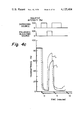
- FIGS. 4a, 4b, 4c, 4d and 4e of the drawing are diagrammatic representations of various processes for providing a dichroic, birefringent glass article in accordance with the invention.
- Each representation includes a graph of polarized bleaching light intensity, a graph of darkening ultraviolet light intensity, and a graph of the light transmittance of the glass, all as a function of treating time.
- Two components of transmittance are shown: transmittance with respect to light polarized parallel to the direction of the bleaching light (T 11 ), and transmittance with respect to light polarized perpendicularly thereto (T 1 ).
- the transmittance measurements are made at a wavelength of 533 nm.
- FIGS. 5a, 5b, 5c, 5d and 5e of the drawing are spectral transmittance curves of darkened photochromic glasses which illustrate the color adaptation resulting when colored polarized optical bleaching light is used to induce dichroism therein.
- Each figure consists of two spectral transmittance curves; one for light polarized parallel to the direction of polarization of the colored bleaching light (T D11 ) and one for light polarized in a direction perpendicular thereto (T D1 ).
- T D11 the direction of polarization of the colored bleaching light
- T D1 a direction perpendicular thereto
- Each figure illustrates the effect of a different bleaching color, with the wavelengths of the bleaching light being indicated by arrows in each case.
- the substantial differences in the shapes of the T D11 curves produce glasses exhibiting very different colors in the darkened state.
- FIG. 6 of the drawing illustrates the resistance to fatigue, upon repeated cycling from the clear to the darkened state, of the polarizing property of one dichroic, birefringent photochromic glass provided according to the invention.
- Each darkening and fading cycle indicated on the horizontal axis of the graph constituted darkening by exposure to direct sunlight followed by thermal fading at ambient temperatures in the absence thereof.
- the data plotted is with respect to Glass No. 5 described in Tables I and III below.
- the dichroic ratios indicated on the vertical axis of the graph were determined from parallel and perpendicular transmittance measurements taken after darkening the glass with an ultraviolet source.
- Factors tending to affect induced anisotropy and color adaptation include not only chemical changes and the heat treatment used to precipitate the silver halide phase, but also subsequent thermal or radiation treatments which may effect the structure of that phase.
- High energy irradiation is a process which can substantially alter both the anisotropy and the total photochromic behavior of the glass.
- a photochromic glass article exhibiting high polarization efficiency is facilitated if a powerful source in linearly-polarized bleaching light is used.
- sources of bleaching light which have been effectively employed are lasers, tungsten-halogen lamps, xenon and mercury arc lamps, and sunlight.
- Linear polarization of light from bleaching sources such as described may suitably be accomplished by plastic or crystal polarizing media or a Brewster angle pile of plates.
- a polarized laser source may be used.
- UV light which may be used to darken the photochromic glass prior to or during the bleaching treatment are sunlight and xenon and mercury arc lamps.
- coincident exposure of the photochromic glass to actinic radiation during the optical bleaching treatment is quite useful in extending the bleaching treatment to obtain high levels of anisotropy in the darkened glass.
- a wide variety of such optical treatments may be employed, including one such treatment wherein optical bleaching light is directed upon darkened photochromic glass, and the glass is then darkened by simultaneous exposure to actinic radiation to provide color centers for preferential bleaching by the bleaching light.
- the level of dichroism can be further enhanced in certain cases by varying the exposure to actinic and bleaching radiation with time.
- Particularly useful are processes wherein the undarkened glass is exposed to light comprising an intense bleaching component, which is gradually diminished in the course of treatment, and a weak actinic component, which is gradually intensified in the course of treatment.
- the variations in exposure to each component may involve light pulsations of increasing or decreasing duration, as in FIGS. 4d and 4e of the drawing, or continuous intensification or extinction as in FIG. 4a of the drawing. Examples of other types of processes which may be used are illustrated in FIGS. 4b and 4c of the drawing.
- Measurement of the dichroic effects produced in silver halide photochromic glass is typically accomplished utilizing a weak probing beam of light. Independent sensors are used to separately determine the transmittance of the glass with respect to light components polarized parallel to the direction of polarization of the bleaching light and light components polarized perpendicularly thereto.
- the transmittance of each component is conventionally defined as the ratio of the intensity of the transmitted light I to that of the incident light I o .
- transmittance is typically measured with respect to a representative light wavelength of 533 nm, although corresponding results are obtained by measuring white light transmittance.
- Polarization efficienty PE is defined as: ##EQU1## where T D11 is the transmittance of the darkened glass with respect to light polarized parallel to the direction of polarization of the bleaching light and T Dl is the transmittance of the darkened glass measured with respect to light polarized perpendicularly thereto.
- the polarization efficiency of a sample of photochromic glass depends not only on the inherent absorption characteristics of the glass, but also upon factors such as sample thickness and the level of induced darkening, both of which affect the absolute transmittance of the sample. Therefore we also record the dichroic ratio of the darkened glass, a measure of anisotropy which is more nearly independent of these factors.
- R dichroic ratio
- T o being the undarkened transmittance of the glass
- T D1 and T D11 being the transmittance of the darkened glass with respect to light polarized parallel and perpendicular to the direction of polarization of the bleaching light as hereinabove defined. This definition is particularly useful for comparing clear glasses exhibiting high undarkened transmittance values (T o ).
- photochromic glasses which may be rendered dichroic and birefringent in accordance with the invention are set forth in Table I below.
- the compositions of the glasses are reported in parts by weight on the oxide basis as calculated from the batch, except for silver and the halogens which are reported on an elemental basis in accordance with conventional practice. Also reported are melting temperatures suitble for melting each composition, and annealing temperatures useful for each glass.
- Glasses of the compositions shown in Table I may be provided in accordance with well known glass manufacturing techniques.
- Batches for the glass may be compounded from conventional glass batch constituents, including oxides or other compounds which are thermally decomposable to the specified oxides or elements at the temperatures utilized for melting the batch.
- the batches may be melted in pots, tanks, crucibles or other melting units at suitable temperatues and thereafter formed into glass articles by techniques such as pressing, rolling, drawing or spinning at viscosities suitable for these forming processes.
- Glasses such as shown in Table I may be, but usually are not, photochromic as formed and annealed. Thus they are typically subjected to a heat treatment subsequent to forming to promote the development of a silver halide crystal phase in the glass.
- This heat treatment is conventional and may comprise exposure of the glass to temperatures between the glass strain point and the glass softening point for a time sufficient to develop the desired photochromic properties in the glass, normally in the range of 1/4-16 hours.
- Glass No. 26 of the above table is an example of a photochromic glass which exhibits substantial darkening in response to short and intermediate wavelength visible light.
- Glass No. 28 contains no silver in its composition and is not photochromic as made. However silver may be introduced into the surface of this glass by immersing a 2 mm thick sample thereof in a molten salt bath consisting of 36% AgNO 3 and 64% NaNO 3 by weight at 280° C. for 8 hours. Thereafter, the silver-containing surface layer is rendered photochromic by heating the glass sample at 650° C. for 1 hour.
- Photochromic glass articles produced using the glass compositions and heat treatments shown in Table I may be treated to induce optical anisotropy in accordance with a variety of darkening and bleaching procedures.
- Many different sources of polarized bleaching light and, optionally, darkening radiation may be used, and the exposure of the glass to these light sources may vary considerbly as to both duration and intensity.
- Some examples of combinations of darkening and bleaching sources which may be used in a system such as shown in FIG. 3 of the drawing for the purpose of administering optical treatments such as illustrated in FIGS. 4a-4e of the drawing are set forth in Table II below.
- Table II Included in Table II are an identifying designation for each combination, a description of each darkening source; a description of each polarized bleaching source, including principal emitted wavelengths for each source; and an integrated beam power level for each laser bleaching beam, as calculated from the amount of light therefrom incident on the glass samples treated.
- the optical anisotropy induced utilizing light source combinations such as described in Table II above is conveniently measured by calculating the dichroic ratio and polarizing efficiency of each glass sample from the undarkened transmittance and the darkened parallel and perpendicular polarized light transmittances thereof.
- Table III below sets forth treating data pertaining to samples of the photochromic glasses shown in Table I, heat treated as therein described, which were subjected to optical treatments utilizing the light source combinations shown in Table II.
- Table III reports the number of the glass, as recorded in Table I, a designation for a light source combination utilized for the optical treatment, corresponding to the combination of the same designation shown in Table II, and the transmittance of the undarkened photochromic glass (T o ).
- the thickness of the glass samples utilized for the optical treatments was about 2 mm.
- the combination of darkening and bleaching exposure intervals constituting the optical treatment in each case was essentially that combination illustrated in FIG. 4d of the drawing.
- glass articles produced in accordance with the invention need not be phototropic and optically anisotropic throughout their entire volume, but instead may comprise only a surface layer or other selected volume portion exhibiting these properties. Also, selected portions of a glass article may be subjected to different optical treatments to provide a photochromic article exhibiting at least two and optionally several volume regions exhibiting different light-polarizing properties and/or different colors in the darkened state.
- glasses which indefinitely retain optically-induced dichroism or birefringence are also quite valuable, particularly for uses relating to information storage.
- some silver halide photochromic glasses exhibit very low thermal fade rates such that they will remain in the darkened state indefinitely in the absence of bleaching light. These glasses are commonly termed bistable photochromic glasses, since both the faded and darkened states are readily retained by the glass.
- the treatment of a bistable photochromic glass to provide a stable dichroic, birefringent product comprises a further important aspect of the present invention, since it permits the storage of information relating to the direction of polarization as well as the intensity of a bleaching light source.
Landscapes
- Physics & Mathematics (AREA)
- Chemical & Material Sciences (AREA)
- Materials Engineering (AREA)
- Chemical Kinetics & Catalysis (AREA)
- General Chemical & Material Sciences (AREA)
- Geochemistry & Mineralogy (AREA)
- Life Sciences & Earth Sciences (AREA)
- Organic Chemistry (AREA)
- Engineering & Computer Science (AREA)
- General Physics & Mathematics (AREA)
- Optics & Photonics (AREA)
- Glass Compositions (AREA)
- Surface Treatment Of Glass (AREA)
- Polarising Elements (AREA)
Priority Applications (6)
| Application Number | Priority Date | Filing Date | Title |
|---|---|---|---|
| US05/739,122 US4125404A (en) | 1976-11-05 | 1976-11-05 | Photochromic glasses exhibiting dichroism, birefringence and color adaptation |
| CA287,515A CA1107556A (en) | 1976-11-05 | 1977-09-26 | Photochromic glasses exhibiting dichroism, birefringence and color adaptation |
| DE19772747919 DE2747919A1 (de) | 1976-11-05 | 1977-10-26 | Photochrome glaeser mit dichroismus, doppelbrechung und farbanpassung |
| GB45744/77A GB1534839A (en) | 1976-11-05 | 1977-11-03 | Photochromic glasses exhibiting dichroism birefringence and colour adaptation |
| JP13240677A JPS5384015A (en) | 1976-11-05 | 1977-11-04 | Photochromic glass and production thereof |
| FR7733213A FR2370003A1 (fr) | 1976-11-05 | 1977-11-04 | Verres photochromiques a dichroisme, birefringence et adaptation de couleur |
Applications Claiming Priority (1)
| Application Number | Priority Date | Filing Date | Title |
|---|---|---|---|
| US05/739,122 US4125404A (en) | 1976-11-05 | 1976-11-05 | Photochromic glasses exhibiting dichroism, birefringence and color adaptation |
Publications (1)
| Publication Number | Publication Date |
|---|---|
| US4125404A true US4125404A (en) | 1978-11-14 |
Family
ID=24970919
Family Applications (1)
| Application Number | Title | Priority Date | Filing Date |
|---|---|---|---|
| US05/739,122 Expired - Lifetime US4125404A (en) | 1976-11-05 | 1976-11-05 | Photochromic glasses exhibiting dichroism, birefringence and color adaptation |
Country Status (6)
| Country | Link |
|---|---|
| US (1) | US4125404A (enExample) |
| JP (1) | JPS5384015A (enExample) |
| CA (1) | CA1107556A (enExample) |
| DE (1) | DE2747919A1 (enExample) |
| FR (1) | FR2370003A1 (enExample) |
| GB (1) | GB1534839A (enExample) |
Cited By (29)
| Publication number | Priority date | Publication date | Assignee | Title |
|---|---|---|---|---|
| US4239338A (en) * | 1979-10-22 | 1980-12-16 | Corning Glass Works | Silver halide optical information storage media |
| US4297417A (en) * | 1978-07-14 | 1981-10-27 | Corning Glass Works | Photosensitive colored glasses exhibiting alterable photo-anisotropic effects |
| US4486213A (en) * | 1982-09-29 | 1984-12-04 | Corning Glass Works | Drawing laminated polarizing glasses |
| US4840655A (en) * | 1988-02-26 | 1989-06-20 | Corning Glass Works | Method for making colored photochromic glasses |
| US4854957A (en) * | 1988-04-13 | 1989-08-08 | Corning Incorporated | Method for modifying coloration in tinted photochromic glasses |
| US5078771A (en) * | 1989-02-07 | 1992-01-07 | Canyon Materials, Inc. | Method of making high energy beam sensitive glasses |
| US5122907A (en) * | 1991-07-03 | 1992-06-16 | Polatomic, Inc. | Light polarizer and method of manufacture |
| US6524756B1 (en) | 1996-10-31 | 2003-02-25 | Canyon Materials, Inc. | Gray scale all-glass photomasks |
| US6563639B1 (en) | 2002-01-24 | 2003-05-13 | Corning Incorporated | Polarizing glasses |
| US6562523B1 (en) | 1996-10-31 | 2003-05-13 | Canyon Materials, Inc. | Direct write all-glass photomask blanks |
| US20030136152A1 (en) * | 2002-01-24 | 2003-07-24 | Borrelli Nicholas F. | Method of making polarizing glasses |
| US6606885B2 (en) | 2001-10-09 | 2003-08-19 | Corning Incorporated | Infrared, glass polarizer and method |
| US20040172974A1 (en) * | 2002-12-19 | 2004-09-09 | Naylor Amy J. | Polarizers and isolators and methods of manufacture |
| US20040198582A1 (en) * | 2003-04-01 | 2004-10-07 | Borrelli Nicholas F. | Optical elements and methods of making optical elements |
| US20070093374A1 (en) * | 2005-10-24 | 2007-04-26 | Corning Incorporated | Ultra-low noble metal doped polarizing glass and process |
| US20070123410A1 (en) * | 2005-11-30 | 2007-05-31 | Morena Robert M | Crystallization-free glass frit compositions and frits made therefrom for microreactor devices |
| US20070141350A1 (en) * | 2005-12-20 | 2007-06-21 | Borrelli Nicholas F | Visible light optical polarizer made from stretched H2-treated glass and method of making same |
| US20070153383A1 (en) * | 2005-12-30 | 2007-07-05 | Nicholas Francis Borrelli | Method for making a wide optical polarizer using extrusion |
| US7326500B1 (en) * | 2000-01-04 | 2008-02-05 | University Of Central Florida Research Foundation, Inc. | Sensitization of photo-thermo-refractive glass to visible radiation by two-step illumination |
| KR100814163B1 (ko) * | 2003-07-01 | 2008-03-14 | 트랜지션즈 옵티칼 인코포레이티드 | 편광 광변색 장치 및 이의 제조 방법 |
| US20080080585A1 (en) * | 2004-04-27 | 2008-04-03 | Glebov Leonid B | Volume bragg lasers based on high efficiency diffractive elements in photo-thermo-refractive glass |
| US20080254373A1 (en) * | 2007-04-13 | 2008-10-16 | Canyon Materials, Inc. | Method of making PDR and PBR glasses for holographic data storage and/or computer generated holograms |
| US20090056379A1 (en) * | 2003-04-01 | 2009-03-05 | Borrelli Nicholas F | Optical elements and methods of making optical elements |
| US20090190214A1 (en) * | 2008-01-29 | 2009-07-30 | Nicholas Francis Borrelli | Polarizing photorefractive glass |
| US20090190216A1 (en) * | 2008-01-29 | 2009-07-30 | Nicholas Francis Borrelli | Polarizing photorefractive glass |
| US8399155B1 (en) | 2000-01-04 | 2013-03-19 | University Of Central Florida Research Foundation, Inc. | Production of high efficiency diffractive and refractive optical elements in multicomponent glass by nonlinear photo-ionization followed by thermal development |
| US20130240803A1 (en) * | 2007-04-26 | 2013-09-19 | Pd-Ld, Inc. | Methods for improving performance of holographic glasses |
| US9682885B2 (en) | 2011-11-16 | 2017-06-20 | Corning Incorporated | Ion exchangeable glass with high crack initiation threshold |
| US20230065240A1 (en) * | 2021-08-25 | 2023-03-02 | The United States of America As Represented By The Director Of The National Geospatial-Intelligence | Method and apparatus for the display of volumetric solids using distributed photochromic compounds |
Families Citing this family (3)
| Publication number | Priority date | Publication date | Assignee | Title |
|---|---|---|---|---|
| GB2219098A (en) * | 1988-05-25 | 1989-11-29 | Plessey Co Plc | Optically anisotropic materials and applications |
| EP0518019A1 (en) * | 1991-06-13 | 1992-12-16 | Corning Incorporated | Birefringent glass waveplate |
| DE10309495B4 (de) | 2003-02-25 | 2006-02-16 | Schott Ag | Aluminosilikatglas und dessen Verwendung |
Citations (6)
| Publication number | Priority date | Publication date | Assignee | Title |
|---|---|---|---|---|
| US3208860A (en) * | 1962-07-31 | 1965-09-28 | Corning Glass Works | Phototropic material and article made therefrom |
| US3540793A (en) * | 1968-07-03 | 1970-11-17 | Corning Glass Works | Photochromic polarizing glasses |
| US3734754A (en) * | 1970-08-19 | 1973-05-22 | Corning Glass Works | Thermally darkening photochromic glass |
| US3920463A (en) * | 1974-02-01 | 1975-11-18 | Robert A Simms | Process for changing the tint of a photochromic material and material formed thereby |
| US4017318A (en) * | 1976-01-02 | 1977-04-12 | Corning Glass Works | Photosensitive colored glasses |
| US4075024A (en) * | 1976-08-19 | 1978-02-21 | Corning Glass Works | Colored glasses and method |
Family Cites Families (1)
| Publication number | Priority date | Publication date | Assignee | Title |
|---|---|---|---|---|
| US3653863A (en) * | 1968-07-03 | 1972-04-04 | Corning Glass Works | Method of forming photochromic polarizing glasses |
-
1976
- 1976-11-05 US US05/739,122 patent/US4125404A/en not_active Expired - Lifetime
-
1977
- 1977-09-26 CA CA287,515A patent/CA1107556A/en not_active Expired
- 1977-10-26 DE DE19772747919 patent/DE2747919A1/de not_active Withdrawn
- 1977-11-03 GB GB45744/77A patent/GB1534839A/en not_active Expired
- 1977-11-04 JP JP13240677A patent/JPS5384015A/ja active Granted
- 1977-11-04 FR FR7733213A patent/FR2370003A1/fr active Granted
Patent Citations (6)
| Publication number | Priority date | Publication date | Assignee | Title |
|---|---|---|---|---|
| US3208860A (en) * | 1962-07-31 | 1965-09-28 | Corning Glass Works | Phototropic material and article made therefrom |
| US3540793A (en) * | 1968-07-03 | 1970-11-17 | Corning Glass Works | Photochromic polarizing glasses |
| US3734754A (en) * | 1970-08-19 | 1973-05-22 | Corning Glass Works | Thermally darkening photochromic glass |
| US3920463A (en) * | 1974-02-01 | 1975-11-18 | Robert A Simms | Process for changing the tint of a photochromic material and material formed thereby |
| US4017318A (en) * | 1976-01-02 | 1977-04-12 | Corning Glass Works | Photosensitive colored glasses |
| US4075024A (en) * | 1976-08-19 | 1978-02-21 | Corning Glass Works | Colored glasses and method |
Cited By (54)
| Publication number | Priority date | Publication date | Assignee | Title |
|---|---|---|---|---|
| US4297417A (en) * | 1978-07-14 | 1981-10-27 | Corning Glass Works | Photosensitive colored glasses exhibiting alterable photo-anisotropic effects |
| US4239338A (en) * | 1979-10-22 | 1980-12-16 | Corning Glass Works | Silver halide optical information storage media |
| US4486213A (en) * | 1982-09-29 | 1984-12-04 | Corning Glass Works | Drawing laminated polarizing glasses |
| US4840655A (en) * | 1988-02-26 | 1989-06-20 | Corning Glass Works | Method for making colored photochromic glasses |
| US4854957A (en) * | 1988-04-13 | 1989-08-08 | Corning Incorporated | Method for modifying coloration in tinted photochromic glasses |
| US5078771A (en) * | 1989-02-07 | 1992-01-07 | Canyon Materials, Inc. | Method of making high energy beam sensitive glasses |
| US5122907A (en) * | 1991-07-03 | 1992-06-16 | Polatomic, Inc. | Light polarizer and method of manufacture |
| US6524756B1 (en) | 1996-10-31 | 2003-02-25 | Canyon Materials, Inc. | Gray scale all-glass photomasks |
| US20050053844A1 (en) * | 1996-10-31 | 2005-03-10 | Canyon Materials, Inc. | Gray scale all-glass photomasks |
| US6562523B1 (en) | 1996-10-31 | 2003-05-13 | Canyon Materials, Inc. | Direct write all-glass photomask blanks |
| US8399155B1 (en) | 2000-01-04 | 2013-03-19 | University Of Central Florida Research Foundation, Inc. | Production of high efficiency diffractive and refractive optical elements in multicomponent glass by nonlinear photo-ionization followed by thermal development |
| US7326500B1 (en) * | 2000-01-04 | 2008-02-05 | University Of Central Florida Research Foundation, Inc. | Sensitization of photo-thermo-refractive glass to visible radiation by two-step illumination |
| US6606885B2 (en) | 2001-10-09 | 2003-08-19 | Corning Incorporated | Infrared, glass polarizer and method |
| US6775062B2 (en) | 2002-01-24 | 2004-08-10 | Corning Incorporated | Polarizing glasses |
| US7104090B2 (en) | 2002-01-24 | 2006-09-12 | Corning Incorporated | Method of making polarizing glasses |
| US20060247117A1 (en) * | 2002-01-24 | 2006-11-02 | Borrelli Nicholas F | Method of making polarizing glasses |
| US20030136152A1 (en) * | 2002-01-24 | 2003-07-24 | Borrelli Nicholas F. | Method of making polarizing glasses |
| US6563639B1 (en) | 2002-01-24 | 2003-05-13 | Corning Incorporated | Polarizing glasses |
| US20040172974A1 (en) * | 2002-12-19 | 2004-09-09 | Naylor Amy J. | Polarizers and isolators and methods of manufacture |
| US20060039071A1 (en) * | 2002-12-19 | 2006-02-23 | Naylor Amy J | Polarizers and isolators and methods of manufacture |
| US7110179B2 (en) | 2002-12-19 | 2006-09-19 | Corning Incorporated | Polarizers and isolators and methods of manufacture |
| US7230760B2 (en) | 2002-12-19 | 2007-06-12 | Corning Incorporated | Polarizers and isolators and methods of manufacture |
| US20040198582A1 (en) * | 2003-04-01 | 2004-10-07 | Borrelli Nicholas F. | Optical elements and methods of making optical elements |
| US20090056379A1 (en) * | 2003-04-01 | 2009-03-05 | Borrelli Nicholas F | Optical elements and methods of making optical elements |
| KR100814163B1 (ko) * | 2003-07-01 | 2008-03-14 | 트랜지션즈 옵티칼 인코포레이티드 | 편광 광변색 장치 및 이의 제조 방법 |
| US20080080585A1 (en) * | 2004-04-27 | 2008-04-03 | Glebov Leonid B | Volume bragg lasers based on high efficiency diffractive elements in photo-thermo-refractive glass |
| US7609743B2 (en) | 2004-04-27 | 2009-10-27 | University Of Central Florida Research Foundation, Inc. | Volume Bragg lasers based on high efficiency diffractive elements in photo-thermo-refractive glass |
| US7648656B2 (en) | 2005-10-24 | 2010-01-19 | Corning Incorporated | Process of making a visible polarizing glass |
| US20070093374A1 (en) * | 2005-10-24 | 2007-04-26 | Corning Incorporated | Ultra-low noble metal doped polarizing glass and process |
| US7468148B2 (en) | 2005-10-24 | 2008-12-23 | Corning Incorporated | Visible polarizing glass and process |
| US20070093373A1 (en) * | 2005-10-24 | 2007-04-26 | Borrelli Nicholas F | Visible polarizing glass and process |
| US7510989B2 (en) | 2005-10-24 | 2009-03-31 | Corning Incorporated | Ultra-low noble metal doped polarizing glass and process |
| US20090084137A1 (en) * | 2005-10-24 | 2009-04-02 | Nicholas Francis Borrelli | Visible polarizing glass and process |
| US8252708B2 (en) | 2005-11-30 | 2012-08-28 | Corning Incorporated | Crystallization-free glass frit compositions and frits made therefrom for microreactor devices |
| US20070123410A1 (en) * | 2005-11-30 | 2007-05-31 | Morena Robert M | Crystallization-free glass frit compositions and frits made therefrom for microreactor devices |
| US20100120603A1 (en) * | 2005-11-30 | 2010-05-13 | Corning Incorporated | Crystallization-free glass frit compositions and frits made therefrom for microreactor devices |
| US20070141350A1 (en) * | 2005-12-20 | 2007-06-21 | Borrelli Nicholas F | Visible light optical polarizer made from stretched H2-treated glass and method of making same |
| DE102006059756B4 (de) * | 2005-12-20 | 2017-12-07 | Corning Inc. | Optischer Polarisator für sichtbares Licht, hergestellt aus gestrecktem, H2-behandeltem Glas und Verfahren zur Herstellung desselben |
| US7618908B2 (en) | 2005-12-20 | 2009-11-17 | Corning Incorporated | Visible light optical polarizer made from stretched H2-treated glass |
| US20070153383A1 (en) * | 2005-12-30 | 2007-07-05 | Nicholas Francis Borrelli | Method for making a wide optical polarizer using extrusion |
| US20080254373A1 (en) * | 2007-04-13 | 2008-10-16 | Canyon Materials, Inc. | Method of making PDR and PBR glasses for holographic data storage and/or computer generated holograms |
| US9120696B2 (en) * | 2007-04-26 | 2015-09-01 | Pd-Ld, Inc. | Methods for improving performance of holographic glasses |
| US20130240803A1 (en) * | 2007-04-26 | 2013-09-19 | Pd-Ld, Inc. | Methods for improving performance of holographic glasses |
| US20090190214A1 (en) * | 2008-01-29 | 2009-07-30 | Nicholas Francis Borrelli | Polarizing photorefractive glass |
| US8534095B2 (en) | 2008-01-29 | 2013-09-17 | Corning Incorporated | Polarizing photorefractive glass |
| US8179595B2 (en) | 2008-01-29 | 2012-05-15 | Corning Incorporated | Polarizing photorefractive glass |
| WO2009097097A1 (en) | 2008-01-29 | 2009-08-06 | Corning Incorporated | Polarizing photoreactive glass |
| US20090190216A1 (en) * | 2008-01-29 | 2009-07-30 | Nicholas Francis Borrelli | Polarizing photorefractive glass |
| US9682885B2 (en) | 2011-11-16 | 2017-06-20 | Corning Incorporated | Ion exchangeable glass with high crack initiation threshold |
| US9783453B2 (en) | 2011-11-16 | 2017-10-10 | Corning Incorporated | Ion exchangeable glass with high crack initiation threshold |
| US10562806B2 (en) | 2011-11-16 | 2020-02-18 | Corning Incorporated | Ion exchangeable glass with high crack initiation threshold |
| US11724958B2 (en) | 2011-11-16 | 2023-08-15 | Corning Incorporated | Ion exchangeable glass with high crack initiation threshold |
| US12378153B2 (en) | 2011-11-16 | 2025-08-05 | Corning Incorporated | Ion exchangeable glass with high crack initiation threshold |
| US20230065240A1 (en) * | 2021-08-25 | 2023-03-02 | The United States of America As Represented By The Director Of The National Geospatial-Intelligence | Method and apparatus for the display of volumetric solids using distributed photochromic compounds |
Also Published As
| Publication number | Publication date |
|---|---|
| JPS6114092B2 (enExample) | 1986-04-17 |
| DE2747919A1 (de) | 1978-05-11 |
| GB1534839A (en) | 1978-12-06 |
| CA1107556A (en) | 1981-08-25 |
| FR2370003B1 (enExample) | 1984-07-13 |
| FR2370003A1 (fr) | 1978-06-02 |
| JPS5384015A (en) | 1978-07-25 |
Similar Documents
| Publication | Publication Date | Title |
|---|---|---|
| US4125404A (en) | Photochromic glasses exhibiting dichroism, birefringence and color adaptation | |
| CA1107555A (en) | Colored dichroic, birefringent glass articles produced by optical alteration of additively-colored glasses containing silver and silver halides | |
| US4304584A (en) | Method for making polarizing glasses by extrusion | |
| JP2780082B2 (ja) | 眼鏡用レンズおよびその製造方法 | |
| US3653863A (en) | Method of forming photochromic polarizing glasses | |
| US5517356A (en) | Glass polarizer for visible light | |
| KR100687223B1 (ko) | 자외선 편광자의 제조방법 | |
| US4832724A (en) | Method of making colored photochromic glasses | |
| US4297417A (en) | Photosensitive colored glasses exhibiting alterable photo-anisotropic effects | |
| DE1932513A1 (de) | Photochromatisches Polarisationsglas | |
| JPS6278127A (ja) | フオトクロミツクガラス | |
| EP0007218A1 (en) | Photosensitive coloured glasses exhibiting alterable photo-anisotropic effects, production and use thereof | |
| Nadeau | Hardening of Potassium Chloride by Color Centers | |
| US4854957A (en) | Method for modifying coloration in tinted photochromic glasses | |
| Borrelli et al. | Optically induced anisotropy in photochromic glasses | |
| US4017292A (en) | Process for making multifocal photochromic ophthalmic lens | |
| KR20000057384A (ko) | 광대역 콘트라스트 편광 유리 | |
| US20090190214A1 (en) | Polarizing photorefractive glass | |
| US5491117A (en) | Optical filter glasses | |
| US4979976A (en) | Making colored photochromic glasses | |
| US5422745A (en) | Preparation of permanent photowritten optical diffraction gratings in irradiated glasses | |
| US4840655A (en) | Method for making colored photochromic glasses | |
| DE3150201A1 (de) | Verfahren zum herstellen von polarisiertem brillenglas | |
| US4076544A (en) | Copper-cadmium-silver photochromic glass | |
| Borrelli et al. | Photoinduced optical anisotropy and color adaptation in silver‐containing glasses |