US4063807A - Perimetric eye testing device - Google Patents
Perimetric eye testing device Download PDFInfo
- Publication number
- US4063807A US4063807A US05/659,787 US65978776A US4063807A US 4063807 A US4063807 A US 4063807A US 65978776 A US65978776 A US 65978776A US 4063807 A US4063807 A US 4063807A
- Authority
- US
- United States
- Prior art keywords
- light
- emitting diodes
- perimetric
- examination device
- eye examination
- Prior art date
- Legal status (The legal status is an assumption and is not a legal conclusion. Google has not performed a legal analysis and makes no representation as to the accuracy of the status listed.)
- Expired - Lifetime
Links
- 239000003086 colorant Substances 0.000 claims description 5
- 230000000694 effects Effects 0.000 claims 1
- 238000003079 width control Methods 0.000 claims 1
- 230000001419 dependent effect Effects 0.000 description 4
- 238000010586 diagram Methods 0.000 description 4
- 230000004456 color vision Effects 0.000 description 3
- 230000004438 eyesight Effects 0.000 description 3
- 238000001208 nuclear magnetic resonance pulse sequence Methods 0.000 description 3
- 206010034960 Photophobia Diseases 0.000 description 2
- 235000019642 color hue Nutrition 0.000 description 2
- 208000013469 light sensitivity Diseases 0.000 description 2
- 238000012986 modification Methods 0.000 description 2
- 230000004048 modification Effects 0.000 description 2
- 229910052754 neon Inorganic materials 0.000 description 2
- GKAOGPIIYCISHV-UHFFFAOYSA-N neon atom Chemical compound [Ne] GKAOGPIIYCISHV-UHFFFAOYSA-N 0.000 description 2
- 230000008447 perception Effects 0.000 description 2
- 230000007423 decrease Effects 0.000 description 1
- 210000003128 head Anatomy 0.000 description 1
- 238000005259 measurement Methods 0.000 description 1
- 238000000034 method Methods 0.000 description 1
- 230000010355 oscillation Effects 0.000 description 1
Images

Classifications
-
- A—HUMAN NECESSITIES
- A61—MEDICAL OR VETERINARY SCIENCE; HYGIENE
- A61B—DIAGNOSIS; SURGERY; IDENTIFICATION
- A61B3/00—Apparatus for testing the eyes; Instruments for examining the eyes
- A61B3/02—Subjective types, i.e. testing apparatus requiring the active assistance of the patient
- A61B3/024—Subjective types, i.e. testing apparatus requiring the active assistance of the patient for determining the visual field, e.g. perimeter types
-
- A—HUMAN NECESSITIES
- A61—MEDICAL OR VETERINARY SCIENCE; HYGIENE
- A61B—DIAGNOSIS; SURGERY; IDENTIFICATION
- A61B3/00—Apparatus for testing the eyes; Instruments for examining the eyes
- A61B3/02—Subjective types, i.e. testing apparatus requiring the active assistance of the patient
- A61B3/06—Subjective types, i.e. testing apparatus requiring the active assistance of the patient for testing light sensitivity, e.g. adaptation; for testing colour vision
- A61B3/066—Subjective types, i.e. testing apparatus requiring the active assistance of the patient for testing light sensitivity, e.g. adaptation; for testing colour vision for testing colour vision
Definitions
- the present invention relates to a perimetric eye examination device of the type having a viewing area, preferably in the form of a hemispherical inner surface, with a fixation point and a number of light sources of small surface area disposed in the viewing area, in which the light sources may be of a specified type wherein the brightness of the light source or groups of light sources can be accurately controlled.
- Perimetric eye testing devices having a hemispherical inner surface with groups of light sources have been described, such as in German patents No. 1,202,024 and No. 1,229,753, as well as U.S. Pat. No. 3,025,755.
- incandescent lamps or neon lamps serve for the light sources.
- incandescent lamps can be varied with regard to their luminous intensity by voltage changes, the color composition thereof is also varied, i.e. the color temperature of the emitted light is changed.
- the characteristics of an incandescent lamp is changed with its burning period.
- the luminous density or luminosity which designates the brightness of a light source, such as an incandescent lamp, adjustable in a simple manner by linearly varying the electric power supplied thereto, and include a constant characteristic over a long period of time.
- Neon lamps are basically uncontrollable in their luminous density because of their physical mode of operation.
- the luminous density or brightness of light-emitting diodes are linearly dependent on the current supplied, thereby being controllable in a simple manner. Moreover, during a variation of a luminous density by a variation of the current supplied to the light-emitting diodes, the color temperature remains practically constant at least within a given range. This characteristic remains constant even after a long operating time of the light-emitting diodes.
- the eye examination device of this invention equipped with light-emitting diodes, permits a control of the luminous density or brightness of each light source in a technically simple manner by controlling the electric current supplied to the light-emitting diodes. It is possible, for example, to provide a simple adjustable electric resistor in series with the light-emitting diodes to control the brightness of the light-emitting diodes. Complex control circuits for maintaining the brightness at a constant value which are required with the use of incandescent lamps, such as in the previously known devices, are no longer necessary.
- a further object of the present invention involves the adjusting of the brightness of the light-emitting diodes according to their distribution over the viewing area in the eye examination device.
- This variation of the brightness of the light-emitting diodes according to their distribution can be carried out independently of the variability of the brightness of individual light sources during the course of a series of examination.
- this distribution of brightness of the light-emitting diode sources over the observation area is carried out in accordance with the physiological characteristics of the human eye wherein an observer perceives light sources centrally in the field of vision at a greater brightness than toward the periphery of the field of vision.
- the light sensitivity of the human eye decreases from the center toward the periphery of the field of vision such that light sources closer to the center are more readily recognizable even when compared to equally bright light sources along the periphery.
- the present invention achieves this object by providing the light-emitting diode sources in a distribution wherein the brightness increases from the center of the observation area toward the outside in correspondence with the light sensitivity characteristics of the human eye.
- light sources at the periphery of the observation area are as recognizable by the eye as those close to the center so that examinations may render the physiological factors inoperative.
- Another object of the present invention is the utilization of a single light-emitting diode as the fixation point for the eye to be tested.
- the present invention further contemplates the ability to execute certain color vision examinations within the scope of the perimetric examination which can be carried out with the device of this invention.
- several light-emitting diodes can emit light of different colors.
- a still further object of the present invention exists in the utilization of current pulses supplied to the light-emitting diodes in order to control the luminous density or brightness.
- This object is achieved through the characteristics of light-emitting diodes in that the response time is extremely short so that flash-like representations of the light sources can be effected with preciseness.
- rectangular current pulses can be applied to the light-emitting diodes at uniform amplitude and with a pulse repetition frequency greater than the flicker frequency, i. e. the frequency at which the human eye no longer recognizes successive pulses, but perceives a continuous impression of light, corresponding to the chronological median value of the light pulses.
- This aspect of the present invention is important, especially when utilizing the light-emitting diodes in the portions of their characteristic curves wherein a non-linear dependency occurs between the luminous density and the current. This especially occurs at the end regions of the luminosity verses current curves, and involves changes in the color hues.
- Such non-linear dependency results in difficulties in the setting of predetermined luminous density values for examinations which are to be qualitativity repeated and compared with one another.
- changes in the color hue leads to an undesirable shift of the measurement into a corresponding color vision field.
- this object of the present invention provides an electronically simple adjustment of light-emitting diodes used for the light sources of a perimetric eye examination device, in which the physiological brightness impression emanating from the light-emitting diode can be adjusted linearly dependent upon electrical values which may be varied without difficulty.
- the brightness perception of the light-emitting diodes is controlled by the application of the current pulses of uniform amplitude and at a pulse repetition frequency above the flicker frequency, as indicated above, by varying the pulse width repetition ratio, i.e. the pulse width to the time period in which the pulse is repeated.
- the pulses of current supplied to the light-emitting diode can be produced by an electronic pulse generator, which is controlled with respect to the pulse width and/or frequency.
- This aspect of the present invention is derived from the fact that perception of the brightness of light may be varied by a corresponding variation of the pulsing control even though the amplitude of the current supplied to the diode, and consequently the luminous color of the light emitted by the diode, remain unchanged. This occurs when the frequency of the pulses is greater than the flicker frequency, about 50 hertz since the brightness impression sensed by the eye is linearly dependent on the pulse width repetition ratio, i.e. the ratio of the pulse width to the pulse repetition time in the pulse sequence of the supply current.
- the technical possibility is afforded of producing pulse widths of 1 microsecond with a sufficiently ideal rectangular shape, which permits a change in the brightness impression strictly proportional to the pulse width repetition ratio of the supply current, such as in a ratio of 1 to 5 ⁇ 10 4 without the occurrence of color changes.
- FIG. 1 shows a perspective view of the perimetric eye-testing device in which the present invention is utilized
- FIG. 2 shows a light-emitting diode appearing in the observation area of the device of FIG. 1 on an enlarged scale
- FIG. 3 shows a simple electrical circuit for controlling the luminous density of a light-emitting diode in accordance with the principles of the present invention
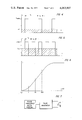
- FIG. 4 shows a diagram useful in the understanding of the present invention wherein a number of light pulses are illustrated in dependence on the time;
- FIG. 5 shows a similar diagram of FIG. 4, but with a different pulse sequence and pulse width repetition ratio
- FIG. 6 is a diagram showing the luminous density or brightness of a light-emitting diode in dependence on the current.
- FIG. 7 shows a circuit diagram useful in supplying current pulses to a light-emitting diode.
- FIG. 1 illustrates a perimetric eye-testing device 1 in which a plurality of light-emitting diodes 3 is arranged in the hemispherical observation area 2 in accordance with the principles of the present invention.
- the perimetric eye-testing device 1 is provided with a headrest 5 located in front of the observation area 2.
- a fixation point 4 is located in front of the headrest 5 such that an observer, or person whose eyes are to be examined, can maintain his head in the headrest 5 and his eyes fixed on the fixation point 4 during the examination.
- the fixation point 4 may be constituted by a light-emitting diode.
- the light-emitting diodes 3 may be inserted into apertures 7 of the hemispherical shell 6, the inner surface of which forms the observation area 2.
- the light-emitting diode 3 is illustrated in FIG. 2 as projecting into the aperture 7 to provide a light source surface at the inner side of the hemispherical shell 6.
- a plurality of these light-emitting diodes are distributed throughout the surface of the hemispherical shell 6 to constitute the observation area 2 useful for the perimetric examinations.
- Each of the light-emitting diodes 3 may be controlled in a simple manner, such as with the use of a potentiometer circuit 8, as illustrated in FIG. 3. This control of the electric current supplied to the light-emitting diode 3 provides a control of the luminous density or brightness of the diode 3 in linear dependence of the current.
- This control of the brightness of the diode 3 may be effected on an individual basis in accordance with the potentiometer 8 in FIG. 3 for each of the respective diodes located on the surface of the observation area 2. Furthermore, the distribution of the light-emitting diodes 3 in the observation area 2 from the fixation point 4 outwardly towards the periphery of the observation area may be made in such a manner that the brightness of the respective diodes is increased from the fixation point 4, or central area of the observation area, toward the outer periphery of the observation area. By this means, the physiological characteristic of the human eye in discerning light sources directly ahead, or centrally located in the observation area, better than those along the periphery of the observation area, or field of view, may be compensated.
- color vision examinations can be carried out within the scope of the perimeter according to the present invention by the use of several light-emitting diodes that emit different colored light. This difference in the color emitted may be achieved by the use of different light-emitting diodes, by variation of the current within certain limits of similar light-emitting diodes, and/or by the use of multi-layer light-emitting diodes which emit light of differing colors according to the supplying of electric current to the different layers.
- the current supplied to the diode may be in the form of current pulses.
- the luminous density L or brightness of a light-emitting diode occurs as a pulse in accordance with the current pulses.
- a number of luminous pulses of the same height occur with a pulse sequence, or period, of t 2 in accordance with corresponding current pulses of uniform amplitude.
- the time t 2 is shorter than the reciprocal value of the flicker frequency limit, i.e. the frequency at which the human eye can no longer perceive the pulses in an oscillation process.
- the individual luminous pulses thereby result in an average physiologically effective brightness impression L m of a constant value.
- This aspect of the present invention can be achieved in a simple electronic circuit, such as by the provision of a conventional pulse generator which is controllable with respect to the pulse width and/or frequency.
- the brightness impression sensed by the eye is linearly dependent on the pulse width repetition ratio regardless of the dependency of the luminous density L of a light-emitting diode on the current flowing therethrough, as illustrated in FIG. 6. Therefore, even where the luminous density of a diode does not depend on the current in a linear manner, the average brightness impression which is perceived by the observer may be varied linearly by controlling the pulse width repetition ratio.
Landscapes
- Life Sciences & Earth Sciences (AREA)
- Health & Medical Sciences (AREA)
- Medical Informatics (AREA)
- Biophysics (AREA)
- Ophthalmology & Optometry (AREA)
- Engineering & Computer Science (AREA)
- Biomedical Technology (AREA)
- Heart & Thoracic Surgery (AREA)
- Physics & Mathematics (AREA)
- Molecular Biology (AREA)
- Surgery (AREA)
- Animal Behavior & Ethology (AREA)
- General Health & Medical Sciences (AREA)
- Public Health (AREA)
- Veterinary Medicine (AREA)
- Led Devices (AREA)
- Eye Examination Apparatus (AREA)
Applications Claiming Priority (4)
| Application Number | Priority Date | Filing Date | Title |
|---|---|---|---|
| DE19752507723 DE2507723C3 (de) | 1975-02-22 | Perimetrisches Augenuntersuchungsgerät | |
| DT2507723 | 1975-02-22 | ||
| DE19752552839 DE2552839C3 (de) | 1975-11-25 | 1975-11-25 | Perimetrisches Augenuntersuchungsgerät |
| DT2552839 | 1975-11-25 |
Publications (1)
| Publication Number | Publication Date |
|---|---|
| US4063807A true US4063807A (en) | 1977-12-20 |
Family
ID=25768539
Family Applications (1)
| Application Number | Title | Priority Date | Filing Date |
|---|---|---|---|
| US05/659,787 Expired - Lifetime US4063807A (en) | 1975-02-22 | 1976-02-20 | Perimetric eye testing device |
Country Status (5)
| Country | Link |
|---|---|
| US (1) | US4063807A (enExample) |
| DD (1) | DD122779A1 (enExample) |
| FR (1) | FR2301215A1 (enExample) |
| GB (1) | GB1529016A (enExample) |
| IT (1) | IT1053342B (enExample) |
Cited By (21)
| Publication number | Priority date | Publication date | Assignee | Title |
|---|---|---|---|---|
| US4169664A (en) * | 1977-11-30 | 1979-10-02 | Synemed, Inc. | Apparatus for determining peripheral vision |
| US4274716A (en) * | 1979-07-05 | 1981-06-23 | Gammon James A | Ocular fixation device |
| US4346968A (en) * | 1980-02-04 | 1982-08-31 | Pacific Innovations | Wall mounted visual field testing system |
| US4421393A (en) * | 1981-04-27 | 1983-12-20 | The United States Of America As Represented By The Secretary Of The Navy | Visual field perimeter and psychomotor tracking performance measuring apparatus |
| US4558933A (en) * | 1983-05-31 | 1985-12-17 | Bausch & Lomb Incorporated | Method and apparatus for uniform background in visual field testing devices |
| US4634243A (en) * | 1984-12-26 | 1987-01-06 | Lkc Systems, Inc. | Glaucoma detection utilizing pattern discrimination test |
| US5299053A (en) * | 1990-10-26 | 1994-03-29 | American Cyanamid Company | Variable shutter illumination system for microscope |
| US5646710A (en) * | 1996-01-03 | 1997-07-08 | Caskey; Patrick | Ophthalmological self-test unit for evaluating macular degeneration |
| US5838422A (en) * | 1996-01-03 | 1998-11-17 | Caskey; Patrick J. | Ophthalmological self-test unit for evaluating macular degeneration |
| US5870169A (en) * | 1996-06-24 | 1999-02-09 | Oculus Optikgeraete Gmbh | Human eye visual field testing device |
| EP0993237A3 (en) * | 1998-10-05 | 2001-01-03 | Matsushita Electric Industrial Co., Ltd. | Light irradiation method |
| US6371931B1 (en) * | 1998-04-15 | 2002-04-16 | Diego Guillen | Reflex tester and method for measurement of range of motion and peripheral vision |
| US20060195018A1 (en) * | 2005-02-25 | 2006-08-31 | Diego Guillen | Reflex tester and method for measurement |
| US20090251067A1 (en) * | 2008-04-02 | 2009-10-08 | Johnson Paul K | Pulsed led illumination to save energy |
| US20100290006A1 (en) * | 2007-07-17 | 2010-11-18 | John Flanagan | Method and device for assessing the field of vision |
| USD709199S1 (en) * | 2010-12-17 | 2014-07-15 | Kowa Company, Ltd | Perimeter |
| WO2014172625A1 (en) * | 2013-04-18 | 2014-10-23 | The Board Of Trustees Of The University Of Illinois | Pattern stimulus for visual function testing |
| USD900823S1 (en) * | 2018-03-16 | 2020-11-03 | REBIScan, Inc. | Ophthalmic neural scanner |
| US20210244277A1 (en) * | 2019-12-06 | 2021-08-12 | Johnson & Johnson Vision Care, Inc. | Spectrally adjustable optical photosensitivity analyzer and uses thereof |
| US11160447B2 (en) * | 2015-08-24 | 2021-11-02 | The Board Of Trustees Of The University Of Illinois | Pixelated, full-field multi-protocol stimulus source apparatus, method and system for probing visual pathway function |
| RU231439U1 (ru) * | 2024-03-25 | 2025-01-28 | Фёдор Дмитриевич Яроцкий | Устройство для последовательного контроля критической частоты слияния мельканий и критической частоты различения мельканий с фиксацией времени реакции испытуемого на изменение частоты мелькания световых импульсов |
Families Citing this family (10)
| Publication number | Priority date | Publication date | Assignee | Title |
|---|---|---|---|---|
| DE2930383C2 (de) * | 1979-07-26 | 1983-01-20 | Optische Werke G. Rodenstock, 8000 München | Leuchtdiodenanordnung |
| DE2930405C2 (de) * | 1979-07-26 | 1982-09-23 | Optische Werke G. Rodenstock, 8000 München | Stimulus-Leuchte für augenoptische Untersuchungsgertäte |
| FR2520604A1 (fr) * | 1982-01-29 | 1983-08-05 | Essilor Int | Dispositif pour la detection de dyschromatopsies, par comparaison d'une teinte de reference et d'une teinte synthetisee par addition de primaires en rapport dose |
| FR2532170A1 (fr) * | 1982-08-27 | 1984-03-02 | Essilor Int | Appareil de depistage des defauts de la vue et cassette pour le service d'un tel appareil |
| GB2132378B (en) * | 1982-11-19 | 1986-05-21 | Gwyndann Group | Illumination of optical instruments |
| DE3579947D1 (de) * | 1984-06-05 | 1990-11-08 | Univ Glasgow | Verfahren und geraet zur sehfeldbestimmung. |
| JPS61288824A (ja) * | 1985-06-18 | 1986-12-19 | 株式会社トプコン | 眼科器械用固視装置 |
| GB2264366A (en) * | 1992-02-20 | 1993-08-25 | Erkan Mutlukan | Perimetry device for examining the central visual field |
| RU2192816C2 (ru) * | 1999-04-15 | 2002-11-20 | ГУ МНТК "Микрохирургия глаза" | Устройство для тренировки мышц глаза |
| WO2004086961A1 (de) * | 2003-04-04 | 2004-10-14 | Werner Reis | Vorrichtung zur untersuchung der farbsinntüchtigkeit |
Citations (2)
| Publication number | Priority date | Publication date | Assignee | Title |
|---|---|---|---|---|
| US3421498A (en) * | 1963-06-25 | 1969-01-14 | Jerome A Gans | Visual field tester |
| US3837734A (en) * | 1972-02-02 | 1974-09-24 | Wilkinson Sword Ltd | Method of and apparatus for measuring visual latency |
-
1976
- 1976-01-19 IT IT7647693A patent/IT1053342B/it active
- 1976-01-26 FR FR7601960A patent/FR2301215A1/fr active Granted
- 1976-02-17 DD DD191278A patent/DD122779A1/xx unknown
- 1976-02-20 GB GB6824/76A patent/GB1529016A/en not_active Expired
- 1976-02-20 US US05/659,787 patent/US4063807A/en not_active Expired - Lifetime
Patent Citations (2)
| Publication number | Priority date | Publication date | Assignee | Title |
|---|---|---|---|---|
| US3421498A (en) * | 1963-06-25 | 1969-01-14 | Jerome A Gans | Visual field tester |
| US3837734A (en) * | 1972-02-02 | 1974-09-24 | Wilkinson Sword Ltd | Method of and apparatus for measuring visual latency |
Non-Patent Citations (1)
| Title |
|---|
| Theodore E. Cohen et al., "The Drodewand . . . Perimetry," Am. J. Optom & Physiol Optics, vol. 51, No. 12, Dec. 1974. * |
Cited By (27)
| Publication number | Priority date | Publication date | Assignee | Title |
|---|---|---|---|---|
| US4169664A (en) * | 1977-11-30 | 1979-10-02 | Synemed, Inc. | Apparatus for determining peripheral vision |
| US4274716A (en) * | 1979-07-05 | 1981-06-23 | Gammon James A | Ocular fixation device |
| US4346968A (en) * | 1980-02-04 | 1982-08-31 | Pacific Innovations | Wall mounted visual field testing system |
| US4421393A (en) * | 1981-04-27 | 1983-12-20 | The United States Of America As Represented By The Secretary Of The Navy | Visual field perimeter and psychomotor tracking performance measuring apparatus |
| US4558933A (en) * | 1983-05-31 | 1985-12-17 | Bausch & Lomb Incorporated | Method and apparatus for uniform background in visual field testing devices |
| US4634243A (en) * | 1984-12-26 | 1987-01-06 | Lkc Systems, Inc. | Glaucoma detection utilizing pattern discrimination test |
| US5299053A (en) * | 1990-10-26 | 1994-03-29 | American Cyanamid Company | Variable shutter illumination system for microscope |
| US5646710A (en) * | 1996-01-03 | 1997-07-08 | Caskey; Patrick | Ophthalmological self-test unit for evaluating macular degeneration |
| US5838422A (en) * | 1996-01-03 | 1998-11-17 | Caskey; Patrick J. | Ophthalmological self-test unit for evaluating macular degeneration |
| US5870169A (en) * | 1996-06-24 | 1999-02-09 | Oculus Optikgeraete Gmbh | Human eye visual field testing device |
| US6371931B1 (en) * | 1998-04-15 | 2002-04-16 | Diego Guillen | Reflex tester and method for measurement of range of motion and peripheral vision |
| US6285134B1 (en) | 1998-10-05 | 2001-09-04 | Matsushita Electric Industrial Co., Ltd. | Light irradiation method for varying a perceived brightness |
| EP0993237A3 (en) * | 1998-10-05 | 2001-01-03 | Matsushita Electric Industrial Co., Ltd. | Light irradiation method |
| US20060195018A1 (en) * | 2005-02-25 | 2006-08-31 | Diego Guillen | Reflex tester and method for measurement |
| US7295124B2 (en) | 2005-02-25 | 2007-11-13 | Diego Guillen | Reflex tester and method for measurement |
| US20100290006A1 (en) * | 2007-07-17 | 2010-11-18 | John Flanagan | Method and device for assessing the field of vision |
| US8210681B2 (en) * | 2007-07-17 | 2012-07-03 | Heidelberg Engineering Gmbh | Method and device for assessing the field of vision |
| US20090251067A1 (en) * | 2008-04-02 | 2009-10-08 | Johnson Paul K | Pulsed led illumination to save energy |
| USD709199S1 (en) * | 2010-12-17 | 2014-07-15 | Kowa Company, Ltd | Perimeter |
| WO2014172625A1 (en) * | 2013-04-18 | 2014-10-23 | The Board Of Trustees Of The University Of Illinois | Pattern stimulus for visual function testing |
| US10292580B2 (en) | 2013-04-18 | 2019-05-21 | The Board Of Trustees Of The University Of Illinois | Pattern stimulus for visual function testing |
| US20190269317A1 (en) * | 2013-04-18 | 2019-09-05 | The Board Of Trustees Of The University Of Illinois | Pattern stimulus for visual function testing |
| US10888221B2 (en) | 2013-04-18 | 2021-01-12 | The Board Of Trustees Of The University Of Illinois | Pattern stimulus for visual function testing |
| US11160447B2 (en) * | 2015-08-24 | 2021-11-02 | The Board Of Trustees Of The University Of Illinois | Pixelated, full-field multi-protocol stimulus source apparatus, method and system for probing visual pathway function |
| USD900823S1 (en) * | 2018-03-16 | 2020-11-03 | REBIScan, Inc. | Ophthalmic neural scanner |
| US20210244277A1 (en) * | 2019-12-06 | 2021-08-12 | Johnson & Johnson Vision Care, Inc. | Spectrally adjustable optical photosensitivity analyzer and uses thereof |
| RU231439U1 (ru) * | 2024-03-25 | 2025-01-28 | Фёдор Дмитриевич Яроцкий | Устройство для последовательного контроля критической частоты слияния мельканий и критической частоты различения мельканий с фиксацией времени реакции испытуемого на изменение частоты мелькания световых импульсов |
Also Published As
| Publication number | Publication date |
|---|---|
| IT1053342B (it) | 1981-08-31 |
| GB1529016A (en) | 1978-10-18 |
| DD122779A1 (enExample) | 1976-11-05 |
| FR2301215A1 (fr) | 1976-09-17 |
| FR2301215B1 (enExample) | 1981-08-21 |
Similar Documents
| Publication | Publication Date | Title |
|---|---|---|
| US4063807A (en) | Perimetric eye testing device | |
| Raab et al. | Visual reaction time and the Broca-Sulzer phenomenon. | |
| US4232678A (en) | Device for the local treatment of a patient, and more particularly applicable in acupuncture and auriculotheraphy | |
| EP1348319B1 (en) | Led luminaire with electrically adjusted color balance | |
| US4593232A (en) | Flame simulating apparatus | |
| US1348957A (en) | Illumination of pictures | |
| US4125781A (en) | Christmas tree lighting control | |
| US4678926A (en) | Christmas tree lighting control | |
| KR900000669B1 (ko) | 방전등의 광도 제어용 작동장치 | |
| Luria | Color-name as a function of stimulus-intensity and duration | |
| US4958143A (en) | Synchronized pulse-enhanced dual light source | |
| Brindley | A new interaction of light and electricity in stimulating the human retina | |
| RU2000128548A (ru) | Устройство для диагностики патологии зрительной системы у детей по критической частоте слияния мельканий | |
| US2234240A (en) | Instrument for determining vitamin a deficiency | |
| Krakau et al. | An automatic adaptometer | |
| Fukuda | Relation between fucker fusion threshold and retinal positions | |
| Perizonius et al. | Evidence on the local character of spatial frequency channels in the human visual system | |
| FRY | Binocular integration of hue and brilliance | |
| WO2012055058A1 (de) | Verfahren und schaltungsanordnung zum betreiben eines led-moduls für beleuchtungszwecke | |
| DE202015005937U1 (de) | Lampe | |
| Weintraub | Successive contrast involving luminance and purity alterations of the Ganzfeld. | |
| US4619506A (en) | Random pattern tracking acceleration tolerance tester | |
| Schramme | Changes in pattern induced flicker colors are mediated by the blue-yellow opponent process | |
| WACHTMEISTER | Incremental thresholds of the oscillatory potentials of the human electroretinogram in response to coloured light | |
| Sheppard | Foveal adaptation to color |