US404792A - Henry maeurer - Google Patents
Henry maeurer Download PDFInfo
- Publication number
- US404792A US404792A US404792DA US404792A US 404792 A US404792 A US 404792A US 404792D A US404792D A US 404792DA US 404792 A US404792 A US 404792A
- Authority
- US
- United States
- Prior art keywords
- cord
- sash
- rabbet
- glass
- strips
- Prior art date
- Legal status (The legal status is an assumption and is not a legal conclusion. Google has not performed a legal analysis and makes no representation as to the accuracy of the status listed.)
- Expired - Lifetime
Links
- 239000011521 glass Substances 0.000 description 4
- 238000010276 construction Methods 0.000 description 2
- 239000000428 dust Substances 0.000 description 2
- 230000000694 effects Effects 0.000 description 1
- 238000000034 method Methods 0.000 description 1
- 230000001502 supplementing effect Effects 0.000 description 1
- 239000002023 wood Substances 0.000 description 1
Images
Classifications
-
- E—FIXED CONSTRUCTIONS
- E06—DOORS, WINDOWS, SHUTTERS, OR ROLLER BLINDS IN GENERAL; LADDERS
- E06B—FIXED OR MOVABLE CLOSURES FOR OPENINGS IN BUILDINGS, VEHICLES, FENCES OR LIKE ENCLOSURES IN GENERAL, e.g. DOORS, WINDOWS, BLINDS, GATES
- E06B3/00—Window sashes, door leaves, or like elements for closing wall or like openings; Layout of fixed or moving closures, e.g. windows in wall or like openings; Features of rigidly-mounted outer frames relating to the mounting of wing frames
- E06B3/32—Arrangements of wings characterised by the manner of movement; Arrangements of movable wings in openings; Features of wings or frames relating solely to the manner of movement of the wing
- E06B3/50—Arrangements of wings characterised by the manner of movement; Arrangements of movable wings in openings; Features of wings or frames relating solely to the manner of movement of the wing with more than one kind of movement
- E06B3/5054—Arrangements of wings characterised by the manner of movement; Arrangements of movable wings in openings; Features of wings or frames relating solely to the manner of movement of the wing with more than one kind of movement where the sliding and rotating movements are independent of each other
- E06B3/5063—Arrangements of wings characterised by the manner of movement; Arrangements of movable wings in openings; Features of wings or frames relating solely to the manner of movement of the wing with more than one kind of movement where the sliding and rotating movements are independent of each other the vertical sliding wings having the possibility of an additional rotational movement
Definitions
- My invention relates to improvements in window-sash of the class in which the glassholding frame swings on pivots, thus enabling the glass to be cleaned from the inside of the room.
- a United States patent was granted to me for window-sash of this kind dated September 25, 1888, numbered 390,179, and my present invention is an improvement upon the invention therein described, although it is not confined to swinging sashes of the specific construction set forth in that patent, but may be advantageously employed in all sashes of an tLHZLIOg'OLlS construction.
- Mypresent invention consists in the application of spring-pressure acting upon the sash-rabbet strip which slides in the rabbet in the window-casing, whereby it is held in close contact with the side upright of the glass-holding frame, thus excluding cold, heat, and dust, and also preventing rattling of the swinging frame.
- My invention extends also to improvements in the method'of introducing and fastening the weight-cord, whereby it may be quickly and easilyreplaced, if broken,without removing the glass-holding frame or the sash-rabbet strips from the window-casing, and whereby also better contact is secured between the sliding strips and the glass-holding frame.
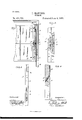
- Figure 1 illustrates a view, partly broken away and partly in section, of the windowcasing, the front of, which is removed and the sash slightly dropped, also the glass-holding frame and sash rabbet strip.
- Fig. 2 illustrates an enlarged view of the pivot connecting the glass-frame with the sash-rabbet strip and the compression-spring applied thereto.
- Fig; 3 illustrates an edge view of a sash-rabbet strip, showing the spring-containing and the cord containing recesses.
- Fig. 4 illustrates a sectional View of a sash-rabbet strip,
- A is the windowcasing, provided with the usual cord-wheel B and weight 0.
- D is the sash-rabbet strip.
- the glass-holding frame which is pivoted to the sash-rabbet strips on each side by the pivot F, all as described in my said former patent, or otherwise, if preferred.
- the upper and lower ends of the sash-rabbet strip D are also looked to the glass-holding frame and held firmly thereto, when closed, by the locking-fasteners G, also as set forth in said patent. These may be omitted, however, if preferred, and other means employed of holding the glass frame from swinging when locked.
- I provide a recess h in the rear edge of the sash-rabbet strips, in which I place a spring I, the ends of which bear on the bottom of the recess. This may be a spiral If so, it encircles the end of the pivot F. If a flat spring, as shown, then a hole is made in it which fits over the end of the pivot, and in either case the springis held in position by means of a washer J, which rests against the end of the pivot and overlaps the spring. It may be held in place by a screw K, tapped into the end of the pivot.
- the improvements in the weight-cord are as follows: I form a cord-recess M in the back edge of the sash-rabbet strips at their upper ends, and after extending it down the proper distance I continue it, in the form of a bored hole, as at N, preferably on an angle, as shown, through to the front edge of the sash-rabbet strips.
- I enlarge the hole somewhat, as at O, to receive the usual knot made in the end of the cord.
- the enlargement 0 should not be so great as to receive a knot, but simply that the wood at the upper angle formed by the intersection of the inclined cord-hole and the inner edge of the strip should be cut away,whereby I am enabled to drive or screw in a suitably-sharpened metallic peg or pin P, which may be threaded, if desired, and which, passing through the cord, the end of which should be preferably tightly wound with string, will firmly and very neatly fasten the cord.
- the pin may pass through from side to side, if preferred; also, that the pin may be permanently left in the edge of the strip, its exposed end being sharpened, whereby the cord may be impaled upon it, room be ing of course left for the introduction of a new cord, when necessary, above the permanent pin; also, the pin may be blunt-ended, but permanent in the strip, and the cord may be untwisted or its strands opened above the Wound extremity thereof to fit over the end of the pin, as by a loop.
- I claim- 1 The combination of a glass-holding frame pivoted at opposite sides to sliding sash-rabbet strips, said strips being provided with cord receiving recesses extending from the upper rear edge thereof through to the front edge thereof, substantially as set forth.
Landscapes
- Engineering & Computer Science (AREA)
- Civil Engineering (AREA)
- Structural Engineering (AREA)
- Securing Of Glass Panes Or The Like (AREA)
Description
Patented June 4,
WINDOW.
' H. MAEURER.
(No Model.)
u. PETERS, Pholmlilhognpher, Wuhinghm n. c.
m w w UNITED STATES ATENT OFFICE.
HENRY MAEURER, OF BROOKLYN, NEWV YORK, ASSIGNOR OF ONE-HALF TO \VILLIAM HEINZMAN N, OF SAME PLACE.
WINDOW.
SPECIFICATION forming part of Letters Patent No. 404,792, dated June 4, 1889.
Application filed October 16, 1888.
To all whom it may c0ncern.-
Be it known that I, HENRY MAEURER, a citizen of the United States, and a resident of Brooklyn, in the county of Kings and State of New York, have invented certain new and useful Improvements in Windows, of which the following is a specification.
My invention relates to improvements in window-sash of the class in which the glassholding frame swings on pivots, thus enabling the glass to be cleaned from the inside of the room. A United States patent was granted to me for window-sash of this kind dated September 25, 1888, numbered 390,179, and my present invention is an improvement upon the invention therein described, although it is not confined to swinging sashes of the specific construction set forth in that patent, but may be advantageously employed in all sashes of an tLHZLIOg'OLlS construction.
Mypresent invention consists in the application of spring-pressure acting upon the sash-rabbet strip which slides in the rabbet in the window-casing, whereby it is held in close contact with the side upright of the glass-holding frame, thus excluding cold, heat, and dust, and also preventing rattling of the swinging frame.
My invention extends also to improvements in the method'of introducing and fastening the weight-cord, whereby it may be quickly and easilyreplaced, if broken,without removing the glass-holding frame or the sash-rabbet strips from the window-casing, and whereby also better contact is secured between the sliding strips and the glass-holding frame.
In the drawings the same reference-letters indicate the same parts in all the figures.
Figure 1 illustrates a view, partly broken away and partly in section, of the windowcasing, the front of, which is removed and the sash slightly dropped, also the glass-holding frame and sash rabbet strip. Fig. 2 illustrates an enlarged view of the pivot connecting the glass-frame with the sash-rabbet strip and the compression-spring applied thereto. Fig; 3 illustrates an edge view of a sash-rabbet strip, showing the spring-containing and the cord containing recesses. Fig. 4 illustrates a sectional View of a sash-rabbet strip,
.spring, 'if preferred.
Serial No. 288,237. (No model.)
showing the direction of the cord-containing recess.
A is the windowcasing, provided with the usual cord-wheel B and weight 0.
D is the sash-rabbet strip.
E is the glass-holding frame, which is pivoted to the sash-rabbet strips on each side by the pivot F, all as described in my said former patent, or otherwise, if preferred. The upper and lower ends of the sash-rabbet strip D are also looked to the glass-holding frame and held firmly thereto, when closed, by the locking-fasteners G, also as set forth in said patent. These may be omitted, however, if preferred, and other means employed of holding the glass frame from swinging when locked.
In order that the sash-rabbet strip may be held close to the side uprights of the glassframe, I provide a recess h in the rear edge of the sash-rabbet strips, in which I place a spring I, the ends of which bear on the bottom of the recess. This may be a spiral If so, it encircles the end of the pivot F. If a flat spring, as shown, then a hole is made in it which fits over the end of the pivot, and in either case the springis held in position by means of a washer J, which rests against the end of the pivot and overlaps the spring. It may be held in place by a screw K, tapped into the end of the pivot. In order that the tension of the spring may not work the pivots loose from their hold in the side uprights of the glass-holding frame, I provide a shoulder L on the pivot, against which a plate L,which is provided with a hole whereby it may fit over the small end of the pivot, rests, and this plate is firmly secured to the side of the glass holding frame, as shown. By this means, as will be readily un- .derstood, the sash-rabbet strips are always firmly pressed against the sides of the glassframe, and dust, heat, and cold are excluded, and all rattling of the frameprevented, and also a good smooth motion is given to the 5 glass-frame during the act of swinging it, some little force being required so to do. This friction also prevents the frame from beingswung too quickly, consequent on accidental dropping or letting go thereof while opening I00 the sash or as aresult of gusts of wind or the like, which might occasion fracture of the glass.
The improvements in the weight-cord are as follows: I form a cord-recess M in the back edge of the sash-rabbet strips at their upper ends, and after extending it down the proper distance I continue it, in the form of a bored hole, as at N, preferably on an angle, as shown, through to the front edge of the sash-rabbet strips. Here I enlarge the hole somewhat, as at O, to receive the usual knot made in the end of the cord. I prefer, however, that the enlargement 0 should not be so great as to receive a knot, but simply that the wood at the upper angle formed by the intersection of the inclined cord-hole and the inner edge of the strip should be cut away,whereby I am enabled to drive or screw in a suitably-sharpened metallic peg or pin P, which may be threaded, if desired, and which, passing through the cord, the end of which should be preferably tightly wound with string, will firmly and very neatly fasten the cord.
From the foregoing it will be apparent that whenever it is desired to replace the cord all that is necessary to do is to tilt the glass-holding frame on its pivots. This exposes the end of the cord in the recess 0. Then the pin can be readily withdrawn by pinchers if not threaded, or with a screw-driver if threaded, and the worn-out or broken cord withdrawn, and the new cord may then be pushed up through the cord-hole N and recess M until it appears at the upper end of the sash-rabbet strips, when it will be pulled through as far as required and the wound end thereof fastened by replacement of the pin, as before, and also that by reason of the cord passing from the rear side to the front side of the strip the effect of the weight is to tip the upper end of the strip forwardly into close contact with the sash-frame, thus supplementing the action of the spring I.
I prefer that the pin should pass through the cord and enter the edge of the strips; but
it is obvious that it may pass through from side to side, if preferred; also, that the pin may be permanently left in the edge of the strip, its exposed end being sharpened, whereby the cord may be impaled upon it, room be ing of course left for the introduction of a new cord, when necessary, above the permanent pin; also, the pin may be blunt-ended, but permanent in the strip, and the cord may be untwisted or its strands opened above the Wound extremity thereof to fit over the end of the pin, as by a loop.
Having described my invention, I claim- 1. The combination of a glass-holding frame pivoted at opposite sides to sliding sash-rabbet strips, said strips being provided with cord receiving recesses extending from the upper rear edge thereof through to the front edge thereof, substantially as set forth.
2. The combination of a glass-holding frame pivoted at opposite sides to sliding sash-rabbet strips, said strips being provided with cord-receiving recesses extending from the upper rear edge thereof through to the front edge thereof, and a cord-fastening pin, substantially as set forth.
The combination of aglass-holding frame pivoted at opposite sides to sliding sash-rabbet-strips, said strips being provided with cord receiving recesses extel'lding from the upper rear edge thereof through to the front edge thereof, and a spring which presses the sliding strip to the glass-frame, substantially as set forth.
Signed at Brooklyn, in the county of Kin and State of New York, this 11th day of Oetober, A. l). 1888.
HENRY MAEURER.
\Vitnesses:
Units. VLEOPOLD, ALF. BERNHEIM.
Publications (1)
| Publication Number | Publication Date |
|---|---|
| US404792A true US404792A (en) | 1889-06-04 |
Family
ID=2473742
Family Applications (1)
| Application Number | Title | Priority Date | Filing Date |
|---|---|---|---|
| US404792D Expired - Lifetime US404792A (en) | Henry maeurer |
Country Status (1)
| Country | Link |
|---|---|
| US (1) | US404792A (en) |
-
0
- US US404792D patent/US404792A/en not_active Expired - Lifetime
Similar Documents
| Publication | Publication Date | Title |
|---|---|---|
| US1271380A (en) | Window-sash mounting. | |
| US2926400A (en) | Push button operated jalousie windows | |
| US1525926A (en) | Transverse window shade | |
| US3147517A (en) | Window sash run and balance apparatus | |
| US84031A (en) | Improvement in sash-stop and holder | |
| US652071A (en) | Device for counterbalancing sashes, shutters, & c. | |
| US346110A (en) | Sash-balancing device | |
| US500759A (en) | Henry chandler fuller | |
| US418193A (en) | Window-ventilator | |
| US2405248A (en) | Storm window | |
| US724683A (en) | Window casing and screen. | |
| US1299460A (en) | Grip-latch. | |
| US1314221A (en) | Disappearing window-scbeen | |
| US102667A (en) | Improved sash-holder | |
| US1045869A (en) | Combination gravity sash-lock and weather-strip. | |
| US509844A (en) | Charles deplanty | |
| US934357A (en) | Window-screen. | |
| US638346A (en) | Window-screen. | |
| US625580A (en) | Joseph a | |
| US421563A (en) | Window | |
| US341334A (en) | Window-screen | |
| US1307387A (en) | Window construction | |
| US266384A (en) | Device for closing windows and doors | |
| US999434A (en) | Window-sash holder. | |
| US1605686A (en) | Inclinable window |