US4008773A - Tightening system - Google Patents
Tightening system Download PDFInfo
- Publication number
- US4008773A US4008773A US05/579,109 US57910975A US4008773A US 4008773 A US4008773 A US 4008773A US 57910975 A US57910975 A US 57910975A US 4008773 A US4008773 A US 4008773A
- Authority
- US
- United States
- Prior art keywords
- signal
- rotation
- torque
- accordance
- tightening
- Prior art date
- Legal status (The legal status is an assumption and is not a legal conclusion. Google has not performed a legal analysis and makes no representation as to the accuracy of the status listed.)
- Expired - Lifetime
Links
- 230000007423 decrease Effects 0.000 claims abstract description 6
- 238000000034 method Methods 0.000 description 12
- 108010014173 Factor X Proteins 0.000 description 6
- 230000013011 mating Effects 0.000 description 4
- 230000003247 decreasing effect Effects 0.000 description 3
- 238000005259 measurement Methods 0.000 description 3
- 230000000712 assembly Effects 0.000 description 2
- 238000000429 assembly Methods 0.000 description 2
- 239000000463 material Substances 0.000 description 2
- 238000012545 processing Methods 0.000 description 2
- 238000010420 art technique Methods 0.000 description 1
- 238000006243 chemical reaction Methods 0.000 description 1
- 230000001419 dependent effect Effects 0.000 description 1
- 238000013461 design Methods 0.000 description 1
- 238000006073 displacement reaction Methods 0.000 description 1
- 230000000694 effects Effects 0.000 description 1
- 239000012530 fluid Substances 0.000 description 1
- 238000005461 lubrication Methods 0.000 description 1
- 238000012986 modification Methods 0.000 description 1
- 230000004048 modification Effects 0.000 description 1
- 230000002028 premature Effects 0.000 description 1
- 239000000523 sample Substances 0.000 description 1
- 238000012360 testing method Methods 0.000 description 1
Images

Classifications
-
- G—PHYSICS
- G05—CONTROLLING; REGULATING
- G05D—SYSTEMS FOR CONTROLLING OR REGULATING NON-ELECTRIC VARIABLES
- G05D17/00—Control of torque; Control of mechanical power
- G05D17/02—Control of torque; Control of mechanical power characterised by the use of electric means
-
- B—PERFORMING OPERATIONS; TRANSPORTING
- B25—HAND TOOLS; PORTABLE POWER-DRIVEN TOOLS; MANIPULATORS
- B25B—TOOLS OR BENCH DEVICES NOT OTHERWISE PROVIDED FOR, FOR FASTENING, CONNECTING, DISENGAGING OR HOLDING
- B25B23/00—Details of, or accessories for, spanners, wrenches, screwdrivers
- B25B23/14—Arrangement of torque limiters or torque indicators in wrenches or screwdrivers
- B25B23/145—Arrangement of torque limiters or torque indicators in wrenches or screwdrivers specially adapted for fluid operated wrenches or screwdrivers
- B25B23/1456—Arrangement of torque limiters or torque indicators in wrenches or screwdrivers specially adapted for fluid operated wrenches or screwdrivers having electrical components
Definitions
- This invention relates generally to apparatus for tightening fasteners and, more particularly, to apparatus for tightening fasteners to the yield point of the fastener material or some other predetermined axial load on the fastener characterized by a flattening of the torque-rotation curve plotted for the particular fastener being tightened.
- torque controlled tools that is, tools that determine when the torque applied to the fastener equals or slightly exceeds a predetermined value and act to interrupt the flow of power to the tool.
- Torque measurement is relatively easy and since torque is related to the tensile stress or axial force experienced by the fastener, and exerted on the structural members, a predetermined torque theoretically corresponds to the predetermined clamp load specified for the joint.
- torque controlled tools that is, tools that determine when the torque applied to the fastener equals or slightly exceeds a predetermined value and act to interrupt the flow of power to the tool.
- the torque-rotation curve for any particular fastener includes an initial or pretightening region wherein the fastener is being rotated but has not yet fully seated on the adjacent structural member; a tightening region wherein the fastener is being tightened within its elastic limit and which is generally linear; and, a yield region wherein its limit of proportionality has been exceeded and wherein the curve begins to flatten and finally flattens out at the yield point of the fastener.
- the technique disclosed in the Pauley patent utilizes a wrench including a first gear train for driving a first control arm in accordance with the torque being applied to the fastener and a second gear train for driving a second control arm in accordance with the rotation of the fastener.
- Each control arm includes a portion of a switch member connected in a circuit controlling the operation of the wrench.
- the control arms are driven in unison and the switch members are closed.
- the second control arm is driven faster than the first control arm so that the switch members open, the control circuit is broken and the wrench shuts off. Theoretically the wrench shuts off at the yield point of the fastener.
- the device disclosed in the Pauley patent is not entirely satisfactory.
- the slope of the curve must be known beforehand so that the gear trains can be properly related.
- similar variations occur in the torque-rotation relationships generated for a group of theoretically similar fasteners.
- the gear trains required to drive the control arms when tightening any particular fastener in a group of similar fasteners will be different.
- a tightening system including a wrench for applying torque and imparting rotation to a fastener member.
- a wrench for applying torque and imparting rotation to a fastener member.
- Associated with the wrench is a first mechanism for developing a signal representative of the torque being applied to the fastener and another mechanism for developing a signal representative of the rotation imparted to the fastener.
- a control system responsive to the torque and rotation signals determines which of the two signals is increasing at a faster rate and, if the torque signal is increasing faster than the rotation signal, increases the rotation signal to correspond to the torque signal.
- the torque signal is changing at a decreasing rate relative to the rotation signal, the rotation signal is not decreased, but a decision-making signal is developed which signal can be processed to develop a control signal at a yield point of the fastener.
- the mechanism for developing the torque signal comprises a first gear system whose output is proportional to the torque being applied to the fastener and the mechanism for developing the rotation signal comprises a second gear system including a variable ratio gear system.
- the first gear system drives a first potentiometer and the second gear system drives a second potentiometer.
- the signals from the potentiometers are compared and when the incremental torque signal is greater than the incremental rotation signal, a signal is fed to a one-way amplifier which controls the variable ratio gear system to increase the rotation signal until it corresponds to the torque signal.
- a decision-making signal is developed and is fed to a decision-making circuit to develop the control signal.
- the two gear system and potentiometers are replaced by a torque cell and an angular encoder device which develop signals representative of torque applied to and rotation of the fastener and these signals are compared as noted above.
- the two potentiometers are replaced by a single potentiometer having an inner portion driven by the first gear system and an outer portion driven by the other gear system so that its output signal is fed either to the one-way amplifier or the decision-making circuit.
- the decision-making signal or its rate of increase is compared to a predetermined signal representative of the yield point of the fastener and the control signal is developed when the signals are substantially equal.
- the decision-making signal is compared to a signal proportional to either the torque or rotation signal and the control signal is developed when the compared signals have a predetermined relationship. According to the second aspect, no predetermined knowledge of the joint assembly is required.
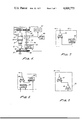
- FIG. 1 is a plot of a curve illustrating the characteristics of the typical torque-rotation relationship experienced by a fastener during a tightening cycle
- FIG. 2 is a plot of a curve illustrating the characteristics of typical torque-time and rotation-time relationships experienced by a fastener during a tightening cycle
- FIG. 3 is a plot of a curve illustrating an underlying principle of operation of a tightening system in accordance with this invention
- FIG. 4 is a schematic drawing of a tightening system in accordance with one embodiment of the invention.
- FIG. 5 is a schematic drawing of a tightening system in accordance with another embodiment of the invention.
- FIG. 6 is a schematic drawing of a tightening system in accordance with still another embodiment of the invention.
- FIG. 7-9 each illustrate a different circuit for processing signals developed by various embodiments of apparatus in accordance with the invention to determine when a yield point has been reached.
- FIG. 1 there is illustrated a typical torque-rotation curve for a threaded fastener being tightened with the torque plotted along the vertical axis and with the rotation plotted along the horizontal axis.
- the curve includes an initial or pretightening region extending from the intersection of the torque and rotation axes to point A.
- the pretightening region mating threads of the fastener assembly have been engaged and one of the fasteners is being rotated, but the bearing face of the rotating fastener has either not contacted the adjacent face of the structural member included in the joint or has not completely pulled the structural members together.
- point A on the curve the structural members have been completely pulled together by the fastener assembly and actual tightening of the joint commences.
- the torque at point A is commonly referred to as the "snug" torque.
- the tightening region of the curve extending from point A to point B, clamp load is actually being exerted on the structural members and the male member in the fastener assembly, that is, the bolt is stretching in the axial direction due to the induced tensile load.
- the curve is approximately linear and in some cases may be exactly linear. As is most usual, however, the curve will include a slight curvature and, thus, a point M wherein the slope of curve is a maximum. At point B the limit of proportionality of the fastener has been reached.
- a tightening system in accordance with this invention is capable of detecting points M or B on the torque-rotation curve and responding thereto to generate a control signal at about point C.
- joint assemblies could include further fastener assemblies constructed such as to deviate from linearity or from the point of maximum slope at a predetermined load other than at the yield point. Such deviation could be detected and used to generate a control signal.
- yield point should be construed to include the yield point of the material from which the fastener is made as well as points on a flattened portion of a torque-rotation curve generated by the configuration of the fastener at a predetermined clamp load.
- the first curve, marked Torque is a plot of the torque applied to the fastener versus time elapsed during the tightening cycle, torque being plotted along the vertical axis and time being plotted along the horizontal axis.
- the second curve, marked Rotation is a plot of the angular displacement or rotation of the fastener versus time elapsed during the tightening cycle, rotation being plotted along the vertical axis and time again being plotted along the horizontal axis.
- the curves illustrated in FIG. 2 are not exact, but are generally close approximations useful in understanding certain aspects of the invention.
- the Torque curve there is a pretightening region in which the torque increases rather slowly and which extends from the intersection of the torque-time axes to point D.
- point D corresponds to point A on the torque-rotation curve.
- Point D to Point E represents the tightening region of the Torque curve similar to the region between points A and B of the torque-rotation curve.
- torque increases at a generally faster rate than in the pretightening region.
- the Torque curve includes a yield region from point E wherein the torque increases at a relatively slow rate and which corresponds to the yield region beyond point C on the torque-rotation curve.
- Point F represents the yield point of the fastener.
- the Rotation curve includes a pretightening region extending from the intersection of the rotation-time axes to point G, a tightening region extending from points G to H and a yield region from point H.
- Point J on the Rotation curve represents the yield point.
- Tightening system 10 includes a wrench 12 having a motor 14, a drive shaft 16 and a driver bit 18.
- Drive shaft 16 is rotated by motor 14 to transmit torque and rotation to a fastener engaged by driver bit 18.
- Wrench 12 can be of any conventional type and as is most common, motor 14 can be air-powered with the flow of motive fluid being controlled by a suitable control valve 20. It should be understood that motor 14 could also be electric, hydraulic or any combination of pneumatic, hydraulic or electric.
- the exact details of the wrench are not necessary for a proper understanding of the invention and, accordingly, a more specific description is not provided.
- Wrench 12 is mounted on a rigid frame 22 of any suitable type by a torsion bar 24 which twists about the rigid frame when motor 14 is operative with a torque substantially equal to and opposite to the torque being applied to a fastener being tightened.
- Carried on torsion bar 24 is a first gear member 26 which drives a second gear member 28 fixed to an output shaft 30.
- One end of output shaft 30 is connected to drive the inner core of a potentiometer 32 and interposed between gear 28 and potentiometer 32 is a slip clutch 34.
- torsion bar 24 twists and rotates gear member 26 which drives gear member 28 and output shaft 30.
- the rotation of shaft 30 can be considered a signal representative of the torque applied to the fastener being tightened which signal is converted to an electrical signal by potentiometer 32 when the inner core of the potentiometer is driven by shaft 30.
- Use of slip clutch 34 precludes rotation of the inner core of potentiometer 32 and prevents an electrical output signal until the snug torque (points A and D on FIGS. 1 and 2, respectively) is being applied to the fastener.
- slip clutch 34 is arranged to engage at a reasonable approximation of the snug torque, for example, at about 20% of the nominal torque to be applied to the fastener.
- Carried on drive shaft 16 is another gear member 35 which, when a fastener is being tightened, drives an output shaft 36 through a gear member 38.
- the output of shaft 36 drives a variable ratio gear system 40 which is arranged to drive another output shaft 42, the output end of which is connected to drive the inner core of a potentiometer 44.
- a slip clutch 46 which is also used to preclude rotation of the inner core of potentiometer 44 and prevents an electrical output signal until the snug torque is being applied to the fastener.
- the rotation of shaft 36 can be considered a signal representative of the angular rotation of the fastener which signal is modified by the setting of variable ratio gear system 40. Accordingly, the rotation of shaft 42 can be considered a signal representative of the modified rotation signal and is converted to an electrical signal by potentiometer 44.
- the torque and rotation curves illustrated therein can also be thought of as curves plotting the torque signal provided by shaft 30 and the rotation signal provided by shaft 36. It can be seen that in the approximately linear region or tightening region of the curves, points D to E on the Torque curve and points G to H on the Rotation curve, one of the signals, preferably the torque signal, is increasing faster than the other signal, preferably, the rotation signal.
- the exact relationship between the signals is, of course, dependent on the flexibility of torsion bar 24 and the gear ratios between shafts 24 and 30 and between shafts 16 and 36.
- the gearing it is preferable to arrange the gearing so that after the snug torque is applied, the torque signal initially increases faster than the rotation signal.
- the rotation signal is modified by being multiplied by a factor X.
- the rotation signal is multiplied incrementally, so that the rotation signal is equal to the torque signal throughout a certain portion of the tightening region of the curves. In effect the Torque and Rotation curves are made to coincide.
- variable ratio gear system 40 In the preferred embodiment of the invention disclosed in FIG. 4 of the drawing, multiplication of the rotation signal is accomplished by variable ratio gear system 40.
- variable ratio gear system 40 When a fastener is tightened and when clutches 34 and 46 have engaged, at the snug point of the Torque-Rotation curve, the variable ratio gear system 40 is set such that the rotation of shaft 42 is equal to the rotation of shaft 36 that is, the initial rotation of shaft 42 is also a signal representative of the initial rotation of the fastener.
- the signals provided by shafts 30 and 42 are, as also noted previously, converted into electrical signals by potentiometers 32 and 44, respectively, and are fed to comparator 48 which can be in the form of a differential amplifier providing an output signal representative of the difference between the initial torque and rotation signals.
- the output signal is fed to a one-way amplifier 50 that is, an amplifier having a gain characteristic in one direction only and the one-way amplifier provides an output signal to variable ratio gear system 40 which increases its gear ratio.
- a one-way amplifier 50 that is, an amplifier having a gain characteristic in one direction only
- the one-way amplifier provides an output signal to variable ratio gear system 40 which increases its gear ratio.
- the gear ratio of variable ratio gear system 40 By increasing the gear ratio of variable ratio gear system 40, the rotation of output shaft 42 as well as the output of potentiometer 44 are modified, that is, are increased by being multiplied by a factor X which is equal to the increased gear ratio.
- comparator 48 no longer provides a significant output signal to one-way amplifier 50 and the one-way amplifier, in turn, provides no operative signal to variable ratio gear system 40.
- variable ratio gear system 40 is fixed only temporarily as will be explained hereinafter, and continues to multiply the rotation signal and provide the modified rotation signal which is representative of a factor X, multiplied by each increment of the rotation signal measured from the snug point. If the rate of increase of the torque signal again increases relative to the rate of increase of the rotation signal, that is, if the torque signal increases relative to the modified rotation signal provided by potentiometer 44, comparator 48 again provides an output signal to one-way amplifier 50 which increases the gear ratio of variable ratio gear system 40 whereby it multiplies an increment of the rotation signal measured from the point where the torque signal increased by another factor, X 2 , and adds the new multiplied increment of the rotation signal to previously multiplied increment of the rotation signal until the modified signal provided by shaft 42 and potentiometer 44 again equal the torque signal provided by potentiometer 32.
- the process repeats itself at each instant when the torque signal exceeds the modified rotation signal.
- the modified rotation signal is equal to the sum of all the incremental angles of rotation multiplied by instantaneous factors X and can be referred to for convenience as an integrated rotation signal.
- the integrated rotation signal can be expressed as ⁇ X ⁇ R or XdR where X is the instantaneous factor and ⁇ R is the incremental rotation of the fastener.
- one-way amplifier 50 would provide an initial signal adjusting the gear ratio of variable ratio gear system 40 which would then multiply the rotation signal providing the integrated rotation signal. Because of the linearity of the curve, no further adjustment of the variable ratio gear system would be provided.
- point B on the curve illustrated in FIG. 1 the rotation signal is increasing faster than the torque signal and the output from comparator 48 is a reverse polarity signal, for convenience the reverse polarity signal will be hereinafter considered negative, and this signal cannot be fed through one-way amplifier 50 because of its one-way gain characteristic.
- the negative signal is fed to a decision making circuit 52 which processes that signal to determine when the yield point of the fastener has been reached and to then develop a control signal which is fed to control valve 20 to shut off the wrench.
- the Torque-Rotation curve is not exactly linear in the tightening region and, accordingly, one-way amplifier 50 is continuously adjusting the setting of variable ratio gear box 40 until the maximum slope of the curve is experienced, point M on the curve.
- point M is experienced, the integrated rotation signal begins increasing faster than the torque signal and the signal from comparator 48 begins to reverse polarity, again for convenience also hereinafter considered negative, and has a relatively small value until point B is reached when it increases significantly.
- the negative signal is fed to decision-making circuit 52 to be processed and determine when the yield point of the fastener has been reached and to then develop a control signal which is fed to control valve 20 to shut off the wrench.
- the negative signals are decision-making signals.
- FIG. 3 of the drawing is a plot of the signal from potentiometer 32 which is representative of the torque being applied to the fastener versus the signal from potentiometer 44 which is representative of the integrated rotation signal.
- the torque signal is plotted on the vertical axis of the curve and the integrated rotation signal is plotted on the horizontal axis.
- Neither potentiometer provides an output until the snug torque is applied to the fastener, that is until point A on the curve illustrated in FIG. 1 is reached.
- each incremental increase in torque results in an equal incremental increase in the integrated rotation signal, X ⁇ R. Because the integrated rotation signal is maintained equal to the torque signal the curve illustrated in FIG. 3 is a straight line forming an angle of 45° with the axes until the appropriate point B or M on the curve illustrated in FIG. 1 is reached. Beyond the appropriate point, the curve starts to flatten indicating that the output of comparator 48 is negative.
- ⁇ T/ ⁇ R is the slope of the Torque-Rotation curve.
- the factor X which cannot be decreased, eventually represents the maximum slope of the curve.
- FIGS. 7-9 wherein different decision-making circuits 52 usable therewith are illustrated.
- a first embodiment of decision-making circuit 52 is illustrated and includes a comparator 54 to which the negative or decision-making signal from comparator 48 is fed. Also fed to comparator 54 from a signal generator 56 is a predetermined negative signal indicative of the expected signal from comparator 48 at the yield point.
- the decision-making signal from comparator 48 is substantially equal to or more negative than the predetermined signal from signal generator 56 the control signal is developed and fed to control valve 20 closing the control valve and shutting off the wrench.
- comparator 54 and signal generator 56 are conventional apparatus and need not be explained further.
- the decision-making circuit described with respect to FIG. 7 of the drawing is particularly usable in those instances where the specifications of the joint being tightened are known and where average values representative of the yield point can be predetermined and set into signal generator 56. With the circuit disclosed in FIG. 7 a reasonable degree of accuracy can be obtained. However, in those instances where the specifications of the joint are not known beforehand or where a higher degree of accuracy is desired, the decision-making circuit can be of the type illustrated in FIGS. 8 and 9 of the drawing.
- a second embodiment of decision-making circuit 52 includes a gradient meter 58 which receives the negative decision-making signal from comparator 48 and integrated rotation signals from potentiometer 42.
- Gradient meter 58 may be in the form of a shift register and a subtraction circuit each of which receives a decision-making signal as an input and which are connected in series.
- the shift register can be clocked by the integrated rotation signal which would be fed to the shift register through an analogue to digital convertor and the output of the shift register is also fed to the subtraction circuit which of course, subtracts its input signals and provides an output signal representative of the rate of change of the decision-making signal with respect to the integrated rotation signal.
- the output signal from gradient meter 58 is fed to a comparator 60 which receives another negative input signal from a signal generator 62 which has been determined to be representative of the expected rate of change of the decision-making signal with respect to the integrated rotation signal at the yield point.
- a comparator 60 determines that its input signals are substantially equal or that the signal from gradient meter 58 is more negative than the signal from signal generator 62, it provides a control signal to control valve 20 closing the control valve and shutting off the wrench.
- the relationship set into signal generator 62 can be understood from the following explanation.
- the decision-making signal from comparator 48 can be expressed as follows:
- Equation D represents the decision-making signal
- X m represents the factor at the point M or the maximum slope of the Torque-Rotation curve
- R represents the instantaneous rotation
- R m represents the rotation at point M
- T represents the instantaneous torque
- T m represents the torque at point M.
- signal generator 62 receives signal from one-way amplifier 50 which is representative of the maximum slope of the Torque-Rotation curve, X m , and includes a calculator circuit for performing the calculation in accordance with the desired predetermined relationship, as explained, and provides an output signal in accordance therewith which is fed to comparator 60 for comparison with the signal from gradient meter 58 as also explained.
- the decision-making circuit 52 illustrated in FIG. 9 of the drawing includes a comparator 64 which receives the negative decision-making signal from comparator 48 and which also receives a negative signal from an amplifier 66.
- the negative signal from amplifier 66 is proportional to the torque being applied to the fastener or, preferably, to the rotation of the fastener and, accordingly, receives an input signal from either potentiometer 32 or 44.
- the control signal closing control valve 20 and shutting off the wrench is developed when the decision-making signal has a predetermined relationship with either the torque or integrated rotation signals.
- amplifier 66 conditions its input signal in accordance with the predetermined relationship and provides a negative output signal which is compared with the decision-making signal.
- amplifier 66 should provide an output signal of approximately -0.002 to -0.020 of the torque or the integrated rotation signal.
- comparator 64 determines that the decision-making signal is more negative than the signal from amplifier 66, it develops a control signal which is fed to control valve 20 closing the valve and shutting off the wrench.
- FIG. 5 of the drawing another embodiment of the invention is disclosed and is generally similar to that illustrated in FIG. 4. Accordingly, similar reference numerals are utilized for like parts.
- gears 26, 28, 34 and 38 have been eliminated as well as variable ratio gear box 40 and potentiometers 32 and 44.
- the torque signal is generated by a torque cell 74 mounted between output shaft 16 and rigid frame 76, a frame somewhat similar to frame 22 in the FIG. 4 embodiment.
- Torque cell 74 is a generally conventional device including a flexible annular member on which strain gauges 78 are attached and which may be connected in a Wheatstone Bridge (not illustrated) to generate signals representative of the torque applied to the fastener by measuring the reaction torque on the wrench.
- a suitable encoder 80 is carried on an inward extension of drive shaft 16 and rotates therewith.
- a proximity probe 82 is mounted through the housing of motor 14 and senses passage of the teeth formed on encoder 80 and develops signals representative of predetermined increments of angular rotation of the fastener.
- the incremental signals are fed through a multiplier 84 whose setting is controlled by the output of one-way amplifier 50.
- the multiplied signals are added in a suitable adding device 86 to provide an integrated angular rotation signal similar to that developed by potentiometer 44 in the FIG. 4 embodiment.
- the signals from torque cell 74 and adding device 86 are fed through comparator 64 and are processed as in the embodiment disclosed in FIG. 4. When the decision-making signal is developed it is fed to decision-making circuits 52 of FIGS. 7-9 and are processed to develop the control signal and shut off wrench 12.
- FIG. 6 another embodiment of a tightening system in accordance with this invention is illustrated and is also generally similar to that illustrated in FIG. 4. Accordingly, like reference numerals are used for similar parts which will not be described in detail.
- potentiometers 32 and 44 and comparator 48 have been eliminated and replaced by a single potentiometer 88.
- Shaft 30 drives the inner core of potentiometer 88 and shaft 42 drives the outer portion or slider assembly of the potentiometer.
- Rotation of the inner core of potentiometer 88 is a signal representative of the torque being applied to the fastener and rotation of the outer portion is a signal representative of the rotation of the fastener or the integral of the rotation multiplied by the ratio of gear box 40 depending on whether the setting of the gear box has been set by one-way amplifier 50.
- Electrical signals developed by potentiometer 88 are thus equivalent to signals from comparator 48 in the FIG. 4 embodiment. That is, if the signals are equal the inner core and outer portion of potentiometer rotate in unison at a null point and provide no output. When one of the signals is increasing faster than the other, the signal from potentiometer 88 is fed either through one-way amplifier 50 or decision-making circuit 52 which can be in accordance with FIG. 7 of the drawing.
Landscapes
- Engineering & Computer Science (AREA)
- Mechanical Engineering (AREA)
- Physics & Mathematics (AREA)
- General Physics & Mathematics (AREA)
- Automation & Control Theory (AREA)
- Details Of Spanners, Wrenches, And Screw Drivers And Accessories (AREA)
Priority Applications (6)
| Application Number | Priority Date | Filing Date | Title |
|---|---|---|---|
| US05/579,109 US4008773A (en) | 1975-05-19 | 1975-05-19 | Tightening system |
| DE19762622091 DE2622091A1 (de) | 1975-05-19 | 1976-05-18 | Anzugssystem zum anziehen eines befestigungselementes |
| SE7605622A SE434612B (sv) | 1975-05-19 | 1976-05-18 | Anordning for atdragning av konstruktionsenhet med ett festelement, tills densammes streckgrens detekteras |
| JP51057187A JPS6036908B2 (ja) | 1975-05-19 | 1976-05-18 | 締付け装置 |
| FR7614887A FR2312065A1 (fr) | 1975-05-19 | 1976-05-18 | Appareil de serrage de dispositifs de fixation, tels que des boulons |
| GB20599/76A GB1551394A (en) | 1975-05-19 | 1976-05-19 | Tightening system |
Applications Claiming Priority (1)
| Application Number | Priority Date | Filing Date | Title |
|---|---|---|---|
| US05/579,109 US4008773A (en) | 1975-05-19 | 1975-05-19 | Tightening system |
Publications (1)
| Publication Number | Publication Date |
|---|---|
| US4008773A true US4008773A (en) | 1977-02-22 |
Family
ID=24315595
Family Applications (1)
| Application Number | Title | Priority Date | Filing Date |
|---|---|---|---|
| US05/579,109 Expired - Lifetime US4008773A (en) | 1975-05-19 | 1975-05-19 | Tightening system |
Country Status (6)
| Country | Link |
|---|---|
| US (1) | US4008773A (en:Method) |
| JP (1) | JPS6036908B2 (en:Method) |
| DE (1) | DE2622091A1 (en:Method) |
| FR (1) | FR2312065A1 (en:Method) |
| GB (1) | GB1551394A (en:Method) |
| SE (1) | SE434612B (en:Method) |
Cited By (31)
| Publication number | Priority date | Publication date | Assignee | Title |
|---|---|---|---|---|
| US4091451A (en) * | 1977-04-26 | 1978-05-23 | Weatherford/Lamb, Inc. | Method of and apparatus for making up a threaded connection |
| US4106570A (en) * | 1977-02-07 | 1978-08-15 | Rockwell International Corporation | Angle sensing tool for applying torque |
| US4179786A (en) * | 1976-08-09 | 1979-12-25 | Rockwell International Corporation | Tension control of fasteners |
| US4186756A (en) * | 1976-06-15 | 1980-02-05 | The Japan Tobacco & Salt Public Corporation | Method of processing smoking composition |
| US4199032A (en) * | 1978-02-17 | 1980-04-22 | Weatherford/Lamb, Inc. | Apparatus for measuring and controlling a force |
| US4226014A (en) * | 1979-04-19 | 1980-10-07 | Rockwell International Corporation | Tension control of fasteners |
| USRE31569E (en) * | 1976-08-09 | 1984-05-01 | Rockwell International Corporation | Tension control of fasteners |
| US4515020A (en) * | 1983-02-23 | 1985-05-07 | Vallourec | Method and apparatus for ensuring correct thread make-up of a pipejoint |
| US4894767A (en) * | 1988-03-31 | 1990-01-16 | Daiichi Dentsu Kabushiki Kaisha | Method for yield tightening of screws |
| US5617924A (en) * | 1993-08-18 | 1997-04-08 | Robert Bosch Gmbh | Arrangement for tightening screw connections |
| US20030164276A1 (en) * | 2000-04-17 | 2003-09-04 | Weatherford/Lamb, Inc. | Top drive casing system |
| US20050098125A1 (en) * | 2002-07-01 | 2005-05-12 | Thomas Hathaway | Valve lash adjustment apparatus and method |
| US20070000336A1 (en) * | 2005-06-29 | 2007-01-04 | Freudenberg-Nok General Partnership | Torque cell |
| US20070251701A1 (en) * | 2006-04-27 | 2007-11-01 | Michael Jahn | Torque sub for use with top drive |
| US20080047749A1 (en) * | 2002-11-27 | 2008-02-28 | Thomas Koithan | Methods and apparatus for applying torque and rotation to connections |
| US7559301B2 (en) | 2002-07-01 | 2009-07-14 | Cinetic Automation Corporation | Valve lash adjustment and inspection apparatus |
| US20090266539A1 (en) * | 2008-04-25 | 2009-10-29 | Graham Ruark | Method of controlling torque applied to a tubular connection |
| US20090293640A1 (en) * | 2001-05-17 | 2009-12-03 | Doyle Boutwell | System and method for deflection compensation in power drive system for connection of tubulars |
| US7896084B2 (en) | 2001-05-17 | 2011-03-01 | Weatherford/Lamb, Inc. | Apparatus and methods for tubular makeup interlock |
| US20110247434A1 (en) * | 2008-10-22 | 2011-10-13 | Carl-Gustaf Carlin | test method and tool for testing fastened fasteners |
| US20120055228A1 (en) * | 2010-09-03 | 2012-03-08 | Eduard Wille Gmbh & Co. Kg | Actuating device for calibrating torque/angle wrenches |
| TWI413576B (en:Method) * | 2012-01-19 | 2013-11-01 | ||
| US8726743B2 (en) | 2011-06-22 | 2014-05-20 | Weatherford/Lamb, Inc. | Shoulder yielding detection during tubular makeup |
| US20140298635A1 (en) * | 2011-11-04 | 2014-10-09 | The Boeing Company | Preloading a fastener of a mechanical fitting |
| US9265551B2 (en) | 2013-07-19 | 2016-02-23 | Pro-Dex, Inc. | Torque-limiting screwdrivers |
| US9568031B2 (en) | 2011-11-04 | 2017-02-14 | The Boeing Company | Truss end pad fitting |
| US10383674B2 (en) | 2016-06-07 | 2019-08-20 | Pro-Dex, Inc. | Torque-limiting screwdriver devices, systems, and methods |
| US10422450B2 (en) | 2017-02-03 | 2019-09-24 | Weatherford Technology Holdings, Llc | Autonomous connection evaluation and automated shoulder detection for tubular makeup |
| US10844675B2 (en) | 2018-12-21 | 2020-11-24 | Weatherford Technology Holdings, Llc | Autonomous connection makeup and evaluation |
| US11090128B2 (en) | 2018-08-20 | 2021-08-17 | Pro-Dex, Inc. | Torque-limiting devices, systems, and methods |
| US11406368B2 (en) * | 2006-10-06 | 2022-08-09 | Covidien Lp | System and method for non-contact electronic articulation sensing |
Citations (5)
| Publication number | Priority date | Publication date | Assignee | Title |
|---|---|---|---|---|
| US2756622A (en) * | 1954-05-21 | 1956-07-31 | Gen Motors Corp | Power operated torque wrench |
| US3368396A (en) * | 1964-09-14 | 1968-02-13 | Exxon Production Research Co | Assembling pipe strings with leak-tight joints |
| US3643501A (en) * | 1969-11-18 | 1972-02-22 | Ingersoll Rand Co | Wrenching system and method |
| US3693726A (en) * | 1970-09-17 | 1972-09-26 | Daimler Benz Ag | Tightening device for automatically tightening bolts and the like |
| US3710874A (en) * | 1971-03-10 | 1973-01-16 | Ingersoll Rand Co | Electronic torque measurement system |
Family Cites Families (1)
| Publication number | Priority date | Publication date | Assignee | Title |
|---|---|---|---|---|
| FR2102719A5 (en:Method) * | 1970-08-18 | 1972-04-07 | Daimler Benz Ag |
-
1975
- 1975-05-19 US US05/579,109 patent/US4008773A/en not_active Expired - Lifetime
-
1976
- 1976-05-18 JP JP51057187A patent/JPS6036908B2/ja not_active Expired
- 1976-05-18 FR FR7614887A patent/FR2312065A1/fr active Granted
- 1976-05-18 SE SE7605622A patent/SE434612B/xx not_active IP Right Cessation
- 1976-05-18 DE DE19762622091 patent/DE2622091A1/de not_active Ceased
- 1976-05-19 GB GB20599/76A patent/GB1551394A/en not_active Expired
Patent Citations (5)
| Publication number | Priority date | Publication date | Assignee | Title |
|---|---|---|---|---|
| US2756622A (en) * | 1954-05-21 | 1956-07-31 | Gen Motors Corp | Power operated torque wrench |
| US3368396A (en) * | 1964-09-14 | 1968-02-13 | Exxon Production Research Co | Assembling pipe strings with leak-tight joints |
| US3643501A (en) * | 1969-11-18 | 1972-02-22 | Ingersoll Rand Co | Wrenching system and method |
| US3693726A (en) * | 1970-09-17 | 1972-09-26 | Daimler Benz Ag | Tightening device for automatically tightening bolts and the like |
| US3710874A (en) * | 1971-03-10 | 1973-01-16 | Ingersoll Rand Co | Electronic torque measurement system |
Cited By (61)
| Publication number | Priority date | Publication date | Assignee | Title |
|---|---|---|---|---|
| US4186756A (en) * | 1976-06-15 | 1980-02-05 | The Japan Tobacco & Salt Public Corporation | Method of processing smoking composition |
| US4179786A (en) * | 1976-08-09 | 1979-12-25 | Rockwell International Corporation | Tension control of fasteners |
| USRE31569E (en) * | 1976-08-09 | 1984-05-01 | Rockwell International Corporation | Tension control of fasteners |
| US4106570A (en) * | 1977-02-07 | 1978-08-15 | Rockwell International Corporation | Angle sensing tool for applying torque |
| US4091451A (en) * | 1977-04-26 | 1978-05-23 | Weatherford/Lamb, Inc. | Method of and apparatus for making up a threaded connection |
| DE2817910A1 (de) * | 1977-04-26 | 1978-11-02 | Weatherford Lamb | Verfahren und vorrichtung zur herstellung einer schraubverbindung |
| US4199032A (en) * | 1978-02-17 | 1980-04-22 | Weatherford/Lamb, Inc. | Apparatus for measuring and controlling a force |
| US4226014A (en) * | 1979-04-19 | 1980-10-07 | Rockwell International Corporation | Tension control of fasteners |
| US4515020A (en) * | 1983-02-23 | 1985-05-07 | Vallourec | Method and apparatus for ensuring correct thread make-up of a pipejoint |
| US4894767A (en) * | 1988-03-31 | 1990-01-16 | Daiichi Dentsu Kabushiki Kaisha | Method for yield tightening of screws |
| US5617924A (en) * | 1993-08-18 | 1997-04-08 | Robert Bosch Gmbh | Arrangement for tightening screw connections |
| US20030164276A1 (en) * | 2000-04-17 | 2003-09-04 | Weatherford/Lamb, Inc. | Top drive casing system |
| US7918273B2 (en) | 2000-04-17 | 2011-04-05 | Weatherford/Lamb, Inc. | Top drive casing system |
| US7793719B2 (en) | 2000-04-17 | 2010-09-14 | Weatherford/Lamb, Inc. | Top drive casing system |
| US20080110637A1 (en) * | 2000-04-17 | 2008-05-15 | Randy Gene Snider | Top drive casing system |
| US8517090B2 (en) | 2001-05-17 | 2013-08-27 | Weatherford/Lamb, Inc. | Apparatus and methods for tubular makeup interlock |
| US8251151B2 (en) | 2001-05-17 | 2012-08-28 | Weatherford/Lamb, Inc. | Apparatus and methods for tubular makeup interlock |
| US8167038B2 (en) | 2001-05-17 | 2012-05-01 | Weatherford/Lamb, Inc. | System and method for deflection compensation in power drive system for connection of tubulars |
| US20110226486A1 (en) * | 2001-05-17 | 2011-09-22 | Haugen David M | Apparatus and methods for tubular makeup interlock |
| US20090293640A1 (en) * | 2001-05-17 | 2009-12-03 | Doyle Boutwell | System and method for deflection compensation in power drive system for connection of tubulars |
| US7896084B2 (en) | 2001-05-17 | 2011-03-01 | Weatherford/Lamb, Inc. | Apparatus and methods for tubular makeup interlock |
| US7207301B2 (en) | 2002-07-01 | 2007-04-24 | Cinetic Automation Corporation | Valve lash adjustment apparatus and method |
| US6973905B2 (en) | 2002-07-01 | 2005-12-13 | Cinetic Automation Corporation | Valve lash adjustment apparatus and method |
| US20090250031A1 (en) * | 2002-07-01 | 2009-10-08 | Hathaway Thomas J | Valve Lash Adjustment and Inspection Apparatus |
| US20050098125A1 (en) * | 2002-07-01 | 2005-05-12 | Thomas Hathaway | Valve lash adjustment apparatus and method |
| US7559301B2 (en) | 2002-07-01 | 2009-07-14 | Cinetic Automation Corporation | Valve lash adjustment and inspection apparatus |
| US20050205035A1 (en) * | 2002-07-01 | 2005-09-22 | Thomas Hathaway | Valve lash adjustment apparatus and method |
| US8001939B2 (en) | 2002-07-01 | 2011-08-23 | Cinetic Automation Corporation | Valve lash adjustment and inspection apparatus |
| US20080047749A1 (en) * | 2002-11-27 | 2008-02-28 | Thomas Koithan | Methods and apparatus for applying torque and rotation to connections |
| US7594540B2 (en) | 2002-11-27 | 2009-09-29 | Weatherford/Lamb, Inc. | Methods and apparatus for applying torque and rotation to connections |
| US7237444B2 (en) | 2005-06-29 | 2007-07-03 | Freudenberg-Nok General Partnership | Torque cell for determining a torque load on a rotary member |
| US20070000336A1 (en) * | 2005-06-29 | 2007-01-04 | Freudenberg-Nok General Partnership | Torque cell |
| US20070251701A1 (en) * | 2006-04-27 | 2007-11-01 | Michael Jahn | Torque sub for use with top drive |
| US7757759B2 (en) | 2006-04-27 | 2010-07-20 | Weatherford/Lamb, Inc. | Torque sub for use with top drive |
| US11406368B2 (en) * | 2006-10-06 | 2022-08-09 | Covidien Lp | System and method for non-contact electronic articulation sensing |
| US8297347B2 (en) * | 2008-04-25 | 2012-10-30 | Weatherford/Lamb, Inc. | Method of controlling torque applied to a tubular connection |
| US20090266539A1 (en) * | 2008-04-25 | 2009-10-29 | Graham Ruark | Method of controlling torque applied to a tubular connection |
| US20110247434A1 (en) * | 2008-10-22 | 2011-10-13 | Carl-Gustaf Carlin | test method and tool for testing fastened fasteners |
| US8578793B2 (en) * | 2008-10-22 | 2013-11-12 | Atlas Copco Industrial Technique Aktiebolag | Test method and tool for testing fastened fasteners |
| US8650928B2 (en) * | 2010-09-03 | 2014-02-18 | Eduard Wille Gmbh & Co. Kg | Actuating device for calibrating torque/angle wrenches |
| US20120055228A1 (en) * | 2010-09-03 | 2012-03-08 | Eduard Wille Gmbh & Co. Kg | Actuating device for calibrating torque/angle wrenches |
| US8726743B2 (en) | 2011-06-22 | 2014-05-20 | Weatherford/Lamb, Inc. | Shoulder yielding detection during tubular makeup |
| US20140298635A1 (en) * | 2011-11-04 | 2014-10-09 | The Boeing Company | Preloading a fastener of a mechanical fitting |
| US9568031B2 (en) | 2011-11-04 | 2017-02-14 | The Boeing Company | Truss end pad fitting |
| US9574587B2 (en) * | 2011-11-04 | 2017-02-21 | The Boeing Company | Preloading a fastener of a mechanical fitting |
| US9863451B2 (en) | 2011-11-04 | 2018-01-09 | The Boeing Company | Truss end pad fitting |
| US10072684B2 (en) | 2011-11-04 | 2018-09-11 | The Boeing Company | Truss end pad fitting |
| TWI413576B (en:Method) * | 2012-01-19 | 2013-11-01 | ||
| US9265551B2 (en) | 2013-07-19 | 2016-02-23 | Pro-Dex, Inc. | Torque-limiting screwdrivers |
| US10206731B2 (en) | 2013-07-19 | 2019-02-19 | Pro-Dex, Inc. | Torque-limiting screwdrivers |
| US10383674B2 (en) | 2016-06-07 | 2019-08-20 | Pro-Dex, Inc. | Torque-limiting screwdriver devices, systems, and methods |
| US12376936B2 (en) | 2016-06-07 | 2025-08-05 | Pro-Dex, Inc. | Torque-limiting screwdriver devices, systems, and methods |
| US11890144B2 (en) | 2016-06-07 | 2024-02-06 | Pro-Dex, Inc. | Torque-limiting screwdriver devices, systems, and methods |
| US11071575B2 (en) | 2016-06-07 | 2021-07-27 | Pro-Dex, Inc. | Torque-limiting screwdriver devices, systems, and methods |
| US10422450B2 (en) | 2017-02-03 | 2019-09-24 | Weatherford Technology Holdings, Llc | Autonomous connection evaluation and automated shoulder detection for tubular makeup |
| US10969040B2 (en) | 2017-02-03 | 2021-04-06 | Weatherford Technology Holdings, Llc | Autonomous connection evaluation and automated shoulder detection for tubular makeup |
| US11090128B2 (en) | 2018-08-20 | 2021-08-17 | Pro-Dex, Inc. | Torque-limiting devices, systems, and methods |
| US11882991B2 (en) | 2018-08-20 | 2024-01-30 | Pro-Dex, Inc. | Torque-limiting devices, systems, and methods |
| US12295794B2 (en) | 2018-08-20 | 2025-05-13 | Pro-Dex, Inc. | Torque-limiting devices, systems, and methods |
| US11162310B2 (en) | 2018-12-21 | 2021-11-02 | Weatherford Technology Holdings, Llc | Autonomous connection makeup and evaluation |
| US10844675B2 (en) | 2018-12-21 | 2020-11-24 | Weatherford Technology Holdings, Llc | Autonomous connection makeup and evaluation |
Also Published As
| Publication number | Publication date |
|---|---|
| FR2312065A1 (fr) | 1976-12-17 |
| SE7605622L (sv) | 1976-11-20 |
| DE2622091A1 (de) | 1976-12-02 |
| JPS51140299A (en) | 1976-12-03 |
| GB1551394A (en) | 1979-08-30 |
| SE434612B (sv) | 1984-08-06 |
| JPS6036908B2 (ja) | 1985-08-23 |
| FR2312065B1 (en:Method) | 1982-08-20 |
Similar Documents
| Publication | Publication Date | Title |
|---|---|---|
| US4008773A (en) | Tightening system | |
| US4008772A (en) | Tightening system | |
| US3974685A (en) | Tightening system and method | |
| US3974883A (en) | Tightening system | |
| US3939920A (en) | Tightening method and system | |
| US4023406A (en) | Tightening system with torque-time control | |
| US4027530A (en) | Simplified apparatus for and method of tightening fasteners | |
| US4163310A (en) | Tightening system | |
| US3965778A (en) | Multi-stage tightening system | |
| US4104780A (en) | Method and system for tightening joint assembly | |
| US4375121A (en) | Dynamic friction indicator and tightening system usable therewith | |
| US3973434A (en) | Tightening system with quality control apparatus | |
| US4110829A (en) | Apparatus for and method of determining rotational and linear stiffness | |
| US4375120A (en) | Method and apparatus for tightening threaded fastener assemblies | |
| US4344216A (en) | Apparatus and method for tightening an assembly | |
| US4104779A (en) | Tightening method and system | |
| JPS6336910B2 (en:Method) | ||
| US4375122A (en) | Method and apparatus for tightening threaded fastener assemblies | |
| JPS6144635B2 (en:Method) | ||
| US4613800A (en) | Servo system for measuring and controlling the amount of torque being applied to rotating tools and method | |
| EP0879669B1 (en) | Method of tightening threaded members | |
| US20020121012A1 (en) | Apparatus for fixedly connecting threaded tubes, and recording medium storing control program | |
| GB2096361A (en) | Method and apparatus for automatically tensioning threaded fasteners | |
| US5007153A (en) | Method for tightening threaded connectors | |
| JP2851652B2 (ja) | フランジボルトナットの締緩装置 |