US3945010A - Pulse compression radar - Google Patents
Pulse compression radar Download PDFInfo
- Publication number
- US3945010A US3945010A US05/496,271 US49627174A US3945010A US 3945010 A US3945010 A US 3945010A US 49627174 A US49627174 A US 49627174A US 3945010 A US3945010 A US 3945010A
- Authority
- US
- United States
- Prior art keywords
- phase
- signal
- sign
- output
- magnitude
- Prior art date
- Legal status (The legal status is an assumption and is not a legal conclusion. Google has not performed a legal analysis and makes no representation as to the accuracy of the status listed.)
- Expired - Lifetime
Links
- 230000006835 compression Effects 0.000 title claims description 6
- 238000007906 compression Methods 0.000 title claims description 6
- 238000005070 sampling Methods 0.000 claims description 12
- 230000010363 phase shift Effects 0.000 claims description 8
- 230000000694 effects Effects 0.000 claims description 5
- 230000035945 sensitivity Effects 0.000 claims description 2
- 239000013598 vector Substances 0.000 description 11
- 238000005311 autocorrelation function Methods 0.000 description 4
- 238000005314 correlation function Methods 0.000 description 3
- 238000010586 diagram Methods 0.000 description 3
- 230000015556 catabolic process Effects 0.000 description 2
- 238000006731 degradation reaction Methods 0.000 description 2
- 239000000523 sample Substances 0.000 description 2
- 230000001419 dependent effect Effects 0.000 description 1
- 238000001914 filtration Methods 0.000 description 1
Images


Classifications
-
- G—PHYSICS
- G01—MEASURING; TESTING
- G01S—RADIO DIRECTION-FINDING; RADIO NAVIGATION; DETERMINING DISTANCE OR VELOCITY BY USE OF RADIO WAVES; LOCATING OR PRESENCE-DETECTING BY USE OF THE REFLECTION OR RERADIATION OF RADIO WAVES; ANALOGOUS ARRANGEMENTS USING OTHER WAVES
- G01S13/00—Systems using the reflection or reradiation of radio waves, e.g. radar systems; Analogous systems using reflection or reradiation of waves whose nature or wavelength is irrelevant or unspecified
- G01S13/02—Systems using reflection of radio waves, e.g. primary radar systems; Analogous systems
- G01S13/06—Systems determining position data of a target
- G01S13/08—Systems for measuring distance only
- G01S13/10—Systems for measuring distance only using transmission of interrupted, pulse modulated waves
- G01S13/26—Systems for measuring distance only using transmission of interrupted, pulse modulated waves wherein the transmitted pulses use a frequency- or phase-modulated carrier wave
- G01S13/28—Systems for measuring distance only using transmission of interrupted, pulse modulated waves wherein the transmitted pulses use a frequency- or phase-modulated carrier wave with time compression of received pulses
- G01S13/284—Systems for measuring distance only using transmission of interrupted, pulse modulated waves wherein the transmitted pulses use a frequency- or phase-modulated carrier wave with time compression of received pulses using coded pulses
- G01S13/288—Systems for measuring distance only using transmission of interrupted, pulse modulated waves wherein the transmitted pulses use a frequency- or phase-modulated carrier wave with time compression of received pulses using coded pulses phase modulated
Definitions
- This invention relates generally to pulse compression and is particularly concerned with avoiding problems caused by Doppler shift in surveillance radar using bi-phase codes as a means of pulse compression.
- Two priorities of importance in any surveillance radar are target detectability and resolution.
- the capability of a radar to detect a small or remote target is limited mainly by the mean transmitted power.
- the resolution of a radar is determined by the bandwidth of the transmitted waveform assuming that a suitable receiver is used.
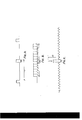
- FIGS. 1a-1c depict the pattern of phase reversal within a transmitted pulse and the autocorrelation function of the pulse
- FIG. 2 shows diagrammatically a simple form of Barker decoder connected to an autocorrelator
- FIG. 3 shows diagrammatically a quadrature system for use in a bi-phase decoder
- FIG. 4 shows a vector diagram demonstrating a doppler shift
- FIG. 5 is a flow chart of the logical steps according to the invention.
- FIG. 6 is a block circuit diagram of an arrangement for implementing the logic described in FIG. 5.
- the transmitted waveform is a train of pulses as shown in FIG. 1 a of the accompanying drawings.
- the mean power is determined by the peak power and the duty ratio, that is to say the ratio of the width ⁇ of the pulses to the overall repetition period T.
- T is fixed by the maximum unambiguous range, and ⁇ by the resolution required.
- the resolution is not governed by the pulse length but, as previously stated, by the overall transmitted bandwidth.
- the bandwidth is increased and the resolution improved with no reduction in mean transmitted power.
- phase modulation in which within the width of the transmitted pulse the phase is reversed at specified intervals or sub-pulses. Whilst these phase reversals can follow a random sequence, by using certain well-defined sequences known as "Barker codes" it is possible to reduce the level of the sidelobes after processing of the received pulse.
- FIG. 1 b of the accompanying drawings there is shown the pattern of phase reversal within a pulse subdivided into thirteen sub-pulses, so forming a Barker code.
- the auto-correlation function of this pulse is shown in FIG. 1 c.
- This graph shows the level of correlation of a pulse as in FIG. 1 b with a similar pulse when plotted against the relative time of the pulses being completed. It will be seen that except at coincidence in time the correlation function takes on values between 0 and 1 and that when the two signals are coincident the correlation function has a value of 13.
- the transmitted pulse has an overall duration of 13 ⁇ the resolution of the radar is 1 ⁇ and there is a difference of 22.3 dB between the level of the sidelobes and the correlation peak, although with digital filtering this may be improved to 34 dB.
- Barker decoder A simple form of Barker decoder is shown diagrammatically in FIG. 2 of the accompanying drawings.
- the input signal is fed into a phase shift detector 1 which compares the phase of the input signal 2 with that from a local oscillator 3.
- a sample-and-hold circuit 4 periodically samples the output of the mixer at periods equal to one sub-pulse and digital code representative of the sampled voltage is fed by an analogue-to-digital converter 5 into a thirteen-element shift register 6.
- Each stage in the shift register is separately sampled and fed into an adder 7, correlation being effected by first multiplying the signal derived from each stage of the shift register by a preselected multiplying factor of +1 or -1 (symbolized by block 8), the sequence of multiplying factors corresponding to the sequence of phase reversal in the transmitted pulse.
- the sum signal 10 at the output of the adder 7 corresponds to the autocorrelation function of the received signal and if an ideal signal is received (corresponding to the signal in FIG. 1 b the output will correspond to FIG. 1 c, the correlation peak being obtained when the digital codes derived from all thirteen sub-pulses fully occupy the shift register 6.
- FIG. 2 only produces the autocorrelation function of FIG. 1 c when the phase of the local oscillator 3 is correctly matched to the input signal 2, that is to say when the phase shift detector 1 only receives signals which are either completely in-phase or completely out-of-phase.
- the phase of the received signal will vary and on average the system will suffer a 3dB loss.
- a quadrature system as shown in FIG. 3 of the accompanying drawings. In this system two channels 11 and 12 are used for processing an input signal 13 which channels are in-phase and quadrature channels.
- the system relies on the fact that when the in-phase signal is 90° out-of-phase with the local oscillator 14 the quadrature channel 11, represented by a phase-shift detector 15 connected to a sample-and-hold circuit 16 which is, in turn, connected to an analog-to-digital converter 17, will produce its maximum output.
- the quadrature channel 11 with the output of the in-phase channel 12, represented by a phase-shift detector 18 connected to a sample-and-hold circuit 20 which is, in turn, connected to an analog-to-digital converter 21
- the signal level at the output may be made substantially independent of the phase of the input signal 13.
- a combiner 22 combines the outputs of the in-phase channel 12 and the quadrature channel 11 and produces a signal 23 whose magnitude is the greater of
- a signal of this magnitude and of sign determined in the in-phase channel 12 is fed into a 13-element shift register 6 as shown in FIG. 2 and the parallel outputs of the shift register, after being suitably multiplied and added, produce a correlation function more closely resembling that of FIG. 1 c.
- the number of radians moved during the thirteen samples is 12 ⁇ 2 f d t p .
- the sidelobe performance degrades sharply once the quadrature axis is passed and this leads to two zones of unacceptably high sidelobes which straddle, respectively, the positive and the negative quadrature axes.
- the zones in which the sidelobe levels are acceptable are 2 ⁇ -(4 ⁇ 12 ⁇ 2 ⁇ f d t p ) radians and the percentage of time when the good sidelobe level is obtained is 100 (1 - 48f d t p )%.
- the present invention seeks to provide an improved system capable of compensating for incorrect allocation of sign to the elements of the bi-phase codes due to Doppler frequency shift in a signal reflected by a single target.
- a bi-phase decoder includes two phase-shift detectors each operative to measure the phase difference between each sub-pulse in a received bi-phase code relative to a respective one of two signals in phase quadrature with one another; two sampling circuits each operative to sample periodically the output of a respective one of the phase-shift detectors and to produce a first signal representative of the magnitude of the sampled output and a further signal representative of the sign of the sampled output; a combiner for combining the magnitude signals generated by the sampling circuit in such a manner as to render the sensitivity of the decoder substantially independent of the phase of the received code and an autocorrelator connected to receive the output signal of the combiner and the sign signal from one of the sampling circuits and to autocorrelate the signal from successive sub-pulses to effect pulse compression; the decoder further includes corrector means for correcting errors in the sign signal derived from one of the sampling circuits resulting from Doppler shifting of the carrier frequency of the received bi-phase code, the corrector means
- the angles which each line subtends with the in-phase axis I and the quadrature axis Q represents the phase of the received signal at any instant in time relative to the local oscillators in the in-phase and quadrature channels, respectively. If there is no Doppler shift, then the vector will always point in the same direction but will take on either positive or negative values depending on whether the sub-pulse is in-phase or out of phase with the appropriate local oscillator. If, however, there is a change in frequency owing to the Doppler effect, then the received signal will have a different frequency from the local oscillator and this results in the phase of the received signal continuously changing.
- the magnitude of the signals sent to the bi-phase decoder is derived both from the in-phase channel 12 and the quadrature channel 11 and is substantially constant and independent of phase.
- the sign of the signal sent to the bi-phase decoder is derived solely from the in-phase channel 12. This means, in the case of the phase vectors following the course shown in FIG. 4, the first four samples will be allocated a positive sign which coincides with the phase of received signal so that until then there is no error. However, in the fifth sub-pulse, again a positive sign will be allocated to the sub-pulse despite the fact that a negative sign should have been allocated. The reason for this may clearly be seen from the vector diagram namely the vectors have crossed the quadrature axis in the course of their rotation caused by Doppler shift.
- a crossing of the quadrature axis may be detected by the fact that the product sign Q ⁇ sign I changes sign. This will occur both when the quadrature axis and when the in-phase axis is crossed. Of all the crossings of the axes, only crossings of the quadrature axis are of importance since crossings of the in-phase axis do not effect the sign of the signal derived from the in-phase channel. It is therefore necessary to test, having determined a change in the product sign Q ⁇ sign I whether this is caused by a crossing of the quadrature axis or a crossing of the in-phase axis.
- this starts by defining a quantity PF which is the product of sign I and sign Q. This product is positive in the first quadrant, negative in the second quadrant, positive in the third quadrant and negative in the fourth quadrant. It is arbitrarily set to positive at the start.
- a multiplying factor MF and this can take on values either of +1 or -1. During all the times that the vectors of FIG. 4 are to the right of the quadrature axis the multiplying factor is positive and during all the time that it is to the left of the quadrature axis the multiplying factor is negative.
- the stored value of PF is changed to the new value and one determines whether the in-phase axis or the quadrature axis has been crossed by comparing the magnitudes of
- the circuit arrangement in FIG. 6 implements the flow chart of FIG. 5 and includes two registers 71 and 65 which store the values of MF and PF respectively.
- An exclusive-OR gate which includes an inverter is designated 61 in the drawing and receives signals representative of sign I and sign Q.
- the output of the exclusive-OR gate 61 is high when sign I is the same as sign Q and low when sign I is different from sign Q. If one takes positive as being high and negative as being low then the output of the exclusive-OR gate 61 is representative of sign I ⁇ sign Q.
- This value is compared in a second exclusive-OR gate 62 with the value of PF stored in the register 65 so that his output would be high whenever there is a change in PF.
- the next step in the flow chart is to set PF to the new value and this is done by feeding the output of the register 65 and of the exclusive-OR gate 62 and the third exclusive-OR gate 63 whose output is fed by way of an OR gate 64 into the clocked register 65.
- the OR gate 64 is provided to enable resetting of the register 65 and commencement of operation and likewise an OR gate 70 is provided for enabling resetting of the register 71 which stores the value of MF.
Landscapes
- Engineering & Computer Science (AREA)
- Radar, Positioning & Navigation (AREA)
- Remote Sensing (AREA)
- Computer Networks & Wireless Communication (AREA)
- Physics & Mathematics (AREA)
- General Physics & Mathematics (AREA)
- Radar Systems Or Details Thereof (AREA)
Applications Claiming Priority (1)
| Application Number | Priority Date | Filing Date | Title |
|---|---|---|---|
| GB3793573A GB1474026A (en) | 1973-08-10 | 1973-08-10 | Pulse compression |
Publications (1)
| Publication Number | Publication Date |
|---|---|
| US3945010A true US3945010A (en) | 1976-03-16 |
Family
ID=10400059
Family Applications (1)
| Application Number | Title | Priority Date | Filing Date |
|---|---|---|---|
| US05/496,271 Expired - Lifetime US3945010A (en) | 1973-08-10 | 1974-08-09 | Pulse compression radar |
Country Status (3)
| Country | Link |
|---|---|
| US (1) | US3945010A (enExample) |
| FR (1) | FR2240581B1 (enExample) |
| GB (1) | GB1474026A (enExample) |
Cited By (8)
| Publication number | Priority date | Publication date | Assignee | Title |
|---|---|---|---|---|
| US4353067A (en) * | 1980-08-29 | 1982-10-05 | Westinghouse Electric Corp. | Method of reducing side lobes of complementary coded pulses in a coherent pulse compression doppler radar receiving system |
| US4532515A (en) * | 1982-02-10 | 1985-07-30 | Cantrell Ben H | Angle of arrival measurements for two unresolved sources |
| US4622552A (en) * | 1984-01-31 | 1986-11-11 | The United States Of America As Represented By The Secretary Of The Navy | Factored matched filter/FFT radar Doppler processor |
| US4661819A (en) * | 1983-05-12 | 1987-04-28 | The United States Of America As Represented By The Secretary Of The Navy | Doppler tolerant binary phase coded pulse compression system |
| US4875050A (en) * | 1988-02-12 | 1989-10-17 | Itt Gilfillan, A Division Of Itt Corporation | Generalized doppler matched binary pulse compressor |
| US5057846A (en) * | 1990-03-26 | 1991-10-15 | Geophysical Survey Systems, Inc. | Efficient operation of probing radar in absorbing media |
| US5389932A (en) * | 1991-06-10 | 1995-02-14 | Fujitsu Limited | Pulse compression control system |
| CN104062645A (zh) * | 2014-06-26 | 2014-09-24 | 哈尔滨工程大学 | 一种测量参量阵差频波与同频小振幅波信号相位差的方法 |
Families Citing this family (2)
| Publication number | Priority date | Publication date | Assignee | Title |
|---|---|---|---|---|
| US5115247A (en) * | 1988-02-16 | 1992-05-19 | Honeywell Inc. | Frequency modulated, phase coded radar |
| CN112083383B (zh) * | 2020-08-30 | 2022-07-29 | 西南电子技术研究所(中国电子科技集团公司第十研究所) | 幅度/相位相关联合检测应答信号的方法 |
Citations (1)
| Publication number | Priority date | Publication date | Assignee | Title |
|---|---|---|---|---|
| US3731311A (en) * | 1970-09-18 | 1973-05-01 | Hughes Aircraft Co | Polyphase encoding-decoding system |
Family Cites Families (2)
| Publication number | Priority date | Publication date | Assignee | Title |
|---|---|---|---|---|
| US3049673A (en) * | 1959-04-15 | 1962-08-14 | Collins Radio Co | Disk reference phase-pulse detector |
| US3680105A (en) * | 1970-10-05 | 1972-07-25 | Raytheon Co | Pulse compression radar system |
-
1973
- 1973-08-10 GB GB3793573A patent/GB1474026A/en not_active Expired
-
1974
- 1974-08-09 US US05/496,271 patent/US3945010A/en not_active Expired - Lifetime
- 1974-08-12 FR FR7427855A patent/FR2240581B1/fr not_active Expired
Patent Citations (1)
| Publication number | Priority date | Publication date | Assignee | Title |
|---|---|---|---|---|
| US3731311A (en) * | 1970-09-18 | 1973-05-01 | Hughes Aircraft Co | Polyphase encoding-decoding system |
Cited By (8)
| Publication number | Priority date | Publication date | Assignee | Title |
|---|---|---|---|---|
| US4353067A (en) * | 1980-08-29 | 1982-10-05 | Westinghouse Electric Corp. | Method of reducing side lobes of complementary coded pulses in a coherent pulse compression doppler radar receiving system |
| US4532515A (en) * | 1982-02-10 | 1985-07-30 | Cantrell Ben H | Angle of arrival measurements for two unresolved sources |
| US4661819A (en) * | 1983-05-12 | 1987-04-28 | The United States Of America As Represented By The Secretary Of The Navy | Doppler tolerant binary phase coded pulse compression system |
| US4622552A (en) * | 1984-01-31 | 1986-11-11 | The United States Of America As Represented By The Secretary Of The Navy | Factored matched filter/FFT radar Doppler processor |
| US4875050A (en) * | 1988-02-12 | 1989-10-17 | Itt Gilfillan, A Division Of Itt Corporation | Generalized doppler matched binary pulse compressor |
| US5057846A (en) * | 1990-03-26 | 1991-10-15 | Geophysical Survey Systems, Inc. | Efficient operation of probing radar in absorbing media |
| US5389932A (en) * | 1991-06-10 | 1995-02-14 | Fujitsu Limited | Pulse compression control system |
| CN104062645A (zh) * | 2014-06-26 | 2014-09-24 | 哈尔滨工程大学 | 一种测量参量阵差频波与同频小振幅波信号相位差的方法 |
Also Published As
| Publication number | Publication date |
|---|---|
| FR2240581A1 (enExample) | 1975-03-07 |
| GB1474026A (en) | 1977-05-18 |
| AU7017474A (en) | 1975-12-18 |
| FR2240581B1 (enExample) | 1976-10-22 |
Similar Documents
| Publication | Publication Date | Title |
|---|---|---|
| US4106019A (en) | Range resolving doppler radar system | |
| US4219812A (en) | Range-gated pulse doppler radar system | |
| US4042925A (en) | Pseudo-random code (PRC) surveilance radar | |
| US4384291A (en) | Efficient low-sidelobe pulse compression | |
| US4078234A (en) | Continuous wave correlation radar system | |
| US4176351A (en) | Method of operating a continuous wave radar | |
| US4057800A (en) | Multi-PRF signal processor system | |
| US6646587B2 (en) | Doppler radar apparatus | |
| US3730628A (en) | Electronic distance measuring method and apparatus | |
| US3945010A (en) | Pulse compression radar | |
| SE500360C2 (sv) | Brusradar | |
| US2817832A (en) | Multiple sweep | |
| US3828348A (en) | System for minimizing multiple time around echos in a coherent-on-receive-doppler radar | |
| US5079556A (en) | Coherent pulse radar system | |
| JPH0146835B2 (enExample) | ||
| JPS61237542A (ja) | デイジタル信号検出器 | |
| US4635060A (en) | Coherent-on-receive radar with prephase correction circuit | |
| US3383686A (en) | Diverse frequency echo detection system with doppler frequency coherence | |
| US4435709A (en) | Radar ranging system for use with sloping target | |
| US4429310A (en) | Random binary waveform encoded ranging apparatus | |
| US4093949A (en) | Clutter tracker using a smoothed doppler frequency measurement | |
| US4430655A (en) | Radar target angle measuring system | |
| US4800388A (en) | Apparatus for measuring pulse compression ratio | |
| US3715751A (en) | Digital speed gate for doppler radar | |
| US3201787A (en) | Method of suppressing noise, compressing bandwidth, and evaluating radar-picture signals or similar periodic trains of impulses |