US3894570A - Self-tapping fastener - Google Patents
Self-tapping fastener Download PDFInfo
- Publication number
- US3894570A US3894570A US353449A US35344973A US3894570A US 3894570 A US3894570 A US 3894570A US 353449 A US353449 A US 353449A US 35344973 A US35344973 A US 35344973A US 3894570 A US3894570 A US 3894570A
- Authority
- US
- United States
- Prior art keywords
- fastener
- thread
- self
- shank
- crest
- Prior art date
- Legal status (The legal status is an assumption and is not a legal conclusion. Google has not performed a legal analysis and makes no representation as to the accuracy of the status listed.)
- Expired - Lifetime
Links
- 238000010079 rubber tapping Methods 0.000 title claims abstract description 33
- 239000000126 substance Substances 0.000 claims abstract description 24
- 238000005520 cutting process Methods 0.000 claims abstract description 17
- 239000000463 material Substances 0.000 claims description 21
- 230000009977 dual effect Effects 0.000 claims description 5
- UONOETXJSWQNOL-UHFFFAOYSA-N tungsten carbide Chemical compound [W+]#[C-] UONOETXJSWQNOL-UHFFFAOYSA-N 0.000 claims description 5
- 229910001092 metal group alloy Inorganic materials 0.000 claims description 4
- MTPVUVINMAGMJL-UHFFFAOYSA-N trimethyl(1,1,2,2,2-pentafluoroethyl)silane Chemical compound C[Si](C)(C)C(F)(F)C(F)(F)F MTPVUVINMAGMJL-UHFFFAOYSA-N 0.000 claims description 4
- 229910001209 Low-carbon steel Inorganic materials 0.000 claims description 2
- 239000007779 soft material Substances 0.000 claims description 2
- 229910052751 metal Inorganic materials 0.000 abstract description 20
- 239000002184 metal Substances 0.000 abstract description 20
- 238000004519 manufacturing process Methods 0.000 abstract description 11
- 238000005096 rolling process Methods 0.000 abstract description 11
- 230000013011 mating Effects 0.000 abstract description 9
- 238000005470 impregnation Methods 0.000 description 16
- 238000000034 method Methods 0.000 description 15
- OKTJSMMVPCPJKN-UHFFFAOYSA-N Carbon Chemical compound [C] OKTJSMMVPCPJKN-UHFFFAOYSA-N 0.000 description 6
- 229910052799 carbon Inorganic materials 0.000 description 6
- 238000010438 heat treatment Methods 0.000 description 6
- 230000006698 induction Effects 0.000 description 6
- 229910052782 aluminium Inorganic materials 0.000 description 5
- XAGFODPZIPBFFR-UHFFFAOYSA-N aluminium Chemical compound [Al] XAGFODPZIPBFFR-UHFFFAOYSA-N 0.000 description 5
- 238000010276 construction Methods 0.000 description 4
- 230000035515 penetration Effects 0.000 description 3
- XEEYBQQBJWHFJM-UHFFFAOYSA-N Iron Chemical compound [Fe] XEEYBQQBJWHFJM-UHFFFAOYSA-N 0.000 description 2
- PXHVJJICTQNCMI-UHFFFAOYSA-N Nickel Chemical compound [Ni] PXHVJJICTQNCMI-UHFFFAOYSA-N 0.000 description 2
- 229910000831 Steel Inorganic materials 0.000 description 2
- 230000002411 adverse Effects 0.000 description 2
- 229910045601 alloy Inorganic materials 0.000 description 2
- 239000000956 alloy Substances 0.000 description 2
- 238000000576 coating method Methods 0.000 description 2
- 238000005553 drilling Methods 0.000 description 2
- 238000010891 electric arc Methods 0.000 description 2
- -1 ferrous metals Chemical class 0.000 description 2
- 239000010687 lubricating oil Substances 0.000 description 2
- 238000003754 machining Methods 0.000 description 2
- 239000012858 resilient material Substances 0.000 description 2
- 239000010959 steel Substances 0.000 description 2
- 238000012360 testing method Methods 0.000 description 2
- 229910000851 Alloy steel Inorganic materials 0.000 description 1
- 229910000975 Carbon steel Inorganic materials 0.000 description 1
- VYZAMTAEIAYCRO-UHFFFAOYSA-N Chromium Chemical compound [Cr] VYZAMTAEIAYCRO-UHFFFAOYSA-N 0.000 description 1
- CWYNVVGOOAEACU-UHFFFAOYSA-N Fe2+ Chemical compound [Fe+2] CWYNVVGOOAEACU-UHFFFAOYSA-N 0.000 description 1
- PWHULOQIROXLJO-UHFFFAOYSA-N Manganese Chemical compound [Mn] PWHULOQIROXLJO-UHFFFAOYSA-N 0.000 description 1
- 238000013459 approach Methods 0.000 description 1
- 238000005452 bending Methods 0.000 description 1
- 230000015556 catabolic process Effects 0.000 description 1
- 239000003795 chemical substances by application Substances 0.000 description 1
- 229910052804 chromium Inorganic materials 0.000 description 1
- 239000011651 chromium Substances 0.000 description 1
- 230000003749 cleanliness Effects 0.000 description 1
- 230000008094 contradictory effect Effects 0.000 description 1
- 239000002826 coolant Substances 0.000 description 1
- 238000001816 cooling Methods 0.000 description 1
- 238000006731 degradation reaction Methods 0.000 description 1
- 230000008021 deposition Effects 0.000 description 1
- 229910003460 diamond Inorganic materials 0.000 description 1
- 239000010432 diamond Substances 0.000 description 1
- 230000003467 diminishing effect Effects 0.000 description 1
- 238000006073 displacement reaction Methods 0.000 description 1
- 230000000694 effects Effects 0.000 description 1
- 230000008030 elimination Effects 0.000 description 1
- 238000003379 elimination reaction Methods 0.000 description 1
- 238000002474 experimental method Methods 0.000 description 1
- 239000000789 fastener Substances 0.000 description 1
- 239000012530 fluid Substances 0.000 description 1
- 238000007542 hardness measurement Methods 0.000 description 1
- 239000004615 ingredient Substances 0.000 description 1
- 229910052742 iron Inorganic materials 0.000 description 1
- 230000001788 irregular Effects 0.000 description 1
- 230000001050 lubricating effect Effects 0.000 description 1
- 229910052748 manganese Inorganic materials 0.000 description 1
- 239000011572 manganese Substances 0.000 description 1
- 238000005555 metalworking Methods 0.000 description 1
- 238000012986 modification Methods 0.000 description 1
- 230000004048 modification Effects 0.000 description 1
- 230000007935 neutral effect Effects 0.000 description 1
- 229910052759 nickel Inorganic materials 0.000 description 1
- 229910021652 non-ferrous alloy Inorganic materials 0.000 description 1
- 239000003921 oil Substances 0.000 description 1
- 239000004033 plastic Substances 0.000 description 1
- 230000005855 radiation Effects 0.000 description 1
- 230000035939 shock Effects 0.000 description 1
- 238000011282 treatment Methods 0.000 description 1
- WFKWXMTUELFFGS-UHFFFAOYSA-N tungsten Chemical compound [W] WFKWXMTUELFFGS-UHFFFAOYSA-N 0.000 description 1
- 229910052721 tungsten Inorganic materials 0.000 description 1
- 239000010937 tungsten Substances 0.000 description 1
Images


Classifications
-
- B—PERFORMING OPERATIONS; TRANSPORTING
- B23—MACHINE TOOLS; METAL-WORKING NOT OTHERWISE PROVIDED FOR
- B23K—SOLDERING OR UNSOLDERING; WELDING; CLADDING OR PLATING BY SOLDERING OR WELDING; CUTTING BY APPLYING HEAT LOCALLY, e.g. FLAME CUTTING; WORKING BY LASER BEAM
- B23K31/00—Processes relevant to this subclass, specially adapted for particular articles or purposes, but not covered by only one of the preceding main groups
- B23K31/02—Processes relevant to this subclass, specially adapted for particular articles or purposes, but not covered by only one of the preceding main groups relating to soldering or welding
- B23K31/025—Connecting cutting edges or the like to tools; Attaching reinforcements to workpieces, e.g. wear-resisting zones to tableware
-
- B—PERFORMING OPERATIONS; TRANSPORTING
- B21—MECHANICAL METAL-WORKING WITHOUT ESSENTIALLY REMOVING MATERIAL; PUNCHING METAL
- B21H—MAKING PARTICULAR METAL OBJECTS BY ROLLING, e.g. SCREWS, WHEELS, RINGS, BARRELS, BALLS
- B21H3/00—Making helical bodies or bodies having parts of helical shape
- B21H3/02—Making helical bodies or bodies having parts of helical shape external screw-threads ; Making dies for thread rolling
- B21H3/027—Rolling of self-tapping screws
-
- F—MECHANICAL ENGINEERING; LIGHTING; HEATING; WEAPONS; BLASTING
- F16—ENGINEERING ELEMENTS AND UNITS; GENERAL MEASURES FOR PRODUCING AND MAINTAINING EFFECTIVE FUNCTIONING OF MACHINES OR INSTALLATIONS; THERMAL INSULATION IN GENERAL
- F16B—DEVICES FOR FASTENING OR SECURING CONSTRUCTIONAL ELEMENTS OR MACHINE PARTS TOGETHER, e.g. NAILS, BOLTS, CIRCLIPS, CLAMPS, CLIPS OR WEDGES; JOINTS OR JOINTING
- F16B33/00—Features common to bolt and nut
- F16B33/02—Shape of thread; Special thread-forms
-
- F—MECHANICAL ENGINEERING; LIGHTING; HEATING; WEAPONS; BLASTING
- F16—ENGINEERING ELEMENTS AND UNITS; GENERAL MEASURES FOR PRODUCING AND MAINTAINING EFFECTIVE FUNCTIONING OF MACHINES OR INSTALLATIONS; THERMAL INSULATION IN GENERAL
- F16B—DEVICES FOR FASTENING OR SECURING CONSTRUCTIONAL ELEMENTS OR MACHINE PARTS TOGETHER, e.g. NAILS, BOLTS, CIRCLIPS, CLAMPS, CLIPS OR WEDGES; JOINTS OR JOINTING
- F16B33/00—Features common to bolt and nut
- F16B33/06—Surface treatment of parts furnished with screw-thread, e.g. for preventing seizure or fretting
-
- Y—GENERAL TAGGING OF NEW TECHNOLOGICAL DEVELOPMENTS; GENERAL TAGGING OF CROSS-SECTIONAL TECHNOLOGIES SPANNING OVER SEVERAL SECTIONS OF THE IPC; TECHNICAL SUBJECTS COVERED BY FORMER USPC CROSS-REFERENCE ART COLLECTIONS [XRACs] AND DIGESTS
- Y10—TECHNICAL SUBJECTS COVERED BY FORMER USPC
- Y10S—TECHNICAL SUBJECTS COVERED BY FORMER USPC CROSS-REFERENCE ART COLLECTIONS [XRACs] AND DIGESTS
- Y10S411/00—Expanded, threaded, driven, headed, tool-deformed, or locked-threaded fastener
- Y10S411/03—Utilizing fluid pressure
-
- Y—GENERAL TAGGING OF NEW TECHNOLOGICAL DEVELOPMENTS; GENERAL TAGGING OF CROSS-SECTIONAL TECHNOLOGIES SPANNING OVER SEVERAL SECTIONS OF THE IPC; TECHNICAL SUBJECTS COVERED BY FORMER USPC CROSS-REFERENCE ART COLLECTIONS [XRACs] AND DIGESTS
- Y10—TECHNICAL SUBJECTS COVERED BY FORMER USPC
- Y10S—TECHNICAL SUBJECTS COVERED BY FORMER USPC CROSS-REFERENCE ART COLLECTIONS [XRACs] AND DIGESTS
- Y10S411/00—Expanded, threaded, driven, headed, tool-deformed, or locked-threaded fastener
- Y10S411/914—Coated bolt
-
- Y—GENERAL TAGGING OF NEW TECHNOLOGICAL DEVELOPMENTS; GENERAL TAGGING OF CROSS-SECTIONAL TECHNOLOGIES SPANNING OVER SEVERAL SECTIONS OF THE IPC; TECHNICAL SUBJECTS COVERED BY FORMER USPC CROSS-REFERENCE ART COLLECTIONS [XRACs] AND DIGESTS
- Y10—TECHNICAL SUBJECTS COVERED BY FORMER USPC
- Y10S—TECHNICAL SUBJECTS COVERED BY FORMER USPC CROSS-REFERENCE ART COLLECTIONS [XRACs] AND DIGESTS
- Y10S411/00—Expanded, threaded, driven, headed, tool-deformed, or locked-threaded fastener
- Y10S411/924—Coupled nut and bolt
- Y10S411/929—Thread lock
- Y10S411/938—Distorted thread
Definitions
- ABSTRACT A threaded fastener of the self-tapping type is de-' scribed having the conventional head, shank, and pilot end.
- the shank includes a helically wound thread member impregnated with a carbide or other, harder substance than the metal from which the fastener is made.
- a thread-cutting fastener, having its pilot tip end impregnated is also described.
- a thread-rolling machine with a unique impregnating electrode is disclosed. The electrode is shown to engage the fastener selectively during the thread-rolling operation itself.
- a method of manufacturing or forming the threaded fastener is described whereby a tough, ductile fastener is shown having superior reciprocal or mating thread forming and cutting characteristics.
- a metal By being ductile or tough. a metal is considered herein as being pliant yet strong. as having the quality of bending or twisting without tearing or breaking. Antonymously. hardness' is used herein to characterize increasing susceptibility to breaking. or brittleness. in addition to resistance to penetration. In the art or trade. it is customary to use the "Rockwell" hardness testing devices. Using such devices. a metal is penetrated by a substance of known hardness. such as a diamond. with a predetermined force. The depth of penetration gives a relative indication of hardness. A number is assigned directly relative to the penetration depth. The results of such a device are ordinarily given on the Rockwell scales designated A. B and C. The higher the number assigned as a result of such a test. the harder the metal. Thus. a metal having a hardness corresponding to a reading of or less on the Rockwell scale would be of the order as is normally considered ductile and is used in the manufacture of relatively tough. ductile fasteners.
- a fastener made from such tough. ductile material generally fails as a self-tapping screw.
- a self-tapping screw is one which forms its own mating threads or reciprocal grooves in a drilled hole in metal or in a hole into which the fastener is being inserted. Failure occurs when the ductile or tough thread on the fastener collapses within the unthreaded hole.
- the fastener is heat treated to approximately l.700F or more.
- the fastener is then in a second step case hardened.
- the fastener's surface is thoroughly cleaned. heated to approximately 1.250 F to l.300 F and placed into a carbon rich atmosphere. In such an environment. the metal has a propensity to attract the carbon.
- the usual result is an approximately 0.004 inch to 0.006 inch carbon layer deposited upon the fasteners surface.
- the third procedural step is entitled induction heat treating. In this step.
- the pilot end of the threaded fastener is placed in a rapidly changing inductance field.
- the iron in the metal has its magnetic field changed by each hysteresis cycle. and thus is heated very rapidly to red hot temperatures.
- the molecular structure at least of approximately 0.06 inch of the exposed surface of the pilot end is changed.
- the result of such treatments unfortunately. hardens the fastener and makes it more brittle.
- such an induction heating procedure has made test fasteners possess a hardness on the order of C 45 and higher on the aforementioned Rockwell scale.
- the induction-heating step requires meticulous positioning of the fasteners. lest the entire fastener be so treated. Moreover. the equipment for the induction-heating step is complex and very costly.
- This invention relates to comparatively small metal fastening parts. such as threaded screw fasteners.
- these fasteners are made of comparathely tough. ductile material. and are characterized by a comparati ely hard substance impregnated at selected points of wear on the thread crests.
- the threads may be impregnated advantageously during the thread-rolling process wherein the threads are rolled on the cylindrical blanks.
- This impregnated thread structure is partic' ularly useful in the case of self-tapping fasteners having surface locking arrangements and for high strength fasteners. normally formed of materials which are adversely affected by conventional hardening methods.
- One aspect of the invention involves the electrode impregnation of the screw threads or other metal parts as part of the machining process. Unlike other coating processes which require a high degree of cleanliness. the carbide impregnation coating process can tolerate coolant and lubricating fluid and machining grit and thus can be incorporated into manufacturing metalworking processes with little extra expense.
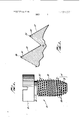
- FIG. I illustrates a side elevational view of an alternative embodiment of the invention. showing a threaded screw fastener
- FIG. 2 illustrates a cross-sectional view taken along line 2-2 of FIG. 1;
- FIG. 3 illustrates a perspective view of a thread-roll machine application of the invention.
- FIG. 4 illustrates a plan view of an alternative threadroll machine application of the invention
- FIG. 5 illustrates a side elevational view of an alternative embodiment of the invention in use
- FIG. 6 is a cross-sectional view taken along line 6-6 of FIG. 4;
- FIG. 7 is a fragmentary perspective view of yet another alternative embodiment of the invention.
- FIG. 8 is a side elevational view taken along line 88 of FIG. 7.
- FIG. l a new fastener construction is shown. reference being bad to FIG. l in the drawings.
- a screw-type fastener having a head or driving means [2 and conventional pilot end 14, described in more detail below, is shown.
- the fastener 10 has a shank with a helical screw thread 22 wound thereabout.
- pilot end 14 and substantially the thread 22 are made from a relatively ductile. possibly resilient material which is ductile and tough enough to stand up to the stresses under which the fastener could be foreseeably placed.
- the pilot end 14 of thread 22 is shown in enlarged cross section and more detail in FIG. 2.
- the thread 22 has impregnated on its outside edge or crest 24 a small layer 26 of metal. or other relatively hard-type substance such as, for example. tungsten carbide or titanium carbide. Such substances are to be substantially harder than the ductile material used in making the shank 20 and other parts ofthe fastener 10.
- a preferred construction is to impregnate only the crest 24 ofthe initial turns of the thread 22, or pilot end 14 of the fastener 10. When the fastener 10 is introduced to the non-threaded or poorly grooved nut or hole. the hardened crest 24 at the pilot end 14 will form a correctly spaced reciprocal groove or thread therein.
- a fastener pilot end both of the thread-forming and of the thread-cutting types is meant.
- a thread-forming fastener deforms or reforms the material into which it is driven, forcing the material to conform to the threads of the fastener.
- the hole for thread-forming fasteners should be sized to produce approximately 80% thread engagement. This value can vary. however, with the flexibility ofthe materials used.
- Thread-cutting fasteners on the other hand are manufactured to function as a tap to cut threads into the material being joined. Usually. as the thread-cutting fastener cuts into the material. chips are generated and pushed ahead of the fastener. See. for example. Solutions to Plastic Fastening Problems" in Assembly Engimeringfieptember. 1971.
- Such an impregnated construction is especially useful when employed in combination with the recently developed self-locking.
- ribbed screw thread 23 developed by Roger W. Orlomoski and adequately described in US. Pat. No. 3,517.7 l7 and in co-pending Pat. application Ser. No. 284.006 filed Aug. 28, 1972.
- the thread in such a screw. designated as an ORLO thread or fas tener in the trade. is constructed having a rib or split. dual. resiliently tough crests. one of which protrudes outside the boundary of a normal thread cross section. A cross-sectional view of this ORLO-type thread crest is shown in the referenced patent and application.
- ORLO thread 23 The two crests of such an ORLO thread 23 are pressed to gether when inserted into a conventional reciprocal, mating thread groove in a nut or hole. A very superior grip is maintained by the outward resilient tension exerted by the dual crested ORLO thread 23.
- a relatively ductile, tough and nonbrittle substance is required for the success of such a fastener.
- a precise, correctly formed mating thread in the nut or hole is greatly desired. Otherwise. the multi-crested thread will likely collapse within the non-tapped nut.
- a fastener having its thread 22 impregnated at the pilot end 14 of the shank 20 as described herein will self-tap a nut or hole in such a case.
- the ORLO thread 23 portion formed beyond the pilot end 14 and beyond the impregnated crest portion will fit within the thus self-tapped nut or hole grooves and provide the desired fastening.
- Self-drilling fasteners not shown, frequently have their pilot ends notched or grooved in the longitudinal. or if the fastener shank is upright, vertical direction.
- the vertical groove presents a vertical edge in a hole which, when the fastener is forcefully rotated, forms or cuts the hole and mating threads therein.
- Such vertical grooves. in the past. necessarily had to be of material harder than the hole which was being formed or cut. It has been found. however, that impregnation of this grooves edges provides sufficient hardness to the cutting edges to form or cut the hole itself and the mating threads in the hole. Such a satisfactory hole is cut despite the fact that the main body of the fastener is made of a tough. ductile material which may even be softer than the material of the hole being cut.
- the resultant fasteners possess a hardness at the impregnated crest 22 comparable to a metal having a hardness C 70. or more, on the above-described Rockwell scale.
- a fastener having its thread so impregnated. it has been found. does not require case hardening nor induction heat treating to pos sess the required self-tapping capability. Elimination of these steps allows the use of substantially cheaper metal in making the fastener. By eliminating the casehardening and induction steps, further. the desired ductility of the fastener is kept. The result is a fastener made from substantially less expensive material having a ductility of approximately C 30. or less, while having self-tapping pilot end threads with a hardness of approximately C 70. or more.
- the method of making such a fastener is substantially less difficult and complex than is the method of preparing the case-hardened and induction'treated fasteners in the presently known methods.
- the carbide can be deposited upon the fasteners thread crests in any of currently known methods. It is preferred, however, that the presently known electric arc vibrating deposition procedures be used. This procedure is described adequately and in detail in US. Pat. No. 3.524.956 to I. .I. Rocklin.
- Such an apparatus can be positioned at the end of the thread-roll forming step in a thread-roll ma chine as will be described in more detail below.
- a thoroughly cleaned thread is not required for the carbide impregnation.
- the high voltage and impact force of the electrode during operation are sufficient to impregnate the blank through the oils and grit.
- the temperature of the fastener remains substantially the same. and therefore the ductility is not changed.
- the fastener may then be heat treated for neutral hardness, increasing the strength. such a heat treatment up to approximately l.850F will not affect the carbide impregnation. See Tungsten. 3rd Ed. (1955) by Li and Wang (American Chemical Society Monograph No. 94). at page 390. It has been found that in the electric arc impregnation. some of the thread crest is removed. but that the deposited carbide substantially compensates therefor. It has been found that the carbide so impregnated anchors into the thread crest or other parts of the fastener approximately 0.001 inch. and forms an additional build-up of approximately from (LUOI inch to 0.0015 inch. The impregnation is solidly implanted upon and into the fastener. and is highly resistant to impact and breaking. it has been found.
- FIG. 3 is shown die block 40 and die block 42, elements in a conventional thread-forming apparatus.
- Die block 40 is shown as the stationary die. Die block 42 moves in the direction of the arrow.
- the blank fastener 44 is rolled between the dies 40. 42 as the die 42 is forcefully moved in the direction of the arrow. Threads are formed on the fastener 44 by the work of the reciprocal, mating grooves 46 on the respective working surfaces of the die blocks 40. 42.
- the facing grooves 46 on these working faces are so matched that when a fastener blank is rolled between the two dies 40, 42, a continuous thread, or a set of parallel continuous threads are formed on the shank of the fastener.
- FIG. 4 A slightly different thread-roll arrangement is illustrated in FIG. 4.
- a stationary die block 50 is shown having grooves 52 on its working face.
- a reciprocal, moving die block 54 is movably positioned with its working face opposite that of die block 50.
- Die 54 has grooves 56 so that when a fastener blank 58 is rolled between the dies 50. 54 in the direction of the arrow as shown. a continuous thread. or a set of parallel continuous threads are formed on the blank 58.
- the dies 50. S4 differ from the dies 40. 42 in that the dies of FIG. 4 have grooved ridges 52. 56 which meet each other in such a way as to form a threaded point or a pilot end of the fastener 58. in accordance with known techniques.
- the thread-rolling apparatus illustrated in FIG. 3 does not form such a pilot end.
- a pilot end in a threaded fastener generally denotes the end of the screw shank opposite the head. or driving end. This end normally has a gradually increasing outside thread diameter beginning from the shanks end.
- the inside. or root diameter of the thread may or may not be tapered in correspondence with the threads outside diameter in order to have a useful pilot end.
- the tapering may not have a thread at all in a pilot end. although normally the thread will extend over such tapering.
- the fastener of FIG. 3. for example. does not have a pilot end.
- the carbide or metal can be automatically and effectively impregnated upon the fastencrs threads.
- an extension 60 of the stationary die block 50. 40 is shown.
- This extension 60 has an electrode of the type described in US. Pat. No. 3.524.956.
- Such an electrode 62 deposits or impregnatcs approximately U.()()l inch of tungsten carbide or other similar material into a metal surface. and lea es approximately a 0.001 inch layer of the carbide protruding from the surface in addition.
- the cxtcnsion 60 as well as any non-forming extension as will be described below. should be constructed so as not to damage or deform the newly formed threads of the fastener blank.
- a plurality of electrodes 62 may be placed in the estension 60, as is illustrated in FIGS. 3 and 4 in the drawings. As explained in the referenced patent. the electrodes 62 rapidly move into and out of contact with the newly formed thread crests.
- the electrodes 62 can be strategically positioned so that only the pilot end 14 is impregnated if that is desired. Alternatively. the electrodes 62 can be positioned so that the entire vertical height of the thread along the shank will be impregnated.
- one continuous electrode 64 could be p0 sitioned as illustrated in FIG. 5. The continuous electrode 64 would effectively impregnate the entire circumference of the fasteners thread crest during thread roll.
- This new thread-roll apparatus could be constructed wherein the moving die 42, 54 could actuate the electrodes 62 at a predetermined moment when the fans tener blank 44. 58 reaches the extension 60.
- a pressure switch 70 as shown in FIG. 4.
- a lever. a radiation sensor or any other welLknown electric circuit actuating device could be positioned to cause the electrodes 62 to activate at the desired moment and for the desired time period.
- FIGS. 3 and 4 Three electrodes are shown in FIGS. 3 and 4. These electrodes 62 are carefully positioned so that the fasteners 44, 58 will be rolled past them at the precise distance along the circumference of the fastener on which it is desired to have the intermittent impregnation. By way of illustration. the distance between the electrodes 62 in FIG. 3 will be exactly I of the circumference of the outside diameter of the threads on fastener 44.
- the electrodes 62 may be energized by the moving die 42. 54 so that they will operate only when the fastener 44. 58 approaches the extension 60. and the grooves 48. 56 of the reciprocal moving die have moved beyond them. There will. of course. have to be added to the moving die 42. 54 an extension 68 shown here only in FIG. 4. Such an extension 68 will not have grooved ridges and will serve only to continue rolling the fastener past the electrodes 62. 64 after the conventional thread-rolling step has been completed.
- the electrodes 62 should have a canted electrode tip.
- a canted electrode tip should fit complementally against the taper of the diminishing outside diameter of the thread on the pilot end of the fastener 58.
- Such a complementally canted fit is illustrated in FIG. 6.
- This type of specially formed electrode tip also has particular advantages when used to impregnate the hole-forming edges of a vertically grooved. self-tapping fastener. The holeforming edge is thus completely impregnated along its vertical length.
- FIGS. 7 and 8. for example. a basic scheme for im pregnating a thread fastener on its tip end from the bot tom is shown.
- a stationary thread-roll die 80 is shown having an extension 82.
- the extension 82 is adapted to extend only so far down from the neck of the fastener 84 so as to retain the fastener 84 in its travel for a short distance beyond the ordinary. normal thread-roll dies.
- a die 86 movable in relation to die 80 is shown having an extension 88 comparable in shape and purpose to extension 82.
- the die 86 and extension 88 move in the direction of the arrows shown in FIG. 7 when the fastener 84 is being thread-rolled and the threads thereon are being formed.
- An impregnating electrode 90 of the description given above is positioned vertically by suitable support means 92.
- the electrode 90 is electrically connected to the power source. not shown. by connection 94.
- Electrode 90 is shown having a slanted tip 96 for engaging a self-tapping. cutting type tip end 98 of a formed fastener 84.
- the cutting edges or crests of the tip end 98 of fastener 84 can be impregnated with a hard substance. such as tungsten carbide or titanium carbide during the thread-roll forming process economically. efficiently and at very high speed.
- a hard substance such as tungsten carbide or titanium carbide
- a self-tapping tip end 98 of the fastener 84 will then be brought into close proximity to the slanted tip 96 of impregnating electrode 90.
- the electrode 90 may be actuated by actuating device 100, and be caused to come into rapid and repeated impregnating contact with tip end 98.
- Actuating device 100 may be a switch or a sensor electrically connected to connection 94 so as to actuate electrode 90 for selected. predetermined periods sufficient to ensure that electrode 90 will be operating when the fastener 84 is rolled in proximity over the electrode 90.
- the tip end 98 of the fastener 84 is horizontally level.
- the tip 96 of electrode should complementally be horizontally level.
- vertical electrodes. as shown in FIGS. 7 and 8, and horizontal or angled electrode. as shown in FIGS. 3. 4. 5 and 6. may be combined in the same thread-roll machine so that the threads and the tip end of the fastener are impregnated as described. Such dual impregnation could be arranged to occur simultaneously or seriatim. however the fastener manufacturer may desire.
- Such impregnated self-tapping. cutting type. or selfdrilling fastener tip ends 98 are extremely practical when the fastener 84 is made of aluminum or other non-ferrous alloys.
- the carbide impregnation on the cutting edges of the self-tapping or self-drilling tip end of such alloys. as well as to the tapping threads. allow an aluminum or other non-ferrous metal alloy screw to be used for light gauge steel and aluminum sheets.
- the fasteners may be made of tough. inexpensive low carbon steels or of non-ferrous metals. and are not subject to the embrittlement or other adverse effects of conventional heat treatments for surface hardening.
- the hardening impregnation may be placed on two. three or more zones on the lead threads of the self-tapping screws. thus providing self-tapping capabilities without impairing the basic toughness of the body of the fastener. or the resiliency or yield point of resilient locking features of the threads of fasteners.
- a self-tapping threaded fastener comprising:
- a shank including driving means at a first end thereof. and self-tapping means at a second end thereof. said shank being formed of a relatively ductile material;
- said shank including at least one helically wound thread each having a plurality of helical turns formed about said shank for at least a portion of the length of said shank.
- said self-tapping means including a continuation of said threads. each said thread including at least one crest;
- a substance substantially harder than said relatively ductile material deposited on and into selected portions of at least said thread crest which defines at least a portion of said self-tapping means. said selected portions located along substantially at least one full helical turn length said substance impregnating the material of said fastener.
- a fastener as claimed in claim 1 wherein said impregnating substance is taken from the group consisting of titanium carbide and tungsten carbide.
- a fastener as defined in claim 1 wherein the bod) of said fastener is made of a relatively tough, soft material.
Landscapes
- Engineering & Computer Science (AREA)
- General Engineering & Computer Science (AREA)
- Mechanical Engineering (AREA)
- Forging (AREA)
- Transmission Devices (AREA)
Priority Applications (14)
| Application Number | Priority Date | Filing Date | Title |
|---|---|---|---|
| US353449A US3894570A (en) | 1973-04-23 | 1973-04-23 | Self-tapping fastener |
| GB1015274A GB1457361A (en) | 1973-04-23 | 1974-03-06 | Manufacture of self-tapping screws |
| GB2663775A GB1457362A (en) | 1973-04-23 | 1974-03-06 | Self-tapping screws |
| CA196,237A CA1022703A (en) | 1973-04-23 | 1974-03-28 | Self-tapping screws |
| FR7411069A FR2226240B1 (show.php) | 1973-04-23 | 1974-03-29 | |
| DE2415619A DE2415619A1 (de) | 1973-04-23 | 1974-03-30 | Schneidschrauben |
| IT50525/74A IT1011262B (it) | 1973-04-23 | 1974-04-22 | Vite autofilettante e metodo ed apparecchiatura per produrla |
| JP49044600A JPS5013245A (show.php) | 1973-04-23 | 1974-04-22 | |
| SE7405451A SE402332B (sv) | 1973-04-23 | 1974-04-23 | Sett att tillverka sjelvgengande skruvar samt av for genomforande av settet |
| US05/479,650 US3968533A (en) | 1973-04-23 | 1974-06-17 | Fastener manufacturing apparatus |
| US05/554,734 US3972084A (en) | 1973-04-23 | 1975-03-03 | Fastener manufacturing method |
| CA250,321A CA1006658A (en) | 1973-04-23 | 1976-04-15 | Self-tapping screws |
| SE7703780A SE416998B (sv) | 1973-04-23 | 1977-03-31 | Sjelvgengande skruv |
| CA280,378A CA1091965A (en) | 1973-04-23 | 1977-06-13 | Self-tapping screws |
Applications Claiming Priority (1)
| Application Number | Priority Date | Filing Date | Title |
|---|---|---|---|
| US353449A US3894570A (en) | 1973-04-23 | 1973-04-23 | Self-tapping fastener |
Related Parent Applications (1)
| Application Number | Title | Priority Date | Filing Date |
|---|---|---|---|
| US05/479,650 Division US3968533A (en) | 1973-04-23 | 1974-06-17 | Fastener manufacturing apparatus |
Related Child Applications (2)
| Application Number | Title | Priority Date | Filing Date |
|---|---|---|---|
| US05/479,650 Continuation-In-Part US3968533A (en) | 1973-04-23 | 1974-06-17 | Fastener manufacturing apparatus |
| US05/554,734 Continuation-In-Part US3972084A (en) | 1973-04-23 | 1975-03-03 | Fastener manufacturing method |
Publications (1)
| Publication Number | Publication Date |
|---|---|
| US3894570A true US3894570A (en) | 1975-07-15 |
Family
ID=23389146
Family Applications (1)
| Application Number | Title | Priority Date | Filing Date |
|---|---|---|---|
| US353449A Expired - Lifetime US3894570A (en) | 1973-04-23 | 1973-04-23 | Self-tapping fastener |
Country Status (8)
| Country | Link |
|---|---|
| US (1) | US3894570A (show.php) |
| JP (1) | JPS5013245A (show.php) |
| CA (1) | CA1022703A (show.php) |
| DE (1) | DE2415619A1 (show.php) |
| FR (1) | FR2226240B1 (show.php) |
| GB (2) | GB1457361A (show.php) |
| IT (1) | IT1011262B (show.php) |
| SE (2) | SE402332B (show.php) |
Cited By (17)
| Publication number | Priority date | Publication date | Assignee | Title |
|---|---|---|---|---|
| US4621963A (en) * | 1984-03-26 | 1986-11-11 | Elco Industries, Inc. | Fastener for roof assemblies and the like |
| US20040235576A1 (en) * | 2003-04-08 | 2004-11-25 | Ejot Gmbh & Co Kg | Screw with a partially hardened functional tip and process for the production thereof |
| US20060055901A1 (en) * | 2004-09-15 | 2006-03-16 | Asml Netherlands B.V. | Apparatus with compartment for high vacuum and use of construction element for constructing a compartment for high vacuum |
| US20060185169A1 (en) * | 2005-02-23 | 2006-08-24 | Paul Lewis | Methods for manufacturing endodontic instruments |
| US20060228186A1 (en) * | 2005-04-08 | 2006-10-12 | Katsumi Shinjo | Self-drilling screw for use with steel sheets |
| US20060254189A1 (en) * | 2001-06-21 | 2006-11-16 | O'banion Michael L | Method and apparatus for fastening steel framing using helical features |
| US20070243043A1 (en) * | 2006-04-17 | 2007-10-18 | Acument Intellectual Properties, Llc | High performance thread forming screw |
| US20080213720A1 (en) * | 2003-05-13 | 2008-09-04 | Ultradent Products, Inc. | Endodontic instruments manufactured using chemical milling |
| US20100119326A1 (en) * | 2008-11-07 | 2010-05-13 | Esk Ceramics Gmbh & Co. Kg | Securing element for screw connections and its use |
| US7743505B2 (en) | 2005-02-23 | 2010-06-29 | Ultradent Products, Inc. | Methods for manufacturing endodontic instruments from powdered metals |
| AT12729U3 (de) * | 2012-04-24 | 2013-09-15 | Nedschroef Fraulautern Gmbh | Schraube |
| US20140193222A1 (en) * | 2012-04-24 | 2014-07-10 | Nedschroef Fraulautern Gmbh | Screw |
| US20150139751A1 (en) * | 2012-05-10 | 2015-05-21 | Sfs Intec Holding Ag | Self-drilling screw and use thereof |
| US9340848B2 (en) | 2010-12-20 | 2016-05-17 | Ejot Gmbh And Co. Kg | Screw made of low-alloy carbon steel, and method for producing such a screw |
| US20170175796A1 (en) * | 2015-12-18 | 2017-06-22 | General Electric Company | Thread for improved fastener reliability |
| US9926962B2 (en) * | 2015-03-02 | 2018-03-27 | Crown Screw Corporation | Self-tapping screw and method of manufacturing the same |
| CN108374821A (zh) * | 2017-02-01 | 2018-08-07 | 卡迈锡控股两合公司 | 具有去硬螺纹端部的高强螺栓 |
Families Citing this family (3)
| Publication number | Priority date | Publication date | Assignee | Title |
|---|---|---|---|---|
| JPS59164410A (ja) * | 1983-03-07 | 1984-09-17 | インテリア・フアスナ−ズ・インコ−ポレイテツド | ねじ具 |
| GB2250226B (en) * | 1990-11-29 | 1994-08-31 | Honda Motor Co Ltd | Metallic mould for casting vehicle wheel |
| US20180311709A1 (en) * | 2015-10-26 | 2018-11-01 | Teleflex Medical Incorporated | Lumen clearing devices |
Citations (5)
| Publication number | Priority date | Publication date | Assignee | Title |
|---|---|---|---|---|
| US3426642A (en) * | 1962-02-05 | 1969-02-11 | Res Eng & Mfg | Self-tapping screws with threadforming projections |
| US3517717A (en) * | 1968-05-03 | 1970-06-30 | Reed Rolled Thread Die Co | Self-locking screws |
| US3530920A (en) * | 1968-05-23 | 1970-09-29 | Usm Corp | Self-locking threaded fasteners |
| US3552467A (en) * | 1969-07-25 | 1971-01-05 | Emric W Bergere | Self-locking fastener and method of making same |
| US3643722A (en) * | 1969-05-16 | 1972-02-22 | Parker Kalon Corp | Self-locking threaded fasteners |
Family Cites Families (2)
| Publication number | Priority date | Publication date | Assignee | Title |
|---|---|---|---|---|
| NL134920C (show.php) * | 1962-10-01 | |||
| CH558342A (de) * | 1968-08-28 | 1975-01-31 | Sandoz Ag | Verfahren zur herstellung von neuen phenolderivaten. |
-
1973
- 1973-04-23 US US353449A patent/US3894570A/en not_active Expired - Lifetime
-
1974
- 1974-03-06 GB GB1015274A patent/GB1457361A/en not_active Expired
- 1974-03-06 GB GB2663775A patent/GB1457362A/en not_active Expired
- 1974-03-28 CA CA196,237A patent/CA1022703A/en not_active Expired
- 1974-03-29 FR FR7411069A patent/FR2226240B1/fr not_active Expired
- 1974-03-30 DE DE2415619A patent/DE2415619A1/de active Pending
- 1974-04-22 JP JP49044600A patent/JPS5013245A/ja active Pending
- 1974-04-22 IT IT50525/74A patent/IT1011262B/it active
- 1974-04-23 SE SE7405451A patent/SE402332B/xx unknown
-
1977
- 1977-03-31 SE SE7703780A patent/SE416998B/xx unknown
Patent Citations (5)
| Publication number | Priority date | Publication date | Assignee | Title |
|---|---|---|---|---|
| US3426642A (en) * | 1962-02-05 | 1969-02-11 | Res Eng & Mfg | Self-tapping screws with threadforming projections |
| US3517717A (en) * | 1968-05-03 | 1970-06-30 | Reed Rolled Thread Die Co | Self-locking screws |
| US3530920A (en) * | 1968-05-23 | 1970-09-29 | Usm Corp | Self-locking threaded fasteners |
| US3643722A (en) * | 1969-05-16 | 1972-02-22 | Parker Kalon Corp | Self-locking threaded fasteners |
| US3552467A (en) * | 1969-07-25 | 1971-01-05 | Emric W Bergere | Self-locking fastener and method of making same |
Cited By (28)
| Publication number | Priority date | Publication date | Assignee | Title |
|---|---|---|---|---|
| US4621963A (en) * | 1984-03-26 | 1986-11-11 | Elco Industries, Inc. | Fastener for roof assemblies and the like |
| US7478987B2 (en) * | 2001-06-21 | 2009-01-20 | Black & Decker Inc. | Method and apparatus for fastening steel framing using helical features |
| US20060254189A1 (en) * | 2001-06-21 | 2006-11-16 | O'banion Michael L | Method and apparatus for fastening steel framing using helical features |
| US7247099B2 (en) * | 2003-04-08 | 2007-07-24 | Ejot Gmbh & Co. Kg | Screw with a partially hardened functional tip and process for the production thereof |
| US20040235576A1 (en) * | 2003-04-08 | 2004-11-25 | Ejot Gmbh & Co Kg | Screw with a partially hardened functional tip and process for the production thereof |
| CN100400902C (zh) * | 2003-04-08 | 2008-07-09 | 埃乔特两合公司 | 带有局部硬化的功能性尖端的螺钉及其制造方法 |
| US20080213720A1 (en) * | 2003-05-13 | 2008-09-04 | Ultradent Products, Inc. | Endodontic instruments manufactured using chemical milling |
| US7196767B2 (en) * | 2004-09-15 | 2007-03-27 | Asml Netherlands B.V. | Apparatus with compartment for high vacuum and use of construction element for constructing a compartment for high vacuum |
| US20060055901A1 (en) * | 2004-09-15 | 2006-03-16 | Asml Netherlands B.V. | Apparatus with compartment for high vacuum and use of construction element for constructing a compartment for high vacuum |
| US7743505B2 (en) | 2005-02-23 | 2010-06-29 | Ultradent Products, Inc. | Methods for manufacturing endodontic instruments from powdered metals |
| US7665212B2 (en) * | 2005-02-23 | 2010-02-23 | Ultradent Products, Inc. | Methods for manufacturing endodontic instruments |
| US20060185169A1 (en) * | 2005-02-23 | 2006-08-24 | Paul Lewis | Methods for manufacturing endodontic instruments |
| US20060228186A1 (en) * | 2005-04-08 | 2006-10-12 | Katsumi Shinjo | Self-drilling screw for use with steel sheets |
| US20070243043A1 (en) * | 2006-04-17 | 2007-10-18 | Acument Intellectual Properties, Llc | High performance thread forming screw |
| US20090286608A1 (en) * | 2006-04-17 | 2009-11-19 | Price David R | Method of forming a high performance thread forming screw |
| US8172692B2 (en) | 2006-04-17 | 2012-05-08 | Acument Intellectual Properties, Llc | Method of forming a high performance thread forming screw |
| US20100119326A1 (en) * | 2008-11-07 | 2010-05-13 | Esk Ceramics Gmbh & Co. Kg | Securing element for screw connections and its use |
| US8425169B2 (en) * | 2008-11-07 | 2013-04-23 | Esk Ceramics Gmbh & Co. Kg | Securing element for screw connections and its use |
| US9340848B2 (en) | 2010-12-20 | 2016-05-17 | Ejot Gmbh And Co. Kg | Screw made of low-alloy carbon steel, and method for producing such a screw |
| AT12729U3 (de) * | 2012-04-24 | 2013-09-15 | Nedschroef Fraulautern Gmbh | Schraube |
| US20140193222A1 (en) * | 2012-04-24 | 2014-07-10 | Nedschroef Fraulautern Gmbh | Screw |
| US9435367B2 (en) * | 2012-04-24 | 2016-09-06 | Nedschroef Fraulautern Gmbh | Screw |
| US20150139751A1 (en) * | 2012-05-10 | 2015-05-21 | Sfs Intec Holding Ag | Self-drilling screw and use thereof |
| US9194416B2 (en) * | 2012-05-10 | 2015-11-24 | Sfs Intec Holding Ag | Self-drilling screw and use thereof |
| US9926962B2 (en) * | 2015-03-02 | 2018-03-27 | Crown Screw Corporation | Self-tapping screw and method of manufacturing the same |
| US20170175796A1 (en) * | 2015-12-18 | 2017-06-22 | General Electric Company | Thread for improved fastener reliability |
| CN108374821A (zh) * | 2017-02-01 | 2018-08-07 | 卡迈锡控股两合公司 | 具有去硬螺纹端部的高强螺栓 |
| US10662993B2 (en) | 2017-02-01 | 2020-05-26 | Kamax Holding Gmbh & Co. Kg | High-strength screw including an unhardened thread end |
Also Published As
| Publication number | Publication date |
|---|---|
| IT1011262B (it) | 1977-01-20 |
| FR2226240A1 (show.php) | 1974-11-15 |
| GB1457361A (en) | 1976-12-01 |
| SE416998B (sv) | 1981-02-16 |
| SE7703780L (sv) | 1977-03-31 |
| SE402332B (sv) | 1978-06-26 |
| CA1022703A (en) | 1977-12-20 |
| JPS5013245A (show.php) | 1975-02-12 |
| GB1457362A (en) | 1976-12-01 |
| FR2226240B1 (show.php) | 1976-12-17 |
| DE2415619A1 (de) | 1974-11-14 |
Similar Documents
| Publication | Publication Date | Title |
|---|---|---|
| US3894570A (en) | Self-tapping fastener | |
| US4233880A (en) | Stainless steel drill screw | |
| US4037281A (en) | Fastener manufacturing method | |
| US3492908A (en) | Thread swaging screw or bolt | |
| US3463045A (en) | Drilling screw | |
| US3137186A (en) | Tool for the installation of thin walled inserts | |
| EP0370674A1 (en) | Drill screw | |
| EP1409185B1 (de) | Gewindeformer oder -bohrer | |
| EP1616652B1 (de) | Werkzeug zur spanlosen Fertigerzeugung eines vorerzeugten Gewindes, Verfahren zur Herstellung eines derartigen Werkzeugs und Verfahren zur Erzeugung eines Gewindes | |
| EP2204244B1 (de) | Verfahren zur Herstellung einer gewindefurchenden Schraube | |
| US6428258B1 (en) | Non cutting hole-shaping and thread-forming stainless screw and process with impact for driving in the same | |
| EP1466990B1 (de) | Schraube mit einer partiell gehärteten Funktionsspitze und Verfahren zu ihrer Herstellung | |
| US2896495A (en) | Self-threading nut | |
| US3472119A (en) | Thread forming screw and method of making same | |
| US3218656A (en) | Method of forming a self-tapping or thread-forming screw | |
| DE3934621C2 (de) | Werkzeug zur spanlosen Formgebung von Gewinden | |
| US3972084A (en) | Fastener manufacturing method | |
| EP1497067A1 (de) | Verfahren, werkzeug und vorrichtung zur herstellung von gewinden | |
| US2263424A (en) | Self tapping screw | |
| US4536117A (en) | Screw fastener | |
| JPS6024737B2 (ja) | 内部に密閉されたらせん状空所を有する弾撥性ねじを被加工物上に形成する方法並びに工具 | |
| US3854350A (en) | Production of externally threaded bolts or the like with intersecting right-hand and left-hand helices | |
| US3968533A (en) | Fastener manufacturing apparatus | |
| US20210086254A1 (en) | Connecting Element | |
| EP0748668B1 (de) | Verfahren zur Herstellung von Drehbohrwerkzeugen |
Legal Events
| Date | Code | Title | Description |
|---|---|---|---|
| AS | Assignment |
Owner name: DEUTSCH FASTENER CORPORATION, 1315 EAST GRAND AVEN Free format text: ASSIGNMENT OF ASSIGNORS INTEREST. SUBJECT TO LICENSE RECITED REGARD SAID APPLICATION AND SAID PATENT;ASSIGNOR:LITTON SYSTEMS, INC.;REEL/FRAME:004383/0898 Effective date: 19850220 |