US3690034A - Environmental seed cell - Google Patents
Environmental seed cell Download PDFInfo
- Publication number
- US3690034A US3690034A US121882A US3690034DA US3690034A US 3690034 A US3690034 A US 3690034A US 121882 A US121882 A US 121882A US 3690034D A US3690034D A US 3690034DA US 3690034 A US3690034 A US 3690034A
- Authority
- US
- United States
- Prior art keywords
- seed
- cell
- outer layers
- layers
- particle size
- Prior art date
- Legal status (The legal status is an assumption and is not a legal conclusion. Google has not performed a legal analysis and makes no representation as to the accuracy of the status listed.)
- Expired - Lifetime
Links
- 230000007613 environmental effect Effects 0.000 title claims abstract description 28
- 239000000463 material Substances 0.000 claims abstract description 53
- 239000002245 particle Substances 0.000 claims abstract description 41
- 239000010455 vermiculite Substances 0.000 claims abstract description 37
- 235000019354 vermiculite Nutrition 0.000 claims abstract description 37
- 229910052902 vermiculite Inorganic materials 0.000 claims abstract description 37
- 230000006835 compression Effects 0.000 claims abstract description 21
- 238000007906 compression Methods 0.000 claims abstract description 21
- 230000002093 peripheral effect Effects 0.000 claims abstract description 21
- 239000011236 particulate material Substances 0.000 claims abstract description 10
- 238000004519 manufacturing process Methods 0.000 claims abstract description 9
- 239000002846 particulate organic matter Substances 0.000 claims abstract description 4
- 238000000034 method Methods 0.000 claims description 16
- 239000000203 mixture Substances 0.000 claims description 16
- 239000002023 wood Substances 0.000 claims description 16
- 239000001913 cellulose Substances 0.000 claims description 15
- 229920002678 cellulose Polymers 0.000 claims description 15
- 239000011230 binding agent Substances 0.000 claims description 13
- 239000003415 peat Substances 0.000 claims description 8
- FBPFZTCFMRRESA-FSIIMWSLSA-N D-Glucitol Natural products OC[C@H](O)[C@H](O)[C@@H](O)[C@H](O)CO FBPFZTCFMRRESA-FSIIMWSLSA-N 0.000 claims description 6
- 239000000600 sorbitol Substances 0.000 claims description 6
- 239000013618 particulate matter Substances 0.000 claims description 4
- 239000003795 chemical substances by application Substances 0.000 claims description 3
- 239000002195 soluble material Substances 0.000 claims description 3
- 239000002131 composite material Substances 0.000 claims description 2
- 238000000354 decomposition reaction Methods 0.000 claims description 2
- 239000005416 organic matter Substances 0.000 claims description 2
- 230000006378 damage Effects 0.000 abstract description 12
- 238000013517 stratification Methods 0.000 abstract description 3
- 230000007246 mechanism Effects 0.000 abstract 1
- 239000002689 soil Substances 0.000 description 11
- 230000035784 germination Effects 0.000 description 10
- 230000012010 growth Effects 0.000 description 10
- 238000000576 coating method Methods 0.000 description 9
- 239000004615 ingredient Substances 0.000 description 9
- XLYOFNOQVPJJNP-UHFFFAOYSA-N water Substances O XLYOFNOQVPJJNP-UHFFFAOYSA-N 0.000 description 9
- FGIUAXJPYTZDNR-UHFFFAOYSA-N potassium nitrate Chemical compound [K+].[O-][N+]([O-])=O FGIUAXJPYTZDNR-UHFFFAOYSA-N 0.000 description 8
- 235000008733 Citrus aurantifolia Nutrition 0.000 description 6
- 235000011941 Tilia x europaea Nutrition 0.000 description 6
- 239000011248 coating agent Substances 0.000 description 6
- 239000004571 lime Substances 0.000 description 6
- 238000005056 compaction Methods 0.000 description 5
- 239000000853 adhesive Substances 0.000 description 4
- 230000001070 adhesive effect Effects 0.000 description 4
- 235000010333 potassium nitrate Nutrition 0.000 description 4
- 239000004323 potassium nitrate Substances 0.000 description 4
- 239000005696 Diammonium phosphate Substances 0.000 description 3
- MNNHAPBLZZVQHP-UHFFFAOYSA-N diammonium hydrogen phosphate Chemical compound [NH4+].[NH4+].OP([O-])([O-])=O MNNHAPBLZZVQHP-UHFFFAOYSA-N 0.000 description 3
- 229910000388 diammonium phosphate Inorganic materials 0.000 description 3
- 235000019838 diammonium phosphate Nutrition 0.000 description 3
- 229920000036 polyvinylpyrrolidone Polymers 0.000 description 3
- 239000001267 polyvinylpyrrolidone Substances 0.000 description 3
- 235000013855 polyvinylpyrrolidone Nutrition 0.000 description 3
- 239000000080 wetting agent Substances 0.000 description 3
- 239000004372 Polyvinyl alcohol Substances 0.000 description 2
- 230000015572 biosynthetic process Effects 0.000 description 2
- 239000003153 chemical reaction reagent Substances 0.000 description 2
- 239000000314 lubricant Substances 0.000 description 2
- HQKMJHAJHXVSDF-UHFFFAOYSA-L magnesium stearate Chemical compound [Mg+2].CCCCCCCCCCCCCCCCCC([O-])=O.CCCCCCCCCCCCCCCCCC([O-])=O HQKMJHAJHXVSDF-UHFFFAOYSA-L 0.000 description 2
- 229920002451 polyvinyl alcohol Polymers 0.000 description 2
- 239000000126 substance Substances 0.000 description 2
- -1 vemiiculite Substances 0.000 description 2
- 229920003043 Cellulose fiber Polymers 0.000 description 1
- 240000008415 Lactuca sativa Species 0.000 description 1
- 235000003228 Lactuca sativa Nutrition 0.000 description 1
- 229920001800 Shellac Polymers 0.000 description 1
- 241000736285 Sphagnum Species 0.000 description 1
- 208000027418 Wounds and injury Diseases 0.000 description 1
- 239000002253 acid Substances 0.000 description 1
- 230000002411 adverse Effects 0.000 description 1
- 239000001387 apium graveolens Substances 0.000 description 1
- 230000005540 biological transmission Effects 0.000 description 1
- 150000001875 compounds Chemical class 0.000 description 1
- 230000002939 deleterious effect Effects 0.000 description 1
- 230000001419 dependent effect Effects 0.000 description 1
- 230000000994 depressogenic effect Effects 0.000 description 1
- 239000006185 dispersion Substances 0.000 description 1
- 238000006073 displacement reaction Methods 0.000 description 1
- 238000009826 distribution Methods 0.000 description 1
- 230000000694 effects Effects 0.000 description 1
- 239000003337 fertilizer Substances 0.000 description 1
- 239000002657 fibrous material Substances 0.000 description 1
- 230000009969 flowable effect Effects 0.000 description 1
- 239000012530 fluid Substances 0.000 description 1
- 239000000417 fungicide Substances 0.000 description 1
- 238000003306 harvesting Methods 0.000 description 1
- 238000007373 indentation Methods 0.000 description 1
- 208000014674 injury Diseases 0.000 description 1
- 230000001788 irregular Effects 0.000 description 1
- 235000019359 magnesium stearate Nutrition 0.000 description 1
- 239000010445 mica Substances 0.000 description 1
- 229910052618 mica group Inorganic materials 0.000 description 1
- 230000003020 moisturizing effect Effects 0.000 description 1
- 235000015097 nutrients Nutrition 0.000 description 1
- 238000012856 packing Methods 0.000 description 1
- 239000000575 pesticide Substances 0.000 description 1
- 230000008635 plant growth Effects 0.000 description 1
- 239000002574 poison Substances 0.000 description 1
- 231100000614 poison Toxicity 0.000 description 1
- 229920002689 polyvinyl acetate Polymers 0.000 description 1
- 239000011118 polyvinyl acetate Substances 0.000 description 1
- 239000000843 powder Substances 0.000 description 1
- 230000000979 retarding effect Effects 0.000 description 1
- 239000004208 shellac Substances 0.000 description 1
- ZLGIYFNHBLSMPS-ATJNOEHPSA-N shellac Chemical compound OCCCCCC(O)C(O)CCCCCCCC(O)=O.C1C23[C@H](C(O)=O)CCC2[C@](C)(CO)[C@@H]1C(C(O)=O)=C[C@@H]3O ZLGIYFNHBLSMPS-ATJNOEHPSA-N 0.000 description 1
- 229940113147 shellac Drugs 0.000 description 1
- 235000013874 shellac Nutrition 0.000 description 1
- 238000003860 storage Methods 0.000 description 1
- 230000009885 systemic effect Effects 0.000 description 1
- 239000011800 void material Substances 0.000 description 1
Images
Classifications
-
- A—HUMAN NECESSITIES
- A01—AGRICULTURE; FORESTRY; ANIMAL HUSBANDRY; HUNTING; TRAPPING; FISHING
- A01C—PLANTING; SOWING; FERTILISING
- A01C1/00—Apparatus, or methods of use thereof, for testing or treating seed, roots, or the like, prior to sowing or planting
- A01C1/06—Coating or dressing seed
-
- B—PERFORMING OPERATIONS; TRANSPORTING
- B30—PRESSES
- B30B—PRESSES IN GENERAL
- B30B11/00—Presses specially adapted for forming shaped articles from material in particulate or plastic state, e.g. briquetting presses, tabletting presses
- B30B11/34—Presses specially adapted for forming shaped articles from material in particulate or plastic state, e.g. briquetting presses, tabletting presses for coating articles, e.g. tablets
Definitions
- ABSTRACT This invention relates to an environmental seed cell formed by compression to define a tablet, and method Sept. 12, 1972 of making the same.
- the cell preferably includes two outer layers of particulate material of relatively large particle size and a central cushioning layer having a particle size substantially smaller than the average particle size of the material of the outer layer.
- the seed is embedded within the central cushioning layer in advance of pressure being applied against the outer layers to formthe tablet, whereby the likelihood of damage to the seed is greatly reduced.
- the material is subjected to a greater pressure at its periphery and a lesser pressure at its central portions, thereby to form a tablet in which the material density is substantially greater in the peripheral area than the central area, and the thickness is greater in the central area than at the periphery.
- the seed is disposed in the central area.
- an environmental seed cell which is capable of withstanding the rigors. of shipment and planting by mechanical plantingmechanisms without destruction, while at the same time the seed, being in registry with the softer, less compressed central areas, is less subject to damage.
- the material forming the outer layers is comprised of vermiculite which is of a laminar particle configuration, the vermiculite being admixed with substantial quantities of non-laminar particulate organic matter to prevent Stratification of the vermiculite when the latter is subjected to tablet'forming pressures.
- seeds are randomly planted in numbers exceeding the desired growing concentration. After germination, the seedlings are thinned to the desired concentration. Obviously, this operation is a wasteful procedure, both from the standpoint of employing unnecessary quantities of seed and, more importantly, from the standpoint of the labor involved in the thinning process.
- the jacketting material may incorporate nutriments or other substances conducive to the proper germination and growth of the seed.
- vermiculite is essentially laminar in configuration and when such laminar material is compressed, the planes of the lamellae tend to become aligned in an orientation substantially'perpendicular to the axis of the compressive force.
- vermiculite'tends to expand in a direction normal to the planes of the lamellae. While the tendency of vermiculite to expand is desirable, it will be appreciated that expansion in. one direction only may be undersirable.
- the invention may be summarized as directed to an improved environmental seed cell and method of makrelatively high compressive forces exerted in the peripheral area and relatively lower compressive forces exerted in the central area, within which area the seed is located.
- a tablet having a rugged, relatively high density peripheral area, to
- the outer layers incorporate vermiculite which has been admixed with substantial quantities of non-laminar particulate material, such as peat moss or other cellulosic particulate material.
- non-laminar particulate material such as peat moss or other cellulosic particulate material.
- the cushioning layer may be comprised of a soluble material and the outer layers and the cushioning layer may incorporate nutriments and/or pesticides, fungicides or like reagents which will facilitate plant growth.
- a further object of the invention is the provision of a cell of the type described which is capable of withstanding the rigors of mechanical planting and shipment without danger or damage to the seed per se.
- Still a further object of the invention is the provision of a seed cell of the type described wherein outer layers of relatively large particle size are employed in conjunction with a central or cushioning layer of relatively smaller particle size so as to minimize the likelihood of damage to the seed in the course of compressing the ingredients to define a planting unit.
- Still a further object of the present invention is to provide an environmental seed cell of the type described wherein the outer layers are comprised of a mixture of laminar material and non-laminar particulate material, whereby the tendency of the laminar material to stratify when subjected to compressive forces is counteracted.
- Still a further object of the invention is to provide a seed cell of the type described wherein mechanical planting may be effected without the necessity for orienting the cell relative to the soil.
- Still a further object of the invention is the provision of a cell of the type described wherein, after the recess in which the cell is planted is covered and watered in the conventional manner, the seed will be provided with the most desirable conditions for effective germination and subsequent growth.
- Still a further object of the invention is to provide a novel method of manufacturing a seed cell having the above described desirable properties.
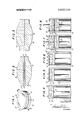
- FIG. 1 is a perspective view of a seed cell according to the invention
- FIG. 2 is a transverse sectional view taken along the lines 2-2 of FIG. 1,
- FIG. 3 is a view of the seed cell diagrammatically illustrating the changes in the cell after the latter has been watered
- FIGS. 4 to 8 are diagrammatic views illustrating a method and apparatus for manufacturing the seed cell.
- the seed cell 10 comprises two outer layers 11 and 12 and an intermediate layer 13 which itself is formed from two layers 14 and 15.
- the seed 16 which may be of any desired type, such as a celery seed or a lettuce seed, is positioned between the two layers 14 and 15.
- Each of the outer layers 11 and 12 is substantially in the form of a disc having a central mound or hemispherical portion 18 on one surface thereof located in the center of each disc.
- the seed cell illustratively is formed by positioning the material from which the layer 12 is formed in a mold 19 having a movable plunger 20 which has a central hemispherical depression 21' in the floor thereof as is illustratively shown in FIG. 4.
- the mold 19 is charged so that the top surface 21 of the material forming the layer 12 is level with the upper end 22 of the mold 19.
- the plunger 20 is then lowered slightly, say about one thirty-second inch and a layer 15 of cushioning material is positioned over the upper surface 21 of the layer 12 as shown in FIG. 5.
- the cushioning material consists of a compound which is preferably compressible, flowable and of extremely small particle size such as remilled Sorbitol.
- a seed 16 is deposited on the top surface of the layer 15 and the plunger is again depressed approximately one thirty-second inch and a second layer 14 of cushioning material is positioned over the first layer 15 and the seed 16, as shown in FIG. 6.
- the cushioning material is preferably compressible and the particle size of the cushioning materialis very much smaller than the seed, the seed 16 will embed between the two layers 14 and 15.
- the plunger 20 is again moved downwardly and a quantity of material 11 equal to the quantity of material utilized to form layer 12 is then positioned in the cavity as shown in FIG. 7.
- a second plunger 20' having a configuration identical to that of plunger 20 is positioned in the mold and with the plunger 20 illustratively restrained from movement, the plunger 20' is moved downwardly so that the layers 12, 15, 14, and 11 of material between the fixed plunger 20 and the movable plunger 20' will be compressed, the plunger 20' moving to the position illustratively shown in FIG. 8.
- FIGS. 4 through 8 is essentially diagrammatic only. It will be readily recognized that the differential compaction desired whereby thecentralportion of the material is compressed to a first degree and the exterior to a second and greater degree may be effected in any of a variety of ways, i.e., by compression mould members wherein a movable sleeve is disposed in surrounding relation of a central die or plunger and wherein the initial forming pressures may involve equal movement of the center and sleeve portions, subsequent inward movement of the sleeve portions providing the additional compaction forces adjacent the periphery.
- a reenforcing peripheral ring is formed to'impart superior strength to the entire tablet without imposing excessive compressive force to the bulk of the tablet, or causing excessive pressure to be exerted on the seed.
- a reenforcing peripheral ring is formed to'impart superior strength to the entire tablet without imposing excessive compressive force to the bulk of the tablet, or causing excessive pressure to be exerted on the seed.
- the thickness of the loose fill layers a series of com- Furthermore, the seed is protected by the layers of cushioning material l4, between which it is embedded.
- the tablet thus formed is thus a compacted mass of material which may readily be handled without disintegration to facilitate its subsequent handling and planting by automatic equipment.
- the material of the cushioning layer or layers 13 is of small particle size, thereby preventing any localized deep indentation in the hull of the seed, with the consequent possible damage to the seed.
- the cushioning layer in short, acts in a manner akin to a fluid by reason of its small particle size, resulting in the transmission to the seed of an overall, substantially equal pressure rather than areas of localized extremely high pressure surrounded by areas in which there is less pressure.
- the tablet By reason of the fact that the periphery of the tablet is relatively highly compacted, the tablet will retain substantially its integrity of shape even if the central portions thereof which are under lesser compaction should tend to disintegrate.
- the outer layers 11 and 12 are formed from a mixture of materials which will provide the desired characteristics that will permit proper germination and growth of the seed when the seed cell is implanted.
- each of the layers 1 1, 12 is formed from a mixture of peat moss or sphagnum moss, wood cellulose, vemiiculite, lime, a wetting agent, potassium nitrate, diammonium phosphate and an adhesive binder.
- moss in addition to being a highly efiicient water retention material is very acid and therefore through the addition of lime the pH factor of the environment can be adjusted to its most desirable level; the wood cellulose increases capillarity of the tablet and in addition, because of its fibrous nature assists in binding the compressed particles together.
- the vermiculite which, is basically ground mica powder, is also highly water retentive and in addition to being highly hygroscopic, as is the moss and wood cellulose, will tend to expand rapidly when the tablet is immersed in water providing a large number of capillary passageways therethrough for flow of water to the seed from the soil and also softening quickly so that it becomes readily penetratable by the seed as the latter germinates.
- the combination of the fibrous materials such as moss, wood cellulose with the vermiculite prevents stratification of the vermiculite when it is compressed so that the roots of the seed, as the latter germinates, may readily penetrate and emerge from the tablet in any direction thereby dispensing with the need for orienting the tablet when it is planted.
- the function of the binder is to enable the particles to adhere together when compacted to form an integral unit.
- the vermiculite is added to the moss and wood cellulose because it has a far greater initial water absorbency and expandability and will break apart the compaction of the moss and wood cellulose fibers for more effective capillary action.
- the mixture may also include a wetting agent such as Maprofix which serves in conventional manner to effect more rapid dispersion of the water into the compacted material.
- a wetting agent such as Maprofix which serves in conventional manner to effect more rapid dispersion of the water into the compacted material.
- the mixture in addition contains an appropriate amount of lime which is dependent upon the amount of moss to regulate the pH factor of the mixture for most efficient germination of the particular seed involved.
- the mixture may contain nutrients such as potassium nitrate and diammonium phosphate which are conventional fertilizers to provide the most effective growth conditions for the seed upon initial germination thereof.
- nutrients such as potassium nitrate and diammonium phosphate which are conventional fertilizers to provide the most effective growth conditions for the seed upon initial germination thereof.
- ingredients above described which are part of the outer layers 11 and 12 may be in any suitable proportions consonant with the objectives hereof. It has been found that a desired range of ingredients would be as follows:
- wetting agent 0.005 to 0.05 parts by weight of wetting agent
- the ingredients are first reduced to a maximum particle size of between about 20 and 40 mesh and are mixed substantially dry, with the water content of'the moss being not in excess of 13 to percent by weight.
- a suitable adhesive binder which may consist of polyvinylpyrrolidone (PVP), polyvinyl acetate, polyvinyl alcohol (PVA). shellac and polyvinylpyrrolidone.
- the quantity of adhesive binder material which may be employed, as is well known in the art, may be varied within a range of parameters determined by the amount of pressure to be applied, the speed with which it is desired that the cells dissolve, and the structural integrity which it is desired that the cells possess.
- the ad hesive is normally applied as a solution to the particles of the outer layer.
- larger quantities of binder will increase the wear-resistance of the cells but will reduce the speed with which the cells will disintegrate after planting. It is within the skill of the worker in the art to modify the various factors including binding composition and quantity and pressure, depending upon the desired end characteristics of the cell.
- a desired lubricant such as magnesium stearate may be added.
- the purpose of this lubricant is to facilitate manufacture by preventing sticking of the tablet to the plungers and rupture during the course of manufacture.
- the layers 14 and 15 which define the cushion or blanket are formed by reducing the cushioning material such as Sorbitol to a preferred micron size of approximately 100 to 75 and thereupon adding say, onefourth of 1 percent by weight of a suitable anti-caking agent such as Cab-O sil which is sold by the Cabot Chemical Corporation.
- a suitable anti-caking agent such as Cab-O sil which is sold by the Cabot Chemical Corporation.
- the tablet In use of the tablet, it may be positioned directly on the ground and tamped slightly thereinto or buried up to one-half inch below the surface.
- the tablets would be located in equally spaced recesses in the ground so as to provide a proper distribution for sufficient growth to maturity.
- the cushion layer of Sorbitol which is water soluble, will quickly and completely dissolve and wash away.
- the outer layers 11 and 12 will rapidly expand in all directions and become extremely porous.
- the seed itself Due to the expansion in all directions of the outer layers 11 and 12, the seed itself is always directly contacted by the inner surfaces of the outer layers and the outer surfaces of the outer layer will compress against the encompassing soil so that there will be no discontinuities therebetween which could interfere with efficient capillary flow of water from the soil to the seed. Furthermore, as the seed germinates and grows, the roots of the seed can readily pass through the outer layers of the tablet, due to the expansion thereof and thence into the soil since there would be no discontinuities or gaps which prevent efficient growth of roots.
- the tablet above described by reason of its compact nature and uniform size, may readily be handled both for initial shipping, storage and by mechanical equipment for planting.
- the tablet provides an ideal environment to promote germination, emergence and a high and uniform yield at harvest.
- An environmental seed cell formed by compression comprising two outer layers, an intervening cushion layer contacting the adjacent surfaces of said outer layers, and a seed embedded in said cushion layer, said outer layers comprising a mixture which includes a laminar material such as vermiculite, and a binder, said vermiculite being of a maximum particle size of about 20 mesh, said cushion layer comprising a finely divided material of a particle size substantially smaller than said vermiculite.
- the seed cell of claim 1 characterized by the edge portions of said cell being compacted to a greater density than the central portions of said cell to define a composite seed cell having .a re-enforced peripheral portion, said seed being in registry with said central portion.
- said outer layer includes non-laminar particulate organic matter, said organic matter constituting at least about one-third of the weight of the material of said outer layer, whereby the tendency of said vermiculite to stratify when subjected to compression is substantially reduced.
- said outer layer includes, in addition, wood cellulose.
- said outer layer comprises about l.5 to 7.2 parts by weight of peat moss, 1.0 to 2.5 parts by weight of wood cellulose, and 1.5 to 7.2 parts by weight of vermiculite.
- An environmental seed cell comprising two outer layers, an intervening cushion layer contacting the adjacent surfaces of said outer layers and a seed embedded in said cushion layer, said cell being formed by the application of pressure in a direction normal to said layers, said outer layers comprising a mixture which includes vermiculite, peat moss and wood cellulose of a maximum particle size of about 20 mesh, and a binder, said cushion layer comprising a soluble, finely divided material of a particle size substantially smaller than the particle size of the material of said outer layer, the density of the edge portions of said cell being substantially greater than the density of the central portion of said cell, said seed being in registry with said central portron.
- said outer layers include 1.5 to 7.2 parts by weight moss; 1.0 to 2.5 parts by weight wood cellulose; and 1.5 to 7.2 parts by weight vermiculite, and said cushion layer comprises Sorbitol and an anti-caking agent.
- An environmental seed cell formed by compression comprising two outer layers and an intervening cushion layer contacting the adjacent surfaces of said outer layers, the particle size of said cushion layer being smaller than the particle size of said outer layers, the material of said outer layers including a binder, said cell including a peripheral portion compacted to a first density, and a central portion compacted to a second density less than said first density, and a seed member disposed in said cushion layer in registry with said central portion, whereby said periphery defines a re-enforced surround area, thus to provide a cell of increased durability.
- An environmental seed cell formed by compression comprising two outer layers and an intervening cushion layer contacting the entire adjacent surfaces of said outer layers, and a seed embedded in said cushion layer, said layers being formed of particulate matter.
Landscapes
- Life Sciences & Earth Sciences (AREA)
- Soil Sciences (AREA)
- Environmental Sciences (AREA)
- Engineering & Computer Science (AREA)
- Mechanical Engineering (AREA)
- Pretreatment Of Seeds And Plants (AREA)
Applications Claiming Priority (1)
| Application Number | Priority Date | Filing Date | Title |
|---|---|---|---|
| US12188271A | 1971-03-08 | 1971-03-08 |
Publications (1)
| Publication Number | Publication Date |
|---|---|
| US3690034A true US3690034A (en) | 1972-09-12 |
Family
ID=22399345
Family Applications (1)
| Application Number | Title | Priority Date | Filing Date |
|---|---|---|---|
| US121882A Expired - Lifetime US3690034A (en) | 1971-03-08 | 1971-03-08 | Environmental seed cell |
Country Status (5)
| Country | Link |
|---|---|
| US (1) | US3690034A (show.php) |
| CA (1) | CA966327A (show.php) |
| DE (1) | DE2210330A1 (show.php) |
| FR (1) | FR2129457A5 (show.php) |
| IT (1) | IT951780B (show.php) |
Cited By (28)
| Publication number | Priority date | Publication date | Assignee | Title |
|---|---|---|---|---|
| US3871132A (en) * | 1973-08-20 | 1975-03-18 | Fmc Corp | Seed tablet |
| US4258074A (en) * | 1978-10-25 | 1981-03-24 | Saat-Und Erntetechnik Gmbh | Process for the encrusting, pilling or granulating of seed material |
| US4326524A (en) * | 1980-09-30 | 1982-04-27 | Minnesota Mining And Manufacturing Company | Solid dose ballistic projectile |
| EP0164484A1 (de) * | 1984-06-12 | 1985-12-18 | Séchoir la Courtine S.A. | Verfahren zur Herstellung von Saatgutpellets |
| US4628633A (en) * | 1981-11-26 | 1986-12-16 | Nilsson Lars G | Germination improving seed capsule and method of preparing the same |
| WO1988006839A1 (en) * | 1987-03-17 | 1988-09-22 | Dieter Neidhardt | Seed capsule and process for the preparation of a seed capsule |
| WO1991005459A1 (en) * | 1989-10-13 | 1991-05-02 | Turpin Kenneth A | A seed-containing water imbibing unit and methods utilising same |
| US6470623B1 (en) * | 1999-08-23 | 2002-10-29 | Weyerhauser Company | End seal for a manufactured seed and a method of manufacturing and attaching the same |
| US20040161606A1 (en) * | 2003-02-18 | 2004-08-19 | Bilkey Peter C. | Water- and oil-absorbent medium comprising milled sphagnum, sphagnum moss, and/or sphagnum peat |
| US20050045089A1 (en) * | 2003-08-27 | 2005-03-03 | Edwin Hirahara | Method of attaching an end seal to manufactured seeds |
| US20050108937A1 (en) * | 2003-11-25 | 2005-05-26 | Edwin Hirahara | Method and system of manufacturing artificial seed coats |
| US20050108935A1 (en) * | 2003-11-25 | 2005-05-26 | Edwin Hirahara | Method and system of manufacturing artificial seed coats |
| US20050114919A1 (en) * | 2003-11-25 | 2005-05-26 | Carlson William C. | Combination end seal and restraint |
| US20050114918A1 (en) * | 2003-11-25 | 2005-05-26 | Edwin Hirahara | System and method of embryo delivery for manufactured seeds |
| US20050108929A1 (en) * | 2003-11-25 | 2005-05-26 | Edwin Hirahara | Method and system for creating manufactured seeds |
| US20050132436A1 (en) * | 2003-12-11 | 2005-06-16 | Carlson William C. | Multi-embryo manufactured seed |
| US20050133528A1 (en) * | 2003-12-18 | 2005-06-23 | Edwin Hirahara | System and method for filling a seedcoat with a liquid to a selected level |
| US20060032121A1 (en) * | 2004-06-30 | 2006-02-16 | Edwin Hirahara | Method and system for producing manufactured seeds |
| US20060064930A1 (en) * | 2004-09-27 | 2006-03-30 | Carlson William C | Manufactured seed having a live end seal coating |
| US20060070145A1 (en) * | 2004-09-27 | 2006-03-30 | Carlson William C | Manufactured seed having a live end seal |
| US20060127634A1 (en) * | 2004-12-15 | 2006-06-15 | Dimakis Alkiviades G | Oriented strand board panel having improved strand alignment and a method for making the same |
| US20060196117A1 (en) * | 2002-10-28 | 2006-09-07 | Seung-Hyun Kim | Pellet of bulbous plants, a method of pelletization and a cultivation method of plants using the same |
| US20070000169A1 (en) * | 2005-06-30 | 2007-01-04 | Hartle Jeffrey E | Method to improve plant somatic embryo germination from manufactured seed |
| US7603807B2 (en) | 2003-11-26 | 2009-10-20 | Weyerhaeuser Nr Company | Vacuum pick-up device with mechanically assisted release |
| US20100263274A1 (en) * | 2009-04-15 | 2010-10-21 | Pioneer Hi-Bred International, Inc. | Encapsulated seed articles and method of making same |
| US20110162270A1 (en) * | 2008-10-31 | 2011-07-07 | David Larsen | Seed and plant growth medium module |
| US20120186147A1 (en) * | 2011-01-24 | 2012-07-26 | Anthony Michael Crivello | Portable hydroseeder seed, mulch and fertilizer water dissolvable packet |
| US20130167437A1 (en) * | 2011-12-30 | 2013-07-04 | Weyerhaeuser Nr Company | Embryo insertion and method |
Families Citing this family (2)
| Publication number | Priority date | Publication date | Assignee | Title |
|---|---|---|---|---|
| DE2731203C3 (de) * | 1977-07-11 | 1981-03-12 | Saat- Und Erntetechnik Gmbh, 3440 Eschwege | Verfahren zur Inkrustierung,Pillierung oder Granulierung von Saatgut |
| EP0013769B1 (de) * | 1979-01-19 | 1982-09-08 | Saat- und Erntetechnik GmbH. | Verfahren zur Inkrustierung, Pillierung, Granulierung von Saatgut |
Citations (4)
| Publication number | Priority date | Publication date | Assignee | Title |
|---|---|---|---|---|
| US3284209A (en) * | 1960-10-06 | 1966-11-08 | Grace W R & Co | Re-expanding compressed exfoliated vermiculite |
| US3555730A (en) * | 1969-02-06 | 1971-01-19 | Fmc Corp | Seed capsule and method of making same |
| US3561159A (en) * | 1968-05-01 | 1971-02-09 | Fmc Corp | Seed capsule and method of making same |
| US3616573A (en) * | 1969-01-22 | 1971-11-02 | Fmc Corp | Seed capsule |
-
1971
- 1971-03-08 US US121882A patent/US3690034A/en not_active Expired - Lifetime
-
1972
- 1972-02-08 CA CA134,245A patent/CA966327A/en not_active Expired
- 1972-02-18 IT IT20744/72A patent/IT951780B/it active
- 1972-03-03 DE DE19722210330 patent/DE2210330A1/de active Pending
- 1972-03-07 FR FR7207800A patent/FR2129457A5/fr not_active Expired
Patent Citations (4)
| Publication number | Priority date | Publication date | Assignee | Title |
|---|---|---|---|---|
| US3284209A (en) * | 1960-10-06 | 1966-11-08 | Grace W R & Co | Re-expanding compressed exfoliated vermiculite |
| US3561159A (en) * | 1968-05-01 | 1971-02-09 | Fmc Corp | Seed capsule and method of making same |
| US3616573A (en) * | 1969-01-22 | 1971-11-02 | Fmc Corp | Seed capsule |
| US3555730A (en) * | 1969-02-06 | 1971-01-19 | Fmc Corp | Seed capsule and method of making same |
Cited By (43)
| Publication number | Priority date | Publication date | Assignee | Title |
|---|---|---|---|---|
| US3871132A (en) * | 1973-08-20 | 1975-03-18 | Fmc Corp | Seed tablet |
| US4258074A (en) * | 1978-10-25 | 1981-03-24 | Saat-Und Erntetechnik Gmbh | Process for the encrusting, pilling or granulating of seed material |
| US4326524A (en) * | 1980-09-30 | 1982-04-27 | Minnesota Mining And Manufacturing Company | Solid dose ballistic projectile |
| US4628633A (en) * | 1981-11-26 | 1986-12-16 | Nilsson Lars G | Germination improving seed capsule and method of preparing the same |
| EP0164484A1 (de) * | 1984-06-12 | 1985-12-18 | Séchoir la Courtine S.A. | Verfahren zur Herstellung von Saatgutpellets |
| US4759151A (en) * | 1984-06-12 | 1988-07-26 | Sechoir La Courtine S.A. | Seed pellets and process for their manufacture |
| WO1988006839A1 (en) * | 1987-03-17 | 1988-09-22 | Dieter Neidhardt | Seed capsule and process for the preparation of a seed capsule |
| WO1991005459A1 (en) * | 1989-10-13 | 1991-05-02 | Turpin Kenneth A | A seed-containing water imbibing unit and methods utilising same |
| GB2255269A (en) * | 1989-10-13 | 1992-11-04 | Kenneth Albert Turpin | A seed-containing water imbibing unit and methods utilising same |
| GB2255269B (en) * | 1989-10-13 | 1994-05-18 | Kenneth Albert Turpin | A seed-containing water imbibing unit and methods utilising same |
| US6470623B1 (en) * | 1999-08-23 | 2002-10-29 | Weyerhauser Company | End seal for a manufactured seed and a method of manufacturing and attaching the same |
| US6931787B2 (en) | 1999-08-23 | 2005-08-23 | Weyerhaeuser Company | End seal for a manufactured seed and a method of manufacturing and attaching the same |
| US20060196117A1 (en) * | 2002-10-28 | 2006-09-07 | Seung-Hyun Kim | Pellet of bulbous plants, a method of pelletization and a cultivation method of plants using the same |
| US20040161606A1 (en) * | 2003-02-18 | 2004-08-19 | Bilkey Peter C. | Water- and oil-absorbent medium comprising milled sphagnum, sphagnum moss, and/or sphagnum peat |
| US6890651B2 (en) * | 2003-02-18 | 2005-05-10 | Agresearch International, Inc. | Water- and oil-absorbent medium comprising milled sphagnum, sphagnum moss, and/or sphagnum peat |
| US20050045089A1 (en) * | 2003-08-27 | 2005-03-03 | Edwin Hirahara | Method of attaching an end seal to manufactured seeds |
| US7228658B2 (en) | 2003-08-27 | 2007-06-12 | Weyerhaeuser Company | Method of attaching an end seal to manufactured seeds |
| US20050114919A1 (en) * | 2003-11-25 | 2005-05-26 | Carlson William C. | Combination end seal and restraint |
| US20050114918A1 (en) * | 2003-11-25 | 2005-05-26 | Edwin Hirahara | System and method of embryo delivery for manufactured seeds |
| US20050108929A1 (en) * | 2003-11-25 | 2005-05-26 | Edwin Hirahara | Method and system for creating manufactured seeds |
| US7555865B2 (en) | 2003-11-25 | 2009-07-07 | Weyerhaeuser Nr Company | Method and system of manufacturing artificial seed coats |
| US20050108935A1 (en) * | 2003-11-25 | 2005-05-26 | Edwin Hirahara | Method and system of manufacturing artificial seed coats |
| US20050108937A1 (en) * | 2003-11-25 | 2005-05-26 | Edwin Hirahara | Method and system of manufacturing artificial seed coats |
| US7131234B2 (en) | 2003-11-25 | 2006-11-07 | Weyerhaeuser Co. | Combination end seal and restraint |
| US7603807B2 (en) | 2003-11-26 | 2009-10-20 | Weyerhaeuser Nr Company | Vacuum pick-up device with mechanically assisted release |
| US7356965B2 (en) | 2003-12-11 | 2008-04-15 | Weyerhaeuser Co. | Multi-embryo manufactured seed |
| US20050132436A1 (en) * | 2003-12-11 | 2005-06-16 | Carlson William C. | Multi-embryo manufactured seed |
| US20050133528A1 (en) * | 2003-12-18 | 2005-06-23 | Edwin Hirahara | System and method for filling a seedcoat with a liquid to a selected level |
| US7591287B2 (en) | 2003-12-18 | 2009-09-22 | Weyerhaeuser Nr Company | System and method for filling a seedcoat with a liquid to a selected level |
| US20060032121A1 (en) * | 2004-06-30 | 2006-02-16 | Edwin Hirahara | Method and system for producing manufactured seeds |
| US7568309B2 (en) | 2004-06-30 | 2009-08-04 | Weyerhaeuser Nr Company | Method and system for producing manufactured seeds |
| US20060070145A1 (en) * | 2004-09-27 | 2006-03-30 | Carlson William C | Manufactured seed having a live end seal |
| US20060064930A1 (en) * | 2004-09-27 | 2006-03-30 | Carlson William C | Manufactured seed having a live end seal coating |
| US7547488B2 (en) | 2004-12-15 | 2009-06-16 | Weyerhaeuser Nr Company | Oriented strand board panel having improved strand alignment and a method for making the same |
| US20060127634A1 (en) * | 2004-12-15 | 2006-06-15 | Dimakis Alkiviades G | Oriented strand board panel having improved strand alignment and a method for making the same |
| US7654037B2 (en) | 2005-06-30 | 2010-02-02 | Weyerhaeuser Nr Company | Method to improve plant somatic embryo germination from manufactured seed |
| US20070000169A1 (en) * | 2005-06-30 | 2007-01-04 | Hartle Jeffrey E | Method to improve plant somatic embryo germination from manufactured seed |
| US20110162270A1 (en) * | 2008-10-31 | 2011-07-07 | David Larsen | Seed and plant growth medium module |
| US8458955B2 (en) * | 2008-10-31 | 2013-06-11 | David Larsen | Seed and plant growth medium module |
| US20100263274A1 (en) * | 2009-04-15 | 2010-10-21 | Pioneer Hi-Bred International, Inc. | Encapsulated seed articles and method of making same |
| US20120186147A1 (en) * | 2011-01-24 | 2012-07-26 | Anthony Michael Crivello | Portable hydroseeder seed, mulch and fertilizer water dissolvable packet |
| US20130167437A1 (en) * | 2011-12-30 | 2013-07-04 | Weyerhaeuser Nr Company | Embryo insertion and method |
| US9456541B2 (en) * | 2011-12-30 | 2016-10-04 | Weyerhaeuser Nr Company | Embryo insertion and method |
Also Published As
| Publication number | Publication date |
|---|---|
| CA966327A (en) | 1975-04-22 |
| FR2129457A5 (show.php) | 1972-10-27 |
| IT951780B (it) | 1973-07-10 |
| DE2210330A1 (de) | 1972-09-14 |
Similar Documents
| Publication | Publication Date | Title |
|---|---|---|
| US3690034A (en) | Environmental seed cell | |
| EP0145709A1 (en) | Germination improving seed capsule and method of preparing the same | |
| US3502458A (en) | Method of making a slow release fertilizer | |
| US3883989A (en) | Expandable shape-retaining peat moss briquettes and method of producing same | |
| CA2083415C (en) | Pills or pellets containing genetic material and inert carrier material and method for their preparation | |
| US6219968B1 (en) | Growing body for plants especially for plant seedlings | |
| CA2000620C (en) | A seed-containing water imbibing tablet or capsule and methods utilising same | |
| JPH0279918A (ja) | アグロプラグのようなアグロブロック、アグロプラグシステムおよびそのためのプラグストリップ | |
| ES2007522A6 (es) | Un procedimiento para preparar una composicion insecticida microencapsulada y composicion preparada. | |
| IL32043A (en) | Seed capsule and method of making same | |
| US5623781A (en) | Pills or pellets containing seeds and inert carrier material and method for their preparation | |
| US3616573A (en) | Seed capsule | |
| JPH02238817A (ja) | 植物育成用マット | |
| EP2286650A2 (en) | Seeded solid soil, method for plant cultivation using the same, and method for manufacturing the same | |
| EP0380448A1 (de) | Saatgutpillen | |
| FI59240B (fi) | Foerfarande och anordning foer pressning av torv till vaextsubstratstycken | |
| EP1427273B1 (en) | Capilar controlled watering of plants | |
| NZ542457A (en) | Manufactured seed having a live end seal coating | |
| DE1915942A1 (de) | Umhuelltes Saatkorn | |
| RU2396744C1 (ru) | Способ получения капсулированного посевного материала | |
| US3583099A (en) | Tile for germinating seed and manufacture thereof | |
| JP2000236708A5 (show.php) | ||
| US3871132A (en) | Seed tablet | |
| JPH08154425A (ja) | 散布用の種子入りペレット | |
| JP2595366Y2 (ja) | 散布用の種子混入ペレット |