US3682534A - Objectives of variable focal length - Google Patents
Objectives of variable focal length Download PDFInfo
- Publication number
- US3682534A US3682534A US104975A US3682534DA US3682534A US 3682534 A US3682534 A US 3682534A US 104975 A US104975 A US 104975A US 3682534D A US3682534D A US 3682534DA US 3682534 A US3682534 A US 3682534A
- Authority
- US
- United States
- Prior art keywords
- front member
- objective
- divergent
- focal length
- zoom
- Prior art date
- Legal status (The legal status is an assumption and is not a legal conclusion. Google has not performed a legal analysis and makes no representation as to the accuracy of the status listed.)
- Expired - Lifetime
Links
- 230000003287 optical effect Effects 0.000 claims description 12
- 230000005499 meniscus Effects 0.000 claims description 5
- 150000001875 compounds Chemical class 0.000 claims description 4
- 230000004075 alteration Effects 0.000 description 20
- 238000000926 separation method Methods 0.000 description 14
- 230000000694 effects Effects 0.000 description 11
- 238000010276 construction Methods 0.000 description 10
- 230000007246 mechanism Effects 0.000 description 5
- 230000006641 stabilisation Effects 0.000 description 4
- 238000011105 stabilization Methods 0.000 description 4
- 238000005086 pumping Methods 0.000 description 2
- 235000012571 Ficus glomerata Nutrition 0.000 description 1
- 240000000365 Ficus racemosa Species 0.000 description 1
- 235000015125 Sterculia urens Nutrition 0.000 description 1
- 230000004308 accommodation Effects 0.000 description 1
- 230000000712 assembly Effects 0.000 description 1
- 238000000429 assembly Methods 0.000 description 1
- 229910052729 chemical element Inorganic materials 0.000 description 1
- 230000000873 masking effect Effects 0.000 description 1
- 238000001228 spectrum Methods 0.000 description 1
Images




Classifications
-
- G—PHYSICS
- G02—OPTICS
- G02B—OPTICAL ELEMENTS, SYSTEMS OR APPARATUS
- G02B15/00—Optical objectives with means for varying the magnification
- G02B15/14—Optical objectives with means for varying the magnification by axial movement of one or more lenses or groups of lenses relative to the image plane for continuously varying the equivalent focal length of the objective
- G02B15/142—Optical objectives with means for varying the magnification by axial movement of one or more lenses or groups of lenses relative to the image plane for continuously varying the equivalent focal length of the objective having two groups only
Definitions
- zoom objectives are known, most of which may conveniently be considered as comprising front and rear assemblies, of which the rear assembly is stationary, the members movable for zooming being included in the front assembly.
- a stationary rear member constituting the rear assembly
- the provision for focusing is usually made at the front member of the front assembly, and the present invention is concerned with a zoom objective having this focusing provision.
- the front member In modern zoom objectives, the front member must have a relatively wide aperture and if made bodily movable to effect focusing, must therefore be of a relatively complex structure in order to facilitate correction of the various aberrations not only throughout the zooming range but also throughout the focusing range, this complexity making the front member quite heavy and bulky. However, it is of utmost importance to keep the weight and bulk of the complete objective, including its operating mechanisms, within easily manageable proportions, and clearly the front member of the objective, which is of relatively large diameter, is in this respect of major importance.
- the front member is divided into a divergent front part and a convergent rear part, and according to the other proposal such front member is divided into an approximately afocal front part and a convergent rear part.
- the present invention has for a general object to provide the above-mentioned advantages in the case of a zoom lens having a divergent front member, and for a more specific object to provide a zoom lens in which change of angular field in the object space during focusing is at least minimized.
- an optical ob jective of the zoom type comprising a stationary rear assembly and a front assembly which includes the members movable for zooming behind a divergent front member which remains stationary during zooming
- an improved front member which is divided into divergent front and divergent rear parts of which only the rear part is axially movable to effect focusing to suit differing object positions, said front member being characterized by the following relationships:
- F A is the equivalent focal length of the complete front member for an infinitely distant object and f and f are the equivalent focal lengths of the front and rear parts, respectively, of the front member.
- f For the purpose of maintaining the field angle constant during focusing it is usually desirable for f to be of the order of 2.5 f
- the use of high surface powers is to be avoided as far as possible to which end it is advantageous more evenly to'divide the divergent power of the front member between the front and rear parts thereof. Indeed, it may even be desirable usually, a compromise, whereby f lies somewhere between f and 2.5 f is desirable.
- a divergent front member can be, in itself, advantageous from the point of view of focusing requirements.
- a divergent front member may be of smaller diameter and involve smaller axial movement than a convergent front member, in order to obtain an equivalent focusing effect.
- This invention therefore, which provides a two part divergent front member, gives rise to the possibility of achieving focusing down to an extremely short object distance by use of a front member of the minimum complexity, bulk and weight necessary to provide for good aberration correction throughout the zooming and focusing ranges, in association with any suitable conventional focusing mechanism of low torque, since only a part of the front member has to be moved.
- FIGS. 1A and 1B diagrammatically and graphically illustrate the effect on angular field in the object space when focusing is performed in a known zoom lens
- FIGS. 2A and 2B diagrammatically and graphically illustrate the same effect for a possible embodiment of the zoom lens according to the invention.
- the reference designates the divergent front member of a zoom lens, which member is bodily movable for focusing, from the position marked in solid line for an object at infinity to the position marked in broken line for a close object.
- d designates the object distance
- 14 designates the focusing movement
- a designates the field semi-angle, which is constant; on the image side of the front member
- B the field semi-angle in the object space.
- FIG. 1B shows the change of B with d graphically, clearly demonstrating the increase in field angle in the object space which takes place as the objective is focused down from an object at infinity to a close object.
- the references 11 and 11 designate the divergent front and divergent rear parts of an embodiment of the objective according to the invention, wherein only the rear part 11 is movable for focusing, from the position marked in solid line for an object at infinity to the position marked in broken line for a close object.
- the field semi-angle in the object space is designated B.
- the references d, u and a have the same designations as in FIG. 1A, which is associated with the gent front member, which is equal to that of the front member of the known objective (42.55) when the two divergent parts (fa: 170.1 and f 68.5) are separated by the distance e (equal to 35.0) for focusing an object at infinity:
- FIG. 2B is a graph of B plotted against d, clearly demonstrating that, in accordance with the invention, the field angle in the object space can be kept constant as the objective is focused down from an object at infinity to a close object.
- the objective according to the invention having a front member consisting of two divergent parts of which only the rear part is movable for focusing, can clearly be designed to improve significantly on the known lens in respect of minimizing the following Table, wherein the values of d and u are again based on the equivalent focal length (f of the diverchange in field angle on the object side when focusing is carried out.
- f must be limited in terms of F in particular not to be greater than 3.0 F sothat focusing to the required extent is possible within an acceptable range of travel, and also not to be less than 1.3 F, so as again to avoid introduction of high powers and additionally in effect to avoid bulkiness of the front member.
- the limitations, in conjunction with the above specified ratio, effectivelydetermine limits for f in terms of F The relationships above specified define the limits for an optimum thin lens design which is compatible with the selection of practical parameters in the corrected front member of a zoom lens requiring a divergent front member. In all modem zoom lenses having divergent front members, the requirements for aberration correction, having due regard to the stop position, are generally the same, so that the specified relationships are of general applicability independent of any particular construction of complete objective.
- front and rear relate respectively to the side of the objective nearer to and further from the longer conjugate, as is usual in the art.
- intemal contact as will be used hereinafter, is intended to include not only a cemented contact surface but also a broken contact," which achieves an equivalent optical effect by means of two FURTHER FEATURES OF THE INVENTION Unlike the prior proposals relating the a zoom lens having a convergent front member, in the present invention aberration correction is distributed between the two parts of the divergent front member but concentrated in the movable rear part.
- the rear part preferably includes at least one collective element made of a highly dispersive material of mean refractive index greater than 1.7 and of Abbe V number less than 32, preferably less than 26, and one or more dispersive elements made of a material or materials having an Abbe V or average Abbe V number greater than 1.5 times, preferably at least 1.9 times, that of the collective element, while the front part preferably includes one or more dispersive elements, conveniently two simple meniscus com-.
- the rear part preferably includes a compound component having a collective internal contact, usually but not exclusively concave to the front, between two elements made of materials whose mean refractive indices differ by more than 0. 1, preferably by more than 0.15.
- the radius of curvature of this internal contact preferably lies between 0.25 f and 0.75 f numerically, preferably between 0.37 f and 0.5 7 f
- the rear part may conveniently comprise a doublet component spaced in front of a dispersive simple component, the front surface of the doublet component and the front surface of the simple component both being concave to the front in some instances, and in any event the radius of the former surface being numerically greater than 0.8 f preferably numerically greater than l.l f
- This radius is thus numerically greater than the radius of the front surface of the simple component, which may lie between 0.3 f and preferably between 0.5 f and 0.81:
- the zoom lens in question comprises a stationary rear assembly and a front assembly consisting of a divergent front member stationary with respect to zooming and second, third and fourth members which are respectively convergent, divergent and convergent, the second and fourth members simultaneously moving forward for zooming toward maximum focal length in association with rearward movement of the third member.
- the objective is characterized by the following features in combination: a.2.5Fm/N f, fl f, l
- Fm is the maximum value of the equivalent focal length of the complete objective
- N is the f-number of the objective
- f f and j ⁇ are respectively the equivalent focal lengths of the second, third and fourth members
- g g and g are respectively the "ratios between maximum and minimum magnifications of the second, third and fourth members
- R is the ratio of the maximum to minimum focal lengths of the complete objective.
- F preferably lies between f and-l.5f more specifically between 1.1 f and l.3f,.
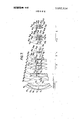
- FIG. 3 shows one example of corrected zone lens with the members movable for zooming in the position of minimum focal length F and the rear part of the front member focused for infinity;
- FIG. 4 shows a modified front member providing a second example of corrected zoom lens
- FIG. 5 shows a further example of corrected zoom lens, again with the members movable for zooming in the position of minimum focal length F and the rear part of the front member focused for infinity;
- FIG. 6 is a corresponding view applicable to fourth and seventh examples
- FIG. 7 is a corresponding view applicable to a fifth example
- FIG. 8 is a corresponding view applicable to a sixth example.
- FIG. 9 is a corresponding view applicable to eighth and ninth examples.
- each example of each of the groups constituted by a fourth and seventh examples, and the eighth and ninth examples constitutes a substantially independent design, the numbers of elements and parameters involved are similar, and the differences in the values of said parameters, from one example to the other within each group, is not sufficient materially to affect the appearance of the objective on the scale to which it is drawn.
- each zoom lens includes three movable members in the front assembly, four variable air separations are involved; these are specified in the second section of each table.
- the values of the variable air separations are given, assuming the objective to be focused for infinity (since focusing movement of the front member affects the first of such variable air separations), for a number of zooming positions designated in terms of the equivalent focal length F of the complete objective as this varies from the minimum value F to the maximum value Fm.
- each table for the first two examples give the equation defining an axial section through an aspheric surface provided in the stationary rear member of the objective.
- each table for the first two examples and the third section for the remaining examples gives, for each of a set of representative values of the distance d of the object in front of the surface R,, the variations AS; and A8 from the values of S and S given in the first and second sections of the table due to focusing movement of the rear part of the front member to suit such object distances.
- Thickness or Refractive Abbe V Clear Radius Air Separation Index n Number Diameter 8, 2.000 Ry-l 8.430 5.65
- Th1ck Lens Separations dunng Zoommg w1th Ob ect at lnfin1ty Th1ck Lens Separauons during Focusmg Table 5 Fo 1.0
- Thick Lens Separations durmg Zoommg with Ob ect at lnfimty F 54 S7 0 S11 Thick Lens Separations during Focusing d As, A&
- the maximum value Fm of the equivalent focal length of the objective in the range of variation is times the minimum value F0 thereof.
- the back focal distance, from the rear surthe relative aperture is 172.0 in the first two examples and f/2. l in the third example.
- the iris diaphragm is stationary and located just in front of the surface R of the rearassembly. 1n the third example, it is located immediately in front of the surface R
- the first and second examples have identical second, third and fourth members.
- the equivalent focal length f, of the second member is 6.9394 Fo, that (f of the third member (surfaces R to R is 3.l328 F0, while that (A) of the fourth member (surfaces R to R is 4.1000 F0.
- the distance x is equal to 9.5474 and the magnification ratios g, and g. are respectively equal to 1.4180, 3.0000 and 2.3507.
- the second, third and fourth members, surfaces R to R surfaces R to R and surfaces R to R respectively have respective equivalent focal lengths of 6.2875, 3. 1562 and 4.8324.
- the distance x is equal to 12.1790 and the magnification ratios g,, 3 and 34 are respectively equal to 1.552, 3.2179 and 2.0028.
- the present invention is particularly concerned with the front member provided at the front of the objective to facilitate focusing.
- the front member has a focal length F equal to 8.7623 F0 in the first example, 8.7644 F0 in the second, and 6.8373 F0 in the third example. It comprises in each case a front part consisting of two simple meniscus components convex to the front, and a rear part consisting of a cemented doublet component followed by a simple dispersive component. Only the rear part is movable for focusing, in accordance with the final sections of the above tables, under the control of the focusing control element.
- Focusing can be effected down to an object distance as short as 30.2 F0 in the first two examples and 28.1 F0 in the third example, and yet it is to be noticed that this front member is not unduly complex and is of wholly acceptable dimensions.
- the rear part can be moved by means .of an inexpensive conventional mechanism involving low torque, and as the front part remains stationary, no air pumping occurs and no increased strain is placed on the mechanism by virtue of fitting attachments to the front member.
- the focal length f of the front part of the front member is 22.4509 F0, i.e., 3.2835 F while the focal length f of the rear part is 1 1.6334 Fa, i.e., 1.7015 F
- f 1.9298 f The collective element of the doublet component of I the rear part has an Abbe V number of 25.43 in each example, while the average value of the mean refractive
- the radii of the front surfaces R and R, of the two components of the rear part are respectively equal to 1.1961 f, and 0.5324 fl
- the intemal contact R has a radius equal to 0.5186 f and the materials of the two elements on either side of such surface have refractive indices differing by 0.21605.
- the radii of the surfaces R, and R are respectively equal to 1.2882 f and 0.45 84 f
- the intemal contact R has a radius equal to 0.5690 f and the materials of the two elements on either side of such surface have refractive indices differing by 0.18477.
- the radii of the front surfaces R, and R are respectively equal to 2.2510 f and 0.6199 f.-
- the first three examples demonstrate the application of the invention to zoom lenses suitable for use in live television photography.
- the front members of these three examples all conform to a somewhat narrower range of thin lens constructions than hereinbefore defined, which narrower range is characterized by the relationships:
- the rear part of the front member includes a col-
- the front part of the front member includes at least one dispersive element whose Abbe V number exceeds 45.
- the front part of the front member comprises two simple meniscus components convex to the front.
- the rear part of the front member includes a compound component having a collective internal contact concave to the front.
- the said internal contact is formed between two elements of materials having mean refractive indices differing by more than 0.1.
- the rear part of the front member includes a compound component having a collective internal contact concave to the front with a radius of curvature lying between 0.25 f and 0.75 F
- the rear part of the front member comprises a doublet component spaced in front of a dispersive simple component.
- the front surfaces of said doublet component and said simple component are both concave to the front, the radius of curvature of the former surface lying between 2 f, and 3 f and that of the latter surface lying between 0.3f42 andf
- the front member of the invention is also suitable for zoom lenses having a smaller focal ratio suited to the otherwise more stringent requirements of cinematography.
- the fourth to ninth examples demonstrate the application of the invention to zoom lenses of this kind.
- the maximum value Fm of the equivalent focal length of the objective in the range of variation is five times the minimum value F0 thereof.
- the back focal distance, from the rear surface of the objective to the image plane, is, for the fourth to ninth examples in sequence, 2.940 Fo, 3.272 F0, 2.858 Fo, 3.151 F0, 3.097 F0 and 2.899 Fa.
- the objective covers a semi-angular field of view varying from 30 at F0 to 3 at Fm.
- the relative aperture of the objective is f/2.8 in the fourth, eighth and ninth examples and f/2.9 in the fifth to seventh examples, whereby N is equal to 2.8 or 2.9 in accordance therewith.
- the iris diaphragm is again located just in front of the front surface R of the rear assembly.
- the equivalent focal length f, F of the front member (surfaces R to R is 4.8000 Po
- the equivalent focal length f: of the second member (surfaces R to Rn) is +3.9290 F0
- the equivalent focal length of the third member (surfaces R to R is l.9300
- the equivalent focal length of the fourth member (surfaces R to R is +2.5802, the positive and negative signs representing convergence and divergence respectively.
- f (F 3.8425,f, 3.1725,f 1.5450, f 2.4108.
- f (F 3.8425,f 3.2424,f 1.5450,fl 2.4108.
- f (F -3.8425, f, 3.1605, ⁇ ; 1.5450,fl 2.2167.
- f (F,,) '-3.9798, F, 3.3102,f l 6002,) 2.2198.
- the magnification ratios g g and g, of the second, third and fourth members are respectively 1.2905, 2.1959 and 1.7644 in the fourth example.
- magnification ratios are taken in conjunction with f, and f ti impart equal movements of the second and fourth members during zooming.
- the present invention is concerned with the front member provided at the front of the objective to facilitate focusing.
- This again comprises in each case a front part consisting of two simple meniscus components convex to the front, and a rear part consisting of a cemented doublet component followed by a simple dispersive component. Only the rear part is movable for focusing, as indicated in the final sections of the tables, and focusing down to a very short object distance of the order of 30 F0 is again made possible with a front member affording the same further advantages as mentioned in connectionwith the first three examples.
- the focal lengthf, of the front part of the front member is 15.751 F0, about 3.28 F while the focal length f of the rear part of the front member is 8.217 F0, about 1.71 F ,wherebyf, O1.92
- the examples show values for f varying from 2.05 F, (Example 8) up to 3.28 F, (Example 4) and values for f varying from 1.71 F (Example 4) up to 2.55 F, (Example 8).
- f is as low as 0.8 f in the eighth example and as high as 1.92 f in the fourth example.
- an even distribution of power between the two parts of the objective is usually more important than in the zoom lenses of the first three examples for television use.
- the front member is preferably divided so that fl 1.3 f whereas for the former use the front member is preferably divided so that lies between about 0.8 f and 1.3 f
- the dif' ferent is due to the requirement in zoom lenses for cinematographic use to provide facility for a higher standard of aberration correction than is necessary for television use.
- the internal contact R of the doublet component in the ear part, while remaining a collective surface is not always concave to the front in the fourth to ninth examples (see Example 9), while the front surface R, of said component, which is always concave to the front in the first group of examples, is convex to the front in Example 9.
- the difference in the mean refractive indices of the materials on either side of the collective contact R varies from about 0.16 in Example 9 up to about 0.22 in Example 8.
- the radius of the surface R ranges in numerical value from about 0.37 f in Example 9 up to 0.57 f in Examples 4 and 5, while the radius of the surface R ranges through infinity from 1 .9 R, in Example 9 to about 4.0 F, in Example 2, so that it is always numerically greater than 1.9.
- the Abbe V numbers of the materials of the dispersive elements have values varying from 49.4 to 60.3.
- each example contains two dispersive elements, the average of the Abbe V numbers of the materials of which show variations from about 1.98 to 2.18 times the Abbe V number of the material of the single collective element.
- the front member of each of the above mentioned first to ninth examples by virtue of the choice of parameters mentioned within the ranges specified according to the further features of the invention, pro- 7 throughout the range of focusing movement. It also cooperates with the particular zooming system described also to provide for good stabilization of aberrations during zooming, so that the stabilized aberrations in the front assembly (the first four members) can be balanced out by suitable design of the rear assembly in accordance with conventional practice in the art. Because only the rear part of the front member is movable for focusing, aberration stabilization with focusing is simplified so that, for a corresponding high standard of correction, the complexity of the whole of the front member may be lessened by comparison with an objective in which the front member is bodily movable.
- each example exhibits a smaller change in the angular field in the object space as focusing is performed.
- a compromise has been effected in respect of the value of the ratio fl fl whereby this design parameter makes a substantial contribution, not only to minimizing variation in said angular field in the object space, but also to achievement of a high standard of aberration correction.
- the various parameters in the above-described examples may be varied, in an inter-related manner according to complex optical laws, somewhat to vary the characteristics of the final objective.
- the parameters of the front member may be varied to increase the ratio f F thereby to achieve even less variation of the angular field in the object space as focusing is performed, but with some loss in facility for aberration correction.
- all the above-described examples provide a reasonable compromise (differing in the various nine cases) between stabilization of aberrations with zooming andstabilization of aberrations with focusing.
- the balance in this respect can also be adjusted by variation of certain design parameters. Such changes are relatively minor and, generally speaking, do not necessitate recalculation of the whole objective.
- the permissible limits of variation for the parameters of the front member are 05/1, for the optical powers of the various surfaces and :t 0.05 F A for the axial thicknesses of the elements and the air spaces between components, excluding physically impossible constructions.
- zoom lens described is in itself especially well suited to provision of a divergent front member capable of focusing down to short object distances.
- a prerequisite for this is the condition that the focal length of the front member exceeds the focal length of the second member.
- F A exceed f without in any way scaling up the front member to undesirable proportions (this is clear from the above examples), so that a remarkable advance in the art is achieved.
- the present invention is not limited to use in basic construction of zoom lens described and is useful to facilitate the design of a front member for any zoom lens wherein the front member is necessarily divergent. In this con-
Landscapes
- Physics & Mathematics (AREA)
- General Physics & Mathematics (AREA)
- Optics & Photonics (AREA)
- Lenses (AREA)
- Telescopes (AREA)
- Lens Barrels (AREA)
Applications Claiming Priority (1)
| Application Number | Priority Date | Filing Date | Title |
|---|---|---|---|
| GB26981/68A GB1214341A (en) | 1968-06-06 | 1968-06-06 | Improvements in or relating to objectives of variable focal length |
Publications (1)
| Publication Number | Publication Date |
|---|---|
| US3682534A true US3682534A (en) | 1972-08-08 |
Family
ID=10252248
Family Applications (1)
| Application Number | Title | Priority Date | Filing Date |
|---|---|---|---|
| US104975A Expired - Lifetime US3682534A (en) | 1968-06-06 | 1971-01-08 | Objectives of variable focal length |
Country Status (5)
| Country | Link |
|---|---|
| US (1) | US3682534A (OSRAM) |
| DE (1) | DE1928692A1 (OSRAM) |
| FR (1) | FR2010288A1 (OSRAM) |
| GB (1) | GB1214341A (OSRAM) |
| SU (1) | SU440006A3 (OSRAM) |
Cited By (10)
| Publication number | Priority date | Publication date | Assignee | Title |
|---|---|---|---|---|
| US4110006A (en) * | 1976-03-11 | 1978-08-29 | Canon Kabushiki Kaisha | Telephoto type zoom lens |
| US4278331A (en) * | 1978-11-17 | 1981-07-14 | Canon Kabushiki Kaisha | Photographic objective which prevents variation in angular field of view during focusing |
| US4336983A (en) * | 1978-11-25 | 1982-06-29 | Canon Kabushiki Kaisha | Photographic objective stabilized against change of angular field during focusing |
| US4752121A (en) * | 1982-07-17 | 1988-06-21 | Canon Kabushiki Kaisha | Zoom lens |
| US4756609A (en) * | 1987-07-13 | 1988-07-12 | Eastman Kodak Company | Four component compact zoom lens |
| US5416639A (en) * | 1991-06-29 | 1995-05-16 | Olympus Optical Co., Ltd. | Zoom lens system |
| US6631034B2 (en) | 2000-05-23 | 2003-10-07 | Olympus Optical Co., Ltd. | Zoom lens system |
| EP2696231A1 (de) | 2012-08-10 | 2014-02-12 | Carl Zeiss AG | Optisches system zur abbildung eines objekts |
| US9036266B2 (en) | 2011-10-20 | 2015-05-19 | Fujifilm Corporation | Zoom lens for projection and projection-type display apparatus |
| US9341827B2 (en) | 2013-04-04 | 2016-05-17 | Cooke Optics Limited | Anamorphic objective lens |
Families Citing this family (2)
| Publication number | Priority date | Publication date | Assignee | Title |
|---|---|---|---|---|
| FR2106359B1 (OSRAM) * | 1970-09-08 | 1975-04-18 | Eastman Kodak Co | |
| US5264965A (en) * | 1991-02-15 | 1993-11-23 | Asahi Kogaku Kogyo Kabushiki Kaisha | Zoom lens |
Citations (1)
| Publication number | Priority date | Publication date | Assignee | Title |
|---|---|---|---|---|
| US3481664A (en) * | 1965-09-01 | 1969-12-02 | Canon Kk | Large aperture and wide angle zoom lens system |
-
1968
- 1968-06-06 GB GB26981/68A patent/GB1214341A/en not_active Expired
-
1969
- 1969-06-06 FR FR6918669A patent/FR2010288A1/fr not_active Withdrawn
- 1969-06-06 DE DE19691928692 patent/DE1928692A1/de active Pending
- 1969-06-06 SU SU1334646A patent/SU440006A3/ru active
-
1971
- 1971-01-08 US US104975A patent/US3682534A/en not_active Expired - Lifetime
Patent Citations (1)
| Publication number | Priority date | Publication date | Assignee | Title |
|---|---|---|---|---|
| US3481664A (en) * | 1965-09-01 | 1969-12-02 | Canon Kk | Large aperture and wide angle zoom lens system |
Cited By (13)
| Publication number | Priority date | Publication date | Assignee | Title |
|---|---|---|---|---|
| US4110006A (en) * | 1976-03-11 | 1978-08-29 | Canon Kabushiki Kaisha | Telephoto type zoom lens |
| US4278331A (en) * | 1978-11-17 | 1981-07-14 | Canon Kabushiki Kaisha | Photographic objective which prevents variation in angular field of view during focusing |
| US4336983A (en) * | 1978-11-25 | 1982-06-29 | Canon Kabushiki Kaisha | Photographic objective stabilized against change of angular field during focusing |
| US4752121A (en) * | 1982-07-17 | 1988-06-21 | Canon Kabushiki Kaisha | Zoom lens |
| US4756609A (en) * | 1987-07-13 | 1988-07-12 | Eastman Kodak Company | Four component compact zoom lens |
| US5416639A (en) * | 1991-06-29 | 1995-05-16 | Olympus Optical Co., Ltd. | Zoom lens system |
| US6631034B2 (en) | 2000-05-23 | 2003-10-07 | Olympus Optical Co., Ltd. | Zoom lens system |
| US9036266B2 (en) | 2011-10-20 | 2015-05-19 | Fujifilm Corporation | Zoom lens for projection and projection-type display apparatus |
| EP2696231A1 (de) | 2012-08-10 | 2014-02-12 | Carl Zeiss AG | Optisches system zur abbildung eines objekts |
| DE102012214303A1 (de) | 2012-08-10 | 2014-02-13 | Carl Zeiss Ag | Optisches System zur Abbildung eines Objekts |
| US9128272B2 (en) | 2012-08-10 | 2015-09-08 | Carl Zeiss Ag | Optical system for imaging an object |
| DE102012214303B9 (de) | 2012-08-10 | 2022-07-07 | Carl Zeiss Ag | Optisches System zur Abbildung eines Objekts sowie Aufnahmeeinheit mit einem optischen System |
| US9341827B2 (en) | 2013-04-04 | 2016-05-17 | Cooke Optics Limited | Anamorphic objective lens |
Also Published As
| Publication number | Publication date |
|---|---|
| DE1928692A1 (de) | 1970-01-02 |
| GB1214341A (en) | 1970-12-02 |
| FR2010288A1 (OSRAM) | 1970-02-13 |
| SU440006A3 (ru) | 1974-08-15 |
Similar Documents
| Publication | Publication Date | Title |
|---|---|---|
| US4836660A (en) | Zoom lens system for compact camera | |
| US3682534A (en) | Objectives of variable focal length | |
| US4437750A (en) | Adjustable diopter type finder optical system | |
| US4844599A (en) | Compact and high-speed wide-angle zoom lens system | |
| US3410632A (en) | Wide-angle objective with negative front component and multilens positive component | |
| US4412726A (en) | Fish eye lens system | |
| US4217048A (en) | Viewfinder capable of adjusting diopter | |
| US4824223A (en) | Projection objective with variable focal length | |
| US3594066A (en) | Optical objectives of variable equivalent focal length | |
| US4204747A (en) | Method of focussing in a photographic lens system | |
| JPH01216310A (ja) | 変倍レンズ | |
| GB2068579A (en) | Ocular optical system with dioptre adjustment | |
| US4086000A (en) | Viewfinder optics with zero power doublet | |
| JPH0235965B2 (OSRAM) | ||
| US3705759A (en) | Optical objective of variable focal length | |
| US4364641A (en) | Wide angle zoom lens | |
| US4124274A (en) | Zoom lens having closeup focusing control | |
| US3989349A (en) | Reflex finder | |
| US4759619A (en) | Inverted telephoto type wide angle lens system with a rear focusing unit | |
| US4311367A (en) | Wide angle photographic lens | |
| US3944339A (en) | Large aperture photographic objective | |
| GB2090998A (en) | Two group zoom lens system having a stop diaphragm at its rear | |
| US3598476A (en) | Zoom lens front member adjustable for focusing | |
| US4094587A (en) | Afocal front attachment for zoom objective | |
| US5223979A (en) | Zoom lens system |