US2425246A - Stabilized castering wheel device - Google Patents
Stabilized castering wheel device Download PDFInfo
- Publication number
- US2425246A US2425246A US601856A US60185645A US2425246A US 2425246 A US2425246 A US 2425246A US 601856 A US601856 A US 601856A US 60185645 A US60185645 A US 60185645A US 2425246 A US2425246 A US 2425246A
- Authority
- US
- United States
- Prior art keywords
- wheels
- vertical
- castering
- stabilized
- wheel
- Prior art date
- Legal status (The legal status is an assumption and is not a legal conclusion. Google has not performed a legal analysis and makes no representation as to the accuracy of the status listed.)
- Expired - Lifetime
Links
- 238000010276 construction Methods 0.000 description 10
- 238000013016 damping Methods 0.000 description 2
- 238000006386 neutralization reaction Methods 0.000 description 1
- 230000002093 peripheral effect Effects 0.000 description 1
- 230000000630 rising effect Effects 0.000 description 1
Images

Classifications
-
- B—PERFORMING OPERATIONS; TRANSPORTING
- B64—AIRCRAFT; AVIATION; COSMONAUTICS
- B64C—AEROPLANES; HELICOPTERS
- B64C25/00—Alighting gear
- B64C25/32—Alighting gear characterised by elements which contact the ground or similar surface
- B64C25/50—Steerable undercarriages; Shimmy-damping
- B64C25/505—Shimmy damping
Definitions
- This invention relates to castering wheels for use principally, but not exclusively, on the landing gear of airplanes.
- Such wheels as now constructed are known to be subject to so-called shimmy, which sets up a serious vibration in the landing gear which is transmitted to the plane during take-ofi and landing operations. Attempts to correct this difficulty have mostly taken the form of damping out the energy of the vibration by friction or dashpot devices.
- An object of my invention is to prevent wheel shimmy from occurring and thus avoid the necessity of damping out vibratory energy in the landing gear. I accomplish this object by interconnecting a plurality of castering wheels in such manner that the movement of one of the wheels about its Vertical spindle axis sets up an equal and opposite movement of the other wheel about its vertical spindle axis, and thus the incipient tendency to develop shimm is immediately counteracted.
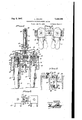
- Figure 1 is a rear elevation
- Figure 2 a side elevation
- Figure 3 a top plan view of a twowheeled castering unit of one form of apparatus.
- Figure 4 is a View mostly in central vertical section, as seen from the front, illustrating the construction shown in Figures 1, 2 and 3 with the castering wheels shifted with respect to each other in parallel vertical planes to enable the treads of both wheels to conform with the surface of a. transverse slope or incline of the landing field-or terrain.
- Figure 5 is a sectional plan View taken on the line VV of Figure 1, illustrating the equal and opposite deflection of the two castering wheels of the unit about their respective vertical spindle axes.
- Figure 6 is a transverse section taken on the line VI-VI of Figure 2 in the direction of the arrow, illustrating a detail of construction by which the two-wheeled castering unit is releasably held in its normal fore-and-aft direction when not in contact with the ground.
- Figure 7 is a diagrammatic view illustrating the interlinking of the two castering wheels by gear sectors.
- Figure 8 is a plan view of a compensated arm and cam construction for interconnecting the two castering wheels
- v Figure 9 is a vertical section of a, portion of the construction shown in Figure 8 on a somewhat larger scale.
- the stabilized wheel unit illustrated in Figures 1 to 6 comprises a pair of rubber-tired wheels I0, ll mounted in supporting forks l2, l3 on independent vertical spindles l4, I5 which are rotatably mounted in socket members I6, I! with intervening ball-bearing members I8, I9.
- the spindles M, l5 are secured in the socket members l6, H by screws and washers such as 20 and 2
- the socket members I6, I! are threaded into hexagonal blocks 22, 23, with which they are thereby made rigid so that each wheel, with its fork, spindle and bearing member, is free to rotate with respect to its fixed socket member and hexagonal block.
- a slotted arm 24 from one of the fork members receives a vertical bolt or pin 25 fastened in two arms 26, 21 which project from the other fork member, for the purpose of interconnecting the two wheels so that neither can swing on its vertical spindle without an equal and opposite swing of the other wheel fork on its vertical spindle.
- the hexagonal blocks 22, 23 are pivotally connected together by a forward pair of horizontal links 28, 29 and a rearward pair of horizontal links 30, 3
- All four of the links are pivoted at their midpoints to a main supporting block 33 by means of shouldered screws such as 34.
- the main supporting block 33 is threaded onto the lower end of a spindle rod 34 having peripheral bearing shoulders 35, 36 over which is fitted an inverted cup or socket member 31.
- a headed collar 38 surrounds the lower portion of the spindl rod 34 beneath the bearing shoulder 35, and confines between it and the upper surface of the main supporting block 33 a leaf spring 39 whose outer ends are curved downward and inward to apply resilient pressure upon the knobs 40 and 41 mounted in the upper surfaces of the hexagonal blocks 22 and 23, for a purpose to be described.
- a shouldered screw or bolt 42 passes through the perforated upper end of the inverted cup or socket member 31 and is threaded into the upper end of the spindle rod 34, t hold the socket member on the spindle rod but to permit the said rod to rotate freely within the socket member.
- the socket member is rig y mounted in the landing gear of the airplane so that the two-wheeled castering unit can rotate on the main vertical spindle thus supported.
- a collar 43 is secured upon the outer surface of the socket member 31 immediately above the collar 38 which is confined between the bearing shoulder 35 of the spindle rod and the upper surface of the main supporting block 33.
- the collar 43 has a downward extension arm 44 through which is threaded the socket 45 of a spring-pressed ball latch which rides over the periphery of the collar 38 and seats in-a notch 38a ( Figure 6) when the two-wheeled castering unit is in normal fore-aind-aft position with respect to the main axis of the airplane. This tends to hold the parts in proper registry with the line of travel while the airplane is in flight.
- the forks I2 and I3 have secured thereto the leaf springs 41, 48 which are curved upward to a point opposite the outer surfaces of the hexagonal blocks 22, 23, at which point angular-faced sliding shoes 49, 50, secured tothe leaf springs by screws 5
- the angular faces of these shoes 49, 5B conform with the hexagonal surfaces against which they bear, thus placing the leaf springs 41, 48 under torsional strains when the wheel forks swing out of their normal fore-and-aft position.
- the arms 28 and 21 on the wheel fork l2 are spaced apart a sufficient distance to permit considerable latitude of relative movement of the slotted arm 24 between them. This accommodates the relative rise and fall of the two forks when the wheels are passing over uneven ground.
- the slot and pin connection provides sufiicient amplitude of movement of each of the wheels about its vertical spindle, transmitting at all times from one wheel to the other an equal and opposite force upon any tendency of either wheel to swing from the normal position coinciding with the line of travel.
- This interconnection between the two wheel forks provides the equalizing force which counteracts at its inception any tendency to develop shimmy.
- the main supporting frame is free to swing about the vertical axis of the spindle rod 34 which permits the two wheels as a unit to accommodate themselves to any change in direction of the plane while on the ground.
- the offset of the wheel forks with respect to the vertical 4 axis of the main spindle rod 34, as well as with the vertical axes of the individual spindles l4, 15, brings the wheel treads a substantial distance to the rear of these axes so that ample freedom of swing is provided to ensure the castering or traili ng motion required,
- FIGS 8 and 9 illustrate an embodiment of the invention in which the two forks are interconnected by means of a slotted arm 51 extending from the fork 58, and a pair of slotted arms 59, 60 extending from the fork 6
- a vertical pivot pin 62 has a squared portion slidably fitting in the slot of arm 51, and on its ends are secured the cam segments 63, 64 by means of set screws or the like 65, 66.
- the hub portions of these cam segments extend into and slide freely within the slots of the arms 59 and 60.
- Their cam slots 61, 68 receive the anti-friction rollers 59, I0 journalled on shouldered screws H, 12 that are threaded into the respective arms 59, 60.
- invention thus comprises a compensated castering wheel device in which the vibration known as shimmy is prevented from arising by automatically creating an opposing force of substantially equal magnitude.
- a stabflized castering wheel device comprising a pair of wheels, forks in which said wheels are mounted, independent vertical spindles to which the respective forks are separately secured, and means for interconnecting said forks to permit them to move about their respective vertical spindle axes only simultaneously, in opposite directions and to equal extent.
- a stabilized castering wheel device comprising a. pair of wheels, independent vertical spindles on which said wheels are mounted, a main supporting frame in which said independent vertical spindles are mounted, a main vertical spindle on which said main supporting frame is mounted for permitting said frame with said pair of wheels to swing as a unit about said main spindle, and means for interconnecting said wheels to restrict their movement about their respective independent vertical spindles to movement which i simultaneous, equal in extent and opposite in direction.
- a stabilized castering wheel device comprising a pair of wheels, supports in which said wheels are mounted, independent vertical spindles to which the respective supports are separately secured, means for releasably maintaining said supports and said wheels in a normally parallel relation to each other, and means for interconnecting said supports and wheels to permit them to swing about their respective vertical spindle axes only simultaneously, in opposite directions and to equal extent.
- a stabilized castering wheel device comprising a pair of wheels, supports in which said wheels are mounted, independent vertical spindles to which the respective supports are separately secured, and articulated arms pivotally interconnecting said supports and wheels to permit them to swin about their respective vertical spindle axes only simultaneously, in opposite directions and to equal extent.
- a stabilized castering wheel device comprising a pair of wheels, supports in which said wheels are mounted, independent vertical spindles to which the respective supports are separately secured, and intermeshing gear elements interconnecting said supports and wheels to permit them to swing about their respective vertical spindle axes only simultaneously, in opposite directions and to equal extent.
- a stabilized castering wheel device comprising a pair of wheels, supports in which said wheels are separately mounted, independent vertical spindles to which the respective supports are separately secured, and arms having slot and pin connection with each other interconnecting said supports and wheels to permit them to swing about their respective vertical spindle axes only simultaneously, in opposite directions and to equal extent.
- a stabilized castering wheel device comprising a pair of wheels, supports in which said wheels are mounted, independent vertical spindles to which the respective supports are separately secured, slotted arms rigidly projecting from said supports into overlapping relation, a vertical pivot pin disposed in the slots of said overlapping arms, and means for maintaining said vertical pin in a position midway between the vertical axes of the said supports to restrict their movement about such axes to motion that is simultaneous, opposite in direction and equal in extent.
Landscapes
- Engineering & Computer Science (AREA)
- Mechanical Engineering (AREA)
- Aviation & Aerospace Engineering (AREA)
- Handcart (AREA)
Description
1947- 1.. KALVIN 2,425,246 7 STABILIZED CASTERING WHEEL DEVICE Filed June 2'7, 1945 2 Sheets-Sheet l INVENTOR A a 0/5 hAz. v/
BY Q
Aug. 5, I947. ,L. KALVlN STABILIZED GASTERING WHEEL DEVICE 2 sheets-sheet 2 Filed June 27, 1945 INVENTOR Lou/s MAV/N- Patented Aug. 5, 1947 UNITED STATES PATENT OFFICE 8 Claims.
This invention relates to castering wheels for use principally, but not exclusively, on the landing gear of airplanes.
Such wheels as now constructed are known to be subject to so-called shimmy, which sets up a serious vibration in the landing gear which is transmitted to the plane during take-ofi and landing operations. Attempts to correct this difficulty have mostly taken the form of damping out the energy of the vibration by friction or dashpot devices.
An object of my invention is to prevent wheel shimmy from occurring and thus avoid the necessity of damping out vibratory energy in the landing gear. I accomplish this object by interconnecting a plurality of castering wheels in such manner that the movement of one of the wheels about its Vertical spindle axis sets up an equal and opposite movement of the other wheel about its vertical spindle axis, and thus the incipient tendency to develop shimm is immediately counteracted.
Examples of stabilized constructions illustrating the basic principle above described are shown in the accompanying drawing, in which Figure 1 is a rear elevation, Figure 2 a side elevation and Figure 3 a top plan view of a twowheeled castering unit of one form of apparatus.
Figure 4 is a View mostly in central vertical section, as seen from the front, illustrating the construction shown in Figures 1, 2 and 3 with the castering wheels shifted with respect to each other in parallel vertical planes to enable the treads of both wheels to conform with the surface of a. transverse slope or incline of the landing field-or terrain.
Figure 5 is a sectional plan View taken on the line VV of Figure 1, illustrating the equal and opposite deflection of the two castering wheels of the unit about their respective vertical spindle axes.
Figure 6 is a transverse section taken on the line VI-VI of Figure 2 in the direction of the arrow, illustrating a detail of construction by which the two-wheeled castering unit is releasably held in its normal fore-and-aft direction when not in contact with the ground.
Figure 7 is a diagrammatic view illustrating the interlinking of the two castering wheels by gear sectors.
Figure 8 is a plan view of a compensated arm and cam construction for interconnecting the two castering wheels, and v Figure 9 is a vertical section of a, portion of the construction shown in Figure 8 on a somewhat larger scale.
The stabilized wheel unit illustrated in Figures 1 to 6 comprises a pair of rubber-tired wheels I0, ll mounted in supporting forks l2, l3 on independent vertical spindles l4, I5 which are rotatably mounted in socket members I6, I! with intervening ball-bearing members I8, I9. The spindles M, l5 are secured in the socket members l6, H by screws and washers such as 20 and 2| which seat upon the upper end of the spindles. The socket members I6, I! are threaded into hexagonal blocks 22, 23, with which they are thereby made rigid so that each wheel, with its fork, spindle and bearing member, is free to rotate with respect to its fixed socket member and hexagonal block. A slotted arm 24 from one of the fork members receives a vertical bolt or pin 25 fastened in two arms 26, 21 which project from the other fork member, for the purpose of interconnecting the two wheels so that neither can swing on its vertical spindle without an equal and opposite swing of the other wheel fork on its vertical spindle. The hexagonal blocks 22, 23 are pivotally connected together by a forward pair of horizontal links 28, 29 and a rearward pair of horizontal links 30, 3|, as clearly shown in Figures 1, 2 and 3. Shouldered screws such as 32 are advantageously employed for securing these links to their blocks. By these four links and shouldered screws, the two blocks 22, 23 are at all times maintained in strict parallelism while remainin capable of relative vertical movement in opposite direction with respect to each other. All four of the links are pivoted at their midpoints to a main supporting block 33 by means of shouldered screws such as 34. The hexagonal blocks, with the pivoted horizontal connecting links and the main supporting block, together constitute an articulated main supporting frame for the two wheels. The main supporting block 33 is threaded onto the lower end of a spindle rod 34 having peripheral bearing shoulders 35, 36 over which is fitted an inverted cup or socket member 31. A headed collar 38 surrounds the lower portion of the spindl rod 34 beneath the bearing shoulder 35, and confines between it and the upper surface of the main supporting block 33 a leaf spring 39 whose outer ends are curved downward and inward to apply resilient pressure upon the knobs 40 and 41 mounted in the upper surfaces of the hexagonal blocks 22 and 23, for a purpose to be described. A shouldered screw or bolt 42 passes through the perforated upper end of the inverted cup or socket member 31 and is threaded into the upper end of the spindle rod 34, t hold the socket member on the spindle rod but to permit the said rod to rotate freely within the socket member. In use, the socket member is rig y mounted in the landing gear of the airplane so that the two-wheeled castering unit can rotate on the main vertical spindle thus supported.
Referring more particularly to Figures 1, 2 and 6, it will be observed that a collar 43 is secured upon the outer surface of the socket member 31 immediately above the collar 38 which is confined between the bearing shoulder 35 of the spindle rod and the upper surface of the main supporting block 33. The collar 43 has a downward extension arm 44 through which is threaded the socket 45 of a spring-pressed ball latch which rides over the periphery of the collar 38 and seats in-a notch 38a (Figure 6) when the two-wheeled castering unit is in normal fore-aind-aft position with respect to the main axis of the airplane. This tends to hold the parts in proper registry with the line of travel while the airplane is in flight. The pressure of the leaf spring 39 upon the knobs 40, 4| tends to bring the two hexagonal blocks '22, 23 to the same height, at which point a springpressed plunger 45 (Figure 4), mounted in the main supporting block 33, enters a notch 22a in the block 22 for resiliently and releasablyretaining the blocks in the normal position thus established. This normally holds the two wheels at equal elevation while permitting them to depart from this relationship upon contact of either wheel with the landing surface before the other. The forks I2 and I3 have secured thereto the leaf springs 41, 48 which are curved upward to a point opposite the outer surfaces of the hexagonal blocks 22, 23, at which point angular-faced sliding shoes 49, 50, secured tothe leaf springs by screws 5|, 52, are resiliently held against the hexagonal blocks to impart to the forks a resilient tendency to assume parallelism with respect to each other so that the two wheels are normally maintained parallel to each other and to the line of flight while the plane is in the air. The angular faces of these shoes 49, 5B conform with the hexagonal surfaces against which they bear, thus placing the leaf springs 41, 48 under torsional strains when the wheel forks swing out of their normal fore-and-aft position.
Referring more particularly to Figures 1, 4 and 5, it will be observed that the arms 28 and 21 on the wheel fork l2 are spaced apart a sufficient distance to permit considerable latitude of relative movement of the slotted arm 24 between them. This accommodates the relative rise and fall of the two forks when the wheels are passing over uneven ground. The slot and pin connection provides sufiicient amplitude of movement of each of the wheels about its vertical spindle, transmitting at all times from one wheel to the other an equal and opposite force upon any tendency of either wheel to swing from the normal position coinciding with the line of travel. This interconnection between the two wheel forks provides the equalizing force which counteracts at its inception any tendency to develop shimmy. On the other hand, the main supporting frame is free to swing about the vertical axis of the spindle rod 34 which permits the two wheels as a unit to accommodate themselves to any change in direction of the plane while on the ground. By reference to Figure 2, it will be noted that the offset of the wheel forks with respect to the vertical 4 axis of the main spindle rod 34, as well as with the vertical axes of the individual spindles l4, 15, brings the wheel treads a substantial distance to the rear of these axes so that ample freedom of swing is provided to ensure the castering or traili ng motion required,
The angular motion of the interconnecting arms 24, 26 and 21, in the construction described, gives rise to a variation in the distance of the pin 25 from the spindle axis of the fork l3, whereas this radial distance remains constant with respect to the fork 12. While theoretically the consequent change of moment or leverage in the respective lever arms would represent a slight unbalancing of the opposed forces, the discrepancy is zero at the normal position of the two wheels, and remains so slight as to .be practically negligible over the small angles of variation in the position of the two wheels. The constructions shown in Figure 7 and Figures 8 and 9 provide theoretically complete neutralization of the shimmy-inciting force over the complete range of angular movement of the two wheels about their respective spindle axes.
In Figure 7, I have illustrated diagrammatically the use of intermeshing gear elements in the form of sectors 53, 54 rigidly connected with the wheel forks 55, 56 to transmit equal and opposite forces from either wheel to the other. In practical construction, the other parts of the device may remain as already described. To accommodate the rise and fall of one of the wheels with respect to the other, the gears will be made of appropriate height or thickness, and the depth of tooth and pitch will be selected to permit the slight decrease in distance between wheels during this action.
Figures 8 and 9 illustrate an embodiment of the invention in which the two forks are interconnected by means of a slotted arm 51 extending from the fork 58, and a pair of slotted arms 59, 60 extending from the fork 6|. A vertical pivot pin 62 has a squared portion slidably fitting in the slot of arm 51, and on its ends are secured the cam segments 63, 64 by means of set screws or the like 65, 66. The hub portions of these cam segments extend into and slide freely within the slots of the arms 59 and 60. Their cam slots 61, 68 receive the anti-friction rollers 59, I0 journalled on shouldered screws H, 12 that are threaded into the respective arms 59, 60. As the forks 58, 6| swing from their normal foreand-aft position, the square face of vertical pin 62 slides along the slot in arm 51, and the hub portions of the cam segments 63, 64 slide along the slots of arms 59, 68. The engagement of the square face of the pin 62 with the walls of the slot in arm 51 causes the pin 62 to turn slightly, carrying with it the cam segments 63, 64. A these cam segments turn, the walls of cam slots 61, 68, abutting against the antifriction rollers 69, 10, move the cam segments the requisite distance to maintain the vertical pin 62 always midway between the respective vertical axes of the two forks. Since this pin constitutes the pivotal connection by which the forces are transmitted through the slotted arms from one fork to the other, the lever moments are always equalized, regardless of the angle of the wheel forks.
In the foregoing examples of constructions according to my invention, I have endeavored to make it clear that the broad principle of interconnecting the two wheels of a unit may be embodied in quite varied types of construction. The
invention thus comprises a compensated castering wheel device in which the vibration known as shimmy is prevented from arising by automatically creating an opposing force of substantially equal magnitude.
I claim:
1. A stabflized castering wheel device comprising a pair of wheels, forks in which said wheels are mounted, independent vertical spindles to which the respective forks are separately secured, and means for interconnecting said forks to permit them to move about their respective vertical spindle axes only simultaneously, in opposite directions and to equal extent.
2. A stabilized castering wheel device comprising a. pair of wheels, independent vertical spindles on which said wheels are mounted, a main supporting frame in which said independent vertical spindles are mounted, a main vertical spindle on which said main supporting frame is mounted for permitting said frame with said pair of wheels to swing as a unit about said main spindle, and means for interconnecting said wheels to restrict their movement about their respective independent vertical spindles to movement which i simultaneous, equal in extent and opposite in direction.
3. A stabilized castering wheel device comprising a pair of wheels, supports in which said wheels are mounted, independent vertical spindles to which the respective supports are separately secured, means for releasably maintaining said supports and said wheels in a normally parallel relation to each other, and means for interconnecting said supports and wheels to permit them to swing about their respective vertical spindle axes only simultaneously, in opposite directions and to equal extent.
4. A stabilized castering wheel device comprising a pair of wheels, supports in which said wheels are mounted, independent vertical spindles to which the respective supports are separately secured, and articulated arms pivotally interconnecting said supports and wheels to permit them to swin about their respective vertical spindle axes only simultaneously, in opposite directions and to equal extent.
5. A stabilized castering wheel device comprising a pair of wheels, supports in which said wheels are mounted, independent vertical spindles to which the respective supports are separately secured, and intermeshing gear elements interconnecting said supports and wheels to permit them to swing about their respective vertical spindle axes only simultaneously, in opposite directions and to equal extent.
6. A stabilized castering wheel device comprising a pair of wheels, supports in which said wheels are separately mounted, independent vertical spindles to which the respective supports are separately secured, and arms having slot and pin connection with each other interconnecting said supports and wheels to permit them to swing about their respective vertical spindle axes only simultaneously, in opposite directions and to equal extent.
7. A stabilized castering wheel device comprising a pair of wheels, supports in which said wheels are mounted, independent vertical spindles to which the respective supports are separately secured, slotted arms rigidly projecting from said supports into overlapping relation, a vertical pivot pin disposed in the slots of said overlapping arms, and means for maintaining said vertical pin in a position midway between the vertical axes of the said supports to restrict their movement about such axes to motion that is simultaneous, opposite in direction and equal in extent.
8. A stabilized castering wheel device comprising a pair of wheels, supports for said wheels, independent vertical spindles on which said supports are mounted, an articulated main supporting frame in which said independent vertical spindles are mounted for rising and falling adjustment opposite to each other, a main vertical spindle on which said articulated main supporting frame is mounted for permitting said articulated main supporting frame and said wheels to swing as a unit, means for releasably holding said articulated main supporting frame in a normally horizontal position with the said independent vertical spindles at equal elevations, and means for interconnecting said wheels to restrict their movement about their respective independent vertical spindle axes to movement which is simultaneous, equal in extent and opposite in direction.
LOUIS KALVIN.
REFERENCES CITED The following references are of record in the file of this patent:
UNITED STATES PATENTS Number Name Date 1,306,080 Romanofi June 10, 1919 2,209,095 Ronning July 23, 1940 388,460 Stengel Aug, 28, 1888 1,622,447 Kalberer Mar. 29, 1927 2,271,304 Mulholland Jan. 27, 1942 FOREIGN PATENTS Number Country Date 147,996 Great Britain July 26, 1920
Priority Applications (1)
| Application Number | Priority Date | Filing Date | Title |
|---|---|---|---|
| US601856A US2425246A (en) | 1945-06-27 | 1945-06-27 | Stabilized castering wheel device |
Applications Claiming Priority (1)
| Application Number | Priority Date | Filing Date | Title |
|---|---|---|---|
| US601856A US2425246A (en) | 1945-06-27 | 1945-06-27 | Stabilized castering wheel device |
Publications (1)
| Publication Number | Publication Date |
|---|---|
| US2425246A true US2425246A (en) | 1947-08-05 |
Family
ID=24409035
Family Applications (1)
| Application Number | Title | Priority Date | Filing Date |
|---|---|---|---|
| US601856A Expired - Lifetime US2425246A (en) | 1945-06-27 | 1945-06-27 | Stabilized castering wheel device |
Country Status (1)
| Country | Link |
|---|---|
| US (1) | US2425246A (en) |
Cited By (2)
| Publication number | Priority date | Publication date | Assignee | Title |
|---|---|---|---|---|
| USD473128S1 (en) | 2001-04-24 | 2003-04-15 | Damian F. Costa | Clip for attaching fabric to pipe |
| US20110131761A1 (en) * | 2008-08-27 | 2011-06-09 | Glenn Campbell | Caster Wheel System |
Citations (6)
| Publication number | Priority date | Publication date | Assignee | Title |
|---|---|---|---|---|
| US388460A (en) * | 1888-08-28 | Caster | ||
| US1306080A (en) * | 1919-06-10 | Office | ||
| GB147996A (en) * | 1919-04-24 | 1920-07-26 | Henry Odell | Improvements in and relating to road vehicles |
| US1622447A (en) * | 1925-10-15 | 1927-03-29 | George J Kalberer | Caster |
| US2209095A (en) * | 1939-01-11 | 1940-07-23 | Ronning Adolph | Vehicle suspension |
| US2271304A (en) * | 1940-01-08 | 1942-01-27 | George K Mulholland | Trailer unit |
-
1945
- 1945-06-27 US US601856A patent/US2425246A/en not_active Expired - Lifetime
Patent Citations (6)
| Publication number | Priority date | Publication date | Assignee | Title |
|---|---|---|---|---|
| US388460A (en) * | 1888-08-28 | Caster | ||
| US1306080A (en) * | 1919-06-10 | Office | ||
| GB147996A (en) * | 1919-04-24 | 1920-07-26 | Henry Odell | Improvements in and relating to road vehicles |
| US1622447A (en) * | 1925-10-15 | 1927-03-29 | George J Kalberer | Caster |
| US2209095A (en) * | 1939-01-11 | 1940-07-23 | Ronning Adolph | Vehicle suspension |
| US2271304A (en) * | 1940-01-08 | 1942-01-27 | George K Mulholland | Trailer unit |
Cited By (3)
| Publication number | Priority date | Publication date | Assignee | Title |
|---|---|---|---|---|
| USD473128S1 (en) | 2001-04-24 | 2003-04-15 | Damian F. Costa | Clip for attaching fabric to pipe |
| US20110131761A1 (en) * | 2008-08-27 | 2011-06-09 | Glenn Campbell | Caster Wheel System |
| US8413295B2 (en) * | 2008-08-27 | 2013-04-09 | Glenn Campbell | Caster wheel system |
Similar Documents
| Publication | Publication Date | Title |
|---|---|---|
| US2126084A (en) | Springing arrangement for the wheels of power driven vehicles | |
| US9511811B2 (en) | Two-wheeled gyroscope-stabilized vehicle and methods for controlling thereof | |
| EP0560670B1 (en) | Vehicle stabilisation device | |
| EP2878537B1 (en) | Bucket seat with scalable kinematics | |
| US4898377A (en) | Roundabout with climbing effect fitted with an airplane | |
| FR2626688A1 (en) | AIRCRAFT AND METHOD AND APPARATUS FOR ITS PILOTAGE | |
| US2554261A (en) | Vehicle wheel suspension with hydraulic steering | |
| US2425246A (en) | Stabilized castering wheel device | |
| EP3572320B1 (en) | Rudder bar with single-piece mobile main module on a curved supporting frame | |
| US1783011A (en) | Helicopter | |
| US2208601A (en) | Steerable vehicle truck | |
| US1802692A (en) | Landing carriage for aircraft | |
| US4032138A (en) | Adjustable position counterweight assembly for amusement ride | |
| US2491191A (en) | Rotating-wing machine | |
| CN104554607B (en) | A kind of drive mechanism | |
| EP3222486A1 (en) | Railway vehicle bogie comprising a lowered body | |
| CN219500700U (en) | Height-adjustable rocking chair | |
| CN213199391U (en) | Vehicle balance suspension shock-absorbing system | |
| GB590320A (en) | Improvements in or relating to apparatus for research on landing gears for aircraft | |
| US2645437A (en) | Aircraft multiwheel continuous tread landing gear | |
| GB542648A (en) | Improvements in aircraft steerable wheel mountings | |
| CN219008016U (en) | Shape-adjustable children's vehicle | |
| US1302508A (en) | Aeroplane. | |
| US2395398A (en) | Amusement device | |
| GB190909616A (en) | Improvements in or relating to Aeroplanes. |