US208317A - Improvement in oil-stoves - Google Patents
Improvement in oil-stoves Download PDFInfo
- Publication number
- US208317A US208317A US208317DA US208317A US 208317 A US208317 A US 208317A US 208317D A US208317D A US 208317DA US 208317 A US208317 A US 208317A
- Authority
- US
- United States
- Prior art keywords
- oil
- plate
- wick
- stove
- pan
- Prior art date
- Legal status (The legal status is an assumption and is not a legal conclusion. Google has not performed a legal analysis and makes no representation as to the accuracy of the status listed.)
- Expired - Lifetime
Links
- 238000010276 construction Methods 0.000 description 3
- 208000018996 secondary polyarteritis nodosa Diseases 0.000 description 2
- 229910001018 Cast iron Inorganic materials 0.000 description 1
- 239000012141 concentrate Substances 0.000 description 1
- 230000000994 depressogenic effect Effects 0.000 description 1
- 239000000446 fuel Substances 0.000 description 1
- 230000002452 interceptive effect Effects 0.000 description 1
- 239000010445 mica Substances 0.000 description 1
- 229910052618 mica group Inorganic materials 0.000 description 1
- 239000002699 waste material Substances 0.000 description 1
Images

Classifications
-
- F—MECHANICAL ENGINEERING; LIGHTING; HEATING; WEAPONS; BLASTING
- F24—HEATING; RANGES; VENTILATING
- F24C—DOMESTIC STOVES OR RANGES ; DETAILS OF DOMESTIC STOVES OR RANGES, OF GENERAL APPLICATION
- F24C5/00—Stoves or ranges for liquid fuels
- F24C5/02—Stoves or ranges for liquid fuels with evaporation burners, e.g. dish type
- F24C5/04—Stoves or ranges for liquid fuels with evaporation burners, e.g. dish type wick type
- F24C5/06—Stoves or ranges for liquid fuels with evaporation burners, e.g. dish type wick type adjustable
Definitions
- My invention relates ments in that class of stoves which are intended to employ oil as a fuel, and these improvements are especially based upon a patent which was issued to me, and dated March 5, 1878.
- My present improvements consist, first, in a novel construction of the oil-reservoir, by which I am enabled to separate the great bulk of oil from that which is being used by the wicks, and to feed it to the wicks in thin sheets by gravitation while at the same time, by the action of a peculiar downwardly-inovin g current of air, caused by the draft which it afterward supplies, this sheet of oil is kept constantly cool.
- a wick-receivcr is made in the bottom of the reservoir below the wick-tubes, which rest upon the bottom, and theoil is fed into these sunken spaces at each end, so as to supply the wicks.
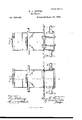
- My invention further consists in the application of an extension hot-plate and removable hot-shelves around the base of the heater or stove proper, so that I utilize any waste and radiant heat at this point, as well as at the top of the apparatus, and in certain other details of construction, which will be more fully described by referring to the accompanying drawings, in which- Figure 1 is a perspective view of my stove.
- Fig. 2 is a vertical section on the line 2 z of Fig. 1.
- Fig. 3 is avertical section on line yy, Fig. 2.
- A is the oil-reservoir of my stove, and it may be made entirely of cast-Iron, so that it will always be perfectly tight.
- the bottom plate is made with a large central depression or pan, B, as shown, and in the bottom of this pan are made the longitudinal sunken grooves or depressions G, which I call wick-receivers, these grooves being formed in a line with and below the wick-tubes, for a purpose to be hereinafter described.
- the wick-tubes D are se to certain improvecured in the bottom of a secondary pan, E,
- This flange stands just within the sides of the pan E, and surrounds the wicktubes in a manner similar to that described in my former patent; but it performs additional duties in the present case, caused by the different construction of the reservoir.
- This reservoir as before described, has its central pan nearly filled by the central pan E, which also rests upon the bottom of the pan B of the reservoir, so that it practically excludes the oil from this bottom, except at the points where the wick-receivers or slots 0 extend beyond the lower end of the wick-tubes, and thus leave a space into which the oil may flow.
- These receivers permit the wicks to extend below the bottom of the wick-tubes, and thus to be in a position to take up the oil to the best advantage.
- the permanent plate F is the body of the stove, having its base or bottom plate, J, hinged at one side to the plate.
- This bottom plate, J also serves as a flame-guard plate, and has long slots made in it to correspond with the wick-tubes, the sides of these slots being bent to stand at an incline toward the wick-tubes, as shown.
- shaped plate K receives the heat from the lamps, and concentrates it as described in my former patent.
- a door, Q, in the side of the stove-body I allows access to the interior without raising it.
- the rack L which is placed upon the top of the stove, is made square, and by constructing it in this shape I provide a large space upon which to place sauce-pans and other ves
- the conical or roof-v sels which is a most important point in this class of stoves.
- the plate F is extended around the base of the stove, as before described, and receives its heat from the plate J; and it is in such a position that all the radiant heat from the body of the stove will be utilized to heat vessels which may be placed upon this plate. This is materially assisted by the openings M, which may be protected by mica, and which will radiate considerable heat.
- extension shelves N which are slitted or cut, as shown in Fig. 1, so that the portion 12 of the shelves will fit over the edges of the plates or shelves F, and the end portions 11. pass under the edges of said plates or shelves, thus securing them in place.
- These extension shelves give me a broad space for the reception of plates and other articles, where nothing has ever before been placed.
- This shelf I utilize the radiant heat and a large quantity which is produced from the plate J.
- a perforated plate, 0, rests upon the plate J, surrounding the wick-tubes, as in my former patent. Openings P are made alongside the wick tubes through the bottom or plate F, so as to admit the air; and this forms the draft, and keeps the wick-tubes cool, while the perforated plate 0 serves to distribute the air as it rises.
- the whole mechanism is cheap, easily managed, and convenient of access.
- the oil-reservoir A having a central depressed bottom, B, said bottom having the longitudinal sunken grooves or wick-receivers G, in combination with the interior pan E, having the wick-tubes D opening through its bottom, so as to allow the wick to enter the receivers, which are filled with oil from their ends, substantially as and for the purpose herein described.
- the oven S with its double top T U, radiator V, and the central openings, W X, substantially as and for the purpose herein described.
Landscapes
- Engineering & Computer Science (AREA)
- Chemical & Material Sciences (AREA)
- Combustion & Propulsion (AREA)
- Mechanical Engineering (AREA)
- General Engineering & Computer Science (AREA)
- Wick-Type Burners And Burners With Porous Materials (AREA)
Description
2 Sheets-Sheet 1.
H. L. HOWSE;
Oil-Stove.
No. 208,317. Patented Sept. 24,1878.
Witnesses, afiz/2% Invent N, FEIERS. PHOTD-UTHOGRAPEER WASHINGTON, D C,
28heets-Sheet 2. H. L. HOWSE. Oil-Stove.
No. 208,317. Patented'Sept. 24, I878.
Wit ne 5 5e 5 NFETERS. PHOTO-LITHOGRAPHER. WASHINGTON. D C,
UNITED STATES PATENT QFFIGE.
HENRY L. HOIVSE, OF SAN FRANCISCO, CALIFORNIA.
IMPROVEMENT IN OlL-STOVES.
Specification forming part of Letters Patent No. 208,317, dated September 24, 1378; application filed July 29, 167:.
To all whom it may concern:
Be it known that I, HENRY L. HowsE, of the city and county of San Francisco, and State of California, have invented an Improvement in Oil-Stoves; and I do hereby declare the following to be a full, clear, and exact description thereof, reference being had to the accompanying drawings.
My invention relates ments in that class of stoves which are intended to employ oil as a fuel, and these improvements are especially based upon a patent which was issued to me, and dated March 5, 1878.
My present improvements consist, first, in a novel construction of the oil-reservoir, by which I am enabled to separate the great bulk of oil from that which is being used by the wicks, and to feed it to the wicks in thin sheets by gravitation while at the same time, by the action of a peculiar downwardly-inovin g current of air, caused by the draft which it afterward supplies, this sheet of oil is kept constantly cool. A wick-receivcr is made in the bottom of the reservoir below the wick-tubes, which rest upon the bottom, and theoil is fed into these sunken spaces at each end, so as to supply the wicks.
My invention further consists in the application of an extension hot-plate and removable hot-shelves around the base of the heater or stove proper, so that I utilize any waste and radiant heat at this point, as well as at the top of the apparatus, and in certain other details of construction, which will be more fully described by referring to the accompanying drawings, in which- Figure 1 is a perspective view of my stove.
Fig. 2 is a vertical section on the line 2 z of Fig. 1. Fig. 3 is avertical section on line yy, Fig. 2.
A is the oil-reservoir of my stove, and it may be made entirely of cast-Iron, so that it will always be perfectly tight. The bottom plate is made with a large central depression or pan, B, as shown, and in the bottom of this pan are made the longitudinal sunken grooves or depressions G, which I call wick-receivers, these grooves being formed in a line with and below the wick-tubes, for a purpose to be hereinafter described. A suitably-protected opening, It, allows the reservoir to be replenished from time to time. The wick-tubes D are se to certain improvecured in the bottom of a secondary pan, E,
which rests upon the bottom of the pan B, and has a flange around its upper edge to rest upon the upper plate of the reservoir, so that this secondary pan nearly fills the pan B, and forms a hollow square within the tank A, which is surrounded with oil. The plate F is fitted to rest upon the corner-posts G, arising from the oil-reservoir; and this plate, which is made of considerable size, is permanently secured to 1 these posts. From the lower surface of this plate a hollow flange, H, projects downward into the pan E, and extends nearly to the bottom of this pan. This flange stands just within the sides of the pan E, and surrounds the wicktubes in a manner similar to that described in my former patent; but it performs additional duties in the present case, caused by the different construction of the reservoir. This reservoir, as before described, has its central pan nearly filled by the central pan E, which also rests upon the bottom of the pan B of the reservoir, so that it practically excludes the oil from this bottom, except at the points where the wick-receivers or slots 0 extend beyond the lower end of the wick-tubes, and thus leave a space into which the oil may flow. These receivers permit the wicks to extend below the bottom of the wick-tubes, and thus to be in a position to take up the oil to the best advantage. Above the permanent plate F is the body of the stove, having its base or bottom plate, J, hinged at one side to the plate. This bottom plate, J, also serves as a flame-guard plate, and has long slots made in it to correspond with the wick-tubes, the sides of these slots being bent to stand at an incline toward the wick-tubes, as shown. By thus hinging this part of the stove to the plate F, I am enabled to make access to all parts of the stove and lamp exceedingly convenient, and without interfering or having to remove any articles on said hot-plate. shaped plate K receives the heat from the lamps, and concentrates it as described in my former patent. A door, Q, in the side of the stove-body I allows access to the interior without raising it.
The rack L, which is placed upon the top of the stove, is made square, and by constructing it in this shape I provide a large space upon which to place sauce-pans and other ves The conical or roof-v sels, which is a most important point in this class of stoves.
The plate F is extended around the base of the stove, as before described, and receives its heat from the plate J; and it is in such a position that all the radiant heat from the body of the stove will be utilized to heat vessels which may be placed upon this plate. This is materially assisted by the openings M, which may be protected by mica, and which will radiate considerable heat.
I have constructed extension shelves N, which are slitted or cut, as shown in Fig. 1, so that the portion 12 of the shelves will fit over the edges of the plates or shelves F, and the end portions 11. pass under the edges of said plates or shelves, thus securing them in place. These extension shelves give me a broad space for the reception of plates and other articles, where nothing has ever before been placed. By the use of this shelf I utilize the radiant heat and a large quantity which is produced from the plate J. A perforated plate, 0, rests upon the plate J, surrounding the wick-tubes, as in my former patent. Openings P are made alongside the wick tubes through the bottom or plate F, so as to admit the air; and this forms the draft, and keeps the wick-tubes cool, while the perforated plate 0 serves to distribute the air as it rises.
The whole mechanism is cheap, easily managed, and convenient of access.
The oven S, I make with a double top, T U, and a radiator, V, is placed between said double top and the bottom of said oven, so
that the heat, entering the opening W, will bedistributed and heat the entire surface, and, escaping at X, will heat a vessel at that point.
Having thus described my invention, what I claim as new, and desire to secure by Letters Patent, is
1. In an oil-stove, the oil-reservoir A, having a central depressed bottom, B, said bottom having the longitudinal sunken grooves or wick-receivers G, in combination with the interior pan E, having the wick-tubes D opening through its bottom, so as to allow the wick to enter the receivers, which are filled with oil from their ends, substantially as and for the purpose herein described.
2. The combination, with the stove-body I, having bottom J, of the plate F, having the removable extension or extensions N, substantial] y as and for the purpose specified.
3. The combination, with the square oil-reservoir, having the plate F mounted upon it, and the square stove-body I, of the square grate or rack L, whereby the heating-surface is extended, and the corners of the rack or grate adapted to receive saucepans, substantially as specified.
4. The oven S, with its double top T U, radiator V, and the central openings, W X, substantially as and for the purpose herein described.
In witness whereof I hereunto set my hand.
HENRY LANGLEY HOWVSE.
Witnesses:
GEo. H. STRONG, FRANK A. BRooKs.
Publications (1)
| Publication Number | Publication Date |
|---|---|
| US208317A true US208317A (en) | 1878-09-24 |
Family
ID=2277722
Family Applications (1)
| Application Number | Title | Priority Date | Filing Date |
|---|---|---|---|
| US208317D Expired - Lifetime US208317A (en) | Improvement in oil-stoves |
Country Status (1)
| Country | Link |
|---|---|
| US (1) | US208317A (en) |
Cited By (1)
| Publication number | Priority date | Publication date | Assignee | Title |
|---|---|---|---|---|
| US8291896B1 (en) * | 2007-07-06 | 2012-10-23 | Dynamic Engineering Designs LLC | Outdoor oven and cooking system |
-
0
- US US208317D patent/US208317A/en not_active Expired - Lifetime
Cited By (1)
| Publication number | Priority date | Publication date | Assignee | Title |
|---|---|---|---|---|
| US8291896B1 (en) * | 2007-07-06 | 2012-10-23 | Dynamic Engineering Designs LLC | Outdoor oven and cooking system |
Similar Documents
| Publication | Publication Date | Title |
|---|---|---|
| US215711A (en) | Improvement in gridirons | |
| US903834A (en) | Oven. | |
| US1156087A (en) | Flame-shield for gas-stoves. | |
| US194242A (en) | Improvement in hydrocarbon-stoves | |
| US1019123A (en) | Oil-stove. | |
| US195950A (en) | Improvement in coal-oil stoves | |
| US472128A (en) | Water-heater | |
| US243929A (en) | Combined heating | |
| US8415A (en) | Portable elevated oven | |
| US419058A (en) | Soldering iron heater | |
| US682630A (en) | Hydrocarbon-vapor stove. | |
| US70207A (en) | Improvement in gas-cooking appabatus | |
| US414740A (en) | Oil-stove and reservoir therefor | |
| US1049750A (en) | Electric heating-stove. | |
| US577619A (en) | Camp or army stove | |
| US405291A (en) | Half to j | |
| US563976A (en) | Water-heater | |
| US544307A (en) | Lazard kahn | |
| US33705A (en) | Improvement in camp-stoves | |
| US264994A (en) | Stove | |
| US782921A (en) | Dinner-pail. | |
| US582842A (en) | Vania | |
| US600833A (en) | Vapor or gas stove | |
| US1031263A (en) | Water-tank attachment for ranges or stoves. | |
| US814578A (en) | Lunch-pail. |