US206602A - Improvement in children s chairs - Google Patents
Improvement in children s chairs Download PDFInfo
- Publication number
- US206602A US206602A US206602DA US206602A US 206602 A US206602 A US 206602A US 206602D A US206602D A US 206602DA US 206602 A US206602 A US 206602A
- Authority
- US
- United States
- Prior art keywords
- seat
- legs
- chairs
- horse
- pivoted
- Prior art date
- Legal status (The legal status is an assumption and is not a legal conclusion. Google has not performed a legal analysis and makes no representation as to the accuracy of the status listed.)
- Expired - Lifetime
Links
- 239000000463 material Substances 0.000 description 2
- 239000002023 wood Substances 0.000 description 2
- 241001023788 Cyttus traversi Species 0.000 description 1
- 241001274197 Scatophagus argus Species 0.000 description 1
- 238000005452 bending Methods 0.000 description 1
- 239000010985 leather Substances 0.000 description 1
Images

Classifications
-
- A—HUMAN NECESSITIES
- A47—FURNITURE; DOMESTIC ARTICLES OR APPLIANCES; COFFEE MILLS; SPICE MILLS; SUCTION CLEANERS IN GENERAL
- A47C—CHAIRS; SOFAS; BEDS
- A47C13/00—Convertible chairs, stools or benches
Definitions
- N-PEIERS PHOTO-LITHUGRAPhER
- WASHINGTON D C IFIT/EI'JIEIK Wit E 5555. z%@ W 3 Sheets-Sheet 2.
- JOHN NICHOLS OF BALDWINSVILLE, ASSIGNOR TO HEYYVOOD BROTHERS & 00., OF GARDNER, AND THOMPSON, PERLEY & VVAITE, OF BALD VVINSVILLE, MASSACHUSETTS.
- This invention relates to an improvement in childrens chairs whereby the chair may be converted into a carriage or rocking-horse.
- the chair is arranged as a high chair, and has at the back of the main seat an auxiliary seat, which serves as the seat for the carriage or rocking-horse.
- the legs of the high chair are so pivoted with reference to the main seat as to support it in its elevated position, and the same legs, provided with rollers at one edge and curved at the other edge, serve to support the auxiliary seat when the chair is used as a rocking-horse.
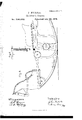
- Figure 1 represents, in side elevation, the contrivance arranged to serve as a high chair, one-half of the head-shaped portion of the rocking-horse being omitted and the footrest being in section;
- Fig. 2 a side elevation, showing the contrivance employed as a car riage;
- Fig. 3 a side elevation, showing it arranged as a rocking-horse, a portion of the rear leg, which serves as the rear of the rocker, being broken away and
- Figs. 4, 5, and 6 are details of fastenings for the movable or pivoted joints.
- the contrivance is composed of a main seat, (1, (represented in Fig. 1 in dotted lines and in Fig. 2 in section,) which serves as the seat for the high chair.
- This seat may be provided, as shown in Fig. 2, with an opening, I), and may have a suitable cover, 0, and the back 0 of the seat may be made in any usual way.
- the seat a has at each side a rigid leg, (I 0, one portion thereof (portion 0) being curved, as shown, to serve as a rocker, and also aleg, f g, pivoted to the seat at 71, so that said legs, connected by suitable rounds, may be so turned with reference to such. seat a as to place the curved portions g in such position as to form a continuation of the are of the curved portions 6, as in Fig. 3, when it is desired to form a rocking-horse.
- edges of the curved portions 0 9 may be provided with strips of leather, rubber, or other suitable material, 1', softer than wood.
- the legs f g will preferably be made in one piece by bending, and the upper portion, 3, will preferably be shaped to conform with the shape of the arms k, and these legs will be provided at the bottom with a roller, I, and at the top with a roller, m, to serve as the wheels for the carriage, which is formed by turning the chair over upon its front, as shown in Fig. 2, the auxiliary seat n at the rear side of the back of the main seat then serving as the seat for the carriage.
- the auxiliary seat also serves for the seat of the rocking-horse.
- the foot-rest 0 is pivoted at 10 between the portions 0 of the rigid legs, and is provided with a locking device composed of a metallic bar, 3, having projections to enter one of the notches 4 in a plate, 5, so that the said footrest may be held in the position shown in section, Fig. 1, to serve as the foot-rest for the high chair, or to sustain avessel; or it may be held in the position shown in dotted lines in such figure and in full lines in Figs. 2 and 3, to serve as afoot-rest for the carriage orrocker.
- This locking device is moved to disengage it by the handle 6, and in the opposite direction by the spring 7.
- Pivoted between the legs d c, at r, are two horse head and neck shaped pieces of wood, 8, or other suitable material, preferably made hollow to make them light, connected by rounds 8 8, and between such pieces is placed a (lash-board, t, provided if desired, with a whip-socket, u, suitable driving-reins o, and bridle being provided.
- Vhen the contrivance is used as a high chair, the pieces 8 are turned within the base of the chair, as shown in Fig. 1, in which position they are locked by means of bolts 10, projecting from springs 20 into holes made in plates ac fixed to the legs (I 0. (Shown in dotted lines, Fig. 1, and in detail, Fig. 4.)
- Vhen the eontrivance is used as a rockinghorse or as a carriage, the pieces .sare turned outward on their pivots, as shown in Figs. 1. and 3, where they are locked by the same locking devices, the bolts then entering other holes in plates .r.
- a handle, y which may be folded parallel with (I, and be locked to the seat a by means of a pin, 13, on a spring, 14, secured to the cross-rod 15, which connects the opposite sides ot'y.
- This handle may be turned outward, as shown in Fig. 2, to be used to draw the carriage, such figure showing the handle broken ott to save space.
- the crossrod 15 when the contrivance is employed as a rocking-horse, is grasped by the child to assist in retaining its seat.
- the legs f are locked in the two positions shown in Figs. 1 and .l by means of springs connected with the under side of seat a. such springs having bolts to enter holes 17 in a plate, 18, (shown in dotted lines, Fig. 3,) such springs, bolts, and plate being constructed and operatingas described of springs 1r, bolts 10, and plate .1. (Shown in Fig. 4.)
- the main and auxiliary seats combined with the fixed and movable legs, curved at their inner edges, as at c y, to serve as a high chair or as a rocker.
- a pair of legs In combination with the auxiliary scat attached to the back of the main seat, a pair of legs, provided at each end with rollers l m, located thereon in front of the center of the main seat, to operate substantially as described.
Landscapes
- Chairs For Special Purposes, Such As Reclining Chairs (AREA)
Description
3 Sheets-Sheet 1 J. NICHOLS. Ohildrens Chairs.
Patented July 30,1878.
N-PEIERS, PHOTO-LITHUGRAPhER, WASHINGTON D C IFIT/EI'JIEIK Wit E 5555. z%@ W 3 Sheets-Sheet 2.
J. NICHOLS.
Childrens Chairs.
No. 206,602. Patented July 30' 1878.
x S e O oi s EH v E O p m Wii E5525. Irv/ 211E015 %@WT Wow I l r v r r NJIHERS. FHDTGUTNOGRAPHER. WASHINGTON, D C.
J. NICHOLS.
Children's Chairs.
Patented July 30, 1878.
IqX/Er in Y. flQ/hd N. FEW-RS. PHOTO LITHOG UNITED STATES PATENT QFFIOE.
JOHN NICHOLS, OF BALDWINSVILLE, ASSIGNOR TO HEYYVOOD BROTHERS & 00., OF GARDNER, AND THOMPSON, PERLEY & VVAITE, OF BALD VVINSVILLE, MASSACHUSETTS.
IMPROVEMENT IN CHILDRENS CHAIRS.
Specification forming part of Letters Patent No. 206,602, dated July 80, 1 7R,- application filed April 22, 1878.
To all whom it may concern Be it known that 1, JOHN NICHOLS, of Baldwinsville, county of Worcester, State of Massachusetts, have invented an Improvement in Childrens Chairs, of which the following is a specification:
This invention relates to an improvement in childrens chairs whereby the chair may be converted into a carriage or rocking-horse.
The chair is arranged as a high chair, and has at the back of the main seat an auxiliary seat, which serves as the seat for the carriage or rocking-horse.
The legs of the high chair are so pivoted with reference to the main seat as to support it in its elevated position, and the same legs, provided with rollers at one edge and curved at the other edge, serve to support the auxiliary seat when the chair is used as a rocking-horse.
Figure 1 represents, in side elevation, the contrivance arranged to serve as a high chair, one-half of the head-shaped portion of the rocking-horse being omitted and the footrest being in section; Fig. 2, a side elevation, showing the contrivance employed as a car riage; Fig. 3, a side elevation, showing it arranged as a rocking-horse, a portion of the rear leg, which serves as the rear of the rocker, being broken away and Figs. 4, 5, and 6 are details of fastenings for the movable or pivoted joints.
The contrivance is composed of a main seat, (1, (represented in Fig. 1 in dotted lines and in Fig. 2 in section,) which serves as the seat for the high chair. This seat may be provided, as shown in Fig. 2, with an opening, I), and may have a suitable cover, 0, and the back 0 of the seat may be made in any usual way.
The seat a has at each side a rigid leg, (I 0, one portion thereof (portion 0) being curved, as shown, to serve as a rocker, and also aleg, f g, pivoted to the seat at 71, so that said legs, connected by suitable rounds, may be so turned with reference to such. seat a as to place the curved portions g in such position as to form a continuation of the are of the curved portions 6, as in Fig. 3, when it is desired to form a rocking-horse.
The edges of the curved portions 0 9 may be provided with strips of leather, rubber, or other suitable material, 1', softer than wood.
The legs f g will preferably be made in one piece by bending, and the upper portion, 3, will preferably be shaped to conform with the shape of the arms k, and these legs will be provided at the bottom with a roller, I, and at the top with a roller, m, to serve as the wheels for the carriage, which is formed by turning the chair over upon its front, as shown in Fig. 2, the auxiliary seat n at the rear side of the back of the main seat then serving as the seat for the carriage. The auxiliary seat also serves for the seat of the rocking-horse.
The foot-rest 0 is pivoted at 10 between the portions 0 of the rigid legs, and is provided with a locking device composed of a metallic bar, 3, having projections to enter one of the notches 4 in a plate, 5, so that the said footrest may be held in the position shown in section, Fig. 1, to serve as the foot-rest for the high chair, or to sustain avessel; or it may be held in the position shown in dotted lines in such figure and in full lines in Figs. 2 and 3, to serve as afoot-rest for the carriage orrocker. This locking device is moved to disengage it by the handle 6, and in the opposite direction by the spring 7.
Pivoted between the legs d c, at r, are two horse head and neck shaped pieces of wood, 8, or other suitable material, preferably made hollow to make them light, connected by rounds 8 8, and between such pieces is placed a (lash-board, t, provided if desired, with a whip-socket, u, suitable driving-reins o, and bridle being provided.
\Vhen the contrivance is used as a high chair, the pieces 8 are turned within the base of the chair, as shown in Fig. 1, in which position they are locked by means of bolts 10, projecting from springs 20 into holes made in plates ac fixed to the legs (I 0. (Shown in dotted lines, Fig. 1, and in detail, Fig. 4.) Vhen the eontrivance is used as a rockinghorse or as a carriage, the pieces .sare turned outward on their pivots, as shown in Figs. 1. and 3, where they are locked by the same locking devices, the bolts then entering other holes in plates .r.
It is obvious that these pieces at might be omitted, and yet the contrivance would operate as a carriage and as a rocker; but it is far more desirable and attractive to employ such pieces To the legs 17 c, at 1;, is pivoted a handle, y, which may be folded parallel with (I, and be locked to the seat a by means of a pin, 13, on a spring, 14, secured to the cross-rod 15, which connects the opposite sides ot'y. (See Fig. 6, showing a detail thereof.) This handle may be turned outward, as shown in Fig. 2, to be used to draw the carriage, such figure showing the handle broken ott to save space.
The crossrod 15, when the contrivance is employed as a rocking-horse, is grasped by the child to assist in retaining its seat.
The legs f are locked in the two positions shown in Figs. 1 and .l by means of springs connected with the under side of seat a. such springs having bolts to enter holes 17 in a plate, 18, (shown in dotted lines, Fig. 3,) such springs, bolts, and plate being constructed and operatingas described of springs 1r, bolts 10, and plate .1. (Shown in Fig. 4.)
(See detail, Fig. 5.)
seat, located at the rear of the back of the main seat, to operate substantially as described.
2. The main and auxiliary seats, combined with the fixed and movable legs, curved at their inner edges, as at c y, to serve as a high chair or as a rocker.
3. The combination, with the seat. 11 and fixed legs, of horse-head-hke pieces 8, pivoted thereto, substantially as and for the purpose described. 7
4. The combination, with the seat I: and legs and pivoted horse-head-like pieces .v, of a dash-board, substantially as described.
5. The combination, with the auxiliary seat a and fixed legs, of the pivoted legs f 1, adapted to be turned so that the narrow ends of such legs will project; in front of or at the rear of such seat, according to whether the apparatus is being used as a carriage or rocker.
t In combination with the auxiliary scat attached to the back of the main seat, a pair of legs, provided at each end with rollers l m, located thereon in front of the center of the main seat, to operate substantially as described.
7. The pivoted foot-board and locking device, combined with the leg 0 and notched plate connected therewith, to operate substantial] y as described.
In testimony whereof I have signed my name to this specification in the presence of two subscribing witnesses.
JOHN Nltlltllm.
\Yitnesses:
Publications (1)
| Publication Number | Publication Date |
|---|---|
| US206602A true US206602A (en) | 1878-07-30 |
Family
ID=2276006
Family Applications (1)
| Application Number | Title | Priority Date | Filing Date |
|---|---|---|---|
| US206602D Expired - Lifetime US206602A (en) | Improvement in children s chairs |
Country Status (1)
| Country | Link |
|---|---|
| US (1) | US206602A (en) |
-
0
- US US206602D patent/US206602A/en not_active Expired - Lifetime
Similar Documents
| Publication | Publication Date | Title |
|---|---|---|
| US336387A (en) | Adjustable chair | |
| US206602A (en) | Improvement in children s chairs | |
| US539041A (en) | Invalid-chair | |
| USRE27255E (en) | Children s play seat | |
| US202560A (en) | Improvement in combined carriage and chair | |
| US264157A (en) | Child s carriage | |
| US229061A (en) | Child s chair | |
| US247848A (en) | Convertible invalid-chair | |
| US220258A (en) | Improvement in children s chairs | |
| US394716A (en) | Convertible chair | |
| US292068A (en) | Child s chair | |
| US1075636A (en) | Chair. | |
| US952648A (en) | Convertible go-cart. | |
| US1154021A (en) | Chair. | |
| US292067A (en) | Child s chair | |
| US342841A (en) | Child s chair | |
| US217341A (en) | Improvement in high-chair and carriage | |
| US259368A (en) | Lemuel a | |
| US249072A (en) | Car-seat | |
| US91350A (en) | Improved child s chair and carriage | |
| US247847A (en) | Benjamin | |
| US746189A (en) | Go-cart. | |
| US260843A (en) | Convertible child s chair | |
| US641680A (en) | Baby-carriage. | |
| US958423A (en) | Folding perambulator. |