US20240297242A1 - Lateral bipolar transistors - Google Patents
Lateral bipolar transistors Download PDFInfo
- Publication number
- US20240297242A1 US20240297242A1 US18/660,956 US202418660956A US2024297242A1 US 20240297242 A1 US20240297242 A1 US 20240297242A1 US 202418660956 A US202418660956 A US 202418660956A US 2024297242 A1 US2024297242 A1 US 2024297242A1
- Authority
- US
- United States
- Prior art keywords
- semiconductor material
- sidewall
- collector
- emitter
- extrinsic base
- Prior art date
- Legal status (The legal status is an assumption and is not a legal conclusion. Google has not performed a legal analysis and makes no representation as to the accuracy of the status listed.)
- Granted
Links
Images


Classifications
-
- H01L29/735—
-
- H—ELECTRICITY
- H10—SEMICONDUCTOR DEVICES; ELECTRIC SOLID-STATE DEVICES NOT OTHERWISE PROVIDED FOR
- H10D—INORGANIC ELECTRIC SEMICONDUCTOR DEVICES
- H10D10/00—Bipolar junction transistors [BJT]
- H10D10/60—Lateral BJTs
-
- H01L29/0808—
-
- H01L29/0821—
-
- H01L29/1008—
-
- H01L29/165—
-
- H01L29/6625—
-
- H—ELECTRICITY
- H10—SEMICONDUCTOR DEVICES; ELECTRIC SOLID-STATE DEVICES NOT OTHERWISE PROVIDED FOR
- H10D—INORGANIC ELECTRIC SEMICONDUCTOR DEVICES
- H10D10/00—Bipolar junction transistors [BJT]
- H10D10/01—Manufacture or treatment
- H10D10/021—Manufacture or treatment of heterojunction BJTs [HBT]
-
- H—ELECTRICITY
- H10—SEMICONDUCTOR DEVICES; ELECTRIC SOLID-STATE DEVICES NOT OTHERWISE PROVIDED FOR
- H10D—INORGANIC ELECTRIC SEMICONDUCTOR DEVICES
- H10D10/00—Bipolar junction transistors [BJT]
- H10D10/01—Manufacture or treatment
- H10D10/041—Manufacture or treatment of thin-film BJTs
-
- H—ELECTRICITY
- H10—SEMICONDUCTOR DEVICES; ELECTRIC SOLID-STATE DEVICES NOT OTHERWISE PROVIDED FOR
- H10D—INORGANIC ELECTRIC SEMICONDUCTOR DEVICES
- H10D10/00—Bipolar junction transistors [BJT]
- H10D10/01—Manufacture or treatment
- H10D10/061—Manufacture or treatment of lateral BJTs
-
- H—ELECTRICITY
- H10—SEMICONDUCTOR DEVICES; ELECTRIC SOLID-STATE DEVICES NOT OTHERWISE PROVIDED FOR
- H10D—INORGANIC ELECTRIC SEMICONDUCTOR DEVICES
- H10D10/00—Bipolar junction transistors [BJT]
- H10D10/311—Thin-film BJTs
-
- H—ELECTRICITY
- H10—SEMICONDUCTOR DEVICES; ELECTRIC SOLID-STATE DEVICES NOT OTHERWISE PROVIDED FOR
- H10D—INORGANIC ELECTRIC SEMICONDUCTOR DEVICES
- H10D10/00—Bipolar junction transistors [BJT]
- H10D10/80—Heterojunction BJTs
-
- H—ELECTRICITY
- H10—SEMICONDUCTOR DEVICES; ELECTRIC SOLID-STATE DEVICES NOT OTHERWISE PROVIDED FOR
- H10D—INORGANIC ELECTRIC SEMICONDUCTOR DEVICES
- H10D62/00—Semiconductor bodies, or regions thereof, of devices having potential barriers
- H10D62/10—Shapes, relative sizes or dispositions of the regions of the semiconductor bodies; Shapes of the semiconductor bodies
- H10D62/13—Semiconductor regions connected to electrodes carrying current to be rectified, amplified or switched, e.g. source or drain regions
- H10D62/133—Emitter regions of BJTs
- H10D62/134—Emitter regions of BJTs of lateral BJTs
-
- H—ELECTRICITY
- H10—SEMICONDUCTOR DEVICES; ELECTRIC SOLID-STATE DEVICES NOT OTHERWISE PROVIDED FOR
- H10D—INORGANIC ELECTRIC SEMICONDUCTOR DEVICES
- H10D62/00—Semiconductor bodies, or regions thereof, of devices having potential barriers
- H10D62/10—Shapes, relative sizes or dispositions of the regions of the semiconductor bodies; Shapes of the semiconductor bodies
- H10D62/13—Semiconductor regions connected to electrodes carrying current to be rectified, amplified or switched, e.g. source or drain regions
- H10D62/137—Collector regions of BJTs
-
- H—ELECTRICITY
- H10—SEMICONDUCTOR DEVICES; ELECTRIC SOLID-STATE DEVICES NOT OTHERWISE PROVIDED FOR
- H10D—INORGANIC ELECTRIC SEMICONDUCTOR DEVICES
- H10D62/00—Semiconductor bodies, or regions thereof, of devices having potential barriers
- H10D62/10—Shapes, relative sizes or dispositions of the regions of the semiconductor bodies; Shapes of the semiconductor bodies
- H10D62/17—Semiconductor regions connected to electrodes not carrying current to be rectified, amplified or switched, e.g. channel regions
- H10D62/177—Base regions of bipolar transistors, e.g. BJTs or IGBTs
- H10D62/184—Base regions of bipolar transistors, e.g. BJTs or IGBTs of lateral BJTs
-
- H—ELECTRICITY
- H10—SEMICONDUCTOR DEVICES; ELECTRIC SOLID-STATE DEVICES NOT OTHERWISE PROVIDED FOR
- H10D—INORGANIC ELECTRIC SEMICONDUCTOR DEVICES
- H10D62/00—Semiconductor bodies, or regions thereof, of devices having potential barriers
- H10D62/80—Semiconductor bodies, or regions thereof, of devices having potential barriers characterised by the materials
- H10D62/82—Heterojunctions
- H10D62/822—Heterojunctions comprising only Group IV materials heterojunctions, e.g. Si/Ge heterojunctions
-
- H—ELECTRICITY
- H10—SEMICONDUCTOR DEVICES; ELECTRIC SOLID-STATE DEVICES NOT OTHERWISE PROVIDED FOR
- H10D—INORGANIC ELECTRIC SEMICONDUCTOR DEVICES
- H10D64/00—Electrodes of devices having potential barriers
- H10D64/20—Electrodes characterised by their shapes, relative sizes or dispositions
- H10D64/27—Electrodes not carrying the current to be rectified, amplified, oscillated or switched, e.g. gates
- H10D64/281—Base electrodes for bipolar transistors
Definitions
- the present disclosure relates to semiconductor structures and, more particularly, to lateral bipolar transistors and methods of manufacture.
- Bipolar transistors can be vertical transistors or lateral transistors.
- a vertical bipolar transistor carriers flow in a vertical direction. Since a collector region is formed in a position deep from a wafer surface, collector resistance increases, thus limiting the transistor performance especially for high-speed operation.
- the transistor requires a high-concentration buried layer, a collector epitaxial layer, and a deep trench isolation, etc. Consequently, the number of process steps increases and thus does the costs.
- the lateral bipolar transistor is simpler in structure than the vertical bipolar transistor.
- a collector electrode can be directly brought into contact with a collector region, which is advantageous for high-speed operation.
- a structure comprises: an extrinsic base comprising at least one sidewall with a gradient concentration of semiconductor material; an emitter on a first side of the extrinsic base; and a collector on a second side of the extrinsic base.
- a structure comprises: an extrinsic base comprising a core of a first semiconductor material and a second semiconductor material, and a sidewall with a gradient concentration of the second semiconductor material; a raised emitter of comprising the first semiconductor material on a first side of the extrinsic base; and a raise collector of the first semiconductor material on a second side of the extrinsic base.
- a method comprises: forming an extrinsic base comprising at least one sidewall with a gradient concentration of semiconductor material; forming an emitter on a first side of the extrinsic base; and forming a collector on a second side of the extrinsic base.
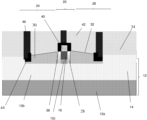
- FIG. 1 shows a starting substrate, amongst other features, and respective fabrication processes in accordance with aspects of the present disclosure.
- FIG. 2 shows a semiconductor material formed on the starting substrate and shallow trench isolation structures, amongst other features, and respective fabrication processes in accordance with aspects of the present disclosure.
- FIG. 3 shows a pillar structure with recessed sidewalls, amongst other features, and respective fabrication processes in accordance with aspects of the present disclosure.
- FIG. 4 shows an epitaxial semiconductor material with a gradient concentration within the recesses, amongst other features, and respective fabrication processes in accordance with aspects of the present disclosure.
- FIG. 5 shows a raised emitter region and a raised collector region, amongst other features, and respective fabrication processes in accordance with aspects of the present disclosure.
- FIG. 6 shows an opening in dielectric material aligned with the pillar structure, amongst other features, and respective fabrication processes in accordance with aspects of the present disclosure.
- FIG. 7 shows sidewall spacers in the opening, amongst other features, and respective fabrication processes in accordance with aspects of the present disclosure.
- FIG. 8 shows semiconductor material in the opening, amongst other features, and respective fabrication processes in accordance with aspects of the present disclosure.
- FIG. 9 shows contacts in an emitter region, extrinsic base region, and collector region, amongst other features, and respective fabrication processes in accordance with aspects of the present disclosure.
- FIGS. 10 - 13 show alternative fabrication processes and respective structures in accordance with additional aspects of the present disclosure.
- the present disclosure relates to semiconductor structures and, more particularly, to lateral bipolar transistors and methods of manufacture. More specifically, the present disclosure relates to lateral bipolar transistors with a SiGe base comprising a gradient concentration of, for example, Ge, in fully depleted semiconductor on insulator (SOI) technology.
- SOI semiconductor on insulator
- the lateral bipolar transistor provides for high voltage RF device applications (e.g., low noise amplifiers and power amplifiers), with the SOI technology providing additional benefits of reduced capacitance and noise isolation.
- the lateral bipolar transistor includes an ultra-narrow base (Wb) comprising a SiGe core with a SiGe sidewall having a gradient concentration of Ge, e.g., graded SiGe sidewall portion(s).
- Wb ultra-narrow base
- the width of the SiGe core may be between 2 nm to 20 nm; although other dimensions are also contemplated herein depending on desired device performance and specific application.
- the graded SiGe portions may be grown from one or both sidewalls of the SiGe core.
- the graded SiGe portions may be formed on an emitter side of the lateral bipolar transistor, a collector side of the lateral bipolar transistor or both the emitter side and collector side of the lateral bipolar transistor.
- the SiGe portions on the one or more sidewalls may be tunable with a preferred profile, e.g., Ge concentration.
- the graded SiGe portions on one or both sides of the SiGe core may have a Ge concentration ranging from about 0% to about 50% (although other concentrations are contemplated herein).
- the grading may comprise a uniform lateral Ge grading or, in embodiments, may include a higher Ge concentration closer to the collector region or the emitter region.
- an additional SiGe region may be grown above the SiGe core. In embodiments, due to the fabrication processes, the additional SiGe region may be formed with a very thin width, e.g., about 3 nm to about 6 nm, with 5 nm target.
- the lateral bipolar transistor of the present disclosure can be manufactured in a number of ways using a number of different tools.
- the methodologies and tools are used to form structures with dimensions in the micrometer and nanometer scale.
- the methodologies, i.e., technologies, employed to manufacture the lateral bipolar transistor of the present disclosure have been adopted from integrated circuit (IC) technology.
- the structures are built on wafers and are realized in films of material patterned by photolithographic processes on the top of a wafer.
- the fabrication of the lateral bipolar transistor uses three basic building blocks: (i) deposition of thin films of material on a substrate, (ii) applying a patterned mask on top of the films by photolithographic imaging, and (iii) etching the films selectively to the mask.
- precleaning processes may be used to clean etched surfaces of any contaminants, as is known in the art.
- a rapid thermal anneal processes may be used to drive-in dopants or material layers as is known in the art.
- FIG. 1 shows a starting substrate in accordance with aspects of the present disclosure.
- the structure 10 of FIG. 1 includes a substrate 12 comprising a semiconductor-on-insulator (SOI) substrate.
- the semiconductor-on-insulator (SOI) substrate 12 includes a semiconductor handle wafer 12 a, an insulator layer 12 b and a semiconductor layer 12 c on the insulator layer 12 b.
- the semiconductor handle wafer 12 a provides mechanical support to the insulator layer 12 b and the semiconductor layer 12 c.
- the semiconductor layer 12 c may be formed by a deposition process, such as chemical vapor deposition (CVD) or plasma enhanced CVD (PECVD).
- the semiconductor layer 12 c may be formed using a smart cut process where two semiconductor wafers are bonded together with an insulator material between the two semiconductor wafers.
- the semiconductor handle wafer 12 a and the semiconductor layer 12 c may be composed of any suitable semiconductor material including, but not limited to, Si, SiGe, SiGeC, SiC, GaAs, InAs, InP, and other III/V or II/VI compound semiconductors.
- the semiconductor handle wafer 12 a and the semiconductor layer 12 c may comprise any suitable single crystallographic orientation (e.g., a (100), (110), (111), or (001) crystallographic orientation).
- the semiconductor handle wafer 12 a may be a P+ substrate.
- the semiconductor layer 12 c may be a fully depleted semiconductor material that is thinned using a conventional oxidation process followed by an etching process to remove the oxidized portion of the semiconductor layer 12 c.
- the semiconductor layer 12 c may be thinned to about 1 nm to about 20 nm; although other dimensions are also contemplated herein.
- the insulator layer 12 b may include a dielectric material such as silicon dioxide, silicon nitride, silicon oxynitride, boron nitride or a combination thereof.
- the insulator layer 12 b may be a buried oxide layer (BOX).
- the insulator layer 12 b may be formed by a deposition process, such as CVD, PECVD or physical vapor deposition (PVD).
- the insulator layer 12 b may be formed using a thermal growth process, such as thermal oxidation, to convert a surface portion of the semiconductor handle wafer 12 a to an oxide material, e.g., insulator layer 12 b.
- the insulator layer 12 b can be formed by implanting oxygen atoms into a bulk semiconductor substrate and thereafter annealing the structure.
- a semiconductor material 16 may formed on the semiconductor layer 12 c.
- the semiconductor material 16 may be SiGe material which is epitaxially grown on the semiconductor layer 12 c using conventional epitaxial processes such that no further explanation is required herein for a complete understanding of the present disclosure.
- the semiconductor material 16 may be in situ doped with a P+ dopant, e.g., boron, during the epitaxial growth process, with a Ge concentration of about 40% as one non-limiting example.
- the semiconductor material 16 may have a depth of about 10 nm to 30 nm, which may be used for a core of the extrinsic base of the lateral bipolar transistor.
- insulator material e.g., SiO 2
- CVD chemical vapor deposition
- Any residual insulator material on the surface of the semiconductor material 16 may be removed by conventional chemical mechanical polishing (CMP) processes.
- FIG. 3 shows a patterning of the capping material 18 , semiconductor material 16 , and semiconductor material 12 c in an extrinsic base region 20 .
- the capping material 18 , the semiconductor material 16 , and the semiconductor material 12 c may be patterned into a pillar 15 using conventional lithography and etching processes as already described herein.
- the pillar 15 may comprise a core of the extrinsic base region. Due to the etching process, the underlying insulator layer 12 b may be exposed between the shallow trench isolation structures 14 .
- recesses 22 are formed on an emitter side 24 and a collector side 26 of the pillar 15 .
- the recesses 22 are below the capping material 18 and may be formed by conventional etching processes, with chemistries that are selective to the semiconductor material 16 and semiconductor layer 12 c.
- the recesses 22 may be about 2 nm to about 40 nm in depth and a height of the combination of the semiconductor materials 12 c, 18 , e.g., about 10 nm to about 30 nm; although other dimensions are also contemplated herein.
- the remaining portion of the pillar 15 may be used as the extrinsic base with a width dimension of about 3 nm to about 6 nm with a target of about 5 nm.
- epitaxial semiconductor material 30 may be formed on the emitter side 24 and epitaxial semiconductor material 32 may be formed on the collector side 26 .
- the epitaxial semiconductor materials 30 , 32 will grow outwards from the semiconductor material 28 .
- the epitaxial semiconductor material 30 may be a raised emitter region; whereas the epitaxial semiconductor material 32 may be a raised collector region.
- the semiconductor materials 30 , 32 may be N+ doped Si material and, more specifically, may be SiP material lightly doped with N+ dopant.
- the N+ dopant may be, for example, arsenic or phosphorus, doped in-situ during an epitaxial growth process of the semiconductor material 30 , 32 .
- a dielectric material or stack of dielectric materials 34 may be formed over the semiconductor materials 30 , 32 .
- the dielectric material or stack of dielectric materials 34 may be an oxide material and/or nitride material as is known in the art.
- the dielectric material or stack of dielectric materials 34 may be deposited using a conventional deposition process, e.g., CVD.
- the capping material may be removed to form an opening 36 , aligned with and exposing the semiconductor materials 16 , 28 .
- the capping material may be removed by any conventional etching processes as is known in the art.
- FIG. 9 shows contacts 46 in the emitter region 24 , extrinsic base region 20 and collector region 26 , amongst other features. More specifically, in FIG. 9 , contacts 46 may be formed in the emitter region 24 , extrinsic base region 20 and the collector region 26 , contacting the semiconductor materials 30 , 32 , 40 . To form the contacts 46 , trenches are formed in the interlevel dielectric material or stack of materials 42 to expose surfaces of the semiconductor materials 16 , 28 , 40 . A silicide process may be performed on the exposed semiconductor materials 16 , 28 , 40 to form silicide contacts 44 .
- the silicide contacts 44 are thus formed on the emitter region 24 , e.g., raised semiconductor material 30 , the collector region 26 , e.g., raised semiconductor material 32 and the extrinsic base region 20 , e.g., semiconductor material 40 .
- Conductive material may then be deposited within the trenches, over the silicide contacts 44 , to form the contacts 46 .
- the conductive material may be tungsten or aluminum, which may also include a barrier liner material. Any excess conductive material on the surface of the interlevel dielectric material or stack of materials 42 may be removed by a conventional CMP process.
- the liner material 48 may be removed on the emitter side 24 of the structure. It should be understood, though, that the liner material 48 may alternatively be removed from the collector side 26 of the structure.
- the liner material 48 may be removed by a conventional lithography and etching processes as is known in the art to expose a single side of the semiconductor material 12 c, 16 . Thereafter, a recess 22 is formed on the exposed side of the pillar 15 by removing some of the semiconductor materials 12 c, 16 as described with respect to FIG. 3 .
- FIG. 13 shows contacts 46 formed in the emitter region 24 , extrinsic base region 20 and the collector region 26 , contacting the semiconductor materials 30 , 32 , 40 , amongst other features.
- epitaxial semiconductor material 30 may be formed on the emitter side 24 and epitaxial semiconductor material 32 may be formed on the collector side 26 to form a raised emitter region and a raised collector region as described with respect to FIG. 5 .
- a dielectric material or stack of dielectric materials 34 may be formed over the semiconductor materials 30 , 32 followed by removal of the capping material to form an opening aligned with and exposing the semiconductor materials 16 , 28 as described with respect to FIG. 6 .
- Sidewall spacers 38 may be formed on sidewalls of the opening 36 which is then filled with additional semiconductor material 40 in the extrinsic base region 20 as described with respect to FIG. 8 .
- An interlevel dielectric material or stack of materials 42 may be formed over the semiconductor materials 16 , 28 , 40 .
- Trenches may be formed in the interlevel dielectric material or stack of materials 42 to expose surfaces of the semiconductor materials 16 , 28 , 40 , followed by fabrication of the silicide contacts 44 and the contacts 46 as described with respect to FIG. 9 .
- the silicide process begins with deposition of a thin transition metal layer, e.g., nickel, cobalt or titanium, over fully formed and patterned semiconductor devices (e.g., semiconductor materials 30 , 32 , 40 ). After deposition of the material, the structure is heated allowing the transition metal to react with exposed silicon (or other semiconductor material as described herein) in the active regions of the semiconductor device forming a low-resistance transition metal silicide. Following the reaction, any remaining transition metal is removed by chemical etching, leaving silicide contacts 44 in the active regions of the device.
- a thin transition metal layer e.g., nickel, cobalt or titanium
- the contacts 46 may be formed on the silicide contacts 44 .
- the contacts 46 may be tungsten or aluminum formed by conventional deposition processes.
- a conductive material e.g., tungsten or aluminum, may be deposited within the trenches and on the silicide contacts 44 to form the contacts 46 .
- Any residual material on the interlevel dielectric material 42 may be removed by a CMP process.
- the transistor can be utilized in system on chip (SoC) technology.
- SoC system on chip
- the SoC is an integrated circuit (also known as a “chip”) that integrates all components of an electronic system on a single chip or substrate. As the components are integrated on a single substrate, SoCs consume much less power and take up much less area than multi-chip designs with equivalent functionality. Because of this, SoCs are becoming the dominant force in the mobile computing (such as in Smartphones) and edge computing markets. SoC is also used in embedded systems and the Internet of Things.
- the method(s) as described above is used in the fabrication of integrated circuit chips.
- the resulting integrated circuit chips can be distributed by the fabricator in raw wafer form (that is, as a single wafer that has multiple unpackaged chips), as a bare die, or in a packaged form.
- the chip is mounted in a single chip package (such as a plastic carrier, with leads that are affixed to a motherboard or other higher level carrier) or in a multichip package (such as a ceramic carrier that has either or both surface interconnections or buried interconnections).
- the chip is then integrated with other chips, discrete circuit elements, and/or other signal processing devices as part of either (a) an intermediate product, such as a motherboard, or (b) an end product.
- the end product can be any product that includes integrated circuit chips, ranging from toys and other low-end applications to advanced computer products having a display, a keyboard or other input device, and a central processor.
Landscapes
- Bipolar Transistors (AREA)
Abstract
The present disclosure relates to semiconductor structures and, more particularly, to a lateral bipolar transistor and methods of manufacture. The structure includes: an extrinsic base having at least one sidewall with a gradient concentration of semiconductor material; an emitter on a first side of the extrinsic base; and a collector on a second side of the extrinsic base.
Description
- The present disclosure relates to semiconductor structures and, more particularly, to lateral bipolar transistors and methods of manufacture.
- Bipolar transistors can be vertical transistors or lateral transistors. In a vertical bipolar transistor, carriers flow in a vertical direction. Since a collector region is formed in a position deep from a wafer surface, collector resistance increases, thus limiting the transistor performance especially for high-speed operation. In addition, the transistor requires a high-concentration buried layer, a collector epitaxial layer, and a deep trench isolation, etc. Consequently, the number of process steps increases and thus does the costs. On the other hand, the lateral bipolar transistor is simpler in structure than the vertical bipolar transistor. Also, in a lateral bipolar transistor, a collector electrode can be directly brought into contact with a collector region, which is advantageous for high-speed operation.
- In an aspect of the disclosure, a structure comprises: an extrinsic base comprising at least one sidewall with a gradient concentration of semiconductor material; an emitter on a first side of the extrinsic base; and a collector on a second side of the extrinsic base.
- In an aspect of the disclosure, a structure comprises: an extrinsic base comprising a core of a first semiconductor material and a second semiconductor material, and a sidewall with a gradient concentration of the second semiconductor material; a raised emitter of comprising the first semiconductor material on a first side of the extrinsic base; and a raise collector of the first semiconductor material on a second side of the extrinsic base.
- In an aspect of the disclosure, a method comprises: forming an extrinsic base comprising at least one sidewall with a gradient concentration of semiconductor material; forming an emitter on a first side of the extrinsic base; and forming a collector on a second side of the extrinsic base.
- The present disclosure is described in the detailed description which follows, in reference to the noted plurality of drawings by way of non-limiting examples of exemplary embodiments of the present disclosure.
-
FIG. 1 shows a starting substrate, amongst other features, and respective fabrication processes in accordance with aspects of the present disclosure. -
FIG. 2 shows a semiconductor material formed on the starting substrate and shallow trench isolation structures, amongst other features, and respective fabrication processes in accordance with aspects of the present disclosure. -
FIG. 3 shows a pillar structure with recessed sidewalls, amongst other features, and respective fabrication processes in accordance with aspects of the present disclosure. -
FIG. 4 shows an epitaxial semiconductor material with a gradient concentration within the recesses, amongst other features, and respective fabrication processes in accordance with aspects of the present disclosure. -
FIG. 5 shows a raised emitter region and a raised collector region, amongst other features, and respective fabrication processes in accordance with aspects of the present disclosure. -
FIG. 6 shows an opening in dielectric material aligned with the pillar structure, amongst other features, and respective fabrication processes in accordance with aspects of the present disclosure. -
FIG. 7 shows sidewall spacers in the opening, amongst other features, and respective fabrication processes in accordance with aspects of the present disclosure. -
FIG. 8 shows semiconductor material in the opening, amongst other features, and respective fabrication processes in accordance with aspects of the present disclosure. -
FIG. 9 shows contacts in an emitter region, extrinsic base region, and collector region, amongst other features, and respective fabrication processes in accordance with aspects of the present disclosure. -
FIGS. 10-13 show alternative fabrication processes and respective structures in accordance with additional aspects of the present disclosure. - The present disclosure relates to semiconductor structures and, more particularly, to lateral bipolar transistors and methods of manufacture. More specifically, the present disclosure relates to lateral bipolar transistors with a SiGe base comprising a gradient concentration of, for example, Ge, in fully depleted semiconductor on insulator (SOI) technology. Advantageously, the lateral bipolar transistor provides for high voltage RF device applications (e.g., low noise amplifiers and power amplifiers), with the SOI technology providing additional benefits of reduced capacitance and noise isolation.
- In more specific embodiments, the lateral bipolar transistor includes an ultra-narrow base (Wb) comprising a SiGe core with a SiGe sidewall having a gradient concentration of Ge, e.g., graded SiGe sidewall portion(s). In embodiments, the width of the SiGe core may be between 2 nm to 20 nm; although other dimensions are also contemplated herein depending on desired device performance and specific application. The graded SiGe portions may be grown from one or both sidewalls of the SiGe core. For example, the graded SiGe portions may be formed on an emitter side of the lateral bipolar transistor, a collector side of the lateral bipolar transistor or both the emitter side and collector side of the lateral bipolar transistor.
- The SiGe portions on the one or more sidewalls may be tunable with a preferred profile, e.g., Ge concentration. For example, the graded SiGe portions on one or both sides of the SiGe core may have a Ge concentration ranging from about 0% to about 50% (although other concentrations are contemplated herein). The grading may comprise a uniform lateral Ge grading or, in embodiments, may include a higher Ge concentration closer to the collector region or the emitter region. Moreover, an additional SiGe region may be grown above the SiGe core. In embodiments, due to the fabrication processes, the additional SiGe region may be formed with a very thin width, e.g., about 3 nm to about 6 nm, with 5 nm target.
- The lateral bipolar transistor of the present disclosure can be manufactured in a number of ways using a number of different tools. In general, though, the methodologies and tools are used to form structures with dimensions in the micrometer and nanometer scale. The methodologies, i.e., technologies, employed to manufacture the lateral bipolar transistor of the present disclosure have been adopted from integrated circuit (IC) technology. For example, the structures are built on wafers and are realized in films of material patterned by photolithographic processes on the top of a wafer. In particular, the fabrication of the lateral bipolar transistor uses three basic building blocks: (i) deposition of thin films of material on a substrate, (ii) applying a patterned mask on top of the films by photolithographic imaging, and (iii) etching the films selectively to the mask. In addition, as is known in the art, precleaning processes may be used to clean etched surfaces of any contaminants, as is known in the art. Moreover, when necessary, a rapid thermal anneal processes may be used to drive-in dopants or material layers as is known in the art.
-
FIG. 1 shows a starting substrate in accordance with aspects of the present disclosure. In particular, thestructure 10 ofFIG. 1 includes asubstrate 12 comprising a semiconductor-on-insulator (SOI) substrate. The semiconductor-on-insulator (SOI)substrate 12 includes a semiconductor handle wafer 12 a, aninsulator layer 12 b and asemiconductor layer 12 c on theinsulator layer 12 b. The semiconductor handle wafer 12 a provides mechanical support to theinsulator layer 12 b and thesemiconductor layer 12 c. Thesemiconductor layer 12 c may be formed by a deposition process, such as chemical vapor deposition (CVD) or plasma enhanced CVD (PECVD). Alternatively, thesemiconductor layer 12 c may be formed using a smart cut process where two semiconductor wafers are bonded together with an insulator material between the two semiconductor wafers. - In the SOI implementation, the semiconductor handle wafer 12 a and the
semiconductor layer 12 c may be composed of any suitable semiconductor material including, but not limited to, Si, SiGe, SiGeC, SiC, GaAs, InAs, InP, and other III/V or II/VI compound semiconductors. Moreover, the semiconductor handle wafer 12 a and thesemiconductor layer 12 c may comprise any suitable single crystallographic orientation (e.g., a (100), (110), (111), or (001) crystallographic orientation). In further embodiments, the semiconductor handle wafer 12 a may be a P+ substrate. Thesemiconductor layer 12 c may be a fully depleted semiconductor material that is thinned using a conventional oxidation process followed by an etching process to remove the oxidized portion of thesemiconductor layer 12 c. Thesemiconductor layer 12 c may be thinned to about 1 nm to about 20 nm; although other dimensions are also contemplated herein. - The
insulator layer 12 b may include a dielectric material such as silicon dioxide, silicon nitride, silicon oxynitride, boron nitride or a combination thereof. In a preferred embodiment, theinsulator layer 12 b may be a buried oxide layer (BOX). Theinsulator layer 12 b may be formed by a deposition process, such as CVD, PECVD or physical vapor deposition (PVD). In further embodiments, theinsulator layer 12 b may be formed using a thermal growth process, such as thermal oxidation, to convert a surface portion of the semiconductor handle wafer 12 a to an oxide material, e.g.,insulator layer 12 b. In yet another embodiment, theinsulator layer 12 b can be formed by implanting oxygen atoms into a bulk semiconductor substrate and thereafter annealing the structure. - Referring to
FIG. 2 , asemiconductor material 16 may formed on thesemiconductor layer 12 c. In embodiments, thesemiconductor material 16 may be SiGe material which is epitaxially grown on thesemiconductor layer 12 c using conventional epitaxial processes such that no further explanation is required herein for a complete understanding of the present disclosure. Thesemiconductor material 16 may be in situ doped with a P+ dopant, e.g., boron, during the epitaxial growth process, with a Ge concentration of about 40% as one non-limiting example. In embodiments, thesemiconductor material 16 may have a depth of about 10 nm to 30 nm, which may be used for a core of the extrinsic base of the lateral bipolar transistor. - Shallow
trench isolation structures 14 are formed within thesemiconductor layer 12 c andsemiconductor material 16, extending to theinsulator layer 12 b. The shallowtrench isolation structures 14 can be formed by conventional lithography, etching and deposition methods known to those of skill in the art. For example, a resist formed over thesemiconductor material 16 is exposed to energy (light) to form a pattern (opening). An etching process with a selective chemistry, e.g., reactive ion etching (RIE), will be used to form one or more trenches in thesemiconductor layer 12 c and thesemiconductor material 16 through the openings of the resist. Following the resist removal by a conventional oxygen ashing process or other known stripants, insulator material (e.g., SiO2) can be deposited within the trenches by any conventional deposition process, e.g., chemical vapor deposition (CVD) processes. Any residual insulator material on the surface of thesemiconductor material 16 may be removed by conventional chemical mechanical polishing (CMP) processes. - Following the fabrication of the shallow
trench isolation structures 14, a cappingmaterial 18 may be formed over the shallowtrench isolation structures 14 and thesemiconductor material 16. In embodiments, the cappingmaterial 18 may be a nitride material that is deposited over the shallowtrench isolation structures 14 and thesemiconductor material 16. For example, the cappingmaterial 18 may be deposited using a conventional deposition method, e.g., CVD. -
FIG. 3 shows a patterning of the cappingmaterial 18,semiconductor material 16, andsemiconductor material 12 c in anextrinsic base region 20. In embodiments, the cappingmaterial 18, thesemiconductor material 16, and thesemiconductor material 12 c may be patterned into apillar 15 using conventional lithography and etching processes as already described herein. Thepillar 15 may comprise a core of the extrinsic base region. Due to the etching process, theunderlying insulator layer 12 b may be exposed between the shallowtrench isolation structures 14. - Still referring to
FIG. 3 , recesses 22 are formed on anemitter side 24 and acollector side 26 of thepillar 15. In embodiments, therecesses 22 are below the cappingmaterial 18 and may be formed by conventional etching processes, with chemistries that are selective to thesemiconductor material 16 andsemiconductor layer 12 c. In embodiments, therecesses 22 may be about 2 nm to about 40 nm in depth and a height of the combination of thesemiconductor materials pillar 15 may be used as the extrinsic base with a width dimension of about 3 nm to about 6 nm with a target of about 5 nm. - As shown in
FIG. 4 , anepitaxial semiconductor material 28 may be formed in therecesses 22, on sides of the patternedsemiconductor material 16 andsemiconductor layer 12 c. In embodiments, thesemiconductor material 28 may be p-doped SiGe material having a thickness of about 2 nm to about 40 nm. TheSiGe material 28 may comprise a gradient (e.g., graded) concentration of Ge material, e.g., ranging from a Ge concentration of about 0% to 50%. In embodiments, the concentration of Ge may be from a smaller % concentration of Ge to a larger % concentration of Ge, starting at an inner portion continuing to an outer portion. In an alternative embodiment, the concentration of the Ge may be from a larger % concentration of Ge to a smaller % concentration of Ge, starting at an inner portion continuing to an outer portion. Also, in embodiments, the cappingmaterial 18 may prevent faceting of thesemiconductor material 28, e.g., thesemiconductor material 28 may be rectangular in shape (e.g., not faceted). - In
FIG. 5 ,epitaxial semiconductor material 30 may be formed on theemitter side 24 andepitaxial semiconductor material 32 may be formed on thecollector side 26. In embodiments, theepitaxial semiconductor materials semiconductor material 28. In this way, theepitaxial semiconductor material 30 may be a raised emitter region; whereas theepitaxial semiconductor material 32 may be a raised collector region. Thesemiconductor materials semiconductor material - As shown in
FIG. 6 , a dielectric material or stack ofdielectric materials 34 may be formed over thesemiconductor materials dielectric materials 34 may be an oxide material and/or nitride material as is known in the art. The dielectric material or stack ofdielectric materials 34 may be deposited using a conventional deposition process, e.g., CVD. Following the deposition of the dielectric material or stack ofdielectric materials 34, the capping material may be removed to form anopening 36, aligned with and exposing thesemiconductor materials - In
FIG. 7 ,sidewall spacers 38 may be formed on sidewalls of theopening 36. In embodiments, thesidewall spacers 38 may be a nitride material, for example, which effectively narrows the width of theopening 36. The sidewall spacers 38 may be formed by a conventional deposition process followed by an anisotropic etching process to remove the sidewall material from horizontal surfaces, e.g., leaving thesidewall spacers 34 on sidewalls of theopening 36. -
FIG. 8 showsadditional semiconductor material 40 filling theopening 36 within theextrinsic base region 20. In embodiments, theadditional semiconductor material 40 may be SiGe that is epitaxially grown within theopening 36. In more specific embodiments, theadditional semiconductor material 40 may be SiGe with a P+ dopant, e.g., boron. The SiGe may also have a gradient profile of Ge, as an example. Thesemiconductor material 40 is self-aligned with thesemiconductor materials extrinsic base region 20. An interlevel dielectric material or stack ofmaterials 42 may be formed over thesemiconductor materials -
FIG. 9 showscontacts 46 in theemitter region 24,extrinsic base region 20 andcollector region 26, amongst other features. More specifically, inFIG. 9 ,contacts 46 may be formed in theemitter region 24,extrinsic base region 20 and thecollector region 26, contacting thesemiconductor materials contacts 46, trenches are formed in the interlevel dielectric material or stack ofmaterials 42 to expose surfaces of thesemiconductor materials semiconductor materials silicide contacts 44. Thesilicide contacts 44 are thus formed on theemitter region 24, e.g., raisedsemiconductor material 30, thecollector region 26, e.g., raisedsemiconductor material 32 and theextrinsic base region 20, e.g.,semiconductor material 40. Conductive material may then be deposited within the trenches, over thesilicide contacts 44, to form thecontacts 46. The conductive material may be tungsten or aluminum, which may also include a barrier liner material. Any excess conductive material on the surface of the interlevel dielectric material or stack ofmaterials 42 may be removed by a conventional CMP process. -
FIGS. 10-13 show alternative fabrication processes and respective structures in accordance with aspects of the present disclosure. These fabrication process may be used to form a single sidewall of SiGe material. Starting fromFIG. 10 , after the patterning of thesemiconductor materials material 18 into thepillar 15, aliner material 48 may be deposited over patterned stack ofmaterials insulator layer 12 b and the shallowtrench isolation structures 14. In embodiments, theliner material 48 may be an oxide/nitride liner deposited by a conventional deposition process, e.g., CVD. - In
FIG. 11 , theliner material 48 may be removed on theemitter side 24 of the structure. It should be understood, though, that theliner material 48 may alternatively be removed from thecollector side 26 of the structure. Theliner material 48 may be removed by a conventional lithography and etching processes as is known in the art to expose a single side of thesemiconductor material recess 22 is formed on the exposed side of thepillar 15 by removing some of thesemiconductor materials FIG. 3 . - As shown in
FIG. 12 , anepitaxial semiconductor material 28 may be formed in therecess 22, on a single side of thepillar 15 below the cappingmaterial 18, i.e., patternedsemiconductor material 16 andsemiconductor layer 12 c. In embodiments, thesemiconductor material 28 may be SiGe material having a depth of about 2 nm to about 40 nm. TheSiGe material 28 may comprise a gradient concentration of Ge material, e.g., ranging from a Ge concentration of about 0% to 50%. In embodiments, the gradient concentration of Ge may be from a smaller % concentration of Ge to a larger % concentration of Ge, starting at an inner portion to continuing and to an outer portion. In an alternative embodiment, the grading concentration of the Ge may be from a larger % concentration of Ge to a smaller % concentration of Ge, starting at an inner portion and to continuing to an outer portion. -
FIG. 13 showscontacts 46 formed in theemitter region 24,extrinsic base region 20 and thecollector region 26, contacting thesemiconductor materials contacts 46,epitaxial semiconductor material 30 may be formed on theemitter side 24 andepitaxial semiconductor material 32 may be formed on thecollector side 26 to form a raised emitter region and a raised collector region as described with respect toFIG. 5 . A dielectric material or stack ofdielectric materials 34 may be formed over thesemiconductor materials semiconductor materials FIG. 6 .Sidewall spacers 38 may be formed on sidewalls of theopening 36 which is then filled withadditional semiconductor material 40 in theextrinsic base region 20 as described with respect toFIG. 8 . An interlevel dielectric material or stack ofmaterials 42 may be formed over thesemiconductor materials materials 42 to expose surfaces of thesemiconductor materials silicide contacts 44 and thecontacts 46 as described with respect toFIG. 9 . - As should be understood by those of skill in the art, the silicide process begins with deposition of a thin transition metal layer, e.g., nickel, cobalt or titanium, over fully formed and patterned semiconductor devices (e.g.,
semiconductor materials silicide contacts 44 in the active regions of the device. - The
contacts 46 may be formed on thesilicide contacts 44. In embodiments, thecontacts 46 may be tungsten or aluminum formed by conventional deposition processes. For example, a conductive material, e.g., tungsten or aluminum, may be deposited within the trenches and on thesilicide contacts 44 to form thecontacts 46. Any residual material on the interleveldielectric material 42 may be removed by a CMP process. - The transistor can be utilized in system on chip (SoC) technology. The SoC is an integrated circuit (also known as a “chip”) that integrates all components of an electronic system on a single chip or substrate. As the components are integrated on a single substrate, SoCs consume much less power and take up much less area than multi-chip designs with equivalent functionality. Because of this, SoCs are becoming the dominant force in the mobile computing (such as in Smartphones) and edge computing markets. SoC is also used in embedded systems and the Internet of Things.
- The method(s) as described above is used in the fabrication of integrated circuit chips. The resulting integrated circuit chips can be distributed by the fabricator in raw wafer form (that is, as a single wafer that has multiple unpackaged chips), as a bare die, or in a packaged form. In the latter case the chip is mounted in a single chip package (such as a plastic carrier, with leads that are affixed to a motherboard or other higher level carrier) or in a multichip package (such as a ceramic carrier that has either or both surface interconnections or buried interconnections). In any case the chip is then integrated with other chips, discrete circuit elements, and/or other signal processing devices as part of either (a) an intermediate product, such as a motherboard, or (b) an end product. The end product can be any product that includes integrated circuit chips, ranging from toys and other low-end applications to advanced computer products having a display, a keyboard or other input device, and a central processor.
- The descriptions of the various embodiments of the present disclosure have been presented for purposes of illustration, but are not intended to be exhaustive or limited to the embodiments disclosed. Many modifications and variations will be apparent to those of ordinary skill in the art without departing from the scope and spirit of the described embodiments. The terminology used herein was chosen to best explain the principles of the embodiments, the practical application or technical improvement over technologies found in the marketplace, or to enable others of ordinary skill in the art to understand the embodiments disclosed herein.
Claims (20)
1. A structure comprising:
an extrinsic base comprising at least one sidewall comprising a gradient concentration of semiconductor material, the extrinsic base comprising a stack of semiconductor material with a first semiconductor material, a second semiconductor material, a third semiconductor material, and a p-type semiconductor material comprising the at least one sidewall with the concentration of the semiconductor material and extending along an entire sidewall of the first semiconductor material and the second semiconductor material;
a spacer aligned with the at least one sidewall comprising the p-type semiconductor material, above the second semiconductor material and surrounding the third semiconductor material;
an emitter having a single top sloped surface and a thicker portion extending to and contacting the p-type semiconductor material; and
a collector having a single top sloped surface and a thicker portion extending to and contacting the p-type semiconductor material.
2. The structure of claim 1 , wherein the emitter is on a first side of the extrinsic base and the single top sloped surface at least partially extends above a top surface of shallow trench isolation structures and to a top surface of the p-type semiconductor material.
3. The structure of claim 1 , wherein the emitter directly contacts the p-type semiconductor material with a thickest portion of the emitter extending to and directly contacting the p-type semiconductor material.
4. The structure of claim 1 , wherein the collector is on a second side of the extrinsic base and the single top sloped surface at least partially extends above the top surface of shallow trench isolation structures and to a top surface of the p-type semiconductor material.
5. The structure of claim 1 , wherein the collector directly contacts the p-type semiconductor material with a thickest portion of the collector extending to and directly contacting the p-type semiconductor material.
6. The structure of claim 1 , wherein the collector and emitter are bounded on a bottom surface by an underlying insulator layer, at a first side surface by the at least one sidewall having the gradient concentration of semiconductor material, at a second side surface by shallow trench isolation structures and on a top surface by interlevel dielectric material, the interlevel dielectric material also contacts the at least one sidewall and is above the extrinsic base.
7. The structure of claim 1 , wherein the emitter is a raised emitter and the collector is a raised collector, and the emitter and the collector cover the at least one sidewall with a first height and extend to shallow trench isolation structures with a second height that is lower than the first height.
8. The structure of claim 3 , wherein the emitter and the collector comprise Si material and the semiconductor material comprises SiGe material with a gradient concentration of Ge.
9. The structure of claim 8 , wherein the Si material comprises N+ Si material and the SiGe material comprises P+ SiGe material.
10. The structure of claim 8 , wherein the gradient concentration of Ge ranges from about 0% to about 50%.
11. The structure of claim 1 , wherein the third semiconductor material of the extrinsic base comprises SiGe material surrounded by sidewall spacers.
12. The structure of claim 1 , wherein the extrinsic base comprises a core of SiGe material and Si material both of which include a recessed sidewall, and the gradient concentration of the semiconductor material is within the recessed sidewall.
13. A structure comprising:
an extrinsic base comprising a first semiconductor material, a second semiconductor material and a third semiconductor material;
a sidewall of epitaxial semiconductor material extending along an entire a sidewall of the first semiconductor material and the second semiconductor material, and having a gradient concentration of semiconductor material, wherein the epitaxial semiconductor material comprises p-type material;
a spacer aligned with the at least one sidewall comprising the epitaxial semiconductor material, above second semiconductor material and surrounding the third semiconductor material;
an emitter having a single top sloped surface and a thickest portion extending to and directly contacting the epitaxial semiconductor material; and
a collector having a single top sloped surface and a thickest portion extending to and directly contacting the epitaxial semiconductor material.
14. The structure of claim 13 , wherein the first semiconductor material comprises Si material and the second semiconductor material comprises SiGe material, wherein the raised emitter and the raised collector directly contact the sidewall.
15. The structure of claim 14 , wherein the gradient concentration of the second semiconductor material comprises a gradient concentration of Ge material.
16. The structure of claim 15 , wherein the gradient concentration of the Ge material comprises about 0% to 50%.
17. The structure of claim 15 , further comprising a recess in the first semiconductor material and the second semiconductor material, and the sidewall with the gradient concentration is within the recess.
18. The structure of claim 13 , wherein the raised emitter and the raised collector directly contact the sidewall.
19. The structure of claim 13 , wherein the extrinsic base comprises opposing sidewalls with the gradient concentration of the second semiconductor material.
20. A method comprising:
forming an extrinsic base comprising at least one sidewall comprising a gradient concentration of semiconductor material, the extrinsic base comprising a stack of semiconductor material with a first semiconductor material, a second semiconductor material, a third semiconductor material, and a p-type semiconductor material comprising the at least one sidewall with the concentration of the semiconductor material and extending along an entire sidewall of the first semiconductor material and the second semiconductor material,
forming a spacer aligned with the at least one sidewall comprising the p-type semiconductor material, above the second semiconductor material and surrounding the third semiconductor material,
forming an emitter having a single top sloped surface and a thicker portion extending to and contacting the p-type semiconductor material, and
forming a collector having a single top sloped surface and a thicker portion extending to and contacting the p-type semiconductor material.
Priority Applications (1)
| Application Number | Priority Date | Filing Date | Title |
|---|---|---|---|
| US18/660,956 US12349374B2 (en) | 2021-08-25 | 2024-05-10 | Lateral bipolar transistors |
Applications Claiming Priority (4)
| Application Number | Priority Date | Filing Date | Title |
|---|---|---|---|
| US202163236899P | 2021-08-25 | 2021-08-25 | |
| US202163237177P | 2021-08-26 | 2021-08-26 | |
| US17/525,634 US12040388B2 (en) | 2021-08-25 | 2021-11-12 | Lateral bipolar transistors |
| US18/660,956 US12349374B2 (en) | 2021-08-25 | 2024-05-10 | Lateral bipolar transistors |
Related Parent Applications (1)
| Application Number | Title | Priority Date | Filing Date |
|---|---|---|---|
| US17/525,634 Continuation US12040388B2 (en) | 2021-08-25 | 2021-11-12 | Lateral bipolar transistors |
Publications (2)
| Publication Number | Publication Date |
|---|---|
| US20240297242A1 true US20240297242A1 (en) | 2024-09-05 |
| US12349374B2 US12349374B2 (en) | 2025-07-01 |
Family
ID=85288494
Family Applications (2)
| Application Number | Title | Priority Date | Filing Date |
|---|---|---|---|
| US17/525,634 Active 2041-12-22 US12040388B2 (en) | 2021-08-25 | 2021-11-12 | Lateral bipolar transistors |
| US18/660,956 Active US12349374B2 (en) | 2021-08-25 | 2024-05-10 | Lateral bipolar transistors |
Family Applications Before (1)
| Application Number | Title | Priority Date | Filing Date |
|---|---|---|---|
| US17/525,634 Active 2041-12-22 US12040388B2 (en) | 2021-08-25 | 2021-11-12 | Lateral bipolar transistors |
Country Status (1)
| Country | Link |
|---|---|
| US (2) | US12040388B2 (en) |
Citations (1)
| Publication number | Priority date | Publication date | Assignee | Title |
|---|---|---|---|---|
| JP2005251888A (en) * | 2004-03-03 | 2005-09-15 | Matsushita Electric Ind Co Ltd | Lateral heterobipolar transistor and manufacturing method thereof |
Family Cites Families (13)
| Publication number | Priority date | Publication date | Assignee | Title |
|---|---|---|---|---|
| TW493278B (en) * | 1999-10-21 | 2002-07-01 | Matsushita Electric Industrial Co Ltd | Lateral heterojunction bipolar transistor and method of fabricating the same |
| US6849871B2 (en) | 2000-10-20 | 2005-02-01 | International Business Machines Corporation | Fully-depleted-collector silicon-on-insulator (SOI) bipolar transistor useful alone or in SOI BiCMOS |
| US6908824B2 (en) * | 2003-11-06 | 2005-06-21 | Chartered Semiconductor Manufacturing Ltd. | Self-aligned lateral heterojunction bipolar transistor |
| US6972466B1 (en) * | 2004-02-23 | 2005-12-06 | Altera Corporation | Bipolar transistors with low base resistance for CMOS integrated circuits |
| US8288758B2 (en) | 2010-12-02 | 2012-10-16 | International Business Machines Corporation | SOI SiGe-base lateral bipolar junction transistor |
| US20130256757A1 (en) * | 2012-03-29 | 2013-10-03 | International Business Machines Corporation | Soi lateral bipolar junction transistor having a wide band gap emitter contact |
| US8558282B1 (en) | 2012-09-08 | 2013-10-15 | International Business Machines Corporation | Germanium lateral bipolar junction transistor |
| US9437718B1 (en) * | 2015-05-12 | 2016-09-06 | International Business Machines Corporation | Semiconductor-on-insulator (SOI) lateral heterojunction bipolar transistor having a wide band gap emitter/collector which are epitaxially grown |
| US9947778B2 (en) | 2016-07-15 | 2018-04-17 | International Business Machines Corporation | Lateral bipolar junction transistor with controlled junction |
| US9997619B1 (en) * | 2017-05-24 | 2018-06-12 | International Business Machines Corporation | Bipolar junction transistors and methods forming same |
| US10734505B2 (en) * | 2017-11-30 | 2020-08-04 | International Business Machines Corporation | Lateral bipolar junction transistor with dual base region |
| US10784347B1 (en) * | 2019-03-07 | 2020-09-22 | International Business Machines Corporation | High-performance lateral BJT with epitaxial lightly doped intrinsic base |
| US11721726B2 (en) * | 2020-08-06 | 2023-08-08 | University of Zagreb, Faculty of Electrical Engineering and Computing | Horizontal current bipolar transistor with silicon-germanium base |
-
2021
- 2021-11-12 US US17/525,634 patent/US12040388B2/en active Active
-
2024
- 2024-05-10 US US18/660,956 patent/US12349374B2/en active Active
Patent Citations (1)
| Publication number | Priority date | Publication date | Assignee | Title |
|---|---|---|---|---|
| JP2005251888A (en) * | 2004-03-03 | 2005-09-15 | Matsushita Electric Ind Co Ltd | Lateral heterobipolar transistor and manufacturing method thereof |
Non-Patent Citations (1)
| Title |
|---|
| Sugiura, "HORIZONTAL HETERO-BIPOLAR TRANSISTOR AND ITS MANUFACTURING METHOD", 2005, machine translation of JP 2005251888A, pp.1-6. (Year: 2005) * |
Also Published As
| Publication number | Publication date |
|---|---|
| US12040388B2 (en) | 2024-07-16 |
| US20230066437A1 (en) | 2023-03-02 |
| US12349374B2 (en) | 2025-07-01 |
Similar Documents
| Publication | Publication Date | Title |
|---|---|---|
| US11127816B2 (en) | Heterojunction bipolar transistors with one or more sealed airgap | |
| US11843034B2 (en) | Lateral bipolar transistor | |
| US12336243B2 (en) | Lateral bipolar transistor with gated collector | |
| US12009412B2 (en) | Bipolar transistors | |
| US12159926B2 (en) | Lateral bipolar transistor | |
| US11855197B2 (en) | Vertical bipolar transistors | |
| US20250220935A1 (en) | Electrostatic device | |
| US12142673B2 (en) | Transistor with wrap-around extrinsic base | |
| US12349374B2 (en) | Lateral bipolar transistors | |
| US11855195B2 (en) | Transistor with wrap-around extrinsic base | |
| US11837460B2 (en) | Lateral bipolar transistor | |
| US11804542B2 (en) | Annular bipolar transistors | |
| US11637181B2 (en) | Lateral bipolar transistors with polysilicon terminals | |
| US11935928B2 (en) | Bipolar transistor with self-aligned asymmetric spacer | |
| US11942534B2 (en) | Bipolar transistor with thermal conductor | |
| US11881523B2 (en) | Heterojunction bipolar transistors | |
| US20250169087A1 (en) | Vertical heterojunction bipolar transistor | |
| US20260068279A1 (en) | Extended drain metal oxide semiconductor device | |
| US11837653B2 (en) | Lateral bipolar junction transistor including a stress layer and method | |
| US11935927B2 (en) | Bipolar transistor with collector contact | |
| US11869958B2 (en) | Heterojunction bipolar transistors | |
| US11916135B2 (en) | Bipolar transistor | |
| US20260026023A1 (en) | Vertical heterojunction bipolar transistor | |
| US20210091195A1 (en) | Heterojunction bipolar transistors |
Legal Events
| Date | Code | Title | Description |
|---|---|---|---|
| FEPP | Fee payment procedure |
Free format text: ENTITY STATUS SET TO UNDISCOUNTED (ORIGINAL EVENT CODE: BIG.); ENTITY STATUS OF PATENT OWNER: LARGE ENTITY |
|
| AS | Assignment |
Owner name: GLOBALFOUNDRIES U.S. INC., NEW YORK Free format text: ASSIGNMENT OF ASSIGNORS INTEREST;ASSIGNORS:YU, HONG;HOLT, JUDSON R.;DERRICKSON, ALEXANDER;SIGNING DATES FROM 20211105 TO 20211112;REEL/FRAME:067533/0718 |
|
| STPP | Information on status: patent application and granting procedure in general |
Free format text: DOCKETED NEW CASE - READY FOR EXAMINATION |
|
| STPP | Information on status: patent application and granting procedure in general |
Free format text: NON FINAL ACTION MAILED |
|
| STCF | Information on status: patent grant |
Free format text: PATENTED CASE |