US20230405015A1 - Substituted 3,6-dihydro-2h-1,3,4-oxadiazin-2-ones for the treatment of sarcoma - Google Patents
Substituted 3,6-dihydro-2h-1,3,4-oxadiazin-2-ones for the treatment of sarcoma Download PDFInfo
- Publication number
- US20230405015A1 US20230405015A1 US18/241,186 US202318241186A US2023405015A1 US 20230405015 A1 US20230405015 A1 US 20230405015A1 US 202318241186 A US202318241186 A US 202318241186A US 2023405015 A1 US2023405015 A1 US 2023405015A1
- Authority
- US
- United States
- Prior art keywords
- dihydro
- oxadiazin
- group
- trifluoromethyl
- phenyl
- Prior art date
- Legal status (The legal status is an assumption and is not a legal conclusion. Google has not performed a legal analysis and makes no representation as to the accuracy of the status listed.)
- Pending
Links
Images
Classifications
-
- A—HUMAN NECESSITIES
- A61—MEDICAL OR VETERINARY SCIENCE; HYGIENE
- A61K—PREPARATIONS FOR MEDICAL, DENTAL OR TOILETRY PURPOSES
- A61K31/00—Medicinal preparations containing organic active ingredients
- A61K31/33—Heterocyclic compounds
- A61K31/395—Heterocyclic compounds having nitrogen as a ring hetero atom, e.g. guanethidine or rifamycins
- A61K31/535—Heterocyclic compounds having nitrogen as a ring hetero atom, e.g. guanethidine or rifamycins having six-membered rings with at least one nitrogen and one oxygen as the ring hetero atoms, e.g. 1,2-oxazines
- A61K31/5395—Heterocyclic compounds having nitrogen as a ring hetero atom, e.g. guanethidine or rifamycins having six-membered rings with at least one nitrogen and one oxygen as the ring hetero atoms, e.g. 1,2-oxazines having two or more nitrogen atoms in the same ring, e.g. oxadiazines
-
- A—HUMAN NECESSITIES
- A61—MEDICAL OR VETERINARY SCIENCE; HYGIENE
- A61K—PREPARATIONS FOR MEDICAL, DENTAL OR TOILETRY PURPOSES
- A61K31/00—Medicinal preparations containing organic active ingredients
- A61K31/33—Heterocyclic compounds
- A61K31/395—Heterocyclic compounds having nitrogen as a ring hetero atom, e.g. guanethidine or rifamycins
- A61K31/495—Heterocyclic compounds having nitrogen as a ring hetero atom, e.g. guanethidine or rifamycins having six-membered rings with two or more nitrogen atoms as the only ring heteroatoms, e.g. piperazine or tetrazines
- A61K31/505—Pyrimidines; Hydrogenated pyrimidines, e.g. trimethoprim
- A61K31/519—Pyrimidines; Hydrogenated pyrimidines, e.g. trimethoprim ortho- or peri-condensed with heterocyclic rings
-
- A—HUMAN NECESSITIES
- A61—MEDICAL OR VETERINARY SCIENCE; HYGIENE
- A61P—SPECIFIC THERAPEUTIC ACTIVITY OF CHEMICAL COMPOUNDS OR MEDICINAL PREPARATIONS
- A61P35/00—Antineoplastic agents
-
- C—CHEMISTRY; METALLURGY
- C07—ORGANIC CHEMISTRY
- C07D—HETEROCYCLIC COMPOUNDS
- C07D401/00—Heterocyclic compounds containing two or more hetero rings, having nitrogen atoms as the only ring hetero atoms, at least one ring being a six-membered ring with only one nitrogen atom
- C07D401/14—Heterocyclic compounds containing two or more hetero rings, having nitrogen atoms as the only ring hetero atoms, at least one ring being a six-membered ring with only one nitrogen atom containing three or more hetero rings
Definitions
- the present invention provides compounds for the treatment of sarcoma, particularly the use of compounds of general formula (I) as described and defined herein, and the use of their pharmaceutical compositions for the treatment of sarcoma, as a sole agent or in combination with other active ingredients.
- Phenotypic screening identified some of the compounds known in the literature to be PDE3 inhibitors to be useful for the treatment of certain cancers. Co-expression of PDE3A and/or PDE3B and Schlafen 12 (SLFN12) polynucleotides or polypeptides are typically required for cells to be sensitive. Those PDE3A/B inhibitors which cause drug sensitivity have been found to stabilize the formation of a complex between PDE3A or PDE3B and SLFN12 and are sometimes even weak PDE3A/PDE3B inhibitors. PDE3A/PDE3B inhibitors which do not cause cell sensitivity typically do not stabilize the PDE3A- or PDE3B-SLFN12 complex.
- Sarcomas are cancerous tumors of the connective tissue including blood vessels, bones, cartilage, deep skin tissues, fat, fibrous tissues, lymph vessels, muscles, and nerves. Sarcomas are difficult to diagnose and are not common tumors which start growing in epithelial cells but sarcomas start in mesenchymal cells which build soft tissue and bones. They occur in adults as well as in children. For children even about 15% of all cancer diagnosis are sarcomas. Therefore there seems to be an urgent need to find new therapies.
- the present invention provides compounds of general formula (I):
- Structures drawn include all permissible rotations about bonds.
- substituted means that one or more hydrogen atoms on the designated atom or group are replaced with a selection from the indicated group, provided that the designated atom's normal valency under the existing circumstances is not exceeded. Combinations of substituents and/or variables are permissible.
- optionally substituted means that the number of substituents can be equal to or different from zero. Unless otherwise indicated, it is possible that optionally substituted groups are substituted with as many optional substituents as can be accommodated by replacing a hydrogen atom with a non-hydrogen substituent on any available carbon or nitrogen atom.
- the term “one or more”, e.g. in the definition of the substituents of the compounds of general formula (I) of the present invention, means “1, 2, 3, 4 or 5, particularly 1, 2, 3 or 4, more particularly 1, 2 or 3, even more particularly 1 or 2”.
- an oxo substituent represents an oxygen atom, which is bound to a carbon atom or to a sulfur atom via a double bond.
- ring substituent means a substituent attached to an aromatic or nonaromatic ring which replaces an available hydrogen atom on the ring.
- a composite substituent be composed of more than one parts, e.g. (C 1 -C 4 -alkyl)-O—(C 1 -C 4 -alkyl)-, a hyphen at the beginning or at the end of such a composite substituent indicates the point of attachment of said composite substituent to the rest of the molecule. Should the composite substituent be substituted said substituent may be bound at any suitable carbon atom of the composite substituent.
- a ring comprising carbon atoms and optionally one or more heteroatoms, such as nitrogen, oxygen or sulfur atoms for example, be substituted with a substituent
- substituent it is possible for said substituent to be bound at any suitable position of said ring, be it bound to a suitable carbon atom and/or to a suitable heteroatom.
- halogen atom means a fluorine, chlorine, bromine or iodine atom, particularly a fluorine, chlorine or bromine atom.
- C 1 -C 6 -alkyl means a linear or branched, saturated, monovalent hydrocarbon group having 1, 2, 3, 4, 5 or 6 carbon atoms, e.g. a methyl, ethyl, propyl, isopropyl, butyl, sec-butyl, isobutyl, tert-butyl, pentyl, isopentyl, 2-methylbutyl, 1-methylbutyl, 1-ethylpropyl, 1,2-dimethylpropyl, neo-pentyl, 1,1-dimethylpropyl, hexyl, 1-methylpentyl, 2-methylpentyl, 3-methylpentyl, 4-methylpentyl, 1-ethylbutyl, 2-ethylbutyl, 1,1-dimethylbutyl, 2,2-dimethylbutyl, 3,3-dimethylbutyl, 2,3-dimethylbutyl, 1,2-dimethylbutyl or
- said group has 1, 2, 3 or 4 carbon atoms (“C 1 -C 4 -alkyl”), e.g. a methyl, ethyl, propyl, isopropyl, butyl, sec-butyl isobutyl, or tert-butyl group, more particularly 1, 2 or 3 carbon atoms (“C 1 -C 3 -alkyl”), e.g. a methyl, ethyl, n-propyl or isopropyl group.
- C 1 -C 4 -alkyl e.g. a methyl, ethyl, propyl, isopropyl, butyl, sec-butyl isobutyl, or tert-butyl group, more particularly 1, 2 or 3 carbon atoms (“C 1 -C 3 -alkyl”), e.g. a methyl, ethyl, n-propyl or isopropyl group.
- alkylene derives from the term “alkyl” as being a bivalent constituent named by addition of “ene” to the term “alkyl” e.g. “methyl” becomes “methylene” meaning a “—CH 2 —” constituent whereby the open bonds of branched constituents are located at the respective ends of the longest chain.
- C 1 -C 6 -haloalkyl means a linear or branched, saturated, monovalent hydrocarbon group in which the term “C 1 -C 6 -alkyl” is as defined supra, and in which one or more of the hydrogen atoms are replaced, identically or differently, with a halogen atom. Particularly, said halogen atom is a fluorine atom.
- Said C 1 -C 6 -haloalkyl group is, for example, fluoromethyl, difluoromethyl, trifluoromethyl, 2-fluoroethyl, 2,2-difluoroethyl, 2,2,2-trifluoroethyl, pentafluoroethyl, 3,3,3-trifluoropropyl or 1,3-difluoropropan-2-yl, more particularly trifluoromethyl or difluoromethyl.
- C 1 -C 6 -alkoxy means a linear or branched, saturated, monovalent group of formula (C 1 -C 6 -alkyl)-O—, in which the term “C 1 -C 6 -alkyl” is as defined supra, e.g. a methoxy, ethoxy, n-propoxy, isopropoxy, n-butoxy, sec-butoxy, isobutoxy, tert-butoxy, pentyloxy, isopentyloxy or n-hexyloxy group, or an isomer thereof.
- C 1 -C 6 -haloalkoxy means a linear or branched, saturated, monovalent C 1 -C 6 -alkoxy group, as defined supra, in which one or more of the hydrogen atoms is replaced, identically or differently, with a halogen atom.
- said halogen atom is a fluorine atom.
- Said C 1 -C 6 -haloalkoxy group is, for example, fluoromethoxy, difluoromethoxy, trifluoromethoxy, 2,2,2-trifluoroethoxy or pentafluoroethoxy.
- C 2 -C 6 -alkenyl means a linear or branched, monovalent hydrocarbon group, which contains one or two double bonds, and which has 2, 3, 4, 5 or 6 carbon atoms, particularly 2 or 4 carbon atoms (“C 2 -C 4 -alkenyl”), it being understood that in the case in which said alkenyl group contains more than one double bond, then it is possible for said double bonds to be isolated from, or conjugated with, each other.
- Said alkenyl group is, for example, an ethenyl (or “vinyl”), prop-2-en-1-yl (or “allyl”), prop-1-en-1-yl, but-3-enyl, but-2-enyl, but-1-enyl, pent-4-enyl, pent-3-enyl, pent-2-enyl, pent-1-enyl, hex-5-enyl, hex-4-enyl, hex-3-enyl, hex-2-enyl, hex-1-enyl, prop-1-en-2-yl (or “isopropenyl”), 2-methylprop-2-enyl, 1-methylprop-2-enyl, 2-methylprop-1-enyl, 1-methylprop-1-enyl, 3-methylbut-3-enyl, 2-methylbut-3-enyl, 1-methylbut-3-enyl, 3-methylbut-2-enyl, 2-methylbut-2-enyl, 2-methylbut-2-
- C 2 -C 6 -alkynyl means a linear or branched, monovalent hydrocarbon group which contains one triple bond, and which contains 2, 3, 4, 5 or 6 carbon atoms, particularly 2 or 3 carbon atoms (“C 2 -C 3 -alkynyl”).
- Said C 2 -C 6 -alkynyl group is, for example, ethynyl, prop-1-ynyl, prop-2-ynyl (or “propargyl”), but-1-ynyl, but-2-ynyl, but-3-ynyl, pent-1-ynyl, pent-2-ynyl, pent-3-ynyl, pent-4-ynyl, hex-1-ynyl, hex-2-ynyl, hex-3-ynyl, hex-4-ynyl, hex-5-ynyl, 1-methylprop-2-ynyl, 2-methylbut-3-ynyl, 1-methylbut-3-ynyl, 1-methylbut-2-ynyl, 3-methylbut-1-ynyl, 1-ethylprop-2-ynyl, 3-methylpent-4-ynyl, 2-methylpent-4-ynyl, 1-methyl-pent-4
- C 3 -C 9 -cycloalkyl means a saturated, monovalent, mono- or bicyclic hydrocarbon ring which contains 3, 4, 5, 6, 7 or 8 carbon atoms.
- Said C 3 -C 8 -cycloalkyl group is for example, a monocyclic hydrocarbon ring, e.g. a cyclopropyl, cyclobutyl, cyclopentyl, cyclohexyl, cycloheptyl or cyclooctyl group, it also includes fused-, bridged- and spiro-cycloalkyl ring systems as e.g. a bicyclic hydrocarbon ring, e.g. a bicyclo[4.2.0]octyl, bicyclo[2.2.1]heptyl or octahydropentalenyl as well as spirocycoalkyl systems as defined below.
- spirocycloalkyl means a saturated, monovalent bicyclic hydrocarbon group in which the two rings share one common ring carbon atom, and wherein said bicyclic hydrocarbon group contains 5, 6, 7, 8, or 9 carbon atoms, it being possible for said spirocycloalkyl group to be attached to the rest of the molecule via any one of the carbon atoms except the spiro carbon atom.
- Said spirocycloalkyl group is, for example, spiro[2.2]pentyl, spiro[2.3]hexyl, spiro[2.4]heptyl, spiro[2.5]octyl, spiro[2.6]nonyl, spiro[3.3]heptyl, spiro[3.4]octyl, spiro[3.5]nonyl, spiro[3.6]decyl, spiro[4.4]nonyl, spiro[4.5]decyl, spiro[4.6]undecyl or spiro[5.5]undecyl.
- C 5 -C 6 -cycloalkenyl means a resulting a cyclopentenyl group, a cyclohexenyl group, a cyclopentadienyl group a cyclohexadienyl group
- C 4 -C 9 -cycloalkenyl means a monovalent, mono- or bicyclic hydrocarbon ring which contains 4, 5, 6, 7, 8 or 9 carbon atoms and one double bond. Particularly, said ring contains 4, 5 or 6 carbon atoms (“C 4 -C 6 -cycloalkenyl”).
- Said C 4 -C 8 -cycloalkenyl group is for example, a monocyclic hydrocarbon ring, e.g. a cyclobutenyl, cyclopentenyl, cyclohexenyl, cycloheptenyl or cyclooctenyl group, or a bridged ring system also a bicyclic hydrocarbon ring, e.g. a bicyclo[2.2.1]hept-2-enyl or bicyclo[2.2.2]oct-2-enyl, bicyclo[3.1.0]hex-2-enyl.
- 3- to 9-membered heterocycloalkyl and “3- to 6-membered heterocycloalkyl” mean a saturated heterocycle with 3, 4, 5, 6, 7, 8 or 9 ring atoms respectively, 3, 4, 5 or 6 ring atoms in total, which contains one or two identical or different ring heteroatoms selected from the series N, O, and S, said heterocycloalkyl group being attached to the rest of the molecule via any one of the carbon atoms or heteroatoms.
- These also include bicyclic ring systems which are either fused- or bridged- or spiro-systems as defined below.
- heterocycloalkane refers to a compound consisting of a heterocycloalkyl group as defined herein, and a hydrogen atom to which said heterocycloalkyl group is bonded with its one valency.
- Said heterocycloalkyl group can be a 3- or 4-membered ring, such as azacyclopropyl, oxacyclopropyl, azetidinyl, oxetanyl or thietanyl, for example; or a 5-membered ring, such as tetrahydrofuranyl, 1,3-dioxolanyl, thiolanyl, pyrrolidinyl, imidazolidinyl, pyrazolidinyl, 1,1-dioxidothiolanyl, 1,2-oxazolidinyl, 1,3-oxazolidinyl or 1,3-thiazolidinyl, for example; or a 6-membered ring, such as tetrahydropyranyl, tetrahydrothiopyranyl, piperidinyl, morpholinyl, dithianyl, thiomorpholinyl, piperazinyl, 1,3
- “4- to 6-membered heterocycloalkyl” means a 4- to 6-membered heterocycloalkyl as defined supra containing one ring nitrogen atom or an oxygen atom or a sulfur atom and if it contains a nitrogen atom it may optionally contains one further ring heteroatom from the series: N, O, S. More particularly, “5- or 6-membered heterocycloalkyl” means a monocyclic, saturated heterocycle with 5 or 6 ring atoms in total, containing one ring nitrogen atom and optionally one further ring heteroatom from the series: N, O. Said heterocycloalkyl group is being attached to the rest of the molecule via any carbon atom or where applicable via any nitrogen atom. Both of them may include bicyclic ring systems as mentioned above. The “5- or 6-membered heterocycloalkyl” group can be particularly substituted with one or two fluorine atoms or a methyl group.
- a “partially unsaturated 3- to 9-membered heterocycloalkyl” means a monocyclic, unsaturated, non-aromatic heterocycle with 5, 6, 7, 8 or 9 ring atoms in total, which contains one or two double bonds and one or two identical or different ring heteroatoms from the series: N, O, S; it being possible for said partially unsaturated heterocycloalkyl group to be attached to the rest of the molecule via any one of the carbon atoms or, if present, a nitrogen atom.
- partially unsaturated heterocycloalkane refers to a compound consisting of a partially unsaturated heterocycloalkyl group as defined herein, and a hydrogen atom to which said partially unsaturated heterocycloalkyl group is bonded with its one valency.
- Said partially unsaturated heterocycloalkyl group is, for example, 4H-pyranyl, 2H-pyranyl, 3,6-dihydro-2H-pyran-4-yl, 5,6-dihydro-2H-pyran-3-yl, tetrahydropyridinyl, e.g. 1,2,3,6-tetrahydropyridin-4-yl, dihydropyridinyl, e.g.
- fused heterocycloalkyl means a bicyclic, saturated heterocycle with 6, 7, 8, or 9 ring atoms in total, or respectively 5, 6 or 7 ring atoms in total, in which the two rings share two adjacent ring atoms, which “fused heterocycloalkyl” contains one or two identical or different ring heteroatoms from the series: N, O, S; it being possible for said fused heterocycloalkyl group to be attached to the rest of the molecule via any one of the carbon atoms or, if present, a nitrogen atom.
- Said fused heterocycloalkyl group is, for example, 3-azabicyclo[3.1.0]hexan-3-yl, 3-azabicyclo[3.2.0]heptan-3-yl, azabicyclo[3.3.0]octyl, azabicyclo[4.3.0]nonyl, diazabicyclo[4.3.0]nonyl, oxazabicyclo[4.3.0]nonyl, or thiazabicyclo[4.3.0]nonyl.
- bridged heterocycloalkyl means a bicyclic, saturated heterocycle with 7, 8 or 9 ring atoms in total, or respectively 7 ring atoms in total, in which the two rings share two common ring atoms which are not adjacent, which “bridged heterocycloalkyl” contains one or two identical or different ring heteroatoms from the series: N, O, S; it being possible for said bridged heterocycloalkyl group to be attached to the rest of the molecule via any one of the carbon atoms or, if present, a nitrogen atom.
- Said bridged heterocycloalkyl group is, for example, azabicyclo[2.2.1]heptyl, oxazabicyclo[2.2.1]heptyl, thiazabicyclo[2.2.1]heptyl, diazabicyclo[2.2.1]heptyl, azabicyclo[2.2.2]octyl, diazabicyclo[2.2.2]octyl, oxazabicyclo[2.2.2]octyl, thiazabicyclo[2.2.2]octyl, azabicyclo[3.2.1]octyl, diazabicyclo[3.2.1]octyl, oxazabicyclo[3.2.1]octyl, thiazabicyclo[3.2.1]octyl, azabicyclo[3.3.1]nonyl, diazabicyclo[3.3.1]nonyl, oxazabicyclo[3.3.1]nonyl, thiazabicyclo[3.3.1
- heterospirocycloalkyl means a bicyclic, saturated heterocycle with 6, 7, 8, or 9 ring atoms in total, in which the two rings share one common ring carbon atom, which “heterospirocycloalkyl” contains one or two identical or different ring heteroatoms from the series: N, O, S; it being possible for said heterospirocycloalkyl group to be attached to the rest of the molecule via any one of the carbon atoms, except the spiro carbon atom, or, if present, a nitrogen atom.
- Said heterospirocycloalkyl group is, for example, azaspiro[2.3]hexyl, azaspiro[3.3]heptyl, oxaazaspiro[3.3]heptyl, thiaazaspiro[3.3]heptyl, 2lambda ⁇ sup>6 ⁇ /sup>-thia-6-azaspiro[3.3]heptane-2,2-dione, oxaspiro[3.3]heptyl, oxazaspiro[5.3]nonyl, oxazaspiro[4.3]octyl, diazaspiro[3.3]heptyl, thiazaspiro[3.3]heptyl, thiazaspiro[4.3]octyl, or one of the further homologous scaffolds such as spiro[3.4]-, spiro[4.4]-, spiro[2.4]-, spiro[2.5]-, spiro[
- aryl refers to an aromatic monocyclic, bicyclic (2 fused rings), tricyclic (3 fused rings), or polycyclic (two or more fused rings) hydrocarbon ring system having 6 to 20 (e.g. 6 to 10 ring carbon atoms).
- aryl groups include phenyl, or naphthyl (e.g., 1-napthyl, 2-napthyl, etc.).
- the aryl group is a phenyl group which is optionally substituted with one or two substituents independently selected from fluorine, difluoromethyl and trifluoromethyl.
- heteroaryl means a monovalent, monocyclic or bicyclic aromatic ring having 5, 6, 8, 9 or 10, ring atoms (a “5- to 10-membered heteroaryl” group), particularly 5, 6, 9 or 10 ring atoms, which contains at least one ring heteroatom and optionally one, two or three further ring heteroatoms from the series: N, O and/or S, and which is bound via a ring carbon atom or a heteroatom to the rest of the molecule.
- heteroene refers to a compound consisting of a heteroaryl group as defined herein, and a hydrogen atom to which said heteroaryl group is bonded with its one valency.
- Said heteroaryl group can be a 5-membered heteroaryl group, such as, for example, thienyl, furanyl, pyrrolyl, oxazolyl, thiazolyl, imidazolyl, pyrazolyl, isoxazolyl, isothiazolyl, oxadiazolyl, triazolyl, thiadiazolyl or tetrazolyl; or a 6-membered heteroaryl group, such as, for example, pyridinyl, pyridazinyl, pyrimidinyl, pyrazinyl or triazinyl; or a tricyclic heteroaryl group, such as, for example, carbazolyl, acridinyl or phenazinyl; or a 9-membered heteroaryl group, such as, for example, benzofuranyl, benzothienyl, benzoxazolyl, benzisoxazolyl, benzimidazolyl,
- heteroaryl or heteroarylene groups include all possible isomeric forms thereof, e.g.: tautomers and positional isomers with respect to the point of linkage to the rest of the molecule.
- pyridinyl includes pyridin-2-yl, pyridin-3-yl and pyridin-4-yl; or the term thienyl includes thien-2-yl and thien-3-yl.
- the heteroaryl group is a 2H-pyrrol-1-yl group, a 1H-pyrrazol-4-yl group, a 1H-pyrrazol-5-yl group, which is optionally substituted with one or two methyl groups, a 1,2-thiazol-4-yl group, a 1,3-thiazol-5-yl group, a pyridin-3-yl, a pyridin-4-yl and a pyridin 5-yl group each group being optionally substituted with one or two substituents and each substituent is independently selected from a halogen atom, a methyl group, a trifluoromethyl group, a methoxy group and a NH 2 group, a 1H-indol-6-yl group, a 1H-indazol-6-yl group, and a 1H-benzimidazol-6-yl group, each group being optionally substituted with one or two substituents and each substituent is independently selected from a hal
- heteroaryl group is a:
- heteroaryl group is a pyridinyl group which is optionally substituted with an amino group, or a pyrazolyl group which is optionally substituted with a difluoromethyl group or a trifluoromethyl group.
- C 1 -C 6 as used in the present text, e.g. in the context of the definition of “C 1 -C 6 -alkyl”, “C 1 -C 6 -haloalkyl”, “C 1 -C 6 -alkoxy” or “C 1 -C 6 -haloalkoxy” means an alkyl group having a finite number of carbon atoms of 1 to 6, i.e. 1, 2, 3, 4, 5 or 6 carbon atoms.
- C 3 -C 8 as used in the present text, e.g. in the context of the definition of “C 3 -C 8 -cycloalkyl”, means a cycloalkyl group having a finite number of carbon atoms of 3 to 8, i.e. 3, 4, 5, 6, 7 or 8 carbon atoms.
- Ring heteroatoms may be substituted to the extent permitted by valency (and, where appropriate, aromaticity), for example, to include —S(O)—, —S(O) 2 —, and —N(R)— as heteroatoms in the ring system (where, for example, R may be a hydrogen atom or a C 1 -C 3 -alkyl group).
- the term “about” is understood as within a range of normal tolerance in the art, for example within 2 standard deviations of the mean. About can be understood as within 10%, 9%, 8%, 7%, 6%, 5%, 4%, 3%, 2%, 1%, 0.5%, 0.1%, 0.05%, or 0.01% of the stated value. Unless otherwise clear from context, all numerical values provided herein are modified by the term about.
- agent any small molecule chemical compound, antibody, nucleic acid molecule, or polypeptide, or fragments thereof.
- ameliorate is meant decrease, suppress, attenuate, diminish, arrest, or stabilize the development or progression of a disease.
- an analog is meant a molecule that is not identical, but has analogous functional or structural features.
- a polypeptide analog retains the biological activity of a corresponding naturally-occurring polypeptide, while having certain biochemical modifications that enhance the analog's function relative to a naturally occurring polypeptide. Such biochemical modifications could increase the analog's protease resistance, membrane permeability, or half-life, without altering, for example, ligand binding.
- An analog may include an unnatural amino acid.
- Controlling a disease such as sarcoma may refer to any reduction in the rate of the progression of the disease.
- Detect refers to identifying the presence, absence or amount of the analyte to be detected.
- the analyte is a PDE3A or SLFN12 polypeptide.
- disease is meant any condition or disease that damages or interferes with the normal function of a cell, tissue, or organ.
- diseases include sarcomas (e.g., malignant fibrous histiocytoma, lymphosarcoma, osteosarcoma, rhabdomyosarcoma, soft tissue sarcoma, and synovial sarcoma).
- an “effective amount” is meant the amount of a compound described herein that inhibits the growth or proliferation of a sarcoma relative to the growth or proliferation of the sarcoma in an untreated patient.
- the effective amount of active compound(s) used to practice the present invention for therapeutic treatment of a disease varies depending upon the manner of administration, the age, body weight, and general health of the subject. Ultimately, the attending physician or veterinarian will decide the appropriate amount and dosage regimen. Such amount is referred to as an “effective” amount.
- the term “leaving group” means an atom or a group of atoms that is displaced in a chemical reaction as stable species taking with it the bonding electrons.
- a leaving group is selected from the group comprising: halide, in particular fluoride, chloride, bromide or iodide, (methylsulfonyl)oxy, [(trifluoromethyl)sulfonyl]oxy, [(nonafluorobutyl)sulfonyl]oxy, (phenylsulfonyl)oxy, [(4-methylphenyl)sulfonyl]oxy, [(4-bromophenyl)sulfonyl]oxy, [(4-nitrophenyl)sulfonyl]oxy, [(2-nitrophenyl)sulfonyl]oxy, [(4-isopropylphenyl)sulfonyl]oxy, [(2,4,6-triisopropylphen
- stable compound or “stable structure” is meant a compound that is sufficiently robust to survive isolation to a useful degree of purity from a reaction mixture, and formulation into an efficacious therapeutic agent.
- prodrugs designates compounds which themselves can be biologically active or inactive, but are converted (for example metabolically or hydrolytically) into compounds of formula (I) during their residence time in the body.
- Derivatives of the compound 6 and the salts thereof which are converted into compound 6 or a salt thereof in a biological system are covered by the invention.
- Said biological system may be, for example, a mammalian organism, particularly a human subject.
- the bioprecursor is, for example, converted into a compound of formula (I) or a salt thereof by metabolic processes.
- pharmaceutically acceptable salt(s) of the compounds of formula (I) include those derived from pharmaceutically acceptable inorganic and organic acids and bases. For example, see S. M. Berge, et al. “Pharmaceutical Salts,” J. Pharm. Sci. 1977, 66, 1-19.
- pharmaceutically acceptable salt refers to a salt formed by the addition of a pharmaceutically acceptable acid or base to a compound disclosed herein.
- the phrase “pharmaceutically acceptable” refers to a substance that is acceptable for use in pharmaceutical applications from a toxicological perspective and does not adversely interact with the active ingredient.
- sarcoma or sarcomas include, but are not limited to, sarcoma of the soft tissue and bone, more particularly osteosarcoma, malignant fibrous histiocytoma, soft tissue sarcoma, synovial sarcoma, lymphosarcoma, and rhabdomyosarcoma.
- a sarcoma is not a soft tissue sarcoma, osteosarcoma, malignant fibrous histiocytoma, lymphosarcoma, or rhabdomyosarcoma, in some embodimentsarcoma does not include rabdomyosarcoma or lymphosarcoma.
- subject is meant a mammal, including, but not limited to, a human or non-human mammal, such as a bovine, equine, canine, ovine, rodent, or feline.
- a subject in need thereof is typically a subject for whom it is desirable to treat a disease, disorder, or condition as described herein (e.g., sarcoma).
- a subject in need thereof may seek or be in need of treatment, require treatment, be receiving treatment, may be receiving treatment in the future, or a human or animal that is under care by a trained professional for a particular disease, disorder, or condition.
- a range of 1 to 50 is understood to include any number, combination of numbers, or sub-range from the group consisting 1, 2, 3, 4, 5, 6, 7, 8, 9, 10, 11, 12, 13, 14, 15, 16, 17, 18, 19, 20, 21, 22, 23, 24, 25, 26, 27, 28, 29, 30, 31, 32, 33, 34, 35, 36, 37, 38, 39, 40, 41, 42, 43, 44, 45, 46, 47, 48, 49, or 50.
- reference is meant a standard or control condition which can be a healthy cell or an average expression in a representative panel of tumor cells or tumor cell lines. For example, the growth or proliferation of a sarcoma treated with a compound described herein is compared to the growth or proliferation of an untreated sarcoma, which acts as a reference.
- Preferred isomers are those which produce the more desirable biological activity.
- These separated, pure or partially purified isomers or racemic mixtures of the compounds for use in this invention are also included within the scope of the present invention.
- the purification and the separation of such materials can be accomplished by standard techniques known in the art.
- the optical isomers can be obtained by resolution of the racemic mixtures according to conventional processes, for example, by the formation of diastereoisomeric salts using an optically active acid or base or formation of covalent diastereomers.
- appropriate acids are tartaric, diacetyltartaric, ditoluoyltartaric and camphorsulfonic acid.
- Mixtures of diastereoisomers can be separated into their individual diastereomers on the basis of their physical and/or chemical differences by methods known in the art, for example, by chromatography or fractional crystallisation.
- the optically active bases or acids are then liberated from the separated diastereomeric salts.
- a different process for separation of optical isomers involves the use of chiral chromatography (e.g., HPLC columns using a chiral phase), with or without conventional derivatisation, optimally chosen to maximise the separation of the enantiomers.
- Suitable HPLC columns using a chiral phase are commercially available, such as those manufactured by Daicel, e.g., Chiracel OD and Chiracel OJ, for example, among many others, which are all routinely selectable.
- Enzymatic separations, with or without derivatisation are also useful.
- the optically active compounds of the present invention can likewise be obtained by chiral syntheses utilizing optically active starting materials.
- any compound of the present invention which contains an imidazopyridine moiety as a heteroaryl group for example can exist as a 1H tautomer, or a 3H tautomer, or even a mixture in any amount of the two tautomers, namely
- Useful forms of the compounds for use in the present invention for the treatment of sarcoma may be such as metabolites, hydrates, solvates, prodrugs, salts, in particular pharmaceutically acceptable salts, and/or co-precipitates.
- solvates can also exist as a hydrate, or as a solvate, wherein the compounds of the present invention contain polar solvents, in particular water, methanol or ethanol for example, as structural element of the crystal lattice of the compounds. It is possible for the amount of polar solvents, in particular water, to exist in a stoichiometric or non-stoichiometric ratio.
- stoichiometric solvates e.g. a hydrate, hemi-, (semi-), mono-, sesqui-, di-, tri-, tetra-, penta-etc. solvates or hydrates, respectively, are possible.
- the present invention includes all such hydrates or solvates.
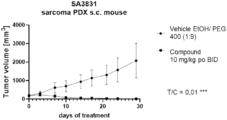
- FIG. 1 is a diagrammatic representation of FIG. 1 :
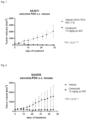
- FIG. 2
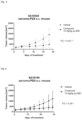
- FIG. 3 is a diagrammatic representation of FIG. 3 :
- FIG. 4
- the present invention includes the method of treatment of sarcoma comprising administering to a patient in need thereof a compound of general formula (I):
- the present invention includes the method of treatment of sarcoma comprising administering to a patient in need thereof a compound of general formula (I), supra, in which:
- the present invention includes the method of treatment of sarcoma comprising administering to a patient in need thereof a compound of general formula (I), supra, in which:
- the present invention includes the method of treatment of sarcoma comprising administering to a patient in need thereof a compound of general formula (I), supra, in which:
- the present invention includes the method of treatment of sarcoma comprising administering to a patient in need thereof a compound of general formula (I), supra, in which:
- the present invention includes the method of treatment of sarcoma comprising administering to a patient in need thereof a compound of general formula (I), supra, in which:
- the present invention includes the method of treatment of sarcoma comprising administering to a patient in need thereof a compound of general formula (I), supra, in which:
- the present invention includes the method of treatment of sarcoma comprising administering to a patient in need thereof a compound of general formula (I), supra, in which:
- the present invention includes the method of treatment of sarcoma comprising administering to a patient in need thereof a compound of general formula (I), supra, in which:
- the present invention includes the method of treatment of sarcoma comprising administering to a patient in need thereof a compound of general formula (I), supra, in which:
- the present invention includes the method of treatment of sarcoma comprising administering to a patient in need thereof a compound of general formula (I), supra, in which:
- the present invention includes the method of treatment of sarcoma comprising administering to a patient in need thereof a compound of general formula (I), supra, in which:
- the present invention includes the method of treatment of sarcoma comprising administering to a patient in need thereof a compound of general formula (I), supra, in which:
- the present invention includes the method of treatment of sarcoma comprising administering to a patient in need thereof a compound of general formula (I), supra, in which:
- the present invention includes the method of treatment of sarcoma comprising administering to a patient in need thereof a compound of general formula (I), supra, in which:
- the present invention includes the method of treatment of sarcoma comprising administering to a patient in need thereof a compound of general formula (I), supra, in which:
- the present invention includes the method of treatment of sarcoma comprising administering to a patient in need thereof a compound of general formula (I), supra, in which:
- the present invention includes the method of treatment of sarcoma comprising administering to a patient in need thereof a compound of general formula (I), supra, in which:
- the present invention includes the method of treatment of sarcoma comprising administering to a patient in need thereof a compound of general formula (I), supra, in which:
- the present invention includes the method of treatment of sarcoma comprising administering to a patient in need thereof a compound of general formula (I), supra, in which:
- the present invention includes the method of treatment of sarcoma comprising administering to a patient in need thereof a compound of general formula (I), supra, in which:
- the present invention includes the method of treatment of sarcoma comprising administering to a patient in need thereof a compound of general formula (I), supra, in which:
- the present invention includes the method of treatment of sarcoma comprising administering to a patient in need thereof a compound of general formula (I), supra, which is selected from the group:
- the present invention provides the method of treatment of sarcoma comprising administering to a patient in need thereof the compound of general formula (I), supra, wherein the compound is selected from the group:
- the present invention provides the method of treatment of sarcoma comprising administering to a patient in need thereof the compound of general formula (I) wherein the compound is selected from the group
- the present invention provides the method of treatment of sarcoma comprising administering to a patient in need thereof the compound of general formula (I) wherein the compound is selected from the group
- the present invention provides the method of treatment of sarcoma comprising administering to a patient in need thereof the compound of general formula (I) wherein the compound is selected from the group
- the present invention provides the method of treatment of sarcoma comprising administering to a patient in need thereof the compound of general formula (I) wherein the compound is selected from the group
- the present invention provides the method of treatment of sarcoma comprising administering to a patient in need thereof the compound of general formula (I) wherein the compound is selected from the group
- the present invention provides the method of treatment of sarcoma comprising administering to a patient in need thereof the compound of general formula (I) wherein the compound is
- the present invention provides the method of treatment of sarcoma comprising administering to a patient in need thereof the compound of general formula (I) wherein the compound is
- the present invention provides the method of treatment of sarcoma comprising administering to a patient in need thereof the compound of general formula (I) wherein the compound is
- the present invention provides the method of treatment of sarcoma comprising administering to a patient in need thereof the compound of general formula (I) wherein the compound is
- the present invention provides the method of treatment of sarcoma comprising administering to a patient in need thereof the compound of general formula (I) wherein the compound is
- the present invention provides the method of treatment of sarcoma comprising administering to a patient in need thereof the compound of general formula (I) wherein the compound is
- the present invention provides the method of treatment of sarcoma comprising administering to a patient in need thereof the compound of general formula (I) wherein the compound is
- the present invention provides the method of treatment of sarcoma comprising administering to a patient in need thereof the compound of general formula (I) wherein the compound is
- the present invention provides the method of treatment of sarcoma comprising administering to a patient in need thereof the compound of general formula (I) wherein the compound is
- the present invention provides the method of treatment of sarcoma comprising administering to a patient in need thereof the compound of general formula (I) wherein the compound is
- the present invention provides the method of treatment of sarcoma comprising administering to a patient in need thereof the compound of general formula (I) wherein the compound is
- the present invention provides the method of treatment of sarcoma comprising administering to a patient in need thereof the compound of general formula (I) wherein the compound is
- the present invention provides the method of treatment of sarcoma comprising administering to a patient in need thereof the compound of general formula (I) wherein the compound is
- the invention provides for the compounds of formula (I) or any subgroup disclosed herein for the manufacture of a medicament for the treatment of sarcoma.
- the present invention includes combinations of two or more of the above mentioned embodiments under the heading “further embodiments of the first aspect of the present invention” for use in the treatment of sarcoma.
- the compounds of general formula (I) for use for the treatment of sarcoma can be prepared according to the disclosure of WO2019/025562, which is incorporated herein by reference in its entirety and particularly in reference to the syntheses described for Examples 1-330 therein.
- Compounds of the present invention can be utilized to treat sarcomas.
- This method comprises administering to a mammal in need thereof, including a human, an amount of a compound of formula (I), or a pharmaceutically acceptable salt, isomer, polymorph, metabolite, hydrate, solvate or ester thereof; which is effective to treat sarcoma.
- the present invention also provides methods of treating sarcoma comprising administering an effective amount of a compound of formula (I) to a patient in need thereof.
- the present invention further comprises a method of treatment of sarcoma comprising the steps of
- the method of analysis can be conducted as described in the art, e.g. J. Biol. Chem. (2020) 295 (11), 3431-3446.
- Cancers of the sarcoma type have been characterized in humans, but also exist in other mammals, and can be treated by administering pharmaceutical compositions of the compounds of formula (I).
- Sarcomas occur on various locations of the body starting from mesenchymal cells which are forming bones and starting in bone, bone marrow or cartilage or connective tissues such as e.g. blood vessels, cartilage, deep skin, fat, fibrous tissues, joints, ligaments, lymph vessels, muscles, nerves and tendons.
- sarcoma For cancers of the sarcoma type there may exist more than 70 subtypes of sarcoma including angiosarcoma, chondrosarcoma, dermatofibrosarcoma protuberans, desmoplastic small round cell tumors, epithelioid sarcoma, Ewing sarcoma, fibrous histiocytoma, gastrointestinal stromal tumor, Kaposi's sarcoma, leiomyosarcoma, liposarcoma, malignant peripheral nerve sheath tumors, myxofibrosarcoma, osteosarcoma, rhabdomyosarcoma, soft tissue sarcoma, solitary fibrous tumor, synovial sarcoma and undifferentiated pleomorphic sarcoma, malignant fibrous histiocytoma, lymphosarcoma, osteosarcoma, rhabdomyosarcoma, soft tissue sarcoma, and syn
- treating or “treatment” as used in the present text is used conventionally, e.g., the management or care of a subject for the purpose of combating, alleviating, reducing, relieving, improving the condition of sarcoma and if most successful let disappear the sarcoma completely. If treatment or prophylaxis is mentioned, treatment is preferred.
- the present invention provides for compounds of general formula (I), as described supra, or stereoisomers, tautomers, N-oxides, hydrates, solvates, and salts thereof, particularly pharmaceutically acceptable salts thereof, or mixtures of same, for use in the treatment or prophylaxis of sarcoma, especially in the treatment of sarcoma and more specifically in the treatment of sarcoma of the osteosarcoma, synovial sarcoma, soft tissue sarcoma, sarcoma (represented by the cell line SA10199, representing a recurrent malignant solitary fibrous tumor, see experimental section) malignant fibrous histiocytoma.
- compounds of general formula (I) as described supra, or stereoisomers, tautomers, N-oxides, hydrates, solvates, and salts thereof, particularly pharmaceutically acceptable salts thereof, or mixtures of same.
- the present invention provides for compounds of general formula (I), as described supra, or stereoisomers, tautomers, N-oxides, hydrates, solvates, and salts thereof, particularly pharmaceutically acceptable salts thereof, or mixtures of same, for use in the treatment of sarcoma, including osteosarcoma, synovial sarcoma, soft tissue sarcoma, sarcoma (represented by the cell line SA10199, representing a recurrent malignant solitary fibrous tumor, see experimental section) or fibrous histiocytoma.
- sarcoma including osteosarcoma, synovial sarcoma, soft tissue sarcoma, sarcoma (represented by the cell line SA10199, representing a recurrent malignant solitary fibrous tumor, see experimental section) or fibrous histiocytoma.
- the present invention includes the use of compounds of general formula (I), as described supra, or stereoisomers, tautomers, N-oxides, hydrates, solvates, and salts thereof, particularly pharmaceutically acceptable salts thereof, or mixtures of same, for the treatment or prophylaxis of sarcoma, especially in the treatment of sarcoma and more specifically in the treatment of osteosarcoma, synovial sarcoma, soft tissue sarcoma, sarcoma (represented by the cell line SA10199, representing a recurrent malignant solitary fibrous tumor, see experimental section) malignant fibrous histiocytoma.
- compounds of general formula (I) as described supra, or stereoisomers, tautomers, N-oxides, hydrates, solvates, and salts thereof, particularly pharmaceutically acceptable salts thereof, or mixtures of same.
- the present invention includes the use of compounds of general formula (I), as described supra, or stereoisomers, tautomers, N-oxides, hydrates, solvates, and salts thereof, particularly pharmaceutically acceptable salts thereof, or mixtures of same, in a method of treatment or prophylaxis of sarcoma, especially in the treatment of osteosarcoma, synovial sarcoma, soft tissue sarcoma, sarcoma (represented by the cell line SA10199, representing a recurrent malignant solitary fibrous tumor, see experimental section) malignant fibrous histiocytoma.
- compounds of general formula (I) as described supra, or stereoisomers, tautomers, N-oxides, hydrates, solvates, and salts thereof, particularly pharmaceutically acceptable salts thereof, or mixtures of same.
- the present invention includes the use of a compound of general formula (I), as described supra, or stereoisomers, tautomers, N-oxides, hydrates, solvates, and salts thereof, particularly pharmaceutically acceptable salts thereof, or mixtures of same, for the preparation of a pharmaceutical composition, preferably a medicament, for the prophylaxis or treatment of sarcoma, especially for the treatment of osteosarcoma, synovial sarcoma, soft tissue sarcoma, sarcoma (represented by the cell line SA10199, representing a recurrent malignant solitary fibrous tumor, see experimental section) malignant fibrous histiocytoma.
- a pharmaceutical composition preferably a medicament, for the prophylaxis or treatment of sarcoma, especially for the treatment of osteosarcoma, synovial sarcoma, soft tissue sarcoma, sarcoma (represented by the cell line SA10199, representing a recurrent malignant solitary fibrous tumor
- the present invention includes a method of treatment or prophylaxis of sarcoma, especially a method of treatment of sarcoma and more specifically a method of treatment of osteosarcoma, synovial sarcoma, soft tissue sarcoma, sarcoma (represented by the cell line SA10199, representing recurrent malignant solitary fibrous tumor, see experimental section) malignant fibrous histiocytoma using an effective amount of a compound of general formula (I), as described supra, or stereoisomers, tautomers, N-oxides, hydrates, solvates, and salts thereof, particularly pharmaceutically acceptable salts thereof, or mixtures of same.
- a compound of general formula (I) as described supra, or stereoisomers, tautomers, N-oxides, hydrates, solvates, and salts thereof, particularly pharmaceutically acceptable salts thereof, or mixtures of same.
- the present invention includes pharmaceutical compositions, in particular a medicament, comprising a compound of general formula (I), as described supra, or a stereoisomer, a tautomer, a hydrate, a solvate, a salt thereof, particularly a pharmaceutically acceptable salt, or a mixture of same, and one or more excipients), in particular one or more pharmaceutically acceptable excipient(s) for use in the treatment of sarcoma, especially in the treatment of sarcoma and more specifically in the treatment of osteosarcoma, synovial sarcoma, soft tissue sarcoma, sarcoma (represented by the cell line SA10199, representing a recurrent malignant solitary fibrous tumor, see experimental section) malignant fibrous histiocytoma.
- Conventional procedures for preparing such pharmaceutical compositions in appropriate dosage forms can be utilized.
- the present invention furthermore includes pharmaceutical compositions, in particular medicaments, which comprise at least one compound of formula (I), conventionally together with one or more pharmaceutically suitable excipients, for their use for the treatment of sarcoma, especially in the treatment of sarcoma and more specifically in the treatment of osteosarcoma, synovial sarcoma, soft tissue sarcoma, sarcoma (represented by the cell line SA10199, representing a recurrent malignant solitary fibrous tumor, see experimental section) malignant fibrous histiocytoma.
- the present invention includes the use of compounds of general formula (I), as described supra, or stereoisomers, tautomers, N-oxides, hydrates, solvates, and salts thereof, particularly pharmaceutically acceptable salts thereof, or mixtures of same, in a method of treatment or prophylaxis of sarcoma, especially in the treatment of sarcoma and more specifically in the treatment of sarcoma of the soft tissue, osteosarcoma, malignant fibrous histiocytoma, sarcoma represented by SA10199 or synovial sarcoma.
- compounds of general formula (I) as described supra, or stereoisomers, tautomers, N-oxides, hydrates, solvates, and salts thereof, particularly pharmaceutically acceptable salts thereof, or mixtures of same.
- the present invention includes the use of compounds of general formula (I), as described supra, or stereoisomers, tautomers, N-oxides, hydrates, solvates, and salts thereof, particularly pharmaceutically acceptable salts thereof, or mixtures of same, in a method of treatment or prophylaxis of sarcoma, especially in the treatment of sarcoma and more specifically in the treatment of sarcoma of the soft tissue, osteosarcoma, sarcoma represented by SA10199 or synovial sarcoma.
- the present invention includes the use of compounds of general formula (I), as described supra, or stereoisomers, tautomers, N-oxides, hydrates, solvates, and salts thereof, particularly pharmaceutically acceptable salts thereof, or mixtures of same, in a method of treatment or prophylaxis of sarcoma, especially in the treatment of sarcoma and more specifically in the treatment of sarcoma of the soft tissue, malignant fibrous histiocytoma, sarcoma represented by SA10199 or synovial sarcoma.
- the present invention includes the use of compounds of general formula (I), as described supra, or stereoisomers, tautomers, N-oxides, hydrates, solvates, and salts thereof, particularly pharmaceutically acceptable salts thereof, or mixtures of same, in a method of treatment or prophylaxis of sarcoma, especially in the treatment of sarcoma and more specifically in the treatment of osteosarcoma.
- one embodiment of the first aspect of the invention is a method of treating osteosarcoma, synovial sarcoma, soft tissue sarcoma, sarcoma (represented by the model S10199) or fibrous histiocytoma comprising administering (6S)-5-[4′-fluoro-2-(trifluoromethyl)biphenyl-4-yl]-6-methyl-3,6-dihydro-2H-1,3,4-oxadiazin-2-one to a patient in need thereof.
- the compounds for use in the treatment of sarcoma can have systemic and/or local activity.
- they can be administered in a suitable manner, such as, for example, via the oral, parenteral, pulmonary, nasal, sublingual, lingual, buccal, rectal, vaginal, dermal, transdermal, conjunctival, otic route or as an implant or stent.
- the compounds of formula (I) for oral administration, it is possible to formulate the compounds of formula (I) to dosage forms known in the art that deliver the compounds of the invention rapidly and/or in a modified manner, such as, for example, tablets (uncoated or coated tablets, for example with enteric or controlled release coatings that dissolve with a delay or are insoluble), orally-disintegrating tablets, films/wafers, films/lyophylisates, capsules (for example hard or soft gelatine capsules), sugar-coated tablets, granules, pellets, powders, emulsions, suspensions, aerosols or solutions. It is possible to incorporate the compounds of formula (I) in crystalline and/or amorphised and/or dissolved form into said dosage forms.
- Parenteral administration can be effected with avoidance of an absorption step (for example intravenous, intraarterial, intracardial, intraspinal or intralumbal) or with inclusion of absorption (for example intramuscular, subcutaneous, intracutaneous, percutaneous or intraperitoneal).
- absorption step for example intravenous, intraarterial, intracardial, intraspinal or intralumbal
- absorption for example intramuscular, subcutaneous, intracutaneous, percutaneous or intraperitoneal.
- Administration forms which are suitable for parenteral administration are, inter alia, preparations for injection and infusion in the form of solutions, suspensions, emulsions, lyophylisates or sterile powders.
- Examples which are suitable for other administration routes are pharmaceutical forms for inhalation [inter alia powder inhalers, nebulizers], nasal drops, nasal solutions, nasal sprays; tablets/films/wafers/capsules for lingual, sublingual or buccal administration; suppositories; eye drops, eye ointments, eye baths, ocular inserts, ear drops, ear sprays, ear powders, ear-rinses, ear tampons; vaginal capsules, aqueous suspensions (lotions, mixturae agitandae), lipophilic suspensions, emulsions, ointments, creams, transdermal therapeutic systems (such as, for example, patches), milk, pastes, foams, dusting powders, implants or stents.
- inhalation inter alia powder inhalers, nebulizers
- nasal drops nasal solutions, nasal sprays
- tablets/films/wafers/capsules for lingual, sublingual or buccal
- the compounds of formula (I) can be incorporated into the stated administration forms. This can be effected in a manner known per se by mixing with pharmaceutically suitable excipients.
- compositions include, inter alia,
- the present invention furthermore relates to the use of a pharmaceutical composition which comprise at least one compound according to the invention, conventionally together with one or more pharmaceutically suitable excipient(s), for the treatment of sarcoma.
- the present invention includes pharmaceutical combinations, in particular medicaments, comprising at least one compound of general formula (I) and at least one or more further active ingredients, in particular for the treatment and/or prophylaxis of sarcoma.
- the present invention includes a pharmaceutical combination, which comprises:
- Bevazizumab Paliperidone or Trabectidin as additional sarcoma agent may be used.
- anti-cancer drugs may be combined, such as: 131I-chTNT, abarelix, abemaciclib, abiraterone, acalabrutinib, aclarubicin, adalimumab, ado-trastuzumab emtansine, afatinib, aflibercept, aldesleukin, alectinib, alemtuzumab, alendronic acid, alitretinoin, alpharadin, altretamine, amifostine, aminoglutethimide, hexyl aminolevulinate, amrubicin, amsacrine, anastrozole, ancestim, anethole dithiolethione, anetumab ravtansine, angiotensin II, antithrombin III, apalutamide, aprepitant, arcitumomab, arglabin, arsenic trioxide, as
- a “fixed combination” is used as known to persons skilled in the art and is defined as a combination wherein, for example, a first active ingredient, such as one or more compounds of general formula (I) of the present invention, and a further active ingredient are present together in one unit dosage or in one single entity.
- a “fixed combination” is a pharmaceutical composition wherein a first active ingredient and a further active ingredient are present in admixture for simultaneous administration, such as in a formulation.
- Another example of a “fixed combination” is a pharmaceutical combination wherein a first active ingredient and a further active ingredient are present in one unit without being in admixture.
- a non-fixed combination or “kit-of-parts” is used as known to persons skilled in the art and is defined as a combination wherein a first active ingredient and a further active ingredient are present in more than one unit.
- a non-fixed combination or kit-of-parts is a combination wherein the first active ingredient and the further active ingredient are present separately. It is possible for the components of the non-fixed combination or kit-of-parts to be administered separately, sequentially, simultaneously, concurrently or chronologically staggered.
- the compounds of formula (I) can be administered as the sole pharmaceutical agent or in combination with one or more other pharmaceutically active ingredients where the combination causes no unacceptable adverse effects for the treatment of sarcoma.
- the compounds of formula (I) can be combined with known anti-sarcoma agents or other anti-cancer drugs.
- a unit dosage may contain from about 0.5 mg to about 1500 mg of active ingredient, and can be administered one or more times per day or less than once a day.
- the average daily dosage for administration by injection including intravenous, intramuscular, subcutaneous and parenteral injections, and use of infusion techniques will preferably be from 0.01 to 200 mg/kg of total body weight.
- the average daily rectal dosage regimen will preferably be from 0.01 to 200 mg/kg of total body weight.
- the average daily vaginal dosage regimen will preferably be from 0.01 to 200 mg/kg of total body weight.
- the average daily topical dosage regimen will preferably be from 0.1 to 200 mg administered between one to four times daily.
- the transdermal concentration will preferably be that required to maintain a daily dose of from 0.01 to 200 mg/kg.
- the average daily inhalation dosage regimen will preferably be from 0.01 to 100 mg/kg of total body weight.
- the dosing schedule maybe once or two time or three times daily and a dose range as referred to above for general dos
- the specific initial and continuing dosage regimen for each patient will vary according to the nature and severity of the condition as determined by the attending diagnostician, the activity of the specific compound employed, the age and general condition of the patient, time of administration, route of administration, rate of excretion of the drug, drug combinations, and the like.
- the desired mode of treatment and number of doses of a compound formula (I) or a pharmaceutically acceptable salt or ester or composition thereof can be ascertained by those skilled in the art using conventional treatment tests.
- Examples were synthesized one or more times. When synthesized more than once, data from biological assays represent average values or median values calculated utilizing data sets obtained from testing of one or more synthetic batch.
- cells on one plate (0 h plate) were treated with 30 ⁇ l/cavity of CTG solution (Promega Cell Titer Glo (catalogue #G755B and G756B)) and incubated at room temperature for 10 min, and luminescence was measured by means of a VICTOR V (Perkin Elmer), in order to determine cell viability on commencement of treatment.
- the cells on the test plate were treated with a set of compounds of the general formula (I) as indicated below and incubated at 37° C. for 72 h.
- the compounds were added to the cells by means of an HP D300 digital dispenser in a 10-step 2.5-fold dilution series generally starting at a maximum final drug concentration of 100 nM.
- the cells were treated with vehicle (DMSO at 0.3% final concentration). After 72 h, the cells were treated with 30 ⁇ l/cavity of CTG solution (Promega Cell Titer Glo (catalogue #G755B and G756B)) and incubated at room temperature for 10 min, and luminescence was measured by means of a VICTOR V (Perkin Elmer), in order to determine cell viability at the end of treatment.
- CTG solution Promega Cell Titer Glo (catalogue #G755B and G756B)
- VICTOR V Perkin Elmer
- mice were implanted subcutaneously with tumor pieces.
- the oral application volume was 10 ml/kg.
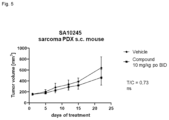
- T/C ratio at study end (Treatment/Control; mean tumor weight of treatment group/mean tumor weight of control group) in Table 2.
- a compound having a T/C below 0.5 is defined as active (i.e., effective).
- Statistical analysis was assessed using SigmaStat software. A one-way analysis of variance was performed and differences to the control were compared by a pair-wise comparison procedure (Dunn's method).
- Models SA16044 and SA10199 also responded to treatment with (6S)-5-[4′-fluoro-2-(trifluoromethyl)biphenyl-4-yl]-6-methyl-3,6-dihydro-2H-1,3,4-oxadiazin-2-one showing a moderate tumor-growth inhibition reflected by a T/C ratio of 0.33 and 0.34, at the treatment end, respectively ( FIGS. 3 & 4 ).
- the model SA10245 was the least sensitive model with a T/C ratio of only 0.73 ( FIG. 5 )
- one embodiment of the first aspect of the invention is a method of treating sarcoma, more specifically osteosarcoma, synovial sarcoma, soft tissue sarcoma, sarcoma, represented by the cell line SA10199, or fibrous histiocytoma comprising administering (6S)-5-[4′-fluoro-2-(trifluoromethyl)biphenyl-4-yl]-6-methyl-3,6-dihydro-2H-1,3,4-oxadiazin-2-one to a patient in need thereof.
Landscapes
- Health & Medical Sciences (AREA)
- Chemical & Material Sciences (AREA)
- Medicinal Chemistry (AREA)
- Pharmacology & Pharmacy (AREA)
- Life Sciences & Earth Sciences (AREA)
- Animal Behavior & Ethology (AREA)
- General Health & Medical Sciences (AREA)
- Public Health (AREA)
- Veterinary Medicine (AREA)
- Organic Chemistry (AREA)
- Epidemiology (AREA)
- Chemical Kinetics & Catalysis (AREA)
- General Chemical & Material Sciences (AREA)
- Nuclear Medicine, Radiotherapy & Molecular Imaging (AREA)
- Pharmaceuticals Containing Other Organic And Inorganic Compounds (AREA)
- Acyclic And Carbocyclic Compounds In Medicinal Compositions (AREA)
- Pyridine Compounds (AREA)
- Plural Heterocyclic Compounds (AREA)
- Medicines That Contain Protein Lipid Enzymes And Other Medicines (AREA)
Priority Applications (1)
| Application Number | Priority Date | Filing Date | Title |
|---|---|---|---|
| US18/241,186 US20230405015A1 (en) | 2021-03-03 | 2023-08-31 | Substituted 3,6-dihydro-2h-1,3,4-oxadiazin-2-ones for the treatment of sarcoma |
Applications Claiming Priority (3)
| Application Number | Priority Date | Filing Date | Title |
|---|---|---|---|
| US202163156193P | 2021-03-03 | 2021-03-03 | |
| PCT/EP2022/055211 WO2022184748A1 (en) | 2021-03-03 | 2022-03-02 | Substituted 3,6-dihydro-2h-1,3,4-oxadiazin-2-ones for the treatment of sarcoma |
| US18/241,186 US20230405015A1 (en) | 2021-03-03 | 2023-08-31 | Substituted 3,6-dihydro-2h-1,3,4-oxadiazin-2-ones for the treatment of sarcoma |
Related Parent Applications (1)
| Application Number | Title | Priority Date | Filing Date |
|---|---|---|---|
| PCT/EP2022/055211 Continuation WO2022184748A1 (en) | 2021-03-03 | 2022-03-02 | Substituted 3,6-dihydro-2h-1,3,4-oxadiazin-2-ones for the treatment of sarcoma |
Publications (1)
| Publication Number | Publication Date |
|---|---|
| US20230405015A1 true US20230405015A1 (en) | 2023-12-21 |
Family
ID=80780814
Family Applications (1)
| Application Number | Title | Priority Date | Filing Date |
|---|---|---|---|
| US18/241,186 Pending US20230405015A1 (en) | 2021-03-03 | 2023-08-31 | Substituted 3,6-dihydro-2h-1,3,4-oxadiazin-2-ones for the treatment of sarcoma |
Country Status (7)
| Country | Link |
|---|---|
| US (1) | US20230405015A1 (enExample) |
| EP (1) | EP4301371A1 (enExample) |
| JP (1) | JP2024508171A (enExample) |
| CN (1) | CN117279644A (enExample) |
| CA (1) | CA3212314A1 (enExample) |
| TW (1) | TW202302113A (enExample) |
| WO (1) | WO2022184748A1 (enExample) |
Families Citing this family (2)
| Publication number | Priority date | Publication date | Assignee | Title |
|---|---|---|---|---|
| CN120187704A (zh) * | 2022-11-24 | 2025-06-20 | 盛睿泽华医药科技(苏州)有限公司 | 吡啶酮化合物及其制备方法和用途 |
| CN118420559B (zh) * | 2023-04-27 | 2025-02-14 | 上海超阳药业有限公司 | 氘代噁二嗪酮化合物及其用途 |
Citations (1)
| Publication number | Priority date | Publication date | Assignee | Title |
|---|---|---|---|---|
| US12258323B2 (en) * | 2017-08-04 | 2025-03-25 | Bayer Aktiengesellschaft | Dihydrooxadiazinones |
Family Cites Families (6)
| Publication number | Priority date | Publication date | Assignee | Title |
|---|---|---|---|---|
| US6150361A (en) * | 1998-12-22 | 2000-11-21 | Bayer Corporation | Triazineone compounds for treating diseases due to sarcosystis, neospora and toxoplasma |
| JP6445573B2 (ja) * | 2013-10-17 | 2018-12-26 | サルタル セラピューティクス エルティーディSartar Therapeutics Ltd | ヒト患者の固形腫瘍の治療に用いるためのホスホジエステラーゼ阻害剤含有組成物 |
| CN106573931A (zh) * | 2014-06-18 | 2017-04-19 | 拜耳医药股份有限公司 | 抑制BET蛋白的具有间位取代的芳族氨基或醚基的3,4‑二氢吡啶并[2,3‑b]吡嗪酮 |
| WO2017027854A1 (en) * | 2015-08-13 | 2017-02-16 | The Broad Institute, Inc. | Compositions and methods for cancer expressing pde3a or slfn12 |
| TW201733591A (zh) * | 2016-02-05 | 2017-10-01 | 拜耳製藥公司 | 用於癌症病人分級及癌症治療之化合物、組合物及方法 |
| US11142522B2 (en) * | 2017-02-03 | 2021-10-12 | The Broad Institute, Inc. | Compounds, compositions and methods for cancer treatment |
-
2022
- 2022-03-02 CN CN202280018587.1A patent/CN117279644A/zh active Pending
- 2022-03-02 EP EP22710550.9A patent/EP4301371A1/en active Pending
- 2022-03-02 WO PCT/EP2022/055211 patent/WO2022184748A1/en not_active Ceased
- 2022-03-02 JP JP2023553692A patent/JP2024508171A/ja active Pending
- 2022-03-02 CA CA3212314A patent/CA3212314A1/en active Pending
- 2022-03-03 TW TW111107759A patent/TW202302113A/zh unknown
-
2023
- 2023-08-31 US US18/241,186 patent/US20230405015A1/en active Pending
Patent Citations (1)
| Publication number | Priority date | Publication date | Assignee | Title |
|---|---|---|---|---|
| US12258323B2 (en) * | 2017-08-04 | 2025-03-25 | Bayer Aktiengesellschaft | Dihydrooxadiazinones |
Non-Patent Citations (2)
| Title |
|---|
| NAZIR. Experimental Cell Research, 2017, 361, 308-315) (Year: 2017) * |
| PULKKA. Clinical Cancer Research, 2019, 25(5), 1676-1687 (Year: 2019) * |
Also Published As
| Publication number | Publication date |
|---|---|
| EP4301371A1 (en) | 2024-01-10 |
| JP2024508171A (ja) | 2024-02-22 |
| TW202302113A (zh) | 2023-01-16 |
| WO2022184748A1 (en) | 2022-09-09 |
| CN117279644A (zh) | 2023-12-22 |
| CA3212314A1 (en) | 2022-09-09 |
Similar Documents
| Publication | Publication Date | Title |
|---|---|---|
| US20230346927A1 (en) | COMBINATION of ATR KINASE INHIBITORS and PD-1/PD-L1 INHIBITORS | |
| US20230064809A1 (en) | Substituted aminoquinolones as dgkalpha inhibitors for immune activation | |
| US12258323B2 (en) | Dihydrooxadiazinones | |
| US20230357239A1 (en) | Pyrido[2,3-d]pyrimidin-4-amines as sos1 inhibitors | |
| WO2024079252A1 (en) | Sos1 inhibitors | |
| US10179123B2 (en) | 2-aryl- and 2-arylalkyl-benzimidazoles as mIDH1 inhibitors | |
| EP3268490B1 (en) | Substituted 2,3-dihydroimidazo[1,2-c]quinazoline-containing combinations | |
| US11660301B2 (en) | Combination of ATR kinase inhibitors with PARP inhibitors | |
| EP3121166A1 (en) | Fused imidazoles as midh1 inhibitors | |
| US20200123147A1 (en) | Thiazole compounds useful as prmt5 inhibitors | |
| WO2018206547A1 (en) | Combination of bub1 and atr inhibitors | |
| WO2018153971A1 (en) | Combination of atr kinase inhibitors | |
| WO2022184748A1 (en) | Substituted 3,6-dihydro-2h-1,3,4-oxadiazin-2-ones for the treatment of sarcoma | |
| WO2019197269A1 (en) | Combinations of copanlisib with triazolone derivatives and their use in the treatment of cancer | |
| US20210369724A1 (en) | Combination of atr kinase inhibitors with 2,3-dihydroimidazo[1,2-c]quinazoline compounds | |
| WO2024165470A1 (en) | Combinations of dgk (diacylglycerol kinase) inhibitors | |
| US20170217946A1 (en) | Amino-substituted isoxazoles | |
| WO2018215282A1 (en) | Combination of bub1 and pi3k inhibitors | |
| HK40105245A (en) | Substituted 3,6-dihydro-2h-1,3,4-oxadiazin-2-ones for the treatment of sarcoma | |
| US20200114001A1 (en) | Combinations of copanlisib with anti-pd-1 antibody | |
| WO2021260443A1 (en) | Combinations of 2,3-dihydroimidazo[1,2-c]quinazolines | |
| CA3270230A1 (en) | Crystalline forms of her2/mutegfr inhibitors and process for their preparation | |
| WO2016202759A1 (en) | Cytotoxic substituted 2-(1 h-pyrazol-1 -yl)-1,3-benzothiazole compounds for the treatment of cancer |
Legal Events
| Date | Code | Title | Description |
|---|---|---|---|
| STPP | Information on status: patent application and granting procedure in general |
Free format text: DOCKETED NEW CASE - READY FOR EXAMINATION |
|
| STPP | Information on status: patent application and granting procedure in general |
Free format text: NON FINAL ACTION COUNTED, NOT YET MAILED |
|
| STPP | Information on status: patent application and granting procedure in general |
Free format text: NON FINAL ACTION MAILED |