US20220401009A1 - System, method, and head mounted display for consussion assessment - Google Patents
System, method, and head mounted display for consussion assessment Download PDFInfo
- Publication number
- US20220401009A1 US20220401009A1 US17/353,793 US202117353793A US2022401009A1 US 20220401009 A1 US20220401009 A1 US 20220401009A1 US 202117353793 A US202117353793 A US 202117353793A US 2022401009 A1 US2022401009 A1 US 2022401009A1
- Authority
- US
- United States
- Prior art keywords
- head mounted
- mounted display
- user
- physiological data
- network connection
- Prior art date
- Legal status (The legal status is an assumption and is not a legal conclusion. Google has not performed a legal analysis and makes no representation as to the accuracy of the status listed.)
- Abandoned
Links
Images



Classifications
-
- G—PHYSICS
- G09—EDUCATION; CRYPTOGRAPHY; DISPLAY; ADVERTISING; SEALS
- G09G—ARRANGEMENTS OR CIRCUITS FOR CONTROL OF INDICATING DEVICES USING STATIC MEANS TO PRESENT VARIABLE INFORMATION
- G09G3/00—Control arrangements or circuits, of interest only in connection with visual indicators other than cathode-ray tubes
- G09G3/001—Control arrangements or circuits, of interest only in connection with visual indicators other than cathode-ray tubes using specific devices not provided for in groups G09G3/02 - G09G3/36, e.g. using an intermediate record carrier such as a film slide; Projection systems; Display of non-alphanumerical information, solely or in combination with alphanumerical information, e.g. digital display on projected diapositive as background
- G09G3/003—Control arrangements or circuits, of interest only in connection with visual indicators other than cathode-ray tubes using specific devices not provided for in groups G09G3/02 - G09G3/36, e.g. using an intermediate record carrier such as a film slide; Projection systems; Display of non-alphanumerical information, solely or in combination with alphanumerical information, e.g. digital display on projected diapositive as background to produce spatial visual effects
-
- A—HUMAN NECESSITIES
- A61—MEDICAL OR VETERINARY SCIENCE; HYGIENE
- A61B—DIAGNOSIS; SURGERY; IDENTIFICATION
- A61B5/00—Measuring for diagnostic purposes; Identification of persons
- A61B5/40—Detecting, measuring or recording for evaluating the nervous system
- A61B5/4058—Detecting, measuring or recording for evaluating the nervous system for evaluating the central nervous system
- A61B5/4064—Evaluating the brain
-
- A—HUMAN NECESSITIES
- A61—MEDICAL OR VETERINARY SCIENCE; HYGIENE
- A61B—DIAGNOSIS; SURGERY; IDENTIFICATION
- A61B5/00—Measuring for diagnostic purposes; Identification of persons
- A61B5/0002—Remote monitoring of patients using telemetry, e.g. transmission of vital signals via a communication network
- A61B5/0004—Remote monitoring of patients using telemetry, e.g. transmission of vital signals via a communication network characterised by the type of physiological signal transmitted
- A61B5/0006—ECG or EEG signals
-
- A—HUMAN NECESSITIES
- A61—MEDICAL OR VETERINARY SCIENCE; HYGIENE
- A61B—DIAGNOSIS; SURGERY; IDENTIFICATION
- A61B5/00—Measuring for diagnostic purposes; Identification of persons
- A61B5/0002—Remote monitoring of patients using telemetry, e.g. transmission of vital signals via a communication network
- A61B5/0015—Remote monitoring of patients using telemetry, e.g. transmission of vital signals via a communication network characterised by features of the telemetry system
- A61B5/0022—Monitoring a patient using a global network, e.g. telephone networks, internet
-
- A—HUMAN NECESSITIES
- A61—MEDICAL OR VETERINARY SCIENCE; HYGIENE
- A61B—DIAGNOSIS; SURGERY; IDENTIFICATION
- A61B5/00—Measuring for diagnostic purposes; Identification of persons
- A61B5/16—Devices for psychotechnics; Testing reaction times ; Devices for evaluating the psychological state
- A61B5/163—Devices for psychotechnics; Testing reaction times ; Devices for evaluating the psychological state by tracking eye movement, gaze, or pupil change
-
- A—HUMAN NECESSITIES
- A61—MEDICAL OR VETERINARY SCIENCE; HYGIENE
- A61B—DIAGNOSIS; SURGERY; IDENTIFICATION
- A61B5/00—Measuring for diagnostic purposes; Identification of persons
- A61B5/24—Detecting, measuring or recording bioelectric or biomagnetic signals of the body or parts thereof
- A61B5/316—Modalities, i.e. specific diagnostic methods
- A61B5/369—Electroencephalography [EEG]
- A61B5/377—Electroencephalography [EEG] using evoked responses
- A61B5/378—Visual stimuli
-
- A—HUMAN NECESSITIES
- A61—MEDICAL OR VETERINARY SCIENCE; HYGIENE
- A61B—DIAGNOSIS; SURGERY; IDENTIFICATION
- A61B5/00—Measuring for diagnostic purposes; Identification of persons
- A61B5/68—Arrangements of detecting, measuring or recording means, e.g. sensors, in relation to patient
- A61B5/6801—Arrangements of detecting, measuring or recording means, e.g. sensors, in relation to patient specially adapted to be attached to or worn on the body surface
- A61B5/6802—Sensor mounted on worn items
- A61B5/6803—Head-worn items, e.g. helmets, masks, headphones or goggles
-
- A—HUMAN NECESSITIES
- A61—MEDICAL OR VETERINARY SCIENCE; HYGIENE
- A61B—DIAGNOSIS; SURGERY; IDENTIFICATION
- A61B5/00—Measuring for diagnostic purposes; Identification of persons
- A61B5/68—Arrangements of detecting, measuring or recording means, e.g. sensors, in relation to patient
- A61B5/6801—Arrangements of detecting, measuring or recording means, e.g. sensors, in relation to patient specially adapted to be attached to or worn on the body surface
- A61B5/6813—Specially adapted to be attached to a specific body part
- A61B5/6814—Head
-
- A—HUMAN NECESSITIES
- A61—MEDICAL OR VETERINARY SCIENCE; HYGIENE
- A61B—DIAGNOSIS; SURGERY; IDENTIFICATION
- A61B5/00—Measuring for diagnostic purposes; Identification of persons
- A61B5/74—Details of notification to user or communication with user or patient; User input means
- A61B5/742—Details of notification to user or communication with user or patient; User input means using visual displays
-
- A—HUMAN NECESSITIES
- A63—SPORTS; GAMES; AMUSEMENTS
- A63F—CARD, BOARD, OR ROULETTE GAMES; INDOOR GAMES USING SMALL MOVING PLAYING BODIES; VIDEO GAMES; GAMES NOT OTHERWISE PROVIDED FOR
- A63F13/00—Video games, i.e. games using an electronically generated display having two or more dimensions
- A63F13/20—Input arrangements for video game devices
- A63F13/21—Input arrangements for video game devices characterised by their sensors, purposes or types
- A63F13/213—Input arrangements for video game devices characterised by their sensors, purposes or types comprising photodetecting means, e.g. cameras, photodiodes or infrared cells
-
- A—HUMAN NECESSITIES
- A63—SPORTS; GAMES; AMUSEMENTS
- A63F—CARD, BOARD, OR ROULETTE GAMES; INDOOR GAMES USING SMALL MOVING PLAYING BODIES; VIDEO GAMES; GAMES NOT OTHERWISE PROVIDED FOR
- A63F13/00—Video games, i.e. games using an electronically generated display having two or more dimensions
- A63F13/25—Output arrangements for video game devices
- A63F13/26—Output arrangements for video game devices having at least one additional display device, e.g. on the game controller or outside a game booth
-
- G—PHYSICS
- G06—COMPUTING OR CALCULATING; COUNTING
- G06F—ELECTRIC DIGITAL DATA PROCESSING
- G06F3/00—Input arrangements for transferring data to be processed into a form capable of being handled by the computer; Output arrangements for transferring data from processing unit to output unit, e.g. interface arrangements
- G06F3/14—Digital output to display device ; Cooperation and interconnection of the display device with other functional units
- G06F3/147—Digital output to display device ; Cooperation and interconnection of the display device with other functional units using display panels
-
- A—HUMAN NECESSITIES
- A63—SPORTS; GAMES; AMUSEMENTS
- A63F—CARD, BOARD, OR ROULETTE GAMES; INDOOR GAMES USING SMALL MOVING PLAYING BODIES; VIDEO GAMES; GAMES NOT OTHERWISE PROVIDED FOR
- A63F2300/00—Features of games using an electronically generated display having two or more dimensions, e.g. on a television screen, showing representations related to the game
- A63F2300/80—Features of games using an electronically generated display having two or more dimensions, e.g. on a television screen, showing representations related to the game specially adapted for executing a specific type of game
- A63F2300/8082—Virtual reality
-
- G—PHYSICS
- G09—EDUCATION; CRYPTOGRAPHY; DISPLAY; ADVERTISING; SEALS
- G09G—ARRANGEMENTS OR CIRCUITS FOR CONTROL OF INDICATING DEVICES USING STATIC MEANS TO PRESENT VARIABLE INFORMATION
- G09G2354/00—Aspects of interface with display user
-
- G—PHYSICS
- G09—EDUCATION; CRYPTOGRAPHY; DISPLAY; ADVERTISING; SEALS
- G09G—ARRANGEMENTS OR CIRCUITS FOR CONTROL OF INDICATING DEVICES USING STATIC MEANS TO PRESENT VARIABLE INFORMATION
- G09G2370/00—Aspects of data communication
- G09G2370/16—Use of wireless transmission of display information
-
- G—PHYSICS
- G09—EDUCATION; CRYPTOGRAPHY; DISPLAY; ADVERTISING; SEALS
- G09G—ARRANGEMENTS OR CIRCUITS FOR CONTROL OF INDICATING DEVICES USING STATIC MEANS TO PRESENT VARIABLE INFORMATION
- G09G2380/00—Specific applications
- G09G2380/08—Biomedical applications
Definitions
- the present disclosure relates to an assessment system, and in particular to a system for concussion assessment.
- the brain trauma are of mild traumatic brain injuries (mTBI) such as concussion, which is frequently-occurring on the people who take strenuous exercise or training such like basketball player, football player, boxer, brawler, soldier, etc.
- mTBI mild traumatic brain injuries
- concussions produce a disturbance of brain function rather than structural injury. Accordingly, persons affected by mTBI often demonstrate no immediate post-trauma abnormalities. Concussive trauma may nevertheless result in mechanical injury to the axonal component that can result in acute to long-term damage and axonal degeneration.
- Conventional models for mTBI are complex and require significant contextual and subject-specific information. These conventional models are difficult to deploy for use in the field, whether for occupational health hazards including trauma-inducing events occurring during sporting events or combat.
- the present disclosure provides a system, which is able to assess concussion.
- the present disclosure further provides a head mounted display, which is able to obtain some personal information for concussion assessment.
- the present disclosure also provides a method for concussion assessment.
- the present disclosure provides a system for concussion assessment, comprises a head mounted display and a remote AI host.
- the head mounted display is disposed for displaying at least one test image to a user and obtaining a plurality of physiological data from the user.
- the remote AI host communicates with the head mounted display through a first network connection, so as to obtain a concussion assessment result according to the plurality of physiological data.
- the system provided by the present disclosure further comprises a portable device.
- the portable device communicates with the head mounted display through a second network connection, as well as the remote AI host communicates with the portable device through the first network connection. Therefore, the portable device is able to transmit the plurality of physiological data to the remote AI host from the head mounted display.
- the first network connection is WIFI, LAN or mobile network
- the second network connection is Bluetooth, ZigBee, infrared, ANT, WIFI, or LAN.
- a head mounted display which is suitable for concussion assessment, comprising a controller, a display module, and a detection module.
- the display module is coupled to the controller, such that the controller makes the display module displaying at least one test image.
- the detection module is disposed for obtaining a plurality of physiological data from a user upon displaying the at test one test image.
- the display module in the head mounted display comprises a display panel and a lens set.
- the display panel is disposed for displaying the at least one test image.
- the lens set is disposed for projecting the at least one test image to the user's eyes.
- the head mounted display provided by the present disclosure further comprises a case and a portable device.
- the portable device has a screen for displaying the at least one test image, and the portable device is suit for installing on the case.
- the display module has a lens set for projecting the at least one test image to the user's eyes.
- the detection module comprises an eyes tracking detector and a brain waves detector.
- the eyes tracking detector detects the movement of the user's eyes and outputs a first detection data to the controller.
- the brain waves detector detects the user's brain waves and outputs a second detection data to the controller. Wherein the first detection data and the second detection data are involved in the physiological data.
- system provided by the present disclosure further comprises a communication module, which is coupled to the controller, so as to transmit the plurality of physiological data on a network connection.
- the present disclosure provides a method for concussion assessment comprising at least of the following steps. Displaying at least one test image on a head mounted display. Obtaining a plurality of physiological data from a user through the head mounted display upon displaying the at least one test image. Transmitting the plurality of physiological data to a remote AI host. Performing an algorithm on the remote AI host to fuse the plurality of physiological data for obtaining a concussion assessment result according to the plurality of physiological data.
- the method provided by the present disclosure comprises the step of sending the concussion assessment result to a portable device.
- the step of displaying the least one test image is displaying at least one 3D VR game animation or 3D VR interact sense game animation.
- the present disclosure is portable, such that it can be used in many situations.
- the head mounted display is able to communicates with the remote AI host, as well as the remote AI host is able to communicates with a portable, such like mobile phone, such that the care-giver can obtain the concussion immediately by the mobile phone.
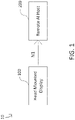
- FIG. 1 is a schematic diagram of the system for concussion assessment according to a first embodiment of the present disclosure.
- FIG. 2 is a schematic diagram of the HMD.
- FIG. 3 is a block diagram of the HMD according to an embodiment of the present disclosure.
- FIG. 4 is a schematic diagram of the system for concussion assessment according to a second embodiment of the present disclosure.
- FIG. 5 is a flow chart of a method for concussion assessment according to an embodiment of the present disclosure.
- FIG. 6 shows VR game animations for brain waves detection according to an embodiment of the present disclosure.
- FIG. 7 shows VR game animations for eyes tracking detection according to an embodiment of the present disclosure.
- FIG. 8 shows the images and features of brain waves according to an embodiment of the present disclosure.
- FIG. 9 shows the images and features of the movement of user's eyes according to an embodiment of the present disclosure.
- a “couples to” B may mean A directly or in-directly connecting to B, such like A connects to B by active or passive component. Furthermore, the meaning of “couple” may involve the analog electric signal or digital data exchanging through wire or wireless connection.
- FIG. 1 is a schematic diagram of the system for concussion assessment according to a first embodiment of the present disclosure.
- the system 10 for concussion assessment comprises a head mounted display 100 (refer to “HMD 100 ” hereinafter) and a remote AI host.
- the remote AI host communicates with the HMD 10 by a first network connection N 1 .
- the HMD 10 is able to display at least one test image and obtain a plurality of physiological data from a user when the user is watching the test image.
- the HMD 10 may be implemented by a virtual reality (VR) HMD. Through the immersive experience by VR HMD, the HMD 10 may obtain correct physiological data.
- the test image may be a VR game animation.
- FIG. 1 is a schematic diagram of the system for concussion assessment according to a first embodiment of the present disclosure
- FIG. 3 is the block diagram of the HMD according to an embodiment of the present disclosure.
- HMD 10 has a controller 102 , a display module 110 and a detector module 120 .
- Controller 102 may be coupled to the display module 110 , so as to make display module 110 displaying the test image.
- the display module 110 may comprises a display panel 112 and a lens set 114 .
- the panel 112 which is able to display the test image, may be implemented by LCD, OLED, or micro-LED panel.
- the lens set 114 may be disposed between the human's eyes 22 and display panel 112 . Accordingly, the lens set 114 could project the test image to the user's eyes 22 .
- the display panel 112 may be replaced by a portable device (not shown), such like mobile phone.
- the portable device has a screen, which is in charge of displaying the test image.
- the portable device may be installed on the case 24 of the HMD 10 , and the screen of the portable device may be toward to the lens set 114 . Such that, the lens set 114 is able to project the test image shown by the portable device to the user's eyes 22 .
- detector module 120 comprises, for example, a brain waves detector 122 and an eyes tracking detector 124 .
- the controller 102 may enable detector module 120 to obtain a plurality of the physiological data.
- the detector module 12 comprises brain waves detector 122 and eyes tracking detector 124 .
- the brain waves detector 122 may be an electroencephalogram electrode and disposed on back side of the HMD 10 , such that the brain waves detector 122 can contact the user's head when he/she wear the HMD 10 .
- the controller 102 is able to enable the brain waves detector 122 to detect the variation of the user's brain waves when he/she watches the test image, and then, the brain waves detector 122 outputs a first detection data DD 1 to the controller 102 .
- the eyes tracking detector 124 is able to detect the movement of user's eyes and output a second detector data DD 2 .
- both of the first detection data DD 1 and the second detection data DD 2 are involved in aforementioned physiological data.
- the HMD10 further has a communication module 130 .
- detection module 120 obtain the physiological data, which are sent to the controller 102 , and then, the controller 102 transmits the physiological data to the communication module 130 .
- the communication module 130 is able to communicate with the remote AI module host 200 by a first network connection N 1 , and transmit the physiological data to the remote AI host 120 to perform the concussion assessment.
- the first network connection N 1 is a wireless connection, such like WIFI, LAN, mobile network
- the remote AI host 120 When the remote AI host 120 received the physiological data, it would obtain some images and features from the physiological data. Please referring to the FIG. 4 , in accordance with the first detector data DD 1 , the remote AI host 120 is able to obtain the brain waves images, as well as their corresponding features. Furthermore, the remote AI host 120 is able to obtain the eyes tracking images and features by the specific algorithm according to the second detection data DD 2 . When those images and features are obtained, the remote AI host, in some embodiments, would enable a machine learning process to deal with those images and features. Therefore, the remote AI host 120 is able to fuse those images and features for obtaining a concussion assessment result. A care-giver is able to assess whether the user has the tendency of concussion by forementioned assessment result. The images and features will be described in detail in below.
- the controller 102 has an embedded system, MCU (Not Shown) or sub-system, which is able to obtain the forementioned images and features. Then, the controller 102 would transmit the images and features to the communicate module 130 and send those to the remote AI host 200 , so as to fuse those images and feature to obtain the concussion assessment result.
- MCU Not Shown
- sub-system which is able to obtain the forementioned images and features. Then, the controller 102 would transmit the images and features to the communicate module 130 and send those to the remote AI host 200 , so as to fuse those images and feature to obtain the concussion assessment result.
- FIG. 4 is a schematic diagram of the system for concussion assessment according to a second embodiment of the present disclosure.
- the system 20 for concussion assessment in the second embodiment is similar with the system 10 .
- the system 20 comprises a portable device 300 .
- the portable device 300 for example, is a mobile phone, a pocket PC, a tablet PC, a notebook PC, a hand-held industrial PC, or a hand-held nursery PC.
- the HMD 10 is able to communicate with the portable device 300 through a second network connection N 2 .
- the second network connection N 2 is Bluetooth, ZigBee, infrared, ANT, WIFI, or LAN.
- the portable device 300 is able to communicate with the remote AI host 200 through the first network N 1 .
- the first network connection N 2 is a wireless network, such like WIFI, LAN, or a mobile network. Accordingly, the HMD 10 is able to transmit the physiological data to the portable device 300 by the second network connection N 2 , and then, the portable device 300 transmits the physiological data to the remote AI host 200 through the first network connection N 1 .
- the remote AI host 200 obtains the concussion assessment result
- the concussion assessment result could be transmitted to the portable deice 300 . Therefore, the care-giver is able to know the concussion assessment result through the portable device 300 .
- FIG. 5 is a flow chart of a method for concussion assessment according to an embodiment of the present disclosure.
- the test image is able to be implemented by 3D VR game animation or 3D VR interact game animation, such like FIG. 6 and FIG. 7 .
- FIGS. 6 ( a ) and 6 ( b ) shows the 3D VR animation for brain waves detection.
- the animations in FIG. 7 may be for eyes tracking detection.
- FIG. 7 ( a ) is for eyes tracking saccades detection
- the animation in FIG. 7 ( b ) is for eyes tracking fixations.
- the user when displaying the 3D VR interact sense animation show as FIG. 7 on the HMD, the user is able to control the stakes or balloons by moving his or her eyes, so as to obtain corresponding scores.
- FIG. 6 and FIG. 7 provide some examples for the test images, the present disclosure is not limited thereto.
- a plurality of physiological data can be obtained through the HMD from a user upon displaying the test images.
- the HMD displays the 3D VR game animation as shown in FIG. 6
- it is able to detect the user's brain waves as the first detection data.
- the 3D VR interact sense game animations shown in FIG. 7 is displayed, the HMD is able to count the forementioned scores and corresponding spend time, which are the second detection data.
- the first and second detection data are involved in the physiological data.
- the physiological data is transmitted to a remote AI host, such as the step S 56 .
- the remote AI host is able to obtain a plurality of images and features according to the physiological data, such as shown in FIG. 8 , FIG. 9 and FIG. 10 .
- FIG. 8 shows the images and features about user's brain waves. Wherein, the features are the SNR values.
- FIG. 8 ( a ) and FIG. 8 ( c ) shows normal data. In contrary, the image and feature in FIG. 8 ( b ) represent that the user has high possibility to suffer a concussion.
- FIG. 9 shows the images and features for eye fixations indication.
- the feature is the frequency of winking per minute.
- the eye fixations indication is more less, the possibility of suffering the concussion is higher.
- FIG. 10 shows the images and features for eye saccades indication. Differently, when the value of eye saccades is higher, the possibility of suffering the concussion is higher. Accordingly, the image and feature in FIG. 10 ( b ) mean that the user may be normal, and those shown in FIG. 10 ( a ) tell us that the user may be unnormal.
- the remote AI host when the remote AI host obtain those images and features, it would enable a machine learning process or deep learning process to deal with those images and features for training an algorithm installed on the remote AI hose. Accordingly, in the step S 60 , The remote AI host would fusing, for example by the algorithm, the physiological data for obtaining a concussion assessment result.
- the concussion result when the concussion result is obtained, it would be transmitted to a portable device through a network connection.
- the images and features in the step S 58 may be obtained by HMD.
- the HMD would transmit those images and features to the remote AI host through a network connection or through a portable device.
- the present disclosure has some characteristics as following.
- the present disclosure adopts HMD to detect user's physiological and upload to the remote AI host directly or through portable device, such like mobile phone or tablet PC. Such that, the present disclosure is easy to carry. Therefore, the care-giver can assess whether a user has tendency of concussion immediately and conveniently.
- the present disclosure obtains the assessment result by machine learning for the images and features of user's brain waves data and eyes motion data and fusing those. Accordingly, the assessment result obtained by the present disclosure is more precious and reliable.
- the remote AI host when the remote AI host obtain the images and features, it would enable a machine learning or deep learning process to deal with those images and features for training its algorithm. Therefore, the algorithm has higher accuracy.
- the present disclosure deploys HMD to detect user's physiological data, it is easy to operate for everyone. Moreover, the assessment result can be displayed on a portable device. Therefore, it is easy to operate for the care-giver even who doesn't have related skill or knowledge.
Landscapes
- Health & Medical Sciences (AREA)
- Life Sciences & Earth Sciences (AREA)
- Engineering & Computer Science (AREA)
- Physics & Mathematics (AREA)
- Animal Behavior & Ethology (AREA)
- Veterinary Medicine (AREA)
- Public Health (AREA)
- General Health & Medical Sciences (AREA)
- Surgery (AREA)
- Biophysics (AREA)
- Pathology (AREA)
- Biomedical Technology (AREA)
- Heart & Thoracic Surgery (AREA)
- Medical Informatics (AREA)
- Molecular Biology (AREA)
- Multimedia (AREA)
- Psychology (AREA)
- Neurology (AREA)
- Psychiatry (AREA)
- Computer Networks & Wireless Communication (AREA)
- Physiology (AREA)
- Human Computer Interaction (AREA)
- Neurosurgery (AREA)
- Theoretical Computer Science (AREA)
- Child & Adolescent Psychology (AREA)
- Developmental Disabilities (AREA)
- Educational Technology (AREA)
- Hospice & Palliative Care (AREA)
- Social Psychology (AREA)
- General Physics & Mathematics (AREA)
- General Engineering & Computer Science (AREA)
- Computer Hardware Design (AREA)
- Eye Examination Apparatus (AREA)
Abstract
A system for concussion assessment, comprises a head mounted display and a remote AI host. The head mounted display is disposed for displaying at least one test image to a user and obtain a plurality of physiological data from the user. The remote AI host communicates with the head mounted display through a first network connection, so as to obtain a concussion assessment result according to the plurality of physiological data.
Description
- The present disclosure relates to an assessment system, and in particular to a system for concussion assessment.
- The brain trauma are of mild traumatic brain injuries (mTBI) such as concussion, which is frequently-occurring on the people who take strenuous exercise or training such like basketball player, football player, boxer, brawler, soldier, etc. There are over 1 million mTBI cases in USA each year.
- In many instances, concussions produce a disturbance of brain function rather than structural injury. Accordingly, persons affected by mTBI often demonstrate no immediate post-trauma abnormalities. Concussive trauma may nevertheless result in mechanical injury to the axonal component that can result in acute to long-term damage and axonal degeneration. Conventional models for mTBI are complex and require significant contextual and subject-specific information. These conventional models are difficult to deploy for use in the field, whether for occupational health hazards including trauma-inducing events occurring during sporting events or combat.
- However, common diagnostic brain imaging device, such as CT, MRI, PET scan, and fMRI cannot detect concussion effectively. Therefore, the golden treatment period of concussion is mistaken because the prior art cannot immediately and preciously diagnosis concussion.
- The present disclosure provides a system, which is able to assess concussion.
- The present disclosure further provides a head mounted display, which is able to obtain some personal information for concussion assessment.
- The present disclosure also provides a method for concussion assessment.
- The present disclosure provides a system for concussion assessment, comprises a head mounted display and a remote AI host. The head mounted display is disposed for displaying at least one test image to a user and obtaining a plurality of physiological data from the user. The remote AI host communicates with the head mounted display through a first network connection, so as to obtain a concussion assessment result according to the plurality of physiological data.
- The system provided by the present disclosure further comprises a portable device. The portable device communicates with the head mounted display through a second network connection, as well as the remote AI host communicates with the portable device through the first network connection. Therefore, the portable device is able to transmit the plurality of physiological data to the remote AI host from the head mounted display.
- In some embodiments, the first network connection is WIFI, LAN or mobile network, and the second network connection is Bluetooth, ZigBee, infrared, ANT, WIFI, or LAN.
- Furthermore, the present disclosure provides a head mounted display, which is suitable for concussion assessment, comprising a controller, a display module, and a detection module. The display module is coupled to the controller, such that the controller makes the display module displaying at least one test image. The detection module is disposed for obtaining a plurality of physiological data from a user upon displaying the at test one test image.
- The display module in the head mounted display comprises a display panel and a lens set. The display panel is disposed for displaying the at least one test image. The lens set is disposed for projecting the at least one test image to the user's eyes.
- In some embodiments, the head mounted display provided by the present disclosure further comprises a case and a portable device. The portable device has a screen for displaying the at least one test image, and the portable device is suit for installing on the case. Wherein the display module has a lens set for projecting the at least one test image to the user's eyes.
- In some embodiments, the detection module comprises an eyes tracking detector and a brain waves detector. The eyes tracking detector detects the movement of the user's eyes and outputs a first detection data to the controller. The brain waves detector detects the user's brain waves and outputs a second detection data to the controller. Wherein the first detection data and the second detection data are involved in the physiological data.
- In some embodiments, the system provided by the present disclosure further comprises a communication module, which is coupled to the controller, so as to transmit the plurality of physiological data on a network connection.
- Furthermore, the present disclosure provides a method for concussion assessment comprising at least of the following steps. Displaying at least one test image on a head mounted display. Obtaining a plurality of physiological data from a user through the head mounted display upon displaying the at least one test image. Transmitting the plurality of physiological data to a remote AI host. Performing an algorithm on the remote AI host to fuse the plurality of physiological data for obtaining a concussion assessment result according to the plurality of physiological data.
- In some embodiments, the method provided by the present disclosure comprises the step of sending the concussion assessment result to a portable device.
- In some embodiments, the step of displaying the least one test image is displaying at least one 3D VR game animation or 3D VR interact sense game animation.
- Compared with the prior art, the present disclosure is portable, such that it can be used in many situations. In addition, the head mounted display is able to communicates with the remote AI host, as well as the remote AI host is able to communicates with a portable, such like mobile phone, such that the care-giver can obtain the concussion immediately by the mobile phone.
-
FIG. 1 is a schematic diagram of the system for concussion assessment according to a first embodiment of the present disclosure. -
FIG. 2 is a schematic diagram of the HMD. -
FIG. 3 is a block diagram of the HMD according to an embodiment of the present disclosure. -
FIG. 4 is a schematic diagram of the system for concussion assessment according to a second embodiment of the present disclosure. -
FIG. 5 is a flow chart of a method for concussion assessment according to an embodiment of the present disclosure. -
FIG. 6 shows VR game animations for brain waves detection according to an embodiment of the present disclosure. -
FIG. 7 shows VR game animations for eyes tracking detection according to an embodiment of the present disclosure. -
FIG. 8 shows the images and features of brain waves according to an embodiment of the present disclosure. -
FIG. 9 shows the images and features of the movement of user's eyes according to an embodiment of the present disclosure. - To facilitate understanding of the object, characteristics and effects of this present disclosure, embodiments together with the attached drawings for the detailed description of the present disclosure are provided.
- In the following paragraphs, A “couples to” B may mean A directly or in-directly connecting to B, such like A connects to B by active or passive component. Furthermore, the meaning of “couple” may involve the analog electric signal or digital data exchanging through wire or wireless connection.
-
FIG. 1 is a schematic diagram of the system for concussion assessment according to a first embodiment of the present disclosure. Please referring toFIG. 1 , thesystem 10 for concussion assessment comprises a head mounted display 100 (refer to “HMD 100” hereinafter) and a remote AI host. In some embodiments, the remote AI host communicates with theHMD 10 by a first network connection N1. - In some embodiments, the
HMD 10 is able to display at least one test image and obtain a plurality of physiological data from a user when the user is watching the test image. In exemplary, theHMD 10 may be implemented by a virtual reality (VR) HMD. Through the immersive experience by VR HMD, theHMD 10 may obtain correct physiological data. In those embodiments, the test image may be a VR game animation. -
FIG. 1 is a schematic diagram of the system for concussion assessment according to a first embodiment of the present disclosure; andFIG. 3 is the block diagram of the HMD according to an embodiment of the present disclosure. Please refer toFIG. 2 andFIG. 3 .HMD 10 has acontroller 102, adisplay module 110 and adetector module 120.Controller 102 may be coupled to thedisplay module 110, so as to makedisplay module 110 displaying the test image. In some embodiments, thedisplay module 110 may comprises adisplay panel 112 and alens set 114. Thepanel 112, which is able to display the test image, may be implemented by LCD, OLED, or micro-LED panel. The lens set 114 may be disposed between the human'seyes 22 anddisplay panel 112. Accordingly, the lens set 114 could project the test image to the user'seyes 22. - In other embodiments, the
display panel 112 may be replaced by a portable device (not shown), such like mobile phone. The portable device has a screen, which is in charge of displaying the test image. In those embodiments, the portable device may be installed on thecase 24 of theHMD 10, and the screen of the portable device may be toward to thelens set 114. Such that, the lens set 114 is able to project the test image shown by the portable device to the user'seyes 22. - Referring to
FIG. 3 ,detector module 120 comprises, for example, a brain wavesdetector 122 and aneyes tracking detector 124. When thedisplay module 110 displays the test image, thecontroller 102 may enabledetector module 120 to obtain a plurality of the physiological data. In some embodiments, the detector module 12 comprises brain wavesdetector 122 andeyes tracking detector 124. In those embodiments, the brain wavesdetector 122 may be an electroencephalogram electrode and disposed on back side of theHMD 10, such that the brain wavesdetector 122 can contact the user's head when he/she wear theHMD 10. Accordingly, thecontroller 102 is able to enable the brain wavesdetector 122 to detect the variation of the user's brain waves when he/she watches the test image, and then, the brain wavesdetector 122 outputs a first detection data DD1 to thecontroller 102. Meanwhile, theeyes tracking detector 124 is able to detect the movement of user's eyes and output a second detector data DD2. Wherein, both of the first detection data DD1 and the second detection data DD2 are involved in aforementioned physiological data. - In an exemplary, the HMD10 further has a
communication module 130. Whendetection module 120 obtain the physiological data, which are sent to thecontroller 102, and then, thecontroller 102 transmits the physiological data to thecommunication module 130. Meanwhile, thecommunication module 130 is able to communicate with the remoteAI module host 200 by a first network connection N1, and transmit the physiological data to theremote AI host 120 to perform the concussion assessment. In some embodiments, the first network connection N1 is a wireless connection, such like WIFI, LAN, mobile network - When the
remote AI host 120 received the physiological data, it would obtain some images and features from the physiological data. Please referring to theFIG. 4 , in accordance with the first detector data DD1, theremote AI host 120 is able to obtain the brain waves images, as well as their corresponding features. Furthermore, theremote AI host 120 is able to obtain the eyes tracking images and features by the specific algorithm according to the second detection data DD2. When those images and features are obtained, the remote AI host, in some embodiments, would enable a machine learning process to deal with those images and features. Therefore, theremote AI host 120 is able to fuse those images and features for obtaining a concussion assessment result. A care-giver is able to assess whether the user has the tendency of concussion by forementioned assessment result. The images and features will be described in detail in below. - Please referring to
FIG. 3 , in other embodiments, thecontroller 102 has an embedded system, MCU (Not Shown) or sub-system, which is able to obtain the forementioned images and features. Then, thecontroller 102 would transmit the images and features to the communicatemodule 130 and send those to theremote AI host 200, so as to fuse those images and feature to obtain the concussion assessment result. -
FIG. 4 is a schematic diagram of the system for concussion assessment according to a second embodiment of the present disclosure. Please referring toFIG. 4 , thesystem 20 for concussion assessment in the second embodiment is similar with thesystem 10. Furthermore, thesystem 20 comprises aportable device 300. In some embodiments, theportable device 300, for example, is a mobile phone, a pocket PC, a tablet PC, a notebook PC, a hand-held industrial PC, or a hand-held nursery PC. - Please refer to
FIG. 3 andFIG. 4 , theHMD 10 is able to communicate with theportable device 300 through a second network connection N2. In some embodiments, the second network connection N2 is Bluetooth, ZigBee, infrared, ANT, WIFI, or LAN. In contrary, theportable device 300 is able to communicate with theremote AI host 200 through the first network N1. In some embodiments, the first network connection N2 is a wireless network, such like WIFI, LAN, or a mobile network. Accordingly, theHMD 10 is able to transmit the physiological data to theportable device 300 by the second network connection N2, and then, theportable device 300 transmits the physiological data to theremote AI host 200 through the first network connection N1. When theremote AI host 200 obtains the concussion assessment result, the concussion assessment result could be transmitted to theportable deice 300. Therefore, the care-giver is able to know the concussion assessment result through theportable device 300. -
FIG. 5 is a flow chart of a method for concussion assessment according to an embodiment of the present disclosure. Please referring toFIG. 5 , in step S52, at least one test image is displayed on an HMD. In exemplary, the test image is able to be implemented by 3D VR game animation or 3D VR interact game animation, such likeFIG. 6 andFIG. 7 . In those embodiments,FIGS. 6(a) and 6(b) shows the 3D VR animation for brain waves detection. When displaying the amination inFIG. 6 , the images inFIGS. 6(a) and 6(b) would be switched continually. Additionally, the animations inFIG. 7 may be for eyes tracking detection. In some embodiments, the 3D VR interact sense animation inFIG. 7(a) is for eyes tracking saccades detection, and the animation inFIG. 7(b) is for eyes tracking fixations. In detail, when displaying the 3D VR interact sense animation show asFIG. 7 on the HMD, the user is able to control the stakes or balloons by moving his or her eyes, so as to obtain corresponding scores. For understanding, althoughFIG. 6 andFIG. 7 provide some examples for the test images, the present disclosure is not limited thereto. - In step S54, a plurality of physiological data can be obtained through the HMD from a user upon displaying the test images. For example, when the HMD displays the 3D VR game animation as shown in
FIG. 6 , it is able to detect the user's brain waves as the first detection data. Similarly, when the 3D VR interact sense game animations shown inFIG. 7 is displayed, the HMD is able to count the forementioned scores and corresponding spend time, which are the second detection data. Wherein, the first and second detection data are involved in the physiological data. Then, the physiological data is transmitted to a remote AI host, such as the step S56. Going to the step S58, the remote AI host is able to obtain a plurality of images and features according to the physiological data, such as shown inFIG. 8 ,FIG. 9 andFIG. 10 .FIG. 8 shows the images and features about user's brain waves. Wherein, the features are the SNR values.FIG. 8(a) andFIG. 8(c) shows normal data. In contrary, the image and feature inFIG. 8(b) represent that the user has high possibility to suffer a concussion. -
FIG. 9 shows the images and features for eye fixations indication. Wherein, the feature is the frequency of winking per minute. The eye fixations indication is more less, the possibility of suffering the concussion is higher. Such that, the image and feature shown inFIG. 9(b) from a user who may be normal, and the image and feature shown inFIG. 9(a) represent that the user has high possibility of unnormal.FIG. 10 shows the images and features for eye saccades indication. Differently, when the value of eye saccades is higher, the possibility of suffering the concussion is higher. Accordingly, the image and feature inFIG. 10(b) mean that the user may be normal, and those shown inFIG. 10(a) tell us that the user may be unnormal. In some embodiments, when the remote AI host obtain those images and features, it would enable a machine learning process or deep learning process to deal with those images and features for training an algorithm installed on the remote AI hose. Accordingly, in the step S60, The remote AI host would fusing, for example by the algorithm, the physiological data for obtaining a concussion assessment result. - In some embodiments, when the concussion result is obtained, it would be transmitted to a portable device through a network connection.
- Alternately, in other embodiments, the images and features in the step S58 may be obtained by HMD. In those embodiments, the HMD would transmit those images and features to the remote AI host through a network connection or through a portable device.
- In summary, the present disclosure has some characteristics as following.
- (1) The present disclosure adopts HMD to detect user's physiological and upload to the remote AI host directly or through portable device, such like mobile phone or tablet PC. Such that, the present disclosure is easy to carry. Therefore, the care-giver can assess whether a user has tendency of concussion immediately and conveniently.
- (2) The present disclosure obtains the assessment result by machine learning for the images and features of user's brain waves data and eyes motion data and fusing those. Accordingly, the assessment result obtained by the present disclosure is more precious and reliable.
- (3) In the present disclosure, when the remote AI host obtain the images and features, it would enable a machine learning or deep learning process to deal with those images and features for training its algorithm. Therefore, the algorithm has higher accuracy.
- (4) Since the present disclosure deploys HMD to detect user's physiological data, it is easy to operate for everyone. Moreover, the assessment result can be displayed on a portable device. Therefore, it is easy to operate for the care-giver even who doesn't have related skill or knowledge.
- While the present disclosure has been described by means of specific embodiments, numerous modifications and variations could be made thereto by those skilled in the art without departing from the scope and spirit of the present disclosure set forth in the claims.
Claims (20)
1. A head mounted display, suitable for concussion assessment, comprising:
a controller;
a display module, coupled to the controller, such that the controller makes the display module displaying at least one test image; and
a detection module, disposed for obtaining a plurality of physiological data from a user.
2. The head mounted display of claim 1 , wherein the display module comprises:
a display panel, disposed for displaying the least one test image; and
a lens set, disposed for projecting the least one test image to the user's eyes.
3. The head mounted display of claim 1 , further comprising:
a case; and
a portable device, has a screen for displaying the least one test image, and the portable device is installed on the case,
wherein the display module has a lens set for projecting the least one test image to the user's eyes.
4. The head mounted display of claim 1 , wherein the detection module comprises:
an eyes tracking detector, detects the movement of the user's eyes, and outputs a first detection data to the controller; and
a brain waves detector, detects the user's brain waves, and outputs a second detection data to the controller,
wherein the first detection data and the second detection data are involved in the physiological data.
5. The head mounted display of claim 4 , wherein the brain waves detector is an electroencephalogram electrode, coupled to the controller and disposed on back side of the head mounted display.
6. The head mounted display of claim 3 , further comprises:
a communication module, coupled to the controller, so as to transmit the plurality of physiological data to a network connection.
7. The head mounted display of claim 5 , wherein the network connection is Bluetooth, ZigBee, infrared, ANT, wireless network, WIFI, LAN or mobile network.
8. A method for concussion assessment, comprising at least of the following steps:
displaying at least one test image on a head mounted display;
obtaining a plurality of physiological data from a user through the head mounted display upon displaying the least one test image;
transmitting the plurality of physiological data to a remote AI host; and
performing an algorithm on the remote AI host to fuse the plurality of physiological data for obtaining a concussion assessment result.
9. The method of claim 8 , further comprising the step:
sending the concussion assessment result to a portable device.
10. The method of claim 9 , wherein the step of displaying the least one test image is displaying at least one 3D VR game animation or 3D VR interact sense game animation.
11. The method of claim 10 , wherein the step of obtaining the plurality of physiological data comprises:
detecting the movement of the user's eyes to obtain an eye tracking saccades data and an eye tracking fixations data upon displaying a 3D VR interact sense game animation on the head mounted display; and
detecting the user's brain waves data upon displaying a 3D VR game animation on the head mounted display.
12. The method of claim 8 , further comprising the following steps:
transmitting the plurality of physiological data to a portable device through a first network connection; and
transmitting the plurality of physiological data to the remote AI host from the portable device through a second network connection.
13. The method of claim 12 , wherein the first network connection is Bluetooth, ZigBee, infrared, ANT, WIFI, or LAN.
14. The method of claim 12 , wherein the second network connection is WIFI, LAN, or a mobile network.
15. A system for concussion assessment, comprising:
a head mounted display, disposed for displaying at least one test image to a user and obtain a plurality of physiological data from the user; and
a remote AI host, communicates with the head mounted display through a first network connection, so as to fuse the plurality of the physiological data for obtaining a concussion assessment result.
16. The system of claim 15 , further comprising:
a portable device, communicates with the head mounted display through a second network connection and the remote AI host through the first network connection.
17. The head mounted display of claim 16 , wherein the first network connection is WIFI, LAN or a mobile network.
18. The head mounted display of claim 16 , wherein the second network connection is Bluetooth, ZigBee, infrared, ANT, WIFI, or LAN.
19. The system of claim 16 , wherein the portable device is a mobile phone, a pocket PC, a tablet PC, a notebook PC, a hand-held industrial PC, or a hand-held nursery PC.
20. The system of claim 15 , wherein the head mounted display is VR head mounted display.
Priority Applications (3)
| Application Number | Priority Date | Filing Date | Title |
|---|---|---|---|
| US17/353,793 US20220401009A1 (en) | 2021-06-21 | 2021-06-21 | System, method, and head mounted display for consussion assessment |
| US18/541,217 US20240188902A1 (en) | 2021-06-21 | 2023-12-15 | System for concussion assessment |
| US18/915,584 US20250032054A1 (en) | 2021-06-21 | 2024-10-15 | System for concussion assessment |
Applications Claiming Priority (1)
| Application Number | Priority Date | Filing Date | Title |
|---|---|---|---|
| US17/353,793 US20220401009A1 (en) | 2021-06-21 | 2021-06-21 | System, method, and head mounted display for consussion assessment |
Related Child Applications (1)
| Application Number | Title | Priority Date | Filing Date |
|---|---|---|---|
| US18/541,217 Continuation-In-Part US20240188902A1 (en) | 2021-06-21 | 2023-12-15 | System for concussion assessment |
Publications (1)
| Publication Number | Publication Date |
|---|---|
| US20220401009A1 true US20220401009A1 (en) | 2022-12-22 |
Family
ID=84490878
Family Applications (1)
| Application Number | Title | Priority Date | Filing Date |
|---|---|---|---|
| US17/353,793 Abandoned US20220401009A1 (en) | 2021-06-21 | 2021-06-21 | System, method, and head mounted display for consussion assessment |
Country Status (1)
| Country | Link |
|---|---|
| US (1) | US20220401009A1 (en) |
Citations (2)
| Publication number | Priority date | Publication date | Assignee | Title |
|---|---|---|---|---|
| US20180103917A1 (en) * | 2015-05-08 | 2018-04-19 | Ngoggle | Head-mounted display eeg device |
| US20200029880A1 (en) * | 2018-07-30 | 2020-01-30 | Hi Llc | Non-invasive systems and methods for detecting mental impairment |
-
2021
- 2021-06-21 US US17/353,793 patent/US20220401009A1/en not_active Abandoned
Patent Citations (2)
| Publication number | Priority date | Publication date | Assignee | Title |
|---|---|---|---|---|
| US20180103917A1 (en) * | 2015-05-08 | 2018-04-19 | Ngoggle | Head-mounted display eeg device |
| US20200029880A1 (en) * | 2018-07-30 | 2020-01-30 | Hi Llc | Non-invasive systems and methods for detecting mental impairment |
Similar Documents
| Publication | Publication Date | Title |
|---|---|---|
| US11832971B2 (en) | Wearable device utilizing flexible electronics | |
| TWI669681B (en) | Electronic calculatiing apparatus, system, and method for providing body posture health information | |
| CN110236555B (en) | Posture and deep breathing improvement devices, systems and methods | |
| JP2013258555A (en) | Head-mounted display, biological information management apparatus, and biological information display method | |
| US20240207682A1 (en) | Detecting Neuromuscular Signals at a Wearable Device to Facilitate Performance of Physical Activities, and Methods and Systems Thereof | |
| US10307083B2 (en) | Posture and deep breathing improvement device, system, and method | |
| US20200289042A1 (en) | Systems, Devices, and Methods of Determining Data Associated with a Persons Eyes | |
| EP3644161A1 (en) | Real-time augmented reality activity feedback | |
| US11609634B2 (en) | Apparatus and method for user interfacing in display glasses | |
| WO2013040642A1 (en) | Activity training apparatus and method | |
| US20220401009A1 (en) | System, method, and head mounted display for consussion assessment | |
| KR101992113B1 (en) | Fitness monitoring system | |
| JP2025061772A (en) | Information Processing System | |
| KR20230090861A (en) | A method and apparatus for evaluating VR and AR game contents using user's human body information | |
| AU2021107210A4 (en) | System, method and virtual reality device for assessing compliance of body movement | |
| CN119173836A (en) | Head-mounted wearable device providing an indication of received and monitored sensor data and methods and systems for use thereof | |
| HK40012656A (en) | Posture and deep breathing improvement device, system, and method | |
| HK40012656B (en) | Posture and deep breathing improvement device, system, and method | |
| HK40007608A (en) | Posture and deep breathing improvement device, system, and method | |
| CN121523534A (en) | Generative model-driven sampling for adaptive sparse multimodal sensing of user environment and intent | |
| CN120712544A (en) | Techniques for determining whether impedance changes detected by a biopotential signal sensor at a sensor-skin interface correspond to user commands, and systems and methods using these techniques | |
| CN121237014A (en) | Grouped gate scanning technology under concave displays | |
| CN121237013A (en) | Gate-on-array (GOA) circuitry for gaze-tracking foveal displays |
Legal Events
| Date | Code | Title | Description |
|---|---|---|---|
| AS | Assignment |
Owner name: VIRTUAL REALITY CONCUSSION ASSESSMENT CORPORATION, NORTH CAROLINA Free format text: ASSIGNMENT OF ASSIGNORS INTEREST;ASSIGNORS:YEH, SHIHCHING;WU, HSIAO-KUANG;REEL/FRAME:056680/0208 Effective date: 20210615 |
|
| STPP | Information on status: patent application and granting procedure in general |
Free format text: DOCKETED NEW CASE - READY FOR EXAMINATION |
|
| STPP | Information on status: patent application and granting procedure in general |
Free format text: NON FINAL ACTION MAILED |
|
| STCB | Information on status: application discontinuation |
Free format text: ABANDONED -- FAILURE TO RESPOND TO AN OFFICE ACTION |