US20220184884A1 - Additively manufactured trim article - Google Patents
Additively manufactured trim article Download PDFInfo
- Publication number
- US20220184884A1 US20220184884A1 US17/123,670 US202017123670A US2022184884A1 US 20220184884 A1 US20220184884 A1 US 20220184884A1 US 202017123670 A US202017123670 A US 202017123670A US 2022184884 A1 US2022184884 A1 US 2022184884A1
- Authority
- US
- United States
- Prior art keywords
- section
- lattice matrix
- cells
- layer
- group
- Prior art date
- Legal status (The legal status is an assumption and is not a legal conclusion. Google has not performed a legal analysis and makes no representation as to the accuracy of the status listed.)
- Granted
Links
Images



Classifications
-
- B—PERFORMING OPERATIONS; TRANSPORTING
- B33—ADDITIVE MANUFACTURING TECHNOLOGY
- B33Y—ADDITIVE MANUFACTURING, i.e. MANUFACTURING OF THREE-DIMENSIONAL [3D] OBJECTS BY ADDITIVE DEPOSITION, ADDITIVE AGGLOMERATION OR ADDITIVE LAYERING, e.g. BY 3D PRINTING, STEREOLITHOGRAPHY OR SELECTIVE LASER SINTERING
- B33Y10/00—Processes of additive manufacturing
-
- B—PERFORMING OPERATIONS; TRANSPORTING
- B33—ADDITIVE MANUFACTURING TECHNOLOGY
- B33Y—ADDITIVE MANUFACTURING, i.e. MANUFACTURING OF THREE-DIMENSIONAL [3D] OBJECTS BY ADDITIVE DEPOSITION, ADDITIVE AGGLOMERATION OR ADDITIVE LAYERING, e.g. BY 3D PRINTING, STEREOLITHOGRAPHY OR SELECTIVE LASER SINTERING
- B33Y80/00—Products made by additive manufacturing
-
- B—PERFORMING OPERATIONS; TRANSPORTING
- B60—VEHICLES IN GENERAL
- B60N—SEATS SPECIALLY ADAPTED FOR VEHICLES; VEHICLE PASSENGER ACCOMMODATION NOT OTHERWISE PROVIDED FOR
- B60N2/00—Seats specially adapted for vehicles; Arrangement or mounting of seats in vehicles
- B60N2/70—Upholstery springs ; Upholstery
-
- B—PERFORMING OPERATIONS; TRANSPORTING
- B60—VEHICLES IN GENERAL
- B60N—SEATS SPECIALLY ADAPTED FOR VEHICLES; VEHICLE PASSENGER ACCOMMODATION NOT OTHERWISE PROVIDED FOR
- B60N2/00—Seats specially adapted for vehicles; Arrangement or mounting of seats in vehicles
- B60N2/80—Head-rests
- B60N2/806—Head-rests movable or adjustable
- B60N2/809—Head-rests movable or adjustable vertically slidable
-
- B—PERFORMING OPERATIONS; TRANSPORTING
- B29—WORKING OF PLASTICS; WORKING OF SUBSTANCES IN A PLASTIC STATE IN GENERAL
- B29C—SHAPING OR JOINING OF PLASTICS; SHAPING OF MATERIAL IN A PLASTIC STATE, NOT OTHERWISE PROVIDED FOR; AFTER-TREATMENT OF THE SHAPED PRODUCTS, e.g. REPAIRING
- B29C64/00—Additive manufacturing, i.e. manufacturing of three-dimensional [3D] objects by additive deposition, additive agglomeration or additive layering, e.g. by 3D printing, stereolithography or selective laser sintering
- B29C64/10—Processes of additive manufacturing
- B29C64/106—Processes of additive manufacturing using only liquids or viscous materials, e.g. depositing a continuous bead of viscous material
- B29C64/124—Processes of additive manufacturing using only liquids or viscous materials, e.g. depositing a continuous bead of viscous material using layers of liquid which are selectively solidified
-
- B—PERFORMING OPERATIONS; TRANSPORTING
- B29—WORKING OF PLASTICS; WORKING OF SUBSTANCES IN A PLASTIC STATE IN GENERAL
- B29L—INDEXING SCHEME ASSOCIATED WITH SUBCLASS B29C, RELATING TO PARTICULAR ARTICLES
- B29L2031/00—Other particular articles
- B29L2031/30—Vehicles, e.g. ships or aircraft, or body parts thereof
-
- Y—GENERAL TAGGING OF NEW TECHNOLOGICAL DEVELOPMENTS; GENERAL TAGGING OF CROSS-SECTIONAL TECHNOLOGIES SPANNING OVER SEVERAL SECTIONS OF THE IPC; TECHNICAL SUBJECTS COVERED BY FORMER USPC CROSS-REFERENCE ART COLLECTIONS [XRACs] AND DIGESTS
- Y02—TECHNOLOGIES OR APPLICATIONS FOR MITIGATION OR ADAPTATION AGAINST CLIMATE CHANGE
- Y02P—CLIMATE CHANGE MITIGATION TECHNOLOGIES IN THE PRODUCTION OR PROCESSING OF GOODS
- Y02P10/00—Technologies related to metal processing
- Y02P10/25—Process efficiency
Definitions
- the present invention generally relates to a trim article, and more specifically, to a trim article provided using an additive manufacturing technique to create a lattice matrix that is tuned on a voxel-level to provide a customized elastic modulus for the article.
- the present concept provides unique structural configuration tuning in a single support unit for a trim article.
- a method of forming a trim article includes the following steps: (1) printing a photocurable composition with a three-dimensional (3D) printer in a layer-by-layer deposition process in a pattern of a lattice matrix having a first section, (2) irradiating the first section of the lattice matrix with an energy source to cure the first section of the lattice matrix, (3) printing the photocurable composition with the 3D printer in a layer-by-layer deposition process in the pattern of the lattice matrix to form a first group of 3D cells and a second group of 3D cells arranged in a pattern of 3D cells to define a second section of the lattice matrix that is disposed adjacent to the first section of the lattice matrix, (4) irradiating the first group of 3D cells of the second section of the lattice matrix with the energy source to cure the first group of 3D cells, such that the first group of 3D cells includes a first elastic modulus,
- a method for manufacturing a headrest bun includes the following steps: (1) additively manufacturing a first section of a lattice matrix comprising a plurality of three-dimensional (3D) cells, wherein each cell of the plurality of 3D cells of the first section of the lattice matrix includes a node and a plurality of links extending outwardly from the node, and further wherein the step of additively manufacturing the first section of the lattice matrix further comprises providing a build material in a layer-by-layer deposition process and curing the build material to provide the first section of the lattice matrix with a first elastic modulus, and (2) additively manufacturing a second section of the lattice matrix comprising a plurality of three-dimensional (3D) cells, wherein each cell of the plurality of 3D cells of the second section of the lattice matrix includes a node and a plurality of links extending outwardly from the node, and further wherein the step of additively manufacturing the second section
- a method of forming a trim article includes the following steps: (1) depositing a thermocurable composition in a layer-by-layer deposition process using an additive manufacturing process to form a first section of a lattice matrix, (2) heating the first section of the lattice matrix with an energy source for a first time interval to cure the first section of the lattice matrix, such that the first section of the lattice matrix includes a first elastic modulus, (3) printing the thermocurable composition in a layer-by-layer deposition process using the additive manufacturing process to form a second section of the lattice matrix that is positioned on the first section of the lattice matrix, (4) heating portions of the second section of the lattice matrix with the energy source for a second time interval that is greater than the first time interval, such that the second section of the lattice matrix includes a second elastic modulus that is higher than the first elastic modulus of the first section of the lattice matrix, (5) printing the thermocurable composition
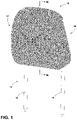
- FIG. 1 is a top perspective view of a headrest assembly
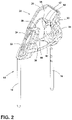
- FIG. 2 is a top perspective view of a support armature of the headrest assembly of FIG. 1 ;
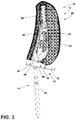
- FIG. 3 is a cross-sectional view of the headrest assembly of FIG. 1 taken at line III;
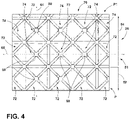
- FIG. 4 is a side elevation view of a portion of a lattice matrix
- FIG. 5 is a side elevation view of another portion of the lattice matrix of FIG. 4 ;
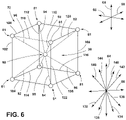
- FIG. 6 is a top perspective schematic view of a 3D cell of a lattice matrix
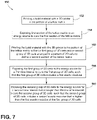
- FIG. 7 is a diagram of a method of making a lattice matrix.
- FIG. 8 is a diagram of another method of making a lattice matrix.
- the term “and/or,” when used in a list of two or more items, means that any one of the listed items can be employed by itself, or any combination of two or more of the listed items can be employed.
- the composition can contain A alone; B alone; C alone; A and B in combination; A and C in combination; B and C in combination; or A, B, and C in combination.
- relational terms such as first and second, top and bottom, and the like, are used solely to distinguish one entity or action from another entity or action, without necessarily requiring or implying any actual such relationship or order between such entities or actions.
- substantially is intended to note that a described feature is equal or approximately equal to a value or description.
- a “substantially planar” surface is intended to denote a surface that is planar or approximately planar.
- substantially is intended to denote that two values are equal or approximately equal. In some embodiments, “substantially” may denote values within about 10% of each other, such as within about 5% of each other, or within about 2% of each other.
- the terms “the,” “a,” or “an,” mean “at least one,” and should not be limited to “only one” unless explicitly indicated to the contrary.
- reference to “a component” includes embodiments having two or more such components unless the context clearly indicates otherwise.
- a trim article is shown in the form of a headrest assembly 10 .
- the headrest assembly 10 includes a headrest bun 12 supported by a support armature 14 .
- the headrest bun 12 is comprised of a lattice matrix 20 that is further comprised of multiple sections, as further described below.
- the lattice matrix 20 is contemplated to be a deflectable member providing a cushioning effect similar to headrest assemblies comprised of a foam padding.
- the headrest bun 12 may include an outer casing comprised of a leather, suede, polymeric or vinyl material that is stretched over the headrest bun 12 .
- the term “lattice matrix” refers to a structural pattern of interconnected links and nodes that define 3D cells with voids therebetween, wherein the overall pattern of the lattice matrix resembles an expanded material configuration.
- the term “deflectable” refers to a component that is considered to have cushioning effect, such that the component is compressible when under pressure from an applied force.
- the term “deflectable” is also used herein to describe a component part that is flexibly resilient.
- a deflectable component part is contemplated to a be a part that can be compressed from an at-rest condition to a compressed condition under a compression force, and is further contemplated to resiliently return to the at-rest condition from the compressed condition after the compression force is removed.
- a deflectable lattice matrix described herein acts as a cushioning component of the headrest assembly 10 .
- the support armature 14 is configured to couple the headrest assembly 10 to an upper portion of a seatback.
- the support armature 14 is contemplated to be a metal member which may be comprised of a steel or aluminum material, and which includes first and second support posts 16 , 18 .
- the first and second support posts 16 , 18 outwardly extend from the lattice matrix 20 , when the lattice matrix 20 is supported on the support armature 14 .
- the configuration of the support armature 14 is further described below with reference to FIG. 2 .
- the support armature 14 includes an upper portion 22 that is received within a hollow core portion 50 ( FIG. 3 ) of the lattice matrix 20 .
- the upper portion 22 of the support armature 14 is supported by the first and second support posts 16 , 18 and includes first and second upright portions 24 , 26 that are interconnected by an upper cross-member 28 .
- the first upright portion 24 includes front and rear support members 30 , 32 which are disposed on opposed sides of the first upright portion 24 . Specifically, the front support member 30 is forwardly offset relative to the first upright portion 24 , and the rear support member 32 is rearwardly offset relative to the first upright portion 24 .
- the second upright portion 26 includes front and rear support members 34 , 36 which are disposed on opposed sides of the second upright portion 26 .
- the front support member 34 is forwardly offset relative to the second upright portion 26
- the rear support member 36 is rearwardly offset relative to second upright portion 26 .
- the front support members 30 , 34 are interconnected by a lower cross member 40 .
- the rear support members 32 , 36 are interconnected by upper and lower cross members 42 , 44 .
- the front and rear support members 30 , 32 are interconnected by a coupling portion 46
- the front and rear support members 34 , 36 are also interconnected by a coupling portion 48 .
- the upper portion 22 of the support armature 14 provides a unique frame assembly for supporting the lattice matrix 20 .
- the lattice matrix 20 is shown supported on the support armature 14 , wherein the upper portion 22 of the support armature 14 is received within a hollow core portion 50 .
- the lattice matrix 20 is comprised of a plurality of interconnected links, as further described below.
- the interconnected links define a plurality of sections 51 of the lattice matrix 20 that are contemplated to be interconnected with one another.
- the lattice matrix 20 includes a first section 52 which defines a front surface 53 of the lattice matrix 20 .
- the first section 52 includes a first elastic modulus that is contemplated to be lower than an elastic modulus of any other section of the plurality of sections 51 .
- the term “elastic modulus” refers to a stiffness or rigidity of a section or component part thereof. Thus, a higher elastic modulus is associated with a stiffer or more rigid section or component part thereof. Further, as used herein, the term “overall elastic modulus” refers to a stiffness or rigidity of a portion of a lattice matrix that is comprised of component parts having varying elastic moduli, as further described below.
- a second section 54 of the lattice matrix 20 is positioned adjacent to and behind the first section 52 . In this way, the second section 54 abuts the first section 52 .
- the second section 54 of the lattice matrix 20 includes a second elastic modulus that is higher than the first elastic modulus of the first section 52 .
- a third section 56 of the lattice matrix 20 is positioned adjacent to and behind the second section 54 . In this way, the third section 56 abuts the second section 54 , such that the second section is disposed between the first section 52 and the second section 54 .
- the third section 56 of the lattice matrix 20 includes a third elastic modulus that is higher than the second elastic modulus of the second section 54 . As shown in FIG.
- the third section 56 of the lattice matrix 20 abuts the upper portion 22 of the support armature 14 , and is contemplated to surround the same within the lattice matrix 20 .
- the lattice matrix 20 further includes a fourth section 58 disposed on an opposite side of the hollow core portion 50 relative to the third section 56 of the lattice matrix 20 . In this way, the hollow core portion 50 of the lattice matrix 20 is disposed between the third section 56 and the fourth section 58 of the lattice matrix 20 .
- the fourth section 58 defines a rear surface 59 of the lattice matrix 20 , and it is contemplated that the fourth section 58 of the lattice matrix 20 may include a fourth elastic modulus that is similar to or equal to the second elastic modulus of the second section 54 . Thus, it is contemplated that the third elastic modulus of the third section 56 is higher than the fourth elastic modulus of the fourth section 58 .
- the sections 52 , 54 , 56 and 58 of the plurality of sections 51 may be referred to herein as multiple layers that are part of a plurality of layers of the lattice matrix 20
- the hollow core portion 50 includes a lower opening 60 in which the upper portion 22 of the support armature 14 is inserted, such that the upper portion 22 of the support armature 14 can be received within the hollow core portion 50 of the lattice matrix 20 .
- the third section 56 of the lattice matrix 20 surrounds the hollow core portion 50 of the lattice matrix 20 , with the exception of the lower opening 60 .
- the plurality of sections 51 is positioned around the hollow core portion 50 of the lattice matrix 20 .
- the first section 52 of the plurality of sections 51 of the lattice matrix 20 includes the lowest elastic modulus; the first elastic modulus.
- the first section 52 of the lattice matrix 20 provides for a soft deformable front outer layer of the lattice matrix configured to cushion a rear portion of a head of a vehicle seat occupant.
- the first section 52 of the lattice matrix 20 is configured to divide the same look and feel of a cushioned outer layer of a standard headrest assembly.
- the multiple sections of the lattice matrix 20 are contemplated to be comprised of a common material, such that the plurality of sections 51 are integrated to define a unitary member in the lattice matrix 20 .
- the support armature 14 is contemplated to be comprised of a metal material to provide rigid support for the lattice matrix 20 .
- the lattice matrix 20 is contemplated to be comprised of a build material constructed using an additive manufacturing technique, whereby a layer-by-layer deposition process is used to print, or otherwise deposit, the build material.
- the build material may include a polymeric material that is cured after deposition to form the various sections of the lattice matrix 20 .
- the process of curing the build material of the lattice matrix 20 involves selective curing the build material for varying intensities for time intervals to provide customized elastic moduli at various portions of the various sections of the lattice matrix 20 .
- the term “integrated” refers to component parts of a unitary whole that are formed together to provide the monolithic structure of the overall article. In this way, the term “integrated” is used herein to describe component parts that are formed together as a unitary whole, as opposed to components that are separately formed and later operably coupled to one another in assembly.
- the term “monolithic structure” is used to describe a structure that is integrally formed in a forming process, such as an additive manufacturing technique.
- Monolithic structures of the present concept provide unitary structures comprised of multiple configurations and features. It is noted that the monolithic structures of the present concept may include a single or common build material used in the additive manufacturing of the structure.
- the lattice matrices of the present concept are not only monolithic in structure, but are specifically configured to provide variated elastic moduli on a voxel level within the lattice matrices, as further described below.
- the first section 52 of the lattice matrix 20 defines an outer layer of the lattice matrix 20 .
- This outer layer defined by the first section 52 includes a first overall elastic modulus.
- the third section 56 of the lattice matrix 20 defines an innermost layer of the lattice matrix 20 .
- the third section 56 of the lattice matrix 20 includes a third overall elastic modulus that is higher than the first overall elastic modulus of the outer layer as defined by the first section 52 of the lattice matrix 20 .
- the innermost layer defined by the third section 56 of the lattice matrix 20 surrounds the hollow core portion 50 of the lattice matrix 20 .
- the second section 54 of the lattice matrix 20 defines an intermediate layer disposed between the outer layer and innermost layer, as respectively defined by the first section 52 and the third section 56 of the lattice matrix 20 . It is contemplated that the second section 54 of the lattice matrix 20 may be comprised of multiple intermediate layers. As noted above, intermediate layer defined by the second section 54 of the lattice matrix 20 includes a second overall elastic modulus that is higher than the first overall elastic modulus of the outer layer (defined by the first section 52 ), and less than the third overall elastic modulus of the innermost layer (defined by the third section 56 ).
- the layers or sections 52 , 54 , 56 , 58 of the plurality of sections 51 of the lattice matrix 20 are comprised of a plurality of three-dimensional (3D) cells 70 , as shown in FIG. 4 .
- the plurality of 3D cells 70 is comprised of a number of different 3D cells having unique properties, as further described below.
- a portion of the lattice matrix 20 is shown. Specifically, portions of the first section 52 and the second section 54 of the plurality of sections 51 of the lattice matrix 20 are shown comprised of a number of 3D cells 72 , 74 . As shown in FIG.
- both the first section 52 and the second section 54 of the lattice matrix 20 each include 3D cells 70 .
- the 3D cells of the first section 52 of the lattice matrix 20 are represented by the reference numeral 72 .
- the second section 54 of the lattice matrix 20 includes 3D cells represented by the reference numerals 72 and 74 .
- the first section 52 of the lattice matrix 20 is contemplated to be a homogenous layer comprised of 3D cells 72 that each include an elastic modulus that is akin to a soft deflectable cushioning member as provided by the 3D cells 72 .
- the second section 54 of the lattice matrix 20 includes 3D cells 72 , as well as 3D cells 74 .
- the second section 54 of the lattice matrix 20 includes 3D cells from two different groups of 3D cells.
- the 3D cells 72 represent a first group of 3D cells
- the 3D cells 74 represent a second group of 3D cells.
- the 3D cells 74 of the second group of 3D cells are contemplated to have a higher elastic modulus as compared to the 3D cells 72 of the first group of 3D cells.
- the second section 54 of the lattice matrix 20 is contemplated to have a higher overall elastic modulus, as compared to the overall elastic modulus of the first section 52 of the lattice matrix 20 , as the second section 54 of the lattice matrix 20 includes the 3D cells 74 having the higher elastic modulus as compared to the 3D cells 72 .
- the second section 54 of the lattice matrix 20 is a stiffer more rigid part of the lattice matrix 20 , as compared to the first section 52 of the lattice matrix 20 .
- the second section 54 and the third section 56 of the lattice matrix 20 both include 3D cells 72 , as well as 3D cells 74 .
- the third section 56 of the lattice matrix 20 includes a higher concentration or greater percentage of 3D cells 74 as compared to the number of 3D cells 74 disposed in the second section 54 .
- the third section 56 of the lattice matrix 20 shown in the embodiment of FIG. 3 includes 3D cells from the first and second groups of 3D cells, much like the second section 54 of the lattice matrix 20 .
- the third section 56 of the lattice matrix 20 includes a higher concentration or higher percentage of 3D cells 74 as compared to the second section 54 of the lattice matrix 20
- the third section 56 of the lattice matrix 20 is contemplated to have a higher overall elastic modulus as compared to the overall elastic modulus of the first and second sections 52 , 54 of the lattice matrix 20 .
- the third section 56 of the lattice matrix 20 is a stiffer more rigid part of the lattice matrix 20 , as compared to either the first section 52 of the lattice matrix 20 or second section 54 of the lattice matrix 20 . It is contemplated that the third section 56 of the lattice matrix 20 may include a pattern of 3D cells comprised of more than 50% 3D cells 74 from the second group of 3D cells. With over half of the 3D cells of the third section 56 of the lattice matrix 20 being 3D cells with a higher elastic modulus (i.e.
- the third section 56 of the lattice matrix 20 is contemplated to provide a rigid support structure for engagement of the upper portion 22 of the support armature 14 . It is further contemplated that the entirety of the third section 56 of the lattice matrix 20 may be comprised of 3D cells 74 .
- the lattice matrix 20 includes an overall pattern P of links and nodes that defines the structure of the lattice matrix 20 .
- the second section 54 of the lattice matrix 20 includes a pattern P 1 of 3D cells 72 and 3D cells 74 .
- the second section 54 of the lattice matrix 20 shown in FIG. 4 illustrates an alternating pattern P 1 of 3D cells 72 and 3D cells 74 .
- FIG. 4 illustrates an alternating pattern P 1 of 3D cells 72 and 3D cells 74 .
- the third section 56 of the lattice matrix 20 includes a pattern P 2 of 3D cells 72 and 3D cells 74 .
- the pattern P 2 of 3D cells of the third section 56 of the lattice matrix 20 provides for more cells from the second group of 3D cells 74 as compared to the pattern P 1 of the second section 54 of the lattice matrix 20 .
- the pattern P 2 of 3D cells of the third section 56 of the lattice matrix 20 provides for a higher overall elastic modulus as compared to the first and second sections 52 , 54 of the lattice matrix 20 .
- any pattern of 3D cells may be used at any section of the plurality of sections 51 of the lattice matrix 20 , so long as a stiffness gradient is provided in order of increasing stiffness from the outer layer 53 of the lattice matrix 20 , to the innermost layer defined by the third section 56 of the lattice matrix 20 .
- the 3D cells 72 , 74 are arranged in a cubic arrangement and are aligned along the vertical direction 64 and the horizontal direction 66 .
- the 3D cells 72 , 74 are also contemplated to be aligned in a longitudinal direction 68 ( FIG. 6 ).
- the directions 64 , 66 and 68 are contemplated to be mutually orthogonal. As shown in FIGS. 4 and 5 , the 3D cells 72 , 74 include nodes 80 that are aligned with one another. The directions 64 , 66 and 68 are identified to facilitate definition of the 3D cells 72 , 74 described herein, and do not necessarily correspond to the actual vertical, horizontal, and longitudinal directions of the lattice matrix 20 in which the 3D cells 72 , 74 are used. Further, it is contemplated that more than two groups of 3D cells may be included in the plurality of 3D cells 70 .
- first section 52 , the second section 54 , the third section 56 and the fourth section 58 of the lattice matrix 20 may each include a homogenous set of 3D cells having the varying elastic moduli as discussed above to provide the stiffness gradient defined from the outer layers 53 , 59 of the lattice matrix 20 , towards the hollow core portion 50 .
- first section 52 , the second section 54 , the third section 56 and the fourth section 58 of the lattice matrix 20 may each include a mixture of 3D cells having varying elastic moduli, yet still provide the stiffness gradient defined from the outer layers 53 , 59 of the lattice matrix 20 , towards the hollow core portion 50 .
- the third section 56 of the lattice matrix 20 may include 3D cells that are printed with a build material in a layer-by-layer deposition process to form a third group of 3D cells defining the third section 56 of the lattice matrix 20 .
- the third group of 3D cells can be cured (by irradiating or heating, or other like energy source exposure), such that the third group of 3D cells includes a third elastic modulus that is higher than the second elastic modulus of the second group of 3D cells of the second section 54 of the lattice matrix 20 .
- the third group of 3D cells can be exposed to an energy source for a third time interval that is greater than the second time interval noted above.
- the third section 56 of the lattice matrix 20 may include 3D cells in a pattern that is comprised of 3D cells from the first group of 3D cells 72 , the second group of 3D cells 74 or the third group of 3d cells described above. It is also contemplated that the third section 56 of the lattice matrix 20 may include 3D cells that are entirely comprised of the second group of 3D cells 74 or the third group of 3d cells, or a mixture thereof.
- a 3D cell is shown in schematic form to provide a sense of the overall structure a 3D cell used with the present concept may include.
- the 3D cell shown in FIG. 6 is represented by the reference numeral 72 , however, it is contemplated that the 3D cells 74 may include a similar structure as the exemplary structure shown in FIG. 6 .
- the 3D cell 72 includes a node 80 that is centrally disposed. A plurality of links 90 outwardly extending from the node 80 in various directions.
- links 82 , 84 , 86 and 88 of the plurality of links 90 extend downwardly from the node 80 in the respective directions as indicated by arrows 132 , 134 , 136 and 138 .
- Links 92 , 94 , 96 and 98 of the plurality of links 90 extend upwardly from the node 80 in the respective directions as indicated by arrows 142 , 144 , 146 and 148 .
- links 100 , 102 , 104 , 106 , 108 , 110 , 112 , 114 , 116 , 118 and 120 represent outwardly extending links from adjacent nodes 81 .
- the interplay of the plurality of links 90 provides for the elastic modulus of the 3D cell 72 .
- the 3D cells 72 , 74 of the present concept are contemplated to have a similar dimensions with respect to link thickness, node dimension and spacing of the voids provided between the links and nodes.
- specific groups of 3D cells may include a different elastic modulus as compared to a different group of 3D cells.
- the varying elastic moduli between groups of 3D cells leads to sections of the lattice matrix 20 having varying overall elastic moduli. This is due to voxel-level tuning of the lattice matrix 20 provided during the additive manufacturing process used to create lattice matrix 20 .
- the term “voxel” should be taken to mean a discrete element of an actual 3D visual representation, or the corresponding element of a 3D object from which such a representation could be rendered.
- the voxels of the lattice matrix 20 are defined as the discrete 3D cells, such as 3D cells 72 , 74 , that make up the lattice matrix 20 .
- the varying elastic moduli between groups of 3D cells is provided by specific curing techniques employed in the additive manufacturing process used to create the lattice matrix 20 .
- the manufacturing process includes an additive manufacturing technique for the creation of the lattice matrix 20 .
- Numerous additive manufacturing techniques are known that may include a light-polymerized 3D printer, a laser sintering printer, a fused filament fabrication printer and the like. These processes may include the deposition of the build material in a layer-by-layer manner to manufacture an overall product. Other processes may use include a liquid build material that is provided in a vat and exposed to an energy source.
- Such additive manufacturing processes are also known to include 3D printers that use digital light projection, such as used in a stereolithography technique, or binder jetting to fuse layers of curable substrates with applications of light or heat from an energy source.
- exposure time intervals from the energy source are varied to provide voxel level tuning of the lattice matrix 20 .
- adjacent voxels within the lattice matrix can include different properties based on a particular voxel's energy source exposure time interval. Increased exposure time intervals lead to resulting voxel's with higher resistance to deformation (i.e. higher elastic modulus).
- the higher the modulus of elasticity of the material the greater the rigidity.
- doubling the modulus of elasticity of a voxel doubles the rigidity of the voxel.
- thermocurable When using light or heat from an energy source in an additive manufacturing process, it is contemplated that a photocurable or thermocurable substrate is being printed on the 3D printer.
- photocurable is meant to represent a composition or build material that is cured by irradiating the build material, such as by exposure to ultraviolet (UV) light emitted from a UV light source in a digital light processing (DLP) technique.
- thermalcurable is meant to represent a composition or build material that is cured by heating the build material, such as by heating a build material, and potentially an adhesive, in a binder jetting process.
- a method 150 of making a trim article such as a headrest bun having a lattice matrix, is shown, and includes the following steps.
- a build material is deposited. It is contemplated that the build material is deposited, or printed, in a build box using a 3D printer.
- the build material is printed in the pattern of a lattice matrix, such as the pattern P of the lattice matrix 20 described above.
- the build material may include any material suitable for printing.
- the build material may be deposited in a layer-by-layer deposition process, and may be exposed to an energy source to cure the build material in a layer-by-layer manner.
- a first section of a lattice matrix may be formed by curing the build material by exposing the same to an energy source. It is contemplated that the first section of the lattice matrix identified in step 154 is akin to the first section 52 of the lattice matrix 20 described above.
- the energy source may include a light source, such as a UV light source configured to cure a photocurable build material by irradiating the same.
- the energy source may also include a heat source configured to cure a thermocurable build material by heating the same. It is contemplated that the deposition step 152 and the curing step 154 of the method 150 may occur simultaneously, such that deposited build material is immediately cured following deposition.
- a second section of the lattice matrix may be formed by depositing or printing build material in the continued configuration of the lattice matrix 20 , such that first and second groups of 3D cells are provided and arranged in a pattern of 3D cells to define the second section of the lattice matrix. It is contemplated that the second section identified in step 156 is akin to the second section 54 of the lattice matrix 20 described above.
- the deposited build material of the second section 54 of the lattice matrix 20 is exposed to the energy source.
- step 158 of the method 150 provides for exposing the first group of 3D cells to the energy source for a first time interval in order to cure the first group of 3D cells.
- the resulting 3D cells of the first group of 3D cells are contemplated to include a first elastic modulus, after having been exposed to the energy source for the duration of the first time interval.
- the deposited build material of the second section 54 of the lattice matrix 20 is exposed to the energy source.
- step 160 of the method 150 provides for exposing the second group of 3D cells to the energy source for a second time interval that is longer than the first time interval in order to cure the second group of 3D cells.
- portions of the second section 54 of the lattice matrix 20 comprised of 3D cells from the second group of 3D cells 74 are exposed to the energy source for a longer period of time (i.e. a longer time interval) as compared to portions of the second section 54 of the lattice matrix 20 comprised of 3D cells from the first group of 3D cells 72 .
- the resulting 3D cells of the second group of 3D cells are contemplated to include a second elastic modulus that is higher than the first elastic modulus after having been exposed to the energy source for the duration of the second time interval.
- steps 158 , 160 of the method 150 may occur simultaneously after deposition of the build material for the second section of the lattice matrix to provide layers of the build material having patterns that are additively developed in a layer-by-layer manner.
- the pattern P 1 of 3D cells shown in the second section 54 of the lattice matrix 20 may be additively manufactured in a layer-by-layer deposition in curing process to provide the 3D cells 72 of the first group of 3D cells, along with the 3D cells 74 of the second group of 3D cells, and their respective elastic moduli.
- a step 164 is provided to additively manufacture a first section of a lattice matrix by providing a curable material.
- the step 164 further provides for curing the curable material to form the first section of lattice matrix have any first elastic modulus.
- a second step 166 of the method 162 includes additively manufacturing a second section of a lattice matrix by providing a curable material.
- the second step 166 of the method 162 further provides for curing the curable material to form the second section of the lattice matrix having a second elastic modulus that is higher than the first elastic modulus of the first section of the lattice matrix.
- the method 162 provides for a method of additively manufacturing the lattice matrix 20 described above along with the plurality of sections 51 , also described above.
- the selective exposure to an energy source provides for layers of build material that can be cured to different degrees, such that voxel level tuning of the lattice matrix is provided.
- the 3D cells of each section of the lattice matrix can be provided with varying elastic moduli to create a section of the lattice matrix that has an overall elastic modulus that is different than an adjacent section of the lattice matrix.
- the lattice matrix 20 of FIG. 3 may include an exposure of the 3D cells of the first section 52 of the lattice matrix 20 to an energy source for a first time interval. It is further contemplated that the lattice matrix 20 of FIG.
- the lattice matrix 20 of FIG. 3 may include an exposure of the 3D cells of the second section 54 of the lattice matrix 20 to an energy source for a second time interval that is two times (or double) as long as the first time interval. In this way, it is contemplated that the second section 54 the lattice matrix 20 will have a higher elastic modulus as compared to the elastic modulus of the first section of the lattice matrix 20 . It is further contemplated that the lattice matrix 20 of FIG. 3 may include an exposure of the 3D cells of the third section 56 of the lattice matrix 20 to an energy source for a third time interval that is ten-times as long as the first time interval.
- the third section 56 the lattice matrix 20 will have a higher elastic modulus as compared to the elastic modulus of the first section 52 of the lattice matrix 20 and the elastic modulus of the second section 54 of the lattice matrix 20 .
- the exposure to an energy source may include exposing a build material to a heat source or a light source for the various time intervals noted above.
- the plurality of sections 51 of the lattice matrix 20 may include homogenous layers of 3D cells that all have similar elastic moduli within the respective sections.
- any given section of the lattice matrix 20 may have a mixture of 3D cells (i.e. multiple groups of 3D cells) arranged in a pattern, wherein the different 3D cells have different elastic moduli. That said, it is contemplated that the result of either method 150 , 162 provides for a lattice matrix 20 having a plurality of sections 51 , wherein each section of the plurality of sections 51 has a specific overall elastic modulus, as provided by the method of manufacture.
- a method of forming a trim article includes the following steps: (1) printing a photocurable composition with a three-dimensional (3D) printer in a layer-by-layer deposition process in a pattern of a lattice matrix having a first section, (2) irradiating the first section of the lattice matrix with an energy source to cure the first section of the lattice matrix, (3) printing the photocurable composition with the 3D printer in a layer-by-layer deposition process in the pattern of the lattice matrix to form a first group of 3D cells and a second group of 3D cells arranged in a pattern of 3D cells to define a second section of the lattice matrix that is disposed adjacent to the first section of the lattice matrix, (4) irradiating the first group of 3D cells of the second section of the lattice matrix with the energy source to cure the first group of 3D cells, such that the first group of 3D cells includes a first elastic modulus,
- a method for manufacturing a headrest bun includes the following steps: (1) additively manufacturing a first section of a lattice matrix comprising a plurality of three-dimensional (3D) cells, wherein each cell of the plurality of 3D cells of the first section of the lattice matrix includes a node and a plurality of links extending outwardly from the node, and further wherein the step of additively manufacturing the first section of the lattice matrix further comprises providing a build material in a layer-by-layer deposition process and curing the build material to provide the first section of the lattice matrix with a first elastic modulus, and (2) additively manufacturing a second section of the lattice matrix comprising a plurality of three-dimensional (3D) cells, wherein each cell of the plurality of 3D cells of the second section of the lattice matrix includes a node and a plurality of links extending outwardly from the node, and further wherein the step of additively manufacturing the second section
- a method of forming a trim article includes the following steps: (1) depositing a thermocurable composition in a layer-by-layer deposition process using an additive manufacturing process to form a first section of a lattice matrix, (2) heating the first section of the lattice matrix with an energy source for a first time interval to cure the first section of the lattice matrix, such that the first section of the lattice matrix includes a first elastic modulus, (3) printing the thermocurable composition in a layer-by-layer deposition process using the additive manufacturing process to form a second section of the lattice matrix that is positioned on the first section of the lattice matrix, (4) heating portions of the second section of the lattice matrix with the energy source for a second time interval that is greater than the first time interval, such that the second section of the lattice matrix includes a second elastic modulus that is higher than the first elastic modulus of the first section of the lattice matrix, (5) printing the thermocurable composition
Landscapes
- Engineering & Computer Science (AREA)
- Chemical & Material Sciences (AREA)
- Materials Engineering (AREA)
- Manufacturing & Machinery (AREA)
- Mechanical Engineering (AREA)
- Aviation & Aerospace Engineering (AREA)
- Transportation (AREA)
- Physics & Mathematics (AREA)
- Optics & Photonics (AREA)
Abstract
Description
- The present invention generally relates to a trim article, and more specifically, to a trim article provided using an additive manufacturing technique to create a lattice matrix that is tuned on a voxel-level to provide a customized elastic modulus for the article.
- The present concept provides unique structural configuration tuning in a single support unit for a trim article.
- According to a first aspect of the present disclosure, a method of forming a trim article, includes the following steps: (1) printing a photocurable composition with a three-dimensional (3D) printer in a layer-by-layer deposition process in a pattern of a lattice matrix having a first section, (2) irradiating the first section of the lattice matrix with an energy source to cure the first section of the lattice matrix, (3) printing the photocurable composition with the 3D printer in a layer-by-layer deposition process in the pattern of the lattice matrix to form a first group of 3D cells and a second group of 3D cells arranged in a pattern of 3D cells to define a second section of the lattice matrix that is disposed adjacent to the first section of the lattice matrix, (4) irradiating the first group of 3D cells of the second section of the lattice matrix with the energy source to cure the first group of 3D cells, such that the first group of 3D cells includes a first elastic modulus, and (5) irradiating the second group of 3D cells of the second section of the lattice matrix with the energy source to curing the second group of 3D cells, such that the second group of 3D cells includes a second elastic modulus that is higher than the first elastic modulus of the first group of 3D cells.
- According to a second aspect of the present disclosure, a method for manufacturing a headrest bun includes the following steps: (1) additively manufacturing a first section of a lattice matrix comprising a plurality of three-dimensional (3D) cells, wherein each cell of the plurality of 3D cells of the first section of the lattice matrix includes a node and a plurality of links extending outwardly from the node, and further wherein the step of additively manufacturing the first section of the lattice matrix further comprises providing a build material in a layer-by-layer deposition process and curing the build material to provide the first section of the lattice matrix with a first elastic modulus, and (2) additively manufacturing a second section of the lattice matrix comprising a plurality of three-dimensional (3D) cells, wherein each cell of the plurality of 3D cells of the second section of the lattice matrix includes a node and a plurality of links extending outwardly from the node, and further wherein the step of additively manufacturing the second section of the lattice matrix further comprises depositing the build material in the layer-by-layer deposition process and curing the build material to provide the second section of the lattice matrix with a second elastic modulus that is higher than the first elastic modulus of the first section of the lattice matrix.
- According to a third aspect of the present disclosure, a method of forming a trim article includes the following steps: (1) depositing a thermocurable composition in a layer-by-layer deposition process using an additive manufacturing process to form a first section of a lattice matrix, (2) heating the first section of the lattice matrix with an energy source for a first time interval to cure the first section of the lattice matrix, such that the first section of the lattice matrix includes a first elastic modulus, (3) printing the thermocurable composition in a layer-by-layer deposition process using the additive manufacturing process to form a second section of the lattice matrix that is positioned on the first section of the lattice matrix, (4) heating portions of the second section of the lattice matrix with the energy source for a second time interval that is greater than the first time interval, such that the second section of the lattice matrix includes a second elastic modulus that is higher than the first elastic modulus of the first section of the lattice matrix, (5) printing the thermocurable composition in a layer-by-layer deposition process using the additive manufacturing process to form a third section of the lattice matrix that is positioned on the second section of the lattice matrix, and (6) heating portions of the third section of the lattice matrix with the energy source for a third time interval that is greater than the second time interval, such that the third section of the lattice matrix includes a third elastic modulus that is higher than the second elastic modulus of the second section of the lattice matrix.
- These and other aspects, objects, and features of the present disclosure will be understood and appreciated by those skilled in the art upon studying the following specification, claims, and appended drawings.
- In the drawings:
-
FIG. 1 is a top perspective view of a headrest assembly; -
FIG. 2 is a top perspective view of a support armature of the headrest assembly ofFIG. 1 ; -
FIG. 3 is a cross-sectional view of the headrest assembly ofFIG. 1 taken at line III; -
FIG. 4 is a side elevation view of a portion of a lattice matrix; -
FIG. 5 is a side elevation view of another portion of the lattice matrix ofFIG. 4 ; -
FIG. 6 is a top perspective schematic view of a 3D cell of a lattice matrix; -
FIG. 7 is a diagram of a method of making a lattice matrix; and -
FIG. 8 is a diagram of another method of making a lattice matrix. - Additional features and advantages of the present disclosure will be set forth in the detailed description which follows and will be apparent to those skilled in the art from the description, or recognized by practicing the invention as described in the following description, together with the claims and appended drawings.
- As used herein, the term “and/or,” when used in a list of two or more items, means that any one of the listed items can be employed by itself, or any combination of two or more of the listed items can be employed. For example, if a composition is described as containing components A, B, and/or C, the composition can contain A alone; B alone; C alone; A and B in combination; A and C in combination; B and C in combination; or A, B, and C in combination.
- In this document, relational terms, such as first and second, top and bottom, and the like, are used solely to distinguish one entity or action from another entity or action, without necessarily requiring or implying any actual such relationship or order between such entities or actions.
- The terms “substantial,” “substantially,” and variations thereof as used herein are intended to note that a described feature is equal or approximately equal to a value or description. For example, a “substantially planar” surface is intended to denote a surface that is planar or approximately planar. Moreover, “substantially” is intended to denote that two values are equal or approximately equal. In some embodiments, “substantially” may denote values within about 10% of each other, such as within about 5% of each other, or within about 2% of each other.
- As used herein the terms “the,” “a,” or “an,” mean “at least one,” and should not be limited to “only one” unless explicitly indicated to the contrary. Thus, for example, reference to “a component” includes embodiments having two or more such components unless the context clearly indicates otherwise.
- Referring now to
FIG. 1 , a trim article is shown in the form of aheadrest assembly 10. - The
headrest assembly 10 includes aheadrest bun 12 supported by asupport armature 14. Theheadrest bun 12 is comprised of alattice matrix 20 that is further comprised of multiple sections, as further described below. Thelattice matrix 20 is contemplated to be a deflectable member providing a cushioning effect similar to headrest assemblies comprised of a foam padding. It is contemplated that theheadrest bun 12 may include an outer casing comprised of a leather, suede, polymeric or vinyl material that is stretched over theheadrest bun 12. As used herein, the term “lattice matrix” refers to a structural pattern of interconnected links and nodes that define 3D cells with voids therebetween, wherein the overall pattern of the lattice matrix resembles an expanded material configuration. Further, as used herein, the term “deflectable” refers to a component that is considered to have cushioning effect, such that the component is compressible when under pressure from an applied force. The term “deflectable” is also used herein to describe a component part that is flexibly resilient. In this way, a deflectable component part is contemplated to a be a part that can be compressed from an at-rest condition to a compressed condition under a compression force, and is further contemplated to resiliently return to the at-rest condition from the compressed condition after the compression force is removed. Thus, a deflectable lattice matrix described herein acts as a cushioning component of theheadrest assembly 10. - As further shown in
FIG. 1 , thesupport armature 14 is configured to couple theheadrest assembly 10 to an upper portion of a seatback. Specifically, thesupport armature 14 is contemplated to be a metal member which may be comprised of a steel or aluminum material, and which includes first andsecond support posts second support posts lattice matrix 20, when thelattice matrix 20 is supported on thesupport armature 14. The configuration of thesupport armature 14 is further described below with reference toFIG. 2 . - Referring now to
FIG. 2 , thesupport armature 14 includes anupper portion 22 that is received within a hollow core portion 50 (FIG. 3 ) of thelattice matrix 20. Theupper portion 22 of thesupport armature 14 is supported by the first andsecond support posts upright portions upper cross-member 28. The firstupright portion 24 includes front andrear support members upright portion 24. Specifically, thefront support member 30 is forwardly offset relative to the firstupright portion 24, and therear support member 32 is rearwardly offset relative to the firstupright portion 24. Similarly, the secondupright portion 26 includes front andrear support members upright portion 26. Specifically, thefront support member 34 is forwardly offset relative to the secondupright portion 26, and therear support member 36 is rearwardly offset relative to secondupright portion 26. Thefront support members lower cross member 40. Therear support members lower cross members rear support members coupling portion 46, and the front andrear support members coupling portion 48. In this way, theupper portion 22 of thesupport armature 14 provides a unique frame assembly for supporting thelattice matrix 20. - Referring now to
FIG. 3 , thelattice matrix 20 is shown supported on thesupport armature 14, wherein theupper portion 22 of thesupport armature 14 is received within ahollow core portion 50. Thelattice matrix 20 is comprised of a plurality of interconnected links, as further described below. The interconnected links define a plurality ofsections 51 of thelattice matrix 20 that are contemplated to be interconnected with one another. Specifically, thelattice matrix 20 includes afirst section 52 which defines afront surface 53 of thelattice matrix 20. Thefirst section 52 includes a first elastic modulus that is contemplated to be lower than an elastic modulus of any other section of the plurality ofsections 51. As used herein, the term “elastic modulus” refers to a stiffness or rigidity of a section or component part thereof. Thus, a higher elastic modulus is associated with a stiffer or more rigid section or component part thereof. Further, as used herein, the term “overall elastic modulus” refers to a stiffness or rigidity of a portion of a lattice matrix that is comprised of component parts having varying elastic moduli, as further described below. - As further shown in
FIG. 3 , asecond section 54 of thelattice matrix 20 is positioned adjacent to and behind thefirst section 52. In this way, thesecond section 54 abuts thefirst section 52. Thesecond section 54 of thelattice matrix 20 includes a second elastic modulus that is higher than the first elastic modulus of thefirst section 52. Athird section 56 of thelattice matrix 20 is positioned adjacent to and behind thesecond section 54. In this way, thethird section 56 abuts thesecond section 54, such that the second section is disposed between thefirst section 52 and thesecond section 54. Thethird section 56 of thelattice matrix 20 includes a third elastic modulus that is higher than the second elastic modulus of thesecond section 54. As shown inFIG. 3 , thethird section 56 of thelattice matrix 20 abuts theupper portion 22 of thesupport armature 14, and is contemplated to surround the same within thelattice matrix 20. Thelattice matrix 20 further includes afourth section 58 disposed on an opposite side of thehollow core portion 50 relative to thethird section 56 of thelattice matrix 20. In this way, thehollow core portion 50 of thelattice matrix 20 is disposed between thethird section 56 and thefourth section 58 of thelattice matrix 20. Thefourth section 58 defines arear surface 59 of thelattice matrix 20, and it is contemplated that thefourth section 58 of thelattice matrix 20 may include a fourth elastic modulus that is similar to or equal to the second elastic modulus of thesecond section 54. Thus, it is contemplated that the third elastic modulus of thethird section 56 is higher than the fourth elastic modulus of thefourth section 58. Thesections sections 51 may be referred to herein as multiple layers that are part of a plurality of layers of thelattice matrix 20 - As further shown in
FIG. 3 , thehollow core portion 50 includes alower opening 60 in which theupper portion 22 of thesupport armature 14 is inserted, such that theupper portion 22 of thesupport armature 14 can be received within thehollow core portion 50 of thelattice matrix 20. Thus, thethird section 56 of thelattice matrix 20 surrounds thehollow core portion 50 of thelattice matrix 20, with the exception of thelower opening 60. Thus, the plurality ofsections 51 is positioned around thehollow core portion 50 of thelattice matrix 20. - As noted above, the
first section 52 of the plurality ofsections 51 of thelattice matrix 20 includes the lowest elastic modulus; the first elastic modulus. In this way, thefirst section 52 of thelattice matrix 20 provides for a soft deformable front outer layer of the lattice matrix configured to cushion a rear portion of a head of a vehicle seat occupant. Thefirst section 52 of thelattice matrix 20 is configured to divide the same look and feel of a cushioned outer layer of a standard headrest assembly. - The multiple sections of the
lattice matrix 20 are contemplated to be comprised of a common material, such that the plurality ofsections 51 are integrated to define a unitary member in thelattice matrix 20. As noted above, thesupport armature 14 is contemplated to be comprised of a metal material to provide rigid support for thelattice matrix 20. Thelattice matrix 20 is contemplated to be comprised of a build material constructed using an additive manufacturing technique, whereby a layer-by-layer deposition process is used to print, or otherwise deposit, the build material. The build material may include a polymeric material that is cured after deposition to form the various sections of thelattice matrix 20. As further described below, the process of curing the build material of thelattice matrix 20 involves selective curing the build material for varying intensities for time intervals to provide customized elastic moduli at various portions of the various sections of thelattice matrix 20. - As used herein, the term “integrated” refers to component parts of a unitary whole that are formed together to provide the monolithic structure of the overall article. In this way, the term “integrated” is used herein to describe component parts that are formed together as a unitary whole, as opposed to components that are separately formed and later operably coupled to one another in assembly. As used herein, the term “monolithic structure” is used to describe a structure that is integrally formed in a forming process, such as an additive manufacturing technique. Monolithic structures of the present concept provide unitary structures comprised of multiple configurations and features. It is noted that the monolithic structures of the present concept may include a single or common build material used in the additive manufacturing of the structure. Further, the lattice matrices of the present concept are not only monolithic in structure, but are specifically configured to provide variated elastic moduli on a voxel level within the lattice matrices, as further described below.
- As further shown in
FIG. 3 , thefirst section 52 of thelattice matrix 20 defines an outer layer of thelattice matrix 20. This outer layer defined by thefirst section 52 includes a first overall elastic modulus. As further shown inFIG. 3 , thethird section 56 of thelattice matrix 20 defines an innermost layer of thelattice matrix 20. As noted above, thethird section 56 of thelattice matrix 20 includes a third overall elastic modulus that is higher than the first overall elastic modulus of the outer layer as defined by thefirst section 52 of thelattice matrix 20. Further, the innermost layer defined by thethird section 56 of thelattice matrix 20 surrounds thehollow core portion 50 of thelattice matrix 20. Thesecond section 54 of thelattice matrix 20 defines an intermediate layer disposed between the outer layer and innermost layer, as respectively defined by thefirst section 52 and thethird section 56 of thelattice matrix 20. It is contemplated that thesecond section 54 of thelattice matrix 20 may be comprised of multiple intermediate layers. As noted above, intermediate layer defined by thesecond section 54 of thelattice matrix 20 includes a second overall elastic modulus that is higher than the first overall elastic modulus of the outer layer (defined by the first section 52), and less than the third overall elastic modulus of the innermost layer (defined by the third section 56). - It is contemplated that the layers or
sections sections 51 of thelattice matrix 20 are comprised of a plurality of three-dimensional (3D)cells 70, as shown inFIG. 4 . The plurality of3D cells 70 is comprised of a number of different 3D cells having unique properties, as further described below. In the view ofFIG. 4 , a portion of thelattice matrix 20 is shown. Specifically, portions of thefirst section 52 and thesecond section 54 of the plurality ofsections 51 of thelattice matrix 20 are shown comprised of a number of3D cells FIG. 4 , both thefirst section 52 and thesecond section 54 of thelattice matrix 20 each include3D cells 70. The 3D cells of thefirst section 52 of thelattice matrix 20 are represented by thereference numeral 72. Thesecond section 54 of thelattice matrix 20 includes 3D cells represented by thereference numerals first section 52 of thelattice matrix 20 is contemplated to be a homogenous layer comprised of3D cells 72 that each include an elastic modulus that is akin to a soft deflectable cushioning member as provided by the3D cells 72. - With further reference to
FIG. 4 , thesecond section 54 of thelattice matrix 20 includes3D cells 72, as well as3D cells 74. In this way, thesecond section 54 of thelattice matrix 20 includes 3D cells from two different groups of 3D cells. Specifically, the3D cells 72 represent a first group of 3D cells, while the3D cells 74 represent a second group of 3D cells. The3D cells 74 of the second group of 3D cells are contemplated to have a higher elastic modulus as compared to the3D cells 72 of the first group of 3D cells. Thus, thesecond section 54 of thelattice matrix 20 is contemplated to have a higher overall elastic modulus, as compared to the overall elastic modulus of thefirst section 52 of thelattice matrix 20, as thesecond section 54 of thelattice matrix 20 includes the3D cells 74 having the higher elastic modulus as compared to the3D cells 72. In this way, thesecond section 54 of thelattice matrix 20 is a stiffer more rigid part of thelattice matrix 20, as compared to thefirst section 52 of thelattice matrix 20. - Referring now to
FIG. 5 , thesecond section 54 and thethird section 56 of thelattice matrix 20 both include3D cells 72, as well as3D cells 74. However, thethird section 56 of thelattice matrix 20 includes a higher concentration or greater percentage of3D cells 74 as compared to the number of3D cells 74 disposed in thesecond section 54. Thus, thethird section 56 of thelattice matrix 20 shown in the embodiment ofFIG. 3 includes 3D cells from the first and second groups of 3D cells, much like thesecond section 54 of thelattice matrix 20. As the3D cells 74 of the second group of 3D cells are contemplated to have a higher elastic modulus as compared to the3D cells 72 of the first group of 3D cells, and thethird section 56 of thelattice matrix 20 includes a higher concentration or higher percentage of3D cells 74 as compared to thesecond section 54 of thelattice matrix 20, thethird section 56 of thelattice matrix 20 is contemplated to have a higher overall elastic modulus as compared to the overall elastic modulus of the first andsecond sections lattice matrix 20. In this way, thethird section 56 of thelattice matrix 20 is a stiffer more rigid part of thelattice matrix 20, as compared to either thefirst section 52 of thelattice matrix 20 orsecond section 54 of thelattice matrix 20. It is contemplated that thethird section 56 of thelattice matrix 20 may include a pattern of 3D cells comprised of more than 50% 3D cells 74 from the second group of 3D cells. With over half of the 3D cells of thethird section 56 of thelattice matrix 20 being 3D cells with a higher elastic modulus (i.e. 3D cells 74), thethird section 56 of thelattice matrix 20 is contemplated to provide a rigid support structure for engagement of theupper portion 22 of thesupport armature 14. It is further contemplated that the entirety of thethird section 56 of thelattice matrix 20 may be comprised of3D cells 74. - In the exemplary portions of the
lattice matrix 20 shown inFIGS. 4 and 5 , various patterns are shown for the placement of3D cells 3D cells FIG. 4 , thelattice matrix 20 includes an overall pattern P of links and nodes that defines the structure of thelattice matrix 20. As further shown inFIG. 4 , thesecond section 54 of thelattice matrix 20 includes a pattern P1 of3D cells 3D cells 74. Specifically, thesecond section 54 of thelattice matrix 20 shown inFIG. 4 illustrates an alternating pattern P1 of3D cells 3D cells 74. As shown inFIG. 5 , thethird section 56 of thelattice matrix 20 includes a pattern P2 of3D cells 3D cells 74. The pattern P2 of 3D cells of thethird section 56 of thelattice matrix 20 provides for more cells from the second group of3D cells 74 as compared to the pattern P1 of thesecond section 54 of thelattice matrix 20. Thus, the pattern P2 of 3D cells of thethird section 56 of thelattice matrix 20 provides for a higher overall elastic modulus as compared to the first andsecond sections lattice matrix 20. - It is contemplated that any pattern of 3D cells may be used at any section of the plurality of
sections 51 of thelattice matrix 20, so long as a stiffness gradient is provided in order of increasing stiffness from theouter layer 53 of thelattice matrix 20, to the innermost layer defined by thethird section 56 of thelattice matrix 20. In the exemplary portions of thelattice matrix 20 shown inFIGS. 4 and 5 , the3D cells vertical direction 64 and thehorizontal direction 66. The3D cells FIG. 6 ). Thedirections FIGS. 4 and 5 , the3D cells nodes 80 that are aligned with one another. Thedirections 3D cells lattice matrix 20 in which the3D cells 3D cells 70. For instance, thefirst section 52, thesecond section 54, thethird section 56 and thefourth section 58 of thelattice matrix 20 may each include a homogenous set of 3D cells having the varying elastic moduli as discussed above to provide the stiffness gradient defined from theouter layers lattice matrix 20, towards thehollow core portion 50. Further, thefirst section 52, thesecond section 54, thethird section 56 and thefourth section 58 of thelattice matrix 20 may each include a mixture of 3D cells having varying elastic moduli, yet still provide the stiffness gradient defined from theouter layers lattice matrix 20, towards thehollow core portion 50. - Further, it is contemplated that the
third section 56 of thelattice matrix 20 may include 3D cells that are printed with a build material in a layer-by-layer deposition process to form a third group of 3D cells defining thethird section 56 of thelattice matrix 20. The third group of 3D cells can be cured (by irradiating or heating, or other like energy source exposure), such that the third group of 3D cells includes a third elastic modulus that is higher than the second elastic modulus of the second group of 3D cells of thesecond section 54 of thelattice matrix 20. Said differently, the third group of 3D cells can be exposed to an energy source for a third time interval that is greater than the second time interval noted above. In this way, the third group of 3D cells will have a higher elastic modulus as compared to the elastic moduli of the first and second groups of3D cells third section 56 of thelattice matrix 20 may include 3D cells in a pattern that is comprised of 3D cells from the first group of3D cells 72, the second group of3D cells 74 or the third group of 3d cells described above. It is also contemplated that thethird section 56 of thelattice matrix 20 may include 3D cells that are entirely comprised of the second group of3D cells 74 or the third group of 3d cells, or a mixture thereof. - Referring now to
FIG. 6 , a 3D cell is shown in schematic form to provide a sense of the overall structure a 3D cell used with the present concept may include. The 3D cell shown inFIG. 6 is represented by thereference numeral 72, however, it is contemplated that the3D cells 74 may include a similar structure as the exemplary structure shown inFIG. 6 . As specifically shown inFIG. 6 , the3D cell 72 includes anode 80 that is centrally disposed. A plurality oflinks 90 outwardly extending from thenode 80 in various directions. Specifically, links 82, 84, 86 and 88 of the plurality oflinks 90 extend downwardly from thenode 80 in the respective directions as indicated byarrows Links links 90 extend upwardly from thenode 80 in the respective directions as indicated byarrows FIG. 6 ,links adjacent nodes 81. The interplay of the plurality oflinks 90 provides for the elastic modulus of the3D cell 72. - The
3D cells lattice matrix 20 having varying overall elastic moduli. This is due to voxel-level tuning of thelattice matrix 20 provided during the additive manufacturing process used to createlattice matrix 20. As used herein, the term “voxel” should be taken to mean a discrete element of an actual 3D visual representation, or the corresponding element of a 3D object from which such a representation could be rendered. In this case, the voxels of thelattice matrix 20 are defined as the discrete 3D cells, such as3D cells lattice matrix 20. The varying elastic moduli between groups of 3D cells is provided by specific curing techniques employed in the additive manufacturing process used to create thelattice matrix 20. - The process by which the
lattice matrix 20 is manufactured will now be described. The manufacturing process, as noted above, includes an additive manufacturing technique for the creation of thelattice matrix 20. Numerous additive manufacturing techniques are known that may include a light-polymerized 3D printer, a laser sintering printer, a fused filament fabrication printer and the like. These processes may include the deposition of the build material in a layer-by-layer manner to manufacture an overall product. Other processes may use include a liquid build material that is provided in a vat and exposed to an energy source. Such additive manufacturing processes are also known to include 3D printers that use digital light projection, such as used in a stereolithography technique, or binder jetting to fuse layers of curable substrates with applications of light or heat from an energy source. As used in the present concept, exposure time intervals from the energy source are varied to provide voxel level tuning of thelattice matrix 20. Thus, adjacent voxels within the lattice matrix can include different properties based on a particular voxel's energy source exposure time interval. Increased exposure time intervals lead to resulting voxel's with higher resistance to deformation (i.e. higher elastic modulus). In identical voxels, the higher the modulus of elasticity of the material, the greater the rigidity. Thus, doubling the modulus of elasticity of a voxel doubles the rigidity of the voxel. When using light or heat from an energy source in an additive manufacturing process, it is contemplated that a photocurable or thermocurable substrate is being printed on the 3D printer. As used herein, the term “photocurable” is meant to represent a composition or build material that is cured by irradiating the build material, such as by exposure to ultraviolet (UV) light emitted from a UV light source in a digital light processing (DLP) technique. As used herein, the term “thermocurable” is meant to represent a composition or build material that is cured by heating the build material, such as by heating a build material, and potentially an adhesive, in a binder jetting process. - Referring now to
FIG. 7 , amethod 150 of making a trim article, such as a headrest bun having a lattice matrix, is shown, and includes the following steps. In aninitial step 152 of themethod 150, a build material is deposited. It is contemplated that the build material is deposited, or printed, in a build box using a 3D printer. The build material is printed in the pattern of a lattice matrix, such as the pattern P of thelattice matrix 20 described above. The build material may include any material suitable for printing. The build material may be deposited in a layer-by-layer deposition process, and may be exposed to an energy source to cure the build material in a layer-by-layer manner. Specifically, in astep 154 of themethod 150, a first section of a lattice matrix may be formed by curing the build material by exposing the same to an energy source. It is contemplated that the first section of the lattice matrix identified instep 154 is akin to thefirst section 52 of thelattice matrix 20 described above. The energy source may include a light source, such as a UV light source configured to cure a photocurable build material by irradiating the same. The energy source may also include a heat source configured to cure a thermocurable build material by heating the same. It is contemplated that thedeposition step 152 and the curingstep 154 of themethod 150 may occur simultaneously, such that deposited build material is immediately cured following deposition. In astep 156 of the method 150 a second section of the lattice matrix may be formed by depositing or printing build material in the continued configuration of thelattice matrix 20, such that first and second groups of 3D cells are provided and arranged in a pattern of 3D cells to define the second section of the lattice matrix. It is contemplated that the second section identified instep 156 is akin to thesecond section 54 of thelattice matrix 20 described above. In anotherstep 158 of themethod 150, the deposited build material of thesecond section 54 of thelattice matrix 20 is exposed to the energy source. Specifically, it is contemplated thatstep 158 of themethod 150 provides for exposing the first group of 3D cells to the energy source for a first time interval in order to cure the first group of 3D cells. The resulting 3D cells of the first group of 3D cells are contemplated to include a first elastic modulus, after having been exposed to the energy source for the duration of the first time interval. In anotherstep 160 of themethod 150, the deposited build material of thesecond section 54 of thelattice matrix 20 is exposed to the energy source. Specifically, it is contemplated thatstep 160 of themethod 150 provides for exposing the second group of 3D cells to the energy source for a second time interval that is longer than the first time interval in order to cure the second group of 3D cells. Thus, portions of thesecond section 54 of thelattice matrix 20 comprised of 3D cells from the second group of3D cells 74 are exposed to the energy source for a longer period of time (i.e. a longer time interval) as compared to portions of thesecond section 54 of thelattice matrix 20 comprised of 3D cells from the first group of3D cells 72. The resulting 3D cells of the second group of 3D cells are contemplated to include a second elastic modulus that is higher than the first elastic modulus after having been exposed to the energy source for the duration of the second time interval. It is contemplated thatsteps method 150 may occur simultaneously after deposition of the build material for the second section of the lattice matrix to provide layers of the build material having patterns that are additively developed in a layer-by-layer manner. Thus, the pattern P1 of 3D cells shown in thesecond section 54 of thelattice matrix 20 may be additively manufactured in a layer-by-layer deposition in curing process to provide the3D cells 72 of the first group of 3D cells, along with the3D cells 74 of the second group of 3D cells, and their respective elastic moduli. - Referring now to
FIG. 8 , anothermethod 162 is shown wherein astep 164 is provided to additively manufacture a first section of a lattice matrix by providing a curable material. Thestep 164 further provides for curing the curable material to form the first section of lattice matrix have any first elastic modulus. Asecond step 166 of themethod 162 includes additively manufacturing a second section of a lattice matrix by providing a curable material. Thesecond step 166 of themethod 162 further provides for curing the curable material to form the second section of the lattice matrix having a second elastic modulus that is higher than the first elastic modulus of the first section of the lattice matrix. In this way, themethod 162 provides for a method of additively manufacturing thelattice matrix 20 described above along with the plurality ofsections 51, also described above. - In the methods described above, the selective exposure to an energy source provides for layers of build material that can be cured to different degrees, such that voxel level tuning of the lattice matrix is provided. Specifically, on a voxel level, the 3D cells of each section of the lattice matrix can be provided with varying elastic moduli to create a section of the lattice matrix that has an overall elastic modulus that is different than an adjacent section of the lattice matrix. For instance, it is contemplated that the
lattice matrix 20 ofFIG. 3 may include an exposure of the 3D cells of thefirst section 52 of thelattice matrix 20 to an energy source for a first time interval. It is further contemplated that thelattice matrix 20 ofFIG. 3 may include an exposure of the 3D cells of thesecond section 54 of thelattice matrix 20 to an energy source for a second time interval that is two times (or double) as long as the first time interval. In this way, it is contemplated that thesecond section 54 thelattice matrix 20 will have a higher elastic modulus as compared to the elastic modulus of the first section of thelattice matrix 20. It is further contemplated that thelattice matrix 20 ofFIG. 3 may include an exposure of the 3D cells of thethird section 56 of thelattice matrix 20 to an energy source for a third time interval that is ten-times as long as the first time interval. In this way, it is contemplated that thethird section 56 thelattice matrix 20 will have a higher elastic modulus as compared to the elastic modulus of thefirst section 52 of thelattice matrix 20 and the elastic modulus of thesecond section 54 of thelattice matrix 20. Again, as noted above, the exposure to an energy source may include exposing a build material to a heat source or a light source for the various time intervals noted above. In themethod 162 described above, and illustrated inFIG. 8 , it is contemplated that the plurality ofsections 51 of thelattice matrix 20 may include homogenous layers of 3D cells that all have similar elastic moduli within the respective sections. In contrast, themethod 150 described above, and illustrated inFIG. 7 , provides for thelattice matrix 20 having multiple sections, wherein any given section of thelattice matrix 20 may have a mixture of 3D cells (i.e. multiple groups of 3D cells) arranged in a pattern, wherein the different 3D cells have different elastic moduli. That said, it is contemplated that the result of eithermethod lattice matrix 20 having a plurality ofsections 51, wherein each section of the plurality ofsections 51 has a specific overall elastic modulus, as provided by the method of manufacture. - According to a first aspect of the present disclosure, a method of forming a trim article, includes the following steps: (1) printing a photocurable composition with a three-dimensional (3D) printer in a layer-by-layer deposition process in a pattern of a lattice matrix having a first section, (2) irradiating the first section of the lattice matrix with an energy source to cure the first section of the lattice matrix, (3) printing the photocurable composition with the 3D printer in a layer-by-layer deposition process in the pattern of the lattice matrix to form a first group of 3D cells and a second group of 3D cells arranged in a pattern of 3D cells to define a second section of the lattice matrix that is disposed adjacent to the first section of the lattice matrix, (4) irradiating the first group of 3D cells of the second section of the lattice matrix with the energy source to cure the first group of 3D cells, such that the first group of 3D cells includes a first elastic modulus, and (5) irradiating the second group of 3D cells of the second section of the lattice matrix with the energy source to curing the second group of 3D cells, such that the second group of 3D cells includes a second elastic modulus that is higher than the first elastic modulus of the first group of 3D cells.
- Embodiments of the first aspect of the present disclosure can include any one or a combination of the following features:
-
- irradiating the first group of 3D cells for a first time interval;
- irradiating the second group of 3D cells for a second time interval that is greater than the first time interval;
- the first section of the lattice matrix includes a first overall elastic modulus, and the second section of the lattice matrix includes a second overall elastic modulus that is higher than the first overall elastic modulus of the first section of the lattice matrix;
- printing a plurality of 3D cells, wherein each 3D cell of the plurality of 3D cells includes a node and a plurality of links outwardly extending from the node;
- printing the first and second groups of 3D cells, such that each 3D cell of the first and second groups of 3D cells includes a node and a plurality of links outwardly extending from the node;
- printing the photocurable composition with the 3D printer in a layer-by-layer deposition process to form the first group of 3D cells and the second group of 3D cells arranged in a pattern of 3D cells that is different than the pattern of 3D cells of the second section of the lattice matrix to define a third section of the lattice matrix disposed adjacent to the second section of the lattice matrix;
- the pattern of 3D cells of the third section of the lattice matrix includes a greater percentage of 3D cells from the second group of 3D cells as compared to the pattern of 3D cells of the second section of the lattice matrix;
- printing the photocurable composition with the 3D printer in a layer-by-layer deposition process to form a third group of 3D cells defining a third section of the lattice matrix that is disposed adjacent to the second section of the lattice matrix;
- irradiating the third group of 3D cells of the third section of the lattice matrix with the energy source, such that the third group of 3D cells includes a third elastic modulus that is higher than the second elastic modulus of the second group of 3D cells; and
- irradiating the third group of 3D cells with the energy source for a third time interval that is greater than the second time interval.
- According to a second aspect of the present disclosure, a method for manufacturing a headrest bun includes the following steps: (1) additively manufacturing a first section of a lattice matrix comprising a plurality of three-dimensional (3D) cells, wherein each cell of the plurality of 3D cells of the first section of the lattice matrix includes a node and a plurality of links extending outwardly from the node, and further wherein the step of additively manufacturing the first section of the lattice matrix further comprises providing a build material in a layer-by-layer deposition process and curing the build material to provide the first section of the lattice matrix with a first elastic modulus, and (2) additively manufacturing a second section of the lattice matrix comprising a plurality of three-dimensional (3D) cells, wherein each cell of the plurality of 3D cells of the second section of the lattice matrix includes a node and a plurality of links extending outwardly from the node, and further wherein the step of additively manufacturing the second section of the lattice matrix further comprises depositing the build material in the layer-by-layer deposition process and curing the build material to provide the second section of the lattice matrix with a second elastic modulus that is higher than the first elastic modulus of the first section of the lattice matrix.
- Embodiments of the second aspect of the present disclosure can include any one or a combination of the following features:
-
- curing the build material in a layer-by-layer manner to provide multiple layers wherein each layer of the plurality of layers includes sections cured for a first time interval and sections cured for a second time interval that is greater than the first time interval;
- heating a thermocurable material in a layer-by-layer manner for a first time interval, and heating a thermocurable material in a layer-by-layer manner for a second time interval that is greater than the first time interval; and
- exposing a photocurable build material to an ultraviolet light source in a layer-by-layer manner for a first time interval, exposing the photocurable build material to an ultraviolet light source in a layer-by-layer manner for a second time interval that is greater than the first time interval.
- According to a third aspect of the present disclosure, a method of forming a trim article includes the following steps: (1) depositing a thermocurable composition in a layer-by-layer deposition process using an additive manufacturing process to form a first section of a lattice matrix, (2) heating the first section of the lattice matrix with an energy source for a first time interval to cure the first section of the lattice matrix, such that the first section of the lattice matrix includes a first elastic modulus, (3) printing the thermocurable composition in a layer-by-layer deposition process using the additive manufacturing process to form a second section of the lattice matrix that is positioned on the first section of the lattice matrix, (4) heating portions of the second section of the lattice matrix with the energy source for a second time interval that is greater than the first time interval, such that the second section of the lattice matrix includes a second elastic modulus that is higher than the first elastic modulus of the first section of the lattice matrix, (5) printing the thermocurable composition in a layer-by-layer deposition process using the additive manufacturing process to form a third section of the lattice matrix that is positioned on the second section of the lattice matrix, and (6) heating portions of the third section of the lattice matrix with the energy source for a third time interval that is greater than the second time interval, such that the third section of the lattice matrix includes a third elastic modulus that is higher than the second elastic modulus of the second section of the lattice matrix.
- Embodiments of a third aspect of the present disclosure can include any one or a combination of the following features:
-
- heating portions of the second section of the lattice matrix on a voxel level to form 3D cells having the second elastic modulus;
- heating portions of the third section of the lattice matrix on a voxel level to form 3D cells having the third elastic modulus;
- the 3D cells of the second and third sections of the lattice matrix each include a node and a plurality of links outwardly extending from the node; and
- the second time interval is at least two times greater than the first time interval, and further wherein the third time interval is at least two times greater than the second time interval.
- It is to be understood that variations and modifications can be made on the aforementioned structure without departing from the concepts of the present invention, and further it is to be understood that such concepts are intended to be covered by the following claims unless these claims by their language expressly state otherwise.
Claims (20)
Priority Applications (3)
| Application Number | Priority Date | Filing Date | Title |
|---|---|---|---|
| US17/123,670 US11639026B2 (en) | 2020-12-16 | 2020-12-16 | Additively manufactured trim article |
| US18/180,927 US12434429B2 (en) | 2020-12-16 | 2023-03-09 | Additively manufactured trim article |
| US19/327,093 US20260008229A1 (en) | 2020-12-16 | 2025-09-12 | Additively manufactured trim article |
Applications Claiming Priority (1)
| Application Number | Priority Date | Filing Date | Title |
|---|---|---|---|
| US17/123,670 US11639026B2 (en) | 2020-12-16 | 2020-12-16 | Additively manufactured trim article |
Related Child Applications (1)
| Application Number | Title | Priority Date | Filing Date |
|---|---|---|---|
| US18/180,927 Continuation US12434429B2 (en) | 2020-12-16 | 2023-03-09 | Additively manufactured trim article |
Publications (2)
| Publication Number | Publication Date |
|---|---|
| US20220184884A1 true US20220184884A1 (en) | 2022-06-16 |
| US11639026B2 US11639026B2 (en) | 2023-05-02 |
Family
ID=81943211
Family Applications (3)
| Application Number | Title | Priority Date | Filing Date |
|---|---|---|---|
| US17/123,670 Active US11639026B2 (en) | 2020-12-16 | 2020-12-16 | Additively manufactured trim article |
| US18/180,927 Active 2041-03-28 US12434429B2 (en) | 2020-12-16 | 2023-03-09 | Additively manufactured trim article |
| US19/327,093 Pending US20260008229A1 (en) | 2020-12-16 | 2025-09-12 | Additively manufactured trim article |
Family Applications After (2)
| Application Number | Title | Priority Date | Filing Date |
|---|---|---|---|
| US18/180,927 Active 2041-03-28 US12434429B2 (en) | 2020-12-16 | 2023-03-09 | Additively manufactured trim article |
| US19/327,093 Pending US20260008229A1 (en) | 2020-12-16 | 2025-09-12 | Additively manufactured trim article |
Country Status (1)
| Country | Link |
|---|---|
| US (3) | US11639026B2 (en) |
Family Cites Families (20)
| Publication number | Priority date | Publication date | Assignee | Title |
|---|---|---|---|---|
| US6658314B1 (en) * | 1999-10-06 | 2003-12-02 | Objet Geometries Ltd. | System and method for three dimensional model printing |
| WO2014193961A1 (en) | 2013-05-31 | 2014-12-04 | Johnson Controls Technology Company | System and method for forming a vehicle trim component via additive manufacturing, and vehicle trim component |
| DE102013218223A1 (en) | 2013-08-01 | 2015-02-05 | Bayerische Motoren Werke Aktiengesellschaft | Method for the production of a component for a vehicle |
| US20160325496A1 (en) * | 2014-01-16 | 2016-11-10 | Hewlett-Packard Development Company, L.P. | Generating three-dimensional objects |
| EP3139794B1 (en) | 2014-05-09 | 2021-07-07 | Adient Luxembourg Holding S.à r.l. | Seat frame as formed by additive manufacturing |
| US9676159B2 (en) | 2014-05-09 | 2017-06-13 | Nike, Inc. | Method for forming three-dimensional structures with different material portions |
| CN106804110B (en) | 2014-09-17 | 2020-11-27 | 美国陶氏有机硅公司 | 3D printing method using photocurable silicone composition |
| US20160096318A1 (en) | 2014-10-03 | 2016-04-07 | Disney Enterprises, Inc. | Three dimensional (3d) printer system and method for printing 3d objects with user-defined material parameters |
| US10052812B2 (en) | 2015-01-13 | 2018-08-21 | University Of Windsor | Method of reducing and optimising printed support structures in 3D printing processes |
| US9908295B2 (en) | 2015-04-29 | 2018-03-06 | Autodesk, Inc. | 3D printed auxetic structures |
| US10216172B2 (en) | 2015-09-18 | 2019-02-26 | Siemens Aktiengesellschaft | Functional 3-D: optimized lattice partitioning of solid 3-D models to control mechanical properties for additive manufacturing |
| AT518080B1 (en) | 2015-11-30 | 2017-07-15 | Greiner Perfoam Gmbh | Method for producing a motor vehicle interior component |
| US10357955B2 (en) * | 2016-04-20 | 2019-07-23 | Hyundai America Technical Center, Inc | Method for forming a 3D printed seat support system |
| US11046003B2 (en) | 2016-06-21 | 2021-06-29 | Sabanci Universitesi | Method for three dimensional printing of heterogeneous structures |
| US10343565B2 (en) | 2016-08-11 | 2019-07-09 | Ford Global Technologies, Llc | Ventilated seat cushion |
| WO2018097694A1 (en) | 2016-11-28 | 2018-05-31 | 주식회사 후본 | Hybrid 3d printer for heterogeneous materials and method for printing composite printed matter made of heterogeneous materials using same |
| DE102016225837A1 (en) | 2016-12-21 | 2018-06-21 | Volkswagen Aktiengesellschaft | Method for producing a body-supporting padding part and motor vehicle |
| WO2019017834A1 (en) | 2017-07-19 | 2019-01-24 | ST Engineering Aerospace Ltd. | Seat-back for a passenger seat |
| US10457175B2 (en) | 2017-08-15 | 2019-10-29 | GM Global Technology Operations LLC | Cushion with spatially varying lattice structures |
| US10611278B2 (en) * | 2017-11-29 | 2020-04-07 | B/E Aerospace, Inc. | Lattices for use in aircraft seat assemblies |
-
2020
- 2020-12-16 US US17/123,670 patent/US11639026B2/en active Active
-
2023
- 2023-03-09 US US18/180,927 patent/US12434429B2/en active Active
-
2025
- 2025-09-12 US US19/327,093 patent/US20260008229A1/en active Pending
Also Published As
| Publication number | Publication date |
|---|---|
| US20260008229A1 (en) | 2026-01-08 |
| US12434429B2 (en) | 2025-10-07 |
| US20230211547A1 (en) | 2023-07-06 |
| US20240075681A9 (en) | 2024-03-07 |
| US11639026B2 (en) | 2023-05-02 |
Similar Documents
| Publication | Publication Date | Title |
|---|---|---|
| US11279274B1 (en) | Additively manufactured trim article | |
| US11712825B2 (en) | Trim article having an integrated structural composition with variated densities and methods for making the same | |
| CN107082036B (en) | Deformable handrail with patterned channel array | |
| DE102020200637A1 (en) | PRODUCTION OF A SEAT UPHOLSTERY DESIGN | |
| DE102016212387A1 (en) | Seat support layer arrangement | |
| US20230219474A1 (en) | Additively manufactured cushion component | |
| DE102010028554A1 (en) | Vehicle seat frame, assembly and manufacturing process | |
| JP2009029064A (en) | Powder model | |
| DE102016225837A1 (en) | Method for producing a body-supporting padding part and motor vehicle | |
| US12434429B2 (en) | Additively manufactured trim article | |
| CN103313880B (en) | Foam component and method of making foam component | |
| US11904523B2 (en) | Trim article having an integrated structural composition with variated densities and methods for making the same | |
| WO2021040718A1 (en) | Auxetic support elements with ergonomic curvatures for passenger seats | |
| JPS58203027A (en) | Manufacture of cushion body of varied hardness and force therefor | |
| US11167674B2 (en) | Seat element panel | |
| DE112019003923T5 (en) | FRAME WITH RESILIENT EDGE FOR SUSPENSION SEATING ELEMENTS | |
| JP2003000392A (en) | Body pressure dispersion type sheet | |
| JP2018034547A (en) | Vehicle seat member and manufacturing method thereof | |
| US20210252759A1 (en) | Device and method for producing seat shells for vehicle seats | |
| DE202022106767U1 (en) | Upholstery element and vehicle seat | |
| US20250196744A1 (en) | User support assembly for vehicles | |
| US20230211527A1 (en) | Coated forming tool | |
| JPH04158024A (en) | Structure of automotive cushion body and method for manufacture thereof | |
| DE102018210780A1 (en) | One-piece vehicle seat | |
| DE102025113051A1 (en) | Mesh element assembly and method of manufacturing |
Legal Events
| Date | Code | Title | Description |
|---|---|---|---|
| AS | Assignment |
Owner name: FORD GLOBAL TECHNOLOGIES, LLC, MICHIGAN Free format text: ASSIGNMENT OF ASSIGNORS INTEREST;ASSIGNORS:SELVASEKAR, SIDDHARTHAN;FREDRIKSSON, CHRIS;MALONEY, PATRICK;AND OTHERS;SIGNING DATES FROM 20201209 TO 20201214;REEL/FRAME:054667/0916 |
|
| FEPP | Fee payment procedure |
Free format text: ENTITY STATUS SET TO UNDISCOUNTED (ORIGINAL EVENT CODE: BIG.); ENTITY STATUS OF PATENT OWNER: LARGE ENTITY |
|
| STPP | Information on status: patent application and granting procedure in general |
Free format text: RESPONSE TO NON-FINAL OFFICE ACTION ENTERED AND FORWARDED TO EXAMINER |
|
| STPP | Information on status: patent application and granting procedure in general |
Free format text: FINAL REJECTION MAILED |
|
| STPP | Information on status: patent application and granting procedure in general |
Free format text: DOCKETED NEW CASE - READY FOR EXAMINATION |
|
| STPP | Information on status: patent application and granting procedure in general |
Free format text: NOTICE OF ALLOWANCE MAILED -- APPLICATION RECEIVED IN OFFICE OF PUBLICATIONS |
|
| STCF | Information on status: patent grant |
Free format text: PATENTED CASE |