US20190117543A1 - Stable Hair Care Compositions Comprising Soluble Salt - Google Patents
Stable Hair Care Compositions Comprising Soluble Salt Download PDFInfo
- Publication number
- US20190117543A1 US20190117543A1 US16/165,016 US201816165016A US2019117543A1 US 20190117543 A1 US20190117543 A1 US 20190117543A1 US 201816165016 A US201816165016 A US 201816165016A US 2019117543 A1 US2019117543 A1 US 2019117543A1
- Authority
- US
- United States
- Prior art keywords
- sodium
- hair care
- sulfate
- care composition
- alkyl
- Prior art date
- Legal status (The legal status is an assumption and is not a legal conclusion. Google has not performed a legal analysis and makes no representation as to the accuracy of the status listed.)
- Abandoned
Links
- 0 *OS(=O)(=O)[O-].[CH3+] Chemical compound *OS(=O)(=O)[O-].[CH3+] 0.000 description 30
- QQONPFPTGQHPMA-UHFFFAOYSA-N C=CC Chemical compound C=CC QQONPFPTGQHPMA-UHFFFAOYSA-N 0.000 description 1
- AMDCCIZNAHSJQG-UHFFFAOYSA-O CCC(C)(C)C(=O)NCCC[N+](C)(C)CC(=O)CCCC[N+](C)(C)CC(O)C[N+](C)(C)C.[Cl-].[Cl-].[Cl-] Chemical compound CCC(C)(C)C(=O)NCCC[N+](C)(C)CC(=O)CCCC[N+](C)(C)CC(O)C[N+](C)(C)C.[Cl-].[Cl-].[Cl-] AMDCCIZNAHSJQG-UHFFFAOYSA-O 0.000 description 1
- WLTGPXJZABAMEL-UHFFFAOYSA-O CCC(C)(C)C(=O)NCCC[N+](C)(C)CC(O)C[N+](C)(C)C.[Cl-].[Cl-] Chemical compound CCC(C)(C)C(=O)NCCC[N+](C)(C)CC(O)C[N+](C)(C)C.[Cl-].[Cl-] WLTGPXJZABAMEL-UHFFFAOYSA-O 0.000 description 1
- VPCHJAVVTXHXEZ-UHFFFAOYSA-O CCC(C)(C)C(=O)NC[N+](C)(C)CC(=O)CC[N+](C)(C)CC(O)C[N+](C)(C)C.[CH3-].[CH3-].[CH3-] Chemical compound CCC(C)(C)C(=O)NC[N+](C)(C)CC(=O)CC[N+](C)(C)CC(O)C[N+](C)(C)C.[CH3-].[CH3-].[CH3-] VPCHJAVVTXHXEZ-UHFFFAOYSA-O 0.000 description 1
- YXBOITATYRLFQY-MOAHSKHNSA-K CCN(C)(C)CC(=O)[O-].CCOP(=O)([O-])O.CNCS(=O)(=O)[O-].[2H]CN(C)(C)CC[O-] Chemical compound CCN(C)(C)CC(=O)[O-].CCOP(=O)([O-])O.CNCS(=O)(=O)[O-].[2H]CN(C)(C)CC[O-] YXBOITATYRLFQY-MOAHSKHNSA-K 0.000 description 1
- CDOOAUSHHFGWSA-OWOJBTEDSA-N [H]/C(F)=C(/[H])C(F)(F)F Chemical compound [H]/C(F)=C(/[H])C(F)(F)F CDOOAUSHHFGWSA-OWOJBTEDSA-N 0.000 description 1
Classifications
-
- A—HUMAN NECESSITIES
- A61—MEDICAL OR VETERINARY SCIENCE; HYGIENE
- A61K—PREPARATIONS FOR MEDICAL, DENTAL OR TOILETRY PURPOSES
- A61K8/00—Cosmetics or similar toiletry preparations
- A61K8/18—Cosmetics or similar toiletry preparations characterised by the composition
- A61K8/30—Cosmetics or similar toiletry preparations characterised by the composition containing organic compounds
- A61K8/46—Cosmetics or similar toiletry preparations characterised by the composition containing organic compounds containing sulfur
- A61K8/463—Cosmetics or similar toiletry preparations characterised by the composition containing organic compounds containing sulfur containing sulfuric acid derivatives, e.g. sodium lauryl sulfate
-
- A—HUMAN NECESSITIES
- A61—MEDICAL OR VETERINARY SCIENCE; HYGIENE
- A61K—PREPARATIONS FOR MEDICAL, DENTAL OR TOILETRY PURPOSES
- A61K31/00—Medicinal preparations containing organic active ingredients
- A61K31/33—Heterocyclic compounds
- A61K31/395—Heterocyclic compounds having nitrogen as a ring hetero atom, e.g. guanethidine or rifamycins
- A61K31/41—Heterocyclic compounds having nitrogen as a ring hetero atom, e.g. guanethidine or rifamycins having five-membered rings with two or more ring hetero atoms, at least one of which being nitrogen, e.g. tetrazole
- A61K31/4164—1,3-Diazoles
- A61K31/4174—Arylalkylimidazoles, e.g. oxymetazolin, naphazoline, miconazole
-
- A—HUMAN NECESSITIES
- A61—MEDICAL OR VETERINARY SCIENCE; HYGIENE
- A61K—PREPARATIONS FOR MEDICAL, DENTAL OR TOILETRY PURPOSES
- A61K31/00—Medicinal preparations containing organic active ingredients
- A61K31/33—Heterocyclic compounds
- A61K31/395—Heterocyclic compounds having nitrogen as a ring hetero atom, e.g. guanethidine or rifamycins
- A61K31/435—Heterocyclic compounds having nitrogen as a ring hetero atom, e.g. guanethidine or rifamycins having six-membered rings with one nitrogen as the only ring hetero atom
- A61K31/44—Non condensed pyridines; Hydrogenated derivatives thereof
- A61K31/4412—Non condensed pyridines; Hydrogenated derivatives thereof having oxo groups directly attached to the heterocyclic ring
-
- A—HUMAN NECESSITIES
- A61—MEDICAL OR VETERINARY SCIENCE; HYGIENE
- A61K—PREPARATIONS FOR MEDICAL, DENTAL OR TOILETRY PURPOSES
- A61K31/00—Medicinal preparations containing organic active ingredients
- A61K31/60—Salicylic acid; Derivatives thereof
-
- A—HUMAN NECESSITIES
- A61—MEDICAL OR VETERINARY SCIENCE; HYGIENE
- A61K—PREPARATIONS FOR MEDICAL, DENTAL OR TOILETRY PURPOSES
- A61K8/00—Cosmetics or similar toiletry preparations
- A61K8/02—Cosmetics or similar toiletry preparations characterised by special physical form
- A61K8/0291—Micelles
-
- A—HUMAN NECESSITIES
- A61—MEDICAL OR VETERINARY SCIENCE; HYGIENE
- A61K—PREPARATIONS FOR MEDICAL, DENTAL OR TOILETRY PURPOSES
- A61K8/00—Cosmetics or similar toiletry preparations
- A61K8/18—Cosmetics or similar toiletry preparations characterised by the composition
- A61K8/19—Cosmetics or similar toiletry preparations characterised by the composition containing inorganic ingredients
-
- A—HUMAN NECESSITIES
- A61—MEDICAL OR VETERINARY SCIENCE; HYGIENE
- A61K—PREPARATIONS FOR MEDICAL, DENTAL OR TOILETRY PURPOSES
- A61K8/00—Cosmetics or similar toiletry preparations
- A61K8/18—Cosmetics or similar toiletry preparations characterised by the composition
- A61K8/19—Cosmetics or similar toiletry preparations characterised by the composition containing inorganic ingredients
- A61K8/20—Halogens; Compounds thereof
-
- A—HUMAN NECESSITIES
- A61—MEDICAL OR VETERINARY SCIENCE; HYGIENE
- A61K—PREPARATIONS FOR MEDICAL, DENTAL OR TOILETRY PURPOSES
- A61K8/00—Cosmetics or similar toiletry preparations
- A61K8/18—Cosmetics or similar toiletry preparations characterised by the composition
- A61K8/30—Cosmetics or similar toiletry preparations characterised by the composition containing organic compounds
- A61K8/33—Cosmetics or similar toiletry preparations characterised by the composition containing organic compounds containing oxygen
- A61K8/34—Alcohols
- A61K8/345—Alcohols containing more than one hydroxy group
-
- A—HUMAN NECESSITIES
- A61—MEDICAL OR VETERINARY SCIENCE; HYGIENE
- A61K—PREPARATIONS FOR MEDICAL, DENTAL OR TOILETRY PURPOSES
- A61K8/00—Cosmetics or similar toiletry preparations
- A61K8/18—Cosmetics or similar toiletry preparations characterised by the composition
- A61K8/30—Cosmetics or similar toiletry preparations characterised by the composition containing organic compounds
- A61K8/46—Cosmetics or similar toiletry preparations characterised by the composition containing organic compounds containing sulfur
- A61K8/466—Cosmetics or similar toiletry preparations characterised by the composition containing organic compounds containing sulfur containing sulfonic acid derivatives; Salts
-
- A—HUMAN NECESSITIES
- A61—MEDICAL OR VETERINARY SCIENCE; HYGIENE
- A61K—PREPARATIONS FOR MEDICAL, DENTAL OR TOILETRY PURPOSES
- A61K8/00—Cosmetics or similar toiletry preparations
- A61K8/18—Cosmetics or similar toiletry preparations characterised by the composition
- A61K8/72—Cosmetics or similar toiletry preparations characterised by the composition containing organic macromolecular compounds
- A61K8/73—Polysaccharides
- A61K8/737—Galactomannans, e.g. guar; Derivatives thereof
-
- A—HUMAN NECESSITIES
- A61—MEDICAL OR VETERINARY SCIENCE; HYGIENE
- A61K—PREPARATIONS FOR MEDICAL, DENTAL OR TOILETRY PURPOSES
- A61K8/00—Cosmetics or similar toiletry preparations
- A61K8/18—Cosmetics or similar toiletry preparations characterised by the composition
- A61K8/72—Cosmetics or similar toiletry preparations characterised by the composition containing organic macromolecular compounds
- A61K8/84—Cosmetics or similar toiletry preparations characterised by the composition containing organic macromolecular compounds obtained by reactions otherwise than those involving only carbon-carbon unsaturated bonds
- A61K8/89—Polysiloxanes
- A61K8/891—Polysiloxanes saturated, e.g. dimethicone, phenyl trimethicone, C24-C28 methicone or stearyl dimethicone
- A61K8/892—Polysiloxanes saturated, e.g. dimethicone, phenyl trimethicone, C24-C28 methicone or stearyl dimethicone modified by a hydroxy group, e.g. dimethiconol
-
- A—HUMAN NECESSITIES
- A61—MEDICAL OR VETERINARY SCIENCE; HYGIENE
- A61Q—SPECIFIC USE OF COSMETICS OR SIMILAR TOILETRY PREPARATIONS
- A61Q5/00—Preparations for care of the hair
- A61Q5/006—Antidandruff preparations
-
- A—HUMAN NECESSITIES
- A61—MEDICAL OR VETERINARY SCIENCE; HYGIENE
- A61Q—SPECIFIC USE OF COSMETICS OR SIMILAR TOILETRY PREPARATIONS
- A61Q5/00—Preparations for care of the hair
- A61Q5/02—Preparations for cleaning the hair
-
- A—HUMAN NECESSITIES
- A61—MEDICAL OR VETERINARY SCIENCE; HYGIENE
- A61Q—SPECIFIC USE OF COSMETICS OR SIMILAR TOILETRY PREPARATIONS
- A61Q5/00—Preparations for care of the hair
- A61Q5/12—Preparations containing hair conditioners
-
- A—HUMAN NECESSITIES
- A61—MEDICAL OR VETERINARY SCIENCE; HYGIENE
- A61K—PREPARATIONS FOR MEDICAL, DENTAL OR TOILETRY PURPOSES
- A61K2800/00—Properties of cosmetic compositions or active ingredients thereof or formulation aids used therein and process related aspects
- A61K2800/40—Chemical, physico-chemical or functional or structural properties of particular ingredients
- A61K2800/59—Mixtures
- A61K2800/596—Mixtures of surface active compounds
Definitions
- the invention relates to a hair care composition that comprises soluble salts and has a viscosity of about 8000 cP or less.
- Compact shampoos are useful for various reasons. Delivered in a typical liquid form, consumers can use less product to clean their hair. Thus, such products are more environmentally sustainable because the product contains less water, smaller packaging, which means that less energy is required for transportation. Delivered as foam (aerosol or mechanical foam), compacting is also important. This form presents an attractive consumer concept.
- a shampoo product delivered via foam is an attractive consumer choice.
- high concentration of surfactant may be needed to deliver sufficient amount of detersive surfactant in a realistic volume for each use.
- High surfactant liquid cleansing compositions often exhibit high viscosity, which makes it difficult to deliver with a typical aerosol foam dispenser.
- High surfactant liquid cleansing compositions are occasionally unstable and phase separate. Based on the foregoing, there is a need for a low viscosity, stable concentrated liquid cleansing composition for delivery as foam.
- compositions (even having high surfactant content) can be prepared by using soluble salts, such as sodium chloride, at a level of from about 1 wt % to about 4.75 wt %. This results in a stable, compact shampoo product having sufficiently low viscosity. Such compositions can be delivered as foams.
- soluble salts such as sodium chloride
- a hair care composition comprising from about 23 wt % to about 45 wt % of total detersive surfactants, wherein from about 15 wt % to about 45 wt % of the total surfactants are anionic detersive surfactants; from about 1 wt % to about 4.75 wt % soluble salt; and an aqueous carrier; wherein the shampoo composition has a viscosity below 8,000 cP at 26.5 ° C.
- mixtures is meant to include a simple combination of materials and any compounds that may result from their combination.
- personal care compositions includes products such as shampoos, shower gels, liquid hand cleansers, hair colorants, facial cleansers, laundry detergent, dish detergent, and other surfactant-based liquid compositions
- component or composition levels are in reference to the active portion of that component or composition, and are exclusive of impurities, for example, residual solvents or by-products, which may be present in commercially available sources of such components or compositions.
- the hair care compositions described herein are compact cleaning compositions that comprise one or more soluble salts, such as sodium chloride, at a level of from about 1 wt % to about 4.75 wt % which provides a stable high surfactant containing composition.
- the composition may be clear.
- the hair care composition can be a shampoo, and the shampoo can be concentrated.
- the hair care composition comprises from about 23 to about 45 wt % of total detersive surfactants, from about 15 to about 45 wt % of anionic detersive surfactant, from about 1 to about 4.75 wt % soluble salt.
- the shampoo composition can have a viscosity below 8,000 cP at 26.5 ° C.
- the hair care composition is a micellar phase product.
- the detersive surfactants aggregate in an aqueous carrier.
- These aggregates can be micellar or lamellar structures.
- Micellar structures are structures where the surfactants aggregate in such a manner that (a) the hydrophilic head groups form a region which is in contact with the bulk carrier, whereas (b) the hydrophobic tails form a region located in the inside/central portion of the structure and not in contact with the bulk of the carrier and there is a single region of the tails.
- Lamellar structures are more complex structures than micelles, having multiple head and tail regions in the same aggregate structure. The most common lamellar structures are arranged in sheets or concentric spheres structures.
- lamellar structures can be found in hair care products, such as shampoos and conditioners.
- the lamellar structures are typically made as a pre-mix intermediate product, using a mixture of (a) fatty amphiphiles (i.e. fatty alcohols or fatty acids, etc) and (b) one or more surfactants; this pre-mix is then mixed with the other ingredients of the shampoo or conditioner to produce the final composition, wherein the lamellar structures exist as Lb phases.
- Another kind of lamellar structures that are used in cleansing products results from the combination of high charge density cationic polymer, such as polyDADMAC, and anionic surfactants.
- Lamellar structures in personal care products can exist (a) as continuous matrix structures throughout the aqueous carrier of the composition or (b) as separate distinct particles or liquid domains that are dispersed in the carrier with limited or no interaction between each other.
- the detersive surfactant and the soluble salt are in the micellar phase. If a lamellar phase is included in the hair care composition, the detersive surfactant and soluble salt added into the hair care composition remain substantially in the micellar phase. Remaining substantially in the micellar phase means from about 50 wt %, 70 wt %, 80 wt %, 90 wt % to about 100 wt % of the detersive surfactant and the soluble salt remain in the micellar phase of the hair care composition.
- Suitable anionic detersive surfactant components for use in the composition herein include those which are known for use in hair care or other personal care shampoo compositions.
- the anionic detersive surfactant may be a combination of sodium lauryl sulfate and sodium laureth-n sulfate.
- the anionic detersive surfactant can be sodium laureth sulfate with an average of one mole ethoxylate.
- the concentration of the anionic surfactant component in the composition should be sufficient to provide the desired cleaning and lather performance.
- Anionic surfactants suitable for use herein include alkyl sulfates and alkyl ether sulfates of the formula ROSO 3 M and RO(C 2 H 4 O) x SO 3 M, wherein R is alkyl or alkenyl of from about 8 to about 18 carbon atoms, x is 1 to 10, and M is a water-soluble cation such as ammonium, sodium, potassium, and triethanolamine cation or salts of the divalent magnesium ion with two anionic surfactant anions.
- the alkyl ether sulfates may be made as condensation products of ethylene oxide and monohydric alcohols having from about 8 to about 24 carbon atoms.
- the alcohols can be derived from fats such as coconut oil, palm oil, palm kernel oil, or tallow, or can be synthetic.
- composition of the can also include anionic surfactants selected from the group consisting of:
- R 1 represents CH 3 (CH 2 ) 10
- R 2 represents H or a hydrocarbon radical comprising 1 to 4 carbon atoms such that the sum of the carbon atoms in z and R 2 is 8
- R 3 is H or CH 3
- y is to 7
- the average value of y is about 1 when y is not zero (0)
- M is a monovalent or divalent, positively-charged cation.
- composition can also include anionic alkyl sulfates and alkyl ether sulfate surfactants having branched alkyl chains which are synthesized from C8 to C18 2-alkylbranched alcohols which may be selected from the group consisting of: Guerbet alcohols, aldol alcohols, oxo alcohols and mixtures thereof.
- Nonlimiting examples of the 2-alkyl branched alcohols include the Guerbet alcohols such as 2-methyl-1-undecanol, 2-ethyl-1-decanol, 2-methyl-1-dodecanol, 2-butyl 1-octanol, 2-butyl-1-nonanol, 2-ethyl-1-undecanol, 2-propyl-1-nonanol, 2-pentyl-1-octanol, 2-pentyl-1-heptanol, and those sold under the tradename ISOFOL® (Sasol), and oxo alcohols, e.g., those sold under the tradenames LIAL® (Sasol), ISALCHEM® (Sasol), NEODOL® (Shell), Other suitable anionic surfactants include water-soluble salts of the organic, sulfonic acids of the general formula [R 1 —SO 3 M].
- R 1 being a straight chain aliphatic hydrocarbon radical having from 13 to 17 carbon atoms, alternatively from 13 to 15 carbon atoms.
- M is a water soluble cation such as ammonium, sodium, potassium, and triethanolamine cation or salts of the divalent magnesium ion with two anionic surfactant anions. These materials are produced by the reaction of SO 2 and O 2 with suitable chain length normal paraffins (C 14 -C 17 ) and are sold commercially as sodium paraffin sulfonates.
- surfactants are:
- sulfonate surfactants are:
- Alpha olefin sulfonates prepared by sulfonation of long chain alpha olefins.
- Alpha olefin sulfonates consist of mixtures of alkene sulfonates,
- R ⁇ C 4 -C 18 alkyl or mixtures thereof and M + monovalent cation.
- anionic surfactants suitable for use herein include, but are not limited to, ammonium lauryl sulfate, ammonium laureth sulfate, triethylamine lauryl sulfate, triethylamine laureth sulfate, triethanolamine lauryl sulfate, triethanolamine laureth sulfate, monoethanolamine lauryl sulfate, monoethanolamine laureth sulfate, diethanolamine lauryl sulfate, diethanolamine laureth sulfate, lauric monoglyceride sodium sulfate, sodium lauryl sulfate, sodium laureth sulfate, potassium laureth sulfate, sodium lauryl sarcosinate, sodium lauroyl sarcosinate, lauryl sarcosine, cocoyl sarcosine, ammonium cocoyl sulfate, ammonium lauroyl
- Additional anionic surfactants suitable for use herein include, but not limited to, acyl isethionate, acyl methyl isethionate, acyl glutamate, acyl glycinate, acyl sarcosinate, acyl alaninate, acyl taurate, sulfosuccinate, alkyl benzene sulfonate, alkyl ether carboxylate, alkylamphoacetate, alpha olefin sulfonate, and mixtures thereof.
- anionic surfactants include, but not limited to, sodium cocoyl isethionate, sodium lauroyl isethionate, sodium lauroyl methyl isethionate, sodium cocoyl glutamate, disodium cocoyl glutamate, sodium lauroyl glutamate, disodium lauroyl glutamate, sodium cocoyl alaninate, sodium lauroyl alaninate, sodium lauroyl glycinate, sodium cocoyl glycinate, sodium laureth sulfosuccinate, disodium laureth sulfosuccinate, sodium lauryl sulfosuccinate, disodium lauryl sulfosuccinate, sodium lauryl glucose carboxylate, sodium cocoyl amphoacetate, sodium lauroyl amphoacetate, sodium methyl cocoyl taurate, and mixtures thereof.
- Suitable anionic surfactant can be surfactant with a tail having an alkyl chain with 8 carbon atoms or higher, include, but are not limited to the following surfactants: sodium trideceth sulfate, sodium tridecyl sulfate, sodium C8-13 alkyl sulfate, sodium C8-15 alkyl sulfate, sodium C8-18 alkyl sulfate, sodium C8-13 pareth sulfate, sodium C8-13 pareth-n sulfate, sodium C8-14 pareth-n sulfate, and combinations thereof.
- Other salts of all the aforementioned surfactants are useful, such as TEA, DEA, ammonia, potassium salts.
- Useful alkoxylates include the ethylene oxide, propylene oxide and EO/PO mixed alkoxylates.
- Phosphates, carboxylates and sulfonates prepared from branched alcohols are also useful anionic branched surfactants.
- Branched surfactants can be derived from synthetic alcohols such as the primary alcohols from the liquid hydrocarbons produced by Fischer-Tropsch condensed syngas, for example SafolTM 23 Alcohol available from Sasol North America, Houston, Tex.; from synthetic alcohols such as NeodolTM 23 Alcohol available from Shell Chemicals, USA; from synthetically made alcohols such as those described in U.S. Pat. No. 6,335,312 issued to Coffindaffer, et al on Jan. 1, 2002.
- Suitable examples of alcohols are SafolTM 23 and NeodolTM 23.
- Suitable examples of alkoxylated alcohols are SafolTM 23-3 and NeodolTM 23-3.
- Sulfates can be prepared by conventional processes to high purity from a sulfur based SO3 air stream process, chlorosulfonic acid process, sulfuric acid process, or Oleum process. Preparation via air stream in a falling film reactor is a suitable sulfation process.
- the anionic surfactant may also be STnS, wherein n can define average moles of ethoxylation. n can range from about 0 to about 3.5, from about 0.5 to about 3.5, from about 1.1 to about 3.5, from about 1.8 to about 3, or n can be about 2 or 3.
- the hair care composition comprises from about 0% to about 30%, from about 1% to about 23%, from about 2% to about 20%, from about 1% to about 20%, from about 1% to about 15%, from about 1% to about 10% by weight of one or more co-surfactants selected from the group consisting of amphoteric surfactant, zwitterionic surfactant, non-ionic surfactant and mixtures thereof.
- Zwitterionic surfactants suitable for use herein include, but are not limited to derivatives of aliphatic quaternary ammonium, phosphonium, and sulfonium compounds, in which the aliphatic radicals can be straight or branched chain, and wherein one of the aliphatic substituents contains from about 8 to about 18 carbon atoms and one substituent contains an anionic group, e.g., carboxy, sulfonate, sulfate, phosphate, or phosphonate.
- zwitterionic surfactants suitable for use herein include betaines, including high alkyl betaines such as coco dimethyl carboxymethyl betaine, cocoamidopropyl betaine, cocobetaine, lauryl amidopropyl betaine, oleyl betaine, lauryl dimethyl carboxymethyl betaine, lauryl dimethyl alphacarboxyethyl betaine, cetyl dimethyl carboxymethyl betaine, lauryl bis-(2-hydroxyethyl) carboxymethyl betaine, stearyl bis-(2-hydroxypropyl) carboxymethyl betaine, oleyl dimethyl gamma-carboxypropyl betaine, lauryl bis-(2-hydroxypropyl)alpha-carboxyethyl betaine, and mixtures thereof.
- betaines including high alkyl betaines such as coco dimethyl carboxymethyl betaine, cocoamidopropyl betaine, cocobetaine, lauryl amidopropyl betaine, oleyl betaine, lau
- the sulfobetaines may include coco dimethyl sulfopropyl betaine, stearyl dimethyl sulfopropyl betaine, lauryl dimethyl sulfoethyl betaine, lauryl bis-(2-hydroxyethyl) sulfopropyl betaine and mixtures thereof.
- the suitable co-surfactants for use herein include zwitterionic molecules which possess a hydroxyl group along with positive and negative charges within the same molecule.
- the suitable zwitterionic co-surfactants possess a hydroxyl group in their molecular structure are:
- the hair care composition can comprise an amphoteric detersive surfactant.
- Amphoteric detersive surfactants suitable for use in the hair care composition include those surfactants broadly described as derivatives of aliphatic secondary and tertiary amines in which the aliphatic radical can be straight or branched chain and wherein one of the aliphatic substituents contains from about 8 to about 18 carbon atoms and one contains an anionic group such as carboxy, sulfonate, sulfate, phosphate, or phosphonate.
- amphoteric detersive surfactants for use in the present hair care composition include sodium cocoamphoacetate, sodium cocoamphodiacetate, sodium lauroamphoacetate, disodium lauroamphodiacetate, sodium cocaminopropionate, sodium cocaminodipropionate, sodium cocoamphohydroxypropylsulfonate, sodium cocoamphopropionate, sodium cornamphopropionate, sodium lauraminopropionate, sodium uroamphohydroxypropylsulfonate, sodium lauroamphopropionate, sodium cornamphopropionate, sodium lauriminodipropionate, ammonium cocaminopropionate, ammonium cocaminodipropionate, ammonium cocoamphoacetate, ammonium cocoamphohydroxypropylsulfonate, ammonium cocoamphopropionate, ammonium cornamphopropionate, ammonium lauraminopropionate, ammonium lauroamphoacetate, ammonium lauro
- lauroamphodipropionate disodium oleoamphodipropionate, disodium PPG-2-isodecethyl-7 carboxyamphodiacetate
- lauraminopropionic acid lauroamphodipropionic acid
- lauryl aminopropylglycine lauryl diethylenediaminoglycine
- amphoteric surfactants include amidobetaines and amidosulfobetaines, wherein the RCONH(CH 2 ) 3 radical, wherein R is a C 11 -C 17 alkyl, is attached to the nitrogen atom of the betaine are also useful in this invention.
- the hair care composition can comprise from about 0% to about 15% by weight, from about 0.5% to about 12% by weight, from about 1% to about 12% by weight, from about 1% to about 8% by weight, and from about 2% to about 12% by weight from about 0% to about 10% by weight, from about 0.5% to about 10% by weight from about 1% to about 10% by weight and from about 2% to about 5% by weight of an non-ionic surfactant.
- Suitable non-ionic surfactants can be selected from the group consisting of: Cocamide, Cocamide Methyl MEA, Cocamide DEA, Cocamide MEA, Cocamide MIPA, Lauramide DEA, Lauramide MEA, Lauramide MIPA, Myrktamide DEA, Myristarnide MEA, PEG-20 Cocamide MEA, PEG-2 Cocamide, PEG-3 Cocamide, PEG-4 Cocamide, PEG-5 Cocamide, PEG-6 Cocamide, PEG-7 Cocamide, PEG-3 Lauramide, PEG-5 Lauramide, PEG-3 Oleamide, PPG-2 Cocamide, PPG-2 Hydroxyethyl Cocamide, and mixtures thereof.
- Suitable nonionic surfactants for use include those described in McCutcheon's Detergents and Emulsifiers, North American edition (1986), Allured Publishing Corp., and McCutcheon's Functional Materials, North American edition (1992).
- Suitable nonionic surfactants for use in the hair care compositions include, but are not limited to, polyoxyethylenated alkyl phenols, polyoxyethylenated alcohols, polyoxyethylenated polyoxypropylene glycols, glyceryl esters of alkanoic acids, polyglyceryl esters of alkanoic acids, propylene glycol esters of alkanoic acids, sorbitol esters of alkanoic acids, polyoxyethylenated sorbitor esters of alkanoic acids, polyoxyethylene glycol esters of alkanoic acids, polyoxyethylenated alkanoic acids, alkanolamides, N-alkylpyrrolidones
- Representative polyoxyethylenated alcohols include alkyl chains ranging in the C9-C16 range and having from about 1 to about 110 alkoxy groups including, but not limited to, laureth-3, laureth-23, ceteth-10, steareth-10, steareth-100, beheneth-10, and commercially available from Shell Chemicals, Houston, Tex. under the trade names Neodol® 91, Neodol® 23, Neodol® 25, Neodol® 45, Neodol® 135, Neodo®1 67, Neodol® PC 100, Neodol® PC 200, Neodol® PC 600, and mixtures thereof.
- Brij® trade name from Uniqema, Wilmington, Del., including, but not limited to, Brij® 30, Brij® 35, Brij® 52, Brij® 56, Brij® 58, Brij® 72, Brij® 76, Brij® 78, Brij® 93, Brij® 97, Brij® 98, Brij® 721 and mixtures thereof.
- Suitable alkyl glycosides and alkyl polyglucosides can be represented by the formula (S)n-O—R wherein S is a sugar moiety such as glucose, fructose, mannose, galactose, and the like; n is an integer of from about 1 to about 1000, and R is a C8-C30 alkyl group.
- Examples of long chain alcohols from which the alkyl group can be derived include decyl alcohol, lauryl alcohol, myristyl alcohol, cetyl alcohol, stearyl alcohol, oleyl alcohol, and the like.
- surfactants examples include alkyl polyglucosides wherein S is a glucose moiety, R is a C8-20 alkyl group, and n is an integer of from about 1 to about 9.
- Commercially available examples of these surfactants include decyl polyglucoside and lauryl polyglucoside available under trade names APG® 325 CS, APG® 600 CS and APG® 625 CS) from Cognis, Ambler, Pa.
- sucrose ester surfactants such as sucrose cocoate and sucrose laurate and alkyl polyglucosides available under trade names TritonTM BG-10 and TritonTM CG-110 from The Dow Chemical Company, Houston, Tex.
- glyceryl esters and polyglyceryl esters including but not limited to, glyceryl monoesters, glyceryl monoesters of C12-22 saturated, unsaturated and branched chain fatty acids such as glyceryl oleate, glyceryl monostearate, glyceryl monopalmitate, glyceryl monobehenate, and mixtures thereof, and polyglyceryl esters of C12-22 saturated, unsaturated and branched chain fatty acids, such as polyglyceryl-4 isostearate, polyglyceryl-3 oleate, polyglyceryl-2-sesquioleate, triglyceryl diisostearate, diglyceryl monooleate, tetraglyceryl monooleate, and mixtures thereof.
- glyceryl esters and polyglyceryl esters including but not limited to, glyceryl monoesters, glyceryl monoesters of C12-22 saturated, unsaturated and
- sorbitan esters are also useful herein as nonionic surfactants.
- Sorbitan esters of C12-22 saturated, unsaturated, and branched chain fatty acids are useful herein. These sorbitan esters usually comprise mixtures of mono-, di-, tri-, etc. esters.
- suitable sorbitan esters include sorbitan monolaurate (SPAN® 20), sorbitan monopalmitate (SPAN® 40), sorbitan monostearate (SPAN® 60), sorbitan tristearate (SPAN® 65), sorbitan monooleate (SPAN® 80), sorbitan trioleate (SPAN® 85), and sorbitan isostearate.
- alkoxylated derivatives of sorbitan esters including, but not limited to, polyoxyethylene (20) sorbitan monolaurate (Tween® 20), polyoxyethylene (20) sorbitan monopalmitate (Tween® 40), polyoxyethylene (20) sorbitan monostearate (Tween® 60), polyoxyethylene (20) sorbitan monooleate (Tween® 80), polyoxyethylene (4) sorbitan monolaurate (Tween® 21), polyoxyethylene (4) sorbitan monostearate (Tween® 61), polyoxyethylene (5) sorbitan monooleate (Tween® 81), and mixtures thereof, all available from Uniqema.
- alkylphenol ethoxylates including, but not limited to, nonylphenol ethoxylates (TergitolTM NP-4, NP-6, NP-7, NP-8, NP-9, NP-10, NP-11, NP-12, NP-13, NP-15, NP-30, NP-40, NP-50, NP-55, NP-70 available from The Dow Chemical Company, Houston, Tex.) and octylphenol ethoxylates (TritonTM X-15, X-35, X-45, X-114, X-100, X-102, X-165, X-305, X-405, X-705 available from The Dow Chemical Company, Houston, Tex.).
- nonylphenol ethoxylates TegitolTM NP-4, NP-6, NP-7, NP-8, NP-9, NP-10, NP-11, NP-12, NP-13, NP-15, NP-30, NP-40, NP
- alkanolamides including cocamide monoethanolamine (CMEA) and tertiary alkylamine oxides including lauramine oxide and cocamine oxide.
- CMEA cocamide monoethanolamine
- tertiary alkylamine oxides including lauramine oxide and cocamine oxide.
- Nonionic surfactants useful herein have an HLB (hydrophile-lipophile balance) of at least 8, in one embodiment greater than 10, and in another embodiment greater than 12.
- the HLB represents the balance between the hydrophilic and lipophilic moieties in a surfactant molecule and is commonly used as a method of classification.
- the HLB values for commonly-used surfactants are readily available in the literature (e.g., HLB Index in McCutcheon's Emulsifiers and Detergents, MC Publishing Co., 2004).
- Non limiting examples of other anionic, zwitterionic, amphoteric, and non-ionic additional surfactants suitable for use in the hair care composition are described in McCutcheon's, Emulsifiers and Detergents, 1989 Annual, published by M. C. Publishing Co., and U.S. Pat. Nos. 3,929,678, 2,658,072; 2,438,091; 2,528,378, which are incorporated herein by reference in their entirety.
- the hair care composition comprises from about 1 wt % to about 4.75 wt % of a soluble salt, alternatively from about 1.5 wt % to about 4.5 wt %, alternatively from about 1.2 wt % to about 4 wt %, and alternatively from about 1.75 wt % to about 3.5 wt %.
- the soluble salts that can be used may contain cations such as calcium, magnesium, potassium, sodium, lithium, ammonium, and tetraethyl ammonium (TEA).
- cations such as calcium, magnesium, potassium, sodium, lithium, ammonium, and tetraethyl ammonium (TEA).
- examples of such salts include chlorides and bromides of calcium, potassium, sodium, lithium, ammonium, and TEA.
- the soluble salt may be an inorganic salt.
- suitable inorganic salts include Mg12, MgBr2, MgC12, Mg(NO3)2, Mg3(PO4)2, Mg2(P2O7), MgSO4, magnesium silicate, Na1, NaBr, NaCl, NaF, Na3(PO4), NaSO3, Na2SO4, Na2SO3, NaNO3, NaIO3, Na3(PO4), Na4(P2O7), sodium silicate, sodium metasilicate, sodium tetrachloroaluminate, sodium tripolyphosphate (STPP), Na2Si3O7, sodium zirconate, CaF2, CaC12, CaBr2, Ca12, CaS04, Ca(NO3)2, KI, KBr, KCl, KF, KNO3, KIO3, K2SO4, K2SO3, K3(PO4), K4(P2O7), potassium pyrosulfate, potassium pyrosulfite, Li1, LiBr, LiC
- Organic salts useful in this invention include, magnesium, sodium, lithium, potassium, zinc, and aluminum salts of the carboxylic acids including formate, acetate, proprionate, pelargonate, citrate, gluconate, lactate aromatic acids, e.g., benzoates, phenolate and substituted benzoates or phenolates, such as phenolate, salicylate, polyaromatic acids terephthalates, and polyacids, e.g., oxylate, adipate, succinate, benzenedicarboxylate, benzenetricarboxylate.
- carboxylic acids including formate, acetate, proprionate, pelargonate, citrate, gluconate, lactate aromatic acids, e.g., benzoates, phenolate and substituted benzoates or phenolates, such as phenolate, salicylate, polyaromatic acids terephthalates, and polyacids, e.g., oxylate, adipate, succinate,
- organic salts include carbonate and/or hydrogencarbonate (HCO 3 ⁇ 1 ) when the pH is suitable, alkyl and aromatic sulfates and sulfonates, e.g., sodium methyl sulfate, benzene sulfonates and derivatives such as xylene sulfonate, and amino acids when the pH is suitable.
- Mixed salts of the above can be used, that is salts neutralized with mixed cations such as potassium/sodium tartrate, partially neutralized salts such as sodium hydrogen tartrate or potassium hydrogen phthalate, and salts comprising one cation with mixed anions.
- compositions can include from about 45% to about 76% by weight, from about 50% to about 75%, from about 55% to about 70% water, from about 60% to about 68% by weight of water.
- the hair care composition may comprise a water-miscible solvent, a hydrotrope or a combination thereof.
- the content of the water-miscible solvent is from about 0 wt % to about 50 wt %, 0 wt % to about 45 wt %, 0 wt % to about 40 wt %, 0 wt % to about 35 wt %, 0 wt % to about 30 wt %, 0 wt % to about 25 wt %, 0 wt % to about 20 wt %, 0 wt % to about 15 wt %, 0 wt % to about 10 wt %, 1 wt % to about 15 wt %, 1 wt % to about 10 wt %, 1 wt % to about 8 wt %, from about 0.01 wt % to about 6 wt %, from about 2
- Suitable water miscible solvents include, but are not limited to, dipropylene glycol, tripropylene glycol, diethylene glycol, ethylene glycol, propylene glycol, glycerin, 1,3-propane diol, 2,2-propanediol, 1,2-butanediol, 1,3-butanediol, 1,4-butanediol, 2,3-butanediol, 2-methyl-2,4-pentanediol, and mixtures thereof.
- the hair care composition may comprise two or more water miscible solvents, wherein at least one of the solvents is dipropylene glycol.
- the hair care composition may comprise one or more hydrotrope.
- the content of the hydrotrope is from about 0 wt % to about 6 wt %, from about 0.01 wt % to about 5 wt %, from about 1 wt % to about 4 wt %, from about 1 wt % to about 3 wt %.
- the hair care composition may comprise one or more hydrotrope.
- the content of the hydrotrope is from about 0 wt % to about 6 wt %, from about 0.01 wt % to about 5 wt %, from about 1 wt % to about 4 wt %, from about 1 wt % to about 3 wt %.
- Suitable hydrotrope classes include C6-C12 aliphatic alcohols, lower alkylaryl sulphonates, naphthalene sulfonates, benzene sulfonates, urea and derivatives, C1-C6 carboxylic sulfates, C1-C6 carboxylic sulfonates, C1-C6 hydrocarboxylates, C2-C4 organic diacids, short chain alkyl sulphate and mixtures thereof.
- Nonlimiting examples of hydrotropes include sodium xylene sulphonate, ammonium xylene sulfonate, potassium xylene sulfonate, calcium xylene sulfonate, sodium cumene sulphonate, ammonium cumene sulfonate, potassium cumene sulfonate, calcium cumene sulfonate, sodium toluene sulfonate, ammonium toluene sulfonate, potassium toluene sulfonate, calcium toluene sulfonate, sodium naphthalene sulfonate, ammonium naphthalene sulfonate, potassium naphthalene sulfonate, calcium naphthalene sulfonate, sodium benzene sulphonate, ammonium benzene sulphonate, potassium benzene sulphonate , calcium benz
- the hair care compositions may have a pH in the range from about 2 to about 10, at 25° C.
- the hair care composition has a pH in the range from about ⁇ 4 to about 7, which may help to solubilize minerals and redox metals already deposited on the hair.
- the hair care composition can also be effective toward washing out the existing minerals and redox metals deposits, which can reduce cuticle distortion and thereby reduce cuticle chipping and damage.
- the hair care composition can also comprise a cationic polymer.
- cationic polymers can include at least one of (a) a cationic guar polymer, (b) a cationic non-guar galactomannan polymer, (c) a cationic tapioca polymer, (d) a cationic copolymer of acrylamide monomers and cationic monomers, and/or (e) a synthetic, non-crosslinked, cationic polymer, which may or may not form lyotropic liquid crystals upon combination with the detersive surfactant (f) a cationic cellulose polymer.
- the cationic polymer can be a mixture of cationic polymers.
- the hair care composition may comprise a cationic guar polymer, which is a cationically substituted galactomannan (guar) gum derivatives.
- guar gum for use in preparing these guar gum derivatives is typically obtained as a naturally occurring material from the seeds of the guar plant.
- the guar molecule itself is a straight chain mannan, which is branched at regular intervals with single membered galactose units on alternative mannose units. The mannose units are linked to each other by means of ⁇ (1-4) glycosidic linkages. The galactose branching arises by way of an ⁇ (1-6) linkage.
- Cationic derivatives of the guar gums are obtained by reaction between the hydroxyl groups of the polygalactomannan and reactive quaternary ammonium compounds.
- the degree of substitution of the cationic groups onto the guar structure should be sufficient to provide the requisite cationic charge density described above.
- the cationic polymer can include, but not limited, to a cationic guar polymer, has a weight average molecular weight of less than 2.0 million g/mol, or from about 10 thousand to about 2 million g/mol, or from about 50 thousand to about 2 million g/mol, or from about 100 thousand to about 2 million g/mol, or from about 10 thousand to about 1 million g/mol, or from about 25 thousand to about 1 million g/mol, or from about 50 thousand to about 1 million g/mol, or from about 100 thousand to about 1 million g/mol.
- the cationic guar polymer can have a charge density of from about 0.2 to about 2.2 meq/g, or from about 0.3 to about 2.0 meq/g, or from about 0.4 to about 1.8 meq/g; or from about 0.5 meq/g to about 1.7 meq/g.
- the cationic guar polymer can have a weight average molecular weight of less than about 1.0 million g/mol, and has a charge density of from about 0.1 meq/g to about 2.5 meq/g.
- the cationic guar polymer has a weight average molecular weight of less than 950 thousand g/mol, or from about 10 thousand to about 900 thousand g/mol, or from about 25 thousand to about 900 thousand g/mol, or from about 50 thousand to about 900 thousand g/mol, or from about 100 thousand to about 900 thousand g/mol, from about 150 thousand to about 800 thousand g/mol.
- the cationic guar polymer can have a charge density of from about 0.2 to about 2.2 meq/g, or from about 0.3 to about 2.0 meq/g, or from about 0.4 to about 1.8 meq/g; or from about 0.5 meq/g to about 1.5 meq/g.
- the hair care composition can comprise from about from about 0.05% to about 2%, from about 0.05% to about 1.8%, from about 0.05% to about 1.5%, from about 0.05% to about 1.2%, from about 0.05% to about 1%, from about 0.05% to about 0.9%, from about 0.1% to about 0.8%, or from about 0.2% to about 0.7% of cationic polymer (a), by total weight of the composition.
- the cationic guar polymer may be formed from quaternary ammonium compounds.
- the quaternary ammonium compounds for forming the cationic guar polymer can conform to the general formula 1:
- R 3 , R 4 and R 5 are methyl or ethyl groups;
- R 6 is either an epoxyalkyl group of the general formula 2:
- R 6 is a halohydrin group of the general formula 3:
- R 7 is a C 1 to C 3 alkylene
- X is chlorine or bromine
- Z is an anion such as Cl—, Br—, I— or HSO 4 —.
- the cationic guar polymer can conform to the general formula 4:
- R 8 is guar gum; and wherein R 4 , R 5 , R 6 and R 7 are as defined above; and wherein Z is a halogen.
- the cationic guar polymer can conform to Formula 5:
- Suitable cationic guar polymers include cationic guar gum derivatives, such as guar hydroxypropyltrimonium chloride.
- the cationic guar polymer can be a guar hydroxypropyltrimonium chloride.
- Specific examples of guar hydroxypropyltrimonium chlorides include the Jaguar® series commercially available from Rhone-Poulenc Incorporated, for example Jaguar® C-500, commercially available from Rhodia.
- Jaguar® C-500 has a charge density of 0.8 meq/g and a weight average molecular weight of 500,000 g/mol.
- guar hydroxypropyltrimonium chloride which has a charge density of about 1.1 meq/g and a weight average molecular weight of about 500,000 g/mol is available from ASI, a charge density of about 1.5 meq/g and a weight average molecular weight of about 500,000 g/mole is available from ASI.
- Hi-Care 1000 which has a charge density of about 0.7 meq/g and a Weight average molecular weight of about 600,000 g/mole and is available from Rhodia
- N-Hance 3269 and N-Hance 3270 which has a charge density of about 0.7 meq/g and a weight average molecular weight of about 425,000 g/mol and is available from ASI
- N-Hance 3271 which has a charge density of about 0.7 meq/g and a weight average molecular weight of about 500,000 g/mol and is available from Ashland
- AquaCat CG518 has a charge density of about 0.9 meq/g and a Weight average molecular weight of about 50,000 g/mol and is available from ASI.
- BF-13 which is a borate (boron) free guar of charge density of about 1.1 meq/g and weight average molecular weight of about 800,000 and BF-17, which is a borate (boron) free guar of charge density of about 1.7 meq/g and M. W.t of about 800,000 both available from ASI.
- N-Hance CG17 has a charge density of about 1.0 meq/g and a weight average molecular weight of about 1,600,000 g/mol and is available from Ashland; and N-Hance 3196 has a charge density of about 0.7 meq/g and a weight average molecular weight of 1,700,000 g/mol and is available from Ashland.
- the hair care compositions may comprise a galactomannan polymer derivative having a mannose to galactose ratio of greater than 2:1 on a monomer to monomer basis, the galactomannan polymer derivative selected from the group consisting of a cationic galactomannan polymer derivative and an amphoteric galactomannan polymer derivative having a net positive charge.
- the term “cationic galactomannan” refers to a galactomannan polymer to which a cationic group is added.
- amphoteric galactomannan refers to a galactomannan polymer to which a cationic group and an anionic group are added such that the polymer has a net positive charge.
- Galactomannan polymers are present in the endosperm of seeds of the Leguminosae family. Galactomannan polymers are made up of a combination of mannose monomers and galactose monomers.
- the galactomannan molecule is a straight chain mannan branched at regular intervals with single membered galactose units on specific mannose units.
- the mannose units are linked to each other by means of ⁇ (1-4) glycosidic linkages.
- the galactose branching arises by way of an ⁇ (1-6) linkage.
- the ratio of mannose monomers to galactose monomers varies according to the species of the plant and also is affected by climate.
- Non Guar Galactomannan polymer derivatives suitable for use can have a ratio of mannose to galactose of greater than 2:1 on a monomer to monomer basis. Suitable ratios of mannose to galactose can be greater than about 3:1, and the ratio of mannose to galactose can be greater than about 4:1. Analysis of mannose to galactose ratios is well known in the art and is typically based on the measurement of the galactose content.
- the gum for use in preparing the non-guar galactomannan polymer derivatives is typically obtained as naturally occurring material such as seeds or beans from plants.
- examples of various non-guar galactomannan polymers include but are not limited to Tara gum (3 parts mannose/1 part galactose), Locust bean or Carob (4 parts mannose/1 part galactose), and Cassia gum (5 parts mannose/1 part galactose).
- the non-guar galactomannan polymer derivatives can have a M. Wt. from about 1,000 to about 1,000,000, and/or form about 5,000 to about 900,000.
- the hair care compositions of the can also include galactomannan polymer derivatives which have a cationic charge density from about 0.5 meq/g to about 7 meq/g.
- the galactomannan polymer derivatives can have a cationic charge density from about 1 meq/g to about 5 meq/g.
- the degree of substitution of the cationic groups onto the galactomannan structure should be sufficient to provide the requisite cationic charge density.
- Cationic non-guar galactomannan polymer derivatives formed from the reagents described above are represented by the general formula 6:
- the cationic galactomannan derivative can be a gum hydroxypropyltrimethylammonium chloride, which can be more specifically represented by the general formula 7:
- the galactomannan polymer derivative can be an amphoteric galactomannan polymer derivative having a net positive charge, obtained when the cationic galactomannan polymer derivative further comprises an anionic group.
- the cationic non-guar galactomannan can have a ratio of mannose to galactose is greater than about 4:1, a weight average molecular weight of about 50,000 g/mol to about 1,000,000 g/mol, and/or from about 100,000 g/mol to about 900,000 g/mol and a cationic charge density from about 1 meq/g to about 5 meq/g, and/or from 2 meq/g to about 4 meq/g and can also be derived from a cassia plant.
- the hair care compositions can comprise water-soluble cationically modified starch polymers.
- cationically modified starch refers to a starch to which a cationic group is added prior to degradation of the starch to a smaller molecular weight, or wherein a cationic group is added after modification of the starch to achieve a desired molecular weight.
- the hair care compositions can comprise cationically modified starch polymers at a range of about 0.01% to about 10%, and/or from about 0.05% to about 5%, by weight of the composition.
- the cationically modified starch polymers disclosed herein have a percent of bound nitrogen of from about 0.5% to about 4%.
- the cationically modified starch polymers for use in the hair care compositions can have a weight average molecular weight about 50,000 g/mol to about 1,000,000 g/mol and/or from about 100,000 g/mol to about 1,000,000 g/mol.
- the hair care compositions can include cationically modified starch polymers which have a charge density of from about 0.2 meq/g to about 5 meq/g, and/or from about 0.2 meq/g to about 2 meq/g.
- the chemical modification to obtain such a charge density includes, but is not limited to, the addition of amino and/or ammonium groups into the starch molecules.
- Non-limiting examples of these ammonium groups may include substituents such as hydroxypropyl trimmonium chloride, trimethylhydroxypropyl ammonium chloride, dimethylstearylhydroxypropyl ammonium chloride, and dimethyldodecylhydroxypropyl ammonium chloride. See Solarek, D.
- the cationic groups may be added to the starch prior to degradation to a smaller molecular weight or the cationic groups may be added after such modification.
- Suitable .sup.1H NMR techniques include those described in “Observation on NMR Spectra of Starches in Dimethyl Sulfoxide, Iodine-Complexing, and Solvating in Water-Dimethyl Sulfoxide”, Qin-Ji Peng and Arthur S. Perlin, Carbohydrate Research, 160 (1987), 57-72; and “An Approach to the Structural Analysis of Oligosaccharides by NMR Spectroscopy”, J. Howard Bradbury and J. Grant Collins, Carbohydrate Research, 71, (1979), 15-25.
- the source of starch before chemical modification can be chosen from a variety of sources such as tubers, legumes, cereal, and grains.
- Non-limiting examples of this source starch may include corn starch, wheat starch, rice starch, waxy corn starch, oat starch, cassaya starch, waxy barley, waxy rice starch, glutenous rice starch, sweet rice starch, amioca, potato starch, tapioca starch, oat starch, sago starch, sweet rice, or mixtures thereof.
- the cationically modified starch polymers can be selected from degraded cationic maize starch, cationic tapioca, cationic potato starch, and mixtures thereof.
- the cationically modified starch polymers are cationic corn starch and cationic tapioca.
- the starch prior to degradation or after modification to a smaller molecular weight, may comprise one or more additional modifications.
- these modifications may include cross-linking, stabilization reactions, phosphorylations, and hydrolyzations.
- Stabilization reactions may include alkylation and esterification.
- An optimal form of the starch is one which is readily soluble in water and forms a substantially clear (% Transmittance.gtoreq.80 at 600 nm) solution in water.
- the transparency of the composition is measured by Ultra-Violet/Visible (UV/VIS) spectrophotometry, which determines the absorption or transmission of UV/VIS light by a sample, using a Gretag Macbeth Colorimeter Color i 5 according to the related instructions.
- a light wavelength of 600 nm has been shown to be adequate for characterizing the degree of clarity of cosmetic compositions.
- Suitable cationically modified starch for use in hair care compositions are available from known starch suppliers. Also suitable for use in hair care compositions are nonionic modified starch that can be further derivatized to a cationically modified starch as is known in the art. Other suitable modified starch starting materials may be quaternized, as is known in the art, to produce the cationically modified starch polymer suitable for use in hair care compositions.
- a starch slurry can be prepared by mixing granular starch in water. The temperature is raised to about 35° C. An aqueous solution of potassium permanganate is then added at a concentration of about 50 ppm based on starch. The pH is raised to about 11.5 with sodium hydroxide and the slurry is stirred sufficiently to prevent settling of the starch. Then, about a 30% solution of hydrogen peroxide diluted in water is added to a level of about 1% of peroxide based on starch. The pH of about 11.5 is then restored by adding additional sodium hydroxide. The reaction is completed over about a 1 to about 20 hour period. The mixture is then neutralized with dilute hydrochloric acid. The degraded starch is recovered by filtration followed by washing and drying.
- the hair care composition can comprise a cationic copolymer of an acrylamide monomer and a cationic monomer, wherein the copolymer has a charge density of from about 1.0 meq/g to about 3.0 meq/g.
- the cationic copolymer can be a synthetic cationic copolymer of acrylamide monomers and cationic monomers.
- the cationic copolymer can comprise:
- each of v, v′, and v′′ is independently an integer of from 1 to 6
- w is zero or an integer of from 1 to 10
- X ⁇ is an anion.
- the above structure may be referred to as triquat.
- Suitable acrylamide monomer include, but are not limited to, either acrylamide or methacrylamide.
- the cationic copolymer can be of an acrylamide monomer and a cationic monomer, wherein the cationic monomer is selected from the group consisting of: dimethylaminoethyl (meth)acrylate, dimethylaminopropyl (meth)acrylate, ditertiobutylaminoethyl (meth)acrylate, dimethylaminomethyl (meth)acrylamide, dimethylaminopropyl (meth)acrylamide; ethylenimine, vinylamine, 2-vinylpyridine, 4-vinylpyridine; trimethylammonium ethyl (meth)acrylate chloride, trimethylammonium ethyl (meth)acrylate methyl sulphate, dimethylammonium ethyl (meth)acrylate benzyl chloride, 4-benzoylbenzyl dimethylammonium ethyl acrylate chloride, trimethyl ammonium ethyl (meth)acrylamido
- the cationic copolymer can comprise a cationic monomer selected from the group consisting of: cationic monomers include trimethylammonium ethyl (meth)acrylate chloride, trimethylammonium ethyl (meth)acrylate methyl sulphate, dimethylammonium ethyl (meth)acrylate benzyl chloride, 4-benzoylbenzyl dimethylammonium ethyl acrylate chloride, trimethyl ammonium ethyl (meth)acrylamido chloride, trimethyl ammonium propyl (meth)acrylamido chloride, vinylbenzyl trimethyl ammonium chloride, and mixtures thereof.
- cationic monomers include trimethylammonium ethyl (meth)acrylate chloride, trimethylammonium ethyl (meth)acrylate methyl sulphate, dimethylammonium ethyl (meth)acrylate benzyl chloride, 4-benzoy
- the cationic copolymer can be water-soluble.
- the cationic copolymer is formed from (1) copolymers of (meth)acrylamide and cationic monomers based on (meth)acrylamide, and/or hydrolysis-stable cationic monomers, (2) terpolymers of (meth)acrylamide, monomers based on cationic (meth)acrylic acid esters, and monomers based on (meth)acrylamide, and/or hydrolysis-stable cationic monomers.
- Monomers based on cationic (meth)acrylic acid esters may be cationized esters of the (meth)acrylic acid containing a quaternized N atom.
- the cationized esters of the (meth)acrylic acid containing a quaternized N atom can be quaternized dialkylaminoalkyl (meth)acrylates with C1 to C3 in the alkyl and alkylene groups.
- Suitable cationized esters of the (meth)acrylic acid containing a quaternized N atom can be selected from the group consisting of: ammonium salts of dimethylaminomethyl (meth)acrylate, dimethylaminoethyl (meth)acrylate, dimethylaminopropyl (meth)acrylate, diethylaminomethyl (meth)acrylate, diethylaminoethyl (meth)acrylate; and diethylaminopropyl (meth)acrylate quaternized with methyl chloride.
- the cationized esters of the (meth)acrylic acid containing a quaternized N atom can be dimethylaminoethyl acrylate, which is quaternized with an alkyl halide, or with methyl chloride or benzyl chloride or dimethyl sulfate (ADAME-Quat).
- the cationic monomer when based on (meth)acrylamides can be quaternized dialkylaminoalkyl(meth)acrylamides with C1 to C3 in the alkyl and alkylene groups, or dimethylaminopropylacrylamide, which is quaternized with an alkyl halide, or methyl chloride or benzyl chloride or dimethyl sulfate.
- Suitable cationic monomer based on a (meth)acrylamide include quaternized dialkylaminoalkyl(meth)acrylamide with C1 to C3 in the alkyl and alkylene groups.
- the cationic monomer based on a (meth)acrylamide can be dimethylaminopropylacrylamide, which is quaternized with an alkyl halide, especially methyl chloride or benzyl chloride or dimethyl sulfate.
- the cationic monomer can be a hydrolysis-stable cationic monomer.
- Hydrolysis-stable cationic monomers can be, in addition to a dialkylaminoalkyl(meth)acrylamide, all monomers that can be regarded as stable to the OECD hydrolysis test.
- the cationic monomer can be hydrolysis-stable and the hydrolysis-stable cationic monomer can be selected from the group consisting of: diallyldimethylammonium chloride and water-soluble, cationic styrene derivatives.
- the cationic copolymer can be a terpolymer of acrylamide, 2-dimethylammoniumethyl (meth)acrylate quaternized with methyl chloride (ADAME-Q) and 3-dimethylammoniumpropyl(meth)acrylamide quaternized with methyl chloride (DIMAPA-Q).
- the cationic copolymer can be formed from acrylamide and acrylamidopropyltrimethylammonium chloride, wherein the acrylamidopropyltrimethylammonium chloride has a charge density of from about 1.0 meq/g to about 3.0 meq/g.
- the cationic copolymer can have a charge density of from about 1.1 meq/g to about 2.5 meq/g, or from about 1.1 meq/g to about 2.3 meq/g, or from about 1.2 meq/g to about 2.2 meq/g, or from about 1.2 meq/g to about 2.1 meq/g, or from about 1.3 meq/g to about 2.0 meq/g, or from about 1.3 meq/g to about 1.9 meq/g.
- the cationic copolymer can have a weight average molecular weight from about 10 thousand g/mol to about 1 million g/mol, or from about 25 thousand g/mol to about 1 million g/mol, or from about 50 thousand g/mol to about 1 million g/mol, or from about 100 thousand g/mol to about 1.0 million g/mol, or from about 150 thousand g/mol to about 1.0 million g/mol.
- the hair care composition can comprise a cationic synthetic polymer that may be formed from
- the cationic polymers can be water soluble or dispersible, non-crosslinked, and synthetic cationic polymers having the following structure:
- A may be one or more of the following cationic moieties:
- R2′ H, C1-C4 linear or branched alkyl and R3 as:
- cationic monomers include aminoalkyl (meth)acrylates, (meth)aminoalkyl (meth)acrylamides; monomers comprising at least one secondary, tertiary or quaternary amine function, or a heterocyclic group containing a nitrogen atom, vinylamine or ethylenimine; diallyldialkyl ammonium salts; their mixtures, their salts, and macromonomers deriving from therefrom.
- cationic monomers include dimethylaminoethyl (meth)acrylate, dimethylaminopropyl (meth)acrylate, ditertiobutylaminoethyl (meth)acrylate, dimethylaminomethyl (meth)acrylamide, dimethylaminopropyl (meth)acrylamide, ethylenimine, vinylamine, 2-vinylpyridine, 4-vinylpyridine, trimethylammonium ethyl (meth)acrylate chloride, trimethylammonium ethyl (meth)acrylate methyl sulphate, dimethylammonium ethyl (meth)acrylate benzyl chloride, 4-benzoylbenzyl dimethylammonium ethyl acrylate chloride, trimethyl ammonium ethyl (meth)acrylamido chloride, trimethyl ammonium propyl (meth)acrylamido chloride, vinylbenzyl trimethyl ammonium chloride, dial
- Suitable cationic monomers include those which comprise a quaternary ammonium group of formula —NR 3 + , wherein R, which is identical or different, represents a hydrogen atom, an alkyl group comprising 1 to 10 carbon atoms, or a benzyl group, optionally carrying a hydroxyl group, and comprise an anion (counter-ion).
- R which is identical or different, represents a hydrogen atom, an alkyl group comprising 1 to 10 carbon atoms, or a benzyl group, optionally carrying a hydroxyl group, and comprise an anion (counter-ion).
- anions are halides such as chlorides, bromides, sulphates, hydrosulphates, alkylsulphates (for example comprising 1 to 6 carbon atoms), phosphates, citrates, formates, and acetates.
- Suitable cationic monomers include trimethylammonium ethyl (meth)acrylate chloride, trimethylammonium ethyl (meth)acrylate methyl sulphate, dimethylammonium ethyl (meth)acrylate benzyl chloride, 4-benzoylbenzyl dimethylammonium ethyl acrylate chloride, trimethyl ammonium ethyl (meth)acrylamido chloride, trimethyl ammonium propyl (meth)acrylamido chloride, vinylbenzyl trimethyl ammonium chloride.
- Additional suitable cationic monomers include trimethyl ammonium propyl (meth)acrylamido chloride.
- Examples of monomers bearing a negative charge include alpha ethylenically unsaturated monomers comprising a phosphate or phosphonate group, alpha ethylenically unsaturated monocarboxylic acids, monoalkylesters of alpha ethylenically unsaturated dicarboxylic acids, monoalkylamides of alpha ethylenically unsaturated dicarboxylic acids, alpha ethylenically unsaturated compounds comprising a sulphonic acid group, and salts of alpha ethylenically unsaturated compounds comprising a sulphonic acid group.
- Suitable monomers with a negative charge include acrylic acid, methacrylic acid, vinyl sulphonic acid, salts of vinyl sulfonic acid, vinylbenzene sulphonic acid, salts of vinylbenzene sulphonic acid, alpha-acrylamidomethylpropanesulphonic acid, salts of alpha-acrylamidomethylpropanesulphonic acid, 2-sulphoethyl methacrylate, salts of 2-sulphoethyl methacrylate, acrylamido-2-methylpropanesulphonic acid (AMPS), salts of acrylamido-2-methylpropanesulphonic acid, and styrenesulphonate (SS).
- acrylic acid methacrylic acid, vinyl sulphonic acid, salts of vinyl sulfonic acid, vinylbenzene sulphonic acid, salts of vinylbenzene sulphonic acid, alpha-acrylamidomethylpropanesulphonic acid, salts of alpha-acrylamidomethylpropanesulphonic acid
- nonionic monomers examples include vinyl acetate, amides of alpha ethylenically unsaturated carboxylic acids, esters of an alpha ethylenically unsaturated monocarboxylic acids with an hydrogenated or fluorinated alcohol, polyethylene oxide (meth)acrylate (i.e. polyethoxylated (meth)acrylic acid), monoalkylesters of alpha ethylenically unsaturated dicarboxylic acids, monoalkylamides of alpha ethylenically unsaturated dicarboxylic acids, vinyl nitriles, vinylamine amides, vinyl alcohol, vinyl pyrolidone, and vinyl aromatic compounds.
- vinyl acetate examples include vinyl acetate, amides of alpha ethylenically unsaturated carboxylic acids, esters of an alpha ethylenically unsaturated monocarboxylic acids with an hydrogenated or fluorinated alcohol, polyethylene oxide (meth)acrylate (i.e.
- Suitable nonionic monomers include styrene, acrylamide, methacrylamide, acrylonitrile, methylacrylate, ethylacrylate, n-propylacrylate, n-butylacrylate, methylmethacrylate, ethylmethacrylate, n-propylmethacrylate, n-butylmethacrylate, 2-ethyl-hexyl acrylate, 2-ethyl-hexyl methacrylate, 2-hydroxyethylacrylate and 2-hydroxyethylmethacrylate.
- the anionic counterion (X—) in association with the synthetic cationic polymers may be any known counterion so long as the polymers remain soluble or dispersible in water, in the hair care composition, or in a coacervate phase of the hair care composition, and so long as the counterions are physically and chemically compatible with the essential components of the hair care composition or do not otherwise unduly impair product performance, stability or aesthetics.
- Non limiting examples of such counterions include halides (e.g., chlorine, fluorine, bromine, iodine), sulfate and methylsulfate.
- the concentration of the cationic polymers ranges about 0.025% to about 5%, from about 0.1% to about 3%, and/or from about 0.2% to about 1%, by weight of the hair care composition.
- Suitable cationic cellulose polymers are salts of hydroxyethyl cellulose reacted with trimethyl ammonium substituted epoxide, referred to in the industry (CTFA) as Polyquaternium 10 and available from Dow/Amerchol Corp. (Edison, N.J., USA) in their Polymer LR, JR, and KG series of polymers.
- CTFA trimethyl ammonium substituted epoxide
- Other suitable types of cationic cellulose include the polymeric quaternary ammonium salts of hydroxyethyl cellulose reacted with lauryl dimethyl ammonium-substituted epoxide referred to in the industry (CTFA) as Polyquaternium 24. These materials are available from Dow/Amerchol Corp. under the tradename Polymer LM-200.
- cationic cellulose examples include the polymeric quaternary ammonium salts of hydroxyethyl cellulose reacted with lauryl dimethyl ammonium-substituted epoxide and trimethyl ammonium substituted epoxide referred to in the industry (CTFA) as Polyquaternium 67. These materials are available from Dow/Amerchol Corp. under the tradename SoftCAT Polymer SL-5, SoftCAT Polymer SL-30, Polymer SL-60, Polymer SL-100, Polymer SK-L, Polymer SK-M, Polymer SK-MH, and Polymer SK-H.
- CTFA trimethyl ammonium substituted epoxide
- the hair care compositions may comprise one or more conditioning agent.
- Conditioning agents include materials that are used to give a particular conditioning benefit to hair and/or skin.
- the conditioning agents useful in the hair care compositions typically comprise a water-insoluble, water-dispersible, non-volatile, liquid that forms emulsified, liquid particles.
- Suitable conditioning agents for use in the hair care composition are those conditioning agents characterized generally as silicones (e.g., silicone oils, cationic silicones, silicone gums, high refractive silicones, and silicone resins), organic conditioning oils (e.g., hydrocarbon oils, polyolefins, and fatty esters) or combinations thereof, or those conditioning agents which otherwise form liquid, dispersed particles in the aqueous surfactant matrix.
- the hair care composition can comprise from about 0% to about 20% by weight, alternatively from about 6% to about 18% by weight; and alternatively from about 8% to about 16% by weight of one of more silicones with a particle size of less than about 300 nm, alternatively less than about 200 nm, and alternatively less than about 100 nm.
- the silicone can be in the form of a nanoemulsion.
- the particle size of the one or more silicones may be measured by dynamic light scattering (DLS).
- DLS dynamic light scattering
- a Malvern Zetasizer Nano ZEN3600 system (www.malvern.com) using He—Ne laser 633 nm may be used for the measurement at 25° C.
- the autocorrelation function may be analyzed using the Zetasizer Software provided by Malvern Instruments, which determines the effective hydrodynamic radius, using the Stokes-Einstein equation:
- k B is the Boltzmann Constant
- T is the absolute temperature
- ⁇ is the viscosity of the medium
- D is the mean diffusion coefficient of the scattering species
- R is the hydrodynamic radius of particles.
- Particle size i.e. hydrodynamic radius
- Particle size may be obtained by correlating the observed speckle pattern that arises due to Brownian motion and solving the Stokes-Einstein equation, which relates the particle size to the measured diffusion constant, as is known in the art.
- the one or more silicones may be in the form of a nanoemulsion.
- the nanoemulsion may comprise any silicone suitable for application to the skin and/or hair.
- the one or more silicones may include in their molecular structure polar functional groups such as Si—OH (present in dimethiconols), primary amines, secondary amines, tertiary amines, and quaternary ammonium salts.
- the one or more silicones may be selected from the group consisting of aminosilicones, pendant quaternary ammonium silicones, terminal quaternary ammonium silicones, amino polyalkylene oxide silicones, quaternary ammonium polyalkylene oxide silicones, and amino morpholino silicones.
- a silicone which falls within this class is the silicone sold by the company Union Carbide under the name “Ucar Silicone ALE 56”.
- Aminofunctional silicones of this kind bear the INCI name: Amodimethicone/Morpholinomethyl Silsesquioxane Copolymer.
- a particularly suitable amodimethicone is the product having the commercial name Wacker Belsil® ADM 8301E.
- aminosilicones include the compounds having the following INCI names: Silicone Quaternium-1, Silicone Quaternium-2, Silicone Quaternium-3, Silicone Quaternium-4, Silicone Quaternium-5, Silicone Quaternium-6, Silicone Quaternium-7, Silicone Quaternium-8, Silicone Quaternium-9, Silicone Quaternium-10, Silicone Quaternium-11, Silicone Quaternium-12, Silicone Quaternium-15, Silicone Quaternium-16, Silicone Quaternium-17, Silicone Quaternium-18, Silicone Quaternium-20, Silicone Quaternium-21, Silicone Quaternium-22, Quaternium-80, as well as Silicone Quaternium-2 Panthenol Succinate and Silicone Quaternium-16/Glycidyl Dimethicone Crosspolymer.
- the aminosilicones can be supplied in the form of a nanoemulsion and include MEM 9049, MEM 8177, MEM 0959, MEM 8194, SME 253, and Silsoft Q.
- R is an alkyl group (preferably R is methyl or ethyl, more preferably methyl) and x is an integer up to about 500, chosen to achieve the desired molecular weight.
- Commercial dimethiconols typically are sold as mixtures with dimethicone or cyclomethicone (e.g., Dow Corning® 1401, 1402, and 1403 fluids).
- the conditioning agent of the hair care compositions described herein may also comprise at least one organic conditioning agents, either alone or in combination with other conditioning agents, such as the silicones described above.
- organic conditioning agents are described below.
- Suitable organic conditioning agents for use as conditioning agents in hair care compositions include, but are not limited to, hydrocarbon oils having at least about 10 carbon atoms, such as cyclic hydrocarbons, straight chain aliphatic hydrocarbons (saturated or unsaturated), and branched chain aliphatic hydrocarbons (saturated or unsaturated), including polymers and mixtures thereof.
- Hydrocarbon oils can be from about C 12 to about C 19 .
- Branched chain hydrocarbon oils, including hydrocarbon polymers typically will contain more than 19 carbon atoms.
- Organic conditioning oils for use in the hair care compositions described herein also include liquid polyolefins, including liquid poly- ⁇ -olefins and/or hydrogenated liquid poly- ⁇ -olefins.
- Polyolefins for use herein can be prepared by polymerization of C 4 to about C 14 olefenic monomers, alternatively from about C 6 to about C 12 .
- Suitable organic conditioning agents for use as a conditioning agent in the hair care compositions described herein include fatty esters having at least 10 carbon atoms. These fatty esters include esters with hydrocarbyl chains derived from fatty acids or alcohols. The hydrocarbyl radicals of the fatty esters hereof may include or have covalently bonded thereto other compatible functionalities, such as amides and alkoxy moieties (e.g., ethoxy or ether linkages, etc.). Other oligomeric or polymeric esters, prepared from unsaturated glyceryl esters can also be used as conditioning materials.
- Fluorinated compounds suitable for delivering conditioning to hair as organic conditioning agents include perfluoropolyethers, perfluorinated olefins, fluorine based specialty polymers that may be in a fluid or elastomer form similar to the silicone fluids previously described, and perfluorinated dimethicones.
- Suitable organic conditioning oils for use in the hair care compositions described herein include, but are not limited to, fatty alcohols having at least about 10 carbon atoms, about 10 to about 22 carbon atoms, alternatively about 12 to about 16 carbon atoms.
- Suitable organic conditioning oils for use in the hair care compositions described herein include, but are not limited to, alkyl glucosides and alkyl glucoside derivatives.
- suitable alkyl glucosides and alkyl glucoside derivatives include Glucam E-10, Glucam E-20, Glucam P-10, and Glucquat 125 commercially available from Amerchol.
- conditioning agents include polyethylene glycols and polypropylene glycols having a weight average molecular weight of up to about 2,000,000 such as those with CTFA names PEG-200, PEG-400, PEG-600, PEG-1000, PEG-2M, PEG-7M, PEG-14M, PEG-45M and mixtures thereof.
- the aerosol foam dispenser may comprise a reservoir for holding the hair care composition.
- the reservoir may be made out of any suitable material selected from the group consisting of plastic, metal, alloy, laminate, and combinations thereof.
- the reservoir may be for one-time use.
- the reservoir may be removable from the aerosol foam dispenser.
- the reservoir may be integrated with the aerosol foam dispenser. There may be two or more reservoirs.
- the reservoir may be comprised of a material selected from the group consisting of rigid materials, flexible materials, and combinations thereof.
- the reservoir may be comprised of a rigid material if it does not collapse under external atmospheric pressure when it is subject to an interior partial vacuum.
- the hair care composition described herein may comprise from about from about 3% to about 20% propellant or foaming agent, alternatively from about 3% to about 18% propellant or foaming agent, alternatively from about 3% to about 15% propellant or foaming agent, alternatively from about 3% to about 12% propellant or foaming agent, alternatively from about 4% to about 10% propellant or foaming agent, and alternatively from about 5% to about 8% propellant or foaming agent, by weight of the hair care composition.
- HFO Trans-1,3,3,3-tetrafluoropropene
- trans-1,3,3,3-tetrafluoropropene When used as a foaming agent, trans-1,3,3,3-tetrafluoropropene has been found to have unique advantages over the use of low vapor pressure hydrocarbon foaming agents (such as commonly used A46 which is a mixture of 84.8% isobutane and 15.2% propane) in that it enables significantly higher foam densities (approximately 2 ⁇ greater) versus hydrobarbon propellants and at equal formula pressure and formula % saturated pressure.
- the higher density enables higher gravimetric foam dosage per unit volume of the resulting dispensed foam shampoo and making it easier to achieve sufficient dosage from a low density foam shampoo form relative to a high density liquid shampoo form.
- the pressure and % saturated pressure is important to enable sufficient foam dispensing over the life of the product (from beginning to middle to end of the pressurized container).
- the trans-1,3,3,3-tetrafluoropropene has been found to result in gloss or shine of the dispensed foam.
- the foaming agent/propellant for use in the hair care composition described herein can be selected from the group consisting of hydrofluoroolefins (HFOs) such as cis- and/or trans-1,3,3,3-tetrafluoropropene (HFO-1234ze), particularly the trans isomer, 3,3,3-trifluoropropene (HFO-1243zf), 2,3,3,3-tetrafluoropropene (HFO 1234yf), 1,2,3,3,3-pentafluoropropene (FIFO-1225ye), and mixtures thereof.
- HFOs hydrofluoroolefins
- HFO-1234ze cis- and/or trans-1,3,3,3-tetrafluoropropene
- HFO-1234ze trans-1,3,3,3-tetrafluoropropene
- HFO-1243zf 3,3,3-trifluoropropene
- HFO 1234yf 2,3,3,3-tetrafluoro
- the foaming agent/propellant for use in the hair care composition described herein can be selected from the group consisting of halogenated alkenes of generic formula that would include numerous HFOs and HCFOs.
- the foaming agent/propellants listed can be mixed with one or more hydrofluoroolefins, hydrochlomfluoroolefins, hydrofluorocarbons, chlorofluorocarbons, hydrocarbons, alkyl ethers, and compressed gases.
- the foaming agent/propellant for use in the hair care composition described herein can be selected from the group consisting of halogenated alkenes of generic formula that would include numerous HFOs and HCFOs.
- the foaming agent/propellants listed can be mixed with one or more hydrofluoroolefins, hydrochlorofluoroolefins, hydrofluorocarbons, chlorofluorocarbons, hydrocarbons, alkyl ethers, and compressed gases.
- the foaming agent/propellant for use in the hair care composition described herein can be selected from the group consisting of hydrochlorofluoroolefins (HCFOs) such as cis and/or trans-1-chloro-3,3,3-trifluoropropene (HCFO-1233zd), particularly the trans isomer, 2-chloro-3,3,3-trifluoropropene (HCFO-1233xf), 1,1-dicloro-3,3,3-trifluoropropene, 1,2-dichloro-3,3,3-trifluoropropene, and mixtures thereof.
- HCFOs hydrochlorofluoroolefins
- HCFO-1233zd trans-1-chloro-3,3,3-trifluoropropene
- HCFO-1233xf 2-chloro-3,3,3-trifluoropropene
- 1,1-dicloro-3,3,3-trifluoropropene 1,2-dichloro-3,3,3-tri
- the foaming agent/propellant for use in the hair care composition described herein can be selected from the group consisting of chlorofluorocarbons (CFCs) such as dichlorodifluoromethane, 1,1-dichloro-1,1,2,2-tetrafluoroethane, 1-chloro-1,1-difluoro-2,2-trifluoroethane, 1-chloro-1,1-difluoroethylene, monochlorodifluoromethane and mixtures thereof;
- CFCs chlorofluorocarbons
- the foaming agent/propellant suitable for use in the hair care composition can be selected from the group consisting of chemically-inert hydrocarbons such as propane, n-butane, isobutane, n-pentane, isopentane, and mixtures thereof; compressed gases such as carbon dioxide, nitrous oxide, nitrogen, compressed air, and mixtures thereof; and mixtures of one or more hydrocarbons and compressed gases.
- chemically-inert hydrocarbons such as propane, n-butane, isobutane, n-pentane, isopentane, and mixtures thereof
- compressed gases such as carbon dioxide, nitrous oxide, nitrogen, compressed air, and mixtures thereof
- mixtures of one or more hydrocarbons and compressed gases such as propane, n-butane, isobutane, n-pentane, isopentane, and mixtures thereof.
- the foaming agent can comprise a blend of hydrocarbons such as isobutane, propane, and butane including, but not limited to, hydrocarbon blend A-46 (15.2% propane, 84.8% isobutane), hydrocarbon blend NP-46 (25.9% propane, 74.1% n-butane), hydrocarbon blend NIP-46 (21.9% propane, 31.3% isobutane, 46.8% n-butane), and other non-limiting hydrocarbon blends designated as A-31, NP-31, NIP-31, A-70, NP-70, NIP-70, A-85, NP-85, A-108.
- the foaming agent can include compressed gases including, but not limited to, carbon dioxide and nitrous oxide.
- the foaming agent for use in the hair care composition described herein can be the hydrocarbon blend A-46 (15.2% propane, 84.8% isobutane).
- the hair care composition may have a liquid phase viscosity of less than about 8000 centipoise (cP), alternatively from about 1 cP centipoise to about 8000 cP, alternatively from about 2 cP centipoise to about 8000 cP, alternatively from about 10 cP to about 8000 cP, alternatively from about 20 to about 6000 cP, alternatively from about 20 to about 5000 cP, alternatively from about 20 to about 4000 cP, alternatively from about 20 to about 3000 cP, alternatively from about 20 to about 2500 cP, alternatively from about 50 to about 2000 cP measured at 26.5° C. as defined herein.
- cP centipoise
- the foam density of the foam dispensed by the aerosol package is between about 0.03 to about 0.35 g/ml.
- the foam can also have a foam density of from about 0.05 g/cm3 to about 0.35 g/cm3, alternatively from about 0.08 g/cm3 to about 0.25 g/cm3, alternatively from about 0.08 g/cm3 to about 0.2 g/cm3, alternatively from about 0.08 g/cm3 to about 0.18 g/cm3, alternatively from about 0.08 g/cm3 to about 0.15 g/cm3, alternatively from about 0.08 g/cm3 to about 0.12 g/cm3; alternatively from about 0.1 g/cm3 to about 0.12 g/cm3, alternatively from about 0.12 g/cm3 to about 0.2 g/cm3, or alternatively from about 0.15 g/cm3 to about 0.2 g/cm3.
- the hair care composition may comprise from about 0.5% to about 7%, alternatively from about 1% to about 6%, and alternatively from about 2% to about 5% perfume, by weight of the hair care composition.
- the hair care composition may have a silicone to perfume ratio of from about 95:5 to about 50:50, alternatively from about 90:10 to about 60:40, and alternatively from about 85:15 to about 70:30.
- Suitable perfumes may be provided in the CTFA (Cosmetic, Toiletry and Fragrance Association) 1992 International Buyers Guide, published by CFTA Publications and OPD 1993 Chemicals Buyers Directory 80th Annual Edition, published by Schnell Publishing Co.
- CTFA Cosmetic, Toiletry and Fragrance Association
- a plurality of perfume components may be present in the hair care composition.
- the hair conditioning composition described herein may optionally comprise one or more additional components known for use in hair care or personal care products, provided that the additional components are physically and chemically compatible with the essential components described herein, or do not otherwise unduly impair product stability, aesthetics or performance
- additional components are most typically those materials approved for use in cosmetics and that are described in reference books such as the CTFA Cosmetic Ingredient Handbook, Second Edition, The Cosmetic, Toiletries, and Fragrance Association, Inc. 1988, 1992.
- Individual concentrations of such additional components may range from about 0.001 wt % to about 10 wt % by weight of the conditioning composition.
- Emulsifiers suitable as an optional ingredient herein include mono- and di-glycerides, fatty alcohols, polyglycerol esters, propylene glycol esters, sorbitan esters and other emulsifiers known or otherwise commonly used to stabilized air interfaces, as for example those used during preparation of aerated foodstuffs such as cakes and other baked goods and confectionary products, or the stabilization of cosmetics such as hair mousses.
- Such optional ingredients include preservatives, perfumes or fragrances, cationic polymers, viscosity modifiers, coloring agents or dyes, conditioning agents, hair bleaching agents, thickeners, moisturizers, foam boosters, additional surfactants or nonionic cosurfactants, emollients, pharmaceutical actives, vitamins or nutrients, sunscreens, deodorants, sensates, plant extracts, nutrients, astringents, cosmetic particles, absorbent particles, adhesive particles, hair fixatives, fibers, reactive agents, skin lightening agents, skin tanning agents, anti-dandruff agents, perfumes, exfoliating agents, acids, bases, humectants, enzymes, suspending agents, pH modifiers, hair colorants, hair perming agents, pigment particles, anti-acne agents, anti-microbial agents, sunscreens, tanning agents, exfoliation particles, hair growth or restorer agents, insect repellents, shaving lotion agents, non-volatile solvents or diluents (water-soluble and water
- Non-limiting examples of anti-dandruff agents include one material or a mixture selected from the groups consisting of: azoles, such as climbazole, ketoconazole, itraconazole, econazole, and elubiol; hydroxyl pyridones, such as octopirox (piroctone olamine), ciclopirox, rilopirox, and MEA-Hydroxyoctyloxypyridinone; kerolytic agents, such as salicylic acid and other hydroxy acids; strobilurins such as azoxystrobin and metal chelators such as 1,10-phenanthroline.
- azoles such as climbazole, ketoconazole, itraconazole, econazole, and elubiol
- hydroxyl pyridones such as octopirox (piroctone olamine), ciclopirox, rilopirox, and MEA-Hydroxyocty
- the azole anti-microbials is an imidazole selected from the group consisting of: benzimidazole, benzothiazole, bifonazole, butaconazole nitrate, climbazole, clotrimazole, croconazole, eberconazole, econazole, elubiol, fenticonazole, fluconazole, 10 flutimazole, isoconazole, ketoconazole, lanoconazole, metronidazole, miconazole, neticonazole, omoconazole, oxiconazole nitrate, sertaconazole, sulconazole nitrate, tioconazole, thiazole, and mixtures thereof, or the azole anti-microbials is a triazole selected from the group consisting of: terconazole, itraconazole, and mixtures thereof.
- the azole anti-microbial active selected from the group consist
- the viscosities of formulations are measured by a Cone/Plate Controlled Stress Brookfield Rheometer R/S Plus, by Brookfield Engineering Laboratories, Stoughton, Mass.
- the cone used (Spindle C-75-1) has a diameter of 75 mm and 1° angle.
- the viscosity is determined using a steady state flow experiment at constant shear rate of 2 s ⁇ 1 and at temperature of 26.5° C.
- the sample size is 2.5 ml and the total measurement reading time is 3 minutes.
- Foam density is measured by placing a 100 ml beaker onto a mass balance, tarring the mass of the beaker and then dispensing product from the aerosol container into the 100 ml beaker until the volume of the foam is above the rim of the vessel.
- the foam is made level with the top of the beaker by scraping a spatula across it within 10 seconds of dispensing the foam above the rim of the vessel.
- the resulting mass of the 100 ml of foam is then divided by the volume (100) to determine the foam density in units of g/ml.
- Foam volume is measured by placing a weigh boat onto a mass balance, tarring the mass of the weigh boat and then dispensing the desired amount of product from the aerosol container. The grams of foam dispensed is determined and then divided by the density of foam as determined from the Foam Density methodology to reach a volume of foam in ml or cm3.
- a visual clarity examination is performed on the samples prior to the addition of insoluble conditioning or other insoluble agents, if such agents are present in the composition.
- a sample is determined to be clear if the sample is free of cloudiness and a person can see through it.
- the method of treating the hair described herein comprises (1) providing a hair care composition, as described herein, (2) dispensing the hair care composition as a liquid form or a foam form using a mechanical foam dispenser or an aerosol foam dispenser; (3) applying the composition to the hair; and (4) rinsing the composition from the hair.
- the hair care composition can form a stable foam.
- a foam is stable when it substantially sustains its volume from the time of dispensing to its application on hair.
- the foam can have a density of from about 0.025 g/cm 3 to about 0.15 g/cm 3 when dispensed from the aerosol foam dispenser.
- compositions described herein can be prepared by conventional formulation and mixing techniques. It will be appreciated that other modifications of the present invention within the skill of those in the shampoo formulation art can be undertaken without departing from the spirit and scope of this invention. All parts, percentages, and ratios herein are by weight unless otherwise specified. Some components may come from suppliers as dilute solutions. The amount stated reflects the weight percent of the active material, unless otherwise specified.
- compositions Ex. 22 Ex. 23 Ex. 24 Ex. 25 Ex. 26 Clarity clear clear clear clear clear clear Stability Stable Stable Stable Stable Stable Bulk Viscosity (cP) 1,544 921 683 3,307 2,279 Total Surfactant 26 26 26 26 26 Sodium Chloride 3 3.5 4 4 4.5 Sodium Laureth Sulfate 26 26 26 26 26 (SLE1S) 1 Dipropylene Glycol 4 4 4 0 0 Sodium Xylene 0 0 0 2.4 2.4 Sulfonate 5 Fragrance 2.4 2.4 2.4 2.4 2.4 2.4 Citric Acid 0.2 0.2 0.2 0.2 0.2 0.2 0.2 0.2 0.2 0.2 0.2 0.2 0.2 0.2 0.2 0.2 0.2 0.2 0.2 0.2 0.2 0.2 0.2 0.2 0.2 0.2 0.2 0.2 0.2 0.2 0.2 0.2 0.2 0.2 0.2 0.2 0.2 0.2 0.2 0.2 0.2 0.2 0.2 0.2 0.2 0.2 0.2 0.2 0.2
- compositions Ex. 32 Ex. 33 Ex. 34 Ex. 35 Ex. 36 Clarity clear clear clear clear clear clear Stability Stable Stable Stable Stable Stable Bulk Viscosity (cP) 2767 519 1208 6430 3988 Total Surfactant 30 30 30 30 30 Total Sodium Chloride 2.01 1.90 1.90 1.75 1.24 Sodium Chloride added 1.75 1.5 1.5 1.75 1 Sodium Chloride from 0.26 0.40 0.40 0 0.24 Co-surfactant(CapB or NaLaa) Sodium Laureth Sulfate 26 24 24 30 26 (SLE1S) 1 Cocamidopropyl Betaine 0 0 0 0 2 (CapB) 3 Sodium Lauroam- 4 6 6 0 2 phoacetate (NaLaa) 4 Dipropylene Glycol 4 4 0 4 4 Sodium Xylene 0 0 2.4 0 0 Sulfonate 5 Fragrance 2.4 2.4 2.4 2.4 2.4 Guar Hyrdroxypropyl- 0.4 0.4
- compositions Ex. 56 Ex. 57 Ex. 58 Ex. 59 Ex. 60 Ex. 61 Ex. 62 Clarity clear clear clear clear clear clear clear clear clear clear clear clear clear clear clear clear clear clear clear clear clear clear clear clear clear clear clear clear clear clear clear clear clear clear clear clear clear clear clear clear clear clear clear clear clear clear clear clear clear clear clear clear clear clear clear clear clear clear clear clear clear clear clear clear clear clear clear clear clear clear clear clear clear clear clear clear clear clear clear clear clear clear clear clear clear clear clear clear clear clear clear clear clear clear clear clear clear clear clear clear clear clear clear clear clear clear clear clear clear clear clear clear clear clear clear clear clear clear clear clear clear clear clear clear clear clear clear clear clear clear clear clear clear clear clear clear clear clear clear clear clear clear clear clear clear clear clear clear clear clear clear clear clear clear clear clear clear clear clear clear clear clear clear clear clear clear clear clear clear clear clear clear clear clear clear clear clear clear clear clear clear clear clear clear clear clear clear clear clear clear clear clear clear clear clear clear clear clear clear clear clear clear clear clear clear clear clear clear clear clear clear clear clear clear clear clear clear clear clear clear clear clear clear clear
- Foaming Agent A46 (a mixture of 84.85% by weight of isobutane and 15.15% by weight of propane) Diversified Cpc International (Channahon US) 9. Foaming Agent HFO (HFO-1234ze, trans 1,3,3,3 tetrafluroprop-1-ene) from Honeywell
Landscapes
- Health & Medical Sciences (AREA)
- Life Sciences & Earth Sciences (AREA)
- Veterinary Medicine (AREA)
- Animal Behavior & Ethology (AREA)
- General Health & Medical Sciences (AREA)
- Public Health (AREA)
- Epidemiology (AREA)
- Birds (AREA)
- Chemical & Material Sciences (AREA)
- Pharmacology & Pharmacy (AREA)
- Medicinal Chemistry (AREA)
- Inorganic Chemistry (AREA)
- Dermatology (AREA)
- Emergency Medicine (AREA)
- Cosmetics (AREA)
Abstract
The invention relates to a hair care composition comprising: from about 23 weight % to about 45 weight % total surfactant; from about 15 weight % to about 45 weight % anionic surfactant; from about 1 wt % to about 4.75 wt % soluble salt, and an aqueous carrier, wherein the hair care composition has a viscosity of less than 8,000 cP at 26.5° C. The hair care composition can be dispensed as a foam.
Description
- The invention relates to a hair care composition that comprises soluble salts and has a viscosity of about 8000 cP or less.
- Compact shampoos are useful for various reasons. Delivered in a typical liquid form, consumers can use less product to clean their hair. Thus, such products are more environmentally sustainable because the product contains less water, smaller packaging, which means that less energy is required for transportation. Delivered as foam (aerosol or mechanical foam), compacting is also important. This form presents an attractive consumer concept.
- A shampoo product delivered via foam is an attractive consumer choice. However, because of the low density of the foam, high concentration of surfactant may be needed to deliver sufficient amount of detersive surfactant in a realistic volume for each use. High surfactant liquid cleansing compositions often exhibit high viscosity, which makes it difficult to deliver with a typical aerosol foam dispenser. High surfactant liquid cleansing compositions are occasionally unstable and phase separate. Based on the foregoing, there is a need for a low viscosity, stable concentrated liquid cleansing composition for delivery as foam.
- It has been surprisingly found that stable, low viscosity compositions (even having high surfactant content) can be prepared by using soluble salts, such as sodium chloride, at a level of from about 1 wt % to about 4.75 wt %. This results in a stable, compact shampoo product having sufficiently low viscosity. Such compositions can be delivered as foams.
- A hair care composition comprising from about 23 wt % to about 45 wt % of total detersive surfactants, wherein from about 15 wt % to about 45 wt % of the total surfactants are anionic detersive surfactants; from about 1 wt % to about 4.75 wt % soluble salt; and an aqueous carrier; wherein the shampoo composition has a viscosity below 8,000 cP at 26.5 ° C.
- As used herein, the articles including “a” and “an” when used in a claim, are understood to mean one or more of what is claimed or described.
- As used herein, “comprising” means that other steps and other ingredients which do not affect the end result can be added. This term encompasses the terms “consisting of” and “consisting essentially of”.
- As used herein, “mixtures” is meant to include a simple combination of materials and any compounds that may result from their combination.
- As used herein, “molecular weight” or “M.Wt.” refers to the weight average molecular weight unless otherwise stated. Molecular weight is measured using industry standard method, gel permeation chromatography (“GPC”).
- As used herein, “personal care compositions” includes products such as shampoos, shower gels, liquid hand cleansers, hair colorants, facial cleansers, laundry detergent, dish detergent, and other surfactant-based liquid compositions
- As used herein, the terms “include,” “includes,” and “including,” are meant to be non-limiting and are understood to mean “comprise,” “comprises,” and “comprising,” respectively.
- All percentages, parts and ratios are based upon the total weight of the compositions of the present invention, unless otherwise specified. All such weights as they pertain to listed ingredients are based on the active level and, therefore, do not include carriers or by-products that may be included in commercially available materials.
- Unless otherwise noted, all component or composition levels are in reference to the active portion of that component or composition, and are exclusive of impurities, for example, residual solvents or by-products, which may be present in commercially available sources of such components or compositions.
- It should be understood that every maximum numerical limitation given throughout this specification includes every lower numerical limitation, as if such lower numerical limitations were expressly written herein. Every minimum numerical limitation given throughout this specification will include every higher numerical limitation, as if such higher numerical limitations were expressly written herein. Every numerical range given throughout this specification will include every narrower numerical range that falls within such broader numerical range, as if such narrower numerical ranges were all expressly written herein.
- The hair care compositions described herein are compact cleaning compositions that comprise one or more soluble salts, such as sodium chloride, at a level of from about 1 wt % to about 4.75 wt % which provides a stable high surfactant containing composition. The composition may be clear. The hair care composition can be a shampoo, and the shampoo can be concentrated. The hair care composition comprises from about 23 to about 45 wt % of total detersive surfactants, from about 15 to about 45 wt % of anionic detersive surfactant, from about 1 to about 4.75 wt % soluble salt. The shampoo composition can have a viscosity below 8,000 cP at 26.5 ° C. The hair care composition is a micellar phase product.
- In a typical cleaning product, the detersive surfactants aggregate in an aqueous carrier. These aggregates can be micellar or lamellar structures. Micellar structures are structures where the surfactants aggregate in such a manner that (a) the hydrophilic head groups form a region which is in contact with the bulk carrier, whereas (b) the hydrophobic tails form a region located in the inside/central portion of the structure and not in contact with the bulk of the carrier and there is a single region of the tails. Lamellar structures are more complex structures than micelles, having multiple head and tail regions in the same aggregate structure. The most common lamellar structures are arranged in sheets or concentric spheres structures. Examples of lamellar structures can be found in hair care products, such as shampoos and conditioners. For these products, the lamellar structures are typically made as a pre-mix intermediate product, using a mixture of (a) fatty amphiphiles (i.e. fatty alcohols or fatty acids, etc) and (b) one or more surfactants; this pre-mix is then mixed with the other ingredients of the shampoo or conditioner to produce the final composition, wherein the lamellar structures exist as Lb phases. Another kind of lamellar structures that are used in cleansing products results from the combination of high charge density cationic polymer, such as polyDADMAC, and anionic surfactants. Multi-lamellar (La) vesicles are formed instantaneously by this combination and the preparation of a premix is not typically necessary. Lamellar structures in personal care products can exist (a) as continuous matrix structures throughout the aqueous carrier of the composition or (b) as separate distinct particles or liquid domains that are dispersed in the carrier with limited or no interaction between each other.
- In this hair care composition the detersive surfactant and the soluble salt are in the micellar phase. If a lamellar phase is included in the hair care composition, the detersive surfactant and soluble salt added into the hair care composition remain substantially in the micellar phase. Remaining substantially in the micellar phase means from about 50 wt %, 70 wt %, 80 wt %, 90 wt % to about 100 wt % of the detersive surfactant and the soluble salt remain in the micellar phase of the hair care composition.
- A. Surfactants
- The hair care composition can comprise a total surfactant level of from about 23% to about 45% by weight, from about 23% to about 40% by weight. The total surfactants can include, but are not limited to anionic surfactants, amphoteric surfactants, zwitterionic surfactants, nonionic surfactants and combinations thereof.
- Suitable anionic detersive surfactant components for use in the composition herein include those which are known for use in hair care or other personal care shampoo compositions. The anionic detersive surfactant may be a combination of sodium lauryl sulfate and sodium laureth-n sulfate. Alternatively, the anionic detersive surfactant can be sodium laureth sulfate with an average of one mole ethoxylate. The concentration of the anionic surfactant component in the composition should be sufficient to provide the desired cleaning and lather performance.
- Anionic surfactants suitable for use herein include alkyl sulfates and alkyl ether sulfates of the formula ROSO3M and RO(C2H4O)xSO3M, wherein R is alkyl or alkenyl of from about 8 to about 18 carbon atoms, x is 1 to 10, and M is a water-soluble cation such as ammonium, sodium, potassium, and triethanolamine cation or salts of the divalent magnesium ion with two anionic surfactant anions. The alkyl ether sulfates may be made as condensation products of ethylene oxide and monohydric alcohols having from about 8 to about 24 carbon atoms. The alcohols can be derived from fats such as coconut oil, palm oil, palm kernel oil, or tallow, or can be synthetic.
-
TABLE 1 Examples of Typical Alkyl Sulfates and Alky Ether Sulfates Surfactant Supplier SLS SLE1S SLE2S SLE3S SLE > 3S Sodium Stepan 100 0 0 0 0 Lauryl STEOL Sulfate SLS Sodium Stepan 45.5 26.3 11.8 0.07 16.33 Laureth-1 STEOL Sulfate SLES-1 Sodium Stepan 18 16.7 12.6 12.4 40.30 Laureth-3 STEOL Sulfate SLES-3 - The composition of the can also include anionic surfactants selected from the group consisting of:
- a) R1O(CH2CHR30)yS03M;
- b) CH3(CH2)CHR2CH2O(CH2CHR30)zS03M; and
- c) mixtures thereof,
- where R1 represents CH3(CH2)10, R2 represents H or a hydrocarbon radical comprising 1 to 4 carbon atoms such that the sum of the carbon atoms in z and R2 is 8, R3 is H or CH3, y is to 7, the average value of y is about 1 when y is not zero (0), and M is a monovalent or divalent, positively-charged cation.
- The composition can also include anionic alkyl sulfates and alkyl ether sulfate surfactants having branched alkyl chains which are synthesized from C8 to C18 2-alkylbranched alcohols which may be selected from the group consisting of: Guerbet alcohols, aldol alcohols, oxo alcohols and mixtures thereof. Nonlimiting examples of the 2-alkyl branched alcohols include the Guerbet alcohols such as 2-methyl-1-undecanol, 2-ethyl-1-decanol, 2-methyl-1-dodecanol, 2-butyl 1-octanol, 2-butyl-1-nonanol, 2-ethyl-1-undecanol, 2-propyl-1-nonanol, 2-pentyl-1-octanol, 2-pentyl-1-heptanol, and those sold under the tradename ISOFOL® (Sasol), and oxo alcohols, e.g., those sold under the tradenames LIAL® (Sasol), ISALCHEM® (Sasol), NEODOL® (Shell), Other suitable anionic surfactants include water-soluble salts of the organic, sulfonic acids of the general formula [R1—SO3M]. R1 being a straight chain aliphatic hydrocarbon radical having from 13 to 17 carbon atoms, alternatively from 13 to 15 carbon atoms. M is a water soluble cation such as ammonium, sodium, potassium, and triethanolamine cation or salts of the divalent magnesium ion with two anionic surfactant anions. These materials are produced by the reaction of SO2 and O2 with suitable chain length normal paraffins (C14-C17) and are sold commercially as sodium paraffin sulfonates.
- Some non-limiting examples of surfactants are:
- Alkyl Sulfates
-

-
- where R is C8-C24 alkyl (linear or branched, saturated or unsaturated) or mixtures thereof and M+ is monovalent cation. Examples include Sodium lauryl sulfate (where R is C12 alkyl and M+ is Na+), ammonium lauryl sulfate (where R is C12 alkyl and M+ is NH3 +), and sodium coco-sulfate (where R is coconut alkyl and M+ is Na+);
- Alkyl Ether Sulfates
-

-
- where R is C8-24 alkyl (linear or branched, saturated or unsaturated) or mixtures thereof, n=1-12, and M+ is monovalent cation. Examples include sodium laureth sulfate (where R is C12 alkyl and M+ is Na+, n=1-3), ammonium laureth sulfate (where R is C12 alkyl, M+ is NH3 +, n=1-3), and Sodium trideceth sulfate (where R is C13 alkyl, M+ is Na+, and n=1-4);
- Some non-limiting examples of sulfonate surfactants are:
-

- where R═C8-C24 alkyl (linear or branched, saturated or unsaturated) or mixtures thereof and M+=monovalent cation, such as Sodium Cocoglyceryl Ether Sulfonate (R=coco alkyl, M+=Na+);
- Alpha olefin sulfonates prepared by sulfonation of long chain alpha olefins. Alpha olefin sulfonates consist of mixtures of alkene sulfonates,
-

-
- where R═C8-C18 alkyl or mixtures thereof and M+=monovalent cation;
- Hydroxyalkyl Sulfonates,
-
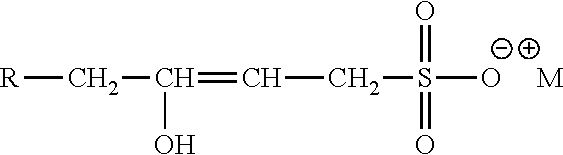
- where R═C4-C18 alkyl or mixtures thereof and M+=monovalent cation. Examples include Sodium C12-14 Olefin Sulfonate (R═C8-C10 alkyl, M+=Na+) and Sodium C 14-16 Olefin Sulfonate (R═C10-C12 alkyl, M+=Na+).
- Examples of additional anionic surfactants suitable for use herein include, but are not limited to, ammonium lauryl sulfate, ammonium laureth sulfate, triethylamine lauryl sulfate, triethylamine laureth sulfate, triethanolamine lauryl sulfate, triethanolamine laureth sulfate, monoethanolamine lauryl sulfate, monoethanolamine laureth sulfate, diethanolamine lauryl sulfate, diethanolamine laureth sulfate, lauric monoglyceride sodium sulfate, sodium lauryl sulfate, sodium laureth sulfate, potassium laureth sulfate, sodium lauryl sarcosinate, sodium lauroyl sarcosinate, lauryl sarcosine, cocoyl sarcosine, ammonium cocoyl sulfate, ammonium lauroyl sulfate, sodium cocoyl sulfate, sodium lauroyl sulfate, potassium cocoyl sulfate, potassium lauryl sulfate, monoethanolamine cocoyl sulfate, sodium trideceth sulfate, sodium tridecyl sulfate, sodium methyl lauroyl taurate, sodium methyl cocoyl taurate, sodium lauroyl isethionate, sodium cocoyl isethionate, sodium laurethsulfosuccinate, sodium laurylsulfosuccinate, sodium tridecyl benzene sulfonate, sodium dodecyl benzene sulfonate, and mixtures thereof.
- Additional anionic surfactants suitable for use herein include, but not limited to, acyl isethionate, acyl methyl isethionate, acyl glutamate, acyl glycinate, acyl sarcosinate, acyl alaninate, acyl taurate, sulfosuccinate, alkyl benzene sulfonate, alkyl ether carboxylate, alkylamphoacetate, alpha olefin sulfonate, and mixtures thereof. Examples of such suitable anionic surfactants include, but not limited to, sodium cocoyl isethionate, sodium lauroyl isethionate, sodium lauroyl methyl isethionate, sodium cocoyl glutamate, disodium cocoyl glutamate, sodium lauroyl glutamate, disodium lauroyl glutamate, sodium cocoyl alaninate, sodium lauroyl alaninate, sodium lauroyl glycinate, sodium cocoyl glycinate, sodium laureth sulfosuccinate, disodium laureth sulfosuccinate, sodium lauryl sulfosuccinate, disodium lauryl sulfosuccinate, sodium lauryl glucose carboxylate, sodium cocoyl glucose carboxylate, sodium cocoyl amphoacetate, sodium lauroyl amphoacetate, sodium methyl cocoyl taurate, and mixtures thereof.
- Suitable anionic surfactant can be surfactant with a tail having an alkyl chain with 8 carbon atoms or higher, include, but are not limited to the following surfactants: sodium trideceth sulfate, sodium tridecyl sulfate, sodium C8-13 alkyl sulfate, sodium C8-15 alkyl sulfate, sodium C8-18 alkyl sulfate, sodium C8-13 pareth sulfate, sodium C8-13 pareth-n sulfate, sodium C8-14 pareth-n sulfate, and combinations thereof. Other salts of all the aforementioned surfactants are useful, such as TEA, DEA, ammonia, potassium salts. Useful alkoxylates include the ethylene oxide, propylene oxide and EO/PO mixed alkoxylates. Phosphates, carboxylates and sulfonates prepared from branched alcohols are also useful anionic branched surfactants. Branched surfactants can be derived from synthetic alcohols such as the primary alcohols from the liquid hydrocarbons produced by Fischer-Tropsch condensed syngas, for example Safol™ 23 Alcohol available from Sasol North America, Houston, Tex.; from synthetic alcohols such as Neodol™ 23 Alcohol available from Shell Chemicals, USA; from synthetically made alcohols such as those described in U.S. Pat. No. 6,335,312 issued to Coffindaffer, et al on Jan. 1, 2002. Suitable examples of alcohols are Safol™ 23 and Neodol™ 23. Suitable examples of alkoxylated alcohols are Safol™ 23-3 and Neodol™ 23-3. Sulfates can be prepared by conventional processes to high purity from a sulfur based SO3 air stream process, chlorosulfonic acid process, sulfuric acid process, or Oleum process. Preparation via air stream in a falling film reactor is a suitable sulfation process. The anionic surfactant may also be STnS, wherein n can define average moles of ethoxylation. n can range from about 0 to about 3.5, from about 0.5 to about 3.5, from about 1.1 to about 3.5, from about 1.8 to about 3, or n can be about 2 or 3.
- The hair care composition comprises from about 0% to about 30%, from about 1% to about 23%, from about 2% to about 20%, from about 1% to about 20%, from about 1% to about 15%, from about 1% to about 10% by weight of one or more co-surfactants selected from the group consisting of amphoteric surfactant, zwitterionic surfactant, non-ionic surfactant and mixtures thereof.
- Zwitterionic surfactants suitable for use herein include, but are not limited to derivatives of aliphatic quaternary ammonium, phosphonium, and sulfonium compounds, in which the aliphatic radicals can be straight or branched chain, and wherein one of the aliphatic substituents contains from about 8 to about 18 carbon atoms and one substituent contains an anionic group, e.g., carboxy, sulfonate, sulfate, phosphate, or phosphonate. Other zwitterionic surfactants suitable for use herein include betaines, including high alkyl betaines such as coco dimethyl carboxymethyl betaine, cocoamidopropyl betaine, cocobetaine, lauryl amidopropyl betaine, oleyl betaine, lauryl dimethyl carboxymethyl betaine, lauryl dimethyl alphacarboxyethyl betaine, cetyl dimethyl carboxymethyl betaine, lauryl bis-(2-hydroxyethyl) carboxymethyl betaine, stearyl bis-(2-hydroxypropyl) carboxymethyl betaine, oleyl dimethyl gamma-carboxypropyl betaine, lauryl bis-(2-hydroxypropyl)alpha-carboxyethyl betaine, and mixtures thereof. The sulfobetaines may include coco dimethyl sulfopropyl betaine, stearyl dimethyl sulfopropyl betaine, lauryl dimethyl sulfoethyl betaine, lauryl bis-(2-hydroxyethyl) sulfopropyl betaine and mixtures thereof.
- The suitable co-surfactants for use herein include zwitterionic molecules which possess a hydroxyl group along with positive and negative charges within the same molecule.
- The suitable zwitterionic co-surfactants possess a hydroxyl group in their molecular structure are:
- Alkyl Hydroxysultains
-

-
- where R is alkyl group with C8 to C24 carbon chain (saturated or unsaturated) or mixture thereof. Examples include lauryl hydroxysultaine (where R is lauryl; C12H25) and coco-hydroxysultaine (where R is coco alkyl).
- Alkylamidoalkyl Hydroxysultaines:
-

-
- where RCO═C6-C24 acyl (saturated or unsaturated) or mixtures thereof. Examples include Cocamidopropyl Hydroxysultaine (RCO=coco acyl, x=3), Lauramidopropyl Hydroxysultaine (RCO=lauroyl, and x=3), Myristamidopropyl Hydroxysultaine (RCO=myristoyl, and x=3), and Oleamidopropyl Hydroxysultaine (RCO=oleoyl, and x=3).
- Alkyl Amphoacetates
-

-
- where R is alkyl group with C6 to C24 carbon chain (saturated or unsaturated) or mixtures thereof and M+ is monovalent cation. Examples include sodium lauroamphoacetate (where R is lauryl and M+ is Na+) and sodium cocoamphoacetate (where R is coco and M+ is Na+).
- Alkyl Amphopropionates
-

-
- where RCO═C6-C24 acyl (saturated or unsaturated) or mixtures thereof and M+=monovalent cation. Examples include Sodium Lauroamphopropionate (RCO=lauroyl and M+ =Na+) and Sodium Cocoamphopropionate (RCO=coco acyl and M+=Na+).
- Alkyl Amphohydroxypropylsulfonates:
-

- where RCO═C6-C24 acyl (saturated or unsaturated) or mixtures thereof and M+=monovalent cation, Examples include Sodium Lauroamphohydroxypropylsulfonate (RCO=lauroyl and M+=Na+) and Sodium Cocoamphohydroxypropylsulfonate (RCO=coco acyl and M+=Na+).
- Alkyl Phosphobetaines:
-
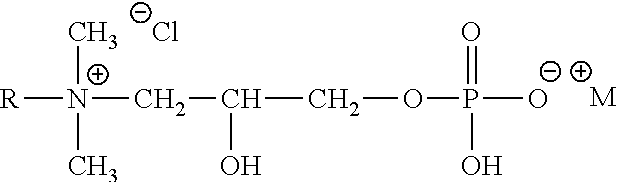
-
- where R═C6-C24 alkyl (saturated or unsaturated) or mixtures thereof and M+=monovalent cation, such as Sodium Coco PG-Dimonium Chloride Phosphate, where R=coco alkyl and M+=Na+
- Amphohydroxyalkylphosphates of the Formula:
-
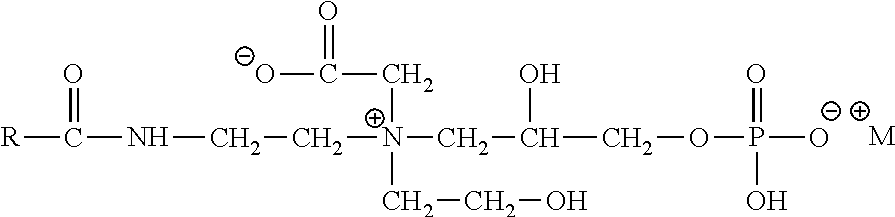
- The hair care composition can comprise an amphoteric detersive surfactant. Amphoteric detersive surfactants suitable for use in the hair care composition include those surfactants broadly described as derivatives of aliphatic secondary and tertiary amines in which the aliphatic radical can be straight or branched chain and wherein one of the aliphatic substituents contains from about 8 to about 18 carbon atoms and one contains an anionic group such as carboxy, sulfonate, sulfate, phosphate, or phosphonate. Exemplary amphoteric detersive surfactants for use in the present hair care composition include sodium cocoamphoacetate, sodium cocoamphodiacetate, sodium lauroamphoacetate, disodium lauroamphodiacetate, sodium cocaminopropionate, sodium cocaminodipropionate, sodium cocoamphohydroxypropylsulfonate, sodium cocoamphopropionate, sodium cornamphopropionate, sodium lauraminopropionate, sodium uroamphohydroxypropylsulfonate, sodium lauroamphopropionate, sodium cornamphopropionate, sodium lauriminodipropionate, ammonium cocaminopropionate, ammonium cocaminodipropionate, ammonium cocoamphoacetate, ammonium cocoamphohydroxypropylsulfonate, ammonium cocoamphopropionate, ammonium cornamphopropionate, ammonium lauraminopropionate, ammonium lauroamphoacetate, ammonium lauroamphohydroxypropylsulfonate, ammonium lauroamphopropionate, ammonium cornamphopropionate, ammonium lauriminodipropionate, triethanonlamine cocaminopropionate, triethanonlamine cocaminodipropionate, triethanonlamine cocoamphoacetate, triethanonlamine cocoamphohydroxypropylsulfonate, triethanonlamine cocoamphopropionate, triethanonlamine cornamphopropionate, triethanonlamine lauraminopropionate, triethanonlamine lauroamphoacetate, triethanonlamine lauroamphohydroxypropylsulfonate, triethanonlamine lauroamphopropionate, triethanonlamine cornamphopropionate, triethanonlamine lauriminodipropionate, cocoamphodipropionic acid, disodium caproamphodiacetate, disodium caproamphoadipropionate, disodium capryloamphodiacetate, disodium capryloamphodipriopionate, disodium cocoamphocarboxyethylhydroxypropylsulfonate cocoamphodiacetate, disodium cocoamphodipropionate, disodium dicarboxyethylcocopropylenediamine, disodium laureth-5 carboxyamphodiacetate, disodium lauriminodipropionate, disodium. lauroamphodipropionate, disodium oleoamphodipropionate, disodium PPG-2-isodecethyl-7 carboxyamphodiacetate, lauraminopropionic acid, lauroamphodipropionic acid, lauryl aminopropylglycine, lauryl diethylenediaminoglycine, and mixtures thereof. Also suitable amphoteric surfactants include amidobetaines and amidosulfobetaines, wherein the RCONH(CH2)3 radical, wherein R is a C11-C17 alkyl, is attached to the nitrogen atom of the betaine are also useful in this invention. The hair care composition can comprise from about 0% to about 15% by weight, from about 0.5% to about 12% by weight, from about 1% to about 12% by weight, from about 1% to about 8% by weight, and from about 2% to about 12% by weight from about 0% to about 10% by weight, from about 0.5% to about 10% by weight from about 1% to about 10% by weight and from about 2% to about 5% by weight of an non-ionic surfactant.
- Suitable non-ionic surfactants can be selected from the group consisting of: Cocamide, Cocamide Methyl MEA, Cocamide DEA, Cocamide MEA, Cocamide MIPA, Lauramide DEA, Lauramide MEA, Lauramide MIPA, Myrktamide DEA, Myristarnide MEA, PEG-20 Cocamide MEA, PEG-2 Cocamide, PEG-3 Cocamide, PEG-4 Cocamide, PEG-5 Cocamide, PEG-6 Cocamide, PEG-7 Cocamide, PEG-3 Lauramide, PEG-5 Lauramide, PEG-3 Oleamide, PPG-2 Cocamide, PPG-2 Hydroxyethyl Cocamide, and mixtures thereof.
- Suitable nonionic surfactants for use include those described in McCutcheon's Detergents and Emulsifiers, North American edition (1986), Allured Publishing Corp., and McCutcheon's Functional Materials, North American edition (1992). Suitable nonionic surfactants for use in the hair care compositions include, but are not limited to, polyoxyethylenated alkyl phenols, polyoxyethylenated alcohols, polyoxyethylenated polyoxypropylene glycols, glyceryl esters of alkanoic acids, polyglyceryl esters of alkanoic acids, propylene glycol esters of alkanoic acids, sorbitol esters of alkanoic acids, polyoxyethylenated sorbitor esters of alkanoic acids, polyoxyethylene glycol esters of alkanoic acids, polyoxyethylenated alkanoic acids, alkanolamides, N-alkylpyrrolidones, alkyl glycosides, alkyl polyglucosides, alkylamine oxides, and polyoxyethylenated silicones.
- Representative polyoxyethylenated alcohols include alkyl chains ranging in the C9-C16 range and having from about 1 to about 110 alkoxy groups including, but not limited to, laureth-3, laureth-23, ceteth-10, steareth-10, steareth-100, beheneth-10, and commercially available from Shell Chemicals, Houston, Tex. under the trade names Neodol® 91, Neodol® 23, Neodol® 25, Neodol® 45, Neodol® 135, Neodo®1 67, Neodol® PC 100, Neodol® PC 200, Neodol® PC 600, and mixtures thereof.
- Also available commercially are the polyoxyethylene fatty ethers available commercially under the Brij® trade name from Uniqema, Wilmington, Del., including, but not limited to, Brij® 30, Brij® 35, Brij® 52, Brij® 56, Brij® 58, Brij® 72, Brij® 76, Brij® 78, Brij® 93, Brij® 97, Brij® 98, Brij® 721 and mixtures thereof.
- Suitable alkyl glycosides and alkyl polyglucosides can be represented by the formula (S)n-O—R wherein S is a sugar moiety such as glucose, fructose, mannose, galactose, and the like; n is an integer of from about 1 to about 1000, and R is a C8-C30 alkyl group. Examples of long chain alcohols from which the alkyl group can be derived include decyl alcohol, lauryl alcohol, myristyl alcohol, cetyl alcohol, stearyl alcohol, oleyl alcohol, and the like. Examples of these surfactants include alkyl polyglucosides wherein S is a glucose moiety, R is a C8-20 alkyl group, and n is an integer of from about 1 to about 9. Commercially available examples of these surfactants include decyl polyglucoside and lauryl polyglucoside available under trade names APG® 325 CS, APG® 600 CS and APG® 625 CS) from Cognis, Ambler, Pa. Also useful herein are sucrose ester surfactants such as sucrose cocoate and sucrose laurate and alkyl polyglucosides available under trade names Triton™ BG-10 and Triton™ CG-110 from The Dow Chemical Company, Houston, Tex.
- Other nonionic surfactants suitable for use are glyceryl esters and polyglyceryl esters, including but not limited to, glyceryl monoesters, glyceryl monoesters of C12-22 saturated, unsaturated and branched chain fatty acids such as glyceryl oleate, glyceryl monostearate, glyceryl monopalmitate, glyceryl monobehenate, and mixtures thereof, and polyglyceryl esters of C12-22 saturated, unsaturated and branched chain fatty acids, such as polyglyceryl-4 isostearate, polyglyceryl-3 oleate, polyglyceryl-2-sesquioleate, triglyceryl diisostearate, diglyceryl monooleate, tetraglyceryl monooleate, and mixtures thereof.
- Also useful herein as nonionic surfactants are sorbitan esters. Sorbitan esters of C12-22 saturated, unsaturated, and branched chain fatty acids are useful herein. These sorbitan esters usually comprise mixtures of mono-, di-, tri-, etc. esters. Representative examples of suitable sorbitan esters include sorbitan monolaurate (SPAN® 20), sorbitan monopalmitate (SPAN® 40), sorbitan monostearate (SPAN® 60), sorbitan tristearate (SPAN® 65), sorbitan monooleate (SPAN® 80), sorbitan trioleate (SPAN® 85), and sorbitan isostearate.
- Also suitable for use herein are alkoxylated derivatives of sorbitan esters including, but not limited to, polyoxyethylene (20) sorbitan monolaurate (Tween® 20), polyoxyethylene (20) sorbitan monopalmitate (Tween® 40), polyoxyethylene (20) sorbitan monostearate (Tween® 60), polyoxyethylene (20) sorbitan monooleate (Tween® 80), polyoxyethylene (4) sorbitan monolaurate (Tween® 21), polyoxyethylene (4) sorbitan monostearate (Tween® 61), polyoxyethylene (5) sorbitan monooleate (Tween® 81), and mixtures thereof, all available from Uniqema.
- Also suitable for use herein are alkylphenol ethoxylates including, but not limited to, nonylphenol ethoxylates (Tergitol™ NP-4, NP-6, NP-7, NP-8, NP-9, NP-10, NP-11, NP-12, NP-13, NP-15, NP-30, NP-40, NP-50, NP-55, NP-70 available from The Dow Chemical Company, Houston, Tex.) and octylphenol ethoxylates (Triton™ X-15, X-35, X-45, X-114, X-100, X-102, X-165, X-305, X-405, X-705 available from The Dow Chemical Company, Houston, Tex.).
- Also suitable for use herein are alkanolamides including cocamide monoethanolamine (CMEA) and tertiary alkylamine oxides including lauramine oxide and cocamine oxide.
- Nonionic surfactants useful herein have an HLB (hydrophile-lipophile balance) of at least 8, in one embodiment greater than 10, and in another embodiment greater than 12. The HLB represents the balance between the hydrophilic and lipophilic moieties in a surfactant molecule and is commonly used as a method of classification. The HLB values for commonly-used surfactants are readily available in the literature (e.g., HLB Index in McCutcheon's Emulsifiers and Detergents, MC Publishing Co., 2004).
- Non limiting examples of other anionic, zwitterionic, amphoteric, and non-ionic additional surfactants suitable for use in the hair care composition are described in McCutcheon's, Emulsifiers and Detergents, 1989 Annual, published by M. C. Publishing Co., and U.S. Pat. Nos. 3,929,678, 2,658,072; 2,438,091; 2,528,378, which are incorporated herein by reference in their entirety.
- B. Soluble Salts
- The hair care composition comprises from about 1 wt % to about 4.75 wt % of a soluble salt, alternatively from about 1.5 wt % to about 4.5 wt %, alternatively from about 1.2 wt % to about 4 wt %, and alternatively from about 1.75 wt % to about 3.5 wt %.
- The soluble salts that can be used may contain cations such as calcium, magnesium, potassium, sodium, lithium, ammonium, and tetraethyl ammonium (TEA). Examples of such salts include chlorides and bromides of calcium, potassium, sodium, lithium, ammonium, and TEA.
- The soluble salt may be an inorganic salt. Nonlimiting examples of suitable inorganic salts include Mg12, MgBr2, MgC12, Mg(NO3)2, Mg3(PO4)2, Mg2(P2O7), MgSO4, magnesium silicate, Na1, NaBr, NaCl, NaF, Na3(PO4), NaSO3, Na2SO4, Na2SO3, NaNO3, NaIO3, Na3(PO4), Na4(P2O7), sodium silicate, sodium metasilicate, sodium tetrachloroaluminate, sodium tripolyphosphate (STPP), Na2Si3O7, sodium zirconate, CaF2, CaC12, CaBr2, Ca12, CaS04, Ca(NO3)2, KI, KBr, KCl, KF, KNO3, KIO3, K2SO4, K2SO3, K3(PO4), K4(P2O7), potassium pyrosulfate, potassium pyrosulfite, Li1, LiBr, LiCl, LiF, LiNO3, AlF3, AlC13, AlBr3, AlI3, Al2(S5O4) 3, Al(PO4), Al(NO3) 3, aluminum silicate; including hydrates of these salts and including combinations of these salts or salts with mixed cations, e.g. potassium alum AlK(SO4)2 and salts with mixed anions, e.g. potassium tetrachloroaluminate and sodium tetrafluoroaluminate. Mixtures of above salts are also useful.
- Soluble organic salts can also be used. Organic salts useful in this invention include, magnesium, sodium, lithium, potassium, zinc, and aluminum salts of the carboxylic acids including formate, acetate, proprionate, pelargonate, citrate, gluconate, lactate aromatic acids, e.g., benzoates, phenolate and substituted benzoates or phenolates, such as phenolate, salicylate, polyaromatic acids terephthalates, and polyacids, e.g., oxylate, adipate, succinate, benzenedicarboxylate, benzenetricarboxylate. Other useful organic salts include carbonate and/or hydrogencarbonate (HCO3 −1) when the pH is suitable, alkyl and aromatic sulfates and sulfonates, e.g., sodium methyl sulfate, benzene sulfonates and derivatives such as xylene sulfonate, and amino acids when the pH is suitable. Mixed salts of the above can be used, that is salts neutralized with mixed cations such as potassium/sodium tartrate, partially neutralized salts such as sodium hydrogen tartrate or potassium hydrogen phthalate, and salts comprising one cation with mixed anions.
- C. Aqueous Carrier
- The compositions can include from about 45% to about 76% by weight, from about 50% to about 75%, from about 55% to about 70% water, from about 60% to about 68% by weight of water.
- D. Water Miscible Solvent and Hydrotrope
- The hair care composition may comprise a water-miscible solvent, a hydrotrope or a combination thereof. The content of the water-miscible solvent is from about 0 wt % to about 50 wt %, 0 wt % to about 45 wt %, 0 wt % to about 40 wt %, 0 wt % to about 35 wt %, 0 wt % to about 30 wt %, 0 wt % to about 25 wt %, 0 wt % to about 20 wt %, 0 wt % to about 15 wt %, 0 wt % to about 10 wt %, 1 wt % to about 15 wt %, 1 wt % to about 10 wt %, 1 wt % to about 8 wt %, from about 0.01 wt % to about 6 wt %, from about 2 wt % to about 6 wt %, from about 2 wt % to about 6 wt %. Suitable water miscible solvents include, but are not limited to, dipropylene glycol, tripropylene glycol, diethylene glycol, ethylene glycol, propylene glycol, glycerin, 1,3-propane diol, 2,2-propanediol, 1,2-butanediol, 1,3-butanediol, 1,4-butanediol, 2,3-butanediol, 2-methyl-2,4-pentanediol, and mixtures thereof. The hair care composition may comprise two or more water miscible solvents, wherein at least one of the solvents is dipropylene glycol.
- The hair care composition may comprise one or more hydrotrope. The content of the hydrotrope is from about 0 wt % to about 6 wt %, from about 0.01 wt % to about 5 wt %, from about 1 wt % to about 4 wt %, from about 1 wt % to about 3 wt %.
- The hair care composition may comprise one or more hydrotrope. The content of the hydrotrope is from about 0 wt % to about 6 wt %, from about 0.01 wt % to about 5 wt %, from about 1 wt % to about 4 wt %, from about 1 wt % to about 3 wt %. Suitable hydrotrope classes include C6-C12 aliphatic alcohols, lower alkylaryl sulphonates, naphthalene sulfonates, benzene sulfonates, urea and derivatives, C1-C6 carboxylic sulfates, C1-C6 carboxylic sulfonates, C1-C6 hydrocarboxylates, C2-C4 organic diacids, short chain alkyl sulphate and mixtures thereof. Nonlimiting examples of hydrotropes include sodium xylene sulphonate, ammonium xylene sulfonate, potassium xylene sulfonate, calcium xylene sulfonate, sodium cumene sulphonate, ammonium cumene sulfonate, potassium cumene sulfonate, calcium cumene sulfonate, sodium toluene sulfonate, ammonium toluene sulfonate, potassium toluene sulfonate, calcium toluene sulfonate, sodium naphthalene sulfonate, ammonium naphthalene sulfonate, potassium naphthalene sulfonate, calcium naphthalene sulfonate, sodium benzene sulphonate, ammonium benzene sulphonate, potassium benzene sulphonate , calcium benzene sulphonate, succinic acid and its sodium, potassium, and ammonium salts, glutaric acid and its sodium, potassium, and axnrnoniurn salts, adipic acid and its sodium, potassium, and ammonium salts, citric acid and its sodium, potassium, and ammonium salts, acetic acid and its sodium, potassium, and ammonium salts, propionic acid arid its sodium, potassium, and ammonium salts, sulfosuccinate sodium, potassium, and ammonium salts, sulfophthalate sodium, potassium, and ammonium salts, sulfoacetate sodium, potassium, and ammonium salts, m-sulfobenzoate sodium, potassium, and ammonium salts, diester sulfosuccinate sodium, potassium, and ammonium salts, urea, methanol, ethanol, propanol, butanol and mixtures thereof. Suitable hydrotropes include sodium xylene sulphonate, ammonium xylene sulfonate, and potassium xylene sulfonate.
- The hair care compositions may have a pH in the range from about 2 to about 10, at 25° C. Alternatively, the hair care composition has a pH in the range from about −4 to about 7, which may help to solubilize minerals and redox metals already deposited on the hair. Thus, the hair care composition can also be effective toward washing out the existing minerals and redox metals deposits, which can reduce cuticle distortion and thereby reduce cuticle chipping and damage.
- E. Cationic Polymers
- The hair care composition can also comprise a cationic polymer. These cationic polymers can include at least one of (a) a cationic guar polymer, (b) a cationic non-guar galactomannan polymer, (c) a cationic tapioca polymer, (d) a cationic copolymer of acrylamide monomers and cationic monomers, and/or (e) a synthetic, non-crosslinked, cationic polymer, which may or may not form lyotropic liquid crystals upon combination with the detersive surfactant (f) a cationic cellulose polymer. Additionally, the cationic polymer can be a mixture of cationic polymers.
- The hair care composition may comprise a cationic guar polymer, which is a cationically substituted galactomannan (guar) gum derivatives. Guar gum for use in preparing these guar gum derivatives is typically obtained as a naturally occurring material from the seeds of the guar plant. The guar molecule itself is a straight chain mannan, which is branched at regular intervals with single membered galactose units on alternative mannose units. The mannose units are linked to each other by means of β(1-4) glycosidic linkages. The galactose branching arises by way of an α(1-6) linkage. Cationic derivatives of the guar gums are obtained by reaction between the hydroxyl groups of the polygalactomannan and reactive quaternary ammonium compounds. The degree of substitution of the cationic groups onto the guar structure should be sufficient to provide the requisite cationic charge density described above.
- The cationic polymer, can include, but not limited, to a cationic guar polymer, has a weight average molecular weight of less than 2.0 million g/mol, or from about 10 thousand to about 2 million g/mol, or from about 50 thousand to about 2 million g/mol, or from about 100 thousand to about 2 million g/mol, or from about 10 thousand to about 1 million g/mol, or from about 25 thousand to about 1 million g/mol, or from about 50 thousand to about 1 million g/mol, or from about 100 thousand to about 1 million g/mol. The cationic guar polymer can have a charge density of from about 0.2 to about 2.2 meq/g, or from about 0.3 to about 2.0 meq/g, or from about 0.4 to about 1.8 meq/g; or from about 0.5 meq/g to about 1.7 meq/g.
- The cationic guar polymer can have a weight average molecular weight of less than about 1.0 million g/mol, and has a charge density of from about 0.1 meq/g to about 2.5 meq/g. In an embodiment, the cationic guar polymer has a weight average molecular weight of less than 950 thousand g/mol, or from about 10 thousand to about 900 thousand g/mol, or from about 25 thousand to about 900 thousand g/mol, or from about 50 thousand to about 900 thousand g/mol, or from about 100 thousand to about 900 thousand g/mol, from about 150 thousand to about 800 thousand g/mol. The cationic guar polymer can have a charge density of from about 0.2 to about 2.2 meq/g, or from about 0.3 to about 2.0 meq/g, or from about 0.4 to about 1.8 meq/g; or from about 0.5 meq/g to about 1.5 meq/g. The hair care composition can comprise from about from about 0.05% to about 2%, from about 0.05% to about 1.8%, from about 0.05% to about 1.5%, from about 0.05% to about 1.2%, from about 0.05% to about 1%, from about 0.05% to about 0.9%, from about 0.1% to about 0.8%, or from about 0.2% to about 0.7% of cationic polymer (a), by total weight of the composition.
- The cationic guar polymer may be formed from quaternary ammonium compounds. The quaternary ammonium compounds for forming the cationic guar polymer can conform to the general formula 1:
-

- wherein where R3, R4 and R5 are methyl or ethyl groups; R6 is either an epoxyalkyl group of the general formula 2:
-

- or R6 is a halohydrin group of the general formula 3:
-

- wherein R7 is a C1 to C3 alkylene; X is chlorine or bromine, and Z is an anion such as Cl—, Br—, I— or HSO4—.
- The cationic guar polymer can conform to the general formula 4:
-

- wherein R8 is guar gum; and wherein R4, R5, R6 and R7 are as defined above; and wherein Z is a halogen. The cationic guar polymer can conform to Formula 5:
-

- Suitable cationic guar polymers include cationic guar gum derivatives, such as guar hydroxypropyltrimonium chloride. The cationic guar polymer can be a guar hydroxypropyltrimonium chloride. Specific examples of guar hydroxypropyltrimonium chlorides include the Jaguar® series commercially available from Rhone-Poulenc Incorporated, for example Jaguar® C-500, commercially available from Rhodia. Jaguar® C-500 has a charge density of 0.8 meq/g and a weight average molecular weight of 500,000 g/mol. Other suitable guar hydroxypropyltrimonium chloride are: guar hydroxypropyltrimonium chloride which has a charge density of about 1.1 meq/g and a weight average molecular weight of about 500,000 g/mol is available from ASI, a charge density of about 1.5 meq/g and a weight average molecular weight of about 500,000 g/mole is available from ASI. Other suitable guar hydroxypropyltrimonium chloride are: Hi-Care 1000, which has a charge density of about 0.7 meq/g and a Weight average molecular weight of about 600,000 g/mole and is available from Rhodia; N-Hance 3269 and N-Hance 3270, which has a charge density of about 0.7 meq/g and a weight average molecular weight of about 425,000 g/mol and is available from ASI, N-Hance 3271 which has a charge density of about 0.7 meq/g and a weight average molecular weight of about 500,000 g/mol and is available from Ashland; AquaCat CG518 has a charge density of about 0.9 meq/g and a Weight average molecular weight of about 50,000 g/mol and is available from ASI. BF-13, which is a borate (boron) free guar of charge density of about 1.1 meq/g and weight average molecular weight of about 800,000 and BF-17, which is a borate (boron) free guar of charge density of about 1.7 meq/g and M. W.t of about 800,000 both available from ASI.
- Other suitable guar hydroxypropyltrimonium chloride are: N-Hance CG17 has a charge density of about 1.0 meq/g and a weight average molecular weight of about 1,600,000 g/mol and is available from Ashland; and N-Hance 3196 has a charge density of about 0.7 meq/g and a weight average molecular weight of 1,700,000 g/mol and is available from Ashland.
- The hair care compositions may comprise a galactomannan polymer derivative having a mannose to galactose ratio of greater than 2:1 on a monomer to monomer basis, the galactomannan polymer derivative selected from the group consisting of a cationic galactomannan polymer derivative and an amphoteric galactomannan polymer derivative having a net positive charge. As used herein, the term “cationic galactomannan” refers to a galactomannan polymer to which a cationic group is added. The term “amphoteric galactomannan” refers to a galactomannan polymer to which a cationic group and an anionic group are added such that the polymer has a net positive charge.
- Galactomannan polymers are present in the endosperm of seeds of the Leguminosae family. Galactomannan polymers are made up of a combination of mannose monomers and galactose monomers. The galactomannan molecule is a straight chain mannan branched at regular intervals with single membered galactose units on specific mannose units. The mannose units are linked to each other by means of β(1-4) glycosidic linkages. The galactose branching arises by way of an α (1-6) linkage. The ratio of mannose monomers to galactose monomers varies according to the species of the plant and also is affected by climate. Non Guar Galactomannan polymer derivatives suitable for use can have a ratio of mannose to galactose of greater than 2:1 on a monomer to monomer basis. Suitable ratios of mannose to galactose can be greater than about 3:1, and the ratio of mannose to galactose can be greater than about 4:1. Analysis of mannose to galactose ratios is well known in the art and is typically based on the measurement of the galactose content.
- The gum for use in preparing the non-guar galactomannan polymer derivatives is typically obtained as naturally occurring material such as seeds or beans from plants. Examples of various non-guar galactomannan polymers include but are not limited to Tara gum (3 parts mannose/1 part galactose), Locust bean or Carob (4 parts mannose/1 part galactose), and Cassia gum (5 parts mannose/1 part galactose).
- The non-guar galactomannan polymer derivatives can have a M. Wt. from about 1,000 to about 1,000,000, and/or form about 5,000 to about 900,000.
- The hair care compositions of the can also include galactomannan polymer derivatives which have a cationic charge density from about 0.5 meq/g to about 7 meq/g., The galactomannan polymer derivatives can have a cationic charge density from about 1 meq/g to about 5 meq/g. The degree of substitution of the cationic groups onto the galactomannan structure should be sufficient to provide the requisite cationic charge density.
- The galactomannan polymer derivative can be a cationic derivative of the non-guar galactomannan polymer, which is obtained by reaction between the hydroxyl groups of the polygalactomannan polymer and reactive quaternary ammonium compounds. Suitable quaternary ammonium compounds for use in forming the cationic galactomannan polymer derivatives include those conforming to the general formulas 1-5, as defined above.
- Cationic non-guar galactomannan polymer derivatives formed from the reagents described above are represented by the general formula 6:
-

- wherein R is the gum. The cationic galactomannan derivative can be a gum hydroxypropyltrimethylammonium chloride, which can be more specifically represented by the general formula 7:
-

- Alternatively the galactomannan polymer derivative can be an amphoteric galactomannan polymer derivative having a net positive charge, obtained when the cationic galactomannan polymer derivative further comprises an anionic group.
- The cationic non-guar galactomannan can have a ratio of mannose to galactose is greater than about 4:1, a weight average molecular weight of about 50,000 g/mol to about 1,000,000 g/mol, and/or from about 100,000 g/mol to about 900,000 g/mol and a cationic charge density from about 1 meq/g to about 5 meq/g, and/or from 2 meq/g to about 4 meq/g and can also be derived from a cassia plant.
- The hair care compositions can comprise at least about 0.05% of a galactomannan polymer derivative by weight of the composition, alternatively from about 0.05% to about 2%, by weight of the composition, of a galactomannan polymer derivative.
- The hair care compositions can comprise water-soluble cationically modified starch polymers. As used herein, the term “cationically modified starch” refers to a starch to which a cationic group is added prior to degradation of the starch to a smaller molecular weight, or wherein a cationic group is added after modification of the starch to achieve a desired molecular weight.
- The definition of the term “cationically modified starch” also includes amphoterically modified starch. The term “amphoterically modified starch” refers to a starch hydrolysate to which a cationic group and an anionic group are added.
- The hair care compositions can comprise cationically modified starch polymers at a range of about 0.01% to about 10%, and/or from about 0.05% to about 5%, by weight of the composition.
- The cationically modified starch polymers disclosed herein have a percent of bound nitrogen of from about 0.5% to about 4%.
- The cationically modified starch polymers for use in the hair care compositions can have a weight average molecular weight about 50,000 g/mol to about 1,000,000 g/mol and/or from about 100,000 g/mol to about 1,000,000 g/mol.
- The hair care compositions can include cationically modified starch polymers which have a charge density of from about 0.2 meq/g to about 5 meq/g, and/or from about 0.2 meq/g to about 2 meq/g. The chemical modification to obtain such a charge density includes, but is not limited to, the addition of amino and/or ammonium groups into the starch molecules. Non-limiting examples of these ammonium groups may include substituents such as hydroxypropyl trimmonium chloride, trimethylhydroxypropyl ammonium chloride, dimethylstearylhydroxypropyl ammonium chloride, and dimethyldodecylhydroxypropyl ammonium chloride. See Solarek, D. B., Cationic Starches in Modified Starches: Properties and Uses, Wurzburg, O. B., Ed., CRC Press, Inc., Boca Raton, Fla. 1986, pp 113-125. The cationic groups may be added to the starch prior to degradation to a smaller molecular weight or the cationic groups may be added after such modification.
- The cationically modified starch polymers generally have a degree of substitution of a cationic group from about 0.2 to about 2.5. As used herein, the “degree of substitution” of the cationically modified starch polymers is an average measure of the number of hydroxyl groups on each anhydroglucose unit which is derivatized by substituent groups. Since each anhydroglucose unit has three potential hydroxyl groups available for substitution, the maximum possible degree of substitution is 3. The degree of substitution is expressed as the number of moles of substituent groups per mole of anhydroglucose unit, on a molar average basis. The degree of substitution may be determined using proton nuclear magnetic resonance spectroscopy (“.sup.1H NMR”) methods well known in the art. Suitable .sup.1H NMR techniques include those described in “Observation on NMR Spectra of Starches in Dimethyl Sulfoxide, Iodine-Complexing, and Solvating in Water-Dimethyl Sulfoxide”, Qin-Ji Peng and Arthur S. Perlin, Carbohydrate Research, 160 (1987), 57-72; and “An Approach to the Structural Analysis of Oligosaccharides by NMR Spectroscopy”, J. Howard Bradbury and J. Grant Collins, Carbohydrate Research, 71, (1979), 15-25.
- The source of starch before chemical modification can be chosen from a variety of sources such as tubers, legumes, cereal, and grains. Non-limiting examples of this source starch may include corn starch, wheat starch, rice starch, waxy corn starch, oat starch, cassaya starch, waxy barley, waxy rice starch, glutenous rice starch, sweet rice starch, amioca, potato starch, tapioca starch, oat starch, sago starch, sweet rice, or mixtures thereof.
- The cationically modified starch polymers can be selected from degraded cationic maize starch, cationic tapioca, cationic potato starch, and mixtures thereof. Alternatively, the cationically modified starch polymers are cationic corn starch and cationic tapioca.
- The starch, prior to degradation or after modification to a smaller molecular weight, may comprise one or more additional modifications. For example, these modifications may include cross-linking, stabilization reactions, phosphorylations, and hydrolyzations. Stabilization reactions may include alkylation and esterification.
- The cationically modified starch polymers may be incorporated into the composition in the form of hydrolyzed starch (e.g., acid, enzyme, or alkaline degradation), oxidized starch (e.g., peroxide, peracid, hypochlorite, alkaline, or any other oxidizing agent), physically/mechanically degraded starch (e.g., via the thermo-mechanical energy input of the processing equipment), or combinations thereof.
- An optimal form of the starch is one which is readily soluble in water and forms a substantially clear (% Transmittance.gtoreq.80 at 600 nm) solution in water. The transparency of the composition is measured by Ultra-Violet/Visible (UV/VIS) spectrophotometry, which determines the absorption or transmission of UV/VIS light by a sample, using a Gretag Macbeth Colorimeter Color i 5 according to the related instructions. A light wavelength of 600 nm has been shown to be adequate for characterizing the degree of clarity of cosmetic compositions.
- Suitable cationically modified starch for use in hair care compositions are available from known starch suppliers. Also suitable for use in hair care compositions are nonionic modified starch that can be further derivatized to a cationically modified starch as is known in the art. Other suitable modified starch starting materials may be quaternized, as is known in the art, to produce the cationically modified starch polymer suitable for use in hair care compositions.
- Starch Degradation Procedure: a starch slurry can be prepared by mixing granular starch in water. The temperature is raised to about 35° C. An aqueous solution of potassium permanganate is then added at a concentration of about 50 ppm based on starch. The pH is raised to about 11.5 with sodium hydroxide and the slurry is stirred sufficiently to prevent settling of the starch. Then, about a 30% solution of hydrogen peroxide diluted in water is added to a level of about 1% of peroxide based on starch. The pH of about 11.5 is then restored by adding additional sodium hydroxide. The reaction is completed over about a 1 to about 20 hour period. The mixture is then neutralized with dilute hydrochloric acid. The degraded starch is recovered by filtration followed by washing and drying.
- The hair care composition can comprise a cationic copolymer of an acrylamide monomer and a cationic monomer, wherein the copolymer has a charge density of from about 1.0 meq/g to about 3.0 meq/g. The cationic copolymer can be a synthetic cationic copolymer of acrylamide monomers and cationic monomers.
- The cationic copolymer can comprise:
-
- (i) an acrylamide monomer of the following Formula AM:
-
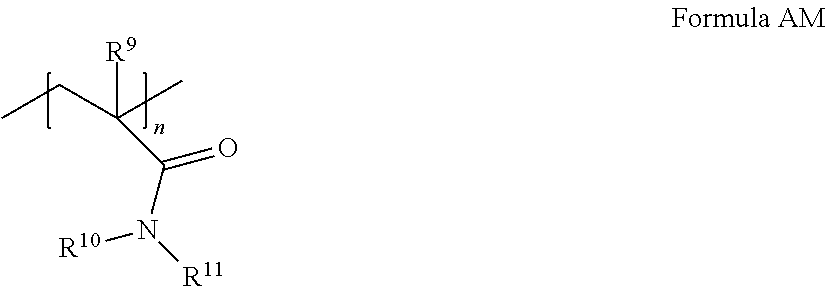
-
- where R9 is H or C1-4 alkyl; and R10 and R11 are independently selected from the group consisting of H, C1-4 alkyl, CH2OCH3, CH2OCH2CH(CH3)2, and phenyl, or together are C3-6cycloalkyl; and
- (ii) a cationic monomer conforming to Formula CM:
-

- where k=1, each of v, v′, and v″ is independently an integer of from 1 to 6, w is zero or an integer of from 1 to 10, and X− is an anion.
- The cationic monomer can conform to Formula CM and where k=1, v=3 and w=0, z=1 and X− is Cl− to form the following structure:
-

- The above structure may be referred to as diquat. Alternatively, the cationic monomer can conform to Formula CM and wherein v and v″ are each 3, v′=1, w=1, y=1 and X− is Cl−, such as:
-

- The above structure may be referred to as triquat.
- Suitable acrylamide monomer include, but are not limited to, either acrylamide or methacrylamide.
- The cationic copolymer can be of an acrylamide monomer and a cationic monomer, wherein the cationic monomer is selected from the group consisting of: dimethylaminoethyl (meth)acrylate, dimethylaminopropyl (meth)acrylate, ditertiobutylaminoethyl (meth)acrylate, dimethylaminomethyl (meth)acrylamide, dimethylaminopropyl (meth)acrylamide; ethylenimine, vinylamine, 2-vinylpyridine, 4-vinylpyridine; trimethylammonium ethyl (meth)acrylate chloride, trimethylammonium ethyl (meth)acrylate methyl sulphate, dimethylammonium ethyl (meth)acrylate benzyl chloride, 4-benzoylbenzyl dimethylammonium ethyl acrylate chloride, trimethyl ammonium ethyl (meth)acrylamido chloride, trimethyl ammonium propyl (meth)acrylamido chloride, vinylbenzyl trimethyl ammonium chloride, diallyldimethyl ammonium chloride, and mixtures thereof.
- The cationic copolymer can comprise a cationic monomer selected from the group consisting of: cationic monomers include trimethylammonium ethyl (meth)acrylate chloride, trimethylammonium ethyl (meth)acrylate methyl sulphate, dimethylammonium ethyl (meth)acrylate benzyl chloride, 4-benzoylbenzyl dimethylammonium ethyl acrylate chloride, trimethyl ammonium ethyl (meth)acrylamido chloride, trimethyl ammonium propyl (meth)acrylamido chloride, vinylbenzyl trimethyl ammonium chloride, and mixtures thereof.
- The cationic copolymer can be water-soluble. The cationic copolymer is formed from (1) copolymers of (meth)acrylamide and cationic monomers based on (meth)acrylamide, and/or hydrolysis-stable cationic monomers, (2) terpolymers of (meth)acrylamide, monomers based on cationic (meth)acrylic acid esters, and monomers based on (meth)acrylamide, and/or hydrolysis-stable cationic monomers. Monomers based on cationic (meth)acrylic acid esters may be cationized esters of the (meth)acrylic acid containing a quaternized N atom. The cationized esters of the (meth)acrylic acid containing a quaternized N atom can be quaternized dialkylaminoalkyl (meth)acrylates with C1 to C3 in the alkyl and alkylene groups. Suitable cationized esters of the (meth)acrylic acid containing a quaternized N atom can be selected from the group consisting of: ammonium salts of dimethylaminomethyl (meth)acrylate, dimethylaminoethyl (meth)acrylate, dimethylaminopropyl (meth)acrylate, diethylaminomethyl (meth)acrylate, diethylaminoethyl (meth)acrylate; and diethylaminopropyl (meth)acrylate quaternized with methyl chloride. The cationized esters of the (meth)acrylic acid containing a quaternized N atom can be dimethylaminoethyl acrylate, which is quaternized with an alkyl halide, or with methyl chloride or benzyl chloride or dimethyl sulfate (ADAME-Quat). The cationic monomer when based on (meth)acrylamides can be quaternized dialkylaminoalkyl(meth)acrylamides with C1 to C3 in the alkyl and alkylene groups, or dimethylaminopropylacrylamide, which is quaternized with an alkyl halide, or methyl chloride or benzyl chloride or dimethyl sulfate.
- Suitable cationic monomer based on a (meth)acrylamide include quaternized dialkylaminoalkyl(meth)acrylamide with C1 to C3 in the alkyl and alkylene groups. The cationic monomer based on a (meth)acrylamide can be dimethylaminopropylacrylamide, which is quaternized with an alkyl halide, especially methyl chloride or benzyl chloride or dimethyl sulfate.
- The cationic monomer can be a hydrolysis-stable cationic monomer. Hydrolysis-stable cationic monomers can be, in addition to a dialkylaminoalkyl(meth)acrylamide, all monomers that can be regarded as stable to the OECD hydrolysis test. The cationic monomer can be hydrolysis-stable and the hydrolysis-stable cationic monomer can be selected from the group consisting of: diallyldimethylammonium chloride and water-soluble, cationic styrene derivatives.
- The cationic copolymer can be a terpolymer of acrylamide, 2-dimethylammoniumethyl (meth)acrylate quaternized with methyl chloride (ADAME-Q) and 3-dimethylammoniumpropyl(meth)acrylamide quaternized with methyl chloride (DIMAPA-Q). The cationic copolymer can be formed from acrylamide and acrylamidopropyltrimethylammonium chloride, wherein the acrylamidopropyltrimethylammonium chloride has a charge density of from about 1.0 meq/g to about 3.0 meq/g.
- The cationic copolymer can have a charge density of from about 1.1 meq/g to about 2.5 meq/g, or from about 1.1 meq/g to about 2.3 meq/g, or from about 1.2 meq/g to about 2.2 meq/g, or from about 1.2 meq/g to about 2.1 meq/g, or from about 1.3 meq/g to about 2.0 meq/g, or from about 1.3 meq/g to about 1.9 meq/g.
- The cationic copolymer can have a weight average molecular weight from about 10 thousand g/mol to about 1 million g/mol, or from about 25 thousand g/mol to about 1 million g/mol, or from about 50 thousand g/mol to about 1 million g/mol, or from about 100 thousand g/mol to about 1.0 million g/mol, or from about 150 thousand g/mol to about 1.0 million g/mol.
- The hair care composition can comprise a cationic synthetic polymer that may be formed from
- i) one or more cationic monomer units, and optionally
- ii) one or more monomer units bearing a negative charge, and/or
- iii) a nonionic monomer,
- wherein the subsequent charge of the copolymer is positive. The ratio of the three types of monomers is given by “m”, “p” and “q” where “m” is the number of cationic monomers, “p” is the number of monomers bearing a negative charge and “q” is the number of nonionic monomers
- The cationic polymers can be water soluble or dispersible, non-crosslinked, and synthetic cationic polymers having the following structure:
-
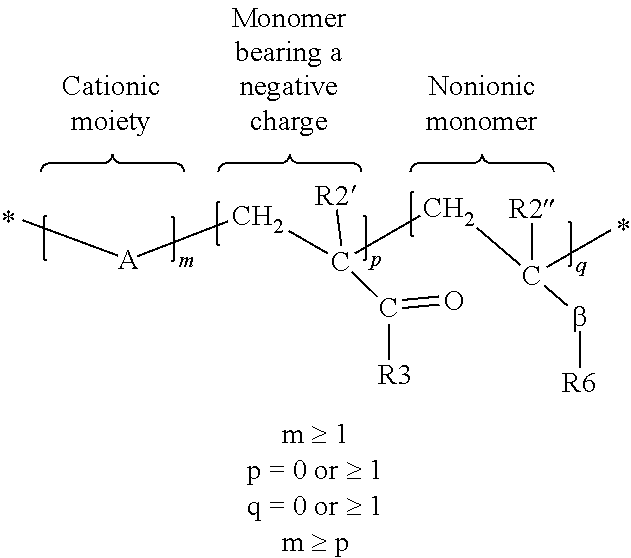
- where A, may be one or more of the following cationic moieties:
-
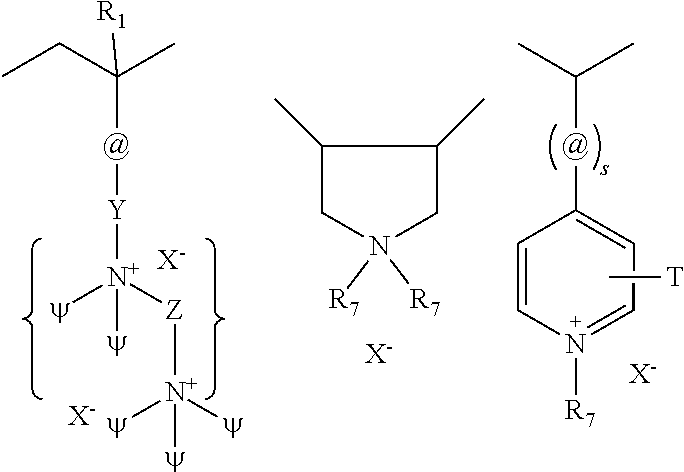
- where @=amido, alkylamido, ester, ether, alkyl or alkylaryl;
- where Y═C1-C22 alkyl, alkoxy, alkylidene, alkyl or aryloxy;
- where ψ=C1-C22 alkyl, alkyloxy, alkyl aryl or alkyl arylox;
- where Z═C1-C22 alkyl, alkyloxy, aryl or aryloxy;
- where R1=H, C1-C4 linear or branched alkyl;
- where s=0 or 1, n=0 or 1;
- where T and R7=C1-C22 alkyl; and
- where X-=halogen, hydroxide, alkoxide, sulfate or alkylsulfate.
- Where the monomer bearing a negative charge is defined by R2′=H, C1-C4 linear or branched alkyl and R3 as:
-

- where D=O, N, or S;
- where Q=NH2 or O;
- where u=1-6;
- where t=0-1; and
- where J=oxygenated functional group containing the following elements P, S, C.
- Where the nonionic monomer is defined by R2″=H, C1-C4 linear or branched alkyl, R6=linear or branched alkyl, alkyl aryl, aryl oxy, alkyloxy, alkylaryl oxy and β is defined as
-

- and
where G′ and G″ are, independently of one another, O, S or N—H and L=0 or 1. - Examples of cationic monomers include aminoalkyl (meth)acrylates, (meth)aminoalkyl (meth)acrylamides; monomers comprising at least one secondary, tertiary or quaternary amine function, or a heterocyclic group containing a nitrogen atom, vinylamine or ethylenimine; diallyldialkyl ammonium salts; their mixtures, their salts, and macromonomers deriving from therefrom.
- Further examples of cationic monomers include dimethylaminoethyl (meth)acrylate, dimethylaminopropyl (meth)acrylate, ditertiobutylaminoethyl (meth)acrylate, dimethylaminomethyl (meth)acrylamide, dimethylaminopropyl (meth)acrylamide, ethylenimine, vinylamine, 2-vinylpyridine, 4-vinylpyridine, trimethylammonium ethyl (meth)acrylate chloride, trimethylammonium ethyl (meth)acrylate methyl sulphate, dimethylammonium ethyl (meth)acrylate benzyl chloride, 4-benzoylbenzyl dimethylammonium ethyl acrylate chloride, trimethyl ammonium ethyl (meth)acrylamido chloride, trimethyl ammonium propyl (meth)acrylamido chloride, vinylbenzyl trimethyl ammonium chloride, diallyldimethyl ammonium chloride.
- Suitable cationic monomers include those which comprise a quaternary ammonium group of formula —NR3 +, wherein R, which is identical or different, represents a hydrogen atom, an alkyl group comprising 1 to 10 carbon atoms, or a benzyl group, optionally carrying a hydroxyl group, and comprise an anion (counter-ion). Examples of anions are halides such as chlorides, bromides, sulphates, hydrosulphates, alkylsulphates (for example comprising 1 to 6 carbon atoms), phosphates, citrates, formates, and acetates.
- Suitable cationic monomers include trimethylammonium ethyl (meth)acrylate chloride, trimethylammonium ethyl (meth)acrylate methyl sulphate, dimethylammonium ethyl (meth)acrylate benzyl chloride, 4-benzoylbenzyl dimethylammonium ethyl acrylate chloride, trimethyl ammonium ethyl (meth)acrylamido chloride, trimethyl ammonium propyl (meth)acrylamido chloride, vinylbenzyl trimethyl ammonium chloride.
- Additional suitable cationic monomers include trimethyl ammonium propyl (meth)acrylamido chloride.
- Examples of monomers bearing a negative charge include alpha ethylenically unsaturated monomers comprising a phosphate or phosphonate group, alpha ethylenically unsaturated monocarboxylic acids, monoalkylesters of alpha ethylenically unsaturated dicarboxylic acids, monoalkylamides of alpha ethylenically unsaturated dicarboxylic acids, alpha ethylenically unsaturated compounds comprising a sulphonic acid group, and salts of alpha ethylenically unsaturated compounds comprising a sulphonic acid group. Suitable monomers with a negative charge include acrylic acid, methacrylic acid, vinyl sulphonic acid, salts of vinyl sulfonic acid, vinylbenzene sulphonic acid, salts of vinylbenzene sulphonic acid, alpha-acrylamidomethylpropanesulphonic acid, salts of alpha-acrylamidomethylpropanesulphonic acid, 2-sulphoethyl methacrylate, salts of 2-sulphoethyl methacrylate, acrylamido-2-methylpropanesulphonic acid (AMPS), salts of acrylamido-2-methylpropanesulphonic acid, and styrenesulphonate (SS).
- Examples of nonionic monomers include vinyl acetate, amides of alpha ethylenically unsaturated carboxylic acids, esters of an alpha ethylenically unsaturated monocarboxylic acids with an hydrogenated or fluorinated alcohol, polyethylene oxide (meth)acrylate (i.e. polyethoxylated (meth)acrylic acid), monoalkylesters of alpha ethylenically unsaturated dicarboxylic acids, monoalkylamides of alpha ethylenically unsaturated dicarboxylic acids, vinyl nitriles, vinylamine amides, vinyl alcohol, vinyl pyrolidone, and vinyl aromatic compounds.
- Suitable nonionic monomers include styrene, acrylamide, methacrylamide, acrylonitrile, methylacrylate, ethylacrylate, n-propylacrylate, n-butylacrylate, methylmethacrylate, ethylmethacrylate, n-propylmethacrylate, n-butylmethacrylate, 2-ethyl-hexyl acrylate, 2-ethyl-hexyl methacrylate, 2-hydroxyethylacrylate and 2-hydroxyethylmethacrylate.
- The anionic counterion (X—) in association with the synthetic cationic polymers may be any known counterion so long as the polymers remain soluble or dispersible in water, in the hair care composition, or in a coacervate phase of the hair care composition, and so long as the counterions are physically and chemically compatible with the essential components of the hair care composition or do not otherwise unduly impair product performance, stability or aesthetics. Non limiting examples of such counterions include halides (e.g., chlorine, fluorine, bromine, iodine), sulfate and methylsulfate.
- The concentration of the cationic polymers ranges about 0.025% to about 5%, from about 0.1% to about 3%, and/or from about 0.2% to about 1%, by weight of the hair care composition.
- Suitable cationic cellulose polymers are salts of hydroxyethyl cellulose reacted with trimethyl ammonium substituted epoxide, referred to in the industry (CTFA) as Polyquaternium 10 and available from Dow/Amerchol Corp. (Edison, N.J., USA) in their Polymer LR, JR, and KG series of polymers. Other suitable types of cationic cellulose include the polymeric quaternary ammonium salts of hydroxyethyl cellulose reacted with lauryl dimethyl ammonium-substituted epoxide referred to in the industry (CTFA) as Polyquaternium 24. These materials are available from Dow/Amerchol Corp. under the tradename Polymer LM-200. Other suitable types of cationic cellulose include the polymeric quaternary ammonium salts of hydroxyethyl cellulose reacted with lauryl dimethyl ammonium-substituted epoxide and trimethyl ammonium substituted epoxide referred to in the industry (CTFA) as Polyquaternium 67. These materials are available from Dow/Amerchol Corp. under the tradename SoftCAT Polymer SL-5, SoftCAT Polymer SL-30, Polymer SL-60, Polymer SL-100, Polymer SK-L, Polymer SK-M, Polymer SK-MH, and Polymer SK-H.
- F. Conditioning Agents
- The hair care compositions may comprise one or more conditioning agent. Conditioning agents include materials that are used to give a particular conditioning benefit to hair and/or skin. The conditioning agents useful in the hair care compositions typically comprise a water-insoluble, water-dispersible, non-volatile, liquid that forms emulsified, liquid particles. Suitable conditioning agents for use in the hair care composition are those conditioning agents characterized generally as silicones (e.g., silicone oils, cationic silicones, silicone gums, high refractive silicones, and silicone resins), organic conditioning oils (e.g., hydrocarbon oils, polyolefins, and fatty esters) or combinations thereof, or those conditioning agents which otherwise form liquid, dispersed particles in the aqueous surfactant matrix.
- 1. Silicone Conditioning Agents
- The hair care composition can comprise from about 0% to about 20% by weight, alternatively from about 6% to about 18% by weight; and alternatively from about 8% to about 16% by weight of one of more silicones with a particle size of less than about 300 nm, alternatively less than about 200 nm, and alternatively less than about 100 nm. The silicone can be in the form of a nanoemulsion.
- The particle size of the one or more silicones may be measured by dynamic light scattering (DLS). A Malvern Zetasizer Nano ZEN3600 system (www.malvern.com) using He—Ne laser 633 nm may be used for the measurement at 25° C.
- The autocorrelation function may be analyzed using the Zetasizer Software provided by Malvern Instruments, which determines the effective hydrodynamic radius, using the Stokes-Einstein equation:
-
- wherein kB is the Boltzmann Constant, T is the absolute temperature, η is the viscosity of the medium, D is the mean diffusion coefficient of the scattering species, and R is the hydrodynamic radius of particles.
- Particle size (i.e. hydrodynamic radius) may be obtained by correlating the observed speckle pattern that arises due to Brownian motion and solving the Stokes-Einstein equation, which relates the particle size to the measured diffusion constant, as is known in the art.
- For each sample, 3 measurements may be made and Z-average values may be reported as the particle size.
- The one or more silicones may be in the form of a nanoemulsion. The nanoemulsion may comprise any silicone suitable for application to the skin and/or hair.
- The one or more silicones may include in their molecular structure polar functional groups such as Si—OH (present in dimethiconols), primary amines, secondary amines, tertiary amines, and quaternary ammonium salts. The one or more silicones may be selected from the group consisting of aminosilicones, pendant quaternary ammonium silicones, terminal quaternary ammonium silicones, amino polyalkylene oxide silicones, quaternary ammonium polyalkylene oxide silicones, and amino morpholino silicones.
- The one or more silicones may comprise:
- (a) at least one aminosilicone corresponding to formula (V):
-
R′aG3-a-Si(OSiG2)n-(OSiGbR′2-b)m—O—SiG3-a-R′a (I) - in which:
- G is chosen from a hydrogen atom, a phenyl group, OH group, and C1-C8 alkyl groups, for example methyl,
- a is an integer ranging from 0 to 3, and in one embodiment a is 0,
- b is chosen from 0 and 1, and in one embodiment b is 1,
- m and n are numbers such that the sum (n+m) can range for example from 1 to 2 000, such as for example from 50 to 150, wherein n can be for example chosen from numbers ranging from 0 to 1 999, such as for example from 49 to 149, and wherein m can be chosen from numbers ranging for example from 1 to 2 000, such as for example from 1 to 10;
- R′ is a monovalent group of formula —CqH2qL in which q is a number from 2 to 8 and L is an optionally quaternized amine group chosen from the groups:
- NR″—CH2—CH2—N′(R1)2,
- N(R″)2,
- N+(R″)3A−,
- N+H(R″)2A−,
- N+H2(R″)A−, and
- N(R″)—CH2—CH2—N+R″H2A−,
in which R″ can be chosen from a hydrogen atom, phenyl groups, benzyl groups, and saturated monovalent hydrocarbon-based groups, such as for example an alkyl group comprising from 1 to 20 carbon atoms, and A− is chosen from halide ions such as, for example, fluoride, chloride, bromide and iodide. - The one or more silicones may include those corresponding to formula (1) wherein a=0, G=methyl, m and n are numbers such that the sum (n+m) can range for example from 1 to 2 000, such as for example from 50 to 150, wherein n can be for example chosen from numbers ranging from 0 to 1 999, such as for example from 49 to 149, and wherein m can be chosen from numbers ranging for example from 1 to 2 000, such as for example from 1 to 10; and L is —N(CH3)2 or —NH2, alternatively —NH2.
- Additional said at least one aminosilicone of the invention include:
- (b) pendant quaternary ammonium silicones of formula (VII):
-

- in which:
- R5 is chosen from monovalent hydrocarbon-based groups comprising from 1 to 18 carbon atoms, such as C1-C18 alkyl groups and C2-C18 alkenyl groups, for example methyl;
- R6 is chosen from divalent hydrocarbon-based groups, such as divalent C1-C18 alkylene groups and divalent C1-C18 alkylenoxy groups, for example C1-C8 alkylenoxy groups, wherein said R6 is bonded to the Si by way of an SiC bond;
- Q− is an anion that can be for example chosen from halide ions, such as chloride, and organic acid salts (such as acetate);
- r is an average statistical value ranging from 2 to 20, such as from 2 to 8;
- s is an average statistical value ranging from 20 to 200, such as from 20 to 50.
- Such aminosilicones are described more particularly in U.S. Pat. No. 4,185,087, the disclosure of which is incorporated by reference herein.
- A silicone which falls within this class is the silicone sold by the company Union Carbide under the name “Ucar Silicone ALE 56”.
- Further examples of said at least one aminosilicone include:
- c) quaternary ammonium silicones of formula (VIIb):
-

- which:
- groups R7, which may be identical or different, are each chosen from monovalent hydrocarbon-based groups comprising from 1 to 18 carbon atoms, such as C1-C18 alkyl groups, for example methyl, C2-C18 alkenyl groups, and rings comprising 5 or 6 carbon atoms;
- R6 is chosen from divalent hydrocarbon-based groups, such as divalent C1-C18 alkylene groups and divalent C1-C18alkylenoxy, for example C1-C8, group connected to the Si by an SiC bond;
- R8, which may be identical or different, represent a hydrogen atom, a monovalent hydrocarbon-based group comprising from 1 to 18 carbon atoms, and in particular a C1-C18 alkyl group, a C2-C18 alkenyl group or a group —R6—NHCOR7;
- X− is an anion such as a halide ion, in particular chloride, or an organic acid salt (acetate, etc.);
- r represents an average statistical value from 2 to 200 and in particular from 5 to 100.
- Such silicones are described, for example, in application EP-A-0 530 974, the disclosure of which is incorporated by reference herein.
- Silicones falling within this class are the silicones sold by the company Eovnik under the names Abil Quat 3270, Abil Quat 3272, Abil Quat 3474 and Abil ME 45.
- Further examples of said at least one aminosilicone include:
- d) quaternary ammonium and polyalkylene oxide silicones
- wherein the quaternary nitrogen groups are located in the polysiloxane backbone, at the termini, or both.
- Such silicones are described in PCT Publication No. WO 2002/010257, the disclosure of which is incorporated by reference herein.
- Silicones falling within this class are the silicones sold by the company Momentive under the names Silsoft Q.
- (e) Aminofunctional silicones having morpholino groups of formula (V):
-

- in which
-
- A denotes a structural unit (I), (II), or (III) bound via —O—
-

-
-
- or an oligomeric or polymeric residue, bound via —O—, containing structural units of formulas (I), (II), or (III), or half of a connecting oxygen atom to a structural unit (III), or denotes —OH,
- * denotes a bond to one of the structural units (I), (II), or (III), or denotes a terminal group B (Si-bound) or D (O-bound),
- B denotes an —OH, —O—Si(CH3)3, —O—Si(CH3)2OH, —O—Si(CH3)2OCH3 group,
- D denotes an —H, —Si(CH3)3, —Si(CH3)2OH, —Si(CH3)2OCH3 group,
- a, b, and c denote integers between 0 and 1000, with the provision that a+b+c>0,
- m, n, and o denote integers between 1 and 1000.
-
- Aminofunctional silicones of this kind bear the INCI name: Amodimethicone/Morpholinomethyl Silsesquioxane Copolymer. A particularly suitable amodimethicone is the product having the commercial name Wacker Belsil® ADM 8301E.
- Examples of such silicones are available from the following suppliers:
- offered by the company Dow Corning: Fluids: 2-8566, AP 6087, AP 6088, DC 8040 Fluid, fluid 8822A DC, DC 8803 & 8813 polymer, 7-6030, AP-8104, AP 8201;Emulsions: CE-8170 AF Micro Emulsion, 2-8177, 2-8194 Microemulsion, 9224 Emulsion, 939, 949, 959, DC 5-7113 Quat Microemulsion, DC 5-7070 Emulsion, DC CE-8810, CE 8401 Emulsion, CE 1619, Dow Corning Toray SS-3551, Dow Corning Toray SS-3552;
- offered by the company Wacker: Wacker Belsil ADM 652, ADM 656, 1100, 1600, 1650 (fluids) ADM 6060 (linear amodimethicone) emulsion; ADM 6057 E (branched amodimethicone) emulsion; ADM 8020 VP (micro emulsion); SLM 28040 (micro emulsion);
- offered by the Company Momentive:Silsoft 331, SF1708, SME 253 & 254 (emulsion), SM2125 (emulsion), SM 2658 (emulsion), Silsoft Q (emulsion)
- offered by the company Shin-Etsu:KF-889, KF-8675, KF-8004, X-52-2265 (emulsion);
- offered by the Company Siltech Silicones: Siltech E-2145, E-Siltech 2145-35;
- offered by the company Evonik Industries:Abil T Quat 60th
- Some non-limiting examples of aminosilicones include the compounds having the following INCI names: Silicone Quaternium-1, Silicone Quaternium-2, Silicone Quaternium-3, Silicone Quaternium-4, Silicone Quaternium-5, Silicone Quaternium-6, Silicone Quaternium-7, Silicone Quaternium-8, Silicone Quaternium-9, Silicone Quaternium-10, Silicone Quaternium-11, Silicone Quaternium-12, Silicone Quaternium-15, Silicone Quaternium-16, Silicone Quaternium-17, Silicone Quaternium-18, Silicone Quaternium-20, Silicone Quaternium-21, Silicone Quaternium-22, Quaternium-80, as well as Silicone Quaternium-2 Panthenol Succinate and Silicone Quaternium-16/Glycidyl Dimethicone Crosspolymer.
- The aminosilicones can be supplied in the form of a nanoemulsion and include MEM 9049, MEM 8177, MEM 0959, MEM 8194, SME 253, and Silsoft Q.
- The one or more silicones may include dimethicones, and/or dimethiconols. The dimethiconols are hydroxyl terminated dimethylsilicones represented by the general chemical formulas
-

- wherein R is an alkyl group (preferably R is methyl or ethyl, more preferably methyl) and x is an integer up to about 500, chosen to achieve the desired molecular weight. Commercial dimethiconols typically are sold as mixtures with dimethicone or cyclomethicone (e.g., Dow Corning® 1401, 1402, and 1403 fluids).
- 2. Non-Silicone Conditioning Agents
- The conditioning agent of the hair care compositions described herein may also comprise at least one organic conditioning agents, either alone or in combination with other conditioning agents, such as the silicones described above. Non-limiting examples of organic conditioning agents are described below.
- a. Hydrocarbon Oils
- Suitable organic conditioning agents for use as conditioning agents in hair care compositions include, but are not limited to, hydrocarbon oils having at least about 10 carbon atoms, such as cyclic hydrocarbons, straight chain aliphatic hydrocarbons (saturated or unsaturated), and branched chain aliphatic hydrocarbons (saturated or unsaturated), including polymers and mixtures thereof. Straight chain hydrocarbon oils can be from about C12 to about C19. Branched chain hydrocarbon oils, including hydrocarbon polymers, typically will contain more than 19 carbon atoms.
- b. Polyolefins
- Organic conditioning oils for use in the hair care compositions described herein also include liquid polyolefins, including liquid poly-α-olefins and/or hydrogenated liquid poly-α-olefins. Polyolefins for use herein can be prepared by polymerization of C4 to about C14 olefenic monomers, alternatively from about C6 to about C12.
- c. Fatty Esters
- Other suitable organic conditioning agents for use as a conditioning agent in the hair care compositions described herein include fatty esters having at least 10 carbon atoms. These fatty esters include esters with hydrocarbyl chains derived from fatty acids or alcohols. The hydrocarbyl radicals of the fatty esters hereof may include or have covalently bonded thereto other compatible functionalities, such as amides and alkoxy moieties (e.g., ethoxy or ether linkages, etc.). Other oligomeric or polymeric esters, prepared from unsaturated glyceryl esters can also be used as conditioning materials.
- d. Fluorinated Conditioning Compounds
- Fluorinated compounds suitable for delivering conditioning to hair as organic conditioning agents include perfluoropolyethers, perfluorinated olefins, fluorine based specialty polymers that may be in a fluid or elastomer form similar to the silicone fluids previously described, and perfluorinated dimethicones.
- e. Fatty Alcohols
- Other suitable organic conditioning oils for use in the hair care compositions described herein include, but are not limited to, fatty alcohols having at least about 10 carbon atoms, about 10 to about 22 carbon atoms, alternatively about 12 to about 16 carbon atoms.
- f. Alkyl Glucosides and Alkyl Glucoside Derivatives
- Suitable organic conditioning oils for use in the hair care compositions described herein include, but are not limited to, alkyl glucosides and alkyl glucoside derivatives. Specific non-limiting examples of suitable alkyl glucosides and alkyl glucoside derivatives include Glucam E-10, Glucam E-20, Glucam P-10, and Glucquat 125 commercially available from Amerchol.
- g. Polyethylene Glycols
- Additional compounds useful herein as conditioning agents include polyethylene glycols and polypropylene glycols having a weight average molecular weight of up to about 2,000,000 such as those with CTFA names PEG-200, PEG-400, PEG-600, PEG-1000, PEG-2M, PEG-7M, PEG-14M, PEG-45M and mixtures thereof.
- G. Aerosol Foam Dispenser
- The aerosol foam dispenser may comprise a reservoir for holding the hair care composition. The reservoir may be made out of any suitable material selected from the group consisting of plastic, metal, alloy, laminate, and combinations thereof. The reservoir may be for one-time use. The reservoir may be removable from the aerosol foam dispenser. Alternatively, the reservoir may be integrated with the aerosol foam dispenser. There may be two or more reservoirs.
- The reservoir may be comprised of a material selected from the group consisting of rigid materials, flexible materials, and combinations thereof. The reservoir may be comprised of a rigid material if it does not collapse under external atmospheric pressure when it is subject to an interior partial vacuum.
- H. Foaming Agent
- The hair care composition described herein may comprise from about from about 3% to about 20% propellant or foaming agent, alternatively from about 3% to about 18% propellant or foaming agent, alternatively from about 3% to about 15% propellant or foaming agent, alternatively from about 3% to about 12% propellant or foaming agent, alternatively from about 4% to about 10% propellant or foaming agent, and alternatively from about 5% to about 8% propellant or foaming agent, by weight of the hair care composition.
- Trans-1,3,3,3-tetrafluoropropene (“HFO”) (Solstice® Propellant HFO-1234ze available by Honeywell) can be used as a foaming agent within shampoo formulations.
-

- When used as a foaming agent, trans-1,3,3,3-tetrafluoropropene has been found to have unique advantages over the use of low vapor pressure hydrocarbon foaming agents (such as commonly used A46 which is a mixture of 84.8% isobutane and 15.2% propane) in that it enables significantly higher foam densities (approximately 2× greater) versus hydrobarbon propellants and at equal formula pressure and formula % saturated pressure. The higher density enables higher gravimetric foam dosage per unit volume of the resulting dispensed foam shampoo and making it easier to achieve sufficient dosage from a low density foam shampoo form relative to a high density liquid shampoo form. The pressure and % saturated pressure is important to enable sufficient foam dispensing over the life of the product (from beginning to middle to end of the pressurized container). The trans-1,3,3,3-tetrafluoropropene has been found to result in gloss or shine of the dispensed foam.
- The foaming agent/propellant for use in the hair care composition described herein can be selected from the group consisting of hydrofluoroolefins (HFOs) such as cis- and/or trans-1,3,3,3-tetrafluoropropene (HFO-1234ze), particularly the trans isomer, 3,3,3-trifluoropropene (HFO-1243zf), 2,3,3,3-tetrafluoropropene (HFO 1234yf), 1,2,3,3,3-pentafluoropropene (FIFO-1225ye), and mixtures thereof.
- The foaming agent/propellant for use in the hair care composition described herein can be selected from the group consisting of halogenated alkenes of generic formula that would include numerous HFOs and HCFOs. In addition, the foaming agent/propellants listed can be mixed with one or more hydrofluoroolefins, hydrochlomfluoroolefins, hydrofluorocarbons, chlorofluorocarbons, hydrocarbons, alkyl ethers, and compressed gases.
- The foaming agent/propellant for use in the hair care composition described herein can be selected from the group consisting of halogenated alkenes of generic formula that would include numerous HFOs and HCFOs. In addition, the foaming agent/propellants listed can be mixed with one or more hydrofluoroolefins, hydrochlorofluoroolefins, hydrofluorocarbons, chlorofluorocarbons, hydrocarbons, alkyl ethers, and compressed gases.
- The foaming agent/propellant for use in the hair care composition described herein can be selected from the group consisting of hydrochlorofluoroolefins (HCFOs) such as cis and/or trans-1-chloro-3,3,3-trifluoropropene (HCFO-1233zd), particularly the trans isomer, 2-chloro-3,3,3-trifluoropropene (HCFO-1233xf), 1,1-dicloro-3,3,3-trifluoropropene, 1,2-dichloro-3,3,3-trifluoropropene, and mixtures thereof.
- The foaming agent/propellant for use in the hair care composition described herein can be selected from the group consisting of chlorofluorocarbons (CFCs) such as dichlorodifluoromethane, 1,1-dichloro-1,1,2,2-tetrafluoroethane, 1-chloro-1,1-difluoro-2,2-trifluoroethane, 1-chloro-1,1-difluoroethylene, monochlorodifluoromethane and mixtures thereof;
- The foaming agent/propellant suitable for use in the hair care composition can be selected from the group consisting of chemically-inert hydrocarbons such as propane, n-butane, isobutane, n-pentane, isopentane, and mixtures thereof; compressed gases such as carbon dioxide, nitrous oxide, nitrogen, compressed air, and mixtures thereof; and mixtures of one or more hydrocarbons and compressed gases. In an embodiment, the foaming agent can comprise a blend of hydrocarbons such as isobutane, propane, and butane including, but not limited to, hydrocarbon blend A-46 (15.2% propane, 84.8% isobutane), hydrocarbon blend NP-46 (25.9% propane, 74.1% n-butane), hydrocarbon blend NIP-46 (21.9% propane, 31.3% isobutane, 46.8% n-butane), and other non-limiting hydrocarbon blends designated as A-31, NP-31, NIP-31, A-70, NP-70, NIP-70, A-85, NP-85, A-108. In an embodiment, the foaming agent can include compressed gases including, but not limited to, carbon dioxide and nitrous oxide.
- The foaming agent for use in the hair care composition described herein can be the hydrocarbon blend A-46 (15.2% propane, 84.8% isobutane).
- I. Viscosity
- The hair care composition may have a liquid phase viscosity of less than about 8000 centipoise (cP), alternatively from about 1 cP centipoise to about 8000 cP, alternatively from about 2 cP centipoise to about 8000 cP, alternatively from about 10 cP to about 8000 cP, alternatively from about 20 to about 6000 cP, alternatively from about 20 to about 5000 cP, alternatively from about 20 to about 4000 cP, alternatively from about 20 to about 3000 cP, alternatively from about 20 to about 2500 cP, alternatively from about 50 to about 2000 cP measured at 26.5° C. as defined herein.
- J. Foam Density
- The foam density of the foam dispensed by the aerosol package is between about 0.03 to about 0.35 g/ml. The foam can also have a foam density of from about 0.05 g/cm3 to about 0.35 g/cm3, alternatively from about 0.08 g/cm3 to about 0.25 g/cm3, alternatively from about 0.08 g/cm3 to about 0.2 g/cm3, alternatively from about 0.08 g/cm3 to about 0.18 g/cm3, alternatively from about 0.08 g/cm3 to about 0.15 g/cm3, alternatively from about 0.08 g/cm3 to about 0.12 g/cm3; alternatively from about 0.1 g/cm3 to about 0.12 g/cm3, alternatively from about 0.12 g/cm3 to about 0.2 g/cm3, or alternatively from about 0.15 g/cm3 to about 0.2 g/cm3.
- K. Perfume
- The hair care composition may comprise from about 0.5% to about 7%, alternatively from about 1% to about 6%, and alternatively from about 2% to about 5% perfume, by weight of the hair care composition.
- The hair care composition may have a silicone to perfume ratio of from about 95:5 to about 50:50, alternatively from about 90:10 to about 60:40, and alternatively from about 85:15 to about 70:30.
- Examples of suitable perfumes may be provided in the CTFA (Cosmetic, Toiletry and Fragrance Association) 1992 International Buyers Guide, published by CFTA Publications and OPD 1993 Chemicals Buyers Directory 80th Annual Edition, published by Schnell Publishing Co. A plurality of perfume components may be present in the hair care composition.
- L. Optional Ingredients
- The hair conditioning composition described herein may optionally comprise one or more additional components known for use in hair care or personal care products, provided that the additional components are physically and chemically compatible with the essential components described herein, or do not otherwise unduly impair product stability, aesthetics or performance Such optional ingredients are most typically those materials approved for use in cosmetics and that are described in reference books such as the CTFA Cosmetic Ingredient Handbook, Second Edition, The Cosmetic, Toiletries, and Fragrance Association, Inc. 1988, 1992. Individual concentrations of such additional components may range from about 0.001 wt % to about 10 wt % by weight of the conditioning composition.
- Emulsifiers suitable as an optional ingredient herein include mono- and di-glycerides, fatty alcohols, polyglycerol esters, propylene glycol esters, sorbitan esters and other emulsifiers known or otherwise commonly used to stabilized air interfaces, as for example those used during preparation of aerated foodstuffs such as cakes and other baked goods and confectionary products, or the stabilization of cosmetics such as hair mousses.
- Further non-limiting examples of such optional ingredients include preservatives, perfumes or fragrances, cationic polymers, viscosity modifiers, coloring agents or dyes, conditioning agents, hair bleaching agents, thickeners, moisturizers, foam boosters, additional surfactants or nonionic cosurfactants, emollients, pharmaceutical actives, vitamins or nutrients, sunscreens, deodorants, sensates, plant extracts, nutrients, astringents, cosmetic particles, absorbent particles, adhesive particles, hair fixatives, fibers, reactive agents, skin lightening agents, skin tanning agents, anti-dandruff agents, perfumes, exfoliating agents, acids, bases, humectants, enzymes, suspending agents, pH modifiers, hair colorants, hair perming agents, pigment particles, anti-acne agents, anti-microbial agents, sunscreens, tanning agents, exfoliation particles, hair growth or restorer agents, insect repellents, shaving lotion agents, non-volatile solvents or diluents (water-soluble and water-insoluble), co-solvents or other additional solvents, and similar other materials.
- Non-limiting examples of anti-dandruff agents include one material or a mixture selected from the groups consisting of: azoles, such as climbazole, ketoconazole, itraconazole, econazole, and elubiol; hydroxyl pyridones, such as octopirox (piroctone olamine), ciclopirox, rilopirox, and MEA-Hydroxyoctyloxypyridinone; kerolytic agents, such as salicylic acid and other hydroxy acids; strobilurins such as azoxystrobin and metal chelators such as 1,10-phenanthroline. In another embodiment, the azole anti-microbials is an imidazole selected from the group consisting of: benzimidazole, benzothiazole, bifonazole, butaconazole nitrate, climbazole, clotrimazole, croconazole, eberconazole, econazole, elubiol, fenticonazole, fluconazole, 10 flutimazole, isoconazole, ketoconazole, lanoconazole, metronidazole, miconazole, neticonazole, omoconazole, oxiconazole nitrate, sertaconazole, sulconazole nitrate, tioconazole, thiazole, and mixtures thereof, or the azole anti-microbials is a triazole selected from the group consisting of: terconazole, itraconazole, and mixtures thereof. In an embodiment, the azole anti-microbial active is ketoconazole. In an embodiment, the sole antimicrobial active is ketoconazole.
- The viscosities of formulations are measured by a Cone/Plate Controlled Stress Brookfield Rheometer R/S Plus, by Brookfield Engineering Laboratories, Stoughton, Mass. The cone used (Spindle C-75-1) has a diameter of 75 mm and 1° angle. The viscosity is determined using a steady state flow experiment at constant shear rate of 2 s−1 and at temperature of 26.5° C. The sample size is 2.5 ml and the total measurement reading time is 3 minutes.
- Foam density is measured by placing a 100 ml beaker onto a mass balance, tarring the mass of the beaker and then dispensing product from the aerosol container into the 100 ml beaker until the volume of the foam is above the rim of the vessel. The foam is made level with the top of the beaker by scraping a spatula across it within 10 seconds of dispensing the foam above the rim of the vessel. The resulting mass of the 100 ml of foam is then divided by the volume (100) to determine the foam density in units of g/ml.
- Foam volume is measured by placing a weigh boat onto a mass balance, tarring the mass of the weigh boat and then dispensing the desired amount of product from the aerosol container. The grams of foam dispensed is determined and then divided by the density of foam as determined from the Foam Density methodology to reach a volume of foam in ml or cm3.
- A visual clarity examination is performed on the samples prior to the addition of insoluble conditioning or other insoluble agents, if such agents are present in the composition. A sample is determined to be clear if the sample is free of cloudiness and a person can see through it.
- The method of treating the hair described herein comprises (1) providing a hair care composition, as described herein, (2) dispensing the hair care composition as a liquid form or a foam form using a mechanical foam dispenser or an aerosol foam dispenser; (3) applying the composition to the hair; and (4) rinsing the composition from the hair. The hair care composition can form a stable foam. A foam is stable when it substantially sustains its volume from the time of dispensing to its application on hair. The foam can have a density of from about 0.025 g/cm3 to about 0.15 g/cm3 when dispensed from the aerosol foam dispenser.
- The following examples illustrate the hair care composition described herein. The exemplified compositions can be prepared by conventional formulation and mixing techniques. It will be appreciated that other modifications of the present invention within the skill of those in the shampoo formulation art can be undertaken without departing from the spirit and scope of this invention. All parts, percentages, and ratios herein are by weight unless otherwise specified. Some components may come from suppliers as dilute solutions. The amount stated reflects the weight percent of the active material, unless otherwise specified.
- The following are non-limiting examples of the hair care composition described herein.
-
-
TABLE 1 Examples of Low Viscosity Compact SH in Liquid Form Compositions Ex. 1 Ex. 2 Ex. 3 Ex. 4 Ex. 5 Ex. 6 Ex. 7 Ex. 8 Ex. 9 Clarity clear clear clear clear clear clear clear clear clear Stability Stable Stable Stable Stable Stable Stable Stable Stable Stable Bulk Viscosity 3,905 1,462 4,488 1,784 3,038 4,624 6,706 1,879 668 (cP) Total Surfactant 30 30 30 30 30 30 26 26 26 Sodium Chloride 2.5 3 3 3.5 3.5 3.5 2.5 3 3.5 Sodium Laureth 30 30 20 20 15 10 26 26 26 Sulfate (SLE1S) 1 Sodium Laureth 0 0 10 10 15 20 0 0 0 Sulfate (SLE3S) 2 Fragrance 2.4 2.4 2.4 2.4 2.4 2.4 2.4 2.4 2.4 Citric Acid 0.2 0.2 0.2 0.2 0.2 0.2 0.2 0.2 0.2 Water and Minors (QS to 100%) QS QS QS QS QS QS QS QS QS -
TABLE 2 Comparative Examples of Low Viscosity Compact SH in Liquid Form Comp. Comp. Comp. Comp. Comp. Comp. Comp. Comp. Comp. Compositions 1 2 3 4 5 6 7 8 9 Clarity not not not not not not not not not clear clear clear clear clear clear clear clear clear Stability Stable Stable Stable Stable Stable Stable Stable not Not stable stable Total 30 30 30 30 30 30 26 26 26 Surfactant Sodium 0 0.5 0 0.5 0.5 0.5 0 5 5 Chloride Sodium 30 30 20 20 15 10 26 26 26 Laureth Sulfate (SLE1S) 1 Sodium 0 0 10 10 15 20 0 0 0 Laureth Sulfate (SLE3S) 2 Fragrance 2.4 2.4 2.4 2.4 2.4 2.4 2.4 2.4 2.4 Citric Acid 0.2 0.2 0.2 0.2 0.2 0.2 0.2 0.2 0.2 Water and QS QS QS QS QS QS QS QS QS Minors (QS to 100%) -
TABLE 3 Comparative Examples of Low Viscosity Compact SH in Liquid Form Comp. Comp. Comp. Comp. Comp. Comp. Comp. Comp. Comp. Comp. Compositions 10 11 12 13 12 13 14 15 16 17 Clarity clear clear clear clear clear clear clear clear clear clear Stability Stable Stable Stable Stable Stable Stable Stable Stable Stable Stable Bulk 62,385 25,177 37,523 26,682 14,620 14843 47 5 412 232 Viscosity (cP) Total 22 15 22 15 22 15 22 15 22 15 Surfactant Sodium 2.5 2.5 3 3 3.5 3.5 0 0 5 5 Chloride Sodium 22 15 22 15 22 15 22 15 22 15 Laureth Sulfate (SLE1S) 1 Fragrance 2.4 2.4 2.4 2.4 2.4 2.4 2.4 2.4 2.4 2.4 Citric Acid 0.2 0.2 0.2 0.2 0.2 0.2 0.2 0.2 0.2 0.2 Water and QS QS QS QS QS QS QS QS QS QS Minors (QS to 100%) -
TABLE 4 Examples of Low Viscosity Compact SH in Liquid Form Ex. Ex. Ex. Ex. Ex. Ex. Compositions 10 11 12 13 14 15 Clarity clear clear clear clear clear clear Stability Stable Stable Stable Stable Stable Stable Bulk 4,953 3,597 1,864 1,389 891 616 Viscosity (cP) Total 30 30 30 30 30 30 Surfactant Sodium 1.5 2 2.5 3 3.5 4 Chloride Sodium 30 30 30 30 30 30 Laureth Sulfate (SLE1S) 1 Dipropylene 4 4 4 4 4 4 Glycol Fragrance 2.4 2.4 2.4 2.4 2.4 2.4 Citric Acid 0.2 0.2 0.2 0.2 0.2 0.2 Water and QS QS QS QS QS QS Minors (QS to 100%) -
-
Ex. Ex. Ex. Ex. Ex. Ex. Compositions 16 17 18 19 20 21 Clarity clear clear clear clear clear clear Stability Stable Stable Stable Stable Stable Stable Bulk 379 3,894 3,009 1,335 2,562 2,079 Viscosity (cP) Total 30 30 30 30 26 26 Surfactant Sodium 4.5 3.5 4 4.5 2 2.5 Chloride Sodium 30 30 30 30 26 26 Laureth Sulfate (SLE1S) 1 Dipropylene 4 0 0 0 4 4 Glycol Sodium 0 2.4 2.4 2.4 0 0 Xylene Sulfonate5 Fragrance 2.4 2.4 2.4 2.4 2.4 2.4 Citric Acid 0.2 0.2 0.2 0.2 0.2 0.2 Water and QS QS QS QS QS QS Minors (QS to 100%) -
-
Compositions Ex. 22 Ex. 23 Ex. 24 Ex. 25 Ex. 26 Clarity clear clear clear clear clear Stability Stable Stable Stable Stable Stable Bulk Viscosity (cP) 1,544 921 683 3,307 2,279 Total Surfactant 26 26 26 26 26 Sodium Chloride 3 3.5 4 4 4.5 Sodium Laureth Sulfate 26 26 26 26 26 (SLE1S) 1 Dipropylene Glycol 4 4 4 0 0 Sodium Xylene 0 0 0 2.4 2.4 Sulfonate5 Fragrance 2.4 2.4 2.4 2.4 2.4 Citric Acid 0.2 0.2 0.2 0.2 0.2 Water and Minors QS QS QS QS QS (QS to 100%) -
-
Compositions Ex. 27 Ex. 28 Ex. 29 Ex. 30 Ex. 31 Clarity clear clear clear clear clear Stability Stable Stable Stable Stable Stable Bulk Viscosity (cP) 5905 3897 1848 6921 3905 Total Surfactant 30 30 30 30 30 Total Sodium Chloride 1.75 1.75 1.75 1.75 1.97 Sodium Chloride added 1.75 1.75 1.75 1.75 1.75 Sodium Chloride from 0 0 0 0 0.22 Co-surfactant(CapB or NaLaa) Sodium Laureth Sulfate 26 26 26 26 26 (SLE1S) 1 Cocamidopropyl 0 0 0 0 4 Betaine3 Dipropylene Glycol 4 4 4 0 4 Sodium Xylene 0 0 0 2.4 0 Sulfonate5 Fragrance 2.4 2.4 2.4 2.4 2.4 Guar Hyrdroxypropyl- 0.8 0.4 0.4 0.4 0.4 trimonium Chloride (Jaguar C500) 6 Silicone Emulsion 0 0 4 0 0 DC18727 Citric Acid 0.2 0.2 0.2 0.2 0.2 Water and Minors QS QS QS QS QS (QS to 100%) -
-
Compositions Ex. 32 Ex. 33 Ex. 34 Ex. 35 Ex. 36 Clarity clear clear clear clear clear Stability Stable Stable Stable Stable Stable Bulk Viscosity (cP) 2767 519 1208 6430 3988 Total Surfactant 30 30 30 30 30 Total Sodium Chloride 2.01 1.90 1.90 1.75 1.24 Sodium Chloride added 1.75 1.5 1.5 1.75 1 Sodium Chloride from 0.26 0.40 0.40 0 0.24 Co-surfactant(CapB or NaLaa) Sodium Laureth Sulfate 26 24 24 30 26 (SLE1S) 1 Cocamidopropyl Betaine 0 0 0 0 2 (CapB)3 Sodium Lauroam- 4 6 6 0 2 phoacetate (NaLaa)4 Dipropylene Glycol 4 4 0 4 4 Sodium Xylene 0 0 2.4 0 0 Sulfonate5 Fragrance 2.4 2.4 2.4 2.4 2.4 Guar Hyrdroxypropyl- 0.4 0.4 0.4 0.4 0 trimonium Chloride (Jaguar C500) 6 Silicone Emulsion 0 0 0 0 0 DC18727 Citric Acid 0.2 0.2 0.2 0.2 0.2 Water and Minors QS QS QS QS QS (QS to 100%) -
-
Ex. Ex. Ex. Ex. Ex. Ex. Ex. Compositions 37 38 39 40 41 42 43 Clarity clear clear clear clear clear clear clear Stability Stable Stable Stable Stable Stable Stable Stable Foam Density 0.094 0.097 0.112 0.120 0.058 0.072 0.097 Bulk Viscosity (cP) 3,905 1,462 3,597 1,864 3,597 1,864 6,706 Total Surfactant 30 30 30 30 30 30 26 Sodium Chloride 2.5 3 2 2.5 2 2.5 2.5 Sodium Laureth 30 30 30 30 30 30 26 Sulfate (SLE1S) 1 Dipropylene Glycol 4 4 4 4 Fragrance 2.4 2.4 2.4 2.4 2.4 2.4 2.4 Citric Acid 0.2 0.2 0.2 0.2 0.2 0.2 0.2 Water and QS QS QS QS QS QS QS Minors (QS to 100%) Foaming Agent 0 0 0 0 6 6 0 A46 (Isobutane and Propane)8 Foaming Agent 7 7 7 7 0 0 7 HF0 (Trans 1,3,3,3 Tetrafluroprop 1 ene)9 -
-
Ex. Ex. Ex. Ex. Ex. Ex. Compositions 44 45 46 47 48 49 Clarity clear clear clear clear clear clear Stability Stable Stable Stable Stable Stable Stable Foam Density 0.11 0.059 0.122 0.063 0.116 0.075 Bulk Viscosity 2,562 2,562 2,079 2,079 1,544 1,544 (cP) Total Surfactant 26 26 26 26 26 26 Sodium Chloride 2 2 2.5 2.5 3 3 Sodium Laureth 26 26 26 26 26 26 Sulfate (SLE1S) 1 Dipropylene 4 4 4 4 4 4 Glycol Sodium Xylene 0 0 0 0 0 0 Sulfonate18 Fragrance 2.4 2.4 2.4 2.4 2.4 2.4 Citric Acid 0.2 0.2 0.2 0.2 0.2 0.2 Water and QS QS QS QS QS QS Minors (QS to 100%) Foaming Agent 0 6 0 6 0 6 A46 (Isobutane and Propane) 19 Foaming Agent 7 0 7 0 7 0 HF0 (Trans 1,3,3,3 Tetrafluroprop 1 ene) 20 -
-
Compositions Ex. 50 Ex. 51 Ex. 52 Ex. 53 Ex. 54 Ex. 55 Clarity clear clear clear clear clear clear Stability Stable Stable Stable Stable Stable Stable Foam Density 0.123 0.070 0.121 0.062 0.105 0.073 Bulk Viscosity 921 921 3,307 3,307 2,279 2,279 (cP) Total Surfactant 26 26 26 26 26 26 Sodium Chloride 3.5 3.5 4 4 4.5 4.5 Sodium Laureth 26 26 26 26 26 26 Sulfate (SLE1S) 1 Dipropylene 4 4 0 0 0 0 Glycol Sodium Xylene 0 0 2.4 2.4 2.4 2.4 Sulfonate18 Fragrance 2.4 2.4 2.4 2.4 2.4 2.4 Citric Acid 0.2 0.2 0.2 0.2 0.2 0.2 Water and QS QS QS QS QS QS Minors (QS to 100%) Foaming Agent 0 6 0 6 0 6 A46 (Isobutane and Propane) 8 Foaming Agent 7 0 7 0 7 0 HF0 (Trans 1,3,3,3 Tetrafluroprop 1 ene) 9 -
-
Compositions Ex. 56 Ex. 57 Ex. 58 Ex. 59 Ex. 60 Ex. 61 Ex. 62 Clarity clear clear clear clear clear clear clear Stability Stable Stable Stable Stable Stable Stable Stable Foam Density 0.102 0.072 0.054 0.059 0.054 0.048 0.087 Bulk Viscosity (cP) 5905 3897 3897 3897 1848 6921 3905 Total Surfactant 26 26 26 26 26 26 30 Total Sodium Chloride 1.75 1.75 1.75 1.75 1.75 1.75 1.97 Sodium Chloride added 1.75 1.75 1.75 1.75 1.75 1.75 1.75 Sodium Chloride from 0 0 0 0 0 0 0.22 Co-surfactant (CapB or NaLaa) Sodium Laureth Sulfate 26 26 26 26 26 26 26 (SLE1S) 1 Cocamidopropyl Betaine 0 0 0 0 0 0 4 (CapB)3 Dipropylene Glycol 4 4 4 4 4 0 4 Sodium Xylene Sulfonate5 0 0 0 0 0 2.4 0 Fragrance 2.4 2.4 2.4 2.4 2.4 2.4 2.4 Guar 0.8 0.4 0.4 0.4 0.4 0.4 0.4 Hyrdroxypropyltrimonium Chloride (Jaguar C500) 6 Silicone Emulsion 0 0 0 0 4 0 0 DC18727 Citric Acid 0.2 0.2 0.2 0.2 0.2 0.2 0.2 Water and Minors (QS to QS QS QS QS QS QS QS 100%) Foaming Agent A46 0 4 6 6 6 6 0 (Isobutane and Propane) 8 Foaming Agent HF0 7 0 0 0 0 0 7 (Trans 1,3,3,3 Tetrafluroprop 1 ene) 9 1. Sodium Laureth (1 molar ethylene oxide) sulfate at 70% active, supplier: Stepan Co 2. Sodium Laureth-3 Sulfate from the Stepan Company 3. Amphosol HCA from Stepan Company 4. NaLaa (Miranol Ultra L32) at 32% active level, supplier: Solvay 5. Sodium Xylene Sulfonate from Stepan Company 6. Jaguar C500, MW of 500,000, CD of 0.7, from Solvay 7. DC 1872 silicone emulsion (dimethiconol) with an average particle size of 30 nm, from Dow Corning 8. Foaming Agent A46 (a mixture of 84.85% by weight of isobutane and 15.15% by weight of propane) Diversified Cpc International (Channahon US) 9. Foaming Agent HFO (HFO-1234ze, trans 1,3,3,3 tetrafluroprop-1-ene) from Honeywell - The dimensions and values disclosed herein are not to be understood as being strictly limited to the exact numerical values recited. Instead, unless otherwise specified, each such dimension is intended to mean both the recited value and a functionally equivalent range surrounding that value. For example, a dimension disclosed as “40 mm” is intended to mean “about 40 mm.”
- Every document cited herein, including any cross referenced or related patent or application and any patent application or patent to which this application claims priority or benefit thereof, is hereby incorporated herein by reference in its entirety unless expressly excluded or otherwise limited. The citation of any document is not an admission that it is prior art with respect to any invention disclosed or claimed herein or that it alone, or in any combination with any other reference or references, teaches, suggests or discloses any such invention. Further, to the extent that any meaning or definition of a term in this document conflicts with any meaning or definition of the same term in a document incorporated by reference, the meaning or definition assigned to that term in this document shall govern.
- While particular embodiments of the present invention have been illustrated and described, it would be obvious to those skilled in the art that various other changes and modifications can be made without departing from the spirit and scope of the invention. It is therefore intended to cover in the appended claims all such changes and modifications that are within the scope of this invention.
Claims (24)
1. A hair care composition comprising:
a) from about 23 wt % to about 45 wt % of total detersive surfactants, wherein from about 15 wt % to about 45 wt % of the total surfactants are anionic detersive surfactants;
b) from about 1 wt % to about 4.75 wt % soluble salt; and
c) an aqueous carrier
wherein the shampoo composition has a viscosity below 8,000 cP at 26.5° C.
2. The hair care composition of claim 1 , wherein wherein the hair care composition is in a micellar phase.
3. The hair care composition of claim 1 , wherein the soluble salt is an inorganic salt.
4. The hair care composition of claim 3 , wherein the inorganic salt is sodium chloride.
5. The hair care composition of claim 1 , comprising from about 1.5 wt % to about 4.5 wt % of an inorganic salt.
6. The hair care composition of claim 3 , comprising from about 1.5 wt % to about 4 wt % of an inorganic salt.
7. The hair care composition of claim 6 , comprising from about 2 wt % to about 3.5 wt % of an inorganic salt.
8. The hair care composition of claim 1 , having a foam density of from about 0.03 to about 0.35 g/mL.
9. The hair care composition of claim 1 , having viscosity of about 1 to about 3000 cP at 26.5° C.
10. The hair care composition of claim 1 , wherein the composition further comprises from about 0.1 weight % to about 25 weight % one or more co-surfactants selected from the group consisting of amphoteric surfactant, zwitterionic surfactant, non-ionic surfactant and mixtures thereof.
11. The hair care composition of claim 1 , wherein the composition further comprises from about 2 weight % to about 20 weight % one or more co-surfactants selected from the group consisting of amphoteric surfactant, zwitterionic surfactant, non-ionic surfactant and mixtures thereof.
12. The hair care composition of claim 1 , wherein the hair care composition further contains about 0.05 to 5 wt % of a silicone conditioning agent.
13. The hair care composition of claim 12 , wherein the silicone conditioning agent contains one of more quaternary ammonium salt in its molecular structure.
14. The hair care composition of claim 12 , wherein the silicone conditioning agent is dimethiconol micro-emulsion.
15. The hair care composition of claim 1 , wherein the composition further comprises from about 0.1 wt % to about 5 wt % of one or more anti-dandruff active.
16. The hair care composition of claim 15 , wherein the anti-dandruff active is selected from the group containing piroctone olamine, climbazole, and salicylic acid and mixtures thereof.
17. The hair care composition of claim 1 wherein the hair care composition further comprises from about 0.05 wt % to about 2 wt % of the hair care composition of one or more cationic polymers.
18. The hair care composition of claim 17 , wherein the cationic polymers are selected from the group consisting of guar hydroxylpropyltrimonium chloride, Polyquaternium-6, Polyquaternium-7, Polyquaternium-10, Polyquaternium-39, Polyquaterinum-67, and mixtures thereof.
19. The hair care composition of claim 18 , wherein the guar hydroxylpropyltrimonium chloride has a weight average molecular weight of from about 100,000 to about 2,000,000 g/m and a charge density from about 0.2 to about 2.2 meg/g.
20. The hair care composition of claim 1 , wherein the anionic surfactant is selected from the group consisting of sodium trideceth sulfate, sodium tridecyl sulfate, sodium C12-13 alkyl sulfate, sodium C12-15 alkyl sulfate, sodium C12-18 alkyl sulfate, sodium C12-13 pareth sulfate, sodium C12-13 pareth-n sulfate, sodium C12-14 pareth-n sulfate, and combinations thereof.
21. The hair care composition of claim 1 , wherein the anionic surfactant is selected from the group consisting of ammonium lauryl sulfate, ammonium laureth sulfate, triethylamine lauryl sulfate, triethylamine laureth sulfate, triethanolamine lauryl sulfate, triethanolamine laureth sulfate, monoethanolamine lauryl sulfate, monoethanolamine laureth sulfate, diethanolamine lauryl sulfate, diethanolamine laureth sulfate, lauric monoglyceride sodium sulfate, sodium lauryl sulfate, sodium laureth sulfate, potassium laureth sulfate, ammonium cocoyl sulfate, ammonium lauroyl sulfate, sodium cocoyl sulfate, sodium lauroyl sulfate, potassium cocoyl sulfate, potassium lauryl sulfate, monoethanolamine cocoyl sulfate, sodium trideceth-1 sulfate, sulfate, sodium trideceth-2 sulfate, sulfate, sodium trideceth-3 sulfate, sodium tridecyl sulfate, lauryl sarcosine, cocoyl sarcosine, sodium lauryl sarcosinate, sodium lauroyl sarcosinate, acyl sarcosinate, acyl taurate, sodium methyl lauroyl taurate, sodium methyl cocoyl taurate, acyl isethionate, acyl methyl isethionate, sodium lauroyl isethionate, sodium lauroyl methyl isethionate, sodium cocoyl isethionate, sulfosuccinate, sodium laureth sulfosuccinate, sodium lauryl sulfosuccinate, disodium laureth sulfosuccinate, disodium lauryl sulfosuccinate, alpha olefin sulfonate, alkyl benzene sulfonate, sodium tridecyl benzene sulfonate, sodium dodecyl benzene sulfonate, acyl glutamate, sodium cocoyl glutamate, disodium cocoyl glutamate, sodium lauroyl glutamate, disodium lauroyl glutamate, acyl glycinate, sodium lauroyl glycinate, sodium cocoyl glycinate, acyl alaninate, sodium lauroyl alaninate, alkyl ether carboxylate, glucose carboxylate, sodium cocoyl glucose carboxylate, alkylamphoacetate, sodium lauryl sodium cocoyl amphoacetate, sodium lauroyl amphoacetate, and mixtures thereof.
22. The hair care composition of claim 1 , wherein the hair care composition comprises from about 0.01 to about 6% of a water miscible solvent selected from the group consisting of dipropylene glycol, tripropylene glycol, diethylene glycol, ethylene glycol, propylene glycol, glycerin, 1,3-propane diol, 2,2-propanediol, 1,2-butanediol, 1,3-butanediol, 1,4-butanediol, 2,3-butanediol, 2-methyl-2,4-pentanediol, and mixtures thereof.
23. The hair care composition of claim 1 , wherein the hair care composition further comprises about 0.5 wt % to about 7 wt % of a perfume.
24. The hair care composition of claim 1 , wherein the hair care composition further comprises from about 3 wt % to about 20 wt % of the hair care composition of one or more foaming agent.
Priority Applications (1)
| Application Number | Priority Date | Filing Date | Title |
|---|---|---|---|
| US16/165,016 US20190117543A1 (en) | 2017-10-20 | 2018-10-19 | Stable Hair Care Compositions Comprising Soluble Salt |
Applications Claiming Priority (2)
| Application Number | Priority Date | Filing Date | Title |
|---|---|---|---|
| US201762574764P | 2017-10-20 | 2017-10-20 | |
| US16/165,016 US20190117543A1 (en) | 2017-10-20 | 2018-10-19 | Stable Hair Care Compositions Comprising Soluble Salt |
Publications (1)
| Publication Number | Publication Date |
|---|---|
| US20190117543A1 true US20190117543A1 (en) | 2019-04-25 |
Family
ID=64184230
Family Applications (1)
| Application Number | Title | Priority Date | Filing Date |
|---|---|---|---|
| US16/165,016 Abandoned US20190117543A1 (en) | 2017-10-20 | 2018-10-19 | Stable Hair Care Compositions Comprising Soluble Salt |
Country Status (2)
| Country | Link |
|---|---|
| US (1) | US20190117543A1 (en) |
| WO (1) | WO2019079693A1 (en) |
Cited By (39)
| Publication number | Priority date | Publication date | Assignee | Title |
|---|---|---|---|---|
| US20190201301A1 (en) * | 2017-12-28 | 2019-07-04 | Honeywell International Inc. | Personal care compositions and methods comprising trans-1-chloro-3,3,3-trifluoropropene |
| US10427943B2 (en) * | 2015-08-28 | 2019-10-01 | Osaka Titanium Technologies Co., Ltd. | Li-containing silicon oxide powder and production method thereof |
| US10426713B2 (en) | 2017-10-10 | 2019-10-01 | The Procter And Gamble Company | Method of treating hair or skin with a personal care composition in a foam form |
| US10441519B2 (en) | 2016-10-21 | 2019-10-15 | The Procter And Gamble Company | Low viscosity hair care composition comprising a branched anionic/linear anionic surfactant mixture |
| US10653590B2 (en) | 2016-10-21 | 2020-05-19 | The Procter And Gamble Company | Concentrated shampoo dosage of foam for providing hair care benefits comprising an anionic/zwitterionic surfactant mixture |
| US10799434B2 (en) | 2016-10-21 | 2020-10-13 | The Procter & Gamble Company | Concentrated shampoo dosage of foam for providing hair care benefits |
| US10842720B2 (en) | 2016-10-21 | 2020-11-24 | The Procter And Gamble Company | Dosage of foam comprising an anionic/zwitterionic surfactant mixture |
| US10888505B2 (en) | 2016-10-21 | 2021-01-12 | The Procter And Gamble Company | Dosage of foam for delivering consumer desired dosage volume, surfactant amount, and scalp health agent amount in an optimal formulation space |
| US10912732B2 (en) | 2017-12-20 | 2021-02-09 | The Procter And Gamble Company | Clear shampoo composition containing silicone polymers |
| US11116705B2 (en) | 2017-10-10 | 2021-09-14 | The Procter And Gamble Company | Compact shampoo composition containing sulfate-free surfactants |
| US11116704B2 (en) | 2017-10-10 | 2021-09-14 | The Procter And Gamble Company | Compact shampoo composition |
| US11116703B2 (en) | 2017-10-10 | 2021-09-14 | The Procter And Gamble Company | Compact shampoo composition containing sulfate-free surfactants |
| US11129783B2 (en) | 2016-10-21 | 2021-09-28 | The Procter And Gamble Plaza | Stable compact shampoo products with low viscosity and viscosity reducing agent |
| US11141361B2 (en) | 2016-10-21 | 2021-10-12 | The Procter And Gamble Plaza | Concentrated shampoo dosage of foam designating hair volume benefits |
| US11141370B2 (en) | 2017-06-06 | 2021-10-12 | The Procter And Gamble Company | Hair compositions comprising a cationic polymer mixture and providing improved in-use wet feel |
| US11154467B2 (en) | 2016-10-21 | 2021-10-26 | The Procter And Gamble Plaza | Concentrated shampoo dosage of foam designating hair conditioning benefits |
| US11224567B2 (en) | 2017-06-06 | 2022-01-18 | The Procter And Gamble Company | Hair compositions comprising a cationic polymer/silicone mixture providing improved in-use wet feel |
| US11253111B2 (en) | 2019-08-22 | 2022-02-22 | Gpcp Ip Holdings Llc | Skin care product dispensers and associated self-foaming compositions |
| US11291616B2 (en) | 2015-04-23 | 2022-04-05 | The Procter And Gamble Company | Delivery of surfactant soluble anti-dandruff agent |
| US11318073B2 (en) | 2018-06-29 | 2022-05-03 | The Procter And Gamble Company | Low surfactant aerosol antidandruff composition |
| US20220273554A1 (en) * | 2019-09-30 | 2022-09-01 | Kao Corporation | Cleaning agent |
| US11446217B2 (en) | 2016-03-03 | 2022-09-20 | The Procter & Gamble Company | Aerosol antidandruff composition |
| US20220323337A1 (en) * | 2019-09-30 | 2022-10-13 | Kao Corporation | Detergent |
| CN115252474A (en) * | 2022-07-29 | 2022-11-01 | 惠州市肌缘生物科技股份有限公司 | Shampoo explosive salt block and preparation method thereof |
| US20230113844A1 (en) * | 2021-10-07 | 2023-04-13 | The Procter & Gamble Company | Sulfate free clear personal cleansing composition comprising low inorganic salt and hydroxamic acid or hydroxamic acid derivatives |
| US11679073B2 (en) | 2017-06-06 | 2023-06-20 | The Procter & Gamble Company | Hair compositions providing improved in-use wet feel |
| US11679065B2 (en) | 2020-02-27 | 2023-06-20 | The Procter & Gamble Company | Compositions with sulfur having enhanced efficacy and aesthetics |
| JP2023528081A (en) * | 2020-06-26 | 2023-07-03 | ザ プロクター アンド ギャンブル カンパニー | Azoxystrobin in sulfate-free personal care compositions |
| CN116528822A (en) * | 2020-12-02 | 2023-08-01 | 联合利华知识产权控股有限公司 | Skin cleansing composition |
| US11771635B2 (en) | 2021-05-14 | 2023-10-03 | The Procter & Gamble Company | Shampoo composition |
| US11819474B2 (en) | 2020-12-04 | 2023-11-21 | The Procter & Gamble Company | Hair care compositions comprising malodor reduction materials |
| US11980679B2 (en) | 2019-12-06 | 2024-05-14 | The Procter & Gamble Company | Sulfate free composition with enhanced deposition of scalp active |
| US11980612B2 (en) | 2020-06-26 | 2024-05-14 | The Procter & Gamble Company | Synergistic anti-inflammatory compositions |
| US11986543B2 (en) | 2021-06-01 | 2024-05-21 | The Procter & Gamble Company | Rinse-off compositions with a surfactant system that is substantially free of sulfate-based surfactants |
| US12226505B2 (en) | 2018-10-25 | 2025-02-18 | The Procter & Gamble Company | Compositions having enhanced deposition of surfactant-soluble anti-dandruff agents |
| WO2025101794A1 (en) * | 2023-11-10 | 2025-05-15 | Actera Ingredients, Inc. | Hair treatments |
| US12427099B2 (en) | 2020-11-23 | 2025-09-30 | The Procter & Gamble Company | Personal care composition |
| US12458575B2 (en) | 2021-12-09 | 2025-11-04 | The Procter & Gamble Company | Sulfate free personal cleansing composition comprising effective preservation |
| US12708594B2 (en) | 2024-04-17 | 2026-08-18 | The Procter & Gamble Company | Sulfate free personal cleansing composition comprising low inorganic salt |
Family Cites Families (12)
| Publication number | Priority date | Publication date | Assignee | Title |
|---|---|---|---|---|
| US2438091A (en) | 1943-09-06 | 1948-03-16 | American Cyanamid Co | Aspartic acid esters and their preparation |
| US2528378A (en) | 1947-09-20 | 1950-10-31 | John J Mccabe Jr | Metal salts of substituted quaternary hydroxy cycloimidinic acid metal alcoholates and process for preparation of same |
| US2658072A (en) | 1951-05-17 | 1953-11-03 | Monsanto Chemicals | Process of preparing amine sulfonates and products obtained thereof |
| DE2437090A1 (en) | 1974-08-01 | 1976-02-19 | Hoechst Ag | CLEANING SUPPLIES |
| US4185087A (en) | 1977-12-28 | 1980-01-22 | Union Carbide Corporation | Hair conditioning compositions containing dialkylamino hydroxy organosilicon compounds and their derivatives |
| GB9116871D0 (en) | 1991-08-05 | 1991-09-18 | Unilever Plc | Hair care composition |
| CA2135641A1 (en) * | 1992-06-16 | 1993-12-23 | Allen D. Urfer | Viscosity-adjusted surfactant concentrate compositions |
| WO1999018928A1 (en) | 1997-10-14 | 1999-04-22 | The Procter & Gamble Company | Personal cleansing compositions comprising mid-chain branched surfactants |
| AU2001291687A1 (en) | 2000-07-27 | 2002-02-13 | Ge Bayer Silicones Gmbh And Co. Kg | Polyammonium-polysiloxane compounds, methods for the production and use thereof |
| MXPA04006002A (en) * | 2001-12-21 | 2004-09-27 | Rhodia | Stable surfactant compositions for suspending components. |
| US8623341B2 (en) * | 2004-07-02 | 2014-01-07 | The Procter & Gamble Company | Personal care compositions containing cationically modified starch and an anionic surfactant system |
| BR112018067494B1 (en) * | 2016-03-03 | 2022-05-10 | The Procter & Gamble Company | Aerosol anti-dandruff composition |
-
2018
- 2018-10-19 WO PCT/US2018/056669 patent/WO2019079693A1/en not_active Ceased
- 2018-10-19 US US16/165,016 patent/US20190117543A1/en not_active Abandoned
Cited By (53)
| Publication number | Priority date | Publication date | Assignee | Title |
|---|---|---|---|---|
| US11291616B2 (en) | 2015-04-23 | 2022-04-05 | The Procter And Gamble Company | Delivery of surfactant soluble anti-dandruff agent |
| US10875775B2 (en) | 2015-08-28 | 2020-12-29 | Osaka Titanium Technologies Co., Ltd. | Li-containing silicon oxide powder and production method thereof |
| US10427943B2 (en) * | 2015-08-28 | 2019-10-01 | Osaka Titanium Technologies Co., Ltd. | Li-containing silicon oxide powder and production method thereof |
| US11446217B2 (en) | 2016-03-03 | 2022-09-20 | The Procter & Gamble Company | Aerosol antidandruff composition |
| US11141361B2 (en) | 2016-10-21 | 2021-10-12 | The Procter And Gamble Plaza | Concentrated shampoo dosage of foam designating hair volume benefits |
| US10842720B2 (en) | 2016-10-21 | 2020-11-24 | The Procter And Gamble Company | Dosage of foam comprising an anionic/zwitterionic surfactant mixture |
| US10653590B2 (en) | 2016-10-21 | 2020-05-19 | The Procter And Gamble Company | Concentrated shampoo dosage of foam for providing hair care benefits comprising an anionic/zwitterionic surfactant mixture |
| US10888505B2 (en) | 2016-10-21 | 2021-01-12 | The Procter And Gamble Company | Dosage of foam for delivering consumer desired dosage volume, surfactant amount, and scalp health agent amount in an optimal formulation space |
| US10441519B2 (en) | 2016-10-21 | 2019-10-15 | The Procter And Gamble Company | Low viscosity hair care composition comprising a branched anionic/linear anionic surfactant mixture |
| US10799434B2 (en) | 2016-10-21 | 2020-10-13 | The Procter & Gamble Company | Concentrated shampoo dosage of foam for providing hair care benefits |
| US11202740B2 (en) | 2016-10-21 | 2021-12-21 | The Procter And Gamble Company | Concentrated shampoo dosage of foam for providing hair care benefits |
| US11129783B2 (en) | 2016-10-21 | 2021-09-28 | The Procter And Gamble Plaza | Stable compact shampoo products with low viscosity and viscosity reducing agent |
| US11154467B2 (en) | 2016-10-21 | 2021-10-26 | The Procter And Gamble Plaza | Concentrated shampoo dosage of foam designating hair conditioning benefits |
| US11141370B2 (en) | 2017-06-06 | 2021-10-12 | The Procter And Gamble Company | Hair compositions comprising a cationic polymer mixture and providing improved in-use wet feel |
| US11679073B2 (en) | 2017-06-06 | 2023-06-20 | The Procter & Gamble Company | Hair compositions providing improved in-use wet feel |
| US11224567B2 (en) | 2017-06-06 | 2022-01-18 | The Procter And Gamble Company | Hair compositions comprising a cationic polymer/silicone mixture providing improved in-use wet feel |
| US11116704B2 (en) | 2017-10-10 | 2021-09-14 | The Procter And Gamble Company | Compact shampoo composition |
| US10426713B2 (en) | 2017-10-10 | 2019-10-01 | The Procter And Gamble Company | Method of treating hair or skin with a personal care composition in a foam form |
| US11129775B2 (en) | 2017-10-10 | 2021-09-28 | The Procter And Gamble Company | Method of treating hair or skin with a personal care composition in a foam form |
| US11116703B2 (en) | 2017-10-10 | 2021-09-14 | The Procter And Gamble Company | Compact shampoo composition containing sulfate-free surfactants |
| US11116705B2 (en) | 2017-10-10 | 2021-09-14 | The Procter And Gamble Company | Compact shampoo composition containing sulfate-free surfactants |
| US11992540B2 (en) | 2017-10-10 | 2024-05-28 | The Procter & Gamble Company | Sulfate free personal cleansing composition comprising low inorganic salt |
| US11607373B2 (en) | 2017-10-10 | 2023-03-21 | The Procter & Gamble Company | Sulfate free clear personal cleansing composition comprising low inorganic salt |
| US11904036B2 (en) | 2017-10-10 | 2024-02-20 | The Procter & Gamble Company | Sulfate free clear personal cleansing composition comprising low inorganic salt |
| US10912732B2 (en) | 2017-12-20 | 2021-02-09 | The Procter And Gamble Company | Clear shampoo composition containing silicone polymers |
| US20230037741A1 (en) * | 2017-12-28 | 2023-02-09 | Honeywell International Inc. | Personal care compositions and methods comprising trans-1-chloro-3,3,3-trifluoropropene |
| US20190201301A1 (en) * | 2017-12-28 | 2019-07-04 | Honeywell International Inc. | Personal care compositions and methods comprising trans-1-chloro-3,3,3-trifluoropropene |
| US12485074B2 (en) * | 2017-12-28 | 2025-12-02 | Solstice Advanced Materials Us, Inc. | Personal care compositions and methods comprising trans-1-chloro-3,3,3-trifluoropropene |
| US11337904B2 (en) * | 2017-12-28 | 2022-05-24 | Honeywell International Inc. | Personal care compositions and methods comprising trans-1-chloro-3,3,3-trifluoropropene |
| JP2021508682A (en) * | 2017-12-28 | 2021-03-11 | ハネウェル・インターナショナル・インコーポレーテッドHoneywell International Inc. | Personal care compositions and methods comprising trans-1-chloro-3,3,3-trifluoropropene |
| US11318073B2 (en) | 2018-06-29 | 2022-05-03 | The Procter And Gamble Company | Low surfactant aerosol antidandruff composition |
| US12226505B2 (en) | 2018-10-25 | 2025-02-18 | The Procter & Gamble Company | Compositions having enhanced deposition of surfactant-soluble anti-dandruff agents |
| US11253111B2 (en) | 2019-08-22 | 2022-02-22 | Gpcp Ip Holdings Llc | Skin care product dispensers and associated self-foaming compositions |
| US20220273554A1 (en) * | 2019-09-30 | 2022-09-01 | Kao Corporation | Cleaning agent |
| US12285518B2 (en) * | 2019-09-30 | 2025-04-29 | Kao Corporation | Detergent |
| US20220323337A1 (en) * | 2019-09-30 | 2022-10-13 | Kao Corporation | Detergent |
| US12383487B2 (en) * | 2019-09-30 | 2025-08-12 | Kao Corporation | Cleaning agent |
| US11980679B2 (en) | 2019-12-06 | 2024-05-14 | The Procter & Gamble Company | Sulfate free composition with enhanced deposition of scalp active |
| US11679065B2 (en) | 2020-02-27 | 2023-06-20 | The Procter & Gamble Company | Compositions with sulfur having enhanced efficacy and aesthetics |
| US11980612B2 (en) | 2020-06-26 | 2024-05-14 | The Procter & Gamble Company | Synergistic anti-inflammatory compositions |
| JP7488372B2 (en) | 2020-06-26 | 2024-05-21 | ザ プロクター アンド ギャンブル カンパニー | Azoxystrobin in sulfate-free personal care compositions |
| JP2023528081A (en) * | 2020-06-26 | 2023-07-03 | ザ プロクター アンド ギャンブル カンパニー | Azoxystrobin in sulfate-free personal care compositions |
| US12427099B2 (en) | 2020-11-23 | 2025-09-30 | The Procter & Gamble Company | Personal care composition |
| CN116528822A (en) * | 2020-12-02 | 2023-08-01 | 联合利华知识产权控股有限公司 | Skin cleansing composition |
| US11819474B2 (en) | 2020-12-04 | 2023-11-21 | The Procter & Gamble Company | Hair care compositions comprising malodor reduction materials |
| US11771635B2 (en) | 2021-05-14 | 2023-10-03 | The Procter & Gamble Company | Shampoo composition |
| US12409125B2 (en) | 2021-05-14 | 2025-09-09 | The Procter & Gamble Company | Shampoo compositions containing a sulfate-free surfactant system and sclerotium gum thickener |
| US11986543B2 (en) | 2021-06-01 | 2024-05-21 | The Procter & Gamble Company | Rinse-off compositions with a surfactant system that is substantially free of sulfate-based surfactants |
| US20230113844A1 (en) * | 2021-10-07 | 2023-04-13 | The Procter & Gamble Company | Sulfate free clear personal cleansing composition comprising low inorganic salt and hydroxamic acid or hydroxamic acid derivatives |
| US12458575B2 (en) | 2021-12-09 | 2025-11-04 | The Procter & Gamble Company | Sulfate free personal cleansing composition comprising effective preservation |
| CN115252474A (en) * | 2022-07-29 | 2022-11-01 | 惠州市肌缘生物科技股份有限公司 | Shampoo explosive salt block and preparation method thereof |
| WO2025101794A1 (en) * | 2023-11-10 | 2025-05-15 | Actera Ingredients, Inc. | Hair treatments |
| US12708594B2 (en) | 2024-04-17 | 2026-08-18 | The Procter & Gamble Company | Sulfate free personal cleansing composition comprising low inorganic salt |
Also Published As
| Publication number | Publication date |
|---|---|
| WO2019079693A1 (en) | 2019-04-25 |
Similar Documents
| Publication | Publication Date | Title |
|---|---|---|
| US11129783B2 (en) | Stable compact shampoo products with low viscosity and viscosity reducing agent | |
| US10441519B2 (en) | Low viscosity hair care composition comprising a branched anionic/linear anionic surfactant mixture | |
| WO2019079693A1 (en) | Stable hair care compositions comprising soluble salt | |
| US20220192954A1 (en) | Delivery of surfactant soluble anti-dandruff agent | |
| US20190117544A1 (en) | Compact aerosol hair care composition comprising hydrocarbon foaming agent | |
| US20190117545A1 (en) | Compact aerosol hair care composition comprising hydrocarbon foaming agent | |
| US11154467B2 (en) | Concentrated shampoo dosage of foam designating hair conditioning benefits | |
| US20180110704A1 (en) | Aerosol hair care compositions comprising hfo foaming agent and water miscible solvents | |
| US11224567B2 (en) | Hair compositions comprising a cationic polymer/silicone mixture providing improved in-use wet feel | |
| US11679073B2 (en) | Hair compositions providing improved in-use wet feel | |
| US20200237628A1 (en) | Concentrated Shampoo Dosage of Foam for Providing Hair Care Benefits | |
| WO2018226774A1 (en) | Hair compositions in a foam form providing improved in-use wet feel | |
| US20180110714A1 (en) | Concentrated shampoo comprising a hydrofluoroolefin or a hydrochlorofluoroolefin for delivering compositional and foam dosage property benefits | |
| US20180344612A1 (en) | Hair compositions providing improved in-use wet feel | |
| JP2019505546A (en) | Aerosol dandruff prevention composition | |
| WO2018226777A1 (en) | Hair care compositions providing improved in-use wet feel |
Legal Events
| Date | Code | Title | Description |
|---|---|---|---|
| STPP | Information on status: patent application and granting procedure in general |
Free format text: DOCKETED NEW CASE - READY FOR EXAMINATION |
|
| AS | Assignment |
Owner name: THE PROCTER & GAMBLE COMPANY, OHIO Free format text: ASSIGNMENT OF ASSIGNORS INTEREST;ASSIGNORS:ZHAO, JEAN JIANQUN;HUTTON, HOWARD DAVID, III;JOHNSON, ERIC SCOTT;AND OTHERS;SIGNING DATES FROM 20181018 TO 20181024;REEL/FRAME:048650/0302 |
|
| STPP | Information on status: patent application and granting procedure in general |
Free format text: NON FINAL ACTION MAILED |
|
| STCB | Information on status: application discontinuation |
Free format text: ABANDONED -- FAILURE TO RESPOND TO AN OFFICE ACTION |