US20180098589A1 - Impact Resistant Structures for Protective Garments - Google Patents
Impact Resistant Structures for Protective Garments Download PDFInfo
- Publication number
- US20180098589A1 US20180098589A1 US15/726,797 US201715726797A US2018098589A1 US 20180098589 A1 US20180098589 A1 US 20180098589A1 US 201715726797 A US201715726797 A US 201715726797A US 2018098589 A1 US2018098589 A1 US 2018098589A1
- Authority
- US
- United States
- Prior art keywords
- protective garment
- garment according
- shock
- layer comprises
- layer
- Prior art date
- Legal status (The legal status is an assumption and is not a legal conclusion. Google has not performed a legal analysis and makes no representation as to the accuracy of the status listed.)
- Abandoned
Links
- 230000001681 protective effect Effects 0.000 title claims description 21
- 238000013016 damping Methods 0.000 claims abstract description 13
- 239000004744 fabric Substances 0.000 claims description 9
- 239000002071 nanotube Substances 0.000 claims description 9
- 239000000835 fiber Substances 0.000 claims description 8
- 229920000642 polymer Polymers 0.000 claims description 7
- 230000003287 optical effect Effects 0.000 claims description 5
- OKTJSMMVPCPJKN-UHFFFAOYSA-N Carbon Chemical compound [C] OKTJSMMVPCPJKN-UHFFFAOYSA-N 0.000 claims description 4
- 229920002635 polyurethane Polymers 0.000 claims description 4
- 239000004814 polyurethane Substances 0.000 claims description 4
- 239000002041 carbon nanotube Substances 0.000 claims description 3
- 229910021393 carbon nanotube Inorganic materials 0.000 claims description 3
- 229910010293 ceramic material Inorganic materials 0.000 claims description 3
- 239000004033 plastic Substances 0.000 claims description 3
- 229920003023 plastic Polymers 0.000 claims description 3
- 239000004433 Thermoplastic polyurethane Substances 0.000 claims description 2
- 229920002959 polymer blend Polymers 0.000 claims description 2
- 229920002994 synthetic fiber Polymers 0.000 claims description 2
- 229920002803 thermoplastic polyurethane Polymers 0.000 claims description 2
- 238000010146 3D printing Methods 0.000 claims 2
- 210000001316 polygonal cell Anatomy 0.000 claims 2
- 230000005540 biological transmission Effects 0.000 claims 1
- 210000002421 cell wall Anatomy 0.000 claims 1
- 239000007769 metal material Substances 0.000 claims 1
- 239000002131 composite material Substances 0.000 abstract description 5
- 230000000149 penetrating effect Effects 0.000 abstract description 2
- 239000000203 mixture Substances 0.000 abstract 1
- 239000000463 material Substances 0.000 description 11
- 230000035939 shock Effects 0.000 description 4
- 230000006835 compression Effects 0.000 description 3
- 238000007906 compression Methods 0.000 description 3
- 229920000271 Kevlar® Polymers 0.000 description 2
- RTAQQCXQSZGOHL-UHFFFAOYSA-N Titanium Chemical compound [Ti] RTAQQCXQSZGOHL-UHFFFAOYSA-N 0.000 description 2
- 239000004760 aramid Substances 0.000 description 2
- 229920006231 aramid fiber Polymers 0.000 description 2
- 229910052751 metal Inorganic materials 0.000 description 2
- 239000002184 metal Substances 0.000 description 2
- 238000000034 method Methods 0.000 description 2
- 239000002990 reinforced plastic Substances 0.000 description 2
- 239000010936 titanium Substances 0.000 description 2
- 229910052719 titanium Inorganic materials 0.000 description 2
- 229920000049 Carbon (fiber) Polymers 0.000 description 1
- 238000007792 addition Methods 0.000 description 1
- 230000000386 athletic effect Effects 0.000 description 1
- 230000000903 blocking effect Effects 0.000 description 1
- 230000037237 body shape Effects 0.000 description 1
- 239000004917 carbon fiber Substances 0.000 description 1
- 230000000694 effects Effects 0.000 description 1
- 229910021389 graphene Inorganic materials 0.000 description 1
- 230000003993 interaction Effects 0.000 description 1
- 210000003127 knee Anatomy 0.000 description 1
- 210000002414 leg Anatomy 0.000 description 1
- VNWKTOKETHGBQD-UHFFFAOYSA-N methane Chemical compound C VNWKTOKETHGBQD-UHFFFAOYSA-N 0.000 description 1
- 238000012986 modification Methods 0.000 description 1
- 230000004048 modification Effects 0.000 description 1
- 230000035515 penetration Effects 0.000 description 1
- 230000002250 progressing effect Effects 0.000 description 1
- 238000004513 sizing Methods 0.000 description 1
- 238000006467 substitution reaction Methods 0.000 description 1
- 230000002195 synergetic effect Effects 0.000 description 1
- 239000002759 woven fabric Substances 0.000 description 1
Images


Classifications
-
- A41D31/0061—
-
- A—HUMAN NECESSITIES
- A41—WEARING APPAREL
- A41D—OUTERWEAR; PROTECTIVE GARMENTS; ACCESSORIES
- A41D1/00—Garments
- A41D1/04—Vests, jerseys, sweaters or the like
-
- A—HUMAN NECESSITIES
- A41—WEARING APPAREL
- A41D—OUTERWEAR; PROTECTIVE GARMENTS; ACCESSORIES
- A41D13/00—Professional, industrial or sporting protective garments, e.g. surgeons' gowns or garments protecting against blows or punches
- A41D13/05—Professional, industrial or sporting protective garments, e.g. surgeons' gowns or garments protecting against blows or punches protecting only a particular body part
-
- A—HUMAN NECESSITIES
- A41—WEARING APPAREL
- A41D—OUTERWEAR; PROTECTIVE GARMENTS; ACCESSORIES
- A41D13/00—Professional, industrial or sporting protective garments, e.g. surgeons' gowns or garments protecting against blows or punches
- A41D13/05—Professional, industrial or sporting protective garments, e.g. surgeons' gowns or garments protecting against blows or punches protecting only a particular body part
- A41D13/0518—Chest
-
- A41D31/005—
-
- A—HUMAN NECESSITIES
- A41—WEARING APPAREL
- A41D—OUTERWEAR; PROTECTIVE GARMENTS; ACCESSORIES
- A41D31/00—Materials specially adapted for outerwear
- A41D31/04—Materials specially adapted for outerwear characterised by special function or use
- A41D31/24—Resistant to mechanical stress, e.g. pierce-proof
- A41D31/245—Resistant to mechanical stress, e.g. pierce-proof using layered materials
-
- A—HUMAN NECESSITIES
- A41—WEARING APPAREL
- A41D—OUTERWEAR; PROTECTIVE GARMENTS; ACCESSORIES
- A41D31/00—Materials specially adapted for outerwear
- A41D31/04—Materials specially adapted for outerwear characterised by special function or use
- A41D31/28—Shock absorbing
- A41D31/285—Shock absorbing using layered materials
-
- A—HUMAN NECESSITIES
- A63—SPORTS; GAMES; AMUSEMENTS
- A63B—APPARATUS FOR PHYSICAL TRAINING, GYMNASTICS, SWIMMING, CLIMBING, OR FENCING; BALL GAMES; TRAINING EQUIPMENT
- A63B71/00—Games or sports accessories not covered in groups A63B1/00 - A63B69/00
- A63B71/08—Body-protectors for players or sportsmen, i.e. body-protecting accessories affording protection of body parts against blows or collisions
- A63B71/12—Body-protectors for players or sportsmen, i.e. body-protecting accessories affording protection of body parts against blows or collisions for the body or the legs, e.g. for the shoulders
-
- D—TEXTILES; PAPER
- D03—WEAVING
- D03D—WOVEN FABRICS; METHODS OF WEAVING; LOOMS
- D03D1/00—Woven fabrics designed to make specified articles
- D03D1/0035—Protective fabrics
- D03D1/0041—Cut or abrasion resistant
-
- D—TEXTILES; PAPER
- D03—WEAVING
- D03D—WOVEN FABRICS; METHODS OF WEAVING; LOOMS
- D03D15/00—Woven fabrics characterised by the material, structure or properties of the fibres, filaments, yarns, threads or other warp or weft elements used
-
- D—TEXTILES; PAPER
- D03—WEAVING
- D03D—WOVEN FABRICS; METHODS OF WEAVING; LOOMS
- D03D15/00—Woven fabrics characterised by the material, structure or properties of the fibres, filaments, yarns, threads or other warp or weft elements used
- D03D15/20—Woven fabrics characterised by the material, structure or properties of the fibres, filaments, yarns, threads or other warp or weft elements used characterised by the material of the fibres or filaments constituting the yarns or threads
- D03D15/242—Woven fabrics characterised by the material, structure or properties of the fibres, filaments, yarns, threads or other warp or weft elements used characterised by the material of the fibres or filaments constituting the yarns or threads inorganic, e.g. basalt
- D03D15/275—Carbon fibres
-
- D—TEXTILES; PAPER
- D03—WEAVING
- D03D—WOVEN FABRICS; METHODS OF WEAVING; LOOMS
- D03D15/00—Woven fabrics characterised by the material, structure or properties of the fibres, filaments, yarns, threads or other warp or weft elements used
- D03D15/20—Woven fabrics characterised by the material, structure or properties of the fibres, filaments, yarns, threads or other warp or weft elements used characterised by the material of the fibres or filaments constituting the yarns or threads
- D03D15/283—Woven fabrics characterised by the material, structure or properties of the fibres, filaments, yarns, threads or other warp or weft elements used characterised by the material of the fibres or filaments constituting the yarns or threads synthetic polymer-based, e.g. polyamide or polyester fibres
-
- D—TEXTILES; PAPER
- D03—WEAVING
- D03D—WOVEN FABRICS; METHODS OF WEAVING; LOOMS
- D03D15/00—Woven fabrics characterised by the material, structure or properties of the fibres, filaments, yarns, threads or other warp or weft elements used
- D03D15/30—Woven fabrics characterised by the material, structure or properties of the fibres, filaments, yarns, threads or other warp or weft elements used characterised by the structure of the fibres or filaments
- D03D15/33—Ultrafine fibres, e.g. microfibres or nanofibres
-
- F—MECHANICAL ENGINEERING; LIGHTING; HEATING; WEAPONS; BLASTING
- F41—WEAPONS
- F41H—ARMOUR; ARMOURED TURRETS; ARMOURED OR ARMED VEHICLES; MEANS OF ATTACK OR DEFENCE, e.g. CAMOUFLAGE, IN GENERAL
- F41H1/00—Personal protection gear
- F41H1/02—Armoured or projectile- or missile-resistant garments; Composite protection fabrics
-
- F—MECHANICAL ENGINEERING; LIGHTING; HEATING; WEAPONS; BLASTING
- F41—WEAPONS
- F41H—ARMOUR; ARMOURED TURRETS; ARMOURED OR ARMED VEHICLES; MEANS OF ATTACK OR DEFENCE, e.g. CAMOUFLAGE, IN GENERAL
- F41H5/00—Armour; Armour plates
- F41H5/02—Plate construction
- F41H5/04—Plate construction composed of more than one layer
- F41H5/0414—Layered armour containing ceramic material
- F41H5/0428—Ceramic layers in combination with additional layers made of fibres, fabrics or plastics
-
- F—MECHANICAL ENGINEERING; LIGHTING; HEATING; WEAPONS; BLASTING
- F41—WEAPONS
- F41H—ARMOUR; ARMOURED TURRETS; ARMOURED OR ARMED VEHICLES; MEANS OF ATTACK OR DEFENCE, e.g. CAMOUFLAGE, IN GENERAL
- F41H5/00—Armour; Armour plates
- F41H5/02—Plate construction
- F41H5/04—Plate construction composed of more than one layer
- F41H5/0442—Layered armour containing metal
- F41H5/0457—Metal layers in combination with additional layers made of fibres, fabrics or plastics
-
- F—MECHANICAL ENGINEERING; LIGHTING; HEATING; WEAPONS; BLASTING
- F41—WEAPONS
- F41H—ARMOUR; ARMOURED TURRETS; ARMOURED OR ARMED VEHICLES; MEANS OF ATTACK OR DEFENCE, e.g. CAMOUFLAGE, IN GENERAL
- F41H5/00—Armour; Armour plates
- F41H5/02—Plate construction
- F41H5/04—Plate construction composed of more than one layer
- F41H5/0471—Layered armour containing fibre- or fabric-reinforced layers
-
- F—MECHANICAL ENGINEERING; LIGHTING; HEATING; WEAPONS; BLASTING
- F41—WEAPONS
- F41H—ARMOUR; ARMOURED TURRETS; ARMOURED OR ARMED VEHICLES; MEANS OF ATTACK OR DEFENCE, e.g. CAMOUFLAGE, IN GENERAL
- F41H5/00—Armour; Armour plates
- F41H5/02—Plate construction
- F41H5/04—Plate construction composed of more than one layer
- F41H5/0471—Layered armour containing fibre- or fabric-reinforced layers
- F41H5/0478—Fibre- or fabric-reinforced layers in combination with plastics layers
-
- A41D2400/22—
-
- A41D2400/62—
-
- A—HUMAN NECESSITIES
- A41—WEARING APPAREL
- A41D—OUTERWEAR; PROTECTIVE GARMENTS; ACCESSORIES
- A41D2500/00—Materials for garments
- A41D2500/20—Woven
-
- A—HUMAN NECESSITIES
- A63—SPORTS; GAMES; AMUSEMENTS
- A63B—APPARATUS FOR PHYSICAL TRAINING, GYMNASTICS, SWIMMING, CLIMBING, OR FENCING; BALL GAMES; TRAINING EQUIPMENT
- A63B71/00—Games or sports accessories not covered in groups A63B1/00 - A63B69/00
- A63B71/08—Body-protectors for players or sportsmen, i.e. body-protecting accessories affording protection of body parts against blows or collisions
- A63B71/12—Body-protectors for players or sportsmen, i.e. body-protecting accessories affording protection of body parts against blows or collisions for the body or the legs, e.g. for the shoulders
- A63B2071/1208—Body-protectors for players or sportsmen, i.e. body-protecting accessories affording protection of body parts against blows or collisions for the body or the legs, e.g. for the shoulders for the breast and the abdomen, e.g. breast plates
-
- A—HUMAN NECESSITIES
- A63—SPORTS; GAMES; AMUSEMENTS
- A63B—APPARATUS FOR PHYSICAL TRAINING, GYMNASTICS, SWIMMING, CLIMBING, OR FENCING; BALL GAMES; TRAINING EQUIPMENT
- A63B2102/00—Application of clubs, bats, rackets or the like to the sporting activity ; particular sports involving the use of balls and clubs, bats, rackets, or the like
- A63B2102/14—Lacrosse
-
- A—HUMAN NECESSITIES
- A63—SPORTS; GAMES; AMUSEMENTS
- A63B—APPARATUS FOR PHYSICAL TRAINING, GYMNASTICS, SWIMMING, CLIMBING, OR FENCING; BALL GAMES; TRAINING EQUIPMENT
- A63B2102/00—Application of clubs, bats, rackets or the like to the sporting activity ; particular sports involving the use of balls and clubs, bats, rackets, or the like
- A63B2102/22—Field hockey
-
- A—HUMAN NECESSITIES
- A63—SPORTS; GAMES; AMUSEMENTS
- A63B—APPARATUS FOR PHYSICAL TRAINING, GYMNASTICS, SWIMMING, CLIMBING, OR FENCING; BALL GAMES; TRAINING EQUIPMENT
- A63B2243/00—Specific ball sports not provided for in A63B2102/00 - A63B2102/38
- A63B2243/0025—Football
-
- D—TEXTILES; PAPER
- D10—INDEXING SCHEME ASSOCIATED WITH SUBLASSES OF SECTION D, RELATING TO TEXTILES
- D10B—INDEXING SCHEME ASSOCIATED WITH SUBLASSES OF SECTION D, RELATING TO TEXTILES
- D10B2101/00—Inorganic fibres
- D10B2101/10—Inorganic fibres based on non-oxides other than metals
- D10B2101/12—Carbon; Pitch
Definitions
- the present invention relates to the field of garments adapted to protect a wearer's body from impacts associated with contacts sports and/or military/police activities.
- Protective garments for sports, military and police uses have evolved in the direction of becoming lighter, stronger, more mobile, and more wearable.
- the structures comprising such protective garments should be capable of deflecting impact forces, damping their impact, dissipating such forces, absorbing them, and blocking penetration through to the wearer's body.
- the present invention comprises a multi-layer composite structure, which is conformable to the contours of the body parts for which protection is required.
- the structure is designed for impacts associated with contact sports, such as football, hockey and lacrosse.
- the structure is designed for military/police applications, in which impacts can be blunt forces, from weapons such as clubs, or penetrative forces, from knives, bullets or shrapnel.
- the present invention deploys a structure comprising a rigid shock deflecting outer layer, two semi-rigid shock damping and dissipative middle layers, and a pliable shock absorbing lower layer.
- the outer shock-deflecting layer of each structure is a panel or shell composed of a rigid, light-weight, impact-resistant polymer, polymer blend or ceramic material.
- the outer layer is sized and contoured to match the body part(s) over which it will be worn. Such sizing and contouring can be done generically according to ranges of different body types, e.g., large men's size, medium men's size, small woman's size, etc.
- the outer layer can be tailored to the body shape, size and contours of specific individual wearer's body. Such tailoring can be done by three-dimensional (3D) optical scanning of the covered body part(s) of the individual and use of the 3D optical scanning data in a 3D printer to produce the corresponding panel/shell structure.
- This 3D optical scanning-printing methodology can also be used to generate partial “exoskeleton” structures, such as breast-plates or sleeves.
- the outer layer structures comprise overlapping, articulated concave shaped panels, which are elastically interconnected so as to move translationally and rotationally with respect to one another.
- the articulated plates/panels are interconnected by a semi-rigid track with intervaled notches or detents, along which each plate/panel can move incrementally in relation to the other interconnected plates/panels.
- the structures of the outer shock-deflecting layer can be the same as those outlined above for the sports embodiments, but they will be composed of a ballistic and puncture resistant material, such as reinforced plastic, reinforced carbon fiber, graphene, titanium metal or aramid fibers.
- the middle layers of the impact resistant structures according to the present invention comprise a deformable, polymer-based microlattice damping layer above a semi-rigid, polyurethane honeycomb lattice dissipating layer.
- the microlattice material preferably comprises a three-dimensional interconnected network of hollow nanotubes preferably having tube diameters less than 1 mm, the stress buckling of which damps impact forces.
- the semi-rigid honeycomb dissipating material acts as a constraining layer that sandwiches the microlattice material between itself and the rigid outer deflecting layer, thereby improving the damping characteristics of the microlattice.
- the honeycomb dissipating layer comprises open hexagonal cells less than 0.5 inches in diameter.
- the shock absorbing lower layer of the present invention comprises a loose fabric interwoven with carbon nanotube yarn (tube diameter less than 1 mm).
- the base fabric is preferably woven of a breathable natural or artificial fiber that wicks moisture away from the wearer's skin.
- the base fabric is preferably a ballistic and puncture resistant fiber, such as Kevlar®.
- the multi-layered composite impact resistant structures of the present invention can be configured as partial exoskeleton panels, which can in turn be removably interconnected to form a complete exoskeleton body armor for the upper torso, arms, lower torso, legs or a combination of some or all of these.
- FIG. 1 is a cut-away view of an exemplary impact resistant breastplate structure in accordance with one embodiment of the present invention
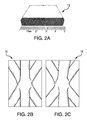
- FIG. 2A is perspective view of an exemplary microlattice layer comprising a component of one embodiment of the present invention
- FIG. 2B is a magnified detail view of the exemplary microlattice of FIG. 2A under initial compression, showing incipient buckling deformation at microlattice nodes;
- FIG. 2C is a magnified detail view of the exemplary microlattice of FIG. 2A under further compression, showing increased buckling deformation at microlattice nodes;
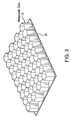
- FIG. 3 is perspective view of an exemplary honeycomb layer comprising a component of one embodiment of the present invention
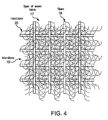
- FIG. 4 is a magnified detail view of an exemplary fabric layer comprising a component of one embodiment of the present invention.
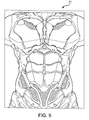
- FIG. 5 is frontal view of an exemplary exoskeleton comprising multiple impact resistant structures according to the present invention.
- an exemplary impact resistant breastplate structure 10 comprises a rigid, shock-deflecting outer layer 11 , below which is a deformable, polymer-based microlattice shock-damping layer 12 , below which is a semi-rigid, polyurethane honeycomb lattice dissipative layer 13 , below which is a lower shock-absorbing fabric layer 14 .
- the microlattice layer 12 comprises a three-dimensional network of hollow nanotubes, preferably having tube diameters less than 1 mm.
- the nanotubes microscopic structure is depicted in FIGS. 2B and 2C , in which the microlattice is under increasing compression, with deformation progressing from incipient buckling at the nodes 15 to more advanced buckling 16 .
- the buckling at the nanotubes' nodes damps impact forces, and the extremely small aspect ratio of the nanotubes' wall thickness to their diameter enables nearly full deformation recoverability.
- FIG. 3 depicts the semi-rigid, polyurethane honeycomb lattice shock-dissipating layer 13 , which lies below the microlattice layer 12 .
- the honeycomb cells are fused together at their walls without interstitial voids. While open hexagonal cells are depicted for illustrative purposes, it should be understood that any open polygonal-shaped cell can be used, although preferably the number of sides of each all should be five or more.
- the honeycomb material 13 is thermoplastic polyurethane and the cells are less than 0.5 inch in diameter.
- the semi-rigid, honeycomb material 13 acts as a constraining layer below the microlattice layer 12 , thereby increasing shock-damping deformation of the microlattice.
- the honeycomb layer attaches to a shock-absorbing lower fabric layer 14 , which is depicted in magnified detail in FIG. 4 .
- This layer comprises a base layer of woven fabric 17 , consisting of fibers 18 with interstices 19 . Between the fibers 18 and the interstices 19 are interwoven carbon nanotubes 20 , preferably with tube diameter less than 1 mm.
- the base fabric 17 is a ballistic and puncture resistant fiber, such as Kevlar®.
- the material composing the rigid, shock-deflecting outer layer 11 of the exemplary breastplate structure 10 can be varied, depending on the application. In sports uses, it is preferably made of a rigid, light-weight, impact-resistant plastic or ceramic material, while in military/police uses, it is preferably composed of a ballistic and puncture resistant material, such as reinforced plastic, titanium metal or aramid fibers.
- a complete or partial exoskeleton 21 can be assembled from articulate panels having the multi-layer composite structure of the present invention.
Landscapes
- Engineering & Computer Science (AREA)
- Textile Engineering (AREA)
- General Engineering & Computer Science (AREA)
- Ceramic Engineering (AREA)
- Health & Medical Sciences (AREA)
- Chemical & Material Sciences (AREA)
- Physical Education & Sports Medicine (AREA)
- General Health & Medical Sciences (AREA)
- Heart & Thoracic Surgery (AREA)
- Inorganic Chemistry (AREA)
- Nanotechnology (AREA)
- Professional, Industrial, Or Sporting Protective Garments (AREA)
- Aiming, Guidance, Guns With A Light Source, Armor, Camouflage, And Targets (AREA)
Abstract
A multi-layer composite structure is conformable to the contours of the body parts for which protection is required. The composition structure contains a rigid shock-deflecting outer layer, two semi-rigid shock-damping and shock-dissipating middle layers, and a pliable shock-absorbing lower layer. In one embodiment, the structure is designed for impacts associated with contact sports, such as football, hockey and lacrosse. In another embodiment, the structure is designed for military/police applications, in which impacts can be blunt forces, from weapons such as clubs, or penetrative forces, from knives, bullets or shrapnel.
Description
- This application claims the benefits of the filing date of U.S. Provisional Patent Application No. 62/407,204, filed Oct. 12, 2016, the disclosure of which is incorporated herein by reference. The present invention is also related to this inventor's U.S. Pat. No. 9,067,122 B2, “Protective Athletic Garment and Method,” which is incorporated herein in its entirety.
- The present invention relates to the field of garments adapted to protect a wearer's body from impacts associated with contacts sports and/or military/police activities.
- Protective garments for sports, military and police uses have evolved in the direction of becoming lighter, stronger, more mobile, and more wearable. Optionally, the structures comprising such protective garments should be capable of deflecting impact forces, damping their impact, dissipating such forces, absorbing them, and blocking penetration through to the wearer's body.
- The principal problem to be solved in designing such garments is that diverse materials need to be utilized in connection with the foregoing capabilities. The task of integrating such diverse materials into a composite structure requires consideration of their interaction, which should be synergistic, such that the resultant protective effect is greater than the sum of each material's isolated contribution.
- The present invention comprises a multi-layer composite structure, which is conformable to the contours of the body parts for which protection is required. In one embodiment, the structure is designed for impacts associated with contact sports, such as football, hockey and lacrosse. In another embodiment, the structure is designed for military/police applications, in which impacts can be blunt forces, from weapons such as clubs, or penetrative forces, from knives, bullets or shrapnel.
- In both embodiments, the present invention deploys a structure comprising a rigid shock deflecting outer layer, two semi-rigid shock damping and dissipative middle layers, and a pliable shock absorbing lower layer.
- In the sports embodiments, the outer shock-deflecting layer of each structure is a panel or shell composed of a rigid, light-weight, impact-resistant polymer, polymer blend or ceramic material. The outer layer is sized and contoured to match the body part(s) over which it will be worn. Such sizing and contouring can be done generically according to ranges of different body types, e.g., large men's size, medium men's size, small woman's size, etc.
- Alternately, the outer layer can be tailored to the body shape, size and contours of specific individual wearer's body. Such tailoring can be done by three-dimensional (3D) optical scanning of the covered body part(s) of the individual and use of the 3D optical scanning data in a 3D printer to produce the corresponding panel/shell structure. This 3D optical scanning-printing methodology can also be used to generate partial “exoskeleton” structures, such as breast-plates or sleeves.
- Over joints, such as shoulders, elbows, spine and knees, the outer layer structures comprise overlapping, articulated concave shaped panels, which are elastically interconnected so as to move translationally and rotationally with respect to one another. In one embodiment, the articulated plates/panels are interconnected by a semi-rigid track with intervaled notches or detents, along which each plate/panel can move incrementally in relation to the other interconnected plates/panels.
- In the military/police embodiments, the structures of the outer shock-deflecting layer can be the same as those outlined above for the sports embodiments, but they will be composed of a ballistic and puncture resistant material, such as reinforced plastic, reinforced carbon fiber, graphene, titanium metal or aramid fibers.
- In both sports and military/police embodiments, the middle layers of the impact resistant structures according to the present invention comprise a deformable, polymer-based microlattice damping layer above a semi-rigid, polyurethane honeycomb lattice dissipating layer. The microlattice material preferably comprises a three-dimensional interconnected network of hollow nanotubes preferably having tube diameters less than 1 mm, the stress buckling of which damps impact forces.
- Beneath the microlattice damping layer, the semi-rigid honeycomb dissipating material acts as a constraining layer that sandwiches the microlattice material between itself and the rigid outer deflecting layer, thereby improving the damping characteristics of the microlattice. Preferably, the honeycomb dissipating layer comprises open hexagonal cells less than 0.5 inches in diameter.
- The shock absorbing lower layer of the present invention comprises a loose fabric interwoven with carbon nanotube yarn (tube diameter less than 1 mm). In the sports embodiments, the base fabric is preferably woven of a breathable natural or artificial fiber that wicks moisture away from the wearer's skin. In the military/police embodiments, the base fabric is preferably a ballistic and puncture resistant fiber, such as Kevlar®.
- As discussed above, the multi-layered composite impact resistant structures of the present invention can be configured as partial exoskeleton panels, which can in turn be removably interconnected to form a complete exoskeleton body armor for the upper torso, arms, lower torso, legs or a combination of some or all of these.
- The foregoing summarizes the general design features of the present invention. In the following sections, specific embodiments of the present invention will be described in some detail. These specific embodiments are intended to demonstrate the feasibility of implementing the present invention in accordance with the general design features discussed above. Therefore, the detailed descriptions of these embodiments are offered for illustrative and exemplary purposes only, and they are not intended to limit the scope either of the foregoing summary description or of the claims which follow.
-
FIG. 1 is a cut-away view of an exemplary impact resistant breastplate structure in accordance with one embodiment of the present invention; -
FIG. 2A is perspective view of an exemplary microlattice layer comprising a component of one embodiment of the present invention; -
FIG. 2B is a magnified detail view of the exemplary microlattice ofFIG. 2A under initial compression, showing incipient buckling deformation at microlattice nodes; -
FIG. 2C is a magnified detail view of the exemplary microlattice ofFIG. 2A under further compression, showing increased buckling deformation at microlattice nodes; -
FIG. 3 is perspective view of an exemplary honeycomb layer comprising a component of one embodiment of the present invention; -
FIG. 4 is a magnified detail view of an exemplary fabric layer comprising a component of one embodiment of the present invention; and -
FIG. 5 is frontal view of an exemplary exoskeleton comprising multiple impact resistant structures according to the present invention. - Referring to
FIG. 1 , an exemplary impactresistant breastplate structure 10 comprises a rigid, shock-deflectingouter layer 11, below which is a deformable, polymer-based microlattice shock-damping layer 12, below which is a semi-rigid, polyurethane honeycomb latticedissipative layer 13, below which is a lower shock-absorbingfabric layer 14. - As shown in
FIG. 2A , themicrolattice layer 12 comprises a three-dimensional network of hollow nanotubes, preferably having tube diameters less than 1 mm. The nanotubes microscopic structure is depicted inFIGS. 2B and 2C , in which the microlattice is under increasing compression, with deformation progressing from incipient buckling at thenodes 15 to moreadvanced buckling 16. The buckling at the nanotubes' nodes damps impact forces, and the extremely small aspect ratio of the nanotubes' wall thickness to their diameter enables nearly full deformation recoverability. -
FIG. 3 depicts the semi-rigid, polyurethane honeycomb lattice shock-dissipatinglayer 13, which lies below themicrolattice layer 12. Preferably, as shown inFIG. 3 , the honeycomb cells are fused together at their walls without interstitial voids. While open hexagonal cells are depicted for illustrative purposes, it should be understood that any open polygonal-shaped cell can be used, although preferably the number of sides of each all should be five or more. Preferably thehoneycomb material 13 is thermoplastic polyurethane and the cells are less than 0.5 inch in diameter. In addition to its shock-dissipating function, the semi-rigid,honeycomb material 13 acts as a constraining layer below themicrolattice layer 12, thereby increasing shock-damping deformation of the microlattice. - As shown in
FIG. 3 , the honeycomb layer attaches to a shock-absorbinglower fabric layer 14, which is depicted in magnified detail inFIG. 4 . This layer comprises a base layer ofwoven fabric 17, consisting offibers 18 withinterstices 19. Between thefibers 18 and theinterstices 19 are interwovencarbon nanotubes 20, preferably with tube diameter less than 1 mm. In military/police applications, thebase fabric 17 is a ballistic and puncture resistant fiber, such as Kevlar®. - The material composing the rigid, shock-deflecting
outer layer 11 of theexemplary breastplate structure 10 can be varied, depending on the application. In sports uses, it is preferably made of a rigid, light-weight, impact-resistant plastic or ceramic material, while in military/police uses, it is preferably composed of a ballistic and puncture resistant material, such as reinforced plastic, titanium metal or aramid fibers. - As shown in
FIG. 5 , a complete orpartial exoskeleton 21 can be assembled from articulate panels having the multi-layer composite structure of the present invention. - Although the preferred embodiment of the present invention has been disclosed for illustrative purposes, those skilled in the art will appreciate that many additions, modifications and substitutions are possible, without departing from the scope and spirit of the present invention as defined by the accompanying claims.
Claims (16)
1. A protective garment comprising:
multiple interconnected impact resistant structures, wherein each impact resistant structure comprises four interconnected layers, consisting of a rigid outer shock-deflecting layer, overlaying a semi-rigid, deformable, polymer-based, microlattice shock-damping layer, overlaying a semi-rigid, polyurethane, honeycomb lattice dissipative layer, overlaying a shock-absorbing lower fabric layer.
2. The protective garment according to claim 1 , wherein the microlattice shock-damping layer comprises a three-dimensional network of multiple hollow polymer nanotubes, having tube diameters less than 1 mm, and wherein the polymer nanotubes are interconnected at multiple nanotube nodes which undergo resilient deformation under an applied stress, thereby effecting a damping of the applied stress.
3. The protective garment according to claim 2 , wherein the honeycomb lattice dissipative layer comprises multiple thermoplastic polyurethane open polygonal cells, less than 0.5 inches in diameter, having cell walls that are fused together without interstitial voids, and wherein the transmission of the applied stress through the open polygonal cells dissipates the applied stress, and wherein the honeycomb lattice dissipative layer constrains the microlattice shock-damping layer, thereby increasing the resilient deformation of the nanotube nodes and increasing the damping of the applied stress.
4. The protective garment according to claim 3 , wherein the shock-absorbing lower fabric layer comprises a base woven layer, consisting of multiple woven fibers with interstices, and multiple carbon nanotubes, less than 1 mm in diameter, which are interwoven between the woven fibers and the interstices.
5. The protective garment according to claim 4 , wherein the woven fibers of the base woven layer are breathable natural or artificial fibers that wick moisture.
6. The protective garment according to claim 4 , wherein the woven fibers of the base woven layer are ballistic and puncture resistant.
7. The protective garment according to claim 5 , wherein the outer shock-deflecting layer comprises a rigid, light-weight, impact-resistant plastic, polymer, polymer blend, or ceramic material.
8. The protective garment according the claim 6 , wherein the outer shock-deflecting layer comprises a rigid plastic or metal material which is ballistic and puncture resistant.
9. The protective garment according to claim 7 , wherein the outer shock-deflecting layer comprises one or more panels or shells, each of which is sized and contoured to conform to a size and a shape of a covered body part over which the panel or shell is to be worn.
10. The protective garment according to claim 8 , wherein the outer shock-deflecting layer comprises one or more panels or shells, each of which is sized and contoured to conform to a size and a shape of a covered body part over which the panel or shell is to be worn.
11. The protective garment according to claim 9 , wherein each of the panels or shells are sized and contoured by 3D printing in conjunction with 3D optical scanning of the covered body part.
12. The protective garment according to claim 10 , wherein each of the panels or shells are sized and contoured by 3D printing in conjunction with 3D optical scanning of the covered body part.
13. The protective garment according to claim 9 , wherein the covered body part is a body joint, and wherein the outer shock-deflecting layer comprises multiple overlapping, articulated concave panels, which are elastically interconnected so as to move translationally and rotationally with respect to one another.
14. The protective garment according to claim 10 , wherein the covered body part is a body joint, and wherein the outer shock-deflecting layer comprises multiple overlapping, articulated concave panels, which are elastically interconnected so as to move translationally and rotationally with respect to one another.
15. The protective garment according to claim 11 , wherein the covered body part is a body joint, and wherein the outer shock-deflecting layer comprises multiple overlapping, articulated concave panels, which are elastically interconnected so as to move translationally and rotationally with respect to one another.
16. The protective garment according to claim 12 , wherein the covered body part is a body joint, and wherein the outer shock-deflecting layer comprises multiple overlapping, articulated concave panels, which are elastically interconnected so as to move translationally and rotationally with respect to one another.
Priority Applications (2)
| Application Number | Priority Date | Filing Date | Title |
|---|---|---|---|
| US15/726,797 US20180098589A1 (en) | 2016-10-12 | 2017-10-06 | Impact Resistant Structures for Protective Garments |
| US16/110,896 US11185119B2 (en) | 2017-10-06 | 2018-08-23 | Protective garments incorporating impact resistant structures |
Applications Claiming Priority (2)
| Application Number | Priority Date | Filing Date | Title |
|---|---|---|---|
| US201662407204P | 2016-10-12 | 2016-10-12 | |
| US15/726,797 US20180098589A1 (en) | 2016-10-12 | 2017-10-06 | Impact Resistant Structures for Protective Garments |
Related Child Applications (1)
| Application Number | Title | Priority Date | Filing Date |
|---|---|---|---|
| US16/110,896 Continuation-In-Part US11185119B2 (en) | 2017-10-06 | 2018-08-23 | Protective garments incorporating impact resistant structures |
Publications (1)
| Publication Number | Publication Date |
|---|---|
| US20180098589A1 true US20180098589A1 (en) | 2018-04-12 |
Family
ID=61829529
Family Applications (1)
| Application Number | Title | Priority Date | Filing Date |
|---|---|---|---|
| US15/726,797 Abandoned US20180098589A1 (en) | 2016-10-12 | 2017-10-06 | Impact Resistant Structures for Protective Garments |
Country Status (1)
| Country | Link |
|---|---|
| US (1) | US20180098589A1 (en) |
Cited By (13)
| Publication number | Priority date | Publication date | Assignee | Title |
|---|---|---|---|---|
| CN108801054A (en) * | 2018-06-21 | 2018-11-13 | 江苏安卡新材料科技有限公司 | A kind of bullet proof composite plating and preparation method thereof |
| CN109029116A (en) * | 2018-09-14 | 2018-12-18 | 江苏安卡新材料科技有限公司 | A kind of carbon pottery bulletproof flashboards |
| IT201800004806A1 (en) * | 2018-04-24 | 2019-10-24 | PROCEDURE FOR MAKING A PADDING | |
| US10591257B1 (en) * | 2018-12-04 | 2020-03-17 | Honeywell Federal Manufacturing & Technologies, Llc | Multi-layer wearable body armor |
| WO2022150867A1 (en) * | 2021-01-12 | 2022-07-21 | Stephanie Bofinger | Female breast and chest protection armour |
| US20220373300A1 (en) * | 2021-05-19 | 2022-11-24 | Vaheh Golestanian Nemagrdi | Custom body armor |
| US11684104B2 (en) | 2019-05-21 | 2023-06-27 | Bauer Hockey Llc | Helmets comprising additively-manufactured components |
| US11781839B1 (en) * | 2018-12-04 | 2023-10-10 | Honeywell Federal Manufacturing & Technologies, Llc | Multi-layer wearable body armor |
| US11779821B2 (en) | 2014-05-13 | 2023-10-10 | Bauer Hockey Llc | Sporting goods including microlattice structures |
| CN117703979A (en) * | 2023-12-31 | 2024-03-15 | 中国空气动力研究与发展中心高速空气动力研究所 | Damping-adjustable slender structure and regulation and control method thereof |
| US20250072847A1 (en) * | 2023-09-01 | 2025-03-06 | Adaptiiv Medical Technologies Inc. | Immobilization devices for radiation therapy |
| CN119642650A (en) * | 2024-11-30 | 2025-03-18 | 四川大学 | A bionic phosphorus armor-like stress dispersion modular component with three-dimensional freedom of movement |
| US12656087B1 (en) * | 2018-12-04 | 2026-06-16 | Honeywell Federal Manufacturing & Technologies, Llc | Multi-layer wearable body armor |
Citations (7)
| Publication number | Priority date | Publication date | Assignee | Title |
|---|---|---|---|---|
| US5918309A (en) * | 1997-10-14 | 1999-07-06 | Second Chance Body Armor, Inc. | Blunt force resistant structure for a protective garment |
| US20060062944A1 (en) * | 2004-09-20 | 2006-03-23 | Gardner Slade H | Ballistic fabrics with improved antiballistic properties |
| US20130283511A1 (en) * | 2011-03-21 | 2013-10-31 | Richard Diamond | Protective Athletic Garment and Method |
| US20140015307A1 (en) * | 2012-07-12 | 2014-01-16 | Sram, Llc | Bicycle rim with brake track |
| US20150101899A1 (en) * | 2013-10-11 | 2015-04-16 | Rousseau Research, Inc. | Protective athletic equipment |
| US20160302496A1 (en) * | 2014-01-06 | 2016-10-20 | Lisa Ferrara | Composite devices and methods for providing protection against traumatic tissue injury |
| US20170307040A1 (en) * | 2011-08-17 | 2017-10-26 | Hrl Laboratories, Llc | Microlattice damping material and method for repeatable energy absorption |
-
2017
- 2017-10-06 US US15/726,797 patent/US20180098589A1/en not_active Abandoned
Patent Citations (7)
| Publication number | Priority date | Publication date | Assignee | Title |
|---|---|---|---|---|
| US5918309A (en) * | 1997-10-14 | 1999-07-06 | Second Chance Body Armor, Inc. | Blunt force resistant structure for a protective garment |
| US20060062944A1 (en) * | 2004-09-20 | 2006-03-23 | Gardner Slade H | Ballistic fabrics with improved antiballistic properties |
| US20130283511A1 (en) * | 2011-03-21 | 2013-10-31 | Richard Diamond | Protective Athletic Garment and Method |
| US20170307040A1 (en) * | 2011-08-17 | 2017-10-26 | Hrl Laboratories, Llc | Microlattice damping material and method for repeatable energy absorption |
| US20140015307A1 (en) * | 2012-07-12 | 2014-01-16 | Sram, Llc | Bicycle rim with brake track |
| US20150101899A1 (en) * | 2013-10-11 | 2015-04-16 | Rousseau Research, Inc. | Protective athletic equipment |
| US20160302496A1 (en) * | 2014-01-06 | 2016-10-20 | Lisa Ferrara | Composite devices and methods for providing protection against traumatic tissue injury |
Non-Patent Citations (1)
| Title |
|---|
| Science Daily, "Carbon Nanotube", accessed on 18 June 2019. (Year: 2019) * |
Cited By (21)
| Publication number | Priority date | Publication date | Assignee | Title |
|---|---|---|---|---|
| US12654078B2 (en) | 2014-05-13 | 2026-06-16 | Bauer Hockey Llc | Sporting goods including microlattice structures |
| US11844986B2 (en) | 2014-05-13 | 2023-12-19 | Bauer Hockey Llc | Sporting goods including microlattice structures |
| US11794084B2 (en) | 2014-05-13 | 2023-10-24 | Bauer Hockey Llc | Sporting goods including microlattice structures |
| US11779821B2 (en) | 2014-05-13 | 2023-10-10 | Bauer Hockey Llc | Sporting goods including microlattice structures |
| IT201800004806A1 (en) * | 2018-04-24 | 2019-10-24 | PROCEDURE FOR MAKING A PADDING | |
| WO2019206745A1 (en) * | 2018-04-24 | 2019-10-31 | Cannon & Macintosh Investment Limited | Method for providing a padding |
| CN112004436A (en) * | 2018-04-24 | 2020-11-27 | 坎农&麦金托什投资有限公司 | Method for providing a gasket |
| CN108801054A (en) * | 2018-06-21 | 2018-11-13 | 江苏安卡新材料科技有限公司 | A kind of bullet proof composite plating and preparation method thereof |
| CN109029116A (en) * | 2018-09-14 | 2018-12-18 | 江苏安卡新材料科技有限公司 | A kind of carbon pottery bulletproof flashboards |
| US11781839B1 (en) * | 2018-12-04 | 2023-10-10 | Honeywell Federal Manufacturing & Technologies, Llc | Multi-layer wearable body armor |
| US11441875B2 (en) * | 2018-12-04 | 2022-09-13 | Honeywell Federal Manufacturing & Technologies, Llc | Multi-layer wearable body armor |
| US10591257B1 (en) * | 2018-12-04 | 2020-03-17 | Honeywell Federal Manufacturing & Technologies, Llc | Multi-layer wearable body armor |
| US12656087B1 (en) * | 2018-12-04 | 2026-06-16 | Honeywell Federal Manufacturing & Technologies, Llc | Multi-layer wearable body armor |
| US11684104B2 (en) | 2019-05-21 | 2023-06-27 | Bauer Hockey Llc | Helmets comprising additively-manufactured components |
| US12369668B2 (en) | 2019-05-21 | 2025-07-29 | Bauer Hockey Llc | Helmets comprising additively-manufactured components |
| WO2022150867A1 (en) * | 2021-01-12 | 2022-07-21 | Stephanie Bofinger | Female breast and chest protection armour |
| US20220373300A1 (en) * | 2021-05-19 | 2022-11-24 | Vaheh Golestanian Nemagrdi | Custom body armor |
| US20250072847A1 (en) * | 2023-09-01 | 2025-03-06 | Adaptiiv Medical Technologies Inc. | Immobilization devices for radiation therapy |
| US12551174B2 (en) * | 2023-09-01 | 2026-02-17 | Adaptiiv Medical Technologies Inc. | Immobilization devices for radiation therapy |
| CN117703979A (en) * | 2023-12-31 | 2024-03-15 | 中国空气动力研究与发展中心高速空气动力研究所 | Damping-adjustable slender structure and regulation and control method thereof |
| CN119642650A (en) * | 2024-11-30 | 2025-03-18 | 四川大学 | A bionic phosphorus armor-like stress dispersion modular component with three-dimensional freedom of movement |
Similar Documents
| Publication | Publication Date | Title |
|---|---|---|
| US11185119B2 (en) | Protective garments incorporating impact resistant structures | |
| US20240391205A1 (en) | Football helmet with custom manufactured fit pods | |
| AU2020279251B2 (en) | Helmet impact attenuation liner | |
| US8291808B2 (en) | Titanium mosaic body armor assembly | |
| US20210323263A1 (en) | Microlattice Layers | |
| US5479659A (en) | Lightweight ballistic resistant garments and method to produce the same | |
| US20120207964A1 (en) | Helmet designs utilizing foam structures having graded properties | |
| TW201326490A (en) | Impact dissipating fabric system and method for preparing the same | |
| US8479314B2 (en) | Ballistic and blunt impact protective knee and elbow pads | |
| DK2853853T3 (en) | Bulletproof vest system with structural frame | |
| US20180326698A1 (en) | Impact resistant flexible materials, articles comprising same and uses thereof | |
| RU2420705C2 (en) | Bullet-resistant structure | |
| EP4029683A1 (en) | Custom manufactured fit pods | |
| DE212017000039U1 (en) | Flexible, lightweight ballistic protection | |
| KR102272250B1 (en) | Protecti ve unit for bulletproof vest with improved flexibility and method for manufac turing the protective unit | |
| US9675124B2 (en) | Joint protector system | |
| CN101819006B (en) | Feather flak jacket | |
| US9526969B1 (en) | Composite athletic cup | |
| AT410142B (en) | Device protects body parts against bullets or shrapnels, has carrier layer, layer of protective plates and energy-absorbing layer | |
| US20140212625A1 (en) | Light weight rotective clothing and accessories | |
| US12140407B2 (en) | Deflection element and protective suit using the deflection element | |
| JP7465015B2 (en) | Protective vest, protection method, and method of manufacturing protective vest | |
| RU198813U1 (en) | FLEXIBLE ARMOR | |
| WO2022159361A1 (en) | Protective laminate structures and related articles | |
| CN117760265A (en) | A fully protective tactical vest |
Legal Events
| Date | Code | Title | Description |
|---|---|---|---|
| STPP | Information on status: patent application and granting procedure in general |
Free format text: DOCKETED NEW CASE - READY FOR EXAMINATION |
|
| STPP | Information on status: patent application and granting procedure in general |
Free format text: NON FINAL ACTION MAILED |
|
| STCB | Information on status: application discontinuation |
Free format text: ABANDONED -- FAILURE TO RESPOND TO AN OFFICE ACTION |