US20180098410A1 - Esd protection device - Google Patents
Esd protection device Download PDFInfo
- Publication number
- US20180098410A1 US20180098410A1 US15/834,187 US201715834187A US2018098410A1 US 20180098410 A1 US20180098410 A1 US 20180098410A1 US 201715834187 A US201715834187 A US 201715834187A US 2018098410 A1 US2018098410 A1 US 2018098410A1
- Authority
- US
- United States
- Prior art keywords
- auxiliary electrode
- auxiliary
- esd protection
- protection device
- discharge
- Prior art date
- Legal status (The legal status is an assumption and is not a legal conclusion. Google has not performed a legal analysis and makes no representation as to the accuracy of the status listed.)
- Granted
Links
- 239000004020 conductor Substances 0.000 claims abstract description 111
- 239000000919 ceramic Substances 0.000 claims abstract description 43
- 239000000463 material Substances 0.000 claims description 21
- 239000000203 mixture Substances 0.000 claims description 14
- 239000004065 semiconductor Substances 0.000 claims description 8
- 239000011810 insulating material Substances 0.000 claims description 7
- 230000001788 irregular Effects 0.000 claims description 7
- 239000007769 metal material Substances 0.000 claims description 6
- 239000010410 layer Substances 0.000 description 141
- 239000000843 powder Substances 0.000 description 14
- 238000009413 insulation Methods 0.000 description 13
- 230000015556 catabolic process Effects 0.000 description 12
- 238000006731 degradation reaction Methods 0.000 description 11
- 239000007772 electrode material Substances 0.000 description 10
- 239000002245 particle Substances 0.000 description 10
- YXFVVABEGXRONW-UHFFFAOYSA-N Toluene Chemical compound CC1=CC=CC=C1 YXFVVABEGXRONW-UHFFFAOYSA-N 0.000 description 9
- 238000004519 manufacturing process Methods 0.000 description 8
- 239000002003 electrode paste Substances 0.000 description 7
- 238000002360 preparation method Methods 0.000 description 7
- MCMNRKCIXSYSNV-UHFFFAOYSA-N Zirconium dioxide Chemical compound O=[Zr]=O MCMNRKCIXSYSNV-UHFFFAOYSA-N 0.000 description 6
- 230000000052 comparative effect Effects 0.000 description 6
- 239000002002 slurry Substances 0.000 description 6
- 230000002950 deficient Effects 0.000 description 5
- 230000000694 effects Effects 0.000 description 5
- 229910010272 inorganic material Inorganic materials 0.000 description 5
- 239000011147 inorganic material Substances 0.000 description 5
- ZZSNKZQZMQGXPY-UHFFFAOYSA-N Ethyl cellulose Chemical compound CCOCC1OC(OC)C(OCC)C(OCC)C1OC1C(O)C(O)C(OC)C(CO)O1 ZZSNKZQZMQGXPY-UHFFFAOYSA-N 0.000 description 4
- VYPSYNLAJGMNEJ-UHFFFAOYSA-N Silicium dioxide Chemical compound O=[Si]=O VYPSYNLAJGMNEJ-UHFFFAOYSA-N 0.000 description 4
- WUOACPNHFRMFPN-UHFFFAOYSA-N alpha-terpineol Chemical compound CC1=CCC(C(C)(C)O)CC1 WUOACPNHFRMFPN-UHFFFAOYSA-N 0.000 description 4
- PNEYBMLMFCGWSK-UHFFFAOYSA-N aluminium oxide Inorganic materials [O-2].[O-2].[O-2].[Al+3].[Al+3] PNEYBMLMFCGWSK-UHFFFAOYSA-N 0.000 description 4
- 230000015572 biosynthetic process Effects 0.000 description 4
- 229910052593 corundum Inorganic materials 0.000 description 4
- 230000032798 delamination Effects 0.000 description 4
- SQIFACVGCPWBQZ-UHFFFAOYSA-N delta-terpineol Natural products CC(C)(O)C1CCC(=C)CC1 SQIFACVGCPWBQZ-UHFFFAOYSA-N 0.000 description 4
- 230000005684 electric field Effects 0.000 description 4
- 238000010304 firing Methods 0.000 description 4
- 238000003475 lamination Methods 0.000 description 4
- 229940116411 terpineol Drugs 0.000 description 4
- 229910001845 yogo sapphire Inorganic materials 0.000 description 4
- 239000001856 Ethyl cellulose Substances 0.000 description 3
- 229910052782 aluminium Inorganic materials 0.000 description 3
- 239000011230 binding agent Substances 0.000 description 3
- 229910052802 copper Inorganic materials 0.000 description 3
- 238000005520 cutting process Methods 0.000 description 3
- 238000007606 doctor blade method Methods 0.000 description 3
- 229920001249 ethyl cellulose Polymers 0.000 description 3
- 235000019325 ethyl cellulose Nutrition 0.000 description 3
- 230000017525 heat dissipation Effects 0.000 description 3
- 229910052759 nickel Inorganic materials 0.000 description 3
- 239000003960 organic solvent Substances 0.000 description 3
- 229910052763 palladium Inorganic materials 0.000 description 3
- 239000004014 plasticizer Substances 0.000 description 3
- 229910052697 platinum Inorganic materials 0.000 description 3
- 229910052709 silver Inorganic materials 0.000 description 3
- -1 TiN Chemical class 0.000 description 2
- GWEVSGVZZGPLCZ-UHFFFAOYSA-N Titan oxide Chemical compound O=[Ti]=O GWEVSGVZZGPLCZ-UHFFFAOYSA-N 0.000 description 2
- 229910045601 alloy Inorganic materials 0.000 description 2
- 239000000956 alloy Substances 0.000 description 2
- 239000002585 base Substances 0.000 description 2
- 230000008901 benefit Effects 0.000 description 2
- 229910010293 ceramic material Inorganic materials 0.000 description 2
- 229910052681 coesite Inorganic materials 0.000 description 2
- 229910052906 cristobalite Inorganic materials 0.000 description 2
- 230000003247 decreasing effect Effects 0.000 description 2
- 239000011521 glass Substances 0.000 description 2
- 230000036039 immunity Effects 0.000 description 2
- 238000000034 method Methods 0.000 description 2
- 150000004767 nitrides Chemical class 0.000 description 2
- 239000012299 nitrogen atmosphere Substances 0.000 description 2
- 238000007747 plating Methods 0.000 description 2
- 230000001737 promoting effect Effects 0.000 description 2
- 238000007650 screen-printing Methods 0.000 description 2
- 239000000377 silicon dioxide Substances 0.000 description 2
- 238000005245 sintering Methods 0.000 description 2
- 229910052682 stishovite Inorganic materials 0.000 description 2
- 229910052905 tridymite Inorganic materials 0.000 description 2
- WEAMLHXSIBDPGN-UHFFFAOYSA-N (4-hydroxy-3-methylphenyl) thiocyanate Chemical compound CC1=CC(SC#N)=CC=C1O WEAMLHXSIBDPGN-UHFFFAOYSA-N 0.000 description 1
- OFEAOSSMQHGXMM-UHFFFAOYSA-N 12007-10-2 Chemical compound [W].[W]=[B] OFEAOSSMQHGXMM-UHFFFAOYSA-N 0.000 description 1
- 239000004925 Acrylic resin Substances 0.000 description 1
- 229920000178 Acrylic resin Polymers 0.000 description 1
- QYEXBYZXHDUPRC-UHFFFAOYSA-N B#[Ti]#B Chemical compound B#[Ti]#B QYEXBYZXHDUPRC-UHFFFAOYSA-N 0.000 description 1
- ZOXJGFHDIHLPTG-UHFFFAOYSA-N Boron Chemical compound [B] ZOXJGFHDIHLPTG-UHFFFAOYSA-N 0.000 description 1
- VYZAMTAEIAYCRO-UHFFFAOYSA-N Chromium Chemical compound [Cr] VYZAMTAEIAYCRO-UHFFFAOYSA-N 0.000 description 1
- 229910018100 Ni-Sn Inorganic materials 0.000 description 1
- 229910018532 Ni—Sn Inorganic materials 0.000 description 1
- 229910052581 Si3N4 Inorganic materials 0.000 description 1
- ATJFFYVFTNAWJD-UHFFFAOYSA-N Tin Chemical compound [Sn] ATJFFYVFTNAWJD-UHFFFAOYSA-N 0.000 description 1
- QCWXUUIWCKQGHC-UHFFFAOYSA-N Zirconium Chemical compound [Zr] QCWXUUIWCKQGHC-UHFFFAOYSA-N 0.000 description 1
- 229910052783 alkali metal Inorganic materials 0.000 description 1
- 150000001340 alkali metals Chemical class 0.000 description 1
- 239000012298 atmosphere Substances 0.000 description 1
- SJKRCWUQJZIWQB-UHFFFAOYSA-N azane;chromium Chemical compound N.[Cr] SJKRCWUQJZIWQB-UHFFFAOYSA-N 0.000 description 1
- 239000011324 bead Substances 0.000 description 1
- YXTPWUNVHCYOSP-UHFFFAOYSA-N bis($l^{2}-silanylidene)molybdenum Chemical compound [Si]=[Mo]=[Si] YXTPWUNVHCYOSP-UHFFFAOYSA-N 0.000 description 1
- LGLOITKZTDVGOE-UHFFFAOYSA-N boranylidynemolybdenum Chemical compound [Mo]#B LGLOITKZTDVGOE-UHFFFAOYSA-N 0.000 description 1
- 229910052796 boron Inorganic materials 0.000 description 1
- 229910052804 chromium Inorganic materials 0.000 description 1
- 239000011651 chromium Substances 0.000 description 1
- 229910021357 chromium silicide Inorganic materials 0.000 description 1
- 230000005611 electricity Effects 0.000 description 1
- 238000010030 laminating Methods 0.000 description 1
- 229910052746 lanthanum Inorganic materials 0.000 description 1
- FZLIPJUXYLNCLC-UHFFFAOYSA-N lanthanum atom Chemical compound [La] FZLIPJUXYLNCLC-UHFFFAOYSA-N 0.000 description 1
- 230000000670 limiting effect Effects 0.000 description 1
- 230000007257 malfunction Effects 0.000 description 1
- 229910052751 metal Inorganic materials 0.000 description 1
- 239000002184 metal Substances 0.000 description 1
- 150000001247 metal acetylides Chemical class 0.000 description 1
- 238000012986 modification Methods 0.000 description 1
- 230000004048 modification Effects 0.000 description 1
- 229910021344 molybdenum silicide Inorganic materials 0.000 description 1
- 230000036961 partial effect Effects 0.000 description 1
- 230000002265 prevention Effects 0.000 description 1
- 230000009467 reduction Effects 0.000 description 1
- 230000002829 reductive effect Effects 0.000 description 1
- 239000011347 resin Substances 0.000 description 1
- 229920005989 resin Polymers 0.000 description 1
- 229910021332 silicide Inorganic materials 0.000 description 1
- 239000002356 single layer Substances 0.000 description 1
- 230000003068 static effect Effects 0.000 description 1
- VEALVRVVWBQVSL-UHFFFAOYSA-N strontium titanate Chemical compound [Sr+2].[O-][Ti]([O-])=O VEALVRVVWBQVSL-UHFFFAOYSA-N 0.000 description 1
- 239000000758 substrate Substances 0.000 description 1
- 229910021341 titanium silicide Inorganic materials 0.000 description 1
- 230000007704 transition Effects 0.000 description 1
- 229910052721 tungsten Inorganic materials 0.000 description 1
- WQJQOUPTWCFRMM-UHFFFAOYSA-N tungsten disilicide Chemical compound [Si]#[W]#[Si] WQJQOUPTWCFRMM-UHFFFAOYSA-N 0.000 description 1
- 229910021342 tungsten silicide Inorganic materials 0.000 description 1
- 229910052726 zirconium Inorganic materials 0.000 description 1
- 229910021355 zirconium silicide Inorganic materials 0.000 description 1
Images
Classifications
-
- H—ELECTRICITY
- H05—ELECTRIC TECHNIQUES NOT OTHERWISE PROVIDED FOR
- H05F—STATIC ELECTRICITY; NATURALLY-OCCURRING ELECTRICITY
- H05F3/00—Carrying-off electrostatic charges
- H05F3/04—Carrying-off electrostatic charges by means of spark gaps or other discharge devices
-
- H—ELECTRICITY
- H01—ELECTRIC ELEMENTS
- H01T—SPARK GAPS; OVERVOLTAGE ARRESTERS USING SPARK GAPS; SPARKING PLUGS; CORONA DEVICES; GENERATING IONS TO BE INTRODUCED INTO NON-ENCLOSED GASES
- H01T1/00—Details of spark gaps
- H01T1/20—Means for starting arc or facilitating ignition of spark gap
-
- H—ELECTRICITY
- H01—ELECTRIC ELEMENTS
- H01T—SPARK GAPS; OVERVOLTAGE ARRESTERS USING SPARK GAPS; SPARKING PLUGS; CORONA DEVICES; GENERATING IONS TO BE INTRODUCED INTO NON-ENCLOSED GASES
- H01T2/00—Spark gaps comprising auxiliary triggering means
- H01T2/02—Spark gaps comprising auxiliary triggering means comprising a trigger electrode or an auxiliary spark gap
-
- H—ELECTRICITY
- H01—ELECTRIC ELEMENTS
- H01T—SPARK GAPS; OVERVOLTAGE ARRESTERS USING SPARK GAPS; SPARKING PLUGS; CORONA DEVICES; GENERATING IONS TO BE INTRODUCED INTO NON-ENCLOSED GASES
- H01T4/00—Overvoltage arresters using spark gaps
- H01T4/10—Overvoltage arresters using spark gaps having a single gap or a plurality of gaps in parallel
-
- H—ELECTRICITY
- H01—ELECTRIC ELEMENTS
- H01T—SPARK GAPS; OVERVOLTAGE ARRESTERS USING SPARK GAPS; SPARKING PLUGS; CORONA DEVICES; GENERATING IONS TO BE INTRODUCED INTO NON-ENCLOSED GASES
- H01T4/00—Overvoltage arresters using spark gaps
- H01T4/10—Overvoltage arresters using spark gaps having a single gap or a plurality of gaps in parallel
- H01T4/12—Overvoltage arresters using spark gaps having a single gap or a plurality of gaps in parallel hermetically sealed
Definitions
- the present invention relates to an ESD protection device.
- Electro-static discharge refers to a discharge phenomenon that occurs when, for example, the human body comes into contact with an electronic apparatus, and causes damage to and malfunction of the electronic apparatus.
- ESD protection devices are devices that protect electronic apparatuses from the application of overcurrent generated during discharge.
- ESD protection devices have a structure in which a pair of discharge electrodes face each other with a distance maintained therebetween. When overvoltage is applied, discharge occurs between the discharge electrodes to guide static electricity to the ground side, thus protecting circuits.
- electronic apparatuses that operate at lower voltages have been widely used. This requires an ESD protection device whose discharge starting voltage is low, in other words, an ESD protection device that allows discharge to occur at a lower voltage.
- Japanese Unexamined Patent Application Publication No. 2010-129320 describes an ESD protection device including an insulating substrate with a cavity portion inside thereof, a first discharge electrode, a second discharge electrode, and an auxiliary electrode that is arranged on at least a portion of the inner periphery of the cavity portion and that is electrically connected to the first discharge electrode and the second discharge electrode.
- discharge occurs primarily along the inner periphery of the cavity portion (referred to as “surface discharge”).
- surface discharge occurs primarily along the inner periphery of the cavity portion.
- the arrangement of the auxiliary electrode on at least a portion of the inner periphery of the cavity portion facilitates the generation of the surface discharge, thus resulting in improved stability of ESD characteristics.
- Preferred embodiments of the present invention provide ESD protection devices that have a lower discharge starting voltage and improved resistance to insulation degradation.
- the inventors have conducted intensive studies and have discovered that it is possible to further reduce a discharge starting voltage and improve resistance to insulation degradation by arranging an auxiliary electrode including a plurality of layers, one of the layers including a larger amount of conductive material being located on the side of a discharge electrode.
- An ESD protection device includes an insulating ceramic body including a cavity portion; an auxiliary electrode including a first main surface and a second main surface, the auxiliary electrode being embedded in the insulating ceramic body such that a side end portion of the auxiliary electrode between the first main surface and the second main surface is exposed to the cavity portion; and a first discharge electrode and a second discharge electrode that are embedded in the insulating ceramic body such that a main surface of the first discharge electrode and a main surface of the second discharge electrode face each other with the auxiliary electrode interposed therebetween.
- the auxiliary electrode includes at least one first auxiliary electrode layer and at least one second auxiliary electrode layer, the first auxiliary electrode layer having a higher content of a conductive material than the second auxiliary electrode layer, the first auxiliary electrode layer being joined to at least one of the first discharge electrode and the second discharge electrode.
- An ESD protection device has a multilayer structure including at least two layers: the first auxiliary electrode layer and the second auxiliary electrode layer that have different contents of the conductive material and that are alternately arranged.
- the first auxiliary electrode layer having a high content of the conductive material is joined to at least one of the first discharge electrode and the second discharge electrode, thus resulting in improved operating characteristics at a low voltage and improved resistance to insulation degradation.
- the first discharge electrode may include a first auxiliary conductor electrically connected to the auxiliary electrode, and the first auxiliary conductor may be arranged such that at least a portion of a main surface of the first auxiliary conductor is exposed to the cavity portion.
- the arrangement of the first auxiliary conductor is able to reduce or prevent the delamination of the discharge electrode even if discharge is repeated, thus resulting in improved stability of the operating characteristics.
- the first discharge electrode may include a first auxiliary conductor electrically connected to the auxiliary electrode
- the second discharge electrode may include a second auxiliary conductor electrically connected to the auxiliary electrode
- the first auxiliary conductor and the second auxiliary conductor may be arranged such that at least a portion of a main surface of the first auxiliary conductor and at least a portion of a main surface of the second auxiliary conductor are exposed to the cavity portion.
- the arrangement of the first auxiliary conductor and the second auxiliary conductor is able to further reduce or prevent the delamination of the discharge electrode even if discharge is repeated, thus resulting in further improved stability of the operating characteristics.
- the conductive material may include a metal material and/or a semiconductor material.
- the use of the metal material and/or the semiconductor material as the conductive material provides the ESD protection device having good stability of the operating characteristics.
- the side end portion of the auxiliary electrode exposed to the cavity portion may include a surface having an irregular shape.
- the irregular shape provides the effects of promoting the emission of secondary electrons to reduce the discharge starting voltage and of increasing a heat dissipation area that dissipates heat generated by discharge to reduce or prevent an increase in the temperature of the auxiliary electrode.
- the second auxiliary electrode layer may have a larger thickness than the first auxiliary electrode layer.
- the auxiliary electrode is able to have further improved insulation.
- the auxiliary electrode may include a through hole in the cavity portion that has an annular shape.
- the surface discharge occurs along a surface of the auxiliary electrode exposed to the cavity portion.
- the stability of the ESD characteristics is improved.
- the auxiliary electrode may have a structure in which one first auxiliary electrode layer and one second auxiliary electrode layer are alternately laminated.
- the alternate lamination of the first auxiliary electrode layer and the second auxiliary electrode layer results in further improved insulation of the auxiliary electrode.
- the auxiliary electrode may have a three-layer structure in which one second auxiliary electrode layer is arranged between one first auxiliary electrode layer joined to the first discharge electrode and one first auxiliary electrode layer joined to the second discharge electrode.
- a streamer is able to propagate reliably from one of the discharge electrodes to the other discharge electrode, and the device may also be used as a bipolar ESD protection device.
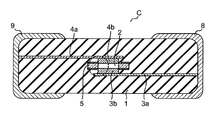
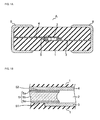
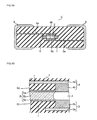
- FIG. 1A is a schematic longitudinal sectional view illustrating an example of the structure of an ESD protection device according to a first preferred embodiment of the present invention.
- FIG. 1B is a partially enlarged sectional view of FIG. 1A .
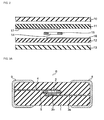
- FIG. 2 is a schematic longitudinal sectional view illustrating an example of a production process of an ESD protection device according to the first preferred embodiment of the present invention.
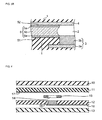
- FIG. 3A is a schematic longitudinal sectional view illustrating an example of the structure of an ESD protection device according to a second preferred embodiment of the present invention.
- FIG. 3B is a partially enlarged sectional view of FIG. 3A .
- FIG. 4 is a schematic longitudinal sectional view illustrating an example of a production process of an ESD protection device according to the second preferred embodiment of the present invention.
- FIG. 5A is a schematic longitudinal sectional view illustrating an example of the structure of an ESD protection device according to a third preferred embodiment of the present invention.
- FIG. 5B is a partially enlarged sectional view of FIG. 5A .
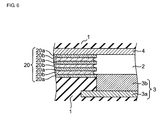
- FIG. 6 is a partially enlarged sectional view illustrating an example of the structure of an ESD protection device according to a fourth preferred embodiment of the present invention.
- FIG. 1A is a schematic longitudinal sectional view illustrating an example of the structure of an ESD protection device according to a first preferred embodiment of the present invention.
- An ESD protection device A includes an insulating ceramic body 1 including a cavity portion 2 , an auxiliary electrode 5 including a first main surface 51 and a second main surface 52 , the auxiliary electrode 5 being embedded in the insulating ceramic body 1 such that a side end portion of the auxiliary electrode 5 between the first main surface 51 and the second main surface 52 is exposed to the cavity portion 2 , and a first discharge electrode 3 and a second discharge electrode 4 that are embedded in the insulating ceramic body 1 such that a main surface of the first discharge electrode 3 and a main surface of the second discharge electrode 4 face each other with the auxiliary electrode 5 interposed therebetween.
- the portion of the first discharge electrode 3 and the portion of the second discharge electrode 4 facing each other are referred to as “facing portions”, in some cases.
- FIG. 1B is a partially enlarged view of the auxiliary electrode 5 in FIG. 1A .
- the auxiliary electrode 5 has a three-layer structure in which first auxiliary electrode layers 5 a and a second auxiliary electrode layer 5 b are laminated. That is, first auxiliary electrode layer 5 a /second auxiliary electrode layer 5 b /first auxiliary electrode layer 5 a are laminated in this order from the first discharge electrode 3 to the second discharge electrode 4 .
- the first auxiliary electrode layers preferably have a higher content of a conductive material than the second auxiliary electrode layer.
- One of the two first auxiliary electrode layers is joined to the first discharge electrode, and the other is joined to the second discharge electrode.
- electrostatic discharge from the first discharge electrode to the second discharge electrode is caused by the concentration of an electric field on a triple point where the first discharge electrode 3 , the auxiliary electrode 5 , and the cavity portion 2 are in contact with one another (hereinafter, referred to as a “surface triple point”).
- Secondary electrons generated at the surface triple point produce dendritic discharge referred to as a streamer.
- the streamer further produces a leader and reaches the second discharge electrode along a surface of the auxiliary electrode 5 .
- the discharge along the surface of the auxiliary electrode 5 is referred to as “surface discharge”.
- a higher concentration of the electric field on the surface triple point facilitates the surface discharge and reduces the discharge starting voltage.
- a higher content of the conductive material in the entire auxiliary electrode results in a higher concentration of the electric field on the triple point and promotes the production of an electron avalanche due to the emission of the secondary electrons.
- the repetition of discharge degrades the insulation and makes it difficult to achieve good resistance to insulation degradation.
- the auxiliary electrode has the three-layer structure, i.e., first auxiliary electrode layer 5 a /second auxiliary electrode layer 5 b /first auxiliary electrode layer 5 a, and the first auxiliary electrode layer is joined to the first discharge electrode.
- This promotes the concentration of the electric field on the surface triple point, to facilitate the production of the streamer and the leader to reduce the discharge starting voltage.
- the use of the first auxiliary electrode layers and the second auxiliary electrode layer that have different contents of the conductive material results in different degrees of shrinkage during sintering. That is, the second auxiliary electrode layer having a low conductive material content shrinks more easily, as compared to the first auxiliary electrode layers.
- a side end portion of the auxiliary electrode exposed to the cavity portion includes an irregular surface (see FIG. 1B ).
- the second auxiliary electrode layer includes a valley portion, and the first auxiliary electrode layers include ridged portions.
- the irregular surface has the effects of promoting the emission of secondary electrons to reduce the discharge starting voltage and of increasing a heat dissipation area to dissipate heat generated by discharge to reduce or prevent an increase in the temperature of the auxiliary electrode.
- the fact that the type of conductive material and the type of insulating material of the first auxiliary electrode layers and the second auxiliary electrode layer are changed to provide different degrees of shrinkage is also effective to provide the irregular surface.
- a mixture of a conductive material and an insulating material, for example, may preferably be used for the first auxiliary electrode layers and the second auxiliary electrode layer.
- the conductive material preferably includes a metal material and a semiconductor material, for example. Examples of the conductive material include Cu, Ag, Pd, Pt, Al, Ni, W, and combinations thereof. Cu is preferred.
- the semiconductor material examples include metal semiconductors, such as Si and Ge, carbides, such as SiC, TiC, ZrC, and WC, nitrides, such as TiN, ZrN, chromium nitride, VN, and TaN, silicides such as titanium silicide, zirconium silicide, tungsten silicide, molybdenum silicide, and chromium silicide, borides such as titanium boride, zirconium boride, chromium boride, lanthanum boride, molybdenum boride, and tungsten boride, oxides such as strontium titanate. SiC is preferred.
- the foregoing metal materials and/or semiconductor materials may be used in appropriate combination as a mixture of two or more, for example.
- the conductive material may preferably be coated with an inorganic material.
- the inorganic material is not particularly limited as long as it is an inorganic material, and may be, for example, an inorganic material, such as Al 2 O 3 , ZrO 2 , or SiO 2 or a calcined powder mixture of materials contained in a ceramic base.
- the insulating material include oxides, such as Al 2 O 3 , SiO 2 , ZrO 2 , and TiO 2 , nitrides, such as Si 3 N 4 and AlN, a calcined powder mixture of materials contained in a ceramic base, vitreous materials, and combinations thereof.
- the first auxiliary electrode layers include a combination of materials having a sintering temperature higher than that of the second auxiliary electrode layer.
- the first auxiliary electrode layers preferably have a higher content of the conductive material than the second auxiliary electrode layer.
- the content of the conductive material may be expressed as percent by volume of the conductive material with respect to (conductive material+insulating material).
- the first auxiliary electrode layers have a content of the conductive material of about 15% to about 50% by volume, preferably about 20% to about 40% by volume, for example.
- the content of the conductive material in the second auxiliary electrode layer may be lower than, for example, preferably about 3% to about 15% by volume lower than the content of the conductive material in the first auxiliary electrode layers.
- the first auxiliary electrode layers have a content of the conductive material of about 30% to about 90% by volume, preferably about 40% to about 80% by volume, for example.
- the content of the conductive material in the second auxiliary electrode layer may be lower than, for example, preferably about 7% to about 30% by volume lower than, the content of the conductive material in the first auxiliary electrode layers.
- the thickness of the auxiliary electrode may be set, depending on the distance of a discharge gap (distance between the facing portions of the first discharge electrode and the second discharge electrode), and is about 3 ⁇ m to about 20 ⁇ m, preferably about 5 ⁇ m to about 15 ⁇ m, for example.
- the thicknesses of the first auxiliary electrode layers and the second auxiliary electrode layer may each be set in the range of about 0.5 ⁇ m to about 15 ⁇ m, preferably about 1 ⁇ m to about 10 ⁇ m, for example, depending on the thickness of the auxiliary electrode.
- the first auxiliary electrode layers and the second auxiliary electrode layer may have the same or different thicknesses.
- the second auxiliary electrode layer has a larger thickness. The larger thickness facilitates a reduction or prevention of a short-circuit between the discharge electrodes.
- the first auxiliary electrode layer having a high content of the conductive material is joined to at least one of the first discharge electrode and the second discharge electrode.
- a two-layer structure i.e., first auxiliary electrode layer/second auxiliary electrode layer
- the first auxiliary electrode layers may be joined to both of the first discharge electrode and the second discharge electrode.
- a streamer propagates reliably from one discharge electrode to the other discharge electrode, and the device may be used as a bipolar ESD protection device, for example.
- multilayer structures that include the first auxiliary electrode layers and the second auxiliary electrode layers alternately laminated and that include various numbers of layers may be used.
- Examples thereof include a three-layer structure, i.e., first auxiliary electrode layer/second auxiliary electrode layer/first auxiliary electrode layer; a five-layer structure, i.e., first auxiliary electrode layer/second auxiliary electrode layer/first auxiliary electrode layer/second auxiliary electrode layer/first auxiliary electrode layer; and a seven-layer structure, i.e., first auxiliary electrode layer/second auxiliary electrode layer/first auxiliary electrode layer/second auxiliary electrode layer/first auxiliary electrode layer/second auxiliary electrode layer/first auxiliary electrode layer.
- the shape of the auxiliary electrode 5 having a multilayer structure is not particularly limited.
- an annular shape for example, may be used when viewed from the lamination direction of the auxiliary electrode 5 .
- a ceramic material included in the insulating ceramic body 1 for example, a low-temperature co-fired ceramic (LTCC) containing Ba, Al, and Si as main components may preferably be used.
- the insulating ceramic body 1 may include at least one of an alkali metal component and a boron component.
- a glass component may be included.
- a first outer electrode 8 and a second outer electrode 9 may preferably be made of, for example, a material such as Cu, Ag, Pd, Pt, Al, Ni, or W, or an alloy containing at least one thereof.
- the method for producing an ESD protection device includes the steps of forming a first discharge electrode and a second discharge electrode on respective main surfaces of a first ceramic green sheet and a second ceramic green sheet, forming an auxiliary electrode sheet including at least two layers in which two auxiliary electrode layers having different contents of a conductive material are alternately arranged, forming a through hole to be formed into a cavity portion in the auxiliary electrode sheet, forming a multilayer body by laminating the first ceramic green sheet and the second ceramic green sheet with the auxiliary electrode sheet interposed therebetween such that the first discharge electrode and the second discharge electrode are exposed to the through hole, and firing the multilayer body.
- Ceramic green sheets 10 , 11 , 12 , and 13 are laminated with the auxiliary electrode sheet 15 interposed therebetween in such a manner that the first discharge electrode and the second discharge electrode are exposed to the through hole to form a green sheet multilayer body.
- the green sheet multilayer body may be fired in the temperature range of about 850° C. to about 1,000° C. in a N 2 atmosphere, for example.
- the first discharge electrode includes a first main conductor 3 a and a first auxiliary conductor 3 b.
- FIG. 3B is a partially enlarged view of the auxiliary electrode 5 .
- the auxiliary electrode 5 has a three-layer structure in which the first auxiliary electrode layers 5 a and the second auxiliary electrode layer 5 b are laminated, i.e., first auxiliary electrode layer 5 a /second auxiliary electrode layer 5 b /first auxiliary electrode layer 5 a laminated in this order from the first discharge electrode 3 toward the second discharge electrode 4 .
- the lower first auxiliary electrode layer 5 a is joined to the first auxiliary conductor 3 b, and the upper first auxiliary electrode layer 5 a is joined to the second discharge electrode 4 .
- the first auxiliary conductor is a conductor used to inhibit the degradation of the main conductor due to the repetition of discharge.
- a via conductor can be used in which a via hole in the insulating ceramic body is filled with a conductive material.
- FIGS. 3A and 3B illustrate a structure in which the first auxiliary conductor is joined to the main conductor, the first auxiliary conductor and the main conductor may be integrally provided.
- the auxiliary conductor is also referred to as a “via conductor”.
- the ESD protection device may be produced in the same or substantially the same method as in the first preferred embodiment, except that in the step of forming the first discharge electrode and the second discharge electrode, the first auxiliary conductor is formed by forming a via hole in the ceramic green sheet on which the first discharge electrode is formed, and then filling the via hole with a conductor.
- FIG. 4 is a schematic sectional view illustrating an example of a production process.
- the ceramic green sheet 12 is used in which the via hole is filled with a first auxiliary conductor 18 and the first discharge electrode 16 is formed.
- the ceramic green sheets 10 , 11 , 12 , and 13 are laminated with the auxiliary electrode sheet 15 interposed therebetween to form a green sheet multilayer body.
- the same or similar advantageous effects as those of the ESD protection device according to the first preferred embodiment are provided. Furthermore, the arrangement of the first auxiliary conductor reduces or prevents the delamination of the discharge electrode even if discharge is repeated, thus resulting in improved stability of operating characteristics.
- the ESD protection device has a structure in which the first discharge electrode and the second discharge electrode partially face each other with the cavity portion interposed therebetween, whereas an ESD protection device according to a third preferred embodiment of the present invention has the same or substantially the same structure as the ESD protection device according to the first preferred embodiment, except that the first discharge electrode includes the first auxiliary conductor, at least a portion of a main surface of the first auxiliary conductor is exposed to the cavity portion, the second discharge electrode includes a second auxiliary conductor, and at least a portion of a main surface of the second auxiliary conductor is exposed to the cavity portion.
- the ESD protection device may be produced in the same or substantially method as in the first preferred embodiment, except that in the step of forming the first discharge electrode and the second discharge electrode, the first auxiliary conductor and the second auxiliary conductor are formed by forming a via hole in the ceramic green sheet on which the first discharge electrode is formed, forming a via hole in the ceramic green sheet on which the second discharge electrode is formed, filling these via holes with the conductor.
- the same or similar advantageous effects as those of the ESD protection device according to the first preferred embodiment are provided. Furthermore, the arrangement of the auxiliary conductors above and below the cavity portion reduces or prevents the delamination of both the discharge electrodes even if discharge is repeated, thus resulting in further improved stability of operating characteristics.
- the ESD protection device according to the second preferred embodiment includes the auxiliary electrode having a three-layer structure, whereas an ESD protection device according to a fourth preferred embodiment of the present invention has the same or substantially the same structure as the ESD protection device according to the second preferred embodiment, except that an auxiliary electrode having a five-layer structure is provided.
- FIG. 6 is a partial enlarged view of the auxiliary electrode 20 .
- the auxiliary electrode 20 has a seven-layer structure in which the first auxiliary electrode layers 20 a and the second auxiliary electrode layers 20 b are laminated, i.e., first auxiliary electrode layer 20 a /second auxiliary electrode layer 20 b /first auxiliary electrode layer 20 a /second auxiliary electrode layer 20 b /first auxiliary electrode layer 20 a /second auxiliary electrode layer 20 b /first auxiliary electrode layer 20 a laminated in this order from the first discharge electrode 3 toward the second discharge electrode 4 .
- the lower first auxiliary electrode layer 20 a is joined to the first auxiliary conductor 3 b, and the upper first auxiliary electrode layer 20 a is joined to the second discharge electrode 4 .
- the second auxiliary electrode layers include valley portions, and the first auxiliary electrode layers include ridged portions.
- a side end portion of the auxiliary electrode exposed to the cavity portion includes an irregular surface in which the valley portions and the ridged portions are
- an increase in the number of the first auxiliary electrode layers and the second auxiliary electrode layers included in the auxiliary electrode facilitates the propagation of a streamer to result in a lower discharge starting voltage and further improved resistance to insulation degradation.
- a heat dissipation area that dissipates heat generated by discharge is further increased.
- a material having a composition primarily containing Ba, Al, and Si (a material whose relative dielectric constant E r was adjusted to 4 to 9 and is referred to as a “BAS material” hereinafter) was used.
- Materials were mixed such that a predetermined composition was obtained, and then calcined at about 800° C. to about 1,000° C.
- the calcined powder was pulverized for about 12 hours with a zirconia ball mill to prepare a ceramic powder.
- the ceramic powder was mixed with an organic solvent, such as toluene or Ekinen.
- the resulting mixture was then mixed with a binder and a plasticizer to prepare a slurry.
- the resulting slurry was formed into four ceramic green sheets having a thickness of about 25 ⁇ m by a doctor blade method.
- the auxiliary electrode material A was a Cu/Al 2 O 3 mixture.
- a Cu powder having an average particle size of about 0.5 ⁇ m and an Al 2 O 3 powder having an average particle size of about 0.1 ⁇ m were mixed together in a ratio of about 35% by volume to about 65% by volume.
- the mixture was mixed with an organic solvent, such as toluene or Ekinen.
- the resulting mixture was then mixed with a binder and a plasticizer to prepare a slurry.
- the auxiliary electrode material B was a Cu/calcined BAS powder mixture.
- a Cu powder having an average particle size of about 0.5 ⁇ m and a calcined BAS powder whose average particle size was adjusted to about 0.5 ⁇ m were mixed in a ratio of about 30% by volume to about 70% by volume.
- the mixture was mixed with an organic solvent, such as toluene or Ekinen.
- the resulting mixture was then mixed with a binder and a plasticizer to prepare a slurry.
- the resulting slurries were formed by a doctor blade method into an auxiliary electrode sheet having a three-layer structure of first auxiliary electrode/second auxiliary electrode/first auxiliary electrode. Specifically, two first auxiliary electrode sheets having a thickness of about 5 ⁇ m were formed with the auxiliary electrode material A. A single second auxiliary electrode sheet having a thickness of about 10 ⁇ m was formed with the auxiliary electrode material B. The first auxiliary electrode sheets were laminated with the second auxiliary electrode sheet interposed therebetween.
- a Cu powder having an average particle size of about 1 ⁇ m and about 15% by weight of an organic vehicle prepared by dissolving ethyl cellulose in terpineol were mixed together using a three-roll mill to prepare a via-conductor paste.
- a Cu powder having an average particle size of about 1 ⁇ m and about 40% by weight of a Cu powder having an average particle size of about 3 ⁇ m, and about 20% by weight of an organic vehicle prepared by dissolving ethyl cellulose in terpineol were mixed together using a three-roll mill to prepare a discharge electrode paste.
- crosslinked acrylic resin beads having an average particle size of about 1 ⁇ m and about 62% by weight of an organic vehicle prepared by dissolving about 10% by weight of Ethocel resin in terpineol were mixed together using a three-roll mill to prepare a paste for cavity formation.
- a Cu powder having an average particle size of about 1 ⁇ m, about 5% by weight of an alkaline borosilicate-based glass frit having a transition point of about 620° C., a softening point of about 720° C., and an average particle size of about 1 ⁇ m, and about 15% by weight of an organic vehicle prepared by dissolving ethyl cellulose in terpineol were mixed together using a three-roll mill to prepare an outer electrode paste.
- Via holes were formed in the ceramic green sheet and the auxiliary electrode sheet with a CO 2 laser.
- the via hole having a diameter of about 130 ⁇ m was formed in the ceramic green sheet and filled with the via-conductor paste.
- the via hole having a diameter of about 130 ⁇ m was formed in the auxiliary electrode sheet and filled with the paste for cavity formation. Then a piece having a predetermined size was cut from the auxiliary electrode sheet and used to form a discharge portion at the time of lamination.
- the discharge electrode paste was applied by screen printing.
- the discharge electrode paste was applied to one ceramic green sheet without a via hole and the ceramic green sheet in which the via hole had been formed and filled with the via conductor, to form outgoing lines to the outside.
- the ceramic green sheets 10 , 11 , 12 , and 13 were stacked such that the auxiliary electrode sheet 15 was interposed between the ceramic green sheet 11 including the second discharge electrode 17 thereon and the ceramic green sheet 12 including the first discharge electrode 16 thereon and the via hole therein, the via hole being filled with the first auxiliary conductor 18 , and then were subjected to pressure bonding to form a multilayer body.
- the ceramic green sheets 10 , 11 , 12 , and 13 were stacked such that the first auxiliary conductor 18 and a portion of the second discharge electrode 17 faced each other with the cavity portion 14 interposed therebetween.
- stacking and pressure bonding were performed in such a manner that the multilayer body had a thickness of about 0.3 mm.
- the multilayer body was divided into chips by cutting with a micro-cutter.
- the cutting was performed such that the chips had a length of about 1.0 mm and a width of about 0.5 mm.
- the chips were fired in an N 2 atmosphere.
- an air atmosphere may preferably be used.
- the electrode paste was applied to end surfaces and baked to form outer electrodes.
- the outer electrodes were subjected to electrolytic Ni—Sn plating.
- ESD protection devices were completed by the steps described above, each of the ESD protection devices including the auxiliary electrode having a three-layer structure and the via conductor arranged on one side of the cavity portion in the thickness direction of the multilayer body.
- the discharge gap (distance between the discharge electrodes) was about 15 ⁇ m. Also in an example and a comparative example described below, the discharge gap was about 15 ⁇ m, unless otherwise specified.
- ESD protection devices were produced, each of the ESD protection devices including an auxiliary electrode having a five-layer structure, a via conductor being arranged on one side of a cavity portion in the thickness direction of a multilayer body.
- the ESD protection devices were produced in the same or substantially the same manner as in Example 1, except that an auxiliary electrode sheet having a five-layer structure of first auxiliary electrode/second auxiliary electrode/first auxiliary electrode/second auxiliary electrode/first auxiliary electrode, was formed in the step of preparing an auxiliary electrode material described above.
- ESD protection devices were produced in the same or substantially the same manner as in Example 1, except that in the step of preparing an auxiliary electrode material described above, the auxiliary electrode material B was used to form an auxiliary electrode sheet having a single-layer structure including only the second auxiliary electrode.
- a voltage of about 1.5 kV to about 3.0 kV for contact discharge was applied in accordance with an electrostatic discharge immunity test specified in an IEC standard (IEC 61000-4-2) to measure an operating ratio.
- IEC 61000-4-2 an electrostatic discharge immunity test specified in an IEC standard
- 100 samples were evaluated.
- the operating ratio used here refers to the ratio of the number of the samples in which discharge occurred at a predetermined voltage to the total number of the samples.
- the resistance of the produced ESD protection devices when discharge occurred repeatedly was evaluated. Specifically, a voltage of about 8 kV or about 10 kV for contact discharge was successively applied 100 times in accordance with the electrostatic discharge immunity test specified in the IEC standard (IEC 61000-4-2). A sample whose IR value was decreased to about 10 k ⁇ was evaluated as a failure. A sample whose IR value was not decreased to about 10 k ⁇ was evaluated as a non-defective product. Non-defective product ratios were compared with one another. In each of the examples and the comparative example, 50 samples were evaluated. The non-defective product ratio used here refers to the ratio of the number of the samples evaluated as the non-defective products to the total number of the samples.
- Comparative example 1 the operating ratio at about 1.5 kV was about 10% or less. In contrast, in each of Examples 1 and 2, an operating ratio of about 30% or more was obtained even at about 1.5 kV. Regarding the resistance to IR degradation, the non-defective product ratio at about 10 kV was about 10% or less in Comparative example 1, whereas the non-defective product ratio was about 50% or more in each of Examples 1 and 2.
Landscapes
- Thermistors And Varistors (AREA)
- Physical Or Chemical Processes And Apparatus (AREA)
Abstract
Description
- This application claims the benefit of priority to Japanese Patent Application No. 2015-148784 filed on Jul. 28, 2015 and is a Continuation Application of PCT Application No. PCT/JP2016/067689 filed on Jun. 14, 2016. The entire contents of each application are hereby incorporated herein by reference.
- The present invention relates to an ESD protection device.
- Electro-static discharge (ESD) refers to a discharge phenomenon that occurs when, for example, the human body comes into contact with an electronic apparatus, and causes damage to and malfunction of the electronic apparatus. ESD protection devices are devices that protect electronic apparatuses from the application of overcurrent generated during discharge.
- ESD protection devices have a structure in which a pair of discharge electrodes face each other with a distance maintained therebetween. When overvoltage is applied, discharge occurs between the discharge electrodes to guide static electricity to the ground side, thus protecting circuits. In recent years, electronic apparatuses that operate at lower voltages have been widely used. This requires an ESD protection device whose discharge starting voltage is low, in other words, an ESD protection device that allows discharge to occur at a lower voltage.
- For example, Japanese Unexamined Patent Application Publication No. 2010-129320 describes an ESD protection device including an insulating substrate with a cavity portion inside thereof, a first discharge electrode, a second discharge electrode, and an auxiliary electrode that is arranged on at least a portion of the inner periphery of the cavity portion and that is electrically connected to the first discharge electrode and the second discharge electrode.
- In the cavity portion, discharge occurs primarily along the inner periphery of the cavity portion (referred to as “surface discharge”). In the ESD protection device described in Japanese Unexamined Patent Application Publication No. 2010-129320, the arrangement of the auxiliary electrode on at least a portion of the inner periphery of the cavity portion facilitates the generation of the surface discharge, thus resulting in improved stability of ESD characteristics.
- In recent years, however, there has been a need for an ESD protection device that enables discharge to occur at a lower voltage and that has high resistance to insulation degradation.
- Preferred embodiments of the present invention provide ESD protection devices that have a lower discharge starting voltage and improved resistance to insulation degradation.
- The inventors have conducted intensive studies and have discovered that it is possible to further reduce a discharge starting voltage and improve resistance to insulation degradation by arranging an auxiliary electrode including a plurality of layers, one of the layers including a larger amount of conductive material being located on the side of a discharge electrode.
- An ESD protection device according to a preferred embodiment of the present invention includes an insulating ceramic body including a cavity portion; an auxiliary electrode including a first main surface and a second main surface, the auxiliary electrode being embedded in the insulating ceramic body such that a side end portion of the auxiliary electrode between the first main surface and the second main surface is exposed to the cavity portion; and a first discharge electrode and a second discharge electrode that are embedded in the insulating ceramic body such that a main surface of the first discharge electrode and a main surface of the second discharge electrode face each other with the auxiliary electrode interposed therebetween. The auxiliary electrode includes at least one first auxiliary electrode layer and at least one second auxiliary electrode layer, the first auxiliary electrode layer having a higher content of a conductive material than the second auxiliary electrode layer, the first auxiliary electrode layer being joined to at least one of the first discharge electrode and the second discharge electrode.
- An ESD protection device according to a preferred embodiment of the present invention has a multilayer structure including at least two layers: the first auxiliary electrode layer and the second auxiliary electrode layer that have different contents of the conductive material and that are alternately arranged. The first auxiliary electrode layer having a high content of the conductive material is joined to at least one of the first discharge electrode and the second discharge electrode, thus resulting in improved operating characteristics at a low voltage and improved resistance to insulation degradation.
- In a preferred embodiment of the present invention, the first discharge electrode may include a first auxiliary conductor electrically connected to the auxiliary electrode, and the first auxiliary conductor may be arranged such that at least a portion of a main surface of the first auxiliary conductor is exposed to the cavity portion.
- According to the preferred embodiment described above, the arrangement of the first auxiliary conductor is able to reduce or prevent the delamination of the discharge electrode even if discharge is repeated, thus resulting in improved stability of the operating characteristics.
- In a preferred embodiment of the present invention, the first discharge electrode may include a first auxiliary conductor electrically connected to the auxiliary electrode, the second discharge electrode may include a second auxiliary conductor electrically connected to the auxiliary electrode, and the first auxiliary conductor and the second auxiliary conductor may be arranged such that at least a portion of a main surface of the first auxiliary conductor and at least a portion of a main surface of the second auxiliary conductor are exposed to the cavity portion.
- According to the preferred embodiment described above, the arrangement of the first auxiliary conductor and the second auxiliary conductor is able to further reduce or prevent the delamination of the discharge electrode even if discharge is repeated, thus resulting in further improved stability of the operating characteristics.
- In a preferred embodiment of the present invention, the conductive material may include a metal material and/or a semiconductor material.
- According to the preferred embodiment described above, the use of the metal material and/or the semiconductor material as the conductive material provides the ESD protection device having good stability of the operating characteristics.
- In a preferred embodiment of the present invention, the side end portion of the auxiliary electrode exposed to the cavity portion may include a surface having an irregular shape.
- According to the preferred embodiment described above, the irregular shape provides the effects of promoting the emission of secondary electrons to reduce the discharge starting voltage and of increasing a heat dissipation area that dissipates heat generated by discharge to reduce or prevent an increase in the temperature of the auxiliary electrode.
- In a preferred embodiment of the present invention, the second auxiliary electrode layer may have a larger thickness than the first auxiliary electrode layer.
- According to the preferred embodiment described above, the auxiliary electrode is able to have further improved insulation.
- In a preferred embodiment of the present invention, the auxiliary electrode may include a through hole in the cavity portion that has an annular shape.
- According to the preferred embodiment described above, the surface discharge occurs along a surface of the auxiliary electrode exposed to the cavity portion. Thus, the stability of the ESD characteristics is improved.
- In a preferred embodiment of the present invention, the auxiliary electrode may have a structure in which one first auxiliary electrode layer and one second auxiliary electrode layer are alternately laminated.
- According to the preferred embodiment described above, the alternate lamination of the first auxiliary electrode layer and the second auxiliary electrode layer results in further improved insulation of the auxiliary electrode.
- In a preferred embodiment of the present invention, the auxiliary electrode may have a three-layer structure in which one second auxiliary electrode layer is arranged between one first auxiliary electrode layer joined to the first discharge electrode and one first auxiliary electrode layer joined to the second discharge electrode.
- According to the preferred embodiment described above, a streamer is able to propagate reliably from one of the discharge electrodes to the other discharge electrode, and the device may also be used as a bipolar ESD protection device.
- According to various preferred embodiments of the present invention, it is possible to provide ESD protection devices with a lower discharge starting voltage and improved resistance to insulation degradation.
- The above and other elements, features, steps, characteristics and advantages of the present invention will become more apparent from the following detailed description of the preferred embodiments with reference to the attached drawings.
-
FIG. 1A is a schematic longitudinal sectional view illustrating an example of the structure of an ESD protection device according to a first preferred embodiment of the present invention. -
FIG. 1B is a partially enlarged sectional view ofFIG. 1A . -
FIG. 2 is a schematic longitudinal sectional view illustrating an example of a production process of an ESD protection device according to the first preferred embodiment of the present invention. -
FIG. 3A is a schematic longitudinal sectional view illustrating an example of the structure of an ESD protection device according to a second preferred embodiment of the present invention. -
FIG. 3B is a partially enlarged sectional view ofFIG. 3A . -
FIG. 4 is a schematic longitudinal sectional view illustrating an example of a production process of an ESD protection device according to the second preferred embodiment of the present invention. -
FIG. 5A is a schematic longitudinal sectional view illustrating an example of the structure of an ESD protection device according to a third preferred embodiment of the present invention. -
FIG. 5B is a partially enlarged sectional view ofFIG. 5A . -
FIG. 6 is a partially enlarged sectional view illustrating an example of the structure of an ESD protection device according to a fourth preferred embodiment of the present invention. - Preferred embodiments of the present invention will be described in detail below with reference to the drawings.
-
FIG. 1A is a schematic longitudinal sectional view illustrating an example of the structure of an ESD protection device according to a first preferred embodiment of the present invention. An ESD protection device A includes an insulatingceramic body 1 including acavity portion 2, anauxiliary electrode 5 including a firstmain surface 51 and a secondmain surface 52, theauxiliary electrode 5 being embedded in the insulatingceramic body 1 such that a side end portion of theauxiliary electrode 5 between the firstmain surface 51 and the secondmain surface 52 is exposed to thecavity portion 2, and afirst discharge electrode 3 and asecond discharge electrode 4 that are embedded in the insulatingceramic body 1 such that a main surface of thefirst discharge electrode 3 and a main surface of thesecond discharge electrode 4 face each other with theauxiliary electrode 5 interposed therebetween. A portion of thefirst discharge electrode 3 and a portion of thesecond discharge electrode 4 face each other with thecavity portion 2 interposed therebetween. In the following description, the portion of thefirst discharge electrode 3 and the portion of thesecond discharge electrode 4 facing each other are referred to as “facing portions”, in some cases. -
FIG. 1B is a partially enlarged view of theauxiliary electrode 5 inFIG. 1A . Theauxiliary electrode 5 has a three-layer structure in which firstauxiliary electrode layers 5 a and a secondauxiliary electrode layer 5 b are laminated. That is, firstauxiliary electrode layer 5 a/secondauxiliary electrode layer 5 b/firstauxiliary electrode layer 5 a are laminated in this order from thefirst discharge electrode 3 to thesecond discharge electrode 4. The first auxiliary electrode layers preferably have a higher content of a conductive material than the second auxiliary electrode layer. One of the two first auxiliary electrode layers is joined to the first discharge electrode, and the other is joined to the second discharge electrode. - In general, electrostatic discharge from the first discharge electrode to the second discharge electrode is caused by the concentration of an electric field on a triple point where the
first discharge electrode 3, theauxiliary electrode 5, and thecavity portion 2 are in contact with one another (hereinafter, referred to as a “surface triple point”). Secondary electrons generated at the surface triple point produce dendritic discharge referred to as a streamer. The streamer further produces a leader and reaches the second discharge electrode along a surface of theauxiliary electrode 5. The discharge along the surface of theauxiliary electrode 5 is referred to as “surface discharge”. A higher concentration of the electric field on the surface triple point facilitates the surface discharge and reduces the discharge starting voltage. A higher content of the conductive material in the entire auxiliary electrode results in a higher concentration of the electric field on the triple point and promotes the production of an electron avalanche due to the emission of the secondary electrons. However, at a larger amount of the conductive material, the repetition of discharge degrades the insulation and makes it difficult to achieve good resistance to insulation degradation. - In the present preferred embodiment, the auxiliary electrode has the three-layer structure, i.e., first
auxiliary electrode layer 5 a/secondauxiliary electrode layer 5 b/firstauxiliary electrode layer 5 a, and the first auxiliary electrode layer is joined to the first discharge electrode. This promotes the concentration of the electric field on the surface triple point, to facilitate the production of the streamer and the leader to reduce the discharge starting voltage. Once the streamer and the leader are produced, the growth of the surface discharge is not substantially reduced or prevented even in the presence of the second auxiliary electrode layer having a low content of the conductive material. Furthermore, the arrangement of the second auxiliary electrode layer, having a low content of the conductive material, adjacent to the first auxiliary electrode layers is less likely to lead to dielectric breakdown due to discharge. Thus, high insulation is maintained to improve resistance to insulation degradation even if discharge is repeated. - The use of the first auxiliary electrode layers and the second auxiliary electrode layer that have different contents of the conductive material results in different degrees of shrinkage during sintering. That is, the second auxiliary electrode layer having a low conductive material content shrinks more easily, as compared to the first auxiliary electrode layers. Thus, a side end portion of the auxiliary electrode exposed to the cavity portion includes an irregular surface (see
FIG. 1B ). The second auxiliary electrode layer includes a valley portion, and the first auxiliary electrode layers include ridged portions. The irregular surface has the effects of promoting the emission of secondary electrons to reduce the discharge starting voltage and of increasing a heat dissipation area to dissipate heat generated by discharge to reduce or prevent an increase in the temperature of the auxiliary electrode. The fact that the type of conductive material and the type of insulating material of the first auxiliary electrode layers and the second auxiliary electrode layer are changed to provide different degrees of shrinkage is also effective to provide the irregular surface. - A mixture of a conductive material and an insulating material, for example, may preferably be used for the first auxiliary electrode layers and the second auxiliary electrode layer. The conductive material preferably includes a metal material and a semiconductor material, for example. Examples of the conductive material include Cu, Ag, Pd, Pt, Al, Ni, W, and combinations thereof. Cu is preferred. Examples of the semiconductor material include metal semiconductors, such as Si and Ge, carbides, such as SiC, TiC, ZrC, and WC, nitrides, such as TiN, ZrN, chromium nitride, VN, and TaN, silicides such as titanium silicide, zirconium silicide, tungsten silicide, molybdenum silicide, and chromium silicide, borides such as titanium boride, zirconium boride, chromium boride, lanthanum boride, molybdenum boride, and tungsten boride, oxides such as strontium titanate. SiC is preferred. The foregoing metal materials and/or semiconductor materials may be used in appropriate combination as a mixture of two or more, for example. The conductive material may preferably be coated with an inorganic material. The inorganic material is not particularly limited as long as it is an inorganic material, and may be, for example, an inorganic material, such as Al2O3, ZrO2, or SiO2 or a calcined powder mixture of materials contained in a ceramic base. Examples of the insulating material include oxides, such as Al2O3, SiO2, ZrO2, and TiO2, nitrides, such as Si3N4 and AlN, a calcined powder mixture of materials contained in a ceramic base, vitreous materials, and combinations thereof. Regarding a combination of the conductive material and the insulating material, preferably, the first auxiliary electrode layers include a combination of materials having a sintering temperature higher than that of the second auxiliary electrode layer.
- The first auxiliary electrode layers preferably have a higher content of the conductive material than the second auxiliary electrode layer. Here, the content of the conductive material may be expressed as percent by volume of the conductive material with respect to (conductive material+insulating material). For example, in the case of a combination of the metal material and the insulating material, the first auxiliary electrode layers have a content of the conductive material of about 15% to about 50% by volume, preferably about 20% to about 40% by volume, for example. The content of the conductive material in the second auxiliary electrode layer may be lower than, for example, preferably about 3% to about 15% by volume lower than the content of the conductive material in the first auxiliary electrode layers. In the case of using the conductive material coated with an inorganic material or the semiconductor material, the first auxiliary electrode layers have a content of the conductive material of about 30% to about 90% by volume, preferably about 40% to about 80% by volume, for example. The content of the conductive material in the second auxiliary electrode layer may be lower than, for example, preferably about 7% to about 30% by volume lower than, the content of the conductive material in the first auxiliary electrode layers.
- The thickness of the auxiliary electrode may be set, depending on the distance of a discharge gap (distance between the facing portions of the first discharge electrode and the second discharge electrode), and is about 3 μm to about 20 μm, preferably about 5 μm to about 15 μm, for example. The thicknesses of the first auxiliary electrode layers and the second auxiliary electrode layer may each be set in the range of about 0.5 μm to about 15 μm, preferably about 1 μm to about 10 μm, for example, depending on the thickness of the auxiliary electrode. The first auxiliary electrode layers and the second auxiliary electrode layer may have the same or different thicknesses. Preferably, the second auxiliary electrode layer has a larger thickness. The larger thickness facilitates a reduction or prevention of a short-circuit between the discharge electrodes.
- The first auxiliary electrode layer having a high content of the conductive material is joined to at least one of the first discharge electrode and the second discharge electrode. In the case where one of the first discharge electrode and the second discharge electrode is joined, a two-layer structure, i.e., first auxiliary electrode layer/second auxiliary electrode layer, may be used. The first auxiliary electrode layers may be joined to both of the first discharge electrode and the second discharge electrode. In this case, a streamer propagates reliably from one discharge electrode to the other discharge electrode, and the device may be used as a bipolar ESD protection device, for example. In this case, multilayer structures that include the first auxiliary electrode layers and the second auxiliary electrode layers alternately laminated and that include various numbers of layers may be used. Examples thereof include a three-layer structure, i.e., first auxiliary electrode layer/second auxiliary electrode layer/first auxiliary electrode layer; a five-layer structure, i.e., first auxiliary electrode layer/second auxiliary electrode layer/first auxiliary electrode layer/second auxiliary electrode layer/first auxiliary electrode layer; and a seven-layer structure, i.e., first auxiliary electrode layer/second auxiliary electrode layer/first auxiliary electrode layer/second auxiliary electrode layer/first auxiliary electrode layer/second auxiliary electrode layer/first auxiliary electrode layer.
- The shape of the
auxiliary electrode 5 having a multilayer structure is not particularly limited. Preferably, an annular shape, for example, may be used when viewed from the lamination direction of theauxiliary electrode 5. - As a ceramic material included in the insulating
ceramic body 1, for example, a low-temperature co-fired ceramic (LTCC) containing Ba, Al, and Si as main components may preferably be used. The insulatingceramic body 1 may include at least one of an alkali metal component and a boron component. In addition, a glass component may be included. - The
first discharge electrode 3 and thesecond discharge electrode 4 are arranged in different planes. Thefirst discharge electrode 3 and thesecond discharge electrode 4 extend in the directions of the different planes. The shape thereof is not particularly limited. For example, a strip shape may be used. Thefirst discharge electrode 3 and thesecond discharge electrode 4 may preferably be made of, for example, a material such as Cu, Ag, Pd, Pt, Al, Ni, or W, or an alloy containing at least one thereof. - A first
outer electrode 8 and a second outer electrode 9 may preferably be made of, for example, a material such as Cu, Ag, Pd, Pt, Al, Ni, or W, or an alloy containing at least one thereof. - The ESD protection device according to this preferred embodiment has a multilayer structure including at least two layers in which two auxiliary electrode layers (the first auxiliary electrode layer and the second auxiliary electrode layer) having different contents of the conductive material are alternately arranged, the first auxiliary electrode layer with a high content of the conductive material being joined to at least one of the first discharge electrode and the second discharge electrode, thus resulting in improved operating characteristics at a low voltage and improved resistance to insulation degradation.
- A non-limiting example of a method for producing an ESD protection device according to the present preferred embodiment will be described below. The method for producing an ESD protection device includes the steps of forming a first discharge electrode and a second discharge electrode on respective main surfaces of a first ceramic green sheet and a second ceramic green sheet, forming an auxiliary electrode sheet including at least two layers in which two auxiliary electrode layers having different contents of a conductive material are alternately arranged, forming a through hole to be formed into a cavity portion in the auxiliary electrode sheet, forming a multilayer body by laminating the first ceramic green sheet and the second ceramic green sheet with the auxiliary electrode sheet interposed therebetween such that the first discharge electrode and the second discharge electrode are exposed to the through hole, and firing the multilayer body.
- The method for producing an ESD protection device according to the present preferred embodiment will be specifically described below with reference to
FIG. 2 . - A conductive paste is applied to ceramic
green sheets first discharge electrode 16 and asecond discharge electrode 17, respectively. - Slurries for two auxiliary electrode layers having different contents of the conductive material are prepared. First auxiliary electrode layer sheets (not illustrated) and a second auxiliary electrode layer sheet (not illustrated) are formed by a doctor blade method, for example. The first auxiliary electrode layer sheets and the second auxiliary electrode layer sheet are alternately laminated to form an
auxiliary electrode sheet 15 having a three-layer structure. - (3) Step of Forming Through Hole to Be Formed into Cavity Portion in Auxiliary Electrode Sheet
- A through
hole 14 to be formed into a cavity portion at the time of lamination is formed in the resultingauxiliary electrode sheet 15. - Ceramic
green sheets auxiliary electrode sheet 15 interposed therebetween in such a manner that the first discharge electrode and the second discharge electrode are exposed to the through hole to form a green sheet multilayer body. - The green sheet multilayer body may be fired in the temperature range of about 850° C. to about 1,000° C. in a N2 atmosphere, for example.
- The ESD protection device according to the first preferred embodiment has a structure in which the first discharge electrode and the second discharge electrode partially face each other with the cavity portion interposed therebetween, whereas an ESD protection device according to a second preferred embodiment of the present invention has the same or substantially the same structure as the ESD protection device according to the first preferred embodiment, except that the first discharge electrode includes a first auxiliary conductor and that the first auxiliary conductor is arranged such that at least a portion of a main surface of the first auxiliary conductor is exposed to the cavity portion.
- As illustrated in
FIG. 3A , the first discharge electrode includes a firstmain conductor 3 a and a firstauxiliary conductor 3 b.FIG. 3B is a partially enlarged view of theauxiliary electrode 5. Theauxiliary electrode 5 has a three-layer structure in which the firstauxiliary electrode layers 5 a and the secondauxiliary electrode layer 5 b are laminated, i.e., firstauxiliary electrode layer 5 a/secondauxiliary electrode layer 5 b/firstauxiliary electrode layer 5 a laminated in this order from thefirst discharge electrode 3 toward thesecond discharge electrode 4. The lower firstauxiliary electrode layer 5 a is joined to the firstauxiliary conductor 3 b, and the upper firstauxiliary electrode layer 5 a is joined to thesecond discharge electrode 4. - The first auxiliary conductor is a conductor used to inhibit the degradation of the main conductor due to the repetition of discharge. For example, a via conductor can be used in which a via hole in the insulating ceramic body is filled with a conductive material. Although
FIGS. 3A and 3B illustrate a structure in which the first auxiliary conductor is joined to the main conductor, the first auxiliary conductor and the main conductor may be integrally provided. Hereinafter, the auxiliary conductor is also referred to as a “via conductor”. - The ESD protection device according to the present preferred embodiment may be produced in the same or substantially the same method as in the first preferred embodiment, except that in the step of forming the first discharge electrode and the second discharge electrode, the first auxiliary conductor is formed by forming a via hole in the ceramic green sheet on which the first discharge electrode is formed, and then filling the via hole with a conductor.
FIG. 4 is a schematic sectional view illustrating an example of a production process. The ceramicgreen sheet 12 is used in which the via hole is filled with a firstauxiliary conductor 18 and thefirst discharge electrode 16 is formed. The ceramicgreen sheets auxiliary electrode sheet 15 interposed therebetween to form a green sheet multilayer body. - According to the present preferred embodiment, the same or similar advantageous effects as those of the ESD protection device according to the first preferred embodiment are provided. Furthermore, the arrangement of the first auxiliary conductor reduces or prevents the delamination of the discharge electrode even if discharge is repeated, thus resulting in improved stability of operating characteristics.
- The ESD protection device according to the first preferred embodiment has a structure in which the first discharge electrode and the second discharge electrode partially face each other with the cavity portion interposed therebetween, whereas an ESD protection device according to a third preferred embodiment of the present invention has the same or substantially the same structure as the ESD protection device according to the first preferred embodiment, except that the first discharge electrode includes the first auxiliary conductor, at least a portion of a main surface of the first auxiliary conductor is exposed to the cavity portion, the second discharge electrode includes a second auxiliary conductor, and at least a portion of a main surface of the second auxiliary conductor is exposed to the cavity portion.
- As illustrated in
FIG. 5A , thefirst discharge electrode 3 includes the firstmain conductor 3 a and the firstauxiliary conductor 3 b, and thesecond discharge electrode 4 includes a secondmain conductor 4 a and a secondauxiliary conductor 4 b.FIG. 5B is a partially enlarged view of theauxiliary electrode 5. Theauxiliary electrode 5 has a three-layer structure in which the firstauxiliary electrode layers 5 a and the secondauxiliary electrode layer 5 b are laminated, i.e., firstauxiliary electrode layer 5 a/secondauxiliary electrode layer 5 b/firstauxiliary electrode layer 5 a laminated in this order from thefirst discharge electrode 3 toward thesecond discharge electrode 4. The lower firstauxiliary electrode layer 5 a is joined to the firstauxiliary conductor 3 b, and the upper firstauxiliary electrode layer 5 a is joined to the secondauxiliary conductor 4 b. - The ESD protection device according to the present preferred embodiment may be produced in the same or substantially method as in the first preferred embodiment, except that in the step of forming the first discharge electrode and the second discharge electrode, the first auxiliary conductor and the second auxiliary conductor are formed by forming a via hole in the ceramic green sheet on which the first discharge electrode is formed, forming a via hole in the ceramic green sheet on which the second discharge electrode is formed, filling these via holes with the conductor.
- According to the present preferred embodiment, the same or similar advantageous effects as those of the ESD protection device according to the first preferred embodiment are provided. Furthermore, the arrangement of the auxiliary conductors above and below the cavity portion reduces or prevents the delamination of both the discharge electrodes even if discharge is repeated, thus resulting in further improved stability of operating characteristics.
- The ESD protection device according to the second preferred embodiment includes the auxiliary electrode having a three-layer structure, whereas an ESD protection device according to a fourth preferred embodiment of the present invention has the same or substantially the same structure as the ESD protection device according to the second preferred embodiment, except that an auxiliary electrode having a five-layer structure is provided.
-
FIG. 6 is a partial enlarged view of the auxiliary electrode 20. The auxiliary electrode 20 has a seven-layer structure in which the first auxiliary electrode layers 20 a and the second auxiliary electrode layers 20 b are laminated, i.e., firstauxiliary electrode layer 20 a/secondauxiliary electrode layer 20 b/firstauxiliary electrode layer 20 a/secondauxiliary electrode layer 20 b/firstauxiliary electrode layer 20 a/secondauxiliary electrode layer 20 b/firstauxiliary electrode layer 20 a laminated in this order from thefirst discharge electrode 3 toward thesecond discharge electrode 4. The lower firstauxiliary electrode layer 20 a is joined to the firstauxiliary conductor 3 b, and the upper firstauxiliary electrode layer 20 a is joined to thesecond discharge electrode 4. The second auxiliary electrode layers include valley portions, and the first auxiliary electrode layers include ridged portions. Thus, a side end portion of the auxiliary electrode exposed to the cavity portion includes an irregular surface in which the valley portions and the ridged portions are alternately arranged. - According to the present preferred embodiment, an increase in the number of the first auxiliary electrode layers and the second auxiliary electrode layers included in the auxiliary electrode facilitates the propagation of a streamer to result in a lower discharge starting voltage and further improved resistance to insulation degradation. In addition, a heat dissipation area that dissipates heat generated by discharge is further increased. Thus, the effect of further reducing or preventing an increase in the temperature of the auxiliary electrode is also provided.
- While various preferred embodiments of the present invention will be described in more detail by examples, the present invention is not limited to the following examples.
- Regarding ceramic materials for ceramic sheets, a material having a composition primarily containing Ba, Al, and Si (a material whose relative dielectric constant Er was adjusted to 4 to 9 and is referred to as a “BAS material” hereinafter) was used. Materials were mixed such that a predetermined composition was obtained, and then calcined at about 800° C. to about 1,000° C. The calcined powder was pulverized for about 12 hours with a zirconia ball mill to prepare a ceramic powder. The ceramic powder was mixed with an organic solvent, such as toluene or Ekinen. The resulting mixture was then mixed with a binder and a plasticizer to prepare a slurry. The resulting slurry was formed into four ceramic green sheets having a thickness of about 25 μm by a doctor blade method.
- Two auxiliary electrode materials A and B were used for the auxiliary electrodes. The auxiliary electrode material A was a Cu/Al2O3 mixture. A Cu powder having an average particle size of about 0.5 μm and an Al2O3 powder having an average particle size of about 0.1 μm were mixed together in a ratio of about 35% by volume to about 65% by volume. The mixture was mixed with an organic solvent, such as toluene or Ekinen. The resulting mixture was then mixed with a binder and a plasticizer to prepare a slurry. The auxiliary electrode material B was a Cu/calcined BAS powder mixture. A Cu powder having an average particle size of about 0.5 μm and a calcined BAS powder whose average particle size was adjusted to about 0.5 μm were mixed in a ratio of about 30% by volume to about 70% by volume. The mixture was mixed with an organic solvent, such as toluene or Ekinen. The resulting mixture was then mixed with a binder and a plasticizer to prepare a slurry.
- The resulting slurries were formed by a doctor blade method into an auxiliary electrode sheet having a three-layer structure of first auxiliary electrode/second auxiliary electrode/first auxiliary electrode. Specifically, two first auxiliary electrode sheets having a thickness of about 5 μm were formed with the auxiliary electrode material A. A single second auxiliary electrode sheet having a thickness of about 10 μm was formed with the auxiliary electrode material B. The first auxiliary electrode sheets were laminated with the second auxiliary electrode sheet interposed therebetween.
- About 85% by weight of a Cu powder having an average particle size of about 1 μm and about 15% by weight of an organic vehicle prepared by dissolving ethyl cellulose in terpineol were mixed together using a three-roll mill to prepare a via-conductor paste.
- About 40% by weight of a Cu powder having an average particle size of about 1 μm and about 40% by weight of a Cu powder having an average particle size of about 3 μm, and about 20% by weight of an organic vehicle prepared by dissolving ethyl cellulose in terpineol were mixed together using a three-roll mill to prepare a discharge electrode paste.
- About 38% by weight of crosslinked acrylic resin beads having an average particle size of about 1 μm and about 62% by weight of an organic vehicle prepared by dissolving about 10% by weight of Ethocel resin in terpineol were mixed together using a three-roll mill to prepare a paste for cavity formation.
- About 80% by weight of a Cu powder having an average particle size of about 1 μm, about 5% by weight of an alkaline borosilicate-based glass frit having a transition point of about 620° C., a softening point of about 720° C., and an average particle size of about 1 μm, and about 15% by weight of an organic vehicle prepared by dissolving ethyl cellulose in terpineol were mixed together using a three-roll mill to prepare an outer electrode paste.
- Via holes were formed in the ceramic green sheet and the auxiliary electrode sheet with a CO2 laser. The via hole having a diameter of about 130 μm was formed in the ceramic green sheet and filled with the via-conductor paste. The via hole having a diameter of about 130 μm was formed in the auxiliary electrode sheet and filled with the paste for cavity formation. Then a piece having a predetermined size was cut from the auxiliary electrode sheet and used to form a discharge portion at the time of lamination.
- The discharge electrode paste was applied by screen printing. The discharge electrode paste was applied to one ceramic green sheet without a via hole and the ceramic green sheet in which the via hole had been formed and filled with the via conductor, to form outgoing lines to the outside.
- As illustrated in
FIG. 4 , the ceramicgreen sheets auxiliary electrode sheet 15 was interposed between the ceramicgreen sheet 11 including thesecond discharge electrode 17 thereon and the ceramicgreen sheet 12 including thefirst discharge electrode 16 thereon and the via hole therein, the via hole being filled with the firstauxiliary conductor 18, and then were subjected to pressure bonding to form a multilayer body. Here, the ceramicgreen sheets auxiliary conductor 18 and a portion of thesecond discharge electrode 17 faced each other with thecavity portion 14 interposed therebetween. In this example, stacking and pressure bonding were performed in such a manner that the multilayer body had a thickness of about 0.3 mm. - As with the case of a chip-type electronic component, such as an LC filter, the multilayer body was divided into chips by cutting with a micro-cutter. In this example, the cutting was performed such that the chips had a length of about 1.0 mm and a width of about 0.5 mm.
- As with the case of a common ceramic multilayer component, the chips were fired in an N2 atmosphere. In the case of an electrode material that is not oxidized, an air atmosphere may preferably be used.
- After the firing, the electrode paste was applied to end surfaces and baked to form outer electrodes.
- The outer electrodes were subjected to electrolytic Ni—Sn plating.
- ESD protection devices were completed by the steps described above, each of the ESD protection devices including the auxiliary electrode having a three-layer structure and the via conductor arranged on one side of the cavity portion in the thickness direction of the multilayer body. The discharge gap (distance between the discharge electrodes) was about 15 μm. Also in an example and a comparative example described below, the discharge gap was about 15 μm, unless otherwise specified.
- In this example, ESD protection devices were produced, each of the ESD protection devices including an auxiliary electrode having a five-layer structure, a via conductor being arranged on one side of a cavity portion in the thickness direction of a multilayer body.
- Specifically, the ESD protection devices were produced in the same or substantially the same manner as in Example 1, except that an auxiliary electrode sheet having a five-layer structure of first auxiliary electrode/second auxiliary electrode/first auxiliary electrode/second auxiliary electrode/first auxiliary electrode, was formed in the step of preparing an auxiliary electrode material described above.
- ESD protection devices were produced in the same or substantially the same manner as in Example 1, except that in the step of preparing an auxiliary electrode material described above, the auxiliary electrode material B was used to form an auxiliary electrode sheet having a single-layer structure including only the second auxiliary electrode.
- Regarding the discharge starting voltage of the produced ESD protection devices, a voltage of about 1.5 kV to about 3.0 kV for contact discharge was applied in accordance with an electrostatic discharge immunity test specified in an IEC standard (IEC 61000-4-2) to measure an operating ratio. In each of the examples and the comparative example, 100 samples were evaluated. The operating ratio used here refers to the ratio of the number of the samples in which discharge occurred at a predetermined voltage to the total number of the samples.
- The resistance of the produced ESD protection devices when discharge occurred repeatedly was evaluated. Specifically, a voltage of about 8 kV or about 10 kV for contact discharge was successively applied 100 times in accordance with the electrostatic discharge immunity test specified in the IEC standard (IEC 61000-4-2). A sample whose IR value was decreased to about 10 kΩ was evaluated as a failure. A sample whose IR value was not decreased to about 10 kΩ was evaluated as a non-defective product. Non-defective product ratios were compared with one another. In each of the examples and the comparative example, 50 samples were evaluated. The non-defective product ratio used here refers to the ratio of the number of the samples evaluated as the non-defective products to the total number of the samples.
- In Comparative example 1, the operating ratio at about 1.5 kV was about 10% or less. In contrast, in each of Examples 1 and 2, an operating ratio of about 30% or more was obtained even at about 1.5 kV. Regarding the resistance to IR degradation, the non-defective product ratio at about 10 kV was about 10% or less in Comparative example 1, whereas the non-defective product ratio was about 50% or more in each of Examples 1 and 2.
- While preferred embodiments of the present invention have been described above, it is to be understood that variations and modifications will be apparent to those skilled in the art without departing from the scope and spirit of the present invention. The scope of the present invention, therefore, is to be determined solely by the following claims.
Claims (20)
Applications Claiming Priority (3)
| Application Number | Priority Date | Filing Date | Title |
|---|---|---|---|
| JP2015148784 | 2015-07-28 | ||
| JP2015-148784 | 2015-07-28 | ||
| PCT/JP2016/067689 WO2017018085A1 (en) | 2015-07-28 | 2016-06-14 | Esd protection device |
Related Parent Applications (1)
| Application Number | Title | Priority Date | Filing Date |
|---|---|---|---|
| PCT/JP2016/067689 Continuation WO2017018085A1 (en) | 2015-07-28 | 2016-06-14 | Esd protection device |
Publications (2)
| Publication Number | Publication Date |
|---|---|
| US20180098410A1 true US20180098410A1 (en) | 2018-04-05 |
| US10292250B2 US10292250B2 (en) | 2019-05-14 |
Family
ID=57885398
Family Applications (1)
| Application Number | Title | Priority Date | Filing Date |
|---|---|---|---|
| US15/834,187 Active US10292250B2 (en) | 2015-07-28 | 2017-12-07 | ESD protection device |
Country Status (4)
| Country | Link |
|---|---|
| US (1) | US10292250B2 (en) |
| JP (1) | JP6399226B2 (en) |
| CN (1) | CN207834827U (en) |
| WO (1) | WO2017018085A1 (en) |
Cited By (2)
| Publication number | Priority date | Publication date | Assignee | Title |
|---|---|---|---|---|
| US11178800B2 (en) | 2018-11-19 | 2021-11-16 | Kemet Electronics Corporation | Ceramic overvoltage protection device having low capacitance and improved durability |
| US11393635B2 (en) | 2018-11-19 | 2022-07-19 | Kemet Electronics Corporation | Ceramic overvoltage protection device having low capacitance and improved durability |
Families Citing this family (1)
| Publication number | Priority date | Publication date | Assignee | Title |
|---|---|---|---|---|
| JP7593888B2 (en) * | 2021-06-21 | 2024-12-03 | Tdk株式会社 | Transient Voltage Protection Devices |
Family Cites Families (7)
| Publication number | Priority date | Publication date | Assignee | Title |
|---|---|---|---|---|
| WO1996002924A1 (en) | 1994-07-14 | 1996-02-01 | Surgx Corporation | Single and multi-layer variable voltage protection devices and methods of making same |
| JP3528655B2 (en) * | 1999-02-17 | 2004-05-17 | 三菱マテリアル株式会社 | Chip type surge absorber and method of manufacturing the same |
| JP5262624B2 (en) | 2008-11-26 | 2013-08-14 | 株式会社村田製作所 | ESD protection device and manufacturing method thereof |
| JP2010153719A (en) | 2008-12-26 | 2010-07-08 | Panasonic Corp | Overvoltage protection parts and manufacturing method thereof |
| JP2012114351A (en) * | 2010-11-26 | 2012-06-14 | Tdk Corp | Anti-static element |
| CN105324891B (en) * | 2013-06-24 | 2017-08-08 | 株式会社村田制作所 | ESD protection device |
| CN206302053U (en) * | 2014-06-24 | 2017-07-04 | 株式会社村田制作所 | Electrostatic Discharge Protection Devices |
-
2016
- 2016-06-14 CN CN201690000924.4U patent/CN207834827U/en not_active Expired - Lifetime
- 2016-06-14 JP JP2017531079A patent/JP6399226B2/en active Active
- 2016-06-14 WO PCT/JP2016/067689 patent/WO2017018085A1/en not_active Ceased
-
2017
- 2017-12-07 US US15/834,187 patent/US10292250B2/en active Active
Cited By (2)
| Publication number | Priority date | Publication date | Assignee | Title |
|---|---|---|---|---|
| US11178800B2 (en) | 2018-11-19 | 2021-11-16 | Kemet Electronics Corporation | Ceramic overvoltage protection device having low capacitance and improved durability |
| US11393635B2 (en) | 2018-11-19 | 2022-07-19 | Kemet Electronics Corporation | Ceramic overvoltage protection device having low capacitance and improved durability |
Also Published As
| Publication number | Publication date |
|---|---|
| JPWO2017018085A1 (en) | 2018-01-11 |
| JP6399226B2 (en) | 2018-10-03 |
| WO2017018085A1 (en) | 2017-02-02 |
| US10292250B2 (en) | 2019-05-14 |
| CN207834827U (en) | 2018-09-07 |
Similar Documents
| Publication | Publication Date | Title |
|---|---|---|
| US8711537B2 (en) | ESD protection device and method for producing the same | |
| US9590417B2 (en) | ESD protective device | |
| WO2011145598A1 (en) | Esd protection device | |
| US8503147B2 (en) | ESD protection device | |
| US10292250B2 (en) | ESD protection device | |
| WO2014188792A1 (en) | Esd protection device | |
| CN107005028B (en) | Esd protection device and its manufacturing method | |
| US9698109B2 (en) | ESD protection device | |
| US9743502B2 (en) | ESD protection device | |
| CN108701969B (en) | ESD protection device | |
| US20200161058A1 (en) | Ceramic Overvoltage Protection Device Having Low Capacitance and Improved Durability | |
| US10320154B2 (en) | ESD protection device and manufacturing method for ESD protection device | |
| US10403584B2 (en) | ESD protection device and method for producing the same | |
| CN207368416U (en) | ESD protection device | |
| TWI506900B (en) | Electrostatic discharge protection device | |
| WO2017006689A1 (en) | Esd protection device | |
| CN106463912A (en) | Electrostatic discharge protection device |
Legal Events
| Date | Code | Title | Description |
|---|---|---|---|
| AS | Assignment |
Owner name: MURATA MANUFACTURING CO., LTD., JAPAN Free format text: ASSIGNMENT OF ASSIGNORS INTEREST;ASSIGNORS:ADACHI, JUN;MIKI, TAKESHI;SUMI, TAKAHIRO;SIGNING DATES FROM 20171127 TO 20171130;REEL/FRAME:044327/0413 |
|
| FEPP | Fee payment procedure |
Free format text: ENTITY STATUS SET TO UNDISCOUNTED (ORIGINAL EVENT CODE: BIG.); ENTITY STATUS OF PATENT OWNER: LARGE ENTITY |
|
| STPP | Information on status: patent application and granting procedure in general |
Free format text: NOTICE OF ALLOWANCE MAILED -- APPLICATION RECEIVED IN OFFICE OF PUBLICATIONS |
|
| STPP | Information on status: patent application and granting procedure in general |
Free format text: PUBLICATIONS -- ISSUE FEE PAYMENT VERIFIED |
|
| STCF | Information on status: patent grant |
Free format text: PATENTED CASE |
|
| MAFP | Maintenance fee payment |
Free format text: PAYMENT OF MAINTENANCE FEE, 4TH YEAR, LARGE ENTITY (ORIGINAL EVENT CODE: M1551); ENTITY STATUS OF PATENT OWNER: LARGE ENTITY Year of fee payment: 4 |