US201631A - Improvement in bags - Google Patents
Improvement in bags Download PDFInfo
- Publication number
- US201631A US201631A US201631DA US201631A US 201631 A US201631 A US 201631A US 201631D A US201631D A US 201631DA US 201631 A US201631 A US 201631A
- Authority
- US
- United States
- Prior art keywords
- bag
- bags
- stitches
- seams
- line
- Prior art date
- Legal status (The legal status is an assumption and is not a legal conclusion. Google has not performed a legal analysis and makes no representation as to the accuracy of the status listed.)
- Expired - Lifetime
Links
- 239000000463 material Substances 0.000 description 11
- 239000004744 fabric Substances 0.000 description 5
- MJBPUQUGJNAPAZ-AWEZNQCLSA-N butin Chemical compound C1([C@@H]2CC(=O)C3=CC=C(C=C3O2)O)=CC=C(O)C(O)=C1 MJBPUQUGJNAPAZ-AWEZNQCLSA-N 0.000 description 2
- 239000000843 powder Substances 0.000 description 2
- 235000020637 scallop Nutrition 0.000 description 2
- 238000009958 sewing Methods 0.000 description 2
- MJBPUQUGJNAPAZ-UHFFFAOYSA-N Butine Natural products O1C2=CC(O)=CC=C2C(=O)CC1C1=CC=C(O)C(O)=C1 MJBPUQUGJNAPAZ-UHFFFAOYSA-N 0.000 description 1
- 241000237509 Patinopecten sp. Species 0.000 description 1
- 241000237503 Pectinidae Species 0.000 description 1
- 241000656145 Thyrsites atun Species 0.000 description 1
- 238000010276 construction Methods 0.000 description 1
- 238000000034 method Methods 0.000 description 1
Images
Classifications
-
- F—MECHANICAL ENGINEERING; LIGHTING; HEATING; WEAPONS; BLASTING
- F42—AMMUNITION; BLASTING
- F42B—EXPLOSIVE CHARGES, e.g. FOR BLASTING, FIREWORKS, AMMUNITION
- F42B5/00—Cartridge ammunition, e.g. separately-loaded propellant charges
- F42B5/38—Separately-loaded propellant charges, e.g. cartridge bags
Definitions
- NPEI'ERS FHCTO.LITHOGRAPHER, wA'smN'GTON. ncA
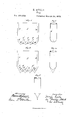
- y, ,Iiliguresfl ⁇ and i2 show the'methodof and sewingmy bag-blanks.
- Figshowsone fOrln 0f fmyimproved bag complete@ Fia 4 shows aforIn-,of taperedfbottom bag-Fig 5 a .ferm ⁇ 0f concave-bottom bag.
- My invention is particularly applicable to the construction of bags, or sacks lfor holding powder used in ordnance, where it ,isdesirable that the bag should be of a peculiar shape at one end, to t, as exactly as may be, into the breech end of the bore of the piece; and it is for this purpose that I deem my invention particularly valuable, although it may be used to great advantage in other cases, and save the material of which the bags or sacks are composed, as well as the labor and time of sewing long seams.
- the breech end of the bore of most pieces of cannon of the present day is of a semispherical, rounded, or conical form, the base of the cone beingl toward the muzzle of the piece.
- a bag of some strong material which can be promptly and safely introduced into its place in the gun.
- I increase the length of the line of stitches seen at g1 g1 g2 g2, &c., Fig. l, and if I desire a rounded endy of less than'a semi-spherical form, I make the lsaid line of stitches shorter than the said line Fig. l; butin both these last instances I curve the line of stitches outwardly sufficiently to produce the rounded convex form; for if the line of stitches be made straight in the last two instances, the form of -the bag will be like that shown in two forms in Fig. 4, and if it be not curved outwardly, but inwardly, then the shape of the bag will be like that shown in Fig. 5.
- the distance from one another of the points 'of union of the lines of stitches at vboth the base and point of the projections should be equal to one-fourth of the entire circumference of the bagthat is to say,
Landscapes
- Engineering & Computer Science (AREA)
- General Engineering & Computer Science (AREA)
- Sewing Machines And Sewing (AREA)
Description
H. REILLY. Bag.
No. 201,631. Patented IVI-arch 26,1878.
.`\" QA -..I p
NPEI'ERS. FHCTO.LITHOGRAPHER, wA'smN'GTON. ncA
:Hue-H nnrnmr, oF snoek Ymunwjronmp I Specification formingpart ofz-.Letter's To au @da hay) miem-Q L Be it known that I, HUGH REILLY, of `Brooktobe afull, ncleanand exactdescriptionof the Same reference :being ing drawings, inwhich-Ki f .Y
y, ,Iiliguresfl` and i2 show the'methodof and sewingmy bag-blanks., Figshowsone fOrln 0f fmyimproved bag complete@ Fia 4 shows aforIn-,of taperedfbottom bag-Fig 5 a .ferm` 0f concave-bottom bag.
Like letters indicate like lpartsinv all they" My invention is particularly applicable to the construction of bags, or sacks lfor holding powder used in ordnance, where it ,isdesirable that the bag should be of a peculiar shape at one end, to t, as exactly as may be, into the breech end of the bore of the piece; and it is for this purpose that I deem my invention particularly valuable, although it may be used to great advantage in other cases, and save the material of which the bags or sacks are composed, as well as the labor and time of sewing long seams.
The breech end of the bore of most pieces of cannon of the present day is of a semispherical, rounded, or conical form, the base of the cone beingl toward the muzzle of the piece. In loading these pieces it has been found desirable to have the powder composing the charge inclosed within a bag of some strong material which can be promptly and safely introduced into its place in the gun. These bags have been made in various ways to give the closed end the desired rounded or conical shape, as the case may be, to fit the breech end of the bore of the gun. Among these ways has been that of taking two or more pieces of thematerial of which the bag is to be formed, and after cutting that end of each piece which is to be at the closed and rounded or conical end of the bag into a half-round or pointed shape, then to sew these two or more pieces together in such manner that all the pieces together shall form a bag of the desired size, and with a rounded or conical bottom. This method is objectionable on'the ground of the great number of long seams, which must be had@ the eccompwyfy natentNo., Q01-,canasta Maren 2c, 187s @Putman-mea .-Jannary'26,1878.` "-1 Y lsewedlup firmly, sothatnopowder 'shall es cape, which sewing is expensive andlaborious; and, moreover, abagso constructed is notas neatin appearance as my improved. bag,-be f cause of the many thick folds of cloth caused by the seams. running up .itssides and across itsbot-tom. Moreover, these seams require a large `amount of material, from one tozone vand l olle-half inch foreach seam. c, 4 My invention obviates these ldifliculties,and y isgasibllDWscy- To form my improvedbag I take i alpieceof the material oiwhich the A.bag is to becmade, usually heavy. annel, (seen at A, Figs. 1 and lf-2,) extending in one .direction somewhat Ymore than the circumference of the y bore of the gun which thebag is to fit, and in the othendirection accordin gto the length of the desired bag plus the material necessary to form the end and to close the mouth and to form the. seams; and I cut or scallop out that edge thereof which is to be at the bottom of the completed bag in four points or projections, (seen at B, Figs. l and 2.) I say above that the dimensions are somewhat more than the circumference of the bore, &c., because I must allow material for the seam up the side of the bag, the amount of which depends upon the material used, but is usually from about one-half to three-fourths of an inch for each edge, making from one to one and one-half inch for the entire seam. The cloth must therefore be cut the desired dimensions plus the amount used for the seam.
After thepiece of material has been cut as above it is sewed as follows: When I desire to make a flat-bottomed bag, I stitch the cloth together, as shown by the dotted lines C C C, &c., Fig. 2, and I make the length of the line of stitchesfrom d* cl2 dad* d5 d6, and so on through all the seams of the points, equal to the radius of the completed bag. I also sew up the one long seam where the edges of the cloth come together, (seen at E E, Figs. l, 2, and 3,) thus making a complete bag with only one long I nue, (shown at f f f f, Fig. 1,) and I make the length of the line of stitches from g1 to lg1 and from g2 to g2, and so all through all the seams of the points, equal in length to one-quarter the circumference of the completed bag. I
also sew up the one long seam where the edges of the cloth come together, (seen at E, Fig. l, as also in Figs. 2 and 3,) as before, thus forming a complete bag with but one long seam from top to bottom, and with a semi-spherical bottom composed of four pieces, each of which has a surface area of an eighth of a sphere.
If I desire a bag with an elliptically-shaped end, I increase the length of the line of stitches seen at g1 g1 g2 g2, &c., Fig. l, and if I desire a rounded endy of less than'a semi-spherical form, I make the lsaid line of stitches shorter than the said line Fig. l; butin both these last instances I curve the line of stitches outwardly sufficiently to produce the rounded convex form; for if the line of stitches be made straight in the last two instances, the form of -the bag will be like that shown in two forms in Fig. 4, and if it be not curved outwardly, but inwardly, then the shape of the bag will be like that shown in Fig. 5.
In all these instances I have referred merely Vto the use of four projections or scallops; and
when only four are used, the distance from one another of the points 'of union of the lines of stitches at vboth the base and point of the projections should be equal to one-fourth of the entire circumference of the bagthat is to say,
if the blankl from which the bag was `to be formed were to lie at upon a table, a line indicating the location of stitches should be as stated.
I do not, however, confine myselfl to four projections; but I use two, three, ve, six, and more. When I use these various numbers I stitch the pieces as before; and when I use two, each projection should be for a Hat-bottom bag of semicircular form, the radius of each circle being the radius of the desired bag, Y
tom formed by uniting the edges of two or more projections vextending" from the piece of material, substantially as described.
-2. A blank for a bag made of one piece of material, and with two or more projections from one side of the material, as and for vthe purposes set forth.` y HUGH REILLY...
Witnesses:
PHrLLiPs ABBOTT,
TENNIE B. ABBOTT.
Publications (1)
| Publication Number | Publication Date |
|---|---|
| US201631A true US201631A (en) | 1878-03-26 |
Family
ID=2271036
Family Applications (1)
| Application Number | Title | Priority Date | Filing Date |
|---|---|---|---|
| US201631D Expired - Lifetime US201631A (en) | Improvement in bags |
Country Status (1)
| Country | Link |
|---|---|
| US (1) | US201631A (en) |
-
0
- US US201631D patent/US201631A/en not_active Expired - Lifetime
Similar Documents
| Publication | Publication Date | Title |
|---|---|---|
| US773850A (en) | Slipper-sole. | |
| US2718640A (en) | Garment appendages | |
| US344340A (en) | David c | |
| US1020050A (en) | Saw-carrying case. | |
| US201631A (en) | Improvement in bags | |
| US2180914A (en) | Pocket construction | |
| US1077320A (en) | Powder-grain. | |
| US490103A (en) | James ross collins | |
| US1171238A (en) | Athletic ball. | |
| US1153377A (en) | Tool-bag for automobiles. | |
| US653113A (en) | Overseam-eyelet. | |
| US204199A (en) | Improvement in pockets for garments | |
| US199738A (en) | Improvement in gloves | |
| US1267193A (en) | Grain-bag. | |
| US234487A (en) | Assig-nob to henby k haet | |
| US1409436A (en) | Carpenter's nail pocket | |
| US274736A (en) | Seam for grain-bags | |
| US749424A (en) | Manufacture of bags | |
| GB1324175A (en) | Stitched seams | |
| US358265A (en) | Bbook | |
| US128530A (en) | Improvement in gloves | |
| US900092A (en) | Cartridge-belt. | |
| US721619A (en) | Apparel-belting. | |
| US722124A (en) | Carrier for small-arms fixed ammunition. | |
| JPS5811700Y2 (en) | flexible container |