US20160017543A1 - Method of Manufacturing Glassine Paper - Google Patents
Method of Manufacturing Glassine Paper Download PDFInfo
- Publication number
- US20160017543A1 US20160017543A1 US14/649,817 US201314649817A US2016017543A1 US 20160017543 A1 US20160017543 A1 US 20160017543A1 US 201314649817 A US201314649817 A US 201314649817A US 2016017543 A1 US2016017543 A1 US 2016017543A1
- Authority
- US
- United States
- Prior art keywords
- web
- calendering
- section
- drying
- profile
- Prior art date
- Legal status (The legal status is an assumption and is not a legal conclusion. Google has not performed a legal analysis and makes no representation as to the accuracy of the status listed.)
- Granted
Links
Images


Classifications
-
- D—TEXTILES; PAPER
- D21—PAPER-MAKING; PRODUCTION OF CELLULOSE
- D21F—PAPER-MAKING MACHINES; METHODS OF PRODUCING PAPER THEREON
- D21F11/00—Processes for making continuous lengths of paper, or of cardboard, or of wet web for fibre board production, on paper-making machines
- D21F11/02—Processes for making continuous lengths of paper, or of cardboard, or of wet web for fibre board production, on paper-making machines of the Fourdrinier type
-
- D—TEXTILES; PAPER
- D21—PAPER-MAKING; PRODUCTION OF CELLULOSE
- D21H—PULP COMPOSITIONS; PREPARATION THEREOF NOT COVERED BY SUBCLASSES D21C OR D21D; IMPREGNATING OR COATING OF PAPER; TREATMENT OF FINISHED PAPER NOT COVERED BY CLASS B31 OR SUBCLASS D21G; PAPER NOT OTHERWISE PROVIDED FOR
- D21H27/00—Special paper not otherwise provided for, e.g. made by multi-step processes
- D21H27/30—Multi-ply
- D21H27/42—Multi-ply comprising dry-laid paper
-
- D—TEXTILES; PAPER
- D21—PAPER-MAKING; PRODUCTION OF CELLULOSE
- D21H—PULP COMPOSITIONS; PREPARATION THEREOF NOT COVERED BY SUBCLASSES D21C OR D21D; IMPREGNATING OR COATING OF PAPER; TREATMENT OF FINISHED PAPER NOT COVERED BY CLASS B31 OR SUBCLASS D21G; PAPER NOT OTHERWISE PROVIDED FOR
- D21H19/00—Coated paper; Coating material
- D21H19/80—Paper comprising more than one coating
- D21H19/84—Paper comprising more than one coating on both sides of the substrate
-
- D—TEXTILES; PAPER
- D21—PAPER-MAKING; PRODUCTION OF CELLULOSE
- D21H—PULP COMPOSITIONS; PREPARATION THEREOF NOT COVERED BY SUBCLASSES D21C OR D21D; IMPREGNATING OR COATING OF PAPER; TREATMENT OF FINISHED PAPER NOT COVERED BY CLASS B31 OR SUBCLASS D21G; PAPER NOT OTHERWISE PROVIDED FOR
- D21H23/00—Processes or apparatus for adding material to the pulp or to the paper
- D21H23/02—Processes or apparatus for adding material to the pulp or to the paper characterised by the manner in which substances are added
- D21H23/22—Addition to the formed paper
- D21H23/52—Addition to the formed paper by contacting paper with a device carrying the material
- D21H23/56—Rolls
-
- D—TEXTILES; PAPER
- D21—PAPER-MAKING; PRODUCTION OF CELLULOSE
- D21H—PULP COMPOSITIONS; PREPARATION THEREOF NOT COVERED BY SUBCLASSES D21C OR D21D; IMPREGNATING OR COATING OF PAPER; TREATMENT OF FINISHED PAPER NOT COVERED BY CLASS B31 OR SUBCLASS D21G; PAPER NOT OTHERWISE PROVIDED FOR
- D21H25/00—After-treatment of paper not provided for in groups D21H17/00 - D21H23/00
- D21H25/08—Rearranging applied substances, e.g. metering, smoothing; Removing excess material
- D21H25/12—Rearranging applied substances, e.g. metering, smoothing; Removing excess material with an essentially cylindrical body, e.g. roll or rod
- D21H25/14—Rearranging applied substances, e.g. metering, smoothing; Removing excess material with an essentially cylindrical body, e.g. roll or rod the body being a casting drum, a heated roll or a calender
-
- D—TEXTILES; PAPER
- D21—PAPER-MAKING; PRODUCTION OF CELLULOSE
- D21H—PULP COMPOSITIONS; PREPARATION THEREOF NOT COVERED BY SUBCLASSES D21C OR D21D; IMPREGNATING OR COATING OF PAPER; TREATMENT OF FINISHED PAPER NOT COVERED BY CLASS B31 OR SUBCLASS D21G; PAPER NOT OTHERWISE PROVIDED FOR
- D21H27/00—Special paper not otherwise provided for, e.g. made by multi-step processes
-
- D—TEXTILES; PAPER
- D21—PAPER-MAKING; PRODUCTION OF CELLULOSE
- D21H—PULP COMPOSITIONS; PREPARATION THEREOF NOT COVERED BY SUBCLASSES D21C OR D21D; IMPREGNATING OR COATING OF PAPER; TREATMENT OF FINISHED PAPER NOT COVERED BY CLASS B31 OR SUBCLASS D21G; PAPER NOT OTHERWISE PROVIDED FOR
- D21H27/00—Special paper not otherwise provided for, e.g. made by multi-step processes
- D21H27/001—Release paper
-
- D—TEXTILES; PAPER
- D21—PAPER-MAKING; PRODUCTION OF CELLULOSE
- D21H—PULP COMPOSITIONS; PREPARATION THEREOF NOT COVERED BY SUBCLASSES D21C OR D21D; IMPREGNATING OR COATING OF PAPER; TREATMENT OF FINISHED PAPER NOT COVERED BY CLASS B31 OR SUBCLASS D21G; PAPER NOT OTHERWISE PROVIDED FOR
- D21H27/00—Special paper not otherwise provided for, e.g. made by multi-step processes
- D21H27/06—Vegetable or imitation parchment; Glassine paper
Definitions
- the invention relates to a method of manufacturing of glassine paper.
- Glassine release base paper is a special paper grade which strongly distinguish from common bulk grades such as newsprint paper, supercalendered uncoated magazine paper (SC-paper) and coated magazine paper printing paper (LWC, MFC).
- the glassine paper is produced so that the base paper including the surface closing with film-forming products is manufactured in a paper machine and is reeled up as machine rolls. Commonly the base paper is dried and then remoisturized to the level needed for super calendaring. The moisture content in the base paper is typically is very high, about 15-20% of the solid contents of the paper.
- the standard manufacturing process has several drawbacks. For example, it requires a process involving two separate steps; the paper machine and the super calender. In some cases it may be required that there are even two separate super calenders per one paper machine in order that the super calendering process can follow the machine production as the calendering speed is lower than the paper machine speed. This increases space requirement and also investment costs. Additionally, the intermediate stage for evening out the moisture in the paper consumes time, requires additional human resources and makes the process more complex. In view of the above prior art, it is the object of the invention to provide an improved method of manufacturing of glassine paper with properties meeting at least the values described above, which improved the efficiency of the prior art manufacturing process.
- this object is met with a method of manufacturing of glassine paper comprising following steps of paper by forming a paper web in a forming section and drying the web in a press section and in a pre-drying section; applying film-forming product on both sides of the web; removing moisture from the film-forming product in an after-drying section; passing the web having film-forming product on its surfaces through an on-line calendering process; and reeling up the glassine paper.
- calendering process comprise calendering process comprises calendering treatment in several successive nips in at least one multi-nip calender.
- calendering process comprises at least a first calendering treatment in a first calendering section and a second calendering treatment in a second calendering section.
- calendering process comprises controlling web tension between the first and the second calendering treatment.
- calendering process comprises application of water by condensing steam onto the web before passing the web to anyone of the calendering sections.
- calendering process comprise cooling of the paper web and application of water by condensing steam onto the web before passing the web to anyone of the calendering sections.
- calendering process comprise application of water by condensing steam onto the web before passing the web to anyone of the calendering sections.
- calendering process comprises at least a first calendering treatment in a first calendering section and a second calendering treatment in a second calendering section and the first calendering treatment comprises treating the paper web in at least four successive calendering nips.
- the second calendering treatment comprises treating the paper web in at least two successive calendering nips.
- removing moisture from the film-forming product in an after-drying section comprises a step of controlling moisture CD profile of the web by transferring heat adjustably in CD direction while drying the web; and wherein controlling moisture CD profile is based on the moisture content profile of the web entering the calendering treatment.
- removing moisture from the film-forming product in an after-drying section comprises a step of controlling moisture CD profile of the web by transferring heat adjustably in CD direction while drying the web; and wherein controlling moisture CD profile is based on the moisture content profile of the web before the reel-up.
- removing moisture from the web in the pre-drying section and applying film-forming product on both sides of the paper comprises a step of controlling moisture CD profile of the web by transferring heat adjustably in CD direction to the web at the press section; and wherein controlling moisture CD profile is based on the moisture content profile of the web before film application and/or impregnation system.
- drying the web by a press section comprises a step of controlling moisture CD profile of the web by transferring heat adjustably in CD direction to the web prior to entering into a press nip; and wherein controlling moisture CD profile is based on the moisture content profile of the web entering the process of applying film-forming product on both sides of the base paper.
- the film-forming product is selected from a group comprising starch, polyvinyl alcohol, carboxymethyl cellulose, alginate or any other product.
- temperatures of the surface of the heating cylinders are controlled to be from 170 to 240° C. and nip loads of the first calendering section and the second calendering section are controlled to be 270-400 kN/m.
- the temperatures of the surface of the heating cylinders are controlled to be from 170 to 240° C. and nip loads of the first calendering section and the second calendering section are controlled to be about 300 kN/m.
- a target calendering process moisture content is set for the web and wherein the target moisture content of the web is achieved by drying the web in the after-drying section.
- the after-drying section is operated so that the target calendering moisture content is obtained by increasing web moisture content up to a point where the target moisture content is achieved.
- the web is further dried in a post-calendering drying section resulting in final moisture content.
- the calendering process is performed at elevated moisture content and the web is dried in a post-calendering drying section resulting in final moisture content.
- the web is subjected to drying with cylinders having their surface roughness selected so that the surface quality obtained in the preceding calendering process will be remained or improved.
- the present invention provides several benefits compared to prior art method of producing glassine paper, of which only few are mentioned.
- glassing paper which has excellent properties. At least an equivalent densification is reached with a lower calendering activity, with smaller number of nips and lower nip load meaning e.g. less energy consumption. Also evaporation rate needed during the calendering phase is smaller than in prior art solutions.
- the present invention results in continuous process without a need of having separate machines and storage space to provide needed density of the paper. Consequently the present invention provides more effective overall process.
- the Glassine grade is defined as follows. Glassine is a very dense, highly resistant and smooth paper, and it is air, water and oil resistant. Typically the lower grammages (40 to 65 g/m 2 ) are designed to be translucent. Typical properties for glassine paper are obtained by a high level of fiber refining, surface closing with film-forming products and calendering. Glassine is used for example as base for release liner because it is suitable for silicone coating. Glassine has to be chemically compatible with the silicone for insuring a proper curing and anchorage of the silicone coating. Glassine may be manufactured from 40 to 150 g/m 2 and is typically used as base of release liner for self-adhesive material and label.
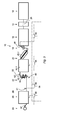
- FIG. 1 shows a paper machine for manufacturing of glassine paper according to an embodiment of the invention
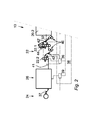
- FIG. 2 shows a paper machine for manufacturing of glassine paper according to another embodiment of the invention
- FIG. 3 shows a paper machine for manufacturing of glassine paper according to still another embodiment of the invention.
- FIG. 4 shows a calendering section of a paper machine for manufacturing of glassine paper according to still another embodiment of the invention.
- FIG. 1 shows a paper machine 10 which comprises in successive order i.e. in a running direction of the web, a forming section 12 , a press section 14 , a first or a pre-drying section 16 , a film application and/or impregnating system 18 , such as a size-press or film press, a second or an after-drying section 20 , a calendering section 22 and a reel-up 24 .
- the forming section 12 , the press section 14 , and the pre-drying section 16 and their operation are known as such by a skilled person in the art.
- a base paper for glassine paper is manufactured by forming a paper web in a forming section 12 and drying the web in a press section 14 and in a pre-drying section 16 .
- the paper machine further comprises a steam box 26 arranged in connection with the press section.
- the steam box 26 is arranged to apply heat controllably in cross direction (later CD) to the web effecting on the removal of the water from the web.
- the operation of the steam box 26 is controlled based on CD moisture profile measured after the pre-drying section 16 and before the film application and/or impregnating system 18 by a measurement frame 28 .
- the purpose is to provide CD moisture profile as even as possible so that the average CD moisture content is within a range of 2 to 7%.
- moisture content means a percentage of ratio of water weight to the weight of the web.
- a film forming product which advantageously is for example a water based solution of starch, polyvinyl alcohol, carboxymethyl cellulose, alginate or any other suitable product and/or mixture thereof, is applied on both sides of the base paper in the film application and/or impregnating system 18 following the pre-drying section 16 .
- the actual composition of the film forming product may be the same for both sides of the base paper, or alternatively different film forming product may be applied to each side of the paper. This provides the effect of resulting in good distribution of the film-forming product in the size press.
- There is a controlling unit 30 which is arranged to perform the above mentioned control procedure in order to practice the method.
- the after drying section comprises a first drying section 20 . 1 and a second drying section 20 . 2 , at least one of which is capable of controlling moisture CD profile of the web by transferring heat adjustably in CD direction while drying the web.
- the first drying section is a contactless dryer, such as an infra-red dryer, which makes it possible to control the moisture CD profile of the web by transferring heat adjustably in CD direction very efficiently.
- the infra-red dryer preceded by a contactless air operated web guiding device, allows the applied film forming product to be dried enough before the web is brought into contact with any solid surface.
- the second drying section 20 . 2 is advantageously a cylinder dryer having steam and/or hot oil heated cylinders.
- the operation of the first 20 . 1 and the second dryer part 20 . 2 is controlled based on CD moisture profile measured after the after-drying section 20 and before the calendering treatment section 22 by a measurement frame 32 .
- the first dryer part 20 . 1 is operated so that it generally dries the web and/or the applied film forming product and additionally transfers heat to the web so that moisture CD profile may be controlled.
- the second dryer part 20 . 2 must not include such profile control capability.
- the purpose is to provide web CD moisture profile as even as possible at an average CD moisture content range of 6-10%, advantageously about 8% before the calendering treatment section.
- a controlling unit 34 which is arranged to perform the above mentioned control procedure in order to practice the method.
- a web cooling section 40 which here comprises two cooling cylinders.
- the cooling section 40 is used as a cooling stage. The web is cooled so that, when the web is subjected to steam application stage 42 ′ after the cooling, the water applied as steam is condensed on the surface of the web.
- the calendering treatment section 22 comprises a first calendering section 22 . 1 in which the paper web is subjected to first calendering treatment, and a second calendering section 22 . 2 in which the paper web is subjected to second calendering treatment.
- a web cooling section 40 which advantageously comprises cooling cylinders.
- the cooling section 40 is used as a cooling stage. In the embodiment of FIG.
- the steam application stage may be also referred to as a steam moisturizer.
- the total increase of the moisture content of the web by the steam moisturizer(s) is in the range of 2-3%. This added moisture is evaporated by the calendering process so that the moisture content of the paper at the reel-up is about 6-5%.
- the first calendering section 22 . 1 comprises a roll stack of a multi-nip calender in which several nips are arranged, advantageously four successive nips.
- the first calendering treatment according to the invention comprises treating the paper web in at least four successive calendering nips.
- the temperatures of the heating cylinders are controlled to be between 170-240° C.
- nip loads of the first calendering section are controlled to be 270-400 kN/m preferably about 300 KN/m.
- the nips of the first calendering section are arranged to control mainly the CD thickness profile of the paper and to increase the desired quality of the glassine paper i.e.
- the CD thickness profile controlled by a heat transfer system 44 capable of heating a roll surface locally and adjustable manner in cross direction of the machine (longitudinal direction of roll).
- the heat transfer system is an inductive heating system installed on the first steel cylinder of the calendering section.
- the operation of the heat transfer system is directly controlled by a thickness CD measurement arranged on a scanner 36 . 1 before the reel-up 24 .
- the second calendering section 22 . 1 comprises a stack of rolls in which at least two successive calendering nips are arranged. Accordingly, the second calendering treatment comprises treating the paper web in at least two successive calendering nips after the cooling stage and steam moisturizer. In order to result in the desired quality of the glassine paper the temperatures and nip loads of the second calendering section are controlled preferably so that the densification and smoothness are at the required levels.
- the second calendering treatment according to the invention comprises treating the paper web so that the temperatures of the heating cylinders are controlled to be between 170-240° C., and nip loads of the second calendering section are controlled to be 270-400 kN/m preferably around 300 KN/m.
- the calendering section are both provided with multi-nip calenders having successive hard surface and soft surface rolls of which the hard surface rolls are heatable.
- the method comprises a step of controlling web tension between the first and the second calendering treatment and calendering sections. Controlling the web tension controls the tension of the web between the first and the second calendering treatment in separate calendering stacks makes it possible to effect on the smoothness of the paper by creating friction between the paper surface and the calender roll. Smoothness, on the other hand, is beneficial in further processing of the glassine paper, for example silicone coating.
- the web tension is provided by the speed difference between the first and the second calendering section.
- controlling unit 36 which is arranged to perform the above mentioned control procedure in order to practice the method controlling at least the operation of the first calendering section 22 . 1 , second calendering section 22 . 2 , web cooling section 40 and the steam moisturizer 42 .
- the control units 30 , 34 and 36 may be separate control units or they may be integral parts of a paper machine quality control system 38 .
- the moisturizer is a steam moisturize
- the water will efficiently diffuse into the web, below its surface to inner structure of the web and provide increased densification of the web and smoothness.
- Increasing the moisture content of the web at the entrance of a calendering section increases also transparency and reduces oil absorption. These are the main indicators of good densification and siliconability. Additionally it is possible in some circumstances obtain good results with smaller nip loads in the calender.
- FIG. 2 shows an embodiment of the invention.
- This embodiment comprises the paper machine 10 as shown in FIG. 1 with an exception that after the calendering treatment section 22 there is a post-calendering drying section 26 arranged between the calendering treatment section 22 and the reel-up 24 .
- the post-calendering drying section 26 is operated so that it generally dries the web and/or the remaining moisture in the web. This allows usage higher moisture content levels of the web in the calendering process, which in turn improves particularly the densification. Densification of the web is important to the process of manufacturing the glassine paper.
- There is a controlling unit 39 which is arranged in connection with the second after-drying section 26 .
- the paper machine's 10 control system may also comprise a web measurement frame 41 before the post calendering drying section in the web running direction. Otherwise the embodiment of FIG. 1 comprises corresponding elements and operates similarly to that of FIG. 1 .
- FIG. 3 shows another embodiment of the invention.
- a paper machine 10 comprises in successive order i.e. in a running direction of the web, a forming section 12 , a press section 14 , a pre-drying section 16 , a film application and/or impregnating system 18 , an after-drying section 20 , a calendering section 22 , a post-calendering drying section 26 and a reel-up 24 .
- the forming section 12 , the press section 14 , and the pre-drying section 16 and their operation are known as such by a skilled person in the art.
- a base paper for glassine paper is manufactured by forming a paper web in a forming section 12 and drying the web in a press section 14 and in a pre-drying section 16 .
- the paper machine further comprises a steam box 26 arranged in connection with the press section.
- the steam box 26 is arranged to apply heat controllably in cross direction to the web effecting on the removal of the water from the web in the press section.
- the operation of the steam box 26 is controlled e.g. based on CD moisture profile measured after the pre-drying section 16 and before the film application and/or impregnating system 18 by a measurement frame 28 .
- the purpose is to provide CD moisture profile as even as possible at an average CD moisture content range of 2 to 7% after the pre-drying section.
- the after drying section comprises a first drying section 20 . 1 and a second drying section 20 . 2 , at least one of which is capable of controlling moisture CD profile of the web by transferring heat adjustably in CD direction while drying the web.
- the web and/or the applied film forming product is dried in the after-drying section 20 while simultaneously controlling he CD moisture content of the web.
- the first drying section is a contactless dryer, such as an infra-red dryer, which makes it possible to control the moisture CD profile of the web by transferring heat adjustably in CD direction very efficiently.
- the infra-red dryer preceded by a contactless air operated web guiding device, allows the applied film forming product to be dried enough before the web is brought into contact with any solid surface.
- the second drying section 20 . 2 is advantageously a cylinder dryer.
- the operation of the first 20 . 1 and the second dryer part 20 . 2 is controlled advantageously based on CD moisture profile measured after the after-drying section 20 and before the calendering treatment section 22 by a measurement frame 32 .
- the first dryer part 20 . 1 is operated so that it generally dries the web and/or the applied film forming product and additionally transfers heat to the web so that moisture CD profile may be controlled i.e. heating is controlled to be more intensive at the CD locations where the web has more moisture.
- the second dryer part 20 . 2 must not include such profile control capability.
- the purpose is to provide CD moisture profile as even as possible so that an average CD moisture content is within a range of 7-11%, advantageously about 9% before the calendering treatment section.
- a target calendering process moisture content is set for the web.
- the target calendering process moisture content is 7-11%, advantageously about 9%. It is monitored by a measurement frame 32 based on which the operation of the paper machine upstream in running direction of the web is controlled.
- the second drying section 20 . 2 is controlled and operated so that the web coming out from the second drying section is at the target calendering moisture content or within an acceptable window. In other words the web is dried to the target calendering moisture content so that adding of additional water is not required.
- the target moisture is stored or made available to the controlling unit 34 which controls the operation of the second drying section 20 . 2 .
- the after-drying section is operated so that the target moisture content for calendering process 22 is obtained by raising web moisture content only up to the point where the target moisture content is reached. This way there is no need to add additional water into the web i.e. the web is led from the after-drying section 20 to the calendering process without actively moisturizing the web.
- the controlling unit 34 is arranged to perform the above mentioned control procedure in order to practice the method.
- the base paper and the applied film forming product has been dried in the after-drying section 20 and, it is passed through an on-line calendering treatment section 22 in which calendering process is practiced.
- the calendering treatment section 22 comprises in FIG. 3 only one calendering section 22 . 1 the actual physical composition may vary in the scope of the invention.
- the calendering section may comprise two separate stacks, or event 3 or 4 stacks if so desired.
- the paper web is subjected to calendering treatment which provides the effect required by glassine paper.
- the calendering section 22 . 1 comprises a roll stack of a multi-nip calender in which several nips are arranged. Accordingly, the calendering treatment according to the invention comprises treating the paper web in at least four successive calendering nips.
- the temperatures of the heating cylinders are controlled to be between 170-240° C.
- nip loads of the first calendering section are controlled to be 270-400 kN/m.
- the nips of the calendering section are arranged to control mainly the CD thickness profile of the paper and to increase the desired quality of the glassine paper i.e. increase density and transparency of the paper.
- the CD thickness profile controlled by a heat transfer system 44 capable of heating a roll surface locally and adjustable manner in cross direction of the machine (longitudinal direction of roll).
- the heat transfer system is an inductive heating system installed on the first steel cylinder of the calendering section.
- the operation of the heat transfer system is directly controlled by a thickness CD measurement arranged on a scanner 37 before the reel-up 24 and/or the scanner 41 after the calendering section and/or the scanner 32 before the calendering section.
- controlling unit 34 , 36 which is arranged to perform the above mentioned control procedure in order to practice the method controlling at least the operation of the calendering section 22 . 1
- the control units 30 , 34 , 36 and 39 may be separate control units or they may be integral parts of a paper machine quality control system 38 .
- the target moisture is obtained only by drying the web
- the water is advantageously manner distributed in the web, below its surface at inner structure of the web and provides increased densification of the web and smoothness. Maintaining the target moisture content of the web at the entrance of a calendering section increases also transparency and reduces oil absorption. These are the main indicators of good densification and siliconability. Additionally it is possible in some circumstances obtain good results with smaller nip loads in the calender.
- the post-calendering drying section 26 is operated so that it generally dries the web and/or the remaining moisture in the web. This allows calendering at elevated moisture content i.e. usage higher moisture content levels of the web in the calendering process, which in turn improves particularly the densification.
- the elevated moisture content means such moisture content that calendering process alone will not evaporate all required amount of water from the web in order to meet the final moisture content for commercial product. Densification of the web is important to the process of manufacturing the glassine paper.
- There is a controlling unit 39 which is arranged in connection with the second after-drying section 26 .
- the paper machine 10 control system may also comprise a web measurement frame 41 before the post calendering drying section in the web running direction.
- the drying cylinder in the post-calendering section 26 have their roughness selected so that the surface quality obtained in the preceding calendering process will be remained or improved.
- FIG. 4 there is shown a part of a paper machine illustrating two successive calender sections 22 . 1 and 22 . 2 in more detailed manner.
- the operation of a calendering process comprising at least a first calendering treatment in which the paper web is subjected to first surface treatment in a first calendering section 22 . 1 and a second calendering treatment in which the paper web is subjected to second surface treatment in a second calendering section 22 . 2 .
- Each of the calender rolls 50 . 1 , 50 . 2 , 50 . 3 , 50 . 4 , 50 . 5 of the first stack as well as the rolls 52 . 1 , 52 . 2 , 52 . 3 of the second stack is provided with a drive 54 . Operation of each drive 54 is controlled by the controlling unit 36 .
- the speed of the rolls 52 . 1 - 52 . 3 of the second calender section is slightly higher than the speed of the rolls 50 . 1 - 50 . 5 of the first calender section.
- the speed differential creates a slip of the paper web in the nip between the first calender rolls, thus creating the friction phenomenon.
Landscapes
- Paper (AREA)
Abstract
Description
- This application is a U.S. national phase application of International Application No. PCT/F12013/051123 filed on 2 Dec. 2013, which designated the U.S., and which claims priority to Finnish Patent Application No. 20126292 filed on 12 Dec. 2012. The contents of each of these applications are hereby incorporated by reference in their entirety in this application.
- 1. Technical Field
- The invention relates to a method of manufacturing of glassine paper.
- 2. Background Art
- Glassine release base paper is a special paper grade which strongly distinguish from common bulk grades such as newsprint paper, supercalendered uncoated magazine paper (SC-paper) and coated magazine paper printing paper (LWC, MFC).
- Typically the glassine paper is produced so that the base paper including the surface closing with film-forming products is manufactured in a paper machine and is reeled up as machine rolls. Commonly the base paper is dried and then remoisturized to the level needed for super calendaring. The moisture content in the base paper is typically is very high, about 15-20% of the solid contents of the paper.
- Due to the drying and re-moisturizing the paper cross directional moisture content profile becomes substantially even. The machine rolls are stored at least 2 hours, in order to even out of the moisture left in the paper. After the moisture has stabilized the base paper is treated in an off-line supercalender in order to provide desired properties of the glassine paper.
- As an example of such an off-line supercalender solution it is referred to document JP2009-155758A.
- The standard manufacturing process has several drawbacks. For example, it requires a process involving two separate steps; the paper machine and the super calender. In some cases it may be required that there are even two separate super calenders per one paper machine in order that the super calendering process can follow the machine production as the calendering speed is lower than the paper machine speed. This increases space requirement and also investment costs. Additionally, the intermediate stage for evening out the moisture in the paper consumes time, requires additional human resources and makes the process more complex. In view of the above prior art, it is the object of the invention to provide an improved method of manufacturing of glassine paper with properties meeting at least the values described above, which improved the efficiency of the prior art manufacturing process.
- With regard to the method, this object is met with a method of manufacturing of glassine paper comprising following steps of paper by forming a paper web in a forming section and drying the web in a press section and in a pre-drying section; applying film-forming product on both sides of the web; removing moisture from the film-forming product in an after-drying section; passing the web having film-forming product on its surfaces through an on-line calendering process; and reeling up the glassine paper.
- According to an embodiment of the invention calendering process comprise calendering process comprises calendering treatment in several successive nips in at least one multi-nip calender.
- According to an embodiment of the invention calendering process comprises at least a first calendering treatment in a first calendering section and a second calendering treatment in a second calendering section.
- According to another embodiment of the invention calendering process comprises controlling web tension between the first and the second calendering treatment.
- According to another embodiment of the invention calendering process comprises application of water by condensing steam onto the web before passing the web to anyone of the calendering sections.
- According to another embodiment of the invention calendering process comprise cooling of the paper web and application of water by condensing steam onto the web before passing the web to anyone of the calendering sections.
- According to still another embodiment of the invention calendering process comprise application of water by condensing steam onto the web before passing the web to anyone of the calendering sections.
- According to still another embodiment of the invention calendering process comprises at least a first calendering treatment in a first calendering section and a second calendering treatment in a second calendering section and the first calendering treatment comprises treating the paper web in at least four successive calendering nips.
- According to still another embodiment of the invention the second calendering treatment comprises treating the paper web in at least two successive calendering nips.
- According to still another embodiment of the invention removing moisture from the film-forming product in an after-drying section comprises a step of controlling moisture CD profile of the web by transferring heat adjustably in CD direction while drying the web; and wherein controlling moisture CD profile is based on the moisture content profile of the web entering the calendering treatment.
- According to still another embodiment of the invention removing moisture from the film-forming product in an after-drying section comprises a step of controlling moisture CD profile of the web by transferring heat adjustably in CD direction while drying the web; and wherein controlling moisture CD profile is based on the moisture content profile of the web before the reel-up.
- According to still another embodiment of the invention removing moisture from the web in the pre-drying section and applying film-forming product on both sides of the paper comprises a step of controlling moisture CD profile of the web by transferring heat adjustably in CD direction to the web at the press section; and wherein controlling moisture CD profile is based on the moisture content profile of the web before film application and/or impregnation system.
- According to still another embodiment of the invention drying the web by a press section comprises a step of controlling moisture CD profile of the web by transferring heat adjustably in CD direction to the web prior to entering into a press nip; and wherein controlling moisture CD profile is based on the moisture content profile of the web entering the process of applying film-forming product on both sides of the base paper.
- According to an embodiment of the invention the film-forming product is selected from a group comprising starch, polyvinyl alcohol, carboxymethyl cellulose, alginate or any other product.
- According to still another embodiment of the invention wherein the applying the film-forming product is practiced in a size-press, film press or any other coating/impregnating system.
- According to still another embodiment of the invention the temperatures of the surface of the heating cylinders are controlled to be from 170 to 240° C. and nip loads of the first calendering section and the second calendering section are controlled to be 270-400 kN/m.
- According to an embodiment of the invention the temperatures of the surface of the heating cylinders are controlled to be from 170 to 240° C. and nip loads of the first calendering section and the second calendering section are controlled to be about 300 kN/m.
- According to still another embodiment of the invention a target calendering process moisture content is set for the web and wherein the target moisture content of the web is achieved by drying the web in the after-drying section. This provides the effect that the web after the after-drying section is as such suitable for calendering in respect of its moisture content and thus no additional steam moisturizing is needed.
- Advantageously the after-drying section is operated so that the target calendering moisture content is obtained by increasing web moisture content up to a point where the target moisture content is achieved.
- According to still another embodiment of the invention the web is further dried in a post-calendering drying section resulting in final moisture content.
- According to still another embodiment of the invention the calendering process is performed at elevated moisture content and the web is dried in a post-calendering drying section resulting in final moisture content.
- According to still another embodiment of the invention the web is subjected to drying with cylinders having their surface roughness selected so that the surface quality obtained in the preceding calendering process will be remained or improved.
- The present invention provides several benefits compared to prior art method of producing glassine paper, of which only few are mentioned.
- By means of the invention it is possible to manufacture glassing paper which has excellent properties. At least an equivalent densification is reached with a lower calendering activity, with smaller number of nips and lower nip load meaning e.g. less energy consumption. Also evaporation rate needed during the calendering phase is smaller than in prior art solutions.
- The present invention results in continuous process without a need of having separate machines and storage space to provide needed density of the paper. Consequently the present invention provides more effective overall process.
- In this context the Glassine grade is defined as follows. Glassine is a very dense, highly resistant and smooth paper, and it is air, water and oil resistant. Typically the lower grammages (40 to 65 g/m2) are designed to be translucent. Typical properties for glassine paper are obtained by a high level of fiber refining, surface closing with film-forming products and calendering. Glassine is used for example as base for release liner because it is suitable for silicone coating. Glassine has to be chemically compatible with the silicone for insuring a proper curing and anchorage of the silicone coating. Glassine may be manufactured from 40 to 150 g/m2 and is typically used as base of release liner for self-adhesive material and label.
- As an example, in the case of base of release liner for self-adhesive label, the usual specifications required by the market for converting and processing in the application are as follows.
-
Density: Grammage (ISO536)/Thick- Typical values ness (ISO534) between 1.1 and 1.2 Smoothness of side to be silicone coat- 900 sec min ed (ISO 5627) Transparency (ISO 2470) 48% min Rizinus Cobb absorption (ISO 535) 1.1 g/m2 max Thickness standard deviation (ISO 534) 2.0 μm max Porosity (ISO 11004) <15.000 pm/Pas Breaking length (ISO 1924) minimum 9.15 Km Release forces at given conditions @ 10 m/min <50 g (coatweight: 1 g/m2) @ 300 m/min <90 g FTM 4 (TESA TAPE 7475) - In the following, the invention will be described with reference to the accompanying exemplary, schematic drawings, in which
-
FIG. 1 shows a paper machine for manufacturing of glassine paper according to an embodiment of the invention, -
FIG. 2 shows a paper machine for manufacturing of glassine paper according to another embodiment of the invention, -
FIG. 3 shows a paper machine for manufacturing of glassine paper according to still another embodiment of the invention and -
FIG. 4 shows a calendering section of a paper machine for manufacturing of glassine paper according to still another embodiment of the invention. -
FIG. 1 shows apaper machine 10 which comprises in successive order i.e. in a running direction of the web, a formingsection 12, apress section 14, a first or apre-drying section 16, a film application and/or impregnatingsystem 18, such as a size-press or film press, a second or an after-dryingsection 20, acalendering section 22 and a reel-up 24. The formingsection 12, thepress section 14, and thepre-drying section 16 and their operation are known as such by a skilled person in the art. - A base paper for glassine paper is manufactured by forming a paper web in a forming
section 12 and drying the web in apress section 14 and in apre-drying section 16. The paper machine further comprises asteam box 26 arranged in connection with the press section. Thesteam box 26 is arranged to apply heat controllably in cross direction (later CD) to the web effecting on the removal of the water from the web. The operation of thesteam box 26 is controlled based on CD moisture profile measured after thepre-drying section 16 and before the film application and/or impregnatingsystem 18 by ameasurement frame 28. The purpose is to provide CD moisture profile as even as possible so that the average CD moisture content is within a range of 2 to 7%. The term moisture content means a percentage of ratio of water weight to the weight of the web. This provides advantageous circumstances for the next step, in which a film forming product, which advantageously is for example a water based solution of starch, polyvinyl alcohol, carboxymethyl cellulose, alginate or any other suitable product and/or mixture thereof, is applied on both sides of the base paper in the film application and/or impregnatingsystem 18 following thepre-drying section 16. The actual composition of the film forming product may be the same for both sides of the base paper, or alternatively different film forming product may be applied to each side of the paper. This provides the effect of resulting in good distribution of the film-forming product in the size press. There is a controllingunit 30 which is arranged to perform the above mentioned control procedure in order to practice the method. - Subsequently the web having its both surfaces applied with the film forming product is passed through the after-drying
section 20. The web and/or the applied film forming product is dried in the after-dryingsection 20. The after drying section comprises a first drying section 20.1 and a second drying section 20.2, at least one of which is capable of controlling moisture CD profile of the web by transferring heat adjustably in CD direction while drying the web. Advantageously the first drying section is a contactless dryer, such as an infra-red dryer, which makes it possible to control the moisture CD profile of the web by transferring heat adjustably in CD direction very efficiently. - In the embodiment of
FIG. 1 the infra-red dryer, preceded by a contactless air operated web guiding device, allows the applied film forming product to be dried enough before the web is brought into contact with any solid surface. The second drying section 20.2 is advantageously a cylinder dryer having steam and/or hot oil heated cylinders. The operation of the first 20.1 and the second dryer part 20.2 is controlled based on CD moisture profile measured after the after-dryingsection 20 and before thecalendering treatment section 22 by ameasurement frame 32. The first dryer part 20.1 is operated so that it generally dries the web and/or the applied film forming product and additionally transfers heat to the web so that moisture CD profile may be controlled. The second dryer part 20.2 must not include such profile control capability. Again, the purpose is to provide web CD moisture profile as even as possible at an average CD moisture content range of 6-10%, advantageously about 8% before the calendering treatment section. - Operating the after-dryer accordingly provides most effective control of densification of the web in the successive calendering treatment. There is a controlling
unit 34 which is arranged to perform the above mentioned control procedure in order to practice the method. After the second dryer part 20.2 and before the first calendering section 22.1 there is aweb cooling section 40, which here comprises two cooling cylinders. Thecooling section 40 is used as a cooling stage. The web is cooled so that, when the web is subjected tosteam application stage 42′ after the cooling, the water applied as steam is condensed on the surface of the web. - After the base paper and the applied film forming product has been dried in the after-drying
section 20 and, if desired and/necessary, moisturized in thesteam application stage 42′, it is passed through an on-linecalendering treatment section 22 in which calendering process is practiced. Thecalendering treatment section 22 comprises a first calendering section 22.1 in which the paper web is subjected to first calendering treatment, and a second calendering section 22.2 in which the paper web is subjected to second calendering treatment. Between the first and the second calendering sections there is also aweb cooling section 40, which advantageously comprises cooling cylinders. Thecooling section 40 is used as a cooling stage. In the embodiment ofFIG. 1 there are two successive cooling cylinders. Moisture content of the web coming from the first calendering section is at about 5-6%. Now, the web is cooled by the web cooling section so that, when the web is subjected tosteam application stage 42 after the cooling, the water, which is applied as steam is condensed on the surface of the web. Preferably the web temperature after the cooling is below 47° C. But, in case the cooling capacity makes it possible, the web temperature may be cooled down to even lower temperature. The steam application stage may be also referred to as a steam moisturizer. According to an embodiment of the invention there may be another steam moisturized between the first calendering section and after the second dryer part 20.2. The total increase of the moisture content of the web by the steam moisturizer(s) is in the range of 2-3%. This added moisture is evaporated by the calendering process so that the moisture content of the paper at the reel-up is about 6-5%. - The first calendering section 22.1 comprises a roll stack of a multi-nip calender in which several nips are arranged, advantageously four successive nips. Accordingly, the first calendering treatment according to the invention comprises treating the paper web in at least four successive calendering nips. In order to result in the desired quality of the glassine paper the temperatures of the heating cylinders are controlled to be between 170-240° C., and nip loads of the first calendering section are controlled to be 270-400 kN/m preferably about 300 KN/m. The nips of the first calendering section are arranged to control mainly the CD thickness profile of the paper and to increase the desired quality of the glassine paper i.e. increase density and transparency of the paper. The CD thickness profile controlled by a
heat transfer system 44 capable of heating a roll surface locally and adjustable manner in cross direction of the machine (longitudinal direction of roll). Advantageously the heat transfer system is an inductive heating system installed on the first steel cylinder of the calendering section. The operation of the heat transfer system is directly controlled by a thickness CD measurement arranged on a scanner 36.1 before the reel-up 24. - The second calendering section 22.1 comprises a stack of rolls in which at least two successive calendering nips are arranged. Accordingly, the second calendering treatment comprises treating the paper web in at least two successive calendering nips after the cooling stage and steam moisturizer. In order to result in the desired quality of the glassine paper the temperatures and nip loads of the second calendering section are controlled preferably so that the densification and smoothness are at the required levels. Accordingly, the second calendering treatment according to the invention comprises treating the paper web so that the temperatures of the heating cylinders are controlled to be between 170-240° C., and nip loads of the second calendering section are controlled to be 270-400 kN/m preferably around 300 KN/m.
- Thus according to the invention the calendering section are both provided with multi-nip calenders having successive hard surface and soft surface rolls of which the hard surface rolls are heatable.
- According to an embodiment of the invention the method comprises a step of controlling web tension between the first and the second calendering treatment and calendering sections. Controlling the web tension controls the tension of the web between the first and the second calendering treatment in separate calendering stacks makes it possible to effect on the smoothness of the paper by creating friction between the paper surface and the calender roll. Smoothness, on the other hand, is beneficial in further processing of the glassine paper, for example silicone coating. The web tension is provided by the speed difference between the first and the second calendering section.
- There is a controlling
unit 36 which is arranged to perform the above mentioned control procedure in order to practice the method controlling at least the operation of the first calendering section 22.1, second calendering section 22.2,web cooling section 40 and thesteam moisturizer 42. Thecontrol units quality control system 38. - Since the moisturizer is a steam moisturize, the water will efficiently diffuse into the web, below its surface to inner structure of the web and provide increased densification of the web and smoothness. Increasing the moisture content of the web at the entrance of a calendering section increases also transparency and reduces oil absorption. These are the main indicators of good densification and siliconability. Additionally it is possible in some circumstances obtain good results with smaller nip loads in the calender.
- A trial experiment that has been made by the inventors has shown that for example that standard deviation thickness value of the glassine paper (62 g/m2) produced by the method according to the invention is less than 1.7 μm (typically max. 2.0 μm) which is far below the commercial requirements. Density value was about 1.1 g/cm3 (typically 1.1-1.2 g/cm3). Also excellent transparency of 50.9% (typically min 48%) was obtained.
-
FIG. 2 shows an embodiment of the invention. This embodiment comprises thepaper machine 10 as shown inFIG. 1 with an exception that after thecalendering treatment section 22 there is apost-calendering drying section 26 arranged between thecalendering treatment section 22 and the reel-up 24. Thepost-calendering drying section 26 is operated so that it generally dries the web and/or the remaining moisture in the web. This allows usage higher moisture content levels of the web in the calendering process, which in turn improves particularly the densification. Densification of the web is important to the process of manufacturing the glassine paper. There is a controllingunit 39 which is arranged in connection with the second after-dryingsection 26. The paper machine's 10 control system may also comprise aweb measurement frame 41 before the post calendering drying section in the web running direction. Otherwise the embodiment ofFIG. 1 comprises corresponding elements and operates similarly to that ofFIG. 1 . -
FIG. 3 shows another embodiment of the invention. Apaper machine 10 comprises in successive order i.e. in a running direction of the web, a formingsection 12, apress section 14, apre-drying section 16, a film application and/or impregnatingsystem 18, an after-dryingsection 20, acalendering section 22, apost-calendering drying section 26 and a reel-up 24. The formingsection 12, thepress section 14, and thepre-drying section 16 and their operation are known as such by a skilled person in the art. - In this embodiment a base paper for glassine paper is manufactured by forming a paper web in a forming
section 12 and drying the web in apress section 14 and in apre-drying section 16. The paper machine further comprises asteam box 26 arranged in connection with the press section. Thesteam box 26 is arranged to apply heat controllably in cross direction to the web effecting on the removal of the water from the web in the press section. The operation of thesteam box 26 is controlled e.g. based on CD moisture profile measured after thepre-drying section 16 and before the film application and/or impregnatingsystem 18 by ameasurement frame 28. The purpose is to provide CD moisture profile as even as possible at an average CD moisture content range of 2 to 7% after the pre-drying section. This provides advantageous circumstances for the next step, in which a film forming product is applied on both sides of the base paper in the film application and/or impregnatingsystem 18. There is a controllingunit 30 in thepaper machine 10 which is arranged to perform the above mentioned control procedure in order to practice the method. - Subsequently the web having its both surfaces applied with the film forming product is passed through the after-drying
section 20. The after drying section comprises a first drying section 20.1 and a second drying section 20.2, at least one of which is capable of controlling moisture CD profile of the web by transferring heat adjustably in CD direction while drying the web. The web and/or the applied film forming product is dried in the after-dryingsection 20 while simultaneously controlling he CD moisture content of the web. Advantageously the first drying section is a contactless dryer, such as an infra-red dryer, which makes it possible to control the moisture CD profile of the web by transferring heat adjustably in CD direction very efficiently. - In the embodiment of
FIG. 3 the infra-red dryer, preceded by a contactless air operated web guiding device, allows the applied film forming product to be dried enough before the web is brought into contact with any solid surface. The second drying section 20.2 is advantageously a cylinder dryer. The operation of the first 20.1 and the second dryer part 20.2 is controlled advantageously based on CD moisture profile measured after the after-dryingsection 20 and before thecalendering treatment section 22 by ameasurement frame 32. The first dryer part 20.1 is operated so that it generally dries the web and/or the applied film forming product and additionally transfers heat to the web so that moisture CD profile may be controlled i.e. heating is controlled to be more intensive at the CD locations where the web has more moisture. The second dryer part 20.2 must not include such profile control capability. Again, the purpose is to provide CD moisture profile as even as possible so that an average CD moisture content is within a range of 7-11%, advantageously about 9% before the calendering treatment section. In the method of manufacturing of glassine paper according to the embodiment ofFIG. 3 a target calendering process moisture content is set for the web. The target calendering process moisture content is 7-11%, advantageously about 9%. It is monitored by ameasurement frame 32 based on which the operation of the paper machine upstream in running direction of the web is controlled. - The second drying section 20.2 is controlled and operated so that the web coming out from the second drying section is at the target calendering moisture content or within an acceptable window. In other words the web is dried to the target calendering moisture content so that adding of additional water is not required. The target moisture is stored or made available to the controlling
unit 34 which controls the operation of the second drying section 20.2. Thus, advantageously the after-drying section is operated so that the target moisture content for calenderingprocess 22 is obtained by raising web moisture content only up to the point where the target moisture content is reached. This way there is no need to add additional water into the web i.e. the web is led from the after-dryingsection 20 to the calendering process without actively moisturizing the web. - Operating the after-dryer accordingly provides most effective control of densification of the web in the successive calendering treatment. The controlling
unit 34 is arranged to perform the above mentioned control procedure in order to practice the method. - Thus, subsequently the base paper and the applied film forming product has been dried in the after-drying
section 20 and, it is passed through an on-linecalendering treatment section 22 in which calendering process is practiced. Even if thecalendering treatment section 22 comprises inFIG. 3 only one calendering section 22.1 the actual physical composition may vary in the scope of the invention. For example, the calendering section may comprise two separate stacks, or event 3 or 4 stacks if so desired. In any case, the paper web is subjected to calendering treatment which provides the effect required by glassine paper. - The calendering section 22.1 comprises a roll stack of a multi-nip calender in which several nips are arranged. Accordingly, the calendering treatment according to the invention comprises treating the paper web in at least four successive calendering nips. In order to result in the desired quality of the glassine paper the temperatures of the heating cylinders are controlled to be between 170-240° C., and nip loads of the first calendering section are controlled to be 270-400 kN/m. The nips of the calendering section are arranged to control mainly the CD thickness profile of the paper and to increase the desired quality of the glassine paper i.e. increase density and transparency of the paper. The CD thickness profile controlled by a
heat transfer system 44 capable of heating a roll surface locally and adjustable manner in cross direction of the machine (longitudinal direction of roll). Advantageously the heat transfer system is an inductive heating system installed on the first steel cylinder of the calendering section. The operation of the heat transfer system is directly controlled by a thickness CD measurement arranged on ascanner 37 before the reel-up 24 and/or thescanner 41 after the calendering section and/or thescanner 32 before the calendering section. - There is a controlling
unit control units quality control system 38. - Since the target moisture is obtained only by drying the web, the water is advantageously manner distributed in the web, below its surface at inner structure of the web and provides increased densification of the web and smoothness. Maintaining the target moisture content of the web at the entrance of a calendering section increases also transparency and reduces oil absorption. These are the main indicators of good densification and siliconability. Additionally it is possible in some circumstances obtain good results with smaller nip loads in the calender.
- A trial experiment that has been made by the inventors has shown that for example that standard deviation thickness value of the glassine paper (62 g/m2) produced by the method according to the invention is less than 1.7 μm (typically max. 2.0 μm) which is far below the commercial requirements. Density value was about 1.1 g/cm3 (typically 1.1-1.2 g/cm3). Also excellent transparency of 50.9% (typically min 48%) was obtained.
- After the
calendering treatment section 22 there is apost-calendering drying section 26 arranged between thecalendering treatment section 22 and the reel-up 24. Thepost-calendering drying section 26 is operated so that it generally dries the web and/or the remaining moisture in the web. This allows calendering at elevated moisture content i.e. usage higher moisture content levels of the web in the calendering process, which in turn improves particularly the densification. The elevated moisture content means such moisture content that calendering process alone will not evaporate all required amount of water from the web in order to meet the final moisture content for commercial product. Densification of the web is important to the process of manufacturing the glassine paper. There is a controllingunit 39 which is arranged in connection with the second after-dryingsection 26. Thepaper machine 10 control system may also comprise aweb measurement frame 41 before the post calendering drying section in the web running direction. - In order to have the surface of the paper after calendering at desired quality and not degrade the surface, it is essential to have chromed drying cylinders in the
post-calendering drying section 26 with very smooth surface (Roughness parameter Ra at least 0.1 μm) According to an embodiment of the invention the drying cylinder in thepost-calendering section 26 have their roughness selected so that the surface quality obtained in the preceding calendering process will be remained or improved. - In
FIG. 4 there is shown a part of a paper machine illustrating two successive calender sections 22.1 and 22.2 in more detailed manner. The operation of a calendering process comprising at least a first calendering treatment in which the paper web is subjected to first surface treatment in a first calendering section 22.1 and a second calendering treatment in which the paper web is subjected to second surface treatment in a second calendering section 22.2. Each of the calender rolls 50.1, 50.2, 50.3, 50.4, 50.5 of the first stack as well as the rolls 52.1, 52.2, 52.3 of the second stack is provided with adrive 54. Operation of each drive 54 is controlled by the controllingunit 36. - In successful calendering process the chain of successive treatments to which the paper is subjected is critical. According to an embodiment of the invention the speed of the rolls 52.1-52.3 of the second calender section is slightly higher than the speed of the rolls 50.1-50.5 of the first calender section. The speed differential creates a slip of the paper web in the nip between the first calender rolls, thus creating the friction phenomenon.
- Thus, by controlling the speed (tension) of web after a stack 22.1 of calendar rolls 50.1-50.5 by the second stack 22.2 it is possible to have friction as a control parameter enhancing the smoothening effect of the cylinders of the calender.
- While the invention has been described herein by way of examples in connection with what are, at present, considered to be the most preferred embodiments, it is to be understood that the invention is not limited to the disclosed embodiments, but is intended to cover various combinations or modifications of its features, and several other applications included within the scope of the invention, as defined in the appended claims. The details mentioned in connection with any embodiment above may be used in connection with another embodiment when such a combination is technically feasible.
Claims (20)
Applications Claiming Priority (3)
| Application Number | Priority Date | Filing Date | Title |
|---|---|---|---|
| FI20126292A FI124852B (en) | 2012-12-12 | 2012-12-12 | Process for the manufacture of ice cream |
| FI20126292 | 2012-12-12 | ||
| PCT/FI2013/051123 WO2014091071A1 (en) | 2012-12-12 | 2013-12-02 | A method of manufacturing of glassine paper |
Publications (2)
| Publication Number | Publication Date |
|---|---|
| US20160017543A1 true US20160017543A1 (en) | 2016-01-21 |
| US9587355B2 US9587355B2 (en) | 2017-03-07 |
Family
ID=49911544
Family Applications (1)
| Application Number | Title | Priority Date | Filing Date |
|---|---|---|---|
| US14/649,817 Active 2033-12-12 US9587355B2 (en) | 2012-12-12 | 2013-12-02 | Method of manufacturing glassine paper |
Country Status (12)
| Country | Link |
|---|---|
| US (1) | US9587355B2 (en) |
| EP (1) | EP2931972B1 (en) |
| JP (1) | JP6348118B2 (en) |
| KR (1) | KR101933755B1 (en) |
| CN (1) | CN105378180B (en) |
| BR (1) | BR112015013054B1 (en) |
| CA (1) | CA2892967C (en) |
| ES (1) | ES3053439T3 (en) |
| FI (1) | FI124852B (en) |
| MX (1) | MX350235B (en) |
| RU (1) | RU2648324C2 (en) |
| WO (1) | WO2014091071A1 (en) |
Cited By (4)
| Publication number | Priority date | Publication date | Assignee | Title |
|---|---|---|---|---|
| US9587355B2 (en) * | 2012-12-12 | 2017-03-07 | Munksjö Oyj | Method of manufacturing glassine paper |
| US10113006B2 (en) * | 2014-06-26 | 2018-10-30 | Upm Specialty Papers Oy | Release liner comprising nanofibrillar cellulose |
| US20190081317A1 (en) * | 2017-09-11 | 2019-03-14 | Andreas Keil | Web coating and calendering system and method |
| US12157974B2 (en) | 2019-10-10 | 2024-12-03 | Billerudkorsnas Ab | Paper production |
Families Citing this family (4)
| Publication number | Priority date | Publication date | Assignee | Title |
|---|---|---|---|---|
| HUE057727T2 (en) * | 2014-09-15 | 2022-06-28 | Upm Specialty Papers Oy | Process to manufacture low weight high quality paper for use as a support layer of a release liner with a belt assembly |
| ES2659454T3 (en) | 2015-02-23 | 2018-03-15 | Upm Specialty Papers Oy | Process for making paper comprising bleached chemothermal paste suitable for a removable coating and products and uses thereof |
| CN104947511A (en) * | 2015-07-16 | 2015-09-30 | 福建省晋江优兰发纸业有限公司 | Making method for glassine paper |
| EP4074891B1 (en) | 2021-04-13 | 2023-12-20 | Billerud Aktiebolag (publ) | New substrate |
Citations (27)
| Publication number | Priority date | Publication date | Assignee | Title |
|---|---|---|---|---|
| US1921540A (en) * | 1932-09-19 | 1933-08-08 | Brown Co | Manufacture of glassine papers |
| US2304287A (en) * | 1939-03-23 | 1942-12-08 | Reconstruction Finance Corp | Manufacture of grease-resistant paper |
| US2792765A (en) * | 1954-03-12 | 1957-05-21 | Riegel Paper Corp | Manufacture of glassine and greaseproof papers |
| US3989416A (en) * | 1973-09-14 | 1976-11-02 | Louden William G | Dense paper and method of manufacturing |
| JPH09217299A (en) * | 1996-02-05 | 1997-08-19 | Oji Paper Co Ltd | Release paper |
| US6193840B1 (en) * | 1995-02-01 | 2001-02-27 | Valmet Corporation | Method for producing surface-treated paper |
| US6200424B1 (en) * | 1996-07-16 | 2001-03-13 | Valmet Corporation | Method and arrangement for calendering a board web |
| US20010029682A1 (en) * | 2000-04-06 | 2001-10-18 | Metso Paper Automation Oy | Method for blowing steam against paper web, and steam box of paper machine |
| US6412189B1 (en) * | 1999-10-21 | 2002-07-02 | Metso Paper Automation Oy | Steam box of a paper machine |
| US6426120B1 (en) * | 1999-07-12 | 2002-07-30 | Morgan Adhesives Company | Treatment of cellulose substrates |
| US6428655B1 (en) * | 1998-06-10 | 2002-08-06 | Metso Paper, Inc. | Integrated paper machine |
| US20030089248A1 (en) * | 2000-01-28 | 2003-05-15 | Pekka Linnonmaa | Method and device for moisturatization of a paper board web in calendering |
| US20040005341A1 (en) * | 2000-08-15 | 2004-01-08 | Dixit Ajit S | Formulation for achievement of oil and grease resistance and release paper properties |
| US20040025720A1 (en) * | 2000-04-04 | 2004-02-12 | Antti Heikkinen | Method and arrangement for controlling moisture in a multiroll calender |
| US6699362B1 (en) * | 1999-05-12 | 2004-03-02 | Metso Paper, Inc. | Method for the manufacture of paper, and paper machine line |
| US20040060676A1 (en) * | 2000-11-09 | 2004-04-01 | Johan Gron | Method for the manufacture of paper, in particular of coated fine paper, and a paper machine line in particular for the manufacture of coated fine paper |
| US6863919B1 (en) * | 1999-03-04 | 2005-03-08 | Metso Paper, Inc. | Method for controlling the moisture of a web in machine direction on a coating machine |
| US20050089641A1 (en) * | 2001-12-10 | 2005-04-28 | Stefan Fors | Method and apparatus for making a multilayer coating |
| US20050126729A1 (en) * | 2002-05-29 | 2005-06-16 | Timo Koskinen | Method for manufacturing base paper for release paper |
| US20050144802A1 (en) * | 2002-09-10 | 2005-07-07 | Voith Paper Patent Gmbh | Equipment and method for producing and/or treating a fibrous web |
| US20060075961A1 (en) * | 2002-11-12 | 2006-04-13 | Metso Paper, Inc. | Moistening arrangement of multiple-nip calender |
| US20060131303A1 (en) * | 2003-12-08 | 2006-06-22 | Wausau Paper Corp. | Single ply paper product, method for manufacturing, and article |
| US20080248318A1 (en) * | 2005-08-25 | 2008-10-09 | Boise White Paper, L.L.C. | Low-Opacity Release Paper, Release-Paper Backing and Methods |
| US20120094101A1 (en) * | 2009-04-09 | 2012-04-19 | Upm-Kymmene Corporation | Method for treating a surface of a substrate |
| US20120186766A1 (en) * | 2011-01-25 | 2012-07-26 | Basf Se | Manufacturing a papery article |
| US20150136349A1 (en) * | 2013-11-21 | 2015-05-21 | Valmet Technologies, Inc. | Method for Producing Fiber Webs and Production Line for Producing Fiber Webs |
| US20160194831A1 (en) * | 2013-09-05 | 2016-07-07 | Mondi Ag | Food wrap paper and method of manufacturing same |
Family Cites Families (16)
| Publication number | Priority date | Publication date | Assignee | Title |
|---|---|---|---|---|
| US2211348A (en) * | 1936-06-11 | 1940-08-13 | Glassine Paper Company | Method of making glassine paper |
| GB551950A (en) * | 1941-09-15 | 1943-03-17 | Du Pont | Improvements in or relating to the treatment of paper |
| US2635509A (en) * | 1946-10-26 | 1953-04-21 | Glassine Paper Company | Method of processing paper |
| CH581744B5 (en) * | 1973-07-12 | 1976-11-15 | Sublistatic Holding Sa | |
| US5622599A (en) * | 1994-06-28 | 1997-04-22 | Sproule; Barry | Method and apparatus for coating pulp products |
| DE69828812T2 (en) * | 1997-11-14 | 2006-03-30 | Metso Paper, Inc. | METHOD FOR THE PRODUCTION OF CALENDERED PAPER |
| US6207020B1 (en) | 1998-05-12 | 2001-03-27 | International Paper Company | Method for conditioning paper and paperboard webs |
| JP4332920B2 (en) * | 1999-01-11 | 2009-09-16 | 王子製紙株式会社 | Method for producing base paper for glassine release paper |
| DK1214470T3 (en) * | 1999-09-08 | 2004-09-27 | Clariant Finance Bvi Ltd | Surface treatment of paper or cardboard and agents for this purpose |
| FI20011291A7 (en) * | 2001-06-18 | 2002-12-19 | Metso Paper Inc | Method and paper machine for producing coated paper |
| ATE494771T1 (en) * | 2003-11-14 | 2011-01-15 | Ahlstrom Research & Services | PLANT PROTECTION DEVICE |
| WO2005078194A1 (en) * | 2004-02-14 | 2005-08-25 | Stora Enso Maxau Gmbh & Co. Kg | Release paper substrate, release paper and method for production of a release paper substrate |
| JP2009155758A (en) | 2007-12-27 | 2009-07-16 | Nippon Paper Industries Co Ltd | Method for producing glassine paper |
| US8206789B2 (en) | 2009-11-03 | 2012-06-26 | Wd Media, Inc. | Glass substrates and methods of annealing the same |
| FR2956671B1 (en) * | 2010-02-23 | 2012-03-30 | Ahlstroem Oy | CELLULOSIC FIBER SUPPORT CONTAINING MODIFIED PVA LAYER - PROCESS FOR THE PRODUCTION AND USE |
| FI124852B (en) * | 2012-12-12 | 2015-02-13 | Munksjö Oyj | Process for the manufacture of ice cream |
-
2012
- 2012-12-12 FI FI20126292A patent/FI124852B/en active IP Right Grant
-
2013
- 2013-12-02 EP EP13815543.7A patent/EP2931972B1/en active Active
- 2013-12-02 WO PCT/FI2013/051123 patent/WO2014091071A1/en not_active Ceased
- 2013-12-02 KR KR1020157018033A patent/KR101933755B1/en active Active
- 2013-12-02 JP JP2015547102A patent/JP6348118B2/en active Active
- 2013-12-02 MX MX2015007437A patent/MX350235B/en active IP Right Grant
- 2013-12-02 BR BR112015013054-2A patent/BR112015013054B1/en active IP Right Grant
- 2013-12-02 CA CA2892967A patent/CA2892967C/en active Active
- 2013-12-02 CN CN201380064077.9A patent/CN105378180B/en active Active
- 2013-12-02 ES ES13815543T patent/ES3053439T3/en active Active
- 2013-12-02 US US14/649,817 patent/US9587355B2/en active Active
- 2013-12-02 RU RU2015127087A patent/RU2648324C2/en active
Patent Citations (31)
| Publication number | Priority date | Publication date | Assignee | Title |
|---|---|---|---|---|
| US1921540A (en) * | 1932-09-19 | 1933-08-08 | Brown Co | Manufacture of glassine papers |
| US2304287A (en) * | 1939-03-23 | 1942-12-08 | Reconstruction Finance Corp | Manufacture of grease-resistant paper |
| US2792765A (en) * | 1954-03-12 | 1957-05-21 | Riegel Paper Corp | Manufacture of glassine and greaseproof papers |
| US3989416A (en) * | 1973-09-14 | 1976-11-02 | Louden William G | Dense paper and method of manufacturing |
| US6193840B1 (en) * | 1995-02-01 | 2001-02-27 | Valmet Corporation | Method for producing surface-treated paper |
| JPH09217299A (en) * | 1996-02-05 | 1997-08-19 | Oji Paper Co Ltd | Release paper |
| US6200424B1 (en) * | 1996-07-16 | 2001-03-13 | Valmet Corporation | Method and arrangement for calendering a board web |
| US6428655B1 (en) * | 1998-06-10 | 2002-08-06 | Metso Paper, Inc. | Integrated paper machine |
| US6863919B1 (en) * | 1999-03-04 | 2005-03-08 | Metso Paper, Inc. | Method for controlling the moisture of a web in machine direction on a coating machine |
| US6699362B1 (en) * | 1999-05-12 | 2004-03-02 | Metso Paper, Inc. | Method for the manufacture of paper, and paper machine line |
| US6426120B1 (en) * | 1999-07-12 | 2002-07-30 | Morgan Adhesives Company | Treatment of cellulose substrates |
| US6412189B1 (en) * | 1999-10-21 | 2002-07-02 | Metso Paper Automation Oy | Steam box of a paper machine |
| US20030089248A1 (en) * | 2000-01-28 | 2003-05-15 | Pekka Linnonmaa | Method and device for moisturatization of a paper board web in calendering |
| US6881301B2 (en) * | 2000-04-04 | 2005-04-19 | Metso Paper, Inc. | Method and arrangement for controlling moisture in a multiroll calender |
| US20040025720A1 (en) * | 2000-04-04 | 2004-02-12 | Antti Heikkinen | Method and arrangement for controlling moisture in a multiroll calender |
| US20010029682A1 (en) * | 2000-04-06 | 2001-10-18 | Metso Paper Automation Oy | Method for blowing steam against paper web, and steam box of paper machine |
| US6449874B2 (en) * | 2000-04-06 | 2002-09-17 | Metso Paper Automation Oy | Method for blowing steam against paper web, and steam box of paper machine |
| US20040005341A1 (en) * | 2000-08-15 | 2004-01-08 | Dixit Ajit S | Formulation for achievement of oil and grease resistance and release paper properties |
| US20040060676A1 (en) * | 2000-11-09 | 2004-04-01 | Johan Gron | Method for the manufacture of paper, in particular of coated fine paper, and a paper machine line in particular for the manufacture of coated fine paper |
| US20050089641A1 (en) * | 2001-12-10 | 2005-04-28 | Stefan Fors | Method and apparatus for making a multilayer coating |
| US20050126729A1 (en) * | 2002-05-29 | 2005-06-16 | Timo Koskinen | Method for manufacturing base paper for release paper |
| US8261465B2 (en) * | 2002-09-10 | 2012-09-11 | Voith Paper Patent Gmbh | Equipment and method for producing and/or treating a fibrous web |
| US20050144802A1 (en) * | 2002-09-10 | 2005-07-07 | Voith Paper Patent Gmbh | Equipment and method for producing and/or treating a fibrous web |
| US20060075961A1 (en) * | 2002-11-12 | 2006-04-13 | Metso Paper, Inc. | Moistening arrangement of multiple-nip calender |
| US20060131303A1 (en) * | 2003-12-08 | 2006-06-22 | Wausau Paper Corp. | Single ply paper product, method for manufacturing, and article |
| US20080248318A1 (en) * | 2005-08-25 | 2008-10-09 | Boise White Paper, L.L.C. | Low-Opacity Release Paper, Release-Paper Backing and Methods |
| US20120094101A1 (en) * | 2009-04-09 | 2012-04-19 | Upm-Kymmene Corporation | Method for treating a surface of a substrate |
| US20120186766A1 (en) * | 2011-01-25 | 2012-07-26 | Basf Se | Manufacturing a papery article |
| US20160194831A1 (en) * | 2013-09-05 | 2016-07-07 | Mondi Ag | Food wrap paper and method of manufacturing same |
| US20150136349A1 (en) * | 2013-11-21 | 2015-05-21 | Valmet Technologies, Inc. | Method for Producing Fiber Webs and Production Line for Producing Fiber Webs |
| US9322135B2 (en) * | 2013-11-21 | 2016-04-26 | Valmet Technologies, Inc. | Method for producing fiber webs and production line for producing fiber webs |
Cited By (4)
| Publication number | Priority date | Publication date | Assignee | Title |
|---|---|---|---|---|
| US9587355B2 (en) * | 2012-12-12 | 2017-03-07 | Munksjö Oyj | Method of manufacturing glassine paper |
| US10113006B2 (en) * | 2014-06-26 | 2018-10-30 | Upm Specialty Papers Oy | Release liner comprising nanofibrillar cellulose |
| US20190081317A1 (en) * | 2017-09-11 | 2019-03-14 | Andreas Keil | Web coating and calendering system and method |
| US12157974B2 (en) | 2019-10-10 | 2024-12-03 | Billerudkorsnas Ab | Paper production |
Also Published As
| Publication number | Publication date |
|---|---|
| FI124852B (en) | 2015-02-13 |
| CN105378180A (en) | 2016-03-02 |
| FI20126292L (en) | 2014-06-13 |
| ES3053439T3 (en) | 2026-01-22 |
| CN105378180B (en) | 2018-06-05 |
| CA2892967C (en) | 2018-06-19 |
| RU2648324C2 (en) | 2018-03-23 |
| RU2015127087A (en) | 2017-01-19 |
| KR101933755B1 (en) | 2018-12-28 |
| BR112015013054B1 (en) | 2021-07-20 |
| MX350235B (en) | 2017-08-30 |
| US9587355B2 (en) | 2017-03-07 |
| CA2892967A1 (en) | 2014-06-19 |
| JP6348118B2 (en) | 2018-06-27 |
| EP2931972C0 (en) | 2025-09-24 |
| WO2014091071A1 (en) | 2014-06-19 |
| EP2931972A1 (en) | 2015-10-21 |
| MX2015007437A (en) | 2015-09-16 |
| BR112015013054A2 (en) | 2017-07-11 |
| EP2931972B1 (en) | 2025-09-24 |
| KR20150085127A (en) | 2015-07-22 |
| JP2016503840A (en) | 2016-02-08 |
Similar Documents
| Publication | Publication Date | Title |
|---|---|---|
| US9587355B2 (en) | Method of manufacturing glassine paper | |
| CA2167856C (en) | Method for producing surface-treated paper and dry end of a paper machine | |
| EP1417377B1 (en) | Method, paper machine and base paper for the manufacture of lwc printing paper coated once | |
| CN204343099U (en) | For the production of the production line of fiber web | |
| EP2765237B1 (en) | Method for producing a fiber web and production line for producing a fiber web | |
| WO2001098585A1 (en) | Calendering method especially for precalendering and a calender for implementing the method | |
| US6274001B1 (en) | Method for calendering surface sized paper/paperboard to improve smoothness | |
| CN110998021A (en) | Machine and method for producing a fibrous web | |
| US6698342B1 (en) | Method for a multi-roll calender as well as a multi-roll calender | |
| EP1030945B1 (en) | Method for producing calendered paper | |
| US10280562B2 (en) | Process to manufacture low weight high quality paper for use as a support layer of a release liner with a belt assembly | |
| US6589388B1 (en) | Method for manufacturing coated paper and a coated paper | |
| US6758135B2 (en) | Method and device for moisturization of a paper or board web in calendering | |
| US6126787A (en) | Dry end of a paper machine | |
| US6886454B1 (en) | Calendering arrangement for a paper machine | |
| EP1482089B1 (en) | Apparatus for applying air on a web | |
| Yadav et al. | Online Soft-Nip Calendering on Off Machine Coater |
Legal Events
| Date | Code | Title | Description |
|---|---|---|---|
| AS | Assignment |
Owner name: AHLSTROM CORPORATION, FINLAND Free format text: ASSIGNMENT OF ASSIGNORS INTEREST;ASSIGNORS:BERTRAND, JEAN-FRANCOIS;RUFFINO, MARCO;REEL/FRAME:036004/0906 Effective date: 20130222 Owner name: MUNKSJO OYJ, FINLAND Free format text: ASSIGNMENT OF ASSIGNORS INTEREST;ASSIGNOR:AHLSTROM CORPORATION;REEL/FRAME:036005/0020 Effective date: 20131018 |
|
| FEPP | Fee payment procedure |
Free format text: PAYOR NUMBER ASSIGNED (ORIGINAL EVENT CODE: ASPN); ENTITY STATUS OF PATENT OWNER: LARGE ENTITY |
|
| STCF | Information on status: patent grant |
Free format text: PATENTED CASE |
|
| MAFP | Maintenance fee payment |
Free format text: PAYMENT OF MAINTENANCE FEE, 4TH YEAR, LARGE ENTITY (ORIGINAL EVENT CODE: M1551); ENTITY STATUS OF PATENT OWNER: LARGE ENTITY Year of fee payment: 4 |
|
| MAFP | Maintenance fee payment |
Free format text: PAYMENT OF MAINTENANCE FEE, 8TH YEAR, LARGE ENTITY (ORIGINAL EVENT CODE: M1552); ENTITY STATUS OF PATENT OWNER: LARGE ENTITY Year of fee payment: 8 |