US20150302775A1 - Method of displaying existence probability of electron in hydrogen atom - Google Patents
Method of displaying existence probability of electron in hydrogen atom Download PDFInfo
- Publication number
- US20150302775A1 US20150302775A1 US14/593,121 US201514593121A US2015302775A1 US 20150302775 A1 US20150302775 A1 US 20150302775A1 US 201514593121 A US201514593121 A US 201514593121A US 2015302775 A1 US2015302775 A1 US 2015302775A1
- Authority
- US
- United States
- Prior art keywords
- area
- radius
- electron
- existence probability
- sphere
- Prior art date
- Legal status (The legal status is an assumption and is not a legal conclusion. Google has not performed a legal analysis and makes no representation as to the accuracy of the status listed.)
- Abandoned
Links
Images
Classifications
-
- G—PHYSICS
- G09—EDUCATION; CRYPTOGRAPHY; DISPLAY; ADVERTISING; SEALS
- G09B—EDUCATIONAL OR DEMONSTRATION APPLIANCES; APPLIANCES FOR TEACHING, OR COMMUNICATING WITH, THE BLIND, DEAF OR MUTE; MODELS; PLANETARIA; GLOBES; MAPS; DIAGRAMS
- G09B23/00—Models for scientific, medical, or mathematical purposes, e.g. full-sized devices for demonstration purposes
- G09B23/06—Models for scientific, medical, or mathematical purposes, e.g. full-sized devices for demonstration purposes for physics
- G09B23/20—Models for scientific, medical, or mathematical purposes, e.g. full-sized devices for demonstration purposes for physics for atomic physics or neucleonics
Definitions
- the present invention relates to an improvement of a method of displaying an existence probability of an electron in a hydrogen atom as a scientific educational tool.
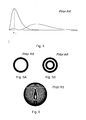
- FIG. 4 As to a method of displaying an existence probability of an electron in a hydrogen atom, a graph of radial distribution shown in FIG. 4 can be seen in many of textbooks and is well known as very ABCs of quantum mechanics. There are also known graphs of qualitative plane (i.e., two-dimensional) distributions shown in FIGS. 5A and 5B , a graph of qualitative stereo (i.e., three-dimensional) distribution shown in FIG. 6 and the like.
- the present invention solves the above-mentioned conventional problem and provides a method of quantitatively displaying a three-dimensional existence probability of an electron in a hydrogen atom as a scientific educational tool.
- One embodiment of the present invention is a method of displaying an existence probability of an electron in a hydrogen atom.
- the method referring to n radii as r 1 to rn in ascending order, to an area proportional to a surface area of a sphere having a radius rn as Sn, and to a value proportional to an existence probability of an electron at a distance rn from the center of a hydrogen atom as Pn, places small symbols which are Pn in number on a figure having an area Sn in an equally spaced manner, or equally divides the area Sn into Pn sections.
- the method displays the small symbols or the divided sections for all of 1 to n in a manner of placing together.
- the method of displaying an existence probability of an electron in a hydrogen atom as an educational tool referring to n radii as r 1 to rn in ascending order, to an area proportional to a surface area of a sphere having a radius rn as Sn, and to a value proportional to an existence probability of an electron at a distance rn from the center of a hydrogen atom as Pn, places small symbols which are Pn in number on a figure having an area Sn in an equally spaced manner, or equally divides the area Sn into Pn sections, and displays the small symbols or the divided sections for all of 1 to n in a manner of placing together, the method is useful in understanding of the existence probability which is very basics of quantum mechanics and inspires interest in studying science.
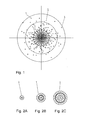
- FIG. 1 is a plan view showing an existence probability of an electron in a 1 s orbital of a hydrogen atom according to a first embodiment of the present invention
- FIGS. 2A to 2C are exploded and enlarged views of the central area of FIG. 1 ;
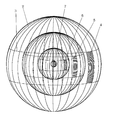
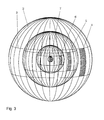
- FIG. 3 is a perspective view showing an existence probability of an electron in a 1 s orbital of a hydrogen atom according to a second embodiment of the present invention
- FIG. 4 is a graph showing existence probabilities of an electron in is and 2 s orbitals of a hydrogen atom along a radial direction according to conventional art.
- FIGS. 5A and 5B are two-dimensional views showing existence probabilities of an electron in 1 s and 2 s orbitals of a hydrogen atom respectively according to conventional art.
- FIG. 6 is a three-dimensional view showing existence probability of an electron in a 1 s orbital of a hydrogen atom according to conventional art.
- N radii are referred to as r 1 to rn in ascending order.
- An area proportional to the surface area of a sphere having a radius rn is referred to as Sn.
- a value proportional to existence probability of an electron at a distance rn from the center of a hydrogen atom is referred to as P n .
- Small symbols which are P n in number are placed on a figure having an area Sn in an equally spaced manner. The small symbols are displayed for all of 1 to n in a manner of being placed together.
- This display method is referred to as the first embodiment of the present invention.
- the second embodiment of the present invention instead, equally divides the area Sn into Pn sections, and displays the divided sections for all of 1 to n on the spheres having radii r 1 to rn placed in a concentric manner.
- FIG. 1 illustrates the method of displaying the existence probability of an electron in a 1 s orbital of a hydrogen atom as an educational tool according to the first embodiment of the present invention.
- There are displayed concentric circles having areas proportional to surface areas of spheres having radii varying from 0.1 to 3.0 with 0.1 increments in between with Bohr radius set at 1 (i.e., a 0 1).
- small symbols whose number is proportional to an existence probability of an electron at a corresponding radius on each of the circles.
- Table 1 The procedure to provide the display will hereinafter be described with reference to following Table 1.
- Table 1 shows part of a set of data prepared by use of spreadsheet software for a personal computer. Part of the preparation procedure that seems to belong to common knowledge of a person skilled in the art is omitted.
- radii r from 0.1 to around 7.0 with 0.1 increments in between in the first row; sphere surface areas 4 ⁇ r 2 in the second row; existence probabilities r 2 exp( ⁇ 2r) with a normalization coefficient omitted in the third row; accumulative values of the existence probabilities from radius 0.1 to r in the fourth row; the values in the third row divided by a convergent value 2.5, multiplied by 2000 so as to be expressed by per 2000 and further rounded to one decimal place in the fifth row; and the existence probabilities at the radius r multiplied by a value obtained by dividing the surface area of a sphere to its immediate left by the surface area of a sphere having the same radius r so as to be expressed by per 2000 in a visible portion and further rounded to the whole number in the sixth row.
- FIGS. 2A to 2C will be explained in first as needed for explanation of visible portions arranged in the sixth row.
- the number 7 is obtained from the per 2000 value, i.e., 6.5 rounded off to the whole number.
- the seven small circles should be placed on the surface of the sphere on the basis of a definition of the existence probability. However, the drawing itself would not be easy.
- the number 6 of the inner small circles 1 is the remainder of subtraction of the number 16 shown in the sixth row (visible portion) and the third column from the number 22 which is obtained by rounding off the number 21.5 shown in the fifth row (per 2000) and the third column to the whole number.
- a ratio of an area of the outer visible portion left without being hidden to the number of small circles 1 placed in the portion was set at the same value as the ratio of the per 2000 value 21.5 to the whole area of the circle 0.502.
- FIG. 1 the inside of a circle having a radius of 4 mm placed slightly inside the outer portion is occupied by figures shown in FIG. 2A and only the outside of the circle is visible part in FIG. 2B .
- the summation of the numbers 13 and 5, i.e., 18, corresponds to the value obtained by subtracting the number 22 in the fourth row and the sixth column from the number 40 obtained by rounding off the number 39.5 in the same row and the fifth column to the whole number.
- adjacent small circles 1 on the same circle having a small radius are displaced appropriately.
- FIG. 3 quantitatively displays a three-dimensional existence probability of an electron in a 1 s orbital of a hydrogen atom on a plane as an educational tool according to the second embodiment of the present invention.
- the area of each of the sections is defined by a per 2000 values in the fifth row of Table 1 rounded to the whole number.
- per 2000 value in Table 1 is 89.6 and can be rounded to 90.
- one appropriate section 4 (selected because of being scarce in overlapping with longitude lines 2 and latitude lines 3 of spheres having other radii and allowing easy understanding of its shape) is hatched with vertical thin lines.
- An appropriate section 6 selected out of those divided into by 2 latitude lines 3 is hatched with vertical thin lines.
- An appropriate section 7 is hatched with vertical thin lines.
- the four spheres are drawn in a concentric manner and inclined at such an angle for the insides of the spheres to easily be viewed.
- the accumulative calculation in the fourth row corresponds to an (approximate) integration of an existence probability r 2 exp( ⁇ 2r).
- the per 2000 values in the fifth row are obtained from the existence probabilities at respective radii divided by the converged value 2.5 and multiplied by 2000.
- the values means that an electron, which exists singularly in the whole space, emerges in the vicinity of a corresponding radius at the probability of n times in 2000 times the unit time or the average revolving period.
- FIG. 2C an electron emerges at the probability of 40 times.
- FIG. 2B with FIG. 2A overlapped on the front thereof in a concentric manner 7 small circles 1 can be seen in a central portion and 16 in the outside thereof. The small circles in both the portions express emerging probability per a unit area over the respective portions.
- FIG. 3 since being a perspective view displaying plural concentric spheres having different radii and the surface of each of the spheres divided equally by the per 2000 value of the existence probability on the surface, allows a viewer to sterically understand a relation in size between the radii and the areas of equally divided sections.
- sections 4 , 5 , 6 and 7 corresponding to four different radii are different in area from each other, the existence probabilities of an electron within the same period are the same among those four sections 4 , 5 , 6 and 7 .
- an electron emerges within section 4 at the probability of once in 2000 times the unit time or the average revolving period (of an electron), and also once within each of sections 5 , 6 , and 7 smaller in area than section 4 .
- FIG. 3 it can be understood that, with a decrease in a radius, the area of one section decreases and the existence probability, which is an inverse number thereof, increases.
- FIG. 1 remains a planar expression
- FIG. 3 is a three-dimensional expression drawn on a plane surface as a perspective view and allows a viewer to understand a three-dimensional distribution of the existence probability.
- FIGS. 1 and 3 advantageously clarify the fact hidden in the conventional graph that the existence probability of an electron is rather higher around the center.
- the surface area of a sphere as a domain of definition of the existence probability and the existence probability are multiplied by each other and unseparated.
- the present invention visualizes the change in the surface area of a sphere itself, expresses the existence probability defined on the surface of the sphere in connection with the surface area of the sphere, and as a result, allows the existence probability itself to be seen.
- a three-dimensional existence probability can be expressed by use of the similar method also for a 2 s-orbital and higher levels of s-orbitals, which is however omitted here.
- Other orbitals such as p-orbitals, do not seem to be necessary for the present invention, and are not described here.
- Small circle 1 can be substituted by other small symbols, such as a small triangle and plus sign “+.”
- the per 2000 value can also be replaced with other numbers, such as per 1000 and 10000.
- the means for dividing the surface of a sphere into sections equal in area does not restricted to longitude lines 2 and latitude lines 3 .
- the surface of a sphere can also be expressed by multiple polygons as if being a soccer ball.
- FIGS. 1 and 3 are both drawings on plane surfaces.
- a three-dimensional structure as an educational tool makes the existence probability more imageable.
- multi-layered concentric spheres are formed of thin and transparent plastic films and small symbols 1 proportional in number to the existence probability are painted on the surfaces of the spheres in colors different from one radius to another.
- the colors are desired to be correlated with radii, such as a color being warmer with a decrease in a radius, and cooler with an increase in a radius.
- the present invention advantageously reveals the three-dimensional distribution of the existence probability of an electron which has been hidden in conventional one-dimensional expressions, such as a graph shown in FIG. 4 , and is expected to contribute to a change in and advancement of quantum mechanics.
- a method of displaying an existence probability of an electron in a hydrogen atom as an educational tool according to the present invention advantageously visualizes the quantitative distribution of the existence probability in the three-dimensional space, and useful for education and research.
Landscapes
- Engineering & Computer Science (AREA)
- General Physics & Mathematics (AREA)
- Physics & Mathematics (AREA)
- Educational Administration (AREA)
- Mathematical Analysis (AREA)
- Mathematical Optimization (AREA)
- Algebra (AREA)
- Business, Economics & Management (AREA)
- Mathematical Physics (AREA)
- Computational Mathematics (AREA)
- Pure & Applied Mathematics (AREA)
- Educational Technology (AREA)
- Theoretical Computer Science (AREA)
- Management, Administration, Business Operations System, And Electronic Commerce (AREA)
- Image Generation (AREA)
Priority Applications (1)
| Application Number | Priority Date | Filing Date | Title |
|---|---|---|---|
| US14/991,381 US20160171910A1 (en) | 2014-04-22 | 2016-01-08 | Method of displaying existence probability of electron in hydrogen atom |
Applications Claiming Priority (2)
| Application Number | Priority Date | Filing Date | Title |
|---|---|---|---|
| JP2014099993A JP6344713B2 (ja) | 2014-04-22 | 2014-04-22 | 水素原子の電子の存在確率表示方法 |
| JP2014-099993 | 2014-04-22 |
Related Child Applications (1)
| Application Number | Title | Priority Date | Filing Date |
|---|---|---|---|
| US14/991,381 Continuation US20160171910A1 (en) | 2014-04-22 | 2016-01-08 | Method of displaying existence probability of electron in hydrogen atom |
Publications (1)
| Publication Number | Publication Date |
|---|---|
| US20150302775A1 true US20150302775A1 (en) | 2015-10-22 |
Family
ID=54322514
Family Applications (2)
| Application Number | Title | Priority Date | Filing Date |
|---|---|---|---|
| US14/593,121 Abandoned US20150302775A1 (en) | 2014-04-22 | 2015-01-09 | Method of displaying existence probability of electron in hydrogen atom |
| US14/991,381 Abandoned US20160171910A1 (en) | 2014-04-22 | 2016-01-08 | Method of displaying existence probability of electron in hydrogen atom |
Family Applications After (1)
| Application Number | Title | Priority Date | Filing Date |
|---|---|---|---|
| US14/991,381 Abandoned US20160171910A1 (en) | 2014-04-22 | 2016-01-08 | Method of displaying existence probability of electron in hydrogen atom |
Country Status (2)
| Country | Link |
|---|---|
| US (2) | US20150302775A1 (enExample) |
| JP (1) | JP6344713B2 (enExample) |
Cited By (2)
| Publication number | Priority date | Publication date | Assignee | Title |
|---|---|---|---|---|
| USD784449S1 (en) * | 2015-10-07 | 2017-04-18 | Four Pines Publishing, Inc | Visual aid that demonstrates a random walk and generates a bell curve distribution |
| US12268971B1 (en) | 2023-05-10 | 2025-04-08 | Index Fund Advisors, Inc. | Probability demonstrator |
Families Citing this family (1)
| Publication number | Priority date | Publication date | Assignee | Title |
|---|---|---|---|---|
| JP6552472B2 (ja) | 2016-11-14 | 2019-07-31 | 本田技研工業株式会社 | 停車制御装置 |
Citations (1)
| Publication number | Priority date | Publication date | Assignee | Title |
|---|---|---|---|---|
| US20140220533A1 (en) * | 2013-02-04 | 2014-08-07 | Haruo Matsushima | Method of displaying electromagnetic field in hydrogen atom |
Family Cites Families (3)
| Publication number | Priority date | Publication date | Assignee | Title |
|---|---|---|---|---|
| SE527272C2 (sv) * | 2005-01-26 | 2006-01-31 | Bright Ab | Interaktiv atommodell |
| JP2010113316A (ja) * | 2008-11-04 | 2010-05-20 | Haruo Matsushima | 教材 |
| JP2014021481A (ja) * | 2012-07-17 | 2014-02-03 | Haruo Matsushima | 水素原子模型 |
-
2014
- 2014-04-22 JP JP2014099993A patent/JP6344713B2/ja not_active Expired - Fee Related
-
2015
- 2015-01-09 US US14/593,121 patent/US20150302775A1/en not_active Abandoned
-
2016
- 2016-01-08 US US14/991,381 patent/US20160171910A1/en not_active Abandoned
Patent Citations (1)
| Publication number | Priority date | Publication date | Assignee | Title |
|---|---|---|---|---|
| US20140220533A1 (en) * | 2013-02-04 | 2014-08-07 | Haruo Matsushima | Method of displaying electromagnetic field in hydrogen atom |
Cited By (2)
| Publication number | Priority date | Publication date | Assignee | Title |
|---|---|---|---|---|
| USD784449S1 (en) * | 2015-10-07 | 2017-04-18 | Four Pines Publishing, Inc | Visual aid that demonstrates a random walk and generates a bell curve distribution |
| US12268971B1 (en) | 2023-05-10 | 2025-04-08 | Index Fund Advisors, Inc. | Probability demonstrator |
Also Published As
| Publication number | Publication date |
|---|---|
| JP2015207264A (ja) | 2015-11-19 |
| US20160171910A1 (en) | 2016-06-16 |
| JP6344713B2 (ja) | 2018-06-20 |
Similar Documents
| Publication | Publication Date | Title |
|---|---|---|
| US9417764B2 (en) | Methods and systems for decluttering icons representing points of interest on a map | |
| US20160171910A1 (en) | Method of displaying existence probability of electron in hydrogen atom | |
| CN109144504A (zh) | 基于d3的数据可视化图形生成方法及存储介质 | |
| Špriňarová et al. | Human-computer interaction in real-3D and Pseudo-3D cartographic visualization: A comparative study | |
| Hennig | Gridded cartograms as a method for visualising earthquake risk at the global scale | |
| Pouliot et al. | Empirical assessment of the suitability of visual variables to achieve notarial tasks established from 3D condominium models | |
| Rhodes | Thinking in Space: The Role of Geography in National Security Decision-Making (August 2019) | |
| dos Santos et al. | Mapping free educational software used to develop geometric reasoning | |
| US9014492B2 (en) | Real-time image reconstruction | |
| US20110282713A1 (en) | Product positioning as a function of consumer needs | |
| US20190094678A1 (en) | Pseudo-volumetric display apparatus and methods | |
| Lehning | Visualisation of Mathematical Thinking | |
| Drury | A real counterexample to two inequalities involving permanents | |
| Hampton | Cosines and Cayley, triangles and tetrahedra | |
| Prakoso et al. | Reconstructing intellectual capital through islamic religiosity | |
| Vicente-Villardón et al. | Logistic biplots for ordinal data with an application to job satisfaction of doctorate degree holders in spain | |
| Rashid et al. | Visualizing the Mean, Mean Deviation, and Standard Deviation from the Disc Plot of a Discrete Random Variable | |
| US20140035924A1 (en) | Trend highlighting | |
| Weisstein | Ternary Diagram | |
| Yuan et al. | Acute triangulations of double planar convex bodies | |
| US20210064656A1 (en) | Tree Ring Map for Data Visualization. | |
| Noucher | From the Mosaic to the Patchwork Metaphor in Digital Cartography—A Response to the Article by Hong et al.(2025) | |
| Sandnes et al. | A simple browser-based 3D-sketching framework for novice and infrequent users | |
| Vergara-Rodríguez et al. | Virtual Reality Technology in Peruvian Higher Education: Influence of University Tenure | |
| Nguyen¹ et al. | Integrating Retinal Variables into Graph Visualizing Multivariate Data to Increase |
Legal Events
| Date | Code | Title | Description |
|---|---|---|---|
| STCB | Information on status: application discontinuation |
Free format text: ABANDONED -- FAILURE TO RESPOND TO AN OFFICE ACTION |