US20120249279A1 - Transformer - Google Patents
Transformer Download PDFInfo
- Publication number
- US20120249279A1 US20120249279A1 US13/432,087 US201213432087A US2012249279A1 US 20120249279 A1 US20120249279 A1 US 20120249279A1 US 201213432087 A US201213432087 A US 201213432087A US 2012249279 A1 US2012249279 A1 US 2012249279A1
- Authority
- US
- United States
- Prior art keywords
- coils
- coil
- transformer
- axial direction
- insulating films
- Prior art date
- Legal status (The legal status is an assumption and is not a legal conclusion. Google has not performed a legal analysis and makes no representation as to the accuracy of the status listed.)
- Granted
Links
- 238000004804 winding Methods 0.000 claims abstract description 72
- 239000004020 conductor Substances 0.000 claims description 52
- 239000000853 adhesive Substances 0.000 claims description 7
- 230000001070 adhesive effect Effects 0.000 claims description 7
- 238000010292 electrical insulation Methods 0.000 description 15
- 238000000034 method Methods 0.000 description 10
- 230000004048 modification Effects 0.000 description 9
- 238000012986 modification Methods 0.000 description 9
- 230000008569 process Effects 0.000 description 8
- 239000002184 metal Substances 0.000 description 7
- 238000005304 joining Methods 0.000 description 3
- 238000004080 punching Methods 0.000 description 3
- 239000002826 coolant Substances 0.000 description 2
- 238000003825 pressing Methods 0.000 description 2
- 238000003466 welding Methods 0.000 description 2
- 230000015572 biosynthetic process Effects 0.000 description 1
- 239000003822 epoxy resin Substances 0.000 description 1
- 239000000696 magnetic material Substances 0.000 description 1
- 239000000463 material Substances 0.000 description 1
- 229920000647 polyepoxide Polymers 0.000 description 1
- 229920001721 polyimide Polymers 0.000 description 1
- 239000009719 polyimide resin Substances 0.000 description 1
- 239000011347 resin Substances 0.000 description 1
- 229920005989 resin Polymers 0.000 description 1
- 239000000758 substrate Substances 0.000 description 1
- 239000011800 void material Substances 0.000 description 1
- 229910000859 α-Fe Inorganic materials 0.000 description 1
Images







Classifications
-
- H—ELECTRICITY
- H01—ELECTRIC ELEMENTS
- H01F—MAGNETS; INDUCTANCES; TRANSFORMERS; SELECTION OF MATERIALS FOR THEIR MAGNETIC PROPERTIES
- H01F27/00—Details of transformers or inductances, in general
- H01F27/28—Coils; Windings; Conductive connections
- H01F27/32—Insulating of coils, windings, or parts thereof
- H01F27/324—Insulation between coil and core, between different winding sections, around the coil; Other insulation structures
-
- H—ELECTRICITY
- H01—ELECTRIC ELEMENTS
- H01F—MAGNETS; INDUCTANCES; TRANSFORMERS; SELECTION OF MATERIALS FOR THEIR MAGNETIC PROPERTIES
- H01F27/00—Details of transformers or inductances, in general
- H01F27/28—Coils; Windings; Conductive connections
- H01F27/32—Insulating of coils, windings, or parts thereof
- H01F27/324—Insulation between coil and core, between different winding sections, around the coil; Other insulation structures
- H01F27/325—Coil bobbins
-
- H—ELECTRICITY
- H01—ELECTRIC ELEMENTS
- H01F—MAGNETS; INDUCTANCES; TRANSFORMERS; SELECTION OF MATERIALS FOR THEIR MAGNETIC PROPERTIES
- H01F27/00—Details of transformers or inductances, in general
- H01F27/28—Coils; Windings; Conductive connections
- H01F27/30—Fastening or clamping coils, windings, or parts thereof together; Fastening or mounting coils or windings on core, casing, or other support
- H01F27/306—Fastening or mounting coils or windings on core, casing or other support
Definitions
- the present invention relates to transformers which include a plurality of coils that are electrically insulated from each other and stacked in a common winding axial direction thereof.
- transformers which are used in, for example, DC-DC converters.
- Those transformers include, as shown in FIG. 30 , a high voltage-side coil 91 and a pair of low voltage-side coils 92 that are electrically insulated from each other and stacked in a common winding axial direction thereof (i.e., the direction of the winding axes of the coils 91 and 92 which coincide with each other). More specifically, the coils 91 and 92 are stacked so that the high voltage-side coil 91 is interposed between the low voltage-side coils 92 in the winding axial direction. Further, the coils 91 and 92 are together sandwiched by a pair of core pieces 93 in the winding axial direction. With the core pieces 93 , magnetic paths can be formed on both the radially inside and radially outside of the coils 91 and 92 .
- Japanese Patent Application Publication No. 2004-303857 discloses a technique, according to which the high voltage-side coil 91 is comprised of a substrate that has coil patterns formed on both the major surfaces thereof and insulating layers 911 that cover the coil patterns. Consequently, the high voltage-side coil 91 is electrically insulated from the low voltage-side coils 92 without interposing the bobbins 94 between the high voltage-side coil 91 and the low voltage-side coils 92 .
- a transformer which includes a pair of first coils and at least one second coil.
- the first and second coils are stacked so that the at least one second coil is interposed between the first coils in a common winding axial direction of the first and second coils.
- Each of the first coils is covered by insulating films and integrated with the insulating films into an integrated body, so that the first coils are electrically insulated from the at least one second coil.
- the transformer further includes a core that is comprised of a pair of core pieces.
- the integrated bodies, each of which is comprised of one of the first coils and the insulating films covering the one of the first coils, and the at least one second coil are together interposed between and thereby covered by the pair of core pieces in the winding axial direction.
- the at least one second coil is interposed between the first coils in the winding axial direction, the at least one second coil is prevented from making contact with the core pieces that are arranged outside of the first coils in the winding axial direction. Consequently, electrical insulation between the at least one second coil and the core pieces is secured without employing any additional insulating means (e.g., bobbins). Moreover, electrical insulation between the first coils and the core pieces is also secured by means of the thin insulating films that cover the first coils.
- each of the first coils is comprised of a plurality of coil segments that are stacked in the winding axial direction. Between each adjacent pair of the coil segments, there is interposed an insulating film so as to electrically insulate the coil segments from each other.
- the integrated bodies each of which is comprised of one of the first coils and the insulating films covering the one of the first coils, are substantially annular-shaped.
- the at least one second coil is also substantially annular-shaped.
- the radially inner periphery of the at least one second coil is positioned radially outside of the radially inner peripheries of the insulating films of the integrated bodies, and the radially outer periphery of the at least one second coil is positioned radially inside of the radially outer peripheries of the insulating films.
- the at least one second coil is bonded by an adhesive to a corresponding one of the integrated bodies.
- the integrated bodies are formed of a coil sheet.
- the integrated bodies are connected with each other via a connecting portion.
- the coil sheet is folded at the connecting portion so that the integrated bodies are superposed in the winding axial direction.
- the connecting portion of the coil sheet includes therein a connecting electric conductor that connects the first coils included in the respective integrated bodies.
- the coil sheet there are provided two coil terminals that protrude respectively from the integrated bodies in a direction perpendicular to both the winding axial direction and an extending direction of the connecting portion of the coil sheet.
- Each of the core pieces of the core has a center portion that extends in the winding axial direction.
- the center portions of the core pieces are inserted in a space formed radially inside of the integrated bodies and the at least one second coil.
- the insulating films of the integrated bodies have extensions that extend in the winding axial direction along the outer surfaces of the center portions of the core pieces, so as to be radially interposed between the outer surfaces of the center portions of the core pieces and the radially inner surface of the at least one second coil.
- Each of the first coils is comprised of a large-linewidth coil segment and a small-linewidth coil segment that are stacked in the winding axial direction.
- the at least one second coil is directly thermally connected to a heat sink.
- the first coils and the at least one second coil are stacked so that the large-linewidth coil segments of the first coils face the at least one second coil.
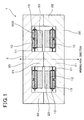
- FIG. 1 is a cross-sectional view illustrating the overall configuration of a transformer according to a first embodiment
- FIG. 2 is a cross-sectional view of a stacked body of the transformer
- FIG. 3 is a cross-sectional view of part of an integrated body of a first coil and insulating films, the integrated body being included in the stacked body;
- FIG. 4 is an exploded perspective view of the transformer
- FIG. 5 is a plan view of a coil sheet, of which a pair of the integrated bodies is formed, before being folded;
- FIG. 6 is a cross-sectional view taken along the line A-A in FIG. 5 ;
- FIG. 7 is a plan view illustrating a pair of large-linewidth electric conductor plates included in the coil sheet before being folded;
- FIG. 8 is a plan view illustrating a pair of small-linewidth electric conductor plates included in the coil sheet before being folded;
- FIG. 9 is a plan view of the coil sheet which is folded to have the pair of the integrated bodies superposed
- FIG. 10 is a cross-sectional view taken along the line B-B in FIG. 9 ;
- FIG. 11 is a plan view illustrating the transformer which is mounted on a heat sink
- FIG. 12 is a cross-sectional view illustrating connecting terminals of a pair of second coils of the transformer, the connecting terminals being fixed to a terminal block of the heat sink;
- FIG. 13 is a cross-sectional view of a stacked body according to a second embodiment
- FIG. 14 is a cross-sectional view of a coil sheet according to the second embodiment before being folded, wherein a pair of second coils is bonded to the coil sheet;
- FIG. 15 is a cross-sectional view illustrating the overall configuration of a transformer according to a third embodiment
- FIG. 16 is a cross-sectional view of a stacked body of the transformer according to the third embodiment.
- FIG. 17 is a plan view of a coil sheet according to the third embodiment before being folded.
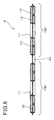
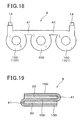
- FIG. 18 is a plan view of a coil sheet according to a fourth embodiment before being folded
- FIG. 19 is a cross-sectional view of a stacked body according to the fourth embodiment.
- FIG. 20 is a plan view of a coil sheet according to a first modification of the fourth embodiment.
- FIG. 21 is a cross-sectional view of a stacked body according to the first modification.
- FIG. 22 is a plan view of a coil sheet according to a second modification of the fourth embodiment.
- FIG. 23 is a cross-sectional view of a stacked body according to the second modification.
- FIG. 24 is a cross-sectional view illustrating a pair of stacked bodies of a transformer according to a fifth embodiment
- FIG. 25 is a cross-sectional view illustrating the overall configuration of a transformer according to a sixth embodiment.
- FIG. 26 is a plan view of a coil sheet according to a seventh embodiment before being folded
- FIG. 27 is a plan view of a coil sheet according to an eighth embodiment before being folded.
- FIG. 28 is a plan view of a coil sheet according to a ninth embodiment before being folded.
- FIG. 29 is a plan view of a coil sheet according to a modification of the night embodiment before being folded.
- FIG. 30 is a cross-sectional view illustrating the overall configuration of a transformer according to the prior art.
- FIGS. 1-29 Exemplary embodiments will be described hereinafter with reference to FIGS. 1-29 . It should be noted that for the sake of clarity and understanding, identical components having identical functions in different embodiments have been marked, where possible, with the same reference numerals in each of the figures and that for the sake of avoiding redundancy, descriptions of the identical components will not be repeated.
- a transformer 1 according to the first embodiment includes a pair of first coils 10 and a pair of second coils 20 .
- the first and second coils 10 and 20 are electrically insulated from each other and stacked (or superposed) in a common winding axial direction thereof (i.e., the direction of the winding axes of the coils 10 and 20 which coincide with each other).
- each of the first coils 10 is covered by insulating films 11 and integrated with the insulating films 11 into an integrated body 100 . Accordingly, there are two integrated bodies 100 included in the transformer 1 .
- the first and second coils 10 and 20 are stacked so that the pair of second coils 20 is interposed between the first coils 10 in the winding axial direction.
- the transformer 1 is configured as a step-down transformer.
- the transformer 1 may be used in, for example, an electric vehicle or a hybrid vehicle to step down (or reduce) voltage for charging a low-voltage power source with electric power supplied by a high-voltage power source.
- the first coils 10 are configured as primary and high voltage-side coils
- the second coils 20 are configured as secondary and low voltage-side coils.
- Each of the first and second coils 10 and 20 has a substantially annular shape.
- each of the integrated bodies 100 also has a substantially annular shape.
- the integrated bodies 100 each of which is comprised of one of the first coils 10 and the insulating films 11 covering the first coil 10 , and the second coils 20 are stacked together to form a stacked body 6 .
- the transformer 1 also includes a core 3 that is made of a magnetic material, such as ferrite, and arranged to cover the stacked body 6 .
- the core 3 is comprised of a pair of core pieces 30 that are respectively arranged on opposite sides of the stacked body 6 in the winding axial direction so as to together sandwich the stacked body 6 in the winding axial direction.
- Each of the core pieces 30 includes a center magnetic leg 31 and a pair of side magnetic legs 32 .
- the center magnetic leg 31 is inserted into the radially inner space of the stacked body 6
- the side magnetic legs 32 are located radially outside of the stacked body 6 so as to be respectively positioned on opposite sides of the stacked body 6 .
- Each of the first coils 10 is formed by stacking two coil segments, each of which is obtained by punching a metal plate into a coil shape, in the thickness direction thereof and joining a corresponding pair of ends of the two coil segments.
- each of the first coils 10 is formed by stacking a large-linewidth electric conductor plate 12 and a small-linewidth electric conductor plate 13 in their thickness direction with an insulating film 11 interposed therebetween.
- the linewidth of the small-linewidth electric conductor plate 13 is less than or equal to half the linewidth of the large-linewidth electric conductor plate 12 .
- the large-linewidth electric conductor plate 12 is substantially annular-shaped so that the number of turns of the plate 12 is equal to 1.
- the small-linewidth electric conductor plate 13 is substantially spiral-shaped so that the number of turns of the plate 13 is equal to 2.
- one end of the large-linewidth electric conductor plate 12 is electrically connected, for example by welding, to one end of the small-linewidth electric conductor plate 13 . Consequently, the total number of turns of the first coil 13 is equal to 3.
- each of the integrated bodies 100 is formed by stacking the large-linewidth and small-linewidth electric conductor plates 12 and 13 of the first coil 10 and three insulating films 11 so that each of the plates 12 and 13 is interposed between an adjacent pair of the insulating films 11 in the winding axial direction. Further, the three insulating films 11 are crimped on both the radially inside and radially outside of the integrated bodies 100 . In addition, the insulating films 11 are also crimped between the radially inner and radially outer turns of the small-linewidth electric conductor plate 13 .
- an adhesive 112 is filled into all the void spaces of the integrated body 100 which are formed between the insulating films 11 and the large-linewidth and small-linewidth electric conductor plates 12 and 13 . Consequently, all of the insulating films 11 and the large-linewidth and small-linewidth electric conductor plates 12 and 13 are bonded together by the adhesive 112 .
- the corresponding ends of the large-linewidth and small-linewidth electric conductor plates 12 and 13 are joined together by, for example, welding, forming a joining portion therebetween. Though not shown in the figures, the joining portion extends to penetrate that of the insulating films 11 which is interposed between the large-linewidth and small-linewidth electric conductor plates 12 and 13 .
- the pair of integrated bodies 100 are formed of a coil sheet 4 . More specifically, in the coil sheet 4 , the two integrated bodies 100 are connected with each other via a connecting portion 41 . As shown in FIGS. 9 and 10 , the connecting portion 41 of the coil sheet 4 is folded in the thickness direction thereof, thereby superposing the integrated bodies 100 in the winding axial direction.
- the connecting portion 41 of the coil sheet 4 includes therein a connecting electric conductor 411 that connects the first coils 10 included in the respective integrated bodies 100 .
- the connecting electric conductor 411 is integrally formed with the small-linewidth electric conductor plates 13 of the first coils 10 into one piece. In other words, the connecting electric conductor 411 is punched out of the same metal plate as the small-linewidth electric conductor plates 13 .
- all of the large-linewidth electric conductor plates 12 , the small-linewidth electric conductor plates 13 and the connecting electric conductor 411 have substantially the same thickness. Further, the thickness of those plates 12 , 13 and 411 is smaller than the thickness of those metal plates of which the second coils 20 are formed. More specifically, the thickness of the plates 12 , 13 and 411 is in the range of 0.3 to 0.5 mm, while the thickness of the metal plates forming the second coils 20 is in the range of 1 to 2 mm.
- both the coil terminals 14 protrude respectively from the integrated bodies 100 in a direction perpendicular to both the winding axial direction and the extending direction (or the longitudinal direction) of the connecting portion 41 . Moreover, both the coil terminals 14 protrude toward the same side in the direction and are both exposed from the insulating films 11 . Further, as shown in FIG. 7 , both the coil terminals 14 are integrally formed with the large-linewidth electric conductor plates 12 of the first coils 10 into one piece. In other words, both the coil terminals 14 are punched out of the same metal plate as the large-linewidth electric conductor plates 12 . In addition, the coil terminals 14 respectively make up a pair of input terminals of the transformer 1 .
- the insulating films 11 together completely cover the first coils 10 except for the coil terminals 14 . More specifically, the insulating films 11 cover not only the major surfaces of the first coils 10 which are perpendicular to the winding axial direction (or to the thickness direction of the large-linewidth and small-linewidth electric conductor plates 12 and 13 ), but also the radially inner and outer surfaces of the first coils 10 . Moreover, the connecting electric conductor 411 that connects the first coils 10 is also completely covered by an insulating film 11 . In addition, the insulating films 11 are made of an electrically insulative resin, such as a polyimide resin and an epoxy resin.
- the total number of turns of the first coil 13 is equal to 3.
- the two first coils 10 are electrically connected in series with each other via the connecting electric conductor 411 . Therefore, the total number of turns of the first coils 10 is equal to 6.
- the winding directions of the first coils 10 are the same.
- each of the second coils 20 is formed by punching a metal plate into a substantially annular shape. Consequently, for each of the second coils 20 , the number of turns of the second coil 20 is equal to 1. Moreover, the two second coils 20 are superposed with a gap formed therebetween in the winding axial direction (or in the thickness direction of the second coils 20 ). Further, as will be described in detail later, the two second coils 20 are electrically connected to each other. Consequently, the total number of turns of the two second coils 20 is equal to 2.
- the diameter of the second coils 20 is set to be smaller than that of the integrated bodies 100 so that the radially outer peripheries of the second coils 20 are positioned radially inside of the radially outer peripheries of the insulating films 11 and the radially inner peripheries of the second coils 20 are positioned radially outside of the radially inner peripheries of the insulating films 11 . That is, the second coils 20 protrude neither radially outward nor radially inward from the insulating films 11 of the integrated bodies 100 .
- the radially outer peripheries of the second coils 20 substantially coincide with the radially outer peripheries of the first coils 10 and the radially inner peripheries of the second coils 20 substantially coincide with the radially inner peripheries of the first coils 10 .
- the transformer 1 is mounted on a heat sink 7 . Further, as shown in FIG. 12 , the second coils 20 of the transformer 1 are thermally connected to the heat sink 7 .
- each of the second coils 20 has a connecting terminal 23 and a coil terminal 24 that protrude from the substantially-annular main body of the second coil 20 .
- the connecting terminals 23 of the second coils 20 are superposed and aligned with each other, and fixed to a terminal block 71 of the heat sink 7 by means of a pair of screws 22 . Consequently, the second coils 20 are electrically connected to each other at the connecting terminals 23 ; they are also fixed to and thereby thermally connected to the heat sink 7 at the connecting terminals 23 .
- the heat sink 7 may be implemented by a wall portion of a cooler that has formed therein a coolant passage for circulating a coolant.
- the second coils 20 are also mechanically connected to each other at the connecting terminals 23 , thereby becoming one integrated body. Further, the coil terminals 24 of the second coils 20 respectively make up a pair of output terminals of transformer 1 . In addition, both the connecting terminals 23 of the second coils 20 are grounded via the heat sink 7 .
- the connecting terminals 23 and coil terminals 24 of the second coils 20 protrude on the opposite side of the core 3 to the coil terminals 14 of the first coils 10 .
- the first coils 10 and the second coils 20 are stacked so that the large-linewidth electric conductor plates 12 respectively face the second coils 20 .
- the integrated bodies 100 are arranged so that the large-linewidth electric conductor plates 12 are respectively in contact with the second coils 20 via the insulating films 11 interposed therebetween.
- the transformer 1 includes the pair of first coils 10 and the pair of second coils 20 that are stacked so that the pair of second coils 20 is interposed between the first coils 10 in the common winding axial direction of the first and second coils 10 and 20 .
- Each of the first coils 10 is covered by the insulating films 11 and integrated with the insulating films 11 into one integrated body 100 , so that the first coils 10 are electrically insulated from the second coils 20 .
- each of the first coils 10 is comprised of the large-linewidth electric conductor plate 12 and the small-linewidth electric conductor plate 13 that are stacked in the winding axial direction with one insulating film 11 interposed therebetween.
- the large-linewidth and small-linewidth electric conductor plates 12 and 13 can be considered as the coil segments that together make up the first coil 10 .
- each of the first coils 10 was made up of a single electric conductor plate that is spiral-shaped as the small-linewidth electric conductor plate 13 shown in FIG. 8 , it would be necessary to lead out the coil terminal 14 or the connecting electric conductor 411 from the radially inner end of the single electric conductor plate in the winding axial direction. Consequently, a certain thickness in the winding axial direction would be sacrificed only for the purpose of leading out the coil terminal 14 or the connecting electric conductor 411 .
- each of the first coils 10 is comprised of the large-linewidth and small-linewidth electric conductor plates 12 and 13 that are stacked in the winding axial direction; that end of the large-linewidth electric conductor plate 12 which does not make up the coil terminal 14 is electrically connected to the radially inner end of the small-linewidth electric conductor plate 13 . Consequently, no thickness in the winding axial direction is sacrificed only for the purpose of leading out the coil terminal 14 or the connecting electric conductor 411 .
- the integrated bodies 100 and the second coils 20 are each substantially annular-shaped. Moreover, the diameter of the second coils 20 is set to be less than that of the integrated bodies 100 so that the radially outer peripheries of the second coils 20 are positioned radially inside of the radially outer peripheries of the insulating films 11 and the radially inner peripheries of the second coils 20 are positioned radially outside of the radially inner peripheries of the insulating films 11 .
- the second coils 20 protrude neither radially outward nor radially inward from the insulating films 11 of the integrated bodies 100 . Consequently, the second coils 20 are prevented from making contact with the center magnetic legs 31 of the core pieces 30 located on the radially inside of the insulating films 11 and the side magnetic legs 32 of the core pieces 30 located on the radially outside of the insulating films 11 . As a result, the electrical insulation between the second coils 20 and the core pieces 30 can be reliably secured.
- both the integrated bodies 100 are formed of the coil sheet 4 , in which the integrated bodies 100 are connected with each other via the connecting portion 41 .
- the coil sheet 4 is folded at the connecting portion 41 so that the integrated bodies 100 are superposed in the winding axial direction.
- the connecting portion 41 of the coil sheet 4 includes therein the connecting electric conductor 411 that connects the first coils 10 included in the respective integrated bodies 100 .
- the two coil terminals 14 that protrude respectively from the integrated bodies 100 in the direction perpendicular to both the winding axial direction and the extending direction of the connecting portion 41 .
- each of the first coils 10 is comprised of the large-linewidth electric conductor segment 12 and the small-linewidth electric conductor segment 13 that are stacked in the winding axial direction.
- the second coils 20 are directly thermally connected to the heat sink 7 .
- the first and second coils 10 and 20 are stacked so that the large-linewidth electric conductor plates 12 of the first coils 10 respectively face the second coils 20 .
- the heat transfer area between the first coils 10 and the second coils 20 is increased in comparison with a case where the small-linewidth electric conductor plates 13 are arranged to respectively face the second coils 20 . Consequently, it is possible to more effectively dissipate heat generated by the first coils 10 via the second coils 20 and the heat sink 7 .
- the connecting terminals 23 and coil terminals 24 of the second coils 20 protrude on the opposite side of the core 3 to the coil terminals 14 of the first coils 10 .
- This embodiment illustrates a transformer 1 which has almost the same configuration as the transformer 1 according to the first embodiment; accordingly, only the differences therebetween will be described hereinafter.
- each of the second coils 20 is bonded by an adhesive 5 to that one of the integrated bodies 100 which is adjacent to the second coil 20 .
- the second coils 20 are respectively bonded by the adhesive 5 to the corresponding integrated bodies 100 .
- the coil sheet 4 is folded at the connecting portion 41 so that the second coils 20 are superposed and face each other in the winding axial direction. Consequently, as shown in FIG. 13 , in the resultant stacked body 6 , the pair of second coils 20 is interposed between the integrated bodies 100 in the winding axial direction.
- the stacked body 6 and the core 3 are assembled together so that the stacked body 6 is interposed between and thereby covered by the core pieces 30 of the core 3 in the winding axial direction (see FIGS. 1 and 4 ).
- the transformer 1 according to the present embodiment is obtained.
- the above-described transformer 1 according to the present embodiment has the same advantages as the transformer 1 according to the first embodiment.
- the second coils 20 are respectively bonded by the adhesive 5 to the corresponding integrated bodies 100 , it is possible to easily handle all of the integrated bodies 100 and the second coils 20 as a single part during the process of assembling the stacked body 6 and the core 3 . Further, it is also possible to more effectively dissipate heat generated by the first coils 10 via the second coils 20 and the heat sink 7 .
- This embodiment illustrates a transformer 1 which has almost the same configuration as the transformer 1 according to the first embodiment; accordingly, only the differences therebetween will be described hereinafter.
- the insulating films 11 which cover the first coils 10 , have extensions 111 that extend in the winding axial direction along the outer surfaces of the center magnetic legs 31 of the core pieces 30 of the core 3 , so as to be radially interposed between the outer surfaces of the center magnetic legs 31 and the radially inner surfaces of the second coils 20 .
- the insulating films 11 are applied so as to have center portions that extend radially inward from the radially inner surfaces of the first coils 10 to close the openings formed on the radially inside of the first coils 10 . Then, the center portions are radially cut into a plurality of pieces. Thereafter, the coil sheet 4 is folded at the connecting portion 41 to superpose the integrated bodies 100 in the winding axial direction; further, the second coils 20 are stacked with the integrated bodies 100 in the winding axial direction to form the stacked body 6 as shown in FIG. 16 . Next, the stacked body 6 and the core 3 are assembled together to form the transformer 1 as shown in FIG.
- the above-described transformer 1 according to the present embodiment has the same advantages as the transformer 1 according to the first embodiment.
- This embodiment illustrates a transformer 1 which has almost the same configuration as the transformer 1 according to the first embodiment; accordingly, only the differences therebetween will be described hereinafter.
- the coil sheet 4 includes three integrated bodies 100 that are connected to one another via a pair of connecting portions 41 and aligned with each other in a direction parallel to the extending direction of the connecting portions 41 .
- the pair of coil terminals 14 are arranged so as to protrude, in a direction perpendicular to both the winding axial direction and the extending direction of the connecting portions 41 , respectively from those two of the integrated bodies 100 which are respectively located at opposite ends of the coil sheet 4 .
- both the coil terminals 14 protrude toward the same side in the direction perpendicular to both the winding axial direction and the extending direction of the connecting portions 41 .
- the coil sheet 4 is folded twice at the connecting portions 41 so that the integrated bodies 100 are superposed in the winding axial direction. Then, each of the second coils 20 is inserted between an adjacent pair of the integrated bodies 100 . Consequently, the integrated bodies 100 are alternately arranged with the second coils 20 in the winding axial direction, forming the stacked body 6 . Thereafter, though not shown in the figures, the stacked body 6 and the core 3 are assembled together to form the transformer 1 according to the present embodiment.
- the above-described transformer 1 according to the present embodiment has the same advantages as the transformer 1 according to the first embodiment.
- the number of the integrated bodies 100 may be suitably set according to the design specification of the transformer 1 .
- the coil sheet 4 includes four integrated bodies 100 that are connected to one another via three connecting portions 41 .
- the coil sheet 4 includes five integrated bodies 100 that are connected to one another via four connecting portions 41 .
- This embodiment illustrates a transformer 1 which has almost the same configuration as the transformer 1 according to the first embodiment; accordingly, only the differences therebetween will be described hereinafter.
- the transformer 1 includes only the single stacked body 6 , in which the pair of second coils 20 is interposed between the integrated bodies 100 in the winding axial direction (see FIG. 2 ).
- the transformer 1 includes a pair of stacked bodies 6 that are stacked in the winding axial direction. Further, in each of the stacked bodies 6 , there is only a single second coil 20 interposed between two integrated bodies 100 . Furthermore, the stacked bodies 6 are electrically connected with each other. More specifically, the first coils 10 included in the integrated bodies 100 of one of the stacked bodies 6 are electrically connected with the first coils 10 included in the integrated bodies 100 of the other stacked body 6 ; the second coils 20 of one of the stacked bodies 6 are electrically connected with the second coils 20 of the other stacked body 6 .
- the above-described transformer 1 according to the present embodiment has the same advantages as the transformer 1 according to the first embodiment.
- each of the stacked bodies 6 can function as a transformer element. That is, two transformer elements are covered by a single core 3 . Consequently, compared to the case of employing two transformers 1 each including a single transformer unit, both the size and part counts are reduced.
- This embodiment illustrates a transformer 1 which has almost the same configuration as the transformer 1 according to the first embodiment; accordingly, only the differences therebetween will be described hereinafter.
- the transformer 1 has the pair of second coils 20 interposed between the integrated bodies 100 (or between the first coils 10 ) in the winding axial direction (see FIG. 1 ).
- the transformer 1 has only a single second coil 20 interposed between the integrated bodies 100 in the winding axial direction.
- the above-described transformer 1 according to the present embodiment has the same advantages as the transformer 1 according to the first embodiment.
- the number of the second coils 20 interposed between the first coils 10 may be suitably set according to the design specification of the transformer 1 .
- This embodiment illustrates a transformer 1 which has almost the same configuration as the transformer 1 according to the fourth embodiment; accordingly, only the differences therebetween will be described hereinafter.
- the coil sheet 4 includes three or more integrated bodies 100 , but has only the pair of coil terminals 14 that protrude respectively from those two of the integrated bodies 100 which are respectively located at opposite ends of the coil sheet 4 (see FIGS. 18-23 ).
- the coil sheet 4 includes four integrated bodies 100 that are connected to one another via three connecting portions 41 and aligned with each other a direction parallel to the extending direction of the connecting portions 41 .
- the coil sheet 4 has four coil terminals 14 that protrude respectively from the integrated bodies 100 in a direction perpendicular to both the winding axial direction and the extending direction of the connecting portions 41 .
- all the coil terminals 14 protrude toward the same side in the direction perpendicular to both the winding axial direction and the extending direction of the connecting portions 41 .
- the above-described transformer 1 according to the present embodiment has the same advantages as the transformer 1 according to the fourth embodiment.
- the number of the coil terminals 14 may be suitably set according to the design specification of the transformer 1 .
- This embodiment illustrates a transformer 1 which has almost the same configuration as the transformer 1 according to the first embodiment; accordingly, only the differences therebetween will be described hereinafter.
- each of the integrated bodies 100 is formed in the shape of a substantially circular ring (see FIG. 5 ).
- each of the integrated bodies 100 is formed in the shape of a substantially rectangular ring.
- each of the first coils 10 and the second coils 20 is also formed in the shape of a substantially rectangular ring.
- the above-described transformer 1 according to the present embodiment has the same advantages as the transformer 1 according to the first embodiment.
- the integrated bodies 100 may also have other shapes, for example, the shape of a substantially elliptical or hexagonal ring.
- This embodiment illustrates a transformer 1 which has almost the same configuration as the transformer 1 according to the first embodiment; accordingly, only the differences therebetween will be described hereinafter.
- the two coil terminals 14 protrude respectively from the integrated bodies 100 in a direction perpendicular to both the winding axial direction and the extending direction of the connecting portion 41 . Moreover, both the coil terminals 14 protrude toward the same side in the direction (see FIG. 5 ).
- the two coil terminals 14 protrude respectively from the integrated bodies 100 in a direction parallel to the extending direction of the connecting portion 41 . Moreover, the two coil terminals 14 protrude toward each other. In addition, it should be noted that the two coil terminals 14 may also be arranged to protrude toward the same side or toward opposite sides in the direction parallel to the extending direction of the connecting portion 41 .
- the above-described transformer 1 according to the present embodiment has the same advantages as the transformer 1 according to the first embodiment.
- the two coil terminals 14 are arranged in the vicinity of the integrated bodies 100 . Consequently, it is possible to secure a high yield rate in punching a single metal plate to form the coil terminals 14 and the large-linewidth electric conductor plates 12 of the integrated bodies 100 .
- the first coils 10 are configured as high voltage-side coils
- the second coils 20 are configured as low voltage-side coils.
- first coils 10 as low voltage-side coils and the second coils 20 as high voltage-side coils.
Landscapes
- Engineering & Computer Science (AREA)
- Power Engineering (AREA)
- Coils Of Transformers For General Uses (AREA)
- Insulating Of Coils (AREA)
Abstract
Description
- This application is based on and claims priority from Japanese Patent Applications No. 2011-72154 filed on Mar. 29, 2011 and No. 2011-272495 filed on Dec. 13, 2011, the contents of which are hereby incorporated by reference in their entireties into this application.
- 1. Technical Field
- The present invention relates to transformers which include a plurality of coils that are electrically insulated from each other and stacked in a common winding axial direction thereof.
- 2. Description of the Related Art
- There are known transformers which are used in, for example, DC-DC converters. Those transformers include, as shown in
FIG. 30 , a high voltage-side coil 91 and a pair of low voltage-side coils 92 that are electrically insulated from each other and stacked in a common winding axial direction thereof (i.e., the direction of the winding axes of thecoils coils side coil 91 is interposed between the low voltage-side coils 92 in the winding axial direction. Further, thecoils core pieces 93 in the winding axial direction. With thecore pieces 93, magnetic paths can be formed on both the radially inside and radially outside of thecoils - Moreover, electrical insulation between the high voltage-
side coil 91, the low voltage-side coils 92 and thecore pieces 93 is secured by interposingtherebetween bobbins 94 that are made of an electrically-insulative material. However, with thebobbins 94, both the size and parts count of thetransformer 9 are increased and the assembly process of thetransformer 9 is complicated. - To solve the above problem, Japanese Patent Application Publication No. 2004-303857 discloses a technique, according to which the high voltage-
side coil 91 is comprised of a substrate that has coil patterns formed on both the major surfaces thereof and insulatinglayers 911 that cover the coil patterns. Consequently, the high voltage-side coil 91 is electrically insulated from the low voltage-side coils 92 without interposing thebobbins 94 between the high voltage-side coil 91 and the low voltage-side coils 92. - However, with the above technique, it is still necessary to interpose the
bobbins 94 between the low voltage-side coils 92 and thecore pieces 93 for securing the electrical insulation therebetween. Consequently, it is difficult to minimize both the size and parts count of thetransformer 9 and simplify the assembly process of thetransformer 9. - According to an exemplary embodiment, a transformer is provided which includes a pair of first coils and at least one second coil. The first and second coils are stacked so that the at least one second coil is interposed between the first coils in a common winding axial direction of the first and second coils. Each of the first coils is covered by insulating films and integrated with the insulating films into an integrated body, so that the first coils are electrically insulated from the at least one second coil.
- With the above configuration, electrical insulation between the first coils and the at least one second coil is secured by means of the thin insulating films that cover the first coils. Consequently, it becomes possible to minimize the thickness of the transformer in the winding axial direction while securing the electrical insulation between the first coils and the at least one second coil. Moreover, since each of the first coils is integrated with the insulating films into one integrated body, the parts count of the transformer is prevented from increasing and the assembly process of the transformer is prevented from becoming complicated.
- Accordingly, with the above configuration, it is possible to minimize both the size and parts count of the transformer and simplify the assembly process of the transformer while securing the electrical insulation between the first coils and the at least one second coil.
- In a further implementation, the transformer further includes a core that is comprised of a pair of core pieces. The integrated bodies, each of which is comprised of one of the first coils and the insulating films covering the one of the first coils, and the at least one second coil are together interposed between and thereby covered by the pair of core pieces in the winding axial direction.
- In this case, since the at least one second coil is interposed between the first coils in the winding axial direction, the at least one second coil is prevented from making contact with the core pieces that are arranged outside of the first coils in the winding axial direction. Consequently, electrical insulation between the at least one second coil and the core pieces is secured without employing any additional insulating means (e.g., bobbins). Moreover, electrical insulation between the first coils and the core pieces is also secured by means of the thin insulating films that cover the first coils.
- In still further implementations, each of the first coils is comprised of a plurality of coil segments that are stacked in the winding axial direction. Between each adjacent pair of the coil segments, there is interposed an insulating film so as to electrically insulate the coil segments from each other.
- The integrated bodies, each of which is comprised of one of the first coils and the insulating films covering the one of the first coils, are substantially annular-shaped. The at least one second coil is also substantially annular-shaped. The radially inner periphery of the at least one second coil is positioned radially outside of the radially inner peripheries of the insulating films of the integrated bodies, and the radially outer periphery of the at least one second coil is positioned radially inside of the radially outer peripheries of the insulating films.
- The at least one second coil is bonded by an adhesive to a corresponding one of the integrated bodies.
- The integrated bodies are formed of a coil sheet. In the coil sheet, the integrated bodies are connected with each other via a connecting portion. The coil sheet is folded at the connecting portion so that the integrated bodies are superposed in the winding axial direction. The connecting portion of the coil sheet includes therein a connecting electric conductor that connects the first coils included in the respective integrated bodies.
- Further, in the coil sheet, there are provided two coil terminals that protrude respectively from the integrated bodies in a direction perpendicular to both the winding axial direction and an extending direction of the connecting portion of the coil sheet.
- Each of the core pieces of the core has a center portion that extends in the winding axial direction. The center portions of the core pieces are inserted in a space formed radially inside of the integrated bodies and the at least one second coil. The insulating films of the integrated bodies have extensions that extend in the winding axial direction along the outer surfaces of the center portions of the core pieces, so as to be radially interposed between the outer surfaces of the center portions of the core pieces and the radially inner surface of the at least one second coil.
- Each of the first coils is comprised of a large-linewidth coil segment and a small-linewidth coil segment that are stacked in the winding axial direction. The at least one second coil is directly thermally connected to a heat sink. The first coils and the at least one second coil are stacked so that the large-linewidth coil segments of the first coils face the at least one second coil.
- The present invention will be understood more fully from the detailed description given hereinafter and from the accompanying drawings of exemplary embodiments, which, however, should not be taken to limit the invention to the specific embodiments but are for the purpose of explanation and understanding only.
- In the accompanying drawings:
-
FIG. 1 is a cross-sectional view illustrating the overall configuration of a transformer according to a first embodiment; -
FIG. 2 is a cross-sectional view of a stacked body of the transformer; -
FIG. 3 is a cross-sectional view of part of an integrated body of a first coil and insulating films, the integrated body being included in the stacked body; -
FIG. 4 is an exploded perspective view of the transformer; -
FIG. 5 is a plan view of a coil sheet, of which a pair of the integrated bodies is formed, before being folded; -
FIG. 6 is a cross-sectional view taken along the line A-A inFIG. 5 ; -
FIG. 7 is a plan view illustrating a pair of large-linewidth electric conductor plates included in the coil sheet before being folded; -
FIG. 8 is a plan view illustrating a pair of small-linewidth electric conductor plates included in the coil sheet before being folded; -
FIG. 9 is a plan view of the coil sheet which is folded to have the pair of the integrated bodies superposed; -
FIG. 10 is a cross-sectional view taken along the line B-B inFIG. 9 ; -
FIG. 11 is a plan view illustrating the transformer which is mounted on a heat sink; -
FIG. 12 is a cross-sectional view illustrating connecting terminals of a pair of second coils of the transformer, the connecting terminals being fixed to a terminal block of the heat sink; -
FIG. 13 is a cross-sectional view of a stacked body according to a second embodiment; -
FIG. 14 is a cross-sectional view of a coil sheet according to the second embodiment before being folded, wherein a pair of second coils is bonded to the coil sheet; -
FIG. 15 is a cross-sectional view illustrating the overall configuration of a transformer according to a third embodiment; -
FIG. 16 is a cross-sectional view of a stacked body of the transformer according to the third embodiment; -
FIG. 17 is a plan view of a coil sheet according to the third embodiment before being folded; -
FIG. 18 is a plan view of a coil sheet according to a fourth embodiment before being folded; -
FIG. 19 is a cross-sectional view of a stacked body according to the fourth embodiment; -
FIG. 20 is a plan view of a coil sheet according to a first modification of the fourth embodiment; -
FIG. 21 is a cross-sectional view of a stacked body according to the first modification; -
FIG. 22 is a plan view of a coil sheet according to a second modification of the fourth embodiment; -
FIG. 23 is a cross-sectional view of a stacked body according to the second modification; -
FIG. 24 is a cross-sectional view illustrating a pair of stacked bodies of a transformer according to a fifth embodiment; -
FIG. 25 is a cross-sectional view illustrating the overall configuration of a transformer according to a sixth embodiment; -
FIG. 26 is a plan view of a coil sheet according to a seventh embodiment before being folded; -
FIG. 27 is a plan view of a coil sheet according to an eighth embodiment before being folded; -
FIG. 28 is a plan view of a coil sheet according to a ninth embodiment before being folded; -
FIG. 29 is a plan view of a coil sheet according to a modification of the night embodiment before being folded; and -
FIG. 30 is a cross-sectional view illustrating the overall configuration of a transformer according to the prior art. - Exemplary embodiments will be described hereinafter with reference to
FIGS. 1-29 . It should be noted that for the sake of clarity and understanding, identical components having identical functions in different embodiments have been marked, where possible, with the same reference numerals in each of the figures and that for the sake of avoiding redundancy, descriptions of the identical components will not be repeated. - Referring to
FIGS. 1 and 4 , atransformer 1 according to the first embodiment includes a pair offirst coils 10 and a pair ofsecond coils 20. The first andsecond coils coils - Moreover, as shown in
FIGS. 1 and 2 , each of the first coils 10 is covered by insulatingfilms 11 and integrated with the insulatingfilms 11 into anintegrated body 100. Accordingly, there are twointegrated bodies 100 included in thetransformer 1. - The first and
second coils second coils 20 is interposed between thefirst coils 10 in the winding axial direction. - In the present embodiment, the
transformer 1 is configured as a step-down transformer. Thetransformer 1 may be used in, for example, an electric vehicle or a hybrid vehicle to step down (or reduce) voltage for charging a low-voltage power source with electric power supplied by a high-voltage power source. In addition, thefirst coils 10 are configured as primary and high voltage-side coils, and the second coils 20 are configured as secondary and low voltage-side coils. - Each of the first and
second coils integrated bodies 100 also has a substantially annular shape. - As shown in
FIG. 2 , theintegrated bodies 100, each of which is comprised of one of thefirst coils 10 and the insulatingfilms 11 covering thefirst coil 10, and the second coils 20 are stacked together to form astacked body 6. - Further, as shown in
FIGS. 1 and 4 , thetransformer 1 also includes acore 3 that is made of a magnetic material, such as ferrite, and arranged to cover thestacked body 6. - Specifically, in the present embodiment, the
core 3 is comprised of a pair ofcore pieces 30 that are respectively arranged on opposite sides of thestacked body 6 in the winding axial direction so as to together sandwich thestacked body 6 in the winding axial direction. - Each of the
core pieces 30 includes a centermagnetic leg 31 and a pair of sidemagnetic legs 32. The centermagnetic leg 31 is inserted into the radially inner space of thestacked body 6, while the sidemagnetic legs 32 are located radially outside of thestacked body 6 so as to be respectively positioned on opposite sides of thestacked body 6. - Each of the first coils 10 is formed by stacking two coil segments, each of which is obtained by punching a metal plate into a coil shape, in the thickness direction thereof and joining a corresponding pair of ends of the two coil segments.
- Specifically, as shown in
FIGS. 2 , 7 and 8, each of the first coils 10 is formed by stacking a large-linewidthelectric conductor plate 12 and a small-linewidthelectric conductor plate 13 in their thickness direction with an insulatingfilm 11 interposed therebetween. The linewidth of the small-linewidthelectric conductor plate 13 is less than or equal to half the linewidth of the large-linewidthelectric conductor plate 12. Moreover, the large-linewidthelectric conductor plate 12 is substantially annular-shaped so that the number of turns of theplate 12 is equal to 1. On the other hand, the small-linewidthelectric conductor plate 13 is substantially spiral-shaped so that the number of turns of theplate 13 is equal to 2. Further, one end of the large-linewidthelectric conductor plate 12 is electrically connected, for example by welding, to one end of the small-linewidthelectric conductor plate 13. Consequently, the total number of turns of thefirst coil 13 is equal to 3. - Referring to
FIGS. 2 and 3 , each of theintegrated bodies 100 is formed by stacking the large-linewidth and small-linewidthelectric conductor plates first coil 10 and three insulatingfilms 11 so that each of theplates films 11 in the winding axial direction. Further, the three insulatingfilms 11 are crimped on both the radially inside and radially outside of theintegrated bodies 100. In addition, the insulatingfilms 11 are also crimped between the radially inner and radially outer turns of the small-linewidthelectric conductor plate 13. Moreover, an adhesive 112 is filled into all the void spaces of theintegrated body 100 which are formed between the insulatingfilms 11 and the large-linewidth and small-linewidthelectric conductor plates films 11 and the large-linewidth and small-linewidthelectric conductor plates - In addition, as described previously, the corresponding ends of the large-linewidth and small-linewidth
electric conductor plates films 11 which is interposed between the large-linewidth and small-linewidthelectric conductor plates - Referring to
FIGS. 5-8 , in the present embodiment, the pair ofintegrated bodies 100 are formed of acoil sheet 4. More specifically, in thecoil sheet 4, the twointegrated bodies 100 are connected with each other via a connectingportion 41. As shown inFIGS. 9 and 10 , the connectingportion 41 of thecoil sheet 4 is folded in the thickness direction thereof, thereby superposing theintegrated bodies 100 in the winding axial direction. - Moreover, as shown in
FIG. 8 , the connectingportion 41 of thecoil sheet 4 includes therein a connectingelectric conductor 411 that connects the first coils 10 included in the respectiveintegrated bodies 100. More specifically, in the present embodiment, the connectingelectric conductor 411 is integrally formed with the small-linewidthelectric conductor plates 13 of thefirst coils 10 into one piece. In other words, the connectingelectric conductor 411 is punched out of the same metal plate as the small-linewidthelectric conductor plates 13. - In the present embodiment, all of the large-linewidth
electric conductor plates 12, the small-linewidthelectric conductor plates 13 and the connectingelectric conductor 411 have substantially the same thickness. Further, the thickness of thoseplates plates - As shown in
FIG. 5 , in thecoil sheet 4, there are provided twocoil terminals 14 that protrude respectively from theintegrated bodies 100 in a direction perpendicular to both the winding axial direction and the extending direction (or the longitudinal direction) of the connectingportion 41. Moreover, both thecoil terminals 14 protrude toward the same side in the direction and are both exposed from the insulatingfilms 11. Further, as shown inFIG. 7 , both thecoil terminals 14 are integrally formed with the large-linewidthelectric conductor plates 12 of thefirst coils 10 into one piece. In other words, both thecoil terminals 14 are punched out of the same metal plate as the large-linewidthelectric conductor plates 12. In addition, thecoil terminals 14 respectively make up a pair of input terminals of thetransformer 1. - The insulating
films 11 together completely cover thefirst coils 10 except for thecoil terminals 14. More specifically, the insulatingfilms 11 cover not only the major surfaces of thefirst coils 10 which are perpendicular to the winding axial direction (or to the thickness direction of the large-linewidth and small-linewidthelectric conductor plates 12 and 13), but also the radially inner and outer surfaces of the first coils 10. Moreover, the connectingelectric conductor 411 that connects the first coils 10 is also completely covered by an insulatingfilm 11. In addition, the insulatingfilms 11 are made of an electrically insulative resin, such as a polyimide resin and an epoxy resin. - As described previously, for each of the first coils 10, the total number of turns of the
first coil 13 is equal to 3. Moreover, the twofirst coils 10 are electrically connected in series with each other via the connectingelectric conductor 411. Therefore, the total number of turns of the first coils 10 is equal to 6. In addition, as shown inFIGS. 9 and 10 , after the twointegrated bodies 100 are brought into superposition by folding thecoil sheet 4 at the connectingportion 41, the winding directions of thefirst coils 10 are the same. - Referring back to
FIGS. 2 and 4 , each of the second coils 20 is formed by punching a metal plate into a substantially annular shape. Consequently, for each of the second coils 20, the number of turns of thesecond coil 20 is equal to 1. Moreover, the twosecond coils 20 are superposed with a gap formed therebetween in the winding axial direction (or in the thickness direction of the second coils 20). Further, as will be described in detail later, the twosecond coils 20 are electrically connected to each other. Consequently, the total number of turns of the twosecond coils 20 is equal to 2. - In the present embodiment, the diameter of the second coils 20 is set to be smaller than that of the
integrated bodies 100 so that the radially outer peripheries of the second coils 20 are positioned radially inside of the radially outer peripheries of the insulatingfilms 11 and the radially inner peripheries of the second coils 20 are positioned radially outside of the radially inner peripheries of the insulatingfilms 11. That is, thesecond coils 20 protrude neither radially outward nor radially inward from the insulatingfilms 11 of theintegrated bodies 100. In addition, when viewed along the winding axial direction, the radially outer peripheries of the second coils 20 substantially coincide with the radially outer peripheries of thefirst coils 10 and the radially inner peripheries of the second coils 20 substantially coincide with the radially inner peripheries of the first coils 10. - Moreover, in the present embodiment, as shown in
FIG. 11 , thetransformer 1 is mounted on aheat sink 7. Further, as shown inFIG. 12 , the second coils 20 of thetransformer 1 are thermally connected to theheat sink 7. - More specifically, each of the second coils 20 has a connecting
terminal 23 and acoil terminal 24 that protrude from the substantially-annular main body of thesecond coil 20. The connectingterminals 23 of the second coils 20 are superposed and aligned with each other, and fixed to aterminal block 71 of theheat sink 7 by means of a pair ofscrews 22. Consequently, the second coils 20 are electrically connected to each other at the connectingterminals 23; they are also fixed to and thereby thermally connected to theheat sink 7 at the connectingterminals 23. In addition, theheat sink 7 may be implemented by a wall portion of a cooler that has formed therein a coolant passage for circulating a coolant. - Moreover, the second coils 20 are also mechanically connected to each other at the connecting
terminals 23, thereby becoming one integrated body. Further, thecoil terminals 24 of the second coils 20 respectively make up a pair of output terminals oftransformer 1. In addition, both the connectingterminals 23 of the second coils 20 are grounded via theheat sink 7. - As shown in
FIG. 11 , when viewed along the winding axial direction, all of the connectingterminals 23 andcoil terminals 24 of thesecond coils 20 protrude from the respective substantially-annular main bodies of the second coils 20 on the same side of thecore 3. - Further, when viewed along the winding axial direction, the connecting
terminals 23 andcoil terminals 24 of thesecond coils 20 protrude on the opposite side of thecore 3 to thecoil terminals 14 of the first coils 10. - Furthermore, as shown in
FIGS. 1 and 2 , thefirst coils 10 and the second coils 20 are stacked so that the large-linewidthelectric conductor plates 12 respectively face the second coils 20. In other words, theintegrated bodies 100 are arranged so that the large-linewidthelectric conductor plates 12 are respectively in contact with thesecond coils 20 via the insulatingfilms 11 interposed therebetween. - Next, the advantages of the
transformer 1 according to the present embodiment will be described. - In the present embodiment, the
transformer 1 includes the pair offirst coils 10 and the pair ofsecond coils 20 that are stacked so that the pair ofsecond coils 20 is interposed between thefirst coils 10 in the common winding axial direction of the first andsecond coils films 11 and integrated with the insulatingfilms 11 into oneintegrated body 100, so that thefirst coils 10 are electrically insulated from the second coils 20. - With the above configuration, electrical insulation between the
first coils 10 and the second coils 20 is secured by means of the thin insulatingfilms 11 that cover the first coils 10. Moreover, since the pair ofsecond coils 20 is interposed between thefirst coils 10 in the winding axial direction, the second coils 20 are prevented from making contact with thecore pieces 30 that are arranged with thestacked body 6 of the first andsecond coils core pieces 30 is secured without employing any additional insulating means. In addition, electrical insulation between thefirst coils 10 and thecore pieces 30 is also secured by means of the thin insulatingfilms 11 that cover the first coils 10. - As a result, it becomes possible to secure the electrical insulation between the first coils 10, the second coils 20 and the
core pieces 30 without employing bobbins and thus without increasing the size of thetransformer 1. Moreover, since each of the first coils 10 is integrated with the insulatingfilms 11 into oneintegrated body 100, the parts count of thetransformer 1 is prevented from increasing and the assembly process of thetransformer 1 is prevented from becoming complicated. - Accordingly, with the above configuration, it is possible to minimize both the size and parts count of the
transformer 1 and simplify the assembly process of thetransformer 1 while securing the electrical insulation between the first coils 10, the second coils 20 and thecore pieces 30 without employing bobbins. - Further, in the present embodiment, each of the first coils 10 is comprised of the large-linewidth
electric conductor plate 12 and the small-linewidthelectric conductor plate 13 that are stacked in the winding axial direction with one insulatingfilm 11 interposed therebetween. In addition, the large-linewidth and small-linewidthelectric conductor plates first coil 10. - With the above configuration, it is possible to increase the number of turns of each of the
first coils 10 without unnecessarily increasing the thickness of each of thefirst coils 10 in the winding axial direction. - More specifically, if each of the
first coils 10 was made up of a single electric conductor plate that is spiral-shaped as the small-linewidthelectric conductor plate 13 shown inFIG. 8 , it would be necessary to lead out thecoil terminal 14 or the connectingelectric conductor 411 from the radially inner end of the single electric conductor plate in the winding axial direction. Consequently, a certain thickness in the winding axial direction would be sacrificed only for the purpose of leading out thecoil terminal 14 or the connectingelectric conductor 411. In comparison, in the present embodiment, each of the first coils 10 is comprised of the large-linewidth and small-linewidthelectric conductor plates electric conductor plate 12 which does not make up thecoil terminal 14 is electrically connected to the radially inner end of the small-linewidthelectric conductor plate 13. Consequently, no thickness in the winding axial direction is sacrificed only for the purpose of leading out thecoil terminal 14 or the connectingelectric conductor 411. - In the present embodiment, the
integrated bodies 100 and the second coils 20 are each substantially annular-shaped. Moreover, the diameter of the second coils 20 is set to be less than that of theintegrated bodies 100 so that the radially outer peripheries of the second coils 20 are positioned radially inside of the radially outer peripheries of the insulatingfilms 11 and the radially inner peripheries of the second coils 20 are positioned radially outside of the radially inner peripheries of the insulatingfilms 11. - With the above configuration, the
second coils 20 protrude neither radially outward nor radially inward from the insulatingfilms 11 of theintegrated bodies 100. Consequently, the second coils 20 are prevented from making contact with the centermagnetic legs 31 of thecore pieces 30 located on the radially inside of the insulatingfilms 11 and the sidemagnetic legs 32 of thecore pieces 30 located on the radially outside of the insulatingfilms 11. As a result, the electrical insulation between the second coils 20 and thecore pieces 30 can be reliably secured. - In the present embodiment, both the
integrated bodies 100 are formed of thecoil sheet 4, in which theintegrated bodies 100 are connected with each other via the connectingportion 41. Thecoil sheet 4 is folded at the connectingportion 41 so that theintegrated bodies 100 are superposed in the winding axial direction. Moreover, the connectingportion 41 of thecoil sheet 4 includes therein the connectingelectric conductor 411 that connects the first coils 10 included in the respectiveintegrated bodies 100. - With the above configuration, it is possible to easily form both the
integrated bodies 100 at the same time by stacking the large-linewidth and small-linewidthelectric conductor plates films 11. Moreover, it is possible to easily handle both theintegrated bodies 100 as a single part during the assembly process of thetransformer 1. In addition, it is possible to easily make the electrical connection between thefirst coils 100 included in the respectiveintegrated bodies 100. - In the present embodiment, in the
coil sheet 4, there are provided the twocoil terminals 14 that protrude respectively from theintegrated bodies 100 in the direction perpendicular to both the winding axial direction and the extending direction of the connectingportion 41. - With the above configuration, it is possible to improve the degree of freedom in setting the shape and the protruding amount of the
coil terminals 14. In other words, it is possible to improve the design freedom of thecoil terminals 14. - In the present embodiment, each of the first coils 10 is comprised of the large-linewidth
electric conductor segment 12 and the small-linewidthelectric conductor segment 13 that are stacked in the winding axial direction. The second coils 20 are directly thermally connected to theheat sink 7. The first andsecond coils electric conductor plates 12 of thefirst coils 10 respectively face the second coils 20. - With the above configuration, the heat transfer area between the
first coils 10 and the second coils 20 is increased in comparison with a case where the small-linewidthelectric conductor plates 13 are arranged to respectively face the second coils 20. Consequently, it is possible to more effectively dissipate heat generated by thefirst coils 10 via the second coils 20 and theheat sink 7. - In the present embodiment, as shown in
FIG. 11 , when viewed along the winding axial direction, the connectingterminals 23 andcoil terminals 24 of thesecond coils 20 protrude on the opposite side of thecore 3 to thecoil terminals 14 of the first coils 10. - With the above configuration, it is possible to more reliably secure the electrical insulation between the
first coils 10 and the second coils 20. - Further, in the present embodiment, when viewed along the winding axial direction, all of the connecting
terminals 23 andcoil terminals 24 of thesecond coils 20 protrude on the same side of thecore 3. - With the above configuration, it is possible to easily form the main bodies of the second coils 20 into the substantially annular shape, thereby securing a high yield rate of the second coils 20.
- This embodiment illustrates a
transformer 1 which has almost the same configuration as thetransformer 1 according to the first embodiment; accordingly, only the differences therebetween will be described hereinafter. - In the present embodiment, as shown in
FIG. 13 , each of the second coils 20 is bonded by an adhesive 5 to that one of theintegrated bodies 100 which is adjacent to thesecond coil 20. - More specifically, in the present embodiment, as shown in
FIG. 14 , on one major surface of thecoil sheet 4, the second coils 20 are respectively bonded by the adhesive 5 to the correspondingintegrated bodies 100. Then, thecoil sheet 4 is folded at the connectingportion 41 so that the second coils 20 are superposed and face each other in the winding axial direction. Consequently, as shown inFIG. 13 , in the resultantstacked body 6, the pair ofsecond coils 20 is interposed between theintegrated bodies 100 in the winding axial direction. Thereafter, thestacked body 6 and thecore 3 are assembled together so that thestacked body 6 is interposed between and thereby covered by thecore pieces 30 of thecore 3 in the winding axial direction (seeFIGS. 1 and 4 ). As a result, thetransformer 1 according to the present embodiment is obtained. - The above-described
transformer 1 according to the present embodiment has the same advantages as thetransformer 1 according to the first embodiment. - In addition, in the present embodiment, since the second coils 20 are respectively bonded by the adhesive 5 to the corresponding
integrated bodies 100, it is possible to easily handle all of theintegrated bodies 100 and thesecond coils 20 as a single part during the process of assembling thestacked body 6 and thecore 3. Further, it is also possible to more effectively dissipate heat generated by thefirst coils 10 via the second coils 20 and theheat sink 7. - This embodiment illustrates a
transformer 1 which has almost the same configuration as thetransformer 1 according to the first embodiment; accordingly, only the differences therebetween will be described hereinafter. - In the present embodiment, as shown in
FIG. 15 , the insulatingfilms 11, which cover the first coils 10, haveextensions 111 that extend in the winding axial direction along the outer surfaces of the centermagnetic legs 31 of thecore pieces 30 of thecore 3, so as to be radially interposed between the outer surfaces of the centermagnetic legs 31 and the radially inner surfaces of the second coils 20. - More specifically, in the present embodiment, as shown in
FIG. 17 , during the formation of theintegrated bodies 100, the insulatingfilms 11 are applied so as to have center portions that extend radially inward from the radially inner surfaces of thefirst coils 10 to close the openings formed on the radially inside of the first coils 10. Then, the center portions are radially cut into a plurality of pieces. Thereafter, thecoil sheet 4 is folded at the connectingportion 41 to superpose theintegrated bodies 100 in the winding axial direction; further, the second coils 20 are stacked with theintegrated bodies 100 in the winding axial direction to form thestacked body 6 as shown inFIG. 16 . Next, thestacked body 6 and thecore 3 are assembled together to form thetransformer 1 as shown inFIG. 15 . During the assembly of thestacked body 6 and thecore 3, the centermagnetic legs 31 of thecore pieces 30 of thecore 3 are inserted into the radially inner space of thestacked body 6, pressing the pieces of the center portions of the insulatingfilms 11. Consequently, by the pressing force of the centermagnetic legs 31, the pieces of the center portions of the insulating films are deformed to extend in the winding axial direction along the outer surfaces of the centermagnetic legs 31, thereby making up theextensions 111. - The above-described
transformer 1 according to the present embodiment has the same advantages as thetransformer 1 according to the first embodiment. - In addition, in the present embodiment, with the
extensions 111 of the insulatingfilms 11 radially interposed between the outer surfaces of the centermagnetic legs 31 of thecore pieces 30 and the radially inner surfaces of the second coils 20, it is possible to more reliably secure the electrical insulation between the second coils 20 and thecore pieces 30 of thecore 3. - This embodiment illustrates a
transformer 1 which has almost the same configuration as thetransformer 1 according to the first embodiment; accordingly, only the differences therebetween will be described hereinafter. - In the present embodiment, as shown in
FIG. 18 , thecoil sheet 4 includes threeintegrated bodies 100 that are connected to one another via a pair of connectingportions 41 and aligned with each other in a direction parallel to the extending direction of the connectingportions 41. Moreover, the pair ofcoil terminals 14 are arranged so as to protrude, in a direction perpendicular to both the winding axial direction and the extending direction of the connectingportions 41, respectively from those two of theintegrated bodies 100 which are respectively located at opposite ends of thecoil sheet 4. In addition, both thecoil terminals 14 protrude toward the same side in the direction perpendicular to both the winding axial direction and the extending direction of the connectingportions 41. - Furthermore, as shown in
FIG. 19 , thecoil sheet 4 is folded twice at the connectingportions 41 so that theintegrated bodies 100 are superposed in the winding axial direction. Then, each of the second coils 20 is inserted between an adjacent pair of theintegrated bodies 100. Consequently, theintegrated bodies 100 are alternately arranged with thesecond coils 20 in the winding axial direction, forming thestacked body 6. Thereafter, though not shown in the figures, thestacked body 6 and thecore 3 are assembled together to form thetransformer 1 according to the present embodiment. - The above-described
transformer 1 according to the present embodiment has the same advantages as thetransformer 1 according to the first embodiment. - In addition, the number of the
integrated bodies 100 may be suitably set according to the design specification of thetransformer 1. For example, in one modification of the present embodiment, as shown inFIGS. 20 and 21 , thecoil sheet 4 includes fourintegrated bodies 100 that are connected to one another via three connectingportions 41. In another modification, as shown inFIGS. 22 and 23 , thecoil sheet 4 includes fiveintegrated bodies 100 that are connected to one another via four connectingportions 41. - This embodiment illustrates a
transformer 1 which has almost the same configuration as thetransformer 1 according to the first embodiment; accordingly, only the differences therebetween will be described hereinafter. - In the first embodiment, the
transformer 1 includes only the singlestacked body 6, in which the pair ofsecond coils 20 is interposed between theintegrated bodies 100 in the winding axial direction (seeFIG. 2 ). - In comparison, in the present embodiment, as shown
FIG. 24 , thetransformer 1 includes a pair ofstacked bodies 6 that are stacked in the winding axial direction. Further, in each of thestacked bodies 6, there is only a singlesecond coil 20 interposed between twointegrated bodies 100. Furthermore, thestacked bodies 6 are electrically connected with each other. More specifically, the first coils 10 included in theintegrated bodies 100 of one of thestacked bodies 6 are electrically connected with the first coils 10 included in theintegrated bodies 100 of the otherstacked body 6; the second coils 20 of one of thestacked bodies 6 are electrically connected with the second coils 20 of the otherstacked body 6. - The above-described
transformer 1 according to the present embodiment has the same advantages as thetransformer 1 according to the first embodiment. - In addition, in the present embodiment, each of the
stacked bodies 6 can function as a transformer element. That is, two transformer elements are covered by asingle core 3. Consequently, compared to the case of employing twotransformers 1 each including a single transformer unit, both the size and part counts are reduced. - This embodiment illustrates a
transformer 1 which has almost the same configuration as thetransformer 1 according to the first embodiment; accordingly, only the differences therebetween will be described hereinafter. In the first embodiment, thetransformer 1 has the pair ofsecond coils 20 interposed between the integrated bodies 100 (or between the first coils 10) in the winding axial direction (seeFIG. 1 ). - In comparison, in the present embodiment, as shown
FIG. 25 , thetransformer 1 has only a singlesecond coil 20 interposed between theintegrated bodies 100 in the winding axial direction. - The above-described
transformer 1 according to the present embodiment has the same advantages as thetransformer 1 according to the first embodiment. - In addition, the number of the
second coils 20 interposed between thefirst coils 10 may be suitably set according to the design specification of thetransformer 1. - This embodiment illustrates a
transformer 1 which has almost the same configuration as thetransformer 1 according to the fourth embodiment; accordingly, only the differences therebetween will be described hereinafter. - In the fourth embodiment, the
coil sheet 4 includes three or moreintegrated bodies 100, but has only the pair ofcoil terminals 14 that protrude respectively from those two of theintegrated bodies 100 which are respectively located at opposite ends of the coil sheet 4 (seeFIGS. 18-23 ). - In comparison, in the present embodiment, as shown
FIG. 26 , thecoil sheet 4 includes fourintegrated bodies 100 that are connected to one another via three connectingportions 41 and aligned with each other a direction parallel to the extending direction of the connectingportions 41. Moreover, thecoil sheet 4 has fourcoil terminals 14 that protrude respectively from theintegrated bodies 100 in a direction perpendicular to both the winding axial direction and the extending direction of the connectingportions 41. In other words, for each of theintegrated bodies 100, there is provided onecoil terminal 14 that protrudes from theintegrated body 100. In addition, all thecoil terminals 14 protrude toward the same side in the direction perpendicular to both the winding axial direction and the extending direction of the connectingportions 41. - The above-described
transformer 1 according to the present embodiment has the same advantages as thetransformer 1 according to the fourth embodiment. - In addition, in the present embodiment, by providing more than two
coil terminals 14 in thecoil sheet 4, it is possible to easily form one or more center taps of thetransformer 1. - It should be noted that the number of the
coil terminals 14 may be suitably set according to the design specification of thetransformer 1. - This embodiment illustrates a
transformer 1 which has almost the same configuration as thetransformer 1 according to the first embodiment; accordingly, only the differences therebetween will be described hereinafter. - In the first embodiment, each of the
integrated bodies 100 is formed in the shape of a substantially circular ring (seeFIG. 5 ). - In comparison, in the present embodiment, as shown
FIG. 27 , each of theintegrated bodies 100 is formed in the shape of a substantially rectangular ring. In addition, though not shown in the figures, each of thefirst coils 10 and the second coils 20 is also formed in the shape of a substantially rectangular ring. - The above-described
transformer 1 according to the present embodiment has the same advantages as thetransformer 1 according to the first embodiment. - In addition, the
integrated bodies 100 may also have other shapes, for example, the shape of a substantially elliptical or hexagonal ring. - This embodiment illustrates a
transformer 1 which has almost the same configuration as thetransformer 1 according to the first embodiment; accordingly, only the differences therebetween will be described hereinafter. - In the first embodiment, the two
coil terminals 14 protrude respectively from theintegrated bodies 100 in a direction perpendicular to both the winding axial direction and the extending direction of the connectingportion 41. Moreover, both thecoil terminals 14 protrude toward the same side in the direction (seeFIG. 5 ). - In comparison, in the present embodiment, as shown
FIG. 28 , the twocoil terminals 14 protrude respectively from theintegrated bodies 100 in a direction parallel to the extending direction of the connectingportion 41. Moreover, the twocoil terminals 14 protrude toward each other. In addition, it should be noted that the twocoil terminals 14 may also be arranged to protrude toward the same side or toward opposite sides in the direction parallel to the extending direction of the connectingportion 41. - The above-described
transformer 1 according to the present embodiment has the same advantages as thetransformer 1 according to the first embodiment. - In addition, in the present embodiment, the two
coil terminals 14 are arranged in the vicinity of theintegrated bodies 100. Consequently, it is possible to secure a high yield rate in punching a single metal plate to form thecoil terminals 14 and the large-linewidthelectric conductor plates 12 of theintegrated bodies 100. - Furthermore, as shown in
FIG. 29 , it is also possible to arrange only one of thecoil terminals 14 to protrude parallel to the extending direction of the connectingportion 41 while arranging theother coil terminal 14 to protrude in a direction perpendicular to both the winding axial direction and the extending direction of the connectingportion 41 as in the first embodiment. - While the above particular embodiments and modifications have been shown and described, it will be understood by those skilled in the art that various further modifications, changes, and improvements may be made without departing from the spirit of the invention.
- For example, in the previous embodiments, the
first coils 10 are configured as high voltage-side coils, and the second coils 20 are configured as low voltage-side coils. - However, it is also possible to configure the
first coils 10 as low voltage-side coils and thesecond coils 20 as high voltage-side coils.
Claims (9)
Applications Claiming Priority (4)
| Application Number | Priority Date | Filing Date | Title |
|---|---|---|---|
| JP2011072154 | 2011-03-29 | ||
| JP2011-072154 | 2011-03-29 | ||
| JP2011-272495 | 2011-12-13 | ||
| JP2011272495A JP5413445B2 (en) | 2011-03-29 | 2011-12-13 | Trance |
Publications (2)
| Publication Number | Publication Date |
|---|---|
| US20120249279A1 true US20120249279A1 (en) | 2012-10-04 |
| US9142346B2 US9142346B2 (en) | 2015-09-22 |
Family
ID=46926443
Family Applications (1)
| Application Number | Title | Priority Date | Filing Date |
|---|---|---|---|
| US13/432,087 Active 2033-03-26 US9142346B2 (en) | 2011-03-29 | 2012-03-28 | Transformer |
Country Status (2)
| Country | Link |
|---|---|
| US (1) | US9142346B2 (en) |
| JP (1) | JP5413445B2 (en) |
Cited By (6)
| Publication number | Priority date | Publication date | Assignee | Title |
|---|---|---|---|---|
| US20150221430A1 (en) * | 2014-02-05 | 2015-08-06 | Wen-Hsiang Wu Li | Modularized planar coil and planar transformer using the same |
| US20150221429A1 (en) * | 2014-02-05 | 2015-08-06 | Wen-Hsiang Wu Li | Planar Coil Module and Planar Transformer Using the Same |
| US9697948B2 (en) * | 2013-11-13 | 2017-07-04 | Rohm Co., Ltd. | Semiconductor device and semiconductor module |
| US20180233270A1 (en) * | 2015-08-07 | 2018-08-16 | Samsung Electro-Mechanics Co., Ltd. | Coil electronic component and method of manufacturing same |
| US20220246347A1 (en) * | 2019-08-23 | 2022-08-04 | Mitsubishi Electric Corporation | Laminated coil, coil device, and power conversion device |
| US12154712B2 (en) | 2013-01-25 | 2024-11-26 | Vishay Dale Electronics, Llc | Method of forming an electromagnetic device |
Families Citing this family (4)
| Publication number | Priority date | Publication date | Assignee | Title |
|---|---|---|---|---|
| JP6561460B2 (en) * | 2014-12-17 | 2019-08-21 | 株式会社デンソー | Coil parts |
| JP6572871B2 (en) * | 2016-11-22 | 2019-09-11 | トヨタ自動車株式会社 | Transformer device and assembly method thereof |
| CN111937099B (en) * | 2018-04-27 | 2024-03-12 | 松下知识产权经营株式会社 | Inductor |
| WO2022158531A1 (en) * | 2021-01-22 | 2022-07-28 | 三菱電機株式会社 | Method for manufacturing laminate coil, laminate coil, coil device, and power conversion device |
Citations (14)
| Publication number | Priority date | Publication date | Assignee | Title |
|---|---|---|---|---|
| JPH08316079A (en) * | 1995-05-23 | 1996-11-29 | Matsushita Electric Ind Co Ltd | Method of manufacturing thin plate punched coil and transformer using the same |
| US6023214A (en) * | 1998-03-18 | 2000-02-08 | Fdk Corporation | Sheet transformer |
| JP2002237419A (en) * | 2001-02-08 | 2002-08-23 | Eiwa:Kk | Planar transformer |
| US20030179067A1 (en) * | 2001-03-05 | 2003-09-25 | Masahiro Gamou | Planar coil and planar transformer |
| US20040070480A1 (en) * | 2001-10-24 | 2004-04-15 | Koji Nakashima | Low-profile transformer and method of manufacturing the transformer |
| JP2004303857A (en) * | 2003-03-31 | 2004-10-28 | Tdk Corp | Thin large current transformer |
| JP2004303746A (en) * | 2003-03-28 | 2004-10-28 | Matsushita Electric Ind Co Ltd | Thin transformer |
| US20060028313A1 (en) * | 2004-07-26 | 2006-02-09 | Infineon Technologies Ag | Component arrangement with a planar transformer |
| US7199569B1 (en) * | 2005-09-30 | 2007-04-03 | Tdk Corporation | Switching power supply unit |
| US20070273465A1 (en) * | 2006-05-26 | 2007-11-29 | Delta Electronics, Inc. | Transformer |
| US20080079524A1 (en) * | 2006-09-29 | 2008-04-03 | Tdk Corporation | Planar transformer and switching power supply |
| US20080211613A1 (en) * | 2006-05-26 | 2008-09-04 | Delta Electronics, Inc. | Transformer |
| US20090045900A1 (en) * | 2007-08-15 | 2009-02-19 | Delta Electronics, Inc. | Conductive winding module and transformer having such conductive winding module |
| US7830237B1 (en) * | 2009-08-19 | 2010-11-09 | Intelextron Inc. | Transformer |
Family Cites Families (6)
| Publication number | Priority date | Publication date | Assignee | Title |
|---|---|---|---|---|
| JPH0786059A (en) * | 1993-09-13 | 1995-03-31 | Matsushita Electric Ind Co Ltd | Converter transformer |
| JPH08316060A (en) * | 1995-05-24 | 1996-11-29 | Matsushita Electric Ind Co Ltd | Laminated transformer |
| JPH10340819A (en) * | 1997-06-05 | 1998-12-22 | Tokin Corp | Coil and thin transformer |
| JP3531790B2 (en) * | 1998-06-08 | 2004-05-31 | 株式会社デンソー | Trance |
| JP2002237416A (en) * | 2001-02-08 | 2002-08-23 | Fuji Electric Co Ltd | Power transformer and method of manufacturing power transformer |
| JP4635969B2 (en) | 2006-06-23 | 2011-02-23 | Tdk株式会社 | Coil equipment, transformers and switching power supplies |
-
2011
- 2011-12-13 JP JP2011272495A patent/JP5413445B2/en active Active
-
2012
- 2012-03-28 US US13/432,087 patent/US9142346B2/en active Active
Patent Citations (14)
| Publication number | Priority date | Publication date | Assignee | Title |
|---|---|---|---|---|
| JPH08316079A (en) * | 1995-05-23 | 1996-11-29 | Matsushita Electric Ind Co Ltd | Method of manufacturing thin plate punched coil and transformer using the same |
| US6023214A (en) * | 1998-03-18 | 2000-02-08 | Fdk Corporation | Sheet transformer |
| JP2002237419A (en) * | 2001-02-08 | 2002-08-23 | Eiwa:Kk | Planar transformer |
| US20030179067A1 (en) * | 2001-03-05 | 2003-09-25 | Masahiro Gamou | Planar coil and planar transformer |
| US20040070480A1 (en) * | 2001-10-24 | 2004-04-15 | Koji Nakashima | Low-profile transformer and method of manufacturing the transformer |
| JP2004303746A (en) * | 2003-03-28 | 2004-10-28 | Matsushita Electric Ind Co Ltd | Thin transformer |
| JP2004303857A (en) * | 2003-03-31 | 2004-10-28 | Tdk Corp | Thin large current transformer |
| US20060028313A1 (en) * | 2004-07-26 | 2006-02-09 | Infineon Technologies Ag | Component arrangement with a planar transformer |
| US7199569B1 (en) * | 2005-09-30 | 2007-04-03 | Tdk Corporation | Switching power supply unit |
| US20070273465A1 (en) * | 2006-05-26 | 2007-11-29 | Delta Electronics, Inc. | Transformer |
| US20080211613A1 (en) * | 2006-05-26 | 2008-09-04 | Delta Electronics, Inc. | Transformer |
| US20080079524A1 (en) * | 2006-09-29 | 2008-04-03 | Tdk Corporation | Planar transformer and switching power supply |
| US20090045900A1 (en) * | 2007-08-15 | 2009-02-19 | Delta Electronics, Inc. | Conductive winding module and transformer having such conductive winding module |
| US7830237B1 (en) * | 2009-08-19 | 2010-11-09 | Intelextron Inc. | Transformer |
Cited By (13)
| Publication number | Priority date | Publication date | Assignee | Title |
|---|---|---|---|---|
| US12154712B2 (en) | 2013-01-25 | 2024-11-26 | Vishay Dale Electronics, Llc | Method of forming an electromagnetic device |
| US11657953B2 (en) | 2013-11-13 | 2023-05-23 | Rohm Co., Ltd. | Semiconductor device and semiconductor module |
| US9697948B2 (en) * | 2013-11-13 | 2017-07-04 | Rohm Co., Ltd. | Semiconductor device and semiconductor module |
| US12387868B2 (en) | 2013-11-13 | 2025-08-12 | Rohm Co., Ltd. | Semiconductor device and semiconductor module |
| US11011297B2 (en) | 2013-11-13 | 2021-05-18 | Rohm Co., Ltd. | Semiconductor device and semiconductor module |
| US20150221429A1 (en) * | 2014-02-05 | 2015-08-06 | Wen-Hsiang Wu Li | Planar Coil Module and Planar Transformer Using the Same |
| US20150221430A1 (en) * | 2014-02-05 | 2015-08-06 | Wen-Hsiang Wu Li | Modularized planar coil and planar transformer using the same |
| US20180233270A1 (en) * | 2015-08-07 | 2018-08-16 | Samsung Electro-Mechanics Co., Ltd. | Coil electronic component and method of manufacturing same |
| US11562848B2 (en) * | 2015-08-07 | 2023-01-24 | Samsung Electro-Mechanics Co., Ltd. | Coil electronic component and method of manufacturing same |
| US12278039B2 (en) | 2015-08-07 | 2025-04-15 | Samsung Electro-Mechanics Co., Ltd. | Coil electronic component and method of manufacturing same |
| US10734155B2 (en) * | 2015-08-07 | 2020-08-04 | Samsung Electro-Mechanics Co., Ltd. | Coil electronic component and method of manufacturing same |
| US20220246347A1 (en) * | 2019-08-23 | 2022-08-04 | Mitsubishi Electric Corporation | Laminated coil, coil device, and power conversion device |
| US12381033B2 (en) * | 2019-08-23 | 2025-08-05 | Mitsubishi Electric Corporation | Laminated coil, coil device, and power conversion device |
Also Published As
| Publication number | Publication date |
|---|---|
| JP5413445B2 (en) | 2014-02-12 |
| JP2012216761A (en) | 2012-11-08 |
| US9142346B2 (en) | 2015-09-22 |
Similar Documents
| Publication | Publication Date | Title |
|---|---|---|
| US9142346B2 (en) | Transformer | |
| CN109841392B (en) | Coil device | |
| US9349521B2 (en) | Primary side module and transformer with same | |
| US8933774B2 (en) | Reactor | |
| CN101840766B (en) | Coil component, transformer, switching power supply unit, and method for manufacturing coil component | |
| CN109859937B (en) | A ring magnetic power device | |
| WO2007086072A2 (en) | High-current electrical coil, and transformer construction including same | |
| KR20020045521A (en) | High-frequency great current transformer | |
| KR20180057526A (en) | Transformer | |
| JP2014127650A (en) | Transformer | |
| EP3457416A1 (en) | Electromagnetic induction device and manufacturing method therefor | |
| CN105931815A (en) | Planar transformer | |
| JP6516910B1 (en) | Step-down converter | |
| US20240062942A1 (en) | Coil device | |
| US20230360850A1 (en) | Converter component and converter | |
| US20250329489A1 (en) | Planar electrical transformer and assembly | |
| JP2010245456A (en) | Reactor assembly | |
| US20230298802A1 (en) | Choke assembly and electric conversion device | |
| JP2006100453A (en) | Transformer | |
| JP7819077B2 (en) | Transformers and Power Converters | |
| JP2010219254A (en) | Reactor aggregate | |
| JP7773595B2 (en) | reactor | |
| JP2020198413A (en) | Planar coil component and planar transformer | |
| US20240387099A1 (en) | Welding transformer | |
| US20230360845A1 (en) | Winding arrangement for electrical transformer |
Legal Events
| Date | Code | Title | Description |
|---|---|---|---|
| AS | Assignment |
Owner name: DENSO CORPORATION, JAPAN Free format text: ASSIGNMENT OF ASSIGNORS INTEREST;ASSIGNORS:ITOU, HIDEKI;HAYASHI, YUJI;ISHIKAWA, MASAMICHI;REEL/FRAME:027943/0190 Effective date: 20120321 |
|
| STCF | Information on status: patent grant |
Free format text: PATENTED CASE |
|
| FEPP | Fee payment procedure |
Free format text: PAYOR NUMBER ASSIGNED (ORIGINAL EVENT CODE: ASPN); ENTITY STATUS OF PATENT OWNER: LARGE ENTITY |
|
| MAFP | Maintenance fee payment |
Free format text: PAYMENT OF MAINTENANCE FEE, 4TH YEAR, LARGE ENTITY (ORIGINAL EVENT CODE: M1551); ENTITY STATUS OF PATENT OWNER: LARGE ENTITY Year of fee payment: 4 |
|
| MAFP | Maintenance fee payment |
Free format text: PAYMENT OF MAINTENANCE FEE, 8TH YEAR, LARGE ENTITY (ORIGINAL EVENT CODE: M1552); ENTITY STATUS OF PATENT OWNER: LARGE ENTITY Year of fee payment: 8 |