US20100063243A1 - Polyamic acids, polyimides, and processes for the production thereof - Google Patents
Polyamic acids, polyimides, and processes for the production thereof Download PDFInfo
- Publication number
- US20100063243A1 US20100063243A1 US11/909,896 US90989606A US2010063243A1 US 20100063243 A1 US20100063243 A1 US 20100063243A1 US 90989606 A US90989606 A US 90989606A US 2010063243 A1 US2010063243 A1 US 2010063243A1
- Authority
- US
- United States
- Prior art keywords
- polyamic acid
- group
- formula
- polyimide
- cagecbda
- Prior art date
- Legal status (The legal status is an assumption and is not a legal conclusion. Google has not performed a legal analysis and makes no representation as to the accuracy of the status listed.)
- Abandoned
Links
- 229920001721 polyimide Polymers 0.000 title claims abstract description 105
- 229920005575 poly(amic acid) Polymers 0.000 title claims abstract description 99
- 239000004642 Polyimide Substances 0.000 title claims abstract description 81
- 238000000034 method Methods 0.000 title claims description 25
- 238000004519 manufacturing process Methods 0.000 title description 2
- 125000000962 organic group Chemical group 0.000 claims abstract description 18
- 125000003178 carboxy group Chemical group [H]OC(*)=O 0.000 claims abstract description 17
- 125000004435 hydrogen atom Chemical group [H]* 0.000 claims abstract description 15
- 238000006210 cyclodehydration reaction Methods 0.000 claims abstract description 13
- 125000000008 (C1-C10) alkyl group Chemical group 0.000 claims abstract description 12
- 125000006552 (C3-C8) cycloalkyl group Chemical group 0.000 claims abstract description 12
- 125000000217 alkyl group Chemical group 0.000 claims abstract description 12
- 125000004093 cyano group Chemical group *C#N 0.000 claims abstract description 12
- 125000005843 halogen group Chemical group 0.000 claims abstract description 12
- 125000001997 phenyl group Chemical group [H]C1=C([H])C([H])=C(*)C([H])=C1[H] 0.000 claims abstract description 12
- WFDIJRYMOXRFFG-UHFFFAOYSA-N Acetic anhydride Chemical class CC(=O)OC(C)=O WFDIJRYMOXRFFG-UHFFFAOYSA-N 0.000 claims description 48
- GTDPSWPPOUPBNX-UHFFFAOYSA-N ac1mqpva Chemical compound CC12C(=O)OC(=O)C1(C)C1(C)C2(C)C(=O)OC1=O GTDPSWPPOUPBNX-UHFFFAOYSA-N 0.000 claims description 33
- -1 alicyclic diamine Chemical class 0.000 claims description 20
- 125000006158 tetracarboxylic acid group Chemical group 0.000 claims description 20
- 150000004985 diamines Chemical class 0.000 claims description 16
- 150000007524 organic acids Chemical class 0.000 claims description 9
- 150000001875 compounds Chemical class 0.000 claims description 8
- 239000002253 acid Substances 0.000 claims description 7
- 229910052751 metal Chemical class 0.000 claims description 7
- 239000002184 metal Chemical class 0.000 claims description 7
- 150000003839 salts Chemical class 0.000 claims description 7
- 125000002915 carbonyl group Chemical group [*:2]C([*:1])=O 0.000 claims description 4
- 125000002496 methyl group Chemical group [H]C([H])([H])* 0.000 claims description 3
- 239000002904 solvent Substances 0.000 abstract description 15
- 238000002834 transmittance Methods 0.000 abstract description 15
- 238000005979 thermal decomposition reaction Methods 0.000 abstract description 3
- 239000000243 solution Substances 0.000 description 54
- OKKJLVBELUTLKV-UHFFFAOYSA-N Methanol Chemical compound OC OKKJLVBELUTLKV-UHFFFAOYSA-N 0.000 description 42
- SECXISVLQFMRJM-UHFFFAOYSA-N N-Methylpyrrolidone Chemical compound CN1CCCC1=O SECXISVLQFMRJM-UHFFFAOYSA-N 0.000 description 23
- 238000005259 measurement Methods 0.000 description 23
- 239000000843 powder Substances 0.000 description 23
- 238000003756 stirring Methods 0.000 description 23
- 0 CNBNC(=O)*(C(C)=O)(C(=O)O)C(=O)O Chemical compound CNBNC(=O)*(C(C)=O)(C(=O)O)C(=O)O 0.000 description 19
- 238000006243 chemical reaction Methods 0.000 description 18
- 238000006358 imidation reaction Methods 0.000 description 18
- JUJWROOIHBZHMG-UHFFFAOYSA-N Pyridine Chemical compound C1=CC=NC=C1 JUJWROOIHBZHMG-UHFFFAOYSA-N 0.000 description 16
- GNOIPBMMFNIUFM-UHFFFAOYSA-N hexamethylphosphoric triamide Chemical compound CN(C)P(=O)(N(C)C)N(C)C GNOIPBMMFNIUFM-UHFFFAOYSA-N 0.000 description 15
- 238000002360 preparation method Methods 0.000 description 14
- ZMXDDKWLCZADIW-UHFFFAOYSA-N N,N-Dimethylformamide Chemical compound CN(C)C=O ZMXDDKWLCZADIW-UHFFFAOYSA-N 0.000 description 13
- 238000005227 gel permeation chromatography Methods 0.000 description 12
- 239000000463 material Substances 0.000 description 12
- 239000013585 weight reducing agent Substances 0.000 description 12
- 230000003287 optical effect Effects 0.000 description 9
- 239000003960 organic solvent Substances 0.000 description 9
- 238000010790 dilution Methods 0.000 description 8
- 239000012895 dilution Substances 0.000 description 8
- UMJSCPRVCHMLSP-UHFFFAOYSA-N pyridine Natural products COC1=CC=CN=C1 UMJSCPRVCHMLSP-UHFFFAOYSA-N 0.000 description 8
- IAZDPXIOMUYVGZ-WFGJKAKNSA-N Dimethyl sulfoxide Chemical compound [2H]C([2H])([2H])S(=O)C([2H])([2H])[2H] IAZDPXIOMUYVGZ-WFGJKAKNSA-N 0.000 description 7
- 238000010438 heat treatment Methods 0.000 description 7
- 238000006116 polymerization reaction Methods 0.000 description 7
- QTBSBXVTEAMEQO-UHFFFAOYSA-N Acetic acid Chemical compound CC(O)=O QTBSBXVTEAMEQO-UHFFFAOYSA-N 0.000 description 6
- UHOVQNZJYSORNB-UHFFFAOYSA-N Benzene Chemical compound C1=CC=CC=C1 UHOVQNZJYSORNB-UHFFFAOYSA-N 0.000 description 6
- 239000011521 glass Substances 0.000 description 6
- RLSSMJSEOOYNOY-UHFFFAOYSA-N m-cresol Chemical compound CC1=CC=CC(O)=C1 RLSSMJSEOOYNOY-UHFFFAOYSA-N 0.000 description 6
- 229920000642 polymer Polymers 0.000 description 6
- XLYOFNOQVPJJNP-UHFFFAOYSA-N water Substances O XLYOFNOQVPJJNP-UHFFFAOYSA-N 0.000 description 6
- VMHLLURERBWHNL-UHFFFAOYSA-M Sodium acetate Chemical compound [Na+].CC([O-])=O VMHLLURERBWHNL-UHFFFAOYSA-M 0.000 description 5
- 238000000862 absorption spectrum Methods 0.000 description 5
- 238000000354 decomposition reaction Methods 0.000 description 5
- 239000012776 electronic material Substances 0.000 description 5
- 238000002329 infrared spectrum Methods 0.000 description 5
- 238000001556 precipitation Methods 0.000 description 5
- 239000001632 sodium acetate Substances 0.000 description 5
- 235000017281 sodium acetate Nutrition 0.000 description 5
- 238000005160 1H NMR spectroscopy Methods 0.000 description 4
- FXHOOIRPVKKKFG-UHFFFAOYSA-N N,N-Dimethylacetamide Chemical compound CN(C)C(C)=O FXHOOIRPVKKKFG-UHFFFAOYSA-N 0.000 description 4
- WYURNTSHIVDZCO-UHFFFAOYSA-N Tetrahydrofuran Chemical compound C1CCOC1 WYURNTSHIVDZCO-UHFFFAOYSA-N 0.000 description 4
- 238000004891 communication Methods 0.000 description 4
- 238000001914 filtration Methods 0.000 description 4
- 238000005406 washing Methods 0.000 description 4
- NTZIQTSKRFJXFK-UHFFFAOYSA-N CNC(=O)C(C(=O)O)(C(=O)O)C(=O)NC Chemical compound CNC(=O)C(C(=O)O)(C(=O)O)C(=O)NC NTZIQTSKRFJXFK-UHFFFAOYSA-N 0.000 description 3
- LYCAIKOWRPUZTN-UHFFFAOYSA-N Ethylene glycol Chemical compound OCCO LYCAIKOWRPUZTN-UHFFFAOYSA-N 0.000 description 3
- ZMANZCXQSJIPKH-UHFFFAOYSA-N Triethylamine Chemical compound CCN(CC)CC ZMANZCXQSJIPKH-UHFFFAOYSA-N 0.000 description 3
- CURBACXRQKTCKZ-UHFFFAOYSA-N cyclobutane-1,2,3,4-tetracarboxylic acid Chemical compound OC(=O)C1C(C(O)=O)C(C(O)=O)C1C(O)=O CURBACXRQKTCKZ-UHFFFAOYSA-N 0.000 description 3
- 101150073654 dapB gene Proteins 0.000 description 3
- 239000012774 insulation material Substances 0.000 description 3
- 239000000203 mixture Substances 0.000 description 3
- 238000006798 ring closing metathesis reaction Methods 0.000 description 3
- 239000004065 semiconductor Substances 0.000 description 3
- CBCKQZAAMUWICA-UHFFFAOYSA-N 1,4-phenylenediamine Chemical compound NC1=CC=C(N)C=C1 CBCKQZAAMUWICA-UHFFFAOYSA-N 0.000 description 2
- ARXJGSRGQADJSQ-UHFFFAOYSA-N 1-methoxypropan-2-ol Chemical compound COCC(C)O ARXJGSRGQADJSQ-UHFFFAOYSA-N 0.000 description 2
- QTWJRLJHJPIABL-UHFFFAOYSA-N 2-methylphenol;3-methylphenol;4-methylphenol Chemical compound CC1=CC=C(O)C=C1.CC1=CC=CC(O)=C1.CC1=CC=CC=C1O QTWJRLJHJPIABL-UHFFFAOYSA-N 0.000 description 2
- YBRVSVVVWCFQMG-UHFFFAOYSA-N 4,4'-diaminodiphenylmethane Chemical compound C1=CC(N)=CC=C1CC1=CC=C(N)C=C1 YBRVSVVVWCFQMG-UHFFFAOYSA-N 0.000 description 2
- HLBLWEWZXPIGSM-UHFFFAOYSA-N 4-Aminophenyl ether Chemical compound C1=CC(N)=CC=C1OC1=CC=C(N)C=C1 HLBLWEWZXPIGSM-UHFFFAOYSA-N 0.000 description 2
- YEJRWHAVMIAJKC-UHFFFAOYSA-N 4-Butyrolactone Chemical compound O=C1CCCO1 YEJRWHAVMIAJKC-UHFFFAOYSA-N 0.000 description 2
- DZIHTWJGPDVSGE-UHFFFAOYSA-N 4-[(4-aminocyclohexyl)methyl]cyclohexan-1-amine Chemical compound C1CC(N)CCC1CC1CCC(N)CC1 DZIHTWJGPDVSGE-UHFFFAOYSA-N 0.000 description 2
- IAZDPXIOMUYVGZ-UHFFFAOYSA-N Dimethylsulphoxide Chemical compound CS(C)=O IAZDPXIOMUYVGZ-UHFFFAOYSA-N 0.000 description 2
- LFQSCWFLJHTTHZ-UHFFFAOYSA-N Ethanol Chemical compound CCO LFQSCWFLJHTTHZ-UHFFFAOYSA-N 0.000 description 2
- YXFVVABEGXRONW-UHFFFAOYSA-N Toluene Natural products CC1=CC=CC=C1 YXFVVABEGXRONW-UHFFFAOYSA-N 0.000 description 2
- 238000010521 absorption reaction Methods 0.000 description 2
- 229910052783 alkali metal Inorganic materials 0.000 description 2
- 229910052784 alkaline earth metal Inorganic materials 0.000 description 2
- 150000004984 aromatic diamines Chemical class 0.000 description 2
- 229930003836 cresol Natural products 0.000 description 2
- XXJWXESWEXIICW-UHFFFAOYSA-N diethylene glycol monoethyl ether Chemical compound CCOCCOCCO XXJWXESWEXIICW-UHFFFAOYSA-N 0.000 description 2
- KZTYYGOKRVBIMI-UHFFFAOYSA-N diphenyl sulfone Chemical compound C=1C=CC=CC=1S(=O)(=O)C1=CC=CC=C1 KZTYYGOKRVBIMI-UHFFFAOYSA-N 0.000 description 2
- 230000000694 effects Effects 0.000 description 2
- LZCLXQDLBQLTDK-UHFFFAOYSA-N ethyl 2-hydroxypropanoate Chemical compound CCOC(=O)C(C)O LZCLXQDLBQLTDK-UHFFFAOYSA-N 0.000 description 2
- 238000011156 evaluation Methods 0.000 description 2
- NAQMVNRVTILPCV-UHFFFAOYSA-N hexane-1,6-diamine Chemical compound NCCCCCCN NAQMVNRVTILPCV-UHFFFAOYSA-N 0.000 description 2
- 239000004973 liquid crystal related substance Substances 0.000 description 2
- VNWKTOKETHGBQD-UHFFFAOYSA-N methane Chemical compound C VNWKTOKETHGBQD-UHFFFAOYSA-N 0.000 description 2
- 239000011259 mixed solution Substances 0.000 description 2
- 238000002156 mixing Methods 0.000 description 2
- 150000007530 organic bases Chemical class 0.000 description 2
- 238000006068 polycondensation reaction Methods 0.000 description 2
- 239000009719 polyimide resin Substances 0.000 description 2
- 239000002243 precursor Substances 0.000 description 2
- KIDHWZJUCRJVML-UHFFFAOYSA-N putrescine Chemical compound NCCCCN KIDHWZJUCRJVML-UHFFFAOYSA-N 0.000 description 2
- HHVIBTZHLRERCL-UHFFFAOYSA-N sulfonyldimethane Chemical compound CS(C)(=O)=O HHVIBTZHLRERCL-UHFFFAOYSA-N 0.000 description 2
- BGHCVCJVXZWKCC-UHFFFAOYSA-N tetradecane Chemical compound CCCCCCCCCCCCCC BGHCVCJVXZWKCC-UHFFFAOYSA-N 0.000 description 2
- FHBXQJDYHHJCIF-UHFFFAOYSA-N (2,3-diaminophenyl)-phenylmethanone Chemical compound NC1=CC=CC(C(=O)C=2C=CC=CC=2)=C1N FHBXQJDYHHJCIF-UHFFFAOYSA-N 0.000 description 1
- 125000000923 (C1-C30) alkyl group Chemical group 0.000 description 1
- AVQQQNCBBIEMEU-UHFFFAOYSA-N 1,1,3,3-tetramethylurea Chemical compound CN(C)C(=O)N(C)C AVQQQNCBBIEMEU-UHFFFAOYSA-N 0.000 description 1
- JDGFELYPUWNNGR-UHFFFAOYSA-N 1,2,3,3a,4,5,6,6a-octahydropentalene-1,3,4,6-tetracarboxylic acid Chemical compound OC(=O)C1CC(C(O)=O)C2C(C(=O)O)CC(C(O)=O)C21 JDGFELYPUWNNGR-UHFFFAOYSA-N 0.000 description 1
- WZCQRUWWHSTZEM-UHFFFAOYSA-N 1,3-phenylenediamine Chemical compound NC1=CC=CC(N)=C1 WZCQRUWWHSTZEM-UHFFFAOYSA-N 0.000 description 1
- RYHBNJHYFVUHQT-UHFFFAOYSA-N 1,4-Dioxane Chemical compound C1COCCO1 RYHBNJHYFVUHQT-UHFFFAOYSA-N 0.000 description 1
- RWNUSVWFHDHRCJ-UHFFFAOYSA-N 1-butoxypropan-2-ol Chemical compound CCCCOCC(C)O RWNUSVWFHDHRCJ-UHFFFAOYSA-N 0.000 description 1
- VLDPXPPHXDGHEW-UHFFFAOYSA-N 1-chloro-2-dichlorophosphoryloxybenzene Chemical compound ClC1=CC=CC=C1OP(Cl)(Cl)=O VLDPXPPHXDGHEW-UHFFFAOYSA-N 0.000 description 1
- JOLQKTGDSGKSKJ-UHFFFAOYSA-N 1-ethoxypropan-2-ol Chemical compound CCOCC(C)O JOLQKTGDSGKSKJ-UHFFFAOYSA-N 0.000 description 1
- IBLKWZIFZMJLFL-UHFFFAOYSA-N 1-phenoxypropan-2-ol Chemical compound CC(O)COC1=CC=CC=C1 IBLKWZIFZMJLFL-UHFFFAOYSA-N 0.000 description 1
- 229940075142 2,5-diaminotoluene Drugs 0.000 description 1
- RLYCRLGLCUXUPO-UHFFFAOYSA-N 2,6-diaminotoluene Chemical compound CC1=C(N)C=CC=C1N RLYCRLGLCUXUPO-UHFFFAOYSA-N 0.000 description 1
- OAYXUHPQHDHDDZ-UHFFFAOYSA-N 2-(2-butoxyethoxy)ethanol Chemical compound CCCCOCCOCCO OAYXUHPQHDHDDZ-UHFFFAOYSA-N 0.000 description 1
- MTVLEKBQSDTQGO-UHFFFAOYSA-N 2-(2-ethoxypropoxy)propan-1-ol Chemical compound CCOC(C)COC(C)CO MTVLEKBQSDTQGO-UHFFFAOYSA-N 0.000 description 1
- POAOYUHQDCAZBD-UHFFFAOYSA-N 2-butoxyethanol Chemical compound CCCCOCCO POAOYUHQDCAZBD-UHFFFAOYSA-N 0.000 description 1
- ZNQVEEAIQZEUHB-UHFFFAOYSA-N 2-ethoxyethanol Chemical compound CCOCCO ZNQVEEAIQZEUHB-UHFFFAOYSA-N 0.000 description 1
- PPPFYBPQAPISCT-UHFFFAOYSA-N 2-hydroxypropyl acetate Chemical compound CC(O)COC(C)=O PPPFYBPQAPISCT-UHFFFAOYSA-N 0.000 description 1
- OBCSAIDCZQSFQH-UHFFFAOYSA-N 2-methyl-1,4-phenylenediamine Chemical compound CC1=CC(N)=CC=C1N OBCSAIDCZQSFQH-UHFFFAOYSA-N 0.000 description 1
- JRBJSXQPQWSCCF-UHFFFAOYSA-N 3,3'-Dimethoxybenzidine Chemical group C1=C(N)C(OC)=CC(C=2C=C(OC)C(N)=CC=2)=C1 JRBJSXQPQWSCCF-UHFFFAOYSA-N 0.000 description 1
- NUIURNJTPRWVAP-UHFFFAOYSA-N 3,3'-Dimethylbenzidine Chemical group C1=C(N)C(C)=CC(C=2C=C(C)C(N)=CC=2)=C1 NUIURNJTPRWVAP-UHFFFAOYSA-N 0.000 description 1
- SOKRCBPOBAYQBS-UHFFFAOYSA-N 3-(3-amino-1-adamantyl)adamantan-1-amine Chemical group C1C(C2)CC(C3)CC2(N)CC13C(C1)(C2)CC3CC1CC2(N)C3 SOKRCBPOBAYQBS-UHFFFAOYSA-N 0.000 description 1
- CRORGGSWAKIXSA-UHFFFAOYSA-N 3-methylbutyl 2-hydroxypropanoate Chemical compound CC(C)CCOC(=O)C(C)O CRORGGSWAKIXSA-UHFFFAOYSA-N 0.000 description 1
- LJMPOXUWPWEILS-UHFFFAOYSA-N 3a,4,4a,7a,8,8a-hexahydrofuro[3,4-f][2]benzofuran-1,3,5,7-tetrone Chemical compound C1C2C(=O)OC(=O)C2CC2C(=O)OC(=O)C21 LJMPOXUWPWEILS-UHFFFAOYSA-N 0.000 description 1
- FYYYKXFEKMGYLZ-UHFFFAOYSA-N 4-(1,3-dioxo-2-benzofuran-5-yl)-2-benzofuran-1,3-dione Chemical compound C=1C=C2C(=O)OC(=O)C2=CC=1C1=CC=CC2=C1C(=O)OC2=O FYYYKXFEKMGYLZ-UHFFFAOYSA-N 0.000 description 1
- JPZRPCNEISCANI-UHFFFAOYSA-N 4-(4-aminophenyl)-3-(trifluoromethyl)aniline Chemical group C1=CC(N)=CC=C1C1=CC=C(N)C=C1C(F)(F)F JPZRPCNEISCANI-UHFFFAOYSA-N 0.000 description 1
- HNHQPIBXQALMMN-UHFFFAOYSA-N 4-[(3,4-dicarboxyphenyl)-dimethylsilyl]phthalic acid Chemical compound C=1C=C(C(O)=O)C(C(O)=O)=CC=1[Si](C)(C)C1=CC=C(C(O)=O)C(C(O)=O)=C1 HNHQPIBXQALMMN-UHFFFAOYSA-N 0.000 description 1
- MOCQGMXEHQTAEN-UHFFFAOYSA-N 4-[(3,4-dicarboxyphenyl)-diphenylsilyl]phthalic acid Chemical compound C1=C(C(O)=O)C(C(=O)O)=CC=C1[Si](C=1C=C(C(C(O)=O)=CC=1)C(O)=O)(C=1C=CC=CC=1)C1=CC=CC=C1 MOCQGMXEHQTAEN-UHFFFAOYSA-N 0.000 description 1
- NWIVYGKSHSJHEF-UHFFFAOYSA-N 4-[(4-amino-3,5-diethylphenyl)methyl]-2,6-diethylaniline Chemical compound CCC1=C(N)C(CC)=CC(CC=2C=C(CC)C(N)=C(CC)C=2)=C1 NWIVYGKSHSJHEF-UHFFFAOYSA-N 0.000 description 1
- IGSBHTZEJMPDSZ-UHFFFAOYSA-N 4-[(4-amino-3-methylcyclohexyl)methyl]-2-methylcyclohexan-1-amine Chemical compound C1CC(N)C(C)CC1CC1CC(C)C(N)CC1 IGSBHTZEJMPDSZ-UHFFFAOYSA-N 0.000 description 1
- ASNOFHCTUSIHOM-UHFFFAOYSA-N 4-[10-(4-aminophenyl)anthracen-9-yl]aniline Chemical compound C1=CC(N)=CC=C1C(C1=CC=CC=C11)=C(C=CC=C2)C2=C1C1=CC=C(N)C=C1 ASNOFHCTUSIHOM-UHFFFAOYSA-N 0.000 description 1
- APXJLYIVOFARRM-UHFFFAOYSA-N 4-[2-(3,4-dicarboxyphenyl)-1,1,1,3,3,3-hexafluoropropan-2-yl]phthalic acid Chemical compound C1=C(C(O)=O)C(C(=O)O)=CC=C1C(C(F)(F)F)(C(F)(F)F)C1=CC=C(C(O)=O)C(C(O)=O)=C1 APXJLYIVOFARRM-UHFFFAOYSA-N 0.000 description 1
- GEYAGBVEAJGCFB-UHFFFAOYSA-N 4-[2-(3,4-dicarboxyphenyl)propan-2-yl]phthalic acid Chemical compound C=1C=C(C(O)=O)C(C(O)=O)=CC=1C(C)(C)C1=CC=C(C(O)=O)C(C(O)=O)=C1 GEYAGBVEAJGCFB-UHFFFAOYSA-N 0.000 description 1
- WUPRYUDHUFLKFL-UHFFFAOYSA-N 4-[3-(4-aminophenoxy)phenoxy]aniline Chemical compound C1=CC(N)=CC=C1OC1=CC=CC(OC=2C=CC(N)=CC=2)=C1 WUPRYUDHUFLKFL-UHFFFAOYSA-N 0.000 description 1
- JCRRFJIVUPSNTA-UHFFFAOYSA-N 4-[4-(4-aminophenoxy)phenoxy]aniline Chemical compound C1=CC(N)=CC=C1OC(C=C1)=CC=C1OC1=CC=C(N)C=C1 JCRRFJIVUPSNTA-UHFFFAOYSA-N 0.000 description 1
- QBSMHWVGUPQNJJ-UHFFFAOYSA-N 4-[4-(4-aminophenyl)phenyl]aniline Chemical compound C1=CC(N)=CC=C1C1=CC=C(C=2C=CC(N)=CC=2)C=C1 QBSMHWVGUPQNJJ-UHFFFAOYSA-N 0.000 description 1
- KMKWGXGSGPYISJ-UHFFFAOYSA-N 4-[4-[2-[4-(4-aminophenoxy)phenyl]propan-2-yl]phenoxy]aniline Chemical compound C=1C=C(OC=2C=CC(N)=CC=2)C=CC=1C(C)(C)C(C=C1)=CC=C1OC1=CC=C(N)C=C1 KMKWGXGSGPYISJ-UHFFFAOYSA-N 0.000 description 1
- UURATDYSEHCBAO-UHFFFAOYSA-N 4-[6-(3,4-dicarboxyphenyl)pyridin-2-yl]phthalic acid Chemical compound C1=C(C(O)=O)C(C(=O)O)=CC=C1C1=CC=CC(C=2C=C(C(C(O)=O)=CC=2)C(O)=O)=N1 UURATDYSEHCBAO-UHFFFAOYSA-N 0.000 description 1
- QQGYZOYWNCKGEK-UHFFFAOYSA-N 5-[(1,3-dioxo-2-benzofuran-5-yl)oxy]-2-benzofuran-1,3-dione Chemical compound C1=C2C(=O)OC(=O)C2=CC(OC=2C=C3C(=O)OC(C3=CC=2)=O)=C1 QQGYZOYWNCKGEK-UHFFFAOYSA-N 0.000 description 1
- OURWKHLDAVYMGO-UHFFFAOYSA-N 7-thiophen-2-ylpyrazolo[1,5-a]pyrimidine-3-carboxylic acid Chemical compound C=1C=NC2=C(C(=O)O)C=NN2C=1C1=CC=CS1 OURWKHLDAVYMGO-UHFFFAOYSA-N 0.000 description 1
- LPEKGGXMPWTOCB-UHFFFAOYSA-N 8beta-(2,3-epoxy-2-methylbutyryloxy)-14-acetoxytithifolin Natural products COC(=O)C(C)O LPEKGGXMPWTOCB-UHFFFAOYSA-N 0.000 description 1
- MRABAEUHTLLEML-UHFFFAOYSA-N Butyl lactate Chemical compound CCCCOC(=O)C(C)O MRABAEUHTLLEML-UHFFFAOYSA-N 0.000 description 1
- CBOCVOKPQGJKKJ-UHFFFAOYSA-L Calcium formate Chemical compound [Ca+2].[O-]C=O.[O-]C=O CBOCVOKPQGJKKJ-UHFFFAOYSA-L 0.000 description 1
- BCZXFFBUYPCTSJ-UHFFFAOYSA-L Calcium propionate Chemical compound [Ca+2].CCC([O-])=O.CCC([O-])=O BCZXFFBUYPCTSJ-UHFFFAOYSA-L 0.000 description 1
- PMPVIKIVABFJJI-UHFFFAOYSA-N Cyclobutane Chemical compound C1CCC1 PMPVIKIVABFJJI-UHFFFAOYSA-N 0.000 description 1
- MQJKPEGWNLWLTK-UHFFFAOYSA-N Dapsone Chemical compound C1=CC(N)=CC=C1S(=O)(=O)C1=CC=C(N)C=C1 MQJKPEGWNLWLTK-UHFFFAOYSA-N 0.000 description 1
- 238000005033 Fourier transform infrared spectroscopy Methods 0.000 description 1
- BELMGGURGNIIOZ-YKGPXHCOSA-N NC1=CC=C(CC2=CC=C(N)C=C2)C=C1.NC1=CC=C(N)C=C1.NC1=CC=C(OC2=CC=C(N)C=C2)C=C1.NC1=CC=C(OC2=CC=CC(OC3=CC=C(N)C=C3)=C2)C=C1.NC1=CC=C(OCCCCCOC2=CC=C(N)C=C2)C=C1.NC1CCC(CC2CCC(N)CC2)CC1.O=C1OC(=O)C2C3C(=O)OC(=O)C2C13.[2H]PP Chemical compound NC1=CC=C(CC2=CC=C(N)C=C2)C=C1.NC1=CC=C(N)C=C1.NC1=CC=C(OC2=CC=C(N)C=C2)C=C1.NC1=CC=C(OC2=CC=CC(OC3=CC=C(N)C=C3)=C2)C=C1.NC1=CC=C(OCCCCCOC2=CC=C(N)C=C2)C=C1.NC1CCC(CC2CCC(N)CC2)CC1.O=C1OC(=O)C2C3C(=O)OC(=O)C2C13.[2H]PP BELMGGURGNIIOZ-YKGPXHCOSA-N 0.000 description 1
- 229920003171 Poly (ethylene oxide) Polymers 0.000 description 1
- 239000002202 Polyethylene glycol Substances 0.000 description 1
- 239000004280 Sodium formate Substances 0.000 description 1
- OXIKYYJDTWKERT-UHFFFAOYSA-N [4-(aminomethyl)cyclohexyl]methanamine Chemical compound NCC1CCC(CN)CC1 OXIKYYJDTWKERT-UHFFFAOYSA-N 0.000 description 1
- FOLJMFFBEKONJP-UHFFFAOYSA-N adamantane-1,3-diamine Chemical compound C1C(C2)CC3CC1(N)CC2(N)C3 FOLJMFFBEKONJP-UHFFFAOYSA-N 0.000 description 1
- 239000000654 additive Substances 0.000 description 1
- 230000000996 additive effect Effects 0.000 description 1
- 125000002723 alicyclic group Chemical group 0.000 description 1
- 150000001408 amides Chemical class 0.000 description 1
- BALIDSJNGIOVDT-UHFFFAOYSA-N anthracene-1,2,5,6-tetracarboxylic acid Chemical compound OC(=O)C1=C(C(O)=O)C=CC2=CC3=C(C(O)=O)C(C(=O)O)=CC=C3C=C21 BALIDSJNGIOVDT-UHFFFAOYSA-N 0.000 description 1
- MRSWDOKCESOYBI-UHFFFAOYSA-N anthracene-2,3,6,7-tetracarboxylic acid Chemical compound OC(=O)C1=C(C(O)=O)C=C2C=C(C=C(C(C(=O)O)=C3)C(O)=O)C3=CC2=C1 MRSWDOKCESOYBI-UHFFFAOYSA-N 0.000 description 1
- 125000003118 aryl group Chemical group 0.000 description 1
- ITHZDDVSAWDQPZ-UHFFFAOYSA-L barium acetate Chemical compound [Ba+2].CC([O-])=O.CC([O-])=O ITHZDDVSAWDQPZ-UHFFFAOYSA-L 0.000 description 1
- 229940112016 barium acetate Drugs 0.000 description 1
- UXFOSWFWQAUFFZ-UHFFFAOYSA-L barium(2+);diformate Chemical compound [Ba+2].[O-]C=O.[O-]C=O UXFOSWFWQAUFFZ-UHFFFAOYSA-L 0.000 description 1
- WKDNYTOXBCRNPV-UHFFFAOYSA-N bpda Chemical compound C1=C2C(=O)OC(=O)C2=CC(C=2C=C3C(=O)OC(C3=CC=2)=O)=C1 WKDNYTOXBCRNPV-UHFFFAOYSA-N 0.000 description 1
- VSGNNIFQASZAOI-UHFFFAOYSA-L calcium acetate Chemical compound [Ca+2].CC([O-])=O.CC([O-])=O VSGNNIFQASZAOI-UHFFFAOYSA-L 0.000 description 1
- 239000001639 calcium acetate Substances 0.000 description 1
- 235000011092 calcium acetate Nutrition 0.000 description 1
- 229960005147 calcium acetate Drugs 0.000 description 1
- 239000004281 calcium formate Substances 0.000 description 1
- 235000019255 calcium formate Nutrition 0.000 description 1
- 229940044172 calcium formate Drugs 0.000 description 1
- 239000004330 calcium propionate Substances 0.000 description 1
- 235000010331 calcium propionate Nutrition 0.000 description 1
- 238000011088 calibration curve Methods 0.000 description 1
- 238000007707 calorimetry Methods 0.000 description 1
- 239000003054 catalyst Substances 0.000 description 1
- HEDRZPFGACZZDS-UHFFFAOYSA-N chloroform Substances ClC(Cl)Cl HEDRZPFGACZZDS-UHFFFAOYSA-N 0.000 description 1
- 239000007822 coupling agent Substances 0.000 description 1
- VKIRRGRTJUUZHS-UHFFFAOYSA-N cyclohexane-1,4-diamine Chemical compound NC1CCC(N)CC1 VKIRRGRTJUUZHS-UHFFFAOYSA-N 0.000 description 1
- 238000011161 development Methods 0.000 description 1
- 230000018109 developmental process Effects 0.000 description 1
- UYAAVKFHBMJOJZ-UHFFFAOYSA-N diimidazo[1,3-b:1',3'-e]pyrazine-5,10-dione Chemical compound O=C1C2=CN=CN2C(=O)C2=CN=CN12 UYAAVKFHBMJOJZ-UHFFFAOYSA-N 0.000 description 1
- ATUOYWHBWRKTHZ-UHFFFAOYSA-N dimethylmethane Natural products CCC ATUOYWHBWRKTHZ-UHFFFAOYSA-N 0.000 description 1
- SZXQTJUDPRGNJN-UHFFFAOYSA-N dipropylene glycol Chemical compound OCCCOCCCO SZXQTJUDPRGNJN-UHFFFAOYSA-N 0.000 description 1
- 238000004090 dissolution Methods 0.000 description 1
- ODQWQRRAPPTVAG-GZTJUZNOSA-N doxepin Chemical compound C1OC2=CC=CC=C2C(=C/CCN(C)C)/C2=CC=CC=C21 ODQWQRRAPPTVAG-GZTJUZNOSA-N 0.000 description 1
- 239000003480 eluent Substances 0.000 description 1
- 229940116333 ethyl lactate Drugs 0.000 description 1
- 238000010528 free radical solution polymerization reaction Methods 0.000 description 1
- 150000003949 imides Chemical class 0.000 description 1
- 238000009413 insulation Methods 0.000 description 1
- 239000007788 liquid Substances 0.000 description 1
- XIXADJRWDQXREU-UHFFFAOYSA-M lithium acetate Chemical compound [Li+].CC([O-])=O XIXADJRWDQXREU-UHFFFAOYSA-M 0.000 description 1
- 229940071257 lithium acetate Drugs 0.000 description 1
- XKPJKVVZOOEMPK-UHFFFAOYSA-M lithium;formate Chemical compound [Li+].[O-]C=O XKPJKVVZOOEMPK-UHFFFAOYSA-M 0.000 description 1
- AXMOZGKEVIBBCF-UHFFFAOYSA-M lithium;propanoate Chemical compound [Li+].CCC([O-])=O AXMOZGKEVIBBCF-UHFFFAOYSA-M 0.000 description 1
- 229940018564 m-phenylenediamine Drugs 0.000 description 1
- UEGPKNKPLBYCNK-UHFFFAOYSA-L magnesium acetate Chemical compound [Mg+2].CC([O-])=O.CC([O-])=O UEGPKNKPLBYCNK-UHFFFAOYSA-L 0.000 description 1
- 229940069446 magnesium acetate Drugs 0.000 description 1
- 235000011285 magnesium acetate Nutrition 0.000 description 1
- 239000011654 magnesium acetate Substances 0.000 description 1
- CQQJGTPWCKCEOQ-UHFFFAOYSA-L magnesium dipropionate Chemical compound [Mg+2].CCC([O-])=O.CCC([O-])=O CQQJGTPWCKCEOQ-UHFFFAOYSA-L 0.000 description 1
- GMDNUWQNDQDBNQ-UHFFFAOYSA-L magnesium;diformate Chemical compound [Mg+2].[O-]C=O.[O-]C=O GMDNUWQNDQDBNQ-UHFFFAOYSA-L 0.000 description 1
- NIQQIJXGUZVEBB-UHFFFAOYSA-N methanol;propan-2-one Chemical compound OC.CC(C)=O NIQQIJXGUZVEBB-UHFFFAOYSA-N 0.000 description 1
- 229940057867 methyl lactate Drugs 0.000 description 1
- 229940017144 n-butyl lactate Drugs 0.000 description 1
- OBKARQMATMRWQZ-UHFFFAOYSA-N naphthalene-1,2,5,6-tetracarboxylic acid Chemical compound OC(=O)C1=C(C(O)=O)C=CC2=C(C(O)=O)C(C(=O)O)=CC=C21 OBKARQMATMRWQZ-UHFFFAOYSA-N 0.000 description 1
- NTNWKDHZTDQSST-UHFFFAOYSA-N naphthalene-1,2-diamine Chemical compound C1=CC=CC2=C(N)C(N)=CC=C21 NTNWKDHZTDQSST-UHFFFAOYSA-N 0.000 description 1
- DOBFTMLCEYUAQC-UHFFFAOYSA-N naphthalene-2,3,6,7-tetracarboxylic acid Chemical compound OC(=O)C1=C(C(O)=O)C=C2C=C(C(O)=O)C(C(=O)O)=CC2=C1 DOBFTMLCEYUAQC-UHFFFAOYSA-N 0.000 description 1
- YTVNOVQHSGMMOV-UHFFFAOYSA-N naphthalenetetracarboxylic dianhydride Chemical compound C1=CC(C(=O)OC2=O)=C3C2=CC=C2C(=O)OC(=O)C1=C32 YTVNOVQHSGMMOV-UHFFFAOYSA-N 0.000 description 1
- UMRZSTCPUPJPOJ-KNVOCYPGSA-N norbornane Chemical compound C1C[C@H]2CC[C@@H]1C2 UMRZSTCPUPJPOJ-KNVOCYPGSA-N 0.000 description 1
- UFOIOXZLTXNHQH-UHFFFAOYSA-N oxolane-2,3,4,5-tetracarboxylic acid Chemical compound OC(=O)C1OC(C(O)=O)C(C(O)=O)C1C(O)=O UFOIOXZLTXNHQH-UHFFFAOYSA-N 0.000 description 1
- 229920001223 polyethylene glycol Polymers 0.000 description 1
- 239000001294 propane Substances 0.000 description 1
- ILVGAIQLOCKNQA-UHFFFAOYSA-N propyl 2-hydroxypropanoate Chemical compound CCCOC(=O)C(C)O ILVGAIQLOCKNQA-UHFFFAOYSA-N 0.000 description 1
- QQONPFPTGQHPMA-UHFFFAOYSA-N propylene Natural products CC=C QQONPFPTGQHPMA-UHFFFAOYSA-N 0.000 description 1
- 229940116423 propylene glycol diacetate Drugs 0.000 description 1
- LLHKCFNBLRBOGN-UHFFFAOYSA-N propylene glycol methyl ether acetate Chemical compound COCC(C)OC(C)=O LLHKCFNBLRBOGN-UHFFFAOYSA-N 0.000 description 1
- 125000004805 propylene group Chemical group [H]C([H])([H])C([H])([*:1])C([H])([H])[*:2] 0.000 description 1
- JREWFSHZWRKNBM-UHFFFAOYSA-N pyridine-2,3,4,5-tetracarboxylic acid Chemical compound OC(=O)C1=CN=C(C(O)=O)C(C(O)=O)=C1C(O)=O JREWFSHZWRKNBM-UHFFFAOYSA-N 0.000 description 1
- 238000011160 research Methods 0.000 description 1
- 229960004249 sodium acetate Drugs 0.000 description 1
- HLBBKKJFGFRGMU-UHFFFAOYSA-M sodium formate Chemical compound [Na+].[O-]C=O HLBBKKJFGFRGMU-UHFFFAOYSA-M 0.000 description 1
- 235000019254 sodium formate Nutrition 0.000 description 1
- JXKPEJDQGNYQSM-UHFFFAOYSA-M sodium propionate Chemical compound [Na+].CCC([O-])=O JXKPEJDQGNYQSM-UHFFFAOYSA-M 0.000 description 1
- 239000004324 sodium propionate Substances 0.000 description 1
- 235000010334 sodium propionate Nutrition 0.000 description 1
- 229960003212 sodium propionate Drugs 0.000 description 1
- 239000000758 substrate Substances 0.000 description 1
- LPSXSORODABQKT-UHFFFAOYSA-N tetrahydrodicyclopentadiene Chemical compound C1C2CCC1C1C2CCC1 LPSXSORODABQKT-UHFFFAOYSA-N 0.000 description 1
- YLQBMQCUIZJEEH-UHFFFAOYSA-N tetrahydrofuran Natural products C=1C=COC=1 YLQBMQCUIZJEEH-UHFFFAOYSA-N 0.000 description 1
- 238000001392 ultraviolet--visible--near infrared spectroscopy Methods 0.000 description 1
Images

Classifications
-
- C—CHEMISTRY; METALLURGY
- C08—ORGANIC MACROMOLECULAR COMPOUNDS; THEIR PREPARATION OR CHEMICAL WORKING-UP; COMPOSITIONS BASED THEREON
- C08G—MACROMOLECULAR COMPOUNDS OBTAINED OTHERWISE THAN BY REACTIONS ONLY INVOLVING UNSATURATED CARBON-TO-CARBON BONDS
- C08G73/00—Macromolecular compounds obtained by reactions forming a linkage containing nitrogen with or without oxygen or carbon in the main chain of the macromolecule, not provided for in groups C08G12/00 - C08G71/00
- C08G73/06—Polycondensates having nitrogen-containing heterocyclic rings in the main chain of the macromolecule
- C08G73/10—Polyimides; Polyester-imides; Polyamide-imides; Polyamide acids or similar polyimide precursors
-
- C—CHEMISTRY; METALLURGY
- C08—ORGANIC MACROMOLECULAR COMPOUNDS; THEIR PREPARATION OR CHEMICAL WORKING-UP; COMPOSITIONS BASED THEREON
- C08L—COMPOSITIONS OF MACROMOLECULAR COMPOUNDS
- C08L79/00—Compositions of macromolecular compounds obtained by reactions forming in the main chain of the macromolecule a linkage containing nitrogen with or without oxygen or carbon only, not provided for in groups C08L61/00 - C08L77/00
- C08L79/04—Polycondensates having nitrogen-containing heterocyclic rings in the main chain; Polyhydrazides; Polyamide acids or similar polyimide precursors
-
- C—CHEMISTRY; METALLURGY
- C08—ORGANIC MACROMOLECULAR COMPOUNDS; THEIR PREPARATION OR CHEMICAL WORKING-UP; COMPOSITIONS BASED THEREON
- C08L—COMPOSITIONS OF MACROMOLECULAR COMPOUNDS
- C08L79/00—Compositions of macromolecular compounds obtained by reactions forming in the main chain of the macromolecule a linkage containing nitrogen with or without oxygen or carbon only, not provided for in groups C08L61/00 - C08L77/00
- C08L79/04—Polycondensates having nitrogen-containing heterocyclic rings in the main chain; Polyhydrazides; Polyamide acids or similar polyimide precursors
- C08L79/08—Polyimides; Polyester-imides; Polyamide-imides; Polyamide acids or similar polyimide precursors
-
- C—CHEMISTRY; METALLURGY
- C08—ORGANIC MACROMOLECULAR COMPOUNDS; THEIR PREPARATION OR CHEMICAL WORKING-UP; COMPOSITIONS BASED THEREON
- C08L—COMPOSITIONS OF MACROMOLECULAR COMPOUNDS
- C08L79/00—Compositions of macromolecular compounds obtained by reactions forming in the main chain of the macromolecule a linkage containing nitrogen with or without oxygen or carbon only, not provided for in groups C08L61/00 - C08L77/00
- C08L79/04—Polycondensates having nitrogen-containing heterocyclic rings in the main chain; Polyhydrazides; Polyamide acids or similar polyimide precursors
- C08L79/08—Polyimides; Polyester-imides; Polyamide-imides; Polyamide acids or similar polyimide precursors
- C08L79/085—Unsaturated polyimide precursors
Definitions
- the present invention relates to polyamic acids and polyimides useful for electronic materials or optical materials, and processes for their production.
- polyimide resins are widely used as protecting materials or insulation materials in liquid display devices or semiconductors, or as electronic materials for e.g. color filters, by virtue of their characteristics such as high mechanical strength, heat resistance, insulation properties and solvent resistance. Further, recently, they are expected to be used as optical communication materials such as optical waveguide materials.
- Patent Document 1 JP-A-60-006726
- Patent Document 2 JP-A-60-188427
- the present inventors have conducted an extensive research to accomplish the above object, and as a result, have accomplished the present invention.
- the present invention provides the following:
- a polyamic acid comprising repeating units represented by the following formula (1), characterized in that at least 10 mol % of A has a structure represented by the formula (2)
- A is a tetravalent organic group
- B is a bivalent organic group
- n is a positive integer
- each of R 1 and R 2 which are independent of each other is a hydrogen atom, a halogen atom, a C 1-10 alkyl group, a C 1-10 halogenated alkyl group, a C 3-8 cycloalkyl group, a phenyl group or a cyano group, and a1 to a4 represent binding sites in the formula (1), provided that a1 and a3 are not simultaneously bonded to the carboxyl groups, and a2 and a4 are not simultaneously bonded to the carboxyl groups.
- each of R 1 and R 2 which are independent of each other, is a hydrogen atom, a halogen atom, a C 1-10 alkyl group, a C 1-10 halogenated alkyl group, a C 3-8 cycloalkyl group, a phenyl group or a cyano group.
- a polyimide obtainable by cyclodehydration of a polyamic acid as defined in any one of the above (1) to (3).
- a polyimide obtainable by cyclodehydration of a polyamic acid as defined in any one of the above (1) to (3), by means of acetic anhydride and a metal salt of an organic acid.
- A′ is a tetravalent organic group represented by the following formula (2):
- each of R 1 and R 2 which are independent of each other is a hydrogen atom, a halogen atom, a C 1-10 alkyl group, a C 1-10 halogenated alkyl group, a C 3-8 cycloalkyl group, a phenyl group or a cyano group, and a1 to a4 represent binding sites to carbonyl groups, provided that a1 and a3 are not simultaneously bonded to the carboxyl groups, and a2 and a4 are not simultaneously bonded to the carboxyl groups.
- A is a tetravalent organic group
- B is a bivalent organic group
- n is a positive integer
- the polyamic acid and the polyimide of the present invention have high light transmittance and heat resistance such that the thermal decomposition temperature is at least 300° C. and are excellent in solubility in various solvents so that their processability is improved.
- FIG. 1 is a wavelength-light transmittance graph of cageCBDA-DPP polyimide film in Example 9.
- FIG. 2 is a wavelength-light transmittance graph of cageCBDA-DPP polyimide film in Example 10.
- FIG. 3 is a wavelength-light transmittance graph of cageCBDA-DCHM polyimide film in Example 11.
- FIG. 4 is a wavelength-light transmittance graph of cageCBDA-DCHM polyimide film in Example 12.
- the polyamic acid of the present invention is a polyamic acid characterized in that in the repeating units represented by the formula (1), at least 10 mol % of A being a tetravalent organic group, has a structure represented by the formula (2).
- A is a tetravalent organic group
- B is a bivalent organic group
- n is a positive integer
- each of R 1 and R 2 which are independent of each other is a hydrogen atom, a halogen atom, a C 1-10 alkyl group, a C 1-10 halogenated alkyl group, a C 3-8 cycloalkyl group, a phenyl group or a cyano group, and a1 to a4 to represent binding sites in the formula (1), provided that a1 and a3 are not simultaneously bonded to the carboxyl groups, and a2 and a4 are not simultaneously bonded to the carboxyl groups.
- a1 to a4 represent binding sites is in the formula (1), respectively. Namely, it is meant that at the respective positions of a1 to a4, the carboxyl group, or the carbonyl group constituting the polymer main chain, in the formula (1) is bonded. However, a1 and a3 are not simultaneously bonded to the carboxyl groups, and a2 and a4 are not simultaneously bonded to the carboxyl groups. Further, the formula (1) has cyclobutane as the basic skeleton, and a1 to a4 are on this ring so that the adjacent ones are in a positional relation of trans-trans-trans.
- each of R 1 and R 2 which are independent of each other is a hydrogen atom, a halogen atom, a C 1-10 alkyl group, a C 1-10 halogenated alkyl group, a C 3-8 cycloalkyl group, a phenyl group or a cyano group, preferably a hydrogen atom or a methyl group.
- the structure of the formula (2) is at least 10 mol %, preferably at least 50 mol %, more preferably at least 80 mol %, of A in the formula (1). 100 mol % of A may be of the structure of the formula (2).
- a polyamic acid wherein 100 mol % of A in the formula (1) is of the structure of the formula (2), can be obtained by a reaction of a tetracarboxylic dianhydride represented by the following formula (3) with a diamine:
- each of R 1 and R 2 which are independent of each other is a hydrogen atom, a halogen atom, a C 1-10 alkyl group, a C 1-10 halogenated alkyl group, a C 3-8 cycloalkyl group, a phenyl group or a cyano group.
- the tetracarboxylic dianhydride represented by the formula (3) can be obtained by a method such as the following Scheme 1 or Scheme 2.
- each of R 1 and R 2 which are independent of each other is a hydrogen atom, a halogen atom, a C 1-10 alkyl group, a C 1-10 halogenated alkyl group, a C 3-8 cycloalkyl group, a phenyl group or a cyano group, and each of R 3 and R 4 which are independent of each other, is a C 1-30 alkyl group.
- tetracarboxylic dianhydrides represented by the formula (3) particularly preferred specific examples may be 1,2,3,4-cyclobutane tetracarboxylic acid-1,3:2,4-dianhydride, and 1,2-demethyl-1,2,3,4-cyclobutane tetracarboxylic acid-1,3:2,4-dianhydride.
- a polyamic acid wherein the structure of the formula (2) is at least 10 mol % and less than 100 mol % of A in the formula (1) can be obtained by a reaction of a tetracarboxylic dianhydride represented by the formula (3), other tetracarboxylic dianhydrides and a diamine.
- a ratio of the tetracarboxylic dianhydride represented by the formula (3) to be at least 10 mol % among the tetracarboxylic dianhydrides to be used for the preparation of a polyamic acid it is possible to obtain a polyamic acid wherein at least 10 mol % of A in the formula (1) is of the structure of the formula (2).
- the content of the structure of the formula (2) can be adjusted by the ratio of the tetracarboxylic dianhydride represented by the formula (3) to other tetracarboxylic dianhydrides to be used.
- Such other tetracarboxylic dianhydrides to be used to obtain the polyamic acid of the present invention are not particularly limited. Further, such tetracarboxylic dianhydrides may be used alone or in combination as a mixture of two or more of them.
- tetracarboxylic dianhydrides may be alicyclic tetracarboxylic dianhydrides such as 1,2,3,4-cyclobutane tetracarboxylic acid-1,2:3,4-dianhydride, 2,3,4,5-tetrahydrofuran tetracarboxylic dianhydride, 1,2,4,5-cyclohexane tetracarboxylic dianhydride, 3,4-dicarboxy-1-cyclohexylsuccinic dianhydride, 3,4-dicarboxy-1,2,3,4-tetrahydro-1-naphthalene succinic dianhydride and bicyclo[3.3.0]octane-2,4,6,8-tetracarboxylic dianhydride.
- 1,2,3,4-cyclobutane tetracarboxylic acid-1,2:3,4-dianhydride 2,3,4,5-tetrahydrofuran tetracarboxylic dianhydride
- aromatic tetracarboxylic dianhydrides may be mentioned such as pyromellitic dianhydride, 2,3,6,7-naphthalene tetracarboxylic dianhydride, 1,2,5,6-naphthalene tetracarboxylic dianhydride, 1,4,5,8-naphthalene tetracarboxylic dianhydride, 2,3,6,7-anthracene tetracarboxylic dianhydride, 1,2,5,6-anthracene tetracarboxylic dianhydride, 3,3′,4,4′-biphenyltetracarboxylic dianhydride, 2,3,3′,4′-biphenyltetracarboxylic dianhydride, bis(3,4-dicarboxyphenyl)ether dianhydride, 3,3′,4,4′-benphenone tetracarboxylic dianhydride, bis(3,4-diacarboxyphenyl)
- the diamine to be used to obtain the polyamic acid of the present invention is not particularly limited.
- an aromatic diamine such as p-phenylene diamine, m-phenylene diamine, 2,5-diaminotoluene, 2,6-diaminotoluene, 1,3-bis(4,4′-aminophenoxy)benzene, 4,4′-diamino-1,5-phenoxypentane, 4,4′-diamiobiphenyl, 3,3′-dimethyl-4,4′-diaminobiphenyl, 3,3′-dimethoxy-4,4′-diaminobiphenyl, 4,4′-diaminodiphenyl ether, 4,4′-diaminodiphenyl methane, 2,2′-diaminodiphenyl propane, bis(3,5-diethyl-4-aminophenyl)methane, diaminodiphenyl sulfone, dia
- diamines it is preferred to use an alicyclic diamine or an aliphatic diamine, whereby the transparency of the polyamic acid of the present invention or the polyimide obtainable thereof, will be higher.
- the method for reacting a tetracarboxylic dianhydride with a diamine in order to obtain the polyamic acid of the present invention is not particularly limited. However, it is simple and convenient to adopt a method of mixing the tetracarboxylic dianhydride and the diamine in an organic solvent to react them.
- the organic solvent to be used for the reaction may, for example, be m-cresol, N-methyl-2-pyrolidone, N,N-dimethylformamide, N,N-dimethylacetamide, N-methylcaptolactam, dimethylsulfoxide, tetramethylurea, pyridine, dimethylsulfone, hexamethylphosphoramide and butyl lactone.
- solvents may be used alone or in combination as a mixture. Further, even a solvent which does not dissolve the polyamic acid may be used as added to the above solvent within a range where a uniform solution can be obtained.
- an optional temperature may be selected from ⁇ 20° C. to 150° C., preferably from ⁇ 5° C. to 100° C.
- the molecular weight of the polyamic acid may be controlled by changing the molar ratio of the tetracarboxylic dianhydride to the diamine to be used for the reaction, and in the same manner as a usual polycondensation reaction, the closer this molar ratio to 1, the larger the molecular weight of the resulting polyamic acid.
- the method of mixing the tetracarboxylic dianhydride and the diamine in an organic solvent may, for example, be a method wherein a solution having the diamine dispersed or dissolved in an organic solvent, is stirred, and the tetracarboxylic dianhydride may be added as it is or as dispersed or dissolved in an organic solvent, a method wherein inversely, the diamine is added to a solution having the tetracarboxylic dianhydride dispersed or dissolved in an organic solvent, or a method wherein the tetracarboxylic dianhydride and the diamine are alternately added. In the present invention, any of such methods may be employed.
- tetracarboxylic dianhydride or the diamine is composed of a plurality of compounds
- such a plurality of compounds may be reacted in a preliminarily mixed state, or may be sequentially reacted separately.
- the polyimide of the present invention is a polyimide obtainable by cyclodehydration of the above-described polyamic acid of the present invention.
- the conversion from the polyamic acid to the polyimide (the cyclodehydration ratio) is defined as the imidation ratio.
- the imidation ratio of the present invention is not limited to 100%. In the polyimide of the present invention, this imidation ratio may selectively have an optional value of from 1 to 100%, as the case requires.
- the method for cyclodehydration of the polyamic acid in order to obtain the polyimide of the present invention is not particularly limited.
- the polyamic acid of the present invention in the same manner as for a usual polyamic acid, it is possible to adopt ring closure by heating or a method for carrying out ring closure chemically by using a known cyclodehydration catalyst.
- an optional temperature of from 100° C. to 300° C., preferably from 120° C. to 250° C., may be selected.
- an organic base such as pyridine or triethylamine in the presence of e.g. acetic anhydride.
- an optional temperature from ⁇ 20° C. to 200° C. may be selected.
- the polymerization solution for the polyamic acid may be used as it is, or after being diluted. Otherwise, the polyamic acid may be recovered from the polymerization solution of the polyamic acid by the after-mentioned method, and it may then be dissolved in a suitable organic solvent, followed by the reaction.
- the organic solvent to be used here may be the above-mentioned solvent for polymerization for the polyamic acid.
- A′ is a tetravalent organic group represented by the following formula (2).
- each of R 1 and R 2 which are independent of each other is a hydrogen atom, a halogen atom, a C 1-10 alkyl group, a C 1-10 halogenated alkyl group, a C 3-8 cycloalkyl group, a phenyl group or a cyano group, and a1 to a4 represent binding sites to carbonyl groups, provided that a1 and a3 are not simultaneously bonded to the carboxyl groups, and a2 and a4 are not simultaneously bonded to the carboxyl groups.
- the metal salt of an organic acid to be used for the above reaction may, for example, be an alkali metal salt of an organic acid or an alkaline earth metal salt of an organic acid.
- it may, for example, be lithium formate, sodium formate, magnesium formate, calcium formate, barium formate, lithium acetate, sodium acetate, magnesium acetate, calcium acetate, barium acetate, lithium propionate, sodium propionate, magnesium propionate, calcium propionate or barium propionate.
- an alkali metal salt of acetic acid or an alkaline earth metal salt of acetic acid is preferred, and particularly preferred is sodium acetate.
- the amount of the metal salt of an organic acid is preferably from 1 to 20 times by mol, particularly preferably from 2 to 10 times by mol, based on one unit of the structure of the above formula (4).
- the amount of acetic anhydride to be used simultaneously is preferably from 2 to 50 times by mol, particularly preferably from 3 to 30 times by mol, based on one unit of the structure of the formula (4).
- reaction can be carried out in the same manner as in the case of cyclodehydration by means of acetic anhydride and an organic base.
- an optional temperature may be selected within a range of from 0° C. to 200° C., particularly preferably from 50° C. to 150° C.
- amic acid compound in this reaction a polyamic acid having repeating units represented by the above formula (1) may be used, and the polyimide of the present invention may be likewise obtained.
- the solution of a polyamic acid or polyimide obtained as described above may be used as it is. Otherwise, it may be used in the form of a powder isolated by precipitation by means of a poor solvent such as methanol or ethanol, or such a powder may be used as re-dissolved in a suitable solvent.
- the solvent for such re-dissolution is not particularly limited so long as it is capable of dissolving the obtained polymer powder.
- Its specific example may, for example, be m-cresol, 2-pyrolidone, N-methylpyrolidone, N-ethylpyrolidone, N-vinylpyrolidone, N,N-dimethylacetamide, N,N-dimethylformamide, hexamethylphosphoramide or ⁇ -butyrolactone.
- the polyamic acid or the polyimide of the present invention when used in the form of a polymer solution, a solvent which does not dissolve the polymer by itself, may be used as added to the above solvent, within a range not to impair the solubility.
- an additive such as a coupling agent
- the molecular weight of the polyamic acid or the polyimide of the present invention is not particularly limited, and a proper molecular weight may be selected depending upon the particular application. However, if the molecular weight is too small, the strength of the material thereby obtainable tends to be inadequate. On the other hand, if the molecular weight is too large, the operation efficiency when made into a polymer solution, tends to be poor. Accordingly, the molecular weight of the polyamic acid or the polyimide of the present invention is preferably from 2,000 to 500,000, more preferably from 5,000 to 300,000, by a number average molecular weight.
- a normal temperature gel permeation chromatography (GPC) apparatus SSC-7200 manufactured by Kabushikikaisha Senshu Kagaku and a column (KD803, 805) manufactured by Shodex were used, and the measurement was carried out by using DMF as an eluent.
- the number average molecular weight and the weight average molecular weight were obtained by calibration curves obtained by using polyethylene glycol and polyethylene oxide as standard products.
- the imidation ratio of a polyimide was confirmed by the following two methods. (1) A method wherein the polyimide is dissolved in d 6 -DMSO (dimethylsulfoxide-d 6 ), and the 1 H-MNR was measured, whereupon the ratio of amic acid groups remaining without being imidated is obtained from the ratio of the integrated value of proton peaks. (2) A method wherein a polyimide film is formed on a glass plate, and its IR spectrum is measured, and the imidation ratio is obtained from the ratio of the area of absorption of the formed imide (1,774 to 1,698 cm ⁇ 1 ) to the area of absorption of the remaining amide (1,630 to 1,650 cm ⁇ 1 ).
- FT-IR FT-IR (NICOLET 5700) manufactured by Thermo Electron Corporation was used.
- TG/DTA differential thermal gravimetric/calorimetry
- the thickness of the polyimide film formed on a glass plate was measured by means of a fully automatic microprofile meter (Surf corder ET 4000A), manufactured by Kosaka Laboratory Ltd.
- the ultraviolet-visible absorption spectrum was measured by means of a self-recording spectrophotometer (UV-VIS-NIR Scanning Spectrophotometer) manufactured by Shimadzu Corporation.
- cageCBDA 1,2,3,4-cyclobutanetetracarboxylic acid-1,3:2,4-dianhydride
- p-PDA p-phenylene diamine
- DCHM 4,4′-diaminodicyclohexyl methane
- HMPA hexamethylphosphoramide
- cageCBDA-DDE 0.576 g (2.94 mmol) of cageCBDA was added and stirred for 43 hours at a rate of 160 rpm at a temperature of 18° C. by means of a mechanical stirrer to obtain a polyamic acid solution of cageCBDA-DDE.
- the number average molecular weight (Mn) of the obtained polyimide was 12,526, the weight average molecular weight (Mw) was 26,902, and Mw/Mn was 2.15.
- Td Decomposition temperature
- polyimide solution after dilution, in the same manner as in Example 1, 0.735 g (7.2 mmol) of acetic anhydride and 1.09 g (13.8 mmol) of pyridine were sequentially added, and after heating to 120° C., stirring was carried out for 3 hours to obtain a polyimide solution. From this polyimide solution, in the same manner as in Example 1, 1.04 g of a slightly brown powder of cageCBDA-DDM polyimide was obtained (methanol for precipitation: 83 ml, methanol for washing: 118 ml). The analytical results of the obtained polyimide are shown below.
- Td Decomposition temperature
- Example 2 Further, to the polyamic acid solution after dilution, in the same manner as in Example 1, 1.51 g (14.4 mmol) of acetic anhydride and 2.18 g (27.6 mmol) of pyridine were sequentially added, and after heating to 120° C., stirring was carried out for 3 hours to obtain a polyimide solution. From this polyimide solution, in the same manner as in Example 1, 1.20 g of a flesh-colored powder of cageCBDA-p-PDA polyimide was obtained (methanol for precipitation: 106 ml, methanol for washing: 152 ml). The analytical results of the obtained polyimide are shown below.
- Td Decomposition temperature
- Td Decomposition temperature
- Td Decomposition temperature
- the polyimides of the present invention showed solubility in various organic solvents.
- This polyimide solution was cooled to room temperature and then dropwise added to 84 ml of water with stirring.
- the grayish brown mixed solution was continuously stirred for one hour, whereby a powder precipitated.
- This powder was collected by filtration, washed twice with 40 ml of water and 40 ml of methanol and then dried under reduced pressure at 65° C. for two hours to obtain 0.92 g of a brown powder of cageCBDA-DDE polyimide.
- This polyimide solution was cooled to room temperature and then dropwise added to 130 ml of water with stirring. The stirring was continued for one hour, whereby a powder precipitated. This powder was collected by filtration, washed twice with 50 ml of water and 50 ml of methanol and then dried under reduced pressure at 65° C. for two hours to obtain 1.13 g of a powder of cageCBDA-DDE polyimide.
- This polyimide solution was cooled to room temperature and then dropwise added to 160 ml of water with stirring. The stirring was continued for one hour, whereby a powder precipitated. This powder was collected by filtration, washed twice with 30 ml of water and 40 ml of methanol and then dried under reduced pressure at 65° C. for two hours to obtain 1.98 g of a powder of cageCBDA-DDE polyimide.
- the number average molecular weight (Mn) of the obtained polyamic acid was 16,116
- the weight average molecular weight (Mw) was 16,656, and Mw/Mn was 1.03.
- the obtained polyamic acid polymerization solution was applied on a glass plate by means of a 25 ⁇ m doctor blade and baked on a hot plate of 100° C. for 30 minutes and further at 220° C. for one hour to form a polyimide film.
- the thickness of this polyimide film was 1.19 ⁇ m, and the imidation ratio obtained from the IR spectrum was 94%.
- the ultraviolet-visible absorption spectrum of the above polyimide film was measured, whereby the light transmittance in a visible light region (380 to 789 nm) was at least 95%, and even at an i-line wavelength (365 nm), high transmittance of 97% was shown ( FIG. 1 ).
- Example 9 The polyamic acid polymerization solution obtained in Example 9 was applied on a glass plate by means of a 200 ⁇ m doctor blade and baked for 30 minutes on a hot plate of 100° C. and further at 160° C. for one hour to form a polyimide film.
- the thickness of this polyimide film was 11.1 ⁇ m, and the imidation ratio obtained from the IR spectrum was 34%.
- the ultraviolet-visible absorption spectrum of the above polyimide film was measured, whereby the light transmittance in a visible light region (380 to 780 nm) was at least 80%, and thus high light transmittance was shown ( FIG. 2 ).
- the obtained polyamic acid polymerization solution was applied on a glass plate by means of a 25 ⁇ m doctor blade and baked for 30 minutes on a hot plate of 100° C. and further at 220° C. for one hour to form a polyimide film.
- the thickness of this polyimide was 1.06 ⁇ m, and the imidation ratio obtained from the IR spectrum was 98%.
- the ultraviolet-visible absorption spectrum of the above polyimide film was measured, whereby the polyimide film having a thickness of 1.06 ⁇ m had a light transmittance of at least 98% in a visible light region (380 to 780 nm), and even at an i-line wavelength (365 nm), a high light transmittance of 98% was shown ( FIG. 3 ).
- Example 11 The polyamic acid polymerization solution obtained in Example 11 was applied on a glass plate by means of a 200 ⁇ m doctor blade and baked for 30 minutes on a hot plate of 100° C. and further at 220° C. for one hour to form a polyimide film.
- the thickness of this polyimide film was 8.81 ⁇ m, and the imidation ratio obtained from the IR spectrum was 52%.
- the ultraviolet-visible absorption spectrum of the above polyimide film was measured, whereby the light transmittance in a visible light region (380 to 780 nm) was at least 94%, and even at an i-line wavelength (365 nm), a high light transmittance of 91% was shown (FIG. 4 ).
- the polyamic acids and polyimides of the present invention are expected to be useful as protecting materials in liquid crystal display devices or semiconductors, as electronic materials such as insulation materials, and further as optical communication materials such as optical waveguides.
Landscapes
- Chemical & Material Sciences (AREA)
- Health & Medical Sciences (AREA)
- Chemical Kinetics & Catalysis (AREA)
- Medicinal Chemistry (AREA)
- Polymers & Plastics (AREA)
- Organic Chemistry (AREA)
- Macromolecular Compounds Obtained By Forming Nitrogen-Containing Linkages In General (AREA)
Abstract
To provide polyamic acids and polyimides, which have high light transmittance and heat resistance such that their thermal decomposition temperatures are at least 300° C. and which are excellent in their solubility in solvents and have their processability improved.
A polyamic acid comprising repeating units represented by the following formula (1), characterized in that at least 10 mol % of A has a structure represented by the formula (2), or a polyimide obtainable by cyclodehydration of such a polyamic acid.
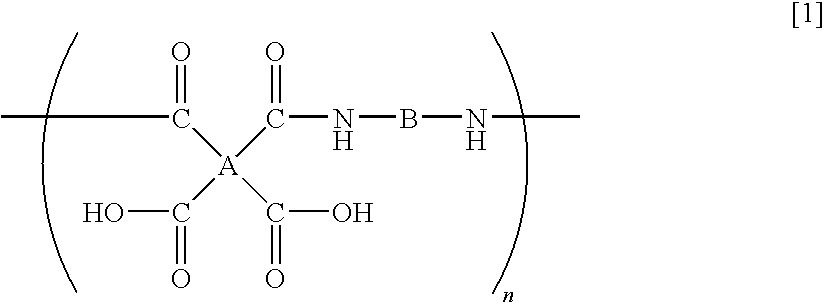
wherein A is a tetravalent organic group, B is a bivalent organic group, and n is a positive integer; and
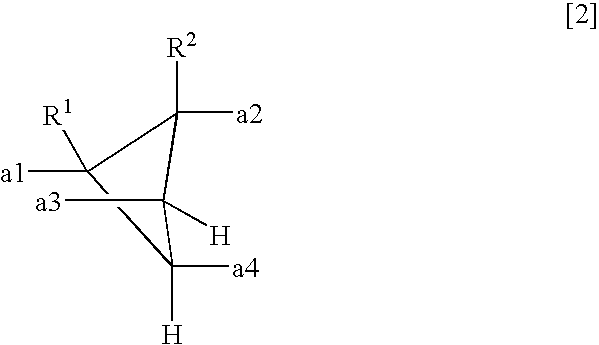
wherein each of R1 and R2 which are independent of each other, is a hydrogen atom, a halogen atom, a C1-10 alkyl group, a C1-10 halogenated alkyl group, a C3-8 cycloalkyl group, a phenyl group or a cyano group, and a1 to a4 represent binding sites in the formula (1), provided that a1 and a3 are not simultaneously bonded to the carboxyl groups, and a2 and a4 are not simultaneously bonded to the carboxyl groups.
Description
- The present invention relates to polyamic acids and polyimides useful for electronic materials or optical materials, and processes for their production.
- Usually, polyimide resins are widely used as protecting materials or insulation materials in liquid display devices or semiconductors, or as electronic materials for e.g. color filters, by virtue of their characteristics such as high mechanical strength, heat resistance, insulation properties and solvent resistance. Further, recently, they are expected to be used as optical communication materials such as optical waveguide materials.
- However, wholly aromatic polyimide resins are colored deep amber and thus are problematic in an application where high transparency is required. As a method for realizing transparency, it is known that if a polyimide precursor is obtained by a polycondensation reaction of an alicyclic tetracarboxylic dianhydride with an aromatic diamine, and the precursor is imidated to obtain a polyimide, it is possible to obtain a polyimide having high transparency with relatively low coloration (Patent Documents 1 and 2).
- In recent years, developments in the electronic material field or in the optical communication material field have been remarkable, and accordingly, higher properties have been required also for the materials to be used. Namely, they are expected not only to be excellent in heat resistance and transparency but also to to have many performances depending upon the particular applications.
- Patent Document 1: JP-A-60-006726
- Patent Document 2: JP-A-60-188427
- It is an object of the present invention to provide a polyamic acid and a polyimide thereof for optical material, which have heat resistance such that the thermal decomposition temperature is at least 300° C. and are excellent in solubility in solvents so that their processability is improved and which further have high light transmittance and are expected to be useful as protecting materials in liquid crystal display devices or semiconductors, as electronic materials such as insulation materials, or as optical communication materials for e.g. optical waveguides.
- The present inventors have conducted an extensive research to accomplish the above object, and as a result, have accomplished the present invention.
- Namely, the present invention provides the following:
- (1) A polyamic acid comprising repeating units represented by the following formula (1), characterized in that at least 10 mol % of A has a structure represented by the formula (2)
-

- wherein A is a tetravalent organic group, B is a bivalent organic group, and n is a positive integer; and
-
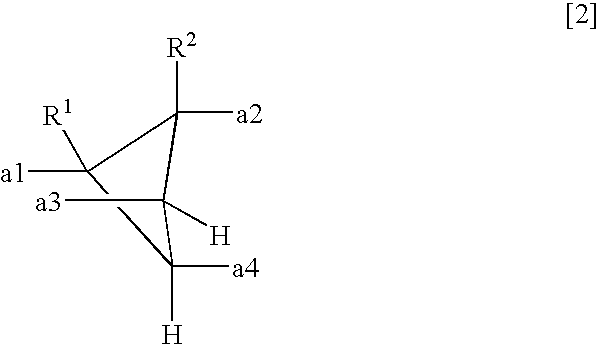
- wherein each of R1 and R2 which are independent of each other, is a hydrogen atom, a halogen atom, a C1-10 alkyl group, a C1-10 halogenated alkyl group, a C3-8 cycloalkyl group, a phenyl group or a cyano group, and a1 to a4 represent binding sites in the formula (1), provided that a1 and a3 are not simultaneously bonded to the carboxyl groups, and a2 and a4 are not simultaneously bonded to the carboxyl groups.
- (2) The polyamic acid according to the above (1), wherein in the formula (2), each of R1 and R2 which are independent of each other, is a hydrogen atom or a methyl group.
- (3) The polyamic acid according to the above (1), wherein in the formula (1), B is a bivalent organic group derived from an alicyclic diamine or an aliphatic diamine.
- (4) A process for producing a polyamic acid as defined in any one of the above (1) to (3), characterized by reacting a tetracarboxylic dianhydride containing at least 10 mol % of a tetracarboxylic dianhydride represented by the formula (3), with a diamine:
-

- wherein each of R1 and R2 which are independent of each other, is a hydrogen atom, a halogen atom, a C1-10 alkyl group, a C1-10 halogenated alkyl group, a C3-8 cycloalkyl group, a phenyl group or a cyano group.
- (5) A polyimide obtainable by cyclodehydration of a polyamic acid as defined in any one of the above (1) to (3).
- (6) A polyimide obtainable by cyclodehydration of a polyamic acid as defined in any one of the above (1) to (3), by means of acetic anhydride and a metal salt of an organic acid.
- (7) A process for producing an imide compound, characterized by cyclodehydration of an amic acid compound containing a structure represented by the following formula (4), by means of acetic anhydride and a metal salt of an organic acid:
-

- wherein A′ is a tetravalent organic group represented by the following formula (2):
-

- wherein each of R1 and R2 which are independent of each other, is a hydrogen atom, a halogen atom, a C1-10 alkyl group, a C1-10 halogenated alkyl group, a C3-8 cycloalkyl group, a phenyl group or a cyano group, and a1 to a4 represent binding sites to carbonyl groups, provided that a1 and a3 are not simultaneously bonded to the carboxyl groups, and a2 and a4 are not simultaneously bonded to the carboxyl groups.
- (8) The process for producing a polyimide according to the above (7), wherein the amic acid compound is a polyamic acid having repeating units represented by the formula (1)
-

- wherein A is a tetravalent organic group, B is a bivalent organic group, and n is a positive integer.
- The polyamic acid and the polyimide of the present invention have high light transmittance and heat resistance such that the thermal decomposition temperature is at least 300° C. and are excellent in solubility in various solvents so that their processability is improved.
-
FIG. 1 is a wavelength-light transmittance graph of cageCBDA-DPP polyimide film in Example 9. -
FIG. 2 is a wavelength-light transmittance graph of cageCBDA-DPP polyimide film in Example 10. -
FIG. 3 is a wavelength-light transmittance graph of cageCBDA-DCHM polyimide film in Example 11. -
FIG. 4 is a wavelength-light transmittance graph of cageCBDA-DCHM polyimide film in Example 12. - Now, the present invention will be described in detail.
- The polyamic acid of the present invention is a polyamic acid characterized in that in the repeating units represented by the formula (1), at least 10 mol % of A being a tetravalent organic group, has a structure represented by the formula (2).
-

- wherein A is a tetravalent organic group, B is a bivalent organic group, and n is a positive integer; and
-
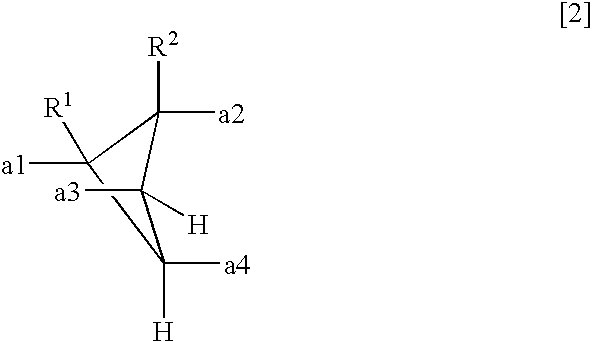
- wherein each of R1 and R2 which are independent of each other, is a hydrogen atom, a halogen atom, a C1-10 alkyl group, a C1-10 halogenated alkyl group, a C3-8 cycloalkyl group, a phenyl group or a cyano group, and a1 to a4 to represent binding sites in the formula (1), provided that a1 and a3 are not simultaneously bonded to the carboxyl groups, and a2 and a4 are not simultaneously bonded to the carboxyl groups.
- In the formula (2), a1 to a4 represent binding sites is in the formula (1), respectively. Namely, it is meant that at the respective positions of a1 to a4, the carboxyl group, or the carbonyl group constituting the polymer main chain, in the formula (1) is bonded. However, a1 and a3 are not simultaneously bonded to the carboxyl groups, and a2 and a4 are not simultaneously bonded to the carboxyl groups. Further, the formula (1) has cyclobutane as the basic skeleton, and a1 to a4 are on this ring so that the adjacent ones are in a positional relation of trans-trans-trans.
- In the formula (2), each of R1 and R2 which are independent of each other, is a hydrogen atom, a halogen atom, a C1-10 alkyl group, a C1-10 halogenated alkyl group, a C3-8 cycloalkyl group, a phenyl group or a cyano group, preferably a hydrogen atom or a methyl group.
- In the polyamic acid of the present invention, the structure of the formula (2) is at least 10 mol %, preferably at least 50 mol %, more preferably at least 80 mol %, of A in the formula (1). 100 mol % of A may be of the structure of the formula (2).
- A polyamic acid wherein 100 mol % of A in the formula (1) is of the structure of the formula (2), can be obtained by a reaction of a tetracarboxylic dianhydride represented by the following formula (3) with a diamine:
-

- In the formula (3), each of R1 and R2 which are independent of each other, is a hydrogen atom, a halogen atom, a C1-10 alkyl group, a C1-10 halogenated alkyl group, a C3-8 cycloalkyl group, a phenyl group or a cyano group.
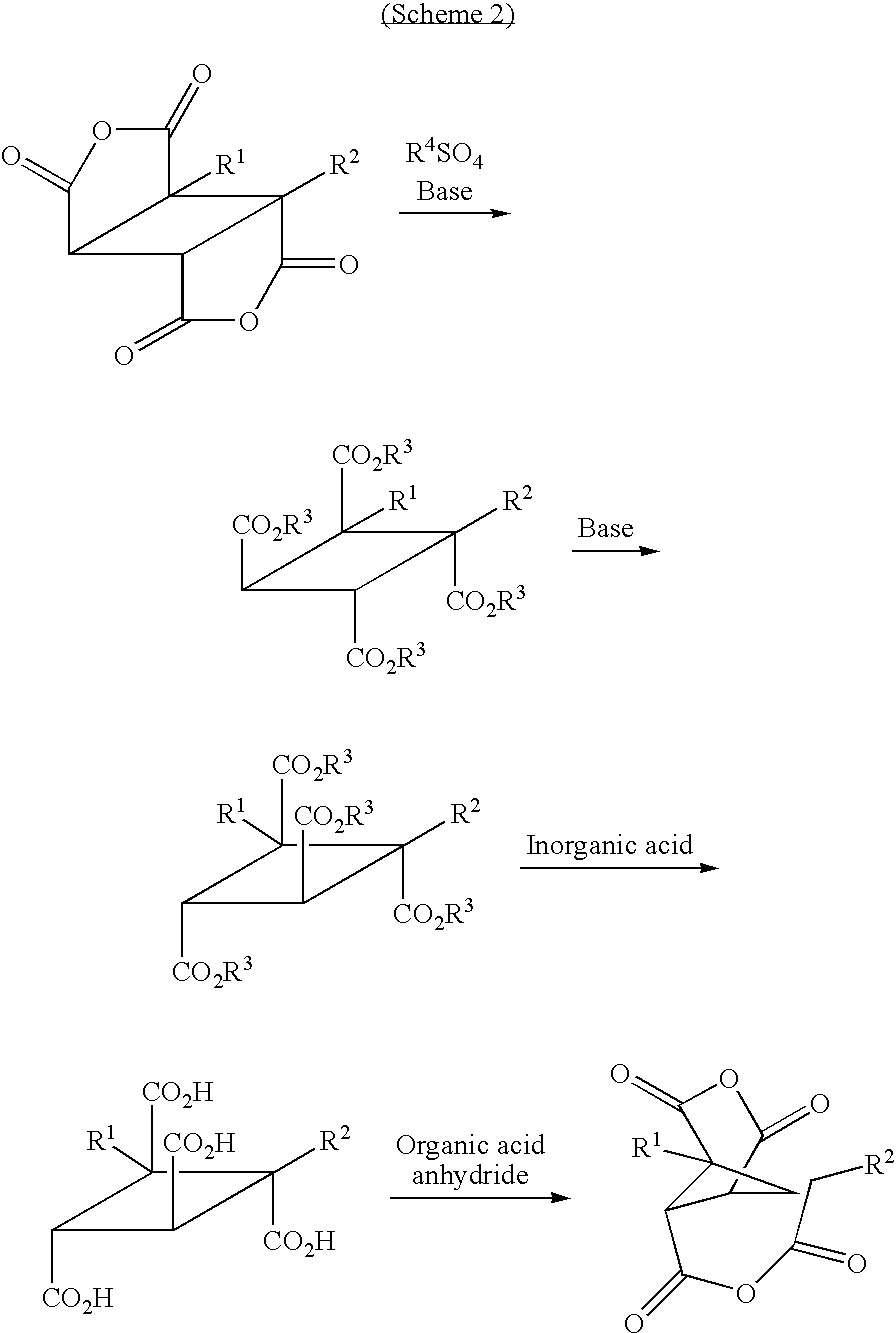
- Here, the tetracarboxylic dianhydride represented by the formula (3) can be obtained by a method such as the following Scheme 1 or
Scheme 2. -

-
- In
Scheme 1 or 2, each of R1 and R2 which are independent of each other, is a hydrogen atom, a halogen atom, a C1-10 alkyl group, a C1-10 halogenated alkyl group, a C3-8 cycloalkyl group, a phenyl group or a cyano group, and each of R3 and R4 which are independent of each other, is a C1-30 alkyl group. - Among tetracarboxylic dianhydrides represented by the formula (3), particularly preferred specific examples may be 1,2,3,4-cyclobutane tetracarboxylic acid-1,3:2,4-dianhydride, and 1,2-demethyl-1,2,3,4-cyclobutane tetracarboxylic acid-1,3:2,4-dianhydride.
- Further, a polyamic acid wherein the structure of the formula (2) is at least 10 mol % and less than 100 mol % of A in the formula (1), can be obtained by a reaction of a tetracarboxylic dianhydride represented by the formula (3), other tetracarboxylic dianhydrides and a diamine. By adjusting the ratio of the tetracarboxylic dianhydride represented by the formula (3) to be at least 10 mol % among the tetracarboxylic dianhydrides to be used for the preparation of a polyamic acid, it is possible to obtain a polyamic acid wherein at least 10 mol % of A in the formula (1) is of the structure of the formula (2). The content of the structure of the formula (2) can be adjusted by the ratio of the tetracarboxylic dianhydride represented by the formula (3) to other tetracarboxylic dianhydrides to be used.
- Such other tetracarboxylic dianhydrides to be used to obtain the polyamic acid of the present invention are not particularly limited. Further, such tetracarboxylic dianhydrides may be used alone or in combination as a mixture of two or more of them.
- Specific examples of such other tetracarboxylic dianhydrides may be alicyclic tetracarboxylic dianhydrides such as 1,2,3,4-cyclobutane tetracarboxylic acid-1,2:3,4-dianhydride, 2,3,4,5-tetrahydrofuran tetracarboxylic dianhydride, 1,2,4,5-cyclohexane tetracarboxylic dianhydride, 3,4-dicarboxy-1-cyclohexylsuccinic dianhydride, 3,4-dicarboxy-1,2,3,4-tetrahydro-1-naphthalene succinic dianhydride and bicyclo[3.3.0]octane-2,4,6,8-tetracarboxylic dianhydride.
- Further, aromatic tetracarboxylic dianhydrides may be mentioned such as pyromellitic dianhydride, 2,3,6,7-naphthalene tetracarboxylic dianhydride, 1,2,5,6-naphthalene tetracarboxylic dianhydride, 1,4,5,8-naphthalene tetracarboxylic dianhydride, 2,3,6,7-anthracene tetracarboxylic dianhydride, 1,2,5,6-anthracene tetracarboxylic dianhydride, 3,3′,4,4′-biphenyltetracarboxylic dianhydride, 2,3,3′,4′-biphenyltetracarboxylic dianhydride, bis(3,4-dicarboxyphenyl)ether dianhydride, 3,3′,4,4′-benphenone tetracarboxylic dianhydride, bis(3,4-diacarboxyphenyl)methane dianhydride, 2,2-bis(3,4-dicarboxyphenyl)propane dianhydride, 1,1,1,3,3,3-hexafluoro-2,2-bis(3,4-dicarboxyphenyl)propane dianhydride, bis(3,4-dicarboxyphenyl)dimethylsilane dianhydride, bis(3,4-dicarboxyphenyl)diphenylsilane dianhydride, 2,3,4,5-pyridine tetracarboxylic dianhydride and 2,6-bis(3,4-dicarboxyphenyl)pyridine dianhydride.
- The diamine to be used to obtain the polyamic acid of the present invention is not particularly limited. For example, an aromatic diamine such as p-phenylene diamine, m-phenylene diamine, 2,5-diaminotoluene, 2,6-diaminotoluene, 1,3-bis(4,4′-aminophenoxy)benzene, 4,4′-diamino-1,5-phenoxypentane, 4,4′-diamiobiphenyl, 3,3′-dimethyl-4,4′-diaminobiphenyl, 3,3′-dimethoxy-4,4′-diaminobiphenyl, 4,4′-diaminodiphenyl ether, 4,4′-diaminodiphenyl methane, 2,2′-diaminodiphenyl propane, bis(3,5-diethyl-4-aminophenyl)methane, diaminodiphenyl sulfone, diaminobenzophenone, diaminonaphthalene, 1,4-bis(4-aminophenoxy)benzene, 1,4-bis(4-aminophenyl)benzene, 9,10-bis(4-aminophenyl)anthracene, 1,3-bis(4-aminophenoxy)benzene, 4,4′-bis(4-aminophenoxy)diphenyl sulfone, 2,2-bis[4-(4-aminophenoxy)phenyl]propane or 2,2′ trifluoromethyl-4,4′-diaminobiphenyl; an alicyclic diamine such as 1,4-diaminocyclohexane, 1,4-cyclohexane bis(methylamine), 4,4′-diaminodicyclohexylmethane, bis(4-amino-3-methylcyclohexyl)methane, 3(4),8(9)-bis(aminomethyl)tricyclo[5.2.1.02,6]decane, 2,5(6)-bis(aminomethyl)bicyclo[2.2.1]heptane, 1,3-diaminoadamantane, 3,3′-diamino-1,1′-biadamantyl or 1,6-diaminodiadamantane (1,6-aminopentanecyclo[7.3.1.14,12,02,7,06,11]tetradecane); and an aliphatic diamine such as tetramethylene diamine or hexamethylene diamine, may, for example, be mentioned. Further, such diamines may be used alone or in combination as a mixture of two or more of them.
- Among these diamines, it is preferred to use an alicyclic diamine or an aliphatic diamine, whereby the transparency of the polyamic acid of the present invention or the polyimide obtainable thereof, will be higher.
- The method for reacting a tetracarboxylic dianhydride with a diamine in order to obtain the polyamic acid of the present invention, is not particularly limited. However, it is simple and convenient to adopt a method of mixing the tetracarboxylic dianhydride and the diamine in an organic solvent to react them. Specific examples of the organic solvent to be used for the reaction may, for example, be m-cresol, N-methyl-2-pyrolidone, N,N-dimethylformamide, N,N-dimethylacetamide, N-methylcaptolactam, dimethylsulfoxide, tetramethylurea, pyridine, dimethylsulfone, hexamethylphosphoramide and butyl lactone. These solvents may be used alone or in combination as a mixture. Further, even a solvent which does not dissolve the polyamic acid may be used as added to the above solvent within a range where a uniform solution can be obtained. As the reaction temperature for the solution polymerization, an optional temperature may be selected from −20° C. to 150° C., preferably from −5° C. to 100° C. Further, the molecular weight of the polyamic acid may be controlled by changing the molar ratio of the tetracarboxylic dianhydride to the diamine to be used for the reaction, and in the same manner as a usual polycondensation reaction, the closer this molar ratio to 1, the larger the molecular weight of the resulting polyamic acid.
- The method of mixing the tetracarboxylic dianhydride and the diamine in an organic solvent may, for example, be a method wherein a solution having the diamine dispersed or dissolved in an organic solvent, is stirred, and the tetracarboxylic dianhydride may be added as it is or as dispersed or dissolved in an organic solvent, a method wherein inversely, the diamine is added to a solution having the tetracarboxylic dianhydride dispersed or dissolved in an organic solvent, or a method wherein the tetracarboxylic dianhydride and the diamine are alternately added. In the present invention, any of such methods may be employed. Further, in a case where the tetracarboxylic dianhydride or the diamine is composed of a plurality of compounds, such a plurality of compounds may be reacted in a preliminarily mixed state, or may be sequentially reacted separately.
- The polyimide of the present invention is a polyimide obtainable by cyclodehydration of the above-described polyamic acid of the present invention. Here, the conversion from the polyamic acid to the polyimide (the cyclodehydration ratio) is defined as the imidation ratio. The imidation ratio of the present invention is not limited to 100%. In the polyimide of the present invention, this imidation ratio may selectively have an optional value of from 1 to 100%, as the case requires.
- The method for cyclodehydration of the polyamic acid in order to obtain the polyimide of the present invention, is not particularly limited. For the polyamic acid of the present invention, in the same manner as for a usual polyamic acid, it is possible to adopt ring closure by heating or a method for carrying out ring closure chemically by using a known cyclodehydration catalyst.
- In the method by heating, an optional temperature of from 100° C. to 300° C., preferably from 120° C. to 250° C., may be selected.
- In the method for carrying out ring closure chemically, it is possible to use, for example, an organic base such as pyridine or triethylamine in the presence of e.g. acetic anhydride. As the temperature at that time, an optional temperature from −20° C. to 200° C. may be selected. For this reaction, the polymerization solution for the polyamic acid may be used as it is, or after being diluted. Otherwise, the polyamic acid may be recovered from the polymerization solution of the polyamic acid by the after-mentioned method, and it may then be dissolved in a suitable organic solvent, followed by the reaction. The organic solvent to be used here, may be the above-mentioned solvent for polymerization for the polyamic acid.
- Further, in the present invention, it has been found that at the time of chemically cyclodehydrating an amic acid compound containing a structure represented by the following formula (4), which is obtainable by a reaction of a tetracarboxylic dianhydride represented by the above formula (3) with an amine compound, it is possible to easily obtain an imide compound with a high imidation ratio by means of acetic anhydride and a metal salt of an organic acid.
-
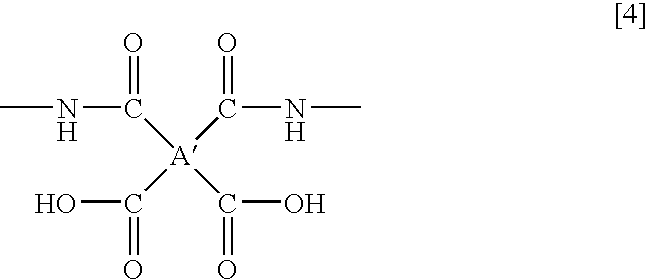
- wherein A′ is a tetravalent organic group represented by the following formula (2).
-
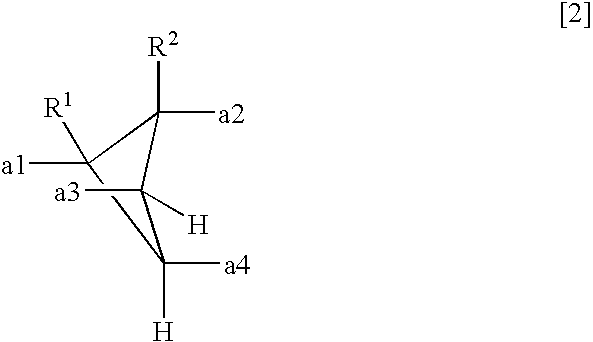
- In the formula (2), each of R1 and R2 which are independent of each other, is a hydrogen atom, a halogen atom, a C1-10 alkyl group, a C1-10 halogenated alkyl group, a C3-8 cycloalkyl group, a phenyl group or a cyano group, and a1 to a4 represent binding sites to carbonyl groups, provided that a1 and a3 are not simultaneously bonded to the carboxyl groups, and a2 and a4 are not simultaneously bonded to the carboxyl groups.
- The metal salt of an organic acid to be used for the above reaction may, for example, be an alkali metal salt of an organic acid or an alkaline earth metal salt of an organic acid. Specifically, it may, for example, be lithium formate, sodium formate, magnesium formate, calcium formate, barium formate, lithium acetate, sodium acetate, magnesium acetate, calcium acetate, barium acetate, lithium propionate, sodium propionate, magnesium propionate, calcium propionate or barium propionate. Among them, from the viewpoint of cyclodehydration effect and economical efficiency, an alkali metal salt of acetic acid or an alkaline earth metal salt of acetic acid is preferred, and particularly preferred is sodium acetate. The amount of the metal salt of an organic acid is preferably from 1 to 20 times by mol, particularly preferably from 2 to 10 times by mol, based on one unit of the structure of the above formula (4). The amount of acetic anhydride to be used simultaneously is preferably from 2 to 50 times by mol, particularly preferably from 3 to 30 times by mol, based on one unit of the structure of the formula (4).
- The reaction can be carried out in the same manner as in the case of cyclodehydration by means of acetic anhydride and an organic base. As the reaction temperature, an optional temperature may be selected within a range of from 0° C. to 200° C., particularly preferably from 50° C. to 150° C.
- As the amic acid compound in this reaction, a polyamic acid having repeating units represented by the above formula (1) may be used, and the polyimide of the present invention may be likewise obtained.
- The solution of a polyamic acid or polyimide obtained as described above, may be used as it is. Otherwise, it may be used in the form of a powder isolated by precipitation by means of a poor solvent such as methanol or ethanol, or such a powder may be used as re-dissolved in a suitable solvent. The solvent for such re-dissolution is not particularly limited so long as it is capable of dissolving the obtained polymer powder. Its specific example may, for example, be m-cresol, 2-pyrolidone, N-methylpyrolidone, N-ethylpyrolidone, N-vinylpyrolidone, N,N-dimethylacetamide, N,N-dimethylformamide, hexamethylphosphoramide or γ-butyrolactone.
- Further, when the polyamic acid or the polyimide of the present invention is used in the form of a polymer solution, a solvent which does not dissolve the polymer by itself, may be used as added to the above solvent, within a range not to impair the solubility. As a specific example, ethyl cellosolve, butyl cellosolve, ethyl carbitol, butyl carbitol, ethyl carbitol acetate, ethylene glycol, 1-methoxy-2-propanol, 1-ethoxy-2-propanol, 1-butoxy-2-propanol, 1-phenoxy-2-propanol, propylene glycol monoacetate, propylene glycol diacetate, propylene glycol-1-monomethylether-2-acetate, propylene glycol-1-monoethylether-2-acetate, dipropylene glycol, 2-(2-ethoxypropoxy)propanol, methyl lactate, ethyl lactate, n-propyl lactate, n-butyl lactate or isoamyl lactate may, for example, be mentioned. For the purpose of improving the adhesion between the polymer and the substrate, it is of course preferred to add an additive such as a coupling agent.
- The molecular weight of the polyamic acid or the polyimide of the present invention is not particularly limited, and a proper molecular weight may be selected depending upon the particular application. However, if the molecular weight is too small, the strength of the material thereby obtainable tends to be inadequate. On the other hand, if the molecular weight is too large, the operation efficiency when made into a polymer solution, tends to be poor. Accordingly, the molecular weight of the polyamic acid or the polyimide of the present invention is preferably from 2,000 to 500,000, more preferably from 5,000 to 300,000, by a number average molecular weight.
- Now, the present invention will be described in further detail with reference to Examples. However, it should be understood that the present invention is by no means restricted to such Examples.
- In the following Examples, for the measurement of the molecular weight for a polyamic acid or a polyimide, a normal temperature gel permeation chromatography (GPC) apparatus (SSC-7200) manufactured by Kabushikikaisha Senshu Kagaku and a column (KD803, 805) manufactured by Shodex were used, and the measurement was carried out by using DMF as an eluent. The number average molecular weight and the weight average molecular weight were obtained by calibration curves obtained by using polyethylene glycol and polyethylene oxide as standard products.
- Further, the imidation ratio of a polyimide was confirmed by the following two methods. (1) A method wherein the polyimide is dissolved in d6-DMSO (dimethylsulfoxide-d6), and the 1H-MNR was measured, whereupon the ratio of amic acid groups remaining without being imidated is obtained from the ratio of the integrated value of proton peaks. (2) A method wherein a polyimide film is formed on a glass plate, and its IR spectrum is measured, and the imidation ratio is obtained from the ratio of the area of absorption of the formed imide (1,774 to 1,698 cm−1) to the area of absorption of the remaining amide (1,630 to 1,650 cm−1).
- For the IR measurement, FT-IR (NICOLET 5700) manufactured by Thermo Electron Corporation was used.
- For the measurement of the thermal characteristics, a differential thermal gravimetric/calorimetry (TG/DTA) apparatus (Thermoplus TG8120) manufactured by Rigaku Corporation, was used.
- The thickness of the polyimide film formed on a glass plate was measured by means of a fully automatic microprofile meter (Surf corder ET 4000A), manufactured by Kosaka Laboratory Ltd.
- The ultraviolet-visible absorption spectrum was measured by means of a self-recording spectrophotometer (UV-VIS-NIR Scanning Spectrophotometer) manufactured by Shimadzu Corporation.
- cageCBDA: 1,2,3,4-cyclobutanetetracarboxylic acid-1,3:2,4-dianhydride
- DDE: 4,4′-diaminodiphenyl ether
- DDM: 4,4′-diaminodiphenyl methane
- p-PDA: p-phenylene diamine
- DPP: 4,4′-diamino-1,5-phenoxypentane
- DAPB: 1,3-bis(4,4′-aminophenoxy)benzene
- DCHM: 4,4′-diaminodicyclohexyl methane
- HMPA: hexamethylphosphoramide
- NMP: N-methyl-2-pyrolidone
-
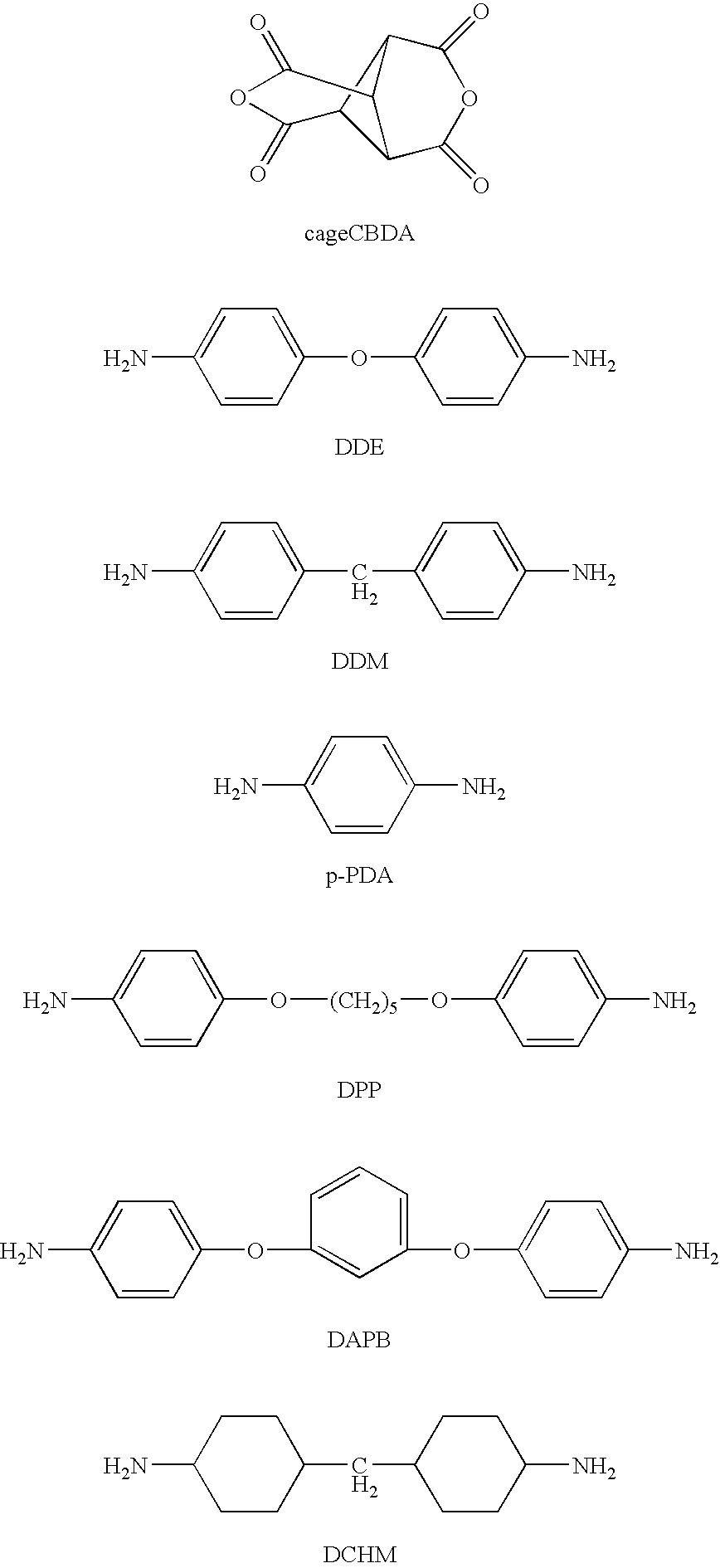
- Into a dried four necked reaction flask, 0.601 g (3.00 mmol) of DDE and 6.67 g of HMPA were charged and stirred at room temperature of 18° C. by means of a mechanical stirrer to dissolve DDE in HMPA.
- Then, 0.576 g (2.94 mmol) of cageCBDA was added and stirred for 43 hours at a rate of 160 rpm at a temperature of 18° C. by means of a mechanical stirrer to obtain a polyamic acid solution of cageCBDA-DDE.
- To this polyamic acid solution, 15.7 g of HMPA was added, stirred and diluted, whereupon a small amount was sampled, and the molecular weight was measured. As a result of the GPC measurement, the number average molecular weight (Mn) of the obtained polyamic acid was 6,366, and the weight average molecular weight (Mw) was 13,989, and Mw/Mn was 2.20.
- To the above polyamic acid solution after dilution, 0.735 g (7.2 mmol) of acetic anhydride was added, followed by stirring at 18° C. for 5 minutes. Then, 1.09 g (13.8 mmol) of pyridine was added, followed by stirring for 30 minutes. Thereafter, the reaction flask was heated to 120° C. in an oil bath, and stirring was further continued for two hours to obtain a red-colored polyimide solution. This polyimide solution was cooled to room temperature and then dropwise added to 83 ml of methanol with stirring. The milky white mixed solution was continuously stirred for 4 hours, whereby a powder precipitated. This powder was collected by filtration, washed with 118 ml of methanol and then dried under reduced pressure to obtain 0.62 g of a slightly brown powder of cageCBDA-DDE polyimide.
- As a result of the GPC measurement, the number average molecular weight (Mn) of the obtained polyimide was 12,526, the weight average molecular weight (Mw) was 26,902, and Mw/Mn was 2.15.
- A part of the obtained polyimide powder was dissolved in d6-DMSO, and the 1H-NMR was measured, whereby the imidation ratio of this polyimide was 17.9%.
- Further, the results of the measurement of the thermal characteristics were as follows.
- 5% weight reduction temperature (T5): 271.5° C.
- 10% weight reduction temperature (T10): 319.4° C.
- Decomposition temperature (Td): 392.1° C.
- Using 0.595 g (3.00 mmol) of DDM, 6.70 g of HMPA and 0.588 g (3.00 mmol) of cageCBDA, stirring was carried out for 43 hours in the same manner as in Example 1 to obtain a polyamic acid solution of cageCBDA-DDM.
- To this polyamic acid solution, 15.7 g of HMPA was added, stirred and diluted, and then, a small amount was sampled, and the molecular weight measurement was carried out. As a result of the GPC measurement, the number average molecular weight (Mn) of the obtained polyamic acid was 11,618, the weight average molecular weight (Mw) was 30,499 and Mw/Mn was 2.62.
- Further, to the polyamic acid solution after dilution, in the same manner as in Example 1, 0.735 g (7.2 mmol) of acetic anhydride and 1.09 g (13.8 mmol) of pyridine were sequentially added, and after heating to 120° C., stirring was carried out for 3 hours to obtain a polyimide solution. From this polyimide solution, in the same manner as in Example 1, 1.04 g of a slightly brown powder of cageCBDA-DDM polyimide was obtained (methanol for precipitation: 83 ml, methanol for washing: 118 ml). The analytical results of the obtained polyimide are shown below.
- Number average molecular weight (Mn): 11,152, weight average molecular weight (Mw): 23,931 (Mw/Mn: 2.15)
- Imidation ratio: 21.9%
- 5% weight reduction temperature (T5): 289.7° C.
- 10% weight reduction temperature (T10): 345.3° C.
- Decomposition temperature (Td): 402.6° C.
- Using 0.541 g (5.00 mmol) of p-PDA, 13.7 g of HMPA and 0.981 g (5.00 mmol) of cageCBDA, stirring was carried out for 45 hours in the same manner as in Example 1 to obtain a polyamic acid solution of cageCBDA-p-PDA.
- To this polyamic acid solution, 15.2 g of HMPA was added, stirred and diluted, and then, a small amount was sampled, and the molecular weight measurement was carried out. As a result of the GPC measurement, the number average molecular weight (Mn) of the obtained polyamic acid was 10,463, the weight average molecular weight (Mw) was 25,219 and Mw/Mn was 2.41.
- Further, to the polyamic acid solution after dilution, in the same manner as in Example 1, 1.51 g (14.4 mmol) of acetic anhydride and 2.18 g (27.6 mmol) of pyridine were sequentially added, and after heating to 120° C., stirring was carried out for 3 hours to obtain a polyimide solution. From this polyimide solution, in the same manner as in Example 1, 1.20 g of a flesh-colored powder of cageCBDA-p-PDA polyimide was obtained (methanol for precipitation: 106 ml, methanol for washing: 152 ml). The analytical results of the obtained polyimide are shown below.
- Number average molecular weight (Mn): 9,648, weight average molecular weight (Mw): 17,555 (Mw/Mn: 1.82)
- Imidation ratio: 26.6%
- 5% weight reduction temperature (T5): 238.1° C.
- 10% weight reduction temperature (T10): 316.5° C.
- Decomposition temperature (Td): 408.4° C.
- Using 0.876 g (3.06 mmol) of DPP, 8.23 g of HMPA and 0.576 g (2.94 mmol) of cageCBDA, stirring was carried out for 43 hours in the same manner as in Example 1 to obtain a polyamic acid solution of cageCBDA-DPP.
- To this polyamic acid solution, 19.3 g of HMPA was added, stirred and diluted, and then, a small amount was sampled, and the molecular weight measurement was carried out. As a result of the GPC measurement, the number average molecular weight (Mn) of the obtained polyamic acid was 11,593, the weight average molecular weight (Mw) was 23,798 and Mw/Mn was 2.05.
- Further, to the polyamic acid solution after dilution, in the same manner as in Example 1, 0.735 g (7.2 mmol) of acetic anhydride and 1.09 g (13.8 mmol) of pyridine were sequentially added, and after heating to 120° C., stirring was carried out for 3 hours to obtain a polyimide solution.
- From this polyimide solution, in the same manner as in Example 1, 0.92 g of a slightly brown powder of cageCBDA-DPP polyimide was obtained (methanol for precipitation: 68 ml, methanol for washing: 200 ml). The analytical results of the obtained polyimide are shown below.
- Number average molecular weight (Mn): 12,853, weight average molecular weight (Mw): 28,344 (Mw/Mn: 2.20)
- Imidation ratio: 17.0%
- 5% weight reduction temperature (T5): 254.5° C.
- 10% weight reduction temperature (T10): 306.7° C.
- Decomposition temperature (Td): 392.1° C.
- Using 0.876 g (3.13 mmol) of DAPB, 8.23 g of HMPA and 0.576 g (2.94 mmol) of cageCBDA, stirring was carried out for 46 hours in the same manner as in Example 1 to obtain a polyamic acid solution of cageCBDA-DAPB.
- To this polyamic acid solution, 19.3 g of HMPA was added, stirred and diluted, and then, a small amount was sampled, and the molecular weight measurement was carried out. As a result of the GPC measurement, the number average molecular weight (Mn) of the obtained polyamic acid was 14,903, the weight average molecular weight (Mw) was 32,391, and Mw/Mn was 2.17.
- Further, to the polyamic acid solution after dilution, in the same manner as in Example 1, 0.735 g (7.2 mmol) of acetic anhydride and 1.09 g (13.8 mmol) of pyridine were sequentially added, and after heating to 120° C., stirring was carried out for 3 hours to obtain a polyimide solution.
- From this polyimide solution, in the same manner as in Example 1, 1.17 g of a slightly brown powder of cageCBDA-DAPB polyimide was obtained (methanol for precipitation: 102 ml, methanol for washing: 145 ml). The analytical results of the obtained polyimide are shown below.
- Number average molecular weight (Mn): 12,002, weight average molecular weight (Mw): 23,666 (Mw/Mn: 1.97)
- Imidation ratio: 23.6%
- 5% weight reduction temperature (T5): 259.9° C.
- 10% weight reduction temperature (T10): 317.7° C.
- Decomposition temperature (Td): 356.5° C.
- The results of the evaluation of the solubility of the polyimides obtained in Examples 1 to 5 in various solvents, are shown in the following Table.
-
TABLE 1 Solubility of polyimides Polyimide Ex. 1 Ex. 2 Ex. 3 Ex. 4 Ex. 5 Solvent Diamine DDE DDM p-PDA DPP DAPB N,N- ++ ++ ++ ++ ++ dimethylformamide (DMF) N,N- ++ ++ ++ ++ ++ dimethylacetamide (DMAc) m-cresol ++ ++ ++ ++ ++ Tetrahydrofuran − − − − − (THF) 1,4-dioxane − − + − − Chloroform − − − − + Pyridine ++ ++ ++ ++ ++ Acetone − − − − − Methanol − − − − − Toluene + − + + ++ ++: Dissolved at 25° C., +: Partially dissolved at 25° C., −: Insoluble even under heating - As is evident from the above, the polyimides of the present invention showed solubility in various organic solvents.
- Into a dried four-necked reaction flask, 1.001 g (5.00 mmol) of DDE and 11.2 g of NMP were charged and stirred at room temperature of 18° C. by means of a mechanical stirrer to dissolve DDE in NMP. Then, 0.981 g (5.00 mmol) of cageCBDA was added, followed by stirring for 24 hours at a rate of 160 rpm at a temperature of 18° C. to obtain a polyamic acid solution of cageCBDA-DDE.
- To this polyamic solution, 26.4 g of NMP was added, stirred and diluted, and then, a small amount was sampled, and the molecular weight measurement was carried out. As a result of the GPC measurement, the number average molecular weight (Mn) of the obtained polyamic acid was 11,400, the weight average molecular weight (Mw) was 26,808, and Mw/Mn was 2.35.
- To the 19.7 g of the polyamic acid solution after dilution, 3.32 g (32.5 mmol) of acetic anhydride and 0.83 g (10.0 mmol) of sodium acetate were added, followed by stirring for 4 hours in an oil bath of 130° C. to obtain a polyimide solution.
- This polyimide solution was cooled to room temperature and then dropwise added to 84 ml of water with stirring. The grayish brown mixed solution was continuously stirred for one hour, whereby a powder precipitated. This powder was collected by filtration, washed twice with 40 ml of water and 40 ml of methanol and then dried under reduced pressure at 65° C. for two hours to obtain 0.92 g of a brown powder of cageCBDA-DDE polyimide.
- A part of the obtained polyimide powder was dissolved in d6-DMSO, and the 1H-NMR was measured, whereby the imidation ratio of this polyimide was 90.8%.
- Further, the results of the measurement of the thermal characteristics were as follows.
- 5% weight reduction temperature (T5): 331.7° C.
- 10% weight reduction temperature (T10): 386.0° C.
- Using 0.432 g (4.00 mmol) of p-PDA, 6.88 g of NMP and 0.784 g (4.00 mmol) of cageCBDA, stirring was carried out for 24 hours in the same manner as in Example 6 to obtain a polyamic acid solution of cageCBDA-p-PDA.
- To this polyamic acid solution, 16.2 g of NMP was added, stirred and diluted, and then, a small amount was sampled, and the molecular weight measurement was carried out. As a result of the GPC measurement, the number average molecular weight (Mn) of the obtained polyamic acid was 13,489, the weight average molecular weight (Mw) was 37,338, and Mw/Mn was 2.77.
- Further, to the polyamic acid solution after dilution, 5.30 g (52.0 mmol) of acetic anhydride and 1.33 g (16.2 mmol) of sodium acetate were added, followed by stirring for 4 hours at 130° C. in the same manner as in Example 6 to obtain a polyimide solution.
- This polyimide solution was cooled to room temperature and then dropwise added to 130 ml of water with stirring. The stirring was continued for one hour, whereby a powder precipitated. This powder was collected by filtration, washed twice with 50 ml of water and 50 ml of methanol and then dried under reduced pressure at 65° C. for two hours to obtain 1.13 g of a powder of cageCBDA-DDE polyimide.
- A part of the obtained polyimide powder was dissolved in d6-DMSO, and the 1H-NMR was measured, whereby the imidation ratio of this polyimide was 86.7%.
- Using 1.15 g (4.00 mmol) of DPP, 11.0 g of NMP and 0.784 g (4.00 mmol) of cageCBDA, stirring was carried out for 24 hours in the same manner as in Example 6 to obtain a polyamic acid solution of cageCBDA-DPP.
- To this polyamic acid solution, 25.8 g of NMP was added, stirred and diluted, and then, a small amount was sampled, and the molecular weight measurement was carried out. As a result of the GPC measurement, the number average molecular weight (Mn) of the obtained polyamic acid was 16,554, the weight average molecular weight (Mw) was 47,728, and Mw/Mn was 2.88.
- To the polyamic acid solution after dilution, 5.30 g (52.0 mmol) of acetic anhydride and 1.33 g (16.2 mmol) of sodium acetate were added, and then stirred for 4 hours at 130° C. in the same manner as in Example 6 to obtain a polyimide solution.
- This polyimide solution was cooled to room temperature and then dropwise added to 160 ml of water with stirring. The stirring was continued for one hour, whereby a powder precipitated. This powder was collected by filtration, washed twice with 30 ml of water and 40 ml of methanol and then dried under reduced pressure at 65° C. for two hours to obtain 1.98 g of a powder of cageCBDA-DDE polyimide.
- A part of the obtained polyimide powder was dissolved in d6-DMSO, and the 1H-NMR was measured, whereby the imidation ratio of this polyimide was 87.2%.
- Into a dried four-necked reaction flask, 0.573 g (2.00 mmol) of DPP and 6.42 g of NMP were charged and stirred at room temperature of 18° C. by means of a mechanical stirrer to dissolve DPP in NMP. Then, 0.392 g (2.00 mmol) of cageCBDA was added and stirred for 19 hours at a rate of 160 rpm at a temperature of 18° C. to is obtain a polyamic acid solution of cageCBDA-DPP.
- As a result of the GPC measurement, the number average molecular weight (Mn) of the obtained polyamic acid was 16,116, the weight average molecular weight (Mw) was 16,656, and Mw/Mn was 1.03.
- The obtained polyamic acid polymerization solution was applied on a glass plate by means of a 25 μm doctor blade and baked on a hot plate of 100° C. for 30 minutes and further at 220° C. for one hour to form a polyimide film. The thickness of this polyimide film was 1.19 μm, and the imidation ratio obtained from the IR spectrum was 94%.
- The ultraviolet-visible absorption spectrum of the above polyimide film was measured, whereby the light transmittance in a visible light region (380 to 789 nm) was at least 95%, and even at an i-line wavelength (365 nm), high transmittance of 97% was shown (
FIG. 1 ). - The polyamic acid polymerization solution obtained in Example 9 was applied on a glass plate by means of a 200 μm doctor blade and baked for 30 minutes on a hot plate of 100° C. and further at 160° C. for one hour to form a polyimide film. The thickness of this polyimide film was 11.1 μm, and the imidation ratio obtained from the IR spectrum was 34%.
- The ultraviolet-visible absorption spectrum of the above polyimide film was measured, whereby the light transmittance in a visible light region (380 to 780 nm) was at least 80%, and thus high light transmittance was shown (
FIG. 2 ). - Into a dried four-necked reaction flask, 0.421 g (2.00 mmol) of DCHM and 7.32 g of cresol were charged, and stirred at room temperature of 18° C. by means of a mechanical stirrer to dissolve DCHM in cresol. Then, 0.392 g (2.00 mmol) of cageCBDA was added, followed by stirring for 24 hours at a rate of 160 rpm at a temperature of 18° C. to obtain a polyamic acid solution of cageCBDA-DCHM.
- The obtained polyamic acid polymerization solution was applied on a glass plate by means of a 25 μm doctor blade and baked for 30 minutes on a hot plate of 100° C. and further at 220° C. for one hour to form a polyimide film. The thickness of this polyimide was 1.06 μm, and the imidation ratio obtained from the IR spectrum was 98%.
- The ultraviolet-visible absorption spectrum of the above polyimide film was measured, whereby the polyimide film having a thickness of 1.06 μm had a light transmittance of at least 98% in a visible light region (380 to 780 nm), and even at an i-line wavelength (365 nm), a high light transmittance of 98% was shown (
FIG. 3 ). - The polyamic acid polymerization solution obtained in Example 11 was applied on a glass plate by means of a 200 μm doctor blade and baked for 30 minutes on a hot plate of 100° C. and further at 220° C. for one hour to form a polyimide film. The thickness of this polyimide film was 8.81 μm, and the imidation ratio obtained from the IR spectrum was 52%.
- The ultraviolet-visible absorption spectrum of the above polyimide film was measured, whereby the light transmittance in a visible light region (380 to 780 nm) was at least 94%, and even at an i-line wavelength (365 nm), a high light transmittance of 91% was shown (FIG. 4).
- The polyamic acids and polyimides of the present invention are expected to be useful as protecting materials in liquid crystal display devices or semiconductors, as electronic materials such as insulation materials, and further as optical communication materials such as optical waveguides.
- The entire disclosure of Japanese Patent Application No. 2005-093393 filed on Mar. 29, 2005 including specification, claims, drawings and summary is incorporated herein by reference in its entirety.
Claims (8)
1. A polyamic acid comprising repeating units represented by the following formula (1), characterized in that at least 10 mol % of A has a structure represented by the formula (2):

wherein A is a tetravalent organic group, B is a bivalent organic group, and n is a positive integer; and

wherein each of R1 and R2 which are independent of each other, is a hydrogen atom, a halogen atom, a C1-10 alkyl group, a C1-10 halogenated alkyl group, a C3-8 cycloalkyl group, a phenyl group or a cyano group, and a1 to a4 represent binding sites in the formula (1), provided that a1 and a3 are not simultaneously bonded to the carboxyl groups, and a2 and a4 are not simultaneously bonded to the carboxyl groups.
2. The polyamic acid according to claim 1 , wherein in the formula (2), each of R1 and R2 which are independent of each other, is a hydrogen atom or a methyl group.
3. The polyamic acid according to claim 1 , wherein in the formula (1), B is a bivalent organic group derived from an alicyclic diamine or an aliphatic diamine.
4. A process for producing a polyamic acid as defined in claim 1 , characterized by reacting a tetracarboxylic dianhydride containing at least 10 mol % of a tetracarboxylic dianhydride represented by the formula (3), with a diamine:
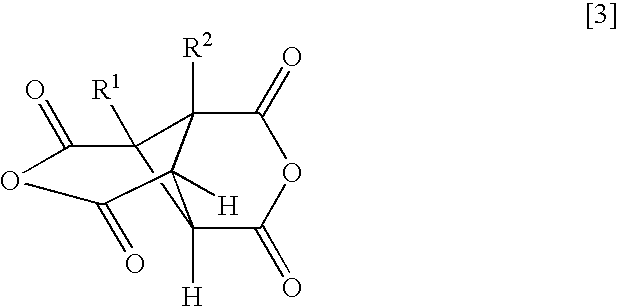
wherein each of R1 and R2 which are independent of each other, is a hydrogen atom, a halogen atom, a C1-10 alkyl group, a C1-10 halogenated alkyl group, a C3-8 cycloalkyl group, a phenyl group or a cyano group.
5. A polyimide obtainable by cyclodehydration of a polyamic acid as defined in claim 1 .
6. A polyimide obtainable by cyclodehydration of a polyamic acid as defined in claim 1 , by means of acetic anhydride and a metal salt of an organic acid.
7. A process for producing an imide compound, characterized by cyclodehydration of an amic acid compound containing a structure represented by the following formula (4), by means of acetic anhydride and a metal salt of an organic acid:

wherein A′ is a tetravalent organic group represented by the following formula (2):

wherein each of R1 and R2 which are independent of each other, is a hydrogen atom, a halogen atom, a C1-10 alkyl group, a C1-10 halogenated alkyl group, a C3-8 cycloalkyl group, a phenyl group or a cyano group, and a1 to a4 represent binding sites to carbonyl groups, provided that a1 and a3 are not simultaneously bonded to the carboxyl groups, and a2 and a4 are not simultaneously bonded to the carboxyl groups.
8. The process for producing a polyimide according to claim 7 , wherein the amic acid compound is a polyamic acid having repeating units represented by the formula (1):
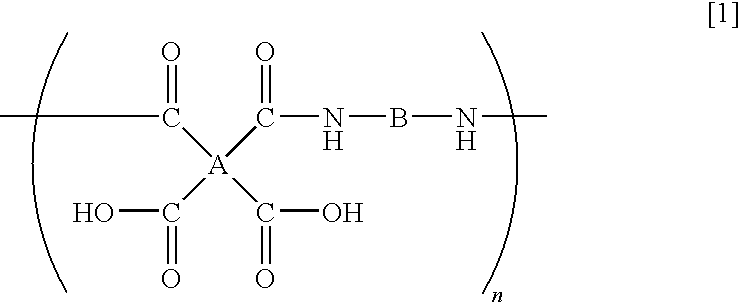
wherein A is a tetravalent organic group, B is a bivalent organic group, and n is a positive integer.
Applications Claiming Priority (3)
| Application Number | Priority Date | Filing Date | Title |
|---|---|---|---|
| JP2005093393 | 2005-03-29 | ||
| JP2005093393 | 2005-03-29 | ||
| PCT/JP2006/305972 WO2006104038A1 (en) | 2005-03-29 | 2006-03-24 | Polyamic acids, polyimides, and processes for the production thereof |
Publications (1)
| Publication Number | Publication Date |
|---|---|
| US20100063243A1 true US20100063243A1 (en) | 2010-03-11 |
Family
ID=37053295
Family Applications (1)
| Application Number | Title | Priority Date | Filing Date |
|---|---|---|---|
| US11/909,896 Abandoned US20100063243A1 (en) | 2005-03-29 | 2006-03-24 | Polyamic acids, polyimides, and processes for the production thereof |
Country Status (6)
| Country | Link |
|---|---|
| US (1) | US20100063243A1 (en) |
| JP (1) | JP5332204B2 (en) |
| KR (2) | KR20130047773A (en) |
| CN (1) | CN101146848B (en) |
| TW (1) | TWI401279B (en) |
| WO (1) | WO2006104038A1 (en) |
Cited By (1)
| Publication number | Priority date | Publication date | Assignee | Title |
|---|---|---|---|---|
| US20120088040A1 (en) * | 2010-10-06 | 2012-04-12 | Masaki Matsumori | Alignment film, composition for forming alignment film and liquid crystal display device |
Families Citing this family (9)
| Publication number | Priority date | Publication date | Assignee | Title |
|---|---|---|---|---|
| JP2008093930A (en) * | 2006-10-11 | 2008-04-24 | Toyobo Co Ltd | Transparent electrically conductive polyimide film |
| JP5386797B2 (en) * | 2007-05-30 | 2014-01-15 | 日産化学工業株式会社 | Flexible polyimide film and manufacturing method thereof |
| JP5376165B2 (en) * | 2009-04-08 | 2013-12-25 | Jsr株式会社 | Liquid crystal aligning agent and liquid crystal display element |
| CN102428088A (en) * | 2009-04-10 | 2012-04-25 | 日产化学工业株式会社 | Cage-shaped cyclopentanoic dianhydride compound, preparation method thereof and polyimide |
| US20130178597A1 (en) * | 2010-07-22 | 2013-07-11 | Ube Industries, Ltd. | Polyimide precursor, polyimide, and materials to be used in producing same |
| KR101495111B1 (en) * | 2013-02-06 | 2015-02-24 | (주)태원시스켐 | Novel diamine compounds, and polyamic acids and polyimides prepared by using same |
| KR102031656B1 (en) * | 2013-03-11 | 2019-10-14 | 동우 화인켐 주식회사 | Polyimide resin |
| JP7298072B2 (en) * | 2018-09-12 | 2023-06-27 | Agc株式会社 | Optical filters and imagers |
| CN119350618A (en) * | 2024-11-25 | 2025-01-24 | 江南大学 | A new type of polyimide |
Citations (6)
| Publication number | Priority date | Publication date | Assignee | Title |
|---|---|---|---|---|
| US3139395A (en) * | 1961-01-09 | 1964-06-30 | American Cyanamid Co | Photodimerization of fumaric acid derivatives |
| US5053480A (en) * | 1983-06-25 | 1991-10-01 | Nissan Chemical Industries, Ltd. | Polyimide resin from cyclobutane tetracarboxylic acid dianhydride |
| US5066771A (en) * | 1987-02-10 | 1991-11-19 | Kozo Iizuka, Director-General Of Agency Of Industrial Science And Technology | Method for producing an imide oligomer |
| US5070182A (en) * | 1988-01-08 | 1991-12-03 | Nissan Chemical Industries Ltd. | Polyimide resin and insulating film for electric and electronic devices |
| US20030113521A1 (en) * | 2000-10-27 | 2003-06-19 | Masaru Nishinaka | Laminate |
| WO2004086146A1 (en) * | 2003-03-24 | 2004-10-07 | Lg Chem Ltd | Transparent, highly heat-resistant polyimide precursor and photosensitive polyimide composition thereof |
Family Cites Families (12)
| Publication number | Priority date | Publication date | Assignee | Title |
|---|---|---|---|---|
| JPS60188427A (en) * | 1984-03-09 | 1985-09-25 | Nissan Chem Ind Ltd | Novel polyimide resin and its production |
| JP3419874B2 (en) * | 1993-02-26 | 2003-06-23 | 株式会社東芝 | Polyamic acid composition and liquid crystal element |
| JP2637391B2 (en) * | 1996-05-13 | 1997-08-06 | 株式会社東芝 | Polyimide resin |
| KR100601067B1 (en) * | 1997-12-02 | 2006-07-19 | 닛산 가가쿠 고교 가부시키 가이샤 | Liquid crystal aligning agent |
| JP4171851B2 (en) * | 1997-12-02 | 2008-10-29 | 日産化学工業株式会社 | Liquid crystal alignment treatment agent |
| JP2002256073A (en) * | 2001-02-28 | 2002-09-11 | Kanegafuchi Chem Ind Co Ltd | Polyimide film and method for producing the same |
| CN1254510C (en) * | 2001-07-26 | 2006-05-03 | 日产化学工业株式会社 | Polyamic acid resin composition |
| JP3894085B2 (en) * | 2002-07-11 | 2007-03-14 | Jsr株式会社 | Liquid crystal aligning agent and method for producing liquid crystal display element |
| CN100430802C (en) * | 2002-12-09 | 2008-11-05 | 株式会社日立显示器 | Liquid crystal display device and method for manufacturing the same |
| WO2004053583A1 (en) * | 2002-12-11 | 2004-06-24 | Nissan Chemical Industries, Ltd. | Liquid crystl orientating agent and liquid crystal display element using it |
| JP4375533B2 (en) * | 2003-06-26 | 2009-12-02 | 三菱瓦斯化学株式会社 | Method for producing solvent-soluble polyimide |
| JP5326211B2 (en) * | 2004-10-20 | 2013-10-30 | 日産化学工業株式会社 | Method for producing caged cyclobutanoic acid dianhydride |
-
2006
- 2006-03-24 KR KR1020137010108A patent/KR20130047773A/en not_active Ceased
- 2006-03-24 JP JP2007510450A patent/JP5332204B2/en not_active Expired - Fee Related
- 2006-03-24 WO PCT/JP2006/305972 patent/WO2006104038A1/en not_active Ceased
- 2006-03-24 US US11/909,896 patent/US20100063243A1/en not_active Abandoned
- 2006-03-24 KR KR1020077020231A patent/KR20070116228A/en not_active Ceased
- 2006-03-24 CN CN2006800094591A patent/CN101146848B/en not_active Expired - Fee Related
- 2006-03-29 TW TW095111021A patent/TWI401279B/en not_active IP Right Cessation
Patent Citations (6)
| Publication number | Priority date | Publication date | Assignee | Title |
|---|---|---|---|---|
| US3139395A (en) * | 1961-01-09 | 1964-06-30 | American Cyanamid Co | Photodimerization of fumaric acid derivatives |
| US5053480A (en) * | 1983-06-25 | 1991-10-01 | Nissan Chemical Industries, Ltd. | Polyimide resin from cyclobutane tetracarboxylic acid dianhydride |
| US5066771A (en) * | 1987-02-10 | 1991-11-19 | Kozo Iizuka, Director-General Of Agency Of Industrial Science And Technology | Method for producing an imide oligomer |
| US5070182A (en) * | 1988-01-08 | 1991-12-03 | Nissan Chemical Industries Ltd. | Polyimide resin and insulating film for electric and electronic devices |
| US20030113521A1 (en) * | 2000-10-27 | 2003-06-19 | Masaru Nishinaka | Laminate |
| WO2004086146A1 (en) * | 2003-03-24 | 2004-10-07 | Lg Chem Ltd | Transparent, highly heat-resistant polyimide precursor and photosensitive polyimide composition thereof |
Non-Patent Citations (1)
| Title |
|---|
| Zapadinskii et al in Russian Chemical Reviews, 42 (11), 1973, "Synthesis of Tetracarboxylic Acids" pp 939-955. * |
Cited By (2)
| Publication number | Priority date | Publication date | Assignee | Title |
|---|---|---|---|---|
| US20120088040A1 (en) * | 2010-10-06 | 2012-04-12 | Masaki Matsumori | Alignment film, composition for forming alignment film and liquid crystal display device |
| US8906474B2 (en) * | 2010-10-06 | 2014-12-09 | Japan Display Inc. | Alignment film, composition for forming alignment film and liquid crystal display device |
Also Published As
| Publication number | Publication date |
|---|---|
| JP5332204B2 (en) | 2013-11-06 |
| KR20130047773A (en) | 2013-05-08 |
| KR20070116228A (en) | 2007-12-07 |
| CN101146848A (en) | 2008-03-19 |
| JPWO2006104038A1 (en) | 2008-09-04 |
| WO2006104038A1 (en) | 2006-10-05 |
| TW200702360A (en) | 2007-01-16 |
| TWI401279B (en) | 2013-07-11 |
| CN101146848B (en) | 2011-07-06 |
Similar Documents
| Publication | Publication Date | Title |
|---|---|---|
| TWI758269B (en) | Polyimide material, production method therefor, and polyimide precursor composition used in production thereof | |
| JP2019108552A (en) | Polyimide precursor composition, method for producing polyimide, polyimide, polyimide film, and substrate | |
| KR101077808B1 (en) | Novel diaminobenzene derivative polyimide precursor and polyimide obtained therefrom and aligning agent for liquid crystal | |
| EP2690124A2 (en) | Composition Comprising Polyimide Block Copolymer And Inorganic Particles, Method Of Preparing The Same, Article Including The Same, And Display Device Including The Article | |
| US9657140B2 (en) | Polyimide and film using same | |
| TWI788288B (en) | Polyimide resin | |
| US20090182114A1 (en) | Tetracarboxylic acid compound, polyimide thereof, and production method thereof | |
| JP5332204B2 (en) | Polyamic acid, polyimide and method for producing the same | |
| KR102871027B1 (en) | Polymers for use in electronic devices | |
| JPWO2013094646A1 (en) | Bis (hydroxyamide) type acid dianhydride, process for producing the same, and polyimide | |
| JP2009292940A (en) | Polyamic acid and polyimide film | |
| JP5315994B2 (en) | Polyamic acid and polyimide | |
| JP2018087260A (en) | Polyimide with fluorene backbone | |
| JP5315918B2 (en) | Production method of polyimide film | |
| JP5170487B2 (en) | Method for producing polyamic acid ester and polyimide | |
| JP5803915B2 (en) | Liquid crystal aligning agent and liquid crystal display element using the same | |
| JP2008163088A (en) | Ester group-containing alicyclic tetracarboxylic anhydride and process for producing the same | |
| JP5163898B2 (en) | Polyamic acid and polyimide | |
| JP2006016303A (en) | Diamine having optically active group, polyimide precursor and polyimide using the same | |
| JP5011595B2 (en) | Novel diamine compound, polyamic acid and imidized polymer produced using the same | |
| JPWO2015151924A1 (en) | Acid dianhydride and its use | |
| JP5741884B2 (en) | Image display device and flexible transparent organic electroluminescence element | |
| JP2006182895A (en) | Alicyclic polyimide |
Legal Events
| Date | Code | Title | Description |
|---|---|---|---|
| AS | Assignment |
Owner name: NISSAN CHEMICAL INDUSTRIES, LTD.,JAPAN Free format text: ASSIGNMENT OF ASSIGNORS INTEREST;ASSIGNORS:SUZUKI, HIDEO;TAMURA, TAKAYUKI;REEL/FRAME:019890/0421 Effective date: 20070614 |
|
| STCB | Information on status: application discontinuation |
Free format text: ABANDONED -- FAILURE TO RESPOND TO AN OFFICE ACTION |