US20030196909A1 - Cu-ni-fe anodes having improved microstructure - Google Patents
Cu-ni-fe anodes having improved microstructure Download PDFInfo
- Publication number
- US20030196909A1 US20030196909A1 US10/126,087 US12608702A US2003196909A1 US 20030196909 A1 US20030196909 A1 US 20030196909A1 US 12608702 A US12608702 A US 12608702A US 2003196909 A1 US2003196909 A1 US 2003196909A1
- Authority
- US
- United States
- Prior art keywords
- anode
- electrolyte
- accordance
- anodes
- comprised
- Prior art date
- Legal status (The legal status is an assumption and is not a legal conclusion. Google has not performed a legal analysis and makes no representation as to the accuracy of the status listed.)
- Granted
Links
- 239000003792 electrolyte Substances 0.000 claims abstract description 72
- XAGFODPZIPBFFR-UHFFFAOYSA-N aluminium Chemical compound [Al] XAGFODPZIPBFFR-UHFFFAOYSA-N 0.000 claims abstract description 47
- 229910052782 aluminium Inorganic materials 0.000 claims abstract description 46
- PNEYBMLMFCGWSK-UHFFFAOYSA-N aluminium oxide Inorganic materials [O-2].[O-2].[O-2].[Al+3].[Al+3] PNEYBMLMFCGWSK-UHFFFAOYSA-N 0.000 claims abstract description 40
- 238000000034 method Methods 0.000 claims abstract description 38
- 229910017881 Cu—Ni—Fe Inorganic materials 0.000 claims abstract description 12
- 229910045601 alloy Inorganic materials 0.000 claims abstract description 12
- 239000000956 alloy Substances 0.000 claims abstract description 12
- 238000000151 deposition Methods 0.000 claims abstract description 4
- 239000000203 mixture Substances 0.000 claims description 39
- 229910052751 metal Inorganic materials 0.000 claims description 36
- 239000002184 metal Substances 0.000 claims description 36
- KLZUFWVZNOTSEM-UHFFFAOYSA-K Aluminium flouride Chemical compound F[Al](F)F KLZUFWVZNOTSEM-UHFFFAOYSA-K 0.000 claims description 34
- PXHVJJICTQNCMI-UHFFFAOYSA-N nickel Substances [Ni] PXHVJJICTQNCMI-UHFFFAOYSA-N 0.000 claims description 34
- XEEYBQQBJWHFJM-UHFFFAOYSA-N iron Substances [Fe] XEEYBQQBJWHFJM-UHFFFAOYSA-N 0.000 claims description 30
- 239000010949 copper Substances 0.000 claims description 28
- 229910052802 copper Inorganic materials 0.000 claims description 27
- 229910052759 nickel Inorganic materials 0.000 claims description 26
- 229910052742 iron Inorganic materials 0.000 claims description 17
- 239000002245 particle Substances 0.000 claims description 11
- 239000012535 impurity Substances 0.000 claims description 10
- RYGMFSIKBFXOCR-UHFFFAOYSA-N Copper Chemical compound [Cu] RYGMFSIKBFXOCR-UHFFFAOYSA-N 0.000 claims description 8
- 238000004519 manufacturing process Methods 0.000 claims description 8
- 239000000155 melt Substances 0.000 claims description 7
- QYEXBYZXHDUPRC-UHFFFAOYSA-N B#[Ti]#B Chemical compound B#[Ti]#B QYEXBYZXHDUPRC-UHFFFAOYSA-N 0.000 claims description 6
- 229910033181 TiB2 Inorganic materials 0.000 claims description 6
- 229910001515 alkali metal fluoride Inorganic materials 0.000 claims description 6
- 229910001512 metal fluoride Inorganic materials 0.000 claims description 5
- 238000000265 homogenisation Methods 0.000 claims description 3
- 239000000463 material Substances 0.000 claims description 3
- 239000000843 powder Substances 0.000 claims description 3
- 239000002002 slurry Substances 0.000 claims description 3
- 229910026551 ZrC Inorganic materials 0.000 claims description 2
- OTCHGXYCWNXDOA-UHFFFAOYSA-N [C].[Zr] Chemical compound [C].[Zr] OTCHGXYCWNXDOA-UHFFFAOYSA-N 0.000 claims description 2
- MTPVUVINMAGMJL-UHFFFAOYSA-N trimethyl(1,1,2,2,2-pentafluoroethyl)silane Chemical compound C[Si](C)(C)C(F)(F)C(F)(F)F MTPVUVINMAGMJL-UHFFFAOYSA-N 0.000 claims description 2
- RTAQQCXQSZGOHL-UHFFFAOYSA-N Titanium Chemical compound [Ti] RTAQQCXQSZGOHL-UHFFFAOYSA-N 0.000 claims 1
- QCWXUUIWCKQGHC-UHFFFAOYSA-N Zirconium Chemical compound [Zr] QCWXUUIWCKQGHC-UHFFFAOYSA-N 0.000 claims 1
- 239000010936 titanium Substances 0.000 claims 1
- 229910052719 titanium Inorganic materials 0.000 claims 1
- 229910052726 zirconium Inorganic materials 0.000 claims 1
- QVGXLLKOCUKJST-UHFFFAOYSA-N atomic oxygen Chemical compound [O] QVGXLLKOCUKJST-UHFFFAOYSA-N 0.000 description 12
- 229910052760 oxygen Inorganic materials 0.000 description 10
- 239000001301 oxygen Substances 0.000 description 10
- 239000010410 layer Substances 0.000 description 9
- 230000005496 eutectics Effects 0.000 description 8
- 150000003839 salts Chemical class 0.000 description 8
- 230000009467 reduction Effects 0.000 description 7
- 239000011195 cermet Substances 0.000 description 6
- 238000005868 electrolysis reaction Methods 0.000 description 6
- OKTJSMMVPCPJKN-UHFFFAOYSA-N Carbon Chemical compound [C] OKTJSMMVPCPJKN-UHFFFAOYSA-N 0.000 description 5
- 150000002739 metals Chemical class 0.000 description 5
- 230000004888 barrier function Effects 0.000 description 4
- 238000009792 diffusion process Methods 0.000 description 4
- 238000005363 electrowinning Methods 0.000 description 4
- 150000002222 fluorine compounds Chemical class 0.000 description 4
- 229910002804 graphite Inorganic materials 0.000 description 4
- 239000010439 graphite Substances 0.000 description 4
- 238000001000 micrograph Methods 0.000 description 4
- 230000003647 oxidation Effects 0.000 description 4
- 238000007254 oxidation reaction Methods 0.000 description 4
- 230000008569 process Effects 0.000 description 4
- 239000002344 surface layer Substances 0.000 description 4
- 238000012360 testing method Methods 0.000 description 4
- 238000005266 casting Methods 0.000 description 3
- 230000008859 change Effects 0.000 description 3
- 238000004090 dissolution Methods 0.000 description 3
- -1 halide salts Chemical class 0.000 description 3
- 238000010438 heat treatment Methods 0.000 description 3
- 239000000758 substrate Substances 0.000 description 3
- VYZAMTAEIAYCRO-UHFFFAOYSA-N Chromium Chemical compound [Cr] VYZAMTAEIAYCRO-UHFFFAOYSA-N 0.000 description 2
- 229910018572 CuAlO2 Inorganic materials 0.000 description 2
- KRHYYFGTRYWZRS-UHFFFAOYSA-M Fluoride anion Chemical compound [F-] KRHYYFGTRYWZRS-UHFFFAOYSA-M 0.000 description 2
- ZOKXTWBITQBERF-UHFFFAOYSA-N Molybdenum Chemical compound [Mo] ZOKXTWBITQBERF-UHFFFAOYSA-N 0.000 description 2
- KDLHZDBZIXYQEI-UHFFFAOYSA-N Palladium Chemical compound [Pd] KDLHZDBZIXYQEI-UHFFFAOYSA-N 0.000 description 2
- HCHKCACWOHOZIP-UHFFFAOYSA-N Zinc Chemical compound [Zn] HCHKCACWOHOZIP-UHFFFAOYSA-N 0.000 description 2
- XVVDIUTUQBXOGG-UHFFFAOYSA-N [Ce].FOF Chemical compound [Ce].FOF XVVDIUTUQBXOGG-UHFFFAOYSA-N 0.000 description 2
- 239000002585 base Substances 0.000 description 2
- 230000015572 biosynthetic process Effects 0.000 description 2
- 239000000919 ceramic Substances 0.000 description 2
- 229910052804 chromium Inorganic materials 0.000 description 2
- 239000011651 chromium Substances 0.000 description 2
- 239000011248 coating agent Substances 0.000 description 2
- 238000000576 coating method Methods 0.000 description 2
- 229910017052 cobalt Inorganic materials 0.000 description 2
- 239000010941 cobalt Substances 0.000 description 2
- GUTLYIVDDKVIGB-UHFFFAOYSA-N cobalt atom Chemical compound [Co] GUTLYIVDDKVIGB-UHFFFAOYSA-N 0.000 description 2
- 239000002131 composite material Substances 0.000 description 2
- 239000004020 conductor Substances 0.000 description 2
- 238000011109 contamination Methods 0.000 description 2
- BERDEBHAJNAUOM-UHFFFAOYSA-N copper(I) oxide Inorganic materials [Cu]O[Cu] BERDEBHAJNAUOM-UHFFFAOYSA-N 0.000 description 2
- 238000005260 corrosion Methods 0.000 description 2
- 230000007797 corrosion Effects 0.000 description 2
- KRFJLUBVMFXRPN-UHFFFAOYSA-N cuprous oxide Chemical compound [O-2].[Cu+].[Cu+] KRFJLUBVMFXRPN-UHFFFAOYSA-N 0.000 description 2
- 230000000694 effects Effects 0.000 description 2
- 229910052746 lanthanum Inorganic materials 0.000 description 2
- FZLIPJUXYLNCLC-UHFFFAOYSA-N lanthanum atom Chemical compound [La] FZLIPJUXYLNCLC-UHFFFAOYSA-N 0.000 description 2
- 230000008018 melting Effects 0.000 description 2
- 238000002844 melting Methods 0.000 description 2
- 229910044991 metal oxide Inorganic materials 0.000 description 2
- 150000004706 metal oxides Chemical class 0.000 description 2
- 229910052750 molybdenum Inorganic materials 0.000 description 2
- 239000011733 molybdenum Substances 0.000 description 2
- BASFCYQUMIYNBI-UHFFFAOYSA-N platinum Chemical compound [Pt] BASFCYQUMIYNBI-UHFFFAOYSA-N 0.000 description 2
- 230000001681 protective effect Effects 0.000 description 2
- 229910052725 zinc Inorganic materials 0.000 description 2
- 239000011701 zinc Substances 0.000 description 2
- IRPGOXJVTQTAAN-UHFFFAOYSA-N 2,2,3,3,3-pentafluoropropanal Chemical compound FC(F)(F)C(F)(F)C=O IRPGOXJVTQTAAN-UHFFFAOYSA-N 0.000 description 1
- 229910000809 Alumel Inorganic materials 0.000 description 1
- OYPRJOBELJOOCE-UHFFFAOYSA-N Calcium Chemical compound [Ca] OYPRJOBELJOOCE-UHFFFAOYSA-N 0.000 description 1
- 229910052684 Cerium Inorganic materials 0.000 description 1
- QPLDLSVMHZLSFG-UHFFFAOYSA-N Copper oxide Chemical compound [Cu]=O QPLDLSVMHZLSFG-UHFFFAOYSA-N 0.000 description 1
- 239000005751 Copper oxide Substances 0.000 description 1
- 229910002482 Cu–Ni Inorganic materials 0.000 description 1
- 229910000640 Fe alloy Inorganic materials 0.000 description 1
- 229910003264 NiFe2O4 Inorganic materials 0.000 description 1
- KJTLSVCANCCWHF-UHFFFAOYSA-N Ruthenium Chemical compound [Ru] KJTLSVCANCCWHF-UHFFFAOYSA-N 0.000 description 1
- XUIMIQQOPSSXEZ-UHFFFAOYSA-N Silicon Chemical compound [Si] XUIMIQQOPSSXEZ-UHFFFAOYSA-N 0.000 description 1
- BQCADISMDOOEFD-UHFFFAOYSA-N Silver Chemical compound [Ag] BQCADISMDOOEFD-UHFFFAOYSA-N 0.000 description 1
- ATJFFYVFTNAWJD-UHFFFAOYSA-N Tin Chemical compound [Sn] ATJFFYVFTNAWJD-UHFFFAOYSA-N 0.000 description 1
- WGLPBDUCMAPZCE-UHFFFAOYSA-N Trioxochromium Chemical compound O=[Cr](=O)=O WGLPBDUCMAPZCE-UHFFFAOYSA-N 0.000 description 1
- 229910007948 ZrB2 Inorganic materials 0.000 description 1
- 229910000905 alloy phase Inorganic materials 0.000 description 1
- AZDRQVAHHNSJOQ-UHFFFAOYSA-N alumane Chemical group [AlH3] AZDRQVAHHNSJOQ-UHFFFAOYSA-N 0.000 description 1
- 239000004411 aluminium Substances 0.000 description 1
- 230000008901 benefit Effects 0.000 description 1
- VWZIXVXBCBBRGP-UHFFFAOYSA-N boron;zirconium Chemical compound B#[Zr]#B VWZIXVXBCBBRGP-UHFFFAOYSA-N 0.000 description 1
- 239000011449 brick Substances 0.000 description 1
- 229910052793 cadmium Inorganic materials 0.000 description 1
- BDOSMKKIYDKNTQ-UHFFFAOYSA-N cadmium atom Chemical compound [Cd] BDOSMKKIYDKNTQ-UHFFFAOYSA-N 0.000 description 1
- 239000011575 calcium Substances 0.000 description 1
- 229910001634 calcium fluoride Inorganic materials 0.000 description 1
- 229910052799 carbon Inorganic materials 0.000 description 1
- 230000015556 catabolic process Effects 0.000 description 1
- 239000010406 cathode material Substances 0.000 description 1
- 238000004210 cathodic protection Methods 0.000 description 1
- ZMIGMASIKSOYAM-UHFFFAOYSA-N cerium Chemical compound [Ce][Ce][Ce][Ce][Ce][Ce][Ce][Ce][Ce][Ce][Ce][Ce][Ce][Ce][Ce][Ce][Ce][Ce][Ce][Ce][Ce][Ce][Ce][Ce][Ce][Ce][Ce][Ce][Ce][Ce][Ce][Ce][Ce][Ce][Ce][Ce][Ce][Ce] ZMIGMASIKSOYAM-UHFFFAOYSA-N 0.000 description 1
- 229910000423 chromium oxide Inorganic materials 0.000 description 1
- 150000001875 compounds Chemical class 0.000 description 1
- 229910000431 copper oxide Inorganic materials 0.000 description 1
- 238000006731 degradation reaction Methods 0.000 description 1
- 238000000280 densification Methods 0.000 description 1
- 238000005516 engineering process Methods 0.000 description 1
- 229910052732 germanium Inorganic materials 0.000 description 1
- GNPVGFCGXDBREM-UHFFFAOYSA-N germanium atom Chemical compound [Ge] GNPVGFCGXDBREM-UHFFFAOYSA-N 0.000 description 1
- PCHJSUWPFVWCPO-UHFFFAOYSA-N gold Chemical compound [Au] PCHJSUWPFVWCPO-UHFFFAOYSA-N 0.000 description 1
- 229910052737 gold Inorganic materials 0.000 description 1
- 239000010931 gold Substances 0.000 description 1
- 239000004615 ingredient Substances 0.000 description 1
- 229910052741 iridium Inorganic materials 0.000 description 1
- GKOZUEZYRPOHIO-UHFFFAOYSA-N iridium atom Chemical compound [Ir] GKOZUEZYRPOHIO-UHFFFAOYSA-N 0.000 description 1
- GWYFCOCPABKNJV-UHFFFAOYSA-N isovaleric acid Chemical compound CC(C)CC(O)=O GWYFCOCPABKNJV-UHFFFAOYSA-N 0.000 description 1
- 229910052747 lanthanoid Inorganic materials 0.000 description 1
- 150000002602 lanthanoids Chemical class 0.000 description 1
- ORUIBWPALBXDOA-UHFFFAOYSA-L magnesium fluoride Chemical compound [F-].[F-].[Mg+2] ORUIBWPALBXDOA-UHFFFAOYSA-L 0.000 description 1
- 229910001635 magnesium fluoride Inorganic materials 0.000 description 1
- WPBNNNQJVZRUHP-UHFFFAOYSA-L manganese(2+);methyl n-[[2-(methoxycarbonylcarbamothioylamino)phenyl]carbamothioyl]carbamate;n-[2-(sulfidocarbothioylamino)ethyl]carbamodithioate Chemical compound [Mn+2].[S-]C(=S)NCCNC([S-])=S.COC(=O)NC(=S)NC1=CC=CC=C1NC(=S)NC(=O)OC WPBNNNQJVZRUHP-UHFFFAOYSA-L 0.000 description 1
- 239000011159 matrix material Substances 0.000 description 1
- 150000002736 metal compounds Chemical class 0.000 description 1
- 239000007769 metal material Substances 0.000 description 1
- 229910052762 osmium Inorganic materials 0.000 description 1
- SYQBFIAQOQZEGI-UHFFFAOYSA-N osmium atom Chemical compound [Os] SYQBFIAQOQZEGI-UHFFFAOYSA-N 0.000 description 1
- 229910052763 palladium Inorganic materials 0.000 description 1
- 230000035515 penetration Effects 0.000 description 1
- 230000000737 periodic effect Effects 0.000 description 1
- 239000002006 petroleum coke Substances 0.000 description 1
- 229910052697 platinum Inorganic materials 0.000 description 1
- 238000002360 preparation method Methods 0.000 description 1
- 239000011819 refractory material Substances 0.000 description 1
- 229910052702 rhenium Inorganic materials 0.000 description 1
- WUAPFZMCVAUBPE-UHFFFAOYSA-N rhenium atom Chemical compound [Re] WUAPFZMCVAUBPE-UHFFFAOYSA-N 0.000 description 1
- 229910052703 rhodium Inorganic materials 0.000 description 1
- 239000010948 rhodium Substances 0.000 description 1
- MHOVAHRLVXNVSD-UHFFFAOYSA-N rhodium atom Chemical compound [Rh] MHOVAHRLVXNVSD-UHFFFAOYSA-N 0.000 description 1
- 229910052707 ruthenium Inorganic materials 0.000 description 1
- 229910052710 silicon Inorganic materials 0.000 description 1
- 239000010703 silicon Substances 0.000 description 1
- 229910052709 silver Inorganic materials 0.000 description 1
- 239000004332 silver Substances 0.000 description 1
- 239000011343 solid material Substances 0.000 description 1
- 239000010935 stainless steel Substances 0.000 description 1
- 229910001220 stainless steel Inorganic materials 0.000 description 1
- 239000000725 suspension Substances 0.000 description 1
- 229910052718 tin Inorganic materials 0.000 description 1
- 238000009827 uniform distribution Methods 0.000 description 1
- 229910000859 α-Fe Inorganic materials 0.000 description 1
Images


Classifications
-
- C—CHEMISTRY; METALLURGY
- C25—ELECTROLYTIC OR ELECTROPHORETIC PROCESSES; APPARATUS THEREFOR
- C25C—PROCESSES FOR THE ELECTROLYTIC PRODUCTION, RECOVERY OR REFINING OF METALS; APPARATUS THEREFOR
- C25C3/00—Electrolytic production, recovery or refining of metals by electrolysis of melts
- C25C3/06—Electrolytic production, recovery or refining of metals by electrolysis of melts of aluminium
-
- C—CHEMISTRY; METALLURGY
- C25—ELECTROLYTIC OR ELECTROPHORETIC PROCESSES; APPARATUS THEREFOR
- C25C—PROCESSES FOR THE ELECTROLYTIC PRODUCTION, RECOVERY OR REFINING OF METALS; APPARATUS THEREFOR
- C25C3/00—Electrolytic production, recovery or refining of metals by electrolysis of melts
- C25C3/06—Electrolytic production, recovery or refining of metals by electrolysis of melts of aluminium
- C25C3/08—Cell construction, e.g. bottoms, walls, cathodes
- C25C3/12—Anodes
Definitions
- This invention relates to electrolytic production of aluminum from alumina and more particularly, it relates to an improved anode for use in a cell for the electrolytic production of aluminum.
- U.S. Pat. No. 5,284,562 discloses an oxidation resistant, non-consumable anode for use in the electrolytic reduction of alumina to aluminum, which has a composition comprising copper, nickel and iron.
- the anode is part of an electrolytic reduction cell comprising a vessel having an interior lined with metal which has the same composition as the anode.
- the electrolyte is preferably composed of a eutectic of AlF 3 and either (a) NaF or (b) primarily NaF with some of the NaF replaced by an equivalent molar amount of KF or KF and LiF.
- U.S. Pat. No. 5,069,771 discloses a method of electrowinning a metal by electrolysis of a melt containing a dissolved species of the metal to be won using a non-consumable anode having a metal, alloy or cermet substrate and an operative anode surface which is a protective surface coating of cerium oxyfluoride preserved by maintaining in the melt a suitable concentration of cerium.
- the anode is provided with an electronically conductive oxygen barrier on the surface of the metal, alloy or cermet substrate.
- the barrier layer may be a chromium oxide film on a chromium-containing alloy substrate.
- the barrier layer carries a ceramic oxide layer, e.g. of stabilized copper oxide which acts as anchorage for the cerium oxyfluoride.
- U.S. Pat. No. 3,957,600 discloses anodes of alloys, which may be fragmented and used in baskets, of passive film-forming metals and elements having atomic numbers 23-29 for use in electrowinning metals, methods of using such anodes, and electrowinning cells incorporating such anodes.
- U.S. Pat. No. 5,529,494 discloses a monolithic bipolar electrode for the production of primary aluminum by molten salt electrolysis composed of a cermet anodic layer, a conductive and diffusion-resistant intermediate layer, and a refractory hard metal cathodic layer, with the edges covered by an electrolyte-resistant coating.
- the intermediate conductive layer has a coefficient of thermal expansion intermediate to the anodic and cathodic layers.
- U.S. Pat. No. 4,620,905 discloses an electrolytic process comprising evolving oxygen on an anode in a molten salt, the anode comprising an alloy comprising a first metal and a second metal, both metals forming oxides, the oxide of the first metal being more resistant than the second metal to attack by the molten salt, the oxide of the second metal being more resistant than the first metal to the diffusion of oxygen.
- the electrode may also be formed of CuAlO 2 and/or Cu 2 O.
- U.S. Pat. No. 4,871,438 discloses cermet electrode compositions comprising NiO—NiFe 2 O 4 —Cu—Ni, and methods for making the same. Addition of nickel metal prior to formation and densification of a base mixture into the cermet allows for an increase in the total amount of copper and nickel that can be contained in the NiO—NiFe 2 O 4 oxide system. Nickel is present in a base mixture weight concentration of from 0.1% to 10%. Copper is present in the alloy phase in a weight concentration of from 10% to 30% of the densified composition.
- U.S. Pat. No. 4,999,097 discloses improved electrolytic cells and methods for producing metals by electrolytic reduction of a compound dissolved in a molten electrolyte.
- a protective surface layer is formed upon at least one electrode in the electrolytic reduction cell and, optionally, upon the lining of the cell.
- U.S. Pat. No. 5,006,209 discloses that finely divided particles of alumina are electrolytically reduced to aluminum in an electrolytic reduction vessel having a plurality of vertically disposed, non-consumable anodes and a plurality of vertically disposed, dimensionally stable cathodes in closely spaced, alternating arrangement with the anodes.
- U.S. Pat. No. 4,865,701 discloses that alumina is reduced to molten aluminum in an electrolytic cell containing a molten electrolyte bath composed of halide salts and having a density less than alumina and aluminum and a melting point less than aluminum.
- the cell comprises a plurality of vertically disposed, spaced-apart, non-consumable, dimensionally stable anodes and cathodes.
- Alumina particles are dispersed in the bath to form a slurry.
- Current is passed between the electrodes, and oxygen bubbles form at the anodes, and molten aluminum droplets form at the cathodes.
- the oxygen bubbles agitate the bath and enhance dissolution of the alumina adjacent the anodes and inhibit the alumina particles from settling at the bottom of the bath.
- the molten aluminum droplets flow downwardly along the cathodes and accumulate at the bottom of the bath.
- U.S. Pat. No. 6,248,227 discloses a non-carbon, metal-based slow-consumable anode of a cell for the electrowinning of aluminium self-forms during normal electrolysis an electrochemically-active oxide-based surface layer (20).
- the rate of formation (35) of the layer (20) is substantially equal to its rate of dissolution (30) at the surface layer/electrolyte interface (25) thereby maintaining its thickness substantially constant, forming a limited barrier controlling the oxidation rate (35).
- the anode (10) usually comprises an alloy of iron with at least one of nickel, copper, cobalt or zinc which during use forms an oxide surface layer (20) mainly containing ferrite.
- U.S. Pat. No. 6,217,739 discloses a method of producing commercial purity aluminum in an electrolytic reduction cell comprising inert anodes.
- the method produces aluminum having acceptable levels of Fe, Cu and Ni impurities.
- the inert anodes used in the process preferably comprise a cermet material comprising ceramic oxide phase portions and metal phase portions.
- U.S. Pat. No. 4,288,302 discloses novel dimensionally stable electrodes constituted by a film forming metallic material alloyed with at least one member of the group consisting of metal belonging to Groups VIB, VIIB, VIII, IIB, IB, IVA, lanthanum and lanthanide series of the Periodic Table, such as chromium, manganese, rhenium, iron, ruthenium, osmium, cobalt, rhodium, iridium, nickel, palladium, platinum, copper, silver, gold, zinc, cadmium, silicon, germanium, tin, lead and lanthanum having an electroconductive and corrosion resistant surface preactivated on the surface thereof, preparation of said electrodes, use of said electrodes as anodes for electrolysis in aqueous and organic solutions or in fused salts as well as for cathodic protection and electrolysis methods using said electrodes.
- U.S. Pat. No. 4,620,905 discloses an electrolytic process comprising evolving oxygen on an anode in a molten salt, the anode comprising an alloy comprising a first metal and a second metal, both metals forming oxides, the oxide of the first metal being more resistant than the second metal to attack by the molten salt, the oxide of the second metal being more resistant than the first metal to the diffusion of oxygen.
- the electrode may also be formed of CuAlO 2 and/or Cu 2 O.
- a method of producing aluminum in an electrolytic cell comprising the steps of providing molten electrolyte in an electrolytic cell, said cell having alumina dissolved in the electrolyte.
- anodes and cathodes are provided in the cell, the anodes comprised of Cu—Ni—Fe alloys, incidental elements and impurities and having a single microstructural phase. Electric current is passed between anodes and cathodes in the cell and aluminum is formed at the cathodes.
- the anode has improved resistance to oxidation and corrosion in molten electrolyte baths compared to other anode compositions in the same bath.
- the anode composition is comprised of 15 to 60 wt. % Ni, 1 to 50 wt. % Fe, the remainder Cu, incidental elements and impurities.
- a more preferred anode is selected from a composition in the range of 10 to 70 wt. % Cu, 15 to 60 wt. % Ni, and 15 to 40 wt. % Fe.
- a typical composition for the anode would contain 30 to 50 wt. % Cu, 20 to 40 wt. % Ni, and 20 to 40 wt. % Fe, with a specific composition containing about 42 wt. % Cu, 28 wt. % Ni, and 30 wt. % Fe.
- Another feature of the present invention is a cell vessel interior lining which is impervious to penetration by molten electrolyte, which can be readily replaced and which may be readily recycled.
- the lining covers the bottom and walls of the vessel interior and may be composed of an alloy having substantially the same composition as the anode composition described herein.
- refractory material such as alumina or insulating fire brick, which thermally insulates the bottom and walls of the vessel.
- the interior metal lining may be electrically connected to the anodes, and the walls or bottom or both and constitute part of the anode arrangement.
- oxygen bubbles are generated at the bottom and elsewhere on the interior metal lining when the latter is part of the anode arrangement, and these bubbles help to maintain in suspension in the molten electrolyte the finely divided alumina particles introduced into the cell.
- the anodes of the present invention may be fabricated by casting a Cu—Ni—Fe melt of the desired composition.
- Cu—Ni—Fe melts are cast into solid material, the casting or anode exhibits multiple microstructural phases.
- the multiple microstructural phases can be converted to a single phase by heating, thus providing a more uniform microstructure having fewer sites depleted or concentrated in elements constituting the anode.
- a cell in accordance with the present invention employs, as an electrolyte, a eutectic or near-eutectic composition consisting essentially of 42-46 mol. % AlF 3 (preferably 43-45 mol. % AlF 3 ) and 54-58 mol. % of either (a) all NaF or (b) primarily NaF with equivalent molar amounts of KF or KF plus LiF replacing some of the NaF.
- a eutectic or near-eutectic composition consisting essentially of 42-46 mol. % AlF 3 (preferably 43-45 mol. % AlF 3 ) and 54-58 mol. % of either (a) all NaF or (b) primarily NaF with equivalent molar amounts of KF or KF plus LiF replacing some of the NaF.
- the invention includes a method of producing aluminum in a low temperature electrolytic cell containing alumina dissolved in a molten electrolyte.
- the method comprises the steps of providing a molten electrolyte having alumina dissolved therein in an electrolytic cell and an anode and a cathode disposed in said electrolyte.
- the anode is comprised of a Cu—Ni—Fe alloy having multiple microstructural phases which is heated to provide a single microstructural phase. Electric current is passed from the anode through the electrolyte to the cathode, thereby depositing aluminum on the cathode, and molten aluminum is collected from the cathode.
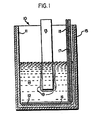
- FIG. 1 is a vertical cross-sectional view of a test cell used for testing anodes of the invention.
- FIG. 2 is a micrograph showing multiple phase metallurgical structure of Cu—Ni—Fe cast anodes.
- FIG. 3 is a micrograph showing single phase microstructure of a Cu—Ni—Fe cast anode of FIG. 3 after heating.
- Anodes of the present invention may be employed in any aluminum producing electrolytic cell. Further, the anodes may be used with any electrolyte which does not oxidize or cause degradation of the electrode during electrolysis. Preferred electrolytes are set forth in our U.S. Pat. No. 5,284,562 incorporated herein by reference as if specifically set forth.
- FIG. 1 there is shown a laboratory electric cell referred to generally as 10 used for testing anodes in accordance with the invention.
- Cell 10 comprises an alumina crucible 11 containing an anode 12 , a cathode 13 , and a molten electrolyte bath 14 .
- Alumina crucible 11 is positioned within a stainless steel container 15 .
- the inner surface of the sidewall of container 15 and the outer surface of the sidewall of crucible 11 are in abutting relation.
- a space can exist between the respective sidewalls of container 15 and crucible 11 .
- the space may be filled with graphite or petroleum coke particles to assist in the uniform distribution of heat to the sidewall of crucible 11 .
- Cathode 13 is typically a slab of titanium diboride, a composite of titanium diboride and graphite, or molybdenum.
- Anode 12 is in the form of a metal disc overlying and substantially covering the bottom 16 of crucible 11 .
- a vertical copper conductor 17 has a lower end connected to disc 12 and an upper end connected to a source of electric current (not shown).
- Vertical conductor 17 is insulated with an alumina tube 18 so as to confine the anodic current to disc 12 .
- Cathode 13 is connected in a conventional manner to the source of electric current.
- Cell 10 is placed in a furnace and held at a temperature at which electrolyte bath 14 is molten (e.g., 680-800° C.). The temperature of bath 14 is measured continuously with a chromel-alumel thermocouple contained in a closed-end fused alumina tube (not shown).
- Electrolyte bath 14 comprises a mixture of fluorides and has a relatively low melting point which enables operation of cell 10 at a relatively low temperature (e.g., 680-800° C.).
- the electrolyte comprises a mixture of fluorides having a eutectic or near-eutectic composition, a composition providing the lowest temperature at which the mixture of fluorides is molten. Examples of such electrolytes are described in detail in U.S. Pat. Nos. 5,006,209 and 5,284,562, fully incorporated herein by reference as if specifically set forth.
- One eutectic or near-eutectic composition consists essentially of 42-46 mol. % AlF 3 (preferably 43-45 mol. % AlF 3 ) and 54-58 mol. % of either (a) all NaF or (b) primarily NaF with equivalent mol amounts of either KF or LiF or KF plus LiF replacing some of the NaF.
- An example of the exact eutectic composition for this embodiment of electrolyte is 44 mol. % AlF 3 (61.1 wt. %) and 56 mol. % NaF (38.9 wt. %).
- Another example of this embodiment comprises 46.7 mol. % AlF 3 , 36.7 mol. % NaF, 8.3 mol.
- the cell can use electrolytes that contain one or more alkali metal fluorides and at least one metal fluoride, e.g., aluminum fluoride, and use a combination of fluorides as long as such baths or electrolytes operate at less than about 900° C.
- the electrolyte can comprise NaF and AlF 3 . That is, the bath can comprise 53 to 62 mol. % NaF and 38 to 47 mol. % AlF 3 .
- the anode composition can be used with other electrolyte bath compositions and such is intended within the purview of the invention.
- the electrolyte can contain one or more alkali metal fluorides and at least one other metal fluoride, e.g., aluminum, calcium or magnesium fluoride, as long as such baths can be operated at less than about 900° C.
- Electrolyte bath 14 may have a composition containing a mixture of two eutectics comprising NaF:AlF 3 eutectic plus KF:AlF 3 eutectic plus up to 4 wt. % LiF.
- This electrolyte composition is discussed in detail in U.S. Pat. No. 5,006,209, cited above. Expressed in terms of the amount of individual ingredients included therein, the electrolyte consists essentially of, in wt. % adjusted to exclude impurities: 6-26 NaF, 7-33 KF, 1-6 LiF and 60-65 AlF 3 .
- Anode 12 is a Cu—Ni—Fe anode which is substantially non-consumable at the temperatures at which cell 10 is operated.
- Fe in the anodes may range from 1 to 45 wt. % and Cu can range from 10 to 70 wt. %.
- Ni can range from 15 to 60 wt. %.
- Suitable anode compositions are in the ranges of 10 to 70 wt. % Cu, 15 to 60 wt. % Ni, the remainder Fe, incidental elements and impurities.
- the Fe can be in the range of 1 to 40 wt. %.
- anode compositions are in the ranges of 35 to 70 wt. % Cu, 25 to 48 wt.
- anode compositions can be selected from the range of 45 to 70 wt. % Cu, 28 to 42 wt. % Ni, and 13 to 17 wt. % Fe.
- the ranges set forth herein are intended to include all the numbers within the range as if specifically set forth. A more detailed discussion of the composition of anode 12 , together with a number of specific examples of anode composition, is contained in U.S. Pat. No. 5,284,562.
- Inert anodes in accordance with the invention may be cast from a melt of an alloy having the desired composition or the anodes may be fabricated from powders of the individual components mixed in the desired proportions. The powders are then sintered or melted to form the anode.
- Cathode 13 may be composed of any suitable material that is wet by molten aluminum and that is not degraded by the molten electrolyte bath.
- suitable cathode materials include titanium diboride, zirconium diboride, titanium carbide, zirconium carbide, or a composite of titanium diboride and graphite (e.g., 50 wt. % graphite), or molybdenum.
- the molten electrolyte contains dissolved alumina.
- alumina in excess of the dissolved alumina can be provided in the electrolyte. That is, incorporated into molten electrolyte bath 14 may be finely divided particles of alumina; the weight of the added alumina is typically about 5-15% of the weight of the fluoride electrolyte.
- the mean particle size of the alumina particles is typically about 1-100 microns, for example.
- Alumina dissolves in molten electrolyte bath 14 when cell 10 is operated in the temperature range 750-900° C. Thus, typically the fluoride electrolyte bath will contain about 1-5 wt. % dissolved alumina.
- FIG. 2 is a micrograph at 500 ⁇ of the structure having 60 wt. % Cu, 20 wt. % Ni, and 70 wt. % Fe. (atom % shown in FIG. 2.)
- FIG. 3 is a micrograph at 200 ⁇ of the homogenized structure. That is, the two phases are changed into a single phase.
- the homogenization can be carried out at sufficiently high temperature and for a sufficiently long time to obtain a single phase metallurgical structure.
- the cast anode can be homogenized in a temperature range of 950° to 1250° C. for about 1 to 12 hours.
- a typical temperature range for homogenizing is about 1000° to 1100° C. with lower temperatures requiring longer times and higher temperatures requiring shorter times to effect a phase change.
- a specific temperature which will effect a phase change in a cast anode is about 1100° C.
- the time at this temperature is typically about 8 hours; however, longer or shorter times may be required, depending on the compositions.
- the single phase has the benefit that it offers a more uniform microstructure for an anode surface with less competing structures subject to oxidation. Further, it offers more resistance to attack by insipient diffusion of the copper rich as-cast matrix.
- an anode having about 70 wt. % Cu, 15 wt. % Ni, 15 wt. % Fe was “cast” to shape and used in a 10 amp electrolytic cell, as shown in FIG. 1, operated at about 760° C.
- the cell was maintained at anode potential of ⁇ 3.9V.
- the molten electrolyte used in the cell contained about 61 wt. % AlF 3 and 39 wt. % NaF.
- the circular anode had a size of about 2 inches in diameter and about 0.25 inch thick.
- a 6% slurry of alumina having a particle size of about 1 ⁇ m was maintained in the molten electrolyte.
- the cell utilized a titanium diboride cathode placed to provide an anode-cathode distance of 0.5 inch.
- Aluminum produced remained attached to the cathode as shown in FIG. 1.
- the cell was run for a total of 5 hours at an anode current density of about 0.5 amps/cm 2 . After the 5 hours, the anode was removed and weighed. The current efficiency was about 76%.
- the product aluminum showed 0.056 wt. % Cu contamination, but no detectable contamination from Ni or Fe.
Landscapes
- Chemical & Material Sciences (AREA)
- Engineering & Computer Science (AREA)
- Chemical Kinetics & Catalysis (AREA)
- Electrochemistry (AREA)
- Materials Engineering (AREA)
- Metallurgy (AREA)
- Organic Chemistry (AREA)
- Electrolytic Production Of Metals (AREA)
Abstract
Description
- [0001] The invention embodied in the subject matter described herein was made during work financed by the following government contract: Department of Energy Office of Industrial Technologies Contract #DE-FC07-98ID13662.
- This invention relates to electrolytic production of aluminum from alumina and more particularly, it relates to an improved anode for use in a cell for the electrolytic production of aluminum.
- In the electrolytic production of aluminum, there is great interest in utilizing an anode substantially inert to the electrolyte and which does not react with oxygen during cell operation. Anodes of this type are described in U.S. Pat. No. 4,399,008 which discloses a composition suitable for fabricating into an inert electrode for use in the electrolytic production of metal from a metal compound dissolved in a molten salt. The electrode comprises at least two metal oxides combined to provide a combination metal oxide.
- Also, U.S. Pat. No. 5,284,562 discloses an oxidation resistant, non-consumable anode for use in the electrolytic reduction of alumina to aluminum, which has a composition comprising copper, nickel and iron. The anode is part of an electrolytic reduction cell comprising a vessel having an interior lined with metal which has the same composition as the anode. The electrolyte is preferably composed of a eutectic of AlF 3 and either (a) NaF or (b) primarily NaF with some of the NaF replaced by an equivalent molar amount of KF or KF and LiF.
- U.S. Pat. No. 5,069,771 discloses a method of electrowinning a metal by electrolysis of a melt containing a dissolved species of the metal to be won using a non-consumable anode having a metal, alloy or cermet substrate and an operative anode surface which is a protective surface coating of cerium oxyfluoride preserved by maintaining in the melt a suitable concentration of cerium. The anode is provided with an electronically conductive oxygen barrier on the surface of the metal, alloy or cermet substrate. The barrier layer may be a chromium oxide film on a chromium-containing alloy substrate. Preferably the barrier layer carries a ceramic oxide layer, e.g. of stabilized copper oxide which acts as anchorage for the cerium oxyfluoride.
- U.S. Pat. No. 3,957,600 discloses anodes of alloys, which may be fragmented and used in baskets, of passive film-forming metals and elements having atomic numbers 23-29 for use in electrowinning metals, methods of using such anodes, and electrowinning cells incorporating such anodes.
- Further, U.S. Pat. No. 5,529,494 discloses a monolithic bipolar electrode for the production of primary aluminum by molten salt electrolysis composed of a cermet anodic layer, a conductive and diffusion-resistant intermediate layer, and a refractory hard metal cathodic layer, with the edges covered by an electrolyte-resistant coating. The intermediate conductive layer has a coefficient of thermal expansion intermediate to the anodic and cathodic layers.
- U.S. Pat. No. 4,620,905 discloses an electrolytic process comprising evolving oxygen on an anode in a molten salt, the anode comprising an alloy comprising a first metal and a second metal, both metals forming oxides, the oxide of the first metal being more resistant than the second metal to attack by the molten salt, the oxide of the second metal being more resistant than the first metal to the diffusion of oxygen. The electrode may also be formed of CuAlO 2 and/or Cu2O.
- U.S. Pat. No. 4,871,438 discloses cermet electrode compositions comprising NiO—NiFe 2O4—Cu—Ni, and methods for making the same. Addition of nickel metal prior to formation and densification of a base mixture into the cermet allows for an increase in the total amount of copper and nickel that can be contained in the NiO—NiFe2O4 oxide system. Nickel is present in a base mixture weight concentration of from 0.1% to 10%. Copper is present in the alloy phase in a weight concentration of from 10% to 30% of the densified composition.
- U.S. Pat. No. 4,999,097 discloses improved electrolytic cells and methods for producing metals by electrolytic reduction of a compound dissolved in a molten electrolyte. In the improved cells and methods, a protective surface layer is formed upon at least one electrode in the electrolytic reduction cell and, optionally, upon the lining of the cell.
- U.S. Pat. No. 5,006,209 discloses that finely divided particles of alumina are electrolytically reduced to aluminum in an electrolytic reduction vessel having a plurality of vertically disposed, non-consumable anodes and a plurality of vertically disposed, dimensionally stable cathodes in closely spaced, alternating arrangement with the anodes.
- U.S. Pat. No. 4,865,701 discloses that alumina is reduced to molten aluminum in an electrolytic cell containing a molten electrolyte bath composed of halide salts and having a density less than alumina and aluminum and a melting point less than aluminum. The cell comprises a plurality of vertically disposed, spaced-apart, non-consumable, dimensionally stable anodes and cathodes. Alumina particles are dispersed in the bath to form a slurry. Current is passed between the electrodes, and oxygen bubbles form at the anodes, and molten aluminum droplets form at the cathodes. The oxygen bubbles agitate the bath and enhance dissolution of the alumina adjacent the anodes and inhibit the alumina particles from settling at the bottom of the bath. The molten aluminum droplets flow downwardly along the cathodes and accumulate at the bottom of the bath.
- U.S. Pat. No. 6,248,227 discloses a non-carbon, metal-based slow-consumable anode of a cell for the electrowinning of aluminium self-forms during normal electrolysis an electrochemically-active oxide-based surface layer (20). The rate of formation (35) of the layer (20) is substantially equal to its rate of dissolution (30) at the surface layer/electrolyte interface (25) thereby maintaining its thickness substantially constant, forming a limited barrier controlling the oxidation rate (35). The anode (10) usually comprises an alloy of iron with at least one of nickel, copper, cobalt or zinc which during use forms an oxide surface layer (20) mainly containing ferrite.
- U.S. Pat. No. 6,217,739 discloses a method of producing commercial purity aluminum in an electrolytic reduction cell comprising inert anodes. The method produces aluminum having acceptable levels of Fe, Cu and Ni impurities. The inert anodes used in the process preferably comprise a cermet material comprising ceramic oxide phase portions and metal phase portions.
- U.S. Pat. No. 4,288,302 discloses novel dimensionally stable electrodes constituted by a film forming metallic material alloyed with at least one member of the group consisting of metal belonging to Groups VIB, VIIB, VIII, IIB, IB, IVA, lanthanum and lanthanide series of the Periodic Table, such as chromium, manganese, rhenium, iron, ruthenium, osmium, cobalt, rhodium, iridium, nickel, palladium, platinum, copper, silver, gold, zinc, cadmium, silicon, germanium, tin, lead and lanthanum having an electroconductive and corrosion resistant surface preactivated on the surface thereof, preparation of said electrodes, use of said electrodes as anodes for electrolysis in aqueous and organic solutions or in fused salts as well as for cathodic protection and electrolysis methods using said electrodes.
- U.S. Pat. No. 4,620,905 discloses an electrolytic process comprising evolving oxygen on an anode in a molten salt, the anode comprising an alloy comprising a first metal and a second metal, both metals forming oxides, the oxide of the first metal being more resistant than the second metal to attack by the molten salt, the oxide of the second metal being more resistant than the first metal to the diffusion of oxygen. The electrode may also be formed of CuAlO 2 and/or Cu2O.
- Additional anode compositions are described in U.S. Pat. Nos. 3,943,048; 4,049,887; 4,956,068; 4,960,494; 5,637,239; 5,667,649; 5,725,744 and 5,993,637.
- There is still a need to improve the corrosivity and conductivity of the non-consumable anode to ensure an anode that provides satisfactory performance without dissolution in an electrolytic cell where alumina is reduced to aluminum.
- It is an object of this invention to provide an improved anode for use in an electrolytic cell.
- It is another object of this invention to provide an improved composition for an anode having resistance to molten electrolyte salts in an aluminum producing electrolytic cell.
- Yet, it is another object of the invention to provide a process for electrolytically producing aluminum from alumina in a low temperature cell using an improved anode.
- And yet it is a further object of the invention to provide an improved anode comprised of Cu—Ni—Fe.
- These and other objects will become apparent from a reading of the specification, claims and drawings appended hereto.
- In accordance with these objects, there is provided a method of producing aluminum in an electrolytic cell comprising the steps of providing molten electrolyte in an electrolytic cell, said cell having alumina dissolved in the electrolyte. In addition, anodes and cathodes are provided in the cell, the anodes comprised of Cu—Ni—Fe alloys, incidental elements and impurities and having a single microstructural phase. Electric current is passed between anodes and cathodes in the cell and aluminum is formed at the cathodes.
- The anode has improved resistance to oxidation and corrosion in molten electrolyte baths compared to other anode compositions in the same bath. Preferably, the anode composition is comprised of 15 to 60 wt. % Ni, 1 to 50 wt. % Fe, the remainder Cu, incidental elements and impurities. A more preferred anode is selected from a composition in the range of 10 to 70 wt. % Cu, 15 to 60 wt. % Ni, and 15 to 40 wt. % Fe. A typical composition for the anode would contain 30 to 50 wt. % Cu, 20 to 40 wt. % Ni, and 20 to 40 wt. % Fe, with a specific composition containing about 42 wt. % Cu, 28 wt. % Ni, and 30 wt. % Fe.
- Another feature of the present invention is a cell vessel interior lining which is impervious to penetration by molten electrolyte, which can be readily replaced and which may be readily recycled. The lining covers the bottom and walls of the vessel interior and may be composed of an alloy having substantially the same composition as the anode composition described herein. Located between the external shell and the interior metal lining of the vessel is refractory material, such as alumina or insulating fire brick, which thermally insulates the bottom and walls of the vessel. The interior metal lining may be electrically connected to the anodes, and the walls or bottom or both and constitute part of the anode arrangement. During operation of the cell, oxygen bubbles are generated at the bottom and elsewhere on the interior metal lining when the latter is part of the anode arrangement, and these bubbles help to maintain in suspension in the molten electrolyte the finely divided alumina particles introduced into the cell.
- The anodes of the present invention may be fabricated by casting a Cu—Ni—Fe melt of the desired composition. When Cu—Ni—Fe melts are cast into solid material, the casting or anode exhibits multiple microstructural phases. The multiple microstructural phases can be converted to a single phase by heating, thus providing a more uniform microstructure having fewer sites depleted or concentrated in elements constituting the anode.
- Preferably, a cell in accordance with the present invention employs, as an electrolyte, a eutectic or near-eutectic composition consisting essentially of 42-46 mol. % AlF 3 (preferably 43-45 mol. % AlF3) and 54-58 mol. % of either (a) all NaF or (b) primarily NaF with equivalent molar amounts of KF or KF plus LiF replacing some of the NaF.
- Thus, the invention includes a method of producing aluminum in a low temperature electrolytic cell containing alumina dissolved in a molten electrolyte. The method comprises the steps of providing a molten electrolyte having alumina dissolved therein in an electrolytic cell and an anode and a cathode disposed in said electrolyte. The anode is comprised of a Cu—Ni—Fe alloy having multiple microstructural phases which is heated to provide a single microstructural phase. Electric current is passed from the anode through the electrolyte to the cathode, thereby depositing aluminum on the cathode, and molten aluminum is collected from the cathode.
- FIG. 1 is a vertical cross-sectional view of a test cell used for testing anodes of the invention.
- FIG. 2 is a micrograph showing multiple phase metallurgical structure of Cu—Ni—Fe cast anodes.
- FIG. 3 is a micrograph showing single phase microstructure of a Cu—Ni—Fe cast anode of FIG. 3 after heating.
- Anodes of the present invention may be employed in any aluminum producing electrolytic cell. Further, the anodes may be used with any electrolyte which does not oxidize or cause degradation of the electrode during electrolysis. Preferred electrolytes are set forth in our U.S. Pat. No. 5,284,562 incorporated herein by reference as if specifically set forth.
- Referring to FIG. 1, there is shown a laboratory electric cell referred to generally as 10 used for testing anodes in accordance with the invention. Cell 10 comprises an
alumina crucible 11 containing ananode 12, acathode 13, and a molten electrolyte bath 14.Alumina crucible 11 is positioned within astainless steel container 15. As shown in FIG. 1, the inner surface of the sidewall ofcontainer 15 and the outer surface of the sidewall ofcrucible 11 are in abutting relation. In practice, a space can exist between the respective sidewalls ofcontainer 15 andcrucible 11. In such a case, the space may be filled with graphite or petroleum coke particles to assist in the uniform distribution of heat to the sidewall ofcrucible 11. -
Cathode 13 is typically a slab of titanium diboride, a composite of titanium diboride and graphite, or molybdenum.Anode 12 is in the form of a metal disc overlying and substantially covering the bottom 16 ofcrucible 11. Avertical copper conductor 17 has a lower end connected todisc 12 and an upper end connected to a source of electric current (not shown).Vertical conductor 17 is insulated with analumina tube 18 so as to confine the anodic current todisc 12.Cathode 13 is connected in a conventional manner to the source of electric current. Cell 10 is placed in a furnace and held at a temperature at which electrolyte bath 14 is molten (e.g., 680-800° C.). The temperature of bath 14 is measured continuously with a chromel-alumel thermocouple contained in a closed-end fused alumina tube (not shown). - Cell 10 is described in detail in U.S. Pat. No. 5,284,562, cited above.
- Electrolyte bath 14 comprises a mixture of fluorides and has a relatively low melting point which enables operation of cell 10 at a relatively low temperature (e.g., 680-800° C.). The electrolyte comprises a mixture of fluorides having a eutectic or near-eutectic composition, a composition providing the lowest temperature at which the mixture of fluorides is molten. Examples of such electrolytes are described in detail in U.S. Pat. Nos. 5,006,209 and 5,284,562, fully incorporated herein by reference as if specifically set forth.
- One eutectic or near-eutectic composition consists essentially of 42-46 mol. % AlF 3 (preferably 43-45 mol. % AlF3) and 54-58 mol. % of either (a) all NaF or (b) primarily NaF with equivalent mol amounts of either KF or LiF or KF plus LiF replacing some of the NaF. An example of the exact eutectic composition for this embodiment of electrolyte is 44 mol. % AlF3 (61.1 wt. %) and 56 mol. % NaF (38.9 wt. %). Another example of this embodiment comprises 46.7 mol. % AlF3, 36.7 mol. % NaF, 8.3 mol. % KF and about 8.3 mol. % LiF. In parts by weight, this example comprises 66 parts AlF3, 26 parts NaF, 8 parts KF and 3-4 parts LiF. The cell can use electrolytes that contain one or more alkali metal fluorides and at least one metal fluoride, e.g., aluminum fluoride, and use a combination of fluorides as long as such baths or electrolytes operate at less than about 900° C. For example, the electrolyte can comprise NaF and AlF3. That is, the bath can comprise 53 to 62 mol. % NaF and 38 to 47 mol. % AlF3.
- It will be appreciated that the anode composition can be used with other electrolyte bath compositions and such is intended within the purview of the invention. For example, the electrolyte can contain one or more alkali metal fluorides and at least one other metal fluoride, e.g., aluminum, calcium or magnesium fluoride, as long as such baths can be operated at less than about 900° C.
- Electrolyte bath 14 may have a composition containing a mixture of two eutectics comprising NaF:AlF3 eutectic plus KF:AlF3 eutectic plus up to 4 wt. % LiF. This electrolyte composition is discussed in detail in U.S. Pat. No. 5,006,209, cited above. Expressed in terms of the amount of individual ingredients included therein, the electrolyte consists essentially of, in wt. % adjusted to exclude impurities: 6-26 NaF, 7-33 KF, 1-6 LiF and 60-65 AlF3.
-
Anode 12 is a Cu—Ni—Fe anode which is substantially non-consumable at the temperatures at which cell 10 is operated. Fe in the anodes may range from 1 to 45 wt. % and Cu can range from 10 to 70 wt. %. Ni can range from 15 to 60 wt. %. Suitable anode compositions are in the ranges of 10 to 70 wt. % Cu, 15 to 60 wt. % Ni, the remainder Fe, incidental elements and impurities. The Fe can be in the range of 1 to 40 wt. %. Preferably, anode compositions are in the ranges of 35 to 70 wt. % Cu, 25 to 48 wt. % Ni, the remainder Fe with suitable amounts of Fe being in the range of 2 to 17 wt. %. More preferably, anode compositions can be selected from the range of 45 to 70 wt. % Cu, 28 to 42 wt. % Ni, and 13 to 17 wt. % Fe. The ranges set forth herein are intended to include all the numbers within the range as if specifically set forth. A more detailed discussion of the composition ofanode 12, together with a number of specific examples of anode composition, is contained in U.S. Pat. No. 5,284,562. - Inert anodes in accordance with the invention may be cast from a melt of an alloy having the desired composition or the anodes may be fabricated from powders of the individual components mixed in the desired proportions. The powders are then sintered or melted to form the anode.
-
Cathode 13 may be composed of any suitable material that is wet by molten aluminum and that is not degraded by the molten electrolyte bath. Examples of suitable cathode materials include titanium diboride, zirconium diboride, titanium carbide, zirconium carbide, or a composite of titanium diboride and graphite (e.g., 50 wt. % graphite), or molybdenum. - The molten electrolyte contains dissolved alumina. However, alumina in excess of the dissolved alumina can be provided in the electrolyte. That is, incorporated into molten electrolyte bath 14 may be finely divided particles of alumina; the weight of the added alumina is typically about 5-15% of the weight of the fluoride electrolyte. The mean particle size of the alumina particles is typically about 1-100 microns, for example. Alumina dissolves in molten electrolyte bath 14 when cell 10 is operated in the temperature range 750-900° C. Thus, typically the fluoride electrolyte bath will contain about 1-5 wt. % dissolved alumina.
- When current is supplied to cell 10, electrolytic reduction of alumina to aluminum occurs. Aluminum is deposited at
cathode 13, and oxygen is liberated atanode 12. That is, aluminum forms atcathode 13, and gaseous oxygen forms atanode 12. Molten aluminum wets the surface ofcathode 13. Bubbles of gaseous oxygen form atanode 12. Quantities of molten aluminum accumulate on thecathode 13 as a continuous phase 19 of molten aluminum. - When an anode is fabricated from a melt of Cu—Ni—Fe by casting, normally two metallurgical phases or structures are produced, as shown in FIG. 2 which is a micrograph at 500× of the structure having 60 wt. % Cu, 20 wt. % Ni, and 70 wt. % Fe. (atom % shown in FIG. 2.) By homogenizing or heating the cast anode a phase change can be obtained. The two phases are changed into a single phase shown in FIG. 3 which is a micrograph at 200× of the homogenized structure. That is, the two phases are changed into a single phase. The homogenization can be carried out at sufficiently high temperature and for a sufficiently long time to obtain a single phase metallurgical structure. Thus, for example, the cast anode can be homogenized in a temperature range of 950° to 1250° C. for about 1 to 12 hours. A typical temperature range for homogenizing is about 1000° to 1100° C. with lower temperatures requiring longer times and higher temperatures requiring shorter times to effect a phase change. A specific temperature which will effect a phase change in a cast anode is about 1100° C. The time at this temperature is typically about 8 hours; however, longer or shorter times may be required, depending on the compositions.
- The single phase has the benefit that it offers a more uniform microstructure for an anode surface with less competing structures subject to oxidation. Further, it offers more resistance to attack by insipient diffusion of the copper rich as-cast matrix.
- The following examples are further illustrative of the invention.
- To test the invention, an anode having about 70 wt. % Cu, 15 wt. % Ni, 15 wt. % Fe was “cast” to shape and used in a 10 amp electrolytic cell, as shown in FIG. 1, operated at about 760° C. The cell was maintained at anode potential of ˜3.9V. The molten electrolyte used in the cell contained about 61 wt. % AlF 3 and 39 wt. % NaF. The circular anode had a size of about 2 inches in diameter and about 0.25 inch thick. A 6% slurry of alumina having a particle size of about 1 μm was maintained in the molten electrolyte. The cell utilized a titanium diboride cathode placed to provide an anode-cathode distance of 0.5 inch. Aluminum produced remained attached to the cathode as shown in FIG. 1. The cell was run for a total of 5 hours at an anode current density of about 0.5 amps/cm2. After the 5 hours, the anode was removed and weighed. The current efficiency was about 76%. The product aluminum showed 0.056 wt. % Cu contamination, but no detectable contamination from Ni or Fe.
- While the invention has been described in terms of preferred embodiments, the claims appended hereto are intended to encompass other embodiments which fall within the spirit of the invention.
Claims (31)
Priority Applications (4)
| Application Number | Priority Date | Filing Date | Title |
|---|---|---|---|
| US10/126,087 US6723222B2 (en) | 2002-04-22 | 2002-04-22 | Cu-Ni-Fe anodes having improved microstructure |
| PCT/US2003/002668 WO2003089687A2 (en) | 2002-04-22 | 2003-01-29 | Cu-ni-fe anodes having improved microstructure |
| AU2003210727A AU2003210727A1 (en) | 2002-04-22 | 2003-01-29 | Cu-ni-fe anodes having improved microstructure |
| US10/431,403 US7077945B2 (en) | 2002-03-01 | 2003-05-08 | Cu—Ni—Fe anode for use in aluminum producing electrolytic cell |
Applications Claiming Priority (1)
| Application Number | Priority Date | Filing Date | Title |
|---|---|---|---|
| US10/126,087 US6723222B2 (en) | 2002-04-22 | 2002-04-22 | Cu-Ni-Fe anodes having improved microstructure |
Related Child Applications (2)
| Application Number | Title | Priority Date | Filing Date |
|---|---|---|---|
| US10/086,255 Continuation-In-Part US6558525B1 (en) | 2002-03-01 | 2002-03-01 | Anode for use in aluminum producing electrolytic cell |
| US10/431,403 Continuation-In-Part US7077945B2 (en) | 2002-03-01 | 2003-05-08 | Cu—Ni—Fe anode for use in aluminum producing electrolytic cell |
Publications (2)
| Publication Number | Publication Date |
|---|---|
| US20030196909A1 true US20030196909A1 (en) | 2003-10-23 |
| US6723222B2 US6723222B2 (en) | 2004-04-20 |
Family
ID=29214925
Family Applications (1)
| Application Number | Title | Priority Date | Filing Date |
|---|---|---|---|
| US10/126,087 Expired - Fee Related US6723222B2 (en) | 2002-03-01 | 2002-04-22 | Cu-Ni-Fe anodes having improved microstructure |
Country Status (3)
| Country | Link |
|---|---|
| US (1) | US6723222B2 (en) |
| AU (1) | AU2003210727A1 (en) |
| WO (1) | WO2003089687A2 (en) |
Cited By (4)
| Publication number | Priority date | Publication date | Assignee | Title |
|---|---|---|---|---|
| US20030201189A1 (en) * | 2002-03-01 | 2003-10-30 | Bergsma S. Craig | Cu-ni-fe anode for use in aluminum producing electrolytic cell |
| WO2005090642A3 (en) * | 2004-03-18 | 2006-04-06 | Moltech Invent Sa | Aluminium electrowinning cells with non-carbon anodes |
| US20070278107A1 (en) * | 2006-05-30 | 2007-12-06 | Northwest Aluminum Technologies | Anode for use in aluminum producing electrolytic cell |
| EP2860290A4 (en) * | 2012-06-11 | 2016-02-10 | Inner Mongolia United Ind Co Ltd | Electrolysis tank used for aluminum electrolysis and electrolysis process using the electrolyzer |
Families Citing this family (21)
| Publication number | Priority date | Publication date | Assignee | Title |
|---|---|---|---|---|
| WO2014062702A1 (en) | 2012-10-16 | 2014-04-24 | Ambri, Inc. | Electrochemical energy storage devices and housings |
| US10541451B2 (en) | 2012-10-18 | 2020-01-21 | Ambri Inc. | Electrochemical energy storage devices |
| US11211641B2 (en) | 2012-10-18 | 2021-12-28 | Ambri Inc. | Electrochemical energy storage devices |
| US11721841B2 (en) | 2012-10-18 | 2023-08-08 | Ambri Inc. | Electrochemical energy storage devices |
| US9735450B2 (en) | 2012-10-18 | 2017-08-15 | Ambri Inc. | Electrochemical energy storage devices |
| US9520618B2 (en) | 2013-02-12 | 2016-12-13 | Ambri Inc. | Electrochemical energy storage devices |
| US9312522B2 (en) | 2012-10-18 | 2016-04-12 | Ambri Inc. | Electrochemical energy storage devices |
| US11387497B2 (en) | 2012-10-18 | 2022-07-12 | Ambri Inc. | Electrochemical energy storage devices |
| US10270139B1 (en) | 2013-03-14 | 2019-04-23 | Ambri Inc. | Systems and methods for recycling electrochemical energy storage devices |
| US9502737B2 (en) | 2013-05-23 | 2016-11-22 | Ambri Inc. | Voltage-enhanced energy storage devices |
| US12347832B2 (en) | 2013-09-18 | 2025-07-01 | Ambri, LLC | Electrochemical energy storage devices |
| DK3058605T3 (en) | 2013-10-16 | 2024-03-04 | Ambri Inc | SEALS FOR DEVICES OF REACTIVE HIGH TEMPERATURE MATERIAL |
| WO2015058165A1 (en) | 2013-10-17 | 2015-04-23 | Ambri Inc. | Battery management systems for energy storage devices |
| US12142735B1 (en) | 2013-11-01 | 2024-11-12 | Ambri, Inc. | Thermal management of liquid metal batteries |
| CN104073704B (en) * | 2014-06-27 | 2016-06-22 | 中国铝业股份有限公司 | A kind of Cu-Ni-Fe base alloy inert anode material and heat treatment method thereof |
| US10181800B1 (en) | 2015-03-02 | 2019-01-15 | Ambri Inc. | Power conversion systems for energy storage devices |
| WO2016141354A2 (en) | 2015-03-05 | 2016-09-09 | Ambri Inc. | Ceramic materials and seals for high temperature reactive material devices |
| US9893385B1 (en) | 2015-04-23 | 2018-02-13 | Ambri Inc. | Battery management systems for energy storage devices |
| US11929466B2 (en) | 2016-09-07 | 2024-03-12 | Ambri Inc. | Electrochemical energy storage devices |
| EP3607603A4 (en) | 2017-04-07 | 2021-01-13 | Ambri Inc. | MOLTEN SALT BATTERY WITH SOLID METAL CATHODE |
| AU2019405440A1 (en) | 2018-12-17 | 2021-08-12 | Ambri, LLC | High temperature energy storage systems and methods |
Family Cites Families (28)
| Publication number | Priority date | Publication date | Assignee | Title |
|---|---|---|---|---|
| IT978528B (en) | 1973-01-26 | 1974-09-20 | Oronzio De Nora Impianti | METALLIC ELECTRODES AND PROCEDURE FOR THEIR ACTIVATION |
| US3943048A (en) | 1973-02-26 | 1976-03-09 | The International Nickel Company, Inc. | Powder anode |
| GB1433800A (en) | 1973-12-27 | 1976-04-28 | Imi Refinery Holdings Ltd | Method of and anodes for use in electrowinning metals |
| US4049887A (en) | 1976-07-20 | 1977-09-20 | Exxon Research & Engineering Co. | Electrochemical cells with cathode-active materials of layered compounds |
| US4171972A (en) * | 1978-02-21 | 1979-10-23 | Olin Corporation | Corrosion resistant copper base alloys for heat exchanger tube |
| US4202708A (en) * | 1978-02-21 | 1980-05-13 | Olin Corporation | Corrosion resistant copper base alloys for heat exchanger tube |
| US4592812A (en) | 1984-10-25 | 1986-06-03 | Electrochemical Technology Corp. | Method and apparatus for electrolytic reduction of alumina |
| US4620905A (en) | 1985-04-25 | 1986-11-04 | Aluminum Company Of America | Electrolytic production of metals using a resistant anode |
| US4999097A (en) | 1987-01-06 | 1991-03-12 | Massachusetts Institute Of Technology | Apparatus and method for the electrolytic production of metals |
| US5017244A (en) * | 1987-03-23 | 1991-05-21 | Olin Corporation | Process for improving the electrical conductivity of a copper-nickel-iron alloy |
| WO1989001994A1 (en) | 1987-09-02 | 1989-03-09 | Moltech Invent S.A. | Molten salt electrolysis with non-consumable anode |
| US4871438A (en) | 1987-11-03 | 1989-10-03 | Battelle Memorial Institute | Cermet anode compositions with high content alloy phase |
| US4871437A (en) | 1987-11-03 | 1989-10-03 | Battelle Memorial Institute | Cermet anode with continuously dispersed alloy phase and process for making |
| US4865701A (en) | 1988-08-31 | 1989-09-12 | Beck Theodore R | Electrolytic reduction of alumina |
| US5006209A (en) | 1990-02-13 | 1991-04-09 | Electrochemical Technology Corp. | Electrolytic reduction of alumina |
| US5725744A (en) | 1992-03-24 | 1998-03-10 | Moltech Invent S.A. | Cell for the electrolysis of alumina at low temperatures |
| US5284562A (en) | 1992-04-17 | 1994-02-08 | Electrochemical Technology Corp. | Non-consumable anode and lining for aluminum electrolytic reduction cell |
| US5529494A (en) | 1995-01-18 | 1996-06-25 | Vlacancich; Tanya | Dental tool driving device |
| US5637239A (en) | 1995-03-31 | 1997-06-10 | United Technologies Corporation | Curved electrode and method for electrical discharge machining curved cooling holes |
| US5667649A (en) | 1995-06-29 | 1997-09-16 | Bushman; James B. | Corrosion-resistant ferrous alloys for use as impressed current anodes |
| JP3809237B2 (en) | 1996-12-06 | 2006-08-16 | キヤノン株式会社 | Electrolytic pattern etching method |
| US6217739B1 (en) | 1997-06-26 | 2001-04-17 | Alcoa Inc. | Electrolytic production of high purity aluminum using inert anodes |
| US5865980A (en) | 1997-06-26 | 1999-02-02 | Aluminum Company Of America | Electrolysis with a inert electrode containing a ferrite, copper and silver |
| US5794112A (en) * | 1997-06-26 | 1998-08-11 | Aluminum Company Of America | Controlled atmosphere for fabrication of cermet electrodes |
| US6103090A (en) | 1998-07-30 | 2000-08-15 | Moltech Invent S.A. | Electrocatalytically active non-carbon metal-based anodes for aluminium production cells |
| US6248227B1 (en) | 1998-07-30 | 2001-06-19 | Moltech Invent S.A. | Slow consumable non-carbon metal-based anodes for aluminium production cells |
| WO2001043208A2 (en) * | 1999-12-09 | 2001-06-14 | Duruz, Jean-Jacques | Aluminium electrowinning cells operating with metal-based anodes |
| US6692631B2 (en) * | 2002-02-15 | 2004-02-17 | Northwest Aluminum | Carbon containing Cu-Ni-Fe anodes for electrolysis of alumina |
-
2002
- 2002-04-22 US US10/126,087 patent/US6723222B2/en not_active Expired - Fee Related
-
2003
- 2003-01-29 WO PCT/US2003/002668 patent/WO2003089687A2/en not_active Ceased
- 2003-01-29 AU AU2003210727A patent/AU2003210727A1/en not_active Abandoned
Cited By (6)
| Publication number | Priority date | Publication date | Assignee | Title |
|---|---|---|---|---|
| US20030201189A1 (en) * | 2002-03-01 | 2003-10-30 | Bergsma S. Craig | Cu-ni-fe anode for use in aluminum producing electrolytic cell |
| US7077945B2 (en) * | 2002-03-01 | 2006-07-18 | Northwest Aluminum Technologies | Cu—Ni—Fe anode for use in aluminum producing electrolytic cell |
| WO2005090642A3 (en) * | 2004-03-18 | 2006-04-06 | Moltech Invent Sa | Aluminium electrowinning cells with non-carbon anodes |
| US20070278107A1 (en) * | 2006-05-30 | 2007-12-06 | Northwest Aluminum Technologies | Anode for use in aluminum producing electrolytic cell |
| EP2860290A4 (en) * | 2012-06-11 | 2016-02-10 | Inner Mongolia United Ind Co Ltd | Electrolysis tank used for aluminum electrolysis and electrolysis process using the electrolyzer |
| AU2013275995B2 (en) * | 2012-06-11 | 2016-05-12 | Inner Mongolia United Industrial Co., Ltd. | Electrolysis tank used for aluminum electrolysis and electrolysis process using the electrolyzer |
Also Published As
| Publication number | Publication date |
|---|---|
| AU2003210727A8 (en) | 2003-11-03 |
| US6723222B2 (en) | 2004-04-20 |
| AU2003210727A1 (en) | 2003-11-03 |
| WO2003089687A2 (en) | 2003-10-30 |
| WO2003089687A3 (en) | 2005-03-17 |
Similar Documents
| Publication | Publication Date | Title |
|---|---|---|
| US6723222B2 (en) | Cu-Ni-Fe anodes having improved microstructure | |
| US6692631B2 (en) | Carbon containing Cu-Ni-Fe anodes for electrolysis of alumina | |
| US5284562A (en) | Non-consumable anode and lining for aluminum electrolytic reduction cell | |
| US5254232A (en) | Apparatus for the electrolytic production of metals | |
| US5069771A (en) | Molten salt electrolysis with non-consumable anode | |
| US4999097A (en) | Apparatus and method for the electrolytic production of metals | |
| AU2004221441B2 (en) | Electrolytic cell for production of aluminum from alumina | |
| EP0072043B1 (en) | Electrolytic production of aluminum | |
| US7077945B2 (en) | Cu—Ni—Fe anode for use in aluminum producing electrolytic cell | |
| US8900438B2 (en) | Electrolytic cell and electrochemical process using an electrode | |
| US3930967A (en) | Process for the electrolysis of a molten charge using inconsumable bi-polar electrodes | |
| JP5562962B2 (en) | Oxygen generating metal anode operating at high current density for aluminum reduction cells | |
| US6811676B2 (en) | Electrolytic cell for production of aluminum from alumina | |
| CA1224746A (en) | Cell for the refining of aluminum | |
| Ransley | Refractory carbides and borides for aluminum reduction cells | |
| EP0380645A1 (en) | Apparatus and method for the electrolytic production of metals | |
| US6616826B1 (en) | Electrolysis apparatus and methods using urania in electrodes, and methods of producing reduced substances from oxidized substances | |
| CA2113696C (en) | Non-consumable anode and lining for aluminum electrolytic reduction cell | |
| AU669407B2 (en) | Non-consumable anode and lining for aluminum electrolytic reduction cell | |
| Chapman | Nickel-iron-based metallic inert anodes for aluminium electrolysis | |
| WO2025171488A1 (en) | Electrolytic cells containing fused cast refractories and lining components | |
| NO309284B1 (en) | Cell, electrode and anode for electrolytic production of aluminum |
Legal Events
| Date | Code | Title | Description |
|---|---|---|---|
| AS | Assignment |
Owner name: NORTHWEST ALUMINUM, OREGON Free format text: ASSIGNMENT OF ASSIGNORS INTEREST;ASSIGNORS:BERGSMA, S. CRAIG;BROWN, CRAIG W.;REEL/FRAME:012824/0884;SIGNING DATES FROM 20020228 TO 20020305 |
|
| AS | Assignment |
Owner name: U.S. TRUST COMPANY, NATIONAL ASSOCIATION, CALIFORN Free format text: SECURITY INTEREST;ASSIGNOR:NORTHWEST ALUMINUM COMPANY;REEL/FRAME:012896/0572 Effective date: 19981221 |
|
| AS | Assignment |
Owner name: NORTHWEST ALUMINUM COMPANY, OREGON Free format text: CORRECTED ASSIGNMENT, PREVIOUSLY RECORDED AT REEL/FRAME 012824/0884 (ASSIGNMENT OF ASSIGNOR'S INTEREST);ASSIGNORS:BERGSMA, S. CRAIG;BROWN, CRAIG W.;REEL/FRAME:013115/0040;SIGNING DATES FROM 20020228 TO 20020305 |
|
| AS | Assignment |
Owner name: UNITED STATES DEPARTMENT OF ENERG, DISTRICT OF COL Free format text: CONFIRMATORY LICENSE;ASSIGNOR:NORTHWEST ALUMINUM TECHNOLOGIES;REEL/FRAME:014923/0111 Effective date: 20031212 |
|
| AS | Assignment |
Owner name: NORTHWEST ALUMINUM COMPANY, OREGON Free format text: RELEASE OF SECURITY INTEREST;ASSIGNOR:THE BANK OF NEW YORK, AS SUCCESSOR TO U.S. TRUST COMPANY, NATIONAL ASSOCIATION;REEL/FRAME:015942/0867 Effective date: 20050414 Owner name: NORTHWEST ALUMINUM TECHNOLOGIES, LLC, OREGON Free format text: RELEASE OF SECURITY INTEREST;ASSIGNOR:THE BANK OF NEW YORK, AS SUCCESSOR TO U.S. TRUST COMPANY, NATIONAL ASSOCIATION;REEL/FRAME:015942/0867 Effective date: 20050414 Owner name: NORTHWEST ALUMINUM SPECIALTIES, INC., OREGON Free format text: RELEASE OF SECURITY INTEREST;ASSIGNOR:THE BANK OF NEW YORK, AS SUCCESSOR TO U.S. TRUST COMPANY, NATIONAL ASSOCIATION;REEL/FRAME:015942/0867 Effective date: 20050414 Owner name: WILMINGTON TRUST COMPANY, DELAWARE Free format text: SECURITY AGREEMENT;ASSIGNOR:NORTHWEST ALUMINUM COMPANY;REEL/FRAME:015942/0937 Effective date: 20050414 |
|
| REMI | Maintenance fee reminder mailed | ||
| LAPS | Lapse for failure to pay maintenance fees | ||
| STCH | Information on status: patent discontinuation |
Free format text: PATENT EXPIRED DUE TO NONPAYMENT OF MAINTENANCE FEES UNDER 37 CFR 1.362 |
|
| FP | Expired due to failure to pay maintenance fee |
Effective date: 20080420 |