US20030138791A1 - 3-Spiro-cyanin fluorochromes and their use in bioassays - Google Patents
3-Spiro-cyanin fluorochromes and their use in bioassays Download PDFInfo
- Publication number
- US20030138791A1 US20030138791A1 US10/130,547 US13054702A US2003138791A1 US 20030138791 A1 US20030138791 A1 US 20030138791A1 US 13054702 A US13054702 A US 13054702A US 2003138791 A1 US2003138791 A1 US 2003138791A1
- Authority
- US
- United States
- Prior art keywords
- fluorescent dye
- group
- dye according
- residues
- compound
- Prior art date
- Legal status (The legal status is an assumption and is not a legal conclusion. Google has not performed a legal analysis and makes no representation as to the accuracy of the status listed.)
- Granted
Links
- 238000004166 bioassay Methods 0.000 title description 2
- 239000007850 fluorescent dye Substances 0.000 claims abstract description 76
- 230000008878 coupling Effects 0.000 claims abstract description 21
- 238000010168 coupling process Methods 0.000 claims abstract description 21
- 238000005859 coupling reaction Methods 0.000 claims abstract description 21
- 238000000034 method Methods 0.000 claims abstract description 15
- 238000004458 analytical method Methods 0.000 claims abstract description 8
- -1 silylhalogene Chemical class 0.000 claims description 48
- 150000001875 compounds Chemical class 0.000 claims description 34
- 229910052751 metal Inorganic materials 0.000 claims description 16
- 239000002184 metal Substances 0.000 claims description 16
- 150000001768 cations Chemical class 0.000 claims description 14
- 239000002245 particle Substances 0.000 claims description 10
- 150000001412 amines Chemical class 0.000 claims description 9
- 239000000306 component Substances 0.000 claims description 9
- 125000003010 ionic group Chemical group 0.000 claims description 9
- 108020004707 nucleic acids Proteins 0.000 claims description 9
- 150000007523 nucleic acids Chemical class 0.000 claims description 9
- 102000039446 nucleic acids Human genes 0.000 claims description 9
- 150000008300 phosphoramidites Chemical class 0.000 claims description 9
- 150000004653 carbonic acids Chemical class 0.000 claims description 7
- 239000000126 substance Substances 0.000 claims description 7
- NQTADLQHYWFPDB-UHFFFAOYSA-N N-Hydroxysuccinimide Chemical compound ON1C(=O)CCC1=O NQTADLQHYWFPDB-UHFFFAOYSA-N 0.000 claims description 6
- 229910052760 oxygen Inorganic materials 0.000 claims description 6
- 229910052717 sulfur Inorganic materials 0.000 claims description 6
- ABLZXFCXXLZCGV-UHFFFAOYSA-N Phosphorous acid Chemical class OP(O)=O ABLZXFCXXLZCGV-UHFFFAOYSA-N 0.000 claims description 5
- 239000012634 fragment Substances 0.000 claims description 5
- 239000012948 isocyanate Substances 0.000 claims description 5
- 150000003871 sulfonates Chemical class 0.000 claims description 5
- NBIIXXVUZAFLBC-UHFFFAOYSA-N Phosphoric acid Chemical compound OP(O)(O)=O NBIIXXVUZAFLBC-UHFFFAOYSA-N 0.000 claims description 4
- 240000004808 Saccharomyces cerevisiae Species 0.000 claims description 4
- 150000001299 aldehydes Chemical class 0.000 claims description 4
- 150000008064 anhydrides Chemical class 0.000 claims description 4
- 210000000601 blood cell Anatomy 0.000 claims description 4
- 150000001720 carbohydrates Chemical class 0.000 claims description 4
- 235000014633 carbohydrates Nutrition 0.000 claims description 4
- 150000002118 epoxides Chemical class 0.000 claims description 4
- 229910052736 halogen Inorganic materials 0.000 claims description 4
- 150000002367 halogens Chemical class 0.000 claims description 4
- 150000002429 hydrazines Chemical class 0.000 claims description 4
- 150000002500 ions Chemical class 0.000 claims description 4
- 150000002540 isothiocyanates Chemical class 0.000 claims description 4
- 238000002372 labelling Methods 0.000 claims description 4
- 235000011007 phosphoric acid Nutrition 0.000 claims description 4
- 239000004033 plastic Substances 0.000 claims description 4
- 229920003023 plastic Polymers 0.000 claims description 4
- 229920000642 polymer Polymers 0.000 claims description 4
- 150000003460 sulfonic acids Chemical class 0.000 claims description 4
- 150000003923 2,5-pyrrolediones Chemical class 0.000 claims description 3
- 241000894006 Bacteria Species 0.000 claims description 3
- 108090000790 Enzymes Proteins 0.000 claims description 3
- 102000004190 Enzymes Human genes 0.000 claims description 3
- 125000000217 alkyl group Chemical group 0.000 claims description 3
- 125000003118 aryl group Chemical group 0.000 claims description 3
- 150000001541 aziridines Chemical class 0.000 claims description 3
- 150000001718 carbodiimides Chemical class 0.000 claims description 3
- 210000004027 cell Anatomy 0.000 claims description 3
- 150000002148 esters Chemical class 0.000 claims description 3
- 150000004676 glycans Chemical class 0.000 claims description 3
- 150000002463 imidates Chemical class 0.000 claims description 3
- 230000003993 interaction Effects 0.000 claims description 3
- 150000002513 isocyanates Chemical class 0.000 claims description 3
- 229920001542 oligosaccharide Polymers 0.000 claims description 3
- 150000002482 oligosaccharides Chemical class 0.000 claims description 3
- VLTRZXGMWDSKGL-UHFFFAOYSA-M perchlorate Inorganic materials [O-]Cl(=O)(=O)=O VLTRZXGMWDSKGL-UHFFFAOYSA-M 0.000 claims description 3
- VLTRZXGMWDSKGL-UHFFFAOYSA-N perchloric acid Chemical compound OCl(=O)(=O)=O VLTRZXGMWDSKGL-UHFFFAOYSA-N 0.000 claims description 3
- 229920000573 polyethylene Polymers 0.000 claims description 3
- 229920001282 polysaccharide Polymers 0.000 claims description 3
- 239000005017 polysaccharide Substances 0.000 claims description 3
- 102000004196 processed proteins & peptides Human genes 0.000 claims description 3
- 108090000765 processed proteins & peptides Proteins 0.000 claims description 3
- 125000003396 thiol group Chemical group [H]S* 0.000 claims description 3
- JOXIMZWYDAKGHI-UHFFFAOYSA-M toluene-4-sulfonate Chemical compound CC1=CC=C(S([O-])(=O)=O)C=C1 JOXIMZWYDAKGHI-UHFFFAOYSA-M 0.000 claims description 3
- 231100000765 toxin Toxicity 0.000 claims description 3
- LSNNMFCWUKXFEE-UHFFFAOYSA-M Bisulfite Chemical compound OS([O-])=O LSNNMFCWUKXFEE-UHFFFAOYSA-M 0.000 claims description 2
- 102000008072 Lymphokines Human genes 0.000 claims description 2
- 108010074338 Lymphokines Proteins 0.000 claims description 2
- 241000700605 Viruses Species 0.000 claims description 2
- 239000002253 acid Substances 0.000 claims description 2
- 150000007513 acids Chemical class 0.000 claims description 2
- 125000003545 alkoxy group Chemical group 0.000 claims description 2
- 150000008052 alkyl sulfonates Chemical class 0.000 claims description 2
- 229910000147 aluminium phosphate Inorganic materials 0.000 claims description 2
- 150000001448 anilines Chemical class 0.000 claims description 2
- 125000000129 anionic group Chemical group 0.000 claims description 2
- 125000004429 atom Chemical group 0.000 claims description 2
- 150000001540 azides Chemical class 0.000 claims description 2
- 239000012503 blood component Substances 0.000 claims description 2
- 150000001642 boronic acid derivatives Chemical class 0.000 claims description 2
- 230000001413 cellular effect Effects 0.000 claims description 2
- 239000004020 conductor Substances 0.000 claims description 2
- 235000014113 dietary fatty acids Nutrition 0.000 claims description 2
- 229940079593 drug Drugs 0.000 claims description 2
- 239000003814 drug Substances 0.000 claims description 2
- 229930195729 fatty acid Natural products 0.000 claims description 2
- 239000000194 fatty acid Substances 0.000 claims description 2
- 235000011187 glycerol Nutrition 0.000 claims description 2
- PEDCQBHIVMGVHV-UHFFFAOYSA-N glycerol group Chemical class OCC(O)CO PEDCQBHIVMGVHV-UHFFFAOYSA-N 0.000 claims description 2
- 229940088597 hormone Drugs 0.000 claims description 2
- 239000005556 hormone Substances 0.000 claims description 2
- 150000002443 hydroxylamines Chemical class 0.000 claims description 2
- 239000002207 metabolite Substances 0.000 claims description 2
- 150000002739 metals Chemical class 0.000 claims description 2
- 239000011859 microparticle Substances 0.000 claims description 2
- 239000002105 nanoparticle Substances 0.000 claims description 2
- 150000003016 phosphoric acids Chemical class 0.000 claims description 2
- 229920000570 polyether Polymers 0.000 claims description 2
- 229920005597 polymer membrane Polymers 0.000 claims description 2
- 229920005862 polyol Polymers 0.000 claims description 2
- 229920006395 saturated elastomer Polymers 0.000 claims description 2
- 239000004065 semiconductor Substances 0.000 claims description 2
- 238000001179 sorption measurement Methods 0.000 claims description 2
- 239000000758 substrate Substances 0.000 claims description 2
- BDHFUVZGWQCTTF-UHFFFAOYSA-M sulfonate Chemical compound [O-]S(=O)=O BDHFUVZGWQCTTF-UHFFFAOYSA-M 0.000 claims description 2
- 150000003459 sulfonic acid esters Chemical class 0.000 claims description 2
- 125000002023 trifluoromethyl group Chemical group FC(F)(F)* 0.000 claims description 2
- 125000002221 trityl group Chemical group [H]C1=C([H])C([H])=C([H])C([H])=C1C([*])(C1=C(C(=C(C(=C1[H])[H])[H])[H])[H])C1=C([H])C([H])=C([H])C([H])=C1[H] 0.000 claims description 2
- 210000000605 viral structure Anatomy 0.000 claims description 2
- 229920002477 rna polymer Polymers 0.000 claims 4
- HDTRYLNUVZCQOY-UHFFFAOYSA-N α-D-glucopyranosyl-α-D-glucopyranoside Natural products OC1C(O)C(O)C(CO)OC1OC1C(O)C(O)C(O)C(CO)O1 HDTRYLNUVZCQOY-UHFFFAOYSA-N 0.000 claims 1
- OWEGMIWEEQEYGQ-UHFFFAOYSA-N 100676-05-9 Natural products OC1C(O)C(O)C(CO)OC1OCC1C(O)C(O)C(O)C(OC2C(OC(O)C(O)C2O)CO)O1 OWEGMIWEEQEYGQ-UHFFFAOYSA-N 0.000 claims 1
- GUBGYTABKSRVRQ-XLOQQCSPSA-N Alpha-Lactose Chemical compound O[C@@H]1[C@@H](O)[C@@H](O)[C@@H](CO)O[C@H]1O[C@@H]1[C@@H](CO)O[C@H](O)[C@H](O)[C@H]1O GUBGYTABKSRVRQ-XLOQQCSPSA-N 0.000 claims 1
- OKTJSMMVPCPJKN-UHFFFAOYSA-N Carbon Chemical group [C] OKTJSMMVPCPJKN-UHFFFAOYSA-N 0.000 claims 1
- 229920000858 Cyclodextrin Polymers 0.000 claims 1
- 229920002307 Dextran Polymers 0.000 claims 1
- GUBGYTABKSRVRQ-QKKXKWKRSA-N Lactose Natural products OC[C@H]1O[C@@H](O[C@H]2[C@H](O)[C@@H](O)C(O)O[C@@H]2CO)[C@H](O)[C@@H](O)[C@H]1O GUBGYTABKSRVRQ-QKKXKWKRSA-N 0.000 claims 1
- GUBGYTABKSRVRQ-PICCSMPSSA-N Maltose Natural products O[C@@H]1[C@@H](O)[C@H](O)[C@@H](CO)O[C@@H]1O[C@@H]1[C@@H](CO)OC(O)[C@H](O)[C@H]1O GUBGYTABKSRVRQ-PICCSMPSSA-N 0.000 claims 1
- 239000004721 Polyphenylene oxide Substances 0.000 claims 1
- MUPFEKGTMRGPLJ-RMMQSMQOSA-N Raffinose Natural products O(C[C@H]1[C@@H](O)[C@H](O)[C@@H](O)[C@@H](O[C@@]2(CO)[C@H](O)[C@@H](O)[C@@H](CO)O2)O1)[C@@H]1[C@H](O)[C@@H](O)[C@@H](O)[C@@H](CO)O1 MUPFEKGTMRGPLJ-RMMQSMQOSA-N 0.000 claims 1
- CZMRCDWAGMRECN-UGDNZRGBSA-N Sucrose Chemical compound O[C@H]1[C@H](O)[C@@H](CO)O[C@@]1(CO)O[C@@H]1[C@H](O)[C@@H](O)[C@H](O)[C@@H](CO)O1 CZMRCDWAGMRECN-UGDNZRGBSA-N 0.000 claims 1
- 229930006000 Sucrose Natural products 0.000 claims 1
- HDTRYLNUVZCQOY-WSWWMNSNSA-N Trehalose Natural products O[C@@H]1[C@@H](O)[C@@H](O)[C@@H](CO)O[C@@H]1O[C@@H]1[C@H](O)[C@@H](O)[C@@H](O)[C@@H](CO)O1 HDTRYLNUVZCQOY-WSWWMNSNSA-N 0.000 claims 1
- MUPFEKGTMRGPLJ-UHFFFAOYSA-N UNPD196149 Natural products OC1C(O)C(CO)OC1(CO)OC1C(O)C(O)C(O)C(COC2C(C(O)C(O)C(CO)O2)O)O1 MUPFEKGTMRGPLJ-UHFFFAOYSA-N 0.000 claims 1
- 125000003158 alcohol group Chemical group 0.000 claims 1
- 229940045714 alkyl sulfonate alkylating agent Drugs 0.000 claims 1
- HDTRYLNUVZCQOY-LIZSDCNHSA-N alpha,alpha-trehalose Chemical compound O[C@@H]1[C@@H](O)[C@H](O)[C@@H](CO)O[C@@H]1O[C@@H]1[C@H](O)[C@@H](O)[C@H](O)[C@@H](CO)O1 HDTRYLNUVZCQOY-LIZSDCNHSA-N 0.000 claims 1
- 230000003321 amplification Effects 0.000 claims 1
- 125000006615 aromatic heterocyclic group Chemical group 0.000 claims 1
- 230000001580 bacterial effect Effects 0.000 claims 1
- GUBGYTABKSRVRQ-QUYVBRFLSA-N beta-maltose Chemical compound OC[C@H]1O[C@H](O[C@H]2[C@H](O)[C@@H](O)[C@H](O)O[C@@H]2CO)[C@H](O)[C@@H](O)[C@@H]1O GUBGYTABKSRVRQ-QUYVBRFLSA-N 0.000 claims 1
- BVKZGUZCCUSVTD-UHFFFAOYSA-N carbonic acid Chemical compound OC(O)=O BVKZGUZCCUSVTD-UHFFFAOYSA-N 0.000 claims 1
- 238000006243 chemical reaction Methods 0.000 claims 1
- LLHRMWHYJGLIEV-UHFFFAOYSA-N desoxy Chemical group COC1=CC(CCN)=CC(OC)=C1C LLHRMWHYJGLIEV-UHFFFAOYSA-N 0.000 claims 1
- 238000001514 detection method Methods 0.000 claims 1
- 150000002016 disaccharides Chemical class 0.000 claims 1
- 235000019441 ethanol Nutrition 0.000 claims 1
- 238000002866 fluorescence resonance energy transfer Methods 0.000 claims 1
- 125000005843 halogen group Chemical group 0.000 claims 1
- 150000002386 heptoses Chemical class 0.000 claims 1
- 150000002402 hexoses Chemical class 0.000 claims 1
- 239000008101 lactose Substances 0.000 claims 1
- 238000012986 modification Methods 0.000 claims 1
- 230000004048 modification Effects 0.000 claims 1
- 150000002772 monosaccharides Chemical class 0.000 claims 1
- 238000003199 nucleic acid amplification method Methods 0.000 claims 1
- 229920000620 organic polymer Polymers 0.000 claims 1
- 150000002972 pentoses Chemical class 0.000 claims 1
- MUPFEKGTMRGPLJ-ZQSKZDJDSA-N raffinose Chemical compound O[C@H]1[C@H](O)[C@@H](CO)O[C@@]1(CO)O[C@@H]1[C@H](O)[C@@H](O)[C@H](O)[C@@H](CO[C@@H]2[C@@H]([C@@H](O)[C@@H](O)[C@@H](CO)O2)O)O1 MUPFEKGTMRGPLJ-ZQSKZDJDSA-N 0.000 claims 1
- HFHDHCJBZVLPGP-UHFFFAOYSA-N schardinger α-dextrin Chemical compound O1C(C(C2O)O)C(CO)OC2OC(C(C2O)O)C(CO)OC2OC(C(C2O)O)C(CO)OC2OC(C(O)C2O)C(CO)OC2OC(C(C2O)O)C(CO)OC2OC2C(O)C(O)C1OC2CO HFHDHCJBZVLPGP-UHFFFAOYSA-N 0.000 claims 1
- 239000005720 sucrose Substances 0.000 claims 1
- 150000003538 tetroses Chemical class 0.000 claims 1
- 150000003641 trioses Chemical class 0.000 claims 1
- 238000003780 insertion Methods 0.000 abstract description 7
- 230000037431 insertion Effects 0.000 abstract description 7
- 230000002776 aggregation Effects 0.000 abstract description 6
- 238000004220 aggregation Methods 0.000 abstract description 6
- 238000006862 quantum yield reaction Methods 0.000 abstract description 5
- 230000000171 quenching effect Effects 0.000 abstract 1
- RTZKZFJDLAIYFH-UHFFFAOYSA-N Diethyl ether Chemical compound CCOCC RTZKZFJDLAIYFH-UHFFFAOYSA-N 0.000 description 58
- 239000000975 dye Substances 0.000 description 52
- 0 [1*][N+]1=C(C)C2(CC*CC2)C2=C1C([2*])=C([3*])C([4*])=C2[5*].[W-] Chemical compound [1*][N+]1=C(C)C2(CC*CC2)C2=C1C([2*])=C([3*])C([4*])=C2[5*].[W-] 0.000 description 38
- QTBSBXVTEAMEQO-UHFFFAOYSA-N Acetic acid Chemical compound CC(O)=O QTBSBXVTEAMEQO-UHFFFAOYSA-N 0.000 description 29
- CSCPPACGZOOCGX-UHFFFAOYSA-N Acetone Chemical compound CC(C)=O CSCPPACGZOOCGX-UHFFFAOYSA-N 0.000 description 24
- LFQSCWFLJHTTHZ-UHFFFAOYSA-N Ethanol Chemical compound CCO LFQSCWFLJHTTHZ-UHFFFAOYSA-N 0.000 description 24
- 230000015572 biosynthetic process Effects 0.000 description 24
- 238000003786 synthesis reaction Methods 0.000 description 23
- SIKJAQJRHWYJAI-UHFFFAOYSA-N benzopyrrole Natural products C1=CC=C2NC=CC2=C1 SIKJAQJRHWYJAI-UHFFFAOYSA-N 0.000 description 21
- WFDIJRYMOXRFFG-UHFFFAOYSA-N Acetic anhydride Chemical compound CC(=O)OC(C)=O WFDIJRYMOXRFFG-UHFFFAOYSA-N 0.000 description 18
- 150000003839 salts Chemical class 0.000 description 18
- XLYOFNOQVPJJNP-UHFFFAOYSA-N water Substances O XLYOFNOQVPJJNP-UHFFFAOYSA-N 0.000 description 15
- PAYRUJLWNCNPSJ-UHFFFAOYSA-N N-phenyl amine Natural products NC1=CC=CC=C1 PAYRUJLWNCNPSJ-UHFFFAOYSA-N 0.000 description 13
- 229960000583 acetic acid Drugs 0.000 description 13
- 238000001816 cooling Methods 0.000 description 13
- 102000004169 proteins and genes Human genes 0.000 description 13
- 108090000623 proteins and genes Proteins 0.000 description 13
- XEKOWRVHYACXOJ-UHFFFAOYSA-N Ethyl acetate Chemical compound CCOC(C)=O XEKOWRVHYACXOJ-UHFFFAOYSA-N 0.000 description 12
- 239000000203 mixture Substances 0.000 description 12
- XAEFZNCEHLXOMS-UHFFFAOYSA-M potassium benzoate Chemical compound [K+].[O-]C(=O)C1=CC=CC=C1 XAEFZNCEHLXOMS-UHFFFAOYSA-M 0.000 description 11
- YUVUKSXNALJHSP-UHFFFAOYSA-M CC(OCCCC[S+]1C2=CC=CC=C2N=C1C)=O.[I-] Chemical compound CC(OCCCC[S+]1C2=CC=CC=C2N=C1C)=O.[I-] YUVUKSXNALJHSP-UHFFFAOYSA-M 0.000 description 10
- JUJWROOIHBZHMG-UHFFFAOYSA-N Pyridine Chemical compound C1=CC=NC=C1 JUJWROOIHBZHMG-UHFFFAOYSA-N 0.000 description 10
- 239000012362 glacial acetic acid Substances 0.000 description 10
- SCVFZCLFOSHCOH-UHFFFAOYSA-M potassium acetate Chemical compound [K+].CC([O-])=O SCVFZCLFOSHCOH-UHFFFAOYSA-M 0.000 description 10
- OKKJLVBELUTLKV-UHFFFAOYSA-N Methanol Chemical compound OC OKKJLVBELUTLKV-UHFFFAOYSA-N 0.000 description 9
- PZOUSPYUWWUPPK-UHFFFAOYSA-N indole Natural products CC1=CC=CC2=C1C=CN2 PZOUSPYUWWUPPK-UHFFFAOYSA-N 0.000 description 9
- RKJUIXBNRJVNHR-UHFFFAOYSA-N indolenine Natural products C1=CC=C2CC=NC2=C1 RKJUIXBNRJVNHR-UHFFFAOYSA-N 0.000 description 9
- 238000002360 preparation method Methods 0.000 description 8
- 108020004414 DNA Proteins 0.000 description 7
- 239000007787 solid Substances 0.000 description 7
- 239000000243 solution Substances 0.000 description 7
- 239000002904 solvent Substances 0.000 description 7
- KFZMGEQAYNKOFK-UHFFFAOYSA-N Isopropanol Chemical compound CC(C)O KFZMGEQAYNKOFK-UHFFFAOYSA-N 0.000 description 6
- YXFVVABEGXRONW-UHFFFAOYSA-N Toluene Chemical compound CC1=CC=CC=C1 YXFVVABEGXRONW-UHFFFAOYSA-N 0.000 description 6
- 229960004132 diethyl ether Drugs 0.000 description 6
- 239000000706 filtrate Substances 0.000 description 6
- QGKMIGUHVLGJBR-UHFFFAOYSA-M (4z)-1-(3-methylbutyl)-4-[[1-(3-methylbutyl)quinolin-1-ium-4-yl]methylidene]quinoline;iodide Chemical compound [I-].C12=CC=CC=C2N(CCC(C)C)C=CC1=CC1=CC=[N+](CCC(C)C)C2=CC=CC=C12 QGKMIGUHVLGJBR-UHFFFAOYSA-M 0.000 description 5
- FLPVVTDEKLGZDZ-UHFFFAOYSA-N 4-iodobutyl acetate Chemical compound CC(=O)OCCCCI FLPVVTDEKLGZDZ-UHFFFAOYSA-N 0.000 description 5
- ISWSIDIOOBJBQZ-UHFFFAOYSA-N Phenol Natural products OC1=CC=CC=C1 ISWSIDIOOBJBQZ-UHFFFAOYSA-N 0.000 description 5
- 238000000862 absorption spectrum Methods 0.000 description 5
- 238000004440 column chromatography Methods 0.000 description 5
- 125000001041 indolyl group Chemical group 0.000 description 5
- 229960004109 potassium acetate Drugs 0.000 description 5
- 235000011056 potassium acetate Nutrition 0.000 description 5
- 239000000047 product Substances 0.000 description 5
- UMJSCPRVCHMLSP-UHFFFAOYSA-N pyridine Natural products COC1=CC=CN=C1 UMJSCPRVCHMLSP-UHFFFAOYSA-N 0.000 description 5
- 125000001424 substituent group Chemical group 0.000 description 5
- RFFLAFLAYFXFSW-UHFFFAOYSA-N 1,2-dichlorobenzene Chemical compound ClC1=CC=CC=C1Cl RFFLAFLAYFXFSW-UHFFFAOYSA-N 0.000 description 4
- LMDZBCPBFSXMTL-UHFFFAOYSA-N 1-ethyl-3-(3-dimethylaminopropyl)carbodiimide Chemical compound CCN=C=NCCCN(C)C LMDZBCPBFSXMTL-UHFFFAOYSA-N 0.000 description 4
- DXYYSGDWQCSKKO-UHFFFAOYSA-N 2-methylbenzothiazole Chemical compound C1=CC=C2SC(C)=NC2=C1 DXYYSGDWQCSKKO-UHFFFAOYSA-N 0.000 description 4
- YMWUJEATGCHHMB-UHFFFAOYSA-N Dichloromethane Chemical compound ClCCl YMWUJEATGCHHMB-UHFFFAOYSA-N 0.000 description 4
- KIWBPDUYBMNFTB-UHFFFAOYSA-N Ethyl hydrogen sulfate Chemical compound CCOS(O)(=O)=O KIWBPDUYBMNFTB-UHFFFAOYSA-N 0.000 description 4
- VEXZGXHMUGYJMC-UHFFFAOYSA-N Hydrochloric acid Chemical compound Cl VEXZGXHMUGYJMC-UHFFFAOYSA-N 0.000 description 4
- VYPSYNLAJGMNEJ-UHFFFAOYSA-N Silicium dioxide Chemical compound O=[Si]=O VYPSYNLAJGMNEJ-UHFFFAOYSA-N 0.000 description 4
- 238000000295 emission spectrum Methods 0.000 description 4
- 229940093499 ethyl acetate Drugs 0.000 description 4
- 235000019439 ethyl acetate Nutrition 0.000 description 4
- 238000001704 evaporation Methods 0.000 description 4
- 230000008020 evaporation Effects 0.000 description 4
- 238000011534 incubation Methods 0.000 description 4
- 239000002773 nucleotide Substances 0.000 description 4
- 125000003729 nucleotide group Chemical group 0.000 description 4
- 238000010992 reflux Methods 0.000 description 4
- 229910002027 silica gel Inorganic materials 0.000 description 4
- 239000000741 silica gel Substances 0.000 description 4
- 229960001866 silicon dioxide Drugs 0.000 description 4
- RIFKADJTWUGDOV-UHFFFAOYSA-N 1-cyclohexylethanone Chemical compound CC(=O)C1CCCCC1 RIFKADJTWUGDOV-UHFFFAOYSA-N 0.000 description 3
- MUDSDYNRBDKLGK-UHFFFAOYSA-N 4-methylquinoline Chemical compound C1=CC=C2C(C)=CC=NC2=C1 MUDSDYNRBDKLGK-UHFFFAOYSA-N 0.000 description 3
- NVRVNSHHLPQGCU-UHFFFAOYSA-N 6-bromohexanoic acid Chemical compound OC(=O)CCCCCBr NVRVNSHHLPQGCU-UHFFFAOYSA-N 0.000 description 3
- 108091003079 Bovine Serum Albumin Proteins 0.000 description 3
- HEMHJVSKTPXQMS-UHFFFAOYSA-M Sodium hydroxide Chemical compound [OH-].[Na+] HEMHJVSKTPXQMS-UHFFFAOYSA-M 0.000 description 3
- ZMANZCXQSJIPKH-UHFFFAOYSA-N Triethylamine Chemical compound CCN(CC)CC ZMANZCXQSJIPKH-UHFFFAOYSA-N 0.000 description 3
- 239000007864 aqueous solution Substances 0.000 description 3
- 229940098773 bovine serum albumin Drugs 0.000 description 3
- 239000003153 chemical reaction reagent Substances 0.000 description 3
- OAKJQQAXSVQMHS-UHFFFAOYSA-N hydrazine Substances NN OAKJQQAXSVQMHS-UHFFFAOYSA-N 0.000 description 3
- XLYOFNOQVPJJNP-UHFFFAOYSA-M hydroxide Chemical compound [OH-] XLYOFNOQVPJJNP-UHFFFAOYSA-M 0.000 description 3
- 239000011261 inert gas Substances 0.000 description 3
- 239000002244 precipitate Substances 0.000 description 3
- 238000002953 preparative HPLC Methods 0.000 description 3
- 238000000746 purification Methods 0.000 description 3
- 238000012163 sequencing technique Methods 0.000 description 3
- 210000002966 serum Anatomy 0.000 description 3
- 238000001228 spectrum Methods 0.000 description 3
- DQSHFKPKFISSNM-UHFFFAOYSA-N 2-methylbenzoxazole Chemical class C1=CC=C2OC(C)=NC2=C1 DQSHFKPKFISSNM-UHFFFAOYSA-N 0.000 description 2
- SAHIIDKSPHSMCR-UHFFFAOYSA-M 4-(4-methylquinolin-1-ium-1-yl)butyl acetate;iodide Chemical compound [I-].C1=CC=C2[N+](CCCCOC(=O)C)=CC=C(C)C2=C1 SAHIIDKSPHSMCR-UHFFFAOYSA-M 0.000 description 2
- IOMZCWUHFGMSEJ-UHFFFAOYSA-N 4-(azaniumylamino)benzenesulfonate Chemical compound NNC1=CC=C(S(O)(=O)=O)C=C1 IOMZCWUHFGMSEJ-UHFFFAOYSA-N 0.000 description 2
- FKNQCJSGGFJEIZ-UHFFFAOYSA-N 4-methylpyridine Chemical compound CC1=CC=NC=C1 FKNQCJSGGFJEIZ-UHFFFAOYSA-N 0.000 description 2
- IJGRMHOSHXDMSA-UHFFFAOYSA-N Atomic nitrogen Chemical compound N#N IJGRMHOSHXDMSA-UHFFFAOYSA-N 0.000 description 2
- CPELXLSAUQHCOX-UHFFFAOYSA-M Bromide Chemical compound [Br-] CPELXLSAUQHCOX-UHFFFAOYSA-M 0.000 description 2
- YAAHJRUUIUENEI-UHFFFAOYSA-K C.C.C.CCN1C(=CC=CC2=[N+](CCCCCC(=O)NS)C3=C(C=C(SOO[O-])C=C3)C23CCN(CS(=O)(=O)[O-])CC3)C2(CCN(CS(=O)(=O)[O-])CC2)C2=C1C=CC(S(=O)(=O)[O-])=C2 Chemical compound C.C.C.CCN1C(=CC=CC2=[N+](CCCCCC(=O)NS)C3=C(C=C(SOO[O-])C=C3)C23CCN(CS(=O)(=O)[O-])CC3)C2(CCN(CS(=O)(=O)[O-])CC2)C2=C1C=CC(S(=O)(=O)[O-])=C2 YAAHJRUUIUENEI-UHFFFAOYSA-K 0.000 description 2
- RTKJKXGWSZCSKY-UHFFFAOYSA-L C.C.CCN1C(=CC=CC2=[N+](CC)C3=C(C=C(SOO[O-])C=C3)C23CCN(CC(=O)ONS)CC3)C2(CCN(CCCCS(=O)(=O)[O-])CC2)C2=C1C=CC(S(=O)(=O)[O-])=C2 Chemical compound C.C.CCN1C(=CC=CC2=[N+](CC)C3=C(C=C(SOO[O-])C=C3)C23CCN(CC(=O)ONS)CC3)C2(CCN(CCCCS(=O)(=O)[O-])CC2)C2=C1C=CC(S(=O)(=O)[O-])=C2 RTKJKXGWSZCSKY-UHFFFAOYSA-L 0.000 description 2
- XAGSJWDGGJBSBT-UHFFFAOYSA-N CC1=CC=C(N2C=C2)C=C1 Chemical compound CC1=CC=C(N2C=C2)C=C1 XAGSJWDGGJBSBT-UHFFFAOYSA-N 0.000 description 2
- VLUMGYSZFBVCEN-UHFFFAOYSA-N CCN1C(=CC=CC2=[N+](CC(=O)ONS)C3=C(C=CC=C3)C23CCN(CC(=O)OC)CC3)C2(CCN(CC(=O)OC)CC2)C2=C1C=CC=C2.[W-] Chemical compound CCN1C(=CC=CC2=[N+](CC(=O)ONS)C3=C(C=CC=C3)C23CCN(CC(=O)OC)CC3)C2(CCN(CC(=O)OC)CC2)C2=C1C=CC=C2.[W-] VLUMGYSZFBVCEN-UHFFFAOYSA-N 0.000 description 2
- GIASCYRBCKJMSA-UHFFFAOYSA-N CCN1C(=CC=CC2=[N+](CC)C3=C(C=CC=C3)C23CC[N+](CC)(CC)CC3)C2(CC[N+](CC)(CC)CC2)C2=C1C=CC=C2.[W-].[W-].[W-] Chemical compound CCN1C(=CC=CC2=[N+](CC)C3=C(C=CC=C3)C23CC[N+](CC)(CC)CC3)C2(CC[N+](CC)(CC)CC2)C2=C1C=CC=C2.[W-].[W-].[W-] GIASCYRBCKJMSA-UHFFFAOYSA-N 0.000 description 2
- HEDRZPFGACZZDS-UHFFFAOYSA-N Chloroform Chemical compound ClC(Cl)Cl HEDRZPFGACZZDS-UHFFFAOYSA-N 0.000 description 2
- QOSSAOTZNIDXMA-UHFFFAOYSA-N Dicylcohexylcarbodiimide Chemical compound C1CCCCC1N=C=NC1CCCCC1 QOSSAOTZNIDXMA-UHFFFAOYSA-N 0.000 description 2
- DHMQDGOQFOQNFH-UHFFFAOYSA-N Glycine Chemical compound NCC(O)=O DHMQDGOQFOQNFH-UHFFFAOYSA-N 0.000 description 2
- CSNNHWWHGAXBCP-UHFFFAOYSA-L Magnesium sulfate Chemical compound [Mg+2].[O-][S+2]([O-])([O-])[O-] CSNNHWWHGAXBCP-UHFFFAOYSA-L 0.000 description 2
- PBCJIPOGFJYBJE-UHFFFAOYSA-N acetonitrile;hydrate Chemical compound O.CC#N PBCJIPOGFJYBJE-UHFFFAOYSA-N 0.000 description 2
- 125000002344 aminooxy group Chemical group [H]N([H])O[*] 0.000 description 2
- 125000003636 chemical group Chemical group 0.000 description 2
- 238000011161 development Methods 0.000 description 2
- 230000018109 developmental process Effects 0.000 description 2
- DENRZWYUOJLTMF-UHFFFAOYSA-N diethyl sulfate Chemical compound CCOS(=O)(=O)OCC DENRZWYUOJLTMF-UHFFFAOYSA-N 0.000 description 2
- 229940008406 diethyl sulfate Drugs 0.000 description 2
- 230000000694 effects Effects 0.000 description 2
- 230000005284 excitation Effects 0.000 description 2
- 239000011521 glass Substances 0.000 description 2
- 125000002887 hydroxy group Chemical group [H]O* 0.000 description 2
- 239000007788 liquid Substances 0.000 description 2
- 230000000269 nucleophilic effect Effects 0.000 description 2
- HKOOXMFOFWEVGF-UHFFFAOYSA-N phenylhydrazine Chemical compound NNC1=CC=CC=C1 HKOOXMFOFWEVGF-UHFFFAOYSA-N 0.000 description 2
- 229940067157 phenylhydrazine Drugs 0.000 description 2
- 239000008363 phosphate buffer Substances 0.000 description 2
- 125000002467 phosphate group Chemical group [H]OP(=O)(O[H])O[*] 0.000 description 2
- 230000008569 process Effects 0.000 description 2
- 238000010791 quenching Methods 0.000 description 2
- YBBRCQOCSYXUOC-UHFFFAOYSA-N sulfuryl dichloride Chemical class ClS(Cl)(=O)=O YBBRCQOCSYXUOC-UHFFFAOYSA-N 0.000 description 2
- 239000006228 supernatant Substances 0.000 description 2
- 125000004149 thio group Chemical group *S* 0.000 description 2
- CSRZQMIRAZTJOY-UHFFFAOYSA-N trimethylsilyl iodide Chemical compound C[Si](C)(C)I CSRZQMIRAZTJOY-UHFFFAOYSA-N 0.000 description 2
- WHOZNOZYMBRCBL-OUKQBFOZSA-N (2E)-2-Tetradecenal Chemical compound CCCCCCCCCCC\C=C\C=O WHOZNOZYMBRCBL-OUKQBFOZSA-N 0.000 description 1
- KVJHGPAAOUGYJX-UHFFFAOYSA-N 1,1,3,3-tetraethoxypropane Chemical compound CCOC(OCC)CC(OCC)OCC KVJHGPAAOUGYJX-UHFFFAOYSA-N 0.000 description 1
- VNMXIOWPBADSIC-UHFFFAOYSA-N 1-(oxan-4-yl)ethanone Chemical compound CC(=O)C1CCOCC1 VNMXIOWPBADSIC-UHFFFAOYSA-N 0.000 description 1
- BJJDXAFKCKSLTE-UHFFFAOYSA-N 2,6-dimethylpyrimidin-4-amine Chemical compound CC1=CC(N)=NC(C)=N1 BJJDXAFKCKSLTE-UHFFFAOYSA-N 0.000 description 1
- LBLYYCQCTBFVLH-UHFFFAOYSA-M 2-methylbenzenesulfonate Chemical compound CC1=CC=CC=C1S([O-])(=O)=O LBLYYCQCTBFVLH-UHFFFAOYSA-M 0.000 description 1
- FDJBAJNSIOMEPG-UHFFFAOYSA-M 4-(2H-1,3-benzothiazol-2-ylium-1-yl)butyl acetate iodide Chemical compound [I-].C1=CC=CC2=N[CH+]S(CCCCOC(=O)C)=C21 FDJBAJNSIOMEPG-UHFFFAOYSA-M 0.000 description 1
- KJKVJLFTXGXIDA-UHFFFAOYSA-M 4-(4-methylpyridin-1-ium-1-yl)butyl acetate;iodide Chemical compound [I-].CC(=O)OCCCC[N+]1=CC=C(C)C=C1 KJKVJLFTXGXIDA-UHFFFAOYSA-M 0.000 description 1
- SXIFAEWFOJETOA-UHFFFAOYSA-N 4-hydroxy-butyl Chemical group [CH2]CCCO SXIFAEWFOJETOA-UHFFFAOYSA-N 0.000 description 1
- BDGLWMJXZYISRY-UHFFFAOYSA-M 4-pyridin-1-ium-1-ylbutyl acetate;iodide Chemical compound [I-].CC(=O)OCCCC[N+]1=CC=CC=C1 BDGLWMJXZYISRY-UHFFFAOYSA-M 0.000 description 1
- NSIXVOMEQDHPBU-UHFFFAOYSA-M 4-quinolin-1-ium-1-ylbutyl acetate;iodide Chemical compound [I-].C1=CC=C2[N+](CCCCOC(=O)C)=CC=CC2=C1 NSIXVOMEQDHPBU-UHFFFAOYSA-M 0.000 description 1
- KDCGOANMDULRCW-UHFFFAOYSA-N 7H-purine Chemical class N1=CNC2=NC=NC2=C1 KDCGOANMDULRCW-UHFFFAOYSA-N 0.000 description 1
- WKBOTKDWSSQWDR-UHFFFAOYSA-N Bromine atom Chemical compound [Br] WKBOTKDWSSQWDR-UHFFFAOYSA-N 0.000 description 1
- FPDMZPVQJXTEPZ-UHFFFAOYSA-N C.C.CN1(C)CCC(CCCN2C(=CC=CC3=[N+](CCCC4CC[N+](C)(C)CC4)C4=C(C=CC=C4)C34CC[N+](C)(CCCC3CCN(C)(C)CC3)CC4)C3(CC[N+](C)(CCCC4CCN(C)(C)CC4)CC3)C3=C2C=CC=C3)CC1.[W-].[W-].[W-].[W-].[W-].[W-].[W-] Chemical compound C.C.CN1(C)CCC(CCCN2C(=CC=CC3=[N+](CCCC4CC[N+](C)(C)CC4)C4=C(C=CC=C4)C34CC[N+](C)(CCCC3CCN(C)(C)CC3)CC4)C3(CC[N+](C)(CCCC4CCN(C)(C)CC4)CC3)C3=C2C=CC=C3)CC1.[W-].[W-].[W-].[W-].[W-].[W-].[W-] FPDMZPVQJXTEPZ-UHFFFAOYSA-N 0.000 description 1
- BJEWLOAZFAGNPE-UHFFFAOYSA-N C=CS(=O)(=O)CC Chemical compound C=CS(=O)(=O)CC BJEWLOAZFAGNPE-UHFFFAOYSA-N 0.000 description 1
- JTGOISKQSDKTKE-UHFFFAOYSA-N CC1=CC=C(N2C(=O)C=CC2=O)C=C1.CCN1C(=O)C=CC1=O Chemical compound CC1=CC=C(N2C(=O)C=CC2=O)C=C1.CCN1C(=O)C=CC1=O JTGOISKQSDKTKE-UHFFFAOYSA-N 0.000 description 1
- MGYGFNQQGAQEON-UHFFFAOYSA-N CC1=CC=C(N=C=O)C=C1 Chemical compound CC1=CC=C(N=C=O)C=C1 MGYGFNQQGAQEON-UHFFFAOYSA-N 0.000 description 1
- ABQKHKWXTUVKGF-UHFFFAOYSA-N CC1=CC=C(N=C=S)C=C1 Chemical compound CC1=CC=C(N=C=S)C=C1 ABQKHKWXTUVKGF-UHFFFAOYSA-N 0.000 description 1
- KUXRUORGGHJVTI-UHFFFAOYSA-N CC1=CC=C(NC(=O)CSSC2=CC=CC=N2)C=C1.CCNC(=O)CSSC1=CC=CC=N1 Chemical compound CC1=CC=C(NC(=O)CSSC2=CC=CC=N2)C=C1.CCNC(=O)CSSC1=CC=CC=N1 KUXRUORGGHJVTI-UHFFFAOYSA-N 0.000 description 1
- WYVAMUWZEOHJOQ-UHFFFAOYSA-N CCC(=O)OC(=O)CC Chemical compound CCC(=O)OC(=O)CC WYVAMUWZEOHJOQ-UHFFFAOYSA-N 0.000 description 1
- KOHHMKOWDIBDTG-UHFFFAOYSA-N CCC(=O)ON1C(=O)CC(S(=O)(=O)O)C1=O.CCC(=O)ON1C(=O)CCC1=O.CCN(CC(=O)ON1C(=O)CCC1=O)CC(=O)ON1C(=O)CCC1=O Chemical compound CCC(=O)ON1C(=O)CC(S(=O)(=O)O)C1=O.CCC(=O)ON1C(=O)CCC1=O.CCN(CC(=O)ON1C(=O)CCC1=O)CC(=O)ON1C(=O)CCC1=O KOHHMKOWDIBDTG-UHFFFAOYSA-N 0.000 description 1
- RCPORUXISFKLPC-UHFFFAOYSA-N CCC(=O)[N+]#N Chemical compound CCC(=O)[N+]#N RCPORUXISFKLPC-UHFFFAOYSA-N 0.000 description 1
- RBACIKXCRWGCBB-UHFFFAOYSA-N CCC1CO1 Chemical compound CCC1CO1 RBACIKXCRWGCBB-UHFFFAOYSA-N 0.000 description 1
- DMUFCLIFVSOQFX-UHFFFAOYSA-N CCCCN1CCC2(CC1)C(=CC=CC1=[N+](CC)C3=C(C=CC=C3)C13CCN(CCCC)CC3)N(CC)C1=C2C=CC=C1.[W-] Chemical compound CCCCN1CCC2(CC1)C(=CC=CC1=[N+](CC)C3=C(C=CC=C3)C13CCN(CCCC)CC3)N(CC)C1=C2C=CC=C1.[W-] DMUFCLIFVSOQFX-UHFFFAOYSA-N 0.000 description 1
- OMRJZOXGJQVQKR-UHFFFAOYSA-N CCCCN1CCC2(CC1)C(=CC=CC1=[N+](CC)C3=C(C=CC=C3)C13CCN(CCCOC)CC3)N(CC)C1=C2C=CC=C1.[W-] Chemical compound CCCCN1CCC2(CC1)C(=CC=CC1=[N+](CC)C3=C(C=CC=C3)C13CCN(CCCOC)CC3)N(CC)C1=C2C=CC=C1.[W-] OMRJZOXGJQVQKR-UHFFFAOYSA-N 0.000 description 1
- CBLFHSVAGYJLAG-UHFFFAOYSA-N CCN1C=C1 Chemical compound CCN1C=C1 CBLFHSVAGYJLAG-UHFFFAOYSA-N 0.000 description 1
- ZPZXBNNVXQRROZ-UHFFFAOYSA-N CCNC1=NC(Cl)=NC(Cl)=N1.CCNC1=NC([W])=NC([W])=N1 Chemical compound CCNC1=NC(Cl)=NC(Cl)=N1.CCNC1=NC([W])=NC([W])=N1 ZPZXBNNVXQRROZ-UHFFFAOYSA-N 0.000 description 1
- YICRPEGTQDSFEX-UHFFFAOYSA-N CCOC(=O)N1C=CN=C1 Chemical compound CCOC(=O)N1C=CN=C1 YICRPEGTQDSFEX-UHFFFAOYSA-N 0.000 description 1
- OCYUJFTWRBLGMK-UHFFFAOYSA-N CCOP(OCCC#N)N(C(C)C)C(C)C Chemical compound CCOP(OCCC#N)N(C(C)C)C(C)C OCYUJFTWRBLGMK-UHFFFAOYSA-N 0.000 description 1
- XDRDGCFXTNVMJZ-UHFFFAOYSA-N CN1(C)CCC(CCCN2C(=CC=CC3=[N+](CCCC4CC[N+](C)(C)CC4)C4=C(C=CC=C4)C34CCN(C)(CCCC3CCN(C)(C)CC3)CC4)C3(CC[N+](C)(CCCC4CCN(C)(C)CC4)CC3)C3=C2C=CC=C3)CC1.[W-].[W-].[W-].[W-].[W-].[W-].[W-] Chemical compound CN1(C)CCC(CCCN2C(=CC=CC3=[N+](CCCC4CC[N+](C)(C)CC4)C4=C(C=CC=C4)C34CCN(C)(CCCC3CCN(C)(C)CC3)CC4)C3(CC[N+](C)(CCCC4CCN(C)(C)CC4)CC3)C3=C2C=CC=C3)CC1.[W-].[W-].[W-].[W-].[W-].[W-].[W-] XDRDGCFXTNVMJZ-UHFFFAOYSA-N 0.000 description 1
- ZAMOUSCENKQFHK-UHFFFAOYSA-N Chlorine atom Chemical compound [Cl] ZAMOUSCENKQFHK-UHFFFAOYSA-N 0.000 description 1
- 102000053602 DNA Human genes 0.000 description 1
- 238000000018 DNA microarray Methods 0.000 description 1
- 239000004471 Glycine Substances 0.000 description 1
- DGAQECJNVWCQMB-PUAWFVPOSA-M Ilexoside XXIX Chemical compound C[C@@H]1CC[C@@]2(CC[C@@]3(C(=CC[C@H]4[C@]3(CC[C@@H]5[C@@]4(CC[C@@H](C5(C)C)OS(=O)(=O)[O-])C)C)[C@@H]2[C@]1(C)O)C)C(=O)O[C@H]6[C@@H]([C@H]([C@@H]([C@H](O6)CO)O)O)O.[Na+] DGAQECJNVWCQMB-PUAWFVPOSA-M 0.000 description 1
- YDQJXVYGARVLRT-UHFFFAOYSA-N Lepidine Natural products C=1C=CC(CC=2NC=CN=2)=CC=1OC=1C(OC)=CC=CC=1CC1=NC=CN1 YDQJXVYGARVLRT-UHFFFAOYSA-N 0.000 description 1
- 108091034117 Oligonucleotide Proteins 0.000 description 1
- 229910019142 PO4 Inorganic materials 0.000 description 1
- PMZURENOXWZQFD-UHFFFAOYSA-L Sodium Sulfate Chemical compound [Na+].[Na+].[O-]S([O-])(=O)=O PMZURENOXWZQFD-UHFFFAOYSA-L 0.000 description 1
- YTPLMLYBLZKORZ-UHFFFAOYSA-N Thiophene Chemical compound C=1C=CSC=1 YTPLMLYBLZKORZ-UHFFFAOYSA-N 0.000 description 1
- 101710120037 Toxin CcdB Proteins 0.000 description 1
- JLCPHMBAVCMARE-UHFFFAOYSA-N [3-[[3-[[3-[[3-[[3-[[3-[[3-[[3-[[3-[[3-[[3-[[5-(2-amino-6-oxo-1H-purin-9-yl)-3-[[3-[[3-[[3-[[3-[[3-[[5-(2-amino-6-oxo-1H-purin-9-yl)-3-[[5-(2-amino-6-oxo-1H-purin-9-yl)-3-hydroxyoxolan-2-yl]methoxy-hydroxyphosphoryl]oxyoxolan-2-yl]methoxy-hydroxyphosphoryl]oxy-5-(5-methyl-2,4-dioxopyrimidin-1-yl)oxolan-2-yl]methoxy-hydroxyphosphoryl]oxy-5-(6-aminopurin-9-yl)oxolan-2-yl]methoxy-hydroxyphosphoryl]oxy-5-(6-aminopurin-9-yl)oxolan-2-yl]methoxy-hydroxyphosphoryl]oxy-5-(6-aminopurin-9-yl)oxolan-2-yl]methoxy-hydroxyphosphoryl]oxy-5-(6-aminopurin-9-yl)oxolan-2-yl]methoxy-hydroxyphosphoryl]oxyoxolan-2-yl]methoxy-hydroxyphosphoryl]oxy-5-(5-methyl-2,4-dioxopyrimidin-1-yl)oxolan-2-yl]methoxy-hydroxyphosphoryl]oxy-5-(4-amino-2-oxopyrimidin-1-yl)oxolan-2-yl]methoxy-hydroxyphosphoryl]oxy-5-(5-methyl-2,4-dioxopyrimidin-1-yl)oxolan-2-yl]methoxy-hydroxyphosphoryl]oxy-5-(5-methyl-2,4-dioxopyrimidin-1-yl)oxolan-2-yl]methoxy-hydroxyphosphoryl]oxy-5-(6-aminopurin-9-yl)oxolan-2-yl]methoxy-hydroxyphosphoryl]oxy-5-(6-aminopurin-9-yl)oxolan-2-yl]methoxy-hydroxyphosphoryl]oxy-5-(4-amino-2-oxopyrimidin-1-yl)oxolan-2-yl]methoxy-hydroxyphosphoryl]oxy-5-(4-amino-2-oxopyrimidin-1-yl)oxolan-2-yl]methoxy-hydroxyphosphoryl]oxy-5-(4-amino-2-oxopyrimidin-1-yl)oxolan-2-yl]methoxy-hydroxyphosphoryl]oxy-5-(6-aminopurin-9-yl)oxolan-2-yl]methoxy-hydroxyphosphoryl]oxy-5-(4-amino-2-oxopyrimidin-1-yl)oxolan-2-yl]methyl [5-(6-aminopurin-9-yl)-2-(hydroxymethyl)oxolan-3-yl] hydrogen phosphate Polymers Cc1cn(C2CC(OP(O)(=O)OCC3OC(CC3OP(O)(=O)OCC3OC(CC3O)n3cnc4c3nc(N)[nH]c4=O)n3cnc4c3nc(N)[nH]c4=O)C(COP(O)(=O)OC3CC(OC3COP(O)(=O)OC3CC(OC3COP(O)(=O)OC3CC(OC3COP(O)(=O)OC3CC(OC3COP(O)(=O)OC3CC(OC3COP(O)(=O)OC3CC(OC3COP(O)(=O)OC3CC(OC3COP(O)(=O)OC3CC(OC3COP(O)(=O)OC3CC(OC3COP(O)(=O)OC3CC(OC3COP(O)(=O)OC3CC(OC3COP(O)(=O)OC3CC(OC3COP(O)(=O)OC3CC(OC3COP(O)(=O)OC3CC(OC3COP(O)(=O)OC3CC(OC3COP(O)(=O)OC3CC(OC3COP(O)(=O)OC3CC(OC3CO)n3cnc4c(N)ncnc34)n3ccc(N)nc3=O)n3cnc4c(N)ncnc34)n3ccc(N)nc3=O)n3ccc(N)nc3=O)n3ccc(N)nc3=O)n3cnc4c(N)ncnc34)n3cnc4c(N)ncnc34)n3cc(C)c(=O)[nH]c3=O)n3cc(C)c(=O)[nH]c3=O)n3ccc(N)nc3=O)n3cc(C)c(=O)[nH]c3=O)n3cnc4c3nc(N)[nH]c4=O)n3cnc4c(N)ncnc34)n3cnc4c(N)ncnc34)n3cnc4c(N)ncnc34)n3cnc4c(N)ncnc34)O2)c(=O)[nH]c1=O JLCPHMBAVCMARE-UHFFFAOYSA-N 0.000 description 1
- FRYDSOYOHWGSMD-UHFFFAOYSA-N [C].O Chemical class [C].O FRYDSOYOHWGSMD-UHFFFAOYSA-N 0.000 description 1
- ZYQWYQVPSBBOSI-UHFFFAOYSA-N [H]N(C)(C)CCC/N=C(\NCC)OC(=O)CC Chemical compound [H]N(C)(C)CCC/N=C(\NCC)OC(=O)CC ZYQWYQVPSBBOSI-UHFFFAOYSA-N 0.000 description 1
- 238000010521 absorption reaction Methods 0.000 description 1
- 230000004913 activation Effects 0.000 description 1
- HAXFWIACAGNFHA-UHFFFAOYSA-N aldrithiol Chemical compound C=1C=CC=NC=1SSC1=CC=CC=N1 HAXFWIACAGNFHA-UHFFFAOYSA-N 0.000 description 1
- 150000001350 alkyl halides Chemical class 0.000 description 1
- 150000001413 amino acids Chemical group 0.000 description 1
- IOWWVAUCXVVEBS-UHFFFAOYSA-N aniline thiourea Chemical compound NC(=S)N.NC1=CC=CC=C1 IOWWVAUCXVVEBS-UHFFFAOYSA-N 0.000 description 1
- ZSIJOEFUDVYXGY-UHFFFAOYSA-N aniline urea Chemical compound NC(=O)N.NC1=CC=CC=C1 ZSIJOEFUDVYXGY-UHFFFAOYSA-N 0.000 description 1
- 239000000427 antigen Substances 0.000 description 1
- 238000003491 array Methods 0.000 description 1
- 125000005228 aryl sulfonate group Chemical group 0.000 description 1
- 230000008901 benefit Effects 0.000 description 1
- 238000010256 biochemical assay Methods 0.000 description 1
- 230000008033 biological extinction Effects 0.000 description 1
- 239000012472 biological sample Substances 0.000 description 1
- 229960002685 biotin Drugs 0.000 description 1
- 239000011616 biotin Substances 0.000 description 1
- 210000004369 blood Anatomy 0.000 description 1
- 239000008280 blood Substances 0.000 description 1
- ZADPBFCGQRWHPN-UHFFFAOYSA-N boronic acid Chemical compound OBO ZADPBFCGQRWHPN-UHFFFAOYSA-N 0.000 description 1
- GDTBXPJZTBHREO-UHFFFAOYSA-N bromine Substances BrBr GDTBXPJZTBHREO-UHFFFAOYSA-N 0.000 description 1
- 229910052794 bromium Inorganic materials 0.000 description 1
- 239000000872 buffer Substances 0.000 description 1
- 150000001721 carbon Chemical class 0.000 description 1
- VQXINLNPICQTLR-UHFFFAOYSA-N carbonyl diazide Chemical class [N-]=[N+]=NC(=O)N=[N+]=[N-] VQXINLNPICQTLR-UHFFFAOYSA-N 0.000 description 1
- 125000002915 carbonyl group Chemical group [*:2]C([*:1])=O 0.000 description 1
- 125000005708 carbonyloxy group Chemical group [*:2]OC([*:1])=O 0.000 description 1
- 239000000460 chlorine Substances 0.000 description 1
- 229910052801 chlorine Inorganic materials 0.000 description 1
- 238000004587 chromatography analysis Methods 0.000 description 1
- 239000012043 crude product Substances 0.000 description 1
- 239000013078 crystal Substances 0.000 description 1
- 230000007423 decrease Effects 0.000 description 1
- 230000001419 dependent effect Effects 0.000 description 1
- SNOJOKOVTYPHMC-UHFFFAOYSA-N di(piperidin-1-yl)methanone Chemical compound C1CCCCN1C(=O)N1CCCCC1 SNOJOKOVTYPHMC-UHFFFAOYSA-N 0.000 description 1
- 238000000502 dialysis Methods 0.000 description 1
- 239000000539 dimer Substances 0.000 description 1
- KPUWHANPEXNPJT-UHFFFAOYSA-N disiloxane Chemical compound [SiH3]O[SiH3] KPUWHANPEXNPJT-UHFFFAOYSA-N 0.000 description 1
- 150000002019 disulfides Chemical class 0.000 description 1
- AFOSIXZFDONLBT-UHFFFAOYSA-N divinyl sulfone Chemical class C=CS(=O)(=O)C=C AFOSIXZFDONLBT-UHFFFAOYSA-N 0.000 description 1
- 239000003480 eluent Substances 0.000 description 1
- IDGUHHHQCWSQLU-UHFFFAOYSA-N ethanol;hydrate Chemical compound O.CCO IDGUHHHQCWSQLU-UHFFFAOYSA-N 0.000 description 1
- ZMMJGEGLRURXTF-UHFFFAOYSA-N ethidium bromide Chemical compound [Br-].C12=CC(N)=CC=C2C2=CC=C(N)C=C2[N+](CC)=C1C1=CC=CC=C1 ZMMJGEGLRURXTF-UHFFFAOYSA-N 0.000 description 1
- 229960005542 ethidium bromide Drugs 0.000 description 1
- LRMHFDNWKCSEQU-UHFFFAOYSA-N ethoxyethane;phenol Chemical compound CCOCC.OC1=CC=CC=C1 LRMHFDNWKCSEQU-UHFFFAOYSA-N 0.000 description 1
- 238000000695 excitation spectrum Methods 0.000 description 1
- 238000000605 extraction Methods 0.000 description 1
- 150000004665 fatty acids Chemical class 0.000 description 1
- 150000002191 fatty alcohols Chemical class 0.000 description 1
- 238000000799 fluorescence microscopy Methods 0.000 description 1
- 238000002523 gelfiltration Methods 0.000 description 1
- 125000000623 heterocyclic group Chemical group 0.000 description 1
- 108091008039 hormone receptors Proteins 0.000 description 1
- 238000003018 immunoassay Methods 0.000 description 1
- 230000002687 intercalation Effects 0.000 description 1
- 238000009830 intercalation Methods 0.000 description 1
- 239000010410 layer Substances 0.000 description 1
- 239000003446 ligand Substances 0.000 description 1
- 150000002632 lipids Chemical class 0.000 description 1
- 229960003390 magnesium sulfate Drugs 0.000 description 1
- 229910052943 magnesium sulfate Inorganic materials 0.000 description 1
- 235000019341 magnesium sulphate Nutrition 0.000 description 1
- 238000005259 measurement Methods 0.000 description 1
- 239000000155 melt Substances 0.000 description 1
- 238000002844 melting Methods 0.000 description 1
- 230000008018 melting Effects 0.000 description 1
- 229910021645 metal ion Inorganic materials 0.000 description 1
- GBMDVOWEEQVZKZ-UHFFFAOYSA-N methanol;hydrate Chemical compound O.OC GBMDVOWEEQVZKZ-UHFFFAOYSA-N 0.000 description 1
- 229910052757 nitrogen Inorganic materials 0.000 description 1
- 239000012038 nucleophile Substances 0.000 description 1
- 239000012044 organic layer Substances 0.000 description 1
- 239000003960 organic solvent Substances 0.000 description 1
- MHYFEEDKONKGEB-UHFFFAOYSA-N oxathiane 2,2-dioxide Chemical compound O=S1(=O)CCCCO1 MHYFEEDKONKGEB-UHFFFAOYSA-N 0.000 description 1
- 229940044654 phenolsulfonic acid Drugs 0.000 description 1
- 235000021317 phosphate Nutrition 0.000 description 1
- 150000003904 phospholipids Chemical class 0.000 description 1
- UEZVMMHDMIWARA-UHFFFAOYSA-M phosphonate Chemical compound [O-]P(=O)=O UEZVMMHDMIWARA-UHFFFAOYSA-M 0.000 description 1
- 150000003013 phosphoric acid derivatives Chemical class 0.000 description 1
- 231100000614 poison Toxicity 0.000 description 1
- 239000002574 poison Substances 0.000 description 1
- 239000002861 polymer material Substances 0.000 description 1
- 230000001376 precipitating effect Effects 0.000 description 1
- 230000005855 radiation Effects 0.000 description 1
- 230000035484 reaction time Effects 0.000 description 1
- 108020003175 receptors Proteins 0.000 description 1
- 238000004366 reverse phase liquid chromatography Methods 0.000 description 1
- 239000012047 saturated solution Substances 0.000 description 1
- 230000035945 sensitivity Effects 0.000 description 1
- 238000000926 separation method Methods 0.000 description 1
- 229910052708 sodium Inorganic materials 0.000 description 1
- 239000011734 sodium Substances 0.000 description 1
- 229910052938 sodium sulfate Inorganic materials 0.000 description 1
- 235000011152 sodium sulphate Nutrition 0.000 description 1
- 238000011895 specific detection Methods 0.000 description 1
- 150000003413 spiro compounds Chemical class 0.000 description 1
- 230000006641 stabilisation Effects 0.000 description 1
- 238000011105 stabilization Methods 0.000 description 1
- 230000000087 stabilizing effect Effects 0.000 description 1
- 238000003756 stirring Methods 0.000 description 1
- 229940124530 sulfonamide Drugs 0.000 description 1
- 238000012360 testing method Methods 0.000 description 1
- 238000004809 thin layer chromatography Methods 0.000 description 1
- 150000003567 thiocyanates Chemical class 0.000 description 1
- 150000003568 thioethers Chemical class 0.000 description 1
- 230000007704 transition Effects 0.000 description 1
- QQOWHRYOXYEMTL-UHFFFAOYSA-N triazin-4-amine Chemical compound N=C1C=CN=NN1 QQOWHRYOXYEMTL-UHFFFAOYSA-N 0.000 description 1
- 150000003918 triazines Chemical class 0.000 description 1
- 150000005691 triesters Chemical class 0.000 description 1
- GKASDNZWUGIAMG-UHFFFAOYSA-N triethyl orthoformate Chemical compound CCOC(OCC)OCC GKASDNZWUGIAMG-UHFFFAOYSA-N 0.000 description 1
- 125000004417 unsaturated alkyl group Chemical group 0.000 description 1
Images


Classifications
-
- G—PHYSICS
- G01—MEASURING; TESTING
- G01N—INVESTIGATING OR ANALYSING MATERIALS BY DETERMINING THEIR CHEMICAL OR PHYSICAL PROPERTIES
- G01N33/00—Investigating or analysing materials by specific methods not covered by groups G01N1/00 - G01N31/00
- G01N33/48—Biological material, e.g. blood, urine; Haemocytometers
- G01N33/50—Chemical analysis of biological material, e.g. blood, urine; Testing involving biospecific ligand binding methods; Immunological testing
- G01N33/53—Immunoassay; Biospecific binding assay; Materials therefor
- G01N33/531—Production of immunochemical test materials
- G01N33/532—Production of labelled immunochemicals
- G01N33/533—Production of labelled immunochemicals with fluorescent label
-
- C—CHEMISTRY; METALLURGY
- C09—DYES; PAINTS; POLISHES; NATURAL RESINS; ADHESIVES; COMPOSITIONS NOT OTHERWISE PROVIDED FOR; APPLICATIONS OF MATERIALS NOT OTHERWISE PROVIDED FOR
- C09B—ORGANIC DYES OR CLOSELY-RELATED COMPOUNDS FOR PRODUCING DYES, e.g. PIGMENTS; MORDANTS; LAKES
- C09B23/00—Methine or polymethine dyes, e.g. cyanine dyes
- C09B23/02—Methine or polymethine dyes, e.g. cyanine dyes the polymethine chain containing an odd number of >CH- or >C[alkyl]- groups
Definitions
- the invention concerns sterically shielded, stabilized fluorescent dyes on the basis of symmetrical or unsymmetrical 3-spirocyanines and their application as marker-molecules in analytical methods.
- Fluorescent dyes are increasingly used to label enzymes, antibodies and nucleic acids and employed in immunoassays, fluorescence microscopy and for sequencing.
- fluorescent dyes are used which are excited using light from the UV or visible region of the electromagnetic spectrum. Their excitation and emission spectra overlap with the given natural serum fluorescence, making them only partially suitable for analysis of natural samples (e.g. blood and serum samples, cells) .
- Fluorescent dyes with excitation wavelength in the near infrared region of the light spectrum are thus used since a couple of years, allowing the measurement of biological samples with low background fluorescence and concomitantly increased sensitivity.
- Fluorescent dyes are suggested according to this invention, which are based on a basic structure of symmetrical or unsymmetrical cyanine dyes with at least one sterically demanding spiro-substituent in 3-position of the indole headgroup. These fluorescent dyes will be referred to as spironines.
- the invention based fluorescent dyes have the following basic structure:
- W ⁇ counter ion, preferably selected from the group of halogen, perchlorate or tosylate,
- A′ is selected from a headgroup having the general formulas II to V,
- Z represents a group with the general formula VI or VII
- n is an integer selected from the group consisting of 0, 1, 2, or 3 or
- the other groups are chosen independently from each other from the groups H, alkyl (C 1 -C 10 ), alkoxy (C 1 -C 10 ), trifluoromethyl, halogen, sulfonic acid, sulfonate, phosphoric acid and phosphonate.
- cyanine dyes with bulky substituents in 3-position of the indole headgroup especially cyclic substituents, so called spirones, e.g. spiro-1′-cyclohexan, spiro-4′-1′-piperidine, 4′-1′-tetrahydropyrane, spiro-4′-1′-tetrahydrothipyrane, spiro-4′-1′-oxotetrahydro-thiopyrane, spiro-4′-1′,1′-dioxotetrahydrothiopyrane, the central polymethine chain can be extensively shielded.
- spirones e.g. spiro-1′-cyclohexan, spiro-4′-1′-piperidine, 4′-1′-tetrahydropyrane, spiro-4′-1′-tetrahydrothipyrane, spiro-4′-1′-oxotetra
- fluorescent dyes substituted like this exhibit a significant reduced tendency towards aggregation. Furthermore, a higher photostability compared to commercially available cyanine dyes was observed.
- Particularly interesting in this matter is the utilization of cyclic substituents, e.g. substituted spiro-cyclohexanes, spiro-piperidines, spiro-tetrahydrooxopyranes or spiro-tetrahydrothiopyranes.
- the invention based fluorophores can be excited by light of a wavelength of 600-1000 nm.
- Typical for the fluorescent dyes are high molar extinction coefficients and very high quantum yields.
- the stokes shift normally is at least 15 nm.
- a utilization of these dyes in a broad field of applications is made possible by cost effective laser diodes emitting light in the range of 670-830 nm.
- the groups R 1 , R 4 , R 6 to R 10 , R 13 and R 17 to R 21 in the general formulas I to V are of higher significance. These positions are especially suitable for insertion of substituents to increase the water solubility, the insertion of non-polar substituents to increase the lipophily and/or at least one reactive group R x for the coupling to biomolecules.
- the fluorescent dyes ycontain at least one reactive group R x for the coupling to target molecules in the general formulas I to VII advantageously as groups R 1 , R 4 , R 6 to R 10 , R 13 and R 17 to R 21 , particular advantageously s groups R 1 , R 6 to R 10 and R 18 to R 21 and particular advantageously as groups R 6 to R 9 and R 18 to R 21 .
- the reactive group R x can be covalently bound directly to the dye or through a bridge made by several atoms and exhibits a suitable chemistry.
- the reactive group R x is preferentially chosen from the group of carbonic acids, activated esters, acylazides, acylhalogenides, acylnitriles, aldehydes, anhydrides, arylamides, alkyl halides, anilines, alkylsufonates, arylhalogenides, thioles, azides, aziridines, borates, carbodiimides, diazoalkanes, epoxides, glyceroles, haloacetamines, halotriazines, hydrazines, hydroxylamines, imidoesters, ,isocyanates, isothiocyanates, maleimides, phosphoramidites, silyl halides, sulfonates and sulfonylchlorides. Subsequently some exemplary groups R x and their structures are shown.
- W is equal to chlorine or bromine and n equal to 1 to 8.
- n is equal to 1 to 8.
- n is equal to 1 to 8.
- n is equal to 1 to 8.
- Tab. 1 shows an overview over possible ways of creating dye-conjugates by covalent binding.
- the fluorescent dye according to the invention may contain at least one ionic group.
- Some of the preferred ionic groups for example are selected from the group of carbonic acids, sulfonic acids, sulfonates, phosphoric acids, phosphonates, phosphordiesters, phosphortriesters and primary to quaternary amines.
- Advantageously at least one of the groups R 1 , R 4 , R 6 to R 10 , R 13 and R 17 to R 21 particular advantageously at least one of the groups R 1 , R 6 to R 10 and R 18 to R 21 and advantageously at least one of the groups R6 to R 9 and R 18 to R 21 .
- one group of the group A chosen from the group R 1 , R 6 to R 9 , and one group of the group A′, chosen from the group R 10 , R 17 to R 21 , can represent ionic groups with opposite charges.
- This has the special advantage that an additional stabilization of the fluorescent dye is made possible by this intramolecular ionic bridge.
- the ionic groups in the groups A and A′ can have the same charge and to form a complex with an ion of opposite charge. It is preferred hereby to have two anionic groups that form a complex with a metal-ion from the 1. to 3. main- or subgroup.
- groups like carbon acids, carbohydrates, sulfonic acids, sulfonates, phosphates, phosphonates, amines, halogens, polyoles or polyethers could be chosen and inserted at any position of the fluorescent dye, advantageously as at least one of the groups R 1 , R 4 , R 6 to R 10 , R 13 and R 17 to R 21 , particular advantageously as at least one of the groups R 1 , R 6 to R 10 and R 18 to R 21 and most particular advantageously as at least one of the groups R 6 to R 9 and R 18 to R 21 .
- long-chain saturated or unsaturated alkyl groups preferably C 6 to C 18
- fatty acids/fatty alcohols could be chosen and inserted at any position of the fluorophor, advantageously at least one of the groups R 1 , R 4 , R 6 to R 10 , R 13 and R 17 to R 21 , particularly advantageous at least one of the groups R 1 , R 6 to R 10 and R 18 to R 21 and especially advantageous at least one of the groups R 6 to R 9 and R 18 to R 21 .
- two ortho residues at the aromatic ring may be combined to form at least one additional aromatic, carbo- or heterocyclic ring.
- the dye can form complexes or conjugates with a biological or non-biological target molecule by creation of one or more covalent bonds using one or more groups R x , the target molecule preferably being from the group of antibodies, proteins, peptides, enzyme substrates, hormones, lymphokines, lipids, phospholipids, metabolites, receptors, antigenes, haptenes, lectines, toxines, carbon hydrates, oligosaccharides, polysaccharides, nucleic acids, desoxyribonucleic acids, derivatizid desoxyribonucleic acid, derivatized nucleic acids, DNA-fragments, RNA-fragments, drugs, virus particles, virus components, yeast, yeast components, bacteria, bacteria components, blood cells, blood cell components, biologic cells, non-cellular blood components, poisons, polymers, polymer particles, glass particles, glass surfaces, plastic surfaces, plastic particles, polymer membranes, metals, conductors or semiconductors.
- the target molecule preferably being
- fluorescent dyes are bound to the surface of or incorporated into nano- or microparticles, mostly on the basis of polymer materials. These particles can then be used advantageously in analytical methods.
- the fluorescent dyes according to the invention especially distinguish themselves from the state of the art by a strongly reduced proneness towards aggregation due to the insertion of bulky spiro-substituents and thus a high degree of coupling to the target molecule without self-quenching of the fluorescence. They therefor exhibit a high quantum yield and are thus excellently suitable as fluorescent dyes, especially as NIR-fluorescent dyes, for the coupling or binding to biomolecules used in bioassays.
- the analytical methods comprise all methods in which fluorescence-optical methods are used to detect biomolecules.
- fluorescence-immuno-tests which are based on known biochemical assays of general receptor-ligand systems, for example antibody-antigen, lectin-carbohydrate, DNA or RNA-complimentary nucleic acids, DNA or RNA-proteins, hormone receptors, enzyme-enzym co-factors, protein G or protein A-immunglobulin or avidin-biotin.
- the fluorescent dye according to the invention contains adequate nucleophilic groups, preferably amino-, thio-, or hydroxy-groups, a coupling of the dye, for example after activation as phosphoramidite, to a nucleotide becomes possible. This process is especially important for the preparation of dye-labelled (desoxy-)nucleotides, which for example can be used in sequencing machines.
- m is equal to 0, 1-17.
- M + metal cation, X, Y, T, W ⁇ and n defined according to claim 1.
- M + metal cation, X, Y, T, W ⁇ and n defined according to claim 1, z equal to 0, 1 to 6.
- FIG. 1 Synthesis of compounds S1 to S3. (Part 1)
- FIG. 2 Synthesis of compounds S1 to S3. (Part 2)
- FIG. 3 Synthesis of compounds S4 to S7. (Part 1)
- FIG. 4 Synthesis of compounds S4 to S7. (Part 2)
- FIG. 5 Synthesis of compound S8.
- FIG. 6 Synthesis of compound S9. (Part 1)
- FIG. 7 Synthesis of compound S9. (Part 2)
- FIG. 8 Absorption spectrum of the fluorescent dyes (compounds S1 to S3) according to the invention.
- FIG. 9 Absorption- and emission-spectrum of compound S2.
- FIG. 10 Absorption- and emission spectrum of the protein conjugate according to example 10.
- FIG. 11 Photostability of compound S3 (according to example 3).
- FIG. 12 Fluorescence of the protein conjugate (compound) according to example 10 depending of the incubation time.
- FIG. 13 Fluorescence of compound in the Fluorescence of compound in presence of high protein concentrations presence of high protein concentrations.
- the quaternary spiro-indole ( 2 c ) is the key component for the further steps in the synthesis.
- the hydroxylsubstituted fluorophores, prepared according to 2 i - 2 l may be converted to the corresponding phosphoramidites with 2-cyanoethyl-N.N-diisopropyl-chlorophosphoramidite and coupled with DNA.
- the residue is dissolved in a small amount of 1M HCl and repreciptated with a saturated solution of KCl.
- the precipitate is separated, dissolved in water and purified by reversed-phase chromatography on silicagel RP-18 with an acetonitrile-water gradient.
- the deprotected dye S9 ( 4 f ) can be converted into a polyethylen glycole-substituted dye (4 g) by melting together with glycidyl-PEG.
- the carbonyl moiety has to be converted into an activated ester (reactive group R x ) . Due to state of the art, this can be carried out with N-hydroxysuccinimide in the presence of 1-ethyl-3-(3-dimethylaminopropyl) carbodiimide (EDC) in aqueous solution or with dicyclohexylcarbodiimide (DCC) in organic solution (FIG. 2, 1 f )
- EDC 1-ethyl-3-(3-dimethylaminopropyl) carbodiimide
- DCC dicyclohexylcarbodiimide
- FIG. 9 shows the emission spectrum of the dye-conjugate obtained with dye S2 (example 2) as described in example 10.
- FIG. 10 shows the corresponding spectrum of a common conjugate created under identical conditions.
- a band in the absorption spectrum at about ⁇ 600 nm due to dimer formation which leads to reduced fluorescence can clearly be seen.
- FIG. 11 displays the photostability of the compound S3 prepared according to example 3, determined in 10 mM phosphate buffer, pH 7.4, compared to a commercial state-of-the-art heptamethine dye. Irradiation was performed using a krypton-lamp and 20 mW/cm 2 at ⁇ >400 nm.
- conjugates with the fluorescent dye according to the invention show a substantially reduced tendency towards aggregation and thus exhibit higher fluorescence.
- the fluorescence of the conjugate with the invention based fluorophor (example 10) after an incubation time of 15 minutes is more than double as high as the one of the conjugate with a state-of-the-art fluorophor.
- the spiro-substituent also causes a shielding of the central polymethine chain against the influence of the surroundings of the fluorophor.
- many fluorophores exhibit a shift of their absorption-maximum towards longer wavelengths and a simultaneous increase of fluorescence with an increase of protein concentration. This is caused by the changed environment created by the protein and the reduced mobility of the fluorescent dye. This effect is minimized with the fluorescent dye according to the invention.
- FIG. 13 normalized display
- BSA bovine serum albumin
- the fluorescence of the commercial fluorophor in contrast, is highly dependent on the environment. Latter effect is a very strong disadvantage when analyzing substances in blood serum.
Landscapes
- Health & Medical Sciences (AREA)
- Immunology (AREA)
- Life Sciences & Earth Sciences (AREA)
- Engineering & Computer Science (AREA)
- Chemical & Material Sciences (AREA)
- Urology & Nephrology (AREA)
- Hematology (AREA)
- Biomedical Technology (AREA)
- Molecular Biology (AREA)
- Medicinal Chemistry (AREA)
- Analytical Chemistry (AREA)
- Cell Biology (AREA)
- Organic Chemistry (AREA)
- Food Science & Technology (AREA)
- Biotechnology (AREA)
- Physics & Mathematics (AREA)
- Microbiology (AREA)
- Biochemistry (AREA)
- General Health & Medical Sciences (AREA)
- General Physics & Mathematics (AREA)
- Pathology (AREA)
- Plural Heterocyclic Compounds (AREA)
- Investigating Or Analysing Materials By The Use Of Chemical Reactions (AREA)
- Investigating Or Analysing Biological Materials (AREA)
- Investigating, Analyzing Materials By Fluorescence Or Luminescence (AREA)
Abstract
Description
- The invention concerns sterically shielded, stabilized fluorescent dyes on the basis of symmetrical or unsymmetrical 3-spirocyanines and their application as marker-molecules in analytical methods.
- Fluorescent dyes are increasingly used to label enzymes, antibodies and nucleic acids and employed in immunoassays, fluorescence microscopy and for sequencing. Traditionally, fluorescent dyes are used which are excited using light from the UV or visible region of the electromagnetic spectrum. Their excitation and emission spectra overlap with the given natural serum fluorescence, making them only partially suitable for analysis of natural samples (e.g. blood and serum samples, cells) . Fluorescent dyes with excitation wavelength in the near infrared region of the light spectrum are thus used since a couple of years, allowing the measurement of biological samples with low background fluorescence and concomitantly increased sensitivity.
- The demand of biochips (protein-, DNA-arrays) that enable the specific detection of proteins as well as DNA or fragments thereof, grows exponentially due to scientific developments in the proteomics and genomics sector. Most of these applications also involve the use of fluorescent dyes.
- The use of reactive and water soluble NIR-fluorophores for coupling with biomolecules was first described in U.S. Pat. No. 5,268,486. Chemical groups are inserted, preferably as N-substituents, that are suitable for coupling with reactive amino acid side chains (e.g. amino-, thio-, carbonyl-, or hydroxy groups), some of these chemical groups being isothiocyanates, thiocyanates, hydrazines, hydroxy-succinimidylesters, disulfides etc. This principle was extended in recent time beyond symmetrical cyanomethine dyes (2,2′-indo-cyanines) to encompass structurally related merocyanines and styrylcyanine dyes.
- All dyes of the cyanine type as well as other commonly used fluorescent dyes, e.g., rhodamines, show a characteristic behavior in aqueous solution. Due to the planar chemical structure (arrangement) of the fluorophores, aggregation or dimer-formation occurs especially at higher coupling ratios (molar ratio dye/protein; D/P>5). This leads to drastically reduced fluorescence due to radiation free intermolecular transition processes. This phenomenon arises in solutions, e.g. in presence of high concentrations of salts, as well as with protein bound fluorophores. Dyes without additional hydrophilic groups and amino-substituted cyanine dyes are especially sensitive to this problem.
- The dyes described in U.S. Pat. No. 5,268,486 and DE 39 120 46 could only reduce but not eliminate this problem through insertion of arylsulfonates to raise their water solubility. In general, the quantum yield in aqueous solutions, however, is reduced dramatically compared to organic solvents.
- Many different interactions are utilized for the labelling of oligonucleotides or DNA/RNA. Besides the classical intercalation dyes like ethidium bromide, the specific ionic binding to phosphate groups of nucleotides (U.S. Pat. No. 5,410,030) by positively charged dyes and various covalent couplings of dyes to modified purin/pyrimidinbases (U.S. Pat. No. 6,027,709) as well as to phosphate groups of nucleotides are feasible. This development reflects the high increase in demand of fluorescent dyes for DNA labelling and sequencing.
- It is the task of the presented invention to suggest fluorescent dyes that exhibit a high quantum yield and simultaneously a low tendency towards aggregation. Furthermore, these fluorophores shall cover a wide variety of different ways to bind to a vast number of target molecules and thus allow for a wide variety of application fields.
- The task is solved by the characteristic features described in
claim 1. The other dependant claims show further advantageous refinements (embodiments). - The application of fluorophores according to the invention is described by claims 37 to 40. Fluorescent dyes are suggested according to this invention, which are based on a basic structure of symmetrical or unsymmetrical cyanine dyes with at least one sterically demanding spiro-substituent in 3-position of the indole headgroup. These fluorescent dyes will be referred to as spironines. The invention based fluorescent dyes have the following basic structure:
- Fluorescent dyes of the general structure A-Z-A′ with
- A a headgroup of general formula I

- wherein X is

- O, S, SO, SO 2 oder

- W −=counter ion, preferably selected from the group of halogen, perchlorate or tosylate,
- A′ is selected from a headgroup having the general formulas II to V,

- wherein Y is O, S, NR 17,

- and T is

- O, S, SO, SO 2 or

- and
- Z represents a group with the general formula VI or VII

- with n is an integer selected from the group consisting of 0, 1, 2, or 3 or
- wherein at least one of the residues R 1 to R26 is selected from a group consisting of
- a) a chemical reactive group for covalent coupling to a target molecule or
- b) an ionic group for coupling to a target molecule by ionic interaction forces or
- c) a lipophilic group for coupling to a target molecule by adsorption.
- By means of the selective introduction of the groups a) to c) into the fluorescent dye, it is made possible to bind the dye to different target molecules and thus allow for different fields of applications.
- The other groups are chosen independently from each other from the groups H, alkyl (C 1-C10), alkoxy (C1-C10), trifluoromethyl, halogen, sulfonic acid, sulfonate, phosphoric acid and phosphonate.
- Through use of cyanine dyes with bulky substituents in 3-position of the indole headgroup, especially cyclic substituents, so called spirones, e.g. spiro-1′-cyclohexan, spiro-4′-1′-piperidine, 4′-1′-tetrahydropyrane, spiro-4′-1′-tetrahydrothipyrane, spiro-4′-1′-oxotetrahydro-thiopyrane, spiro-4′-1′,1′-dioxotetrahydrothiopyrane, the central polymethine chain can be extensively shielded.
- Surprisingly, it could be shown according to the invention that fluorescent dyes substituted like this exhibit a significant reduced tendency towards aggregation. Furthermore, a higher photostability compared to commercially available cyanine dyes was observed. Particularly interesting in this matter is the utilization of cyclic substituents, e.g. substituted spiro-cyclohexanes, spiro-piperidines, spiro-tetrahydrooxopyranes or spiro-tetrahydrothiopyranes. Based on these spiro compounds, a new elegant way is created to control the water solubility by choosing a polar or non-polar substituent as well as to positively influence the binding behavior of the dye by insertion of reactive groups R x or ionic groups. The shielding and thus stabilizing effect of the spirane groups can be amplified through further insertion of bulky substituents at the spiro-residues.
- The invention based fluorophores can be excited by light of a wavelength of 600-1000 nm. Typical for the fluorescent dyes are high molar extinction coefficients and very high quantum yields. The stokes shift normally is at least 15 nm. A utilization of these dyes in a broad field of applications is made possible by cost effective laser diodes emitting light in the range of 670-830 nm.
- The groups R 1, R4, R6 to R10, R13 and R17 to R21 in the general formulas I to V are of higher significance. These positions are especially suitable for insertion of substituents to increase the water solubility, the insertion of non-polar substituents to increase the lipophily and/or at least one reactive group Rx for the coupling to biomolecules.
- Thus, the fluorescent dyes ycontain at least one reactive group R x for the coupling to target molecules in the general formulas I to VII advantageously as groups R1, R4, R6 to R10, R13 and R17 to R21, particular advantageously s groups R1, R6 to R10 and R18 to R21 and particular advantageously as groups R6 to R9 and R18 to R21. The reactive group Rx can be covalently bound directly to the dye or through a bridge made by several atoms and exhibits a suitable chemistry. The reactive group Rx is preferentially chosen from the group of carbonic acids, activated esters, acylazides, acylhalogenides, acylnitriles, aldehydes, anhydrides, arylamides, alkyl halides, anilines, alkylsufonates, arylhalogenides, thioles, azides, aziridines, borates, carbodiimides, diazoalkanes, epoxides, glyceroles, haloacetamines, halotriazines, hydrazines, hydroxylamines, imidoesters, ,isocyanates, isothiocyanates, maleimides, phosphoramidites, silyl halides, sulfonates and sulfonylchlorides. Subsequently some exemplary groups Rx and their structures are shown.
- activated carbonic acid

- with n, m and p independently from each other equal to 1 to 8
- carbodiimides

- with n equal to 1 to 8
- anhydrides

- with n equal to 1 to 8
- carbonic acid azides

- With n equal to 1 to 8
- Coupling of nucleophiles through
- epoxides

- with n equal to 1 to 8
- isothiocyanates
- —(CH2)n—NCS

- with n equal to 1 to 8
- isocyanates
- —(CH2)n—NCO

- with n equal to 1 to 8
- aziridines

- with n equal to 1 to 8

- maleimides

- with n equal to 1 to 8
- pyridyl-disulfide activated groups

- with n and m independently from each other equal to 1 to 8
- halodi- und triazines

- with W is equal to chlorine or bromine and n equal to 1 to 8
- vinylsulfones

- with n is equal to 1 to 8
- acylimidazoles

- with n is equal to 1 to 8
- phosphoramidite

- with n is equal to 1 to 8
- Tab. 1 shows an overview over possible ways of creating dye-conjugates by covalent binding.
- Additionally, the fluorescent dye according to the invention may contain at least one ionic group. Some of the preferred ionic groups for example are selected from the group of carbonic acids, sulfonic acids, sulfonates, phosphoric acids, phosphonates, phosphordiesters, phosphortriesters and primary to quaternary amines. Advantageously at least one of the groups R 1, R4, R6 to R10, R13 and R17 to R21, particular advantageously at least one of the groups R1, R6 to R10 and R18 to R21 and advantageously at least one of the groups R6 to R9 and R18 to R21.
- Further, one group of the group A, chosen from the group R 1, R6 to R9, and one group of the group A′, chosen from the group R10, R17 to R21, can represent ionic groups with opposite charges. This has the special advantage that an additional stabilization of the fluorescent dye is made possible by this intramolecular ionic bridge. It is also possible for the ionic groups in the groups A and A′ to have the same charge and to form a complex with an ion of opposite charge. It is preferred hereby to have two anionic groups that form a complex with a metal-ion from the 1. to 3. main- or subgroup.
- To raise the solubility in water, for example groups like carbon acids, carbohydrates, sulfonic acids, sulfonates, phosphates, phosphonates, amines, halogens, polyoles or polyethers could be chosen and inserted at any position of the fluorescent dye, advantageously as at least one of the groups R 1, R4, R6 to R10, R13 and R17 to R21, particular advantageously as at least one of the groups R1, R6 to R10 and R18 to R21 and most particular advantageously as at least one of the groups R6 to R9 and R18 to R21.
- To raise the lipophily, long-chain saturated or unsaturated alkyl groups (preferably C 6 to C18) or fatty acids/fatty alcohols could be chosen and inserted at any position of the fluorophor, advantageously at least one of the groups R1, R4, R6 to R10, R13 and R17 to R21, particularly advantageous at least one of the groups R1, R6 to R10 and R18 to R21 and especially advantageous at least one of the groups R6 to R9 and R18 to R21.
- In another advantageous embodiment of the invention two ortho residues at the aromatic ring may be combined to form at least one additional aromatic, carbo- or heterocyclic ring.
- The dye can form complexes or conjugates with a biological or non-biological target molecule by creation of one or more covalent bonds using one or more groups R x, the target molecule preferably being from the group of antibodies, proteins, peptides, enzyme substrates, hormones, lymphokines, lipids, phospholipids, metabolites, receptors, antigenes, haptenes, lectines, toxines, carbon hydrates, oligosaccharides, polysaccharides, nucleic acids, desoxyribonucleic acids, derivatizid desoxyribonucleic acid, derivatized nucleic acids, DNA-fragments, RNA-fragments, drugs, virus particles, virus components, yeast, yeast components, bacteria, bacteria components, blood cells, blood cell components, biologic cells, non-cellular blood components, poisons, polymers, polymer particles, glass particles, glass surfaces, plastic surfaces, plastic particles, polymer membranes, metals, conductors or semiconductors.
- In another advantageous refinement fluorescent dyes are bound to the surface of or incorporated into nano- or microparticles, mostly on the basis of polymer materials. These particles can then be used advantageously in analytical methods.
- The fluorescent dyes according to the invention especially distinguish themselves from the state of the art by a strongly reduced proneness towards aggregation due to the insertion of bulky spiro-substituents and thus a high degree of coupling to the target molecule without self-quenching of the fluorescence. They therefor exhibit a high quantum yield and are thus excellently suitable as fluorescent dyes, especially as NIR-fluorescent dyes, for the coupling or binding to biomolecules used in bioassays. The analytical methods comprise all methods in which fluorescence-optical methods are used to detect biomolecules. A preferred way of realization are fluorescence-immuno-tests which are based on known biochemical assays of general receptor-ligand systems, for example antibody-antigen, lectin-carbohydrate, DNA or RNA-complimentary nucleic acids, DNA or RNA-proteins, hormone receptors, enzyme-enzym co-factors, protein G or protein A-immunglobulin or avidin-biotin.
- If the fluorescent dye according to the invention contains adequate nucleophilic groups, preferably amino-, thio-, or hydroxy-groups, a coupling of the dye, for example after activation as phosphoramidite, to a nucleotide becomes possible. This process is especially important for the preparation of dye-labelled (desoxy-)nucleotides, which for example can be used in sequencing machines.
- Some representative fluorescent dyes according to the invention are summarized in the following.

- with M +=metal cation and with X, T, and n defined according to
claim 1;
- with M +=metal cation, NHS=N-Hydroxy-succinimide and with X, T, W− and n defined according to
claim 1.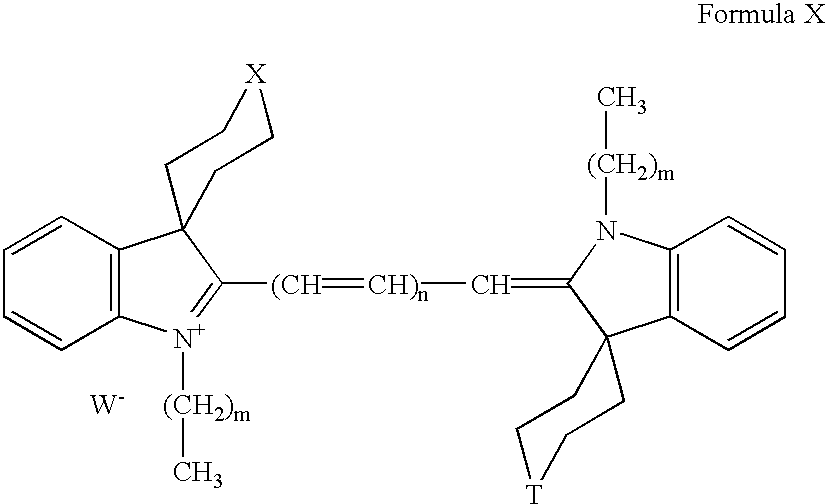
- with X, T, W − and n defined according to
claim 1, m is equal to 0, 1-17.
- with M +=,metal cation, X, Y, T, W−, m and n are defined according to
claim 1.
- with X, Y, T, W −, m and n defined according to
claim 1, p is equal to 1 to 8. - Formula XIII

- with X and n defined according to
claim 1, q is equal to 1 to 8.
- with M +=metal cation and n defined according to
claim 1, NHS=N-hydroxy-succinimid, r and s independently from each other equal to 1 to 8.
- with W − and n defined according to
claim 1.
- with W − and n defined according to
claim 1.
- with W − and n defined according to
claim 1, NHS=N-hydroxy-succinimide, PEG=poly ethylen glycole and with t and u independently from each other equal to 1 to 8.
- with W and n defined according to
claim 1, R′=trityl, R′′=phosphoramidite, v and w independently equal to 0 to 6.
- with M +=metal cation, X, Y, T, W− and n defined according to
claim 1.
- with M +=metal cation, X, Y, T, W− and n defined according to
claim 1, z equal to 0, 1 to 6. - The invention will be described in more detail by way of figures and examples below, without restricting it to them.
- FIG. 1 Synthesis of compounds S1 to S3. (Part 1)
- FIG. 2 Synthesis of compounds S1 to S3. (Part 2)
- FIG. 3 Synthesis of compounds S4 to S7. (Part 1)
- FIG. 4 Synthesis of compounds S4 to S7. (Part 2)
- FIG. 5 Synthesis of compound S8.
- FIG. 6 Synthesis of compound S9. (Part 1)
- FIG. 7 Synthesis of compound S9. (Part 2)
- FIG. 8 Absorption spectrum of the fluorescent dyes (compounds S1 to S3) according to the invention.
- FIG. 9 Absorption- and emission-spectrum of compound S2.
- FIG. 10 Absorption- and emission spectrum of the protein conjugate according to example 10.
- FIG. 11 Photostability of compound S3 (according to example 3).
- FIG. 12 Fluorescence of the protein conjugate (compound) according to example 10 depending of the incubation time.
- FIG. 13 Fluorescence of compound in the Fluorescence of compound in presence of high protein concentrations presence of high protein concentrations.
- Preparation of dyes of the symmetrical 3-spiro-1′-cyclohexan indole type
- Synthesis of dye S1
- Preparation of 2-methyl-3-spiro-1′-cyclohexan-5-sulfo-3H-indole; potassium salt(FIG. 1, 1 a)
- 30 mmol (5.646 g) phenylhydrazine sulfonic acid is heated with 60 mmol (7.5729 ) cyclohexylmethylketone and 60 mmol (5.889 g) potassium acetate in 30 ml glacial acetic acid for 6 h under reflux. Subsequently the volatile components were evaporated under reduced pressure. The brown residue is transferred into an extraction thimble and extracted with 200 ml 2-propanole using a Soxleth apparatus. The product starts crystallising in the flask even in the heat, after cooling it is filtered with suction and dried in vacuum.
- Yield: 6.044 g (66%)
- Preparation of 1-(5-carboxypentyl)-2-methyl-3-spiro-1′-cyclohexan-5-sulfo-3H-indolium bromide; potassium salt ( 1 b)
- 4.5 mmol (1.418 g) 2-methyl-3-spiro-1′-cyclohexan-5-sulfo-3H-indole is mixed with 5.5 mmol (1.073 g) 6-bromohexanoic acid and reacted in the melt at 110° C. for 2.5 h. After cooling the mixture is triturated with acetone, filtered, repeatedly washed with acetone and finally dried in vacuum.
- Yield: 1.505 g (66%)
- The quaternary spiro-indole ( 2 c) is the key component for the further steps in the synthesis.
- Dye S1
- 1-(5-carboxypentyl)-2-[5-(1-(5-carboxypentyl)-1,3-dihydro-3-spiro-1′-cyclohexan-5-sulfo-2H-indole-2-yliden)-propenyl]-3-spiro-1′-cyclohexan-5-sulfo-3H-indolium hydroxide, inner salt, potassium salt: (FIG. 2, 1 c)
- 0.4 mmol (205 mg) 1-(5-carboxypentyl)-2-methyl-3-spiro-1-cyclohexan-5-sulfo-3H-indolium bromide (potassium salt) together with 1 mmol (148 mg) triethoxymethane in 2 ml pyridine are heated under reflux for 30 minutes. After cooling the crude dye is precipitated with ether and purified by preparative HPLC using RP-18 and ethanol:water gradient.
- According to this procedure cyanine dyes with longer polymethine chain are also accessible.
- Synthesis of dye S2
- 1-(5-carboxypentyl)-2-[5-(1-(5-carboxypentyl)-1,3-dihydro-3-spiro-1′-cyclohexan-5-sulfo-2H-indole-2-yliden)-penta-1,3-dienyl]-3-spiro-1′-cyclohexan-5-sulfo-3H-indolium hydroxide, inner salt, potassium salt: (FIG. 2, 1 d)
- 0.22 mmol (111.6 mg) 1-(5-carboxypentyl)-2-methyl-3-spiro-1′-cyclohexan-5-sulfoindolium bromide (potassium salt) were dissolved in 1 ml of dry pyridine and refluxed. Then 0,5 ml tetraethoxypropane is added in portions over a period of 2.5 h. The precipitated dye is repeatedly washed with pyridine, finally washed with diethylether and purified by preparative HPLC using methanol water gradient on silicagel RP-18.
- Synthesis of dye S3
- 1-(5-carboxypentyl)-2-[5-(1-(5-carboxypentyl)-1,3-dihydro-3-spiro-1′-cyclohexan-5-sulfo-2H-indole-2-yliden)-hepta-1,3,5-trienyl]-3-spiro-1′-cyclohexan-5-sulfo-3H-indolium hydroxide, inner salt, potassium salt (FIG. 2, 1 e)
- 0.32 mmol (125 mg) 1-(5-carboxypentyl)-2-methyl-3-spiro-1′-cyclohexan-5-sulfoindolium bromide (potassium salt) together with 0.16 mmol (45 mg) glutaconedianil hydrochloride and 0.65 mmol (63 mg) potassium acetate in a mixture of 2 ml acetic anhydride and 0.5 ml glacial acetic acid are heated to reflux for 30 minutes. The crude dye is precipitated with acetone, filtered off and purified by preparative HPLC using a ethanol-water gradient on silicagel RP-18.
- Preparation of dyes of the asymmetric 3-spiro-1-cyclohexan indole type
- Synthesis of dye S4
- 2-methyl-3-spiro-1′-cyclohexan-3H-indole (FIG. 3, 2 a)
- 1.25 mol (135.2 g) phenylhydrazine and 1.5 mol (189.3 g) cyclohexylmethylketone in 1.251 glacial acetic acid are heated to reflux for 3 h. The glacial acetic acid is evaporated in vacuum, 11 of water is added to the residue and the solution is extracted 4 x with ether. After the etheric layer is washed with sodium hyrogencarbonate solution and dried with sodium sulfate, the ether is evaporated and the residue is distilled in vacuum.
- bp.(2 mbar): 133-136° C.
- yield: 192.6 g (77%)
- 1-(4-sulfobutyl)-2-methyl-3-spiro-1′cyclohexan-3H-indolium hydroxide inner salt (FIG. 3, 2 b)
- 28.7 mmol (5.72 g) 2-methyl-3-spiro-1′-cyclohexan-3H-indole and 32 mmol (4.36 g) butanesultone are heated to 120° C. for 4 h. After cooling the mixture is triturated with 50 ml ether, washed 2 x with ethylacetate, again with ether and finally dried in vacuum.
- Yield: 7.93 g (82%)
- 2-(4-acetanilino-1,3-butadienyl)-3-spiro-1′-cyclohexan-1-(4-sulfobutyl)-3H-indolium hydroxide inner salt (FIG. 3, 2 c)
- 4 mmol (1.34 g) 1-(4-sulfobutyl)-2-methyl-3-spiro-1′cyclohexan-3H-indolium hydroxide inner salt and 5 mmol malondianil (prepared from 5 mmol (1.62 g) malondianilhydroperchlorate and 5 mmol (490 mg) potassiumacetate in abs. ethanol, diluted with diethylether and evaporation of the filtrate) in 5 ml acetic anhydride and 5 ml glacial acetic acid are heated at 80° C. for 3 h. The solvent is evaporated in vacuum and the residue triturated with ether, filtered off and washed with ether until the filtrate is colourless. The product is dried in vacuum and used for the next steps without further purification. Yield:2.00 g (98% d.Th.)
- 1-(4-acetoxybutyl)-2-methyl-3-spiro-1′-cyclohexan-3H-indolium iodide (FIG. 3, 2 d)
- 0.27 mol (49.8 g) 2-methyl-3-spiro-1′-cyclohexan-3H-indole and 0.27 mol (70.0 g) 4-iodobutylacetate are heated for 5 h at 110° C. After cooling the residue is dissolved in small amount of methylenchloride and stirred with 500 ml of ether. After stirring for a while the product crystallises, it is sucked of, washed with ether and dried in vacuum.
- Yield: 104.9 g (87%)
- Analogous to the preparation of 1-(4-acetoxybutyl)-2-methyl-3-spiro-1′-cyclohexan-3H-indolium iodide ( 2 d) the according derivatives of 2-methylbenzoxazole, 2-methylbenzothiazole, 4-methylpyridine and 4-methylchinoline are accessible.
- 1-(4-acetoxybutyl)-2-methyl benzoxazolium iodide ( 2 e)
- 10 mmol (1.33 g) 2-methylbenzoxazole and 10 mmol (2.42 g) 4-iodobutylacetate are heated for 6 h at 130° C. and after cooling mixed with 10 ml of ethylacetate. The crystals obtained are washed with ether and dried in vacuum.
- Yield:2.17 g (58%)
- 1-(4-acetoxybutyl)-2-methyl benzothiazolium iodide ( 2 f)
- 10 mmol (1.49 g) 2-methyl-benzothiazole and 10 mmol (2.42 g) 4-iodobutylacetate are heated for 4 h at 120° C. and after cooling mixed with ether sucked off, again washed with ether and dried in vacuum.
- Yield:3.01 g (77%)
- 1-(4-acetoxybutyl)-4-methyl-pyridinium iodide ( 2 g)
- 10 mmol (0.93 g) y-picoline and 10 mmol (2.42 g) 4-iodobutylacetate are heated 4 h at 120° C. and after cooling repeatedly stirred with ether, decanted a finally dried in vacuum.
- Yield:2.35 g (70% d.Th.) viscous mass
- 1-(4-acetoxybutyl)-4-methyl-chinolinium iodide (2 h)
- 10 mmol (1.43 g) lepidine and 10 mmol (2.42 g) 4-iodobutylacetate are heated 4 h at 120° C. and after cooling repeatedly stirred with ether, decanted a finally dried in vacuum.
- Yield:3.13 g (81% d.Th.) viscous mass
- Dye S4
- 1-(4-hydroxybutyl)-2-[5-(1,3-dihydro-1-(4-sulfo-butyl)-3-spiro-1′-cyclohexan-2H-indole-2-ylidene)-penta-1,3-dienyl]-benzoxazolium hydroxide inner salt (FIG. 4, 2 i)
- 0.20 mmol (101 mg) 2-(4-acetanilino-1,3-butadienyl)-3-spiro-1′cyclohexan-1-(4-sulfobutyl)-3H-indolium hydroxide inner salt, 0.21 mmol (79 mg) 1-(4-acetoxybutyl)-benzoxazolium iodide and 0.21 mmol (29.3 μl) triethylamine are refluxed in 1 ml abs. ethanol for 30 min. After cooling 5 ml ether is added and decanted. The residue is dissolved in a mixture of 1 ml conc. HCl and 9 ml methanol and left overnight at 4° C. The solvent is evaporated in vacuum and the residue is purified by chromatography on silicagel RP-18 and acetonitrile-water (1:1).
- Synthesis of dye S5
- 1-(4-hydroxybutyl)-2-[5-(1,3-dihydro-1-(4-sulfo-butyl)-3-spiro-1′-cyclohexan-2H-indole-2-yliden)-penta-1,3-dienyl]-benzothiazolium hydroxide inner salt (FIG. 4, 2 j)
- Analogously to the procedure cited above 0.21 mmol (82 mg) 1-(4-acetoxybutyl)-benzothiazolium iodide are reacted with the appropriate reagents.
- Synthesis of dye S6
- 1-(4-hydroxybutyl)-4-[5-(1,3-dihydro-1-(4-sulfobutyl)-3-spiro-1′-cyclohexan-2H-indole-2-yliden)-penta-1,3-dienyl]-pyridinium hydroxide inner salt (FIG. 4, 2 k)
- Analogously to the procedure cited above 0.21 mol (71 mg) 1-(4-acetoxybutyl)-pyridinium iodide are reacted with the appropriate reagents.
- Synthesis of dye S7
- 1- (4-hydroxybutyl) -4-[5- (1,3-dihydro-1- (4-sulfobutyl)-3-spiro-1′-cyclohexan-2H-indole-2-yliden)-penta-1,3-dienyl]-chinolinium hydroxide inner salt (FIG. 4, 2 l)
- Analogously to the procedure cited above 0.21 mmol (81 mg) 1-(4-acetoxybutyl)-chinolinium iodide are reacted with the appropriate reagents.
- Due to the state of the art, the hydroxylsubstituted fluorophores, prepared according to 2 i-2 lmay be converted to the corresponding phosphoramidites with 2-cyanoethyl-N.N-diisopropyl-chlorophosphoramidite and coupled with DNA.
- Preparation of dyes of the asymmetric 3-spiro-1′-4-tetrahydropyrane-indole type
- Synthesis of dye S8
- 2-methyl-5-sulfo-3-spiro-4′-tetrahydropyrane-3H-indole (FIG. 5, 3 a)
- 40 mmol (7.53 g) phenylhydrazine-4-sulfonic acid and 44 mmol 4-acetyltetrahydropyrane in 40 ml glacial acetic acid were refluxed 48 h under nitrogen. Afterwards the precipitate is filtered and the acetic acid is evaporated. The residue is dissolved in a small amount of water and 4ml of 10M NaOH is added. After evaporation to dryness the residue is extracted with 2-propanole. The extract is evaporated and the residue dried in vacuum.
- Yield: 6.94 g (57%)
- 1-ethyl-2-methyl-5-sulfo-3-spiro-4′-tetrahydropyrane-3H-indolium hydroxide inner salt (FIG. 5, 3 b)
- 5.2 mmol (1,58 g) 2-methyl-5-sulfo-3-spiro-4′-tetra-hydropyrane-3H-indole and 5.72 mmol (882 mg) diethylsulfate are heated for 5 h at 110° C. in 3 ml 1.2-dichlorobenzene. After cooling the mixture is diluted with acetone and filtered. The resulting cake is thoroughly washed with acetone and dried in vacuum.
- Yield:1.089 (67%)
- 1-(5-carboxypentyl)-2-methyl-5-sulfo-3-spiro-4′-tetrahydtopyrane-3H-indolium inner salt (FIG. 5, 3 c)
- 10 mmol (3.03 g) 2-ethyl-5-sulfo-3-spiro-4′-tetrahydro-yrane-3H-indole and 15 mmol (22.93 g) 6-bromohexanoic acid are heated in 10 ml of 1,2-dichlorobenzene for 24 h at 120° C. After cooling the solution is diluted with acetone and decanted. The precipitate is triturated with hot 2-propanole, cooled, filtered, washed with 2-propanole and acetone and finally dried in vacuum.
- Yield 3.07 g (78%)
- 2-(4-acetanilino-1,3-butadienyl)-1-ethyl-3-spiro-4′-tetrahydropyrane-5-sulfo-3H-indolium hydroxide inner salt (FIG. 5, 3 d)
- 3 mmol (0.93 g) 1-ethyl-2-methyl-3-spiro-4′-tetrahydro-pyrane-5-sulfo-3H-indolium toluenesulfonate and 3.6 mmol malondianile (prepared from 3.6 mmol (prepared from 3.6 mmol (1.165 g) malondianilehydroperchlorate and 3.6 mmol (353 mg) potassium acetate in abs. ethanol, diluted with diethylether and evaporation of the filtrate) in 15 ml of a mixture of glacial acetic acid and acetic anhydride (1:1 v/v) and heated for 3 h at 80° C. The solvent is evaporated in vacuum and the residue triturated with ether, filtered off and washed with ether until the filtrate is colourless. The product is dried in vacuum.
- Yield:1.33 g (92%)
- dye S8
- 1-(5-carboxypentyl)-2-[5-(1,3-dihydro-1-ethyl)-3-spiro-4′-tetrahydropyrane-5-sulfo-2H-indole-2-yliden)-penta-1,3-dienyl]-3-spiro-4′-tetrahydropyrane-5-sulfo-3H-indolium hydroxide inner salt potassium salt, (FIG. 5, 3 e)
- 2.5 mmol (1.20 g) 2-(4-acetanilino-1,3-butadienyl)-3-spiro-4′-tetrahydropyrane-1-ethyl-5-sulfo-3H-indolium hydroxide inner salt in a mixture of 5 ml pyridine and 5 ml acetic anhydride are treated with 2.7 mmol (1.07 g) 1-(5-carboxypentyl)-2-methyl-5-sulfo-3-spiro-4′-tetrahydropyran-3H-indolium inner salt and refluxed for 40 min. The solution is concentrated in vacuum to one third and the crude dye is precipitated with ether and decanted. The residue is dissolved in a small amount of 1M HCl and repreciptated with a saturated solution of KCl. The precipitate is separated, dissolved in water and purified by reversed-phase chromatography on silicagel RP-18 with an acetonitrile-water gradient.
- Preparation of dyes of the asymmetric 3-spiro-1′-4′-piperidyl-indole type
- Syntheses of dye S9
- Synthesis of 2-methyl-3-spiro-4′-(1′-carboxybenzyl)-piperidine-3H-indole (FIG. 6, 4 a)
- 4.31 g (16.5 mmol) of the piperidylketone and 1.62 g (1.48 ml, 15 mmol) phenylhydrazine are dissolved in 15 ml glacial acetic acid under inert gas atmosphere and refluxed for 3.5 h. The excess acetic acid is distilled in vacuum on a rotary evaporator remaining a brown oil. The oil is taken up in 80 ml of water and extracted thrice with each 40 ml diethylether. The combined organic layers are washed once again with 40 ml of water and dried over magnesiumsulfate. The solvent is distilled off in vacuum on a rotary evaporator. The remaining brown oil is purified by column chromatography (dichloromethane/ethylacetate =2:1) The indole is obtained as reddish oil. Yield=3.23 g, 9.7 mmol,(64%).
- Synthesis of 1-ethyl-2-methyl-3-spiro-4′-(1′-carboxybenzyl)-piperidine-3H-indolenium ethyl sulfate (FIG. 6, 4 b)
- Under inert gas atmosphere 2.06 g (6 mmol) of 2-methyl-3-spiro-4′-(1′-carboxybenzyl)-piperidine-3H-indole ( 4 a) are dissolved in 3 ml toluene. 1.02 g (0.89 ml, 6.6 mmol) diethylsulfate are added through a syringe. The mixture is refluxed for 3.5 h, precipitating a dark purple oil, which turns solid on cooling. The supernatant liquid is decanted and the residue repeatedly washed with small portions of toluene. The solid is purified by columnchromatography with the aid of a gradient system(l. ethylacetate ,2. acetone/glacial acetic acid=10:2). The quaternary indole is eluted twice with the solvent and the product is obtained as highly viscous oil (0.93 g, 1.9 mmol, 32%)
- Synthesis of 2-(4-acetanilino-1,3-butadienyl)-1-ethyl-3-spiro-4′-(1′-carboxybenzyl)-piperidine-3H-indolenium ethyl sulfate (FIG. 6, 4 c)
- 0.93 g (1.9 mmol) of the quaternary indole ( 4 b) and 2.4 mmol malondianil (prepared from 0.79 g (2.4 mmol) malondianil-hydroperchlorate and 0.23 g (2.4 mmol) potassium acetate in abs. ethanol, diluted with diethylether and evaporation of the filtrate) in 3 ml of acetic anhydride and 3 ml glacial acetic acid are heated for 3 h at 80° C. The solvent is removed under reduced pressure on a rotary evaporator. The solid residue is triturated with diethylether, filtered and washed with ether until the filtrate is colourless. The crude product (1.19 g, 1.8 mmol, 97%) is dried in vacuum and used in the next step without further purification.
- Synthesis of 1-carboxypentyl-2-methyl-3-spiro-4′-(1′-carboxybenzyl)-piperidine-3H-indolium bromide (FIG. 6, 4 d)
- 2.06 g (6 mmol) 2-methyl-3-spiro-4′-(1′-carboxy-benzyl)-piperidine-3H-indole ( 4 a) are heated in 5 ml 6-
bromohexanoicacid 3,5h a 120° C. The supernatant is decanted from the reddish solid. Purification is carried out by column chromatography (water/acetic acid=10:2).The quaternary indole is obtained as reddish highly viscous oil (0.95 g, 1.8 mmol, 30%) - Dye S9
- Synthesis of 1-(5-carboxypentyl)-2-[5-(1,3-dihydro-1-(1-ethyl)-3-spiro-4′-(1′-carboxybenzyl)-piperidine-2H-indole-2-yliden)-penta-1,3-dienyl]-3-spiro-4′-(1′-carboxybenzyl)-piperidin-3H-indolenium ethyl sulfate (FIG. 6, 4 e)
- 0.62 g (1.8 mmol) of the hemicyanine ( 4 c) and 0.71 g (1.8 mmol) the indole (4 d) in 3 ml acetic anhydride and 3 ml pyridine are refluxed for 30 min. The mixture is evaporated to dryness in vacuum on a rotary evaporator. The solid residue is taken up in a mixture of 10 ml conc. HCl and 100 ml methanol and left overnight at 4° C. The solvent is distilled off at reduced pressure and the residue is purified by column chromatography (isopropanol:water, 2:1 (v/v)). The dye S9 is obtained as dark blue crystalline solid (0.36 g, 0.38 mmol, 21% ).
- Synthesis of 1-(5-carboxypentyl)-2-[5-(1,3-dihydro-1-(1-ethyl)-3-spiro-4′-piperidine-2H-indole-2-ylidene)-penta-1,3-dienyl]-3-spiro-4′-piperidine-3H-indolenium ethylsulfate (FIG. 7, 4 f)
- 0.36 g (0.38 mmol) of the dye ( 4 e) is dissolved under an inertgas atmosphere in 5 ml of chloroform. With a syringe 0.09 g (0.07 ml, 0.46 mmol) of iodotrimethylsilane is added and the mixture is stirred at room temperature until the educt is not detectable again by thinlayer chromatography (isopropanol/water=10:2, v/v) . After that 2ml of methanol is added and the mixture is stirred for 5 min. at room temperature. The liquid components are distilled off in vacuum on a rotary evaporator and the solid residue is purified by column chromatography with the eluent isopropanol:water=2:1. Yield: 0.23 g, 0,3 mmol (80%)
- The deprotected dye S9 ( 4 f) can be converted into a polyethylen glycole-substituted dye (4 g) by melting together with glycidyl-PEG.
- Absorption spectra of the dyes (S1-S3) prepared in examples 1-3 are shown in FIG. 8.
- In order to covalently label target molecules the carbonyl moiety has to be converted into an activated ester (reactive group R x) . Due to state of the art, this can be carried out with N-hydroxysuccinimide in the presence of 1-ethyl-3-(3-dimethylaminopropyl) carbodiimide (EDC) in aqueous solution or with dicyclohexylcarbodiimide (DCC) in organic solution (FIG. 2, 1f)
- Coupling of the NHS activated pentamethine-spiro-cyanine (compound S2) to protein
- 0,2 mg activated dye are added while shaking to 1 mg of bovine serum albumin in 1
ml 10 mM phosphate buffer, pH 8.0. After a reaction time of 60 min, the coupling is stopped by the addition of 40 μl glycine solution (10% m/v, in PBS-buffer, pH 7,4) and the excess of dye is removed through dialysis or gelfiltration. - FIG. 9 shows the emission spectrum of the dye-conjugate obtained with dye S2 (example 2) as described in example 10.
- In comparison, FIG. 10 shows the corresponding spectrum of a common conjugate created under identical conditions. A band in the absorption spectrum at about λ=600 nm due to dimer formation which leads to reduced fluorescence can clearly be seen.
- The mobility of the fluorescent dye is reduced due to the influence of the bulky spiro-substituent, which leads to an increased photostability. FIG. 11 displays the photostability of the compound S3 prepared according to example 3, determined in 10 mM phosphate buffer, pH 7.4, compared to a commercial state-of-the-art heptamethine dye. Irradiation was performed using a krypton-lamp and 20 mW/cm 2 at λ>400 nm.
- By determination of the fluorescence of the S3-conjugate, according to example 10, in comparison to a conjugate, created using a common cyanine-dye, the results displayed in FIG. 12 are obtained. The resulting fluorescence of the conjugates, created under identical conditions, was determined at different incubation times after separation of the excess of the dye. The longer the incubation time, the higher the label degree fluorophor:protein. The formation of a narrow maximum is observed with the conjugate according to the state of the art, the resulting fluorescence decreases more than 50% at higher labeling degrees due to self-quenching phemonena. In contrast, conjugates with the fluorescent dye according to the invention (examples 2 and 10) show a substantially reduced tendency towards aggregation and thus exhibit higher fluorescence. The fluorescence of the conjugate with the invention based fluorophor (example 10) after an incubation time of 15 minutes is more than double as high as the one of the conjugate with a state-of-the-art fluorophor.
- The spiro-substituent also causes a shielding of the central polymethine chain against the influence of the surroundings of the fluorophor. As known, many fluorophores exhibit a shift of their absorption-maximum towards longer wavelengths and a simultaneous increase of fluorescence with an increase of protein concentration. This is caused by the changed environment created by the protein and the reduced mobility of the fluorescent dye. This effect is minimized with the fluorescent dye according to the invention. As shown in FIG. 13 (normalized display), there only is a minimal increase of fluorescence in the presence of high concentrations of bovine serum albumin (BSA) . The fluorescence of the commercial fluorophor, in contrast, is highly dependent on the environment. Latter effect is a very strong disadvantage when analyzing substances in blood serum.
- In table 2 the characteristic data of selected fluorescent dyes according to the invention are shown.
TABLE 1 type of chemical electrophilic group nucleophilic group bondage formed activated ester1) amine/aniline carboxamide acylazide amine/aniline carboxamide acylhalide amine/aniline carboxamide acylhalogene alkohole/phenole ester acylnitrile alkohole/phenole ester acylnitrile amine/aniline carboxamide aldehyde amine/aniline imine aldehyde/ketone hydrazine hydrazone aldehyde/ketone hydroxylamine oxime alkylhalogene amine/aniline alkylamine alkylhalogene carbonic acids ester alkylhalogene thiole thio ether alkylhalogene alcohol/phenol ether alkylsulfonate thiole thio ether alkylsulfonate carbonic acids ester alkylsulfonate alcohol/phenol ester anhydride alcohol/phenol ester anhydride amine/aniline carboxamide arylhalogene thiole thiophenole arylhalogene amine arylamine aziridine thiole thioester boronate glycole boronatester carbonic acids amine/aniline carboxamide carbonic acids alcohol ester carbonic acids hydrazine hydrazide carbodiimide carbonic acids N-acyl-urea diazoalkane carbonic acids ester epoxide thiole thio ether haloacetamide thiole thio ether halotriazine amine/aniline aminotriazine halotriazine alcohol/phenol triazinether imidoester amin/aniline amidine isocyanate amine/aniline urea isocyanate alcohol/phenol urethane isothiocyanate amine/aniline thiourea maleimide thiole thio ether phosphoramidite alcohol phosphite triester silylhalogene alcohol silyl ether sulfonic acid ester amine/aniline alkylamine sulfonic acid ester carbonic acids ester sulfonic acid ester thiole thio ether sulfonic acid ester alcohol ether sulfonic acid ester amine/aniline sulfonamide sulfonylchloride alcohol/phenol sulfonic acid ester -
TABLE 2 charactareistic data of selected fluorescent dyes according to the invention absorption emission- maximum maximum Compound (nm) (nm) S1* 557 572 S2* 656 672 S3* 756 772 S4** 612 638 S5** 650 676 S6** 603 626 S7** 702 728 S8** 662 684 S9** 660 682
Claims (41)


Applications Claiming Priority (4)
| Application Number | Priority Date | Filing Date | Title |
|---|---|---|---|
| DE10046215.4 | 2000-09-19 | ||
| DE10046215 | 2000-09-19 | ||
| DE10046215A DE10046215B4 (en) | 2000-09-19 | 2000-09-19 | Fluorochromes and their use |
| PCT/EP2001/010130 WO2002026890A1 (en) | 2000-09-19 | 2001-09-03 | 3-spiro-cyanin fluorochromes and their use in bioassays |
Publications (2)
| Publication Number | Publication Date |
|---|---|
| US20030138791A1 true US20030138791A1 (en) | 2003-07-24 |
| US7855293B2 US7855293B2 (en) | 2010-12-21 |
Family
ID=7656704
Family Applications (1)
| Application Number | Title | Priority Date | Filing Date |
|---|---|---|---|
| US10/130,547 Expired - Fee Related US7855293B2 (en) | 2000-09-19 | 2001-09-03 | 3-spiro-cyanin fluorochromes and their use in bioassays |
Country Status (6)
| Country | Link |
|---|---|
| US (1) | US7855293B2 (en) |
| EP (1) | EP1320571B1 (en) |
| AU (1) | AU2001284051A1 (en) |
| CA (1) | CA2422758A1 (en) |
| DE (2) | DE10046215B4 (en) |
| WO (1) | WO2002026890A1 (en) |
Cited By (3)
| Publication number | Priority date | Publication date | Assignee | Title |
|---|---|---|---|---|
| US20020064794A1 (en) * | 2000-09-29 | 2002-05-30 | Molecular Probes, Inc. | Modified carbocyanine dyes and their conjugates |
| US20100260682A1 (en) * | 2002-12-10 | 2010-10-14 | Echelon Biosciences Incorporated | Compounds and methods of use thereof for assaying lysophospholipase D activity |
| US20110182810A1 (en) * | 2009-12-25 | 2011-07-28 | Canon Kabushiki Kaisha | Central nervous system labelling composition for intranasal administration and labelling method and screening method using central nervous system labelling composition for intranasal administration |
Families Citing this family (13)
| Publication number | Priority date | Publication date | Assignee | Title |
|---|---|---|---|---|
| JP2003048879A (en) | 2001-05-31 | 2003-02-21 | Nisshinbo Ind Inc | Fluorescent group-containing carbodiimide compound and method for producing the compound |
| DE102006029454A1 (en) | 2005-12-05 | 2007-06-06 | Dyomics Gmbh | Hydrophilic markers based on diastereomeric |
| JP2011506673A (en) † | 2007-12-14 | 2011-03-03 | バイオティウム, インコーポレイテッド | Fluorescent compound |
| US7951959B2 (en) | 2008-09-17 | 2011-05-31 | Thermo Fisher Scientific (Milwaukee) LLC | Hydrophilic labels for biomolecules |
| CA2748500C (en) | 2009-01-29 | 2017-10-17 | Commonwealth Scientific And Industrial Research Organisation | Measuring g protein coupled receptor activation |
| US10053447B2 (en) | 2010-12-21 | 2018-08-21 | Pierce Biotechnology, Inc | Fluorescent compounds |
| US8889884B1 (en) | 2011-07-14 | 2014-11-18 | Pierce Biotechnology, Inc. | Phosphine derivatives of fluorescent compounds |
| US9249307B2 (en) | 2011-08-16 | 2016-02-02 | Pierce Biotechnology, Inc. | Benzocyanine compounds |
| US9751868B2 (en) | 2012-02-28 | 2017-09-05 | Pierce Biotechnology, Inc. | Benzocyanine compounds |
| CN104395306B (en) | 2012-03-02 | 2019-04-23 | 皮尔斯生物科技有限公司 | Indole Derivatives as Labeling Dyes for Biomolecules |
| US9676787B2 (en) | 2012-08-28 | 2017-06-13 | Pierce Biotechnology, Inc. | Benzopyrylium compounds |
| CN110132915B (en) * | 2019-05-10 | 2020-09-22 | 华南理工大学 | Aggregation-induced emission probe and method for dual detection of heavy metal ion pollutants |
| CN110591054B (en) * | 2019-09-17 | 2021-05-18 | 江苏泰特尔新材料科技股份有限公司 | Epoxide with low total chlorine content and no heavy metal residue and synthesis process thereof |
Citations (18)
| Publication number | Priority date | Publication date | Assignee | Title |
|---|---|---|---|---|
| US4981977A (en) * | 1989-06-09 | 1991-01-01 | Carnegie-Mellon University | Intermediate for and fluorescent cyanine dyes containing carboxylic acid groups |
| US5268486A (en) * | 1986-04-18 | 1993-12-07 | Carnegie-Mellon Unversity | Method for labeling and detecting materials employing arylsulfonate cyanine dyes |
| US5556959A (en) * | 1993-01-22 | 1996-09-17 | Pharmacia P-L Biochemicals Inc. | Indocarbocyanine-linked phosphoramidites |
| US5569587A (en) * | 1986-04-18 | 1996-10-29 | Carnegie Mellon University | Method for labeling and detecting materials employing luminescent arysulfonate cyanine dyes |
| US5582977A (en) * | 1991-09-16 | 1996-12-10 | Molecular Probes, Inc. | Dimers of unsymmetrical cyanine dyes |
| US5597696A (en) * | 1994-07-18 | 1997-01-28 | Becton Dickinson And Company | Covalent cyanine dye oligonucleotide conjugates |
| US5627027A (en) * | 1986-04-18 | 1997-05-06 | Carnegie Mellon University | Cyanine dyes as labeling reagents for detection of biological and other materials by luminescence methods |
| US5986086A (en) * | 1997-06-20 | 1999-11-16 | Amersham Pharmacia Biotech Inc. | Non-sulfonated cyanine dyes for labeling nucleosides and nucleotides |
| US6004536A (en) * | 1995-11-14 | 1999-12-21 | Molecular Probes, Inc. | Lipophilic cyanine dyes with enchanced aqueous solubilty |
| US6027709A (en) * | 1997-01-10 | 2000-02-22 | Li-Cor Inc. | Fluorescent cyanine dyes |
| US6048982A (en) * | 1986-04-18 | 2000-04-11 | Carnegie Mellon University | Cyanine dyes as labeling reagents for detection of biological and other materials by luminescence methods |
| US6083485A (en) * | 1994-12-07 | 2000-07-04 | Institut Fur Diagnostikforschung Gmbh | Near infrared radiation in-vivo diagnostic methods and dyes |
| US6114350A (en) * | 1999-04-19 | 2000-09-05 | Nen Life Science Products, Inc. | Cyanine dyes and synthesis methods thereof |
| US6319488B1 (en) * | 1995-10-11 | 2001-11-20 | Institut für Diagnostikforschung GmbH an der Freien Universität Berlin | Contrast medium for near infrared diagnosis |
| US6329531B1 (en) * | 1996-11-19 | 2001-12-11 | Schering Ag | Optical diagnostic agents for diagnosis of neurodegenerative diseases by means of near infrared radiation (NIR radiation) |
| US20020077487A1 (en) * | 2000-09-29 | 2002-06-20 | Molecular Probes, Inc. | Modified carbocyanine dyes and their conjugates |
| US6740755B2 (en) * | 2000-11-28 | 2004-05-25 | Giuseppe Caputo | Process and method for the preparation of asymmetric monofunctionalized indocyanine labelling reagents and obtained compounds |
| US6974698B1 (en) * | 1999-01-15 | 2005-12-13 | The United States Of America As Represented By The Department Of Health And Human Services | Methods for delivering biologically active molecules into cells |
Family Cites Families (12)
| Publication number | Priority date | Publication date | Assignee | Title |
|---|---|---|---|---|
| DE499967C (en) * | 1928-06-28 | 1930-06-25 | I G Farbenindustrie Akt Ges | Process for the preparation of polymethine dyes |
| DE3912046B4 (en) * | 1988-09-02 | 2004-03-25 | Carnegie Mellon University | Method of labeling a component of an aqueous liquid and luminescent photostable reaction product |
| IL91673A0 (en) * | 1988-09-20 | 1990-04-29 | Us Health | Method for tagging an oligodeoxynucleotide |
| US5534416A (en) | 1993-04-13 | 1996-07-09 | Molecular Probes, Inc. | Fluorescent viability assay using cyclic-substituted unsymmetrical cyanine dyes |
| JPH07114140A (en) * | 1993-10-18 | 1995-05-02 | Mitsubishi Paper Mills Ltd | Absorption dye for photography |
| JPH07271065A (en) * | 1994-02-09 | 1995-10-20 | Mitsubishi Paper Mills Ltd | Electrophotographic photoreceptor |
| JPH08292590A (en) * | 1995-04-20 | 1996-11-05 | Mitsubishi Paper Mills Ltd | Electrophotographic photoreceptor |
| JP3414928B2 (en) * | 1996-04-25 | 2003-06-09 | 三菱製紙株式会社 | Thermal recording material for infrared laser |
| JPH10195319A (en) | 1997-01-13 | 1998-07-28 | Mitsubishi Paper Mills Ltd | Method for producing polymethine cyanine compound |
| JPH10219124A (en) * | 1997-02-12 | 1998-08-18 | Mitsubishi Paper Mills Ltd | Spiroindolenine ring-containing methine dye |
| DE19717904A1 (en) | 1997-04-23 | 1998-10-29 | Diagnostikforschung Inst | Acid-labile and enzymatically cleavable dye constructs for diagnostics with near infrared light and for therapy |
| DE19940394C2 (en) | 1999-08-25 | 2002-03-21 | Inst Chemo Biosensorik | Fluorochromes and their use |
-
2000
- 2000-09-19 DE DE10046215A patent/DE10046215B4/en not_active Expired - Fee Related
-
2001
- 2001-09-03 DE DE50113301T patent/DE50113301D1/en not_active Expired - Lifetime
- 2001-09-03 CA CA002422758A patent/CA2422758A1/en not_active Abandoned
- 2001-09-03 WO PCT/EP2001/010130 patent/WO2002026890A1/en not_active Ceased
- 2001-09-03 EP EP01962995A patent/EP1320571B1/en not_active Expired - Lifetime
- 2001-09-03 AU AU2001284051A patent/AU2001284051A1/en not_active Abandoned
- 2001-09-03 US US10/130,547 patent/US7855293B2/en not_active Expired - Fee Related
Patent Citations (23)
| Publication number | Priority date | Publication date | Assignee | Title |
|---|---|---|---|---|
| US5268486A (en) * | 1986-04-18 | 1993-12-07 | Carnegie-Mellon Unversity | Method for labeling and detecting materials employing arylsulfonate cyanine dyes |
| US5486616A (en) * | 1986-04-18 | 1996-01-23 | Carnegie Mellon University | Method for labeling and detecting materials employing arylsulfonate cyanine dyes |
| US5569587A (en) * | 1986-04-18 | 1996-10-29 | Carnegie Mellon University | Method for labeling and detecting materials employing luminescent arysulfonate cyanine dyes |
| US6048982A (en) * | 1986-04-18 | 2000-04-11 | Carnegie Mellon University | Cyanine dyes as labeling reagents for detection of biological and other materials by luminescence methods |
| US5627027A (en) * | 1986-04-18 | 1997-05-06 | Carnegie Mellon University | Cyanine dyes as labeling reagents for detection of biological and other materials by luminescence methods |
| US4981977A (en) * | 1989-06-09 | 1991-01-01 | Carnegie-Mellon University | Intermediate for and fluorescent cyanine dyes containing carboxylic acid groups |
| US5582977A (en) * | 1991-09-16 | 1996-12-10 | Molecular Probes, Inc. | Dimers of unsymmetrical cyanine dyes |
| US5556959A (en) * | 1993-01-22 | 1996-09-17 | Pharmacia P-L Biochemicals Inc. | Indocarbocyanine-linked phosphoramidites |
| US5597696A (en) * | 1994-07-18 | 1997-01-28 | Becton Dickinson And Company | Covalent cyanine dye oligonucleotide conjugates |
| US20030170179A1 (en) * | 1994-12-07 | 2003-09-11 | Institut Fur Diagnostikforschung Gmbh An Der Freien Universita (Copy) | Near infrared imaging agent |
| US6083485A (en) * | 1994-12-07 | 2000-07-04 | Institut Fur Diagnostikforschung Gmbh | Near infrared radiation in-vivo diagnostic methods and dyes |
| US6319488B1 (en) * | 1995-10-11 | 2001-11-20 | Institut für Diagnostikforschung GmbH an der Freien Universität Berlin | Contrast medium for near infrared diagnosis |
| US6004536A (en) * | 1995-11-14 | 1999-12-21 | Molecular Probes, Inc. | Lipophilic cyanine dyes with enchanced aqueous solubilty |
| US6329531B1 (en) * | 1996-11-19 | 2001-12-11 | Schering Ag | Optical diagnostic agents for diagnosis of neurodegenerative diseases by means of near infrared radiation (NIR radiation) |
| US6027709A (en) * | 1997-01-10 | 2000-02-22 | Li-Cor Inc. | Fluorescent cyanine dyes |
| US5986086A (en) * | 1997-06-20 | 1999-11-16 | Amersham Pharmacia Biotech Inc. | Non-sulfonated cyanine dyes for labeling nucleosides and nucleotides |
| US6974698B1 (en) * | 1999-01-15 | 2005-12-13 | The United States Of America As Represented By The Department Of Health And Human Services | Methods for delivering biologically active molecules into cells |
| US6204389B1 (en) * | 1999-04-19 | 2001-03-20 | Nen Life Science Products, Inc. | Cyanine dyes and synthesis methods thereof |
| US6224644B1 (en) * | 1999-04-19 | 2001-05-01 | Nen Life Science Products, Inc. | Cyanine dyes and synthesis methods thereof |
| US6197956B1 (en) * | 1999-04-19 | 2001-03-06 | Nen Life Science Products, Inc. | Cyanine dyes and synthesis methods thereof |
| US6114350A (en) * | 1999-04-19 | 2000-09-05 | Nen Life Science Products, Inc. | Cyanine dyes and synthesis methods thereof |
| US20020077487A1 (en) * | 2000-09-29 | 2002-06-20 | Molecular Probes, Inc. | Modified carbocyanine dyes and their conjugates |
| US6740755B2 (en) * | 2000-11-28 | 2004-05-25 | Giuseppe Caputo | Process and method for the preparation of asymmetric monofunctionalized indocyanine labelling reagents and obtained compounds |
Cited By (24)
| Publication number | Priority date | Publication date | Assignee | Title |
|---|---|---|---|---|
| US7820824B2 (en) | 2000-09-29 | 2010-10-26 | Life Technologies Corporation | Modified carbocyanine dyes and their conjugates |
| US20020064794A1 (en) * | 2000-09-29 | 2002-05-30 | Molecular Probes, Inc. | Modified carbocyanine dyes and their conjugates |
| US6977305B2 (en) | 2000-09-29 | 2005-12-20 | Molecular Probes, Inc. | Modified carbocyanine dyes and their conjugates |
| US20060004188A1 (en) * | 2000-09-29 | 2006-01-05 | Wai-Yee Leung | Intermediates and the synthesis of modified carbocyanine dyes and their conjugates |
| US20070178512A1 (en) * | 2000-09-29 | 2007-08-02 | Invitrogen Corporation | Modified carbocyanine dyes and their conjugates |
| US20070178511A1 (en) * | 2000-09-29 | 2007-08-02 | Invitrogen Corporation | Modified carbocyanine dyes and their conjugates |
| US9423323B2 (en) | 2000-09-29 | 2016-08-23 | Life Technologies Corporation | Modified carbocyanine dyes and their conjugates |
| US20090035810A1 (en) * | 2000-09-29 | 2009-02-05 | Invitrogen Corporation | Modified carbocyanine dyes and their conjugates |
| US7566790B2 (en) | 2000-09-29 | 2009-07-28 | Life Technologies Corporation | Intermediates and the synthesis of modified carbocyanine dyes and their conjugates |
| US7671214B2 (en) | 2000-09-29 | 2010-03-02 | Molecular Probes, Inc. | Modified carbocyanine dyes and their conjugates |
| US6974873B2 (en) | 2000-09-29 | 2005-12-13 | Molecular Probes, Inc. | Modified carbocyanine dyes and their conjugates |
| US20090035809A1 (en) * | 2000-09-29 | 2009-02-05 | Invitrogen Corporation | Modified Carbocyanine Dyes and Their Conjugates |
| US8252932B2 (en) | 2000-09-29 | 2012-08-28 | Life Technologies Corporation | Modified carbocyanine dyes and their conjugates |
| US7927830B2 (en) | 2000-09-29 | 2011-04-19 | Life Technologies Corporation | Modified carbocyanine dyes and their conjugates |
| US20110171678A1 (en) * | 2000-09-29 | 2011-07-14 | Life Technologies Corporation | Modified carbocyanine dyes and their conjugates |
| US9018396B2 (en) | 2000-09-29 | 2015-04-28 | Life Technologies Corporation | Modified carbocyanine dyes and their conjugates |
| US7790893B2 (en) | 2000-09-29 | 2010-09-07 | Life Technologies Corporation | Modified carbocyanine dyes and their conjugates |
| US8614302B2 (en) | 2000-09-29 | 2013-12-24 | Life Technologies Corporation | Modified carbocyanine dyes and their conjugates |
| US8569506B2 (en) | 2000-09-29 | 2013-10-29 | Life Technologies Corporation | Modified carbocyanine dyes and their conjugates |
| US8512971B2 (en) * | 2002-12-10 | 2013-08-20 | Echelon Biosciences, Inc. | Compounds and methods of use thereof for assaying lysophospholipase D activity |
| US20100260682A1 (en) * | 2002-12-10 | 2010-10-14 | Echelon Biosciences Incorporated | Compounds and methods of use thereof for assaying lysophospholipase D activity |
| US8652438B2 (en) * | 2009-12-25 | 2014-02-18 | Canon Kabushiki Kaisha | Central nervous system labelling composition for intranasal administration and labelling method and screening method using central nervous system labelling composition for intranasal administration |
| US20110182810A1 (en) * | 2009-12-25 | 2011-07-28 | Canon Kabushiki Kaisha | Central nervous system labelling composition for intranasal administration and labelling method and screening method using central nervous system labelling composition for intranasal administration |
| US9649392B2 (en) | 2009-12-25 | 2017-05-16 | Canon Kabushiki Kaisha | Central nervous system labelling composition for intranasal administration and labelling method and screening method using central nervous system labelling composition for intranasal administration |
Also Published As
| Publication number | Publication date |
|---|---|
| EP1320571B1 (en) | 2007-11-21 |
| DE50113301D1 (en) | 2008-01-03 |
| WO2002026890A1 (en) | 2002-04-04 |
| US7855293B2 (en) | 2010-12-21 |
| DE10046215B4 (en) | 2004-04-15 |
| EP1320571A1 (en) | 2003-06-25 |
| AU2001284051A1 (en) | 2002-04-08 |
| CA2422758A1 (en) | 2003-03-18 |
| DE10046215A1 (en) | 2002-04-04 |
Similar Documents
| Publication | Publication Date | Title |
|---|---|---|
| US7855293B2 (en) | 3-spiro-cyanin fluorochromes and their use in bioassays | |
| CN104704366B (en) | Azaindole quinoline-the cyanine dye and its bioconjugates of hydroxamic acid substitution | |
| US5433896A (en) | Dibenzopyrrometheneboron difluoride dyes | |
| US5877310A (en) | Glycoconjugated fluorescent labeling reagents | |
| US6403807B1 (en) | Bridged fluorescent dyes, their preparation and their use in assays | |
| EP1678258B1 (en) | Cyanine dye labelling reagents | |
| US7563907B2 (en) | Compounds based on polymethines | |
| CA2380272C (en) | Stable near-infrared (nir) marker dyes based on benzopyrylium-polymethines | |
| US7250517B2 (en) | Luminescent compounds | |
| US9896538B2 (en) | Polyfluoreno[4,5-cde]oxepine polymers and conjugates thereof | |
| US20030165942A1 (en) | Compound, especially marker-dye, on the basis of polymethines | |
| EP0747448B1 (en) | Rigidized monomethine cyanine dyes | |
| AU2001259351B2 (en) | Sulfonated (8,9)benzophenoxazine dyes and the use of their labelled conjugates | |
| WO2010055207A1 (en) | Chelating, chelating agents and conjugates deriver thereof | |
| US20030045717A1 (en) | Compounds on the basis of 2 and 4-chromeenylidene-merocyaninese respectively, and their use | |
| CN115397923A (en) | Compound and labeled biological substance using same | |
| WO1996041174A1 (en) | Fluorescent labeling reagents | |
| CN115280147A (en) | UV excitable polyfluorene-based conjugates and their use in analyte detection methods |
Legal Events
| Date | Code | Title | Description |
|---|---|---|---|
| STCF | Information on status: patent grant |
Free format text: PATENTED CASE |
|
| FPAY | Fee payment |
Year of fee payment: 4 |
|
| MAFP | Maintenance fee payment |
Free format text: PAYMENT OF MAINTENANCE FEE, 8TH YR, SMALL ENTITY (ORIGINAL EVENT CODE: M2552) Year of fee payment: 8 |
|
| FEPP | Fee payment procedure |
Free format text: MAINTENANCE FEE REMINDER MAILED (ORIGINAL EVENT CODE: REM.); ENTITY STATUS OF PATENT OWNER: SMALL ENTITY |
|
| LAPS | Lapse for failure to pay maintenance fees |
Free format text: PATENT EXPIRED FOR FAILURE TO PAY MAINTENANCE FEES (ORIGINAL EVENT CODE: EXP.); ENTITY STATUS OF PATENT OWNER: SMALL ENTITY |
|
| STCH | Information on status: patent discontinuation |
Free format text: PATENT EXPIRED DUE TO NONPAYMENT OF MAINTENANCE FEES UNDER 37 CFR 1.362 |
|
| FP | Lapsed due to failure to pay maintenance fee |
Effective date: 20221221 |