US1857094A - Toy boat - Google Patents
Toy boat Download PDFInfo
- Publication number
- US1857094A US1857094A US513065A US51306531A US1857094A US 1857094 A US1857094 A US 1857094A US 513065 A US513065 A US 513065A US 51306531 A US51306531 A US 51306531A US 1857094 A US1857094 A US 1857094A
- Authority
- US
- United States
- Prior art keywords
- mast
- hull
- boat
- along
- channel
- Prior art date
- Legal status (The legal status is an assumption and is not a legal conclusion. Google has not performed a legal analysis and makes no representation as to the accuracy of the status listed.)
- Expired - Lifetime
Links
- 230000015572 biosynthetic process Effects 0.000 description 4
- 238000005755 formation reaction Methods 0.000 description 4
- 239000002184 metal Substances 0.000 description 4
- 238000010276 construction Methods 0.000 description 3
- 241000251468 Actinopterygii Species 0.000 description 1
- 229910001369 Brass Inorganic materials 0.000 description 1
- 241000269821 Scombridae Species 0.000 description 1
- 239000010951 brass Substances 0.000 description 1
- 238000006243 chemical reaction Methods 0.000 description 1
- 230000000694 effects Effects 0.000 description 1
- 235000019688 fish Nutrition 0.000 description 1
- 235000015250 liver sausages Nutrition 0.000 description 1
- 235000020640 mackerel Nutrition 0.000 description 1
- 238000000034 method Methods 0.000 description 1
- 230000000717 retained effect Effects 0.000 description 1
- XYSQXZCMOLNHOI-UHFFFAOYSA-N s-[2-[[4-(acetylsulfamoyl)phenyl]carbamoyl]phenyl] 5-pyridin-1-ium-1-ylpentanethioate;bromide Chemical compound [Br-].C1=CC(S(=O)(=O)NC(=O)C)=CC=C1NC(=O)C1=CC=CC=C1SC(=O)CCCC[N+]1=CC=CC=C1 XYSQXZCMOLNHOI-UHFFFAOYSA-N 0.000 description 1
- 238000006467 substitution reaction Methods 0.000 description 1
Images
Classifications
-
- A—HUMAN NECESSITIES
- A63—SPORTS; GAMES; AMUSEMENTS
- A63H—TOYS, e.g. TOPS, DOLLS, HOOPS OR BUILDING BLOCKS
- A63H23/00—Toy boats; Floating toys; Other aquatic toy devices
- A63H23/02—Boats; Sailing boats
Definitions
- This invention relates to improvements in toy boats. ⁇ More particularly it relates to miniature sailing boats; :and it provides for the making -of boats of convertible rig.
- a boa-t has vbeen of some particular-rig, for exampleyasloop or -a yawl, or a schooner.
- the invention provides for such a 'boat to be rigged yin one of the various styles Vknown in regular, full sized vsailing 10 boats. It also provides. improvements in the rigging of toy boats, and novel features ⁇ for the isubstitut'ionand adjust-ment of masts ⁇ and rigging for 'converting the boat from a sloop, for example, toa schooner, or a yawl.
- '0 ift is an object ofthe invention to provide so that .a sailing boat of toy .character may be converted as desired from one to Vanother type of boat, .characterized 'by one or another number, size, .position and type of masts Aand of sails and rigging.
- Another object is to provide so that a person may experiment Vliberallly with rigging, and, by setting the masts, etc., at different locations along 'the hull, dis cover ⁇ for himself effects of the diifering arrangements.
- One structural feature resides in the VAprovision of ya universal mast-retainer, which permits the lsetting of :a mast or masts in vany selected position, or positions, Aand which permits substitution of rigs to convert the boat from one type to another.
- each mast 4 is shaped to fftnicely and nonrotat-ably in the channel, and the tops of masts have the usual stays.
- the stays "35- have each a bowser for drawing and holding the stays taut, asv do also the sheets for maf nipulating the sails.
- the maker may place v marks on ythe deck or channel to'indicate the Y locations for masts consideredto be best, 'for 7 each type of rig, ⁇ and then lthe owner may set the masts accordingly, or as desi-red.
- lthe Y construction described provides that on a vgivenhull a main sail ⁇ and jib may be used with a single mast set properly for a-sloop rig. @r
- a two masted schooner rig may be used; ;or a ketch rig. And yall this ⁇ with the same hull.
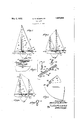
- Figure 1 is an elevation Vof va sail boat
- kinvention Figure 2 is a detail in perspective of a lfragment lofthe deck channel plate by means of which vthe rig is convertible, with the parts separated, showing how the base of a mast fits and is held therein; and how a ringblock serving kas a ring-bolt maybe selectively and adjustably set and secured therein;
- k Figure is a fragmentary detail view showing oneA of my devices for securing a sail;
- Figure 4 is a detail perspective of a bowser
- Figure 5 is an elevation of the hull of Figure l rigged as a schooner;
- Figure 6 is an elevation of the same hull l rigged asa ketch.
- Figure 7 is a fragmentary side elevation of the main sheet when close hauled.
- the hull 10 may be of any suitable construction, equipped with a keel 12 and having a rudder 14 operable in any suitable way, ⁇ as by the tiller 16.
- A. mast and ring-block retainer is indicated at 18, being a plate secured to the deck and eX- tending fore and aft medially thereof.
- This plate preferably is in the form of a'channel with its ends cut and pressed flat as at 20, 2O to provide means at each end, and in its midportions as desired, for attachment of the plate to the deck.
- Figure 1 shows a sloop'whi'ch embodies a mast 22, with main sail and -jib 24, 26.
- the heel of the mast is trimmed to a blunt wedge form at 28 ( Figure 2) so that it lits nicely in the channel 18 at any location along the chan-V c the place selected for it, by thepin 34, and
- the main sail and jib are mounted on the mast much as in a full sized boat.
- Such a wire link combines well with hard finished fish line, or mackerel line, to holdthe line tautand to make the masts and sails secure.
- one such link is shown in detail in the form of an eye hook, used as a sail connector 38, in which one of the wire loops is opened to constitute a hook.
- a link when used as a bowser 42 preferably has both of its loops closed, as vseen in Figure 4. The sheet or stay on which it serves runs through. each of its loops, as does the main sheet seen in Figure 7 and after running to the screw edge or hook eye at which it is fastened it is brought back and is tied around the middle of bowser 42 as at 43 in Figure 7.
- the line By sliding the bowser along the line, the line may be shortened or lengthened. lVhen the line is taut, its friction where it is woven through the bowser will prevent any slipping of the bowser, and so will maintain the line taut. Or, if there be too much slack to be taken up, as there may be in some instances in the-main sheet, the end of the sheet, instead of being attached to the bowser, can be run through both of its loops, and then led to the deck and be layed.
- the tiller 16 may be set and held by any desired method; but preferably themain sheet is connected to the tiller by an automatic control which permits of selective leverage setting such that tiller and boom interact.
- an automatic control which permits of selective leverage setting such that tiller and boom interact.
- a slidable element 48 on the tiller which may be of a type already known, having an eye from which the main sheet may run to an eyel on the boom, whence for the taking up of Vits extra length ⁇ it runs along the boom to and through an eye at 'the mast, and thence back ⁇ along the boom to its bowser 42 seen in Figure 7
- Abutments (not shown) at each side of the tiller may limit its swing; and springs (not shown) tend to return it to medial position.
- the body may be let out or drawn in; and by setting the position of slide 48 on the tiller, the lextent to which an increase of wind will pull over thetiller may be varied, according to the angle at which boom is set, and the leverage desired to balance the wind.
- FIG. 5 the'same hull is shown converted into a schooner the two masts and the sails being mounted as above described.
- a block 56 fixed amidships on the deck channel plate, carries an eye through which passes the sheet that controls boom 54.
- Gr a hook connector 88 may be interposed.
- this block 56 is adapted to be selectively set along the channel 18, and to be locked in the selected location by the pin 58. Letting out and drawing in of the .boom may be accomplished in a similar manner as has been described for the connection of boom to rudder handle, of Figure 1.
- All of these three illustrated different sets of rigging, and other sets at will may be provided for a single hull, to make the one boat capable of being rigged as a schooner, a sloop or a yawl, or otherwise, as and when the owner desires.
- the conversion may be made readily and quickly.
- the masts can be stepped in various positions, and sails altered, according to the requirements of the respective style of rig, or for experimentation by the operator, so as to attain the proper or any desired balance, in that particular rig,as regards relation of the center of edort to the center of lateral resistance.
- the retaining plate 18 is provided especially for the adjustable positioning and holding of masts and of blocks for holding the sheets, it can be similarly used for holding other things, as a cabin.
- a toy boat having means by which the rig may be converted, comprising, in combination vvith the hull, a mast-retaining device extending for and aft and including mastengaging means, at a multiplicity of points along its extent, for holding the heel of a mast removably at any of said points.
- a toy boat having means by which the rig may be converted, comprising, in combination With the hull, a plate of sheet metal extending fixedly fore and aft and including mast-engaging means at a multiplicity of points along its extent, for holding the heel of a mast removably at any of said points.
- a toy boat having means by Which the rig may be converted, comprising, in combination With the hull, a plate of sheet metal formed as a channel, extending for and aft, including mast-engaging'means, at a multiplicity of points along its extent, for stepping a mast along said channel, and for holding the heel of a mast removably at any of said points.
- a toy boat having means by which the rig maybe converted, comprising, in combination with the hull, a plate of sheet metal formed as .a channel, extending fore and aft, and, at a multiplicity of points along its extent having holes in the sides of the channel, whereby a pin can be thrust across the channel, through the heel of a mast set in said channel, to hold the mast at any of said points.
- a convertible toy boat comprising a hull With a mast engaging device extending along its deck; rigging, including a mast and stays therefor mounted on said hull, the mast having its heel formed to be held by said engaging device at selective locations along it; and the hull having means for securing the stays in positions suitable for holding the mast in its several selective positions.
- a convertible toy boat comprising a hull with a mast engaging device extending along its deck; rigging, including a mast and stays therefor mounted on said hull, the mast having its heel formed to be held by said engaging device at selective locations along it; and the hull having means for securing the stays in positions suitable for holding the mast in its several selective positions, and bowsers for adjusting the stay-lines, comprising bent Wires having S-form except that the rings are set at right angles to each other;r ⁇ one of said bovvsers being strung on a stay Which has variable length, with the stay passing through both of its rings and with an end of the line turned back upon itself from the end of the stay and secured to the bowser; whereby the stay line may be drawn taut by sliding the boWser therealong, and will be maintained taut by frictional grip of the boWser.
- a convertible toy boat comprising a hull With a channel extending along its deck;
- the mast having a boom and the boom having a sheet; and the eye-block being adapted to hold the sheet.
- a convertible toy boat comprising a hull With a channel extending along its deck; a mast having its heel fitting said channel at any of a multiplicity of selective locations along it; means for locking said mast in its selected position; a boom and sheet for the mast; and means for attaching the sheet at said channel in any of a multiplicity of selective locations along it.
- a convertible toy boat comprising the combination of a hull With mast-heel-holding means thereon extending fore and aft'through the Whole of a region Which includes the mast locations of a plurality of rigs, said meansV including mast-engaging formations, at a multiplicity of points along it, for holding the heel of a mast at any of said points.
- a convertible toy boat comprising aV hull, means extending fore and aft, including mast-engaging formations, at a multiplicity of Ypoints along its extent, for retaining amast at any of said points; and a plurality of masts, each comprising a part of a rig for the boat; said masts being removably stepped along said means, and each being stayed, at a selected one of said mast-engaging formations.
Landscapes
- Engineering & Computer Science (AREA)
- Ocean & Marine Engineering (AREA)
- Toys (AREA)
Description
May 3, 1932. A. M. DERFu-ER l 1,857,094
TY BOAT y FiledY Fb. 5, 1951 @Marilyn Patented May 3, 1932 UNITED STATES PATE Nr orf-ics 1 `ALFEtIlD 4M. DOERFLER, OF MANSFIELD, MASSACHUSETTS, `ASSIGrNOR. TO EYEEETT .E if.
KEN T, F NEWTON, MASSACHUSETTS TOY BOAT Application .led February 3, 1931. Y Serial.y No. 513,065. fgj
This invention relates to improvements in toy boats. `More particularly it relates to miniature sailing boats; :and it provides for the making -of boats of convertible rig.
5 H-itherto -such a boa-t has vbeen of some particular-rig, for exampleyasloop or -a yawl, or a schooner. The invention provides for such a 'boat to be rigged yin one of the various styles Vknown in regular, full sized vsailing 10 boats. It also provides. improvements in the rigging of toy boats, and novel features `for the isubstitut'ionand adjust-ment of masts `and rigging for 'converting the boat from a sloop, for example, toa schooner, or a yawl.
'1'5 Sailing `boats of the type to which the in- Ven-tion relates may ordinarily vary from 1 foot to'6 feet or so in length. As the position 'and height of mast, length of boom, and shape Aand vsize of sails differ greatly, Aas ibe twee-n different types of sail boat, Va toy boat hitherto has always been of some particular type just as a real boat is, and has not been convertible to another type in any instance 0f kwhich I am aware. Yet there is much of importance which a person interested 4'in sai-ling or in 'building toy 'boats could Yenjoyand learn if the same hull could be sailed under different rigs readily interchangeablel Also the value of a single boat to 'an owner'is 3U greatly increased, by providing so that its aspect and behavior can be changed from time to time by changing its type and rig, but the construction kof boatsas hitherto made 'has not permitted this.
'0 ift is an object ofthe invention to provide so that .a sailing boat of toy .character may be converted as desired from one to Vanother type of boat, .characterized 'by one or another number, size, .position and type of masts Aand of sails and rigging. Another object is to provide so that a person may experiment Vliberallly with rigging, and, by setting the masts, etc., at different locations along 'the hull, dis cover `for himself effects of the diifering arrangements. One structural feature resides in the VAprovision of ya universal mast-retainer, which permits the lsetting of :a mast or masts in vany selected position, or positions, Aand which permits substitution of rigs to convert the boat from one type to another. It is an incidental feature to provide 'inexpensive 4means for securing themasts and for changing the eifect'ive length-of lines used as stays. or sheets; and also Afor making other rigging connections.y "55 These objects and "results may be attained, according to a lpreferred embodiment of the invention, b employing a medial deck channel, prefera ly in the 4form of achanneljplate Xed on-the deck, for holding the foot of the ymast orv masts at any Lplace or yplaces along a considerable fore and aft length of the hull. The foot of each mast 4is shaped to fftnicely and nonrotat-ably in the channel, and the tops of masts have the usual stays. 'The stays "35- have each a bowser for drawing and holding the stays taut, asv do also the sheets for maf nipulating the sails. The maker may place v marks on ythe deck or channel to'indicate the Y locations for masts consideredto be best, 'for 7 each type of rig, `and then lthe owner may set the masts accordingly, or as desi-red. For an example of the convertibility attained, lthe Y construction described provides that on a vgivenhull a main sail `and jib may be used with a single mast set properly for a-sloop rig. @r
a two masted schooner rig may be used; ;or a ketch rig. And yall this `with the same hull.
It is intended that the patent shall cover, by suitable expression in the appended claims, whatever features ofpatentable `novelty exist in the invention disclosed.
In the accompanying drawings:
Figure 1 is an elevation Vof va sail boat,
rigged as a sloop, embodying features of my `.w
kinvention Figure 2 is a detail in perspective of a lfragment lofthe deck channel plate by means of which vthe rig is convertible, with the parts separated, showing how the base of a mast fits and is held therein; and how a ringblock serving kas a ring-bolt maybe selectively and adjustably set and secured therein;
kFigure is a fragmentary detail view showing oneA of my devices for securing a sail; Figure 4 is a detail perspective of a bowser Figure 5 is an elevation of the hull of Figure l rigged as a schooner; and
Figure 6 is an elevation of the same hull l rigged asa ketch. Y
Figure 7 is a fragmentary side elevation of the main sheet when close hauled.
Referring to the drawings the hull 10 may be of any suitable construction, equipped with a keel 12 and having a rudder 14 operable in any suitable way, `as by the tiller 16. A. mast and ring-block retainer is indicated at 18, being a plate secured to the deck and eX- tending fore and aft medially thereof. This plate preferably is in the form of a'channel with its ends cut and pressed flat as at 20, 2O to provide means at each end, and in its midportions as desired, for attachment of the plate to the deck.
Figure 1 shows a sloop'whi'ch embodies a mast 22, with main sail and - jib 24, 26. The heel of the mast is trimmed to a blunt wedge form at 28 (Figure 2) so that it lits nicely in the channel 18 at any location along the chan-V c the place selected for it, by thepin 34, and
- holding of cord. They can bemade by automay be braced and retained by the stays Y36 which run from the top of the mast through eye hooks 38 which hook into screw eyes 40 at the rail. And bowser devices 42 serve for maintaining the lines taut.
The main sail and jib are mounted on the mast much as in a full sized boat.
lBut I prefer to simplify the various connections and working lengths for stays, sheets, etc., by making the line return upon itself to a bowser 42 running on and'holding by friction on the main part of the line. I have found a very inexpensive way to consti* tute such aV bowser by utilizing a metal device whose form is already known in another branch of industry. I refer to the links of bent wire of which small brass chains are commonly made, wherein each link embodies two loops set in planes at right angles to each other. I have found these, when employed singly, to serve excellently for this frictional matic machinery commercially in quantities at very low cost. Such a wire link combines well with hard finished fish line, or mackerel line, to holdthe line tautand to make the masts and sails secure. In Figure 3 one such link is shown in detail in the form of an eye hook, used as a sail connector 38, in which one of the wire loops is opened to constitute a hook. A link when used as a bowser 42 preferably has both of its loops closed, as vseen in Figure 4. The sheet or stay on which it serves runs through. each of its loops, as does the main sheet seen in Figure 7 and after running to the screw edge or hook eye at which it is fastened it is brought back and is tied around the middle of bowser 42 as at 43 in Figure 7. By sliding the bowser along the line, the line may be shortened or lengthened. lVhen the line is taut, its friction where it is woven through the bowser will prevent any slipping of the bowser, and so will maintain the line taut. Or, if there be too much slack to be taken up, as there may be in some instances in the-main sheet, the end of the sheet, instead of being attached to the bowser, can be run through both of its loops, and then led to the deck and be layed.
The tiller 16 may be set and held by any desired method; but preferably themain sheet is connected to the tiller by an automatic control which permits of selective leverage setting such that tiller and boom interact. For this purpose there is illustrated in Figures 1 and 7 a simple form of adjustable control. It consists of a slidable element 48 on the tiller, which may be of a type already known, having an eye from which the main sheet may run to an eyel on the boom, whence for the taking up of Vits extra length `it runs along the boom to and through an eye at 'the mast, and thence back `along the boom to its bowser 42 seen in Figure 7 Abutments (not shown) at each side of the tiller may limit its swing; and springs (not shown) tend to return it to medial position. Thus by adjusting the bowser 42 along the main sheet, the body may be let out or drawn in; and by setting the position of slide 48 on the tiller, the lextent to which an increase of wind will pull over thetiller may be varied, according to the angle at which boom is set, and the leverage desired to balance the wind.
In Figure 5 the'same hull is shown converted into a schooner the two masts and the sails being mounted as above described. For the fore mast, a block 56, fixed amidships on the deck channel plate, carries an eye through which passes the sheet that controls boom 54. Gr a hook connector 88 may be interposed.
As seen in Figure 2 this block 56 is adapted to be selectively set along the channel 18, and to be locked in the selected location by the pin 58. Letting out and drawing in of the .boom may be accomplished in a similar manner as has been described for the connection of boom to rudder handle, of Figure 1.
The same hull is illustrated in Figure 6 as being rigged as a ketch, and embodying features above described.
All of these three illustrated different sets of rigging, and other sets at will may be provided for a single hull, to make the one boat capable of being rigged as a schooner, a sloop or a yawl, or otherwise, as and when the owner desires. The conversion may be made readily and quickly.
In each case, the masts can be stepped in various positions, and sails altered, according to the requirements of the respective style of rig, or for experimentation by the operator, so as to attain the proper or any desired balance, in that particular rig,as regards relation of the center of edort to the center of lateral resistance.
Although the retaining plate 18 is provided especially for the adjustable positioning and holding of masts and of blocks for holding the sheets, it can be similarly used for holding other things, as a cabin.
I claim as my invention:
l. A toy boat having means by which the rig may be converted, comprising, in combination vvith the hull, a mast-retaining device extending for and aft and including mastengaging means, at a multiplicity of points along its extent, for holding the heel of a mast removably at any of said points. p
2. A toy boat having means by which the rig may be converted, comprising, in combination With the hull, a plate of sheet metal extending fixedly fore and aft and including mast-engaging means at a multiplicity of points along its extent, for holding the heel of a mast removably at any of said points.
3. A toy boat having means by Which the rig may be converted, comprising, in combination With the hull, a plate of sheet metal formed as a channel, extending for and aft, including mast-engaging'means, at a multiplicity of points along its extent, for stepping a mast along said channel, and for holding the heel of a mast removably at any of said points. f
4. A toy boat having means by which the rig maybe converted, comprising, in combination with the hull, a plate of sheet metal formed as .a channel, extending fore and aft, and, at a multiplicity of points along its extent having holes in the sides of the channel, whereby a pin can be thrust across the channel, through the heel of a mast set in said channel, to hold the mast at any of said points.
5. A convertible toy boat comprising a hull With a mast engaging device extending along its deck; rigging, including a mast and stays therefor mounted on said hull, the mast having its heel formed to be held by said engaging device at selective locations along it; and the hull having means for securing the stays in positions suitable for holding the mast in its several selective positions.
6. A convertible toy boat comprising a hull with a mast engaging device extending along its deck; rigging, including a mast and stays therefor mounted on said hull, the mast having its heel formed to be held by said engaging device at selective locations along it; and the hull having means for securing the stays in positions suitable for holding the mast in its several selective positions, and bowsers for adjusting the stay-lines, comprising bent Wires having S-form except that the rings are set at right angles to each other;r` one of said bovvsers being strung on a stay Which has variable length, with the stay passing through both of its rings and with an end of the line turned back upon itself from the end of the stay and secured to the bowser; whereby the stay line may be drawn taut by sliding the boWser therealong, and will be maintained taut by frictional grip of the boWser. y
7. A convertible toy boat comprising a hull With a channel extending along its deck;
and a mast and an eye-block, both fitting therein at a multiplicity of locations; the mast having a boom and the boom having a sheet; and the eye-block being adapted to hold the sheet.
8. A convertible toy boat comprising a hull With a channel extending along its deck; a mast having its heel fitting said channel at any of a multiplicity of selective locations along it; means for locking said mast in its selected position; a boom and sheet for the mast; and means for attaching the sheet at said channel in any of a multiplicity of selective locations along it. Y
9. A convertible toy boat comprising the combination of a hull With mast-heel-holding means thereon extending fore and aft'through the Whole of a region Which includes the mast locations of a plurality of rigs, said meansV including mast-engaging formations, at a multiplicity of points along it, for holding the heel of a mast at any of said points.
l0. In a toy boat, the combination With the hull of means adapting the hull for interchangeability of rigs; said means being a` device on the deck, providing a region extending fore and aft on the hull a distance to include the positions of masts of a plurality of different rigs, and including mastholding formations at a multiplicity of points along said device for holding the heel of a mast at any of said points.V
11. A convertible toy boat comprising aV hull, means extending fore and aft, including mast-engaging formations, at a multiplicity of Ypoints along its extent, for retaining amast at any of said points; and a plurality of masts, each comprising a part of a rig for the boat; said masts being removably stepped along said means, and each being stayed, at a selected one of said mast-engaging formations.
Signed at Boston, Massachusetts, this fifteenth day of December, 1930.
ALFRED M. DOERFLER.
Priority Applications (1)
| Application Number | Priority Date | Filing Date | Title |
|---|---|---|---|
| US513065A US1857094A (en) | 1931-02-03 | 1931-02-03 | Toy boat |
Applications Claiming Priority (1)
| Application Number | Priority Date | Filing Date | Title |
|---|---|---|---|
| US513065A US1857094A (en) | 1931-02-03 | 1931-02-03 | Toy boat |
Publications (1)
| Publication Number | Publication Date |
|---|---|
| US1857094A true US1857094A (en) | 1932-05-03 |
Family
ID=24041758
Family Applications (1)
| Application Number | Title | Priority Date | Filing Date |
|---|---|---|---|
| US513065A Expired - Lifetime US1857094A (en) | 1931-02-03 | 1931-02-03 | Toy boat |
Country Status (1)
| Country | Link |
|---|---|
| US (1) | US1857094A (en) |
Cited By (2)
| Publication number | Priority date | Publication date | Assignee | Title |
|---|---|---|---|---|
| US2680921A (en) * | 1952-07-09 | 1954-06-15 | Gowland & Gowland | Model sailing ship |
| US4923427A (en) * | 1988-12-23 | 1990-05-08 | Vincent Roland | Surfing figurine |
-
1931
- 1931-02-03 US US513065A patent/US1857094A/en not_active Expired - Lifetime
Cited By (2)
| Publication number | Priority date | Publication date | Assignee | Title |
|---|---|---|---|---|
| US2680921A (en) * | 1952-07-09 | 1954-06-15 | Gowland & Gowland | Model sailing ship |
| US4923427A (en) * | 1988-12-23 | 1990-05-08 | Vincent Roland | Surfing figurine |
Similar Documents
| Publication | Publication Date | Title |
|---|---|---|
| US1856803A (en) | Fore and aft rigged vessel | |
| US3557733A (en) | Apparatus for changing the curvature of a sail | |
| Sleight | The complete sailing manual | |
| US1857094A (en) | Toy boat | |
| US3185121A (en) | Spinnaker sail jibe | |
| US2747315A (en) | Sportsman's accessories | |
| US606104A (en) | twining | |
| US4147121A (en) | Self-releasing traveler and cam cleat | |
| US4319537A (en) | Sailcraft traveler car and assembly | |
| US1642716A (en) | Ship's rigging | |
| US2162441A (en) | Sailboat mast bending | |
| US843822A (en) | Reefing-gear. | |
| US601282A (en) | Island | |
| US3534700A (en) | Adjustable jib sheet block | |
| US521388A (en) | Boat-ballasting device | |
| US3318277A (en) | Shroud guard | |
| US5575229A (en) | Control tackle apparatus for a sailboard rig outhaul | |
| US5115754A (en) | Adjustable spreader arms for sailing graft | |
| USRE29279E (en) | Device for launching and dousing light sails such as spinnakers | |
| US779440A (en) | Sail-boat. | |
| US1619680A (en) | Mooring gear for airships | |
| US625132A (en) | Fore-and-aft-rigged vessel | |
| US701571A (en) | Shifting topsails. | |
| US795025A (en) | Rig of sailing vessels. | |
| US1647813A (en) | Sliding device for sails |