US1856633A - Backing for plastic material - Google Patents
Backing for plastic material Download PDFInfo
- Publication number
- US1856633A US1856633A US423525A US42352530A US1856633A US 1856633 A US1856633 A US 1856633A US 423525 A US423525 A US 423525A US 42352530 A US42352530 A US 42352530A US 1856633 A US1856633 A US 1856633A
- Authority
- US
- United States
- Prior art keywords
- liner
- cellular
- plastic material
- cells
- backing
- Prior art date
- Legal status (The legal status is an assumption and is not a legal conclusion. Google has not performed a legal analysis and makes no representation as to the accuracy of the status listed.)
- Expired - Lifetime
Links
- 239000000463 material Substances 0.000 title description 59
- 239000004033 plastic Substances 0.000 title description 31
- 230000001413 cellular effect Effects 0.000 description 44
- 210000004027 cell Anatomy 0.000 description 34
- 239000011505 plaster Substances 0.000 description 19
- 238000000034 method Methods 0.000 description 15
- 239000000047 product Substances 0.000 description 9
- 230000003014 reinforcing effect Effects 0.000 description 8
- 239000011162 core material Substances 0.000 description 5
- BPQQTUXANYXVAA-UHFFFAOYSA-N Orthosilicate Chemical compound [O-][Si]([O-])([O-])[O-] BPQQTUXANYXVAA-UHFFFAOYSA-N 0.000 description 4
- 238000010438 heat treatment Methods 0.000 description 4
- 238000004519 manufacturing process Methods 0.000 description 3
- 239000002131 composite material Substances 0.000 description 2
- 239000000203 mixture Substances 0.000 description 2
- -1 stucco Substances 0.000 description 2
- VTYYLEPIZMXCLO-UHFFFAOYSA-L Calcium carbonate Chemical compound [Ca+2].[O-]C([O-])=O VTYYLEPIZMXCLO-UHFFFAOYSA-L 0.000 description 1
- 239000004115 Sodium Silicate Substances 0.000 description 1
- 239000000853 adhesive Substances 0.000 description 1
- 230000001070 adhesive effect Effects 0.000 description 1
- 238000009435 building construction Methods 0.000 description 1
- OSGAYBCDTDRGGQ-UHFFFAOYSA-L calcium sulfate Inorganic materials [Ca+2].[O-]S([O-])(=O)=O OSGAYBCDTDRGGQ-UHFFFAOYSA-L 0.000 description 1
- ZOMBKNNSYQHRCA-UHFFFAOYSA-J calcium sulfate hemihydrate Chemical compound O.[Ca+2].[Ca+2].[O-]S([O-])(=O)=O.[O-]S([O-])(=O)=O ZOMBKNNSYQHRCA-UHFFFAOYSA-J 0.000 description 1
- 239000011111 cardboard Substances 0.000 description 1
- 210000003850 cellular structure Anatomy 0.000 description 1
- 239000004568 cement Substances 0.000 description 1
- 239000007799 cork Substances 0.000 description 1
- 238000001035 drying Methods 0.000 description 1
- 239000000945 filler Substances 0.000 description 1
- 238000000227 grinding Methods 0.000 description 1
- 239000011507 gypsum plaster Substances 0.000 description 1
- 238000009413 insulation Methods 0.000 description 1
- 238000003801 milling Methods 0.000 description 1
- 238000012986 modification Methods 0.000 description 1
- 230000004048 modification Effects 0.000 description 1
- 239000000123 paper Substances 0.000 description 1
- 239000011087 paperboard Substances 0.000 description 1
- 239000012466 permeate Substances 0.000 description 1
- 239000011148 porous material Substances 0.000 description 1
- 239000004576 sand Substances 0.000 description 1
- NTHWMYGWWRZVTN-UHFFFAOYSA-N sodium silicate Chemical compound [Na+].[Na+].[O-][Si]([O-])=O NTHWMYGWWRZVTN-UHFFFAOYSA-N 0.000 description 1
- 229910052911 sodium silicate Inorganic materials 0.000 description 1
- 239000000126 substance Substances 0.000 description 1
Images
Classifications
-
- E—FIXED CONSTRUCTIONS
- E04—BUILDING
- E04C—STRUCTURAL ELEMENTS; BUILDING MATERIALS
- E04C2/00—Building elements of relatively thin form for the construction of parts of buildings, e.g. sheet materials, slabs, or panels
- E04C2/02—Building elements of relatively thin form for the construction of parts of buildings, e.g. sheet materials, slabs, or panels characterised by specified materials
- E04C2/26—Building elements of relatively thin form for the construction of parts of buildings, e.g. sheet materials, slabs, or panels characterised by specified materials composed of materials covered by two or more of groups E04C2/04, E04C2/08, E04C2/10 or of materials covered by one of these groups with a material not specified in one of the groups
-
- E—FIXED CONSTRUCTIONS
- E04—BUILDING
- E04F—FINISHING WORK ON BUILDINGS, e.g. STAIRS, FLOORS
- E04F13/00—Coverings or linings, e.g. for walls or ceilings
- E04F13/07—Coverings or linings, e.g. for walls or ceilings composed of covering or lining elements; Sub-structures therefor; Fastening means therefor
- E04F13/08—Coverings or linings, e.g. for walls or ceilings composed of covering or lining elements; Sub-structures therefor; Fastening means therefor composed of a plurality of similar covering or lining elements
- E04F13/14—Coverings or linings, e.g. for walls or ceilings composed of covering or lining elements; Sub-structures therefor; Fastening means therefor composed of a plurality of similar covering or lining elements stone or stone-like materials, e.g. ceramics concrete; of glass or with an outer layer of stone or stone-like materials or glass
Definitions
- This invention relates to a backing or surface for receiving plastic material, such for example as plaster.
- An object of the invention is to provide a generally improved and relatively easy, rapid, and inexpensive method of producing a satisfactory backing for the reception of plaster or other plastic material.
- Another object is to provide a method which results in a surface which forms an exceedingly satisfactory interlocking bond with plastic material applied to such surface.
- a further object is the provision of an improved method of making a composite wall- I board comprising a backing and a layer of plaster or the like, which method results in a wallboard which is strong and durable, and in which the plaster orthe like is intimately and tenaciously interlocked or 'bonded with the backing.
- the invention re-o sides in certain improvements and combinations of parts, all as will be hereinafter more.
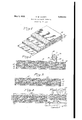
- Fig. 1 is a perspective view, with parts broken away, of a backing member at an intermediate stage of its completion according.
- Fig. 2 is a vertical section througha backing member such as that shown in Flg. 1, illust'rating one method of removing a liner to form the completed backing member;
- Fig. 3' is a vertical section through a preferred embodiment of completed backing member
- Fig. 4 is a vertical section through a. completed wallboard formed by applying a layer of plaster to a backing such as that shown in Fig. 3, and
- Fig. 5 is a view similar to Fig. 2 illustrating another method of removing one of the liners.
- a backing'or surface for receiving plastic material should be of such nature that the plastic material will be intima-tely and tenaciously bonded to thebackng or receiving surface.
- the present invention contemplates the use of a vcellular body as the backing.
- the cellular body is so treated that a relatively large number of the cells of the cellular body are opened up or exposed, so that the plastic material when applied to the body may enter. such exposed cells to form an intimate bond with the body.
- a cellular body suitable for the purpose of the present invention may conveniently be made from a material containing, for example, a silicate or other suitable substance which puffs or intumesces upon the applica tion of heat.
- the material is composed principally -of sodium silicate and a filler, such as ground limestone.
- the intumescing operation preferably takes place in a mold or between platens, so
- the size and shape of the intumesced product is thus controlled and the expansion of the product during the intumescing operation is limited.
- the cells or pores of the resulting product are relatively small and permeate the whole body of the material.
- one or more liners or facings of suitable sheet material are applied to the cellular body, partly to strengthen the resulting product and partly to render more easy the manufacturing operation by preventing sticking of the body to the mold or platen in which it is intumesced.
- a reinforcing sheet is interposed in the cellular body at an intermediate point thereof. This serves to strengthen the resulting product materially, especially since one of the liners or facings is later removed according to the present invention, as will be described below.
- the liners and reinforcing sheet are applied to the core material before the latter-is intumesced, it is found in practice that after intumescing, the liners and reinforcing sheet adhere extremely tenaciously to the core material, so that the resulting product is practically an integral unit and cannot easily be separated.
- one of the liners is removed in order to expose the cells at the surface of the core or cellular body, thus permitting anyplastic material applied to the body to enter the exposed cells and to become bonded to the body.
- the cellular body without any liner on one face of the'cellular body or with a liner which may be stripped easily from the body, as for example, by using a greased or otherwise treated liner which Wlll not adhere to the core.
- a liner on each face in order to prevent the material from sticking to the platen and the linerv generally adheres tenaciously to the core as has been mentioned above, and this is especially true when the liner is of ordinary paper or cardboard. Accordingly, such a liner cannot be strip ed easily from t e cellular body, but accor ing to the present invention it may be removed by any suitable means, as by the use of a planer, a grinder,
- the liner which is to be removed may conveniently be of less thickness than'the opposite liner which is intended to remain" ermanently in place, and in the drawings t e top'liner14 which thinner than the bottom liner 13 and thinner than the intermediate reinforcing sheet 12. Tissue paper strong enough to-withstand passage through the platens may convenientlybe used. for the liner which is later to be removed. Byusing a thinner liner, the cost of the liner is reduced'a'nd the operation of removing the, latter is made easier and less expensive.
- the liner may be removed in one o eration and a layer of the cellular body may removed in another operation, or both the liner and a portion of the bod may be removed in the same operation.
- Fig. 2 of the drawings illustrates the removal of the top liner 14' and a layer of the cellular body '10 in one operation by means of a rotary planing element comprising blades 20 of hard material fixed to a rotating shaft 21.
- Fig. 5 there is showman abrading element such as the grindstone 22 for accomplishin the same result of removin the liner 14 an a portion of the cellular ody. As stated above, this may be done by any'suitable cutting, grinding, or abrading means, and if preferred, the liner may be removed by the use of one means and the layer of cellular body may be removed by the use of a different means.
- the amount of material removed may be varied from timeito time as may be desired; In practice, however, it is found that removal of a layer of the cellular body about one sixty-fourth of an inch in thickness is effective to open up a great many more cells than those originally exposed at the surface of the body, and is generally sufficient.
- An important aspect of the present invention is that when a planer or grinder or the like is used for removing a liner and/or a part of the cellular body, the resultin or remaining body of material may be ished to precisely a predetermined thickness.
- two panels or strips of material are erected next to each other in the wall of a room, they will match with each other perfectly and there will be no shadow or line caused by materials of unequal thickness abutting each other. It is well known that a difference in thickness of only a few thousandths of angio suflicient to cause a noticeable shadow at a joint, when light conditions are fayorable.
- Fig. 3 there is shown a finished product comprising the cellular portions 10 and 11, the.intermediate reinforcing sheet 12, and the liner 13. As shown in this figure the top liner 14 has been completely removed, as has to flow into the exposed cells of the base,
- plastic material includes ordinar/y plaster, plaster of Paris, stucco, and various cements or adhesives which might be employed to affix any articles, such as cork, linoleum, or rubber tothe cellular body.
- the backing of the present invention is capable of many uses, some of which have been outlined above, yet it is especially useful in connection with making Walls or ceilings for building construction.
- the backing may be nailed to studding or otherwise applied to the frame work of the building, and plaster or the like may subsequently be applied thereto. It is preferred, however, to apply the plaster to the backing before the latter is erected in the building, and thus to make what might be termed a composite wallboard.
- the wallboard is constructed by applying a layer of plaster in its wet or plastic state when properly erected in a I vides a finished wall surface to a backing having a cellular body, such as that shown in Fig. 3.
- the plaster when applied enters the exposed cells of the body, and upon subsequent drying it become securely interlocked and bonded with the cellular body by reason of the interengager'nent of the plaster with the cells of the body.
- Such a wall board is shown in Fig. 4 of the drawings and comprises the same parts shown in Fig. 3 with the addition of a layer of plaster 25. It will be seen clearly from this figure that the plaster has entered the exposed cells of the cellular body 10, so that the plaster is bonded extremely tenaciouslywith the cellular body and it is practically impossible for the plaster to become separated from its backing.
- a wallboard of the type shown in Fig. 4 is durable and relatively strong, being strengthened by the liner 13 and reinforcing sheet 12.
- a cellular body such as that here disclosed not only serves as an excellent backing for plastic material, but also provides effective insulation against passage of heat, due to its cellular structure.
- face as used in this specification and in the accompanying claims is intended to be interpreted in its ordinary or commonly accepted sense as denoting a face of substantial area, usually lying parallel to the finished wall or ceiling surface, and as distinguished fromthe comparatively narrow edge of a piece of wallboard or the like.
- the method of preparing a receiving surface for plastic material which comprises forming a cellular body with a liner on one face thereof, and removing said liner to expose cells of said cellular body so that plastic material applied to said body may enter such exposed cells to form a bond with said body.
- the method of preparing a receiving surface for plastic material which comprises forming a cellular body with a liner on one face thereof, and removing said liner and a portion of said body to expose a relatively large number of cells of said body so that plastic material applied to said body may enter such exposed cells to form a bond With said body.
- the method of preparing a receiving surface for plastic material which comprises forming a cellular bod" and removing a por-- tion of said cellular body from one surface thereof to expose a relatively large number of cells of said body so that plastic material applied to said body may enter such exposed cells to form a bond with said body.
- the method of preparing a receiving surface for plastic material which comprises heating an intumescent material containing a silicate to form a hard removmg a portion of said one surface thereof cellular body, and cellular. body from to expose a relatively large number of cells of said body so that plastic material applied to said body may enter such exposed cells to form a bond with said body.
- the method of preparing a receiving surface for plastic material which comprises applying an intumescent material containing a silicate to a liner of sheet material, heating said intumescent material to form a hard cellular body attached to said liner, and removing said liner to expose cells of said cellular body so that plastic material applied to said body may enter such exposed cells to form a bond with saidbody.
- the method of preparing a receiving surface for plastic material which comprises applying an intumescent material containing ing said liner and a portion of said body to expose a relatively large number of cells of said body so that plastic material applied to said body may enter such exposed cells to form a bond with said body.
- the method of constructing a wall ma- I terial which comprises forming a relatively hard cellular body with a layer of reinforcing sheet material interposed therein and a liner of sheet material on each face of said cellular body, removing one of said liners and a portion of said cellular body to expose a relatively-large number of cells of said body, and applying plaster to the surface of said body from which said liner and portion of the body have been'removed, so that said plaster may enter said exposed cells to form an interlocklng bond with said body.
- the method of constructing a wall material which comprises forming a cellular. body with a liner on each face thereof, and removlngione'of saldsllners and aportion-of 'said'body to leave'a predetermined thickness
Landscapes
- Engineering & Computer Science (AREA)
- Architecture (AREA)
- Civil Engineering (AREA)
- Structural Engineering (AREA)
- Chemical & Material Sciences (AREA)
- Ceramic Engineering (AREA)
- Laminated Bodies (AREA)
Description
May 3, 1932.
'F. W. HARNEY BACKING FOR PLASTIC MATERIAL Filed Jan, 25, 1950 %Z6ATTORNEY Patented May 3, 1932 FRANCIS W. HARNEY, OF LOGKPORT, NEW YORK,
ASSEIZGNOR TO THE UPSON COMPANY,
. OF LOCKIBORT, NEW YORK, A. CORPORATION OF NEW YORK BACKING roBl rmsrrc MATERIAL Application filed January 25, 1930. Serial No. 423,525.-
This invention relates to a backing or surface for receiving plastic material, such for example as plaster. An object of the invention is to provide a generally improved and relatively easy, rapid, and inexpensive method of producing a satisfactory backing for the reception of plaster or other plastic material.
Another object is to provide a method which results in a surface which forms an exceedingly satisfactory interlocking bond with plastic material applied to such surface.
A further object is the provision of an improved method of making a composite wall- I board comprising a backing and a layer of plaster or the like, which method results in a wallboard which is strong and durable, and in which the plaster orthe like is intimately and tenaciously interlocked or 'bonded with the backing. To these and other ends the invention re-o sides in certain improvements and combinations of parts, all as will be hereinafter more.
fully described, the novel features being pointed out in the claims at the end of the specification. I
In the drawings:
Fig. 1 .is a perspective view, with parts broken away, of a backing member at an intermediate stage of its completion according.
to the present invention;
Fig. 2 is a vertical section througha backing member such as that shown in Flg. 1, illust'rating one method of removing a liner to form the completed backing member;
Fig. 3'is a vertical section through a preferred embodiment of completed backing member;
Fig. 4 is a vertical section through a. completed wallboard formed by applying a layer of plaster to a backing such as that shown in Fig. 3, and
Fig. 5 is a view similar to Fig. 2 illustrating another method of removing one of the liners.
Similar reference numerals through the several views indicate the same parts.
It is desirable that a backing'or surface for receiving plastic material should be of such nature that the plastic material will be intima-tely and tenaciously bonded to thebackng or receiving surface. To thisend, the present invention contemplates the use of a vcellular body as the backing. According to a preferred embodiment of the invention, the cellular body is so treated that a relatively large number of the cells of the cellular body are opened up or exposed, so that the plastic material when applied to the body may enter. such exposed cells to form an intimate bond with the body.
A cellular body suitable for the purpose of the present invention may conveniently be made from a material containing, for example, a silicate or other suitable substance which puffs or intumesces upon the applica tion of heat. Preferatl, the material is composed principally -of sodium silicate and a filler, such as ground limestone. When such a mixture of the proper proportions, as 7 known in the prior art, is treated by the application of heat, the mixture intumesces and forms a body which is permeated by a great number of pockets or cells.
The intumescing operation preferably takes place in a mold or between platens, so
that the size and shape of the intumesced product is thus controlled and the expansion of the product during the intumescing operation is limited. When this intumescing is properly carried out, all as known in the prior art, the cells or pores of the resulting product are relatively small and permeate the whole body of the material. By suitably treating the intumesced product, as by baking it 'or the like, it may be rendered quite hard and moisture resisting to a relatively high degree.
Preferably one or more liners or facings of suitable sheet material are applied to the cellular body, partly to strengthen the resulting product and partly to render more easy the manufacturing operation by preventing sticking of the body to the mold or platen in which it is intumesced. Preferably also a reinforcing sheet is interposed in the cellular body at an intermediate point thereof. This serves to strengthen the resulting product materially, especially since one of the liners or facings is later removed according to the present invention, as will be described below.
a product of the kind above described, com
posed of a cellular body having portions 10 and 11 on opposite sides 'of an intermediate reinforcing sheet 12, and having also a bottom liner 13 and a top liner 14.
If the liners and reinforcing sheet are applied to the core material before the latter-is intumesced, it is found in practice that after intumescing, the liners and reinforcing sheet adhere extremely tenaciously to the core material, so that the resulting product is practically an integral unit and cannot easily be separated.
According to the present invention, one of the liners is removed in order to expose the cells at the surface of the core or cellular body, thus permitting anyplastic material applied to the body to enter the exposed cells and to become bonded to the body.
At times it may be possible to manufacture the cellular body without any liner on one face of the'cellular body or with a liner which may be stripped easily from the body, as for example, by using a greased or otherwise treated liner which Wlll not adhere to the core. Generally, however, itis necessary to use a liner on each face in order to prevent the material from sticking to the platen and the linerv generally adheres tenaciously to the core as has been mentioned above, and this is especially true when the liner is of ordinary paper or cardboard. Accordingly, such a liner cannot be strip ed easily from t e cellular body, but accor ing to the present invention it may be removed by any suitable means, as by the use of a planer, a grinder,
' a milling cutter, a sand blast, or the like. The liner which is to be removed may conveniently be of less thickness than'the opposite liner which is intended to remain" ermanently in place, and in the drawings t e top'liner14 which thinner than the bottom liner 13 and thinner than the intermediate reinforcing sheet 12. Tissue paper strong enough to-withstand passage through the platens may convenientlybe used. for the liner which is later to be removed. Byusing a thinner liner, the cost of the liner is reduced'a'nd the operation of removing the, latter is made easier and less expensive.
When'one liner has been removed so that one face of the cellular body is exposed, a considerable number of cells of the cellular body will be open or exposed, and may form a is to be removed is illustrated as being satisfactory surface for the application of plastic material. Ordinarily, owever, it is ound that a considerable proportionof the cells closely adjacent the surface of the body are closed and thus cannot be entered by the plastic material. The present invention accordingly contemplates the removal not only of the liner, but also of a part of the cellular body itself. It is found'in practice that if a layer of the cellular body he removed, the cells which lie just-beneath the original surface of the body are thus opened up and exposed, and the result is that a relatively great number of cells-are exposed and may be entered by the plastic material so that an exceedingly tenacious bond results between the plastic material and the cellular body.
In practice, the liner may be removed in one o eration and a layer of the cellular body may removed in another operation, or both the liner and a portion of the bod may be removed in the same operation. Fig. 2 of the drawings illustrates the removal of the top liner 14' and a layer of the cellular body '10 in one operation by means of a rotary planing element comprising blades 20 of hard material fixed to a rotating shaft 21. In
Fig. 5 there is showman abrading element such as the grindstone 22 for accomplishin the same result of removin the liner 14 an a portion of the cellular ody. As stated above, this may be done by any'suitable cutting, grinding, or abrading means, and if preferred, the liner may be removed by the use of one means and the layer of cellular body may be removed by the use of a different means.
Obviously the amount of material removed may be varied from timeito time as may be desired; In practice, however, it is found that removal of a layer of the cellular body about one sixty-fourth of an inch in thickness is effective to open up a great many more cells than those originally exposed at the surface of the body, and is generally sufficient.
An important aspect of the present invention is that when a planer or grinder or the like is used for removing a liner and/or a part of the cellular body, the resultin or remaining body of material may be ished to precisely a predetermined thickness. Hence when two panels or strips of material are erected next to each other in the wall of a room, they will match with each other perfectly and there will be no shadow or line caused by materials of unequal thickness abutting each other. It is well known that a difference in thickness of only a few thousandths of an inchis suflicient to cause a noticeable shadow at a joint, when light conditions are fayorable. v
In Fig. 3, there is shown a finished product comprising the cellular portions 10 and 11, the.intermediate reinforcing sheet 12, and the liner 13. As shown inthis figure the top liner 14 has been completely removed, as has to flow into the exposed cells of the base,
' whether or not the material subsequently hardens. For example, the term plastic material as here used, includes ordinar/y plaster, plaster of Paris, stucco, and various cements or adhesives which might be employed to affix any articles, such as cork, linoleum, or rubber tothe cellular body.
Although the backing of the present invention is capable of many uses, some of which have been outlined above, yet it is especially useful in connection with making Walls or ceilings for building construction. The backing may be nailed to studding or otherwise applied to the frame work of the building, and plaster or the like may subsequently be applied thereto. It is preferred, however, to apply the plaster to the backing before the latter is erected in the building, and thus to make what might be termed a composite wallboard.
The wallboard is constructed by applying a layer of plaster in its wet or plastic state when properly erected in a I vides a finished wall surface to a backing having a cellular body, such as that shown in Fig. 3. The plaster when applied enters the exposed cells of the body, and upon subsequent drying it become securely interlocked and bonded with the cellular body by reason of the interengager'nent of the plaster with the cells of the body. Such a wall board is shown in Fig. 4 of the drawings and comprises the same parts shown in Fig. 3 with the addition of a layer of plaster 25. It will be seen clearly from this figure that the plaster has entered the exposed cells of the cellular body 10, so that the plaster is bonded extremely tenaciouslywith the cellular body and it is practically impossible for the plaster to become separated from its backing.
A wallboard of the type shown in Fig. 4 is durable and relatively strong, being strengthened by the liner 13 and reinforcing sheet 12.
It may be shipped and handled easily, and
building it proneeding no further plastering.
A cellular body such as that here disclosed not only serves as an excellent backing for plastic material, but also provides effective insulation against passage of heat, due to its cellular structure.
The term face as used in this specification and in the accompanying claims is intended to be interpreted in its ordinary or commonly accepted sense as denoting a face of substantial area, usually lying parallel to the finished wall or ceiling surface, and as distinguished fromthe comparatively narrow edge of a piece of wallboard or the like.
While one embodiment of the invention has been disclosed, it is to be understood that the inventive idea may be carried out in a number of ways. This application is therefore not to be limited to the precise details disclosed, but it is intended to cover all variations and modifications thereof falling within the spirit of the invention or the scope of the appended claims.
I claim as my invention:
1. The method of preparing a receiving surface for plastic material which comprises forming a cellular body with a liner on one face thereof, and removing said liner to expose cells of said cellular body so that plastic material applied to said body may enter such exposed cells to form a bond with said body.
2. The method of preparing a receiving surface for plastic material which comprises forming a cellular body with a liner on one face thereof, and removing said liner and a portion of said body to expose a relatively large number of cells of said body so that plastic material applied to said body may enter such exposed cells to form a bond With said body.
3. The method of preparing a receiving surface for plastic material which comprises forming a cellular bod" and removing a por-- tion of said cellular body from one surface thereof to expose a relatively large number of cells of said body so that plastic material applied to said body may enter such exposed cells to form a bond with said body.
4. The method of preparing a receiving surface for plastic material which comprises heating an intumescent material containing a silicate to form a hard removmg a portion of said one surface thereof cellular body, and cellular. body from to expose a relatively large number of cells of said body so that plastic material applied to said body may enter such exposed cells to form a bond with said body.
5. The method of preparing a receiving surface for plastic material which comprises applying an intumescent material containing a silicate to a liner of sheet material, heating said intumescent material to form a hard cellular body attached to said liner, and removing said liner to expose cells of said cellular body so that plastic material applied to said body may enter such exposed cells to form a bond with saidbody.
6. The method of preparing a receiving surface for plastic material which comprises applying an intumescent material containing ing said liner and a portion of said body to expose a relatively large number of cells of said body so that plastic material applied to said body may enter such exposed cells to form a bond with said body.
7. The method of preparing a receiving surface for plastic material which comprises interposing an intumescent material containmg a sillcate between a relatively thin liner and a thicker liner of sheet material,
heating said inturnescent material to form a hard cellular body attached to said liners, and removing the relatively thin liner to expose cells of said cellular body so that plastic material applied to said body may enter such exposed cells to form a bond with said body.
8. The method of'preparing a receiving surface for plastic material which comprises interposing an' intumescent material containing a silicate between a relatively thin liner and a thicker liner of sheet material, heating said intumescent material to form a hard cellular body between said liners, and
removing the relatively thin liner and a por-' tion of saidbody to expose a relatively large number of cells of said body so that plastic material applied to said body may enter such of remaining material, so that one piece of such remaining material will be of the same thickness as another piece thereof lrrespective of variations in thickness of the orlginal bod v y. "FRANCIS W. HARNEY.
exposed cells to form a bond with said body.
ing said liner and a portion of said body to expose a relatively large number of cells of said body, and applying plaster to the surface of said body from which said liner and portion of the body have been removed, so that said plaster may enter said exposed cells to form an interlocking bond with said body. 11. The method of constructing a wall ma- I terial which comprises forming a relatively hard cellular body with a layer of reinforcing sheet material interposed therein and a liner of sheet material on each face of said cellular body, removing one of said liners and a portion of said cellular body to expose a relatively-large number of cells of said body, and applying plaster to the surface of said body from which said liner and portion of the body have been'removed, so that said plaster may enter said exposed cells to form an interlocklng bond with said body. 1
12. The method of constructing a wall material which comprises forming a cellular. body with a liner on each face thereof, and removlngione'of saldsllners and aportion-of 'said'body to leave'a predetermined thickness
Priority Applications (1)
| Application Number | Priority Date | Filing Date | Title |
|---|---|---|---|
| US423525A US1856633A (en) | 1930-01-25 | 1930-01-25 | Backing for plastic material |
Applications Claiming Priority (1)
| Application Number | Priority Date | Filing Date | Title |
|---|---|---|---|
| US423525A US1856633A (en) | 1930-01-25 | 1930-01-25 | Backing for plastic material |
Publications (1)
| Publication Number | Publication Date |
|---|---|
| US1856633A true US1856633A (en) | 1932-05-03 |
Family
ID=23679207
Family Applications (1)
| Application Number | Title | Priority Date | Filing Date |
|---|---|---|---|
| US423525A Expired - Lifetime US1856633A (en) | 1930-01-25 | 1930-01-25 | Backing for plastic material |
Country Status (1)
| Country | Link |
|---|---|
| US (1) | US1856633A (en) |
Cited By (1)
| Publication number | Priority date | Publication date | Assignee | Title |
|---|---|---|---|---|
| US6177180B1 (en) * | 1997-06-02 | 2001-01-23 | Armstrong World Industries, Inc. | Composite construction board with load bearing properties |
-
1930
- 1930-01-25 US US423525A patent/US1856633A/en not_active Expired - Lifetime
Cited By (1)
| Publication number | Priority date | Publication date | Assignee | Title |
|---|---|---|---|---|
| US6177180B1 (en) * | 1997-06-02 | 2001-01-23 | Armstrong World Industries, Inc. | Composite construction board with load bearing properties |
Similar Documents
| Publication | Publication Date | Title |
|---|---|---|
| US5391245A (en) | Fire-resistant building component | |
| US3332187A (en) | Brick wall panel and method of making | |
| US2062590A (en) | Method of creating a desing and article | |
| CA1090244A (en) | Method of producing fire resistant wood products and product thereof | |
| US1825877A (en) | Composition flooring and method of making the same | |
| US2569831A (en) | Method of making bevelled siding | |
| US1925460A (en) | Surfacing material and method of forming same | |
| US2131043A (en) | Process of making building elements and the like | |
| US2266746A (en) | Wall structure | |
| US2181530A (en) | Joint sealing strip | |
| US1569947A (en) | Wall-board lath | |
| US2139620A (en) | Siding element and method of making the same | |
| US3385019A (en) | Wallboard and wall structure | |
| US1805840A (en) | Reenforced and protected wall board edge | |
| US2643539A (en) | Artificial stone wall facing | |
| US2512371A (en) | Insulating siding and the like and its manufacture | |
| US2239107A (en) | Composite board | |
| US2754235A (en) | Thermal insulating wallboard | |
| US2037995A (en) | Acoustical plaster composition | |
| US2200750A (en) | Wallboard | |
| US2136431A (en) | Baseboard for plaster and the like | |
| US1487255A (en) | Manufacture of fireproof and waterproof wooden building plates | |
| US2021348A (en) | Veneered stone like unit | |
| US2364772A (en) | Concrete foem material | |
| US1997803A (en) | Method of manufacturing decorative woods |