US1856624A - Camping cot - Google Patents
Camping cot Download PDFInfo
- Publication number
- US1856624A US1856624A US75995A US7599525A US1856624A US 1856624 A US1856624 A US 1856624A US 75995 A US75995 A US 75995A US 7599525 A US7599525 A US 7599525A US 1856624 A US1856624 A US 1856624A
- Authority
- US
- United States
- Prior art keywords
- cot
- bars
- legs
- central bar
- central
- Prior art date
- Legal status (The legal status is an assumption and is not a legal conclusion. Google has not performed a legal analysis and makes no representation as to the accuracy of the status listed.)
- Expired - Lifetime
Links
- 239000004744 fabric Substances 0.000 description 4
- 229910000831 Steel Inorganic materials 0.000 description 2
- 239000010959 steel Substances 0.000 description 2
- 238000010276 construction Methods 0.000 description 1
Images

Classifications
-
- A—HUMAN NECESSITIES
- A47—FURNITURE; DOMESTIC ARTICLES OR APPLIANCES; COFFEE MILLS; SPICE MILLS; SUCTION CLEANERS IN GENERAL
- A47C—CHAIRS; SOFAS; BEDS
- A47C17/00—Sofas; Couches; Beds
- A47C17/64—Travelling or camp beds
- A47C17/68—Travelling or camp beds only the legs being foldable
Definitions
- This invention relates to a folding cot, suitable for camping purposes, which can be quickly and easily set up and folded and which will fold compactly so that it can be readily handled and transported.
- I provide a pair of side rails composed of channel bars, each rail comprising three parts, namely, a relatively long central bar and two end bars of shorter length having forked ends which straddle the central bar and which are pivoted to it, a short distance from its ends.
- Legs are pivoted within the central bar, at the ends of the latter, and these are provided 1 with slots or notches near their pivotal points.
- Sliding bolts are secured to the end bars and adapted to enter these notches when the cot is being set up. These bolts lock the end bars and the legs so that the legs cannot fold and the end bars cannot move upwardly or downwardly except by releasing the bolts.
- the pair of legs at each end of the cot are connected together by folding toggle levers, and a suitable fabric is detachably con- 'nected to the end bars of the frame.
- a suitable fabric is detachably con- 'nected to the end bars of the frame.
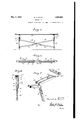
- Fig. 1 is a top plan view of the cot set up, a part only of the mattress frame being '3 shown,-
- Fig. 2 is a side elevation ofthe same
- Fig. 3 is a detail view, on a larger scale, showing parts of a side bar, an end bar, and a leg in central longitudinal section, and a 4 part of the mattress frame in cross section;
- Fig. 4 isan end view of the cot, set up;
- Fig. 5 is a side view of the cot, folded;
- Fig. 6 is an end view of the cot, partly folded;and,
- 1F ig. 7 is a perspective view of detached portions of a side bar end bar and leg,- and of a cross bar of the mattress frame.
- the, frame of the: cot comprises a pair of side rails a, a, eachalike-in construction and each composed of a relatively long central bar 1 and end bars 2 and 2 which are connected to the central bar, by pivots 3, a short distance from the ends of the latter bar.
- the several parts of the side rails are composed of channeled steel, the central bars 1 having their open sides facing down-ward when the cot is set up, and the end bars having their open sides facing upward when the cot is set up.
- the end bars are of slightly greater width than the central bar. As shown in the detail views, Figs. 3 and 7, the end bars have their back portions removed for some distance from their pivotal points, leaving forked ends 2 which straddle the central bar.
- Legs 4, 4 composed of channel steel, are connected to the ends of each central bar by pivot pins 5.
- the legs are of slightly less width than the width of the central bars of the side rails and are pivoted within the central bars, so that they may fold therein.
- the open sides of the legs connected with each side rail face one another, and in the back of each leg, close to its upper end, is formed a slot 6, adapted to receive a sliding latch or bolt 7 secured to the back of the adjacent end rail.
- Each bolt is arranged within a suitable guide 8, attached to the end rail, and it is pressed toward its locking position by a spring 9.
- the end bars are provided with adjustable channelled parts 2 at their outer ends, and
- these parts are slotted at their ends, as shown at 2, to receive studs 10 on cross bars 10 which support the wire mattress b.
- these crossbars are of U-shape in cross section and hook over the ends of the adjustable parts 2 of the end bars.
- Each part 2 has a suitable number of spaced openings 2, through which a bolt 11 may be inserted to hold the part in, anyposition of adjustment. The purpose of this adjustment is to apply the proper tension to the mattress when the cot is setup. 4 I
- the cot lying on its side, and the side rails are then pulled apart upwardly, spreading the toggles.
- the end bars at one end o'f th-e cot are then swung outwardly, and the latch bolts automatically lock with the legs, the beveled ends 7 of the bolts sliding'over the ends of thecentral bars and into the slots in the legs.
- the end bars at the opposite end of the cot are then swung outwardly, but not into the locking position, and the fabric frame is then hooked over the end bars; After the fabric frame has been applied,the' end barswhich were last un- "folded, are pressed downwardly and the bolts the'adj acent legs.
- VVhat'Iclaim is: l
- each rail comprising a relatively long central bar and end bars, the latter composed of channel bars and having forked ends pivotally con- 'nected'to the'central bar adjacent the ends thereof, said end bars adapted to fit around the back and sides of the central bar when the cot isfolded and to extend beyond the end of the central bar with their open sides up- ,ward when the cot is set up, legs pivoted to the central bar, and means for fastening the end bars to the legs.
- a pair of side rails composed of channel bars, each rail comprising a relatively long central bar having its open side downward when the cot is set up, and end bars, the latter having forked ends pivotally connected tothe central bar, adjacent the ends of the latter, said end bars adapted to fit around theback and'sides of the central bar when the cot is folded and'toextend be- I :yond the ends of the central bar, with their open sides upward, when the cot is set up, legs pivoted to the central bars, and means for fastening the end bars to the legs.
- a pair of side rails each comprising a relatively long central bar and end bars, the latter each having a forked end pivoted to the central bar a short distance from an endo'f the latter, legs pivotedto the central bars at their ends and having slots near their pivotal points, and latch bolts on said end bars adapted to engage said slots when the cot is setup;
- a pair of side rails composed of channel bars, each rail comprising a relatively long central bar, having its open side downward, when the cot is set up, and end bars, the latter having parts of'their' backs cut away-, leaving forked'ends which straddle the central ba-r and are pivotally connected to the latter a short distance from its ends,
- end bars adapted to fitfover'the back of the central bar when the cot is folded and to extend beyond the ends of the central bar with their open sides upward when the'cot is set up, legs pivoted within the central bar at its ends and adapted to fold within the latter bar, and bolts on the end bars adapted to interlock with the legs when the cot is set 5.
- a pair of side rails composed of channel bars, each rail comprising a relatively long central bar, having its open side downward when-the cot is setup, and end bars, the latter having forked ends which straddle the central bar and are pivotally connected to the latter a short distance from its ends, said end bars adapted to fitaround the back and sides of the central bar when the cot is folded and to extend beyond the ends of the central bar with their open sides upward when the cot is set up, legs pivoted within the central bar at its ends and adapted to fold within the latter bar, and means for detachably securing the end'bars to the'legs when the .cot is set up. o r r 6.
- each rail comprising a relatively. long central bar, having its open sidedownward when the cot isset up, and end bars, thelatter having parts of their backs cut away, leaving forked ends which straddle the central bar and are pivotally connectedto the latter a short distance from its ends, said end bars adapted to fit over the back of the central bar when the cot is folded and to extend beyond the ends ofthe central bar with their open sides upward when the 'cot is set up, channeled legs pivoted within the central bar at its ends, theopen sides of the legs facing one another when the cot is set up and the;
- each rail comprising a relatively long central bar and end bars, the latter composed of channel bars pivotally connected to the central bar adjacent the ends thereof, said end bars adapted to fit around the back and sides of the central bar when the cot is folded and to extend beyond the end of the central bar with their open sides upward when the cot is set up, legs pivoted to the central bar, and means for fastening the end bars to the legs.
Landscapes
- Health & Medical Sciences (AREA)
- General Health & Medical Sciences (AREA)
- Nursing (AREA)
- Tents Or Canopies (AREA)
Description
M. A. DAVIS my 3, 193g.
CAMPING COT Original Fild Dec.
. 1925 2 Sheets-Sheet H m. h
ECFEEEEEEEEECEFCCEEEL Ma s; 1932. M. A. DAVIS 1,856,624
CAMPING COT Original Filed Dec. 17, 1925 2 Sheets-Sheet 2 gwue/nto'a ManaeZl A Da attoznug Patented May 3, 1932 PATENT OFFICE MANSELL A. DAVIS, LOS ANGEIJES, CALIFORNIA CAMPING COT Application filed December 17, 1925,. Serial No. 75,995. Renewed December 14, 1931'.
This invention relates to a folding cot, suitable for camping purposes, which can be quickly and easily set up and folded and which will fold compactly so that it can be readily handled and transported.
In carrying out the invention, I provide a pair of side rails composed of channel bars, each rail comprising three parts, namely, a relatively long central bar and two end bars of shorter length having forked ends which straddle the central bar and which are pivoted to it, a short distance from its ends. Legs are pivoted within the central bar, at the ends of the latter, and these are provided 1 with slots or notches near their pivotal points. Sliding bolts are secured to the end bars and adapted to enter these notches when the cot is being set up. These bolts lock the end bars and the legs so that the legs cannot fold and the end bars cannot move upwardly or downwardly except by releasing the bolts. The pair of legs at each end of the cot are connected together by folding toggle levers, and a suitable fabric is detachably con- 'nected to the end bars of the frame. When the cot is folded the channeled end bars fold over the backs of the central'bars and the legs fold within the central bars, and the toggle connections between the legs at opposite 30. sides of the cot fold and permit the side bars tolie close to one another.
In the accompanying drawings,
Fig. 1 is a top plan view of the cot set up, a part only of the mattress frame being '3 shown,-
Fig. 2 is a side elevation ofthe same; Fig. 3 is a detail view, on a larger scale, showing parts of a side bar, an end bar, and a leg in central longitudinal section, and a 4 part of the mattress frame in cross section;
Fig. 4 isan end view of the cot, set up; Fig. 5 is a side view of the cot, folded; Fig. 6 is an end view of the cot, partly folded;and,
1F ig. 7 is a perspective view of detached portions of a side bar end bar and leg,- and of a cross bar of the mattress frame.
Referring. to the drawings, the, frame of the: cot comprises a pair of side rails a, a, eachalike-in construction and each composed of a relatively long central bar 1 and end bars 2 and 2 which are connected to the central bar, by pivots 3, a short distance from the ends of the latter bar. The several parts of the side rails are composed of channeled steel, the central bars 1 having their open sides facing down-ward when the cot is set up, and the end bars having their open sides facing upward when the cot is set up. The end bars are of slightly greater width than the central bar. As shown in the detail views, Figs. 3 and 7, the end bars have their back portions removed for some distance from their pivotal points, leaving forked ends 2 which straddle the central bar. Legs 4, 4: composed of channel steel, are connected to the ends of each central bar by pivot pins 5. The legs are of slightly less width than the width of the central bars of the side rails and are pivoted within the central bars, so that they may fold therein. The open sides of the legs connected with each side rail face one another, and in the back of each leg, close to its upper end, is formed a slot 6, adapted to receive a sliding latch or bolt 7 secured to the back of the adjacent end rail. Each bolt is arranged within a suitable guide 8, attached to the end rail, and it is pressed toward its locking position by a spring 9.
v When the cot is set up, these bolts lock the end bars to the legs so that the latter cannot fold and the end bars cannot be moved upwardly or downwardly with respect to the legs or the central bars.
The end bars are provided with adjustable channelled parts 2 at their outer ends, and
these parts are slotted at their ends, as shown at 2, to receive studs 10 on cross bars 10 which support the wire mattress b. As shown these crossbars are of U-shape in cross section and hook over the ends of the adjustable parts 2 of the end bars. Each part 2 has a suitable number of spaced openings 2, through which a bolt 11 may be inserted to hold the part in, anyposition of adjustment. The purpose of this adjustment is to apply the proper tension to the mattress when the cot is setup. 4 I
The pair of legs at each end of the cot are connected together by toggle levers 25, eachv consisting of two relatively long levers12,
pivoted, as shown, near the upper ends of the legs and pivotally connected together at 13, and two shorter levers 14, pivotedto the legs near their lower ends and to the ends of the levers 12, the arrangement being such that in folding the cot, the joints between the i levers '12and 14 will break downwardly.
When the cot is knocked down, the end bars 2, 2, fold over the backs of the central bars 1, as shown in Figs. 5 and 6, and the legs fold within the central bars, the toggleslying' flat against the legs, as shown in Fig. 5. In setting up thecot, the legs are first unfolded,
as shown in Fig. 6, the cot lying on its side, and the side rails are then pulled apart upwardly, spreading the toggles. The end bars at one end o'f th-e cot are then swung outwardly, and the latch bolts automatically lock with the legs, the beveled ends 7 of the bolts sliding'over the ends of thecentral bars and into the slots in the legs. The end bars at the opposite end of the cot are then swung outwardly, but not into the locking position, and the fabric frame is then hooked over the end bars; After the fabric frame has been applied,the' end barswhich were last un- "folded, are pressed downwardly and the bolts the'adj acent legs.
' To fold the'cot, the operation is reversed,
thereon automatically enter the openings in the bolts at one end of the cot being first released, afterwhich the fabric frame may be unhooked. Ihe end bars, after releasing the bolts, may then be folded over the backs of the central bars, and the legs may be folded within the centralbars after the toggles havebeen broken and the legs at the opposite sides' of the cot have been brought together, as shown in Fig. 6.
VVhat'Iclaim is: l
1'. In a folding cot, a pair of side rails, each rail comprising a relatively long central bar and end bars, the latter composed of channel bars and having forked ends pivotally con- 'nected'to the'central bar adjacent the ends thereof, said end bars adapted to fit around the back and sides of the central bar when the cot isfolded and to extend beyond the end of the central bar with their open sides up- ,ward when the cot is set up, legs pivoted to the central bar, and means for fastening the end bars to the legs.
2. In a folding cot, a pair of side rails composed of channel bars, each rail comprising a relatively long central bar having its open side downward when the cot is set up, and end bars, the latter having forked ends pivotally connected tothe central bar, adjacent the ends of the latter, said end bars adapted to fit around theback and'sides of the central bar when the cot is folded and'toextend be- I :yond the ends of the central bar, with their open sides upward, when the cot is set up, legs pivoted to the central bars, and means for fastening the end bars to the legs.
' 3. In a folding cot, a pair of side rails, each comprising a relatively long central bar and end bars, the latter each having a forked end pivoted to the central bar a short distance from an endo'f the latter, legs pivotedto the central bars at their ends and having slots near their pivotal points, and latch bolts on said end bars adapted to engage said slots when the cot is setup;
In a folding cot, a pair of side rails composed of channel bars, each rail comprising a relatively long central bar, having its open side downward, when the cot is set up, and end bars, the latter having parts of'their' backs cut away-, leaving forked'ends which straddle the central ba-r and are pivotally connected to the latter a short distance from its ends,
said end bars adapted to fitfover'the back of the central bar when the cot is folded and to extend beyond the ends of the central bar with their open sides upward when the'cot is set up, legs pivoted within the central bar at its ends and adapted to fold within the latter bar, and bolts on the end bars adapted to interlock with the legs when the cot is set 5. In a folding cot, a pair of side rails composed of channel bars, each rail comprising a relatively long central bar, having its open side downward when-the cot is setup, and end bars, the latter having forked ends which straddle the central bar and are pivotally connected to the latter a short distance from its ends, said end bars adapted to fitaround the back and sides of the central bar when the cot is folded and to extend beyond the ends of the central bar with their open sides upward when the cot is set up, legs pivoted within the central bar at its ends and adapted to fold within the latter bar, and means for detachably securing the end'bars to the'legs when the .cot is set up. o r r 6. In a foldingcot, apair of side rails composed of channel bars, each rail comprising a relatively. long central bar, having its open sidedownward when the cot isset up, and end bars, thelatter having parts of their backs cut away, leaving forked ends which straddle the central bar and are pivotally connectedto the latter a short distance from its ends, said end bars adapted to fit over the back of the central bar when the cot is folded and to extend beyond the ends ofthe central bar with their open sides upward when the 'cot is set up, channeled legs pivoted within the central bar at its ends, theopen sides of the legs facing one another when the cot is set up and the;
backs of the legs having slots near their pivotal points, and boltson the end bars adapted to enter said slots. V
, 7. Ina folding 'cot,japair of side rails composed of channel bars, each rail'comprising a relatively long central bar, having its open side downward when the cot is set up, and end bars, the latter having forked ends which straddle the central bar and are pivotally connected to the latter a short distance from its ends, said end bars adapted to fit, around the back and sides of the central bar when the cot is folded and to extend beyond the ends of the central bar with their open sides upward when the cot is set up channeled legs pivoted within the central bar at its ends and adapted to fold within said central bar, the open sides of the legs facing one another when the cot is set up, and means for detachably connecting the end bars to the legs when the cot is set up.
8. In a folding cot, a pair of side rails, each rail comprising a relatively long central bar and end bars, the latter composed of channel bars pivotally connected to the central bar adjacent the ends thereof, said end bars adapted to fit around the back and sides of the central bar when the cot is folded and to extend beyond the end of the central bar with their open sides upward when the cot is set up, legs pivoted to the central bar, and means for fastening the end bars to the legs.
In testimony whereof I hereunto aflix my signature.
MANSELL A. DAVIS.
Priority Applications (1)
| Application Number | Priority Date | Filing Date | Title |
|---|---|---|---|
| US75995A US1856624A (en) | 1925-12-17 | 1925-12-17 | Camping cot |
Applications Claiming Priority (1)
| Application Number | Priority Date | Filing Date | Title |
|---|---|---|---|
| US75995A US1856624A (en) | 1925-12-17 | 1925-12-17 | Camping cot |
Publications (1)
| Publication Number | Publication Date |
|---|---|
| US1856624A true US1856624A (en) | 1932-05-03 |
Family
ID=22129248
Family Applications (1)
| Application Number | Title | Priority Date | Filing Date |
|---|---|---|---|
| US75995A Expired - Lifetime US1856624A (en) | 1925-12-17 | 1925-12-17 | Camping cot |
Country Status (1)
| Country | Link |
|---|---|
| US (1) | US1856624A (en) |
Cited By (2)
| Publication number | Priority date | Publication date | Assignee | Title |
|---|---|---|---|---|
| US3047330A (en) * | 1958-12-20 | 1962-07-31 | Daimler Benz Ag | Automobile with camping bed |
| US20150216322A1 (en) * | 2013-08-05 | 2015-08-06 | Artsana Usa, Inc. | Bi-axially collapsible frame for a bassinet |
-
1925
- 1925-12-17 US US75995A patent/US1856624A/en not_active Expired - Lifetime
Cited By (3)
| Publication number | Priority date | Publication date | Assignee | Title |
|---|---|---|---|---|
| US3047330A (en) * | 1958-12-20 | 1962-07-31 | Daimler Benz Ag | Automobile with camping bed |
| US20150216322A1 (en) * | 2013-08-05 | 2015-08-06 | Artsana Usa, Inc. | Bi-axially collapsible frame for a bassinet |
| US9675182B2 (en) * | 2013-08-05 | 2017-06-13 | Artsana Usa, Inc. | Bi-axially collapsible frame for a bassinet |
Similar Documents
| Publication | Publication Date | Title |
|---|---|---|
| US1376924A (en) | Scaffold | |
| US2279122A (en) | Foldable table | |
| US1854248A (en) | Collapsible leg structure for tables | |
| US1693537A (en) | Folding bed | |
| US1577204A (en) | Camping cot | |
| US1682671A (en) | Collapsible bench leg | |
| US1531837A (en) | Collapsible chair | |
| US1569728A (en) | All steel camp cot | |
| US2761743A (en) | Adjustable scaffold leg unit | |
| US1422320A (en) | Portable folding bed | |
| US2112454A (en) | Folding cot | |
| US2740681A (en) | Hold-down clamp structure for a foldable table | |
| US1729986A (en) | Foldable bed construction | |
| US1604108A (en) | Foldable camp chair | |
| US1568409A (en) | Camper's folding bed | |
| US1761214A (en) | Luggage carrier | |
| GB524834A (en) | An improved folding structure | |
| US949614A (en) | Step-ladder. | |
| US1706192A (en) | Auto camp table | |
| US1624307A (en) | Folding bed | |
| US2604725A (en) | Curtain stretcher | |
| US1654529A (en) | Folding cot | |
| US1444143A (en) | Collapsible bed | |
| US1549287A (en) | Combination vehicle bed and luggage carrier | |
| US1385021A (en) | Folding frame |