US1854862A - Automatic pressure retaining valve - Google Patents
Automatic pressure retaining valve Download PDFInfo
- Publication number
- US1854862A US1854862A US446614A US44661430A US1854862A US 1854862 A US1854862 A US 1854862A US 446614 A US446614 A US 446614A US 44661430 A US44661430 A US 44661430A US 1854862 A US1854862 A US 1854862A
- Authority
- US
- United States
- Prior art keywords
- valve
- pressure retaining
- pressure
- retaining valve
- automatic pressure
- Prior art date
- Legal status (The legal status is an assumption and is not a legal conclusion. Google has not performed a legal analysis and makes no representation as to the accuracy of the status listed.)
- Expired - Lifetime
Links
Images

Classifications
-
- B—PERFORMING OPERATIONS; TRANSPORTING
- B60—VEHICLES IN GENERAL
- B60T—VEHICLE BRAKE CONTROL SYSTEMS OR PARTS THEREOF; BRAKE CONTROL SYSTEMS OR PARTS THEREOF, IN GENERAL; ARRANGEMENT OF BRAKING ELEMENTS ON VEHICLES IN GENERAL; PORTABLE DEVICES FOR PREVENTING UNWANTED MOVEMENT OF VEHICLES; VEHICLE MODIFICATIONS TO FACILITATE COOLING OF BRAKES
- B60T15/00—Construction arrangement, or operation of valves incorporated in power brake systems and not covered by groups B60T11/00 or B60T13/00
- B60T15/02—Application and release valves
- B60T15/36—Other control devices or valves characterised by definite functions
- B60T15/54—Other control devices or valves characterised by definite functions for controlling exhaust from triple valve or from brake cylinder
-
- Y—GENERAL TAGGING OF NEW TECHNOLOGICAL DEVELOPMENTS; GENERAL TAGGING OF CROSS-SECTIONAL TECHNOLOGIES SPANNING OVER SEVERAL SECTIONS OF THE IPC; TECHNICAL SUBJECTS COVERED BY FORMER USPC CROSS-REFERENCE ART COLLECTIONS [XRACs] AND DIGESTS
- Y10—TECHNICAL SUBJECTS COVERED BY FORMER USPC
- Y10T—TECHNICAL SUBJECTS COVERED BY FORMER US CLASSIFICATION
- Y10T24/00—Buckles, buttons, clasps, etc.
- Y10T24/44—Clasp, clip, support-clamp, or required component thereof
- Y10T24/44641—Clasp, clip, support-clamp, or required component thereof having gripping member formed from, biased by, or mounted on resilient member
- Y10T24/44949—Clasp, clip, support-clamp, or required component thereof having gripping member formed from, biased by, or mounted on resilient member including resilient biasing wire
- Y10T24/44957—Coiled wire
Definitions
- This invention relates to an automatic pressure retaining valve adapted to be embodied in an air brake system of the type used upon trains and the like.
- the air brakeaut-cmatic pressure retaining valve will enable the engineer to keep brakes on the entire train after brakesare applied and restore the pressure in auxiliary reservoirs and train lines all three at the same time.
- the air brake automatic pressure retaining valve will also enable the engineer to keep the requisite or any pressure below maximum Federal pressure at all times.
- the air brake automatic pressure retaining valve will enable the engineer to release any amount of pressure from the brake cylinder by working the air brakes automatic pressure retaining valves controlling valve. The engineer will be able to maintain this pressure in brake cylinders until the descension is completed without other applications of air to brakes. (He will not have to keep applying and releasing the brakes :to keeptrain under control.)
- Figure 1 is a diagrammatic view showing one of the automatic pressure retaining valves embodied in the air brake system.
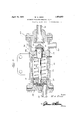
- Figure 2 is an enlarged sectional view through the retaining valve itself.
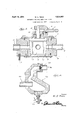
- Figure 3 is a sectional view of the engineers control valve for the pressure retaining valve.
- Figure 4 is a refuse trap and strainer.
- the numeral 5 designates the reservoir connected through the medium of the pipe 6 with the control valve 7.
- This valve 7 is of appropriate construction and located in the engineers cab to permit it to be conveniently manipulated.
- it 7 comprises a suitably shaped chassis or body with a drain in Figure 1 as the full release -block position and full on position.
- the numeral 17 designates an attaching stud for mounting purposes.
- This control valve may be of appropriate construction and at 18 it is formed with an exhaust outlet leading into the atmosphere. Then too, there is a pipe connection at 19 through which the main reservoir pressure is conducted, and associated with this is a pressure gauge 20.
- the gauge has piped connection with a suitable conduit 21 leading to and indirectly connected with a T-shaped coupling 22.
- the branch 23 is connected with a dirt trap 24 and a pipe 25 is connected with the remaining branch and leads to other cars (not shown).
- the trap 24 is connected with the pressure retaining valve 26, andthe pressure retaining valve in turn connects with the exhaust from thetriple valve whose pipe is here designated by the numeral 27.
- the trap 24 is of suitable design and includes a strainer 28 and a collection receptacle having a valved drain cook 29 located therewith. This trap has a pipe connection at 30 which leads to and is connected with a pressure retaining valve as shown in Fig.- ure 2.
- the construction of the pressure retaining valve may be IUD coiled spring 39.
- An enlarged portion 38a of the piston extends through the central lined aperture in the partition 33 where it is provided with a swivelled cut-off valve element 40.
- This valve is located in the chamber 35 and cooperates with the valve seat 41 carried by the opposite end closing head 42.
- the triple valve exhaust pipe 27 is connected with this head 42.
- the coiled spring 39 will react when the pressure is relieved from the valve 26 to open the valve element 40, in this way releasing the air from the brake cylinder (not shown).
- a brake retainer of the type described adapted to be incorporated between a valved connection with the main reservoir of the system and the triple valve thereof, comprising a uniform tubular body having flanged ends and an interior partition intermediate the ends, a sleeve inserted in one end of the body, a head closing the said one end and retaining said sleeve, another head closing the other end of the body and provided with an inwardly facing valve seat, said valved connection having communication with the interior of the tubular body through said head, and said triple valve having communication with the interior of the tubular body and the said valve seat through said other head, an exhaust through the tubular body positioned between said partition and the said other head; and a piston reciprocable in the body between the partition and the head, a piston rod on the piston having an enlarged bearing porsaid valve out of engagement with the valve seat.
Landscapes
- Engineering & Computer Science (AREA)
- Transportation (AREA)
- Mechanical Engineering (AREA)
- Valves And Accessory Devices For Braking Systems (AREA)
Description
A ril 19, 1932. w. H. RENN AUTOMATIC PRESSURE RETAINING VALVE 3 Sheets-Sheet 1 Filed April 25, 1930 I Allomcy April 19, 1932. 1 H, RENN 1,854,862
AUTOMATIC PRESSURE RETAINING VALVE 7 Filed April 23, 1955') 3 Sheets-Sheet 2 Inventor W E /7 Allomey April 19, 1932. w. H. RENN.
' AUTOMATIC BRESSURE RETI HNING VALVE Filed April 23, 1930 3 Sheets-Sheet 3 Patented Apr. 19, 1932 UNITED STATES PATENT OFFICE WILLIAM H. RENN, OF DURHAM, NORTH CAROLINA, ASSIG-NOR OF ONE-SIXTH TO RUDOLPH E. ANDONE-SIXTH TO EUTIGUS '1. RENN, BOTH OF DURHAM, NORTH CAROLINA, AND ONE-THIRD T0 CLYDE A. DOUGLASS, OF RALEIGH, NORTH CAROLINA AUTOMATIC PRESSURE RETAINING VALVE Application. filed April 23,
This invention relates to an automatic pressure retaining valve adapted to be embodied in an air brake system of the type used upon trains and the like.
In carrying the inventive conception into practice and in involving and producing the structure for accomplishing the desired results, I have developed a simple and economical arrangement susceptible of being incorporated in present-day air-brake structures which is capable of fulfilling the requirements of a device of this kind. in a, practical and satisfactory manner. a
In order to understand the fundamental advantages and features of the invention, I call attention at this time to the following enumerations: r I
First: The air brakeaut-cmatic pressure retaining valve will enable the engineer to keep brakes on the entire train after brakesare applied and restore the pressure in auxiliary reservoirs and train lines all three at the same time. The air brake automatic pressure retaining valve will also enable the engineer to keep the requisite or any pressure below maximum Federal pressure at all times.
Second: The air brake automatic pressure retaining valve will enable the engineer to release any amount of pressure from the brake cylinder by working the air brakes automatic pressure retaining valves controlling valve. The engineer will be able to maintain this pressure in brake cylinders until the descension is completed without other applications of air to brakes. (He will not have to keep applying and releasing the brakes :to keeptrain under control.)
Other features and advantages will become more apparent from the following description and drawings.
In the drawings Figure 1 is a diagrammatic view showing one of the automatic pressure retaining valves embodied in the air brake system.
Figure 2 is an enlarged sectional view through the retaining valve itself.
Figure 3 is a sectional view of the engineers control valve for the pressure retaining valve.
Figure 4 is a refuse trap and strainer.
Attention is first invited to Figure 1,
1930. Serial No. 446,614.
wherein it will be observed that the numeral 5 designates the reservoir connected through the medium of the pipe 6 with the control valve 7. This valve 7 is of appropriate construction and located in the engineers cab to permit it to be conveniently manipulated. Referring to Figure 3, it will be seen that it 7 comprises a suitably shaped chassis or body with a drain in Figure 1 as the full release -block position and full on position. The numeral 17 designates an attaching stud for mounting purposes.
This control valve may be of appropriate construction and at 18 it is formed with an exhaust outlet leading into the atmosphere. Then too, there is a pipe connection at 19 through which the main reservoir pressure is conducted, and associated with this is a pressure gauge 20. The gauge has piped connection with a suitable conduit 21 leading to and indirectly connected with a T-shaped coupling 22. The branch 23 is connected with a dirt trap 24 and a pipe 25 is connected with the remaining branch and leads to other cars (not shown).
The trap 24; is connected with the pressure retaining valve 26, andthe pressure retaining valve in turn connects with the exhaust from thetriple valve whose pipe is here designated by the numeral 27.
The trap 24 is of suitable design and includes a strainer 28 and a collection receptacle having a valved drain cook 29 located therewith. This trap has a pipe connection at 30 which leads to and is connected with a pressure retaining valve as shown in Fig.- ure 2.
Referring now to Figure 2, the construction of the pressure retaining valve may be IUD coiled spring 39.
An enlarged portion 38a of the piston extends through the central lined aperture in the partition 33 where it is provided with a swivelled cut-off valve element 40. This valve is located in the chamber 35 and cooperates with the valve seat 41 carried by the opposite end closing head 42. The triple valve exhaust pipe 27 is connected with this head 42.
Leading from one side of the chamber 35 is an exhaust or outlet 43 for the triple valve exhaust pressure.
In operation, it is evident that when the train is descending a long or steep grade, the engineer will apply the brakes to the train and then resort to the control of the automatic pressure valve 26. This is done by placing the lever 15 (see Figure 1) in full on position. This will cause air in the main reservoir 5 to flow through the pipe 6 and through the control valve 7 into the pipe connection 19. Here it will flow through the passage or pipe 21 through the coupling 22, through the trap 24, and into the automatic valve 26 through the medium of the pipe connection 30.
Introducing this pressure into the automatic valve will act on the head of the piston to force it in a direction from left to right in Figure 2, against the tension of the spring 39. This will seat the valve head 40 against the seat 41 thus closing the triple valve exhaust connection. The engineer will then put the brake valve handle (not shown) in release position, and then in running posi- The air pressure thus put in the brake cylinder will not leak out because the valve 40 is seated against the seat 41. Next the engineer should move the lever 15 to block position, thus holding the air pressure in the automatic pressure retaining valve 26. In this way the brakes will remain on, though the brake valve handle has been placed in release position so that the brakes will stay on to keep the train from gaining too much speed, while at the same time air pressure is being built up in the system.
When the descension of the grade has been completed, the engineer will put the handle or lever 15 in full release position, thus causing the air to escape back through the trap and conduit 21 and then through the control valve and to discharge into the atmosphere through the outlet 18.
The coiled spring 39 will react when the pressure is relieved from the valve 26 to open the valve element 40, in this way releasing the air from the brake cylinder (not shown).
It is thought that persons skilled in the art to which the invention relates will be able to obtain a clear understanding of the invention after considering the description in connection with the drawings. Therefore a more lengthy description is regarded as un- Minor changes in shape, size, and rearrangement of details coming Within the field of invention claimed may be resorted to in actual practice if desired.
I claim:
In a fluid pressure brake system, a brake retainer of the type described adapted to be incorporated between a valved connection with the main reservoir of the system and the triple valve thereof, comprising a uniform tubular body having flanged ends and an interior partition intermediate the ends, a sleeve inserted in one end of the body, a head closing the said one end and retaining said sleeve, another head closing the other end of the body and provided with an inwardly facing valve seat, said valved connection having communication with the interior of the tubular body through said head, and said triple valve having communication with the interior of the tubular body and the said valve seat through said other head, an exhaust through the tubular body positioned between said partition and the said other head; and a piston reciprocable in the body between the partition and the head, a piston rod on the piston having an enlarged bearing porsaid valve out of engagement with the valve seat.
In testimony whereof I afiix my signature.
WILLIAM H. RENN.
Priority Applications (1)
| Application Number | Priority Date | Filing Date | Title |
|---|---|---|---|
| US446614A US1854862A (en) | 1930-04-23 | 1930-04-23 | Automatic pressure retaining valve |
Applications Claiming Priority (1)
| Application Number | Priority Date | Filing Date | Title |
|---|---|---|---|
| US446614A US1854862A (en) | 1930-04-23 | 1930-04-23 | Automatic pressure retaining valve |
Publications (1)
| Publication Number | Publication Date |
|---|---|
| US1854862A true US1854862A (en) | 1932-04-19 |
Family
ID=23773240
Family Applications (1)
| Application Number | Title | Priority Date | Filing Date |
|---|---|---|---|
| US446614A Expired - Lifetime US1854862A (en) | 1930-04-23 | 1930-04-23 | Automatic pressure retaining valve |
Country Status (1)
| Country | Link |
|---|---|
| US (1) | US1854862A (en) |
-
1930
- 1930-04-23 US US446614A patent/US1854862A/en not_active Expired - Lifetime
Similar Documents
| Publication | Publication Date | Title |
|---|---|---|
| US2173928A (en) | Fluid pressure brake | |
| US2064573A (en) | Brake | |
| US2030288A (en) | Brake control mechanism | |
| US2170851A (en) | Master cylinder and piston structure | |
| GB472223A (en) | Improvements relating to fluid pressure braking apparatus for railway and other vehicles | |
| US2128853A (en) | Safety device for hydraulic brakes | |
| US2111930A (en) | Hydraulic brake connection | |
| GB389930A (en) | Improvements in hydraulic control gear for the brakes of vehicles and like purposes | |
| US2056940A (en) | Hydraulic brake system | |
| US1464640A (en) | Air brake | |
| US2106491A (en) | Fluid pressure brake | |
| US2664101A (en) | Automatic shutoff valve for pressure fluid systems | |
| US2571420A (en) | Mechanism for draining moisture from compressed-air storage tanks | |
| US2119001A (en) | Hydraulic brake equalizer | |
| US1614653A (en) | Compressed-air brake system for motor-vehicle trains | |
| US2148725A (en) | Speed controlled brake | |
| US2508206A (en) | Brake cylinder pressure control valve device | |
| US2779635A (en) | Bleeding valves for air brake cylinders | |
| US2112427A (en) | Fluid pressure brake | |
| US852949A (en) | Air-brake apparatus. | |
| US1514995A (en) | Automatic air brake | |
| US952299A (en) | Air-brake. | |
| US2121552A (en) | Trip controlled brake | |
| US966211A (en) | Air-brake system. | |
| US2854288A (en) | Variable load brake apparatus |