US185478A - Improvement in jack-lasts - Google Patents
Improvement in jack-lasts Download PDFInfo
- Publication number
- US185478A US185478A US185478DA US185478A US 185478 A US185478 A US 185478A US 185478D A US185478D A US 185478DA US 185478 A US185478 A US 185478A
- Authority
- US
- United States
- Prior art keywords
- last
- jack
- lasts
- shoe
- piece
- Prior art date
- Legal status (The legal status is an assumption and is not a legal conclusion. Google has not performed a legal analysis and makes no representation as to the accuracy of the status listed.)
- Expired - Lifetime
Links
- 230000002045 lasting effect Effects 0.000 description 5
- XEEYBQQBJWHFJM-UHFFFAOYSA-N Iron Chemical compound [Fe] XEEYBQQBJWHFJM-UHFFFAOYSA-N 0.000 description 2
- 238000009966 trimming Methods 0.000 description 2
- 238000010276 construction Methods 0.000 description 1
- 229910052742 iron Inorganic materials 0.000 description 1
- 238000004519 manufacturing process Methods 0.000 description 1
- 239000002184 metal Substances 0.000 description 1
- 229910052751 metal Inorganic materials 0.000 description 1
- 238000000034 method Methods 0.000 description 1
- 238000004904 shortening Methods 0.000 description 1
- 239000002023 wood Substances 0.000 description 1
Images
Classifications
-
- A—HUMAN NECESSITIES
- A43—FOOTWEAR
- A43D—MACHINES, TOOLS, EQUIPMENT OR METHODS FOR MANUFACTURING OR REPAIRING FOOTWEAR
- A43D3/00—Lasts
- A43D3/02—Lasts for making or repairing shoes
- A43D3/025—Longitudinally expansible lasts
Definitions
- the design of the invention is to facilitate the manufacture of boots and shoes by a last of the proper size and form to it the foot, and so that the bottom may be put on and the shoe finished upon the last, but more especially so that the shoe may be removed with facility from the last at any stage of its making, and placed upon another last of similar construction, with as much ease and facility as the shoe with the ordinary last in it may be transferred from one jack to another.
- the lasting of the shoes is carried on separately, the outsole tacked to, and the work, with the last in it, carried to another place to be nailed or pegged in the machine, after which the last is drawn out and returned to the part of the shop where the lasting is done.
- my new jack-last the loss of time and trouble in carrying lasts from one part of the shop to another is avoided, and the expense and labor of drawing out the lasts are saved.
- My jack-last is provided with the means for the ready placing and removal of the boot or shoe, preserving, when under operation, the integrity of the surface of the last.
- the last portion of the jack is bisected transversely, one section being adapted to be removed out of the surface-line, and to be restored thereto to constitute the jack-last a complete workstructure, upon and from which the shoe may be worked from one jack-last to another, and the work done with dispatch.
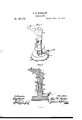
- Figure 1 represents a view ,in perspective, of a jack-last embracing my invention
- Fig. 2 a vertical longitudinal section of the same, the toepiece being elevated to illustrate the method of shortening the last.
- the bisection is inclined to the axis of the standard, and the movable section or toe-piece A rises upon an incline toward the heel-piece B, and gradually carries the shoe free of the heel-piece, and permits it to be readily slipped forward from oft' the toe-piece, since, as the toe-piece or movable portion rises upon the incline, it gradually diminishes the length of the Whole last, and in doing so lifts and frees the shoe of the last, so that it may be slipped off, as before stated.
- the shoe is put on when the toepiece is raised, and as the toe part is pressed lown to its place the shoe is completely iilled by the last.
- the toe-piece is raised by suitable treadle devices D, in order to leave both hands of the operative free, and connected therewith is an annulus, E, or universal ,lifting-disk, which strikes up the guidepin b, which extends from the toepece, and is socketed therein.
- the toe-piece A is firmly supported upon a bearing projection, c, of the heel-piece B, through which bearing the guidepin b passes, as shown in Fig. 2, and travels in the same inclined line.
- the last A B is pivoted in the standard C, and fastened by screw d (which may be countersunk in the standard) engaging with a circumferential groove, e, in the pivot projection F of thelast.
- screw d which may be countersunk in the standard
- the last maybe turned freely around upon its pivot, the pin b being of a length which does not touch the annulus E when the nailing or other work is going on. No matter in what position the last may be when the treadle is operated, the annulus strikes the pin and raises the toe-piece.
- the machine is designed to be operated in an upright position
- a series of the jack'lasts are used for the diiferent operations of lasting, pegging, trimming, and finishing.
- the last may be entirely of iron or other metal, or it may be of wood and plated.
- the bisecting joint need not necessarily be a dovetail joint, but it should be such as to lock the sections together in any position.
- a jack-last the last portion being bisected transversely, one section being operated and controlled in constant connection with the other, to interrupt and restore the continuity of the lasts surface by the direct agency of a treadle or lever and intermediate connections, substantially as described.
- the movable or actilhlgsection A in combination with the passivesection B, provided with guidebearing c, and the operating device b, substantially as described.
Landscapes
- Footwear And Its Accessory, Manufacturing Method And Apparatuses (AREA)
Description
C1"131GfELoW.
JACK-LASTS.
N.185,478. Patented Dec.19,1s7s.
uil,
UNITED STATES PATENT OEETGEo `CHARLES D. BIGELOW, OF NEW YORK, N. Y.
IMPROVEMENT IN JACK-LASTS.
Specification forming part of Letters Patent N o. 185,478, dated December 19, 1876; application filed November 11, 1876.
To all whom it may concern:
Be it known that I, CHARLES D. BIGELow, formerly of Brooklyn, but now of the city of New York, in the county of New York and $tate of New York, have invented certain new and useful Improvements in Jack-Lasts 5 and I do hereby declare that the following is a full, clear, and exact description thereof, which will enable others skilled in the art to which it appertains to make and use the same, reference being had to the accompanying drawings, and to letters of reference marked thereon, which form a part of this specification.
The design of the invention is to facilitate the manufacture of boots and shoes by a last of the proper size and form to it the foot, and so that the bottom may be put on and the shoe finished upon the last, but more especially so that the shoe may be removed with facility from the last at any stage of its making, and placed upon another last of similar construction, with as much ease and facility as the shoe with the ordinary last in it may be transferred from one jack to another. In large manufactories the lasting of the shoes is carried on separately, the outsole tacked to, and the work, with the last in it, carried to another place to be nailed or pegged in the machine, after which the last is drawn out and returned to the part of the shop where the lasting is done. By means of my new jack-last the loss of time and trouble in carrying lasts from one part of the shop to another is avoided, and the expense and labor of drawing out the lasts are saved.
My jack-last is provided with the means for the ready placing and removal of the boot or shoe, preserving, when under operation, the integrity of the surface of the last. The last portion of the jack is bisected transversely, one section being adapted to be removed out of the surface-line, and to be restored thereto to constitute the jack-last a complete workstructure, upon and from which the shoe may be worked from one jack-last to another, and the work done with dispatch.
In the accgmpanying drawings, Figure 1 represents a view ,in perspective, of a jack-last embracing my invention; and Fig. 2, a vertical longitudinal section of the same, the toepiece being elevated to illustrate the method of shortening the last.
I make the last in two sections, A B, the bisection, as shown, being oblique to the line of the standard C, joined by a dovetail `joint, a, using the heel-piece as a support or bearing. The bisection is inclined to the axis of the standard, and the movable section or toe-piece A rises upon an incline toward the heel-piece B, and gradually carries the shoe free of the heel-piece, and permits it to be readily slipped forward from oft' the toe-piece, since, as the toe-piece or movable portion rises upon the incline, it gradually diminishes the length of the Whole last, and in doing so lifts and frees the shoe of the last, so that it may be slipped off, as before stated. `The shoe is put on when the toepiece is raised, and as the toe part is pressed lown to its place the shoe is completely iilled by the last. The toe-piece is raised by suitable treadle devices D, in order to leave both hands of the operative free, and connected therewith is an annulus, E, or universal ,lifting-disk, which strikes up the guidepin b, which extends from the toepece, and is socketed therein. The toe-piece A is firmly supported upon a bearing projection, c, of the heel-piece B, through which bearing the guidepin b passes, as shown in Fig. 2, and travels in the same inclined line. The last A B is pivoted in the standard C, and fastened by screw d (which may be countersunk in the standard) engaging with a circumferential groove, e, in the pivot projection F of thelast. The last maybe turned freely around upon its pivot, the pin b being of a length which does not touch the annulus E when the nailing or other work is going on. No matter in what position the last may be when the treadle is operated, the annulus strikes the pin and raises the toe-piece.
To give the annulus a free movement up and down the standard, it is provided with a collar, f, in lugs g of which, at its junction with the under surface of the lifting-annulus, are jointed links hof the treadle-baili. Were it not for this annulus time Would be wasted in lifting the toe-piece.
As shown in the drawings, the machine is designed to be operated in an upright position,
in which.` case it is used for lasting, nailing, and hgeling. It may, however, be operated ina horizontal position,in which case it is used for trimming and burnishing the edges. The insole in the lasting is tacked to the wooden plugs k, and the upper drawn over and tacked to the insole and to the plug lc in the heel.
A series of the jack'lasts are used for the diiferent operations of lasting, pegging, trimming, and finishing. The last may be entirely of iron or other metal, or it may be of wood and plated. The bisecting joint need not necessarily be a dovetail joint, but it should be such as to lock the sections together in any position.
It will also be observed that 1 put on and freethe shoe with relation to the last without entirely separating the sections, while the last is ofthe proper size to fill the shoe.
I claim- 1. A jack-last, the last portion being bisected transversely, one section being operated and controlled in constant connection with the other, to interrupt and restore the continuity of the lasts surface by the direct agency of a treadle or lever and intermediate connections, substantially as described.
2. In a jack-last havinga bisected last portion, the inclined guide devicebpin., combinar tion with the movable section A,"the bearing 5` c, the annulus E, and the treadle or lever connection D, as described. v
3. In a jack-last havnga bisectedlast portion, the movable or actilhlgsection A, in combination with the passivesection B, provided with guidebearing c, and the operating device b, substantially as described.
4. In combination with'a. jack-last of two sections, bisected obliquely, as set forth, the annnlus or universal lifting-disk E, adapted to operate with a guide-pin, Ab,"'or 'other suitable means to extend the movable section, for the purpose stated. 1 ,E
5. The combination, with, a jack-last of two sections, bisected obliquely, asset forth, of the annulus or universal liftingdisk 1E and the intermediate lifting device b ofa treadlefconf l nection, for the purpogestatedl 1 In testimony that I clairiry thelforegoing I. f have aiixed my signaturein presenceof two` f;
CHARLES 1i); BrGnLow.
witnesses.
Witnesses:
A. E. H. JOHNSON, J. W. HAMILTON J oHNsoN.`
Publications (1)
| Publication Number | Publication Date |
|---|---|
| US185478A true US185478A (en) | 1876-12-19 |
Family
ID=2254884
Family Applications (1)
| Application Number | Title | Priority Date | Filing Date |
|---|---|---|---|
| US185478D Expired - Lifetime US185478A (en) | Improvement in jack-lasts |
Country Status (1)
| Country | Link |
|---|---|
| US (1) | US185478A (en) |
-
0
- US US185478D patent/US185478A/en not_active Expired - Lifetime
Similar Documents
| Publication | Publication Date | Title |
|---|---|---|
| US841732A (en) | Last. | |
| US245303A (en) | Expanding last | |
| US2375788A (en) | Machine for assembling uppers and their lasts | |
| US346772A (en) | pisano | |
| US221567A (en) | Improvement in machinery for cementing shoe uppers and soles | |
| US1832925A (en) | Treeing machine | |
| US579251A (en) | Shoe-repairing jack | |
| US1076618A (en) | Leveling-machine jack. | |
| US1065584A (en) | Method of making shoes. | |
| US1163589A (en) | Sole-pressing machine. | |
| US2104137A (en) | Means for operating on shoes | |
| US2193187A (en) | Last jack | |
| US1258400A (en) | Shoe-holding mechanism. | |
| US1291757A (en) | Last-pulling machine. | |
| US439752A (en) | Jack for burnishing | |
| US378446A (en) | Machine | |
| US720171A (en) | Spring-heel-seating machine. | |
| US2967313A (en) | Shoe last and means for holding an insole thereon | |
| US384891A (en) | Lasting-jack | |
| US331476A (en) | buegess | |
| US152559A (en) | Improvement in machinery for shaping shoe-soles | |
| US1057804A (en) | Lasting-machine. | |
| US173405A (en) | Improvement in machinery for lasting the uppers of boots and shoes | |
| US493196A (en) | Relasting-machine | |
| US393216A (en) | Sole laying and pressing machine |