US1854724A - Eye testing instrument - Google Patents
Eye testing instrument Download PDFInfo
- Publication number
- US1854724A US1854724A US425238A US42523830A US1854724A US 1854724 A US1854724 A US 1854724A US 425238 A US425238 A US 425238A US 42523830 A US42523830 A US 42523830A US 1854724 A US1854724 A US 1854724A
- Authority
- US
- United States
- Prior art keywords
- eye
- tube
- color
- test
- fixation
- Prior art date
- Legal status (The legal status is an assumption and is not a legal conclusion. Google has not performed a legal analysis and makes no representation as to the accuracy of the status listed.)
- Expired - Lifetime
Links
- 238000012360 testing method Methods 0.000 title description 52
- 230000000007 visual effect Effects 0.000 description 13
- 238000013507 mapping Methods 0.000 description 8
- 230000007935 neutral effect Effects 0.000 description 3
- 238000010276 construction Methods 0.000 description 2
- 101150029610 asun gene Proteins 0.000 description 1
- 239000004744 fabric Substances 0.000 description 1
- 101150017817 ints13 gene Proteins 0.000 description 1
- 238000004519 manufacturing process Methods 0.000 description 1
- 238000005259 measurement Methods 0.000 description 1
- 239000000203 mixture Substances 0.000 description 1
- 230000003287 optical effect Effects 0.000 description 1
- 230000002747 voluntary effect Effects 0.000 description 1
Images
Classifications
-
- A—HUMAN NECESSITIES
- A61—MEDICAL OR VETERINARY SCIENCE; HYGIENE
- A61B—DIAGNOSIS; SURGERY; IDENTIFICATION
- A61B3/00—Apparatus for testing the eyes; Instruments for examining the eyes
- A61B3/02—Subjective types, i.e. testing apparatus requiring the active assistance of the patient
- A61B3/024—Subjective types, i.e. testing apparatus requiring the active assistance of the patient for determining the visual field, e.g. perimeter types
Definitions
- This invention relates to improvements in eye-testing instruments and has particular reference to instruments for testing and measuring the field of vision.
- the principal object of this invention is to provide a simple, inexpensive and complete device whereby the field of vision of each eye may be ascertained.
- Another object of this invention is to pro vide eflicient and simple means to prevent attention being distracted by extraneous obje'cts.
- Another object of this invention is'to provide means for testing both the visual and color fields of the eye.
- Another object of this invention is to provide means to promote clear vision of the test and fixation objectss.
- Another object of this invention is to provide means for the simultaneous measuring and recording of the field of vision.
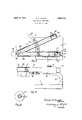
- Fig. I is a top or plan view partly in -sec tion. showing my improved instrument.
- Fig. II is a front view of the same.
- Fig. III is a front view of the color test object.
- the usual type of apparatus for me'asun ing the field of vision is of an elaborate nature when made upon scientific principles and is also a bulky and expensive addition to the practitioners stock.
- the movable target for instance, is attached to a huge arcuate arm which is supported on a framework large enough to enable it to be swung in any meridian and altogether the instrument is not economical. neat nor easy to use.
- the Rotatably mounted in the bearing 3 is a' tubular member 4 having an open end and a fixation spot 5 atthe other.
- the interior of the tubular member 4 may have a neutral color such as gray in order that attention will not be attracted to anything but the fixation spot 5 which may be of any suit-able size.
- a screw 6 is provided in the bearing 3 and locates in a groove 7 in the tube 4. The screw 6 may be loosened to allow rotation of the tube 4 as desired but the groove 7 will prevent undesired longitudinal movement.
- an arouate arm 8 having a graduatedscale 9 on both sides@
- a saddle member 10 shaped to slide freely on the arm 8 carries a second tubular member 11 also having a neutral color in terior and so arranged that a continuation of its axis (will intersect a continuation of the axis of the first tube 4 at the point 12 Fig.
- arcuate arm 8 is an arc having its center upon the point 12 to allow the tube 11 to be pivoted thereupon.
- a suitable sized target 13 is placed at one end of the second tube 11 while the other end is open as in the first tube .4.
- a lens 14 is held in the tube 11 adjacent the target .13 to project said target to infinity or other point clearly seen and a similar lens 15 is held in the tube 4.
- a lamp 1'9 having a shade 20 thereover may be used in each tube to illuminate the test spots.
- the tubes 4 and 11 are closed together until the eye 16 can sight both the fixation object 5 and target 13.
- the eye 16 will then be in the position shown in Fig. I.
- the first tube 4 is, of course, locked in position with the axis of the two tubes either in the same horizontal plane or at any desired angle to each other.
- the second tube 11 is next moved on the arcuate arm 8 away from the first tube 4 until the limit of the visual field is reached.
- the angleof this will be recorded automatically on the scale 9 and the screw 6 may then be loosened to enable the second tube 11 to be swung at an angle to the horizontal plane of the first.
- the second tube 11 is then used to record the extent of the entire field by moving it towards and away from the first tube inthe plane of the tubes and it may be also completely rotated in a plane normal to the plane of the two tubes by the rotation of the tube 4 in the bearing 3.
- the scale 9 on each side of the arcuate arm will enable measurements to be taken not-withstanding whether the second tube 11 is being used on the right or left hand side of the first tube 4.
- the red spot is of a chosen color and brighter than the grey back field 1.8 when at the center of the color field of a normal eye, but when placed at the margin of said field will appear as of the same visual intensity.
- test spot 17 may be of any desired color, such as red, green, yellow or blue, depending on the different fields being tested and may be of any size desired.
- the second tube 11 In the operation of the color field test the second tube 11 is moved towards and away from the first tube 4 or completely around in a plane normal thereto as described above as in testing the visual field. If the red color field is being tested the red spot is used and the patient .fixes his eye on the fixation splot 5 in the first tube 4 and the color splot 17 will disappear and emerge at certain boundaries and these are recorded on the scale 9. A different colored test object is used for the different color fields as has been related.
- Means for mapping the visual field of an eye under test comprising a support, a member rotatably mounted on the support and having a'fixa-tion object thereon positioned at the center or rotation of said support and in line with straight ahead vision of the eye under test, a test object support on the rota able member and having a test object thereon movable towards and away from the fixation object and to different meridians relative to the fixation object and means for looking the rotatable member in desired selected meridians relative to the fixation object to prevent movement of said rotatable member during the movement of the test object towards and away from said fixation object in said selected meridians.
- Means for mapping the color fields of an eye under test comprising a support, a member rotatably mounted on the support and having a fixation object thereon posi tioned at the center of rotation of said sup port and in line with straight ahead vision of the eye under test, a test object support on the rotatable member having a colored test object thereon of the color to be tested.
- said test object being movable towards and away from the fixation object and to different meridians relative to the fixation object and means for locking the rotatable member in desired selected meridians relative to the fixation object to prevent movement of said rotatable member during the movement of the colored test object towards and away from said fixation object in said selected meridians.
- Means for mapping the visual field of an eye under test comprising a support, a tubular member rotatablymounted on the support and having its longitudinal axis lying on the line of straight ahead vision of the eye under test, a fixation object in thetubular member positioned at the center of rotation of said tubular member and on said line of straight ahead vision, a second tubular member on the first andhaving a test object therein movable in an arc towards and away from the fixation object about the eye as the center of said arcuate movement and to different meridians relative to said fixation object about said fixation object as the center of movement.
- Means for mapping the color fields of an eye under test comprising a support, atubular member rotatably mounted on the support and having its longitudinal axis lying on the line of straight ahead vision of the eye under test, a fixation object in the tubular member positioned at the center of rotation of said tubular member and on said line of straight ahead vision, a second tubular member on the first and having a colored test object therein of the color to be tested, said test object being movable in an arc towards and away from the fixation object about the eye as the center of said arcuate movement and to diflerent meridians relative to said fixation object about said fixation object as a center of movement.
- Means for mapping the visual field of an eye under test comprising a support, a support, a support, a support, a support, a support, a support, a support, a support, a support, a support, a support, a support, a support, a support, a support, a support, a support, a support, a support, a support, a support, a support, a support, a support, a support, a support, a support, a support, a support, a support, a support, a support, a support, a support, a support, a support, a support, a support, a support, a support, a support, a support, a support, a support, a support, a support, a support, a support, a support, a support, a support, a support, a support, a support, a support, a support, a support, a support, a support,
- tubular member rotatably mounted on the support and having its longitudinal axis lying on the line of straight ahead vision of the eye under test, a fixation object in the tubular member positioned at the center of rotation of said tube and on said line of straight ahead vision, a second tubular member on the first having a test object therein movable in an arc towards and away from the fixation object about the eye as the center of said areuate movement and to difi'erent meridians relative to said fixation object and indicator means cooperating with said tubular members for measuring and recording the limits of said field.
- tubular members having their inner walls of a gray or neutral color.
- Means for mapping the color fields of an eye under test comprising a support, a tubular member rotatably mounted on a support and having its longitudinal axis lying on the line of straight ahead vision of the eye under test, a fixation object in the tubular member positioned at the center of rotation of said tube and on said line of straight ahead vision, a second tubular member on the first and having a test object therein movable in an arc towards and away from the fixation object about the eye as the center of said areuate movement and to difierent meridians relative to said fixation object about said fixation object at the center of movement, said test object having a field of one color and a spot of a different color thereon, said spot having a color brighter in visual intensity than the surrounding field when located substantially at the center of the color field of the eye under test and appearing as being of the same visual intensity and blendin with the color of the field when positione adjacent the edge of the color field being tested.
- Means for mapping the visual field of an eye under test comprising a support, a tubular member rotatably mounted on the support and having its longitudinal axis lying on the line of straight ahead vision of the eye under test, a fixation object in the tubular member positioned at the center of rotation of said tube and on said line of straight ahead vision, a second tubular member on the first and having a test object therein movable in an arc towards and away from the fixation object about the eye as the center of said arcuate movement and to different meridians relative to said fixation object and an expandible cover onthe tubular members adjacent the eye under test for shielding the eye from undesired extraneous objects during the movement of said tubular members.
- Means for mapping the color fields of an eye under test comprising a support, a tubular member rotatably mounted on the support and having its longitudinal axis lying on the line of straight ahead vision of the eye under test, a fixation object in the tubular member positioned at the center of rotation of said tubular member and on said line of straight ahead vision, a secondtubular member on the first and having a colored test object therein of the color to be tested, said test object being movable in an arc towards and away from the fixation object about the eye as the center of said arcuate movement and to different meridians rela-
Landscapes
- Life Sciences & Earth Sciences (AREA)
- Health & Medical Sciences (AREA)
- Medical Informatics (AREA)
- Biophysics (AREA)
- Ophthalmology & Optometry (AREA)
- Engineering & Computer Science (AREA)
- Biomedical Technology (AREA)
- Heart & Thoracic Surgery (AREA)
- Physics & Mathematics (AREA)
- Molecular Biology (AREA)
- Surgery (AREA)
- Animal Behavior & Ethology (AREA)
- General Health & Medical Sciences (AREA)
- Public Health (AREA)
- Veterinary Medicine (AREA)
- Eye Examination Apparatus (AREA)
Description
April 19, 1932. L R 1,854,724
' EYE TESTING INSTRUMENT Filed Feb. 1, 1930 4 lllllllllll 4 BY EM W A TTORNE Y Patented Apr. 19, 1932 UNIT i) STATES EDGAR D. TILLYER, OF SOUTI-IBRIDGE, MASSACHUSETTS, ASSIGNOR T0 AMERICAN OPTICAL COMPANY, OF SOUTHBRIDGE, MASSACHUSETTS, A VOLUNTARY ASSOCIA- TION OF MASSACHUSETTS EYE TESTING INSTRUMENT Application filed. February 1, 1930. Serial No. 425,238.
This invention relates to improvements in eye-testing instruments and has particular reference to instruments for testing and measuring the field of vision.
The principal object of this invention is to provide a simple, inexpensive and complete device whereby the field of vision of each eye may be ascertained.
Another object of this invention is to pro vide eflicient and simple means to prevent attention being distracted by extraneous obje'cts. v
Another object of this invention is'to provide means for testing both the visual and color fields of the eye.
Another object of this invention is to provide means to promote clear vision of the test and fixation obiects.
Another object of this invention is to provide means for the simultaneous measuring and recording of the field of vision.
Other objects and advantages will become apparent from the following description taken in connection with the accompanying drawings and it will be understood that many changes may be made in the details of construction. and arrangement of parts without departing from the spirit of the invention as expressed in the accompanying claims. I, therefore, do not wish to be limited to the exact details shown and described as the preferred forms only have been shown by way of illustration.
In the drawings:
Fig. I is a top or plan view partly in -sec tion. showing my improved instrument.
Fig. II is a front view of the same.
Fig. III is a front view of the color test object.
The usual type of apparatus for me'asun ing the field of vision is of an elaborate nature when made upon scientific principles and is also a bulky and expensive addition to the practitioners stock. The movable target, for instance, is attached to a huge arcuate arm which is supported on a framework large enough to enable it to be swung in any meridian and altogether the instrument is not economical. neat nor easy to use.
In this invention all the expensive mechanism has been eliminated and, although the Rotatably mounted in the bearing 3 is a' tubular member 4 having an open end and a fixation spot 5 atthe other. The interior of the tubular member 4 may have a neutral color such as gray in order that attention will not be attracted to anything but the fixation spot 5 which may be of any suit-able size. To hold the tube 4 in position a screw 6 is provided in the bearing 3 and locates in a groove 7 in the tube 4. The screw 6 may be loosened to allow rotation of the tube 4 as desired but the groove 7 will prevent undesired longitudinal movement.
On one side of the tube is secured an arouate arm 8 having a graduatedscale 9 on both sides@ A saddle member 10 shaped to slide freely on the arm 8 carries a second tubular member 11 also having a neutral color in terior and so arranged that a continuation of its axis (will intersect a continuation of the axis of the first tube 4 at the point 12 Fig.
I. It will be seen that the arcuate arm 8 is an arc having its center upon the point 12 to allow the tube 11 to be pivoted thereupon.
In order to allow the tubular members to be pivoted at the point 12 of the eye I cut away a portion 25 on each tube and thereby allow free pivotal movement of the second tube 11 to the extent of the visual field. I also place a preferably dark-colored cloth 26 over the portions 25 to prevent undesired light from entering the tubes at this point. It will readily be seen that the patients eye will be occluded from exterior objects and will therefore see only the objects in the tubes which concentration is highly desirable in perimetry tests.
A suitable sized target 13 is placed at one end of the second tube 11 while the other end is open as in the first tube .4. A lens 14 is held in the tube 11 adjacent the target .13 to project said target to infinity or other point clearly seen and a similar lens 15 is held in the tube 4. A lamp 1'9 having a shade 20 thereover may be used in each tube to illuminate the test spots.
It will now be apparent that an extremely simple apparatus has been devised to measure and record the visual field of the eye inasmuch as no elaborate mechanism is necessary to accomplish the desired results as will be apparent from the following description of theoperation.
In the operation of the device the tubes 4 and 11 are closed together until the eye 16 can sight both the fixation object 5 and target 13. The eye 16 will then be in the position shown in Fig. I. The first tube 4 is, of course, locked in position with the axis of the two tubes either in the same horizontal plane or at any desired angle to each other.
The second tube 11 is next moved on the arcuate arm 8 away from the first tube 4 until the limit of the visual field is reached. The angleof this will be recorded automatically on the scale 9 and the screw 6 may then be loosened to enable the second tube 11 to be swung at an angle to the horizontal plane of the first. The second tube 11 is then used to record the extent of the entire field by moving it towards and away from the first tube inthe plane of the tubes and it may be also completely rotated in a plane normal to the plane of the two tubes by the rotation of the tube 4 in the bearing 3. The scale 9 on each side of the arcuate arm will enable measurements to be taken not-withstanding whether the second tube 11 is being used on the right or left hand side of the first tube 4.
Any serious encroachment on the field of vision at any point will become immediately apparent upon the rotation of the second tube 11 around the first tube 4 and the amount will be indicated automatically on the scale 9. This forms a simple test for the visual field and if desired I can also map out the color field of the eye.
To accomplish this additional test I provide in the tube 11 a colored spot 17, say of red, on a grey back field 18, Fig. 111, in place of the target 13. The red spot is of a chosen color and brighter than the grey back field 1.8 when at the center of the color field of a normal eye, but when placed at the margin of said field will appear as of the same visual intensity. In this way I have provided means whereby the colored spot will blend or fade into its surrounding field 18 when moved to the margin of the color field of the eye under test.
It will be understood that the test spot 17 may be of any desired color, such as red, green, yellow or blue, depending on the different fields being tested and may be of any size desired.
In the operation of the color field test the second tube 11 is moved towards and away from the first tube 4 or completely around in a plane normal thereto as described above as in testing the visual field. If the red color field is being tested the red spot is used and the patient .fixes his eye on the fixation splot 5 in the first tube 4 and the color splot 17 will disappear and emerge at certain boundaries and these are recorded on the scale 9. A different colored test object is used for the different color fields as has been related.
From the foregoing it will be apparent that I have provided a useful and desirable instrument for measuring'the various fields of the eye. The simplicity of construction and operation will be seen from the description and while the elaborate mechanism of prior art instruments has been eliminated it will be clear that the accuracy and completeness of the tests has not been jeopardized. The instrument is economical to manufacture and compact in size and the ease and speed of operation will be readily apparent.
Having described my invention, I claim:
1. Means for mapping the visual field of an eye under test comprising a support, a member rotatably mounted on the support and having a'fixa-tion object thereon positioned at the center or rotation of said support and in line with straight ahead vision of the eye under test, a test object support on the rota able member and having a test object thereon movable towards and away from the fixation object and to different meridians relative to the fixation object and means for looking the rotatable member in desired selected meridians relative to the fixation object to prevent movement of said rotatable member during the movement of the test object towards and away from said fixation object in said selected meridians.
2. Means for mapping the color fields of an eye under test comprising a support, a member rotatably mounted on the support and having a fixation object thereon posi tioned at the center of rotation of said sup port and in line with straight ahead vision of the eye under test, a test object support on the rotatable member having a colored test object thereon of the color to be tested. said test object being movable towards and away from the fixation object and to different meridians relative to the fixation object and means for locking the rotatable member in desired selected meridians relative to the fixation object to prevent movement of said rotatable member during the movement of the colored test object towards and away from said fixation object in said selected meridians.
3. Means for mapping the visual field of an eye under test comprising a support, a tubular member rotatablymounted on the support and having its longitudinal axis lying on the line of straight ahead vision of the eye under test, a fixation object in thetubular member positioned at the center of rotation of said tubular member and on said line of straight ahead vision, a second tubular member on the first andhaving a test object therein movable in an arc towards and away from the fixation object about the eye as the center of said arcuate movement and to different meridians relative to said fixation object about said fixation object as the center of movement. I
4. Means for mapping the color fields of an eye under test comprising a support, atubular member rotatably mounted on the support and having its longitudinal axis lying on the line of straight ahead vision of the eye under test, a fixation object in the tubular member positioned at the center of rotation of said tubular member and on said line of straight ahead vision, a second tubular member on the first and having a colored test object therein of the color to be tested, said test object being movable in an arc towards and away from the fixation object about the eye as the center of said arcuate movement and to diflerent meridians relative to said fixation object about said fixation object as a center of movement.
5. Means for mapping the visual field of an eye under test comprising a support, a
tubular member rotatably mounted on the support and having its longitudinal axis lying on the line of straight ahead vision of the eye under test, a fixation object in the tubular member positioned at the center of rotation of said tube and on said line of straight ahead vision, a second tubular member on the first having a test object therein movable in an arc towards and away from the fixation object about the eye as the center of said areuate movement and to difi'erent meridians relative to said fixation object and indicator means cooperating with said tubular members for measuring and recording the limits of said field.
tive to said fixation object about said fixation object as the center of movement, said tubular members having their inner walls of a gray or neutral color.
7. Means for mapping the color fields of an eye under test comprising a support, a tubular member rotatably mounted on a support and having its longitudinal axis lying on the line of straight ahead vision of the eye under test, a fixation object in the tubular member positioned at the center of rotation of said tube and on said line of straight ahead vision, a second tubular member on the first and having a test object therein movable in an arc towards and away from the fixation object about the eye as the center of said areuate movement and to difierent meridians relative to said fixation object about said fixation object at the center of movement, said test object having a field of one color and a spot of a different color thereon, said spot having a color brighter in visual intensity than the surrounding field when located substantially at the center of the color field of the eye under test and appearing as being of the same visual intensity and blendin with the color of the field when positione adjacent the edge of the color field being tested.
8. Means for mapping the visual field of an eye under test comprising a support, a tubular member rotatably mounted on the support and having its longitudinal axis lying on the line of straight ahead vision of the eye under test, a fixation object in the tubular member positioned at the center of rotation of said tube and on said line of straight ahead vision, a second tubular member on the first and having a test object therein movable in an arc towards and away from the fixation object about the eye as the center of said arcuate movement and to different meridians relative to said fixation object and an expandible cover onthe tubular members adjacent the eye under test for shielding the eye from undesired extraneous objects during the movement of said tubular members.
EDGAR D. TILLYER.
6. Means for mapping the color fields of an eye under test comprising a support, a tubular member rotatably mounted on the support and having its longitudinal axis lying on the line of straight ahead vision of the eye under test, a fixation object in the tubular member positioned at the center of rotation of said tubular member and on said line of straight ahead vision, a secondtubular member on the first and having a colored test object therein of the color to be tested, said test object being movable in an arc towards and away from the fixation object about the eye as the center of said arcuate movement and to different meridians rela-
Priority Applications (1)
| Application Number | Priority Date | Filing Date | Title |
|---|---|---|---|
| US425238A US1854724A (en) | 1930-02-01 | 1930-02-01 | Eye testing instrument |
Applications Claiming Priority (1)
| Application Number | Priority Date | Filing Date | Title |
|---|---|---|---|
| US425238A US1854724A (en) | 1930-02-01 | 1930-02-01 | Eye testing instrument |
Publications (1)
| Publication Number | Publication Date |
|---|---|
| US1854724A true US1854724A (en) | 1932-04-19 |
Family
ID=23685731
Family Applications (1)
| Application Number | Title | Priority Date | Filing Date |
|---|---|---|---|
| US425238A Expired - Lifetime US1854724A (en) | 1930-02-01 | 1930-02-01 | Eye testing instrument |
Country Status (1)
| Country | Link |
|---|---|
| US (1) | US1854724A (en) |
Cited By (3)
| Publication number | Priority date | Publication date | Assignee | Title |
|---|---|---|---|---|
| DE3434319A1 (en) * | 1984-09-19 | 1986-04-03 | Oculus-Optikgeräte GmbH, 6330 Wetzlar | METHOD FOR FIXATION CONTROL OF THE PATIENT EYE IN PERIMETER MEASUREMENTS |
| US5953117A (en) * | 1995-11-03 | 1999-09-14 | Nederlandse Organisatie Voor Toegepast-Natuurwetenschappelijk Onderzoek (Tno) | Visual prominence meter |
| NL1020561C2 (en) * | 2002-05-08 | 2003-11-11 | Tno | Device and method for determining the prominence of an object. |
-
1930
- 1930-02-01 US US425238A patent/US1854724A/en not_active Expired - Lifetime
Cited By (4)
| Publication number | Priority date | Publication date | Assignee | Title |
|---|---|---|---|---|
| DE3434319A1 (en) * | 1984-09-19 | 1986-04-03 | Oculus-Optikgeräte GmbH, 6330 Wetzlar | METHOD FOR FIXATION CONTROL OF THE PATIENT EYE IN PERIMETER MEASUREMENTS |
| US5953117A (en) * | 1995-11-03 | 1999-09-14 | Nederlandse Organisatie Voor Toegepast-Natuurwetenschappelijk Onderzoek (Tno) | Visual prominence meter |
| NL1020561C2 (en) * | 2002-05-08 | 2003-11-11 | Tno | Device and method for determining the prominence of an object. |
| WO2003094705A1 (en) * | 2002-05-08 | 2003-11-20 | Nederlandse Organisatie Voor Toegepast- Natuurwetenschappelijk Onderzoek Tno | Device and method for determining the prominence of an object |
Similar Documents
| Publication | Publication Date | Title |
|---|---|---|
| US2238207A (en) | Testing eyes | |
| US4711540A (en) | Eye disease inspecting instrument | |
| US3684355A (en) | Glare susceptibility tester | |
| US1721208A (en) | Eye-examining instrument | |
| US2798408A (en) | Vision testing devices | |
| US3416857A (en) | Method and apparatus for examining visual fields incorporating optical light target projection means and transparent overlay record chart | |
| US2063015A (en) | Eye testing instrument | |
| JP3527057B2 (en) | Optotype presenting device | |
| US1780291A (en) | Optical apparatus | |
| US3067647A (en) | Subjective optometer | |
| US5381196A (en) | Contrast sensitivity tester | |
| US1942850A (en) | Eye-testing device | |
| US1960111A (en) | Eye testing device | |
| US2114984A (en) | Apparatus for the determination of the refraction of the eye | |
| US2294382A (en) | Binocular eye test | |
| US2835162A (en) | Apparatus for and method of examining eyes | |
| US1558348A (en) | Method of and apparatus for vision testing, etc. | |
| US1693979A (en) | Perimeter | |
| US3778164A (en) | Ophthalmometer having alternative viewing measuring systems and including improved contact lens holding means | |
| US2012758A (en) | Apparatus for the objective determination of the refraction of the eye | |
| US1925576A (en) | Eye testing instrument and method | |
| US2420012A (en) | Ophthalmic test instrument for the ocular muscles | |
| US2367855A (en) | Apparatus for determining refractive errors of the eye | |
| US2464547A (en) | Betinoscope | |
| US2329907A (en) | Refractor |