US1854660A - Tile roof construction - Google Patents
Tile roof construction Download PDFInfo
- Publication number
- US1854660A US1854660A US358451A US35845129A US1854660A US 1854660 A US1854660 A US 1854660A US 358451 A US358451 A US 358451A US 35845129 A US35845129 A US 35845129A US 1854660 A US1854660 A US 1854660A
- Authority
- US
- United States
- Prior art keywords
- tiles
- roof
- runners
- tile
- rows
- Prior art date
- Legal status (The legal status is an assumption and is not a legal conclusion. Google has not performed a legal analysis and makes no representation as to the accuracy of the status listed.)
- Expired - Lifetime
Links
- 238000010276 construction Methods 0.000 title description 14
- 230000000284 resting effect Effects 0.000 description 8
- XLYOFNOQVPJJNP-UHFFFAOYSA-N water Substances O XLYOFNOQVPJJNP-UHFFFAOYSA-N 0.000 description 6
- 239000000463 material Substances 0.000 description 3
- 230000005484 gravity Effects 0.000 description 2
- 238000004519 manufacturing process Methods 0.000 description 2
- LISQPVFOWSYUMT-UHFFFAOYSA-N BOOB Chemical compound BOOB LISQPVFOWSYUMT-UHFFFAOYSA-N 0.000 description 1
- 241001446467 Mama Species 0.000 description 1
- 241001304248 Progne modesta Species 0.000 description 1
- 102000012152 Securin Human genes 0.000 description 1
- 108010061477 Securin Proteins 0.000 description 1
- 239000004568 cement Substances 0.000 description 1
- 239000002184 metal Substances 0.000 description 1
- 238000004078 waterproofing Methods 0.000 description 1
Images
Classifications
-
- E—FIXED CONSTRUCTIONS
- E04—BUILDING
- E04D—ROOF COVERINGS; SKY-LIGHTS; GUTTERS; ROOF-WORKING TOOLS
- E04D1/00—Roof covering by making use of tiles, slates, shingles, or other small roofing elements
- E04D1/34—Fastenings for attaching roof-covering elements to the supporting elements
-
- E—FIXED CONSTRUCTIONS
- E04—BUILDING
- E04D—ROOF COVERINGS; SKY-LIGHTS; GUTTERS; ROOF-WORKING TOOLS
- E04D1/00—Roof covering by making use of tiles, slates, shingles, or other small roofing elements
- E04D1/02—Grooved or vaulted roofing elements
- E04D1/04—Grooved or vaulted roofing elements of ceramics, glass or concrete, with or without reinforcement
- E04D1/045—Vaulted roofing elements laid alternately side-up and side-down, e.g. monks and nuns tiles
-
- E—FIXED CONSTRUCTIONS
- E04—BUILDING
- E04D—ROOF COVERINGS; SKY-LIGHTS; GUTTERS; ROOF-WORKING TOOLS
- E04D1/00—Roof covering by making use of tiles, slates, shingles, or other small roofing elements
- E04D1/34—Fastenings for attaching roof-covering elements to the supporting elements
- E04D2001/3408—Fastenings for attaching roof-covering elements to the supporting elements characterised by the fastener type or material
- E04D2001/3411—Metal wires or rods
-
- E—FIXED CONSTRUCTIONS
- E04—BUILDING
- E04D—ROOF COVERINGS; SKY-LIGHTS; GUTTERS; ROOF-WORKING TOOLS
- E04D1/00—Roof covering by making use of tiles, slates, shingles, or other small roofing elements
- E04D1/34—Fastenings for attaching roof-covering elements to the supporting elements
- E04D2001/3408—Fastenings for attaching roof-covering elements to the supporting elements characterised by the fastener type or material
- E04D2001/342—Flexible filamentous ties, e.g. to be twisted or forming nets
-
- E—FIXED CONSTRUCTIONS
- E04—BUILDING
- E04D—ROOF COVERINGS; SKY-LIGHTS; GUTTERS; ROOF-WORKING TOOLS
- E04D1/00—Roof covering by making use of tiles, slates, shingles, or other small roofing elements
- E04D1/34—Fastenings for attaching roof-covering elements to the supporting elements
- E04D2001/3408—Fastenings for attaching roof-covering elements to the supporting elements characterised by the fastener type or material
- E04D2001/3438—Fasteners comprising several coacting elements
-
- E—FIXED CONSTRUCTIONS
- E04—BUILDING
- E04D—ROOF COVERINGS; SKY-LIGHTS; GUTTERS; ROOF-WORKING TOOLS
- E04D1/00—Roof covering by making use of tiles, slates, shingles, or other small roofing elements
- E04D1/34—Fastenings for attaching roof-covering elements to the supporting elements
- E04D2001/3452—Fastenings for attaching roof-covering elements to the supporting elements characterised by the location of the fastening means
- E04D2001/3467—Fastenings for attaching roof-covering elements to the supporting elements characterised by the location of the fastening means through apertures, holes or slots
-
- E—FIXED CONSTRUCTIONS
- E04—BUILDING
- E04D—ROOF COVERINGS; SKY-LIGHTS; GUTTERS; ROOF-WORKING TOOLS
- E04D1/00—Roof covering by making use of tiles, slates, shingles, or other small roofing elements
- E04D1/34—Fastenings for attaching roof-covering elements to the supporting elements
- E04D2001/347—Fastenings for attaching roof-covering elements to the supporting elements characterised by the fastening pattern
- E04D2001/3473—Fastenings for attaching roof-covering elements to the supporting elements characterised by the fastening pattern fastening single roof elements to the roof structure with or without indirect clamping of neighbouring roof covering elements
-
- E—FIXED CONSTRUCTIONS
- E04—BUILDING
- E04D—ROOF COVERINGS; SKY-LIGHTS; GUTTERS; ROOF-WORKING TOOLS
- E04D1/00—Roof covering by making use of tiles, slates, shingles, or other small roofing elements
- E04D1/34—Fastenings for attaching roof-covering elements to the supporting elements
- E04D2001/3488—Fastenings for attaching roof-covering elements to the supporting elements characterised by the type of roof covering elements being fastened
- E04D2001/3497—Spanish type tiles
Definitions
- the general object of this invention is to provide a tile roof construction having simple means for facilitate ing the layin of the tiles and securing the same in position without necess1tating dr ving of nails or other fasteners or creating any perforations-throughout the area of the $0 roof.
- a further object of the invention is to produce as a novel article of manufacture a tile supporting runner which can .be readily applied to a roof and to which the tiles can .be readily secured.
- the invention consists in the novel parts and combination of parts to be described hereinafter, all of which contribute to produce an etficient tile roof construction.
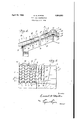
- Figure 1 is a vertical section taken throu h a roof of common form, with portions of e roof and supporting wall broken away.
- Figure 2 is a side elevation of the roof shown in Figure 1, showing the tiling in rocess of application certain parts being roken away.
- the invention can be racticed on a roof of any'construc- Iii the present specification, by way of example, I have described the invention as applied to a simple type of roof in which the roof extends down from a ridge or rooftree.
- 1 represents a gable roof, that is an inclined roof having two parts, 1 and 1", extending down from a ridge 2, the said roof being provided with a continuous water shedding surface which may have a waterproof covering 3.
- I provide a plurality of tile supporting runners 4, said runners consisting of elongated cables or wires, either flat or round strips, having two sections, 4 and 4", which are attached together at the point 5 over the ridge 2 and extending down roof sections 1 and 1", upon which they rest.
- the tiles 6 are supported on the watershedding surface of the roof.
- the tiles include vertical rows of cover tiles 7 alternating with vertical rows of pan tiles 8, the edges of the cover tiles extending over the edges of. the pan tiles in the usual manner.
- the relatively lower tiles on the roof extend under the relatively higher or upper tiles in the usual manner so that the lower edge 9 of every upper tile overlaps the upper edge 10 of every lower tile.
- the tiles are, of course, laid in horizontal rows beginning at the bottom row 11. As each row of tiles is laid, the tiles are secured to the hanger-s4. Any suitable means may be provided for this purpose, but I prefer to provide the hangers with a plurality of links 12 in the form of wires attached to eyes 13 formed equidistant on the runners. As illustrated, I employ a runner 4 under each vertical row of pan tiles but, if desired, where the roof is not steep and the weight on the runners 4 is not too great, I may not use runners under the pan tiles, but would support the same by means of two links connected to the eyes of the two adjacent runners that lie under the cover-tiles, said links being connected together and provided with an extension or hook to secure it to the pan tile. These runners resist the pull caused by gravity of all the tiles attached to them,
- the weight of the tiles is great, for example, where the construction is applied to a relatively wide roof, I prefer to provide a runner extending under each vertical row of pan tiles. trated in Figure 2, the runner for the pan tiles lies directly under the center of the v tile, but, if desired, the runners for the rows of pan tiles may be displaced slightly from the central position so as to permit the tile to rest properly upon the roof.
- the hanger links 12 are preferably of soft wire and are formed at their ends with extensions 14 which, if desired, may be bent at right angles so as to indicate the point at which the tile is secured.
- the tiles may be provided with any means for engaging the links 12. I prefer, however, to provide the upper end of each tile with a small opening 15 through which the extension Ll is projected in an upward direction, after which the extension can be bent over as indicated at 16 in Figure 1. This secures the tile.
- runners are unattached to the water-shedding surface of the roof over its effective areathat is, the area between the walls.
- each runner 4 may be secured to the eaves 17 of the roof by a fastening device such as a nail 18 driven through the eye 19.
- the runners 4 shall be manufactured by machinery in large quantities and delivered in rows or long rods. No special construction of the rods is necessary to adapt them for use on a roof having a ridge as illustrated. It is merely necessary to apply the rods to the ridge so that the rod forms an angle at this point. In other words, a length of rod can be used and then bent on the job so that it forms two extensions, 4 and 1, making the proper angle to each other to enable them to rest flat on the roof.
- the wires or hands forming the runners are relatively thin, as illustrated, and by reason of the flexibility of the metal, the runners can be delivered in the form of a roll at the place where the runners are to be used.
- the positions of the extensions 14 may vary slightly so as to give slight irregularity in the position of the tiles.
- the invention is also applicable to concrete roofs, and any other type of roof covered with a waterproofing material. It is particularly of advantage in the tiling of roofs made water-tight by laying waterproof tarred paper or similar sheet material because such a roof will leak if nails or fasteners are driven through the sheet material.
- a tile roof construction the combination of an inclined supporting roof having a continuous water shedding upper surface, a plurality of tile supporting runners supported at an elevated point on the roof and extending downwardly and resting on the roof, tiles disposed in overlapping relation in rows supported on said water-shedding surface overlying the said runners so that the upper ends of lower tiles extend under the lower ends of upper tiles, watertight means for securing the runners to the roof at an elevated point, said runners resting unattached on the roof at their lower portions, and means for securing the individual tiles to the said runners.
- a tile roof construction the combination of an inclined supporting roof having a continuous water shedding upper surface, a plurality of tile supporting runners resting unattached throughout the area of the roof, tiles disposed in overlapping relation in rows overlying the said runners so that the upper ends of lower tiles extend under the lower ends of upper tiles, 2. plurality of hangers attached to the runners, said tiles having means at their upper ends for securing the same to the said hangers.
- a tile roof construction the combination of an inclined supporting roof having a continuous water shedding upper surface, a plurality of tile supporting runners resting unattached throughout the area of the roof, tiles disposed in overlapping relation in rows overlying the said runners so that the upper ends of lower tiles extend under the lower ends oi upper tiles, a plurality of hangers in the form of links connected to the said runners, the upper ends of'the said tiles having openings to, engage the ends of the said links to secure the tiles on the roof.
- a tile roof construction the combination of an inclined supporting roof having a continuous water shedding upper sur face, a lurality of tile sup orting runners in the orin of wires extend mg equidistant 30 down the inclined roof and resting unattached throughout the area of the roof, tiles disposed in overlapping relation in rows overlying the said runners so that the upper ends of lower tiles extend under the lower ends of upper tiles, said tiles having openings in their upper ends, and hangers in the form of links attached to said wires with their lower ends secured in the said opendisposed under the lower ends of upper tiles.
- a supporting roof having a continuous water shedding upper surface
- a plurality of tile supporting elongated metallic runners disposed apart extending down and resting unattached throughout the area of the roof
- cover tiles disposed in overlapping relation in rows overlying the said runners so that go the upper ends of lower tiles extend under the lower ends of upper tiles
- meansfor securing the individual cover tiles to the said runners pan tile hangers supported on the said runners, and pan tiles laid in rows between 5 the cover tiles in overlappingrelation and secured to the pan tile hangers.
- a runner comprising two sections to rest respectively upon the so two inclined sidesof the roof with a connection connecting said sections at the ridge of the roof, and having means at a plurality of points on the same for securing tiles thereto.
Landscapes
- Engineering & Computer Science (AREA)
- Architecture (AREA)
- Civil Engineering (AREA)
- Structural Engineering (AREA)
- Mechanical Engineering (AREA)
- Chemical & Material Sciences (AREA)
- Ceramic Engineering (AREA)
- Roof Covering Using Slabs Or Stiff Sheets (AREA)
Description
April 19, 1932. E. G. MARTIN 1,354,660
TILE ROOF CONSTRUCTION Filed April 27, 1929 gwvml oc mama Apt. 19,1932
UNITED ST TES PATENT OFFICE" mnm'r G. MARTIN, 01 L08 All'G-ELES, CALIFORNIA, ASSIGNOB OI ONE-FOURTH TO THOMAS D. COBCORAN, ONE-FOURTH TO MERRILL w. HARD AND ORE-FOURTH TO LIONEL A. WOLFE, ALL OF LOS ANGELES, CALIFORNIA TILE BOOB CONSTRUCTION to wooden roofs to employ nails or hangers that are driven at different points throughout the area of the roof to secure the tiles in position. In driving these nails the tiles are sometimes broken, and furthermore th1s means of securing the tiles is also objectionable because it frequently causes the roofs to leak at the points where the fasteners are driven into the roofs. The general object of this invention is to provide a tile roof construction having simple means for facilitate ing the layin of the tiles and securing the same in position without necess1tating dr ving of nails or other fasteners or creating any perforations-throughout the area of the $0 roof.
- tion.
A further object of the invention is to produce as a novel article of manufacture a tile supporting runner which can .be readily applied to a roof and to which the tiles can .be readily secured.
Further objects of the inventlon will appear hereinafter.
The invention consists in the novel parts and combination of parts to be described hereinafter, all of which contribute to produce an etficient tile roof construction.
A preferred embodiment of the invention is described in the following specification, while the broad scope of the invention is pointed out in the appended claims.
In the drawings: Figure 1 is a vertical section taken throu h a roof of common form, with portions of e roof and supporting wall broken away.
Figure 2 is a side elevation of the roof shown in Figure 1, showing the tiling in rocess of application certain parts being roken away.
It should be understood that the invention can be racticed on a roof of any'construc- Iii the present specification, by way of example, I have described the invention as applied to a simple type of roof in which the roof extends down from a ridge or rooftree.
1929. Serial No. 858,451.
Referring to the parts illustrated in the drawings, 1 represents a gable roof, that is an inclined roof having two parts, 1 and 1", extending down from a ridge 2, the said roof being provided with a continuous water shedding surface which may have a waterproof covering 3. In applying the invention to such a roof, I provide a plurality of tile supporting runners 4, said runners consisting of elongated cables or wires, either flat or round strips, having two sections, 4 and 4", which are attached together at the point 5 over the ridge 2 and extending down roof sections 1 and 1", upon which they rest.
In this type of roof the presence of the ridge 2 makes it unnecessary to secure the runners in place because the weight of the tiles on one roof section will balance the tiles on the opposite roof section. If the roof has no ridge,
2 the upper end of the runner should be attached to the roof adjacent the uppermost row of tiles.-
The tiles 6 are supported on the watershedding surface of the roof. The tiles include vertical rows of cover tiles 7 alternating with vertical rows of pan tiles 8, the edges of the cover tiles extending over the edges of. the pan tiles in the usual manner. The relatively lower tiles on the roof extend under the relatively higher or upper tiles in the usual manner so that the lower edge 9 of every upper tile overlaps the upper edge 10 of every lower tile.
The tiles are, of course, laid in horizontal rows beginning at the bottom row 11. As each row of tiles is laid, the tiles are secured to the hanger-s4. Any suitable means may be provided for this purpose, but I prefer to provide the hangers with a plurality of links 12 in the form of wires attached to eyes 13 formed equidistant on the runners. As illustrated, I employ a runner 4 under each vertical row of pan tiles but, if desired, where the roof is not steep and the weight on the runners 4 is not too great, I may not use runners under the pan tiles, but would support the same by means of two links connected to the eyes of the two adjacent runners that lie under the cover-tiles, said links being connected together and provided with an extension or hook to secure it to the pan tile. These runners resist the pull caused by gravity of all the tiles attached to them,
However, where the weight of the tiles is great, for example, where the construction is applied to a relatively wide roof, I prefer to provide a runner extending under each vertical row of pan tiles. trated in Figure 2, the runner for the pan tiles lies directly under the center of the v tile, but, if desired, the runners for the rows of pan tiles may be displaced slightly from the central position so as to permit the tile to rest properly upon the roof.
The hanger links 12 are preferably of soft wire and are formed at their ends with extensions 14 which, if desired, may be bent at right angles so as to indicate the point at which the tile is secured. The tiles may be provided with any means for engaging the links 12. I prefer, however, to provide the upper end of each tile with a small opening 15 through which the extension Ll is projected in an upward direction, after which the extension can be bent over as indicated at 16 in Figure 1. This secures the tile.
It will be evident that in practicing my invention the runners are unattached to the water-shedding surface of the roof over its effective areathat is, the area between the walls.
If desired, the lower end of each runner 4 may be secured to the eaves 17 of the roof by a fastening device such as a nail 18 driven through the eye 19.
By practicing my invention the labor of laying the tiles on the roof is greatly reduced.-
I intend that the runners 4 shall be manufactured by machinery in large quantities and delivered in rows or long rods. No special construction of the rods is necessary to adapt them for use on a roof having a ridge as illustrated. It is merely necessary to apply the rods to the ridge so that the rod forms an angle at this point. In other words, a length of rod can be used and then bent on the job so that it forms two extensions, 4 and 1, making the proper angle to each other to enable them to rest flat on the roof.
The wires or hands forming the runners are relatively thin, as illustrated, and by reason of the flexibility of the metal, the runners can be delivered in the form of a roll at the place where the runners are to be used.
If desired, the positions of the extensions 14 may vary slightly so as to give slight irregularity in the position of the tiles.
Such irregularity is sometimes desired in layingtiles. At th ridge '2 the uppermost tiles 20 are 1-,iles without any openings their upperends being thrust under ridge tiles 21 As illuswhich seat on a cement ridge 22 that embeds the upper ends of the special tiles 20.
The invention is also applicable to concrete roofs, and any other type of roof covered with a waterproofing material. It is particularly of advantage in the tiling of roofs made water-tight by laying waterproof tarred paper or similar sheet material because such a roof will leak if nails or fasteners are driven through the sheet material.
It is understood that the embodiment of the invention described herein is only one of the many embodiments this invention may take, and I do not wish to be limited in the practice of the invention, nor in the claims, to the particular embodiment set forth.
\Vhat I claim is:
1. In a tile roof construction, the combination of an inclined supporting roof having a continuous water shedding upper surface, a plurality of tile supporting runners supported at an elevated point on the roof and extending downwardly and resting on the roof, tiles disposed in overlapping relation in rows supported on said water-shedding surface overlying the said runners so that the upper ends of lower tiles extend under the lower ends of upper tiles, watertight means for securing the runners to the roof at an elevated point, said runners resting unattached on the roof at their lower portions, and means for securing the individual tiles to the said runners.
2. In a tile roof construction, the combination of an inclined supporting roof having a continuous water shedding upper surface, a plurality of tile supporting runners resting unattached throughout the area of the roof, tiles disposed in overlapping relation in rows overlying the said runners so that the upper ends of lower tiles extend under the lower ends of upper tiles, 2. plurality of hangers attached to the runners, said tiles having means at their upper ends for securing the same to the said hangers.
3. In a tile roof construction, the combination of an inclined supporting roof having a continuous water shedding upper surface, a plurality of tile supporting runners resting unattached throughout the area of the roof, tiles disposed in overlapping relation in rows overlying the said runners so that the upper ends of lower tiles extend under the lower ends oi upper tiles, a plurality of hangers in the form of links connected to the said runners, the upper ends of'the said tiles having openings to, engage the ends of the said links to secure the tiles on the roof.
4. In a tile roof construction, the combination of an inclined supporting roof having a continuous water shedding upper sur face, a lurality of tile sup orting runners in the orin of wires extend mg equidistant 30 down the inclined roof and resting unattached throughout the area of the roof, tiles disposed in overlapping relation in rows overlying the said runners so that the upper ends of lower tiles extend under the lower ends of upper tiles, said tiles having openings in their upper ends, and hangers in the form of links attached to said wires with their lower ends secured in the said opendisposed under the lower ends of upper tiles.
5. In a tile roof construction, the combination of a supporting roof having a continuous water shedding upper surface, a plurality of tile supporting elongated metallic runners disposed apart extending down and resting unattached throughout the area of the roof, cover tiles disposed in overlapping relation in rows overlying the said runners so that go the upper ends of lower tiles extend under the lower ends of upper tiles, meansfor securing the individual cover tiles to the said runners, pan tile hangers supported on the said runners, and pan tiles laid in rows between 5 the cover tiles in overlappingrelation and secured to the pan tile hangers.
6. As a new article of manufacture for supporting tiles on a gable roof, a runner comprising two sections to rest respectively upon the so two inclined sidesof the roof with a connection connecting said sections at the ridge of the roof, and having means at a plurality of points on the same for securing tiles thereto.
7. In a tile roof construction, the combination of an inclined supporting roof having a ings, the said openings in lower tiles being runner exerted by the action of gravity down the roof and forming the sole attachment of the runners to the roof on the eflective area of the roof.
Signed at Los Angeles, California, this 22nd day of April, 1929.
EMMET G. MARTIN.
continuous water-shedding upper surface, a
' plurality of tile supporting runners attached to'the roof adjacent its ridge extending down the roof substantially equidisant from each other and resting loosely unattached on the said water-shedding surface throughout its efi'ective area, tiles supported on the said water-shedding surface in overlapping relation in rows overlying the said runners so that the upper ends of the lower tiles extend under the lower. ends of upper tiles, and hangers in the form of links attached to the said runners and attached to the upper ends of the tiles.
8, In a tile roof construction, the combination of an inclined supporting roof having a continuous water-shedding upper surface, a plurality of tile supporting runners resting loosely upon said water-shedding surface and extending downwardly, tiles disposed in overlapping relation in rows supported on said water-shedding surface overlying the said runners so that the upper ends of the lower tiles extend under the'lower ends of 60 the upper tiles, means for securing the individual tiles to the said runners and means corresponding to each runner and located adjacent the uppermost row of tiles for securing the said runners to the roof, said securin means resisting the pull of all the tiles of each-
Priority Applications (1)
| Application Number | Priority Date | Filing Date | Title |
|---|---|---|---|
| US358451A US1854660A (en) | 1929-04-27 | 1929-04-27 | Tile roof construction |
Applications Claiming Priority (1)
| Application Number | Priority Date | Filing Date | Title |
|---|---|---|---|
| US358451A US1854660A (en) | 1929-04-27 | 1929-04-27 | Tile roof construction |
Publications (1)
| Publication Number | Publication Date |
|---|---|
| US1854660A true US1854660A (en) | 1932-04-19 |
Family
ID=23409720
Family Applications (1)
| Application Number | Title | Priority Date | Filing Date |
|---|---|---|---|
| US358451A Expired - Lifetime US1854660A (en) | 1929-04-27 | 1929-04-27 | Tile roof construction |
Country Status (1)
| Country | Link |
|---|---|
| US (1) | US1854660A (en) |
Cited By (5)
| Publication number | Priority date | Publication date | Assignee | Title |
|---|---|---|---|---|
| US2900929A (en) * | 1954-08-06 | 1959-08-25 | Carl W Adelt | Roof construction |
| EP0074011A3 (en) * | 1981-09-01 | 1983-05-25 | DLW Aktiengesellschaft | Construction unit for fastening roof laths intended to receive roofing elements, in particular roof tiles, to building rafters, supporting thermally insulating elements |
| US4426823A (en) | 1981-06-02 | 1984-01-24 | Kobe Thomas R | Apparatus and method for mounting roofing tile |
| FR2618174A1 (en) * | 1987-07-15 | 1989-01-20 | Piquemal Jean | Device for fixing and hooking curved tiles |
| FR2626601A1 (en) * | 1988-02-01 | 1989-08-04 | Hoffmann Hubert | DEVICE FOR MAINTAINING TILES, OR THE LIKE |
-
1929
- 1929-04-27 US US358451A patent/US1854660A/en not_active Expired - Lifetime
Cited By (6)
| Publication number | Priority date | Publication date | Assignee | Title |
|---|---|---|---|---|
| US2900929A (en) * | 1954-08-06 | 1959-08-25 | Carl W Adelt | Roof construction |
| US4426823A (en) | 1981-06-02 | 1984-01-24 | Kobe Thomas R | Apparatus and method for mounting roofing tile |
| EP0074011A3 (en) * | 1981-09-01 | 1983-05-25 | DLW Aktiengesellschaft | Construction unit for fastening roof laths intended to receive roofing elements, in particular roof tiles, to building rafters, supporting thermally insulating elements |
| FR2618174A1 (en) * | 1987-07-15 | 1989-01-20 | Piquemal Jean | Device for fixing and hooking curved tiles |
| FR2626601A1 (en) * | 1988-02-01 | 1989-08-04 | Hoffmann Hubert | DEVICE FOR MAINTAINING TILES, OR THE LIKE |
| EP0327481A1 (en) * | 1988-02-01 | 1989-08-09 | Hubert Hoffmann | Fastening device for roof tiles |
Similar Documents
| Publication | Publication Date | Title |
|---|---|---|
| US2250764A (en) | Metallic building unit | |
| US3309831A (en) | Plastic shingle with interfitting means | |
| US2151794A (en) | Roof construction and roofing element therefor | |
| US1597993A (en) | Metal shingle | |
| US1593096A (en) | Multiple-shingle-roofing unit | |
| US1924650A (en) | Siding material | |
| US2057819A (en) | Tile supporting strip | |
| US1469543A (en) | Shingle | |
| US1610082A (en) | Fastener | |
| US1547498A (en) | Roofing | |
| US1158268A (en) | Tile roofing. | |
| US2025983A (en) | Tile clip | |
| US1517944A (en) | Means for securing flexible tile roofing | |
| US1418377A (en) | Roofing | |
| US1496108A (en) | Roof covering | |
| US1410867A (en) | Interlocking shingle | |
| US1672713A (en) | Roof and shingle therefor | |
| US1810674A (en) | Roof construction | |
| US1661642A (en) | Metal lath | |
| US1221370A (en) | Tile roofing. | |
| US1439434A (en) | Valley roofing | |
| US777058A (en) | Tile roof. | |
| US1691343A (en) | Roofing | |
| US1558795A (en) | Shingle roofing | |
| US1930427A (en) | Roof |