US1853586A - Pressure gauge and pop valve - Google Patents
Pressure gauge and pop valve Download PDFInfo
- Publication number
- US1853586A US1853586A US505182A US50518230A US1853586A US 1853586 A US1853586 A US 1853586A US 505182 A US505182 A US 505182A US 50518230 A US50518230 A US 50518230A US 1853586 A US1853586 A US 1853586A
- Authority
- US
- United States
- Prior art keywords
- piston
- pressure
- pressure gauge
- levers
- cylinder
- Prior art date
- Legal status (The legal status is an assumption and is not a legal conclusion. Google has not performed a legal analysis and makes no representation as to the accuracy of the status listed.)
- Expired - Lifetime
Links
- 238000010276 construction Methods 0.000 description 2
- PDJARQSWGDDFHH-PSWAGMNNSA-N PQIP Chemical compound C1CN(C)CCN1[C@@H]1C[C@H](C=2N3C=CN=C(N)C3=C(C=3C=C4N=C(C=CC4=CC=3)C=3C=CC=CC=3)N=2)C1 PDJARQSWGDDFHH-PSWAGMNNSA-N 0.000 description 1
Images

Classifications
-
- G—PHYSICS
- G01—MEASURING; TESTING
- G01L—MEASURING FORCE, STRESS, TORQUE, WORK, MECHANICAL POWER, MECHANICAL EFFICIENCY, OR FLUID PRESSURE
- G01L7/00—Measuring the steady or quasi-steady pressure of a fluid or a fluent solid material by mechanical or fluid pressure-sensitive elements
- G01L7/16—Measuring the steady or quasi-steady pressure of a fluid or a fluent solid material by mechanical or fluid pressure-sensitive elements in the form of pistons
Definitions
- This invention relates to a pressure gauge and pop valve, the general object of the invention being to operate the movable parts of a gauge by a direct thrust of pressure in a conduit on a piston, the movement of the piston being governed by weights.
- Another object of the invention isto provide a port in the cylinder which contains the piston, said port being opened when the piston is raised to an excessive amount by the pressure so that the pressure will pass through the port and not raise the piston any farther, thus preventing damage to the parts.
- This portalso acts as a safety means for permitting the pressure to escape when it becomes excessive.
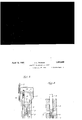
- Figure 1 is an elevation of the device.
- Figure 2 is a side view thereof.
- Figure 3 is a sectional View through the cylinder to show the construction of the piston.
- the numeral 1 indicates a barrel or cylinder having its lower end tapered and threaded so that it can be screwed in the pressure line or conduit and the numeral 2 indicates the piston extending into the bore of the barrel or cylinder.
- a cup 3 is fastened to the lower end of the piston by a screw 4, said screw being provided with an enlarged part 5 which forms an expander for the cup and a guide 6 is placed between the cup and the end of the piston and has a hold therein through which the screw passes.
- the upper end of the piston 2 is formed with a forked end 7 to which is pivoted a pair of links 8.
- the upper ends of these links are pivoted to the pair of levers 9.
- the upper ends of these levers are pivoted on a rod 10 forming part of a frame 11 and the links 8 are pivoted to the levers adjacent thepivoted points.
- weight 12 is adjustably connected to the lower endof each lever and one of the levers has at'its upper end a toothed'segment 13 which meshes'with the gear 14- on a shaft 15 journalled in the frame'll and having a finger 16 connected with its outer end.
- a dial carrying memberllz is carried by the frame 11 and the finger 16 is designed to pass over the dial as shown in Figure 1. i I From the foregoing it will be seen that when the cylinder is placed on a pressure line.
- the lower part of the piston will be exposed to the pressure in said line so that the piston will be raised by the pressure and the upward movement of the piston will swing the weighted levers 9 upwardly thus causing the gears to operate the finger 16 over the dial to indicate the degree of pressure in the conduit or pressure line.
- the cylinder 1 is formed with the ports 18 and when the pressure is excessive the piston will be raised above said ports which will stop further movement of the piston and cause, the pressure to escape through the ports. This will prevent damage to the parts.
- the ports are so arranged that they will be uncovered when the levers 9 reach a horizontal position.
- a pressure gauge comprising a cylinder adapted to have one end inserted in a conduit, a piston in the cylinder adapted to be acted upon by the pressure in the conduit, a pair of ATENT OFFICE v pivoted levers, aframe connected with the 7 said levers, indicator means supported by the frame and including a scale and a finger, and means connecting the upper end of one of the levers with the finger whereby said finger will be moved by the movement of said levers.
- a pressure gauge comprising a cylinder adapted to have one end placed in a conduit
- a piston in saidcylinder adapted to beacted on by the pressure in the conduit, a frame connected With the cylinder, a pair of'weighted levers pivoted in the frame, links connecting the levers adj acent their pivotal points with the upper end of the piston, a segment connected with an extended upper end of one of the levers, a shaft journalled in the frame, agear on the shaft meshing with the segment, Bennettger carried by the shaft and a dial meme ber carried by the frame and over the dial of which the finger moves.
Landscapes
- Physics & Mathematics (AREA)
- General Physics & Mathematics (AREA)
- Measuring Fluid Pressure (AREA)
Description
April 12, 1932. J. THOMAS PRESSURE GAUGE AND POP VALVE Filed Dec. 27, 1930 2 Sheets-Sheet Inventor 77; Ifioma a Q By Wm A llomey April 12, 1932. J. THOMAS PRESSURE GAUGE AND POP VALVE File d Dec.
27, 1930 2 Sheets-Sheet 2 Patented Apr. 12, 1932 UNITED STATES JACK LEE THOMAS, OF OKLAHOMA CITY, OKLAHOMA, ASS IGNOR OF ONE-FOURTH TO EMIYIETT T. BRUCE, ONE-FOURTH vTO WILLIAM D. FAWCETT, AND ONE-FOURTH TO ELMER F. ROSS, ALL OF OKLAHOMA CITY, OKLAHOMA PRESSURE GAUGE nn PQIP vALvE- Application filed December 27,1930. Serial No. 505,182.
This invention relates to a pressure gauge and pop valve, the general object of the invention being to operate the movable parts of a gauge by a direct thrust of pressure in a conduit on a piston, the movement of the piston being governed by weights.
Another object of the invention isto provide a port in the cylinder which contains the piston, said port being opened when the piston is raised to an excessive amount by the pressure so that the pressure will pass through the port and not raise the piston any farther, thus preventing damage to the parts. This portalso acts as a safety means for permitting the pressure to escape when it becomes excessive.
This invention also consists in certain other features of construction and in the combination and arrangement of the several parts, to be hereinafter fully described, illustrated in the accompanying drawings and specifically pointed out in the appended claims.
In describing the invention in detail, reference will be had to the accompanying drawings wherein like characters denote like or corresponding parts throughout the several views, and in which:
Figure 1 is an elevation of the device.
Figure 2 is a side view thereof.
Figure 3 is a sectional View through the cylinder to show the construction of the piston.
In the drawings the numeral 1 indicates a barrel or cylinder having its lower end tapered and threaded so that it can be screwed in the pressure line or conduit and the numeral 2 indicates the piston extending into the bore of the barrel or cylinder. A cup 3 is fastened to the lower end of the piston by a screw 4, said screw being provided with an enlarged part 5 which forms an expander for the cup and a guide 6 is placed between the cup and the end of the piston and has a hold therein through which the screw passes.
The upper end of the piston 2 is formed with a forked end 7 to which is pivoted a pair of links 8. The upper ends of these links are pivoted to the pair of levers 9. The upper ends of these levers are pivoted on a rod 10 forming part of a frame 11 and the links 8 are pivoted to the levers adjacent thepivoted points. weight 12 is adjustably connected to the lower endof each lever and one of the levers has at'its upper end a toothed'segment 13 which meshes'with the gear 14- on a shaft 15 journalled in the frame'll and having a finger 16 connected with its outer end.
A dial carrying memberllz is carried by the frame 11 and the finger 16 is designed to pass over the dial as shown in Figure 1. i I From the foregoing it will be seen that when the cylinder is placed on a pressure line.
or conduit the lower part of the piston will be exposed to the pressure in said line so that the piston will be raised by the pressure and the upward movement of the piston will swing the weighted levers 9 upwardly thus causing the gears to operate the finger 16 over the dial to indicate the degree of pressure in the conduit or pressure line.
The cylinder 1 is formed with the ports 18 and when the pressure is excessive the piston will be raised above said ports which will stop further movement of the piston and cause, the pressure to escape through the ports. This will prevent damage to the parts. The ports are so arranged that they will be uncovered when the levers 9 reach a horizontal position.
From the foregoing it will be seen that I have provided a simple means for ascertaining the degree of pressure in a pressure line.
It is thought from the foregoing description that the advantages and novel features of the invention will be readily apparent.
It is to be understood that changes may be made in theconstruction and in the'combination and arrangement of the several parts provided that such changes fall within the scope of the appended claims.
Having thus described my invention, what I claim as new'is:
1. A pressure gauge comprising a cylinder adapted to have one end inserted in a conduit, a piston in the cylinder adapted to be acted upon by the pressure in the conduit, a pair of ATENT OFFICE v pivoted levers, aframe connected with the 7 said levers, indicator means supported by the frame and including a scale and a finger, and means connecting the upper end of one of the levers with the finger whereby said finger will be moved by the movement of said levers. s
2. A pressure gauge comprising a cylinder adapted to have one end placed in a conduit,
a piston in saidcylinder adapted to beacted on by the pressure in the conduit, a frame connected With the cylinder, a pair of'weighted levers pivoted in the frame, links connecting the levers adj acent their pivotal points with the upper end of the piston, a segment connected with an extended upper end of one of the levers, a shaft journalled in the frame, agear on the shaft meshing with the segment, afinger carried by the shaft and a dial meme ber carried by the frame and over the dial of which the finger moves.
In testimony whereof I afiix my signature.
JACK LEE THOMAS.
Priority Applications (1)
| Application Number | Priority Date | Filing Date | Title |
|---|---|---|---|
| US505182A US1853586A (en) | 1930-12-27 | 1930-12-27 | Pressure gauge and pop valve |
Applications Claiming Priority (1)
| Application Number | Priority Date | Filing Date | Title |
|---|---|---|---|
| US505182A US1853586A (en) | 1930-12-27 | 1930-12-27 | Pressure gauge and pop valve |
Publications (1)
| Publication Number | Publication Date |
|---|---|
| US1853586A true US1853586A (en) | 1932-04-12 |
Family
ID=24009349
Family Applications (1)
| Application Number | Title | Priority Date | Filing Date |
|---|---|---|---|
| US505182A Expired - Lifetime US1853586A (en) | 1930-12-27 | 1930-12-27 | Pressure gauge and pop valve |
Country Status (1)
| Country | Link |
|---|---|
| US (1) | US1853586A (en) |
-
1930
- 1930-12-27 US US505182A patent/US1853586A/en not_active Expired - Lifetime
Similar Documents
| Publication | Publication Date | Title |
|---|---|---|
| US1853586A (en) | Pressure gauge and pop valve | |
| US1998136A (en) | Scale | |
| DE426957C (en) | Flow meter with movable damming body | |
| US351538A (en) | Measuring-pump | |
| DE580077C (en) | Device for testing safety regulators on steam or gas turbines | |
| DE627982C (en) | Volume reducer taking into account the humidity of the gas to be measured | |
| DE384423C (en) | Device for measuring high dilutions of gases and vapors | |
| US1781227A (en) | Pressure-relief device | |
| AT217224B (en) | Force, especially pressure measuring device | |
| AT14655B (en) | Water meter for boiler feed water. | |
| DE644664C (en) | Pressure balance for flow meter | |
| DE842125C (en) | Device for displaying the tank content, in particular in motor vehicles | |
| US1281882A (en) | Piston-supporter. | |
| DE408936C (en) | Improvement on float knives for liquids, gases or vapors | |
| DE377110C (en) | Lever inclination scale | |
| DE762033C (en) | Preload tester with an indicator for the penetration depth of the test tip | |
| US762136A (en) | Computing-scale. | |
| AT127334B (en) | Device for preventing the actuation of the printing mechanism of a balance as long as the balance is not in balance. | |
| US1660027A (en) | Retarding device | |
| DE385258C (en) | Filling point for liquids, connected to a scale | |
| US1945042A (en) | Liquid level gauge | |
| DE723782C (en) | Compressed air accumulator with mechanical safety control | |
| DE536489C (en) | Steam meter | |
| DE740738C (en) | Pressure measuring device | |
| US1526797A (en) | Refrigerator |