US1852417A - Method of producing fringes and fringed fabrics - Google Patents
Method of producing fringes and fringed fabrics Download PDFInfo
- Publication number
- US1852417A US1852417A US341759A US34175929A US1852417A US 1852417 A US1852417 A US 1852417A US 341759 A US341759 A US 341759A US 34175929 A US34175929 A US 34175929A US 1852417 A US1852417 A US 1852417A
- Authority
- US
- United States
- Prior art keywords
- fringes
- fabric
- fringed
- borders
- border
- Prior art date
- Legal status (The legal status is an assumption and is not a legal conclusion. Google has not performed a legal analysis and makes no representation as to the accuracy of the status listed.)
- Expired - Lifetime
Links
- 239000004744 fabric Substances 0.000 title description 35
- 238000000034 method Methods 0.000 title description 11
- 238000009956 embroidering Methods 0.000 description 24
- 238000005520 cutting process Methods 0.000 description 4
- 239000000463 material Substances 0.000 description 2
- 239000000700 radioactive tracer Substances 0.000 description 2
- 238000005728 strengthening Methods 0.000 description 2
- RYGMFSIKBFXOCR-UHFFFAOYSA-N Copper Chemical compound [Cu] RYGMFSIKBFXOCR-UHFFFAOYSA-N 0.000 description 1
- 239000005018 casein Substances 0.000 description 1
- BECPQYXYKAMYBN-UHFFFAOYSA-N casein, tech. Chemical compound NCCCCC(C(O)=O)N=C(O)C(CC(O)=O)N=C(O)C(CCC(O)=N)N=C(O)C(CC(C)C)N=C(O)C(CCC(O)=O)N=C(O)C(CC(O)=O)N=C(O)C(CCC(O)=O)N=C(O)C(C(C)O)N=C(O)C(CCC(O)=N)N=C(O)C(CCC(O)=N)N=C(O)C(CCC(O)=N)N=C(O)C(CCC(O)=O)N=C(O)C(CCC(O)=O)N=C(O)C(COP(O)(O)=O)N=C(O)C(CCC(O)=N)N=C(O)C(N)CC1=CC=CC=C1 BECPQYXYKAMYBN-UHFFFAOYSA-N 0.000 description 1
- 235000021240 caseins Nutrition 0.000 description 1
- 238000000926 separation method Methods 0.000 description 1
- 239000000126 substance Substances 0.000 description 1
Images

Classifications
-
- D—TEXTILES; PAPER
- D04—BRAIDING; LACE-MAKING; KNITTING; TRIMMINGS; NON-WOVEN FABRICS
- D04D—TRIMMINGS; RIBBONS, TAPES OR BANDS, NOT OTHERWISE PROVIDED FOR
- D04D3/00—Chenille trimmings
Definitions
- the present invention has reference to a method of producin fringes and fringed borders or articles in any designs and sizes and of any material and preferably by means of the embroidering machine.
- a method for producing fringes is known in which loops or meshes are formed which loosely hang from the embroidered fabric. To this end a specially designed embroidering machine is needed, because it is necessary that while from one side the thread is pushed through the fabric by the needle thread catchers cooperate on the other side of the fabric with the loops and, hold the latter when the needle recedes. If a border connecting the fringes at their roots is to be embroidered a second embroidering machine is needed or certain parts of the machine must be exchanged. The known method is tedious and can only be carried out with an expensive machine.
- the subject matter of the present invention is a method by means of which regular fringes. i. e. fringes having free ended threads. can be produced and in which the embroidering of the fringes as well as of the transverse border holding the fringes t0- gether may be made in one single operation on the same embroidering machine.
- the process according to the invention consists in that on a ground fabric a border and at right angles or approximately at right angles to the latter floating threads are embroidered in the desired closeness of the fringes. whereupon the threads are cut at their free ends whereby the length of the fringes corresponds to the length of the thread.
- embroiderin one border two borders may be produced and simultaneously floating threads embroidered between the borders: by cutting these threads the middle of their length two borders provided with fringes are obtained.
- the thread forming the fringes may be placed like the warp threads of aweaving loom over beams and the latter inserted in the embroidering machine instead of the beams carrying the fabric; borders are there embroidered on 50 these threads at regular distances and the thread cut off adjacent to one edge of each border to obtain fringed borders.
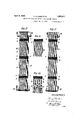
- Fig. 1 is a front View of the embroidery on the ground cloth, i
- Fig. 2 is a section of Fig. 1, i
- Fig. 3 shows the fringed border obtained by the embroidery according to Fig. 1.
- Figs. 4 7 show further examples of fringed borders
- Fig. 8 shows a further manner in which a fringed border may be produced by embroidering
- Figs. 9 and 10 show fringed borders ob tained in the manner shown in Fig. 8;
- Fig. 11 shows a way alternative to Fig. 8 of obtaining fringed borders
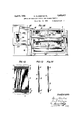
- Fig. 12 shows in a plan view an embroidery for producing fringed borders
- Fig. 13 is a vertical section of Fig. 12,
- Fig. 14 is a further vertical section with the ground fabric removed.
- Fig. 15 shows in a diagrammatic manner a pantograph embroidering machine used for producing fringed borders.
- Figs. 1-3 of the drawings 1 denotes the ground fabric of any suitable material fixed in the frame of an embroidering machine in the well known manner.
- the border 2 is embroidered by means of the rows of needles of the machine.
- the floating or strut threads 3 are embroidered of such a length and closeness as is desired to form the finished fringes.
- an ordinary shuttle embroidering machine is used for embroidering the fabric 1 and the threads of the needles and bobbins are connected with each other and with the fabric; when. using a hand operated embroidering machine the floating threads are loosely pulled through the fabric 1.
- the embroidery pattern may be drafted on an enlarged scale on drafting paper and the movements of the frame of the machine are caused by a pantograph the tracer of which is moved along the design on the drafting paper by the operator in the manner well known in the art of embroidering.
- Ihe fabric 1 mustbesufficiently resisting.
- the border 2 may have any pattern from a simple cord like strip to a richly decorated patternv of .anywidth, to which. the fringes are attached. Thejfloatingxthread .3z-is repeated any desired number of times depending on the desired closeness of the fringe threads. 7
- bOrder-Qby means of:borers,-.an.d-by .thesame implements :the fabric may be removed on the edges of the fabric by boring it atwaytluring embroidering so that it only requires to be cut la-long? line. mfm ..to-completely -remo-v'e the fabric.
- the .fabric is cut along the lines and the weft threads .15. are removed.
- the product obtained is a fringed border as illustrated in Fig. 9 in which the fringes 3 hang loosely in Fig. 10.
- the fabric 3, 15 may be strengthened "at'the places where the borders .are embroidered by an auxiliary not been bored off are removed by cutting or .mordanting, while in the latter casein which theauXi-liary fabric isused for special'effects only: thepa-rts. of this fabric not required I F ig. .11 differs from. Fig.1 10. in. as.
- Figs. 1244 afurther manner ofcarrying into effect the-method according-tothe present invention is-shown.
- On the ground fabric 1 two bordersQ- and 2. are simultaneously emeach other being t-wice the desired 'length'of the. fringes. .T-he borders 2and 2 mayhave .the same patternor different patterns and v 7 .they may .be "straight :or. curved or. ofeany meofca-ikind of .threads suitable.forsforming.-
- This cut may be in the middle of the distance' between the borders or at some other distance and it may be straight or curved.
- the fabric 1 is out along the I lines 2 and 2r:-z, the fabricis removed "amachmeand. thereupon .thebe'amsi-lti and 17 and the fringed borders-are completed.
- Fig. 14 is a section similar to Fig. 13 showing the finished fringed borders with the fabric removed.
- fringes with a border and fringes without a border and from the smallest up to the greatest possible length may be produced.
- Fringes of short length and closely arranged produce an article having a velvet like appearance.
- Fig. 15 shows in a diagrammatic manner a pantograph embroidering machine on which 15 the method according to the present invention may preferably be carried out.
- 16 and 17 are the beams on which the fabric 1 or the warp threads to be embroidered are wound; these beams are inserted in the movable frame 19 of the machine having a fixed rame 18 and two rows of needles 20 and 21.
- 22 is the pantograph mechanism and the operator moves with the handle 23 the tracer of the pantograph on the point paper 24 whereby 25 the frame 19 carries out the movements necessary for obtaining the desired stitches as is well known in the art.
- a method of producing fringed borders which consists in embroidering on a fabric a border by means of an embroidering machine, embroidering at right angles to said border floating threads closely spaced beside each other, separating the fabric covered by said floating threads from the latter, and cutting said floating threads at their ends remote from the border.
- a method of producing fringed borders by means of an embroidering machine which consists in embroidering on a fabric borders at a distance from each other, embroidering the space between said borders with floating threads closely spaced beside each other, separating the fabric covered by said threads from the latter, and cutting said floating threads intermediate said borders.
Landscapes
- Engineering & Computer Science (AREA)
- Textile Engineering (AREA)
- Sewing Machines And Sewing (AREA)
Description
April 5, 1932. KLAlBER ET AL 1,852,417
METHOD OF PRODUCING FRINGES AND FRINGED FABRICS Filed Feb. 21, 929 3 Sheets-Sheet l IN vE 0R8 FIG I 2 ES'AA.AAA 2 n Patented Apr. 5, 1932 UNITED STATES PATENT OFFICE GEORG KLAIBER, OF ALTSTATTEN, AND EMIL Ktl'HNIS, F OBERRIET, SWITZERLAND, AS ldIGNORS TO THE FIRM JACOB BURNER A. G., O}? REBSTEIN, ST. GALL, SWITZERLAND METHOD OF PRODUCING- FRINGE'S AND FRINGED FABRICS Application filed February 21, 1929, Serial No. 341,759, and in Switzerland February 24, 1928.
The present invention has reference to a method of producin fringes and fringed borders or articles in any designs and sizes and of any material and preferably by means of the embroidering machine.
A method for producing fringes is known in which loops or meshes are formed which loosely hang from the embroidered fabric. To this end a specially designed embroidering machine is needed, because it is necessary that while from one side the thread is pushed through the fabric by the needle thread catchers cooperate on the other side of the fabric with the loops and, hold the latter when the needle recedes. If a border connecting the fringes at their roots is to be embroidered a second embroidering machine is needed or certain parts of the machine must be exchanged. The known method is tedious and can only be carried out with an expensive machine.
The subject matter of the present invention is a method by means of which regular fringes. i. e. fringes having free ended threads. can be produced and in which the embroidering of the fringes as well as of the transverse border holding the fringes t0- gether may be made in one single operation on the same embroidering machine.
The process according to the invention consists in that on a ground fabric a border and at right angles or approximately at right angles to the latter floating threads are embroidered in the desired closeness of the fringes. whereupon the threads are cut at their free ends whereby the length of the fringes corresponds to the length of the thread. Instead of embroiderin one border two borders may be produced and simultaneously floating threads embroidered between the borders: by cutting these threads the middle of their length two borders provided with fringes are obtained. Alternately the thread forming the fringes may be placed like the warp threads of aweaving loom over beams and the latter inserted in the embroidering machine instead of the beams carrying the fabric; borders are there embroidered on 50 these threads at regular distances and the thread cut off adjacent to one edge of each border to obtain fringed borders.
The accompanying drawings serve to illustrate several ways of carrying the method of the invention into effect and show examples of the article produced. In the drawings:
Fig. 1 is a front View of the embroidery on the ground cloth, i
Fig. 2 is a section of Fig. 1, i
Fig. 3 shows the fringed border obtained by the embroidery according to Fig. 1.
Figs. 4 7 show further examples of fringed borders;
Fig. 8 shows a further manner in which a fringed border may be produced by embroidering,
Figs. 9 and 10 show fringed borders ob tained in the manner shown in Fig. 8;
Fig. 11 shows a way alternative to Fig. 8 of obtaining fringed borders,
Fig. 12 shows in a plan view an embroidery for producing fringed borders,
Fig. 13 is a vertical section of Fig. 12,
Fig. 14 is a further vertical section with the ground fabric removed, and
Fig. 15 shows in a diagrammatic manner a pantograph embroidering machine used for producing fringed borders.
' Referring now to Figs. 1-3 of the drawings 1 denotes the ground fabric of any suitable material fixed in the frame of an embroidering machine in the well known manner. On the fabric 1 the border 2 is embroidered by means of the rows of needles of the machine. At right angles or approximately at right angles to the border the floating or strut threads 3 are embroidered of such a length and closeness as is desired to form the finished fringes. Preferably an ordinary shuttle embroidering machine is used for embroidering the fabric 1 and the threads of the needles and bobbins are connected with each other and with the fabric; when. using a hand operated embroidering machine the floating threads are loosely pulled through the fabric 1. The embroidery pattern may be drafted on an enlarged scale on drafting paper and the movements of the frame of the machine are caused by a pantograph the tracer of which is moved along the design on the drafting paper by the operator in the manner well known in the art of embroidering. Ihe fabric 1 mustbesufficiently resisting. The border 2 may have any pattern from a simple cord like strip to a richly decorated patternv of .anywidth, to which. the fringes are attached. Thejfloatingxthread .3z-is repeated any desired number of times depending on the desired closeness of the fringe threads. 7
. After the embroidery-is finished the floating threads are out along theline arw in Fig. 1. Thereupon thepartof thefabric whichis not covered by .theborder .is..cut l5 away. Thereby the separation between the .cneedle threads on. one side. ofithefabricaand the bobbin: threads on. the other; side issuspended: and both. rows of- .th-reads-. now'. hang I freely from-theborder 2-.andf0rm the fringes.
. 2O L'Ihe fabric mayvbe removed-within: the
bOrder-Qby means of:borers,-.an.d-by .thesame implements :the fabric may be removed on the edges of the fabric by boring it atwaytluring embroidering so that it only requires to be cut la-long? line. mfm ..to-completely -remo-v'e the fabric.
eThe fringes .may; be; tied;-.togetl1er-. at? on the machine to form bundles of fringes-F 6 2 (Fig. 5). and. 1 0 maybe provided onexarranged' below the other andal-ways twosbundlesaof i fringes tied together (Fig.6). lVith the fringed border-shown ini'F ig.-7 the fringes are partly usedzaspattern for the border 2, in .as.:-1nuch-..as.- af-ter: embroidering the border llby-meansbfor withoutthreads :12 thepattern-isobtained by knotting the o fringes at 13,and.l4.
.- zmordanting material. 7
:Referring nowtoFigs. 8-.'10.-0f the .dra-wsings. the .ground. fabric on :which? the-border .is 'to. be embroidered comprises warp: threads 3 closely arranged one ,beside the" other and Lfringes. .These warp threadsfi are held together. by weftv threads. 15. arrangeda'at-some distance fromeachotherand being ofa minor quality. .asthey-have tOI-be removed later on.
5 .-.The fabric is wound" (in-beams.- 16. andl'i', for instanceonathe cloth-beams ofashuttle embroidering .machine or on a. other beams specially adaptedifor'the purpese. .The warp vthreads of which the. fringes'are formed, are
verticalain'the embroidering machine and it isthuspossibleto-prcduce fringed borders of ..a --lengthequal-to the effective Width of the embroidering machine. -.-Theborders 2 are embroidered-over the whole length ofvthe from the embroidered border. "lhe'fringes 3 "may be tied together in bundles as is shown 'fabric'. TThe' latter may not only'serve for strengthening purposes but for obtaining special efi ects in the border. .In' the former casethe partsof the auxiliary fabricwhich are. not covered by the embroidery and have for these effects are-removed.
broidered, the distance of .these bordersfrom spond to the desired length of the fringes the .fabric is cut along the lines and the weft threads .15. are removed. The product obtained is a fringed border as illustrated in Fig. 9 in which the fringes 3 hang loosely in Fig. 10. If necessary the fabric 3, 15 may be strengthened "at'the places where the borders .are embroidered by an auxiliary not been bored off are removed by cutting or .mordanting, while in the latter casein which theauXi-liary fabric isused for special'effects only: thepa-rts. of this fabric not required I F ig. .11 differs from. Fig.1 10. in. as. muchas a the warp threads 3 forming. the ground fabric are not held together. by weftthreads such as 15 in' Fig. 8. but'are only. connected I (Figrt). .T-he. fringesmay-also-be tied tom gether at-8 atrsome .distance; from: theborder Further two IOWS'-'.OfkD0l3S9 togetherby' the embroidered borders, othera wise the proceeding of producing the .fringed borders is exactly. the same as described with broidering machine. The use of an auxiliary fabric-for-strengthening purposes maybe desirableas described. above and its superfluous 3 parts may beremovedin a .mechanica'l-or chemical manner.
I In Figs. 1244 afurther manner ofcarrying into effect the-method according-tothe present invention is-shown. On the ground fabric 1 two bordersQ- and 2. are simultaneously emeach other being t-wice the desired 'length'of the. fringes. .T-he borders 2and 2 mayhave .the same patternor different patterns and v 7 .they may .be "straight :or. curved or. ofeany meofca-ikind of .threads suitable.forsforming.-
shape orarrangement. .Thefloating.threadsi lii 3. are embroidered-from one. border to the .also used to form fringes.
When the embroidery is'finished the floating threads 3 are cut intermediate the borders,
for instance along the line m-m in Fig.'12.
This cutmay be in the middle of the distance' between the borders or at some other distance and it may be straight or curved.
Thereupon the fabric 1 is out along the I lines 2 and 2r:-z, the fabricis removed "amachmeand. thereupon .thebe'amsi-lti and 17 and the fringed borders-are completed. As
described in the previous examples the fabric may be removed by boring during the em broidering. Fig. 14 is a section similar to Fig. 13 showing the finished fringed borders with the fabric removed.
According to this method fringes with a border and fringes without a border and from the smallest up to the greatest possible length may be produced.
Fringes of short length and closely arranged produce an article having a velvet like appearance.
Fig. 15 shows in a diagrammatic manner a pantograph embroidering machine on which 15 the method according to the present invention may preferably be carried out. 16 and 17 are the beams on which the fabric 1 or the warp threads to be embroidered are wound; these beams are inserted in the movable frame 19 of the machine having a fixed rame 18 and two rows of needles 20 and 21. 22 is the pantograph mechanism and the operator moves with the handle 23 the tracer of the pantograph on the point paper 24 whereby 25 the frame 19 carries out the movements necessary for obtaining the desired stitches as is well known in the art.
We claim:
1. A method of producing fringed borders which consists in embroidering on a fabric a border by means of an embroidering machine, embroidering at right angles to said border floating threads closely spaced beside each other, separating the fabric covered by said floating threads from the latter, and cutting said floating threads at their ends remote from the border.
2. A method of producing fringed borders by means of an embroidering machine, which consists in embroidering on a fabric borders at a distance from each other, embroidering the space between said borders with floating threads closely spaced beside each other, separating the fabric covered by said threads from the latter, and cutting said floating threads intermediate said borders.
In testimony that we claim the foregoing as our invention, we have signed our names.
M GEORG KLAIBER.
3 EMIL KUHNIS.
bit
Applications Claiming Priority (1)
| Application Number | Priority Date | Filing Date | Title |
|---|---|---|---|
| CH1852417X | 1928-02-24 |
Publications (1)
| Publication Number | Publication Date |
|---|---|
| US1852417A true US1852417A (en) | 1932-04-05 |
Family
ID=4566512
Family Applications (1)
| Application Number | Title | Priority Date | Filing Date |
|---|---|---|---|
| US341759A Expired - Lifetime US1852417A (en) | 1928-02-24 | 1929-02-21 | Method of producing fringes and fringed fabrics |
Country Status (1)
| Country | Link |
|---|---|
| US (1) | US1852417A (en) |
Cited By (1)
| Publication number | Priority date | Publication date | Assignee | Title |
|---|---|---|---|---|
| US3486780A (en) * | 1968-06-06 | 1969-12-30 | Fringe Equipment Inc | Fringe knot tying machine |
-
1929
- 1929-02-21 US US341759A patent/US1852417A/en not_active Expired - Lifetime
Cited By (1)
| Publication number | Priority date | Publication date | Assignee | Title |
|---|---|---|---|---|
| US3486780A (en) * | 1968-06-06 | 1969-12-30 | Fringe Equipment Inc | Fringe knot tying machine |
Similar Documents
| Publication | Publication Date | Title |
|---|---|---|
| Bellinger | Textiles from Gordion | |
| US4665851A (en) | Method of assembling textiles | |
| US2065498A (en) | Comb loom | |
| US2005951A (en) | Manufacture of fabrics | |
| US1661018A (en) | Pile fabric | |
| US2883735A (en) | Tufted fabric | |
| JP2551921B2 (en) | Tufted pattern | |
| US2165469A (en) | Sewing of fabrics | |
| US2443358A (en) | Production of rugs, carpets and the like | |
| US2557453A (en) | Method of forming axminster fabric | |
| USRE33215E (en) | Method of assembling textiles | |
| US1749551A (en) | Pile fabric | |
| Naik et al. | Protection and revival of traditional hand embroidery, Kasuti by automation | |
| Tod | The joy of hand weaving | |
| US1846245A (en) | Pile fabric and method of making the same | |
| US2187469A (en) | Method of making figured fabrics | |
| US2016909A (en) | Production of tufted fabrics | |
| US2338638A (en) | Take-off mechanism for looms | |
| US3186442A (en) | Apparatus and method for forming a decorative fringe | |
| US2971359A (en) | Method and apparatus for making knitted pile fabrics | |
| US1757555A (en) | Process and apparatus for making double pile fabrics | |
| US2557452A (en) | Axminster fabric | |
| US1310902A (en) | A firm comprising louis h | |
| Buckley | Lace Fabrics | |
| US2748444A (en) | Chenille yarns and their manufacture |