US1852274A - Open work panel - Google Patents
Open work panel Download PDFInfo
- Publication number
- US1852274A US1852274A US423693A US42369330A US1852274A US 1852274 A US1852274 A US 1852274A US 423693 A US423693 A US 423693A US 42369330 A US42369330 A US 42369330A US 1852274 A US1852274 A US 1852274A
- Authority
- US
- United States
- Prior art keywords
- panel
- vitreous material
- vitreous
- open
- reenforcing
- Prior art date
- Legal status (The legal status is an assumption and is not a legal conclusion. Google has not performed a legal analysis and makes no representation as to the accuracy of the status listed.)
- Expired - Lifetime
Links
- 239000000463 material Substances 0.000 description 22
- 239000002184 metal Substances 0.000 description 14
- 229910052751 metal Inorganic materials 0.000 description 14
- 239000004744 fabric Substances 0.000 description 8
- 238000000034 method Methods 0.000 description 3
- 238000005488 sandblasting Methods 0.000 description 3
- 238000005266 casting Methods 0.000 description 2
- 238000005520 cutting process Methods 0.000 description 2
- 238000004519 manufacturing process Methods 0.000 description 2
- 239000012779 reinforcing material Substances 0.000 description 2
- 238000004873 anchoring Methods 0.000 description 1
- 239000012634 fragment Substances 0.000 description 1
- 150000002739 metals Chemical class 0.000 description 1
- 239000012768 molten material Substances 0.000 description 1
- 230000003014 reinforcing effect Effects 0.000 description 1
- 238000007493 shaping process Methods 0.000 description 1
- 238000005728 strengthening Methods 0.000 description 1
- 210000004127 vitreous body Anatomy 0.000 description 1
Images
Classifications
-
- B—PERFORMING OPERATIONS; TRANSPORTING
- B44—DECORATIVE ARTS
- B44C—PRODUCING DECORATIVE EFFECTS; MOSAICS; TARSIA WORK; PAPERHANGING
- B44C3/00—Processes, not specifically provided for elsewhere, for producing ornamental structures
- B44C3/10—Producing and filling perforations, e.g. tarsia plates
Definitions
- Th present invention relates to one-piece open signs, grilles or the like of vitreous material. Grilles or the like have been made of so-called opaque vitreous material, by sandblasting away parts thereof. However, the character of the designs have been limited by the fact that no area may be completely separated from the remainder and still leave anchoring or supporting means therefor.
- the object of the present invention is to make possible the production of open-work panels of the type just mentioned, in which entire sections of vitreous material may be spaced apart from the remainder so as to stand in relief.
- I cast an opaque vitreous panel with a sheet of metal reenforcing material embedded therein. I then sand-blast the panel, cutting entirely through the same; but without destroying the reenforcing material encountered in the cutting operations.
- a comparatively still reenforcing material such as a sheet of expanded metal similar to expanded metal lath, for large work, the structure as a whole will remain rigid and flat after the design has been cut therein even though some areas are completely separated from the rest of the vitreous body. Consequently letters or other designs may be cut out so as to stand fully in relief.
- the reenforcing fabric not only serves as a support and as strengthening means, but as a screen over the openings that have been cut through the panel.
- my invention may be said to have for its object the production of a novel one-piece openwork vitreous panel in which the openings are screened.
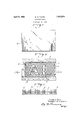
- Figure 1 is a plan View of a fragment of a panel before it is worked;
- Fig. 2 is a view similar to Fig. 1,, showing the completed open-work;
- Fig. 3 is a section on line 33 of Fig. 2.
- A represents a panel of opaque vitreous material having embedded therein, in the process of shaping the mass of molten material to form the panel, a metal reenforcing fabric which is not visible on the face of the virgin panel as it appears in Fig. 1.
- This reenforcing material indicated at 1 in Figs. 2 and 3, is a suitable open-work fabric, conveniently expanded metal more or less similar toeX- panded metal lath.
- the reenforcing fabric extends over and beyond the area in which openings are to appear in the panel.
- a sand-blast is applied to cut entirely through the panel over areas corresponding to the opening in the stencil.
- the design is simply in the form of letters to produce a one-piece open-work sign comprising a frame 2 and letters 3, 3. All of the vitreouswmaterial within the frame and surrounding the elements of the letters is cut away so that the letters stand out in full relief, being completely spaced apart from each other and from the frame. However, the letters are firmly held inplace so that they will be held accurately aligned. Instead of letters, any other design may be cut.
- the mesh of the reenforcing fabric may be made of any desired size so as to form for the openings in the panel screens that will be effective in the situation under which the panel is used.
- the design of the reenforcing fabric may of itself be ornamental; the exposed portions of the fabric may be decorated if desired; or the panel may be made of or coated with the rarer ornamental metals.
- I claim 1 The method of producing a device in the form of a panel composed of'sections of vitreous material spaced apart from each other and held together by perforated metal, which consists in casting a panel of vitreous material upon a sheet 'of perforated metal,:
- the method of producing a device in the form of an open-work panel of vitreous material in relief which consists in casting a panel of vitreous material upon a. sheet of expanded metal, and then sand-blasting out portions of the vitreous material extending throughout the entire thicknessof the panel while leaving the corresponding portions of the expanded metal intact.
- a device comprising a panel of cast vitreous material having a perforated metal reinforcing sheet embedded in the same, the vitreous material being cut awaythroughout the entire thickness of the panel and the reinforcing material being left intact throughout such areas that there remains a border of vitreous material and one or more islands of vitreous material in the space surrounded by the border.
- a device comprising a panel of cast vitreous material having a sheet of expanded metal embedded therein the vitreous material being cut away throughout the entire thickness of the panel and the reinforcing material being left intact throughout such areas that there remains a border of vitreous material and one or more islands of vitreous Ipaterial in the space surrounded by the bor- In testimony whereof, I sign this specification. 7
Landscapes
- Engineering & Computer Science (AREA)
- Mechanical Engineering (AREA)
- Laminated Bodies (AREA)
Description
April 5, 1932. w. N. THURN OPEN WORK PANEL Filed Jan. 27, 1950 Patented Apr. 5, 1932 UNITED STATES PATENT oFFlcE WALTER N. THURN, OF CHICAGO, ILLINOIS, .ASSIG-NQR TO VITROLITE COMPANY,
A CORPORATION OF WEST VIRGINIA OPEN WORK PANEL Application filed January 27, 1930. Serial No. 423,693.
Th present invention relates to one-piece open signs, grilles or the like of vitreous material. Grilles or the like have been made of so-called opaque vitreous material, by sandblasting away parts thereof. However, the character of the designs have been limited by the fact that no area may be completely separated from the remainder and still leave anchoring or supporting means therefor.
The object of the present invention is to make possible the production of open-work panels of the type just mentioned, in which entire sections of vitreous material may be spaced apart from the remainder so as to stand in relief.
In accordance with my invention I cast an opaque vitreous panel with a sheet of metal reenforcing material embedded therein. I then sand-blast the panel, cutting entirely through the same; but without destroying the reenforcing material encountered in the cutting operations. By using a comparatively still reenforcing material, such as a sheet of expanded metal similar to expanded metal lath, for large work, the structure as a whole will remain rigid and flat after the design has been cut therein even though some areas are completely separated from the rest of the vitreous body. Consequently letters or other designs may be cut out so as to stand fully in relief.
It will be noted that the reenforcing fabric not only serves as a support and as strengthening means, but as a screen over the openings that have been cut through the panel.
Therefore, viewed in one of its aspects, my invention may be said to have for its object the production of a novel one-piece openwork vitreous panel in which the openings are screened.
The various features of novelty whereby my invention is characterized will hereinafter he pointed out with particularity in the claims; but, for a full understanding of my invention and of its objects and advantages, reference may be had to the following detailed description taken in connection with the accompanying drawings, wherein:
Figure 1 is a plan View of a fragment of a panel before it is worked; Fig. 2 is a view similar to Fig. 1,, showing the completed open-work; and Fig. 3 is a section on line 33 of Fig. 2.
Referring to the drawings, A represents a panel of opaque vitreous material having embedded therein, in the process of shaping the mass of molten material to form the panel, a metal reenforcing fabric which is not visible on the face of the virgin panel as it appears in Fig. 1. This reenforcing material, indicated at 1 in Figs. 2 and 3, is a suitable open-work fabric, conveniently expanded metal more or less similar toeX- panded metal lath. The reenforcing fabric extends over and beyond the area in which openings are to appear in the panel. Coven ing the panel with a stencil of rubber or the like, a sand-blast is applied to cut entirely through the panel over areas corresponding to the opening in the stencil. In the arrangement shown, the design is simply in the form of letters to produce a one-piece open-work sign comprising a frame 2 and letters 3, 3. All of the vitreouswmaterial within the frame and surrounding the elements of the letters is cut away so that the letters stand out in full relief, being completely spaced apart from each other and from the frame. However, the letters are firmly held inplace so that they will be held accurately aligned. Instead of letters, any other design may be cut.
The mesh of the reenforcing fabric may be made of any desired size so as to form for the openings in the panel screens that will be effective in the situation under which the panel is used. Furthermore, the design of the reenforcing fabric may of itself be ornamental; the exposed portions of the fabric may be decorated if desired; or the panel may be made of or coated with the rarer ornamental metals.
It will thus be seen that I have produced in a simple way an open-work vitreouspanel in which the vitreous material may be divided into many or separate parts, if desired, each part and the fabric as a whole being effectively reenforced, and in which all openings are screened. a
While I have illustrated and described with particularity only a single preferred form of my invention, I do not desire to be hunted to the exact structural details thus illustrated and described; but intend to cover all forms and arrangements which come within the definitions of my invention constituting the appended claims.
I claim 1. The method of producing a device in the form of a panel composed of'sections of vitreous material spaced apart from each other and held together by perforated metal, which consists in casting a panel of vitreous material upon a sheet 'of perforated metal,:
and then sand-blasting away portions of the vitreous material and leaving the metal intact.
2. The method of producing a device in the form of an open-work panel of vitreous material in relief, which consists in casting a panel of vitreous material upon a. sheet of expanded metal, and then sand-blasting out portions of the vitreous material extending throughout the entire thicknessof the panel while leaving the corresponding portions of the expanded metal intact.
3. A device comprising a panel of cast vitreous material having a perforated metal reinforcing sheet embedded in the same, the vitreous material being cut awaythroughout the entire thickness of the panel and the reinforcing material being left intact throughout such areas that there remains a border of vitreous material and one or more islands of vitreous material in the space surrounded by the border.
4. A device comprising a panel of cast vitreous material having a sheet of expanded metal embedded therein the vitreous material being cut away throughout the entire thickness of the panel and the reinforcing material being left intact throughout such areas that there remains a border of vitreous material and one or more islands of vitreous Ipaterial in the space surrounded by the bor- In testimony whereof, I sign this specification. 7
WALTER N. TI -IURN.
Priority Applications (1)
| Application Number | Priority Date | Filing Date | Title |
|---|---|---|---|
| US423693A US1852274A (en) | 1930-01-27 | 1930-01-27 | Open work panel |
Applications Claiming Priority (1)
| Application Number | Priority Date | Filing Date | Title |
|---|---|---|---|
| US423693A US1852274A (en) | 1930-01-27 | 1930-01-27 | Open work panel |
Publications (1)
| Publication Number | Publication Date |
|---|---|
| US1852274A true US1852274A (en) | 1932-04-05 |
Family
ID=23679850
Family Applications (1)
| Application Number | Title | Priority Date | Filing Date |
|---|---|---|---|
| US423693A Expired - Lifetime US1852274A (en) | 1930-01-27 | 1930-01-27 | Open work panel |
Country Status (1)
| Country | Link |
|---|---|
| US (1) | US1852274A (en) |
Cited By (4)
| Publication number | Priority date | Publication date | Assignee | Title |
|---|---|---|---|---|
| US2524593A (en) * | 1948-04-07 | 1950-10-03 | Vermont Marble Co | Method of forming letters in stone and resulting product |
| US4380128A (en) * | 1979-10-12 | 1983-04-19 | Kagawa & Co., Ltd. | Greeting card with open work engraving thereon |
| US4909002A (en) * | 1987-04-27 | 1990-03-20 | Cliffston Products Limited | Concrete screed rails |
| US20100221565A1 (en) * | 2009-02-27 | 2010-09-02 | Skeeter Jane A | Recycled Glass Structural and Decorative Barrier or Building, Lighting and Furniture Component |
-
1930
- 1930-01-27 US US423693A patent/US1852274A/en not_active Expired - Lifetime
Cited By (5)
| Publication number | Priority date | Publication date | Assignee | Title |
|---|---|---|---|---|
| US2524593A (en) * | 1948-04-07 | 1950-10-03 | Vermont Marble Co | Method of forming letters in stone and resulting product |
| US4380128A (en) * | 1979-10-12 | 1983-04-19 | Kagawa & Co., Ltd. | Greeting card with open work engraving thereon |
| US4909002A (en) * | 1987-04-27 | 1990-03-20 | Cliffston Products Limited | Concrete screed rails |
| US20100221565A1 (en) * | 2009-02-27 | 2010-09-02 | Skeeter Jane A | Recycled Glass Structural and Decorative Barrier or Building, Lighting and Furniture Component |
| US8091305B2 (en) * | 2009-02-27 | 2012-01-10 | Skeeter Jane A | Recycled glass structural and decorative barrier or building, lighting and furniture component |
Similar Documents
| Publication | Publication Date | Title |
|---|---|---|
| US1999796A (en) | Method of manufacture of thermoplastic sheet constructions | |
| US1531109A (en) | Block molding | |
| JPH05169149A (en) | Device for manufacturing punching metal without burr | |
| US1822909A (en) | Grille panel construction | |
| DE10141634B4 (en) | Label for a household appliance | |
| Kennedy et al. | Illusory contours can arise in dot figures | |
| US2163298A (en) | Interchangeable illuminated sign | |
| WO2001074606A1 (en) | Translucent decorative panel | |
| US1558297A (en) | Sign | |
| US2204551A (en) | Automobile door and method of making the same | |
| US3034465A (en) | Die | |
| US1951306A (en) | Method of making radiator shutters | |
| US1935584A (en) | Vitreous panel having anchoring means and method of making the same | |
| GB471630A (en) | Shelter for protection against bombardments | |
| US1899533A (en) | Sign and method for making it | |
| US1667309A (en) | Method of ornamenting stone | |
| US2059332A (en) | Glass-steel building construction | |
| US2847779A (en) | Advertising signs and methods of making the same | |
| US1747124A (en) | Screen | |
| US1996993A (en) | Radio control panel | |
| JPH05169148A (en) | Device for manufacturing punching metal without burr | |
| US767799A (en) | Prismatic window. | |
| DE585198C (en) | Decorative window | |
| US2198061A (en) | Reflecting sign | |
| DE668669C (en) | Characters formed from translucent, upright stripes |