US1852018A - Stiffener for boots and shoes and method of making the stiffener - Google Patents
Stiffener for boots and shoes and method of making the stiffener Download PDFInfo
- Publication number
- US1852018A US1852018A US357524A US35752429A US1852018A US 1852018 A US1852018 A US 1852018A US 357524 A US357524 A US 357524A US 35752429 A US35752429 A US 35752429A US 1852018 A US1852018 A US 1852018A
- Authority
- US
- United States
- Prior art keywords
- thermoplastic
- stiffener
- boots
- shoes
- substance
- Prior art date
- Legal status (The legal status is an assumption and is not a legal conclusion. Google has not performed a legal analysis and makes no representation as to the accuracy of the status listed.)
- Expired - Lifetime
Links
- 239000003351 stiffener Substances 0.000 title description 11
- 238000004519 manufacturing process Methods 0.000 title description 10
- 229920001169 thermoplastic Polymers 0.000 description 32
- 239000004416 thermosoftening plastic Substances 0.000 description 32
- 239000000126 substance Substances 0.000 description 26
- MTHSVFCYNBDYFN-UHFFFAOYSA-N diethylene glycol Chemical compound OCCOCCO MTHSVFCYNBDYFN-UHFFFAOYSA-N 0.000 description 15
- 239000000463 material Substances 0.000 description 15
- XLYOFNOQVPJJNP-UHFFFAOYSA-N water Substances O XLYOFNOQVPJJNP-UHFFFAOYSA-N 0.000 description 12
- 229920002472 Starch Polymers 0.000 description 10
- 239000000853 adhesive Substances 0.000 description 10
- 230000001070 adhesive effect Effects 0.000 description 10
- 235000019698 starch Nutrition 0.000 description 10
- 239000008107 starch Substances 0.000 description 10
- 238000009835 boiling Methods 0.000 description 8
- 239000007788 liquid Substances 0.000 description 7
- 239000003795 chemical substances by application Substances 0.000 description 5
- LYCAIKOWRPUZTN-UHFFFAOYSA-N Ethylene glycol Chemical compound OCCO LYCAIKOWRPUZTN-UHFFFAOYSA-N 0.000 description 4
- 239000004744 fabric Substances 0.000 description 3
- 238000002844 melting Methods 0.000 description 3
- 230000008018 melting Effects 0.000 description 3
- 210000004722 stifle Anatomy 0.000 description 3
- 229920000742 Cotton Polymers 0.000 description 2
- PEDCQBHIVMGVHV-UHFFFAOYSA-N Glycerine Chemical compound OCC(O)CO PEDCQBHIVMGVHV-UHFFFAOYSA-N 0.000 description 2
- 239000008135 aqueous vehicle Substances 0.000 description 2
- WGCNASOHLSPBMP-UHFFFAOYSA-N hydroxyacetaldehyde Natural products OCC=O WGCNASOHLSPBMP-UHFFFAOYSA-N 0.000 description 2
- 229920000126 latex Polymers 0.000 description 2
- 238000000034 method Methods 0.000 description 2
- 239000000203 mixture Substances 0.000 description 2
- 238000007665 sagging Methods 0.000 description 2
- 239000012815 thermoplastic material Substances 0.000 description 2
- 240000000972 Agathis dammara Species 0.000 description 1
- 239000004859 Copal Substances 0.000 description 1
- 229920002871 Dammar gum Polymers 0.000 description 1
- 241000782205 Guibourtia conjugata Species 0.000 description 1
- RGCKGOZRHPZPFP-UHFFFAOYSA-N alizarin Chemical compound C1=CC=C2C(=O)C3=C(O)C(O)=CC=C3C(=O)C2=C1 RGCKGOZRHPZPFP-UHFFFAOYSA-N 0.000 description 1
- 239000010426 asphalt Substances 0.000 description 1
- 229920001971 elastomer Polymers 0.000 description 1
- 239000003292 glue Substances 0.000 description 1
- 235000011187 glycerol Nutrition 0.000 description 1
- 239000003779 heat-resistant material Substances 0.000 description 1
- 239000004615 ingredient Substances 0.000 description 1
- 239000002648 laminated material Substances 0.000 description 1
- 239000012170 montan wax Substances 0.000 description 1
- 239000000843 powder Substances 0.000 description 1
- 239000011347 resin Substances 0.000 description 1
- 229920005989 resin Polymers 0.000 description 1
- 239000007787 solid Substances 0.000 description 1
- 235000013547 stew Nutrition 0.000 description 1
- 239000001993 wax Substances 0.000 description 1
Images
Classifications
-
- A—HUMAN NECESSITIES
- A43—FOOTWEAR
- A43B—CHARACTERISTIC FEATURES OF FOOTWEAR; PARTS OF FOOTWEAR
- A43B23/00—Uppers; Boot legs; Stiffeners; Other single parts of footwear
- A43B23/08—Heel stiffeners; Toe stiffeners
- A43B23/081—Toe stiffeners
- A43B23/086—Toe stiffeners made of impregnated fabrics, plastics or the like
-
- Y—GENERAL TAGGING OF NEW TECHNOLOGICAL DEVELOPMENTS; GENERAL TAGGING OF CROSS-SECTIONAL TECHNOLOGIES SPANNING OVER SEVERAL SECTIONS OF THE IPC; TECHNICAL SUBJECTS COVERED BY FORMER USPC CROSS-REFERENCE ART COLLECTIONS [XRACs] AND DIGESTS
- Y10—TECHNICAL SUBJECTS COVERED BY FORMER USPC
- Y10T—TECHNICAL SUBJECTS COVERED BY FORMER US CLASSIFICATION
- Y10T156/00—Adhesive bonding and miscellaneous chemical manufacture
- Y10T156/10—Methods of surface bonding and/or assembly therefor
- Y10T156/1052—Methods of surface bonding and/or assembly therefor with cutting, punching, tearing or severing
-
- Y—GENERAL TAGGING OF NEW TECHNOLOGICAL DEVELOPMENTS; GENERAL TAGGING OF CROSS-SECTIONAL TECHNOLOGIES SPANNING OVER SEVERAL SECTIONS OF THE IPC; TECHNICAL SUBJECTS COVERED BY FORMER USPC CROSS-REFERENCE ART COLLECTIONS [XRACs] AND DIGESTS
- Y10—TECHNICAL SUBJECTS COVERED BY FORMER USPC
- Y10T—TECHNICAL SUBJECTS COVERED BY FORMER US CLASSIFICATION
- Y10T428/00—Stock material or miscellaneous articles
- Y10T428/249921—Web or sheet containing structurally defined element or component
- Y10T428/249953—Composite having voids in a component [e.g., porous, cellular, etc.]
- Y10T428/249982—With component specified as adhesive or bonding agent
- Y10T428/249985—Composition of adhesive or bonding component specified
-
- Y—GENERAL TAGGING OF NEW TECHNOLOGICAL DEVELOPMENTS; GENERAL TAGGING OF CROSS-SECTIONAL TECHNOLOGIES SPANNING OVER SEVERAL SECTIONS OF THE IPC; TECHNICAL SUBJECTS COVERED BY FORMER USPC CROSS-REFERENCE ART COLLECTIONS [XRACs] AND DIGESTS
- Y10—TECHNICAL SUBJECTS COVERED BY FORMER USPC
- Y10T—TECHNICAL SUBJECTS COVERED BY FORMER US CLASSIFICATION
- Y10T428/00—Stock material or miscellaneous articles
- Y10T428/249921—Web or sheet containing structurally defined element or component
- Y10T428/249994—Composite having a component wherein a constituent is liquid or is contained within preformed walls [e.g., impregnant-filled, previously void containing component, etc.]
- Y10T428/249999—Differentially filled foam, filled plural layers, or filled layer with coat of filling material
-
- Y—GENERAL TAGGING OF NEW TECHNOLOGICAL DEVELOPMENTS; GENERAL TAGGING OF CROSS-SECTIONAL TECHNOLOGIES SPANNING OVER SEVERAL SECTIONS OF THE IPC; TECHNICAL SUBJECTS COVERED BY FORMER USPC CROSS-REFERENCE ART COLLECTIONS [XRACs] AND DIGESTS
- Y10—TECHNICAL SUBJECTS COVERED BY FORMER USPC
- Y10T—TECHNICAL SUBJECTS COVERED BY FORMER US CLASSIFICATION
- Y10T442/00—Fabric [woven, knitted, or nonwoven textile or cloth, etc.]
- Y10T442/20—Coated or impregnated woven, knit, or nonwoven fabric which is not [a] associated with another preformed layer or fiber layer or, [b] with respect to woven and knit, characterized, respectively, by a particular or differential weave or knit, wherein the coating or impregnation is neither a foamed material nor a free metal or alloy layer
- Y10T442/2361—Coating or impregnation improves stiffness of the fabric other than specified as a size
Definitions
- This invention relates to a stiffener for the uppers of boots and shoes and to a method of making it and is herein described as embodied in a thermoplastic toe stifiener and its manpfacture.
- thermoplastic toe stifi'ener is subject to two opposed requirements, first, it should be capable of being softened by heat and of remaining soft while it is being conformed to the toe portion of the last during the manufacture ofthe shoe, and, second, it should resist softening by unusual solar heat, when, for example, the finished shoe in which it is incorporated is exposed to the sun for long periods in a shop window or when the shoe is worn in a tropical country.
- thermoplastic stifiieners have" been developed containing a layer of heat-resistant material which is not thermoplastic, the layer being a thin somewhat flexible one which-does not interfere with the-conformingof the heated stifi'ener to the last during the manufacture of the shoe, but which, in the finished shoe, has enough strength to prevent the stifi'ened portion of the upper of the shoe from sagging when exposed to solar heat in the manner-referred to above.
- An object of the present invention is to provide an improved stiffener of the type last described and a method of making the stifi'ener.
- a plurality, of layers of suitable porous sheetmaterial are bonded together by means of a non-thermoplastic adhesive substance in an aqueous vehicle, and the laminated material thus formed is impregnated with a thermoplastic sub"- stance.
- a non-thermoplastic adhesive substance in an aqueous vehicle
- thermoplastic sub for example, starch. paste containing diethylene glycol may be used to bond together two sheets of'cotton flannel; and
- the resultant stiflener thus comprises a laminated base having its layers bonded together by an adhesive substance containing a mollifying agent, said base being impregnated with thermoplastic material.
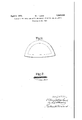
- Fig. 1 is a plan of a toe stiifener in which the invention is embodied
- Fig. 2 is a cross-section of a portion of the stlfiener on anenlarged scale.
- the illustrated stifl'ener comprises two layers of fabric bonded together by means of a non-thermoplastic adhesive substance in an aqueous vehicle and subsequently impregnated with a thermoplastic substance.
- the margin of the stifi'ener may be beveled, as indicated in Fig. 1, either by being skived or by being subjected simultaneously to heat and pressure.
- a starch paste is made by mixing two parts by weight of dry starch paste powder with sixteen parts by weight of water and adding one part by weight of diethylene "glycol. This paste is used to bond together two layers of a suitable fabric such, for example, as cotton flannel. After the water has driedout, the starch bond, because of,the presence of the diethyl- (ne glycol, does not become stiff and]? brittle as it otherwise would but remains'flexible.
- the laminated fabric thus bonded is then, impregnated by being immersed in WZbath-of 'molten thermoplasticmaterial stew for e E- an le; as a mixture ofl 75 p'er cent'ieolophany' an 25 per cent blown asphalt and allowed 95 to cool, after whichlthe sti'fieners are died out of it.
- the temperature of the-bath varies somewhat, depending upon-the thermoplastic ingredients whichfare"used,and is a proximately 0.; but inasmuch as t e no boiling point of the diethylene glycol is 250 C., the diethylene glycol remains in the stiffener and serves to maintain the starch bond in a flexible condition.
- water soluble adhesive substances such, 'for example, as glue, and other high boiling li uids, which are miscible or somewhat miscible with water, such, for example, as glycerine and Turkey red oil, may be used.
- a high boiling liquid as a mollifying agent
- very good results may be secured by using rubber latex; and a bond which has 'proved to be satisfactory maybe made by the use of starch paste mixed with rubber latex in such proportions that'the mixture contains two parts by weight of starch to one part by weight of rubber solids.
- thermoplastic substance or substances used are immaterial; and any of the well-known substances such as Montan wax, dammar, copal 1 and various waxes and resins may be employed.
- thermoplastic stiffener for boots and shoes which comprises bonding together a plurality of pieces biporous sheet material by. means of an adhesive 39 substance capable of being dispersed in water and a mollifying agent therefor, impreg nating the laminated sheet material with a thermoplastic substance, and cutting out the stiffener from the laminated impregnated material.
- thermoplastic stifi'ener for boots and shoes which comprises bonding together a plurality of pieces of porous sheet material by means of an adhesive ter and a mollifying agent therefor, impregnating the laminated sheet material with a molten thermoplastic substance, and cutting ,out the stifi'enerfrom the laminated impregjnated material.
- thermoplastic stiflener for boots and shoes which comprises bonding together a plurality. of pieces ofporous sheet material by means of a non-thermoplastic adhesive substance capable of being dispersed in water containing a liquid having a boiling point higher than the melting point of the thermoplastic substance to be used, impregnating the laminated sheet material with the thermoplastic substance in molten conditon, and cutting out the stifiE'enerslfrom the laminated, impregnated mater1a 1 4.
- thermoplastic stiffener for boots and shoes which comprises bonding together a plurality of pieces of porous sheet material by means of starch rous sheet material by means of starch paste containing diethylene glycol, impregnating 4 the laminated sheet material with the thermoplastic substance in molten condition, and cut- .ting out stifieners from the laminated impregnated material.
- a stiflener for boots and shoes comprising a laminated base impregnated with a thermoplastissubstance, the layers of the base being bonded together b a non-thermoplastic adhesive substance capa le of being dispersed in water containing a mollifying agent.
- thermoplastic substance for boots and shoes
- a non-thermoplastic adhesivesubstance capable of being dispersed in water containing a liquid having. a boiling point which is higher than the melting point of the thermoplastic substance.
- thermoplastic substance capable of being dispersed in water containing a liquid which is miscible with water and has a boiling point which is higher than the melting point of the thermoplastic substance.
- a stifi'ener for boots and shoes impregnated with a thermoplastic substance the base of the stiffener consisting of a, plurality of layers of porous sheet material bonded together by a non-thermoplastic adhesive substance capable of being dispersed in water containing a liquid which is miscible with Water and is stable when subjected to a de es of heat suflicientto melt the thermoplastic substance.
- L 10 A stifi'ener for boots and shoes comprising a laminated base impregnated with a thermoplastic substance, the layers of the paste containing a liquid having a boiling
Landscapes
- Footwear And Its Accessory, Manufacturing Method And Apparatuses (AREA)
Description
April 5, 1932. w. J. LUND 1,352,018
STIFFENER FOR BOOTS AND SHOES AND METHOD OF MAKING THE STIFFENER Filed April 25. 1929 vi/v 717/1 Patented Apr. 5, 1932 CHINERY CORPORATION, OF JERSEY rraa STATES wrLLIAM JACKSON LUND, or LEICESTER, ENGLAND, ASSIGNOB To U- 1,'ssz,01s
ED SHOE MA PATERSON, JERSEY, A CORPGBATION OF NEW- STIFFENEB, FOR BOOTS AND SHOES AND METHOD OF MAKING- THE STHTENER Application filed April 23, 1929, Serial No. 357,524, and in GreatBritain June 2, 1928.
This invention relates to a stiffener for the uppers of boots and shoes and to a method of making it and is herein described as embodied in a thermoplastic toe stifiener and its manpfacture.
A thermoplastic toe stifi'ener is subject to two opposed requirements, first, it should be capable of being softened by heat and of remaining soft while it is being conformed to the toe portion of the last during the manufacture ofthe shoe, and, second, it should resist softening by unusual solar heat, when, for example, the finished shoe in which it is incorporated is exposed to the sun for long periods in a shop window or when the shoe is worn in a tropical country. In order to meet these two opposed requirements thermoplastic stifiieners have" been developed containing a layer of heat-resistant material which is not thermoplastic, the layer being a thin somewhat flexible one which-does not interfere with the-conformingof the heated stifi'ener to the last during the manufacture of the shoe, but which, in the finished shoe, has enough strength to prevent the stifi'ened portion of the upper of the shoe from sagging when exposed to solar heat in the manner-referred to above.
An object of the present invention is to provide an improved stiffener of the type last described and a method of making the stifi'ener.
According to the method, a plurality, of layers of suitable porous sheetmaterial are bonded together by means of a non-thermoplastic adhesive substance in an aqueous vehicle, and the laminated material thus formed is impregnated with a thermoplastic sub"- stance. For example, starch. paste containing diethylene glycol may be used to bond together two sheets of'cotton flannel; and
when the laminated sheet material has dried,
it may be immersed in the molten thermo plastic substance to impregnate it. Inasmuch as the boiling point of diethylene glycol is much higher than any temperature to which the stifiener is subjected either during its manufacture orduring the manufacture of the shoe in which it is subsequently incorporated, a certain amount of this liquid remains in the starch and serves to mollify thestarch, which would otherwise dry to a lfird brittle condition, so as to make it flex- 1 e.
The resultant stiflener thus comprises a laminated base having its layers bonded together by an adhesive substance containing a mollifying agent, said base being impregnated with thermoplastic material. When such a stifiener is incorporated in the toe portion of the upper of a shoe, the flex'iblebond -will prevent the toe portion. of the upper from sagging if the shoe is subjected to unusual heat. 2 v
Referringv to the accompanying drawings,
Fig. 1 is a plan of a toe stiifener in which the invention is embodied, and
Fig. 2 is a cross-section of a portion of the stlfiener on anenlarged scale.
The illustrated stifl'ener comprises two layers of fabric bonded together by means of a non-thermoplastic adhesive substance in an aqueous vehicle and subsequently impregnated with a thermoplastic substance. The margin of the stifi'ener may be beveled, as indicated in Fig. 1, either by being skived or by being subjected simultaneously to heat and pressure. I
As an example of one way in which the stifl'ener may be manufactured, a starch paste is made by mixing two parts by weight of dry starch paste powder with sixteen parts by weight of water and adding one part by weight of diethylene "glycol. This paste is used to bond together two layers of a suitable fabric such, for example, as cotton flannel. After the water has driedout, the starch bond, because of,the presence of the diethyl- (ne glycol, does not become stiff and]? brittle as it otherwise would but remains'flexible. 90 The laminated fabric thus bonded is then, impregnated by being immersed in WZbath-of 'molten thermoplasticmaterial stew for e E- an le; as a mixture ofl 75 p'er cent'ieolophany' an 25 per cent blown asphalt and allowed 95 to cool, after whichlthe sti'fieners are died out of it. The temperature of the-bath, varies somewhat, depending upon-the thermoplastic ingredients whichfare"used,and is a proximately 0.; but inasmuch as t e no boiling point of the diethylene glycol is 250 C., the diethylene glycol remains in the stiffener and serves to maintain the starch bond in a flexible condition. Other water soluble adhesive substances, such, 'for example, as glue, and other high boiling li uids, which are miscible or somewhat miscible with water, such, for example, as glycerine and Turkey red oil, may be used. Instead of using a high boiling liquid as a mollifying agent, very good results may be secured by using rubber latex; and a bond which has 'proved to be satisfactory maybe made by the use of starch paste mixed with rubber latex in such proportions that'the mixture contains two parts by weight of starch to one part by weight of rubber solids.
' The particular thermoplastic substance or substances used are immaterial; and any of the well-known substances such as Montan wax, dammar, copal 1 and various waxes and resins may be employed.
Having thus described my invention, what I claim as new and desire to secure by LettersPatent ofthe United States is 1. Themethod of making a thermoplastic" stiffener for boots and shoes which comprises bonding together a plurality of pieces biporous sheet material by. means of an adhesive 39 substance capable of being dispersed in water and a mollifying agent therefor, impreg nating the laminated sheet material with a thermoplastic substance, and cutting out the stiffener from the laminated impregnated material.
2. The methodof making a thermoplastic stifi'ener for boots and shoes which comprises bonding together a plurality of pieces of porous sheet material by means of an adhesive ter and a mollifying agent therefor, impregnating the laminated sheet material with a molten thermoplastic substance, and cutting ,out the stifi'enerfrom the laminated impregjnated material.
3. The method of making a thermoplastic stiflener for boots and shoes which comprises bonding together a plurality. of pieces ofporous sheet material by means of a non-thermoplastic adhesive substance capable of being dispersed in water containing a liquid having a boiling point higher than the melting point of the thermoplastic substance to be used, impregnating the laminated sheet material with the thermoplastic substance in molten conditon, and cutting out the stifiE'enerslfrom the laminated, impregnated mater1a 1 4. The method of making a thermoplastic stiffener for boots and shoes which comprises bonding together a plurality of pieces of porous sheet material by means of starch rous sheet material by means of starch paste containing diethylene glycol, impregnating 4 the laminated sheet material with the thermoplastic substance in molten condition, and cut- .ting out stifieners from the laminated impregnated material.
6'. A stiflener for boots and shoes comprising a laminated base impregnated with a thermoplastissubstance, the layers of the base being bonded together b a non-thermoplastic adhesive substance capa le of being dispersed in water containing a mollifying agent.
7 .-A stifiener for boots and shoes comprising a laminated base impregnated with a thermoplastic substance, the layers of the base being bonded together by a non-thermoplastic adhesivesubstance capable of being dispersed in water containing a liquid having. a boiling point which is higher than the melting point of the thermoplastic substance.
8. A stifl'ener-for boots and shoes impregnated with a thermoplastic substance, the base of the stifi'ener consisting oi a plurality of la ers of porous sheet material bonded toget er by a non-thermoplastic adhesive. substance capable of being dispersed in water containing a liquid which is miscible with water and has a boiling point which is higher than the melting point of the thermoplastic substance.
9. A stifi'ener for boots and shoes impregnated with a thermoplastic substance, the base of the stiffener consisting of a, plurality of layers of porous sheet material bonded together by a non-thermoplastic adhesive substance capable of being dispersed in water containing a liquid which is miscible with Water and is stable when subjected to a de es of heat suflicientto melt the thermoplastic substance. L 10. A stifi'ener for boots and shoes comprising a laminated base impregnated with a thermoplastic substance, the layers of the paste containing a liquid having a boiling
Applications Claiming Priority (1)
| Application Number | Priority Date | Filing Date | Title |
|---|---|---|---|
| GB1852018X | 1928-06-02 |
Publications (1)
| Publication Number | Publication Date |
|---|---|
| US1852018A true US1852018A (en) | 1932-04-05 |
Family
ID=10891996
Family Applications (1)
| Application Number | Title | Priority Date | Filing Date |
|---|---|---|---|
| US357524A Expired - Lifetime US1852018A (en) | 1928-06-02 | 1929-04-23 | Stiffener for boots and shoes and method of making the stiffener |
Country Status (1)
| Country | Link |
|---|---|
| US (1) | US1852018A (en) |
-
1929
- 1929-04-23 US US357524A patent/US1852018A/en not_active Expired - Lifetime
Similar Documents
| Publication | Publication Date | Title |
|---|---|---|
| US2180924A (en) | Rubber footwear | |
| US1370799A (en) | Arch-supporting insole | |
| US1365221A (en) | Method of securing soles to last-bottoms | |
| US2758045A (en) | Solvent softening shoe stiffener | |
| US2077125A (en) | Laminated shoe stiffener | |
| US1983622A (en) | Shoe stiffener and method of making the same | |
| US2919453A (en) | Process for stiffening parts of footwear by insertion of hardener impregnated blank coated with synthetic resin | |
| US1640362A (en) | Manufacture of shoes | |
| US2616821A (en) | Laminated box toe stiffening material | |
| US1720764A (en) | Shoe stiffener | |
| US1979461A (en) | Shoe structure | |
| US3113906A (en) | Stiffening shoe counters | |
| US2512003A (en) | Stiffening portions of the uppers of shoes | |
| US2648616A (en) | Material for shoe stiffeners | |
| US2034650A (en) | Goodyear welt | |
| US2390347A (en) | Shoe stiffener and process of making the same | |
| US1746249A (en) | Art of stiffening portion of boots and shoes | |
| US2611726A (en) | Shoe lining having self-stiffening properties | |
| US3066426A (en) | Ribbed insole and blank therefor | |
| US2373404A (en) | Shoe construction | |
| US2242729A (en) | Thermoplastic stiffener | |
| US2127783A (en) | Shoe stiffener | |
| US1282399A (en) | Shoe. | |
| US2447681A (en) | Process of stiffening shoe parts | |
| US1889196A (en) | Art of stiffening parts of boots and shoes |