US1851863A - Jacquard apparatus for textile machines with movable implements for forming loops - Google Patents
Jacquard apparatus for textile machines with movable implements for forming loops Download PDFInfo
- Publication number
- US1851863A US1851863A US472014A US47201430A US1851863A US 1851863 A US1851863 A US 1851863A US 472014 A US472014 A US 472014A US 47201430 A US47201430 A US 47201430A US 1851863 A US1851863 A US 1851863A
- Authority
- US
- United States
- Prior art keywords
- jacquard
- needles
- textile machines
- prisms
- forming loops
- Prior art date
- Legal status (The legal status is an assumption and is not a legal conclusion. Google has not performed a legal analysis and makes no representation as to the accuracy of the status listed.)
- Expired - Lifetime
Links
- 239000004753 textile Substances 0.000 title description 8
- 238000009940 knitting Methods 0.000 description 7
- 238000000059 patterning Methods 0.000 description 5
- XEEYBQQBJWHFJM-UHFFFAOYSA-N Iron Chemical compound [Fe] XEEYBQQBJWHFJM-UHFFFAOYSA-N 0.000 description 2
- 230000000694 effects Effects 0.000 description 2
- 239000004744 fabric Substances 0.000 description 2
- 101100165798 Arabidopsis thaliana CYP86A1 gene Proteins 0.000 description 1
- 239000004136 Calcium sodium polyphosphate Substances 0.000 description 1
- -1 Germanyl Chemical group 0.000 description 1
- 238000005452 bending Methods 0.000 description 1
- 230000015572 biosynthetic process Effects 0.000 description 1
- 238000010276 construction Methods 0.000 description 1
- 230000001419 dependent effect Effects 0.000 description 1
- 230000001627 detrimental effect Effects 0.000 description 1
- 238000010586 diagram Methods 0.000 description 1
- 229910052742 iron Inorganic materials 0.000 description 1
- 230000002028 premature Effects 0.000 description 1
- 238000009941 weaving Methods 0.000 description 1
Images

Classifications
-
- D—TEXTILES; PAPER
- D04—BRAIDING; LACE-MAKING; KNITTING; TRIMMINGS; NON-WOVEN FABRICS
- D04B—KNITTING
- D04B9/00—Circular knitting machines with independently-movable needles
- D04B9/26—Circular knitting machines with independently-movable needles for producing patterned fabrics
Definitions
- the invention relates to a jacquard apparatus for textile machines with movable 1mlements for forming loops, more particulary for circular knitting machines.
- the jac- 5 quard apparatus known in connection with weaving looms has already found use in circular knitting machines.
- Such machines with the jacquardapparatuses belonging thereto require. a very large floor s ace.
- the thus arranged acquar apparatuses prevent access to the machine, with the result for exam le that the production of the fa ric can be f0 lowed only with difliculty.
- a pattern device of this kind is particularly suitable for circular knitting machines of all kinds.
- two jacquard prisms which are dependent on each othervin their movements are suflicient to push the flexible members in machines of all sizes and of all kinds, the jacquard prisms carrying out their pushing action alternately.
- two jacquard prisms were intended to act alternately on flexible members. This however took place in a -manner in which the jacquard prisms worked independently of each other.
- Both of these jacquard prisms preferably are situ ated at one side of the machine in close proximity to the needle cylinders so that very little room is required for them. Access to- 5 of the fabric accordingly is not 'hin ered in 1 any way, because the hitherto necessary employment of harness cords is eliminated.
- a wire core is provided loosely in a stationary cover and has at least one bend together with the cover.
- the loose arrangement of this wire core permits its easy movement between the jacquard prism and the 'needle, whilst the bend brakes this easy movement slightly and in such a way that the ease of movement is maintained a but the movement is braked to an extent that causes the wire core to remain in any given position and not to leave such position acci dentally.
- the needlespush by the wire cores for patterning activities 0 position partly or wholl prematurely.
- Figure 4 a division diagram for two needle groups.
- the disc transmits its rotary movement to the cam shroud 12 which is secured to it.
- the shroud 12 encircles the stationary cylingbep ides the needles 13 and the I ationary cy inder is secured to the base plate 3 by means of a support 15.
- Four posts 16 are secured to the rotary disc and carry a rod 18 by the aid of a bridge 17, the ribbingdisc 19 and the bobbin stand 20 being mounted on the rod 18.
- Lugs 25, 26, 27 and 28 are secured to the ring 4, the lugs 25 and 26 servm as bearings for a shaft 29 on the ends of w ich are secured the bevel wheels 30 and 31.
- the bev'el' wheel 30 meshes with a bevel wheel 32 secured (in the driving shaft 10 and transmits the rotary movement thereof through the bevel wheel 31 to a bevel wheel 33 which meshes therewith and is secured to a shaft 34 mounted in the lugs 27 and 28..
- the last named lugs have arms 35, 36 and there is an arm 37 mounted on the ring 4. At theiends of the arms there is mounted a bolt 38 which secures the two arms together. Upwardly p jecting airs of fin ers 39, 39 are arranged on the bolt 38 an each pair carries at its ends one of the known jacquard PllSIIlS 40 and 40' respectively.
- the pairs of fingers 39, 39' have eyes 41.
- Rods 42 are connected pivotally at one end by means of the said eyes and the other ends of the rods engage cam-slots 43 in discs 44 securedto the shaft 34.
- the rods are supported at their rear ends-by arms 45 which are mounted rotatably on the In arms 36.
- the cam discs 44 are so arranged 'on their Shaft that, ascan be seen in Figure 3, the front jacquard prism 40 is out of operative posit1on when the rear jacquard prism 40' is in operative position. Both prisms are turned 90 on their return movement in the usual way and therefore not illustrated manner,
- arm 37 and an arm 45 carry the pairs of plates 46, 46'.
- sleeves produced from closely wound helical springs 47 are secured in the plates 46' and in a ring 49 provided on the needle cylinder 14.
- These sleeves 47 each serve as a guide for a wire 48 which lies loosely therein and the wires serve as stoppers for the knitting needles 13 because they project into the needle slots in the cylinder 14 directly beneath the needles 13.
- Each stopper 48 colmnences directly in front of one of the two jacquard prisms 40 and 40', then extends with its sleeve in a horizontal direction and then bends into the vertical.
- the loose support of the stoppers 48 in the stationary sleeve 47 provides for the necessary easy movement of the stoppers 48.
- I cla1m -- A 3 1.
- a jacquard apparatus for textile machines which-hav'e movable, loop-forming im; plements, the combination of a needle cylinder, needles which are raisable and lowerable inthe needle cylinder, jacquard prisms adapted to be arranged in proximity to the machine,
- a jacglliard apparatus for textile machines accor the machine, means carryin the said prisms, a shaft carrying the sai adapted to rise and fall, and flexible thrust members arranged between the jacquard prisms and lower ends of the needles for advancing the needles and reventing a premature, undesired return 0 the'needles.
Landscapes
- Engineering & Computer Science (AREA)
- Textile Engineering (AREA)
- Knitting Machines (AREA)
Description
March 29, 1932. oas-r 1 1,851,863
JACQUARD APPARATUS FOR TEXTILE MACHINES wI Tu y MOVABLE IMPLEMENTS FOR'FORMING LOOPS Filed July 31, 1950 3 Sheets-Sheet l I". 1 f'l W: Q :25 i H 18 k ."k EI'I'A 9 ----32 4 40 r f 37 v 39 1 a2 3a a"; 31 44 In venfor:
March 29, 1932. 1 NQBST 1,851,863
JACQUARD APPARATUS FOR TEXTILE MACHINES WITH A MOVABLE IMPLEMENTS FOR FORMING LOOPS Filed July I51,- 1930 3 Sheets-Sheet 2 rw? l 9 14 f 6 m $2 62 6 I. L J g- -Z1 40 1 47 5 9 47 g Ax 4 71 4 I 7- '1; 46 v .9 47 15 40/ g 12 34 1 E543 i a: 2 39 i 45 In venfom Jiturney March 29, 1932. NQBST 1,851,863
JACQUARD APPARATUS FOR TEXTILE MACHINES WITH MOVABLE IMPLEMENTS FOR FORMING LOOPS Filed July 31, 1930 3 Sheets-Sheet 5 lnvenfor:
Patented '29, 1932 UNITED STATES PATENT "OFFICE GEOBG HORST, OI IITTWEIDA, GERMANY uceuann arrm'rvs iron. 'rnxmn mcnnms wrrn novnm mrnmtms I'QB x; roams LOOPS Application. filed July 81 1980, Serial No. 472,014, and in Germanyl'une 5, 1929.
The invention relates to a jacquard apparatus for textile machines with movable 1mlements for forming loops, more particulary for circular knitting machines. The jac- 5 quard apparatus known in connection with weaving looms has already found use in circular knitting machines. For example it is known to employ in star arrangement around 'the circular knitting machine, one or two jacquard apparatuses for each feeder, knitter or looper of the machine. Such machines with the jacquardapparatuses belonging thereto require. a very large floor s ace. Furthermore the thus arranged acquar apparatuses prevent access to the machine, with the result for exam le that the production of the fa ric can be f0 lowed only with difliculty. In other cirdular knitting machines one or more jacquard apparatuses so are perched above the machine. In this case there are pattern apparatuses in which, as in weavinglooms, the patterning needles are drawn up by, them atthe same time as the harness cords connected to the sinkers.
Owing to the weight of these pattern apparatuses themselves it is necessar .to deviate strongly from the hitherto light orm of construction of the circular machine. .A jacquard apparatus has also been proposed in which the sinkers for actuation of the patterning needles are arra ed in the w'cinity of rotary lifters and fal ers. In this 'proposal it is ro osed to employ, amongst other things, a ex1 1e member for advancing the sinkers. The flexible member is forced by the jacquard prism against the sinker, against the pressure of a s ring. But also in this case the upper nee le cylinder is hidden by the sinkers and harness cords, for examplein 40 pearl machines. For the same reason this apparatus cannot be used for auxiliary camdnachines for colour atterned, plain fabrics, because it would .l iide the necessary ribbing disc and cam plate.
posed between each two or more jacquard prisms having pattern cards and'every one of the raisable .an lowerable needles in the .cylinder of a circular knittin or circular full fashioned machine, a flexib e member which progress of 'the machine and observation of the rogress din-t t th tee Accor g 0 my em 15 m r not leave their is pushed'by the jacquard prism and imparts .the'received motion direct to its needle and thereby brings the needle into its working o sition. On completion of its work the nee le pushes its flexible member forcibly back into its-initial position whereby no special means is required for that purpose. A pattern device of this kind is particularly suitable for circular knitting machines of all kinds. In most cases, two jacquard prisms which are dependent on each othervin their movements are suflicient to push the flexible members in machines of all sizes and of all kinds, the jacquard prisms carrying out their pushing action alternately. According to the last mentioned prior proposal, two jacquard prisms were intended to act alternately on flexible members. This however took place in a -manner in which the jacquard prisms worked independently of each other. Both of these jacquard prisms preferably are situ ated at one side of the machine in close proximity to the needle cylinders so that very little room is required for them. Access to- 5 of the fabric accordingly is not 'hin ered in 1 any way, because the hitherto necessary employment of harness cords is eliminated.
Another distinctive feature of the inven tion consists in the peculiar formation and arrangement of the flexible members. According to this feature a wire core is provided loosely in a stationary cover and has at least one bend together with the cover. The loose arrangement of this wire core permits its easy movement between the jacquard prism and the 'needle, whilst the bend brakes this easy movement slightly and in such a way that the ease of movement is maintained a but the movement is braked to an extent that causes the wire core to remain in any given position and not to leave such position acci dentally. In consequence the needlespush by the wire cores for patterning activities 0 position partly or wholl prematurely.
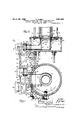
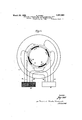
The accompanying drawings show the new jacquard patterning device in combinationwith a four feeder, knitter or looper circular no I 14 which knitting machine for plain goods rib frame with auxiliary cams. Irithe drawings Figure 1 shows both parts in elevation, Figure 2 the patterning device in longitudinal section,
Figure '3 the same in section on'line 3 30f Figure 2, regarded from above, and
Figure 4a division diagram for two needle groups.
Referring to the drawings, four posts 2 8 or a driving pulley'9.
' The disc transmits its rotary movement to the cam shroud 12 which is secured to it. The shroud 12 encircles the stationary cylingbep ides the needles 13 and the I ationary cy inder is secured to the base plate 3 by means of a support 15. Four posts 16 are secured to the rotary disc and carry a rod 18 by the aid of a bridge 17, the ribbingdisc 19 and the bobbin stand 20 being mounted on the rod 18. The hereinbefor'e stated parts to the chamber 3, 4, 5, and their manner of operation are known.. Lugs 25, 26, 27 and 28 are secured to the ring 4, the lugs 25 and 26 servm as bearings for a shaft 29 on the ends of w ich are secured the bevel wheels 30 and 31. The bev'el' wheel 30 meshes with a bevel wheel 32 secured (in the driving shaft 10 and transmits the rotary movement thereof through the bevel wheel 31 to a bevel wheel 33 which meshes therewith and is secured to a shaft 34 mounted in the lugs 27 and 28..
The last named lugs have arms 35, 36 and there is an arm 37 mounted on the ring 4. At theiends of the arms there is mounted a bolt 38 which secures the two arms together. Upwardly p jecting airs of fin ers 39, 39 are arranged on the bolt 38 an each pair carries at its ends one of the known jacquard PllSIIlS 40 and 40' respectively. The pairs of fingers 39, 39' have eyes 41. Rods 42 are connected pivotally at one end by means of the said eyes and the other ends of the rods engage cam-slots 43 in discs 44 securedto the shaft 34. The rods are supported at their rear ends-by arms 45 which are mounted rotatably on the In arms 36. By rotation of the cam discs 44 t e rods 42 and thereby the feed cylinders 40, 40' have a to-and-fro motion imparted to them. I
The cam discs 44 are so arranged 'on their Shaft that, ascan be seen in Figure 3, the front jacquard prism 40 is out of operative posit1on when the rear jacquard prism 40' is in operative position. Both prisms are turned 90 on their return movement in the usual way and therefore not illustrated manner,
The ends of sleeves produced from closely wound helical springs 47 are secured in the plates 46' and in a ring 49 provided on the needle cylinder 14. These sleeves 47 each serve as a guide for a wire 48 which lies loosely therein and the wires serve as stoppers for the knitting needles 13 because they project into the needle slots in the cylinder 14 directly beneath the needles 13. Each stopper 48 colmnences directly in front of one of the two jacquard prisms 40 and 40', then extends with its sleeve in a horizontal direction and then bends into the vertical.
The stoppers 48 selected according to the patternare pushed by the card leaves lying on the jacquard prisms 40, 40 and the movement is transmitted by the said stoppers to cam'and brought into action. Y
The loose support of the stoppers 48 in the stationary sleeve 47 provides for the necessary easy movement of the stoppers 48.
The bending of these stoppers and their sleeves does not arise merely from their arrangement but has also the purpose to so restrict or brake the easy'movement of the stoppers that they and the needles actuated by them do not change accidentally from the position into which they are pushed by the acquard risms. Consequently the needles lifted in t e working of the pattern do not slide down either'partly or wholly'before their activities are ended and therefore the detrimental results attached to such unintended movements do not arise. The return movement of the needles and their stoppers are momentaril [projected by the 'acquard prism 40 lie'i'n t ose parts of the nee le cylinder which are indicated by the brackets a whilst none o f'the four yarn guides 50 lies opposite those parts. As soon as the yarn ides reach the .parts indicated. by the rackets a, those needles 13 which lie in the parts indicated by the brackets 71 are projected y the jacquard prism 40'. j j
I cla1m:-- A 3 1. In a jacquard apparatus" for textile machines which-hav'e movable, loop-forming im; plements, the combination of a needle cylinder, needles which are raisable and lowerable inthe needle cylinder, jacquard prisms adapted to be arranged in proximity to the machine,
attern cards riding on the jacquard prisms, exiblethrust members interposed between the jacquard prismsand each of-the needles for directly transmitting motion from the jacquard prisms to the needles and thereby of jacquard prlsms, 100
names advancing the needles, and means for forcibly returning the flexible thrust members to the initial position through the action of the said needles on the flexible thrust members.
2. In a jacglliard apparatus for textile machines, accor the machine, means carryin the said prisms, a shaft carrying the sai adapted to rise and fall, and flexible thrust members arranged between the jacquard prisms and lower ends of the needles for advancing the needles and reventing a premature, undesired return 0 the'needles.
3. In a jacquard apparatus for textile machines, according to claim 1,,the combination forming needles,
- bent flexible thrust mem rs, and bent stationary sleeves containing the flexible thrust members loosely and braking to a small extent the free movement of the flexible thrust members in the said sleeves.
In testimony whereof, I have si name to this specification at Dres en, Germany, this 16th day of J uiy 1930. I
G one NOBST.
g to claim 1, the combination of jacquard prisms arranged at one side of.
means, needles
Applications Claiming Priority (1)
| Application Number | Priority Date | Filing Date | Title |
|---|---|---|---|
| DE1851863X | 1929-06-05 |
Publications (1)
| Publication Number | Publication Date |
|---|---|
| US1851863A true US1851863A (en) | 1932-03-29 |
Family
ID=7746051
Family Applications (1)
| Application Number | Title | Priority Date | Filing Date |
|---|---|---|---|
| US472014A Expired - Lifetime US1851863A (en) | 1929-06-05 | 1930-07-31 | Jacquard apparatus for textile machines with movable implements for forming loops |
Country Status (1)
| Country | Link |
|---|---|
| US (1) | US1851863A (en) |
Cited By (2)
| Publication number | Priority date | Publication date | Assignee | Title |
|---|---|---|---|---|
| US2595922A (en) * | 1948-11-17 | 1952-05-06 | Moncenisio Off | Circular knitting machine for stockings and the like |
| US20240376645A1 (en) * | 2023-05-10 | 2024-11-14 | Pinghu Dajie Art & Crafts goods Co., Ltd. | Computerized chenille jacquard carpet machine |
-
1930
- 1930-07-31 US US472014A patent/US1851863A/en not_active Expired - Lifetime
Cited By (2)
| Publication number | Priority date | Publication date | Assignee | Title |
|---|---|---|---|---|
| US2595922A (en) * | 1948-11-17 | 1952-05-06 | Moncenisio Off | Circular knitting machine for stockings and the like |
| US20240376645A1 (en) * | 2023-05-10 | 2024-11-14 | Pinghu Dajie Art & Crafts goods Co., Ltd. | Computerized chenille jacquard carpet machine |
Similar Documents
| Publication | Publication Date | Title |
|---|---|---|
| US3258941A (en) | Resilient knitted band | |
| US3303670A (en) | Multi-slide guide-bar | |
| CN106222872A (en) | A kind of one goes out two jacquard warp knitting machines | |
| CN109868551B (en) | A three-wool jacquard plush blanket double needle bed warp knitting machine | |
| US1795235A (en) | Device for reproducing designs upon knitting machines | |
| US3099921A (en) | Warp knitting machine | |
| US2744398A (en) | Warp knitting machine | |
| US2750772A (en) | Knitting machine needle device | |
| GB2051147A (en) | Raschel machines | |
| US3480044A (en) | Double-lift jacquards operating with reverse selection | |
| US3247686A (en) | Guide bars for warp knitting machine | |
| US2092347A (en) | Circular knitting machine | |
| US3566618A (en) | Individual needle control means for circular warp knitting machines | |
| US1951104A (en) | Machine for the production of knitted fabrics | |
| US3145549A (en) | Apparatus for producing a knitted fabric having an inlay of weft threads | |
| US3464235A (en) | Raschel warp knitting machine | |
| US1866713A (en) | Knitted article or garment | |
| US1355196A (en) | Feeding and pattern mechanism for warp-knitting machines | |
| US2331528A (en) | Flat knitting machine | |
| US2035960A (en) | Lace attachment for knitting machines | |
| US1796579A (en) | Warp-knitting frame | |
| US3355911A (en) | Warp-knitting machine | |
| US3360964A (en) | Warp-knitting machine and warp knitting made thereby | |
| US3375681A (en) | Flat bed knitting machines and method of knitting | |
| US2736179A (en) | Dittrich |