US1851834A - Method of manufacturing metal tiles - Google Patents
Method of manufacturing metal tiles Download PDFInfo
- Publication number
- US1851834A US1851834A US371688A US37168829A US1851834A US 1851834 A US1851834 A US 1851834A US 371688 A US371688 A US 371688A US 37168829 A US37168829 A US 37168829A US 1851834 A US1851834 A US 1851834A
- Authority
- US
- United States
- Prior art keywords
- tiles
- flanges
- blank
- corners
- metal
- Prior art date
- Legal status (The legal status is an assumption and is not a legal conclusion. Google has not performed a legal analysis and makes no representation as to the accuracy of the status listed.)
- Expired - Lifetime
Links
- 229910052751 metal Inorganic materials 0.000 title description 17
- 239000002184 metal Substances 0.000 title description 17
- 238000004519 manufacturing process Methods 0.000 title description 8
- 239000004568 cement Substances 0.000 description 8
- 238000000034 method Methods 0.000 description 4
- 238000003825 pressing Methods 0.000 description 3
- RYGMFSIKBFXOCR-UHFFFAOYSA-N Copper Chemical compound [Cu] RYGMFSIKBFXOCR-UHFFFAOYSA-N 0.000 description 2
- HCHKCACWOHOZIP-UHFFFAOYSA-N Zinc Chemical compound [Zn] HCHKCACWOHOZIP-UHFFFAOYSA-N 0.000 description 2
- 239000004411 aluminium Substances 0.000 description 2
- 229910052782 aluminium Inorganic materials 0.000 description 2
- XAGFODPZIPBFFR-UHFFFAOYSA-N aluminium Chemical compound [Al] XAGFODPZIPBFFR-UHFFFAOYSA-N 0.000 description 2
- 238000000576 coating method Methods 0.000 description 2
- 229910052802 copper Inorganic materials 0.000 description 2
- 239000010949 copper Substances 0.000 description 2
- 239000011505 plaster Substances 0.000 description 2
- 239000011701 zinc Substances 0.000 description 2
- 229910052725 zinc Inorganic materials 0.000 description 2
- 229910000831 Steel Inorganic materials 0.000 description 1
- 229910000004 White lead Inorganic materials 0.000 description 1
- 239000002253 acid Substances 0.000 description 1
- 238000005452 bending Methods 0.000 description 1
- 230000015572 biosynthetic process Effects 0.000 description 1
- 229920002678 cellulose Polymers 0.000 description 1
- 239000001913 cellulose Substances 0.000 description 1
- 239000011248 coating agent Substances 0.000 description 1
- 230000007797 corrosion Effects 0.000 description 1
- 238000005260 corrosion Methods 0.000 description 1
- 238000005034 decoration Methods 0.000 description 1
- 210000003298 dental enamel Anatomy 0.000 description 1
- 230000006866 deterioration Effects 0.000 description 1
- 238000001035 drying Methods 0.000 description 1
- 229910052571 earthenware Inorganic materials 0.000 description 1
- 230000000266 injurious effect Effects 0.000 description 1
- 239000004570 mortar (masonry) Substances 0.000 description 1
- 239000003973 paint Substances 0.000 description 1
- 238000005498 polishing Methods 0.000 description 1
- 239000003755 preservative agent Substances 0.000 description 1
- 230000002335 preservative effect Effects 0.000 description 1
- 230000000717 retained effect Effects 0.000 description 1
- 238000005507 spraying Methods 0.000 description 1
- 239000010959 steel Substances 0.000 description 1
- 239000000126 substance Substances 0.000 description 1
Images
Classifications
-
- B—PERFORMING OPERATIONS; TRANSPORTING
- B21—MECHANICAL METAL-WORKING WITHOUT ESSENTIALLY REMOVING MATERIAL; PUNCHING METAL
- B21D—WORKING OR PROCESSING OF SHEET METAL OR METAL TUBES, RODS OR PROFILES WITHOUT ESSENTIALLY REMOVING MATERIAL; PUNCHING METAL
- B21D53/00—Making other particular articles
-
- B—PERFORMING OPERATIONS; TRANSPORTING
- B21—MECHANICAL METAL-WORKING WITHOUT ESSENTIALLY REMOVING MATERIAL; PUNCHING METAL
- B21D—WORKING OR PROCESSING OF SHEET METAL OR METAL TUBES, RODS OR PROFILES WITHOUT ESSENTIALLY REMOVING MATERIAL; PUNCHING METAL
- B21D49/00—Sheathing or stiffening objects
Definitions
- This invention relates to an improved method of manufacturing metal tiles, cornices, skirtings, cappings and the like for use as wall coverings, and the object thereof is to produce a tile'or similararticle which is cheap to manufacture, light to handle, and adapted to be easily and securely fixed, and to form a united surface without appreciable gaps through which exudation of cement is likely'to occur. While my invention is more particularly designed for the production of articles for interior use, I do not intend to exclude its application to external decoration.
- Tiles of glazed earthenware or the like as now used are relatively expensive to make and heavy to handle, while they are also liable to become broken or damaged in transit or manipulation.
- Various substitutes have from timeto time been proposed, amongst others, relatively large sheets of zinc having a lithographed pattern representing a number' of contiguous tiles or the like, and such sheets are aflixed to the surface to be covered by meansofa white lead or similar cement.
- Newly plastered or cemented walls are, however, not well adapted to take these sheets, because adhesion is not perfect until the surfaces have thoroughly dried out; moreover, if any acid is present in the cement or plaster, it tends to set up a chemical action which is injurious to the metal, and relatively rapid deterioration of the sheets ensues, which can only be remedied by the replacement of the 1 entire sheet.
- My invention consists in a process for manufacturing metal tiles wherein triangular portions are first removed from the corners of a fiat metal blank by straight line cuts making equal angles with the sides, next turning up flanges on the edges of the blank of such depth that the apices of the triangular gaps so formed at the corners are in the plane of the tile face, and then pressing the tile face outwardly to a depth of 1 or 2 millimetres from such apices, so as to form a tile having a cupped body portion with closed corners, and edge flanges separated by triangularly shaped openings which do not extend to the plane of the body of the tile.
- the tile so formed, if required to be coated, is now thoroughly cleansed, and if desired treated with a suitable preservative paint or the like adapted to prevent corrosion, and the external surface is then provided, by spraying or in any other convenient manner, with a suitable coating or coatings of cellulose or other appropriate enamel.
- a suitable preservative paint or the like adapted to prevent corrosion
- the external surface is then provided, by spraying or in any other convenient manner, with a suitable coating or coatings of cellulose or other appropriate enamel.
- the metal used for forming the blank is copper, aluminium, or a similar decorative metal which is not easily corrodible in ordinary circumstances, these latter operations may, if desired, be omitted.
- the tiles produced in the above manner are adapted to be aflixed and to remain firmly attached to walls and other surfaces by embedding their flanges in cement, plaster, or the like, and by reason of their formation they will form a practically continuous decorative surface, without exudation of cement.
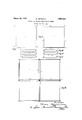
- Figure I represents in plan view a blank for a square tile after the corners have been removed;
- Figure II shows such blank in plan view with the flanges pressed up vertically to the face or body, of which Figure III is an elevation on a larger scale;
- Figure IV is a view in elevation of the blank after cupping;
- Figure V is an elevation of the cupped blank with the flanges turned inwards, and
- Figure VI is a view in plan from behind of four tiles as they would appear when assembled.
- Like numerals refer to like parts in all the figures.
- the metal blank 1 has its corners removed by straight line cuts making equal angles with the sides, as indicated at 2; the flanges 3 are then turned up vertical to the body 1 of the blank, along lines (see the dotted lines in Fig. I), parallel with the sides, which meet at right angles approxi mately in the centres of the lines 2 formed by the removal of the corners.
- the apices 4 of the triangles formed at the corners are in the plane of the body 1, and it will be noted that such corners are as sharp as possible and not radiused.
- the blank as shown in Figure III, is next subjected to pressure between suitable dies in such manner as that the external face of the body 1 is cupped to the extent of 1 or 2 millimetres and therefore stands away to that extent from the apices at of the corner triangles, as indicated in Figure IV, and by the same or a subsequent operation the flanges 3 are bent inwards towards each other so that the flanges on opposite sides form to gether with the body 1 an enlarged dovetail in cross-section. If desired, however, not all the flanges need be so inclined.
- the blank so formed is next treated as hereinbefore indicated and the finished product is adapted after drying and polishing (if desired) to be used commercially.
- Figure VI is a plan view from the rear of four tiles as they appear when assembled.
- the angle 5 is made at the junction of the flanges of two contiguous tiles forms a triangular passage, and when four tiles are laid as shown in the figure the point 6 at which they meet forms a passage leading from any one to any other. If therefore, there is an excess of cement or the like on the surface which any one tile covers, such excess can, if suitable pressure he applied to the face of the tiles while the cement is still sulficiently plastic, be caused to flow through the passages so formed, and a uniform and level surface can thus be assured. 7
Landscapes
- Engineering & Computer Science (AREA)
- Mechanical Engineering (AREA)
- Finishing Walls (AREA)
Description
March 29, 1932. M, HEYMANN 1,851,834
I METHOD OF MANUFACTURING METAL TILES Filed June 17, 1929 E z Fig.1 I
3\ ilf E M; m 3 m g- Z Q mm v w Patented Mar. 29, 1932 MAX 'HEYMANN, 0F REGENTS PARK, LONDON, ENGLAND METHOD or MANUIACTU3ING- METAL TILES" Application filed June 17, 1923, Serial No.
This invention relates to an improved method of manufacturing metal tiles, cornices, skirtings, cappings and the like for use as wall coverings, and the object thereof is to produce a tile'or similararticle which is cheap to manufacture, light to handle, and adapted to be easily and securely fixed, and to form a united surface without appreciable gaps through which exudation of cement is likely'to occur. While my invention is more particularly designed for the production of articles for interior use, I do not intend to exclude its application to external decoration.
Tiles of glazed earthenware or the like as now used are relatively expensive to make and heavy to handle, while they are also liable to become broken or damaged in transit or manipulation. Various substitutes have from timeto time been proposed, amongst others, relatively large sheets of zinc having a lithographed pattern representing a number' of contiguous tiles or the like, and such sheets are aflixed to the surface to be covered by meansofa white lead or similar cement. Newly plastered or cemented walls are, however, not well adapted to take these sheets, because adhesion is not perfect until the surfaces have thoroughly dried out; moreover, if any acid is present in the cement or plaster, it tends to set up a chemical action which is injurious to the metal, and relatively rapid deterioration of the sheets ensues, which can only be remedied by the replacement of the 1 entire sheet.
My invention consists in a process for manufacturing metal tiles wherein triangular portions are first removed from the corners of a fiat metal blank by straight line cuts making equal angles with the sides, next turning up flanges on the edges of the blank of such depth that the apices of the triangular gaps so formed at the corners are in the plane of the tile face, and then pressing the tile face outwardly to a depth of 1 or 2 millimetres from such apices, so as to form a tile having a cupped body portion with closed corners, and edge flanges separated by triangularly shaped openings which do not extend to the plane of the body of the tile.
371,688, and in Great Britain July 6, 1928.
In carrying out my invention I press or stamp from suitable sheet metal such as zinc, copper, aluminium, steel, or the like, of a relatively thin gauge, blanks of slightly larger dimensions than those of a separate tile of the kind required, or of one element adapted to-constitute with other similar elements a skirting, cornice or the like. I remove the corners from the blanks so formed by a straight line out making equal angles with the sides, the size of the triangle removed being such as to leave free for bending over on each edge of the blank a strip of metal of slightly less width, measured from the external face of the blank, than the final width of the flanges hereinafter referredto, by means whereof the tiles are retained in place. These sidestrips are next turned up, by appropriate dies, so that they stand vertically to the face of the blank, and in order to prevent exudation of the cement or mortar from between the meeting edges of contiguous tiles when fixed inplace, it is desirable thatsuch edges should be as straight as possible; furthermore, for the samereason, and for the sake of appearance, it is desirable todispense with radiused corners in planyiew, such as usually occur in stamped or pressed work, and it is also advisable to key the tiles together by means of thecement by which they are affixed. I obtain these results by subjecting the blank with its vertical'flanges to pressure between appropriate male and female dies, of the type usually employed for metal drawing or pressing, such that its external face or body is cupped? or pressed out by drawing the metal toa distance of about one or two millimetres below the apices of the triangular gaps at its corner when the tile is regarded in side eleva tion (see Figures III and IV) thus forming a'body with closed corners from the point 4 downwards; by the same or a subsequent operation, the flanges are turned in slightly so that they incline towards one another and stand at an angle of somewhat less than 90 degrees, with the body of the blank, so that in cross-section the body and the flanges form an enlarged dovetail. In this'mannera tile is produced having in-turned flanges extend ing' around its whole periphery, such flanges having triangular portions removed from the corners in such manner as to provide openings which do not extend to the plane of the tile body.
The tile so formed, if required to be coated, is now thoroughly cleansed, and if desired treated with a suitable preservative paint or the like adapted to prevent corrosion, and the external surface is then provided, by spraying or in any other convenient manner, with a suitable coating or coatings of cellulose or other appropriate enamel. If, however, the metal used for forming the blank is copper, aluminium, or a similar decorative metal which is not easily corrodible in ordinary circumstances, these latter operations may, if desired, be omitted.
The tiles produced in the above manner are adapted to be aflixed and to remain firmly attached to walls and other surfaces by embedding their flanges in cement, plaster, or the like, and by reason of their formation they will form a practically continuous decorative surface, without exudation of cement.
In order that my invention may bemore readily comprehended, I have appended drawings hereto in which Figure I represents in plan view a blank for a square tile after the corners have been removed; Figure II shows such blank in plan view with the flanges pressed up vertically to the face or body, of which Figure III is an elevation on a larger scale; Figure IV is a view in elevation of the blank after cupping; Figure V is an elevation of the cupped blank with the flanges turned inwards, and Figure VI is a view in plan from behind of four tiles as they would appear when assembled. Like numerals refer to like parts in all the figures.
Referring to Figure I, the metal blank 1 has its corners removed by straight line cuts making equal angles with the sides, as indicated at 2; the flanges 3 are then turned up vertical to the body 1 of the blank, along lines (see the dotted lines in Fig. I), parallel with the sides, which meet at right angles approxi mately in the centres of the lines 2 formed by the removal of the corners. As shown in Figure III the apices 4 of the triangles formed at the corners are in the plane of the body 1, and it will be noted that such corners are as sharp as possible and not radiused. The blank, as shown in Figure III, is next subjected to pressure between suitable dies in such manner as that the external face of the body 1 is cupped to the extent of 1 or 2 millimetres and therefore stands away to that extent from the apices at of the corner triangles, as indicated in Figure IV, and by the same or a subsequent operation the flanges 3 are bent inwards towards each other so that the flanges on opposite sides form to gether with the body 1 an enlarged dovetail in cross-section. If desired, however, not all the flanges need be so inclined.
The blank so formed is next treated as hereinbefore indicated and the finished product is adapted after drying and polishing (if desired) to be used commercially.
Figure VI is a plan view from the rear of four tiles as they appear when assembled.
The angle 5 is made at the junction of the flanges of two contiguous tiles forms a triangular passage, and when four tiles are laid as shown in the figure the point 6 at which they meet forms a passage leading from any one to any other. If therefore, there is an excess of cement or the like on the surface which any one tile covers, such excess can, if suitable pressure he applied to the face of the tiles while the cement is still sulficiently plastic, be caused to flow through the passages so formed, and a uniform and level surface can thus be assured. 7
Having now particularly described and ascertained the nature of my said invention and in what manner the same is to be performed, I declare that what I claim is 1. Process for the production of metal tiles consisting in the removalfrom the corners of a flat blank of appropriate metal, of triangular portions by straight line cuts making equal angles with the sides, turning up flanges on the edges of the blank of such depth that the apices of the triangular gaps so formed at the corners lie in the plane of the face, and pressing the face outwardly to a depth of 1 or 2 millimeters from such apices.
2. Process for the production of metal tiles consisting in the operations specified in claim 1 and the additional operation of turning in some or all of the flanges.
MAX HEYMANN.
Applications Claiming Priority (1)
| Application Number | Priority Date | Filing Date | Title |
|---|---|---|---|
| GB1851834X | 1928-07-06 |
Publications (1)
| Publication Number | Publication Date |
|---|---|
| US1851834A true US1851834A (en) | 1932-03-29 |
Family
ID=10891985
Family Applications (1)
| Application Number | Title | Priority Date | Filing Date |
|---|---|---|---|
| US371688A Expired - Lifetime US1851834A (en) | 1928-07-06 | 1929-06-17 | Method of manufacturing metal tiles |
Country Status (1)
| Country | Link |
|---|---|
| US (1) | US1851834A (en) |
Cited By (1)
| Publication number | Priority date | Publication date | Assignee | Title |
|---|---|---|---|---|
| US3720031A (en) * | 1970-12-14 | 1973-03-13 | R Wilson | Structural surface covering and method of making a cover element therefor |
-
1929
- 1929-06-17 US US371688A patent/US1851834A/en not_active Expired - Lifetime
Cited By (1)
| Publication number | Priority date | Publication date | Assignee | Title |
|---|---|---|---|---|
| US3720031A (en) * | 1970-12-14 | 1973-03-13 | R Wilson | Structural surface covering and method of making a cover element therefor |
Similar Documents
| Publication | Publication Date | Title |
|---|---|---|
| US1723659A (en) | Method of forming hollow articles | |
| CN104594581A (en) | Wall heat-insulation coating integrated construction method | |
| US3008256A (en) | Grooved tile and method of cutting same to form discrete elements | |
| US1728934A (en) | Manufacture of tile and brick | |
| US1851834A (en) | Method of manufacturing metal tiles | |
| US2953469A (en) | Simulated stone product and method of forming same | |
| US2145068A (en) | Tile and tile assembly | |
| US2137896A (en) | Scored wallboard | |
| US1560941A (en) | Ornamented surface and method of forming the same | |
| US2018216A (en) | Building covering, and method of manufacturing same | |
| US2218791A (en) | Flexible siding material | |
| US1603366A (en) | Wall and ceiling construction | |
| US1669639A (en) | Tile simulation | |
| JP3229930U (en) | Extruded cement board | |
| CN214462039U (en) | Vacuum heat-insulating decorative integrated board for building | |
| US1645214A (en) | Tile | |
| JPS60216939A (en) | Production of wall facing material | |
| JPH08246637A (en) | Building panel | |
| US1837902A (en) | Method of producing dividing strips for floors | |
| JPS6349456Y2 (en) | ||
| JPS59106660A (en) | Simulated tile for building and production thereof | |
| JPS5912780A (en) | Manufacture of decorative panel | |
| US2068396A (en) | Covering material and process of | |
| US1674763A (en) | Apparatus for making building units | |
| JP4451943B2 (en) | Joint formation method |