US185172A - Improvement in dies for making watch-case backs - Google Patents
Improvement in dies for making watch-case backs Download PDFInfo
- Publication number
- US185172A US185172A US185172DA US185172A US 185172 A US185172 A US 185172A US 185172D A US185172D A US 185172DA US 185172 A US185172 A US 185172A
- Authority
- US
- United States
- Prior art keywords
- dies
- improvement
- watch
- backs
- case
- Prior art date
- Legal status (The legal status is an assumption and is not a legal conclusion. Google has not performed a legal analysis and makes no representation as to the accuracy of the status listed.)
- Expired - Lifetime
Links
- 239000002184 metal Substances 0.000 description 4
- 238000005476 soldering Methods 0.000 description 3
- 238000004519 manufacturing process Methods 0.000 description 2
- 229910000679 solder Inorganic materials 0.000 description 2
- 229910001369 Brass Inorganic materials 0.000 description 1
- 239000010951 brass Substances 0.000 description 1
- 239000007789 gas Substances 0.000 description 1
- 238000000034 method Methods 0.000 description 1
- 239000007787 solid Substances 0.000 description 1
Images
Classifications
-
- B—PERFORMING OPERATIONS; TRANSPORTING
- B21—MECHANICAL METAL-WORKING WITHOUT ESSENTIALLY REMOVING MATERIAL; PUNCHING METAL
- B21D—WORKING OR PROCESSING OF SHEET METAL OR METAL TUBES, RODS OR PROFILES WITHOUT ESSENTIALLY REMOVING MATERIAL; PUNCHING METAL
- B21D28/00—Shaping by press-cutting; Perforating
- B21D28/02—Punching blanks or articles with or without obtaining scrap; Notching
- B21D28/06—Making more than one part out of the same blank; Scrapless working
-
- Y—GENERAL TAGGING OF NEW TECHNOLOGICAL DEVELOPMENTS; GENERAL TAGGING OF CROSS-SECTIONAL TECHNOLOGIES SPANNING OVER SEVERAL SECTIONS OF THE IPC; TECHNICAL SUBJECTS COVERED BY FORMER USPC CROSS-REFERENCE ART COLLECTIONS [XRACs] AND DIGESTS
- Y10—TECHNICAL SUBJECTS COVERED BY FORMER USPC
- Y10T—TECHNICAL SUBJECTS COVERED BY FORMER US CLASSIFICATION
- Y10T29/00—Metal working
- Y10T29/49—Method of mechanical manufacture
- Y10T29/49579—Watch or clock making
- Y10T29/49584—Watch or clock making having case, cover, or back
Definitions
- Watch-cases have heretofore been made in the following manner: The metal was first cast into bars. Bezels and centers were then drawn from the bars by a draw-bench, through a draw-plate or dies, then out oil in suitable length, soldered and swaged down to a suitable shape and size.
- backsand caps plates were rolledout through rollers to the required thickness, cut in shape with shears, and swaged up by followers, made usually of brass or composition. Snaps were then soldered on, and the pieces finished up in lathes, and the required form given to them by means of gravel-s and different other and well-known tools.
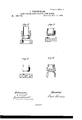
- a cup-shape piece as shown in Figure 1 is first obtained in a double-action press with dies, which are shown in Fig. 2. Then, by other dies, which are shown in Fig. 3, the edge of the piece is crowded in a little,
- Fig. 4 The piece is then operated upon by a double upper and a lower die, which dies are shown in Fig. 5.
- the inside of the double upper die prevents the metal from lapping over while the outside one is crowding down the metal into an angular shape for the snap part of the back or cap. The result is, the piece as shown in Fig. 6.
- the operation of the dies at, b, and c is as follows:
- the piece, as shown in Fig. 4, is placedunder the upper double die.
- the inner die a is connected to the outer one b by means of a stout spring, a, passing up the shank d.
- This spring elevates the outer die from the lower face of the inner one.
- a downward pressure of the outer die will carry its angular edge fdown on. the flange of the cup-piece, Fig. 4, carrying the metal to the inside, and giving it the same shape as the angular cavity.
- On releasing the exterior die it returns to its position above the inner die, ready for a second operation.
- Iclaim- I 1 The method of forming up watch-case caps and backs by means of the dies, substantially as described.
Landscapes
- Engineering & Computer Science (AREA)
- Mechanical Engineering (AREA)
- Switch Cases, Indication, And Locking (AREA)
Description
ZSheets-Sh-eeiL. J. FORTENBACH.
DIES FOR MAKING WATCH-CASE BACKS. No. 185,172. Patented Dec.12,1876;
1?%% aml m m III Vii/205.96 5.-
THE GRAPHIC CDNM zsheets sheem. J. FORTENBACH.
DIES FOR MAKING WATCH-CASE BA Nq.1 85,17z. 'Patented. .1z 1a7s.
ZQQK g r UNITED STATES PATENT OFFICE.
JOSEPH FORTENBAGH, OF OARLSTADT, NEW JERSEY.
IMPROVEMENT IN DlES FOR MAKING WATCH-CASE BACKS.
Specification forming part of Letters Patent No. 185.172, dated December 12, 1876; application filed May 7, 1875.
To all whom it may concern Be it known that I, JOSEPH FORTENBACH, of Oarlstadt, Bergen county, in the State of New Jersey, have invented certain new and useful Improvements in the Manufacture of the Backs and Caps of Watch-Gases, of which the following is a full, clear, and exact dcscription, reference being had to the drawings. forming a part of this specification.
Watch-cases have heretofore been made in the following manner: The metal was first cast into bars. Bezels and centers were then drawn from the bars by a draw-bench, through a draw-plate or dies, then out oil in suitable length, soldered and swaged down to a suitable shape and size.
For the backsand caps plates were rolledout through rollers to the required thickness, cut in shape with shears, and swaged up by followers, made usually of brass or composition. Snaps were then soldered on, and the pieces finished up in lathes, and the required form given to them by means of gravel-s and different other and well-known tools.
By my improvements I am enabled to manufacture a watch-case without the necessity of, first drawing any of the parts from bars, and then soldering the ends of the sections cut therefrom, or of making the snaps separate from such parts, and subsequently uniting them by means of solder.
By such improvements all the parts referred to are formed up by means of a series of dies, the centers containing shoulders for bezels and caps, back and front backs, the bezels to their proper shape, and the covers containing snaps formed solidly thereto, thereby avoiding the necessity of solder and much manual labor in the attachment of such snaps.
To make backs and caps, which is the subject-matter of the present application, without soldering on the snap, or the aid of handlabor after the use of the dies in the forming up of a snap, a cup-shape piece, as shown in Figure 1, is first obtained in a double-action press with dies, which are shown in Fig. 2. Then, by other dies, which are shown in Fig. 3, the edge of the piece is crowded in a little,
as seen in Fig. 4. The piece is then operated upon by a double upper and a lower die, which dies are shown in Fig. 5. The inside of the double upper die prevents the metal from lapping over while the outside one is crowding down the metal into an angular shape for the snap part of the back or cap. The result is, the piece as shown in Fig. 6.
The operation of the dies at, b, and c is as follows: The piece, as shown in Fig. 4, is placedunder the upper double die. The inner die a is connected to the outer one b by means of a stout spring, a, passing up the shank d. This spring elevates the outer die from the lower face of the inner one. A downward pressure of the outer die will carry its angular edge fdown on. the flange of the cup-piece, Fig. 4, carrying the metal to the inside, and giving it the same shape as the angular cavity. On releasing the exterior die it returns to its position above the inner die, ready for a second operation. The piece is then placed in a single-action press between dies, which are shown in Fig.7, which prepares it for other dies, which are shown in Fig. 8, by reason of which it gets the shape shown, respectively, in Figs. 9 and 10. It is then ready to be finished up in the usual way. Hence, it is seen that, by the aid of these last-mentioned dies, the solid angular portion of the snap is obtained without the necessity of soldering on an angular piece, or forming up of a snap with hand-tools, as formerly practiced-a result never before accomplished prior to my invention of such dies.
Iclaim- I 1. The method of forming up watch-case caps and backs by means of the dies, substantially as described.
2. The combination of the dies shown in Figs. 2, 3, 5, 7, and 8.
3. The dies (1., b, and c, the upper one being double, and containing an angular edge, f, substantially as and for the purpose described.
JOSEPH FORTENBACH. Witnesses:
JAMES H. HUNTER, K. NEWELL.
Publications (1)
| Publication Number | Publication Date |
|---|---|
| US185172A true US185172A (en) | 1876-12-12 |
Family
ID=2254577
Family Applications (1)
| Application Number | Title | Priority Date | Filing Date |
|---|---|---|---|
| US185172D Expired - Lifetime US185172A (en) | Improvement in dies for making watch-case backs |
Country Status (1)
| Country | Link |
|---|---|
| US (1) | US185172A (en) |
-
0
- US US185172D patent/US185172A/en not_active Expired - Lifetime
Similar Documents
| Publication | Publication Date | Title |
|---|---|---|
| US404956A (en) | Island | |
| US1373726A (en) | Method of and die for producing forgings | |
| US185174A (en) | Improvement in dies for making watch-case centers | |
| US1373725A (en) | Carl g | |
| US440694A (en) | Island | |
| US1331921A (en) | Base-plug for time-fuses | |
| US372158A (en) | Heney lefoet | |
| US72224A (en) | Improvement in the manufacture of jewelry | |
| US144969A (en) | Improvement in machines for forging hammers | |
| US24528A (en) | Improvement in constructing rims and field-pieces for watch or locket cases | |
| US141861A (en) | Improvement in the manufacture of watch-case centers | |
| US53782A (en) | Improvement in nut-machines | |
| US106938A (en) | Improvement in dies for forming eyelets | |
| US58665A (en) | Improvement in the manufacture of spoons | |
| US185173A (en) | Improvement in dies for making watch-case bezels | |
| US1283453A (en) | Metal-working machine. | |
| US192801A (en) | Improvement in blanks for table-forks | |
| US130758A (en) | somers | |
| US221985A (en) | Improvement in the manufacture of electrotype-dies | |
| US354662A (en) | Manufacture of buttons | |
| US92254A (en) | Improvement in eyelet-making machines | |
| US237734A (en) | field | |
| US145938A (en) | Improvement in the manufacture of catches for jewelers uses | |
| US1070121A (en) | Process of manufacturing unwelded chains. | |
| GB191502459A (en) | Improvements in or appertaining to the Manufacture of Ordnance Shell Bodies and other Hollow Forgings. |