US1663276A - Wall for building construction - Google Patents
Wall for building construction Download PDFInfo
- Publication number
- US1663276A US1663276A US186039D US18603927D US1663276A US 1663276 A US1663276 A US 1663276A US 186039 D US186039 D US 186039D US 18603927 D US18603927 D US 18603927D US 1663276 A US1663276 A US 1663276A
- Authority
- US
- United States
- Prior art keywords
- plates
- flanges
- strips
- adjacent
- construction
- Prior art date
- Legal status (The legal status is an assumption and is not a legal conclusion. Google has not performed a legal analysis and makes no representation as to the accuracy of the status listed.)
- Expired - Lifetime
Links
- 238000009435 building construction Methods 0.000 title description 4
- 238000010276 construction Methods 0.000 description 11
- 239000004568 cement Substances 0.000 description 9
- 239000002184 metal Substances 0.000 description 7
- 229910052751 metal Inorganic materials 0.000 description 7
- 239000002023 wood Substances 0.000 description 7
- 229910001018 Cast iron Inorganic materials 0.000 description 4
- 239000007769 metal material Substances 0.000 description 4
- 238000003754 machining Methods 0.000 description 2
- 239000000463 material Substances 0.000 description 2
- 241000532091 Vanellus miles Species 0.000 description 1
- 238000000465 moulding Methods 0.000 description 1
- 239000000615 nonconductor Substances 0.000 description 1
- 239000011505 plaster Substances 0.000 description 1
Images
Classifications
-
- E—FIXED CONSTRUCTIONS
- E04—BUILDING
- E04B—GENERAL BUILDING CONSTRUCTIONS; WALLS, e.g. PARTITIONS; ROOFS; FLOORS; CEILINGS; INSULATION OR OTHER PROTECTION OF BUILDINGS
- E04B2/00—Walls, e.g. partitions, for buildings; Wall construction with regard to insulation; Connections specially adapted to walls
- E04B2/02—Walls, e.g. partitions, for buildings; Wall construction with regard to insulation; Connections specially adapted to walls built-up from layers of building elements
- E04B2/28—Walls having cavities between, but not in, the elements; Walls of elements each consisting of two or more parts kept in distance by means of spacers, all parts being solid
-
- E—FIXED CONSTRUCTIONS
- E04—BUILDING
- E04B—GENERAL BUILDING CONSTRUCTIONS; WALLS, e.g. PARTITIONS; ROOFS; FLOORS; CEILINGS; INSULATION OR OTHER PROTECTION OF BUILDINGS
- E04B2/00—Walls, e.g. partitions, for buildings; Wall construction with regard to insulation; Connections specially adapted to walls
- E04B2/02—Walls, e.g. partitions, for buildings; Wall construction with regard to insulation; Connections specially adapted to walls built-up from layers of building elements
- E04B2002/0297—Walls, e.g. partitions, for buildings; Wall construction with regard to insulation; Connections specially adapted to walls built-up from layers of building elements of which the width is less than the wall thickness
Definitions
- This inventionf relates to walls for build ing construction.
- rlhe improved construction is on the well known lines adapted for building cast iron t tanks, which construction consists essentially of standardized cast iron flanged plates of uniform design with a minimum number of special plates.
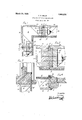
- Fig. 1 is a section showing a corner plate and two adjacent plates connected thereto,
- Fig. 3 is a part section through a window sill and a supporting plate.
- Fig.V 4 is a part section through a door frame and adjacent plate.
- the metal plates a are provided with flanges Z) presented inwardly and with marginal rims or ledges 0 of the same or substantially the same thickness as the plates and forming an extension thereof beyond the flanges b.
- the flanges b Fig. 2 shows to a larger scale a section v may besaid to be set back from the edges of' the plates.
- edges of the marginal rims e may be bevelledl as shown to more effectively retain or support the filling of cement f.
- the internal lining of the house whether of wood lathes and plaster, composition board or other material is nailed or otherwise secured to the inside face of the wooden jointing strips 0l and the latter may project beyond the inner edges of the flanges b.
- Fig. 3 shows how the marginal rim c is employed as a tongue for fitting a window sill i in a weather tight manner
- VFig; 4 shows how a door frame j is fitted within the rim c and secured by a coach screw m to the flange
- the door mouldings 7a and Z are fitted in an appropriate Amongst other advantages of the construction shown is that the shell of a house may be built in a very short time of unmachined cast iron plates, and the number of different types of plates required may be reduced to a minimum,as few as three types only being required in most cases.
- the cement filling f betweenthe joints is readily inserted and by filling the same into the f is inserted into the dovetailed or undercut recesses or grooves d of the wooden strips d the said cement filling is securely anchored in place to better maintain a weathertght joint.
- V The erection of the building may be carried out without the aid of external scaffolding if desired.
- Adequate means are provided for securing and making weather tight joints forthe windows, doors and other fittings and also for securing the internal lining or otherinternal fittings.
Landscapes
- Engineering & Computer Science (AREA)
- Architecture (AREA)
- Physics & Mathematics (AREA)
- Electromagnetism (AREA)
- Civil Engineering (AREA)
- Structural Engineering (AREA)
- Securing Of Glass Panes Or The Like (AREA)
Description
Marh2o,192s. 1,663,276
'F.v. MILES WALL FOR BUILDING CONSTRUCTION Filed April 25. 1927 Patented Mar. Z0, 19'28.
UNITED STATES THOMAS VIVIAN MILES, OFdNEAR SI-IEFFIELD,`ENGLAND, ASSIGNOR OF g l 1,663,216 PATENT OFFICE.
ONE-Hann 'ro NEWTON CHAMBERS & COMPANY LIMITED, `O11" NEAR SHEFFIELD, ENGLAND, A
BRITISH COMPANY.
WALL FOR BUILDING CONSTRUCTION.
Application filed April23, 1927.` Serial No. 186,039@
This inventionfrelates to walls for build ing construction. l
rlhe improved construction is on the well known lines adapted for building cast iron t tanks, which construction consists essentially of standardized cast iron flanged plates of uniform design with a minimum number of special plates.
In adapting sucha construction for buildio ing walls for houses the cast iron plates havebeen assembled with strips of wood r other non-metallic material inserted between the fianges of the plates for the purpose of avoiding machining and permitting the 15 plates to be used as received from `the foundry as far as the machining of the iianges is concerned. f
The external joint between the flanged plates or between marginal rims projecting at right angles lto the flanges was filled with cement.
It is the object of the present invention to provide an improved construction and combination of parts whereby the strips of wood or non-metallic material inserted between vthe fianges of the plates and the cement filled in between the adjacent rims or ledges of the plates'may be effectively united to prevent the cement filling frombeing dislodged and thereby more effectively seal the joint between the plates against the weather.
With these and other objects in view my invention consists in the construction, arrangement and combination of the various parts as hereinafter more fully set forth, pointed out in the claims and illustrated in the` accompanying drawings, wherein, n
Fig. 1 is a section showing a corner plate and two adjacent plates connected thereto,
across a joint between the adjacent plates.
Fig. 3 is a part section through a window sill and a supporting plate.
Fig.V 4: is a part section through a door frame and adjacent plate.
Similar lettersrefer to similar parts in f all the figures. f
In the construction of wall shown in Figs. 1 and 2, the metal plates a are provided with flanges Z) presented inwardly and with marginal rims or ledges 0 of the same or substantially the same thickness as the plates and forming an extension thereof beyond the flanges b. In other words the flanges b Fig. 2 shows to a larger scale a section v may besaid to be set back from the edges of' the plates.
` In constructing the wall of' a building,
of the metal plates a and extends into and lls the dovetailed recess or groove d yin the wooden strips d, the said cementrfilling being thus more effectively held iny place and an effective weather-tight joint secured.y
The edges of the marginal rims e may be bevelledl as shown to more effectively retain or support the filling of cement f.
The internal lining of the house whether of wood lathes and plaster, composition board or other material is nailed or otherwise secured to the inside face of the wooden jointing strips 0l and the latter may project beyond the inner edges of the flanges b.
By this construction there is provided between the plates e and the lining g an intervening air space It which forms an efficient non-conductor. If desired the space Itrlriay be filled in with any suitable materia Fig. 1 shows how a corner plate is employed, the arrangement being otherwise as in Fig. 2. j
Fig. 3 shows how the marginal rim c is employed as a tongue for fitting a window sill i in a weather tight manner, and,
VFig; 4 shows how a door frame j is fitted within the rim c and secured by a coach screw m to the flange The door mouldings 7a and Z are fitted in an appropriate Amongst other advantages of the construction shown is that the shell of a house may be built in a very short time of unmachined cast iron plates, and the number of different types of plates required may be reduced to a minimum,as few as three types only being required in most cases. The cement filling f betweenthe joints is readily inserted and by filling the same into the f is inserted into the dovetailed or undercut recesses or grooves d of the wooden strips d the said cement filling is securely anchored in place to better maintain a weathertght joint.
. VThe erection of the buildingmay be carried out without the aid of external scaffolding if desired.
Adequate means are provided for securing and making weather tight joints forthe windows, doors and other fittings and also for securing the internal lining or otherinternal fittings. l
What I claim as my invention and desire to secure by Letters Patent is l. `The improved construction of walls for buildings comprising the combination of metal plates provided with flanges presented inwardly and with marginal rims projecting at right angles t0 the said flanges, strips of wood inserted between the adjacent flanges of the assembled plates, the said strips of wood having their ends adjacent tothe said marginal rims formed with dovetailedy recesses, and a cement filling inserted between the adjacent marginal rims of the assembled `metal -plates and extending therefroml into and filling the recesses in the wooden strips.
2.' The improved construction of walls for recaer@ buildings comprising the combination of metal plates provided with flanges presented inwardly and with marginal rims projecting at right angles to the said flanges, strips of non-metallic material inserted between the adjacent flanges of the'assembled plates, the said strips of non-metallic material having their edges adjacent to the said marginal rims formed with dovetailed recesses, a cement filling inserted between the adjacent marginal rims of' the assembled metal plates and extending therefrom into and lilling the recesses in the non-metallic strips of material.
3. The improved construction of walls for buildings comprising the combination of metal plates provided with flanges presented inwardly and with marginal rims projecting at right angles to the said flanges, strips of' wood inserted between the adjacent flanges of' the assembled plates, the said strips of wood having their ends adjacent to the said marginal rims formed with undercut recesses, anda cement filling inserted between the adjacent marginal rims of the assembled metal plates and extending therefrom into and filling therecesses in the wooden strips.
THOMAS VIVIAN MILES..
Priority Applications (1)
| Application Number | Priority Date | Filing Date | Title |
|---|---|---|---|
| US186039D US1663276A (en) | 1927-04-23 | 1927-04-23 | Wall for building construction |
Applications Claiming Priority (1)
| Application Number | Priority Date | Filing Date | Title |
|---|---|---|---|
| US186039D US1663276A (en) | 1927-04-23 | 1927-04-23 | Wall for building construction |
Publications (1)
| Publication Number | Publication Date |
|---|---|
| US1663276A true US1663276A (en) | 1928-03-20 |
Family
ID=31990251
Family Applications (1)
| Application Number | Title | Priority Date | Filing Date |
|---|---|---|---|
| US186039D Expired - Lifetime US1663276A (en) | 1927-04-23 | 1927-04-23 | Wall for building construction |
Country Status (1)
| Country | Link |
|---|---|
| US (1) | US1663276A (en) |
-
1927
- 1927-04-23 US US186039D patent/US1663276A/en not_active Expired - Lifetime
Similar Documents
| Publication | Publication Date | Title |
|---|---|---|
| US1946690A (en) | Tiled construction | |
| US3004634A (en) | Window structures | |
| US965595A (en) | Wall-furring. | |
| US1836964A (en) | Tiled wall or the like | |
| US3099900A (en) | Method of installing an areaway wall | |
| US2026886A (en) | Building unit | |
| US2652907A (en) | Knockdown reversible hollow metal doorframe | |
| US3040390A (en) | Prefabricated door and window constructions | |
| US2331752A (en) | Prefabricated building construction | |
| US2270846A (en) | Building construction | |
| US3076293A (en) | Method of dry construction and set of elements for carrying out the same | |
| US2732045A (en) | Flashing surrounds | |
| US2308789A (en) | Building structure | |
| US1085605A (en) | Sheet-metal trim. | |
| US2781559A (en) | Prefabricated frames | |
| US1337745A (en) | Portable building | |
| US3465485A (en) | Window frame assembly | |
| US2305413A (en) | Construction of window and door frames | |
| US2472981A (en) | Wall panel jctfnt construction | |
| US1524145A (en) | Adjustable frame for ventilators and the like | |
| US1575705A (en) | Interior partition | |
| US1187544A (en) | Door-casing. | |
| US1716023A (en) | Metal buck and trim | |
| US1954891A (en) | Building construction | |
| US1005249A (en) | Fireproof window construction. |