US166316A - Improvement in building mechanisms for spinning-frames - Google Patents
Improvement in building mechanisms for spinning-frames Download PDFInfo
- Publication number
- US166316A US166316A US166316DA US166316A US 166316 A US166316 A US 166316A US 166316D A US166316D A US 166316DA US 166316 A US166316 A US 166316A
- Authority
- US
- United States
- Prior art keywords
- spinning
- ring
- rail
- frames
- improvement
- Prior art date
- Legal status (The legal status is an assumption and is not a legal conclusion. Google has not performed a legal analysis and makes no representation as to the accuracy of the status listed.)
- Expired - Lifetime
Links
- 230000007246 mechanism Effects 0.000 title description 10
- 239000004575 stone Substances 0.000 description 3
- 238000010276 construction Methods 0.000 description 1
- 230000004048 modification Effects 0.000 description 1
- 238000012986 modification Methods 0.000 description 1
- 238000007378 ring spinning Methods 0.000 description 1
- 238000004804 winding Methods 0.000 description 1
Images

Classifications
-
- D—TEXTILES; PAPER
- D01—NATURAL OR MAN-MADE THREADS OR FIBRES; SPINNING
- D01H—SPINNING OR TWISTING
- D01H1/00—Spinning or twisting machines in which the product is wound-up continuously
- D01H1/14—Details
- D01H1/36—Package-shaping arrangements, e.g. building motions, e.g. control for the traversing stroke of ring rails; Stopping ring rails in a predetermined position
Definitions
- the improvement is shown and described as applied to what is known as the ring and traveler machine, and the bobbins are made without heads, like quills, or with the ends of the same slightly enlarged, and the yarn is wound upon them with each successive layer slightly shorter than the last, so that when the requisite amount of yarn has been deposited upon the bobbins the yarn will present at each end of the bobbin a conical form or, instead Vof this, the order ot' windin on the yarn may be reversed, if preferred. ⁇
- My invention therefore, consists in the combination with the heart-cam mechanism and the ring-rail mechanism, a radial arm, which receivesa constant oscillating movement from the heart-cam, by suitable devices to be described, and by means of a block which is moved radially upon said radial arm automatical1y and is connected with the ring-rail mechanism, a variable extent of movement is given to the ring-rail corresponding to the radial position of the block upon the arm, the
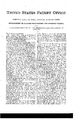
- Figure l is a longitudinal sectional elevation of some of the principal parts of a ring spinning-machine, looking outward.
- Fig. 2 is a transversel sectional elevation of the same on the line xm of' Fig:ll.
- Fig. 3 is ⁇ a transverse sectional elevation of the same on the line z z, and
- Fig 4 is a separate vview of the radial-arm and sliding-rack that operates it, as seen from the side opposite to Fig. l.
- a A is the frame of the machine; B B, the spindle-rails 5 G, the ring-rail 5 C O', the guides which carry the ring-rail; and D' D, &c., Ythe spindles, all constructed in the usual way for ring-spinning.
- E E are rocking shafts, carrying horizontal arms E E,upon the outer ends of which arms the rail-guides C O are supported.
- To each of the shafts E is also attached an upright armF, at a right angle to the arm E', and the upper ends of the said arms F are connected by a rod, G, which is jointed to both.
- the heart-cam H by which the requisite alternating movement is given to the ring-rail C through the mechanism to be described.
- the heart-cam H is rotated by the worm-gear I and worm J upon the shaft J', which is driven in any convenient way from the machine.
- the heart-cam H imparts a vertical reciprocating motion to the sliding. rack K, which is guided by the frame of the machine, and is moved up and down by the cam in the usual way.
- L is' a radial arm, so called, which is made to oscillate upon an axis, L', in the position shown in the drawing, and 4has attached to' it a toothed sector, which engages with the teeth of the sliding rack K, and thereby receives a regular vibrating movement from the heartcamvin an obvious manner.
- the radial arm L is provided with a radial screw, M, which is mounted upon it in bearings, as shown, and works in the block N, which slides upon the arm, and is moved in and out, or held in position upon -the arm by the screw.
- the screw is turned by the lratchet O upon the lower end of the screw, and the pawl P, which is jointed to the lower end ot' the slide K, in the manner shown in Fig. 4, and by the joint movements of those two parts the pawl is made to take successively into the notches of the ratchet, and gradually turn the screw, and thereby change the radial distance of the block N from the center of the arm L, and, consequently, the extent of the motion imparted thereby.
- the block N is connected by a long jointed rod, Q, to the most distant of the rocker-arms F, to which this rod is also jointed at f, by which a reciprocating movement is given to this part of the mechanism which carries the ring-rail G, and the extent of this .movement is gradually varied by the change of position of the block N upon the arm L in an obvious manner.
- rlhe position of the joint-pin f on the armF may also be varied by means of several holes iu the arm F, as shown, to/suit the length ofthe bobbin.
- R is a crank attached to the ratchet O by which to turn the screw back by hand to restore the block N to the proper position to commence the bobbin.
Landscapes
- Engineering & Computer Science (AREA)
- Structural Engineering (AREA)
- Mechanical Engineering (AREA)
- Textile Engineering (AREA)
- Spinning Or Twisting Of Yarns (AREA)
Description
l. M. STONE; Building Mechanism for Spinning-Frames.
gli
Wzltvesses. In van wir UNITED STATES PATENT Gmane.
JOSEPH M. STONE, OF NORTH ANDOVER, MASSACHUSETTS.
IMPROVEMENT IN BUILDING MECI-IANISMS FOR SPINNING-FRAMES.
Specification forming part of Letters Patent No. 166,3 [6, dated August 3, 1875; application filed April 27, 1875. y
To all whom it may concern:
Be it known that I, JOSEPH M. STONE, of North Andover, in the county of Essex and State of Massachusetts, have invented certain Improvements in Spinning-Machines, of which the following is a specification My invention relates more especially to certain modifications in the construction of that part of a spinning-machine which guides the yarn as it is wound upon the bobbin, by which a conical form is given to the yarn at the ends when heads are not used upon the bobbins.
In this case the improvement is shown and described as applied to what is known as the ring and traveler machine, and the bobbins are made without heads, like quills, or with the ends of the same slightly enlarged, and the yarn is wound upon them with each successive layer slightly shorter than the last, so that when the requisite amount of yarn has been deposited upon the bobbins the yarn will present at each end of the bobbin a conical form or, instead Vof this, the order ot' windin on the yarn may be reversed, if preferred.`
For this reason it becomes necessary to interpose between the mechanism which carries the ring-rail up and down, and the heartmotion,77 as it is called, which imparts the reciprocating movement to the ring-rail, a mechanism for modifying the constant movement imparted by the heart-cam, so as to automatically' vary the extent of movement imparted to the ring-rail, in order to produce the result in winding the yarn upon the `bobbin that I, have before stated.
My invention, therefore, consists in the combination with the heart-cam mechanism and the ring-rail mechanism, a radial arm, which receivesa constant oscillating movement from the heart-cam, by suitable devices to be described, and by means of a block which is moved radially upon said radial arm automatical1y and is connected with the ring-rail mechanism, a variable extent of movement is given to the ring-rail corresponding to the radial position of the block upon the arm, the
'details of which mechanism will be hereafter more fully described.
In the drawings, Figure l is a longitudinal sectional elevation of some of the principal parts of a ring spinning-machine, looking outward. Fig. 2 is a transversel sectional elevation of the same on the line xm of' Fig:ll. Fig. 3 is `a transverse sectional elevation of the same on the line z z, and Fig 4 is a separate vview of the radial-arm and sliding-rack that operates it, as seen from the side opposite to Fig. l.
A A is the frame of the machine; B B, the spindle-rails 5 G, the ring-rail 5 C O', the guides which carry the ring-rail; and D' D, &c., Ythe spindles, all constructed in the usual way for ring-spinning. E E are rocking shafts, carrying horizontal arms E E,upon the outer ends of which arms the rail-guides C O are supported. To each of the shafts E is also attached an upright armF, at a right angle to the arm E', and the upper ends of the said arms F are connected by a rod, G, which is jointed to both. By this arrangement the rocking shafts E and the two ends ot' the ringrail G are made to move in coincidence. His the heart-cam, by which the requisite alternating movement is given to the ring-rail C through the mechanism to be described. The heart-cam H is rotated by the worm-gear I and worm J upon the shaft J', which is driven in any convenient way from the machine. The heart-cam H imparts a vertical reciprocating motion to the sliding. rack K, which is guided by the frame of the machine, and is moved up and down by the cam in the usual way. L is' a radial arm, so called, which is made to oscillate upon an axis, L', in the position shown in the drawing, and 4has attached to' it a toothed sector, which engages with the teeth of the sliding rack K, and thereby receives a regular vibrating movement from the heartcamvin an obvious manner. `The radial arm L is provided with a radial screw, M, which is mounted upon it in bearings, as shown, and works in the block N, which slides upon the arm, and is moved in and out, or held in position upon -the arm by the screw. The screw is turned by the lratchet O upon the lower end of the screw, and the pawl P, which is jointed to the lower end ot' the slide K, in the manner shown in Fig. 4, and by the joint movements of those two parts the pawl is made to take successively into the notches of the ratchet, and gradually turn the screw, and thereby change the radial distance of the block N from the center of the arm L, and, consequently, the extent of the motion imparted thereby. The block N is connected by a long jointed rod, Q, to the most distant of the rocker-arms F, to which this rod is also jointed at f, by which a reciprocating movement is given to this part of the mechanism which carries the ring-rail G, and the extent of this .movement is gradually varied by the change of position of the block N upon the arm L in an obvious manner. rlhe position of the joint-pin f on the armF may also be varied by means of several holes iu the arm F, as shown, to/suit the length ofthe bobbin. R is a crank attached to the ratchet O by which to turn the screw back by hand to restore the block N to the proper position to commence the bobbin.
The mode of operation of this machinery is believed to be sufficiently obvious without furthe-r explanation.
What I claim is- 1. The combination, substantially as shown and described, of the ring-rail and its cony JOSEPH M. STONE. Witnesses: f
ABIsHAI MILLER, WM. O. HIBBARD.
Publications (1)
| Publication Number | Publication Date |
|---|---|
| US166316A true US166316A (en) | 1875-08-03 |
Family
ID=2235725
Family Applications (1)
| Application Number | Title | Priority Date | Filing Date |
|---|---|---|---|
| US166316D Expired - Lifetime US166316A (en) | Improvement in building mechanisms for spinning-frames |
Country Status (1)
| Country | Link |
|---|---|
| US (1) | US166316A (en) |
-
0
- US US166316D patent/US166316A/en not_active Expired - Lifetime
Similar Documents
| Publication | Publication Date | Title |
|---|---|---|
| US5455A (en) | Spinning-machine | |
| US808A (en) | Improvement in self-acting mules for spinning cotton and other fibrous materials | |
| US2364819A (en) | Builder mechanism | |
| US113445A (en) | Improvement in self-acting mules for spinning | |
| US706414A (en) | Ring spinning and twisting frame. | |
| US99203A (en) | Improvement in ring-spinning frames | |
| US6753A (en) | Machinery for spinning flax | |
| US401282A (en) | Spinning | |
| US125688A (en) | Improvement in machines for doubling and twisting yarns | |
| US557485A (en) | Island | |
| US1054236A (en) | Building-motion for spinning-machines. | |
| US1344449A (en) | Winding mechanism | |
| US123364A (en) | Improvement in self-acting mules for spinning | |
| US4638A (en) | Spinning- hemp | |
| US158530A (en) | Improvement in traverse mechanisms for ring spinning-frames | |
| US195470A (en) | Improvement in cop-building mechanisms for spinning-machines | |
| US59973A (en) | Bridge | |
| US905205A (en) | Ring spinning and twisting machine. | |
| US596106A (en) | Spinning-machine | |
| US217389A (en) | Improvement in ring-spinning frames | |
| US626094A (en) | Thuk tueton taylor | |
| US652203A (en) | Spinning-mule. | |
| US204436A (en) | Improvement in spinning-frames | |
| US123221A (en) | Improvement in splmfshng-maghines | |
| US185834A (en) | Improvement in cop-builders |