US12353030B2 - Optical coherent imager having shared input-output path and method for sensing coherent light - Google Patents
Optical coherent imager having shared input-output path and method for sensing coherent light Download PDFInfo
- Publication number
- US12353030B2 US12353030B2 US17/622,629 US202117622629A US12353030B2 US 12353030 B2 US12353030 B2 US 12353030B2 US 202117622629 A US202117622629 A US 202117622629A US 12353030 B2 US12353030 B2 US 12353030B2
- Authority
- US
- United States
- Prior art keywords
- polarization
- optical
- coupler
- coherent
- optical signal
- Prior art date
- Legal status (The legal status is an assumption and is not a legal conclusion. Google has not performed a legal analysis and makes no representation as to the accuracy of the status listed.)
- Active
Links
Images




Classifications
-
- G—PHYSICS
- G02—OPTICS
- G02B—OPTICAL ELEMENTS, SYSTEMS OR APPARATUS
- G02B6/00—Light guides; Structural details of arrangements comprising light guides and other optical elements, e.g. couplings
- G02B6/24—Coupling light guides
- G02B6/42—Coupling light guides with opto-electronic elements
- G02B6/4201—Packages, e.g. shape, construction, internal or external details
- G02B6/4204—Packages, e.g. shape, construction, internal or external details the coupling comprising intermediate optical elements, e.g. lenses, holograms
- G02B6/4213—Packages, e.g. shape, construction, internal or external details the coupling comprising intermediate optical elements, e.g. lenses, holograms the intermediate optical elements being polarisation selective optical elements
-
- A—HUMAN NECESSITIES
- A61—MEDICAL OR VETERINARY SCIENCE; HYGIENE
- A61B—DIAGNOSIS; SURGERY; IDENTIFICATION
- A61B5/00—Measuring for diagnostic purposes; Identification of persons
- A61B5/0059—Measuring for diagnostic purposes; Identification of persons using light, e.g. diagnosis by transillumination, diascopy, fluorescence
- A61B5/0062—Arrangements for scanning
- A61B5/0066—Optical coherence imaging
-
- G—PHYSICS
- G01—MEASURING; TESTING
- G01S—RADIO DIRECTION-FINDING; RADIO NAVIGATION; DETERMINING DISTANCE OR VELOCITY BY USE OF RADIO WAVES; LOCATING OR PRESENCE-DETECTING BY USE OF THE REFLECTION OR RERADIATION OF RADIO WAVES; ANALOGOUS ARRANGEMENTS USING OTHER WAVES
- G01S17/00—Systems using the reflection or reradiation of electromagnetic waves other than radio waves, e.g. lidar systems
- G01S17/02—Systems using the reflection of electromagnetic waves other than radio waves
- G01S17/06—Systems determining position data of a target
- G01S17/08—Systems determining position data of a target for measuring distance only
- G01S17/32—Systems determining position data of a target for measuring distance only using transmission of continuous waves, whether amplitude-, frequency-, or phase-modulated, or unmodulated
- G01S17/34—Systems determining position data of a target for measuring distance only using transmission of continuous waves, whether amplitude-, frequency-, or phase-modulated, or unmodulated using transmission of continuous, frequency-modulated waves while heterodyning the received signal, or a signal derived therefrom, with a locally-generated signal related to the contemporaneously transmitted signal
-
- G—PHYSICS
- G01—MEASURING; TESTING
- G01S—RADIO DIRECTION-FINDING; RADIO NAVIGATION; DETERMINING DISTANCE OR VELOCITY BY USE OF RADIO WAVES; LOCATING OR PRESENCE-DETECTING BY USE OF THE REFLECTION OR RERADIATION OF RADIO WAVES; ANALOGOUS ARRANGEMENTS USING OTHER WAVES
- G01S7/00—Details of systems according to groups G01S13/00, G01S15/00, G01S17/00
- G01S7/48—Details of systems according to groups G01S13/00, G01S15/00, G01S17/00 of systems according to group G01S17/00
- G01S7/499—Details of systems according to groups G01S13/00, G01S15/00, G01S17/00 of systems according to group G01S17/00 using polarisation effects
-
- G—PHYSICS
- G02—OPTICS
- G02B—OPTICAL ELEMENTS, SYSTEMS OR APPARATUS
- G02B27/00—Optical systems or apparatus not provided for by any of the groups G02B1/00 - G02B26/00, G02B30/00
- G02B27/28—Optical systems or apparatus not provided for by any of the groups G02B1/00 - G02B26/00, G02B30/00 for polarising
- G02B27/283—Optical systems or apparatus not provided for by any of the groups G02B1/00 - G02B26/00, G02B30/00 for polarising used for beam splitting or combining
-
- G—PHYSICS
- G02—OPTICS
- G02B—OPTICAL ELEMENTS, SYSTEMS OR APPARATUS
- G02B5/00—Optical elements other than lenses
- G02B5/30—Polarising elements
- G02B5/3083—Birefringent or phase retarding elements
-
- G—PHYSICS
- G02—OPTICS
- G02B—OPTICAL ELEMENTS, SYSTEMS OR APPARATUS
- G02B6/00—Light guides; Structural details of arrangements comprising light guides and other optical elements, e.g. couplings
- G02B6/24—Coupling light guides
- G02B6/26—Optical coupling means
- G02B6/27—Optical coupling means with polarisation selective and adjusting means
- G02B6/2706—Optical coupling means with polarisation selective and adjusting means as bulk elements, i.e. free space arrangements external to a light guide, e.g. polarising beam splitters
-
- G—PHYSICS
- G02—OPTICS
- G02B—OPTICAL ELEMENTS, SYSTEMS OR APPARATUS
- G02B6/00—Light guides; Structural details of arrangements comprising light guides and other optical elements, e.g. couplings
- G02B6/24—Coupling light guides
- G02B6/26—Optical coupling means
- G02B6/27—Optical coupling means with polarisation selective and adjusting means
- G02B6/2726—Optical coupling means with polarisation selective and adjusting means in or on light guides, e.g. polarisation means assembled in a light guide
- G02B6/274—Optical coupling means with polarisation selective and adjusting means in or on light guides, e.g. polarisation means assembled in a light guide based on light guide birefringence, e.g. due to coupling between light guides
-
- A—HUMAN NECESSITIES
- A61—MEDICAL OR VETERINARY SCIENCE; HYGIENE
- A61B—DIAGNOSIS; SURGERY; IDENTIFICATION
- A61B2562/00—Details of sensors; Constructional details of sensor housings or probes; Accessories for sensors
- A61B2562/04—Arrangements of multiple sensors of the same type
- A61B2562/046—Arrangements of multiple sensors of the same type in a matrix array
-
- G—PHYSICS
- G02—OPTICS
- G02B—OPTICAL ELEMENTS, SYSTEMS OR APPARATUS
- G02B6/00—Light guides; Structural details of arrangements comprising light guides and other optical elements, e.g. couplings
- G02B6/24—Coupling light guides
- G02B6/26—Optical coupling means
- G02B6/27—Optical coupling means with polarisation selective and adjusting means
- G02B6/2753—Optical coupling means with polarisation selective and adjusting means characterised by their function or use, i.e. of the complete device
- G02B6/2773—Polarisation splitting or combining
-
- G—PHYSICS
- G02—OPTICS
- G02B—OPTICAL ELEMENTS, SYSTEMS OR APPARATUS
- G02B6/00—Light guides; Structural details of arrangements comprising light guides and other optical elements, e.g. couplings
- G02B6/24—Coupling light guides
- G02B6/26—Optical coupling means
- G02B6/34—Optical coupling means utilising prism or grating
Definitions
- the present disclosure relates to an optical coherent imager having a shared input-output path and a method for sensing coherent light. More particularly, the present disclosure relates to a photonic integrated circuit having shared input-output path based on polarization diversity and a method for sensing coherent light.
- An optical coherent imager is an active imaging system that comprises an array of optical detectors (herein referred to as a “sensor”) and a light source (usually a coherent light source such as a laser).
- the light source serves the purposes of target illumination as well as providing a local oscillator (LO) for optical coherent detection (also called optical heterodyne detection).
- LO local oscillator
- optical coherent detection also called optical heterodyne detection
- Such an optical coherent imager may be used in applications including 3D frequency-modulated continuous-wave (FMCW) LIDAR and optical coherence tomography (OCT).
- FMCW frequency-modulated continuous-wave
- OCT optical coherence tomography
- the optical coherent imager operates by coherently combining the LO with the target signal in free-space using bulk optics before performing detection by the sensor of the imager.
- an optical coherent imager with a detection sensor based on the photonic integrated circuit (PIC) technology permits the mixing of the LO and the target signal on a photonic chip (also called a PIC chip in this disclosure).
- the PIC-based sensor comprises an array of coherent sensing units that plays the role of the active detection pixels of a conventional detection array such as a CCD or CMOS image sensor.
- the coherent sensing units of the PIC-based sensor couple the target signals from free space through free-space-to-waveguide couplers into a plurality of waveguides on the PIC chip.
- the target signals manifested as waveguide modes in the waveguides may then be manipulated and processed using the various photonic components that are implemented on the PIC chip, including the coherent mixing with the LO using 2 ⁇ 2 optical couplers and the detection by photodetectors.
- the LO may manifest as a waveguide mode by introducing the LO light into the PIC chip through couplers.
- the target scene is scanned by an illuminating laser beam by steering the laser beam using some scanning mechanism.
- a finite FOV of the imager sensor receives target signals.
- This finite FOV depends on the spot size of the illuminating laser beam and the imaging optics of the imager. Due to a smaller FOV used in the finite-field illumination approach, the laser power is concentrated in a smaller region, resulting in more photons received by the imager sensor at the corresponding FOV. Consequently, the finite-field illumination approach usually allows the active imager to operate in longer distances than the full-field illumination approach given the same illuminating laser power.
- the beam scanning mechanism may be implemented on the same PIC chip of the sensor to lower the manufacturing cost of the imager.
- Common beam scanning mechanisms implementable on a PIC chip include an optical phased array (OPA).
- OPA optical phased array
- the photonic components for the beam scanning mechanism (herein referred to as a “transmitter”) nevertheless are usually implemented in a region of the PIC chip that is separate from the detection region comprising the free-space-to-waveguide couplers (herein referred to as a “receiver”) of the PIC-based sensor. Due to such separation, separate optical systems may be needed for the transmitter and receiver, in order to respectively direct the illuminating light beam to the target and to maximize the coupling of the target signal to the receiver.
- an optical coherent imager utilizing finite-field illumination
- the transmitter and receiver share the same optical system for, respectively, illuminating the target and receiving target signals.
- the optical paths of the outgoing probe beam and the incoming target signals are the same.
- Advantages of such an input-output-path-sharing imager include a simplified optical system and simplified calibrations between the transmitter and receiver. The simplified optical system may lead to a more efficient use of laser power by enabling the imager to supply the LO light more specifically only to those coherent sensing units that receive signals from the target during the beam scanning process.
- the present disclosure provides an optical coherent imager implemented on a photonic integrated circuit (PIC) that enables shared path for transmitting and receiving optical signals by exploiting polarization diversity.
- PIC photonic integrated circuit
- the present disclosure also provides an optical coherent imager including an array of the optical coherent sensing units to simplify the design and calibrations of the imager, and a method for coherent sensing by the optical coherent imager.
- the second sub-coupler is disposed on and vertically separated from the first sub-coupler.
- At least one of the polarization convertors is a Faraday rotator.
- the present disclosure provides an optical coherent imager comprising an optical coherent sensor described above and an imaging optics system including a plurality of lenses, wherein the imaging optics system is disposed such that the optical coherent sensor is located proximate an image plane of the imaging optics system.
- the present disclosure provides a method for optical coherent imaging, comprising: emitting, from an optical coherent imager, one or more outgoing optical signals to one or more targets respectively along one or more optical paths corresponding respectively to one or more field-of-view positions of the optical coherent imager; receiving, by the optical coherent imager along the optical paths, one or more incoming optical signals reflected from the targets illuminated by the outgoing optical signals; converting, by a polarization transformer of the optical coherent imager, each of the incoming optical signals into a first optical component having a first polarization state and a second optical component having a second polarization state, wherein the first polarization state is orthogonal to the second polarization state; and guiding, by one or more polarization diversified optical couplers on an optical coherent sensor of the optical coherent imager, the first and second optical components of the incoming optical signals to one or more photodetectors of the optical coherent sensor so as to perform heterodyne detection with local oscillator light at each of the field-of-view
- emitting the outgoing optical signals comprises: generating one or more source optical signals from a light source; converting the source optical signals into the outgoing optical signals, wherein each outgoing optical signal has a first emission polarization state, by the polarization diversified optical couplers; and emitting the outgoing optical signals from the polarization diversified optical couplers.
- the method further comprises transforming each of the outgoing optical signals from the first emission polarization state to a second emission polarization state by the polarization transformer of the optical coherent imager.
- converting the incoming optical signals comprises rotating the first polarization state of each of the incoming optical signals by a first predefined polarization angle and the second polarization state of each of the incoming optical signals by a second predefined polarization angle.
- FIG. 1 A shows a plan view of a coherent sensing unit for transmitting and receiving optical signals based on polarization diversity, in accordance with an embodiment of the present disclosure.
- FIG. 2 shows a perspective view of a polarization-diversified free-space-to-waveguide coupler, in accordance with another embodiment of the present disclosure.
- FIG. 4 A shows a side view of a polarization-separation configuration for in-coupling optical signals, in accordance with an embodiment of the present disclosure.
- FIG. 5 A shows a perspective view of a polarization transformation configuration realized by the Faraday effect, in accordance with an embodiment of the present disclosure.
- FIG. 6 B shows a top view of the polarization states of optical signals in FIG. 6 A .
- FIG. 6 C shows a side view of a polarization transformation-separation configuration incorporating the polarization transformation configuration in FIG. 6 A and the polarization-separation configuration in FIG. 4 C , in accordance with another embodiment of the present disclosure.
- FIG. 7 A shows a plan view of a coherent sensing unit for transmitting and receiving optical signals based on polarization diversity, in accordance with another embodiment of the present disclosure.
- FIG. 7 B shows a plan view of a coherent sensing unit for transmitting and receiving optical signals based on polarization diversity, in accordance with yet another embodiment of the present disclosure.
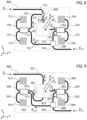
- FIG. 8 shows a plan view of a coherent sensing unit for transmitting and receiving optical signals based on polarization diversity, in accordance with a further embodiment of the present disclosure.
- FIG. 10 A shows a top view of a three-waveguide polarization-diversified free-space-to-wave guide coupler, in accordance with an embodiment of the present disclosure.
- FIG. 10 B shows a perspective view of the coupler illustrated in FIG. 10 A .
- FIG. 10 C shows a side view of a polarization transformation-separation configuration for use with a three-wave guide polarization-diversified free-sp ace-to-wave guide coupler for out-coupling optical signals, in accordance with an embodiment of the present disclosure.
- FIG. 10 D shows a side view of the configuration illustrated in FIG. 10 C used for in-coupling optical signals.
- FIG. 10 E shows a top view of the polarization states of the optical signals in FIG. 10 C .
- FIG. 10 F shows a top view of the polarization states of the optical signals in FIG. 10 D .
- FIG. 11 A shows a perspective view of a three-waveguide polarization-diversified free-space-to-waveguide coupler, in accordance with another embodiment of the present disclosure.
- FIG. 11 B show a side view of a polarization transformation-separation configuration for use with a three-wave guide polarization-diversified free-space-to-waveguide coupler for out-coupling optical signals, in accordance with another embodiment of the present disclosure.
- FIG. 11 D shows a top view of the polarization states of the optical signals in FIG. 11 B .
- FIG. 11 E shows a top view of the polarization states of the optical signals in FIG. 11 C .
- FIG. 12 A show a side view of a polarization transformation-separation configuration for use with a three-wave guide polarization-diversified free-space-to-waveguide coupler for out-coupling optical signals, in accordance with a further embodiment of the present disclosure.
- FIG. 12 B show a side view of the configuration illustrated in FIG. 12 A used for in-coupling optical signals.
- FIG. 12 C shows a top view of the polarization states of the optical signals in FIG. 12 A .
- FIG. 12 D shows a top view of the polarization states of the optical signals in FIG. 12 B .
- FIG. 13 A shows a top view of a three-waveguide polarization-diversified free-space-to-waveguide coupler, in accordance with a further embodiment of the present disclosure.
- FIG. 13 B shows a perspective view of the coupler illustrated in FIG. 13 A .
- FIG. 13 C shows a side view of a polarization transformation-separation configuration for use with a three-wave guide polarization-diversified free-space-to-waveguide coupler for out-coupling optical signals, in accordance with a yet further embodiment of the present disclosure.
- FIG. 13 D shows another side view of the configuration illustrated in FIG. 13 C .
- FIG. 13 E shows a side view of the configuration as illustrated in FIG. 13 C used for in-coupling optical signals.
- FIG. 13 F shows another side view of the configuration illustrated in FIG. 13 E .
- FIG. 13 G shows a top view of the polarization states and path locations on the x-y plane of the optical signals in FIGS. 13 C and 13 D .
- FIG. 13 H shows a top view of the polarization states and path locations on the x-y plane of the optical signals in FIGS. 13 E and 13 F .
- FIG. 14 shows a plan view of a coherent sensing unit for transmitting and receiving optical signals based on polarization diversity, wherein the polarization of the transmitted optical signal is adjustable, in accordance with an embodiment of the present disclosure.
- FIG. 15 A shows a top view of a four-waveguide polarization-diversified free-space-to-waveguide coupler, in accordance with an embodiment of the present disclosure.
- FIG. 15 B shows a perspective view of the coupler illustrated in FIG. 15 A .
- FIG. 15 C shows a side view of a polarization transformation-separation configuration for use with a four-waveguide polarization-diversified free-sp ace-to-waveguide coupler for out-coupling optical signals, in accordance with an embodiment of the present disclosure.
- FIG. 15 D shows another side view of the configuration illustrated in FIG. 15 C .
- FIG. 15 E shows a top view of the polarization states and path locations on the x-y plane of the optical signals in FIGS. 15 C and 15 D .
- FIG. 15 F shows a side view of the configuration as illustrated in FIG. 15 C used for in-coupling optical signals.
- FIG. 15 G shows another side view of the configuration illustrated in FIG. 15 F .
- FIG. 15 H shows a top view of the polarization states and path locations on the x-y plane of the optical signals in FIGS. 15 F and 15 G .
- FIG. 16 A shows a top view of a four-waveguide polarization-diversified free-space-to-waveguide coupler, in accordance with another embodiment of the present disclosure.
- FIG. 16 B shows a perspective view of the coupler illustrated in FIG. 16 A .
- FIG. 16 E shows a top view of the polarization states of the optical signals in FIG. 16 C .
- FIG. 16 F shows a top view of the polarization states of the optical signals in FIG. 16 D .
- FIG. 17 A shows a perspective view of a four-waveguide polarization-diversified free-space-to-waveguide coupler, in accordance with a further embodiment of the present disclosure.
- FIG. 17 B show a side view of a polarization transformation-separation configuration for use with a four-waveguide polarization-diversified free-sp ace-to-waveguide coupler for out-coupling optical signals, in accordance with a further embodiment of the present disclosure.
- FIG. 17 C show a side view of the configuration illustrated in FIG. 17 B used for in-coupling optical signals.
- FIG. 17 D shows a top view of the polarization states of the optical signals in FIG. 17 B .
- FIG. 17 E shows a top view of the polarization states of the optical signals in FIG. 17 C .
- FIG. 18 A shows a plan view of a coherent optical sensor, in accordance with an embodiment of the present disclosure.
- FIG. 18 B shows a row of coherent sensing units of a coherent sensing array, in accordance with an embodiment of the present disclosure.
- FIG. 19 A shows a plan view of a coherent optical sensor, in accordance with another embodiment of the present disclosure.
- FIG. 19 B shows a plan view of a coherent sensing unit group, in accordance with an embodiment of the present disclosure.
- FIG. 20 B shows a plan view of a coherent sensing unit group, in accordance with another embodiment of the present disclosure.
- FIG. 20 C shows a plan view of a Mach-Zehnder interferometer-based optical switch in accordance with an embodiment of the present disclosure.
- FIG. 21 A shows a side view of an optical coherent imager, in accordance with an embodiment of the present disclosure.
- FIG. 22 A shows a side view of an optical coherent imager, in accordance with another embodiment of the present disclosure.
- FIG. 23 illustrates a flowchart of a method of optical coherent imaging using polarization diversification to enable shared path for transmitting and receiving optical signals, in accordance with an embodiment of the present disclosure.
- FIG. 1 A shows a plan view of a coherent sensing unit 100 for transmitting and receiving optical signals based on polarization diversity, in accordance with an embodiment of the present disclosure.
- a plurality of coherent sensing units 100 may be used to form a coherent sensor array of an optical coherent imager.
- FIG. 1 B shows a perspective view of a polarization-diversified free-space-to-waveguide coupler 101 of coherent sensing unit 100 , in accordance with an embodiment of the present disclosure.
- Coherent sensing unit 100 may be implemented using photonic integrated circuit (PIC) technology on a photonic substrate.
- the surface of the photonic substrate may be represented by a plane spanned by the x and y axes of the coordinate system illustrated in FIGS. 1 A and 1 B .
- PIC photonic integrated circuit
- Photonic components of coherent sensing unit 100 implemented on the photonic substrate may or may not be covered by a cladding. Such components also may or may not be embedded in a cladding.
- the photonic substrate and the cladding are not shown in FIGS. 1 A and 1 B , as well as in other figures of the present disclosure.
- a target that is to be detected by the optical coherent imager is taken to be located at a position along the positive z-direction away from the substrate surface and, if applicable, any optical components above the substrate surface. The target is not explicitly shown in the drawings for simplicity.
- the waveguides of coherent sensing unit 100 of the present disclosure may be fabricated with the dimension along the z direction smaller than the dimensions on the x-y plane and are made to support various waveguide modes, including but not limited to transverse electric (TE) modes, transverse magnetic (TM) modes, and TE and TM modes, according to the coordinate system in the embodiments illustrated in FIGS. 1 A and 1 B .
- TE transverse electric
- TM transverse magnetic
- a TE mode may refer to a waveguide mode that has a dominant electric field component transverse to the propagation direction of the mode and the surface of the photonic substrate on which the waveguide resides
- a TM mode may refer to a waveguide mode that has a dominant magnetic field component transverse to the propagation direction of the mode and the surface of the photonic substrate on which the waveguide resides.
- optical source signal E S may be supplied to coherent sensing unit 100 through waveguide 121
- a local oscillator (LO) E LO may be supplied to coherent sensing unit 100 through waveguide 123 .
- Optical source signal E S and LO E LO may or may not come from the same light source, where the light source may or may not be implemented on the same PIC chip comprising coherent sensing unit 100 .
- optical source signal E S may be made to manifest as the fundamental TE mode in waveguide 121 and the LO E LO may be made to manifest as the fundamental TE mode in waveguide 123 , by proper designs of system and method to couple the light source (or light sources) that gives rise to E S and E LO in the waveguides of the PIC chip comprising coherent sensing unit 100 . Such designs are well-known to those skilled in the art.
- the optical source signal E S may intentionally be made to manifest as a TM mode or a TE mode other than the fundamental TE mode in waveguide 121 .
- the LO E LO may intentionally be made to manifest as a TM mode or a TE mode other than the fundamental TE mode in waveguide 123 .
- polarization-diversified free-space-to-wave guide coupler 101 may function as both a transmitter and a receiver. It is a two-waveguide coupler that is connected to waveguides 121 and 122 , wherein a primary role of waveguide 121 is to direct signal light to coupler 101 and a primary role of waveguide 122 is to receive in-coupled light from coupler 101 , even though in-coupled light from coupler 101 may also be directed to waveguide 121 according to some embodiments.
- waveguide 121 may be regarded as an out-coupling waveguide and waveguide 122 may be regarded as an in-coupling waveguide.
- a distinguishing feature of polarization-diversified free-space-to-waveguide coupler 101 is that, when the polarization state of an incoming optical signal (E in in FIG. 1 A ) arriving at coupler 101 is orthogonal to the polarization state of the outgoing optical signal (E out in FIG. 1 A ) output from coupler 101 , the incoming optical signal may be in-coupled and directed to an in-coupling waveguide (waveguide 122 in FIG. 1 A ) that is distinct from the out-coupling waveguide (waveguide 121 in FIG. 1 A ).
- free space may refer to vacuum, air, a region above the surface of the coupler, or any homogenous medium with boundaries that have length-scales much larger (e.g., at least 10 times) than the wavelength of the optical signals propagating in it.
- coupler 101 may couple optical source signal E S from waveguide 121 into free space as an outgoing optical signal E out , which may be used for target illumination by the optical coherent imager.
- the outgoing optical signal E out output by coupler 101 propagates in a direction that is out of the x-y plane (i.e., the propagation direction of E out has a nonzero z component) and is polarized with a polarization determined by the design of coupler 101 .
- coupler 101 may couple an incoming optical signal E in into coherent sensing unit 100 .
- Incoming optical signal E in is essentially an optical signal from a target (or a target signal) described previously.
- the incoming optical signal E in coupled by coupler 101 may be directed to either or both waveguides 121 and 122 , depending on the polarization state of the incoming optical signal E in .
- the polarization components of the incoming optical signal E in that are coupled to waveguides 121 and 122 depend on the design of coupler 101 .
- a first polarization component of the incoming optical signal E in that is orthogonal to the polarization of the outgoing optical signal E out may be directed to waveguide 122 as an in-coupled optical signal E in(wg)1
- a second polarization component of the incoming optical signal E in that is orthogonal to the first polarization of the incoming optical signal E in may be directed to waveguide 121 as an in-coupled optical signal E in(wg)2 . More details about the two polarization components in-coupled to coupler 101 will be described below with reference to FIG. 1 B .
- the in-coupled optical signal E in(wg)1 may be processed by the rest of the circuits of coherent sensing unit 100 . In FIG.
- in-coupled optical signal E in(wg)2 propagates in a direction opposite to the propagation direction of optical source signal E S .
- in-coupled optical signal E in(wg)2 may be left unattended without affecting the other parts of the PIC chip comprising the sensing unit 100 .
- the in-coupled optical signal E in(wg)2 may be processed by some other parts of the PIC chip comprising the sensing unit 700 .
- coupler 101 may comprise a single photonic component or multiple photonic components.
- coupler 101 may be realized by a polarization-splitting free-space-to-waveguide coupler.
- a polarization-splitting free-sp ace-to-waveguide coupler include, but not limited to, a polarization-splitting grating coupler as described in “POLARIZATION SPLITTING GRATING COUPLERS,” U.S. Pat. No.
- coupler 101 may also comprise any of TE-TM mode converters, splitters, and combiners.
- coupler 101 may comprise a single layer of photonic material.
- coupler 101 may comprise multiple layers of photonic materials, wherein the photonic materials of the different layers may be the same or different.
- E out as shown in FIG. 1 B propagates in the z direction.
- outgoing optical signal E out may propagate in a direction not perpendicular to the substrate surface, that is, E out may propagate in a direction at a slanted angle with respect to the substrate surface.
- an incoming optical signal E in may comprise either one or both of two orthogonal polarization components: a first polarization component E LO,1 and a second polarization component E in2 . It is appreciated that when incoming optical signal E in comprises only first polarization component E in1 , the amplitude of second polarization component E in2 is zero, and vice versa. Coupler 101 may be designed in such a way that the first polarization component E LO,1 may be in-coupled and directed to waveguide 122 as in-coupled optical signal E in(wg)1 , wherein the first polarization component E LO,1 is orthogonal to the polarization of outgoing optical signal E out .
- coupler 101 may be designed in such a way that the second polarization component E in2 may be in-coupled and directed to waveguide 121 as in-coupled optical signal E in(wg)2 , which propagates in a direction opposite to the propagation direction of optical source signal E S .
- the first polarization component E LO,1 that is in-coupled and directed to waveguide 122 is orthogonal to the polarization of outgoing optical signal E out
- the second polarization component E in2 that is in-coupled and directed to waveguide 121 is orthogonal to the first polarization Emi.
- the second polarization E in2 may or may not be the same as (up to a proportionality factor) the polarization of the outgoing optical signal E out , as outgoing optical signal E out and incoming optical signal E in may propagate along the same or different directions.
- the specific polarization components of incoming optical signal E in that are coupled to waveguides 121 and 122 depend on the design of coupler 101 .
- coupler 101 may be designed to optimally in-couple optical signals according to a preferred polarization basis, which is referred to as the coupling polarization basis.
- the coupling polarization basis may be the same as the polarization of outgoing optical signal E out output by coupler 101 . As shown in FIG.
- the coupling polarization basis may be a linear polarization basis (e.g., x and y polarizations), and coupler 101 may in-couple a first linear polarization component E LO,1 (e.g., polarized along the y direction) of the incoming optical signal E in and direct it to waveguide 122 , wherein the first linear polarization component E LO,1 is orthogonal to the polarization of the linearly-polarized outgoing optical signal E out (e.g., x direction) and lies on a plane (e.g., y-z plane) parallel to a first component of the coupling polarization basis (i.e., y direction).
- a first linear polarization component E LO,1 e.g., polarized along the y direction
- the first linear polarization component E LO,1 is orthogonal to the polarization of the linearly-polarized outgoing optical signal E out (e.g., x direction) and lies on
- coupler 101 may in-couple a second linear polarization component E in2 (e.g., along a direction on the x-z plane in FIG. 1 B ) of the incoming optical signal E in and direct it to waveguide 121 , wherein the second linear polarization component E in2 lies on a plane (i.e., x-z plane) parallel to the polarization of the linearly-polarized outgoing optical signal E out (i.e., x direction) and a second component of the coupling polarization basis (i.e., x direction), and the second polarization E in2 is orthogonal to the first polarization E in1 .
- a plane i.e., x-z plane
- the second component of the coupling polarization basis i.e., x direction
- Coupler 101 may couple the incoming optical signal component E LO,1 from free space to give rise to the in-coupled optical signal E in(wg)1 in waveguide 122 .
- in-coupled optical signal E in(wg)1 may manifest as a TE mode in waveguide 122 .
- in-coupled optical signal E in(wg)1 propagates towards the positive x direction in FIG. 1 B with a dominant electric field component along the y direction.
- coupler 101 may couple incoming optical signal component E in2 from free space to give rise to in-coupled optical signal E in(wg)2 in waveguide 121 .
- in-coupled optical signal E in(wg)1 in waveguide 122 may manifest as a single waveguide mode.
- the single waveguide mode may be the fundamental TE mode.
- the single waveguide mode may be the fundamental TM mode.
- the single waveguide mode may be a mode other than the fundamental TE mode or the fundamental TM mode.
- the in-coupled optical signal E in(wg)1 in waveguide 122 may manifest as a combination of multiple waveguide modes.
- in-coupled optical signal E in(wg)2 in waveguide 121 may manifest as a single waveguide mode.
- the single waveguide mode may be the fundamental TE mode.
- the single waveguide mode may be the fundamental TM mode.
- the single waveguide mode may be a mode other than the fundamental TE mode or the fundamental TM mode.
- in-coupled optical signal E in(wg)2 in waveguide 121 may manifest as a combination of multiple waveguide modes.
- coupler 101 is intended to separate orthogonal polarization components of optical signals into two separate waveguides 121 and 122 , it is not uncommon that cross-couplings may occur in some embodiments of coupler 101 .
- the incoming optical signal E in may be linearly polarized along a direction that is orthogonal to the polarization of E out and lies on a plane parallel to the first component of the linear polarization basis (e.g., the incoming optical signal is E in1 )
- a nonzero fraction of E in may be directed to waveguide 121 in addition to the fraction of E in directed to waveguide 122 .
- incoming optical signal E in may be linearly polarized along a direction that lies on a plane parallel to the polarization of E out and the second component of the linear polarization basis (e.g., the incoming optical signal is E in2 )
- a nonzero fraction of E in may be directed to waveguide 122 in addition to the fraction of E in directed to waveguide 121 .
- a nonzero fraction of E S in waveguide 121 may propagate to waveguide 122 directly through coupler 101 in addition to the fraction of E S coupled to free space as the outgoing optical signal E out by coupler 101 .
- Such cross-couplings may be regarded as imperfections of the design of coupler 101 .
- coupler 101 may be designed to maximize the couplings of the respective polarization components with their intended waveguides while the cross-couplings may be minimized.
- photodetectors 103 and 104 may be connected to an output electronic circuit comprising electronic components such as, but not limited to, any one or more of transimpedance amplifiers (TIA), transistors, diodes, resistors, capacitors, and electrical switches, that are used to process the electrical outputs of photodetectors 103 and 104 .
- This output electronic circuit is not shown in FIG. 1 A .
- sub-coupler 201 may be designed to optimally couple incoming or outgoing optical signal E 1 that is linearly polarized along a certain direction (e.g., along the x direction), whereas sub-coupler 202 may be designed to optimally couple incoming or outgoing optical signal E 2 that is linearly polarized along a direction orthogonal to the polarization of E 1 (e.g., along the y direction).
- Sub-couplers 201 and 202 may or may not be aligned to the same x-y positions.
- sub-coupler 201 may be a free-space-to-waveguide coupler, such as but not limited to a grating coupler, that may optimally couple with optical signal E 1 polarized according to a polarization (e.g., linear polarization along the x direction) and minimally couple with optical signal E 2 polarized according to a polarization (e.g., linear polarization along the y direction) orthogonal to the polarization of E 1 .
- a polarization e.g., linear polarization along the x direction
- a polarization e.g., linear polarization along the y direction
- the pair of orthogonally polarized optical signals E 1 and E 2 that are optimally coupled with one and minimally coupled with the other of sub-couplers 201 and 202 may be any of a pair of orthogonal linear polarizations, right and left circular polarizations, and a pair of orthogonal elliptical polarizations.
- orthogonal optical signals E 1 and E 2 are drawn at different spatial locations on the surface of sub-couplers 201 and 202 for illustrative purpose.
- sub-coupler 201 may optimally couple with optical signal E 1 and minimally couple with E 2 at the same spatial location or at different spatial locations on the surface of sub-coupler 201 .
- sub-coupler 202 may optimally couple with optical signal E 2 and minimally couple with E 1 at the same spatial location or at different spatial locations on the surface of sub-coupler 202 .
- optical signals E 1 and E 2 are drawn to propagate along a direction perpendicular to the plane of the substrate surface, i.e., along the z direction.
- optical signals E 1 and E 2 may propagate along directions that may or may not be perpendicular to the plane of the substrate surface.
- optical signals E 1 and E 2 may propagate along different directions, though optical signals E 1 and E 2 are drawn to propagate along the same direction in FIG. 2 .
- sub-coupler 201 may comprise a single layer of photonic material. According to other embodiments, sub-coupler 201 may comprise multiple layers of photonic materials, wherein the photonic materials of the different layers may be the same or different. Similarly, according to some embodiments, sub-coupler 202 may comprise a single layer of photonic material. According to other embodiments, sub-coupler 202 may comprise multiple layers of photonic materials, wherein the photonic materials of the different layers may be the same or different.
- sub-coupler 301 may comprise a single layer of photonic material. According to other embodiments, sub-coupler 301 may comprise multiple layers of photonic materials, wherein the photonic materials of the different layers may be the same or different. Similarly, according to some embodiments, sub-coupler 302 may comprise a single layer of photonic material. According to other embodiments, sub-coupler 302 may comprise multiple layers of photonic materials, wherein the photonic materials of the different layers may be the same or different.
- FIG. 4 A shows a side view of a polarization-separation configuration for in-coupling optical signals, in accordance with an embodiment of the present disclosure.
- FIG. 4 B shows a side view of the polarization-separation configuration in FIG. 4 A for out-coupling optical signals.
- FIG. 4 C shows a side view of the polarization-separation configuration in FIG. 4 A for in-coupling and out-coupling optical signals.
- the polarization-separation configuration as shown in FIGS. 4 A, 4 B and 4 C , may be used with polarization-diversified free-space-to-waveguide coupler 300 in FIG.
- optical signal E 1 (coupled with sub-coupler 301 ) and optical signal E 2 (coupled with sub-coupler 302 ) to propagate along a common optical path in free space, wherein the common optical path lies between an optical component 401 and the target.
- the polarization-separation configuration comprises a polarization-dependent beam-separator 401 .
- polarization-dependent beam-separator 401 may be a birefringent beam displacer.
- a birefringent beam displacer may be made of one or more materials such as, but not limited to, calcite crystal, alpha barium borate crystal, yttrium vanadate crystal, or rutile crystal.
- a birefringent beam displacer is well-known in the art.
- polarization-dependent beam-separator 401 may be a polarization-dependent beam-separator other than a birefringent beam displacer, such as but not limited to a birefringent wedge, a polarization beam splitter, a polarization-dependent grating, or a polarization-dependent metalens.
- polarization-dependent beam-separator 401 may be a component that is separate from the PIC chip comprising polarization-diversified free-space-to-waveguide coupler 300 as illustrated in FIG. 4 A . According to other embodiments, polarization-dependent beam-separator 401 may be attached to the surface of the PIC chip comprising coupler 300 . According to further embodiments, polarization-dependent beam-separator 401 may be within or be part of the PIC chip comprising coupler 300 .
- an incoming optical signal E in may arrive at the polarization-dependent beam-separator 401 from a target.
- Polarization-dependent beam-separator 401 may split the incoming optical signal E in into two optical signals E 1 and E 2 , wherein the polarizations of optical signals E 1 and E 2 are orthogonal to each other.
- the splitting of the optical signal may depend on the polarization of the incoming optical signal.
- One of optical signals E 1 and E 2 is the ordinary ray (o-ray) and the other is the extraordinary ray (e-ray).
- optical signal E 1 may be the o-ray whereas optical signal E 2 may be the e-ray.
- o-ray and e-ray used herein may generally be referred to two orthogonally polarized light rays that are split by polarization-dependent beam-separator 401 , wherein the splitting is defined by the characteristics of the polarization-dependent beam-separator.
- the polarizations of optical signals E 1 and E 2 depend on the permittivities of the materials of polarization-dependent beam-separator 401 , the orientation of optic axis 498 and the incident angle of incoming optical signal E in .
- the incident angle of incoming optical signal E in is close to the normal of the surface of polarization-dependent beam-separator 401 .
- the o-ray and e-ray may be laterally displaced upon emergence from polarization-dependent beam-separator 401 .
- the lateral displacements may depend on any one or more of the factors including but not limited to the geometries (e.g., shape and thickness), permittivities of the materials, and orientation of optic axis 498 of polarization-dependent beam-separator 401 , and the wavelength and incident angle of incoming optical signal E in .
- sub-coupler 301 may be configured to optimally couple with o-ray E 1 based on its polarization and propagation direction, wherein the polarization and propagation direction of o-ray E 1 may be pre-determined.
- sub-coupler 302 may be configured to optimally couple with e-ray E 2 based on its polarization and propagation direction, wherein the polarization and propagation direction of e-ray E 2 may be pre-determined.
- the incident angle of incoming optical signal E in may be close to the normal of the surface of polarization-dependent beam-separator 401 and optic axis 498 may be oriented at an angle on the y-z plane.
- sub-coupler 301 may be configured to optimally couple with o-ray E 1 propagating along the z direction and polarized along the x direction
- sub-coupler 302 may be configured to optimally couple with e-ray E 2 propagating along the z direction and polarized along the y direction.
- Lateral separation 399 between sub-couplers 301 and 302 may be determined by incorporating the information of lateral separation 499 between o-ray E 1 and e-ray E 2 .
- sub-coupler 301 may not be configured to optimally couple with o-ray E 1 based on its polarization. That is, the optimal polarization for coupling with sub-coupler 301 may not be the same as the polarization of o-ray E 1 .
- sub-coupler 302 may not be configured to optimally couple with e-ray E 2 based on its polarization. That is, the optimal polarization for coupling with sub-coupler 302 may not be the same as the polarization of e-ray E 2 .
- sub-coupler 301 may not be configured to optimally couple with o-ray E 1 based on the propagation direction of o-ray E 1 .
- sub-coupler 302 may not be configured to optimally couple with e-ray E 2 based on the propagation direction of e-ray E 2 .
- sub-coupler 301 may be a polarization-independent coupler and may be configured to optimally couple with o-ray E 1 based only on the propagation direction of o-ray E 1 .
- sub-coupler 302 may be a polarization-independent coupler and may be configured to optimally couple with e-ray E 2 based only on the propagation direction of e-ray E 2 .
- optical signal E 1 outgoing from sub-coupler 301 may be polarized according to the polarization of the o-ray defined by polarization-dependent beam-separator 401 (e.g., linear polarization along the x direction as shown in FIG. 4 B ) and optical signal E 2 outgoing from sub-coupler 302 may be polarized according to the polarization of the e-ray defined by polarization-dependent beam-separator 401 (e.g., linear polarization along the y direction as shown in FIG. 4 B ). Propagation of optical signals through polarization-dependent beam-separator 401 is reversible.
- optical signals E 1 and E 2 may be combined to give rise to an outgoing optical signal E out that propagates along an optical path away from an upper surface of polarization-dependent beam-separator 401 (e.g., a path that continues the path of optical signal E 1 with null lateral displacement as illustrated in FIG. 4 B ), wherein optical signals E 1 and E 2 are coherent with respect to each other and the outgoing optical signal E out is polarized according to the polarizations, amplitudes, and relative phase of optical signals E 1 and E 2 .
- optical signals E 1 and E 2 emerging from and exiting polarization-dependent beam-separator 401 may not perfectly overlap spatially. This may give rise to spatially varying polarization of outgoing optical signal E out .
- polarization-dependent beam-separator 401 and sub-couplers 301 and 302 may be configured in such a way that the spatial overlap between optical signals E 1 and E 2 may give rise to an outgoing optical signal E out that has a dominant (i.e., greater than 50%) polarization state.
- Polarization-dependent beam-separator 401 may be used with coupler 300 to transmit and receive optical signals, wherein one of sub-couplers 301 and 302 may be used for transmitting an outgoing optical signal E out , while the other one of sub-couplers 301 and 302 may be used for receiving an incoming optical signal E in .
- Optical signals E out and E in may propagate along a common optical path that lies between optical component 401 and the target. As shown in FIG. 4 C , on one hand, optical signal E 1 outgoing from sub-coupler 301 may be polarized according to the polarization of the o-ray defined by polarization-dependent beam-separator 401 .
- optical signal E 1 may give rise to outgoing optical signal E out , wherein the polarizations of optical signals E 1 and E out are the same.
- outgoing optical signal E out may emerge from and exit polarization-dependent beam-separator 401 with a polarization that is the same as the polarization of optical signal E 1 (i.e., along the x direction) and propagate along an optical path away from polarization-dependent beam-separator 401 (e.g., a path that continues the path of optical signal E 1 without lateral displacement as illustrated in FIG. 4 C ).
- an incoming optical signal EH may be polarized according to the polarization of the e-ray defined by polarization-dependent beam-separator 401 and propagate along the same optical path as the outgoing optical signal E out , but in a reversed direction.
- incoming optical signal E in may give rise to optical signal E 2 that may be coupled with sub-coupler 302 , wherein the polarizations of optical signals E in and E 2 are the same. For example, as shown in FIG.
- an incoming optical signal E in linearly polarized along the y direction incident at a direction normal to an upper surface of polarization-dependent beam-separator 401 may give rise to optical signal E 2 that is linearly polarized along the y direction and couples with sub-coupler 302 , wherein optical signal E 2 is laterally displaced by polarization-dependent beam-separator 401 .
- the polarizations of outgoing optical signal E out and incoming optical signal E in are orthogonal to each other, and the polarizations of optical signals E 1 and E 2 are orthogonal to each other.
- incoming optical signal E in when the polarization of incoming optical signal E in is not orthogonal to the polarization of outgoing optical signal E out , incoming optical signal E in may be split into an o-ray and an e-ray, wherein the o-ray may couple with sub-coupler 301 and the e-ray may couple with sub-coupler 302 , as illustrated in the embodiment in FIG. 4 A .
- a coupling polarization basis may be formed by a pair of polarizations of optical signals which couple with sub-couplers 301 and 302 optimally.
- the coupling polarization basis may be the same as the polarizations of the o-ray and e-ray corresponding to polarization-dependent beam-separator 401 .
- the coupling polarization basis may be different from the polarizations of the o-ray and e-ray corresponding to polarization-dependent beam-separator 401 .
- the optical signal out-coupled by coupler 300 may give rise to two outgoing optical signals emerging from polarization-dependent beam-separator 401 , wherein the two outgoing optical signals are optical signals corresponding to the o-ray and the e-ray.
- optical signal E 1 emitted by sub-coupler 301 may give rise to an outgoing o-ray that is the same as the outgoing optical signal E out and an outgoing e-ray that propagates along an optical path different from that of outgoing optical signal E out (not shown).
- either one or both of sub-couplers 301 and 302 in FIG. 4 C may be a polarization-independent free-space-to-waveguide coupler.
- a polarization-independent free-space-to-waveguide coupler may be able to optimally couple an incoming optical signal Ern irrespective of the polarizations of the o-ray and the e-ray corresponding to polarization-dependent beam-separator 401 .
- the optical signal reflected by the target has a dominant polarization component that is the same as the optical signal that illuminates the target.
- Such circumstances include but not limited to specular reflection and light reflection off a shiny target surface.
- a polarization transformation mechanism may thus be desirable to be used with a coherent sensing unit that utilizes polarization diversity for out-coupling and in-coupling optical signals.
- Faraday rotator 501 is an optical component disposed between the target and polarization-diversified free-space-to-waveguide coupler 101 .
- Faraday rotator 501 may be configured to rotate a linearly polarized optical signal by an angle (e.g., 45 degrees).
- an angle e.g. 45 degrees
- coupler 101 may emit optical signal E 1 that is linearly polarized along the x direction.
- Faraday rotator 501 may then rotate the polarization of optical signal E 1 by 45 degrees to give rise to optical signal E 2 that is linearly polarized along a direction that makes an angle of 45 degrees with respect to the x direction.
- component 902 is a 2 ⁇ 2 optical coupler that mixes the in-coupled optical signal E 2 from waveguide 922 and the LO E LO,1 from waveguide 923 , and splits and directs the mixed signal to waveguides 924 and 925 .
- 2 ⁇ 2 optical coupler 902 may be similar to 2 ⁇ 2 optical coupler 702 of coherent sensing unit 700 in FIG. 7 A .
- component 912 is a 2 ⁇ 2 optical coupler that mixes the in-coupled optical signal E 3 from waveguide 933 and the LO E LO,2 from waveguide 935 , and splits and directs the mixed signal to waveguides 936 and 937 .
- component 913 is a square-law photodetector that receives and detects the optical signal from waveguide 936 .
- component 914 is a square-law photodetector that receives and detects the optical signal from waveguide 937 .
- photodetectors 913 and 914 may be similar to photodetectors 713 and 714 of coherent sensing unit 700 in FIG. 7 A .
- FIG. 10 A shows a top view of a three-waveguide polarization-diversified free-space-to-waveguide coupler 1000 , in accordance with an embodiment of the present disclosure.
- FIG. 10 B shows a perspective view of coupler 1000 illustrated in FIG. 10 A .
- FIG. 10 B additionally shows polarized outgoing and incoming optical signals E 10 , E 23 , and E 33 coupling with sub-couplers 1001 and 1002 .
- Coupler 1000 as indicated by the dash line in FIG. 10 A , comprises two sub-couplers 1001 and 1002 .
- sub-coupler 1001 may be realized by either polarization-diversified free-space-to-waveguide coupler 101 as illustrated in FIG.
- waveguide 921 is connected to sub-coupler 1001 as an out-coupling waveguide and waveguide 922 is connected to sub-coupler 1001 as a first in-coupling waveguide.
- waveguide 933 is connected to sub-coupler 1002 as a second in-coupling waveguide.
- waveguides 921 , 922 , and 933 are the same waveguides 921 , 922 , and 933 of coherent sensing unit 900 as illustrated in FIG. 9 .
- sub-coupler 1001 one primary function of sub-coupler 1001 is to act as a transmitter to out-couple an optical signal for target illumination.
- Optical signal E 1 in waveguide 921 may be out-coupled by sub-coupler 1001 into free space as an outgoing optical signal E 10 .
- outgoing optical signal E 10 is polarized according to the design of sub-coupler 1001 . For example, as shown in FIG. 10 B , optical signal E 10 is linearly polarized along the x direction.
- sub-coupler 1001 another primary function of sub-coupler 1001 is to act as a receiver to in-couple an incoming optical signal into coherent sensing unit 900 , wherein the polarization state of the incoming optical signal is orthogonal to the polarization of the outgoing optical signal.
- An incoming optical signal E 23 that has a polarization orthogonal to outgoing optical signal E 10 is in-coupled by sub-coupler 1001 to give rise to in-coupled optical signal E 2 in waveguide 922 .
- the polarization of incoming optical signal E 23 that is optimally in-coupled by sub-coupler 1001 is determined according to the design of sub-coupler 1001 . For example, as shown in FIG. 10 B , optical signal E 23 that is optimally in-coupled is linearly polarized along the y direction.
- the polarization of incoming optical signal E 33 that is optimally in-coupled by sub-coupler 1002 is determined according to the design of sub-coupler 1002 .
- optical signal E 33 that is optimally in-coupled is linearly polarized along the x direction, which is the same as the polarization of outgoing optical signal E 10 .
- FIG. 10 C shows a side view of a polarization transformation-separation configuration 1010 for use with a three-waveguide polarization-diversified free-space-to-wave guide coupler for out-coupling optical signals, in accordance with an embodiment of the present disclosure.
- FIG. 10 D shows a side view of configuration 1010 illustrated in FIG. 10 C used for in-coupling optical signals.
- Polarization transformation-separation configuration 1010 enables incoming optical signals E 23 and E 33 arriving at coupler 1000 and outgoing optical signal E 10 emitted by coupler 1000 to propagate along a common optical path, wherein the common optical path lies between configuration 1010 and the target.
- the polarization transformation-separation configuration 1010 comprises Faraday rotator 1051 , an optional polarization rotator 1052 , and polarization-dependent beam-separator 1041 as illustrated in FIGS. 10 C and 10 D .
- FIG. 10 E shows a top view of the polarization states of the optical signals in FIG. 10 C .
- FIG. 10 F shows a top view of the polarization states of the optical signals in FIG. 10 D .
- sub-coupler 1001 of coupler 1000 may out-couple optical signal E 1 from waveguide 921 to give rise to optical signal E 10 , which is linearly polarized according to the design of sub-coupler 1001 (e.g., linearly polarized along the x direction) and propagates out of sub-coupler 1001 (e.g., towards the positive z direction) into free space.
- optical signal E 10 which is linearly polarized according to the design of sub-coupler 1001 (e.g., linearly polarized along the x direction) and propagates out of sub-coupler 1001 (e.g., towards the positive z direction) into free space.
- FIGS. 10 B and 10 C sub-coupler 1001 of coupler 1000 may out-couple optical signal E 1 from waveguide 921 to give rise to optical signal E 10 , which is linearly polarized according to the design of sub-coupler 1001 (e.g., linearly polarized along the x direction) and propagates out of sub-coupler
- Faraday rotator 1051 may rotate the polarization of optical signal E 10 by an angle (e.g., 45 degrees) to give rise to optical signal E 11 (e.g., E 11 is linearly polarized along a direction at an angle of 45 degrees with respect to the x direction).
- Optional polarization rotator 1052 which is similar to polarization rotator 502 in FIG. 5 C , may further rotate the polarization of E 11 by an angle (e.g., 45 degrees) to give rise to optical signal E 12 (e.g., E 12 is linearly polarized along the y direction).
- Polarization-dependent beam-separator 1041 which is similar to polarization-dependent beam-separator 401 in FIG. 4 C , may be configured in such a way that through which optical signal E 12 (which may manifest as the o-ray according to the configuration of polarization-dependent beam-separator 1041 ) may give rise to optical signal Ela that propagates along an intended optical path (e.g., along the same optical path as E 12 without lateral displacement). According to some embodiments, optical signal Ela may be polarized with the same polarization as E 12 (i.e., linearly polarized along the y direction). Optical signal E 13 may then be used for target illumination. Similar to polarization rotator 502 in FIGS.
- a function of the optional polarization rotator 1052 may be to enable the optical signal emerging from polarization-dependent beam-separator 1041 for target illumination to be polarized along a direction the same as one of the polarization basis components defined by coupler 1000 (e.g., orthogonal to the polarization of optical signal E 10 according to the embodiment in FIG. 10 C ).
- polarization-dependent beam-separator 1041 may be configured with respect to sub-coupler 1001 such that optical signal E 11 may manifest as an o-ray according to the configuration of polarization-dependent beam-separator 1041 .
- incoming optical signal E 20 may pass through polarization-dependent beam-separator 1041 to give rise to optical signal E 21 with the same polarization as E 11 in FIG. 10 C (i.e., linearly polarized along the y direction), wherein optical signal E 21 may manifest as an o-ray with respect to polarization-dependent beam-separator 1041 .
- polarization rotator 1052 may then rotate the polarization of E 21 by an angle (e.g., 45 degrees) to give rise to optical signal E 22 which is linearly polarized along a direction the same as the polarization of optical signal E 11 in FIG. 10 C .
- Faraday rotator 1051 which breaks optical propagation reciprocity, may rotate the polarization of optical signal E 22 by an angle (e.g., 45 degrees) to give rise to optical signal E 23 with a linear polarization (i.e., along the y direction) that is orthogonal to the polarization of optical signal E 10 .
- Optical signal E 23 may then be in-coupled by sub-coupler 1001 to give rise to in-coupled optical signal E 2 that is directed to waveguide 922 as illustrated in FIG. 10 B .
- optical signal E 30 since optical signal E 30 is linearly polarized along a direction orthogonal to the polarization of E 20 , through polarization-dependent beam-separator 1041 , optical signal E 30 may give rise to optical signal E 31 that propagates along an optical path spatially distinct from the optical path of optical signal E 21 and is polarized with a polarization orthogonal to that of E 21 .
- incoming optical signal E 31 is linearly polarized along the x direction and propagates along an optical path in the same direction as optical signal E 21 but laterally displaced towards the negative x direction. As illustrated in FIG.
- optical signal E 31 may manifest as an e-ray with respect to polarization-dependent beam-separator 1041 .
- Polarization rotator 1052 may then rotate the polarization of E 31 by an angle (e.g., 45 degrees) to give rise to optical signal E 32 which is linearly polarized along a direction orthogonal to the polarization of optical signal E 22 .
- Faraday rotator 1051 may rotate the polarization of optical signal E 32 by an angle (e.g., 45 degrees) to give rise to optical signal E 33 with a linear polarization (i.e., along the x direction) that is orthogonal to the polarization of optical signal E 23 .
- Optical signal E 33 may then be in-coupled by sub-coupler 1002 to give rise to the in-coupled optical signal E 3 that is directed to waveguide 933 as illustrated in FIG. 10 B .
- an incoming optical signal from a target that propagates along an optical path the same as, but in an opposite direction to, optical signal E 11 in FIG. 10 C may comprise either one or both of two incoming optical signal components with polarizations the same as that of optical signals E 22 and E 32 illustrated in FIG. 10 D , wherein optical signal E 22 is linearly polarized along the same direction as the polarization of optical signal E 11 and optical signal E 32 is linearly polarized along a direction orthogonal to the polarization of optical signal E 22 .
- polarization-dependent beam-separator 1041 that is configured in accordance with the polarization direction of optical signal E 11 may give rise to an optical path for optical signal E 22 that is the same as, but in opposite direction to, the optical path of E 11 , whereas optical signal E 32 may propagate along another spatially distinct optical path that is displaced differently from the situation with the polarization rotator 1052 .
- incoming optical signal E 32 may now propagate along an optical path in the same direction as optical signal E 22 but laterally displaced towards a direction on the x-y plane that is no longer the negative x direction as in FIG. 10 D .
- the position of sub-coupler 1002 may need to be adjusted on the substrate surface accordingly.
- the components of polarization transformation-separation configuration 1010 may exhibit as separate components as illustrated in FIG. 10 C . According to other embodiments, some or all components of polarization transformation-separation configuration 1010 may exhibit as a single combined component. Additionally, according to some embodiments, polarization transformation-separation configuration 1010 may be an optical assembly that is separate from the PIC chip comprising polarization-diversified free-space-to-waveguide coupler 1000 as illustrated in FIG. 10 C . According to other embodiments, some or all components of polarization transformation-separation configuration 1010 may be attached to the surface of the PIC chip comprising coupler 1000 . According to further embodiments, some or all components of polarization transformation-separation configuration 1010 may be within or be part of the PIC chip comprising coupler 1000 .
- the optical signals are depicted to propagate along the z direction and are at normal incident on coupler 1000 , polarization-dependent beam-separator 1041 , Faraday rotator 1051 , and polarization rotator 1052 .
- the propagation directions of the optical signals may be at normal incidence or at incident angles other than normal incidence with respect to these components.
- FIG. 11 A shows a perspective view of a three-waveguide polarization-diversified free-space-to-waveguide coupler 1100 , in accordance with another embodiment of the present disclosure.
- Three-waveguide polarization-diversified free-space-to-wave guide coupler 1100 (herein referred to as coupler 1100 for simplicity), as indicated by the dash line in FIG. 11 A , comprises three sub-couplers 1101 , 1102 , and 1103 .
- each of sub-couplers 1101 , 1102 , and 1103 may be realized by a free-space-to-waveguide coupler, including but not limited to a grating coupler, that is coupled to a single waveguide.
- each of sub-couplers 1102 and 1103 may be realized by a polarization-independent free-space-to-waveguide coupler.
- waveguide 921 is connected to sub-coupler 1101 as an out-coupling waveguide
- waveguide 922 is connected to sub-coupler 1102 as a first in-coupling waveguide
- waveguide 933 is connected to sub-coupler 1103 as a second in-coupling waveguide.
- waveguides 921 , 922 , and 933 in FIG. 11 A are the same waveguides 921 , 922 , and 933 of coherent sensing unit 900 in FIG. 9 .
- a primary function of sub-coupler 1101 is to act as a transmitter to out-couple an optical signal for target illumination.
- Optical signal E 1 in waveguide 921 is out-coupled by sub-coupler 1101 into free space as an outgoing optical signal E 01 .
- Outgoing optical signal E 01 is polarized according to the design of sub-coupler 1101 .
- optical signal E 01 is linearly polarized along the x direction as illustrated in FIG. 11 A .
- a primary function of sub-coupler 1102 is to act as a receiver to in-couple an incoming optical signal into coherent sensing unit 900 in FIG. 9 , wherein the polarization state of the incoming optical signal is orthogonal to the polarization of the outgoing optical signal.
- an incoming optical signal E 24 that has a polarization orthogonal to outgoing optical signal E 01 may be in-coupled by sub-coupler 1102 to give rise to in-coupled optical signal E 2 in waveguide 922 .
- the polarization of incoming optical signal E 24 that is optimally in-coupled by sub-coupler 1102 is determined according to the design of sub-coupler 1102 .
- optical signal E 24 that is optimally in-coupled is linearly polarized along the y direction as illustrated in FIG. 11 A .
- a primary function of sub-coupler 1103 is to act as a receiver to in-couple an incoming optical signal into coherent sensing unit 900 in FIG. 9 , wherein the polarization state of the incoming optical signal is orthogonal to the polarization of the incoming optical signal coupled by sub-coupler 1102 into waveguide 922 .
- an incoming optical signal E 34 that has a polarization orthogonal to optical signal E 24 is in-coupled by sub-coupler 1103 to give rise to the in-coupled optical signal E 3 in waveguide 933 .
- optical signal E 34 that is optimally in-coupled by sub-coupler 1103 is determined according to the design of sub-coupler 1103 .
- optical signal E 34 that is optimally in-coupled is linearly polarized along the x direction as illustrated in FIG. 11 A .
- FIG. 11 B show a side view of a polarization transformation-separation configuration 1110 for use with three-waveguide polarization-diversified free-space-to-waveguide coupler 1100 for out-coupling optical signals, in accordance with another embodiment of the present disclosure.
- FIG. 11 C show a side view of the configuration 1110 illustrated in FIG. 11 B used for in-coupling optical signals.
- configuration 1110 enables the incoming optical signals E 24 and E 34 arriving at coupler 1100 and outgoing optical signal E 01 emitted by coupler 1100 to propagate along a common optical path, wherein the common optical path lies between configuration 1110 and the target.
- the polarization transformation-separation configuration 1110 comprises Faraday rotator 1151 , an optional polarization rotator 1152 , and polarization-dependent beam-separators 1141 and 1142 as illustrated in FIGS. 11 B and 11 C .
- FIG. 11 D shows a top view of the polarization states of the optical signals in FIG. 11 B .
- FIG. 11 E shows a top view of the polarization states of the optical signals in FIG. 11 C .
- Polarization transformation-separation configuration 1110 in FIGS. 11 B and 11 C is similar to polarization transformation-separation configuration 1010 in FIGS. 10 C and 10 D .
- the primary difference between configuration 1110 and configuration 1010 is that configuration 1110 as illustrated in FIGS. 11 B and 11 C has an additional polarization-dependent beam-separator 1142 that is disposed between Faraday rotator 1151 and polarization-diversified free-space-to-waveguide coupler 1100 .
- component 1141 in FIGS. 11 B and 11 C is a polarization-dependent beam-separator that is similar to polarization-dependent beam-separator 1041 in FIGS. 10 C and 10 D .
- 11 B and 11 C is an optional polarization rotator that is similar to polarization rotator 1052 in FIGS. 10 C and 10 D .
- Component 1151 in FIGS. 11 B and 11 C is a Faraday rotator that is similar to Faraday rotator 1051 in FIGS. 10 C and 10 D .
- sub-coupler 1101 of coupler 1100 may output an outgoing optical signal E 01 into free space.
- the additional polarization-dependent beam-separator 1142 in configuration 1110 may be configured in such a way that optical signal E 01 may be laterally displaced on the x-y plane to give rise to optical signal E 10 that has the same polarization as optical signal E 01 , wherein optical signal E 01 may manifest as an e-ray with respect to polarization-dependent beam-separator 1142 .
- optical signal E 01 is linearly polarized along the x direction and the outgoing optical signal is displaced towards the positive x direction.
- Faraday rotator 1151 , polarization rotator 1152 , and polarization-dependent beam-separator 1141 of polarization transformation-separation configuration 1110 may transform optical signal E 10 in FIG. 11 B to give rise to optical signal E 13 .
- optical signal E 13 is linearly polarized along a direction orthogonal to that of optical signal E 01 (i.e., along the y direction).
- an incoming optical signal from a target that propagates along an optical path that is the same as, but in an opposite direction to, optical signal Ela in FIG. 11 B may comprise either one or both of two incoming optical signal components with polarizations that are the same as that of incoming optical signals E 20 and E 30 , as illustrated in FIG. 11 C , wherein optical signal E 20 is linearly polarized along the same direction as the polarization of optical signal Ela and optical signal E 30 is linearly polarized along a direction orthogonal to the polarization of optical signal E 20 .
- E 20 is linearly polarized along the y direction
- E 30 is linearly polarized along the x direction.
- polarization-dependent beam-separator 1141 , polarization rotator 1152 , and Faraday rotator 1151 of polarization transformation-separation configuration 1110 may transform optical signal E 20 in FIG. 11 C to give rise to optical signal E 23 that has a polarization orthogonal to that of optical signal E 10 in FIG. 11 B .
- the additional polarization-dependent beam-separator 1142 in configuration 1110 is configured in such a way that optical signal E 23 may give rise to an optical signal E 24 that has a polarization orthogonal to that of optical signal E 01 in FIG.
- optical signal E 24 may manifest as an o-ray with respect to polarization-dependent beam-separator 1142 .
- Optical signal E 24 may then be in-coupled by sub-coupler 1102 to give rise to in-coupled optical signal E 2 that is directed to waveguide 922 as illustrated in FIG. 11 A .
- polarization-dependent beam-separator 1141 , polarization rotator 1152 , and Faraday rotator 1151 of polarization transformation-separation configuration 1110 may transform optical signal E 30 in FIG. 11 C to give rise to optical signal E 33 that has a polarization orthogonal to that of optical signal E 23 in FIG. 11 C .
- optical signal E 33 may be laterally displaced on the x-y plane to give rise to optical signal E 34 , that has a polarization orthogonal to that of optical signal E 24 , in a way the same as optical signal E 01 giving rise to optical signal E 10 but in an opposite direction. As shown in FIG.
- optical signal E 33 is linearly polarized along the x direction and is displaced towards the negative x direction to give rise to optical signal E 34 that is also linearly polarized along the x direction. Similar to optical signal E 01 , optical signal E 33 may manifest as an e-ray with respect to polarization-dependent beam-separator 1142 . Optical signal E 34 may then be in-coupled by sub-coupler 1103 to give rise to the in-coupled optical signal E 3 that is directed to waveguide 933 as illustrated in FIG. 11 A .
- optional polarization rotator 1152 in polarization transformation-separation configuration 1110 may be omitted, so that an outgoing optical signal with a polarization state that is the same as optical signal E 11 may be used for target illumination. Similar to the omission of optional polarization rotator 1052 from polarization transformation-separation configuration 1010 , omission of polarization rotator 1152 in polarization-separation configuration 1110 may require polarization-dependent beam-separator 1141 to be reconfigured, such as by orientating the optic axis of polarization-dependent beam-separator 1141 , in accordance with the polarization direction of optical signal E 11 . Either or both of the positions of sub-couplers 1102 and 1103 may also need to be adjusted on the substrate surface accordingly in order to compensate for the different orientation of the optic axis of polarization-dependent beam-separator 1141 .
- the components of polarization transformation-separation configuration 1110 may exhibit as separate components as illustrated in FIG. 11 B . According to other embodiments, some or all components of polarization transformation-separation configuration 1110 may exhibit as a single combined component. Additionally, according to some embodiments, polarization transformation-separation configuration 1110 may be an optical assembly that is separate from the PIC chip comprising polarization-diversified free-space-to-waveguide coupler 1100 as illustrated in FIG. 11 B . According to other embodiments, some or all components of polarization transformation-separation configuration 1110 may be attached to the surface of the PIC chip comprising coupler 1100 . According to further embodiments, some or all components of polarization transformation-separation configuration 1110 may be within or be part of the PIC chip comprising coupler 1100 .
- the optical signals are depicted to propagate along the z direction and are at normal incident on coupler 1100 , polarization-dependent beam-separators 1141 and 1142 , Faraday rotator 1151 , and polarization rotator 1152 .
- the propagation directions of the optical signals may be at normal incidence or at incident angles other than normal incidence with respect to these components.
- FIG. 12 A show a side view of a polarization transformation-separation configuration 1210 for use with three-waveguide polarization-diversified free-space-to-waveguide coupler 1100 for out-coupling optical signals, in accordance with a further embodiment of the present disclosure.
- FIG. 12 B show a side view of configuration 1210 illustrated in FIG. 12 A used for in-coupling optical signals.
- Configuration 1210 enables incoming optical signals E 24 and E 34 arriving at coupler 1100 and outgoing optical signal E 01 emitted by coupler 1100 to propagate along a common optical path, wherein the common optical path lies between configuration 1210 and the target. As shown in FIGS.
- polarization transformation-separation configuration 1210 comprises Faraday rotator 1251 , an optional polarization rotator 1252 , polarization-dependent beam-separators 1241 and 1242 , and an optional quarter-wave plate 1261 .
- FIG. 12 C shows a top view of the polarization states of the optical signals in FIG. 12 A .
- FIG. 12 D shows a top view of the polarization states of the optical signals in FIG. 12 B .
- Polarization transformation-separation configuration 1210 in FIGS. 12 A and 12 B is a modified embodiment of polarization transformation-separation configuration 1110 in FIGS. 11 B and 11 C .
- Primary modifications of configuration 1210 from configuration 1110 comprise the followings: (1) polarization rotator 1252 of configuration 1210 , if present, is configured in such a way that effects a polarization rotation in a direction opposite to the rotation direction effected by polarization rotator 1152 of configuration 1110 ; (2) polarization-dependent beam-separator 1241 of configuration 1210 is configured by, for example, orienting the optic axis of 1241 in such a way that effects a lateral displacement, if any, in a direction opposite to the lateral displacement effected by polarization-dependent beam-separator 1242 for the case when optional polarization rotator 1252 is present; and (3) configuration 1210 comprises an additional quarter-wave plate 1261 that is disposed between polarization-dependent beam-separator 12
- polarization-dependent beam-separator 1242 of configuration 1210 is similar to polarization-dependent beam-separator 1142 of configuration 1110
- Faraday rotator 1251 of configuration 1210 is similar to Faraday rotator 1151 of configuration 1110 .
- modifications (1) and (2) in configuration 1210 described above may result in an optical path for optical signals E 20 , E 21 , E 22 , E 23 , and E 24 with a path length that is similar to the path length of the optical path for optical signals E 30 , E 31 , E 32 , E 33 , and E 34 , in comparison to the corresponding optical paths in configuration 1110 as illustrated in FIG. 11 C .
- Modifications (1) and (2) may thus have an advantage of minimizing the phase difference between optical signals E 24 and E 34 arriving respectively at sub-couplers 1102 and 1103 .
- modifications (1) and (2) described above may, if optional polarization rotator 1252 is present, also enable optical signal E 13 to be emitted at a location and direction on the surface of polarization-dependent beam-separator 1241 that are similar to the emitting location and direction of optical signal E 01 on the surface of sub-coupler 1101 .
- Modifications (1) and (2) may thus have another advantage of enabling simplified optical alignment for the installation of polarization transformation-separation configuration 1210 with coupler 1100 by using the outgoing optical signal from sub-coupler 1101 of coupler 1100 .
- modification (3) described above may enable the use of a circularly-polarized optical signal E 1C for target illumination. More specifically, quarter-wave plate 1261 may transform a linearly polarized optical signal E 13 to give rise to a circularly-polarized optical signal E 1C for target illumination. As shown in FIGS. 12 A and 12 C , optical signal E 13 is linearly polarized along the x direction and optical signal E 1C is right-circularly polarized with respect to its propagation direction. For optical signal reception, an incoming optical signal from a target may be decomposed according to any two orthogonal polarizations. As shown in FIGS.
- an incoming optical signal from the target which propagates towards the negative z direction, may comprise either one or both of two polarization components Etc and E 3C , wherein one of them is right-circularly polarized and the other one of them is left-circularly polarized with respect to their propagation direction.
- Etc is right-circularly polarized
- E 3C is left-circularly polarized with respect to the negative z direction.
- quarter-wave plate 1261 may transform optical signal Etc to give rise to a linearly polarized optical signal E 20 , and transform optical signal E 3C to give rise to optical signal E 30 that has a polarization orthogonal to E 20 .
- E 20 is linearly polarized along the x direction
- E 30 is linearly polarized along the y direction.
- using a circularly-polarized optical signal instead of a linearly-polarized optical signal for target illumination that is enabled by modification (3) may have an advantage of minimizing the odd of significant signal loss due to certain properties of the target or target surface.
- Such significant signal loss may arise in circumstances such as, but not limited to, when a target surface preferentially reflects light with a linear polarization that is by coincidence orthogonal to a linearly polarized illuminating optical signal.
- a circularly-polarized illuminating optical signal always comprises a pair of orthogonal linearly-polarized components that may avoid the vanishing of reflected optical signal under such a situation.
- optional polarization rotator 1252 in polarization transformation-separation configuration 1210 may be omitted. Similar to the omission of optional polarization rotator 1152 from polarization transformation-separation configuration 1110 , the omission of polarization rotator 1252 in polarization transformation-separation configuration 1210 may require polarization-dependent beam-separator 1241 and quarter-wave plate 1261 to be reconfigured, such as by orientating the optic axes of polarization-dependent beam-separator 1241 and quarter-wave plate 1261 in accordance with the polarization direction of optical signal E 11 .
- Either or both of the positions of sub-couplers 1102 and 1103 may also need to be adjusted on the substrate surface accordingly in order to compensate for the different orientations of the optic axes of polarization-dependent beam-separator 1241 and quarter-wave plate 1261 .
- the components of polarization transformation-separation configuration 1210 may exhibit as separate components as illustrated in FIG. 12 A . According to other embodiments, some or all components of polarization transformation-separation configuration 1210 may exhibit as a single combined component. Additionally, according to some embodiments, polarization transformation-separation configuration 1210 may be an optical assembly that is separate from the PIC chip comprising polarization-diversified free-space-to-waveguide coupler 1100 as illustrated in FIG. 12 A . According to other embodiments, some or all components of polarization transformation-separation configuration 1210 may be attached to the surface of the PIC chip comprising coupler 1100 . According to further embodiments, some or all components of polarization transformation-separation configuration 1210 may be within or be part of the PIC chip comprising coupler 1100 .
- the optical signals are depicted to propagate along the z direction and are at normal incident on coupler 1100 , polarization-dependent beam-separators 1241 and 1242 , Faraday rotator 1251 , polarization rotator 1252 , and quarter-wave plate 1261 .
- the propagation directions of the optical signals may be at normal incidence or at incident angles other than normal incidence with respect to these components.
- FIG. 13 A shows a top view of a three-waveguide polarization-diversified free-space-to-waveguide coupler 1300 , in accordance with a further embodiment of the present disclosure.
- FIG. 13 B shows a perspective view of coupler 1300 illustrated in FIG. 13 A .
- FIG. 13 B shows polarized outgoing and incoming optical signals E 01 , E 24 , and E 34 coupling respectively with sub-couplers 1301 , 1302 , and 1303 .
- Three-waveguide polarization-diversified free-space-to-waveguide coupler 1300 herein referred to as coupler 1300 for simplicity), as indicated by the dash line in FIGS.
- each of sub-couplers 1301 , 1302 , and 1303 may be realized by a free-space-to-waveguide coupler, including but not limited to a grating coupler, that is coupled to a single waveguide.
- each of sub-couplers 1302 and 1303 may be realized by a polarization-independent free-space-to-waveguide coupler.
- Coupler 1300 is a modified embodiment of coupler 1100 as illustrated in FIG. 11 A .
- Sub-coupler 1301 of coupler 1300 in FIGS. 13 A and 13 B is similar to sub-coupler 1101 of coupler 1100 in FIG.
- FIG. 13 G shows a top view of the polarization states and path locations on the x-y plane of the optical signals in FIGS. 13 C and 13 D .
- FIG. 13 G shows an inset showing the top view of coupler 1300 indicating the locations of sub-couplers 1301 , 1302 , and 1303 on the x-y plane as a reference for the path locations of the optical signals in FIG. 13 G .
- FIG. 13 H shows a top view of the polarization states and path locations on the x-y plane of the optical signals in FIGS. 13 E and 13 F .
- the path locations on the x-y plane in FIG. 13 H may be referenced to the locations of sub-couplers 1301 , 1302 , and 1303 indicated in the inset of FIG. 13 G .
- the polarization transformation-separation configuration 1310 comprises Faraday rotator 1351 , an optional polarization rotator 1352 , polarization-dependent beam-separators 1341 and 1342 , and an optional quarter-wave plate 1361 .
- Polarization transformation-separation configuration 1310 shown in FIGS. 13 C, 13 D, 13 E, and 13 F is a modified embodiment of polarization transformation-separation configuration 1110 in FIGS. 11 B and 11 C .
- Primary modifications of configuration 1310 from configuration 1110 comprise the followings: (1) polarization-dependent beam-separator 1341 of configuration 1310 is configured such as, but not limited to, by orienting the optic axis of polarization-dependent beam-separator 1341 in such a way that effects a lateral displacement, if any, in a direction on the x-y plane that is perpendicular to the lateral displacement effected by polarization-dependent beam-separator 1342 for the case when optional polarization rotator 1352 is present; and (2) configuration 1310 comprises an additional quarter-wave plate 1361 disposed between polarization-dependent beam-separator 1341 and the target.
- polarization-dependent beam-separator 1342 of configuration 1310 is similar to polarization-dependent beam-separator 1142 of configuration 1110
- Faraday rotator 1351 of configuration 1310 is similar to Faraday rotator 1151 of configuration 1110
- polarization rotator 1352 of configuration 1310 is similar to polarization rotator 1152 of configuration 1110 .
- polarization-dependent beam-separator 1342 effects a lateral displacement, if any, along the x direction as shown in FIGS. 13 C and 13 E
- polarization-dependent beam-separator 1341 effects a lateral displacement, if any, along the y direction as shown in FIGS. 13 D and 13 F
- polarization transformation-separation configurations 1110 and 1210 wherein the polarization-dependent beam-separators in either configuration effect lateral displacements, if any, along the x direction.
- Modification (1) may thus have an advantage of minimizing the phase difference between optical signals E 2C and E 3C arriving respectively at sub-couplers 1302 and 1303 .
- optional polarization rotator 1352 in polarization transformation-separation configuration 1310 may be omitted. Similar to the omission of optional polarization rotator 1252 from polarization transformation-separation configuration 1210 , the omission of polarization rotator 1352 in polarization-separation configuration 1310 may require polarization-dependent beam-separator 1341 and quarter-wave plate 1361 to be reconfigured by, for example, orientating the optic axes of polarization-dependent beam-separator 1341 and quarter-wave plate 1361 in accordance with the polarization direction of optical signal E 11 .
- Either or both of the positions of sub-couplers 1302 and 1303 may also need to be adjusted on the substrate surface accordingly in order to compensate for the different orientations of the optic axes of polarization-dependent beam-separator 1341 and quarter-wave plate 1361 .
- the components of polarization transformation-separation configuration 1310 may exhibit as separate components as illustrated in FIG. 13 C . According to other embodiments, some or all components of polarization transformation-separation configuration 1310 may exhibit as a single combined component. Additionally, according to some embodiments, polarization transformation-separation configuration 1310 may be an optical assembly that is separate from the PIC chip comprising polarization-diversified free-sp ace-to-waveguide coupler 1300 as illustrated in FIG. 13 C . According to other embodiments, some or all components of polarization transformation-separation configuration 1310 may be attached to the surface of the PIC chip comprising coupler 1300 . According to further embodiments, some or all components of polarization transformation-separation configuration 1310 may be within or be part of the PIC chip comprising coupler 1300 .
- FIG. 14 shows a plan view of a coherent sensing unit 1400 for transmitting and receiving optical signals based on polarization diversity, wherein the polarization of the transmitted optical signal is adjustable, in accordance with an embodiment of the present disclosure.
- Coherent sensing unit 1400 is similar to coherent sensing units 700 , 710 , 800 , and 900 that detect an incoming optical signal with any polarization state.
- polarization-diversified free-space-to-waveguide coupler 1401 (herein referred to as coupler 1401 for simplicity) is a four-waveguide coupler that is connected to waveguides 1421 , 1422 , 1432 , and 1433 .
- Coupler 1401 may function as both a transmitter and a receiver.
- the outgoing optical signal arising from optical signal E 1 may be orthogonally polarized with respect to the outgoing optical signal arising from optical signal E 4 .
- the outgoing optical signals may manifest as a single outgoing optical signal E out with a polarization state defined by the design of coupler 1401 , and the amplitudes and the relative phase of optical signals E 1 and E 4 .
- coupler 1401 may couple an incoming optical signal E in into coherent sensing unit 1400 .
- Incoming optical signal E in coupled by coupler 1401 may be directed to either or both waveguides 1422 and 1433 , depending on the polarization state of incoming optical signal E in .
- the polarization components of incoming optical signal E in that are coupled to waveguides 1422 and 1433 depend on the design of coupler 1401 .
- the polarization component of incoming optical signal E in that is orthogonal to the polarization component of outgoing optical signal Emit arising from optical signal E 1 may be directed to waveguide 1422 as an in-coupled optical signal E 2
- the polarization component of incoming optical signal E in that is orthogonal to the polarization component of incoming optical signal E in directed to waveguide 1422 may be directed to waveguide 1433 as an in-coupled optical signal E 3 .
- the polarization component of incoming optical signal E in that is orthogonal to the polarization component of outgoing optical signal E out arising from optical signal E 4 may be directed to waveguide 1433 as an in-coupled optical signal E 3
- the polarization component of incoming optical signal E in that is orthogonal to the polarization component of incoming optical signal E in directed to waveguide 1433 may be directed to waveguide 1422 as an in-coupled optical signal E 2 .
- coupler 1401 in general may comprise a single photonic component or multiple photonic components. Embodiments of coupler 1401 are illustrated in FIGS. 15 A, 16 A, and 17 A to be described below. According to some embodiments, similar to coupler 101 in FIGS. 1 A and 1 B , coupler 1401 may also comprise any of TE-TM mode converters, splitters, and combiners.
- splitting coupler 1406 splits the LO E LO from waveguide 1434 and directs a fraction of the LO to waveguide 1423 as the LO E LO,1 and a fraction of the LO to waveguide 1435 as the LO E LO,2 .
- the fractions of the LO that are passed respectively to waveguides 1423 and 1435 depend on the splitting ratio and loss of splitting coupler 1406 .
- splitting coupler 1406 may be a 50/50 splitting coupler.
- splitting coupler 1406 may have a splitting ratio other than 50/50.
- component 1403 is a square-law photodetector that receives and detects the optical signal from waveguide 1424 .
- component 1404 is a square-law photodetector that receives and detects the optical signal from waveguide 1425 .
- photodetectors 1403 and 1404 may be similar to photodetectors 903 and 904 of coherent sensing unit 900 in FIG. 9 .
- component 1412 is a 2 ⁇ 2 optical coupler that mixes in-coupled optical signal E 3 from waveguide 1433 and the LO E LO,2 from waveguide 1435 , and splits and directs the mixed signal to waveguides 1436 and 1437 .
- component 1413 is a square-law photodetector that receives and detects the optical signal from waveguide 1436 .
- component 1414 is a square-law photodetector that receives and detects the optical signal from waveguide 1437 .
- photodetectors 1413 and 1414 may be similar to photodetectors 913 and 914 of coherent sensing unit 900 in FIG. 9 .
- FIG. 15 A shows a top view of a four-waveguide polarization-diversified free-space-to-waveguide coupler 1500 (herein referred to as coupler 1500 for simplicity), in accordance with an embodiment of the present disclosure.
- FIG. 15 B shows a perspective view of coupler 1500 illustrated in FIG. 15 A .
- FIG. 15 B additionally shows polarized outgoing and incoming optical signals E 01 , E 24 , E 34 , and E 04 coupling respectively with sub-couplers 1501 , 1502 , 1503 , and 1504 .
- Coupler 1500 as indicated by the dash line in FIG. 15 A , comprises four sub-couplers 1501 , 1502 , 1503 , and 1504 .
- each of the sub-couplers 1501 , 1502 , 1503 , and 1504 may be realized by a free-space-to-waveguide coupler, including but not limited to a grating coupler, that is coupled to a single waveguide.
- each of the sub-couplers 1502 and 1503 may be realized by a polarization-independent free-space-to-waveguide coupler.
- Coupler 1500 is a modified embodiment of coupler 1300 as illustrated in FIG. 13 A , with an addition of sub-coupler 1504 that is connected to waveguide 1432 of coherent sensing unit 1400 in FIG. 14 .
- FIG. 15 C shows a side view of a polarization transformation-separation configuration 1510 for use with four-waveguide polarization-diversified free-space-to-wave guide coupler 1500 for out-coupling optical signals, in accordance with an embodiment of the present disclosure.
- FIG. 15 F shows a side view of configuration 1510 as illustrated in FIG. 15 C used for in-coupling optical signals.
- Configuration 1510 enables incoming optical signals E 24 and E 34 arriving at coupler 1500 and outgoing optical signals E 01 and E 04 emitted by coupler 1500 to propagate along a common optical path, wherein the common optical path lies between configuration 1510 and the target.
- FIG. 15 D shows another side view of configuration 1510 illustrated in FIG. 15 C .
- FIG. 15 C shows a side view of a polarization transformation-separation configuration 1510 for use with four-waveguide polarization-diversified free-space-to-wave guide coupler 1500 for out-coupling optical signals, in accordance with an embodiment of the present disclosure.
- 15 G shows another side view of configuration 1510 illustrated in FIG. 15 F .
- Embodiments of the optical paths and the polarization states of the outgoing optical signals arising from optical signals E 1 and E 4 and the incoming optical signals that give rise to E 2 and E 3 are shown in FIGS. 15 C, 15 D, 15 F, and 15 G .
- waveguides 1421 , 1422 , 1432 , and 1433 are not shown explicitly in FIGS. 15 C, 15 D, 15 F, and 15 G .
- FIG. 15 E shows a top view of the polarization states and path locations on the x-y plane of the optical signals in FIGS. 15 C and 15 D .
- FIG. 15 E additionally shows an inset for the top view of coupler 1500 indicating the locations of sub-couplers 1501 , 1502 , 1503 , and 1504 on the x-y plane as a reference for the path locations of the optical signals in FIG. 15 E .
- FIG. 15 H shows a top view of the polarization states and path locations on the x-y plane of the optical signals in FIGS. 15 F and 15 G .
- the inset in FIG. 15 H shows the top view of coupler 1500 indicating the locations of sub-couplers 1501 , 1502 , 1503 , and 1504 on the x-y plane as a reference for the path locations of the optical signals in FIG. 15 H .
- Polarization transformation-separation configuration 1510 shown in FIGS. 15 C, 15 D, 15 F, and 15 G is essentially the same as polarization transformation-separation configuration 1310 shown in FIGS. 13 C, 13 D, 13 E, and 13 F , except for the omission of quarter-wave plate 1361 that is used to produce a circularly polarized outgoing optical signal for target illumination.
- Coherent sensing unit 1400 operating with coupler 1500 and polarization transformation-separation configuration 1510 may produce an outgoing optical signal with any polarization state, including linear polarization, circular polarization or elliptical polarization, for target illumination by adjusting the amplitudes and relative phase of optical signals E 1 and E 4 in waveguides 1421 and 1432 .
- sub-couplers 1501 , 1502 , 1503 , and 1504 of coupler 1500 may need to be designed and configured in such a way that maximizes the spatial overlap of outgoing optical signals E 13 and E 43 as illustrated in FIGS. 15 C, 15 D, and 15 E , so as to minimize the spatial variation of the polarization of the outgoing optical signal combined from optical signals E 13 and E 43 .
- the optical signals are depicted to propagate along the z direction and are at normal incident on coupler 1500 , polarization-dependent beam-separators 1541 and 1542 , Faraday rotator 1551 , and polarization rotator 1552 .
- the propagation directions of the optical signals may be at normal incidence or at incident angles other than normal incidence with respect to these components.
- FIG. 16 A shows a top view of a four-waveguide polarization-diversified free-space-to-waveguide coupler 1600 (herein referred to as coupler 1600 for simplicity), in accordance with another embodiment of the present disclosure.
- FIG. 16 B shows a perspective view of coupler 1600 illustrated in FIG. 16 A .
- FIG. 16 B additionally shows polarized outgoing and incoming optical signals E 10 , E 40 , E 23 , and E 33 coupling with sub-couplers 1601 and 1602 .
- Coupler 1600 as indicated by the dash line in FIG. 16 A , comprises two sub-couplers 1601 and 1602 .
- each of sub-couplers 1601 and 1602 may be realized by either polarization-diversified free-space-to-waveguide coupler 101 as illustrated in FIG. 1 B or polarization-diversified free-space-to-waveguide coupler 200 as illustrated in FIG. 2 .
- Coupler 1600 is a modified embodiment of coupler 1000 as illustrated in FIG. 10 A , with an additional waveguide 1432 connecting to sub-coupler 1602 of coherent sensing unit 1600 in FIG. 16 A for out-coupling optical signal E 4 .
- outgoing optical signal E 10 and incoming optical signal E 23 are drawn to couple with sub-coupler 1601 at different spatial locations.
- outgoing optical signal E 10 and incoming optical signal E 23 may couple with sub-coupler 1601 at the same spatial locations according to some embodiments, or at different spatial locations according to other embodiments.
- outgoing optical signal E 40 and incoming optical signal E 33 may couple with sub-coupler 1602 at the same spatial locations according to some embodiments, or at different spatial locations according to other embodiments.
- FIG. 16 C shows a side view of a polarization transformation-separation configuration 1610 for use with four-waveguide polarization-diversified free-space-to-wave guide coupler 1600 for out-coupling optical signals, in accordance with another embodiment of the present disclosure.
- FIG. 16 D shows a side view of configuration 1610 illustrated in FIG. 16 C used for in-coupling optical signals.
- FIG. 16 E shows a top view of the polarization states of the optical signals in FIG. 16 C
- FIG. 16 F shows a top view of the polarization states of the optical signals in FIG. 16 D .
- Polarization transformation-separation configuration 1610 is essentially the same as polarization transformation-separation configuration 1010 as illustrated in FIGS.
- FIGS. 16 C, 16 D, 16 E, and 16 F Embodiments of the optical paths and the polarization states of the outgoing optical signals arising from optical signals E 1 and E 4 and the incoming optical signals that give rise to optical signals E 2 and E 3 are shown in FIGS. 16 C, 16 D, 16 E, and 16 F .
- waveguides 1421 , 1422 , 1432 , and 1433 are not shown explicitly in FIGS. 16 C and 16 D .
- the optical signals are depicted to propagate along the z direction and are at normal incident on coupler 1600 , polarization-dependent beam-separator 1641 , Faraday rotator 1651 , and polarization rotator 1652 .
- the propagation directions of the optical signals may be at normal incidence or at incident angles other than normal incidence with respect to these components.
- FIG. 17 A shows a perspective view of a four-waveguide polarization-diversified free-space-to-waveguide coupler 1700 (herein referred to as coupler 1700 for simplicity), in accordance with a further embodiment of the present disclosure.
- FIG. 17 A additionally shows polarized outgoing and incoming optical signals E 01 , E 04 , E 24 , and E 34 coupling with sub-couplers 1701 , 1702 , and 1703 .
- Coupler 1700 as indicated by the dash line in FIG. 17 A , comprises three sub-couplers 1701 , 1702 , and 1703 .
- sub-coupler 1701 may be realized by either polarization-diversified free-space-to-waveguide coupler 101 as illustrated in FIG.
- Coupler 1700 is a modified embodiment of coupler 1100 as illustrated in FIG. 11 A , with an additional waveguide 1432 connecting to sub-coupler 1701 of coherent sensing unit 1700 in FIG. 17 A for out-coupling optical signal E 4 in addition to the out-coupling of optical signal E 1 from waveguide 1421 .
- outgoing optical signal E 01 and outgoing optical signal E 04 are drawn to couple with sub-coupler 1701 at different spatial locations.
- outgoing optical signal E 01 and outgoing optical signal E 04 may couple with sub-coupler 1701 at the same spatial locations so as to ensure maximal spatial overlap of the two outgoing optical signals.
- outgoing optical signal E 01 and outgoing optical signal E 04 may couple with sub-coupler 1701 at different spatial locations.
- FIG. 17 B show a side view of a polarization transformation-separation configuration 1710 for use with four-waveguide polarization-diversified free-space-to-wave guide coupler 1700 for out-coupling optical signals, in accordance with a further embodiment of the present disclosure.
- FIG. 17 C show a side view of configuration 1710 illustrated in FIG. 17 B used for in-coupling optical signals.
- FIG. 17 D shows a top view of the polarization states of the optical signals in FIG. 17 B
- FIG. 17 E shows a top view of the polarization states of the optical signals in FIG. 17 C .
- Polarization transformation-separation configuration 1710 is essentially the same as polarization transformation-separation configuration 1110 as illustrated in FIGS. 11 B and 11 C .
- Embodiments of the optical paths and the polarization states of the outgoing optical signals arising from optical signals E 1 and E 4 and the incoming optical signals that give rise to optical signals E 2 and E 3 are shown in FIGS. 17 B, 17 C, 17 D, and 17 E .
- polarization transformation-separation configuration 1710 with coupler 1700 may ensure that the optical path length of the signals E 01 , E 10 , E 11 , E 12 , and E 13 is essentially the same as the optical path length of the signals E 04 , E 40 , E 41 , E 42 , and E 43 , so that the polarization of the coherently combined optical signal from optical signals E 13 and E 43 is essentially the same as the polarization of the coherently combined optical signal from optical signals E 01 and EA.
- waveguides 1421 , 1422 , 1432 , and 1433 are not shown explicitly in FIGS. 17 B and 17 C .
- the optical signals are depicted to propagate along the z direction and are at normal incident on coupler 1700 , polarization-dependent beam-separators 1741 and 1742 , Faraday rotator 1751 , and polarization rotator 1752 .
- the propagation directions of the optical signals may be at normal incidence or at incident angles other than normal incidence with respect to these components.
- FIG. 18 A shows a plan view of a coherent optical sensor 1800 in accordance with an embodiment of the present disclosure.
- Coherent optical sensor 1800 comprises a coherent sensing array 1810 and optical routing circuits 1820 and 1830 that are implemented on a PIC chip.
- optical routing circuit 1820 is used for routing the LO E LO into coherent sensing array 1810 .
- optical routing circuit 1820 in FIG. 18 A routes the LO E LO into the different rows of coherent sensing array 1810 .
- Optical routing circuit 1820 comprises a network of optical waveguides wherein the flow of the LO E LO is controlled by a plurality of optical switches in the network.
- optical routing circuit 1820 comprises optical switches 1821 , 1822 , and 1823 , which may be, but not limited to, Mach-Zehnder interferometer (MZI)-based optical switches, or MEMS-based optical switches.
- MZI Mach-Zehnder interferometer
- optical routing circuit 1820 in FIG. 18 A may be in the form of a binary tree.
- An optical switch directs the LO E LO from an input to one or more output ports of the switch.
- optical switch 1821 in FIG. 18 A may direct the LO E LO in waveguide 1824 to either one or both of waveguides 1825 and 1826 .
- Optical routing circuit 1830 is used for routing optical source signal E S into coherent sensing array 1810 .
- optical routing circuit 1830 may exhibit a structure similar to that of optical routing circuit 1820 .
- optical routing circuit 1830 may be in the form of a binary tree comprising optical switches 1831 , 1832 , and 1833 .
- optical routing circuit 1830 may exhibit a structure different from that of optical routing circuit 1820 .
- coherent sensing array 1810 comprises an array of coherent sensing units 1801 .
- coherent sensing array 1810 comprises 24 coherent sensing units 1801 arranged in a 4 ⁇ 6 rectangular format (i.e., 4 rows and 6 columns).
- FIG. 18 B shows a row of 6 coherent sensing units of coherent sensing array 1810 , in accordance with an embodiment of the present disclosure.
- each coherent sensing unit 1801 of coherent sensing array 1810 is connected to two waveguides that function as optical input ports for the coherent sensing unit.
- coherent sensing unit 1801 may be coherent sensing unit 100 as illustrated in FIG. 1 A .
- coherent sensing unit 1801 may be coherent sensing unit 700 as illustrated in FIG. 7 A .
- coherent sensing unit 1801 may be coherent sensing unit 800 as illustrated in FIG. 8 .
- coherent sensing unit 1801 may be coherent sensing unit 900 as illustrated in FIG. 9 .
- the two waveguides that are connected to coherent sensing unit 1801 may be used to direct optical source signal E S and the LO E LO into that sensing unit 1801 .
- waveguide 1843 may be used to direct optical source signal E S into coherent sensing unit 1801 that is connected to waveguides 1843 and 1844 in FIG. 18 B
- waveguide 1844 may be used to direct the LO E LO into the same coherent sensing unit.
- Splitting couplers may be used in coherent sensing array 1810 to distribute optical source signal E S and the LO E LO into different coherent sensing units 1801 . As shown in FIG.
- splitting couplers 1811 , 1812 , 1813 , 1814 , and 1815 may be used to distribute optical source signal E S into the six coherent sensing units 1801 .
- Splitting couplers 1811 , 1812 , 1813 , 1814 . and 1815 may have the same or different splitting ratios.
- splitting coupler 1811 may have a splitting ratio of 5:1
- splitting coupler 1812 may have a splitting ratio of 4:1
- splitting coupler 1813 may have a splitting ratio of 3:1
- splitting coupler 1814 may have a splitting ratio of 2:1
- splitting coupler 1815 may have a splitting ratio of 1:1.
- splitting couplers 1851 , 1852 , 1853 , 1854 , and 1855 may be used to distribute the LO E LO into the six coherent sensing units 1801 , wherein splitting couplers 1851 , 1852 , 1853 , 1854 , and 1855 are similar to splitting couplers 1811 , 1812 , 1813 , 1814 , and 1815 that may or may not evenly distribute the LO E LO to the six coherent sensing units 1801 .
- Coherent optical sensor 1800 in FIG. 18 A may also comprise laser sources, electrical control circuits, and electrical readout circuits that are not shown explicitly in the figure.
- FIG. 19 A shows a plan view of a coherent optical sensor 1900 , in accordance with another embodiment of the present disclosure.
- Coherent optical sensor 1900 comprises an array of coherent sensing units 1901 that are coupled to optical source signal E S through an optical routing circuit in the topology of an H-tree.
- coherent optical sensor 1900 as shown in FIG. 19 A manifests as a three-level H-tree with eight coherent sensing units 1901 .
- the H-tree optical routing circuit in coherent optical sensor 1900 is constructed by a network of waveguides that are coupled with a plurality of optical switches 1902 .
- Optical switches 1902 in FIG. 19 A may be similar to optical switches 1821 , 1822 , 1823 , 1831 , 1832 , and 1833 of coherent optical sensor 1800 in FIG. 18 A .
- each of coherent sensing units 1901 may be coupled to a single waveguide that supplies optical source signal E S to the coherent sensing unit.
- the optical source signal E S may be used as both the optical source signal for target illumination and the LO for heterodyne detection in a coherent sensing unit 1901 .
- each of coherent sensing units 1901 may be a coherent sensing unit 710 as illustrated in FIG. 7 B .
- each of coherent sensing units 1901 may be a coherent sensing unit 100 as illustrated in FIG. 1 A , a coherent sensing unit 700 as illustrated in FIG. 7 A , a coherent sensing unit 800 as illustrated in FIG. 8 , or a coherent sensing unit 900 as illustrated in FIG.
- each of coherent sensing units 1901 may be a coherent sensing unit group 1910 as illustrated in FIG. 19 B .
- Coherent optical sensor 1900 in FIG. 19 A may also comprise laser sources, electrical control circuits, and electrical readout circuits that are not shown explicitly in the figure.
- FIG. 19 B shows a plan view of a coherent sensing unit group 1910 , in accordance with an embodiment of the present disclosure.
- coherent sensing unit group 1910 comprises a plurality of coherent sensing units 1911 arranged in an H-tree topology.
- coherent optical sensor 1910 in FIG. 19 B manifests as a two-level H-tree with four coherent sensing units 1911 .
- components 1913 are splitting couplers that may be used to split optical source signal E S so as to supply a fraction of optical source signal E S to each of coherent sensing units 1911 of coherent sensing unit group 1910 .
- the splitting ratios of splitting couplers 1913 may be 50/50 so as to distribute the source signal evenly to all coherent sensing units 1911 of coherent sensing unit group 1910 .
- components 1912 are splitting couplers that may be used to split optical source signal E S that is supplied to each coherent sensing unit 1911 into a fraction of optical source signal E S as the optical source signal and a fraction of optical source signal E S as the LO for the coherent sensing unit.
- the splitting ratio of splitting coupler 1912 may or may not be 50/50.
- each of coherent sensing unit 1911 may be coherent sensing unit 100 as illustrated in FIG. 1 A , coherent sensing unit 700 as illustrated in FIG. 7 A , coherent sensing unit 800 as illustrated in FIG. 8 , or coherent sensing unit 900 as illustrated in FIG. 9 .
- FIG. 20 A shows a plan view of a coherent optical sensor 2000 , in accordance with a further embodiment of the present disclosure.
- Coherent optical sensor 2000 comprises a sensing region 2010 and optical routing circuits 2020 and 2030 that are implemented on a PIC chip.
- sensing region 2010 comprises a plurality of coherent sensing unit groups 2001 .
- Each coherent sensing unit group 2001 comprises a plurality of coherent sensing units that emit outgoing optical signals for target illumination wherein the polarization of the outgoing optical signals is adjustable.
- optical routing circuit 2020 may be used for routing the local oscillator E LO to coherent sensing unit groups 2001 in sensing region 2010 .
- optical routing circuit 2020 may be similar to optical routing circuit 1820 of coherent optical sensor 1800 .
- optical routing circuit 2030 may be used for routing source light E S to coherent sensing unit groups 2001 in sensing region 2010 .
- optical routing circuit 2030 may be similar to optical routing circuit 1830 of coherent optical sensor 1800 .
- FIG. 20 B shows a plan view of a coherent sensing unit group 2001 , in accordance with another embodiment of the present disclosure.
- Coherent sensing unit group 2001 comprises a plurality of coherent sensing units 2002 that emit outgoing optical signals with adjustable polarizations for target illumination.
- coherent sensing unit group 2001 is drawn to comprise four coherent sensing units 2002 in FIG. 20 B .
- Each coherent sensing unit 2002 comprises one input waveguide for in-coupling the LO E LO and two input waveguides for in-coupling source light, wherein the amplitudes and the relative phase of the source light in the two waveguides determine the polarization state of the outgoing optical signal emitted from coherent sensing unit 2002 .
- a coherent sensing unit 2002 may be realized by coherent sensing unit 1400 as illustrated in FIG. 14 .
- each coherent sensing unit group 2001 comprises a plurality of splitting couplers 2051 , 2052 , and 2053 to distribute the LO E LO to each of coherent sensing units 2002 of coherent sensing unit group 2001 .
- splitting couplers 2051 , 2052 , and 2053 may be similar to splitting couplers 1851 , 1852 , 1853 , 1854 , and 1855 that may or may not distribute the LO E LO evenly to each coherent sensing unit 2002 of coherent sensing unit group 2001 .
- each coherent sensing unit group 2001 may comprise an optical switch 2021 that divides source light E S into two fractions. The two fractions of source light E S may then be distributed to each coherent sensing unit 2002 through splitting couplers. For example, a fraction of source light E S may be distributed to coherent sensing units 2002 through splitting couplers 2011 , 2012 , and 2013 .
- splitting couplers 2011 , 2012 , and 2013 may be similar to splitting couplers 1811 , 1812 , 1813 , 1814 , and 1815 that may or may not distribute source light E S evenly to each coherent sensing unit 2002 of coherent sensing unit group 2001 .
- coherent sensing unit group 2001 may comprise waveguide crossings 2022 to enable optical signals to cross each other with minimal loss and cross-talk in a compact PIC layout.
- FIG. 20 C shows a plan view of a Mach-Zehnder interferometer-based optical switch 2021 , in accordance with an embodiment of the present disclosure.
- Optical switch 2021 which is a Mach-Zehnder interferometer, includes a phase shifter 2031 to control the output fractions of optical switch 2021 .
- phase shifter 2031 may be an electro-optic phase shifter or a thermo-optic phase shifter.
- Coherent optical sensor 2000 in FIG. 20 A may comprise laser sources, electrical control circuits, and electrical readout circuits that are not shown explicitly.
- coherent sensing unit group 2001 in FIG. 20 B may comprise electrical control circuits and electrical readout circuits that are not shown explicitly.
- FIG. 21 A shows a side view of an optical coherent imager 2100 , in accordance with an embodiment of the present disclosure.
- Optical coherent imager 2100 comprises a coherent optical sensor 2101 , a polarization transformation-separation assembly 2102 , and an imaging optics system 2103 .
- Optical coherent imager 2100 may also comprise other components including but not limited to any one or more of laser sources, electronic controllers, electronic interfaces, and digital signal processors that are not shown explicitly in FIG. 21 A for simplicity.
- Coherent optical sensor 2101 in FIG. 21 A is a sensor comprising a plurality of coherent sensing units of the present disclosure.
- coherent optical sensor 2101 may be one of coherent optical sensors 1800 , 1900 , and 2000 respectively illustrated in FIGS. 18 A, 19 A, and 20 A .
- Outgoing optical signals are emitted from coherent optical sensor 2101 for target illumination.
- Outgoing optical signals emitted from different coherent sensing units of coherent optical sensor 2101 through imaging optics system 2103 may give rise to illuminating beams of different field-of-view positions, so that each field-of-view position corresponds to a coherent sensing unit of the coherent optical sensor.
- the details of imaging optics system 2103 in FIG. 21 A are shown only for illustrative purpose.
- Polarization transformation-separation assembly 2102 may be one of the configurations shown in FIGS. 4 C, 5 A, 5 C, 6 A, 6 C, 10 C, 11 B, 12 A, 13 C, 15 C, 16 C, and 17 B .
- Polarization transformation-separation assembly 2102 may be used to enable the outgoing optical signals emitted from coherent optical sensor 2101 for target illumination and the incoming optical signals (i.e., target signals) received by coherent optical sensor 2101 to propagate along common optical paths, wherein the common optical paths lie between assembly 2102 and target 2104 .
- Imaging optics system 2103 may have at least one image plane.
- Polarization transformation-separation assembly 2102 may be disposed at a location proximate an image plane of imaging optics system 2103 .
- polarization transformation-separation assembly 2102 is disposed at a location proximate coherent optical sensor 2101 , which is disposed at the final image plane 2161 of imaging optics system 2103 .
- FIG. 21 B shows a closeup view of imager 2100 in FIG. 21 A near the final image plane 2161 .
- polarization transformation-separation assembly 2102 may be manifested as the polarization transformation-separation configuration illustrated in FIG. 6 C .
- incoming optical signals from the target that share common optical paths with respect to outgoing optical signals may be spatially separated on the final image plane by polarization-dependent beam-separator 401 .
- spatial separation 2198 is the spatial separation of the incoming and outgoing light rays 2171 effected by polarization-dependent beam-separator 401
- spatial separation 2199 is the spatial separation of the incoming and outgoing light rays 2172 effected by polarization-dependent beam-separator 401
- imaging optics system 2103 may possess image space telecentricity that enables the spatial separations by polarization-dependent beam-separator 401 to be uniform across the field of view of optical coherent imager 2100 .
- Spatial separation 2198 of light rays 2171 may thus be similar to spatial separation 2199 of light rays 2172 .
- angular subtense 2188 of light rays 2171 may also be similar to angular subtense 2189 of light rays 2172 .
- the polarization-diversified free-space-to-waveguide couplers of the coherent sensing units in coherent optical sensor 2101 may be designed to optimally couple with optical signals according to a common incident angle (e.g., normal incidence), a common angular subtense and, if applicable, a common separation between sub-couplers.
- each of the polarization-diversified free-space-to-waveguide couplers of the coherent sensing units in coherent optical sensor 2101 may be designed individually to optimally couple with optical signals according to the specifications of polarization transformation-separation assembly 2102 and imaging optics system 2103 .
- FIG. 21 C shows a polarization map of example ordinary rays (o-rays) and extraordinary rays (e-rays) with respect to polarization-dependent beam-separator 401 on coherent optical sensor 2101 over the field of view of the optical coherent imager in FIG. 21 B .
- polarizations 2191 illustrate examples of the o-ray polarizations
- polarizations 2192 illustrate examples of the e-ray polarizations.
- optic axis 498 which lies on the x-z plane in FIG.
- the o-ray polarizations are linear polarizations that have dominant components along the y direction, whereas the e-ray polarizations are linear polarizations that have dominant components along the x direction.
- both the o-ray and e-ray polarizations may be unform over the field of view of the optical coherent imager.
- the polarizations of the o-rays and e-rays may depart from uniformity when imaging optics system 2103 is not exactly image-space telecentric.
- the polarization-diversified free-space-to-waveguide couplers of the coherent sensing units in coherent optical sensor 2101 may be designed wherein the non-uniformity is ignored.
- each of the polarization-diversified free-space-to-waveguide couplers of the coherent sensing units in coherent optical sensor 2101 may be designed individually to optimally couple with optical signals according to the variations of the polarizations of the o-rays and e-rays over the field of view of imaging optics system 2103 .
- FIG. 22 A shows a side view of an optical coherent imager 2200 , in accordance with another embodiment of the present disclosure.
- Optical coherent imager 2200 comprises a coherent optical sensor 2201 , an imaging optics system 2203 , and a polarization transformation-separation assembly with components disposed with the optical components of imaging optics system 2203 .
- the polarization transformation-separation assembly comprises polarization-dependent beam-separators 2241 and 2242 , Faraday rotator 2251 , polarization rotator 2252 , and quarter-wave plate 2261 .
- This polarization transformation-separation assembly is similar to polarization transformation-separation configuration 1210 in FIGS.
- polarization-dependent beam-separator 2241 may be a birefringent wedge.
- light rays 2271 illustrate example optical paths of a field-of-view position of optical coherent imager 2200
- light rays 2272 illustrate example optical paths of another field-of-view position of optical coherent imager 2200 .
- FIG. 22 B shows side views of light rays propagating through a polarization-dependent beam-separator 2241 that effects angular displacement and light rays propagating through a polarization-dependent beam-separator 2242 that effects lateral displacement, in accordance with embodiments of the present disclosure.
- polarization-dependent beam-separator 2242 may give rise to a lateral displacement to an incoming light ray with the lateral displacement depending on the polarization of the light ray. For example, in FIG.
- the x polarization component and the y polarization component of a light ray is laterally displaced with different displacements when the light ray passes through polarization-dependent beam-separator 2242 .
- polarization-dependent beam-separator 2241 may give rise to an angular displacement to an incoming light ray with the angular displacement depending on the polarization of the light ray.
- the x polarization component and the y polarization component of a light ray is angularly displaced at different angles when the light ray passes through polarization-dependent beam-separator 2241 .
- polarization-dependent beam-separator 2242 is disposed at a location proximate an image plane of imaging optics system 2203
- polarization-dependent beam-separator 2241 is disposed at a location proximate a focal plane of imaging optics system 2203 .
- Angular displacements by polarization-dependent beam-separator 2241 on the focal plane may effectively give rise to lateral displacements on the image plane.
- polarization-dependent beam-separator 2241 may have an advantage of enabling a greater flexibility in various locations for disposing optical components, including but not limited to polarization-dependent beam-separators 2241 and 2242 , Faraday rotator 2251 , polarization rotator 2252 , and quarter-wave plate 2261 , in imaging optics system 2203 .
- Faraday rotator 2251 , polarization rotator 2252 , and quarter-wave plate 2261 may be disposed at locations in imaging optics system 2203 where the incident angles of light rays are relatively small (i.e., close to normal incidence). According to some embodiments, some polarization-dependent components may have larger performance tolerances than others for certain applications of optical coherent imaging. For example, Faraday rotator 2251 that is tolerant to the incident angles of light rays may be disposed at any location between polarization rotator 2252 and polarization-dependent beam-separators 2242 .
- quarter-wave plate 2261 may be disposed at a location where there is a larger variation in the incident angles of light rays at different field-of-view positions.
- Quarter-wave plate 2261 may transform a linearly-polarized outgoing optical signal at normal incidence to a circularly-polarized optical signal, and a linearly-polarized outgoing optical signal at an incident angle other than normal incidence to an elliptically-polarized optical signal.
- the consequence of the variations in incident angle on quarter-wave plate 2261 at different field-of-view positions may thus essentially result in different elliptically-polarized light for the illumination of different positions of the target scene, which may not impose significant issue for the relevant applications of optical coherent imaging.
- coherent optical sensor 2201 may enable dynamical polarization adjustment, which may mitigate the issue of the different elliptically-polarized light for the illumination of different positions of the target scene.
- Step 2301 source light is generated from a light source.
- the source light is guided through a waveguide circuit to one or more polarization-diversified free-space-to-waveguide couplers in a coherent optical sensor of an optical coherent imager.
- the guiding of the source light through the waveguide circuit may be accomplished by controlling electro-optical or thermo-optical switches in the waveguide circuit using a control system.
- the choice of the polarization-diversified free-space-to-waveguide couplers to which the source light is guided may be determined by the positions of a target scene to be illuminated. More specifically, each target scene position corresponds to a field-of-view position of the optical coherent imager, which in turn corresponds to a polarization-diversified free-space-to-waveguide coupler in the coherent optical sensor of the optical coherent imager.
- Step 2305 for each of the chosen polarization-diversified free-space-to-waveguide couplers (herein referred to as the couplers for simplicity) to which the source light is guided, the source light is out-coupled into free space from the coupler to give rise to outgoing light with a first polarization.
- free space may refer to vacuum, air, a region above the surface of the coupler, or any homogenous medium with boundaries that have length-scales much larger (e.g., at least 10 times) than the wavelength of the optical signals propagating in it.
- the polarization-diversified free-space-to-waveguide coupler may be realized by coupler 101 shown and described with respect to FIG. 1 B , coupler 200 shown and described with respect to FIG.
- coupler 300 shown and described with respect to FIG. 3 coupler 1000 shown and described with respect to FIG. 10 A
- coupler 1100 shown and described with respect to FIG. 11 A coupler 1300 shown and described with respect to FIG. 13 A
- coupler 1500 shown and described with respect to FIG. 15 A coupler 1600 shown and described with respect to FIG. 16 A
- coupler 1700 shown and described with respect to FIG. 17 A .
- the optical path of the outgoing light may additionally be laterally or angularly displaced, or both laterally and angularly displaced.
- the displacement may be realized by at least one of optical-path-displacing components such as but not limited to polarization-dependent beam-separator.
- the operations of polarization transformation and optical path displacement may be realized by a combination of optical components including but not limited to Faraday rotator, polarization rotator, quarter-wave plate, and polarization-dependent beam-separator. According to some embodiments, such operations may be realized by at least one of, but not limited to, the configurations illustrated in FIGS.
- a polarization transformation configuration with optical path displacement comprises components 2241 , 2242 , 2251 , 2252 , and 2261 that are disposed with the optical components (lenses) of imaging optics system 2203 .
- the transformed outgoing light is directed to one or more targets located at the field-of-view positions of the optical coherent imager that correspond to the chosen polarization-diversified free-space-to-waveguide couplers according to Step 2303 .
- the transformed outgoing light may be directed to the targets with an additional imaging optics system disposed between the chosen couplers and the targets.
- the targets may reflect or scatter the transformed outgoing light that illuminates them.
- the reflected or scattered light from the targets may be received by the optical coherent imager at the field-of-view positions of the imager that correspond to the chosen polarization-diversified free-space-to-waveguide couplers described in Step 2309 .
- the reflected or scattered light may be received with an additional imaging optics system disposed between the chosen couplers and the targets.
- the optical imaging system may be the same as the imaging optics system in Step 2309 .
- the received light that is reflected or scattered from the target may be transformed by the same polarization transformation configuration as described in Step 2307 .
- the received light may comprise either one or both of a component with a third polarization that is the same as the second polarization of the transformed outgoing light, and a component with a fourth polarization that is orthogonal to the third polarization component.
- the polarization transformation configuration may transform the third polarization of the received light to a fifth polarization that is orthogonal to the first polarization of the outgoing light at that position.
- the polarization transformation configuration may transform the fourth polarization of the received light to a sixth polarization that is orthogonal to the fifth polarization of the transformed received light.
- the optical path of at least one polarization component of the received light may additionally be displaced by the same optical-path-displacing components described in Step 2307 .
- the polarization components of the received light that are displaced may be either one or both of the third and fourth polarizations.
- the transformed received light may be coupled from free space into in-coupling wave guides using one or more polarization-diversified free-space-to-wave guide couplers.
- these polarization-diversified free-space-to-waveguide couplers may be the same set of polarization-diversified free-free-space-to-waveguide couplers used to emit the outgoing polarized light in Step 2305 .
- At least one of the in-coupling waveguides receiving some or all of the transformed received light through the polarization-diversified free-space-to-waveguide coupler is different from the waveguide that guides the source light to the coupler (i.e., the out-coupling waveguide) according to Step 2303 .
- the polarization-diversified free-free-space-to-waveguide coupler may in-couple the fifth polarization of the transformed received light, which is orthogonal to the first polarization of the outgoing light emitted from the coupler, to at least one waveguide that is different from the out-coupling waveguide. This may be accomplished by the design of the polarization-diversified free-space-to-waveguide coupler that couples the fifth polarization of the transformed received light to an in-coupling waveguide that is different from the out-coupling waveguide.
- the in-coupled received light in the in-coupling waveguides may be detected by detectors that are disposed in proximity to the polarization-diversified free-space-to-waveguide couplers that in-couple the transformed received light.
- the detectors may be arranged as heterodyne detection setups to carry out heterodyne detection with local oscillator light that is supplied to the heterodyne detection setups.
- the detected signals may be processed to extract information about the target.
- the processing of signals may be performed by a signal processing unit that may or may not be a part of the optical coherent imager.
- the information of the target may include but not limited to the coordinates of the target and the reflectivity of the target surface.
- the information of the target may include the distance of the target from the optical coherent imager.
- the information of the target may include the velocity information of the target.
- the distance and velocity information may be obtained by modulating the source light in Step 2301 according to the approach of FMCW LIDAR and be extracted by means of Fourier transformations of the detected signals.
Landscapes
- Physics & Mathematics (AREA)
- General Physics & Mathematics (AREA)
- Optics & Photonics (AREA)
- Health & Medical Sciences (AREA)
- Engineering & Computer Science (AREA)
- Life Sciences & Earth Sciences (AREA)
- Computer Networks & Wireless Communication (AREA)
- Radar, Positioning & Navigation (AREA)
- Remote Sensing (AREA)
- Electromagnetism (AREA)
- Biophysics (AREA)
- Molecular Biology (AREA)
- Nuclear Medicine, Radiotherapy & Molecular Imaging (AREA)
- Pathology (AREA)
- Biomedical Technology (AREA)
- Heart & Thoracic Surgery (AREA)
- Medical Informatics (AREA)
- Radiology & Medical Imaging (AREA)
- Surgery (AREA)
- Animal Behavior & Ethology (AREA)
- General Health & Medical Sciences (AREA)
- Public Health (AREA)
- Veterinary Medicine (AREA)
- Optical Integrated Circuits (AREA)
- Image Analysis (AREA)
Abstract
Description
- 1. Lawrence C. Gunn, III, Thierry J. Pinguet, Maxime J. Rattier, and Jeremy Witzens, “POLARIZATION SPLITTING GRATING COUPLERS,” U.S. Pat. No. 7,006,732 B2, filed Dec. 12, 2003.
- 2. Bing Shen, Peng Wang, Randy Polson, and Rajesh Menon, “Integrated metamaterials for efficient and compact free-sp ace-to-waveguide coupling,” Optics Express, Vol. 22, pp. 27175-27182 (2014).
- 3. Xia Chen and Hon K. Tsang, “Polarization-independent grating couplers for silicon-on-insulator nanophotonic waveguides,” Optics Letters, Vol. 36, No. 6, pp. 796-798 (2011).
- 4. Junming Zhao, Lianhong Zhang, Jensen Li, Yijun Feng, Any Dyke, Sajad Haq, and Yang Hao, “A Wide-angle Multi-Octave Broadband Waveplate Based on Field Transformation Approach,” Scientific Reports, 5, 17532 (2015).
- 5. Paolo Pintus, Duanni Huang, Paul Adrian Morton, Yuya Shoji, Tetsuya Mizumoto, John E. Bowers, “Broadband TE Optical Isolators and Circulators in Silicon Photonics Through Ce:YIG Bonding,” Journal of Lightwave Technology, Vol. 37, No. 5, p. 1463 (2019).
Claims (24)
Priority Applications (1)
| Application Number | Priority Date | Filing Date | Title |
|---|---|---|---|
| US17/622,629 US12353030B2 (en) | 2021-02-09 | 2021-07-21 | Optical coherent imager having shared input-output path and method for sensing coherent light |
Applications Claiming Priority (3)
| Application Number | Priority Date | Filing Date | Title |
|---|---|---|---|
| US202163147733P | 2021-02-09 | 2021-02-09 | |
| PCT/US2021/042533 WO2023003550A1 (en) | 2021-07-21 | 2021-07-21 | Optical coherent imager having shared input-output path and method for sensing coherent light |
| US17/622,629 US12353030B2 (en) | 2021-02-09 | 2021-07-21 | Optical coherent imager having shared input-output path and method for sensing coherent light |
Publications (2)
| Publication Number | Publication Date |
|---|---|
| US20240142705A1 US20240142705A1 (en) | 2024-05-02 |
| US12353030B2 true US12353030B2 (en) | 2025-07-08 |
Family
ID=90834732
Family Applications (1)
| Application Number | Title | Priority Date | Filing Date |
|---|---|---|---|
| US17/622,629 Active US12353030B2 (en) | 2021-02-09 | 2021-07-21 | Optical coherent imager having shared input-output path and method for sensing coherent light |
Country Status (2)
| Country | Link |
|---|---|
| US (1) | US12353030B2 (en) |
| AU (1) | AU2021456934B2 (en) |
Families Citing this family (1)
| Publication number | Priority date | Publication date | Assignee | Title |
|---|---|---|---|---|
| CN119511243A (en) * | 2023-08-11 | 2025-02-25 | 北京摩尔芯光半导体技术有限公司 | FMCW laser radar system |
Citations (25)
| Publication number | Priority date | Publication date | Assignee | Title |
|---|---|---|---|---|
| US5204866A (en) * | 1990-10-15 | 1993-04-20 | International Business Machines Corporation | Bidirectional free-space optical bus for electronics systems |
| US20030016425A1 (en) | 2001-07-19 | 2003-01-23 | Tan Tun Sein | Polarization diversity receiver with planar waveguide and polarizing beam splitter |
| US20030058499A1 (en) * | 2001-09-26 | 2003-03-27 | Nadejda Reingand | Method and system for optical time division multiplexed fiber communications with coherent detection |
| US6900899B2 (en) * | 2001-08-20 | 2005-05-31 | Agilent Technologies, Inc. | Interferometers with coated polarizing beam splitters that are rotated to optimize extinction ratios |
| US7006732B2 (en) * | 2003-03-21 | 2006-02-28 | Luxtera, Inc. | Polarization splitting grating couplers |
| US20070297054A1 (en) * | 2002-04-18 | 2007-12-27 | General Photonics Corporation, A California Corporation | Optical Depolarizers and DGD Generators Based on Optical Delay |
| US20170155225A1 (en) * | 2015-11-30 | 2017-06-01 | Luminar Technologies, Inc. | Pulsed laser for lidar system |
| US10151883B2 (en) * | 2016-05-25 | 2018-12-11 | Juniper Networks, Inc. | Optical coupling device and method |
| US20190064457A1 (en) * | 2017-08-24 | 2019-02-28 | Juniper Networks, Inc. | Optical coupler including a faraday rotator layer and at least one grating coupler |
| US10401480B1 (en) * | 2018-12-05 | 2019-09-03 | Luminar Technologies, Inc. | Lidar receiver with multiple detectors for range-ambiguity mitigation |
| US20200150241A1 (en) | 2018-11-09 | 2020-05-14 | The Charles Stark Draper Laboratory, Inc. | Dual-Polarization LiDAR Systems and Methods |
| US20200186258A1 (en) | 2018-12-07 | 2020-06-11 | 8 Rivers Capital, Llc | Coherent receiver for free space optical communications and lidar |
| US20200256958A1 (en) | 2019-02-07 | 2020-08-13 | Pointcloud Inc. | Ranging using a shared path optical coupler |
| US20200319314A1 (en) | 2019-04-04 | 2020-10-08 | Aeva, Inc. | Lidar system with a multi-mode waveguide photodetector |
| WO2020205450A1 (en) | 2019-03-29 | 2020-10-08 | Ours Technology Inc. | Switchable coherent pixel array for frequency modulated continuous wave light detection and ranging |
| US10908372B2 (en) | 2018-03-05 | 2021-02-02 | The Charles Stark Draper Laboratory, Inc. | Systems and methods for isolating excitation and signal paths for chip-scale LIDAR |
| US20210055694A1 (en) | 2019-08-20 | 2021-02-25 | Kam Wai Clifford Chan | Photonic coherent detection array |
| US20210055390A1 (en) * | 2019-08-20 | 2021-02-25 | Luminar Technologies, Inc. | Coherent pulsed lidar system |
| US10948598B1 (en) | 2020-11-25 | 2021-03-16 | Aeva, Inc. | Coherent LiDAR system utilizing polarization-diverse architecture |
| US20210316756A1 (en) | 2020-04-14 | 2021-10-14 | Scantinel Photonics GmbH | Device and method for scanning measurement of the distance to an object |
| US20220146645A1 (en) * | 2019-07-26 | 2022-05-12 | Ours Technology, Llc | Focal plane array system for lidar |
| US20220390578A1 (en) * | 2019-08-20 | 2022-12-08 | Oam Photonics Llc | Photonic coherent detection array |
| US20230152537A1 (en) * | 2020-02-26 | 2023-05-18 | Rheinisch-Westfälische Technische Hochschule (Rwth) Aachen | Optical Coupler Comprising a Molded Optical Interposer Together with a PIC and 2 Polarization Selective Elements Enabling Isolation and/or Polarization Management |
| US20240085538A1 (en) * | 2020-05-05 | 2024-03-14 | Ivan S. Grudinin | Arbitrary Optical Waveform Generation Utilizing Frequency Discriminators |
| US12015440B2 (en) * | 2021-10-22 | 2024-06-18 | Oam Photonics Llc | Chip-scale receiver and method for free space optical coherent communications |
-
2021
- 2021-07-21 AU AU2021456934A patent/AU2021456934B2/en active Active
- 2021-07-21 US US17/622,629 patent/US12353030B2/en active Active
Patent Citations (26)
| Publication number | Priority date | Publication date | Assignee | Title |
|---|---|---|---|---|
| US5204866A (en) * | 1990-10-15 | 1993-04-20 | International Business Machines Corporation | Bidirectional free-space optical bus for electronics systems |
| US20030016425A1 (en) | 2001-07-19 | 2003-01-23 | Tan Tun Sein | Polarization diversity receiver with planar waveguide and polarizing beam splitter |
| US6900899B2 (en) * | 2001-08-20 | 2005-05-31 | Agilent Technologies, Inc. | Interferometers with coated polarizing beam splitters that are rotated to optimize extinction ratios |
| US20030058499A1 (en) * | 2001-09-26 | 2003-03-27 | Nadejda Reingand | Method and system for optical time division multiplexed fiber communications with coherent detection |
| US20070297054A1 (en) * | 2002-04-18 | 2007-12-27 | General Photonics Corporation, A California Corporation | Optical Depolarizers and DGD Generators Based on Optical Delay |
| US7006732B2 (en) * | 2003-03-21 | 2006-02-28 | Luxtera, Inc. | Polarization splitting grating couplers |
| US20170155225A1 (en) * | 2015-11-30 | 2017-06-01 | Luminar Technologies, Inc. | Pulsed laser for lidar system |
| US10151883B2 (en) * | 2016-05-25 | 2018-12-11 | Juniper Networks, Inc. | Optical coupling device and method |
| US20190064457A1 (en) * | 2017-08-24 | 2019-02-28 | Juniper Networks, Inc. | Optical coupler including a faraday rotator layer and at least one grating coupler |
| US10908372B2 (en) | 2018-03-05 | 2021-02-02 | The Charles Stark Draper Laboratory, Inc. | Systems and methods for isolating excitation and signal paths for chip-scale LIDAR |
| US20200150241A1 (en) | 2018-11-09 | 2020-05-14 | The Charles Stark Draper Laboratory, Inc. | Dual-Polarization LiDAR Systems and Methods |
| US10401480B1 (en) * | 2018-12-05 | 2019-09-03 | Luminar Technologies, Inc. | Lidar receiver with multiple detectors for range-ambiguity mitigation |
| US20200186258A1 (en) | 2018-12-07 | 2020-06-11 | 8 Rivers Capital, Llc | Coherent receiver for free space optical communications and lidar |
| US20200256958A1 (en) | 2019-02-07 | 2020-08-13 | Pointcloud Inc. | Ranging using a shared path optical coupler |
| WO2020205450A1 (en) | 2019-03-29 | 2020-10-08 | Ours Technology Inc. | Switchable coherent pixel array for frequency modulated continuous wave light detection and ranging |
| US20200319314A1 (en) | 2019-04-04 | 2020-10-08 | Aeva, Inc. | Lidar system with a multi-mode waveguide photodetector |
| US20220146645A1 (en) * | 2019-07-26 | 2022-05-12 | Ours Technology, Llc | Focal plane array system for lidar |
| US20210055694A1 (en) | 2019-08-20 | 2021-02-25 | Kam Wai Clifford Chan | Photonic coherent detection array |
| US20210055390A1 (en) * | 2019-08-20 | 2021-02-25 | Luminar Technologies, Inc. | Coherent pulsed lidar system |
| US11402802B2 (en) * | 2019-08-20 | 2022-08-02 | Oam Photonics Llc | Photonic coherent detection array |
| US20220390578A1 (en) * | 2019-08-20 | 2022-12-08 | Oam Photonics Llc | Photonic coherent detection array |
| US20230152537A1 (en) * | 2020-02-26 | 2023-05-18 | Rheinisch-Westfälische Technische Hochschule (Rwth) Aachen | Optical Coupler Comprising a Molded Optical Interposer Together with a PIC and 2 Polarization Selective Elements Enabling Isolation and/or Polarization Management |
| US20210316756A1 (en) | 2020-04-14 | 2021-10-14 | Scantinel Photonics GmbH | Device and method for scanning measurement of the distance to an object |
| US20240085538A1 (en) * | 2020-05-05 | 2024-03-14 | Ivan S. Grudinin | Arbitrary Optical Waveform Generation Utilizing Frequency Discriminators |
| US10948598B1 (en) | 2020-11-25 | 2021-03-16 | Aeva, Inc. | Coherent LiDAR system utilizing polarization-diverse architecture |
| US12015440B2 (en) * | 2021-10-22 | 2024-06-18 | Oam Photonics Llc | Chip-scale receiver and method for free space optical coherent communications |
Non-Patent Citations (6)
| Title |
|---|
| B. Shen, P. Wang, R. Polson, and R. Menon, "Integrated metamaterials for efficient and compact free-space-to-waveguide coupling," Opt. Express 22, 27175-27182 (2014). (Year: 2014). * |
| International Search Report and Written Opinion dated Oct. 19, 2021 in counterpart PCT application (12 pages). |
| Kersey, A.D.; Marrone, M.J.; Dandridge, A.,"Adaptive polarisation diversity receiver configuration for coherent optical fibre communications," Elec. Lett., 25, 275-277 (1989). (Year: 1989). * |
| Paolo Pintus, Duanni Huang, Paul Adrian Morton, Yuya Shoji, Tetsuya Mizumoto, and John E. Bowers, "Broadband TE Optical Isolators and Circulators in Silicon Photonics Through Ce:YIG Bonding," J. Lightwave Technol. 37, 1463-1473 (2019). (Year: 2019). * |
| Xia Chen and Hon K. Tsang, "Polarization-independent grating couplers for silicon-on-insulator nanophotonic waveguides," Opt. Lett. 36, 796-798 (2011). (Year: 2011). * |
| Zhao, J., Zhang, L., Li, J. et al. A Wide-angle Multi-Octave Broadband Waveplate Based on Field Transformation Approach. Sci. Rep. 5, 17532 (2015). (Year: 2015). * |
Also Published As
| Publication number | Publication date |
|---|---|
| AU2021456934A9 (en) | 2024-02-08 |
| AU2021456934A1 (en) | 2023-06-08 |
| US20240142705A1 (en) | 2024-05-02 |
| AU2021456934B2 (en) | 2024-11-21 |
Similar Documents
| Publication | Publication Date | Title |
|---|---|---|
| JP7646244B2 (en) | Optical coherent imager with shared input/output paths and method for sensing coherent light - Patents.com | |
| US11047983B1 (en) | Coherent LiDAR system utilizing a non-reciprocal optical element | |
| US11624826B2 (en) | Use of common chirp periods in generation of LIDAR data | |
| US8965155B1 (en) | Heterogeneous waveguide integrated optical isolator and circulator | |
| US8204378B1 (en) | Coherent optical signal processing | |
| US20220291361A1 (en) | Use of circulator in lidar system | |
| JP2021501364A5 (en) | ||
| KR20210141749A (en) | LIDAR system with multi-mode waveguide photodetector | |
| US20110299162A1 (en) | Free-Space Optical Hybrid | |
| CN115567115A (en) | An optical phased array laser communication system based on multi-aperture coherent combining | |
| CN105705907A (en) | Energy-efficient optic gyroscope devices | |
| EP3504569A1 (en) | Optical coupler including a faraday rotator | |
| US20230280531A1 (en) | Integrated polarization controller systems | |
| US5003625A (en) | Optical heterodyne detection and integrated optical component suitable for use in such a device | |
| CN214750920U (en) | Polarization conversion coupling structure, photonic integrated chip and optical component | |
| AU2021456934B2 (en) | Optical coherent imager having shared input-output path and method for sensing coherent light | |
| US11700062B2 (en) | Optical transceiver | |
| AU2025201265A1 (en) | Optical coherent imager having shared input-output path and method for sensing coherent light | |
| US20230228877A1 (en) | Imaging system having multiple cores | |
| US11353656B1 (en) | On-chip polarization control | |
| CN111766722B (en) | 1-Division multiplexing circulator array system | |
| US6775005B2 (en) | Low-coherence reflectometer with polarization control | |
| JP2004245731A (en) | Photoelectric field sensor | |
| US20240241312A1 (en) | Optical bridges for photonic integrated circuits | |
| US20250076469A1 (en) | Change of resolution in field of view |
Legal Events
| Date | Code | Title | Description |
|---|---|---|---|
| AS | Assignment |
Owner name: OAM PHOTONICS LLC, CALIFORNIA Free format text: ASSIGNMENT OF ASSIGNORS INTEREST;ASSIGNORS:CHAN, KAM WAI CLIFFORD;WONG, CHUNG KI;REEL/FRAME:058474/0093 Effective date: 20210720 |
|
| FEPP | Fee payment procedure |
Free format text: ENTITY STATUS SET TO UNDISCOUNTED (ORIGINAL EVENT CODE: BIG.); ENTITY STATUS OF PATENT OWNER: SMALL ENTITY |
|
| FEPP | Fee payment procedure |
Free format text: ENTITY STATUS SET TO SMALL (ORIGINAL EVENT CODE: SMAL); ENTITY STATUS OF PATENT OWNER: SMALL ENTITY |
|
| STPP | Information on status: patent application and granting procedure in general |
Free format text: NON FINAL ACTION MAILED |
|
| STPP | Information on status: patent application and granting procedure in general |
Free format text: RESPONSE TO NON-FINAL OFFICE ACTION ENTERED AND FORWARDED TO EXAMINER |
|
| STPP | Information on status: patent application and granting procedure in general |
Free format text: FINAL REJECTION MAILED |
|
| STPP | Information on status: patent application and granting procedure in general |
Free format text: DOCKETED NEW CASE - READY FOR EXAMINATION |
|
| STPP | Information on status: patent application and granting procedure in general |
Free format text: NON FINAL ACTION MAILED |
|
| AS | Assignment |
Owner name: NATIONAL SCIENCE FOUNDATION, VIRGINIA Free format text: CONFIRMATORY LICENSE;ASSIGNOR:OAM PHOTONICS LLC;REEL/FRAME:070088/0485 Effective date: 20221227 |
|
| STPP | Information on status: patent application and granting procedure in general |
Free format text: RESPONSE TO NON-FINAL OFFICE ACTION ENTERED AND FORWARDED TO EXAMINER |
|
| STPP | Information on status: patent application and granting procedure in general |
Free format text: NOTICE OF ALLOWANCE MAILED -- APPLICATION RECEIVED IN OFFICE OF PUBLICATIONS |
|
| STCF | Information on status: patent grant |
Free format text: PATENTED CASE |