US12330936B2 - Method for preparing ceramic solid electrolyte for lithium secondary battery - Google Patents
Method for preparing ceramic solid electrolyte for lithium secondary battery Download PDFInfo
- Publication number
- US12330936B2 US12330936B2 US17/045,487 US201917045487A US12330936B2 US 12330936 B2 US12330936 B2 US 12330936B2 US 201917045487 A US201917045487 A US 201917045487A US 12330936 B2 US12330936 B2 US 12330936B2
- Authority
- US
- United States
- Prior art keywords
- solid electrolyte
- hours
- ceramic solid
- heat treatment
- preparing
- Prior art date
- Legal status (The legal status is an assumption and is not a legal conclusion. Google has not performed a legal analysis and makes no representation as to the accuracy of the status listed.)
- Active, expires
Links
Images




Classifications
-
- C—CHEMISTRY; METALLURGY
- C01—INORGANIC CHEMISTRY
- C01B—NON-METALLIC ELEMENTS; COMPOUNDS THEREOF; METALLOIDS OR COMPOUNDS THEREOF NOT COVERED BY SUBCLASS C01C
- C01B25/00—Phosphorus; Compounds thereof
- C01B25/16—Oxyacids of phosphorus; Salts thereof
- C01B25/26—Phosphates
- C01B25/45—Phosphates containing plural metal, or metal and ammonium
-
- H—ELECTRICITY
- H01—ELECTRIC ELEMENTS
- H01M—PROCESSES OR MEANS, e.g. BATTERIES, FOR THE DIRECT CONVERSION OF CHEMICAL ENERGY INTO ELECTRICAL ENERGY
- H01M10/00—Secondary cells; Manufacture thereof
- H01M10/05—Accumulators with non-aqueous electrolyte
- H01M10/052—Li-accumulators
-
- C—CHEMISTRY; METALLURGY
- C01—INORGANIC CHEMISTRY
- C01P—INDEXING SCHEME RELATING TO STRUCTURAL AND PHYSICAL ASPECTS OF SOLID INORGANIC COMPOUNDS
- C01P2002/00—Crystal-structural characteristics
- C01P2002/70—Crystal-structural characteristics defined by measured X-ray, neutron or electron diffraction data
- C01P2002/72—Crystal-structural characteristics defined by measured X-ray, neutron or electron diffraction data by d-values or two theta-values, e.g. as X-ray diagram
-
- C—CHEMISTRY; METALLURGY
- C01—INORGANIC CHEMISTRY
- C01P—INDEXING SCHEME RELATING TO STRUCTURAL AND PHYSICAL ASPECTS OF SOLID INORGANIC COMPOUNDS
- C01P2004/00—Particle morphology
- C01P2004/01—Particle morphology depicted by an image
- C01P2004/03—Particle morphology depicted by an image obtained by SEM
-
- C—CHEMISTRY; METALLURGY
- C01—INORGANIC CHEMISTRY
- C01P—INDEXING SCHEME RELATING TO STRUCTURAL AND PHYSICAL ASPECTS OF SOLID INORGANIC COMPOUNDS
- C01P2006/00—Physical properties of inorganic compounds
- C01P2006/40—Electric properties
-
- H—ELECTRICITY
- H01—ELECTRIC ELEMENTS
- H01M—PROCESSES OR MEANS, e.g. BATTERIES, FOR THE DIRECT CONVERSION OF CHEMICAL ENERGY INTO ELECTRICAL ENERGY
- H01M10/00—Secondary cells; Manufacture thereof
- H01M10/05—Accumulators with non-aqueous electrolyte
- H01M10/052—Li-accumulators
- H01M10/0525—Rocking-chair batteries, i.e. batteries with lithium insertion or intercalation in both electrodes; Lithium-ion batteries
-
- H—ELECTRICITY
- H01—ELECTRIC ELEMENTS
- H01M—PROCESSES OR MEANS, e.g. BATTERIES, FOR THE DIRECT CONVERSION OF CHEMICAL ENERGY INTO ELECTRICAL ENERGY
- H01M10/00—Secondary cells; Manufacture thereof
- H01M10/05—Accumulators with non-aqueous electrolyte
- H01M10/056—Accumulators with non-aqueous electrolyte characterised by the materials used as electrolytes, e.g. mixed inorganic/organic electrolytes
- H01M10/0561—Accumulators with non-aqueous electrolyte characterised by the materials used as electrolytes, e.g. mixed inorganic/organic electrolytes the electrolyte being constituted of inorganic materials only
- H01M10/0562—Solid materials
-
- H—ELECTRICITY
- H01—ELECTRIC ELEMENTS
- H01M—PROCESSES OR MEANS, e.g. BATTERIES, FOR THE DIRECT CONVERSION OF CHEMICAL ENERGY INTO ELECTRICAL ENERGY
- H01M2300/00—Electrolytes
- H01M2300/0017—Non-aqueous electrolytes
- H01M2300/0065—Solid electrolytes
- H01M2300/0068—Solid electrolytes inorganic
- H01M2300/0071—Oxides
-
- Y—GENERAL TAGGING OF NEW TECHNOLOGICAL DEVELOPMENTS; GENERAL TAGGING OF CROSS-SECTIONAL TECHNOLOGIES SPANNING OVER SEVERAL SECTIONS OF THE IPC; TECHNICAL SUBJECTS COVERED BY FORMER USPC CROSS-REFERENCE ART COLLECTIONS [XRACs] AND DIGESTS
- Y02—TECHNOLOGIES OR APPLICATIONS FOR MITIGATION OR ADAPTATION AGAINST CLIMATE CHANGE
- Y02E—REDUCTION OF GREENHOUSE GAS [GHG] EMISSIONS, RELATED TO ENERGY GENERATION, TRANSMISSION OR DISTRIBUTION
- Y02E60/00—Enabling technologies; Technologies with a potential or indirect contribution to GHG emissions mitigation
- Y02E60/10—Energy storage using batteries
Definitions
- the present invention relates to a method for preparing a ceramic solid electrolyte used for a solid lithium secondary battery.
- the present invention relates to a method for preparing a ceramic solid electrolyte having even particle distribution, excellent crystallinity, and high ionic conductivity.
- the ceramic solid electrolyte of the present invention may comprise oxide-based, phosphate-based, and sulfide-based electrolytes.
- the lithium secondary battery market has been extended not only to small-sized IT devices, but also to medium/large-sized markets such as electric vehicles and ESS systems.
- Such a lithium secondary battery is required to have high instantaneous output, excellent reversibility during charging and discharging, high energy density, and excellent reproducibility and stability. Flexibility in shape and processing also plays an important role in order to cope with the trend to be more compact and thinner.
- the lithium secondary battery market becomes gradually medium/large-sized, there is a growing need to manufacture a secondary battery by packaging or modularizing plural cells rather than to manufacture a secondary battery with one cell.
- Lithium ion conductive ceramics which may be called a starting point of developing a solid electrolyte, may be largely divided into sulfide-based and oxide-based ceramics.
- the sulfide-based solid electrolyte is relatively easy to synthesize and has ductility compared to the oxide-based solid electrolyte and thus, does not require high heat treatment during processing.
- the sulfide-based solid electrolyte also exhibits high conductivity.
- thio-LISICON(Li 3.25 Ge 0.25 P 0.75 S 4 ) shows the conductivity of 2.2 mS/cm
- LGPS(Li 10 GeP 2 S 12 ) shows the conductivity of 12 mS/cm.
- oxide-based solid electrolytes include LATP(Li 1+x Al x Ti 2 ⁇ x (PO 4 ) 3 ) (0 ⁇ x ⁇ 2), LAGP (Li 1+x Al x Ge 2 ⁇ x (PO 4 ) 3 ) (0 ⁇ x ⁇ 2), Li 7 La 3 Zr 2 O 12 (LLZO), etc.
- LATP Li 1+x Al x Ti 2 ⁇ x (PO 4 ) 3 ) (0 ⁇ x ⁇ 2)
- LAGP Li 1+x Al x Ge 2 ⁇ x (PO 4 ) 3 ) (0 ⁇ x ⁇ 2)
- Li 7 La 3 Zr 2 O 12 (LLZO) Li 7 La 3 Zr 2 O 12
- the LATP and the LAGP are good for commercialization because they have excellent ionic conductivity and are stable in the atmosphere.
- Most of these oxide-based solid electrolytes are prepared by a solid phase method, so the particles are uneven and the crystallinity varies greatly depending on the heat treatment temperature.
- the ceramic solid electrolyte is prepared by mixing raw material particles by a solid phase method, mixing the mixture by ball-milling in a dry state, and then heating the mixture.
- the ceramic solid electrolyte prepared by this way has low ionic conductivity because it has uneven particle distribution and various shapes of particles.
- An object of the present invention is to prepare a ceramic solid electrolyte having even particle distribution, even particle shape, and excellent crystallinity by improving the conventional method for synthesizing the ceramic solid electrolyte.
- the present invention provides ceramic solid electrolyte particles having spherical shapes and even distribution by mixing raw materials using water as a solvent and applying a rotary concentration method or a spray method.
- the ceramic particles prepared above are made into an electrolyte and applied to a battery, it is possible to exhibit excellent electrochemical properties.
- FIG. 1 is a schematic diagram of a process of preparing a ceramic electrolyte according to an embodiment of the present invention.
- FIG. 2 is an SEM photograph showing the distribution and shape of LATP particle sample 1 according to a preparation process of Table 1.
- FIG. 3 is an SEM photograph showing the distribution and shape of LATP particle sample 2 according to a preparation process of Table 1.
- FIG. 4 is an SEM photograph showing the distribution and shape of LATP particle sample 3 according to a preparation process of Table 1.
- FIG. 5 is an SEM photograph showing the distribution and shape of LATP particle sample 4 according to a preparation process of Table 1.
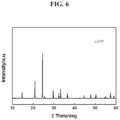
- FIG. 6 is an XRD graph of Li 1.3 Al 0.3 Ti 1.7 (PO 4 ) 3 , which is a ceramic solid electrolyte prepared by adding a rotary concentration method.
- FIG. 7 is a SEM photograph of particles of LAGP synthesized by a method of Sample 1.
- FIG. 8 is a SEM photograph of particles of LAGP synthesized by a method of Sample 2.
- FIG. 9 is a SEM photograph of particles of LAGP synthesized by a method of Sample 3.
- FIG. 10 is an XRD graph of Li 1.3 Al 0.3 Ge 1.7 (PO 4 ) 3 , which is a ceramic solid electrolyte prepared by adding a rotary concentration method.
- the oxide-based conductive ceramic electrolyte may be prepared by mixing raw materials of the ceramic solid electrolyte in an equivalent ratio using distilled water as a solvent, mixing the mixture in a solution state for 24 hours by ball-milling, drying first by adding a rotary concentration method or a spray method, drying second at 80° C., heating first at 400° C. for 4 hours, and heating second at 1000° C. for 4 hours.
- the solid electrolyte LATP may be represented by the following Chemical Formula 1. Li 1+x Al x Ti 2 ⁇ x (PO 4 ) 3 (0 ⁇ x ⁇ 2) [Chemical Formula 1]
- Li 1.3 Al 0.3 Ti 1.7 (PO 4 ) 3 is preferable.
- Step 1 for preparing the LATP ceramic solid electrolyte may be a step of preparing a solid electrolyte precursor by adding and mixing lithium chloride, aluminum nitrate, ammonium phosphate, and titanium butoxide in distilled water.
- the lithium chloride is LiCl
- the aluminum nitrate is Al(NO 3 ) 3 ⁇ 9H 2 O
- the ammonium phosphate is NH 4 H 2 PO 4
- the titanium butoxide is Ti(OC 4 H 9 ) 4 .
- Step 2 may be a step for mixing the solid electrolyte precursor with a ball-mill.
- the speed of the ball-mill may be 150 RPM to 400 RPM, preferably 200 to 300 RPM.
- Step 3 may be a step for drying first by a rotary concentration method or a spray method.
- the temperature of the rotary concentration method may be 60° C. to 100° C., preferably 70° C. to 80° C.
- the temperature of the spray method may be 80° C. to 300° C., preferably 100° C. to 200° C.
- Step 4 may be a step for drying second in a dryer at 80° C. for at least 24 hours to completely remove the distilled water solvent.
- Step 5 may be a step for calcining first ceramic particles in a heat treatment device and firing second the ceramic particles.
- the first calcining temperature may be 300° C. to 500° C., preferably 350° C. to 450° C.
- the second firing temperature may be 900° C. to 1200° C., preferably 1000° C. to 1100° C.
- the calcining and firing time may be 2 to 10 hours, preferably 3 to 5 hours.
- the ceramic particles may be calcined at 400° C. for 4 hours and then fired at 1000° C. for 4 hours.
- the heat treatment may be performed by starting from room temperature.
- the solid electrolyte ceramic particles may be made into a powder form with a mortar.
- the solid electrolyte LAGP may be represented by the following Chemical Formula 2. Li 1+x Al x Ge 2 ⁇ x (PO 4 ) 3 (0 ⁇ x ⁇ 2) [Chemical Formula 2]
- Li 1.3 Al 0.3 Ge 1.7 (PO 4 ) 3 is preferable.
- Step 1 for preparing the LAGP ceramic solid electrolyte particles may be a step of preparing a solid electrolyte precursor by adding and mixing lithium chloride, aluminum nitrate, ammonium phosphate, and germanium oxide in distilled water.
- the lithium chloride is LiCl
- the aluminum nitrate is Al(NO 3 ) 3 ⁇ 9H 2 O
- the ammonium phosphate is NH 4 H 2 PO 4
- the germanium oxide is GeO 2 .
- Step 2 may be a step for mixing the solid electrolyte precursor with a ball-mill.
- the speed of the ball-mill may be 150 RPM to 400 RPM, preferably 200 to 300 RPM.
- Step 3 may be a step for drying first by a rotary concentration method or a spray method.
- the temperature of the rotary concentration method may be 60° C. to 100° C., preferably 70° C. to 80° C.
- the temperature of the spray method may be 80° C. to 300° C., preferably 100° C. to 200° C.
- Step 4 may be a step for drying second in a dryer at 80° C. for at least 24 hours to completely remove the distilled water solvent.
- Step 5 may be a step for calcining first ceramic particles in a heat treatment device and firing second the ceramic particles.
- the first calcining temperature may be 300° C. to 500° C., preferably 350° C. to 450° C.
- the second firing temperature may be 900° C. to 1200° C., preferably 1000° C. to 1100° C.
- the calcining and firing time may be 2 to 10 hours, preferably 3 to 5 hours.
- the ceramic particles may be calcined at 400° C. for 4 hours and then fired at 1000° C. for 4 hours.
- zirconia balls of 5 mm and 10 mm in diameter were prepared in a ratio of 2:1, and then added in a 500 ml container prepared so that a volume ratio of the mixed sample and the zirconia balls was 1:1.
- the rotary speed of the ball milling was 200 to 300 RPM, and the ball milling was performed for 24 hours.
- the zirconia balls were removed from the sample.
- the sample was dried first by a rotary concentration method or a spray method, put in an evaporation dish and then sufficiently dried second at 80° C. for 24 hours. Then, the dried sample was pulverized in a mortar to form a powder form. Then, the sample was heat treated as follows. The temperature was raised from room temperature to 400° C.
- the sample was heat treated for 4 hours to calcine the sample and cooled naturally until 100° C. or less. Thereafter, the sample was heat treated at 1000° C. for 4 hours to fire the sample and then pulverized to prepare a powdered LATP solid electrolyte.
- FIG. 1 A method of preparing the LATP solid electrolyte was illustrated in FIG. 1 .
- Sample 1 a sample obtained by ball-milling and mixing without using a distilled water solvent and then heat-treating
- Sample 2 a sample obtained by ball-milling and mixing using a distilled water solvent, drying the solvent, and then heat-treating
- Sample 3 a sample obtained by ball-milling and mixing using a distilled water solvent, drying first the solvent by a rotary concentration method, drying second the solvent in an oven, and then heat-treating is referred to as Sample 3
- Sample obtained by ball-milling and mixing using a distilled water solvent, drying first the solvent by spraying, drying second the solvent in an oven, and then heat-treating is referred to as Sample 4.
- Samples 1 to 4 are summarized in Table 1 below.
- FIGS. 2 to 5 are SEM photographs of LATP ceramic particles according to the above process.
- Sample 1 FIG. 2
- Sample 2 FIG. 3
- Sample 3 FIG. 4
- Sample 4 FIG. 5
- Sample 4 FIG. 5
- FIG. 5 has a very even particle shape and has a particle distribution of 0.6 to 3 micrometers.
- the synthesized Li 1.3 Al 0.3 Ti 1.7 (PO 4 ) 3 was analyzed at a scanning speed of 4°/min for an XRD analysis 2 theta section of 10° to 90°. The analyzed results were shown in FIG. 6 . It can be seen that the LATP is synthesized in a NASICON structure.
- the ionic conductivity is increased.
- zirconia balls of 5 mm and 10 mm in diameter were prepared in a ratio of 2:1, and then added in a 500 ml container prepared so that a volume ratio of the mixed sample and the zirconia balls was 1:1.
- the rotary speed of the ball milling was 200 to 300 RPM, and the ball milling was performed for 24 hours.
- the zirconia balls were removed from the sample.
- the sample was dried first by a rotary concentration method or a spray method, put in an evaporation dish and then sufficiently dried second at 80° C. for 24 hours. Then, the dried sample was pulverized in a mortar to form a powder form. Then, the sample was heat treated as follows. The temperature was raised from room temperature to 400° C.
- the sample was heat treated for 4 hours to calcine the sample and cooled naturally until 100° C. or less. Thereafter, the sample was heat treated at 1000° C. for 4 hours to fire the sample and then pulverized to prepare a powdered LATP solid electrolyte.
- FIGS. 7 to 9 are SEM photographs of particles of LAGP synthesized by methods of Samples 1 to 3.
- the particles synthesized through first solvent drying by adding rotary concentration method (Sample 3) shows the best particle characteristic.
- the synthesized Li 13 Al 0.3 Ge 1.7 (PO 4 ) 3 was analyzed at a scanning speed of 4°/min for an XRD analysis 2 theta section of 10° to 90°. The analyzed results were shown in FIG. 10 . It can be seen that the LAGP is synthesized in a NASICON structure.
Landscapes
- Chemical & Material Sciences (AREA)
- Organic Chemistry (AREA)
- Inorganic Chemistry (AREA)
- Engineering & Computer Science (AREA)
- General Chemical & Material Sciences (AREA)
- Electrochemistry (AREA)
- Chemical Kinetics & Catalysis (AREA)
- Manufacturing & Machinery (AREA)
- Physics & Mathematics (AREA)
- Condensed Matter Physics & Semiconductors (AREA)
- General Physics & Mathematics (AREA)
- Materials Engineering (AREA)
- Secondary Cells (AREA)
- Conductive Materials (AREA)
Abstract
Description
-
- (Patent Document 0001) Korean Patent Unexamined Publication No. 10-2012-0039447
Li1+xAlxTi2−x(PO4)3(0<x<2) [Chemical Formula 1]
Li1+xAlxGe2−x(PO4)3(0<x<2) [Chemical Formula 2]
| TABLE 1 | ||||
| Synthesis | Using distilled | Ball-milling | Process | Heat |
| condition | water solvent | and mixing | added | treatment |
| Sample 1 | x | 24 h | x | 400° C., 4 h |
| 1000° C., 4 | ||||
| Sample | ||||
| 2 | ∘ | 24 h | x | 400° C., 4 h |
| 1000° C., 4 h | ||||
| Sample 3 | ∘ | 24 h | Rotary | 400° C., 4 h |
| concen- | 1000° C., 4 h | |||
| trating | ||||
| Sample 4 | ∘ | 24 h | Spraying | 400° C., 4 h |
| 1000° C., 4 h | ||||
| TABLE 2 | |||||
| Sample 1 | |
Sample 3 | Sample 4 | ||
| Ionic conductivity | 2.2 × 10⁻⁴ | 3.4 × 10⁻⁴ | 7.2 × 10⁻⁴ | 6.8 × 10⁻⁴ |
| (S/cm) | ||||
Claims (9)
Applications Claiming Priority (3)
| Application Number | Priority Date | Filing Date | Title |
|---|---|---|---|
| KR1020180039464A KR102224126B1 (en) | 2018-04-05 | 2018-04-05 | Synthesis Process of Ceramic Solid Electrolyte for Lithium Secondary Batteries |
| KR10-2018-0039464 | 2018-04-05 | ||
| PCT/KR2019/003528 WO2019194454A2 (en) | 2018-04-05 | 2019-03-27 | Method for preparing ceramic solid electrolyte for lithium secondary battery |
Publications (2)
| Publication Number | Publication Date |
|---|---|
| US20210155480A1 US20210155480A1 (en) | 2021-05-27 |
| US12330936B2 true US12330936B2 (en) | 2025-06-17 |
Family
ID=68100838
Family Applications (1)
| Application Number | Title | Priority Date | Filing Date |
|---|---|---|---|
| US17/045,487 Active 2042-04-01 US12330936B2 (en) | 2018-04-05 | 2019-03-27 | Method for preparing ceramic solid electrolyte for lithium secondary battery |
Country Status (6)
| Country | Link |
|---|---|
| US (1) | US12330936B2 (en) |
| EP (1) | EP3780222B1 (en) |
| JP (1) | JP7030207B2 (en) |
| KR (1) | KR102224126B1 (en) |
| CN (1) | CN111937213A (en) |
| WO (1) | WO2019194454A2 (en) |
Families Citing this family (6)
| Publication number | Priority date | Publication date | Assignee | Title |
|---|---|---|---|---|
| KR102427454B1 (en) * | 2019-11-26 | 2022-08-01 | 주식회사 세븐킹에너지 | Ionic Conductive Ceramic and Its Synthesis Method |
| KR102802594B1 (en) * | 2019-12-20 | 2025-05-07 | 도와 일렉트로닉스 가부시키가이샤 | Amorphous lithium ion conducting oxide powder and its manufacturing method, and a method for manufacturing lithium ion conducting oxide powder having a NASICON type crystal structure |
| KR102546049B1 (en) * | 2021-04-01 | 2023-06-22 | 주식회사 신한세라믹 | Method for manufacturing solid electrolyte for secondary battery by molded articles |
| CN113889660A (en) * | 2021-09-04 | 2022-01-04 | 浙江锋锂新能源科技有限公司 | Spherical lithium-containing oxide electrolyte powder material and preparation method thereof |
| KR20240058429A (en) * | 2022-10-26 | 2024-05-03 | 주식회사 레몬 | Fabrication of Ionic Conducting LATP Nanofiber Network by Electro―spinning |
| CN118575322A (en) | 2022-12-30 | 2024-08-30 | 昆明理工大学 | Method for preparing sodium super-ion conductor type solid electrolyte by low-dimensional crystallization |
Citations (22)
| Publication number | Priority date | Publication date | Assignee | Title |
|---|---|---|---|---|
| JPH07109175A (en) | 1990-01-23 | 1995-04-25 | Ercros Sa | Composite ceramic material used in industrial application under high temperature and severe thermal shock condition and production thereof |
| US20020113344A1 (en) * | 2000-12-11 | 2002-08-22 | Ngk Insulators, Ltd. | Method for producing beta-alumina solid electrolyte |
| WO2004106232A1 (en) | 2003-05-30 | 2004-12-09 | Nippon Chemical Industrial Co., Ltd. | Lithium sulfide powder, method for producing same and inorganic solid electrolyte |
| US20050260410A1 (en) * | 2004-05-21 | 2005-11-24 | Tdk Corporation | Ceramic material powder, method of production thereof, dielectric ceramic composition, electronic device, and multilayer ceramic capacitor |
| JP2008110899A (en) | 2006-10-31 | 2008-05-15 | Ohara Inc | Lithium ion-conducting inorganic particle and production method thereof |
| JP2010517738A (en) | 2007-02-01 | 2010-05-27 | ▲発▼泰(▲天▼津)科技有限公司 | Microwave rotating thin film concentrator |
| KR20120039447A (en) | 2010-10-15 | 2012-04-25 | 삼성에스디아이 주식회사 | Solid electrolyte, rechargeable lithium battery comprising the same, method for preparing solid electrolyte particles and solid electrolyte particles |
| US8304115B1 (en) * | 2009-08-28 | 2012-11-06 | Cermacell, LLC | Multi layer ceramic battery |
| JP2013191558A (en) | 2012-03-09 | 2013-09-26 | Samsung Electronics Co Ltd | Inorganic ion conductor, method of forming the same, and fuel cell including the same |
| WO2013156116A1 (en) * | 2012-04-19 | 2013-10-24 | Karlsruher Institut für Technologie | Method for producing li-ion conductive lithium aluminium titanium phosphates and use thereof as a solid-state electrolyte |
| KR101383356B1 (en) | 2012-08-07 | 2014-04-14 | 한국전기연구원 | composite of ceramic dielectric with high dielectric constant and their manufacturing mehtod |
| CN104466238A (en) | 2014-11-28 | 2015-03-25 | 深圳华中科技大学研究院 | Doped type solid ceramic electrolyte as well as preparation method and application thereof |
| WO2015064351A1 (en) | 2013-11-01 | 2015-05-07 | セントラル硝子株式会社 | Solid-electrolyte precursor, manufacturing method therefor, method for manufacturing solid electrolyte, and method for manufacturing solid-electrolyte/electrode-active-material complex |
| JP2015202998A (en) | 2014-04-16 | 2015-11-16 | 株式会社豊田自動織機 | Garnet-type oxide, method for producing the same, and solid electrolyte for secondary battery and secondary battery using the same |
| CN105406118A (en) | 2015-12-30 | 2016-03-16 | 哈尔滨工业大学 | Ceramic solid electrolyte and preparation method thereof |
| JP2016509331A (en) | 2013-10-24 | 2016-03-24 | エルジー・ケム・リミテッド | Solid electrolyte particles, manufacturing method thereof, and lithium secondary battery including the same |
| CN105609881A (en) | 2015-12-18 | 2016-05-25 | 中国科学院青岛生物能源与过程研究所 | Inorganic solid-state electrolyte material and preparation method therefor |
| JP2016519395A (en) | 2013-05-03 | 2016-06-30 | 韓国生産技術研究院Korea Institute Of Industrial Technology | Method for producing solid electrolyte for solid oxide fuel cell and method for producing unit cell |
| US20160293988A1 (en) | 2013-01-31 | 2016-10-06 | Board Of Trustees Of Michigan State University | Template-based methods of making and using ceramic solids and products and devices related thereto |
| KR20160135367A (en) | 2014-04-24 | 2016-11-25 | 다이치 키겐소 카가쿠 코교 컴퍼니 리미티드 | Method for producing garnet-type compound, garnet-type compound, and all-solid lithium secondary cell containing said garnet-type compound |
| JP2016207354A (en) | 2015-04-17 | 2016-12-08 | 出光興産株式会社 | Production method of sulfide solid electrolyte |
| JP2017132682A (en) | 2015-07-30 | 2017-08-03 | セントラル硝子株式会社 | Sintered compact including lithium titanate and lithium titanate lanthanum, method for producing the same, and lithium battery |
-
2018
- 2018-04-05 KR KR1020180039464A patent/KR102224126B1/en active Active
-
2019
- 2019-03-27 WO PCT/KR2019/003528 patent/WO2019194454A2/en not_active Ceased
- 2019-03-27 EP EP19781886.7A patent/EP3780222B1/en active Active
- 2019-03-27 US US17/045,487 patent/US12330936B2/en active Active
- 2019-03-27 CN CN201980024758.XA patent/CN111937213A/en active Pending
- 2019-03-27 JP JP2020554217A patent/JP7030207B2/en active Active
Patent Citations (24)
| Publication number | Priority date | Publication date | Assignee | Title |
|---|---|---|---|---|
| JPH07109175A (en) | 1990-01-23 | 1995-04-25 | Ercros Sa | Composite ceramic material used in industrial application under high temperature and severe thermal shock condition and production thereof |
| US20020113344A1 (en) * | 2000-12-11 | 2002-08-22 | Ngk Insulators, Ltd. | Method for producing beta-alumina solid electrolyte |
| WO2004106232A1 (en) | 2003-05-30 | 2004-12-09 | Nippon Chemical Industrial Co., Ltd. | Lithium sulfide powder, method for producing same and inorganic solid electrolyte |
| US20050260410A1 (en) * | 2004-05-21 | 2005-11-24 | Tdk Corporation | Ceramic material powder, method of production thereof, dielectric ceramic composition, electronic device, and multilayer ceramic capacitor |
| JP2008110899A (en) | 2006-10-31 | 2008-05-15 | Ohara Inc | Lithium ion-conducting inorganic particle and production method thereof |
| JP2010517738A (en) | 2007-02-01 | 2010-05-27 | ▲発▼泰(▲天▼津)科技有限公司 | Microwave rotating thin film concentrator |
| US8304115B1 (en) * | 2009-08-28 | 2012-11-06 | Cermacell, LLC | Multi layer ceramic battery |
| KR20120039447A (en) | 2010-10-15 | 2012-04-25 | 삼성에스디아이 주식회사 | Solid electrolyte, rechargeable lithium battery comprising the same, method for preparing solid electrolyte particles and solid electrolyte particles |
| JP2013191558A (en) | 2012-03-09 | 2013-09-26 | Samsung Electronics Co Ltd | Inorganic ion conductor, method of forming the same, and fuel cell including the same |
| WO2013156116A1 (en) * | 2012-04-19 | 2013-10-24 | Karlsruher Institut für Technologie | Method for producing li-ion conductive lithium aluminium titanium phosphates and use thereof as a solid-state electrolyte |
| KR101383356B1 (en) | 2012-08-07 | 2014-04-14 | 한국전기연구원 | composite of ceramic dielectric with high dielectric constant and their manufacturing mehtod |
| US20160293988A1 (en) | 2013-01-31 | 2016-10-06 | Board Of Trustees Of Michigan State University | Template-based methods of making and using ceramic solids and products and devices related thereto |
| JP2016519395A (en) | 2013-05-03 | 2016-06-30 | 韓国生産技術研究院Korea Institute Of Industrial Technology | Method for producing solid electrolyte for solid oxide fuel cell and method for producing unit cell |
| JP2016509331A (en) | 2013-10-24 | 2016-03-24 | エルジー・ケム・リミテッド | Solid electrolyte particles, manufacturing method thereof, and lithium secondary battery including the same |
| WO2015064351A1 (en) | 2013-11-01 | 2015-05-07 | セントラル硝子株式会社 | Solid-electrolyte precursor, manufacturing method therefor, method for manufacturing solid electrolyte, and method for manufacturing solid-electrolyte/electrode-active-material complex |
| US20160293947A1 (en) | 2013-11-01 | 2016-10-06 | Central Glass Co., Ltd. | Solid-electrolyte precursor, manufacturing method therefor, method for manufacturing solid electrolyte, and method for manufacturing solid-electrolyte/electrode-active-material complex |
| JP2015202998A (en) | 2014-04-16 | 2015-11-16 | 株式会社豊田自動織機 | Garnet-type oxide, method for producing the same, and solid electrolyte for secondary battery and secondary battery using the same |
| KR20160135367A (en) | 2014-04-24 | 2016-11-25 | 다이치 키겐소 카가쿠 코교 컴퍼니 리미티드 | Method for producing garnet-type compound, garnet-type compound, and all-solid lithium secondary cell containing said garnet-type compound |
| CN106232526A (en) | 2014-04-24 | 2016-12-14 | 第稀元素化学工业株式会社 | Method for producing garnet-type compound, garnet-type compound, and all-solid lithium secondary battery containing the garnet-type compound |
| CN104466238A (en) | 2014-11-28 | 2015-03-25 | 深圳华中科技大学研究院 | Doped type solid ceramic electrolyte as well as preparation method and application thereof |
| JP2016207354A (en) | 2015-04-17 | 2016-12-08 | 出光興産株式会社 | Production method of sulfide solid electrolyte |
| JP2017132682A (en) | 2015-07-30 | 2017-08-03 | セントラル硝子株式会社 | Sintered compact including lithium titanate and lithium titanate lanthanum, method for producing the same, and lithium battery |
| CN105609881A (en) | 2015-12-18 | 2016-05-25 | 中国科学院青岛生物能源与过程研究所 | Inorganic solid-state electrolyte material and preparation method therefor |
| CN105406118A (en) | 2015-12-30 | 2016-03-16 | 哈尔滨工业大学 | Ceramic solid electrolyte and preparation method thereof |
Non-Patent Citations (8)
| Title |
|---|
| Erqing Zhao, et al., "Stable LATP/LAGP doubleOlayer solid electrolyte prepared via a simple dry-pressing method for solid state lithium ion batteries," RSC Adv. 2016., vo. 6, pp. 92579-92585 (Sep. 21, 2016). |
| Extended European Search Report mailed on Sep. 27, 2021 from the European Patent Office for European Application No. 19781886.7. |
| International Search Report for PCT/KR2019/003528, mailed Oct. 30, 2019, and its English translation. |
| Non-final Office Action mailed on Apr. 26, 2021 from the Chinese Patent Office for Chinese Application No. 2021042201974470. |
| Non-final Office Action mailed on Jun. 29, 2021 from the Japanese Patent Office for Japanese Application No. 2020-554217. |
| Non-final Office Action mailed on Jun. 4, 2019 from the Korean Patent Office for Korean Application No. 10-2018-0039464. |
| Zhao et al.; Solid LATP/LAGP double-layer solid electrolyte prepared via simple dry-pressing method for solid state lithium ion batteries; RCS Advances, 2016, 6 92579-92585. (Year: 2016). * |
| Zhao, Erqing et al., "Stable LATP/LAGP double-layer solid electrolyte prepared via a simple dry-pressing method for solid state lithium ion batteries", RSC Advances, 2016, vol. 6, pp. 92579-92585. |
Also Published As
| Publication number | Publication date |
|---|---|
| US20210155480A1 (en) | 2021-05-27 |
| WO2019194454A3 (en) | 2019-12-12 |
| WO2019194454A2 (en) | 2019-10-10 |
| CN111937213A (en) | 2020-11-13 |
| EP3780222B1 (en) | 2025-01-22 |
| KR102224126B1 (en) | 2021-03-08 |
| EP3780222C0 (en) | 2025-01-22 |
| KR20190116615A (en) | 2019-10-15 |
| JP2021514107A (en) | 2021-06-03 |
| EP3780222A2 (en) | 2021-02-17 |
| JP7030207B2 (en) | 2022-03-04 |
| EP3780222A4 (en) | 2021-10-27 |
Similar Documents
| Publication | Publication Date | Title |
|---|---|---|
| US12330936B2 (en) | Method for preparing ceramic solid electrolyte for lithium secondary battery | |
| JP7767501B2 (en) | Lithium ion conducting composite material comprising at least one polymer and lithium ion conducting particles, and method for producing a lithium ion conductor from said composite material | |
| Zhang et al. | Preparation and electrochemical properties of Li1+ xAlxGe2-x (PO4) 3 synthesized by a sol-gel method | |
| US20160268630A1 (en) | Li-Ion Conductive Oxide Ceramic Material Including Garnet-Type or Similar Crystal Structure | |
| CN107848894A (en) | Carbuncle type oxidate sintered body and its manufacture method | |
| CN104591231A (en) | Fluorine-containing garnet-structure lithium ion oxide ceramic | |
| KR102072005B1 (en) | Preparation method of sulfide-based solid electrolyte with reduced impurity content and sulfide-based solid electrolyte with reduced impurity content preprared by the same | |
| CN108352568A (en) | Multi-layered electrolyte unit, secondary battery including the same, and method of manufacturing the same | |
| CN113526560A (en) | A kind of sodium-potassium co-intercalation metal oxide cathode material and preparation method thereof | |
| JP6971089B2 (en) | A method for manufacturing a solid electrolyte, a method for manufacturing an electrode material for an all-solid-state battery, and a method for manufacturing an all-solid-state battery. | |
| JP2020113376A (en) | Positive electrode material for all-solid-state battery, all-solid-state battery, and method for manufacturing positive-electrode active material for all-solid-state battery | |
| JPH10334919A (en) | Lithium cobaltate-based positive electrode active material for lithium ion secondary battery, method for producing the same, and lithium ion secondary battery | |
| KR20200040704A (en) | Synthesis Process of Ceramic Solid Electrolyte for Lithium Secondary Batteries | |
| JP2019050083A (en) | Method of manufacturing solid electrolyte, method of manufacturing electrode material for all solid battery, and method of manufacturing all solid battery | |
| JP7457805B2 (en) | Ionic Conductive Ceramic and Its Synthesis Method | |
| WO2021030916A1 (en) | Sodium silicate solid-state electrolyte material | |
| CN113061026A (en) | Oxide solid electrolyte and preparation method thereof | |
| EP4679552A1 (en) | Arrangement structure of solid electrolyte in all-solid-state cell, and battery | |
| US12463210B2 (en) | Electrolyte and electrode materials for rechargeable lithium batteries | |
| JP7125227B2 (en) | Method for producing lithium-containing cobalt oxide having spinel crystal phase | |
| JPH11195417A (en) | Method for producing high-purity tetragonal lithium manganate powder suitable for use as a positive electrode active material for lithium ion secondary batteries | |
| JP2001048544A (en) | Method for producing lithium manganese composite oxide for non-aqueous lithium secondary battery and use thereof | |
| JP2001158623A (en) | Method for producing spinel-type lithium manganate |
Legal Events
| Date | Code | Title | Description |
|---|---|---|---|
| AS | Assignment |
Owner name: SEVEN KING ENERGY CO., LTD., KOREA, REPUBLIC OF Free format text: ASSIGNMENT OF ASSIGNORS INTEREST;ASSIGNORS:SON, JUNG WOO;SON, JI WON;KIM, JAE KWANG;REEL/FRAME:053978/0123 Effective date: 20200924 |
|
| FEPP | Fee payment procedure |
Free format text: ENTITY STATUS SET TO UNDISCOUNTED (ORIGINAL EVENT CODE: BIG.); ENTITY STATUS OF PATENT OWNER: SMALL ENTITY |
|
| FEPP | Fee payment procedure |
Free format text: ENTITY STATUS SET TO MICRO (ORIGINAL EVENT CODE: MICR); ENTITY STATUS OF PATENT OWNER: SMALL ENTITY |
|
| STPP | Information on status: patent application and granting procedure in general |
Free format text: APPLICATION DISPATCHED FROM PREEXAM, NOT YET DOCKETED |
|
| STPP | Information on status: patent application and granting procedure in general |
Free format text: DOCKETED NEW CASE - READY FOR EXAMINATION |
|
| STPP | Information on status: patent application and granting procedure in general |
Free format text: NON FINAL ACTION MAILED |
|
| STPP | Information on status: patent application and granting procedure in general |
Free format text: RESPONSE TO NON-FINAL OFFICE ACTION ENTERED AND FORWARDED TO EXAMINER |
|
| STPP | Information on status: patent application and granting procedure in general |
Free format text: NON FINAL ACTION MAILED |
|
| STPP | Information on status: patent application and granting procedure in general |
Free format text: RESPONSE TO NON-FINAL OFFICE ACTION ENTERED AND FORWARDED TO EXAMINER |
|
| STPP | Information on status: patent application and granting procedure in general |
Free format text: FINAL REJECTION MAILED |
|
| STPP | Information on status: patent application and granting procedure in general |
Free format text: RESPONSE AFTER FINAL ACTION FORWARDED TO EXAMINER |
|
| STPP | Information on status: patent application and granting procedure in general |
Free format text: ADVISORY ACTION MAILED |
|
| FEPP | Fee payment procedure |
Free format text: ENTITY STATUS SET TO SMALL (ORIGINAL EVENT CODE: SMAL); ENTITY STATUS OF PATENT OWNER: SMALL ENTITY |
|
| STPP | Information on status: patent application and granting procedure in general |
Free format text: DOCKETED NEW CASE - READY FOR EXAMINATION |
|
| STPP | Information on status: patent application and granting procedure in general |
Free format text: NOTICE OF ALLOWANCE MAILED -- APPLICATION RECEIVED IN OFFICE OF PUBLICATIONS |
|
| STCF | Information on status: patent grant |
Free format text: PATENTED CASE |
|
| AS | Assignment |
Owner name: DUKSAN FUTURECELL CO., LTD., KOREA, REPUBLIC OF Free format text: CHANGE OF NAME;ASSIGNOR:SEVEN KING ENERGY CO., LTD.;REEL/FRAME:073156/0850 Effective date: 20240202 |