US12263452B2 - Gas solution supply device - Google Patents

Gas solution supply device Download PDF

Info

Publication number
US12263452B2
US12263452B2 US17/488,814 US202117488814A US12263452B2 US 12263452 B2 US12263452 B2 US 12263452B2 US 202117488814 A US202117488814 A US 202117488814A US 12263452 B2 US12263452 B2 US 12263452B2
Authority
US
United States
Prior art keywords
gas
valve
liquid separator
line
solution
Prior art date
Legal status (The legal status is an assumption and is not a legal conclusion. Google has not performed a legal analysis and makes no representation as to the accuracy of the status listed.)
Active, expires
Application number
US17/488,814
Other versions
US20220105478A1 (en
Inventor
Suguru Ozawa
Yuji Araki
Toshifumi Watanabe
Yoichi Nakagawa
Risa KIMURA
Tao Xu
Current Assignee (The listed assignees may be inaccurate. Google has not performed a legal analysis and makes no representation or warranty as to the accuracy of the list.)
Ebara Corp
Original Assignee
Ebara Corp
Priority date (The priority date is an assumption and is not a legal conclusion. Google has not performed a legal analysis and makes no representation as to the accuracy of the date listed.)
Filing date
Publication date
Priority claimed from JP2021092452A external-priority patent/JP7550720B2/en
Application filed by Ebara Corp filed Critical Ebara Corp
Assigned to EBARA CORPORATION reassignment EBARA CORPORATION ASSIGNMENT OF ASSIGNORS INTEREST (SEE DOCUMENT FOR DETAILS). Assignors: ARAKI, YUJI, KIMURA, RISA, NAKAGAWA, YOICHI, OZAWA, SUGURU, WATANABE, TOSHIFUMI, XU, TAO
Publication of US20220105478A1 publication Critical patent/US20220105478A1/en
Application granted granted Critical
Publication of US12263452B2 publication Critical patent/US12263452B2/en
Active legal-status Critical Current
Adjusted expiration legal-status Critical

Links

Images

Classifications

    • BPERFORMING OPERATIONS; TRANSPORTING
    • B01PHYSICAL OR CHEMICAL PROCESSES OR APPARATUS IN GENERAL
    • B01FMIXING, e.g. DISSOLVING, EMULSIFYING OR DISPERSING
    • B01F23/00Mixing according to the phases to be mixed, e.g. dispersing or emulsifying
    • B01F23/20Mixing gases with liquids
    • B01F23/23Mixing gases with liquids by introducing gases into liquid media, e.g. for producing aerated liquids
    • B01F23/232Mixing gases with liquids by introducing gases into liquid media, e.g. for producing aerated liquids using flow-mixing means for introducing the gases, e.g. baffles
    • B01F23/2323Mixing gases with liquids by introducing gases into liquid media, e.g. for producing aerated liquids using flow-mixing means for introducing the gases, e.g. baffles by circulating the flow in guiding constructions or conduits
    • BPERFORMING OPERATIONS; TRANSPORTING
    • B01PHYSICAL OR CHEMICAL PROCESSES OR APPARATUS IN GENERAL
    • B01FMIXING, e.g. DISSOLVING, EMULSIFYING OR DISPERSING
    • B01F23/00Mixing according to the phases to be mixed, e.g. dispersing or emulsifying
    • B01F23/20Mixing gases with liquids
    • B01F23/23Mixing gases with liquids by introducing gases into liquid media, e.g. for producing aerated liquids
    • BPERFORMING OPERATIONS; TRANSPORTING
    • B01PHYSICAL OR CHEMICAL PROCESSES OR APPARATUS IN GENERAL
    • B01FMIXING, e.g. DISSOLVING, EMULSIFYING OR DISPERSING
    • B01F23/00Mixing according to the phases to be mixed, e.g. dispersing or emulsifying
    • B01F23/20Mixing gases with liquids
    • B01F23/23Mixing gases with liquids by introducing gases into liquid media, e.g. for producing aerated liquids
    • B01F23/232Mixing gases with liquids by introducing gases into liquid media, e.g. for producing aerated liquids using flow-mixing means for introducing the gases, e.g. baffles
    • B01F23/2326Mixing gases with liquids by introducing gases into liquid media, e.g. for producing aerated liquids using flow-mixing means for introducing the gases, e.g. baffles adding the flowing main component by suction means, e.g. using an ejector
    • BPERFORMING OPERATIONS; TRANSPORTING
    • B01PHYSICAL OR CHEMICAL PROCESSES OR APPARATUS IN GENERAL
    • B01DSEPARATION
    • B01D19/00Degasification of liquids
    • B01D19/0063Regulation, control including valves and floats
    • BPERFORMING OPERATIONS; TRANSPORTING
    • B01PHYSICAL OR CHEMICAL PROCESSES OR APPARATUS IN GENERAL
    • B01DSEPARATION
    • B01D19/00Degasification of liquids
    • B01D19/0068General arrangements, e.g. flowsheets
    • BPERFORMING OPERATIONS; TRANSPORTING
    • B01PHYSICAL OR CHEMICAL PROCESSES OR APPARATUS IN GENERAL
    • B01FMIXING, e.g. DISSOLVING, EMULSIFYING OR DISPERSING
    • B01F21/00Dissolving
    • B01F21/30Workflow diagrams or layout of plants, e.g. flow charts; Details of workflow diagrams or layout of plants, e.g. controlling means
    • BPERFORMING OPERATIONS; TRANSPORTING
    • B01PHYSICAL OR CHEMICAL PROCESSES OR APPARATUS IN GENERAL
    • B01FMIXING, e.g. DISSOLVING, EMULSIFYING OR DISPERSING
    • B01F23/00Mixing according to the phases to be mixed, e.g. dispersing or emulsifying
    • B01F23/10Mixing gases with gases
    • B01F23/19Mixing systems, i.e. flow charts or diagrams; Arrangements, e.g. comprising controlling means
    • BPERFORMING OPERATIONS; TRANSPORTING
    • B01PHYSICAL OR CHEMICAL PROCESSES OR APPARATUS IN GENERAL
    • B01FMIXING, e.g. DISSOLVING, EMULSIFYING OR DISPERSING
    • B01F23/00Mixing according to the phases to be mixed, e.g. dispersing or emulsifying
    • B01F23/20Mixing gases with liquids
    • B01F23/23Mixing gases with liquids by introducing gases into liquid media, e.g. for producing aerated liquids
    • B01F23/231Mixing gases with liquids by introducing gases into liquid media, e.g. for producing aerated liquids by bubbling
    • B01F23/23105Arrangement or manipulation of the gas bubbling devices
    • B01F23/2311Mounting the bubbling devices or the diffusers
    • B01F23/23114Mounting the bubbling devices or the diffusers characterised by the way in which the different elements of the bubbling installation are mounted
    • B01F23/231141Mounting auxiliary devices, e.g. pumps or compressors in a particular place on the bubbling installation, e.g. under water
    • BPERFORMING OPERATIONS; TRANSPORTING
    • B01PHYSICAL OR CHEMICAL PROCESSES OR APPARATUS IN GENERAL
    • B01FMIXING, e.g. DISSOLVING, EMULSIFYING OR DISPERSING
    • B01F23/00Mixing according to the phases to be mixed, e.g. dispersing or emulsifying
    • B01F23/20Mixing gases with liquids
    • B01F23/23Mixing gases with liquids by introducing gases into liquid media, e.g. for producing aerated liquids
    • B01F23/231Mixing gases with liquids by introducing gases into liquid media, e.g. for producing aerated liquids by bubbling
    • B01F23/23105Arrangement or manipulation of the gas bubbling devices
    • B01F23/2312Diffusers
    • B01F23/23122Diffusers having elements opening under air pressure, e.g. valves
    • BPERFORMING OPERATIONS; TRANSPORTING
    • B01PHYSICAL OR CHEMICAL PROCESSES OR APPARATUS IN GENERAL
    • B01FMIXING, e.g. DISSOLVING, EMULSIFYING OR DISPERSING
    • B01F23/00Mixing according to the phases to be mixed, e.g. dispersing or emulsifying
    • B01F23/20Mixing gases with liquids
    • B01F23/23Mixing gases with liquids by introducing gases into liquid media, e.g. for producing aerated liquids
    • B01F23/232Mixing gases with liquids by introducing gases into liquid media, e.g. for producing aerated liquids using flow-mixing means for introducing the gases, e.g. baffles
    • BPERFORMING OPERATIONS; TRANSPORTING
    • B01PHYSICAL OR CHEMICAL PROCESSES OR APPARATUS IN GENERAL
    • B01FMIXING, e.g. DISSOLVING, EMULSIFYING OR DISPERSING
    • B01F23/00Mixing according to the phases to be mixed, e.g. dispersing or emulsifying
    • B01F23/20Mixing gases with liquids
    • B01F23/23Mixing gases with liquids by introducing gases into liquid media, e.g. for producing aerated liquids
    • B01F23/2366Parts; Accessories
    • BPERFORMING OPERATIONS; TRANSPORTING
    • B01PHYSICAL OR CHEMICAL PROCESSES OR APPARATUS IN GENERAL
    • B01FMIXING, e.g. DISSOLVING, EMULSIFYING OR DISPERSING
    • B01F23/00Mixing according to the phases to be mixed, e.g. dispersing or emulsifying
    • B01F23/20Mixing gases with liquids
    • B01F23/29Mixing systems, i.e. flow charts or diagrams
    • BPERFORMING OPERATIONS; TRANSPORTING
    • B01PHYSICAL OR CHEMICAL PROCESSES OR APPARATUS IN GENERAL
    • B01FMIXING, e.g. DISSOLVING, EMULSIFYING OR DISPERSING
    • B01F23/00Mixing according to the phases to be mixed, e.g. dispersing or emulsifying
    • B01F23/70Pre-treatment of the materials to be mixed
    • B01F23/703Degassing or de-aerating materials; Replacing one gas within the materials by another gas
    • BPERFORMING OPERATIONS; TRANSPORTING
    • B01PHYSICAL OR CHEMICAL PROCESSES OR APPARATUS IN GENERAL
    • B01FMIXING, e.g. DISSOLVING, EMULSIFYING OR DISPERSING
    • B01F23/00Mixing according to the phases to be mixed, e.g. dispersing or emulsifying
    • B01F23/80After-treatment of the mixture
    • B01F23/803Venting, degassing or ventilating of gases, fumes or toxic vapours from the mixture
    • BPERFORMING OPERATIONS; TRANSPORTING
    • B01PHYSICAL OR CHEMICAL PROCESSES OR APPARATUS IN GENERAL
    • B01FMIXING, e.g. DISSOLVING, EMULSIFYING OR DISPERSING
    • B01F25/00Flow mixers; Mixers for falling materials, e.g. solid particles
    • B01F25/30Injector mixers
    • B01F25/31Injector mixers in conduits or tubes through which the main component flows
    • BPERFORMING OPERATIONS; TRANSPORTING
    • B01PHYSICAL OR CHEMICAL PROCESSES OR APPARATUS IN GENERAL
    • B01FMIXING, e.g. DISSOLVING, EMULSIFYING OR DISPERSING
    • B01F25/00Flow mixers; Mixers for falling materials, e.g. solid particles
    • B01F25/30Injector mixers
    • B01F25/31Injector mixers in conduits or tubes through which the main component flows
    • B01F25/312Injector mixers in conduits or tubes through which the main component flows with Venturi elements; Details thereof
    • B01F25/3124Injector mixers in conduits or tubes through which the main component flows with Venturi elements; Details thereof characterised by the place of introduction of the main flow
    • B01F25/31243Eductor or eductor-type venturi, i.e. the main flow being injected through the venturi with high speed in the form of a jet
    • BPERFORMING OPERATIONS; TRANSPORTING
    • B01PHYSICAL OR CHEMICAL PROCESSES OR APPARATUS IN GENERAL
    • B01FMIXING, e.g. DISSOLVING, EMULSIFYING OR DISPERSING
    • B01F25/00Flow mixers; Mixers for falling materials, e.g. solid particles
    • B01F25/50Circulation mixers, e.g. wherein at least part of the mixture is discharged from and reintroduced into a receptacle
    • B01F25/51Circulation mixers, e.g. wherein at least part of the mixture is discharged from and reintroduced into a receptacle in which the mixture is circulated through a set of tubes, e.g. with gradual introduction of a component into the circulating flow
    • BPERFORMING OPERATIONS; TRANSPORTING
    • B01PHYSICAL OR CHEMICAL PROCESSES OR APPARATUS IN GENERAL
    • B01FMIXING, e.g. DISSOLVING, EMULSIFYING OR DISPERSING
    • B01F25/00Flow mixers; Mixers for falling materials, e.g. solid particles
    • B01F25/50Circulation mixers, e.g. wherein at least part of the mixture is discharged from and reintroduced into a receptacle
    • B01F25/53Circulation mixers, e.g. wherein at least part of the mixture is discharged from and reintroduced into a receptacle in which the mixture is discharged from and reintroduced into a receptacle through a recirculation tube, into which an additional component is introduced
    • BPERFORMING OPERATIONS; TRANSPORTING
    • B01PHYSICAL OR CHEMICAL PROCESSES OR APPARATUS IN GENERAL
    • B01FMIXING, e.g. DISSOLVING, EMULSIFYING OR DISPERSING
    • B01F35/00Accessories for mixers; Auxiliary operations or auxiliary devices; Parts or details of general application
    • B01F35/20Measuring; Control or regulation
    • BPERFORMING OPERATIONS; TRANSPORTING
    • B01PHYSICAL OR CHEMICAL PROCESSES OR APPARATUS IN GENERAL
    • B01FMIXING, e.g. DISSOLVING, EMULSIFYING OR DISPERSING
    • B01F35/00Accessories for mixers; Auxiliary operations or auxiliary devices; Parts or details of general application
    • B01F35/20Measuring; Control or regulation
    • B01F35/22Control or regulation
    • B01F35/221Control or regulation of operational parameters, e.g. level of material in the mixer, temperature or pressure
    • B01F35/2211Amount of delivered fluid during a period
    • BPERFORMING OPERATIONS; TRANSPORTING
    • B01PHYSICAL OR CHEMICAL PROCESSES OR APPARATUS IN GENERAL
    • B01FMIXING, e.g. DISSOLVING, EMULSIFYING OR DISPERSING
    • B01F35/00Accessories for mixers; Auxiliary operations or auxiliary devices; Parts or details of general application
    • B01F35/71Feed mechanisms
    • B01F35/717Feed mechanisms characterised by the means for feeding the components to the mixer
    • B01F35/7176Feed mechanisms characterised by the means for feeding the components to the mixer using pumps
    • BPERFORMING OPERATIONS; TRANSPORTING
    • B01PHYSICAL OR CHEMICAL PROCESSES OR APPARATUS IN GENERAL
    • B01FMIXING, e.g. DISSOLVING, EMULSIFYING OR DISPERSING
    • B01F35/00Accessories for mixers; Auxiliary operations or auxiliary devices; Parts or details of general application
    • B01F35/71Feed mechanisms
    • B01F35/717Feed mechanisms characterised by the means for feeding the components to the mixer
    • B01F35/71805Feed mechanisms characterised by the means for feeding the components to the mixer using valves, gates, orifices or openings
    • BPERFORMING OPERATIONS; TRANSPORTING
    • B01PHYSICAL OR CHEMICAL PROCESSES OR APPARATUS IN GENERAL
    • B01FMIXING, e.g. DISSOLVING, EMULSIFYING OR DISPERSING
    • B01F35/00Accessories for mixers; Auxiliary operations or auxiliary devices; Parts or details of general application
    • B01F35/71Feed mechanisms
    • B01F35/717Feed mechanisms characterised by the means for feeding the components to the mixer
    • B01F35/71805Feed mechanisms characterised by the means for feeding the components to the mixer using valves, gates, orifices or openings
    • B01F35/718051Feed mechanisms characterised by the means for feeding the components to the mixer using valves, gates, orifices or openings being adjustable
    • CCHEMISTRY; METALLURGY
    • C01INORGANIC CHEMISTRY
    • C01BNON-METALLIC ELEMENTS; COMPOUNDS THEREOF; METALLOIDS OR COMPOUNDS THEREOF NOT COVERED BY SUBCLASS C01C
    • C01B13/00Oxygen; Ozone; Oxides or hydroxides in general
    • C01B13/10Preparation of ozone
    • C01B13/11Preparation of ozone by electric discharge
    • BPERFORMING OPERATIONS; TRANSPORTING
    • B01PHYSICAL OR CHEMICAL PROCESSES OR APPARATUS IN GENERAL
    • B01FMIXING, e.g. DISSOLVING, EMULSIFYING OR DISPERSING
    • B01F2101/00Mixing characterised by the nature of the mixed materials or by the application field
    • B01F2101/58Mixing semiconducting materials, e.g. during semiconductor or wafer manufacturing processes
    • BPERFORMING OPERATIONS; TRANSPORTING
    • B01PHYSICAL OR CHEMICAL PROCESSES OR APPARATUS IN GENERAL
    • B01FMIXING, e.g. DISSOLVING, EMULSIFYING OR DISPERSING
    • B01F23/00Mixing according to the phases to be mixed, e.g. dispersing or emulsifying
    • B01F23/20Mixing gases with liquids
    • B01F23/23Mixing gases with liquids by introducing gases into liquid media, e.g. for producing aerated liquids
    • B01F23/237Mixing gases with liquids by introducing gases into liquid media, e.g. for producing aerated liquids characterised by the physical or chemical properties of gases or vapours introduced in the liquid media
    • B01F23/2376Mixing gases with liquids by introducing gases into liquid media, e.g. for producing aerated liquids characterised by the physical or chemical properties of gases or vapours introduced in the liquid media characterised by the gas being introduced
    • B01F23/23761Aerating, i.e. introducing oxygen containing gas in liquids
    • B01F23/237613Ozone
    • CCHEMISTRY; METALLURGY
    • C02TREATMENT OF WATER, WASTE WATER, SEWAGE, OR SLUDGE
    • C02FTREATMENT OF WATER, WASTE WATER, SEWAGE, OR SLUDGE
    • C02F1/00Treatment of water, waste water, or sewage
    • C02F1/72Treatment of water, waste water, or sewage by oxidation
    • C02F1/78Treatment of water, waste water, or sewage by oxidation with ozone
    • CCHEMISTRY; METALLURGY
    • C02TREATMENT OF WATER, WASTE WATER, SEWAGE, OR SLUDGE
    • C02FTREATMENT OF WATER, WASTE WATER, SEWAGE, OR SLUDGE
    • C02F2201/00Apparatus for treatment of water, waste water or sewage
    • C02F2201/78Details relating to ozone treatment devices
    • C02F2201/782Ozone generators
    • CCHEMISTRY; METALLURGY
    • C02TREATMENT OF WATER, WASTE WATER, SEWAGE, OR SLUDGE
    • C02FTREATMENT OF WATER, WASTE WATER, SEWAGE, OR SLUDGE
    • C02F2201/00Apparatus for treatment of water, waste water or sewage
    • C02F2201/78Details relating to ozone treatment devices
    • C02F2201/784Diffusers or nozzles for ozonation
    • HELECTRICITY
    • H01ELECTRIC ELEMENTS
    • H01LSEMICONDUCTOR DEVICES NOT COVERED BY CLASS H10
    • H01L21/00Processes or apparatus adapted for the manufacture or treatment of semiconductor or solid state devices or of parts thereof
    • H01L21/02Manufacture or treatment of semiconductor devices or of parts thereof
    • H01L21/02041Cleaning
    • H10P70/00

Definitions

  • the present invention relates to a gas solution supply device for supplying gas solution, and in particular to a technique for achieving a high concentration of gas solution.
  • Ozone water has been used for cleaning electronic components such as semiconductor devices and liquid crystal.
  • Ozone water is produced by dissolving ozone gas in ultrapure water and then supplied to a use point (such as a semiconductor device factory and an electronic component factory).
  • ozone water produced by dissolving ozone gas in ultrapure water is stored in a gas-liquid separator and the ozone water is delivered from the gas-liquid separator to the use point by a pump located at a stage subsequent to the gas-liquid separator (downstream thereof), for example (see Japanese Patent Laid-Open No. 2019-155221, for instance).
  • a conventional device has only one gas-liquid separator and a pump (a pump for delivering ozone water to the use point) is provided subsequent to the gas-liquid separator, a pressure in the gas-liquid separator is difficult to increase, making it difficult to achieve a high concentration of ozone water.
  • the pump is an air-driven pump, it is also difficult to suppress fluctuations in delivery pressure of ozone water due to influence of pulsation of the pump.
  • An object of the present invention which has been made in view of these challenges, is to provide a gas solution supply device that can achieve a high concentration of gas solution and can suppress fluctuations in the delivery pressure of gas solution.
  • a gas solution supply device includes: a first gas-liquid separator in which gas solution is stored; a second gas-liquid separator which is provided at a stage subsequent to the first gas-liquid separator and in which gas solution to be supplied to a use point is stored; an intermediate line provided between the first gas-liquid separator and the second gas-liquid separator; a pressure booster pump that is provided on the intermediate line and increases a pressure of gas solution being supplied from the first gas-liquid separator to the second gas-liquid separator; a gas supply line that supplies gas as a material of the gas solution; and a gas dissolving unit that is provided on the intermediate line and dissolves the gas supplied from the gas supply line in the gas solution supplied from the first gas-liquid separator.
  • the pressure booster pump is provided at a stage preceding the second gas-liquid separator, so that the pressure in the second gas-liquid separator can be increased and a high concentration of gas solution is possible.
  • providing the second gas-liquid separator at a stage subsequent to the pressure booster pump results in damper effect, making it possible to suppress fluctuations in delivery pressure of gas solution being supplied from the second gas-liquid separator to the use point.
  • the first gas-liquid separator may include a circulating supply line for circulating and supplying unused gas solution at the use point.
  • unused gas solution at the use point can be recycled and usage of gas as a material of gas solution can be reduced. Since in this case the first gas-liquid separator, to which unused gas solution at the use point is supplied, is provided at a stage preceding the pressure booster pump, there is no need for a pump to increase the pressure of the unused gas solution.
  • the first gas-liquid separator may include a liquid supply line through which liquid as a material of the gas solution is supplied, and the liquid supply line may include a second gas dissolving unit that dissolves undissolved excess gas discharged from the second gas-liquid separator in the liquid as a material of the gas solution.
  • the gas solution supply device of the present invention may include: a first valve provided on a liquid supply line that supplies liquid as a material of the gas solution; a second valve provided on a gas solution supply line that supplies the gas solution to the use point; a third valve provided on an exhaust line from the first gas-liquid separator to an exhaust port; a fourth valve provided on a drain line branching from the exhaust line; and a control unit that performs open and close control of the first valve, the second valve, the third valve, and the fourth valve.
  • the control unit may be configured to: when the gas solution is to be supplied to the use point, perform control to open the first valve, the second valve and the third valve and close the fourth valve, and when the first gas-liquid separator and the second gas-liquid separator are to be cleaned, perform control to close the second valve and the third valve and open the first valve and the fourth valve.
  • gas solution can be supplied to the use point by opening the first, the second and the third valves and closing the fourth valve, while the first gas-liquid separator and the second gas-liquid separator can be cleaned by closing the second and the third valves and opening the first and the fourth valves.
  • a method according to the present invention is a method for execution in a gas solution supply device, the gas solution supply device including: a first gas-liquid separator in which gas solution is stored; a second gas-liquid separator which is provided at a stage subsequent to the first gas-liquid separator and in which gas solution to be supplied to a use point is stored; an intermediate line provided between the first gas-liquid separator and the second gas-liquid separator; and a pressure booster pump that is provided on the intermediate line and increases a pressure of gas solution being supplied from the first gas-liquid separator to the second gas-liquid separator.
  • the method includes the steps of supplying gas as a material of the gas solution to the intermediate line, and dissolving the supplied gas in the gas solution supplied from the first gas-liquid separator.
  • This method can also increase the pressure in the second gas-liquid separator and enable a high concentration of gas solution because the pressure booster pump is provided at a stage preceding the second gas-liquid separator as with the device above. Further, providing the second gas-liquid separator at a stage subsequent to the pressure booster pump results in damper effect, making it possible to suppress fluctuations in delivery pressure of gas solution being supplied from the second gas-liquid separator to the use point.
  • the gas solution supply device may include: a first valve provided on a liquid supply line that supplies liquid as a material of the gas solution; a second valve provided on a gas solution supply line that supplies the gas solution to the use point; a third valve provided on an exhaust line from the first gas-liquid separator to an exhaust port; and a fourth valve provided on a drain line branching from the exhaust line.
  • the method may include: when the gas solution is to be supplied to the use point, opening the first valve, the second valve and the third valve and closing the fourth valve, and when the first gas-liquid separator and the second gas-liquid separator are to be cleaned, closing the second valve and the third valve and opening the first valve and the fourth valve.
  • gas solution can be supplied to the use point by opening the first, the second and the third valves and closing the fourth valve, while the first gas-liquid separator and the second gas-liquid separator can be cleaned by closing the second and the third valves and opening the first and the fourth valves.
  • the present invention can achieve a high concentration of gas solution and can suppress fluctuations in the delivery pressure of gas solution.
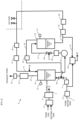
  • FIG. 1 illustrates a configuration of a gas solution supply device (ozone water supply device) in a first embodiment of the present invention
  • FIG. 2 illustrates a configuration of the gas solution supply device (ozone water supply device) in a second embodiment of the present invention
  • FIG. 3 illustrates a configuration of the gas solution supply device (ozone water supply device) in a third embodiment of the present invention
  • FIG. 4 illustrates a configuration of the gas solution supply device (ozone water supply device) in a fourth embodiment of the present invention
  • FIG. 5 shows a configuration of a variation of the gas solution supply device (ozone water supply device) of the first embodiment
  • FIG. 6 shows a configuration of a variation of the gas solution supply device (ozone water supply device) of the second embodiment
  • FIG. 7 shows a configuration of a variation of the gas solution supply device (ozone water supply device) of the third embodiment
  • FIG. 8 shows a configuration of a variation of the gas solution supply device (ozone water supply device) of the fourth embodiment.
  • FIG. 9 shows another example of the gas solution supply device (ozone water supply device).
  • FIG. 1 illustrates a configuration of the ozone water supply device of this embodiment.
  • an ozone water supply device 1 includes a gas supply line 2 through which ozone gas as a material of ozone water is supplied and a liquid supply line 3 through which pure water (DIW) as a material of ozone water is supplied.
  • DIW pure water
  • the gas supply line 2 is supplied with a first gas (e.g., oxygen gas) and a second gas (e.g., carbon dioxide gas, nitrogen gas, or mixed gas of carbon dioxide gas and nitrogen gas) as materials of ozone gas.
  • the gas supply line 2 includes a gas flow rate adjuster 4 and an ozonizer 5 .
  • the gas flow rate adjuster 4 adjusts a flow rate of the first gas and that of the second gas.
  • the ozonizer 5 generates ozone gas from the material gas (mixed gas of the first gas and the second gas) by electric discharge.
  • the liquid supply line 3 is supplied with pure water, with the flow rate of the pure water being adjusted by a flow regulating valve 6 and the flow rate of the pure water being measured by a flow sensor 7 .
  • the liquid supply line 3 is connected with a first gas-liquid separator 8 .
  • the first gas-liquid separator 8 is connected with a circulating supply line 9 , which circulates and supplies unused ozone water at a use point.
  • the circulating supply line 9 includes a flow sensor 10 for measuring the flow rate of unused ozone water at the use point and a pressure regulating valve 11 for adjusting a pressure of the unused ozone water at the use point.
  • the first gas-liquid separator 8 stores unused ozone water and includes a level sensor 12 for measuring a level of the ozone water.
  • the first gas-liquid separator 8 includes an exhaust line 13 for discharging undissolved ozone gas.
  • the exhaust line 13 includes an ozone gas decomposer 14 for decomposing ozone gas and a pressure regulating valve 15 for adjusting the pressure of ozone gas being exhausted.
  • a second gas-liquid separator 16 in which ozone water to be supplied to the use point is stored is provided at a stage subsequent to (downstream of) the first gas-liquid separator 8 , the first gas-liquid separator 8 and the second gas-liquid separator 16 being connected by an intermediate line 17 .
  • the intermediate line 17 includes a pressure booster pump 18 that increases the pressure of ozone water being supplied from the first gas-liquid separator 8 to the second gas-liquid separator 16 , a flow sensor 19 that measures the flow rate of ozone water being supplied to the second gas-liquid separator 16 , and a gas dissolving nozzle 20 that dissolves the ozone gas supplied from the gas supply line 2 in the ozone water supplied from the first gas-liquid separator 8 .
  • the ozone water from the gas dissolving nozzle 20 may be introduced from an upper portion of the second gas-liquid separator 16 .
  • the ozone water from the gas dissolving nozzle 20 may also be introduced from a lower portion of the second gas-liquid separator 16 . In that case, the gas dissolving nozzle 20 is preferably disposed in a lower portion of the second gas-liquid separator 16 .
  • the pressure booster pump 18 can be a centrifugal pump, a bellows pump, or a diaphragm pump, for example.
  • a portion of the pressure booster pump 18 that makes contact with ozone water and/or ozone gas is made of a material resistant to ozone water and ozone gas (e.g., fluorine resin).
  • the gas dissolving nozzle 20 can be an ejector or an aspirator, for example.
  • An ejector and an aspirator can dissolve ozone gas in pure water by making use of Venturi effect. When an ejector or an aspirator is used, regular replacement would be unnecessary and diffusion rate would be also improved compared to an ozone dissolver using hollow fiber membrane.
  • the gas dissolving nozzle 20 is preferably provided subsequent to the pressure booster pump 18 . If the gas dissolving nozzle 20 is provided at a stage preceding the pressure booster pump 18 , gas-liquid mixture would be supplied to the pressure booster pump 18 , resulting in lower pumping and pressure boosting performances of the pressure booster pump 18 and lower flow rate and pressure of ozone water being supplied.
  • the second gas-liquid separator 16 has a level sensor 21 for measuring the level of ozone water.
  • the second gas-liquid separator 16 also includes a discharge line 22 for discharging undissolved ozone gas.
  • the discharge line 22 includes a pressure regulating valve 23 for adjusting the pressure of ozone gas being discharged from the second gas-liquid separator 16 .
  • the discharge line 22 from the second gas-liquid separator 16 is connected with the exhaust line 13 from the first gas-liquid separator 8 .
  • the second gas-liquid separator 16 includes an ozone water supply line 24 for supplying ozone water to the use point.
  • the ozone water supply line 24 includes a flow sensor 25 for measuring the flow rate of the ozone water being supplied to the use point and a pressure sensor 26 for measuring the pressure of the ozone water being supplied to the use point.
  • the ozone water supply line 24 and the liquid supply line 3 each have a delivery line 27 branching from the ozone water supply line 24 and the liquid supply line 3 , respectively, the delivery line 27 being connected with the circulating supply line 9 .
  • the delivery line 27 includes an ozone water concentration meter 28 for measuring a concentration of ozone water.
  • the ozone water concentration meter 28 has a switching valve such that both a zero point of DIW can be measured and the concentration of ozone water can be checked.
  • pressure control is performed by the pressure regulating valve 11 of the circulating supply line 9 so that a value of the pressure sensor 26 on the ozone water supply line 24 is constant.
  • Pressure control is also performed with the pressure booster pump 18 on the intermediate line 17 so that the value of the flow sensor 25 on the ozone water supply line 24 is the same as the value of the flow sensor 19 on the intermediate line 17 .
  • flow rate control is performed with the flow regulating valve 6 on the liquid supply line 3 so that the difference between the value of the flow sensor 25 on the ozone water supply line 24 and the value of the flow sensor 10 on the circulating supply line 9 is the same as the value of the flow sensor 7 on the liquid supply line 3 .
  • gas flow rate in the gas supply line 2 is adjusted with the adjuster 4 based on the value of the ozone water concentration meter 28 on the delivery line 27 , and the gas concentration in the gas supply line 2 is adjusted with the ozonizer 5 (electric power discharged at the ozonizer 5 is adjusted), thus controlling the gas flow rate and the gas concentration (feed rate of ozone gas).
  • the ozone water supply device 1 of the first embodiment has the pressure booster pump 18 at a stage preceding the second gas-liquid separator 16 as described above, the pressure in the second gas-liquid separator 16 can be increased, enabling a high concentration of ozone water. Further, providing the second gas-liquid separator 16 at a stage subsequent to the pressure booster pump 18 results in damper effect, making it possible to suppress fluctuations in the delivery pressure of ozone water being supplied from the second gas-liquid separator 16 to the use point.
  • this embodiment can recycle unused ozone water at the use point and reduce usage of ozone gas and DIW as materials of ozone water. Since in this case the first gas-liquid separator 8 , to which unused ozone water at the use point is supplied, is provided at a stage preceding the pressure booster pump 18 , there is no need for a pump to increase the pressure of the unused ozone water.
  • the ozone water supply device 1 according to a second embodiment of the present invention is discussed.
  • differences of the ozone water supply device 1 of the second embodiment from the first embodiment are focused.
  • the configuration and operation of the second embodiment are similar to the first embodiment.
  • FIG. 2 illustrates a configuration of the ozone water supply device 1 of this embodiment.
  • a second gas dissolving nozzle 29 is provided on the liquid supply line 3 and the discharge line 22 from the second gas-liquid separator 16 is connected to the second gas dissolving nozzle 29 .
  • the second gas dissolving nozzle 29 dissolves undissolved excess ozone gas discharged from the second gas-liquid separator 16 in pure water being supplied to the liquid supply line 3 .
  • the first gas-liquid separator 8 is supplied with ozone water from the liquid supply line 3 .
  • the ozone water from the gas dissolving nozzle 29 may be introduced from an upper portion of the first gas-liquid separator 8 .
  • the ozone water from the gas dissolving nozzle 29 may also be introduced from a lower portion of the first gas-liquid separator 8 .
  • the gas dissolving nozzle 29 is preferably disposed in a lower portion of the first gas-liquid separator 8 .
  • pressure control is also performed with the pressure regulating valve 11 on the circulating supply line 9 so that the value of the pressure sensor 26 on the ozone water supply line 24 is constant as with the first embodiment.
  • Flow rate control is also performed with the pressure booster pump 18 on the intermediate line 17 so that the value of the flow sensor 25 on the ozone water supply line 24 is the same as the value of the flow sensor 19 on the intermediate line 17 .
  • flow rate control is performed with the flow regulating valve 6 on the liquid supply line 3 so that the difference between the value of the flow sensor 25 on the ozone water supply line 24 and the value of the flow sensor 10 on the circulating supply line 9 is the same as the value of the flow sensor 7 on the liquid supply line 3 .
  • gas flow rate in the gas supply line 2 is adjusted with the adjuster 4 based on the value of the ozone water concentration meter 28 on the delivery line 27 , and the gas concentration in the gas supply line 2 is adjusted with the ozonizer 5 (electric power discharged at the ozonizer 5 is adjusted), thus controlling the gas flow rate and the gas concentration (the feed rate of ozone gas).
  • the ozone water supply device 1 of the second embodiment as described above also provides similar effects to the first embodiment.
  • this embodiment can recycle undissolved excess ozone gas discharged from the second gas-liquid separator 16 , further reducing the usage of ozone gas as a material of ozone water. Further, this embodiment enables a further higher concentration of ozone water than in the first embodiment.
  • the ozone water supply device 1 according to a third embodiment of the present invention is described.
  • differences of the ozone water supply device 1 of the third embodiment from the second embodiment are focused.
  • the configuration and operation of the third embodiment are similar to the second embodiment.
  • FIG. 3 illustrates a configuration of the ozone water supply device 1 of this embodiment. As shown in FIG. 3 , this embodiment does not include the circulating supply line 9 to circulate unused ozone water at the use point and supply it to the first gas-liquid separator 8 . Thus, the pressure in the first gas-liquid separator 8 can be made high compared with the first and second embodiments, allowing a higher concentration of ozone water.
  • pressure control is performed by the pressure regulating valve 11 of the circulating supply line 9 so that the value of the flow sensor 25 or the pressure sensor 26 on the ozone water supply line 24 is constant. Further, flow rate control is performed with the pressure booster pump 18 on the intermediate line 17 so that the value of flow sensor 25 on the ozone water supply line 24 is the same as the value of the flow sensor 19 on the intermediate line 17 , and flow rate control is further performed with the flow regulating valve 6 on the liquid supply line 3 so that the value of the flow sensor 7 on the liquid supply line 3 is the same as well.
  • gas flow rate in the gas supply line 2 is adjusted with the adjuster 4 based on the value of the ozone water concentration meter 28 on the delivery line 27 , and the gas concentration in the gas supply line 2 is adjusted with the ozonizer 5 (electric power discharged at the ozonizer 5 is adjusted), thus controlling the gas flow rate and the gas concentration (the feed rate of ozone gas).
  • the ozone water supply device 1 of the third embodiment as described above also provides similar effects to the second embodiment.
  • this embodiment does not allow recycling of unused ozone water at the use point since the circulating supply line 9 is not present, further higher concentration is possible than in the second embodiment.
  • the ozone water supply device 1 according to a fourth embodiment of the present invention is discussed.
  • differences of the ozone water supply device 1 of the fourth embodiment from the first embodiment are focused.
  • the configuration and operation of the fourth embodiment are similar to the first embodiment.
  • FIG. 4 illustrates a configuration of the ozone water supply device 1 of this embodiment.
  • the liquid supply line 3 is not connected with the first gas-liquid separator 8 but with the pressure booster pump 18 . Further, the liquid supply line 3 meets an ozone water supply line 30 on which ozone water from the first gas-liquid separator 8 is supplied. Further, the discharge line 22 of the second gas-liquid separator 16 is not connected with the exhaust line 13 but with the circulating supply line 9 .
  • the ozone water supply device 1 of the fourth embodiment as described above also provides similar effects to the first embodiment.
  • the ozone water supply device 1 can have an internal cleaning function for the gas-liquid separators 8 , 16 .
  • examples (variations) of the ozone water supply device 1 having a cleaning function for the gas-liquid separators is described.
  • FIG. 5 shows a configuration of a variation (Variation 1) of the ozone water supply device 1 of the first embodiment.
  • a valve 31 is provided on the liquid supply line 3 , on which pure water is supplied, and a valve 32 is provided on the ozone water supply line 24 , which supplies ozone water to the use point.
  • a valve 33 is provided on the circulating supply line 9 , which returns unused ozone water at the use point to the ozone water supply device 1 .
  • a valve 34 is provided on the exhaust line 13 from the first gas-liquid separator 8 to an exhaust port, and a valve 35 is provided on a drain line 130 branching from the exhaust line 13 .
  • the exhaust line 13 further includes a valve 36 having an opening adjusting function.
  • open and close control is performed such that the valve 32 , the valve 33 , the valve 34 and the valve 36 are opened and the valve 35 is closed.
  • the valve 31 is controlled for opening and closing according to the level in the first gas-liquid separator 8 as detected by the level sensor 12 . Specifically, open and close control is performed such that the valve 31 is closed when the level in the first gas-liquid separator 8 is high and the valve 31 is opened when the level in the first gas-liquid separator 8 is low.
  • the valve 31 is opened and the degree of opening of the valve 36 is reduced, thus causing gas in the first gas-liquid separator 8 to gradually escape and the first gas-liquid separator 8 to be filled with pure water. Since the valve 32 is closed and the valve 40 within the ozone water concentration meter 28 is also closed, the level in the second gas-liquid separator 16 gradually rises, until the second gas-liquid separator 16 is filled with pure water. In this manner, insides of the first gas-liquid separator 8 and the second gas-liquid separator 16 can be cleaned with pure water.
  • ozone water can be supplied to the use point and also the insides of the first gas-liquid separator 8 and the second gas-liquid separator 16 can be cleaned with pure water.
  • Variation 2 a variation of the ozone water supply device 1 according to the second embodiment is described.
  • differences of Variation 2 from Variation 1 are focused.
  • the configuration and operation of Variation 2 are similar to Variation 1.
  • FIG. 6 shows a configuration of the ozone water supply device 1 in Variation 2. Pure water from the second gas-liquid separator 16 is sent from the discharge line 22 to the first gas-liquid separator 8 via the nozzle 29 . The valve 36 is opened and pure water from the first gas-liquid separator 8 is discharged to the drain from the drain line 130 branching from the exhaust line 13 .
  • ozone water can also be supplied to the use point and the insides of the first gas-liquid separator 8 and the second gas-liquid separator 16 can be cleaned with pure water by performing open and close control of the valves 31 to 36 as with Variation 1.
  • Variation 3 a variation of the ozone water supply device 1 according to the third embodiment is described.
  • differences of Variation 3 from Variation 1 are focused.
  • the configuration and operation of Variation 3 are similar to Variation 1.
  • FIG. 7 shows a configuration of the ozone water supply device 1 in Variation 3. Since the ozone water supply device 1 of Variation 3 does not include the circulating supply line 9 , it does not include the valve 33 provided on the circulating supply line 9 either. Pure water from the second gas-liquid separator 16 is sent from the discharge line 22 to the first gas-liquid separator 8 via the nozzle 29 . The valve 36 is opened and pure water from the first gas-liquid separator 8 is discharged to the drain from the drain line 130 branching from the exhaust line 13 .
  • ozone water can also be supplied to the use point and the insides of the first gas-liquid separator 8 and the second gas-liquid separator 16 can be cleaned with pure water by performing open and close control of the valves 31 , 32 , 34 , 35 , 36 as with Variation 1.
  • Variation 4 a variation of the ozone water supply device 1 according to the fourth embodiment is described.
  • differences of Variation 4 from Variation 1 are focused.
  • the configuration and operation of Variation 4 are similar to Variation 1.
  • FIG. 8 shows a configuration of the ozone water supply device 1 in Variation 4.
  • the valve 36 with an opening adjusting function is not provided on the exhaust line 13 .
  • a valve 37 is provided on the ozone water supply line 30 from the first gas-liquid separator 8 .
  • open and close control is performed such that the valve 32 , valve 33 , the valve 34 and the valve 37 are opened and the valve 35 is closed.
  • the valve 31 is controlled for opening and closing according to the level in the first gas-liquid separator 8 as detected by the level sensor 12 . Specifically, open and close control is performed such that the valve 31 is closed when the level in the first gas-liquid separator 8 is high and the valve 31 is opened when the level in the first gas-liquid separator 8 is low.
  • the level in the second gas-liquid separator 16 gradually rises since the valve 32 and the valve 37 are closed, until the second gas-liquid separator 16 is filled with pure water. In this manner, the inside of the second gas-liquid separator 16 can be cleaned with pure water.
  • valve 34 Since in this case the valve 34 is closed and the valve 35 is opened, pure water from the first gas-liquid separator 8 is discharged to the drain from the drain line 130 branching from the exhaust line 13 .
  • ozone water can also be supplied to the use point and the insides of the first gas-liquid separator 8 and the second gas-liquid separator 16 can be cleaned with pure water by performing open and close control of the valves 31 to 35 and 37 as described above.
  • FIG. 9 shows another example of the ozone water supply device 1 .
  • the first gas-liquid separator 8 is not provided, while a valve 39 is provided on a supply line 38 which supplies ozone water generated via the gas dissolving nozzle 20 to the second gas-liquid separator 16 .
  • the exhaust line 13 is provided at the second gas-liquid separator 16 .
  • open and close control is performed so that the valve 32 , the valve 34 and the valve 39 are opened and the valve 35 is closed.
  • the valve 31 is controlled for opening and closing according to the level in the second gas-liquid separator 16 as detected by the level sensor 21 . Specifically, open and close control is performed such that the valve 31 is closed when the level in the second gas-liquid separator 16 is high and the valve 31 is opened when the level in the second gas-liquid separator 16 is low.
  • the level in the second gas-liquid separator 16 gradually rises since the valve 32 is closed, until the second gas-liquid separator 16 is filled with pure water. In this manner, the inside of the second gas-liquid separator 16 can be cleaned with pure water.
  • valve 34 Since in this case the valve 34 is closed and the valve 35 is opened, pure water from the second gas-liquid separator 16 is discharged to the drain from the drain line 130 branching from the exhaust line 13 .
  • ozone water can also be supplied to the use point and the inside of the second gas-liquid separator 16 can be cleaned with pure water by performing open and close control of the valves 31 , 32 , 34 , 35 , 39 as described above.
  • the gas solution supply devices according to the present invention has the effects of enabling a high concentration of gas solution and suppressing fluctuations in the delivery pressure of gas solution, and can be advantageously used for production of ozone water and the like.

Landscapes

  • Chemical & Material Sciences (AREA)
  • Chemical Kinetics & Catalysis (AREA)
  • Organic Chemistry (AREA)
  • Health & Medical Sciences (AREA)
  • General Health & Medical Sciences (AREA)
  • Toxicology (AREA)
  • Inorganic Chemistry (AREA)
  • Cleaning Or Drying Semiconductors (AREA)
  • Oxygen, Ozone, And Oxides In General (AREA)

Abstract

A gas solution supply device 1 includes: a first gas-liquid separator 8 in which gas solution is stored; a second gas-liquid separator 16 provided at a stage subsequent to the first gas-liquid separator 8 and in which gas solution to be supplied to a use point is stored; an intermediate line 17 provided between the first gas-liquid separator 8 and the second gas-liquid separator 16; a pressure booster pump 18 provided on the intermediate line 17 and increases a pressure of gas solution being supplied from the first gas-liquid separator 8 to the second gas-liquid separator 16; a gas supply line 2 that supplies gas as a material of the gas solution; and a gas dissolving unit 20 provided on the intermediate line 17 and dissolves the gas supplied from the gas supply line 2 in the gas solution supplied from the first gas-liquid separator 8.

Description

BACKGROUND OF THE INVENTION Field of the Invention
The present invention relates to a gas solution supply device for supplying gas solution, and in particular to a technique for achieving a high concentration of gas solution.
Description of the Related Art
Ozone water has been used for cleaning electronic components such as semiconductor devices and liquid crystal. Ozone water is produced by dissolving ozone gas in ultrapure water and then supplied to a use point (such as a semiconductor device factory and an electronic component factory).
In a conventional ozone water producing device, ozone water produced by dissolving ozone gas in ultrapure water is stored in a gas-liquid separator and the ozone water is delivered from the gas-liquid separator to the use point by a pump located at a stage subsequent to the gas-liquid separator (downstream thereof), for example (see Japanese Patent Laid-Open No. 2019-155221, for instance).
However, since a conventional device has only one gas-liquid separator and a pump (a pump for delivering ozone water to the use point) is provided subsequent to the gas-liquid separator, a pressure in the gas-liquid separator is difficult to increase, making it difficult to achieve a high concentration of ozone water. Where the pump is an air-driven pump, it is also difficult to suppress fluctuations in delivery pressure of ozone water due to influence of pulsation of the pump.
An object of the present invention, which has been made in view of these challenges, is to provide a gas solution supply device that can achieve a high concentration of gas solution and can suppress fluctuations in the delivery pressure of gas solution.
SUMMARY OF THE INVENTION
A gas solution supply device according to the present invention includes: a first gas-liquid separator in which gas solution is stored; a second gas-liquid separator which is provided at a stage subsequent to the first gas-liquid separator and in which gas solution to be supplied to a use point is stored; an intermediate line provided between the first gas-liquid separator and the second gas-liquid separator; a pressure booster pump that is provided on the intermediate line and increases a pressure of gas solution being supplied from the first gas-liquid separator to the second gas-liquid separator; a gas supply line that supplies gas as a material of the gas solution; and a gas dissolving unit that is provided on the intermediate line and dissolves the gas supplied from the gas supply line in the gas solution supplied from the first gas-liquid separator.
In this arrangement, the pressure booster pump is provided at a stage preceding the second gas-liquid separator, so that the pressure in the second gas-liquid separator can be increased and a high concentration of gas solution is possible. In addition, providing the second gas-liquid separator at a stage subsequent to the pressure booster pump results in damper effect, making it possible to suppress fluctuations in delivery pressure of gas solution being supplied from the second gas-liquid separator to the use point.
In the gas solution supply device of the present invention, the first gas-liquid separator may include a circulating supply line for circulating and supplying unused gas solution at the use point.
With this arrangement, unused gas solution at the use point can be recycled and usage of gas as a material of gas solution can be reduced. Since in this case the first gas-liquid separator, to which unused gas solution at the use point is supplied, is provided at a stage preceding the pressure booster pump, there is no need for a pump to increase the pressure of the unused gas solution.
In the gas solution supply device of the present invention, the first gas-liquid separator may include a liquid supply line through which liquid as a material of the gas solution is supplied, and the liquid supply line may include a second gas dissolving unit that dissolves undissolved excess gas discharged from the second gas-liquid separator in the liquid as a material of the gas solution.
With this arrangement, undissolved excess gas discharged from the second gas-liquid separator can be recycled and usage of gas as a material of gas solution can be reduced.
The gas solution supply device of the present invention may include: a first valve provided on a liquid supply line that supplies liquid as a material of the gas solution; a second valve provided on a gas solution supply line that supplies the gas solution to the use point; a third valve provided on an exhaust line from the first gas-liquid separator to an exhaust port; a fourth valve provided on a drain line branching from the exhaust line; and a control unit that performs open and close control of the first valve, the second valve, the third valve, and the fourth valve. The control unit may be configured to: when the gas solution is to be supplied to the use point, perform control to open the first valve, the second valve and the third valve and close the fourth valve, and when the first gas-liquid separator and the second gas-liquid separator are to be cleaned, perform control to close the second valve and the third valve and open the first valve and the fourth valve.
With this arrangement, gas solution can be supplied to the use point by opening the first, the second and the third valves and closing the fourth valve, while the first gas-liquid separator and the second gas-liquid separator can be cleaned by closing the second and the third valves and opening the first and the fourth valves.
A method according to the present invention is a method for execution in a gas solution supply device, the gas solution supply device including: a first gas-liquid separator in which gas solution is stored; a second gas-liquid separator which is provided at a stage subsequent to the first gas-liquid separator and in which gas solution to be supplied to a use point is stored; an intermediate line provided between the first gas-liquid separator and the second gas-liquid separator; and a pressure booster pump that is provided on the intermediate line and increases a pressure of gas solution being supplied from the first gas-liquid separator to the second gas-liquid separator. The method includes the steps of supplying gas as a material of the gas solution to the intermediate line, and dissolving the supplied gas in the gas solution supplied from the first gas-liquid separator.
This method can also increase the pressure in the second gas-liquid separator and enable a high concentration of gas solution because the pressure booster pump is provided at a stage preceding the second gas-liquid separator as with the device above. Further, providing the second gas-liquid separator at a stage subsequent to the pressure booster pump results in damper effect, making it possible to suppress fluctuations in delivery pressure of gas solution being supplied from the second gas-liquid separator to the use point.
In the method of the present invention, the gas solution supply device may include: a first valve provided on a liquid supply line that supplies liquid as a material of the gas solution; a second valve provided on a gas solution supply line that supplies the gas solution to the use point; a third valve provided on an exhaust line from the first gas-liquid separator to an exhaust port; and a fourth valve provided on a drain line branching from the exhaust line. The method may include: when the gas solution is to be supplied to the use point, opening the first valve, the second valve and the third valve and closing the fourth valve, and when the first gas-liquid separator and the second gas-liquid separator are to be cleaned, closing the second valve and the third valve and opening the first valve and the fourth valve.
According to this method, gas solution can be supplied to the use point by opening the first, the second and the third valves and closing the fourth valve, while the first gas-liquid separator and the second gas-liquid separator can be cleaned by closing the second and the third valves and opening the first and the fourth valves.
The present invention can achieve a high concentration of gas solution and can suppress fluctuations in the delivery pressure of gas solution.
BRIEF DESCRIPTION OF THE DRAWINGS
FIG. 1 illustrates a configuration of a gas solution supply device (ozone water supply device) in a first embodiment of the present invention;
FIG. 2 illustrates a configuration of the gas solution supply device (ozone water supply device) in a second embodiment of the present invention;
FIG. 3 illustrates a configuration of the gas solution supply device (ozone water supply device) in a third embodiment of the present invention;
FIG. 4 illustrates a configuration of the gas solution supply device (ozone water supply device) in a fourth embodiment of the present invention;
FIG. 5 shows a configuration of a variation of the gas solution supply device (ozone water supply device) of the first embodiment;
FIG. 6 shows a configuration of a variation of the gas solution supply device (ozone water supply device) of the second embodiment;
FIG. 7 shows a configuration of a variation of the gas solution supply device (ozone water supply device) of the third embodiment;
FIG. 8 shows a configuration of a variation of the gas solution supply device (ozone water supply device) of the fourth embodiment; and
FIG. 9 shows another example of the gas solution supply device (ozone water supply device).
DETAILED DESCRIPTION OF THE PREFERRED EMBODIMENTS
Gas solution supply devices according to embodiments of the present invention are now described with reference to the drawings. The embodiments herein illustrate ozone water supply devices that are used for production of ozone water and the like.
First Embodiment
Configuration of an ozone water supply device according to a first embodiment of the present invention is described with reference to a drawing. FIG. 1 illustrates a configuration of the ozone water supply device of this embodiment. As shown in FIG. 1 , an ozone water supply device 1 includes a gas supply line 2 through which ozone gas as a material of ozone water is supplied and a liquid supply line 3 through which pure water (DIW) as a material of ozone water is supplied.
The gas supply line 2 is supplied with a first gas (e.g., oxygen gas) and a second gas (e.g., carbon dioxide gas, nitrogen gas, or mixed gas of carbon dioxide gas and nitrogen gas) as materials of ozone gas. The gas supply line 2 includes a gas flow rate adjuster 4 and an ozonizer 5. The gas flow rate adjuster 4 adjusts a flow rate of the first gas and that of the second gas. The ozonizer 5 generates ozone gas from the material gas (mixed gas of the first gas and the second gas) by electric discharge.
The liquid supply line 3 is supplied with pure water, with the flow rate of the pure water being adjusted by a flow regulating valve 6 and the flow rate of the pure water being measured by a flow sensor 7. The liquid supply line 3 is connected with a first gas-liquid separator 8. The first gas-liquid separator 8 is connected with a circulating supply line 9, which circulates and supplies unused ozone water at a use point.
The circulating supply line 9 includes a flow sensor 10 for measuring the flow rate of unused ozone water at the use point and a pressure regulating valve 11 for adjusting a pressure of the unused ozone water at the use point.
The first gas-liquid separator 8 stores unused ozone water and includes a level sensor 12 for measuring a level of the ozone water. The first gas-liquid separator 8 includes an exhaust line 13 for discharging undissolved ozone gas. The exhaust line 13 includes an ozone gas decomposer 14 for decomposing ozone gas and a pressure regulating valve 15 for adjusting the pressure of ozone gas being exhausted.
A second gas-liquid separator 16 in which ozone water to be supplied to the use point is stored is provided at a stage subsequent to (downstream of) the first gas-liquid separator 8, the first gas-liquid separator 8 and the second gas-liquid separator 16 being connected by an intermediate line 17.
The intermediate line 17 includes a pressure booster pump 18 that increases the pressure of ozone water being supplied from the first gas-liquid separator 8 to the second gas-liquid separator 16, a flow sensor 19 that measures the flow rate of ozone water being supplied to the second gas-liquid separator 16, and a gas dissolving nozzle 20 that dissolves the ozone gas supplied from the gas supply line 2 in the ozone water supplied from the first gas-liquid separator 8. The ozone water from the gas dissolving nozzle 20 may be introduced from an upper portion of the second gas-liquid separator 16. The ozone water from the gas dissolving nozzle 20 may also be introduced from a lower portion of the second gas-liquid separator 16. In that case, the gas dissolving nozzle 20 is preferably disposed in a lower portion of the second gas-liquid separator 16.
The pressure booster pump 18 can be a centrifugal pump, a bellows pump, or a diaphragm pump, for example. A portion of the pressure booster pump 18 that makes contact with ozone water and/or ozone gas is made of a material resistant to ozone water and ozone gas (e.g., fluorine resin).
The gas dissolving nozzle 20 can be an ejector or an aspirator, for example. An ejector and an aspirator can dissolve ozone gas in pure water by making use of Venturi effect. When an ejector or an aspirator is used, regular replacement would be unnecessary and diffusion rate would be also improved compared to an ozone dissolver using hollow fiber membrane. The gas dissolving nozzle 20 is preferably provided subsequent to the pressure booster pump 18. If the gas dissolving nozzle 20 is provided at a stage preceding the pressure booster pump 18, gas-liquid mixture would be supplied to the pressure booster pump 18, resulting in lower pumping and pressure boosting performances of the pressure booster pump 18 and lower flow rate and pressure of ozone water being supplied.
The second gas-liquid separator 16 has a level sensor 21 for measuring the level of ozone water. The second gas-liquid separator 16 also includes a discharge line 22 for discharging undissolved ozone gas. The discharge line 22 includes a pressure regulating valve 23 for adjusting the pressure of ozone gas being discharged from the second gas-liquid separator 16. In this embodiment, the discharge line 22 from the second gas-liquid separator 16 is connected with the exhaust line 13 from the first gas-liquid separator 8.
The second gas-liquid separator 16 includes an ozone water supply line 24 for supplying ozone water to the use point. The ozone water supply line 24 includes a flow sensor 25 for measuring the flow rate of the ozone water being supplied to the use point and a pressure sensor 26 for measuring the pressure of the ozone water being supplied to the use point.
The ozone water supply line 24 and the liquid supply line 3 each have a delivery line 27 branching from the ozone water supply line 24 and the liquid supply line 3, respectively, the delivery line 27 being connected with the circulating supply line 9. The delivery line 27 includes an ozone water concentration meter 28 for measuring a concentration of ozone water. The ozone water concentration meter 28 has a switching valve such that both a zero point of DIW can be measured and the concentration of ozone water can be checked.
With the ozone water supply device 1 of this embodiment, pressure control is performed by the pressure regulating valve 11 of the circulating supply line 9 so that a value of the pressure sensor 26 on the ozone water supply line 24 is constant. Pressure control is also performed with the pressure booster pump 18 on the intermediate line 17 so that the value of the flow sensor 25 on the ozone water supply line 24 is the same as the value of the flow sensor 19 on the intermediate line 17. Alternatively, flow rate control is performed with the flow regulating valve 6 on the liquid supply line 3 so that the difference between the value of the flow sensor 25 on the ozone water supply line 24 and the value of the flow sensor 10 on the circulating supply line 9 is the same as the value of the flow sensor 7 on the liquid supply line 3. Further, gas flow rate in the gas supply line 2 is adjusted with the adjuster 4 based on the value of the ozone water concentration meter 28 on the delivery line 27, and the gas concentration in the gas supply line 2 is adjusted with the ozonizer 5 (electric power discharged at the ozonizer 5 is adjusted), thus controlling the gas flow rate and the gas concentration (feed rate of ozone gas).
Since the ozone water supply device 1 of the first embodiment has the pressure booster pump 18 at a stage preceding the second gas-liquid separator 16 as described above, the pressure in the second gas-liquid separator 16 can be increased, enabling a high concentration of ozone water. Further, providing the second gas-liquid separator 16 at a stage subsequent to the pressure booster pump 18 results in damper effect, making it possible to suppress fluctuations in the delivery pressure of ozone water being supplied from the second gas-liquid separator 16 to the use point.
In addition, this embodiment can recycle unused ozone water at the use point and reduce usage of ozone gas and DIW as materials of ozone water. Since in this case the first gas-liquid separator 8, to which unused ozone water at the use point is supplied, is provided at a stage preceding the pressure booster pump 18, there is no need for a pump to increase the pressure of the unused ozone water.
Second Embodiment
Next, the ozone water supply device 1 according to a second embodiment of the present invention is discussed. Here, differences of the ozone water supply device 1 of the second embodiment from the first embodiment are focused. Unless otherwise noted, the configuration and operation of the second embodiment are similar to the first embodiment.
FIG. 2 illustrates a configuration of the ozone water supply device 1 of this embodiment. As shown in FIG. 2 , in the second embodiment, a second gas dissolving nozzle 29 is provided on the liquid supply line 3 and the discharge line 22 from the second gas-liquid separator 16 is connected to the second gas dissolving nozzle 29. The second gas dissolving nozzle 29 dissolves undissolved excess ozone gas discharged from the second gas-liquid separator 16 in pure water being supplied to the liquid supply line 3. The first gas-liquid separator 8 is supplied with ozone water from the liquid supply line 3. The ozone water from the gas dissolving nozzle 29 may be introduced from an upper portion of the first gas-liquid separator 8. The ozone water from the gas dissolving nozzle 29 may also be introduced from a lower portion of the first gas-liquid separator 8. In that case, the gas dissolving nozzle 29 is preferably disposed in a lower portion of the first gas-liquid separator 8.
In the ozone water supply device 1 of this embodiment, pressure control is also performed with the pressure regulating valve 11 on the circulating supply line 9 so that the value of the pressure sensor 26 on the ozone water supply line 24 is constant as with the first embodiment. Flow rate control is also performed with the pressure booster pump 18 on the intermediate line 17 so that the value of the flow sensor 25 on the ozone water supply line 24 is the same as the value of the flow sensor 19 on the intermediate line 17. Alternatively, flow rate control is performed with the flow regulating valve 6 on the liquid supply line 3 so that the difference between the value of the flow sensor 25 on the ozone water supply line 24 and the value of the flow sensor 10 on the circulating supply line 9 is the same as the value of the flow sensor 7 on the liquid supply line 3. Further, gas flow rate in the gas supply line 2 is adjusted with the adjuster 4 based on the value of the ozone water concentration meter 28 on the delivery line 27, and the gas concentration in the gas supply line 2 is adjusted with the ozonizer 5 (electric power discharged at the ozonizer 5 is adjusted), thus controlling the gas flow rate and the gas concentration (the feed rate of ozone gas).
The ozone water supply device 1 of the second embodiment as described above also provides similar effects to the first embodiment.
Besides, this embodiment can recycle undissolved excess ozone gas discharged from the second gas-liquid separator 16, further reducing the usage of ozone gas as a material of ozone water. Further, this embodiment enables a further higher concentration of ozone water than in the first embodiment.
Third Embodiment
Next, the ozone water supply device 1 according to a third embodiment of the present invention is described. Here, differences of the ozone water supply device 1 of the third embodiment from the second embodiment are focused. Unless otherwise noted, the configuration and operation of the third embodiment are similar to the second embodiment.
FIG. 3 illustrates a configuration of the ozone water supply device 1 of this embodiment. As shown in FIG. 3 , this embodiment does not include the circulating supply line 9 to circulate unused ozone water at the use point and supply it to the first gas-liquid separator 8. Thus, the pressure in the first gas-liquid separator 8 can be made high compared with the first and second embodiments, allowing a higher concentration of ozone water.
With the ozone water supply device 1 of this embodiment, pressure control is performed by the pressure regulating valve 11 of the circulating supply line 9 so that the value of the flow sensor 25 or the pressure sensor 26 on the ozone water supply line 24 is constant. Further, flow rate control is performed with the pressure booster pump 18 on the intermediate line 17 so that the value of flow sensor 25 on the ozone water supply line 24 is the same as the value of the flow sensor 19 on the intermediate line 17, and flow rate control is further performed with the flow regulating valve 6 on the liquid supply line 3 so that the value of the flow sensor 7 on the liquid supply line 3 is the same as well. Moreover, gas flow rate in the gas supply line 2 is adjusted with the adjuster 4 based on the value of the ozone water concentration meter 28 on the delivery line 27, and the gas concentration in the gas supply line 2 is adjusted with the ozonizer 5 (electric power discharged at the ozonizer 5 is adjusted), thus controlling the gas flow rate and the gas concentration (the feed rate of ozone gas).
The ozone water supply device 1 of the third embodiment as described above also provides similar effects to the second embodiment.
Although this embodiment does not allow recycling of unused ozone water at the use point since the circulating supply line 9 is not present, further higher concentration is possible than in the second embodiment.
Fourth Embodiment
Next, the ozone water supply device 1 according to a fourth embodiment of the present invention is discussed. Here, differences of the ozone water supply device 1 of the fourth embodiment from the first embodiment are focused. Unless otherwise noted, the configuration and operation of the fourth embodiment are similar to the first embodiment.
FIG. 4 illustrates a configuration of the ozone water supply device 1 of this embodiment. As shown in FIG. 4 , in this embodiment, the liquid supply line 3 is not connected with the first gas-liquid separator 8 but with the pressure booster pump 18. Further, the liquid supply line 3 meets an ozone water supply line 30 on which ozone water from the first gas-liquid separator 8 is supplied. Further, the discharge line 22 of the second gas-liquid separator 16 is not connected with the exhaust line 13 but with the circulating supply line 9.
The ozone water supply device 1 of the fourth embodiment as described above also provides similar effects to the first embodiment.
(Internal Cleaning of Gas-Liquid Separators)
The ozone water supply device 1 can have an internal cleaning function for the gas- liquid separators 8, 16. In the following, examples (variations) of the ozone water supply device 1 having a cleaning function for the gas-liquid separators is described.
(Variation 1)
FIG. 5 shows a configuration of a variation (Variation 1) of the ozone water supply device 1 of the first embodiment. As shown in FIG. 5 , in Variation 1, a valve 31 is provided on the liquid supply line 3, on which pure water is supplied, and a valve 32 is provided on the ozone water supply line 24, which supplies ozone water to the use point. A valve 33 is provided on the circulating supply line 9, which returns unused ozone water at the use point to the ozone water supply device 1. Further, a valve 34 is provided on the exhaust line 13 from the first gas-liquid separator 8 to an exhaust port, and a valve 35 is provided on a drain line 130 branching from the exhaust line 13. The exhaust line 13 further includes a valve 36 having an opening adjusting function. These valves 31 to 36 can be controlled for opening and closing by a control unit (not shown) provided in the ozone water supply device 1.
In Variation 1, when ozone water is to be supplied to the use point, open and close control is performed such that the valve 32, the valve 33, the valve 34 and the valve 36 are opened and the valve 35 is closed. The valve 31 is controlled for opening and closing according to the level in the first gas-liquid separator 8 as detected by the level sensor 12. Specifically, open and close control is performed such that the valve 31 is closed when the level in the first gas-liquid separator 8 is high and the valve 31 is opened when the level in the first gas-liquid separator 8 is low.
In contrast, when supply of ozone water to the use point is stopped and the gas- liquid separators 8, 16 are to be cleaned, open and close control is performed such that the valve 31 and the valve 35 are opened, the degree of opening of the valve 36 is reduced, and the valve 32, the valve 33 and the valve 34 are closed. In doing so, the level sensors 12, 21 are placed in a state where their high-level warning function is disabled. Further, supply of ozone gas from the gas supply line 2 is also stopped.
Once pure water is supplied from the liquid supply line 3, the valve 31 is opened and the degree of opening of the valve 36 is reduced, thus causing gas in the first gas-liquid separator 8 to gradually escape and the first gas-liquid separator 8 to be filled with pure water. Since the valve 32 is closed and the valve 40 within the ozone water concentration meter 28 is also closed, the level in the second gas-liquid separator 16 gradually rises, until the second gas-liquid separator 16 is filled with pure water. In this manner, insides of the first gas-liquid separator 8 and the second gas-liquid separator 16 can be cleaned with pure water.
With the valve 32 being closed, pure water from the second gas-liquid separator 16 is sent from the discharge line 22 to the exhaust line 13. Then, the pure water is discharged to a drain from the drain line 130 branching from the exhaust line 13.
In this case, as the valve 34 is closed and the valve 35 is opened, pure water from the first gas-liquid separator 8 is discharged to the drain from the drain line 130 branching from the exhaust line 13. In a case where an ozone decomposer (not shown) is provided on the drain line 130, the insides of the gas- liquid separators 8, 16 can be cleaned with ozone water instead of pure water (ozone water has higher cleaning effect than pure water) by not stopping the supply of ozone gas.
According to Variation 1, by performing open and close control of the valves 31 to 36 as described above, ozone water can be supplied to the use point and also the insides of the first gas-liquid separator 8 and the second gas-liquid separator 16 can be cleaned with pure water.
(Variation 2)
Next, a variation (Variation 2) of the ozone water supply device 1 according to the second embodiment is described. Here, differences of Variation 2 from Variation 1 are focused. Unless otherwise noted, the configuration and operation of Variation 2 are similar to Variation 1.
FIG. 6 shows a configuration of the ozone water supply device 1 in Variation 2. Pure water from the second gas-liquid separator 16 is sent from the discharge line 22 to the first gas-liquid separator 8 via the nozzle 29. The valve 36 is opened and pure water from the first gas-liquid separator 8 is discharged to the drain from the drain line 130 branching from the exhaust line 13.
In Variation 2 as described above, ozone water can also be supplied to the use point and the insides of the first gas-liquid separator 8 and the second gas-liquid separator 16 can be cleaned with pure water by performing open and close control of the valves 31 to 36 as with Variation 1.
(Variation 3)
Next, a variation (Variation 3) of the ozone water supply device 1 according to the third embodiment is described. Here, differences of Variation 3 from Variation 1 are focused. Unless otherwise noted, the configuration and operation of Variation 3 are similar to Variation 1.
FIG. 7 shows a configuration of the ozone water supply device 1 in Variation 3. Since the ozone water supply device 1 of Variation 3 does not include the circulating supply line 9, it does not include the valve 33 provided on the circulating supply line 9 either. Pure water from the second gas-liquid separator 16 is sent from the discharge line 22 to the first gas-liquid separator 8 via the nozzle 29. The valve 36 is opened and pure water from the first gas-liquid separator 8 is discharged to the drain from the drain line 130 branching from the exhaust line 13.
In Variation 3 as described above, ozone water can also be supplied to the use point and the insides of the first gas-liquid separator 8 and the second gas-liquid separator 16 can be cleaned with pure water by performing open and close control of the valves 31, 32, 34, 35, 36 as with Variation 1.
(Variation 4)
Next, a variation (Variation 4) of the ozone water supply device 1 according to the fourth embodiment is described. Here, differences of Variation 4 from Variation 1 are focused. Unless otherwise noted, the configuration and operation of Variation 4 are similar to Variation 1.
FIG. 8 shows a configuration of the ozone water supply device 1 in Variation 4. As shown in FIG. 8 , in Variation 4, the valve 36 with an opening adjusting function is not provided on the exhaust line 13. Rather, in Variation 4, a valve 37 is provided on the ozone water supply line 30 from the first gas-liquid separator 8.
In Variation 4, when ozone water is to be supplied to the use point, open and close control is performed such that the valve 32, valve 33, the valve 34 and the valve 37 are opened and the valve 35 is closed. The valve 31 is controlled for opening and closing according to the level in the first gas-liquid separator 8 as detected by the level sensor 12. Specifically, open and close control is performed such that the valve 31 is closed when the level in the first gas-liquid separator 8 is high and the valve 31 is opened when the level in the first gas-liquid separator 8 is low.
In contrast, when supply of ozone water to the use point is stopped and the gas- liquid separators 8, 16 are to be cleaned, open and close control is performed such that the valve 31 and the valve 35 are opened and the valve 32, the valve 33, the valve 34 and the valve 37 are closed. In doing so, the level sensors 12, 21 are placed in a state where their high-level warning function is disabled. Further, supply of ozone gas from the gas supply line 2 is also stopped.
Once pure water is supplied from the liquid supply line 3, the level in the second gas-liquid separator 16 gradually rises since the valve 32 and the valve 37 are closed, until the second gas-liquid separator 16 is filled with pure water. In this manner, the inside of the second gas-liquid separator 16 can be cleaned with pure water.
With the valve 32 and the valve 37 being closed, pure water from the second gas-liquid separator 16 is sent from the discharge line 22 to the circulating supply line 9. Here, as the valve 33 is closed, the pure water sent to the circulating supply line 9 is supplied to the first gas-liquid separator 8. Then, with the valve 37 being closed, the level in the first gas-liquid separator 8 also gradually rises, until the first gas-liquid separator 8 is filled with pure water. In this manner, the inside of the first gas-liquid separator 8 can be cleaned with pure water.
Since in this case the valve 34 is closed and the valve 35 is opened, pure water from the first gas-liquid separator 8 is discharged to the drain from the drain line 130 branching from the exhaust line 13.
In Variation 4, ozone water can also be supplied to the use point and the insides of the first gas-liquid separator 8 and the second gas-liquid separator 16 can be cleaned with pure water by performing open and close control of the valves 31 to 35 and 37 as described above.
OTHER EXAMPLES
FIG. 9 shows another example of the ozone water supply device 1. In the example of FIG. 9 , the first gas-liquid separator 8 is not provided, while a valve 39 is provided on a supply line 38 which supplies ozone water generated via the gas dissolving nozzle 20 to the second gas-liquid separator 16. Further, the exhaust line 13 is provided at the second gas-liquid separator 16.
In the example of FIG. 9 , when ozone water is to be supplied to the use point, open and close control is performed so that the valve 32, the valve 34 and the valve 39 are opened and the valve 35 is closed. The valve 31 is controlled for opening and closing according to the level in the second gas-liquid separator 16 as detected by the level sensor 21. Specifically, open and close control is performed such that the valve 31 is closed when the level in the second gas-liquid separator 16 is high and the valve 31 is opened when the level in the second gas-liquid separator 16 is low.
In contrast, when supply of ozone water to the use point is stopped and the second gas-liquid separator 16 is to be cleaned, open and close control is performed such that the valve 31, the valve 35, and the valve 39 are opened and the valve 32 and the valve 34 are closed. In doing so, the level sensor 21 is placed in a state where its high-level warning function is disabled. Further, supply of ozone gas from the gas supply line 2 is also stopped.
Once pure water is supplied from the liquid supply line 3, the level in the second gas-liquid separator 16 gradually rises since the valve 32 is closed, until the second gas-liquid separator 16 is filled with pure water. In this manner, the inside of the second gas-liquid separator 16 can be cleaned with pure water.
Since in this case the valve 34 is closed and the valve 35 is opened, pure water from the second gas-liquid separator 16 is discharged to the drain from the drain line 130 branching from the exhaust line 13.
With the example of FIG. 9 , ozone water can also be supplied to the use point and the inside of the second gas-liquid separator 16 can be cleaned with pure water by performing open and close control of the valves 31, 32, 34, 35, 39 as described above.
While the embodiments of the present invention have been described by way of example, the scope of the present invention is not limited to them and may be modified or altered according to an objective within the scope as defined by the claims.
As shown above, the gas solution supply devices according to the present invention has the effects of enabling a high concentration of gas solution and suppressing fluctuations in the delivery pressure of gas solution, and can be advantageously used for production of ozone water and the like.
REFERENCE SIGNS LIST
    • 1 ozone water supply device
    • 2 gas supply line
    • 3 liquid supply line
    • 4 gas flow rate adjuster
    • 5 ozonizer
    • 6 flow regulating valve
    • 7 flow sensor
    • 8 the first gas-liquid separator
    • 9 circulating supply line
    • 10 flow sensor
    • 11 pressure regulating valve
    • 12 level sensor
    • 13 exhaust line
    • 14 ozone gas decomposer
    • 15 pressure regulating valve
    • 16 the second gas-liquid separator
    • 17 intermediate line
    • 18 pressure booster pump
    • 19 flow sensor
    • 20 gas dissolving nozzle
    • 21 level sensor
    • 22 discharge line
    • 23 pressure regulating valve
    • 24 ozone water supply line
    • 25 flow sensor
    • 26 pressure sensor
    • 27 delivery line
    • 28 ozone water concentration meter
    • 29 the second gas dissolving nozzle
    • 30 ozone water supply line
    • 31-37 valves
    • 38 supply line
    • 39 valve
    • 40 valve

Claims (5)

What is claimed is:
1. A gas solution supply device comprising:
a first gas-liquid separator in which gas solution is stored;
a second gas-liquid separator which is provided at a stage subsequent to the first gas-liquid separator and in which gas solution to be supplied to a use point is stored;
an intermediate line provided between the first gas-liquid separator and the second gas-liquid separator;
a pressure booster pump that is provided on the intermediate line and increases a pressure of gas solution being supplied from the first gas-liquid separator to the second gas-liquid separator;
a gas supply line that supplies gas as a material of the gas solution; and
a first gas dissolving unit that is provided on the intermediate line and dissolves the gas supplied from the gas supply line in the gas solution supplied from the first gas-liquid separator,
wherein the first gas-liquid separator comprises a liquid supply line through which liquid as a material of the gas solution is supplied, the liquid supply line comprising a second gas dissolving unit that dissolves undissolved excess gas discharged from the second gas-liquid separator in the liquid as a material of the gas solution.
2. The gas solution supply device according to claim 1, wherein the first gas-liquid separator comprises a circulating supply line for circulating and supplying unused gas solution at the use point.
3. The gas solution supply device according to claim 1, comprising:
a first valve provided on the liquid supply line;
a second valve provided on a gas solution supply line that supplies the gas solution to the use point;
a third valve provided on an exhaust line from the first gas-liquid separator to an exhaust port;
a fourth valve provided on a drain line branching from the exhaust line; and
a control unit that performs open and close control of the first valve, the second valve, the third valve, and the fourth valve,
wherein the control unit is configured to:
when the gas solution is to be supplied to the use point, perform control to open the first valve, the second valve and the third valve and close the fourth valve, and
when the first gas-liquid separator and the second gas-liquid separator are to be cleaned, perform control to close the second valve and the third valve and open the first valve and the fourth valve.
4. A method for execution using the gas solution supply device according to claim 1,
the method comprising the steps of:
supplying gas as a material of the gas solution to the intermediate line; and
dissolving the supplied gas in the gas solution supplied from the first gas-liquid separator.
5. The method according to claim 4, wherein the gas solution supply device comprises:
a first valve provided on the liquid supply line;
a second valve provided on a gas solution supply line that supplies the gas solution to the use point;
a third valve provided on an exhaust line from the first gas-liquid separator to an exhaust port; and
a fourth valve provided on a drain line branching from the exhaust line,
the method comprising:
when the gas solution is to be supplied to the use point, opening the first valve, the second valve and the third valve and closing the fourth valve, and
when the first gas-liquid separator and the second gas-liquid separator are to be cleaned, closing the second valve and the third valve and opening the first valve and the fourth valve.
US17/488,814 2020-10-01 2021-09-29 Gas solution supply device Active 2043-11-26 US12263452B2 (en)

Applications Claiming Priority (4)

Application Number Priority Date Filing Date Title
JP2020167237 2020-10-01
JP2020-167237 2020-10-01
JP2021-092452 2021-06-01
JP2021092452A JP7550720B2 (en) 2020-10-01 2021-06-01 Gas dissolving liquid supply device

Publications (2)

Publication Number Publication Date
US20220105478A1 US20220105478A1 (en) 2022-04-07
US12263452B2 true US12263452B2 (en) 2025-04-01

Family

ID=78179154

Family Applications (1)

Application Number Title Priority Date Filing Date
US17/488,814 Active 2043-11-26 US12263452B2 (en) 2020-10-01 2021-09-29 Gas solution supply device

Country Status (5)

Country Link
US (1) US12263452B2 (en)
EP (1) EP3978109B1 (en)
KR (1) KR20220044416A (en)
CN (1) CN114272776A (en)
TW (1) TWI887494B (en)

Cited By (1)

* Cited by examiner, † Cited by third party
Publication number Priority date Publication date Assignee Title
US20250140575A1 (en) * 2021-09-07 2025-05-01 Kurita Water Industries Ltd. Device for supplying liquid for semiconductor manufacturing

Families Citing this family (4)

* Cited by examiner, † Cited by third party
Publication number Priority date Publication date Assignee Title
US11733549B2 (en) 2005-10-11 2023-08-22 Ingeniospec, Llc Eyewear having removable temples that support electrical components
JP2020016597A (en) * 2018-07-27 2020-01-30 パナソニック株式会社 Radar data processor, object discrimination device, radar data processing method and object discrimination method
CN119034520B (en) * 2023-05-29 2025-12-02 漳州松霖智能家居有限公司 Water effluent equipment, microbubble generator and its control method
WO2025183570A1 (en) * 2024-03-01 2025-09-04 Nanobubble Agritech Limited Nanobubble generation system

Citations (11)

* Cited by examiner, † Cited by third party
Publication number Priority date Publication date Assignee Title
CN2541450Y (en) 2002-03-20 2003-03-26 天津市水产研究所 Dual-pot circulation mixed ozone water treatment appts.
WO2004063100A2 (en) 2003-01-10 2004-07-29 Tersano Inc. Sanitization system and system components producing ozonated liquid
WO2013001926A1 (en) 2011-06-29 2013-01-03 シャープ株式会社 Ozone liquid generator, method for generating ozone liquid, and toilet
TW201332641A (en) 2011-10-17 2013-08-16 Asahi Organic Chem Ind Ozonated water manufacturing method and manufacturing apparatus
US20160361693A1 (en) 2014-02-20 2016-12-15 Organo Corporation Ozone water supply method and ozone water supply device
JP6055049B1 (en) 2015-08-28 2016-12-27 レノボ・シンガポール・プライベート・リミテッド Portable computer with touch screen and control method
WO2017051987A1 (en) 2015-09-25 2017-03-30 이면규 Exhaust ozone recycling apparatus
US20170282132A1 (en) * 2014-09-18 2017-10-05 Ebara Corporation Gas-dissolved water production device and production method
US20180333686A1 (en) * 2017-05-19 2018-11-22 Ebara Corporation Gas solution production apparatus
WO2019163105A1 (en) 2018-02-23 2019-08-29 エコデザイン株式会社 Ozone solution generation apparatus and ozone solution generation method
JP2019155221A (en) 2018-03-07 2019-09-19 株式会社荏原製作所 Circulation type gas dissolution liquid supply device and circulation type gas dissolution liquid supply method

Patent Citations (12)

* Cited by examiner, † Cited by third party
Publication number Priority date Publication date Assignee Title
CN2541450Y (en) 2002-03-20 2003-03-26 天津市水产研究所 Dual-pot circulation mixed ozone water treatment appts.
WO2004063100A2 (en) 2003-01-10 2004-07-29 Tersano Inc. Sanitization system and system components producing ozonated liquid
WO2013001926A1 (en) 2011-06-29 2013-01-03 シャープ株式会社 Ozone liquid generator, method for generating ozone liquid, and toilet
JP2013010068A (en) 2011-06-29 2013-01-17 Sharp Corp Ozone liquid generator and method for generating ozone liquid
TW201332641A (en) 2011-10-17 2013-08-16 Asahi Organic Chem Ind Ozonated water manufacturing method and manufacturing apparatus
US20160361693A1 (en) 2014-02-20 2016-12-15 Organo Corporation Ozone water supply method and ozone water supply device
US20170282132A1 (en) * 2014-09-18 2017-10-05 Ebara Corporation Gas-dissolved water production device and production method
JP6055049B1 (en) 2015-08-28 2016-12-27 レノボ・シンガポール・プライベート・リミテッド Portable computer with touch screen and control method
WO2017051987A1 (en) 2015-09-25 2017-03-30 이면규 Exhaust ozone recycling apparatus
US20180333686A1 (en) * 2017-05-19 2018-11-22 Ebara Corporation Gas solution production apparatus
WO2019163105A1 (en) 2018-02-23 2019-08-29 エコデザイン株式会社 Ozone solution generation apparatus and ozone solution generation method
JP2019155221A (en) 2018-03-07 2019-09-19 株式会社荏原製作所 Circulation type gas dissolution liquid supply device and circulation type gas dissolution liquid supply method

Cited By (1)

* Cited by examiner, † Cited by third party
Publication number Priority date Publication date Assignee Title
US20250140575A1 (en) * 2021-09-07 2025-05-01 Kurita Water Industries Ltd. Device for supplying liquid for semiconductor manufacturing

Also Published As

Publication number Publication date
TW202220746A (en) 2022-06-01
KR20220044416A (en) 2022-04-08
US20220105478A1 (en) 2022-04-07
CN114272776A (en) 2022-04-05
TWI887494B (en) 2025-06-21
EP3978109B1 (en) 2024-10-16
EP3978109A1 (en) 2022-04-06

Similar Documents

Publication Publication Date Title
US12263452B2 (en) Gas solution supply device
KR102639443B1 (en) Gas dissolution liquid supply device and gas dissolution liquid supply method
KR102571000B1 (en) Feed liquid preparation method
US10710030B2 (en) Gas solution production apparatus
US9080131B2 (en) Method for producing high concentration ozonated water and device for producing high concentration ozonated water
WO2015125500A1 (en) Ozone water supply method and ozone water supply device
US20130171531A1 (en) Fuel cell system
CN1653400A (en) Device and method for controlling ozonated water flow and concentration
WO2015064657A1 (en) Flow adjustment mechanism, diluted drug solution supply mechanism, liquid treatment device, and operation method thereof
CN106714954A (en) Device and method for manufacturing gas-dissolved water
JP7457512B2 (en) Ozone water production equipment
US20200353431A1 (en) Functional water producing apparatus and functional water producing method
US10835876B2 (en) Gas-dissolved liquid producing apparatus
US11040315B2 (en) Gas-dissolved liquid producing apparatus
JP7550720B2 (en) Gas dissolving liquid supply device
JP7041466B2 (en) Ozone water supply system
US20180353911A1 (en) Gas solution production apparatus
JP6059871B2 (en) Gas dissolved water manufacturing apparatus and gas dissolved water manufacturing method
JP2018103148A (en) Diluent manufacturing apparatus and diluent manufacturing method
JP5417812B2 (en) Fuel cell system
KR20210100543A (en) Device for manufacturing gas-dissolved solution
US12509375B2 (en) Dilute solution production apparatus
JP2020179372A (en) Gas dissolution water manufacturing apparatus and method
CN117643807A (en) Gas-dissolved-liquid supply device and method performed using same
WO2024255488A1 (en) Solution supply device and semiconductor apparatus

Legal Events

Date Code Title Description
AS Assignment

Owner name: EBARA CORPORATION, JAPAN

Free format text: ASSIGNMENT OF ASSIGNORS INTEREST;ASSIGNORS:OZAWA, SUGURU;ARAKI, YUJI;WATANABE, TOSHIFUMI;AND OTHERS;REEL/FRAME:057641/0685

Effective date: 20210906

FEPP Fee payment procedure

Free format text: ENTITY STATUS SET TO UNDISCOUNTED (ORIGINAL EVENT CODE: BIG.); ENTITY STATUS OF PATENT OWNER: LARGE ENTITY

STPP Information on status: patent application and granting procedure in general

Free format text: DOCKETED NEW CASE - READY FOR EXAMINATION

STPP Information on status: patent application and granting procedure in general

Free format text: NON FINAL ACTION MAILED

STPP Information on status: patent application and granting procedure in general

Free format text: RESPONSE TO NON-FINAL OFFICE ACTION ENTERED AND FORWARDED TO EXAMINER

STPP Information on status: patent application and granting procedure in general

Free format text: NON FINAL ACTION MAILED

STPP Information on status: patent application and granting procedure in general

Free format text: RESPONSE TO NON-FINAL OFFICE ACTION ENTERED AND FORWARDED TO EXAMINER

STPP Information on status: patent application and granting procedure in general

Free format text: NOTICE OF ALLOWANCE MAILED -- APPLICATION RECEIVED IN OFFICE OF PUBLICATIONS

STPP Information on status: patent application and granting procedure in general

Free format text: PUBLICATIONS -- ISSUE FEE PAYMENT RECEIVED

STCF Information on status: patent grant

Free format text: PATENTED CASE