US12249232B2 - Instant alert notifier and docking station - Google Patents
Instant alert notifier and docking station Download PDFInfo
- Publication number
- US12249232B2 US12249232B2 US18/527,931 US202318527931A US12249232B2 US 12249232 B2 US12249232 B2 US 12249232B2 US 202318527931 A US202318527931 A US 202318527931A US 12249232 B2 US12249232 B2 US 12249232B2
- Authority
- US
- United States
- Prior art keywords
- docking station
- portable
- notifier
- notifying device
- building
- Prior art date
- Legal status (The legal status is an assumption and is not a legal conclusion. Google has not performed a legal analysis and makes no representation as to the accuracy of the status listed.)
- Active
Links
Images




Classifications
-
- G—PHYSICS
- G08—SIGNALLING
- G08B—SIGNALLING SYSTEMS, e.g. PERSONAL CALLING SYSTEMS; ORDER TELEGRAPHS; ALARM SYSTEMS
- G08B25/00—Alarm systems in which the location of the alarm condition is signalled to a central station, e.g. fire or police telegraphic systems
- G08B25/12—Manually actuated calamity alarm transmitting arrangements emergency non-personal manually actuated alarm, activators, e.g. details of alarm push buttons mounted on an infrastructure
-
- G—PHYSICS
- G08—SIGNALLING
- G08B—SIGNALLING SYSTEMS, e.g. PERSONAL CALLING SYSTEMS; ORDER TELEGRAPHS; ALARM SYSTEMS
- G08B21/00—Alarms responsive to a single specified undesired or abnormal condition and not otherwise provided for
- G08B21/02—Alarms for ensuring the safety of persons
-
- G—PHYSICS
- G08—SIGNALLING
- G08B—SIGNALLING SYSTEMS, e.g. PERSONAL CALLING SYSTEMS; ORDER TELEGRAPHS; ALARM SYSTEMS
- G08B27/00—Alarm systems in which the alarm condition is signalled from a central station to a plurality of substations
- G08B27/001—Signalling to an emergency team, e.g. firemen
-
- G—PHYSICS
- G08—SIGNALLING
- G08B—SIGNALLING SYSTEMS, e.g. PERSONAL CALLING SYSTEMS; ORDER TELEGRAPHS; ALARM SYSTEMS
- G08B5/00—Visible signalling systems, e.g. visible personal calling systems or remote indication of seats occupied
- G08B5/002—Distress signalling devices, e.g. rescue balloons
-
- G—PHYSICS
- G08—SIGNALLING
- G08B—SIGNALLING SYSTEMS, e.g. PERSONAL CALLING SYSTEMS; ORDER TELEGRAPHS; ALARM SYSTEMS
- G08B5/00—Visible signalling systems, e.g. visible personal calling systems or remote indication of seats occupied
- G08B5/22—Visible signalling systems, e.g. visible personal calling systems or remote indication of seats occupied using electric transmission; using electromagnetic transmission
- G08B5/222—Personal calling arrangements or devices, i.e. paging systems
- G08B5/223—Personal calling arrangements or devices, i.e. paging systems using wireless transmission
- G08B5/224—Paging receivers with visible signalling details
-
- G—PHYSICS
- G08—SIGNALLING
- G08B—SIGNALLING SYSTEMS, e.g. PERSONAL CALLING SYSTEMS; ORDER TELEGRAPHS; ALARM SYSTEMS
- G08B5/00—Visible signalling systems, e.g. visible personal calling systems or remote indication of seats occupied
- G08B5/22—Visible signalling systems, e.g. visible personal calling systems or remote indication of seats occupied using electric transmission; using electromagnetic transmission
- G08B5/24—Visible signalling systems, e.g. visible personal calling systems or remote indication of seats occupied using electric transmission; using electromagnetic transmission with indicator element moving about a pivot, e.g. hinged flap or rotating vane
-
- G—PHYSICS
- G08—SIGNALLING
- G08B—SIGNALLING SYSTEMS, e.g. PERSONAL CALLING SYSTEMS; ORDER TELEGRAPHS; ALARM SYSTEMS
- G08B13/00—Burglar, theft or intruder alarms
- G08B13/18—Actuation by interference with heat, light, or radiation of shorter wavelength; Actuation by intruding sources of heat, light, or radiation of shorter wavelength
- G08B13/189—Actuation by interference with heat, light, or radiation of shorter wavelength; Actuation by intruding sources of heat, light, or radiation of shorter wavelength using passive radiation detection systems
- G08B13/194—Actuation by interference with heat, light, or radiation of shorter wavelength; Actuation by intruding sources of heat, light, or radiation of shorter wavelength using passive radiation detection systems using image scanning and comparing systems
- G08B13/196—Actuation by interference with heat, light, or radiation of shorter wavelength; Actuation by intruding sources of heat, light, or radiation of shorter wavelength using passive radiation detection systems using image scanning and comparing systems using television cameras
- G08B13/19697—Arrangements wherein non-video detectors generate an alarm themselves
-
- G—PHYSICS
- G08—SIGNALLING
- G08B—SIGNALLING SYSTEMS, e.g. PERSONAL CALLING SYSTEMS; ORDER TELEGRAPHS; ALARM SYSTEMS
- G08B5/00—Visible signalling systems, e.g. visible personal calling systems or remote indication of seats occupied
- G08B5/22—Visible signalling systems, e.g. visible personal calling systems or remote indication of seats occupied using electric transmission; using electromagnetic transmission
- G08B5/36—Visible signalling systems, e.g. visible personal calling systems or remote indication of seats occupied using electric transmission; using electromagnetic transmission using visible light sources
- G08B5/38—Visible signalling systems, e.g. visible personal calling systems or remote indication of seats occupied using electric transmission; using electromagnetic transmission using visible light sources using flashing light
Definitions
- the disclosure relates generally to emergency notification systems and discloses a novel instant alert notifier and docking station which can also be considered an emergency video notifier.
- One common obstacle to developing a strategy for handling an emergency situation is the often inability for the responders to have real time video and images from within the location of the emergency and/or inability to be able to communicate with innocent persons located within the location.
- the disclosed novel device and system is directed to enhancing the information provided to first responders prior to their entry into the location of the emergency to allow them to have more current and relevant information when developing their rescue/extraction plan.
- a novel instant alert notifier preferably novel instant video alert notifier
- docking or mounting station preferably, for use in emergency situations, though such use is not considered limiting.
- several notifiers and docking station combinations will be located through the building or location. In dire Code Red situations when every second counts, the disclosed instant alert notifier is charged and ready for use.
- the user pulls the device cover (preferably a clear cover) outward or downward (depending on the embodiment of the docking station, which causes the instant alert notifier to preferably perform some or all of the following functions (1) snaps a still image of the person removing the notifier, (2) triggers a “code red” alert and/or activates flashing red LEDS on the mounting/docking stations where they are located throughout the building/in all locations and then (3) switches from a front to a rear camera operation (preferably with a built-in LED flash/flashlight front and rear).
- the device cover preferably a clear cover
- the user is now able to capture, in real time, time- and date-stamped video and/or still images that can be automatically uploaded to off-site or on premises law enforcement and first responder devices, as well as other designated geographically remote location(s) or other locations on the premises who are preferably not in the room of the building where the notifier was removed from its associated docking station.
- the removal of the notifier from its docking station can also cause the system to stream live video, audio and/or images to the first responders/emergency responders from all of the other notifiers in the building still contained within their corresponding docking stations, which allows the first responder/emergency personnel to have more information concerning current events within the location of the emergency.
- all remaining docked devices in the building/vicinity can preferably switch to video streaming mode to allow police and first responders to monitor individual devices still connected in their docking/mount station to surveil events unfolding in other close or nearby locations.
- a criminal's movements within the building may be able to be tracked by law enforcement, as one non-limiting example.
- the disclosed instant alert notifier can also be outfitted with a push-to-talk feature allowing communication with first responders.
- the unique docking station can preferably charge the instant alert notifier device/emergency video notifier either by 12 volts (similar to a car charger) over the existing pair of wires of an old fire switch or by power over Ethernet (“POE”) if two pairs of wires are available similar to CAT5 cables.
- Another charging alternative can include, without limitation, using an AC/DC adapter for charging from a 110/120 Volt AC line source.
- AC/DC adapter for charging from a 110/120 Volt AC line source.
- such charging techniques are not considered limiting and other charging technologies can be used and are considered within the scope of the disclosure.
- the WiFi can preferably be inactivated until the instant alert notifier/instant video alert notifier (collectively “IVAN”) is pulled out (i.e. out of its resting/connection position with respect to the docketing station).
- IVAN instant alert notifier/instant video alert notifier
- a dedicated WiFi configuration can be preferably provided in case all of the IVANs associated with the building geographical area, etc. are pulled at the same time due to traffic.
- the IVAN can work with more than one network similar to a command vehicle.
- the IVAN can preferably be programmed to find another WiFi (lan) connection when help arrives. Where the IVAN is provided with full smartphone capabilities in certain non-limiting embodiments, it can call a predetermined phone number in remote applications.
- the IVAN can have recording capabilities, which preferably record all of the time, and can save at least (typically 60 seconds, though such time period is not considered limiting and other time periods can be chosen and considered within the scope of the disclosure) to determine the cause of activation.
- the IVAN can also be used as part of the surveillance system.
- the IVAN can be provided with a “fish-eye” type lens due to common placement in hallway applications. In other situations/uses, as well as at the end of a hallway facing the hallway, a normal lens can also be used.
- the IVAN can also provide the user with a flashlight, preferably programmed to activate at the detection of darkness (i.e. to reduce power loss).
- the IVAN can be designed and/or programmed to allow the user to speak to an operator over wifi.
- the Inventors also incorporate by reference the disclosures in U.S. Pat. No. 10,225,914 (Date of Patent Mar. 5, 2019) and U.S. Pat. No. 9,679,711 (Date of Patent Jun. 13, 2017) both entitled PORTABLE PROGRAMMABLE DISPLAY AND CONTROL MODULE in their entireties as if fully set forth herein.
- the IVAN can also be programmed with or design to include artificial intelligence (“AI”) capabilities, including, without limitation, AI variants such as machine learning, deep learning and artificial neural networks.
- AI artificial intelligence
- the IVAN can also be designed or programed to be used as part of a complete life safety system.
- the IVAN and docking station in a school setting, where a teacher or school administrator/personal sees something suspicious occurring they can go over to the nearest IVAN where they can push an emergency button (which takes a still image of them and saves preferably 60 seconds pre-event.
- the IVAN can be capable of recording a voice message from that person, such as, without limitation “I just saw a guy with a gun by the 1st floor cafeteria. Initiate active shooter protocols!”. The message can then be broadcasted to all of docking stations for the school and red LEDS can begin flashing to alert people in the classrooms and offices.
- the IVAN can then be removed from the docking station and become a mobile recording/push to talk/text device for the user.
- one function for the IVAN can be to allow for “push to talk” capabilities and also to listen to voice communications from other people inside the school and outside with first responder commands. If the individual feels an event is worth documenting (i.e. a picture of the shooter) they can begin recording video to be sent to police and first responders outside the building. In this non-limiting use embodiment, unnecessary video clogging-up the system that has to be analyzed can be reduced.
- the cameras of the IVANs that remain in their docking stations can be called-up by police outside the building, such as, based on input from individuals inside though such is not considered limiting. As a non-limiting example, if the event is happening on the 2nd floor, the responders can call-up all cameras on that particular floor to determine effective action and evacuation plans.
- the IVAN can also be provided with “shot-spotter technology” which can trigger an automatic voice alert, such as, without limitation, “Gun fire detected 1st floor visitor lobby area.” “Initiate Active Shooter protocols!”
- the IVAN can also be provided with a “mode” switch based on the location where it's installed to customize the features that would best suits the environment (e.g. school, office, government building, standard facilities, etc.).
- a “mode” switch based on the location where it's installed to customize the features that would best suits the environment (e.g. school, office, government building, standard facilities, etc.).
- whatever floor the alarm is triggered from (in a multi-floor building) can become the dominant video-voice information data broadcast.
- the appropriate CPU/PCB of the IVAN can be programmed to automatically trigger the alarm.
- lens blockage could be from spray paint, tape, a finger or hand, etc. and the IVAN can save the 60 second pre-event footage which should capture the conduct that caused the blockage.
- the video, audio and/or images created by the one or more notifiers can be used as evidence in legal proceedings, as well as used for after action/even training purposes.
- the notifier can also be provided with a laser feature (i.e. preferably a LED laser, though not limited to LEDs) to allow the notifier to temporarily blind/distract a suspect/criminal, which may allow others to take action with respect to the event.
- a laser feature i.e. preferably a LED laser, though not limited to LEDs
- FIG. 1 is a perspective view of one embodiment for the instant alert notifier/emergency video notifier (“IVAN”) mounted to a classroom wall through the instant docking station in accordance with the present disclosure;
- IVAN instant alert notifier/emergency video notifier
- FIGS. 2 A and 2 B illustrate a non-limiting first step and embodiment for removing the IVAN from its attachment to the docking station
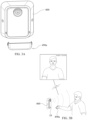
- FIGS. 3 A and 3 B further illustrate the preferred removal first step of FIGS. 2 A and 2 B and also illustrate a preferred picture taken of the individual involved with the removal first step;
- FIG. 4 illustrates the IVAN removed or released from its connection to the docking station
- FIG. 5 illustrates the IVAN being handheld by a user during use, such as, but not limited to, during an emergency situation;
- FIG. 6 illustrates the removal of the IVAN preferably triggering actions by other IVANs located in the building or geographical location/area as well as the broadcasting of video and/or images from the removed IVAN to remote locations and/or to emergency responders;
- FIG. 7 illustrates a non-limiting embodiment for mounting or securing the docking station to a wall or other surface
- FIG. 8 further illustrates the non-limiting mounting/securing embodiment of FIG. 7 ;
- FIGS. 9 A and 9 B combined show a sequence of preferred use diagram for the novel IVAN in accordance with the present disclosure
- FIG. 10 illustrates a non-limiting embodiment for the docking station with a non-limiting IVAN embodiment secured thereto prior to removal in accordance with the present disclosure
- FIG. 11 illustrates a front perspective view of the docking station of FIG. 10 with the IVAN removed;
- FIG. 12 illustrates a back perspective view of the docking station of FIG. 10 ;
- FIG. 13 illustrates a back member of the docking station of FIG. 10 ;
- FIG. 14 is an exploded view of the docking station of FIG. 10 ;
- FIG. 15 is a perspective view of the back side of the front member of the docking station of FIG. 10 ;
- FIGS. 16 A, 16 B, 16 C, 16 D and 16 E illustrates the steps involved for removing the IVAN from the docking station embodiment of FIG. 10 in accordance with the present disclosure
- FIG. 17 illustrates a front perspective view of a non-limiting embodiment for the IVAN in accordance with the present disclosure
- FIG. 18 illustrates a back perspective view of a non-limiting embodiment for the IVAN of FIG. 17 ;
- FIG. 19 illustrates a front perspective view of the interior for the IVAN of FIG. 17 showing certain non-limiting electronic components that can be provided for IVAN;
- FIG. 20 illustrates a side view of the interior embodiment of FIG. 19 ;
- FIG. 21 illustrates another non-limiting embodiment for the docking station with a non-limiting IVAN embodiment secured thereto prior to removal in accordance with the present disclosure
- FIG. 22 illustrates the docking station of FIG. 21 with the IVAN removed
- FIG. 23 illustrates a non-limiting electronic block diagram for one embodiment for the docking station and IVAN
- FIG. 24 is a close-up partial perspective view shown a first embodiment for triggering events with the system in accordance with the present disclosure prior to pressing the EMERGENCY button;
- FIG. 25 is a close-up partial perspective view of the triggering event first embodiment after the EMERGENCY button has been pressed/activated in accordance with the present disclosure.
- FIG. 26 is a perspective exploded view for one embodiment of the notifier and docking station in accordance with the present disclosure.
- notifier 10 a virtually instant alert notifier and docket station
- docking station 400 can be mounted to a surface, such as, but not limited to a wall surface, and in a preferred embodiment is mounted to an electrical box commonly found for light switches and/or electrical plugs.
- docking station 400 allows the removably attached/secured notifier 10 , and as well as preferably docking station 400 itself, to be in electrical communication with the existing electrical circuitry of the building, house, etc., such that notifier 10 can be fully charged when needed.
- Notifier 10 preferably connects occupants/persons involved or subjected to an emergency event or other situation to first responders and other designated individuals. Notifier 10 allows for the combination of live video, audio and location monitoring to be provided to the first responders which will allow such responders and other associated or designated individuals to have detailed and current information for their use in planning and/or executing lifesaving rescues.
- notifier 10 includes in public schools, government buildings and locations, commercial and retail facilities.
- FIG. 9 provides for a preferred non-limiting sequence of use of notifier for an emergency situation.
- a router and notifier 10 stations are installed in the desired building and once installed notifiers 10 can power up and begin recording.
- an emergency i.e. live shooter, etc.
- the occupant or another individual preferably goes to a notifier 10 station (presumably the closest station to the occupant) and can remove notifier from its mounting/resting/docking point within docking station (such as described below for FIG. 16 ).
- notifier 10 can be programmed to save the last 60 second (or another programmed time period) of video that was captured by notifier 10 .
- one or more key fob can also be strategically placed in the desired building for which the user can wirelessly communicate with the notifier and cause it to activate or otherwise send a signal/information to remote responders/emergency personnel.
- Notifier 10 can also be programmed allow the user to provide the remote responders/emergency personnel with a more specific message concerning the nature of the emergency, though it is also within the scope of the disclosure just to send out a general emergency signal when activating/removing notifier 10 .
- a few choices can be displayed and provided to the user to select (i.e.
- system and/or notifier 10 can be programmed to also recognize voice commands from a user.
- notifier 10 can report to the router indicating an emergency or other event.
- the router preferably engages or otherwise electrically/electronically communicates (preferably through a Wifi communication, though not limiting) with the other notifiers 10 positioned in the building or relevant area of the emergency/event, and can send a notification to appropriate first responders and/or other designated or appropriate individuals, such as, but not limited to, via the FirstNet Authority First Priority public safety communications platform—Band 14 or similar technology or another preferably wireless electronic communication technology—Wifi, cellular, Ethernet etc.).
- the first responders Once receiving notification of the emergency/event, barring some unusual event, the first responders usually will react to the notification and move/travel to the scene of the emergency/event.
- the other notifiers 10 at the scene of the emergency/event, upon engagement with the router can be preferably programmed to begin to sound an audible noise alarm and/or to begin flashing lights to get the attention (i.e. alert) other occupants at or near the scene of the emergency/event, that there is a situation occurring at or near their geographical location.
- the other notifiers 10 (still within/electrically connected to their mounting/docking stations) can begin streaming live video, audio and/or images from their locations in the building/emergency location to the first responders/emergency personally either through wired or wireless communication technology.
- the responders can observe multiple camera (still images or video)/audio fees from notifier 10 and/or the other notifiers 10 .
- the responder using his or her electronic device can also preferably send or otherwise transmit audio to the notifier 10 or other notifiers 10 .
- the occupants can follow emergency/event protocol and move to designated locations. As they travel to these locations, the occupants can remove notifiers 10 from nearby stations. The occupants can use their notifiers 10 to send/transmit date and to communication with the first responders.
- the occupants can include: live video, still images, push to talk/hear, push for flashlight, stealth mode, location determinations/identifications, presence of life and/or temperature/moisture.
- the first responders or other involved individuals can form an appropriate response plan.
- Notifiers 10 allow the first responders to identify the location of the devices in the building or area of the emergency/event (and/or occupants for notifiers 10 removed from their docking station 400 ) and using the camera feed(s) from the notifier(s) 10 can detect hostiles and obstructions.
- Implementing the response plan preferably based on or aided by the information from the notifier(s) 10 , the first responders reach the location of the emergency/event and rescue the occupants.
- FIG. 10 illustrates a non-limiting embodiment for notifier 10 being stored, housed or otherwise connected or secured to its associated docking station 400 when not in use (i.e. prior to an emergency situation occurring, etc.).
- FIGS. 11 - 15 illustrate preferred, though non-limiting, details for docking station 400 and show in the preferred embodiment that docking station 400 can include a back member 410 having back surface 412 with a plurality of mounting/securing apertures/holes 414 and apertures/holes 416 for securing to an outlet box, as well as a larger aperture/ 418 , preferably centrally located, though such location is not considered limiting.
- a top opening/conduit 420 along with additional fastener holes 422 can be provided in a top wall 430 of back member 410 .
- Back member 410 can also be preferably provided with a left side wall 432 , right side wall 434 and bottom wall 436 which can define a receiving area 438 for receiving a portion of the front member 450 of docking station 400 which will be discussed in more detail below.
- Bottom wall 436 can also be provided with fastener holes 439 similar to fastener holes 422 of top wall 430 .
- outlet box holes or the corner mounting holes 414 can be used as conventional connection (i.e. mounting screws, bolts, other fasteners, etc.).
- Any necessary wires, such as any power or electrical wires from an electrical box area or another location, can be routed or directed through aperture 418 and/or opening/hole/conduit 420 and can be connected to an AC/DC converter 440 preferably secured to a front surface 413 of back member 410 .
- the above noted POE and/or 12V charging options can also be incorporated.
- Front member 450 can be provided with a front surface 452 having a cavity 454 , a back surface 456 and a top wall 458 , left side wall 460 , right side wall 462 and bottom wall 464 .
- Top wall 458 and bottom wall 464 can be provided with fastener holes 466 and 468 , respectively, which can be aligned with fastener holes 422 and 438 , respectively, when front member 450 is properly positioned within receiving area 438 to allow for conventional connection of front member 450 to back member 410 (i.e. mounting screws, bolts, other fasteners, etc.).
- any wires associated with front member 450 can also connected to AC/DC converter 440 .
- front member 450 can be slid onto back member 410 and properly positioned/aligned, preferably two screws on the top and two screws on the bottom, in association with the fastener holes discussed above, which can be used to maintain front member 450 on back member 410 .
- front member 450 secured to back surface 456 or some other preferably internal location of front member 450 can include the following electrical and mechanical components, whose purpose or function are conventional: Hall effect sensor 472 , a plurality of LED Boards 474 ( ⁇ 3), power management component 476 , piezo speaker 478 , processing PCB (printed circuit board) 480 , securing magnet 482 , device charging contacts 484 which preferably extend through and are accessible on the other side so as to make contact with notifier 10 when notifier 10 is inserted within cavity 454 (i.e. prior to an emergency situation) as a preferred mechanism for charging notifier 10 , and backup battery 486 .
- Hall effect sensor 472 a plurality of LED Boards 474 ( ⁇ 3)
- power management component 476 piezo speaker 478
- processing PCB (printed circuit board) 480 processing PCB (printed circuit board) 480
- securing magnet 482 securing magnet 482
- device charging contacts 484 which preferably extend through and are accessible on the other side so as to make
- FIGS. 16 a - 16 e illustrate one embodiment for how a user accesses notifier 10 during an emergency situation or when another scenario requiring use of notifier 10 occurs.
- notifier 10 resides within cavity 454 and is partially hidden behind slide cover 490 whose inwardly turned side/ends are preferably residing within corresponding tracks 496 on front surface 452 .
- Slide cover 490 includes aperture 492 which a movable button 500 rested within (i.e. preferably by positioning of a spring member 502 ). Button 500 resting within aperture 492 (i.e. button engaged) prevents slide cover 490 from being slid downward.
- buttons 500 When notifier 10 is needed, a user pushes button 500 inward which causes it to be no longer resting within aperture 492 and thus allowing the user to slide/move/pull cover 490 downward which permits notifier 10 to be removed from within cavity 454 for use by the user during the emergency or other situation.
- At least portions of side walls 491 of slide cover 490 can received within guide slots 459 disposed on front surface 452 for guiding the travel (up/down) of slide cover 490 .
- slots 459 having a closed first end and an open second end, such that slide cover 490 can preferably only be slid in one direction when releasing/accessing notifier 10 from within cavity 454 of mounting/docking station 400 .
- FIG. 17 illustrate one non-limiting embodiment for notifier 10 , which has a front area 12 , back area 14 , left side 16 , right side 18 and top portion 20 .
- front area 12 can be provided with a camera lens 22 , IR LEDs 24 , flashlight LED 26 , speaker 28 , volume controls 30 and stealth mode mode/activator 32 .
- charging contacts 34 can be provided at back area 14 for mating within charging contacts 484 of front member 450 when notifier 10 is disposed within cavity 454 for charging notifier 10 . With the charging capabilities through the contacts 34 and 484 and the charging power source, notifier 10 is preferably fully charged when it is accessed by the user as described above. Also seen in FIG.
- a microphone 40 can be provided on left side area 16 , though such location is not considered limiting.
- top portion 20 is provided within a digital display 42 .
- An outer area of notifier can be provided with a gripping member 44 for easier holding of notifier 10 .
- FIGS. 19 and 20 show the preferred components disposed within notifier 10 .
- Some of the preferred components for notifier 10 include microphone PCBA 50 , Arducam PCBA 52 , Wifi module 54 , volume and stealth mode PCBA 56 , push to talk and flashlight switches 36 and 38 , respectively, a magnet 58 for securing notifier 10 , a magnet 60 used for dock detection, digital display 42 , camera lens 22 , Flashlight PCBA 58 , and battery 60 .
- notifier 10 The internal and external accessible components of notifier 10 perform their ordinary conventional functions.
- the camera associated with camera lens 22 can be provided on its own printed circuit board (“PCB”) and can be held in place within notifier 10 by an internal bracket (preferably constructed from plastic, though not considered limiting) and fasteners.
- the camera can be connected (electrically connected) to the main PCBA (PCB 52 ) using a ribbon cable.
- Microphone 40 can be preferably at least partially covered by a gasket (preferably constructed from rubber, though not considered limiting), with the gasket being used to isolate exterior sounds from “noise” or “echos” from within notifier 10 .
- battery 60 disposed within notifier 10 can be a 3.6V, 3120 mAh LiPo battery though such is not considered limiting and other types of batteries and/or batteries with different values can be used and are considered within the scope of the disclosure.
- Battery 60 can be held in place with adhesive backed foam and can sit or otherwise be positioned behind main PCBA 52 though such location is not considered limiting.
- Speaker 28 can be covered by a water resistant acoustic membrane and in a preferred embodiment, the opening in the body of notifier 10 for speaker 28 (i.e. adjacent to the internal location of speaker 28 within notifier 10 ) can be barely visible from the outside.
- IR LEDs 24 can be preferably provided with their own PCB in order to optimize positioning within notifier 10 .
- the IR LED PCB can include two contact pads which can connect to springs provided on main PCB 52 to transfer power.
- FIG. 21 illustrates another non-limiting embodiment for notifier 10 and docking station 400 .
- cover 490 a is pulled out when accessing notifier 10 .
- a front surface 452 a of docking station 400 can also reveal directions to the person and any other nearby occupant to an Exit for the building.
- docking station 400 can act as a docking location for notifier 10 and can also acts as an alarm for the occupants, while also preferably serving as a beacon for location monitoring during an emergency or other monitored event.
- notifier 10 and/or docking station 400 can include one or more of the following: notifier 10 charging, battery back up (especially in case of power failure at the building), location monitoring of notifier(s) 10 via Proximity, LED alarms (such as, but not limited to, CODE RED alarms), audible alarms, notifier 10 removal detection, live video, push to talk audio, etc.
- notifier 10 can record and stream still images, video and/or audio to first responders and other individuals involved with the emergency or event.
- notifier 10 can act as a connection (i.e. wireless electronic connection) between occupants and responders/other individuals to help create and execute an effective rescue or disaster handling plan.
- Certain non-limiting features/functionality for notifier 10 can include one or more of the following:
- FIG. 23 illustrates one non-limiting embodiment for an electronics block diagram of both docking station 400 (i.e. wall or surface mounted docking station, etc.) and notifier 10 (i.e. removable handheld unit).
- the various components operate in the conventional manner and communication between the notifier 10 and docking station can occur through one or more conventional communication technologies now known or later developed.
- Cameras can be preferably provided at the front and at back of notifier 10 .
- the camera can have ordinary components such as a lens, lens base, CMOS sensor, PCB, and can provided images and video in one or more resolutions, frames per second, as well as provided for IR filtering such as with the use of a motorized IR cut filter.
- Notifier 10 can also be provided with storage memory for storing video, still images, audio and/or other information.
- FIGS. 24 , 25 and 26 illustrate one non-limiting embodiment, for triggering one or more initial activation events. These events can include, without limitation, taking a picture of the user as he or she removes notifier 10 , sending/transmitting a wired or wireless signal/alert to one or more emergency personnel, causing the other notifiers 10 in the building to stream and transmit live video, audio and images from their locations to the one or more emergency personnel, etc.
- the pushing of button 500 by the user, to allow the user to slide cover 490 downward is the user's action that triggers the one or more initial events to begin.
- a magnet 531 is located on a side portion of button 500 , with the magnet creating or producing a magnetic field.
- a Hall effect sensor 541 is located within the housing of front member 450 of the docking/mounting station 400 and when button 500 is pushed inward by the user, the magnetic field created by magnet 531 passes over (or otherwise sensed by sensor 541 ) and triggers Hall effect sensor 541 to send a signal to one or more of the microcontrollers/microprocessors/circuity to cause the one or more initial activation events to begin/occur.
- Other sensors or mechanisms can also be used to determine that button 500 has been pushed inward and to trigger the activation events.
- a tactile switch and/or spring loaded contacts assembly could also be used and considered within the scope of the disclosure.
- magnet 531 and Hall effect sensor 541 are preferred, as it doesn't require the pressing of button 500 to be perfect by the user (especially in an emergency situation).
- the nature of the magnetic field merely requires it to be close to Hall effect sensor 541 for Hall effect sensor begin the above-noted actions.
- triggering can occur when notifier 10 is removed from docking station, and such alternative triggering configuration is also considered within the scope of the disclosure.
- the Hall-effect sensor can be provided on the docking station and the magnet on notifier 10 .
- notifier 10 can be designed/programmed for constant recording of video, audio and/or images preferably into a circular buffer that allows for the review of the video, audio and/or images that were captured by notifier 10 just prior to notifier 10 being activated (i.e. removed from mounting/docking station 400 ).
- notifier 10 can be programmed to retain the prior 60 seconds of video from the moment in time that notifier 10 is activated.
- the circular buffer preferably allows the older video to be constantly written over and updated with newly captured video.
- an App may also be downloaded to a user's phone that can be also associated with one or more notifiers 10 to again allow the user to control at least one notifier 10 through use of the App, without the user actually removing notifier 10 from its securement to docking station 400 .
- the App can also notify a cloud-based system associated with the notifiers and the cloud-based system can communicate with one or more, or all of the notifiers 10 locating in the building or other location of the emergency.
- the signal to the notifiers can come from cell or Wifi network to activate the notifiers.
- Emergency button 500 can be designed to prevent a person who has removed notifier 10 from docking station 400 from easily reinstalling notifier 10 to docking station 400 , without the use of a specific tool, which may act as a deterrent for a person tampering with notifier 10 and/or docking station 400 .
- the specific tool is required in order to reset the removed notifier when it is put back into docking station 400 .
- a “catch” of button 500 i.e. oval shaped slot, etc.
- the insertion of the specific/special tool is required to release button 500 from its “catched” position.
- the system 433 MHz RF transmitter and/or receiver modules can be used or incorporated for some or all of the wireless capabilities.
- the electrical/mechanical connections, coding, programming and/or powering for the transmitter and/or receiver modules would preferably be as conventionally known for such transmitters and receiver modules and such conventional connections, coding, programming and powering are considered incorporated by reference into this disclosure.
Landscapes
- Physics & Mathematics (AREA)
- General Physics & Mathematics (AREA)
- Electromagnetism (AREA)
- Business, Economics & Management (AREA)
- Emergency Management (AREA)
- Engineering & Computer Science (AREA)
- Computer Networks & Wireless Communication (AREA)
- Alarm Systems (AREA)
Abstract
Description
-
- a. Live Video—records and transmits video/still images of events preferably as they are happening to inform first responders. Preferably provided infrared LEDs allow for use of
notifier 10 when the area or room is dark. - b. Flashlight—can be used to illuminate dark rooms or locations, sends signals and/or blind hostiles.
- c. Audio Monitoring—allows first responders and others to listen in on an “active” situation as it is happening. The user of
notifier 10 can also communicate with first responders and others via preferably provided “Push to Talk” technology. The notifier can be provided with Push to Talk/Hear technology. - d. Stealth Mode—allows the user to make
notifier 10 go dark withnotifier 10 programmed to silence itself to help protect the user from being noticed by a hostile. - e. Location Monitoring—notifier 10 can be preferably provided with an installed beacon(s) to track the location of
notifier 10 which notifier 10 can transmit to first responders to help them get to the user and/or other occupants faster. - f. Sign of Life Monitoring—notifier 10 can be programmed and provided with technology to allow it to monitor for “signs of life” to improve the effectiveness of rescue missions.
- g. Other monitoring technology such as for temperature/moisture readings/measurements.
- h. Preferably, some or all
other notifiers 10 still positioned within their corresponding mounting/docking stations 400 in the building, emergency location, etc. can be activated by the removal of onenotifier 10 from its mounting/docking station 400 and the other notifiers can stream live video, audio and/or images from their respective locations to the first responders and emergency personnel to provide such individuals with additional current information regarding the emergency.
- a. Live Video—records and transmits video/still images of events preferably as they are happening to inform first responders. Preferably provided infrared LEDs allow for use of
-
- 1. Assembly hard-wired into single-gang electrical box
- 2. Video Resolution: preferably up to 4K, though not limiting
- 3. Memory: preferably 32 GB, though not limiting
- 4. Preferably up to 10 hours of continuous non-stop recording, though not limiting
- 5. Two 140-degree wide-angle lenses,
- 6. One-touch recording
- 7. Stealth mode
- 8. Built-in 820.11 WiFi; optional Z WAVE-enabled design
- 9. Built-in Geotag stamps date, time and GPS coordinates onto every video and/or photo file
- 10. Battery indicator
- 11. Built-in speaker
- 12. Vibration confirmation and low back-up battery alert
- 13. Simultaneous photo taking during video recording
- 14. Built-in night vision
- 15. Password protected
- 16. 60-second pre- and post-record, though not limiting
- 17. Built-in LED flashlight
Claims (11)
Priority Applications (1)
| Application Number | Priority Date | Filing Date | Title |
|---|---|---|---|
| US18/527,931 US12249232B2 (en) | 2020-01-15 | 2023-12-04 | Instant alert notifier and docking station |
Applications Claiming Priority (6)
| Application Number | Priority Date | Filing Date | Title |
|---|---|---|---|
| US202062961494P | 2020-01-15 | 2020-01-15 | |
| US202063114942P | 2020-11-17 | 2020-11-17 | |
| US17/149,555 US11521472B1 (en) | 2020-01-16 | 2021-01-14 | Instant video alert notifier |
| US17/236,113 US11217073B1 (en) | 2020-01-15 | 2021-04-21 | Instant alert notifier and docking station |
| US17/567,119 US11837077B1 (en) | 2020-01-15 | 2022-01-01 | Instant alert notifier and docking station |
| US18/527,931 US12249232B2 (en) | 2020-01-15 | 2023-12-04 | Instant alert notifier and docking station |
Related Parent Applications (1)
| Application Number | Title | Priority Date | Filing Date |
|---|---|---|---|
| US17/567,119 Continuation US11837077B1 (en) | 2020-01-15 | 2022-01-01 | Instant alert notifier and docking station |
Publications (2)
| Publication Number | Publication Date |
|---|---|
| US20240177581A1 US20240177581A1 (en) | 2024-05-30 |
| US12249232B2 true US12249232B2 (en) | 2025-03-11 |
Family
ID=79169735
Family Applications (3)
| Application Number | Title | Priority Date | Filing Date |
|---|---|---|---|
| US17/236,113 Active US11217073B1 (en) | 2020-01-15 | 2021-04-21 | Instant alert notifier and docking station |
| US17/567,119 Active 2041-01-14 US11837077B1 (en) | 2020-01-15 | 2022-01-01 | Instant alert notifier and docking station |
| US18/527,931 Active US12249232B2 (en) | 2020-01-15 | 2023-12-04 | Instant alert notifier and docking station |
Family Applications Before (2)
| Application Number | Title | Priority Date | Filing Date |
|---|---|---|---|
| US17/236,113 Active US11217073B1 (en) | 2020-01-15 | 2021-04-21 | Instant alert notifier and docking station |
| US17/567,119 Active 2041-01-14 US11837077B1 (en) | 2020-01-15 | 2022-01-01 | Instant alert notifier and docking station |
Country Status (1)
| Country | Link |
|---|---|
| US (3) | US11217073B1 (en) |
Families Citing this family (2)
| Publication number | Priority date | Publication date | Assignee | Title |
|---|---|---|---|---|
| US11217073B1 (en) * | 2020-01-15 | 2022-01-04 | William J. Rintz | Instant alert notifier and docking station |
| US12626583B1 (en) | 2025-01-06 | 2026-05-12 | Motorola Solutions, Inc. | Methods and systems for controlling an emergency response device |
Citations (51)
| Publication number | Priority date | Publication date | Assignee | Title |
|---|---|---|---|---|
| US5289162A (en) * | 1992-07-27 | 1994-02-22 | Mcdaniel Steven M | Emergency condition and door ajar alarm for appliances |
| US20010038336A1 (en) * | 1999-01-23 | 2001-11-08 | James Acevedo | Wireless smoke detection system |
| US20020050807A1 (en) * | 2000-08-02 | 2002-05-02 | Janik Craig M. | Device docking apparatus and method for using the same |
| US20020107043A1 (en) * | 2001-01-19 | 2002-08-08 | Adamson Alan D. | Cordless phone apparatus |
| US20050017863A1 (en) * | 2003-07-25 | 2005-01-27 | Woods Martha H. | Emergency alert alarm locator |
| US20050017866A1 (en) * | 2003-07-25 | 2005-01-27 | Woods Martha H. | Personal emergency alert alarm |
| US20060178128A1 (en) * | 2003-12-19 | 2006-08-10 | Eaton Eric T | Method of operating a mobile communication device and mobile communication system during an emergency situation |
| US7312712B1 (en) * | 2007-04-11 | 2007-12-25 | Douglas Bevan Worrall | Traveler safety notification system |
| US20080001734A1 (en) * | 2003-02-03 | 2008-01-03 | Stilp Louis A | Portable telephone in a security network |
| US20080135321A1 (en) * | 2006-12-08 | 2008-06-12 | Ripple Richard A | Personal mobility device with an incorporated safety and informational system |
| US20080166990A1 (en) * | 2007-01-09 | 2008-07-10 | Shrage Toiv | Telephone Directory Assistance System |
| US20130052979A1 (en) * | 2011-08-23 | 2013-02-28 | Ching-Paio CHIANG | Initiative notification apparatus and the notifying method thereof |
| USD709505S1 (en) * | 2012-04-23 | 2014-07-22 | Samsung Electronics Co., Ltd. | Docking station |
| US8805640B2 (en) * | 2010-01-29 | 2014-08-12 | Certusview Technologies, Llc | Locating equipment docking station communicatively coupled to or equipped with a mobile/portable device |
| US8837683B2 (en) * | 2010-10-10 | 2014-09-16 | Medsign International Corporation | Critical health information profile and emergency communication system |
| US20150248832A1 (en) * | 2014-02-28 | 2015-09-03 | Tyco Fire & Security Gmbh | Method and Apparatus for Testing Fire Alarm Initiating Devices |
| US20150269824A1 (en) * | 2014-03-18 | 2015-09-24 | Jack Ke Zhang | Techniques for emergency detection and emergency alert messaging |
| US20150305690A1 (en) * | 2012-11-22 | 2015-10-29 | Geob International Sdn. Bhd. | Medical Monitoring System |
| US20160224064A1 (en) * | 2013-07-03 | 2016-08-04 | Pucline, Llc | Electrical power supplying system having an electrical power supplying docking station with a multi-function module for use in diverse environments |
| US20170015291A1 (en) * | 2015-07-13 | 2017-01-19 | Volvo Car Corporation | Safety brake device and method for safety braking of an autonomous vehicle |
| US20170172424A1 (en) * | 2014-12-22 | 2017-06-22 | Eggers & Associates, Inc. | Wearable Apparatus, System and Method for Detection of Cardiac Arrest and Alerting Emergency Response |
| US20180075712A1 (en) * | 2016-09-14 | 2018-03-15 | Siemens Industry, Inc. | Visually-impaired-accessible building safety system |
| US20180103206A1 (en) * | 2015-06-26 | 2018-04-12 | Mobile Video Corporation | Mobile camera and system with automated functions and operational modes |
| US20180122220A1 (en) * | 2016-09-14 | 2018-05-03 | ASR Patent Holdings LLC | System and method for responding to an active shooter |
| US10089809B1 (en) * | 2017-06-14 | 2018-10-02 | International Business Machines Corporation | Cognitive intercom assistant |
| US20190039748A1 (en) * | 2016-04-05 | 2019-02-07 | Airbus Operations Gmbh | Retrofittable display device for displaying an activation status of an emergency chute in an aircraft |
| US20190253670A1 (en) * | 2011-11-14 | 2019-08-15 | Tseng-Lu Chien | LED Light Has Built-In Camera-Assembly to Capture Colorful Digital-Data Under Dark Environment |
| US20190268627A1 (en) * | 2016-03-08 | 2019-08-29 | Dean Drako | Method for sharing private video streams with first responders |
| US20190342526A1 (en) * | 2016-03-08 | 2019-11-07 | Dean Drako | System and apparatus for sharing private video streams with first responders |
| US20200014964A1 (en) * | 2016-03-08 | 2020-01-09 | Dean Drako | Apparatus for sharing private video streams with public service agencies |
| US20200068375A1 (en) * | 2018-08-22 | 2020-02-27 | Allied Citizens Technologies, Inc. | Emergency reporting device and system |
| US20200117900A1 (en) * | 2018-10-12 | 2020-04-16 | Armaments Research Company Inc. | Remote support system and methods for firearm and asset monitoring including coalescing cones of fire |
| US20200153872A1 (en) * | 2016-03-08 | 2020-05-14 | Dean Drako | System, methods, and apparatus for sharing private video stream assets with first responders |
| US20200168063A1 (en) * | 2018-11-27 | 2020-05-28 | Livefree Emergency Response, Inc. | System and method for suppression of physical threats |
| US20200250941A1 (en) * | 2019-02-05 | 2020-08-06 | Honeywell International Inc. | Systems and methods for controlling illumination coverage of visual alarm devices |
| USD892801S1 (en) * | 2020-04-03 | 2020-08-11 | Shenzhen Xfanic Technology Co., Ltd | Docking station |
| US10785417B2 (en) * | 2017-11-06 | 2020-09-22 | Kyocera Document Solutions Inc. | Monitoring system |
| US10805771B1 (en) * | 2019-06-25 | 2020-10-13 | Goldtek Technology Co., Ltd. | Location tracking device and method |
| US20210076206A1 (en) * | 2018-03-15 | 2021-03-11 | Ways Investments, LLC | System, Method, and Apparatus for Virtualizing Digital Assistants |
| US11217073B1 (en) * | 2020-01-15 | 2022-01-04 | William J. Rintz | Instant alert notifier and docking station |
| US11978988B1 (en) * | 2019-06-30 | 2024-05-07 | Smart Power Partners LLC | Power adapter having contact elements in a recess and method of controlling a power adapter |
| US11990718B1 (en) * | 2019-06-30 | 2024-05-21 | Smart Power Partners LLC | Power adapter having a plurality of interfaces and methods of implementing a power adapter |
| US11996660B1 (en) * | 2019-06-30 | 2024-05-28 | Smart Power Partners LLC | In-wall power adapter configured to provide power to a load |
| US12003051B1 (en) * | 2019-06-30 | 2024-06-04 | Smart Power Partners LLC | Control attachment for an in-wall power adapter and method of implementing a control attachment |
| US12013709B1 (en) * | 2019-06-30 | 2024-06-18 | Smart Power Partners LLC | Power adapter and method of implementing a power adapter to provide power to a load |
| US12027968B2 (en) * | 2017-04-01 | 2024-07-02 | John J. King | Power adapters and methods of implementing a power adapter |
| US12057665B1 (en) * | 2019-06-30 | 2024-08-06 | Smart Power Partners LLC | In-wall power adapter configured to provide power to a load and adapted to receive a wall plate |
| US12066848B1 (en) * | 2019-06-30 | 2024-08-20 | Smart Power Partners LLC | In-wall power adaper adapted to receive a control attachment and method of implementing a power adapter |
| US12069786B1 (en) * | 2019-06-30 | 2024-08-20 | Smart Power Partners LLC | Control attachment configured to provide power to a load and method of configuring a control attachment |
| US12081025B2 (en) * | 2017-04-01 | 2024-09-03 | Smart Power Partners LLC | Power adapters adapted to receive a module and methods of implementing power adapters with modules |
| US12176666B2 (en) * | 2021-11-03 | 2024-12-24 | Smart Power Partners LLC | Control module having an actuator and adapted to be attached to a power adapter |
-
2021
- 2021-04-21 US US17/236,113 patent/US11217073B1/en active Active
-
2022
- 2022-01-01 US US17/567,119 patent/US11837077B1/en active Active
-
2023
- 2023-12-04 US US18/527,931 patent/US12249232B2/en active Active
Patent Citations (55)
| Publication number | Priority date | Publication date | Assignee | Title |
|---|---|---|---|---|
| US5289162A (en) * | 1992-07-27 | 1994-02-22 | Mcdaniel Steven M | Emergency condition and door ajar alarm for appliances |
| US20010038336A1 (en) * | 1999-01-23 | 2001-11-08 | James Acevedo | Wireless smoke detection system |
| US20020050807A1 (en) * | 2000-08-02 | 2002-05-02 | Janik Craig M. | Device docking apparatus and method for using the same |
| US20020107043A1 (en) * | 2001-01-19 | 2002-08-08 | Adamson Alan D. | Cordless phone apparatus |
| US20080001734A1 (en) * | 2003-02-03 | 2008-01-03 | Stilp Louis A | Portable telephone in a security network |
| US7511614B2 (en) * | 2003-02-03 | 2009-03-31 | Ingrid, Inc. | Portable telephone in a security network |
| US20050017863A1 (en) * | 2003-07-25 | 2005-01-27 | Woods Martha H. | Emergency alert alarm locator |
| US20050017866A1 (en) * | 2003-07-25 | 2005-01-27 | Woods Martha H. | Personal emergency alert alarm |
| US20060178128A1 (en) * | 2003-12-19 | 2006-08-10 | Eaton Eric T | Method of operating a mobile communication device and mobile communication system during an emergency situation |
| US20080135321A1 (en) * | 2006-12-08 | 2008-06-12 | Ripple Richard A | Personal mobility device with an incorporated safety and informational system |
| US20080166990A1 (en) * | 2007-01-09 | 2008-07-10 | Shrage Toiv | Telephone Directory Assistance System |
| US7312712B1 (en) * | 2007-04-11 | 2007-12-25 | Douglas Bevan Worrall | Traveler safety notification system |
| US8805640B2 (en) * | 2010-01-29 | 2014-08-12 | Certusview Technologies, Llc | Locating equipment docking station communicatively coupled to or equipped with a mobile/portable device |
| US8837683B2 (en) * | 2010-10-10 | 2014-09-16 | Medsign International Corporation | Critical health information profile and emergency communication system |
| US20130052979A1 (en) * | 2011-08-23 | 2013-02-28 | Ching-Paio CHIANG | Initiative notification apparatus and the notifying method thereof |
| US20190253670A1 (en) * | 2011-11-14 | 2019-08-15 | Tseng-Lu Chien | LED Light Has Built-In Camera-Assembly to Capture Colorful Digital-Data Under Dark Environment |
| USD709505S1 (en) * | 2012-04-23 | 2014-07-22 | Samsung Electronics Co., Ltd. | Docking station |
| US20150305690A1 (en) * | 2012-11-22 | 2015-10-29 | Geob International Sdn. Bhd. | Medical Monitoring System |
| US20160224064A1 (en) * | 2013-07-03 | 2016-08-04 | Pucline, Llc | Electrical power supplying system having an electrical power supplying docking station with a multi-function module for use in diverse environments |
| US20150248832A1 (en) * | 2014-02-28 | 2015-09-03 | Tyco Fire & Security Gmbh | Method and Apparatus for Testing Fire Alarm Initiating Devices |
| US20150269824A1 (en) * | 2014-03-18 | 2015-09-24 | Jack Ke Zhang | Techniques for emergency detection and emergency alert messaging |
| US20170172424A1 (en) * | 2014-12-22 | 2017-06-22 | Eggers & Associates, Inc. | Wearable Apparatus, System and Method for Detection of Cardiac Arrest and Alerting Emergency Response |
| US20180103206A1 (en) * | 2015-06-26 | 2018-04-12 | Mobile Video Corporation | Mobile camera and system with automated functions and operational modes |
| US20170015291A1 (en) * | 2015-07-13 | 2017-01-19 | Volvo Car Corporation | Safety brake device and method for safety braking of an autonomous vehicle |
| US20200153872A1 (en) * | 2016-03-08 | 2020-05-14 | Dean Drako | System, methods, and apparatus for sharing private video stream assets with first responders |
| US20200014964A1 (en) * | 2016-03-08 | 2020-01-09 | Dean Drako | Apparatus for sharing private video streams with public service agencies |
| US20190342526A1 (en) * | 2016-03-08 | 2019-11-07 | Dean Drako | System and apparatus for sharing private video streams with first responders |
| US20190268627A1 (en) * | 2016-03-08 | 2019-08-29 | Dean Drako | Method for sharing private video streams with first responders |
| US20190039748A1 (en) * | 2016-04-05 | 2019-02-07 | Airbus Operations Gmbh | Retrofittable display device for displaying an activation status of an emergency chute in an aircraft |
| US20180122220A1 (en) * | 2016-09-14 | 2018-05-03 | ASR Patent Holdings LLC | System and method for responding to an active shooter |
| US20180075712A1 (en) * | 2016-09-14 | 2018-03-15 | Siemens Industry, Inc. | Visually-impaired-accessible building safety system |
| US12027968B2 (en) * | 2017-04-01 | 2024-07-02 | John J. King | Power adapters and methods of implementing a power adapter |
| US12081025B2 (en) * | 2017-04-01 | 2024-09-03 | Smart Power Partners LLC | Power adapters adapted to receive a module and methods of implementing power adapters with modules |
| US10089809B1 (en) * | 2017-06-14 | 2018-10-02 | International Business Machines Corporation | Cognitive intercom assistant |
| US10785417B2 (en) * | 2017-11-06 | 2020-09-22 | Kyocera Document Solutions Inc. | Monitoring system |
| US11337061B2 (en) * | 2018-03-15 | 2022-05-17 | Ways Investments, LLC | System, method, and apparatus for virtualizing digital assistants |
| US20210076206A1 (en) * | 2018-03-15 | 2021-03-11 | Ways Investments, LLC | System, Method, and Apparatus for Virtualizing Digital Assistants |
| US20200068375A1 (en) * | 2018-08-22 | 2020-02-27 | Allied Citizens Technologies, Inc. | Emergency reporting device and system |
| US10841776B2 (en) * | 2018-08-22 | 2020-11-17 | Allied Citizens Technologies, Inc. | Emergency reporting device and system |
| US20200117900A1 (en) * | 2018-10-12 | 2020-04-16 | Armaments Research Company Inc. | Remote support system and methods for firearm and asset monitoring including coalescing cones of fire |
| US20200168063A1 (en) * | 2018-11-27 | 2020-05-28 | Livefree Emergency Response, Inc. | System and method for suppression of physical threats |
| US20200250941A1 (en) * | 2019-02-05 | 2020-08-06 | Honeywell International Inc. | Systems and methods for controlling illumination coverage of visual alarm devices |
| US10805771B1 (en) * | 2019-06-25 | 2020-10-13 | Goldtek Technology Co., Ltd. | Location tracking device and method |
| US12003051B1 (en) * | 2019-06-30 | 2024-06-04 | Smart Power Partners LLC | Control attachment for an in-wall power adapter and method of implementing a control attachment |
| US11978988B1 (en) * | 2019-06-30 | 2024-05-07 | Smart Power Partners LLC | Power adapter having contact elements in a recess and method of controlling a power adapter |
| US11990718B1 (en) * | 2019-06-30 | 2024-05-21 | Smart Power Partners LLC | Power adapter having a plurality of interfaces and methods of implementing a power adapter |
| US11996660B1 (en) * | 2019-06-30 | 2024-05-28 | Smart Power Partners LLC | In-wall power adapter configured to provide power to a load |
| US12013709B1 (en) * | 2019-06-30 | 2024-06-18 | Smart Power Partners LLC | Power adapter and method of implementing a power adapter to provide power to a load |
| US12057665B1 (en) * | 2019-06-30 | 2024-08-06 | Smart Power Partners LLC | In-wall power adapter configured to provide power to a load and adapted to receive a wall plate |
| US12066848B1 (en) * | 2019-06-30 | 2024-08-20 | Smart Power Partners LLC | In-wall power adaper adapted to receive a control attachment and method of implementing a power adapter |
| US12069786B1 (en) * | 2019-06-30 | 2024-08-20 | Smart Power Partners LLC | Control attachment configured to provide power to a load and method of configuring a control attachment |
| US11837077B1 (en) * | 2020-01-15 | 2023-12-05 | William J. Rintz | Instant alert notifier and docking station |
| US11217073B1 (en) * | 2020-01-15 | 2022-01-04 | William J. Rintz | Instant alert notifier and docking station |
| USD892801S1 (en) * | 2020-04-03 | 2020-08-11 | Shenzhen Xfanic Technology Co., Ltd | Docking station |
| US12176666B2 (en) * | 2021-11-03 | 2024-12-24 | Smart Power Partners LLC | Control module having an actuator and adapted to be attached to a power adapter |
Also Published As
| Publication number | Publication date |
|---|---|
| US20240177581A1 (en) | 2024-05-30 |
| US11837077B1 (en) | 2023-12-05 |
| US11217073B1 (en) | 2022-01-04 |
Similar Documents
| Publication | Publication Date | Title |
|---|---|---|
| US20240177581A1 (en) | Instant alert notifier and docking station | |
| EP3182390B1 (en) | Autonomous safety and security device on an unmanned platform under command and control of a cellular phone | |
| EP3104352B1 (en) | Security system for identifying disturbances in a building | |
| US20090027498A1 (en) | Security clock device and system | |
| US20170069196A1 (en) | Emergency notification and response system | |
| US11900778B1 (en) | System for improving safety in schools | |
| CA2519754C (en) | Automaton intelligent robot protector for cars and transportations | |
| KR101950755B1 (en) | System for Public Place Security And Method for Driving The Same | |
| KR100792802B1 (en) | AI security system | |
| US20050128072A1 (en) | Security system for a building | |
| AU2021441505B2 (en) | Instant alert notifier and docking station | |
| KR101842366B1 (en) | Security method with Drones | |
| KR101057149B1 (en) | Patrol safety hat and patrol management device using such safety hat | |
| KR20080045101A (en) | Mobile security system | |
| KR101594053B1 (en) | Security System Through Convergence Solutions | |
| JP2005311995A (en) | Mobile telephone set as abnormal/emergency situation detecting means | |
| KR20100073671A (en) | Security device | |
| KR101735245B1 (en) | Emergency call control method with surveillance camera installed | |
| EP3255619B1 (en) | Wireless personal safety device | |
| KR20010088971A (en) | New Tech Security System | |
| KR102095154B1 (en) | 112 emergency bell call system for security using emergency bell and ip camera | |
| JP2008140346A (en) | Radiocommunication device equipped with emergency notification function | |
| JP3035932U (en) | Security device by image transmission | |
| KR101416076B1 (en) | Cctv emergency call system | |
| KR20100137784A (en) | Emergency rescue system |
Legal Events
| Date | Code | Title | Description |
|---|---|---|---|
| FEPP | Fee payment procedure |
Free format text: ENTITY STATUS SET TO UNDISCOUNTED (ORIGINAL EVENT CODE: BIG.); ENTITY STATUS OF PATENT OWNER: LARGE ENTITY |
|
| FEPP | Fee payment procedure |
Free format text: ENTITY STATUS SET TO SMALL (ORIGINAL EVENT CODE: SMAL); ENTITY STATUS OF PATENT OWNER: LARGE ENTITY |
|
| STPP | Information on status: patent application and granting procedure in general |
Free format text: DOCKETED NEW CASE - READY FOR EXAMINATION |
|
| AS | Assignment |
Owner name: RINTZ, WILLIAM J., NEW JERSEY Free format text: ASSIGNMENT OF ASSIGNORS INTEREST;ASSIGNORS:FELTS, SAMUEL C.;MOORE, ALLEN W.;REEL/FRAME:067138/0354 Effective date: 20210428 Owner name: SUNSATIONAL PARTNERS LLC, FLORIDA Free format text: ASSIGNMENT OF ASSIGNORS INTEREST;ASSIGNOR:RINTZ, WILLIAM J.;REEL/FRAME:067138/0589 Effective date: 20231214 Owner name: IPVIDEO CORPORATION, NEW YORK Free format text: ASSIGNMENT OF ASSIGNORS INTEREST;ASSIGNOR:SUNSATIONAL PARTNERS LLC;REEL/FRAME:067138/0757 Effective date: 20231214 Owner name: SUNSATIONAL PARTNERS LLC, FLORIDA Free format text: ASSIGNMENT OF ASSIGNORS INTEREST;ASSIGNOR:ADRIAN, TERRI-ANN;REEL/FRAME:067138/0679 Effective date: 20231214 |
|
| FEPP | Fee payment procedure |
Free format text: ENTITY STATUS SET TO UNDISCOUNTED (ORIGINAL EVENT CODE: BIG.); ENTITY STATUS OF PATENT OWNER: LARGE ENTITY |
|
| STPP | Information on status: patent application and granting procedure in general |
Free format text: NON FINAL ACTION MAILED |
|
| STPP | Information on status: patent application and granting procedure in general |
Free format text: RESPONSE TO NON-FINAL OFFICE ACTION ENTERED AND FORWARDED TO EXAMINER |
|
| STPP | Information on status: patent application and granting procedure in general |
Free format text: NOTICE OF ALLOWANCE MAILED -- APPLICATION RECEIVED IN OFFICE OF PUBLICATIONS |
|
| STPP | Information on status: patent application and granting procedure in general |
Free format text: PUBLICATIONS -- ISSUE FEE PAYMENT RECEIVED |
|
| STPP | Information on status: patent application and granting procedure in general |
Free format text: PUBLICATIONS -- ISSUE FEE PAYMENT VERIFIED |
|
| STCF | Information on status: patent grant |
Free format text: PATENTED CASE |