US12243748B2 - FinFET device having a gate with a tapering bottom portion and a gate fill material with a widening bottom portion - Google Patents

FinFET device having a gate with a tapering bottom portion and a gate fill material with a widening bottom portion Download PDF

Info

Publication number
US12243748B2
US12243748B2 US17/869,057 US202217869057A US12243748B2 US 12243748 B2 US12243748 B2 US 12243748B2 US 202217869057 A US202217869057 A US 202217869057A US 12243748 B2 US12243748 B2 US 12243748B2
Authority
US
United States
Prior art keywords
gate
isolation regions
fill material
gate structure
semiconductor device
Prior art date
Legal status (The legal status is an assumption and is not a legal conclusion. Google has not performed a legal analysis and makes no representation as to the accuracy of the status listed.)
Active
Application number
US17/869,057
Other versions
US20220359207A1 (en
Inventor
Shih-Yao Lin
Kuei-Yu Kao
Chih-Han Lin
Ming-Ching Chang
Chao-Cheng Chen
Current Assignee (The listed assignees may be inaccurate. Google has not performed a legal analysis and makes no representation or warranty as to the accuracy of the list.)
Taiwan Semiconductor Manufacturing Co TSMC Ltd
Original Assignee
Taiwan Semiconductor Manufacturing Co TSMC Ltd
Priority date (The priority date is an assumption and is not a legal conclusion. Google has not performed a legal analysis and makes no representation as to the accuracy of the date listed.)
Filing date
Publication date
Priority claimed from US16/811,079 external-priority patent/US11482421B2/en
Application filed by Taiwan Semiconductor Manufacturing Co TSMC Ltd filed Critical Taiwan Semiconductor Manufacturing Co TSMC Ltd
Priority to US17/869,057 priority Critical patent/US12243748B2/en
Publication of US20220359207A1 publication Critical patent/US20220359207A1/en
Priority to US18/778,304 priority patent/US20240371644A1/en
Application granted granted Critical
Publication of US12243748B2 publication Critical patent/US12243748B2/en
Active legal-status Critical Current
Anticipated expiration legal-status Critical

Links

Images

Classifications

    • H10D64/01334
    • HELECTRICITY
    • H01ELECTRIC ELEMENTS
    • H01LSEMICONDUCTOR DEVICES NOT COVERED BY CLASS H10
    • H01L21/00Processes or apparatus adapted for the manufacture or treatment of semiconductor or solid state devices or of parts thereof
    • H01L21/02Manufacture or treatment of semiconductor devices or of parts thereof
    • H01L21/04Manufacture or treatment of semiconductor devices or of parts thereof the devices having potential barriers, e.g. a PN junction, depletion layer or carrier concentration layer
    • H01L21/18Manufacture or treatment of semiconductor devices or of parts thereof the devices having potential barriers, e.g. a PN junction, depletion layer or carrier concentration layer the devices having semiconductor bodies comprising elements of Group IV of the Periodic Table or AIIIBV compounds with or without impurities, e.g. doping materials
    • H01L21/28Manufacture of electrodes on semiconductor bodies using processes or apparatus not provided for in groups H01L21/20 - H01L21/268
    • H01L21/28008Making conductor-insulator-semiconductor electrodes
    • H01L21/28017Making conductor-insulator-semiconductor electrodes the insulator being formed after the semiconductor body, the semiconductor being silicon
    • H01L21/28026Making conductor-insulator-semiconductor electrodes the insulator being formed after the semiconductor body, the semiconductor being silicon characterised by the conductor
    • H01L21/28123Lithography-related aspects, e.g. sub-lithography lengths; Isolation-related aspects, e.g. to solve problems arising at the crossing with the side of the device isolation; Planarisation aspects
    • H01L21/28141Lithography-related aspects, e.g. sub-lithography lengths; Isolation-related aspects, e.g. to solve problems arising at the crossing with the side of the device isolation; Planarisation aspects insulating part of the electrode is defined by a sidewall spacer, e.g. dummy spacer, or a similar technique, e.g. oxidation under mask, plating
    • HELECTRICITY
    • H01ELECTRIC ELEMENTS
    • H01LSEMICONDUCTOR DEVICES NOT COVERED BY CLASS H10
    • H01L21/00Processes or apparatus adapted for the manufacture or treatment of semiconductor or solid state devices or of parts thereof
    • H01L21/70Manufacture or treatment of devices consisting of a plurality of solid state components formed in or on a common substrate or of parts thereof; Manufacture of integrated circuit devices or of parts thereof
    • H01L21/71Manufacture of specific parts of devices defined in group H01L21/70
    • H01L21/76Making of isolation regions between components
    • H01L21/762Dielectric regions, e.g. EPIC dielectric isolation, LOCOS; Trench refilling techniques, SOI technology, use of channel stoppers
    • H01L21/76224Dielectric regions, e.g. EPIC dielectric isolation, LOCOS; Trench refilling techniques, SOI technology, use of channel stoppers using trench refilling with dielectric materials
    • H01L21/823431
    • H01L21/823437
    • H01L21/823468
    • H01L27/0886
    • H01L29/0653
    • H01L29/4238
    • H01L29/6653
    • H01L29/66545
    • H01L29/6656
    • H01L29/66795
    • H01L29/785
    • H01L29/7851
    • HELECTRICITY
    • H10SEMICONDUCTOR DEVICES; ELECTRIC SOLID-STATE DEVICES NOT OTHERWISE PROVIDED FOR
    • H10DINORGANIC ELECTRIC SEMICONDUCTOR DEVICES
    • H10D30/00Field-effect transistors [FET]
    • H10D30/01Manufacture or treatment
    • H10D30/021Manufacture or treatment of FETs having insulated gates [IGFET]
    • H10D30/024Manufacture or treatment of FETs having insulated gates [IGFET] of fin field-effect transistors [FinFET]
    • HELECTRICITY
    • H10SEMICONDUCTOR DEVICES; ELECTRIC SOLID-STATE DEVICES NOT OTHERWISE PROVIDED FOR
    • H10DINORGANIC ELECTRIC SEMICONDUCTOR DEVICES
    • H10D30/00Field-effect transistors [FET]
    • H10D30/60Insulated-gate field-effect transistors [IGFET]
    • H10D30/62Fin field-effect transistors [FinFET]
    • HELECTRICITY
    • H10SEMICONDUCTOR DEVICES; ELECTRIC SOLID-STATE DEVICES NOT OTHERWISE PROVIDED FOR
    • H10DINORGANIC ELECTRIC SEMICONDUCTOR DEVICES
    • H10D30/00Field-effect transistors [FET]
    • H10D30/60Insulated-gate field-effect transistors [IGFET]
    • H10D30/62Fin field-effect transistors [FinFET]
    • H10D30/6211Fin field-effect transistors [FinFET] having fin-shaped semiconductor bodies integral with the bulk semiconductor substrates
    • HELECTRICITY
    • H10SEMICONDUCTOR DEVICES; ELECTRIC SOLID-STATE DEVICES NOT OTHERWISE PROVIDED FOR
    • H10DINORGANIC ELECTRIC SEMICONDUCTOR DEVICES
    • H10D62/00Semiconductor bodies, or regions thereof, of devices having potential barriers
    • H10D62/10Shapes, relative sizes or dispositions of the regions of the semiconductor bodies; Shapes of the semiconductor bodies
    • H10D62/113Isolations within a component, i.e. internal isolations
    • H10D62/115Dielectric isolations, e.g. air gaps
    • H10D62/116Dielectric isolations, e.g. air gaps adjoining the input or output regions of field-effect devices, e.g. adjoining source or drain regions
    • HELECTRICITY
    • H10SEMICONDUCTOR DEVICES; ELECTRIC SOLID-STATE DEVICES NOT OTHERWISE PROVIDED FOR
    • H10DINORGANIC ELECTRIC SEMICONDUCTOR DEVICES
    • H10D64/00Electrodes of devices having potential barriers
    • H10D64/01Manufacture or treatment
    • H10D64/015Manufacture or treatment removing at least parts of gate spacers, e.g. disposable spacers
    • HELECTRICITY
    • H10SEMICONDUCTOR DEVICES; ELECTRIC SOLID-STATE DEVICES NOT OTHERWISE PROVIDED FOR
    • H10DINORGANIC ELECTRIC SEMICONDUCTOR DEVICES
    • H10D64/00Electrodes of devices having potential barriers
    • H10D64/01Manufacture or treatment
    • H10D64/017Manufacture or treatment using dummy gates in processes wherein at least parts of the final gates are self-aligned to the dummy gates, i.e. replacement gate processes
    • HELECTRICITY
    • H10SEMICONDUCTOR DEVICES; ELECTRIC SOLID-STATE DEVICES NOT OTHERWISE PROVIDED FOR
    • H10DINORGANIC ELECTRIC SEMICONDUCTOR DEVICES
    • H10D64/00Electrodes of devices having potential barriers
    • H10D64/01Manufacture or treatment
    • H10D64/021Manufacture or treatment using multiple gate spacer layers, e.g. bilayered sidewall spacers
    • HELECTRICITY
    • H10SEMICONDUCTOR DEVICES; ELECTRIC SOLID-STATE DEVICES NOT OTHERWISE PROVIDED FOR
    • H10DINORGANIC ELECTRIC SEMICONDUCTOR DEVICES
    • H10D64/00Electrodes of devices having potential barriers
    • H10D64/20Electrodes characterised by their shapes, relative sizes or dispositions 
    • H10D64/27Electrodes not carrying the current to be rectified, amplified, oscillated or switched, e.g. gates
    • H10D64/311Gate electrodes for field-effect devices
    • H10D64/411Gate electrodes for field-effect devices for FETs
    • H10D64/511Gate electrodes for field-effect devices for FETs for IGFETs
    • H10D64/517Gate electrodes for field-effect devices for FETs for IGFETs characterised by the conducting layers
    • H10D64/519Gate electrodes for field-effect devices for FETs for IGFETs characterised by the conducting layers characterised by their top-view geometrical layouts
    • HELECTRICITY
    • H10SEMICONDUCTOR DEVICES; ELECTRIC SOLID-STATE DEVICES NOT OTHERWISE PROVIDED FOR
    • H10DINORGANIC ELECTRIC SEMICONDUCTOR DEVICES
    • H10D84/00Integrated devices formed in or on semiconductor substrates that comprise only semiconducting layers, e.g. on Si wafers or on GaAs-on-Si wafers
    • H10D84/01Manufacture or treatment
    • H10D84/0123Integrating together multiple components covered by H10D12/00 or H10D30/00, e.g. integrating multiple IGBTs
    • H10D84/0126Integrating together multiple components covered by H10D12/00 or H10D30/00, e.g. integrating multiple IGBTs the components including insulated gates, e.g. IGFETs
    • H10D84/0135Manufacturing their gate conductors
    • HELECTRICITY
    • H10SEMICONDUCTOR DEVICES; ELECTRIC SOLID-STATE DEVICES NOT OTHERWISE PROVIDED FOR
    • H10DINORGANIC ELECTRIC SEMICONDUCTOR DEVICES
    • H10D84/00Integrated devices formed in or on semiconductor substrates that comprise only semiconducting layers, e.g. on Si wafers or on GaAs-on-Si wafers
    • H10D84/01Manufacture or treatment
    • H10D84/0123Integrating together multiple components covered by H10D12/00 or H10D30/00, e.g. integrating multiple IGBTs
    • H10D84/0126Integrating together multiple components covered by H10D12/00 or H10D30/00, e.g. integrating multiple IGBTs the components including insulated gates, e.g. IGFETs
    • H10D84/0147Manufacturing their gate sidewall spacers
    • HELECTRICITY
    • H10SEMICONDUCTOR DEVICES; ELECTRIC SOLID-STATE DEVICES NOT OTHERWISE PROVIDED FOR
    • H10DINORGANIC ELECTRIC SEMICONDUCTOR DEVICES
    • H10D84/00Integrated devices formed in or on semiconductor substrates that comprise only semiconducting layers, e.g. on Si wafers or on GaAs-on-Si wafers
    • H10D84/01Manufacture or treatment
    • H10D84/0123Integrating together multiple components covered by H10D12/00 or H10D30/00, e.g. integrating multiple IGBTs
    • H10D84/0126Integrating together multiple components covered by H10D12/00 or H10D30/00, e.g. integrating multiple IGBTs the components including insulated gates, e.g. IGFETs
    • H10D84/0158Integrating together multiple components covered by H10D12/00 or H10D30/00, e.g. integrating multiple IGBTs the components including insulated gates, e.g. IGFETs the components including FinFETs
    • HELECTRICITY
    • H10SEMICONDUCTOR DEVICES; ELECTRIC SOLID-STATE DEVICES NOT OTHERWISE PROVIDED FOR
    • H10DINORGANIC ELECTRIC SEMICONDUCTOR DEVICES
    • H10D84/00Integrated devices formed in or on semiconductor substrates that comprise only semiconducting layers, e.g. on Si wafers or on GaAs-on-Si wafers
    • H10D84/01Manufacture or treatment
    • H10D84/02Manufacture or treatment characterised by using material-based technologies
    • H10D84/03Manufacture or treatment characterised by using material-based technologies using Group IV technology, e.g. silicon technology or silicon-carbide [SiC] technology
    • H10D84/038Manufacture or treatment characterised by using material-based technologies using Group IV technology, e.g. silicon technology or silicon-carbide [SiC] technology using silicon technology, e.g. SiGe
    • HELECTRICITY
    • H10SEMICONDUCTOR DEVICES; ELECTRIC SOLID-STATE DEVICES NOT OTHERWISE PROVIDED FOR
    • H10DINORGANIC ELECTRIC SEMICONDUCTOR DEVICES
    • H10D84/00Integrated devices formed in or on semiconductor substrates that comprise only semiconducting layers, e.g. on Si wafers or on GaAs-on-Si wafers
    • H10D84/80Integrated devices formed in or on semiconductor substrates that comprise only semiconducting layers, e.g. on Si wafers or on GaAs-on-Si wafers characterised by the integration of at least one component covered by groups H10D12/00 or H10D30/00, e.g. integration of IGFETs
    • H10D84/82Integrated devices formed in or on semiconductor substrates that comprise only semiconducting layers, e.g. on Si wafers or on GaAs-on-Si wafers characterised by the integration of at least one component covered by groups H10D12/00 or H10D30/00, e.g. integration of IGFETs of only field-effect components
    • H10D84/83Integrated devices formed in or on semiconductor substrates that comprise only semiconducting layers, e.g. on Si wafers or on GaAs-on-Si wafers characterised by the integration of at least one component covered by groups H10D12/00 or H10D30/00, e.g. integration of IGFETs of only field-effect components of only insulated-gate FETs [IGFET]
    • H10D84/834Integrated devices formed in or on semiconductor substrates that comprise only semiconducting layers, e.g. on Si wafers or on GaAs-on-Si wafers characterised by the integration of at least one component covered by groups H10D12/00 or H10D30/00, e.g. integration of IGFETs of only field-effect components of only insulated-gate FETs [IGFET] comprising FinFETs
    • H10W10/014
    • H10W10/17
    • H10W20/069
    • HELECTRICITY
    • H10SEMICONDUCTOR DEVICES; ELECTRIC SOLID-STATE DEVICES NOT OTHERWISE PROVIDED FOR
    • H10DINORGANIC ELECTRIC SEMICONDUCTOR DEVICES
    • H10D30/00Field-effect transistors [FET]
    • H10D30/60Insulated-gate field-effect transistors [IGFET]
    • H10D30/791Arrangements for exerting mechanical stress on the crystal lattice of the channel regions
    • H10D30/797Arrangements for exerting mechanical stress on the crystal lattice of the channel regions being in source or drain regions, e.g. SiGe source or drain
    • HELECTRICITY
    • H10SEMICONDUCTOR DEVICES; ELECTRIC SOLID-STATE DEVICES NOT OTHERWISE PROVIDED FOR
    • H10DINORGANIC ELECTRIC SEMICONDUCTOR DEVICES
    • H10D62/00Semiconductor bodies, or regions thereof, of devices having potential barriers
    • H10D62/80Semiconductor bodies, or regions thereof, of devices having potential barriers characterised by the materials
    • H10D62/82Heterojunctions
    • H10D62/822Heterojunctions comprising only Group IV materials heterojunctions, e.g. Si/Ge heterojunctions

Definitions

  • Fin Field-Effect Transistor (FinFET) devices are becoming commonly used in integrated circuits.
  • FinFET devices have a three-dimensional structure that comprises a semiconductor fin protruding from a substrate.
  • a gate structure configured to control the flow of charge carriers within a conductive channel of the FinFET device, wraps around the semiconductor fin.
  • the gate structure wraps around three sides of the semiconductor fin, thereby forming conductive channels on three sides of the semiconductor fin.
  • FIG. 1 illustrates a perspective view of a Fin Field-Effect Transistor (FinFET) device, in accordance with some embodiments.
  • FinFET Fin Field-Effect Transistor
  • FIGS. 2 - 4 , 5 A, 5 B, 6 , 7 A- 7 D, 8 A, 8 B, 9 A, 9 B, 10 A, 10 B, 11 A, 11 B, 12 A, 12 B, 13 A, 13 B, 14 A, 14 B , and 15 A- 15 C illustrate cross-sectional views of a FinFET device 100 at various stages of fabrication, in accordance with an embodiment.
  • FIGS. 16 A, 16 B, 17 A, 17 B, 18 A, 18 B, 19 A, and 19 B illustrate cross-sectional views of a FinFET device 100 A at various stages of fabrication, in an embodiment.
  • FIGS. 20 A, 20 B, 21 A, and 21 B illustrate cross-sectional views of a FinFET device 100 B at various stages of fabrication, in an embodiment.
  • FIGS. 22 A, 22 B, and 23 A- 23 C illustrate various views of a FinFET device 100 C at various stages of fabrication, in an embodiment.
  • FIGS. 24 A, 24 B, and 24 C illustrate various embodiment cross-sectional views of the gate electrode of a FinFET device, in some embodiments.
  • FIGS. 25 - 30 illustrate cross-sectional views of a portion of a FinFET device 200 at various stages of fabrication, in an embodiment.
  • FIG. 31 illustrate a cross-sectional view of a portion of a FinFET device 200 A, in an embodiment.
  • FIG. 32 illustrate a cross-sectional view of a portion of a FinFET device 200 B, in an embodiment.
  • FIG. 33 illustrates a flow chart of method of forming a semiconductor device, in accordance with some embodiments.
  • first and second features are formed in direct contact
  • additional features may be formed between the first and second features, such that the first and second features may not be in direct contact
  • spatially relative terms such as “beneath,” “below,” “lower,” “above,” “upper” and the like, may be used herein for ease of description to describe one element or feature's relationship to another element(s) or feature(s) as illustrated in the figures.
  • the spatially relative terms are intended to encompass different orientations of the device in use or operation in addition to the orientation depicted in the figures.
  • the apparatus may be otherwise oriented (rotated 90 degrees or at other orientations) and the spatially relative descriptors used herein may likewise be interpreted accordingly.
  • Embodiments of the present disclosure are discussed in the context of forming a FinFET device, and in particular, in the context of forming a replacement gate (e.g., a metal gate) for a FinFET device.
  • a replacement gate e.g., a metal gate
  • a dummy gate is formed over a fin that is disposed between isolation regions. A lower portion of the dummy gate is then thinned such that a thickness of the lower portion of the dummy gate decreases as the lower portion of the dummy gate extends toward the isolation regions.
  • a gate fill material is formed on at least the lower portion of the dummy gate, and a spacer is formed along sidewalls of the dummy gate electrode and along sidewalls of the gate fill material. After the gate spacers are formed, the dummy gate electrode and at least portions of the gate fill material are removed to form an opening between the gate spacers, and a metal gate structure is formed in the opening.
  • FIG. 1 illustrates an example of a FinFET 30 in a perspective view.
  • the FinFET 30 includes a substrate 50 and a fin 64 protruding above the substrate 50 .
  • Isolation regions 62 are formed on opposing sides of the fin 64 , with the fin 64 protruding above the isolation regions 62 .
  • a gate dielectric 66 is along sidewalls and over a top surface of the fin 64 , and a gate electrode 68 is over the gate dielectric 66 .
  • Source/drain regions 80 are in the fin 64 and on opposing sides of the gate dielectric 66 and the gate electrode 68 .
  • FIG. 1 further illustrates reference cross-sections that are used in later figures.
  • Cross-section B-B extends along a longitudinal axis of the gate electrode 68 of the FinFET 30 .
  • Cross-section A-A is perpendicular to cross-section B-B and is along a longitudinal axis of the fin 64 and in a direction of, for example, a current flow between the source/drain regions 80 .
  • Cross-section C-C is parallel to cross-section B-B and is across the source/drain region 80 .
  • Cross-section D-D is parallel to cross-section A-A and is outside of the fin 64 (e.g., between two adjacent fins). Subsequent figures refer to these reference cross-sections for clarity.
  • FIGS. 2 - 4 , 5 A, 5 B, 6 , 7 A- 7 D, 8 A, 8 B, 9 A, 9 B, 10 A, 10 B, 11 A, 11 B, 12 A, 12 B, 13 A, 13 B, 14 A, 14 B , 15 A, 15 B, and 15 C illustrate various cross-sectional views of a FinFET device 100 at various stages of fabrication, in accordance with an embodiment.
  • the FinFET device 100 is similar to the FinFET 30 in FIG. 1 , but with multiple fins and multiple gate structures.
  • figures with the same numeral but different letters refer to different views of the FinFET device at a same processing stage.
  • FIGS. 5 A and FIG. 5 B refer to different views of the FinFET device at a same processing stage.
  • FIGS. 2 - 4 and 5 A illustrate cross-sectional views of the FinFET device 100 along cross-section B-B.
  • FIGS. 5 B, 6 , and 7 A illustrate cross-sectional views of the FinFET device 100 along cross-section D-D.
  • FIGS. 7 B, 7 C, and 7 D illustrate cross-sectional views along cross-section B-B, A-A, and C-C, respectively.
  • FIGS. 8 A, 9 A, 10 A, 11 A, 12 A, 13 A, 14 A , and 15 A illustrate cross-sectional views of the FinFET device 100 along cross-section D-D, and FIGS.
  • FIG. 15 C is a zoomed-in view of a portion of FIG. 15 A .
  • the distance between two adjacent fins 64 may become so small that the deposition rate of a deposition process becomes low in such small spaces.
  • sidewalls of the upper portion of the gate electrode 68 which is above the fin 64 , are covered by the deposited dielectric layer 71 .
  • little or no dielectric layer 71 is formed along sidewalls of the lower portion of the gate electrode 68 .
  • the lateral etching rate of the plasma etching process is adjusted, e.g., by adjusting a bias power of the plasma etching process, to control the sidewall profile of the gate electrode 68 .
  • a wet etch process is performed to remove the lower portion of the gate electrode 68 .
  • FIGS. 7 B and 7 C illustrate cross-sectional views of the FinFET device 100 along cross-sections B-B and A-A, respectively, after the lower portions of the gate electrode 68 are thinned.
  • FIG. 7 D illustrates the cross-sectional views of the FinFET device 100 along cross-section C-C. Note that the dummy gate structure 75 is not in the cross-section C-C, thus not illustrated in FIG. 7 D .
  • the gate fill material 73 is formed of a suitable material that provides etching selectivity over (e.g., having different etching rate from) the material of the gate electrode 68 , such that the gate electrode 68 and the gate fill material 73 are removed in two different etching processes in subsequent processing. Details are discussed below.
  • Example materials for the gate fill material 73 include silicon germanium (SiGe), silicon nitride (SiN), silicon oxynitride (SiON), silicon oxycarbonitride (SiOCN), silicon carbide (SiC), silicon oxycarbides (SiOC), or silicon oxide (SiO), or the like.
  • FIGS. 11 A and 11 B are merely non-limiting examples, and other shapes and formation methods are possible. These and other variations are fully intended to be included within the scope of the present disclosure.
  • source/drain regions 80 are formed in/over the fin 64 on opposing sides of the dummy gate structure 75 .
  • the source/drain regions 80 are formed by forming recesses in the fin 64 , then epitaxially growing a material in the recesses, using suitable methods such as metal-organic CVD (MOCVD), molecular beam epitaxy (MBE), liquid phase epitaxy (LPE), vapor phase epitaxy (VPE), selective epitaxial growth (SEG), the like, or a combination thereof.
  • MOCVD metal-organic CVD
  • MBE molecular beam epitaxy
  • LPE liquid phase epitaxy
  • VPE vapor phase epitaxy
  • SEG selective epitaxial growth
  • the epitaxial source/drain regions 80 may have surfaces raised from respective surfaces of the fins 64 (e.g. raised above the non-recessed portions of the fins 64 ) and may have facets.
  • the source/drain regions 80 of the adjacent fins 64 may merge to form a continuous epitaxial source/drain region 80 .
  • the source/drain regions 80 for adjacent fins 64 do not merge together and remain separate source/drain regions 80 .
  • the resulting FinFET is an n-type FinFET, and source/drain regions 80 comprise silicon carbide (SiC), silicon phosphorous (SiP), phosphorous-doped silicon carbon (SiCP), or the like.
  • the resulting FinFET is a p-type FinFET, and source/drain regions 80 comprise SiGe, and a p-type impurity such as boron or indium.
  • the epitaxial source/drain regions 80 may be implanted with dopants to form source/drain regions 80 followed by an anneal process.
  • the implanting process may include forming and patterning masks such as a photoresist to cover the regions of the FinFET device 100 that are to be protected from the implanting process.
  • the source/drain regions 80 may have an impurity (e.g., dopant) concentration in a range from about 1E19 cm ⁇ 3 to about 1E21 cm ⁇ 3 .
  • P-type impurities such as boron or indium, may be implanted in the source/drain region 80 of a P-type transistor.
  • N-type impurities, such as phosphorous or arsenide, may be implanted in the source/drain regions 80 of an N-type transistor.
  • the epitaxial source/drain regions may be in situ doped during growth.
  • a contact etch stop layer (CESL) 89 is formed over the structure illustrated in FIGS. 11 A and 11 B .
  • the CESL 89 functions as an etch stop layer in a subsequent etching process, and may comprise a suitable material such as silicon oxide, silicon nitride, silicon oxynitride, combinations thereof, or the like, and may be formed by a suitable formation method such as CVD, PVD, combinations thereof, or the like.
  • a first interlayer dielectric (ILD) 90 is formed over the CESL 89 and over the dummy gate structures 75 .
  • the first ILD 90 is formed of a dielectric material such as silicon oxide, phosphosilicate glass (PSG), borosilicate glass (BSG), boron-doped phosphosilicate Glass (BPSG), undoped silicate glass (USG), or the like, and may be deposited by any suitable method, such as CVD, PECVD, or FCVD.
  • a planarization process such as a CMP process, may be performed to remove the mask 70 and to remove portions of the CESL 89 disposed over the gate electrode 68 . After the planarization process, the top surface of the first ILD 90 is level with the top surface of the gate electrode 68 , in some embodiments.
  • an embodiment gate-last process (sometimes referred to as replacement gate process) is performed to replace the dummy gate electrode 68 , the gate fill material 73 , and the dummy gate dielectric 66 with an active gate (may also be referred to as a replacement gate or a metal gate) and active gate dielectric material(s).
  • the gate structure that is formed after the replacement gate process is referred to as a metal gate structure or a replacement gate structure, and elements of the metal gate structure without the active gate dielectric may be referred to as a metal gate.
  • the dummy gate electrodes 68 are removed by a first etching process, e.g., using an etchant that is selective to (e.g., having a higher etch rate for) the material of the gate electrode 68 .
  • a suitable etching process such as a wet etch process or a dry etch process, may be performed as the first etching process.
  • recesses 88 are formed between respective gate spacers 87 .
  • FIG. 13 A cross-sectional view along cross-section D-D
  • the gate fill material 73 remain at the bottom of the recesses 88
  • upper inner sidewalls e.g., upper portions of the sidewalls facing the gate fill material 73
  • FIG. 13 B cross-sectional view along cross-section A-A
  • no gate fill material 73 is left and the dummy gate dielectric 66 is exposed by the recesses 88 .
  • a second etching process is performed after the first etching process is finished, to remove the gate fill material 73 , e.g., using an etchant that is selective to the gate fill material 73 .
  • a suitable etching process such as a wet etch process (e.g., using an etching chemical) or a dry etch process, may be performed as the second etching process.
  • a plasma etch process is performed as the second etching process, where the plasma process uses a gas source comprising a main etch gas and a dilute gas (also referred to as carrier gas).
  • the main etch gas may comprises Cl 2 , HBr, CF 4 , CHF 3 , CH 2 F 2 , CH 3 F, C 4 F 6 , BCl 3 , SF 6 , H 2 , combinations thereof, or the like
  • the carrier gas comprises an inert gas, such as Ar, He, Ne, combinations thereof, or the like
  • the gas source may optionally include a passivation gas comprising N 2 , O 2 , CO 2 , SO 2 , CO, SiCl 4 , combinations thereof, or the like.
  • the passivation gas is used to tune the etching selectivity of the second etching process, so as to advantageously reduce or avoid damage to, e.g., the gate spacers 87 and the first ILD 90 during the second etching process, in some embodiments.
  • a power of the plasma etching process (performed as the second etching process) is between about 10 W and about 3000 W, and a bias power of the plasma etching process is between about 10 W and about 3000 W.
  • the bias power is tuned to adjust the lateral etching rate of the plasma etching process.
  • a pressure of the plasma etching process is between about 1 mTorr and about 800 mTorr.
  • a flow rate of each of the main etching gas, the dilute gas, and the passivation gas is between about 10 standard cubic centimeters per minute (sccm) and about 5000 sccm. In the example of FIGS.
  • the gate fill material 73 is removed from the recesses 88 , and the plasma etching process also removes portions of the gate dielectric 66 underlying (e.g., directly below) the recesses 88 . As illustrated in FIG. 14 B , remaining portions of the gate dielectric 66 are disposed directly under the gate spacers 87 .
  • the second etching process also removes upper portions of the isolation regions 62 (e.g., due to over-etching), and as a result, isolation regions 62 has a concave upper surface 62 U 2 under the recesses 88 .
  • the concave upper surface 62 U 2 corresponds to an area of the upper surface of the isolation regions 62 not covered by the gate fill material 73 after the first etching process (see FIG. 13 A ).
  • the isolation regions 62 also have a substantially flat upper surface 62 U 1 in areas covered by the gate fill material 73 after the first etching process, and as a result, little or no etching was done to those areas (e.g., 62 U 1 ) during the second etching process.
  • a metal gate structure 97 (also referred to as a replacement gate structure) is formed in each of the recesses 88 .
  • the metal gate structure 97 has a multi-layered structure (not illustrated in FIGS. 15 A and 15 B , but illustrated in FIG. 15 C ), in some embodiments.
  • FIG. 15 C illustrates a zoomed-in view of an area 77 in FIG. 15 A .
  • the metal gate structure 97 includes a gate dielectric layer 94 , a barrier layer 96 , a work function layer 98 , and a gate electrode 99 .
  • the gate dielectric layer 94 is deposited conformally in the recesses 88 , such as on the top surfaces and the sidewalls of the fins 64 and on sidewalls of the gate spacers 87 , and on a top surface of the first ILD 90 (not shown).
  • the gate dielectric layer 94 comprises silicon oxide, silicon nitride, or multilayers thereof.
  • the gate dielectric layer 94 includes a high-k dielectric material, and in these embodiments, the gate dielectric layers 94 may have a k value greater than about 7.0, and may include a metal oxide or a silicate of Hf, Al, Zr, La, Mg, Ba, Ti, Pb, and combinations thereof.
  • the formation methods of gate dielectric layer 94 may include molecular beam deposition (MBD), atomic layer deposition (ALD), PECVD, and the like.
  • the barrier layer 96 is formed conformally over the gate dielectric layer 94 .
  • the barrier layer 96 may comprise an electrically conductive material such as titanium nitride, although other materials, such as tantalum nitride, titanium, tantalum, or the like, may alternatively be utilized.
  • the barrier layer 96 may be formed using a CVD process, such as PECVD. However, other alternative processes, such as sputtering, metal organic chemical vapor deposition (MOCVD), or ALD, may alternatively be used.
  • the work function layer 98 such as P-type work function layer or N-type work function layer, is formed in the recesses over the barrier layers 96 .
  • Exemplary P-type work function metals that may be included in the gate structures for P-type devices include TiN, TaN, Ru, Mo, Al, WN, ZrSi 2 , MoSi 2 , TaSi 2 , NiSi 2 , WN, other suitable P-type work function materials, or combinations thereof.
  • Exemplary N-type work function metals that may be included in the gate structures for N-type devices include Ti, Ag, TaAl, TaAlC, TiAlN, TaC, TaCN, TaSiN, Mn, Zr, other suitable N-type work function materials, or combinations thereof.
  • a work function value is associated with the material composition of the work function layer, and thus, the material of the work function layer is chosen to tune its work function value so that a target threshold voltage Vt is achieved in the device that is to be formed.
  • the work function layer(s) may be deposited by CVD, physical vapor deposition (PVD), and/or other suitable process.
  • a seed layer (not shown) is formed conformally over the work function layer 98 .
  • the seed layer may include copper, titanium, tantalum, titanium nitride, tantalum nitride, the like, or a combination thereof, and may be deposited by ALD, sputtering, PVD, or the like.
  • the seed layer is a metal layer, which may be a single layer or a composite layer comprising a plurality of sub-layers formed of different materials.
  • the seed layer comprises a titanium layer and a copper layer over the titanium layer.
  • the gate electrode 99 is deposited over the seed layer, and fills the remaining portions of the recesses 88 .
  • the gate electrode 99 may be made of a metal-containing material such as Cu, Al, W, the like, combinations thereof, or multi-layers thereof, and may be formed by, e.g., electroplating, electroless plating, or other suitable method.
  • a planarization process such as a CMP, may be performed to remove the excess portions of the gate dielectric layer 94 , the barrier layer 96 , the work function layer 98 , the seed layer, and the gate electrode 99 , which excess portions are over the top surface of the first ILD 90 .
  • the resulting remaining portions of the gate dielectric layer 94 , the barrier layer 96 , the work function layer 98 , the seed layer, and the gate electrode 99 thus form the replacement gate structure 97 of the resulting FinFET device 100 .
  • the bottom surface of the metal gate structure 97 is curved, e.g., having a protrusion that protrudes downward into the isolation region 62 , as illustrated in FIG. 15 A .
  • a width W 1 of the protrusion is between about 0 angstrom and about 3000 angstroms (e.g., 0 angstrom ⁇ W 1 ⁇ 3000 angstroms), and a depth D 1 of the protrusion is between about 0 angstrom and about 200 angstroms (e.g., 0 angstrom ⁇ D 1 ⁇ 200 angstroms).
  • FIG. 15 B illustrates portions of the metal gate structure 97 disposed directly over the fin 64 .
  • FIGS. 15 A and 15 B may be performed after the processing step of FIGS. 15 A and 15 B to complete the fabrication of the FinFET device 100 . Details are not discussed here.
  • FIGS. 16 A, 16 B, 17 A, 17 B, 18 A, 18 B, 19 A, and 19 B illustrate cross-sectional views of a FinFET device 100 A at various stages of fabrication, in an embodiment.
  • the FinFET device 100 A in FIGS. 16 A and 16 B is similar to the FinFET device 100 in FIGS. 10 A and 10 B , but with gate fill materials 73 along sidewalls of the gate electrode 68 .
  • the processing of FIGS. 16 A and 16 B follows the processing step of FIGS. 9 A and 9 B .
  • FIGS. 9 A and 9 B In particular, compared with FIGS.
  • the lateral etching rate of the second etching process (e.g., an anisotropic etching process) is adjusted (e.g., reduced), such that sidewalls of the dummy gate structure 75 (e.g., 68 and 70 ) are covered (e.g., completely covered) by remaining portions of the gate fill material 73 in FIGS. 16 A and 16 B .
  • the remaining portions of the gate fill material 73 extends continuously from an upper surface of the dummy gate structure 75 distal from the isolation regions 62 to the isolation regions 62 .
  • the shape and location of the gate fill material 73 illustrated in FIGS. 16 A and 16 B may be formed directly after the bottom-up deposition process to form the gate fill material 73 , and no additional etching process is performed to shape the gate fill material 73 in order to form the structure illustrated in FIGS. 16 A and 16 B .
  • the gate spacers 87 , the source/drain regions 80 , the CESL 89 , and the first ILD 90 are formed, using the same or similar processing steps as illustrated in FIGS. 11 A, 11 B, 12 A and 12 B .
  • a planarization process, such as CMP, may be performed next to remove the mask 70 and to achieve a coplanar upper surface between the gate electrode 68 , the gate spacers 87 , the CESL 89 , and the first ILD 90 .
  • the first etching process is performed to remove the dummy gate electrode 68 , similar to FIGS. 13 A and 13 B .
  • the recesses 88 are formed. Note that compared with FIG. 13 A , portions of the gate fill material 73 are left covering the entire inner sidewalls (e.g., sidewalls facing the gate fill material 73 ) of the gate spacers 87 .
  • the gate fill material 73 extends continuously from an upper surface of the gate spacer 87 to the upper surface of the isolation regions 62 in the cross-sectional view of FIG. 17 A , and extends continuously from the upper surface of the gate spacer 87 to the upper surface of the gate dielectric 66 in the cross-sectional view of FIG. 17 B .
  • the second etching process is performed to remove portions of the gate fill material 73 .
  • the second etching process is a plasma etch process same as or similar to that of FIGS. 14 A and 14 B .
  • the bias power of the plasma etch process may be adjusted to achieve a target level of anisotropicity (e.g., a target level of lateral etching rate).
  • a target level of anisotropicity e.g., a target level of lateral etching rate.
  • remaining portions of the gate fill material 73 covers the entire inner sidewalls of the gate spacers 87 .
  • the remaining portions of the gate fill material 73 in FIG. 18 A may function as another gate spacer.
  • the inner sidewalls 73 S of the remaining portion of gate fill material 73 are straight (e.g., perpendicular to the upper surface of the substrate) such that the thickness of gate fill material 73 is substantially uniform.
  • a center area of the upper surface of the isolation regions 62 which is exposed in FIG. 17 A , has a curved (e.g., concave) upper surface 62 U 2 due to, e.g., over etching during the second etching process.
  • Upper surface 62 U 1 of the isolation regions, which is under (e.g., covered by) the gate fill material 73 in FIG. 17 A is substantially flat, since it is protected from the second etching process.
  • the metal gate structure 97 is formed to fill the recesses 88 , using the same or similar processing as in FIGS. 15 A and 15 B . Details are not repeated here.
  • FIGS. 20 A, 20 B, 21 A, and 21 B illustrate cross-sectional views of a FinFET device 100 B at various stages of fabrication, in an embodiment.
  • the FinFET device 100 B in FIGS. 20 A and 20 B is similar to the FinFET device 100 in FIGS. 14 A and 14 B , but with the process condition of the second etching process adjusted such that, after the second etching process, lower portions 73 L of the gate fill material 73 are left.
  • an area of the upper surface of the isolation regions 62 which area is exposed by the recess 88 , has a curved (e.g., concave) upper surface 62 U 2 due to, e.g., over etching during the second etching process.
  • Upper surface 62 U 1 of the isolation regions, which is under (e.g., covered by) the lower portion 73 L of the gate fill material 73 is substantially flat, since it is protected from the second etching process.
  • a width W 2 of the lower portions 73 L of the gate fill material 73 is between about 0 angstrom and about 500 angstroms (e.g., 0 angstrom ⁇ W 2 ⁇ 500 angstroms).
  • a height D 2 of the lower portions 73 L which is the same as the height of the lower portions 97 L of the metal gate structure 97 , is between about 0 angstrom and about 1000 angstroms (e.g., 0 angstrom ⁇ D 2 ⁇ 1000 angstroms). Note that in the illustrated embodiment of FIG.
  • upper portions of the metal gate structure 97 has straight sidewalls, and the lower portions of the metal gate structures 97 has sloped or curved sidewalls.
  • a bottom surface of the metal gate structure 97 is curved and extends into the isolation regions 62 .
  • FIGS. 22 A, 22 B, 23 A, and 23 B illustrate cross-sectional views of a FinFET device 100 C at various stages of fabrication, in an embodiment.
  • FIG. 23 C illustrates a zoomed-in view of an area 79 in FIG. 23 A .
  • the FinFET device 100 C in FIGS. 22 A and 22 B is similar to the FinFET device 100 A in FIGS. 18 A and 18 B , but with the process condition of the second etching process adjusted such that, after the second etching process, lower portions 73 L of the gate fill material 73 are thicker than the upper portion 73 U of the gate fill material 73 .
  • lower portions 73 L of the remaining gate fill material 73 are thicker than upper portions 73 U of the remaining gate fill material 73 .
  • the inner sidewalls of the lower portions 73 L of the remaining gate fill material 73 (e.g., facing the recesses 88 ) are sloped or curved toward a center axis 88 C of the recess 88 .
  • the inner sidewalls of the upper portions 73 U may be straight (e.g., perpendicular to the upper surface of the substrate), or may be sloped toward the center axis 88 C of the recess 88 as the gate fill material 73 extends toward the isolation regions 62 .
  • FIG. 22 A further illustrates the curved (e.g., concave) upper surface 62 U 2 and the flat upper surface 62 U 1 of the isolation regions 62 .
  • the gate fill material 73 comprises a first portion directly over the fin (see, e.g., 73 in FIG. 22 B ), wherein a thickness of the first portion remain a same as the first portion extends from an upper surface of the gate spacers 87 to an upper surface of the fin 64 .
  • the gate fill material 73 further comprises a second portion (see, e.g., 73 / 73 L in FIG. 22 A ) on a first side of the fin 64 , where the second portion contacts the isolation regions 62 , and a thickness of the second portion increases as the second portion extends toward the isolation regions 62 .
  • FIG. 23 C illustrates a zoomed-in view of an area 79 in FIG. 23 A .
  • the bottom surface of the metal gate structure 97 is curved and extends into the isolation regions 62 .
  • the upper sidewall 97 S 1 of the metal gate structure 97 may be straight, and the lower sidewall 97 S 2 of the metal gate structure 97 may be sloped toward a center axis 97 C of the metal gate structure 97 .
  • An angle ⁇ D between the lower sidewall 97 S 2 and a horizontal line HL in FIG. 19 C may be less than about 90 degrees.
  • a height D 3 of the lower portion of the metal gate structure 97 measured between the isolation regions 62 and a location where the upper sidewall 97 S 1 adjoins the lower sidewall 97 S 2 , is between about 0 angstrom and about 1000 angstroms (e.g., 0 angstrom ⁇ D 3 ⁇ 1000 angstroms), in an embodiment.
  • a thickness W 3 of the lower portion of the gate fill material 73 measured at an interface between the gate fill material 73 and the isolation regions 62 , is between about 0 angstroms and about 500 angstroms (e.g., 0 angstrom ⁇ W 3 ⁇ 500 angstroms), in an embodiment.
  • FIGS. 24 A- 24 C illustrate various embodiment cross-sectional views of the bottom portion of the metal gate structure 97 along cross-section D-D.
  • the second etching process e.g., by controlling the bias voltage to control lateral etching rate, and/or by tuning the selectivity of the second etching process
  • different shapes and/or sizes for the remaining portions of the gate fill material 73 can be achieved to control the shape/size of the bottom portion of the metal gate structure 97 .
  • the bottom portion of the metal gate structure 97 tapers off and has a curved bottom surface.
  • the metal gate structure 97 has sloped sidewalls, and a bottom surface 97 B of the metal gate structure 97 has a slight arch (e.g., bends upwards) in the middle.
  • the bottom portion of metal gate structure 97 has sloped sidewalls and a flat bottom surface 97 B.
  • An angle between the bottom surface 97 B and a respective sidewall 97 S of the metal gate structure 97 denoted as ⁇ g1 , ⁇ g2 , and ⁇ g3 respectively in FIGS. 24 A, 24 B, and 24 C , is larger than about 90 degrees.
  • the angle between the bottom surface 97 B and a respective sidewall 97 S of the metal gate structure 97 may be less than 90 degrees, and may not achieve a larger than 90 degree angle.
  • the current disclosure allows larger than 90 degree angles to be formed, which may advantageously increase the volume of the metal gate structure 97 and reduces the electrical resistance of the metal gate structure 97 .
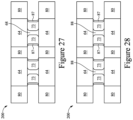
  • FIGS. 25 - 30 illustrate cross-sectional views of a FinFET device 200 at various stages of fabrication, in an embodiment.
  • the FinFET device 200 illustrated may be a cross-sectional view of a portion of, e.g., the FinFET device 100 A along a cross-section E-E illustrated in FIG. 16 A (also illustrated in FIG. 8 A ). Note that the cross-section E-E is across the lower portion 68 L (e.g., a lower portion that tapers off) of the gate electrode 68 .
  • the FinFET device 200 is at a same or similar processing step of FIGS. 8 A and 8 B .
  • the gate electrode 68 Due to the location of the cross-section E-E (e.g., near the end of the tapering portion of the gate electrode 68 ), the gate electrode 68 is shown as a thin strip. Note that for simplicity, only portions of the gate electrode 68 between the fins 64 are illustrated in FIGS. 25 - 30 .
  • FIG. 25 also illustrates the corner regions 68 C of the gate electrode 68 , which extends away from the longitudinal axis 68 A of the gate electrode 68 , therefore the cross-section of the gate electrode 68 in FIG. 25 has a convex shape.
  • the shape of the corner regions 68 C is caused by the etching process (see, e.g., 7 A) to thin the lower portion of the gate electrode 68 , because the etching process may have a slower etching rate in the corner regions (e.g., 68 C).
  • FIG. 26 the gate fill material 73 is formed.
  • the gate fill material 73 may also have corner regions 73 C similar to corner regions 68 C, due to similar reasons (e.g., slower etching rate at corner regions). Therefore, FIG. 26 may correspond to the processing step of, e.g., FIGS. 16 A and 16 B .
  • gate spacers 87 are formed along sidewalls of the gate fill material 73 , and source/drain regions 80 are formed over the fins 64 . Due to the conformal deposition process and/or the etching process to form the gate spacers 87 , the gate spacers 87 have similar corner regions.
  • FIG. 28 may correspond to the processing step of FIGS. 17 A and 17 B .
  • FIG. 29 the second etching process is performed to remove portions of the gate fill material 73 , and remaining portions of the gate fill material 73 are disposed along inner sidewalls of the gate spacers 87 .
  • the inner sidewalls 73 S of the gate fill material 73 at the corner regions bend toward a respective center axis 88 A of the recess 88 . Therefore, each of the recesses 88 now has a convex shaped cross-section.
  • FIG. 29 may correspond to the processing step of FIGS. 18 A and 18 B .
  • the metal gate structure 97 is formed to fill the recess 88 .
  • the metal gate structures 97 also have a convex shape.
  • an angle ⁇ A between two adjacent sides in the corner region of the metal gate structure 97 is larger than about 90 degrees and smaller than about 180 degree. Due to the convex shape of the metal gate structure 97 , corner regions of the metal gate structures 97 bends inwards toward a center axis 97 A of the metal gate structure 97 , thus away from the source/drain regions 80 .
  • the metal gate structures 97 may have a concave cross-section, with corner regions extending outwards toward the source/drain regions 80 , which may have increased leakage current.
  • FIG. 31 illustrates a cross-sectional view of a FinFET device 200 A, in an embodiment.
  • the FinFET device 200 A is similar to the FinFET device 200 in FIG. 30 , but with the gate fill material 73 only in corner regions, which may be due to a higher lateral etching rate of the etching process.
  • FIG. 32 illustrates a cross-sectional view of a FinFET device 200 B, in an embodiment.
  • the FinFET device 200 B is similar to the FinFET device 200 in FIG. 30 , but with the gate fill material 73 completely removed. Note that due to the over etching to completely remove the gate fill material 73 , corner regions of the gate spacers 87 bends inward, which again causes the cross-section of the metal gate structure 97 to have a convex shape.
  • FIG. 33 illustrates a flow chart of a method 1000 of forming a semiconductor device, in accordance with some embodiments. It should be understood that the embodiment method shown in FIG. 33 is merely an example of many possible embodiment methods. One of ordinary skill in the art would recognize many variations, alternatives, and modifications. For example, various steps as illustrated in FIG. 33 may be added, removed, replaced, rearranged and repeated.
  • a fin is formed protruding above a substrate.
  • isolation regions are formed on opposing sides of the fin.
  • a dummy gate is formed over the fin.
  • a thickness of a lower portion of the dummy gate proximate to the isolation regions is reduced, wherein after reducing the thickness, a distance between opposing sidewalls of the lower portion of the dummy gate decreases as the dummy gate extends toward the isolation regions.
  • a gate fill material is formed along at least the opposing sidewalls of the lower portion of the dummy gate.
  • gate spacers are formed along sidewalls of the dummy gate and along sidewalls of the gate fill material.
  • the dummy gate is replaced with a metal gate.
  • Embodiments may achieve advantages. For example, as semiconductor manufacturing process continues to advance, feature sizes continue to shrink. As the distance between fins becomes smaller and smaller, it is increasingly difficult to deposit material between the fins. Voids, or empty spaces, may be formed in the material deposited between fins, especially near the bottom of the fin. In the process of forming the gate electrode 68 , if the gate electrode layer has voids in it, after patterning, the gate electrode 68 may have voids, especially at the bottom of the gate electrode 68 . In subsequent processing, gate spacers 87 are formed along sidewalls of the gate electrode 68 .
  • the material of the gate spacer 87 e.g., silicon nitride
  • the gate electrode 68 is removed and replaced with the gate materials.
  • the material (e.g., silicon nitride) of the gate spacers 87 which filled the voids, will not be etched away with the gate electrode 68 , and will remain in the final metal gate structure 97 . This may cause defect or high resistance of the metal gate structure 97 .
  • the current disclosed methods reduces the thickness of the lower portion of the gate electrode 68 and forms the gate fill material 73 around the lower portion, as a result, any voids at the sidewalls of the gate electrode 68 are filled with the dummy gate fill material 73 , which dummy gate fill material 73 is then removed and replaced with a gate material (e.g., fill metal) in the subsequent replacement gate process. Therefore, the problem with voids at the sidewalls of the gate electrode 68 , e.g., defect or increased gate resistance of the metal gate structure 97 , are avoided or reduced.
  • the disclosed embodiment methods increase the distance between the metal gate structure 97 and the source/drain regions 80 , thus reducing leakage current of the FinFET device formed.
  • a method of forming a semiconductor device includes: forming a fin protruding above a substrate; forming isolation regions on opposing sides of the fin; forming a dummy gate over the fin; reducing a thickness of a lower portion of the dummy gate proximate to the isolation regions, wherein after reducing the thickness, a distance between opposing sidewalls of the lower portion of the dummy gate decreases as the dummy gate extends toward the isolation regions; after reducing the thickness, forming a gate fill material along at least the opposing sidewalls of the lower portion of the dummy gate; forming gate spacers along sidewalls of the dummy gate and along sidewalls of the gate fill material; and replacing the dummy gate with a metal gate.
  • reducing the thickness of the lower portion of the dummy gate comprises: forming a protection layer over an upper portion of the dummy gate, wherein the lower portion of the dummy gate is exposed by the protection layer; and performing an etching process, wherein a first etch rate of the protection layer for the etching process is slower than a second etch rate of the dummy gate for the etching process.
  • the etching process is a plasma etching process, wherein performing the etching process comprises tuning a bias voltage of the plasma etching process to control a lateral etching rate of the plasma etching process.
  • forming the gate fill material comprises: depositing the gate fill material on the isolation regions and along sidewalls of the dummy gate; and performing an anisotropic etching process to remove portions of the deposited gate fill material.
  • sidewalls of remaining portions of the gate fill material are aligned with respective sidewalls of an upper portion of the dummy gate.
  • remaining portions of the gate fill material extend continuously along sidewalls of the dummy gate from an upper surface of the dummy gate distal from the isolation regions to the isolation regions.
  • replacing the dummy gate comprises: performing a first etching process to remove the dummy gate; performing a second etching process different form the first etching process to remove at least portions of the gate fill material, thereby forming an opening between the gate spacers; and forming the metal gate in the opening.
  • remaining portions of the gate fill material extend continuously along the gate spacers from upper surfaces of the gate spacers distal from the isolation regions to the isolation regions.
  • a distance, measured between lower sidewalls of the remaining portions of the gate fill material facing the metal gate decreases as the remaining portions of the gate fill material extend toward the isolation regions.
  • remaining portions of the gate fill material cover lower sidewalls of the gate spacers while exposing upper sidewalls of the gate spacers.
  • an upper portion of the metal gate contacts the gate spacers, and a lower portion of the metal gate contacts the remaining portions of the gate fill material.
  • a method of forming a semiconductor device includes: forming a dummy gate over a fin, wherein the fin protrudes above a substrate and is interposed between isolation regions; thinning a lower portion of the dummy gate proximate to the isolation regions, wherein after the thinning, a thickness of the lower portion of the dummy gate decreases as the dummy gate extends toward the isolation regions; forming a gate fill material on the lower portion of the dummy gate; forming gate spacers on opposing sides of the dummy gate and on opposing sides of the gate fill material; after forming the gate spacers, removing the dummy gate and removing at least a portion of the gate fill material to form an opening between the gate spacers; and forming a metal gate in the opening.
  • a thickness of an upper portion of the dummy gate remains a same as the dummy gate extends toward the isolation regions, wherein the upper portion of the dummy gate is disposed over an upper surface of the fin.
  • the gate fill material is formed on the lower portion of the dummy gate such that sidewalls of the dummy gate are aligned with respective sidewalls of the gate fill material.
  • forming the gate fill material comprises forming the gate fill material to extend continuously along sidewalls of the dummy gate from an upper surface of the dummy gate distal from the substrate to the isolation regions.
  • a remaining portion of the gate fill material covers lower sidewalls of the gate spacers and exposes upper sidewalls of the gate spacers. In an embodiment, a thickness of the remaining portion of the gate fill material increases as the remaining portion of the gate fill material extends toward the isolation regions.
  • a semiconductor device includes: a fin protruding above a substrate; isolation regions on opposing sides of the fin; a gate structure over the fin; gate spacers along sidewalls of the gate structure; and a gate fill material between the gate structure and the gate spacers, wherein a distance between sidewalls of the gate fill material facing the gate structure decreases as the gate fill material extends toward the isolation regions.
  • the gate fill material is disposed on and contacts the isolation regions, wherein the gate fill material covers lower sidewalls of the gate spacers and exposes upper sidewalls of the gate spacers.
  • the gate fill material extends continuously along sidewalls of the gate spacers from upper surfaces of the gate spacers to the isolation regions, wherein the gate fill material comprises: a first portion over an upper surface of the fin, wherein a thickness of the first portion remain a same as the first portion extends from the upper surface of the gate spacers to the upper surface of the fin; and a second portion below the upper surface of the fin, wherein a thickness of the second portion increases as the second portion extends toward the isolation regions.

Landscapes

  • Engineering & Computer Science (AREA)
  • Insulated Gate Type Field-Effect Transistor (AREA)
  • Physics & Mathematics (AREA)
  • Condensed Matter Physics & Semiconductors (AREA)
  • General Physics & Mathematics (AREA)
  • Manufacturing & Machinery (AREA)
  • Computer Hardware Design (AREA)
  • Microelectronics & Electronic Packaging (AREA)
  • Power Engineering (AREA)
  • Thin Film Transistor (AREA)

Abstract

A method of forming a semiconductor device includes: forming a fin protruding above a substrate; forming isolation regions on opposing sides of the fin; forming a dummy gate over the fin; reducing a thickness of a lower portion of the dummy gate proximate to the isolation regions, where after reducing the thickness, a distance between opposing sidewalls of the lower portion of the dummy gate decreases as the dummy gate extends toward the isolation regions; after reducing the thickness, forming a gate fill material along at least the opposing sidewalls of the lower portion of the dummy gate; forming gate spacers along sidewalls of the dummy gate and along sidewalls of the gate fill material; and replacing the dummy gate with a metal gate.

Description

PRIORITY CLAIM AND CROSS-REFERENCE
This application is a divisional of U.S. patent application Ser. No. 16/811,079, filed on Mar. 6, 2020, entitled “Fin Field-Effect Transistor Device and Method of Forming the Same,” which claims priority to U.S. Provisional Patent Application No. 62/927,577, filed Oct. 29, 2019, entitled “Novel Method of MG Formation Through Bottom-Up Dummy Gate,” which applications are hereby incorporated by reference in their entireties.
BACKGROUND
The semiconductor industry has experienced rapid growth due to continuous improvements in the integration density of a variety of electronic components (e.g., transistors, diodes, resistors, capacitors, etc.). For the most part, this improvement in integration density has come from repeated reductions in minimum feature size, which allows more components to be integrated into a given area.
Fin Field-Effect Transistor (FinFET) devices are becoming commonly used in integrated circuits. FinFET devices have a three-dimensional structure that comprises a semiconductor fin protruding from a substrate. A gate structure, configured to control the flow of charge carriers within a conductive channel of the FinFET device, wraps around the semiconductor fin. For example, in a tri-gate FinFET device, the gate structure wraps around three sides of the semiconductor fin, thereby forming conductive channels on three sides of the semiconductor fin.
BRIEF DESCRIPTION OF THE DRAWINGS
Aspects of the present disclosure are best understood from the following detailed description when read with the accompanying figures. It is noted that, in accordance with the standard practice in the industry, various features are not drawn to scale. In fact, the dimensions of the various features may be arbitrarily increased or reduced for clarity of discussion.
FIG. 1 illustrates a perspective view of a Fin Field-Effect Transistor (FinFET) device, in accordance with some embodiments.
FIGS. 2-4, 5A, 5B, 6, 7A-7D, 8A, 8B, 9A, 9B, 10A, 10B, 11A, 11B, 12A, 12B, 13A, 13B, 14A, 14B, and 15A-15C illustrate cross-sectional views of a FinFET device 100 at various stages of fabrication, in accordance with an embodiment.
FIGS. 16A, 16B, 17A, 17B, 18A, 18B, 19A, and 19B illustrate cross-sectional views of a FinFET device 100A at various stages of fabrication, in an embodiment.
FIGS. 20A, 20B, 21A, and 21B illustrate cross-sectional views of a FinFET device 100B at various stages of fabrication, in an embodiment.
FIGS. 22A, 22B, and 23A-23C illustrate various views of a FinFET device 100C at various stages of fabrication, in an embodiment.
FIGS. 24A, 24B, and 24C illustrate various embodiment cross-sectional views of the gate electrode of a FinFET device, in some embodiments.
FIGS. 25-30 illustrate cross-sectional views of a portion of a FinFET device 200 at various stages of fabrication, in an embodiment.
FIG. 31 illustrate a cross-sectional view of a portion of a FinFET device 200A, in an embodiment.
FIG. 32 illustrate a cross-sectional view of a portion of a FinFET device 200B, in an embodiment.
FIG. 33 illustrates a flow chart of method of forming a semiconductor device, in accordance with some embodiments.
DETAILED DESCRIPTION
The following disclosure provides many different embodiments, or examples, for implementing different features of the invention. Specific examples of components and arrangements are described below to simplify the present disclosure. These are, of course, merely examples and are not intended to be limiting. For example, the formation of a first feature over or on a second feature in the description that follows may include embodiments in which the first and second features are formed in direct contact, and may also include embodiments in which additional features may be formed between the first and second features, such that the first and second features may not be in direct contact.
Further, spatially relative terms, such as “beneath,” “below,” “lower,” “above,” “upper” and the like, may be used herein for ease of description to describe one element or feature's relationship to another element(s) or feature(s) as illustrated in the figures. The spatially relative terms are intended to encompass different orientations of the device in use or operation in addition to the orientation depicted in the figures. The apparatus may be otherwise oriented (rotated 90 degrees or at other orientations) and the spatially relative descriptors used herein may likewise be interpreted accordingly.
Embodiments of the present disclosure are discussed in the context of forming a FinFET device, and in particular, in the context of forming a replacement gate (e.g., a metal gate) for a FinFET device.
In some embodiments, a dummy gate is formed over a fin that is disposed between isolation regions. A lower portion of the dummy gate is then thinned such that a thickness of the lower portion of the dummy gate decreases as the lower portion of the dummy gate extends toward the isolation regions. Next, a gate fill material is formed on at least the lower portion of the dummy gate, and a spacer is formed along sidewalls of the dummy gate electrode and along sidewalls of the gate fill material. After the gate spacers are formed, the dummy gate electrode and at least portions of the gate fill material are removed to form an opening between the gate spacers, and a metal gate structure is formed in the opening.
FIG. 1 illustrates an example of a FinFET 30 in a perspective view. The FinFET 30 includes a substrate 50 and a fin 64 protruding above the substrate 50. Isolation regions 62 are formed on opposing sides of the fin 64, with the fin 64 protruding above the isolation regions 62. A gate dielectric 66 is along sidewalls and over a top surface of the fin 64, and a gate electrode 68 is over the gate dielectric 66. Source/drain regions 80 are in the fin 64 and on opposing sides of the gate dielectric 66 and the gate electrode 68. FIG. 1 further illustrates reference cross-sections that are used in later figures. Cross-section B-B extends along a longitudinal axis of the gate electrode 68 of the FinFET 30. Cross-section A-A is perpendicular to cross-section B-B and is along a longitudinal axis of the fin 64 and in a direction of, for example, a current flow between the source/drain regions 80. Cross-section C-C is parallel to cross-section B-B and is across the source/drain region 80. Cross-section D-D is parallel to cross-section A-A and is outside of the fin 64 (e.g., between two adjacent fins). Subsequent figures refer to these reference cross-sections for clarity.
FIGS. 2-4, 5A, 5B, 6, 7A-7D, 8A, 8B, 9A, 9B, 10A, 10B, 11A, 11B, 12A, 12B, 13A, 13B, 14A, 14B, 15A, 15B, and 15C illustrate various cross-sectional views of a FinFET device 100 at various stages of fabrication, in accordance with an embodiment. The FinFET device 100 is similar to the FinFET 30 in FIG. 1 , but with multiple fins and multiple gate structures. Throughout the discussion herein, figures with the same numeral but different letters (e.g., FIG. 5A and FIG. 5B) refer to different views of the FinFET device at a same processing stage. FIGS. 2-4 and 5A illustrate cross-sectional views of the FinFET device 100 along cross-section B-B. FIGS. 5B, 6, and 7A illustrate cross-sectional views of the FinFET device 100 along cross-section D-D. FIGS. 7B, 7C, and 7D illustrate cross-sectional views along cross-section B-B, A-A, and C-C, respectively. FIGS. 8A, 9A, 10A, 11A, 12A, 13A, 14A, and 15A illustrate cross-sectional views of the FinFET device 100 along cross-section D-D, and FIGS. 8B, 9B, 10B, 11B, 12B, 13B, 14B, and 15B illustrate cross-sectional views of the FinFET device 100 along cross-section A-A. FIG. 15C is a zoomed-in view of a portion of FIG. 15A.
FIG. 2 illustrates a cross-sectional view of the substrate 50. The substrate 50 may be a semiconductor substrate, such as a bulk semiconductor, a semiconductor-on-insulator (SOI) substrate, or the like, which may be doped (e.g., with a p-type or an n-type dopant) or undoped. The substrate 50 may be a wafer, such as a silicon wafer. Generally, an SOI substrate includes a layer of a semiconductor material formed on an insulator layer. The insulator layer may be, for example, a buried oxide (BOX) layer, a silicon oxide layer, or the like. The insulator layer is provided on a substrate, typically a silicon or glass substrate. Other substrates, such as a multi-layered or gradient substrate may also be used. In some embodiments, the semiconductor material of the substrate 50 may include silicon; germanium; a compound semiconductor including silicon carbide, gallium arsenic, gallium phosphide, indium phosphide, indium arsenide, and/or indium antimonide; an alloy semiconductor including SiGe, GaAsP, AlInAs, AlGaAs, GaInAs, GaInP, and/or GaInAsP; or combinations thereof.
Referring to FIG. 3 , the substrate 50 shown in FIG. 2 is patterned using, for example, photolithography and etching techniques. For example, a mask layer, such as a pad oxide layer 52 and an overlying pad nitride layer 56, is formed over the substrate 50. The pad oxide layer 52 may be a thin film comprising silicon oxide formed, for example, using a thermal oxidation process. The pad oxide layer 52 may act as an adhesion layer between the substrate 50 and the overlying pad nitride layer 56. In some embodiments, the pad nitride layer 56 is formed of silicon nitride, silicon oxynitride, silicon carbonitride, the like, or a combination thereof, and may be formed using low-pressure chemical vapor deposition (LPCVD) or plasma enhanced chemical vapor deposition (PECVD), as examples.
The mask layer may be patterned using photolithography techniques. Generally, photolithography techniques utilize a photoresist material (not shown) that is deposited, irradiated (exposed), and developed to remove a portion of the photoresist material. The remaining photoresist material protects the underlying material, such as the mask layer in this example, from subsequent processing steps, such as etching. In this example, the photoresist material is used to pattern the pad oxide layer 52 and pad nitride layer 56 to form a patterned mask 58, as illustrated in FIG. 3 .
The patterned mask 58 is subsequently used to pattern exposed portions of the substrate 50 to form trenches 61, thereby defining semiconductor fins 64 (e.g., 64A and 64B) between adjacent trenches 61 as illustrated in FIG. 3 . In some embodiments, the semiconductor fins 64 are formed by etching trenches in the substrate 50 using, for example, reactive ion etch (RIE), neutral beam etch (NBE), the like, or a combination thereof. The etching process may be anisotropic. In some embodiments, the trenches 61 may be strips (viewed from in the top) parallel to each other, and closely spaced with respect to each other. In some embodiments, the trenches 61 may be continuous and surround the semiconductor fins 64. The semiconductor fins 64 may also be referred to as fins 64 hereinafter. Two fins 64 are illustrated in FIG. 3 as a non-limiting example. Other numbers of fins are also possible and are fully intended to be included within the scope of the present disclosure.
The fins 64 may be patterned by any suitable method. For example, the fins 64 may be patterned using one or more photolithography processes, including double-patterning or multi-patterning processes. Generally, double-patterning or multi-patterning processes combine photolithography and self-aligned processes, allowing patterns to be created that have, for example, pitches smaller than what is otherwise obtainable using a single, direct photolithography process. For example, in one embodiment, a sacrificial layer is formed over a substrate and patterned using a photolithography process. Spacers are formed alongside the patterned sacrificial layer using a self-aligned process. The sacrificial layer is then removed, and the remaining spacers, or mandrels, may then be used to pattern the fins.
FIG. 4 illustrates the formation of an insulation material between neighboring semiconductor fins 64 to form isolation regions 62. The insulation material may be an oxide, such as silicon oxide, a nitride, the like, or a combination thereof, and may be formed by a high density plasma chemical vapor deposition (HDP-CVD), a flowable CVD (FCVD) (e.g., a CVD-based material deposition in a remote plasma system and post curing to make it convert to another material, such as an oxide), the like, or a combination thereof. Other insulation materials and/or other formation processes may be used. In the illustrated embodiment, the insulation material is silicon oxide formed by a FCVD process. An anneal process may be performed once the insulation material is formed. A planarization process, such as a chemical mechanical polish (CMP), may remove any excess insulation material and form top surfaces of the isolation regions 62 and top surfaces of the semiconductor fins 64 that are coplanar (not shown). The patterned mask 58 (see FIG. 3 ) may also be removed by the planarization process.
In some embodiments, the isolation regions 62 include a liner, e.g., a liner oxide (not shown), at the interface between the isolation region 62 and the substrate 50/semiconductor fins 64. In some embodiments, the liner oxide is formed to reduce crystalline defects at the interface between the substrate 50 and the isolation region 62. Similarly, the liner oxide may also be used to reduce crystalline defects at the interface between the semiconductor fins 64 and the isolation region 62. The liner oxide (e.g., silicon oxide) may be a thermal oxide formed through a thermal oxidation of a surface layer of substrate 50, although other suitable method may also be used to form the liner oxide.
Next, the isolation regions 62 are recessed to form shallow trench isolation (STI) regions 62. The isolation regions 62 are recessed such that the upper portions of the semiconductor fins 64 protrude from between neighboring STI regions 62. The top surfaces of the STI regions 62 may have a flat surface (as illustrated), a convex surface, a concave surface (such as dishing), or a combination thereof. The top surfaces of the STI regions 62 may be formed flat, convex, and/or concave by an appropriate etch. The isolation regions 62 may be recessed using an acceptable etching process, such as one that is selective to the material of the isolation regions 62. For example, a dry etch, or a wet etch using dilute hydrofluoric (dHF) acid, may be performed to recess the isolation regions 62.
FIGS. 2 through 4 illustrate an embodiment of forming fins 64, but fins may be formed in various different processes. For example, a top portion of the substrate 50 may be replaced by a suitable material, such as an epitaxial material suitable for an intended type (e.g., N-type or P-type) of semiconductor devices to be formed. Thereafter, the substrate 50, with epitaxial material on top, is patterned to form semiconductor fins 64 that comprise the epitaxial material.
As another example, a dielectric layer can be formed over a top surface of a substrate; trenches can be etched through the dielectric layer; homoepitaxial structures can be epitaxially grown in the trenches; and the dielectric layer can be recessed such that the homoepitaxial structures protrude from the dielectric layer to form fins.
In yet another example, a dielectric layer can be formed over a top surface of a substrate; trenches can be etched through the dielectric layer; heteroepitaxial structures can be epitaxially grown in the trenches using a material different from the substrate; and the dielectric layer can be recessed such that the heteroepitaxial structures protrude from the dielectric layer to form fins.
In embodiments where epitaxial material(s) or epitaxial structures (e.g., the heteroepitaxial structures or the homoepitaxial structures) are grown, the grown material(s) or structures may be in situ doped during growth, which may obviate prior and subsequent implantations although in situ and implantation doping may be used together. Still further, it may be advantageous to epitaxially grow a material in an NMOS region different from the material in a PMOS region. In various embodiments, the fins 64 may comprise silicon germanium (SixGe1-x, where x can be between 0 and 1), silicon carbide, pure or substantially pure germanium, a III-V compound semiconductor, a II-VI compound semiconductor, or the like. For example, the available materials for forming III-V compound semiconductor include, but are not limited to, InAs, AlAs, GaAs, InP, GaN, InGaAs, InAlAs, GaSb, AlSb, AlP, GaP, and the like.
FIGS. 5A and 5B illustrate the formation of dummy gate structure 75 over the semiconductor fins 64. The dummy gate structure 75 includes gate dielectric 66 (may also be referred to as dummy gate dielectric) and gate electrode 68 (may also be referred to as dummy gate electrode or dummy gate), in some embodiments. A mask 70 may be formed over the dummy gate structure 75. To form the dummy gate structure 75, a dielectric layer is formed on the semiconductor fins 64. The dielectric layer may be, for example, silicon oxide, silicon nitride, multilayers thereof, or the like, and may be deposited or thermally grown.
A gate layer is formed over the dielectric layer, and a mask layer is formed over the gate layer. The gate layer may be deposited over the dielectric layer and then planarized, such as by a CMP. The mask layer may be deposited over the gate layer. The gate layer may be formed of, for example, polysilicon, although other materials may also be used. The mask layer may be formed of, for example, silicon nitride or the like.
After the layers (e.g., the dielectric layer, the gate layer, and the mask layer) are formed, the mask layer may be patterned using acceptable photolithography and etching techniques to form mask 70. The pattern of the mask 70 then may be transferred to the gate layer and the dielectric layer by an acceptable etching technique to form gate electrode 68 and gate dielectric 66, respectively. The gate electrode 68 and the gate dielectric 66 cover respective channel regions of the semiconductor fins 64. The gate electrode 68 may also have a lengthwise direction substantially perpendicular to the lengthwise direction of respective semiconductor fins 64.
The gate dielectric 66 is shown to be formed (e.g., by thermal oxidization of the material of the fins 64) over the fins 64 (e.g., over top surfaces and sidewalls of the fins 64) but not over the STI regions 62 in the example of FIG. 5A. In other embodiments, the gate dielectric 66 may be formed (e.g., deposited) over the fins 64 and over the STI regions 62. For example, the gate dielectric 66 may extends continuously from the fin 64A to the fin 64B. These and other variations are fully intended to be included within the scope of the present disclosure. FIG. 5B shows the corresponding cross-section view along cross-section D-D. Two dummy gate structures 75 are illustrated in FIG. 5B as a non-limiting example. Other numbers of dummy gate structures are also possible and are fully intended to be included within the scope of the present disclosure.
FIGS. 6 and 7A illustrate a thinning process to reduce a thickness of lower portions of the dummy gate structure 75 proximate to the isolation regions 62. In FIG. 6 , a protection layer 71 is formed over the mask 70 and over upper portions of the gate electrode 68, while lower portions of the gate electrode 68 are exposed by the protection layer 71. The protection layer 71 is formed of a material different from the material of gate electrode 68, such that in a subsequent etching process, the protection layer 71 prevents or reduces etching of its underlying layers (e.g., upper portion of gate electrode 68). The protection layer 71 may be a dielectric layer, such as a silicon oxide layer or a silicon nitride layer, formed by a suitable deposition process such as PECVD or atomic layer deposition (ALD), although other suitable material, such as a carbon-based coating, may also be used as the protection layer 71. The discussion hereinafter may refer to the protection layer 71 as a dielectric layer 71, with the understanding that any suitable material may be used to form the protection layer 71.
FIG. 6 further illustrates the fin 64 in phantom, since the fin 64 is not in the cross-section of FIG. 6 . In the example of FIG. 6 , the dielectric layer 71 is formed over upper portions of the gate electrode 68, which upper portions are disposed above an upper surface 64U of the fin 64, while lower portions of the gate electrode 68 disposed below the upper surface 64U are exposed (e.g., not covered) by the dielectric layer 71. Therefore, the deposition process of the dielectric layer 71 may be referred to as a depth-selective deposition process. This depth-selective deposition process may be a result of the small space between adjacent fins 64. As semiconductor manufacturing process continues to advance, features sizes continue to shrink. The distance between two adjacent fins 64 may become so small that the deposition rate of a deposition process becomes low in such small spaces. As a result, when the dielectric layer 71 is being formed, sidewalls of the upper portion of the gate electrode 68, which is above the fin 64, are covered by the deposited dielectric layer 71. In contrast, little or no dielectric layer 71 is formed along sidewalls of the lower portion of the gate electrode 68.
The location of the dielectric layer 71 in FIG. 6 is merely a non-limiting example. For example, the dielectric layer 71 may extends below the upper surface 64U of the fin 64, and may stop at a location between the upper surface 64U of the fin 64 and the upper surface of the isolation region 62. In some embodiments, the sidewalls of the lower portion of the gate electrode 68 are also covered by the dielectric layer 71, but a thickness of the dielectric layer 71 over the lower portions of the gate electrode 68 is smaller than a thickness of the dielectric layer 71 over the upper portions of the gate electrode 68. For example, the thickness of the dielectric layer 71 may decrease continuously as the gate electrode 68 extends toward the isolation regions 62. As a result, in a subsequent etching process, the lower portion of the gate electrode 68 is consumed (e.g., etched) more than the upper portion of the gate electrode 68.
Next, in FIG. 7A, an etching process is performed to reduce a thickness T of a lower portion 68L (e.g., a portion below the upper surface 64U of the fin 64) of the gate electrode 68. The etching process uses an etchant that is selective to the material (e.g., polysilicon) of the gate electrode 68, in some embodiments. A suitable etching process, such as an anisotropic etching process (e.g., a plasma etching process), may be used to remove the lower portions of the gate electrode 68. In embodiments where plasma etching is used, the lateral etching rate of the plasma etching process is adjusted, e.g., by adjusting a bias power of the plasma etching process, to control the sidewall profile of the gate electrode 68. In other embodiments, a wet etch process is performed to remove the lower portion of the gate electrode 68.
As illustrated in FIG. 7A, after the etching process, exterior portions of the lower portion 68L of the gate electrode 68 are removed, and therefore, a thickness T of the gate electrode 68 in the lower portion 68L is reduced. As illustrated in FIG. 7A, sidewalls of the lower portion 68L are sloped (e.g., slanted) with respect to the upper surface of the substrate 50, such that a distance between opposing sidewalls of the lower portion 68L decreases as the lower portion 68L of the gate electrode 68 extends toward the isolation regions 62. In other words, in the cross-section view of FIG. 7A, the gate electrode 68 tapers off as the gate electrode extends toward the isolation regions 62. In the example of FIG. 7A, the opposing sidewalls of the upper portion of the gate electrode 68 (e.g., portions above the upper surface 64U of the fin 64) are straight (e.g., perpendicular to the upper surface of the substrate 50), such that the thickness T of the gate electrode 68 in the upper portion remains a same (e.g., having a substantially uniform thickness).
In some embodiments, the dielectric layer 71 is removed (e.g., completely removed) by the etching process to thin the lower portions of the gate electrode 68. In other embodiments, after the etching process to thin the lower portions of the gate electrode 68 is performed, the dielectric layer 71 is removed by another suitable etching process, e.g., using an etchant selective to the material of the dielectric layer 71.
FIGS. 7B and 7C illustrate cross-sectional views of the FinFET device 100 along cross-sections B-B and A-A, respectively, after the lower portions of the gate electrode 68 are thinned. FIG. 7D illustrates the cross-sectional views of the FinFET device 100 along cross-section C-C. Note that the dummy gate structure 75 is not in the cross-section C-C, thus not illustrated in FIG. 7D.
FIGS. 9A, 9B, 10A, 10B, 11A, 11B, 12A, 12B, 13A, 13B, 14A, 14B, and 15A-15C illustrate additional processing steps to from the FinFET device 100, in accordance with an embodiment. For simplicity, not all features are illustrated in these figures. For example, the substrate 50 is not illustrated in the figures. To facilitate comparison with subsequent figures, (simplified) cross-sectional views of the FinFET device 100 in FIGS. 7A and 7C are shown in FIGS. 8A and 8B, respectively.
Next, in FIGS. 9A and 9B, a gate fill material 73 is formed over the FinFET device 100 of FIGS. 8A and 8B. The gate fill material 73 fills the space between lower portions 68L of the gate electrode 68. The gate fill material 73 may also be formed along sidewalls of the dummy gate structure 75. The gate fill material 73 may be formed in a bottom-up fashion, using a suitable deposition process such as CVD, PECVD, ALD, or plasma-enhanced ALD (PEALD). In some embodiments, the gate fill material 73 is removed in subsequent processing, and therefore, the gate fill material 73 may also be referred to as a dummy gate fill material. In the illustrated embodiment, the gate fill material 73 is formed of a suitable material that provides etching selectivity over (e.g., having different etching rate from) the material of the gate electrode 68, such that the gate electrode 68 and the gate fill material 73 are removed in two different etching processes in subsequent processing. Details are discussed below. Example materials for the gate fill material 73 include silicon germanium (SiGe), silicon nitride (SiN), silicon oxynitride (SiON), silicon oxycarbonitride (SiOCN), silicon carbide (SiC), silicon oxycarbides (SiOC), or silicon oxide (SiO), or the like.
Next, in FIGS. 10A and 10B, an anisotropic etching process, such as a plasma etching process, is performed to remove portions of the gate fill material 73 (e.g., portions disposed outside boundaries or sidewalls of the gate electrode 68). In an embodiment where a plasma etching process is used to remove portions of the gate fill material 73, a bias voltage of the plasma etching process is tuned (e.g., adjusted) to adjust a lateral etching rate of the plasma etching process. In the example of FIGS. 10A and 10B, portions of the gate fill material 73, such as portions disposed along sidewalls of the dummy gate structure 75 and portions disposed between dummy gate structures 75, are removed, and remaining portions of the gate fill material 73 are disposed within lateral extents (e.g., within boundaries defined by sidewalls) of the dummy gate structures 75. For example, the gate fill material 73 is disposed around the lower portion 68L of the gate electrode 68, e.g., in spaces between slanted sidewalls of the lower portion 68L of the gate electrode 68 and the isolation regions 62. In FIG. 10A, exterior sidewalls of the remaining portions of the gate fill material 73 are aligned with respective sidewalls of the gate electrode 68. In other embodiments, after the anisotropic etching process, the remaining portions of the gate fill material 73 extend along (e.g., cover) the entire sidewalls of the dummy gate structure 75 (see, e.g., 16A). Note that in the cross-sectional view of FIG. 10B, no gate fill material 73 is left over the gate dielectric 66 after the anisotropic etching process.
Next, in FIGS. 11A and 11B, gate spacers 87 are formed along sidewalls of the dummy gate structure (e.g., 68 and 70) and along sidewalls of the gate fill material 73. The gate spacers 87 are formed of a nitride, such as silicon nitride, silicon oxynitride, silicon carbonitride, the like, or a combination thereof, and may be formed using, e.g., a thermal oxidation, CVD, or other suitable deposition process, in some embodiments. The gate spacers 87 are formed of a different material from that of the gate fill material 73 and that of the gate electrode 68, in the illustrated embodiment.
In an embodiment, the gate spacer 87 is formed by first conformally depositing a gate spacer layer over the FinFET device 100. Next, an anisotropic etch process, such as a dry etch process, is performed to remove a first portion of the gate spacer layer disposed on upper surfaces of the FinFET device 100 (e.g., the upper surface of the mask 70) while keeping a second portion of the gate spacer layer disposed along sidewalls of the dummy gate structures 75 and along sidewalls of the gate fill material 73. The second portion of the gate spacer layer remaining after the anisotropic etch process forms the gate spacer 87. The anisotropic etch process also removes horizontal portions of the gate spacer layer.
The shapes and formation methods of the gate spacer 87 as illustrated in FIGS. 11A and 11B are merely non-limiting examples, and other shapes and formation methods are possible. These and other variations are fully intended to be included within the scope of the present disclosure.
Next, source/drain regions 80 are formed in/over the fin 64 on opposing sides of the dummy gate structure 75. The source/drain regions 80 are formed by forming recesses in the fin 64, then epitaxially growing a material in the recesses, using suitable methods such as metal-organic CVD (MOCVD), molecular beam epitaxy (MBE), liquid phase epitaxy (LPE), vapor phase epitaxy (VPE), selective epitaxial growth (SEG), the like, or a combination thereof. The gate dielectric 66 disposed outside boundaries (e.g., sidewalls) of the gate spacers 87 is removed by the process to form the recesses for the source/drain regions 80. As illustrated in FIG. 11B, the epitaxial source/drain regions 80 may have surfaces raised from respective surfaces of the fins 64 (e.g. raised above the non-recessed portions of the fins 64) and may have facets. The source/drain regions 80 of the adjacent fins 64 may merge to form a continuous epitaxial source/drain region 80. In some embodiments, the source/drain regions 80 for adjacent fins 64 do not merge together and remain separate source/drain regions 80. In some embodiments, the resulting FinFET is an n-type FinFET, and source/drain regions 80 comprise silicon carbide (SiC), silicon phosphorous (SiP), phosphorous-doped silicon carbon (SiCP), or the like. In some embodiments, the resulting FinFET is a p-type FinFET, and source/drain regions 80 comprise SiGe, and a p-type impurity such as boron or indium.
The epitaxial source/drain regions 80 may be implanted with dopants to form source/drain regions 80 followed by an anneal process. The implanting process may include forming and patterning masks such as a photoresist to cover the regions of the FinFET device 100 that are to be protected from the implanting process. The source/drain regions 80 may have an impurity (e.g., dopant) concentration in a range from about 1E19 cm−3 to about 1E21 cm−3. P-type impurities, such as boron or indium, may be implanted in the source/drain region 80 of a P-type transistor. N-type impurities, such as phosphorous or arsenide, may be implanted in the source/drain regions 80 of an N-type transistor. In some embodiments, the epitaxial source/drain regions may be in situ doped during growth.
Next, in FIGS. 12A and 12B, a contact etch stop layer (CESL) 89 is formed over the structure illustrated in FIGS. 11A and 11B. The CESL 89 functions as an etch stop layer in a subsequent etching process, and may comprise a suitable material such as silicon oxide, silicon nitride, silicon oxynitride, combinations thereof, or the like, and may be formed by a suitable formation method such as CVD, PVD, combinations thereof, or the like.
Next, a first interlayer dielectric (ILD) 90 is formed over the CESL 89 and over the dummy gate structures 75. In some embodiments, the first ILD 90 is formed of a dielectric material such as silicon oxide, phosphosilicate glass (PSG), borosilicate glass (BSG), boron-doped phosphosilicate Glass (BPSG), undoped silicate glass (USG), or the like, and may be deposited by any suitable method, such as CVD, PECVD, or FCVD. A planarization process, such as a CMP process, may be performed to remove the mask 70 and to remove portions of the CESL 89 disposed over the gate electrode 68. After the planarization process, the top surface of the first ILD 90 is level with the top surface of the gate electrode 68, in some embodiments.
Next, in FIGS. 13A, 13B, 14A, 14B, 15A, and 15B, an embodiment gate-last process (sometimes referred to as replacement gate process) is performed to replace the dummy gate electrode 68, the gate fill material 73, and the dummy gate dielectric 66 with an active gate (may also be referred to as a replacement gate or a metal gate) and active gate dielectric material(s). In some embodiments, the gate structure that is formed after the replacement gate process is referred to as a metal gate structure or a replacement gate structure, and elements of the metal gate structure without the active gate dielectric may be referred to as a metal gate.
Referring to FIGS. 13A and 13B, the dummy gate electrodes 68 are removed by a first etching process, e.g., using an etchant that is selective to (e.g., having a higher etch rate for) the material of the gate electrode 68. A suitable etching process, such as a wet etch process or a dry etch process, may be performed as the first etching process. After the first etching process, recesses 88 are formed between respective gate spacers 87. In FIG. 13A (cross-sectional view along cross-section D-D), the gate fill material 73 remain at the bottom of the recesses 88, and upper inner sidewalls (e.g., upper portions of the sidewalls facing the gate fill material 73) of the gate spacers 87 are exposed. In FIG. 13B (cross-sectional view along cross-section A-A), no gate fill material 73 is left and the dummy gate dielectric 66 is exposed by the recesses 88.
Next, in FIGS. 14A and 14B, a second etching process is performed after the first etching process is finished, to remove the gate fill material 73, e.g., using an etchant that is selective to the gate fill material 73. A suitable etching process, such as a wet etch process (e.g., using an etching chemical) or a dry etch process, may be performed as the second etching process. In an embodiment, a plasma etch process is performed as the second etching process, where the plasma process uses a gas source comprising a main etch gas and a dilute gas (also referred to as carrier gas). The main etch gas may comprises Cl2, HBr, CF4, CHF3, CH2F2, CH3F, C4F6, BCl3, SF6, H2, combinations thereof, or the like, and the carrier gas comprises an inert gas, such as Ar, He, Ne, combinations thereof, or the like. In addition, the gas source may optionally include a passivation gas comprising N2, O2, CO2, SO2, CO, SiCl4, combinations thereof, or the like. The passivation gas is used to tune the etching selectivity of the second etching process, so as to advantageously reduce or avoid damage to, e.g., the gate spacers 87 and the first ILD 90 during the second etching process, in some embodiments.
In some embodiments, a power of the plasma etching process (performed as the second etching process) is between about 10 W and about 3000 W, and a bias power of the plasma etching process is between about 10 W and about 3000 W. In some embodiments, the bias power is tuned to adjust the lateral etching rate of the plasma etching process. A pressure of the plasma etching process is between about 1 mTorr and about 800 mTorr. A flow rate of each of the main etching gas, the dilute gas, and the passivation gas is between about 10 standard cubic centimeters per minute (sccm) and about 5000 sccm. In the example of FIGS. 14A and 14B, after the plasma etching process, the gate fill material 73 is removed from the recesses 88, and the plasma etching process also removes portions of the gate dielectric 66 underlying (e.g., directly below) the recesses 88. As illustrated in FIG. 14B, remaining portions of the gate dielectric 66 are disposed directly under the gate spacers 87. In some embodiments, the second etching process also removes upper portions of the isolation regions 62 (e.g., due to over-etching), and as a result, isolation regions 62 has a concave upper surface 62U2 under the recesses 88. The concave upper surface 62U2 corresponds to an area of the upper surface of the isolation regions 62 not covered by the gate fill material 73 after the first etching process (see FIG. 13A). In the example of FIG. 14A, the isolation regions 62 also have a substantially flat upper surface 62U1 in areas covered by the gate fill material 73 after the first etching process, and as a result, little or no etching was done to those areas (e.g., 62U1) during the second etching process.
Next, in FIGS. 15A and 15B, a metal gate structure 97 (also referred to as a replacement gate structure) is formed in each of the recesses 88. The metal gate structure 97 has a multi-layered structure (not illustrated in FIGS. 15A and 15B, but illustrated in FIG. 15C), in some embodiments. FIG. 15C illustrates a zoomed-in view of an area 77 in FIG. 15A.
As illustrated in FIG. 15C, the metal gate structure 97 includes a gate dielectric layer 94, a barrier layer 96, a work function layer 98, and a gate electrode 99. In accordance with some embodiments, to form the replacement gate structures 97, the gate dielectric layer 94 is deposited conformally in the recesses 88, such as on the top surfaces and the sidewalls of the fins 64 and on sidewalls of the gate spacers 87, and on a top surface of the first ILD 90 (not shown). In some embodiments, the gate dielectric layer 94 comprises silicon oxide, silicon nitride, or multilayers thereof. In other embodiments, the gate dielectric layer 94 includes a high-k dielectric material, and in these embodiments, the gate dielectric layers 94 may have a k value greater than about 7.0, and may include a metal oxide or a silicate of Hf, Al, Zr, La, Mg, Ba, Ti, Pb, and combinations thereof. The formation methods of gate dielectric layer 94 may include molecular beam deposition (MBD), atomic layer deposition (ALD), PECVD, and the like.
Next, the barrier layer 96 is formed conformally over the gate dielectric layer 94. The barrier layer 96 may comprise an electrically conductive material such as titanium nitride, although other materials, such as tantalum nitride, titanium, tantalum, or the like, may alternatively be utilized. The barrier layer 96 may be formed using a CVD process, such as PECVD. However, other alternative processes, such as sputtering, metal organic chemical vapor deposition (MOCVD), or ALD, may alternatively be used.
Next, the work function layer 98, such as P-type work function layer or N-type work function layer, is formed in the recesses over the barrier layers 96. Exemplary P-type work function metals that may be included in the gate structures for P-type devices include TiN, TaN, Ru, Mo, Al, WN, ZrSi2, MoSi2, TaSi2, NiSi2, WN, other suitable P-type work function materials, or combinations thereof. Exemplary N-type work function metals that may be included in the gate structures for N-type devices include Ti, Ag, TaAl, TaAlC, TiAlN, TaC, TaCN, TaSiN, Mn, Zr, other suitable N-type work function materials, or combinations thereof. A work function value is associated with the material composition of the work function layer, and thus, the material of the work function layer is chosen to tune its work function value so that a target threshold voltage Vt is achieved in the device that is to be formed. The work function layer(s) may be deposited by CVD, physical vapor deposition (PVD), and/or other suitable process.
Next, a seed layer (not shown) is formed conformally over the work function layer 98. The seed layer may include copper, titanium, tantalum, titanium nitride, tantalum nitride, the like, or a combination thereof, and may be deposited by ALD, sputtering, PVD, or the like. In some embodiments, the seed layer is a metal layer, which may be a single layer or a composite layer comprising a plurality of sub-layers formed of different materials. For example, the seed layer comprises a titanium layer and a copper layer over the titanium layer.
Next, the gate electrode 99 is deposited over the seed layer, and fills the remaining portions of the recesses 88. The gate electrode 99 may be made of a metal-containing material such as Cu, Al, W, the like, combinations thereof, or multi-layers thereof, and may be formed by, e.g., electroplating, electroless plating, or other suitable method. After the formation of the gate electrode 99, a planarization process, such as a CMP, may be performed to remove the excess portions of the gate dielectric layer 94, the barrier layer 96, the work function layer 98, the seed layer, and the gate electrode 99, which excess portions are over the top surface of the first ILD 90. The resulting remaining portions of the gate dielectric layer 94, the barrier layer 96, the work function layer 98, the seed layer, and the gate electrode 99 thus form the replacement gate structure 97 of the resulting FinFET device 100. Now that due to the concave upper surface 62U2 (see FIG. 14A) of the isolation regions 62, the bottom surface of the metal gate structure 97 is curved, e.g., having a protrusion that protrudes downward into the isolation region 62, as illustrated in FIG. 15A. In some embodiments, a width W1 of the protrusion is between about 0 angstrom and about 3000 angstroms (e.g., 0 angstrom≤W1≤3000 angstroms), and a depth D1 of the protrusion is between about 0 angstrom and about 200 angstroms (e.g., 0 angstrom≤D1≤200 angstroms). FIG. 15B illustrates portions of the metal gate structure 97 disposed directly over the fin 64.
One skilled in the art will readily appreciate that additional processing, such as processing to form gate contact plugs, source/drain contact plugs, and interconnect structures, may be performed after the processing step of FIGS. 15A and 15B to complete the fabrication of the FinFET device 100. Details are not discussed here.
FIGS. 16A, 16B, 17A, 17B, 18A, 18B, 19A, and 19B illustrate cross-sectional views of a FinFET device 100A at various stages of fabrication, in an embodiment. The FinFET device 100A in FIGS. 16A and 16B is similar to the FinFET device 100 in FIGS. 10A and 10B, but with gate fill materials 73 along sidewalls of the gate electrode 68. In other words, the processing of FIGS. 16A and 16B follows the processing step of FIGS. 9A and 9B. In particular, compared with FIGS. 10A and 10B, the lateral etching rate of the second etching process (e.g., an anisotropic etching process) is adjusted (e.g., reduced), such that sidewalls of the dummy gate structure 75 (e.g., 68 and 70) are covered (e.g., completely covered) by remaining portions of the gate fill material 73 in FIGS. 16A and 16B. In other words, the remaining portions of the gate fill material 73 extends continuously from an upper surface of the dummy gate structure 75 distal from the isolation regions 62 to the isolation regions 62. In another embodiment, the shape and location of the gate fill material 73 illustrated in FIGS. 16A and 16B may be formed directly after the bottom-up deposition process to form the gate fill material 73, and no additional etching process is performed to shape the gate fill material 73 in order to form the structure illustrated in FIGS. 16A and 16B.
Next, in FIGS. 17A and 17B, the gate spacers 87, the source/drain regions 80, the CESL 89, and the first ILD 90 are formed, using the same or similar processing steps as illustrated in FIGS. 11A, 11B, 12A and 12B. A planarization process, such as CMP, may be performed next to remove the mask 70 and to achieve a coplanar upper surface between the gate electrode 68, the gate spacers 87, the CESL 89, and the first ILD 90.
Next, the first etching process is performed to remove the dummy gate electrode 68, similar to FIGS. 13A and 13B. After the first etching process, the recesses 88 are formed. Note that compared with FIG. 13A, portions of the gate fill material 73 are left covering the entire inner sidewalls (e.g., sidewalls facing the gate fill material 73) of the gate spacers 87. In other words, the gate fill material 73 extends continuously from an upper surface of the gate spacer 87 to the upper surface of the isolation regions 62 in the cross-sectional view of FIG. 17A, and extends continuously from the upper surface of the gate spacer 87 to the upper surface of the gate dielectric 66 in the cross-sectional view of FIG. 17B.
Next, in FIGS. 18A and 18B, the second etching process is performed to remove portions of the gate fill material 73. In some embodiments, the second etching process is a plasma etch process same as or similar to that of FIGS. 14A and 14B. The bias power of the plasma etch process may be adjusted to achieve a target level of anisotropicity (e.g., a target level of lateral etching rate). As illustrated in FIGS. 18A and 18B, after the second etching process, remaining portions of the gate fill material 73 covers the entire inner sidewalls of the gate spacers 87. The remaining portions of the gate fill material 73 in FIG. 18A may function as another gate spacer. In the example of FIGS. 18A and 18B, the inner sidewalls 73S of the remaining portion of gate fill material 73 are straight (e.g., perpendicular to the upper surface of the substrate) such that the thickness of gate fill material 73 is substantially uniform.
Note that in FIG. 18A, a center area of the upper surface of the isolation regions 62, which is exposed in FIG. 17A, has a curved (e.g., concave) upper surface 62U2 due to, e.g., over etching during the second etching process. Upper surface 62U1 of the isolation regions, which is under (e.g., covered by) the gate fill material 73 in FIG. 17A, is substantially flat, since it is protected from the second etching process.
Next, in FIGS. 19A and 19B, the metal gate structure 97 is formed to fill the recesses 88, using the same or similar processing as in FIGS. 15A and 15B. Details are not repeated here.
FIGS. 20A, 20B, 21A, and 21B illustrate cross-sectional views of a FinFET device 100B at various stages of fabrication, in an embodiment. The FinFET device 100B in FIGS. 20A and 20B is similar to the FinFET device 100 in FIGS. 14A and 14B, but with the process condition of the second etching process adjusted such that, after the second etching process, lower portions 73L of the gate fill material 73 are left. In FIG. 20A, an area of the upper surface of the isolation regions 62, which area is exposed by the recess 88, has a curved (e.g., concave) upper surface 62U2 due to, e.g., over etching during the second etching process. Upper surface 62U1 of the isolation regions, which is under (e.g., covered by) the lower portion 73L of the gate fill material 73, is substantially flat, since it is protected from the second etching process.
Next, in FIGS. 21A and 21B, the metal gate structures 97 are formed in the recesses 88, using the same or similar processing as FIGS. 15A and 15B. In FIG. 21A, a width W2 of the lower portions 73L of the gate fill material 73 is between about 0 angstrom and about 500 angstroms (e.g., 0 angstrom≤W2≤500 angstroms). A height D2 of the lower portions 73L, which is the same as the height of the lower portions 97L of the metal gate structure 97, is between about 0 angstrom and about 1000 angstroms (e.g., 0 angstrom≤D2≤1000 angstroms). Note that in the illustrated embodiment of FIG. 21A, upper portions of the metal gate structure 97 has straight sidewalls, and the lower portions of the metal gate structures 97 has sloped or curved sidewalls. In FIG. 21A, a bottom surface of the metal gate structure 97 is curved and extends into the isolation regions 62.
FIGS. 22A, 22B, 23A, and 23B illustrate cross-sectional views of a FinFET device 100C at various stages of fabrication, in an embodiment. FIG. 23C illustrates a zoomed-in view of an area 79 in FIG. 23A. The FinFET device 100C in FIGS. 22A and 22B is similar to the FinFET device 100A in FIGS. 18A and 18B, but with the process condition of the second etching process adjusted such that, after the second etching process, lower portions 73L of the gate fill material 73 are thicker than the upper portion 73U of the gate fill material 73.
Referring to FIG. 22A, lower portions 73L of the remaining gate fill material 73 are thicker than upper portions 73U of the remaining gate fill material 73. The inner sidewalls of the lower portions 73L of the remaining gate fill material 73 (e.g., facing the recesses 88) are sloped or curved toward a center axis 88C of the recess 88. The inner sidewalls of the upper portions 73U may be straight (e.g., perpendicular to the upper surface of the substrate), or may be sloped toward the center axis 88C of the recess 88 as the gate fill material 73 extends toward the isolation regions 62. FIG. 22A further illustrates the curved (e.g., concave) upper surface 62U2 and the flat upper surface 62U1 of the isolation regions 62.
In some embodiments, after the second etching process, the gate fill material 73 comprises a first portion directly over the fin (see, e.g., 73 in FIG. 22B), wherein a thickness of the first portion remain a same as the first portion extends from an upper surface of the gate spacers 87 to an upper surface of the fin 64. The gate fill material 73 further comprises a second portion (see, e.g., 73/73L in FIG. 22A) on a first side of the fin 64, where the second portion contacts the isolation regions 62, and a thickness of the second portion increases as the second portion extends toward the isolation regions 62.
Next, in FIGS. 23A and 23B, the metal gate structure 97 is formed in the recess 88. FIG. 23C illustrates a zoomed-in view of an area 79 in FIG. 23A. As illustrated in FIG. 23C, the bottom surface of the metal gate structure 97 is curved and extends into the isolation regions 62. The upper sidewall 97S1 of the metal gate structure 97 may be straight, and the lower sidewall 97S2 of the metal gate structure 97 may be sloped toward a center axis 97C of the metal gate structure 97. An angle θD between the lower sidewall 97S2 and a horizontal line HL in FIG. 19C may be less than about 90 degrees. A height D3 of the lower portion of the metal gate structure 97, measured between the isolation regions 62 and a location where the upper sidewall 97S1 adjoins the lower sidewall 97S2, is between about 0 angstrom and about 1000 angstroms (e.g., 0 angstrom≤D3≤1000 angstroms), in an embodiment. A thickness W3 of the lower portion of the gate fill material 73, measured at an interface between the gate fill material 73 and the isolation regions 62, is between about 0 angstroms and about 500 angstroms (e.g., 0 angstrom≤W3≤500 angstroms), in an embodiment.
FIGS. 24A-24C illustrate various embodiment cross-sectional views of the bottom portion of the metal gate structure 97 along cross-section D-D. By adjusting the second etching process, (e.g., by controlling the bias voltage to control lateral etching rate, and/or by tuning the selectivity of the second etching process), different shapes and/or sizes for the remaining portions of the gate fill material 73 (see, e.g., FIGS. 13A, 18A, 20A and 22A) can be achieved to control the shape/size of the bottom portion of the metal gate structure 97. For example, in FIG. 24A, the bottom portion of the metal gate structure 97 tapers off and has a curved bottom surface. In FIG. 24B, the metal gate structure 97 has sloped sidewalls, and a bottom surface 97B of the metal gate structure 97 has a slight arch (e.g., bends upwards) in the middle. In FIG. 24C, the bottom portion of metal gate structure 97 has sloped sidewalls and a flat bottom surface 97B. An angle between the bottom surface 97B and a respective sidewall 97S of the metal gate structure 97, denoted as θg1, θg2, and θg3 respectively in FIGS. 24A, 24B, and 24C, is larger than about 90 degrees. Without the current disclosed methods, the angle between the bottom surface 97B and a respective sidewall 97S of the metal gate structure 97 may be less than 90 degrees, and may not achieve a larger than 90 degree angle. The current disclosure allows larger than 90 degree angles to be formed, which may advantageously increase the volume of the metal gate structure 97 and reduces the electrical resistance of the metal gate structure 97.
FIGS. 25-30 illustrate cross-sectional views of a FinFET device 200 at various stages of fabrication, in an embodiment. The FinFET device 200 illustrated may be a cross-sectional view of a portion of, e.g., the FinFET device 100A along a cross-section E-E illustrated in FIG. 16A (also illustrated in FIG. 8A). Note that the cross-section E-E is across the lower portion 68L (e.g., a lower portion that tapers off) of the gate electrode 68.
Referring to FIG. 25 , the FinFET device 200 is at a same or similar processing step of FIGS. 8A and 8B. Due to the location of the cross-section E-E (e.g., near the end of the tapering portion of the gate electrode 68), the gate electrode 68 is shown as a thin strip. Note that for simplicity, only portions of the gate electrode 68 between the fins 64 are illustrated in FIGS. 25-30 . FIG. 25 also illustrates the corner regions 68C of the gate electrode 68, which extends away from the longitudinal axis 68A of the gate electrode 68, therefore the cross-section of the gate electrode 68 in FIG. 25 has a convex shape. The shape of the corner regions 68C is caused by the etching process (see, e.g., 7A) to thin the lower portion of the gate electrode 68, because the etching process may have a slower etching rate in the corner regions (e.g., 68C).
Next, in FIG. 26 , the gate fill material 73 is formed. The gate fill material 73 may also have corner regions 73C similar to corner regions 68C, due to similar reasons (e.g., slower etching rate at corner regions). Therefore, FIG. 26 may correspond to the processing step of, e.g., FIGS. 16A and 16B.
Next, in FIG. 27 , gate spacers 87 are formed along sidewalls of the gate fill material 73, and source/drain regions 80 are formed over the fins 64. Due to the conformal deposition process and/or the etching process to form the gate spacers 87, the gate spacers 87 have similar corner regions.
Next, in FIG. 28 , the gate electrode 68 is removed by the first etching process, and the recesses 88 are formed. Therefore, FIG. 28 may correspond to the processing step of FIGS. 17A and 17B.
Next, in FIG. 29 , the second etching process is performed to remove portions of the gate fill material 73, and remaining portions of the gate fill material 73 are disposed along inner sidewalls of the gate spacers 87. Note that due to the slower etching rate of the gate fill material 73 at the corner regions, after the second etching process, the inner sidewalls 73S of the gate fill material 73 at the corner regions bend toward a respective center axis 88A of the recess 88. Therefore, each of the recesses 88 now has a convex shaped cross-section. FIG. 29 may correspond to the processing step of FIGS. 18A and 18B.
Next, in FIG. 30 , the metal gate structure 97 is formed to fill the recess 88. Note that due to the recesses 88 having a convex shape, the metal gate structures 97 also have a convex shape. As a result, an angle θA between two adjacent sides in the corner region of the metal gate structure 97, is larger than about 90 degrees and smaller than about 180 degree. Due to the convex shape of the metal gate structure 97, corner regions of the metal gate structures 97 bends inwards toward a center axis 97A of the metal gate structure 97, thus away from the source/drain regions 80. This advantageously increase the distance between the metal gate structures 97 and the source/drain regions 80 and reduces the leakage current (e.g., leakage current between the metal gate structure 97 and the source/drain regions 80) of the FinFET device formed. In contrast, without the currently disclosed formation methods, the metal gate structures 97 may have a concave cross-section, with corner regions extending outwards toward the source/drain regions 80, which may have increased leakage current.
FIG. 31 illustrates a cross-sectional view of a FinFET device 200A, in an embodiment. The FinFET device 200A is similar to the FinFET device 200 in FIG. 30 , but with the gate fill material 73 only in corner regions, which may be due to a higher lateral etching rate of the etching process.
FIG. 32 illustrates a cross-sectional view of a FinFET device 200B, in an embodiment. The FinFET device 200B is similar to the FinFET device 200 in FIG. 30 , but with the gate fill material 73 completely removed. Note that due to the over etching to completely remove the gate fill material 73, corner regions of the gate spacers 87 bends inward, which again causes the cross-section of the metal gate structure 97 to have a convex shape.
FIG. 33 illustrates a flow chart of a method 1000 of forming a semiconductor device, in accordance with some embodiments. It should be understood that the embodiment method shown in FIG. 33 is merely an example of many possible embodiment methods. One of ordinary skill in the art would recognize many variations, alternatives, and modifications. For example, various steps as illustrated in FIG. 33 may be added, removed, replaced, rearranged and repeated.
Referring to FIG. 33 , at step 1010, a fin is formed protruding above a substrate. At step 1020, isolation regions are formed on opposing sides of the fin. At step 1030, a dummy gate is formed over the fin. At step 1040, a thickness of a lower portion of the dummy gate proximate to the isolation regions is reduced, wherein after reducing the thickness, a distance between opposing sidewalls of the lower portion of the dummy gate decreases as the dummy gate extends toward the isolation regions. At step 1050, after reducing the thickness, a gate fill material is formed along at least the opposing sidewalls of the lower portion of the dummy gate. At step 1060, gate spacers are formed along sidewalls of the dummy gate and along sidewalls of the gate fill material. At step 1070, the dummy gate is replaced with a metal gate.
Embodiments may achieve advantages. For example, as semiconductor manufacturing process continues to advance, feature sizes continue to shrink. As the distance between fins becomes smaller and smaller, it is increasingly difficult to deposit material between the fins. Voids, or empty spaces, may be formed in the material deposited between fins, especially near the bottom of the fin. In the process of forming the gate electrode 68, if the gate electrode layer has voids in it, after patterning, the gate electrode 68 may have voids, especially at the bottom of the gate electrode 68. In subsequent processing, gate spacers 87 are formed along sidewalls of the gate electrode 68. If there are voids at the sidewalls of the gate electrode 68, the material of the gate spacer 87 (e.g., silicon nitride) will fill those voids. In the subsequent replacement gate process, the gate electrode 68 is removed and replaced with the gate materials. However, the material (e.g., silicon nitride) of the gate spacers 87, which filled the voids, will not be etched away with the gate electrode 68, and will remain in the final metal gate structure 97. This may cause defect or high resistance of the metal gate structure 97. In contrast, the current disclosed methods reduces the thickness of the lower portion of the gate electrode 68 and forms the gate fill material 73 around the lower portion, as a result, any voids at the sidewalls of the gate electrode 68 are filled with the dummy gate fill material 73, which dummy gate fill material 73 is then removed and replaced with a gate material (e.g., fill metal) in the subsequent replacement gate process. Therefore, the problem with voids at the sidewalls of the gate electrode 68, e.g., defect or increased gate resistance of the metal gate structure 97, are avoided or reduced. In addition, as illustrated in FIGS. 25-30 , the disclosed embodiment methods increase the distance between the metal gate structure 97 and the source/drain regions 80, thus reducing leakage current of the FinFET device formed.
In an embodiment, a method of forming a semiconductor device includes: forming a fin protruding above a substrate; forming isolation regions on opposing sides of the fin; forming a dummy gate over the fin; reducing a thickness of a lower portion of the dummy gate proximate to the isolation regions, wherein after reducing the thickness, a distance between opposing sidewalls of the lower portion of the dummy gate decreases as the dummy gate extends toward the isolation regions; after reducing the thickness, forming a gate fill material along at least the opposing sidewalls of the lower portion of the dummy gate; forming gate spacers along sidewalls of the dummy gate and along sidewalls of the gate fill material; and replacing the dummy gate with a metal gate. In an embodiment, reducing the thickness of the lower portion of the dummy gate comprises: forming a protection layer over an upper portion of the dummy gate, wherein the lower portion of the dummy gate is exposed by the protection layer; and performing an etching process, wherein a first etch rate of the protection layer for the etching process is slower than a second etch rate of the dummy gate for the etching process. In an embodiment, the etching process is a plasma etching process, wherein performing the etching process comprises tuning a bias voltage of the plasma etching process to control a lateral etching rate of the plasma etching process. In an embodiment, forming the gate fill material comprises: depositing the gate fill material on the isolation regions and along sidewalls of the dummy gate; and performing an anisotropic etching process to remove portions of the deposited gate fill material. In an embodiment, after the anisotropic etching process, sidewalls of remaining portions of the gate fill material are aligned with respective sidewalls of an upper portion of the dummy gate. In an embodiment, after the anisotropic etching process, remaining portions of the gate fill material extend continuously along sidewalls of the dummy gate from an upper surface of the dummy gate distal from the isolation regions to the isolation regions. In an embodiment, replacing the dummy gate comprises: performing a first etching process to remove the dummy gate; performing a second etching process different form the first etching process to remove at least portions of the gate fill material, thereby forming an opening between the gate spacers; and forming the metal gate in the opening. In an embodiment, after the second etching process, remaining portions of the gate fill material extend continuously along the gate spacers from upper surfaces of the gate spacers distal from the isolation regions to the isolation regions. In an embodiment, a distance, measured between lower sidewalls of the remaining portions of the gate fill material facing the metal gate, decreases as the remaining portions of the gate fill material extend toward the isolation regions. In an embodiment, after the second etching process, remaining portions of the gate fill material cover lower sidewalls of the gate spacers while exposing upper sidewalls of the gate spacers. In an embodiment, an upper portion of the metal gate contacts the gate spacers, and a lower portion of the metal gate contacts the remaining portions of the gate fill material. In an embodiment, a method of forming a semiconductor device includes: forming a dummy gate over a fin, wherein the fin protrudes above a substrate and is interposed between isolation regions; thinning a lower portion of the dummy gate proximate to the isolation regions, wherein after the thinning, a thickness of the lower portion of the dummy gate decreases as the dummy gate extends toward the isolation regions; forming a gate fill material on the lower portion of the dummy gate; forming gate spacers on opposing sides of the dummy gate and on opposing sides of the gate fill material; after forming the gate spacers, removing the dummy gate and removing at least a portion of the gate fill material to form an opening between the gate spacers; and forming a metal gate in the opening. In an embodiment, after the thinning, a thickness of an upper portion of the dummy gate remains a same as the dummy gate extends toward the isolation regions, wherein the upper portion of the dummy gate is disposed over an upper surface of the fin. In an embodiment, the gate fill material is formed on the lower portion of the dummy gate such that sidewalls of the dummy gate are aligned with respective sidewalls of the gate fill material. In an embodiment, forming the gate fill material comprises forming the gate fill material to extend continuously along sidewalls of the dummy gate from an upper surface of the dummy gate distal from the substrate to the isolation regions. In an embodiment, after removing at least a portion of the gate fill material, a remaining portion of the gate fill material covers lower sidewalls of the gate spacers and exposes upper sidewalls of the gate spacers. In an embodiment, a thickness of the remaining portion of the gate fill material increases as the remaining portion of the gate fill material extends toward the isolation regions.
In an embodiment, a semiconductor device includes: a fin protruding above a substrate; isolation regions on opposing sides of the fin; a gate structure over the fin; gate spacers along sidewalls of the gate structure; and a gate fill material between the gate structure and the gate spacers, wherein a distance between sidewalls of the gate fill material facing the gate structure decreases as the gate fill material extends toward the isolation regions. In an embodiment, the gate fill material is disposed on and contacts the isolation regions, wherein the gate fill material covers lower sidewalls of the gate spacers and exposes upper sidewalls of the gate spacers. In an embodiment, the gate fill material extends continuously along sidewalls of the gate spacers from upper surfaces of the gate spacers to the isolation regions, wherein the gate fill material comprises: a first portion over an upper surface of the fin, wherein a thickness of the first portion remain a same as the first portion extends from the upper surface of the gate spacers to the upper surface of the fin; and a second portion below the upper surface of the fin, wherein a thickness of the second portion increases as the second portion extends toward the isolation regions.
The foregoing outlines features of several embodiments so that those skilled in the art may better understand the aspects of the present disclosure. Those skilled in the art should appreciate that they may readily use the present disclosure as a basis for designing or modifying other processes and structures for carrying out the same purposes and/or achieving the same advantages of the embodiments introduced herein. Those skilled in the art should also realize that such equivalent constructions do not depart from the spirit and scope of the present disclosure, and that they may make various changes, substitutions, and alterations herein without departing from the spirit and scope of the present disclosure.

Claims (20)

What is claimed is:
1. A semiconductor device comprising:
a fin protruding above a substrate;
isolation regions on opposing sides of the fin;
a gate structure over the fin;
gate spacers along sidewalls of the gate structure; and
a gate fill material between the gate structure and the gate spacers, wherein a distance, measured between opposing sidewalls of the gate fill material facing the gate structure, decreases as the gate fill material extends toward the isolation regions, wherein the gate fill material comprises:
a first portion over an upper surface of the fin distal from the substrate, wherein a first thickness of the first portion remains a same as the first portion extends from an upper surface of the gate spacers to the upper surface of the fin; and
a second portion below the upper surface of the fin, wherein a second thickness of the second portion increases as the second portion extends toward the isolation regions.
2. The semiconductor device of claim 1, wherein the gate structure comprises:
a gate electrode;
a work function layer around the gate electrode;
a barrier layer around the work function layer; and
a gate dielectric layer around the barrier layer, wherein the gate dielectric layer contacts the gate fill material.
3. The semiconductor device of claim 2, wherein the gate fill material is a first dielectric material different from a second dielectric material of the gate spacers.
4. The semiconductor device of claim 1, wherein the gate fill material is disposed on the isolation regions and contacts the isolation regions.
5. The semiconductor device of claim 4, wherein the gate fill material extends continuously along sidewalls of the gate spacers from the upper surface of the gate spacers distal from the isolation regions to the isolation regions.
6. The semiconductor device of claim 1, wherein a bottom portion of the gate structure contacts the isolation regions and the gate fill material, wherein a width of the bottom portion of the gate structure decreases as the gate structure extends toward the isolation regions.
7. The semiconductor device of claim 6, wherein a bottom surface of the gate structure faces and contacts the isolation regions, wherein the bottom surface of the gate structure is a curved surface and extends into the isolation regions.
8. The semiconductor device of claim 7, wherein a center of the bottom surface of the gate structure extends deeper into the isolation regions than an edge of the bottom surface of the gate structure.
9. A semiconductor device comprising:
isolation regions over a substrate;
a fin protruding above the isolation regions;
a gate structure over the fin, wherein an upper portion of the gate structure has a uniform thickness, and a lower portion of the gate structure tapers off as the lower portion of the gate structure extends toward the isolation regions;
gate spacers along sidewalls of the gate structure; and
a gate fill material between and contacting the gate structure and the gate spacers, wherein a thickness of the gate fill material increases as the gate fill material extends toward the isolation regions.
10. The semiconductor device of claim 9, wherein a lower surface of the gate structure contacts the isolation regions, wherein the lower surface of the gate structure is a curved surface.
11. The semiconductor device of claim 10, wherein a lower surface of the gate fill material contacts the isolation regions, wherein the lower surface of the gate fill material is a flat surface.
12. The semiconductor device of claim 10, wherein the lower surface of the gate structure extends into the isolation regions.
13. The semiconductor device of claim 9, wherein the gate fill material contacts and extends continuously along sidewalls of the gate spacers from upper surfaces of the gate spacers distal from the substrate to the isolation regions.
14. The semiconductor device of claim 9, wherein the gate fill material has an upper portion distal from the isolation regions and has a lower portion contacting the isolation regions, wherein the upper portion of the gate fill material has a uniform thickness, and the lower portion of the gate fill material has a thickness that increases continuously as the lower portion of the gate fill material extends toward the isolation regions.
15. The semiconductor device of claim 9, wherein an upper surface of the isolation regions has a first region and a second region, wherein the first region contacts a lower surface of the gate fill material facing the isolation regions, and the second region contacts a lower surface of the gate structure facing the isolation regions, wherein the first region is a flat surface, and the second region is a curved surface.
16. The semiconductor device of claim 15, wherein the second region extends closer to the substrate than the first region.
17. A semiconductor device comprising:
isolation regions over a substrate;
a fin between the isolation regions and protruding above the isolation regions;
a gate structure over the fin, wherein a lower portion of the gate structure extends into the isolation regions;
gate spacers on opposing sides of the gate structure; and
a gate fill material between the gate structure and the gate spacers, wherein the gate fill material comprises an upper portion distal from the isolation regions and a lower portion contacting the isolation regions, wherein the upper portion of the gate fill material has a uniform thickness, and the lower portion of the gate fill material has a thickness that increases as the gate fill material extends toward the isolation regions.
18. The semiconductor device of claim 17, wherein a thickness of the lower portion of the gate structure, measured between opposing sidewalls of the lower portion of the gate structure, decreases as the lower portion of the gate structure extends toward the isolation regions.
19. The semiconductor device of claim 17, wherein the gate fill material contacts the lower portion of the gate structure and the gate spacers.
20. The semiconductor device of claim 19, wherein the gate fill material extends along sidewalls of the gate spacers from an upper surface of the gate spacers distal from the substrate to the isolation regions.
US17/869,057 2019-10-29 2022-07-20 FinFET device having a gate with a tapering bottom portion and a gate fill material with a widening bottom portion Active US12243748B2 (en)

Priority Applications (2)

Application Number Priority Date Filing Date Title
US17/869,057 US12243748B2 (en) 2019-10-29 2022-07-20 FinFET device having a gate with a tapering bottom portion and a gate fill material with a widening bottom portion
US18/778,304 US20240371644A1 (en) 2019-10-29 2024-07-19 Fin field-effect transistor device and method of forming the same

Applications Claiming Priority (3)

Application Number Priority Date Filing Date Title
US201962927577P 2019-10-29 2019-10-29
US16/811,079 US11482421B2 (en) 2019-10-29 2020-03-06 Method of forming a semiconductor device by a replacement gate process
US17/869,057 US12243748B2 (en) 2019-10-29 2022-07-20 FinFET device having a gate with a tapering bottom portion and a gate fill material with a widening bottom portion

Related Parent Applications (1)

Application Number Title Priority Date Filing Date
US16/811,079 Division US11482421B2 (en) 2019-10-29 2020-03-06 Method of forming a semiconductor device by a replacement gate process

Related Child Applications (1)

Application Number Title Priority Date Filing Date
US18/778,304 Continuation US20240371644A1 (en) 2019-10-29 2024-07-19 Fin field-effect transistor device and method of forming the same

Publications (2)

Publication Number Publication Date
US20220359207A1 US20220359207A1 (en) 2022-11-10
US12243748B2 true US12243748B2 (en) 2025-03-04

Family

ID=75378894

Family Applications (2)

Application Number Title Priority Date Filing Date
US17/869,057 Active US12243748B2 (en) 2019-10-29 2022-07-20 FinFET device having a gate with a tapering bottom portion and a gate fill material with a widening bottom portion
US18/778,304 Pending US20240371644A1 (en) 2019-10-29 2024-07-19 Fin field-effect transistor device and method of forming the same

Family Applications After (1)

Application Number Title Priority Date Filing Date
US18/778,304 Pending US20240371644A1 (en) 2019-10-29 2024-07-19 Fin field-effect transistor device and method of forming the same

Country Status (3)

Country Link
US (2) US12243748B2 (en)
KR (1) KR102355230B1 (en)
DE (1) DE102020107241B4 (en)

Families Citing this family (1)

* Cited by examiner, † Cited by third party
Publication number Priority date Publication date Assignee Title
TWI855804B (en) * 2023-08-02 2024-09-11 南亞科技股份有限公司 Semiconductor structure and manufacturing method thereof

Citations (25)

* Cited by examiner, † Cited by third party
Publication number Priority date Publication date Assignee Title
US8487378B2 (en) 2011-01-21 2013-07-16 Taiwan Semiconductor Manufacturing Company, Ltd. Non-uniform channel junction-less transistor
US8729634B2 (en) 2012-06-15 2014-05-20 Taiwan Semiconductor Manufacturing Company, Ltd. FinFET with high mobility and strain channel
US8826213B1 (en) 2013-03-11 2014-09-02 Taiwan Semiconductor Manufacturing Company, Ltd. Parasitic capacitance extraction for FinFETs
US20140282326A1 (en) 2013-03-12 2014-09-18 Taiwan Semiconductor Manufacturing Company, Ltd. Methods for Layout Verification for Polysilicon Cell Edge Structures in FinFET Standard Cells
US8887106B2 (en) 2011-12-28 2014-11-11 Taiwan Semiconductor Manufacturing Company, Ltd. Method of generating a bias-adjusted layout design of a conductive feature and method of generating a simulation model of a predefined fabrication process
CN104282756A (en) 2013-07-12 2015-01-14 三星电子株式会社 Semiconductor device and fabricating method thereof
US20150021694A1 (en) * 2013-07-17 2015-01-22 GlobalFoundries, Inc. Integrated circuits having replacement metal gates with improved threshold voltage performance and methods for fabricating the same
US20150115363A1 (en) 2013-10-30 2015-04-30 Taiwan Semiconductor Manufacturing Co., Ltd Mechanisms for forming finfet device
TW201535527A (en) 2013-12-23 2015-09-16 英特爾股份有限公司 Pre-molding of the fin element before cladding for transistor channel applications
US20160172496A1 (en) * 2014-12-12 2016-06-16 United Microelectronics Corp. Finfet transistor with epitaxial structures
US20160365343A1 (en) 2015-06-15 2016-12-15 Taiwan Semiconductor Manufacturing Co., Ltd Gate structure with insulating structure and method for manufacturing the same
US20170005005A1 (en) 2015-07-02 2017-01-05 Taiwan Semiconductor Manufacturing Co., Ltd. Fin field effect transistor (finfet) device structure and method for forming the same
US20170098711A1 (en) 2015-10-02 2017-04-06 Taiwan Semiconductor Manufacturing Co., Ltd. Semiconductor devices, finfet devices and methods of forming the same
US20170110567A1 (en) 2015-10-20 2017-04-20 Taiwan Semiconductor Manufacturing Co., Ltd. Finfet device and method of forming and monitoring quality of the same
US20170186588A1 (en) 2014-09-30 2017-06-29 Taiwan Semiconductor Manufacturing Co., Ltd. Dry etching apparatus
CN106952908A (en) 2016-01-06 2017-07-14 中芯国际集成电路制造(上海)有限公司 Semiconductor structure and manufacturing method thereof
KR20180078126A (en) 2016-12-29 2018-07-09 타이완 세미콘덕터 매뉴팩쳐링 컴퍼니 리미티드 A semiconductor device and a method for fabricating the same
US20180254338A1 (en) * 2017-03-03 2018-09-06 Samsung Electronics Co., Ltd. Semiconductor Device
US20190051730A1 (en) * 2017-08-11 2019-02-14 Samsung Electronics Co., Ltd. Semiconductor device
TW201914025A (en) 2017-08-30 2019-04-01 台灣積體電路製造股份有限公司 Semiconductor device and manufacturing method thereof
US20190198636A1 (en) * 2017-12-21 2019-06-27 Samsung Electronics Co., Ltd Semiconductor Devices and Methods of Manufacturing the Same
US20190371795A1 (en) 2018-05-29 2019-12-05 Taiwan Semiconductor Manufacturing Company, Ltd. Methods of Manufacturing Transistor Gate Structures by Local Thinning of Dummy Gate Stacks using an Etch Barrier
US20200098920A1 (en) * 2018-09-24 2020-03-26 Qualcomm Incorporated Transistor gate structure
US20200235016A1 (en) * 2019-01-18 2020-07-23 Semiconductor Manufacturing International (Beijing) Corporation Semiconductor structure and method for the forming same
US20210074829A1 (en) * 2019-09-06 2021-03-11 Semiconductor Manufacturing International (Shanghai) Corporation Semiconductor structure and fabrication method thereof

Patent Citations (32)

* Cited by examiner, † Cited by third party
Publication number Priority date Publication date Assignee Title
US8487378B2 (en) 2011-01-21 2013-07-16 Taiwan Semiconductor Manufacturing Company, Ltd. Non-uniform channel junction-less transistor
US8887106B2 (en) 2011-12-28 2014-11-11 Taiwan Semiconductor Manufacturing Company, Ltd. Method of generating a bias-adjusted layout design of a conductive feature and method of generating a simulation model of a predefined fabrication process
US8729634B2 (en) 2012-06-15 2014-05-20 Taiwan Semiconductor Manufacturing Company, Ltd. FinFET with high mobility and strain channel
US8826213B1 (en) 2013-03-11 2014-09-02 Taiwan Semiconductor Manufacturing Company, Ltd. Parasitic capacitance extraction for FinFETs
US20140282326A1 (en) 2013-03-12 2014-09-18 Taiwan Semiconductor Manufacturing Company, Ltd. Methods for Layout Verification for Polysilicon Cell Edge Structures in FinFET Standard Cells
CN104282756A (en) 2013-07-12 2015-01-14 三星电子株式会社 Semiconductor device and fabricating method thereof
US9831240B2 (en) 2013-07-12 2017-11-28 Samsung Electronics Co., Ltd. Elevated source drain semiconductor device with L-shaped spacers and fabricating method thereof
US20150021694A1 (en) * 2013-07-17 2015-01-22 GlobalFoundries, Inc. Integrated circuits having replacement metal gates with improved threshold voltage performance and methods for fabricating the same
US20150115363A1 (en) 2013-10-30 2015-04-30 Taiwan Semiconductor Manufacturing Co., Ltd Mechanisms for forming finfet device
KR20150050338A (en) 2013-10-30 2015-05-08 타이완 세미콘덕터 매뉴팩쳐링 컴퍼니 리미티드 Mechanisms for forming finfet device
US9653584B2 (en) 2013-12-23 2017-05-16 Intel Corporation Pre-sculpting of Si fin elements prior to cladding for transistor channel applications
TW201535527A (en) 2013-12-23 2015-09-16 英特爾股份有限公司 Pre-molding of the fin element before cladding for transistor channel applications
US20170186588A1 (en) 2014-09-30 2017-06-29 Taiwan Semiconductor Manufacturing Co., Ltd. Dry etching apparatus
US20160172496A1 (en) * 2014-12-12 2016-06-16 United Microelectronics Corp. Finfet transistor with epitaxial structures
US20160365343A1 (en) 2015-06-15 2016-12-15 Taiwan Semiconductor Manufacturing Co., Ltd Gate structure with insulating structure and method for manufacturing the same
KR20170142972A (en) 2015-06-15 2017-12-28 타이완 세미콘덕터 매뉴팩쳐링 컴퍼니 리미티드 Gate structure with insulating structure and method for manufacturing the same
US20170005005A1 (en) 2015-07-02 2017-01-05 Taiwan Semiconductor Manufacturing Co., Ltd. Fin field effect transistor (finfet) device structure and method for forming the same
US20170098711A1 (en) 2015-10-02 2017-04-06 Taiwan Semiconductor Manufacturing Co., Ltd. Semiconductor devices, finfet devices and methods of forming the same
US20210036148A1 (en) 2015-10-20 2021-02-04 Taiwan Semiconductor Manufacturing Co., Ltd. FinFET Device and Method of Forming and Monitoring Quality of the Same
US20170110567A1 (en) 2015-10-20 2017-04-20 Taiwan Semiconductor Manufacturing Co., Ltd. Finfet device and method of forming and monitoring quality of the same
CN106952908A (en) 2016-01-06 2017-07-14 中芯国际集成电路制造(上海)有限公司 Semiconductor structure and manufacturing method thereof
KR20180078126A (en) 2016-12-29 2018-07-09 타이완 세미콘덕터 매뉴팩쳐링 컴퍼니 리미티드 A semiconductor device and a method for fabricating the same
US20190013208A1 (en) 2016-12-29 2019-01-10 Taiwan Semiconductor Manufacturing Co., Ltd. Semiconductor device and a method for fabricating the same
US20180254338A1 (en) * 2017-03-03 2018-09-06 Samsung Electronics Co., Ltd. Semiconductor Device
US20190051730A1 (en) * 2017-08-11 2019-02-14 Samsung Electronics Co., Ltd. Semiconductor device
TW201914025A (en) 2017-08-30 2019-04-01 台灣積體電路製造股份有限公司 Semiconductor device and manufacturing method thereof
US10535654B2 (en) 2017-08-30 2020-01-14 Taiwan Semiconductor Manufacturing Co., Ltd. Cut metal gate with slanted sidewalls
US20190198636A1 (en) * 2017-12-21 2019-06-27 Samsung Electronics Co., Ltd Semiconductor Devices and Methods of Manufacturing the Same
US20190371795A1 (en) 2018-05-29 2019-12-05 Taiwan Semiconductor Manufacturing Company, Ltd. Methods of Manufacturing Transistor Gate Structures by Local Thinning of Dummy Gate Stacks using an Etch Barrier
US20200098920A1 (en) * 2018-09-24 2020-03-26 Qualcomm Incorporated Transistor gate structure
US20200235016A1 (en) * 2019-01-18 2020-07-23 Semiconductor Manufacturing International (Beijing) Corporation Semiconductor structure and method for the forming same
US20210074829A1 (en) * 2019-09-06 2021-03-11 Semiconductor Manufacturing International (Shanghai) Corporation Semiconductor structure and fabrication method thereof

Also Published As

Publication number Publication date
US20220359207A1 (en) 2022-11-10
KR102355230B1 (en) 2022-01-25
DE102020107241B4 (en) 2025-02-06
DE102020107241A1 (en) 2021-04-29
KR20210053155A (en) 2021-05-11
US20240371644A1 (en) 2024-11-07

Similar Documents

Publication Publication Date Title
US11495501B2 (en) Fin field-effect transistor devices and methods of forming the same
US11728215B2 (en) Fin Field-Effect Transistor device and method of forming the same
US12300742B2 (en) Fin field-effect transistor device and method of forming the same
US11916147B2 (en) Fin field-effect transistor device having contact plugs with re-entrant profile
US12087639B2 (en) Fin field-effect transistor devices and methods of forming the same
US20190109053A1 (en) Fin field-effect transistor device and method
US11482421B2 (en) Method of forming a semiconductor device by a replacement gate process
CN112750703B (en) Fin field effect transistor device and method for forming the same
US20240371644A1 (en) Fin field-effect transistor device and method of forming the same
US20240387701A1 (en) Fin field-effect transistor device and method
US20200365720A1 (en) Semiconductor device with multi-layered source/drain regions having different dopant concentrations and manufacturing method thereof
US12532529B2 (en) Semiconductor devices and methods of manufacturing thereof
US12046515B2 (en) Semiconductor devices and methods of manufacturing thereof

Legal Events

Date Code Title Description
FEPP Fee payment procedure

Free format text: ENTITY STATUS SET TO UNDISCOUNTED (ORIGINAL EVENT CODE: BIG.); ENTITY STATUS OF PATENT OWNER: LARGE ENTITY

STPP Information on status: patent application and granting procedure in general

Free format text: DOCKETED NEW CASE - READY FOR EXAMINATION

STPP Information on status: patent application and granting procedure in general

Free format text: NON FINAL ACTION MAILED

STPP Information on status: patent application and granting procedure in general

Free format text: RESPONSE TO NON-FINAL OFFICE ACTION ENTERED AND FORWARDED TO EXAMINER

STPP Information on status: patent application and granting procedure in general

Free format text: NON FINAL ACTION MAILED

STPP Information on status: patent application and granting procedure in general

Free format text: RESPONSE TO NON-FINAL OFFICE ACTION ENTERED AND FORWARDED TO EXAMINER

STPP Information on status: patent application and granting procedure in general

Free format text: NOTICE OF ALLOWANCE MAILED -- APPLICATION RECEIVED IN OFFICE OF PUBLICATIONS

STPP Information on status: patent application and granting procedure in general

Free format text: NOTICE OF ALLOWANCE MAILED -- APPLICATION RECEIVED IN OFFICE OF PUBLICATIONS

STPP Information on status: patent application and granting procedure in general

Free format text: PUBLICATIONS -- ISSUE FEE PAYMENT VERIFIED

STCF Information on status: patent grant

Free format text: PATENTED CASE