US12187746B2 - C26-linked rapamycin analogs as mTOR inhibitors - Google Patents

C26-linked rapamycin analogs as mTOR inhibitors Download PDF

Info

Publication number
US12187746B2
US12187746B2 US18/298,313 US202318298313A US12187746B2 US 12187746 B2 US12187746 B2 US 12187746B2 US 202318298313 A US202318298313 A US 202318298313A US 12187746 B2 US12187746 B2 US 12187746B2
Authority
US
United States
Prior art keywords
disease
cancer
independently
alkyl
certain embodiments
Prior art date
Legal status (The legal status is an assumption and is not a legal conclusion. Google has not performed a legal analysis and makes no representation as to the accuracy of the status listed.)
Active, expires
Application number
US18/298,313
Other versions
US20240166667A1 (en
Inventor
Christopher Michael Semko
Gang Wang
G. Leslie Burnett
James Bradley Aggen
Gert KISS
James Joseph Cregg
Micah James Evans Gliedt
Jennifer Pitzen
Julie Chu-Li Lee
Walter Won
Arun P. Thottumkara
Adrian Liam Gill
Current Assignee (The listed assignees may be inaccurate. Google has not performed a legal analysis and makes no representation or warranty as to the accuracy of the list.)
Revolution Medicines Inc
Original Assignee
Revolution Medicines Inc
Priority date (The priority date is an assumption and is not a legal conclusion. Google has not performed a legal analysis and makes no representation as to the accuracy of the date listed.)
Filing date
Publication date
Application filed by Revolution Medicines Inc filed Critical Revolution Medicines Inc
Priority to US18/298,313 priority Critical patent/US12187746B2/en
Publication of US20240166667A1 publication Critical patent/US20240166667A1/en
Assigned to Revolution Medicines, Inc. reassignment Revolution Medicines, Inc. ASSIGNMENT OF ASSIGNORS INTEREST (SEE DOCUMENT FOR DETAILS). Assignors: KISS, Gert, AGGEN, JAMES BRADLEY, BURNETT, G. Leslie, CREGG, James Joseph, GILL, ADRIAN LIAM, GLIEDT, Micah James Evans, LEE, Julie Chu-li, PITZEN, Jennifer, SEMKO, CHRISTOPHER MICHAEL, THOTTUMKARA, ARUN P., WANG, GANG, WON, WALTER
Application granted granted Critical
Publication of US12187746B2 publication Critical patent/US12187746B2/en
Assigned to WILMINGTON TRUST, NATIONAL ASSOCIATION, AS AGENT reassignment WILMINGTON TRUST, NATIONAL ASSOCIATION, AS AGENT SECURITY INTEREST (SEE DOCUMENT FOR DETAILS). Assignors: Revolution Medicines, Inc.
Active legal-status Critical Current
Adjusted expiration legal-status Critical

Links

Classifications

    • CCHEMISTRY; METALLURGY
    • C07ORGANIC CHEMISTRY
    • C07DHETEROCYCLIC COMPOUNDS
    • C07D498/00Heterocyclic compounds containing in the condensed system at least one hetero ring having nitrogen and oxygen atoms as the only ring hetero atoms
    • C07D498/12Heterocyclic compounds containing in the condensed system at least one hetero ring having nitrogen and oxygen atoms as the only ring hetero atoms in which the condensed system contains three hetero rings
    • C07D498/18Bridged systems
    • AHUMAN NECESSITIES
    • A61MEDICAL OR VETERINARY SCIENCE; HYGIENE
    • A61KPREPARATIONS FOR MEDICAL, DENTAL OR TOILETRY PURPOSES
    • A61K31/00Medicinal preparations containing organic active ingredients
    • A61K31/33Heterocyclic compounds
    • A61K31/395Heterocyclic compounds having nitrogen as a ring hetero atom, e.g. guanethidine or rifamycins
    • A61K31/435Heterocyclic compounds having nitrogen as a ring hetero atom, e.g. guanethidine or rifamycins having six-membered rings with one nitrogen as the only ring hetero atom
    • A61K31/47Quinolines; Isoquinolines
    • A61K31/4738Quinolines; Isoquinolines ortho- or peri-condensed with heterocyclic ring systems
    • AHUMAN NECESSITIES
    • A61MEDICAL OR VETERINARY SCIENCE; HYGIENE
    • A61KPREPARATIONS FOR MEDICAL, DENTAL OR TOILETRY PURPOSES
    • A61K31/00Medicinal preparations containing organic active ingredients
    • A61K31/33Heterocyclic compounds
    • A61K31/395Heterocyclic compounds having nitrogen as a ring hetero atom, e.g. guanethidine or rifamycins
    • A61K31/495Heterocyclic compounds having nitrogen as a ring hetero atom, e.g. guanethidine or rifamycins having six-membered rings with two or more nitrogen atoms as the only ring heteroatoms, e.g. piperazine or tetrazines
    • A61K31/505Pyrimidines; Hydrogenated pyrimidines, e.g. trimethoprim
    • A61K31/519Pyrimidines; Hydrogenated pyrimidines, e.g. trimethoprim ortho- or peri-condensed with heterocyclic rings
    • AHUMAN NECESSITIES
    • A61MEDICAL OR VETERINARY SCIENCE; HYGIENE
    • A61KPREPARATIONS FOR MEDICAL, DENTAL OR TOILETRY PURPOSES
    • A61K31/00Medicinal preparations containing organic active ingredients
    • A61K31/33Heterocyclic compounds
    • A61K31/395Heterocyclic compounds having nitrogen as a ring hetero atom, e.g. guanethidine or rifamycins
    • A61K31/55Heterocyclic compounds having nitrogen as a ring hetero atom, e.g. guanethidine or rifamycins having seven-membered rings, e.g. azelastine, pentylenetetrazole
    • A61K31/553Heterocyclic compounds having nitrogen as a ring hetero atom, e.g. guanethidine or rifamycins having seven-membered rings, e.g. azelastine, pentylenetetrazole having at least one nitrogen and one oxygen as ring hetero atoms, e.g. loxapine, staurosporine
    • AHUMAN NECESSITIES
    • A61MEDICAL OR VETERINARY SCIENCE; HYGIENE
    • A61PSPECIFIC THERAPEUTIC ACTIVITY OF CHEMICAL COMPOUNDS OR MEDICINAL PREPARATIONS
    • A61P35/00Antineoplastic agents
    • CCHEMISTRY; METALLURGY
    • C07ORGANIC CHEMISTRY
    • C07DHETEROCYCLIC COMPOUNDS
    • C07D519/00Heterocyclic compounds containing more than one system of two or more relevant hetero rings condensed among themselves or condensed with a common carbocyclic ring system not provided for in groups C07D453/00 or C07D455/00

Definitions

  • the Sequence Listing associated with this application is provided in XML format in lieu of a paper copy, and is hereby incorporated by reference into the specification.
  • the name of the XML file containing the Sequence Listing is REME_009_04US_SeqList_ST26.xml.
  • the XML file is about 17,314 bytes, was created on Apr. 6, 2023, and is being submitted electronically via Patent Center.
  • the present disclosure relates to mTOR inhibitors. Specifically, the embodiments are directed to compounds and compositions inhibiting mTOR, methods of treating diseases mediated by mTOR, and methods of synthesizing these compounds.
  • mTOR The mammalian target of rapamycin (mTOR) is a serine-threonine kinase related to the lipid kinases of the phosphoinositide 3-kinase (PI3K) family.
  • PI3K phosphoinositide 3-kinase
  • mTOR exists in two complexes, mTORC1 and mTORC2, which are differentially regulated, have distinct substrate specificities, and are differentially sensitive to rapamycin.
  • mTORC1 integrates signals from growth factor receptors with cellular nutritional status and controls the level of cap-dependent mRNA translation by modulating the activity of key translational components such as the cap-binding protein and oncogene eIF4E.
  • Rapamycin is a selective mTORC1 inhibitor through the binding to the FK506 Rapamycin Binding (FRB) domain of mTOR kinase with the aid of FK506 binding protein 12 (FKBP12).
  • FRB domain of mTOR is accessible in the mTORC1 complex, but less so in the mTORC2 complex.
  • the potency of inhibitory activities against downstream substrates of mTORC1 by the treatment of Rapamycin is known to be diverse among the mTORC1 substrates.
  • Rapamycin strongly inhibits phosphorylation of the mTORC1 substrate S6K and, indirectly, phosphorylation of the downstream ribosomal protein S6 which control ribosomal biogenesis.
  • Rapamycin shows only partial inhibitory activity against phosphorylation of 4E-BP1, a major regulator of eIF4E which controls the initiation of CAP-dependent translation. As a result, more complete inhibitors of mTORC1 signaling are of interest.
  • TORi ATP site TOR inhibitor
  • the molecules compete with ATP, the substrate for the kinase reaction, in the active site of the mTOR kinase (and are therefore also mTOR active site inhibitors). As a result, these molecules inhibit downstream phosphorylation of a broader range of substrates.
  • mTOR inhibition may have the effect of blocking 4E-BP1 phosphorylation, these agents may also inhibit mTORC2, which leads to a block of Akt activation due to inhibition of phosphorylation of Akt S473.
  • mTOR inhibitors Disclosed herein, inter alia, are mTOR inhibitors. In some embodiments, compounds disclosed herein are more selective inhibitors of mTORC1 versus mTORC2. In some embodiments, compounds disclosed herein are more selective inhibitors of mTORC2 versus mTORC1. In some embodiments, compounds disclosed herein exhibit no selectivity difference between mTORC1 and mTORC2.
  • the present disclosure relates to compounds capable of inhibiting the activity of mTOR.
  • the present disclosure further provides a process for the preparation of compounds of the present disclosure, pharmaceutical preparations comprising such compounds and methods of using such compounds and compositions in the management of diseases or disorders mediated by mTOR.
  • heteroarylene, heterocyclylene, and arylene are each independently optionally substituted with alkyl, hydroxyalkyl, haloalkyl, alkoxy, halogen, or hydroxyl;
  • heteroarylene, heterocyclylene, and arylene are each independently optionally substituted with alkyl, hydroxyalkyl, haloalkyl, alkoxy, halogen, or hydroxyl;
  • the present disclosure provides a method of treating a disease or disorder mediated by mTOR comprising administering to the subject suffering from or susceptible to developing a disease or disorder mediated by mTOR a therapeutically effective amount of one or more disclosed compounds.
  • the present disclosure provides a method of preventing a disease or disorder mediated by mTOR comprising administering to the subject suffering from or susceptible to developing a disease or disorder mediated by mTOR a therapeutically effective amount of one or more disclosed compounds.
  • the present disclosure provides a method of reducing the risk of a disease or disorder mediated by mTOR comprising administering to the subject suffering from or susceptible to developing a disease or disorder mediated by mTOR a therapeutically effective amount of one or more disclosed compounds.
  • Another aspect of the present disclosure is directed to a pharmaceutical composition
  • a pharmaceutical composition comprising a compound of Formula I, Ia, or Ib, or a pharmaceutically acceptable salt or tautomer of any of the foregoing, and a pharmaceutically acceptable carrier.
  • the pharmaceutically acceptable carrier can further comprise an excipient, diluent, or surfactant.
  • the pharmaceutical composition can be effective for treating, preventing, or reducing the risk of a disease or disorder mediated by mTOR a disease mediated by mTOR in a subject in need thereof.
  • Another aspect of the present disclosure relates to a compound of Formula I, Ia, or Ib, or a pharmaceutically acceptable salt or tautomer of any of the foregoing, for use in treating, preventing, or reducing the risk of a disease or disorder mediated by mTOR in a subject in need thereof.
  • Another aspect of the present disclosure relates to the use of a compound of Formula I, Ia, or Ib, or a pharmaceutically acceptable salt or tautomer of any of the foregoing, in the manufacture of a medicament for treating, preventing, or reducing the risk of a disease or disorder mediated by mTOR in a subject in need thereof.
  • the present disclosure also provides compounds that are useful in inhibiting mTOR.
  • the present disclosure relates to mTOR inhibitors. Specifically, the embodiments are directed to compounds and compositions inhibiting mTOR, methods of treating diseases mediated by mTOR, and methods of synthesizing these compounds
  • an optionally substituted group may be unsubstituted or substituted by one or more (e.g., 0, 1, 2, 3, 4, or 5 or more, or any range derivable therein) of the substituents listed for that group in which said substituents may be the same or different.
  • an optionally substituted group has 1 substituent.
  • an optionally substituted group has 2 substituents.
  • an optionally substituted group has 3 substituents.
  • an optionally substituted group has 4 substituents.
  • an optionally substituted group has 5 substituents.
  • alkyl by itself or as part of another substituent, means, unless otherwise stated, a straight (i.e., unbranched) or branched non-cyclic carbon chain (or carbon), or combination thereof, which may be fully saturated, mono- or polyunsaturated and can include di- and multivalent radicals, having the number of carbon atoms designated (i.e., C 1 -C 10 means one to ten carbons).
  • saturated hydrocarbon radicals include, but are not limited to, groups such as methyl, ethyl, n-propyl, isopropyl, n-butyl, t-butyl, isobutyl, sec-butyl, (cyclohexyl)methyl, homologs and isomers of, for example, n-pentyl, n-hexyl, n-heptyl, n-octyl, and the like.
  • An unsaturated alkyl group is one having one or more double bonds or triple bonds.
  • unsaturated alkyl groups include, but are not limited to, vinyl, 2-propenyl, crotyl, 2-isopentenyl, 2-(butadienyl), 2,4-pentadienyl, 3-(1,4-pentadienyl), ethynyl, 1- and 3-propynyl, 3-butynyl, and the higher homologs and isomers.
  • alkylene by itself or as part of another substituent, means, unless otherwise stated, a divalent radical derived from an alkyl.
  • an alkyl (or alkylene) group will have from 1 to 24 carbon atoms, such as those groups having 10 or fewer carbon atoms.
  • alkenyl means an aliphatic hydrocarbon group containing a carbon carbon double bond and which may be straight or branched having about 2 to about 6 carbon atoms in the chain. Certain alkenyl groups have 2 to about 4 carbon atoms in the chain. Branched may mean that one or more lower alkyl groups such as methyl, ethyl, or propyl are attached to a linear alkenyl chain. Exemplary alkenyl groups include ethenyl, propenyl, n-butenyl, and i-butenyl.
  • a C 2 -C 6 alkenyl group is an alkenyl group containing between 2 and 6 carbon atoms.
  • alkenylene by itself or as part of another substituent, means, unless otherwise stated, a divalent radical derived from an alkene.
  • alkynyl means an aliphatic hydrocarbon group containing a carbon carbon triple bond and which may be straight or branched having about 2 to about 6 carbon atoms in the chain. Certain alkynyl groups have 2 to about 4 carbon atoms in the chain. Branched may mean that one or more lower alkyl groups such as methyl, ethyl, or propyl are attached to a linear alkynyl chain. Exemplary alkynyl groups include ethynyl, propynyl, n-butynyl, 2-butynyl, 3-methylbutynyl, and n-pentynyl.
  • a C 2 -C 6 alkynyl group is an alkynyl group containing between 2 and 6 carbon atoms.
  • alkynylene by itself or as part of another substituent, means, unless otherwise stated, a divalent radical derived from an alkyne.
  • cycloalkyl means a monocyclic or polycyclic saturated or partially unsaturated carbon ring containing 3-18 carbon atoms.
  • cycloalkyl groups include, without limitation, cyclopropyl, cyclobutyl, cyclopentyl, cyclohexyl, cycloheptanyl, cyclooctanyl, norboranyl, norborenyl, bicyclo[2.2.2]octanyl, or bicyclo[2.2.2]octenyl.
  • a C 3 -C 8 cycloalkyl is a cycloalkyl group containing between 3 and 8 carbon atoms.
  • a cycloalkyl group can be fused (e.g., decalin) or bridged (e.g., norbornane).
  • a “cycloalkylene,” alone or as part of another substituent, means a divalent radical derived from a cycloalkyl.
  • heterocyclyl or “heterocycloalkyl” or “heterocycle” refers to a monocyclic or polycyclic 3 to 24-membered ring containing carbon and at least one heteroatom selected from oxygen, phosphorous nitrogen, and sulfur and wherein there is not delocalized ⁇ electrons (aromaticity) shared among the ring carbon or heteroatom(s).
  • Heterocyclyl rings include, but are not limited to, oxetanyl, azetadinyl, tetrahydrofuranyl, pyrrolidinyl, oxazolinyl, oxazolidinyl, thiazolinyl, thiazolidinyl, pyranyl, thiopyranyl, tetrahydropyranyl, dioxalinyl, piperidinyl, morpholinyl, thiomorpholinyl, thiomorpholinyl S-oxide, thiomorpholinyl S-dioxide, piperazinyl, azepinyl, oxepinyl, diazepinyl, tropanyl, and homotropanyl.
  • a heteroycyclyl or heterocycloalkyl ring can also be fused or bridged, e.g., can be a bicyclic ring.
  • heterocyclylene or “heterocycloalkylene,” alone or as part of another substituent, means a divalent radical derived from a “heterocyclyl” or “heterocycloalkyl” or “heterocycle.”
  • aryl means, unless otherwise stated, a polyunsaturated, aromatic, hydrocarbon substituent, which can be a single ring or multiple rings (preferably from 1 to 3 rings) that are fused together (i.e., a fused ring aryl) or linked covalently.
  • a fused ring aryl may refer to multiple rings fused together wherein at least one of the fused rings is an aryl ring.
  • arylene alone or as part of another substituent, means a divalent radical derived from an aryl.
  • heteroaryl refers to an aryl group (or rings) that contain at least one heteroatom such as N 3 , O, or S, wherein the nitrogen and sulfur atom(s) are optionally oxidized, and the nitrogen atom(s) is optionally quaternized.
  • heteroaryl includes fused ring heteroaryl groups (i.e., multiple rings fused together wherein at least one of the fused rings is a heteroaromatic ring).
  • a 5,6-fused ring heteroarylene refers to two rings fused together, wherein one ring has 5 members and the other ring has 6 members, and wherein at least one ring is a heteroaryl ring.
  • a 6,6-fused ring heteroarylene refers to two rings fused together, wherein one ring has 6 members and the other ring has 6 members, and wherein at least one ring is a heteroaryl ring.
  • a 6,5-fused ring heteroarylene refers to two rings fused together, wherein one ring has 6 members and the other ring has 5 members, and wherein at least one ring is a heteroaryl ring.
  • a heteroaryl group can be attached to the remainder of the molecule through a carbon or heteroatom.
  • Non-limiting examples of aryl and heteroaryl groups include phenyl, 1-naphthyl, 2-naphthyl, 4-biphenyl, 1-pyrrolyl, 2-pyrrolyl, 3-pyrrolyl, 3-pyrazolyl, 2-imidazolyl, 4-imidazolyl, pyrazinyl, 2-oxazolyl, 4-oxazolyl, 2-phenyl-4-oxazolyl, 5-oxazolyl, 3-isoxazolyl, 4-isoxazolyl, 5-isoxazolyl, 2-thiazolyl, 4-thiazolyl, 5-thiazolyl, 2-furyl, 3-furyl, 2-thienyl, 3-thienyl, 2-pyridyl, 3-pyridyl, 4-pyridyl, 2-pyrimidyl, 4-pyrimidyl, 5-benzothiazolyl, purinyl, 2-benzimidazolyl, 5-indolyl, 1-isoquinoly
  • heteroaryl may also include multiple condensed ring systems that have at least one such aromatic ring, which multiple condensed ring systems are further described below.
  • the term may also include multiple condensed ring systems (e.g., ring systems comprising 2, 3 or 4 rings) wherein a heteroaryl group, as defined above, can be condensed with one or more rings selected from heteroaryls (to form for example a naphthyridinyl such as 1,8-naphthyridinyl), heterocycles, (to form for example a 1, 2, 3, 4-tetrahydronaphthyridinyl such as 1, 2, 3, 4-tetrahydro-1,8-naphthyridinyl), carbocycles (to form for example 5,6,7,8-tetrahydroquinolyl) and aryls (to form for example indazolyl) to form the multiple condensed ring system.
  • heteroaryls to form for example a naphthyridinyl such
  • the rings of the multiple condensed ring system can be connected to each other via fused, spiro and bridged bonds when allowed by valency requirements. It is to be understood that the individual rings of the multiple condensed ring system may be connected in any order relative to one another. It is also to be understood that the point of attachment of a multiple condensed ring system (as defined above for a heteroaryl) can be at any position of the multiple condensed ring system including a heteroaryl, heterocycle, aryl or carbocycle portion of the multiple condensed ring system and at any suitable atom of the multiple condensed ring system including a carbon atom and heteroatom (e.g., a nitrogen).
  • heteroarylene alone or as part of another substituent, means a divalent radical derived from a heteroaryl.
  • Non-limiting examples of aryl and heteroaryl groups include pyridinyl, pyrimidinyl, thiophenyl, thienyl, furanyl, indolyl, benzoxadiazolyl, benzodioxolyl, benzodioxanyl, thianaphthanyl, pyrrolopyridinyl, indazolyl, quinolinyl, quinoxalinyl, pyridopyrazinyl, quinazolinonyl, benzoisoxazolyl, imidazopyridinyl, benzofuranyl, benzothienyl, benzothiophenyl, phenyl, naphthyl, biphenyl, pyrrolyl, pyrazolyl, imidazolyl, pyrazinyl, oxazolyl, isoxazolyl, thiazolyl, furylthienyl, pyridyl, pyrimid
  • a heteroaryl moiety may include one ring heteroatom (e.g., O, N, or S).
  • a heteroaryl moiety may include two optionally different ring heteroatoms (e.g., O, N, or S).
  • a heteroaryl moiety may include three optionally different ring heteroatoms (e.g., O, N, or S).
  • a heteroaryl moiety may include four optionally different ring heteroatoms (e.g., O, N, or S).
  • a heteroaryl moiety may include five optionally different ring heteroatoms (e.g., O, N, or S).
  • An aryl moiety may have a single ring.
  • An aryl moiety may have two optionally different rings.
  • An aryl moiety may have three optionally different rings.
  • An aryl moiety may have four optionally different rings.
  • a heteroaryl moiety may have one ring.
  • a heteroaryl moiety may have two optionally different rings.
  • a heteroaryl moiety may have three optionally different rings.
  • a heteroaryl moiety may have four optionally different rings.
  • a heteroaryl moiety may have five optionally different rings.
  • halo or “halogen,” by themselves or as part of another substituent, means, unless otherwise stated, a fluorine, chlorine, bromine, or iodine atom. Additionally, terms such as “haloalkyl” may include monohaloalkyl and polyhaloalkyl. For example, the term “halo(C 1 -C 4 )alkyl” may include, but is not limited to, fluoromethyl, difluoromethyl, trifluoromethyl, 2,2,2-trifluoroethyl, 4-chlorobutyl, 3-bromopropyl, 1-fluoro-2-bromoethyl, and the like.
  • hydroxyl means —OH.
  • hydroxyalkyl as used herein, means an alkyl moiety as defined herein, substituted with one or more, such as one, two or three, hydroxy groups. In certain instances, the same carbon atom does not carry more than one hydroxy group.
  • Representative examples include, but are not limited to, hydroxymethyl, 2-hydroxyethyl, 2-hydroxypropyl, 3-hydroxypropyl, 1-(hydroxymethyl)-2-methylpropyl, 2-hydroxybutyl, 3-hydroxybutyl, 4-hydroxybutyl, 2,3-dihydroxypropyl, 2-hydroxy-1-hydroxymethylethyl, 2,3-dihydroxybutyl, 3,4-dihydroxybutyl and 2-(hydroxymethyl)-3-hydroxypropyl.
  • oxo means an oxygen that is double bonded to a carbon atom.
  • a substituent group as used herein, may be a group selected from the following moieties:
  • an “effective amount” when used in connection with a compound is an amount effective for treating or preventing a disease in a subject as described herein.
  • carrier encompasses carriers, excipients, and diluents and may mean a material, composition or vehicle, such as a liquid or solid filler, diluent, excipient, solvent or encapsulating material, involved in carrying or transporting a pharmaceutical agent from one organ, or portion of the body, to another organ, or portion of the body of a subject.
  • treating refers to improving at least one symptom of the subject's disorder. Treating may include curing, improving, or at least partially ameliorating the disorder.
  • prevent refers to keeping a disease or disorder from afflicting the subject. Preventing may include prophylactic treatment. For instance, preventing can include administering to the subject a compound disclosed herein before a subject is afflicted with a disease and the administration will keep the subject from being afflicted with the disease.
  • disorder means, and is used interchangeably with, the terms disease, condition, or illness, unless otherwise indicated.
  • administer refers to either directly administering a disclosed compound or pharmaceutically acceptable salt or tautomer of the disclosed compound or a composition to a subject, or administering a prodrug derivative or analog of the compound or pharmaceutically acceptable salt or tautomer of the compound or composition to the subject, which can form an equivalent amount of active compound within the subject's body.
  • a “patient” or “subject” is a mammal, e.g., a human, mouse, rat, guinea pig, dog, cat, horse, cow, pig, or non-human primate, such as a monkey, chimpanzee, baboon or rhesus.
  • a compound has the following formula:
  • R 32 is ⁇ O. In certain embodiments, R 32 is —OR 3 . In certain embodiments, R 32 is H. In certain embodiments, R 32 is —N 3 .
  • a 3 is —[C(R 3 ) 2 ] n —. In certain embodiments, A 3 is CH 2 . In certain embodiments, A 3 is (C 6 -C 10 )arylene. In certain embodiments, A 3 is cycloalkylene. In certain embodiments, A 3 is heteroarylene. In certain embodiments, A 3 is heterocyclylene.
  • R 26 is —OH.
  • R 26 is -A 1 -L 1 -A 2 -B. In certain embodiments, R 26 is -A 1 -A 2 -B. In certain embodiments, R 26 is -L 2 -A 1 -L 1 -A 2 -L 3 -B.
  • R 26 is -A 1 -L 1 -A 2 -B. In certain embodiments, R 26 is -A 1 -L 1 -A 2 -B, wherein A 1 and A 2 are absent. In certain embodiments, R 26 is -A 1 -L 1 -A 2 -B, wherein A 2 is absent. In certain embodiments, R 26 is -A 1 -L 1 -A 2 -B, wherein A 1 is absent.
  • R 26 is -A 1 -A 2 -B. In certain embodiments, R 26 is -L 2 -A 1 -L 1 -A 2 -L 3 -B, wherein L 2 and A 1 are absent. In certain embodiments, R 26 is -L 2 -A 1 -L 1 -A 2 -L 3 -B, wherein L 2 is absent. In certain embodiments, R 26 is -L 2 -A 1 -L 1 -A 2 -L 3 -B, wherein L 3 is absent.
  • each L 1 is independently selected from
  • each L 1 is independently selected from
  • L 1 is N-(2-aminoethyl)-2-aminoethyl-N-(2-aminoethyl)-2-aminoethyl-N-(2-aminoethyl)-2-aminoethyl-N-(2-aminoethyl)-2-aminoethyl-N-(2-aminoethyl)-2-aminoethyl
  • L 1 is N-(2-aminoethyl)-2-aminoethyl-N-(2-aminoethyl)-2-aminoethyl-N-(2-aminoethyl)-2-aminoethyl-N-(2-aminoethyl)-2-aminoethyl-N-(2-aminoethyl)-2-aminoethyl
  • L 1 is N-(2-aminoethyl)-2-aminoethyl-N-(2-aminoethyl)-2-aminoethyl-N-(2-aminoethyl)-2-aminoethyl-N-(2-aminoethyl)-2-aminoethyl-N-(2-aminoethyl)-2-aminoethyl
  • L 1 is N-(2-aminoethyl)-2-aminoethyl-N-(2-aminoethyl)-2-aminoethyl-N-(2-aminoethyl)-2-aminoethyl-N-(2-aminoethyl)-2-aminoethyl-N-(2-aminoethyl)-2-aminoethyl
  • L 1 is N-(2-aminoethyl)-2-aminoethyl-N-(2-aminoethyl)-2-aminoethyl-N-(2-aminoethyl)-2-aminoethyl-N-(2-aminoethyl)-2-aminoethyl-N-(2-aminoethyl)-2-aminoethyl
  • L 1 is N-(2-aminoethyl)-2-aminoethyl-N-(2-aminoethyl)-2-aminoethyl-N-(2-aminoethyl)-2-aminoethyl-N-(2-aminoethyl)-2-aminoethyl-N-(2-aminoethyl)-2-aminoethyl
  • L 1 is N-(2-aminoethyl)-2-aminoethyl-N-(2-aminoethyl)-2-aminoethyl-N-(2-aminoethyl)-2-aminoethyl-N-(2-aminoethyl)-2-aminoethyl-N-(2-aminoethyl)-2-aminoethyl
  • L 1 is N-(2-aminoethyl)-2-aminoethyl-N-(2-aminoethyl)-2-aminoethyl-N-(2-aminoethyl)-2-aminoethyl-N-(2-aminoethyl)-2-aminoethyl-N-(2-aminoethyl)-2-aminoethyl
  • L 1 is N-(2-aminoethyl)-2-aminoethyl-N-(2-aminoethyl)-2-aminoethyl-N-(2-aminoethyl)-2-aminoethyl-N-(2-aminoethyl)-2-aminoethyl-N-(2-aminoethyl)-2-aminoethyl
  • L 1 is N-(2-aminoethyl)-2-aminoethyl-N-(2-aminoethyl)-2-aminoethyl-N-(2-aminoethyl)-2-aminoethyl-N-(2-aminoethyl)-2-aminoethyl-N-(2-aminoethyl)-2-aminoethyl
  • L 1 is N-(2-aminoethyl)-2-aminoethyl-N-(2-aminoethyl)-2-aminoethyl-N-(2-aminoethyl)-2-aminoethyl-N-(2-aminoethyl)-2-aminoethyl-N-(2-aminoethyl)-2-aminoethyl
  • L 1 is N-(2-aminoethyl)-2-aminoethyl-N-(2-aminoethyl)-2-aminoethyl-N-(2-aminoethyl)-2-aminoethyl-N-(2-aminoethyl)-2-aminoethyl-N-(2-aminoethyl)-2-aminoethyl
  • L 1 is N-(2-aminoethyl)-2-aminoethyl-N-(2-aminoethyl)-2-aminoethyl-N-(2-aminoethyl)-2-aminoethyl-N-(2-aminoethyl)-2-aminoethyl-N-(2-aminoethyl)-2-aminoethyl
  • L 2 and L 3 are independently absent or are independently selected from
  • L 2 and L 3 are independently absent or are independently selected from
  • L 2 is absent.
  • L 2 is
  • L 2 is
  • L 2 is
  • L 2 is
  • L 2 is
  • L 2 is
  • L 2 is
  • L 2 is
  • L 2 is
  • L 2 is
  • L 2 is
  • L 2 is
  • L 2 is
  • L 3 is absent.
  • L 3 is
  • L 3 is
  • L 3 is
  • L 3 is
  • L 3 is
  • L 3 is
  • L 3 is
  • L 3 is
  • L 3 is
  • L 3 is
  • L 3 is
  • L 3 is
  • L 3 is
  • a 1 and A 2 are independently absent or are independently selected from:
  • a 1 and A 2 are independently absent or are independently selected from
  • a 1 is absent. In certain embodiments, A 1 is
  • a 1 is N-(2-aminoethyl)-2-aminoethyl-N-(2-aminoethyl)-2-aminoethyl-N-(2-aminoethyl)-2-aminoethyl-N-(2-aminoethyl)-2-aminoethyl-N-(2-aminoethyl)-2-aminoethyl
  • a 1 is N-(2-aminoethyl)-2-aminoethyl-N-(2-aminoethyl)-2-aminoethyl-N-(2-aminoethyl)-2-aminoethyl-N-(2-aminoethyl)-2-aminoethyl-N-(2-aminoethyl)-2-aminoethyl
  • a 1 is N-(2-aminoethyl)-2-aminoethyl-N-(2-aminoethyl)-2-aminoethyl-N-(2-aminoethyl)-2-aminoethyl-N-(2-aminoethyl)-2-aminoethyl-N-(2-aminoethyl)-2-aminoethyl
  • a 1 is N-(2-aminoethyl)-2-aminoethyl-N-(2-aminoethyl)-2-aminoethyl-N-(2-aminoethyl)-2-aminoethyl-N-(2-aminoethyl)-2-aminoethyl-N-(2-aminoethyl)-2-aminoethyl
  • a 1 is N-(2-aminoethyl)-2-aminoethyl-N-(2-aminoethyl)-2-aminoethyl-N-(2-aminoethyl)-2-aminoethyl-N-(2-aminoethyl)-2-aminoethyl-N-(2-aminoethyl)-2-aminoethyl
  • a 1 is N-(2-aminoethyl)-2-aminoethyl-N-(2-aminoethyl)-2-aminoethyl-N-(2-aminoethyl)-2-aminoethyl-N-(2-aminoethyl)-2-aminoethyl-N-(2-aminoethyl)-2-aminoethyl
  • a 1 is N-(2-aminoethyl)-2-aminoethyl-N-(2-aminoethyl)-2-aminoethyl-N-(2-aminoethyl)-2-aminoethyl-N-(2-aminoethyl)-2-aminoethyl-N-(2-aminoethyl)-2-aminoethyl
  • a 1 is N-(2-aminoethyl)-2-aminoethyl-N-(2-aminoethyl)-2-aminoethyl-N-(2-aminoethyl)-2-aminoethyl-N-(2-aminoethyl)-2-aminoethyl-N-(2-aminoethyl)-2-aminoethyl
  • a 1 is N-(2-aminoethyl)-2-aminoethyl-N-(2-aminoethyl)-2-aminoethyl-N-(2-aminoethyl)-2-aminoethyl-N-(2-aminoethyl)-2-aminoethyl-N-(2-aminoethyl)-2-aminoethyl
  • a 1 is N-(2-aminoethyl)-2-aminoethyl-N-(2-aminoethyl)-2-aminoethyl-N-(2-aminoethyl)-2-aminoethyl-N-(2-aminoethyl)-2-aminoethyl-N-(2-aminoethyl)-2-aminoethyl
  • a 1 is N-(2-aminoethyl)-2-aminoethyl-N-(2-aminoethyl)-2-aminoethyl-N-(2-aminoethyl)-2-aminoethyl-N-(2-aminoethyl)-2-aminoethyl-N-(2-aminoethyl)-2-aminoethyl
  • a 1 A 1
  • each Q is independently 1 to 3 rings selected from arylene, cycloalkylene, heteroarylene, and heterocyclylene.
  • a 1 is N-(2-aminoethyl)-2-aminoethyl-N-(2-aminoethyl)-2-aminoethyl-N-(2-aminoethyl)-2-aminoethyl-N-(2-aminoethyl)-2-aminoethyl-N-(2-aminoethyl)-2-aminoethyl
  • each Q is independently 1 to 3 rings selected from arylene, cycloalkylene, heteroarylene, and heterocyclylene.
  • a 1 is N-(2-aminoethyl)-2-aminoethyl-N-(2-aminoethyl)-2-aminoethyl-N-(2-aminoethyl)-2-aminoethyl-N-(2-aminoethyl)-2-aminoethyl-N-(2-aminoethyl)-2-aminoethyl
  • each X is independently absent or 1 to 2 rings selected from arylene, cycloalkylene, heteroarylene, and heterocyclylene; and each X 1 is a heteroarylene or heterocyclylene ring.
  • a 1 is N-(2-aminoethyl)-2-aminoethyl-N-(2-aminoethyl)-2-aminoethyl-N-(2-aminoethyl)-2-aminoethyl-N-(2-aminoethyl)-2-aminoethyl-N-(2-aminoethyl)-2-aminoethyl
  • each W is independently absent or 1 to 2 rings selected from arylene, cycloalkylene, heteroarylene, and heterocyclylene; and each W 1 is a heteroarylene or heterocyclylene ring.
  • a 1 is N-(2-aminoethyl)-2-aminoethyl-N-(2-aminoethyl)-2-aminoethyl-N-(2-aminoethyl)-2-aminoethyl-N-(2-aminoethyl)-2-aminoethyl-N-(2-aminoethyl)-2-aminoethyl
  • each W is independently absent or 1 to 2 rings selected from arylene, cycloalkylene, heteroarylene, and heterocyclylene; and each W 1 is a heteroarylene or heterocyclylene ring.
  • a 1 is N-(2-aminoethyl)-2-aminoethyl-N-(2-aminoethyl)-2-aminoethyl-N-(2-aminoethyl)-2-aminoethyl-N-(2-aminoethyl)-2-aminoethyl-N-(2-aminoethyl)-2-aminoethyl
  • each G is independently absent or a ring selected from arylene, cycloalkylene, heteroarylene, and heterocyclylene.
  • a 1 is N-(2-aminoethyl)-2-aminoethyl-N-(2-aminoethyl)-2-aminoethyl-N-(2-aminoethyl)-2-aminoethyl-N-(2-aminoethyl)-2-aminoethyl-N-(2-aminoethyl)-2-aminoethyl
  • each G is independently absent or a ring selected from arylene, cycloalkylene, heteroarylene, and heterocyclylene; and each G 1 and G 2 are independently heteroarylene or heterocyclylene ring.
  • a 1 is N-(2-aminoethyl)-2-aminoethyl-N-(2-aminoethyl)-2-aminoethyl-N-(2-aminoethyl)-2-aminoethyl-N-(2-aminoethyl)-2-aminoethyl-N-(2-aminoethyl)-2-aminoethyl
  • a 1 is N-(2-aminoethyl)-2-aminoethyl-N-(2-aminoethyl)-2-aminoethyl-N-(2-aminoethyl)-2-aminoethyl-N-(2-aminoethyl)-2-aminoethyl-N-(2-aminoethyl)-2-aminoethyl
  • a 1 is N-(2-aminoethyl)-2-aminoethyl-N-(2-aminoethyl)-2-aminoethyl-N-(2-aminoethyl)-2-aminoethyl-N-(2-aminoethyl)-2-aminoethyl-N-(2-aminoethyl)-2-aminoethyl
  • a 2 is absent. In certain embodiments, A 2 is
  • a 2 is N-(2-aminoethyl)-2-aminoethyl-N-(2-aminoethyl)-2-aminoethyl-N-(2-aminoethyl)-2-aminoethyl-N-(2-aminoethyl)-2-aminoethyl-N-(2-aminoethyl)-2-aminoethyl
  • a 2 is N-(2-aminoethyl)-2-aminoethyl-N-(2-aminoethyl)-2-aminoethyl-N-(2-aminoethyl)-2-aminoethyl-N-(2-aminoethyl)-2-aminoethyl-N-(2-aminoethyl)-2-aminoethyl
  • a 2 is N-(2-aminoethyl)-2-aminoethyl-N-(2-aminoethyl)-2-aminoethyl-N-(2-aminoethyl)-2-aminoethyl-N-(2-aminoethyl)-2-aminoethyl-N-(2-aminoethyl)-2-aminoethyl
  • a 2 is N-(2-aminoethyl)-2-aminoethyl-N-(2-aminoethyl)-2-aminoethyl-N-(2-aminoethyl)-2-aminoethyl-N-(2-aminoethyl)-2-aminoethyl-N-(2-aminoethyl)-2-aminoethyl
  • a 2 is N-(2-aminoethyl)-2-aminoethyl-N-(2-aminoethyl)-2-aminoethyl-N-(2-aminoethyl)-2-aminoethyl-N-(2-aminoethyl)-2-aminoethyl-N-(2-aminoethyl)-2-aminoethyl
  • a 2 is N-(2-aminoethyl)-2-aminoethyl-N-(2-aminoethyl)-2-aminoethyl-N-(2-aminoethyl)-2-aminoethyl-N-(2-aminoethyl)-2-aminoethyl-N-(2-aminoethyl)-2-aminoethyl
  • a 2 is N-(2-aminoethyl)-2-aminoethyl-N-(2-aminoethyl)-2-aminoethyl-N-(2-aminoethyl)-2-aminoethyl-N-(2-aminoethyl)-2-aminoethyl-N-(2-aminoethyl)-2-aminoethyl
  • a 2 is N-(2-aminoethyl)-2-aminoethyl-N-(2-aminoethyl)-2-aminoethyl-N-(2-aminoethyl)-2-aminoethyl-N-(2-aminoethyl)-2-aminoethyl-N-(2-aminoethyl)-2-aminoethyl
  • a 2 is N-(2-aminoethyl)-2-aminoethyl-N-(2-aminoethyl)-2-aminoethyl-N-(2-aminoethyl)-2-aminoethyl-N-(2-aminoethyl)-2-aminoethyl-N-(2-aminoethyl)-2-aminoethyl
  • a 2 is N-(2-aminoethyl)-2-aminoethyl-N-(2-aminoethyl)-2-aminoethyl-N-(2-aminoethyl)-2-aminoethyl-N-(2-aminoethyl)-2-aminoethyl-N-(2-aminoethyl)-2-aminoethyl
  • a 2 is N-(2-aminoethyl)-2-aminoethyl-N-(2-aminoethyl)-2-aminoethyl-N-(2-aminoethyl)-2-aminoethyl-N-(2-aminoethyl)-2-aminoethyl-N-(2-aminoethyl)-2-aminoethyl
  • each Q is independently 1 to 3 rings selected from arylene, cycloalkylene, heteroarylene, and heterocyclylene.
  • a 2 is N-(2-aminoethyl)-2-aminoethyl-N-(2-aminoethyl)-2-aminoethyl-N-(2-aminoethyl)-2-aminoethyl-N-(2-aminoethyl)-2-aminoethyl-N-(2-aminoethyl)-2-aminoethyl
  • each Q is independently 1 to 3 rings selected from arylene, cycloalkylene, heteroarylene, and heterocyclylene.
  • a 2 is N-(2-aminoethyl)-2-aminoethyl-N-(2-aminoethyl)-2-aminoethyl-N-(2-aminoethyl)-2-aminoethyl-N-(2-aminoethyl)-2-aminoethyl-N-(2-aminoethyl)-2-aminoethyl
  • each X is independently absent or 1 to 2 rings selected from arylene, cycloalkylene, heteroarylene, and heterocyclylene; and each X 1 is a heteroarylene or heterocyclylene ring.
  • a 2 is N-(2-aminoethyl)-2-aminoethyl-N-(2-aminoethyl)-2-aminoethyl-N-(2-aminoethyl)-2-aminoethyl-N-(2-aminoethyl)-2-aminoethyl-N-(2-aminoethyl)-2-aminoethyl
  • each W is independently absent or 1 to 2 rings selected from arylene, cycloalkylene, heteroarylene, and heterocyclylene; and each W 1 is a heteroarylene or heterocyclylene ring.
  • a 2 is N-(2-aminoethyl)-2-aminoethyl-N-(2-aminoethyl)-2-aminoethyl-N-(2-aminoethyl)-2-aminoethyl-N-(2-aminoethyl)-2-aminoethyl-N-(2-aminoethyl)-2-aminoethyl
  • each W is independently absent or 1 to 2 rings selected from arylene, cycloalkylene, heteroarylene, and heterocyclylene; and each W 1 is a heteroarylene or heterocyclylene ring.
  • a 2 is N-(2-aminoethyl)-2-aminoethyl-N-(2-aminoethyl)-2-aminoethyl-N-(2-aminoethyl)-2-aminoethyl-N-(2-aminoethyl)-2-aminoethyl-N-(2-aminoethyl)-2-aminoethyl
  • each G is independently absent or a ring selected from arylene, cycloalkylene, heteroarylene, and heterocyclylene.
  • a 2 is N-(2-aminoethyl)-2-aminoethyl-N-(2-aminoethyl)-2-aminoethyl-N-(2-aminoethyl)-2-aminoethyl-N-(2-aminoethyl)-2-aminoethyl-N-(2-aminoethyl)-2-aminoethyl
  • each G is independently absent or a ring selected from arylene, cycloalkylene, heteroarylene, and heterocyclylene; and each G 1 and G 2 are independently heteroarylene or heterocyclylene ring.
  • a 2 is N-(2-aminoethyl)-2-aminoethyl-N-(2-aminoethyl)-2-aminoethyl-N-(2-aminoethyl)-2-aminoethyl-N-(2-aminoethyl)-2-aminoethyl-N-(2-aminoethyl)-2-aminoethyl
  • a 2 is N-(2-aminoethyl)-2-aminoethyl-N-(2-aminoethyl)-2-aminoethyl-N-(2-aminoethyl)-2-aminoethyl-N-(2-aminoethyl)-2-aminoethyl-N-(2-aminoethyl)-2-aminoethyl
  • a 2 is N-(2-aminoethyl)-2-aminoethyl-N-(2-aminoethyl)-2-aminoethyl-N-(2-aminoethyl)-2-aminoethyl-N-(2-aminoethyl)-2-aminoethyl-N-(2-aminoethyl)-2-aminoethyl
  • each B is independently selected from
  • B is N-(2-aminoethyl)-2-aminoethyl-N-(2-aminoethyl)-2-aminoethyl-N-(2-aminoethyl)-2-aminoethyl-N-(2-aminoethyl)-2-aminoethyl-N-(2-aminoethyl)-2-aminoethyl-N-phenyl
  • B is N-(2-aminoethyl)-2-aminoethyl-N-(2-aminoethyl)-2-aminoethyl-N-(2-aminoethyl)-2-aminoethyl-N-(2-aminoethyl)-2-aminoethyl-N-(2-aminoethyl)-2-aminoethyl-N-phenyl
  • B is N-(2-aminoethyl)-2-aminoethyl-N-(2-aminoethyl)-2-aminoethyl-N-(2-aminoethyl)-2-aminoethyl-N-(2-aminoethyl)-2-aminoethyl-N-(2-aminoethyl)-2-aminoethyl-N-phenyl
  • B is N-(2-aminoethyl)-2-aminoethyl-N-(2-aminoethyl)-2-aminoethyl-N-(2-aminoethyl)-2-aminoethyl-N-(2-aminoethyl)-2-aminoethyl-N-(2-aminoethyl)-2-aminoethyl-N-phenyl
  • each B 1 is independently selected from
  • heteroarylene, heterocyclylene, and arylene are each independently optionally substituted with alkyl, hydroxyalkyl, haloalkyl, alkoxy, halogen, or hydroxyl.
  • B 1 is N-(2-aminoethyl)-2-aminoethyl-N-(2-aminoethyl)-2-aminoethyl-N-(2-aminoethyl)-2-aminoethyl-N-(2-aminoethyl)-2-aminoethyl-N-(2-aminoethyl)-2-aminoethyl
  • B 1 is N-(2-aminoethyl)-2-aminoethyl-N-(2-aminoethyl)-2-aminoethyl-N-(2-aminoethyl)-2-aminoethyl-N-(2-aminoethyl)-2-aminoethyl-N-(2-aminoethyl)-2-aminoethyl
  • B 1 is N-(2-aminoethyl)-2-aminoethyl-N-(2-aminoethyl)-2-aminoethyl-N-(2-aminoethyl)-2-aminoethyl-N-(2-aminoethyl)-2-aminoethyl-N-(2-aminoethyl)-2-aminoethyl
  • arylene are optionally substituted with haloalkyl.
  • B 1 is N-(2-aminoethyl)-2-aminoethyl-N-(2-aminoethyl)-2-aminoethyl-N-(2-aminoethyl)-2-aminoethyl-N-(2-aminoethyl)-2-aminoethyl-N-(2-aminoethyl)-2-aminoethyl
  • B 1 is N-(2-aminoethyl)-2-aminoethyl-N-(2-aminoethyl)-2-aminoethyl-N-(2-aminoethyl)-2-aminoethyl-N-(2-aminoethyl)-2-aminoethyl-N-(2-aminoethyl)-2-aminoethyl
  • B 1 is N-(2-aminoethyl)-2-aminoethyl-N-(2-aminoethyl)-2-aminoethyl-N-(2-aminoethyl)-2-aminoethyl-N-(2-aminoethyl)-2-aminoethyl-N-(2-aminoethyl)-2-aminoethyl
  • B 1 is N-(2-aminoethyl)-2-aminoethyl-N-(2-aminoethyl)-2-aminoethyl-N-(2-aminoethyl)-2-aminoethyl-N-(2-aminoethyl)-2-aminoethyl-N-(2-aminoethyl)-2-aminoethyl
  • B 1 is N-(2-aminoethyl)-2-aminoethyl-N-(2-aminoethyl)-2-aminoethyl-N-(2-aminoethyl)-2-aminoethyl-N-(2-aminoethyl)-2-aminoethyl-N-(2-aminoethyl)-2-aminoethyl
  • the heteroaryl, heterocyclyl, and arylene are optionally substituted with alkyl, hydroxyalkyl, haloalkyl, alkoxy, halogen, or hydroxyl.
  • R 3 is H. In certain embodiments, R 3 is (C 1 -C 6 )alkyl.
  • R 4 is H. In certain embodiments, R 4 is (C 1 -C 6 )alkyl. In certain embodiments, R 4 is halogen. In certain embodiments, R 4 is 5-12 membered heteroaryl, 5-12 membered heterocyclyl, or (C 6 -C 10 )aryl, wherein the heteroaryl, heterocyclyl, and aryl are optionally substituted with —N(R 3 ) 2 , —OR 3 , halogen, (C 1 -C 6 )alkyl, —(C 1 -C 6 )alkylene-heteroaryl, —(C 1 -C 6 )alkylene-CN, or —C(O)NR 3 -heteroaryl. In certain embodiments, R 4 is —C(O)NR 3 -heterocyclyl. In certain embodiments, R 4 is 5-12 membered heteroaryl, optionally substituted with —N(R 3 ) 2 or —OR 3
  • each R 5 is independently H, (C 1 -C 6 )alkyl, —C(O)OR 3 , or —N(R 3 ) 2 , wherein the alkyl of (C 1 -C 6 )alkyl is optionally substituted with —N(R 3 ) 2 or —OR 3 .
  • R 5 is H.
  • R 5 is (C 1 -C 6 )alkyl, wherein the alkyl is optionally substituted with —N(R 3 ) 2 or —OR 3 .
  • R 5 is —C(O)OR 3 .
  • R 5 is —N(R 3 ) 2 .
  • each R 6 is independently H, (C 1 -C 6 )alkyl, —C(O)OR 3 , or —N(R 3 ) 2 , wherein the alkyl of (C 1 -C 6 )alkyl is optionally substituted with —N(R 3 ) 2 or —OR 3 .
  • R 6 is H.
  • R 6 is (C 1 -C 6 )alkyl, wherein the alkyl is optionally substituted with —N(R 3 ) 2 or —OR 3 .
  • R 6 is —C(O)OR 3 .
  • R 6 is —N(R 3 ) 2 .
  • each R 7 is independently H, (C 1 -C 6 )alkyl, —C(O)OR 3 , or —N(R 3 ) 2 , wherein the alkyl of (C 1 -C 6 )alkyl is optionally substituted with —N(R 3 ) 2 or —OR 3 .
  • R 7 is H.
  • R 7 is (C 1 -C 6 )alkyl, wherein the alkyl is optionally substituted with —N(R 3 ) 2 or —OR 3 .
  • R 7 is —C(O)OR 3 .
  • R 7 is —N(R 3 ) 2 .
  • each R 8 is independently H, (C 1 -C 6 )alkyl, —C(O)OR 3 , or —N(R 3 ) 2 , wherein the alkyl of (C 1 -C 6 )alkyl is optionally substituted with —N(R 3 ) 2 or —OR 3 .
  • R 8 is H.
  • R 8 is (C 1 -C 6 )alkyl, wherein the alkyl is optionally substituted with —N(R 3 ) 2 or —OR 3 .
  • R 8 is —C(O)OR 3 .
  • R 8 is —N(R 3 ) 2 .
  • each Y is independently C(R 3 ) 2 or a bond.
  • Y is C(R 3 ) 2 .
  • Y is CH 2 .
  • Y is a bond.
  • n is 1, 2, 3, 4, 5, 6, 7, or 8, or any range derivable therein. In certain embodiments, n is 1, 2, 3, or 4. In certain embodiments, n is 5, 6, 7, or 8. In certain embodiments, n is 9, 10, 11, or 12.
  • o is an integer from zero to 10, or any range derivable therein. In certain embodiments, o is 0, 1, 2, 3, 4, or 5. In certain embodiments, o is 6, 7, 8, 9, or 10. In certain embodiments, o is one to 7. In certain embodiments, o is one to 8. In certain embodiments, o is one to 9. In certain embodiments, o is 3 to 8.
  • o is an integer from zero to 30, or any range derivable therein. In certain embodiments, o is an integer from zero to 30, 29, 28, 27, or 26. In certain embodiments, o is an integer from zero to 25, 24, 23, 22, or 21. In certain embodiments, o is an integer from zero to 20, 19, 18, 17, or 16. In certain embodiments, o is an integer from zero to 15, 14, 13, 12, or 11.
  • p is 0, 1, 2, 3, 4, 5, or 6, or any range derivable therein. In certain embodiments, p is 7, 8, 9, 10, 11, or 12. In certain embodiments, p is 0, 1, 2, or 3. In certain embodiments, p is 4, 5, or 6.
  • q is an integer from zero to 10, or any range derivable therein. In certain embodiments, q is 0, 1, 2, 3, 4, or 5. In certain embodiments, q is 6, 7, 8, 9, or 10. In certain embodiments, q is one to 7. In certain embodiments, q is one to 8. In certain embodiments, q is one to 9. In certain embodiments, q is 3 to 8.
  • q is an integer from zero to 30, or any range derivable therein. In certain embodiments, q is an integer from zero to 30, 29, 28, 27, or 26. In certain embodiments, q is an integer from zero to 25, 24, 23, 22, or 21. In certain embodiments, q is an integer from zero to 20, 19, 18, 17, or 16. In certain embodiments, q is an integer from zero to 15, 14, 13, 12, or 11.
  • r is an integer from one to 6, or any range derivable therein. In certain embodiments, r is one. In certain embodiments, r is 2. In certain embodiments, r is 3. In certain embodiments, r is 4. In certain embodiments, r is 5. In certain embodiments, r is 6.
  • the present disclosure provides a compound of formula (I) or (Ia),
  • the present disclosure provides a compound of formula (I) or (Ia),
  • the present disclosure provides for a compound selected from below, or a pharmaceutically acceptable salt or tautomer thereof,
  • the present disclosure provides for a compound selected from below or a pharmaceutically acceptable salt or tautomer thereof,
  • the present disclosure provides for a compound selected from below or a pharmaceutically acceptable salt or tautomer thereof,
  • the compounds of the disclosure may include pharmaceutically acceptable salts of the compounds disclosed herein.
  • Representative “pharmaceutically acceptable salts” may include, e.g., water-soluble and water-insoluble salts, such as the acetate, amsonate (4,4-diaminostilbene-2,2-disulfonate), benzenesulfonate, benzonate, bicarbonate, bisulfate, bitartrate, borate, bromide, butyrate, calcium, calcium edetate, camsylate, carbonate, chloride, citrate, clavulariate, dihydrochloride, edetate, edisylate, estolate, esylate, fiunarate, gluceptate, gluconate, glutamate, glycollylarsanilate, hexafluorophosphate, hexylresorcinate, hydrabamine, hydrobromide, hydrochloride, hydroxynaphthoate, iod
  • “Pharmaceutically acceptable salt” may also include both acid and base addition salts.
  • “Pharmaceutically acceptable acid addition salt” may refer to those salts which retain the biological effectiveness and properties of the free bases, which are not biologically or otherwise undesirable, and which may be formed with inorganic acids such as, but are not limited to, hydrochloric acid, hydrobromic acid, sulfuric acid, nitric acid, phosphoric acid and the like, and organic acids such as, but not limited to, acetic acid, 2,2-dichloroacetic acid, adipic acid, alginic acid, ascorbic acid, aspartic acid, benzenesulfonic acid, benzoic acid, 4-acetamidobenzoic acid, camphoric acid, camphor-10-sulfonic acid, capric acid, caproic acid, caprylic acid, carbonic acid, cinnamic acid, citric acid, cyclamic acid, dodecylsulfuric acid, ethane-1,2-disul
  • “Pharmaceutically acceptable base addition salt” may refer to those salts that retain the biological effectiveness and properties of the free acids, which are not biologically or otherwise undesirable. These salts may be prepared from addition of an inorganic base or an organic base to the free acid. Salts derived from inorganic bases may include, but are not limited to, the sodium, potassium, lithium, ammonium, calcium, magnesium, iron, zinc, copper, manganese, aluminum salts and the like. For example, inorganic salts may include, but are not limited to, ammonium, sodium, potassium, calcium, and magnesium salts.
  • Salts derived from organic bases may include, but are not limited to, salts of primary, secondary, and tertiary amines, substituted amines including naturally occurring substituted amines, cyclic amines and basic ion exchange resins, such as ammonia, isopropylamine, trimethylamine, diethylamine, triethylamine, tripropylamine, diethanolamine, ethanolamine, deanol, 2-dimethylaminoethanol, 2-diethylaminoethanol, dicyclohexylamine, lysine, arginine, histidine, caffeine, procaine, hydrabamine, choline, betaine, benethamine, benzathine, ethylenediamine, glucosamine, methylglucamine, theobromine, triethanolamine, tromethamine, purines, piperazine, piperidine, N-ethylpiperidine, polyamine resins and the like.
  • basic ion exchange resins such
  • structures depicted herein may also include compounds which differ only in the presence of one or more isotopically enriched atoms.
  • compounds having the present structure except for the replacement of a hydrogen atom by deuterium or tritium, or the replacement of a carbon atom by 13 C or 14 C, or the replacement of a nitrogen atom by 15 N, or the replacement of an oxygen atom with 17 O or 18 O are within the scope of the disclosure.
  • Such isotopically labeled compounds are useful as research or diagnostic tools.
  • one or more deuterium atoms may be introduced into the PEG moiety of any compound of the present invention. Mechanisms for such modifications are known in the art starting from commercially available starting materials, such as isotopically enriched hydroxylamine building blocks.
  • a tritium or a deuterium may be introduced at the C32 position of compounds of the present invention using, for example, a commercially available isotopically pure reducing agent and methods known to those in the art.
  • an isotope such as deuterium or tritium may be introduced into the R 26 substituent of a compound of Formula I, Ia, or Ib using commercially available starting materials and methods known to those of skill in the art.
  • the compounds of the present disclosure may be made by a variety of methods, including standard chemistry. Suitable synthetic routes are depicted in the schemes given below.
  • the compounds of any of the formulae described herein may be prepared by methods known in the art of organic synthesis as set forth in part by the following synthetic schemes and examples.
  • protecting groups for sensitive or reactive groups are employed where necessary in accordance with general principles or chemistry.
  • Protecting groups are manipulated according to standard methods of organic synthesis (T. W. Greene and P. G. M. Wuts, “Protective Groups in Organic Synthesis”, Third edition, Wiley, New York 1999). These groups are removed at a convenient stage of the compound synthesis using methods that are readily apparent to those skilled in the art.
  • the selection processes, as well as the reaction conditions and order of their execution, shall be consistent with the preparation of compounds of Formula I, or a pharmaceutically acceptable salt or tautomer of any of the foregoing.
  • the compounds of any of the formulae described herein may be prepared by methods which avoid the use of metal-mediated cycloaddition reactions which require the use of azide-containing compounds.
  • Azide containing compounds present potential safety hazards associated with their preparation and storage (e.g., explosion due to high energy decomposition).
  • the reaction schemes herein can avoid the use of copper or ruthenium metals in the penultimate or ultimate synthetic steps, which can be advantageous. Avoiding the use of copper or ruthenium metals in the penultimate or ultimate synthetic steps reduces the potential for contamination of the final compounds with undesirable metal impurities.
  • the present disclosure may include both possible stereoisomers (unless specified in the synthesis) and may include not only racemic compounds but the individual enantiomers and/or diastereomers as well.
  • a compound When a compound is desired as a single enantiomer or diastereomer, it may be obtained by stereospecific synthesis or by resolution of the final product or any convenient intermediate. Resolution of the final product, an intermediate, or a starting material may be effected by any suitable method known in the art. See, for example, “Stereochemistry of Organic Compounds” by E. L. Eliel, S. H. Wilen, and L. N. Mander (Wiley-Interscience, 1994).
  • the compounds described herein may be made from commercially available starting materials or synthesized using known organic, inorganic, and/or enzymatic processes.
  • the compounds of the present disclosure can be prepared in a number of ways well known to those skilled in the art of organic synthesis.
  • compounds of the disclosure can be synthesized using the methods described below, together with synthetic methods known in the art of synthetic organic chemistry, or variations thereon as appreciated by those skilled in the art. These methods may include but are not limited to those methods described below.
  • tautomers may refer to a set of compounds that have the same number and type of atoms, but differ in bond connectivity and are in equilibrium with one another.
  • a “tautomer” is a single member of this set of compounds. Typically a single tautomer is drawn but it may be understood that this single structure may represent all possible tautomers that might exist. Examples may include enol-ketone tautomerism. When a ketone is drawn it may be understood that both the enol and ketone forms are part of the disclosure.
  • thermodynamic equilibrium position may vary between different members of compounds of Formula I, Ia, or Ib, both isomers are contemplated for the compounds of Formula I, Ia, or Ib.
  • the pyran isomer form of all intermediates and compounds of Formula I is shown.
  • rapamycin is Formula RAP
  • R 16 is —OCH 3 ; R 26 is ⁇ O; R 28 is —OH; R 32 is ⁇ O; and R 40 is —OH.
  • a “rapalog” refers to an analog or derivative of rapamycin.
  • a rapalog can be rapamycin that is substituted at any position, such as R 16 , R 26 , R 28 , R 32 , or R 40 .
  • An active site inhibitor is an active site mTOR inhibitor.
  • AS inhibitor is depicted by B, in Formula I, Ia, or Ib. Series 1 Bifunctional Rapalogs
  • the linker amine can include substitutions, such as R ⁇ H and C1-C6 alkyl groups.
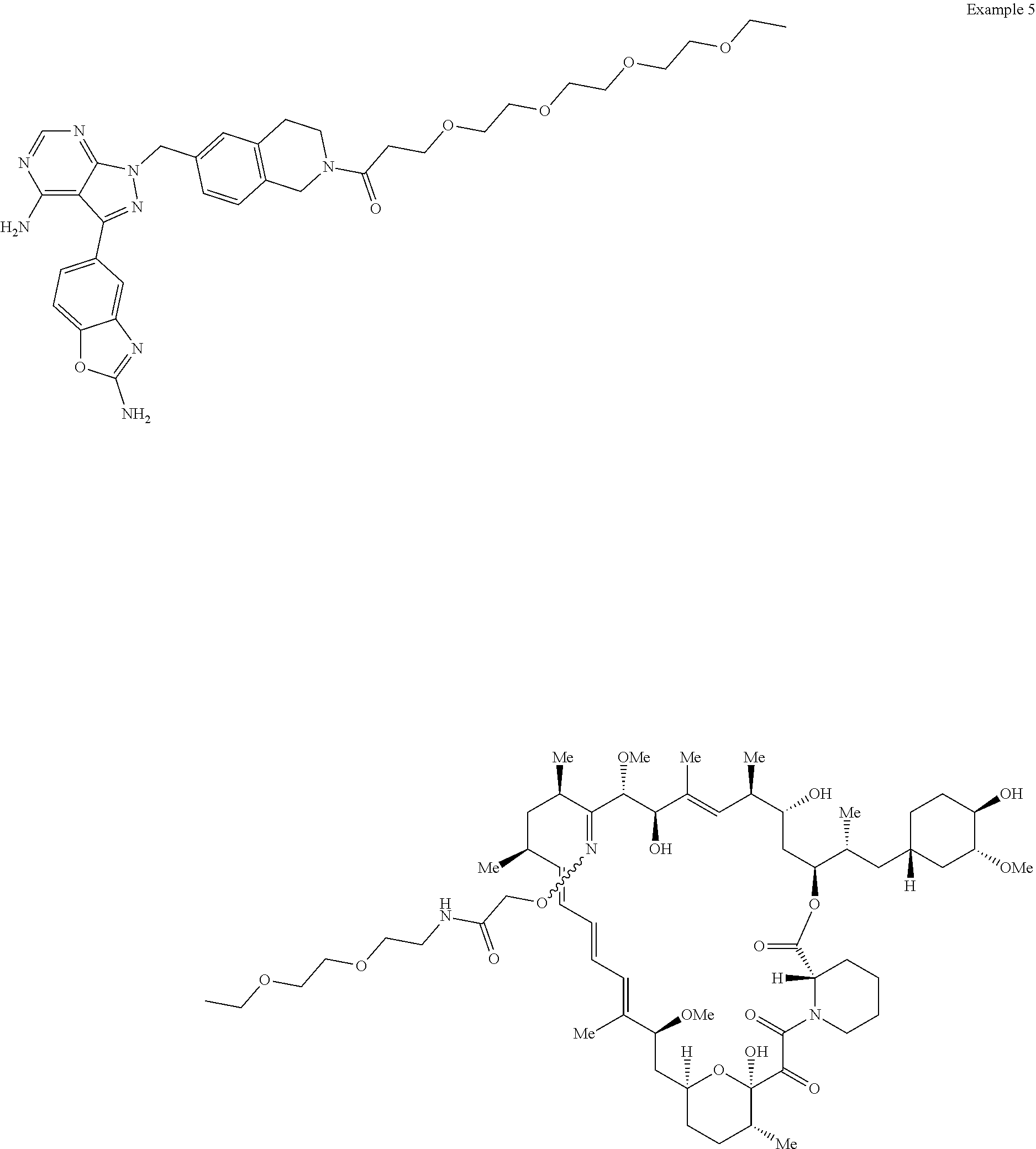
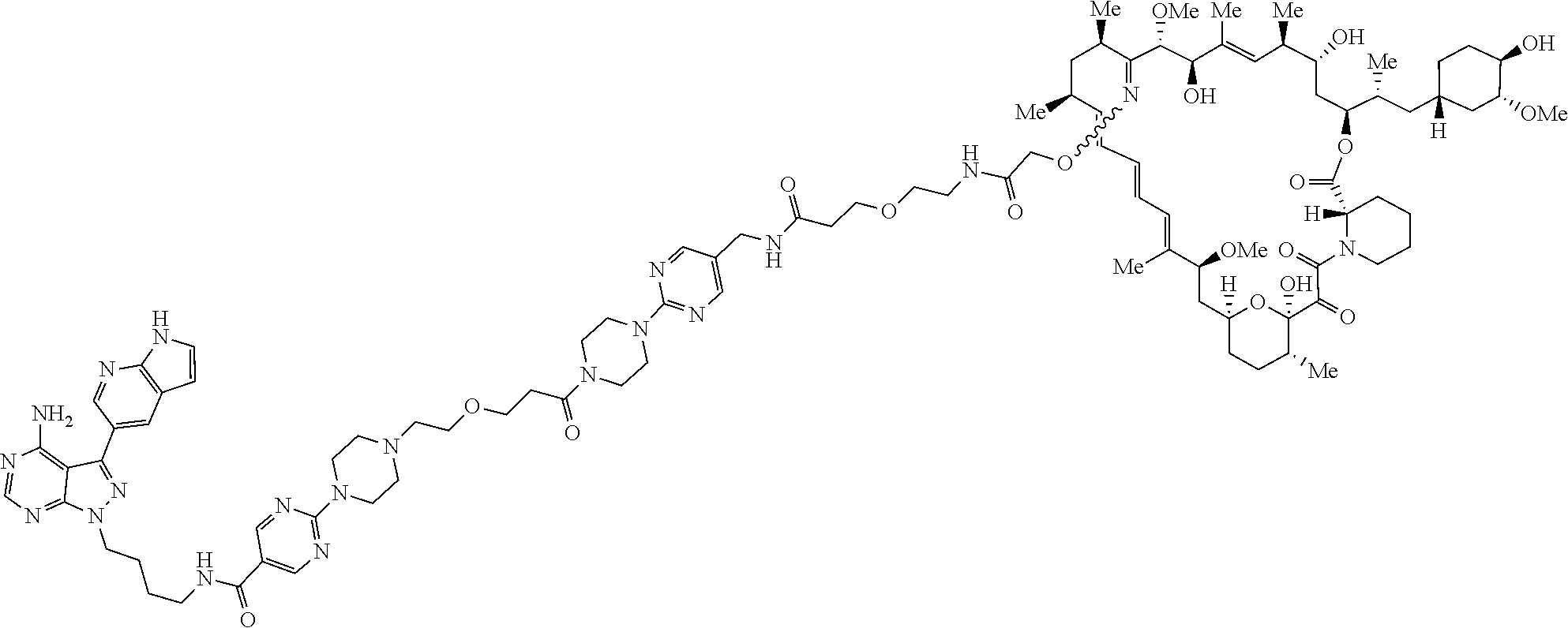
  • the amide moiety can be attached to the rapalog at R 26 (Formula I, Ia, or Ib), via an oxime linkage fragment including variations found in Table 1 in the Examples Section.
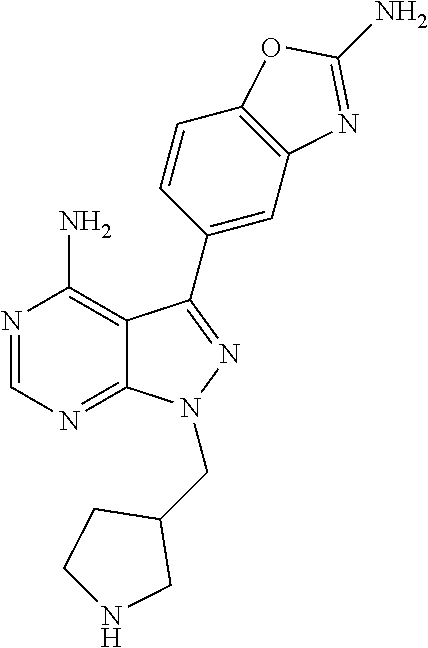
  • An mTOR active site inhibitor can attach to the linker via a primary or secondary amine, and may include variations found in Table 2 in the Examples Section.
  • the linker amine can include substitutions, such as R ⁇ H and C1-C6 alkyl groups.
  • the pre-linker amine can include substitutions, such as R 2 ⁇ H, C1-C6 alkyl groups, and cycloalkyl including 4 to 8-membered rings.
  • the amide moiety can be attached to the rapalog at R 26 (Formula I, Ia, or Ib), via an oxime linkage fragment including variations found in Table 1 in the Examples Section.
  • An mTOR active site inhibitor can attach to the linker via a primary or secondary amine, and may include variations found in Table 2 in the Examples Section.
  • the linker amine can include substitutions, such as R ⁇ H and C1-C6 alkyl groups.
  • the post-linker amine can include substitutions, such as R 2 ⁇ H, C1-C6 alkyl groups, and cycloalkyl including 4 to 8-membered rings.
  • the amide moiety can be attached to the rapalog at R 26 (Formula I, Ia, or Ib), via an oxime linkage fragment including variations found in Table 1 in the Examples Section.
  • An mTOR active site inhibitor can attach to the linker via a primary or secondary amine, and may include variations found in Table 2 in the Examples Section.
  • the linker amine can include substitutions, such as R ⁇ H and C1-C6 alkyl groups.
  • the pre- and post-linker amines can each include substitutions, such as R 2 ⁇ H, C1-C6 alkyl groups, and cycloalkyl including 4 to 8-membered rings.
  • the amide moiety can be attached to the rapalog at R 26 (Formula I, Ia, or Ib), via an oxime linkage fragment including variations found in Table 1 in the Examples Section.
  • An mTOR active site inhibitor can attach to the linker via a primary or secondary amine, and may include variations found in Table 2 in the Examples Section.
  • the pre-linker amine can include substitutions, such as R 2 ⁇ H, C1-C6 alkyl groups, and cycloalkyl including 4 to 8-membered rings.
  • the amide moiety can be attached to the rapalog at R 26 (Formula I, Ia, or Ib), via an oxime linkage fragment including variations found in Table 1 in the Examples Section.
  • An mTOR active site inhibitor can attach to the linker via a primary or secondary amine, and may include variations found in Table 2 in the Examples Section.
  • the linker amines can include substitutions, such as R ⁇ H and C1-C6 alkyl groups.
  • the post-linker amine can include substitutions, such as R 2 ⁇ H, C1-C6 alkyl groups, and cycloalkyl including 4 to 8-membered rings.
  • the amide moiety can be attached to the rapalog at R 26 (Formula I, Ia, or Ib), via an oxime linkage fragment including variations found in Table 1 in the Examples Section.
  • An mTOR active site inhibitor can attach to the linker via a primary or secondary amine, and may include variations found in Table 2 in the Examples Section.
  • the linker amine can include substitutions, such as R ⁇ H and C1-C6 alkyl groups.
  • the pre- and post-linker amines can each include substitutions, such as R 2 ⁇ H, C1-C6 alkyl groups, and cycloalkyl including 4 to 8-membered rings.
  • the amide moiety can be attached to the rapalog at R 26 (Formula I, Ia, or Ib), via an oxime linkage fragment including variations found in Table 1 in the Examples Section.
  • An mTOR active site inhibitor can attach to the linker via a primary or secondary amine, and may include variations found in Table 2 in the Examples Section.
  • the linker amine can include substitutions, such as R ⁇ H and C1-C6 alkyl groups.
  • the post-linker amine can include substitutions, such as R 2 ⁇ H, C1-C6 alkyl groups, and cycloalkyl including 4 to 8-membered rings.
  • the amide moiety can be attached to the rapalog at R 26 (Formula I, Ia, or Ib), via an oxime linkage fragment including variations found in Table 1 in the Examples Section.
  • An mTOR active site inhibitor can attach to the linker via a primary or secondary amine, and may include variations found in Table 2 in the Examples Section.
  • compositions including a pharmaceutically acceptable excipient and a compound, or pharmaceutically acceptable salt or tautomer thereof.
  • a compound of the present invention may be included in a therapeutically effective amount.
  • Administration of the disclosed compounds or compositions can be accomplished via any mode of administration for therapeutic agents.
  • These modes may include systemic or local administration such as oral, nasal, parenteral, transdermal, subcutaneous, vaginal, buccal, rectal, topical, intrathecal, or intracranial administration modes.
  • administering can include oral administration, administration as a suppository, topical contact, intravenous, parenteral, intraperitoneal, intramuscular, intralesional, intrathecal, intracranial, intranasal or subcutaneous administration, or the implantation of a slow-release device, e.g., a mini-osmotic pump, to a subject.
  • Administration can be by any route, including parenteral and transmucosal (e.g., buccal, sublingual, palatal, gingival, nasal, vaginal, rectal, or transdermal).
  • Parenteral administration includes, e.g., intravenous, intramuscular, intra-arteriole, intradermal, subcutaneous, intraperitoneal, intraventricular, and intracranial.
  • Other modes of delivery include, but are not limited to, the use of liposomal formulations, intravenous infusion, transdermal patches, etc.
  • the compositions of the present disclosure can be delivered by transdermally, by a topical route, formulated as applicator sticks, solutions, suspensions, emulsions, gels, creams, ointments, pastes, jellies, paints, powders, and aerosols.
  • Oral preparations include tablets, pills, powder, dragees, capsules, liquids, lozenges, cachets, gels, syrups, slurries, suspensions, etc., suitable for ingestion by the patient.
  • Solid form preparations include powders, tablets, pills, capsules, cachets, suppositories, and dispersible granules.
  • Liquid form preparations include solutions, suspensions, and emulsions, for example, water or water/propylene glycol solutions.
  • the compositions of the present disclosure may additionally include components to provide sustained release and/or comfort. Such components include high molecular weight, anionic mucomimetic polymers, gelling polysaccharides and finely-divided drug carrier substrates.
  • compositions of the present disclosure can also be delivered as microspheres for slow release in the body.
  • microspheres can be administered via intradermal injection of drug-containing microspheres, which slowly release subcutaneously (see Rao, J. Biomater Set Polym. Ed. 7:623-645, 1995; as biodegradable and injectable gel formulations (see, e.g., Gao Pharm. Res.
  • the formulations of the compositions of the present disclosure can be delivered by the use of liposomes which fuse with the cellular membrane or are endocytosed, i.e., by employing receptor ligands attached to the liposome, that bind to surface membrane protein receptors of the cell resulting in endocytosis.
  • liposomes particularly where the liposome surface carries receptor ligands specific for target cells, or are otherwise preferentially directed to a specific organ, one can focus the delivery of the compositions of the present invention into the target cells in vivo.
  • compositions of the present disclosure can also be delivered as nanoparticles.
  • the disclosed compounds or pharmaceutical compositions can be in solid, semi-solid or liquid dosage form, such as, for example, injectables, tablets, suppositories, pills, time-release capsules, elixirs, tinctures, emulsions, syrups, powders, liquids, suspensions, or the like, sometimes in unit dosages and consistent with conventional pharmaceutical practices.
  • injectables tablets, suppositories, pills, time-release capsules, elixirs, tinctures, emulsions, syrups, powders, liquids, suspensions, or the like, sometimes in unit dosages and consistent with conventional pharmaceutical practices.
  • they can also be administered in intravenous (both bolus and infusion), intraperitoneal, intrathecal, subcutaneous or intramuscular form, and all using forms well known to those skilled in the pharmaceutical arts.
  • Illustrative pharmaceutical compositions are tablets and gelatin capsules comprising a compound of the disclosure and a pharmaceutically acceptable carrier, such as a) a diluent, e.g., purified water, triglyceride oils, such as hydrogenated or partially hydrogenated vegetable oil, or mixtures thereof, corn oil, olive oil, sunflower oil, safflower oil, fish oils, such as EPA or DHA, or their esters or triglycerides or mixtures thereof, omega-3 fatty acids or derivatives thereof, lactose, dextrose, sucrose, mannitol, sorbitol, cellulose, sodium, saccharin, glucose and/or glycine; b) a lubricant, e.g., silica, talcum, stearic acid, its magnesium or calcium salt, sodium oleate, sodium stearate, magnesium stearate, sodium benzoate, sodium acetate, sodium chloride and/or polyethylene glycol; for tablets also; c
  • Liquid, particularly injectable, compositions can, for example, be prepared by dissolution, dispersion, etc.
  • the disclosed compound is dissolved in or mixed with a pharmaceutically acceptable solvent such as, for example, water, saline, aqueous dextrose, glycerol, ethanol, and the like, to thereby form an injectable isotonic solution or suspension.
  • a pharmaceutically acceptable solvent such as, for example, water, saline, aqueous dextrose, glycerol, ethanol, and the like.
  • Proteins such as albumin, chylomicron particles, or serum proteins can be used to solubilize the disclosed compounds.
  • the disclosed compounds can be also formulated as a suppository that can be prepared from fatty emulsions or suspensions; using polyalkylene glycols such as propylene glycol, as the carrier.
  • the disclosed compounds can also be administered in the form of liposome delivery systems, such as small unilamellar vesicles, large unilamellar vesicles and multilamellar vesicles.
  • Liposomes can be formed from a variety of phospholipids, containing cholesterol, stearylamine or phosphatidylcholines.
  • a film of lipid components is hydrated with an aqueous solution of drug to a form lipid layer encapsulating the drug, as described for instance in U.S. Pat. No. 5,262,564, the contents of which are hereby incorporated by reference.
  • Disclosed compounds can also be delivered by the use of monoclonal antibodies as individual carriers to which the disclosed compounds are coupled.
  • the disclosed compounds can also be coupled with soluble polymers as targetable drug carriers.
  • Such polymers can include polyvinylpyrrolidone, pyran copolymer, polyhydroxypropylmethacrylamide-phenol, polyhydroxyethylaspanamidephenol, or polyethyleneoxidepolylysine substituted with palmitoyl residues.
  • the disclosed compounds can be coupled to a class of biodegradable polymers useful in achieving controlled release of a drug, for example, polylactic acid, polyepsilon caprolactone, polyhydroxy butyric acid, polyorthoesters, polyacetals, polydihydropyrans, polycyanoacrylates and cross-linked or amphipathic block copolymers of hydrogels.
  • a polymer e.g., a polycarboxylic acid polymer, or a polyacrylate.
  • Parenteral injectable administration is generally used for subcutaneous, intramuscular or intravenous injections and infusions.
  • Injectables can be prepared in conventional forms, either as liquid solutions or suspensions or solid forms suitable for dissolving in liquid prior to injection.
  • compositions comprising a compound, or a pharmaceutically acceptable salt or tautomer thereof, of the present disclosure and a pharmaceutically acceptable carrier.
  • the pharmaceutically acceptable carrier can further include an excipient, diluent, or surfactant.
  • compositions can be prepared according to conventional mixing, granulating or coating methods, respectively, and the present pharmaceutical compositions can contain from about 0.1% to about 99%, from about 5% to about 90%, or from about 1% to about 20% of the disclosed compound by weight or volume.
  • the compounds described herein can be used in combination with one another, with other active agents known to be useful in treating cancer, autoimmune disease, inflammatory disease, metabolic disease, neurodegenerative disease, fungal infection, or transplant rejection, or with adjunctive agents that may not be effective alone, but may contribute to the efficacy of the active agent.
  • the compounds described herein can be used in combination with other active agents known to be longevity agents or anti-aging agents.
  • the pharmaceutical composition may include a second agent (e.g., therapeutic agent).
  • the pharmaceutical composition may include a second agent (e.g., therapeutic agent) in a therapeutically effective amount.
  • the second agent is an anti-cancer agent.
  • the second agent is an immunotherapeutic agent.
  • the second agent is an immune-oncological agent.
  • the second agent is an anti-autoimmune disease agent.
  • the second agent is an anti-inflammatory disease agent.
  • the second agent is an anti-neurodegenerative disease agent.
  • the second agent is an anti-metabolic disease agent.
  • the second agent is an anti-cardiovascular disease agent.
  • the second agent is an anti-aging agent. In embodiments, the second agent is a longevity agent. In embodiments, the second agent is an agent for treating or preventing transplant rejection. In embodiments, the second agent is an agent for treating or preventing fungal infection. In embodiments, the second agent is immune system repressor. In embodiments, the second agent is an mTOR modulator. In embodiments, the second agent is an mTOR inhibitor. In embodiments, the second agent is an active site mTOR inhibitor. In embodiments, the second agent is a rapamycin. In embodiments, the second agent is a rapamycin analog. In embodiments, the second agent is an mTOR pathway inhibitor. In certain embodiments, the second agent is CDK4/6 inhibitor; anti-PD1/PD-L1, PI3K inhibitor; or Ras inhibitor.
  • Anti-cancer agent or “anti-cancer drug” is used in accordance with its plain ordinary meaning and refers to a composition (e.g. compound, drug, antagonist, inhibitor, modulator) having antineoplastic properties or the ability to inhibit the growth or proliferation of cells.
  • an anti-cancer agent is a chemotherapeutic.
  • an anticancer agent is an agent approved by the FDA or similar regulatory agency of a country other than the USA, for treating cancer.
  • anti-cancer agents include, but are not limited to, rapamycin, rapamycin analog, bevacizumab, PP242, ⁇ N 128, MLN0128, anti-androgens (e.g., Casodex, Flutamide, MDV3100, or ARN-509), MEK (e.g. MEK1, MEK2, or MEK1 and MEK2) inhibitors (e.g.
  • alkylating agents e.g., cyclophosphamide, ifosfamide, chlorambucil, busulfan, melphalan, mechlorethamine, uramustine, thiotepa, nitrosoureas, nitrogen mustards (e.g., mechloroethamine, cyclophosphamide, chlorambucil, meiphalan), ethylenimine and methylmelamines (e.g., hexamethlymelamine, thiotepa), alkyl sulfonates (e.g., cyclophosphamide, ifosfamide, chlorambucil, busulfan, melphalan, mechlorethamine, uramustine, thiotepa, nitrosoureas, nitrogen mustards (e.g., mechloroethamine, cyclophosphamide, chlorambucil, meiphalan),
  • mTOR inhibitors include antibodies (e.g., rituxan), 5-aza-2′-deoxycytidine, doxorubicin, vincristine, etoposide, gemcitabine, imatinib (Gleevec®), geldanamycin, 17-N-Allylamino-17-Demethoxygeldanamycin (17-AAG), bortezomib, trastuzumab, anastrozole; angiogenesis inhibitors; antiandrogen, antiestrogen; antisense oligonucleotides; apoptosis gene modulators; apoptosis regulators; arginine deaminase; BCR/ABL antagonists; beta lactam derivatives; bFGF inhibitor; bicalut
  • gefitinib IressaTM
  • erlotinib TarcevaTM
  • cetuximab ErbituxTM
  • lapatinib TykerbTM
  • panitumumab VectibixTM
  • vandetanib CaprelsaTM
  • afatinib/BIBW2992 CI-1033/canertinib, neratinib/HKI-272, CP-724714, TAK-285, AST-1306, ARRY334543, ARRY-380, AG-1478, dacomitinib/PF299804, OSI-420/desmethyl erlotinib, AZD8931, AEE788, pelitinib/EKB-569, CUDC-101, WZ8040, WZ4002, WZ3146, AG-490, XL647, PD153035, BMS-599626), sorafenib, imatinib, sunitinib, dasat
  • tomaymycin carboplatin
  • CC-1065 and CC-1065 analogs including amino-CBIs, nitrogen mustards (such as chlorambucil and melphalan), dolastatin and dolastatin analogs (including auristatins: eg. monomethyl auristatin E), anthracycline antibiotics (such as doxorubicin, daunorubicin, etc.), duocarmycins and duocarmycin analogs, enediynes (such as neocarzinostatin and calicheamicins), leptomycin derivatives, maytansinoids and maytansinoid analogs (e.g.
  • mertansine methotrexate
  • mitomycin C taxoids
  • vinca alkaloids such as vinblastine and vincristine
  • epothilones e.g. epothilone B
  • camptothecin and its clinical analogs topotecan and irinotecan FNK128, PP242, PP121, MLN0128, AZD8055, AZD2014, VP-BEZ235, BGT226, SFl 126, Torin 1, Torin 2, WYE 687, WYE 687 salt (e.g., hydrochloride), PF04691502, PI-103, CC-223, OSI-027, XL388, KU-0063794, GDC-0349, PKI-587, rapamycin, deforolimus (AP23573, MK-8669, ridaforolimus), temsirolimus (CCI-779), ABT478, everolimus (RAD001) or the like.
  • mTOR refers to the protein “mechanistic target of rapamycin (serine/threonine kinase)” or “mammalian target of rapamycin.”
  • the term “mTOR” may refer to the nucleotide sequence or protein sequence of human mTOR (e.g., Entrez 2475, Uniprot P42345, RefSeq NM_004958, or RefSeq NP_004949) (SEQ ID NO: 1).
  • the term “mTOR” may include both the wild-type form of the nucleotide sequences or proteins as well as any mutants thereof. In some embodiments, “mTOR” is wild-type mTOR.
  • mTOR is one or more mutant forms.
  • the term “mTOR” XYZ may refer to a nucleotide sequence or protein of a mutant mTOR wherein the Y numbered amino acid of mTOR that normally has an X amino acid in the wildtype, instead has a Z amino acid in the mutant.
  • an mTOR is the human mTOR.
  • the mTOR has the nucleotide sequence corresponding to reference number GL206725550 (SEQ ID NO:2).
  • the mTOR has the nucleotide sequence corresponding to RefSeq NM_004958.3 (SEQ ID NO:2).
  • the mTOR has the protein sequence corresponding to reference number GL4826730 (SEQ ID NO: 1). In embodiments, the mTOR has the protein sequence corresponding to RefSeq NP_004949.1 (SEQ ID NO: 1). In embodiments, the mTOR has the following amino acid sequence:
  • the mTOR is a mutant mTOR.
  • the mutant mTOR is associated with a disease that is not associated with wildtype mTOR.
  • the mTOR may include at least one amino acid mutation (e.g., 1, 2, 3, 4, 5, 6, 7, 8, 9, 10, 11, 12, 13, 14, 15, 16, 17, 18, 19, 20, 21, 22, 23, 24, 25, 26, 27, 28, 29, or 30 mutations, or any range derivable therein) compared to the sequence above.
  • mTORC1 refers to the protein complex including mTOR and Raptor (regulatory-associated protein of mTOR). mTORC1 may also include MLST8 (mammalian lethal with SEC 13 protein 8), PRAS40, and/or DEPTOR. mTORC1 may function as a nutrient/energy/redox sensor and regulator of protein synthesis.
  • mTORC1 pathway or “mTORC1 signal transduction pathway” may refer to a cellular pathway including mTORC1. An mTORC1 pathway includes the pathway components upstream and downstream from mTORC1. An mTORC1 pathway is a signaling pathway that is modulated by modulation of mTORC1 activity.
  • an mTORC1 pathway is a signaling pathway that is modulated by modulation of mTORC1 activity but not by modulation of mTORC2 activity. In embodiments, an mTORC1 pathway is a signaling pathway that is modulated to a greater extent by modulation of mTORC1 activity than by modulation of mTORC2 activity.
  • mTORC2 refers to the protein complex including mTOR and RICTOR (rapamycin-insensitive companion of mTOR). mTORC2 may also include GOL, mSIN1 (mammalian stress-activated protein kinase interacting protein 1), Protor 1/2, DEPTOR, TTI1, and/or TEL2. mTORC2 may regulate cellular metabolism and the cytoskeleton.
  • mTORC2 pathway or “mTORC2 signal transduction pathway” may refer to a cellular pathway including mTORC2.
  • An mTORC2 pathway includes the pathway components upstream and downstream from mTORC2.
  • An mTORC2 pathway is a signaling pathway that is modulated by modulation of mTORC2 activity.
  • an mTORC2 pathway is a signaling pathway that is modulated by modulation of mTORC2 activity but not by modulation of mTORC1 activity. In embodiments, an mTORC2 pathway is a signaling pathway that is modulated to a greater extent by modulation of mTORC2 activity than by modulation of mTORC1 activity.
  • Rapamycin refers to a macrolide produced by the bacteria Streptomyces hygroscopicus . Rapamycin may prevent the activation of T cells and B cells. Rapamycin has the IUPAC name (3S,6R,7E,9R, 10R, 12R, 14S, 15E, 17E, 19E,21S,23S,26R,27R,34aS)-9, 10, 12, 13, 14,21,22,23,24,25,26,27,32,33,34,34a-hexadecahydro-9,27-dihydroxy-3-[(1R)-2-[(1 S,3 R,4R)-4-hydroxy-3-methoxycyclohexyl]-1-methylethyl]-10,21-dimethoxy-6,8,12,14,20,26-hexamethyl-23,27-epoxy-3H-pyrido[2,1-c][1,4]-oxaazacyclohentria
  • Analog is used in accordance with its plain ordinary meaning within chemistry and biology and refers to a chemical compound that is structurally similar to another compound (i.e., a so-called “reference” compound) but differs in composition, e.g., in the replacement of one atom by an atom of a different element, or in the presence of a particular functional group, or the replacement of one functional group by another functional group, or the absolute stereochemistry of one or more chiral centers of the reference compound, including isomers thereof.
  • rapamycin analog or “rapalog” refers to an analog or derivative (e.g., a prodrug) of rapamycin.
  • active site mTOR inhibitor and “ATP mimetic” refers to a compound that inhibits the activity of mTOR (e.g., kinase activity) and binds to the active site of mTOR (e.g., the ATP binding site, overlapping with the ATP binding site, blocking access by ATP to the ATP binding site of mTOR).
  • mTOR e.g., kinase activity
  • ATP mimetic refers to a compound that inhibits the activity of mTOR (e.g., kinase activity) and binds to the active site of mTOR (e.g., the ATP binding site, overlapping with the ATP binding site, blocking access by ATP to the ATP binding site of mTOR).
  • active site mTOR inhibitors include, but are not limited to, 1-NK128, PP242, PP121, MLN0128, AZD8055, AZD2014, NVP-BEZ235, BGT226, SF1126, Torin 1, Torin 2, WYE 687, WYE 687 salt (e.g., hydrochloride), PF04691502, PI-103, CC-223, OSI-027, XL388, KU-0063794, GDC-0349, and PKI-587.
  • an active site mTOR inhibitor is an asTORi.
  • active site inhibitor may refer to “active site mTOR inhibitor.”
  • FKBP refers to the protein Peptidyl-prolyl cis-trans isomerase. For non-limiting examples of FKBP, see Cell Mol Life Sci. 2013 September; 70(18):3243-75.
  • FKBP may refer to “FKBP-12” or “FKBP 12” or “FKBP 1 A.”
  • FKBP may refer to the human protein. Included in the term “FKBP” is the wildtype and mutant forms of the protein.
  • FKBP may refer to the wildtype human protein.
  • FKBP may refer to the wildtype human nucleic acid.
  • the FKBP is a mutant FKBP.
  • the mutant FKBP is associated with a disease that is not associated with wildtype FKBP.
  • the FKBP includes at least one amino acid mutation (e.g., 1, 2, 3, 4, 5, 6, 7, 8, 9, 10, 11, 12, 13, 14, 15, 16, 17, 18, 19, 20, 21, 22, 23, 24, 25, 26, 27, 28, 29, or 30 mutations, or any range derivable therein) compared to wildtype FKBP.
  • FKBP-12 or “FKBP 12” or “FKBP1A” may refer to the protein “Peptidyl-prolyl cis-trans isomerase FKBP 1 A.”
  • FKBP-12 or “FKBP 12” or “FKBP 1 A” may refer to the human protein. Included in the term “FKBP-12” or “FKBP 12” or “FKBP 1 A” are the wildtype and mutant forms of the protein.
  • FKBP-12 or “FKBP 12” or “FKBP 1 A” may refer to the protein associated with Entrez Gene 2280, OMIM 186945, UniProt P62942, and/or RefSeq (protein) NP_000792 (SEQ ID NO:3).
  • the reference numbers immediately above may refer to the protein, and associated nucleic acids, known as of the date of filing of this application.
  • “FKBP-12” or “FKBP 12” or “FKBP 1 A” may refer to the wildtype human protein.
  • FKBP-12” or “FKBP 12” or “FKBP1A” may refer to the wildtype human nucleic acid.
  • the FKBP-12 is a mutant FKBP-12.
  • the mutant FKBP-12 is associated with a disease that is not associated with wildtype FKBP-12.
  • the FKBP-12 may include at least one amino acid mutation (e.g., 1, 2, 3, 4, 5, 6, 7, 8, 9, 10, 11, 12, 13, 14, 15, 16, 17, 18, 19, 20, 21, 22, 23, 24, 25, 26, 27, 28, 29, or 30 mutations, or any range derivable therein) compared to wildtype FKBP-12.
  • the FKBP-12 has the protein sequence corresponding to reference number GI:206725550.
  • the FKBP-12 has the protein sequence corresponding to RefSeq NP_000792.1 (SEQ ID NO:3).
  • 4E-BP1 refers to the protein “Eukaryotic translation initiation factor 4E-binding protein 1.”
  • 4E-BP1 or “4EBP1” or “EIF4EBP1” may refer to the human protein. Included in the term “4E-BP 1” or “4EBP 1” or “EIF4EBP1” are the wildtype and mutant forms of the protein.
  • “4E-BP1” or “4EBP1” or “EIF4EBP1” may refer to the protein associated with Entrez Gene 1978, OMIM 602223, UniProt Q13541, and/or RefSeq (protein) NP_004086 (SEQ ID NO:4).
  • the reference numbers immediately above may refer to the protein, and associated nucleic acids, known as of the date of filing of this application.
  • “4E-BP 1” or “4EBP1” or “EIF4EBP1” may refer to the wildtype human protein.
  • “4E-BP1” or “4EBP1” or “EIF4EBP1” may refer to the wildtype human nucleic acid.
  • the 4EBP1 is a mutant 4EBP1.
  • the mutant 4EBP1 is associated with a disease that is not associated with wildtype 4EBP1.
  • the 4EBP1 may include at least one amino acid mutation (e.g., 1, 2, 3, 4, 5, 6, 7, 8, 9, 10, 11, 12, 13, 14, 15, 16, 17, 18, 19, 20, 21, 22, 23, 24, 25, 26, 27, 28, 29, or 30 mutations, or any range derivable therein) compared to wildtype 4EBP1.
  • the 4EBP1 has the protein sequence corresponding to reference number GL4758258.
  • the 4EBP1 has the protein sequence corresponding to RefSeq NP_004086.1 (SEQ ID NO:4).
  • Akt refers to the serine/threonine specific protein kinase involved in cellular processes such as glucose metabolism, apoptosis, proliferation, and other functions, also known as “protein kinase B” (PKB) or “Akt1.”
  • PPKB protein kinase B
  • the reference numbers immediately above may refer to the protein, and associated nucleic acids, known as of the date of filing of this application.
  • Akt or “Akt1” or “PKB” may refer to the wildtype human protein.
  • Akt or “Akt1” or “PKB” may refer to the wildtype human nucleic acid.
  • the Akt is a mutant Akt.
  • the mutant Akt is associated with a disease that is not associated with wildtype Akt.
  • the Akt may include at least one amino acid mutation (e.g., 1, 2, 3, 4, 5, 6, 7, 8, 9, 10, 11, 12, 13, 14, 15, 16, 17, 18, 19, 20, 21, 22, 23, 24, 25, 26, 27, 28, 29, or 30 mutations, or any range derivable therein) compared to wildtype Akt.
  • the Akt has the protein sequence corresponding to reference number GI: 62241011.
  • the Akt has the protein sequence corresponding to RefSeq NP_005154.2 (SEQ ID NO:5).
  • the present disclosure provides a method of treating a disease or disorder mediated by mTOR comprising administering to the subject suffering from or susceptible to developing a disease or disorder mediated by mTOR a therapeutically effective amount of one or more disclosed compositions or compounds.
  • the present disclosure provides a method of preventing a disease or disorder mediated by mTOR comprising administering to the subject suffering from or susceptible to developing a disease or disorder mediated by mTOR a therapeutically effective amount of one or more disclosed compositions or compounds.
  • the present disclosure provides a method of reducing the risk of a disease or disorder mediated by mTOR comprising administering to the subject suffering from or susceptible to developing a disease or disorder mediated by mTOR a therapeutically effective amount of one or more disclosed compositions or compounds.
  • the disease is cancer or an immune-mediated disease.
  • the cancer is selected from brain and neurovascular tumors, head and neck cancers, breast cancer, lung cancer, mesothelioma, lymphoid cancer, stomach cancer, kidney cancer, renal carcinoma, liver cancer, ovarian cancer, ovary endometriosis, testicular cancer, gastrointestinal cancer, prostate cancer, glioblastoma, skin cancer, melanoma, neuro cancers, spleen cancers, pancreatic cancers, blood proliferative disorders, lymphoma, leukemia, endometrial cancer, cervical cancer, vulva cancer, prostate cancer, penile cancer, bone cancers, muscle cancers, soft tissue cancers, intestinal or rectal cancer, anal cancer, bladder cancer, bile duct cancer, ocular cancer, gastrointestinal stromal tumors, and neuro-endocrine tumors.
  • the disorder is liver cirrhosis.
  • the immune-mediated disease is selected from resistance by transplantation of heart, kidney, liver, medulla ossium, skin, cornea, lung, pancreas, intestinum ***, limb, muscle, nerves, duodenum, small-bowel, or pancreatic-islet-cell; graft-versus-host diseases brought about by medulla ossium transplantation; rheumatoid arthritis, systemic lupus erythematosus, Hashimoto's thyroiditis, multiple sclerosis, myasthenia gravis, type I diabetes, uveitis, allergic encephalomyelitis, and glomerulonephritis.
  • the disease is tuberous sclerosis complex (TSC).
  • TSC tuberous sclerosis complex
  • the disease is pancreatic neuroendocrine tumor (PNET), mantle cell lymphoma (MCL), colorectal cancer or bowel cancer (CRC), uterine cancer, ovarian cancer, bladder cancer, genitourinary tract cancer, or renal cell carcinoma (RCC).
  • PNET pancreatic neuroendocrine tumor
  • MCL mantle cell lymphoma
  • CRCC renal cell carcinoma
  • the present disclosure provides a method of treating cancer comprising administering to the subject a therapeutically effective amount of one or more disclosed compositions or compounds.
  • the cancer is selected from brain and neurovascular tumors, head and neck cancers, breast cancer, lung cancer, mesothelioma, lymphoid cancer, stomach cancer, kidney cancer, renal carcinoma, liver cancer, ovarian cancer, ovary endometriosis, testicular cancer, gastrointestinal cancer, prostate cancer, glioblastoma, skin cancer, melanoma, neuro cancers, spleen cancers, pancreatic cancers, blood proliferative disorders, lymphoma, leukemia, endometrial cancer, cervical cancer, vulva cancer, prostate cancer, penile cancer, bone cancers, muscle cancers, soft tissue cancers, intestinal or rectal cancer, anal cancer, bladder cancer, bile duct cancer, ocular cancer, gastrointestinal stromal tumors, and neuro-endocrine tumors.
  • the disorder is liver cirrhosis.
  • the disease is tuberous sclerosis complex (TSC).
  • TSC tuberous sclerosis complex
  • the disease is pancreatic neuroendocrine tumor (PNET), mantle cell lymphoma (MCL), colorectal cancer or bowel cancer (CRC), uterine cancer, ovarian cancer, bladder cancer, genitourinary tract cancer, or renal cell carcinoma (RCC).
  • PNET pancreatic neuroendocrine tumor
  • MCL mantle cell lymphoma
  • CRCC renal cell carcinoma
  • cancer includes human cancers and carcinomas, sarcomas, adenocarcinomas, lymphomas, leukemias, etc., including solid and lymphoid cancers, kidney, breast, lung, bladder, colon, ovarian, prostate, pancreas, stomach, brain, head and neck, skin, uterine, testicular, glioma, esophagus, and liver cancer, including hepatocarcinoma, lymphoma, including B-acute lymphoblastic lymphoma, non-Hodgkin's lymphomas (e.g., Burkitt's, Small Cell, and Large Cell lymphomas), Hodgkin's lymphoma, leukemia (including AML, ALL, and CML), or multiple myeloma.
  • the disease is multiple myeloma.
  • the disease is breast cancer.
  • the disease is triple negative breast cancer.
  • cancer includes cancer, neoplasm or malignant tumors found in mammals (e.g. humans), including leukemia, carcinomas and sarcomas.
  • exemplary cancers that may be treated with a compound or method provided herein include cancer of the prostate, thyroid, endocrine system, brain, breast, cervix, colon, head and neck, liver, kidney, lung, non-small cell lung, melanoma, mesothelioma, ovary, sarcoma, stomach, uterus, Medulloblastoma, colorectal cancer, pancreatic cancer.
  • Additional examples may include, Hodgkin's Disease, Non-Hodgkin's Lymphoma, multiple myeloma, neuroblastoma, glioma, glioblastoma multiforme, ovarian cancer, rhabdomyosarcoma, primary thrombocytosis, primary macroglobulinemia, primary brain tumors, malignant pancreatic insulanoma, malignant carcinoid, urinary bladder cancer, premalignant skin lesions, testicular cancer, lymphomas, thyroid cancer, neuroblastoma, esophageal cancer, genitourinary tract cancer, malignant hypercalcemia, endometrial cancer, adrenal cortical cancer, neoplasms of the endocrine or exocrine pancreas, medullary thyroid cancer, medullary thyroid carcinoma, melanoma, colorectal cancer, papillary thyroid cancer, hepatocellular carcinoma, or prostate cancer.
  • the disease is leukemia.
  • leukemia refers broadly to progressive, malignant diseases of the blood-forming organs and is generally characterized by a distorted proliferation and development of leukocytes and their precursors in the blood and bone marrow. Leukemia is generally clinically classified on the basis of (1) the duration and character of the disease-acute or chronic; (2) the type of cell involved; myeloid (myelogenous), lymphoid (lymphogenous), or monocytic; and (3) the increase or non-increase in the number of aberrant cells in the blood-leukemic or aleukemic (subleukemic).
  • Exemplary leukemias that may be treated with a compound or method provided herein include, for example, acute nonlymphocytic leukemia, chronic lymphocytic leukemia, acute granulocytic leukemia, chronic granulocytic leukemia, acute promyelocytic leukemia, adult T-cell leukemia, aleukemic leukemia, a leukocythemic leukemia, basophylic leukemia, blast cell leukemia, bovine leukemia, chronic myelocytic leukemia, leukemia cutis, embryonal leukemia, eosinophilic leukemia, Gross' leukemia, hairy-cell leukemia, hemoblastic leukemia, hemocytoblastic leukemia, histiocytic leukemia, stem cell leukemia, acute monocytic leukemia, leukopenic leukemia, lymphatic leukemia, lymphoblastic leukemia, lymphocytic leukemia, lymphogenous leukemia,
  • the disease is sarcoma.
  • sarcoma generally refers to a tumor which is made up of a substance like the embryonic connective tissue and is generally composed of closely packed cells embedded in a fibrillar or homogeneous substance.
  • Sarcomas that may be treated with a compound or method provided herein include a chondrosarcoma, fibrosarcoma, lymphosarcoma, melanosarcoma, myxosarcoma, osteosarcoma, Abemethy's sarcoma, adipose sarcoma, liposarcoma, alveolar soft part sarcoma, ameloblastic sarcoma, botryoid sarcoma, chloroma sarcoma, chorio carcinoma, embryonal sarcoma, Wilms' tumor sarcoma, endometrial sarcoma, stromal sarcoma, Ewing's sarcoma, fascial sarcoma, fibroblastic sarcoma, giant cell sarcoma, granulocytic sarcoma, Hodgkin's sarcoma, idiopathic multiple pigmented hemo
  • the disease is melanoma.
  • melanoma is taken to mean a tumor arising from the melanocyte system of the skin and other organs.
  • Melanomas that may be treated with a compound or method provided herein include, for example, acral-lentiginous melanoma, amelanotic melanoma, benign juvenile melanoma, Cloudman's melanoma, S91 melanoma, Harding-Passey melanoma, juvenile melanoma, lentigo maligna melanoma, malignant melanoma, nodular melanoma, subungal melanoma, or superficial spreading melanoma.
  • the disease is carcinoma.
  • carcinoma refers to a malignant new growth made up of epithelial cells tending to infiltrate the surrounding tissues and give rise to metastases.
  • Exemplary carcinomas that may be treated with a compound or method provided herein include, for example, medullary thyroid carcinoma, familial medullary thyroid carcinoma, acinar carcinoma, acinous carcinoma, adenocystic carcinoma, adenoid cystic carcinoma, carcinoma adenomatosum, carcinoma of adrenal cortex, alveolar carcinoma, alveolar cell carcinoma, basal cell carcinoma, carcinoma basocellulare, basaloid carcinoma, basosquamous cell carcinoma, bronchioalveolar carcinoma, bronchiolar carcinoma, bronchogenic carcinoma, cerebriform carcinoma, cholangiocellular carcinoma, chorionic carcinoma, colloid carcinoma, comedo carcinoma, corpus carcinoma, cribriform carcinoma, carcinoma en cuirasse, carcinoma cutaneum, cylindrical carcinoma, cylindrical cell carcinoma, duct carcinoma, carcinoma durum, embryonal
  • the present disclosure provides a method of treating an immune-mediated disease comprising administering to the subject a therapeutically effective amount of one or more disclosed compositions or compounds.
  • the immune-mediated disease is selected from resistance by transplantation of heart, kidney, liver, medulla ossium, skin, cornea, lung, pancreas, intestinum ***, limb, muscle, nerves, duodenum, small-bowel, or pancreatic-islet-cell; graft-versus-host diseases brought about by medulla ossium transplantation; rheumatoid arthritis, systemic lupus erythematosus, Hashimoto's thyroiditis, multiple sclerosis, myasthenia gravis, type I diabetes, uveitis, allergic encephalomyelitis, and glomerulonephritis.
  • the disease is autoimmune disease.
  • autoimmune disease refers to a disease or condition in which a subject's immune system has an aberrant immune response against a substance that does not normally elicit an immune response in a healthy subject.
  • autoimmune diseases examples include Acute Disseminated Encephalomyelitis (ADEM), Acute necrotizing hemorrhagic leukoencephalitis, Addison's disease, Agammaglobulinemia, Alopecia areata, Amyloidosis, Ankylosing spondylitis, Anti-GBM/Anti-TBM nephritis, Antiphospholipid syndrome (APS), Autoimmune angioedema, Autoimmune aplastic anemia, Autoimmune dysautonomia, Autoimmune hepatitis, Autoimmune hyperlipidemia, Autoimmune immunodeficiency, Autoimmune inner ear disease (AIED), Autoimmune myocarditis, Autoimmune oophoritis, Autoimmune pancreatitis, Autoimmune retinopathy, Autoimmune thrombocytopenic purpura (ATP), Autoimmune thyroid disease, Auto
  • ADAM Acute Disseminated Encephalomye
  • the present disclosure provide a method of treating an age related condition comprising administering to the subject a therapeutically effective amount of one or more disclosed compositions or compounds.
  • the age related condition is selected from sarcopenia, skin atrophy, muscle wasting, brain atrophy, atherosclerosis, arteriosclerosis, pulmonary emphysema, osteoporosis, osteoarthritis, high blood pressure, erectile dysfunction, dementia, Huntington's disease, Alzheimer's disease, cataracts, age-related macular degeneration, prostate cancer, stroke, diminished life expectancy, impaired kidney function, and age-related hearing loss, aging-related mobility disability (e.g., frailty), cognitive decline, age-related dementia, memory impairment, tendon stiffness, heart dysfunction such as cardiac hypertrophy and systolic and diastolic dysfunction, immunosenescence, cancer, obesity, and diabetes.
  • sarcopenia skin atrophy, muscle wasting, brain atrophy, atherosclerosis, arteriosclerosis, pulmonary em
  • the disclosed compositions or compounds can be used with regard to immunosenescence.
  • Immunosenescence may refer to a decrease in immune function resulting in impaired immune response, e.g., to cancer, vaccination, infectious pathogens, among others. It involves both the host's capacity to respond to infections and the development of long-term immune memory, especially by vaccination. This immune deficiency is ubiquitous and found in both long- and short-lived species as a function of their age relative to life expectancy rather than chronological time. It is considered a major contributory factor to the increased frequency of morbidity and mortality among the elderly. Immunosenescence is not a random deteriorative phenomenon, rather it appears to inversely repeat an evolutionary pattern and most of the parameters affected by immunosenescence appear to be under genetic control.
  • Immunosenescence can also be sometimes envisaged as the result of the continuous challenge of the unavoidable exposure to a variety of antigens such as viruses and bacteria. Immunosenescence is a multifactorial condition leading to many pathologically significant health problems, e.g., in the aged population. Age-dependent biological changes such as depletion of hematopoietic stem cells, an increase in PD1+ lymphocytes, a decline in the total number of phagocytes and NK cells and a decline in humoral immunity contribute to the onset of immunosenescence. In one aspect, immunosenescence can be measured in an individual by measuring telomere length in immune cells (See, e.g., U.S. Pat. No. 5,741,677).
  • Immunosenescence can also be determined by documenting in an individual a lower than normal number of naive CD4 and/or CD8 T cells, T cell repertoire, the number of PD1-expressing T cells, e.g., a lower than normal number of PD-1 negative T cells, or response to vaccination in a subject greater than or equal to 65 years of age.
  • mTOR selective modulation of certain T-cell populations may improve vaccine efficacy in the aging population and enhance effectiveness of cancer immunotherapy.
  • the present disclosure provides a method of treating immunosenescence comprising administering to the subject a therapeutically effective amount of one or more disclosed compositions or compounds.
  • a disease that may be treated with a compound, pharmaceutical composition, or method described herein is organ or tissue transplant rejection (e.g. heart, lung, combined heart-lung, liver, kidney, pancreatic, skin or corneal transplants; graft-versus-host disease), restenosis, Hamartoma syndromes (e.g., tuberous sclerosis or Cowden Disease), Lymphangioleiomyomatosis, Retinitis pigmentosis, encephalomyelitis, insulin-dependent diabetes mellitus, lupus, dermatomyositis, arthritis, rheumatic diseases, Steroid-resistant acute Lymphoblastic Leukemia, fibrosis, scleroderma, pulmonary fibrosis, renal fibrosis, cystic fibrosis, Pulmonary hypertension, Multiple sclerosis, VHL syndrome, Carney complex, Familial adenonamtous polyposis, Juvenile polyposis syndrome, Birt-Hogg-Duke syndrome, Fa
  • the disease is neurodegenerative disease.
  • the term “neurodegenerative disease” refers to a disease or condition in which the function of a subject's nervous system becomes impaired.
  • Examples of neurodegenerative diseases that may be treated with a compound, pharmaceutical composition, or method described herein include Alexander's disease, Alper's disease, Alzheimer's disease, Amyotrophic lateral sclerosis, Ataxia telangiectasia, Batten disease (also known as Spielmeyer-Vogt-Sjogren-Batten disease), Bovine spongiform encephalopathy (BSE), Canavan disease, Cockayne syndrome, Corticobasal degeneration, Creutzfeldt-Jakob disease, frontotemporal dementia, Gerstmann-Straussler-Scheinker syndrome, Huntington's disease, HIV-associated dementia, Kennedy's disease, Krabbe's disease, kuru, Lewy body dementia, Machado-Joseph disease (Spinocerebellar at
  • the disease is metabolic disease.
  • the term “metabolic disease” refers to a disease or condition in which a subject's metabolism or metabolic system (e.g., function of storing or utilizing energy) becomes impaired.
  • Examples of metabolic diseases that may be treated with a compound, pharmaceutical composition, or method described herein include diabetes (e.g., type I or type II), obesity, metabolic syndrome, or a mitochondrial disease (e.g., dysfunction of mitochondria or aberrant mitochondrial function).
  • the disease is fungal disease.
  • the term “fungal disease” refers to a disease or condition associated with a fungus infection of the subject.
  • fungal diseases that may be treated with a compound, pharmaceutical composition, or method described herein include infection with Mucor circinelloides , zygomycetes, Cryptococcus neoformans, Candida albicans , yeast, and Saccharomyces cerevisiae among others.
  • the disease is inflammatory disease.
  • inflammatory disease refers to a disease or condition characterized by aberrant inflammation (e.g. an increased level of inflammation compared to a control such as a healthy person not suffering from a disease).
  • inflammatory diseases include traumatic brain injury, arthritis, rheumatoid arthritis, psoriatic arthritis, juvenile idiopathic arthritis, multiple sclerosis, systemic lupus erythematosus (SLE), myasthenia gravis, juvenile onset diabetes, diabetes mellitus type 1, Guillain-Barre syndrome, Hashimoto's encephalitis, Hashimoto's thyroiditis, ankylosing spondylitis, psoriasis, Sjogren's syndrome, vasculitis, glomerulonephritis, auto-immune thyroiditis, Behcet's disease, Crohn's disease, ulcerative colitis, bullous pemphigoid, sarcoidosis, ichthyosis, Graves ophthalmopathy, inflammatory bowel disease, Addison's disease, Vitiligo, asthma, allergic asthma, acne vulgaris, celiac disease, chronic prostatitis, inflammatory bowel disease, pelvic
  • the disease is cardiovascular disease.
  • cardiovascular disease refers to a disease or condition in which the function of a subject's cardiovascular system becomes impaired.
  • cardiovascular diseases include congestive heart failure; arrhythmogenic syndromes (e.g., paroxysomal tachycardia, delayed after depolarizations, ventricular tachycardia, sudden tachycardia, exercise-induced arrhythmias, long QT syndromes, or bidirectional tachycardia); thromboembolic disorders (e.g., arterial cardiovascular thromboembolic disorders, venous cardiovascular thromboembolic disorders, or thromboembolic disorders in the chambers of the heart); atherosclerosis; restenosis; peripheral arterial disease; coronary bypass grafting surgery; carotid artery disease; arteritis; myocarditis; cardiovascular inflammation; vascular inflammation; coronary heart disease (CHD); unstable angina
  • a method of treating a disease associated with an aberrant level of mTOR activity in a subject in need of such treatment may be caused by an upregulation of mTOR.
  • the method may include administering to the subject one or more compositions or compounds described herein.
  • the method may include administering to the subject a therapeutically effective amount of one or more compositions or compounds described herein (e.g., an mTOR modulator (e.g., inhibitor) as described above).
  • compositions or compounds as described herein for use as a medicament.
  • the medicament is useful for treating a disease caused by an upregulation of mTOR.
  • the use may include administering to the subject one or more compositions or compounds described herein.
  • the use may include administering to the subject a therapeutically effective amount of one or more compositions or compounds described herein (e.g., an mTOR modulator (e.g., inhibitor) as described above).
  • an mTOR modulator e.g., inhibitor
  • compositions or compounds as described herein for use in the treatment of a disease caused by aberrant levels of mTORC1 activity in a subject in need of such treatment.
  • the disease may be caused by an upregulation of mTORC1.
  • the use may include administering to the subject one or more compositions or compounds described herein.
  • the use may include administering to the subject a therapeutically effective amount of one or more compositions or compounds described herein (e.g., an mTORC1 modulator (e.g., inhibitor) as described above).
  • Upregulation of mTOR can result in an increased amount of mTOR activity compared to normal levels of mTOR activity in a particular subject or a population of healthy subjects.
  • the increased amount of mTOR activity may result in, for example, excessive amounts of cell proliferation thereby causing the disease state.
  • the subject of treatment for the disease is typically a mammal.
  • the mammal treated with the compound e.g., compound described herein, mTOR modulator (e.g., inhibitor)
  • mTOR modulator e.g., inhibitor
  • the mammal treated with the compound may be a human, nonhuman primate, and/or non-human mammal (e.g., rodent, canine).
  • a method of treating an mTOR activity-associated disease in a subject in need of such treatment including administering one or more compositions or compounds as described herein, including embodiments (e.g., a claim, embodiment, example, table, figure, or claim) to the subject.
  • compositions or compounds as described herein for use as a medicament.
  • the medicament may be useful for treating an mTORC1 activity-associated disease in a subject in need of such treatment.
  • the use may include administering one or more compositions or compounds as described herein, including embodiments (e.g., an aspect, embodiment, example, table, figure, or claim) to the subject.
  • compositions or compounds for use in the treatment of an mTOR activity-associated disease in a subject in need of such treatment may include administering one or more compositions or compounds as described herein, including embodiments (e.g., an aspect, embodiment, example, table, figure, or claim) to the subject.
  • the mTOR activity-associated disease or disease associated with aberrant levels of mTOR activity is cancer. In embodiments, the mTOR activity-associated disease or disease associated with aberrant levels of mTOR activity is an autoimmune disease. In embodiments, the mTOR activity-associated disease or disease associated with aberrant levels of mTOR activity is an inflammatory disease. In embodiments, the mTOR activity-associated disease or disease associated with aberrant levels of mTOR activity is a neurodegenerative disease. In embodiments, the mTOR activity-associated disease or disease associated with aberrant levels of mTOR activity is a metabolic disease. In embodiments, the mTOR activity-associated disease or disease associated with aberrant levels of mTOR activity is transplant rejection. In embodiments, the mTOR activity-associated disease or disease associated with aberrant levels of mTOR activity is fungal infection. In embodiments, the mTOR activity-associated disease or disease associated with aberrant levels of mTOR activity is a cardiovascular disease.
  • the mTOR activity-associated disease or disease associated with aberrant levels of mTOR activity is aging. In embodiments, the mTOR activity-associated disease or disease associated with aberrant levels of mTOR activity is dying of an age-related disease. In embodiments, the mTOR activity-associated disease or disease associated with aberrant levels of mTOR activity is an age-related condition.
  • the age related condition is selected from the group consisting of sarcopenia, skin atrophy, muscle wasting, brain atrophy, atherosclerosis, arteriosclerosis, pulmonary emphysema, osteoporosis, osteoarthritis, high blood pressure, erectile dysfunction, dementia, Huntington's disease, Alzheimer's disease, cataracts, age-related macular degeneration, prostate cancer, stroke, diminished life expectancy, impaired kidney function, and age-related hearing loss, aging-related mobility disability (e.g., frailty), cognitive decline, age-related dementia, memory impairment, tendon stiffness, heart dysfunction such as cardiac hypertrophy and systolic and diastolic dysfunction, immunosenescence, cancer, obesity, and diabetes.
  • sarcopenia skin atrophy, muscle wasting, brain atrophy, atherosclerosis, arteriosclerosis, pulmonary emphysema, osteoporosis, osteoarthritis, high blood pressure, erectile dysfunction, dementia, Huntington's
  • mTOR selective modulation of certain T-cell populations may improve vaccine efficacy in the aging population and enhance effectiveness of cancer immunotherapy.
  • the present disclosure provides a method of treating immunosenescence comprising administering to the subject a therapeutically effective amount of one or more disclosed compounds.
  • the mTOR activity-associated disease or disease associated with aberrant levels of mTOR activity is cancer (e.g., carcinomas, sarcomas, adenocarcinomas, lymphomas, leukemias, solid cancers, lymphoid cancers; cancer of the kidney, breast, lung, bladder, colon, gastrointestinal, ovarian, prostate, pancreas, stomach, brain, head and neck, skin, uterine, esophagus, liver; testicular cancer, glioma, hepatocarcinoma, lymphoma, including B-acute lymphoblastic lymphoma, non-Hodgkin's lymphomas (e.g., Burkitt's, Small Cell, and Large Cell lymphomas), Hodgkin's lymphoma, leukemia (including AML, ALL, and CML), multiple myeloma, and breast cancer (e.g., triple negative breast cancer)).
  • cancer e.g., carcinomas, sarcomas
  • the mTOR activity-associated disease or disease associated with aberrant levels of mTOR activity is Acute Disseminated Encephalomyelitis (ADEM), Acute necrotizing hemorrhagic leukoencephalitis, Addison's disease, Agammaglobulinemia, Alopecia areata, Amyloidosis, Ankylosing spondylitis, Anti-GBM/Anti-TBM nephritis, Antiphospholipid syndrome (APS), Autoimmune angioedema, Autoimmune aplastic anemia, Autoimmune dysautonomia, Autoimmune hepatitis, Autoimmune hyperlipidemia, Autoimmune immunodeficiency, Autoimmune inner ear disease (AIED), Autoimmune myocarditis, Autoimmune oophoritis, Autoimmune pancreatitis, Autoimmune retinopathy, Autoimmune thrombocytopenic purpura (ATP), Autoimmune thyroid disease
  • a method of treating a disease including administering an effective amount of one or more compositions or compounds as described herein.
  • one or more compositions or compounds as described herein for use as a medicament e.g., for treatment of a disease.
  • one or more compositions or compounds as described herein for use in the treatment of a disease e.g., including administering an effective amount of one or more compositions or compounds as described herein.
  • the disease is cancer.
  • the disease is an autoimmune disease.
  • the disease is an inflammatory disease.
  • the disease is a neurodegenerative disease.
  • the disease is a metabolic disease.
  • the disease is fungal infection.
  • the disease is transplant rejection.
  • the disease is a cardiovascular disease.
  • the disease is cancer (e.g., carcinomas, sarcomas, adenocarcinomas, lymphomas, leukemias, solid cancers, lymphoid cancers; cancer of the kidney, breast, lung, bladder, colon, ovarian, prostate, pancreas, stomach, brain, head and neck, skin, uterine, esophagus, liver; testicular cancer, glioma, hepatocarcinoma, lymphoma, including B-acute lymphoblastic lymphoma, non-Hodgkin's lymphomas (e.g., Burkitt's, Small Cell, and Large Cell lymphomas), Hodgkin's lymphoma, leukemia (including AML, ALL, and CML), multiple myeloma, and breast cancer (e.g., triple negative breast cancer)).
  • cancer e.g., carcinomas, sarcomas, adenocarcinomas, lymphomas, leukemias, solid cancers
  • the disease is Acute Disseminated Encephalomyelitis (ADEM), Acute necrotizing hemorrhagic leukoencephalitis, Addison's disease, Agammaglobulinemia, Alopecia areata, Amyloidosis, Ankylosing spondylitis, Anti-GBM/Anti-TBM nephritis, Antiphospholipid syndrome (APS), Autoimmune angioedema, Autoimmune aplastic anemia, Autoimmune dysautonomia, Autoimmune hepatitis, Autoimmune hyperlipidemia, Autoimmune immunodeficiency, Autoimmune inner ear disease (AIED), Autoimmune myocarditis, Autoimmune oophoritis, Autoimmune pancreatitis, Autoimmune retinopathy, Autoimmune thrombocytopenic purpura (ATP), Autoimmune thyroid disease, Autoimmune urticaria, Axonal or neuronal neurode,
  • the disease is a polycystic disease. In embodiments, the disease is polycystic kidney disease. In embodiments, the disease is stenosis. In embodiments, the disease is restenosis. In embodiments, the disease is neointimal proliferation. In embodiments, the disease is neointimal hyperplasia.
  • a method of treating aging in a subject in need of such treatment including administering one or more compositions or compounds as described herein, including embodiments (e.g., a claim, embodiment, example, table, figure, or claim) to the subject.
  • the present disclosure provides a method of treating immunosenescence comprising administering to the subject a therapeutically effective amount of one or more disclosed compounds or compositions.
  • compositions or compounds as described herein for use as a medicament.
  • the medicament may be useful for treating aging in a subject in need of such treatment.
  • the use may include administering one or more compositions or compounds as described herein, including embodiments (e.g., an aspect, embodiment, example, table, figure, or claim) to the subject.
  • compositions or compounds disclosed herein for use in the treatment of aging in a subject in need of such treatment.
  • the use may include administering one or more compositions or compounds as described herein, including embodiments (e.g., an aspect, embodiment, example, table, figure, or claim) to the subject.
  • a method of extending life span or inducing longevity in a subject in need of such treatment including administering one or more compositions or compounds as described herein, including embodiments (e.g., a claim, embodiment, example, table, figure, or claim) to the subject.
  • compositions or compounds as described herein for use as a medicament.
  • the medicament may be useful for extending life span or inducing longevity in a subject in need of such treatment.
  • the use may include administering one or more compositions or compounds as described herein, including embodiments (e.g., an aspect, embodiment, example, table, figure, or claim) to the subject.
  • compositions or compounds for use in extending life span or inducing longevity in a subject in need of such treatment may include administering one or more compositions or compounds as described herein, including embodiments (e.g., an aspect, embodiment, example, table, figure, or claim) to the subject.
  • a method of treating a polycystic disease in a subject in need of such treatment may be polycystic kidney disease.
  • the method may include administering to the subject one or more compositions or compounds described herein.
  • the method may include administering to the subject a therapeutically effective amount of one or more compositions or compounds described herein (e.g., an mTOR modulator (e.g., inhibitor) as described above).
  • an mTOR modulator e.g., inhibitor
  • compositions or compounds as described herein for use as a medicament.
  • the medicament is useful for treating a polycystic disease.
  • the polycystic disease may be polycystic kidney disease.
  • the use may include administering to the subject one or more compositions or compounds described herein.
  • the use may include administering to the subject a therapeutically effective amount of one or more compositions or compounds described herein (e.g., an mTOR modulator (e.g., inhibitor) as described above).
  • compositions or compounds as described herein for use in the treatment of a polycystic disease in a subject in need of such treatment.
  • the polycystic disease may be polycystic kidney disease.
  • the use may include administering to the subject one or more compositions or compounds described herein.
  • the use may include administering to the subject a therapeutically effective amount of one or more compositions or compounds described herein (e.g., an mTOR modulator (e.g., inhibitor) as described above).
  • a method of treating stenosis in a subject in need of such treatment may be restenosis.
  • the method may include administering to the subject one or more compositions or compounds described herein.
  • the one or more compositions or compounds are administered in a drug eluting stent.
  • the method may include administering to the subject a therapeutically effective amount of one or more compositions or compounds described herein (e.g., an mTOR modulator (e.g., inhibitor) as described above).
  • an mTOR modulator e.g., inhibitor
  • compositions or compounds as described herein for use as a medicament.
  • the medicament is useful for treating stenosis.
  • the stenosis may be restenosis.
  • the use may include administering to the subject one or more compositions or compounds described herein.
  • the compound is administered in a drug eluting stent.
  • the use may include administering to the subject a therapeutically effective amount of one or more compositions or compounds described herein (e.g., an mTOR modulator (e.g., inhibitor) as described above).
  • an mTOR modulator e.g., inhibitor
  • compositions or compounds as described herein for use in the treatment of stenosis in a subject in need of such treatment.
  • the stenosis may be restenosis.
  • the use may include administering to the subject one or more compositions or compounds described herein.
  • the one or more compositions or compounds are administered in a drug eluting stent.
  • the use may include administering to the subject a therapeutically effective amount of one or more compositions or compounds described herein (e.g., an mTOR modulator (e.g., inhibitor) as described above).
  • the disease is a disease described herein and the compound is a compound described herein and the composition is a composition described herein.
  • compounds disclosed herein are more selective inhibitors of mTORC1 versus mTORC2. In some embodiments, compounds disclosed herein are more selective inhibitors of mTORC2 versus mTORC1. In some embodiments, compounds disclosed herein exhibit no selectivity difference between mTORC1 and mTORC2.
  • a method of modulating mTORC1 activity in a subject in need thereof including administering to the subject an effective amount of a compound as described herein, or a pharmaceutically acceptable salt thereof.
  • the method includes inhibiting mTORC1 activity.
  • the method includes inhibiting mTORC1 activity and not inhibiting mTORC2 activity.
  • the method includes inhibiting mTORC1 activity more than inhibiting mTORC2 activity. In embodiments, the method includes inhibiting mTORC1 activity at least 1.1 fold as much as inhibiting mTORC2 activity (e.g., at least 1.1, 1.2, 1.3, 1.4, 1.5, 1.6, 1.7, 1.8, 1.9, 2, 3, 4, 5, 6, 7, 8, 9, 10, 20, 30, 40, 50, 60, 70, 80, 90, 100, 200, 300, 400, 500, 600, 700, 800, 900, 1000, 2000, 3000, 4000, 5000, 6000, 7000, 8000, 9000, 10000, 10000, 20000, 30000, 40000, 50000, 60000, 70000, 80000, 90000, 100000, 100000, 200000, 300000, 400000, 500000, 600000, 700000, 800000, 900000, or 1000000 fold).
  • a method of modulating mTORC2 activity in a subject in need thereof including administering to the subject an effective amount of a compound as described herein, or a pharmaceutically acceptable salt thereof.
  • the method includes inhibiting mTORC2 activity.
  • the method includes inhibiting mTORC2 activity and not inhibiting mTORC1 activity.
  • the method includes inhibiting mTORC2 activity more than inhibiting mTORC1 activity. In embodiments, the method includes inhibiting mTORC2 activity at least 1.1 fold as much as inhibiting mTORC1 activity (e.g., at least 1.1, 1.2, 1.3, 1.4, 1.5, 1.6, 1.7, 1.8, 1.9, 2, 3, 4, 5, 6, 7, 8, 9, 10, 20, 30, 40, 50, 60, 70, 80, 90, 100, 200, 300, 400, 500, 600, 700, 800, 900, 1000, 2000, 3000, 4000, 5000, 6000, 7000, 8000, 9000, 10000, 10000, 20000, 30000, 40000, 50000, 60000, 70000, 80000, 90000, 100000, 100000, 200000, 300000, 400000, 500000, 600000, 700000, 800000, 900000, or 1000000 fold).
  • the mTOR is in a cell.
  • the cell is a mammalian cell, such as a human cell.
  • the cell may be isolated in vitro, form part of a tissue in vitro, or may form part of an organism.
  • Embodiment I As follows:
  • Embodiment I-1 A compound of Formula I:
  • heteroarylene, heterocyclylene, and arylene are each independently optionally substituted with alkyl, hydroxyalkyl, haloalkyl, alkoxy, halogen, or hydroxyl;
  • Embodiment I-2 The compound of Embodiment I-1, wherein R 32 is ⁇ O.
  • Embodiment I-3 The compound of Embodiment I-1, wherein R 32 is —OR 3 .
  • Embodiment I-4 The compound of any one of Embodiments I-1 to I-3, wherein A 3 is —[C(R 3 ) 2 ] n —.
  • Embodiment I-5 The compound of any one of Embodiments I-1 to I-3, wherein A 3 is —(C 6 -C 10 )arylene-.
  • Embodiment I-6 The compound of any one of Embodiments I-1 to I-5, wherein R 26 is -A 1 -L 1 -A 2 -B, wherein A 1 and A 2 are absent.
  • Embodiment I-7 The compound of any one of Embodiments I-1 to I-5, wherein R 26 is -A 1 -L 1 -A 2 -B, wherein A 2 is absent.
  • Embodiment I-8 The compound of any one of Embodiments I-1 to I-5, wherein R 26 is -A 1 -L 1 -A 2 -B, wherein A 1 is absent.
  • Embodiment I-9 The compound of any one of Embodiments I-1 to I-5, wherein R 26 is -A 1 -L 1 -A 2 -B.
  • Embodiment I-10 The compound of any one of Embodiments I-1 to I-5, wherein R 26 is -A 1 -A 2 -B.
  • Embodiment I-11 The compound of any one of Embodiments I-1 to I-5, wherein R 26 is -L 2 -A 1 -L 1 -A 2 -L 3 -B.
  • Embodiment I-12 The compound of any one of Embodiments I-1 to I-5, wherein R 26 is —OH.
  • Embodiment I-13 The compound of any one of Embodiments I-1 to I-11, wherein L 1 is
  • Embodiment I-14 The compound of any one of Embodiments I-1 to I-11, wherein L 1 is
  • Embodiment I-15 The compound of any one of Embodiments I-1 to I-11, wherein L 1 is
  • Embodiment I-16 The compound of any one of Embodiments I-1 to I-11, wherein L 1 is
  • Embodiment I-17 The compound of any one of c Embodiments I-1 to I-11, wherein L 1 is
  • Embodiment I-18 The compound of any one of Embodiments I-1 to I-11, wherein L 1 is
  • Embodiment I-19 The compound of any one of Embodiments I-1 to I-11, wherein L 1 is
  • Embodiment I-20 The compound of any one of Embodiments I-1 to I-11, wherein L 1 is
  • Embodiment I-21 The compound of any one of Embodiments I-1 to I-11 and I-13 to I-20, wherein A 1 is absent.
  • Embodiment I-22 The compound of any one of Embodiments I-1 to I-5, I-7, I-9 to I-11 and I-13 to I-20, wherein A 1 is
  • Embodiment I-23 The compound of any one of Embodiments I-1 to I-5, I-7, I-9 to I-11 and I-13 to I-20, wherein A 1 is
  • Embodiment I-24 The compound of any one of Embodiments I-1 to I-5, I-7, I-9 to I-11 and I-13 to I-20, wherein A 1 is
  • Embodiment I-25 The compound of any one of Embodiments I-1 to I-5, I-7, I-9 to I-11 and I-13 to I-20, wherein A 1 is
  • Embodiment I-26 The compound of any one of Embodiments I-1 to I-5, I-7, I-9 to I-11 and I-13 to I-20, wherein A 1 is
  • Embodiment I-27 The compound of any one of Embodiments I-1 to I-11 and I-13 to I-24, wherein A 2 is absent.
  • Embodiment I-28 The compound of any one of Embodiments I-1 to I-5, I-8 to I-11 and I-13 to I-24, wherein A 2 is
  • Embodiment I-29 The compound of any one of Embodiments I-1 to I-5, I-8 to I-11 and I-13 to I-24, wherein A 2 is
  • Embodiment I-30 The compound of any one of Embodiments I-1 to I-5, I-8 to I-11 and I-13 to I-24, wherein A 2 is
  • Embodiment I-31 The compound of any one of Embodiments I-1 to I-5, I-8 to I-11 and I-13 to I-24, wherein A 2 is
  • Embodiment I-32 The compound of any one of Embodiments I-1 to I-5, I-8 to I-11 and I-13 to I-24, wherein A 2 is
  • Embodiment I-33 The compound of any one of Embodiments I-1 to I-11 and I-13 to I-30, wherein B is
  • Embodiment I-34 The compound of any one of Embodiments I-1 to I-11 and I-13 to I-30, wherein B is
  • Embodiment I-35 The compound of any one of Embodiments I-1 to I-11 and I-13 to I-34, wherein B 1 is
  • Embodiment I-36 The compound of any one of Embodiments I-1 to I-11 and I-13 to I-34, wherein B 1 is
  • Embodiment I-37 The compound of any one of Embodiments I-1 to I-11 and I-13 to I-36, wherein R 4 is 5-12 membered heteroaryl, optionally substituted with —N(R 3 ) 2 , —OR 3 , halogen, (C 1 -C 6 )alkyl, —(C 1 -C 6 )alkylene-heteroaryl, —(C 1 -C 6 )alkylene-CN, or —C(O)NR 3 -heteroaryl.
  • Embodiment I-38 The compound of any one of Embodiments I-1 to I-37, or a pharmaceutically acceptable salt or tautomer thereof, wherein compound has the following formula:
  • Example I-39 A compound selected from the group consisting of:
  • Embodiment I-40 A pharmaceutical composition comprising a compound of any one of Embodiments I-1 to I-39, or a pharmaceutically acceptable salt thereof, and at least one of a pharmaceutically acceptable carrier, diluent, or excipient.
  • Embodiment I-41 A method of treating a disease or disorder mediated by mTOR comprising administering to the subject suffering from or susceptible to developing a disease or disorder mediated by mTOR a therapeutically effective amount of one or more compounds of any one of Embodiments I-1 to I-39, or a pharmaceutically acceptable salt thereof.
  • Embodiment I-42 A method of preventing a disease or disorder mediated by mTOR comprising administering to the subject suffering from or susceptible to developing a disease or disorder mediated by mTOR a therapeutically effective amount of one or more compounds of any one of Embodiments I-1 to I-39, or a pharmaceutically acceptable salt thereof.
  • Embodiment I-43 A method of reducing the risk of a disease or disorder mediated by mTOR comprising administering to the subject suffering from or susceptible to developing a disease or disorder mediated by mTOR a therapeutically effective amount of one or more compounds of any one of Embodiments I-1 to I-39, or a pharmaceutically acceptable salt thereof.
  • Embodiment I-44 The method of any one of Embodiments I-41 to I-43, wherein the disease is cancer or an immune-mediated disease.
  • Embodiment I-45 The method of Embodiment I-44, wherein the cancer is selected from brain and neurovascular tumors, head and neck cancers, breast cancer, lung cancer, mesothelioma, lymphoid cancer, stomach cancer, kidney cancer, renal carcinoma, liver cancer, ovarian cancer, ovary endometriosis, testicular cancer, gastrointestinal cancer, prostate cancer, glioblastoma, skin cancer, melanoma, neuro cancers, spleen cancers, pancreatic cancers, blood proliferative disorders, lymphoma, leukemia, endometrial cancer, cervical cancer, vulva cancer, prostate cancer, penile cancer, bone cancers, muscle cancers, soft tissue cancers, intestinal or rectal cancer, anal cancer, bladder cancer, bile duct cancer, ocular cancer, gastrointestinal stromal tumors, and neuro-endocrine tumors.
  • the cancer is selected from brain and neurovascular tumors, head and neck cancers, breast cancer, lung cancer, mesot
  • Embodiment I-46 The method of Embodiment I-44, wherein the immune-mediated disease is selected from resistance by transplantation of heart, kidney, liver, medulla ossium, skin, cornea, lung, pancreas, intestinum ***, limb, muscle, nerves, duodenum, small-bowel, or pancreatic-islet-cell; graft-versus-host diseases brought about by medulla ossium transplantation; rheumatoid arthritis, systemic lupus erythematosus, Hashimoto's thyroiditis, multiple sclerosis, myasthenia gravis, type I diabetes, uveitis, allergic encephalomyelitis, and glomerulonephritis.
  • the immune-mediated disease is selected from resistance by transplantation of heart, kidney, liver, medulla ossium, skin, cornea, lung, pancreas, intestinum ***, limb, muscle, nerves, duodenum, small-
  • Embodiment I-47 A method of treating cancer comprising administering to the subject a therapeutically effective amount of one or more compounds of any one of Embodiments I-1 to I-39, or a pharmaceutically acceptable salt thereof.
  • Embodiment I-48 The method of Embodiment I-47, wherein the cancer is selected from brain and neurovascular tumors, head and neck cancers, breast cancer, lung cancer, mesothelioma, lymphoid cancer, stomach cancer, kidney cancer, renal carcinoma, liver cancer, ovarian cancer, ovary endometriosis, testicular cancer, gastrointestinal cancer, prostate cancer, glioblastoma, skin cancer, melanoma, neuro cancers, spleen cancers, pancreatic cancers, blood proliferative disorders, lymphoma, leukemia, endometrial cancer, cervical cancer, vulva cancer, prostate cancer, penile cancer, bone cancers, muscle cancers, soft tissue cancers, intestinal or rectal cancer, anal cancer, bladder cancer, bile duct cancer, ocular cancer, gastrointestinal stromal tumors, and neuro-endocrine tumors.
  • the cancer is selected from brain and neurovascular tumors, head and neck cancers, breast cancer, lung cancer, mesot
  • Embodiment I-49 A method of treating an immune-mediated disease comprising administering to the subject a therapeutically effective amount of one or more compounds of any one of Embodiments I-1 to I-39, or a pharmaceutically acceptable salt thereof.
  • Embodiment I-50 The method of Embodiment I-49, wherein the immune-mediated disease is selected from resistance by transplantation of heart, kidney, liver, medulla ossium, skin, cornea, lung, pancreas, intestinum ***, limb, muscle, nerves, duodenum, small-bowel, or pancreatic-islet-cell; graft-versus-host diseases brought about by medulla ossium transplantation; rheumatoid arthritis, systemic lupus erythematosus, Hashimoto's thyroiditis, multiple sclerosis, myasthenia gravis, type I diabetes, uveitis, allergic encephalomyelitis, and glomerulonephritis.
  • the immune-mediated disease is selected from resistance by transplantation of heart, kidney, liver, medulla ossium, skin, cornea, lung, pancreas, intestinum ***, limb, muscle, nerves, duodenum, small-bowel
  • Embodiment I-51 A method of treating an age related condition comprising administering to the subject a therapeutically effective amount of one or more compounds of any one of Embodiments I-1 to I-39, or a pharmaceutically acceptable salt thereof.
  • Embodiment I-52 The method of Embodiment I-51, wherein the age related condition is selected from sarcopenia, skin atrophy, muscle wasting, brain atrophy, atherosclerosis, arteriosclerosis, pulmonary emphysema, osteoporosis, osteoarthritis, high blood pressure, erectile dysfunction, dementia, Huntington's disease, Alzheimer's disease, cataracts, age-related macular degeneration, prostate cancer, stroke, diminished life expectancy, impaired kidney function, and age-related hearing loss, aging-related mobility disability (e.g., frailty), cognitive decline, age-related dementia, memory impairment, tendon stiffness, heart dysfunction such as cardiac hypertrophy and systolic and diastolic dysfunction, immunosenescence, cancer, obesity, and diabetes.
  • the age related condition is selected from sarcopenia, skin atrophy, muscle wasting, brain atrophy, atherosclerosis, arteriosclerosis, pulmonary emphysema, osteoporos
  • Embodiment I-53 A compound of any one of Embodiments I-1 to I-39, or a pharmaceutically acceptable salt thereof, for use in treating, preventing, or reducing the risk of a disease or condition mediated by mTOR.
  • Embodiment I-54 Use of a compound of any of Embodiments I-1 to I-39, or a pharmaceutically acceptable salt thereof, in the manufacture of a medicament for treating, preventing, or reducing the risk of a disease or disorder mediated by mTOR.
  • Embodiment I-55 A compound of any one of Embodiments I-1 to I-39, or a pharmaceutically acceptable salt thereof, for use in treating cancer.
  • Embodiment I-Embodiment I-56 Use of a compound of any one of Embodiments I-1 to I-39, or a pharmaceutically acceptable salt thereof, in the manufacture of a medicament for treating cancer.
  • Embodiment I-57 A compound of any one of Embodiments I-1 to I-39, or a pharmaceutically acceptable salt thereof, for use in treating an immune-mediated disease.
  • Embodiment I-58 Use of a compound of any one of Embodiments I-1 to I-39, or a pharmaceutically acceptable salt thereof, in the manufacture of a medicament for treating an immune-mediated disease.
  • Embodiment I-59 A compound of any one of Embodiments I-1 to I-39, or a pharmaceutically acceptable salt thereof, for use in treating an age related condition.
  • Embodiment I-60 Use of a compound of any one of Embodiments I-1 to I-39, or a pharmaceutically acceptable salt thereof, in the manufacture of a medicament for treating an age related condition.
  • Embodiment II As follows:
  • Embodiment II-1 A compound of Formula Ia:
  • heteroarylene, heterocyclylene, and arylene are each independently optionally substituted with alkyl, hydroxyalkyl, haloalkyl, alkoxy, halogen, or hydroxyl;
  • Embodiment II-2 The compound of Embodiment II-1, wherein R 32 is ⁇ O.
  • Embodiment II-3 The compound of Embodiment II-1, wherein R 32 is —OR 3 .
  • Embodiment II-4 The compound of any one of Embodiments II-1 to II-3, wherein A 3 is —[C(R 3 ) 2 ] n —.
  • Embodiment II-5 The compound of any one of Embodiments II-1 to II-3, wherein A 3 is —(C 6 -C 10 )arylene-.
  • Embodiment II-6 The compound of any one of Embodiments II-1 to II-5, wherein R 26 is -A 1 -L 1 -A 2 -B, wherein A 1 and A 2 are absent.
  • Embodiment II-7 The compound of any one of Embodiments II-1 to II-5, wherein R 26 is -A 1 -L 1 -A 2 -B, wherein A 2 is absent.
  • Embodiment II-8 The compound of any one of Embodiments II-1 to II-5, wherein R 26 is -A 1 -L 1 -A 2 -B, wherein A 1 is absent.
  • Embodiment II-9 The compound of any one of Embodiments II-1 to II-5, wherein R 26 is -A 1 -L 1 -A 2 -B.
  • Embodiment II-10 The compound of any one of Embodiments II-1 to II-5, wherein R 26 is -A 1 -A 2 -B.
  • Embodiment II-11 The compound of any one of Embodiments II-1 to II-5, wherein R 26 is -L 2 -A 1 -L 1 -A 2 -L 3 -B.
  • Embodiment II-12 The compound of any one of Embodiments II-1 to II-5, wherein R 26 is —OH.
  • Embodiment II-13 The compound of any one of Embodiments II-1 to II-11, wherein L 1 is
  • Embodiment 11-14 The compound of any one of Embodiments II-1 to II-11, wherein L 1 is
  • Embodiment 11-15 The compound of any one of Embodiments II-1 to II-11, wherein L 1 is
  • Embodiment 11-16 The compound of any one of Embodiments II-1 to II-11, wherein L 1 is
  • Embodiment 11-17 The compound of any one of Embodiments II-1 to II-11, wherein L 1 is
  • Embodiment II-18 The compound of any one of Embodiments II-1 to II-11, wherein L 1 is
  • Embodiment 11-19 The compound of any one of Embodiments II-1 to II-11, wherein L 1 is
  • Embodiment 11-20 The compound of any one of Embodiments II-1 to II-11, wherein L 1 is
  • Embodiment 11-21 The compound of any one of Embodiments II-1 to II-11, wherein L 1 is
  • Embodiment II-22 The compound of any one of Embodiments II-1 to II-11 and II-13 to II-21, wherein A 1 is absent.
  • Embodiment II-23 The compound of any one of Embodiments II-1 to II-5, II-7, II-9 to II-11 and II-13 to II-21, wherein A 1 is
  • Embodiment II-24 The compound of any one of Embodiments II-1 to II-5, II-7, II-9 to II-11 and II-13 to II-21, wherein A 1 is
  • Embodiment II-25 The compound of any one of Embodiments II-1 to II-5, II-7, II-9 to II-11 and II-13 to II-21, wherein A 1 is
  • Embodiment II-26 The compound of any one of Embodiments II-1 to II-5, II-7, II-9 to II-11 and II-13 to II-21, wherein A 1 is
  • Embodiment II-27 The compound of any one of Embodiments II-1 to II-5, II-7, II-9 to II-11 and II-13 to II-21, wherein A 1 is
  • Embodiment II-28 The compound of any one of Embodiments II-1 to II-5, II-7, II-9 to II-11 and II-13 to II-21, wherein A 1 is
  • Embodiment II-29 The compound of any one of Embodiments II-1 to II-5, 11-7, 11-9 to II-11 and II-13 to II-21, wherein A 1 is
  • Embodiment II-30 The compound of any one of Embodiments II-1 to II-11 and II-13 to II-29, wherein A 2 is absent.
  • Embodiment II-31 The compound of any one of Embodiments II-1 to II-5, II-8 to II-11 and II-13 to II-29, wherein A 2 is
  • Embodiment II-32 The compound of any one of Embodiments II-1 to II-5, II-8 to II-11 and II-13 to II-29, wherein A 2 is
  • Embodiment II-33 The compound of any one of Embodiments II-1 to II-5, II-8 to II-11 and II-13 to II-29, wherein A 2 is
  • Embodiment II-34 The compound of any one of Embodiments II-1 to II-5, II-8 to II-11 and II-13 to II-29, wherein A 2 is
  • Embodiment II-35 The compound of an one of Embodiments II-1 to II-5, II-8 to II-11 and II-13 to II-29, wherein A 2 is
  • Embodiment II-36 The compound of any one of Embodiments II-1 to II-5, II-8 to II-11 and II-13 to II-29, wherein A 2 is
  • Embodiment II-37 The compound of any one of Embodiments II-1 to II-5, II-8 to II-11 and II-13 to II-29, wherein A 2 is
  • Embodiment II-38 The compound of any one of Embodiments II-1 to II-11 and II-13 to II-37, wherein B is
  • Embodiment II-39 The compound of any one of Embodiments II-1 to II-11 and II-13 to II-37, wherein B is
  • Embodiment II-40 The compound of any one of Embodiments II-1 to II-11 and II-13 to II-39, wherein B 1 is
  • Embodiment II-41 The compound of any one of Embodiments II-1 to II-11 and II-13 to II-39, wherein B 1 is
  • Embodiment II-42 The compound of any one of Embodiments II-1 to II-11 and II-13 to II-41, wherein R 4 is 5-12 membered heteroaryl, optionally substituted with —N(R 3 ) 2 , —OR 3 , halogen, (C 1 -C 6 )alkyl, —(C 1 -C 6 )alkylene-heteroaryl, —(C 1 -C 6 )alkylene-CN, or —C(O)NR 3 -heteroaryl.
  • Embodiment II-43 The compound of any one of Embodiments II-1 to II-42, or a pharmaceutically acceptable salt or tautomer thereof, wherein compound has the following formula:
  • Embodiment II-44 A compound selected from the group consisting of:
  • Embodiment II-45 A compound selected from the group consisting of:
  • Embodiment II-46 A compound selected from the group consisting of:
  • Embodiment II-47 A pharmaceutical composition comprising a compound of any one of Embodiments II-1 to 11-46, or a pharmaceutically acceptable salt thereof, and at least one of a pharmaceutically acceptable carrier, diluent, or excipient.
  • Embodiment 11-48 A method of treating a disease or disorder mediated by mTOR comprising administering to the subject suffering from or susceptible to developing a disease or disorder mediated by mTOR a therapeutically effective amount of one or more compounds of any one of Embodiments II-1 to II-46, or a pharmaceutically acceptable salt thereof.
  • Embodiment II-49 A method of preventing a disease or disorder mediated by mTOR comprising administering to the subject suffering from or susceptible to developing a disease or disorder mediated by mTOR a therapeutically effective amount of one or more compounds of any one of Embodiments II-1 to II-46, or a pharmaceutically acceptable salt thereof.
  • Embodiment II-50 A method of reducing the risk of a disease or disorder mediated by mTOR comprising administering to the subject suffering from or susceptible to developing a disease or disorder mediated by mTOR a therapeutically effective amount of one or more compounds of any one of Embodiments II-1 to II-46, or a pharmaceutically acceptable salt thereof.
  • Embodiment II-51 The method of any one of Embodiments II-47 to II-49, wherein the disease is cancer or an immune-mediated disease.
  • Embodiment II-52 The method of Embodiment II-51, wherein the cancer is selected from brain and neurovascular tumors, head and neck cancers, breast cancer, lung cancer, mesothelioma, lymphoid cancer, stomach cancer, kidney cancer, renal carcinoma, liver cancer, ovarian cancer, ovary endometriosis, testicular cancer, gastrointestinal cancer, prostate cancer, glioblastoma, skin cancer, melanoma, neuro cancers, spleen cancers, pancreatic cancers, blood proliferative disorders, lymphoma, leukemia, endometrial cancer, cervical cancer, vulva cancer, prostate cancer, penile cancer, bone cancers, muscle cancers, soft tissue cancers, intestinal or rectal cancer, anal cancer, bladder cancer, bile duct cancer, ocular cancer, gastrointestinal stromal tumors, and neuro-endocrine tumors.
  • the cancer is selected from brain and neurovascular tumors, head and neck cancers, breast cancer, lung cancer, mesot
  • Embodiment II-53 The method of Embodiment II-51, wherein the immune-mediated disease is selected from resistance by transplantation of heart, kidney, liver, medulla ossium, skin, cornea, lung, pancreas, intestinum ***, limb, muscle, nerves, duodenum, small-bowel, or pancreatic-islet-cell; graft-versus-host diseases brought about by medulla ossium transplantation; rheumatoid arthritis, systemic lupus erythematosus, Hashimoto's thyroiditis, multiple sclerosis, myasthenia gravis, type I diabetes, uveitis, allergic encephalomyelitis, and glomerulonephritis.
  • Embodiment II-54 A method of treating cancer comprising administering to the subject a therapeutically effective amount of one or more compounds of any one of Embodiments II-1 to II-46, or a pharmaceutically acceptable salt thereof.
  • Embodiment II-55 The method of Embodiment II-54, wherein the cancer is selected from brain and neurovascular tumors, head and neck cancers, breast cancer, lung cancer, mesothelioma, lymphoid cancer, stomach cancer, kidney cancer, renal carcinoma, liver cancer, ovarian cancer, ovary endometriosis, testicular cancer, gastrointestinal cancer, prostate cancer, glioblastoma, skin cancer, melanoma, neuro cancers, spleen cancers, pancreatic cancers, blood proliferative disorders, lymphoma, leukemia, endometrial cancer, cervical cancer, vulva cancer, prostate cancer, penile cancer, bone cancers, muscle cancers, soft tissue cancers, intestinal or rectal cancer, anal cancer, bladder cancer, bile duct cancer, ocular cancer, gastrointestinal stromal tumors, and neuro-endocrine tumors.
  • the cancer is selected from brain and neurovascular tumors, head and neck cancers, breast cancer, lung cancer, mesot
  • Embodiment II-56 A method of treating an immune-mediated disease comprising administering to the subject a therapeutically effective amount of one or more compounds of any one of Embodiments II-1 to II-46, or a pharmaceutically acceptable salt thereof.
  • Embodiment II-57 The method of Embodiment II-56, wherein the immune-mediated disease is selected from resistance by transplantation of heart, kidney, liver, medulla ossium, skin, cornea, lung, pancreas, intestinum ***, limb, muscle, nerves, duodenum, small-bowel, or pancreatic-islet-cell; graft-versus-host diseases brought about by medulla ossium transplantation; rheumatoid arthritis, systemic lupus erythematosus, Hashimoto's thyroiditis, multiple sclerosis, myasthenia gravis, type I diabetes, uveitis, allergic encephalomyelitis, and glomerulonephritis.
  • the immune-mediated disease is selected from resistance by transplantation of heart, kidney, liver, medulla ossium, skin, cornea, lung, pancreas, intestinum ***, limb, muscle, nerves, duodenum, small-
  • Embodiment II-58 A method of treating an age related condition comprising administering to the subject a therapeutically effective amount of one or more compounds of any one of Embodiments II-1 to II-46, or a pharmaceutically acceptable salt thereof.
  • Embodiment II-59 The method of Embodiment II-58, wherein the age related condition is selected from sarcopenia, skin atrophy, muscle wasting, brain atrophy, atherosclerosis, arteriosclerosis, pulmonary emphysema, osteoporosis, osteoarthritis, high blood pressure, erectile dysfunction, dementia, Huntington's disease, Alzheimer's disease, cataracts, age-related macular degeneration, prostate cancer, stroke, diminished life expectancy, impaired kidney function, and age-related hearing loss, aging-related mobility disability (e.g., frailty), cognitive decline, age-related dementia, memory impairment, tendon stiffness, heart dysfunction such as cardiac hypertrophy and systolic and diastolic dysfunction, immunosenescence, cancer, obesity, and diabetes.
  • the age related condition is selected from sarcopenia, skin atrophy, muscle wasting, brain atrophy, atherosclerosis, arteriosclerosis, pulmonary emphysema, osteoporos
  • Embodiment II-60 A compound of any one of Embodiments II-1 to II-46, or a pharmaceutically acceptable salt thereof, for use in treating, preventing, or reducing the risk of a disease or condition mediated by mTOR.
  • Embodiment II-61 Use of a compound of any of Embodiments II-1 to II-46, or a pharmaceutically acceptable salt thereof, in the manufacture of a medicament for treating, preventing, or reducing the risk of a disease or disorder mediated by mTOR.
  • Embodiment II-62 A compound of any one of Embodiments II-1 to II-46, or a pharmaceutically acceptable salt thereof, for use in treating cancer.
  • Embodiment II-63 Use of a compound of any one of Embodiments II-1 to II-46, or a pharmaceutically acceptable salt thereof, in the manufacture of a medicament for treating cancer.
  • Embodiment II-64 A compound of any one of Embodiments II-1 to II-46, or a pharmaceutically acceptable salt thereof, for use in treating an immune-mediated disease.
  • Embodiment II-65 Use of a compound of any one of Embodiments II-1 to II-46, or a pharmaceutically acceptable salt thereof, in the manufacture of a medicament for treating an immune-mediated disease.
  • Embodiment II-66 A compound of any one of Embodiments II-1 to II-46, or a pharmaceutically acceptable salt thereof, for use in treating an age related condition.
  • Embodiment II-67 Use of a compound of any one of Embodiments II-1 to II-46, or a pharmaceutically acceptable salt thereof, in the manufacture of a medicament for treating an age related condition.
  • the linker amine can include substitutions, such as R ⁇ H and C1-C6 alkyl groups.
  • the amide moiety can be attached to the rapalog at R 26 (Formula I), via an oxime linkage fragment including variations found in Table 1 in the Examples Section.
  • An mTOR active site inhibitor can attach to the linker via a primary or secondary amine, and may include variations found in Table 2 in the Examples Section.
  • the linker amine can include substitutions, such as R ⁇ H and C1-C6 alkyl groups.
  • the pre-linker amine can include substitutions, such as R 2 ⁇ H, C1-C6 alkyl groups, and cycloalkyl including 4 to 8-membered rings.
  • the amide moiety can be attached to the rapalog at R 26 (Formula I), via an oxime linkage fragment including variations found in Table 1 in the Examples Section.
  • An mTOR active site inhibitor can attach to the linker via a primary or secondary amine, and may include variations found in Table 2 in the Examples Section.
  • the linker amine can include substitutions, such as R ⁇ H and C1-C6 alkyl groups.
  • the post-linker amine can include substitutions, such as R 2 ⁇ H, C1-C6 alkyl groups, and cycloalkyl including 4 to 8-membered rings.
  • the amide moiety can be attached to the rapalog at R 26 (Formula I), via an oxime linkage fragment including variations found in Table 1 in the Examples Section.
  • An mTOR active site inhibitor can attach to the linker via a primary or secondary amine, and may include variations found in Table 2 in the Examples Section.
  • the linker amine can include substitutions, such as R ⁇ H and C1-C6 alkyl groups.
  • the pre- and post-linker amines can each include substitutions, such as R 2 ⁇ H, C1-C6 alkyl groups, and cycloalkyl including 4 to 8-membered rings.
  • the amide moiety can be attached to the rapalog at R 26 (Formula I), via an oxime linkage fragment including variations found in Table 1 in the Examples Section.
  • An mTOR active site inhibitor can attach to the linker via a primary or secondary amine, and may include variations found in Table 2 in the Examples Section.
  • the pre-linker amine can include substitutions, such as R 2 ⁇ H, C1-C6 alkyl groups, and cycloalkyl including 4 to 8-membered rings.
  • the amide moiety can be attached to the rapalog at R 26 (Formula I), via an oxime linkage fragment including variations found in Table 1 in the Examples Section.
  • An mTOR active site inhibitor can attach to the linker via a primary or secondary amine, and may include variations found in Table 2 in the Examples Section.
  • the linker amines can include substitutions, such as R ⁇ H and C1-C6 alkyl groups.
  • the post-linker amine can include substitutions, such as R 2 ⁇ H, C1-C6 alkyl groups, and cycloalkyl including 4 to 8-membered rings.
  • the amide moiety can be attached to the rapalog at R 26 (Formula I), via an oxime linkage fragment including variations found in Table 1 in the Examples Section.
  • An mTOR active site inhibitor can attach to the linker via a primary or secondary amine, and may include variations found in Table 2 in the Examples Section.
  • the linker amine can include substitutions, such as R ⁇ H and C1-C6 alkyl groups.
  • the pre- and post-linker amines can each include substitutions, such as R 2 ⁇ H, C1-C6 alkyl groups, and cycloalkyl including 4 to 8-membered rings.
  • the amide moiety can be attached to the rapalog at R 26 (Formula I), via an oxime linkage fragment including variations found in Table 1 in the Examples Section.
  • An mTOR active site inhibitor can attach to the linker via a primary or secondary amine, and may include variations found in Table 2 in the Examples Section.
  • the linker amine can include substitutions, such as R ⁇ H and C1-C6 alkyl groups.
  • the post-linker amine can include substitutions, such as R 2 ⁇ H, C1-C6 alkyl groups, and cycloalkyl including 4 to 8-membered rings.
  • the amide moiety can be attached to the rapalog at R 26 (Formula I), via an oxime linkage fragment including variations found in Table 1 in the Examples Section.
  • An mTOR active site inhibitor can attach to the linker via a primary or secondary amine, and may include variations found in Table 2 in the Examples Section.
  • Active Site inhibitor monomers Monomer A Monomer B Monomer C Monomer D Monomer E Monomer F Monomer G Monomer H Monomer I Monomer J Monomer K Monomer L Monomer M Monomer N Monomer O Monomer P Monomer Q Monomer R Monomer S Monomer T Monomer U Monomer V Monomer W Monomer X Monomer Y Monomer Z Monomer AA Monomer AB Monomer AC Monomer AD Monomer AE Monomer AF Monomer AG Monomer AH Monomer AI
  • Step 1 Synthesis of tert-butyl 4-((4-amino-3-iodo-1H-pyrazolo[3,4-d]pyrimidin-1-yl)methyl)benzylcarbamate
  • Step 2 Synthesis of tert-butyl 4-((4-amino-3-(2-aminobenzo[d]oxazol-5-yl)-1H-pyrazolo[3,4-d]pyrimidin-1-yl)methyl)benzylcarbamate
  • Step 3 Synthesis of 5-(4-amino-1-(4-(aminomethyl)benzyl)-1H-pyrazolo[3,4-d]pyrimidin-3-yl)benzo[d]oxazol-2-amine
  • Step 1 Synthesis of tert-butyl N-(4- ⁇ 4-amino-3-[6-(benzyloxy)-1H-indol-2-yl]-1H-pyrazolo[3,4-d]pyrimidin-1-yl ⁇ butyl)carbamate
  • Step 2 Synthesis of tert-butyl (4-(4-amino-3-(6-hydroxy-1H-indol-2-yl)-1H-pyrazolo[3,4-d]pyrimidin-1-yl)butyl)carbamate
  • Step 3 Synthesis of 2-(4-amino-1-(4-aminobutyl)-1H-pyrazolo[3,4-d]pyrimidin-3-yl)-1H-indol-6-ol
  • Step 1 Synthesis of tert-butyl 6-((4-amino-3-iodo-1H-pyrazolo[3,4-d]pyrimidin-1-yl)methyl)-3,4-dihydroisoquinoline-2(1H)-carboxylate
  • Step 2 Synthesis of tert-butyl 6-((4-amino-3-(2-aminobenzo[d]oxazol-5-yl)-1H-pyrazolo[3,4-d]pyrimidin-1-yl)methyl)-3,4-dihydroisoquinoline-2(1H)-carboxylate
  • Step 3 Synthesis of 5-(4-amino-1-((1,2,3,4-tetrahydroisoquinolin-6-yl)methyl)-1H-pyrazolo[3,4-d]pyramidin-3-yl)benzo[d]oxazol-2-amine
  • Step 1 Synthesis of tert-butyl 2-(4-amino-1-(4-((tert-butoxycarbonyl)amino)butyl)-1H-pyrazolo[3,4-d]pyrimidin-3-yl)-7-methoxy-1H-indole-1-carboxylate
  • the mixture is transferred to a separatory funnel and the aqueous phase is extracted with EtOAc.
  • the organic phase is washed with sat. aq. NaCl, dried over Na 2 SO 4 , filtered, and concentrated under reduced pressure.
  • the desired product is isolated after chromatography on silica gel.
  • Step 2 Synthesis of tert-butyl 2-(4-amino-1-(4-((tert-butoxycarbonyl)amino)butyl)-1H-pyrazolo[3,4-d]pyrimidin-3-yl)-7-hydroxy-1H-indole-1-carboxylate
  • Step 3 Synthesis of 2-(4-amino-1-(4-aminobutyl)-1H-pyrazolo[3,4-d]pyrimidin-3-yl)-1H-indol-7-ol
  • Step 1 Synthesis of tert-butyl 4-((4-amino-3-iodo-1H-pyrazolo[3,4-d]pyrimidin-1-yl)methyl)piperidine-1-carboxylate
  • Step 2 Synthesis of tert-butyl 4-((4-amino-3-(2-aminobenzo[d]oxazol-5-yl)-1H-pyrazolo[3,4-d]pyrimidin-1-yl)methyl)piperidine-1-carboxylate
  • Step 3 Synthesis of 5-(4-amino-1-(piperidin-4-ylmethyl)-1H-pyrazolo[3,4-d]pyrimidin-3-yl)benzo[d]oxazol-2-amine
  • Step 1 Synthesis of tert-butyl (4-(4-amino-3-(5-((tert-butyldimethylsilyl)oxy)-1H-indol-2-yl)-1H-pyrazolo[3,4-d]pyrimidin-1-yl)butyl)carbamate
  • the sealed tube was heated at 150° C. for 20 min in a microwave. This was repeated for 9 additional batches.
  • the 10 batches were combined and the reaction mixture was cooled and partitioned between EtOAc (60 mL) and H 2 O (80 mL). The aqueous layer was separated and extracted with EtOAc (2 ⁇ 50 mL). The organic layers were combined, washed with brine (60 mL) and dried over anhydrous Na 2 SO 4 . The suspension was filtered and the filtrate was concentrated under reduced pressure.
  • the crude material was purified by silica gel chromatography (1 ⁇ 75% EtOAc/petroleum ether).
  • tert-butyl (4-(4-amino-3-(5-((tert-butyldimethylsilyl)oxy)-1H-indol-2-yl)-1H-pyrazolo[3,4-d]pyrimidin-1-yl)butyl)carbamate (10 g, 60% yield) as a light yellow solid.
  • Step 2 Synthesis of tert-butyl (4-(4-amino-3-(5-hydroxy-1H-indol-2-yl)-1H-pyrazolo[3,4-d]pyrimidin-1-yl)butyl)carbamate
  • Step 3 Synthesis of 2-[4-amino-1-(4-aminobutyl)pyrazolo[3,4-d]pyrimidin-3-yl]-1H-indol-5-ol
  • Step 1 Synthesis of tert-butyl 3-((4-amino-3-iodo-1H-pyrazolo[3,4-d]pyrimidin-1-yl) methyl)azetidine-1-carboxylate
  • Step 2 Synthesis of tert-butyl 3-((4-amino-3-(2-aminobenzo[d]oxazol-5-yl)-1H-pyrazolo [3,4-d]pyrimidin-1-yl)methyl)azetidine-1-carboxylate
  • Step 3 Synthesis of 5-(4-amino-1-(azetidin-3-ylmethyl)-1H-pyrazolo[3,4-d]pyrimidin-3-yl)benzo[d]oxazol-2-amine
  • Step 1 Synthesis of tert-butyl 3-((4-amino-3-iodo-1H-pyrazolo[3,4-d]pyrimidin-1-yl) methyl)pyrrolidine-1-carboxylate
  • Step 2 Synthesis of tert-butyl 3-[[4-amino-3-(2-amino-1,3-benzoxazol-5-yl)pyrazolo[3,4-d]pyrimidin-1-yl]methyl]pyrrolidine-1-carboxylate
  • Step 3 Synthesis of 5-(4-amino-1-(pyrrolidin-3-ylmethyl)-1H-pyrazolo[3,4-d]pyrimidin-3-yl)benzo[d]oxazol-2-amine
  • Step 1 Synthesis of tert-butyl 2-(4-amino-1-(4-((tert-butoxycarbonyl)amino)butyl)-1H-pyrazolo[3,4-d]pyrimidin-3-yl)-7-methoxy-1H-indole-1-carboxylate
  • the mixture is transferred to a separatory funnel and the aqueous phase is extracted with EtOAc.
  • the organic phase is washed with sat. aq. NaCl, dried over Na 2 SO 4 , filtered, and concentrated under reduced pressure.
  • the desired product is isolated after chromatography on silica gel.
  • Step 2 Synthesis of 1-(4-aminobutyl)-3-(7-methoxy-1H-indol-2-yl)-1H-pyrazolo[3,4-d]pyrimidin-4-amine
  • Step 1 Synthesis of tert-butyl (4-(4-amino-1H-pyrazolo[3,4-d]pyrimidin-1-yl)butyl)carbamate
  • Step 4 Synthesis of tert-butyl (4-(4-(dimethylamino)-3-iodo-1H-pyrazolo[3,4-d]pyrimidin-1-yl)butyl)carbamate
  • Step 5 Synthesis of tert-butyl (4-(3-(2-aminobenzo[d]oxazol-5-yl)-4-(dimethylamino)-1H-pyrazolo[3,4-d]pyrimidin-1-yl)butyl)carbamate
  • Step 6 Synthesis of 5-(1-(4-aminobutyl)-4-(dimethylamino)-1H-pyrazolo[3,4-d]pyrimidin-3-yl)benzo[d]oxazol-2-amine
  • Step 1 Synthesis of tert-butyl (6-(4,4,5,5-tetramethyl-1,3,2-dioxaborolan-2-yl)benzo[d]isoxazol-3-yl)carbamate
  • Step 2 Synthesis of tert-butyl (4-(4-amino-3-(3-((tert-butoxycarbonyl)amino)benzo[d]isoxazol-6-yl)-1H-pyrazolo[3,4-d]pyrimidin-1-yl)butyl)carbamate
  • the reaction is then quenched with H 2 O and EtOAc.
  • the mixture is transferred to a separatory funnel and the aqueous phase is extracted with EtOAc.
  • the organic phase is washed with sat. aq. NaCl, dried over Na 2 SO 4 , filtered, and concentrated under reduced pressure.
  • the desired product is isolated after chromatography on silica gel.
  • Step 3 Synthesis of 6-(4-amino-1-(4-aminobutyl)-1H-pyrazolo[3,4-d]pyrimidin-3-yl)benzo-[d]isoxazol-3-amine
  • the synthesis of this monomer proceeds first by synthesis of the Suzuki reaction coupling partner (3-(4,4,5,5-tetramethyl-1,3,2-dioxaborolane)quinolin-6-yl)-N-boc-methanamine starting from methyl 3-bromoquinoline-6-carboxylate. Reduction of the methyl ester with lithium aluminum hydride followed by Mitsunobu reaction with phthalimide and hydrazine cleavage provides the benzylic amine.
  • the Suzuki reaction coupling partner 3-(4,4,5,5-tetramethyl-1,3,2-dioxaborolane)quinolin-6-yl)-N-boc-methanamine starting from methyl 3-bromoquinoline-6-carboxylate.
  • This monomer is a commercially available chemical known as BGT226(CAS #1245537-68-1). At the time this application was prepared, it was available for purchase from several vendors as the free amine.
  • Step 1 Synthesis of tert-butyl (4-(4-amino-3-(3-((4,5-dihydrothiazol-2-yl)carbamoyl)phenyl)-1H-pyrazolo[3,4-d]pyrimidin-1-yl)butyl)carbamate
  • reaction mixture was sonicated until formation of a clear, yellow solution, which was subsequently heated at 80° C. for 14 h.
  • the reaction was then diluted with sat. aq. NaCl (30 mL) and the mixture transferred to a separatory funnel.
  • the aqueous phase was extracted with DCM (3 ⁇ 25 mL).
  • the combined organic phases were dried over Na 2 SO 4 , filtered, and concentrated under reduced pressure.
  • the desired product was isolated as a yellow solid (324 mg, 53% yield) after silica gel chromatography (0 ⁇ 15% MeOH/DCM).
  • Step 2 Synthesis of 3-(4-amino-1-(4-aminobutyl)-1H-pyrazolo[3,4-d]pyrimidin-3-yl)-N-(4,5-dihydrothiazol-2-yl)benzamide
  • Step 1 Synthesis of tert-butyl (4-hydroxybutyl)(methyl)carbamate
  • Step 2 Synthesis of tert-butyl (4-bromobutyl)(methyl)carbamate
  • Step 3 Synthesis of tert-butyl (4-(4-amino-3-iodo-1H-pyrazolo[3,4-d]pyrimidin-1-yl) butyl) (methyl)carbamate
  • Step 4 Synthesis of tert-butyl (4-(4-amino-3-(2-aminobenzo[d]oxazol-5-yl)-1H-pyrazolo[3,4-d]pyrimidin-1-yl)butyl)(methyl)carbamate
  • Step 5 Synthesis of 5-(4-amino-1-(4-(methylamino)butyl)-1H-pyrazolo[3,4-d]pyrimidin-3-yl) benzo[d]oxazol-2-amine
  • Step 1 Synthesis of tert-butyl N-tert-butoxycarbonyl-N-[(2-chloropyrimidin-5-yl)methyl]carbamate
  • Step 2 Synthesis of tert-butyl N-tert-butoxycarbonyl-N-[[2-[4-[4-[8-(6-methoxy-3-pyridyl)-3-methyl-2-oxo-imidazo[4,5-c]quinolin-1-yl]-2-(trifluoromethyl)phenyl]piperazin-1-yl]pyrimidin-5-yl]methyl]carbamate
  • Step 3 Synthesis of 1-[4-[4-[5-(aminomethyl)pyrimidin-2-yl]piperazin-1-yl]-3-(trifluoromethyl) phenyl]-8-(6-methoxy-3-pyridyl)-3-methyl-imidazo[4,5-c]quinolin-2-one
  • Step 1 Synthesis of tert-butyl N-[4-[4-amino-3-(1H-indol-5-yl)pyrazolo[3,4-d]pyrimidin-1-yl]butyl]carbamate
  • the mixture was stirred at 110° C. for 3 h.
  • the reaction mixture was cooled to room temperature, filtered and the filtrate was partitioned between EtOAc (500 mL) and H 2 O (500 mL).
  • the aqueous layer was separated and extracted with EtOAc (3 ⁇ 300 mL).
  • the organic layers were combined, washed with brine (20 mL) and dried over anhydrous Na 2 SO 4 , then filtered and the filtrate was concentrated under reduced pressure.
  • Step 2 Synthesis of 1-(4-aminobutyl)-3-(1H-pyrrolo[2,3-b]pyridin-5-yl)pyrazolo[3,4-d]pyrimidin-4-amine
  • Step 1 Synthesis of tert-butyl 6-((4-amino-3-(5-((tert-butyldimethylsilyl)oxy)-1H-indol-2-yl)-1H-pyrazolo[3,4-d]pyrimidin-1-yl)methyl)-3,4-dihydroisoquinoline-2(1H)-carboxylate
  • the sealed tube was heated at 150° C. for 20 min under microwave. The reaction mixture was then cooled and 6 separate batches were combined together. The reaction mixture was partitioned between EtOAc (100 mL) and H 2 O (100 mL). The aqueous layer was separated and extracted with EtOAc (3 ⁇ 80 mL). The organic layers were combined, washed with brine (100 mL) and dried over anhydrous Na 2 SO 4 . The solution was filtered and the filtrate was concentrated under reduced pressure.
  • Step 2 Synthesis of tert-butyl 6-((4-amino-3-(5-hydroxy-1H-indol-2-yl)-1H-pyrazolo[3,4-d]pyrimidin-1-yl)methyl)-3,4-dihydroisoquinoline-2(1H)-carboxylate
  • Step 3 Synthesis of 2-(4-amino-1-((1,2,3,4-tetrahydroisoquinolin-6-yl)methyl)-1H-pyrazolo[3,4-d]pyrimidin-3-yl)-1H-indol-5-ol 2,2,2-trifluoroacetate
  • Step 1 Synthesis of tert-butyl 6-(bromomethyl)-3,4-dihydroisoquinoline-2(1H)-carboxylate
  • Step 2 Synthesis of tert-butyl 6-((4-amino-3-iodo-1H-pyrazolo[3,4-d]pyrimidin-1-yl) methyl)-3,4-dihydroisoquinoline-2(1H)-carboxylate
  • Step 3 Synthesis of tert-butyl 6-((4-amino-3-(1H-pyrrolo[2,3-b]pyridin-5-yl)-1H-pyrazolo[3,4-d]pyrimidin-1-yl)methyl)-3,4-dihydroisoquinoline-2(1H)-carboxylate
  • Step 4 Synthesis of 3-(1H-pyrrolo[2,3-b]pyridin-5-yl)-1-((1,2,3,4-tetrahydroisoquinolin-6-yl)methyl)-1H-pyrazolo[3,4-d]pyrimidin-4-amine 2,2,2-trifluoroacetate
  • Step 2 Synthesis of methyl 4-((2-((tert-butoxycarbonyl)amino)ethyl)thio)-3-fluoro-2-methylbenzoate
  • Step 3 Synthesis of methyl 4-((2-((tert-butoxycarbonyl)amino)ethyl)sulfonyl)-3-fluoro-2-methylbenzoate
  • Step 4 Synthesis of 4-((2-((tert-butoxycarbonyl)amino)ethyl)sulfonyl)-3-fluoro-2-methylbenzoic acid
  • Step 5 Synthesis of (4-(tert-butoxycarbonyl)-2,3,4,5-tetrahydrobenzo[f][1,4] oxazepin-7-yl)boronic acid
  • Step 6 Synthesis of tert-butyl 7-(6-aminopyridin-3-yl)-2,3-dihydrobenzo[f][1,4] oxazepine-4(5H)-carboxylate
  • Step 8 Synthesis of tert-butyl (2-((4-(7-(6-aminopyridin-3-yl)-2,3,4,5-tetrahydrobenzo[f][1,4]oxazepine-4-carbonyl)-2-fluoro-3-methylphenyl)sulfonyl)ethyl)carbamate
  • Step 9 Synthesis of (4-((2-aminoethyl)sulfonyl)-3-fluoro-2-methylphenyl)(7-(6-aminopyridin-3-yl)-2,3-dihydrobenzo[f][1,4]oxazepin-4(5H)-yl)methanone 2,2,2-trifluoroacetate
  • Step 2 Synthesis of tert-butyl 4-(6-(4-amino-3-iodo-1H-pyrazolo[3,4-d]pyrimidin-1-yl)pyrimidin-4-yl)piperazine-1-carboxylate
  • Step 3 Synthesis of tert-butyl 4-(6-(4-amino-3-(2-aminobenzo[d]oxazol-5-yl)-1H-pyrazolo[3,4-d]pyrimidin-1-yl)pyrimidin-4-yl)piperazine-1-carboxylate
  • Step 4 Synthesis of 5-(4-amino-1-(6-(piperazin-1-yl)pyrimidin-4-yl)-1H-pyrazolo[3,4-d]pyrimidin-3-yl)benzo[d]oxazol-2-amine trifluoroacetic acid salt
  • Step 1 Synthesis of tert-butyl 2-(4-(4-(8-(6-methoxypyridin-3-yl)-3-methyl-2-oxo-2,3-dihydro-1H-imidazo[4,5-c]quinolin-1-yl)-2-(trifluoromethyl)phenyl)piperazin-1-yl)-7,8-dihydropyrido[4,3-d]pyrimidine-6(5H)-carboxylate
  • Step 2 Synthesis of 8-(6-methoxypyridin-3-yl)-3-methyl-1-(4-(4-(5,6,7,8-tetrahydropyrido[4,3-d]pyrimidin-2-yl)piperazin-1-yl)-3-(trifluoromethyl)phenyl)-1H-imidazo[4,5-c]quinolin-2(3H)-one
  • Step 1 Synthesis of tert-butyl 4-((methylsulfonyl)oxy)piperidine-1-carboxylate
  • Step 2 Synthesis of tert-butyl 4-(4-amino-3-iodo-1H-pyrazolo[3,4-d]pyrimidin-1-yl)piperidine-1-carboxylate
  • Step 3 Synthesis of tert-butyl 4-(4-amino-3-(2-aminobenzo[d]oxazol-5-yl)-1H-pyrazolo[3,4-d]pyrimidin-1-yl)piperidine-1-carboxylate
  • Step 4 Synthesis of 5-(4-amino-1-(piperidin-4-yl)-1H-pyrazolo[3,4-d]pyrimidin-3-yl)benzo[d]oxazol-2-amine trifluoroacetic acid salt
  • Step 1 Synthesis of tert-butyl 4-(4-amino-3-(1H-pyrrolo[2,3-b]pyridin-5-yl)-1H-pyrazolo[3,4-d]pyrimidin-1-yl)piperidine-1-carboxylate
  • Step 2 Synthesis of 1-(piperidin-4-yl)-3-(1H-pyrrolo[2,3-b]pyridin-5-yl)-1H-pyrazolo[3,4-d]pyrimidin-4-amine trifluoroacetic acid salt
  • Step 2 Synthesis of methyl 4-((2-((tert-butoxycarbonyl)amino)ethyl)thio)-2-methylbenzoate
  • Step 3 Synthesis of methyl 4-((2-((tert-butoxycarbonyl)amino)ethyl)sulfonyl)-2-methylbenzoate
  • Step 4 Synthesis of 4-((2-((tert-butoxycarbonyl)amino)ethyl)sulfonyl)-2-methylbenzoic acid
  • Step 5 Synthesis of tert-butyl (2-((4-(7-(6-aminopyridin-3-yl)-2,3,4,5-tetrahydrobenzo[f][1,4]oxazepine-4-carbonyl)-3-methylphenyl)sulfonyl)ethyl)carbamate
  • Step 6 Synthesis of (4-((2-aminoethyl)sulfonyl)-2-methylphenyl)(7-(6-aminopyridin-3-yl)-2,3-dihydrobenzo[f][1,4]oxazepin-4(5H)-yl)methanone
  • Step 1 Synthesis of (Z)-tert-butyl 3-((dimethylamino)methylene)-4-oxopiperidine-1-carboxylate
  • Step 2 Synthesis of tert-butyl 2-(hydroxymethyl)-7,8-dihydropyrido[4,3-d]pyrimidine-6(5H)-carboxylate
  • Step 3 Synthesis of tert-butyl 2-(bromomethyl)-7,8-dihydropyrido[4,3-d]pyrimidine-6(5H)-carboxylate
  • Step 4 Synthesis of tert-butyl 2-((4-amino-3-iodo-1H-pyrazolo[3,4-d]pyrimidin-1-yl)methyl)-7,8-dihydropyrido[4,3-d]pyrimidine-6(5H)-carboxylate

Landscapes

  • Chemical & Material Sciences (AREA)
  • Organic Chemistry (AREA)
  • Health & Medical Sciences (AREA)
  • Veterinary Medicine (AREA)
  • Medicinal Chemistry (AREA)
  • Pharmacology & Pharmacy (AREA)
  • Life Sciences & Earth Sciences (AREA)
  • Animal Behavior & Ethology (AREA)
  • General Health & Medical Sciences (AREA)
  • Public Health (AREA)
  • Epidemiology (AREA)
  • General Chemical & Material Sciences (AREA)
  • Nuclear Medicine, Radiotherapy & Molecular Imaging (AREA)
  • Chemical Kinetics & Catalysis (AREA)
  • Pharmaceuticals Containing Other Organic And Inorganic Compounds (AREA)
  • Nitrogen And Oxygen Or Sulfur-Condensed Heterocyclic Ring Systems (AREA)

Abstract

The present disclosure relates to mTOR inhibitors. Specifically, the embodiments are directed to compounds and compositions inhibiting mTOR, methods of treating diseases mediated by mTOR, and methods of synthesizing these compounds.

Description

CROSS REFERENCE TO RELATED APPLICATIONS
This application is a continuation of U.S. patent application Ser. No. 17/086,169, filed Oct. 30, 2020, which is a continuation of International Patent Application No. PCT/US2019/029738, filed Apr. 29, 2019, which claims the benefit of U.S. Provisional Application No. 62/665,426, filed May 1, 2018 and U.S. Provisional Application No. 62/752,881, filed Oct. 30, 2018, and U.S. Provisional Application No. 62/836,040, filed Apr. 18, 2019, the contents of each of which are incorporated herein by reference in their entireties.
REFERENCE TO A SEQUENCE LISTING
The Sequence Listing associated with this application is provided in XML format in lieu of a paper copy, and is hereby incorporated by reference into the specification. The name of the XML file containing the Sequence Listing is REME_009_04US_SeqList_ST26.xml. The XML file is about 17,314 bytes, was created on Apr. 6, 2023, and is being submitted electronically via Patent Center.
FIELD OF THE DISCLOSURE
The present disclosure relates to mTOR inhibitors. Specifically, the embodiments are directed to compounds and compositions inhibiting mTOR, methods of treating diseases mediated by mTOR, and methods of synthesizing these compounds.
BACKGROUND OF THE DISCLOSURE
The mammalian target of rapamycin (mTOR) is a serine-threonine kinase related to the lipid kinases of the phosphoinositide 3-kinase (PI3K) family. mTOR exists in two complexes, mTORC1 and mTORC2, which are differentially regulated, have distinct substrate specificities, and are differentially sensitive to rapamycin. mTORC1 integrates signals from growth factor receptors with cellular nutritional status and controls the level of cap-dependent mRNA translation by modulating the activity of key translational components such as the cap-binding protein and oncogene eIF4E.
mTOR signaling has been deciphered in increasing detail. The differing pharmacology of inhibitors of mTOR has been particularly informative. The first reported inhibitor of mTOR, Rapamycin is now understood to be an incomplete inhibitor of mTORC1. Rapamycin is a selective mTORC1 inhibitor through the binding to the FK506 Rapamycin Binding (FRB) domain of mTOR kinase with the aid of FK506 binding protein 12 (FKBP12). The FRB domain of mTOR is accessible in the mTORC1 complex, but less so in the mTORC2 complex. Interestingly, the potency of inhibitory activities against downstream substrates of mTORC1 by the treatment of Rapamycin is known to be diverse among the mTORC1 substrates. For example, Rapamycin strongly inhibits phosphorylation of the mTORC1 substrate S6K and, indirectly, phosphorylation of the downstream ribosomal protein S6 which control ribosomal biogenesis. On the other hand, Rapamycin shows only partial inhibitory activity against phosphorylation of 4E-BP1, a major regulator of eIF4E which controls the initiation of CAP-dependent translation. As a result, more complete inhibitors of mTORC1 signaling are of interest.
A second class of “ATP-site” inhibitors of mTOR kinase were reported. This class of mTOR inhibitors will be referred to as TORi (ATP site TOR inhibitor). The molecules compete with ATP, the substrate for the kinase reaction, in the active site of the mTOR kinase (and are therefore also mTOR active site inhibitors). As a result, these molecules inhibit downstream phosphorylation of a broader range of substrates.
Although mTOR inhibition may have the effect of blocking 4E-BP1 phosphorylation, these agents may also inhibit mTORC2, which leads to a block of Akt activation due to inhibition of phosphorylation of Akt S473.
Disclosed herein, inter alia, are mTOR inhibitors. In some embodiments, compounds disclosed herein are more selective inhibitors of mTORC1 versus mTORC2. In some embodiments, compounds disclosed herein are more selective inhibitors of mTORC2 versus mTORC1. In some embodiments, compounds disclosed herein exhibit no selectivity difference between mTORC1 and mTORC2.
SUMMARY OF THE DISCLOSURE
The present disclosure relates to compounds capable of inhibiting the activity of mTOR. The present disclosure further provides a process for the preparation of compounds of the present disclosure, pharmaceutical preparations comprising such compounds and methods of using such compounds and compositions in the management of diseases or disorders mediated by mTOR.
The present disclosure provides compounds of Formula Ia:
Figure US12187746-20250107-C00001
    • or a pharmaceutically acceptable salt or tautomer thereof, wherein:
    • R32 is H, ═O, —OR3, or —N3;
    • A3 is —[C(R3)2]n—, (C6-C10)arylene, cycloalkylene, heteroarylene, or heterocyclylene;
    • R26 is -A1-L1-A2-B; -A1-A2-B; -L2-A1-L1-A2-L3-B; or —OH;
    • A1 and A2 are independently absent or are independently selected from
Figure US12187746-20250107-C00002
Figure US12187746-20250107-C00003
Figure US12187746-20250107-C00004
    • wherein the bond on the left side of A1, as drawn, is bound to —C(═B)— or L2; and wherein the bond on the right side of the A2 moiety, as drawn, is bound to B or L3;
    • each Q is independently 1 to 3 rings selected from arylene, cycloalkylene, heteroarylene, and heterocyclylene;
    • each X is independently absent or 1 to 2 rings selected from arylene, cycloalkylene, heteroarylene, and heterocyclylene;
    • each X1 is independently a heteroarylene or heterocyclylene ring;
    • each W is independently absent or 1 to 2 rings selected from arylene, cycloalkylene, heteroarylene, and heterocyclylene;
    • each W1 is independently a heteroarylene or heterocyclylene ring;
    • each G is independently absent or a ring selected from arylene, cycloalkylene, heteroarylene, and heterocyclylene;
    • each G1 and G2 are independently heteroarylene or heterocyclylene ring;
    • each L1 is independently selected from
Figure US12187746-20250107-C00005
    • L2 and L3 are independently absent or are independently selected from
Figure US12187746-20250107-C00006
    • each B is independently selected from
Figure US12187746-20250107-C00007
    • each B1 is independently selected from
Figure US12187746-20250107-C00008

wherein the
Figure US12187746-20250107-C00009

bond on the left side of B1, as drawn, is bound to A2 or L1; and wherein the heteroarylene, heterocyclylene, and arylene are each independently optionally substituted with alkyl, hydroxyalkyl, haloalkyl, alkoxy, halogen, or hydroxyl;
    • each R3 is independently H or (C1-C6)alkyl;
    • each R4 is independently H, (C1-C6)alkyl, halogen, 5-12 membered heteroaryl, 5-12 membered heterocyclyl, (C6-C10)aryl, wherein the heteroaryl, heterocyclyl, and aryl are each independently optionally substituted with —N(R3)2, —OR3, halogen, (C1-C6)alkyl, —(C1-C6)alkylene-heteroaryl, —(C1-C6)alkylene-CN, —C(O)NR3-heteroaryl, or —C(O)NR3-heterocyclyl;
    • each R5 is independently H, (C1-C6)alkyl, —C(O)OR3, or —N(R3)2, wherein the alkyl of (C1-C6)alkyl is optionally substituted with —N(R3)2 or —OR3;
    • each R6 is independently H, (C1-C6)alkyl, —C(O)OR3, or —N(R3)2, wherein the alkyl of (C1-C6)alkyl is optionally substituted with —N(R3)2 or —OR3;
    • each R7 is independently H, (C1-C6)alkyl, —C(O)OR3, or —N(R3)2, wherein the alkyl of (C1-C6)alkyl is optionally substituted with —N(R3)2 or —OR3;
    • each R8 is independently H, (C1-C6)alkyl, —C(O)OR3, or —N(R3)2, wherein the alkyl of (C1-C6)alkyl is optionally substituted with —N(R3)2 or —OR3;
    • each Y is independently C(R3)2 or a bond;
    • each n is independently an integer from one to 12;
    • each o is independently an integer from zero to 30;
    • each p is independently an integer from zero to 12;
    • each q is independently an integer from zero to 30; and
    • each r is independently an integer from one to 6.
The present disclosure provides compounds of Formula I:
Figure US12187746-20250107-C00010
    • or a pharmaceutically acceptable salt or tautomer thereof, wherein:
    • R32 is H, ═O, or —OR3;
    • A3 is —[C(R3)2]n—, (C6-C10)arylene, cycloalkylene, heteroarylene, or heterocyclylene;
    • R26 is -A1-L1-A2-B; -A1-A2-B; -L2-A1-L1-A2-L3-B; or —OH;
    • A1 and A2 are independently absent or are independently selected from
Figure US12187746-20250107-C00011
Figure US12187746-20250107-C00012
    • wherein the bond on the left side of A1, as drawn, is bound to —C(═O)— or L2; and wherein the bond on the right side of the A2 moiety, as drawn, is bound to B or L3;
    • each Q is independently 1 to 3 rings selected from arylene, cycloalkylene, heteroarylene, and heterocyclylene;
    • each X is independently absent or 1 to 2 rings selected from arylene, cycloalkylene, heteroarylene, and heterocyclylene;
    • each X1 is independently a heteroarylene or heterocyclylene ring;
    • each W is independently absent or 1 to 2 rings selected from arylene, cycloalkylene, heteroarylene, and heterocyclylene;
    • each W1 is independently a heteroarylene or heterocyclylene ring;
    • each G is independently absent or a ring selected from arylene, cycloalkylene, heteroarylene, and heterocyclylene;
    • each G1 and G2 are independently heteroarylene or heterocyclylene ring;
    • each L1 is independently selected from
Figure US12187746-20250107-C00013
    • L2 and L3 are independently absent or are independently selected from
Figure US12187746-20250107-C00014
    • each B is independently selected from
Figure US12187746-20250107-C00015
    • each B1 is independently selected from
Figure US12187746-20250107-C00016

wherein the
Figure US12187746-20250107-C00017

bond on the left side of B1, as drawn, is, bound to A2 or L1; and wherein the heteroarylene, heterocyclylene, and arylene are each independently optionally substituted with alkyl, hydroxyalkyl, haloalkyl, alkoxy, halogen, or hydroxyl;
    • each R3 is independently H or (C1-C6)alkyl;
    • each R4 is independently H, (C1-C6)alkyl, halogen, 5-12 membered heteroaryl, 5-12 membered heterocyclyl, (C6-C10)aryl, wherein the heteroaryl, heterocyclyl, and aryl are each independently optionally substituted with —N(R3)2, —OR3, halogen, (C1-C6)alkyl, —(C1-C6)alkylene-heteroaryl, —(C1-C6)alkylene-CN, —C(O)NR3-heteroaryl, or —C(O)NR3-heterocyclyl;
    • each R5 is independently H, (C1-C6)alkyl, —C(O)OR3, or —N(R3)2, wherein the alkyl of (C1-C6)alkyl is optionally substituted with —N(R3)2 or —OR3;
    • each R6 is independently H, (C1-C6)alkyl, —C(O)OR3, or —N(R3)2, wherein the alkyl of (C1-C6)alkyl is optionally substituted with —N(R3)2 or —OR3;
    • each R7 is independently H, (C1-C6)alkyl, —C(O)OR3, or —N(R3)2, wherein the alkyl of (C1-C6)alkyl is optionally substituted with —N(R3)2 or —OR3;
    • each R8 is independently H, (C1-C6)alkyl, —C(O)OR3, or —N(R3)2, wherein the alkyl of (C1-C6)alkyl is optionally substituted with —N(R3)2 or —OR3;
    • each Y is independently C(R3)2 or a bond;
    • each n is independently an integer from one to 12;
    • each o is independently an integer from zero to 30;
    • each p is independently an integer from zero to 12;
    • each q is independently an integer from zero to 30; and
    • each r is independently an integer from one to 6.
The present disclosure provides a method of treating a disease or disorder mediated by mTOR comprising administering to the subject suffering from or susceptible to developing a disease or disorder mediated by mTOR a therapeutically effective amount of one or more disclosed compounds. The present disclosure provides a method of preventing a disease or disorder mediated by mTOR comprising administering to the subject suffering from or susceptible to developing a disease or disorder mediated by mTOR a therapeutically effective amount of one or more disclosed compounds. The present disclosure provides a method of reducing the risk of a disease or disorder mediated by mTOR comprising administering to the subject suffering from or susceptible to developing a disease or disorder mediated by mTOR a therapeutically effective amount of one or more disclosed compounds.
Another aspect of the present disclosure is directed to a pharmaceutical composition comprising a compound of Formula I, Ia, or Ib, or a pharmaceutically acceptable salt or tautomer of any of the foregoing, and a pharmaceutically acceptable carrier. The pharmaceutically acceptable carrier can further comprise an excipient, diluent, or surfactant. The pharmaceutical composition can be effective for treating, preventing, or reducing the risk of a disease or disorder mediated by mTOR a disease mediated by mTOR in a subject in need thereof.
Another aspect of the present disclosure relates to a compound of Formula I, Ia, or Ib, or a pharmaceutically acceptable salt or tautomer of any of the foregoing, for use in treating, preventing, or reducing the risk of a disease or disorder mediated by mTOR in a subject in need thereof.
Another aspect of the present disclosure relates to the use of a compound of Formula I, Ia, or Ib, or a pharmaceutically acceptable salt or tautomer of any of the foregoing, in the manufacture of a medicament for treating, preventing, or reducing the risk of a disease or disorder mediated by mTOR in a subject in need thereof.
The present disclosure also provides compounds that are useful in inhibiting mTOR.
DETAILED DESCRIPTION OF THE DISCLOSURE
The present disclosure relates to mTOR inhibitors. Specifically, the embodiments are directed to compounds and compositions inhibiting mTOR, methods of treating diseases mediated by mTOR, and methods of synthesizing these compounds
The details of the disclosure are set forth in the accompanying description below. Although methods and materials similar or equivalent to those described herein can be used in the practice or testing of the present disclosure, illustrative methods and materials are now described. Other features, objects, and advantages of the disclosure will be apparent from the description and from the claims. In the specification and the appended claims, the singular forms also may include the plural unless the context clearly dictates otherwise. Unless defined otherwise, all technical and scientific terms used herein have the same meaning as commonly understood by one of ordinary skill in the art to which this disclosure belongs. All patents and publications cited in this specification are incorporated herein by reference in their entireties.
Terms
The articles “a” and “an” are used in this disclosure and refers to one or more than one (i.e., to at least one) of the grammatical object of the article, unless indicated otherwise. By way of example, “an element” may mean one element or more than one element, unless indicated otherwise.
The term “or” means “and/or” unless indicated otherwise. The term “and/or” means either “and” or “or”, or both, unless indicated otherwise.
The term “optionally substituted” unless otherwise specified means that a group may be unsubstituted or substituted by one or more (e.g., 0, 1, 2, 3, 4, or 5 or more, or any range derivable therein) of the substituents listed for that group in which said substituents may be the same or different. In an embodiment, an optionally substituted group has 1 substituent. In another embodiment an optionally substituted group has 2 substituents. In another embodiment an optionally substituted group has 3 substituents. In another embodiment an optionally substituted group has 4 substituents. In another embodiment an optionally substituted group has 5 substituents.
The term “alkyl,” by itself or as part of another substituent, means, unless otherwise stated, a straight (i.e., unbranched) or branched non-cyclic carbon chain (or carbon), or combination thereof, which may be fully saturated, mono- or polyunsaturated and can include di- and multivalent radicals, having the number of carbon atoms designated (i.e., C1-C10 means one to ten carbons). Examples of saturated hydrocarbon radicals include, but are not limited to, groups such as methyl, ethyl, n-propyl, isopropyl, n-butyl, t-butyl, isobutyl, sec-butyl, (cyclohexyl)methyl, homologs and isomers of, for example, n-pentyl, n-hexyl, n-heptyl, n-octyl, and the like. An unsaturated alkyl group is one having one or more double bonds or triple bonds. Examples of unsaturated alkyl groups include, but are not limited to, vinyl, 2-propenyl, crotyl, 2-isopentenyl, 2-(butadienyl), 2,4-pentadienyl, 3-(1,4-pentadienyl), ethynyl, 1- and 3-propynyl, 3-butynyl, and the higher homologs and isomers.
The term “alkylene,” by itself or as part of another substituent, means, unless otherwise stated, a divalent radical derived from an alkyl. Typically, an alkyl (or alkylene) group will have from 1 to 24 carbon atoms, such as those groups having 10 or fewer carbon atoms.
The term “alkenyl” means an aliphatic hydrocarbon group containing a carbon carbon double bond and which may be straight or branched having about 2 to about 6 carbon atoms in the chain. Certain alkenyl groups have 2 to about 4 carbon atoms in the chain. Branched may mean that one or more lower alkyl groups such as methyl, ethyl, or propyl are attached to a linear alkenyl chain. Exemplary alkenyl groups include ethenyl, propenyl, n-butenyl, and i-butenyl. A C2-C6 alkenyl group is an alkenyl group containing between 2 and 6 carbon atoms.
The term “alkenylene,” by itself or as part of another substituent, means, unless otherwise stated, a divalent radical derived from an alkene.
The term “alkynyl” means an aliphatic hydrocarbon group containing a carbon carbon triple bond and which may be straight or branched having about 2 to about 6 carbon atoms in the chain. Certain alkynyl groups have 2 to about 4 carbon atoms in the chain. Branched may mean that one or more lower alkyl groups such as methyl, ethyl, or propyl are attached to a linear alkynyl chain. Exemplary alkynyl groups include ethynyl, propynyl, n-butynyl, 2-butynyl, 3-methylbutynyl, and n-pentynyl. A C2-C6 alkynyl group is an alkynyl group containing between 2 and 6 carbon atoms.
The term “alkynylene,” by itself or as part of another substituent, means, unless otherwise stated, a divalent radical derived from an alkyne.
The term “cycloalkyl” means a monocyclic or polycyclic saturated or partially unsaturated carbon ring containing 3-18 carbon atoms. Examples of cycloalkyl groups include, without limitation, cyclopropyl, cyclobutyl, cyclopentyl, cyclohexyl, cycloheptanyl, cyclooctanyl, norboranyl, norborenyl, bicyclo[2.2.2]octanyl, or bicyclo[2.2.2]octenyl. A C3-C8 cycloalkyl is a cycloalkyl group containing between 3 and 8 carbon atoms. A cycloalkyl group can be fused (e.g., decalin) or bridged (e.g., norbornane).
A “cycloalkylene,” alone or as part of another substituent, means a divalent radical derived from a cycloalkyl.
The terms “heterocyclyl” or “heterocycloalkyl” or “heterocycle” refers to a monocyclic or polycyclic 3 to 24-membered ring containing carbon and at least one heteroatom selected from oxygen, phosphorous nitrogen, and sulfur and wherein there is not delocalized π electrons (aromaticity) shared among the ring carbon or heteroatom(s). Heterocyclyl rings include, but are not limited to, oxetanyl, azetadinyl, tetrahydrofuranyl, pyrrolidinyl, oxazolinyl, oxazolidinyl, thiazolinyl, thiazolidinyl, pyranyl, thiopyranyl, tetrahydropyranyl, dioxalinyl, piperidinyl, morpholinyl, thiomorpholinyl, thiomorpholinyl S-oxide, thiomorpholinyl S-dioxide, piperazinyl, azepinyl, oxepinyl, diazepinyl, tropanyl, and homotropanyl. A heteroycyclyl or heterocycloalkyl ring can also be fused or bridged, e.g., can be a bicyclic ring.
A “heterocyclylene” or “heterocycloalkylene,” alone or as part of another substituent, means a divalent radical derived from a “heterocyclyl” or “heterocycloalkyl” or “heterocycle.”
The term “aryl” means, unless otherwise stated, a polyunsaturated, aromatic, hydrocarbon substituent, which can be a single ring or multiple rings (preferably from 1 to 3 rings) that are fused together (i.e., a fused ring aryl) or linked covalently. A fused ring aryl may refer to multiple rings fused together wherein at least one of the fused rings is an aryl ring.
An “arylene,” alone or as part of another substituent, means a divalent radical derived from an aryl.
The term “heteroaryl” refers to an aryl group (or rings) that contain at least one heteroatom such as N3, O, or S, wherein the nitrogen and sulfur atom(s) are optionally oxidized, and the nitrogen atom(s) is optionally quaternized. Thus, the term “heteroaryl” includes fused ring heteroaryl groups (i.e., multiple rings fused together wherein at least one of the fused rings is a heteroaromatic ring). A 5,6-fused ring heteroarylene refers to two rings fused together, wherein one ring has 5 members and the other ring has 6 members, and wherein at least one ring is a heteroaryl ring. Likewise, a 6,6-fused ring heteroarylene refers to two rings fused together, wherein one ring has 6 members and the other ring has 6 members, and wherein at least one ring is a heteroaryl ring. And a 6,5-fused ring heteroarylene refers to two rings fused together, wherein one ring has 6 members and the other ring has 5 members, and wherein at least one ring is a heteroaryl ring. A heteroaryl group can be attached to the remainder of the molecule through a carbon or heteroatom. Non-limiting examples of aryl and heteroaryl groups include phenyl, 1-naphthyl, 2-naphthyl, 4-biphenyl, 1-pyrrolyl, 2-pyrrolyl, 3-pyrrolyl, 3-pyrazolyl, 2-imidazolyl, 4-imidazolyl, pyrazinyl, 2-oxazolyl, 4-oxazolyl, 2-phenyl-4-oxazolyl, 5-oxazolyl, 3-isoxazolyl, 4-isoxazolyl, 5-isoxazolyl, 2-thiazolyl, 4-thiazolyl, 5-thiazolyl, 2-furyl, 3-furyl, 2-thienyl, 3-thienyl, 2-pyridyl, 3-pyridyl, 4-pyridyl, 2-pyrimidyl, 4-pyrimidyl, 5-benzothiazolyl, purinyl, 2-benzimidazolyl, 5-indolyl, 1-isoquinolyl, 5-isoquinolyl, 2-quinoxalinyl, 5-quinoxalinyl, 3-quinolyl, and 6-quinolyl. Substituents for each of the above noted aryl and heteroaryl ring systems are selected from the group of acceptable substituents described herein.
The term “heteroaryl” may also include multiple condensed ring systems that have at least one such aromatic ring, which multiple condensed ring systems are further described below. The term may also include multiple condensed ring systems (e.g., ring systems comprising 2, 3 or 4 rings) wherein a heteroaryl group, as defined above, can be condensed with one or more rings selected from heteroaryls (to form for example a naphthyridinyl such as 1,8-naphthyridinyl), heterocycles, (to form for example a 1, 2, 3, 4-tetrahydronaphthyridinyl such as 1, 2, 3, 4-tetrahydro-1,8-naphthyridinyl), carbocycles (to form for example 5,6,7,8-tetrahydroquinolyl) and aryls (to form for example indazolyl) to form the multiple condensed ring system. The rings of the multiple condensed ring system can be connected to each other via fused, spiro and bridged bonds when allowed by valency requirements. It is to be understood that the individual rings of the multiple condensed ring system may be connected in any order relative to one another. It is also to be understood that the point of attachment of a multiple condensed ring system (as defined above for a heteroaryl) can be at any position of the multiple condensed ring system including a heteroaryl, heterocycle, aryl or carbocycle portion of the multiple condensed ring system and at any suitable atom of the multiple condensed ring system including a carbon atom and heteroatom (e.g., a nitrogen).
A “heteroarylene,” alone or as part of another substituent, means a divalent radical derived from a heteroaryl.
Non-limiting examples of aryl and heteroaryl groups include pyridinyl, pyrimidinyl, thiophenyl, thienyl, furanyl, indolyl, benzoxadiazolyl, benzodioxolyl, benzodioxanyl, thianaphthanyl, pyrrolopyridinyl, indazolyl, quinolinyl, quinoxalinyl, pyridopyrazinyl, quinazolinonyl, benzoisoxazolyl, imidazopyridinyl, benzofuranyl, benzothienyl, benzothiophenyl, phenyl, naphthyl, biphenyl, pyrrolyl, pyrazolyl, imidazolyl, pyrazinyl, oxazolyl, isoxazolyl, thiazolyl, furylthienyl, pyridyl, pyrimidyl, benzothiazolyl, purinyl, benzimidazolyl, isoquinolyl, thiadiazolyl, oxadiazolyl, pyrrolyl, diazolyl, triazolyl, tetrazolyl, benzothiadiazolyl, isothiazolyl, pyrazolopyrimidinyl, pyrrolopyrimidinyl, benzotriazolyl, benzoxazolyl, or quinolyl. The examples above may be substituted or unsubstituted and divalent radicals of each heteroaryl example above are non-limiting examples of heteroarylene. A heteroaryl moiety may include one ring heteroatom (e.g., O, N, or S). A heteroaryl moiety may include two optionally different ring heteroatoms (e.g., O, N, or S). A heteroaryl moiety may include three optionally different ring heteroatoms (e.g., O, N, or S). A heteroaryl moiety may include four optionally different ring heteroatoms (e.g., O, N, or S). A heteroaryl moiety may include five optionally different ring heteroatoms (e.g., O, N, or S). An aryl moiety may have a single ring. An aryl moiety may have two optionally different rings. An aryl moiety may have three optionally different rings. An aryl moiety may have four optionally different rings. A heteroaryl moiety may have one ring. A heteroaryl moiety may have two optionally different rings. A heteroaryl moiety may have three optionally different rings. A heteroaryl moiety may have four optionally different rings. A heteroaryl moiety may have five optionally different rings.
The terms “halo” or “halogen,” by themselves or as part of another substituent, means, unless otherwise stated, a fluorine, chlorine, bromine, or iodine atom. Additionally, terms such as “haloalkyl” may include monohaloalkyl and polyhaloalkyl. For example, the term “halo(C1-C4)alkyl” may include, but is not limited to, fluoromethyl, difluoromethyl, trifluoromethyl, 2,2,2-trifluoroethyl, 4-chlorobutyl, 3-bromopropyl, 1-fluoro-2-bromoethyl, and the like.
The term “hydroxyl,” as used herein, means —OH.
The term “hydroxyalkyl” as used herein, means an alkyl moiety as defined herein, substituted with one or more, such as one, two or three, hydroxy groups. In certain instances, the same carbon atom does not carry more than one hydroxy group. Representative examples include, but are not limited to, hydroxymethyl, 2-hydroxyethyl, 2-hydroxypropyl, 3-hydroxypropyl, 1-(hydroxymethyl)-2-methylpropyl, 2-hydroxybutyl, 3-hydroxybutyl, 4-hydroxybutyl, 2,3-dihydroxypropyl, 2-hydroxy-1-hydroxymethylethyl, 2,3-dihydroxybutyl, 3,4-dihydroxybutyl and 2-(hydroxymethyl)-3-hydroxypropyl.
The term “oxo,” as used herein, means an oxygen that is double bonded to a carbon atom.
A substituent group, as used herein, may be a group selected from the following moieties:
    • (A) oxo, halogen, —CF3, —CN, —OH, —OCH3, —NH2, —COOH, —CONH2, —NO2, —SH, —SO3H, —SO4H, —SO2NH2, —NHNH2, —ONH2, —NHC═(O)NHNH2, —NHC═(O)NH2, —NHSO2H, —NHC═(O)H, —NHC(O)—OH, —NHOH, —OCF3, —OCHF2, —OCH2F, unsubstituted alkyl, unsubstituted cycloalkyl, unsubstituted heterocycloalkyl, unsubstituted aryl, unsubstituted heteroaryl, and
    • (B) alkyl, cycloalkyl, heterocyclyl, aryl, heteroaryl, substituted with at least one substituent selected from:
      • (i) oxo, halogen, —CF3, —CN, —OH, —OCH3, —NH2, —COOH, —CONH2, —NO2, —SH, —SO3H, —SO4H, —SO2NH2, —NHNH2, —ONH2, —NHC═(O)NHNH2, —NHC═(O)NH2, —NHSO2H, —NHC═(O)H, —NHC(O)—OH, —NHOH, —OCF3, —OCHF2, —OCH2F, unsubstituted alkyl, unsubstituted heteroalkyl, unsubstituted cycloalkyl, unsubstituted heterocycloalkyl, unsubstituted aryl, unsubstituted heteroaryl, and
      • (ii) alkyl, heteroalkyl, cycloalkyl, heterocycloalkyl, aryl, heteroaryl, substituted with at least one substituent selected from:
        • (a) oxo, halogen, —CF3, —CN, —OH, —OCH3, —NH2, —COOH, —CONH2, —NO2, —SH, —SO3H, —SO4H, —SO2NH2, —NHNH2, —ONH2, —NHC═(O)NHNH2, —NHC═(O)NH2, —NHSO2H, —NHC═(O)H, —NHC(O)—OH, —NHOH, —OCF3, —OCHF2, —OCH2F, unsubstituted alkyl, unsubstituted heteroalkyl, unsubstituted cycloalkyl, unsubstituted heterocycloalkyl, unsubstituted aryl, unsubstituted heteroaryl, and
        • (b) alkyl, heteroalkyl, cycloalkyl, heterocycloalkyl, aryl, heteroaryl, substituted with at least one substituent selected from: oxo, halogen, —CF3, —CN, —OH, —NH2, —COOH, —CONH2, —NO2, —SH, —SO3H, —SO4H, —SO2NH2, —NHNH2, —ONH2, —NHC═(O)NHNH2, —NHC═(O)NH2, —NHSO2H, —NHC═(O)H, —NHC(O)—OH, —NHOH, —OCF3, —OCHF2, unsubstituted alkyl, unsubstituted heteroalkyl, unsubstituted cycloalkyl, unsubstituted heterocycloalkyl, unsubstituted aryl, unsubstituted heteroaryl.
An “effective amount” when used in connection with a compound is an amount effective for treating or preventing a disease in a subject as described herein.
The term “carrier”, as used in this disclosure, encompasses carriers, excipients, and diluents and may mean a material, composition or vehicle, such as a liquid or solid filler, diluent, excipient, solvent or encapsulating material, involved in carrying or transporting a pharmaceutical agent from one organ, or portion of the body, to another organ, or portion of the body of a subject.
The term “treating” with regard to a subject, refers to improving at least one symptom of the subject's disorder. Treating may include curing, improving, or at least partially ameliorating the disorder.
The term “prevent” or “preventing” with regard to a subject refers to keeping a disease or disorder from afflicting the subject. Preventing may include prophylactic treatment. For instance, preventing can include administering to the subject a compound disclosed herein before a subject is afflicted with a disease and the administration will keep the subject from being afflicted with the disease.
The term “disorder” is used in this disclosure and means, and is used interchangeably with, the terms disease, condition, or illness, unless otherwise indicated.
The term “administer”, “administering”, or “administration” as used in this disclosure refers to either directly administering a disclosed compound or pharmaceutically acceptable salt or tautomer of the disclosed compound or a composition to a subject, or administering a prodrug derivative or analog of the compound or pharmaceutically acceptable salt or tautomer of the compound or composition to the subject, which can form an equivalent amount of active compound within the subject's body.
A “patient” or “subject” is a mammal, e.g., a human, mouse, rat, guinea pig, dog, cat, horse, cow, pig, or non-human primate, such as a monkey, chimpanzee, baboon or rhesus.
Compounds
The present disclosure provides a compound having the structure of Formula (Ia),
Figure US12187746-20250107-C00018

or a pharmaceutically acceptable salt or tautomer thereof, wherein R32, A3, and R26 are described as above.
The present disclosure provides a compound having the structure of Formula (I),
Figure US12187746-20250107-C00019

or a pharmaceutically acceptable salt or tautomer thereof, wherein R32, A3, and R26 are described as above.
The present disclosure provides a compound having the structure of Formula b:
Figure US12187746-20250107-C00020

or a pharmaceutically acceptable salt or tautomer thereof, wherein R32, A3, and R26 are described as above for Formula I.
In certain embodiments, a compound has the following formula:
Figure US12187746-20250107-C00021

or a pharmaceutically acceptable salt or tautomer thereof.
In certain embodiments, R32 is ═O. In certain embodiments, R32 is —OR3. In certain embodiments, R32 is H. In certain embodiments, R32 is —N3.
In certain embodiments, A3 is —[C(R3)2]n—. In certain embodiments, A3 is CH2. In certain embodiments, A3 is (C6-C10)arylene. In certain embodiments, A3 is cycloalkylene. In certain embodiments, A3 is heteroarylene. In certain embodiments, A3 is heterocyclylene.
In certain embodiments, R26 is —OH.
In certain embodiments, R26 is -A1-L1-A2-B. In certain embodiments, R26 is -A1-A2-B. In certain embodiments, R26 is -L2-A1-L1-A2-L3-B.
In certain embodiments, R26 is -A1-L1-A2-B. In certain embodiments, R26 is -A1-L1-A2-B, wherein A1 and A2 are absent. In certain embodiments, R26 is -A1-L1-A2-B, wherein A2 is absent. In certain embodiments, R26 is -A1-L1-A2-B, wherein A1 is absent.
In certain embodiments, R26 is -A1-A2-B. In certain embodiments, R26 is -L2-A1-L1-A2-L3-B, wherein L2 and A1 are absent. In certain embodiments, R26 is -L2-A1-L1-A2-L3-B, wherein L2 is absent. In certain embodiments, R26 is -L2-A1-L1-A2-L3-B, wherein L3 is absent.
As described above, each L1 is independently selected from
Figure US12187746-20250107-C00022
As described above for Formula Ia, each L1 is independently selected from
Figure US12187746-20250107-C00023
In certain embodiments, L1 is
Figure US12187746-20250107-C00024
In certain embodiments, L1 is
Figure US12187746-20250107-C00025
In certain embodiments, L1 is
Figure US12187746-20250107-C00026
In certain embodiments, L1 is
Figure US12187746-20250107-C00027
In certain embodiments, L1 is
Figure US12187746-20250107-C00028
In certain embodiments, L1 is
Figure US12187746-20250107-C00029
In certain embodiments, L1 is
Figure US12187746-20250107-C00030
In certain embodiments, L1 is
Figure US12187746-20250107-C00031
In certain embodiments, L1 is
Figure US12187746-20250107-C00032
In certain embodiments, L1 is
Figure US12187746-20250107-C00033
In certain embodiments, L1 is
Figure US12187746-20250107-C00034
In certain embodiments, L1 is
Figure US12187746-20250107-C00035
In certain embodiments, L1 is
Figure US12187746-20250107-C00036
As described above, L2 and L3 are independently absent or are independently selected from
Figure US12187746-20250107-C00037
As described above for Formula Ia, L2 and L3 are independently absent or are independently selected from
Figure US12187746-20250107-C00038
In certain embodiments, L2 is absent.
In certain embodiments, L2 is
Figure US12187746-20250107-C00039
In certain embodiments, L2 is
Figure US12187746-20250107-C00040
In certain embodiments, L2 is
Figure US12187746-20250107-C00041
In certain embodiments, L2 is
Figure US12187746-20250107-C00042
In certain embodiments, L2 is
Figure US12187746-20250107-C00043
In certain embodiments, L2 is
Figure US12187746-20250107-C00044
In certain embodiments, L2 is
Figure US12187746-20250107-C00045
In certain embodiments, L2 is
Figure US12187746-20250107-C00046
In certain embodiments, L2 is
Figure US12187746-20250107-C00047
In certain embodiments, L2 is
Figure US12187746-20250107-C00048
In certain embodiments, L2 is
Figure US12187746-20250107-C00049
In certain embodiments, L2 is
Figure US12187746-20250107-C00050
In certain embodiments, L2 is
Figure US12187746-20250107-C00051
In certain embodiments, L3 is absent.
In certain embodiments, L3 is
Figure US12187746-20250107-C00052
In certain embodiments, L3 is
Figure US12187746-20250107-C00053
In certain embodiments, L3 is
Figure US12187746-20250107-C00054
In certain embodiments, L3 is
Figure US12187746-20250107-C00055
In certain embodiments, L3 is
Figure US12187746-20250107-C00056
In certain embodiments, L3 is
Figure US12187746-20250107-C00057
In certain embodiments, L3 is
Figure US12187746-20250107-C00058
In certain embodiments, L3 is
Figure US12187746-20250107-C00059
In certain embodiments, L3 is
Figure US12187746-20250107-C00060
In certain embodiments, L3 is
Figure US12187746-20250107-C00061
In certain embodiments, L3 is
Figure US12187746-20250107-C00062
In certain embodiments, L3 is
Figure US12187746-20250107-C00063
In certain embodiments, L3 is
Figure US12187746-20250107-C00064
As described above, A1 and A2 are independently absent or are independently selected from:
Figure US12187746-20250107-C00065
Figure US12187746-20250107-C00066
    • wherein the bond on the left side of A1, as drawn, is bound to —C(═O)— or L2; and wherein the bond on the right side of the A2 moiety, as drawn, is bound to B or L3;
    • each Q is independently 1 to 3 rings selected from arylene, cycloalkylene, heteroarylene, and heterocyclylene;
    • each X is independently absent or 1 to 2 rings selected from arylene, cycloalkylene, heteroarylene, and heterocyclylene;
    • each X1 is independently a heteroarylene or heterocyclylene ring;
    • each W is independently absent or 1 to 2 rings selected from arylene, cycloalkylene, heteroarylene, and heterocyclylene;
    • each W1 is independently a heteroarylene or heterocyclylene ring;
    • each G is independently absent or a ring selected from arylene, cycloalkylene, heteroarylene, and heterocyclylene;
    • each G1 and G2 are independently heteroarylene or heterocyclylene ring.
As described above for Formula Ia, A1 and A2 are independently absent or are independently selected from
Figure US12187746-20250107-C00067
Figure US12187746-20250107-C00068
Figure US12187746-20250107-C00069
    • wherein the bond on the left side of A1, as drawn, is bound to —C(═O)— or L2; and wherein the bond on the right side of the A2 moiety, as drawn, is bound to B or L3
    • each Q is independently 1 to 3 rings selected from arylene, cycloalkylene, heteroarylene, and heterocyclylene;
    • each X is independently absent or 1 to 2 rings selected from arylene, cycloalkylene, heteroarylene, and heterocyclylene;
    • each X1 is independently a heteroarylene or heterocyclylene ring;
    • each W is independently absent or 1 to 2 rings selected from arylene, cycloalkylene, heteroarylene, and heterocyclylene;
    • each W1 is independently a heteroarylene or heterocyclylene ring;
    • each G is independently absent or a ring selected from arylene, cycloalkylene, heteroarylene, and heterocyclylene;
    • each G1 and G2 are independently heteroarylene or heterocyclylene ring;
In certain embodiments, A1 is absent. In certain embodiments, A1 is
Figure US12187746-20250107-C00070

In certain embodiment, A1 is
Figure US12187746-20250107-C00071

In certain embodiments, A1 is
Figure US12187746-20250107-C00072

In certain embodiments, A1 is
Figure US12187746-20250107-C00073

In certain embodiments, A1 is
Figure US12187746-20250107-C00074

In certain embodiments, A1 is
Figure US12187746-20250107-C00075

In certain embodiments, A1 is
Figure US12187746-20250107-C00076

In certain embodiments, A1 is
Figure US12187746-20250107-C00077

In certain embodiments, A1 is
Figure US12187746-20250107-C00078

In certain embodiments, A1 is
Figure US12187746-20250107-C00079

In certain embodiments, A1 is
Figure US12187746-20250107-C00080

In certain embodiments, A1 is
Figure US12187746-20250107-C00081
In certain embodiments, A1
Figure US12187746-20250107-C00082

wherein each Q is independently 1 to 3 rings selected from arylene, cycloalkylene, heteroarylene, and heterocyclylene.
In certain embodiments, A1 is
Figure US12187746-20250107-C00083

wherein each Q is independently 1 to 3 rings selected from arylene, cycloalkylene, heteroarylene, and heterocyclylene.
In certain embodiments, A1 is
Figure US12187746-20250107-C00084

wherein each X is independently absent or 1 to 2 rings selected from arylene, cycloalkylene, heteroarylene, and heterocyclylene; and each X1 is a heteroarylene or heterocyclylene ring.
In certain embodiments, A1 is
Figure US12187746-20250107-C00085

wherein each W is independently absent or 1 to 2 rings selected from arylene, cycloalkylene, heteroarylene, and heterocyclylene; and each W1 is a heteroarylene or heterocyclylene ring.
In certain embodiments, A1 is
Figure US12187746-20250107-C00086

wherein each W is independently absent or 1 to 2 rings selected from arylene, cycloalkylene, heteroarylene, and heterocyclylene; and each W1 is a heteroarylene or heterocyclylene ring.
In certain embodiments, A1 is
Figure US12187746-20250107-C00087

wherein each G is independently absent or a ring selected from arylene, cycloalkylene, heteroarylene, and heterocyclylene.
In certain embodiments, A1 is
Figure US12187746-20250107-C00088

wherein each G is independently absent or a ring selected from arylene, cycloalkylene, heteroarylene, and heterocyclylene; and each G1 and G2 are independently heteroarylene or heterocyclylene ring.
In certain embodiments, A1 is
Figure US12187746-20250107-C00089

In certain embodiments, A1 is
Figure US12187746-20250107-C00090

In certain embodiments, A1 is
Figure US12187746-20250107-C00091
In certain embodiments, A2 is absent. In certain embodiments, A2 is
Figure US12187746-20250107-C00092

In certain embodiments, A2 is
Figure US12187746-20250107-C00093

In certain embodiments, A2 is
Figure US12187746-20250107-C00094

In certain embodiments, A2 is
Figure US12187746-20250107-C00095

In certain embodiments, A2 is
Figure US12187746-20250107-C00096

In certain embodiments, A2 is
Figure US12187746-20250107-C00097

In certain embodiments, A2 is
Figure US12187746-20250107-C00098

In certain embodiments, A2 is
Figure US12187746-20250107-C00099

In certain embodiments, A2 is
Figure US12187746-20250107-C00100

In certain embodiments, A2 is
Figure US12187746-20250107-C00101

In certain embodiments, A2 is
Figure US12187746-20250107-C00102
In certain embodiments, A2 is
Figure US12187746-20250107-C00103

wherein each Q is independently 1 to 3 rings selected from arylene, cycloalkylene, heteroarylene, and heterocyclylene.
In certain embodiments, A2 is
Figure US12187746-20250107-C00104

wherein each Q is independently 1 to 3 rings selected from arylene, cycloalkylene, heteroarylene, and heterocyclylene.
In certain embodiments, A2 is
Figure US12187746-20250107-C00105

wherein each X is independently absent or 1 to 2 rings selected from arylene, cycloalkylene, heteroarylene, and heterocyclylene; and each X1 is a heteroarylene or heterocyclylene ring.
In certain embodiments, A2 is
Figure US12187746-20250107-C00106

wherein each W is independently absent or 1 to 2 rings selected from arylene, cycloalkylene, heteroarylene, and heterocyclylene; and each W1 is a heteroarylene or heterocyclylene ring.
In certain embodiments, A2 is
Figure US12187746-20250107-C00107

wherein each W is independently absent or 1 to 2 rings selected from arylene, cycloalkylene, heteroarylene, and heterocyclylene; and each W1 is a heteroarylene or heterocyclylene ring.
In certain embodiments, A2 is
Figure US12187746-20250107-C00108

wherein each G is independently absent or a ring selected from arylene, cycloalkylene, heteroarylene, and heterocyclylene.
In certain embodiments, A2 is
Figure US12187746-20250107-C00109

wherein each G is independently absent or a ring selected from arylene, cycloalkylene, heteroarylene, and heterocyclylene; and each G1 and G2 are independently heteroarylene or heterocyclylene ring.
In certain embodiments, A2 is
Figure US12187746-20250107-C00110

In certain embodiments, A2 is
Figure US12187746-20250107-C00111

In certain embodiments, A2 is
Figure US12187746-20250107-C00112
As described above, each B is independently selected from
Figure US12187746-20250107-C00113
In certain embodiments, B is
Figure US12187746-20250107-C00114
In certain embodiments, B is
Figure US12187746-20250107-C00115
In certain embodiments, B is
Figure US12187746-20250107-C00116

In certain embodiments, B is
Figure US12187746-20250107-C00117
As described above, each B1 is independently selected from
Figure US12187746-20250107-C00118

wherein the
Figure US12187746-20250107-C00119

bond on the left side of B1, as drawn, is bound to A2 or L1; and wherein the heteroarylene, heterocyclylene, and arylene are each independently optionally substituted with alkyl, hydroxyalkyl, haloalkyl, alkoxy, halogen, or hydroxyl.
In certain embodiments, B1 is
Figure US12187746-20250107-C00120
In certain embodiments, B1 is
Figure US12187746-20250107-C00121

In certain embodiments, B1 is
Figure US12187746-20250107-C00122

wherein arylene are optionally substituted with haloalkyl.
In certain embodiments, B1 is
Figure US12187746-20250107-C00123

In certain embodiments, B1 is
Figure US12187746-20250107-C00124
In certain embodiments, B1 is
Figure US12187746-20250107-C00125

In certain embodiments, B1 is
Figure US12187746-20250107-C00126

In certain embodiments, B1 is
Figure US12187746-20250107-C00127
In certain embodiments, in B1, the heteroaryl, heterocyclyl, and arylene are optionally substituted with alkyl, hydroxyalkyl, haloalkyl, alkoxy, halogen, or hydroxyl.
In certain embodiments, R3 is H. In certain embodiments, R3 is (C1-C6)alkyl.
In certain embodiments, R4 is H. In certain embodiments, R4 is (C1-C6)alkyl. In certain embodiments, R4 is halogen. In certain embodiments, R4 is 5-12 membered heteroaryl, 5-12 membered heterocyclyl, or (C6-C10)aryl, wherein the heteroaryl, heterocyclyl, and aryl are optionally substituted with —N(R3)2, —OR3, halogen, (C1-C6)alkyl, —(C1-C6)alkylene-heteroaryl, —(C1-C6)alkylene-CN, or —C(O)NR3-heteroaryl. In certain embodiments, R4 is —C(O)NR3-heterocyclyl. In certain embodiments, R4 is 5-12 membered heteroaryl, optionally substituted with —N(R3)2 or —OR3.
As described above, each R5 is independently H, (C1-C6)alkyl, —C(O)OR3, or —N(R3)2, wherein the alkyl of (C1-C6)alkyl is optionally substituted with —N(R3)2 or —OR3. In certain embodiments, R5 is H. In certain embodiments, R5 is (C1-C6)alkyl, wherein the alkyl is optionally substituted with —N(R3)2 or —OR3. In certain embodiments, R5 is —C(O)OR3. In certain embodiments, R5 is —N(R3)2.
As described above, each R6 is independently H, (C1-C6)alkyl, —C(O)OR3, or —N(R3)2, wherein the alkyl of (C1-C6)alkyl is optionally substituted with —N(R3)2 or —OR3. In certain embodiments, R6 is H. In certain embodiments, R6 is (C1-C6)alkyl, wherein the alkyl is optionally substituted with —N(R3)2 or —OR3. In certain embodiments, R6 is —C(O)OR3. In certain embodiments, R6 is —N(R3)2.
As described above, each R7 is independently H, (C1-C6)alkyl, —C(O)OR3, or —N(R3)2, wherein the alkyl of (C1-C6)alkyl is optionally substituted with —N(R3)2 or —OR3. In certain embodiments, R7 is H. In certain embodiments, R7 is (C1-C6)alkyl, wherein the alkyl is optionally substituted with —N(R3)2 or —OR3. In certain embodiments, R7 is —C(O)OR3. In certain embodiments, R7 is —N(R3)2.
As described above, each R8 is independently H, (C1-C6)alkyl, —C(O)OR3, or —N(R3)2, wherein the alkyl of (C1-C6)alkyl is optionally substituted with —N(R3)2 or —OR3. In certain embodiments, R8 is H. In certain embodiments, R8 is (C1-C6)alkyl, wherein the alkyl is optionally substituted with —N(R3)2 or —OR3. In certain embodiments, R8 is —C(O)OR3. In certain embodiments, R8 is —N(R3)2.
As described above, each Y is independently C(R3)2 or a bond. In certain embodiments, Y is C(R3)2. In certain embodiments, Y is CH2. In certain embodiments, Y is a bond.
In certain embodiments, n is 1, 2, 3, 4, 5, 6, 7, or 8, or any range derivable therein. In certain embodiments, n is 1, 2, 3, or 4. In certain embodiments, n is 5, 6, 7, or 8. In certain embodiments, n is 9, 10, 11, or 12.
In certain embodiments, o is an integer from zero to 10, or any range derivable therein. In certain embodiments, o is 0, 1, 2, 3, 4, or 5. In certain embodiments, o is 6, 7, 8, 9, or 10. In certain embodiments, o is one to 7. In certain embodiments, o is one to 8. In certain embodiments, o is one to 9. In certain embodiments, o is 3 to 8.
In certain embodiments, o is an integer from zero to 30, or any range derivable therein. In certain embodiments, o is an integer from zero to 30, 29, 28, 27, or 26. In certain embodiments, o is an integer from zero to 25, 24, 23, 22, or 21. In certain embodiments, o is an integer from zero to 20, 19, 18, 17, or 16. In certain embodiments, o is an integer from zero to 15, 14, 13, 12, or 11.
In certain embodiments, p is 0, 1, 2, 3, 4, 5, or 6, or any range derivable therein. In certain embodiments, p is 7, 8, 9, 10, 11, or 12. In certain embodiments, p is 0, 1, 2, or 3. In certain embodiments, p is 4, 5, or 6.
In certain embodiments, q is an integer from zero to 10, or any range derivable therein. In certain embodiments, q is 0, 1, 2, 3, 4, or 5. In certain embodiments, q is 6, 7, 8, 9, or 10. In certain embodiments, q is one to 7. In certain embodiments, q is one to 8. In certain embodiments, q is one to 9. In certain embodiments, q is 3 to 8.
In certain embodiments, q is an integer from zero to 30, or any range derivable therein. In certain embodiments, q is an integer from zero to 30, 29, 28, 27, or 26. In certain embodiments, q is an integer from zero to 25, 24, 23, 22, or 21. In certain embodiments, q is an integer from zero to 20, 19, 18, 17, or 16. In certain embodiments, q is an integer from zero to 15, 14, 13, 12, or 11.
As described above, r is an integer from one to 6, or any range derivable therein. In certain embodiments, r is one. In certain embodiments, r is 2. In certain embodiments, r is 3. In certain embodiments, r is 4. In certain embodiments, r is 5. In certain embodiments, r is 6.
The present disclosure provides a compound of formula (I) or (Ia),
Figure US12187746-20250107-C00128
    • or a pharmaceutically acceptable salt or tautomer thereof, having one, two, three, or four of the following features.
      • a) A3 is —[C(R3)2]n—, such as CH2;
      • b) R26 is -A1-L1-A2-B;
      • c) L1 is
Figure US12187746-20250107-C00129
      • d) A2 is
Figure US12187746-20250107-C00130
      • e) B is
Figure US12187746-20250107-C00131
      • f) B1 is
Figure US12187746-20250107-C00132
      • g) R4 is 5-12 membered heteroaryl, optionally substituted with —N(R3)2 or —OR3; and
      • h) R32 is —OH.
The present disclosure provides a compound of formula (I) or (Ia),
Figure US12187746-20250107-C00133
    • or a pharmaceutically acceptable salt or tautomer thereof, having one, two, three, or four of the following features:
      • a) A3 is —[C(R3)2]n—, such as CH2,
      • b) R26 is -A1-L1-A2-B;
      • c) A1 is absent;
      • d) A2 is absent;
      • e) L1 is
Figure US12187746-20250107-C00134
      • f) B is
Figure US12187746-20250107-C00135
      • g) B1 is
Figure US12187746-20250107-C00136
      • h) R4 is 5-12 membered heteroaryl, optionally substituted with —N(R3)2 or —OR3; and
      • i) R32 is —OH.
The present disclosure provides a compound of formula (Ia),
Figure US12187746-20250107-C00137
    • or a pharmaceutically acceptable salt or tautomer thereof, having one, two, three, or four of the following features:
      • a) A3 is —[C(R3)2]n—, such as CH2;
      • b) R26 is -A1-L1-A2-B;
      • c) A1 is
Figure US12187746-20250107-C00138
      • d) A2 is
Figure US12187746-20250107-C00139
      • e) L1 is
Figure US12187746-20250107-C00140
      • f) B is
Figure US12187746-20250107-C00141
      • g) B1 is
Figure US12187746-20250107-C00142
      • h) R4 is 5-12 membered heteroaryl, optionally substituted with —N(R3)2 or —OR3; and
      • i) R32 is —OH.
In certain embodiments, the present disclosure provides for a compound selected from below, or a pharmaceutically acceptable salt or tautomer thereof,
Figure US12187746-20250107-C00143
Figure US12187746-20250107-C00144
Figure US12187746-20250107-C00145
Figure US12187746-20250107-C00146
Figure US12187746-20250107-C00147
Figure US12187746-20250107-C00148
Figure US12187746-20250107-C00149
Figure US12187746-20250107-C00150
Figure US12187746-20250107-C00151
Figure US12187746-20250107-C00152
Figure US12187746-20250107-C00153
Figure US12187746-20250107-C00154
Figure US12187746-20250107-C00155
Figure US12187746-20250107-C00156
Figure US12187746-20250107-C00157
Figure US12187746-20250107-C00158
Figure US12187746-20250107-C00159
Figure US12187746-20250107-C00160
Figure US12187746-20250107-C00161
Figure US12187746-20250107-C00162
Figure US12187746-20250107-C00163
Figure US12187746-20250107-C00164
Figure US12187746-20250107-C00165
Figure US12187746-20250107-C00166
Figure US12187746-20250107-C00167
Figure US12187746-20250107-C00168
Figure US12187746-20250107-C00169
Figure US12187746-20250107-C00170
Figure US12187746-20250107-C00171
Figure US12187746-20250107-C00172
Figure US12187746-20250107-C00173
Figure US12187746-20250107-C00174
Figure US12187746-20250107-C00175
Figure US12187746-20250107-C00176
Figure US12187746-20250107-C00177
Figure US12187746-20250107-C00178
Figure US12187746-20250107-C00179
Figure US12187746-20250107-C00180
Figure US12187746-20250107-C00181
Figure US12187746-20250107-C00182
Figure US12187746-20250107-C00183
Figure US12187746-20250107-C00184
Figure US12187746-20250107-C00185
Figure US12187746-20250107-C00186
In certain embodiments, the present disclosure provides for a compound selected from below or a pharmaceutically acceptable salt or tautomer thereof,
Figure US12187746-20250107-C00187
Figure US12187746-20250107-C00188
Figure US12187746-20250107-C00189
Figure US12187746-20250107-C00190
Figure US12187746-20250107-C00191
Figure US12187746-20250107-C00192
Figure US12187746-20250107-C00193
Figure US12187746-20250107-C00194
Figure US12187746-20250107-C00195
Figure US12187746-20250107-C00196
Figure US12187746-20250107-C00197
Figure US12187746-20250107-C00198
Figure US12187746-20250107-C00199
Figure US12187746-20250107-C00200
Figure US12187746-20250107-C00201
In certain embodiments, the present disclosure provides for a compound selected from below or a pharmaceutically acceptable salt or tautomer thereof,
Figure US12187746-20250107-C00202
Figure US12187746-20250107-C00203
Figure US12187746-20250107-C00204
Figure US12187746-20250107-C00205
The compounds of the disclosure may include pharmaceutically acceptable salts of the compounds disclosed herein. Representative “pharmaceutically acceptable salts” may include, e.g., water-soluble and water-insoluble salts, such as the acetate, amsonate (4,4-diaminostilbene-2,2-disulfonate), benzenesulfonate, benzonate, bicarbonate, bisulfate, bitartrate, borate, bromide, butyrate, calcium, calcium edetate, camsylate, carbonate, chloride, citrate, clavulariate, dihydrochloride, edetate, edisylate, estolate, esylate, fiunarate, gluceptate, gluconate, glutamate, glycollylarsanilate, hexafluorophosphate, hexylresorcinate, hydrabamine, hydrobromide, hydrochloride, hydroxynaphthoate, iodide, sethionate, lactate, lactobionate, laurate, magnesium, malate, maleate, mandelate, mesylate, methylbromide, methylnitrate, methylsulfate, mucate, napsylate, nitrate, N-methylglucamine ammonium salt, 3-hydroxy-2-naphthoate, oleate, oxalate, palmitate, pamoate, 1,1-methene-bis-2-hydroxy-3-naphthoate, einbonate, pantothenate, phosphate/diphosphate, picrate, polygalacturonate, propionate, p-toluenesulfonate, salicylate, stearate, subacetate, succinate, sulfate, sulfosalicylate, suramate, tannate, tartrate, teoclate, tosylate, triethiodide, and valerate salts.
“Pharmaceutically acceptable salt” may also include both acid and base addition salts. “Pharmaceutically acceptable acid addition salt” may refer to those salts which retain the biological effectiveness and properties of the free bases, which are not biologically or otherwise undesirable, and which may be formed with inorganic acids such as, but are not limited to, hydrochloric acid, hydrobromic acid, sulfuric acid, nitric acid, phosphoric acid and the like, and organic acids such as, but not limited to, acetic acid, 2,2-dichloroacetic acid, adipic acid, alginic acid, ascorbic acid, aspartic acid, benzenesulfonic acid, benzoic acid, 4-acetamidobenzoic acid, camphoric acid, camphor-10-sulfonic acid, capric acid, caproic acid, caprylic acid, carbonic acid, cinnamic acid, citric acid, cyclamic acid, dodecylsulfuric acid, ethane-1,2-disulfonic acid, ethanesulfonic acid, 2-hydroxyethanesulfonic acid, formic acid, fumaric acid, galactaric acid, gentisic acid, glucoheptonic acid, gluconic acid, glucuronic acid, glutamic acid, glutaric acid, 2-oxo-glutaric acid, glycerophosphoric acid, glycolic acid, hippuric acid, isobutyric acid, lactic acid, lactobionic acid, lauric acid, maleic acid, malic acid, malonic acid, mandelic acid, methanesulfonic acid, mucic acid, naphthalene-1,5-disulfonic acid, naphthalene-2-sulfonic acid, l-hydroxy-2-naphthoic acid, nicotinic acid, oleic acid, orotic acid, oxalic acid, palmitic acid, pamoic acid, propionic acid, pyroglutamic acid, pyruvic acid, salicylic acid, 4-aminosalicylic acid, sebacic acid, stearic acid, succinic acid, tartaric acid, thiocyanic acid, p-toluenesulfonic acid, trifluoroacetic acid, undecylenic acid, and the like.
“Pharmaceutically acceptable base addition salt” may refer to those salts that retain the biological effectiveness and properties of the free acids, which are not biologically or otherwise undesirable. These salts may be prepared from addition of an inorganic base or an organic base to the free acid. Salts derived from inorganic bases may include, but are not limited to, the sodium, potassium, lithium, ammonium, calcium, magnesium, iron, zinc, copper, manganese, aluminum salts and the like. For example, inorganic salts may include, but are not limited to, ammonium, sodium, potassium, calcium, and magnesium salts. Salts derived from organic bases may include, but are not limited to, salts of primary, secondary, and tertiary amines, substituted amines including naturally occurring substituted amines, cyclic amines and basic ion exchange resins, such as ammonia, isopropylamine, trimethylamine, diethylamine, triethylamine, tripropylamine, diethanolamine, ethanolamine, deanol, 2-dimethylaminoethanol, 2-diethylaminoethanol, dicyclohexylamine, lysine, arginine, histidine, caffeine, procaine, hydrabamine, choline, betaine, benethamine, benzathine, ethylenediamine, glucosamine, methylglucamine, theobromine, triethanolamine, tromethamine, purines, piperazine, piperidine, N-ethylpiperidine, polyamine resins and the like.
Unless otherwise stated, structures depicted herein may also include compounds which differ only in the presence of one or more isotopically enriched atoms. For example, compounds having the present structure except for the replacement of a hydrogen atom by deuterium or tritium, or the replacement of a carbon atom by 13C or 14C, or the replacement of a nitrogen atom by 15N, or the replacement of an oxygen atom with 17O or 18O are within the scope of the disclosure. Such isotopically labeled compounds are useful as research or diagnostic tools.
In some embodiments, one or more deuterium atoms may be introduced into the PEG moiety of any compound of the present invention. Mechanisms for such modifications are known in the art starting from commercially available starting materials, such as isotopically enriched hydroxylamine building blocks. In some embodiments, a tritium or a deuterium may be introduced at the C32 position of compounds of the present invention using, for example, a commercially available isotopically pure reducing agent and methods known to those in the art. In some embodiments, an isotope such as deuterium or tritium may be introduced into the R26 substituent of a compound of Formula I, Ia, or Ib using commercially available starting materials and methods known to those of skill in the art.
Methods of Synthesizing Disclosed Compounds
The compounds of the present disclosure may be made by a variety of methods, including standard chemistry. Suitable synthetic routes are depicted in the schemes given below.
The compounds of any of the formulae described herein may be prepared by methods known in the art of organic synthesis as set forth in part by the following synthetic schemes and examples. In the schemes described below, it is well understood that protecting groups for sensitive or reactive groups are employed where necessary in accordance with general principles or chemistry. Protecting groups are manipulated according to standard methods of organic synthesis (T. W. Greene and P. G. M. Wuts, “Protective Groups in Organic Synthesis”, Third edition, Wiley, New York 1999). These groups are removed at a convenient stage of the compound synthesis using methods that are readily apparent to those skilled in the art. The selection processes, as well as the reaction conditions and order of their execution, shall be consistent with the preparation of compounds of Formula I, or a pharmaceutically acceptable salt or tautomer of any of the foregoing.
The compounds of any of the formulae described herein may be prepared by methods which avoid the use of metal-mediated cycloaddition reactions which require the use of azide-containing compounds. Azide containing compounds present potential safety hazards associated with their preparation and storage (e.g., explosion due to high energy decomposition). Also, the reaction schemes herein can avoid the use of copper or ruthenium metals in the penultimate or ultimate synthetic steps, which can be advantageous. Avoiding the use of copper or ruthenium metals in the penultimate or ultimate synthetic steps reduces the potential for contamination of the final compounds with undesirable metal impurities.
Those skilled in the art will recognize if a stereocenter exists in any of the compounds of the present disclosure. Accordingly, the present disclosure may include both possible stereoisomers (unless specified in the synthesis) and may include not only racemic compounds but the individual enantiomers and/or diastereomers as well. When a compound is desired as a single enantiomer or diastereomer, it may be obtained by stereospecific synthesis or by resolution of the final product or any convenient intermediate. Resolution of the final product, an intermediate, or a starting material may be effected by any suitable method known in the art. See, for example, “Stereochemistry of Organic Compounds” by E. L. Eliel, S. H. Wilen, and L. N. Mander (Wiley-Interscience, 1994).
Preparation of Compounds
The compounds described herein may be made from commercially available starting materials or synthesized using known organic, inorganic, and/or enzymatic processes.
The compounds of the present disclosure can be prepared in a number of ways well known to those skilled in the art of organic synthesis. By way of example, compounds of the disclosure can be synthesized using the methods described below, together with synthetic methods known in the art of synthetic organic chemistry, or variations thereon as appreciated by those skilled in the art. These methods may include but are not limited to those methods described below.
The term “tautomers” may refer to a set of compounds that have the same number and type of atoms, but differ in bond connectivity and are in equilibrium with one another. A “tautomer” is a single member of this set of compounds. Typically a single tautomer is drawn but it may be understood that this single structure may represent all possible tautomers that might exist. Examples may include enol-ketone tautomerism. When a ketone is drawn it may be understood that both the enol and ketone forms are part of the disclosure.
In addition to tautomers that may exist at all amide, carbonyl, and oxime groups within compounds of Formula I, Ia, or Ib, compounds in this family readily interconvert via a ring-opened species between two major isomeric forms, known as the pyran and oxepane isomers (shown below). This interconversion can be promoted by magnesium ions, mildly acidic conditions, or alkylamine salts, as described in the following references: i) Hughes, P. F.; Musser, J.; Conklin, M.; Russo, R. 1992. Tetrahedron Lett. 33(33): 4739-32. ii) Zhu, T. 2007. U.S. Pat. No. 7,241,771; Wyeth. iii) Hughes, P. F. 1994. U.S. Pat. No. 5,344,833; American Home Products Corp. The scheme below shows an interconversion between the pyran and oxepane isomers in compounds of Formula I, Ia, or Ib.
Figure US12187746-20250107-C00206
As this interconversion occurs under mild condition, and the thermodynamic equilibrium position may vary between different members of compounds of Formula I, Ia, or Ib, both isomers are contemplated for the compounds of Formula I, Ia, or Ib. For the sake of brevity, the pyran isomer form of all intermediates and compounds of Formula I is shown.
General Assembly Approaches For Bifunctional Rapalogs
With reference to the schemes below, rapamycin is Formula RAP,
Figure US12187746-20250107-C00207

where R16 is —OCH3; R26 is ═O; R28 is —OH; R32 is ═O; and R40 is —OH. A “rapalog” refers to an analog or derivative of rapamycin. For example, with reference to the schemes below, a rapalog can be rapamycin that is substituted at any position, such as R16, R26, R28, R32, or R40. An active site inhibitor (AS inhibitor) is an active site mTOR inhibitor. In certain embodiments, AS inhibitor is depicted by B, in Formula I, Ia, or Ib.
Series 1 Bifunctional Rapalogs
A general structure of Series 1 bifunctional rapalogs is shown in Scheme 1 below. Scheme 1. For these types of bifunctional rapalogs, the linker may include variations where q=0 to 30, such as q=1 to 7, and r=1 to 6. The linker amine can include substitutions, such as R═H and C1-C6 alkyl groups. The amide moiety can be attached to the rapalog at R26 (Formula I, Ia, or Ib), via an oxime linkage fragment including variations found in Table 1 in the Examples Section. An mTOR active site inhibitor can attach to the linker via a primary or secondary amine, and may include variations found in Table 2 in the Examples Section.
Figure US12187746-20250107-C00208

Series 2 Bifunctional Rapalogs
A general structure of Series 2 bifunctional rapalogs is shown in Scheme 2 below. For these types of bifunctional rapalogs, the linker may include variations where q=0 to 30, such as q=1 to 7. The linker amine can include substitutions, such as R═H and C1-C6 alkyl groups. The pre-linker amine can include substitutions, such as R2═H, C1-C6 alkyl groups, and cycloalkyl including 4 to 8-membered rings. The amide moiety can be attached to the rapalog at R26 (Formula I, Ia, or Ib), via an oxime linkage fragment including variations found in Table 1 in the Examples Section. An mTOR active site inhibitor can attach to the linker via a primary or secondary amine, and may include variations found in Table 2 in the Examples Section.
Figure US12187746-20250107-C00209

Series 3 Bifunctional Rapalogs
A general structure of Series 3 bifunctional rapalogs is shown in Scheme 3 below. For these types of bifunctional rapalogs, the linker may include variations where q=0 to 30, such as q=1 to 7. The linker amine can include substitutions, such as R═H and C1-C6 alkyl groups. The post-linker amine can include substitutions, such as R2═H, C1-C6 alkyl groups, and cycloalkyl including 4 to 8-membered rings. The amide moiety can be attached to the rapalog at R26 (Formula I, Ia, or Ib), via an oxime linkage fragment including variations found in Table 1 in the Examples Section. An mTOR active site inhibitor can attach to the linker via a primary or secondary amine, and may include variations found in Table 2 in the Examples Section.
Figure US12187746-20250107-C00210

Series 4 Bifunctional Rapalogs
A general structure of Series 4 bifunctional rapalogs is shown in Scheme 4 below. For these types of bifunctional rapalogs, the linker may include variations where q=0 to 30, such as q=1 to 7. The linker amine can include substitutions, such as R═H and C1-C6 alkyl groups. The pre- and post-linker amines can each include substitutions, such as R2═H, C1-C6 alkyl groups, and cycloalkyl including 4 to 8-membered rings. The amide moiety can be attached to the rapalog at R26 (Formula I, Ia, or Ib), via an oxime linkage fragment including variations found in Table 1 in the Examples Section. An mTOR active site inhibitor can attach to the linker via a primary or secondary amine, and may include variations found in Table 2 in the Examples Section.
Figure US12187746-20250107-C00211

Series 5 Bifunctional Rapalogs
A general structure of Series 5 bifunctional rapalogs is shown in Scheme 5 below. For these types of bifunctional rapalogs, the pre-linker amine can include substitutions, such as R2═H, C1-C6 alkyl groups, and cycloalkyl including 4 to 8-membered rings. The amide moiety can be attached to the rapalog at R26 (Formula I, Ia, or Ib), via an oxime linkage fragment including variations found in Table 1 in the Examples Section. An mTOR active site inhibitor can attach to the linker via a primary or secondary amine, and may include variations found in Table 2 in the Examples Section.
Figure US12187746-20250107-C00212

Series 6 Bifunctional Rapalogs
A general structure of Series 6 bifunctional rapalogs is shown in Scheme 6 below. For these types of bifunctional rapalogs, the linker may include variations where q=0 to 30, such as q=1 to 7. The linker amines can include substitutions, such as R═H and C1-C6 alkyl groups. The post-linker amine can include substitutions, such as R2═H, C1-C6 alkyl groups, and cycloalkyl including 4 to 8-membered rings. The amide moiety can be attached to the rapalog at R26 (Formula I, Ia, or Ib), via an oxime linkage fragment including variations found in Table 1 in the Examples Section. An mTOR active site inhibitor can attach to the linker via a primary or secondary amine, and may include variations found in Table 2 in the Examples Section.
Figure US12187746-20250107-C00213

Series 7 Bifunctional Rapalogs
A general structure of Series 7 bifunctional rapalogs is shown in Scheme 7 below. For these types of bifunctional rapalogs, the linker may include variations where q=0 to 30, such as q=1 to 7. The linker amine can include substitutions, such as R═H and C1-C6 alkyl groups. The pre- and post-linker amines can each include substitutions, such as R2═H, C1-C6 alkyl groups, and cycloalkyl including 4 to 8-membered rings. The amide moiety can be attached to the rapalog at R26 (Formula I, Ia, or Ib), via an oxime linkage fragment including variations found in Table 1 in the Examples Section. An mTOR active site inhibitor can attach to the linker via a primary or secondary amine, and may include variations found in Table 2 in the Examples Section.
Figure US12187746-20250107-C00214

Series 8 Bifunctional Rapalogs
A general structure of Series 8 bifunctional rapalogs is shown in Scheme 8 below. For these types of bifunctional rapalogs, the linker may include variations where q=0 to 10, such as q=1 to 7. The linker amine can include substitutions, such as R═H and C1-C6 alkyl groups. The post-linker amine can include substitutions, such as R2═H, C1-C6 alkyl groups, and cycloalkyl including 4 to 8-membered rings. The amide moiety can be attached to the rapalog at R26 (Formula I, Ia, or Ib), via an oxime linkage fragment including variations found in Table 1 in the Examples Section. An mTOR active site inhibitor can attach to the linker via a primary or secondary amine, and may include variations found in Table 2 in the Examples Section.
Figure US12187746-20250107-C00215

Pharmaceutical Compositions
Another aspect provides a pharmaceutical composition including a pharmaceutically acceptable excipient and a compound, or pharmaceutically acceptable salt or tautomer thereof.
In embodiments of the pharmaceutical compositions, a compound of the present invention, or a pharmaceutically acceptable salt or tautomer thereof, may be included in a therapeutically effective amount.
Administration of the disclosed compounds or compositions can be accomplished via any mode of administration for therapeutic agents. These modes may include systemic or local administration such as oral, nasal, parenteral, transdermal, subcutaneous, vaginal, buccal, rectal, topical, intrathecal, or intracranial administration modes.
In certain embodiments, administering can include oral administration, administration as a suppository, topical contact, intravenous, parenteral, intraperitoneal, intramuscular, intralesional, intrathecal, intracranial, intranasal or subcutaneous administration, or the implantation of a slow-release device, e.g., a mini-osmotic pump, to a subject. Administration can be by any route, including parenteral and transmucosal (e.g., buccal, sublingual, palatal, gingival, nasal, vaginal, rectal, or transdermal). Parenteral administration includes, e.g., intravenous, intramuscular, intra-arteriole, intradermal, subcutaneous, intraperitoneal, intraventricular, and intracranial. Other modes of delivery include, but are not limited to, the use of liposomal formulations, intravenous infusion, transdermal patches, etc. The compositions of the present disclosure can be delivered by transdermally, by a topical route, formulated as applicator sticks, solutions, suspensions, emulsions, gels, creams, ointments, pastes, jellies, paints, powders, and aerosols. Oral preparations include tablets, pills, powder, dragees, capsules, liquids, lozenges, cachets, gels, syrups, slurries, suspensions, etc., suitable for ingestion by the patient. Solid form preparations include powders, tablets, pills, capsules, cachets, suppositories, and dispersible granules. Liquid form preparations include solutions, suspensions, and emulsions, for example, water or water/propylene glycol solutions. The compositions of the present disclosure may additionally include components to provide sustained release and/or comfort. Such components include high molecular weight, anionic mucomimetic polymers, gelling polysaccharides and finely-divided drug carrier substrates. These components are discussed in greater detail in U.S. Pat. Nos. 4,911,920; 5,403,841; 5,212,162; and 4,861,760. The entire contents of these patents are incorporated herein by reference in their entirety for all purposes. The compositions of the present disclosure can also be delivered as microspheres for slow release in the body. For example, microspheres can be administered via intradermal injection of drug-containing microspheres, which slowly release subcutaneously (see Rao, J. Biomater Set Polym. Ed. 7:623-645, 1995; as biodegradable and injectable gel formulations (see, e.g., Gao Pharm. Res. 12:857-863, 1995); or, as microspheres for oral administration (see, e.g., Eyles, J. Pharm. Pharmacol. 49:669-674, 1997). In another embodiment, the formulations of the compositions of the present disclosure can be delivered by the use of liposomes which fuse with the cellular membrane or are endocytosed, i.e., by employing receptor ligands attached to the liposome, that bind to surface membrane protein receptors of the cell resulting in endocytosis. By using liposomes, particularly where the liposome surface carries receptor ligands specific for target cells, or are otherwise preferentially directed to a specific organ, one can focus the delivery of the compositions of the present invention into the target cells in vivo. (See, e.g., Al-Muhammed, J. Microencapsul. 13:293-306, 1996; Chonn, Curr. Opin. Biotechnol. 6:698-708, 1995; Ostro, Am. J. Hosp. Pharm. 46: 1576-1587, 1989). The compositions of the present disclosure can also be delivered as nanoparticles.
Depending on the intended mode of administration, the disclosed compounds or pharmaceutical compositions can be in solid, semi-solid or liquid dosage form, such as, for example, injectables, tablets, suppositories, pills, time-release capsules, elixirs, tinctures, emulsions, syrups, powders, liquids, suspensions, or the like, sometimes in unit dosages and consistent with conventional pharmaceutical practices. Likewise, they can also be administered in intravenous (both bolus and infusion), intraperitoneal, intrathecal, subcutaneous or intramuscular form, and all using forms well known to those skilled in the pharmaceutical arts.
Illustrative pharmaceutical compositions are tablets and gelatin capsules comprising a compound of the disclosure and a pharmaceutically acceptable carrier, such as a) a diluent, e.g., purified water, triglyceride oils, such as hydrogenated or partially hydrogenated vegetable oil, or mixtures thereof, corn oil, olive oil, sunflower oil, safflower oil, fish oils, such as EPA or DHA, or their esters or triglycerides or mixtures thereof, omega-3 fatty acids or derivatives thereof, lactose, dextrose, sucrose, mannitol, sorbitol, cellulose, sodium, saccharin, glucose and/or glycine; b) a lubricant, e.g., silica, talcum, stearic acid, its magnesium or calcium salt, sodium oleate, sodium stearate, magnesium stearate, sodium benzoate, sodium acetate, sodium chloride and/or polyethylene glycol; for tablets also; c) a binder, e.g., magnesium aluminum silicate, starch paste, gelatin, tragacanth, methylcellulose, sodium carboxymethylcellulose, magnesium carbonate, natural sugars such as glucose or beta-lactose, corn sweeteners, natural and synthetic gums such as acacia, tragacanth or sodium alginate, waxes and/or polyvinylpyrrolidone, if desired; d) a disintegrant, e.g., starches, agar, methyl cellulose, bentonite, xanthan gum, alginic acid or its sodium salt, or effervescent mixtures; e) absorbent, colorant, flavorant and sweetener; f) an emulsifier or dispersing agent, such as Tween 80, Labrasol, HPMC, DOSS, caproyl 909, labrafac, labrafil, peceol, transcutol, capmul MCM, capmul PG-12, captex 355, gelucire, vitamin E TGPS or other acceptable emulsifier; and/or g) an agent that enhances absorption of the compound such as cyclodextrin, hydroxypropyl-cyclodextrin, PEG400, PEG200.
Liquid, particularly injectable, compositions can, for example, be prepared by dissolution, dispersion, etc. For example, the disclosed compound is dissolved in or mixed with a pharmaceutically acceptable solvent such as, for example, water, saline, aqueous dextrose, glycerol, ethanol, and the like, to thereby form an injectable isotonic solution or suspension. Proteins such as albumin, chylomicron particles, or serum proteins can be used to solubilize the disclosed compounds.
The disclosed compounds can be also formulated as a suppository that can be prepared from fatty emulsions or suspensions; using polyalkylene glycols such as propylene glycol, as the carrier.
The disclosed compounds can also be administered in the form of liposome delivery systems, such as small unilamellar vesicles, large unilamellar vesicles and multilamellar vesicles. Liposomes can be formed from a variety of phospholipids, containing cholesterol, stearylamine or phosphatidylcholines. In some embodiments, a film of lipid components is hydrated with an aqueous solution of drug to a form lipid layer encapsulating the drug, as described for instance in U.S. Pat. No. 5,262,564, the contents of which are hereby incorporated by reference.
Disclosed compounds can also be delivered by the use of monoclonal antibodies as individual carriers to which the disclosed compounds are coupled. The disclosed compounds can also be coupled with soluble polymers as targetable drug carriers. Such polymers can include polyvinylpyrrolidone, pyran copolymer, polyhydroxypropylmethacrylamide-phenol, polyhydroxyethylaspanamidephenol, or polyethyleneoxidepolylysine substituted with palmitoyl residues. Furthermore, the disclosed compounds can be coupled to a class of biodegradable polymers useful in achieving controlled release of a drug, for example, polylactic acid, polyepsilon caprolactone, polyhydroxy butyric acid, polyorthoesters, polyacetals, polydihydropyrans, polycyanoacrylates and cross-linked or amphipathic block copolymers of hydrogels. In one embodiment, disclosed compounds are not covalently bound to a polymer, e.g., a polycarboxylic acid polymer, or a polyacrylate.
Parenteral injectable administration is generally used for subcutaneous, intramuscular or intravenous injections and infusions. Injectables can be prepared in conventional forms, either as liquid solutions or suspensions or solid forms suitable for dissolving in liquid prior to injection.
Another aspect of the disclosure relates to a pharmaceutical composition comprising a compound, or a pharmaceutically acceptable salt or tautomer thereof, of the present disclosure and a pharmaceutically acceptable carrier. The pharmaceutically acceptable carrier can further include an excipient, diluent, or surfactant.
Compositions can be prepared according to conventional mixing, granulating or coating methods, respectively, and the present pharmaceutical compositions can contain from about 0.1% to about 99%, from about 5% to about 90%, or from about 1% to about 20% of the disclosed compound by weight or volume.
The compounds described herein can be used in combination with one another, with other active agents known to be useful in treating cancer, autoimmune disease, inflammatory disease, metabolic disease, neurodegenerative disease, fungal infection, or transplant rejection, or with adjunctive agents that may not be effective alone, but may contribute to the efficacy of the active agent. The compounds described herein can be used in combination with other active agents known to be longevity agents or anti-aging agents.
In embodiments of the pharmaceutical compositions, the pharmaceutical composition may include a second agent (e.g., therapeutic agent). In embodiments of the pharmaceutical compositions, the pharmaceutical composition may include a second agent (e.g., therapeutic agent) in a therapeutically effective amount. In embodiments, the second agent is an anti-cancer agent. In embodiments, the second agent is an immunotherapeutic agent. In embodiments, the second agent is an immune-oncological agent. In embodiments, the second agent is an anti-autoimmune disease agent. In embodiments, the second agent is an anti-inflammatory disease agent. In embodiments, the second agent is an anti-neurodegenerative disease agent. In embodiments, the second agent is an anti-metabolic disease agent. In embodiments, the second agent is an anti-cardiovascular disease agent. In embodiments, the second agent is an anti-aging agent. In embodiments, the second agent is a longevity agent. In embodiments, the second agent is an agent for treating or preventing transplant rejection. In embodiments, the second agent is an agent for treating or preventing fungal infection. In embodiments, the second agent is immune system repressor. In embodiments, the second agent is an mTOR modulator. In embodiments, the second agent is an mTOR inhibitor. In embodiments, the second agent is an active site mTOR inhibitor. In embodiments, the second agent is a rapamycin. In embodiments, the second agent is a rapamycin analog. In embodiments, the second agent is an mTOR pathway inhibitor. In certain embodiments, the second agent is CDK4/6 inhibitor; anti-PD1/PD-L1, PI3K inhibitor; or Ras inhibitor.
“Anti-cancer agent” or “anti-cancer drug” is used in accordance with its plain ordinary meaning and refers to a composition (e.g. compound, drug, antagonist, inhibitor, modulator) having antineoplastic properties or the ability to inhibit the growth or proliferation of cells. In some embodiments, an anti-cancer agent is a chemotherapeutic. In some embodiments, an anticancer agent is an agent approved by the FDA or similar regulatory agency of a country other than the USA, for treating cancer. Examples of anti-cancer agents include, but are not limited to, rapamycin, rapamycin analog, bevacizumab, PP242, ΓN 128, MLN0128, anti-androgens (e.g., Casodex, Flutamide, MDV3100, or ARN-509), MEK (e.g. MEK1, MEK2, or MEK1 and MEK2) inhibitors (e.g. XL518, CI-1040, PD035901, selumetinib/AZD6244, GSK1 120212/trametinib, GDC-0973, ARRY-162, ARRY-300, AZD8330, PD0325901, U0126, PD98059, TAK-733, PD318088, AS703026, BAY 869766), alkylating agents (e.g., cyclophosphamide, ifosfamide, chlorambucil, busulfan, melphalan, mechlorethamine, uramustine, thiotepa, nitrosoureas, nitrogen mustards (e.g., mechloroethamine, cyclophosphamide, chlorambucil, meiphalan), ethylenimine and methylmelamines (e.g., hexamethlymelamine, thiotepa), alkyl sulfonates (e.g., busulfan), nitrosoureas (e.g., carmustine, lomusitne, semustine, streptozocin), triazenes (decarbazine)), anti-metabolites (e.g., 5-azathioprine, leucovorin, capecitabine, fludarabine, gemcitabine, pemetrexed, raltitrexed, folic acid analog (e.g., methotrexate), pyrimidine analogs (e.g., fluorouracil, floxouridine, Cytarabine), purine analogs (e.g., mercaptopurine, thioguanine, pentostatin), etc.), plant alkaloids (e.g., vincristine, vinblastine, vinorelbine, vindesine, podophyllotoxin, paclitaxel, docetaxel, etc.), topoisomerase inhibitors (e.g., irinotecan, topotecan, amsacrine, etoposide (VP 16), etoposide phosphate, teniposide, etc.), antitumor antibiotics (e.g., doxorubicin, adriamycin, daunorubicin, epirubicin, actinomycin, bleomycin, mitomycin, mitoxantrone, plicamycin, etc.), platinum-based compounds (e.g. cisplatin, oxaloplatin, carboplatin), anthracenedione (e.g., mitoxantrone), substituted urea (e.g., hydroxyurea), methyl hydrazine derivative (e.g., procarbazine), adrenocortical suppressant (e.g., mitotane, aminoglutethimide), epipodophyllotoxins (e.g., etoposide), antibiotics (e.g., daunorubicin, doxorubicin, bleomycin), enzymes (e.g., L-asparaginase), inhibitors of mitogen-activated protein kinase signaling (e.g. U0126, PD98059, PD184352, PD0325901, ARRY-142886, SB239063, SP600125, BAY 43-9006, wortmannin, or LY294002), mTOR inhibitors, antibodies (e.g., rituxan), 5-aza-2′-deoxycytidine, doxorubicin, vincristine, etoposide, gemcitabine, imatinib (Gleevec®), geldanamycin, 17-N-Allylamino-17-Demethoxygeldanamycin (17-AAG), bortezomib, trastuzumab, anastrozole; angiogenesis inhibitors; antiandrogen, antiestrogen; antisense oligonucleotides; apoptosis gene modulators; apoptosis regulators; arginine deaminase; BCR/ABL antagonists; beta lactam derivatives; bFGF inhibitor; bicalutamide; camptothecin derivatives; casein kinase inhibitors (ICOS); clomifene analogues; cytarabine dacliximab; dexamethasone; estrogen agonists; estrogen antagonists; etanidazole; etoposide phosphate; exemestane; fadrozole; finasteride; fludarabine; fluorodaunorunicin hydrochloride; gadolinium texaphyrin; gallium nitrate; gelatinase inhibitors; gemcitabine; glutathione inhibitors; hepsulfam; immunostimulant peptides; insulin-like growth factor-1 receptor inhibitor; interferon agonists; interferons; interleukins; letrozole; leukemia inhibiting factor; leukocyte alpha interferon; leuprolide+estrogen+progesterone; leuprorelin; matrilysin inhibitors; matrix metalloproteinase inhibitors; MIF inhibitor; mifepristone; mismatched double stranded RNA; monoclonal antibody; mycobacterial cell wall extract; nitric oxide modulators; oxaliplatin; panomifene; pentrozole; phosphatase inhibitors; plasminogen activator inhibitor; platinum complex; platinum compounds; prednisone; proteasome inhibitors; protein A-based immune modulator; protein kinase C inhibitor; protein tyrosine phosphatase inhibitors; purine nucleoside phosphorylase inhibitors; ras farnesyl protein transferase inhibitors; ras inhibitors; ras-GAP inhibitor; ribozymes; signal transduction inhibitors; signal transduction modulators; single chain antigen-binding protein; stem cell inhibitor; stem-cell division inhibitors; stromelysin inhibitors; synthetic glycosaminoglycans; tamoxifen methiodide; telomerase inhibitors; thyroid stimulating hormone; translation inhibitors; tyrosine kinase inhibitors; urokinase receptor antagonists; steroids (e.g., dexamethasone), finasteride, aromatase inhibitors, gonadotropin-releasing hormone agonists (GnRH) such as goserelin or leuprolide, adrenocorticosteroids (e.g., prednisone), progestins (e.g., hydroxyprogesterone caproate, megestrol acetate, medroxyprogesterone acetate), estrogens (e.g., diethlystilbestrol, ethinyl estradiol), antiestrogen (e.g., tamoxifen), androgens (e.g., testosterone propionate, fluoxymesterone), antiandrogen (e.g., flutamide), immunostimulants (e.g., Bacillus Calmette-Guerin (BCG), levamisole, interleukin-2, alpha-interferon, etc.), monoclonal antibodies (e.g., anti-CD20, anti-HER2, anti-CD52, anti-HLA-DR, and anti-VEGF monoclonal antibodies), immunotoxins (e.g., anti-CD33 monoclonal antibody-calicheamicin conjugate, anti-CD22 monoclonal antibody-pseudomonas exotoxin conjugate, etc.), radioimmunotherapy (e.g., anti-CD20 monoclonal antibody conjugated to U 1In, 90Y, or 131I, etc.), triptolide, homoharringtonine, dactinomycin, doxorubicin, epirubicin, topotecan, itraconazole, vindesine, cerivastatin, vincristine, deoxyadenosine, sertraline, pitavastatin, irinotecan, clofazimine, 5-nonyloxytryptamine, vemurafenib, dabrafenib, erlotinib, gefitinib, EGFR inhibitors, epidermal growth factor receptor (EGFR)-targeted therapy or therapeutic (e.g. gefitinib (Iressa™), erlotinib (Tarceva™), cetuximab (Erbitux™), lapatinib (Tykerb™) panitumumab (Vectibix™), vandetanib (Caprelsa™), afatinib/BIBW2992, CI-1033/canertinib, neratinib/HKI-272, CP-724714, TAK-285, AST-1306, ARRY334543, ARRY-380, AG-1478, dacomitinib/PF299804, OSI-420/desmethyl erlotinib, AZD8931, AEE788, pelitinib/EKB-569, CUDC-101, WZ8040, WZ4002, WZ3146, AG-490, XL647, PD153035, BMS-599626), sorafenib, imatinib, sunitinib, dasatinib, pyrrolo benzodiazepines (e.g. tomaymycin), carboplatin, CC-1065 and CC-1065 analogs including amino-CBIs, nitrogen mustards (such as chlorambucil and melphalan), dolastatin and dolastatin analogs (including auristatins: eg. monomethyl auristatin E), anthracycline antibiotics (such as doxorubicin, daunorubicin, etc.), duocarmycins and duocarmycin analogs, enediynes (such as neocarzinostatin and calicheamicins), leptomycin derivatives, maytansinoids and maytansinoid analogs (e.g. mertansine), methotrexate, mitomycin C, taxoids, vinca alkaloids (such as vinblastine and vincristine), epothilones (e.g. epothilone B), camptothecin and its clinical analogs topotecan and irinotecan, FNK128, PP242, PP121, MLN0128, AZD8055, AZD2014, VP-BEZ235, BGT226, SFl 126, Torin 1, Torin 2, WYE 687, WYE 687 salt (e.g., hydrochloride), PF04691502, PI-103, CC-223, OSI-027, XL388, KU-0063794, GDC-0349, PKI-587, rapamycin, deforolimus (AP23573, MK-8669, ridaforolimus), temsirolimus (CCI-779), ABT478, everolimus (RAD001) or the like.
mTOR and Methods of Treatment
The term “mTOR” refers to the protein “mechanistic target of rapamycin (serine/threonine kinase)” or “mammalian target of rapamycin.” The term “mTOR” may refer to the nucleotide sequence or protein sequence of human mTOR (e.g., Entrez 2475, Uniprot P42345, RefSeq NM_004958, or RefSeq NP_004949) (SEQ ID NO: 1). The term “mTOR” may include both the wild-type form of the nucleotide sequences or proteins as well as any mutants thereof. In some embodiments, “mTOR” is wild-type mTOR. In some embodiments, “mTOR” is one or more mutant forms. The term “mTOR” XYZ may refer to a nucleotide sequence or protein of a mutant mTOR wherein the Y numbered amino acid of mTOR that normally has an X amino acid in the wildtype, instead has a Z amino acid in the mutant. In embodiments, an mTOR is the human mTOR. In embodiments, the mTOR has the nucleotide sequence corresponding to reference number GL206725550 (SEQ ID NO:2). In embodiments, the mTOR has the nucleotide sequence corresponding to RefSeq NM_004958.3 (SEQ ID NO:2). In embodiments, the mTOR has the protein sequence corresponding to reference number GL4826730 (SEQ ID NO: 1). In embodiments, the mTOR has the protein sequence corresponding to RefSeq NP_004949.1 (SEQ ID NO: 1). In embodiments, the mTOR has the following amino acid sequence:
(SEQ ID NO: 1)
MLGTGPAAATTAATTSSNVSVLQQFASGLKSRNEETRAKAAKELQHYVTM
ELREMSQEESTRFYDQLNHHIFELVSSSDANERKGGILAIASLIGVEGGN
ATRIGRFANYLRNLLPSNDPWMEMASKAIGRLAMAGDTFTAEYVEFEVKR
ALEWLGADRNEGRRHAAVLVLRELAISVPTFFFQQVQPFFDNIFVAVWDP
KQAIREGAVAALRACLILTTQREPKEMQKPQWYRHTFEEAEKGFDETLAK
EKGMNRDDRIHGALLILNELVRISSMEGERLREEMEEITQQQLVHDKYCK
DLMGFGTKPRHITPFTSFQAVQPQQSNALVGLLGYSSHQGLMGFGTSPSP
AKSTLVESRCCRDLMEEKFDQVCQWVLKCRNSKNSLIQMTILNLLPRLAA
FRPSAFTDTQYLQDTMNHVLSCVKKEKERTAAFQALGLLSVAVRSEFKVY
LPRVLDIIRAALPPKDFAHKRQKAMQVDATVFTCISMLARAMGPGIQQDI
KELLEPMLAVGLSPALTAVLYDLSRQIPQLKKDIQDGLLKMLSLVLMHKP
LRHPGMPKGLAHQLASPGLTTLPEASDVGSITLALRTLGSFEFEGHSLTQ
FVRHCADHFLNSEHKEIRMEAARTCSRLLTPSIHLISGHAHVVSQTAVQV
VADVLSKLLWGITDPDPDIRYCVLASLDERFDAHLAQAENLQALFVALND
QVFEIRELAICTVGRLSSMNPAFVMPFLRKMLIQILTELEHSGIGRIKEQ
SARMLGHLVSNAPRLIRPYMEPILKALILKLKDPDPDPNPGVINNVLATI
GELAQVSGLEMRKWVDELFIIIMDMLQDSSLLAKRQVALWTLGQLVASTG
YVVEPYRKYPTLLEVLLNFLKTEQNQGTRREAIRVLGLLGALDPYKHKVN
IGMIDQSRDASAVSLSESKSSQDSSDYSTSEMLVNMGNLPLDEFYPAVSM
VALMRIFRDQSLSHHHTMVVQAITFIFKSLGLKCVQFLPQVMPTFLNVIR
VCDGAIREFLFQQLGMLVSFVKSHIRPYMDEIVTLMREFWVMNTSIQSTI
ILLIEQIVVALGGEFKLYLPQLIPHMLRVFMHDNSPGRIVSIKLLAAIQL
FGANLDDYLHLLLPPIVKLFDAPEAPLPSRKAALETVDRLTESLDFTDYA
SRIIHPIVRTLDQSPELRSTAMDTLSSLVFQLGKKYQIFIPMVNKVLVRH
RINHQRYDVLICRIVKGYTLADEEEDPLIYQHRMLRSGQGDALASGPVET
GPMKKLHVSTINLQKAWGAARRVSKDDWLEWLRRLSLELLKDSSSPSLRS
CWALAQAYNPMARDLFNAAFVSCWSELNEDQQDELIRSIELALTSQDIAE
VTQTLLNLAEFMEHSDKGPLPLRDDNGIVLLGERAAKCRAYAKALHYKEL
EFQKGPTPAILESLISINNKLQQPEAAAGVLEYAMKHFGELEIQATWYEK
LHEWEDALVAYDKKMDTNKDDPELMLGRMRCLEALGEWGQLHQQCCEKWT
LVNDETQAKMARMAAAAAWGLGQWDSMEEYTCMIPRDTHDGAFYRAVLAL
HQDLFSLAQQCIDKARDLLDAELTAMAGESYSRAYGAMVSCHMLSELEEV
IQYKLVPERREIIRQIWWERLQGCQRIVEDWQKILMVRSLVVSPHEDMRT
WLKYASLCGKSGRLALAHKTLVLLLGVDPSRQLDHPLPTVHPQVTYAYMK
NMWKSARKIDAFQHMQHFVQTMQQQAQHAIATEDQQHKQELHKLMARCFL
KLGEWQLNLQGINESTIPKVLQYYSAATEHDRSWYKAWHAWAVMNFEAVL
HYKHQNQARDEKKKLRHASGANITNATTAATTAATATTTASTEGSNSESE
AESTENSPTPSPLQKKVTEDLSKTLLMYTVPAVQGFFRSISLSRGNNLQD
TLRVLTLWFDYGHWPDVNEALVEGVKAIQIDTWLQVIPQLIARIDTPRPL
VGRLIHQLLTDIGRYHPQALIYPLTVASKSTTTARHNAANKILKNMCEHS
NTLVQQAMMVSEELIRVAILWHEMWHEGLEEASRLYFGERNVKGMFEVLE
PLHAMMERGPQTLKETSFNQAYGRDLMEAQEWCRKYMKSGNVKDLTQAWD
LYYHVFRRISKQLPQLTSLELQYVSPKLLMCRDLELAVPGTYDPNQPIIR
IQSIAPSLQVITSKQRPRKLTLMGSNGHEFVFLLKGHEDLRQDERVMQLF
GLVNTLLANDPTSLRKNLSIQRYAVIPLSTNSGLIGWVPHCDTLHALIRD
YREKKKILLNIEHRIMLRMAPDYDHLTLMQKVEVFEHAVNNTAGDDLAKL
LWLKSPSSEVWFDRRTNYTRSLAVMSMVGYILGLGDRHPSNLMLDRLSGK
ILHIDFGDCFEVAMTREKFPEKIPFRLTRMLTNAMEVTGLDGNYRITCHT
VMEVLREHKDSVMAVLEAFVYDPLLNWRLMDTNTKGNKRSRTRTDSYSAG
QSVEILDGVELGEPAHKKTGTTVPESIHSFIGDGLVKPEALNKKAIQIIN
RVRDKLTGRDFSHDDTLDVPTQVELLIKQATSHENLCQCYIGWCPFW
In embodiments, the mTOR is a mutant mTOR. In embodiments, the mutant mTOR is associated with a disease that is not associated with wildtype mTOR. In embodiments, the mTOR may include at least one amino acid mutation (e.g., 1, 2, 3, 4, 5, 6, 7, 8, 9, 10, 11, 12, 13, 14, 15, 16, 17, 18, 19, 20, 21, 22, 23, 24, 25, 26, 27, 28, 29, or 30 mutations, or any range derivable therein) compared to the sequence above.
The term “mTORC1” refers to the protein complex including mTOR and Raptor (regulatory-associated protein of mTOR). mTORC1 may also include MLST8 (mammalian lethal with SEC 13 protein 8), PRAS40, and/or DEPTOR. mTORC1 may function as a nutrient/energy/redox sensor and regulator of protein synthesis. The term “mTORC1 pathway” or “mTORC1 signal transduction pathway” may refer to a cellular pathway including mTORC1. An mTORC1 pathway includes the pathway components upstream and downstream from mTORC1. An mTORC1 pathway is a signaling pathway that is modulated by modulation of mTORC1 activity. In embodiments, an mTORC1 pathway is a signaling pathway that is modulated by modulation of mTORC1 activity but not by modulation of mTORC2 activity. In embodiments, an mTORC1 pathway is a signaling pathway that is modulated to a greater extent by modulation of mTORC1 activity than by modulation of mTORC2 activity.
The term “mTORC2” refers to the protein complex including mTOR and RICTOR (rapamycin-insensitive companion of mTOR). mTORC2 may also include GOL, mSIN1 (mammalian stress-activated protein kinase interacting protein 1), Protor 1/2, DEPTOR, TTI1, and/or TEL2. mTORC2 may regulate cellular metabolism and the cytoskeleton. The term “mTORC2 pathway” or “mTORC2 signal transduction pathway” may refer to a cellular pathway including mTORC2. An mTORC2 pathway includes the pathway components upstream and downstream from mTORC2. An mTORC2 pathway is a signaling pathway that is modulated by modulation of mTORC2 activity. In embodiments, an mTORC2 pathway is a signaling pathway that is modulated by modulation of mTORC2 activity but not by modulation of mTORC1 activity. In embodiments, an mTORC2 pathway is a signaling pathway that is modulated to a greater extent by modulation of mTORC2 activity than by modulation of mTORC1 activity.
The term “rapamycin” or “sirolimus” refers to a macrolide produced by the bacteria Streptomyces hygroscopicus. Rapamycin may prevent the activation of T cells and B cells. Rapamycin has the IUPAC name (3S,6R,7E,9R, 10R, 12R, 14S, 15E, 17E, 19E,21S,23S,26R,27R,34aS)-9, 10, 12, 13, 14,21,22,23,24,25,26,27,32,33,34,34a-hexadecahydro-9,27-dihydroxy-3-[(1R)-2-[(1 S,3 R,4R)-4-hydroxy-3-methoxycyclohexyl]-1-methylethyl]-10,21-dimethoxy-6,8,12,14,20,26-hexamethyl-23,27-epoxy-3H-pyrido[2,1-c][1,4]-oxaazacyclohentriacontine-1,5,11,28,29(4H,6H,31H)-pentone. Rapamycin has the CAS number 53123-88-9. Rapamycin may be produced synthetically (e.g., by chemical synthesis) or through use of a production method that does not include use of Streptomyces hygroscopicus.
“Analog” is used in accordance with its plain ordinary meaning within chemistry and biology and refers to a chemical compound that is structurally similar to another compound (i.e., a so-called “reference” compound) but differs in composition, e.g., in the replacement of one atom by an atom of a different element, or in the presence of a particular functional group, or the replacement of one functional group by another functional group, or the absolute stereochemistry of one or more chiral centers of the reference compound, including isomers thereof.
The term “rapamycin analog” or “rapalog” refers to an analog or derivative (e.g., a prodrug) of rapamycin.
The terms “active site mTOR inhibitor” and “ATP mimetic” refers to a compound that inhibits the activity of mTOR (e.g., kinase activity) and binds to the active site of mTOR (e.g., the ATP binding site, overlapping with the ATP binding site, blocking access by ATP to the ATP binding site of mTOR). Examples of active site mTOR inhibitors include, but are not limited to, 1-NK128, PP242, PP121, MLN0128, AZD8055, AZD2014, NVP-BEZ235, BGT226, SF1126, Torin 1, Torin 2, WYE 687, WYE 687 salt (e.g., hydrochloride), PF04691502, PI-103, CC-223, OSI-027, XL388, KU-0063794, GDC-0349, and PKI-587. In embodiments, an active site mTOR inhibitor is an asTORi. In some embodiments, “active site inhibitor” may refer to “active site mTOR inhibitor.”
The term “FKBP” refers to the protein Peptidyl-prolyl cis-trans isomerase. For non-limiting examples of FKBP, see Cell Mol Life Sci. 2013 September; 70(18):3243-75. In embodiments, “FKBP” may refer to “FKBP-12” or “FKBP 12” or “FKBP 1 A.” In embodiments, “FKBP” may refer to the human protein. Included in the term “FKBP” is the wildtype and mutant forms of the protein. In embodiments, “FKBP” may refer to the wildtype human protein. In embodiments, “FKBP” may refer to the wildtype human nucleic acid. In embodiments, the FKBP is a mutant FKBP. In embodiments, the mutant FKBP is associated with a disease that is not associated with wildtype FKBP. In embodiments, the FKBP includes at least one amino acid mutation (e.g., 1, 2, 3, 4, 5, 6, 7, 8, 9, 10, 11, 12, 13, 14, 15, 16, 17, 18, 19, 20, 21, 22, 23, 24, 25, 26, 27, 28, 29, or 30 mutations, or any range derivable therein) compared to wildtype FKBP.
The term “FKBP-12” or “FKBP 12” or “FKBP1A” may refer to the protein “Peptidyl-prolyl cis-trans isomerase FKBP 1 A.” In embodiments, “FKBP-12” or “FKBP 12” or “FKBP 1 A” may refer to the human protein. Included in the term “FKBP-12” or “FKBP 12” or “FKBP 1 A” are the wildtype and mutant forms of the protein. In embodiments, “FKBP-12” or “FKBP 12” or “FKBP 1 A” may refer to the protein associated with Entrez Gene 2280, OMIM 186945, UniProt P62942, and/or RefSeq (protein) NP_000792 (SEQ ID NO:3). In embodiments, the reference numbers immediately above may refer to the protein, and associated nucleic acids, known as of the date of filing of this application. In embodiments, “FKBP-12” or “FKBP 12” or “FKBP 1 A” may refer to the wildtype human protein. In embodiments, “FKBP-12” or “FKBP 12” or “FKBP1A” may refer to the wildtype human nucleic acid. In embodiments, the FKBP-12 is a mutant FKBP-12. In embodiments, the mutant FKBP-12 is associated with a disease that is not associated with wildtype FKBP-12. In embodiments, the FKBP-12 may include at least one amino acid mutation (e.g., 1, 2, 3, 4, 5, 6, 7, 8, 9, 10, 11, 12, 13, 14, 15, 16, 17, 18, 19, 20, 21, 22, 23, 24, 25, 26, 27, 28, 29, or 30 mutations, or any range derivable therein) compared to wildtype FKBP-12. In embodiments, the FKBP-12 has the protein sequence corresponding to reference number GI:206725550. In embodiments, the FKBP-12 has the protein sequence corresponding to RefSeq NP_000792.1 (SEQ ID NO:3).
The term “4E-BP1” or “4EBP1” or “EIF4EBP1” refers to the protein “Eukaryotic translation initiation factor 4E-binding protein 1.” In embodiments, “4E-BP1” or “4EBP1” or “EIF4EBP1” may refer to the human protein. Included in the term “4E-BP 1” or “4EBP 1” or “EIF4EBP1” are the wildtype and mutant forms of the protein. In embodiments, “4E-BP1” or “4EBP1” or “EIF4EBP1” may refer to the protein associated with Entrez Gene 1978, OMIM 602223, UniProt Q13541, and/or RefSeq (protein) NP_004086 (SEQ ID NO:4). In embodiments, the reference numbers immediately above may refer to the protein, and associated nucleic acids, known as of the date of filing of this application. In embodiments, “4E-BP 1” or “4EBP1” or “EIF4EBP1” may refer to the wildtype human protein. In embodiments, “4E-BP1” or “4EBP1” or “EIF4EBP1” may refer to the wildtype human nucleic acid. In embodiments, the 4EBP1 is a mutant 4EBP1. In embodiments, the mutant 4EBP1 is associated with a disease that is not associated with wildtype 4EBP1. In embodiments, the 4EBP1 may include at least one amino acid mutation (e.g., 1, 2, 3, 4, 5, 6, 7, 8, 9, 10, 11, 12, 13, 14, 15, 16, 17, 18, 19, 20, 21, 22, 23, 24, 25, 26, 27, 28, 29, or 30 mutations, or any range derivable therein) compared to wildtype 4EBP1. In embodiments, the 4EBP1 has the protein sequence corresponding to reference number GL4758258. In embodiments, the 4EBP1 has the protein sequence corresponding to RefSeq NP_004086.1 (SEQ ID NO:4).
The term “Akt” refers to the serine/threonine specific protein kinase involved in cellular processes such as glucose metabolism, apoptosis, proliferation, and other functions, also known as “protein kinase B” (PKB) or “Akt1.” In embodiments, “Akt” or “AM” or “PKB” may refer to the human protein. Included in the term “Akt” or “Akt1” or “PKB” are the wildtype and mutant forms of the protein. In embodiments, “Akt” or “Akt1” or “PKB” may refer to the protein associated with Entrez Gene 207, OMIM 164730, UniProt P31749, and/or RefSeq (protein) NP_005154 (SEQ ID NO:5). In embodiments, the reference numbers immediately above may refer to the protein, and associated nucleic acids, known as of the date of filing of this application. In embodiments, “Akt” or “Akt1” or “PKB” may refer to the wildtype human protein. In embodiments, “Akt” or “Akt1” or “PKB” may refer to the wildtype human nucleic acid. In embodiments, the Akt is a mutant Akt. In embodiments, the mutant Akt is associated with a disease that is not associated with wildtype Akt. In embodiments, the Akt may include at least one amino acid mutation (e.g., 1, 2, 3, 4, 5, 6, 7, 8, 9, 10, 11, 12, 13, 14, 15, 16, 17, 18, 19, 20, 21, 22, 23, 24, 25, 26, 27, 28, 29, or 30 mutations, or any range derivable therein) compared to wildtype Akt. In embodiments, the Akt has the protein sequence corresponding to reference number GI: 62241011. In embodiments, the Akt has the protein sequence corresponding to RefSeq NP_005154.2 (SEQ ID NO:5).
The present disclosure provides a method of treating a disease or disorder mediated by mTOR comprising administering to the subject suffering from or susceptible to developing a disease or disorder mediated by mTOR a therapeutically effective amount of one or more disclosed compositions or compounds. The present disclosure provides a method of preventing a disease or disorder mediated by mTOR comprising administering to the subject suffering from or susceptible to developing a disease or disorder mediated by mTOR a therapeutically effective amount of one or more disclosed compositions or compounds. The present disclosure provides a method of reducing the risk of a disease or disorder mediated by mTOR comprising administering to the subject suffering from or susceptible to developing a disease or disorder mediated by mTOR a therapeutically effective amount of one or more disclosed compositions or compounds.
In some embodiments, the disease is cancer or an immune-mediated disease. In some embodiments, the cancer is selected from brain and neurovascular tumors, head and neck cancers, breast cancer, lung cancer, mesothelioma, lymphoid cancer, stomach cancer, kidney cancer, renal carcinoma, liver cancer, ovarian cancer, ovary endometriosis, testicular cancer, gastrointestinal cancer, prostate cancer, glioblastoma, skin cancer, melanoma, neuro cancers, spleen cancers, pancreatic cancers, blood proliferative disorders, lymphoma, leukemia, endometrial cancer, cervical cancer, vulva cancer, prostate cancer, penile cancer, bone cancers, muscle cancers, soft tissue cancers, intestinal or rectal cancer, anal cancer, bladder cancer, bile duct cancer, ocular cancer, gastrointestinal stromal tumors, and neuro-endocrine tumors. In some embodiments, the disorder is liver cirrhosis. In some embodiments, the immune-mediated disease is selected from resistance by transplantation of heart, kidney, liver, medulla ossium, skin, cornea, lung, pancreas, intestinum tenue, limb, muscle, nerves, duodenum, small-bowel, or pancreatic-islet-cell; graft-versus-host diseases brought about by medulla ossium transplantation; rheumatoid arthritis, systemic lupus erythematosus, Hashimoto's thyroiditis, multiple sclerosis, myasthenia gravis, type I diabetes, uveitis, allergic encephalomyelitis, and glomerulonephritis. In certain embodiments, the disease is tuberous sclerosis complex (TSC). In certain embodiments, the disease is pancreatic neuroendocrine tumor (PNET), mantle cell lymphoma (MCL), colorectal cancer or bowel cancer (CRC), uterine cancer, ovarian cancer, bladder cancer, genitourinary tract cancer, or renal cell carcinoma (RCC).
The present disclosure provides a method of treating cancer comprising administering to the subject a therapeutically effective amount of one or more disclosed compositions or compounds. In some embodiments, the cancer is selected from brain and neurovascular tumors, head and neck cancers, breast cancer, lung cancer, mesothelioma, lymphoid cancer, stomach cancer, kidney cancer, renal carcinoma, liver cancer, ovarian cancer, ovary endometriosis, testicular cancer, gastrointestinal cancer, prostate cancer, glioblastoma, skin cancer, melanoma, neuro cancers, spleen cancers, pancreatic cancers, blood proliferative disorders, lymphoma, leukemia, endometrial cancer, cervical cancer, vulva cancer, prostate cancer, penile cancer, bone cancers, muscle cancers, soft tissue cancers, intestinal or rectal cancer, anal cancer, bladder cancer, bile duct cancer, ocular cancer, gastrointestinal stromal tumors, and neuro-endocrine tumors. In some embodiments, the disorder is liver cirrhosis. In certain embodiments, the disease is tuberous sclerosis complex (TSC). In certain embodiments, the disease is pancreatic neuroendocrine tumor (PNET), mantle cell lymphoma (MCL), colorectal cancer or bowel cancer (CRC), uterine cancer, ovarian cancer, bladder cancer, genitourinary tract cancer, or renal cell carcinoma (RCC).
In certain embodiments, cancer includes human cancers and carcinomas, sarcomas, adenocarcinomas, lymphomas, leukemias, etc., including solid and lymphoid cancers, kidney, breast, lung, bladder, colon, ovarian, prostate, pancreas, stomach, brain, head and neck, skin, uterine, testicular, glioma, esophagus, and liver cancer, including hepatocarcinoma, lymphoma, including B-acute lymphoblastic lymphoma, non-Hodgkin's lymphomas (e.g., Burkitt's, Small Cell, and Large Cell lymphomas), Hodgkin's lymphoma, leukemia (including AML, ALL, and CML), or multiple myeloma. In certain embodiments, the disease is multiple myeloma. In certain embodiments, the disease is breast cancer. In certain embodiments, the disease is triple negative breast cancer.
In certain embodiments, cancer includes cancer, neoplasm or malignant tumors found in mammals (e.g. humans), including leukemia, carcinomas and sarcomas. Exemplary cancers that may be treated with a compound or method provided herein include cancer of the prostate, thyroid, endocrine system, brain, breast, cervix, colon, head and neck, liver, kidney, lung, non-small cell lung, melanoma, mesothelioma, ovary, sarcoma, stomach, uterus, Medulloblastoma, colorectal cancer, pancreatic cancer. Additional examples may include, Hodgkin's Disease, Non-Hodgkin's Lymphoma, multiple myeloma, neuroblastoma, glioma, glioblastoma multiforme, ovarian cancer, rhabdomyosarcoma, primary thrombocytosis, primary macroglobulinemia, primary brain tumors, malignant pancreatic insulanoma, malignant carcinoid, urinary bladder cancer, premalignant skin lesions, testicular cancer, lymphomas, thyroid cancer, neuroblastoma, esophageal cancer, genitourinary tract cancer, malignant hypercalcemia, endometrial cancer, adrenal cortical cancer, neoplasms of the endocrine or exocrine pancreas, medullary thyroid cancer, medullary thyroid carcinoma, melanoma, colorectal cancer, papillary thyroid cancer, hepatocellular carcinoma, or prostate cancer.
In certain embodiments, the disease is leukemia. The term “leukemia” refers broadly to progressive, malignant diseases of the blood-forming organs and is generally characterized by a distorted proliferation and development of leukocytes and their precursors in the blood and bone marrow. Leukemia is generally clinically classified on the basis of (1) the duration and character of the disease-acute or chronic; (2) the type of cell involved; myeloid (myelogenous), lymphoid (lymphogenous), or monocytic; and (3) the increase or non-increase in the number of aberrant cells in the blood-leukemic or aleukemic (subleukemic). Exemplary leukemias that may be treated with a compound or method provided herein include, for example, acute nonlymphocytic leukemia, chronic lymphocytic leukemia, acute granulocytic leukemia, chronic granulocytic leukemia, acute promyelocytic leukemia, adult T-cell leukemia, aleukemic leukemia, a leukocythemic leukemia, basophylic leukemia, blast cell leukemia, bovine leukemia, chronic myelocytic leukemia, leukemia cutis, embryonal leukemia, eosinophilic leukemia, Gross' leukemia, hairy-cell leukemia, hemoblastic leukemia, hemocytoblastic leukemia, histiocytic leukemia, stem cell leukemia, acute monocytic leukemia, leukopenic leukemia, lymphatic leukemia, lymphoblastic leukemia, lymphocytic leukemia, lymphogenous leukemia, lymphoid leukemia, lymphosarcoma cell leukemia, mast cell leukemia, megakaryocyte leukemia, micromyeloblastic leukemia, monocytic leukemia, myeloblasts leukemia, myelocytic leukemia, myeloid granulocytic leukemia, myelomonocytic leukemia, Naegeli leukemia, plasma cell leukemia, multiple myeloma, plasmacytic leukemia, promyelocytic leukemia, Rieder cell leukemia, Schilling's leukemia, stem cell leukemia, subleukemic leukemia, or undifferentiated cell leukemia.
In certain embodiments, the disease is sarcoma. The term “sarcoma” generally refers to a tumor which is made up of a substance like the embryonic connective tissue and is generally composed of closely packed cells embedded in a fibrillar or homogeneous substance. Sarcomas that may be treated with a compound or method provided herein include a chondrosarcoma, fibrosarcoma, lymphosarcoma, melanosarcoma, myxosarcoma, osteosarcoma, Abemethy's sarcoma, adipose sarcoma, liposarcoma, alveolar soft part sarcoma, ameloblastic sarcoma, botryoid sarcoma, chloroma sarcoma, chorio carcinoma, embryonal sarcoma, Wilms' tumor sarcoma, endometrial sarcoma, stromal sarcoma, Ewing's sarcoma, fascial sarcoma, fibroblastic sarcoma, giant cell sarcoma, granulocytic sarcoma, Hodgkin's sarcoma, idiopathic multiple pigmented hemorrhagic sarcoma, immunoblastic sarcoma of B cells, lymphoma, immunoblastic sarcoma of T-cells, Jensen's sarcoma, Kaposi's sarcoma, Kupffer cell sarcoma, angiosarcoma, leukosarcoma, malignant mesenchymoma sarcoma, parosteal sarcoma, reticulocytic sarcoma, Rous sarcoma, serocystic sarcoma, synovial sarcoma, or telangiectaltic sarcoma.
In certain embodiments, the disease is melanoma. The term “melanoma” is taken to mean a tumor arising from the melanocyte system of the skin and other organs. Melanomas that may be treated with a compound or method provided herein include, for example, acral-lentiginous melanoma, amelanotic melanoma, benign juvenile melanoma, Cloudman's melanoma, S91 melanoma, Harding-Passey melanoma, juvenile melanoma, lentigo maligna melanoma, malignant melanoma, nodular melanoma, subungal melanoma, or superficial spreading melanoma.
In certain embodiments, the disease is carcinoma. The term “carcinoma” refers to a malignant new growth made up of epithelial cells tending to infiltrate the surrounding tissues and give rise to metastases. Exemplary carcinomas that may be treated with a compound or method provided herein include, for example, medullary thyroid carcinoma, familial medullary thyroid carcinoma, acinar carcinoma, acinous carcinoma, adenocystic carcinoma, adenoid cystic carcinoma, carcinoma adenomatosum, carcinoma of adrenal cortex, alveolar carcinoma, alveolar cell carcinoma, basal cell carcinoma, carcinoma basocellulare, basaloid carcinoma, basosquamous cell carcinoma, bronchioalveolar carcinoma, bronchiolar carcinoma, bronchogenic carcinoma, cerebriform carcinoma, cholangiocellular carcinoma, chorionic carcinoma, colloid carcinoma, comedo carcinoma, corpus carcinoma, cribriform carcinoma, carcinoma en cuirasse, carcinoma cutaneum, cylindrical carcinoma, cylindrical cell carcinoma, duct carcinoma, carcinoma durum, embryonal carcinoma, encephaloid carcinoma, epiermoid carcinoma, carcinoma epitheliale adenoides, exophytic carcinoma, carcinoma ex ulcere, carcinoma fibrosum, gelatiniforni carcinoma, gelatinous carcinoma, giant cell carcinoma, carcinoma gigantocellulare, glandular carcinoma, granulosa cell carcinoma, hair-matrix carcinoma, hematoid carcinoma, hepatocellular carcinoma, Hurthle cell carcinoma, hyaline carcinoma, hypernephroid carcinoma, infantile embryonal carcinoma, carcinoma in situ, intraepidermal carcinoma, intraepithelial carcinoma, Krompecher's carcinoma, Kulchitzky-cell carcinoma, large-cell carcinoma, lenticular carcinoma, carcinoma lenticulare, lipomatous carcinoma, lymphoepithelial carcinoma, carcinoma medullare, medullary carcinoma, melanotic carcinoma, carcinoma molle, mucinous carcinoma, carcinoma muciparum, carcinoma mucocellulare, mucoepidermoid carcinoma, carcinoma mucosum, mucous carcinoma, carcinoma myxomatodes, nasopharyngeal carcinoma, oat cell carcinoma, carcinoma ossificans, osteoid carcinoma, papillary carcinoma, periportal carcinoma, preinvasive carcinoma, prickle cell carcinoma, pultaceous carcinoma, renal cell carcinoma of kidney, reserve cell carcinoma, carcinoma sarcomatodes, schneiderian carcinoma, scirrhous carcinoma, carcinoma scroti, signet-ring cell carcinoma, carcinoma simplex, small-cell carcinoma, solanoid carcinoma, spheroidal cell carcinoma, spindle cell carcinoma, carcinoma spongiosum, squamous carcinoma, squamous cell carcinoma, string carcinoma, carcinoma telangiectaticum, carcinoma telangiectodes, transitional cell carcinoma, carcinoma tuberosum, tuberous carcinoma, verrucous carcinoma, or carcinoma villosum.
The present disclosure provides a method of treating an immune-mediated disease comprising administering to the subject a therapeutically effective amount of one or more disclosed compositions or compounds. In some embodiments, the immune-mediated disease is selected from resistance by transplantation of heart, kidney, liver, medulla ossium, skin, cornea, lung, pancreas, intestinum tenue, limb, muscle, nerves, duodenum, small-bowel, or pancreatic-islet-cell; graft-versus-host diseases brought about by medulla ossium transplantation; rheumatoid arthritis, systemic lupus erythematosus, Hashimoto's thyroiditis, multiple sclerosis, myasthenia gravis, type I diabetes, uveitis, allergic encephalomyelitis, and glomerulonephritis.
In certain embodiments, the disease is autoimmune disease. As used herein, the term “autoimmune disease” refers to a disease or condition in which a subject's immune system has an aberrant immune response against a substance that does not normally elicit an immune response in a healthy subject. Examples of autoimmune diseases that may be treated with a compound, pharmaceutical composition, or method described herein include Acute Disseminated Encephalomyelitis (ADEM), Acute necrotizing hemorrhagic leukoencephalitis, Addison's disease, Agammaglobulinemia, Alopecia areata, Amyloidosis, Ankylosing spondylitis, Anti-GBM/Anti-TBM nephritis, Antiphospholipid syndrome (APS), Autoimmune angioedema, Autoimmune aplastic anemia, Autoimmune dysautonomia, Autoimmune hepatitis, Autoimmune hyperlipidemia, Autoimmune immunodeficiency, Autoimmune inner ear disease (AIED), Autoimmune myocarditis, Autoimmune oophoritis, Autoimmune pancreatitis, Autoimmune retinopathy, Autoimmune thrombocytopenic purpura (ATP), Autoimmune thyroid disease, Autoimmune urticaria, Axonal or neuronal neuropathies, Balo disease, Behcet's disease, Bullous pemphigoid, Cardiomyopathy, Castleman disease, Celiac disease, Chagas disease, Chronic fatigue syndrome, Chronic inflammatory demyelinating polyneuropathy (CIDP), Chronic recurrent multifocal ostomyelitis (CRMO), Churg-Strauss syndrome, Cicatricial pemphigoid/benign mucosal pemphigoid, Crohn's disease, Cogans syndrome, Cold agglutinin disease, Congenital heart block, Coxsackie myocarditis, CREST disease, Essential mixed cryoglobulinemia, Demyelinating neuropathies, Dermatitis herpetiformis, Dermatomyositis, Devic's disease (neuromyelitis optica), Discoid lupus, Dressier's syndrome, Endometriosis, Eosinophilic esophagitis, Eosinophilic fasciitis, Erythema nodosum, Experimental allergic encephalomyelitis, Evans syndrome, Fibromyalgia, Fibrosing alveolitis, Giant cell arteritis (temporal arteritis), Giant cell myocarditis, Glomerulonephritis, Goodpasture's syndrome, Granulomatosis with Polyangiitis (GPA) (formerly called Wegener's Granulomatosis), Graves' disease, Guillain-Barre syndrome, Hashimoto's encephalitis, Hashimoto's thyroiditis, Hemolytic anemia, Henoch-Schonlein purpura, Herpes gestationis, Hypogammaglobulinemia, Idiopathic thrombocytopenic purpura (ITP), IgA nephropathy, IgG4-related sclerosing disease, Immunoregulatory lipoproteins, Inclusion body myositis, Interstitial cystitis, Juvenile arthritis, Juvenile diabetes (Type 1 diabetes), Juvenile myositis, Kawasaki syndrome, Lambert-Eaton syndrome, Leukocytoclastic vasculitis, Lichen planus, Lichen sclerosus, Ligneous conjunctivitis, Linear IgA disease (LAD), Lupus (SLE), Lyme disease, chronic, Meniere's disease, Microscopic polyangiitis, Mixed connective tissue disease (MCTD), Mooren's ulcer, Mucha-Habermann disease, Multiple sclerosis, Myasthenia gravis, Myositis, Narcolepsy, Neuromyelitis optica (Devic's), Neutropenia, Ocular cicatricial pemphigoid, Optic neuritis, Palindromic rheumatism, PANDAS (Pediatric Autoimmune Neuropsychiatric Disorders Associated with Streptococcus), Paraneoplastic cerebellar degeneration, Paroxysmal nocturnal hemoglobinuria (PNH), Parry Romberg syndrome, Parsonnage-Turner syndrome, Pars planitis (peripheral uveitis), Pemphigus, Peripheral neuropathy, Perivenous encephalomyelitis, Pernicious anemia, POEMS syndrome, Polyarteritis nodosa, Type I, II, & III autoimmune polyglandular syndromes, Polymyalgia rheumatica, Polymyositis, Postmyocardial infarction syndrome, Postpericardiotomy syndrome, Progesterone dermatitis, Primary biliary cirrhosis, Primary sclerosing cholangitis, Psoriasis, Psoriatic arthritis, Idiopathic pulmonary fibrosis, Pyoderma gangrenosum, Pure red cell aplasia, Raynauds phenomenon, Reactive Arthritis, Reflex sympathetic dystrophy, Reiter's syndrome, Relapsing polychondritis, Restless legs syndrome, Retroperitoneal fibrosis, Rheumatic fever, Rheumatoid arthritis, Sarcoidosis, Schmidt syndrome, Scleritis, Scleroderma, Sjogren's syndrome, Sperm & testicular autoimmunity, Stiff person syndrome, Subacute bacterial endocarditis (SBE), Susac's syndrome, Sympathetic ophthalmia, Takayasu's arteritis, Temporal arteritis/Giant cell arteritis, Thrombocytopenic purpura (TTP), Tolosa-Hunt syndrome, Transverse myelitis, Type 1 diabetes, Ulcerative colitis, Undifferentiated connective tissue disease (UCTD), Uveitis, Vasculitis, Vesiculobullous dermatosis, Vitiligo, or Wegener's granulomatosis (i.e., Granulomatosis with Polyangiitis (GPA).
The present disclosure provide a method of treating an age related condition comprising administering to the subject a therapeutically effective amount of one or more disclosed compositions or compounds. In certain embodiments, the age related condition is selected from sarcopenia, skin atrophy, muscle wasting, brain atrophy, atherosclerosis, arteriosclerosis, pulmonary emphysema, osteoporosis, osteoarthritis, high blood pressure, erectile dysfunction, dementia, Huntington's disease, Alzheimer's disease, cataracts, age-related macular degeneration, prostate cancer, stroke, diminished life expectancy, impaired kidney function, and age-related hearing loss, aging-related mobility disability (e.g., frailty), cognitive decline, age-related dementia, memory impairment, tendon stiffness, heart dysfunction such as cardiac hypertrophy and systolic and diastolic dysfunction, immunosenescence, cancer, obesity, and diabetes.
In certain embodiments, the disclosed compositions or compounds can be used with regard to immunosenescence. Immunosenescence may refer to a decrease in immune function resulting in impaired immune response, e.g., to cancer, vaccination, infectious pathogens, among others. It involves both the host's capacity to respond to infections and the development of long-term immune memory, especially by vaccination. This immune deficiency is ubiquitous and found in both long- and short-lived species as a function of their age relative to life expectancy rather than chronological time. It is considered a major contributory factor to the increased frequency of morbidity and mortality among the elderly. Immunosenescence is not a random deteriorative phenomenon, rather it appears to inversely repeat an evolutionary pattern and most of the parameters affected by immunosenescence appear to be under genetic control. Immunosenescence can also be sometimes envisaged as the result of the continuous challenge of the unavoidable exposure to a variety of antigens such as viruses and bacteria. Immunosenescence is a multifactorial condition leading to many pathologically significant health problems, e.g., in the aged population. Age-dependent biological changes such as depletion of hematopoietic stem cells, an increase in PD1+ lymphocytes, a decline in the total number of phagocytes and NK cells and a decline in humoral immunity contribute to the onset of immunosenescence. In one aspect, immunosenescence can be measured in an individual by measuring telomere length in immune cells (See, e.g., U.S. Pat. No. 5,741,677). Immunosenescence can also be determined by documenting in an individual a lower than normal number of naive CD4 and/or CD8 T cells, T cell repertoire, the number of PD1-expressing T cells, e.g., a lower than normal number of PD-1 negative T cells, or response to vaccination in a subject greater than or equal to 65 years of age. In certain embodiments, mTOR selective modulation of certain T-cell populations may improve vaccine efficacy in the aging population and enhance effectiveness of cancer immunotherapy. The present disclosure provides a method of treating immunosenescence comprising administering to the subject a therapeutically effective amount of one or more disclosed compositions or compounds.
In certain embodiments, a disease that may be treated with a compound, pharmaceutical composition, or method described herein is organ or tissue transplant rejection (e.g. heart, lung, combined heart-lung, liver, kidney, pancreatic, skin or corneal transplants; graft-versus-host disease), restenosis, Hamartoma syndromes (e.g., tuberous sclerosis or Cowden Disease), Lymphangioleiomyomatosis, Retinitis pigmentosis, encephalomyelitis, insulin-dependent diabetes mellitus, lupus, dermatomyositis, arthritis, rheumatic diseases, Steroid-resistant acute Lymphoblastic Leukemia, fibrosis, scleroderma, pulmonary fibrosis, renal fibrosis, cystic fibrosis, Pulmonary hypertension, Multiple sclerosis, VHL syndrome, Carney complex, Familial adenonamtous polyposis, Juvenile polyposis syndrome, Birt-Hogg-Duke syndrome, Familial hypertrophic cardiomyopathy, Wolf-Parkinson-White syndrome, Parkinson's disease, Huntingtin's disease, Alzheimer's disease, dementias caused by tau mutations, spinocerebellar ataxia type 3, motor neuron disease caused by SOD1 mutations, neuronal ceroid lipofucinoses/Batten disease (pediatric neurodegeneration), wet macular degeneration, dry macular degeneration, muscle wasting (atrophy, cachexia), myopathies (e.g., Danon's disease), bacterial infection, viral infection, M. tuberculosis, group A streptococcus, HSV type I, HIV infection, Neurofibromatosis (e.g., Neurofibromatosis type 1), or Peutz-Jeghers syndrome.
In certain embodiments, the disease is neurodegenerative disease. As used herein, the term “neurodegenerative disease” refers to a disease or condition in which the function of a subject's nervous system becomes impaired. Examples of neurodegenerative diseases that may be treated with a compound, pharmaceutical composition, or method described herein include Alexander's disease, Alper's disease, Alzheimer's disease, Amyotrophic lateral sclerosis, Ataxia telangiectasia, Batten disease (also known as Spielmeyer-Vogt-Sjogren-Batten disease), Bovine spongiform encephalopathy (BSE), Canavan disease, Cockayne syndrome, Corticobasal degeneration, Creutzfeldt-Jakob disease, frontotemporal dementia, Gerstmann-Straussler-Scheinker syndrome, Huntington's disease, HIV-associated dementia, Kennedy's disease, Krabbe's disease, kuru, Lewy body dementia, Machado-Joseph disease (Spinocerebellar ataxia type 3), Multiple sclerosis, Multiple System Atrophy, Narcolepsy, Neuroborreliosis, Parkinson's disease, Pelizaeus-Merzbacher Disease, Pick's disease, Primary lateral sclerosis, Prion diseases, Refsum's disease, Sandhoff s disease, Schilder's disease, Subacute combined degeneration of spinal cord secondary to Pernicious Anaemia, Schizophrenia, Spinocerebellar ataxia (multiple types with varying characteristics), Spinal muscular atrophy, Steele-Richardson-Olszewski disease, or Tabes dorsalis.
In certain embodiments, the disease is metabolic disease. As used herein, the term “metabolic disease” refers to a disease or condition in which a subject's metabolism or metabolic system (e.g., function of storing or utilizing energy) becomes impaired. Examples of metabolic diseases that may be treated with a compound, pharmaceutical composition, or method described herein include diabetes (e.g., type I or type II), obesity, metabolic syndrome, or a mitochondrial disease (e.g., dysfunction of mitochondria or aberrant mitochondrial function).
In certain embodiments, the disease is fungal disease. As used herein, the term “fungal disease” refers to a disease or condition associated with a fungus infection of the subject. Examples of fungal diseases that may be treated with a compound, pharmaceutical composition, or method described herein include infection with Mucor circinelloides, zygomycetes, Cryptococcus neoformans, Candida albicans, yeast, and Saccharomyces cerevisiae among others.
In certain embodiments, the disease is inflammatory disease. As used herein, the term “inflammatory disease” refers to a disease or condition characterized by aberrant inflammation (e.g. an increased level of inflammation compared to a control such as a healthy person not suffering from a disease). Examples of inflammatory diseases include traumatic brain injury, arthritis, rheumatoid arthritis, psoriatic arthritis, juvenile idiopathic arthritis, multiple sclerosis, systemic lupus erythematosus (SLE), myasthenia gravis, juvenile onset diabetes, diabetes mellitus type 1, Guillain-Barre syndrome, Hashimoto's encephalitis, Hashimoto's thyroiditis, ankylosing spondylitis, psoriasis, Sjogren's syndrome, vasculitis, glomerulonephritis, auto-immune thyroiditis, Behcet's disease, Crohn's disease, ulcerative colitis, bullous pemphigoid, sarcoidosis, ichthyosis, Graves ophthalmopathy, inflammatory bowel disease, Addison's disease, Vitiligo, asthma, allergic asthma, acne vulgaris, celiac disease, chronic prostatitis, inflammatory bowel disease, pelvic inflammatory disease, reperfusion injury, sarcoidosis, transplant rejection, interstitial cystitis, atherosclerosis, and atopic dermatitis.
In certain embodiments, the disease is cardiovascular disease. As used herein, the term “cardiovascular disease” refers to a disease or condition in which the function of a subject's cardiovascular system becomes impaired. Examples of cardiovascular diseases that may be treated with a compound, pharmaceutical composition, or method described herein include congestive heart failure; arrhythmogenic syndromes (e.g., paroxysomal tachycardia, delayed after depolarizations, ventricular tachycardia, sudden tachycardia, exercise-induced arrhythmias, long QT syndromes, or bidirectional tachycardia); thromboembolic disorders (e.g., arterial cardiovascular thromboembolic disorders, venous cardiovascular thromboembolic disorders, or thromboembolic disorders in the chambers of the heart); atherosclerosis; restenosis; peripheral arterial disease; coronary bypass grafting surgery; carotid artery disease; arteritis; myocarditis; cardiovascular inflammation; vascular inflammation; coronary heart disease (CHD); unstable angina (UA); unstable refractory angina; stable angina (SA); chronic stable angina; acute coronary syndrome (ACS); myocardial infarction (first or recurrent); acute myocardial infarction (AMI); myocardial infarction; non-Q wave myocardial infarction; non-STE myocardial infarction; coronary artery disease; ischemic heart disease; cardiac ischemia; ischemia; ischemic sudden death; transient ischemic attack; stroke; peripheral occlusive arterial disease; venous thrombosis; deep vein thrombosis; thrombophlebitis; arterial embolism; coronary arterial thrombosis; cerebral arterial thrombosis, cerebral embolism; kidney embolism; pulmonary embolism; thrombosis (e.g., associated with prosthetic valves or other implants, indwelling catheters, stents, cardiopulmonary bypass, hemodialysis); thrombosis (e.g., associated with atherosclerosis, surgery, prolonged immobilization, arterial fibrillation, congenital thrombophilia, cancer, diabetes, hormones, or pregnancy); or cardiac arrhythmias (e.g., supraventricular arrhythmias, atrial arrhythmias, atrial flutter, or atrial fibrillation).
In an aspect is provided a method of treating a disease associated with an aberrant level of mTOR activity in a subject in need of such treatment. The disease may be caused by an upregulation of mTOR. The method may include administering to the subject one or more compositions or compounds described herein. The method may include administering to the subject a therapeutically effective amount of one or more compositions or compounds described herein (e.g., an mTOR modulator (e.g., inhibitor) as described above).
In an aspect is provided one or more compositions or compounds as described herein for use as a medicament. In embodiments, the medicament is useful for treating a disease caused by an upregulation of mTOR. The use may include administering to the subject one or more compositions or compounds described herein. The use may include administering to the subject a therapeutically effective amount of one or more compositions or compounds described herein (e.g., an mTOR modulator (e.g., inhibitor) as described above).
In an aspect is provided one or more compositions or compounds as described herein for use in the treatment of a disease caused by aberrant levels of mTORC1 activity in a subject in need of such treatment. The disease may be caused by an upregulation of mTORC1. The use may include administering to the subject one or more compositions or compounds described herein. The use may include administering to the subject a therapeutically effective amount of one or more compositions or compounds described herein (e.g., an mTORC1 modulator (e.g., inhibitor) as described above).
Upregulation of mTOR can result in an increased amount of mTOR activity compared to normal levels of mTOR activity in a particular subject or a population of healthy subjects. The increased amount of mTOR activity may result in, for example, excessive amounts of cell proliferation thereby causing the disease state.
The subject of treatment for the disease is typically a mammal. The mammal treated with the compound (e.g., compound described herein, mTOR modulator (e.g., inhibitor)) may be a human, nonhuman primate, and/or non-human mammal (e.g., rodent, canine).
In another aspect is provided a method of treating an mTOR activity-associated disease in a subject in need of such treatment, the method including administering one or more compositions or compounds as described herein, including embodiments (e.g., a claim, embodiment, example, table, figure, or claim) to the subject.
In another aspect is provided one or more compositions or compounds as described herein for use as a medicament. In embodiments, the medicament may be useful for treating an mTORC1 activity-associated disease in a subject in need of such treatment. In embodiments, the use may include administering one or more compositions or compounds as described herein, including embodiments (e.g., an aspect, embodiment, example, table, figure, or claim) to the subject.
In another aspect is provided one or more compositions or compounds for use in the treatment of an mTOR activity-associated disease in a subject in need of such treatment. In embodiments, the use may include administering one or more compositions or compounds as described herein, including embodiments (e.g., an aspect, embodiment, example, table, figure, or claim) to the subject.
In embodiments, the mTOR activity-associated disease or disease associated with aberrant levels of mTOR activity is cancer. In embodiments, the mTOR activity-associated disease or disease associated with aberrant levels of mTOR activity is an autoimmune disease. In embodiments, the mTOR activity-associated disease or disease associated with aberrant levels of mTOR activity is an inflammatory disease. In embodiments, the mTOR activity-associated disease or disease associated with aberrant levels of mTOR activity is a neurodegenerative disease. In embodiments, the mTOR activity-associated disease or disease associated with aberrant levels of mTOR activity is a metabolic disease. In embodiments, the mTOR activity-associated disease or disease associated with aberrant levels of mTOR activity is transplant rejection. In embodiments, the mTOR activity-associated disease or disease associated with aberrant levels of mTOR activity is fungal infection. In embodiments, the mTOR activity-associated disease or disease associated with aberrant levels of mTOR activity is a cardiovascular disease.
In embodiments, the mTOR activity-associated disease or disease associated with aberrant levels of mTOR activity is aging. In embodiments, the mTOR activity-associated disease or disease associated with aberrant levels of mTOR activity is dying of an age-related disease. In embodiments, the mTOR activity-associated disease or disease associated with aberrant levels of mTOR activity is an age-related condition. In certain embodiments, the age related condition is selected from the group consisting of sarcopenia, skin atrophy, muscle wasting, brain atrophy, atherosclerosis, arteriosclerosis, pulmonary emphysema, osteoporosis, osteoarthritis, high blood pressure, erectile dysfunction, dementia, Huntington's disease, Alzheimer's disease, cataracts, age-related macular degeneration, prostate cancer, stroke, diminished life expectancy, impaired kidney function, and age-related hearing loss, aging-related mobility disability (e.g., frailty), cognitive decline, age-related dementia, memory impairment, tendon stiffness, heart dysfunction such as cardiac hypertrophy and systolic and diastolic dysfunction, immunosenescence, cancer, obesity, and diabetes. In certain embodiments, mTOR selective modulation of certain T-cell populations may improve vaccine efficacy in the aging population and enhance effectiveness of cancer immunotherapy. The present disclosure provides a method of treating immunosenescence comprising administering to the subject a therapeutically effective amount of one or more disclosed compounds.
In embodiments, the mTOR activity-associated disease or disease associated with aberrant levels of mTOR activity is cancer (e.g., carcinomas, sarcomas, adenocarcinomas, lymphomas, leukemias, solid cancers, lymphoid cancers; cancer of the kidney, breast, lung, bladder, colon, gastrointestinal, ovarian, prostate, pancreas, stomach, brain, head and neck, skin, uterine, esophagus, liver; testicular cancer, glioma, hepatocarcinoma, lymphoma, including B-acute lymphoblastic lymphoma, non-Hodgkin's lymphomas (e.g., Burkitt's, Small Cell, and Large Cell lymphomas), Hodgkin's lymphoma, leukemia (including AML, ALL, and CML), multiple myeloma, and breast cancer (e.g., triple negative breast cancer)).
In embodiments, the mTOR activity-associated disease or disease associated with aberrant levels of mTOR activity is Acute Disseminated Encephalomyelitis (ADEM), Acute necrotizing hemorrhagic leukoencephalitis, Addison's disease, Agammaglobulinemia, Alopecia areata, Amyloidosis, Ankylosing spondylitis, Anti-GBM/Anti-TBM nephritis, Antiphospholipid syndrome (APS), Autoimmune angioedema, Autoimmune aplastic anemia, Autoimmune dysautonomia, Autoimmune hepatitis, Autoimmune hyperlipidemia, Autoimmune immunodeficiency, Autoimmune inner ear disease (AIED), Autoimmune myocarditis, Autoimmune oophoritis, Autoimmune pancreatitis, Autoimmune retinopathy, Autoimmune thrombocytopenic purpura (ATP), Autoimmune thyroid disease, Autoimmune urticaria, Axonal or neuronal neuropathies, Balo disease, Behcet's disease, Bullous pemphigoid, Cardiomyopathy, Castleman disease, Celiac disease, Chagas disease, Chronic fatigue syndrome, Chronic inflammatory demyelinating polyneuropathy (CIDP), Chronic recurrent multifocal ostomyelitis (CRMO), Churg-Strauss syndrome, Cicatricial pemphigoid/benign mucosal pemphigoid, Crohn's disease, Cogans syndrome, Cold agglutinin disease, Congenital heart block, Coxsackie myocarditis, CREST disease, Essential mixed cryoglobulinemia, Demyelinating neuropathies, Dermatitis herpetiformis, Dermatomyositis, Devic's disease (neuromyelitis optica), Discoid lupus, Dressier's syndrome, Endometriosis, Eosinophilic esophagitis, Eosinophilic fasciitis, Erythema nodosum, Experimental allergic encephalomyelitis, Evans syndrome, Fibromyalgia, Fibrosing alveolitis, Giant cell arteritis (temporal arteritis), Giant cell myocarditis, Glomerulonephritis, Goodpasture's syndrome, Granulomatosis with Polyangiitis (GPA) (formerly called Wegener's Granulomatosis), Graves' disease, Guillain-Barre syndrome, Hashimoto's encephalitis, Hashimoto's thyroiditis, Hemolytic anemia, Henoch-Schonlein purpura, Herpes gestationis, Hypogammaglobulinemia, Idiopathic thrombocytopenic purpura (ITP), IgA nephropathy, IgG4-related sclerosing disease, Immunoregulatory lipoproteins, Inclusion body myositis, Interstitial cystitis, Juvenile arthritis, Juvenile diabetes (Type 1 diabetes), Juvenile myositis, Kawasaki syndrome, Lambert-Eaton syndrome, Leukocytoclastic vasculitis, Lichen planus, Lichen sclerosus, Ligneous conjunctivitis, Linear IgA disease (LAD), Lupus (SLE), Lyme disease, chronic, Meniere's disease, Microscopic polyangiitis, Mixed connective tissue disease (MCTD), Mooren's ulcer, Mucha-Habermann disease, Multiple sclerosis, Myasthenia gravis, Myositis, Narcolepsy, Neuromyelitis optica (Devic's), Neutropenia, Ocular cicatricial pemphigoid, Optic neuritis, Palindromic rheumatism, PANDAS (Pediatric Autoimmune Neuropsychiatry Disorders Associated with Streptococcus), Paraneoplastic cerebellar degeneration, Paroxysmal nocturnal hemoglobinuria (PNH), Parry Romberg syndrome, Parsonnage-Turner syndrome, Pars planitis (peripheral uveitis), Pemphigus, Peripheral neuropathy, Perivenous encephalomyelitis, Pernicious anemia, POEMS syndrome, Polyarteritis nodosa, Type I, II, & III autoimmune polyglandular syndromes, Polymyalgia rheumatica, Polymyositis, Postmyocardial infarction syndrome, Postpericardiotomy syndrome, Progesterone dermatitis, Primary biliary cirrhosis, Primary sclerosing cholangitis, Psoriasis, Psoriatic arthritis, Idiopathic pulmonary fibrosis, Pyoderma gangrenosum, Pure red cell aplasia, Raynauds phenomenon, Reactive Arthritis, Reflex sympathetic dystrophy, Reiter's syndrome, Relapsing polychondritis, Restless legs syndrome, Retroperitoneal fibrosis, Rheumatic fever, Rheumatoid arthritis, Sarcoidosis, Schmidt syndrome, Scleritis, Scleroderma, Sjogren's syndrome, Sperm & testicular autoimmunity, Stiff person syndrome, Subacute bacterial endocarditis (SBE), Susac's syndrome, Sympathetic ophthalmia, Takayasu's arteritis, Temporal arteritis/Giant cell arteritis, Thrombocytopenic purpura (TTP), Tolosa-Hunt syndrome, Transverse myelitis, Type 1 diabetes, Ulcerative colitis, Undifferentiated connective tissue disease (UCTD), Uveitis, Vasculitis, Vesiculobullous dermatosis, Vitiligo, Wegener's granulomatosis (i.e., Granulomatosis with Polyangiitis (GPA), traumatic brain injury, arthritis, rheumatoid arthritis, psoriatic arthritis, juvenile idiopathic arthritis, multiple sclerosis, systemic lupus erythematosus (SLE), myasthenia gravis, juvenile onset diabetes, diabetes mellitus type 1, Guillain-Barre syndrome, Hashimoto's encephalitis, Hashimoto's thyroiditis, ankylosing spondylitis, psoriasis, Sjogren's syndrome, vasculitis, glomerulonephritis, auto-immune thyroiditis, Behcet's disease, Crohn's disease, ulcerative colitis, bullous pemphigoid, sarcoidosis, ichthyosis, Graves ophthalmopathy, inflammatory bowel disease, Addison's disease, Vitiligo, asthma, allergic asthma, acne vulgaris, celiac disease, chronic prostatitis, inflammatory bowel disease, pelvic inflammatory disease, reperfusion injury, sarcoidosis, transplant rejection, interstitial cystitis, atherosclerosis, atopic dermatitis, Alexander's disease, Alper's disease, Alzheimer's disease, Amyotrophic lateral sclerosis, Ataxia telangiectasia, Batten disease (also known as Spielmeyer-Vogt-Sjogren-Batten disease), Bovine spongiform encephalopathy (BSE), Canavan disease, Cockayne syndrome, Corticobasal degeneration, Creutzfeldt-Jakob disease, frontotemporal dementia, Gerstmann-Straussler-Scheinker syndrome, Huntington's disease, HTV-associated dementia, Kennedy's disease, Krabbe's disease, kuru, Lewy body dementia, Machado-Joseph disease (Spinocerebellar ataxia type 3), Multiple sclerosis, Multiple System Atrophy, Narcolepsy, Neuroborreliosis, Parkinson's disease, Pelizaeus-Merzbacher Disease, Pick's disease, Primary lateral sclerosis, Prion diseases, Refsum's disease, Sandhoff s disease, Schilder's disease, Subacute combined degeneration of spinal cord secondary to Pernicious Anaemia, Schizophrenia, Spinocerebellar ataxia (multiple types with varying characteristics), Spinal muscular atrophy, Steele-Richardson-Olszewski disease, Tabes dorsalis, diabetes (e.g., type I or type II), obesity, metabolic syndrome, a mitochondrial disease (e.g., dysfunction of mitochondria or aberrant mitochondrial function), fungal infection, transplant rejection, or a cardiovascular disease (e.g., congestive heart failure; arrhythmogenic syndromes (e.g., paroxysomal tachycardia, delayed after depolarizations, ventricular tachycardia, sudden tachycardia, exercise-induced arrhythmias, long QT syndromes, or bidirectional tachycardia); thromboembolic disorders (e.g., arterial cardiovascular thromboembolic disorders, venous cardiovascular thromboembolic disorders, or thromboembolic disorders in the chambers of the heart); atherosclerosis; restenosis; peripheral arterial disease; coronary bypass grafting surgery; carotid artery disease; arteritis; myocarditis; cardiovascular inflammation; vascular inflammation; coronary heart disease (CHD); unstable angina (UA); unstable refractory angina; stable angina (SA); chronic stable angina; acute coronary syndrome (ACS); myocardial infarction (first or recurrent); acute myocardial infarction (AMI); myocardial infarction; non-Q wave myocardial infarction; non-STE myocardial infarction; coronary artery disease; ischemic heart disease; cardiac ischemia; ischemia; ischemic sudden death; transient ischemic attack; stroke; peripheral occlusive arterial disease; venous thrombosis; deep vein thrombosis; thrombophlebitis; arterial embolism; coronary arterial thrombosis; cerebral arterial thrombosis, cerebral embolism; kidney embolism; pulmonary embolism; thrombosis (e.g., associated with prosthetic valves or other implants, indwelling catheters, stents, cardiopulmonary bypass, hemodialysis); thrombosis (e.g., associated with atherosclerosis, surgery, prolonged immobilization, arterial fibrillation, congenital thrombophilia, cancer, diabetes, hormones, or pregnancy); or cardiac arrhythmias (e.g., supraventricular arrhythmias, atrial arrhythmias, atrial flutter, or atrial fibrillation).
In an aspect is provided a method of treating a disease including administering an effective amount of one or more compositions or compounds as described herein. In an aspect is provided one or more compositions or compounds as described herein for use as a medicament (e.g., for treatment of a disease). In an aspect is provided one or more compositions or compounds as described herein for use in the treatment of a disease (e.g., including administering an effective amount of one or more compositions or compounds as described herein). In embodiments, the disease is cancer. In embodiments, the disease is an autoimmune disease. In embodiments, the disease is an inflammatory disease. In embodiments, the disease is a neurodegenerative disease. In embodiments, the disease is a metabolic disease. In embodiments, the disease is fungal infection. In embodiments, the disease is transplant rejection. In embodiments, the disease is a cardiovascular disease.
In embodiments, the disease is cancer (e.g., carcinomas, sarcomas, adenocarcinomas, lymphomas, leukemias, solid cancers, lymphoid cancers; cancer of the kidney, breast, lung, bladder, colon, ovarian, prostate, pancreas, stomach, brain, head and neck, skin, uterine, esophagus, liver; testicular cancer, glioma, hepatocarcinoma, lymphoma, including B-acute lymphoblastic lymphoma, non-Hodgkin's lymphomas (e.g., Burkitt's, Small Cell, and Large Cell lymphomas), Hodgkin's lymphoma, leukemia (including AML, ALL, and CML), multiple myeloma, and breast cancer (e.g., triple negative breast cancer)).
In embodiments, the disease is Acute Disseminated Encephalomyelitis (ADEM), Acute necrotizing hemorrhagic leukoencephalitis, Addison's disease, Agammaglobulinemia, Alopecia areata, Amyloidosis, Ankylosing spondylitis, Anti-GBM/Anti-TBM nephritis, Antiphospholipid syndrome (APS), Autoimmune angioedema, Autoimmune aplastic anemia, Autoimmune dysautonomia, Autoimmune hepatitis, Autoimmune hyperlipidemia, Autoimmune immunodeficiency, Autoimmune inner ear disease (AIED), Autoimmune myocarditis, Autoimmune oophoritis, Autoimmune pancreatitis, Autoimmune retinopathy, Autoimmune thrombocytopenic purpura (ATP), Autoimmune thyroid disease, Autoimmune urticaria, Axonal or neuronal neuropathies, Balo disease, Behcet's disease, Bullous pemphigoid, Cardiomyopathy, Castleman disease, Celiac disease, Chagas disease, Chronic fatigue syndrome, Chronic inflammatory demyelinating polyneuropathy (CIDP), Chronic recurrent multifocal ostomyelitis (CRMO), Churg-Strauss syndrome, Cicatricial pemphigoid/benign mucosal pemphigoid, Crohn's disease, Cogans syndrome, Cold agglutinin disease, Congenital heart block, Coxsackie myocarditis, CREST disease, Essential mixed cryoglobulinemia, Demyelinating neuropathies, Dermatitis herpetiformis, Dermatomyositis, Devic's disease (neuromyelitis optica), Discoid lupus, Dressler's syndrome, Endometriosis, Eosinophilic esophagitis, Eosinophilic fasciitis, Erythema nodosum, Experimental allergic encephalomyelitis, Evans syndrome, Fibromyalgia, Fibrosing alveolitis, Giant cell arteritis (temporal arteritis), Giant cell myocarditis, Glomerulonephritis, Goodpasture's syndrome, Granulomatosis with Polyangiitis (GPA) (formerly called Wegener's Granulomatosis), Graves' disease, Guillain-Barre syndrome, Hashimoto's encephalitis, Hashimoto's thyroiditis, Hemolytic anemia, Henoch-Schonlein purpura, Herpes gestationis, Hypogammaglobulinemia, Idiopathic thrombocytopenic purpura (ITP), IgA nephropathy, IgG4-related sclerosing disease, Immunoregulatory lipoproteins, Inclusion body myositis, Interstitial cystitis, Juvenile arthritis, Juvenile diabetes (Type 1 diabetes), Juvenile myositis, Kawasaki syndrome, Lambert-Eaton syndrome, Leukocytoclastic vasculitis, Lichen planus, Lichen sclerosus, Ligneous conjunctivitis, Linear IgA disease (LAD), Lupus (SLE), Lyme disease, Meniere's disease, Microscopic polyangiitis, Mixed connective tissue disease (MCTD), Mooren's ulcer, Mucha-Habermann disease, Multiple sclerosis, Myasthenia gravis, Myositis, Narcolepsy, Neuromyelitis optica (Devic's), Neutropenia, Ocular cicatricial pemphigoid, Optic neuritis, Palindromic rheumatism, PANDAS (Pediatric Autoimmune Neuropsychiatric Disorders Associated with Streptococcus), Paraneoplastic cerebellar degeneration, Paroxysmal nocturnal hemoglobinuria (PNH), Parry Romberg syndrome, Parsonnage-Turner syndrome, Pars planitis (peripheral uveitis), Pemphigus, Peripheral neuropathy, Perivenous encephalomyelitis, Pernicious anemia, POEMS syndrome, Polyarteritis nodosa, Type I, II, & III autoimmune polyglandular syndromes, Polymyalgia rheumatica, Polymyositis, Postmyocardial infarction syndrome, Postpericardiotomy syndrome, Progesterone dermatitis, Primary biliary cirrhosis, Primary sclerosing cholangitis, Psoriasis, Psoriatic arthritis, Idiopathic pulmonary fibrosis, Pyoderma gangrenosum, Pure red cell aplasia, Raynauds phenomenon, Reactive Arthritis, Reflex sympathetic dystrophy, Reiter's syndrome, Relapsing polychondritis, Restless legs syndrome, Retroperitoneal fibrosis, Rheumatic fever, Rheumatoid arthritis, Sarcoidosis, Schmidt syndrome, Scleritis, Scleroderma, Sjogren's syndrome, Sperm & testicular autoimmunity, Stiff person syndrome, Subacute bacterial endocarditis (SBE), Susac's syndrome, Sympathetic ophthalmia, Takayasu's arteritis, Temporal arteritis/Giant cell arteritis, Thrombocytopenic purpura (TTP), Tolosa-Hunt syndrome, Transverse myelitis, Type 1 diabetes, Ulcerative colitis, Undifferentiated connective tissue disease (UCTD), Uveitis, Vasculitis, Vesiculobullous dermatosis, Vitiligo, Wegener's granulomatosis (i.e., Granulomatosis with Polyangiitis (GPA), traumatic brain injury, arthritis, rheumatoid arthritis, psoriatic arthritis, juvenile idiopathic arthritis, multiple sclerosis, systemic lupus erythematosus (SLE), myasthenia gravis, juvenile onset diabetes, diabetes mellitus type 1, Guillain-Barre syndrome, Hashimoto's encephalitis, Hashimoto's thyroiditis, ankylosing spondylitis, psoriasis, vasculitis, glomerulonephritis, auto-immune thyroiditis, Behcet's disease, Crohn's disease, ulcerative colitis, bullous pemphigoid, sarcoidosis, ichthyosis, Graves ophthalmopathy, inflammatory bowel disease, Addison's disease, Vitiligo, asthma, allergic asthma, acne vulgaris, celiac disease, chronic prostatitis, inflammatory bowel disease, pelvic inflammatory disease, reperfusion injury, sarcoidosis, transplant rejection, interstitial cystitis, atherosclerosis, atopic dermatitis, Alexander's disease, Alper's disease, Alzheimer's disease, Amyotrophic lateral sclerosis, Ataxia telangiectasia, Batten disease (also known as Spielmeyer-Vogt-Sjogren-Batten disease), Bovine spongiform encephalopathy (BSE), Canavan disease, Cockayne syndrome, Corticobasal degeneration, Creutzfeldt-Jakob disease, frontotemporal dementia, Gerstmann-Straussler-Scheinker syndrome, Huntington's disease, HTV-associated dementia, Kennedy's disease, Krabbe's disease, kuru, Lewy body dementia, Machado-Joseph disease (Spinocerebellar ataxia type 3), Multiple sclerosis, Multiple System Atrophy, Narcolepsy, Neuroborreliosis, Parkinson's disease, Pelizaeus-Merzbacher Disease, Pick's disease, Primary lateral sclerosis, Prion diseases, Refsum's disease, Sandhoff's disease, Schilder's disease, Subacute combined degeneration of spinal cord secondary to Pernicious Anaemia, Schizophrenia, Spinocerebellar ataxia (multiple types with varying characteristics), Spinal muscular atrophy, Steele-Richardson-Olszewski disease, Tabes dorsalis, diabetes (e.g., type I or type II), obesity, metabolic syndrome, a mitochondrial disease (e.g., dysfunction of mitochondria or aberrant mitochondrial function), fungal infection, transplant rejection, or a cardiovascular disease (e.g., congestive heart failure; arrhythmogenic syndromes (e.g., paroxysomal tachycardia, delayed after depolarizations, ventricular tachycardia, sudden tachycardia, exercise-induced arrhythmias, long QT syndromes, or bidirectional tachycardia); thromboembolic disorders (e.g., arterial cardiovascular thromboembolic disorders, venous cardiovascular thromboembolic disorders, or thromboembolic disorders in the chambers of the heart); atherosclerosis; restenosis; peripheral arterial disease; coronary bypass grafting surgery; carotid artery disease; arteritis; myocarditis; cardiovascular inflammation; vascular inflammation; coronary heart disease (CHD); unstable angina (UA); unstable refractory angina; stable angina (SA); chronic stable angina; acute coronary syndrome (ACS); myocardial infarction (first or recurrent); acute myocardial infarction (AMI); myocardial infarction; non-Q wave myocardial infarction; non-STE myocardial infarction; coronary artery disease; ischemic heart disease; cardiac ischemia; ischemia; ischemic sudden death; transient ischemic attack; stroke; peripheral occlusive arterial disease; venous thrombosis; deep vein thrombosis; thrombophlebitis; arterial embolism; coronary arterial thrombosis; cerebral arterial thrombosis, cerebral embolism; kidney embolism; pulmonary embolism; thrombosis (e.g., associated with prosthetic valves or other implants, indwelling catheters, stents, cardiopulmonary bypass, hemodialysis); thrombosis (e.g., associated with atherosclerosis, surgery, prolonged immobilization, arterial fibrillation, congenital thrombophilia, cancer, diabetes, hormones, or pregnancy); or cardiac arrhythmias (e.g., supraventricular arrhythmias, atrial arrhythmias, atrial flutter, or atrial fibrillation). In embodiments, the disease is a polycystic disease. In embodiments, the disease is polycystic kidney disease. In embodiments, the disease is stenosis. In embodiments, the disease is restenosis. In embodiments, the disease is neointimal proliferation. In embodiments, the disease is neointimal hyperplasia.
In another aspect is provided a method of treating aging in a subject in need of such treatment, the method including administering one or more compositions or compounds as described herein, including embodiments (e.g., a claim, embodiment, example, table, figure, or claim) to the subject. The present disclosure provides a method of treating immunosenescence comprising administering to the subject a therapeutically effective amount of one or more disclosed compounds or compositions.
In another aspect is provided one or more compositions or compounds as described herein for use as a medicament. In embodiments, the medicament may be useful for treating aging in a subject in need of such treatment. In embodiments, the use may include administering one or more compositions or compounds as described herein, including embodiments (e.g., an aspect, embodiment, example, table, figure, or claim) to the subject.
In another aspect is provided one or more compositions or compounds disclosed herein for use in the treatment of aging in a subject in need of such treatment. In embodiments, the use may include administering one or more compositions or compounds as described herein, including embodiments (e.g., an aspect, embodiment, example, table, figure, or claim) to the subject.
In another aspect is provided a method of extending life span or inducing longevity in a subject in need of such treatment, the method including administering one or more compositions or compounds as described herein, including embodiments (e.g., a claim, embodiment, example, table, figure, or claim) to the subject.
In another aspect is provided one or more compositions or compounds as described herein for use as a medicament. In embodiments, the medicament may be useful for extending life span or inducing longevity in a subject in need of such treatment. In embodiments, the use may include administering one or more compositions or compounds as described herein, including embodiments (e.g., an aspect, embodiment, example, table, figure, or claim) to the subject.
In another aspect is provided one or more compositions or compounds for use in extending life span or inducing longevity in a subject in need of such treatment. In embodiments, the use may include administering one or more compositions or compounds as described herein, including embodiments (e.g., an aspect, embodiment, example, table, figure, or claim) to the subject.
In an aspect is provided a method of treating a polycystic disease in a subject in need of such treatment. The polycystic disease may be polycystic kidney disease. The method may include administering to the subject one or more compositions or compounds described herein. The method may include administering to the subject a therapeutically effective amount of one or more compositions or compounds described herein (e.g., an mTOR modulator (e.g., inhibitor) as described above).
In an aspect is provided one or more compositions or compounds as described herein for use as a medicament. In embodiments, the medicament is useful for treating a polycystic disease. The polycystic disease may be polycystic kidney disease. The use may include administering to the subject one or more compositions or compounds described herein. The use may include administering to the subject a therapeutically effective amount of one or more compositions or compounds described herein (e.g., an mTOR modulator (e.g., inhibitor) as described above).
In an aspect is provided one or more compositions or compounds as described herein for use in the treatment of a polycystic disease in a subject in need of such treatment. The polycystic disease may be polycystic kidney disease. The use may include administering to the subject one or more compositions or compounds described herein. The use may include administering to the subject a therapeutically effective amount of one or more compositions or compounds described herein (e.g., an mTOR modulator (e.g., inhibitor) as described above).
In an aspect is provided a method of treating stenosis in a subject in need of such treatment. The stenosis may be restenosis. The method may include administering to the subject one or more compositions or compounds described herein. In embodiments the one or more compositions or compounds are administered in a drug eluting stent. The method may include administering to the subject a therapeutically effective amount of one or more compositions or compounds described herein (e.g., an mTOR modulator (e.g., inhibitor) as described above).
In an aspect is provided one or more compositions or compounds as described herein for use as a medicament. In embodiments, the medicament is useful for treating stenosis. The stenosis may be restenosis. The use may include administering to the subject one or more compositions or compounds described herein. In embodiments the compound is administered in a drug eluting stent. The use may include administering to the subject a therapeutically effective amount of one or more compositions or compounds described herein (e.g., an mTOR modulator (e.g., inhibitor) as described above).
In an aspect is provided one or more compositions or compounds as described herein for use in the treatment of stenosis in a subject in need of such treatment. The stenosis may be restenosis. The use may include administering to the subject one or more compositions or compounds described herein. In embodiments the one or more compositions or compounds are administered in a drug eluting stent. The use may include administering to the subject a therapeutically effective amount of one or more compositions or compounds described herein (e.g., an mTOR modulator (e.g., inhibitor) as described above).
In embodiments, the disease is a disease described herein and the compound is a compound described herein and the composition is a composition described herein.
Methods of Modulating mTOR
In some embodiments, compounds disclosed herein are more selective inhibitors of mTORC1 versus mTORC2. In some embodiments, compounds disclosed herein are more selective inhibitors of mTORC2 versus mTORC1. In some embodiments, compounds disclosed herein exhibit no selectivity difference between mTORC1 and mTORC2.
In another aspect is provided a method of modulating mTORC1 activity in a subject in need thereof, including administering to the subject an effective amount of a compound as described herein, or a pharmaceutically acceptable salt thereof. In embodiments, the method includes inhibiting mTORC1 activity. In embodiments, the method includes inhibiting mTORC1 activity and not inhibiting mTORC2 activity.
In embodiments, the method includes inhibiting mTORC1 activity more than inhibiting mTORC2 activity. In embodiments, the method includes inhibiting mTORC1 activity at least 1.1 fold as much as inhibiting mTORC2 activity (e.g., at least 1.1, 1.2, 1.3, 1.4, 1.5, 1.6, 1.7, 1.8, 1.9, 2, 3, 4, 5, 6, 7, 8, 9, 10, 20, 30, 40, 50, 60, 70, 80, 90, 100, 200, 300, 400, 500, 600, 700, 800, 900, 1000, 2000, 3000, 4000, 5000, 6000, 7000, 8000, 9000, 10000, 10000, 20000, 30000, 40000, 50000, 60000, 70000, 80000, 90000, 100000, 100000, 200000, 300000, 400000, 500000, 600000, 700000, 800000, 900000, or 1000000 fold).
In another aspect is provided a method of modulating mTORC2 activity in a subject in need thereof, including administering to the subject an effective amount of a compound as described herein, or a pharmaceutically acceptable salt thereof. In embodiments, the method includes inhibiting mTORC2 activity. In embodiments, the method includes inhibiting mTORC2 activity and not inhibiting mTORC1 activity.
In embodiments, the method includes inhibiting mTORC2 activity more than inhibiting mTORC1 activity. In embodiments, the method includes inhibiting mTORC2 activity at least 1.1 fold as much as inhibiting mTORC1 activity (e.g., at least 1.1, 1.2, 1.3, 1.4, 1.5, 1.6, 1.7, 1.8, 1.9, 2, 3, 4, 5, 6, 7, 8, 9, 10, 20, 30, 40, 50, 60, 70, 80, 90, 100, 200, 300, 400, 500, 600, 700, 800, 900, 1000, 2000, 3000, 4000, 5000, 6000, 7000, 8000, 9000, 10000, 10000, 20000, 30000, 40000, 50000, 60000, 70000, 80000, 90000, 100000, 100000, 200000, 300000, 400000, 500000, 600000, 700000, 800000, 900000, or 1000000 fold).
In some embodiments, the mTOR is in a cell. In some embodiments, the cell is a mammalian cell, such as a human cell. The cell may be isolated in vitro, form part of a tissue in vitro, or may form part of an organism.
EXEMPLARY EMBODIMENTS
Some embodiments of this disclosure are Embodiment I, as follows:
Embodiment I-1. A compound of Formula I:
Figure US12187746-20250107-C00216
    • or a pharmaceutically acceptable salt or tautomer thereof, wherein:
    • R32 is H, ═O, or —OR3;
    • A3 is —[C(R3)2]n—, (C6-C10)arylene, cycloalkylene, heteroarylene, or heterocyclylene;
    • R26 is -A1-L1-A2-B; -A1-A2-B; -L2-A1-L1-A2-L-B; or —OH;
    • A1 and A2 are independently absent or are independently selected from
Figure US12187746-20250107-C00217
Figure US12187746-20250107-C00218
    • wherein the bond on the left side of A1, as drawn, is bound to —C(═O)— or L2; and wherein the bond on the right side of the A2 moiety, as drawn, is bound to B or L3;
    • each Q is independently 1 to 3 rings selected from arylene, cycloalkylene, heteroarylene, and heterocyclylene;
    • each X is independently absent or 1 to 2 rings selected from arylene, cycloalkylene, heteroarylene, and heterocyclylene;
    • each X1 is a heteroarylene or heterocyclylene ring;
    • each W is independently absent or 1 to 2 rings selected from arylene, cycloalkylene, heteroarylene, and heterocyclylene;
    • each W1 is a heteroarylene or heterocyclylene ring;
    • each G is independently absent or a ring selected from arylene, cycloalkylene, heteroarylene, and heterocyclylene;
    • each G1 and G2 are independently heteroarylene or heterocyclylene ring;
    • L1 is selected from
Figure US12187746-20250107-C00219
Figure US12187746-20250107-C00220
    • L2 and L3 are independently absent or are independently selected from
Figure US12187746-20250107-C00221
    • B is selected from
Figure US12187746-20250107-C00222
    • B1 is selected from
Figure US12187746-20250107-C00223

wherein the
Figure US12187746-20250107-C00224

bond on the left side of B1, as drawn, is bound to A2 or L1; and wherein the heteroarylene, heterocyclylene, and arylene are each independently optionally substituted with alkyl, hydroxyalkyl, haloalkyl, alkoxy, halogen, or hydroxyl;
    • each R3 is independently H or (C1-C6)alkyl;
    • each R4 is independently H, (C1-C6)alkyl, halogen, 5-12 membered heteroaryl, 5-12 membered heterocyclyl, (C6-C10)aryl, wherein the heteroaryl, heterocyclyl, and aryl are each independently optionally substituted with —N(R3)2, —OR3, halogen, (C1-C6)alkyl, —(C1-C6)alkylene-heteroaryl, —(C1-C6)alkylene-CN, —C(O)NR3-heteroaryl, or —C(O)NR3-heterocyclyl;
    • each R5 is independently H, (C1-C6)alkyl, —C(O)OR3, or —N(R3)2, wherein the alkyl is optionally substituted with —N(R3)2 or —OR3;
    • each R6 is independently H, (C1-C6)alkyl, —C(O)OR3, or —N(R3)2, wherein the alkyl is optionally substituted with —N(R3)2 or —OR3;
    • each R7 is independently H, (C1-C6)alkyl, —C(O)OR3, or —N(R3)2, wherein the alkyl is optionally substituted with —N(R3)2 or —OR3;
    • each R8 is independently H, (C1-C6)alkyl, —C(O)OR3, or —N(R3)2, wherein the alkyl is optionally substituted with —N(R3)2 or —OR3;
    • each Y is independently C(R3)2 or a bond;
    • each n is independently an integer from one to 12;
    • each o is independently an integer from zero to 30;
    • each p is independently an integer from zero to 12;
    • each q is independently an integer from zero to 30; and
    • each r is independently an integer from one to 6.
Embodiment I-2. The compound of Embodiment I-1, wherein R32 is ═O.
Embodiment I-3. The compound of Embodiment I-1, wherein R32 is —OR3.
Embodiment I-4. The compound of any one of Embodiments I-1 to I-3, wherein A3 is —[C(R3)2]n—.
Embodiment I-5. The compound of any one of Embodiments I-1 to I-3, wherein A3 is —(C6-C10)arylene-.
Embodiment I-6. The compound of any one of Embodiments I-1 to I-5, wherein R26 is -A1-L1-A2-B, wherein A1 and A2 are absent.
Embodiment I-7. The compound of any one of Embodiments I-1 to I-5, wherein R26 is -A1-L1-A2-B, wherein A2 is absent.
Embodiment I-8. The compound of any one of Embodiments I-1 to I-5, wherein R26 is -A1-L1-A2-B, wherein A1 is absent.
Embodiment I-9. The compound of any one of Embodiments I-1 to I-5, wherein R26 is -A1-L1-A2-B.
Embodiment I-10. The compound of any one of Embodiments I-1 to I-5, wherein R26 is -A1-A2-B.
Embodiment I-11. The compound of any one of Embodiments I-1 to I-5, wherein R26 is -L2-A1-L1-A2-L3-B.
Embodiment I-12. The compound of any one of Embodiments I-1 to I-5, wherein R26 is —OH.
Embodiment I-13. The compound of any one of Embodiments I-1 to I-11, wherein L1 is
Figure US12187746-20250107-C00225
Embodiment I-14. The compound of any one of Embodiments I-1 to I-11, wherein L1 is
Figure US12187746-20250107-C00226
Embodiment I-15. The compound of any one of Embodiments I-1 to I-11, wherein L1 is
Figure US12187746-20250107-C00227
Embodiment I-16. The compound of any one of Embodiments I-1 to I-11, wherein L1 is
Figure US12187746-20250107-C00228
Embodiment I-17. The compound of any one of c Embodiments I-1 to I-11, wherein L1 is
Figure US12187746-20250107-C00229
Embodiment I-18. The compound of any one of Embodiments I-1 to I-11, wherein L1 is
Figure US12187746-20250107-C00230
Embodiment I-19. The compound of any one of Embodiments I-1 to I-11, wherein L1 is
Figure US12187746-20250107-C00231
Embodiment I-20. The compound of any one of Embodiments I-1 to I-11, wherein L1 is
Figure US12187746-20250107-C00232
Embodiment I-21. The compound of any one of Embodiments I-1 to I-11 and I-13 to I-20, wherein A1 is absent.
Embodiment I-22. The compound of any one of Embodiments I-1 to I-5, I-7, I-9 to I-11 and I-13 to I-20, wherein A1 is
Figure US12187746-20250107-C00233
Embodiment I-23. The compound of any one of Embodiments I-1 to I-5, I-7, I-9 to I-11 and I-13 to I-20, wherein A1 is
Figure US12187746-20250107-C00234
Embodiment I-24. The compound of any one of Embodiments I-1 to I-5, I-7, I-9 to I-11 and I-13 to I-20, wherein A1 is
Figure US12187746-20250107-C00235
Embodiment I-25. The compound of any one of Embodiments I-1 to I-5, I-7, I-9 to I-11 and I-13 to I-20, wherein A1 is
Figure US12187746-20250107-C00236
Embodiment I-26. The compound of any one of Embodiments I-1 to I-5, I-7, I-9 to I-11 and I-13 to I-20, wherein A1 is
Figure US12187746-20250107-C00237
Embodiment I-27. The compound of any one of Embodiments I-1 to I-11 and I-13 to I-24, wherein A2 is absent.
Embodiment I-28. The compound of any one of Embodiments I-1 to I-5, I-8 to I-11 and I-13 to I-24, wherein A2 is
Figure US12187746-20250107-C00238
Embodiment I-29. The compound of any one of Embodiments I-1 to I-5, I-8 to I-11 and I-13 to I-24, wherein A2 is
Figure US12187746-20250107-C00239
Embodiment I-30. The compound of any one of Embodiments I-1 to I-5, I-8 to I-11 and I-13 to I-24, wherein A2 is
Figure US12187746-20250107-C00240
Embodiment I-31. The compound of any one of Embodiments I-1 to I-5, I-8 to I-11 and I-13 to I-24, wherein A2 is
Figure US12187746-20250107-C00241
Embodiment I-32. The compound of any one of Embodiments I-1 to I-5, I-8 to I-11 and I-13 to I-24, wherein A2 is
Figure US12187746-20250107-C00242
Embodiment I-33. The compound of any one of Embodiments I-1 to I-11 and I-13 to I-30, wherein B is
Figure US12187746-20250107-C00243
Embodiment I-34. The compound of any one of Embodiments I-1 to I-11 and I-13 to I-30, wherein B is
Figure US12187746-20250107-C00244
Embodiment I-35. The compound of any one of Embodiments I-1 to I-11 and I-13 to I-34, wherein B1 is
Figure US12187746-20250107-C00245
Embodiment I-36. The compound of any one of Embodiments I-1 to I-11 and I-13 to I-34, wherein B1 is
Figure US12187746-20250107-C00246
Embodiment I-37. The compound of any one of Embodiments I-1 to I-11 and I-13 to I-36, wherein R4 is 5-12 membered heteroaryl, optionally substituted with —N(R3)2, —OR3, halogen, (C1-C6)alkyl, —(C1-C6)alkylene-heteroaryl, —(C1-C6)alkylene-CN, or —C(O)NR3-heteroaryl.
Embodiment I-38. The compound of any one of Embodiments I-1 to I-37, or a pharmaceutically acceptable salt or tautomer thereof, wherein compound has the following formula:
Figure US12187746-20250107-C00247
Example I-39. A compound selected from the group consisting of:
Figure US12187746-20250107-C00248
Figure US12187746-20250107-C00249
Figure US12187746-20250107-C00250
Figure US12187746-20250107-C00251
Figure US12187746-20250107-C00252
Figure US12187746-20250107-C00253
Figure US12187746-20250107-C00254
Figure US12187746-20250107-C00255
Figure US12187746-20250107-C00256
Figure US12187746-20250107-C00257
Figure US12187746-20250107-C00258
Figure US12187746-20250107-C00259
Figure US12187746-20250107-C00260
Figure US12187746-20250107-C00261
Figure US12187746-20250107-C00262
Figure US12187746-20250107-C00263
Figure US12187746-20250107-C00264
Figure US12187746-20250107-C00265
Figure US12187746-20250107-C00266
Figure US12187746-20250107-C00267
Figure US12187746-20250107-C00268
Figure US12187746-20250107-C00269
Figure US12187746-20250107-C00270
Figure US12187746-20250107-C00271
Figure US12187746-20250107-C00272
Figure US12187746-20250107-C00273
Figure US12187746-20250107-C00274
Figure US12187746-20250107-C00275
Figure US12187746-20250107-C00276

or a pharmaceutically acceptable salt or isomer thereof.
Embodiment I-40. A pharmaceutical composition comprising a compound of any one of Embodiments I-1 to I-39, or a pharmaceutically acceptable salt thereof, and at least one of a pharmaceutically acceptable carrier, diluent, or excipient.
Embodiment I-41. A method of treating a disease or disorder mediated by mTOR comprising administering to the subject suffering from or susceptible to developing a disease or disorder mediated by mTOR a therapeutically effective amount of one or more compounds of any one of Embodiments I-1 to I-39, or a pharmaceutically acceptable salt thereof.
Embodiment I-42. A method of preventing a disease or disorder mediated by mTOR comprising administering to the subject suffering from or susceptible to developing a disease or disorder mediated by mTOR a therapeutically effective amount of one or more compounds of any one of Embodiments I-1 to I-39, or a pharmaceutically acceptable salt thereof.
Embodiment I-43. A method of reducing the risk of a disease or disorder mediated by mTOR comprising administering to the subject suffering from or susceptible to developing a disease or disorder mediated by mTOR a therapeutically effective amount of one or more compounds of any one of Embodiments I-1 to I-39, or a pharmaceutically acceptable salt thereof.
Embodiment I-44. The method of any one of Embodiments I-41 to I-43, wherein the disease is cancer or an immune-mediated disease.
Embodiment I-45. The method of Embodiment I-44, wherein the cancer is selected from brain and neurovascular tumors, head and neck cancers, breast cancer, lung cancer, mesothelioma, lymphoid cancer, stomach cancer, kidney cancer, renal carcinoma, liver cancer, ovarian cancer, ovary endometriosis, testicular cancer, gastrointestinal cancer, prostate cancer, glioblastoma, skin cancer, melanoma, neuro cancers, spleen cancers, pancreatic cancers, blood proliferative disorders, lymphoma, leukemia, endometrial cancer, cervical cancer, vulva cancer, prostate cancer, penile cancer, bone cancers, muscle cancers, soft tissue cancers, intestinal or rectal cancer, anal cancer, bladder cancer, bile duct cancer, ocular cancer, gastrointestinal stromal tumors, and neuro-endocrine tumors.
Embodiment I-46. The method of Embodiment I-44, wherein the immune-mediated disease is selected from resistance by transplantation of heart, kidney, liver, medulla ossium, skin, cornea, lung, pancreas, intestinum tenue, limb, muscle, nerves, duodenum, small-bowel, or pancreatic-islet-cell; graft-versus-host diseases brought about by medulla ossium transplantation; rheumatoid arthritis, systemic lupus erythematosus, Hashimoto's thyroiditis, multiple sclerosis, myasthenia gravis, type I diabetes, uveitis, allergic encephalomyelitis, and glomerulonephritis.
Embodiment I-47. A method of treating cancer comprising administering to the subject a therapeutically effective amount of one or more compounds of any one of Embodiments I-1 to I-39, or a pharmaceutically acceptable salt thereof.
Embodiment I-48. The method of Embodiment I-47, wherein the cancer is selected from brain and neurovascular tumors, head and neck cancers, breast cancer, lung cancer, mesothelioma, lymphoid cancer, stomach cancer, kidney cancer, renal carcinoma, liver cancer, ovarian cancer, ovary endometriosis, testicular cancer, gastrointestinal cancer, prostate cancer, glioblastoma, skin cancer, melanoma, neuro cancers, spleen cancers, pancreatic cancers, blood proliferative disorders, lymphoma, leukemia, endometrial cancer, cervical cancer, vulva cancer, prostate cancer, penile cancer, bone cancers, muscle cancers, soft tissue cancers, intestinal or rectal cancer, anal cancer, bladder cancer, bile duct cancer, ocular cancer, gastrointestinal stromal tumors, and neuro-endocrine tumors.
Embodiment I-49. A method of treating an immune-mediated disease comprising administering to the subject a therapeutically effective amount of one or more compounds of any one of Embodiments I-1 to I-39, or a pharmaceutically acceptable salt thereof.
Embodiment I-50. The method of Embodiment I-49, wherein the immune-mediated disease is selected from resistance by transplantation of heart, kidney, liver, medulla ossium, skin, cornea, lung, pancreas, intestinum tenue, limb, muscle, nerves, duodenum, small-bowel, or pancreatic-islet-cell; graft-versus-host diseases brought about by medulla ossium transplantation; rheumatoid arthritis, systemic lupus erythematosus, Hashimoto's thyroiditis, multiple sclerosis, myasthenia gravis, type I diabetes, uveitis, allergic encephalomyelitis, and glomerulonephritis.
Embodiment I-51. A method of treating an age related condition comprising administering to the subject a therapeutically effective amount of one or more compounds of any one of Embodiments I-1 to I-39, or a pharmaceutically acceptable salt thereof.
Embodiment I-52. The method of Embodiment I-51, wherein the age related condition is selected from sarcopenia, skin atrophy, muscle wasting, brain atrophy, atherosclerosis, arteriosclerosis, pulmonary emphysema, osteoporosis, osteoarthritis, high blood pressure, erectile dysfunction, dementia, Huntington's disease, Alzheimer's disease, cataracts, age-related macular degeneration, prostate cancer, stroke, diminished life expectancy, impaired kidney function, and age-related hearing loss, aging-related mobility disability (e.g., frailty), cognitive decline, age-related dementia, memory impairment, tendon stiffness, heart dysfunction such as cardiac hypertrophy and systolic and diastolic dysfunction, immunosenescence, cancer, obesity, and diabetes.
Embodiment I-53. A compound of any one of Embodiments I-1 to I-39, or a pharmaceutically acceptable salt thereof, for use in treating, preventing, or reducing the risk of a disease or condition mediated by mTOR.
Embodiment I-54. Use of a compound of any of Embodiments I-1 to I-39, or a pharmaceutically acceptable salt thereof, in the manufacture of a medicament for treating, preventing, or reducing the risk of a disease or disorder mediated by mTOR.
Embodiment I-55. A compound of any one of Embodiments I-1 to I-39, or a pharmaceutically acceptable salt thereof, for use in treating cancer.
Embodiment I-Embodiment I-56. Use of a compound of any one of Embodiments I-1 to I-39, or a pharmaceutically acceptable salt thereof, in the manufacture of a medicament for treating cancer.
Embodiment I-57. A compound of any one of Embodiments I-1 to I-39, or a pharmaceutically acceptable salt thereof, for use in treating an immune-mediated disease.
Embodiment I-58. Use of a compound of any one of Embodiments I-1 to I-39, or a pharmaceutically acceptable salt thereof, in the manufacture of a medicament for treating an immune-mediated disease.
Embodiment I-59. A compound of any one of Embodiments I-1 to I-39, or a pharmaceutically acceptable salt thereof, for use in treating an age related condition.
Embodiment I-60. Use of a compound of any one of Embodiments I-1 to I-39, or a pharmaceutically acceptable salt thereof, in the manufacture of a medicament for treating an age related condition.
Some embodiments of this disclosure are Embodiment II, as follows:
Embodiment II-1. A compound of Formula Ia:
Figure US12187746-20250107-C00277
    • or a pharmaceutically acceptable salt or tautomer thereof, wherein:
    • R32 is H, ═O, —OR3, or —N3;
    • A3 is —[C(R3)2]n—, (C6-C10)arylene, cycloalkylene, heteroarylene, or heterocyclylene;
    • R26 is -A1-L1-A2-B; -A1-A2-B; -L2-A1-L1-A2-L3-B; or —OH;
    • A1 and A2 are independently absent or are independently selected from
Figure US12187746-20250107-C00278
Figure US12187746-20250107-C00279
Figure US12187746-20250107-C00280
Figure US12187746-20250107-C00281
    • wherein the bond on the left side of A1, as drawn, is bound to —C(═O)— or L2; and wherein the bond on the right side of the A2 moiety, as drawn, is bound to B or L3
    • each Q is independently 1 to 3 rings selected from arylene, cycloalkylene, heteroarylene, and heterocyclylene;
    • each X is independently absent or 1 to 2 rings selected from arylene, cycloalkylene, heteroarylene, and heterocyclylene;
    • each X1 is independently a heteroarylene or heterocyclylene ring;
    • each W is independently absent or 1 to 2 rings selected from arylene, cycloalkylene, heteroarylene, and heterocyclylene;
    • each W1 is independently a heteroarylene or heterocyclylene ring;
    • each G is independently absent or a ring selected from arylene, cycloalkylene, heteroarylene, and heterocyclylene;
    • each G1 and G2 are independently heteroarylene or heterocyclylene ring;
    • each L1 is independently selected from
Figure US12187746-20250107-C00282
    • L2 and L3 are independently absent or are independently selected from
Figure US12187746-20250107-C00283
    • each B is independently selected from
Figure US12187746-20250107-C00284
    • each B1 is independently selected from
Figure US12187746-20250107-C00285
Figure US12187746-20250107-C00286

wherein the
Figure US12187746-20250107-C00287

bond on the left side of B1, as drawn, is bound to A2 or L1; and wherein the heteroarylene, heterocyclylene, and arylene are each independently optionally substituted with alkyl, hydroxyalkyl, haloalkyl, alkoxy, halogen, or hydroxyl;
    • each R3 is independently H or (C1-C6)alkyl;
    • each R4 is independently H, (C1-C6)alkyl, halogen, 5-12 membered heteroaryl, 5-12 membered heterocyclyl, (C6-C10)aryl, wherein the heteroaryl, heterocyclyl, and aryl are each independently optionally substituted with —N(R3)2, —OR3, halogen, (C1-C6)alkyl, —(C1-C6)alkylene-heteroaryl, —(C1-C6)alkylene-CN, —C(O)NR3-heteroaryl, or —C(O)NR3-heterocyclyl;
    • each R5 is independently H, (C1-C6)alkyl, —C(O)OR3, or —N(R3)2, wherein the alkyl of (C1-C6)alkyl is optionally substituted with —N(R3)2 or —OR3;
    • each R6 is independently H, (C1-C6)alkyl, —C(O)OR3, or —N(R3)2, wherein the alkyl of (C1-C6)alkyl is optionally substituted with —N(R3)2 or —OR3;
    • each R7 is independently H, (C1-C6)alkyl, —C(O)OR3, or —N(R3)2, wherein the alkyl of (C1-C6)alkyl is optionally substituted with —N(R3)2 or —OR3;
    • each R8 is independently H, (C1-C6)alkyl, —C(O)OR3, or —N(R3)2, wherein the alkyl of (C1-C6)alkyl is optionally substituted with —N(R3)2 or —OR3;
    • each Y is independently C(R3)2 or a bond;
    • each n is independently an integer from one to 12;
    • each o is independently an integer from zero to 30;
    • each p is independently an integer from zero to 12;
    • each q is independently an integer from zero to 30; and
    • each r is independently an integer from one to 6.
Embodiment II-2. The compound of Embodiment II-1, wherein R32 is ═O.
Embodiment II-3. The compound of Embodiment II-1, wherein R32 is —OR3.
Embodiment II-4. The compound of any one of Embodiments II-1 to II-3, wherein A3 is —[C(R3)2]n—.
Embodiment II-5. The compound of any one of Embodiments II-1 to II-3, wherein A3 is —(C6-C10)arylene-.
Embodiment II-6. The compound of any one of Embodiments II-1 to II-5, wherein R26 is -A1-L1-A2-B, wherein A1 and A2 are absent.
Embodiment II-7. The compound of any one of Embodiments II-1 to II-5, wherein R26 is -A1-L1-A2-B, wherein A2 is absent.
Embodiment II-8. The compound of any one of Embodiments II-1 to II-5, wherein R26 is -A1-L1-A2-B, wherein A1 is absent.
Embodiment II-9. The compound of any one of Embodiments II-1 to II-5, wherein R26 is -A1-L1-A2-B.
Embodiment II-10. The compound of any one of Embodiments II-1 to II-5, wherein R26 is -A1-A2-B.
Embodiment II-11. The compound of any one of Embodiments II-1 to II-5, wherein R26 is -L2-A1-L1-A2-L3-B.
Embodiment II-12. The compound of any one of Embodiments II-1 to II-5, wherein R26 is —OH.
Embodiment II-13. The compound of any one of Embodiments II-1 to II-11, wherein L1 is
Figure US12187746-20250107-C00288
Embodiment 11-14. The compound of any one of Embodiments II-1 to II-11, wherein L1 is
Figure US12187746-20250107-C00289
Embodiment 11-15. The compound of any one of Embodiments II-1 to II-11, wherein L1 is
Figure US12187746-20250107-C00290
Embodiment 11-16. The compound of any one of Embodiments II-1 to II-11, wherein L1 is
Figure US12187746-20250107-C00291
Embodiment 11-17. The compound of any one of Embodiments II-1 to II-11, wherein L1 is
Figure US12187746-20250107-C00292
Embodiment II-18. The compound of any one of Embodiments II-1 to II-11, wherein L1 is
Figure US12187746-20250107-C00293
Embodiment 11-19. The compound of any one of Embodiments II-1 to II-11, wherein L1 is
Figure US12187746-20250107-C00294
Embodiment 11-20. The compound of any one of Embodiments II-1 to II-11, wherein L1 is
Figure US12187746-20250107-C00295
Embodiment 11-21. The compound of any one of Embodiments II-1 to II-11, wherein L1 is
Figure US12187746-20250107-C00296
Embodiment II-22. The compound of any one of Embodiments II-1 to II-11 and II-13 to II-21, wherein A1 is absent.
Embodiment II-23. The compound of any one of Embodiments II-1 to II-5, II-7, II-9 to II-11 and II-13 to II-21, wherein A1 is
Figure US12187746-20250107-C00297
Embodiment II-24. The compound of any one of Embodiments II-1 to II-5, II-7, II-9 to II-11 and II-13 to II-21, wherein A1 is
Figure US12187746-20250107-C00298
Embodiment II-25. The compound of any one of Embodiments II-1 to II-5, II-7, II-9 to II-11 and II-13 to II-21, wherein A1 is
Figure US12187746-20250107-C00299
Embodiment II-26. The compound of any one of Embodiments II-1 to II-5, II-7, II-9 to II-11 and II-13 to II-21, wherein A1 is
Figure US12187746-20250107-C00300
Embodiment II-27. The compound of any one of Embodiments II-1 to II-5, II-7, II-9 to II-11 and II-13 to II-21, wherein A1 is
Figure US12187746-20250107-C00301
Embodiment II-28. The compound of any one of Embodiments II-1 to II-5, II-7, II-9 to II-11 and II-13 to II-21, wherein A1 is
Figure US12187746-20250107-C00302
Embodiment II-29. The compound of any one of Embodiments II-1 to II-5, 11-7, 11-9 to II-11 and II-13 to II-21, wherein A1 is
Figure US12187746-20250107-C00303
Embodiment II-30. The compound of any one of Embodiments II-1 to II-11 and II-13 to II-29, wherein A2 is absent.
Embodiment II-31. The compound of any one of Embodiments II-1 to II-5, II-8 to II-11 and II-13 to II-29, wherein A2 is
Figure US12187746-20250107-C00304
Embodiment II-32. The compound of any one of Embodiments II-1 to II-5, II-8 to II-11 and II-13 to II-29, wherein A2 is
Figure US12187746-20250107-C00305
Embodiment II-33. The compound of any one of Embodiments II-1 to II-5, II-8 to II-11 and II-13 to II-29, wherein A2 is
Figure US12187746-20250107-C00306
Embodiment II-34. The compound of any one of Embodiments II-1 to II-5, II-8 to II-11 and II-13 to II-29, wherein A2 is
Figure US12187746-20250107-C00307
Embodiment II-35. The compound of an one of Embodiments II-1 to II-5, II-8 to II-11 and II-13 to II-29, wherein A2 is
Figure US12187746-20250107-C00308
Embodiment II-36. The compound of any one of Embodiments II-1 to II-5, II-8 to II-11 and II-13 to II-29, wherein A2 is
Figure US12187746-20250107-C00309
Embodiment II-37. The compound of any one of Embodiments II-1 to II-5, II-8 to II-11 and II-13 to II-29, wherein A2 is
Figure US12187746-20250107-C00310
Embodiment II-38. The compound of any one of Embodiments II-1 to II-11 and II-13 to II-37, wherein B is
Figure US12187746-20250107-C00311
Embodiment II-39. The compound of any one of Embodiments II-1 to II-11 and II-13 to II-37, wherein B is
Figure US12187746-20250107-C00312
Embodiment II-40. The compound of any one of Embodiments II-1 to II-11 and II-13 to II-39, wherein B1 is
Figure US12187746-20250107-C00313
Embodiment II-41. The compound of any one of Embodiments II-1 to II-11 and II-13 to II-39, wherein B1 is
Figure US12187746-20250107-C00314
Embodiment II-42. The compound of any one of Embodiments II-1 to II-11 and II-13 to II-41, wherein R4 is 5-12 membered heteroaryl, optionally substituted with —N(R3)2, —OR3, halogen, (C1-C6)alkyl, —(C1-C6)alkylene-heteroaryl, —(C1-C6)alkylene-CN, or —C(O)NR3-heteroaryl.
Embodiment II-43. The compound of any one of Embodiments II-1 to II-42, or a pharmaceutically acceptable salt or tautomer thereof, wherein compound has the following formula:
Figure US12187746-20250107-C00315
Embodiment II-44. A compound selected from the group consisting of:
Figure US12187746-20250107-C00316
Figure US12187746-20250107-C00317
Figure US12187746-20250107-C00318
Figure US12187746-20250107-C00319
Figure US12187746-20250107-C00320
Figure US12187746-20250107-C00321
Figure US12187746-20250107-C00322
Figure US12187746-20250107-C00323
Figure US12187746-20250107-C00324
Figure US12187746-20250107-C00325
Figure US12187746-20250107-C00326
Figure US12187746-20250107-C00327
Figure US12187746-20250107-C00328
Figure US12187746-20250107-C00329
Figure US12187746-20250107-C00330
Figure US12187746-20250107-C00331
Figure US12187746-20250107-C00332
Figure US12187746-20250107-C00333
Figure US12187746-20250107-C00334
Figure US12187746-20250107-C00335
Figure US12187746-20250107-C00336
Figure US12187746-20250107-C00337
Figure US12187746-20250107-C00338
Figure US12187746-20250107-C00339
Figure US12187746-20250107-C00340
Figure US12187746-20250107-C00341
Figure US12187746-20250107-C00342
Figure US12187746-20250107-C00343
Figure US12187746-20250107-C00344
Figure US12187746-20250107-C00345
Figure US12187746-20250107-C00346

or a pharmaceutically acceptable salt or tautomer thereof.
Embodiment II-45. A compound selected from the group consisting of:
Figure US12187746-20250107-C00347
Figure US12187746-20250107-C00348
Figure US12187746-20250107-C00349
Figure US12187746-20250107-C00350
Figure US12187746-20250107-C00351
Figure US12187746-20250107-C00352
Figure US12187746-20250107-C00353
Figure US12187746-20250107-C00354
Figure US12187746-20250107-C00355
Figure US12187746-20250107-C00356
Figure US12187746-20250107-C00357
Figure US12187746-20250107-C00358
Figure US12187746-20250107-C00359
Figure US12187746-20250107-C00360
Figure US12187746-20250107-C00361

or a pharmaceutically acceptable salt or tautomer thereof.
Embodiment II-46. A compound selected from the group consisting of:
Figure US12187746-20250107-C00362
Figure US12187746-20250107-C00363
Figure US12187746-20250107-C00364

or a pharmaceutically acceptable salt or tautomer thereof.
Embodiment II-47. A pharmaceutical composition comprising a compound of any one of Embodiments II-1 to 11-46, or a pharmaceutically acceptable salt thereof, and at least one of a pharmaceutically acceptable carrier, diluent, or excipient.
Embodiment 11-48. A method of treating a disease or disorder mediated by mTOR comprising administering to the subject suffering from or susceptible to developing a disease or disorder mediated by mTOR a therapeutically effective amount of one or more compounds of any one of Embodiments II-1 to II-46, or a pharmaceutically acceptable salt thereof.
Embodiment II-49. A method of preventing a disease or disorder mediated by mTOR comprising administering to the subject suffering from or susceptible to developing a disease or disorder mediated by mTOR a therapeutically effective amount of one or more compounds of any one of Embodiments II-1 to II-46, or a pharmaceutically acceptable salt thereof.
Embodiment II-50. A method of reducing the risk of a disease or disorder mediated by mTOR comprising administering to the subject suffering from or susceptible to developing a disease or disorder mediated by mTOR a therapeutically effective amount of one or more compounds of any one of Embodiments II-1 to II-46, or a pharmaceutically acceptable salt thereof.
Embodiment II-51. The method of any one of Embodiments II-47 to II-49, wherein the disease is cancer or an immune-mediated disease.
Embodiment II-52. The method of Embodiment II-51, wherein the cancer is selected from brain and neurovascular tumors, head and neck cancers, breast cancer, lung cancer, mesothelioma, lymphoid cancer, stomach cancer, kidney cancer, renal carcinoma, liver cancer, ovarian cancer, ovary endometriosis, testicular cancer, gastrointestinal cancer, prostate cancer, glioblastoma, skin cancer, melanoma, neuro cancers, spleen cancers, pancreatic cancers, blood proliferative disorders, lymphoma, leukemia, endometrial cancer, cervical cancer, vulva cancer, prostate cancer, penile cancer, bone cancers, muscle cancers, soft tissue cancers, intestinal or rectal cancer, anal cancer, bladder cancer, bile duct cancer, ocular cancer, gastrointestinal stromal tumors, and neuro-endocrine tumors.
Embodiment II-53. The method of Embodiment II-51, wherein the immune-mediated disease is selected from resistance by transplantation of heart, kidney, liver, medulla ossium, skin, cornea, lung, pancreas, intestinum tenue, limb, muscle, nerves, duodenum, small-bowel, or pancreatic-islet-cell; graft-versus-host diseases brought about by medulla ossium transplantation; rheumatoid arthritis, systemic lupus erythematosus, Hashimoto's thyroiditis, multiple sclerosis, myasthenia gravis, type I diabetes, uveitis, allergic encephalomyelitis, and glomerulonephritis.
Embodiment II-54. A method of treating cancer comprising administering to the subject a therapeutically effective amount of one or more compounds of any one of Embodiments II-1 to II-46, or a pharmaceutically acceptable salt thereof.
Embodiment II-55. The method of Embodiment II-54, wherein the cancer is selected from brain and neurovascular tumors, head and neck cancers, breast cancer, lung cancer, mesothelioma, lymphoid cancer, stomach cancer, kidney cancer, renal carcinoma, liver cancer, ovarian cancer, ovary endometriosis, testicular cancer, gastrointestinal cancer, prostate cancer, glioblastoma, skin cancer, melanoma, neuro cancers, spleen cancers, pancreatic cancers, blood proliferative disorders, lymphoma, leukemia, endometrial cancer, cervical cancer, vulva cancer, prostate cancer, penile cancer, bone cancers, muscle cancers, soft tissue cancers, intestinal or rectal cancer, anal cancer, bladder cancer, bile duct cancer, ocular cancer, gastrointestinal stromal tumors, and neuro-endocrine tumors.
Embodiment II-56. A method of treating an immune-mediated disease comprising administering to the subject a therapeutically effective amount of one or more compounds of any one of Embodiments II-1 to II-46, or a pharmaceutically acceptable salt thereof.
Embodiment II-57. The method of Embodiment II-56, wherein the immune-mediated disease is selected from resistance by transplantation of heart, kidney, liver, medulla ossium, skin, cornea, lung, pancreas, intestinum tenue, limb, muscle, nerves, duodenum, small-bowel, or pancreatic-islet-cell; graft-versus-host diseases brought about by medulla ossium transplantation; rheumatoid arthritis, systemic lupus erythematosus, Hashimoto's thyroiditis, multiple sclerosis, myasthenia gravis, type I diabetes, uveitis, allergic encephalomyelitis, and glomerulonephritis.
Embodiment II-58. A method of treating an age related condition comprising administering to the subject a therapeutically effective amount of one or more compounds of any one of Embodiments II-1 to II-46, or a pharmaceutically acceptable salt thereof.
Embodiment II-59. The method of Embodiment II-58, wherein the age related condition is selected from sarcopenia, skin atrophy, muscle wasting, brain atrophy, atherosclerosis, arteriosclerosis, pulmonary emphysema, osteoporosis, osteoarthritis, high blood pressure, erectile dysfunction, dementia, Huntington's disease, Alzheimer's disease, cataracts, age-related macular degeneration, prostate cancer, stroke, diminished life expectancy, impaired kidney function, and age-related hearing loss, aging-related mobility disability (e.g., frailty), cognitive decline, age-related dementia, memory impairment, tendon stiffness, heart dysfunction such as cardiac hypertrophy and systolic and diastolic dysfunction, immunosenescence, cancer, obesity, and diabetes.
Embodiment II-60. A compound of any one of Embodiments II-1 to II-46, or a pharmaceutically acceptable salt thereof, for use in treating, preventing, or reducing the risk of a disease or condition mediated by mTOR.
Embodiment II-61. Use of a compound of any of Embodiments II-1 to II-46, or a pharmaceutically acceptable salt thereof, in the manufacture of a medicament for treating, preventing, or reducing the risk of a disease or disorder mediated by mTOR.
Embodiment II-62. A compound of any one of Embodiments II-1 to II-46, or a pharmaceutically acceptable salt thereof, for use in treating cancer.
Embodiment II-63. Use of a compound of any one of Embodiments II-1 to II-46, or a pharmaceutically acceptable salt thereof, in the manufacture of a medicament for treating cancer.
Embodiment II-64. A compound of any one of Embodiments II-1 to II-46, or a pharmaceutically acceptable salt thereof, for use in treating an immune-mediated disease.
Embodiment II-65. Use of a compound of any one of Embodiments II-1 to II-46, or a pharmaceutically acceptable salt thereof, in the manufacture of a medicament for treating an immune-mediated disease.
Embodiment II-66. A compound of any one of Embodiments II-1 to II-46, or a pharmaceutically acceptable salt thereof, for use in treating an age related condition.
Embodiment II-67. Use of a compound of any one of Embodiments II-1 to II-46, or a pharmaceutically acceptable salt thereof, in the manufacture of a medicament for treating an age related condition.
EXAMPLES
The disclosure is further illustrated by the following examples and synthesis examples, which are not to be construed as limiting this disclosure in scope or spirit to the specific procedures herein described. It is to be understood that the examples are provided to illustrate certain embodiments and that no limitation to the scope of the disclosure is intended thereby. It is to be further understood that resort may be had to various other embodiments, modifications, and equivalents thereof which may suggest themselves to those skilled in the art without departing from the spirit of the present disclosure and/or scope of the appended claims.
Definitions used in the following examples and elsewhere herein are:
CH2Cl2, DCM Methylene chloride, Dichloromethane
CH3CN, MeCN Acetonitrile
DIPEA Diisopropylethyl amine
DMA Dimethylacetamide
DME Dimethoxyethane
DMF N,N-Dimethylformamide
EDCI 1-Ethyl-3-(3-dimethylaminopropyl)carbodiimide
EtOAc Ethyl acetate
h hour
H2O Water
HCl Hydrochloric acid
HOBt Hydroxybenzotriazole
HPLC High-performance liquid chromatography
LCMS Liquid chromatography-mass spectrometry
MeOH Methanol
MTBE Methyl tert-butyl ether
Na2SO4 Sodium sulfate
PEG Polyethylene glycol
TBDMS tert-butyldimethylsilyl
TFA Trifluoroacetic acid
THF Tetrahydrofuran
TMS Tetramethylsilane

Series 1 Bifunctional Rapalogs
A general structure of Series 1 bifunctional rapalogs is shown in Scheme 1 below. Scheme 1. For these types of bifunctional rapalogs, the linker may include variations where q=0 to 30, such as q=1 to 7, and r=1 to 6. The linker amine can include substitutions, such as R═H and C1-C6 alkyl groups. The amide moiety can be attached to the rapalog at R26 (Formula I), via an oxime linkage fragment including variations found in Table 1 in the Examples Section. An mTOR active site inhibitor can attach to the linker via a primary or secondary amine, and may include variations found in Table 2 in the Examples Section.
Figure US12187746-20250107-C00365

Series 2 Bifunctional Rapalogs
A general structure of to Series 2 bifunctional rapalogs is shown in Scheme 2 below. For these types of bifunctional rapalogs, the linker may include variations where q=0 to 30, such as q=1 to 7. The linker amine can include substitutions, such as R═H and C1-C6 alkyl groups. The pre-linker amine can include substitutions, such as R2═H, C1-C6 alkyl groups, and cycloalkyl including 4 to 8-membered rings. The amide moiety can be attached to the rapalog at R26 (Formula I), via an oxime linkage fragment including variations found in Table 1 in the Examples Section. An mTOR active site inhibitor can attach to the linker via a primary or secondary amine, and may include variations found in Table 2 in the Examples Section.
Figure US12187746-20250107-C00366

Series 3 Bifunctional Rapalogs
A general structure of Series 3 bifunctional rapalogs is shown in Scheme 3 below. For these types of bifunctional rapalogs, the linker may include variations where q=0 to 30, such as q=1 to 7. The linker amine can include substitutions, such as R═H and C1-C6 alkyl groups. The post-linker amine can include substitutions, such as R2═H, C1-C6 alkyl groups, and cycloalkyl including 4 to 8-membered rings. The amide moiety can be attached to the rapalog at R26 (Formula I), via an oxime linkage fragment including variations found in Table 1 in the Examples Section. An mTOR active site inhibitor can attach to the linker via a primary or secondary amine, and may include variations found in Table 2 in the Examples Section.
Figure US12187746-20250107-C00367

Series 4 Bifunctional Rapalogs
A general structure of Series 4 bifunctional rapalogs is shown in Scheme 4 below. For these types of bifunctional rapalogs, the linker may include variations where q=0 to 30, such as q=1 to 7. The linker amine can include substitutions, such as R═H and C1-C6 alkyl groups. The pre- and post-linker amines can each include substitutions, such as R2═H, C1-C6 alkyl groups, and cycloalkyl including 4 to 8-membered rings. The amide moiety can be attached to the rapalog at R26 (Formula I), via an oxime linkage fragment including variations found in Table 1 in the Examples Section. An mTOR active site inhibitor can attach to the linker via a primary or secondary amine, and may include variations found in Table 2 in the Examples Section.
Figure US12187746-20250107-C00368

Series 5 Bifunctional Rapalogs
A general structure of Series 5 bifunctional rapalogs is shown in Scheme 5 below. For these types of bifunctional rapalogs, the pre-linker amine can include substitutions, such as R2═H, C1-C6 alkyl groups, and cycloalkyl including 4 to 8-membered rings. The amide moiety can be attached to the rapalog at R26 (Formula I), via an oxime linkage fragment including variations found in Table 1 in the Examples Section. An mTOR active site inhibitor can attach to the linker via a primary or secondary amine, and may include variations found in Table 2 in the Examples Section.
Figure US12187746-20250107-C00369

Series 6 Bifunctional Rapalogs
A general structure of Series 6 bifunctional rapalogs is shown in Scheme 6 below. For these types of bifunctional rapalogs, the linker may include variations where q=0 to 30, such as q=1 to 7. The linker amines can include substitutions, such as R═H and C1-C6 alkyl groups. The post-linker amine can include substitutions, such as R2═H, C1-C6 alkyl groups, and cycloalkyl including 4 to 8-membered rings. The amide moiety can be attached to the rapalog at R26 (Formula I), via an oxime linkage fragment including variations found in Table 1 in the Examples Section. An mTOR active site inhibitor can attach to the linker via a primary or secondary amine, and may include variations found in Table 2 in the Examples Section.
Figure US12187746-20250107-C00370

Series 7 Bifunctional Rapalogs
A general structure of Series 7 bifunctional rapalogs is shown in Scheme 7 below. For these types of bifunctional rapalogs, the linker may include variations where q=0 to 30, such as q=1 to 7. The linker amine can include substitutions, such as R═H and C1-C6 alkyl groups. The pre- and post-linker amines can each include substitutions, such as R2═H, C1-C6 alkyl groups, and cycloalkyl including 4 to 8-membered rings. The amide moiety can be attached to the rapalog at R26 (Formula I), via an oxime linkage fragment including variations found in Table 1 in the Examples Section. An mTOR active site inhibitor can attach to the linker via a primary or secondary amine, and may include variations found in Table 2 in the Examples Section.
Figure US12187746-20250107-C00371

Series 8 Bifunctional Rapalogs
A general structure of Series 8 bifunctional rapalogs is shown in Scheme 8 below. For these types of bifunctional rapalogs, the linker may include variations where q=0 to 30, such as q=1 to 7. The linker amine can include substitutions, such as R═H and C1-C6 alkyl groups. The post-linker amine can include substitutions, such as R2═H, C1-C6 alkyl groups, and cycloalkyl including 4 to 8-membered rings. The amide moiety can be attached to the rapalog at R26 (Formula I), via an oxime linkage fragment including variations found in Table 1 in the Examples Section. An mTOR active site inhibitor can attach to the linker via a primary or secondary amine, and may include variations found in Table 2 in the Examples Section.
Figure US12187746-20250107-C00372
TABLE 1
Carboxylic acid containing rapalog monomers.
Carboxylic acid containing rapalog
Figure US12187746-20250107-C00373
  Monomer 1
Figure US12187746-20250107-C00374
  Monomer 2
Figure US12187746-20250107-C00375
  Monomer 3
Figure US12187746-20250107-C00376
  Monomer 4
Figure US12187746-20250107-C00377
  Monomer 5
Figure US12187746-20250107-C00378
  Monomer 6
Figure US12187746-20250107-C00379
  Monomer 7
Figure US12187746-20250107-C00380
  Monomer 8
TABLE 2
Active Site inhibitor monomers.
Active Site inhibitor monomers
Figure US12187746-20250107-C00381
  Monomer A
Figure US12187746-20250107-C00382
  Monomer B
Figure US12187746-20250107-C00383
  Monomer C
Figure US12187746-20250107-C00384
  Monomer D
Figure US12187746-20250107-C00385
  Monomer E
Figure US12187746-20250107-C00386
  Monomer F
Figure US12187746-20250107-C00387
  Monomer G
Figure US12187746-20250107-C00388
  Monomer H
Figure US12187746-20250107-C00389
  Monomer I
Figure US12187746-20250107-C00390
  Monomer J
Figure US12187746-20250107-C00391
  Monomer K
Figure US12187746-20250107-C00392
  Monomer L
Figure US12187746-20250107-C00393
  Monomer M
Figure US12187746-20250107-C00394
  Monomer N
Figure US12187746-20250107-C00395
  Monomer O
Figure US12187746-20250107-C00396
  Monomer P
Figure US12187746-20250107-C00397
  Monomer Q
Figure US12187746-20250107-C00398
  Monomer R
Figure US12187746-20250107-C00399
  Monomer S
Figure US12187746-20250107-C00400
  Monomer T
Figure US12187746-20250107-C00401
  Monomer U
Figure US12187746-20250107-C00402
  Monomer V
Figure US12187746-20250107-C00403
  Monomer W
Figure US12187746-20250107-C00404
  Monomer X
Figure US12187746-20250107-C00405
  Monomer Y
Figure US12187746-20250107-C00406
  Monomer Z
Figure US12187746-20250107-C00407
  Monomer AA
Figure US12187746-20250107-C00408
  Monomer AB
Figure US12187746-20250107-C00409
  Monomer AC
Figure US12187746-20250107-C00410
  Monomer AD
Figure US12187746-20250107-C00411
  Monomer AE
Figure US12187746-20250107-C00412
  Monomer AF
Figure US12187746-20250107-C00413
  Monomer AG
Figure US12187746-20250107-C00414
  Monomer AH
Figure US12187746-20250107-C00415
  Monomer AI
TABLE 3
Active Site inhibitor monomers
Active Site Inhibitor
  
Figure US12187746-20250107-C00416
  Monomer AJ
Figure US12187746-20250107-C00417
  Monomer AK
Figure US12187746-20250107-C00418
  Monomer AL
Figure US12187746-20250107-C00419
  Monomer AM
Figure US12187746-20250107-C00420
  Monomer AN
Figure US12187746-20250107-C00421
  Monomer AO
TABLE 4
Amine containing pre- and post-linkers.
Amide containing block
Figure US12187746-20250107-C00422
  Building block A
Figure US12187746-20250107-C00423
  Building block B
Figure US12187746-20250107-C00424
  Building block C
Figure US12187746-20250107-C00425
  Building block D
Figure US12187746-20250107-C00426
  Building block E
Figure US12187746-20250107-C00427
  Building block F
Figure US12187746-20250107-C00428
  Building block G
Figure US12187746-20250107-C00429
  Building block H
Figure US12187746-20250107-C00430
  Building block I
Figure US12187746-20250107-C00431
  Building block J
Figure US12187746-20250107-C00432
  Building block K
Figure US12187746-20250107-C00433
  Building block L
Figure US12187746-20250107-C00434
  Building block M
Figure US12187746-20250107-C00435
  Building block N
Figure US12187746-20250107-C00436
  Building block O
Figure US12187746-20250107-C00437
  Building block P
Figure US12187746-20250107-C00438
  Building block Q
Figure US12187746-20250107-C00439
  Building block R
Figure US12187746-20250107-C00440
  Building block S
Figure US12187746-20250107-C00441
  Building block T
Figure US12187746-20250107-C00442
  Building block U
Figure US12187746-20250107-C00443
  Building block V
Figure US12187746-20250107-C00444
  Building block W
Figure US12187746-20250107-C00445
  Building block X
Figure US12187746-20250107-C00446
  Building block Y
Figure US12187746-20250107-C00447
  Building block Z
Figure US12187746-20250107-C00448
  Building block AA
Figure US12187746-20250107-C00449
  Building block AB
Figure US12187746-20250107-C00450
  Building block AC
Figure US12187746-20250107-C00451
  Building block AD
Figure US12187746-20250107-C00452
  Building block AE
Figure US12187746-20250107-C00453
  Building block AF
Figure US12187746-20250107-C00454
  Building block AG
Figure US12187746-20250107-C00455
  Building block AH
Figure US12187746-20250107-C00456
  Building block AI
Figure US12187746-20250107-C00457
  Building block AJ
Figure US12187746-20250107-C00458
  Building block AK
Figure US12187746-20250107-C00459
  Building block AL
Figure US12187746-20250107-C00460
  Building block AM
Figure US12187746-20250107-C00461
  Building block AN
Figure US12187746-20250107-C00462
  Building block AO
Figure US12187746-20250107-C00463
  Building block AP
Figure US12187746-20250107-C00464
  Building block AQ
Figure US12187746-20250107-C00465
  Building block AR
Figure US12187746-20250107-C00466
  Building block AS
Figure US12187746-20250107-C00467
  Building block AT
Figure US12187746-20250107-C00468
  Building block AU
Figure US12187746-20250107-C00469
  Building block AV
Figure US12187746-20250107-C00470
  Building block AW
Figure US12187746-20250107-C00471
  Building block AX
Figure US12187746-20250107-C00472
  Building block AY
Figure US12187746-20250107-C00473
  Building block AZ
Figure US12187746-20250107-C00474
  Building block BA
Figure US12187746-20250107-C00475
  Building block BB
Figure US12187746-20250107-C00476
  Building block BC
Figure US12187746-20250107-C00477
  Building block BD
Figure US12187746-20250107-C00478
  Building block BE
Figure US12187746-20250107-C00479
  Building block BF
Preparation of Active Site Inhibitor Monomers Monomer A. 5-(4-amino-1-(4-(aminomethyl)benzyl)-1H-pyrazolo[3,4-d]pyrimidin-3-yl)benzo[d]oxazol-2-amine trifluoroacetic acid salt
Figure US12187746-20250107-C00480
Step 1: Synthesis of tert-butyl 4-((4-amino-3-iodo-1H-pyrazolo[3,4-d]pyrimidin-1-yl)methyl)benzylcarbamate
To a solution of 3-iodo-1H-pyrazolo[3,4-d]pyrimidin-4-amine (3.8 g, 14.56 mmol, 1.0 equiv) in DMF (20 mL) was added NaH (582.27 mg, 14.56 mmol, 60 wt. %, 1.0 equiv) at 0° C. and the reaction solution was stirred at this temperature for 30 min, then tert-butyl 4-(bromomethyl)benzylcarbamate (4.59 g, 15.29 mmol, 1.05 equiv) was added to the reaction at 0° C. and the reaction solution was stirred at room temperature for 2 h. The solution was poured into H2O (80 mL) and the solid that precipitated out was filtered. The solid cake was washed with H2O (2×10 mL) and then dried under reduced pressure to give tert-butyl 4-((4-amino-3-iodo-1H-pyrazolo[3,4-d]pyrimidin-1-yl)methyl)benzylcarbamate (5 g, 53% yield) as a yellow solid. LCMS (ESI) m/z: [M+Na] calcd for C18H21IN6O2: 503.07; found 503.2.
Step 2: Synthesis of tert-butyl 4-((4-amino-3-(2-aminobenzo[d]oxazol-5-yl)-1H-pyrazolo[3,4-d]pyrimidin-1-yl)methyl)benzylcarbamate
To a bi-phasic suspension of tert-butyl 4-((4-amino-3-iodo-1H-pyrazolo[3,4-d]pyrimidin-1-yl)methyl)benzylcarbamate (5 g, 7.68 mmol, 1.0 equiv), 5-(4,4,5,5-tetramethyl-1,3,2-dioxaborolan-2-yl)benzo[d]oxazol-2-amine (2.40 g, 9.22 mmol, 1.2 equiv) and Pd(PPh3)4 (887.66 mg, 768.16 μmol, 0.1 equiv) in DME (100 mL) and H2O (50 mL) was added Na2CO3 (1.91 g, 23.04 mmol, 3.0 equiv) at room temperature under N2. The mixture was stirred at 110° C. for 3 h. The reaction mixture was cooled to room temperature and filtered, the filtrate was extracted by EtOAc (3×50 mL). The organic phases were combined and washed with brine (10 mL), dried over Na2SO4, filtered, and the filtrate was concentrated under reduced pressure to give a residue. The residue was purified by silica gel chromatography (0→20% MeOH/EtOAc) to give tert-butyl 4-((4-amino-3-(2-aminobenzo[d]oxazol-5-yl)-1H-pyrazolo[3,4-d]pyrimidin-1-yl)methyl)benzylcarbamate (4.5 g, 82% yield) as a yellow solid. LCMS (ESI) m/z: [M+H] calcd for C25H26N8O3: 487.22; found 487.2.
Step 3: Synthesis of 5-(4-amino-1-(4-(aminomethyl)benzyl)-1H-pyrazolo[3,4-d]pyrimidin-3-yl)benzo[d]oxazol-2-amine
To a solution of tert-butyl 4-((4-amino-3-(2-aminobenzo[d]oxazol-5-yl)-1H-pyrazolo[3,4-d]pyrimidin-1-yl)methyl)benzylcarbamate (4.5 g, 6.29 mmol, 1.0 equiv) in DCM (50 mL) was added TFA (30.80 g, 270.12 mmol, 20 mL, 42.95 equiv) at 0° C. The reaction solution was stirred at room temperature for 2 h. The reaction solution was concentrated under reduced pressure to give a residue, which was dissolved in 10 mL of MeCN, then poured into MTBE (100 mL). The solid that precipitated was then filtered and the solid cake was dried under reduced pressure to give 5-[4-amino-1-[[4-(aminomethyl)phenyl]methyl]pyrazolo[3,4-d]pyrimidin-3-yl]-1,3-benzoxazol-2-amine (2.22 g, 71% yield) as a yellow solid. LCMS (ESI) m/z: [M+H] calcd for C20H18N8O: 387.16; found 387.1.
Monomer B. 2-(4-amino-1-(4-aminobutyl)-1H-pyrazolo[3,4-d]pyrimidin-3-yl)-1H-indol-6-ol trifluoroacetic acid salt
Figure US12187746-20250107-C00481
Step 1: Synthesis of tert-butyl N-(4-{4-amino-3-[6-(benzyloxy)-1H-indol-2-yl]-1H-pyrazolo[3,4-d]pyrimidin-1-yl}butyl)carbamate
To a mixture of tert-butyl (4-(4-amino-3-iodo-1H-pyrazolo[3,4-d]pyrimidin-1-yl)butyl)carbamate (300 mg, 694 μmol, 1.0 equiv) and (6-(benzyloxy)-1-(tert-butoxycarbonyl)-1H-indol-2-yl)boronic acid (763 mg, 2.08 mmol, 3.0 equiv) in DMF (2.6 mL), EtOH (525 μL), and H2O (350 μL) were added Pd(OAc)2 (15.5 mg, 69 μmol, 0.1 equiv), triphenylphosphine (36.1 mg, 138 μmol, 0.2 equiv), and sodium carbonate (440 mg, 4.16 mmol, 6.0 equiv). The reaction was heated at 80° C. for 20 h, cooled to room temperature, and quenched with H2O (10 mL) and EtOAc (10 mL). The mixture was transferred to a separatory funnel and the aqueous phase was extracted with EtOAc (3×20 mL). The combined organic phase was washed with sat. aq. NaCl (1×20 mL), dried over Na2SO4, filtered, and concentrated under reduced pressure. The crude material was purified by silica gel chromatography (20→85% EtOAc/heptane) to provide the product (201 mg, 46% yield) as an orange solid. LCMS (ESI) m/z: [M+H] calcd for C29H33N7O3: 528.27; found 528.2.
Step 2: Synthesis of tert-butyl (4-(4-amino-3-(6-hydroxy-1H-indol-2-yl)-1H-pyrazolo[3,4-d]pyrimidin-1-yl)butyl)carbamate
To a solution of tert-butyl N-(4-{4-amino-3-[6-(benzyloxy)-1H-indol-2-yl]-1H-pyrazolo[3,4-d]pyrimidin-1-yl}butyl)carbamate (1.0 equiv) in EtOH is added Pd/C (10 mol %). The reaction is purged with H2 and the reaction is stirred under an atmosphere of H2 until consumption of starting material, as determined by LCMS. The reaction is then diluted with EtOAc, filtered over Celite, and concentrated under reduced pressure. The resulting residue is purified by silica gel chromatography to afford the desired product.
Step 3: Synthesis of 2-(4-amino-1-(4-aminobutyl)-1H-pyrazolo[3,4-d]pyrimidin-3-yl)-1H-indol-6-ol
To a solution of tert-butyl (4-(4-amino-3-(6-hydroxy-1H-indol-2-yl)-1H-pyrazolo[3,4-d]pyrimidin-1-yl)butyl)carbamate (1.0 equiv) in anhydrous DCM is added TFA (50 equiv.) dropwise at 0° C. The reaction is stirred at 0° C. and warmed to room temperature. Once the reaction is complete, as determined by LCMS, the reaction is concentrated under reduced pressure. The residue is triturated with MeCN, then dripped into MTBE over 10 min. The supernatant is removed and the precipitate is collected by filtration under N2 to give 2-(4-amino-1-(4-aminobutyl)-1H-pyrazolo[3,4-d]pyrimidin-3-yl)-1H-indol-6-ol.
Monomer C. 5-(4-amino-1-((1,2,3,4-tetrahydroisoquinolin-6-yl)methyl)-1H-pyrazolo[3,4-d]pyrimidin-3-yl)benzo[d]oxazol-2-amine trifluoroacetic acid salt
Figure US12187746-20250107-C00482
Step 1: Synthesis of tert-butyl 6-((4-amino-3-iodo-1H-pyrazolo[3,4-d]pyrimidin-1-yl)methyl)-3,4-dihydroisoquinoline-2(1H)-carboxylate
To a suspension of 3-iodo-1H-pyrazolo[3,4-d]pyrimidin-4-amine (5 g, 19.16 mmol, 1.0 equiv) in DMF (50.0 mL) was added NaH (766.22 mg, 19.16 mmol, 60 wt. %, 1.0 equiv) at 4° C. The mixture was stirred at 4° C. for 30 min. To the reaction mixture was added tert-butyl 6-(bromomethyl)-3,4-dihydroisoquinoline-2(1H)-carboxylate (6.87 g, 21.07 mmol, 1.1 equiv) in DMF (30 mL) at 4° C. The mixture was stirred at room temperature for 2 h. The mixture was then cooled to 4° C. and H2O (400 mL) was added and the mixture was stirred for 30 min. The resulting precipitate was collected by filtration to give crude tert-butyl 6-((4-amino-3-iodo-1H-pyrazolo[3,4-d]pyrimidin-1-yl)methyl)-3,4-dihydroisoquinoline-2(1H)-carboxylate (9.7 g, 76% yield) as a light yellow solid. The crude product was used for the next step directly.
Step 2: Synthesis of tert-butyl 6-((4-amino-3-(2-aminobenzo[d]oxazol-5-yl)-1H-pyrazolo[3,4-d]pyrimidin-1-yl)methyl)-3,4-dihydroisoquinoline-2(1H)-carboxylate
To a bi-phasic suspension of tert-butyl 6-((4-amino-3-iodo-1H-pyrazolo[3,4-d]pyrimidin-1-yl)methyl)-3,4-dihydroisoquinoline-2(1H)-carboxylate (9.7 g, 14.63 mmol, 1.0 equiv), 5-(4,4,5,5-tetramethyl-1,3,2-dioxaborolan-2-yl)benzo[d]oxazol-2-amine (4.57 g, 17.55 mmol, 1.2 equiv), and Na2CO3 (7.75 g, 73.14 mmol, 5.0 equiv) in DME (120.0 mL) and H2O (60 mL) was added Pd(PPh3)4 (1.69 g, 1.46 mmol, 0.1 equiv) at room temperature under N2. The mixture was stirred at 110° C. for 3 h. The reaction mixture was then cooled to room temperature and partitioned between EtOAc (100 mL) and H2O (100 mL). The aqueous layer was separated and extracted with EtOAc (2×60 mL). The organic layers were combined, washed with brine (80 mL) and dried over anhydrous Na2SO4, filtered and the filtrate was concentrated under reduced pressure. The residue was purified by silica gel chromatography (1→100% EtOAc/petroleum ether, then 20→50% MeOH/EtOAc) to afford tert-butyl 6-((4-amino-3-(2-aminobenzo[d]oxazol-5-yl)-1H-pyrazolo[3,4-d]pyrimidin-1-yl)methyl)-3,4-dihydroisoquinoline-2(1H)-carboxylate (4.5 g, 58% yield,) as a light yellow solid.
Step 3: Synthesis of 5-(4-amino-1-((1,2,3,4-tetrahydroisoquinolin-6-yl)methyl)-1H-pyrazolo[3,4-d]pyramidin-3-yl)benzo[d]oxazol-2-amine
To neat TFA (32.5 mL, 438.97 mmol, 50.0 equiv) was added tert-butyl 6-((4-amino-3-(2-aminobenzo[d]oxazol-5-yl)-1H-pyrazolo[3,4-d]pyrimidin-1-yl)methyl)-3,4-dihydroisoquinoline-2(1H)-carboxylate (4.5 g, 8.78 mmol, 1.0 equiv) at room temperature. The mixture was stirred for 30 min and then concentrated under reduced pressure. The oily residue was triturated with MeCN (8 mL), then dripped into MTBE (350 mL) over 10 min. The supernatant was removed and then the precipitate was collected by filtration under N2 to give 5-(4-amino-1-((1,2,3,4-tetrahydroisoquinolin-6-yl)methyl)-1H-pyrazolo[3,4-d]pyrimidin-3-yl)benzo[d]oxazol-2-amine (5.72 g, over 100% yield) as a light pink solid. LCMS (ESI) m/z: [M+H] calcd for C22H20N8O: 413.18; found 413.2.
Monomer D. 2-(4-amino-1-(4-aminobutyl)-1H-pyrazolo[3,4-d]pyrimidin-3-yl)-1H-indol-7-ol trifluoroacetic acid salt
Figure US12187746-20250107-C00483
Step 1: Synthesis of tert-butyl 2-(4-amino-1-(4-((tert-butoxycarbonyl)amino)butyl)-1H-pyrazolo[3,4-d]pyrimidin-3-yl)-7-methoxy-1H-indole-1-carboxylate
To a mixture of tert-butyl (4-(4-amino-3-iodo-1H-pyrazolo[3,4-d]pyrimidin-1-yl)butyl)carbamate (1.0 equiv) and (1-(tert-butoxycarbonyl)-7-methoxy-1H-indol-2-yl)boronic acid (3.0 equiv) in DME and H2O is added Pd(PPh3)4 (0.1 equiv) and sodium carbonate (6.0 equiv). The reaction is heated at 80° C. until completion, as determined by LCMS and TLC analysis. The reaction is then quenched with H2O and EtOAc. The mixture is transferred to a separatory funnel and the aqueous phase is extracted with EtOAc. The organic phase is washed with sat. aq. NaCl, dried over Na2SO4, filtered, and concentrated under reduced pressure. The desired product is isolated after chromatography on silica gel.
Step 2: Synthesis of tert-butyl 2-(4-amino-1-(4-((tert-butoxycarbonyl)amino)butyl)-1H-pyrazolo[3,4-d]pyrimidin-3-yl)-7-hydroxy-1H-indole-1-carboxylate
To a solution of tert-butyl 2-(4-amino-1-(4-((tert-butoxycarbonyl)amino)butyl)-1H-pyrazolo[3,4-d]pyrimidin-3-yl)-7-methoxy-1H-indole-1-carboxylate (1.0 equiv) in DCM at −10° C. is added BBr3 (2.0 equiv). The reaction is allowed to stir until consumption of starting material, as determined by LCMS. The reaction is quenched by slow addition of sat. aq. NaHCO3, transferred to a separatory funnel and the mixture is extracted with DCM. The organic phase is washed with sat. aq. NaCl, dried over Na2SO4, filtered, and concentrated under reduced pressure. The desired product is isolated after chromatography on silica gel.
Step 3: Synthesis of 2-(4-amino-1-(4-aminobutyl)-1H-pyrazolo[3,4-d]pyrimidin-3-yl)-1H-indol-7-ol
To a solution of tert-butyl 2-(4-amino-1-(4-((tert-butoxycarbonyl)amino)butyl)-1H-pyrazolo[3,4-d]pyrimidin-3-yl)-7-hydroxy-1H-indole-1-carboxylate (1.0 equiv) in DCM at 0° C. is added TFA dropwise. The reaction is stirred at 0° C. and warmed to room temperature. Once the reaction is complete, as determined by LCMS, the reaction is concentrated under reduced pressure. The residue is triturated with MeCN, then dripped into MTBE over 10 min. The supernatant is removed and the precipitate is collected by filtration under N2 to give 2-(4-amino-1-(4-aminobutyl)-1H-pyrazolo[3,4-d]pyrimidin-3-yl)-1H-indol-7-ol.
Monomer E. 5-(4-amino-1-(piperidin-4-ylmethyl)-1H-pyrazolo[3,4-d]pyrimidin-3-yl)benzo[d]oxazol-2-amine trifluoroacetic acid salt
Figure US12187746-20250107-C00484
Step 1: Synthesis of tert-butyl 4-((4-amino-3-iodo-1H-pyrazolo[3,4-d]pyrimidin-1-yl)methyl)piperidine-1-carboxylate
To a solution of 3-iodo-1H-pyrazolo[3,4-d]pyrimidin-4-amine (3 g, 11.49 mmol, 1.0 equiv) in DMA (30 mL) was added tert-butyl 4-(bromomethyl)piperidine-1-carboxylate (3.36 g, 12.07 mmol, 1.05 equiv) and K2CO3 (4.77 g, 34.48 mmol, 3.0 equiv), then the reaction was stirred at 80° C. for 3 h. The reaction mixture was filtered to remove K2CO3 and the filtrate was poured into H2O (200 mL). A solid precipitated was then filtered to give tert-butyl 4-((4-amino-3-iodo-1H-pyrazolo[3,4-d]pyrimidin-1-yl)methyl)piperidine-1-carboxylate (3 g, 57% yield) as light yellow solid. LCMS (ESI) m/z: [M+H] calcd for C16H23N6O2: 459.10; found 459.1.
Step 2: Synthesis of tert-butyl 4-((4-amino-3-(2-aminobenzo[d]oxazol-5-yl)-1H-pyrazolo[3,4-d]pyrimidin-1-yl)methyl)piperidine-1-carboxylate
To a bi-phasic suspension of tert-butyl 4-((4-amino-3-iodo-1H-pyrazolo[3,4-d]pyrimidin-1-yl)methyl)piperidine-1-carboxylate (3 g, 6.55 mmol, 1.0 equiv) and 5-(4,4,5,5-tetramethyl-1,3,2-dioxaborolan-2-yl)benzo[d]oxazol-2-amine (2.04 g, 7.86 mmol, 1.2 equiv) and Na2CO3 (3.47 g, 32.73 mmol, 5.0 equiv) in DME (60 mL) and H2O (30 mL) was added Pd(PPh3)4 (756.43 mg, 654.60 μmol, 0.1 equiv) at room temperature under N2. The mixture was stirred at 110° C. for 3 h. Two batches were combined together. The reaction mixture was cooled and partitioned between EtOAc (500 mL) and H2O (500 mL). The aqueous layer was separated and extracted with EtOAc (3×300 mL). All the organic layers were combined, washed with brine (20 mL), dried over anhydrous Na2SO4, filtered, and the filtrate was concentrated under reduced pressure to give tert-butyl 4-((4-amino-3-(2-aminobenzo[d]oxazol-5-yl)-1H-pyrazolo[3,4-d]pyrimidin-1-yl)methyl)piperidine-1-carboxylate (4.5 g, 74% yield) as a yellow solid. LCMS (ESI) m/z: [M+H] calcd for C23H28N8O3: 465.24; found 465.2.
Step 3: Synthesis of 5-(4-amino-1-(piperidin-4-ylmethyl)-1H-pyrazolo[3,4-d]pyrimidin-3-yl)benzo[d]oxazol-2-amine
A solution of tert-butyl 4-((4-amino-3-(2-aminobenzo[d]oxazol-5-yl)-1H-pyrazolo[3,4-d]pyrimidin-1-yl)methyl)piperidine-1-carboxylate (2.5 g, 5.38 mmol, 1.0 equiv) in TFA (25 mL) was stirred at room temperature for 30 min. The reaction solution was concentrated under reduced pressure to remove TFA. The residue was added to MTBE (400 mL) and a solid precipitated, which was then filtered to give 5-(4-amino-1-(piperidin-4-ylmethyl)-1H-pyrazolo[3,4-d]pyrimidin-3-yl)benzo[d]oxazol-2-amine (2.7 g, over 100% yield) as a yellow solid. LCMS (ESI) m/z: [M+H] calcd for C18H20N8O: 365.18; found 365.1.
Monomer F. 2-(4-amino-1-(4-aminobutyl)-1H-pyrazolo[3,4-d]pyrimidin-3-yl)-1H-indol-5-ol trifluoroacetic acid salt
Figure US12187746-20250107-C00485
Step 1: Synthesis of tert-butyl (4-(4-amino-3-(5-((tert-butyldimethylsilyl)oxy)-1H-indol-2-yl)-1H-pyrazolo[3,4-d]pyrimidin-1-yl)butyl)carbamate
To a solution of tert-butyl (4-(4-amino-3-iodo-1H-pyrazolo[3,4-d]pyrimidin-1-yl)butyl)carbamate (1.0 g, 2.31 mmol, 1.0 equiv) in dioxane (10.5 mL) and H2O (3.5 mL) was added (1-(tert-butoxycarbonyl)-5-((tert-butyldimethylsilyl)oxy)-1H-indol-2-yl)boronic acid (1.54 g, 2.78 mmol, 1.2 equiv), K3PO4 (1.47 g, 6.94 mmol, 3.0 equiv), Pd2(dba)3 (211.84 mg, 231.34 μmol, 0.1 equiv), and SPhos (189.95 mg, 462.69 μmol, 0.2 equiv) at room temperature under N2. The sealed tube was heated at 150° C. for 20 min in a microwave. This was repeated for 9 additional batches. The 10 batches were combined and the reaction mixture was cooled and partitioned between EtOAc (60 mL) and H2O (80 mL). The aqueous layer was separated and extracted with EtOAc (2×50 mL). The organic layers were combined, washed with brine (60 mL) and dried over anhydrous Na2SO4. The suspension was filtered and the filtrate was concentrated under reduced pressure. The crude material was purified by silica gel chromatography (1→75% EtOAc/petroleum ether). The desired fractions were combined and evaporated under reduced pressure to give tert-butyl (4-(4-amino-3-(5-((tert-butyldimethylsilyl)oxy)-1H-indol-2-yl)-1H-pyrazolo[3,4-d]pyrimidin-1-yl)butyl)carbamate (10 g, 60% yield) as a light yellow solid.
Step 2: Synthesis of tert-butyl (4-(4-amino-3-(5-hydroxy-1H-indol-2-yl)-1H-pyrazolo[3,4-d]pyrimidin-1-yl)butyl)carbamate
To a mixture of tert-butyl (4-(4-amino-3-(5-((tert-butyldimethylsilyl)oxy)-1H-indol-2-yl)-1H-pyrazolo[3,4-d]pyrimidin-1-yl)butyl)carbamate (10 g, 18.12 mmol, 1.0 equiv) in THE (100 mL) was added TBAF·3H2O (1 M, 54.37 mL, 3.0 equiv) in one portion at room temperature under N2. The mixture was stirred for 1 h and then H2O (100 mL) was added to the reaction mixture. The layers were separated and the aqueous phase was extracted with EtOAc (2×80 mL). The combined organic phase was washed with brine (100 mL), dried with anhydrous Na2SO4, filtered and concentrated under reduced pressure. The residue was purified by silica gel chromatography (1→67% EtOAc/petroleum ether) to afford tert-butyl (4-(4-amino-3-(5-hydroxy-1H-indol-2-yl)-1H-pyrazolo[3,4-d]pyrimidin-1-yl)butyl)carbamate (7 g, 87% yield) as a light pink solid.
Step 3: Synthesis of 2-[4-amino-1-(4-aminobutyl)pyrazolo[3,4-d]pyrimidin-3-yl]-1H-indol-5-ol
To TFA (50.0 mL, 675.26 mmol, 38.9 equiv) was added tert-butyl (4-(4-amino-3-(5-hydroxy-1H-indol-2-yl)-1H-pyrazolo[3,4-d]pyrimidin-1-yl)butyl)carbamate (7.6 g, 17.37 mmol, 1.0 equiv) at room temperature. The mixture was stirred for 40 min and was then concentrated under reduced pressure. The oily residue was triturated with MeCN (20 mL), then added dropwise into MTBE (300 mL) for 10 min. The supernatant was removed and then the precipitate was collected by filtration under N2 to give 2-[4-amino-1-(4-aminobutyl)pyrazolo[3,4-d]pyrimidin-3-yl]-1H-indol-5-ol (7.79 g, 91% yield) as light yellow solid. LCMS (ESI) m/z: [M+H] calcd for C17H19N7O: 338.17; found 338.2.
Monomer G. 5-(4-amino-1-(azetidin-3-ylmethyl)-1H-pyrazolo[3,4-d]pyrimidin-3-yl)benzo[d]oxazol-2-amine trifluoroacetic acid salt
Figure US12187746-20250107-C00486
Step 1: Synthesis of tert-butyl 3-((4-amino-3-iodo-1H-pyrazolo[3,4-d]pyrimidin-1-yl) methyl)azetidine-1-carboxylate
To a solution of 3-iodo-1H-pyrazolo[3,4-d]pyrimidin-4-amine (4 g, 15.32 mmol, 1.0 equiv), tert-butyl 3-(hydroxymethyl)azetidine-1-carboxylate (3.01 g, 16.09 mmol, 1.05 equiv) and PPh3 (6.03 g, 22.99 mmol, 1.5 equiv) in THE (80 mL) cooled to 0° C. was added DIAD (4.47 mL, 22.99 mmol, 1.5 equiv), dropwise. After the addition was complete, the reaction was stirred at room temperature for 14 h. The reaction was poured into H2O (200 mL) and then extracted with EtOAc (3×50 mL). The organic layers were combined and washed with brine (2×50 mL). The organic phase was dried over Na2SO4, filtered, the filtrate was concentrated under reduced pressure to give a residue. The residue was purified by silica gel chromatography (0→100% EtOAc/petroleum ether) to give tert-butyl 3-((4-amino-3-iodo-1H-pyrazolo[3,4-d]pyrimidin-1-yl)methyl) azetidine-1-carboxylate (4.2 g, 64% yield) as a white solid. LCMS (ESI) m/z: [M+H] calcd for C14H19IN6O2: 431.07; found 431.0.
Step 2: Synthesis of tert-butyl 3-((4-amino-3-(2-aminobenzo[d]oxazol-5-yl)-1H-pyrazolo [3,4-d]pyrimidin-1-yl)methyl)azetidine-1-carboxylate
To a bi-phasic suspension of tert-butyl 3-((4-amino-3-iodo-1H-pyrazolo[3,4-d]pyrimidin-1-yl)methyl)azetidine-1-carboxylate (4 g, 9.30 mmol, 1.0 equiv), 5-(4,4,5,5-tetramethyl-1,3,2-dioxaborolan-2-yl)benzo[d]oxazol-2-amine (2.90 g, 11.16 mmol, 1.2 equiv) and Na2CO3 (4.93 g, 46.49 mmol, 5.0 equiv) in DME (100 mL) and H2O (50 mL) was added Pd(PPh3)4 (1.07 g, 929.71 μmol, 0.1 equiv) at room temperature under N2. The mixture was stirred at 110° C. for 3 h. The reaction mixture was then cooled to room temperature and filtered, and the filtrate was extracted by EtOAc (3×50 mL). The organic layers were combined and washed with brine (10 mL), dried over Na2SO4, filtered and the filtrate was concentrated under reduced pressure to give a residue. The residue was purified by silica gel chromatography (0→20% MeOH/EtOAc) to give tert-butyl 3-((4-amino-3-(2-aminobenzo[d]oxazol-5-yl)-1H-pyrazolo[3,4-d]pyrimidin-1-yl)methyl)azetidine-1-carboxylate (3.5 g, 80% yield) as a yellow solid. LCMS (ESI) m/z: [M+H] calcd for C21H24N8O3: 437.20; found 437.2.
Step 3: Synthesis of 5-(4-amino-1-(azetidin-3-ylmethyl)-1H-pyrazolo[3,4-d]pyrimidin-3-yl)benzo[d]oxazol-2-amine
To a solution of tert-butyl 3-((4-amino-3-(2-aminobenzo[d]oxazol-5-yl)-1H-pyrazolo[3,4-d]pyrimidin-1-yl)methyl)azetidine-1-carboxylate (3.29 g, 6.87 mmol, 1.0 equiv) in DCM (20 mL) was added TFA (7.50 mL, 101.30 mmol, 14.7 equiv) at 0° C. The reaction was warmed to room temperature and stirred for 2 h. The reaction solution was concentrated under reduced pressure to give a residue. The residue was dissolved in MeCN (6 mL) and then poured into MTBE (80 mL). A solid precipitated, which was filtered and the solid cake was dried under reduced pressure to give 5-[4-amino-1-(azetidin-3-ylmethyl)pyrazolo[3,4-d]pyrimidin-3-yl]-1,3-benzoxazol-2-amine (4.34 g, over 100% yield, TFA) as a yellow solid. LCMS (ESI) m/z: [M+H] calcd for C16H16N8O: 337.15; found 337.1.
Monomer H. 5-(4-amino-1-(4-aminobutyl)-1H-pyrazolo[3,4-d]pyrimidin-3-yl)benzo[d]-oxazol-2-amine trifluoroacetic acid salt
Figure US12187746-20250107-C00487
This monomer was synthesized following the procedures outlined in Nature 2015, 534, 272-276, which is incorporated by reference in its entirety.
Monomer I. 5-(4-amino-1-(pyrrolidin-3-ylmethyl)-1H-pyrazolo[3,4-d]pyrimidin-3-yl)benzo[d]oxazol-2-amine trifluoroacetic acid salt
Figure US12187746-20250107-C00488
Step 1: Synthesis of tert-butyl 3-((4-amino-3-iodo-1H-pyrazolo[3,4-d]pyrimidin-1-yl) methyl)pyrrolidine-1-carboxylate
A suspension of 3-iodo-1H-pyrazolo[3,4-d]pyrimidin-4-amine (4.5 g, 17.24 mmol, 1.0 equiv), tert-butyl 3-(bromomethyl)pyrrolidine-1-carboxylate (4.78 g, 18.10 mmol, 1.05 equiv) and K2CO3 (7.15 g, 51.72 mmol, 3.0 equiv) in DMA (40 mL) was heated to 85° C. The reaction was stirred at 85° C. for 3 h, at which point the solution was cooled to room temperature. Then, H2O (80 mL) was added to the reaction, and a solid precipitated out. The mixture was filtered, and the solid cake was washed with H2O (2×40 mL), and then dried under reduced pressure to give tert-butyl 3-((4-amino-3-iodo-1H-pyrazolo[3,4-d]pyrimidin-1-yl) methyl)pyrrolidine-1-carboxylate (6 g, 78% yield) as a yellow solid. LCMS (ESI) m z: [M+H] calcd for C15H21IN6O2: 445.08; found 445.1.
Step 2: Synthesis of tert-butyl 3-[[4-amino-3-(2-amino-1,3-benzoxazol-5-yl)pyrazolo[3,4-d]pyrimidin-1-yl]methyl]pyrrolidine-1-carboxylate
To a bi-phasic suspension of tert-butyl 3-((4-amino-3-iodo-1H-pyrazolo[3,4-d]pyrimidin-1-yl) methyl)pyrrolidine-1-carboxylate (4 g, 9.00 mmol, 1.0 equiv), 5-(4,4,5,5-tetramethyl-1,3,2-dioxaborolan-2-yl)benzo[d]oxazol-2-amine (2.81 g, 10.80 mmol, 1.2 equiv) and Na2CO3 (4.77 g, 45.02 mmol, 5.0 equiv) in DME (120 mL) and H2O (60 mL) was added Pd(PPh3)4 (1.04 g, 900.35 μmol, 0.1 equiv) at room temperature under N2. The mixture was stirred at 110° C. for 3 h. The reaction mixture was cooled to room temperature and filtered and the filtrate was extracted with EtOAc (3×50 mL). The organic phases were combined and washed with brine (50 mL), dried over Na2SO4, filtered and concentrated under reduced pressure to give a residue. The residue was purified by silica gel chromatography (0→20% MeOH/EtOAc) to give tert-butyl 3-((4-amino-3-(2-aminobenzo[d]oxazol-5-yl)-1H-pyrazolo[3,4-d]pyrimidin-1-yl) methyl)pyrrolidine-1-carboxylate (3 g, 64% yield) as a yellow solid. LCMS (ESI) m/z: [M+H] calcd for C22H26N8O3: 451.21, found 451.2.
Step 3: Synthesis of 5-(4-amino-1-(pyrrolidin-3-ylmethyl)-1H-pyrazolo[3,4-d]pyrimidin-3-yl)benzo[d]oxazol-2-amine
To a solution of tert-butyl 3-((4-amino-3-(2-aminobenzo[d]oxazol-5-yl)-1H-pyrazolo[3,4-d]pyrimidin-1-yl)methyl)pyrrolidine-1-carboxylate (3 g, 6.66 mmol, 1.0 equiv) in DCM (40 mL) was added TFA (20 mL) at 0° C., dropwise. The reaction mixture was warmed to room temperature and stirred for 2 h. The reaction solution was then concentrated under reduced pressure to give a residue. The residue was dissolved in MeCN (4 mL), then poured into MTBE (100 mL), and a solid precipitated out. The solid was filtered and the cake was dried under reduced pressure to give 5-(4-amino-1-(pyrrolidin-3-ylmethyl)-1H-pyrazolo[3,4-d]pyrimidin-3-yl)benzo[d]oxazol-2-amine (4.00 g, over 100% yield, TFA) as a yellow solid. LCMS (ESI) m/z: [M+H] calcd for C17H18N8O: 351.17; found 351.2.
Monomer J. 1-(4-aminobutyl)-3-(7-methoxy-1H-indol-2-yl)-1H-pyrazolo[3,4-d]pyrimidin-4-aminetrifluoroacetic acid salt
Figure US12187746-20250107-C00489
Step 1: Synthesis of tert-butyl 2-(4-amino-1-(4-((tert-butoxycarbonyl)amino)butyl)-1H-pyrazolo[3,4-d]pyrimidin-3-yl)-7-methoxy-1H-indole-1-carboxylate
To a mixture of tert-butyl (4-(4-amino-3-iodo-1H-pyrazolo[3,4-d]pyrimidin-1-yl)butyl)carbamate (1.0 equiv) and (1-(tert-butoxycarbonyl)-7-methoxy-1H-indol-2-yl)boronic acid (3.0 equiv) in DME and H2O is added Pd(PPh3)4 (0.1 equiv) and sodium carbonate (6.0 equiv). The reaction is heated at 80° C. until completion, as determined by LCMS and TLC analysis. The reaction is then quenched with H2O and EtOAc. The mixture is transferred to a separatory funnel and the aqueous phase is extracted with EtOAc. The organic phase is washed with sat. aq. NaCl, dried over Na2SO4, filtered, and concentrated under reduced pressure. The desired product is isolated after chromatography on silica gel.
Step 2: Synthesis of 1-(4-aminobutyl)-3-(7-methoxy-1H-indol-2-yl)-1H-pyrazolo[3,4-d]pyrimidin-4-amine
To a solution of tert-butyl 2-(4-amino-1-(4-((tert-butoxycarbonyl)amino)butyl)-1H-pyrazolo[3,4-d]pyrimidin-3-yl)-7-hydroxy-1H-indole-1-carboxylate (1.0 equiv) in DCM at 0° C. is added TFA dropwise. The reaction is stirred at 0° C. and warmed to room temperature. Once the reaction is complete, as determined by LCMS, the reaction is concentrated under reduced pressure. The residue is triturated with MeCN, then dripped into MTBE over 10 min. The supernatant is removed and the precipitate is collected by filtration under N2 to give 1-(4-aminobutyl)-3-(7-methoxy-1H-indol-2-yl)-1H-pyrazolo[3,4-d]pyrimidin-4-amine.
Monomer K Synthesis of 1-(4-aminobutyl)-1H-pyrazolo[3,4-d]pyrimidin-4-amine trifluoroacetic acid salt
Figure US12187746-20250107-C00490
Step 1: Synthesis of tert-butyl (4-(4-amino-1H-pyrazolo[3,4-d]pyrimidin-1-yl)butyl)carbamate
To a mixture of tert-butyl (4-(4-amino-3-iodo-1H-pyrazolo[3,4-d]pyrimidin-1-yl)butyl)carbamate (300 mg, 694 μmol, 1.0 equiv) in MeOH (14 mL) at 0° C. was added zinc dust (226 mg, 3.46 mmol, 5.0 equiv). Sat. aq. NH4Cl (14 mL) was added to the reaction mixture and the reaction was warmed to room temperature and stirred for 18 h. The reaction was quenched by EtOAc (40 mL) and H2O (10 mL) and the mixture was transferred to a separatory funnel. The aqueous phase was extracted with EtOAc (3×20 mL) and the combined organic phases were washed with sat. aq. NaHCO3 (15 mL), dried over Na2SO4, filtered, and concentrated under reduced pressure to provide the product (210 mg, 99% yield) as a light yellow solid that was used without further purification. LCMS (ESI) m/z: [M+H] calcd for C14H22N6O2: 307.19; found 307.1.
Step 2: Synthesis of 1-(4-aminobutyl)-1H-pyrazolo[3,4-d]pyrimidin-4-amine
To a solution of tert-butyl (4-(4-amino-1H-pyrazolo[3,4-d]pyrimidin-1-yl)butyl)carbamate (210 mg, 691 μmol) in DCM (3.5 mL) at 0° C. was added TFA (3.5 mL), dropwise. After 3 h, the reaction was warmed to room temperature and concentrated under reduced pressure to provide the trifluoroacetate salt of the product (220 mg, 99% yield) as a brown oil, which was used without further purification. LCMS (ESI) m/z: [M+H] calcd for C9H14N6: 207.13; found 207.1.
Monomer L. 1-[4-(piperazin-1-yl)-3-(trifluoromethyl)phenyl]-9-(quinolin-3-yl)-1H,2H-benzo[h]1,6-naphthyridin-2-one
Figure US12187746-20250107-C00491
The preparation of this monomer has been previously reported in the literature. See the following references: i) Liu, Qingsong; Chang, Jae Won; Wang, Jinhua; Kang, Seong A.; Thoreen, Carson C.; Markhard, Andrew; Hur, Wooyoung; Zhang, Jianming; Sim, Taebo; Sabatini, David M.; et al From Journal of Medicinal Chemistry (2010), 53(19), 7146-7155. ii) Gray, Nathanael; Chang, Jae Won; Zhang, Jianming; Thoreen, Carson C.; Kang, Seong Woo Anthony; Sabatini, David M.; Liu, Qingsong From PCT Int. Appl. (2010), WO 2010044885A2, which are incorporated by reference in their entirety.
Monomer M. 5-(1-(4-aminobutyl)-4-(dimethylamino)-1H-pyrazolo[3,4-d]pyrimidin-3-yl)benzo[d]oxazol-2-amine trifluoroacetic acid salt
Figure US12187746-20250107-C00492
Step 1: Synthesis of 3-iodo-1-trityl-1H-pyrazolo[3,4-d]pyrimidin-4-amine
A suspension of 3-iodo-1H-pyrazolo[3,4-d]pyrimidin-4-amine (10.5 g, 40.23 mmol, 1.0 equiv) in DMF (170.0 mL) was treated with Cs2CO3 (19.7 g, 60.34 mmol, 1.5 equiv) and [chloro(diphenyl)methyl]benzene (13.5 g, 48.27 mmol, 1.2 equiv) at room temperature. The reaction mixture was stirred at 70° C. for 4 h under a nitrogen atmosphere. The reaction mixture was added to H2O (1200 mL). The precipitate was filtered and washed with H2O. The residue was purified by silica gel chromatography (0→60% EtOAc/petroleum ether) to afford 3-iodo-1-trityl-1H-pyrazolo[3,4-d]pyrimidin-4-amine (15.40 g, 73.5% yield) as a white solid.
Step 2: Synthesis of 3-iodo-N,N-dimethyl-1-trityl-1H-pyrazolo[3,4-d]pyrimidin-4-amine
To a suspension of NaH (2.98 g, 74.50 mmol, 60 wt. %, 2.5 equiv) in DMF (150 mL) was added the solution of 3-iodo-1-trityl-1H-pyrazolo[3,4-d]pyrimidin-4-amine (15.0 g, 29.80 mmol, 1.0 equiv) in DMF (50 mL) at 0° C. The mixture was stirred at 0° C. for 10 min. To the reaction mixture was then added iodomethane (16.92 g, 119.20 mmol, 7.42 mL, 4.0 equiv) at 0° C. The mixture was stirred at room temperature for 2 h, at which point H2O (1400 mL) was added at 0° C. The mixture was stirred for an additional 10 min at 0° C. The resulting precipitate was collected by filtration to give crude product, which was purified by silica gel chromatography (1%→25% EtOAc/petroleum ether) twice to afford 3-iodo-N,N-dimethyl-1-trityl-1H-pyrazolo[3,4-d]pyrimidin-4-amine (9.0 g, 89% yield) as a white solid.
Step 3: Synthesis of 3-iodo-N,N-dimethyl-1H-pyrazolo[3,4-d]pyrimidin-4-amine
To a cooled solution of TFA (19.1 mL, 258.1 mmol, 15.0 equiv) in DCM (100.0 mL) was added 3-iodo-N,N-dimethyl-1-trityl-1H-pyrazolo[3,4-d]pyrimidin-4-amine (9.10 g, 17.12 mmol, 1.0 equiv) at 4° C. The mixture was stirred at room temperature for 1 h. The residue was poured into H2O (100 mL) and the aqueous phase was extracted with DCM (2×50 mL). To the aqueous phase was then added a saturated aqueous solution of NaHCO3 until the solution was pH 8. The resulting precipitate was collected by filtration to give 3-iodo-N,N-dimethyl-1H-pyrazolo[3,4-d]pyrimidin-4-amine (3.40 g, 68.7% yield) as a white solid.
Step 4: Synthesis of tert-butyl (4-(4-(dimethylamino)-3-iodo-1H-pyrazolo[3,4-d]pyrimidin-1-yl)butyl)carbamate
To a suspension of 3-iodo-N,N-dimethyl-1H-pyrazolo[3,4-d]pyrimidin-4-amine (1.7 g, 5.88 mmol, 1.0 equiv) in DMF (20 mL) was added NaH (247 mg, 6.17 mmol, 60 wt. %, 1.05 equiv) at 4° C. The mixture was stirred at 4° C. for 30 min. To the reaction mixture was then added tert-butyl N-(4-bromobutyl)carbamate (2.22 g, 8.82 mmol, 1.81 mL, 1.5 equiv) in DMF (10 mL) at 4° C. The mixture was stirred at room temperature for 2 h. To the mixture was then added H2O (100 mL) at 4° C. The mixture was stirred for an additional 30 min at 4° C. and the resulting precipitate was collected by filtration to give crude product. The residue was purified by silica gel chromatography (0→75% EtOAc/petroleum ether) to afford tert-butyl(4-(4-(dimethylamino)-3-iodo-1H-pyrazolo[3,4-d]pyrimidin-1-yl)butyl)carbamate (2.0 g, 56% yield) as a white solid.
Step 5: Synthesis of tert-butyl (4-(3-(2-aminobenzo[d]oxazol-5-yl)-4-(dimethylamino)-1H-pyrazolo[3,4-d]pyrimidin-1-yl)butyl)carbamate
To a bi-phasic suspension of tert-butyl (4-(4-(dimethylamino)-3-iodo-1H-pyrazolo[3,4-d]pyrimidin-1-yl)butyl)carbamate (4.0 g, 8.69 mmol, 1.0 equiv), 5-(4,4,5,5-tetramethyl-1,3,2-dioxaborolan-2-yl)benzo[d]oxazol-2-amine (3.4 g, 13.03 mmol, 1.5 equiv), and Na2CO3 (4.6 g, 43.45 mmol, 5.0 equiv) in DME (80.0 mL) and H2O (40.0 mL) was added Pd(PPh3)4 (1.0 g, 868.98 μmol, 0.1 equiv) at room temperature under N2. The mixture was stirred at 110° C. for 3 h. The reaction mixture was then cooled and partitioned between EtOAc (300 mL) and H2O (600 mL). The aqueous layer was separated and extracted with EtOAc (2×100 mL). The organic layers were combined, washed with brine (2×60 mL) and dried over anhydrous Na2SO4, filtered, and concentrated under reduced pressure. The crude material was purified by silica gel column chromatography (50% EtOAc/hexanes followed by 20% MeOH/EtOAc). The desired fractions were combined and concentrated under reduced pressure to give tert-butyl (4-(3-(2-aminobenzo[d]oxazol-5-yl)-4-(dimethylamino)-1H-pyrazolo[3,4-d]pyramidin-1-yl)butyl)carbamate (3.2 g, 78.9% yield) as a light brown solid.
Step 6: Synthesis of 5-(1-(4-aminobutyl)-4-(dimethylamino)-1H-pyrazolo[3,4-d]pyrimidin-3-yl)benzo[d]oxazol-2-amine
To TFA (20.82 mL, 281.27 mmol, 36.5 equiv) was added tert-butyl (4-(3-(2-aminobenzo[d]oxazol-5-yl)-4-(dimethylamino)-1H-pyrazolo[3,4-d]pyrimidin-1-yl)butyl)carbamate (3.6 g, 7.72 mmol, 1.0 equiv) at room temperature. The mixture was stirred for 30 min, at which point the mixture was concentrated under reduced pressure. The oily residue was triturated with MeCN (8 mL) and MTBE (60 mL) for 10 min. The supernatant was removed and then the precipitate was collected by filtration under N2 to give 5-(1-(4-aminobutyl)-4-(dimethylamino)-1H-pyrazolo[3,4-d]pyrimidin-3-yl)benzo[d]oxazol-2-amine (4.0 g, crude, TFA) as a light brown solid.
To 1M NaOH (107.2 mL, 14.7 equiv) was added 5-(1-(4-aminobutyl)-4-(dimethylamino)-1H-pyrazolo[3,4-d]pyrimidin-3-yl)benzo[d]oxazol-2-amine (3.5 g, crude, TFA) at room temperature. The mixture was stirred for 10 min and then the aqueous phase was extracted with DCM (3×50 mL). The combined organic phase was washed with brine (50 mL), dried with anhydrous Na2SO4, filtered and concentrated under reduced pressure. TFA (539.37 μL, 7.28 mmol, 1.0 equiv) was added and concentrated under reduced pressure. MeCN (10 mL) was then added, followed by MTBE (150 mL). The resulting precipitate was collected by filtration to give 5-(1-(4-aminobutyl)-4-(dimethylamino)-1H-pyrazolo[3,4-d]pyrimidin-3-yl)benzo[d]oxazol-2-amine (1.3 g, 36.6% yield, TFA) as a light brown product. LCMS (ESI) m/z: [M+H] calcd for C18H22N8O: 367.19; found 367.1.
Monomer N. 6-(4-amino-1-(4-aminobutyl)-1H-pyrazolo[3,4-d]pyrimidin-3-yl)benzo-[d]isoxazol-3-amine trifluoroacetic acid salt
Figure US12187746-20250107-C00493
Figure US12187746-20250107-C00494
Step 1: Synthesis of tert-butyl (6-(4,4,5,5-tetramethyl-1,3,2-dioxaborolan-2-yl)benzo[d]isoxazol-3-yl)carbamate
To a solution of tert-butyl (6-bromobenzo[d]isoxazol-3-yl)carbamate (1.0 equiv) in dioxane is added Pd(PPh3)4 (0.1 equiv), sodium carbonate (6.0 equiv), and bis(pinacolato)diboron (3.0 equiv). The reaction mixture is stirred and heated until completion, as determined by LCMS and TLC analysis. The reaction is cooled to room temperature, quenched with sat. aq. NaHCO3, and the mixture transferred to a separatory funnel. The aqueous phase is extracted with EtOAc and the organic phase is washed with sat. aq. NaCl, dried over Na2SO4, filtered, and concentrated under reduced pressure. The desired product is isolated after purification by silica gel chromatography.
Step 2: Synthesis of tert-butyl (4-(4-amino-3-(3-((tert-butoxycarbonyl)amino)benzo[d]isoxazol-6-yl)-1H-pyrazolo[3,4-d]pyrimidin-1-yl)butyl)carbamate
To a mixture of tert-butyl (4-(4-amino-3-iodo-1H-pyrazolo[3,4-d]pyrimidin-1-yl)butyl)carbamate (1.0 equiv) and tert-butyl (6-(4,4,5,5-tetramethyl-1,3,2-dioxaborolan-2-yl)benzo[d]isoxazol-3-yl)carbamate (3.0 equiv) in DME and H2O is added Pd(PPh3)4 (0.1 equiv) and sodium carbonate (6.0 equiv). The reaction is heated at 80° C. until completion, as determined by LCMS and TLC analysis. The reaction is then quenched with H2O and EtOAc. The mixture is transferred to a separatory funnel and the aqueous phase is extracted with EtOAc. The organic phase is washed with sat. aq. NaCl, dried over Na2SO4, filtered, and concentrated under reduced pressure. The desired product is isolated after chromatography on silica gel.
Step 3: Synthesis of 6-(4-amino-1-(4-aminobutyl)-1H-pyrazolo[3,4-d]pyrimidin-3-yl)benzo-[d]isoxazol-3-amine
To a solution of tert-butyl (4-(4-amino-3-(3-((tert-butoxycarbonyl)amino)benzo[d]isoxazol-6-yl)-1H-pyrazolo[3,4-d]pyrimidin-1-yl)butyl)carbamate (1.0 equiv) in DCM at 0° C. is added TFA, dropwise. The reaction is stirred at 0° C. and warmed to room temperature. Once the reaction is complete, as determined by LCMS, the reaction is concentrated under reduced pressure. The residue is triturated with MeCN, then added dropwise into MTBE over 10 min. The supernatant is removed and the precipitate is collected by filtration under N2 to give 6-(4-amino-1-(4-aminobutyl)-1H-pyrazolo[3,4-d]pyrimidin-3-yl)benzo-[d]isoxazol-3-amine.
Monomer O. 4-(5-(4-morpholino-1-(1-(pyridin-3-ylmethyl)piperidin-4-yl)-1H-pyrazolo[3,4-d]pyrimidin-6-yl)-1H-indol-1-yl)butan-1-amine trifluoroacetic acid salt
Figure US12187746-20250107-C00495
The synthesis of this monomer proceeds by alkylation of WAY-600 (CAS #1062159-35-6) with tert-butyl (4-bromobutyl)carbamate under basic conditions, followed by Boc-deprotection using TFA to produce the TFA salt.
Reference for preparation of WAY-600: Discovery of Potent and Selective Inhibitors of the Mammalian Target of Rapamycin (mTOR) Kinase: Nowak, P.; Cole, D. C.; Brooijmans, N.; Bursavich, M. G.; Curran, K. J.; Ellingboe, J. W.; Gibbons, J. J.; Hollander, I.; Hu, Y.; Kaplan, J.; Malwitz, D. J.; Toral-Barza, L.; Verheijen, J. C.; Zask, A.; Zhang, W.-G.; Yu, K. 2009; Journal of Medicinal Chemistry Volume 52, Issue 22, 7081-89, which is incorporated by reference in its entirety.
Monomer P. 2-(4-(8-(6-(aminomethyl)quinolin-3-yl)-3-methyl-2-oxo-2,3-dihydro-1H-imidazo[4,5-c]quinolin-1-yl)phenyl)-2-methylpropanenitrile trifluoroacetic acid salt
Figure US12187746-20250107-C00496
Figure US12187746-20250107-C00497
Figure US12187746-20250107-C00498
The synthesis of this monomer proceeds first by synthesis of the Suzuki reaction coupling partner (3-(4,4,5,5-tetramethyl-1,3,2-dioxaborolane)quinolin-6-yl)-N-boc-methanamine starting from methyl 3-bromoquinoline-6-carboxylate. Reduction of the methyl ester with lithium aluminum hydride followed by Mitsunobu reaction with phthalimide and hydrazine cleavage provides the benzylic amine. Protection of the benzylic amine with di-tert-butyl dicarbonate followed by a Miyaura borylation reaction provides (3-(4,4,5,5-tetramethyl-1,3,2-dioxaborolane)quinolin-6-yl)-N-boc-methanamine.
An SNAr reaction of 2-(4-aminophenyl)-2-methylpropanenitrile with 6-bromo-4-chloro-3-nitroquinoline provides the substituted amino-nitro-pyridine. Reduction of the nitro group with Raney-Ni under a hydrogen atmosphere followed by cyclization with trichloromethyl chloroformate provides the aryl-substituted urea. Substitution of the free N—H of the urea with methyl iodide mediated by tetrabutylammonium bromide and sodium hydroxide followed by Suzuki coupling of (3-(4,4,5,5-tetramethyl-1,3,2-dioxaborolane)quinolin-6-yl)-N-boc-methanamine and then Boc-deprotection using TFA produces the TFA salt.
Reference for preparation of 2-[4-(8-bromo-3-methyl-2-oxo-2,3-dihydro-imidazo [4,5-c]quinolin-1-yl)-phenyl]-2-methyl-propionitrile: Vannucchi, A. M.; Bogani, C.; Bartalucci, N. 2016. JAK PI3K/mTOR combination therapy. U.S. Pat. No. 9,358,229. Novartis Pharma AG, Incyte Corporation, which is incorporated by reference in its entirety.
Monomer Q. 8-(6-methoxypyridin-3-yl)-3-methyl-1-[4-(piperazin-1-yl)-3-(trifluoromethyl)phenyl]-1H,2H,3H-imidazo[4,5-c]quinolin-2-one
Figure US12187746-20250107-C00499
This monomer is a commercially available chemical known as BGT226(CAS #1245537-68-1). At the time this application was prepared, it was available for purchase from several vendors as the free amine.
Monomer R. 3-(4-amino-1-(4-aminobutyl)-1H-pyrazolo[3,4-d]pyrimidin-3-yl)-N-(4,5-dihydrothiazol-2-yl)benzamide trifluoroacetic acid salt
Figure US12187746-20250107-C00500
Step 1: Synthesis of tert-butyl (4-(4-amino-3-(3-((4,5-dihydrothiazol-2-yl)carbamoyl)phenyl)-1H-pyrazolo[3,4-d]pyrimidin-1-yl)butyl)carbamate
To a solution of (3-((4,5-dihydrothiazol-2-yl)carbamoyl)phenyl)boronic acid (500 mg, 1.15 mmol, 1.0 equiv) and tert-butyl (4-(4-amino-3-iodo-1H-pyrazolo[3,4-d]pyrimidin-1-yl)butyl)carbamate (575 mg, 2.30 mmol, 2.0 equiv) in dioxane (19.1 mL), EtOH (3.8 mL), and H2O (2.3 mL) was added Pd(PPh3)4 (265 mg, 230 μmol, 0.2 equiv) and sodium carbonate (730 mg, 6.89 mmol, 6.0 equiv). The reaction mixture was sonicated until formation of a clear, yellow solution, which was subsequently heated at 80° C. for 14 h. The reaction was then diluted with sat. aq. NaCl (30 mL) and the mixture transferred to a separatory funnel. The aqueous phase was extracted with DCM (3×25 mL). The combined organic phases were dried over Na2SO4, filtered, and concentrated under reduced pressure. The desired product was isolated as a yellow solid (324 mg, 53% yield) after silica gel chromatography (0→15% MeOH/DCM). LCMS (ESI) m/z: [M+H] calcd for C24H30N8O3S: 511.22; found 511.2.
Step 2: Synthesis of 3-(4-amino-1-(4-aminobutyl)-1H-pyrazolo[3,4-d]pyrimidin-3-yl)-N-(4,5-dihydrothiazol-2-yl)benzamide
To a solution of tert-butyl (4-(4-amino-3-(3-((4,5-dihydrothiazol-2-yl)carbamoyl)phenyl)-1H-pyrazolo[3,4-d]pyrimidin-1-yl)butyl)carbamate (324 mg, 614 μmol) in DCM (4.1 mL) at 0° C. was added TFA (1.5 mL), dropwise. After 1 h, the reaction was warmed to room temperature and concentrated under reduced pressure to provide the trifluoroacetate salt of the product as a yellow solid (320 mg, 99%). Used without further purification. LCMS (ESI) m/z: [M+H] calcd for C19H22N8OS: 411.16; found 411.1.
Monomer S. 2-(5-(4-morpholino-1-(1-(pyridin-3-ylmethyl)piperidin-4-yl)-1H-pyrazolo[3,4-d]pyrimidin-6-yl)-1H-indol-3-yl)ethan-1-amine
Figure US12187746-20250107-C00501
The synthesis of this monomer proceeds by condensation of 2,4,6-trichloropyrimidine-5-carbaldehyde with 3-((4-hydrazineylpiperidin-1-yl)methyl)pyridine hydrochloride. Reaction of the product with morpholine followed by a Suzuki reaction with boronic ester gives the Boc-protected amine. Final deprotection with TFA gives the monomer. This synthesis route follows closely to the reported preparation of highly related structures in the following references: i) Nowak, Pawel; Cole, Derek C.; Brooijmans, Natasja; Curran, Kevin J.; Ellingboe, John W.; Gibbons, James J.; Hollander, Irwin; Hu, Yong Bo; Kaplan, Joshua; Malwitz, David J.; et al From Journal of Medicinal Chemistry (2009), 52(22), 7081-7089. ii) Zask, Arie; Nowak, Pawel Wojciech; Verheijen, Jeroen; Curran, Kevin J.; Kaplan, Joshua; Malwitz, David; Bursavich, Matthew Gregory; Cole, Derek Cecil; Ayral-Kaloustian, Semiramis; Yu, Ker; et al From PCT Int. Appl. (2008), WO 2008115974 A2 20080925, which are incorporated by reference in their entirety.
Monomer T. 1-(4-aminobutyl)-3-iodo-1H-pyrazolo[3,4-d]pyrimidin-4-amine trifluoroacetic acid salt
Figure US12187746-20250107-C00502
To a mixture of tert-butyl (4-(4-amino-3-iodo-1H-pyrazolo[3,4-d]pyrimidin-1-yl)butyl)carbamate (496 mg, 1.14 mmol, 1.0 equiv) in DCM (5.7 mL) at 0° C. was added TFA (1.5 mL) dropwise. The reaction was allowed to stir at 0° C. for 1 h, at which time the reaction was concentrated under reduced pressure to provide a yellow solid (505 mg, 99% yield) which was taken on without further purification. LCMS (ESI) m/z: [M+H] calcd for C9H13IN6: 333.02; found 332.9.
Monomer U. 5-(4-amino-1-(4-(methylamino)butyl)-1H-pyrazolo[3,4-d]pyrimidin-3-yl)benzo[d]oxazol-2-amine trifluoroacetic acid salt
Figure US12187746-20250107-C00503
Figure US12187746-20250107-C00504
Step 1: Synthesis of tert-butyl (4-hydroxybutyl)(methyl)carbamate
To a solution of 4-(methylamino)butan-1-ol (0.5 g, 4.85 mmol, 104.2 mL, 1.0 equiv) in DCM (10 mL) at room temperature was added Boc2O (1.06 g, 4.85 mmol, 1.11 mL, 1.0 equiv). The mixture was stirred for 3 h at room temperature and then the mixture was concentrated under reduced pressure at 30° C. The residue was purified by silica gel chromatography (100/1 to 3/1 petroleum ether/EtOAc) to afford tert-butyl (4-hydroxybutyl)(methyl)carbamate (0.9 g, 91.4% yield) as a colorless oil.
Step 2: Synthesis of tert-butyl (4-bromobutyl)(methyl)carbamate
To a solution of tert-butyl (4-hydroxybutyl)(methyl)carbamate (0.9 g, 4.43 mmol, 1.0 equiv) in THE (20 mL) at room temperature was added PPh3 (2.21 g, 8.41 mmol, 1.9 equiv) and CBr4 (2.79 g, 8.41 mmol, 1.9 equiv). The mixture was stirred for 1 h and then the reaction mixture was filtered and concentrated. The residue was purified by silica gel chromatography (1/0 to 4/1 petroleum ether/EtOAc) to afford tert-butyl (4-bromobutyl)(methyl) carbamate (1.1 g, 93.3% yield) as a colorless oil.
Step 3: Synthesis of tert-butyl (4-(4-amino-3-iodo-1H-pyrazolo[3,4-d]pyrimidin-1-yl) butyl) (methyl)carbamate
To a suspension of 3-iodo-1H-pyrazolo[3,4-d]pyrimidin-4-amine (0.9 g, 3.45 mmol, 1.0 equiv) in DMF (10 mL) at 4° C. was added NaH (137.92 mg, 3.45 mmol, 60 wt. %, 1.0 equiv). The mixture was stirred at 4° C. for 30 min and then a solution of tert-butyl (4-bromobutyl)(methyl)carbamate (1.01 g, 3.79 mmol, 25.92 mL, 1.1 equiv) in DMF (3 mL) was added. The mixture was stirred at room temperature for 3 h, at which point H2O (100 mL) was added. The aqueous phase was extracted with EtOAc (3×30 mL) and the combined organic phases were washed with brine (20 mL), dried with anhydrous Na2SO4, filtered and concentrated under reduced pressure. The residue was purified by silica gel chromatography (1/0 to 0/1 petroleum ether/EtOAc) to afford tert-butyl (4-(4-amino-3-iodo-1H-pyrazolo[3,4-d]pyrimidin-1-yl)butyl)(methyl) carbamate (1.2 g, 78% yield) as a white solid. LCMS (ESI) m/z: [M+H] calcd for C15H23IN6O2: 447.10; found 447.1.
Step 4: Synthesis of tert-butyl (4-(4-amino-3-(2-aminobenzo[d]oxazol-5-yl)-1H-pyrazolo[3,4-d]pyrimidin-1-yl)butyl)(methyl)carbamate
To a bi-phasic suspension of tert-butyl (4-(4-amino-3-iodo-1H-pyrazolo[3,4-d]pyrimidin-1-yl)butyl)(methyl)carbamate (1.2 g, 2.69 mmol, 1.0 equiv), 5-(4,4,5,5-tetramethyl-1,3,2-dioxaborolan-2-yl)benzo[d]oxazol-2-amine (1.19 g, 3.23 mmol, 1.2 equiv), and Na2CO3 (1.42 g, 13.44 mmol, 5.0 equiv) in DME (20 mL) and H2O (10 mL) at room temperature was added Pd(PPh3)4 (310.71 mg, 268.89 μmol, 0.1 equiv) under N2. The mixture was stirred at 110° C. for 3 h and then the reaction mixture was cooled and partitioned between EtOAc (20 mL) and H2O (15 mL). The aqueous layer was separated and extracted with EtOAc (3×20 mL). The combined organic layers were washed with brine (2×20 mL), dried over anhydrous Na2SO4, filtered and concentrated under reduced pressure. The crude product was purified by silica gel chromatography (1/0 to 4/1 EtOAc/MeOH) to give tert-butyl (4-(4-amino-3-(2-aminobenzo[d]oxazol-5-yl)-1H-pyrazolo [3,4-d]pyrimidin-1-yl)butyl)(methyl) carbamate (0.78 g, 62.5% yield) as an orange solid.
Step 5: Synthesis of 5-(4-amino-1-(4-(methylamino)butyl)-1H-pyrazolo[3,4-d]pyrimidin-3-yl) benzo[d]oxazol-2-amine
A solution of tert-butyl(4-(4-amino-3-(2-aminobenzo[d]oxazol-5-yl)-1H-pyrazolo[3,4-d]pyrimidin-1-yl)butyl)(methyl)carbamate (0.78 g, 1.72 mmol, 1.0 equiv) in TFA (5 mL) at room temperature was stirred for 30 min. The solution was concentrated under reduced pressure and the oily residue was triturated with MeCN (1 mL) and then added to MTBE (100 mL). The supernatant was removed and then the precipitate was collected by filtration under N2 to give 5-(4-amino-1-(4-(methylamino) butyl)-1H-pyrazolo[3,4-d]pyrimidin-3-yl)benzo[d]oxazol-2-amine bis-trifluorosulfonate (0.959 g, 93% yield) as an orange solid. LCMS (ESI) m/z: [M+H] calcd for C17H20N8O: 353.18; found 353.1.
Monomer V. 1-(4-(4-(5-(aminomethyl)pyrimidin-2-yl)piperazin-1-yl)-3-(trifluoromethyl)phenyl)-8-(6-methoxypyridin-3-yl)-3-methyl-1,3-dihydro-2H-imidazo[4,5-c]quinolin-2-one
Figure US12187746-20250107-C00505
Figure US12187746-20250107-C00506
Step 1: Synthesis of tert-butyl N-tert-butoxycarbonyl-N-[(2-chloropyrimidin-5-yl)methyl]carbamate
To a solution of tert-butyl N-tert-butoxycarbonylcarbamate (7.33 g, 33.74 mmol, 1.0 equiv) in DMF (80 mL) was added NaH (1.62 g, 40.49 mmol, 60 wt. %, 1.2 equiv) at 0° C. The mixture was stirred at 0° C. for 30 min and then 5-(bromomethyl)-2-chloro-pyrimidine (7 g, 33.74 mmol, 1 equiv) was added. The reaction mixture was stirred at room temperature for 1.5 h and then the mixture was poured into sat. NH4Cl (300 mL) and stirred for 5 min. The aqueous phase was extracted with EtOAc (3×80 mL) and the combined organic phases were washed with brine (50 mL), dried over anhydrous Na2SO4, filtered and concentrated under reduced pressure. The residue was purified by silica gel chromatography (20:1 to 1:1 petroleum ether/EtOAc) to afford tert-butyl N-tert-butoxycarbonyl-N-[(2-chloro pyrimidin-5-yl)methyl]carbamate (7.0 g, 60.3% yield) as a white solid. LCMS (ESI) m/z: [M+H] calcd for C15H22ClN3O4: 344.14; found 344.2.
Step 2: Synthesis of tert-butyl N-tert-butoxycarbonyl-N-[[2-[4-[4-[8-(6-methoxy-3-pyridyl)-3-methyl-2-oxo-imidazo[4,5-c]quinolin-1-yl]-2-(trifluoromethyl)phenyl]piperazin-1-yl]pyrimidin-5-yl]methyl]carbamate
To a solution of 8-(6-methoxy-3-pyridyl)-3-methyl-1-[4-piperazin-1-yl-3-(trifluoromethyl)phenyl]imidazo[4,5-c]quinolin-2-one (0.4 g, 748.32 μmol, 1.0 equiv) in MeCN (7 mL) was added tert-butyl N-tert-butoxycarbonyl-N-[(2-chloropyrimidin-5-yl)methyl]carbamate (514.55 mg, 1.50 mmol, 2.0 equiv) and K2CO3 (413.69 mg, 2.99 mmol, 4 equiv) at room temperature. The reaction mixture was stirred at 80° C. for 14 h and then the mixture was cooled to room temperature, filtered and concentrated under reduced pressure. The residue was purified by washing with MTBE (5 mL) to give tert-butyl N-tert-butoxycarbonyl-N-[[2-[4-[4-[8-(6-methoxy-3-pyridyl)-3-methyl-2-oxo-imidazo[4,5-c]quinolin-1-yl]-2-(trifluoromethyl)phenyl]piperazin-1-yl]pyrimidin-5-yl]methyl]carbamate (0.57 g, 90.5% yield) as a light yellow solid. LCMS (ESI) m/z: [M+H] calcd for C43H46F3N9O6: 842.36; found 842.7.
Step 3: Synthesis of 1-[4-[4-[5-(aminomethyl)pyrimidin-2-yl]piperazin-1-yl]-3-(trifluoromethyl) phenyl]-8-(6-methoxy-3-pyridyl)-3-methyl-imidazo[4,5-c]quinolin-2-one
A solution of tert-butyl N-tert-butoxycarbonyl-N-[[2-[4-[4-[8-(6-methoxy-3-pyridyl)-3-methyl-2-oxo-imidazo[4,5-c]quinolin-1-yl]-2-(trifluoromethyl)phenyl]piperazin-1-yl]pyrimidin-5-yl]methyl]carbamate (0.95 g, 1.13 mmol, 1 equiv) in TFA (10 mL) was stirred at room temperature for 1 h, at which point the solvent was concentrated under reduced pressure. The residue was dissolved in MeCN (10 mL) and then the solution was added to MTBE (150 mL), dropwise. The precipitate was collected to give 1-[4-[4-[5-(aminomethyl)pyrimidin-2-yl]piperazin-1-yl]-3-(trifluoromethyl)phenyl]-8-(6-methoxy-3-pyridyl)-3-methyl-imidazo[4,5-c]quinolin-2-one trifluoromethanesulfonate (0.778 g, 84.8% yield) as a yellow solid. LCMS (ESI) m/z: [M+H] calcd for C33H30F3N9O2: 642.26; found 642.4.
Monomer W. 1-(4-aminobutyl)-3-(1H-pyrrolo[2,3-b]pyridin-5-yl)pyrazolo[3,4-d]pyrimidin-4-amine
Figure US12187746-20250107-C00507
Step 1: Synthesis of tert-butyl N-[4-[4-amino-3-(1H-indol-5-yl)pyrazolo[3,4-d]pyrimidin-1-yl]butyl]carbamate
To a bi-phasic suspension of tert-butyl N-[4-(4-amino-3-iodo-pyrazolo[3,4-d]pyrimidin-1-yl)butyl]carbamate (8 g, 18.51 mmol, 1 equiv), 5-(4,4,5,5-tetramethyl-1,3,2-dioxaborolan-2-yl)-1H-pyrrolo[2,3-b]pyridine (5.42 g, 22.21 mmol, 1.2 equiv) and Na2CO3 (9.81 g, 92.54 mmol, 5 equiv) in diglyme (160 mL) and H2O (80 mL) was added Pd(PPh3)4 (2.14 g, 1.85 mmol, 0.1 equiv) at room temperature under N2. The mixture was stirred at 110° C. for 3 h. The reaction mixture was cooled to room temperature, filtered and the filtrate was partitioned between EtOAc (500 mL) and H2O (500 mL). The aqueous layer was separated and extracted with EtOAc (3×300 mL). The organic layers were combined, washed with brine (20 mL) and dried over anhydrous Na2SO4, then filtered and the filtrate was concentrated under reduced pressure. The residue was purified by silica gel chromatography (1/0 to 0/1 petroleum ether/EtOAc then 4/1 EtOAc/MeOH) to give tert-butyl N-[4-[4-amino-3-(1H-indol-5-yl)pyrazolo[3,4-d]pyrimidin-1-yl]butyl]carbamate (6.6 g, 84.6% yield) as a yellow solid. LCMS (ESI) m/z: [M+H] calcd for C22H27N7O2: 422.22; found 423.3.
Step 2: Synthesis of 1-(4-aminobutyl)-3-(1H-pyrrolo[2,3-b]pyridin-5-yl)pyrazolo[3,4-d]pyrimidin-4-amine
To tert-butyl N-[4-[4-amino-3-(1H-indol-5-yl)pyrazolo[3,4-d]pyrimidin-1-yl]butyl]carbamate (6.6 g, 15.66 mmol, 1 equiv) was added TFA (66 mL), which was then stirred at room temperature for 30 min. The reaction solution was concentrated under reduced pressure to remove TFA and then MTBE (400 mL) was added to the residue. The suspension was stirred for 15 min, at which point the yellow solid was filtered, and the solid cake dried under reduced pressure to give 1-(4-aminobutyl)-3-(1H-pyrrolo[2,3-b]pyridin-5-yl)pyrazolo[3,4-d]pyrimidin-4-amine (10.2 g, 97.1% yield) as a yellow solid. LCMS (ESI) m/z: [M+H] calcd for C16H18N8: 323.17; found 323.1.
Monomer X. 2-(4-amino-1-((1,2,3,4-tetrahydroisoquinolin-6-yl)methyl)-1H-pyrazolo[3,4-d]pyrimidin-3-yl)-1H-indol-5-ol 2,2,2-trifluoroacetate
Figure US12187746-20250107-C00508
Step 1: Synthesis of tert-butyl 6-((4-amino-3-(5-((tert-butyldimethylsilyl)oxy)-1H-indol-2-yl)-1H-pyrazolo[3,4-d]pyrimidin-1-yl)methyl)-3,4-dihydroisoquinoline-2(1H)-carboxylate
To a solution of tert-butyl 6-((4-amino-3-iodo-1H-pyrazolo[3,4-d]pyrimidin-1-yl)methyl)-3,4-dihydroisoquinoline-2(1H)-carboxylate (1 g, 1.97 mmol, 1.0 equiv) in dioxane (10.5 mL) and H2O (3.5 mL) was added (1-(tert-butoxycarbonyl)-5-((tert-butyldimethylsilyl)oxy)-1H-indol-2-yl)boronic acid (1.16 g, 2.96 mmol, 1.5 equiv), K3PO4 (1.26 g, 5.92 mmol, 3.0 equiv), Pd2(dba)3 (180.85 mg, 197.50 μmol, 0.1 equiv), and SPhos (162.16 mg, 394.99 μmol, 0.2 equiv) at room temperature under N2. The sealed tube was heated at 150° C. for 20 min under microwave. The reaction mixture was then cooled and 6 separate batches were combined together. The reaction mixture was partitioned between EtOAc (100 mL) and H2O (100 mL). The aqueous layer was separated and extracted with EtOAc (3×80 mL). The organic layers were combined, washed with brine (100 mL) and dried over anhydrous Na2SO4. The solution was filtered and the filtrate was concentrated under reduced pressure. The crude material was purified by silica gel column chromatography (100/1 to 1/4 petroleum ether/EtOAc) to give tert-butyl 6-((4-amino-3-(5-((tert-butyldimethylsilyl)oxy)-1H-indol-2-yl)-1H-pyrazolo [3,4-d]pyrimidin-1-yl)methyl)-3,4-dihydroisoquinoline-2(1H)-carboxylate (6.17 g, 82.9% yield) as a light yellow solid.
Step 2: Synthesis of tert-butyl 6-((4-amino-3-(5-hydroxy-1H-indol-2-yl)-1H-pyrazolo[3,4-d]pyrimidin-1-yl)methyl)-3,4-dihydroisoquinoline-2(1H)-carboxylate
To a mixture of tert-butyl 6-((4-amino-3-(5-((tert-butyldimethylsilyl)oxy)-1H-indol-2-yl)-1H-pyrazolo[3,4-d]pyrimidin-1-yl)methyl)-3,4-dihydroisoquinoline-2(1H)-carboxylate (6.17 g, 9.86 mmol, 1.0 equiv) in THE (100 mL) was added tetrabutylammonium fluoride trihydrate (1 M, 10.84 mL, 1.1 equiv) in one portion at 0° C. under N2. The mixture was stirred at 0° C. for 1 h and was then added to H2O (100 mL). The aqueous phase was extracted with EtOAc (3×80 mL) and the combined organic phase was washed with brine (2×80 mL), dried with anhydrous Na2SO4, filtered and concentrated under reduced pressure. The residue was purified by silica gel chromatography (1/1 to 0/1 petroleum ether/EtOAc) to afford tert-butyl 6-((4-amino-3-(5-hydroxy-1H-indol-2-yl)-1H-pyrazolo[3,4-d]pyrimidin-1-yl)methyl)-3,4-dihydroisoquinoline-2(1H)-carboxylate (4 g, 79.3% yield) as a light pink solid. LCMS (ESI) m/z: [M+H] calcd for C28H29N7O3: 512.24; found 512.3.
Step 3: Synthesis of 2-(4-amino-1-((1,2,3,4-tetrahydroisoquinolin-6-yl)methyl)-1H-pyrazolo[3,4-d]pyrimidin-3-yl)-1H-indol-5-ol 2,2,2-trifluoroacetate
To a solution of tert-butyl 6-((4-amino-3-(5-hydroxy-1H-indol-2-yl)-1H-pyrazolo [3,4-d]pyrimidin-1-yl)methyl)-3,4-dihydroisoquinoline-2(1H)-carboxylate (4.5 g, 8.80 mmol, 1.0 equiv) in MeOH (50 mL) was added HCl in MeOH (4 M, 50 mL, 22.7 equiv) at room temperature. The mixture was stirred at room temperature overnight and was then concentrated under reduced pressure. To the crude product was added EtOAc (100 mL) and the resulting precipitate was collected by filtration under N2 to give 2-(4-amino-1-((1,2,3,4-tetrahydroisoquinolin-6-yl)methyl)-1H-pyrazolo[3,4-d]pyrimidin-3-yl)-1H-indol-5-ol 2,2,2-trifluoroacetate (4.1 g, 85.0% yield, 3HCl) as a light yellow solid. LCMS (ESI) m/z: [M+H] calcd for C23H21N7O: 412.19; found 412.1.
Monomer Y. 3-(1H-pyrrolo[2,3-b]pyridin-5-yl)-1-((1,2,3,4-tetrahydroisoquinolin-6-yl)methyl)-1H-pyrazolo[3,4-d]pyrimidin-4-amine 2,2,2-trifluoroacetate
Figure US12187746-20250107-C00509
Step 1: Synthesis of tert-butyl 6-(bromomethyl)-3,4-dihydroisoquinoline-2(1H)-carboxylate
A solution of NBS (34.07 g, 191.39 mmol, 4 equiv) in THF (200 mL) was added in portions to a solution of tert-butyl 6-(hydroxymethyl)-3,4-dihydroisoquinoline-2(1H)-carboxylate (12.6 g, 47.85 mmol, 1.0 equiv) and triphenylphosphine (37.65 g, 143.55 mmol, 3.0 equiv) in THF (200 mL) at 0° C. After the addition was complete, the mixture was stirred for 1 h at room temperature. EtOAc (150 mL) was added and the mixture was washed with H2O (200 mL) and brine (150 mL), dried over anhydrous Na2SO4 and concentrated under reduced pressure. The residue was purified by silica gel chromatography (100/1 to 10/1 petroleum ether/EtOAc) to afford tert-butyl 6-(bromomethyl)-3,4-dihydroisoquinoline-2(1H)-carboxylate (8.56 g, 54.8% yield) as a light yellow solid.
Step 2: Synthesis of tert-butyl 6-((4-amino-3-iodo-1H-pyrazolo[3,4-d]pyrimidin-1-yl) methyl)-3,4-dihydroisoquinoline-2(1H)-carboxylate
To a suspension of 3-iodo-1H-pyrazolo[3,4-d]pyrimidin-4-amine (9.5 g, 36.40 mmol, 1.0 equiv) in DMF (110 mL) was added NaH (1.46 g, 36.40 mmol, 60 wt. %, 1.0 equiv) at 0° C. The mixture was stirred at 0° C. for 30 min at which point a solution of tert-butyl 6-(bromomethyl)-3,4-dihydroisoquinoline-2(1H)-carboxylate (12.47 g, 38.22 mmol, 1.05 equiv) in DMF (40 mL) was added at 0° C. The mixture was stirred at room temperature for 1 h and then H2O (1000 mL) was added at 0° C. The mixture stirred at 0° C. for 30 min and then the resulting precipitate was collected by filtration to give tert-butyl 6-((4-amino-3-iodo-1H-pyrazolo[3,4-d]pyrimidin-1-yl)methyl)-3,4-dihydroisoquinoline-2(1H)-carboxylate (17.8 g, 76.3% yield) as a light yellow solid, which was used the next step directly. LCMS (ESI) m/z: [M+H] calcd for C20H23IN6O2: 507.10; found 507.1.
Step 3: Synthesis of tert-butyl 6-((4-amino-3-(1H-pyrrolo[2,3-b]pyridin-5-yl)-1H-pyrazolo[3,4-d]pyrimidin-1-yl)methyl)-3,4-dihydroisoquinoline-2(1H)-carboxylate
To a bi-phasic suspension of tert-butyl 6-((4-amino-3-iodo-1H-pyrazolo [3,4-d]pyrimidin-1-yl)methyl)-3,4-dihydroisoquinoline-2(1H)-carboxylate (6.5 g, 10.14 mmol, 1.0 equiv), 5-(4,4,5,5-tetramethyl-1,3,2-dioxaborolan-2-yl)-1H-pyrrolo [2,3-b] pyridine (2.97 g, 12.16 mmol, 1.2 equiv), and Na2CO3 (5.37 g, 50.68 mmol, 5.0 equiv) in diglyme (100 mL) and H2O (50 mL) was added Pd(PPh3)4 (1.17 g, 1.01 mmol, 0.1 equiv) at room temperature under N2. The mixture was stirred at 110° C. for 3 h. The reaction mixture was then cooled and partitioned between EtOAc (100 mL) and H2O (100 mL). The aqueous layer was separated and extracted with EtOAc (2×100 mL). The combined organic phase was washed with brine (100 mL), dried with anhydrous Na2SO4, filtered and concentrated under reduced pressure. The residue was purified by silica gel chromatography (0/1 to 1/4 MeOH/EtOAc) to afford tert-butyl 6-((4-amino-3-(1H-pyrrolo[2,3-b]pyridin-5-yl)-1H-pyrazolo[3,4-d]pyramid in-1-yl) methyl)-3,4-dihydroisoquinoline-2(1H)-carboxylate (3.77 g, 72.1% yield) as a light yellow solid. LCMS (ESI) m/z: [M+H] calcd for C27H28N8O2: 497.24; found 497.3.
Step 4: Synthesis of 3-(1H-pyrrolo[2,3-b]pyridin-5-yl)-1-((1,2,3,4-tetrahydroisoquinolin-6-yl)methyl)-1H-pyrazolo[3,4-d]pyrimidin-4-amine 2,2,2-trifluoroacetate
tert-Butyl 6-((4-amino-3-(1H-pyrrolo[2,3-b]pyridin-5-yl)-1H-pyrazolo[3,4-d]pyrimidin-1-yl)methyl)-3,4-dihydroisoquinoline-2(1H)-carboxylate (3.77 g, 7.59 mmol, 1.0 equiv) was added to TFA (85.36 mL, 1.15 mol, 151.8 equiv) at room temperature. The reaction mixture was stirred for 1 h. It was then concentrated under reduced pressure and the oily residue was triturated with MeCN (3 mL), then dripped into MTBE (200 mL) for 5 min. The supernatant was removed and then the precipitate was collected by filtration under N2 to give the product, which was dissolved in MeCN (20 mL), and finally concentrated under reduced pressure to give 3-(1H-pyrrolo[2,3-b]pyridin-5-yl)-1-((1,2,3,4-tetrahydroisoquinolin-6-yl)methyl)-1H-pyrazolo[3,4-d]pyrimidin-4-amine 2,2,2-trifluoroacetate (4.84 g, 85.0% yield, 3TFA) as a light yellow solid. LCMS (ESI) m/z: [M+H] calcd for C22H20N8: 397.19; found 397.2.
Monomer Z. (4-((2-aminoethyl)sulfonyl)-3-fluoro-2-methylphenyl)(7-(6-aminopyridin-3-yl)-2,3-dihydrobenzo[f][1,4]oxazepin-4(5H)-yl)methanone 2,2,2-trifluoroacetate
Figure US12187746-20250107-C00510
Figure US12187746-20250107-C00511
Step 1: Synthesis of methyl 3,4-difluoro-2-methylbenzoate
To a solution of 3,4-difluoro-2-methylbenzoic acid (2 g, 11.62 mmol, 1.0 equiv) in DMF (20 mL) was added K2CO3 (4.82 g, 34.86 mmol, 3.0 equiv) and iodomethane (3.26 mL, 52.29 mmol, 4.5 equiv) at room temperature. The mixture was stirred at room temperature for 3 h. The solution of methyl 3,4-difluoro-2-methylbenzoate in DMF (20 mL) was used directly in the next step.
Step 2: Synthesis of methyl 4-((2-((tert-butoxycarbonyl)amino)ethyl)thio)-3-fluoro-2-methylbenzoate
To a solution of methyl 3,4-difluoro-2-methylbenzoate (2.16 g, 11.28 mmol, 1.0 equiv) in DMF (20 mL) was added tert-butyl (2-mercaptoethyl)carbamate (2.0 g, 11.28 mmol, 1 equiv) and K2CO3 (3.12 g, 22.56 mmol, 2.0 equiv) at room temperature. The reaction was stirred at 110° C. for 12 h, at which point the mixture was added to H2O (50 mL). The aqueous solution was then extracted with EtOAc (3×30 mL) and the organic phase was combined and concentrated under reduced pressure. The residue was purified by silica gel chromatography (1/0 to 3/1 petroleum ether/EtOAc) to afford methyl 4-((2-((tert-butoxycarbonyl)amino)ethyl)thio)-3-fluoro-2-methylbenzoate (3 g, 76.0% yield) as light yellow solid.
Step 3: Synthesis of methyl 4-((2-((tert-butoxycarbonyl)amino)ethyl)sulfonyl)-3-fluoro-2-methylbenzoate
To a solution of methyl 4-((2-((tert-butoxycarbonyl)amino)ethyl)thio)-3-fluoro-2-methylbenzoate (3.3 g, 9.61 mmol, 1.0 equiv), NaOH (2 M, 4.80 mL, 1.0 equiv), and NaHCO3 (2.42 g, 28.83 mmol, 3.0 equiv) in acetone (30 mL) was added potassium peroxymonosulfate (12.35 g, 20.08 mmol, 2.1 equiv). The mixture was stirred for 12 h at room temperature and then the mixture was acidified to pH 5 by addition of 1N HCl. The aqueous layer was extracted with EtOAc (3×30 mL) and the combined organic phase was washed with brine (20 mL), dried with anhydrous Na2SO4, filtered and concentrated under reduced pressure. The residue was purified by silica gel chromatography (1/0 to 3/1 petroleum ether/EtOAc) to afford methyl 4-((2-((tert-butoxycarbonyl)amino)ethyl)sulfonyl)-3-fluoro-2-methylbenzoate (2.1 g, 58.2% yield) as a yellow solid. LCMS (ESI) m/z: [M−56+H] calcd for C16H22FNO6S: 320.12; found 320.1.
Step 4: Synthesis of 4-((2-((tert-butoxycarbonyl)amino)ethyl)sulfonyl)-3-fluoro-2-methylbenzoic acid
To a solution of methyl 4-((2-((tert-butoxycarbonyl)amino)ethyl)sulfonyl)-3-fluoro-2-methylbenzoate (2.1 g, 5.59 mmol, 1.0 equiv) in THE (20 mL), MeOH (10 mL) and H2O (10 mL) was added LiOH·H2O (704.16 mg, 16.78 mmol, 3.0 equiv) at room temperature. The reaction mixture was stirred at 40° C. for 4 h. The mixture was then concentrated under reduced pressure to remove THE and MeOH. The aqueous phase was neutralized with 0.5N HCl and was then extracted with EtOAc (5×20 mL). The combined organic phase was washed with brine (2×20 mL), dried with anhydrous Na2SO4, filtered and concentrated under reduced pressure to give 4-((2-((tert-butoxycarbonyl)amino)ethyl)sulfonyl)-3-fluoro-2-methylbenzoic acid (2.01 g, 97.1% yield) as a white solid. LCMS (ESI) m/z: [M−100+H] calcd for C15H20FNO6S: 262.11; found 262.1.
Step 5: Synthesis of (4-(tert-butoxycarbonyl)-2,3,4,5-tetrahydrobenzo[f][1,4] oxazepin-7-yl)boronic acid
To a solution of tert-butyl 7-bromo-2,3-dihydrobenzo[f][1,4]oxazepine-4(5H)-carboxylate (4 g, 12.19 mmol, 1.0 equiv) in THE (80 mL) at −60° C. was added B(OiPr)3 (4.58 g, 24.38 mmol, 5.60 mL, 2.0 equiv) followed by dropwise addition of n-BuLi (2.5 M, 12.19 mL, 2.5 equiv) in n-hexane. The reaction was stirred at −65° C. for 1 h. The reaction mixture was quenched with 1N HCl (12.25 mL) and allowed to warm to room temperature. The reaction mixture was extracted with EtOAc (3×30 mL), dried over anhydrous Na2SO4, filtered and concentrated under reduced pressure to give (4-(tert-butoxycarbonyl)-2,3,4,5-tetrahydrobenzo[f][1,4]oxazepin-7-yl)boronic acid (3.5 g, crude) as light yellow oil, which was used to the next step directly. LCMS (ESI) m/z: [M−100+H] calcd for C14H20BNO5: 194.15; found 194.2.
Step 6: Synthesis of tert-butyl 7-(6-aminopyridin-3-yl)-2,3-dihydrobenzo[f][1,4] oxazepine-4(5H)-carboxylate
To a solution of (4-(tert-butoxycarbonyl)-2,3,4,5-tetrahydrobenzo[f][1,4]oxazepin-7-yl)boronic acid (4.2 g, 14.33 mmol, 1.0 equiv) in H2O (20 mL) and dioxane (60 mL) was added 5-bromopyridin-2-amine (2.48 g, 14.33 mmol, 1.0 equiv), Pd(dppf)Cl2·DCM (1.17 g, 1.43 mmol, 0.1 equiv) and Et3N (4.35 g, 42.99 mmol, 5.98 mL, 3.0 equiv) at room temperature. The mixture was stirred at 85° C. for 12 h. The mixture was then cooled to room temperature and the residue was poured into H2O (15 mL). The aqueous phase was extracted with EtOAc (3×40 mL) and the combined organic phase was washed with brine (2×40 mL), dried with anhydrous Na2SO4, filtered and concentrated under reduced pressure. The residue was purified by silica gel chromatography (1/0 to 1/8 petroleum ether/EtOAc) to afford tert-butyl 7-(6-aminopyridin-3-yl)-2,3-dihydrobenzo[f][1,4]oxazepine-4(5H)-carboxylate (3.3 g, 65.0% yield) as light yellow solid. LCMS (ESI) m/z: [M+H] calcd for C19H23N3O3: 342.18; found 342.2.
Step 7: Synthesis of 5-(2,3,4,5-tetrahydrobenzo[f][1,4]oxazepin-7-yl)pyridin-2-amine
To a solution of tert-butyl 7-(6-aminopyridin-3-yl)-2,3-dihydrobenzo[f][1,4]oxazepine-4(5H)-carboxylate (3.3 g, 9.67 mmol, 1.0 equiv) in THE (40 mL) was added HCl in EtOAc (4 M, 100 mL, 41.38 equiv) at room temperature. The mixture was stirred for 3 h. The reaction mixture was filtered and the filter cake was washed with EtOAc (3×15 mL) and then dried under reduced pressure to give 5-(2,3,4,5-tetrahydrobenzo [f][1,4]oxazepin-7-yl)pyridin-2-amine (3 g, 95.1% yield, 2HCl) as a light yellow solid.
Step 8: Synthesis of tert-butyl (2-((4-(7-(6-aminopyridin-3-yl)-2,3,4,5-tetrahydrobenzo[f][1,4]oxazepine-4-carbonyl)-2-fluoro-3-methylphenyl)sulfonyl)ethyl)carbamate
To a solution of 4-((2-((tert-butoxycarbonyl)amino)ethyl)sulfonyl)-3-fluoro-2-methylbenzoic acid (690.08 mg, 1.91 mmol, 1.0 equiv) in DMF (10 mL) was added HATU (1.09 g, 2.86 mmol, 1.5 equiv) and DIPEA (1.66 mL, 9.55 mmol, 5 equiv). The reaction was stirred at room temperature for 30 min and then 5-(2,3,4,5-tetrahydrobenzo[f][1,4]oxazepin-7-yl)pyridin-2-amine (0.6 g, 1.91 mmol, 1.0 equiv, 2HCl) was added. The mixture was stirred for 2 h, at which point H2O (40 mL) was added. The mixture was stirred for 5 min and the resulting precipitate was collected by filtration to give the crude product. The residue was purified by silica gel chromatography (1/0 to 10/1 EtOAc/MeOH) to afford tert-butyl (2-((4-(7-(6-aminopyridin-3-yl)-2,3,4,5-tetrahydrobenzo[f][1,4] oxazepine-4-carbonyl)-2-fluoro-3-methylphenyl)sulfonyl)ethyl)carbamate (0.538 g, 47.4% yield) as a light yellow solid. LCMS (ESI) m/z: [M+H] calcd for C29H33FN4O6S: 585.22; found 585.3.
Step 9: Synthesis of (4-((2-aminoethyl)sulfonyl)-3-fluoro-2-methylphenyl)(7-(6-aminopyridin-3-yl)-2,3-dihydrobenzo[f][1,4]oxazepin-4(5H)-yl)methanone 2,2,2-trifluoroacetate
A solution tert-butyl (2-((4-(7-(6-aminopyridin-3-yl)-2,3,4,5-tetrahydrobenzo[f][1,4] oxazepine-4-carbonyl)-2-fluoro-3-methylphenyl)sulfonyl)ethyl)carbamate (0.538 g, 920.20 μmol, 1.0 equiv) in TFA (10.35 mL, 139.74 mmol, 151.85 equiv) was stirred at room temperature for 2 h. The solution was then concentrated under reduced pressure. The oily residue was triturated with MeCN (1 mL) and then dripped into MTBE (30 mL) for 10 min. The supernatant was removed and then the precipitate was collected by filtration under N2 to give (4-((2-aminoethyl)sulfonyl)-3-fluoro-2-methylphenyl)(7-(6-aminopyridin-3-yl)-2,3-dihydrobenzo[f][1,4]oxazepin-4(5H)-yl)methanone 2,2,2-trifluoroacetate (0.50 g, 87.4% yield) as a light brown solid. LCMS (ESI) m/z: [M+H] calcd for C24H25FN4O4S: 485.17; found 485.1.
Monomer AA. 5-(4-amino-1-(6-(piperazin-1-yl)pyrimidin-4-yl)-1H-pyrazolo[3,4-d]pyrimidin-3-yl)benzo[d]oxazol-2-amine trifluoroacetic acid salt
Figure US12187746-20250107-C00512
Step 1: Synthesis of 1-(6-chloropyrimidin-4-yl)-3-iodo-1H-pyrazolo[3,4-d]pyrimidin-4-amine
To a suspension of 3-iodo-1H-pyrazolo[3,4-d]pyrimidin-4-amine (5 g, 19.16 mmol, 1.0 equiv) in DMF (60 mL) was added NaH (804.53 mg, 20.11 mmol, 60 wt. %, 1.05 equiv) at 0° C. The mixture was stirred at 0° C. for 30 min. To the reaction mixture was then added 4,6-dichloropyrimidine (3.42 g, 22.99 mmol, 1.2 equiv) at 0° C. The mixture was stirred at room temperature for 2.5 h, at which point the reaction mixture was added to H2O (600 mL). The suspension was then filtered to give the product (7.1 g, 99.2% yield) as a yellow solid. LCMS (ESI) m/z: [M+H] calcd for C9H5ClIN7: 373.94; found 373.9.
Step 2: Synthesis of tert-butyl 4-(6-(4-amino-3-iodo-1H-pyrazolo[3,4-d]pyrimidin-1-yl)pyrimidin-4-yl)piperazine-1-carboxylate
To a solution of 1-(6-chloropyrimidin-4-yl)-3-iodo-1H-pyrazolo[3,4-d]pyrimidin-4-amine (5 g, 13.39 mmol, 1.0 equiv) and tert-butyl piperazine-1-carboxylate (2.99 g, 16.06 mmol, 1.2 equiv) in DMF (50 mL) was added K2CO3 (3.70 g, 26.77 mmol, 2.0 equiv). The reaction mixture was stirred at 100° C. for 4 h, at which point it was added to H2O (500 mL). The suspension was then filtered to give the product (6.2 g, 88.5% yield) as a yellow solid. LCMS (ESI) m/z: [M+H] calcd for C18H22IN9O2: 524.09; found 524.2.
Step 3: Synthesis of tert-butyl 4-(6-(4-amino-3-(2-aminobenzo[d]oxazol-5-yl)-1H-pyrazolo[3,4-d]pyrimidin-1-yl)pyrimidin-4-yl)piperazine-1-carboxylate
To a bi-phasic suspension of 5-(4,4,5,5-tetramethyl-1,3,2-dioxaborolan-2-yl)benzo[d]oxazol-2-amine (3.08 g, 11.85 mmol, 1.0 equiv), tert-butyl 4-(6-(4-amino-3-iodo-1H-pyrazolo[3,4-d]pyrimidin-1-yl)pyrimidin-4-yl)piperazine-1-carboxylate (6.2 g, 11.85 mmol, 1.0 equiv) and Na2CO3 (6.28 g, 59.24 mmol, 5.0 equiv) in H2O (100 mL) and DME (200 mL) was added Pd(PPh3)4 (1.37 g, 1.18 mmol, 0.1 equiv) at room temperature under N2. The mixture was stirred at 110° C. for 24 h and then the mixture was filtered to give a solid cake. The solid was added to dioxane (20 mL) and stirred at 110° C. for 60 min, then filtered to give the product (3.5 g, 55.8% yield) as a brown solid. LCMS (ESI) m/z: [M+H] calcd for C25H27N11O3: 530.24; found 530.3.
Step 4: Synthesis of 5-(4-amino-1-(6-(piperazin-1-yl)pyrimidin-4-yl)-1H-pyrazolo[3,4-d]pyrimidin-3-yl)benzo[d]oxazol-2-amine trifluoroacetic acid salt
A solution of tert-butyl 4-(6-(4-amino-3-(2-aminobenzo[d]oxazol-5-yl)-1H-pyrazolo[3,4-d]pyrimidin-1-yl)pyrimidin-4-yl)piperazine-1-carboxylate (3.5 g, 6.61 mmol, 1.0 equiv) in TFA (35 mL) was stirred at room temperature for 1 h. The reaction solution was concentrated under reduced pressure and the resulting crude material was dissolved in MeCN (20 mL) and added dropwise to MTBE (500 mL). The resulting solid was then filtered to give the product (5.5 g, 91.9% yield) as a brown solid. LCMS (ESI) m/z: [M+H] calcd for C20H19N11O: 430.19; found 430.1.
Monomer AB. 8-(6-methoxypyridin-3-yl)-3-methyl-1-(4-(4-(5,6,7,8-tetrahydropyrido[4,3-d]pyrimidin-2-yl)piperazin-1-yl)-3-(trifluoromethyl)phenyl)-1H-imidazo[4,5-c]quinolin-2(3H)-one trifluoroacetic acid salt
Figure US12187746-20250107-C00513
Step 1: Synthesis of tert-butyl 2-(4-(4-(8-(6-methoxypyridin-3-yl)-3-methyl-2-oxo-2,3-dihydro-1H-imidazo[4,5-c]quinolin-1-yl)-2-(trifluoromethyl)phenyl)piperazin-1-yl)-7,8-dihydropyrido[4,3-d]pyrimidine-6(5H)-carboxylate
To a mixture of 8-(6-methoxypyridin-3-yl)-3-methyl-1-(4-(piperazin-1-yl)-3-(trifluoromethyl)phenyl)-1H-imidazo[4,5-c]quinolin-2(3H)-one (0.3 g, 561.24 μmol, 1.0 equiv) and tert-butyl 2-chloro-7,8-dihydropyrido[4,3-d]pyrimidine-6(5H)-carboxylate (151.38 mg, 561.24 μmol, 1.0 equiv) in DMF (5 mL) was added K2CO3 (193.92 mg, 1.40 mmol, 2.5 equiv). The mixture was stirred at 100° C. for 14 h, at which point H2O (20 mL) was added. The aqueous layer was extracted with EtOAc (3×40 mL) and the combined organic layers were concentrated under reduced pressure. The crude material was purified by column chromatography (30/1 to 15/1 DCM/MeOH) to give the product (0.30 g, 69.6% yield) as a light-yellow solid. LCMS (ESI) m/z: [M+H] calcd for C40H40F3N9O4: 768.33; found 768.5.
Step 2: Synthesis of 8-(6-methoxypyridin-3-yl)-3-methyl-1-(4-(4-(5,6,7,8-tetrahydropyrido[4,3-d]pyrimidin-2-yl)piperazin-1-yl)-3-(trifluoromethyl)phenyl)-1H-imidazo[4,5-c]quinolin-2(3H)-one
A solution of tert-butyl 2-(4-(4-(8-(6-methoxypyridin-3-yl)-3-methyl-2-oxo-2,3-dihydro-1H-imidazo[4,5-c]quinolin-1-yl)-2-(trifluoromethyl)phenyl)piperazin-1-yl)-7,8-dihydropyrido[4,3-d]pyrimidine-6(5H)-carboxylate (0.8 g, 1.04 mmol, 1.0 equiv) in TFA (8 mL) was stirred at room temperature for 2 h. The solvent was concentrated under reduced pressure and the residue was dissolved in MeCN (5 mL), then the solution was added dropwise to MTBE (150 mL). The precipitate was filtered and the solid was dried under reduced pressure to give the product (600 mg, 70.6% yield) as a yellow solid. LCMS (ESI) m/z: [M+H] calcd for C35H32F3N9O2: 668.27; found 668.3.
Monomer AC. 5-(4-amino-1-(piperidin-4-ylmethyl)-1H-pyrazolo[3,4-d]pyrimidin-3-yl)benzo[d]oxazol-2-amine trifluoroacetic acid salt
Figure US12187746-20250107-C00514
Step 1: Synthesis of tert-butyl 4-((methylsulfonyl)oxy)piperidine-1-carboxylate
To a solution of tert-butyl 4-hydroxypiperidine-1-carboxylate (4 g, 19.87 mmol, 1.0 equiv) and Et3N (3.87 mL, 27.82 mmol, 1.4 equiv) in DCM (40 mL) was added MsCl (2.15 mL, 27.82 mmol, 1.4 equiv) at 0° C. Then the reaction mixture was stirred at room temperature for 1 h. H2O (50 mL) was added and the aqueous phase was extracted with DCM (3×50 mL). The combined organic phase was washed with brine, dried with anhydrous Na2SO4, filtered and concentrated under reduced pressure to give the product (5.62 g, 101% crude yield) as a yellow solid which was used directly in the next step.
Step 2: Synthesis of tert-butyl 4-(4-amino-3-iodo-1H-pyrazolo[3,4-d]pyrimidin-1-yl)piperidine-1-carboxylate
To a suspension of 3-iodo-1H-pyrazolo[3,4-d]pyrimidin-4-amine (5 g, 19.16 mmol, 1.0 equiv) and tert-butyl 4-((methylsulfonyl)oxy)piperidine-1-carboxylate (5.62 g, 20.11 mmol, 1.05 equiv) in DMF (100 mL) was added K2CO3 (5.29 g, 38.31 mmol, 2.0 equiv). The mixture was stirred at 80° C. for 12 h. The reaction mixture was then added to H2O (400 mL) at 0° C. The resulting precipitate was filtered to give the product (5.0 g, 58.8% yield) as a yellow solid. LCMS (ESI) m/z: [M+H] calcd for C15H21IN6O2: 445.09; found 445.1.
Step 3: Synthesis of tert-butyl 4-(4-amino-3-(2-aminobenzo[d]oxazol-5-yl)-1H-pyrazolo[3,4-d]pyrimidin-1-yl)piperidine-1-carboxylate
To a suspension of tert-butyl 4-(4-amino-3-iodo-1H-pyrazolo[3,4-d]pyrimidin-1-yl)piperidine-1-carboxylate (5 g, 11.25 mmol, 1.0 equiv), 5-(4,4,5,5-tetramethyl-1,3,2-dioxaborolan-2-yl)benzo[d]oxazol-2-amine (3.51 g, 13.51 mmol, 1.2 equiv) and Na2CO3 (5.96 g, 56.27 mmol, 5.0 equiv) in H2O (50 mL) and DME (100 mL) was added Pd(PPh3)4 (1.30 g, 1.13 mmol, 0.1 equiv) at room temperature under N2. The mixture was stirred at 110° C. for 3 h. The reaction mixture was then cooled to room temperature and filtered. The filtrate was partitioned between EtOAc (100 mL) and H2O (100 mL) and then the aqueous layer was separated and extracted with EtOAc (3×100 mL). The combined organic layer was washed with brine (20 mL) and dried over anhydrous Na2SO4, filtered, and concentrated under reduced pressure. The residue was triturated with EtOAc (30 mL) and filtered to give the product (3.6 g, 71.0% yield) as a yellow solid. LCMS (ESI) m/z: [M+H] calcd for C22H26N8O3: 451.22; found 451.3.
Step 4: Synthesis of 5-(4-amino-1-(piperidin-4-yl)-1H-pyrazolo[3,4-d]pyrimidin-3-yl)benzo[d]oxazol-2-amine trifluoroacetic acid salt
A solution of tert-butyl 4-(4-amino-3-(2-aminobenzo[d]oxazol-5-yl)-1H-pyrazolo[3,4-d]pyrimidin-1-yl)piperidine-1-carboxylate (1.4 g, 3.11 mmol, 1.0 equiv) in TFA (10 mL) was stirred at room temperature for 30 min. The reaction solution was concentrated under reduced pressure and the crude solid was dissolved in MeCN (20 mL). The solution was added dropwise to MTBE (100 mL) and the resulting solid was filtered to give the product (1.6 g, 85.8% yield) as a yellow solid. LCMS (ESI) m/z: [M+H] calcd for C17H18N8O3: 351.17; found 351.1.
Monomer AD. 1-(piperidin-4-yl)-3-(1H-pyrrolo[2,3-b]pyridin-5-yl)-1H-pyrazolo[3,4-d]pyrimidin-4-amine trifluoroacetic acid salt
Figure US12187746-20250107-C00515
Step 1: Synthesis of tert-butyl 4-(4-amino-3-(1H-pyrrolo[2,3-b]pyridin-5-yl)-1H-pyrazolo[3,4-d]pyrimidin-1-yl)piperidine-1-carboxylate
To a suspension of 5-(4,4,5-trimethyl-1,3,2-dioxaborolan-2-yl)-1H-pyrrolo[2,3-b]pyridine (857.12 mg, 3.51 mmol, 1.2 equiv), tert-butyl 4-(4-amino-3-iodo-1H-pyrazolo[3,4-d]pyrimidin-1-yl)piperidine-1-carboxylate (1.3 g, 2.93 mmol, 1.0 equiv) and Na2CO3 (1.55 g, 14.63 mmol, 5.0 equiv) in DME (20 mL) and H2O (10 mL) was added Pd(PPh3)4 (338.13 mg, 292.62 μmol, 0.1 equiv) at room temperature under N2. The mixture was stirred at 110° C. for 3 h. The reaction mixture was then cooled to room temperature and filtered. The filtrate was partitioned between EtOAc (50 mL) and H2O (50 mL) and the aqueous layer was separated and extracted with EtOAc (3×50 mL). The combined organic layer were washed with brine, dried over anhydrous Na2SO4, filtered, and concentrated under reduced pressure. The residue was triturated with EtOAc (10 mL), filtered, the solid cake was dried under reduced pressure to give the product (1.0 g, 78.7% yield) as a yellow solid.
Step 2: Synthesis of 1-(piperidin-4-yl)-3-(1H-pyrrolo[2,3-b]pyridin-5-yl)-1H-pyrazolo[3,4-d]pyrimidin-4-amine trifluoroacetic acid salt
A solution of tert-butyl 4-(4-amino-3-(1H-pyrrolo[2,3-b]pyridin-5-yl)-1H-pyrazolo[3,4-d]pyrimidin-1-yl)piperidine-1-carboxylate (1.5 g, 3.45 mmol, 1.0 equiv) in TFA (10 mL) was stirred at room temperature for 30 min. The reaction solution was concentrated under reduced pressure and the crude residue was dissolved in MeCN (20 mL). The solution was added dropwise to MTBE (100 mL) and the resulting solid was filtered to give the product (1.19 g, 74.2% yield) as a light yellow solid. LCMS (ESI) m/z: [M+H] calcd for C17H18N8: 335.18; found 335.1.
Monomer AE. (4-((2-aminoethyl)sulfonyl)-2-methylphenyl)(7-(6-aminopyridin-3-yl)-2,3-dihydrobenzo[f][1,4]oxazepin-4(5H)-yl)methanone
Figure US12187746-20250107-C00516
Figure US12187746-20250107-C00517
Step 1: Synthesis of methyl 4-fluoro-2-methylbenzoate
To a solution of 4-fluoro-2-methylbenzoic acid (86 g, 557.94 mmol, 1.0 equiv) in DMF (900 mL) was added K2CO3 (231.33 g, 1.67 mol, 3.0 equiv) and iodomethane (79.19 g, 557.94 mmol, 34.73 mL, 1.0 equiv). The mixture was stirred at room temperature for 1 h. The solution of methyl 4-fluoro-2-methylbenzoate in DMF (900 mL) was used directly in the next step.
Step 2: Synthesis of methyl 4-((2-((tert-butoxycarbonyl)amino)ethyl)thio)-2-methylbenzoate
To a solution of methyl 4-fluoro-2-methylbenzoate (93.8 g, 557.94 mmol, 1.0 equiv) in DMF (900 mL) was added tert-butyl (2-mercaptoethyl)carbamate (98.91 g, 557.97 mmol, 1.0 equiv) and K2CO3 (154.23 g, 1.12 mol, 2.0 equiv). The reaction was stirred at 110° C. for 12 h, at which point the mixture was cooled to room temperature and added to H2O (1000 mL). The aqueous layer was then extracted with EtOAc (3×600 mL) and the combined organic layers were washed with brine, dried, and concentrated under reduced pressure. Purification by silica gel chromatography (0-25% EtOAc/petroleum ether) afforded the desired product as a colorless oil (144 g, 79% yield).
Step 3: Synthesis of methyl 4-((2-((tert-butoxycarbonyl)amino)ethyl)sulfonyl)-2-methylbenzoate
To two separate batches containing a solution of methyl 4-((2-((tert-butoxycarbonyl)amino)ethyl)thio)-2-methylbenzoate (72 g, 221.25 mmol, 1.0 equiv), NaOH (2 M, 110.6 mL, 1.0 equiv), and NaHCO3 (55.76 g, 663.75 mmol, 3.0 equiv) in acetone (750 mL) was added potassium peroxymonosulfate (284.28 g, 462.41 mmol, 2.1 equiv). The mixture was stirred for 12 h at room temperature, at which point the two batches were combined and then the mixture was acidified to pH 5 by addition of 1N HCl. The aqueous layer was extracted with EtOAc (3×1500 mL) and the combined organic phases were washed with brine (2×500 mL), dried, and concentrated under reduced pressure. Purification by silica gel chromatography (0→25% EtOAc/petroleum ether) afforded the desired product as a white solid (120 g, 76% yield).
Step 4: Synthesis of 4-((2-((tert-butoxycarbonyl)amino)ethyl)sulfonyl)-2-methylbenzoic acid
To a solution of methyl 4-((2-((tert-butoxycarbonyl)amino)ethyl)sulfonyl)-2-methylbenzoate (35 g, 97.92 mmol, 1.0 equiv) in THE (200 mL), MeOH (100 mL) and H2O (100 mL) was added LiOH·H2O (12.33 g, 293.77 mmol, 3.0 equiv) at room temperature. The reaction mixture was stirred at 40° C. for 1 h. The mixture was then concentrated under reduced pressure to remove THE and MeOH. The aqueous phase was neutralized with 0.5N HCl and the resulting precipitate was isolated by filtration. The solid cake was washed with H2O (3×20 mL) to afford the desired product as a white solid (25 g, 74% yield).
Step 5: Synthesis of tert-butyl (2-((4-(7-(6-aminopyridin-3-yl)-2,3,4,5-tetrahydrobenzo[f][1,4]oxazepine-4-carbonyl)-3-methylphenyl)sulfonyl)ethyl)carbamate
To a solution of 4-((2-((tert-butoxycarbonyl)amino)ethyl)sulfonyl)-2-methylbenzoic acid (9.7 g, 28.25 mmol, 1.0 equiv) and 5-(2,3,4,5-tetrahydrobenzo[f][1,4]oxazepin-7-yl)pyridin-2-amine (8.88 g, 28.25 mmol, 1.0 equiv, 2HCl) in DMF (120 mL) was added HATU (16.11 g, 42.37 mmol, 1.5 equiv) and DIPEA (18.25 g, 141.24 mmol, 24.60 mL, 5.0 equiv). The reaction was stirred at room temperature for 1 h, at which point the reaction mixture was poured into H2O (1000 mL). The mixture was stirred for 5 min and the resulting precipitate was collected by filtration to give the crude product. The crude product was triturated with EtOAc (100 mL), filtered, and the solid cake was dried under reduced pressure to afford the desired product as a white solid (14 g, 87% yield).
Step 6: Synthesis of (4-((2-aminoethyl)sulfonyl)-2-methylphenyl)(7-(6-aminopyridin-3-yl)-2,3-dihydrobenzo[f][1,4]oxazepin-4(5H)-yl)methanone
A solution tert-butyl (2-((4-(7-(6-aminopyridin-3-yl)-2,3,4,5-tetrahydrobenzo[f][1,4] oxazepine-4-carbonyl)-3-methylphenyl)sulfonyl)ethyl)carbamate (19 g, 33.53 mmol, 1.0 equiv) in TFA (100 mL) was stirred at room temperature for 30 min. The solution was then concentrated under reduced pressure. The residue was triturated with MeCN (30 mL) and then dripped into MTBE (600 mL) and stirred for 20 min. The suspension was filtered and the resulting solid was dissolved in MeCN (30 mL) and concentrated under reduced pressure to afford the desired product as a light yellow solid (24 g, TFA salt). LCMS (ESI) m/z: [M+H] calcd for C24H26N4O4S: 467.18; found 467.1.
Monomer AF. 5-(4-amino-1-((5,6,7,8-tetrahydropyrido[4,3-d]pyrimidin-2-yl)methyl)-1H-pyrazolo[3,4-d]pyrimidin-3-yl)benzo[d]oxazol-2-amine
Figure US12187746-20250107-C00518
Step 1: Synthesis of (Z)-tert-butyl 3-((dimethylamino)methylene)-4-oxopiperidine-1-carboxylate
A solution of tert-butyl 4-oxopiperidine-1-carboxylate (15 g, 75.28 mmol, 1.0 equiv) and 1,1-dimethoxy-N,N-dimethylmethanamine (11.00 mL, 82.81 mmol, 1.1 equiv) in DMF (105 mL) was stirred at 95° C. for 12 h. The reaction mixture was then concentrated under reduced pressure and the resulting residue was dissolved in EtOAc (30 mL) and washed with brine (3×30 mL). The aqueous phase was extracted with EtOAc (50 mL), and the combined organic phases were dried and concentrated under reduced pressure to afford the desired product as a yellow solid (10.1 g, 53% yield).
Step 2: Synthesis of tert-butyl 2-(hydroxymethyl)-7,8-dihydropyrido[4,3-d]pyrimidine-6(5H)-carboxylate
To a solution of NaOEt (1.98 g, 29.10 mmol, 1.0 equiv) in EtOH (70 mL) was added (Z)-tert-butyl 3-((dimethylamino)methylene)-4-oxopiperidine-1-carboxylate (7.4 g, 29.10 mmol, 1.0 equiv) and 2-hydroxyacetimidamide hydrochloride (3.54 g, 32.01 mmol, 1.1 equiv). The reaction mixture was heated to 90° C. for 12 h, at which point the mixture was cooled to room temperature and concentrated under reduced pressure. The residue was partitioned with EtOAc (40 mL) and washed with sat. NaHCO3 (40 mL). The aqueous phase was extracted with EtOAc (3×20 mL) and the combined organic phases were washed with brine (2×50 mL), dried, and concentrated under reduced pressure. Purification by silica gel chromatography (25% EtOAc/petroleum ether) afforded the desired product as a yellow solid (7.24 g, 94% yield).
Step 3: Synthesis of tert-butyl 2-(bromomethyl)-7,8-dihydropyrido[4,3-d]pyrimidine-6(5H)-carboxylate
To a solution of tert-butyl 2-(hydroxymethyl)-7,8-dihydropyrido[4,3-d]pyrimidine-6(5H)-carboxylate (6.24 g, 23.52 mmol, 1.0 equiv) and PPh3 (12.34 g, 47.04 mmol, 2.0 equiv) in DCM (140 mL) was added CBr4 (14.82 g, 44.69 mmol, 1.9 equiv). The mixture was stirred at room temperature for 3 h, at which point mixture was concentrated under reduced pressure. The residue was partitioned between EtOAc (20 mL) and H2O (20 mL), the aqueous phase was extracted with EtOAc (3×20 mL). The combined organic phases were washed with brine (2×50 mL), dried, and concentrated under reduced pressure. Purification by silica gel chromatography (14% EtOAc/petroleum ether) afforded the desired product as a yellow solid (3.6 g, 47% yield).
Step 4: Synthesis of tert-butyl 2-((4-amino-3-iodo-1H-pyrazolo[3,4-d]pyrimidin-1-yl)methyl)-7,8-dihydropyrido[4,3-d]pyrimidine-6(5H)-carboxylate
To a solution of 3-iodo-1H-pyrazolo[3,4-d]pyrimidin-4-amine (1.59 g, 6.09 mmol, 1.0 equiv) in DMF (15 mL) was added NaH (243.73 mg, 6.09 mmol, 60 wt. %, 1.0 equiv) at 0° C. The suspension was stirred for 30 min and then tert-butyl 2-(bromomethyl)-7,8-dihydropyrido[4,3-d]pyrimidine-6(5H)-carboxylate (2.2 g, 6.70 mmol, 1.1 equiv) was added. The reaction mixture was warmed to room temperature and stirred for 3 h. The mixture was poured into H2O at 0° C. and the precipitate was collected by filtration to afford the desired product as a brown solid (2.5 g, 66% yield).
Step 5: Synthesis of tert-butyl 2-((4-amino-3-(2-aminobenzo[d]oxazol-5-yl)-1H-pyrazolo[3,4-d]pyrimidin-1-yl)methyl)-7,8-dihydropyrido[4,3-d]pyrimidine-6(5H)-carboxylate
To a solution of tert-butyl 2-((4-amino-3-iodo-1H-pyrazolo[3,4-d]pyrimidin-1-yl)methyl)-7,8-dihydropyrido[4,3-d]pyrimidine-6(5H)-carboxylate (4.55 g, 8.95 mmol, 1.0 equiv), 5-(4,4,5,5-tetramethyl-1,3,2-dioxaborolan-2-yl)benzo[d]oxazol-2-amine (2.79 g, 10.74 mmol, 1.2 equiv) and Na2CO3 (4.74 g, 44.76 mmol, 5.0 equiv) in dioxane (70 mL) and H2O (35 mL) was added Pd(PPh3)4 (1.03 g, 895.11 μmol, 0.1 equiv). The reaction mixture was heated to 110° C. for 3 h, at which point the mixture was cooled to room temperature and poured into H2O at 0° C. The precipitate was filtered, and the solid cake was dried under reduced pressure. The crude product was washed with EtOAc (50 mL) to afford the desired product as light yellow solid (3.14 g, 68% yield).
Step 6: Synthesis of 5-(4-amino-1-((5,6,7,8-tetrahydropyrido[4,3-d]pyrimidin-2-yl)methyl)-1H-pyrazolo[3,4-d]pyrimidin-3-yl)benzo[d]oxazol-2-amine
A solution of tert-butyl 2-((4-amino-3-(2-aminobenzo[d]oxazol-5-yl)-1H-pyrazolo[3,4-d]pyrimidin-1-yl)methyl)-7,8-dihydropyrido[4,3-d]pyrimidine-6(5H)-carboxylate (3.14 g, 6.10 mmol, 1.0 equiv) in TFA (20 mL) was stirred at room temperature for 30 min. The mixture was concentrated under reduced pressure and the resulting residue was added dissolved in MeCN (7 mL) and added to MTBE (700 mL). The precipitate was collected by filtration to afford the desired product as a brown solid (4.25 g, 92% yield, 3 TFA). LCMS (ESI) m/z: [M+H] calcd for C20H18N10O: 415.18; found 415.1.
Monomer AG. 5-(4-amino-1-((2-((2-aminoethyl)sulfonyl)-1,2,3,4-tetrahydroisoquinolin-6-yl)methyl)-1H-pyrazolo[3,4-d]pyrimidin-3-yl)benzo[d]oxazol-2-amine
Figure US12187746-20250107-C00519
Step 1: Synthesis of N-Boc taurine tetrabutylammonium salt
To a solution of 2-aminoethanesulfonic acid (10.00 mL, 79.91 mmol, 1.0 equiv) in THF (60 mL) and aqueous NaOH (2 M, 40 mL, 1.0 equiv) was added Boc2O (18.31 g, 83.90 mmol, 1.05 equiv). The mixture was stirred at room temperature for 15 h, at which point the mixture was extracted with EtOAc (10 mL). The aqueous phase was diluted with H2O (450 mL), treated with LiOH·H2O (3.35 g, 79.83 mmol, 1.0 equiv) and nBu4NHSO4 (27.13 g 79.90 mmol, 1.0 equiv) and stirred for 30 min. This mixture was extracted with DCM (3×80 mL), and the combined organic phases were dried and concentrated under reduced pressure to afford the desired product as a colorless oil (34.26 g, 91% yield).
Step 2: Synthesis of tert-butyl (2-(chlorosulfonyl)ethyl)carbamate
To a solution of N-Boc taurine tetrabutylammonium salt (4.7 g, 10.05 mmol, 1.0 equiv) in DCM (42 mL) was added DMF (77.32 μL, 1.00 mmol, 0.1 equiv) followed by a solution of triphosgene (0.5 M, 8.04 mL, 0.4 equiv) in DCM at 0° C. The mixture was warmed to room temperature and stirred for 30 min. The solution of tert-butyl (2-(chlorosulfonyl)ethyl)carbamate (2.45 g, crude) in DCM was used directly in the next step.
Step 3: Synthesis of tert-butyl (2-((6-((4-amino-3-(2-aminobenzo[d]oxazol-5-yl)-1H-pyrazolo[3,4-d]pyrimidin-1-yl)methyl)-3,4-dihydroisoquinolin-2(1H)-yl)sulfonyl)ethyl)carbamate
To a solution of 5-(4-amino-1-((1,2,3,4-tetrahydroisoquinolin-6-yl)methyl)-1H-pyrazolo[3,4-d]pyrimidin-3-yl)benzo[d]oxazol-2-amine (6.04 g, 9.44 mmol, 1.0 equiv, 2TFA) in DMF (40 mL) was added Et3N (7.88 mL, 56.63 mmol, 6.0 equiv). A solution of tert-butyl (2-(chlorosulfonyl)ethyl)carbamate in DCM (42 mL) at 0° C. was added. The mixture was warmed to room temperature and stirred 16 h. The reaction mixture was concentrated under reduced pressure to remove DCM and the resulting solution was purified by reverse phase chromatography (15→45% MeCN/H2O) to afford the desired product as a white solid (5.8 g, 83% yield, TFA). LCMS (ESI) m/z: [M+H] calcd for C29H33N9O5S: 620.24; found 620.3.
Step 4: Synthesis of 5-(4-amino-1-((2-((2-aminoethyl)sulfonyl)-1,2,3,4-tetrahydroisoquinolin-6-yl)methyl)-1H-pyrazolo[3,4-d]pyrimidin-3-yl)benzo[d]oxazol-2-amine
A solution of tert-butyl (2-((6-((4-amino-3-(2-aminobenzo[d]oxazol-5-yl)-1H-pyrazolo[3,4-d]pyrimidin-1-yl)methyl)-3,4-dihydroisoquinolin-2(1H)-yl)sulfonyl)ethyl)carbamate (5.8 g, 9.36 mmol, 1.0 equiv) in TFA (48 mL) was stirred at room temperature for 0.5 h, at which point the reaction mixture was concentrated under reduced pressure. The crude product dissolved in MeCN (30 mL) and was added dropwise into MTBE (200 mL). The mixture was stirred for 5 min and filtered, the filter cake was dried under reduced pressure to afford the desired product as a yellow solid (3.6 g, 62% yield, 2.2TFA). LCMS (ESI) m/z: [M+H] calcd for C24H25N903S: 520.19; found 520.1.
Monomer AH. tert-butyl ((5-((4-amino-3-(2-aminobenzo[d]oxazol-5-yl)-1H-pyrazolo[3,4-d]pyrimidin-1-yl)methyl)pyrimidin-2-yl)methyl)carbamate
Figure US12187746-20250107-C00520
Step 1: Synthesis of (2-(((tert-butoxycarbonyl)amino)methyl)pyrimidin-5-yl)methyl methanesulfonate
To a solution of tert-butyl ((5-(hydroxymethyl)pyrimidin-2-yl)methyl)carbamate (4.2 g, 17.55 mmol, 1.0 equiv) in DCM (42 mL) at 0° C. was added Et3N (7.33 mL, 52.66 mmol, 3.0 equiv) followed by MsCl (2.41 g, 21.06 mmol, 1.63 mL, 1.2 equiv). The mixture was stirred at 0° C. for 10 min, and then H2O (15 mL) was added. The reaction mixture was extracted with DCM (5×10 mL) and the combined organic phases were washed with brine (5 mL), dried, filtered, and concentrated under reduced pressure to afford the desired product (5.5 g, 98.7% yield) as a colorless solid.
Step 2: Synthesis of tert-butyl ((5-((4-amino-3-iodo-1H-pyrazolo[3,4-d]pyrimidin-1-yl)methyl)pyrimidin-2-yl)methyl)carbamate
To a solution of (2-(((tert-butoxycarbonyl)amino)methyl)pyrimidin-5-yl)methyl methanesulfonate (5.47 g, 17.24 mmol, 1.2 equiv) and 3-iodo-1H-pyrazolo[3,4-d]pyrimidin-4-amine (3.75 g, 14.37 mmol, 1.0 equiv) in DMF (55 mL) at room temperature was added K2CO3 (5.96 g, 43.10 mmol, 3 equiv). The mixture was stirred at 80° C. for 5 h, at which point H2O (100 mL) and brine (20 mL) were poured into the reaction mixture. The solution was extracted with EtOAc (10×30 mL) and the combined organic phases were dried, filtered, and concentrated under reduced pressure. Purification by silica gel chromatography (0→30% EtOAc/MeOH) afforded the desired product (2 g, 28.9% yield) as a yellow solid.
Step 3: Synthesis of tert-butyl ((5-((4-amino-3-(2-aminobenzo[d]oxazol-5-yl)-1H-pyrazolo[3,4-d]pyrimidin-1-yl)methyl)pyrimidin-2-yl)methyl)carbamate
To a solution of tert-butyl ((5-((4-amino-3-iodo-1H-pyrazolo[3,4-d]pyrimidin-1-yl)methyl)pyrimidin-2-yl)methyl)carbamate (2 g, 4.15 mmol, 1.0 equiv), 5-(4,4,5,5-tetramethyl-1,3,2-dioxaborolan-2-yl)-1,3-benzoxazol-2-amine (1.13 g, 4.35 mmol, 1.05 equiv) and Na2CO3 (688.39 mg, 8.29 mmol, 2.0 equiv) in dioxane (20 mL) and H2O (10 mL) was added Pd(PPh3)4 (479.21 mg, 414.70 μmol, 0.1 equiv). The mixture was stirred at 110° C. for 1 h, at which time the mixture was cooled to room temperature, filtered, and the solid cake washed with MeOH (3×10 mL). The filtrate was concentrated under reduced pressure to remove MeOH and then added dropwise into H2O (50 mL). The resulting suspension was filtered, and the filter cake was washed with H2O (3×10 mL). The solid cake was stirred in MeOH (20 mL) for 30 min. The resulting suspension was filtered, and the filter cake washed with MeOH (3×8 mL). The filter cake was dried under reduced pressure to afford the desired product (1.03 g, 48.9% yield) as a white solid. LCMS (ESI) m/z: [M+H] calcd for C23H24N10O3: 489.21; found 489.2.
Step 4: Synthesis of 5-(4-amino-1-{[2-(aminomethyl)pyrimidin-5-yl]methyl}-1H-pyrazolo[3,4-d]pyrimidin-3-yl)-1,3-benzoxazol-2-amine
To tert-butyl ((5-((4-amino-3-(2-aminobenzo[d]oxazol-5-yl)-1H-pyrazolo[3,4-d]pyrimidin-1-yl)methyl)pyrimidin-2-yl)methyl)carbamate (100 mg, 0.205 mmol, 1.0 equiv) was added con. HCl (850 μL, 10.2 mmol, 50 equiv). The reaction was stirred for 1 h and was then poured into acetone (3 mL). The resulting precipitate was filtered, washed with acetone, and dried under reduced pressure to afford the desired product (80 mg, 92% yield) as a brown solid. LCMS (ESI) m/z: [M+H] calcd for C18H24N10O: 389.16; found 389.0.
Monomer AI. 5-(4-(dimethylamino)-1-((1,2,3,4-tetrahydroisoquinolin-6-yl)methyl)-1H-pyrazolo[3,4-d]pyrimidin-3-yl)benzo[d]oxazol-2-amine trifluoroacetic acid salt
Figure US12187746-20250107-C00521
Step 1: Synthesis of tert-butyl 6-((4-(dimethylamino)-3-iodo-1H-pyrazolo[3,4-d]pyrimidin-1-yl)methyl)-3,4-dihydroisoquinoline-2(1H)-carboxylate
To a solution of 3-iodo-N,N-dimethyl-1H-pyrazolo[3,4-d]pyrimidin-4-amine (3.6 g, 12.45 mmol, 1.0 equiv) in DMF (36 mL) at 0° C. was added NaH (523.00 mg, 13.08 mmol, 60 wt. %, 1.05 equiv). The mixture was stirred at 0° C. for 30 min. To the reaction mixture was then added a solution of tert-butyl 6-(bromomethyl)-3,4-dihydroisoquinoline-2(1H)-carboxylate (4.47 g, 13.70 mmol, 1.1 equiv) in DMF (18 mL) at 0° C. The mixture was stirred at room temperature for 2 h. The reaction mixture was then added to cold H2O (200 mL) and stirred for 30 min. The resulting precipitate was collected by filtration to afford the desired product (6 g, 71.9% yield) as a white solid.
Step 2: Synthesis of tert-butyl 6-((3-(2-aminobenzo[d]oxazol-5-yl)-4-(dimethylamino)-1H-pyrazolo[3,4-d]pyrimidin-1-yl)methyl)-3,4-dihydroisoquinoline-2(1H)-carboxylate
To a solution of tert-butyl 6-((4-(dimethylamino)-3-iodo-1H-pyrazolo[3,4-d]pyrimidin-1-yl)methyl)-3,4-dihydroisoquinoline-2(1H)-carboxylate (2 g, 2.96 mmol, 1.0 equiv) and 5-(4,4,5,5-tetramethyl-1,3,2-dioxaborolan-2-yl)benzo[d]oxazol-2-amine (922.81 mg, 3.55 mmol, 1.2 equiv) in dioxane (24 mL) and H2O (12 mL) was added Na2CO3 (1.57 g, 14.78 mmol, 5.0 equiv) and Pd(PPh3)4 (341.66 mg, 295.66 μmol, 0.1 equiv). The mixture was stirred at 110° C. for 12 h. The reaction mixture was then poured into cold H2O (200 mL) and stirred for 30 min. The resulting precipitate was collected by filtration. Purification by silica gel chromatography (5→100% petroleum ether/EtOAc) afforded the desired product (1.2 g, 72.3% yield) as a yellow solid.
Step 3: Synthesis of 5-(4-(dimethylamino)-1-((1,2,3,4-tetrahydroisoquinolin-6-yl)methyl)-1H-pyrazolo[3,4-d]pyrimidin-3-yl)benzo[d]oxazol-2-amine
A solution of tert-butyl 6-((3-(2-aminobenzo[d]oxazol-5-yl)-4-(dimethylamino)-1H-pyrazolo[3,4-d]pyrimidin-1-yl)methyl)-3,4-dihydroisoquinoline-2(1H)-carboxylate (1.7 g, 3.14 mmol, 1.0 equiv) in TFA (10 mL) was stirred at room temperature for 30 min. The reaction mixture was then concentrated under reduced pressure. The residue was added to MeCN (10 mL) and the solution was added dropwise into MTBE (200 mL). The resulting solid was dissolved in MeCN (30 mL) and the solution was concentrated under reduced pressure to afford the desired product (1.67 g, 92.9% yield,) as a yellow solid. LCMS (ESI) m/z: [M+H] calcd for C24H24N8O: 441.22; found 441.2.
Monomer AJ. 4-amino-5-(2-aminobenzo[d]oxazol-5-yl)-5H-pyrimido[5,4-b]indole-7-carboxylic acid
Figure US12187746-20250107-C00522
This monomer can be prepared from 7-methyl-5H-pyrimido[5,4-b]indol-4-ol by benzylic oxidation to the carboxylic acid, conversion to the ethyl ester, followed by O-ethylation with triethyloxonium tetrafluoroboroate. Palladium-mediated arylation followed by ester hydrolysis and final ammonia-olysis provides the monomer.
Monomer AK. 4-amino-5-(2-aminobenzo[d]oxazol-5-yl)-5H-pyrimido[5,4-b]indole-8-carboxylic acid
Figure US12187746-20250107-C00523
This monomer can be prepared following a similar route as that to prepare the previous monomer, but using the isomeric starting material from 8-methyl-5H-pyrimido[5,4-b]indol-4-ol. Benzylic oxidation to the carboxylic acid, conversion to the ethyl ester, followed by O-ethylation with triethyloxonium tetrafluoroboroate and palladium-mediated arylation, followed by ester hydrolysis and final ammonia-olysis provides the monomer.
Monomer AL. 3-(2,4-bis((S)-3-methylmorpholino)-4a,8a-dihydropyrido[2,3-d]pyrimidin-7-yl)benzoic acid
Figure US12187746-20250107-C00524
Step 1: Synthesis of (3S)-4-[7-chloro-2-[(3S)-3-methylmorpholin-4-yl]pyrido[2,3-d]pyrimidin-4-yl] 3-methyl-morpholine
To a solution of 2,4,7-trichloropyrido[2,3-d]pyrimidine (4.0 g, 17.06 mmol, 1.0 equiv) in DMA (10 mL) was added (3S)-3-methylmorpholine (4.31 g, 42.65 mmol, 2.5 equiv) and DIPEA (5.51 g, 42.65 mmol, 7.43 mL, 2.5 equiv). The reaction solution was heated to 70° C. for 48 h. The reaction suspension was cooled to room temperature, poured into cold H2O (50 mL) to precipitate out a solid. The solid was filtered and the filter cake was rinsed with H2O, and dried under reduced pressure to give the crude product, which was purified by column chromatography on silica gel (0→100% petroleum ether/EtOAc) to give (3S)-4-[7-chloro-2-[(3S)-3-methylmorpholin-4-yl]pyrido[2,3-d]pyrimidin-4-yl] 3-methyl-morpholine (3.5 g, 56.4% yield) as a yellow solid. LCMS (ESI) m/z: [M+H] calcd for C17H22ClN5O2: 364.15; found 364.2.
Step 2: Synthesis of 3-[2,4-bis[(3S)-3-methylmorpholin-4-yl]pyrido[2,3-d]pyrimidin-7-yl]benzoic acid
To a solution of (3S)-4-[7-chloro-2-[(3S)-3-methylmorpholin-4-yl]pyrido[2,3-d]pyrimidin-4-yl]-3-methyl-morpholine (2 g, 5.50 mmol, 1.0 equiv) and 3-boronobenzoic acid (1.09 g, 6.60 mmol, 1.2 equiv) in 1,4-dioxane (40 mL) was added a solution of K2CO3 (911.65 mg, 6.60 mmol, 1.2 equiv) in H2O (4 mL), followed by Pd(PPh3)4 (317.60 mg, 274.85 μmol, 0.05 equiv). The solution was degassed for 10 min and refilled with N2, then the reaction mixture was heated to 100° C. under N2 for 5 h. The reaction was cooled to room temperature and filtered. The filtrate was acidified by HCl (2N) to pH 3, and the aqueous layer was washed with EtOAc (3×20 mL). Then, the aqueous phase was concentrated under reduced pressure to give a residue, which was purified by column chromatography on silica gel (50%→100% petroleum ether/EtOAc) to give 3-[2,4-bis[(3S)-3-methylmorpholin-4-yl]pyrido[2,3-d]pyrimidin-7-yl]benzoic acid hydrochloride (2.5 g, 89.9% yield) as a yellow solid. LCMS (ESI) m/z: [M+H] calcd for C24H27N5O4: 450.21; found 450.2.
Reference for preparation of this monomer: Menear, K.; Smith, G. C. M.; Malagu, K.; Duggan, H. M. E.; Martin, N. M. B.; Leroux, F. G. M. 2012. Pyrido-, pyrazo- and pyrimido-pyrimidine derivatives as mTOR inhibitors. U.S. Pat. No. 8,101,602. Kudos Pharmaceuticals, Ltd, which is incorporated by reference in its entirety.
Monomer AM. (1r,4r)-4-[4-amino-5-(7-methoxy-1H-indol-2-yl)imidazo[4,3-f][1,2,4]triazin-7-yl]cyclohexane-1-carboxylic acid
Figure US12187746-20250107-C00525
This monomer, also known as OSI-027 (CAS #=936890-98-1), is a commercially available compound. At the time this application was prepared, it was available for purchase from several vendors.
Monomer AN. 2-(4-(4-(8-(6-methoxypyridin-3-yl)-3-methyl-2-oxo-2,3-dihydro-1H-imidazo[4,5-c]quinolin-1-yl)-2-(trifluoromethyl)phenyl)piperazin-1-yl)pyrimidine-5-carboxylic acid
Figure US12187746-20250107-C00526
Preparation of this monomer proceeds by reaction of BGT226 with methyl 2-chloropyrimidine-5-carboxylate, followed by ester hydrolysis, to give the titled Monomer.
Monomer AO. 4-amino-5-{1H-pyrrolo[2,3-b]pyridin-5-yl}-5H-pyrimido[5,4-b]indole-8-carboxylic acid
Figure US12187746-20250107-C00527
This monomer can be prepared from 7-methyl-5H-pyrimido[5,4-b]indol-4-ol by benzylic oxidation to the carboxylic acid, conversion to the ethyl ester, followed by O-ethylation with triethyloxonium tetrafluoroboroate. Palladium-mediated arylation followed by ester hydrolysis and final ammonia-olysis provides the monomer.
Preparation of Pre- and Post-Linkers
Building Block A. tert-butyl N-[(tert-butoxy)carbonyl]-N-{[2-(piperazin-1-yl)pyrimidin-5-yl]methyl}carbamate
Figure US12187746-20250107-C00528
Step 1: Synthesis of 5-(bromomethyl)-2-chloropyrimidine
To a solution of 2-chloro-5-methylpyrimidine (92 g, 715.62 mmol, 1.0 equiv) in CCl4 (1000 mL) was added NBS (178.31 g, 1.00 mol, 1.4 equiv) and benzoyl peroxide (3.47 g, 14.31 mmol, 0.02 equiv). The mixture was stirred at 76° C. for 18 h. The reaction mixture was then cooled to room temperature and concentrated under reduced pressure. The reaction mixture was filtered and the solid cake was washed with DCM (150 mL). The resulting solution was concentrated under reduced pressure to give the crude product. The residue was purified by silica gel chromatography (1/0 to 0/1 petroleum ether/EtOAc) to give the product (70.8 g, 47.7% crude yield) as a yellow oil, which was used directly for the next step. LCMS (ESI) m/z: [M+H] calcd for C5H4BrClN2: 206.93; found 206.9.
Step 2: Synthesis of tert-butyl N-tert-butoxycarbonyl-N-((2-piperazin-1-ylpyrimidin-5-yl)methyl)carbamate
To a solution of tert-butyl N-tert-butoxycarbonylcarbamate (36.89 g, 169.79 mmol, 0.74 equiv) in DMF (750 mL) was added NaH (6.88 g, 172.09 mmol, 60 wt. %, 0.75 equiv) at 0° C. The mixture was stirred at 0° C. for 30 min. Then, 5-(bromomethyl)-2-chloro-pyrimidine (47.6 g, 229.45 mmol, 1.0 equiv) was added at 0° C. The reaction mixture was stirred at room temperature for 15.5 h. The mixture was then poured into H2O (1600 mL) and the aqueous phase was extracted with EtOAc (3×300 mL). The combined organic phase was washed with brine (2×200 mL), dried with anhydrous Na2SO4, filtered and concentrated under reduced pressure. The residue was purified by silica gel chromatography (1/0 to 0/1 petroleum ether/EtOAc) to give the product (70 g, crude) as a yellow solid, which was used in the next step directly.
Step 3: Synthesis of tert-butyl N-tert-butoxycarbonyl-N-[(2-piperazin-1-ylpyrimidin-5-yl)methyl]carbamate
To a solution of 1-benzylpiperazine (30.44 g, 122.16 mmol, 1.0 equiv, 2HCl) in MeCN (550 mL) was added tert-butyl N-tert-butoxycarbonyl-N-((2-chloropyrimidin-5-yl)methyl)carbamate (42 g, 122.16 mmol, 1.0 equiv) and K2CO3 (84.42 g, 610.81 mmol, 5.0 equiv). The mixture was stirred at 80° C. for 61 h. The reaction mixture was then diluted with EtOAc (150 mL) and the mixture was filtered. The resulting solution was concentrated under reduced pressure to give the crude product. The residue was purified by silica gel chromatography (1/0 to 0/1 petroleum ether/EtOAc) to give the product (45 g, 74% yield) as a white solid.
Step 4: Synthesis of tert-butyl N-tert-butoxycarbonyl-N-[(2-piperazin-1-ylpyrimidin-5-yl)methyl]carbamate
To a solution of tert-butyl N-[[2-(4-benzylpiperazin-1-yl)pyrimidin-5-yl]methyl]-N-tert-butoxycarbonyl-carbamate (24 g, 49.63 mmol, 1.0 equiv) in MeOH (600 mL) was added Pd/C (24 g, 47.56 mmol, 10 wt. %, 1.0 equiv) under argon. The mixture was degassed under reduced pressure and purged with H2 three times. The mixture was stirred under H2 (50 psi) at 50° C. for 19 h. The reaction mixture was cooled to room temperature, filtered, and the filter cake was washed with MeOH (500 mL). The resulting solution was concentrated under reduced pressure. The residue was purified by silica gel chromatography (1/0 to 0/1 EtOAc/MeOH) to give the product (25.5 g, 68% yield) as a white solid.
Building Block B. 2-(4-(5-(((tert-butoxycarbonyl)amino)methyl)pyrimidin-2-yl)piperazin-1-yl)pyrimidine-5-carboxylic acid
Figure US12187746-20250107-C00529
Step 1: Synthesis of ethyl 2-(4-(5-((bis(tert-butoxycarbonyl)amino)methyl)pyrimidin-2-yl)piperazin-1-yl)pyrimidine-5-carboxylate
To a solution of ethyl 2-chloropyrimidine-5-carboxylate (2.37 g, 12.71 mmol, 1.0 equiv) and tert-butyl N-tert-butoxycarbonyl-N-((2-piperazin-1-ylpyrimidin-5-yl)methyl)carbamate (5 g, 12.71 mmol, 1.0 equiv) in MeCN (80 mL) was added K2CO3 (5.27 g, 38.12 mmol, 3.0 equiv). The mixture was stirred at 80° C. for 16 h. The reaction mixture was then poured into H2O (200 mL) and the suspension was filtered. The filtrate was washed with H2O (80 mL) and dried under reduced pressure to give the product (6.1 g, 87% yield) as a white solid.
Step 2: Synthesis of 2-(4-(5-(((tert-butoxycarbonyl)amino)methyl)pyrimidin-2-yl)piperazin-1-yl)pyrimidine-5-carboxylic acid
To a solution of ethyl 2-(4-(5-((bis(tert-butoxycarbonyl)amino)methyl)pyrimidin-2-yl)piperazin-1-yl)pyrimidine-5-carboxylate (5 g, 9.20 mmol, 1.0 equiv) in H2O (50 mL), EtOH (15 mL) and THF (50 mL) was added LiOH·H2O (1.54 g, 36.79 mmol, 4.0 equiv). The reaction mixture was stirred at 55° C. for 16 h. The mixture was then concentrated to remove THF and EtOH and then the mixture was diluted with H2O (55 mL) and was acidified (pH=3) with aqueous HCl (1 N). The mixture was filtered and the filter cake was washed with H2O (36 mL). The filter cake was dried under reduced pressure to give the product (2.7 g, 69.3%) as a white solid. LCMS (ESI) m/z: [M+H] calcd for C19H25N7O4: 416.21; found 416.1.
Building Block C. tert-butyl 2-(piperazin-1-yl)-7,8-dihydropyrido[4,3-d]pyrimidine-6(5H)-carboxylate
Figure US12187746-20250107-C00530
Step 1: Synthesis of tert-butyl 2-(4-benzylpiperazin-1-yl)-7,8-dihydropyrido[4,3-d]pyrimidine-6(5H)-carboxylate
To a solution of tert-butyl 2-chloro-7,8-dihydropyrido[4,3-d]pyrimidine-6(5H)-carboxylate (15 g, 55.61 mmol, 1.0 equiv) in MeCN (150 mL) was added 1-benzylpiperazine (11.76 g, 66.73 mmol, 1.2 equiv) and K2CO3 (46.12 g, 333.67 mmol, 6.0 equiv). The mixture was stirred at 80° C. for 27 h. The reaction mixture was diluted with EtOAc (200 mL), filtered and concentrated under reduced pressure. The crude product was purified by silica gel chromatography (1/0 to 0/1 petroleum ether/EtOAc) to give the product (20.2 g, 80% yield) as a white solid. LCMS (ESI) m/z: [M+H] calcd for C23H31N5O2: 410.26; found 410.1.
Step 2: Synthesis of tert-butyl 2-(piperazin-1-yl)-7,8-dihydropyrido[4,3-d]pyrimidine-6(5H)-carboxylate
To a solution of tert-butyl 2-(4-benzylpiperazin-1-yl)-7,8-dihydropyrido[4,3-d]pyrimidine-6(5H)-carboxylate (8 g, 19.53 mmol, 1.0 equiv) in MeOH (200 mL) was added Pd/C (8 g, 19.53 mmol, 10 wt. %, 1.0 equiv) under argon. The mixture was degassed and purged with H2 three times. The mixture was stirred under H2 (50 psi) at 50° C. for 19 h. The reaction mixture was cooled to room temperature, filtered through a pad of Celite and the filter cake was washed with MeOH (150 mL). The resulting solution was concentrated under reduced pressure and the crude product was washed with petroleum ether (60 mL) to give the product (9.25 g, 72% yield) as a white solid. LCMS (ESI) m/z: [M+H] calcd for C16H25N5O2: 320.21; found 320.2.
Building Block D. 2-(4-(6-(tert-butoxycarbonyl)-5,6,7,8-tetrahydropyrido[4,3-d]pyrimidin-2-yl)piperazin-1-yl)pyrimidine-5-carboxylic acid
Figure US12187746-20250107-C00531
Step 1: Synthesis of tert-butyl 2-(4-(5-(ethoxycarbonyl)pyrimidin-2-yl)piperazin-1-yl)-7,8-dihydropyrido[4,3-d]pyrimidine-6(5H)-carboxylate
To a solution of ethyl 2-chloropyrimidine-5-carboxylate (4.09 g, 21.92 mmol, 1.0 equiv) in dioxane (80 mL) was added tert-butyl 2-(piperazin-1-yl)-7,8-dihydropyrido[4,3-d]pyrimidine-6(5H)-carboxylate (7 g, 21.92 mmol, 1.0 equiv) and Et3N (9.15 mL, 65.75 mmol, 3.0 equiv). The mixture was stirred at 90° C. for 64 h. The solution was poured into H2O (200 mL) and then the mixture was filtered and the filter cake was washed with H2O (100 mL) followed by petroleum ether (60 mL). The filter cake was dried under reduced pressure to give the product (10.1 g, 92% yield) as a brown solid. LCMS (ESI) m/z: [M+H] calcd for C23H31N7O4: 470.25; found 470.4.
Step 2: Synthesis of 2-(4-(6-(tert-butoxycarbonyl)-5,6,7,8-tetrahydropyrido[4,3-d]pyrimidin-2-yl)piperazin-1-yl)pyrimidine-5-carboxylic acid
To a solution of tert-butyl 2-(4-(5-(ethoxycarbonyl)pyrimidin-2-yl)piperazin-1-yl)-7,8-dihydropyrido[4,3-d]pyrimidine-6(5H)-carboxylate (6.0 g, 12.78 mmol, 1.0 equiv) in THE (40 mL), EtOH (20 mL) and H2O (40 mL) was added LiOH·H2O (1.07 g, 25.56 mmol, 2.0 equiv). The reaction mixture was stirred at 35° C. for 15 h. The mixture was then concentrated under reduced pressure to remove THE and EtOH. The mixture was then diluted with H2O (500 mL) and was adjusted to pH 3 with aqueous HCl (1 N). The mixture was filtered and the filter cake was washed with H2O (80 mL) followed by petroleum ether (80 mL). The filter cake was dried under reduced pressure to give the product (3.8 g, 65% yield) as a white solid. LCMS (ESI) m/z: [M+H] calcd for C21H27N7O4: 442.22; found 442.3.
Building Block E. tert-butyl methyl((2-(piperazin-1-yl)pyrimidin-5-yl)methyl)carbamate
Figure US12187746-20250107-C00532
Step 1: Synthesis of (2-chloropyrimidin-5-yl)methanamine
To a solution of tert-butyl N-tert-butoxycarbonyl-N-((2-chloropyrimidin-5-yl)methyl)carbamate (28 g, 81.44 mmol, 1.0 equiv) in EtOAc (30 mL) was added HCl in EtOAc (260 mL). The reaction mixture was stirred at room temperature for 5 h. The reaction mixture was filtered and the filter cake was washed with EtOAc (100 mL). The solid cake was dried under reduced pressure to give the product (14.3 g, 96.6% yield) as a white solid.
Step 2: Synthesis of tert-butyl ((2-chloropyrimidin-5-yl)methyl)carbamate
To a solution of (2-chloropyrimidin-5-yl)methanamine (13 g, 72.21 mmol, 1.0 equiv, HCl) in DCM (130 mL) was added DIPEA (20.41 mL, 144.42 mmol, 1.8 equiv) and Boc2O (16.59 mL, 72.21 mmol, 1.0 equiv), then the mixture was stirred at room temperature for 3 h. The reaction mixture was added to H2O (100 mL) and then the aqueous layer was separated and extracted with DCM (2×100 mL). Then combined organic phase was washed with sat. NH4Cl (2×200 mL) and brine (2×200 mL), dried with anhydrous Na2SO4, filtered and concentrated under reduced pressure. The residue was purified by silica gel chromatography (1/0 to 1/1 petroleum ether/EtOAc) to give the product (12 g, 68.2% yield) as a white solid.
Step 3: Synthesis of tert-butyl ((2-chloropyrimidin-5-yl)methyl)(methyl)carbamate
To a solution of tert-butyl ((2-chloropyrimidin-5-yl)methyl)carbamate (11 g, 45.14 mmol, 1.0 equiv) and MeI (14.05 mL, 225.70 mmol, 5.0 equiv) in THE (150 mL) was added NaH (1.99 g, 49.65 mmol, 60 wt. %, 1.1 equiv) at 0° C. The mixture was stirred at 0° C. for 3 h and then the reaction was quenched with H2O (100 mL). The aqueous phase was extracted with EtOAc (3×150 mL) and the combined organic phase was washed with brine (50 mL), dried with anhydrous Na2SO4, filtered and concentrated under reduced pressure. The residue was purified by silica gel chromatography (1/0 to 3/1 petroleum ether/EtOAc) to give the product (9 g, 77.4% yield) as a white solid.
Step 4: Synthesis of tert-butyl ((2-(4-benzylpiperazin-1-yl)pyrimidin-5-yl)methyl)(methyl)carbamate
To a solution of tert-butyl ((2-chloropyrimidin-5-yl)methyl)(methyl)carbamate (9 g, 34.92 mmol, 1.0 equiv) in MeCN (90 mL) was added 1-benzylpiperazine (8.70 g, 34.92 mmol, 1.0 equiv, 2HCl), and K2CO3 (24.13 g, 174.61 mmol, 5.0 equiv). The reaction mixture was stirred at 80° C. for 20 h. The mixture was then filtered and concentrated under reduced pressure. The residue was purified by silica gel chromatography (1/0 to 1/1 petroleum ether/EtOAc) to give the product (12 g, 86.4% yield) as a yellow oil.
Step 5: Synthesis of tert-butyl methyl((2-(piperazin-1-yl)pyrimidin-5-yl)methyl)carbamate
To a solution of tert-butyl ((2-(4-benzylpiperazin-1-yl)pyrimidin-5-yl)methyl)(methyl)carbamate (12 g, 30.19 mmol, 1.0 equiv) in MeOH (120 mL) was added Pd/C (2 g, 10 wt. %). The suspension was degassed and purged with H2 and then the mixture was stirred under H2 (15 psi) at room temperature for 3 h. The reaction mixture was filtered through Celite and the filtrate was concentrated under reduced pressure. The residue was purified by silica gel chromatography 1/0 to 1/1 petroleum ether/EtOAc) to give semi-pure material (9 g) as a yellow oil. Petroleum ether was added to the residue and the solution was stirred at −60° C. until solid appeared. The suspension was filtered and the filtrate was concentrated under reduced pressure to give the product (4.07 g, 55.6% yield) as a yellow oil. LCMS (ESI) m/z: [M+H] calcd for C15H25N5O2: 308.21; found 308.1.
Building Block F. 2-(4-(5-(((tert-butoxycarbonyl)(methyl)amino)methyl) pyrimidin-2-yl)piperazin-1-yl)pyrimidine-5-carboxylic acid
Figure US12187746-20250107-C00533
Step 1: Synthesis of ethyl 2-(4-(5-(((tert-butoxycarbonyl)(methyl)amino)methyl) pyrimidin-2-yl)piperazin-1-yl)pyrimidine-5-carboxylate
To a mixture of tert-butyl methyl((2-(piperazin-1-yl)pyrimidin-5-yl)methyl)carbamate (4.3 g, 13.99 mmol, 1.0 equiv) and ethyl 2-chloropyrimidine-5-carboxylate (2.87 g, 15.39 mmol, 1.1 equiv) in MeCN (20 mL) was added K2CO3 (3.87 g, 27.98 mmol, 2.0 equiv). The mixture was stirred at 80° C. for 12 h. The reaction mixture then cooled to room temperature and was filtered. The filtrate was concentrated under reduced pressure and the crude product was purified by silica gel chromatography (1/0 to 1/1 petroleum ether/EtOAc) to give the product (4.7 g, 71.3% yield) as a white solid.
Step 2: Synthesis of 2-(4-(5-(((tert-butoxycarbonyl)(methyl)amino)methyl) pyrimidin-2-yl)piperazin-1-yl)pyrimidine-5-carboxylic acid
To a solution of ethyl 2-(4-(5-(((tert-butoxycarbonyl)(methyl)amino)methyl)pyrimidin-2-yl)piperazin-1-yl)pyrimidine-5-carboxylate (6 g, 13.11 mmol, 1.0 equiv) in THE (100 mL), EtOH (30 mL), and H2O (30 mL) was added LiOH·H2O (1.10 g, 26.23 mmol, 2.0 equiv). The mixture was stirred at room temperature for 16 h. The mixture was then concentrated under reduced pressure to remove THE and EtOH and then neutralized by the addition of 1N HCl. The resulting precipitate was collected by filtration to give the product (5.11 g, 90.1% yield) as a white solid. LCMS (ESI) m/z: [M+H] calcd for C20H27N7O4: 430.22; found 430.2.
Building Block G. tert-butyl N-tert-butoxycarbonyl-N-((2-(2-((tert-butyl(diphenyl)silyl)oxymethyl)piperazin-1-yl)pyrimidin-5-yl)methyl)carbamate
Figure US12187746-20250107-C00534
Step 1: Synthesis of tert-butyl N-((2-(4-benzyl-2-(hydroxymethyl)piperazin-1-yl)pyrimidin-5-yl)methyl)-N-tert-butoxycarbonyl-carbamate
To a solution of tert-butyl N-tert-butoxycarbonyl-N-((2-chloropyrimidin-5-yl)methyl)carbamate (18.33 g, 53.32 mmol, 1.1 equiv) and (4-benzylpiperazin-2-yl)methanol (10 g, 48.48 mmol, 1.0 equiv) in DMF (100 mL) was added K2CO3 (13.40 g, 96.95 mmol, 2.0 equiv). The mixture was stirred at 100° C. for 12 h. The reaction mixture was then cooled to room temperature and H2O (100 mL) was added. The aqueous layer was extracted with EtOAc (2×150 mL) and the combined organic layer was washed with brine (20 mL), dried with Na2SO4, filtered and the filtrate was concentrated under reduced pressure to give the product (7.3 g, 29.3% yield) as a yellow oil. LCMS (ESI) m/z: [M+H] calcd for C27H39N5O5: 514.31; found 514.5.
Step 2: Synthesis of tert-butyl N-((2-(4-benzyl-2-((tert-butyl(diphenyl)silyl)oxymethyl)piperazin-1-yl)pyrimidin-5-yl)methyl)-N-tert-butoxycarbonyl-carbamate
To a solution of tert-butyl N-((2-(4-benzyl-2-(hydroxymethyl)piperazin-1-yl)pyrimidin-5-yl)methyl)-N-tert-butoxycarbonyl-carbamate (2.3 g, 4.48 mmol, 1.0 equiv) in DCM (30 mL) was added imidazole (609.69 mg, 8.96 mmol, 2.0 equiv) and TBDPSCl (1.73 mL, 6.72 mmol, 1.5 equiv). The reaction mixture was stirred at room temperature for 2 h. The mixture was then washed with H2O (100 mL) and the aqueous phase extracted with EtOAc (2×60 mL). The combined organic phase was washed with brine (20 mL), dried with Na2SO4, filtered and concentrated under reduced pressure. The residue was purified by silica gel chromatography (20/1 to 3/1 petroleum ether/EtOAc) to give the product (4 g, 59.4% yield) as a yellow oil. LCMS (ESI) m/z: [M+H] calcd for C43H57N5O5Si: 752.42; found 752.4.
Step 3: Synthesis of tert-butyl N-tert-butoxycarbonyl-N-((2-(2-((tert-butyl(diphenyl)silyl)oxymethyl)piperazin-1-yl)pyrimidin-5-yl)methyl)carbamate
To a solution of tert-butyl N-((2-(4-benzyl-2-((tert-butyl(diphenyl)silyl)oxymethyl)piperazin-1-yl)pyrimidin-5-yl)methyl)-N-tert-butoxycarbonyl-carbamate (3.3 g, 4.39 mmol, 1.0 equiv) in EtOH (10 mL) was added Pd(OH)2/C (1 g, 10 wt. %). The mixture was heated to 50° C. under H2 (30 psi) for 30 h. The mixture was then cooled to room temperature, filtered through Celite, and concentrated under reduced pressure. The residue was purified by silica gel chromatography (20/1 to 3/1 EtOAc/EtOH) to give the product (1.44 g, 45.6% yield) as a yellow solid. LCMS (ESI) m z: [M+H] calcd for C36H51N5O5Si: 662.38; found 662.3.
Building Block H. 2-(4-(5-(((tert-butoxycarbonyl)amino)methyl)pyrimidin-2-yl)-3-(hydroxymethyl)piperazin-1-yl)pyrimidine-5-carboxylic acid
Figure US12187746-20250107-C00535
Step 1: Synthesis of tert-butyl N-tert-butoxycarbonyl-N-((2-(2-(hydroxymethyl)piperazin-1-yl) pyrimidin-5-yl)methyl)carbamate
To a solution of tert-butyl N-((2-(4-benzyl-2-(hydroxymethyl)piperazin-1-yl)pyrimidin-5-yl)methyl)-N-tert-butoxycarbonyl-carbamate (3 g, 5.84 mmol, 1.0 equiv) in EtOH (40 mL) was added Pd/C (2 g, 10 wt. %). The suspension was degassed and purged with H2, then stirred under H2 (50 psi) at 30° C. for 16 h. The reaction mixture was cooled to room temperature and filtered through Celite and then concentrated under reduced pressure to give the product (1.6 g, crude) as a yellow oil. LCMS (ESI) m/z: [M+H] calcd for C20H33N5O5: 424.26; found 424.3.
Step 2: Synthesis of ethyl 2-(4-(5-((bis(tert-butoxycarbonyl)amino)methyl)pyrimidin-2-yl)-3-(hydroxymethyl)piperazin-1-yl)pyrimidine-5-carboxylate
To a solution of tert-butyl N-tert-butoxycarbonyl-N-((2-(2-(hydroxymethyl)piperazin-1-yl)pyrimidin-5-yl)methyl)carbamate (1.4 g, 3.31 mmol, 1.0 equiv) in MeCN (20 mL) was added K2CO3 (2.28 g, 16.53 mmol, 5.0 equiv) and ethyl 2-chloropyrimidine-5-carboxylate (616.84 mg, 3.31 mmol, 1.0 equiv). The solution was stirred at 80° C. for 4 h. The mixture was cooled to room temperature and poured into H2O (30 mL). The aqueous layer was extracted with EtOAc (2×30 mL) and the combined organic layer was washed with brine (20 mL), dried with Na2SO4, filtered and concentrated under reduced pressure. The mixture was purified by silica gel chromatography (20/1 to 3/1 petroleum ether/EtOAc) to give the product (1.6 g, 66.7% yield) as a light yellow solid. LCMS (ESI) m/z: [M+H] calcd for C27H39N7O7: 574.30; found 574.4.
Step 3: Synthesis of 2-(4-(5-(((tert-butoxycarbonyl)amino)methyl)pyrimidin-2-yl)-3-(hydroxymethyl)piperazin-1-yl)pyrimidine-5-carboxylic acid
To a solution of ethyl 2-(4-(5-((bis(tert-butoxycarbonyl)amino)methyl)pyrimidin-2-yl)-3-(hydroxymethyl)piperazin-1-yl)pyrimidine-5-carboxylate (1.4 g, 2.44 mmol, 1.0 equiv) in THE (6 mL) and EtOH (6 mL) at 0° C. was added a solution of LiOH·H2O (512.07 mg, 12.20 mmol, 5.0 equiv) in H2O (3 mL). The reaction mixture was warmed to room temperature and stirred for 2 h. The mixture was then concentrated under reduced pressure to remove THE and EtOH. The aqueous phase was adjusted to pH 3 with 0.1M HCl and the resulting suspension was filtered. The solid cake was dried under reduced pressure to give the product (613.14 mg, 55.6% yield) as a white solid. LCMS (ESI) m/z: [M+H] calcd for C20H27N7O5: 446.22; found 446.2.
Building Block I. tert-butyl N-[(tert-butoxy)carbonyl]-N-({2-[(3R)-3-(hydroxymethyl)piperazin-1-yl]pyrimidin-5-yl}methyl)carbamate
Figure US12187746-20250107-C00536
Step 1: Synthesis of (R)-tert-butyl-N-tert-butoxycarbonyl-((2-(3-(((tert-butyldiphenylsilyl)-oxy)methyl)piperazin-1-yl)pyrimidin-5-yl)methyl)carbamate
To a solution of tert-butyl-N-tert-butoxycarbonyl-((2-chloropyrimidin-5-yl)methyl)carbamate (24.24 g, 70.51 mmol, 1.0 equiv) in MeCN (300 mL) was added (R)-2-(((tert-butyldiphenylsilyl)oxy)methyl)piperazine (25 g, 70.51 mmol, 1.0 equiv) and K2CO3 (29.24 g, 211.53 mmol, 3.0 equiv). The mixture was stirred at 80° C. for 16 h. The reaction mixture was then cooled to room temperature, diluted with EtOAc (200 mL), filtered and the filtrate was concentrated under reduced pressure. Purification by silica gel chromatography (0→100% EtOAc/petroleum ether) afforded the desired product (46.5 g, 94% yield) as a white solid.
Step 2: Synthesis of tert-butyl N-[(tert-butoxy)carbonyl]-N-({2-[(3R)-3-(hydroxymethyl)piperazin-1-yl]pyrimidin-5-yl}methyl)carbamate
To a solution of (R)-tert-butyl-N-tert-butoxycarbonyl-((2-(3-(((tert-butyldiphenylsilyl)oxy)methyl)piperazin-1-yl)pyrimidin-5-yl)methyl)carbamate (12 g, 18.13 mmol, 1.0 equiv) in THE (120 mL) was added TBAF (1 M, 23.93 mL, 1.3 equiv). The mixture was stirred at room temperature for 2 h. The reaction mixture was then poured into H2O (300 mL) and the aqueous phase was extracted with EtOAc (3×80 mL). The combined organic phases were combined, washed with brine (80 mL), dried, filtered and the filtrate was concentrated under reduced pressure. Purification by silica gel chromatography (0→20% MeOH/DCM) afforded the desired product (5 g, 64% yield) as a yellow solid.
Building Block J. 2-{4-[5-({[(tert-butoxy)carbonyl]amino}methyl)pyrimidin-2-yl]piperazin-1-yl}pyrimidine-5-carboxylic acid
Figure US12187746-20250107-C00537
Step 1: Synthesis of (R)-ethyl 2-(4-(5-(((di-tert-butoxycarbonyl)amino)methyl)pyrimidin-2-yl)-2-(((tert-butyldiphenylsilyl)oxy)methyl)piperazin-1-yl)pyrimidine-5-carboxylate
To a solution of (R)-tert-butyl-N-tert-butoxycarbonyl-N-((2-(3-(((tert-butyldiphenylsilyl)oxy)methyl)piperazin-1-yl)pyrimidin-5-yl)methyl)carbamate (31.5 g, 45.21 mmol, 1.0 equiv) in MeCN (350 mL) was added ethyl 2-chloropyrimidine-5-carboxylate (8.44 g, 45.21 mmol, 1.0 equiv) and K2CO3 (18.75 g, 135.63 mmol, 3.0 equiv). The mixture was stirred at 80° C. for 16 h. The reaction mixture was then cooled to room temperature, diluted with EtOAc (150 mL), and filtered to remove inorganic salts. The filtrate was then concentrated under reduced pressure. Purification by silica gel chromatography (0→100% EtOAc/petroleum ether) afforded the desired product (33.5 g, 89% yield).
Step 2: Synthesis of (R)-ethyl 2-(4-(5-(((di-tert-butoxycarbonyl)amino)methyl)pyrimidin-2-yl)-2-(hydroxymethyl)piperazin-1-yl)pyrimidine-5-carboxylate
To a solution of (R)-ethyl 2-(4-(5-(((di-tert-butoxycarbonyl)amino)methyl)pyrimidin-2-yl)-2-(((tert-butyldiphenylsilyl)oxy)methyl)piperazin-1-yl)pyrimidine-5-carboxylate (36.5 g, 44.95 mmol, 1.0 equiv) in THE (300 mL) was added TBAF (1 M, 59.33 mL, 1.32 equiv). The mixture was stirred at room temperature for 6 h, at which point the reaction mixture was poured into H2O (500 mL). The aqueous phase was separated and extracted with EtOAc (3×150 mL) and the combined organic layers were washed with brine (150 mL), dried, filtered, and the filtrate was concentrated under reduced pressure. Purification by silica gel chromatography (0→100% EtOAc/petroleum ether) afforded the desired product (17 g, 64% yield) as a yellow oil.
Step 3: Synthesis of (R)-2-(4-(5-(((tert-butoxycarbonyl)amino)methyl)pyrimidin-2-yl)-2-(hydroxymethyl)piperazin-1-yl)pyrimidine-5-carboxylic acid
To a solution of (R)-ethyl 2-(4-(5-(((di-tert-butoxycarbonyl)amino)methyl)pyrimidin-2-yl)-2-(hydroxymethyl)piperazin-1-yl)pyrimidine-5-carboxylate (17 g, 29.64 mmol, 1.0 equiv) in H2O (160 mL), EtOH (80 mL) and THE (160 mL) was added LiOH·H2O (4.97 g, 118.54 mmol, 4.0 equiv). The reaction mixture was stirred at 55° C. for 16 h. To the mixture was then added LiOH·H2O (1.01 g, 24.00 mmol, 0.81 equiv) and the reaction mixture was stirred at 55° C. for an additional 9 h. The mixture was cooled to room temperature, diluted with H2O (150 mL), and concentrated under reduced pressure to remove THE and EtOH. The mixture was acidified (pH=5) with 1 N HCl, filtered, and the filter cake washed with H2O (2×30 mL). The filter cake was dried under reduced pressure to afford the desired product (9.2 g, 67% yield) as a white solid. LCMS (ESI) m/z: [M+H] calcd for C20H27N7O5: 446.22; found 446.1.
Building Block K. tert-butyl N-[(tert-butoxy)carbonyl]-N-({2-[(3S)-3-(hydroxymethyl)piperazin-1-yl]pyrimidin-5-yl}methyl)carbamate
Figure US12187746-20250107-C00538
This building block is prepared by a process similar to that for Building block I by utilizing [(2S)-piperazin-2-yl]methanol.
Building Block L. 2-[(2S)-4-[5-({[(tert-butoxy)carbonyl]amino}methyl)pyrimidin-2-yl]-2-(hydroxymethyl)piperazin-1-yl]pyrimidine-5-carboxylic acid
Figure US12187746-20250107-C00539
This building block is prepared from Building block K by a process similar to that for Building block J.
Building Block M. tert-butyl 2-[(3R)-3-(hydroxymethyl)piperazin-1-yl]-5H,6H,7H,8H-pyrido[4,3-d]pyrimidine-6-carboxylate
Figure US12187746-20250107-C00540
Step 1: Synthesis of (R)-tert-butyl 2-(3-(((tert-butyldiphenylsilyl)oxy)-methyl)piperazin-1-yl)-7,8-dihydropyrido[4,3-d]pyrimidine-6(5H)-carboxylate
To a solution of (R)-2-(((tert-butyldiphenylsilyl)oxy)methyl)piperazine (25 g, 70.51 mmol, 1.0 equiv) in MeCN (250 mL) was added K2CO3 (29.24 g, 211.53 mmol, 3.0 equiv) and tert-butyl 2-chloro-7,8-dihydropyrido[4,3-d]pyrimidine-6(5H)-carboxylate (17.12 g, 63.46 mmol, 0.9 equiv). The mixture was stirred at 80° C. for 17 h. The reaction mixture was then cooled to room temperature, filtered, and the filtrated was concentrated under reduced pressure. Purification by silica gel chromatography (0→100% EtOAc/petroleum ether) afforded the desired product (31 g, 73.5% yield) as a white solid. LCMS (ESI) m/z: [M+H] calcd for C33H45N5O3Si: 588.34; found 588.2.
Step 2: Synthesis of (R)-tert-butyl 2-(3-(hydroxymethyl)piperazin-1-yl)-7,8-dihydropyrido[4,3-d]pyrimidine-6(5H)-carboxylate
To a mixture of (R)-tert-butyl 2-(3-(((tert-butyldiphenylsilyl)oxy)methyl)piperazin-1-yl)-7,8-dihydropyrido[4,3-d]pyrimidine-6(5H)-carboxylate (12 g, 20.41 mmol, 1.0 equiv) in THE (120 mL) was added TBAF (1.0 M, 24.50 mL, 1.2 equiv). The mixture was stirred at room temperature for 5 h. The mixture was poured into H2O (100 mL), and the aqueous phase was extracted with EtOAc (2×100 mL). The combined organic phases were washed with brine (100 mL), dried, filtered, and the filtrate was concentrated under reduced pressure. Purification by silica gel chromatography (0→10% MeOH/DCM) afforded the desired product (6 g, 84.1% yield) as a white solid. LCMS (ESI) m/z: [M+H] calcd for C17H27N5O3: 350.22; found 350.2.
Building Block N. 2-[(2R)-4-{6-[(tert-butoxy)carbonyl]-5H,6H,7H,8H-pyrido[4,3-d]pyrimidin-2-yl}-2-(hydroxymethyl)piperazin-1-yl]pyrimidine-5-carboxylic acid
Figure US12187746-20250107-C00541
This building block is prepared from Building block M by a process similar to that for Building block J.
Building Block O. tert-butyl 2-[(3S)-3-(hydroxymethyl)piperazin-1-yl]-5H,6H,7H,8H-pyrido[4,3-d]pyrimidine-6-carboxylate
Figure US12187746-20250107-C00542
This building block is prepared by a process similar to that for Building block I by utilizing tert-butyl 2-chloro-7,8-dihydropyrido[4,3-d]pyrimidine-6(5H)-carboxylate and [(2S)-piperazin-2-yl]methanol.
Building Block P. 2-[(2S)-4-{6-[(tert-butoxy)carbonyl]-5H,6H,7H,8H-pyrido[4,3-d]pyrimidin-2-yl}-2-(hydroxymethyl)piperazin-1-yl]pyrimidine-5-carboxylic acid
Figure US12187746-20250107-C00543
This building block is prepared from Building block O by a process similar to that for Building block J.
Building Block Q. tert-butyl N-[(tert-butoxy)carbonyl]-N-({2-[(3S)-3-[(dimethylamino)methyl]piperazin-1-yl]pyrimidin-5-yl}methyl)carbamate
Figure US12187746-20250107-C00544
Step 1: Synthesis of (R)-dibenzyl 2-(dimethylcarbamoyl)piperazine-1,4-dicarboxylate
To a solution of CDI (12.21 g, 75.30 mmol, 1.2 equiv) in DCM (300 mL) at 0° C. was added (R)-1,4-bis((benzyloxy)carbonyl)piperazine-2-carboxylic acid (25 g, 62.75 mmol, 1.0 equiv). The mixture was stirred at 0° C. for 0.5 h, at which time dimethylamine (8.51 mL, 92.87 mmol, 1.5 equiv, HCl) was added. The reaction mixture was warmed to room temperature and stirred for 12 h. The reaction mixture was then added to H2O (200 mL), and the aqueous layer was separated and extracted with DCM (2×200 mL). The combined organic phases were washed with brine (2×50 mL), dried, filtered, and the filtrate was concentrated under reduced pressure. Purification by silica gel chromatography (50→100% EtOAc/petroleum ether) afforded the desired product (23.5 g, 88.0% yield) as a yellow oil.
Step 2: Synthesis of (S)-dibenzyl 2-((dimethylamino)methyl)piperazine-1,4-dicarboxylate
To a solution of (R)-dibenzyl 2-(dimethylcarbamoyl)piperazine-1,4-dicarboxylate (28 g, 65.81 mmol, 1.0 equiv) in THF (300 mL) at 0° C. was added BH3·Me2S (10 M, 13.16 mL, 2.0 equiv). The reaction mixture was then stirred at 80° C. for 3 h. The reaction mixture was cooled to room temperature and then MeOH (50 mL) was added. After stirring for an additional 1 h the mixture was concentrated under reduced pressure. Purification by silica gel chromatography (50→100% EtOAc/petroleum ether) afforded the desired product (18 g, 66.5% yield) as a yellow oil.
Step 3: Synthesis of (R)—N,N-dimethyl-1-(piperazin-2-yl)methanamine
To a solution of (S)-dibenzyl 2-((dimethylamino)methyl)piperazine-1,4-dicarboxylate (18 g, 43.74 mmol, 1.0 equiv) in EtOAc (200 mL) was added Pd/C (1.5 g, 10 wt. %). The suspension was degassed under reduced pressure and purged with H2 three times. The suspension was stirred under H2 (30 psi) at 30° C. for 5 h. The reaction mixture was then filtered through celite and the filtrate was concentrated under reduced pressure to afford the desired product (6 g, 95.8% yield) as a yellow solid.
Step 4: Synthesis of tert-butyl N-tert-butoxycarbonyl-N-((2-((3S)-3-((dimethylamino)methyl)piperazin-1-yl)pyrimidin-5-yl)methyl)carbamate
To a solution of (R)—N,N-dimethyl-1-(piperazin-2-yl)methanamine (2.8 g, 19.55 mmol, 1.0 equiv) in MeCN (40 mL) was added tert-butyl N-tert-butoxycarbonyl-N-((2-chloropyrimidin-5-yl)methyl)carbamate (6.72 g, 19.55 mmol, 1.0 equiv) and K2CO3 (5.40 g, 39.10 mmol, 2.0 equiv). The mixture was stirred at 80° C. for 24 h. The mixture was then cooled to room temperature, filtered, and the filter cake washed with EtOAc (3×10 mL). The filtrate was then concentrated under reduced pressure. Purification by silica gel chromatography (0→100% MeOH/EtOAc) afforded the desired product (5.3 g, 57.8% yield) as a yellow oil. LCMS (ESI) m/z: [M+H] calcd for C22H38N6O4: 451.31; found 451.2.
Building Block R. 2-[(2S)-4-[5-({[(tert-butoxy)carbonyl]amino}methyl)pyrimidin-2-yl]-2-[(dimethylamino)methyl]piperazin-1-yl]pyrimidine-5-carboxylic acid
Figure US12187746-20250107-C00545
Step 1: Synthesis of (S)-ethyl 2-(4-(5-(((bi-tert-butoxycarbonyl)amino)methyl) pyrimidin-2-yl)-2-((dimethylamino)methyl)piperazin-1-yl)pyrimidine-5-carboxylate
To a solution of (S)-tert-butyl-N-tert-butoxycarbonyl ((2-(3-((dimethylamino)methyl) piperazin-1-yl)pyrimidin-5-yl)methyl)carbamate (3.26 g, 7.24 mmol, 1.0 equiv) in DMF (30 mL) was added Et3N (3.02 mL, 21.71 mmol, 3.0 equiv) and ethyl 2-chloropyrimidine-5-carboxylate (1.47 g, 7.86 mmol, 1.1 equiv). The mixture was stirred at 50° C. for 3 h and then concentrated under reduced pressure to afford the desired product (4.35 g, crude) as a solution in DMF (30 mL), which was used directly in the next step. LCMS (ESI) m/z: [M+H] calcd for C29H44N8O6: 601.35; found 601.5.
Step 2: Synthesis of (S)-2-(4-(5-(((tert-butoxycarbonyl)amino)methyl)-pyrimidin-2-yl)-2-((dimethylamino)methyl)piperazin-1-yl)pyrimidine-5-carboxylic acid
To a solution of (S)-ethyl 2-(4-(5-(((bi-tert-butoxycarbonyl)amino)methyl)-pyrimidin-2-yl)-2-((dimethylamino)methyl)piperazin-1-yl)pyrimidine-5-carboxylate (4.35 g, 7.24 mmol, 1.0 equiv) in DMF (30 mL) was added DMF (50 mL), EtOH (30 mL), and H2O (30 mL). To the solution was then added LiOH·H2O (3 g, 71.50 mmol, 9.9 equiv) at 50° C. The reaction was stirred at 50° C. for 36 h. The mixture was then cooled to room temperature, neutralized with 0.5 N HCl, and concentrated under reduced pressure. Purification by reverse phase chromatography (2→30% MeCN/H2O) afforded the desired product (1.15 g, 34% yield) as a white solid. LCMS (ESI) m/z: [M+H] calcd for C22H32N8O4: 473.26; found 473.3.
Building Block S. tert-butyl N-[(tert-butoxy)carbonyl]-N-({2-[(3R)-3-[(dimethylamino)methyl]piperazin-1-yl]pyrimidin-5-yl}methyl)carbamate
Figure US12187746-20250107-C00546
This building block is prepared by a process similar to that for Building block I by utilizing dimethyl({[(2S)-piperazin-2-yl]methyl})amine.
Building Block T. 2-[(2R)-4-[5-({[(tert-butoxy)carbonyl]amino}methyl)pyrimidin-2-yl]-2-[(dimethylamino)methyl]piperazin-1-yl]pyrimidine-5-carboxylic acid
Figure US12187746-20250107-C00547
This building block is prepared from Building block S by a process similar to that for Building block J.
Building Block U. tert-butyl 2-[(3S)-3-[(dimethylamino)methyl]piperazin-1-yl]-5H,6H,7H,8H-pyrido[4,3-d]pyrimidine-6-carboxylate
Figure US12187746-20250107-C00548
To a solution of tert-butyl 2-chloro-7,8-dihydropyrido[4,3-d]pyrimidine-6(5H)-carboxylate (4.80 g, 17.80 mmol, 1.4 equiv) in MeCN (45 mL) was added K2CO3 (10.42 g, 75.40 mmol, 3.0 equiv) and (R)—N,N-dimethyl-1-(piperazin-2-yl)methanamine (3.6 g, 25.13 mmol, 1.0 equiv). The mixture was stirred at 80° C. for 8 h. The mixture was then cooled to room temperature, filtered, and the filter cake was washed with EtOAc (50 mL). To the organic phase was added H2O (50 mL) and the aqueous phase was extracted with EtOAc (3×50 mL). The combined organic phases were washed with brine (5 mL), dried, filtered and concentrated under reduced pressure. Purification by silica gel chromatography (8→67% EtOAc/petroleum ether) afforded the desired product (6.5 g, 63.5% yield) as a yellow oil.
Building Block V. 2-[(2S)-4-{6-[(tert-butoxy)carbonyl]-5H,6H,7H,8H-pyrido[4,3-d]pyrimidin-2-yl}-2-[(dimethylamino)methyl]piperazin-1-yl]pyrimidine-5-carboxylic acid
Figure US12187746-20250107-C00549
Step 1: Synthesis of (S)-tert-butyl 2-(3-((dimethylamino)methyl)-4-(5-(ethoxycarbonyl)pyrimidin-2-yl)piperazin-1-yl)-7,8-dihydropyrido[4,3-d]pyrimidine-6(5H)-carboxylate
To a solution of (S)-tert-butyl 2-(3-((dimethylamino)methyl)piperazin-1-yl)-7,8-dihydropyrido[4,3-d]pyrimidine-6(5H)-carboxylate (3 g, 7.97 mmol, 1.0 equiv) in DMF (70 mL) at 0° C. was added NaH (382.44 mg, 9.56 mmol, 60 wt. %, 1.2 equiv). The suspension was stirred at 0° C. for 0.5 h, then ethyl 2-chloropyrimidine-5-carboxylate (1.49 g, 7.97 mmol, 1 equiv) in DMF (50 mL) was added, dropwise. The mixture was warmed to room temperature and stirred for 5 h. The mixture was then cooled to 0° C. and poured into H2O (360 mL). The suspension was filtered, and the filter cake washed with H2O (30 mL) and dried under reduced pressure. Purification by silica gel chromatography (6%→33% EtOAc/petroleum ether) afforded the desired product (1.8 g, 39.6% yield) as a brown oil.
Step 2: Synthesis of (S)-2-(4-(6-(tert-butoxycarbonyl)-5,6,7,8-tetrahydropyrido[4,3-d]pyrimidin-2-yl)-2-((dimethylamino)methyl)piperazin-1-yl)pyrimidine-5-carboxylic acid
To a solution of (S)-tert-butyl 2-(3-((dimethylamino)methyl)-4-(5-(ethoxycarbonyl)pyrimidin-2-yl)piperazin-1-yl)-7,8-dihydropyrido[4,3-d]pyrimidine-6(5H)-carboxylate (1.1 g, 2.09 mmol, 1.0 equiv) in THE (5 mL), EtOH (2.5 mL), and H2O (2.5 mL) was added LiOH·H2O (175.30 mg, 4.18 mmol, 2.0 equiv). The mixture was stirred at room temperature for 2 h, at which point the pH was adjusted to 7 by the addition of 1 N HCl at 0° C. The mixture was concentrated under reduced pressure to remove THE and MeOH. The resulting suspension was filtered, and the filter cake was washed with H2O (5 mL) and dried under reduced pressure to afford the desired product (680 mg, 65.3% yield) as a white solid. LCMS (ESI) m/z: [M+H] calcd for C24H34N8O4: 499.28; found 499.2.
Building Block W. tert-butyl 2-[(3R)-3-[(dimethylamino)methyl]piperazin-1-yl]-5H,6H,7H,8H-pyrido[4,3-d]pyrimidine-6-carboxylate
Figure US12187746-20250107-C00550
This building block is prepared by a process similar to that for Building block I by utilizing tert-butyl 2-chloro-7,8-dihydropyrido[4,3-d]pyrimidine-6(5H)-carboxylate and dimethyl({[(2S)-piperazin-2-yl]methyl})amine.
Building Block X. 2-[(2R)-4-{6-[(tert-butoxy)carbonyl]-5H,6H,7H,8H-pyrido[4,3-d]pyrimidin-2-yl}-2-[(dimethylamino)methyl]piperazin-1-yl]pyrimidine-5-carboxylic acid
Figure US12187746-20250107-C00551
This building block is prepared from Building block W by a process similar to that for Building block J.
Building Block Y. tert-butyl (2R)-4-{6-[(tert-butoxy)carbonyl]-5H,6H,7H,8H-pyrido[4,3-d]pyrimidin-2-yl}piperazine-2-carboxylate
Figure US12187746-20250107-C00552
Step 1: Synthesis of (R)-1,4-bis((benzyloxy)carbonyl)piperazine-2-carboxylic acid
To a solution of (R)-piperazine-2-carboxylic acid (70 g, 344.71 mmol, 1.0 equiv, 2HCl) in dioxane (1120 mL) and H2O (700 mL) was added 50% aq. NaOH until the solution was pH=11. Benzyl chloroformate (156.82 mL, 1.10 mol, 3.2 equiv) was added and the reaction mixture was stirred at room temperature for 12 h. To the solution was then added H2O (1200 mL) and the aqueous layer was washed with MTBE (3×800 mL). The aqueous layer was adjusted to pH=2 with concentrated HCl (12N) and extracted with EtOAc (2×1000 mL). The combined organic extracts were dried, filtered and the filtrate was concentrated under reduced pressure to afford the desired product (137 g, 99.8% yield) as a yellow solid. LCMS (ESI) m/z: [M+H] calcd for C21H22N2O6: 399.16; found 399.2.
Step 2: Synthesis of (R)-1,4-dibenzyl 2-tert-butyl piperazine-1,2,4-tricarboxylate
To a solution of (R)-1,4-bis((benzyloxy)carbonyl)piperazine-2-carboxylic acid (50 g, 125.50 mmol, 1.0 equiv) in toluene (500 mL) at 80° C. was added 1,1-di-tert-butoxy-N,N-dimethylmethanamine (57.17 mL, 238.45 mmol, 1.9 equiv). The solution was stirred at 80° C. for 2 h, at which point the reaction mixture was cooled to room temperature and partitioned between EtOAc (300 mL) and H2O (500 mL). The aqueous layer was extracted with EtOAc (2×500 mL) and the combined organic layers were dried, filtered and the filtrate was concentrated under reduced pressure. Purification by silica gel chromatography (0%→25% EtOAc/petroleum ether) afforded the desired product (35 g, 61.2% yield) as a white solid. LCMS (ESI) m/z: [M+Na] calcd for C25H30N2O6: 477.20; found 477.1.
Step 3: Synthesis of (R)-tert-butyl piperazine-2-carboxylate
To a solution of (R)-1,4-dibenzyl 2-tert-butyl piperazine-1,2,4-tricarboxylate (35 g, 77.01 mmol, 1.0 equiv) in EtOAc (350 mL) was added Pd/C (10 g, 10 wt. %). The suspension was degassed under reduced pressure and purged with H2 three times. The mixture was stirred under H2 (30 psi) at 30° C. for 4 h. The reaction mixture was then filtered through celite, the residue was washed with MeOH (5×200 mL), and the filtrate was concentrated under reduced pressure to afford the desired product (14 g, 79.6% yield) as yellow oil. LCMS (ESI) m/z: [M+H] calcd for C9H18N2O2: 187.15; found 187.1.
Step 4: Synthesis of (R)-tert-butyl 2-(3-(tert-butoxycarbonyl)piperazin-1-yl)-7,8-dihydropyrido[4,3-d]pyrimidine-6(5H)-carboxylate
To a solution of tert-butyl (2R)-piperazine-2-carboxylate (12 g, 64.43 mmol, 1.0 equiv) in MeCN (200 mL) was added K2CO3 (17.81 g, 128.86 mmol, 2.0 equiv) and tert-butyl 2-chloro-7,8-dihydropyrido[4,3-d]pyrimidine-6(5H)-carboxylate (17.38 g, 64.43 mmol, 1.0 equiv). The reaction mixture was heated to 80° C. and stirred for 12 h. The reaction mixture was then cooled to room temperature and filtered, the residue was washed with EtOAc (3×150 mL), and the filtrate was concentrated under reduced pressure. Purification by silica gel chromatography (0%→100% EtOAc/petroleum ether) afforded the desired product (19 g, 69.2% yield) as a yellow solid. LCMS (ESI) m/z: [M+H] calcd for C21H33N5O4: 420.26; found 420.2.
Building Block Z. 4-amino-2-[(2R)-2-[(tert-butoxy)carbonyl]-4-{6-[(tert-butoxy)carbonyl]-5H,6H,7H,8H-pyrido[4,3-d]pyrimidin-2-yl}piperazin-1-yl]pyrimidine-5-carboxylic acid
Figure US12187746-20250107-C00553
Step 1: Synthesis of (R)-tert-butyl 2-(4-(4-amino-5-(ethoxycarbonyl)pyrimidin-2-yl)-3-(tert-butoxycarbonyl)piperazin-1-yl)-7,8-dihydropyrido[4,3-d]pyrimidine-6(5H)-carboxylate
To a stirred solution of (R)-tert-butyl 2-(3-(tert-butoxycarbonyl)piperazin-1-yl)-7,8-dihydropyrido[4,3-d]pyrimidine-6(5H)-carboxylate (12 g, 28.60 mmol, 1.0 equiv) in MeCN (150 mL) was added K2CO3 (7.91 g, 57.20 mmol, 2.0 equiv) and ethyl 4-amino-2-chloropyrimidine-5-carboxylate (6.92 g, 34.32 mmol, 1.2 equiv). The reaction mixture was stirred at 80° C. for 12 h, at which point the reaction mixture was filtered and the filtrate was concentrated under reduced pressure. Purification by silica gel chromatography (0%→17% EtOAc/petroleum ether) afforded the desired product (16 g, 91.6% yield) as a yellow solid. LCMS (ESI) m/z: [M+H] calcd for C28H40N8O6: 585.32; found 585.1.
Step 2: Synthesis of (R)-4-amino-2-(2-(tert-butoxycarbonyl)-4-(6-(tert-butoxycarbonyl)-5,6,7,8-tetrahydropyrido[4,3-d]pyrimidin-2-yl)piperazin-1-yl)pyrimidine-5-carboxylic acid
To two separate batches run in parallel each containing a solution of (R)-tert-butyl 2-(4-(4-amino-5-(ethoxycarbonyl)pyrimidin-2-yl)-3-(tert-butoxycarbonyl)piperazin-1-yl)-7,8-dihydropyrido[4,3-d]pyrimidine-6(5H)-carboxylate (7 g, 11.97 mmol, 1.0 equiv) in THE (70 mL), EtOH (35 mL) and H2O (35 mL) was added LiOH·H2O (2.01 g, 47.89 mmol, 4.0 equiv). The mixtures were stirred at 60° C. for 3 h, at which point the two reaction mixtures were combined, and were adjusted to pH=7 with 1 N HCl. The mixture was concentrated under reduced pressure to remove THE and EtOH, filtered, and the residue was dried under reduced pressure. The residue was stirred in MTBE (100 mL) for 10 min, filtered, and the residue was dried under reduced pressure to afford the desired product (8.02 g, 55.1% yield) as a white solid. LCMS (ESI) m/z: [M+H] calcd for C26H36N8O6:557.29; found 557.3.
Building Block AA. tert-butyl (2S)-4-{6-[(tert-butoxy)carbonyl]-5H,6H,7H,8H-pyrido[4,3-d]pyrimidin-2-yl}piperazine-2-carboxylate
Figure US12187746-20250107-C00554
This building block is prepared by a process similar to that for Building block I by utilizing tert-butyl 2-chloro-7,8-dihydropyrido[4,3-d]pyrimidine-6(5H)-carboxylate and tert-butyl (2S)-piperazine-2-carboxylate.
Building Block AB. 4-amino-2-[(2S)-2-[(tert-butoxy)carbonyl]-4-{6-[(tert-butoxy)carbonyl]-5H,6H,7H,8H-pyrido[4,3-d]pyrimidin-2-yl}piperazin-1-yl]pyrimidine-5-carboxylic acid
Figure US12187746-20250107-C00555
This building block is prepared from Building block AA by a process similar to that for Building block J by utilizing ethyl 4-amino-2-chloropyrimidine-5-carboxylate.
Building Block AC. 4-amino-2-(4-{6-[(tert-butoxy)carbonyl]-5H,6H,7H,8H-pyrido[4,3-d]pyrimidin-2-yl}piperazin-1-yl)pyrimidine-5-carboxylic acid
Figure US12187746-20250107-C00556
Step 1: Synthesis of tert-butyl 2-(4-(4-amino-5-(ethoxycarbonyl)pyrimidin-2-yl)piperazin-1-yl)-7,8-dihydropyrido[4,3-d]pyrimidine-6(5H)-carboxylate
To a solution of tert-butyl 2-(piperazin-1-yl)-7,8-dihydropyrido[4,3-d]pyrimidine-6(5H)-carboxylate (8.3 g, 25.99 mmol, 1.0 equiv) and ethyl 4-amino-2-chloropyrimidine-5-carboxylate (5.24 g, 25.99 mmol, 1.0 equiv) in MeCN (100 mL) was added to K2CO3 (7.18 g, 51.97 mmol, 2.0 equiv). The reaction was stirred at 80° C. for 12 h. The reaction was then cooled to room temperature, DCM (100 mL) was added, and the reaction mixture was stirred for 30 min. The suspension was filtered, and the filter cake was washed with DCM (6×100 mL). The filtrate was concentrated under reduced pressure and the residue was triturated with EtOAc (30 mL), filtered and then the filter cake was dried under reduced pressure to afford the desired product (8.7 g, 65.9% yield) as light yellow solid.
Step 2: Synthesis of 4-amino-2-(4-(6-(tert-butoxycarbonyl)-5,6,7,8-tetrahydropyrido[4,3-d]pyrimidin-2-yl)piperazin-1-yl)pyrimidine-5-carboxylic acid
To a solution of tert-butyl 2-(4-(4-amino-5-(ethoxycarbonyl)pyrimidin-2-yl)piperazin-1-yl)-7,8-dihydropyrido[4,3-d]pyrimidine-6(5H)-carboxylate (8.7 g, 17.95 mmol, 1.0 equiv) in THE (120 mL), EtOH (60 mL), and H2O (60 mL) was added LiOH·H2O (1.51 g, 35.91 mmol, 2.0 equiv). The mixture was stirred at 55° C. for 12 h. The reaction mixture was then concentrated under reduced pressure to remove EtOH and THF, and the reaction mixture was adjusted to pH=6 by the addition of 1 N HCl. The precipitate was filtered, and the filter cake was washed with H2O (3×50 mL) and then dried under reduced pressure to afford the desired product (7.3 g, 89.1% yield) as light yellow solid. LCMS (ESI) m/z: [M+H] calcd for C21H28N8O4: 457.23; found 457.2.
Building Block AD. 4-amino-2-{4-[5-({[(tert-butoxy)carbonyl]amino}methyl)pyrimidin-2-yl]piperazin-1-yl}pyrimidine-5-carboxylic acid
Figure US12187746-20250107-C00557
Step 1: Synthesis of ethyl 4-amino-2-(4-(5-(((di-tert-butoxycarbonyl)amino)methyl)pyrimidin-2-yl)piperazin-1-yl)pyrimidine-5-carboxylate
To a solution of tert-butyl-N-tert-butoxycarbonyl-N-((2-(piperazin-1-yl)pyrimidin-5-yl)methyl)carbamate (8.3 g, 21.09 mmol, 1.0 equiv) in MeCN (100 mL) was added ethyl 4-amino-2-chloropyrimidine-5-carboxylate (4.04 g, 20.04 mmol, 0.95 equiv) and K2CO3 (8.75 g, 63.28 mmol, 3.0 equiv). The mixture was stirred at 80° C. for 3 h. The reaction was then cooled to room temperature, DCM (150 mL) was added, and the reaction mixture was stirred for 30 min. The suspension was filtered, the filter cake was washed with DCM (3×100 mL), and the filtrate was concentrated under reduced pressure. Purification by silica gel chromatography (0%→100% EtOAc/petroleum ether) afforded the desired product (8.35 g, 67% yield) as a white solid.
Step 2: Synthesis of 4-amino-2-(4-(5-(((tert-butoxycarbonyl)amino)methyl)pyrimidin-2-yl)piperazin-1-yl)pyrimidine-5-carboxylic acid
To a solution of ethyl 4-amino-2-(4-(5-(((di-tert-butoxycarbonyl)amino)methyl)pyrimidin-2-yl)piperazin-1-yl)pyrimidine-5-carboxylate (8.3 g, 14.86 mmol, 1.0 equiv) in H2O (70 mL), EtOH (36 mL) and THE (80 mL) was added LiOH·H2O (2.49 g, 59.43 mmol, 4.0 equiv). The reaction mixture was stirred at 55° C. for 16 h. The mixture was then concentrated under reduced pressure to remove THE and EtOH. The mixture was diluted with H2O (55 mL) and was adjusted to pH=6 by the addition of 1 N HCl. The mixture was filtered, and the filter cake was washed with H2O (2×20 mL). The solid cake was dried under reduced pressure to afford the desired product (5.5 g, 84% yield) as a white solid. LCMS (ESI) m/z: [M+H] calcd for C19H26N8O4: 431.22; found 431.4.
Building Block AE. 4-amino-2-[(2R)-4-{6-[(tert-butoxy)carbonyl]-5H,6H,7H,8H-pyrido[4,3-d]pyrimidin-2-yl}-2-(hydroxymethyl)piperazin-1-yl]pyrimidine-5-carboxylic acid
Figure US12187746-20250107-C00558
Step 1: Synthesis of (R)-tert-butyl 2-(4-(4-amino-5-(ethoxycarbonyl)pyrimidin-2-yl)-3-(((tert-butyldiphenylsilyl)oxy)methyl)piperazin-1-yl)-7,8-dihydropyrido[4,3-d]pyrimidine-6(5H)-carboxylate
To a solution of (R)-tert-butyl 2-(3-(((tert-butyldiphenylsilyl)oxy)methyl) piperazin-1-yl)-7,8-dihydropyrido[4,3-d]pyrimidine-6(5H)-carboxylate (17.2 g, 29.26 mmol, 1.0 equiv) in MeCN (200 mL) was added K2CO3 (12.13 g, 87.78 mmol, 3.0 equiv) and ethyl 4-amino-2-chloropyrimidine-5-carboxylate (6.37 g, 31.60 mmol, 1.08 equiv). The mixture was stirred at 80° C. for 18 h. The reaction mixture was then cooled to room temperature, filtered and the filtrate was concentrated under reduced pressure. Purification by silica gel chromatography (0%→33% EtOAc/petroleum ether) afforded the desired product (20.3 g, 90.6% yield) as a white solid. LCMS (ESI) m/z: [M+H] calcd for C40H52N8O5Si: 753.39; found 753.4.
Step 2: Synthesis of (R)-4-amino-2-(4-(6-(tert-butoxycarbonyl)-5,6,7,8-tetrahydropyrido[4,3-d]pyrimidin-2-yl)-2-(hydroxymethyl)piperazin-1-yl)pyrimidine-5-carboxylic acid
To a solution of (R)-tert-butyl 2-(4-(4-amino-5-(ethoxycarbonyl)pyrimidin-2-yl)-3-(((tert-butyldiphenylsilyl)oxy)methyl)piperazin-1-yl)-7,8-dihydropyrido[4,3-d]pyrimidine-6(5H)-carboxylate (20.3 g, 26.96 mmol, 1.0 equiv) in THF (200 mL) was added TBAF (1.0 M, 50.75 mL, 1.9 equiv). The reaction mixture was stirred at room temperature for 5 h. The mixture was then poured into H2O (200 mL) and the aqueous phase was extracted with EtOAc (2×150 mL). The combined organic phases were washed with brine (2×100 mL), dried, filtered and concentrated under reduced pressure. Purification by silica gel chromatography (0%-20% EtOAc/petroleum ether) afforded the desired product (12 g, 85.7% yield) as a white solid. LCMS (ESI) m/z: [M+H] calcd for C24H34N8O5: 515.28; found 515.4.
Step 3: Synthesis of (R)-4-amino-2-(4-(6-(tert-butoxycarbonyl)-5,6,7,8-tetrahydropyrido[4,3-d]pyrimidin-2-yl)-2-(hydroxymethyl)piperazin-1-yl)pyrimidine-5-carboxylic acid
To a solution of (R)-4-amino-2-(4-(6-(tert-butoxycarbonyl)-5,6,7,8-tetrahydropyrido[4,3-d]pyrimidin-2-yl)-2-(hydroxymethyl)piperazin-1-yl)pyrimidine-5-carboxylic acid (12 g, 23.32 mmol, 1.0 equiv) in THE (100 mL), EtOH (30 mL), and H2O (30 mL) was added LiOH·H2O (5.87 g, 139.92 mmol, 6.0 equiv). The mixture was stirred at 50° C. for 22 h. The mixture was then concentrated under reduced pressure to remove THE and EtOH. The aqueous phase was neutralized with 1 N HCl and the resulting precipitate was filtered. The filter cake was washed with H2O (50 mL) and dried under reduced pressure. The filtrate was extracted with DCM (8×60 mL) and the combined organic phases were washed with brine (2×50 mL), dried, filtered, and concentrated under reduced pressure. The resulting residue was combined with the initial filter cake and the solid was dissolved in DCM (150 mL) and concentrated under reduced pressure to afford the desired product (9.76 g, 85.2% yield) as a white solid. LCMS (ESI) m/z: [M+H] calcd for C22H30N8O5: 487.24; found 487.2.
Building Block AF. 4-amino-2-[(2S)-4-{6-[(tert-butoxy)carbonyl]-5H,6H,7H,8H-pyrido[4,3-d]pyrimidin-2-yl}-2-(hydroxymethyl)piperazin-1-yl]pyrimidine-5-carboxylic acid
Figure US12187746-20250107-C00559
This building block is prepared from Building block 0 by a process similar to that for Building block J by utilizing ethyl 4-amino-2-chloropyrimidine-5-carboxylate.
Building Block AG. 2-((2-(4-(5-((di-(tert-butoxycarbonyl)amino)methyl)pyrimidin-2-yl)piperazin-1-yl)-2-oxoethyl)(methyl)amino)acetic acid
Figure US12187746-20250107-C00560
To a solution of tert-butyl N-tert-butoxycarbonyl-N-((2-piperazin-1-ylpyrimidin-5-yl)methyl)carbamate (4.88 g, 12.39 mmol, 1.0 equiv) in EtOAc (40 mL) was added 4-methylmorpholine-2,6-dione (1.6 g, 12.39 mmol, 1.0 equiv). The reaction was stirred at room temperature for 2 h then reaction mixture was concentrated under reduced pressure to give the crude product. The residue was triturated with EtOAc (15 mL) and filtered to give the product (5.65 g, 87.2% yield) as a white solid. LCMS (ESI) m/z: [M+H] calcd for C24H39N6O7: 523.28; found 523.3.
Building Block AH. tert-butyl N-tert-butoxycarbonyl-N-((2-(4-(3-(2-piperazin-1-ylethoxy)propanoyl)piperazin-1-yl)pyrimidin-5-yl)methyl)carbamate
Figure US12187746-20250107-C00561
Step 1: Synthesis of benzyl 4-(2-(3-(tert-butoxy)-3-oxopropoxy)ethyl)piperazine-1-carboxylate
To a solution of tert-butyl 3-(2-bromoethoxy)propanoate (35 g, 138.27 mmol, 1.0 equiv) and benzyl piperazine-1-carboxylate (31.14 mL, 138.27 mmol, 1.0 equiv, HCl) in MeCN (420 mL) was added K2CO3 (57.33 g, 414.80 mmol, 3.0 equiv). The reaction was stirred at 80° C. for 20 h. The reaction mixture was cooled to room temperature and the suspension was filtered. The filter cake was washed with EtOAc (3×50 mL) and the combined filtrates were concentrated under reduced pressure to give the crude product. The residue was purified by silica gel chromatography (5/1 to 0/1 petroleum ether/EtOAc) to give the product (46 g, 84.8% yield) as a yellow oil.
Step 2: Synthesis of 3-(2-(4-((benzyloxy)carbonyl)piperazin-1-yl)ethoxy)propanoic acid
A solution of benzyl 4-(2-(3-(tert-butoxy)-3-oxopropoxy)ethyl)piperazine-1-carboxylate (21 g, 53.50 mmol, 1.0 equiv) in TFA (160 mL) was stirred at room temperature for 2 h and then concentrated under reduced pressure. The residue was purified by silica gel chromatography (1/0 to 4/1 EtOAc/MeOH) to give the product (20.4 g, 84.7% yield, TFA) as a yellow oil. LCMS (ESI) m/z: [M+H] calcd for C17H24N2O5: 337.18; found 337.1.
Step 3: Synthesis of benzyl 4-(2-(3-(4-(5-(((di-tert-butoxycarbonyl)amino)methyl)pyrimidin-2-yl)piperazin-1-yl)-3-oxopropoxy)ethyl)piperazine-1-carboxylate
To a solution of 3-(2-(4-((benzyloxy)carbonyl)piperazin-1-yl)ethoxy)propanoic acid (20.2 g, 44.85 mmol, 1.0 equiv, TFA) in DCM (500 mL) was added HATU (25.58 g, 67.27 mmol, 1.5 equiv) and DIPEA (17.39 g, 134.55 mmol, 23.44 mL, 3.0 equiv). The reaction was stirred at room temperature for 30 min, and then tert-butyl N-tert-butoxycarbonyl-N-((2-piperazin-1-ylpyrimidin-5-yl)methyl)carbamate (14.12 g, 35.88 mmol, 0.8 equiv) was added. The reaction mixture was stirred at for 2 h and then quenched with sat. NH4Cl (500 mL). The aqueous phase was extracted with DCM (3×300 mL) and the combined organic phase was washed with brine (30 mL), dried with anhydrous Na2SO4, filtered and concentrated under reduced pressure to give crude product. The residue was purified by silica gel chromatography (0/1 petroleum ether/EtOAc to 10/1 DCM/MeOH) to give the product (29 g, 90.8% yield) as a yellow oil. LCMS (ESI) m/z: [M+H] calcd for C36H53N7O8: 712.41; found 712.4.
Step 4: Synthesis of tert-butyl N-tert-butoxycarbonyl-N-((2-(4-(3-(2-piperazin-1-ylethoxy)propanoyl)piperazin-1-yl)pyrimidin-5-yl)methyl)carbamate
To a solution of 4-(2-(3-(4-(5-(((di-tert-butoxycarbonyl)amino)methyl)pyrimidin-2-yl)piperazin-1-yl)-3-oxopropoxy)ethyl)piperazine-1-carboxylate (5 g, 7.02 mmol, 1.0 equiv) in EtOAc (150 mL) was added Pd/C (2 g, 10 wt. %). The suspension was degassed and purged with H2 and then stirred under H2 (30 psi) at 30° C. for 3 h. The suspension was then cooled to room temperature and filtered through Celite. The filter cake was washed with MeOH (15×100 mL) and the combined filtrates were concentrated under reduced pressure to give the product (12 g, 89.9% yield) as a light yellow oil. LCMS (ESI) m/z: [M+H] calcd for C28H47N7O6: 578.37; found 578.5.
Building Block AL. ethyl 2-(piperazin-1-yl)pyrimidine-5-carboxylate
Figure US12187746-20250107-C00562
Step 1: Synthesis of ethyl 2-(4-(tert-butoxycarbonyl)piperazin-1-yl)pyrimidine-5-carboxylate
To a solution of tert-butyl piperazine-1-carboxylate (11.94 g, 53.59 mmol, 1.0 equiv, HCl) and ethyl 2-chloropyrimidine-5-carboxylate (10 g, 53.59 mmol, 1.0 equiv) in MeCN (100 mL) was added K2CO3 (7.41 g, 53.59 mmol, 1.0 equiv). The mixture was stirred at 80° C. for 17 h and then poured into H2O (200 mL). The mixture was filtered and the filter cake was washed with H2O (80 mL) and dried under reduced pressure to give the product (15.76 g, 82% yield) as a white solid.
Step 2: Synthesis of ethyl 2-(piperazin-1-yl)pyrimidine-5-carboxylate
To a solution of ethyl 2-(4-(tert-butoxycarbonyl)piperazin-1-yl)pyrimidine-5-carboxylate (15.7 g, 46.67 mmol, 1.0 equiv) in EtOAc (150 mL) was added HCl/EtOAc (150 mL) at 0° C. The resulting mixture was stirred at room temperature for 9 h. The reaction mixture was filtered and the filter cake was washed with EtOAc (100 mL). The solid was dried under reduced pressure to give the product (12.55 g, 96% yield, HCl) as a white solid. LCMS (ESI) m/z: [M+H] calcd for C11H16N4O2: 237.14; found 237.3.
Building Block AJ. 2-(4-(2-(3-(4-(5-(((di-tert-butoxycarbonyl)amino)methyl)pyrimidin-2-yl)piperazin-1-yl)-3-oxopropoxy)ethyl)piperazin-1-yl)pyrimidine-5-carboxylic acid
Figure US12187746-20250107-C00563
Step 1: Synthesis of ethyl 2-(4-(2-(3-(tert-butoxy)-3-oxopropoxy)ethyl)piperazin-1-yl)pyrimidine-5-carboxylate
To a solution of ethyl 2-piperazin-1-ylpyrimidine-5-carboxylate (17.92 g, 75.85 mmol, 1.2 equiv) and tert-butyl 3-(2-bromoethoxy)propanoate (16 g, 63.21 mmol, 1.0 equiv) in MeCN (200 mL) was added K2CO3 (17.47 g, 126.42 mmol, 2.0 equiv). The reaction was stirred at 80° C. for 12 h and then the reaction mixture was filtered, and the filtrate was concentrated under reduced pressure. The crude product was suspended in petroleum ether (200 mL) and stirred for 20 min at 0° C. and then filtered. The solid was dried under reduced pressure to give the product (19.4 g, 75.1% yield) as a yellow solid.
Step 2: Synthesis of 3-(2-(4-(5-(ethoxycarbonyl)pyrimidin-2-yl)piperazin-1-yl)ethoxy)propanoic acid
A solution of ethyl 2-(4-(2-(3-(tert-butoxy)-3-oxopropoxy)ethyl)piperazin-1-yl)pyrimidine-5-carboxylate (19.4 g, 47.49 mmol, 1.0 equiv) in TFA (200 mL) was stirred at room temperature for 30 min. The reaction mixture was then concentrated under reduced pressure and the residue purified by silica gel chromatography (50/1 to 1/1 EtOAc/MeOH) to give the product (18 g, 81.3% yield) as a yellow oil.
Step 3: Synthesis of ethyl 2-(4-(2-(3-(4-(5-(((di-tert-butoxycarbonyl)amino)methyl)pyrimidin-2-yl)piperazin-1-yl)-3-oxopropoxy)ethyl)piperazin-1-yl)pyrimidine-5-carboxylate
To a solution of 3-(2-(4-(5-(ethoxycarbonyl)pyrimidin-2-yl)piperazin-1-yl)ethoxy)propanoic acid (13 g, 27.87 mmol, 1.0 equiv,) in DCM (200 mL) was added HATU (15.90 g, 41.81 mmol, 1.5 equiv) and DIPEA (19.42 mL, 111.49 mmol, 4.0 equiv). The reaction was then stirred at room temperature for 30 min and then tert-butyl N-tert-butoxycarbonyl-N-[(2-piperazin-1-ylpyrimidin-5-yl)methyl]carbamate (10.97 g, 27.87 mmol, 1.0 equiv) was added. The mixture was stirred at for 2 h and then poured into a sat. NH4C1 solution (200 mL). The aqueous phase was extracted with DCM (2×200 mL) and the combined organic phase was washed with brine (2×20 mL), dried with anhydrous Na2SO4, filtered and concentrated under reduced pressure. The residue was purified by silica gel chromatography (100/1 to 9/1 EtOAc/MeOH) to give the product (17 g, 79% yield) as yellow oil.
Step 4: Synthesis of 2-(4-(2-(3-(4-(5-(((di-tert-butoxycarbonyl)amino)methyl)pyrimidin-2-yl)piperazin-1-yl)-3-oxopropoxy)ethyl)piperazin-1-yl)pyrimidine-5-carboxylic acid
To a solution of ethyl 2-(4-(2-(3-(4-(5-(((di-tert-butoxycarbonyl)amino)methyl)pyrimidin-2-yl)piperazin-1-yl)-3-oxopropoxy)ethyl)piperazin-1-yl)pyrimidine-5-carboxylate (11 g, 15.11 mmol, 1.0 equiv) in THE (40 mL), EtOH (10 mL), and H2O (20 mL) was added LiOH·H2O (1.27 g, 30.23 mmol, 2.0 equiv). The mixture was then stirred at 35° C. for 1.5 h. The reaction mixture was extracted with EtOAc (30 mL) and the aqueous phase was adjusted to pH=7 by addition of HCl (1 N). The mixture was then concentrated under reduced pressure. The crude product was purified by reversed-phase chromatography (20/1 to 3/1 H2O/MeCN) to give the product (6.1 g, 67.3% yield) as a white solid. LCMS (ESI) m/z: [M+H] calcd for C33H49N9O8: 700.38; found 700.4.
Building Block AK. 2-(4-(2-(3-(4-(5-(((tert-butoxycarbonyl)amino)methyl)pyrimidin-2-yl)piperazin-1-yl)-3-oxopropoxy)ethyl)piperazin-1-yl)pyrimidine-5-carboxylic acid
Figure US12187746-20250107-C00564
A solution of ethyl 2-(4-(2-(3-(4-(5-(((di-tert-butoxycarbonyl)amino)methyl)pyrimidin-2-yl)piperazin-1-yl)-3-oxopropoxy)ethyl)piperazin-1-yl)pyrimidine-5-carboxylate (5.4 g, 7.42 mmol, 1.0 equiv) in THE (40 mL), EtOH (10 mL), and H2O (10 mL) was added LiOH·H2O (933.92 mg, 22.26 mmol, 3.0 equiv). The mixture was then stirred at 30° C. for 12 h. The reaction mixture was then extracted with EtOAc (2×50 mL) and the aqueous phase was adjusted to pH=7 by addition of HCl (1 N). The solution was then concentrated under reduced pressure. The crude product was purified by reversed-phase chromatography (20/1 to 3/1 H2O/MeCN) to give the product (1.01 g, 22.5% yield) as a white solid. LCMS (ESI) m/z: [M+H] calcd for C28H41N9O6: 600.33; found 600.2.
Building Block AL. 4-{4-[2-(3-{4-[5-({[(tert-butoxy)carbonyl]amino}methyl)pyrimidin-2-yl]piperazin-1-yl}-3-oxopropoxy)ethyl]piperazin-1-yl}-4-oxobutanoic acid
Figure US12187746-20250107-C00565
To a solution of tert-butyl N-tert-butoxycarbonyl-N-((2-(4-(3-(2-piperazin-1-ylethoxy)propanoyl)piperazin-1-yl)pyrimidin-5-yl)methyl)carbamate (1.0 equiv) in DCM is added succinic anhydride (1.2 equiv) and Et3N (2.0 equiv). The reaction is stirred at room temperature until consumption of starting material, as determined by LCMS analysis. The reaction mixture is then concentrated under reduced pressure to give the crude product. The residue is purified by silica gel chromatography to afford the product.
Building Block AM. 2-(4-(4-(4-(5-(((tert-butoxycarbonyl)amino)methyl)pyrimidin-2-yl)piperazin-1-yl)-4-oxobutyl)piperazin-1-yl)pyrimidine-5-carboxylic acid
Figure US12187746-20250107-C00566
Step 1: Synthesis of ethyl 2-(4-(4-(tert-butoxy)-4-oxobutyl)piperazin-1-yl)pyrimidine-5-carboxylate
To a solution of ethyl 2-(piperazin-1-yl)pyrimidine-5-carboxylate hydrochloride (10 g, 36.67 mmol, 1.0 equiv, HCl) and tert-butyl 4-bromobutanoate (8.18 g, 36.67 mmol, 1.0 equiv) in DMF (100 mL) was added Et3N (15.31 mL, 110.00 mmol, 3.0 equiv). The mixture was stirred at 130° C. for 14 h. The mixture was then poured into H2O (400 mL) and the solution was extracted with EtOAc (3×150 mL). The combined organic layer was washed with brine (200 mL), dried over Na2SO4 and concentrated under reduced pressure. The residue was purified by silica gel chromatography (5/1 to 1/1 petroleum ether/EtOAc) to give the product (9.5 g, 68.5% yield) as a yellow solid. LCMS (ESI) m/z: [M+H] calcd for C19H30N4O4: 379.24; found 379.2, 380.2.
Step 2: Synthesis of 4-(4-(5-(ethoxycarbonyl)pyrimidin-2-yl)piperazin-1-yl)butanoic acid hydrochloride
To a solution of ethyl 2-(4-(4-(tert-butoxy)-4-oxobutyl)piperazin-1-yl)pyrimidine-5-carboxylate (9.5 g, 25.10 mmol, 1.0 equiv) in EtOAc (100 mL) was added HCl/EtOAc (500 mL). The mixture was stirred at room temperature for 10 h and then the solution was concentrated under reduced pressure to give the product (9.6 g, 96.8% yield, 2HCl) as a white solid. LCMS (ESI) m/z: [M+H] calcd for C15H22N4O4: 323.17; found 323.2.
Step 3: Synthesis of ethyl 2-(4-(4-(4-(5-(((di-tert-butoxycarbonyl)amino)methyl)pyrimidin-2-yl)piperazin-1-yl)-4-oxobutyl)piperazin-1-yl)pyrimidine-5-carboxylic acid
To a solution of 4-(4-(5-(ethoxycarbonyl)pyrimidin-2-yl)piperazin-1-yl)butanoic acid hydrochloride (5 g, 15.51 mmol, 1.0 equiv) and tert-butyl N-tert-butoxycarbonyl-N-((2-piperazin-1-ylpyrimidin-5-yl)methyl)carbamate (6.10 g, 15.51 mmol, 1.0 equiv) in DMF (150 mL) was added DIPEA (8.11 mL, 46.53 mmol, 3.0 equiv) and HATU (7.08 g, 18.61 mmol, 1.2 equiv). The mixture was stirred at room temperature for 3 h and then the solution was poured into H2O (600 mL). The aqueous layer was extracted with EtOAc (3×200 mL) and then the combined organic layer was washed with brine (100 mL), dried with Na2SO4 and concentrated under reduced pressure. The residue was purified by silica gel chromatography (50/1 to 15/1 DCM/MeOH) to give the product (6.3 g, 58.2% yield) as a yellow solid. LCMS (ESI) m/z: [M+H] calcd for C34H51N9O7: 698.40; found 698.6.
Step 4: Synthesis of 2-(4-(4-(4-(5-(((tert-butoxycarbonyl)amino)methyl)pyrimidin-2-yl)piperazin-1-yl)-4-oxobutyl)piperazin-1-yl)pyrimidine-5-carboxylic acid
To a solution of ethyl 2-(4-(4-(4-(5-((bis(tert-butoxycarbonyl)amino)methyl)pyrimidin-2-yl)piperazin-1-yl)-4-oxo-butyl)piperazin-1-yl)pyrimidine-5-carboxylate (4.5 g, 6.45 mmol, 1.0 equiv) in EtOH (7 mL) and THF (28 mL) was added a solution of LiOH·H2O (541.17 mg, 12.90 mmol, 2.0 equiv) in H2O (7 mL). The mixture was stirred at 30° C. for 8 h, then additional LiOH·H2O (541 mg, 12.90 mmol, 2.0 equiv) was added. After stirring for an additional 8 h at 30° C., the solution was concentrated under reduced pressure. H2O (20 mL) was added and solution was adjusted to pH 3 with 1N HCl. The suspension was filtered and the solid dried under reduced pressure to give the product (3.2 g, 79.1% yield) as a white solid. LCMS (ESI) m/z: [M+H] calcd for C27H39N9O5: 570.32; found 570.3.
Building Block AN. 2-(4-(2-(2-(4-(6-(tert-butoxycarbonyl)-5,6,7,8-tetrahydropyrido[4,3-d]pyrimidin-2-yl)piperazin-1-yl)ethoxy)ethyl)piperazin-1-yl)pyrimidine-5-carboxylic acid
Figure US12187746-20250107-C00567
Step 1: Synthesis of benzyl 4-(2-hydroxyethyl)piperazine-1-carboxylate
To a solution of benzyl piperazine-1-carboxylate hydrochloride (41.09 g, 160.04 mmol, 1.0 equiv, HCl) in MeCN (200 mL) was added K2CO3 (66.36 g, 480.13 mmol, 3.0 equiv) and 2-bromoethanol (20 g, 160.04 mmol, 1.0 equiv). The reaction mixture was stirred at 80° C. for 16 h, at which point it was cooled to room temperature and filtered. The filter cake was washed with EtOAc (100 mL) and the filtrate then washed with H2O (100 mL). The aqueous phase was extracted with EtOAc (3×50 mL) and the combined organic phases were washed with brine (50 mL), dried, and concentrated under reduced pressure. Purification by silica gel chromatography (5→25% MeOH/EtOAc) afforded the desired product as a yellow solid (20 g, 47% yield). LCMS (ESI) m/z: [M+H] calcd for C14H2N2O3: 265.16; found 264.9.
Step 2: Synthesis of tert-butyl 4-(2-hydroxyethyl)piperazine-1-carboxylate
To a solution of tert-butyl piperazine-1-carboxylate (198.72 g, 1.07 mol, 1.0 equiv) in MeCN (1500 mL) was added 2-bromoethanol (240 g, 1.92 mol, 1.8 equiv) and K2CO3 (221.19 g, 1.60 mol, 1.5 equiv). The reaction mixture was stirred at 80° C. for 16 h, at which point the mixture was cooled to room temperature, filtered, and the filtrate was concentrated under reduced pressure. Purification by silica gel chromatography (0-14% MeOH/EtOAc) afforded the desired product as a white solid (146 g, 59% yield).
Step 3: Synthesis of tert-butyl 4-(2-bromoethyl)piperazine-1-carboxylate
To a solution of tert-butyl 4-(2-hydroxyethyl)piperazine-1-carboxylate (45 g, 195.39 mmol, 1.0 equiv) in THE (600 mL) was added triphenylphosphine (97.38 g, 371.25 mmol, 1.9 equiv) and CBr4 (116.64 g, 351.71 mmol, 1.8 equiv). The mixture was stirred at room temperature for 3 h. Two separate batches were combined, and the reaction mixture was filtered, and the filtrate concentrated under reduced pressure. Purification by silica gel chromatography (1-25% EtOAc/petroleum ether) afforded the desired product as a light-yellow solid (31 g, 27% yield).
Step 4: Synthesis of benzyl 4-(2-(2-(4-(tert-butoxycarbonyl)piperazin-1-yl)ethoxy)ethyl)piperazine-1-carboxylate
To a solution of benzyl 4-(2-hydroxyethyl)piperazine-1-carboxylate (18 g, 68.10 mmol, 1.0 equiv) in toluene (200 mL) was added NaNH2 (26.57 g, 680.99 mmol, 10.0 equiv). tert-Butyl 4-(2-bromoethyl)piperazine-1-carboxylate (25 g, 85.27 mmol, 1.25 equiv) was added and the mixture was heated to 90° C. for 18 h. The mixture was cooled to room temperature and poured into H2O (700 mL) at 0° C. The aqueous phase was extracted with EtOAc (3×240 mL) and the combined organic phases were washed successively with H2O (350 mL) and sat. brine (2×200 mL), dried, filtered, and concentrated under reduced pressure. Purification by silica gel chromatography (0-12% MeOH/EtOAc) afforded the desired product as a light-yellow oil (20 g, 62% yield).
Step 5: Synthesis of tert-butyl 4-(2-(2-(piperazin-1-yl)ethoxy)ethyl)piperazine-1-carboxylate
To a solution of benzyl 4-(2-(2-(4-(tert-butoxycarbonyl)piperazin-1-yl)ethoxy)ethyl)piperazine-1-carboxylate (20 g, 41.96 mmol, 1.0 equiv) in EtOAc (180 mL) was added Pd/C (8 g, 10 wt. %). The suspension was degassed under reduced pressure and purged with H2 three times. The mixture was stirred under H2 (30 psi) at 35° C. for 12 h. The reaction mixture was then filtered, and the filtrate was concentrated under reduced pressure. Purification by silica gel chromatography (0-100% MeOH/EtOAc) afforded the desired product as a colorless oil (10.8 g, 75% yield).
Step 6: Synthesis of ethyl 2-(4-(2-(2-(4-(tert-butoxycarbonyl)piperazin-1-yl)ethoxy)-ethyl)piperazin-1-yl)pyrimidine-5-carboxylate
To a solution of tert-butyl 4-(2-(2-(piperazin-1-yl)ethoxy)ethyl)piperazine-1-carboxylate (10.8 g, 31.54 mmol, 1.0 equiv) in MeCN (100 mL) was added K2CO3 (13.08 g, 94.61 mmol, 3.0 equiv) and ethyl 2-chloropyrimidine-5-carboxylate (5.88 g, 31.54 mmol, 1.0 equiv). The mixture was stirred at 80° C. for 12 h, at which point the reaction was cooled to room temperature, filtered, and the filtrate concentrated under reduced pressure. Purification by silica gel chromatography (0→9% MeOH/DCM) afforded the desired product as a white solid (13.6 g, 85% yield).
Step 7: Synthesis of 2-(4-(2-(2-(4-(6-(tert-butoxycarbonyl)-5,6,7,8-tetrahydropyrido-[4,3-d]pyrimidin-2-yl)piperazin-1-yl)ethoxy)ethyl)piperazin-1-yl)pyrimidine-5-carboxylic acid
To a solution of ethyl 2-(4-(2-(2-(4-(tert-butoxycarbonyl)piperazin-1-yl)ethoxy)ethyl)piperazin-1-yl)pyrimidine-5-carboxylate (13.6 g, 27.61 mmol, 1.0 equiv) in MeOH (50 mL) was added a solution of HCl in MeOH (4 M, 150 mL, 21.7 equiv). The reaction was stirred at room temperature for 4 h, at which point the mixture was concentrated under reduced pressure to afford the crude desired product as a white solid (13.8 g, 4HCl) that was taken directly onto the next step. LCMS (ESI) m/z: [M+H] calcd for C19H32N6O3: 393.26; found 393.3.
Step 8: Synthesis of tert-butyl 2-(4-(2-(2-(4-(5-(ethoxycarbonyl)pyrimidin-2-yl)-piperazin-1-yl)ethoxy)ethyl)piperazin-1-yl)-7,8-dihydropyrido[4,3-d]pyrimidine-6(5H)-carboxylate
To a stirred solution of 2-(4-(2-(2-(4-(6-(tert-butoxycarbonyl)-5,6,7,8-tetrahydropyrido[4,3-d]pyrimidin-2-yl)piperazin-1-yl)ethoxy)ethyl)piperazin-1-yl)pyrimidine-5-carboxylic acid (10.2 g, 18.95 mmol, 1.0 equiv, 4HCl) and DIPEA (16.50 mL, 94.74 mmol, 5.0 equiv) in DMF (100 mL) was added tert-butyl 2-chloro-7,8-dihydropyrido[4,3-d]pyrimidine-6(5H)-carboxylate (5.11 g, 18.95 mmol, 1.0 equiv). The reaction mixture was stirred at 90° C. for 12 h. The reaction mixture was then cooled to room temperature and added to EtOAc (200 mL) and H2O (400 mL). The aqueous phase was extracted with EtOAc (2×100 mL) and the combined organic phases were washed with aqueous NH4Cl (4×100 mL), brine (2×100 mL), dried, filtered and concentrated under reduced pressure. Purification by silica gel chromatography (0→9% MeOH/DCM) afforded the desired product as a white solid (5.4 g, 45% yield). LCMS (ESI) m/z: [M+H] calcd for C31H47N9O5: 626.38; found 626.3.
Step 9: Synthesis of 2-(4-(2-(2-(4-(6-(tert-butoxycarbonyl)-5,6,7,8-tetrahydropyrido[4,3-d]pyrimidin-2-yl)piperazin-1-yl)ethoxy)ethyl)piperazin-1-yl)pyrimidine-5-carboxylic acid
To a solution of tert-butyl 2-(4-(2-(2-(4-(5-(ethoxycarbonyl)pyrimidin-2-yl)piperazin-1-yl)ethoxy)ethyl)piperazin-1-yl)-7,8-dihydropyrido[4,3-d]pyrimidine-6(5H)-carboxylate (5.4 g, 8.63 mmol, 1.0 equiv) in THF (50 mL), EtOH (20 mL), and H2O (20 mL) was added LiOH·H2O (1.09 g, 25.89 mmol, 3.0 equiv). The reaction mixture was stirred at 35° C. for 12 h, at which point the mixture was concentrated under reduced pressure to remove THE and EtOH. The aqueous phase was neutralized to pH=7 with 0.5N HCl and concentrated under reduced pressure. Purification by reverse phase chromatography afforded the desired product as a white solid (4.72 g, 92% yield). LCMS (ESI) m/z: [M+H] calcd for C29H43N9O5: 598.35; found 598.3.
Building Block AO. 1′-[(tert-butoxy)carbonyl]-[1,4′-bipiperidine]-4-carboxylic acid
Figure US12187746-20250107-C00568
At the time of this application this building block was commercially available (CAS #201810-59-5).
Building Block AP. 2-((2-(piperazin-1-yl)pyrimidin-5-yl)methyl)isoindoline-1,3-dione hydrochloride salt
Figure US12187746-20250107-C00569
Step 1: Synthesis of 2-chloro-5-(dibromomethyl)pyrimidine
To a solution of 2-chloro-5-methylpyrimidine (100 g, 777.85 mmol, 1.0 equiv) in CCl4 (1200 mL) was added NBS (304.58 g, 1.71 mol, 2.2 equiv) and AIBN (51.09 g, 311.14 mmol, 0.4 equiv). The mixture was stirred at 80° C. for 16 h. The reaction solution was then cooled to room temperature, filtered, and the filtrate was poured into H2O (1500 mL). The solution was diluted with DCM (3×250 mL) and the organic layer washed with brine (300 mL), dried with anhydrous Na2SO4, filtered and concentrated under reduced pressure to give the crude product as a brown oil, which was used directly in the next step.
Step 2: Synthesis of 5-(bromomethyl)-2-chloropyrimidine
To a solution of 2-chloro-5-(dibromomethyl)pyrimidine (229 g, 799.72 mmol, 1.0 equiv) in THE (600 mL) was added DIPEA (111.44 mL, 639.77 mmol, 0.8 equiv) and 1-ethoxyphosphonoyloxyethane (82.57 mL, 639.77 mmol, 0.8 equiv). The mixture was stirred at room temperature for 19 h. The mixture was then poured into H2O (1200 mL) and the aqueous phase was extracted with EtOAc (3×300 mL). The combined organic phase was washed with brine (300 mL), dried with anhydrous Na2SO4, filtered and concentrated under reduced pressure. The residue was purified by silica gel chromatography (1/0 to 0/1 petroleum ether/EtOAc) to give the product as a brown oil, which was used directly for the next step.
Step 3: Synthesis of 2-((2-chloropyrimidin-5-yl)methyl)isoindoline-1,3-dione
To a mixture of isoindoline-1,3-dione (15 g, 101.95 mmol, 1.0 equiv) in DMF (126 mL) was added NaH (4.89 g, 122.34 mmol, 60 wt. %, 1.2 equiv) at 0° C. The mixture was stirred at 0° C. for 30 min, then a solution of 5-(bromomethyl)-2-chloro-pyrimidine (30.21 g, 101.95 mmol, 1.0 equiv) in DMF (24 mL) was added dropwise to the above mixture at room temperature. The mixture was stirred at room temperature for 2 h and was then cooled to 0° C. and quenched with sat. NH4Cl (600 mL). The suspension was filtered and the solid dried under reduced pressure to give the crude product (27.4 g, 98.2% yield) as a grey solid, which was used directly in the next step. LCMS (ESI) m/z: [M+H] calcd for C13H8ClN3O2: 274.04; found 274.0.
Step 4: Synthesis of tert-butyl 4-(5-((1,3-dioxoisoindolin-2-yl)methyl)pyrimidin-2-yl)piperazine-1-carboxylate
To a solution of 2-((2-chloropyrimidin-5-yl)methyl)isoindoline-1,3-dione (27 g, 98.66 mmol, 1.0 equiv) and tert-butyl piperazine-1-carboxylate (20.21 g, 108.52 mmol, 1.1 equiv) in DMF (270 mL) was added K2CO3 (34.09 g, 246.64 mmol, 2.5 equiv). The mixture was stirred at 80° C. for 3 h and then the reaction was cooled to room temperature and poured into H2O (1200 mL). The suspension was filtered and the solid was dried under reduced pressure to give the crude product (35.58 g, 85.2% yield) as a white solid, which was used directly in the next step.
Step 5: Synthesis of 2-((2-(piperazin-1-yl)pyrimidin-5-yl)methyl)isoindoline-1,3-dione
A solution of tert-butyl 4-(5-((1,3-dioxoisoindolin-2-yl)methyl)pyrimidin-2-yl)piperazine-1-carboxylate (15 g, 35.42 mmol, 1 equiv) in HCl/EtOAc (150 mL) was stirred at room temperature for 2 h. The mixture was filtered and then the filter cake was washed with EtOAc (20 mL) and dried under reduced pressure to give the product (42.53 g, 92.5% yield) as a white solid.
Building Block AQ. 2-[(2-{4-[2-(3-{4-[5-({bis[(tert-butoxy)carbonyl]amino}methyl)pyrimidin-2-yl]piperazin-1-yl}-3-oxopropoxy)ethyl]piperazin-1-yl}-2-oxoethyl)(methyl)amino]acetic acid
Figure US12187746-20250107-C00570
To a solution of tert-butyl N-[(tert-butoxy)carbonyl]-N-{[2-(4-{3-[2-(piperazin-1-yl)ethoxy]propanoyl}piperazin-1-yl)pyrimidin-5-yl]methyl}carbamate (300 mg, 519 μmol, 1.0 equiv) in pyridine (8 mL) at 0° C. was added 4-methylmorpholine-2,6-dione (80.3 mg, 622 μmol, 1.2 equiv). The reaction mixture was stirred at 0° C. for 1 h and then warmed to room temperature and stirred for an additional 12 h. The solvent was concentrated under reduced pressure and the solid was partitioned between DCM and H2O. The organic layer was separated, dried over MgSO4 and the solvent was concentrated under reduced pressure to give the product (23.0 mg, 6.28% yield). LCMS (ESI) m/z: [M+H] calcd for C33H54N8O9: 707.41; found 707.4.
Building Block AR. 2-(4-(2-(3-(4-(6-(tert-butoxycarbonyl)-5,6,7,8-tetrahydropyrido[4,3-d]pyrimidin-2-yl)piperazin-1-yl)-3-oxopropoxy)ethyl)piperazin-1-yl)pyrimidine-5-carboxylic acid
Figure US12187746-20250107-C00571
Step 1: Synthesis of tert-butyl 2-(4-(3-(2-(4-(5-(ethoxycarbonyl)pyrimidin-2-yl)piperazin-1-yl)ethoxy)propanoyl)piperazin-1-yl)-7,8-dihydropyrido[4,3-d]pyrimidine-6(5H)-carboxylate
To a solution of 3-(2-(4-(5-(ethoxycarbonyl)pyrimidin-2-yl)piperazin-1-yl)ethoxy) propanoic acid (6 g, 12.86 mmol, 1.0 equiv, TFA) in DMF (55 mL) was added HATU (6.36 g, 16.72 mmol, 1.3 equiv) and DIPEA (11.20 mL, 64.32 mmol, 5.0 equiv). After 0.5 h, tert-butyl 2-(piperazin-1-yl)-7,8-dihydropyrido[4,3-d]pyrimidine-6(5H)-carboxylate (4.11 g, 12.86 mmol, 1.0 equiv) was added. The mixture was stirred for 3 h, at which point it was filtered and the solid cake was dried under reduced pressure to afford the desired product as a white solid (7.5 g, 89% yield). LCMS (ESI) m/z: [M+H] calcd for C32H47N9O6: 654.37; found 654.4.
Step 2: Synthesis of 2-(4-(2-(3-(4-(6-(tert-butoxycarbonyl)-5,6,7,8-tetrahydropyrido[4,3-d]pyrimidin-2-yl)piperazin-1-yl)-3-oxopropoxy)ethyl)piperazin-1-yl)pyrimidine-5-carboxylic acid
To a solution of tert-butyl 2-(4-(3-(2-(4-(5-(ethoxycarbonyl)pyrimidin-2-yl)piperazin-1-yl)ethoxy)propanoyl)piperazin-1-yl)-7,8-dihydropyrido[4,3-d]pyrimidine-6(5H)-carboxylate (7.2 g, 11.01 mmol, 1.0 equiv) in THE (72 mL), EtOH (36 mL) and H2O (36 mL) was added LiOH·H2O (1.85 g, 44.05 mmol, 4.0 equiv). The reaction mixture was stirred at room temperature for 2.5 h, at which point the mixture was filtered and the filtrate was concentrated under reduced pressure to remove THE and EtOH. The aqueous phase was neutralized to pH=7 with 1N HCl, and then concentrated under reduced pressure. Purification by reverse phase chromatography (30% MeCN/H2O) afforded the desired product as a white solid (3.85 g, 54% yield). LCMS (ESI) m/z: [M+H] calcd for C30H43N9O6: 626.34; found 626.3.
Building Block AS. 2-(4-(2-(2-(3-(4-(5-((di-tert-butoxycarbonylamino)methyl)pyrimidin-2-yl)piperazin-1-yl)-3-oxo-propoxy)ethoxy)ethyl)piperazin-1-yl)pyrimidine-5-carboxylic acid
Figure US12187746-20250107-C00572
Step 1: Synthesis of 3-(2-(2-(4-(5-(ethoxycarbonyl)pyrimidin-2-yl)piperazin-1-yl)ethoxy)ethoxy)propanoic acid
A solution of ethyl 2-(4-(2-(2-(3-(tert-butoxy)-3-oxopropoxy)ethoxy)ethyl)piperazin-1-yl)pyrimidine-5-carboxylate (4 g, 8.84 mmol, 1.0 equiv) in TFA (12.29 mL, 166.00 mmol, 18.8 equiv) was stirred at room temperature for 3 h. The reaction mixture was concentrated under reduced pressure. Purification by silica gel chromatography (0→20% MeOH/EtOAc) afforded the desired product as a brown oil (4.35 g, 95% yield, TFA salt).
Step 2: Synthesis of ethyl 2-(4-(2-(2-(3-(4-(5-((bis(tert-butoxycarbonyl)amino)methyl)pyrimidin-2-yl)piperazin-1-yl)-3-oxopropoxy)ethoxy)ethyl)piperazin-1-yl)pyrimidine-5-carboxylate
To a solution of 3-(2-(2-(4-(5-ethoxycarbonylpyrimidin-2-yl)piperazin-1-yl)ethoxy)ethoxy)propanoic acid (3.8 g, 7.44 mmol, 1.0 equiv, TFA) in DCM (30 mL) was added HATU (4.25 g, 11.17 mmol, 1.5 equiv) and DIPEA (6.48 mL, 37.22 mmol, 5.0 equiv). The reaction was stirred at room temperature for 30 min, and then tert-butyl N-tert-butoxycarbonyl-N-((2-piperazin-1ylpyrimidin-5-yl)methyl)carbamate (2.93 g, 7.44 mmol, 1.0 equiv) was added. The mixture was stirred at room temperature for 3.5 h, at which point the reaction mixture was concentrated under reduced pressure. Purification by silica gel chromatography (0→20% MeOH/EtOAc) afforded the desired product as a brown oil (4.14 g, 70% yield).
Step 3: Synthesis of 2-(4-(2-(2-(3-(4-(5-((di-tert-butoxycarbonylamino)methyl)pyrimidin-2-yl)piperazin-1-yl)-3-oxo-propoxy)ethoxy)ethyl)piperazin-1-yl)pyrimidine-5-carboxylic acid
To a solution of ethyl 2-(4-(2-(2-(3-(4-(5-((bis(tert-butoxycarbonyl)amino)methyl)pyrimidin-2-yl)piperazin-1-yl)-3-oxo-propoxy)ethoxy)ethyl)piperazin-1-yl)pyrimidine-5-carboxylate (1.4 g, 1.81 mmol, 1.0 equiv) in THE (28 mL), EtOH (14 mL) and H2O (14 mL) was added LiOH·H2O (304.44 mg, 7.25 mmol, 4.0 equiv). The mixture was stirred at 40° C. for 30 min, at which point the reaction mixture was concentrated under reduced pressure. Purification by reverse phase chromatography (10→40% MeCN/H2O) afforded the desired product as a yellow solid (500 mg, 43% yield).
Building Block AT. 2-{4-[2-(2-{4-[5-({[(tert-butoxy)carbonyl]amino}methyl)pyrimidin-2-yl]piperazin-1-yl}ethoxy)ethyl]piperazin-1-yl}pyrimidine-5-carboxylic acid
Figure US12187746-20250107-C00573
Step 1: Synthesis of ethyl 2-(4-(2-(2-(4-(5-(((di-tert-butoxycarbonyl)amino)methyl)pyrimidin-2-yl)piperazin-1-yl)ethoxy)ethyl)piperazin-1-yl)pyrimidine-5-carboxylate
To a solution of ethyl 2-(4-(2-(2-(piperazin-1-yl)ethoxy)ethyl)piperazin-1-yl)pyrimidine-5-carboxylate hydrochloride (7.3 g, 13.56 mmol, 1.0 equiv, 4HCl) in DMF (75 mL) was added DIPEA (14.17 mL, 81.36 mmol, 6.0 equiv) and tert-butyl-N-tert-butoxycarbonyl-N-[(2-chloropyrimidin-5-yl)methyl]carbamate (5.59 g, 16.27 mmol, 1.2 equiv). The mixture was stirred at 80° C. for 12 h. The mixture was then cooled to room temperature and poured into H2O (300 mL). The aqueous phase was extracted with EtOAc (3×80 mL). The combined organic phases were washed with sat. NH4Cl (4×80 mL) and brine (150 mL), dried, filtered and the filtrate was concentrated under reduced pressure. Purification by silica gel chromatography (0%→17% MeOH/EtOAc) afforded the desired product (7.7 g, 81.1% yield) as a light yellow oil. LCMS (ESI) m/z: [M+Na] calcd for C34H53N9O7: 722.40; found 722.4.
Step 2: Synthesis of 2-(4-(2-(2-(4-(5-(((tert-butoxycarbonyl)amino)methyl)pyrimidin-2-yl)piperazin-1-yl)ethoxy)ethyl)piperazin-1-yl)pyrimidine-5-carboxylic acid
To a solution of ethyl 2-(4-(2-(2-(4-(5-(((di-tert-butoxycarbonyl)amino)methyl)pyrimidin-2-yl)piperazin-1-yl)ethoxy)ethyl)piperazin-1-yl)pyrimidine-5-carboxylate (7.7 g, 11.00 mmol, 1.0 equiv) in THE (80 mL), EtOH (20 mL), and H2O (40 mL) was added LiOH·H2O (2.31 g, 55.01 mmol, 5.0 equiv). The mixture was stirred at 50° C. for 26 h. The mixture was then concentrated under reduced pressure to remove THE and EtOH. The aqueous phase was neutralized with 0.5 N HCl, and concentrated under reduced pressure. Purification by reverse phase chromatography afforded the desired product (4.67 g, 74.3% yield) as a white solid. LCMS (ESI) m/z: [M− H] calcd for C27H41N9O5: 570.31; found 570.3.
Building Block AU. (R)-tert-butyl 4-(5-(((tert-butoxycarbonyl-N-tert-butoxycarbonyl)amino)methyl)pyrimidin-2-yl)piperazine-2-carboxylate
Figure US12187746-20250107-C00574
Step 1: Synthesis of (R)-1,4-bis((benzyloxy)carbonyl)piperazine-2-carboxylic acid
To two separate batches containing a solution (2R)-piperazine-2-carboxylic acid (70 g, 344.71 mmol, 1 equiv, 2HCl) in H2O (700 mL) and dioxane (1120 mL) was added 50% aq. NaOH until pH=11. Benzyl chloroformate (156.82 mL, 1.10 mol, 3.2 equiv) was added and the reaction was stirred at room temperature for 12 h. The two reaction mixtures were combined and H2O (1200 mL) was added. The aqueous layer was extracted with MTBE (3×1000 mL), adjusted to pH=2 with con. HCl, and then extracted with EtOAc (2×1000 mL). The combined organic phases were dried, filtered, and concentrated under reduced pressure to afford the desired product (280 g, 86% yield). LCMS (ESI) m/z: [M+H] calcd for C21H22N2O6: 399.16; found 399.0.
Step 2: Synthesis of (R)-1,4-dibenzyl 2-tert-butyl piperazine-1,2,4-tricarboxylate
To a solution of (R)-1,4-bis((benzyloxy)carbonyl)piperazine-2-carboxylic acid (70 g, 175.70 mmol, 1.0 equiv) in toluene (700 mL) at 80° C. was added 1,1-di-tert-butoxy-N,N-dimethyl-methanamine (80.04 mL, 333.83 mmol, 1.9 equiv). The reaction was stirred at 80° C. for 2 h, at which point it was cooled to room temperature and partitioned between EtOAc (300 mL) and H2O (500 mL). The aqueous layer was extracted with EtOAc (2×500 mL) and the combined organic layers were dried, filtered, and concentrated under reduced pressure. Purification by silica gel chromatography (0→25 EtOAc/petroleum ether) afforded the desired product as a white solid (50 g, 57% yield). LCMS (ESI) m/z: [M+Na] calcd for C25H30N2O6: 477.20; found 476.9.
Step 3: Synthesis of (R)-tert-butyl piperazine-2-carboxylate
To a solution of (R)-1,4-dibenzyl 2-tert-butyl piperazine-1,2,4-tricarboxylate (50 g, 110.01 mmol, 1 equiv) in EtOAc (20 mL) was added Pd/C (15 g, 10 wt. %). The suspension was degassed under reduced pressure and purged with H2 three times. The suspension was stirred under H2 (30 psi) at 30° C. for 4 h. The reaction mixture was then filtered, the residue was washed with MeOH (5×200 mL), and the filtrate concentrated under reduced pressure to afford the desired product as a yellow oil (17 g, 81% yield). LCMS (ESI) m/z: [M+H] calcd for C9H18N2O2: 187.15; found 187.1.
Step 4: Synthesis of (R)-tert-butyl 4-(5-(((tert-butoxycarbonyl-N-tert-butoxycarbonyl)amino)methyl)pyrimidin-2-yl)piperazine-2-carboxylate
To a suspension of (R)-tert-butyl piperazine-2-carboxylate (8 g, 23.27 mmol, 1.0 equiv) and tert-butyl-N-tert-butoxycarbonyl ((2-chloropyrimidin-5-yl)methyl)carbamate (5.20 g, 27.92 mmol, 1.2 equiv) in MeCN (100 mL) was added K2CO3 (6.43 g, 46.54 mmol, 2.0 equiv). The reaction mixture was heated to 80° C. for 12 h, at which point it was cooled to room temperature, filtered, and the filtrate was concentrated under reduced pressure. Purification by silica gel chromatography (0→100% EtOAc/petroleum ether) afforded the desired product as a yellow solid (9.2 g, 73% yield). LCMS (ESI) m/z: [M+H] calcd for C24H39N5O6:494.30; found 494.1.
Building Block AV. (S)-tert-butyl 4-(5-(((tert-butoxycarbonyl-N-tert-butoxycarbonyl)amino)methyl)pyrimidin-2-yl)piperazine-2-carboxylate
Figure US12187746-20250107-C00575
This building block is prepared by a process similar to that for Building block AU by utilizing (2S)-piperazine-2-carboxylic acid.
Building Block AW. (R)-2-(4-(2-(3-(2-(tert-butoxycarbonyl)-4-(5-(((tert-butoxycarbonyl-N-tert-butoxycarbonyl)amino)methyl)pyrimidin-2-yl)piperazin-1-yl)-3-oxopropoxy)ethyl)piperazin-1-yl)pyrimidine-5-carboxylic acid
Figure US12187746-20250107-C00576
Step 1: Synthesis of (R)-ethyl 2-(4-(2-(3-(2-(tert-butoxycarbonyl)-4-(5-(((tert-butoxycarbonyl-N-tert-butoxycarbonyl)amino)methyl)pyrimidin-2-yl)piperazin-1-yl)-3-oxopropoxy)ethyl)piperazin-1-yl)pyrimidine-5-carboxylate
To a solution of (R)-tert-butyl 4-(5-(((tert-butoxycarbonyl-N-tert-butoxycarbonyl)amino)methyl)pyrimidin-2-yl)piperazine-2-carboxylate (5.3 g, 11.36 mmol, 1.0 equiv, TFA) in DCM (80 mL) was added HATU (6.48 g, 17.05 mmol, 1.5 equiv) and DIPEA (7.92 mL, 45.45 mmol, 4.0 equiv). The reaction was stirred at room temperature for 30 min and then tert-butyl (2R)-4-(5-((bis(tert-butoxycarbonyl)amino)methyl)pyrimidin-2-yl)piperazine-2-carboxylate (5.61 g, 11.36 mmol, 1.0 equiv) was added. The mixture was stirred for 1 h, at which point sat. NH4Cl (80 mL) was added. The organic phase was washed with sat. NH4Cl (5×80 mL), dried, filtered, and concentrated under reduced pressure. Purification by silica gel chromatography (0→9% MeOH/EtOAc) afforded the desired product as a yellow solid (8.4 g, 85% yield).
Step 2: Synthesis of (R)-2-(4-(2-(3-(2-(tert-butoxycarbonyl)-4-(5-(((tert-butoxycarbonyl-N-tert-butoxycarbonyl)amino)methyl)pyrimidin-2-yl)piperazin-1-yl)-3-oxopropoxy)ethyl)piperazin-1-yl)pyrimidine-5-carboxylic acid
To two separate batches containing a solution a solution of (R)-ethyl 2-(4-(2-(3-(2-(tert-butoxycarbonyl)-4-(5-(((tert-butoxycarbonyl-N-tert-butoxycarbonyl)amino)methyl)pyrimidin-2-yl)piperazin-1-yl)-3-oxopropoxy)ethyl)piperazin-1-yl)pyrimidine-5-carboxylate (3.4 g, 4.11 mmol, 1.0 equiv) in THE (16 mL), EtOH (8 mL) and H2O (8 mL) was added LiOH·H2O (344.61 mg, 8.21 mmol, 2.0 equiv). The mixture was stirred at room temperature for 2 h. The two reaction mixtures were then combined and were adjusted to pH=7 with 1N HCl. The solution was concentrated under reduced pressure to remove THE and EtOH. The solution was then filtered, and the resulting solid was purified by reverse phase chromatography to afford the desired product as a white solid (4 g, 59% yield). LCMS (ESI) m/z: [M+H] calcd for C38H57N9O10: 800.43; found 800.3.
Building Block AX. (S)-2-(4-(2-(3-(2-(tert-butoxycarbonyl)-4-(5-(((tert-butoxycarbonyl-N-tert-butoxycarbonyl)amino)methyl)pyrimidin-2-yl)piperazin-1-yl)-3-oxopropoxy)ethyl)piperazin-1-yl)pyrimidine-5-carboxylic acid
Figure US12187746-20250107-C00577
This building block is prepared from Building block AV by a process similar to that for Building block AW.
Building Block AY. 1′-(2-(3-(4-(5-(((tert-butoxycarbonyl)amino)methyl)pyrimidin-2-yl) piperazin-1-yl)-3-oxopropoxy)ethyl)-[1,4′-bipiperidine]-4-carboxylic acid
Figure US12187746-20250107-C00578
Step 1: Synthesis of l-tert-butyl 4-ethyl [1,4′-bipiperidine]-1′,4-dicarboxylate
To a solution of ethyl piperidine-4-carboxylate (30 g, 150.57 mmol, 1.0 equiv) and tert-butyl 4-oxopiperidine-1-carboxylate (23.67 g, 150.57 mmol, 1.0 equiv) in DCM (300 mL) was added HOAc (6.00 mL, 104.95 mmol, 0.7 equiv). The mixture was stirred at room temperature for 30 min, then NaBH(OAc)3 (63.82 g, 301.13 mmol, 2.0 equiv) was added. The mixture was stirred for 16 h, at which point H2O (50 mL) was added. The aqueous phase was extracted with DCM (3×15 mL) and the combined organic phases were washed with brine (10 mL), dried, filtered, and concentrated under reduced pressure. Purification by silica gel chromatography (8→100 MeOH/EtOAc) afforded the desired product as a yellow oil (30 g, 59% yield).
Step 2: Synthesis of ethyl [1,4′-bipiperidine]-4-carboxylate
To a solution of HCl in EtOAc (200 mL) was added 1′-tert-butyl 4-ethyl [1,4′-bipiperidine]-1′,4-dicarboxylate (20 g, 58.74 mmol, 1.0 equiv). The mixture was stirred at room temperature for 3 h. The mixture was then concentrated under reduced pressure to afford the desired crude product as a white solid (15 g, HCl salt).
Step 3: Synthesis of ethyl 1′-(2-(3-(tert-butoxy)-3-oxopropoxy)ethyl)-[1,4′-bipiperidine]-4-carboxylate
To a solution of tert-butyl 3-(2-bromoethoxy)propanoate (6.46 g, 25.54 mmol, 1.0 equiv) in DMF (240 mL) was added K2CO3 (10.59 g, 76.61 mmol, 3.0 equiv) and ethyl [1,4′-bipiperidine]-4-carboxylate (8 g, 25.54 mmol, 1.0 equiv, 2HCl). The mixture was stirred at 120° C. for 12 h, at which point the reaction was cooled to room temperature, filtered, the filter cake washed with H2O (20 mL), and the filtrate was concentrated under reduced pressure. Purification by silica gel chromatography (0→11% MeOH/EtOAc) afforded the desired product as a yellow oil (6.6 g, 63% yield).
Step 4: Synthesis of 3-(2-(4-(ethoxycarbonyl)-[1,4′-bipiperidin]-1′-yl)ethoxy)propanoic acid
To the solution of HCl in EtOAc (70 mL) was added ethyl 1′-(2-(3-(tert-butoxy)-3-oxopropoxy) ethyl)-[1,4′-bipiperidine]-4-carboxylate (6.6 g, 16.00 mmol, 1.0 equiv). The mixture was stirred at room temperature for 3 h, at which point the reaction was concentrated under reduced pressure to afford the desired product as a white solid (6.5 g, 95% yield, 2HCl).
Step 5: Synthesis of ethyl 1′-(2-(3-(4-(5-(((N,N-di-tert-butoxycarbonyl)amino)methyl)pyrimidin-2-yl)piperazin-1-yl)-3-oxopropoxy)ethyl)-[1,4′-bipiperidine]-4-carboxylate
To a solution of tert-butyl-tert-butoxycarbonyl((2-(piperazin-1-yl)pyrimidin-5-yl)methyl)carbamate (2.49 g, 6.33 mmol, 1.5 equiv) in DMF (40 mL) was added DIPEA (9.74 mL, 55.89 mmol, 6.0 equiv) and HATU (5.31 g, 13.97 mmol, 1.5 equiv). The mixture was stirred at room temperature for 30 min, and then 3-(2-(4-(ethoxycarbonyl)-[1,4′-bipiperidin]-1′-yl)ethoxy) propanoic acid (4 g, 9.32 mmol, 1.0 equiv, 2HCl) was added. The mixture was stirred at for 1.5 h, at which point H2O (5 mL) and EtOAc (20 mL) were added. The aqueous phase was extracted with EtOAc (3×10 mL) and the combined organic phases were washed with brine (5 mL), dried, filtered and concentrated under reduced pressure. Purification by reverse phase chromatography afforded the desired product as a brown oil (1.6 g, 23% yield). LCMS (ESI) m/z: [M+H] calcd for C37H61N7O8: 732.47; found 732.6.
Step 6: Synthesis of 1′-(2-(3-(4-(5-(((tert-butoxycarbonyl)amino)methyl)pyrimidin-2-yl)piperazin-1-yl)-3-oxopropoxy)ethyl)-[1,4′-bipiperidine]-4-carboxylic acid
To a solution of ethyl 1′-(2-(3-(4-(5-(((N,N-di-tert-butoxycarbonyl)amino)methyl)pyrimidin-2-yl)piperazin-1-yl)-3-oxopropoxy)ethyl)-[1,4′-bipiperidine]-4-carboxylate (1.4 g, 1.91 mmol, 1.0 equiv) in THE (7.5 mL), EtOH (3.8 mL), and H2O (3.8 mL) was added LiOH·H2O (321.07 mg, 7.65 mmol, 4.0 equiv). The mixture was stirred at room temperature for 2 h, at which point the mixture was concentrated under reduced pressure. Purification by reverse phase chromatography (5→38% MeCN/H2O) afforded the desired product as a yellow solid (325 mg, 22% yield). LCMS (ESI) m/z: [M+H] calcd for C30H49N7O6: 604.38; found 604.3.
Building Block AZ. 1-(4-{2-[2-(2-{[(benzyloxy)carbonyl]amino}ethoxy)ethoxy]ethyl}piperazin-1-yl)-3,6,9,12-tetraoxapentadecan-15-oic acid
Figure US12187746-20250107-C00579
Step 1: Synthesis of benzyl (2-(2-(2-bromoethoxy)ethoxy)ethyl)carbamate
To a solution of benzyl (2-(2-(2-hydroxyethoxy)ethoxy)ethyl)carbamate (10 g, 35.30 mmol, 1.0 equiv) in DCM (300 mL) at 0° C. was added PPh3 (13.79 g, 52.59 mmol, 1.49 equiv) and CBr4 (17.44 g, 52.59 mmol, 1.49 equiv). Then the mixture was warmed to room temperature and stirred for 12 h. The reaction mixture was then filtered, and the filtrate was concentrated under reduced pressure. Purification by silica gel chromatography (1%→25% EtOAc/petroleum ether) afforded the desired product (10.8 g, 88.4% yield) as yellow oil.
Step 2: Synthesis of tert-butyl 4-(3-oxo-1-phenyl-2,7,10-trioxa-4-azadodecan-12-yl)piperazine-1-carboxylate
To a solution of benzyl (2-(2-(2-bromoethoxy)ethoxy)ethyl)carbamate (10.8 g, 31.19 mmol, 1.0 equiv) and tert-butyl piperazine-1-carboxylate (5.81 g, 31.19 mmol, 1.0 equiv) in MeCN (100 mL) was added K2CO3 (4.31 g, 31.19 mmol, 1.0 equiv). The mixture was stirred at 80° C. for 1 h. The reaction mixture was then filtered, and the filtrate was concentrated under reduced pressure. Purification by silica gel chromatography (0%-50% MeOH/EtOAc) afforded the desired product (13.1 g, 93.0% yield) as yellow oil.
Step 3: Synthesis of benzyl (2-(2-(2-(piperazin-1-yl)ethoxy)ethoxy)ethyl)carbamate
A solution of tert-butyl 4-(3-oxo-1-phenyl-2,7,10-trioxa-4-azadodecan-12-yl)piperazine-1-carboxylate (5.64 g, 12.49 mmol, 1.0 equiv) in HCl/EtOAc (50 mL, 4 M) was stirred at room temperature for 1 h. The reaction mixture was then concentrated under reduced pressure to afford the desired product (5.23 g, crude, HCl salt) as yellow oil.
Step 4: Synthesis of tert-butyl 1-(4-(3-oxo-1-phenyl-2,7,10-trioxa-4-azadodecan-12-yl)piperazin-1-yl)-3,6,9,12-tetraoxapentadecan-15-oate
A solution of benzyl (2-(2-(2-(piperazin-1-yl)ethoxy)ethoxy)ethyl)carbamate (13.3 g, 31.34 mmol, 1.0 equiv, 2HCl) and tert-butyl 1-bromo-3,6,9,12-tetraoxapentadecan-15-oate in MeCN (150 mL) was added K2CO3 (21.66 g, 156.71 mmol, 5.0 equiv). The mixture was stirred at 80° C. for 12 h. The reaction mixture was then filtered, and the filtrate was concentrated under reduced pressure. Purification by silica gel chromatography (1%→17% MeOH/DCM) afforded the desired product (5.4 g, 26.3% yield) as a yellow oil.
Step 5: Synthesis of 1-(4-(3-oxo-1-phenyl-2,7,10-trioxa-4-azadodecan-12-yl)piperazin-1-yl)-3,6,9,12-tetraoxapentadecan-15-oic acid
A solution of tert-butyl 1-(4-(3-oxo-1-phenyl-2,7,10-trioxa-4-azadodecan-12-yl)piperazin-1-yl)-3,6,9,12-tetraoxapentadecan-15-oate (2.4 g, 3.66 mmol, 1.0 equiv) in TFA (20 mL) was stirred at room temperature for 30 min. The reaction mixture was then concentrated under reduced pressure to afford the desired product (3.03 g, TFA salt) as yellow oil.
Building Block BA. (R)-2-(2-(tert-butoxycarbonyl)-4-(6-(tert-butoxycarbonyl)-5,6,7,8-tetrahydropyrido[4,3-d]pyrimidin-2-yl)piperazin-1-yl)pyrimidine-5-carboxylic acid
Figure US12187746-20250107-C00580
Step 1: Synthesis of (R)-tert-butyl 2-(3-(tert-butoxycarbonyl)-4-(5-(ethoxycarbonyl)pyrimidin-2-yl)piperazin-1-yl)-7,8-dihydropyrido[4,3-d]pyrimidine-6(5H)-carboxylate
To two separate batches run in parallel each containing a solution of (R)-tert-butyl 2-(3-(tert-butoxycarbonyl)piperazin-1-yl)-7,8-dihydropyrido[4,3-d]pyrimidine-6(5H)-carboxylate (6 g, 14.30 mmol, 1.0 equiv) and K2CO3 (3.95 g, 28.60 mmol, 2.0 equiv) in MeCN (80 mL) was added ethyl 2-chloropyrimidine-5-carboxylate (3.20 g, 17.16 mmol, 1.2 equiv). The reaction mixtures were stirred at 80° C. for 12 h. The two reactions mixtures were combined and filtered, the residue was washed with EtOAc (3×50 mL), and the filtrate was concentrated under reduced pressure. Purification by silica gel chromatography (0%→17% MeOH/EtOAc) afforded the desired product (15 g, 91.5% yield) as a yellow solid. LCMS (ESI) m/z: [M+H] calcd for C28H39N7O6: 570.31; found 570.1.
Step 2: Synthesis of (R)-2-(2-(tert-butoxycarbonyl)-4-(6-(tert-butoxycarbonyl)-5,6,7,8-tetrahydropyrido[4,3-d]pyrimidin-2-yl)piperazin-1-yl)pyrimidine-5-carboxylic acid
To a solution of (R)-tert-butyl 2-(3-(tert-butoxycarbonyl)-4-(5-(ethoxycarbonyl)pyrimidin-2-yl)piperazin-1-yl)-7,8-dihydropyrido[4,3-d]pyrimidine-6(5H)-carboxylate (15 g, 26.33 mmol, 1.0 equiv) in THE (80 mL), EtOH (40 mL) and H2O (40 mL) was added LiOH·H2O (2.21 g, 52.66 mmol, 2.0 equiv). The mixture was stirred at room temperature for 6 h. The reaction mixture was then adjusted to pH=6 with 1 N HCl. The resulting suspension was filtered, and the solid cake was dried under reduced pressure to afford the desired product (10.87 g, 75.9% yield) as a white solid. LCMS (ESI) m/z: [M+H] calcd for C26H35N7O6: 542.27; found 542.1.
Building Block BB. (S)-2-(2-(tert-butoxycarbonyl)-4-(6-(tert-butoxycarbonyl)-5,6,7,8-tetrahydropyrido[4,3-d]pyrimidin-2-yl)piperazin-1-yl)pyrimidine-5-carboxylic acid
Figure US12187746-20250107-C00581
This building block is prepared from Building block AA by a process similar to that for Building block BA.
Building Block BC. 2-[(2R)-2-[(tert-butoxy)carbonyl]-4-[5-({[(tert-butoxy)carbonyl]amino}methyl)pyrimidin-2-yl]piperazin-1-yl]pyrimidine-5-carboxylic acid
Figure US12187746-20250107-C00582
This building block is prepared from Building block AU by a process similar to that for Building block BA.
Building Block BD. 2-[(2S)-2-[(tert-butoxy)carbonyl]-4-[5-({[(tert-butoxy)carbonyl]amino}methyl)pyrimidin-2-yl]piperazin-1-yl]pyrimidine-5-carboxylic acid
Figure US12187746-20250107-C00583
This building block is prepared from Building block AV by a process similar to that for Building block BA.
Building Block BE. 15-(6-((4-amino-3-(2-aminobenzo[d]oxazol-5-yl)-1H-pyrazolo[3,4-d]pyrimidin-1-yl)methyl)-3,4-dihydroisoquinolin-2(1H)-yl)-1-((1S,4S)-5-(2-(2-(2-aminoethoxy)ethoxy)ethyl)-2,5-diazabicyclo[2.2.1]heptan-2-yl)-3,6,9,12-tetraoxapentadecan-15-one
Figure US12187746-20250107-C00584
Step 1: Synthesis of (1S,4S)-tert-butyl 5-(3-oxo-1-phenyl-2,7,10-trioxa-4-azadodecan-12-yl)-2,5-diazabicyclo[2.2.1]heptane-2-carboxylate
To a solution of (1S,4S)-tert-butyl 2,5-diazabicyclo[2.2.1]heptane-2-carboxylate (2.85 g, 14.37 mmol, 1.0 equiv) in MeCN (50 mL) was added K2CO3 (3.97 g, 28.75 mmol, 2.0 equiv) and benzyl (2-(2-(2-bromoethoxy)ethoxy)ethyl)carbamate (4.98 g, 14.37 mmol, 1.0 equiv). The mixture was stirred at 80° C. for 24 h. The reaction mixture was then filtered, and the filtrate was concentrated under reduced pressure. Purification by silica gel chromatography (0→10% MeOH/EtOAc) afforded the desired product (6.2 g, 93.0% yield) as colorless oil. LCMS (ESI) m/z: [M+H] calcd for C24H37N3O6: 464.27; found 464.2.
Step 2: Synthesis of benzyl (2-(2-(2-((1S,4S)-2,5-diazabicyclo[2.2.1]heptan-2-yl)ethoxy)ethoxy)ethyl)carbamate
To a solution of (1S,4S)-tert-butyl 5-(3-oxo-1-phenyl-2,7,10-trioxa-4-azadodecan-12-yl)-2,5-diazabicyclo[2.2.1]heptane-2-carboxylate (6.2 g, 13.37 mmol, 1.0 equiv) in DCM (60 mL) was added TFA (20.7 mL, 279.12 mmol, 20.9 equiv). The reaction was stirred for 2 h, at which point the mixture was concentrated under reduced pressure at 45° C. to afford the desired crude product (10.5 g, 4TFA) as light brown oil, which was used the next step directly. LCMS (ESI) m/z: [M+H] calcd for C19H29N3O4: 364.22; found 364.2.
Step 3: Synthesis of tert-butyl 1-((1S,4S)-5-(3-oxo-1-phenyl-2,7,10-trioxa-4-azadodecan-12-yl)-2,5-diazabicyclo[2.2.1]heptan-2-yl)-3,6,9,12-tetraoxapentadecan-15-oate
To a solution of benzyl (2-(2-(2-((1S,4S)-2,5-diazabicyclo[2.2.1]heptan-2-yl)ethoxy) ethoxy)ethyl)carbamate (5 g, 6.10 mmol, 1.0 equiv, 4TFA) in MeCN (80 mL) was added K2CO3 (5.06 g, 36.61 mmol, 6.0 equiv) and tert-butyl 1-bromo-3,6,9,12-tetraoxapentadecan-15-oate (2.35 g, 6.10 mmol, 1.0 equiv). The reaction mixture was stirred at 80° C. for 12 h. The reaction mixture was then filtered, and the filtrate was concentrated under reduced pressure. Purification by silica gel chromatography (0→15% MeOH/EtOAc) afforded the desired product (5.2 g, 92.8% yield) as light yellow oil. LCMS (ESI) m/z: [M+H] calcd for C34H57N3O10: 668.4; found 668.4.
Step 4: Synthesis of 1-((1S,4S)-5-(3-oxo-1-phenyl-2,7,10-trioxa-4-azadodecan-12-yl)-2,5-diazabicyclo[2.2.1]heptan-2-yl)-3,6,9,12-tetraoxapentadecan-15-oic acid
A solution of tert-butyl 1-((1S,4S)-5-(3-oxo-1-phenyl-2,7,10-trioxa-4-azadodecan-12-yl)-2,5-diazabicyclo[2.2.1]heptan-2-yl)-3,6,9,12-tetraoxapentadecan-15-oate (5.2 g, 5.66 mmol, 1.0 equiv) in TFA (47.3 mL, 638.27 mmol, 112.75 equiv) was stirred at room temperature for 30 min. The mixture was then concentrated under reduced pressure at 45° C. Purification by reverse phase chromatography (2→35% MeCN/H2O (0.05% NH4OH)) afforded the desired product (1.88 g, 54.3% yield) as light brown oil. LCMS (ESI) m/z: [M+H] calcd for C30H49N3O10: 612.34; found 612.3.
Building Block BF. 21-(6-((4-amino-3-(2-aminobenzo[d]oxazol-5-yl)-1H-pyrazolo[3,4-d]pyrimidin-1-yl)methyl)-3,4-dihydroisoquinolin-2(1H)-yl)-1-(piperazin-1-yl)-3,6,9,12,15,18-hexaoxahenicosan-21-one
Figure US12187746-20250107-C00585
Step 1: Synthesis of benzyl 4-(23,23-dimethyl-21-oxo-3,6,9,12,15,18,22-heptaoxatetracosyl) piperazine-1-carboxylate
To a solution of tert-butyl 1-bromo-3,6,9,12,15,18-hexaoxahenicosan-21-oate (5 g, 10.56 mmol, 1.0 equiv) and benzyl piperazine-1-carboxylate (2.62 mL, 11.62 mmol, 1.1 equiv, HCl) in MeCN (50 mL) was added K2CO3 (4.38 g, 31.69 mmol, 3.0 equiv). The reaction mixture was stirred at 80° C. for 10 h. The mixture was then filtered, the solid cake washed with EtOAc (3×3 mL), and the filtrate concentrated under reduced pressure. Purification by silica gel chromatography (0→10% MeOH/EtOAc) afforded the desired product (4 g, 61.8% yield) as a red liquid.
Step 2: Synthesis of 1-(4-((benzyloxy)carbonyl)piperazin-1-yl)-3,6,9,12,15,18-hexaoxahenicosan-1-oic acid
To a solution of benzyl 4-(23,23-dimethyl-21-oxo-3,6,9,12,15,18,22-heptaoxatetracosyl)piperazine-1-carboxylate (1.8 g, 2.94 mmol, 1.0 equiv) in DCM (10 mL) was added TFA (10 mL). The solution was stirred for 0.5 h. The solution was then concentrated under reduced pressure. To the residue was added DCM (30 mL) and then the solution was concentrated under reduced pressure to afford the desired product (1.6 g, 2.87 mmol, TFA) as a red liquid.
Preparation of Rapamycin Monomers Monomer 1. 32(R)-hydroxy 26-aminooxyacetic acid rapamycin
Figure US12187746-20250107-C00586
Step 1: Synthesis of 32(R)-hydroxy rapamycin
A solution of 32(R)-hydroxy-28,40-bistriethylsilyl rapamycin (3.64 g, 3.18 mmol, 1 equiv) in THE (41.8 mL) was treated with pyridine (20.8 mL, 258 mmol, 81 equiv) and the reaction mixture was cooled to 0° C. The solution was treated dropwise with 70% HF-pyridine (4.60 mL, 159 mmol, 50 equiv) and the reaction mixture was stirred at 0° C. for 20 min followed by warming to room temperature. After 5 h, the reaction mixture was cooled back to 0° C. and carefully added to ice cold sat. NaHCO3 solution (400 mL). The mixture was extracted with EtOAc (2×100 mL) and the organic phases were washed with 75 mL portions of H2O, sat. NaHCO3 solution and brine. The organic solution was dried over Na2SO4, filtered and concentrated to yield a light yellow oil that produced a stiff foam under reduced pressure. The crude material was purified by silica gel chromatography (20→40% acetone/hex) to yield the desired product as a white amorphous solid (1.66 g, 57% yield). LCMS (ESI) m/z: [M+Na] calcd for C51H81NO13: 938.56; found 938.7; m/z: [M− H] calcd for C51H51NO13: 914.56; found 914.7.
Step 2: Synthesis of 32(R)-hydroxy 26-aminooxyacetic acid rapamycin
To a dry reaction flask was added 32(R)-hydroxy rapamycin (3.39 g, 3.70 mmol, 1.0 equiv) and carboxymethoxylamine hemihydrochloride (1.62 g, 7.40 mmol, 2.0 equiv), followed by pyridine (18 mL) at room temperature. Pyridine hydrochloride (2.99 g, 25.9 mmol, 7.0 equiv) was added and then the reaction mixture was heated to 50° C. After 1.5 days, the solvent was removed under reduced pressure and the semisolid material was purified by reverse phase chromatography (15→90% MeCN/H2O, no TFA) to afford the product, a mixture of E/Z oxime isomers, as a white powder (1.51 g, 41% yield). LCMS (ESI) m/z: [M+Na] calcd for C53H84N2O15: 1011.58; found 1011.6.
Monomer 2. 32(R)-methoxy 26-aminooxyacetic acid rapamycin
Figure US12187746-20250107-C00587
Step 1: Synthesis of 32(R)-methoxy-28,40-bistriethylsilyl rapamycin
To a stirred solution of 32(R)-hydroxy-28,40-bistriethylsilyl rapamycin (3.83 g, 3.34 mmol, 1.0 equiv) in chloroform (95.8 mL) was added Proton Sponge® (7.17 g, 33.5 mmol, 10.0 equiv) along with freshly dried 4 Å molecular sieves (4 g). The solution was stirred for 1 h prior to the addition of trimethyloxonium tetrafluoroborate (4.95 g, 33.5 mmol, 10.0 equiv, dried by heating under reduced pressure at 50° C. for 1 h before use) at room temperature. The reaction mixture was stirred for 18 h, and then the reaction mixture was diluted with DCM and filtered through Celite. The filtrate was washed sequentially with aqueous 1 M HCl (2×), sat. aqueous NaHCO3 solution, then dried and concentrated under reduced pressure. Purification by silica gel chromatography (10-20% EtOAc/hexanes) afforded the desired product as a yellow oil that was contaminated with 3 wt. % Proton Sponge. The residue was taken up in MTBE and washed with aqueous 1 M HCl, sat. aqueous NaHCO3 solution, dried, and then concentrated under reduced pressure to furnish a yellow foam (3.15 g, 81.2% yield). LCMS (ESI) m/z: [M− TES+H2O] calcd for C64H111NO13Si2: 1061.68; found 1061.9.
Step 2: Synthesis of 32(R)-methoxy rapamycin
To a stirred solution of 32(R)-methoxy-28,40-bistriethylsilyl rapamycin (1.11 g, 0.958 mmol, 1.0 equiv) in THE (12.6 mL) and pyridine (6.30 mL) in a plastic vial was added 70% HF-pyridine (2.22 mL, 76.6 mmol, 80.0 equiv) dropwise at 0° C. The reaction mixture was stirred at 0° C. for 20 min before being warmed to room temperature for 3 h. The reaction mixture was cooled to 0° C. and poured slowly into ice cold sat. aqueous NaHCO3 solution (50 mL). The aqueous layer was extracted with EtOAc (3×) and the combined organics were washed with sat. aqueous NaHCO3 solution, brine, dried, and concentrated under reduced pressure. The yellow residue was dissolved in MeOH (5 mL) and added dropwise to H2O (50 mL) to produce a white precipitate. After stirring for 15 min the slurry was filtered on a medium porosity funnel and the cake washed with H2O (2×). The solids were then dissolved in MeCN (50 mL) and lyophilized overnight to provide the product as a white solid (780 mg, 87% yield). LCMS (ESI) m/z: [M+Na] calcd for C52H83NO13: 952.58; found 952.4.
Step 3: Synthesis of 32(R)-methoxy 26-aminooxyacetic acid rapamycin
To a dry reaction flask was added 32(R)-methoxy rapamycin (118 mg, 0.127 mmol, 1.0 equiv) and carboxymethoxylamine hemihydrochloride (137 mg, 0.634 mmol, 5.0 equiv), followed by pyridine (0.59 mL) at room temperature. Pyridine hydrochloride (0.103 g, 0.888 mmol, 7.0 equiv) was added and then the reaction mixture was heated to 50° C. After 1.5 days, the reaction mixture was cooled to room temperature and added dropwise into H2O (25 mL) followed by cooling the mixture to 0° C. The precipitated solid was filtered, washed with H2O twice and dried to afford the product, a mixture of E Z oxime isomers, as a white powder (99 mg, 77% yield). LCMS (ESI) m/z: [M− H] calcd for C54H86N2O15: 1001.59; found 1001.7.
Figure US12187746-20250107-C00588
Step 1: Synthesis of 32(R)-ethoxy-28,40-bistriethylsilyl rapamycin
A solution of 32(R)-hydroxyhydroxy-28,40-bistriethylsilyl rapamycin (773 mg, 0.675 mmol, 1.0 equiv) in chloroform (19 mL) was treated with N,N,N′,N′-tetramethyl-1,8-naphthalenediamine (1.85 g, 8.63 mmol, 12.8 equiv) along with freshly dried 4 Å molecular sieves. The mixture was stirred for 1 h at room temperature and treated with triethyloxonium tetrafluoroborate (1.51 g, 7.95 mmol, 11.8 equiv) in one portion at room temperature. The reaction mixture was stirred for 3 h, at which point the reaction mixture was diluted with DCM and filtered through Celite, washing the filter pad with additional DCM. The combined filtrates were washed twice with 1M HCl, once with saturated NaHCO3 solution, and dried over Na2SO4. The solution was filtered and concentrated to a residue. The crude residue was treated with MTBE and filtered to remove polar insoluble material. The filtrate was concentrated and purified by silica gel chromatography (5-25% EtOAc/hex) to afford the product as a foam (516 mg, 65% yield). LCMS (ESI) m/z: [M+Na] calcd for C65H113NO13Si2 1194.77; found 1194.6.
Step 2: Synthesis of 32(R)-ethoxy rapamycin
To a solution of 32(R)-ethoxy-28,40-bistriethylsilyl rapamycin (131 mg, 0.112 mmol, 1.0 equiv) in THE (1.3 mL) at 0° C. was added pyridine (271 μL, 3.35 mmol, 3.4 equiv) followed by 70% HF-pyridine (51 μL, 1.8 mmol, 1.8 equiv). The reaction flask was capped and stored in the fridge for 3 days, at which point the reaction mixture was poured into cold saturated NaHCO3 (20 mL). The aqueous layer extracted with EtOAc (3×20 mL) and the combined organic layers were washed with 1M HCl (2×20 mL), saturated NaHCO3 solution (20 mL), and brine. The solution was dried over Na2SO4, filtered, and concentrated. The residue was taken up in MeOH (1.5 mL) and added dropwise to H2O (20 mL). The solids were filtered and washed with additional H2O to provide the product (53 mg, 51% yield) as a white powder. LCMS (ESI) m/z: [M+Na] calcd for C53H85NO13: 966.59; found 966.5.
Step 3: Synthesis of 32(R)-ethoxy 26-aminooxyacetic acid rapamycin
To a dry reaction flask is added 32(R)-ethoxy rapamycin (1.0 equiv) and carboxymethoxylamine hemihydrochloride (5.0 equiv), followed by pyridine at room temperature. Pyridine hydrochloride (7.0 equiv) is added and then the reaction mixture is heated to 50° C. After 1.5 days, the reaction mixture is cooled to room temperature and added dropwise into H2O followed by cooling the mixture to 0° C. The precipitated solid is filtered, washed with H2O twice and dried to afford the product, a mixture of E Z oxime isomers.
Monomer 4. 32(R)-hydroxy 26-(3-aminooxybenzoic acid) rapamycin
Figure US12187746-20250107-C00589
To a solution of 32(R)-hydroxy rapamycin (0.500 g, 0.546 mmol, 1.0 equiv) and 3-(aminooxy)benzoic acid (0.207 g, 1.35 mmol, 2.5 equiv) in pyridine (2.6 mL) was added pyridine hydrochloride (0.442 g, 3.82 mmol, 7.0 equiv). The reaction mixture heated to 50° C. After 43 h, additional 3-(aminooxy)benzoic acid (0.103 g, 0.67 mmol, 1.2 equiv) and 4 M HCl in dioxane (0.136 mL, 0.54 mmol, 1.0 equiv) was added. After 24 h, the reaction was cooled to room temperature and the solution was partitioned between EtOAc and 1M HCL. The aqueous layer was extracted with EtOAc and the combined organic layers were washed with 2M HCl, H2O, and brine, dried with Na2SO4 and concentrated under reduced pressure. The crude product was purified by silica gel chromatography (15→50% acetone/DCM then 5% MeOH/DCM) to provide the semi-pure product. Repurification by preparative plate silica gel chromatography (50% acetone/DCM) provided the product (0.089 g, 16% yield) as a white foam. LCMS (ESI) m/z: [M+Na] calcd for C58H86N2O15: 1073.59; found 1073.5.
Monomer 5. 32(R)-hydroxy 26-(2-aminooxy-2-methylpropanoic acid) rapamycin
Figure US12187746-20250107-C00590
To a solution of 32(R)-hydroxy rapamycin (0.500 g, 0.546 mmol, 1.0 equiv) and 2-(aminooxy)-2-methylpropanoic acid hydrochloride (0.340 g, 2.18 mmol, 4.0 equiv) in pyridine (2.6 mL) was added pyridine hydrochloride (0.504 g, 4.36 mmol, 8.0 equiv). The reaction mixture was heated to 50° C. for 64 h. The reaction mixture was then cooled to room temperature and was partitioned between EtOAc and 2N HCl. The aqueous layer was extracted with EtOAc and then the combined organic layers were washed with 2N HCl, H2O, and brine, dried with Na2SO4 and concentrated under reduced pressure. The residue was purified by silica gel chromatography (20→50% acetone/DCM) to provide semi-pure product (0.275 g). Trituration with 50% Et20/hexane (40 mL) afforded the purified product (0.127 g, 23% yield) as a white solid. LCMS (ESI) m/z: [M+Na] calcd for C55H88N2O15: 1039.61; found 1039.6.
Monomer 6. 26-Aminooxyacetic Acid Rapamycin
Figure US12187746-20250107-C00591
Step 1: Synthesis of 32-(1,3-dithiolane) rapamycin
To a solution of rapamycin (1.0 equiv) in chloroform is added 1,2-ethanedithiol (1.1 equiv) followed by iodine (0.1 equiv). The solution is stirred at room temperature until consumption of rapamycin, as determined by LCMS analysis. After aqueous workup, the crude material is purified by silica gel chromatography to provide the product.
Step 2: Synthesis of 32-(1,3-dithiolane) 26-aminooxyacetic acid rapamycin
To a dry reaction flask is added 32-(1,3-dithiolane) rapamycin (1.0 equiv) and carboxymethoxylamine hemihydrochloride (5.0 equiv), followed by pyridine at room temperature. Pyridine hydrochloride (7.0 equiv) is added and then the reaction mixture is heated to 50° C. After 1.5 days, the reaction mixture is cooled to room temperature and added dropwise into H2O followed by cooling the mixture to 0° C. The precipitated solid is filtered, washed with H2O twice and dried to afford the product, a mixture of E Z oxime isomers.
Step 3: Synthesis of 26-aminooxyacetic acid rapamycin
To a solution of 32-(1,3-dithiolane) 26-aminooxyacetic acid rapamycin in MeCN and H2O at room temperature is added [bis(trifluoroacetoxy)iodo]benzene. The solution is stirred at room temperature until consumption of starting material, as determined by LCMS analysis. After aqueous workup, the crude material is purified by silica gel chromatography to provide the product.
Monomer 7. 32-deoxy 26-aminooxyacetic acid rapamycin
Figure US12187746-20250107-C00592
To a solution of 32-deoxy rapamycin (880 mg, 0.978 mmol, 1.0 equiv) and carboxymethoxylamine hemihydrochloride (430 mg, 2.0 mmol) in pyridine (10.4 mL) was added pyridine hydrochloride (791.7 mg, 6.851 mmol, 7.0 equiv) and then the reaction mixture was heated to 50° C. After 67 h, the reaction mixture was cooled to room temperature and added to H2O (100 mL). The aqueous layer was extracted EtOAc (2×100 mL) and the combined organic layers were washed with H2O (50 mL), dried, filtered, and concentrated under reduced pressure. Purification by reverse phase chromatography (15→100% MeCN/H2O) afforded the desired product (190 mg, 20%) as a colorless fluffy solid. LCMS (ESI) m/z: [M+Na] calcd for C53H84N2O14: 995.58; found 995.7; [M− H] calcd for C53H84N2O14: 971.58; found 972.0.
Monomer 8. 32(R)-methoxy 26-aminooxyacetic acid 40(R)-[[(3-(4-methyl-1-piperazinyl)propyl]carbamate] rapamycin
Figure US12187746-20250107-C00593
Step 1: Synthesis of 32(R)-methoxy 26-(2-{[(4-nitrophenoxy)carbonyl]oxy}-2-oxoethoxy)imino 40(R)-(4-nitrophenyl)carbonate rapamycin
To a solution of 32(R)-methoxy 26-aminooxyacetic acid rapamycin (300 mg, 0.299 mmol, 1.0 equiv) in DCM (10.6 mL) was added 4 Å molecular sieves (300 mg). The suspension was stirred for 1 h and then pyridine (239 μL, 2.98 mmol, 10.0 equiv) was added. The reaction was cooled to 0° C. and then O-(4-nitrophenyl)chloroformate (153 mg, 0.897 mmol, 3.0 equiv) was added. The reaction warmed to room temperature and stirred for 2 h, at which point the solvent was removed under reduced pressure to provide a crude white solid that was taken directly onto the next step. LCMS (ESI) m/z: [M+H] calcd for C68H92N4O23: 1333.63; found 1333.6.
Step 2: Synthesis of 32(R)-methoxy 26-aminooxyacetic acid 40(R)-[[(3-(4-methyl-1-piperazinyl)propyl]carbamate] rapamycin
To a solution of 32(R)-methoxy 26-(2-{[(4-nitrophenoxy)carbonyl]oxy}-2-oxoethoxy)imino 40(R)-(4-nitrophenyl)carbonate rapamycin (0.270 g, 0.2024 mmol, 1.0 equiv) in DMA (1.0 mL) was added pyridine (161 μL, 2.02 mmol, 10.0 equiv) and H2O (1.09 mL, 60.7 mmol, 300 equiv). The reaction stirred at 50° C. for 8 h, at which point the reaction was cooled to room temperature and stirred for an additional 12 h. To the reaction mixture was then added 3-(4-methylpiperazin-1-yl)propan-1-amine (63.6 mg, 0.4048 mmol, 2.0 equiv) and the reaction stirred for 1 h, at which point the mixture was purified by reverse phase chromatography (10→100% MeCN/H2O) to afford the desired product as a white solid (17.0 mg, 7% yield). LCMS (ESI) m/z: [M+H] calcd for C63H103N5O16: 1186.75; found 1186.8.
GENERAL PROCEDURES AND SPECIFIC EXAMPLES General Procedure 1: Coupling of a Carboxylic Acid and an Amine Followed by N-Boc Deprotection
Figure US12187746-20250107-C00594
Step 1
To a 0.1 M solution of carboxylic acid (1.0 equiv) in DMA was added an amine (1.2 equiv), DIPEA (4.0 equiv) and PyBOP (1.3 equiv). The reaction was allowed to stir until consumption of the carboxylic acid, as indicated by LCMS. The reaction mixture was then purified by silica gel chromatography to afford the product.
Step 2
To a 0.03 M solution of N-Boc protected amine (1.0 equiv) in dioxane was added HCl (4 M in dioxane, 10 equiv). The reaction was allowed to stir until consumption of the N-Boc protected amine, as indicated by LCMS. The reaction was then concentrated under reduced pressure, and the resulting oil was azeotroped with DCM to afford the product. Intermediate A1-1. 1-amino-N-{4-[4-amino-3-(2-amino-1,3-benzoxazol-5-yl)-1H-2λ4-pyrazolo[3,4-d]pyrimidin-2-yl]butyl}-3,6,9,12,15,18,21,24-octaoxaheptacosan-27-amide hydrochloride
Figure US12187746-20250107-C00595
Step 1: Synthesis of tert-butyl N-[26-({4-[4-amino-3-(2-amino-1,3-benzoxazol-5-yl)-1H-2λ4-pyrazolo[3,4-d]pyrimidin-2-yl]butyl}carbamoyl)-3,6,9,12,15,18,21,24-octaoxahexacosan-1-yl]carbamate
To a solution of 1-{[(tert-butoxy)carbonyl]amino}-3,6,9,12,15,18,21,24-octaoxaheptacosan-27-oic acid (250 mg, 0.4615 mmol, 1.0 equiv) and 5-(4-amino-1-(4-aminobutyl)-1H-pyrazolo[3,4-d]pyrimidin-3-yl)benzo[d]-oxazol-2-amine trifluoroacetic acid salt (375 mg, 0.8307 mmol, 1.8 equiv) in DMA (4.61 mL) was added DIPEA (239 μL, 1.38 mmol, 3.0 equiv) followed by PyBOP (312 mg, 0.599 mmol, 1.3 equiv). The homogenous reaction mixture was stirred at room temperature. After 3 h, the crude reaction solution was purified by preparative HPLC (10→99% MeCN/H2O) to provide the product (127 mg, 31% yield) as a pink solid. LCMS (ESI) m/z: [M+H] calcd for C40H63N9O12: 862.47; found 862.3.
Step 2: Synthesis of 1-amino-N-{4-[4-amino-3-(2-amino-1,3-benzoxazol-5-yl)-1H-2λ4-pyrazolo[3,4-d]pyrimidin-2-yl]butyl}-3,6,9,12,15,18,21,24-octaoxaheptacosan-27-amide hydrochloride
To solution of tert-butyl N-[26-({4-[4-amino-3-(2-amino-1,3-benzoxazol-5-yl)-1H-2λ4-pyrazolo[3,4-d]pyrimidin-2-yl]butyl}carbamoyl)-3,6,9,12,15,18,21,24-octaoxahexacosan-1-yl]carbamate (124 mg, 0.1436 mmol, 1.0 equiv) in dioxane (2 mL) was added 4N HCl in dioxane (2 mL). The heterogeneous solution was vigorously stirred for 2 h, at which point the reaction mixture was concentrated under reduced pressure. The product was dissolved in H2O and lyophilized to afford the product (132 mg, 115%) as a light pink gum. LCMS (ESI) m/z: [M+H] calcd for C35H55N9O10: 762.42; found 762.3.
Following General Procedure 1, but using the appropriate amine-containing active site inhibitor in Table 2 and PEG carboxylic acid, the Intermediates A1 in Table 5 were prepared:
TABLE 5
Additional amines prepared
Molecular
Structure Formula Calculated MW Observed MW
Figure US12187746-20250107-C00596
C35H55N9O10 [M + H] = 762.42 [M + H] = 762.3
Intermediate A1-1
Figure US12187746-20250107-C00597
C31H47N9O8 [M + H] = 674.36 [M + H] = 674.3
Intermediate A1-2
Figure US12187746-20250107-C00598
C27H39N9O6 [M + H] = 586.31 [M + H] = 586.6
Intermediate A1-3
Figure US12187746-20250107-C00599
C25H35N9O5 [M + H] = 542.29 [M + H] = 542.3
Intermediate A1-4
Figure US12187746-20250107-C00600
C23H31N9O4 [M + H] = 498.26 [M + H] = 498.2
Intermediate A1-5
Figure US12187746-20250107-C00601
C21H27N9O3 [M + H] = 454.23 [M + H] = 454.1
Intermediate A1-6
Figure US12187746-20250107-C00602
C41H57N9O10 [M + H] = 836.43 [M + H] = 836.3
Intermediate A1-7
Figure US12187746-20250107-C00603
C37H49N9O8 [M + H] = 748.38 [M + H] = 748.2
Intermediate A1-8
Figure US12187746-20250107-C00604
C33H41N9O6 [M + H] = 660.33 [M + H] = 660.2
Intermediate A1-9
Figure US12187746-20250107-C00605
C31H37N9O5 [M + H] = 616.30 [M + H] = 616.3
Intermediate A1-10
Figure US12187746-20250107-C00606
C29H33N9O4 [M + H] = 572.28 [M + H] = 572.3
Intermediate A1-11
Figure US12187746-20250107-C00607
C27H29N9O3 [M + H] = 528.25 [M + H] = 528.2
Intermediate A1-12
Figure US12187746-20250107-C00608
C35H55N9O9 [M + H] = 746.42 [M + H] = 746.4
Intermediate A1-13
Figure US12187746-20250107-C00609
C31H47N9O7 [M + H] = 658.37 [M + H] = 658.3
Intermediate A1-14
Figure US12187746-20250107-C00610
C27H39N9O5 [M + H] = 570.32 [M + H] = 570.2
Intermediate A1-15
Figure US12187746-20250107-C00611
C23H31N9O3 [M + H] = 482.26 [M + H] = 482.3
Intermediate A1-16
Figure US12187746-20250107-C00612
C21H27N9O2 [M + H] = 438.24 [M + H] = 438.4
Intermediate A1-17
Figure US12187746-20250107-C00613
C49H73N9O13 [M + H] = 996.54 [M + H] = 996.4
Intermediate A1-18
Figure US12187746-20250107-C00614
C45H65N9O11 [M + H] = 908.49 [M + H] = 908.3
Intermediate A1-19
Figure US12187746-20250107-C00615
C41H57N9O9 [M + H] = 820.44 [M + H] = 820.3
Intermediate A1-20
Figure US12187746-20250107-C00616
C37H49N9O7 [M + H] = 732.39 [M + H] = 732.3
Intermediate A1-21
Figure US12187746-20250107-C00617
C35H45N9O6 [M + H] = 688.36 [M + H] = 688.3
Intermediate A1-22
Figure US12187746-20250107-C00618
C33H41N9O5 [M + H] = 644.33 [M + H] = 644.3
Intermediate A1-23
Figure US12187746-20250107-C00619
C31H37N9O4 [M + H] = 600.31 [M + H] = 600.4
Intermediate A1-24
Figure US12187746-20250107-C00620
C36H55N9O10 [M + H] = 774.42 [M + H] = 774.7
Intermediate A1-25
Figure US12187746-20250107-C00621
C32H47N9O8 [M + H] = 686.36 [M + H] = 686.4
Intermediate A1-26
Figure US12187746-20250107-C00622
C40H63N9O11 [M + H] = 846.47 [M + H] = 846.8
Intermediate A1-27
Figure US12187746-20250107-C00623
C43H54F3N7O9 [M + H] = 870.40 [M + H] = 870.4
Intermediate A1-28
Figure US12187746-20250107-C00624
C52H67F3N10O11 [M + H] = 1065.50 [M + H] = 1065.4
Intermediate A1-29
Figure US12187746-20250107-C00625
C48H59F3N10O9 [M + H] = 977.45 [M + H] = 977.4
Intermediate A1-30
Figure US12187746-20250107-C00626
C39H57F3N12O12 [M + H] = 853.43 [M + H] = 853.4
Intermediate A1-31
Figure US12187746-20250107-C00627
C40H55N9O10 [M + H] = 822.42 [M + H] = 822.2
Intermediate A1-32
Figure US12187746-20250107-C00628
C39H55N9O10 [M + H] = 810.42 [M + H] = 810.3
Intermediate A1-33
Figure US12187746-20250107-C00629
C43H63N5O13S [M + H] = 890.42 [M + H] = 890.3
Intermediate A1-34
Figure US12187746-20250107-C00630
C39H54FN5O11S [M + H] = 820.36 [M + H] = 820.3
Intermediate A1-35
Figure US12187746-20250107-C00631
C43H62FN5O13S [M + H] = 908.41 [M + H] = 908.3
Intermediate A1-36
Figure US12187746-20250107-C00632
C47H62F3N7O11 [M + H] = 958.46 [M + H] = 958.3
Intermediate A1-37
Figure US12187746-20250107-C00633
C34H43N9O6 [M + H] = 674.34 [M + H] = 674.3
Intermediate A1-38
Figure US12187746-20250107-C00634
C41H64N8O11 [M + H] = 845.48 [M + H] = 845.3
Intermediate A1-39
Figure US12187746-20250107-C00635
C37H56N8O9 [M + H] = 757.43 [M + H] = 757.3
Intermediate A1-40
Figure US12187746-20250107-C00636
C27H36N8O4 [M + H] = 537.29 [M + H] = 537.2
Intermediate A1-41
Figure US12187746-20250107-C00637
C37H53N11O10 [M + H] = 812.41 [M + H] = 812.3
Intermediate A1-42
Figure US12187746-20250107-C00638
C36H56N8O10 [M + H] = 761.42 [M + H] = 761.3
Intermediate A1-43
Figure US12187746-20250107-C00639
C43H61N9O10 [M + H] = 864.46 [M + H] = 864.4
Intermediate A1-44
Figure US12187746-20250107-C00640
C43H62N10O12S [M + H] = 943.44 [M + H] = 943.3
Intermediate A1-45
Figure US12187746-20250107-C00641
C39H55N11O10 [M + H] = 838.42 [M + H] = 838.3
Intermediate A1-46
Following General Procedure 1, but using the appropriate Intermediate A1 in Table 5 and PEG carboxylic acid, the Intermediates A2 in Table 6 were prepared:
TABLE 6
Additional amines prepared
Calcu- Ob-
Molecular lated served
Structure Formula MW MW
Figure US12187746-20250107-C00642
C38H60N10 O11 [M + H] = 833.45 [M + H] = 833.8
Intermediate A2-1
Figure US12187746-20250107-C00643
C44H62N10 O11 [M + H] = 907.47 [M + H] = 908.0
Intermediate A2-2
Figure US12187746-20250107-C00644
C38H60N10 O10 [M + H] = 817.46 [M + H] = 817.4
Intermediate A2-3
Figure US12187746-20250107-C00645
C48H70N10 O12 [M + H] = 979.53 [M + H] = 979.9
Intermediate A2-4
Figure US12187746-20250107-C00646
C46H66N10 O11 [M + H] = 935.50 [M + H] = 935.3
Intermediate A2-5
Figure US12187746-20250107-C00647
C40H61N9 O10 [M + H] = 828.46 [M + H] = 828.3
Intermediate A2-6
General Procedure 2: Coupling of a Carboxylic Acid Containing Rapamycin Monomer and an Active Site Inhibitor Containing Intermediate Having a Primary or Secondary Amine
Figure US12187746-20250107-C00648
To a 0.05 M solution of rapamycin carboxylic acid monomer (1.0 equiv) and active site inhibitor containing intermediate (1.5 equiv) in DMA was added DIPEA (5.0 equiv) followed by PyBOP (1.8 equiv). The resulting homogenous solution was stirred at room temperature under nitrogen. Upon completion as determined by LCMS analysis, the crude reaction mixture was purified by preparative HPLC to provide the product.
Example 1: Synthesis of Series 1 Bivalent Rapamycin Compound
Figure US12187746-20250107-C00649
To a solution of 32(R)-hydroxy 26-aminooxyacetic acid rapamycin (28 mg, 28.30 mol, 1.0 equiv) and 1-amino-N-{4-[4-amino-3-(2-amino-1,3-benzoxazol-5-yl)-1H-pyrazolo[3,4-d]pyrimidin-1-yl]butyl}-3,6,9,12,15,18,21,24-octaoxaheptacosan-27-amide hydrochloride (33.8 mg, 42.33 μmol, 1.5 equiv) in DMA (566 μL) was added DIPEA (24.5 L, 141.5 μmol, 5.0 equiv) followed by PyBOP (26.5 mg, 50.94 μmol, 1.8 equiv). The resulting homogenous solution was stirred at room temperature. After 5 h, the crude reaction mixture was purified by preparative TPLC (40→99% MeCN/H2O) to provide the product (21 mg, 42% yield), as a fluffy white solid. LCMS (ESI) m/z: [M+H] calcd for C88H137N11O24: 1732.99; found 1732.9.
Following General Procedure 2, but using the appropriate rapamycin carboxylic acid monomer in Table 1 and Intermediates A1 and A2 from Tables 5 and 6, the Series 1 bivalent analogs in Table 7 were synthesized:
TABLE 7
Series 1 Bivalent Compounds:
Molecular
Structure Formula Calculated MW Observed MW
Figure US12187746-20250107-C00650
C88H137N11O24 [M + H] = 1732.99 [M + H] = 1732.9
Example 1
Figure US12187746-20250107-C00651
C84H129N11O22 [M + H] = 1644.94 [M + H] = 1644.8
Example 2
Figure US12187746-20250107-C00652
C84H129N11O22 [M + H] = 1644.94 [M + H] = 1644.9
Example 3
Figure US12187746-20250107-C00653
C94H139N11O24 [M + H] = 1807.01 [M + H] = 1806.9
Example 4
Figure US12187746-20250107-C00654
C90H131N11O22 [M + H] = 1718.95 [M + H] = 1719.0
Example 5
Figure US12187746-20250107-C00655
C88H137N11O23 [M + H] = 1717.00 [M + H] = 1716.8
Example 6
Figure US12187746-20250107-C00656
C84H129N11O21 [M + H] = 1628.94 [M + H] = 1628.8
Example 7
Figure US12187746-20250107-C00657
C89H139N11O23 [M + H] = 1731.01 [M + H] = 1730.9
Example 8
Figure US12187746-20250107-C00658
C94H139N11O23 [M + H] = 1791.01 [M + H] = 1790.9
Example 9
Figure US12187746-20250107-C00659
C90H131N11O21 [M + H] = 1702.96 [M + H] = 1703.0
Example 10
Figure US12187746-20250107-C00660
C95H141N11O23 [M + H] = 1805.03 [M + H] = 1804.9
Example 11
Figure US12187746-20250107-C00661
C85H129N11O22 [M + H] = 1656.94 [M + H] = 1656.9
Example 12
Figure US12187746-20250107-C00662
C96H136F3N9O23 [M + H] = 1840.98 [M + H] = 1841.0
Example 13
Figure US12187746-20250107-C00663
C101H141F3N12O23 [M + H] = 1948.03 [M + H] = 1947.9
Example 14
Figure US12187746-20250107-C00664
C96H145N7O27S [M + H] = 1861.00 [M + H] = 1860.8
Example 45
Figure US12187746-20250107-C00665
C96H144FN7O27S [M + H] = 1878.99 [M + H] = 1878.7
Example 46
Figure US12187746-20250107-C00666
C92H136FN7O25S [M + H] = 1790.94 [M + H] = 1791.0
Example 47
Figure US12187746-20250107-C00667
C92H135N11O22 [M + H] = 1746.99 [M + H] = 1747.0
Example 48
Figure US12187746-20250107-C00668
C94H138N11O23 [M + H] = 1790.00 [M + H] = 1789.7
Example 67
General Procedure 3: Coupling of a Halide Containing PEG Ester and an Amine
Figure US12187746-20250107-C00669
Step 1
To a 0.1 M solution of amine containing pre-linker (1.0 equiv) in MeCN was added K2CO3 (2.0 equiv) followed by halide containing PEG ester (1.0 equiv). The reaction was stirred at 80° C. until consumption of amine containing pre-linker, as indicated by LCMS analysis. The reaction was then purified by silica gel chromatography to afford the product.
Step 2
To a 0.1 M solution of PEG tert-butyl ester (1.0 equiv) in EtOAc was added a solution of HCl in EtOAc. The resulting suspension was stirred at room temperature until consumption of the PEG ester, as indicated by LCMS analysis. The reaction was then concentrated under reduced pressure to afford the product.
Intermediate B1-1. 1-(4-(5-((1,3-dioxoisoindolin-2-yl)methyl)pyrimidin-2-yl)piperazin-1-yl)-3,6,9,12-tetraoxapentadecan-15-oic acid
Figure US12187746-20250107-C00670
Step 1: Synthesis of tert-butyl 1-(4-(5-((1,3-dioxoisoindolin-2-yl)methyl)pyrimidin-2-yl)piperazin-1-yl)-3,6,9,12-tetraoxapentadecan-15-oate
To a mixture of 2-((2-(piperazin-1-yl)pyrimidin-5-yl)methyl)isoindoline-1,3-dione (7.97 g, 24.66 mmol, 1.0 equiv) in MeCN (200 mL) was added K2CO3 (6.82 g, 49.31 mmol, 2.0 equiv) followed by tert-butyl 1-bromo-3,6,9,12-tetraoxapentadecan-15-oate (9.5 g, 24.66 mmol, 1.0 equiv). The reaction mixture was heated to 85° C. and stirred for 15 h. The mixture was then cooled to room temperature and filtered. The filtrate was concentrated under reduced pressure and the residue purified by silica gel chromatography (0→20% EtOAc/MeOH) to give the product (11.5 g, 74.3% yield) as a light yellow liquid.
Step 2: Synthesis of 1-(4-(5-((1,3-dioxoisoindolin-2-yl)methyl)pyrimidin-2-yl)piperazin-1-yl)-3,6,9,12-tetraoxapentadecan-15-oic acid
To a solution of tert-butyl 1-(4-(5-((1,3-dioxoisoindolin-2-yl)methyl)pyrimidin-2-yl)piperazin-1-yl)-3,6,9,12-tetraoxapentadecan-15-oate (3.5 g, 5.58 mmol, 1.0 equiv) in EtOAc (50 mL) was added a solution of HCl in EtOAc (500 mL). The mixture was stirred at room temperature for 3 h. The mixture was then concentrated under reduced pressure to give the product (5.3 g, 78.2% yield, HCl) as a white solid. LCMS (ESI) m/z: [M+H] calcd for C28H37N5O8: 572.27; found 572.4.
Following General Procedure 3, but using the appropriate halide containing PEG and amine containing pre-linkers in Table 4, the Intermediates B1 in Table 8 were prepared:
TABLE 8
Additional protected amines prepared
Molecular Calculated Observed
Structure Formula MW MW
Figure US12187746-20250107-C00671
C28H37N5O8 [M + H] = 572.27 [M + H] = 572.4
Intermediate B1-1
General Procedure 4: Coupling of a PEG Carboxylic Acid and an Amine Containing Active Site Inhibitor Followed by Amine Deprotection
Figure US12187746-20250107-C00672
Step 1
To a 0.15 M solution of PEG carboxylic acid (1.0 equiv) in DMF was added HATU (1.3 equiv) and DIPEA (5.0 equiv). After stirring for 30 min, the amine containing active site inhibitor (1.2 equiv) was added. The reaction was stirred at room temperature until consumption of PEG carboxylic acid, as indicated by LCMS. The reaction was then purified by reverse phase chromatography to afford the product.
Step 2
To a 0.1 M solution of phthalimide protected amine (1.0 equiv) in MeOH at 0° C. was added NH2NH2·H2O (4.0 equiv). The resulting mixture was stirred at 60° C. until consumption of the phthalimide protected amine, as indicated by LCMS analysis. The reaction was then purified by reverse phase chromatography to afford the product.
Intermediate B2-1. N-(4-(4-amino-3-(2-aminobenzo[d]oxazol-5-yl)-1H-pyrazolo[3,4-d]pyrimidin-1-yl)butyl)-1-(4-(5-(aminomethyl)pyrimidin-2-yl)piperazin-1-yl)-3,6,9,12-tetraoxapentadecan-15-amide
Figure US12187746-20250107-C00673
Step 1: Synthesis of N-(4-(4-amino-3-(2-aminobenzo[d]oxazol-5-yl)-1H-pyrazolo[3,4-d]pyrimidin-1-yl)butyl)-1-(4-(5-((1,3-dioxoisoindolin-2-yl)methyl)pyrimidin-2-yl)piperazin-1-yl)-3,6,9,12-tetraoxapentadecan-15-amide
To a mixture of 1-(4-(5-((1,3-dioxoisoindolin-2-yl)methyl)pyrimidin-2-yl)piperazin-1-yl)-3,6,9,12-tetraoxapentadecan-15-oic acid (3 g, 4.93 mmol, 1.0 equiv, HCl) in DMF (30 mL) was added HATU (12.11 μL, 6.41 mmol, 1.3 equiv) and DIPEA (4.30 mL, 24.67 mmol, 5.0 equiv). After 30 min, 5-(4-amino-1-(4-aminobutyl)-1H-pyrazolo[3,4-d]pyrimidin-3-yl)benzo[d]oxazol-2-amine (4.03 g, 5.92 mmol, 1.2 equiv, 3TFA) was added. The mixture was stirred at room temperature for 3 h. The reaction mixture was then purified by prep-HPLC (MeCN/H2O) to give the product (5.4 g, 81.2% yield) as a light red solid. LCMS (ESI) m/z: [M+2H]/2 calcd for C44H53N13O8: 446.71; found 447.0.
Step 2: Synthesis of N-(4-(4-amino-3-(2-aminobenzo[d]oxazol-5-yl)-1H-pyrazolo[3,4-d]pyrimidin-1-yl)butyl)-1-(4-(5-(aminomethyl)pyrimidin-2-yl)piperazin-1-yl)-3,6,9,12-tetraoxapentadecan-15-amide
To a mixture of N-(4-(4-amino-3-(2-aminobenzo[d]oxazol-5-yl)-1H-pyrazolo[3,4-d]pyrimidin-1-yl)butyl)-1-(4-(5-((1,3-dioxoisoindolin-2-yl)methyl)pyrimidin-2-yl)piperazin-1-yl)-3,6,9,12-tetraoxapentadecan-15-amide (4 g, 2.97 mmol, 1.0 equiv, 4TFA) in MeOH (25 mL) at 0° C. was added NH2NH2·H2O (588.63 μL, 11.87 mmol, 4.0 equiv). The mixture was stirred at 60° C. for 2 h. The mixture was then cooled to room temperature and filtered, and the filter cake was washed with MeOH (5 mL). The filtrate was concentrated under reduced pressure and the residue was purified by prep-HPLC (MeCN/H2O) to give the product (700 mg, 24.5% yield) as a white solid. LCMS (ESI) m/z: [M+2H]/2 calcd for C36H51N13O6: 381.71; found 381.8.
Following General Procedure 4, but using the appropriate Intermediate B1 in Table 8 and amine containing active site inhibitors in Table 2, the Intermediates B2 in Table 9 were prepared:
TABLE 9
Additional amines prepared
Calcu- Ob-
Molecular lated served
Structure Formula MW MW
Figure US12187746-20250107-C00674
C36H51N13O6 [M + 2H]/2 = 381.71 [M + 2H]/2 = 381.8
Intermediate B2-1
Figure US12187746-20250107-C00675
C42H53N13O6 [M + H] = 836.43 [M + H] = 836.4
Intermediate B2-2
Figure US12187746-20250107-C00676
C36H51N13O5 [M + 2H]/2 = 373.72 [M + 2H]/2 = 737.7
Intermediate B2-3
General Procedure 5: Coupling of a Halide Containing PEG Carboxylic Acid and an Amine Containing Active Site Inhibitor
Figure US12187746-20250107-C00677
To a 0.1 M solution of amine containing active site inhibitor (1.0 equiv) and PEG containing carboxylic acid (1.2 equiv) in DMA was added DIPEA (4.0 equiv) followed by PyBOP (1.3 equiv). The reaction was stirred until consumption of amine containing active site inhibitor, as indicated by LCMS. The reaction was then purified by reverse phase HPLC to afford the product.
Intermediate B3-1. 18-{6-[(4-amino-3-{1H-pyrrolo[2,3-b]pyridin-5-yl}-1H-pyrazolo[3,4-d]pyrimidin-1-yl)methyl]-1,2,3,4-tetrahydroisoquinolin-2-yl}-1-bromo-3,6,9,12,15-pentaoxaoctadecan-18-one
Figure US12187746-20250107-C00678
To a solution of 1-bromo-3,6,9,12,15-pentaoxaoctadecan-18-oic acid (105 mg, 282 μmol, 1.2 equiv) and 3-{1H-pyrrolo[2,3-b]pyridin-5-yl}-1-[(1,2,3,4-tetrahydroisoquinolin-6-yl)methyl]-1H-pyrazolo[3,4-d]pyrimidin-4-amine (120 mg, 235 μmol, 1.0 equiv) in DMA (2.34 mL) was added DIPEA (163 μL, 940 μmol, 4.0 equiv) followed by PyBOP (158 mg, 305 μmol, 1.3 equiv). The resulting solution was stirred at room temperature for 3 h then purified by reverse phase HPLC (10→98% MeCN+0.1% formic acid/H2O+0.1% formic acid) to afford the product (82.7 mg, 47% yield). LCMS (ESI) m/z: [M+H] calcd for C35H43BrN8O6: 751.26; found 751.2.
Following General Procedure 5, but using the appropriate halide containing PEG carboxylic acid and amine containing active site inhibitors in Table 2, the Intermediates B3 in Table 10 were prepared:
TABLE 10
Additional PEG halides prepared
Molecular Calculated Observed
Structure Formula MW MW
Figure US12187746-20250107-C00679
C35H43BrN8O6 [M + H] = 751.26 [M + H] = 751.2
Intermediate B3-1
Figure US12187746-20250107-C00680
C27H27BrN8O3 [M + H] = 591.15 [M + H] = 591.2
Intermediate B3-2
General Procedure 6: Displacement of a PEG Halide with an Amine Containing Post Linker and Deprotection of the Amine
Figure US12187746-20250107-C00681
Step 1
To a 0.1 M solution of halide containing PEG (1.0 equiv) in MeCN was added K2CO3 (3.0 equiv) followed by amine containing post linker (1.2 equiv). The resulting suspension was heated to 80° C. and stirred until consumption of the PEG halide, as indicated by LCMS analysis. The reaction was cooled to room temperature and then purified by silica gel chromatography to afford the product.
Step 2
To a 0.07 M solution of N-Boc protected amine (1.0 equiv) in dioxane was added HCl (4 M in dioxane, 10.0 equiv). The reaction was stirred until consumption of N-Boc protected amine, as indicated by LCMS analysis. The reaction was then concentrated under reduced pressure to afford the product.
Intermediate B2-4. 18-{6-[(4-amino-3-{1H-pyrrolo[2,3-b]pyridin-5-yl}-1H-pyrazolo[3,4-d]pyrimidin-1-yl)methyl]-1,2,3,4-tetrahydroisoquinolin-2-yl}-1-(4-{5H,6H,7H,8H-pyrido[4,3-d]pyrimidin-2-yl}piperazin-1-yl)-3,6,9,12,15-pentaoxaoctadecan-18-one
Figure US12187746-20250107-C00682
Step 1: Synthesis of tert-butyl 2-[4-(18-{6-[(4-amino-3-{1H-pyrrolo[2,3-b]pyridin-5-yl}-1H-pyrazolo[3,4-d]pyrimidin-1-yl)methyl]-1,2,3,4-tetrahydroisoquinolin-2-yl}-18-oxo-3,6,9,12,15-pentaoxaoctadecan-1-yl)piperazin-1-yl]-5H,6H,7H,8H-pyrido[4,3-d]pyrimidine-6-carboxylate
To a suspension of 18-{6-[(4-amino-3-{1H-pyrrolo[2,3-b]pyridin-5-yl}-1H-pyrazolo[3,4-d]pyrimidin-1-yl)methyl]-1,2,3,4-tetrahydroisoquinolin-2-yl}-1-bromo-3,6,9,12,15-pentaoxaoctadecan-18-one (82.7 mg, 110 μmol, 1.0 equiv) in MeCN (1.09 mL) was added K2CO3 (45.6 mg, 330 μmol, 3.0 equiv) followed by tert-butyl 2-(piperazin-1-yl)-5H,6H,7H,8H-pyrido[4,3-d]pyrimidine-6-carboxylate (42.1 mg, 132 μmol, 1.2 equiv). The resulting suspension was heated to 80° C. for 8 h, then purified by silica gel chromatography (0-20% MeOH/DCM) to afford the product (75.1 mg, 70% yield). LCMS (ESI) m/z: [M+H] calcd for C51H67N13O8: 990.53; found 990.5.
Step 2: Synthesis of 18-{6-[(4-amino-3-{1H-pyrrolo[2,3-b]pyridin-5-yl}-1H-pyrazolo[3,4-d]pyrimidin-1-yl)methyl]-1,2,3,4-tetrahydroisoquinolin-2-yl}-1-(4-{5H,6H,7H,8H-pyrido[4,3-d]pyrimidin-2-yl}piperazin-1-yl)-3,6,9,12,15-pentaoxaoctadecan-18-one
To a solution of tert-butyl 2-[4-(18-{6-[(4-amino-3-{1H-pyrrolo[2,3-b]pyridin-5-yl}-1H-pyrazolo[3,4-d]pyrimidin-1-yl)methyl]-1,2,3,4-tetrahydroisoquinolin-2-yl}-18-oxo-3,6,9,12,15-pentaoxaoctadecan-1-yl)piperazin-1-yl]-5H,6H,7H,8H-pyrido[4,3-d]pyrimidine-6-carboxylate (75.1 mg, 75.8 μmol, 1.0 equiv) in dioxane (1 mL) was added HCl (4 M in dioxane, 472 μL, 1.89 mmol, 10.0 equiv). The solution was stirred at room temperature for 45 min, then concentrated under reduced pressure to afford the product. LCMS (ESI) m/z: [M+Na] calcd for C46H59N13O6: 912.46; found 912.5.
Following General Procedure 6, but using the appropriate PEG carboxylic acid and amine containing active site inhibitors in Table 2, the Intermediates B2 in Table 11 were prepared:
TABLE 11
Additional amines prepared
Molecular Calculated Observed
Structure Formula MW MW
Figure US12187746-20250107-C00683
C46H59N13O6 [M + H] = 890.48 [M + H] = 890.5
Intermediate B2-4
Following General Procedure 1, but using the appropriate carboxylic acid PEG tert-butyl ester and amine containing active site inhibitors in Table 2, the Intermediates B4 in Table 12 were prepared:
TABLE 12
Additional amines prepared
Molecular Calculated Observed
Structure Formula MW MW
Figure US12187746-20250107-C00684
C28H38N8O8 [M + H] = 615.29 [M + H] = 615.1
Intermediate B4-1
Following General Procedure 1, but using the appropriate Intermediates B4 in Table 12 and amine containing pre-linkers in Table 4, the Intermediates B2 in Table 13 were prepared:
TABLE 13
Additional amines prepared
Molecular Calculated Observed
Structure Formula MW MW
Figure US12187746-20250107-C00685
C39H53N13O7 [M + H] = 816.43 [M + H] = 816.4
Intermediate B2-5
Following General Procedure 1, but using the appropriate Intermediates A1 and amine containing pre-linkers in Table 4, the Intermediates B2 in Table 14 were prepared:
TABLE 14
Additional amines prepared
Calcu- Ob-
Molecular lated served
Structure Formula MW MW
Figure US12187746-20250107-C00686
C41H52N16O6 [M + H] = 865.44 [M + H] = 865.2
Intermediate B2-6
Figure US12187746-20250107-C00687
C39H48N16O5 [M + H] = 821.41 [M + H] = 821.2
Intermediate B2-7
Figure US12187746-20250107-C00688
C37H44N16O4 [M + H] = 777.38 [M + H] = 777.3
Intermediate B2-8
Figure US12187746-20250107-C00689
C49H58N16O7 [M + H] = 983.48 [M + H] = 983.4
Intermediate B2-9
Figure US12187746-20250107-C00690
C43H46N16O4 [M + H] = 851.40 [M + H] = 851.4
Intermediate B2-10
Figure US12187746-20250107-C00691
C43H56N16O6 [M + H] = 893.47 [M + H] = 893.3
Intermediate B2-11
Figure US12187746-20250107-C00692
C49H58N16O6 [M + H] = 989.46 [M + H] = 989.4
Intermediate B2-12
Figure US12187746-20250107-C00693
C47H54N16O5 [M + H] = 923.46 [M + H] = 923.4
Intermediate B2-13
Figure US12187746-20250107-C00694
C39H50N16O6 [M + H] = 839.42 [M + H] = 839.3
Intermediate B2-14
Figure US12187746-20250107-C00695
C47H56N16O7 [M + H] = 957.46 [M + H] = 957.7
Intermediate B2-15
Figure US12187746-20250107-C00696
C45H52N16O6 [M + H] = 935.42 [M + H] = 935.3
Intermediate B2-16
Figure US12187746-20250107-C00697
C43H48N16O5 [M + H] = 891.39 [M + H] = 891.4
Intermediate B2-17
Figure US12187746-20250107-C00698
C41H54N16O6 [M + H] = 867.45 [M + H] = 867.3
Intermediate B2-18
Figure US12187746-20250107-C00699
C47H56N16O6 [M + H] = 941.47 [M + H] = 941.2
Intermediate B2-19
Figure US12187746-20250107-C00700
C48H58N16O6 [M + H] = 955.48 [M + H] = 955.2
Intermediate B2-20
Figure US12187746-20250107-C00701
C45H52N16O5 [M + H] = 897.44 [M + H] = 897.3
Intermediate B2-21
Figure US12187746-20250107-C00702
C48H58N16O8 [M + H] = 987.47 [M + H] = 987.42
Intermediate B2-22
Figure US12187746-20250107-C00703
C48H58N16O7 [M + H] = 971.48 [M + H] = 971.31
Intermediate B2-23
Figure US12187746-20250107-C00704
C44H55N13O7 [M + H] = 878.44 [M + H] = 878.5
Intermediate B2-24
Figure US12187746-20250107-C00705
C37H51N15O6 [M + H] = 802.42 [M + H] = 802.4
Intermediate B2-25
Figure US12187746-20250107-C00706
C43H53N15O6 [M + H] = 876.44 [M + H] = 876.4
Intermediate B2-26
Figure US12187746-20250107-C00707
C37H51N15O5 [M + H] = 786.43 [M + H] = 786.5
Intermediate B2-27
Figure US12187746-20250107-C00708
C50H58N16O9 [M + H] = 1027.47 [M + H] = 1027.1
Intermediate B2-28
Figure US12187746-20250107-C00709
C35H43N17O4 [M + H] = 766.38 [M + H] = 766.3
Intermediate B2-29
Figure US12187746-20250107-C00710
C41H45N17O4 [M + H] = 840.39 [M + H] = 840.4
Intermediate B2-30
Figure US12187746-20250107-C00711
C47H57N17O7 [M + H] = 972.47 [M + H] = 972.5
Intermediate B2-31
Figure US12187746-20250107-C00712
C48H59N17O7 [M + H] = 986.49 [M + H] = 986.4
Intermediate B2-32
Figure US12187746-20250107-C00713
C47H57N17O6 [M + H] = 956.48 [M + H] = 956.3
Intermediate B2-33
Figure US12187746-20250107-C00714
C49H59N17O6 [M + H] = 982.49 [M + H] = 982.2
Intermediate B2-34
Figure US12187746-20250107-C00715
C44H61N11O9 [M + H] = 888.48 [M + H] = 888.3
Intermediate B2-35
Figure US12187746-20250107-C00716
C44H51N17O4 [M + H] = 882.44 [M + H] = 882.4
Intermediate B2-36
Figure US12187746-20250107-C00717
C43H52N14O4 [M + H] = 829.44 [M + H] = 829.3
Intermediate B2-37
Figure US12187746-20250107-C00718
C41H56N10O8 [M + H] = 817.44 [M + H] = 817.2
Intermediate B2-38
Figure US12187746-20250107-C00719
C43H59N11O9 [M + H] = 874.46 [M + H] = 874.3
Intermediate B2-39
Following General Procedure 2, but using the appropriate rapamycin carboxylic acid monomer in Table 1 and Intermediates B2 from Tables 9, 11, and 13 and 14, the Series 2 bivalent analogs in Table 15 were synthesized:
TABLE 15
Series 2 Bivalent Compounds:
Molecular
Structure Formula Calculated MW Observed MW
Figure US12187746-20250107-C00720
C94H134N18O20 [M + H] = 1836.01 [M + H] = 1836.3
Example 15
Figure US12187746-20250107-C00721
C92H130N18O19 [M + H] = 1791.98 [M + H] = 1792.1
Example 16
Figure US12187746-20250107-C00722
C90H126N18O18 [M + H] = 1747.96 [M + H] = 1748.2
Example 17
Figure US12187746-20250107-C00723
C96H128N18O18 [M + H] = 1821.97 [M + H] = 1821.7
Example 18
Figure US12187746-20250107-C00724
C100H136N18O19 [M + H] = 1894.03 [M + H] = 1894.0
Example 19
Figure US12187746-20250107-C00725
C92H132N18O20 [M + H] = 1809.99 [M + H] = 1809.6
Example 20
Figure US12187746-20250107-C00726
C98H134N18O19 [M + H] = 1868.02 [M + H] = 1867.9
Example 21
Figure US12187746-20250107-C00727
C90H133N17O19 [M + H] = 1757.00 [M + H] = 1756.8
Example 22
Figure US12187746-20250107-C00728
C92H135N15O21 [M + H] = 1787.00 [M + H] = 1787.0
Example 23
Figure US12187746-20250107-C00729
C90H133N17O20 [M + H] = 1773.00 [M + H] = 1773.0
Example 24
Figure US12187746-20250107-C00730
C96H135N17O20 [M + H] = 1847.02 [M + H] = 1847.0
Example 25
Figure US12187746-20250107-C00731
C97H133N19O18 [M + H] = 1853.02 [M + H] = 1852.9
Example 49
Figure US12187746-20250107-C00732
C94H127N19O18 [M + H] = 1810.97 [M + H] = 1811.1
Example 50
Figure US12187746-20250107-C00733
C88H125N19O18 [M + H] = 1736.95 [M + H] = 1737.0
Example 51
Figure US12187746-20250107-C00734
C96H134N16O18 [M + H] = 1800.01 [M + H] = 1800.1
Example 52
Figure US12187746-20250107-C00735
C97H143N13O23 [M + H] = 1859.05 [M + H] = 1859.0
Example 68
Following General Procedure 1, but using the appropriate amine containing active site inhibitors in Table 2 and amine containing pre-linkers in Table 4, the Intermediates C1 in Table 16 were prepared:
TABLE 16
Additional amines prepared
Molecular Calculated Observed
Structure Formula MW MW
Figure US12187746-20250107-C00736
  Intermediate C1-1
C36H35N15O2 [M + H] = 710.32 [M + H] = 710.2
Figure US12187746-20250107-C00737
  Intermediate C1-2
C30H33N15O [M + H] = 620.31 [M + H] = 620.2
Figure US12187746-20250107-C00738
  Intermediate C1-3
C38H37N15O2 [M + H] = 736.34 [M + H] = 736.2
Figure US12187746-20250107-C00739
  Intermediate C1-4
C25H28N12O2 [M + H] = 529.26 [M + H] = 529.5
Figure US12187746-20250107-C00740
  Intermediate C1-5
C33H38N10O2 [M + H] = 607.33 [M + H] = 607.3
Figure US12187746-20250107-C00741
  Intermediate C1-6
C31H30N12O2 [M + H] = 603.27 [M + H] = 603.3
Figure US12187746-20250107-C00742
  Intermediate C1-7
C31H30N12O [M + H] = 587.28 [M + H] = 587.3
Figure US12187746-20250107-C00743
  Intermediate C1-8
C29H32N10O2 [M + H] = 553.28 [M + H] =
Following General Procedure 1, but using the PEG carboxylic acids and Intermediates C1 in Table 16, the Intermediates C2 in Table 17 were prepared:
TABLE 17
Additional amines prepared
Molecular Calculated Observed
Structure Formula MW MW
Figure US12187746-20250107-C00744
  Intermediate C2-1
C47H56N16O7 [M + H] = 957.46 [M + H] = 957.7
Figure US12187746-20250107-C00745
  Intermediate C2-2
C41H54N16O6 [M + H] = 867.45 [M + H] = 867.2
Figure US12187746-20250107-C00746
  Intermediate C2-3
C43H46N16O4 [M + H] = 851.40 [M + H] = 851.2
Figure US12187746-20250107-C00747
  Intermediate C2-4
C36H49N13O7 [M + H] = 776.40 [M + H] = 776.3
Figure US12187746-20250107-C00748
  Intermediate C2-5
C30H37N13O4 [M + H] = 644.32 [M + H] = 644.3
Figure US12187746-20250107-C00749
  Intermediate C2-6
C48H67N11O9 [M + H] = 942.52 [M + H] = 943.2
Figure US12187746-20250107-C00750
  Intermediate C2-7
C44H61N11O9 [M + H] = 888.48 [M + H] = 888.3
Following General Procedure 2, but using the appropriate rapamycin carboxylic acid monomer in Table 1 and Intermediates C2 from Table 17, the Series 3 bivalent analogs in Table 18 were synthesized:
TABLE 18
Series 3 Bivalent Compounds
Cal- Ob-
Molecular culated served
Structure Formula MW MW
Figure US12187746-20250107-C00751
  Example 26
C96H128N18O18 [M + H] = 1821.97 [M + H] = 1821.9
Figure US12187746-20250107-C00752
  Example 27
C89H131N15O21 [M + H] = 1746.97 [M + H] = 1746.9
Figure US12187746-20250107-C00753
  Example 28
C101H149N13O23 [M + H] = 1913.10 [M + H] = 1913.0
Figure US12187746-20250107-C00754
  Example 69
C97H143N13O23 [M + H] = 1859.05 [M + H] = 1858.9
Following General Procedure 1, but using the appropriate Intermediates C2 in Table 17 and amine containing pre-linkers in Table 4, the Intermediates D1 in Table 19 were prepared:
TABLE 19
Additional amines prepared
Calcu- Ob-
Molecular lated served
Structure Formula MW MW
Figure US12187746-20250107-C00755
  Intermediate D1-1
C44H52N20O5 [M + H] = 941.45 [M + H] = 941.5
Following General Procedure 1, but using the appropriate amine containing active site inhibitors in Table 2 and amine containing pre-linkers in Table 4, the Intermediates D1 in Table 20 were prepared:
TABLE 20
Additional amines prepared
Molecular Calculated Observed
Structure Formula MW MW
Figure US12187746-20250107-C00756
  Intermediate D1-2
C39H49N17O4 [M + H] = 820.43 [M + H] = 820.4
Figure US12187746-20250107-C00757
  Intermediate D1-3
C45H51N17O4 [M + H] = 894.44 [M + H] = 894.4
Figure US12187746-20250107-C00758
  Intermediate D1-4
C39H49N17O3 [M + H] = 804.43 [M + H] = 804.4
Figure US12187746-20250107-C00759
  Intermediate D1-5
C45H51N17O3 [M + H] = 878.45 [M + H] = 878.4
Figure US12187746-20250107-C00760
  Intermediate D1-6
C40H49N17O4 [M + H] = 832.43 [M + H] = 832.4
Figure US12187746-20250107-C00761
  Intermediate D1-7
C58H63F3N18O5 [M + H] = 1149.53 [M + H] = 1149.4
Figure US12187746-20250107-C00762
  Intermediate D1-8
C45H56N16O5 [M + H] = 901.47 [M + H] = 901.4
Figure US12187746-20250107-C00763
  Intermediate D1-9
C38H51N15O4 [M + H] = 782.43 [M + H] = 782.4
Figure US12187746-20250107-C00764
  Intermediate D1-10
C47H53N17O4 [M + H] = 920.46 [M + H] = 920.4
Figure US12187746-20250107-C00765
  Intermediate D1-11
C47H56FN13O7S [M + H] = 966.42 [M + H] = 966.3
Figure US12187746-20250107-C00766
  Intermediate D1-12
C47H57N13O7S [M + H] = 948.43 [M + H] = 948.4
Figure US12187746-20250107-C00767
  Intermediate D1-13
C47H55N17O4 [M + H] = 922.47 [M + H] = 922.4
Figure US12187746-20250107-C00768
  Intermediate D1-14
C47H53N17O3 [M + H] = 904.46 [M + H] = 904.4
Figure US12187746-20250107-C00769
  Intermediate D1-15
C44H51N17O3 [M + H] = 866.45 [M + H] = 866.3
Figure US12187746-20250107-C00770
  Intermediate D1-16
C46H53N17O3 [M + H] = 892.46 [M + H] = 892.3
Figure US12187746-20250107-C00771
  Intermediate D1-17
C44H51N17O2 [M + H] = 850.45 [M + H] = 850.3
Figure US12187746-20250107-C00772
  Intermediate D1-18
C46H53N17O2 [M + H] = 876.47 [M + H] = 876.3
Figure US12187746-20250107-C00773
  Intermediate D1-19
C44H53N15O5 [M + H] = 872.45 [M + H] = 872.3
Figure US12187746-20250107-C00774
  Intermediate D1-20
C46H51N17O6 [M + H] = 938.61 [M + H] = 938.3
Figure US12187746-20250107-C00775
  Intermediate D1-21
C46H51N17O5 [M + H] = 922.44 [M + H] = 922.3
Figure US12187746-20250107-C00776
  Intermediate D1-22
C47H59N15O4 [M + H] = 898.50 [M + H] = 898.4
Following General Procedure 2, but using the appropriate rapamycin carboxylic acid monomer in Table 1 and Intermediates D1 from Tables 19 and 20, the Series 4 bivalent analogs in Table 21 were synthesized:
TABLE 21
Series 4 Bivalent Compounds
Cal- Ob-
Molecular culated served
Structure Formula MW MW
Figure US12187746-20250107-C00777
  Example 29
C92H131N19O18 [M + H] = 1791.00 [M + H] = 1791.9
Figure US12187746-20250107-C00778
  Example 30
C98H133N19O18 [M + H] = 1865.02 [M + H] = 1864.9
Figure US12187746-20250107-C00779
  Example 31
C98H133N19O17 [M + H] = 1849.02 [M + H] = 1849.0
Figure US12187746-20250107-C00780
  Example 32
C93H131N19O18 [M + H] = 1802.20 [M + H] = 1803.0
Figure US12187746-20250107-C00781
  Example 33
C111H145F3N20O19 [M + 2H]/2 = 1060.55 [M + 2H]/2 = 1061.0
Figure US12187746-20250107-C00782
  Example 34
C99H135N19O18 [M + H] = 1879.29 [M + H] = 1879.1
Figure US12187746-20250107-C00783
  Example 35
C103H135N19O18 [M + H] = 1927.03 [M + H] = 1927.0
Figure US12187746-20250107-C00784
  Example 36
C98H138N18O19 [M + H] = 1872.05 [M + H] = 1871.9
Figure US12187746-20250107-C00785
  Example 38
C100H137N19O18 [M + H] = 1893.05 [M + H] = 1893.1
Figure US12187746-20250107-C00786
  Example 53
C100H138FN15O21S [M + H] = 1937.00 [M + H] = 1937.0
Figure US12187746-20250107-C00787
  Example 54
C108H152N22O19 [M + 2H]/2 = 1031.59 [M + 2H]/2 = 1032.1
Figure US12187746-20250107-C00788
  Example 55
C99H133N19O20 [M + H] = 1909.01 [M + H] = 1909.0
Figure US12187746-20250107-C00789
  Example 56
C100H135N19O20 [M + H] = 1923.02 [M + H] = 1923.1
Figure US12187746-20250107-C00790
  Example 57
C100H135N19O18 [M + H] = 1891.03 [M + H] = 1891.1
Figure US12187746-20250107-C00791
  Example 58
C101H137N19O18 [M + H] = 1905.05 [M + H] = 1905.1
Figure US12187746-20250107-C00792
  Example 59
C97H133N19O17 [M + H] = 1837.02 [M + H] = 1837.1
Figure US12187746-20250107-C00793
  Example 60
C98H135N19O17 [M + H] = 1851.04 [M + H] = 1851.0
Figure US12187746-20250107-C00794
  Example 61
C99H135N19O17 [M + H] = 1863.04 [M + H] = 1863.0
Figure US12187746-20250107-C00795
  Example 62
C100H137N19O17 [M + H] = 1877.05 [M + H] = 1877.0
Figure US12187746-20250107-C00796
  Example 63
C100H141N17O18 [M + H] = 1869.07 [M + H] = 1869.1
Figure US12187746-20250107-C00797
  Example 64
C101H143N17O18 [M + H] = 1883.09 [M + H] = 1883.1
Following General Procedure 1, but using the appropriate Intermediates C1 in Table 16 and amine containing pre-linkers in Table 4, the Intermediates E1 in Table 22 were prepared:
TABLE 22
Additional amines prepared
Molecular Calculated Observed
Structure Formula MW MW
Figure US12187746-20250107-C00798
  Intermediate E1-1
C39H43N19O3 [M + H] = 826.39 [M + H] = 826.5
Figure US12187746-20250107-C00799
  Intermediate E1-2
C45H45N19O3 [M + H] = 900.41 [M + H] = 900.2
Figure US12187746-20250107-C00800
  Intermediate E1-3
C45H45N19O2 [M + H] = 884.41 [M + H] = 884.4
Figure US12187746-20250107-C00801
  Intermediate E1-4
C47H47N19O3 [M + H] = 926.42 [M + H] = 926.6
Figure US12187746-20250107-C00802
  Intermediate E1-5
C47H47N19O2 [M + H] = 910.43 [M + H] = 910.2
Figure US12187746-20250107-C00803
  Intermediate E1-6
C38H47N17O3 [M + H] = 790.41 [M + H] = 790.4
Figure US12187746-20250107-C00804
  Intermediate E1-7
C44H49N17O3 [M + H] = 864.43 [M + H] = 864.3
Figure US12187746-20250107-C00805
  Intermediate E1-8
C39H47N17O3 [M + H] = 802.41 [M + H] = 802.3
Following General Procedure 2, but using the appropriate rapamycin carboxylic acid monomer in Table 1 and Intermediates E1 from Table 22, the Series 5 bivalent analogs in Table 23 were synthesized:
TABLE 23
Series 5 Bivalent Compounds:
Ob-
Molecular Calculated served
Structure Formula MW MW
Figure US12187746-20250107-C00806
  Example 37
C91H129N19O17 [M + H] = 1760.99 [M + H] = 1761.0
Figure US12187746-20250107-C00807
  Example 65
C97H131N19O17 [M + H] = 1835.00 [M + H] = 1834.9
Figure US12187746-20250107-C00808
  Example 66
C92H129N19O17 [M + H] = 1772.99 [M + H] = 1773.0
TABLE 24
Additional amines prepared
Molecular Calculated Observed
Structure Formula MW MW
Figure US12187746-20250107-C00809
  Intermediate F1-1
C43H61N11O8 [M + H] = 860.48 [M + H] = 860.4
Figure US12187746-20250107-C00810
  Intermediate F1-2
C44H61N11O8 [M + H] = 872.48 [M + H] = 872.2
Following General Procedure 2, but using the appropriate rapamycin carboxylic acid monomer in Table 1 and Intermediates F1 from Table 24, the Series 6 bivalent analogs in Table 25 were synthesized:
TABLE 25
Series 6 Bivalent Compounds:
Molecular Calculated Observed
Structure Formula MW MW
Figure US12187746-20250107-C00811
  Example 70
C96H143N13O22 [M + H] = 1831.06 [M + H] = 1830.9
Following General Procedure 1, but using the appropriate Intermediates A1 in Table 5 and amine containing pre-linkers in Table 4, the Intermediates G1 in Table 26 were prepared:
TABLE 26
Additional amines prepared
Molecular Calculated Observed
Structure Formula MW MW
Figure US12187746-20250107-C00812
  Intermediate G1-1
C44H58N18O6 [M + H] = 935.49 [M + H] = 935.5
Figure US12187746-20250107-C00813
  Intermediate G1-2
C50H60N18O6 [M + H] = 1009.50 [M + H] = 1009.5
Figure US12187746-20250107-C00814
  Intermediate G1-3
C44H58N18O5 [M + H] = 919.49 [M + H] = 919.5
Following General Procedure 6, but using the appropriate Intermediates B3 in Table 10 and amine containing pre-linkers in Table 4, the Intermediates G1 in Table 27 were prepared:
TABLE 27
Additional amines prepared
Molecular Calculated Observed
Structure Formula MW MW
Figure US12187746-20250107-C00815
  Intermediate G1-4
C45H57N15O5 [M + H] = 888.48 [M + H] = 888.4
Following General Procedure 2, but using the appropriate rapamycin carboxylic acid monomer in Table 1 and Intermediates G1 from Tables 26 and 27, the Series 7 bivalent analogs in Table 28 were synthesized:
TABLE 28
Series 7 Bivalent Compounds
Molecular Calculated Observed
Structure Formula MW MW
Figure US12187746-20250107-C00816
  Example 39
C103H142N20O20 [M + H] = 1980.08 [M + H] = 1980.1
Figure US12187746-20250107-C00817
  Example 40
C98H139N17O19 [M + H] = 1859.05 [M + H] = 1858.9
Figure US12187746-20250107-C00818
  Example 41
C97H140N20O20 [M + H] = 1906.07 [M + H] = 1906.0
Following General Procedure 1, but using the appropriate Intermediates D1 in Tables 19 and 20 and PEG carboxylic acids, the Intermediates H1 in Table 29 were prepared:
TABLE 29
Additional amines prepared
Molecular Calculated Observed
Structure Formula MW MW
Figure US12187746-20250107-C00819
  Intermediate H1-1
C44H58N18O6 [M + H] = 935.49 [M + H] = 935.5
Figure US12187746-20250107-C00820
  Intermediate H1-2
C50H60N18O6 [M + 2H]/2 = 505.23 [M + H]/2 = 505.4
Figure US12187746-20250107-C00821
  Intermediate H1-3
C44H58N18O5 [M + 2H]/2 = 460.25 [M + H]/2 = 460.3
Following General Procedure 2, but using the appropriate rapamycin carboxylic acid monomer in Table 1 and Intermediates H1 from Table 29, the Series 8 bivalent analogs in Table 30 were synthesized:
TABLE 30
Series 8 Bivalent Compounds:
Molecular Calculated Observed
Structure Formula MW MW
Figure US12187746-20250107-C00822
  Example 42
C97H140N20O19 [M + H] = 1890.07 [M + H] = 1890.0
Figure US12187746-20250107-C00823
  Example 43
C97H140N20O20 [M + H] = 1906.07 [M + H] = 1906.0
Figure US12187746-20250107-C00824
  Example 44
C103H142N20O20 [M + H] = 1980.08 [M + H] = 1980.1
BIOLOGICAL EXAMPLES
Cell Based AlphaLISA Assays For Determining IC50 For Inhibition of P-Akt (S473), P-4E-BP1 (T37/46), and P-P70S6K (T389) in MDA-MB-468 Cells
mTOR Kinase Cellular Assay
To measure functional activity of mTORC1 and mTORC2 in cells the phosphorylation of 4EBP1 (Thr37/46) and P70S6K (Thr389), and AKT1/2/3 (Ser473) was monitored using AlphaLisa SureFire Ultra Kits (Perkin Elmer). MDA-MB-468 cells (ATCC® HTB-132) are cultured in 96-well tissue culture plates and treated with compounds in the disclosure at concentrations varying from 0.017-1,000 nM for two to four hours at 37° C. Incubations are terminated by removal of the assay buffer and addition of lysis buffer provided with the assay kit. Samples are processed according to the manufacturer's instructions. The Alpha signal from the respective phosphoproteins is measured in duplicate using a microplate reader (Envision, Perkin-Elmer or Spectramax M5, Molecular Devices). Inhibitor concentration response curves are analyzed using normalized IC50 regression curve fitting with control based normalization.
As an example, measured IC50 values for selected compounds are reported below:
pIC50 for Inhibition of mTORC1 and mTORC2 Substrate
Phosphorylation
p-P70S6K- p-4E-BP1- p-AKT1/2/3-
Example (T389) (T37/46) (S473)
MLN-128 ++ ++ ++
Rapamycin +++
1 ++ ++ +
2 +++ ++ +
3 +++ ++ +
4 +++ ++ +
5 +++ +++ +
6 ++ ++
7 +++ ++
8 +++ ++
9 ++ ++
10 +++ ++
11 ++ ++
12 +++ +++ +
13 +++ +++ ++
14 +++ ++ +
15 ++ ++ +
16 ++ ++
17 ++ ++
18 ++ ++
19 ++ ++
20 ++ ++
21 ++ ++
22 ++ +
23 ++ ++ +
24 ++ + +
25 ++ +
26 ++ ++
27 ++ ++ +
28 ++ ++ +
29 ++ ++ +
30 +++ ++
31 +++ ++
32 +++ ++ ++
33 +
34 ++ ++
35 +
36 ++ +
37 +++ ++ ++
39 ++ ++
40 ++ ++
42 ++ ++
43 +++ ++ +
44 +++ ++ +
45 ++ ++
46 ++ ++
47 ++ +
48 + ++
49 ++ ++
50 +
51 +
52 ++ ++
53 +++ ++
54 ++ ++
55 +++ ++
56 +++ ++ ++
57 +++ ++
58 ++ ++
59 +++ ++
60 ++ ++
61 ++ ++
62 ++
63 +++ ++
64 +++ ++
65 ++ ++
66 ++
67 +++ +++ +
68 ++ ++ +
69 ++ ++
70 ++ ++ +
Note:
pIC50 (p-P70S6K-(T389))
≥9 +++
9 > pIC50 ≥ 8 ++
8 > pIC50 ≥ 6 +
<6
pIC50 (p-4E-BP1-(T37/46) or p-AKT1/2/3-(S473))
≥8.5 +++
8.5 > pIC50 ≥ 7.5 ++
7.5 > pIC50 ≥ 6.0 +
<6
EQUIVALENTS
While the present disclosure has been described in conjunction with the specific embodiments set forth above, many alternatives, modifications and other variations thereof will be apparent to those of ordinary skill in the art. All such alternatives, modifications and variations are intended to fall within the spirit and scope of the present disclosure.

Claims (9)

The invention claimed is:
1. A method of treating a disease or disorder in in a subject suffering from or susceptible to developing a disease or disorder mediated by mTOR,
wherein the disease or disorder is cancer; and wherein the cancer is selected from brain and neurovascular tumors, head and neck cancers, breast cancer, lung cancer, mesothelioma, lymphoid cancer, stomach cancer, kidney cancer, renal carcinoma, liver cancer, ovarian cancer, ovary endometriosis, testicular cancer, gastrointestinal cancer, prostate cancer, glioblastoma, skin cancer, melanoma, neuro cancers, spleen cancers, pancreatic cancers, blood proliferative disorders, lymphoma, leukemia, endometrial cancer, cervical cancer, vulva cancer, prostate cancer, penile cancer, bone cancers, muscle cancers, soft tissue cancers, intestinal or rectal cancer, anal cancer, bladder cancer, bile duct cancer, ocular cancer, gastrointestinal stromal tumors, and neuro-endocrine tumors; or
wherein the disease or disorder is an immune-mediated disease; and wherein the immune-mediated disease is selected from resistance by transplantation of heart, kidney, liver, medulla ossium, skin, cornea, lung, pancreas, intestinum tenue, limb, muscle, nerves, duodenum, small-bowel, or pancreatic-islet-cell; graft-versus-host diseases brought about by medulla ossium transplantation; rheumatoid arthritis, systemic lupus erythematosus, Hashimoto's thyroiditis, multiple sclerosis, myasthenia gravis, type I diabetes, uveitis, allergic encephalomyelitis, and glomerulonephritis; or
wherein the disease or disorder is selected from sarcopenia, skin atrophy, muscle wasting, brain atrophy, atherosclerosis, arteriosclerosis, pulmonary emphysema, osteoporosis, osteoarthritis, high blood pressure, erectile dysfunction, dementia, Huntington's disease, Alzheimer's disease, cataracts, age-related macular degeneration, prostate cancer, stroke, diminished life expectancy, impaired kidney function, and age-related hearing loss, aging-related mobility disability, cognitive decline, age-related dementia, memory impairment, tendon stiffness, heart dysfunction, immunosenescence, cancer, obesity, and diabetes;
the method comprising administering to the subject a therapeutically effective amount of a compound of Formula Ia:
Figure US12187746-20250107-C00825
or a pharmaceutically acceptable salt, stereoisomer, tautomer, or oxepane isomer thereof, wherein:
R32 is H, ═O, —OR3, or —N3;
A3 is —[C(R3)2]n—, (C6-C10) arylene, cycloalkylene, heteroarylene, or heterocyclylene;
R26 is -A1-L1-A2-B; -A1-A2-B; or -L2-A1-L1-A2-L3-B;
A1 and A2 are independently absent or are independently selected from
Figure US12187746-20250107-C00826
Figure US12187746-20250107-C00827
Figure US12187746-20250107-C00828
Figure US12187746-20250107-C00829
wherein the bond on the left side of A1, as drawn, is bound to —C(═O)— or L2; and wherein the bond on the right side of the A2 moiety, as drawn, is bound to B or L3;
each Q is independently 1 to 3 rings selected from arylene, cycloalkylene, heteroarylene, and heterocyclylene;
each X is independently absent or 1 to 2 rings selected from arylene, cycloalkylene, heteroarylene, and heterocyclylene;
each X1 is independently a heteroarylene or heterocyclylene ring;
each W is independently absent or 1 to 2 rings selected from arylene, cycloalkylene, heteroarylene, and heterocyclylene;
each W1 is independently a heteroarylene or heterocyclylene ring;
each G is independently absent or a ring selected from arylene, cycloalkylene, heteroarylene, and heterocyclylene;
each G1 and G2 are independently heteroarylene or heterocyclylene ring;
each L1 is independently selected from
Figure US12187746-20250107-C00830
L2 and L3 are independently absent or are independently selected from
Figure US12187746-20250107-C00831
each B is independently selected from
Figure US12187746-20250107-C00832
each B1 is independently selected from
Figure US12187746-20250107-C00833
Figure US12187746-20250107-C00834
wherein the
Figure US12187746-20250107-C00835
bond on the left side of B1, as drawn, is bound to A2 or L1; and wherein the heteroarylene, heterocyclylene, and arylene are each independently optionally substituted with alkyl, hydroxyalkyl, haloalkyl, alkoxy, halogen, or hydroxyl;
each R3 is independently H or (C1-C6)alkyl;
each R4 is independently H, (C1-C6)alkyl, halogen, 5-12 membered heteroaryl, 5-12 membered heterocyclyl, (C6-C10) aryl, wherein the heteroaryl, heterocyclyl, and aryl are each independently optionally substituted with —N(R3)2, —OR3, halogen, (C1-C6)alkyl, —(C1-C6)alkylene-heteroaryl, —(C1-C6)alkylene-CN, —C(O) NR3-heteroaryl, or —C(O) NR3-heterocyclyl;
each R5 is independently H, (C1-C6)alkyl, —C(O) OR3, or —N(R3)2, wherein the alkyl of (C1-C6)alkyl is optionally substituted with —N(R3)2 or —OR3;
each R6 is independently H, (C1-C6)alkyl, —C(O) OR3, or —N(R3)2, wherein the alkyl of (C1-C6)alkyl is optionally substituted with —N(R3)2 or —OR3;
each R7 is independently H, (C1-C6)alkyl, —C(O) OR3, or —N(R3)2, wherein the alkyl of (C1-C6)alkyl is optionally substituted with —N(R3)2 or —OR3;
each R8 is independently H, (C1-C6)alkyl, —C(O) OR3, or —N(R3)2, wherein the alkyl of (C1-C6)alkyl is optionally substituted with —N(R3)2 or —OR3;
each Y is independently C(R3)2 or a bond;
each n is independently an integer from one to 12;
each o is independently an integer from zero to 30;
each p is independently an integer from zero to 12;
each q is independently an integer from zero to 30; and
each r is independently an integer from one to 6.
2. The method of claim 1, wherein R32 is ═O or —OR3.
3. The method of claim 1, wherein A3 is —[C(R3)2]n— or —(C6-C10)arylene-.
4. The method of claim 1, wherein R26 is
-A1-L1-A2-B, wherein A1 and A2 are absent;
-A1-L1-A2-B, wherein A2 is absent;
-A1-L1-A2-B, wherein A1 is absent;
-A1-L1-A2-B;
-A1-A2-B; or
-L2-A1-L1-A2-L3-B.
5. The method of claim 1, wherein the compound is selected from the group consisting of:
Figure US12187746-20250107-C00836
Figure US12187746-20250107-C00837
Figure US12187746-20250107-C00838
Figure US12187746-20250107-C00839
Figure US12187746-20250107-C00840
Figure US12187746-20250107-C00841
Figure US12187746-20250107-C00842
Figure US12187746-20250107-C00843
Figure US12187746-20250107-C00844
Figure US12187746-20250107-C00845
Figure US12187746-20250107-C00846
Figure US12187746-20250107-C00847
Figure US12187746-20250107-C00848
Figure US12187746-20250107-C00849
Figure US12187746-20250107-C00850
Figure US12187746-20250107-C00851
Figure US12187746-20250107-C00852
Figure US12187746-20250107-C00853
Figure US12187746-20250107-C00854
Figure US12187746-20250107-C00855
Figure US12187746-20250107-C00856
Figure US12187746-20250107-C00857
Figure US12187746-20250107-C00858
or a pharmaceutically acceptable salt, stereoisomer, tautomer, or oxepane isomer thereof.
6. The method of claim 1, wherein the compound is selected from the group consisting of:
Figure US12187746-20250107-C00859
Figure US12187746-20250107-C00860
Figure US12187746-20250107-C00861
Figure US12187746-20250107-C00862
Figure US12187746-20250107-C00863
Figure US12187746-20250107-C00864
Figure US12187746-20250107-C00865
Figure US12187746-20250107-C00866
Figure US12187746-20250107-C00867
Figure US12187746-20250107-C00868
Figure US12187746-20250107-C00869
or a pharmaceutically acceptable salt, stereoisomer, tautomer, or oxepane isomer thereof.
7. The method of claim 1, wherein the compound is selected from the group consisting of:
Figure US12187746-20250107-C00870
Figure US12187746-20250107-C00871
or a pharmaceutically acceptable salt, stereoisomer, tautomer, or oxepane isomer thereof.
8. The method of claim 1, wherein the aging-related mobility disability is frailty.
9. The method of claim 1, wherein the heart dysfunction is cardiac hypertrophy or systolic and diastolic dysfunction.
US18/298,313 2018-05-01 2023-04-10 C26-linked rapamycin analogs as mTOR inhibitors Active 2039-05-03 US12187746B2 (en)

Priority Applications (1)

Application Number Priority Date Filing Date Title
US18/298,313 US12187746B2 (en) 2018-05-01 2023-04-10 C26-linked rapamycin analogs as mTOR inhibitors

Applications Claiming Priority (6)

Application Number Priority Date Filing Date Title
US201862665426P 2018-05-01 2018-05-01
US201862752881P 2018-10-30 2018-10-30
US201962836040P 2019-04-18 2019-04-18
PCT/US2019/029738 WO2019212991A1 (en) 2018-05-01 2019-04-29 C26-linked rapamycin analogs as mtor inhibitors
US17/086,169 US11685749B2 (en) 2018-05-01 2020-10-30 C26-linked rapamycin analogs as mTOR inhibitors
US18/298,313 US12187746B2 (en) 2018-05-01 2023-04-10 C26-linked rapamycin analogs as mTOR inhibitors

Related Parent Applications (1)

Application Number Title Priority Date Filing Date
US17/086,169 Continuation US11685749B2 (en) 2018-05-01 2020-10-30 C26-linked rapamycin analogs as mTOR inhibitors

Publications (2)

Publication Number Publication Date
US20240166667A1 US20240166667A1 (en) 2024-05-23
US12187746B2 true US12187746B2 (en) 2025-01-07

Family

ID=66625253

Family Applications (2)

Application Number Title Priority Date Filing Date
US17/086,169 Active US11685749B2 (en) 2018-05-01 2020-10-30 C26-linked rapamycin analogs as mTOR inhibitors
US18/298,313 Active 2039-05-03 US12187746B2 (en) 2018-05-01 2023-04-10 C26-linked rapamycin analogs as mTOR inhibitors

Family Applications Before (1)

Application Number Title Priority Date Filing Date
US17/086,169 Active US11685749B2 (en) 2018-05-01 2020-10-30 C26-linked rapamycin analogs as mTOR inhibitors

Country Status (11)

Country Link
US (2) US11685749B2 (en)
EP (1) EP3788050B1 (en)
JP (1) JP7381492B2 (en)
KR (1) KR102859103B1 (en)
CN (1) CN112368289B (en)
AU (2) AU2019262979B2 (en)
CA (1) CA3098698A1 (en)
IL (2) IL278335B2 (en)
MX (2) MX2020011564A (en)
SG (1) SG11202010560QA (en)
WO (1) WO2019212991A1 (en)

Cited By (5)

* Cited by examiner, † Cited by third party
Publication number Priority date Publication date Assignee Title
US12404272B2 (en) 2020-11-06 2025-09-02 Incyte Corporation Process for making a PD-1/PD-L1 inhibitor and salts and crystalline forms thereof
US12466822B2 (en) 2016-12-22 2025-11-11 Incyte Corporation Heterocyclic compounds as immunomodulators
US12516044B2 (en) 2015-12-17 2026-01-06 Incyte Corporation Heterocyclic compounds as immunomodulators
US12539305B2 (en) 2022-05-25 2026-02-03 Revolution Medicines, Inc. Methods of treating cancer with an mTOR inhibitor
US12544448B2 (en) 2024-04-30 2026-02-10 Revolution Medicines, Inc. C40-, C28-, and C-32-linked rapamycin analogs as mTOR inhibitors

Families Citing this family (47)

* Cited by examiner, † Cited by third party
Publication number Priority date Publication date Assignee Title
TWI806832B (en) 2016-07-12 2023-07-01 美商銳新醫藥公司 2,5-disubstituted 3-methyl pyrazines and 2,5,6-trisubstituted 3-methyl pyrazines as allosteric shp2 inhibitors
AU2018210770B2 (en) 2017-01-23 2022-03-24 Revolution Medicines, Inc. Bicyclic compounds as allosteric SHP2 inhibitors
BR112019014527A2 (en) 2017-01-23 2020-02-27 Revolution Medicines, Inc. PYRIDINE COMPOUNDS AS ALLOSTIC SHP2 INHIBITORS
BR112020007058A2 (en) 2017-10-12 2020-10-06 Revolution Medicines, Inc. pyridine, pyrazine, and triazine compounds as allosteric shp2 inhibitors
WO2019118909A1 (en) 2017-12-15 2019-06-20 Revolution Medicines, Inc. Polycyclic compounds as allosteric shp2 inhibitors
CN118978535A (en) 2018-05-01 2024-11-19 锐新医药公司 C40-, C28- and C-32-linked rapamycin analogs as mTOR inhibitors
MX2020011564A (en) 2018-05-01 2021-01-29 Revolution Medicines Inc RAPAMYCIN ANALOGUES BINDED TO C26 AS MTOR INHIBITORS.
EP3930845A1 (en) 2019-03-01 2022-01-05 Revolution Medicines, Inc. Bicyclic heterocyclyl compounds and uses thereof
WO2020180768A1 (en) 2019-03-01 2020-09-10 Revolution Medicines, Inc. Bicyclic heteroaryl compounds and uses thereof
CN114901366A (en) 2019-11-04 2022-08-12 锐新医药公司 RAS inhibitors
PH12022550988A1 (en) 2019-11-04 2023-10-09 Revolution Medicines Inc Ras inhibitors
KR20220109408A (en) 2019-11-04 2022-08-04 레볼루션 메디슨즈, 인크. RAS inhibitors
WO2021092115A1 (en) 2019-11-08 2021-05-14 Revolution Medicines, Inc. Bicyclic heteroaryl compounds and uses thereof
WO2021108683A1 (en) 2019-11-27 2021-06-03 Revolution Medicines, Inc. Covalent ras inhibitors and uses thereof
MX2022016355A (en) 2020-06-18 2023-04-03 Revolution Medicines Inc Methods for delaying, preventing, and treating acquired resistance to ras inhibitors.
CA3187757A1 (en) 2020-09-03 2022-03-24 Ethan AHLER Use of sos1 inhibitors to treat malignancies with shp2 mutations
IL301298A (en) 2020-09-15 2023-05-01 Revolution Medicines Inc Indole derivatives as ras inhibitors in the treatment of cancer
AU2021409816A1 (en) 2020-12-22 2023-07-06 Qilu Regor Therapeutics Inc. Sos1 inhibitors and uses thereof
CN113101290B (en) * 2021-03-23 2025-08-26 徐州医科大学 Application of mTOR inhibitor Torin1 in the preparation of drugs for cholestatic bile duct injury
WO2022216900A2 (en) * 2021-04-09 2022-10-13 Revolution Medicines, Inc. Synthesis of rapamycin analog compounds
WO2022235866A1 (en) 2021-05-05 2022-11-10 Revolution Medicines, Inc. Covalent ras inhibitors and uses thereof
AR125787A1 (en) 2021-05-05 2023-08-16 Revolution Medicines Inc RAS INHIBITORS
AR125782A1 (en) 2021-05-05 2023-08-16 Revolution Medicines Inc RAS INHIBITORS
AR127308A1 (en) 2021-10-08 2024-01-10 Revolution Medicines Inc RAS INHIBITORS
CN119212994A (en) 2021-12-17 2024-12-27 建新公司 Pyrazolopyrazine compounds as SHP2 inhibitors
EP4227307A1 (en) 2022-02-11 2023-08-16 Genzyme Corporation Pyrazolopyrazine compounds as shp2 inhibitors
WO2023172940A1 (en) 2022-03-08 2023-09-14 Revolution Medicines, Inc. Methods for treating immune refractory lung cancer
CN120504682A (en) 2022-06-10 2025-08-19 锐新医药公司 Macrocyclic RAS inhibitors
US20240124450A1 (en) 2022-09-21 2024-04-18 Pfizer Inc. Novel SIK Inhibitors
KR20250164828A (en) 2023-03-30 2025-11-25 레볼루션 메디슨즈, 인크. Composition for inducing RAS GTP hydrolysis and use thereof
KR20260005904A (en) 2023-04-07 2026-01-12 레볼루션 메디슨즈, 인크. macrocyclic RAS inhibitors
CN121263418A (en) 2023-04-07 2026-01-02 锐新医药公司 Macrocyclic RAS inhibitors
TW202448897A (en) 2023-04-14 2024-12-16 美商銳新醫藥公司 Crystalline forms of ras inhibitors, compositions containing the same, and methods of use thereof
CN121100123A (en) 2023-04-14 2025-12-09 锐新医药公司 Crystalline form of Ras inhibitors
TW202508595A (en) 2023-05-04 2025-03-01 美商銳新醫藥公司 Combination therapy for a ras related disease or disorder
US20250049810A1 (en) 2023-08-07 2025-02-13 Revolution Medicines, Inc. Methods of treating a ras protein-related disease or disorder
WO2025080946A2 (en) 2023-10-12 2025-04-17 Revolution Medicines, Inc. Ras inhibitors
TW202542151A (en) 2023-12-22 2025-11-01 美商銳格醫藥有限公司 Sos1 inhibitors and uses thereof
WO2025171296A1 (en) 2024-02-09 2025-08-14 Revolution Medicines, Inc. Ras inhibitors
WO2025240847A1 (en) 2024-05-17 2025-11-20 Revolution Medicines, Inc. Ras inhibitors
WO2025255438A1 (en) 2024-06-07 2025-12-11 Revolution Medicines, Inc. Methods of treating a ras protein-related disease or disorder
WO2025265060A1 (en) 2024-06-21 2025-12-26 Revolution Medicines, Inc. Therapeutic compositions and methods for managing treatment-related effects
WO2026006747A1 (en) 2024-06-28 2026-01-02 Revolution Medicines, Inc. Ras inhibitors
WO2026015796A1 (en) 2024-07-12 2026-01-15 Revolution Medicines, Inc. Methods of treating a ras related disease or disorder
WO2026015825A1 (en) 2024-07-12 2026-01-15 Revolution Medicines, Inc. Use of ras inhibitor for treating pancreatic cancer
WO2026015801A1 (en) 2024-07-12 2026-01-15 Revolution Medicines, Inc. Methods of treating a ras related disease or disorder
WO2026015790A1 (en) 2024-07-12 2026-01-15 Revolution Medicines, Inc. Methods of treating a ras related disease or disorder

Citations (155)

* Cited by examiner, † Cited by third party
Publication number Priority date Publication date Assignee Title
US3929992A (en) 1972-09-29 1975-12-30 Ayerst Mckenna & Harrison Rapamycin and process of preparation
GB1459571A (en) 1974-09-12 1976-12-22 Pfizer Ltd Thiophene-2-sulphonamide derivatives and their use as therapeutic agents sheet orienting apparatus
US4316885A (en) 1980-08-25 1982-02-23 Ayerst, Mckenna And Harrison, Inc. Acyl derivatives of rapamycin
EP0088593A2 (en) 1982-03-05 1983-09-14 Eli Lilly And Company 1,2,4-Triazine and pyrazine derivatives
US4650803A (en) 1985-12-06 1987-03-17 University Of Kansas Prodrugs of rapamycin
US4861760A (en) 1985-10-03 1989-08-29 Merck & Co., Inc. Ophthalmological composition of the type which undergoes liquid-gel phase transition
JPH0249775A (en) 1988-05-19 1990-02-20 Nippon Soda Co Ltd Heterocyclic compound having 6-membered or 7-membered ring and production thereof
US4911920A (en) 1986-07-30 1990-03-27 Alcon Laboratories, Inc. Sustained release, comfort formulation for glaucoma therapy
US5023264A (en) 1990-07-16 1991-06-11 American Home Products Corporation Rapamycin oximes
US5023263A (en) 1990-08-09 1991-06-11 American Home Products Corporation 42-oxorapamycin
EP0467606A1 (en) 1990-07-16 1992-01-22 American Home Products Corporation Rapamycin derivatives
US5100883A (en) 1991-04-08 1992-03-31 American Home Products Corporation Fluorinated esters of rapamycin
WO1992005179A1 (en) 1990-09-19 1992-04-02 American Home Products Corporation Carboxylic acid esters of rapamycin
US5102876A (en) 1991-05-07 1992-04-07 American Home Products Corporation Reduction products of rapamycin
JPH04112877A (en) 1990-09-04 1992-04-14 Nippon Soda Co Ltd New cyanopyrazine derivative and production thereof
US5118677A (en) 1991-05-20 1992-06-02 American Home Products Corporation Amide esters of rapamycin
US5118678A (en) 1991-04-17 1992-06-02 American Home Products Corporation Carbamates of rapamycin
US5120726A (en) 1991-03-08 1992-06-09 American Home Products Corporation Rapamycin hydrazones
US5120842A (en) 1991-04-01 1992-06-09 American Home Products Corporation Silyl ethers of rapamycin
US5130307A (en) 1990-09-28 1992-07-14 American Home Products Corporation Aminoesters of rapamycin
US5151413A (en) 1991-11-06 1992-09-29 American Home Products Corporation Rapamycin acetals as immunosuppressant and antifungal agents
US5162333A (en) 1991-09-11 1992-11-10 American Home Products Corporation Aminodiesters of rapamycin
US5177203A (en) 1992-03-05 1993-01-05 American Home Products Corporation Rapamycin 42-sulfonates and 42-(N-carboalkoxy) sulfamates useful as immunosuppressive agents
US5212162A (en) 1991-03-27 1993-05-18 Alcon Laboratories, Inc. Use of combinations gelling polysaccharides and finely divided drug carrier substrates in topical ophthalmic compositions
WO1993011130A1 (en) 1991-12-03 1993-06-10 Smithkline Beecham Plc Rapamycin derivative and its medicinal use
US5221670A (en) 1990-09-19 1993-06-22 American Home Products Corporation Rapamycin esters
US5233036A (en) 1990-10-16 1993-08-03 American Home Products Corporation Rapamycin alkoxyesters
US5252579A (en) 1993-02-16 1993-10-12 American Home Products Corporation Macrocyclic immunomodulators
US5256790A (en) 1992-08-13 1993-10-26 American Home Products Corporation 27-hydroxyrapamycin and derivatives thereof
US5258389A (en) 1992-11-09 1993-11-02 Merck & Co., Inc. O-aryl, O-alkyl, O-alkenyl and O-alkynylrapamycin derivatives
US5260300A (en) 1992-11-19 1993-11-09 American Home Products Corporation Rapamycin carbonate esters as immuno-suppressant agents
US5262564A (en) 1992-10-30 1993-11-16 Octamer, Inc. Sulfinic acid adducts of organo nitroso compounds useful as retroviral inactivating agents anti-retroviral agents and anti-tumor agents
US5262423A (en) 1992-10-29 1993-11-16 American Home Products Corporation Rapamycin arylcarbonyl and alkoxycarbonyl carbamates as immunosuppressive and antifungal agents
WO1994002485A1 (en) 1992-07-17 1994-02-03 Smithkline Beecham Corporation Rapamycin derivatives
WO1994002136A1 (en) 1992-07-17 1994-02-03 Smithkline Beecham Corporation Rapamycin derivatives
WO1994004540A1 (en) 1992-08-13 1994-03-03 American Home Products Corporation 27-hydroxyrapamycin and derivatives thereof
US5302584A (en) 1992-10-13 1994-04-12 American Home Products Corporation Carbamates of rapamycin
WO1994009010A1 (en) 1992-10-09 1994-04-28 Sandoz Ltd. O-alkylated rapamycin derivatives and their use, particularly as immunosuppressants
US5344833A (en) 1992-01-16 1994-09-06 American Home Products Corporation Oxepane isomers of rapamycin useful as immunosuppressive agents
US5362718A (en) 1994-04-18 1994-11-08 American Home Products Corporation Rapamycin hydroxyesters
WO1994025072A1 (en) 1993-04-23 1994-11-10 American Home Products Corporation Rapamycin conjugates and antibodies
US5373014A (en) 1993-10-08 1994-12-13 American Home Products Corporation Rapamycin oximes
US5378836A (en) 1993-10-08 1995-01-03 American Home Products Corporation Rapamycin oximes and hydrazones
US5385909A (en) 1993-11-22 1995-01-31 American Home Products Corporation Heterocyclic esters of rapamycin
US5385910A (en) 1993-11-22 1995-01-31 American Home Products Corporation Gem-distributed esters of rapamycin
US5385908A (en) 1993-11-22 1995-01-31 American Home Products Corporation Hindered esters of rapamycin
US5389639A (en) 1993-12-29 1995-02-14 American Home Products Company Amino alkanoic esters of rapamycin
WO1995004738A1 (en) 1993-08-10 1995-02-16 American Home Products Corporation C-22 ring stabilized rapamycin derivatives
US5391730A (en) 1993-10-08 1995-02-21 American Home Products Corporation Phosphorylcarbamates of rapamycin and oxime derivatives thereof
US5403841A (en) 1991-01-15 1995-04-04 Alcon Laboratories, Inc. Use of carrageenans in topical ophthalmic compositions
US5411967A (en) 1992-10-13 1995-05-02 American Home Products Corporation Carbamates of rapamycin
WO1995014023A1 (en) 1993-11-19 1995-05-26 Abbott Laboratories Semisynthetic analogs of rapamycin (macrolides) being immunomodulators
WO1995016691A1 (en) 1993-12-17 1995-06-22 Sandoz Ltd. Rapamycin derivatives useful as immunosuppressants
US5434260A (en) 1992-10-13 1995-07-18 American Home Products Corporation Carbamates of rapamycin
US5463048A (en) 1994-06-14 1995-10-31 American Home Products Corporation Rapamycin amidino carbamates
US5480989A (en) 1992-10-13 1996-01-02 American Home Products Corporation Carbamates of rapamycin
US5480988A (en) 1992-10-13 1996-01-02 American Home Products Corporation Carbamates of rapamycin
US5489680A (en) 1992-10-13 1996-02-06 American Home Products Corporation Carbamates of rapamycin
US5491231A (en) 1994-11-28 1996-02-13 American Home Products Corporation Hindered N-oxide esters of rapamycin
US5504091A (en) 1993-04-23 1996-04-02 American Home Products Corporation Biotin esters of rapamycin
US5527907A (en) 1993-11-19 1996-06-18 Abbott Laboratories Macrolide immunomodulators
US5563145A (en) 1994-12-07 1996-10-08 American Home Products Corporation Rapamycin 42-oximes and hydroxylamines
WO1996041807A1 (en) 1995-06-09 1996-12-27 Novartis Ag Rapamycin derivatives
US5741677A (en) 1995-06-07 1998-04-21 Geron Corporation Methods for measuring telomere length
US5780462A (en) 1995-12-27 1998-07-14 American Home Products Corporation Water soluble rapamycin esters
WO1999036553A2 (en) 1998-01-15 1999-07-22 Ariad Gene Therapeutics, Inc. Regulation of biological events using multimeric chimeric proteins
WO2001014387A1 (en) 1999-08-24 2001-03-01 Ariad Gene Therapeutics, Inc. 28-epirapalogs
US6277983B1 (en) 2000-09-27 2001-08-21 American Home Products Corporation Regioselective synthesis of rapamycin derivatives
US6323201B1 (en) 1994-12-29 2001-11-27 The Regents Of The University Of California Compounds for inhibition of ceramide-mediated signal transduction
US6342507B1 (en) 1997-09-05 2002-01-29 Isotechnika, Inc. Deuterated rapamycin compounds, method and uses thereof
US6358969B1 (en) 1991-02-19 2002-03-19 Smithkline Beecham P.L.C. 3-desmethylrapamycin or derivatives thereof, processes for their preparation and their use as antifungal agents and immunosuppressants
WO2004024719A1 (en) 2002-09-12 2004-03-25 Pharmacia & Upjohn Company Llc Substituted 1,4-pyrazine derivatives
US6720344B2 (en) 1996-06-20 2004-04-13 The Board Of Regents Of The University Of Texas System Methods and compositions for stimulating osteoblast proliferation or treating malignant cell proliferation and methods for selecting osteoblast proliferation stimulants
JP2004161716A (en) 2002-11-15 2004-06-10 Takeda Chem Ind Ltd Jnk inhibitor
WO2004101583A1 (en) 2003-05-16 2004-11-25 Isotechnika Inc. Rapamycin carbohydrate derivatives
WO2005007085A2 (en) 2003-06-20 2005-01-27 The Regents Of The University Of California Pyrazolo pyrimidine derivatives and methods of use thereof
US20050101624A1 (en) 2003-11-12 2005-05-12 Betts Ronald E. 42-O-alkoxyalkyl rapamycin derivatives and compositions comprising same
US20050192311A1 (en) 2004-03-01 2005-09-01 Terumo Kabushiki Kaisha Process for production of O-alkylated rapamycin derivatives
WO2005105760A1 (en) 2004-04-30 2005-11-10 Takeda Pharmaceutical Company Limited Heterocyclic amide compound and use thereof as an mmp-13 inhibitor
WO2006009518A1 (en) 2004-07-19 2006-01-26 Haiyi Biotech Pte Ltd A micro-organism and a method of producing paclitaxel by the use of the same
WO2006069038A1 (en) 2004-12-20 2006-06-29 Ariad Gene Therapeutics, Inc. Therapeutic materials and methods
WO2006068760A2 (en) 2004-11-19 2006-06-29 The Regents Of The University Of California Anti-inflammatory pyrazolopyrimidines
US7074804B2 (en) 2003-07-16 2006-07-11 Wyeth CCI-779 Isomer C
ES2258763T3 (en) 1992-10-13 2006-09-01 Wyeth RAPAMYCINE CARBAMATES.
WO2006116727A2 (en) * 2005-04-27 2006-11-02 Dade Rehring Inc. Compositions and methods for detection of sirolimus
WO2007057457A2 (en) 2005-11-21 2007-05-24 Novartis Ag Neuroendocrine tumor treatment using mtor inhibitors
WO2007061737A2 (en) 2005-11-17 2007-05-31 Osi Pharmaceuticals, Inc. FUSED BICYCLIC mTOR INHIBITORS
WO2007068462A2 (en) 2005-12-15 2007-06-21 Novartis Ag Mtor inhibitors for the treatment of inflammatory bowel disease
US7241771B2 (en) 2005-03-07 2007-07-10 Wyeth Oxepane isomer of 42-O-(2-hydroxy)ethyl-rapamycin
WO2007114926A2 (en) 2006-04-04 2007-10-11 The Regents Of The University Of California Kinase antagonists
WO2007121453A2 (en) 2006-04-17 2007-10-25 The Regents Of The University Of California 2-hydroxy-1-oxo 1,2 dihydro isoquinoline chelating agents
WO2008046641A2 (en) 2006-10-19 2008-04-24 Schoemig Albert Coated implant
WO2008047821A1 (en) 2006-10-18 2008-04-24 Takeda Pharmaceutical Company Limited Fused heterocyclic compound
RU2322981C2 (en) 2001-02-19 2008-04-27 Новартис Аг Combination and method for prophylaxis of breast cancer
WO2008065887A1 (en) 2006-11-27 2008-06-05 Terumo Kabushiki Kaisha Process for producing o-alkylated rapamycin derivative, and o-alkylated rapamycin derivative
WO2008115974A2 (en) 2007-03-21 2008-09-25 Wyeth Pyrazolopyrimidine analogs and their use as mtor kinase and pi3 kinase inhibitors
US20080249123A1 (en) 2007-04-05 2008-10-09 Wyeth Wortmannin-rapamycin conjugate and uses thereof
US20090074831A1 (en) 2007-09-18 2009-03-19 Robert Falotico LOCAL VASCULAR DELIVERY OF mTOR INHIBITORS IN COMBINATION WITH PEROXISOME PROLIFERATORS-ACTIVATED RECEPTOR STIMULATORS
JP2009513222A (en) 2005-10-27 2009-04-02 コーニンクレッカ フィリップス エレクトロニクス エヌ ヴィ Using tissue acceleration to create better DTI (tissue Doppler imaging) waveforms for CRT (cardiac resynchronization therapy)
WO2009046436A1 (en) 2007-10-04 2009-04-09 Memorial Sloan-Kettering Cancer Center Methods for inhibiting senescence of epithelial cells
US20090131631A1 (en) 2005-05-20 2009-05-21 Solvay (Societe Anonyme) Method for making a chlorohydrin
WO2009089262A1 (en) 2008-01-08 2009-07-16 Siemens Healthcare Diagnostics Inc. Stabilization of solid support assay reagents
WO2009088990A1 (en) 2008-01-04 2009-07-16 Intellikine, Inc. Certain chemical entities, compositions and methods
US20090253733A1 (en) 2008-04-02 2009-10-08 Biointeractions, Ltd. Rapamycin carbonate esters
WO2009131631A1 (en) 2008-04-14 2009-10-29 Poniard Pharmaceuticals, Inc. Rapamycin analogs as anti-cancer agents
US20090274739A1 (en) 2006-04-13 2009-11-05 The Trustees Of Columbia University In The City Of New York Methods and compositions for treating neointimal hyperplasia
US20090292118A1 (en) 2008-05-26 2009-11-26 Kwang-Chung Lee Process for making Biolimus A9
US20090312319A1 (en) 2008-01-04 2009-12-17 Intellikine Certain chemical entities, compositions and methods
WO2010006072A2 (en) 2008-07-08 2010-01-14 The Regents Of The University Of California Mtor modulators and uses thereof
WO2010006086A2 (en) 2008-07-08 2010-01-14 Intellikine, Inc. Kinase inhibitors and methods of use
WO2010025406A1 (en) 2008-08-29 2010-03-04 Biosensors International Group, Ltd. Stent coatings for reducing late stent thrombosis
WO2010036380A1 (en) 2008-09-26 2010-04-01 Intellikine, Inc. Heterocyclic kinase inhibitors
WO2010044885A2 (en) 2008-10-17 2010-04-22 Whitehead Institute For Biomedical Research Soluble mtor complexes and modulators thereof
WO2010051043A1 (en) 2008-11-03 2010-05-06 Intellikine, Inc. Benzoxazole kinase inhibitors and methods of use
US20100190980A1 (en) 2007-06-21 2010-07-29 Taisho Pharmaceutical Co., Ltd Pyrazinamide compound
WO2010138487A1 (en) 2009-05-26 2010-12-02 Exelixis, Inc. BENZOXAZEPINES AS INHIBITORS OF PI3K/m TOR AND METHODS OF THEIR USE AND MANUFACTURE
WO2011022439A1 (en) 2009-08-17 2011-02-24 Intellikine, Inc. Heterocyclic compounds and uses thereof
WO2011022440A2 (en) 2009-08-17 2011-02-24 Memorial Sloan-Kettering Cancer Center Heat shock protein binding compounds, compositions, and methods for making and using same
WO2011047384A2 (en) 2009-10-16 2011-04-21 The Regents Of The University Of California Methods of inhibiting ire1
US20110124641A1 (en) 2008-03-14 2011-05-26 Pingda Ren Benzothiazole kinase inhibitors and methods of use
US20110269779A1 (en) 2008-11-18 2011-11-03 Intellikine, Inc. Methods and compositions for treatment of ophthalmic conditions
US8101602B2 (en) 2006-08-23 2012-01-24 Kudos Pharmaceuticals, Ltd. Pyrido-, pyrazo- and pyrimido-pyrimidine derivatives as mTOR inhibitors
WO2012017449A1 (en) 2010-08-04 2012-02-09 Meril Life Sciences Pvt. Ltd Process for preparation of novel 42-0-(heteroalkoxyalkyl) rapamycin compounds with anti-proliferative properties"
US20120065426A1 (en) 2010-09-15 2012-03-15 Kanto Kagaku Kabushiki Kaisha Process for preparing amine compound
WO2012066502A1 (en) 2010-11-19 2012-05-24 Biocon Limited Processes for preparation of everolimus and intermediates thereof
WO2012103959A1 (en) 2011-02-04 2012-08-09 Synthon Bv Process for making everolimus
WO2012151562A1 (en) 2011-05-04 2012-11-08 Intellikine, Llc Combination pharmaceutical compositions and uses thereof
WO2012154695A2 (en) 2011-05-06 2012-11-15 The Regents Of The University Of California Treatment of polycystic disease
US20120294930A1 (en) 2011-02-23 2012-11-22 Intellikine Llc Combination of kinase inhibitors and uses thereof
US20120329776A1 (en) 2009-05-07 2012-12-27 Pingda Ren Heterocyclic compounds and uses thereof
WO2013077921A2 (en) 2011-09-02 2013-05-30 The Regents Of The University Of California Substituted pyrazolo[3,4-d]pyrimidines and uses thereof
US20130289271A1 (en) 2008-10-27 2013-10-31 Signal Pharmaceuticals, Llc PYRAZINO[2,3-b]PYRAZINE mTOR KINASE INHIBITORS FOR ONCOLOGY INDICATIONS AND DISEASES ASSOCIATED WITH THE mTOR/PI3K/AKT PATHWAY
US8604032B2 (en) 2010-05-21 2013-12-10 Infinity Pharmaceuticals, Inc. Chemical compounds, compositions and methods for kinase modulation
US8697709B2 (en) 2008-10-16 2014-04-15 The Regents Of The University Of California Fused ring heteroaryl kinase inhibitors
WO2014082286A1 (en) 2012-11-30 2014-06-05 Hangzhou Zylox Pharma Co., Ltd. Rafamycin analogs and methods for making same
WO2015066371A1 (en) 2013-10-31 2015-05-07 Forum Pharmaceuticals, Inc. SPIRO-OXADIAZOLINE COMPOUNDS AS AGONISTS OF α-7-NICOTINIC ACETYLCHOLINE RECEPTORS
WO2015095755A1 (en) 2013-12-19 2015-06-25 Seattle Genetics, Inc. Methylene carbamate linkers for use with targeted-drug conjugates
WO2015184983A1 (en) 2014-06-03 2015-12-10 中国人民解放军军事医学科学院毒物药物研究所 Rapamycin derivative, preparation method therefor, and pharmaceutical composition and uses thereof
US20150368297A1 (en) 2014-06-19 2015-12-24 Chonnam National University Hospital Novel Peptide Compound for Inhibiting Restenosis and Promoting Re-Endothelialization and Method for Preparing the Same
WO2016040806A1 (en) 2014-09-11 2016-03-17 The Regents Of The University Of California mTORC1 INHIBITORS
US9358229B2 (en) 2011-08-10 2016-06-07 Novartis Pharma Ag JAK PI3K/mTOR combination therapy
WO2016100116A1 (en) 2014-12-17 2016-06-23 Siemens Healthcare Diagnostics Inc. Sandwich assay design for small molecules
US20160279108A1 (en) 2015-02-24 2016-09-29 University Of Kansas Targeted mtor inhibitors
CN106188093A (en) 2015-05-08 2016-12-07 上海医药工业研究院 A kind of rapamycin structure analog and preparation method thereof
WO2017044720A1 (en) 2015-09-11 2017-03-16 Navitor Pharmaceuticals, Inc. Rapamycin analogs and uses thereof
WO2017121444A1 (en) 2016-01-11 2017-07-20 Merck Patent Gmbh Quinolin-2-one derivatives
WO2018204416A1 (en) 2017-05-02 2018-11-08 Revolution Medicines, Inc. Rapamycin analogs as mtor inhibitors
WO2019064182A1 (en) 2017-09-26 2019-04-04 Novartis Ag Rapamycin derivatives
US20190284146A1 (en) 2016-07-21 2019-09-19 Chia Tai Tianqing Pharmaceutical Group Co., Ltd. M-dihydroxybenzene derivative crystal and salt, and manufacturing method thereof
WO2019212990A1 (en) 2018-05-01 2019-11-07 Revolution Medicines, Inc. C40-, c28-, and c-32-linked rapamycin analogs as mtor inhibitors
WO2019212991A1 (en) 2018-05-01 2019-11-07 Revolution Medicines, Inc. C26-linked rapamycin analogs as mtor inhibitors
WO2020160711A1 (en) 2019-02-07 2020-08-13 Beigene, Ltd. Imidazo [2, 1-f] [1, 2, 4] triazin-4-amine derivatives as tlr7 agonist
WO2021257736A1 (en) 2020-06-18 2021-12-23 Revolution Medicines, Inc. Methods for delaying, preventing, and treating acquired resistance to ras inhibitors
WO2022216900A2 (en) 2021-04-09 2022-10-13 Revolution Medicines, Inc. Synthesis of rapamycin analog compounds
WO2023230577A1 (en) 2022-05-25 2023-11-30 Revolution Medicines, Inc. Methods of treating cancer with an mtor inhibitor

Family Cites Families (1)

* Cited by examiner, † Cited by third party
Publication number Priority date Publication date Assignee Title
FR2903038B1 (en) 2006-06-29 2009-04-17 Facom Sa SUPPORT FOR A SERIES OF TOOLS.

Patent Citations (227)

* Cited by examiner, † Cited by third party
Publication number Priority date Publication date Assignee Title
US3929992A (en) 1972-09-29 1975-12-30 Ayerst Mckenna & Harrison Rapamycin and process of preparation
GB1459571A (en) 1974-09-12 1976-12-22 Pfizer Ltd Thiophene-2-sulphonamide derivatives and their use as therapeutic agents sheet orienting apparatus
US4316885A (en) 1980-08-25 1982-02-23 Ayerst, Mckenna And Harrison, Inc. Acyl derivatives of rapamycin
EP0088593A2 (en) 1982-03-05 1983-09-14 Eli Lilly And Company 1,2,4-Triazine and pyrazine derivatives
US4861760A (en) 1985-10-03 1989-08-29 Merck & Co., Inc. Ophthalmological composition of the type which undergoes liquid-gel phase transition
US4650803A (en) 1985-12-06 1987-03-17 University Of Kansas Prodrugs of rapamycin
US4911920A (en) 1986-07-30 1990-03-27 Alcon Laboratories, Inc. Sustained release, comfort formulation for glaucoma therapy
JPH0249775A (en) 1988-05-19 1990-02-20 Nippon Soda Co Ltd Heterocyclic compound having 6-membered or 7-membered ring and production thereof
JPH04230389A (en) 1990-07-16 1992-08-19 American Home Prod Corp Rapamycin derivative
US5023264A (en) 1990-07-16 1991-06-11 American Home Products Corporation Rapamycin oximes
EP0467606A1 (en) 1990-07-16 1992-01-22 American Home Products Corporation Rapamycin derivatives
US5023263A (en) 1990-08-09 1991-06-11 American Home Products Corporation 42-oxorapamycin
JPH04112877A (en) 1990-09-04 1992-04-14 Nippon Soda Co Ltd New cyanopyrazine derivative and production thereof
WO1992005179A1 (en) 1990-09-19 1992-04-02 American Home Products Corporation Carboxylic acid esters of rapamycin
US5221670A (en) 1990-09-19 1993-06-22 American Home Products Corporation Rapamycin esters
US5130307A (en) 1990-09-28 1992-07-14 American Home Products Corporation Aminoesters of rapamycin
US5233036A (en) 1990-10-16 1993-08-03 American Home Products Corporation Rapamycin alkoxyesters
US5403841A (en) 1991-01-15 1995-04-04 Alcon Laboratories, Inc. Use of carrageenans in topical ophthalmic compositions
US6358969B1 (en) 1991-02-19 2002-03-19 Smithkline Beecham P.L.C. 3-desmethylrapamycin or derivatives thereof, processes for their preparation and their use as antifungal agents and immunosuppressants
US5120726A (en) 1991-03-08 1992-06-09 American Home Products Corporation Rapamycin hydrazones
US5212162A (en) 1991-03-27 1993-05-18 Alcon Laboratories, Inc. Use of combinations gelling polysaccharides and finely divided drug carrier substrates in topical ophthalmic compositions
US5120842A (en) 1991-04-01 1992-06-09 American Home Products Corporation Silyl ethers of rapamycin
US5120842B1 (en) 1991-04-01 1993-07-06 A Failli Amedeo
US5100883A (en) 1991-04-08 1992-03-31 American Home Products Corporation Fluorinated esters of rapamycin
US5118678A (en) 1991-04-17 1992-06-02 American Home Products Corporation Carbamates of rapamycin
US5102876A (en) 1991-05-07 1992-04-07 American Home Products Corporation Reduction products of rapamycin
US5118677A (en) 1991-05-20 1992-06-02 American Home Products Corporation Amide esters of rapamycin
US5162333A (en) 1991-09-11 1992-11-10 American Home Products Corporation Aminodiesters of rapamycin
US5151413A (en) 1991-11-06 1992-09-29 American Home Products Corporation Rapamycin acetals as immunosuppressant and antifungal agents
WO1993011130A1 (en) 1991-12-03 1993-06-10 Smithkline Beecham Plc Rapamycin derivative and its medicinal use
US5344833A (en) 1992-01-16 1994-09-06 American Home Products Corporation Oxepane isomers of rapamycin useful as immunosuppressive agents
US5177203A (en) 1992-03-05 1993-01-05 American Home Products Corporation Rapamycin 42-sulfonates and 42-(N-carboalkoxy) sulfamates useful as immunosuppressive agents
WO1994002136A1 (en) 1992-07-17 1994-02-03 Smithkline Beecham Corporation Rapamycin derivatives
WO1994002485A1 (en) 1992-07-17 1994-02-03 Smithkline Beecham Corporation Rapamycin derivatives
US5256790A (en) 1992-08-13 1993-10-26 American Home Products Corporation 27-hydroxyrapamycin and derivatives thereof
WO1994004540A1 (en) 1992-08-13 1994-03-03 American Home Products Corporation 27-hydroxyrapamycin and derivatives thereof
US5665772A (en) 1992-10-09 1997-09-09 Sandoz Ltd. O-alkylated rapamycin derivatives and their use, particularly as immunosuppressants
WO1994009010A1 (en) 1992-10-09 1994-04-28 Sandoz Ltd. O-alkylated rapamycin derivatives and their use, particularly as immunosuppressants
US5480988A (en) 1992-10-13 1996-01-02 American Home Products Corporation Carbamates of rapamycin
US5434260A (en) 1992-10-13 1995-07-18 American Home Products Corporation Carbamates of rapamycin
US5302584A (en) 1992-10-13 1994-04-12 American Home Products Corporation Carbamates of rapamycin
US5480989A (en) 1992-10-13 1996-01-02 American Home Products Corporation Carbamates of rapamycin
US5411967A (en) 1992-10-13 1995-05-02 American Home Products Corporation Carbamates of rapamycin
ES2258763T3 (en) 1992-10-13 2006-09-01 Wyeth RAPAMYCINE CARBAMATES.
US5489680A (en) 1992-10-13 1996-02-06 American Home Products Corporation Carbamates of rapamycin
US5262423A (en) 1992-10-29 1993-11-16 American Home Products Corporation Rapamycin arylcarbonyl and alkoxycarbonyl carbamates as immunosuppressive and antifungal agents
US5262564A (en) 1992-10-30 1993-11-16 Octamer, Inc. Sulfinic acid adducts of organo nitroso compounds useful as retroviral inactivating agents anti-retroviral agents and anti-tumor agents
US5258389A (en) 1992-11-09 1993-11-02 Merck & Co., Inc. O-aryl, O-alkyl, O-alkenyl and O-alkynylrapamycin derivatives
WO1994011380A1 (en) 1992-11-19 1994-05-26 American Home Products Corporation Rapamycin carbonate esters as immunosuppressant agents
US5260300A (en) 1992-11-19 1993-11-09 American Home Products Corporation Rapamycin carbonate esters as immuno-suppressant agents
US5252579A (en) 1993-02-16 1993-10-12 American Home Products Corporation Macrocyclic immunomodulators
US5504091A (en) 1993-04-23 1996-04-02 American Home Products Corporation Biotin esters of rapamycin
WO1994025072A1 (en) 1993-04-23 1994-11-10 American Home Products Corporation Rapamycin conjugates and antibodies
WO1995004738A1 (en) 1993-08-10 1995-02-16 American Home Products Corporation C-22 ring stabilized rapamycin derivatives
CN1132512A (en) 1993-08-10 1996-10-02 美国家用产品公司 Rapamycin derivatives stabilized at ring C-22
RU2152946C1 (en) 1993-08-10 2000-07-20 Американ Хоум Продактс Корпорейшн C-22 stabilized derivatives of rapamycin, method of immuno- -suppression inducing, method of treatment and prophylaxis of transplant rejection or homologous disease, method of treatment or prophylaxis of hyperproliferative vascular disorder
US5378836A (en) 1993-10-08 1995-01-03 American Home Products Corporation Rapamycin oximes and hydrazones
US5391730A (en) 1993-10-08 1995-02-21 American Home Products Corporation Phosphorylcarbamates of rapamycin and oxime derivatives thereof
US5373014A (en) 1993-10-08 1994-12-13 American Home Products Corporation Rapamycin oximes
WO1995014023A1 (en) 1993-11-19 1995-05-26 Abbott Laboratories Semisynthetic analogs of rapamycin (macrolides) being immunomodulators
US5527907A (en) 1993-11-19 1996-06-18 Abbott Laboratories Macrolide immunomodulators
US5583139A (en) 1993-11-19 1996-12-10 Abbott Laboratories Marcolide immunomodulators
US5385908A (en) 1993-11-22 1995-01-31 American Home Products Corporation Hindered esters of rapamycin
US5385910A (en) 1993-11-22 1995-01-31 American Home Products Corporation Gem-distributed esters of rapamycin
US5385909A (en) 1993-11-22 1995-01-31 American Home Products Corporation Heterocyclic esters of rapamycin
WO1995016691A1 (en) 1993-12-17 1995-06-22 Sandoz Ltd. Rapamycin derivatives useful as immunosuppressants
US5389639A (en) 1993-12-29 1995-02-14 American Home Products Company Amino alkanoic esters of rapamycin
US5362718A (en) 1994-04-18 1994-11-08 American Home Products Corporation Rapamycin hydroxyesters
US5463048A (en) 1994-06-14 1995-10-31 American Home Products Corporation Rapamycin amidino carbamates
US5491231A (en) 1994-11-28 1996-02-13 American Home Products Corporation Hindered N-oxide esters of rapamycin
US5563145A (en) 1994-12-07 1996-10-08 American Home Products Corporation Rapamycin 42-oximes and hydroxylamines
US6562819B2 (en) 1994-12-29 2003-05-13 The Regents Of The University Of California Compounds for inhibition of ceramide-mediated signal transduction
US6323201B1 (en) 1994-12-29 2001-11-27 The Regents Of The University Of California Compounds for inhibition of ceramide-mediated signal transduction
US5741677A (en) 1995-06-07 1998-04-21 Geron Corporation Methods for measuring telomere length
WO1996041807A1 (en) 1995-06-09 1996-12-27 Novartis Ag Rapamycin derivatives
US5985890A (en) 1995-06-09 1999-11-16 Novartis Ag Rapamycin derivatives
US6200985B1 (en) 1995-06-09 2001-03-13 Novartis Ag Rapamycin derivatives
US5780462A (en) 1995-12-27 1998-07-14 American Home Products Corporation Water soluble rapamycin esters
US6720344B2 (en) 1996-06-20 2004-04-13 The Board Of Regents Of The University Of Texas System Methods and compositions for stimulating osteoblast proliferation or treating malignant cell proliferation and methods for selecting osteoblast proliferation stimulants
US6342507B1 (en) 1997-09-05 2002-01-29 Isotechnika, Inc. Deuterated rapamycin compounds, method and uses thereof
WO1999036553A2 (en) 1998-01-15 1999-07-22 Ariad Gene Therapeutics, Inc. Regulation of biological events using multimeric chimeric proteins
WO2001014387A1 (en) 1999-08-24 2001-03-01 Ariad Gene Therapeutics, Inc. 28-epirapalogs
US6277983B1 (en) 2000-09-27 2001-08-21 American Home Products Corporation Regioselective synthesis of rapamycin derivatives
US8410131B2 (en) 2001-02-19 2013-04-02 Novartis Pharmaceuticals Corporation Cancer treatment
RU2322981C2 (en) 2001-02-19 2008-04-27 Новартис Аг Combination and method for prophylaxis of breast cancer
WO2004024719A1 (en) 2002-09-12 2004-03-25 Pharmacia & Upjohn Company Llc Substituted 1,4-pyrazine derivatives
JP2004161716A (en) 2002-11-15 2004-06-10 Takeda Chem Ind Ltd Jnk inhibitor
WO2004101583A1 (en) 2003-05-16 2004-11-25 Isotechnika Inc. Rapamycin carbohydrate derivatives
US20040235762A1 (en) 2003-05-16 2004-11-25 Mark Abel Rapamycin carbohydrate derivatives
US7160867B2 (en) 2003-05-16 2007-01-09 Isotechnika, Inc. Rapamycin carbohydrate derivatives
US20120065154A1 (en) 2003-06-20 2012-03-15 The Regents Of The University Of California Pyrazolo Pyrimidine Derivatives and Methods of Use Thereof
US7429596B2 (en) 2003-06-20 2008-09-30 The Regents Of The University Of California 1H-pyrrolo [2,3-D] pyrimidine derivatives and methods of use thereof
US20160168151A1 (en) 2003-06-20 2016-06-16 The Regents Of The University Of California Pyrazolo pyrimidine derivatives and methods of use thereof
US20090181988A1 (en) 2003-06-20 2009-07-16 The Regents Of The University Of California Pyrazolo Pyrimidine Derivatives and Methods of Use Thereof
US20050085472A1 (en) 2003-06-20 2005-04-21 Masahiro Tanaka Pyrazolo pyrimidine derivatives and methods of use thereof
WO2005007085A2 (en) 2003-06-20 2005-01-27 The Regents Of The University Of California Pyrazolo pyrimidine derivatives and methods of use thereof
US20150031881A1 (en) 2003-06-20 2015-01-29 The Regents Of The University Of California Pyrazolo pyrimidine derivatives and methods of use thereof
US7074804B2 (en) 2003-07-16 2006-07-11 Wyeth CCI-779 Isomer C
US20050101624A1 (en) 2003-11-12 2005-05-12 Betts Ronald E. 42-O-alkoxyalkyl rapamycin derivatives and compositions comprising same
US20050192311A1 (en) 2004-03-01 2005-09-01 Terumo Kabushiki Kaisha Process for production of O-alkylated rapamycin derivatives
JP2008273976A (en) 2004-03-01 2008-11-13 Terumo Corp O-alkylated rapamycin derivatives
WO2005105760A1 (en) 2004-04-30 2005-11-10 Takeda Pharmaceutical Company Limited Heterocyclic amide compound and use thereof as an mmp-13 inhibitor
WO2006009518A1 (en) 2004-07-19 2006-01-26 Haiyi Biotech Pte Ltd A micro-organism and a method of producing paclitaxel by the use of the same
WO2006068760A2 (en) 2004-11-19 2006-06-29 The Regents Of The University Of California Anti-inflammatory pyrazolopyrimidines
US9512125B2 (en) 2004-11-19 2016-12-06 The Regents Of The University Of California Substituted pyrazolo[3.4-D] pyrimidines as anti-inflammatory agents
US20090124638A1 (en) 2004-11-19 2009-05-14 Regents Of The University Of California Anti-inflammatory pyrazolopyrimidines
US20110144134A1 (en) 2004-11-19 2011-06-16 The Regents Of The University Of California Anti-Inflammatory Pyrazolopyrimndines
WO2006069038A1 (en) 2004-12-20 2006-06-29 Ariad Gene Therapeutics, Inc. Therapeutic materials and methods
US7241771B2 (en) 2005-03-07 2007-07-10 Wyeth Oxepane isomer of 42-O-(2-hydroxy)ethyl-rapamycin
WO2006116727A2 (en) * 2005-04-27 2006-11-02 Dade Rehring Inc. Compositions and methods for detection of sirolimus
US20090131631A1 (en) 2005-05-20 2009-05-21 Solvay (Societe Anonyme) Method for making a chlorohydrin
JP2009513222A (en) 2005-10-27 2009-04-02 コーニンクレッカ フィリップス エレクトロニクス エヌ ヴィ Using tissue acceleration to create better DTI (tissue Doppler imaging) waveforms for CRT (cardiac resynchronization therapy)
WO2007061737A2 (en) 2005-11-17 2007-05-31 Osi Pharmaceuticals, Inc. FUSED BICYCLIC mTOR INHIBITORS
RU2487711C2 (en) 2005-11-21 2013-07-20 Новартис Аг Treating neuroendocrine tumours
WO2007057457A2 (en) 2005-11-21 2007-05-24 Novartis Ag Neuroendocrine tumor treatment using mtor inhibitors
WO2007068462A2 (en) 2005-12-15 2007-06-21 Novartis Ag Mtor inhibitors for the treatment of inflammatory bowel disease
WO2008127226A2 (en) 2006-04-04 2008-10-23 The Regents Of The University Of California P13 kinase antagonists
US9493467B2 (en) 2006-04-04 2016-11-15 The Regents Of The University Of California PI3 kinase antagonists
WO2007114926A2 (en) 2006-04-04 2007-10-11 The Regents Of The University Of California Kinase antagonists
US20100009963A1 (en) 2006-04-04 2010-01-14 The Regents Of The University Of California Kinase antagonists
US20110301144A1 (en) 2006-04-04 2011-12-08 The Regents Of The University Of California Kinase Antagonists
US20090270426A1 (en) 2006-04-04 2009-10-29 Regents Of The University Of California P13 Kinase Antagonists
US8642604B2 (en) 2006-04-04 2014-02-04 The Regents Of The University Of California Substituted pyrazolo[3,2-d]pyrimidines as anti-cancer agents
US7585868B2 (en) 2006-04-04 2009-09-08 The Regents Of The University Of California Substituted pyrazolo[3,4-D]pyrimidines as kinase antagonists
US20140288096A1 (en) 2006-04-04 2014-09-25 The Regents Of The University Of California P13 kinase antagonists
US20090274739A1 (en) 2006-04-13 2009-11-05 The Trustees Of Columbia University In The City Of New York Methods and compositions for treating neointimal hyperplasia
WO2007121453A2 (en) 2006-04-17 2007-10-25 The Regents Of The University Of California 2-hydroxy-1-oxo 1,2 dihydro isoquinoline chelating agents
US8101602B2 (en) 2006-08-23 2012-01-24 Kudos Pharmaceuticals, Ltd. Pyrido-, pyrazo- and pyrimido-pyrimidine derivatives as mTOR inhibitors
US8492405B2 (en) 2006-10-18 2013-07-23 Takeda Pharmaceutical Company Limited Glucokinase-activating fused heterocyclic compounds and methods of treating diabetes and obesity
WO2008047821A1 (en) 2006-10-18 2008-04-24 Takeda Pharmaceutical Company Limited Fused heterocyclic compound
EP1916006A1 (en) 2006-10-19 2008-04-30 Albert Schömig Implant coated with a wax or a resin
WO2008046641A2 (en) 2006-10-19 2008-04-24 Schoemig Albert Coated implant
WO2008065887A1 (en) 2006-11-27 2008-06-05 Terumo Kabushiki Kaisha Process for producing o-alkylated rapamycin derivative, and o-alkylated rapamycin derivative
WO2008115974A2 (en) 2007-03-21 2008-09-25 Wyeth Pyrazolopyrimidine analogs and their use as mtor kinase and pi3 kinase inhibitors
US20080249123A1 (en) 2007-04-05 2008-10-09 Wyeth Wortmannin-rapamycin conjugate and uses thereof
US20100190980A1 (en) 2007-06-21 2010-07-29 Taisho Pharmaceutical Co., Ltd Pyrazinamide compound
US20090074831A1 (en) 2007-09-18 2009-03-19 Robert Falotico LOCAL VASCULAR DELIVERY OF mTOR INHIBITORS IN COMBINATION WITH PEROXISOME PROLIFERATORS-ACTIVATED RECEPTOR STIMULATORS
WO2009046436A1 (en) 2007-10-04 2009-04-09 Memorial Sloan-Kettering Cancer Center Methods for inhibiting senescence of epithelial cells
US20110046165A1 (en) 2008-01-04 2011-02-24 Pingda Ren Certain chemical entitles, compositions and methods
WO2009088990A1 (en) 2008-01-04 2009-07-16 Intellikine, Inc. Certain chemical entities, compositions and methods
WO2009088986A1 (en) 2008-01-04 2009-07-16 Intellikine, Inc. Certain chemical entities, compositions and methods
US20090312319A1 (en) 2008-01-04 2009-12-17 Intellikine Certain chemical entities, compositions and methods
WO2009089262A1 (en) 2008-01-08 2009-07-16 Siemens Healthcare Diagnostics Inc. Stabilization of solid support assay reagents
US20110124641A1 (en) 2008-03-14 2011-05-26 Pingda Ren Benzothiazole kinase inhibitors and methods of use
US20090253733A1 (en) 2008-04-02 2009-10-08 Biointeractions, Ltd. Rapamycin carbonate esters
WO2009122176A2 (en) 2008-04-02 2009-10-08 Biointeractions Ltd Rapamycin carbonate esters
US20110098241A1 (en) 2008-04-14 2011-04-28 Poniard Pharmaceuticals, Inc. Rapamycin analogs as anti-cancer agents
WO2009131631A1 (en) 2008-04-14 2009-10-29 Poniard Pharmaceuticals, Inc. Rapamycin analogs as anti-cancer agents
US20090292118A1 (en) 2008-05-26 2009-11-26 Kwang-Chung Lee Process for making Biolimus A9
US20110172228A1 (en) 2008-07-08 2011-07-14 Pingda Ren Kinase inhibitors and methods of use
WO2010006086A2 (en) 2008-07-08 2010-01-14 Intellikine, Inc. Kinase inhibitors and methods of use
US20110224223A1 (en) 2008-07-08 2011-09-15 The Regents Of The University Of California, A California Corporation MTOR Modulators and Uses Thereof
US9629843B2 (en) 2008-07-08 2017-04-25 The Regents Of The University Of California MTOR modulators and uses thereof
WO2010006072A2 (en) 2008-07-08 2010-01-14 The Regents Of The University Of California Mtor modulators and uses thereof
US20160000789A1 (en) 2008-07-08 2016-01-07 The Regents Of The University Of California Mtor modulators and uses thereof
WO2010025406A1 (en) 2008-08-29 2010-03-04 Biosensors International Group, Ltd. Stent coatings for reducing late stent thrombosis
US20110281866A1 (en) 2008-09-26 2011-11-17 Intellikine, Inc. Heterocyclic kinase inhibitors
WO2010036380A1 (en) 2008-09-26 2010-04-01 Intellikine, Inc. Heterocyclic kinase inhibitors
US8697709B2 (en) 2008-10-16 2014-04-15 The Regents Of The University Of California Fused ring heteroaryl kinase inhibitors
WO2010044885A2 (en) 2008-10-17 2010-04-22 Whitehead Institute For Biomedical Research Soluble mtor complexes and modulators thereof
US20130289271A1 (en) 2008-10-27 2013-10-31 Signal Pharmaceuticals, Llc PYRAZINO[2,3-b]PYRAZINE mTOR KINASE INHIBITORS FOR ONCOLOGY INDICATIONS AND DISEASES ASSOCIATED WITH THE mTOR/PI3K/AKT PATHWAY
WO2010051043A1 (en) 2008-11-03 2010-05-06 Intellikine, Inc. Benzoxazole kinase inhibitors and methods of use
US20100190749A1 (en) 2008-11-03 2010-07-29 Pingda Ren Benzoxazole kinase inhibitors and methods of use
WO2010051042A1 (en) 2008-11-03 2010-05-06 Intellikine, Inc. Benzoxazole kinase inhibitors and methods of use
US20110269779A1 (en) 2008-11-18 2011-11-03 Intellikine, Inc. Methods and compositions for treatment of ophthalmic conditions
US8785454B2 (en) 2009-05-07 2014-07-22 Intellikine Llc Heterocyclic compounds and uses thereof
US20120329776A1 (en) 2009-05-07 2012-12-27 Pingda Ren Heterocyclic compounds and uses thereof
JP2012528165A (en) 2009-05-26 2012-11-12 エクセリクシス, インク. Benzoxazepines as inhibitors of PI3K / mTOR and methods for their use and production
WO2010138487A1 (en) 2009-05-26 2010-12-02 Exelixis, Inc. BENZOXAZEPINES AS INHIBITORS OF PI3K/m TOR AND METHODS OF THEIR USE AND MANUFACTURE
WO2011022440A2 (en) 2009-08-17 2011-02-24 Memorial Sloan-Kettering Cancer Center Heat shock protein binding compounds, compositions, and methods for making and using same
WO2011022439A1 (en) 2009-08-17 2011-02-24 Intellikine, Inc. Heterocyclic compounds and uses thereof
US20120322814A1 (en) 2009-10-16 2012-12-20 The Regents Of The University Of California Methods of inhibiting ire1
WO2011047384A9 (en) 2009-10-16 2011-08-25 The Regents Of The University Of California Methods of inhibiting ire1
WO2011047384A2 (en) 2009-10-16 2011-04-21 The Regents Of The University Of California Methods of inhibiting ire1
US8980899B2 (en) 2009-10-16 2015-03-17 The Regents Of The University Of California Methods of inhibiting Ire1
US8604032B2 (en) 2010-05-21 2013-12-10 Infinity Pharmaceuticals, Inc. Chemical compounds, compositions and methods for kinase modulation
WO2012017449A1 (en) 2010-08-04 2012-02-09 Meril Life Sciences Pvt. Ltd Process for preparation of novel 42-0-(heteroalkoxyalkyl) rapamycin compounds with anti-proliferative properties"
US20120065426A1 (en) 2010-09-15 2012-03-15 Kanto Kagaku Kabushiki Kaisha Process for preparing amine compound
WO2012066502A1 (en) 2010-11-19 2012-05-24 Biocon Limited Processes for preparation of everolimus and intermediates thereof
WO2012103960A1 (en) 2011-02-04 2012-08-09 Synthon Bv Process for making trisubstituted silyloxyethyl triflates
WO2012103959A1 (en) 2011-02-04 2012-08-09 Synthon Bv Process for making everolimus
US20120294930A1 (en) 2011-02-23 2012-11-22 Intellikine Llc Combination of kinase inhibitors and uses thereof
WO2012151562A1 (en) 2011-05-04 2012-11-08 Intellikine, Llc Combination pharmaceutical compositions and uses thereof
US20140066462A1 (en) 2011-05-06 2014-03-06 Intellikine Llc Treatment of polycystic disease
WO2012154695A2 (en) 2011-05-06 2012-11-15 The Regents Of The University Of California Treatment of polycystic disease
US9358229B2 (en) 2011-08-10 2016-06-07 Novartis Pharma Ag JAK PI3K/mTOR combination therapy
US9321772B2 (en) 2011-09-02 2016-04-26 The Regents Of The University Of California Substituted pyrazolo[3,4-D]pyrimidines and uses thereof
WO2013077921A2 (en) 2011-09-02 2013-05-30 The Regents Of The University Of California Substituted pyrazolo[3,4-d]pyrimidines and uses thereof
US20160354377A1 (en) 2011-09-02 2016-12-08 The Regents Of The University Of California Substituted pyrazolo[3,4-d]pyrimidines and uses thereof
JP2016500112A (en) 2012-11-30 2016-01-07 ハンジョウ ジロックス ファーマ カンパニー リミテッドHangzhou Zylox Pharma Co.,Ltd. Rapamycin analogs and methods for their production
WO2014082286A1 (en) 2012-11-30 2014-06-05 Hangzhou Zylox Pharma Co., Ltd. Rafamycin analogs and methods for making same
WO2015066371A1 (en) 2013-10-31 2015-05-07 Forum Pharmaceuticals, Inc. SPIRO-OXADIAZOLINE COMPOUNDS AS AGONISTS OF α-7-NICOTINIC ACETYLCHOLINE RECEPTORS
WO2015095755A1 (en) 2013-12-19 2015-06-25 Seattle Genetics, Inc. Methylene carbamate linkers for use with targeted-drug conjugates
WO2015184983A1 (en) 2014-06-03 2015-12-10 中国人民解放军军事医学科学院毒物药物研究所 Rapamycin derivative, preparation method therefor, and pharmaceutical composition and uses thereof
US10160767B2 (en) 2014-06-03 2018-12-25 Institute Of Pharmacology And Toxicology Academy Of Military Medical Sciences P.L.A. China Rapamycin derivative, and a preparation method, pharmaceutical composition and use thereof
US9603891B2 (en) 2014-06-19 2017-03-28 Chonnam National University Hospital Peptide compound for inhibiting restenosis and promoting re-endothelialization and method for preparing the same
US20150368297A1 (en) 2014-06-19 2015-12-24 Chonnam National University Hospital Novel Peptide Compound for Inhibiting Restenosis and Promoting Re-Endothelialization and Method for Preparing the Same
US20170246305A1 (en) 2014-09-11 2017-08-31 The Regents Of The University Of California mTORC1 INHIBITORS
US10117945B2 (en) 2014-09-11 2018-11-06 The Regents Of The University Of California mTORC1 inhibitors
JP2017531624A (en) 2014-09-11 2017-10-26 ザ・リージエンツ・オブ・ザ・ユニバーシテイ・オブ・カリフオルニア mTORC1 inhibitor
WO2016040806A1 (en) 2014-09-11 2016-03-17 The Regents Of The University Of California mTORC1 INHIBITORS
WO2016100116A1 (en) 2014-12-17 2016-06-23 Siemens Healthcare Diagnostics Inc. Sandwich assay design for small molecules
US20160279108A1 (en) 2015-02-24 2016-09-29 University Of Kansas Targeted mtor inhibitors
CN106188093A (en) 2015-05-08 2016-12-07 上海医药工业研究院 A kind of rapamycin structure analog and preparation method thereof
WO2017044720A1 (en) 2015-09-11 2017-03-16 Navitor Pharmaceuticals, Inc. Rapamycin analogs and uses thereof
WO2017121444A1 (en) 2016-01-11 2017-07-20 Merck Patent Gmbh Quinolin-2-one derivatives
US20190284146A1 (en) 2016-07-21 2019-09-19 Chia Tai Tianqing Pharmaceutical Group Co., Ltd. M-dihydroxybenzene derivative crystal and salt, and manufacturing method thereof
US20210094975A1 (en) 2017-05-02 2021-04-01 Revolution Medicines, Inc. Rapamycin analogs as mtor inhibitors
WO2018204416A1 (en) 2017-05-02 2018-11-08 Revolution Medicines, Inc. Rapamycin analogs as mtor inhibitors
US20230093861A1 (en) 2017-05-02 2023-03-30 Revolution Medicines, Inc. Rapamycin analogs as mtor inhibitors
WO2019064182A1 (en) 2017-09-26 2019-04-04 Novartis Ag Rapamycin derivatives
US20190336609A1 (en) 2018-05-01 2019-11-07 Revolution Medicines, Inc. C40-, C28-, and C-32-Linked Rapamycin Analogs as mTOR Inhibitors
WO2019212990A1 (en) 2018-05-01 2019-11-07 Revolution Medicines, Inc. C40-, c28-, and c-32-linked rapamycin analogs as mtor inhibitors
WO2019212991A1 (en) 2018-05-01 2019-11-07 Revolution Medicines, Inc. C26-linked rapamycin analogs as mtor inhibitors
US10980889B1 (en) 2018-05-01 2021-04-20 Revolution Medicines, Inc. C40-, C28-, and C-32-linked rapamycin analogs as mTOR inhibitors
US20210338824A1 (en) 2018-05-01 2021-11-04 Revolution Medicines, Inc. C40-, C28-, and C-32-Linked Rapamycin Analogs as mTOR Inhibitors
US12048749B2 (en) 2018-05-01 2024-07-30 Revolution Medicines, Inc. C40-, C28-, and C-32-linked rapamycin analogs as mTOR inhibitors
US11364300B2 (en) 2018-05-01 2022-06-21 Revolution Medicines, Inc. C40-, C28-, and C-32-linked rapamycin analogs as mTOR inhibitors
US11685749B2 (en) 2018-05-01 2023-06-27 Revolution Medicines, Inc. C26-linked rapamycin analogs as mTOR inhibitors
US20220340596A1 (en) 2018-05-01 2022-10-27 Revolution Medicines, Inc. C26-linked rapamycin analogs as mtor inhibitors
US20230055672A1 (en) 2018-05-01 2023-02-23 Revolution Medicines, Inc. C40-, C28-, and C-32-Linked Rapamycin Analogs as mTOR Inhibitors
WO2020160711A1 (en) 2019-02-07 2020-08-13 Beigene, Ltd. Imidazo [2, 1-f] [1, 2, 4] triazin-4-amine derivatives as tlr7 agonist
WO2021257736A1 (en) 2020-06-18 2021-12-23 Revolution Medicines, Inc. Methods for delaying, preventing, and treating acquired resistance to ras inhibitors
WO2022216900A2 (en) 2021-04-09 2022-10-13 Revolution Medicines, Inc. Synthesis of rapamycin analog compounds
US20240174615A1 (en) 2021-04-09 2024-05-30 Revolution Medicines, Inc. Synthesis of rapamycin analog compounds
WO2023230577A1 (en) 2022-05-25 2023-11-30 Revolution Medicines, Inc. Methods of treating cancer with an mtor inhibitor
US20240100056A1 (en) 2022-05-25 2024-03-28 Revolution Medicines, Inc. Methods of treating cancer with an mtor inhibitor

Non-Patent Citations (111)

* Cited by examiner, † Cited by third party
Title
Al-Muhammed et al. "In-vivo studies on dexamethasone sodium phosphate liposomes", Journal of microencapsulation, Jan. 1, 1996;13(3):293-305.
Anonyous, "Scientific Discussion," EMEA, 2015, pp. 1-49.
Apsel, B. et al. (Nov. 2008, e-published Oct. 12, 2008). "Targeted polypharmacology: discovery of dual inhibitors of tyrosine and phosphoinositide kinases," Nature Chemical Biology 4(11):691-699.
Awad, M.M. et al., "Acquired Resistance to KRASG12C Inhibition in Cancer," The New England Journal of Medicine, Jun. 24, 2021, vol. 384, pp. 2382-2393.
Ayral-Kaloustian, S. et al. (Jan. 2010). "Hybrid inhibitors of phosphatidylinositol 3-kinase (PI3K) and the mammalian target of rapamycin (mTOR): design, synthesis, and superior antitumor activity of novel wortmannin-rapamycin conjugates," J Med Chem 53(1):452-459.
Banerjee, S.S. et al. (2012, e-published May 7, 2012). "Poly(ethylene glycol)—Prodrug Conjugates: Concept, Design, and Applications," J Drug Deliv 2012:103973, 17 pages.
Burnett L G., "Discovery of RMC-5552: A selective bi-steric inhibitor of mTORC1 that suppresses 4EBP1 phosphorylation, for the treatment of mTORC1-activated tumors including RAS pathway escape", In: Proceedings of the American Association for Cancer Research Annual Meeting 2021; Apr. 10-15 and May 17-21, 2021, 25 pages, [online], Philadelphia (PA): AACR; Cancer Res 2021;81(13_Suppl):Abstract nr ND10 [retrieved on Jun. 7, 2023]. Retrieved from: https://s3-us-west-2.amazonaws.com/rvmdpubs.revmed.com/2021/04+ND10+RMC-5552.pdf . . . .
Campanero, M. et al, "Therapeutic drug monitoring for sirolimus in whole blood of organ transplants by high-performance liquid chromatography with ultraviolet detection," Journal of Chromotography, 2004, vol. 1031, pp. 265-273.
CAS Registry No. 53123-88-9, accessed Feb. 27, 2018, 2 pages.
Choi, J. et al. (Jul. 1996). "Structure of the FKBP12-rapamycin complex interacting with the binding domain of human FRAP," Science 273(5272):239-242.
Chonn et al. "Recent advances in liposomal drug-delivery systems", Current Opinion in Biotechnology, (1995); 6(6):698-708.
Chou, "Drug Combination Studies and Their Synergy Quantification Using the Chou-Talalay Method." Cancer Research (2010); 70(2): 440-446. Published OnlineFirst Jan. 12, 2010.
Christensen, J., "The KRASG12C Inhibitor, MRTX849, Provides Insight Toward Therapeutic Susceptibility of KRAS Mutant Cancer," Presentation at AACR-NCI-EORTC International Conference, Oct. 26-30, 2019, 30 pages, audio and visual available at https://webcast.aacr.org/console/player/41715?mediaType=audio&.
ClinicalTrials.gov, "Combination Study of RMC-4630 and Sotorasib for NSCLC Subjects With KRASG12C Mutation After Failure of Prior Standard Therapies," NCT No. NCT05054725, last updated Apr. 3, 2023, 9 pages.
ClinicalTrials.gov, "Dose Escalation and Dose Expansion Study of RMC-6291 Monotherapy in Subjects with Advanced KRASG12C Mutant Solid Tumors," NCT No. NCT05462717, last updated Sep. 6, 2023, 7 pages.
ClinicalTrials.gov, "Dose Escalation of RMC-4630 Monotherapy in Relapsed/Refractory Solid Tumors," NCT No. NCT03634982, last updated Sep. 1, 2022, 8 pages.
ClinicalTrials.gov, "Dose Escalation of RMC-5552 Monotherapy in Relapsed/Refractory Solid Tumors," NCT No. NCT04774952, last updated Mar. 7, 2023, 8 pages.
ClinicalTrials.gov, "Evaluation of RMC-6236 in Subjects with Advanced Solid Tumors Harboring Specific Mutations in Kras," Nct No. NCT05379985, last updated Dec. 27, 2022, 7 pages.
ClinicalTrials.gov, "History of Changes for Study: NCT04774952; Dose Escalation of RMC-5552 Monotherapy in Relapsed/Refractory Solid Tumors," NCT No. NCT04774952, earliest publication date of Feb. 25, 2023, 4 pages.
ClinicalTrials.gov, "Sotorasib Activity in Subjects With Advanced Solid Tumors With KRAS p.G12C Mutation (CodeBreak 101)," NCT No. NCT04185883, last updated Sep. 14, 2023, 14 pages.
Database Registry [Online], CAS Registry No. 1237826-20-8 (Aug. 23, 2010), 1 page.
Database Registry [Online], CAS Registry No. 153984-91-9 (Mar. 30, 1994), 1 page.
Dhaon, M. et al., "Synthesis, isolation, and characterization of ABT-578 equilibrium isomers," Tetrahedron Letters, Dec. 22, 2006, vol. 48, pp. 1059-1062.
Dorwald, F.Z., "Side Reactions in Organic Synthesis: A Guide to Successful Synthesis Design," Weinheim: Wiley-VCH Verlag Gmbh & Co. KGaA, Preface, Mar. 2006, 4 printed pages.
Dowling, R.J. et al. (May 28, 2010). "mTORC1-mediated cell proliferation, but not cell growth, controlled by the 4E-BPs," Science 328(5982):1172-1176.
Drachman, J.G. et al. (2013). "Antibody-drug conjugates: the chemistry behind empowering antibodies to fight cancer," Hematology Am Soc Hematol Educ Program 2013:306-310.
Extended European Search Report in EP Application No. 23164819.7, mailed Jan. 25, 2024, 20 pages.
Eyles JE, et al. "Oral delivery and fate of poly (lactic acid) microsphere-encapsulated interferon in rats", Journal of pharmacy and pharmacology, (1997); 49(7):669-674.
Feldman M.E., et al., "Active-Site Inhibitors of mTOR Target Rapamycin-Resistant Outputs of mTORC1 and mTORC2," PLoS Biology, Feb. 2009, vol. 7 (2), pp. 0371-0383.
Final Rejection Office Action for U.S. Appl. No. 17/086,169 mailed on Oct. 17, 2022, 7 pages.
Flygare. J.A. et al. (Jan. 2013). "Antibody-drug conjugates for the treatment of cancer," Chem Biol Drug Des 81(1):113-121.
Fundamentals of Medical Prevention. Educational and Methodological Manual for Students and Cadets of Professional Development Cycles of State Professional Educational Institutions. Novosibirsk, 2016, UDC 614.2-084, BBC 51.1(2)2, pp. 13-21, Available online https://rcmpnso.ru/profila/m_mater/docs/osnovi_med_pomoshi.pdf?ysclid=l5wi7xgplo450927514.
Galat, "Functional diversity and pharmacological profiles of the FKBPs and their complexes with small natural ligands," Cell Mol Life Sci. Sep. 2013;70(18):3243-75.
Gao, Z.H., et al., "Controlled release of a contraceptive steroids from biodegradable and injectable gel formulations: in vitro evaluation," Pharm Res., (1995);12(6):857-863.
Guo et al., "High-throughput screening using patient-derived tumor xenografts to predict clinical trial drug response," Nature Medicine, Oct. 19, 2015, vol. 21, No. 11, pp. 1318-1325.
Hackam et al. "Translation of research evidence from animals to humans", JAMA, (2006); 296(14):1727-1732.
Hara, K. et al. (Jul. 26, 2002). "Raptor, a binding partner of target of rapamycin (TOR), mediates TOR action," Cell 110(2):177-189.
Hsieh, A.C. et al. (Feb. 22, 2012). "The translational landscape of mTOR signalling steers cancer initiation and metastasis," Nature 485(7396):55-61.
Hsieh, A.C. et al. (Mar. 16, 2010). "Genetic dissection of the oncogenic mTOR pathway reveals druggable addiction to translational control via 4EBP-el F4E," Cancer Cell 17(3):249-261.
Hughes et al., "The isolation, synthesis and characterization of an isomeric form of rapamycin," Tetrahedron Letters, vol. 33, Issue 33, Aug. 11, 1992, pp. 4739-4742.
Il'Ichev, Y. et al., "Degradation of rapamycin and its ring-opened isomer: role of base catalysis," ARKIVOC, May 6, 2007, vol. 12, pp. 110-131.
Infante, J. R. et al. (2013). Abstract C252: A phase 1, dose-escalation study of MLN0128, an investigational oral mammalian target of rapamycin complex 1/2 (mTORC1/2) catalytic inhibitor, in patients (pts) with advanced non-hematologic malignancies. Mol. Cancer Ther. 12; C252.
International Search Report and Written Opinion for PCT Application No. PCT/US2023/067503 dated Jul. 19, 2023, 15 pages.
International Search Report and Written Opinion in PCT/US2022/023778, mailed Nov. 25, 2022, 1-18.
International Search Report mailed on Aug. 28, 2018, for PCT Application No. PCT/US2018/030531, filed on May 1, 2018, 16 pages.
International Search Report mailed on Dec. 14, 2015, for PCT Application No. PCT/US2015/049693, filed on Sep. 11, 2015, 3 pages.
International Search Report mailed on Jun. 26, 2019, for PCT Application No. PCT/US2019/029738, filed on Apr. 29, 2019, 4 pages.
International Search Report mailed on Sep. 23, 2019, for PCT Application No. PCT/US2019/029737, filed on Apr. 29, 2019, 12 pages.
Jacinto, E. et al. (Nov. 2004, e-published Oct. 3, 2004). "Mammalian TOR complex 2 controls the actin cytoskeleton and is rapamycin insensitive," Nat Cell Biol 6(11):1122-1128.
Jordan "Tamoxifen: a most unlikely pioneering medicine", Nature Reviews Drug Discovery, (2003); 2(3):205-213.
Kallen et al., "X-ray Crystal Structure of 28-O-Methylrapamycin complexed with FKBP12: Is the Cyclohexyl Moiety Part of the Effector Domain of Rapamycin," J. Am. Chem. Soc. 1996, 118, 5857-5861.
Katritzky, A.R., et al., "QSAR modeling, synthesis and bioassay of diverse leukemia RPMI-8226 cell line active agents," Eur J Med Chem. Nov. 2010, vol. 45, No. 11, pp. 5183-5199.
Katritzky, A.R., et al., "Tautomerism in drug discovery," Journal of computer-aided molecular design, Jun. 2010, vol. 24 (6-7), pp. 475-484.
Kim, D.H. et al. (Jul. 26, 2002). "mTOR interacts with raptor to form a nutrient-sensitive complex that signals to the cell growth machinery," Cell 110(2):163-175.
Kolb, H.C. et al (Jun. 1, 2001). "Click Chemistry: Diverse Chemical Function from a Few Good Reactions," Angewandte Chemie International Edition 40(11):2004-2021.
Kummerer, K. "Pharmaceuticals in the Environment", Annual Review of Environment and Resources, 2010, vol. 35, pp. 57-75, doi: 10.1146/annurev-environ-052809-161223.
Lamming, D.W. et al. (Mar. 30, 2012). "Rapamycin-induced insulin resistance is mediated by mTORC2 loss and uncoupled from longevity," Science 335(6076):1638-1643.
Lee, BJ et al., "Selective inhibitors of mTORC1 activate 4EBP1 and suppress tumor growth," Nat Chem Biol., Oct. 2021, vol. 17, No. 10, pp. 1065-1074.
Leungo, J. et al., "Studies on Selective Reductions of Rapamycin," Tetrahedron Letters, 1994, vol. 35, No. 35, pp. 6469-6472.
Liu et al., "Discovery of 1-(4-(4-propionylpiperazin-1-yl)-3-(trifluoromethyl)phenyl)-9-(quinolin-3-yl)benzo[h][1,6]naphthyridin-2(1H)-one as a highly potent, selective mammalian target of rapamycin (mTOR) inhibitor for the treatment of cancer," J Med Chem. Oct. 14, 2010;53(19):7146-55.
Luengo et al., "Manipulation of the Rapamycin Effector Domain. Selective Nucleophilic Substitution of the C7 Methoxy Group," Org. Chem. 1994, 59, 22, 6512-6513.
Mashkovsky, M.D., "Medicaments (Doctor's Manual)", 14th Edition, vol. 1., Moscow. (2001), pp. 11; 6 pages.
Masuda, et al., Synthesis of Alkoxy-, (Alkylthio)-, Phenoxy-, and (Phenylthio)pyrazines and their Olfactive Properties, J. Agric. Food Chem., 1986, pp. 377-381.
McCormick, M.A. et al. (Jan. 12, 2011). "TOR and ageing: a complex pathway for a complex process," Philas Trans R Soc Land B Biol Sci 366(1561):17-27.
Moni et al., "Synthesis of rapamycin glycoconjugates via a CuAAC-based approach," Tetrahedron Letters, vol. 54, Issue 51, Dec. 18, 2013, pp. 6999-7003.
Naing, A. et al. (Sep. 25, 2012, e-published Aug. 30, 2012). "Safety, tolerability, pharmacokinetics and pharmacodynamics of AZD8055 in advanced solid tumours and lymphoma," Br J Cancer 107(7):1093-1099.
Neasta, J. et al. (Jul. 2014, e-published Apr. 19, 2014). "mTOR complex 1: a key player in neuroadaptations induced by drugs of abuse," J Neurochem 130(2):172-184.
Nelson et al., "Manipulation of the C(22)-C(27) Region of Rapamycin: Stability Issues and Biological Implications," Bioorganic & Medicinal Chemistry Letters, vol. 9, No. 2, 1999, pp. 295-300.
Nelson, F.C. et al., "A Novel Ring Contraction of Rapamycin," Tetrahedron Letters, 1994, vol. 35, No. 41, pp. 7557-7560.
Nowak et al., "Discovery of potent and selective inhibitors of the mammalian target of rapamycin (mTOR) kinase," J Med Chem. Nov. 26, 2009;52(22):7081-9.
O'Donnell, A. et al. (Apr. 1, 2008, e-published Mar. 10, 2008). "Phase I pharmacokinetic and pharmacodynamic study of the oral mammalian target of rapamycin inhibitor everolimus in patients with advanced solid tumors," J Clin Onco/ 26(10):1588-1595.
Ohbayashi, Y., et al., "Topical steroid injection for refractory oral chronic graft-versus-host disease" Rinsho Ketsueki, (2007), vol. 48, pp. 1508-1510.
O'Reilly, K.E. et al. (Feb. 1, 2006). "mTOR inhibition induces upstream receptor tyrosine kinase signaling and activates Akt," Cancer Res 66(3):1500-1508.
Ostro MJ, et al. "Use of liposomes as injectable-drug delivery systems", American Journal of Hospital Pharmacy, (1989), 46:1576-1587.
Pokrovsky, V.I., "Small Medical Encyclopedia," Medicine, 1996, V5, pp. 90-96, and English translation of relevant portion, 12 pages.
Prior, I. et al., "The Frequency f Ras Mutations in Cancer," Cancer Research, 2020, vol. 80, pp. 2969-2974.
Rao, "Recent developments of collagen-based materials for medical applications and drug delivery systems," J Biomater Sci Polym Ed. 1995;7(7):623-45.
Revolution Medicines, Inc., "On Target to Outsmart Cancer™," Corporate Presentation, Jan. 10, 2023, 32 pages.
Revolution Medicines, Inc., "On Target to Outsmart Cancer™," Corporate Presentation, Jan. 11, 2022, 33 pages.
Revolution Medicines, Inc., "Revolution Medicines Announces Publication Describing Design and Synthesis of RMC-5552, a First-in-Class, Bi-Steric mTORC1-Selective Inhibitor," Press Release dated Dec. 19, 2022, 2 pages.
Revolution Medicines, Inc., "Targeting KRASG12C(ON) and Potential Application to Overcoming Drug Resistance in RAS-Addicted Tumors," RAS-Targeted Drug Development, Sep. 22, 2021, 16 pages.
Revolution Medicines, Inc., "The Bi-steric mTORC1-Selective Inhibitor RMC-5552 in Tumors with Activation of mTOR Signaling: Preclinical Activity in Combination with RAS(ON) Inhibitors in RAS-Addicted Tumors, and Initial Clinical Findings from a Single Agent Phase 1/1b Study," 2022 ASCO Annual Meeting, Jun. 3-7, 2002, Chicago, IL, Abstract No. 3098, 1 page.
Rhodes, N. et al. (Apr. 1, 2008). "Characterization of an Akt kinase inhibitor with potent pharmacodynamic and antitumor activity," Cancer Res 68(7):2366-2374.
Ricciutelli, M. et al., "Evaluation of rapamycin chemical stability in volatile-organic solvents by HPLC," Journal of Pharmaceutical and Biomedical Analysis, Mar. 20, 2006, vol. 41, pp. 1070-1074.
Rodrik-Outmezguine, V.S. et al. (Aug. 2011, e-published Jun. 17, 2011). "mTOR kinase inhibition causes feedback-dependent biphasic regulation of AKT signaling," Cancer Discov 1(3):248-259.
Rodrik-Outmezguine, V.S., et al., "Overcoming mTOR Resistance Mutations with a New-Generation mTOR Inhibitor," Nature, Jun. 9, 2016, vol. 534(7606), 28 pages.
Ruggero, D. et al. (May 2004, e-published Apr. 18, 2004). "The translation factor eIF-4E promotes tumor formation and cooperates with c-Myc in lymphomagenesis," Nat Med 10(5):484-486.
Sanchez-Martinez, Conception, "Cyclin dependent kinase (CDK) inhibitors as anticancer drugs", Bioorganic & Medicinal Chemistry Letters, Pergamon, Amsterdam, NL, 25(17), Jun. 6, 2015, pp. 3420-3435.
Sarbassov, D.D. et al. (Apr. 21, 2006). "Prolonged rapamycin treatment inhibits mTORC2 assembly and Akt/PKB," Mol Cell 22(2):159-168.
Sarbassov, D.D. et al. (Jul. 27, 2004). "Rictor, a novel binding partner of mTOR, defines a rapamycin-insensitive and raptor-independent pathway that regulates the cytoskeleton," Curr Biol 14(14):1296-1302.
Shu et al., "Synthesis of I125 labeled photoaffinity rapamycin analogs," Journal of Labelled Compounds and Radiopharmaceuticals, vol. 38, No. 3, 1996, pp. 227-237.
Sobhani, H. et al., "A Reversed Phase High Performance Liquid Chromatographic Method for Determination of Rapamycin," Iranian Journal of Pharmaceutical Research, Feb. 2013, vol. 12 (supplement), pp. 77-81.
Strom et al., "Structural identification of SAR-943 metabolites generated by human liver microsomes in vitro using mass spectrometry in combination with analysis of fragmentation patterns," J. Mass. Spectrom. 2011, 46, 615-624.
Su, K. Y. et al. (Feb. 1, 2012). "Pretreatment epidermal growth factor receptor (EGFR) T790M mutation predicts shorter EGFR tyrosine kinase inhibitor response duration in patients with non-small-cell lung cancer," J Clin Oncol 30(4):433-440.
Tallarida, R.J., "Quantitative methods for assessing drug synergism," Genes and cancer, Nov. 2011, vol. 2, No. 11, pp. 1003-1008.
Tanaka, N. et al., "Clinical Acquired Resistance to KRASG12C Inhibition through a Novel KRAS Switch-II Pocket Mutation and Polyclonal Alterations Converging on RAS-MAPK Reactivation," AACR Cancer Discovery, Aug. 2021, vol. 11, No. 8, pp. 1913-1922.
Thoreen C.C., et al., "An ATP-competitive Mammalian Target of Rapamycin Inhibitor Reveals Rapamycin-resistant Functions of mTORC1," Journal of Biological Chemistry, Mar. 2009, vol. 284 (12), pp. 8023-8032.
Umeda, N. et al. (Jan. 12, 2011, e-published Dec. 13, 2010). "A photocleavable rapamycin conjugate for spatiotemporal control of small GTPase activity," J Am Chem Soc 133(1):12-14.
Vengerovskiy, A. I., "Pharmacological incompatibility", Bulletin of Siberian Medicine (2003); 2(3): 49-56; 16 pages (English translation of Russian Office Action for Russian Application No. 2013107378/13(010962) attached).
Viale, PH., "The American Cancer Society's Facts & Figures: 2020 Edition," Journal of the Advanced Practitioner in Oncology, Mar. 2020, vol. 11, No. 2, pp. 135-136.
Wagner, R. et al., "Rapamycin analogs with reduced systemic exposure," Bioorganic Medicinal Chemistry Letters, Sep. 26, 2005, vol. 15, pp. 5340-5343.
Wood, E.R. et al. (Sep. 15, 2004). "A unique structure for epidermal growth factor receptor bound to GW572016 (Lapatinib): relationships among protein conformation, inhibitor off-rate, and receptor activity in tumor cells," Cancer Res 64(18):6652-6659.
Written Opinion mailed on Dec. 14, 2015, or PCT Application No. PCT/US2015/049693, filed on Sep. 11, 2015, 7 pages.
Wyeth Laboratories, Rapamune® (sirolimus) Oral Solution Tablets, 37 pages, retreived from https://www.accessdata.fda.gov/drugsatfda_docs/label/2007/021083s030,021110s038lbl.pdf.
Xie et al., "Design, Synthesis and Biological Evaluation of Novel Rapamycin Benzothiazole Hybrids as mTOR Targeted Anti-cancer Agents," Chem Pharm Bull (Tokyo). 2016;64(4):346-55.
Xie et al., "Synthesis of Rapamycin Derivatives Containing the Triazole Moiety Used as Potential mTOR-Targeted Anticancer Agents," Arch Pharm (Weinheim). Jun. 2016;349(6):428-41.
Xu, C.X. et al. (2011, e-published Jun. 14, 2011). "The combination of RAD001 and NVP-BEZ235 exerts synergistic anticancer activity against non-small cell lung cancer in vitro and in vivo," PLoS One 6(6):e20899.
Yamanishi, et al., Syntheses of trimethylpyrazines and their antibacterial properties, Yakugaku Zasshi, 1967, pp. 105-107.
Yang, H. et al. (May 9, 2013, e-published May 1, 2013). "mTOR kinase structure, mechanism and regulation," Nature 497(7448):217-223.
Yohannes, D. et al., "Degradation of Rapamycin Retrieval of Major Intact Subunits," Tetraheron Letters, Jan. 1, 1992, vol. 33, No. 49, pp. 7469-7472.
Zeng, H. et al. (Jul. 25, 2013, e-published Jun. 30, 2013). "mTORC1 couples immune signals and metabolic programming to establish T(reg)-cell function," Nature (7459):485-490.

Cited By (5)

* Cited by examiner, † Cited by third party
Publication number Priority date Publication date Assignee Title
US12516044B2 (en) 2015-12-17 2026-01-06 Incyte Corporation Heterocyclic compounds as immunomodulators
US12466822B2 (en) 2016-12-22 2025-11-11 Incyte Corporation Heterocyclic compounds as immunomodulators
US12404272B2 (en) 2020-11-06 2025-09-02 Incyte Corporation Process for making a PD-1/PD-L1 inhibitor and salts and crystalline forms thereof
US12539305B2 (en) 2022-05-25 2026-02-03 Revolution Medicines, Inc. Methods of treating cancer with an mTOR inhibitor
US12544448B2 (en) 2024-04-30 2026-02-10 Revolution Medicines, Inc. C40-, C28-, and C-32-linked rapamycin analogs as mTOR inhibitors

Also Published As

Publication number Publication date
JP2021523113A (en) 2021-09-02
EP3788050A1 (en) 2021-03-10
MX2023007581A (en) 2023-07-10
US11685749B2 (en) 2023-06-27
SG11202010560QA (en) 2020-11-27
JP7381492B2 (en) 2023-11-15
US20240166667A1 (en) 2024-05-23
AU2019262979A1 (en) 2020-12-10
KR20210018243A (en) 2021-02-17
AU2023241273A1 (en) 2023-10-26
EP3788050B1 (en) 2024-08-28
CN112368289A (en) 2021-02-12
CN112368289B (en) 2024-02-20
IL278335B1 (en) 2024-05-01
MX2020011564A (en) 2021-01-29
AU2019262979B2 (en) 2023-07-06
KR102859103B1 (en) 2025-09-12
WO2019212991A1 (en) 2019-11-07
IL278335A (en) 2020-12-31
IL312291A (en) 2024-06-01
US20220340596A1 (en) 2022-10-27
IL278335B2 (en) 2024-09-01
CA3098698A1 (en) 2019-11-07

Similar Documents

Publication Publication Date Title
US12187746B2 (en) C26-linked rapamycin analogs as mTOR inhibitors
US12048749B2 (en) C40-, C28-, and C-32-linked rapamycin analogs as mTOR inhibitors
US12544448B2 (en) C40-, C28-, and C-32-linked rapamycin analogs as mTOR inhibitors
RU2826559C2 (en) C26-linked analogues of rapamycin as mtor inhibitors
TWI913217B (en) C40-, C28-, AND C-32-LINKED RAPAMYCIN ANALOGS AS mTOR INHIBITORS
RU2805211C2 (en) C40-, c28- and c-32-linked rapamycin analogues as mtor inhibitors
TWI911762B (en) C40-, C28-, AND C-32-LINKED RAPAMYCIN ANALOGS AS mTOR INHIBITORS
HK40095848A (en) C40-, c28-, and c-32-linked rapamycin analogs as mtor inhibitors
HK40052499B (en) C40-, c28-, and c-32-linked rapamycin analogs as mtor inhibitors

Legal Events

Date Code Title Description
FEPP Fee payment procedure

Free format text: ENTITY STATUS SET TO UNDISCOUNTED (ORIGINAL EVENT CODE: BIG.); ENTITY STATUS OF PATENT OWNER: SMALL ENTITY

FEPP Fee payment procedure

Free format text: ENTITY STATUS SET TO SMALL (ORIGINAL EVENT CODE: SMAL); ENTITY STATUS OF PATENT OWNER: SMALL ENTITY

STPP Information on status: patent application and granting procedure in general

Free format text: DOCKETED NEW CASE - READY FOR EXAMINATION

STPP Information on status: patent application and granting procedure in general

Free format text: NON FINAL ACTION MAILED

AS Assignment

Owner name: REVOLUTION MEDICINES, INC., CALIFORNIA

Free format text: ASSIGNMENT OF ASSIGNORS INTEREST;ASSIGNORS:SEMKO, CHRISTOPHER MICHAEL;WANG, GANG;BURNETT, G. LESLIE;AND OTHERS;SIGNING DATES FROM 20201027 TO 20201112;REEL/FRAME:067921/0585

STPP Information on status: patent application and granting procedure in general

Free format text: RESPONSE TO NON-FINAL OFFICE ACTION ENTERED AND FORWARDED TO EXAMINER

STPP Information on status: patent application and granting procedure in general

Free format text: NOTICE OF ALLOWANCE MAILED -- APPLICATION RECEIVED IN OFFICE OF PUBLICATIONS

STPP Information on status: patent application and granting procedure in general

Free format text: PUBLICATIONS -- ISSUE FEE PAYMENT RECEIVED

STPP Information on status: patent application and granting procedure in general

Free format text: PUBLICATIONS -- ISSUE FEE PAYMENT VERIFIED

STCF Information on status: patent grant

Free format text: PATENTED CASE

FEPP Fee payment procedure

Free format text: ENTITY STATUS SET TO UNDISCOUNTED (ORIGINAL EVENT CODE: BIG.); ENTITY STATUS OF PATENT OWNER: LARGE ENTITY

AS Assignment

Owner name: WILMINGTON TRUST, NATIONAL ASSOCIATION, AS AGENT, MINNESOTA

Free format text: SECURITY INTEREST;ASSIGNOR:REVOLUTION MEDICINES, INC.;REEL/FRAME:071721/0025

Effective date: 20250623