US12172962B2 - Diaroyl carbazole compound and use thereof as sensitising agent - Google Patents
Diaroyl carbazole compound and use thereof as sensitising agent Download PDFInfo
- Publication number
- US12172962B2 US12172962B2 US17/598,936 US202017598936A US12172962B2 US 12172962 B2 US12172962 B2 US 12172962B2 US 202017598936 A US202017598936 A US 202017598936A US 12172962 B2 US12172962 B2 US 12172962B2
- Authority
- US
- United States
- Prior art keywords
- alkyl
- group
- compound
- diaroyl
- substituted
- Prior art date
- Legal status (The legal status is an assumption and is not a legal conclusion. Google has not performed a legal analysis and makes no representation as to the accuracy of the status listed.)
- Active, expires
Links
Classifications
-
- C—CHEMISTRY; METALLURGY
- C07—ORGANIC CHEMISTRY
- C07D—HETEROCYCLIC COMPOUNDS
- C07D209/00—Heterocyclic compounds containing five-membered rings, condensed with other rings, with one nitrogen atom as the only ring hetero atom
-
- C—CHEMISTRY; METALLURGY
- C07—ORGANIC CHEMISTRY
- C07D—HETEROCYCLIC COMPOUNDS
- C07D209/00—Heterocyclic compounds containing five-membered rings, condensed with other rings, with one nitrogen atom as the only ring hetero atom
- C07D209/56—Ring systems containing three or more rings
-
- C—CHEMISTRY; METALLURGY
- C07—ORGANIC CHEMISTRY
- C07D—HETEROCYCLIC COMPOUNDS
- C07D209/00—Heterocyclic compounds containing five-membered rings, condensed with other rings, with one nitrogen atom as the only ring hetero atom
- C07D209/56—Ring systems containing three or more rings
- C07D209/80—[b, c]- or [b, d]-condensed
-
- C—CHEMISTRY; METALLURGY
- C07—ORGANIC CHEMISTRY
- C07D—HETEROCYCLIC COMPOUNDS
- C07D209/00—Heterocyclic compounds containing five-membered rings, condensed with other rings, with one nitrogen atom as the only ring hetero atom
- C07D209/56—Ring systems containing three or more rings
- C07D209/80—[b, c]- or [b, d]-condensed
- C07D209/82—Carbazoles; Hydrogenated carbazoles
- C07D209/86—Carbazoles; Hydrogenated carbazoles with only hydrogen atoms, hydrocarbon or substituted hydrocarbon radicals, directly attached to carbon atoms of the ring system
-
- C—CHEMISTRY; METALLURGY
- C07—ORGANIC CHEMISTRY
- C07D—HETEROCYCLIC COMPOUNDS
- C07D209/00—Heterocyclic compounds containing five-membered rings, condensed with other rings, with one nitrogen atom as the only ring hetero atom
- C07D209/56—Ring systems containing three or more rings
- C07D209/80—[b, c]- or [b, d]-condensed
- C07D209/82—Carbazoles; Hydrogenated carbazoles
- C07D209/88—Carbazoles; Hydrogenated carbazoles with hetero atoms or with carbon atoms having three bonds to hetero atoms with at the most one bond to halogen, e.g. ester or nitrile radicals, directly attached to carbon atoms of the ring system
-
- C—CHEMISTRY; METALLURGY
- C07—ORGANIC CHEMISTRY
- C07D—HETEROCYCLIC COMPOUNDS
- C07D209/00—Heterocyclic compounds containing five-membered rings, condensed with other rings, with one nitrogen atom as the only ring hetero atom
- C07D209/56—Ring systems containing three or more rings
- C07D209/80—[b, c]- or [b, d]-condensed
- C07D209/94—[b, c]- or [b, d]-condensed containing carbocyclic rings other than six-membered
-
- C—CHEMISTRY; METALLURGY
- C07—ORGANIC CHEMISTRY
- C07D—HETEROCYCLIC COMPOUNDS
- C07D333/00—Heterocyclic compounds containing five-membered rings having one sulfur atom as the only ring hetero atom
- C07D333/02—Heterocyclic compounds containing five-membered rings having one sulfur atom as the only ring hetero atom not condensed with other rings
- C07D333/04—Heterocyclic compounds containing five-membered rings having one sulfur atom as the only ring hetero atom not condensed with other rings not substituted on the ring sulphur atom
- C07D333/06—Heterocyclic compounds containing five-membered rings having one sulfur atom as the only ring hetero atom not condensed with other rings not substituted on the ring sulphur atom with only hydrogen atoms, hydrocarbon or substituted hydrocarbon radicals, directly attached to the ring carbon atoms
- C07D333/08—Hydrogen atoms or radicals containing only hydrogen and carbon atoms
- C07D333/10—Thiophene
-
- C—CHEMISTRY; METALLURGY
- C07—ORGANIC CHEMISTRY
- C07D—HETEROCYCLIC COMPOUNDS
- C07D405/00—Heterocyclic compounds containing both one or more hetero rings having oxygen atoms as the only ring hetero atoms, and one or more rings having nitrogen as the only ring hetero atom
- C07D405/02—Heterocyclic compounds containing both one or more hetero rings having oxygen atoms as the only ring hetero atoms, and one or more rings having nitrogen as the only ring hetero atom containing two hetero rings
- C07D405/12—Heterocyclic compounds containing both one or more hetero rings having oxygen atoms as the only ring hetero atoms, and one or more rings having nitrogen as the only ring hetero atom containing two hetero rings linked by a chain containing hetero atoms as chain links
-
- C—CHEMISTRY; METALLURGY
- C07—ORGANIC CHEMISTRY
- C07D—HETEROCYCLIC COMPOUNDS
- C07D409/00—Heterocyclic compounds containing two or more hetero rings, at least one ring having sulfur atoms as the only ring hetero atoms
- C07D409/02—Heterocyclic compounds containing two or more hetero rings, at least one ring having sulfur atoms as the only ring hetero atoms containing two hetero rings
- C07D409/12—Heterocyclic compounds containing two or more hetero rings, at least one ring having sulfur atoms as the only ring hetero atoms containing two hetero rings linked by a chain containing hetero atoms as chain links
-
- C—CHEMISTRY; METALLURGY
- C07—ORGANIC CHEMISTRY
- C07D—HETEROCYCLIC COMPOUNDS
- C07D471/00—Heterocyclic compounds containing nitrogen atoms as the only ring hetero atoms in the condensed system, at least one ring being a six-membered ring with one nitrogen atom, not provided for by groups C07D451/00 - C07D463/00
- C07D471/02—Heterocyclic compounds containing nitrogen atoms as the only ring hetero atoms in the condensed system, at least one ring being a six-membered ring with one nitrogen atom, not provided for by groups C07D451/00 - C07D463/00 in which the condensed system contains two hetero rings
- C07D471/06—Peri-condensed systems
-
- C—CHEMISTRY; METALLURGY
- C07—ORGANIC CHEMISTRY
- C07D—HETEROCYCLIC COMPOUNDS
- C07D487/00—Heterocyclic compounds containing nitrogen atoms as the only ring hetero atoms in the condensed system, not provided for by groups C07D451/00 - C07D477/00
- C07D487/02—Heterocyclic compounds containing nitrogen atoms as the only ring hetero atoms in the condensed system, not provided for by groups C07D451/00 - C07D477/00 in which the condensed system contains two hetero rings
- C07D487/06—Peri-condensed systems
-
- C—CHEMISTRY; METALLURGY
- C07—ORGANIC CHEMISTRY
- C07D—HETEROCYCLIC COMPOUNDS
- C07D495/00—Heterocyclic compounds containing in the condensed system at least one hetero ring having sulfur atoms as the only ring hetero atoms
- C07D495/02—Heterocyclic compounds containing in the condensed system at least one hetero ring having sulfur atoms as the only ring hetero atoms in which the condensed system contains two hetero rings
- C07D495/04—Ortho-condensed systems
-
- C—CHEMISTRY; METALLURGY
- C08—ORGANIC MACROMOLECULAR COMPOUNDS; THEIR PREPARATION OR CHEMICAL WORKING-UP; COMPOSITIONS BASED THEREON
- C08F—MACROMOLECULAR COMPOUNDS OBTAINED BY REACTIONS ONLY INVOLVING CARBON-TO-CARBON UNSATURATED BONDS
- C08F2/00—Processes of polymerisation
- C08F2/46—Polymerisation initiated by wave energy or particle radiation
- C08F2/48—Polymerisation initiated by wave energy or particle radiation by ultraviolet or visible light
- C08F2/50—Polymerisation initiated by wave energy or particle radiation by ultraviolet or visible light with sensitising agents
-
- C—CHEMISTRY; METALLURGY
- C08—ORGANIC MACROMOLECULAR COMPOUNDS; THEIR PREPARATION OR CHEMICAL WORKING-UP; COMPOSITIONS BASED THEREON
- C08F—MACROMOLECULAR COMPOUNDS OBTAINED BY REACTIONS ONLY INVOLVING CARBON-TO-CARBON UNSATURATED BONDS
- C08F220/00—Copolymers of compounds having one or more unsaturated aliphatic radicals, each having only one carbon-to-carbon double bond, and only one being terminated by only one carboxyl radical or a salt, anhydride ester, amide, imide or nitrile thereof
- C08F220/02—Monocarboxylic acids having less than ten carbon atoms; Derivatives thereof
- C08F220/10—Esters
- C08F220/12—Esters of monohydric alcohols or phenols
- C08F220/16—Esters of monohydric alcohols or phenols of phenols or of alcohols containing two or more carbon atoms
- C08F220/18—Esters of monohydric alcohols or phenols of phenols or of alcohols containing two or more carbon atoms with acrylic or methacrylic acids
- C08F220/1806—C6-(meth)acrylate, e.g. (cyclo)hexyl (meth)acrylate or phenyl (meth)acrylate
-
- C—CHEMISTRY; METALLURGY
- C08—ORGANIC MACROMOLECULAR COMPOUNDS; THEIR PREPARATION OR CHEMICAL WORKING-UP; COMPOSITIONS BASED THEREON
- C08F—MACROMOLECULAR COMPOUNDS OBTAINED BY REACTIONS ONLY INVOLVING CARBON-TO-CARBON UNSATURATED BONDS
- C08F220/00—Copolymers of compounds having one or more unsaturated aliphatic radicals, each having only one carbon-to-carbon double bond, and only one being terminated by only one carboxyl radical or a salt, anhydride ester, amide, imide or nitrile thereof
- C08F220/02—Monocarboxylic acids having less than ten carbon atoms; Derivatives thereof
- C08F220/10—Esters
- C08F220/12—Esters of monohydric alcohols or phenols
- C08F220/16—Esters of monohydric alcohols or phenols of phenols or of alcohols containing two or more carbon atoms
- C08F220/18—Esters of monohydric alcohols or phenols of phenols or of alcohols containing two or more carbon atoms with acrylic or methacrylic acids
- C08F220/1807—C7-(meth)acrylate, e.g. heptyl (meth)acrylate or benzyl (meth)acrylate
-
- C—CHEMISTRY; METALLURGY
- C08—ORGANIC MACROMOLECULAR COMPOUNDS; THEIR PREPARATION OR CHEMICAL WORKING-UP; COMPOSITIONS BASED THEREON
- C08F—MACROMOLECULAR COMPOUNDS OBTAINED BY REACTIONS ONLY INVOLVING CARBON-TO-CARBON UNSATURATED BONDS
- C08F222/00—Copolymers of compounds having one or more unsaturated aliphatic radicals, each having only one carbon-to-carbon double bond, and at least one being terminated by a carboxyl radical and containing at least one other carboxyl radical in the molecule; Salts, anhydrides, esters, amides, imides, or nitriles thereof
- C08F222/02—Acids; Metal salts or ammonium salts thereof, e.g. maleic acid or itaconic acid
-
- C—CHEMISTRY; METALLURGY
- C08—ORGANIC MACROMOLECULAR COMPOUNDS; THEIR PREPARATION OR CHEMICAL WORKING-UP; COMPOSITIONS BASED THEREON
- C08F—MACROMOLECULAR COMPOUNDS OBTAINED BY REACTIONS ONLY INVOLVING CARBON-TO-CARBON UNSATURATED BONDS
- C08F4/00—Polymerisation catalysts
-
- C—CHEMISTRY; METALLURGY
- C08—ORGANIC MACROMOLECULAR COMPOUNDS; THEIR PREPARATION OR CHEMICAL WORKING-UP; COMPOSITIONS BASED THEREON
- C08K—Use of inorganic or non-macromolecular organic substances as compounding ingredients
- C08K5/00—Use of organic ingredients
- C08K5/16—Nitrogen-containing compounds
- C08K5/34—Heterocyclic compounds having nitrogen in the ring
- C08K5/3412—Heterocyclic compounds having nitrogen in the ring having one nitrogen atom in the ring
- C08K5/3415—Five-membered rings
- C08K5/3417—Five-membered rings condensed with carbocyclic rings
-
- C—CHEMISTRY; METALLURGY
- C09—DYES; PAINTS; POLISHES; NATURAL RESINS; ADHESIVES; COMPOSITIONS NOT OTHERWISE PROVIDED FOR; APPLICATIONS OF MATERIALS NOT OTHERWISE PROVIDED FOR
- C09D—COATING COMPOSITIONS, e.g. PAINTS, VARNISHES OR LACQUERS; FILLING PASTES; CHEMICAL PAINT OR INK REMOVERS; INKS; CORRECTING FLUIDS; WOODSTAINS; PASTES OR SOLIDS FOR COLOURING OR PRINTING; USE OF MATERIALS THEREFOR
- C09D11/00—Inks
- C09D11/02—Printing inks
- C09D11/03—Printing inks characterised by features other than the chemical nature of the binder
- C09D11/033—Printing inks characterised by features other than the chemical nature of the binder characterised by the solvent
-
- C—CHEMISTRY; METALLURGY
- C09—DYES; PAINTS; POLISHES; NATURAL RESINS; ADHESIVES; COMPOSITIONS NOT OTHERWISE PROVIDED FOR; APPLICATIONS OF MATERIALS NOT OTHERWISE PROVIDED FOR
- C09D—COATING COMPOSITIONS, e.g. PAINTS, VARNISHES OR LACQUERS; FILLING PASTES; CHEMICAL PAINT OR INK REMOVERS; INKS; CORRECTING FLUIDS; WOODSTAINS; PASTES OR SOLIDS FOR COLOURING OR PRINTING; USE OF MATERIALS THEREFOR
- C09D11/00—Inks
- C09D11/02—Printing inks
- C09D11/03—Printing inks characterised by features other than the chemical nature of the binder
- C09D11/037—Printing inks characterised by features other than the chemical nature of the binder characterised by the pigment
-
- C—CHEMISTRY; METALLURGY
- C09—DYES; PAINTS; POLISHES; NATURAL RESINS; ADHESIVES; COMPOSITIONS NOT OTHERWISE PROVIDED FOR; APPLICATIONS OF MATERIALS NOT OTHERWISE PROVIDED FOR
- C09D—COATING COMPOSITIONS, e.g. PAINTS, VARNISHES OR LACQUERS; FILLING PASTES; CHEMICAL PAINT OR INK REMOVERS; INKS; CORRECTING FLUIDS; WOODSTAINS; PASTES OR SOLIDS FOR COLOURING OR PRINTING; USE OF MATERIALS THEREFOR
- C09D11/00—Inks
- C09D11/02—Printing inks
- C09D11/10—Printing inks based on artificial resins
- C09D11/101—Inks specially adapted for printing processes involving curing by wave energy or particle radiation, e.g. with UV-curing following the printing
-
- C—CHEMISTRY; METALLURGY
- C09—DYES; PAINTS; POLISHES; NATURAL RESINS; ADHESIVES; COMPOSITIONS NOT OTHERWISE PROVIDED FOR; APPLICATIONS OF MATERIALS NOT OTHERWISE PROVIDED FOR
- C09D—COATING COMPOSITIONS, e.g. PAINTS, VARNISHES OR LACQUERS; FILLING PASTES; CHEMICAL PAINT OR INK REMOVERS; INKS; CORRECTING FLUIDS; WOODSTAINS; PASTES OR SOLIDS FOR COLOURING OR PRINTING; USE OF MATERIALS THEREFOR
- C09D11/00—Inks
- C09D11/02—Printing inks
- C09D11/10—Printing inks based on artificial resins
- C09D11/106—Printing inks based on artificial resins containing macromolecular compounds obtained by reactions only involving carbon-to-carbon unsaturated bonds
- C09D11/107—Printing inks based on artificial resins containing macromolecular compounds obtained by reactions only involving carbon-to-carbon unsaturated bonds from unsaturated acids or derivatives thereof
-
- C—CHEMISTRY; METALLURGY
- C09—DYES; PAINTS; POLISHES; NATURAL RESINS; ADHESIVES; COMPOSITIONS NOT OTHERWISE PROVIDED FOR; APPLICATIONS OF MATERIALS NOT OTHERWISE PROVIDED FOR
- C09D—COATING COMPOSITIONS, e.g. PAINTS, VARNISHES OR LACQUERS; FILLING PASTES; CHEMICAL PAINT OR INK REMOVERS; INKS; CORRECTING FLUIDS; WOODSTAINS; PASTES OR SOLIDS FOR COLOURING OR PRINTING; USE OF MATERIALS THEREFOR
- C09D11/00—Inks
- C09D11/30—Inkjet printing inks
- C09D11/38—Inkjet printing inks characterised by non-macromolecular additives other than solvents, pigments or dyes
-
- C—CHEMISTRY; METALLURGY
- C09—DYES; PAINTS; POLISHES; NATURAL RESINS; ADHESIVES; COMPOSITIONS NOT OTHERWISE PROVIDED FOR; APPLICATIONS OF MATERIALS NOT OTHERWISE PROVIDED FOR
- C09D—COATING COMPOSITIONS, e.g. PAINTS, VARNISHES OR LACQUERS; FILLING PASTES; CHEMICAL PAINT OR INK REMOVERS; INKS; CORRECTING FLUIDS; WOODSTAINS; PASTES OR SOLIDS FOR COLOURING OR PRINTING; USE OF MATERIALS THEREFOR
- C09D135/00—Coating compositions based on homopolymers or copolymers of compounds having one or more unsaturated aliphatic radicals, each having only one carbon-to-carbon double bond, and at least one being terminated by a carboxyl radical, and containing at least another carboxyl radical in the molecule, or of salts, anhydrides, esters, amides, imides or nitriles thereof; Coating compositions based on derivatives of such polymers
- C09D135/02—Homopolymers or copolymers of esters
-
- C—CHEMISTRY; METALLURGY
- C09—DYES; PAINTS; POLISHES; NATURAL RESINS; ADHESIVES; COMPOSITIONS NOT OTHERWISE PROVIDED FOR; APPLICATIONS OF MATERIALS NOT OTHERWISE PROVIDED FOR
- C09D—COATING COMPOSITIONS, e.g. PAINTS, VARNISHES OR LACQUERS; FILLING PASTES; CHEMICAL PAINT OR INK REMOVERS; INKS; CORRECTING FLUIDS; WOODSTAINS; PASTES OR SOLIDS FOR COLOURING OR PRINTING; USE OF MATERIALS THEREFOR
- C09D4/00—Coating compositions, e.g. paints, varnishes or lacquers, based on organic non-macromolecular compounds having at least one polymerisable carbon-to-carbon unsaturated bond ; Coating compositions, based on monomers of macromolecular compounds of groups C09D183/00 - C09D183/16
- C09D4/06—Organic non-macromolecular compounds having at least one polymerisable carbon-to-carbon unsaturated bond in combination with a macromolecular compound other than an unsaturated polymer of groups C09D159/00 - C09D187/00
-
- C—CHEMISTRY; METALLURGY
- C09—DYES; PAINTS; POLISHES; NATURAL RESINS; ADHESIVES; COMPOSITIONS NOT OTHERWISE PROVIDED FOR; APPLICATIONS OF MATERIALS NOT OTHERWISE PROVIDED FOR
- C09D—COATING COMPOSITIONS, e.g. PAINTS, VARNISHES OR LACQUERS; FILLING PASTES; CHEMICAL PAINT OR INK REMOVERS; INKS; CORRECTING FLUIDS; WOODSTAINS; PASTES OR SOLIDS FOR COLOURING OR PRINTING; USE OF MATERIALS THEREFOR
- C09D5/00—Coating compositions, e.g. paints, varnishes or lacquers, characterised by their physical nature or the effects produced; Filling pastes
-
- C—CHEMISTRY; METALLURGY
- C09—DYES; PAINTS; POLISHES; NATURAL RESINS; ADHESIVES; COMPOSITIONS NOT OTHERWISE PROVIDED FOR; APPLICATIONS OF MATERIALS NOT OTHERWISE PROVIDED FOR
- C09D—COATING COMPOSITIONS, e.g. PAINTS, VARNISHES OR LACQUERS; FILLING PASTES; CHEMICAL PAINT OR INK REMOVERS; INKS; CORRECTING FLUIDS; WOODSTAINS; PASTES OR SOLIDS FOR COLOURING OR PRINTING; USE OF MATERIALS THEREFOR
- C09D7/00—Features of coating compositions, not provided for in group C09D5/00; Processes for incorporating ingredients in coating compositions
- C09D7/40—Additives
- C09D7/60—Additives non-macromolecular
- C09D7/61—Additives non-macromolecular inorganic
-
- C—CHEMISTRY; METALLURGY
- C09—DYES; PAINTS; POLISHES; NATURAL RESINS; ADHESIVES; COMPOSITIONS NOT OTHERWISE PROVIDED FOR; APPLICATIONS OF MATERIALS NOT OTHERWISE PROVIDED FOR
- C09D—COATING COMPOSITIONS, e.g. PAINTS, VARNISHES OR LACQUERS; FILLING PASTES; CHEMICAL PAINT OR INK REMOVERS; INKS; CORRECTING FLUIDS; WOODSTAINS; PASTES OR SOLIDS FOR COLOURING OR PRINTING; USE OF MATERIALS THEREFOR
- C09D7/00—Features of coating compositions, not provided for in group C09D5/00; Processes for incorporating ingredients in coating compositions
- C09D7/40—Additives
- C09D7/60—Additives non-macromolecular
- C09D7/63—Additives non-macromolecular organic
-
- C—CHEMISTRY; METALLURGY
- C09—DYES; PAINTS; POLISHES; NATURAL RESINS; ADHESIVES; COMPOSITIONS NOT OTHERWISE PROVIDED FOR; APPLICATIONS OF MATERIALS NOT OTHERWISE PROVIDED FOR
- C09J—ADHESIVES; NON-MECHANICAL ASPECTS OF ADHESIVE PROCESSES IN GENERAL; ADHESIVE PROCESSES NOT PROVIDED FOR ELSEWHERE; USE OF MATERIALS AS ADHESIVES
- C09J11/00—Features of adhesives not provided for in group C09J9/00, e.g. additives
- C09J11/02—Non-macromolecular additives
- C09J11/04—Non-macromolecular additives inorganic
-
- C—CHEMISTRY; METALLURGY
- C09—DYES; PAINTS; POLISHES; NATURAL RESINS; ADHESIVES; COMPOSITIONS NOT OTHERWISE PROVIDED FOR; APPLICATIONS OF MATERIALS NOT OTHERWISE PROVIDED FOR
- C09J—ADHESIVES; NON-MECHANICAL ASPECTS OF ADHESIVE PROCESSES IN GENERAL; ADHESIVE PROCESSES NOT PROVIDED FOR ELSEWHERE; USE OF MATERIALS AS ADHESIVES
- C09J11/00—Features of adhesives not provided for in group C09J9/00, e.g. additives
- C09J11/02—Non-macromolecular additives
- C09J11/06—Non-macromolecular additives organic
-
- C—CHEMISTRY; METALLURGY
- C09—DYES; PAINTS; POLISHES; NATURAL RESINS; ADHESIVES; COMPOSITIONS NOT OTHERWISE PROVIDED FOR; APPLICATIONS OF MATERIALS NOT OTHERWISE PROVIDED FOR
- C09J—ADHESIVES; NON-MECHANICAL ASPECTS OF ADHESIVE PROCESSES IN GENERAL; ADHESIVE PROCESSES NOT PROVIDED FOR ELSEWHERE; USE OF MATERIALS AS ADHESIVES
- C09J135/00—Adhesives based on homopolymers or copolymers of compounds having one or more unsaturated aliphatic radicals, each having only one carbon-to-carbon double bond, and at least one being terminated by a carboxyl radical, and containing at least another carboxyl radical in the molecule, or of salts, anhydrides, esters, amides, imides or nitriles thereof; Adhesives based on derivatives of such polymers
- C09J135/02—Homopolymers or copolymers of esters
-
- C—CHEMISTRY; METALLURGY
- C09—DYES; PAINTS; POLISHES; NATURAL RESINS; ADHESIVES; COMPOSITIONS NOT OTHERWISE PROVIDED FOR; APPLICATIONS OF MATERIALS NOT OTHERWISE PROVIDED FOR
- C09J—ADHESIVES; NON-MECHANICAL ASPECTS OF ADHESIVE PROCESSES IN GENERAL; ADHESIVE PROCESSES NOT PROVIDED FOR ELSEWHERE; USE OF MATERIALS AS ADHESIVES
- C09J4/00—Adhesives based on organic non-macromolecular compounds having at least one polymerisable carbon-to-carbon unsaturated bond ; adhesives, based on monomers of macromolecular compounds of groups C09J183/00 - C09J183/16
- C09J4/06—Organic non-macromolecular compounds having at least one polymerisable carbon-to-carbon unsaturated bond in combination with a macromolecular compound other than an unsaturated polymer of groups C09J159/00 - C09J187/00
-
- G—PHYSICS
- G02—OPTICS
- G02B—OPTICAL ELEMENTS, SYSTEMS OR APPARATUS
- G02B5/00—Optical elements other than lenses
- G02B5/20—Filters
-
- G—PHYSICS
- G02—OPTICS
- G02B—OPTICAL ELEMENTS, SYSTEMS OR APPARATUS
- G02B5/00—Optical elements other than lenses
- G02B5/20—Filters
- G02B5/201—Filters in the form of arrays
-
- G—PHYSICS
- G03—PHOTOGRAPHY; CINEMATOGRAPHY; ANALOGOUS TECHNIQUES USING WAVES OTHER THAN OPTICAL WAVES; ELECTROGRAPHY; HOLOGRAPHY
- G03F—PHOTOMECHANICAL PRODUCTION OF TEXTURED OR PATTERNED SURFACES, e.g. FOR PRINTING, FOR PROCESSING OF SEMICONDUCTOR DEVICES; MATERIALS THEREFOR; ORIGINALS THEREFOR; APPARATUS SPECIALLY ADAPTED THEREFOR
- G03F7/00—Photomechanical, e.g. photolithographic, production of textured or patterned surfaces, e.g. printing surfaces; Materials therefor, e.g. comprising photoresists; Apparatus specially adapted therefor
- G03F7/0005—Production of optical devices or components in so far as characterised by the lithographic processes or materials used therefor
- G03F7/0007—Filters, e.g. additive colour filters; Components for display devices
-
- G—PHYSICS
- G03—PHOTOGRAPHY; CINEMATOGRAPHY; ANALOGOUS TECHNIQUES USING WAVES OTHER THAN OPTICAL WAVES; ELECTROGRAPHY; HOLOGRAPHY
- G03F—PHOTOMECHANICAL PRODUCTION OF TEXTURED OR PATTERNED SURFACES, e.g. FOR PRINTING, FOR PROCESSING OF SEMICONDUCTOR DEVICES; MATERIALS THEREFOR; ORIGINALS THEREFOR; APPARATUS SPECIALLY ADAPTED THEREFOR
- G03F7/00—Photomechanical, e.g. photolithographic, production of textured or patterned surfaces, e.g. printing surfaces; Materials therefor, e.g. comprising photoresists; Apparatus specially adapted therefor
- G03F7/004—Photosensitive materials
-
- G—PHYSICS
- G03—PHOTOGRAPHY; CINEMATOGRAPHY; ANALOGOUS TECHNIQUES USING WAVES OTHER THAN OPTICAL WAVES; ELECTROGRAPHY; HOLOGRAPHY
- G03F—PHOTOMECHANICAL PRODUCTION OF TEXTURED OR PATTERNED SURFACES, e.g. FOR PRINTING, FOR PROCESSING OF SEMICONDUCTOR DEVICES; MATERIALS THEREFOR; ORIGINALS THEREFOR; APPARATUS SPECIALLY ADAPTED THEREFOR
- G03F7/00—Photomechanical, e.g. photolithographic, production of textured or patterned surfaces, e.g. printing surfaces; Materials therefor, e.g. comprising photoresists; Apparatus specially adapted therefor
- G03F7/004—Photosensitive materials
- G03F7/027—Non-macromolecular photopolymerisable compounds having carbon-to-carbon double bonds, e.g. ethylenic compounds
- G03F7/028—Non-macromolecular photopolymerisable compounds having carbon-to-carbon double bonds, e.g. ethylenic compounds with photosensitivity-increasing substances, e.g. photoinitiators
- G03F7/029—Inorganic compounds; Onium compounds; Organic compounds having hetero atoms other than oxygen, nitrogen or sulfur
- G03F7/0295—Photolytic halogen compounds
-
- G—PHYSICS
- G03—PHOTOGRAPHY; CINEMATOGRAPHY; ANALOGOUS TECHNIQUES USING WAVES OTHER THAN OPTICAL WAVES; ELECTROGRAPHY; HOLOGRAPHY
- G03F—PHOTOMECHANICAL PRODUCTION OF TEXTURED OR PATTERNED SURFACES, e.g. FOR PRINTING, FOR PROCESSING OF SEMICONDUCTOR DEVICES; MATERIALS THEREFOR; ORIGINALS THEREFOR; APPARATUS SPECIALLY ADAPTED THEREFOR
- G03F7/00—Photomechanical, e.g. photolithographic, production of textured or patterned surfaces, e.g. printing surfaces; Materials therefor, e.g. comprising photoresists; Apparatus specially adapted therefor
- G03F7/004—Photosensitive materials
- G03F7/027—Non-macromolecular photopolymerisable compounds having carbon-to-carbon double bonds, e.g. ethylenic compounds
- G03F7/028—Non-macromolecular photopolymerisable compounds having carbon-to-carbon double bonds, e.g. ethylenic compounds with photosensitivity-increasing substances, e.g. photoinitiators
- G03F7/031—Organic compounds not covered by group G03F7/029
-
- C—CHEMISTRY; METALLURGY
- C08—ORGANIC MACROMOLECULAR COMPOUNDS; THEIR PREPARATION OR CHEMICAL WORKING-UP; COMPOSITIONS BASED THEREON
- C08K—Use of inorganic or non-macromolecular organic substances as compounding ingredients
- C08K5/00—Use of organic ingredients
- C08K5/16—Nitrogen-containing compounds
- C08K5/29—Compounds containing one or more carbon-to-nitrogen double bonds
Definitions
- the present invention belongs to the technical field of organic chemistry and photocuring technique, and particularly relates to a novel diaroyl carbazole compound, which is used as a high-activity sensitizing agent to form a photoinitiator composition together with a carbazolyl oxime ester, showing high sensitivity for use in a photocurable composition, especially in a photoresist.
- Photocuring technique has been widely used since 1970s.
- UV photocuring technique is widely used in the fields of coatings, printing inks and electronic device manufacturing.
- Photoinitiators and co-initiators such as sensitizing agents are key factors affecting curing efficiency.
- Carbazolyl oxime ester is an important class of oxime ester photoinitiators, and is well known, studied and used by those skilled in the art due to its relatively high sensitivity.
- carbazolyl oxime ester compounds with various substituents and their use in materials or devices such as color filters, black matrixes, optical spacers and liquid crystal segmentation orientation were disclosed in CN1922142A (Mitsubishi Chemical), CN100528838C (02), CN101528694A (831), CN101528693A, CN101508744A (304), CN103153952A (03), CN103492948A and, CN107793502A.
- the content of pigment in the photocurable formula is getting higher and higher, especially in black photoresists, while the light energy utilization rate in the curing process is reduced due to the absorption by pigment.
- Sensitizing agents described in the prior art such as CN100528838C includes benzophenone and derivatives thereof, thioxanthone and derivatives thereof, anthraquinone and derivatives thereof, coumarin derivatives, camphorquinone, phenothiazine and derivatives thereof, 3-(aroylmethylene) thiazolines, rhodanine and derivatives thereof, cosine, rhodamine, acridine, anthocyanin, merocyanine dyes and tertiary amine compounds, wherein benzophenone and derivatives thereof, thioxanthone and derivatives thereof, anthraquinone and derivatives thereof, and coumarin derivatives are preferred.
- sensitizing agents do not show satisfactory sensitizing effect when mixing with carbazolyl oxime ester.
- Some compounds such as eosin, anthocyanin and phenothiazine even reduce the photocuring efficiency of photocurable composition formula due to the presence of phenolic hydroxyls or anilino groups.
- photoinitiators themselves, they have much lower photoinitiation efficiency than carbazolyl oxime ester compounds, and they do not show synergistic sensitizing effect when mixing with carbazolyl oxime ester. Therefore, there is actually no ideal sensitizing agent in the prior art.
- a new class of new diaroyl carbazole compounds of formulas I and II are synthesized by the inventors of the present invention. It is surprisingly found that the new diaroyl carbazole compounds show a significant sensitising effect when they are used together with carbazolyl oxime ester, such as Trgacure®OXE 03, at a specific ratio, and their sensitising effects are significantly higher than that of those compounds disclosed in the prior art. Therefore, a photoinitiator composition comprising the above diaroyl carbazole compound and carbazolyl oxime ester is provided, and use of the photoinitiator composition in a photocurable composition, particularly in a photoresist is provided.
- carbazolyl oxime ester such as Trgacure®OXE 03
- the compound of formula I is selected from compounds of formula I-A and I-B; and the compound of formula II is selected from compounds of formula II-A and II-B:
- diaroyl carbazole compounds of formula I-A and I-B are selected from the group consisting of following compounds:
- a photoinitiator composition comprising at least one of the above diaroyl carbazole compounds and at least one carbazolyl oxime ester photoinitiator, wherein the carbazolyl oxime ester photoinitiator comprises at least one oxime ester group
- the carbazole parent structure is selected from the group consisting of carbazole, benzocarbazole and dibenzocarbazole, wherein hydrogen atoms on the parent structure are optionally substituted by one or more groups selected from C1-C20 alkyl, halogen, NO 2 , CN, OR 27 , C6-C20 aroyl, C4-C20 heteroaryl and 4,5-diphenylimidazole-2-ylin addition to the above oxime ester group or carbonyl group connected with the oxime ester group, and adjacent substituents on the parent structure optionally form a new five-membered to seven-membered ring structure; wherein C1-C20 alkyl is unsubstituted or substituted by one or more groups selected from halogen: halogen, C3-C8 cycloalkyl, C3-C8 heterocyclic group, phenyl, COOR 27 , OR 27 , PO(OC n H 2n+1 ) 2 ,
- R 22 ′, R 23 ′, R 24 ′, NR 25 ′, R 26 ′ have the same definition as corresponding R 22 , R 23 , R 24 and NR 25 R 26 .
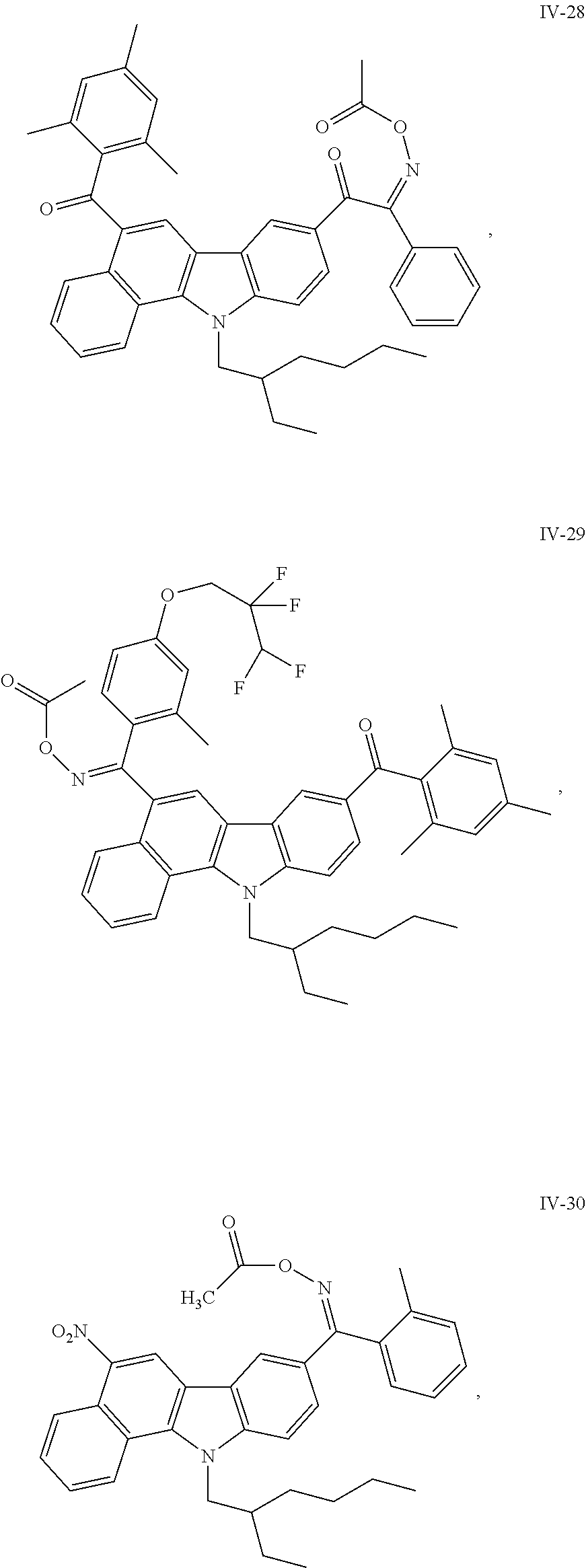
- the carbazolyl oxime ester photoinitiator is selected from the group consisting of the following compounds and any combination thereof:
- the carbazolyl oxime ester can be prepared for example via oximation and esterification using corresponding acylcarbazole parent compounds as a raw material.
- a preferred method for preparing the photoinitiator composition comprises: well mixing 0.1 mol of a sensitizing agent compound such as a compound of formula I-1 with 0.1 mol of a carbazolyl oxime ester such as a compound of formula IV-22 to obtain a photoinitiator composition.
- the photoinitiator composition can be prepared by directly mixing one or more sensitizing agent compounds with one or more carbazolyl oxime esters and other components, wherein a ratio of a total molar amount of the sensitizing agent to a total molar amount of the carbazolyl oxime ester is not greater than 2:1, preferably is 0.1:1 to 1.4:1, and more preferably is 0.22:1 to 1.16:1.
- the present invention further provides a photocurable composition, comprising:
- examples of compounds having a low molecular weight include alkyl acrylate, cycloalkyl acrylate, hydroxyalkyl acrylate, dialkylaminoalkyl acrylate, alkyl methacrylate, cycloalkyl methacrylate, hydroxyalkyl methacrylate, and dialkylaminoalkyl methacrylate, such as methyl acrylate, butyl acrylate, cyclohexyl acrylate, 2-hydroxyethyl acrylate, isobornyl acrylate, ethyl methacrylate, and polysiloxane acrylate; other examples include acrylonitrile, vinyl acetate, vinyl ether, styrene, and N-vinyl-2-pyrrolidone.
- Examples of compounds containing two or more double bonds include ethylene glycol, polyethylene glycol, propylene glycol, neopentyl glycol, diacrylate of 1,6-hexanediol, trihydroxymethane triacrylate, pentaerythritol tetraacrylate, dipentaerythritol hexaacrylate, vinyl acrylate, triallyl isocyanurate, etc.
- Examples of double bond compounds having a higher molecular weight include a large class of substances commonly known as oligomers generally having a molecular weight of 500-3000, such as acrylated epoxy resin, acrylated polyester resin unsaturated polyester resin, acrylated polyether resin, and acrylated polyurethane resin.
- the present invention also provides an ink or a coating, which comprises the above-mentioned photocurable composition, into which other necessary components can also be added depending on the required performance such as ink color, printing application, etc.
- the ink or coating can be used for pattern printing, 3D printing, PCB solder mask, liquid or dry film corrosion resistant materials, substrate protective coating, etc.
- the present invention also provides an adhesive, which comprises the above-mentioned photocurable composition, into which other necessary components can also be added depending on the required performance for the adhesive.
- the adhesive can be used for adhering glass, plastic, metal members, etc.
- the present invention also provides a photoresist, comprising:
- Examples of the multifunctional acrylate monomer in component b include: dipentaerythritol hexaacrylate and pentaerythritol tetraacrylate.
- Examples of the alkali soluble resin in component c include copolymers obtained by copolymerizing of polyacrylate having a carboxylic acid group, such as methacrylic acid, itaconic acid, maleic acid, etc., and a common monomer such as methyl acrylate, butyl methacrylate, benzyl acrylate, hydroxyethyl acrylate, styrene, butadiene, maleic anhydride, etc.
- the copolymer include a copolymer of methyl methacrylate and methacrylic acid, a copolymer of benzyl methacrylate and methacrylic acid, a copolymer of methyl methacrylate, butyl methacrylate, methacrylic acid and styrene.
- Examples of the pigment in component d include: C.I. pigment red 177, C.I. pigment green 7, C.I. pigment blue 15:6, solvent blue 25, carbon black, titanium black, and C.I. pigment black 1.
- Component b, component c, component d and component e are described in many existing literatures such as CN103153952A, and those skilled in the art can make selections according to their needs.
- component a as a photoinitiator, other existing or commercial available photoinitiators or co-initiators, such as Omnirad BDK, Omnirad 369, Omnirad 379, Omnirad 389, Omnirad TPO, Omnirad 819, Omnirad ITX, Omnirad DETX, and Omnirad 784, can also be added, as long as it is beneficial to the performance of the photocurable composition, especially the photoresist, wherein, Omnirad is a commodity of IGM resin company.
- Omnirad is a commodity of IGM resin company.
- resins such as polyalkyl methacrylate, ethyl cellulose, carboxymethyl cellulose, linear phenolic resin, polyvinyl butyral, polyvinyl acetate, polyester and polyimide can be added.
- the present invention also provides a black photoresist.
- the pigment in the photoresist is a well-dispersed black pigment such as carbon black or titanium black, it becomes a black photoresist.
- Black photoresist can be used to prepare a black matrix, a spacer of cell gap, and a microlens.
- a color filter device can be prepared by a color filter processing process using the photoresist and/or black photoresist of the present invention as raw materials, which is an important component of a color display screen.
- any article such as a color filer and a color display screen prepared by necessary processes using any materials comprising the photoinitiator composition of tire present invention such as an ink, a coating, an adhesive, a photoresist, and a black photoresist.
- the dichloroethane solution is vacuum distilled to recover dichloroethane.
- the residue is crystallized by adding 80 ml of ethyl acetate to obtain 30.5 g of a product as a white powder having a content of 98.5% and a yield of 69.5%.
- step 1a 30 g of 9-ethyl-3,6-bis(4-fluorobenzoyl) carbazole prepared in step 1a, 25 g of 2,2,3,3-tetrafluoropropanol and 8 g of sodiam hydroxide are dissolved in 200 ml of pyridine and reacted at 70° C. for 18 h. Vacuum distillation is carried out to evaporate pyridine and redundant 2,2,3,3-tetrafluoropropanol. 100 ml of water and 250 ml of dichloroethane are added to the residue and stirred for 1 h. Then an aqueous phase is separated.
- the dichloroethane solution is washed twice with 100 ml of water, and vacuum distilled to recover dichloroethane.
- 150 ml of ethyl acetate and 2 g of activated carbon are added to the residue, followed by refluxing under heating for 1 h and filtering to remove activated carbon to obtain a filtrate.
- the filtrate is vacuum distilled to remove about 100 ml of ethyl acetate, then cooled to crystallize, and filtered.
- the filter cake is dried to obtain 27.8 g of a product as a light yellow powder having a content of 98.5% and a yield of 61.4%.
- step 2a 4.0 g of 11-(2-ethylhexyl)-5,8-bis(4-fluorobenzoyl)-11H-benzo[a]carbazole obtained in step 2a is dissolved with 20 ml pyridine in a 50 ml single-necked flask, then 2.2 g of tetrafluoropropanol and 1.2 g of sodium hydroxide are added, heated to 80° C. and stirred for 5 h. The reaction solution is added dropwise to 100 ml of water, then stirred with 100 ml of dichloroethane for 1 h, and allowed to stand for separation. The separated dichloroethane solution is concentrated under reduced pressure to dryness to obtain 4.7 g of brown solid.
- the brown solid is dissolved under heating in a mixed solvent of 20 ml ethyl acetate and 20 ml ethanol, then 0.25 g activated carbon is added, followed by refluxing for 1 h.
- the resulted solution is hot filtered, and the filtrate is cooled down to precipitate a yellow crystal, which is dried to obtain 2.5 g product.
- the total yield of the two-step reaction is 51.3%, and the content of 11-(2-ethylhexyl)-5,8bis[4-(2,2,3,3-tetrafluoropropoxy)benzoyl]-11H-benzo[a]carbazole is 98.51%.
- compositions prepared in the composition preparation examples can be used as the initiator and sensitizing agent, or can be mixed according to the proportion in the table and dissolved in the PMA, and then the composition solution is mixed with the black color paste in proportion.
- the resulted is coated onto a glass slide using a 10 ⁇ m wire rod, and put into an oven for drying at 90° C. for 5 min.
- a 365 nm light source is used to perform curing with a 120 ⁇ m mask, and then development is carried out using a 1% NaOH solution at 25° C., followed by soaking and cleaning for 10 s with pure water. After diving in an oven at 90° C. for 30 minutes, the line width of the developed image is measured. The unit of line width is ⁇ m.
- Example 6 example 6 example 7 Compound of 0.024 0.024 0 0 formula I-1 NCI 831 0.056 0 0.08 0 PBG 304 0 0.056 0 0.08 PMA 2 2 2 2 black color 4.5 4.5 4.5 4.5 4.5 paste sensitizing 0.27 0.23 0 0 agent/initiator molar ratio
- the examples and comparative examples in tables 1, 2 and 4 are used to perform coating, curing, developing, and measuring.
- the data are shown in tables 5, 6, 7 and 8.
- the results show that: examples where the compound of formula I-1 is used as a sensitizing agent in combination with various carbazolyl oxime esters at a ratio within the range of the present invention exhibit significantly better development effect than comparative examples in which a sensitizing agent is not used, or a sensitizing agent is used alone or the amount of sensitizing agent is outside the range of the present invention.
- the results of comparative example 2 show that the compound of formula I-1 alone cannot form a developed pattern, and has almost no effect of initiating polymerization.
- the examples and comparative examples in table 3 are used to perform coating, curing, developing, and measuring.
- the data are shown in table 7.
- the results show that: examples where the compound of formula II-2 is used as a sensitizing agent in combination with various carbazolyl oxime esters at a ratio within the range of the present invention exhibit significantly better development effect than comparative examples in which a sensitizing agent is not used, or a sensitizing agent is used alone or the amount of sensitizing agent is outside the range of the present invention.
- the results of comparative example 9 show that the compound of formula II-2 alone cannot form a developed pattern, and has almost no effect of initiating polymerization.
- the examples and comparative examples are prepared according to the components described in table 9. After the components are mixed well, they are coated onto a glass slide using a 50 ⁇ m wire rod to form a film, which is then cured under a 365 nm light source with a mask. After curing, the film weight is measured. After immersing in acetone at room temperature for 36 h, the film weight is measured again, and the gel conversion rate is calculated.
- Example 10 Example 11
- Example 13 Photomer 6010 5 5 5 5 HPMA 4.5 4.5 4.5 OXE 02 0 0 0.5
- Composition preparation 0.5 0 0 example 1 Composition preparation 0 0.5 0 example 2
- Test data of the comparative examples and examples in table 9 are shown in Table 10.
- the data show that the adhesives in embodiments 10 and 11 in which the photocurable composition of the present inventions are used have significantly higher double bond gel conversion rate under lights than that in comparative example 13 in which oxime ester photoinitiator is used alone.
Landscapes
- Chemical & Material Sciences (AREA)
- Organic Chemistry (AREA)
- Engineering & Computer Science (AREA)
- Materials Engineering (AREA)
- Physics & Mathematics (AREA)
- Wood Science & Technology (AREA)
- Life Sciences & Earth Sciences (AREA)
- Chemical Kinetics & Catalysis (AREA)
- General Physics & Mathematics (AREA)
- Health & Medical Sciences (AREA)
- Medicinal Chemistry (AREA)
- Polymers & Plastics (AREA)
- Inorganic Chemistry (AREA)
- Spectroscopy & Molecular Physics (AREA)
- General Chemical & Material Sciences (AREA)
- Optics & Photonics (AREA)
- Indole Compounds (AREA)
- Materials For Photolithography (AREA)
- Polymerisation Methods In General (AREA)
- Plural Heterocyclic Compounds (AREA)
- Optical Filters (AREA)
- Paints Or Removers (AREA)
- Inks, Pencil-Leads, Or Crayons (AREA)
Abstract
Description

-
- wherein,
- R1, R8, R11 and R18 are each independently selected from the group consisting of H, halogen, C1-C8 alkyl, C1-C8 O-alkyl and CN;
- R2, R3, R4, R5, R6, R7, R12, R13, R14, R15, R16 and R17 are each independently selected from the group consisting of H, F, Cl, COOR20, C1-C12 straight or branched alkyl, and C1-C12 straight or branched alkoxy, wherein, the C1-C12 straight or branched alkyl is unsubstituted or substituted by one or more groups selected from the group consisting of phenyl, C3-C6 cycloalkyl, C3-C6 heterocyclic groups, F, Cl, COOR21, OR21, SR21, PO(OCnH2n+1)2, and Si(CnH2n+1)3, and wherein n is an integer from 1 to 4;
- provided that at least one substituent on a benzene ring of each benzoyl group is a fluorine atom or a fluoroalkyl-containing group;
- R9 and R19 are each independently selected from the group consisting of C1-C12 straight or branched alkyl, C2-C12 alkenyl, C3-C12 alkenyl alkyl group, with hydrogen atoms on the carbon atoms being unsubstituted or substituted by one or more groups selected from the group consisting of phenyl, C3-C6 cycloalkyl, C3-C6 heterocyclic group, halogen, COOR20, OR20, SR20, PO(OCnH2n+1)2 and Si(CnH2n+1)3, wherein n is an integer from 1 to 4; or wherein the C3-C12 alkenyl alkyl is interrupted by one or more groups selected from the group consisting of O, S, SO, SO2, CO, and COO;
- or R9 and R19 are each independently C3-C12, with its alkyl chain being interrupted by one or more groups selected from the group consisting of O, S, SO, SO2, and CO;
- or R9 and R19 are each independently phenyl unsubstituted or substituted by one or more groups selected from the group consisting of C1-C8 alkyl, halogen, OR20, SR20, COR20, CN, and COOH;
- or R9 and R1, or R9 and R8 optionally form a C4-C6 heterocyclic structure;
- or R19 and R11, or R19 and R18 optionally form a C4-C6 heterocyclic structure;
- R20 is C1-C12 alkyl or phenyl, unsubstituted or substituted by one or more groups selected from the groups consisting of phenyl, C3-C6 cycloalkyl, C3-C6 heterocyclic groups, F, Cl, OR21, and SR21; and
- R21 is C1-C12 alkyl.

-
- wherein
- R2, R3, R4, R5, R6, R7, R12, R13, R14, R15, R16, and R17 are each independently selected from the group consisting of H, F, Cl, COOR20, C1-C12 straight or branched alkyl, C1-C12 straight or branched alkoxy, wherein the C1-C12 straight or branched alkyl is unsubstituted or substituted by one or more groups selected from the group consisting of phenyl, C3-C6 cycloalkyl, C3-C6 heterocyclic group, F, Cl, COOR21, OR21, SR21, PO(OCnH2n+1)2 and Si(CnH2n+1)3, wherein n is an integer from 1 to 4;
- provided that at least one substituent on the benzene ring of each benzoyl group is a fluorine atom or a fluoroalkyl-containing group;
- R9 and R19 are as defined above; and
- Y1, Y2 are each independently C2-C8 straight chain and branched alkyl groups, and the chain can be inserted by O, S, NR21 or carbonyl, or hydrogen on the carbon may be substituted by OH or halogen atoms.


-
- preparing a symmetric or asymmetric diaroyl compound via one-step or two-step Friedel-Crafts acylation reaction using a compound of formula III-A or formula III-B as a raw material reacting with a corresponding acylation reagent such as substituted aroyl chloride or acid anhydride; and
- optionally further carrying out aa esterification reaction or etherification reaction with an R20OH alcohol compound when any aryl group contains a carboxyl group or contains a halogen atom which is replaceable, obtaining a diaroyl carbazole compound of formula I or formula II:

-
- wherein R1, R8, R9, R11, R18 and R19 are as defined above.

which is connected to a N-substituted carbazole parent structure directly or via a carbonyl group;
-
- wherein, R22 is C1-C12 alkyl unsubstituted or substituted with one or more groups selected from the group consisting of halogen, OR24, SR24, C3-C8 cycloalkyl, phenyl, C4-C20 heteroaryl, and COOR24; or R22 is C6-C20 aryl or C4-C20 heteroaryl, each unsubstituted or substituted by one or more groups selected from the group consisting of halogen, C1-C20 alkyl, one or more F-substituted C1-C8 alkyl, CN, OR24, SR24, and NR25R26; or R22 is C6-C20 aroyl, C4-C20 heteroaryl;
- R23 is selected from the group consisting of C1-C12 alkyl, C6-C20 aryl, and C1-C4 alkoxy;
- R24 is selected from the group consisting of H, C1-C8 alkyl, phenyl, and C1-C20 alkyl phenyl, wherein the C1-C8 alkyl is optionally substituted by one or more of C3-C8 heterocyclic group, F and acetoxy;
- R25 and R26 are each independently C1-C4 alkyl, or OR24 substituted C2-C4 alkyl, or NR25R26 is a cyclic structure selected from


R24′, OR24′, SR24′, NR25′R26′, COOR24′, R24′SO2; R22′, R23′, R24′, NR25′, R26′ have the same definition as corresponding R22, R23, R24 and NR25R26.




-
- a. a photoinitiator composition, comprising at least one sensitizing agent of formula I, II-A or II-B and at least one carbazole oxime ester compound of any one of formulas IV1 to IV37; optionally, component a accounts for 1-10%, preferably 1-8% by weight of a total weight of all solids in the formulation; and
- b. at least one radically polymerizable compound; optionally, the radically polymerizable compound is selected from the group consisting of an acrylate compound, a methacrylate compound, a resin containing acrylate or methacrylate groups, and any combination thereof.
-
- a. at least one of the above photoinitiator composition, optionally, the mass of which accounts for 0.2% to 10%, preferably 1% to 8% by weight of a total weight of all solids in the formulation,
- b. at least one radically polymerizable confound, such as a multifunctional acrylate monomer,
- c. an alkali soluble resin,
- d. a pigment, and
- e. a solvent.
-
- 365 nm LED surface light source, Lantian Special Light Development Co., Ltd.
Test Equipment: - Stereo microscope, COVS-50G, Guangzhou Mingmei Optoelectronic Technology Co., Ltd., wherein the unit of line width is μm.
Experimental Materials: - A compound of formula I-1, from compound preparation example 1;
- A compound of formula II-2, from compound preparation example 2;
- Omnirad DETX, a photoinitiator product of IGM Resin Company;
- Esacure 364, a photoinitiator product of IGM Resin Company;
- Omnirad EMK, a photoinitiator product of IGM Resin Company;
- OXE 02: a compound of formula IV-1, a photoinitiator product of BASF Company;
- OXE 03: a compound of formula IV-22, a photoinitiator product of BASF Company;
- NCI 831: a compound of formula IV-9, a product of ADEKA Company, Japan;
- PBG 304: a compound of formula IV-2, a product of Changzhou Qiangli Electronic New Material Co., Ltd.;
- Photomer 6010: aliphatic urethane triacrylate, a product of IGM Resin Company;
- DPHA: dipentaerythritol penta/hexaacrylate, a product of Tianjin Tianjiao Chemical Co., Ltd.;
- HPMA: polymaleic acid, a product of Aladdin Industries, USA.
- 365 nm LED surface light source, Lantian Special Light Development Co., Ltd.
| TABLE 1 | ||
| Examples | Comarative examples | |
| 1 | 2 | 3 | 4 | 1 | 2 | 3 | 4 | 5 | |
| Compound of | 0.024 | 0.04 | 0.024 | 0.04 | 0 | 0.08 | 0.056 | 0.056 | 0 |
| formula I-1 | |||||||||
| OXE 02 | 0.056 | 0.04 | 0 | 0 | 0.08 | 0 | 0.024 | 0 | 0 |
| OXE 03 | 0 | 0 | 0.056 | 0.04 | 0 | 0 | 0 | 0.024 | 0.08 |
| PMA | 2 | 2 | 2 | 2 | 2 | 2 | 2 | 2 | 2 |
| black color | 4.5 | 4.5 | 4.5 | 4.5 | 4.5 | 4.5 | 4.5 | 4.5 | 4.5 |
| paste | |||||||||
| sensitizing | 0.32 | 0.75 | 0.49 | 1.16 | 0 | 0 | 1.74 | 2.69 | 0 |
| agent/initiator | |||||||||
| molar ratio | |||||||||
| TABLE 2 | |||||
| Comparative | Comparative | ||||
| Example 5 | Example 6 | example 6 | example 7 | ||
| Compound of | 0.024 | 0.024 | 0 | 0 |
| formula I-1 | ||||
| NCI 831 | 0.056 | 0 | 0.08 | 0 |
| PBG 304 | 0 | 0.056 | 0 | 0.08 |
| PMA | 2 | 2 | 2 | 2 |
| black color | 4.5 | 4.5 | 4.5 | 4.5 |
| paste | ||||
| sensitizing | 0.27 | 0.23 | 0 | 0 |
| agent/initiator | ||||
| molar ratio | ||||
| TABLE 3 | ||||
| Example | Example | Example | Comparative examples | |
| 7 | 8 | 9 | 1 | 2 | 8 | 9 | |
| Compound of | 0.024 | 0.04 | 0.024 | 0 | 0 | 0.056 | 0.08 |
| formula II-2 | |||||||
| OXE 02 | 0 | 0 | 0.056 | 0.08 | 0 | 0 | 0 |
| OXE 03 | 0.056 | 0.04 | 0 | 0 | 0.08 | 0.024 | 0 |
| PMA | 2 | 2 | 2 | 2 | 2 | 2 | 2 |
| black color | 4.5 | 4.5 | 4.5 | 4.5 | 4.5 | 4.5 | 4.5 |
| paste | |||||||
| sensitizing | 0.41 | 0.96 | 0.27 | 0 | 0 | 2.24 | 0 |
| agent/initiator | |||||||
| molar ratio | |||||||
| TABLE 4 | ||||
| Comparative 10 | Comparative 11 | Comparative 12 | ||
| Omnirad | 0.024 | 0 | 0 |
| DETX | |||
| ESacure | 0 | 0.024 | 0 |
| 3644 | |||
| Omnirad | 0 | 0 | 0.024 |
| EMK | |||
| OXE 02 | 0.056 | 0.056 | 0.056 |
| PMA | 2 | 2 | 2 |
| black color | 4.5 | 4.5 | 4.5 |
| paste | |||
| sensitizing | 0.79 | 0.25 | 0.65 |
| agent/initiator | |||
| molar ratio | |||
| TABLE 5 | ||
| Examples | Comparative examples | |
| 1 | 2 | 3 | 4 | 1 | 2 | 3 | 4 | 5 | |
| Break | 20 | 20 | 34 | 34 | 20 | 20 | 20 | 20 | 35 |
| point/s | |||||||||
| Line width | 135.8 | 127.0 | 141.8 | 160.4 | 119.6 | 0 | 104.2 | 113.3 | 131.5 |
| TABLE 6 | |||||
| Comparative | Comparative | ||||
| Example 5 | Example 6 | example 6 | example 7 | ||
| Break point/s | 32 | 25 | 30 | 22 |
| Line width | 163.0 | 130.0 | 138.0 | 115.0 |
| TABLE 7 | ||||
| Example | Example | Example | Comparative examples | |
| 7 | 8 | 9 | 1 | 5 | 8 | 9 | |
| Break | 34 | 30 | 21 | 20 | 35 | 22 | 20 |
| point/s | |||||||
| Line width | 143.2 | 133.6 | 126.0 | 119.6 | 131.5 | 110.2 | 0 |
| TABLE 8 | ||||
| Comparative | Comparative | Comparative | ||
| example 10 | example 11 | example 12 | ||
| Break point/s | 22 | 25 | 24 | ||
| Line width | 112.0 | 118.0 | 109.0 | ||
| TABLE 9 | ||||
| Example 10 | Example 11 | Example 13 | ||
| Photomer 6010 | 5 | 5 | 5 |
| HPMA | 4.5 | 4.5 | 4.5 |
| OXE 02 | 0 | 0 | 0.5 |
| Composition preparation | 0.5 | 0 | 0 |
| example 1 | |||
| Composition preparation | 0 | 0.5 | 0 |
| example 2 | |||
| TABLE 10 | ||||
| Example 10 | Example 11 | Comparative example 13 | ||
| Gel conversion | 92.5% | 92.7% | 85.2% |
| rate | |||
Claims (17)


Applications Claiming Priority (3)
| Application Number | Priority Date | Filing Date | Title |
|---|---|---|---|
| CN201910540381.5 | 2019-06-21 | ||
| CN201910540381 | 2019-06-21 | ||
| PCT/CN2020/079714 WO2020253283A1 (en) | 2019-06-21 | 2020-03-17 | Novel diaroyl carbazole compound and use thereof as sensitising agent |
Publications (2)
| Publication Number | Publication Date |
|---|---|
| US20220185775A1 US20220185775A1 (en) | 2022-06-16 |
| US12172962B2 true US12172962B2 (en) | 2024-12-24 |
Family
ID=73799005
Family Applications (1)
| Application Number | Title | Priority Date | Filing Date |
|---|---|---|---|
| US17/598,936 Active 2041-06-12 US12172962B2 (en) | 2019-06-21 | 2020-03-17 | Diaroyl carbazole compound and use thereof as sensitising agent |
Country Status (7)
| Country | Link |
|---|---|
| US (1) | US12172962B2 (en) |
| JP (1) | JP2022528738A (en) |
| KR (1) | KR102711242B1 (en) |
| CN (3) | CN113518774B (en) |
| DE (1) | DE112020002202T5 (en) |
| TW (1) | TWI776133B (en) |
| WO (1) | WO2020253283A1 (en) |
Families Citing this family (5)
| Publication number | Priority date | Publication date | Assignee | Title |
|---|---|---|---|---|
| CN112111028A (en) * | 2019-06-21 | 2020-12-22 | 江苏英力科技发展有限公司 | Photoinitiator composition containing acylcarbazole derivative and carbazolyl oxime ester and application of photoinitiator composition in photocuring composition |
| KR20250005473A (en) * | 2022-06-27 | 2025-01-09 | 후지필름 가부시키가이샤 | Curable composition, method for producing a cured product, film, optical element, image sensor, solid-state imaging element, image display device, and radical polymerization initiator |
| US11807607B1 (en) | 2023-03-09 | 2023-11-07 | King Faisal University | Aminocarbazole compounds as antibacterial agents |
| US11780809B1 (en) | 2023-03-09 | 2023-10-10 | King Faisal University | Carbazole compounds as antibacterial agents |
| WO2025164316A1 (en) * | 2024-01-30 | 2025-08-07 | 富士フイルム株式会社 | Photocurable composition, pixel manufacturing method, film, solid-state imaging element, image display device, and photopolymerization initiator |
Citations (25)
| Publication number | Priority date | Publication date | Assignee | Title |
|---|---|---|---|---|
| EP0240745A2 (en) | 1983-08-31 | 1987-10-14 | Memorex Corporation | Disk drive servo techniques |
| WO2000049080A1 (en) | 1999-02-19 | 2000-08-24 | Dsm N.V. | Photo curable liquid resin composition and photofabricated cured product |
| JP2002241531A (en) | 2001-02-16 | 2002-08-28 | Sekisui Plastics Co Ltd | Pre-expanded particles of thermoplastic polyester resin and method for producing the same |
| US20040170924A1 (en) | 2001-06-11 | 2004-09-02 | Kazuhiko Kunimoto | Oxime ester photoiniators having a combined structure |
| JP2005343847A (en) | 2004-06-04 | 2005-12-15 | Toyo Ink Mfg Co Ltd | Energy sensitive acid generating composition |
| JP2005343347A (en) | 2004-06-04 | 2005-12-15 | Yanmar Co Ltd | Tractor |
| CN1922142A (en) | 2004-02-23 | 2007-02-28 | 三菱化学株式会社 | Oxime ester compound, photopolymerizable composition and color filter using same |
| JP2007112930A (en) | 2005-10-21 | 2007-05-10 | Toyo Ink Mfg Co Ltd | Photoradical polymerizable composition |
| JP2007219362A (en) * | 2006-02-20 | 2007-08-30 | Toyo Ink Mfg Co Ltd | Polymerizable composition, negative resist using the same, and image pattern forming method using the same |
| CN101321727A (en) | 2005-12-01 | 2008-12-10 | 西巴控股有限公司 | Oxime ester photoinitiator |
| CN101508744A (en) | 2009-03-11 | 2009-08-19 | 常州强力电子新材料有限公司 | Carbazole oxime ester lightlike initiating agent |
| CN101528693A (en) | 2006-12-20 | 2009-09-09 | 三菱化学株式会社 | Oxime ester compound, photopolymerization initiator, photopolymerizable composition, color filter, and liquid crystal display device |
| CN101528694A (en) | 2006-12-27 | 2009-09-09 | 株式会社艾迪科 | Oxime ester compound and photopolymerization initiator containing the same |
| WO2012045736A1 (en) | 2010-10-05 | 2012-04-12 | Basf Se | Oxime ester derivatives of benzocarbazole compounds and their use as photoinitiators in photopolymerizable compositions |
| JP2013001713A (en) | 2011-06-10 | 2013-01-07 | Toyo Ink Sc Holdings Co Ltd | New sensitizer and polymerizable composition using the same, and production method of polymer using the same |
| CN102924710A (en) | 2012-10-23 | 2013-02-13 | 中国科学院长春应用化学研究所 | Polyaryletherketone resin with carbazole ring in main chain and preparation method thereof |
| CN102924366A (en) | 2012-10-23 | 2013-02-13 | 中国科学院长春应用化学研究所 | Carbazole ketone intermediate containing multi-functional group structure and preparation method for carbazole ketone intermediate |
| WO2013083505A1 (en) | 2011-12-07 | 2013-06-13 | Basf Se | Oxime ester photoinitiators |
| US20130188270A1 (en) | 2010-10-05 | 2013-07-25 | Basf Se | Oxime ester |
| CN103492948A (en) | 2011-08-04 | 2014-01-01 | 株式会社Lg化学 | Photosensitive compound and photosensitive resin composition including same |
| JP2015523324A (en) | 2012-05-09 | 2015-08-13 | ビーエーエスエフ ソシエタス・ヨーロピアBasf Se | Oxime ester photoinitiator |
| JP2015165297A (en) | 2014-02-04 | 2015-09-17 | 新日鉄住金化学株式会社 | Photosensitive composition for light-shielding film, and cured product thereof |
| CN105358527A (en) | 2013-07-08 | 2016-02-24 | 巴斯夫欧洲公司 | Oxime ester photoinitiators |
| CN107678245A (en) | 2016-08-01 | 2018-02-09 | 东友精细化工有限公司 | Colored photosensitive resin composition, color filter and image display device having the same |
| CN107793502A (en) | 2016-09-07 | 2018-03-13 | 常州强力电子新材料股份有限公司 | Oxime ester lightlike initiating agent, its preparation method, Photocurable composition and its application |
Family Cites Families (2)
| Publication number | Priority date | Publication date | Assignee | Title |
|---|---|---|---|---|
| JP2002341531A (en) * | 2001-05-15 | 2002-11-27 | Dainippon Printing Co Ltd | Photocurable resin composition, color filter and liquid crystal panel |
| CN109503735A (en) | 2017-09-15 | 2019-03-22 | 常州强力先端电子材料有限公司 | Photoinitiator, the Photocurable composition comprising it and its application |
-
2020
- 2020-03-17 DE DE112020002202.1T patent/DE112020002202T5/en active Pending
- 2020-03-17 JP JP2021560178A patent/JP2022528738A/en active Pending
- 2020-03-17 CN CN202080012922.8A patent/CN113518774B/en active Active
- 2020-03-17 WO PCT/CN2020/079714 patent/WO2020253283A1/en not_active Ceased
- 2020-03-17 US US17/598,936 patent/US12172962B2/en active Active
- 2020-03-17 KR KR1020217039140A patent/KR102711242B1/en active Active
- 2020-03-18 TW TW109109042A patent/TWI776133B/en active
- 2020-03-31 CN CN202010240176.XA patent/CN112110847A/en active Pending
- 2020-06-19 CN CN202010565795.6A patent/CN112110848A/en active Pending
Patent Citations (37)
| Publication number | Priority date | Publication date | Assignee | Title |
|---|---|---|---|---|
| EP0240745A2 (en) | 1983-08-31 | 1987-10-14 | Memorex Corporation | Disk drive servo techniques |
| WO2000049080A1 (en) | 1999-02-19 | 2000-08-24 | Dsm N.V. | Photo curable liquid resin composition and photofabricated cured product |
| JP2002241531A (en) | 2001-02-16 | 2002-08-28 | Sekisui Plastics Co Ltd | Pre-expanded particles of thermoplastic polyester resin and method for producing the same |
| US20040170924A1 (en) | 2001-06-11 | 2004-09-02 | Kazuhiko Kunimoto | Oxime ester photoiniators having a combined structure |
| CN100528838C (en) | 2001-06-11 | 2009-08-19 | 西巴特殊化学品控股有限公司 | Oxime ester photoinitiators having composite structures |
| CN1922142A (en) | 2004-02-23 | 2007-02-28 | 三菱化学株式会社 | Oxime ester compound, photopolymerizable composition and color filter using same |
| JP2005343347A (en) | 2004-06-04 | 2005-12-15 | Yanmar Co Ltd | Tractor |
| JP2005343847A (en) | 2004-06-04 | 2005-12-15 | Toyo Ink Mfg Co Ltd | Energy sensitive acid generating composition |
| JP2007112930A (en) | 2005-10-21 | 2007-05-10 | Toyo Ink Mfg Co Ltd | Photoradical polymerizable composition |
| CN101321727A (en) | 2005-12-01 | 2008-12-10 | 西巴控股有限公司 | Oxime ester photoinitiator |
| US20090087759A1 (en) | 2005-12-01 | 2009-04-02 | Akira Matsumoto | Oxime Ester Photoinitiators |
| JP2009519904A (en) | 2005-12-01 | 2009-05-21 | チバ ホールディング インコーポレーテッド | Oxime ester photoinitiator |
| JP2007219362A (en) * | 2006-02-20 | 2007-08-30 | Toyo Ink Mfg Co Ltd | Polymerizable composition, negative resist using the same, and image pattern forming method using the same |
| CN101528693A (en) | 2006-12-20 | 2009-09-09 | 三菱化学株式会社 | Oxime ester compound, photopolymerization initiator, photopolymerizable composition, color filter, and liquid crystal display device |
| US20170283520A1 (en) | 2006-12-27 | 2017-10-05 | Adeka Corporation | Oxime ester compound and photopolymerization initiator containing the same |
| CN101528694A (en) | 2006-12-27 | 2009-09-09 | 株式会社艾迪科 | Oxime ester compound and photopolymerization initiator containing the same |
| CN101508744A (en) | 2009-03-11 | 2009-08-19 | 常州强力电子新材料有限公司 | Carbazole oxime ester lightlike initiating agent |
| WO2012045736A1 (en) | 2010-10-05 | 2012-04-12 | Basf Se | Oxime ester derivatives of benzocarbazole compounds and their use as photoinitiators in photopolymerizable compositions |
| CN103153952A (en) | 2010-10-05 | 2013-06-12 | 巴斯夫欧洲公司 | Oxime ester derivatives of benzocarbazole compounds and their use as photoinitiators in photopolymerizable compositions |
| US20130188270A1 (en) | 2010-10-05 | 2013-07-25 | Basf Se | Oxime ester |
| JP2014500852A (en) | 2010-10-05 | 2014-01-16 | ビーエーエスエフ ソシエタス・ヨーロピア | Oxime ester derivatives of benzocarbazole compounds and their use as photoinitiators in photopolymerizable compositions |
| JP2013001713A (en) | 2011-06-10 | 2013-01-07 | Toyo Ink Sc Holdings Co Ltd | New sensitizer and polymerizable composition using the same, and production method of polymer using the same |
| CN103492948A (en) | 2011-08-04 | 2014-01-01 | 株式会社Lg化学 | Photosensitive compound and photosensitive resin composition including same |
| US20140220491A1 (en) | 2011-08-04 | 2014-08-07 | Lg Chem, Ltd. | Photoactive compound and photosensitive resin composition comprising the same |
| JP2015509074A (en) | 2011-12-07 | 2015-03-26 | ビーエーエスエフ ソシエタス・ヨーロピアBasf Se | Oxime ester photoinitiator |
| WO2013083505A1 (en) | 2011-12-07 | 2013-06-13 | Basf Se | Oxime ester photoinitiators |
| JP2015523324A (en) | 2012-05-09 | 2015-08-13 | ビーエーエスエフ ソシエタス・ヨーロピアBasf Se | Oxime ester photoinitiator |
| EP2963014A1 (en) | 2012-05-09 | 2016-01-06 | Basf Se | Oxime ester photoinitiators |
| CN104284888B (en) | 2012-05-09 | 2017-10-27 | 巴斯夫欧洲公司 | Oxime ester photoinitiators |
| US20200004146A1 (en) | 2012-05-09 | 2020-01-02 | Basf Se | Oxime ester photoinitiators |
| CN102924366A (en) | 2012-10-23 | 2013-02-13 | 中国科学院长春应用化学研究所 | Carbazole ketone intermediate containing multi-functional group structure and preparation method for carbazole ketone intermediate |
| CN102924710A (en) | 2012-10-23 | 2013-02-13 | 中国科学院长春应用化学研究所 | Polyaryletherketone resin with carbazole ring in main chain and preparation method thereof |
| CN105358527A (en) | 2013-07-08 | 2016-02-24 | 巴斯夫欧洲公司 | Oxime ester photoinitiators |
| US10234761B2 (en) | 2013-07-08 | 2019-03-19 | Basf Se | Oxime ester photoinitiators |
| JP2015165297A (en) | 2014-02-04 | 2015-09-17 | 新日鉄住金化学株式会社 | Photosensitive composition for light-shielding film, and cured product thereof |
| CN107678245A (en) | 2016-08-01 | 2018-02-09 | 东友精细化工有限公司 | Colored photosensitive resin composition, color filter and image display device having the same |
| CN107793502A (en) | 2016-09-07 | 2018-03-13 | 常州强力电子新材料股份有限公司 | Oxime ester lightlike initiating agent, its preparation method, Photocurable composition and its application |
Non-Patent Citations (21)
| Title |
|---|
| (Wang. Feifei et al.) (Properties of Poly (arylene ether ketone) s Containing N-Alkylcarbazole in Main Chains) Chinese Journal of Applied Chemistry, vol. 32, No. 4, Apr. 30, 2015 (Apr. 30, 2015), ISSN: 1000-0518, pp. 379-385. |
| 2nd Office Action in Corresponding Korean Application KR 10-2021-7039140; Office Action dated Apr. 7, 2024; 4 pages. |
| 2nd Office Action, dated Jun. 15, 2024 of corresponding Chinese Patent Application CN202080012922.8 (5 pages) with English translation (6 pages). |
| Decision on Refusal in Japanese Patent Application JP2021-560178 corresponding to present application U.S. Appl. No. 17/598,936 (2 pages) and English translation thereof (2 pages). |
| English Translation of relevant portion of 2nd Office Action in corresponding Korean Application KR 10-21-21-7039140; 1 page. |
| English Translation of Taiwan Patent Application 109109042 (corresponding to U.S. Appl. No. 17/598,936), Office Action Jan. 25, 2022 (5 pages). |
| Feifei Wang, et al; Carbazole-based poly(aryl ether ketone) containing crosslinkable allyl groups on the side chains: synthesis, characterization and properties; Polym Int 2015; 64:858-866 (9 pages). |
| FeifeiWang, ZhipengWang, HonghuaWang and Guangyuan Zhou, Carbazole-based poly(aryl ether keton) containing crosslinkable allyl groups on the side chains: synthesis, characterization and properties, PolymInt 2015; 64: 858-866 (Year: 2015). * |
| First Office Action in Chinese Patent Application CN20208001922.8 corresponding to present application U.S. Appl. No. 17/598,936 (8 pages) and English translation thereof (7 pages). |
| First Office Action in German Patent Application DE 11 2020 002 202.1 corresponding to present application U.S. Appl. No. 17/598,936 (10 pages) and English translation thereof (2 pages). |
| First Office Action in Korean Patent Application KR10-2021-7039140 corresponding to present application U.S. Appl. No. 17/598,936 (13 pages) and English translation thereof (14 pages). |
| International Search Report from PCT/CN2020/079714. |
| Jian Huang, Zeng Xu, Zheyi Cai, Jingjing Guo, aJiali Guo, Pingchuan Shen, Zhiming Wang,Zujin Zhao, Dongge Ma, and Ben Z, Tang Robust luminescent small molecules with aggregation-induced delayed fluorescence for efficient solution-processed OLEDs, J. Mater. Chem. C, 2019, 7, 330-339 (Year: 2019). * |
| Office Action dated Nov. 23, 2023 from Counterpart Application JP2021-560178 filed Mar. 17, 2020; 2 page English translation. |
| Office Action from Counterpart Application JP2021-560178 and 3 page translation thereof. |
| Office Action from Counterpart Application JP2021-560178 filed Mar. 17, 2020; 5 pages. A 3 page English translation thereof has been previously submitted. |
| Taiwan Patent Application 109109042 (corresponding to U.S. Appl. No. 17/598,936), Office Action Jan. 25, 2022 (9 pages). |
| Wang, Feifei et al; Polymer Int 2015; 64:258-266; Synthesis and characterization of soluble poly(arylene ether ketone) s with high glass transition temperature based on 3,6-bi(4-fluorobenzoyl)-N-alkylcarbazole. (Published Online in Wiley Online Library Aug. 26, 2014). |
| Wang, Feifei, et al; Polymer Int 2015; 64:258-266; Carbazole-based poly(arylene ether ketone) containing crossslinkable allyl groups on the side chains: synthesis, characterization and properties (Published Online in Wiley Online Library Jan. 13, 2015). |
| Wang. Feifei et al. "Carbazole-based poly(aryletherketone) containing crosslinkable allyl groups on the side chains: synthesis. characterization and properties" Polymer International, vol. 64, No. 7, Jan. 13, 2015 (Jan. 13, 2015), ISSN: 0959-8103, pp. 858-866. |
| Written Opinion of the International Sesarch Authority in PCT/CN2020/079714. |
Also Published As
| Publication number | Publication date |
|---|---|
| KR102711242B1 (en) | 2024-09-26 |
| TW202100510A (en) | 2021-01-01 |
| CN112110847A (en) | 2020-12-22 |
| DE112020002202T5 (en) | 2022-01-20 |
| WO2020253283A1 (en) | 2020-12-24 |
| CN113518774A (en) | 2021-10-19 |
| TWI776133B (en) | 2022-09-01 |
| KR20220002617A (en) | 2022-01-06 |
| CN112110848A (en) | 2020-12-22 |
| CN113518774B (en) | 2024-10-18 |
| JP2022528738A (en) | 2022-06-15 |
| US20220185775A1 (en) | 2022-06-16 |
Similar Documents
| Publication | Publication Date | Title |
|---|---|---|
| US12172962B2 (en) | Diaroyl carbazole compound and use thereof as sensitising agent | |
| CN104661997B (en) | Novel fluorene oxime ester compound, and photopolymerization initiator and photoresist composition containing the fluorene oxime ester compound | |
| US11947259B2 (en) | Photoinitiator composition containing acylcarbazole derivative and carbazolyl oxime ester, and use thereof in photocurable composition | |
| EP1567518B1 (en) | Oxime ester photoinitiators with heteroaromatic groups | |
| EP3514135B1 (en) | Fluorene photoinitiator, preparation method therefor, photocurable composition having same, and use of same in photocuring field | |
| CN103130919B (en) | Carbazole ketone oxime ester high-photosensibility photoinitiator | |
| WO2012045736A1 (en) | Oxime ester derivatives of benzocarbazole compounds and their use as photoinitiators in photopolymerizable compositions | |
| WO2002100903A1 (en) | Oxime ester photoinitiators having a combined structure | |
| EP2172455A1 (en) | Oxime ester photoinitiators | |
| KR101883164B1 (en) | Asymmetric dioxime ester compound and manufacturing method and use therof | |
| CN114369178A (en) | Photoinitiating composition, photocuring composition, photoresist, photocuring composition and application of photoresist | |
| CN106278967A (en) | For the acyl group oxime ester compound of UV curing materials and synthetic method thereof and application | |
| CN101341172B (en) | Oxime ester photoinitiators | |
| CN114369179A (en) | Photoinitiator composition, photocuring composition and product containing photoinitiator composition | |
| CN116135888A (en) | Oxime ester fluorene photoinitiator, photo-curing resin composition and application | |
| CN119219521A (en) | Carbonyl difluorene (ketone) oxime ester compounds, products containing the same and applications thereof |
Legal Events
| Date | Code | Title | Description |
|---|---|---|---|
| AS | Assignment |
Owner name: IGM (ANQING) HIGH TECHNOLOGY DEVELOPMENT CO., LTD., CHINA Free format text: ASSIGNMENT OF ASSIGNORS INTEREST;ASSIGNORS:ZHAO, WENCHAO;LI, JIAQI;MA, ZHONGLI;AND OTHERS;REEL/FRAME:057619/0578 Effective date: 20210807 |
|
| FEPP | Fee payment procedure |
Free format text: ENTITY STATUS SET TO UNDISCOUNTED (ORIGINAL EVENT CODE: BIG.); ENTITY STATUS OF PATENT OWNER: LARGE ENTITY |
|
| STPP | Information on status: patent application and granting procedure in general |
Free format text: DOCKETED NEW CASE - READY FOR EXAMINATION |
|
| STPP | Information on status: patent application and granting procedure in general |
Free format text: NON FINAL ACTION MAILED |
|
| STPP | Information on status: patent application and granting procedure in general |
Free format text: RESPONSE TO NON-FINAL OFFICE ACTION ENTERED AND FORWARDED TO EXAMINER |
|
| STPP | Information on status: patent application and granting procedure in general |
Free format text: NOTICE OF ALLOWANCE MAILED -- APPLICATION RECEIVED IN OFFICE OF PUBLICATIONS |
|
| ZAAB | Notice of allowance mailed |
Free format text: ORIGINAL CODE: MN/=. |
|
| STPP | Information on status: patent application and granting procedure in general |
Free format text: PUBLICATIONS -- ISSUE FEE PAYMENT RECEIVED |
|
| STPP | Information on status: patent application and granting procedure in general |
Free format text: WITHDRAW FROM ISSUE AWAITING ACTION |
|
| STPP | Information on status: patent application and granting procedure in general |
Free format text: DOCKETED NEW CASE - READY FOR EXAMINATION |
|
| STPP | Information on status: patent application and granting procedure in general |
Free format text: PUBLICATIONS -- ISSUE FEE PAYMENT VERIFIED |
|
| STCF | Information on status: patent grant |
Free format text: PATENTED CASE |