US12152175B2 - Composition made from (meth)acrylate monomers - Google Patents
Composition made from (meth)acrylate monomers Download PDFInfo
- Publication number
- US12152175B2 US12152175B2 US17/779,406 US202017779406A US12152175B2 US 12152175 B2 US12152175 B2 US 12152175B2 US 202017779406 A US202017779406 A US 202017779406A US 12152175 B2 US12152175 B2 US 12152175B2
- Authority
- US
- United States
- Prior art keywords
- composition
- meth
- acrylate
- family
- group
- Prior art date
- Legal status (The legal status is an assumption and is not a legal conclusion. Google has not performed a legal analysis and makes no representation as to the accuracy of the status listed.)
- Active, expires
Links
Images

Classifications
-
- C—CHEMISTRY; METALLURGY
- C09—DYES; PAINTS; POLISHES; NATURAL RESINS; ADHESIVES; COMPOSITIONS NOT OTHERWISE PROVIDED FOR; APPLICATIONS OF MATERIALS NOT OTHERWISE PROVIDED FOR
- C09J—ADHESIVES; NON-MECHANICAL ASPECTS OF ADHESIVE PROCESSES IN GENERAL; ADHESIVE PROCESSES NOT PROVIDED FOR ELSEWHERE; USE OF MATERIALS AS ADHESIVES
- C09J4/00—Adhesives based on organic non-macromolecular compounds having at least one polymerisable carbon-to-carbon unsaturated bond ; adhesives, based on monomers of macromolecular compounds of groups C09J183/00 - C09J183/16
- C09J4/06—Organic non-macromolecular compounds having at least one polymerisable carbon-to-carbon unsaturated bond in combination with a macromolecular compound other than an unsaturated polymer of groups C09J159/00 - C09J187/00
-
- C—CHEMISTRY; METALLURGY
- C09—DYES; PAINTS; POLISHES; NATURAL RESINS; ADHESIVES; COMPOSITIONS NOT OTHERWISE PROVIDED FOR; APPLICATIONS OF MATERIALS NOT OTHERWISE PROVIDED FOR
- C09J—ADHESIVES; NON-MECHANICAL ASPECTS OF ADHESIVE PROCESSES IN GENERAL; ADHESIVE PROCESSES NOT PROVIDED FOR ELSEWHERE; USE OF MATERIALS AS ADHESIVES
- C09J11/00—Features of adhesives not provided for in group C09J9/00, e.g. additives
- C09J11/02—Non-macromolecular additives
- C09J11/06—Non-macromolecular additives organic
-
- C—CHEMISTRY; METALLURGY
- C09—DYES; PAINTS; POLISHES; NATURAL RESINS; ADHESIVES; COMPOSITIONS NOT OTHERWISE PROVIDED FOR; APPLICATIONS OF MATERIALS NOT OTHERWISE PROVIDED FOR
- C09J—ADHESIVES; NON-MECHANICAL ASPECTS OF ADHESIVE PROCESSES IN GENERAL; ADHESIVE PROCESSES NOT PROVIDED FOR ELSEWHERE; USE OF MATERIALS AS ADHESIVES
- C09J11/00—Features of adhesives not provided for in group C09J9/00, e.g. additives
- C09J11/08—Macromolecular additives
-
- C—CHEMISTRY; METALLURGY
- C09—DYES; PAINTS; POLISHES; NATURAL RESINS; ADHESIVES; COMPOSITIONS NOT OTHERWISE PROVIDED FOR; APPLICATIONS OF MATERIALS NOT OTHERWISE PROVIDED FOR
- C09J—ADHESIVES; NON-MECHANICAL ASPECTS OF ADHESIVE PROCESSES IN GENERAL; ADHESIVE PROCESSES NOT PROVIDED FOR ELSEWHERE; USE OF MATERIALS AS ADHESIVES
- C09J133/00—Adhesives based on homopolymers or copolymers of compounds having one or more unsaturated aliphatic radicals, each having only one carbon-to-carbon double bond, and at least one being terminated by only one carboxyl radical, or of salts, anhydrides, esters, amides, imides, or nitriles thereof; Adhesives based on derivatives of such polymers
- C09J133/04—Homopolymers or copolymers of esters
- C09J133/14—Homopolymers or copolymers of esters of esters containing halogen, nitrogen, sulfur or oxygen atoms in addition to the carboxy oxygen
-
- C—CHEMISTRY; METALLURGY
- C09—DYES; PAINTS; POLISHES; NATURAL RESINS; ADHESIVES; COMPOSITIONS NOT OTHERWISE PROVIDED FOR; APPLICATIONS OF MATERIALS NOT OTHERWISE PROVIDED FOR
- C09J—ADHESIVES; NON-MECHANICAL ASPECTS OF ADHESIVE PROCESSES IN GENERAL; ADHESIVE PROCESSES NOT PROVIDED FOR ELSEWHERE; USE OF MATERIALS AS ADHESIVES
- C09J4/00—Adhesives based on organic non-macromolecular compounds having at least one polymerisable carbon-to-carbon unsaturated bond ; adhesives, based on monomers of macromolecular compounds of groups C09J183/00 - C09J183/16
-
- C—CHEMISTRY; METALLURGY
- C09—DYES; PAINTS; POLISHES; NATURAL RESINS; ADHESIVES; COMPOSITIONS NOT OTHERWISE PROVIDED FOR; APPLICATIONS OF MATERIALS NOT OTHERWISE PROVIDED FOR
- C09J—ADHESIVES; NON-MECHANICAL ASPECTS OF ADHESIVE PROCESSES IN GENERAL; ADHESIVE PROCESSES NOT PROVIDED FOR ELSEWHERE; USE OF MATERIALS AS ADHESIVES
- C09J5/00—Adhesive processes in general; Adhesive processes not provided for elsewhere, e.g. relating to primers
-
- C—CHEMISTRY; METALLURGY
- C09—DYES; PAINTS; POLISHES; NATURAL RESINS; ADHESIVES; COMPOSITIONS NOT OTHERWISE PROVIDED FOR; APPLICATIONS OF MATERIALS NOT OTHERWISE PROVIDED FOR
- C09J—ADHESIVES; NON-MECHANICAL ASPECTS OF ADHESIVE PROCESSES IN GENERAL; ADHESIVE PROCESSES NOT PROVIDED FOR ELSEWHERE; USE OF MATERIALS AS ADHESIVES
- C09J2433/00—Presence of (meth)acrylic polymer
-
- C—CHEMISTRY; METALLURGY
- C09—DYES; PAINTS; POLISHES; NATURAL RESINS; ADHESIVES; COMPOSITIONS NOT OTHERWISE PROVIDED FOR; APPLICATIONS OF MATERIALS NOT OTHERWISE PROVIDED FOR
- C09J—ADHESIVES; NON-MECHANICAL ASPECTS OF ADHESIVE PROCESSES IN GENERAL; ADHESIVE PROCESSES NOT PROVIDED FOR ELSEWHERE; USE OF MATERIALS AS ADHESIVES
- C09J2491/00—Presence of oils, fats or waxes
Definitions
- the present invention relates to a (meth)acrylate-monomer-based composition.
- the invention also relates to the use of said composition in the repair and/or the semi-structural or structural adhesive bonding of materials in the transportation, marine, assembly, electronics or construction field.
- Acrylic compositions are reactive systems that are known to crosslink by radical polymerization. They are used as adhesives, sealants and coatings. Radical polymerization is typically initiated by a redox system which, by means of an oxidation-reduction reaction, results in the production of radicals.
- the first component conventionally contains the reducing agent and the reactive monomers
- the second component contains the oxidizing agent. Once the two components have been mixed, the reducing agent induces cleavage of the O—O bond of the organic peroxide for example, and initiates polymerization.
- one of the problems of this technique is inhibition by oxygen. This is because the oxygen present in air in its triplet state will interact with the radicals formed at the surface of the sample, thus preventing them from initiating polymerization. This inhibition is essentially expressed at the surface since there is very little or no deep penetration of the oxygen depending on the grammage exposed. In addition, the polymerization reaction is often slow for surfaces exposed to atmospheric oxygen, which surfaces, that are partially polymerized, often remain tacky.
- the present invention relates to a two-component composition
- a two-component composition comprising:
- composition A comprising:
- composition B comprising:
- composition A and/or B it comprises at least one radical photoinitiator in composition A and/or B;
- At least one polymerization inhibitor in a content of less than or equal to 0.3% by weight relative to the total weight of said composition.
- the reducing agent can be chosen from tertiary amines, sodium metabisulfite, sodium bisulfite, transition metals, azo compounds, alpha-aminosulfones, and mixtures thereof.
- azo compounds mention may for example be made of azoisobutyric acid.
- alpha-sulfones mention may for example be made of bis(tolylsulfonymethyl)benzylamine.
- DIIPT diisopropanol-p-toluidine
- dimethyl-p-toluidine dipropoxy-p-toluidine
- dimethylaniline N,N-dimethylaminomethylphenol
- N, N-diisopropanol-p-chloroaniline N,N-diisopropanol-p-bromoaniline
- N,N-diethyl-p-bromoaniline the amines having formula (I) or (II) below; and mixtures thereof:
- v is preferably 1, and R 1 is preferably in the para-position.
- the amines of formula (I) are preferably chosen from those in which:
- R 1 represents a linear or branched, saturated or unsaturated alkyl comprising from 1 to 20 carbon atoms, preferably from 1 to 10 carbon atoms; preferentially, R 1 represents methyl;
- n and n represent, independently of one another, an integer ranging from 1 to 18, preferably from 1 to 9, advantageously from 1 to 5;
- R 2 and R 3 represent, independently of one another, a hydrogen atom or a linear or branched alkyl group comprising from 1 to 12 carbon atoms, said alkyl group being optionally interrupted by at least one oxygen atom; preferably, R 2 and R 3 each represent a hydrogen atom;
- the amines of formula (I) are those in which:
- R 1 represents methyl
- n and n represent, independently of one another, an integer ranging from 1 to 18, preferably from 1 to 9, advantageously from 1 to 5;
- R 2 and R 3 represent a hydrogen atom
- amines of formula (I) mention may for example be made of Bisomer® PTE (CAS number: 878391-30-1) sold by Geo Specialty Chemicals, Accelerator PT25E (CAS number: 878391-30-1) sold by Lanxess, N,N-bis(2-hydroxypropyl)-p-aniline (CAS number: 3077-13-2) available from Biosynth, N,N-bis(2-hydroxypropyI)-p-toluidine (CAS number: 38668-48-3) sold by BASF, Ethox ANA-10 (CAS number: 36356-83-9) available from Ethox Chemical.
- Bisomer® PTE CAS number: 878391-30-1
- Accelerator PT25E CAS number: 878391-30-1
- Lanxess N,N-bis(2-hydroxypropyl)-p-aniline (CAS number: 3077-13-2) available from Biosynth
- v is preferably 1, and R 1 is preferably in the para-position.
- the amines of formula (II) are preferably chosen from those in which:
- R 1 represents a linear or branched, saturated or unsaturated alkyl comprising from 1 to 20 carbon atoms, preferably from 1 to 10 carbon atoms; preferentially, R 1 represents methyl;
- R 3 represents a halogen atom, a hydrogen atom or a linear or branched alkyl group comprising from 1 to 12 carbon atoms, said alkyl group being optionally interrupted by at least one oxygen atom;
- R 4 represents a hydrogen atom, an arylalkyl group, or a linear or branched alkyl group comprising from 1 to 20 carbon atoms, preferably from 1 to 6 carbon atoms.
- N-(2-hydroxyethyl)-N-methylaniline (CAS number: 93-90-3) available from Sigma-Aldrich and N-(2-hydroxyethyl)-N-methyl-p-toluidine (MHPT, CAS number: 2842-44-6) available from Parchem.
- composition A comprise at least one tertiary amine as reducing agent, and even more preferentially an amine of formula (I) mentioned above.
- Composition A may comprise a total content of reducing agent(s) ranging from 0.5% to 5%, preferably from 1% to 3%, by weight relative to the total weight of said composition A.
- the oxidizing agent can be chosen from peroxides, organic salts of transition metals, compounds containing a labile chlorine, and mixtures thereof.
- the peroxides can be chosen from organic peroxides, inorganic peroxides, and mixtures thereof.
- peroxydisulfuric acid and salts thereof such as ammonium peroxodisulfate, sodium peroxodisulfate and potassium peroxodisulfate.
- organic peroxides mention may be made of cumene hydroperoxide, para-menthane hydroperoxide, tert-butyl peroxyisobutyrate, tert-butyl peroxybenzoate, tert-butyl peroxyneodecanoate, tert-amyl peroxypivalate, acetyl peroxide, benzoyl peroxide, dibenzoyl peroxide, 1,3-bis-(t-butylperoxyisopropyl)benzene, diacetyl peroxide, t-butylcumyl peroxide, tert-butyl peroxyacetate, cumyl peroxide 2,5-dimethyl-2,5-di-t-butylperoxyhexane, 2,5-dimethyl-2,5-di-t-butyl-peroxyhex-3-yne, 4-methyl-2,2-di-t-butylperoxypentane, and mixture
- composition B comprises benzoyl peroxide as oxidizing agent.
- Composition B may comprise a total content of oxidizing agent(s) ranging from 0.5% to 5%, preferably from 1% to 3%, by weight relative to the total weight of said composition B.
- composition according to the invention can typically comprise a redox system, a reducing agent which is included in composition A and an oxidizing agent which is included in composition B. Mention may for example be made of the following combinations:
- organic peroxides oxidizing agent
- tertiary amines reducing agent
- organic hydroperoxides oxidizing agent
- transition metals reducing agent
- composition according to the invention can be polymerized or crosslinked under electromagnetic radiation.
- composition according to the invention can comprise from 0.1% to 5% by weight, preferably from 0.5% to 3% by weight, even more preferentially from 1% to 2% by weight, of radical photoinitiator(s), relative to the total weight of the composition.
- the radical photoinitiator is preferably present in composition A.
- the radical photoinitiator can be any radical photoinitiator known to those skilled in the art. Under the action of UV/visible radiation, the radical photoinitiator generates radicals which will be responsible for the initiation of the photopolymerization reaction, and makes it possible in particular to increase the efficiency of the photopolymerization reaction. This is, of course, chosen as a function of the light source used, according to its ability to efficiently absorb the radiation selected. It will be possible, for example, to choose the appropriate radical photoinitiator from its UV/visible absorption spectrum.
- the radical photoinitiator is appropriate for working with irradiation sources emitting in the near zone of the visible region.
- the source of the UV or visible radiation can be an LED.
- said at least one radical photoinitiator is chosen from the group consisting:
- radical photoinitiators of type I chosen from:
- radical photoinitiators of type 11 chosen from:
- radical photoinitiators of the family of the dyes such as, for example, triazines, fluorones, cyanines, safranins, 4,5,6,7-tetrachloro-3′,6′-dihydroxy-2′,4′,5′,7′-tetraiodo-3H-spiro[isobenzofuran-1,9′-xanthen]-3-one, pyryliums and thiopyryliums, thiazines, flavins, pyronines, oxazines or rhodamines;
- said at least one radical photoinitiator is chosen from the group consisting:
- radical photoinitiators of type I chosen from:
- radical photoinitiators of type 11 chosen from:
- radical photoinitiators of the family of the dyes such as, for example, triazines, fluorones, cyanines, safranins, 4,5,6,7-tetrachloro-3′,6′-dihydroxy-2′,4′,5′,7′-tetraiodo-3H-spiro[isobenzofuran-1,9′-xanthen]-3-one, pyryliums and thiopyryliums, thiazines, flavins, pyronines, oxazines or rhodamines;
- radical photoinitiator is chosen from the following radical photoinitiators:
- phosphine oxides such as, for example, diphenyl(2,4,6-trimethylbenzoyl)phosphine oxide (TPO), ethyl(2,4,6-trimethylbenzoyl)phenylphosphine oxide (TPO-L) and bis(2,6-dimethoxybenzoyl)-2,4,4-trimethylphenylphosphine oxide (BAPO);
- thioxanthones such as, for example, isopropylthioxanthone (ITX), 2,4-diethylthioxanthone, 2,4-dimethylthioxanthone, 2-chlorothioxanthone and 1-chloro-4-isopropylthioxanthone;
- the radical photoinitiator being even more preferentially chosen from diphenyl-(2,4,6-trimethylbenzoyl)phosphine oxide (TPO), ethyl-(2,4,6-trimethylbenzoyl)phenylphosphine oxide (TPO-L) and bis-(2,6-dimethoxybenzoyl)-2,4,4-trimethylphenylphosphine oxide (BAPO).
- TPO diphenyl-(2,4,6-trimethylbenzoyl)phosphine oxide
- TPO-L ethyl-(2,4,6-trimethylbenzoyl)phenylphosphine oxide
- BAPO bis-(2,6-dimethoxybenzoyl)-2,4,4-trimethylphenylphosphine oxide
- the radical photoinitiator can be chosen from 2,4,6-trimethylbenzoyldiphenylphosphine or TPO available, for example, from Lambson under the commercial reference Speedcure® TPO (CAS: 75980-60-8), ethyl (2,4,6-trimethylbenzoyl)phenylphosphinate or TPO-L available, for example, from Lambson under the commercial reference Speedcure® TPO-L (CAS: 84434-11-7), phenylbis(2,4,6-trimethylbenzoyl)phosphine oxide or BAPO (CAS: 162881-26-7) available, for example, from BASF under the commercial reference Irgacure® 819, 2-benzyl-2-dimethylamino-1-(4-morpholinophenyl)-1-butanone (CAS: 119313-12-1) available, for example, from BASF under the commercial reference Irgacure® 369, 2-methyl-1[4-
- composition according to the invention comprises at least one polymerization inhibitor.
- the content of the latter in the composition is therefore strictly greater than 0 ppm (part per million by weight).
- the total content of polymerization inhibitor(s) is preferably less than or equal to 0.25%, preferentially less than or equal to 0.20% by weight, and advantageously less than or equal to 0.10% by weight relative to the total weight of said composition.
- the composition comprises from 0.01% to 0.20% by weight of polymerization inhibitor(s) relative to the total weight of said composition.
- the polymerization inhibitor may be any type of polymerization inhibitor known to those skilled in the art.
- hydroquinone hydroquinone monomethyl ether (4-hydroxyanisole, MEHQ), 1,4-benzoquinone, 1,4-napthoquinone, catechol, pyrogallol, bisphenol A, para-(tert-butyl)phenol, phenothiazine, and mixtures thereof.
- the polymerization inhibitor is hydroquinone monomethyl ether (MEHQ).
- composition A and in composition B may be identical or different.
- the (meth)acrylate monomers can comprise one (monofunctional) or more (polyfunctional) (meth)acrylate functions.
- the (meth)acrylate monomer(s) can be chosen from the group consisting of:
- the (meth)acrylate monomer is chosen from methyl (meth)acrylate, ethyl (meth)acrylate, 2-ethylhexyl (meth)acrylate, heptyl (meth)acrylate, 2-tert-butylheptyl (meth)acrylate, octyl (meth)acrylate, 3-isopropylheptyl (meth)acrylate, nonyl (meth)acrylate, decyl (meth)acrylate, undecyl (meth)acrylate, 5-methylundecyl (meth)acrylate, dodecyl (meth)acrylate, 2-methyldodecyl (meth)acrylate, tridecyl (meth)acrylate, 5-methyltridecyl (meth)acrylate, tetradecyl (meth)acrylate, pentadecyl (meth)acrylate, hexadecyl (meth)acrylate
- the (meth)acrylate monomer is chosen from the monomers of formulae (IV) and (V), and mixtures thereof.
- the (meth)acrylate monomer is chosen from the following monomers and mixtures thereof:
- Composition A can comprise a total content of (meth)acrylate monomer(s) of greater than or equal to 30%, preferably greater than or equal to 40%, even more preferentially greater than or equal to 60% by weight relative to the total weight of composition A.
- composition B comprises a (meth)acrylate monomer
- the content thereof can be greater than or equal to 40% by weight, preferably greater than or equal to 50% by weight, and advantageously greater than or equal to 60% by weight relative to the total weight of composition B.
- composition B comprises at least one (meth)acrylate monomer.
- the two-component composition according to the invention can comprise at least one additive chosen from the group consisting of catalysts, fillers, antioxidants, light stabilizers/UV absorbers, metal deactivators, antistatics, film-preventing agents, foaming agents, biocides, plasticizers, lubricants, emulsifiers, dyes, pigments, rheological agents, impact modifiers, adhesion promoters, optical brighteners, flame retardants, anti-sweating agents, nucleating agents, solvents, and mixtures thereof.
- additives chosen from the group consisting of catalysts, fillers, antioxidants, light stabilizers/UV absorbers, metal deactivators, antistatics, film-preventing agents, foaming agents, biocides, plasticizers, lubricants, emulsifiers, dyes, pigments, rheological agents, impact modifiers, adhesion promoters, optical brighteners, flame retardants, anti-sweating agents, nucleating agents, solvents, and mixtures thereof.
- composition A and/or composition B of the composition according to the invention may be present in composition A and/or composition B of the composition according to the invention.
- epoxy resins for instance epoxy resins, phthalates, benzoates, trimethylolpropane esters, trimethylolethane esters, trimethylolmethane esters, glycerol esters, pentaerythritol esters, naphthenic mineral oils, adipates, cyclohexyldicarboxylates, paraffinic oils,
- diisodecyl phthalate as for example sold under the name PalatinolTM DIDP by BASF,
- pentaerythritol tetravalerate as for example sold under the name PevalenTM by Perstorp,
- (thixotropic) rheological agent(s) examples include any rheological agent customarily used in the field of adhesive compositions.
- the thixotropic agents are chosen from:
- PVC plastisols corresponding to a suspension of PVC in a plasticizing agent which is miscible with PVC, obtained in situ by heating to temperatures ranging from 60° C. to 80° C.
- These plastisols can be those described in particular in the publication Polyurethane Sealants, Robert M. Evans, ISBN 087762-998-6,
- fumed silica as for example sold under the name HDK® N20 by Wacker;
- urea derivatives resulting from the reaction of an aromatic diisocyanate monomer, such as 4,4′-MDI, with an aliphatic amine, such as butylamine.
- aromatic diisocyanate monomer such as 4,4′-MDI
- aliphatic amine such as butylamine
- micronized amide waxes such as Crayvallac® SLT or Crayvallac® SLA sold by Arkema.
- composition according to the invention may also comprise at least one organic and/or mineral filler.
- the mineral filler(s) that may be used are advantageously chosen so as to improve the mechanical performance of the composition according to the invention in the crosslinked state.
- mineral filler(s) use may be made of any mineral filler(s) usually used in the field of adhesive compositions. These fillers are typically in the form of particles of diverse geometry. They may be, for example, spherical or fibrous or may have an irregular shape.
- the filler(s) are chosen from the group consisting of clay, quartz, carbonate fillers, kaolin, gypsum, clays and mixtures thereof; preferentially, the filler(s) are chosen from carbonate fillers, such as alkali metal or alkaline-earth metal carbonates, and more preferentially calcium carbonate or chalk.
- These fillers may be untreated or treated, for example using an organic acid, such as stearic acid, or a mixture of organic acids predominantly consisting of stearic acid.
- an organic acid such as stearic acid, or a mixture of organic acids predominantly consisting of stearic acid.
- Use may also be made of hollow mineral microspheres, such as hollow glass microspheres, and more particularly those made of calcium sodium borosilicate or of aluminosilicate.
- composition according to the invention may also comprise at least one adhesion promoter, preferably chosen from silanes, such as aminosilanes, epoxysilanes or acryloyl silanes, or adhesion promoters based on a phosphate ester, such as for example the 2-hydroxyethyl methacrylate phosphate ester, 2-methacryloyloxyethyl phosphate, bis(2-methacryloyloxyethyl phosphate), 2-acryloyloxyethyl phosphate, bis(2-acryloyloxyethyl phosphate), methyl-(2-methacryloyloxyethyl phosphate), ethyl-(2-methacryloyloxyethyl phosphate), a mixture of 2-hydroxyethyl methacrylate mono- and diphosphate esters.
- adhesion promoter preferably chosen from silanes, such as aminosilanes, epoxysilanes or acryloyl silanes
- a solvent in particular a volatile solvent
- its content is preferably less than or equal to 5% by weight, more preferably less than or equal to 3% by weight, relative to the total weight of the composition.
- the content of solvent(s) in the composition is between 0% and 5% by weight.
- a pigment When a pigment is present in the composition, its content is preferably less than or equal to 3% by weight, more preferably less than or equal to 2% by weight, relative to the total weight of the composition. When it is present, the pigment can, for example, represent from 0.1% to 3% by weight or from 0.4% to 2% by weight of the total weight of the composition.
- the pigments can be organic or inorganic pigments.
- the pigment is TiO 2 , in particular Kronos® 2059 sold by Kronos.
- the composition can comprise an amount of from 0.1% to 3%, preferably from 1% to 3%, by weight of at least one UV stabilizer or antioxidant.
- These compounds are typically introduced in order to protect the composition from degradation resulting from a reaction with oxygen which is liable to be formed by the action of heat or light.
- These compounds can include primary antioxidants which trap free radicals. The primary antioxidants can be used alone or in combination with other secondary antioxidants or UV stabilizers.
- Irganox® 1010 Irganox® B561, Irganox® 245, Irgafos® 168, Tinuvin® 328 or TinuvinTM 770, which are sold by BASF.
- the composition may comprise at least one acrylic block copolymer.
- the acrylic block copolymers are typically impact modifiers.
- the acrylic block copolymers can be copolymers comprising:
- At least one rigid block (A) from 1% to 99% of at least one rigid block (A), the glass transition temperature of which is greater than the ambient temperature by at least 20° C.;
- the copolymers are tri blocks comprising rigid block/flexible block/rigid block, in which:
- At least one rigid block (A) of the copolymer advantageously consists of monomer units derived from at least one methacrylate of formula CH 2 ⁇ C(CH 3 )—COOR i where R i is a linear or branched C 1 -C 3 alkyl group, a branched C 4 group, a C 3 -C 8 cycloalkyl group, a C 6 -C 20 aryl group, a C 7 -C 30 arylalkyl group containing a C 1 -C 4 alkyl group, a heterocyclic group or a heterocyclylalkyl group containing a C 1 -C 4 alkyl group; and
- the flexible block (B) advantageously contains:
- the rigid block (A) preferably comprises monomeric units derived from methyl methacrylate monomers.
- the rigid block (A) may also comprise at least one dialkylacrylamide monomer, the linear or branched alkyl groups of which comprise from 1 to 10 carbon atoms, such as N,N-dimethylacrylamide.
- the flexible block (B) preferably comprises monomeric units derived from at least one monomer chosen from butyl acrylate, 2-ethylhexyl acrylate, hydroxyethyl acrylate, 2-ethylhexyl methacrylate, n-octyl acrylate, and mixtures thereof.
- the copolymer is a polymethyl methacrylate/poly(n-butyl acrylate)/polymethyl methacrylate block copolymer.
- Nanostrength® sold by Arkema (M52 comprising 52% by weight of poly(n-butyl acrylate), or M75 comprising approximately 75% by weight of poly(n-butyl acrylate), or M65 comprising approximately 65% by weight of poly(n-butyl acrylate)).
- the composition can comprise at least one urethane-acrylate having a number-average molecular weight of greater than or equal to 2000 g/mol, preferentially greater than or equal to 4000 g/mol.
- the urethane-acrylate can be obtained by reaction between a polyol and a polyisocyanate, followed by functionalization with for example hydroxymethyl methacrylate.
- Composition B can comprise at least one epoxy resin.
- the epoxy resin may be aliphatic, cycloaliphatic, heterocyclic or aromatic.
- the epoxy resin may be monomeric or polymeric.
- the epoxy resins can be chosen from polyglycidyl ethers of polyphenolic compounds, preferably comprising from 2 to 6 glycidyl ether functions per mole of resin.
- a phenolic compound is a compound having at least two aromatic hydroxyl groups.
- the phenolic compounds can be chosen from the group consisting of resorcinol, catechol, hydroquinone, bisphenol A (2,2-bis-(4-hydroxyphenyl)propane), bisphenol AP (1,1-bis(4- hydroxyphenyl)-1-phenylethane), bisphenol AF (2,2-bis-(4-hydroxyphenyl)hexafluoropropane), bisphenol B ((2,2-bis(4-hydroxyphenyl)butane), bisphenol BP (bis(4-hydroxyphenyl)diphenylmethane), bisphenol C (2,2-bis(3-methyl-4-hydroxyphenyl)propane), bisphenol CII (bis(4-hydroxyphenyl)-2,2-dichloroethylene), bisphenol E (1,1-bis(4-hydroxyphenyl)ethane), bisphenol F (bis(4-hydroxyphenyl)-2,2-dichloroethylene), bisphenol FL (4,4′-(9H-fluoren-9-ylidene)
- the epoxy resin can have an epoxy function content ranging from 0.3 to 10.8 meq per gram of resin.
- Epon 862 resin sold by Hexion Speciality Chemicals
- Eposir® resins based on bisphenol A sold by SIR Industrial (for example Eposir® 7120)
- Eposir® resins based on bisphenol A/bisphenol F for example Eposir® F556
- composition B does not comprise any epoxy resin.
- composition A/composition B ratio by volume in the composition of the invention ranges from 20/1 to 1/1, preferentially from 10/1 to 1/1.
- the present invention preferably relates to a two-component composition comprising:
- composition A comprising:
- composition B comprising:
- composition A and/or B it comprises at least one radical photoinitiator in composition A and/or B;
- radical photoinitiator being chosen from the following radical photoinitiators:
- phosphine oxides such as, for example, diphenyl(2,4,6-trimethylbenzoyl)phosphine oxide (TPO), ethyl(2,4,6-trimethylbenzoyl)phenylphosphine oxide (TPO-L) and bis(2,6-dimethoxybenzoyl)-2,4,4-trimethylphenylphosphine oxide (BAPO);
- thioxanthones such as, for example, isopropylthioxanthone (ITX), 2,4-diethylthioxanthone, 2,4-dimethylthioxanthone, 2-chlorothioxanthone and 1-chloro-4-isopropylthioxanthone;
- the radical photoinitiator being even more preferentially chosen from diphenyl-(2,4,6-trimethylbenzoyl)phosphine oxide (TPO), ethyl-(2,4,6-trimethylbenzoyl)phenylphosphine oxide (TPO-L) and bis-(2,6-dimethoxybenzoyl)-2,4,4-trimethylphenylphosphine oxide (BAPO), and the (meth)acrylate monomer being chosen from the compounds of formula (IV) or (V) below:
- Z represents H, ⁇ O, a linear or branched alkyl group, a benzyl group, an aryl group or an alkoxy group.
- the present invention also relates to a ready-to-use kit, comprising, on the one hand, composition A as defined above and, on the other hand, composition B as defined above, packaged in two separate compartments. It may for example be a two-component cartridge.
- composition according to the invention may be in a two-component form, for example in a ready-to-use kit, comprising composition A, on the one hand, in a first compartment or drum and composition B, on the other hand, in a second compartment or drum, in proportions suitable for direct mixing of the two components, for example by means of a metering pump.
- the kit also comprises one or more means for mixing compositions A and B.
- the mixing means are chosen from metering pumps and static mixers of diameter suited to the amounts used.
- the present invention also relates to the use of a composition as defined above as adhesive, sealant or coating, preferably as adhesive.
- the invention also relates to the use of said composition in the repair and/or the structural or semi-structural adhesive bonding of materials in the transportation, motor vehicle (car, bus or truck), assembly, marine, electronics or construction field.
- the invention also relates to the use of said composition in the repair and/or the structural or semi-structural adhesive bonding of materials in the transportation, motor vehicle (car, bus or truck), assembly, marine or construction field.
- the present invention also relates to a method for assembling two substrates by adhesive bonding, comprising:
- compositions A and B as defined above
- crosslinking the composition by submission to electromagnetic irradiation.
- the crosslinking step can be carried out at a temperature of between 0° C. and 200° C., preferably between 10° C. and 150° C., preferably between 23 and 80° C. and in particular between 20° C. and 25° C.
- the electromagnetic irradiation can be produced with a UV radiation source or with an LED.
- the crosslinking step under electromagnetic irradiation can be carried out at a wavelength ranging from 200 to 500 nm.
- the electromagnetic irradiation step is carried out with an intensity of less than or equal to 300 mW/cm 2 , preferentially less than or equal to 200 mW/cm 2 , for example less than or equal to 100 mW/cm 2 .
- the appropriate substrates are, for example, inorganic substrates, such as concrete, metals or alloys (such as aluminium alloys, steel, non-ferrous metals and galvanized metals); or else organic substrates, such as wood, plastics, such as PVC, polycarbonate, PMMA, polyethylene, polypropylene, polyesters, epoxy resins; substrates made of metal and composites coated with paint.
- inorganic substrates such as concrete, metals or alloys (such as aluminium alloys, steel, non-ferrous metals and galvanized metals); or else organic substrates, such as wood, plastics, such as PVC, polycarbonate, PMMA, polyethylene, polypropylene, polyesters, epoxy resins; substrates made of metal and composites coated with paint.
- compositions according to the invention advantageously allow rapid polymerization and polymerization which takes place at the surface and at depth.
- the surface of the crosslinked compositions dry rapidly and are not tacky, thereby advantageously making it possible to increase the productivity of industrial processes.
- compositions according to the invention advantageously allow a good compromise between storage stability and high reactivity.
- compositions of the invention make it possible to surface-crosslink and deep-crosslink the shadow areas which have not been irradiated.
- compositions according to the invention advantageously exhibit, after crosslinking, good adhesive properties.
- the term “of between x and y” or “ranging from x to y” is understood to mean an interval in which the limits x and y are included.
- the range “of between 0% and 25%” includes in particular the values 0% and 25%.
- Speedcure® TPO-L (CAS: 84434-11-7) sold by Lambson: ethyl (2,4,6-trimethylbenzoyl) phenyl phosphinate;
- ReticTM BP50 sold by Arkema is benzoyl peroxide (48-52% weight/weight) in an Isononyl benzoate (12-15%)/Ethylene Glycol (8-10%) mixture;
- Crayvallac® SLT sold by Arkema is a micronized amide wax used as rheological agent
- Visiomer® Glyfoma (CAS: 1620329-57-9) sold by Evonik Industries and having a molar mass equal to 172.2 g/mol, mixture of glycerol formal methacrylate isomers, comprising a content of MEHQ (4-hydroxyanisole or hydroquinone monomethyl ether) of 200 ppm;
- SR9054 (CAS number: 1628778-81-3) sold by Sartomer: difunctional acrylic acid adhesion promoter;
- Aerosil® R202 (CAS number: 67762-90-7): a hydrophobic fumed silica (post-treated PDMS) having a specific surface area (BET) equal to 100 ⁇ 20 m 2 /g sold by Evonik;
- MBS Clearstrength® XT100 sold by Arkema core-shell impact modifier based on MBS (MMA-butadiene-styrene);
- Vikoflex® 7170 sold by Arkema is an epoxidized soybean oil used as a plasticizer
- urethane-acrylate U1 obtained by reaction of a polypropylene glycol diol having a molar mass of 2000 g/mol with MDI, followed by functionalization with hydroxymethyl methacrylate.
- the weight-average molecular weight is 6500 g/mol and the polydispersity is 2.9.
- the Crayvallac® and the trimethylolpropane formal acrylate of Example 1, and the MEHQ are mixed in a reactor kept constantly stirred and under nitrogen at 55° C. for 1 h.
- the reaction mixture is then cooled to 23° C. and the other ingredients constituting component A are added in the proportions shown in the following table, at a temperature of 23° C.
- the various ingredients constituting component B are mixed in the proportions shown in the following table, at a temperature of 23° C., in a reactor kept constantly stirred and under nitrogen.
- Composition No. 1 Component A Component B % by weight % by weight (relative to the (relative to the ingredients total weight of A) ingredients total weight of B) Trimethylol- 95 Retic BP 50 quantity propane formal sufficient acrylate to reach 100% (Example 1) MEHQ 855 ppm Trimethylol- 98 propane formal acrylate (Example 1) Speedcure ® 1 MEHQ 882 ppm TPO Bisomere ® PTE 1 Crayvallac ® quantity SLT sufficient to reach 100% Total 100 Total 100 Component A and component B above were mixed, in a 1:1 ratio by volume. The mixing is carried out at a temperature of approximately 23° C., according to the given ratio by volume, with a static mixer, and then the mixture was irradiated under LED at 405 nm with an intensity of 100 mW/cm 2 .
- Comparative composition No. 2 Component A Component B % by weight % by weight (relative to the (relative to the Ingredients total weight of A) Ingredients total weight of B) Trimethylol- 97 Retic BP 50 quantity propane formal sufficient acrylate to reach 100% (Example 1) MEHQ 873 ppm Trimethylol- 98 propane formal acrylate (Example 1) Bisomere ® PTE 1 MEHQ 882 ppm Crayvallac ® quantity SLT sufficient to reach 100% TOTAL 100 TOTAL 100
- Component A and component B above were mixed, in a 1:1 ratio by volume.
- the mixing is carried out at a temperature of approximately 23° C., according to the given ratio by volume, with a static mixer.
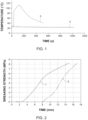
- This optical pyrometry test makes it possible to determine the exothermicity of the reaction and the lag time, that is to say the time required by the sample in order to begin to polymerize. This time is the pot life.
- FIG. 1 shows that comparative composition No. 2 (absence of photoinitiator, curve a) does not polymerize in the absence of photoinitiator and of irradiation with an LED.
- composition No. 1 according to the invention (curve b) polymerizes very rapidly since an exotherm (temperature peak) is observed from the first seconds of irradiation.
- the polymer obtained is advantageously dry at the surface (tack-free).
- Example 3 Composition No. 3
- the Crayvallac® and the Visiomer Glyfoma are mixed in a reactor kept constantly stirred and under nitrogen at 55° C. for 1 h.
- the reaction mixture is then cooled to 23° C. and the other ingredients constituting component A are added in the proportions shown in the following table, at a temperature of 23° C.
- the various ingredients constituting component B are mixed in the proportions shown in the following table, at a temperature of 23° C., in a reactor kept constantly stirred and under nitrogen.
- Composition No. 3 Component A Component B % by weight % by weight (relative to the (relative to the ingredients total weight of A) ingredients total weight of B) Visiomer 96 Retic BP 50 1 Glyfoma (including 200 ppm MEHQ) Speedcure ® 1 Visiomer 99 TPO-L Glyfoma (including 200 ppm MEHQ) Bisomere ® PTE 1 Crayvallac ® 2 SLT TOTAL 100 TOTAL 100
- Component A and component B above were mixed, in a 1:1 ratio by volume.
- the mixing is carried out at a temperature of approximately 23° C., according to the given ratio by volume, with a static mixer, and then the mixture was irradiated under LED at 405 nm with an intensity of 100 mW/cm 2 .
- the polymer obtained is advantageously dry at the surface (tack-free), thus the oxygen did not have time to inhibit the surface.
- the combination of the photo activated redox system advantageously makes it possible to improve the surface polymerization under air.
- composition A of composition No. 1 of Example 1 was placed in an incubator at 50° C. for 12 days.
- compositions A and B of composition No. 1 were carried out in a 1:1 ratio by volume at 23° C. with a static mixer, and then the mixture was irradiated under LED at 405 nm with an intensity of 100 mJ/cm 2 .
- composition No. 1 according to the invention is virtually identical to composition No. 1 having undergone the accelerated ageing (temperature peak at 101° C. with a pot life of 32 s).
- the reactivity of composition No. 1 is advantageously stable over time.
- compositions No. 1 (Example 1) and No. 3 (Example 3) were tested in polymerization in the shadow areas. A portion of the sample (mixture) is hidden so as to have an obstacle-to-light effect. The other portion is irradiated for two minutes with an LED at 405 nm with an intensity of 100 mW/cm 2 . The sample is then left in the dark and monitored at various times in order to see the propagation of the polymerization in the non-irradiated area by virtue of the second mechanism of the redox reaction which does not require light. Complete polymerization (shadow areas included) of the samples was observed in 1 h 30.
- the Crayvallac® and the Visiomer Glyfoma are mixed in a reactor kept constantly stirred and under nitrogen at 55° C. for 1 h.
- the mixture is then brought back down to 23° C. and the other ingredients constituting component A are added in the proportions shown in the following table, at a temperature of 23° C.
- the various ingredients constituting component B are mixed in the proportions shown in the following table, at a temperature of 23° C., in a reactor kept constantly stirred and under nitrogen.
- Composition No. 4 Component A Component B % by weight % by weight (relative to the (relative to the ingredients total weight of A) ingredients total weight of B) Visiomer 36 Retic BP 50 20 Glyfoma (including 200 ppm MEHQ) Urethane 40 Vikoflex 75 acrylate U1 7170 Speedcure ® 1 Crayvallac ® 5 TPO-L SLT Bisomere ® PTE 1 Methacrylic 1 acid XT100 17 Silica R202 3 SR9054 1 TOTAL 100 TOTAL 100
- Composition No. 5 Component A
- Component B % by weight % by weight (relative to the (relative to the ingredients total weight of A) ingredients total weight of B)
- Visiomer 37 Retic BP 50 20
- Glyfoma (including 200 ppm MEHQ)
- Urethane 40 Vikoflex 75 acrylate U1 7170 Crayvallac ® 5 SLT Bisomere ® PTE 1 Methacrylic 1 acid XT100 17
- Component A and component B above were mixed, in a 1:1 ratio by volume.
- the mixing is carried out at a temperature of approximately 23° C., according to the given ratio by volume, with a static mixer, and then the mixture was irradiated under LED at 405 nm with an intensity of 100 mW/cm 2 .
- Adhesive Bonding Tests The adhesive bondings are produced on strips made of aluminium originating from Rocholl. An area of 25 ⁇ 12.5 mm was delimited on a strip using wedges made of Teflon with a thickness of 250 ⁇ m. This area was filled with the test composition and then a second strip of the same material was laminated. The combination was held by a clamp and placed in a climate-controlled chamber at 23° C. or at 100° C.
- the aim of the tensile testing on a universal testing machine is to evaluate the maximum force (in MPa) to be exerted on the assemblage in order to separate it.
- Recourse to a tensile testing device makes it possible to subject a lap joint placed between two rigid supports to a shear stress up to failure by exerting tension on the supports parallel to the surface of the assemblage and to the main axis of the test specimen.
- the result to be recorded is the breaking force or stress.
- the shear stress is applied via the movable jaw of the tensile testing device with a displacement at the rate of 5 mm/min.
- FIG. 2 shows that composition No. 4 according to the invention (curve 1) exhibits a faster increase in cohesion than comparative composition No. 5 (curve 2).
Landscapes
- Chemical & Material Sciences (AREA)
- Organic Chemistry (AREA)
- Adhesives Or Adhesive Processes (AREA)
- Polymerisation Methods In General (AREA)
- Addition Polymer Or Copolymer, Post-Treatments, Or Chemical Modifications (AREA)
- Organic Low-Molecular-Weight Compounds And Preparation Thereof (AREA)
Abstract
Description
-
- at least one reducing agent;
- at least one (meth)acrylate monomer;
-
- at least one oxidizing agent; and
- optionally at least one (meth)acrylate monomer;
said composition being characterized in that:

in which:
-
- m and n are, independently of one another, an integer ranging from 1 to 150, preferably from 1 to 100, preferentially from 1 to 72, advantageously from 1 to 36, even more advantageously from 1 to 18;
- r is an integer ranging from 1 to 200, preferably from 1 to 104, preferentially from 1 to 72, advantageously from 1 to 36;
- R1 represents a radical chosen from the group consisting of a linear or branched, saturated or unsaturated alkyl comprising from 1 to 20 carbon atoms, preferably from 1 to 10 carbon atoms; a (hetero)aryl comprising from 6 to 12 carbon atoms; a cycloalkyl comprising from 3 to 12 carbon atoms;
- v represents an integer ranging from 0 to 5;
- R2 and R3 represent, independently of one another, a halogen atom, a hydrogen atom or a linear or branched alkyl group comprising from 1 to 12 carbon atoms, said alkyl group being optionally interrupted by at least one oxygen atom;
- R4 represents a hydrogen atom, an arylalkyl group, or a linear or branched alkyl group comprising from 1 to 20 carbon atoms, preferably an alkyl group comprising from 1 to 12 carbon atoms, advantageously from 1 to 6 carbon atoms;
- on the condition that m+n>2, preferably n+m≥2.5.
-
- the family of the acetophenones and alkoxyacetophenones, such as, for example, 2,2-dimethoxy-2-phenylacetophenone and 2-diethyl-2-phenylacetophenone;
- the family of the hydroxyacetophenones, such as, for example, 2,2-dimethyl-2-hydroxyacetophenone, 1-hydroxycyclohexyl phenyl ketone, 2-hydroxy-4′-(2-hydroxyethoxy)-2-methylpropiophenone and 2-hydroxy-4′-(2-hydroxypropoxy)-2-methylpropiophenone;
- the family of the alkylaminoacetophenones, such as, for example, 2-methyl-4′-(methylthio)-2-morpholinopropiophenone, 2-benzyl-2-(dimethylamino)-4-morpholinobutyrophenone and 2-(4-methylbenzyl)-2-(dimethylamino)-4-morpholinobutyrophenone;
- the family of the benzoin ethers, such as, for example, benzil, benzoin methyl ether and benzoin isopropyl ether;
- the family of the phosphine oxides, such as, for example, diphenyl(2,4,6-trimethylbenzoyl)phosphine oxide (TPO), ethyl(2,4,6-trimethylbenzoyl)phenylphosphine oxide (TPO-L) and bis(2,6-dimethoxybenzoyl)-2,4,4-trimethylphenylphosphine oxide (BAPO);
- the family of the metallocenes, such as, for example, ferrocene, bis(eta5-2,4-cyclopentadien-1-yl)bis(2,6-difluoro-3-(1H-pyrrol-1-yl)phenyl)titanium and (cumene)(cyclopentadienyl)iron hexafluorophosphate;
-
- the family of the benzophenones, such as, for example, 4-phenylbenzophenone, 4-(4′-methylphenylthio)benzophenone or 1[4-[(4-benzoylphenyl)thio]phenyl]-2-methyl-2-[(4-methylphenyl)sulfonyl]-1-propanone;
- the family of the thioxanthones, such as, for example, isopropylthioxanthone (ITX), 2,4-diethylthioxanthone, 2,4-dimethylthioxanthone, 2-chlorothioxanthone and 1-chloro-4-isopropylthioxanthone;
- the family of the quinones, such as, for example, anthraquinones, including 2-ethylanthraquinone, and camphorquinones;
- the family of the benzoylformate esters, such as, for example, methyl benzoylformate;
- the family of the dibenzylidene ketones, such as, for example, the p-dimethylamino ketone;
- the family of the coumarins, such as, for example, 5-methoxy- and 7-methoxycoumarin, 7-diethylaminocoumarin and N-phenylglycine coumarin;
-
- the family of the acetophenones and alkoxyacetophenones, such as, for example, 2,2-dimethoxy-2-phenylacetophenone and 2-diethyl-2-phenylacetophenone;
- the family of the hydroxyacetophenones, such as, for example, 2,2-dimethyl-2-hydroxyacetophenone, 1-hydroxycyclohexyl phenyl ketone, 2-hydroxy-4′-(2-hydroxyethoxy)-2-methylpropiophenone and 2-hydroxy-4′-(2-hydroxypropoxy)-2-methylpropiophenone;
- the family of the alkylaminoacetophenones, such as, for example, 2-methyl-4′-(methylthio)-2-morpholinopropiophenone, 2-benzyl-2-(dimethylamino)-4-morpholinobutyrophenone and 2-(4-methylbenzyl)-2-(dimethylamino)-4-morpholinobutyrophenone;
- the family of the benzoin ethers, such as, for example, benzil, benzoin methyl ether and benzoin isopropyl ether;
- the family of the phosphine oxides, such as, for example, diphenyl(2,4,6-trimethylbenzoyl)phosphine oxide (TPO), ethyl(2,4,6-trimethylbenzoyl)phenylphosphine oxide (TPO-L) and bis(2,6-dimethoxybenzoyl)-2,4,4-trimethylphenylphosphine oxide (BAPO);
- the family of the metallocenes, such as, for example, ferrocene, bis(eta5-2,4-cyclopentadien-1-yl)bis(2,6-difluoro-3-(1H-pyrrol-1-yl)phenyl)titanium and (cumene)(cyclopentadienyl)iron hexafluorophosphate;
-
- the family of the benzophenones, such as, for example, 4-phenylbenzophenone, 4-(4′-methylphenylthio)benzophenone or 1-[4-[(4-benzoylphenyl)thio]phenyl]-2-methyl-2-[(4-methylphenyl)sulfonyl]-1-propanone;
- the family of the thioxanthones, such as, for example, isopropylthioxanthone (ITX), 2,4-diethylthioxanthone, 2,4-dimethylthioxanthone, 2-chlorothioxanthone and 1-chloro-4-isopropylthioxanthone;
- the family of the benzoylformate esters, such as, for example, methyl benzoylformate;
- the family of the dibenzylidene ketones, such as, for example, the p-dimethylamino ketone;
- the family of the coumarins, such as, for example, 5-methoxy- and 7-methoxycoumarin, 7-diethylaminocoumarin and N-phenylglycine coumarin;
H2C═C(R5)—COOR6 (III)
in which:
-
- R5 represents a hydrogen atom or a methyl group;
- R6 is chosen from the group consisting of alkyls, cycloalkyls, alkenyls, cycloalkenyls, alkylaryls, arylalkyls or aryls, it being possible for said alkyls, cycloalkyls, alkenyls, cycloalkenyls, alkylaryls, arylalkyls or aryls to be optionally substituted and/or interrupted by at least one silane, one silicone, one oxygen, one halogen, one carbonyl, one hydroxyl, one ester, one urea, one urethane, one carbonate, one amine, one amide, one sulfur, one sulfonate, or one sulfone;
- polyethylene glycol di(meth)acrylates;
- tetrahydrofuran (meth)acrylates;
- hydroxypropyl (meth)acrylate;
- hexanediol di(meth)acrylate;
- trimethylol propane tri(meth)acrylate;
- diethylene glycol di(meth)acrylate;
- triethylene glycol di(meth)acrylate;
- tetraethylene glycol di(meth)acrylate;
- dipropylene glycol di(meth)acrylate;
- di(pentamethylene glycol) di(meth)acrylate;
- diglyceryl tetra(meth)acrylate;
- tetramethylene di(meth)acrylate;
- ethylene di(meth)acrylate;
- bisphenol A mono- and di(meth)acrylates;
- bisphenol F mono- and di(meth)acrylates;
- compounds of formula (IV) or (V) below:

in which:
-
- R7 represents H or a methyl;
- R8 represents H or ethyl;
- p represents 0 or 1; and
- Z represents H1 ═O, a linear or branched alkyl group, a benzyl group, an aryl group or an alkoxy group;

-
- at least one reducing agent;
- at least one (meth)acrylate monomer;
-
- at least one oxidizing agent; and
- optionally at least one (meth)acrylate monomer;
said composition being characterized in that:
the (meth)acrylate monomer being chosen from the compounds of formula (IV) or (V) below:

in which:
-
- R7 represents H or a methyl;
- R8 represents H or ethyl;
- p represents 0 or 1; and

The various ingredients constituting component B are mixed in the proportions shown in the following table, at a temperature of 23° C., in a reactor kept constantly stirred and under nitrogen.
| Composition No. 1 |
| Component A | Component B |
| % by weight | % by weight | ||
| (relative to the | (relative to the | ||
| ingredients | total weight of A) | ingredients | total weight of B) |
| Trimethylol- | 95 | Retic BP 50 | quantity |
| propane formal | sufficient | ||
| acrylate | to reach 100% | ||
| (Example 1) | |||
| MEHQ | 855 ppm | Trimethylol- | 98 |
| propane formal | |||
| acrylate | |||
| (Example 1) | |||
| Speedcure ® | 1 | MEHQ | 882 ppm |
| TPO | |||
| | 1 | ||
| Crayvallac ® | quantity | ||
| SLT | sufficient | ||
| to reach 100 | |||
| Total | |||
| 100 | | 100 | |
Component A and component B above were mixed, in a 1:1 ratio by volume.
The mixing is carried out at a temperature of approximately 23° C., according to the given ratio by volume, with a static mixer, and then the mixture was irradiated under LED at 405 nm with an intensity of 100 mW/cm2.
| Comparative composition No. 2 |
| Component A | Component B |
| % by weight | % by weight | ||
| (relative to the | (relative to the | ||
| Ingredients | total weight of A) | Ingredients | total weight of B) |
| Trimethylol- | 97 | Retic BP 50 | quantity |
| propane formal | sufficient | ||
| acrylate | to reach 100% | ||
| (Example 1) | |||
| MEHQ | 873 ppm | Trimethylol- | 98 |
| propane formal | |||
| acrylate | |||
| (Example 1) | |||
| Bisomere ® |
1 | MEHQ | 882 ppm |
| Crayvallac ® | quantity | ||
| SLT | sufficient | ||
| to reach 100 | |||
| TOTAL | |||
| 100 | |
100 | |
In addition, it was observed that the polymer obtained is advantageously dry at the surface (tack-free).
The various ingredients constituting component B are mixed in the proportions shown in the following table, at a temperature of 23° C., in a reactor kept constantly stirred and under nitrogen.
| Composition No. 3 |
| Component A | Component B |
| % by weight | % by weight | ||
| (relative to the | (relative to the | ||
| ingredients | total weight of A) | ingredients | total weight of B) |
| Visiomer | 96 | Retic BP 50 | 1 |
| Glyfoma | |||
| (including | |||
| 200 ppm MEHQ) | |||
| Speedcure ® | 1 | Visiomer | 99 |
| TPO-L | Glyfoma | ||
| (including | |||
| 200 ppm | |||
| MEHQ) | |||
| Bisomere ® |
1 | ||
| |
2 | ||
| | |||
| TOTAL | |||
| 100 | |
100 | |
The various ingredients constituting component B are mixed in the proportions shown in the following table, at a temperature of 23° C., in a reactor kept constantly stirred and under nitrogen.
| Composition No. 4 |
| Component A | Component B |
| % by weight | % by weight | ||
| (relative to the | (relative to the | ||
| ingredients | total weight of A) | ingredients | total weight of B) |
| Visiomer | 36 | Retic BP 50 | 20 |
| Glyfoma | |||
| (including | |||
| 200 ppm MEHQ) | |||
| |
40 | Vikoflex | 75 |
| acrylate U1 | 7170 | ||
| |
1 | |
5 |
| TPO-L | SLT | ||
| |
1 | ||
| |
1 | ||
| acid | |||
| XT100 | 17 | ||
| |
3 | ||
| |
1 | ||
| |
100 | |
100 |
| Composition No. 5 (comparative) |
| Component A | Component B |
| % by weight | % by weight | ||
| (relative to the | (relative to the | ||
| ingredients | total weight of A) | ingredients | total weight of B) |
| Visiomer | 37 | Retic BP 50 | 20 |
| Glyfoma | |||
| (including | |||
| 200 ppm MEHQ) | |||
| | 40 | Vikoflex | 75 |
| acrylate U1 | 7170 | ||
| | 5 | ||
| SLT | |||
| | 1 | ||
| | 1 | ||
| acid | |||
| XT100 | 17 | ||
| | 3 | ||
| | 1 | ||
| | 100 | | 100 |
Component A and component B above were mixed, in a 1:1 ratio by volume.
The mixing is carried out at a temperature of approximately 23° C., according to the given ratio by volume, with a static mixer, and then the mixture was irradiated under LED at 405 nm with an intensity of 100 mW/cm2.
Adhesive Bonding Tests
The adhesive bondings are produced on strips made of aluminium originating from Rocholl. An area of 25×12.5 mm was delimited on a strip using wedges made of Teflon with a thickness of 250 μm. This area was filled with the test composition and then a second strip of the same material was laminated. The combination was held by a clamp and placed in a climate-controlled chamber at 23° C. or at 100° C. and 50% RH (relative humidity) for a week before tensile testing on a universal testing machine. Insolation on the section for 30 seconds.
The aim of the tensile testing on a universal testing machine is to evaluate the maximum force (in MPa) to be exerted on the assemblage in order to separate it. Recourse to a tensile testing device makes it possible to subject a lap joint placed between two rigid supports to a shear stress up to failure by exerting tension on the supports parallel to the surface of the assemblage and to the main axis of the test specimen. The result to be recorded is the breaking force or stress. The shear stress is applied via the movable jaw of the tensile testing device with a displacement at the rate of 5 mm/min. This tensile testing method is carried out as defined by the standard EN 1465 of 2009.
Claims (16)

H2C═C(R5)—COOR6 (III)


Applications Claiming Priority (3)
| Application Number | Priority Date | Filing Date | Title |
|---|---|---|---|
| FRFR1913176 | 2019-11-25 | ||
| FR1913176A FR3103487B1 (en) | 2019-11-25 | 2019-11-25 | Composition based on (meth)acrylate monomers |
| PCT/FR2020/052154 WO2021105603A1 (en) | 2019-11-25 | 2020-11-24 | Composition made from (meth)acrylate monomers |
Publications (2)
| Publication Number | Publication Date |
|---|---|
| US20230022325A1 US20230022325A1 (en) | 2023-01-26 |
| US12152175B2 true US12152175B2 (en) | 2024-11-26 |
Family
ID=70295219
Family Applications (1)
| Application Number | Title | Priority Date | Filing Date |
|---|---|---|---|
| US17/779,406 Active 2041-06-14 US12152175B2 (en) | 2019-11-25 | 2020-11-24 | Composition made from (meth)acrylate monomers |
Country Status (7)
| Country | Link |
|---|---|
| US (1) | US12152175B2 (en) |
| EP (1) | EP4065655A1 (en) |
| JP (1) | JP7759878B2 (en) |
| CN (1) | CN114729231A (en) |
| FR (1) | FR3103487B1 (en) |
| TW (1) | TW202128793A (en) |
| WO (1) | WO2021105603A1 (en) |
Cited By (1)
| Publication number | Priority date | Publication date | Assignee | Title |
|---|---|---|---|---|
| US20240263057A1 (en) * | 2021-05-17 | 2024-08-08 | Bostik Sa | Composition based on (meth)acrylate monomers |
Families Citing this family (4)
| Publication number | Priority date | Publication date | Assignee | Title |
|---|---|---|---|---|
| FR3125056B1 (en) * | 2021-07-12 | 2025-01-17 | Bostik Sa | Composition based on (meth)acrylate monomers |
| FR3125055B1 (en) * | 2021-07-12 | 2025-03-14 | Bostik Sa | Composition based on (meth)acrylate monomers |
| FR3129402B1 (en) * | 2021-11-22 | 2023-10-27 | Bostik Sa | Composition based on (meth)acrylate monomers |
| FR3135984B1 (en) * | 2022-05-31 | 2026-02-13 | Bostik Sa | Composition based on (meth)acrylate compounds |
Citations (5)
| Publication number | Priority date | Publication date | Assignee | Title |
|---|---|---|---|---|
| US2967173A (en) * | 1956-03-22 | 1961-01-03 | Du Pont | Polymerizable esters of acrylic and methacrylic acid and polymers thereof |
| WO2008014466A2 (en) | 2006-07-28 | 2008-01-31 | Lord Corporation | Dual cure adhesive formulations |
| CN102898963A (en) | 2012-10-18 | 2013-01-30 | 上海康达化工新材料股份有限公司 | Acrylate structure adhesive and preparation method thereof |
| US20140231009A1 (en) * | 2013-02-20 | 2014-08-21 | Illinois Tool Works, Inc. | Galvanized metal bonding adhesive formulation and process for the use thereof |
| US20150225626A1 (en) | 2012-10-26 | 2015-08-13 | Henkel lP & Holding GmbH | Adhesive compositions |
Family Cites Families (8)
| Publication number | Priority date | Publication date | Assignee | Title |
|---|---|---|---|---|
| US3547848A (en) | 1967-11-03 | 1970-12-15 | Armour Ind Chem Co | Thixotropic coating compositions comprising a varnish and a di-substituted urea |
| JPS5258315A (en) | 1975-11-10 | 1977-05-13 | Hitachi Denshi Ltd | Portable tv camera |
| DE102004042858A1 (en) | 2004-09-04 | 2006-03-09 | Lanxess Deutschland Gmbh | Specific mixtures of derivatives of N, N-bis (2-hydroxyalkyl) -4-toluidine, their preparation and use |
| JP2008001665A (en) * | 2006-06-26 | 2008-01-10 | Kuraray Medical Inc | 2-pot type dental adhesive |
| JP5325633B2 (en) * | 2009-03-30 | 2013-10-23 | クラレノリタケデンタル株式会社 | Two-part dental adhesive |
| JPWO2018008580A1 (en) * | 2016-07-06 | 2019-04-25 | セメダイン株式会社 | Curable composition and product |
| CN114292212B (en) * | 2016-08-10 | 2024-07-05 | 阿科玛法国公司 | Compounds containing cyclic structural motifs, urethane/ureido linking units and free radically polymerizable functional groups |
| JP2018165363A (en) * | 2017-03-28 | 2018-10-25 | 東亞合成株式会社 | Curable composition, method for producing curable composition, and method for producing active energy ray-curable composition |
-
2019
- 2019-11-25 FR FR1913176A patent/FR3103487B1/en active Active
-
2020
- 2020-11-24 WO PCT/FR2020/052154 patent/WO2021105603A1/en not_active Ceased
- 2020-11-24 US US17/779,406 patent/US12152175B2/en active Active
- 2020-11-24 JP JP2022530756A patent/JP7759878B2/en active Active
- 2020-11-24 TW TW109141174A patent/TW202128793A/en unknown
- 2020-11-24 EP EP20820503.9A patent/EP4065655A1/en active Pending
- 2020-11-24 CN CN202080081547.2A patent/CN114729231A/en active Pending
Patent Citations (5)
| Publication number | Priority date | Publication date | Assignee | Title |
|---|---|---|---|---|
| US2967173A (en) * | 1956-03-22 | 1961-01-03 | Du Pont | Polymerizable esters of acrylic and methacrylic acid and polymers thereof |
| WO2008014466A2 (en) | 2006-07-28 | 2008-01-31 | Lord Corporation | Dual cure adhesive formulations |
| CN102898963A (en) | 2012-10-18 | 2013-01-30 | 上海康达化工新材料股份有限公司 | Acrylate structure adhesive and preparation method thereof |
| US20150225626A1 (en) | 2012-10-26 | 2015-08-13 | Henkel lP & Holding GmbH | Adhesive compositions |
| US20140231009A1 (en) * | 2013-02-20 | 2014-08-21 | Illinois Tool Works, Inc. | Galvanized metal bonding adhesive formulation and process for the use thereof |
Non-Patent Citations (2)
| Title |
|---|
| ISA/EP; International Search Report and Written Opinion for International Patent Application No. PCT/FR2020/052154 dated Feb. 18, 2021, 11 pages. |
| Shaabin, "The effect of inhibitor and initiator concentration on degree of conversion, flexural strength and polymerization shrinkage stress on resin-matrix composite," Masters Thesis, Indiana University School of Dentistry (2009). (Year: 2009). * |
Cited By (2)
| Publication number | Priority date | Publication date | Assignee | Title |
|---|---|---|---|---|
| US20240263057A1 (en) * | 2021-05-17 | 2024-08-08 | Bostik Sa | Composition based on (meth)acrylate monomers |
| US12421430B2 (en) * | 2021-05-17 | 2025-09-23 | Bostik Sa | Composition based on (meth)acrylate monomers |
Also Published As
| Publication number | Publication date |
|---|---|
| WO2021105603A1 (en) | 2021-06-03 |
| FR3103487A1 (en) | 2021-05-28 |
| EP4065655A1 (en) | 2022-10-05 |
| FR3103487B1 (en) | 2022-03-04 |
| US20230022325A1 (en) | 2023-01-26 |
| TW202128793A (en) | 2021-08-01 |
| JP2023503475A (en) | 2023-01-30 |
| JP7759878B2 (en) | 2025-10-24 |
| CN114729231A (en) | 2022-07-08 |
Similar Documents
| Publication | Publication Date | Title |
|---|---|---|
| US12152175B2 (en) | Composition made from (meth)acrylate monomers | |
| JP6443991B2 (en) | Enthiol-based curable composition and cured product thereof | |
| KR102564083B1 (en) | Initiator blends and photocurable compositions useful for three-dimensional printing containing such initiator blends | |
| RU2458955C2 (en) | Adhesive compositions with double curing system | |
| JP5665735B2 (en) | Curable resin composition, adhesive composition, cured product or composite | |
| US20240240063A1 (en) | Composition based on a (meth)acrylate monomer and zinc salt | |
| US20220153913A1 (en) | Methacrylate monomer-based composition | |
| US12421430B2 (en) | Composition based on (meth)acrylate monomers | |
| KR20210005005A (en) | Polymer and oxygen absorber and resin composition using the same | |
| KR20140099187A (en) | Method for manufacturing an adhesive sheet having an ultraviolet-curable acrylic adhesive agent layer | |
| US20100297457A1 (en) | (Meth) acrylate composition featuring reduced oxygen inhibition | |
| US20240166926A1 (en) | Composition based on (meth)acrylate monomers | |
| FR3120872A1 (en) | Composition based on (meth)acrylate monomers | |
| JPWO2006051872A1 (en) | Anaerobic adhesive composition or photocurable anaerobic adhesive composition containing piperidine compound | |
| JP7547725B2 (en) | Water-peelable curable composition | |
| US20240309130A1 (en) | Composition based on (meth)acrylate monomers | |
| JP2025518746A (en) | (Meth)acrylate-based compounds | |
| US20250034440A1 (en) | (meth)acrylate-based two-component adhesive formulation for assembling wind turbine blades | |
| WO2025191087A1 (en) | Two-component composition | |
| US20230399521A1 (en) | Peroxide-free coating compositions comprising unsaturated polyester | |
| JP2023125582A (en) | Curable compositions, self-healing materials and cured products | |
| JP2025077326A (en) | VINYL POLYMER, ADHESIVE COMPOSITION, ADHESIVE, ADHESIVE SHEET, POLYMERIZABLE COMPOSITION, AND METHOD FOR PRODUCING VINYL POLYMER |
Legal Events
| Date | Code | Title | Description |
|---|---|---|---|
| AS | Assignment |
Owner name: CENTRE NATIONAL DE LA RECHERCHE SCIENTIFIQUE, FRANCE Free format text: ASSIGNMENT OF ASSIGNORS INTEREST;ASSIGNORS:MICHAUD, GUILLAUME;SIMON, FREDERIC;FOUQUAY, STEPHANE;AND OTHERS;REEL/FRAME:060002/0232 Effective date: 20220406 Owner name: UNIVERSITE DE HAUTE-ALSACE, FRANCE Free format text: ASSIGNMENT OF ASSIGNORS INTEREST;ASSIGNORS:MICHAUD, GUILLAUME;SIMON, FREDERIC;FOUQUAY, STEPHANE;AND OTHERS;REEL/FRAME:060002/0232 Effective date: 20220406 Owner name: BOSTIK SA, FRANCE Free format text: ASSIGNMENT OF ASSIGNORS INTEREST;ASSIGNORS:MICHAUD, GUILLAUME;SIMON, FREDERIC;FOUQUAY, STEPHANE;AND OTHERS;REEL/FRAME:060002/0232 Effective date: 20220406 |
|
| FEPP | Fee payment procedure |
Free format text: ENTITY STATUS SET TO UNDISCOUNTED (ORIGINAL EVENT CODE: BIG.); ENTITY STATUS OF PATENT OWNER: LARGE ENTITY |
|
| AS | Assignment |
Owner name: CENTRE NATIONAL DE LA RECHERCHE SCIENTIFIQUE, FRANCE Free format text: CORRECTIVE ASSIGNMENT TO CORRECT THE 2ND AND 3RD INVENTOR'S EXCLUSION OF ACCENT MARKS PREVIOUSLY RECORDED AT REEL: 060002 FRAME: 0232. ASSIGNOR(S) HEREBY CONFIRMS THE ASSIGNMENT;ASSIGNORS:MICHAUD, GUILLAUME;SIMON, FREDERIC;FOUQUAY, STEPHANE;AND OTHERS;REEL/FRAME:060352/0766 Effective date: 20220406 Owner name: UNIVERSITE DE HAUTE-ALSACE, FRANCE Free format text: CORRECTIVE ASSIGNMENT TO CORRECT THE 2ND AND 3RD INVENTOR'S EXCLUSION OF ACCENT MARKS PREVIOUSLY RECORDED AT REEL: 060002 FRAME: 0232. ASSIGNOR(S) HEREBY CONFIRMS THE ASSIGNMENT;ASSIGNORS:MICHAUD, GUILLAUME;SIMON, FREDERIC;FOUQUAY, STEPHANE;AND OTHERS;REEL/FRAME:060352/0766 Effective date: 20220406 Owner name: BOSTIK SA, FRANCE Free format text: CORRECTIVE ASSIGNMENT TO CORRECT THE 2ND AND 3RD INVENTOR'S EXCLUSION OF ACCENT MARKS PREVIOUSLY RECORDED AT REEL: 060002 FRAME: 0232. ASSIGNOR(S) HEREBY CONFIRMS THE ASSIGNMENT;ASSIGNORS:MICHAUD, GUILLAUME;SIMON, FREDERIC;FOUQUAY, STEPHANE;AND OTHERS;REEL/FRAME:060352/0766 Effective date: 20220406 |
|
| STPP | Information on status: patent application and granting procedure in general |
Free format text: DOCKETED NEW CASE - READY FOR EXAMINATION |
|
| STPP | Information on status: patent application and granting procedure in general |
Free format text: NON FINAL ACTION MAILED |
|
| STPP | Information on status: patent application and granting procedure in general |
Free format text: RESPONSE TO NON-FINAL OFFICE ACTION ENTERED AND FORWARDED TO EXAMINER |
|
| STPP | Information on status: patent application and granting procedure in general |
Free format text: RESPONSE TO NON-FINAL OFFICE ACTION ENTERED AND FORWARDED TO EXAMINER |
|
| STPP | Information on status: patent application and granting procedure in general |
Free format text: NOTICE OF ALLOWANCE MAILED -- APPLICATION RECEIVED IN OFFICE OF PUBLICATIONS |
|
| STPP | Information on status: patent application and granting procedure in general |
Free format text: PUBLICATIONS -- ISSUE FEE PAYMENT RECEIVED |
|
| STPP | Information on status: patent application and granting procedure in general |
Free format text: PUBLICATIONS -- ISSUE FEE PAYMENT VERIFIED |
|
| STCF | Information on status: patent grant |
Free format text: PATENTED CASE |
|
| AS | Assignment |
Owner name: BOSTIK SA, FRANCE Free format text: CHANGE OF ADDRESS;ASSIGNOR:BOSTIK SA;REEL/FRAME:072277/0238 Effective date: 20250704 |