US12123725B2 - Method for computing a personalized itinerary from a departure location to an arrival location - Google Patents
Method for computing a personalized itinerary from a departure location to an arrival location Download PDFInfo
- Publication number
- US12123725B2 US12123725B2 US17/335,402 US202117335402A US12123725B2 US 12123725 B2 US12123725 B2 US 12123725B2 US 202117335402 A US202117335402 A US 202117335402A US 12123725 B2 US12123725 B2 US 12123725B2
- Authority
- US
- United States
- Prior art keywords
- transfer
- trip
- transfers
- feasible
- time
- Prior art date
- Legal status (The legal status is an assumption and is not a legal conclusion. Google has not performed a legal analysis and makes no representation as to the accuracy of the status listed.)
- Active, expires
Links
- 238000000034 method Methods 0.000 title claims abstract description 156
- 238000012546 transfer Methods 0.000 claims abstract description 1177
- 238000013138 pruning Methods 0.000 claims abstract description 54
- 238000005457 optimization Methods 0.000 claims description 65
- 238000006073 displacement reaction Methods 0.000 claims description 23
- 238000012545 processing Methods 0.000 claims description 8
- 230000003116 impacting effect Effects 0.000 claims description 6
- 238000007781 pre-processing Methods 0.000 description 36
- 230000008569 process Effects 0.000 description 35
- 244000141353 Prunus domestica Species 0.000 description 33
- 230000008859 change Effects 0.000 description 9
- 238000012986 modification Methods 0.000 description 6
- 230000004048 modification Effects 0.000 description 6
- 238000013459 approach Methods 0.000 description 3
- 238000013499 data model Methods 0.000 description 3
- 238000012937 correction Methods 0.000 description 2
- 238000010586 diagram Methods 0.000 description 2
- 230000006870 function Effects 0.000 description 2
- 230000009286 beneficial effect Effects 0.000 description 1
- 230000001351 cycling effect Effects 0.000 description 1
- 230000003247 decreasing effect Effects 0.000 description 1
- 230000001419 dependent effect Effects 0.000 description 1
- 230000000694 effects Effects 0.000 description 1
- 238000002372 labelling Methods 0.000 description 1
- 238000012360 testing method Methods 0.000 description 1
- 230000036962 time dependent Effects 0.000 description 1
- XLYOFNOQVPJJNP-UHFFFAOYSA-N water Substances O XLYOFNOQVPJJNP-UHFFFAOYSA-N 0.000 description 1
Images


Classifications
-
- G—PHYSICS
- G01—MEASURING; TESTING
- G01C—MEASURING DISTANCES, LEVELS OR BEARINGS; SURVEYING; NAVIGATION; GYROSCOPIC INSTRUMENTS; PHOTOGRAMMETRY OR VIDEOGRAMMETRY
- G01C21/00—Navigation; Navigational instruments not provided for in groups G01C1/00 - G01C19/00
- G01C21/26—Navigation; Navigational instruments not provided for in groups G01C1/00 - G01C19/00 specially adapted for navigation in a road network
- G01C21/34—Route searching; Route guidance
- G01C21/3407—Route searching; Route guidance specially adapted for specific applications
- G01C21/3423—Multimodal routing
-
- G—PHYSICS
- G01—MEASURING; TESTING
- G01C—MEASURING DISTANCES, LEVELS OR BEARINGS; SURVEYING; NAVIGATION; GYROSCOPIC INSTRUMENTS; PHOTOGRAMMETRY OR VIDEOGRAMMETRY
- G01C21/00—Navigation; Navigational instruments not provided for in groups G01C1/00 - G01C19/00
- G01C21/26—Navigation; Navigational instruments not provided for in groups G01C1/00 - G01C19/00 specially adapted for navigation in a road network
- G01C21/34—Route searching; Route guidance
- G01C21/3446—Details of route searching algorithms, e.g. Dijkstra, A*, arc-flags or using precalculated routes
-
- G—PHYSICS
- G01—MEASURING; TESTING
- G01C—MEASURING DISTANCES, LEVELS OR BEARINGS; SURVEYING; NAVIGATION; GYROSCOPIC INSTRUMENTS; PHOTOGRAMMETRY OR VIDEOGRAMMETRY
- G01C21/00—Navigation; Navigational instruments not provided for in groups G01C1/00 - G01C19/00
- G01C21/26—Navigation; Navigational instruments not provided for in groups G01C1/00 - G01C19/00 specially adapted for navigation in a road network
- G01C21/34—Route searching; Route guidance
- G01C21/3407—Route searching; Route guidance specially adapted for specific applications
- G01C21/343—Calculating itineraries
Definitions
- a journey planner (also called trip planner) is a solver used to determine an itinerary from an origin location (the origin) to an arrival location (the destination), using one or more transport modes, in particular public transportation modes (subway, tram, bus, etc.—the planner is said to be “multimodal” when covering several transportation modes and allowing intermodal transfers from one mode to another). Searches may be optimized on different criteria, for example fastest, shortest, least changes, cheapest. Searches may be constrained for example to leave or arrive at a certain time, to avoid certain waypoints, etc.
- Public transport modes generally operate according to published schedules; given that public transport services only depart at specific times (unlike private modes of transportation such as driving, walking, or cycling, which may leave at any time), an algorithm must therefore not only find a path to a destination, but seek to optimize it so as to minimize the arrival time in this time-dependent setting.
- Trip-Based Public Transit Routing is a method based on iterations, similar to breadth-first search in a graph, where one iteration corresponds to taking a trip.
- the Trip-Based Public Transit Routing algorithm is an algorithm for computing a Pareto front and a Pareto path per value in the Pareto front for two criteria in multimodal networks restricted to transit and walking between stations, considering an origin, a destination, and a start time.
- the criteria minimum arrival time (i.e., the earliest arrival time considering the start time) and minimum transfer number (i.e., the minimum number of changes of transport mode, either within the same network or intermodally), are optimized.
- a n-tuple (v 1 , v 2 , . . . , v n ) of values for those criteria is non-dominated in the Pareto sense if there is no other n-tuple (v′ 1 , v′ 2 , . . . , v′ n ) such that for all i ⁇ 1, 2, . . . , n ⁇ , v′ i ⁇ v i and ⁇ i ⁇ 1, 2, . . . , n ⁇ such that v′ i ⁇ v i .
- the set of all optimal values is called Pareto front.
- An optimal path, in the Pareto sense, for minimum arrival time and minimum number of transfers is hence a path whose values belong to the Pareto front.
- the Trip-Based Public Transit Routing algorithm builds the Pareto front for minimum arrival time and minimum number of transfers and returns one optimal itinerary with this value for each element in the Pareto front in polynomial time.
- the Trip-Based Public Transit Routing algorithm is based on the preprocessing and pruning of the feasible transfers between trips.
- the aim is to build for each trip a neighborhood of reachable trips in such way that when searching this graph structure, the Pareto front can be obtained.
- An earliest arrival time query will then consist in a simple breadth-first search exploration in a time-independent network where the trips are vertices and the possible transfers the arcs.
- FIG. 2 An example of this graphical representation of the transportation network is illustrated in FIG. 2 .
- the Trip-Based Public Transit Routing algorithm can also cover profile queries, where all the optimal paths must be found for a given starting time range.
- FIG. 2 illustrates the modeling of the network in the Trip-Based Public Transit Routing algorithm search phase.
- Public transit information is represented using a graph, whose vertices (or nodes) are the trips of the public transit network and those arcs represent the possibility to transfer between two trips at given stops.
- FIG. 2 illustrates the modeling of a transfer 15 between a first trip 10 of a public transit network at station (stop) (i) and a second trip 20 of the public transit network at station (stop) (j).
- FIG. 2 further illustrates a second transfer 25 between the first trip 10 of the public transit network at station (stop) (u) and a third trip 30 of the public transit network at station (stop) (v).
- node 11 corresponds to trip 10
- node 21 corresponds to trip 20
- node 31 corresponds to trip 30 .
- transfer 15 corresponds to arc 17 and transfer 25 corresponds to arc 27 . It is noted that several feasible transfers are often possible between two trips.
- FIG. 3 illustrates an example of a trip-based public transit routing process that utilizes a database 50 containing public transit routing information for a particular area, such as a city.
- a preprocessing process 51 constructs a set of feasible transfers between trips in the public transit network using the Trip-Based Public Transit Routing algorithm.
- a trip, in the Trip-Based Public Transit Routing algorithm is an ordered list of arrival and departure times at stops/stations that will be fulfilled by a single vehicle.
- the trip, in the Trip-Based Public Transit Routing algorithm corresponds to taking one vehicle of a line.
- a line is an ordered set of trips sharing the same sequence of stops visited by the vehicles corresponding to the trips and where trips do not overtake one another (the order of the arrival and departure times of the trip is the same for all the stops of the line).
- a pruning process 53 prunes the set of feasible transfers between trips in the public transit network.
- the preprocessing and pruning of the feasible transfers between trips build, for each trip, a neighborhood of reachable trips that will be smaller than the complete neighborhood.
- the pruning process 53 ensures the correction.
- a search engine module 57 finds the Pareto front and one solution per element in the Pareto front 59 by performing an earliest arrival time query that consists in a simple breadth-first search like exploration in a time-independent network where the trips are the nodes of FIG. 2 and the possible transfers are the arcs of FIG. 2 . So, for each iteration, one additional trip is taken in each solution to try and get to destination.
- the parameters include origin, destination, and start time or time range.
- the user is not able to specify a maximum transfer duration and/or a transfer speed.
- a user might wish to set a large maximum duration and a high speed. For example, a user may see a long transfer at a brisk pace as an opportunity to keep fit.
- some modes that include the use of a kick scooter or roller blades that can be carried by the user in the public transit network, can be modeled by a faster transfer.
- FIG. 1 illustrates an example of architecture of a system for computing an itinerary from a departure location to an arrival location
- FIG. 2 illustrates an example of a data model for public transit networks where trips are represented as nodes and feasible transfers are represented as arcs;
- FIG. 3 illustrates a block diagram of a public transit routing process based on feasible transfers preprocessing
- FIG. 4 illustrates a block diagram of a public transit routing process based on feasible transfers preprocessing that allows selection of a maximum transfer duration and a transfer speed;
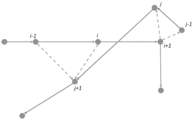
- FIG. 5 is a graphical representation illustrating stops that can be reached by walking from a current stop or from the stops reached after a transfer;
- FIG. 6 is a graphical representation illustrating transfers between two lines
- FIG. 7 illustrates an algorithmic example of preprocessing a set of feasible transfers using arrival time-based pruning
- FIG. 8 illustrates another algorithmic example of building and preprocessing a set of feasible transfers using line-based pruning
- FIG. 9 illustrates a conventional algorithmic example of an earliest arrival time query in a public transit network with a data model where trips are represented as nodes and feasible transfers are represented as arcs;
- FIG. 10 and FIG. 11 illustrate an algorithmic example of an earliest arrival time query in a public transit network with a data model where trips are represented as nodes and feasible transfers are represented as arcs;
- FIG. 12 is a graphical representation illustrating transfers from one origin trip of an origin line to a destination line
- FIG. 13 is a graphical representation illustrating labelling for an origin trip and a destination trip in the preprocessing step
- FIG. 14 illustrates an algorithmic example of preprocessing a set of feasible transfers using arrival time based pruning
- FIG. 15 illustrates an algorithmic example of building and preprocessing a set of feasible transfers using line-based pruning
- FIG. 16 illustrates Tables 1-5
- FIG. 17 illustrates Table 6 and Table 7
- FIG. 18 illustrates Table 8 and Table 9.
- a method for computing at least one itinerary, when at least one itinerary is feasible (e.g., when arrival times plus transfer duration is less than or equal to the departure time at possible line transfers), from a departure location to an arrival location, which allows a user to select, at query time, a maximum transfer duration (which is also referred to herein a system maximum transfer time) and/or an appropriate transfer speed (which is also referred to herein as a transfer duration coefficient), will be described below.
- the departure and arrival locations are geographical locations, typically locations on a map as defined by an address, a point of interest, coordinates, etc.
- the determined itineraries are preferably the optimal ones (or at least close to the optimal ones; i.e., approximations of the optimal ones) according to at least one criterion such as the arrival time (which should be the earliest), the duration of the itinerary (which should be the lowest), the departure time (which should be the latest), the length of the itinerary (which should be the shortest), the number of transfers (which should be the lowest), the price (which should be the lowest), etc.
- a “cost” of the itinerary can be computed according to a given cost function, the cost being minimized and possibly multidimensional.
- each itinerary comprises a multimodal transportation network of predetermined stations.
- the multimodal transportation network is preferably a network of public transportation modes, in particular “scheduled” transportation modes; i.e., following a line (a predetermined sequence of stations) and of which timetables are known.
- Examples of scheduled public transportation modes include bus, metro, tramway, train, water shuttle, carpooling, etc. It is to be noted that the multimodal transportation network might further comprise non-scheduled transportation modes such as on-demand bus, ride-hailing, or even bike sharing (wherein the users can simply take a bike for going from a station to another without any restriction), but advantageously only walking and scheduled public transportation modes are hereby involved in the multimodal transportation network.
- non-scheduled transportation modes such as on-demand bus, ride-hailing, or even bike sharing (wherein the users can simply take a bike for going from a station to another without any restriction), but advantageously only walking and scheduled public transportation modes are hereby involved in the multimodal transportation network.
- station or “stop,” it is meant a facility at a given location wherein at least one of the transportation modes of the multimodal transportation network regularly stops to load or unload passengers, for example a bus station, a metro station, a train station, etc.
- connection A travel between two consecutive stations during a trip is called “connection.” It is associated with a departure time from the first stop and an arrival time at the second stop.
- a trip is a set of ordered arrival/departure times at stations/stops for a single vehicle.
- a transfer corresponds to leaving one trip at its i th stop and taking (starting) a second trip at its j th stop.
- the multimodal network is restricted to a public transit network and walking between stations, wherein a transfer is walking between stations.
- the transfers could of course be done using a non-walking mode (such as a kick scooter or roller blades), if speed personalization is added.
- the method may be implemented within an architecture such as illustrated in FIG. 1 , by means of a server 100 and/or a client 200 .
- the client 200 may include a computer (as shown in FIG. 1 ), a tablet, a mobile device (such as a smartphone), or smart speaker.
- Each of these devices 100 , 200 are typically connected to an extended network 300 such as the Internet for data exchange.
- Each one comprises data processors 110 , 210 , and optionally memory 120 , 220 such as a hard disk.
- the user generally uses a client device 200 of the smartphone or smart speaker type, for inputting a request for itineraries (are inputted the departure location, the arrival location, and a departure time or range thereof or an arrival time or range thereof).
- the request may be either directly processed by the client 200 , or transmitted to the server 100 for being processed there.
- the described methodology is not limited to any specific implementation.
- the server 100 can still be called for performing any of the subroutines.
- t@i represents the pair (t, i) where t is a trip and i is an index in its stop sequence; i.e., t@i represents the i th stop of trip t. If several identical stops in the sequence (i.e. the trip return at a previously visited stop), t@i refers to the one in the i th position, that is the index of the stop is also referenced in the notation.
- ⁇ right arrow over (p) ⁇ (t) (t@1, t@2, . . . ) is the stop sequence of trip t.
- ⁇ arr (t,i) is the arrival time and ⁇ dep (t,i) is the corresponding departure time at t@i of trip t.
- the schedule of t is defined by the arrival and departure times of t at the stops of its sequence.
- ⁇ arr (t,i) is the arrival time of t at the i th stop of ⁇ right arrow over (p) ⁇ (t)
- ⁇ dep (t,i) is the departure time of t at the i th stop of ⁇ right arrow over (p) ⁇ (t).
- Trips are grouped into lines that do not exactly represent the routes of the public transport network.
- a displacement between the i th stop of t and the j th stop of t using trip t is denoted t@i ⁇ t@j, and similarly, a transfer between trip t at the i th station and trip u at the j th station is denoted t@i ⁇ u@j.
- Walking transfer times are defined for any pair of stops (p,q), p ⁇ q that are close enough of one another and the associated duration is ⁇ fp (p,q).
- a minimum change time ⁇ fp (p,p) can be defined, to represent the time needed to move within this station.
- a line L is an ordered set of trips t 0 , t 1 , t 2 , . . . , such that all trips of the line have the same stop sequence (denoted ⁇ right arrow over (p) ⁇ (L)) and do not overtake one another.
- a transfer t@i ⁇ u@j is feasible if and only if ⁇ fp (t@i, u@j) is defined and ⁇ arr ( t,i )+ ⁇ fp ( t@i,u@j ) ⁇ dep ( u,j )
- T is the set of all feasible transfers.
- the set of feasible transfers for a trip t contains all transfers from the i th stop, t@i, of trip t to the j th stop, u@j, of trip u such that a user can reach stop u@j on time to get trip u after alighting t at stop t@i.
- One approach to diminish the negative impact on the query times is to prune the set of feasible transfers while keeping all the transfers that belong to at least one optimal path per value in the Pareto front.
- an arrival time based pruning method is any method for pruning a set of feasible transfers based on comparing arrival times at stations and/or change times at stations (minimum time at which it will be possible to take a new trip).
- each trip t is processed in turn, and each stop i of its sequence, starting by the last one.
- the process determines if taking a neighboring trip u at stop j, leaving t at stop i, can improve the arrival ( ⁇ A ) or change ( ⁇ C ) times at any stop of the network, compared to the previous transfers processed.
- the above pruning method reduces the query time, which in turns reduces the time needed to provide the user with a set of possible itineraries.
- the processing time in the search phase is reduced.
- the preprocessing step described in FIG. 7
- the preprocessing phase for the process illustrated in FIG. 7 is costly because computing all the possible arrival and change times for all the reachable stops for each transfer is costly (in terms of execution times).
- applying another faster pruning phase, as discussed below, that removes some transfers before applying pruning of FIG. 7 can reduce the preprocessing computation times.
- a transfer is not performed from the first stop of a trip or to the last stop of a trip.
- the algorithm illustrated in FIG. 8 considers each pair (origin trip, target line) and prune the corresponding transfers.
- the pruning is based on a Pareto dominance relation between transfers t@i ⁇ u@j with the criteria: origin index i, with should be the highest, target line index j, which should be the lowest, destination trip u, which should be the lowest.
- the obtained algorithm builds a correct set of transfers for the criteria to minimize arrival time and number of transfers.
- a correct set of transfers is such that for each value in the Pareto front, there is at least one solution in the Pareto set with this value such that all the transfers of this solution belong to the transfer set.
- Other pruning processes that ensure the correction of the transfer set may include a process based upon line-based U-turn removal; and a process based upon two stops from the origin line enabling a transfer to the same stop of the target line.
- transfer (i, L′@j, ⁇ fp (L@i, L′@j)) can be removed from the set of feasible transfers if for all trip t of L, wherein t′ is the earliest trip from L′ that can be caught at j after ⁇ arr (t,i)+ ⁇ fp (L@i, L′@j), ⁇ arr ( t,i ⁇ 1)+ ⁇ fp ( L @( i ⁇ 1), L ′@( j+ 1)) ⁇ arr ( t′,j+ 1)
- FIG. 5 shows stops that may be reached from stop p t i by either walking and/or transferring to stops p u j+1 or p u j .
- the arrival time base transfer pruning as discussed above with respect to FIG. 7 , can be applied. Since the first preprocessing step of FIG. 8 , has created an initial transfer set that is smaller, this second preprocessing step will be significantly less expensive computationally than with the complete transfer set and total preprocessing time is reduced.
- routing algorithms can be designed to find the Pareto front and one solution with this value per element in the Pareto front for one or more criteria.
- FIG. 9 illustrates the earliest arrival time query algorithm proposed in Witt's Trip-Based Public Transit Routing Article.
- the lines of L will be the targets of the algorithm while the search queue is initialized with the earliest trip of each line reached from origin.
- the index R(t) of the first reached stop of trip t initialized to ⁇ for all trips, is maintained. For each number of transfers, one queue Q n of trip segments reached after n transfers is defined.
- Q 0 is initialized from the trips that can be taken from the source stop p src .
- ⁇ for any stop q reached by walking from p src ( ⁇ fp (p src ,q) is defined)
- the earliest trip of (L i) ⁇ L(q) is added to the queue. It is the smallest trip t of line L such that
- duration between this origin and neighboring stations can be computed, for instance using a classical shortest path algorithm in the road network.
- the process After the initialization, the process performs a breadth-first search. For each iteration, the process scans the trips in the queue. Each trip is scanned in turn. If the trip belongs to the target lines, the trip is compared to the current solution set. Then the transfers from this trip are added to the queue of the next iteration.
- FIG. 9 A more detailed description of this process is provided in FIG. 9 .
- Profile queries are also considered, where in addition to source and target stops, the user provides an earliest departure time ⁇ edt and a latest departure time ⁇ ldt ; i.e., an interval in which to depart.
- Maximum departure time is considered a third criterion in the Pareto search.
- the result of the query is the set of all the Pareto values for minimum arrival time, minimum number of transfers, and maximum departure time starting within the interval (and one itinerary per value).
- the computation for profile queries is as follows: perform an earliest arrival time query starting at ⁇ ldt and add the Pareto values to the result set of the profile search. Then restart the search starting at the preceding instant without resetting the labels. By iterating the process, the Pareto front can be completed without performing unnecessary computations as the labels will only allow improvements on preceding arrival times.
- FIG. 4 illustrates the public transit routing process proposed in this invention that allows a user to set a personalized maximum time for a transfer and/or set a personalized transfer speed.
- the public transit routing process utilizes a database 50 containing public transit routing information for a particular area, such as a city.
- a preprocessing process 51 constructs a set of feasible transfers between trips in the public transit network.
- a preprocessing process 51 prunes the set of feasible transfers between trips in the public transit network (e.g., using the first preprocessing step and a second preprocessing step described above with reference to FIGS. 7 and 8 , respectively) to obtain a reduced transfer set 53 .
- the preprocessing and pruning of the possible transfers between trips build, for each trip, a neighborhood of reachable trips that will be as small as possible.
- the building process and pruning process 51 ensure a correct set of transfers.
- a search engine module 57 finds the Pareto front and one solution per element in the Pareto front 59 by performing an earliest arrival time query that consists in a breadth-first search like exploration in a time-independent network (e.g., using the embodiment illustrated in FIG. 9 of the earliest arrival time query algorithm proposed in Witt's Trip-Based Public Transit Routing Article for a limited set of user definable parameters) where the trips 10 , 20 , and 30 are the nodes 11 , 21 and 31 , respectively, of FIG. 2 and the possible transfers 15 and 25 are the arcs 17 and 27 , respectively, of FIG. 2 . So, for each iteration, one additional trip is taken in each solution to try and get to destination.
- a user is enabled to define a larger set of parameters 56 then the set of parameters 55 of the embodiment illustrated in FIG. 3 .
- the parameters 56 include origin (which is also referred to herein as departure location), destination (which is also referred to herein as arrival location), start time or time range which are mandatory, and maximum transfer duration (which is also referred to herein a system maximum transfer time), and transfer speed (which is also referred to herein as a transfer duration coefficient) which are optional parameters (with default values).
- origin which is also referred to herein as departure location
- destination which is also referred to herein as arrival location
- start time or time range which are mandatory
- maximum transfer duration which is also referred to herein a system maximum transfer time
- transfer speed which is also referred to herein as a transfer duration coefficient
- the method proposed is based on the Trip-Based Public Transit Routing algorithm.
- the Trip-Based Public Transit Routing algorithm is not compatible with the addition of a maximum transfer duration parameter, nor with the addition of a user defined transfer speed.
- the query phase 57 and the preprocessing phase 51 need to be modified to ensure a correct result and reduce any impact on the overall processing time.
- the arrival time based pruning can then be applied or not, as the obtained feasible transfer set is already of reduced size.
- all the trips in between the origin and destination can be taken, depending on the chosen transfer speed, and each is the transfer of interest for a given speed range.
- each is the transfer of interest for a given speed range In the case where there is a finite set of possible speed values, not all the trips of the range might be relevant, and only the earliest for each given speed of the set (so at most as many trips as there are speeds) will be considered.
- the tuple (t@i ⁇ u@j, ⁇ fp (t@i, u@j), ⁇ max ) is saved, where ⁇ max is the maximum transfer duration coefficient such that the transfer is feasible.
- each tuple indicates the arrival time, fixed and variable parts, and maximum transfer duration and minimum speed coefficient for transfer to be feasible, as illustrated on FIG. 13 .
- the maximal duration coefficient can be used instead of minimum speed coefficient, and standard transfer duration (transfer duration considering a reference speed) can be used instead of maximum transfer duration for the transfer to be feasible.
- arr f arr v , ⁇ , ⁇ max
- arr f arr v , ⁇ , ⁇ max
- arr f the fixed arrival time part
- ⁇ the duration with reference speed
- arr v the variable arrival time part with standard speed
- ⁇ max the maximum transfer duration coefficient
- FIG. 13 illustrates such labels in the context of a transfer between a trip t and a trip t′.
- Condition (1) and (2) correspond to classical Pareto dominance.
- Condition (3) correspond to arrival time dominance, but must be valid for all possible speeds. It is equivalent to: ( arr′ f ⁇ arr f )/ ⁇ arr v ⁇ arr′ v . for all possible values of transfer duration coefficient ⁇ , as it is non negative.
- the above condition is true if it is true for the minimum value min that transfer duration coefficient ⁇ can take, obtaining the following conditions for label dominance: ⁇ ′ max ⁇ max (1) ⁇ ′ ⁇ (2) ( arr′ f ⁇ arr f )/ min ⁇ arr v ⁇ arr′ v . (3)
- Line L is the line having stops i ⁇ 1, i, and i+1
- line L′ is the line having stops j ⁇ 1, j, and j+1.
- the possible trips of L taken after the transfer are all the trips between the earliest trip such that ⁇ dep ( t′,j ⁇ 1) ⁇ arr ( t,i+ 1)+ min ⁇ fp ( L @( i+ 1), L ′@( j ⁇ 1)) and the earliest trip such that ⁇ dep ( t′,j ⁇ 1) ⁇ arr ( t,i+ 1)+ max ⁇ fp ( L @( i+ 1), L ′@( j ⁇ 1))
- the standard transfer duration and the maximum transfer duration coefficient ⁇ max ⁇ max for which they will be feasible, can be saved.
- the stops of L′ can be marked by the arrival time of each trip, starting from the earliest, the same standard transfer duration and increasing maximum transfer duration coefficients. Note that those labels are not dominated and are hence all kept.
- FIG. 13 show some of the tentative labels set by a single transfer between a trip t and a trip t′.
- the path will be feasible if and only if all the maximum transfer duration coefficients are below a given bound.
- FIG. 14 illustrates an embodiment of this pruning phase. Note that minimum change times are also checked. They are given similar labels with the hypothesis that they are also multiplied by a duration coefficient when speed varies.
- the main modification is the generation of several destination trips for transfers between an origin line and a destination line (see FIG. 15 ).
- the dominance rule of the transfers of the transfer set now needs to look at two additional criteria: the transfer duration (to minimize) and the transfer duration coefficient (to maximize).
- the query phase (e.g., performed at 57 in FIG. 4 ) needs to be modified to implement the personalization of the route search process.
- pruning is performed, at query time, in order to remove the transfers for which duration exceeds the bound.
- the duration must be an attribute of the transfer.
- the standard duration if it is desired to add a maximum transfer duration as a parameter
- the transfer distance if a speed is provided as a parameter
- a transfer is valid if it is feasible at current speed. Saving the minimum speed for which the transfer is feasible will hence enable pruning during the search. Equivalently, if standard duration is associated to transfer, a maximum transfer duration coefficient can be added to transfer information. It would be possible to add a maximum speed (respectively, minimum duration coefficient) for which the transfer can be useful.
- a speed mask can be added to transfers in order to keep only the right ones depending on the speed during the query phase.
- FIG. 10 and FIG. 11 illustrate the modified query phase (e.g., performed at 57 in FIG. 4 ).
- the transfer set for each transfer t@i ⁇ u@j, the standard duration ⁇ and a maximum transfer duration coefficient ⁇ max for which the transfer is valid are saved to obtain a tuple (t@i ⁇ u@j, ⁇ , ⁇ max ).
- a user can input a user defined maximum transfer duration ⁇ max and transfer duration coefficient ⁇ (relative to the standard duration) in addition to source and destination stops and departure time.
- the first data set covers the maneuver Ile-De-France and is provided by IDFM (Ile-De-France Mobility).
- the second data set is provided by Naver Map and contains public transportation information for Korea.
- Table 1 of FIG. 16 illustrates the data sets, and Table 2 of FIG. 16 illustrates the preprocessing of the first data set (IDFM) with maximum 10 min transfer time.
- the number of footpaths may vary, depending on the maximum transfer duration used to generate missing footpaths from the data set.
- the IDFM network was generated with maximum transfer duration of 10 minutes (maximum transfer duration of the Korean data set).
- the final number of transfers for each speed (see Table 3 of FIG. 16 , wherein Table 3 illustrates the preprocessing of the IDFM data set with maximum 10 min transfer time at each speed level, and Table 5 of FIG. 16 , wherein Table 5 illustrates the preprocessing of the Korean data set with maximum 10 min transfer time at each speed level) varies as expected, as more transfers are feasible for “fast” speed and less for “slow” speed than for the “standard” speed. Also, enabling the maximum transfer duration constraints increases the number of transfers that are not pruned.
- Table 6 of FIG. 17 and Table 8 of FIG. 18 illustrate the execution times and number of solutions for the different versions of the process.
- the execution times are not impacted by the existence of several speeds instead of one.
- the execution times are similar to that of the standard code without any modifications as the number of transfers is not very different. It is noted that to reduce the execution time by a third in the conventional approach, the number of transfers removed is 9 out of 10 in the conventional approach.
- the above-described methods extend the Trip Based Public Transit Routing algorithm to compute personalized itineraries in a multimodal network based on custom transfer speed and maximum transfer duration.
- the customization is done at query time and requires only one server for any speed and maximum transfer duration within chosen bounds.
- the user could choose a speed from a set provided by the application.
- the method modifies the pruning phase of the Trip Based Public Transit Routing algorithm to obtain Pareto front for minimizing arrival time and number of transfers.
- the Trip Based Public Transit Routing algorithm requires that the transfer times and maximum transfer times are fixed and identical for all users as they are used in the preprocessing as constant values.
- the above described extension allows for the possibility to change maximum transfer duration at query time and to modify transfer speeds while ensuring the optimality of the results.
- Transfer speed and maximal duration personalization is a relevant feature in many contexts (traveling with children, with heavy luggage, bad weather, etc.).
- a method builds a reduced set of feasible transfers between public transit trips based upon transfer times between stations, and a system maximum transfer time ⁇ max that can be finite or infinite by (a) computing, for each origin line L, and for each destination line L′, a set of transfers ⁇ (L, L′) between stations of the origin line and stations of the destination line such that the transfer time from the station of the origin line to the station of the destination line is lower than the system maximum transfer time ⁇ max ; (b) determining, for each trip t of origin line L, and for each transfer (L@i ⁇ L′@j, A ⁇ fp (L@i, L′@j)) in the transfer set ⁇ (L, L′), an earliest trip t′ of L′ wherein ⁇ ⁇ fp is a transfer duration associated with the displacement between two stops, t@i and t′@j, and wherein the transfer (t@i ⁇ t′@j, A ⁇ fp (L@i, L′@j))
- a method for computing at least one customized itinerary from a departure location to an arrival location based upon a user specified maximum transfer time that is lower than a system maximum transfer time ⁇ max which can be finite or infinite, (a) inputs, by a user, a user specified departure location, a user specified arrival location, a user specified departure time, and a user specified maximum transfer time that is lower than the system maximum transfer time ⁇ max; (b) computes, for each origin line L, and for each destination line L′, a set of transfers T (L, L′) between stations of the origin line and stations of the destination line such that the transfer time from the station of the origin line to the station of the destination line is lower than the system maximum transfer time ⁇ max; (c) determines, for each trip t of origin line L, and for each transfer (L@i ⁇ L′@j, ⁇ fp (L@i, L′@j)) in the transfer set T (L, L′), an earliest trip t′ of L′ wherein the transfer (t@i ⁇ t
- the routing optimization algorithm may compute a Pareto front according to the criteria earliest arrival time and minimum number of transfers.
- the departure time inputted at (a) may be replaced by a user inputted arrival time, the initial trips being defined at (f) as the latest trips from the stations of which the destination can be reached before the user inputted arrival time, the final trips being defined at (g) as the trips that can be reached from the destination, and the routing optimization algorithm computing the Pareto front according to latest departure time and minimum number of transfers performing a backward search.
- the routing optimization algorithm may compute one optimal solution per element in the Pareto front.
- the routing optimization algorithm may compute an optimal solution per element in the Pareto front.
- a method for building a set of transfers between public transit trips based upon transfer times between stations, a minimum transfer duration coefficient ⁇ min and a maximum transfer duration coefficient ⁇ max (a) computes, for each origin line L, and for each destination line L′, a set of transfers T (L, L′) between stations of the origin line and stations of the destination line such that the transfer time from the station of the origin line to the station of the destination line is defined; (b) determining, for each trip t of origin line L, and for each transfer (L@i ⁇ L′@j, ⁇ ) in the transfer set T (L, L′), an earliest trip t′ min of L′ wherein the transfer is feasible with transfer duration coefficient ⁇ min , and an earliest trip t′ max of L′ wherein the transfer is feasible with transfer duration coefficient ⁇ max ; (c) for each trip t′ of [t′ min , t′ max ], computes the maximum transfer duration coefficient ⁇ max such that the transfer t@i ⁇ t′@j is feasible; (d
- a method computes at least one customized itinerary from a departure location to an arrival location, based on a minimum transfer duration coefficient ⁇ min and a maximum transfer duration coefficient ⁇ max , by (a) computing, for each origin line L, and for each destination line L′, a set of transfers T (L, L′) between stations of the origin line and stations of the destination line such that the transfer time from the station of the origin line to the station of the destination line is defined; (b) determining, for each trip t of origin line L, and for each transfer (L@i ⁇ L′@j, ⁇ ) in the transfer set T (L, L′), an earliest trip t′ min of L′ wherein the transfer is feasible with transfer duration coefficient ⁇ min , and an earliest trip t′ max of L′ wherein the transfer is feasible with transfer duration coefficient ⁇ max ; (c) for each trip t′ of [t′ min , t′ max ], computing the maximum transfer duration coefficient ⁇ such that the transfer t@i ⁇ t′@j is feasible; (
- the routing optimization algorithm computes the Pareto front according to earliest arrival time and minimum number of transfers.
- the departure time inputted at (a) is replaced by a user inputted arrival time, the initial trips being defined at (f) as the latest trips from the stations of which the destination can be reached before the user inputted arrival time, the final trips being defined at (g) as the trips that can be reached from the destination, and the routing optimization algorithm computing the Pareto front according to latest departure time and minimum number of transfers performing a backward search.
- the routing optimization algorithm computes an optimal solution per element in the Pareto front.
- the routing optimization algorithm computes an optimal solution per element in the Pareto front.
- a method builds a set of transfers between public transit trips based upon transfer times between stations, a system maximum transfer time ⁇ max that can be finite or infinite, and a minimum transfer duration coefficient ⁇ min and a maximum transfer duration coefficient ⁇ max , by (a) computing, for each origin line L, and for each destination line L′, a set of transfers T (L, L′) between stations of the origin line and stations of the destination line such that the transfer time from the station of the origin line to the station of the destination line is less or equal to ⁇ max ⁇ max ; (b) determining, for each trip t of origin line L, and for each transfer (L@i ⁇ L′@j, ⁇ fp (L@i, L′@j)) in the transfer set T (L, L′), an earliest trip t′ min of L′ wherein the transfer is feasible with transfer duration coefficient ⁇ min , and an earliest trip t′ max of L′ wherein the transfer is feasible with transfer duration coefficient ⁇ max ; (c) for each trip t′ of
- a method computes at least one customized itinerary from a departure location to an arrival location based upon a user specified maximum transfer time lower than or equal to a system maximum transfer time ⁇ max that can be finite or infinite and a maximum transfer coefficient chosen within a range [ ⁇ min , ⁇ max ] of possible values, by (a) computing, for each origin line L, and for each destination line L′, a set of transfers T (L, L′) between stations of the origin line and stations of the destination line such that the transfer time from the station of the origin line to the station of the destination line is less or equal to ⁇ max ⁇ max ; (b) determining, for each trip t of origin line L, and for each transfer (L@i ⁇ L′@j, ⁇ fp (L@i, L′@j)) in the transfer set T (L, L′), an earliest trip t′ min of L′ wherein the transfer is feasible with transfer duration coefficient ⁇ min , and an earliest trip t′ max of L′ wherein the transfer is feasible with transfer duration coefficient
- the routing optimization algorithm computes a Pareto front according to earliest arrival time and minimum number of transfers.
- the departure time inputted at (a) is replaced by a user inputted arrival time, the initial trips being defined at (f) as the latest trips from the stations of which the destination can be reached before the user inputted arrival time, the final trips being defined at (g) as the trips that can be reached from the destination, and the routing optimization algorithm computing the Pareto front according to latest departure time and minimum number of transfers performing a backward search.
- the routing optimization algorithm computes one optimal solution per element in the Pareto front.
- the routing optimization algorithm computes one optimal solution per element in the Pareto front.
- a method builds a set of transfers between public transit trips based upon transfer times between stations, a set of possible transfer duration coefficients ⁇ 1 , ⁇ 2 , . . . ⁇ m ⁇ , by (a) computing, for each origin line L, and for each destination line L′, a set of transfers T (L, L′) between stations of the origin line and stations of the destination line such that the transfer time from the station of the origin line to the station of the destination line is defined; (b) determining, for each trip t of origin line L, and for each transfer (L@i ⁇ L′@j, ⁇ ) in the transfer set T (L, L′), an earliest trip t′k of L′ wherein the transfer is feasible for each possible transfer duration coefficient ⁇ k ; (c) for each trip t′k of L′ wherein t′k is the earliest trip of L′ such that the transfer t@i ⁇ t′ k @j is feasible for transfer duration coefficient ⁇ k , adding transfer (t@i ⁇ t′
- the sets T (t, L′, k) are computed in transfer duration coefficient increasing order and a next set of transfers is initialized containing a set for a previous transfer duration coefficient.
- the sets T (t, L′, k) are computed in transfer duration coefficient increasing order and a next set of transfers is initialized containing a set for a previous transfer duration coefficient.
- a method computes at least one customized itinerary from a departure location to an arrival location based upon a user specified transfer duration coefficient chosen within a set of possible transfer duration coefficients ⁇ 1 , ⁇ 2 , . . . ⁇ m ⁇ , by (a) computing, for each origin line L, and for each destination line L′, a set of transfers T (L, L′) between stations of the origin line and stations of the destination line such that the transfer time from the station of the origin line to the station of the destination line is defined; (b) determining, for each trip t of origin line L, and for each transfer (L@i ⁇ L′@j, ⁇ ) in the transfer set T (L, L′), an earliest trip t′ k of L′ wherein the transfer is feasible for each possible transfer duration coefficient ⁇ k ; (c) for each trip t′ k of L′ wherein t′k is the earliest trip of L′ such that the transfer t@i ⁇ t′k@j is feasible for transfer duration coefficient ⁇ k
- the routing optimization algorithm computes a Pareto front according to earliest arrival time and minimum number of transfers.
- the departure time inputted at (a) is replaced by a user inputted arrival time, the initial trips being defined at (f) as the latest trips from the stations of which the destination can be reached before the user inputted arrival time, the final trips being defined at (g) as the trips that can be reached from the destination, and the routing optimization algorithm computing the Pareto front according to latest departure time and minimum number of transfers performing a backward search.
- the routing optimization algorithm computes an optimal solution per element in the Pareto front.
- the routing optimization algorithm computes an optimal solution per element in the Pareto front.
- the sets T (t, L′, k) are computed in transfer duration coefficient increasing order and a next set of transfers is initialized containing a set for a previous transfer duration coefficient.
- the sets T (t, L′, k) are computed in transfer duration coefficient increasing order and a next set of transfers is initialized containing a set for a previous transfer duration coefficient.
- a method builds a set of transfers between public transit trips based upon transfer times between stations, a set of possible transfer duration coefficients ⁇ 1 , ⁇ 2 , . . . ⁇ m ⁇ and a system maximum transfer time ⁇ max that can be finite or infinite, by (a) computing, for each origin line L, and for each destination line L′, a set of transfers T (L, L′) between stations of the origin line and stations of the destination line such that the transfer time from the station of the origin line to the station of the destination line is less or equal to ⁇ max ⁇ max ; (b) determining, for each trip t of origin line L, and for each transfer (L@i ⁇ L′@j, ⁇ ) in the transfer set T (L, L′), an earliest trip t′k of L′ wherein the transfer is feasible for each possible transfer coefficient ⁇ k ; (c) for each trip t′k of L′ wherein t′k is the earliest trip of L′ wherein the transfer t@i ⁇ t′
- the sets T (t, L′, k) are computed in transfer duration coefficient increasing order and next set of transfers is initialized containing the set for the previous transfer duration coefficient.
- the sets T (t, L′, k) are computed in transfer duration coefficient increasing order and next set of transfers is initialized containing the set for the previous transfer duration coefficient.
- a method computes at least one customized itinerary from a departure location to an arrival location based upon a user specified transfer duration coefficient chosen within a set of possible transfer duration coefficients ⁇ 1 , ⁇ 2 , . . . ⁇ m ⁇ , a user specified maximum transfer time lower than or equal to a system maximum transfer time ⁇ max that can be finite or infinite, by (a) computing, for each origin line L, and for each destination line L′, a set of transfers T (L, L′) between stations of the origin line and stations of the destination line such that the transfer time from the station of the origin line to the station of the destination line is defined and lower than or equal to ⁇ max ⁇ max ; (b) determining, for each trip t of origin line L, and for each transfer (L@i ⁇ L′@j, ⁇ ) in the transfer set T (L, L′), an earliest trip t′k of L′ wherein the transfer is feasible for each possible transfer coefficient ⁇ k ; (c) for each trip t′k of L′
- the routing optimization algorithm computes a Pareto front for earliest arrival time and minimum number of transfers.
- the departure time inputted at (a) is replaced by a user inputted arrival time, the initial trips being defined at (f) as the latest trips from the stations of which the destination can be reached before the user inputted arrival time, the final trips being defined at (g) as the trips that can be reached from the destination, and the routing optimization algorithm computing the Pareto front according to latest departure time and minimum number of transfers performing a backward search.
- the routing optimization algorithm computes one optimal solution per element in the Pareto front.
- the routing optimization algorithm computes one optimal solution per element in the Pareto front.
- the sets T (t, L′, k) are computed in transfer duration coefficient increasing order and a next set of transfers is initialized containing a set for a previous transfer duration coefficient.
- the sets T (t, L′, k) are computed in transfer duration coefficient increasing order and the next set of transfers is initialized containing the set for the previous transfer duration coefficient.
- a method for building a reduced set of feasible transfers between public transit trips based upon transfer times between stations, and a system maximum transfer time ⁇ max that can be finite or infinite comprises (a) computing, for each origin line L, and for each destination line L′, a set of transfers T (L, L′) between stations of the origin line and stations of the destination line such that the transfer time from the station of the origin line to the station of the destination line is lower than the system maximum transfer time ⁇ max; (b) determining, for each trip t of origin line L, and for each transfer (L@i ⁇ L′@j, ⁇ fp (L@i, L′@j)) in the transfer set T (L, L′), an earliest trip t′ of L′ wherein ⁇ fp is a transfer duration associated with the displacement between two stops, t@i and t′@j, and wherein the transfer (t@i ⁇ t′@j, ⁇ fp (L@i, L′@j)) is feasible when the arrival time T arr (
- the method may further comprise (e) computing at least one customized itinerary from a departure location to an arrival location based upon a user specified maximum transfer time that is lower than the system maximum transfer time ⁇ max; the computing the at least one customized itinerary includes (e1) receiving a user specified departure location, a user specified arrival location, a user specified departure time, and a user specified maximum transfer time that is lower than the system maximum transfer time ⁇ max, (e2) removing transfers from the reduced set of feasible transfers T (t, L′) if they are dominated in the Pareto sense based on the criteria: destination trip t′, which should be the lowest, origin trip index i, which should be the highest, destination trip index j, which should be the lowest, and transfer duration ⁇ , which should be the lowest, (e3) determining a set of possible initial trips as a set of pairs (trip t, station index i) such that the station t@i of the trip t is reachable from the departure location and trip t is the earliest trip of its line that can be boarded at
- the routing optimization algorithm may compute a Pareto front according to the criteria earliest arrival time and minimum number of transfers.
- the departure time inputted at (e1) may be replaced by a user inputted arrival time, the initial trips being defined at (e3) as the latest trips from the stations of which the destination location can be reached before the user inputted arrival time, the final trips being defined at (e4) as the trips that can be reached from the destination, and the routing optimization algorithm computing the Pareto front according to latest departure time and minimum number of transfers performing a backward search.
- the routing optimization algorithm may compute one optimal solution per element in the Pareto front.
- a method for building a set of transfers between public transit trips based upon transfer times between stations, a minimum transfer duration coefficient ⁇ min and a maximum transfer duration coefficient ⁇ max comprises (a) computing, for each origin line L, and for each destination line L′, a set of transfers T (L, L′) between stations of the origin line and stations of the destination line such that the transfer time from the station of the origin line to the station of the destination line is defined; (b) determining, for each trip t of origin line L, and for each transfer (L@i ⁇ L′@j, ⁇ ) in the transfer set T (L, L′), an earliest trip t′ min of L′ wherein the transfer is feasible with transfer duration coefficient ⁇ min , and an earliest trip t′ max of L′ wherein the transfer is feasible with transfer duration coefficient ⁇ max ; (c) for each trip t′ of [t′ min , t′ max ], computing the maximum transfer duration coefficient ⁇ max such that the transfer t@i ⁇ t′@j is feasible; (d)
- the method may further comprise (f) computing at least one customized itinerary from a departure location to an arrival location, based on the minimum transfer duration coefficient ⁇ min and the maximum transfer duration coefficient ⁇ max , the computing the at least one customized itinerary includes (f1) inputting, by a user, a user specified departure location, a user specified arrival location, a user specified departure time, and a user specified transfer duration coefficient in the interval [ min , ⁇ max ], (f2) determining a set of possible initial trips as a set of pairs (trip t, station index i) such that the station t@i of the trip t is reachable from the origin location and trip t is the earliest trip of its line that can be boarded given the departure time and the displacement duration between the origin location and the station t@i, (f3) determining a set of possible final trips as a set of pairs (destination trip t, station index i) such that the arrival location is reachable from the station t@i, and (f4) performing a routing optimization algorithm so as to build,
- the routing optimization algorithm may compute the Pareto front according to earliest arrival time and minimum number of transfers.
- the departure time inputted at (f1) may be replaced by a user inputted arrival time, the initial trips being defined at (f2) as the latest trips from the stations of which the destination can be reached before the user inputted arrival time, the final trips being defined at (f3) as the trips that can be reached from the destination, and the routing optimization algorithm computing the Pareto front according to latest departure time and minimum number of transfers performing a backward search.
- the routing optimization algorithm may compute an optimal solution per element in the Pareto front.
- a method for building a set of transfers between public transit trips based upon transfer times between stations, a system maximum transfer time ⁇ max that can be finite or infinite, and a minimum transfer duration coefficient ⁇ min and a maximum transfer duration coefficient ⁇ max comprises (a) computing, for each origin line L, and for each destination line L′, a set of transfers T (L, L′) between stations of the origin line and stations of the destination line such that the transfer time from the station of the origin line to the station of the destination line is less or equal to ⁇ max ⁇ max ; (b) determining, for each trip t of origin line L, and for each transfer (L@i ⁇ L′@j, ⁇ fp (L@i, L′@j)) in the transfer set T (L, L′), an earliest trip t′ min of L′ wherein the transfer is feasible with transfer duration coefficient ⁇ min , and an earliest trip t′ max of L′ wherein the transfer is feasible with transfer duration coefficient ⁇ max ; (c) for each trip t′ of
- the method may further comprise (f) computing at least one customized itinerary from a departure location to an arrival location based upon a user specified maximum transfer time lower than or equal to the system maximum transfer time ⁇ max and the maximum transfer duration coefficient chosen within a range [ ⁇ min , ⁇ max ] of possible values; the computing the at least one customized itinerary includes (f1) inputting, by a user, a user specified departure location, a user specified arrival location, a user specified departure time, a user specified transfer duration coefficient in the range [ ⁇ min , ⁇ max ], and a user specified maximum transfer time less or equal to the system maximum transfer duration ⁇ max; (f2) determining a set of possible initial trips as a set of pairs (trip t, station index i) such that the station t@i of the trip t is reachable from the origin location and trip t is the earliest trip of its line that can be boarded given the departure time and the displacement duration between the origin location and the station t@i; (f3) determining a set of possible final trips as a
- the routing optimization algorithm may compute a Pareto front according to earliest arrival time and minimum number of transfers.
- the departure time inputted at (f1) may be replaced by a user inputted arrival time, the initial trips being defined at (f2) as the latest trips from the stations of which the destination can be reached before the user inputted arrival time, the final trips being defined at (f3) as the trips that can be reached from the destination, and the routing optimization algorithm computing the Pareto front according to latest departure time and minimum number of transfers performing a backward search.
- the routing optimization algorithm may compute one optimal solution per element in the Pareto front.
- a method for building a set of transfers between public transit trips based upon transfer times between stations, a set of possible transfer duration coefficients ⁇ 1 , ⁇ 2 , . . . ⁇ m ⁇ comprises (a) computing, for each origin line L, and for each destination line L′, a set of transfers T (L, L′) between stations of the origin line and stations of the destination line such that the transfer time from the station of the origin line to the station of the destination line is defined; (b) determining, for each trip t of origin line L, and for each transfer (L@i ⁇ L′@j, ⁇ ) in the transfer set T (L, L′), an earliest trip t′k of L′ wherein the transfer is feasible for each possible transfer duration coefficient ⁇ k ; (c) for each trip t′ k of L′ wherein t′k is the earliest trip of L′ such that the transfer t@i ⁇ t k @j is feasible for transfer duration coefficient ⁇ k , adding transfer (t@i ⁇ t′
- the sets T (t, L′, k) may be computed in transfer duration coefficient increasing order and a next set of transfers is initialized containing a set for a previous transfer duration coefficient.
- the method may further comprise (e) computing at least one customized itinerary from a departure location to an arrival location based upon a user specified transfer duration coefficient chosen within the set of possible transfer duration coefficients ⁇ 1 , ⁇ 2, . . . ⁇ m ⁇ , the computing the at least one customized itinerary includes (e1) inputting, by a user, a user specified departure location, a user specified arrival location, a user specified departure time, and a user specified transfer duration coefficient among the set ⁇ 1 , ⁇ 2 , . . .
- the routing optimization algorithm may compute a Pareto front according to earliest arrival time and minimum number of transfers.
- the departure time inputted at (e1) may be replaced by a user inputted arrival time, the initial trips being defined at (e2) as the latest trips from the stations of which the destination can be reached before the user inputted arrival time, the final trips being defined at (e3) as the trips that can be reached from the destination, and the routing optimization algorithm computing the Pareto front according to latest departure time and minimum number of transfers performing a backward search.
- the routing optimization algorithm may compute an optimal solution per element in the Pareto front.
- a method for building a set of transfers between public transit trips based upon transfer times between stations, a set of possible transfer duration coefficients ⁇ 1 , ⁇ 2 , . . . ⁇ m ⁇ and a system maximum transfer time ⁇ max that can be finite or infinite comprises (a) computing, for each origin line L, and for each destination line L′, a set of transfers T (L, L′) between stations of the origin line and stations of the destination line such that the transfer time from the station of the origin line to the station of the destination line is less or equal to ⁇ max ⁇ max ; (b) determining, for each trip t of origin line L, and for each transfer (L@i ⁇ L′@j, ⁇ ) in the transfer set T (L, L′), an earliest trip t′ k of L′ wherein the transfer is feasible for each possible transfer coefficient ⁇ k ; (c) for each trip t′k of L′ wherein t′ k is the earliest trip of L′ wherein the transfer t@i ⁇
- the sets T (t, L′, k) may be computed in transfer duration coefficient increasing order and next set of transfers is initialized containing the set for the previous transfer duration coefficient.
- the method may further comprise (e) computing at least one customized itinerary from a departure location to an arrival location based upon a user specified transfer duration coefficient chosen within a set of possible transfer duration coefficients ⁇ 1 , ⁇ 2 , . . . ⁇ m ⁇ , a user specified maximum transfer time lower than or equal to a system maximum transfer time ⁇ max that can be finite or infinite; the computing at least one customized itinerary includes (e1) inputting, by a user, a user specified departure location, a user specified arrival location, a user specified departure time, a user specified transfer duration coefficient among the set ⁇ 1 , ⁇ 2 , . . .
- the routing optimization algorithm may compute a Pareto front for earliest arrival time and minimum number of transfers.
- the departure time inputted at (e1) may be replaced by a user inputted arrival time, the initial trips being defined at (e2) as the latest trips from the stations of which the destination can be reached before the user inputted arrival time, the final trips being defined at (e3) as the trips that can be reached from the destination, and the routing optimization algorithm computing the Pareto front according to latest departure time and minimum number of transfers performing a backward search.
- the routing optimization algorithm may compute one optimal solution per element in the Pareto front.
Landscapes
- Engineering & Computer Science (AREA)
- Radar, Positioning & Navigation (AREA)
- Remote Sensing (AREA)
- Automation & Control Theory (AREA)
- Physics & Mathematics (AREA)
- General Physics & Mathematics (AREA)
- Management, Administration, Business Operations System, And Electronic Commerce (AREA)
- Navigation (AREA)
Abstract
Description


t

and
t


τarr(t,i)+Δτfp(t@i,u@j)≤τdep(u,j)
τarr(t,i−1)+Δτfp(L@(i−1),L′@(j+1))<τarr(t′,j+1)
τarr(t,i−1)+Δτfp(L@(i−1),L′@(j+1)<(τarr(t′,j+1)−τdep(t′,j))+τarr(t,i)+Δτfp(L@i,L′@j)
Δτfp(L@(i−1),L′@(j+1))≤Δτfp(L@i,L′@j)

-
- (1) σ′max≤σmax;
- (2) Δτ′≤Δτ;
- (3) and for any duration coefficient α such that both transfers are defined,
arr′ f +arr′ v ×σ≤arr f +arr v×σ.
(arr′ f −arr f)/σ≤arr v −arr′ v.
for all possible values of transfer duration coefficient σ, as it is non negative. In particular, the above condition is true if it is true for the minimum value

σ′max≤σmax (1)
Δτ′≤Δτ (2)
(arr′ f −arr f)/
τdep(t′,j−1)≥τarr(t,i+1)+
and the earliest trip such that
τdep(t′,j−1)≥τarr(t,i+1)+


Claims (31)
Priority Applications (1)
| Application Number | Priority Date | Filing Date | Title |
|---|---|---|---|
| US17/335,402 US12123725B2 (en) | 2020-08-21 | 2021-06-01 | Method for computing a personalized itinerary from a departure location to an arrival location |
Applications Claiming Priority (2)
| Application Number | Priority Date | Filing Date | Title |
|---|---|---|---|
| US202063068581P | 2020-08-21 | 2020-08-21 | |
| US17/335,402 US12123725B2 (en) | 2020-08-21 | 2021-06-01 | Method for computing a personalized itinerary from a departure location to an arrival location |
Publications (2)
| Publication Number | Publication Date |
|---|---|
| US20220057217A1 US20220057217A1 (en) | 2022-02-24 |
| US12123725B2 true US12123725B2 (en) | 2024-10-22 |
Family
ID=80269413
Family Applications (1)
| Application Number | Title | Priority Date | Filing Date |
|---|---|---|---|
| US17/335,402 Active 2041-12-31 US12123725B2 (en) | 2020-08-21 | 2021-06-01 | Method for computing a personalized itinerary from a departure location to an arrival location |
Country Status (1)
| Country | Link |
|---|---|
| US (1) | US12123725B2 (en) |
Families Citing this family (1)
| Publication number | Priority date | Publication date | Assignee | Title |
|---|---|---|---|---|
| CN116187606B (en) * | 2022-12-26 | 2026-07-14 | 天翼云科技有限公司 | User travel path identification method and device, electronic equipment and storage medium |
Citations (27)
| Publication number | Priority date | Publication date | Assignee | Title |
|---|---|---|---|---|
| US5991688A (en) | 1996-05-02 | 1999-11-23 | Pioneer Electronic Corporation | Route setting method and apparatus in navigation system, and program storage device readable by the apparatus |
| US20020059025A1 (en) | 2000-11-12 | 2002-05-16 | Hong-Soo Kim | Method for finding shortest path to destination in traaffic network using Dijkstra algorithm or Floyd-warshall algorithm |
| US6779060B1 (en) | 1998-08-05 | 2004-08-17 | British Telecommunications Public Limited Company | Multimodal user interface |
| US6785608B1 (en) | 2001-12-19 | 2004-08-31 | Navteq North America, Llc | System and method for calculating an optimized route and calculation thereof |
| US20040218536A1 (en) | 2002-12-11 | 2004-11-04 | Nippon Telegraph And Telephone Corp. | Multicast communication path calculation method and multicast communication path calculation apparatus |
| WO2005013234A1 (en) | 2003-08-05 | 2005-02-10 | Thinkware Systems Corporation | Method and system for providing routing information with heterogeneous public transportation vehicles |
| US20050043884A1 (en) | 2003-08-21 | 2005-02-24 | Hitachi, Ltd. | Server device, an in-vehicle terminal device, and program of communication-based car navigation system |
| US20070008949A1 (en) | 2005-07-07 | 2007-01-11 | Nokia Corporation | Method for automatic route aggregation in a communication system |
| US20080075007A1 (en) | 2006-09-25 | 2008-03-27 | Mehta Neelesh B | Decentralized and dynamic route selection in cooperative relay networks |
| WO2008142783A1 (en) | 2007-05-23 | 2008-11-27 | Navitime Japan Co., Ltd. | Navigation system, route retrieval server and mobile terminal device, and route guiding method |
| US20100036606A1 (en) | 2006-10-30 | 2010-02-11 | Alan Henry Jones | Method of and apparatus for generating routes |
| US20100082245A1 (en) | 2008-09-26 | 2010-04-01 | General Motors Corporation | System and method for individually updating a location-based geometric boundary of a subscriber vehicle |
| US20100228574A1 (en) | 2007-11-24 | 2010-09-09 | Routerank Ltd. | Personalized real-time location-based travel management |
| US20100280853A1 (en) | 2007-12-05 | 2010-11-04 | Michael Thomas Petralia | Holistic multimodal transport apparatus and method |
| US20100305984A1 (en) | 2009-06-01 | 2010-12-02 | Scopia, LLC | Intermodal trip planner |
| US20110112759A1 (en) * | 2009-11-11 | 2011-05-12 | Google Inc. | Transit routing system for public transportation trip planning |
| US20110125666A1 (en) | 2003-03-25 | 2011-05-26 | Future Freight Corporation | Trading in multi-modal freight shipment derivatives |
| US8494771B2 (en) | 2011-09-07 | 2013-07-23 | Microsoft Corporation | Journey planning in public transportation networks |
| US20130204525A1 (en) * | 2012-02-08 | 2013-08-08 | Martin Pfeifle | Method and system for routing using uncertainty data |
| JP2014032139A (en) | 2012-08-06 | 2014-02-20 | Hitachi Automotive Systems Ltd | Traveling support apparatus and traveling support method |
| US20140257697A1 (en) | 2013-03-08 | 2014-09-11 | Zzzoom, LLC | Generating transport routes using public and private modes |
| US20140343974A1 (en) | 2013-05-14 | 2014-11-20 | Google Inc. | Selecting a Subset of Transit Trips Based on Time and Duration |
| US20150371157A1 (en) | 2014-06-20 | 2015-12-24 | Uber Technologies, Inc. | Trip planning and implementation |
| JP2016045020A (en) | 2014-08-20 | 2016-04-04 | 株式会社ナビタイムジャパン | Information processing system, information processing program, information processing apparatus, and information processing method |
| US20160203422A1 (en) | 2015-01-14 | 2016-07-14 | Nextop Italia Srl Semplificata | Method and electronic travel route building system, based on an intermodal electronic platform |
| JP2017075967A (en) | 2017-01-19 | 2017-04-20 | 三菱重工業株式会社 | OBE, rechargeable car, terminal, and charger |
| EP3339806A1 (en) | 2016-12-22 | 2018-06-27 | Gestalt Systems GmbH | Navigation for vehicle based on parallel processing to determine collision-free paths |
-
2021
- 2021-06-01 US US17/335,402 patent/US12123725B2/en active Active
Patent Citations (31)
| Publication number | Priority date | Publication date | Assignee | Title |
|---|---|---|---|---|
| US5991688A (en) | 1996-05-02 | 1999-11-23 | Pioneer Electronic Corporation | Route setting method and apparatus in navigation system, and program storage device readable by the apparatus |
| US6779060B1 (en) | 1998-08-05 | 2004-08-17 | British Telecommunications Public Limited Company | Multimodal user interface |
| US20020059025A1 (en) | 2000-11-12 | 2002-05-16 | Hong-Soo Kim | Method for finding shortest path to destination in traaffic network using Dijkstra algorithm or Floyd-warshall algorithm |
| US6785608B1 (en) | 2001-12-19 | 2004-08-31 | Navteq North America, Llc | System and method for calculating an optimized route and calculation thereof |
| US20040218536A1 (en) | 2002-12-11 | 2004-11-04 | Nippon Telegraph And Telephone Corp. | Multicast communication path calculation method and multicast communication path calculation apparatus |
| US20110125666A1 (en) | 2003-03-25 | 2011-05-26 | Future Freight Corporation | Trading in multi-modal freight shipment derivatives |
| JP2007520685A (en) | 2003-08-05 | 2007-07-26 | シンクウェア システムズ コーポレーション | Public transport integrated route information providing method and route information providing device |
| WO2005013234A1 (en) | 2003-08-05 | 2005-02-10 | Thinkware Systems Corporation | Method and system for providing routing information with heterogeneous public transportation vehicles |
| US20050043884A1 (en) | 2003-08-21 | 2005-02-24 | Hitachi, Ltd. | Server device, an in-vehicle terminal device, and program of communication-based car navigation system |
| US20070008949A1 (en) | 2005-07-07 | 2007-01-11 | Nokia Corporation | Method for automatic route aggregation in a communication system |
| US20080075007A1 (en) | 2006-09-25 | 2008-03-27 | Mehta Neelesh B | Decentralized and dynamic route selection in cooperative relay networks |
| US20100036606A1 (en) | 2006-10-30 | 2010-02-11 | Alan Henry Jones | Method of and apparatus for generating routes |
| WO2008142783A1 (en) | 2007-05-23 | 2008-11-27 | Navitime Japan Co., Ltd. | Navigation system, route retrieval server and mobile terminal device, and route guiding method |
| US20100228574A1 (en) | 2007-11-24 | 2010-09-09 | Routerank Ltd. | Personalized real-time location-based travel management |
| US20100280853A1 (en) | 2007-12-05 | 2010-11-04 | Michael Thomas Petralia | Holistic multimodal transport apparatus and method |
| US20100082245A1 (en) | 2008-09-26 | 2010-04-01 | General Motors Corporation | System and method for individually updating a location-based geometric boundary of a subscriber vehicle |
| US20100305984A1 (en) | 2009-06-01 | 2010-12-02 | Scopia, LLC | Intermodal trip planner |
| US20110112759A1 (en) * | 2009-11-11 | 2011-05-12 | Google Inc. | Transit routing system for public transportation trip planning |
| JP2013511095A (en) | 2009-11-11 | 2013-03-28 | グーグル インコーポレイテッド | Transit route determination system for public transportation trip planning |
| US8417409B2 (en) | 2009-11-11 | 2013-04-09 | Google Inc. | Transit routing system for public transportation trip planning |
| US8494771B2 (en) | 2011-09-07 | 2013-07-23 | Microsoft Corporation | Journey planning in public transportation networks |
| US20130204525A1 (en) * | 2012-02-08 | 2013-08-08 | Martin Pfeifle | Method and system for routing using uncertainty data |
| JP2014032139A (en) | 2012-08-06 | 2014-02-20 | Hitachi Automotive Systems Ltd | Traveling support apparatus and traveling support method |
| US20140257697A1 (en) | 2013-03-08 | 2014-09-11 | Zzzoom, LLC | Generating transport routes using public and private modes |
| US20140343974A1 (en) | 2013-05-14 | 2014-11-20 | Google Inc. | Selecting a Subset of Transit Trips Based on Time and Duration |
| US20150371157A1 (en) | 2014-06-20 | 2015-12-24 | Uber Technologies, Inc. | Trip planning and implementation |
| JP2016045020A (en) | 2014-08-20 | 2016-04-04 | 株式会社ナビタイムジャパン | Information processing system, information processing program, information processing apparatus, and information processing method |
| US20160203422A1 (en) | 2015-01-14 | 2016-07-14 | Nextop Italia Srl Semplificata | Method and electronic travel route building system, based on an intermodal electronic platform |
| EP3339806A1 (en) | 2016-12-22 | 2018-06-27 | Gestalt Systems GmbH | Navigation for vehicle based on parallel processing to determine collision-free paths |
| JP2018109621A (en) | 2016-12-22 | 2018-07-12 | ゲシュタルト システムズ ゲゼルシャフト ミット ベシュレンクテル ハフツングGestalt Systems GmbH | Navigation for moving body |
| JP2017075967A (en) | 2017-01-19 | 2017-04-20 | 三菱重工業株式会社 | OBE, rechargeable car, terminal, and charger |
Non-Patent Citations (84)
| Title |
|---|
| "General transit feed standard format reference documentation," https://developers.google.com/transit/gtfs/reference/. |
| "General transit feed standard format reference documentation," https://developers.google.com/transit/gtfs/reference/2018. |
| Artigues, Christian, Marie-josé Huguet, Fallou Gueye, Frédéric Schettini, and Laurent Dezou. State-Based Accelerations and Bidirectional Search for Bi-Objective Multi-Modal Sh. |
| Artigues, Christian, Marie-josé Huguet, Fallou Gueye, Frederic Schettini, and Laurent Dezou. State-Based Accelerations and Bidirectional Search for Bi-Objective Multi-Modal Shortest Paths, 2013. 2013. |
| Barrett, Chris, Riko Jacob, and Madhav Marathe. ‘Formal-Language-Constrained Path Problems’. SIAM Journal on Computing 30 (2000): 200-0. |
| Barrett, Chris, Riko Jacob, and Madhav Marathe. ‘Formal-Language-Constrained Path Problems’. SIAM Journal on Computing 30 (2000): 200-0. 2000. |
| Bast, Hannah, Daniel Delling, Andrew Goldberg, Matthias Müller-Hannemann, Thomas Pajor, Peter Sanders, Dorothea Wagner, and Renato F. Werneck. ‘Route Planning in Transportation Networks’. ArXiv: 1504.05140 [Cs], Apr. 20, 2015. http://arxiv.org/abs/1504.05140. 2015. |
| Bast, Hannah, Daniel Delling, Andrew Goldberg, Matthias Müller-Hannemann, Thomas Pajor, Peter Sanders, Dorothea Wagner, and Renato F. Werneck. 'Route Planning in Transportatio. |
| Bast, Hannah, Daniel Delling, Andrew V. Goldberg, Matthias Müller-hannemann, Thomas Pajor, Peter Sanders, Dorothea Wagner, and Renato F. Werneck. ‘Route Planning in Transportation Networks’, 2014. 2014. |
| Bast, Hannah, Daniel Delling, Andrew V. Goldberg, Matthias Müller-hannemann, Thomas Pajor, Peter Sanders, Dorothea Wagner, and Renato F. Werneck. 'Route Planning in Transporta. |
| Bast, Hannah, Erik Carlsson, Arno Eigenwillig, Robert Geisberger, Chris Harrelson, Veselin Raychev, and Fabien Viger. ‘Fast Routing in Very Large Public Transportation Networks Using Transfer Patterns’. In In Proceedings of the 18th Annual European Conference on Algorithms: Part I, ESA'10, 290-301. Springer-Verlag, 2010. 2010. |
| Bast, Hannah, Erik Carlsson, Arno Eigenwillig, Robert Geisberger, Chris Harrelson, Veselin Raychev, and Fabien Viger. 'Fast Routing in Very Large Public Transportation Network. |
| Bast, Hannah, Mirko Brodesser, and Sabine Stor. ‘Result Diversity for Multi-Modal Route Planning’. In 13th Workshop on Algorithmic Approaches for Transportation Modelling, Opt. |
| Bast, Hannah, Mirko Brodesser, and Sabine Stor. ‘Result Diversity for Multi-Modal Route Planning’. In 13th Workshop on Algorithmic Approaches for Transportation Modelling, Optimization, and Systems, vol. 33 of OpenAccess Series in Informatics (OASIcs), pp. 123-136, Dagstuhl, 2013. 2013. |
| Daniel Delling, Thomas Pajor, and Renato F. Werneck. Round-based public transit routing. In Proceedings of the Fourteenth Workshop on Algorithm Engineering and Experiments (AL. |
| Daniel Delling, Thomas Pajor, and Renato F. Werneck. Round-based public transit routing. In Proceedings of the Fourteenth Workshop on Algorithm Engineering and Experiments (ALENEX), 2013. 2013. |
| Delling, Daniel, Julian Dibbelt, Thomas Pajor, Dorothea Wagner, and Renato F. Werneck. Computing Multimodal Journeys in Practice?, n.d. |
| Delling, Daniel, Julian Dibbelt, Thomas Pajor, Dorothea Wagner, and Renato F. Werneck. Computing Multimodal Journeys in Practice?, n.d. 2018. |
| Dibbelt, Julian, Thomas Pajor, Ben Strasser, and Dorothea Wagner. ‘Intriguingly Simple and Fast Transit Routing’. In In SEA, vol. 7933 of LNCS, 43-54. Springer, 2013. |
| Dibbelt, Julian, Thomas Pajor, Ben Strasser, and Dorothea Wagner. ‘Intriguingly Simple and Fast Transit Routing’. In In SEA, vol. 7933 of LNCS, 43-54. Springer, 2013. 2013. |
| Dorothea Wagner and Tobias Zundorf. Public Transit Routing with Unrestricted Walking. In Gianlorenzo D'Angelo and Twan Dollevoet, editors, 17th Workshop on Algorithmic Approac. |
| Dorothea Wagner and Tobias Zundorf. Public Transit Routing with Unrestricted Walking. In Gianlorenzo D'Angelo and Twan Dollevoet, editors, 17th Workshop on Algorithmic Approaches for Transportation Modelling, Optimization, and Systems (ATMOS 2017), vol. 59 of OpenAccess Series in Informatics (OASIcs), p. 7:1-7:14, Dagstuhl, Germany, 2017. Schloss Dagstuhl—Leibniz-Zentrum fuer Informatik. 2017. |
| Duc-Minh Phan and Laurent Viennot. Fast public transitrouting with unrestrictedwalking through hub labeling. In Proceedings of the Special Event on Analysis of Experimental A. |
| Duc-Minh Phan and Laurent Viennot. Fast public transitrouting with unrestrict-edwalking through hub labeling. In Proceedings of the Special Event on Analysis of Experimental Algorithms (SEA2), Lecture Notes in Computer Science. Springer, 2019. 2019. |
| E. Cohen, E. Halperin, H. Kaplan, and U. Zwick. Reachability and distance queries via 2-hop labels. SIAM Journal on Computing, 32(5):13381355, 2003 2003. |
| E. Cohen, E. Halperin, H. Kaplan, and U. Zwick. Reachability and distance queries via 2-hop labels. SIAM Journal on Computing, 32(5):13381355, 2003. |
| English Translation of Abstract of Published Japanese Patent Application No. JP 2007-520685 (A) Jul. 26, 2007 2007. |
| English Translation of Abstract of Published Japanese Patent Application No. JP 2013-511095 (A) Feb. 28, 2013 2013. |
| English Translation of Abstract of Published Japanese Patent Application No. JP 2014-032139 (A) 2014. |
| English Translation of Abstract of Published Japanese Patent Application No. JP 2016-045020 (A) Apr. 4, 2016 2016. |
| English Translation of Abstract of Published Japanese Patent Application No. JP 2017-075967 (A) 2017. |
| English Translation of Abstract of Published Japanese Patent Application No. JP 2018-109621 (A) 2018. |
| European Search Report for EP 19305687.6 (Jul. 25, 2019) Jul. 25, 2019. |
| European Search Report for EP 19305689.2 (Jul. 26, 2019) Jul. 26, 2019. |
| Garey M. R. and D. S. Johnson. Computers and intractability: A guide to the theory of NP-completeness. Freeman, 1979. |
| Garey M. R. and D. S. Johnson. Computers and intractability: A guide to the theory of NP-completeness. Freeman, 1979. 1979. |
| Geisberger, Robert, Peter Sanders, Dominik Schultes, and Daniel Delling. ‘Contraction Hierarchies: Faster and Simpler Hierarchical Routing in Road Networks’. In Experimental A. |
| Geisberger, Robert, Peter Sanders, Dominik Schultes, and Daniel Delling. ‘Contraction Hierarchies: Faster and Simpler Hierarchical Routing in Road Networks’. In Experimental Algorithms, edited by Catherine C. McGeoch, 5038:319-33. Berlin, Heidelberg: Springer Berlin Heidelberg, 2008. https://doi.org/10.1007/978-3-540-68552-4_24. 2008. |
| Goldberg, Andrew V., and Chris Harrelson. ‘Computing the Shortest Path: A Search Meets Graph Theory’. In Proceedings of the Sixteenth Annual ACM-SIAM Symposium on Discrete Alg. |
| Goldberg, Andrew V., and Chris Harrelson. ‘Computing the Shortest Path: A Search Meets Graph Theory’. In Proceedings of the Sixteenth Annual ACM-SIAM Symposium on Discrete Algorithms, 156-165. SODA '05. Vancouver, British Columbia: Society for Industrial and Applied Mathematics, 2005 2005. |
| Hannah Bast, Mirko Brodesser, and Sabine Storandt. Result Diversity for Multi-Modal Route Plan-ning. In Daniele Frigioni and Sebastian Stiller, editors, 13th Workshop on Algor. |
| Hannah Bast, Mirko Brodesser, and Sabine Storandt. Result Diversity for Multi-Modal Route Plan-ning. In Daniele Frigioni and Sebastian Stiller, editors, 13th Workshop on Algorithmic Approaches for Transportation Modelling, Optimization, and Systems, vol. 33 of OpenAccess Series in Infor¬matics (OASIcs), pp. 123-136, Dagstuhl, Germany, 2013. Schloss Dagstuhl—Leibniz-Zentrum fuer Informatik 2013. |
| Hansen, Pierre. ‘Bicriterion Path Problems’. In Multiple Criteria Decision Making Theory and Application, edited by Günter Fandel and Tomas Gal, 177:109-27. Berlin, Heidelberg. |
| Hansen, Pierre. ‘Bicriterion Path Problems’. In Multiple Criteria Decision Making Theory and Application, edited by Günter Fandel and Tomas Gal, 177:109-27. Berlin, Heidelberg: Springer Berlin Heidelberg, 1980. https://doi. org/10.1007/978-3-642-48782-8_9. 1980. |
| I0̂le De France Mobilités. Open data. https://www.iledefrance-mobilites.fr 2018. |
| I0̂le De France Mobilités. Open data. https://www.iledefrance-mobilites.fr 2019. |
| I0̂le De France Mobilités. Open data. https://www.iledefrance-mobilites.fr. |
| Idri, Abdelfattah, Mariyem Oukarfi, Azedine Boulmakoul, Karine Zeitouni, and Ali Masri. ‘A Distributed Approach for Shortest Path Algorithm in Dynamic Multimodal Transportation Networks’. Transportation Research Procedia 27 (2017): 294-300. https://doi.org/10.1016/j.trpro.2017.12.094. 2017. |
| Idri, Abdelfattah, Mariyem Oukarfi, Azedine Boulmakoul, Karine Zeitouni, and Ali Masri. 'A Distributed Approach for Shortest Path Algorithm in Dynamic Multimodal Transportatio. |
| Julian Dibbelt, Thomas Pajor, and Dorothea Wagner. User-constrained multi-modal route plan-ning. In SIAM, editor, Proceedings of the 14th Meeting on Algorithm Engineering and Experiments (ALENEX12), p. 118129, 2012 2012. |
| Julian Dibbelt, Thomas Pajor, and Dorothea Wagner. User-constrained multi-modal route planning. In SIAM, editor, Proceedings of the 14th Meeting on Algorithm Engineering and. |
| Julian Dibbelt, Thomas Pajor, and Renato F. Werneck. Public transit labeling. In Bampis E., editor, Experimental Algorithms SEA 2015, vol. 9125 of Lecture Notes in Computer Science. Springer, 2015 2015. |
| Julian Dibbelt, Thomas Pajor, and Renato F. Werneck. Public transit labeling. In Bampis E., editor, Experimental Algorithms SEA 2015, vol. 9125 of Lecture Notes in Computer. |
| Kirchler, Dominik. ‘Efficient Routing on Multi-Modal Transportation Networks’. Phdthesis, Ecole Polytechnique X, 2013. https://pastel.archives-ouvertes.fr/pastel-00877450. |
| Kirchler, Dominik. ‘Efficient Routing on Multi-Modal Transportation Networks’. Phdthesis, Ecole Polytechnique X, 2013. https://pastel.archives-ouvertes.fr/pastel-00877450. 2013. |
| Liu, Lu, and Liqiu Meng. ‘Algorithms of Multi-Modal Route Planning Based on the Concept of Switch Point’. Photogrammetrie—Fernerkundung—Geoinformation 2009, No. 5 (Nov. 1). |
| Liu, Lu, and Liqiu Meng. ‘Algorithms of Multi-Modal Route Planning Based on the Concept of Switch Point’. Photogrammetrie—Fernerkundung—Geoinformation 2009, No. 5 (Nov. 1, 2009): 431-44. https://doi.org/10.1127/1432-8364/2009/0031. 2009. |
| Liu, Xudong, Christian Fritz, and Matthew Klenk. ‘On Extensibility and Personalizability of Multi-Modal Trip Planning’, n.d., 7. |
| Liu, Xudong, Christian Fritz, and Matthew Klenk. ‘On Extensibility and Personalizability of Multi-Modal Trip Planning’, n.d., 7. 2018. |
| Matthias Hertel Hannah Bast and Sabine Storandt. Scalable transfer patterns. In Proceedings of the Eighteenth Workshop on Algorithm Engineering and Experiments (ALENEX), 2016 2016. |
| Matthias Hertel Hannah Bast and Sabine Storandt. Scalable transfer patterns. In Proceedings of the Eighteenth Workshop on Algorithm Engineering and Experiments (ALENEX), 2016. |
| Moritz Baum, Valentin Buchhold, Jonas Sauer, Dorothea Wagner, and Tobias Zündorf. Unlimited transfers for multi-modal route planning: An efficient solution. In Proceedings of ESA 2019, to appear, 2019 2019. |
| Moritz Baum, Valentin Buchhold, Jonas Sauer, Dorothea Wagner, and Tobias Zundorf. Unlimited transfers for multi-modal route planning: An efficient solution. In Proceedings of. |
| U.S. Appl. No. 16/700,096, filed Dec. 2, 2019, entitled, "Method for Computing at Least One Itinerary From a Departure Location to an Arrival Location" 2019. |
| U.S. Appl. No. 16/700,096, filed Dec. 2, 2019, entitled, "Method for Computing at Least One Itinerary From a Departure Location to an Arrival Location". |
| U.S. Appl. No. 16/830,609, filed Mar. 26, 2020, entitled, "Methods for Preprocessing a Set of Feasible Transfers for Computing Itineraries in a Multimodal Transportation Network" 2020. |
| U.S. Appl. No. 16/830,609, filed Mar. 26, 2020, entitled, Methods for Preprocessing a Set of Feasible Transfers for Computing Itineraries in a Multimodal Tr. |
| U.S. Appl. No. 16/830,621, filed Mar. 26, 2020, entitled, "Method for Preprocessing a Set of Non-Scheduled Lines Within a Multimodal Transportation Network of Predetermined Stations and for Computing at Least One Itinerary From a Departure Location to an Arrival Location" 2020. |
| U.S. Appl. No. 16/830,621, filed Mar. 26, 2020, entitled, Method for Preprocessing a Set of Non-Scheduled Lines Within a Multimodal Transportation Network O. |
| U.S. Appl. No. 16/853,914, filed Apr. 21, 2020, entitled, "Method for Computing an Itinerary From a Departure Location to an Arrival Location" 2020. |
| U.S. Appl. No. 16/853,914, filed Apr. 21, 2020, entitled, "Method for Computing an Itinerary From a Departure Location to an Arrival Location". |
| U.S. Appl. No. 16/995,969, filed Aug. 18, 2020, entitled, "Method for Computing an Itinerary From a Departure Location to an Arrival Location" 2020. |
| Ulloa Luis, Lehoux Vassilissa, Roulland Fréderic. Trip planning within a multimodal urban mobility, IET Intelligent Transport Systems, 12(2):87-92, 2018. |
| Ulloa Luis, Lehoux Vassilissa, Roulland Frederic. Trip planning within a multimodal urban mobility, IET Intelligent Transport Systems, 12(2):87-92, 2018. 2018. |
| Vassilissa Lehoux and Darko Drakulic. Mode Personalization in Trip-Based Transit Routing. In Gianlorenzo D'Angelo and Twan Dollevoet, editors, 19th Workshop on Algorithmic App. |
| Vassilissa Lehoux and Darko Drakulic. Mode Personalization in Trip-Based Transit Routing. In Gianlorenzo D'Angelo and Twan Dollevoet, editors, 19th Workshop on Algorithmic Approaches for Transportation Modelling, Optimization, and Systems (ATMOS 2019), vol. 75 of OpenAccess Series in Informatics (OASIcs), Dagstuhl, Germany, 2019. Schloss Dagstuhl-Leibniz-Zentrum fuer Informatik 2019. |
| Web page : https://opendata.stif.info. ‘Home page—Portail Open Data Île-de-france Mobilités—Open Data Île-de- France Mobilités.Pdf’, n.d. 2018. |
| Web page : https://opendata.stif.info. ‘Home page—Portail Open Data Île-de-france Mobilites—Open Data Île-de-France Mobilités.Pdf’, n.d. |
| Web page: https://data.grandlyon.com/ Home ⋅ Métropolitan Data of the Grand Lyon.Pdf', n.d. |
| Web page: https://data.grandlyon.com/ Home ⋅ Métropolitan Data of the Grand Lyon.Pdf', n.d. 2018. |
| Witt, Sacha. Trip-based public transit routing using condensed search trees. In Marc Goerigk and Renato Werneck, editors, 16th Workshop on Algorithmic Approaches for Transpora. |
| Witt, Sacha. Trip-based public transit routing using condensed search trees. In Marc Goerigk and Renato Werneck, editors, 16th Workshop on Algorithmic Approaches for Transporation Modelling, Optimization, and Systems (ATMOS16), No. 10, 2016. 2016. |
| Witt, Sascha. ‘Trip-Based Public Transit Routing’. ArXiv:1504.07149 [Cs] 9294 (2015): 1025-36. https://doi.org/10.1007/978-3-662-48350-3_85. |
| Witt, Sascha. ‘Trip-Based Public Transit Routing’. ArXiv:1504.07149 [Cs] 9294 (2015): 1025-36. https://doi.org/10.1007/978-3-662-48350-3_85. 2015. |
Also Published As
| Publication number | Publication date |
|---|---|
| US20220057217A1 (en) | 2022-02-24 |
Similar Documents
| Publication | Publication Date | Title |
|---|---|---|
| US11803785B2 (en) | Method for computing at least one itinerary from a departure location to an arrival location | |
| KR102514131B1 (en) | A method and a computer system for providing a route or a route duration for a journey from a source location to a target location | |
| Bast et al. | Route planning in transportation networks | |
| US8494771B2 (en) | Journey planning in public transportation networks | |
| US20140012610A1 (en) | System and method for itinerary planning | |
| US11499836B2 (en) | Method for preprocessing a set of non-scheduled lines within a multimodal transportation network of predetermined stations and for computing at least one itinerary from a departure location to an arrival location | |
| KR102696587B1 (en) | Communication server device, method, and communication system for managing requests for transportation-related services | |
| US20230196215A1 (en) | Method for computing a set of itineraries from a departure location to an arrival location using cluster-based searching | |
| US12264921B2 (en) | Method for preprocessing a set of feasible transfers for computing itineraries in a multimodal transportation network | |
| Syed et al. | Neural network based large neighborhood search algorithm for ride hailing services | |
| Garcia et al. | Hybrid approach for the public transportation time dependent orienteering problem with time windows | |
| Nannicini et al. | Shortest paths on dynamic graphs | |
| Guan et al. | A dynamic routing framework for shared mobility services | |
| JP2020193974A (en) | How to handle a feasible set of transfers to calculate an itinerary within a multi-modal transportation network | |
| Gavalas et al. | An efficient heuristic for the vacation planning problem | |
| US20220057217A1 (en) | Method for computing a personalized itinerary from a departure location to an arrival location | |
| CN108332754A (en) | Method for optimizing route, device, electronic equipment and computer storage media | |
| US11768078B2 (en) | Method for computing an itinerary from a departure location to an arrival location | |
| Alisoltani et al. | Data-oriented approach for the dial-a-ride problem | |
| CN119642845A (en) | Multi-mode traffic travel route planning method, device, equipment and medium | |
| Fang et al. | A multi-criteria system for recommending taxi routes with an advance reservation | |
| Gündling et al. | Multi Objective Optimization of Multimodal Two-Way Roundtrip Journeys | |
| Dalkılıç et al. | A gradual approach for multimodel journey planning: A case study in Izmir, Turkey | |
| CN119863003B (en) | A method, system, equipment, and medium for inter-flight planning of aircraft flights. | |
| Giannakopoulou | Algorithms for cloud-based smart mobility |
Legal Events
| Date | Code | Title | Description |
|---|---|---|---|
| FEPP | Fee payment procedure |
Free format text: ENTITY STATUS SET TO UNDISCOUNTED (ORIGINAL EVENT CODE: BIG.); ENTITY STATUS OF PATENT OWNER: LARGE ENTITY |
|
| STPP | Information on status: patent application and granting procedure in general |
Free format text: DOCKETED NEW CASE - READY FOR EXAMINATION |
|
| STPP | Information on status: patent application and granting procedure in general |
Free format text: NON FINAL ACTION MAILED |
|
| AS | Assignment |
Owner name: NAVER CORPORATION, KOREA, REPUBLIC OF Free format text: ASSIGNMENT OF ASSIGNORS INTEREST;ASSIGNORS:LEHOUX-LEBACQUE, VASSILISSA;LOIODICE, CHRISTELLE;SIGNING DATES FROM 20221103 TO 20221107;REEL/FRAME:062286/0599 |
|
| STPP | Information on status: patent application and granting procedure in general |
Free format text: FINAL REJECTION MAILED |
|
| STPP | Information on status: patent application and granting procedure in general |
Free format text: DOCKETED NEW CASE - READY FOR EXAMINATION |
|
| STPP | Information on status: patent application and granting procedure in general |
Free format text: NON FINAL ACTION MAILED |
|
| STPP | Information on status: patent application and granting procedure in general |
Free format text: RESPONSE TO NON-FINAL OFFICE ACTION ENTERED AND FORWARDED TO EXAMINER |
|
| STPP | Information on status: patent application and granting procedure in general |
Free format text: NOTICE OF ALLOWANCE MAILED -- APPLICATION RECEIVED IN OFFICE OF PUBLICATIONS |
|
| ZAAB | Notice of allowance mailed |
Free format text: ORIGINAL CODE: MN/=. |
|
| STPP | Information on status: patent application and granting procedure in general |
Free format text: PUBLICATIONS -- ISSUE FEE PAYMENT RECEIVED |
|
| STPP | Information on status: patent application and granting procedure in general |
Free format text: PUBLICATIONS -- ISSUE FEE PAYMENT VERIFIED |
|
| STCF | Information on status: patent grant |
Free format text: PATENTED CASE |